Strategic Business/Financial
Communications Review
Kevin M. Brett
J410
May 23, 2013
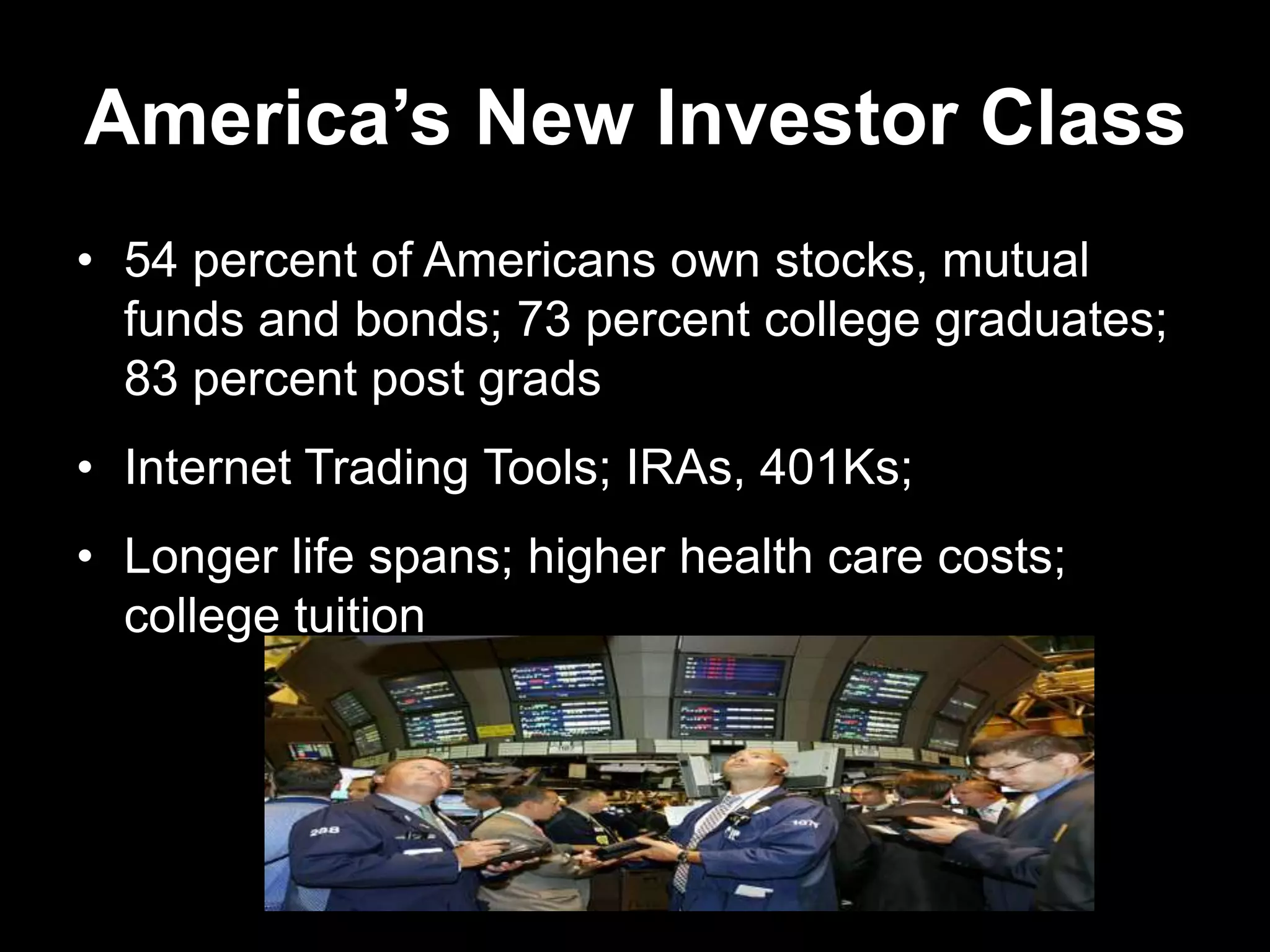
America’s New Investor Class
• 54 percent of Americans own stocks, mutual
funds and bonds; 73 percent college graduates;
83 percent post grads
• Internet Trading Tools; IRAs, 401Ks;
• Longer life spans; higher health care costs;
college tuition
24-Hour Financial News?
• Wall Street Journal, Financial Times, Investor’s
Business Daily
• Fortune, Forbes, Business Week, Barron's
• CNBC, Fox Business, Bloomberg TV
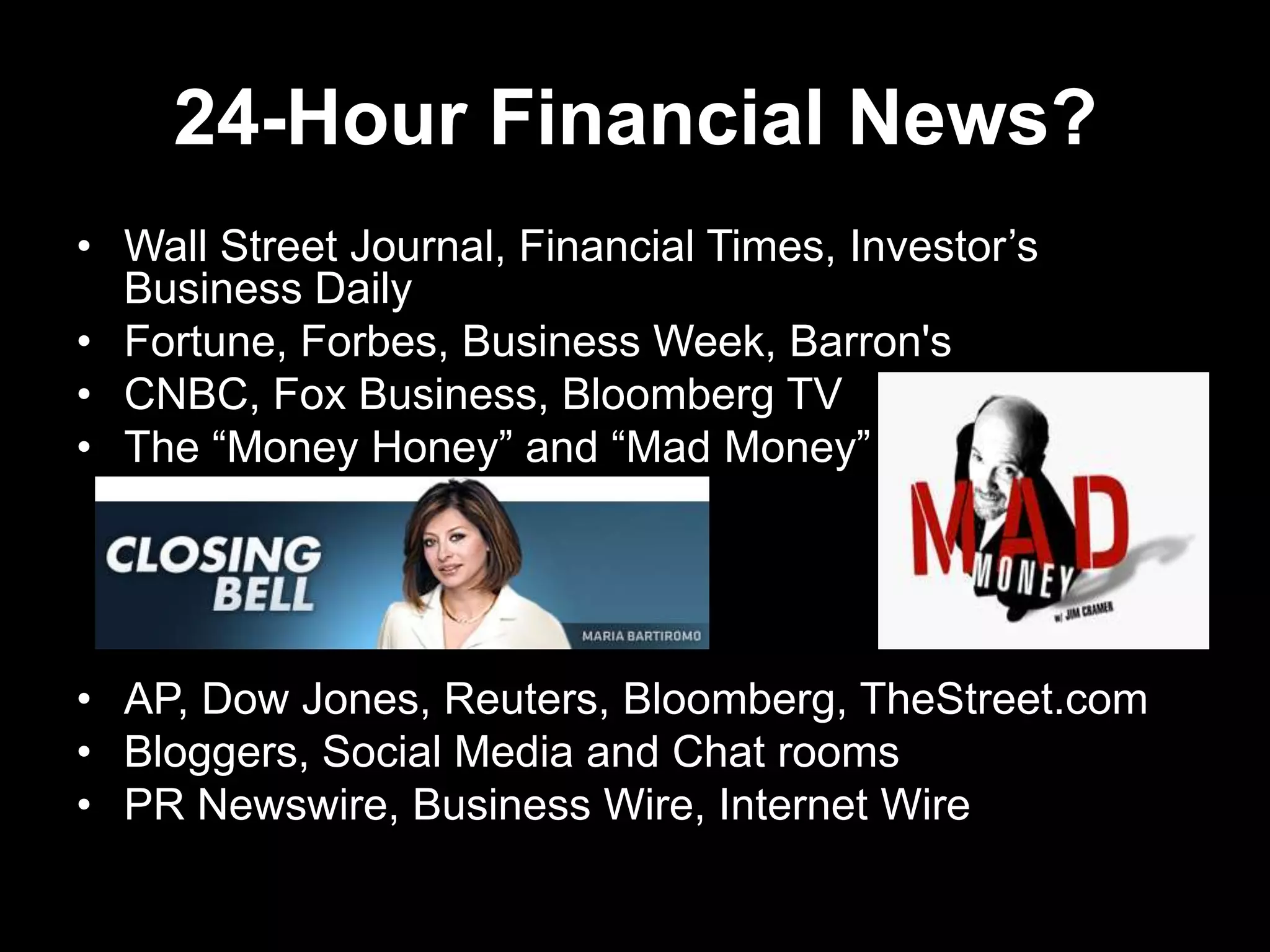
• The ―Money Honey‖ and ―Mad Money‖
• AP, Dow Jones, Reuters, Bloomberg, TheStreet.com
• Bloggers, Social Media and Chat rooms
• PR Newswire, Business Wire, Internet Wire
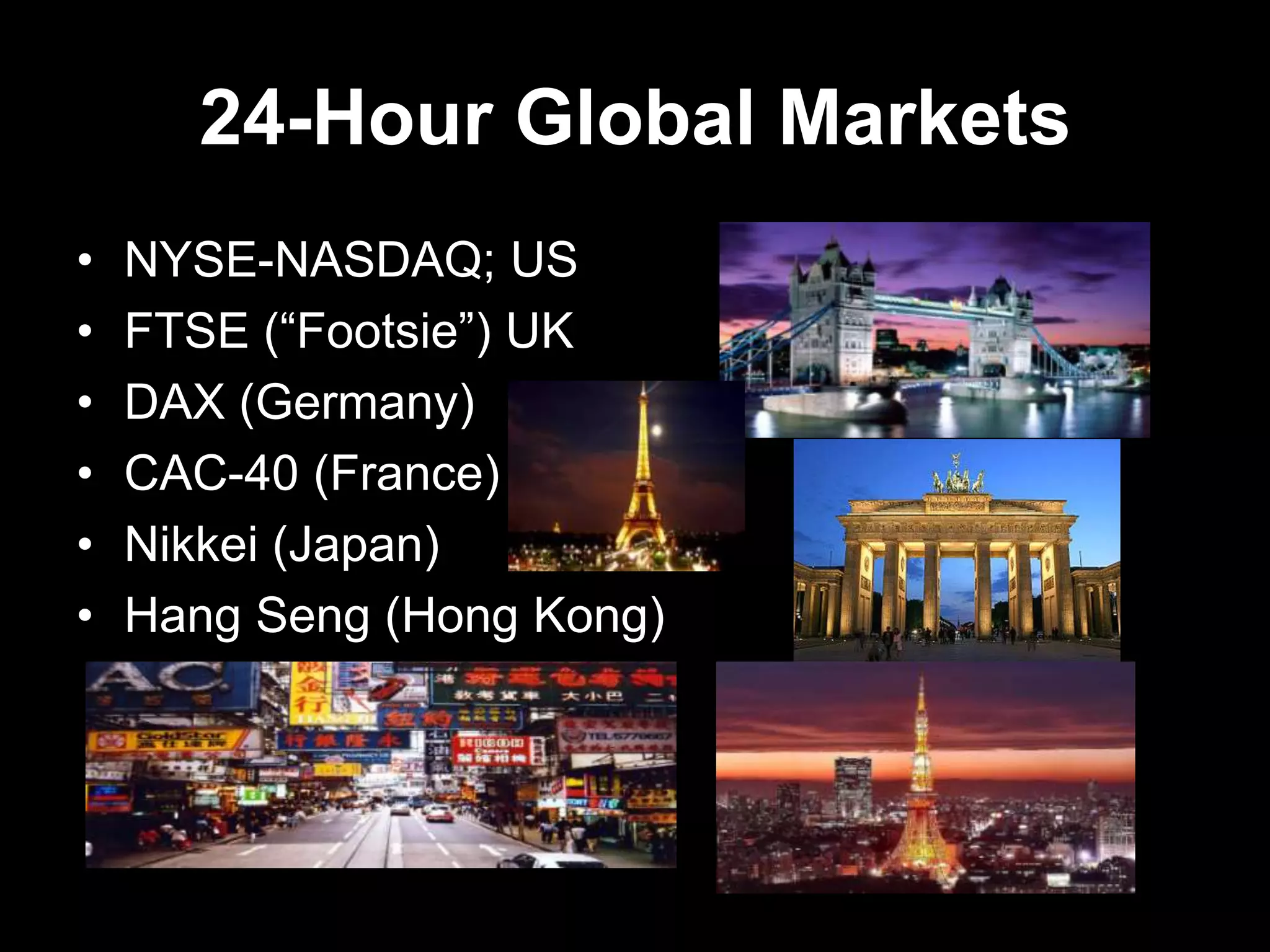
24-Hour Global Markets
• NYSE-NASDAQ; US
• FTSE (―Footsie‖) UK
• DAX (Germany)
• CAC-40 (France)
• Nikkei (Japan)
• Hang Seng (Hong Kong)
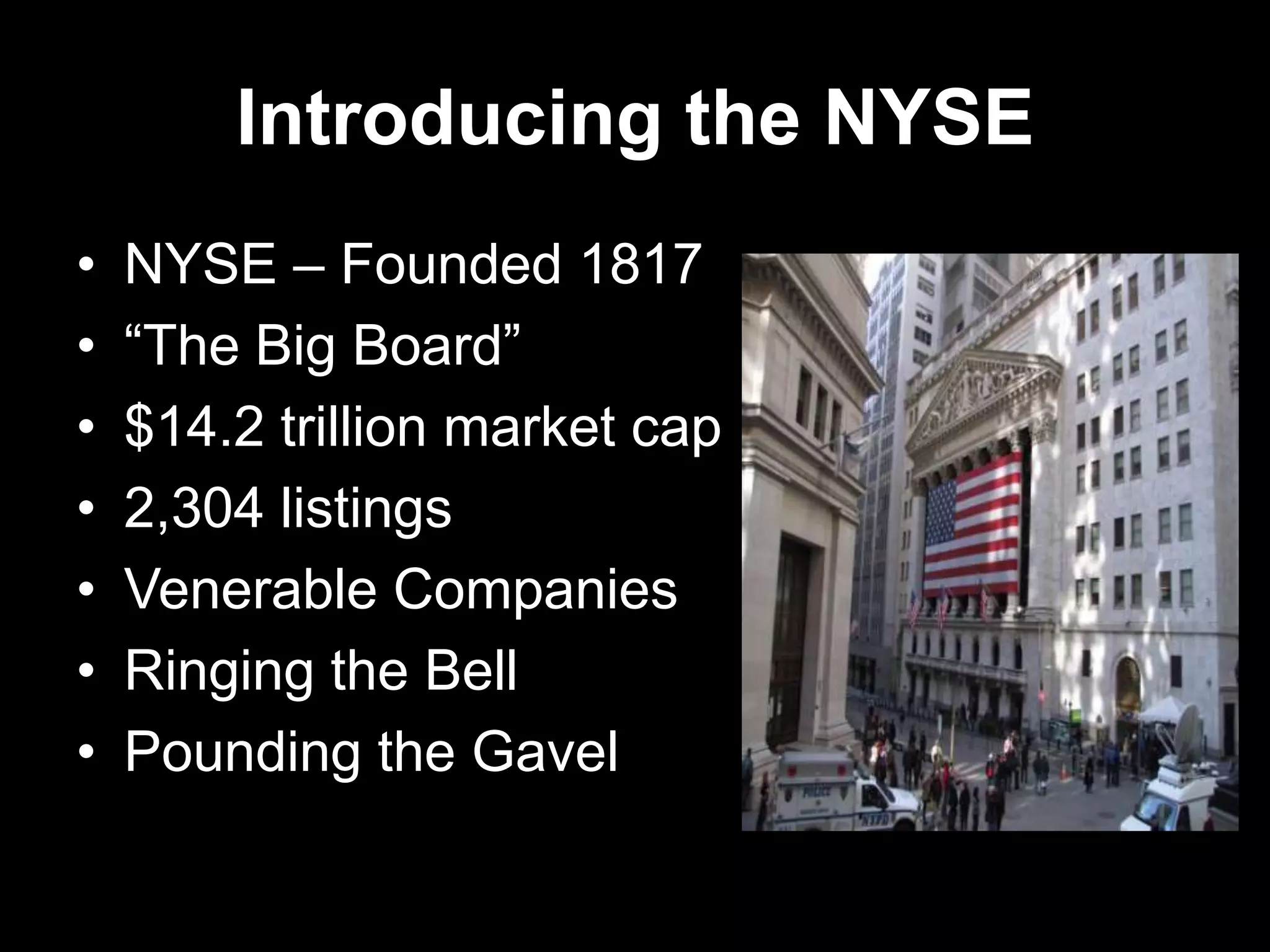
Introducing the NYSE
• NYSE – Founded 1817
• ―The Big Board‖
• $14.2 trillion market cap
• 2,304 listings
• Venerable Companies
• Ringing the Bell
• Pounding the Gavel
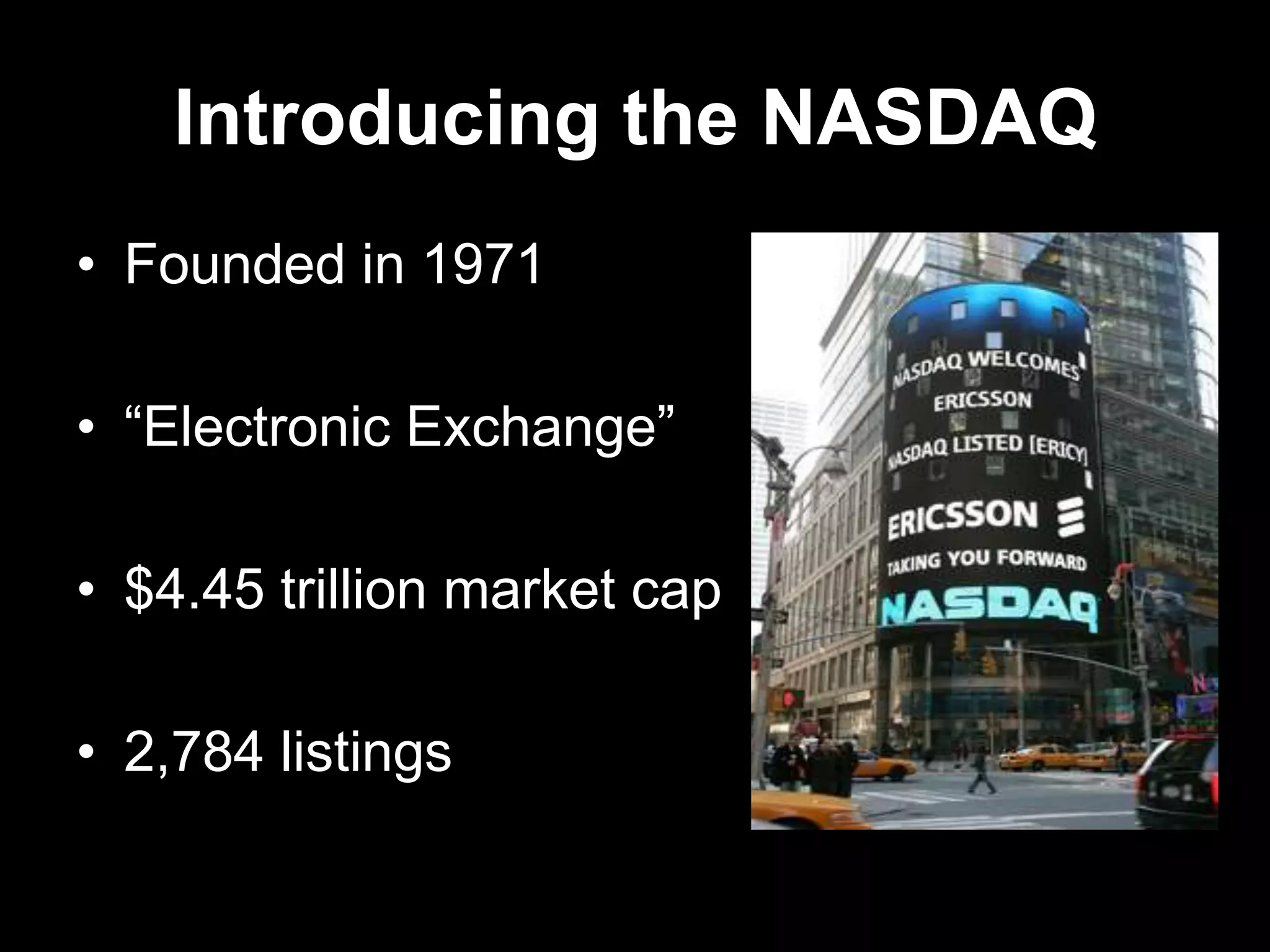
Introducing the NASDAQ
• Founded in 1971
• ―Electronic Exchange‖
• $4.45 trillion market cap
• 2,784 listings
SEC Disclosure Rules
• Annual Report to Shareholders (10K)
• Quarterly Earnings Reports (10Q)
• Major Unplanned Announcements (8K)
– Upside / Downside Guidance Variations
– Mergers and Acquisitions
– Restructurings
• Annual Meeting of Shareholders
• Prospectus for Planned IPO (S1)
• Selling Additional Shares (S4)
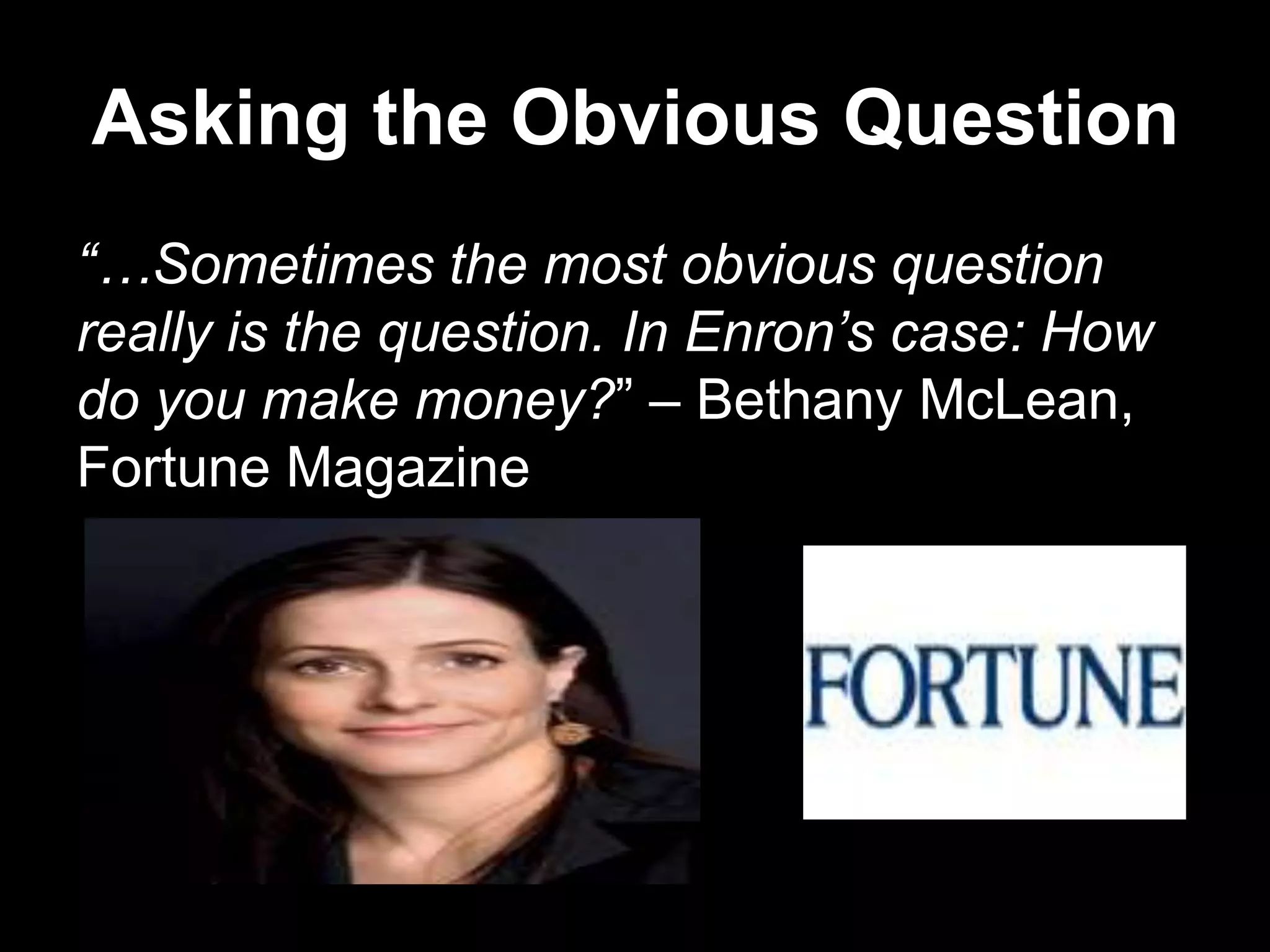
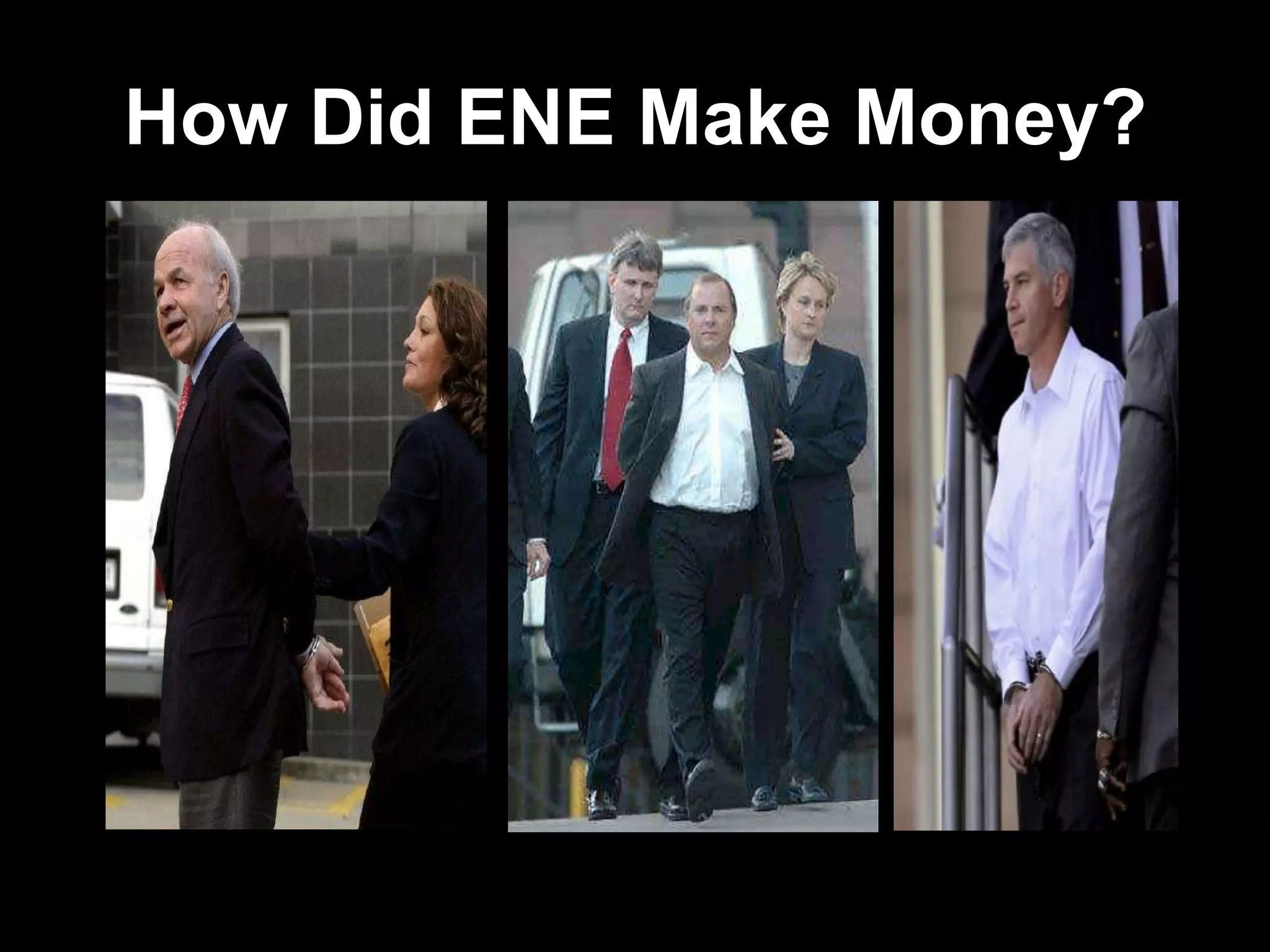
Asking the Obvious Question
“…Sometimes the most obvious question
really is the question. In Enron’s case: How
do you make money?‖ – Bethany McLean,
Fortune Magazine
How Did ENE Make Money?
How Does AMZN Make Money?
How Does NKE Make Money?
How Does JWN Make Money?
How Does SBUX Make Money?
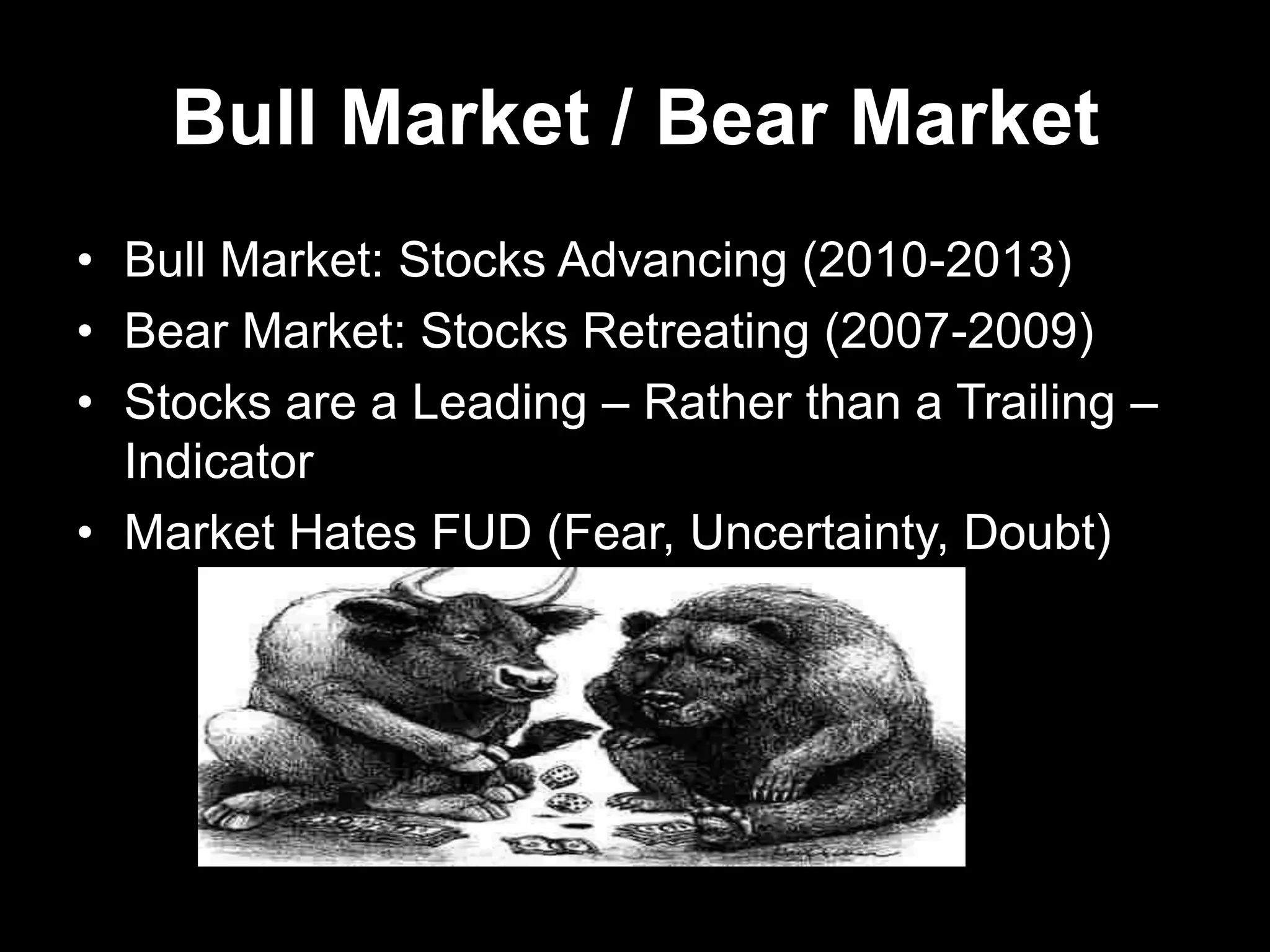
Bull Market / Bear Market
• Bull Market: Stocks Advancing (2010-2013)
• Bear Market: Stocks Retreating (2007-2009)
• Stocks are a Leading – Rather than a Trailing –
Indicator
• Market Hates FUD (Fear, Uncertainty, Doubt)
How Do We Determine
“Market Cap” or “Market Value?”
• Why Do We Care?
Quick Market Definitions
• GAAP: Generally Accepted Accounting
Principles
• EPS: Earnings Per Share
• IPO: Initial Public Offering
• Market Capitalization: Share price x
Number of Shares Outstanding = Value
• SEC: Securities Exchange Commission
What Does Wall Street
Really Care About?
• Top Line
• Bottom Line
• Gross Margin
• Year-over-Year
• Cash
• EPS
• Dividends
Apple Q2 2013 Results
• Revenues: $43.6 billion
• Cost of Sales: $27.25 billion
• Gross Margin: $16.34 billion
• R&D: $1.11 billion
• SG&A: $2.67 billion
• Operating Income: $12.35 billion
• Taxes: $3.35 billion
• Net Income: $9.54 billion
• EPS: $10.09 per share (946,035 Shares)
• Cash Dividend: $2.65 per share
How Do We Compute EPS?
• Why is this metric important?
Amazon Q4 2012 Balance Sheet
• Cash/Short-Term: $8.08 billion
• Accounts Receivable: $3.81 billion
• Inventories: $6.03 billion
• Current Assets: $21.29 billion
• PPE: $7.06 billion
• Total: $32.55 billion
• Accounts Payable: $13.31 billion
• Current Liabilities: $19.00 billion
• Long-Term Debt: $3.08 billion
• Total Liabilities: $24.06 billion
• Equity (Stock): $8.19 billion
• Total Liabilities/Equity: $32.55 billion
• 500 million shares
What is P/E Ratio
What is the “Multiple”
• Company Stock Price Divided by Earnings Per
Share
• How Many Times Earnings is the Stock Price? –
The ―Multiple‖
• $60 price/$2.50 EPS = 24 Multiple
What is P/E Ratio?
• Ratio Used by Investors to Examine
Performance of a Company Stock
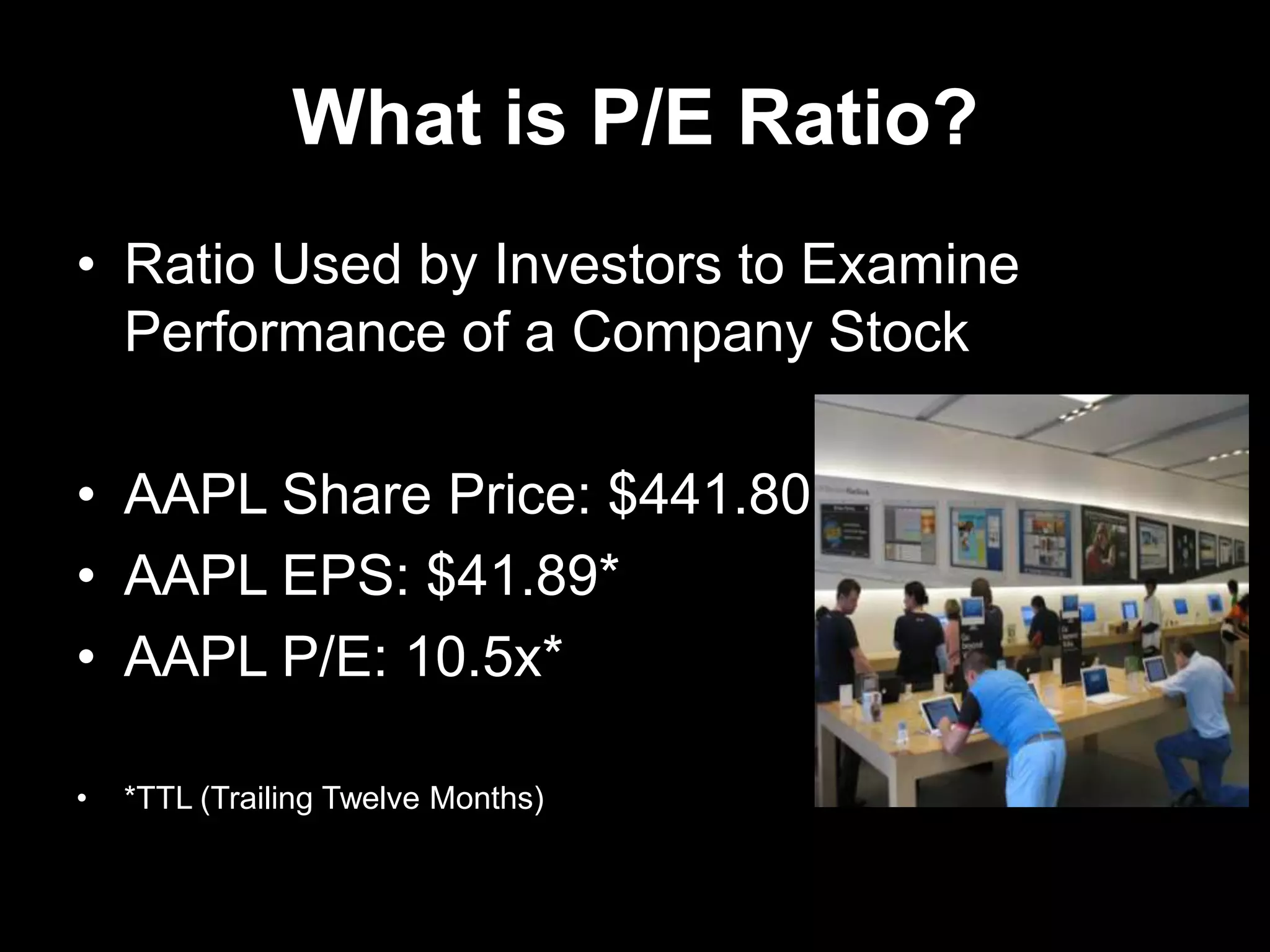
• AAPL Share Price: $441.80
• AAPL EPS: $41.89*
• AAPL P/E: 10.5x*
• *TTL (Trailing Twelve Months)
Institutional vs. Retail Investors
• Buy Side: Major mutual funds (Fidelity, Janus,
Putnam etc.); public employee retirement
systems; ―Institutional Investors‖
• Sell Side: Investment firms (JP Morgan, Morgan
Stanley)
• Retail Investors: Charles Schwab, TD
Waterhouse, E-Trade
Doing Well vs. Doing Good
Fiduciary Responsibility
• ERISA Mandate
• Investors Expect Returns
• Employees Expect
Returns
• Need to Stay in Business
• Board Oversight
• Potential Securities
Litigation
Corporate Social
Responsibility
• Multiple Stakeholders
• Giving Back
• Heightened Trust
• Benefit of the Doubt
• Creative Capitalism
• Counter to NGOs
• No ―Greenwashing‖
• No ―Pinkwashing‖
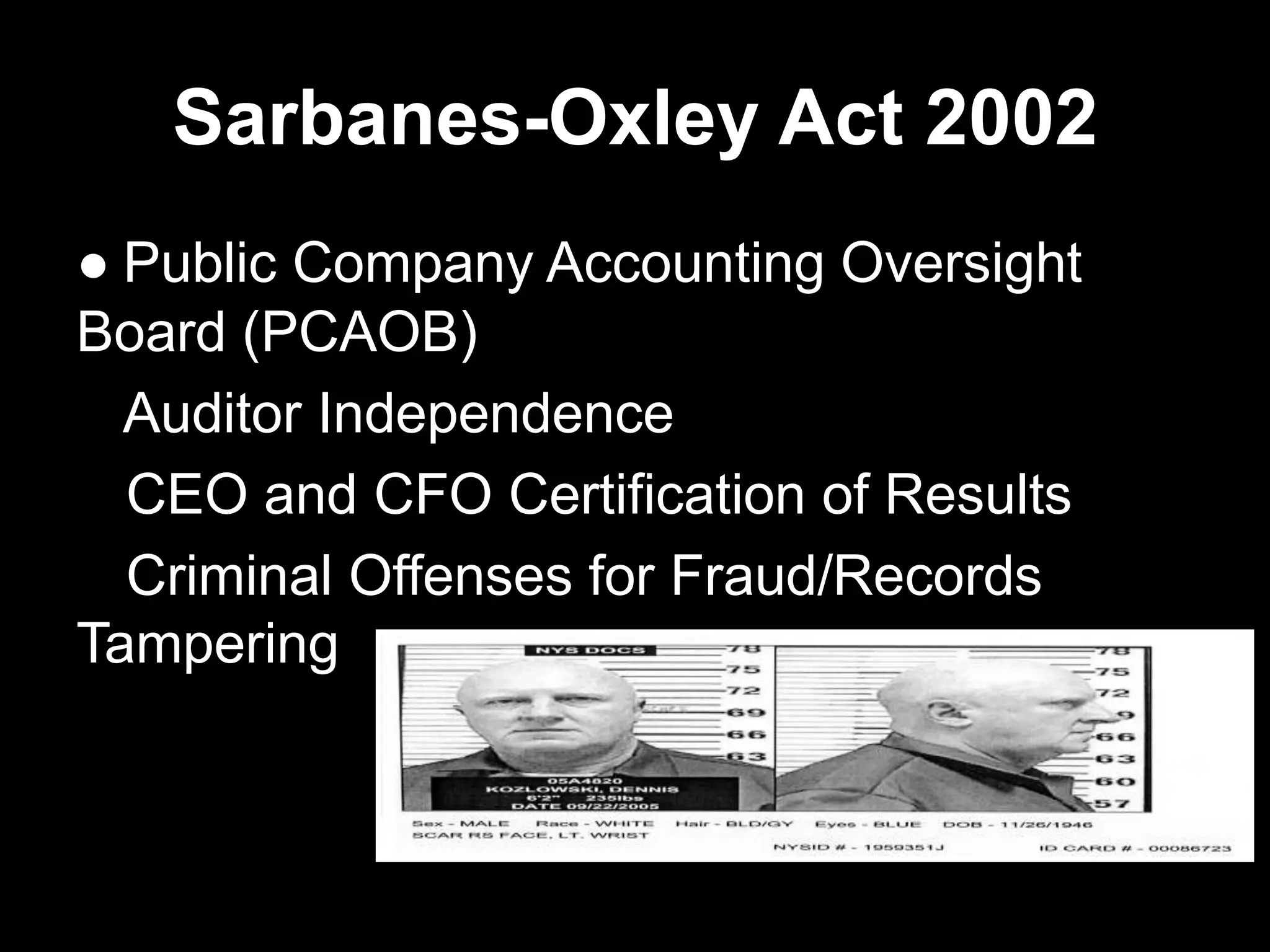
Sarbanes-Oxley Act 2002
● Public Company Accounting Oversight
Board (PCAOB)
Auditor Independence
CEO and CFO Certification of Results
Criminal Offenses for Fraud/Records
Tampering
SEC Fair Disclosure
• Regulation FD provides that when a company
discloses ―material‖ nonpublic information to
certain individuals or entities — such as stock
analysts or shareholders — the company must
make public disclosure of that information. In this
way, the new rule aims to promote the full-and-
fair disclosure.
• (Media Exempted)
GAAP vs. Pro Forma
• GAAP Greater or Equal Prominence to Pro Forma – SEC Reg. G
• GAAP: Generally Accepted Accounting Principles
• Pro Forma, Non-GAAP or Earnings Before Special Items
• Pro Forma: “For The Sake of Form”
• Pro Forma: Results from Continuing Operations
GAAP: Q1 Income Statement
Mallard.com (DUCK: NASDAQ)
• Revenues: $2 million
• COGS: $1 million
• Gross Margin: $1 million
• SG&A: $250,000
• R&D: $250,000
• Amortization: $1 million
• Operating Margin: ($500,000)
• Taxes: $200,000
• Net Loss: ($700,000)
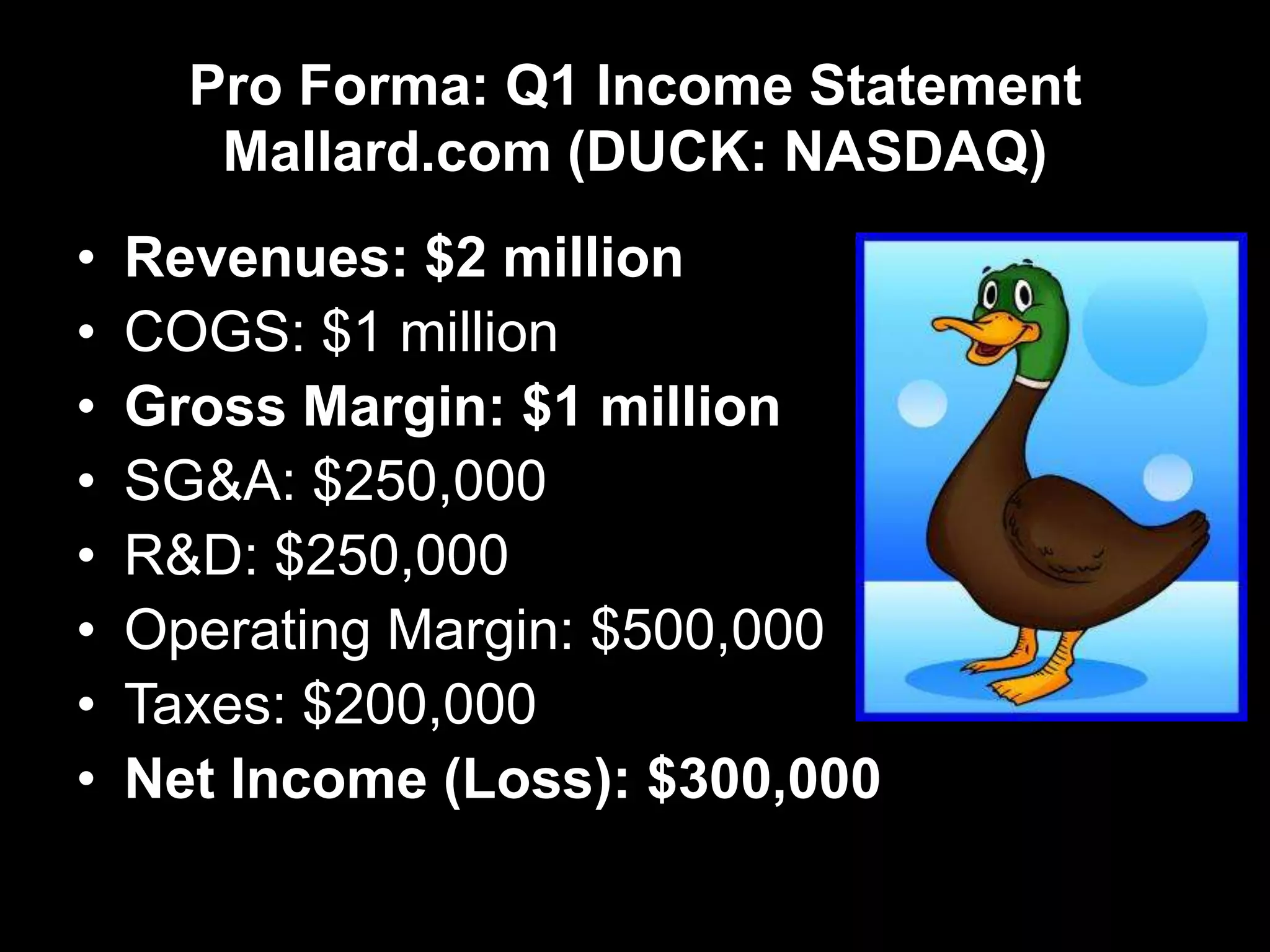
Pro Forma: Q1 Income Statement
Mallard.com (DUCK: NASDAQ)
• Revenues: $2 million
• COGS: $1 million
• Gross Margin: $1 million
• SG&A: $250,000
• R&D: $250,000
• Operating Margin: $500,000
• Taxes: $200,000
• Net Income (Loss): $300,000
Common Questions on Deals
• Size of Deal?
• Financing? $20.1 billion?
• How many are going to be laid off?
• Is the deal accretive or dilutive to EPS?
• Is there any product or customer overlap?
• How will you integrate the two companies?
• Anti-Trust Issues?
• Will you report the deal on a Pro Forma basis?
Financing the Deal?
Paying a “Premium?”
• Cash from Balance Sheet
• Stock (1 for 1 or Ratio)
• S4 (Issue More Stock)
• LBO (Leveraged Buyout): Combo of Cash/Stock
and Debt
Buy Low, Sell High

Buy Low, Sell High

  • 1.
  • 2.
    America’s New InvestorClass • 54 percent of Americans own stocks, mutual funds and bonds; 73 percent college graduates; 83 percent post grads • Internet Trading Tools; IRAs, 401Ks; • Longer life spans; higher health care costs; college tuition
  • 3.
    24-Hour Financial News? •Wall Street Journal, Financial Times, Investor’s Business Daily • Fortune, Forbes, Business Week, Barron's • CNBC, Fox Business, Bloomberg TV • The ―Money Honey‖ and ―Mad Money‖ • AP, Dow Jones, Reuters, Bloomberg, TheStreet.com • Bloggers, Social Media and Chat rooms • PR Newswire, Business Wire, Internet Wire
  • 4.
    24-Hour Global Markets •NYSE-NASDAQ; US • FTSE (―Footsie‖) UK • DAX (Germany) • CAC-40 (France) • Nikkei (Japan) • Hang Seng (Hong Kong)
  • 5.
    Introducing the NYSE •NYSE – Founded 1817 • ―The Big Board‖ • $14.2 trillion market cap • 2,304 listings • Venerable Companies • Ringing the Bell • Pounding the Gavel
  • 6.
    Introducing the NASDAQ •Founded in 1971 • ―Electronic Exchange‖ • $4.45 trillion market cap • 2,784 listings
  • 7.
    SEC Disclosure Rules •Annual Report to Shareholders (10K) • Quarterly Earnings Reports (10Q) • Major Unplanned Announcements (8K) – Upside / Downside Guidance Variations – Mergers and Acquisitions – Restructurings • Annual Meeting of Shareholders • Prospectus for Planned IPO (S1) • Selling Additional Shares (S4)
  • 8.
    Asking the ObviousQuestion “…Sometimes the most obvious question really is the question. In Enron’s case: How do you make money?‖ – Bethany McLean, Fortune Magazine
  • 9.
    How Did ENEMake Money?
  • 10.
    How Does AMZNMake Money?
  • 11.
    How Does NKEMake Money?
  • 12.
    How Does JWNMake Money?
  • 13.
    How Does SBUXMake Money?
  • 14.
    Bull Market /Bear Market • Bull Market: Stocks Advancing (2010-2013) • Bear Market: Stocks Retreating (2007-2009) • Stocks are a Leading – Rather than a Trailing – Indicator • Market Hates FUD (Fear, Uncertainty, Doubt)
  • 15.
    How Do WeDetermine “Market Cap” or “Market Value?” • Why Do We Care?
  • 16.
    Quick Market Definitions •GAAP: Generally Accepted Accounting Principles • EPS: Earnings Per Share • IPO: Initial Public Offering • Market Capitalization: Share price x Number of Shares Outstanding = Value • SEC: Securities Exchange Commission
  • 17.
    What Does WallStreet Really Care About? • Top Line • Bottom Line • Gross Margin • Year-over-Year • Cash • EPS • Dividends
  • 18.
    Apple Q2 2013Results • Revenues: $43.6 billion • Cost of Sales: $27.25 billion • Gross Margin: $16.34 billion • R&D: $1.11 billion • SG&A: $2.67 billion • Operating Income: $12.35 billion • Taxes: $3.35 billion • Net Income: $9.54 billion • EPS: $10.09 per share (946,035 Shares) • Cash Dividend: $2.65 per share
  • 19.
    How Do WeCompute EPS? • Why is this metric important?
  • 20.
    Amazon Q4 2012Balance Sheet • Cash/Short-Term: $8.08 billion • Accounts Receivable: $3.81 billion • Inventories: $6.03 billion • Current Assets: $21.29 billion • PPE: $7.06 billion • Total: $32.55 billion • Accounts Payable: $13.31 billion • Current Liabilities: $19.00 billion • Long-Term Debt: $3.08 billion • Total Liabilities: $24.06 billion • Equity (Stock): $8.19 billion • Total Liabilities/Equity: $32.55 billion • 500 million shares
  • 21.
    What is P/ERatio What is the “Multiple” • Company Stock Price Divided by Earnings Per Share • How Many Times Earnings is the Stock Price? – The ―Multiple‖ • $60 price/$2.50 EPS = 24 Multiple
  • 22.
    What is P/ERatio? • Ratio Used by Investors to Examine Performance of a Company Stock • AAPL Share Price: $441.80 • AAPL EPS: $41.89* • AAPL P/E: 10.5x* • *TTL (Trailing Twelve Months)
  • 23.
    Institutional vs. RetailInvestors • Buy Side: Major mutual funds (Fidelity, Janus, Putnam etc.); public employee retirement systems; ―Institutional Investors‖ • Sell Side: Investment firms (JP Morgan, Morgan Stanley) • Retail Investors: Charles Schwab, TD Waterhouse, E-Trade
  • 24.
    Doing Well vs.Doing Good Fiduciary Responsibility • ERISA Mandate • Investors Expect Returns • Employees Expect Returns • Need to Stay in Business • Board Oversight • Potential Securities Litigation Corporate Social Responsibility • Multiple Stakeholders • Giving Back • Heightened Trust • Benefit of the Doubt • Creative Capitalism • Counter to NGOs • No ―Greenwashing‖ • No ―Pinkwashing‖
  • 25.
    Sarbanes-Oxley Act 2002 ●Public Company Accounting Oversight Board (PCAOB) Auditor Independence CEO and CFO Certification of Results Criminal Offenses for Fraud/Records Tampering
  • 26.
    SEC Fair Disclosure •Regulation FD provides that when a company discloses ―material‖ nonpublic information to certain individuals or entities — such as stock analysts or shareholders — the company must make public disclosure of that information. In this way, the new rule aims to promote the full-and- fair disclosure. • (Media Exempted)
  • 27.
    GAAP vs. ProForma • GAAP Greater or Equal Prominence to Pro Forma – SEC Reg. G • GAAP: Generally Accepted Accounting Principles • Pro Forma, Non-GAAP or Earnings Before Special Items • Pro Forma: “For The Sake of Form” • Pro Forma: Results from Continuing Operations
  • 28.
    GAAP: Q1 IncomeStatement Mallard.com (DUCK: NASDAQ) • Revenues: $2 million • COGS: $1 million • Gross Margin: $1 million • SG&A: $250,000 • R&D: $250,000 • Amortization: $1 million • Operating Margin: ($500,000) • Taxes: $200,000 • Net Loss: ($700,000)
  • 29.
    Pro Forma: Q1Income Statement Mallard.com (DUCK: NASDAQ) • Revenues: $2 million • COGS: $1 million • Gross Margin: $1 million • SG&A: $250,000 • R&D: $250,000 • Operating Margin: $500,000 • Taxes: $200,000 • Net Income (Loss): $300,000
  • 30.
    Common Questions onDeals • Size of Deal? • Financing? $20.1 billion? • How many are going to be laid off? • Is the deal accretive or dilutive to EPS? • Is there any product or customer overlap? • How will you integrate the two companies? • Anti-Trust Issues? • Will you report the deal on a Pro Forma basis?
  • 31.
    Financing the Deal? Payinga “Premium?” • Cash from Balance Sheet • Stock (1 for 1 or Ratio) • S4 (Issue More Stock) • LBO (Leveraged Buyout): Combo of Cash/Stock and Debt