Statistics
• Is concerned with
• Collecting
• Organizing
• Summarizing
• Presenting and Analyzing data
• To draw valid conclusions &
making reasonable decisions
on the basis of such analysis
Collecting data
• Can collect data concerning
–Characteristics of a groups of
individuals or objects
–E.g. 100 blood donors donate 100
bottles of blood in Blood Bank
Organizing data
• Can organize data by classifying
different groups
– Sex and blood type of blood donors
– E.g. Male, Female and A,B,AB & O
Summarizing data
• Can summarize the number of
individual in each class
–E.g 60 males and 40 females
–15 A, 30 B, 5 AB and 50 O
Presenting data
• Can present data by
rate, ratio,
percentage, diagram
ect
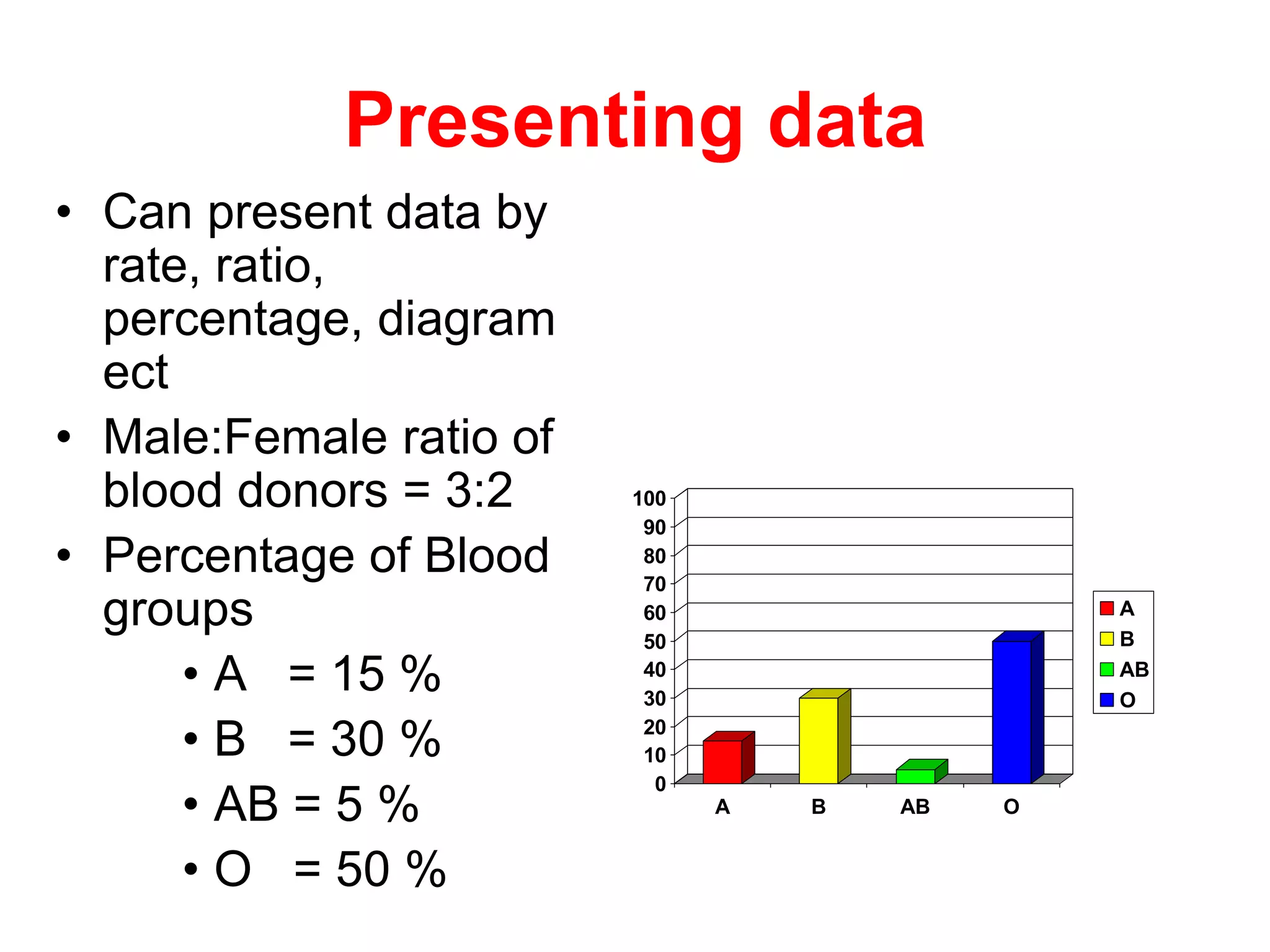
• Male:Female ratio of
blood donors = 3:2
• Percentage of Blood
groups
• A = 15 %
• B = 30 %
• AB = 5 %
• O = 50 %
0
10
20
30
40
50
60
70
80
90
100
A B AB O
A
B
AB
O
Analyzing data
• From presentation, the findings can be
analyzed such as more male blood
donors than female
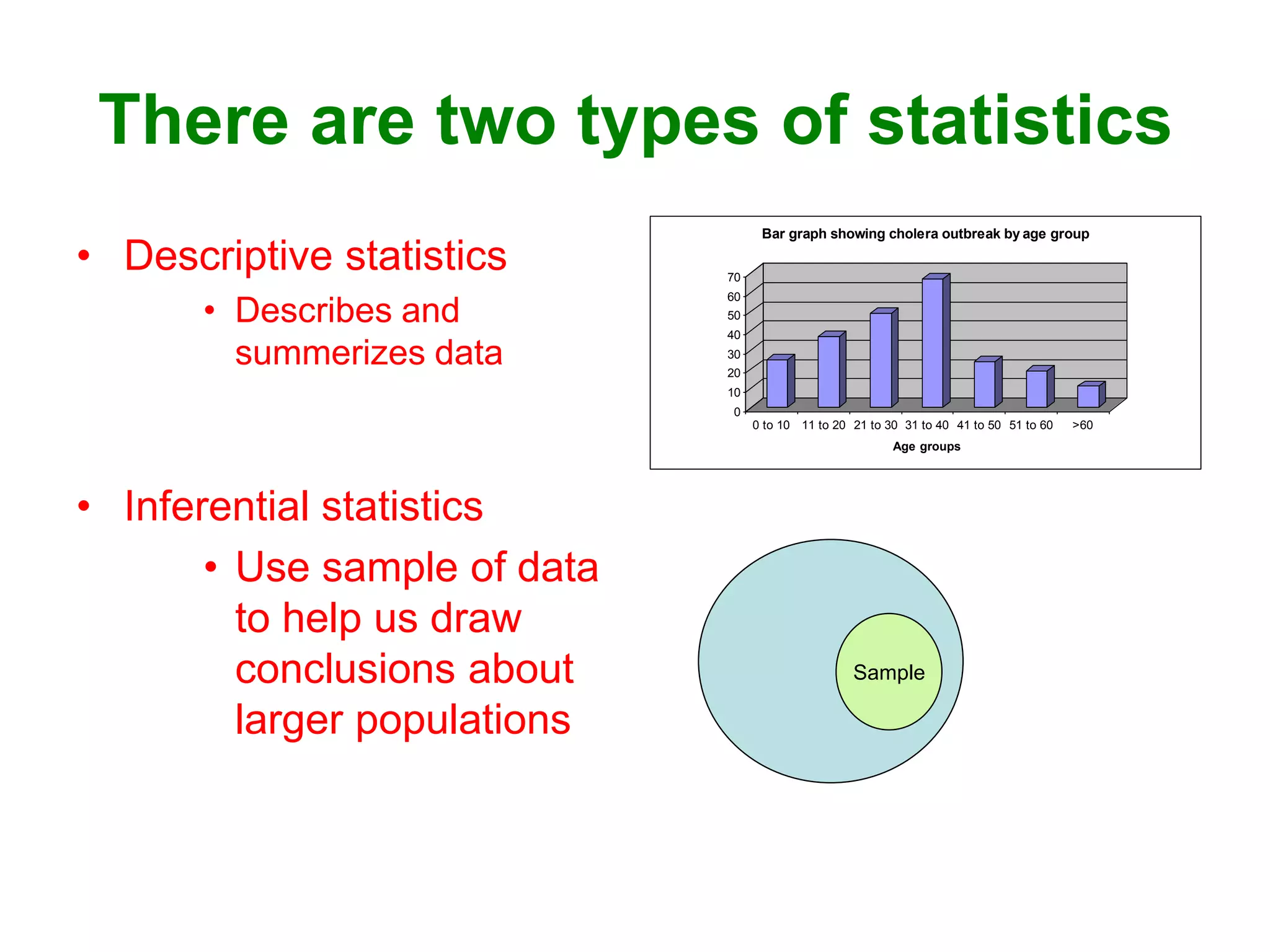
There are two types of statistics
• Descriptive statistics
• Describes and
summerizes data
• Inferential statistics
• Use sample of data
to help us draw
conclusions about
larger populations
0
10
20
30
40
50
60
70
0 to 10 11 to 20 21 to 30 31 to 40 41 to 50 51 to 60 >60
Age groups
Bar graph showing cholera outbreak by age group
Sample
Clinical trial for Antihypertensive drug
• Population with SBP = 180 mm Hg
• Random sample = 10 patients
• Give antihypertensive drug
• After drug, sample mean SBP = 170 mm Hg
• Can we conclude that the drug was effective not
without a statistical analysis?
• No (need to compute probability due to chance )
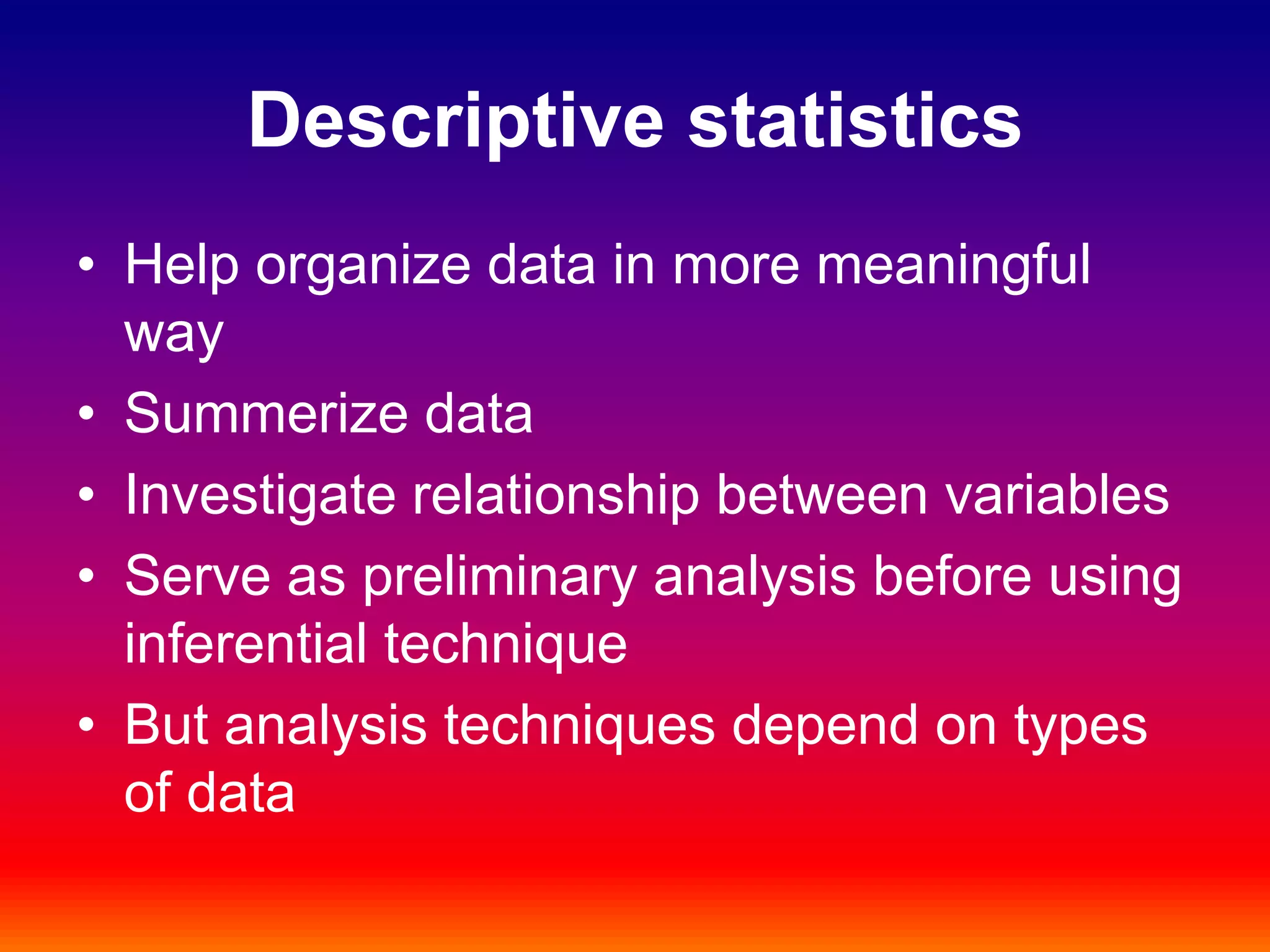
Descriptive statistics
• Help organize data in more meaningful
way
• Summerize data
• Investigate relationship between variables
• Serve as preliminary analysis before using
inferential technique
• But analysis techniques depend on types
of data
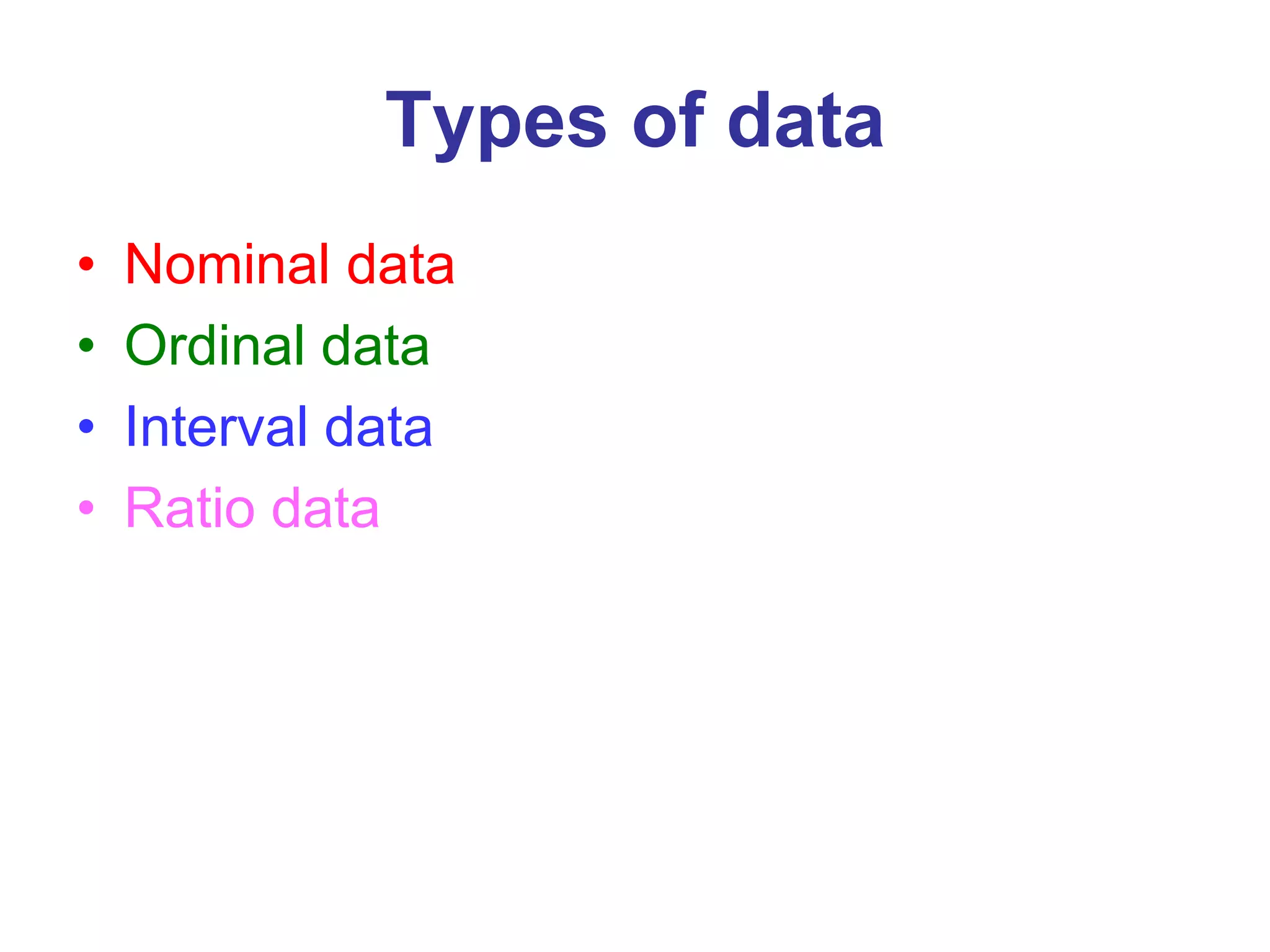
Types of data
• Nominal data
• Ordinal data
• Interval data
• Ratio data
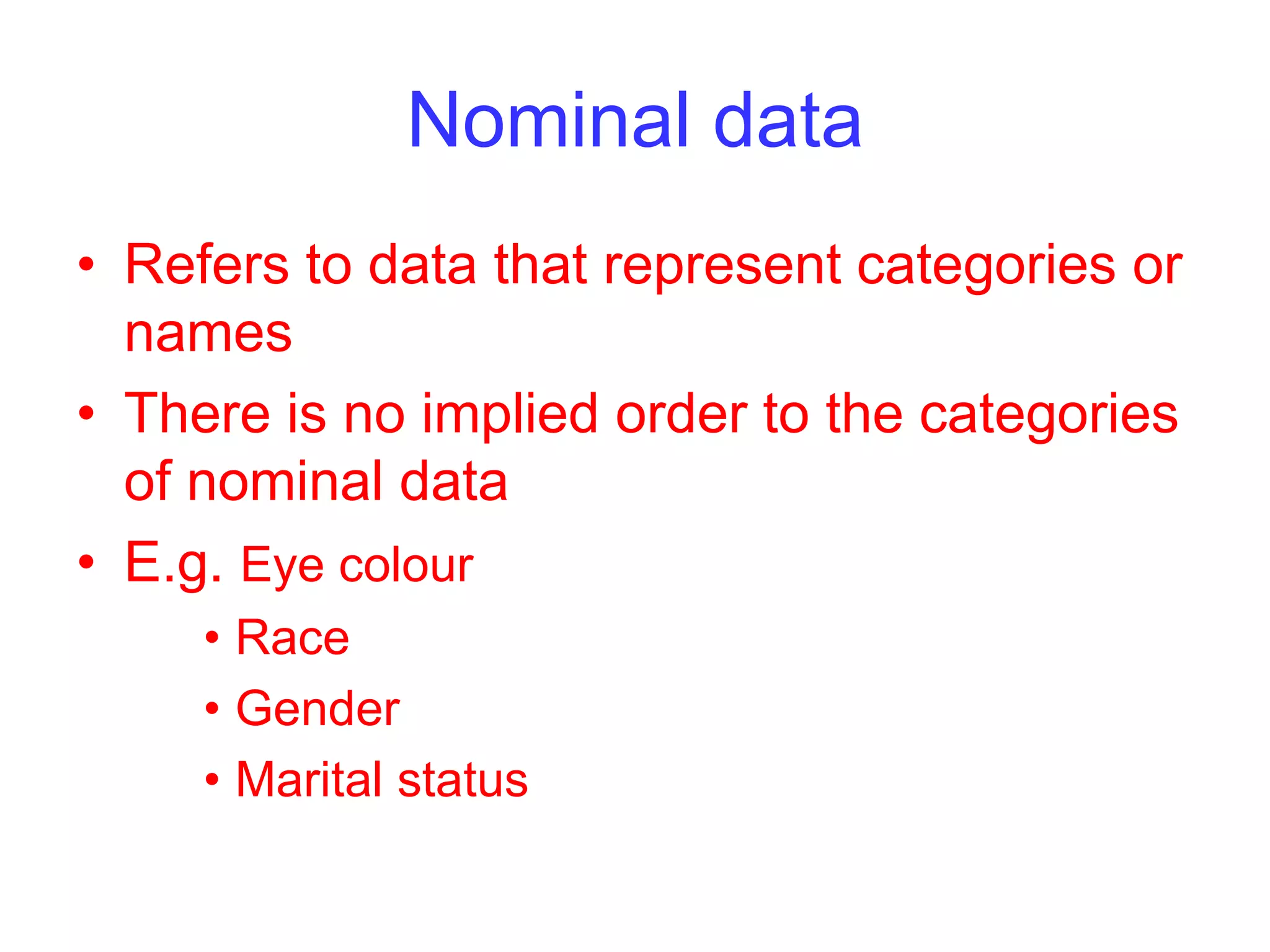
Nominal data
• Refers to data that represent categories or
names
• There is no implied order to the categories
of nominal data
• E.g. Eye colour
• Race
• Gender
• Marital status
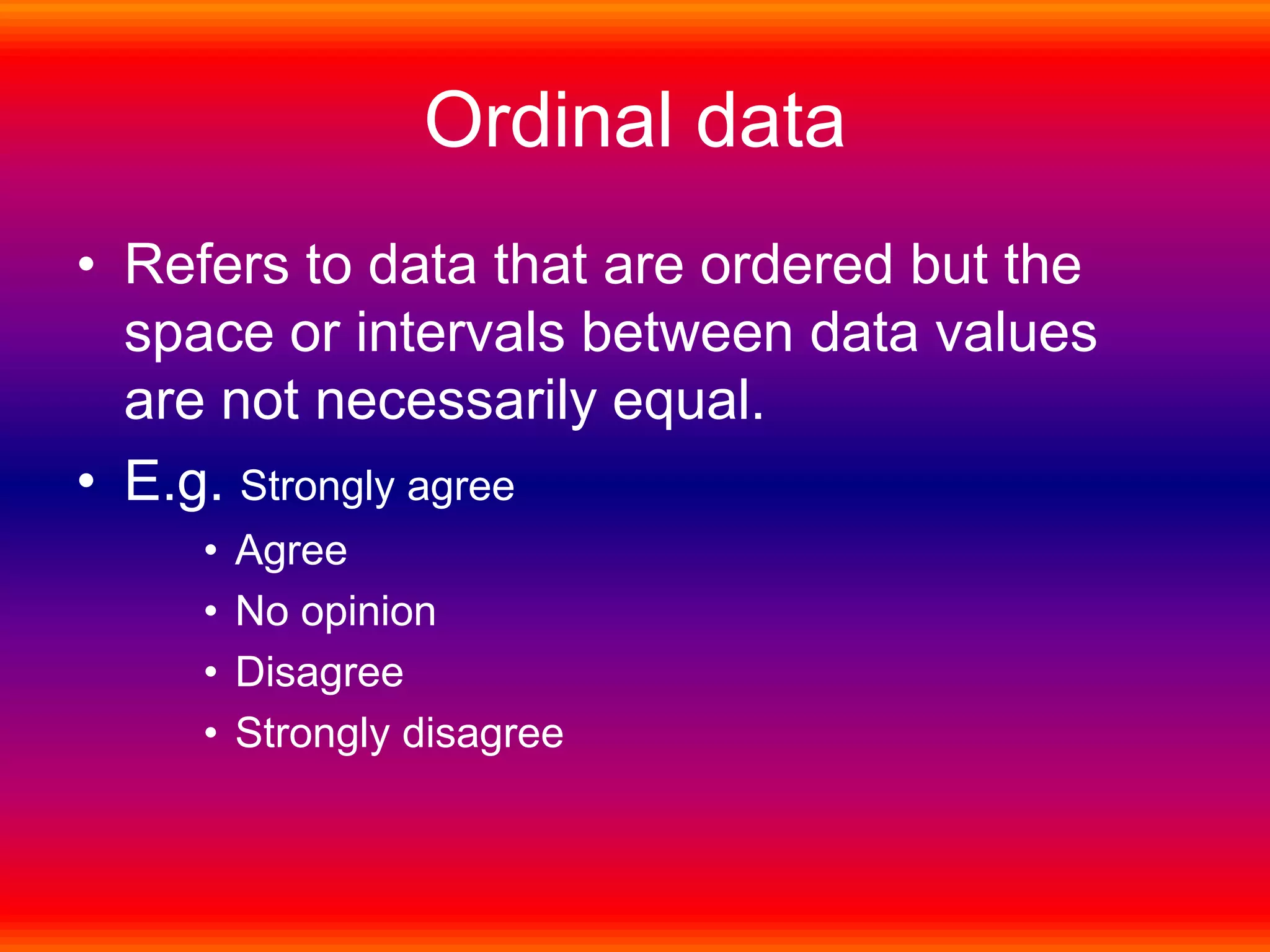
Ordinal data
• Refers to data that are ordered but the
space or intervals between data values
are not necessarily equal.
• E.g. Strongly agree
• Agree
• No opinion
• Disagree
• Strongly disagree
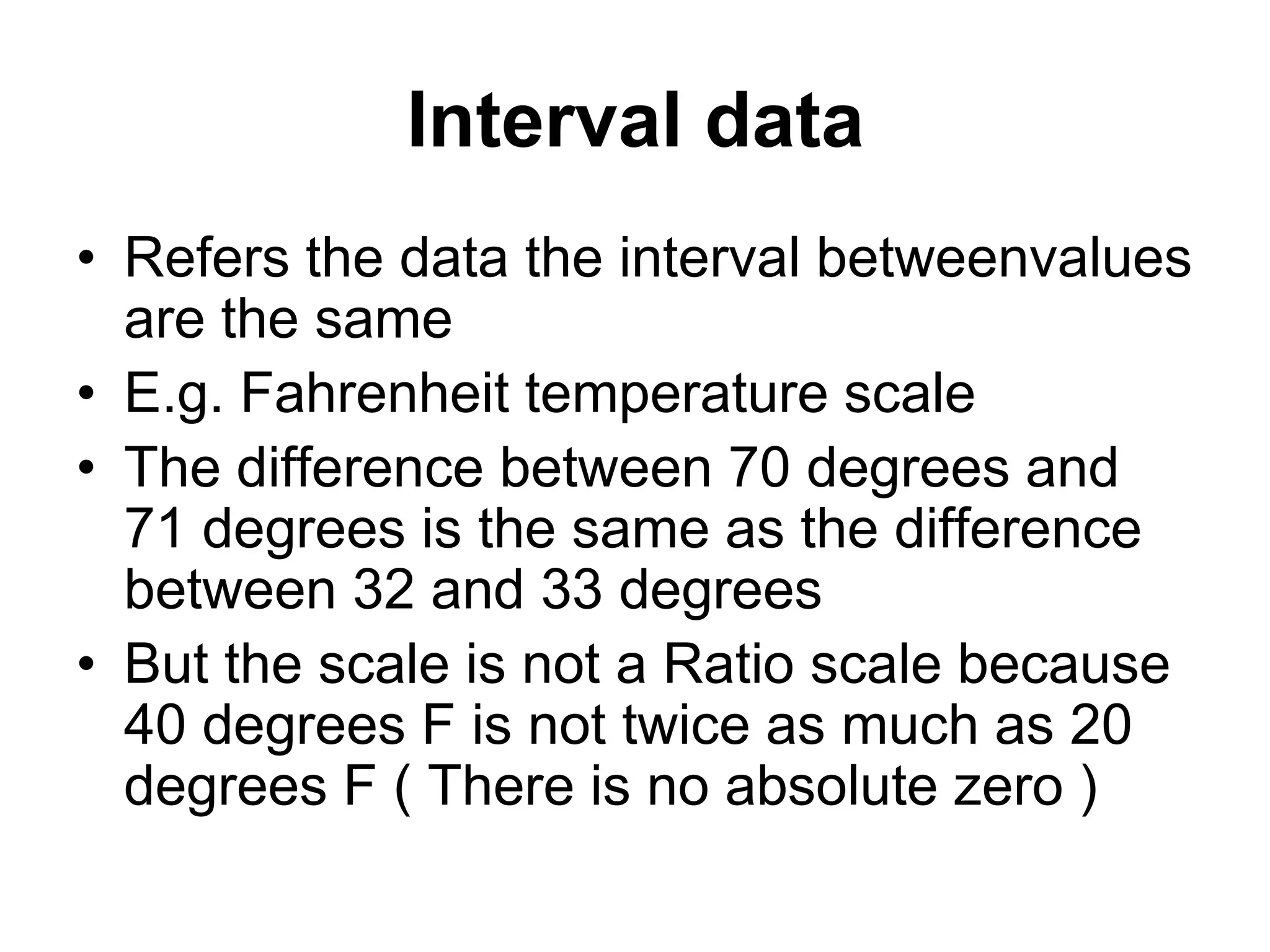
Interval data
• Refers the data the interval betweenvalues
are the same
• E.g. Fahrenheit temperature scale
• The difference between 70 degrees and
71 degrees is the same as the difference
between 32 and 33 degrees
• But the scale is not a Ratio scale because
40 degrees F is not twice as much as 20
degrees F ( There is no absolute zero )
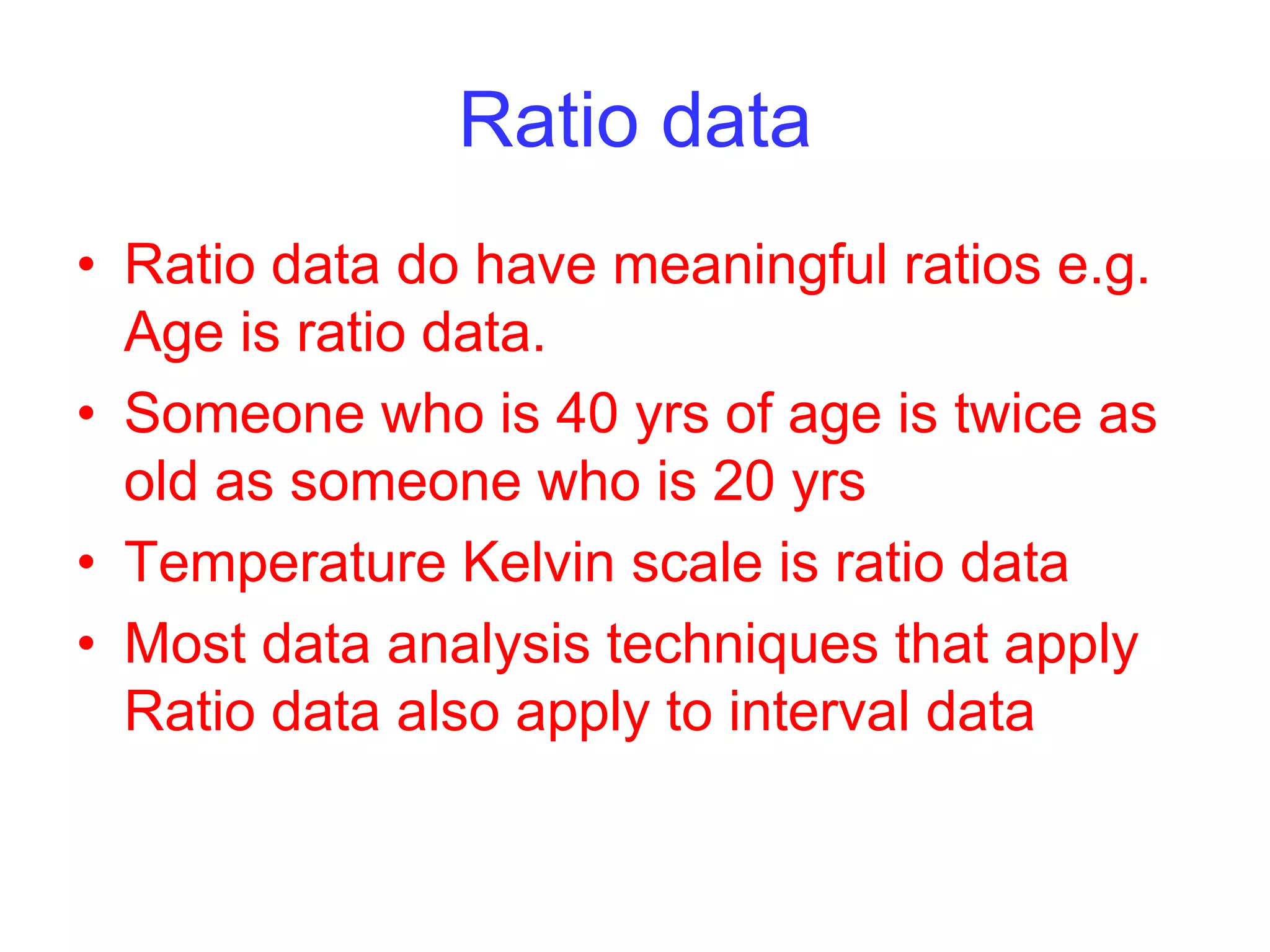
Ratio data
• Ratio data do have meaningful ratios e.g.
Age is ratio data.
• Someone who is 40 yrs of age is twice as
old as someone who is 20 yrs
• Temperature Kelvin scale is ratio data
• Most data analysis techniques that apply
Ratio data also apply to interval data
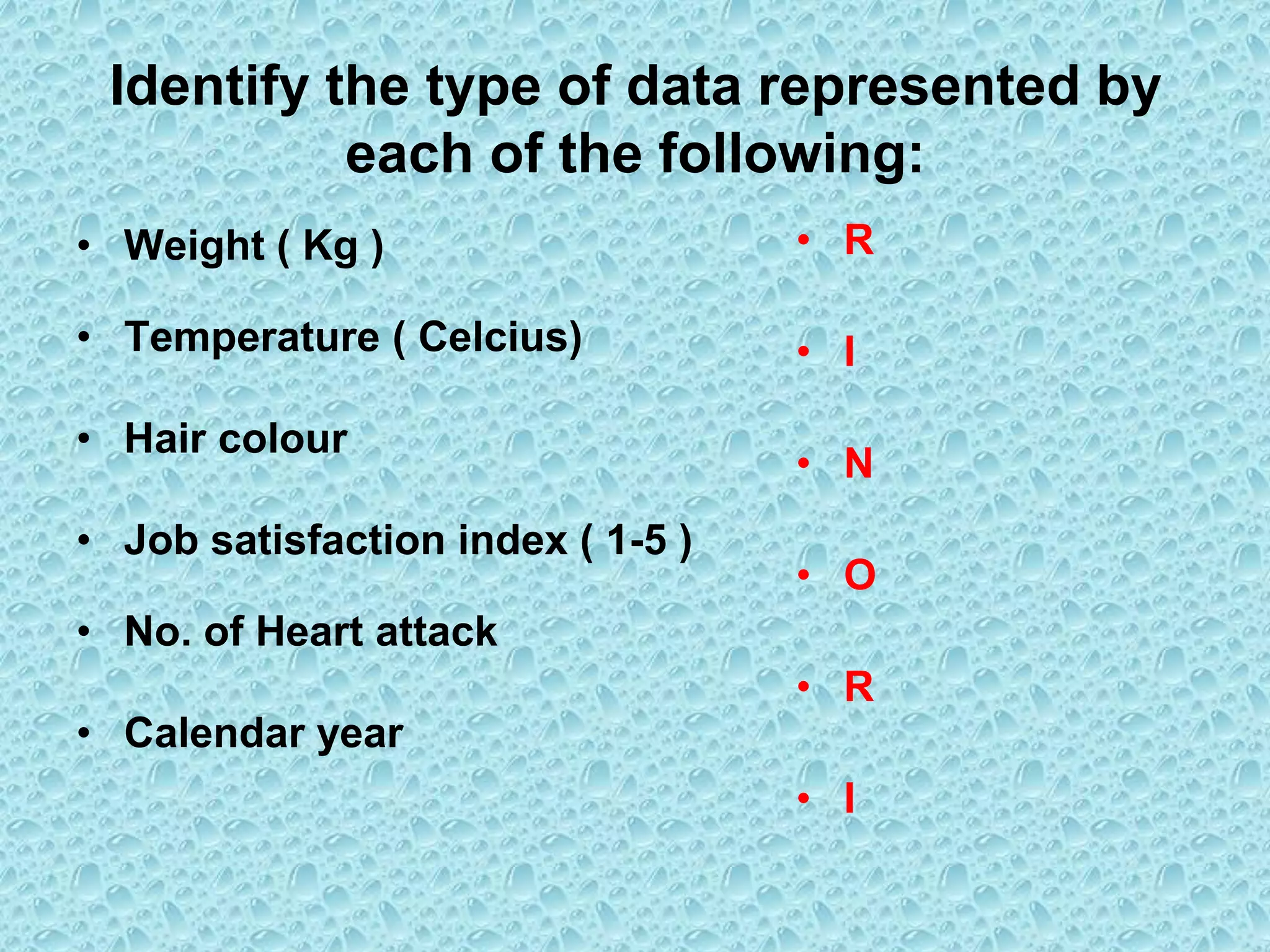
Identify the type of data represented by
each of the following:
• Weight ( Kg )
• Temperature ( Celcius)
• Hair colour
• Job satisfaction index ( 1-5 )
• No. of Heart attack
• Calendar year
• R
• I
• N
• O
• R
• I
Frequency distribution
• Useful method for summerizing data in graphic
form
• Suppose we want to investigate relationship
between coffee drinking and heart rate ( pulse )
• First we need to know something about heart
rates in a “ normal “ population
• Next we define a population to investigate
• E.g Males between 30 and 40 yrs in Myanmar
• Take sample from population
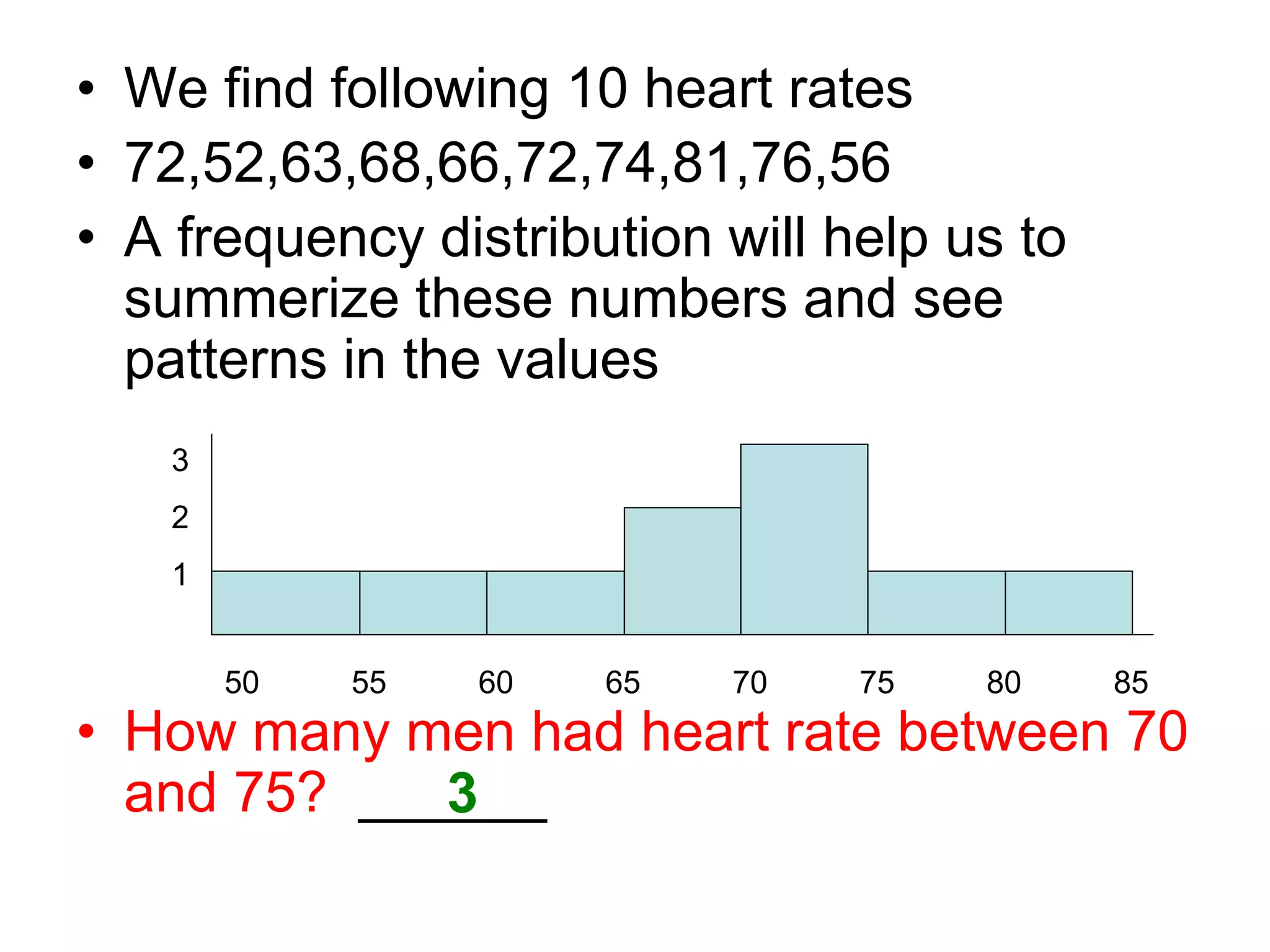
• We find following 10 heart rates
• 72,52,63,68,66,72,74,81,76,56
• A frequency distribution will help us to
summerize these numbers and see
patterns in the values
• How many men had heart rate between 70
and 75? ______
50 55 60 65 70 75 80 85
3
2
1
3
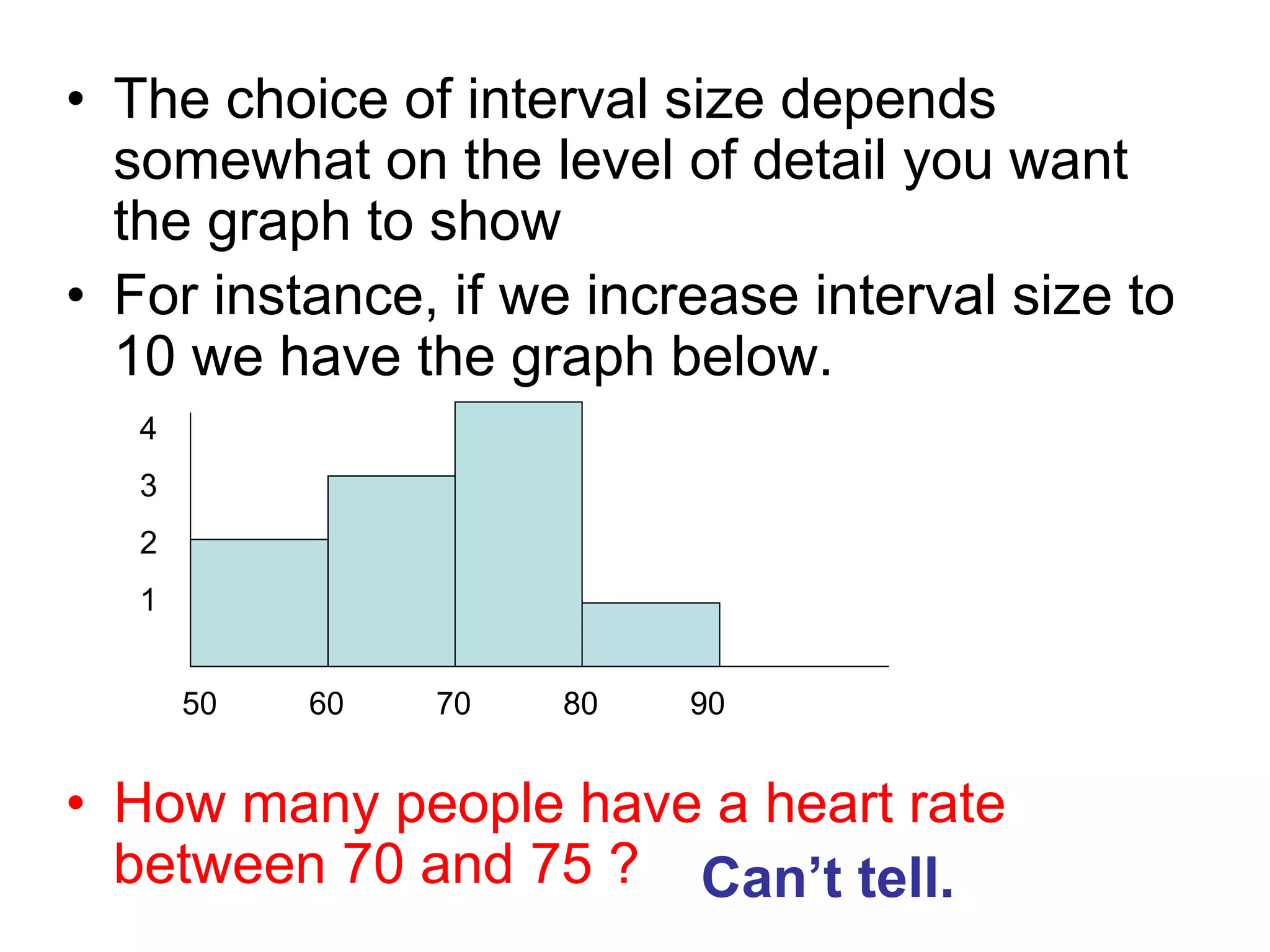
• The choice of interval size depends
somewhat on the level of detail you want
the graph to show
• For instance, if we increase interval size to
10 we have the graph below.
• How many people have a heart rate
between 70 and 75 ?
50 60 70 80 90
4
3
2
1
Can’t tell.
Mean, Median and Mode
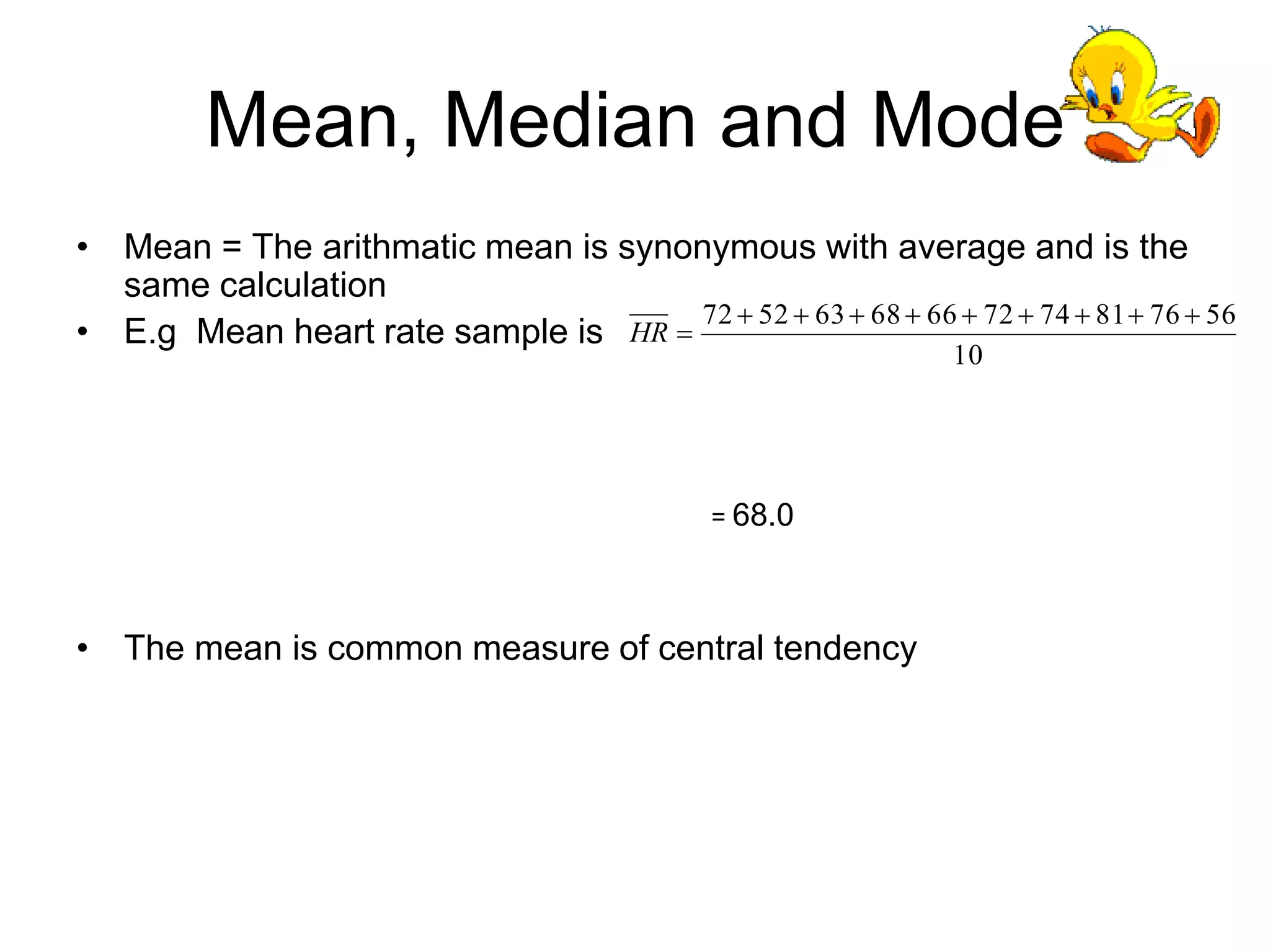
• Mean = The arithmatic mean is synonymous with average and is the
same calculation
• E.g Mean heart rate sample is
= 68.0
• The mean is common measure of central tendency
10
56
76
81
74
72
66
68
63
52
72 









HR
Median
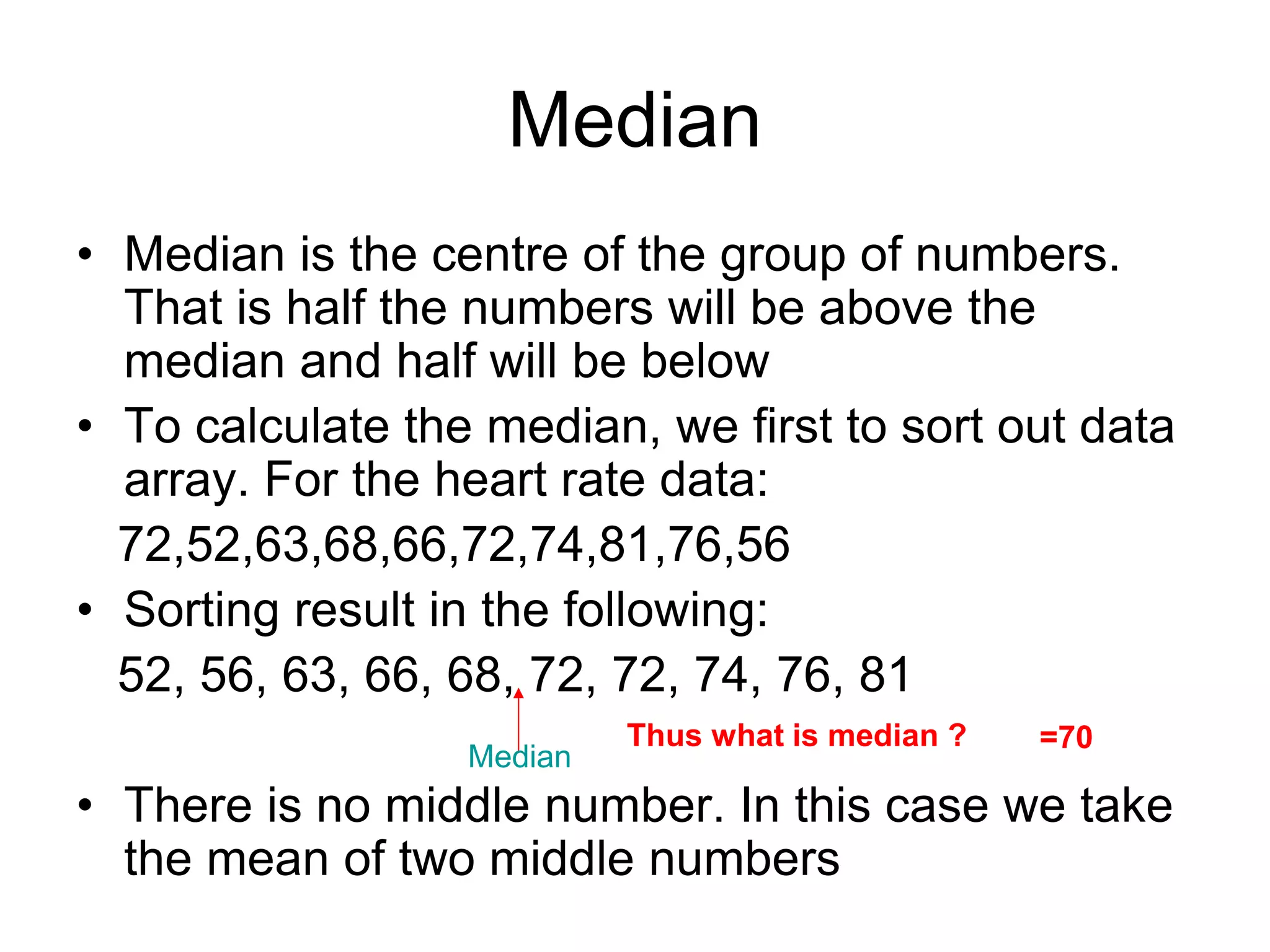
• Median is the centre of the group of numbers.
That is half the numbers will be above the
median and half will be below
• To calculate the median, we first to sort out data
array. For the heart rate data:
72,52,63,68,66,72,74,81,76,56
• Sorting result in the following:
52, 56, 63, 66, 68, 72, 72, 74, 76, 81
• There is no middle number. In this case we take
the mean of two middle numbers
Median
Thus what is median ? =70
Mode
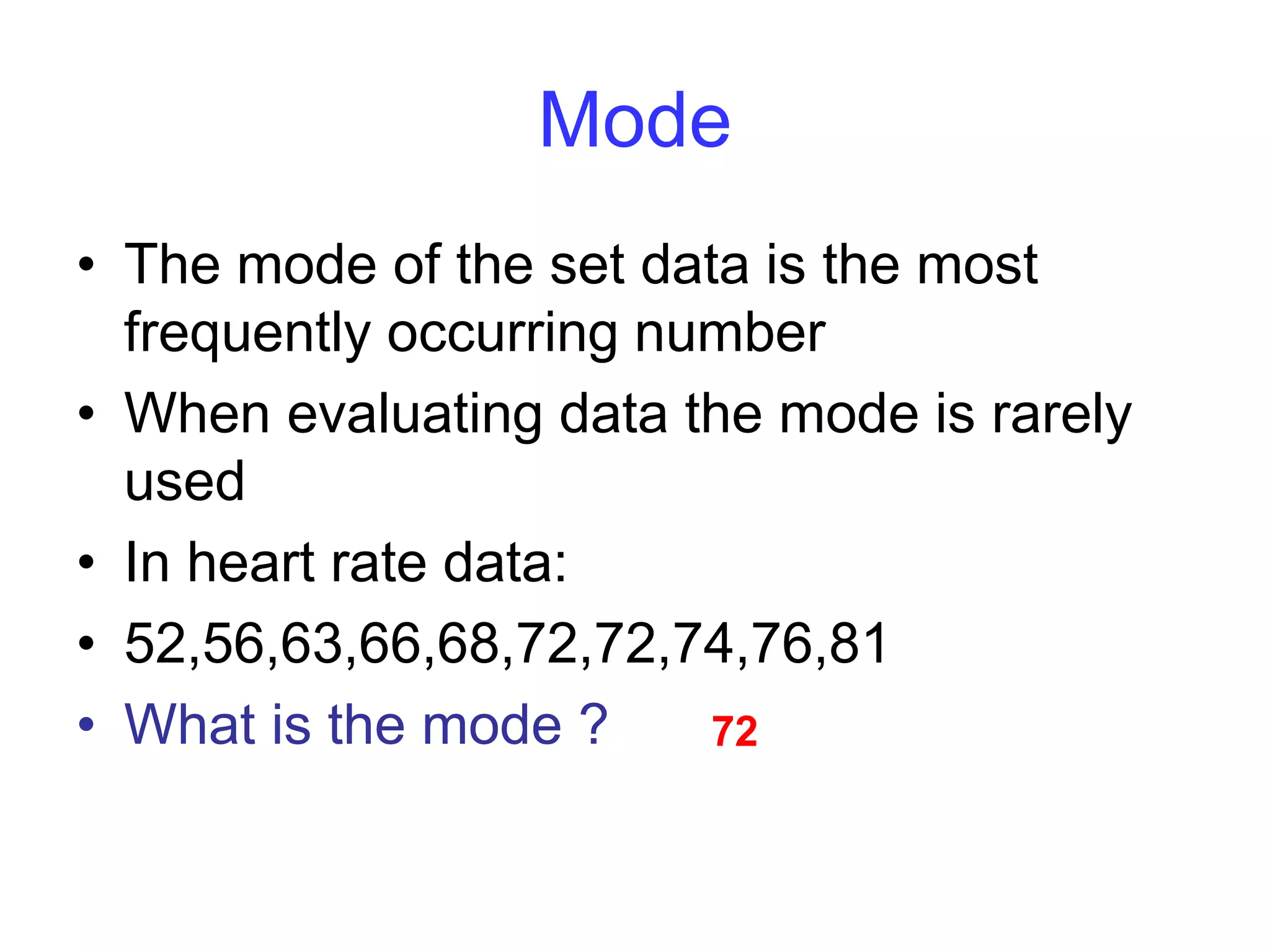
• The mode of the set data is the most
frequently occurring number
• When evaluating data the mode is rarely
used
• In heart rate data:
• 52,56,63,66,68,72,72,74,76,81
• What is the mode ? 72
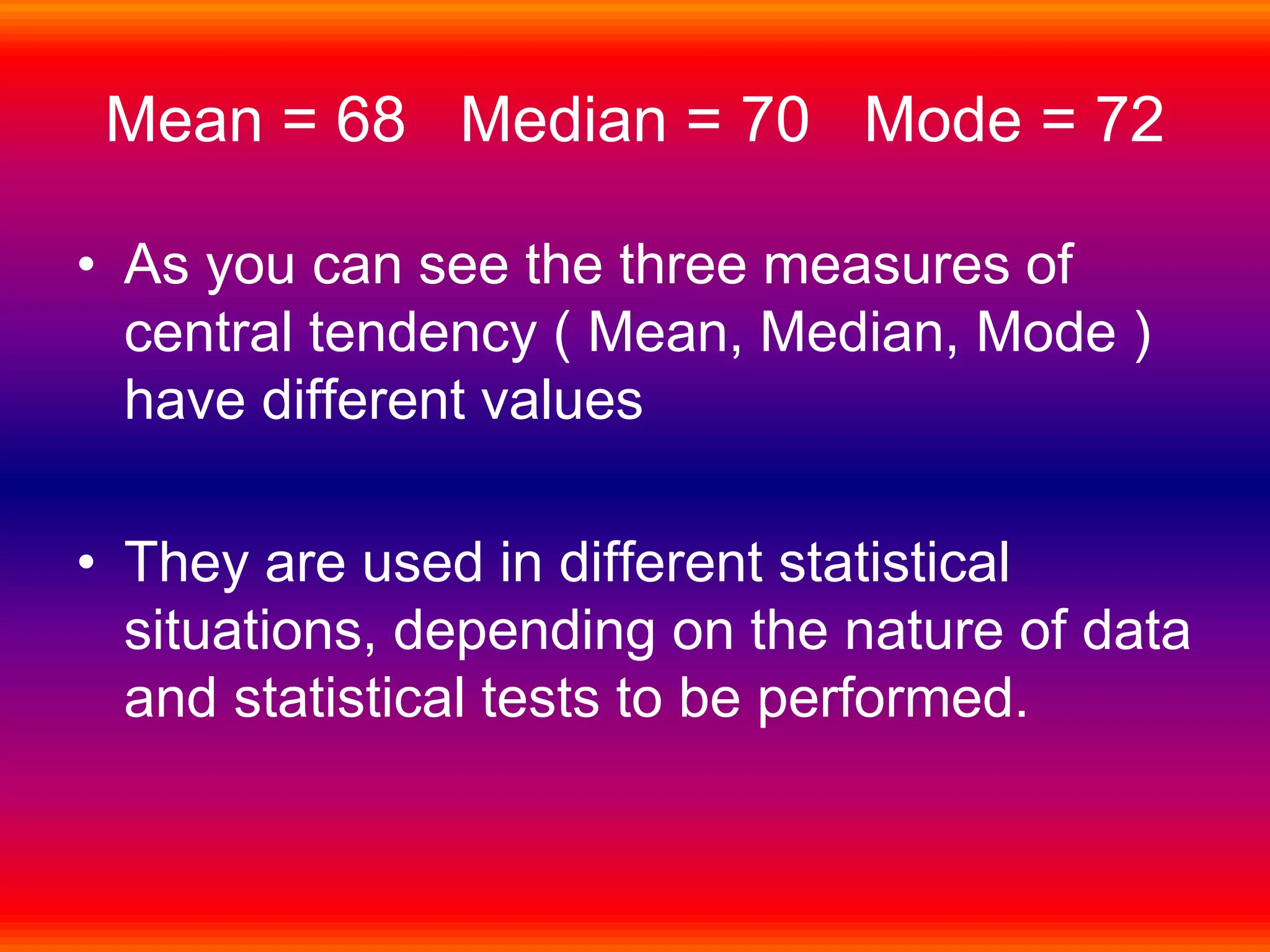
Mean = 68 Median = 70 Mode = 72
• As you can see the three measures of
central tendency ( Mean, Median, Mode )
have different values
• They are used in different statistical
situations, depending on the nature of data
and statistical tests to be performed.
Population and samples
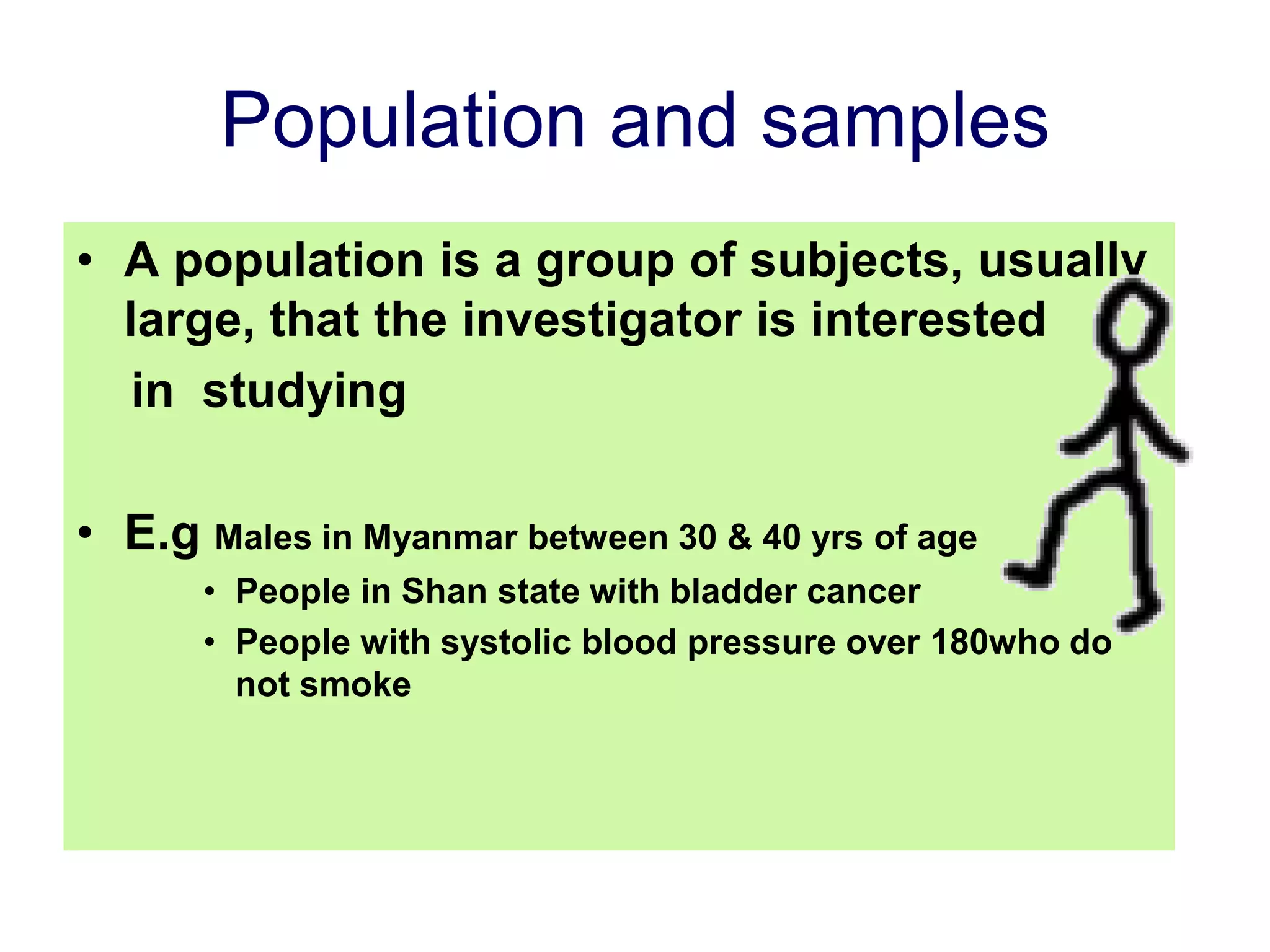
• A population is a group of subjects, usually
large, that the investigator is interested
in studying
• E.g Males in Myanmar between 30 & 40 yrs of age
• People in Shan state with bladder cancer
• People with systolic blood pressure over 180who do
not smoke
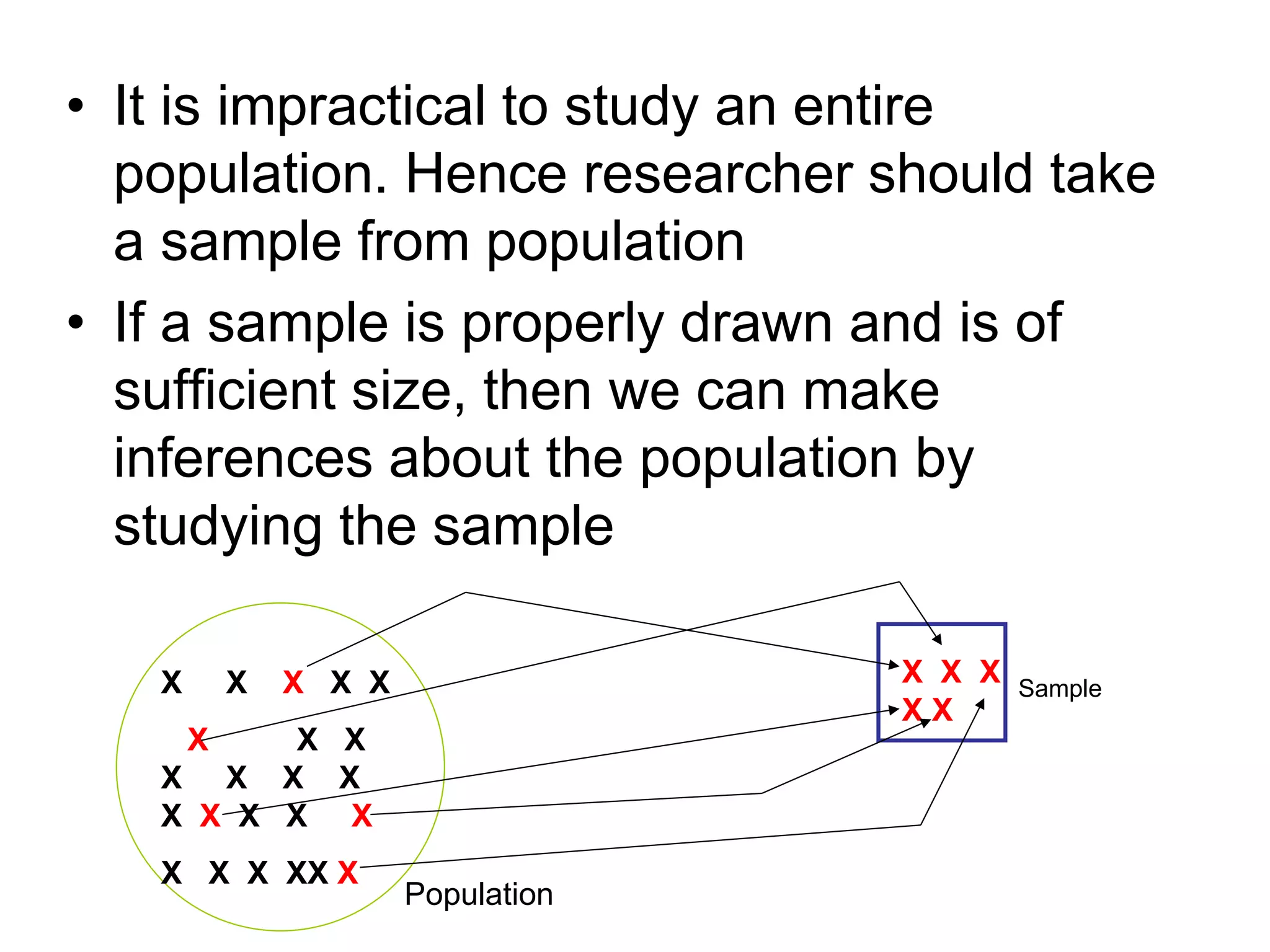
• It is impractical to study an entire
population. Hence researcher should take
a sample from population
• If a sample is properly drawn and is of
sufficient size, then we can make
inferences about the population by
studying the sample
Population
Sample
X X X X X
X X X
X X X X
X X X X X
X X X XX X
X X X
X X
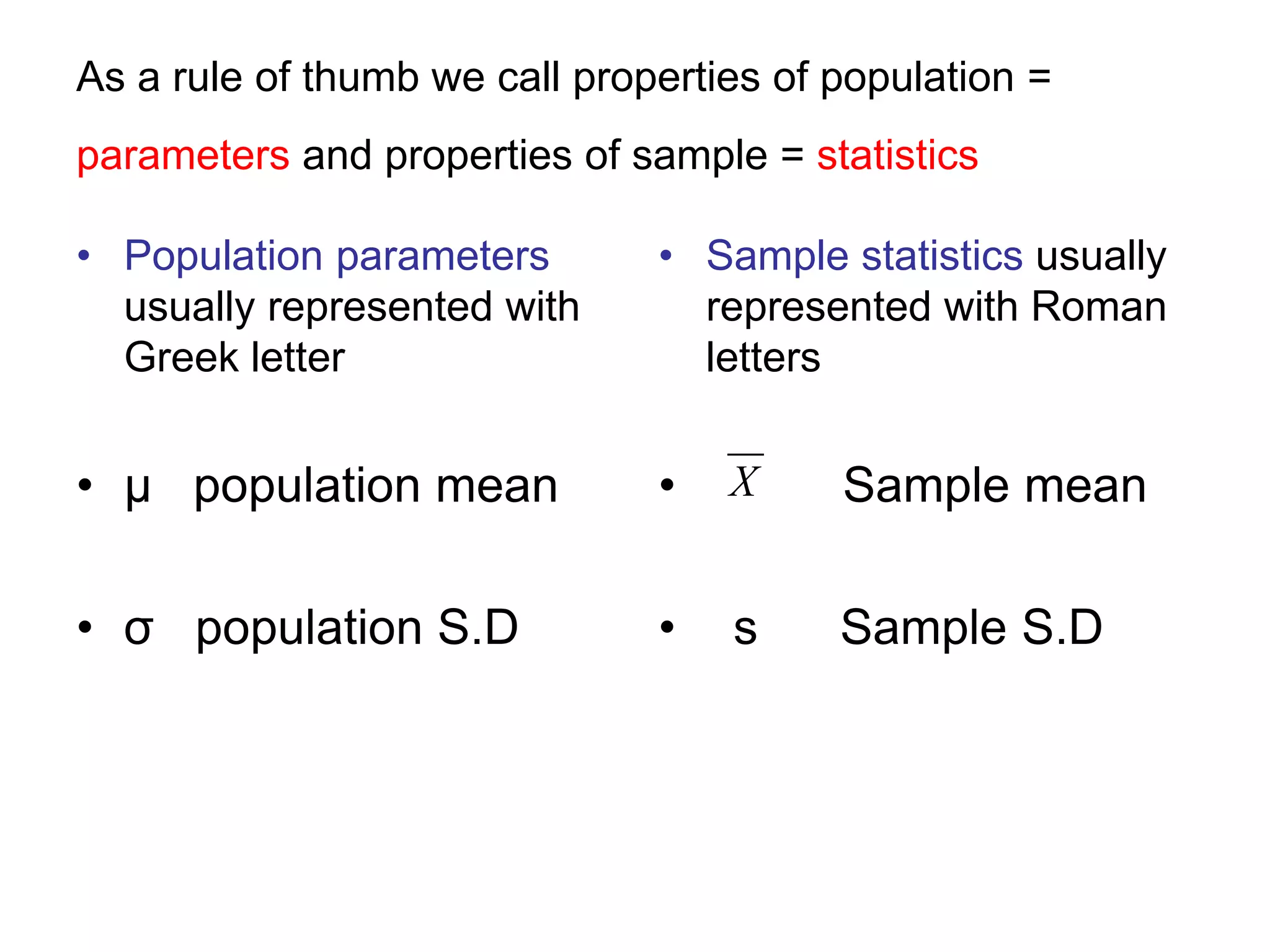
As a rule of thumb we call properties of population =
parameters and properties of sample = statistics
• Population parameters
usually represented with
Greek letter
• μ population mean
• σ population S.D
• Sample statistics usually
represented with Roman
letters
• Sample mean
• s Sample S.D
X
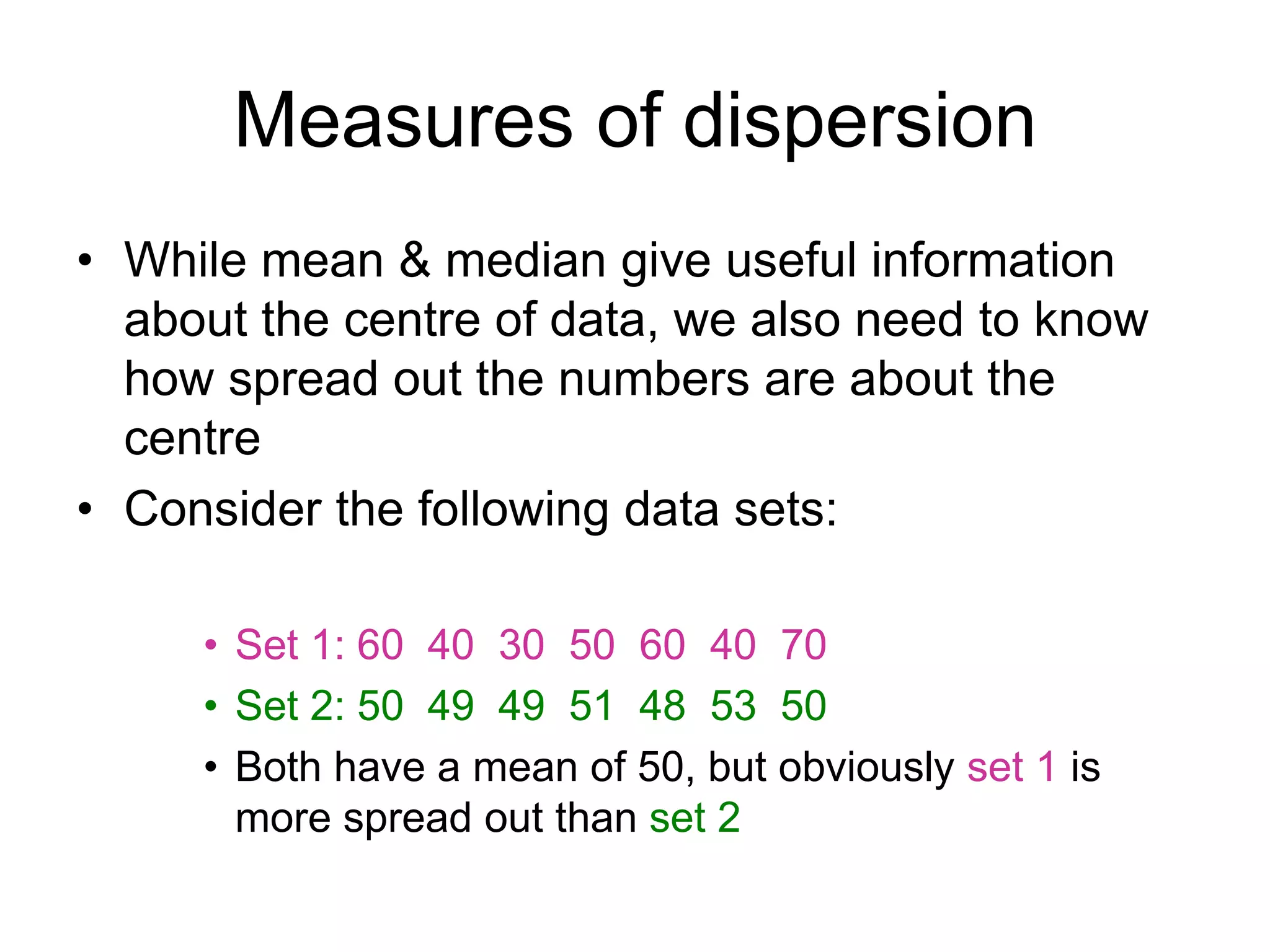
Measures of dispersion
• While mean & median give useful information
about the centre of data, we also need to know
how spread out the numbers are about the
centre
• Consider the following data sets:
• Set 1: 60 40 30 50 60 40 70
• Set 2: 50 49 49 51 48 53 50
• Both have a mean of 50, but obviously set 1 is
more spread out than set 2
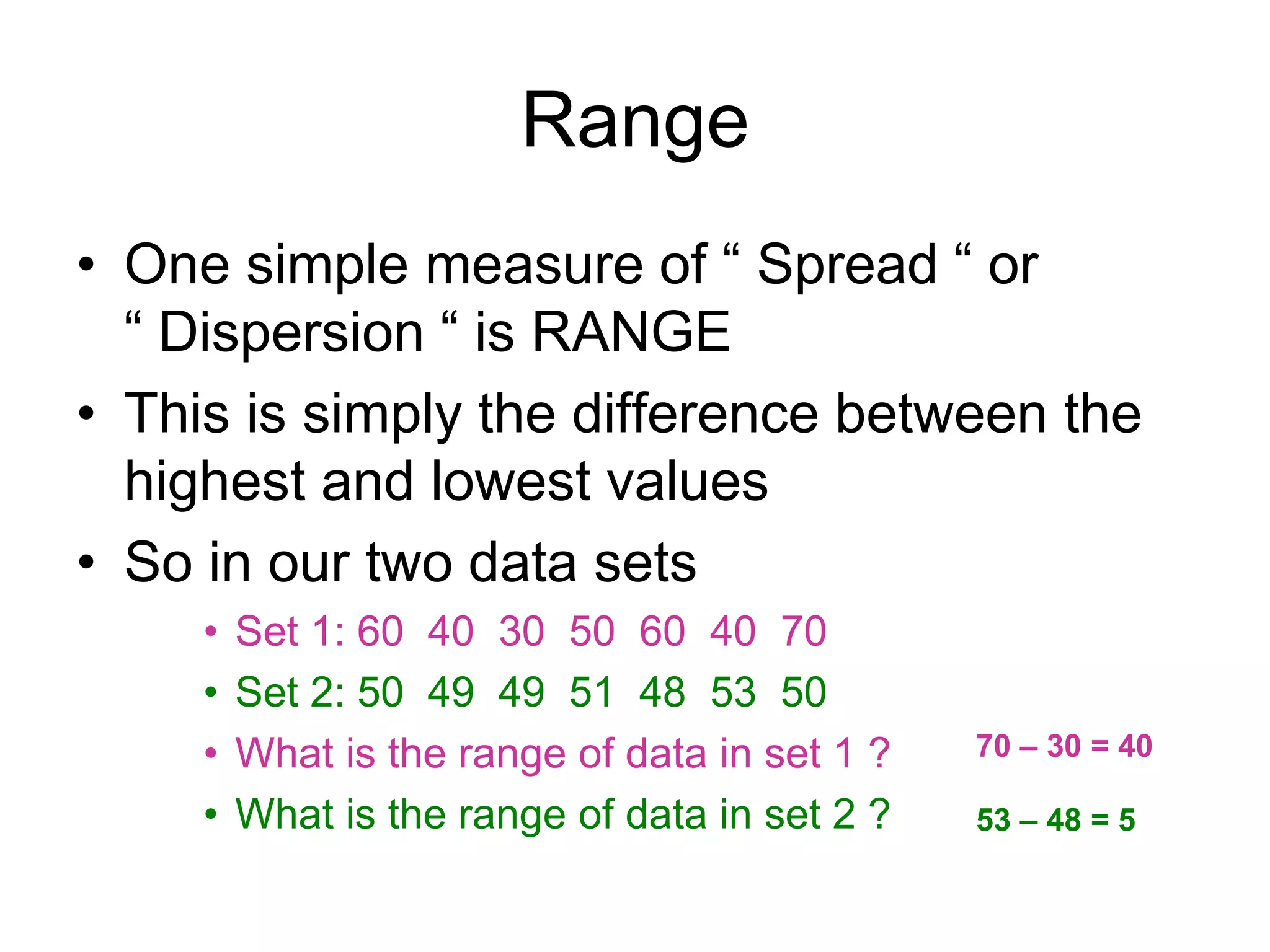
Range
• One simple measure of “ Spread “ or
“ Dispersion “ is RANGE
• This is simply the difference between the
highest and lowest values
• So in our two data sets
• Set 1: 60 40 30 50 60 40 70
• Set 2: 50 49 49 51 48 53 50
• What is the range of data in set 1 ?
• What is the range of data in set 2 ?
70 – 30 = 40
53 – 48 = 5
• However you will find that the range is not
often used, and for good reason it is too
sensitive to a single high or low data value
• Instead we suggest two alternatives:
• Inter quartile range
• Standard deviation
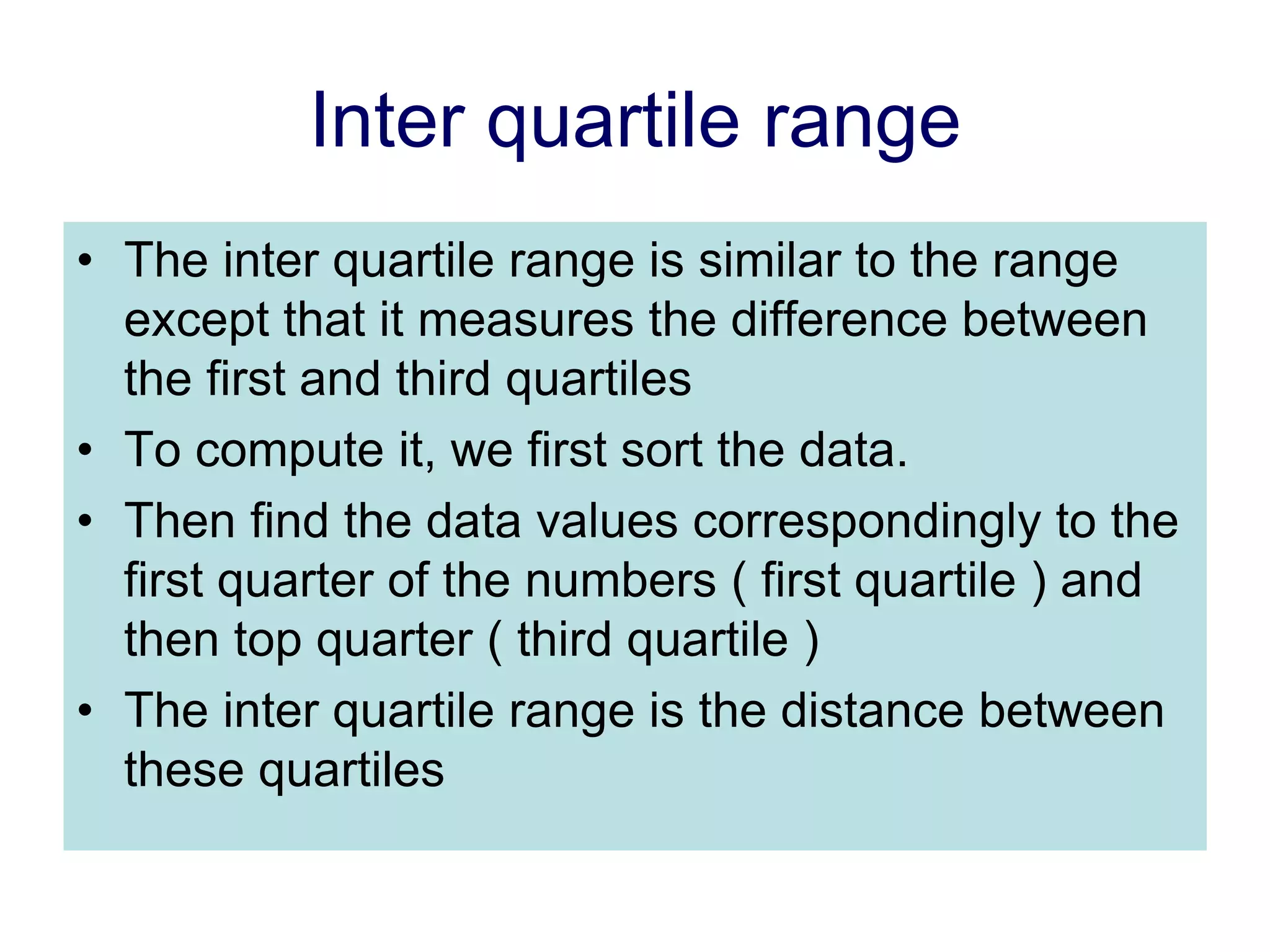
Inter quartile range
• The inter quartile range is similar to the range
except that it measures the difference between
the first and third quartiles
• To compute it, we first sort the data.
• Then find the data values correspondingly to the
first quarter of the numbers ( first quartile ) and
then top quarter ( third quartile )
• The inter quartile range is the distance between
these quartiles
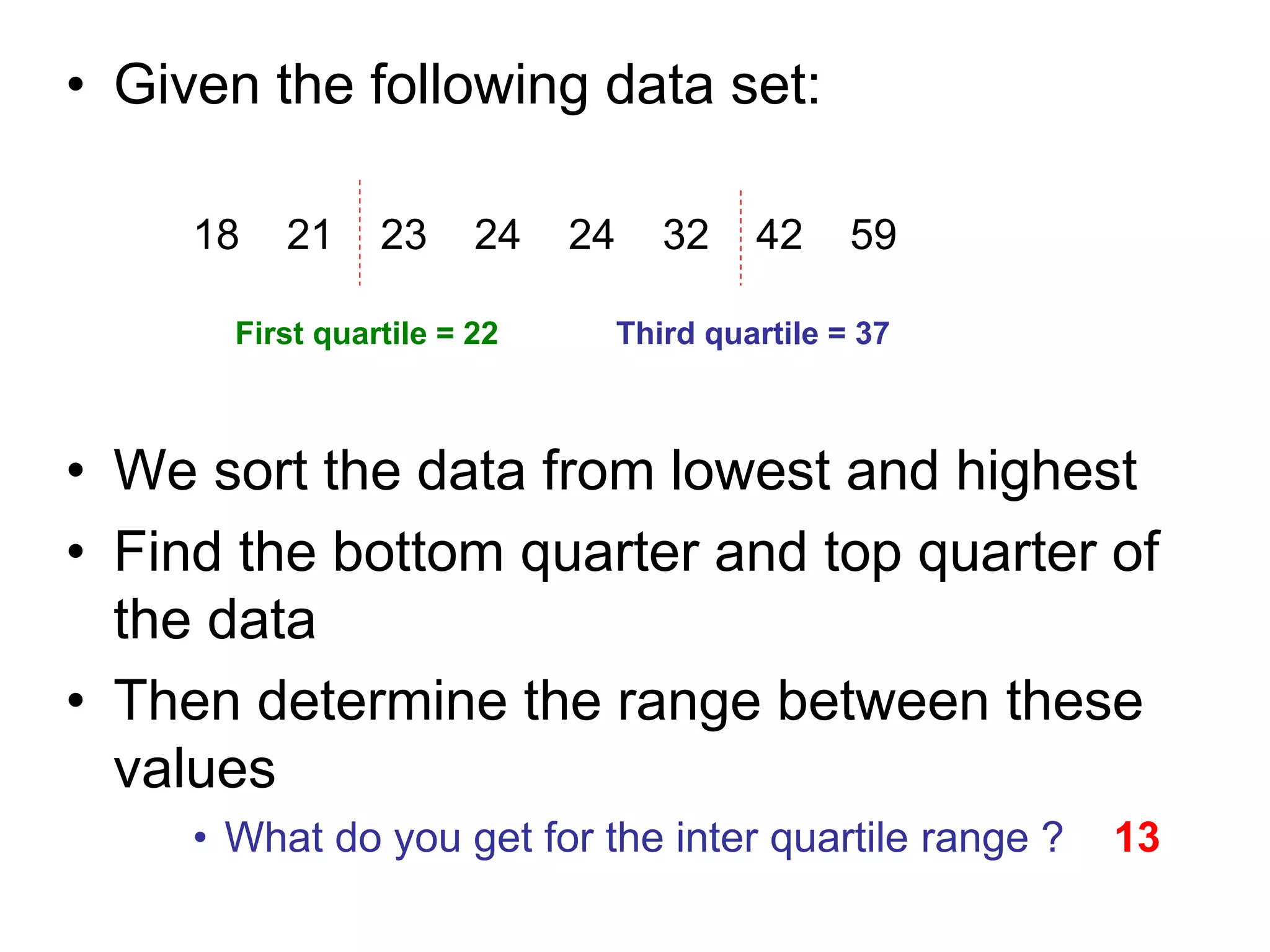
• Given the following data set:
18 21 23 24 24 32 42 59
• We sort the data from lowest and highest
• Find the bottom quarter and top quarter of
the data
• Then determine the range between these
values
• What do you get for the inter quartile range ?
First quartile = 22 Third quartile = 37
13
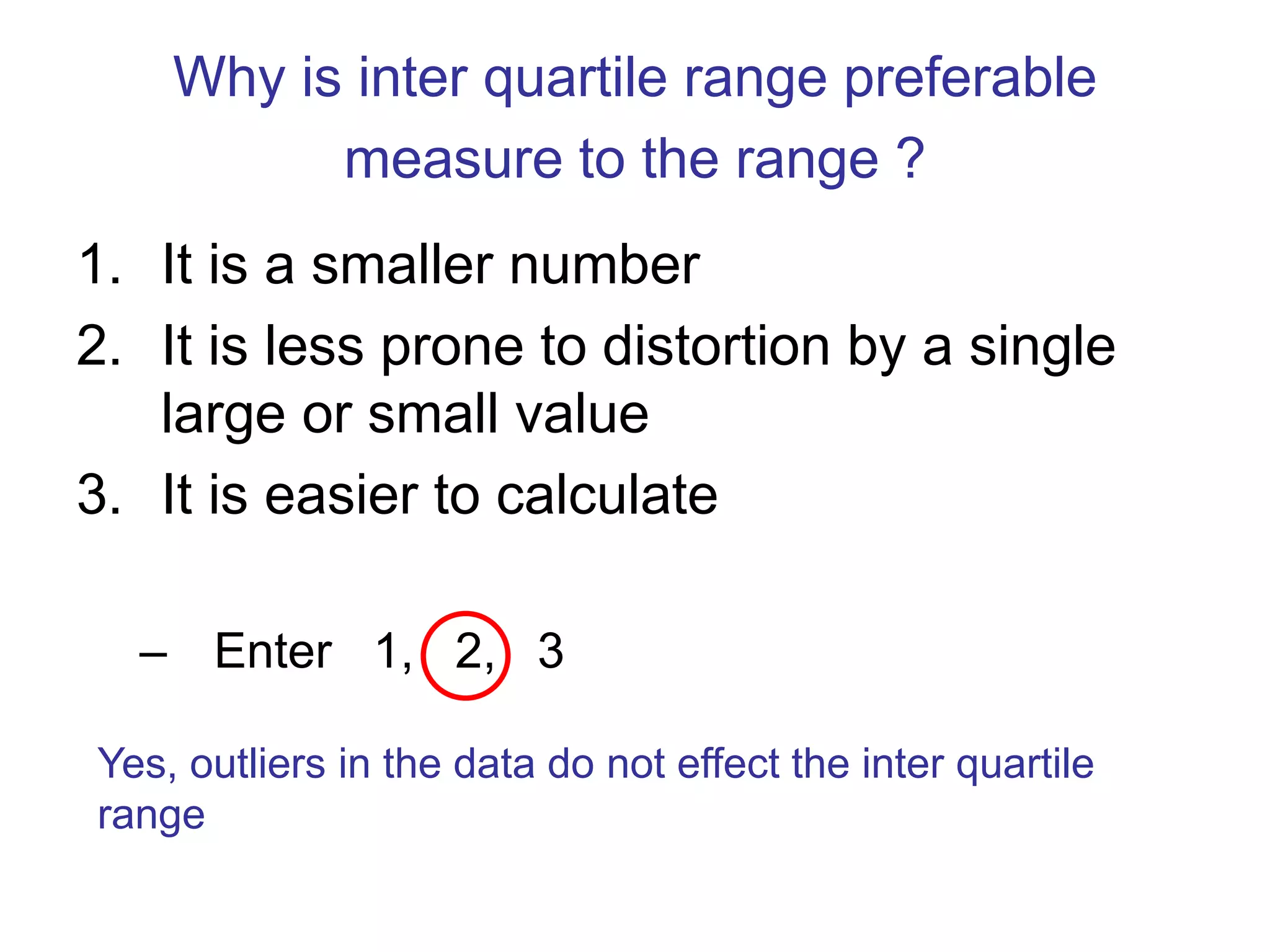
Why is inter quartile range preferable
measure to the range ?
1. It is a smaller number
2. It is less prone to distortion by a single
large or small value
3. It is easier to calculate
– Enter 1, 2, 3
Yes, outliers in the data do not effect the inter quartile
range
Standard deviation
• The most common used measure of
dispersion is Standard Deviation
• The S.D can be thought of as the “
average “ deviation ( difference ) between
the mean of a sample and each data value
in the sample
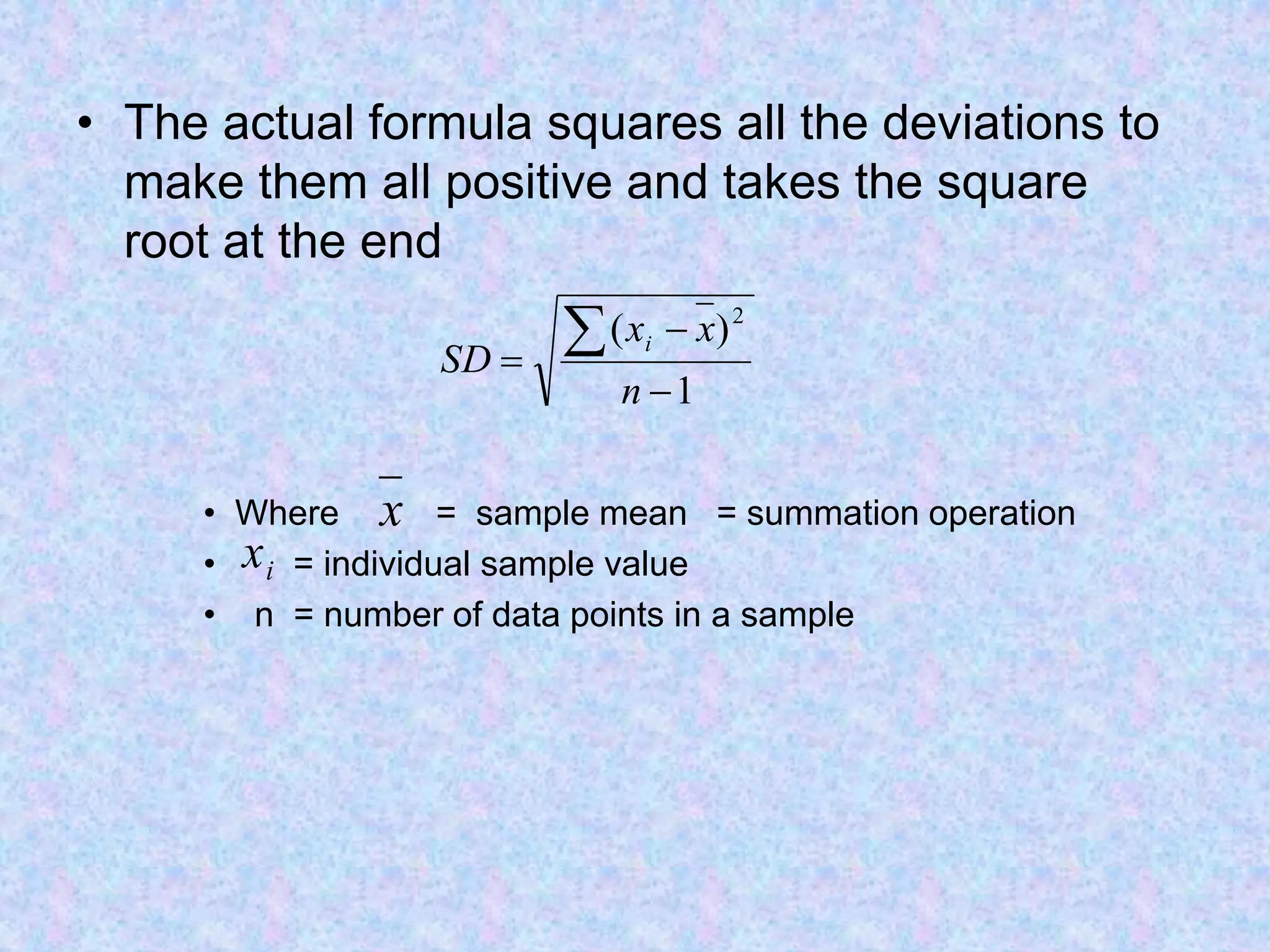
• The actual formula squares all the deviations to
make them all positive and takes the square
root at the end
• Where = sample mean = summation operation
• = individual sample value
• n = number of data points in a sample
1
)
( 2




n
x
x
SD
i
x
i
x
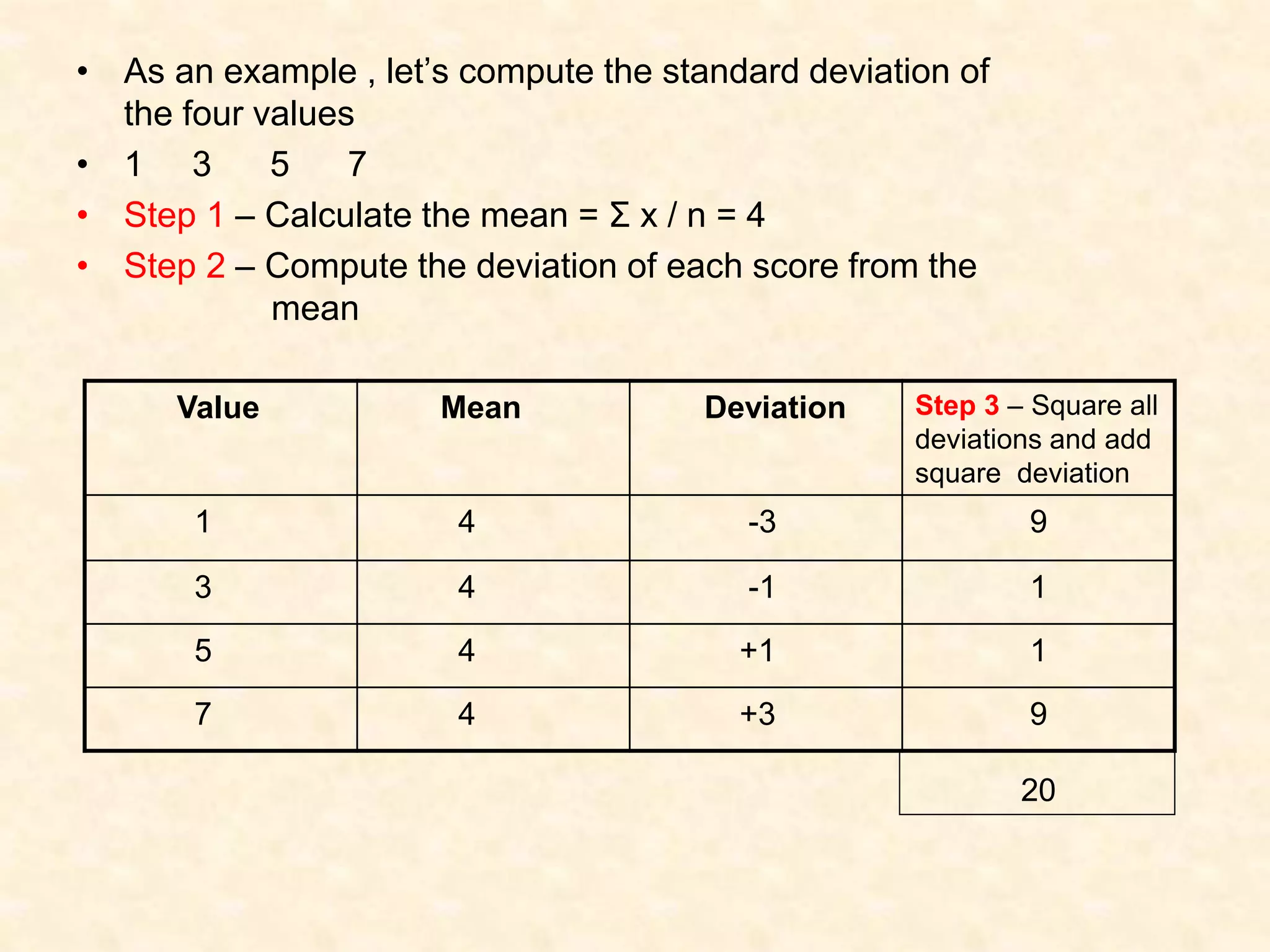
• As an example , let’s compute the standard deviation of
the four values
• 1 3 5 7
• Step 1 – Calculate the mean = Σ x / n = 4
• Step 2 – Compute the deviation of each score from the
mean
Value Mean Deviation Step 3 – Square all
deviations and add
square deviation
1 4 -3 9
3 4 -1 1
5 4 +1 1
7 4 +3 9
20
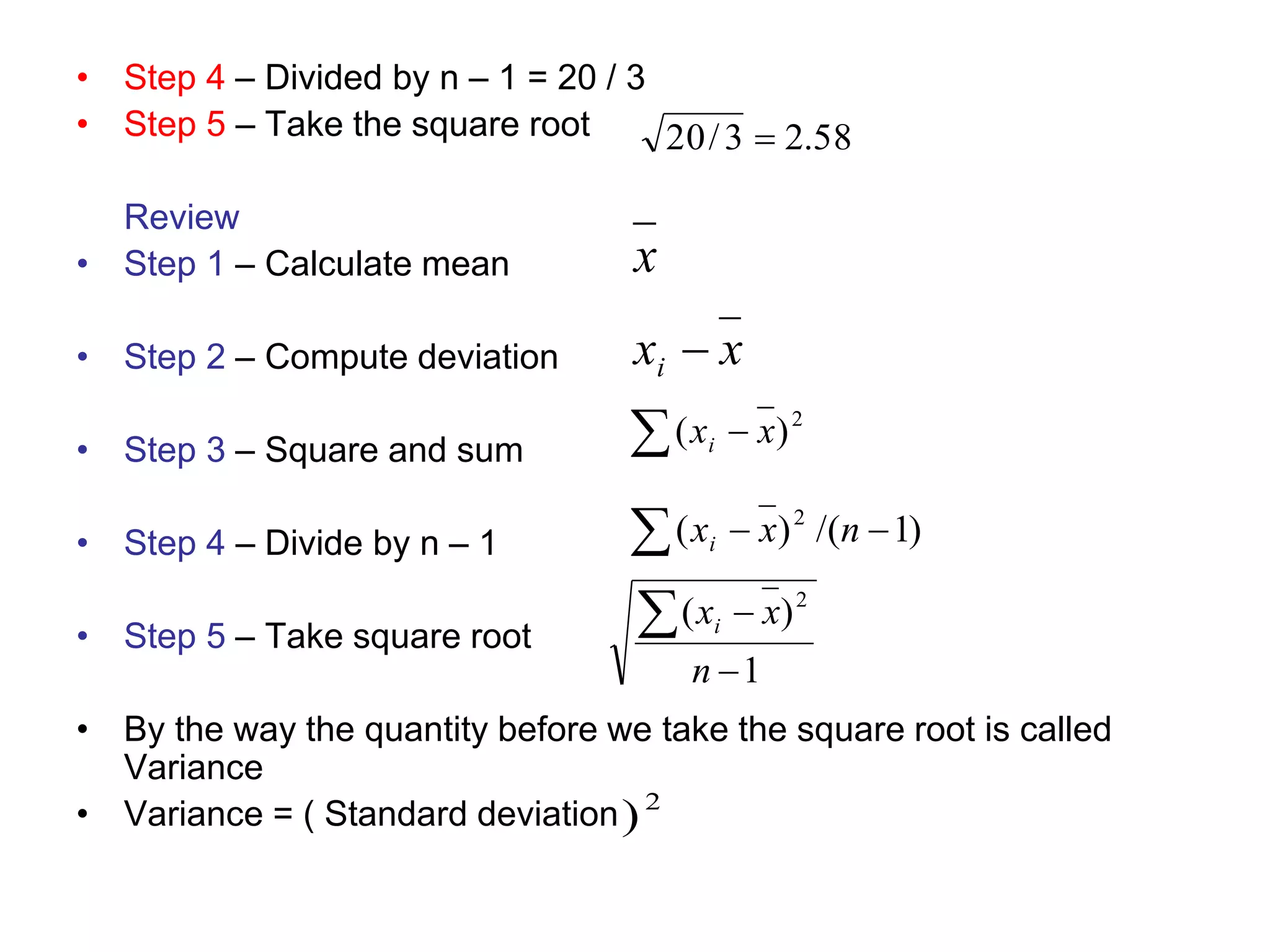
• Step 4 – Divided by n – 1 = 20 / 3
• Step 5 – Take the square root
Review
• Step 1 – Calculate mean
• Step 2 – Compute deviation
• Step 3 – Square and sum
• Step 4 – Divide by n – 1
• Step 5 – Take square root
• By the way the quantity before we take the square root is called
Variance
• Variance = ( Standard deviation
58
.
2
3
/
20 
2
)
x
x
xi 
  2
)
( x
xi
)
1
/(
)
( 2


 n
x
xi
1
)
( 2



n
x
xi

IV STATISTICS I.pdf

  • 2.
    Statistics • Is concernedwith • Collecting • Organizing • Summarizing • Presenting and Analyzing data • To draw valid conclusions & making reasonable decisions on the basis of such analysis
  • 3.
    Collecting data • Cancollect data concerning –Characteristics of a groups of individuals or objects –E.g. 100 blood donors donate 100 bottles of blood in Blood Bank
  • 4.
    Organizing data • Canorganize data by classifying different groups – Sex and blood type of blood donors – E.g. Male, Female and A,B,AB & O
  • 5.
    Summarizing data • Cansummarize the number of individual in each class –E.g 60 males and 40 females –15 A, 30 B, 5 AB and 50 O
  • 6.
    Presenting data • Canpresent data by rate, ratio, percentage, diagram ect • Male:Female ratio of blood donors = 3:2 • Percentage of Blood groups • A = 15 % • B = 30 % • AB = 5 % • O = 50 % 0 10 20 30 40 50 60 70 80 90 100 A B AB O A B AB O
  • 7.
    Analyzing data • Frompresentation, the findings can be analyzed such as more male blood donors than female
  • 8.
    There are twotypes of statistics • Descriptive statistics • Describes and summerizes data • Inferential statistics • Use sample of data to help us draw conclusions about larger populations 0 10 20 30 40 50 60 70 0 to 10 11 to 20 21 to 30 31 to 40 41 to 50 51 to 60 >60 Age groups Bar graph showing cholera outbreak by age group Sample
  • 9.
    Clinical trial forAntihypertensive drug • Population with SBP = 180 mm Hg • Random sample = 10 patients • Give antihypertensive drug • After drug, sample mean SBP = 170 mm Hg • Can we conclude that the drug was effective not without a statistical analysis? • No (need to compute probability due to chance )
  • 10.
    Descriptive statistics • Helporganize data in more meaningful way • Summerize data • Investigate relationship between variables • Serve as preliminary analysis before using inferential technique • But analysis techniques depend on types of data
  • 11.
    Types of data •Nominal data • Ordinal data • Interval data • Ratio data
  • 12.
    Nominal data • Refersto data that represent categories or names • There is no implied order to the categories of nominal data • E.g. Eye colour • Race • Gender • Marital status
  • 13.
    Ordinal data • Refersto data that are ordered but the space or intervals between data values are not necessarily equal. • E.g. Strongly agree • Agree • No opinion • Disagree • Strongly disagree
  • 14.
    Interval data • Refersthe data the interval betweenvalues are the same • E.g. Fahrenheit temperature scale • The difference between 70 degrees and 71 degrees is the same as the difference between 32 and 33 degrees • But the scale is not a Ratio scale because 40 degrees F is not twice as much as 20 degrees F ( There is no absolute zero )
  • 15.
    Ratio data • Ratiodata do have meaningful ratios e.g. Age is ratio data. • Someone who is 40 yrs of age is twice as old as someone who is 20 yrs • Temperature Kelvin scale is ratio data • Most data analysis techniques that apply Ratio data also apply to interval data
  • 16.
    Identify the typeof data represented by each of the following: • Weight ( Kg ) • Temperature ( Celcius) • Hair colour • Job satisfaction index ( 1-5 ) • No. of Heart attack • Calendar year • R • I • N • O • R • I
  • 17.
    Frequency distribution • Usefulmethod for summerizing data in graphic form • Suppose we want to investigate relationship between coffee drinking and heart rate ( pulse ) • First we need to know something about heart rates in a “ normal “ population • Next we define a population to investigate • E.g Males between 30 and 40 yrs in Myanmar • Take sample from population
  • 18.
    • We findfollowing 10 heart rates • 72,52,63,68,66,72,74,81,76,56 • A frequency distribution will help us to summerize these numbers and see patterns in the values • How many men had heart rate between 70 and 75? ______ 50 55 60 65 70 75 80 85 3 2 1 3
  • 19.
    • The choiceof interval size depends somewhat on the level of detail you want the graph to show • For instance, if we increase interval size to 10 we have the graph below. • How many people have a heart rate between 70 and 75 ? 50 60 70 80 90 4 3 2 1 Can’t tell.
  • 20.
    Mean, Median andMode • Mean = The arithmatic mean is synonymous with average and is the same calculation • E.g Mean heart rate sample is = 68.0 • The mean is common measure of central tendency 10 56 76 81 74 72 66 68 63 52 72           HR
  • 21.
    Median • Median isthe centre of the group of numbers. That is half the numbers will be above the median and half will be below • To calculate the median, we first to sort out data array. For the heart rate data: 72,52,63,68,66,72,74,81,76,56 • Sorting result in the following: 52, 56, 63, 66, 68, 72, 72, 74, 76, 81 • There is no middle number. In this case we take the mean of two middle numbers Median Thus what is median ? =70
  • 22.
    Mode • The modeof the set data is the most frequently occurring number • When evaluating data the mode is rarely used • In heart rate data: • 52,56,63,66,68,72,72,74,76,81 • What is the mode ? 72
  • 23.
    Mean = 68Median = 70 Mode = 72 • As you can see the three measures of central tendency ( Mean, Median, Mode ) have different values • They are used in different statistical situations, depending on the nature of data and statistical tests to be performed.
  • 24.
    Population and samples •A population is a group of subjects, usually large, that the investigator is interested in studying • E.g Males in Myanmar between 30 & 40 yrs of age • People in Shan state with bladder cancer • People with systolic blood pressure over 180who do not smoke
  • 25.
    • It isimpractical to study an entire population. Hence researcher should take a sample from population • If a sample is properly drawn and is of sufficient size, then we can make inferences about the population by studying the sample Population Sample X X X X X X X X X X X X X X X X X X X X XX X X X X X X
  • 26.
    As a ruleof thumb we call properties of population = parameters and properties of sample = statistics • Population parameters usually represented with Greek letter • μ population mean • σ population S.D • Sample statistics usually represented with Roman letters • Sample mean • s Sample S.D X
  • 27.
    Measures of dispersion •While mean & median give useful information about the centre of data, we also need to know how spread out the numbers are about the centre • Consider the following data sets: • Set 1: 60 40 30 50 60 40 70 • Set 2: 50 49 49 51 48 53 50 • Both have a mean of 50, but obviously set 1 is more spread out than set 2
  • 28.
    Range • One simplemeasure of “ Spread “ or “ Dispersion “ is RANGE • This is simply the difference between the highest and lowest values • So in our two data sets • Set 1: 60 40 30 50 60 40 70 • Set 2: 50 49 49 51 48 53 50 • What is the range of data in set 1 ? • What is the range of data in set 2 ? 70 – 30 = 40 53 – 48 = 5
  • 29.
    • However youwill find that the range is not often used, and for good reason it is too sensitive to a single high or low data value • Instead we suggest two alternatives: • Inter quartile range • Standard deviation
  • 30.
    Inter quartile range •The inter quartile range is similar to the range except that it measures the difference between the first and third quartiles • To compute it, we first sort the data. • Then find the data values correspondingly to the first quarter of the numbers ( first quartile ) and then top quarter ( third quartile ) • The inter quartile range is the distance between these quartiles
  • 31.
    • Given thefollowing data set: 18 21 23 24 24 32 42 59 • We sort the data from lowest and highest • Find the bottom quarter and top quarter of the data • Then determine the range between these values • What do you get for the inter quartile range ? First quartile = 22 Third quartile = 37 13
  • 32.
    Why is interquartile range preferable measure to the range ? 1. It is a smaller number 2. It is less prone to distortion by a single large or small value 3. It is easier to calculate – Enter 1, 2, 3 Yes, outliers in the data do not effect the inter quartile range
  • 33.
    Standard deviation • Themost common used measure of dispersion is Standard Deviation • The S.D can be thought of as the “ average “ deviation ( difference ) between the mean of a sample and each data value in the sample
  • 34.
    • The actualformula squares all the deviations to make them all positive and takes the square root at the end • Where = sample mean = summation operation • = individual sample value • n = number of data points in a sample 1 ) ( 2     n x x SD i x i x
  • 35.
    • As anexample , let’s compute the standard deviation of the four values • 1 3 5 7 • Step 1 – Calculate the mean = Σ x / n = 4 • Step 2 – Compute the deviation of each score from the mean Value Mean Deviation Step 3 – Square all deviations and add square deviation 1 4 -3 9 3 4 -1 1 5 4 +1 1 7 4 +3 9 20
  • 36.
    • Step 4– Divided by n – 1 = 20 / 3 • Step 5 – Take the square root Review • Step 1 – Calculate mean • Step 2 – Compute deviation • Step 3 – Square and sum • Step 4 – Divide by n – 1 • Step 5 – Take square root • By the way the quantity before we take the square root is called Variance • Variance = ( Standard deviation 58 . 2 3 / 20  2 ) x x xi    2 ) ( x xi ) 1 /( ) ( 2    n x xi 1 ) ( 2    n x xi