IT Operating Model
bridge between strategy and operations
Eryk Budi Pratama
July 31th, 2018
Agenda
01
02
03
Enterprise Operating Model
IT Operating Model
Case Study
Network Security Technology – Next Generation Firewall
Network Security – Next Generation Firewall
Enterprise Operating
Model
Enterprise Operating Model IT Operating Model Case Study
Definition Operating Model Quadrant Operationalize Strategy
Source: “Define Your Operating Model”, Harvard Business Review, 2008
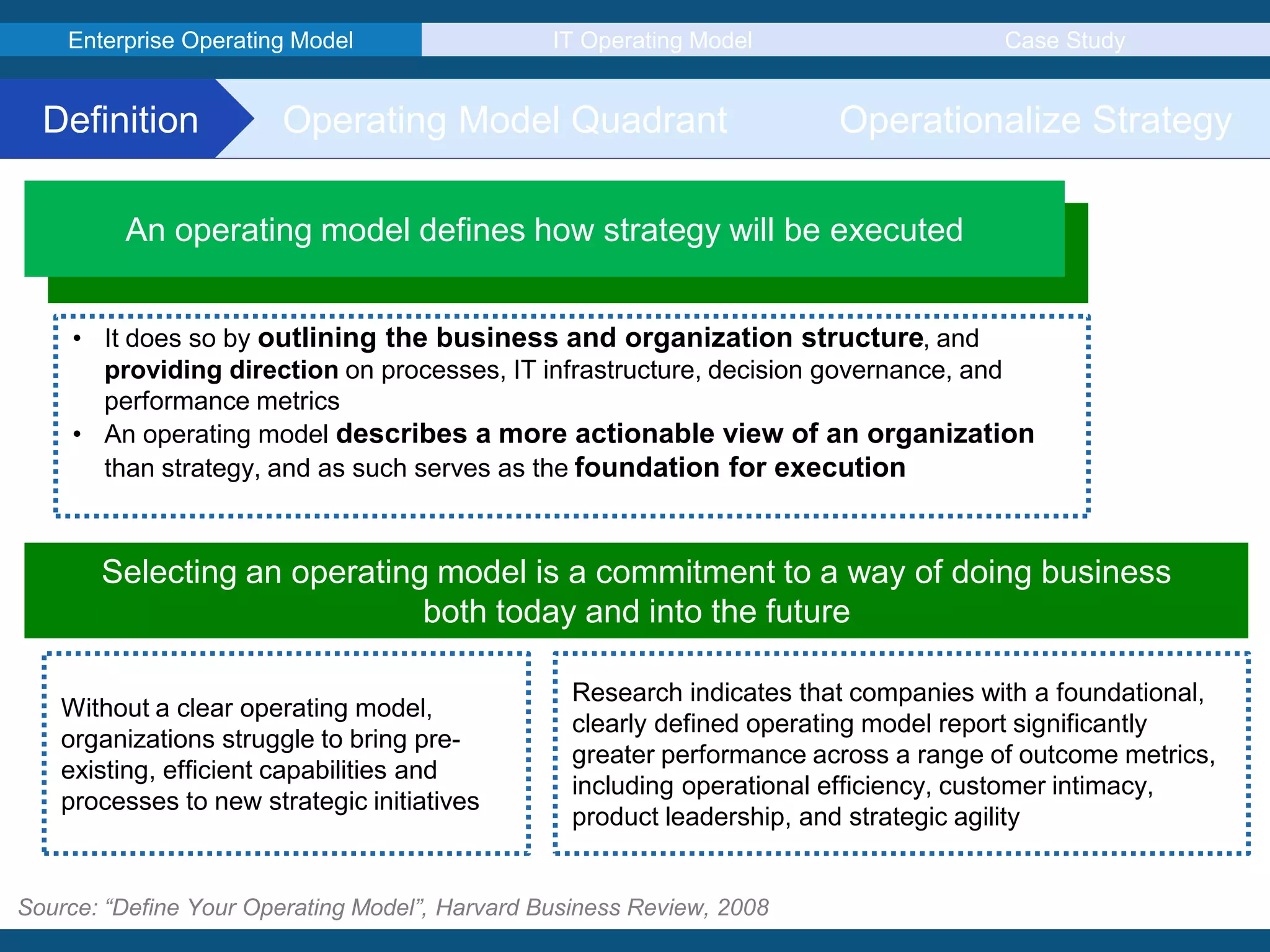
An operating model defines how strategy will be executed
• It does so by outlining the business and organization structure, and
providing direction on processes, IT infrastructure, decision governance, and
performance metrics
• An operating model describes a more actionable view of an organization
than strategy, and as such serves as the foundation for execution
Selecting an operating model is a commitment to a way of doing business
both today and into the future
Without a clear operating model,
organizations struggle to bring pre-
existing, efficient capabilities and
processes to new strategic initiatives
Research indicates that companies with a foundational,
clearly defined operating model report significantly
greater performance across a range of outcome metrics,
including operational efficiency, customer intimacy,
product leadership, and strategic agility
Enterprise Operating Model IT Operating Model Case Study
Definition Operating Model Quadrant Operationalize Strategy
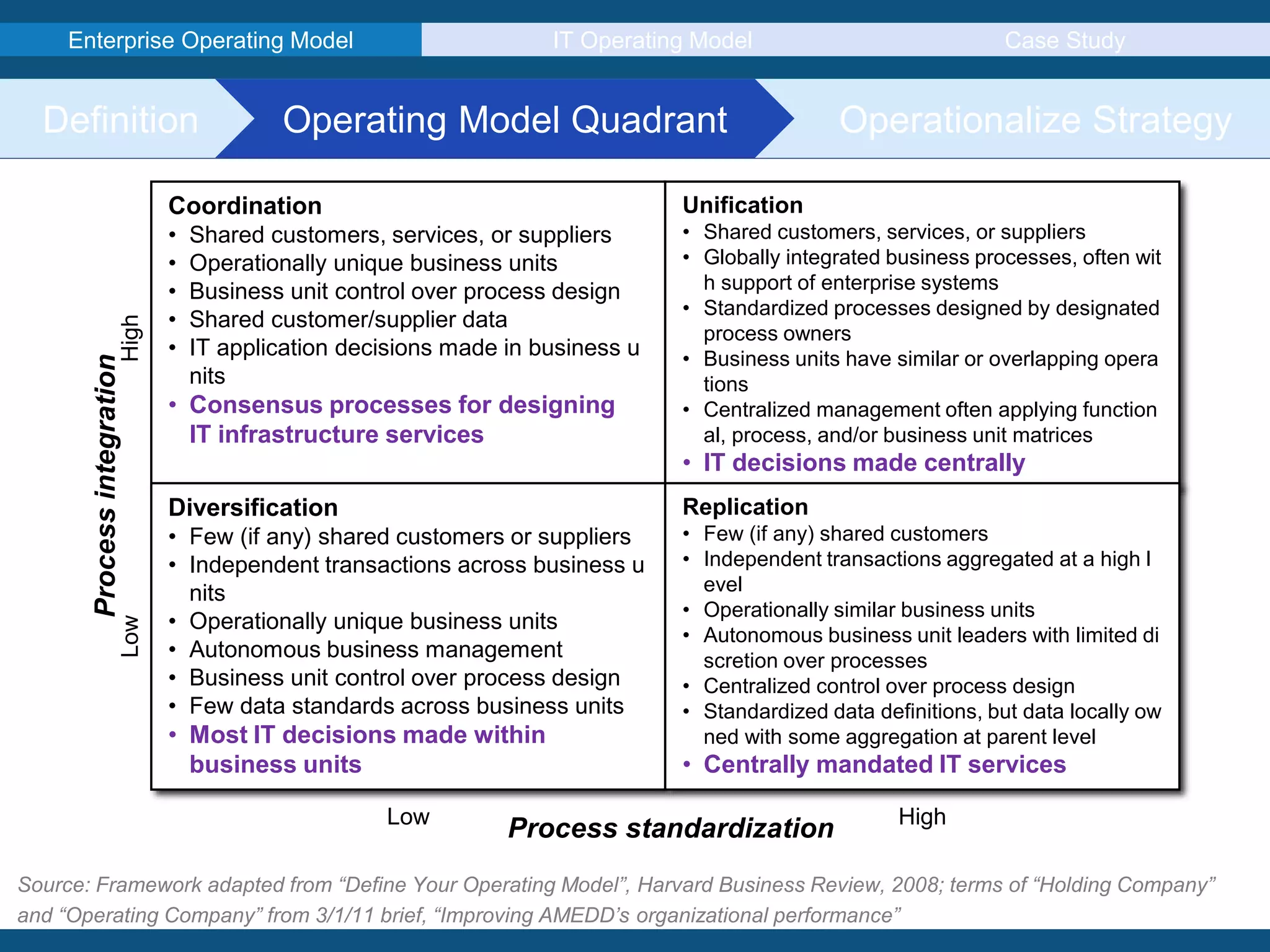
Coordination
• Shared customers, services, or suppliers
• Operationally unique business units
• Business unit control over process design
• Shared customer/supplier data
• IT application decisions made in business u
nits
• Consensus processes for designing
IT infrastructure services
Unification
• Shared customers, services, or suppliers
• Globally integrated business processes, often wit
h support of enterprise systems
• Standardized processes designed by designated
process owners
• Business units have similar or overlapping opera
tions
• Centralized management often applying function
al, process, and/or business unit matrices
• IT decisions made centrally
Diversification
• Few (if any) shared customers or suppliers
• Independent transactions across business u
nits
• Operationally unique business units
• Autonomous business management
• Business unit control over process design
• Few data standards across business units
• Most IT decisions made within
business units
Replication
• Few (if any) shared customers
• Independent transactions aggregated at a high l
evel
• Operationally similar business units
• Autonomous business unit leaders with limited di
scretion over processes
• Centralized control over process design
• Standardized data definitions, but data locally ow
ned with some aggregation at parent level
• Centrally mandated IT services
Processintegration
Process standardizationLow High
LowHigh
Source: Framework adapted from “Define Your Operating Model”, Harvard Business Review, 2008; terms of “Holding Company”
and “Operating Company” from 3/1/11 brief, “Improving AMEDD’s organizational performance”
Enterprise Operating Model IT Operating Model Case Study
Definition Operating Model Quadrant Operationalize Strategy
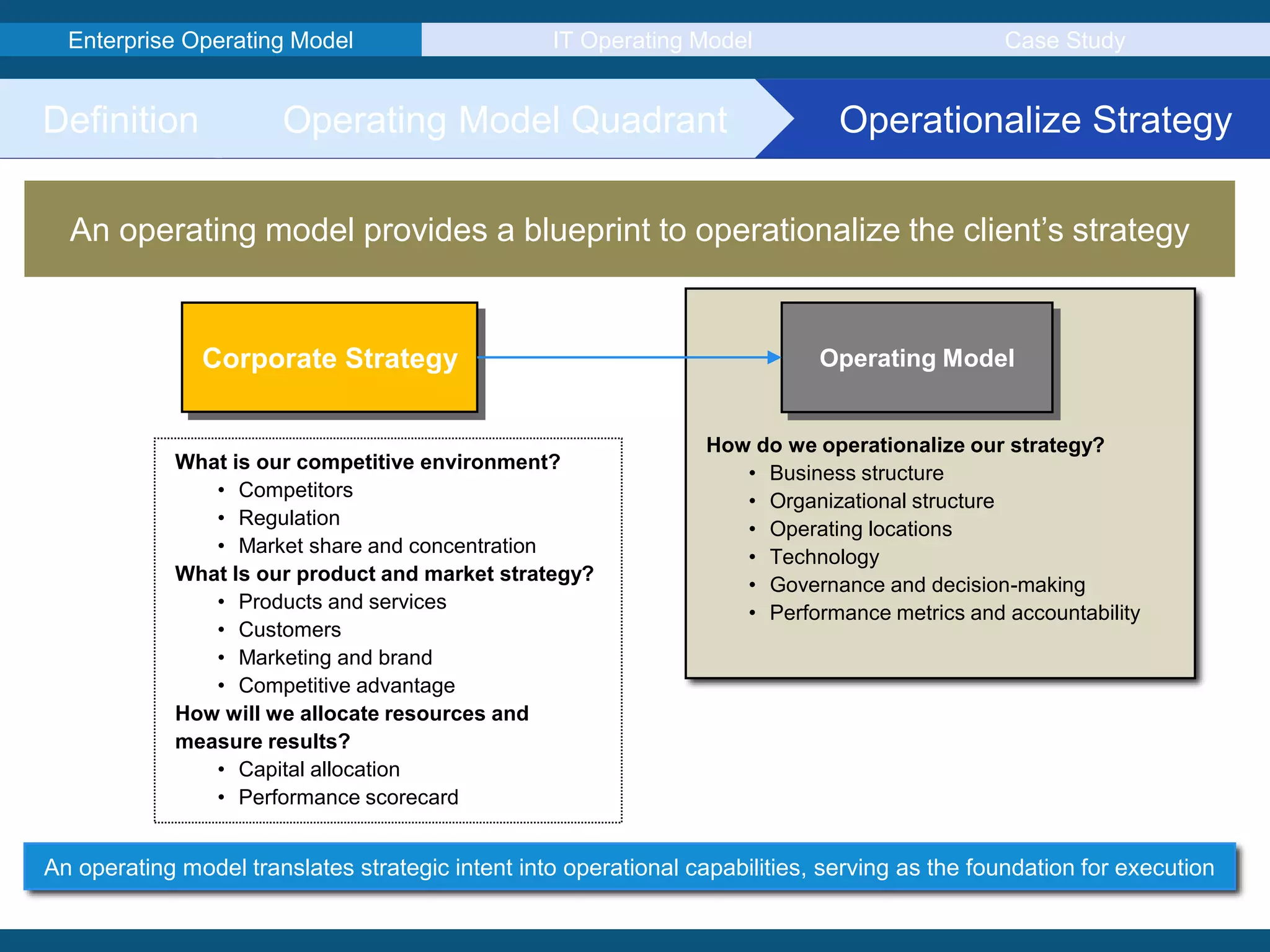
An operating model provides a blueprint to operationalize the client’s strategy
Corporate Strategy Operating Model
What is our competitive environment?
• Competitors
• Regulation
• Market share and concentration
What Is our product and market strategy?
• Products and services
• Customers
• Marketing and brand
• Competitive advantage
How will we allocate resources and
measure results?
• Capital allocation
• Performance scorecard
How do we operationalize our strategy?
• Business structure
• Organizational structure
• Operating locations
• Technology
• Governance and decision-making
• Performance metrics and accountability
An operating model translates strategic intent into operational capabilities, serving as the foundation for execution
IT Operating Model
Enterprise Operating Model IT Operating Model Case Study
Definition Issues and Triggers Framework
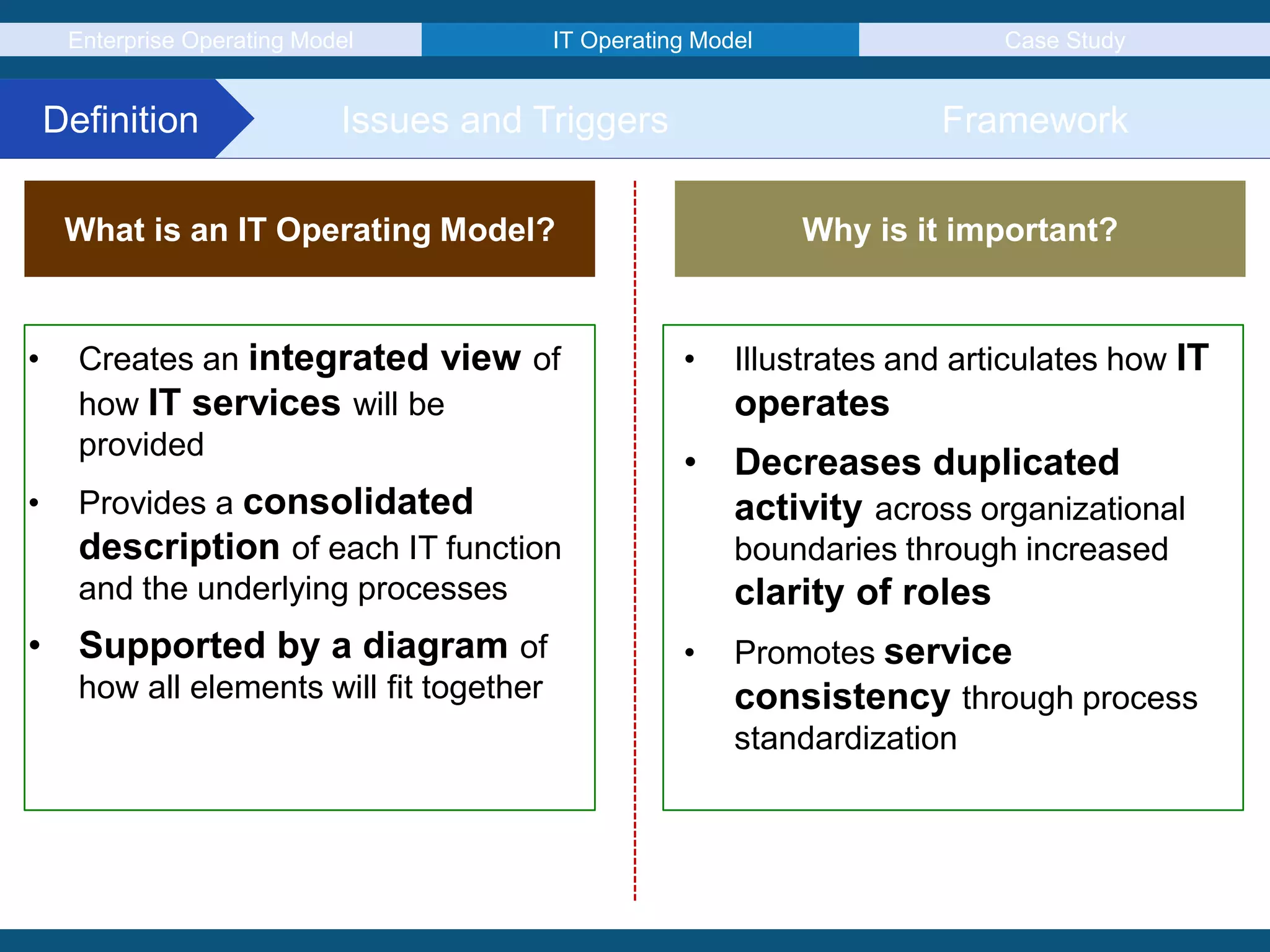
What is an IT Operating Model? Why is it important?
• Creates an integrated view of
how IT services will be
provided
• Provides a consolidated
description of each IT function
and the underlying processes
• Supported by a diagram of
how all elements will fit together
• Illustrates and articulates how IT
operates
• Decreases duplicated
activity across organizational
boundaries through increased
clarity of roles
• Promotes service
consistency through process
standardization
Enterprise Operating Model IT Operating Model Case Study
Definition Issues and Triggers Framework
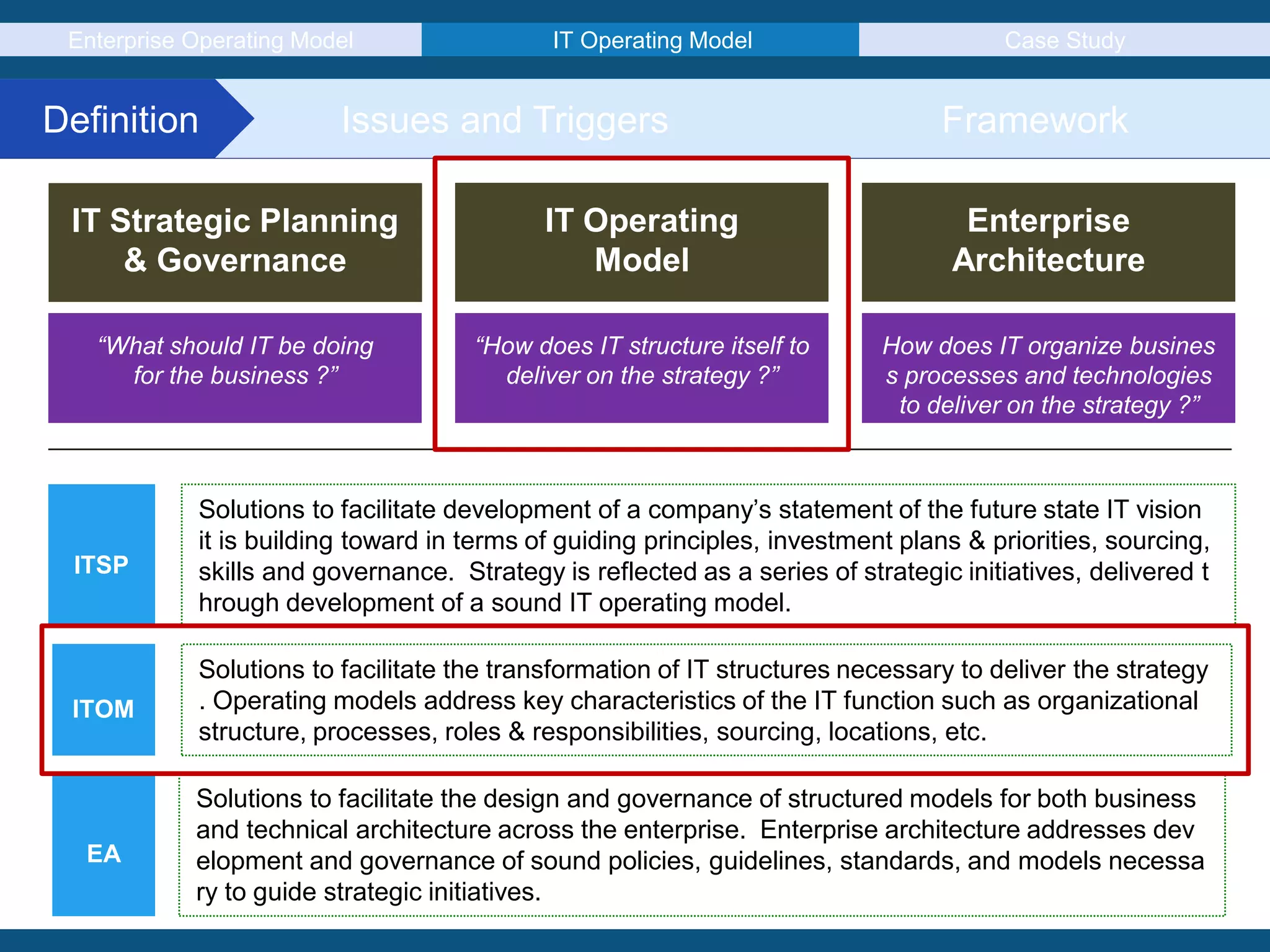
IT Strategic Planning
& Governance
IT Operating
Model
Enterprise
Architecture
“What should IT be doing
for the business ?”
“How does IT structure itself to
deliver on the strategy ?”
How does IT organize busines
s processes and technologies
to deliver on the strategy ?”
Solutions to facilitate development of a company’s statement of the future state IT vision
it is building toward in terms of guiding principles, investment plans & priorities, sourcing,
skills and governance. Strategy is reflected as a series of strategic initiatives, delivered t
hrough development of a sound IT operating model.
Solutions to facilitate the transformation of IT structures necessary to deliver the strategy
. Operating models address key characteristics of the IT function such as organizational
structure, processes, roles & responsibilities, sourcing, locations, etc.
Solutions to facilitate the design and governance of structured models for both business
and technical architecture across the enterprise. Enterprise architecture addresses dev
elopment and governance of sound policies, guidelines, standards, and models necessa
ry to guide strategic initiatives.
ITSP
ITOM
EA
Enterprise Operating Model IT Operating Model Case Study
Definition Issues and Triggers Framework
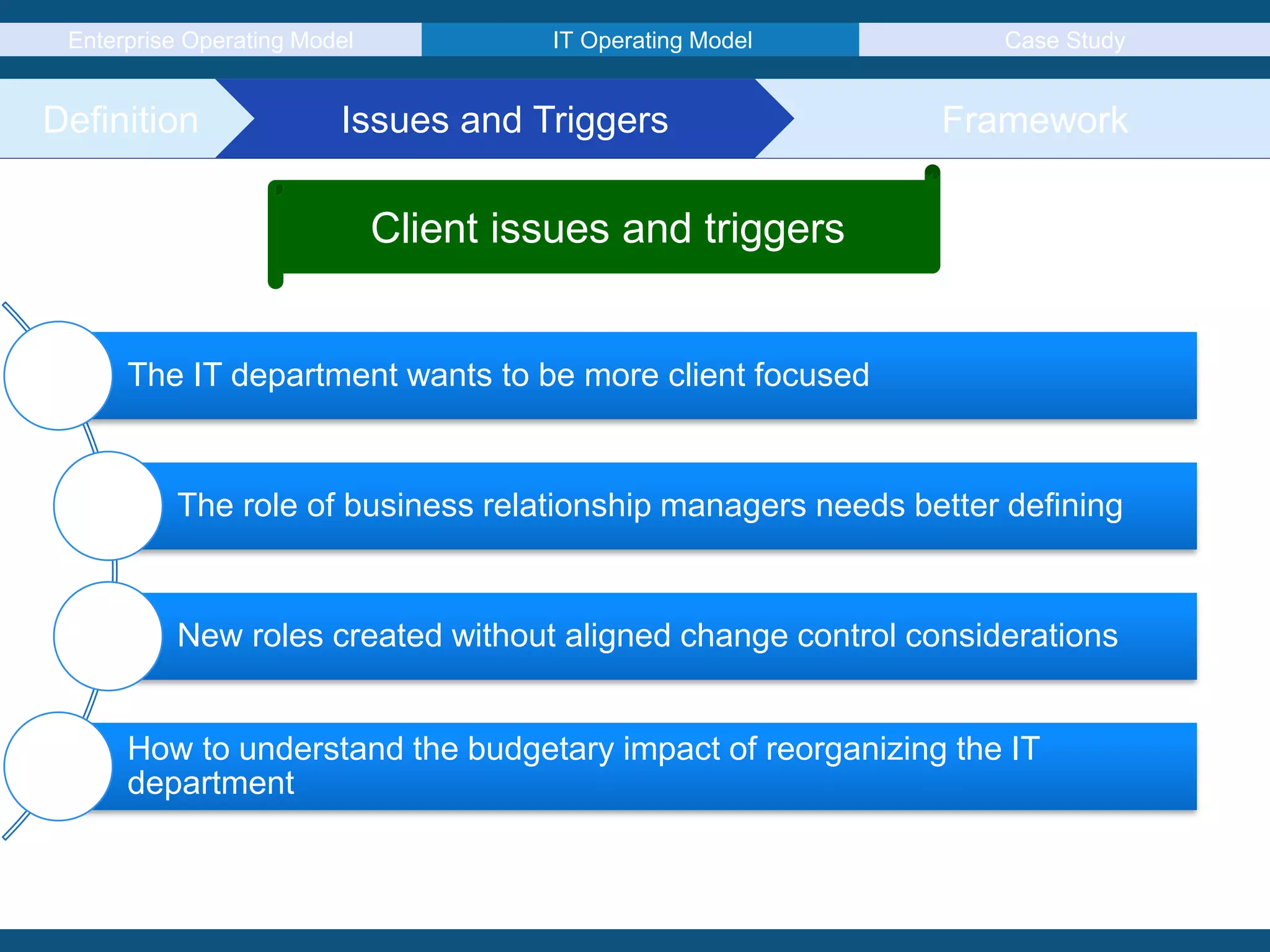
The IT department wants to be more client focused
The role of business relationship managers needs better defining
New roles created without aligned change control considerations
How to understand the budgetary impact of reorganizing the IT
department
Client issues and triggers
Enterprise Operating Model IT Operating Model Case Study
Definition Issues and Triggers Framework
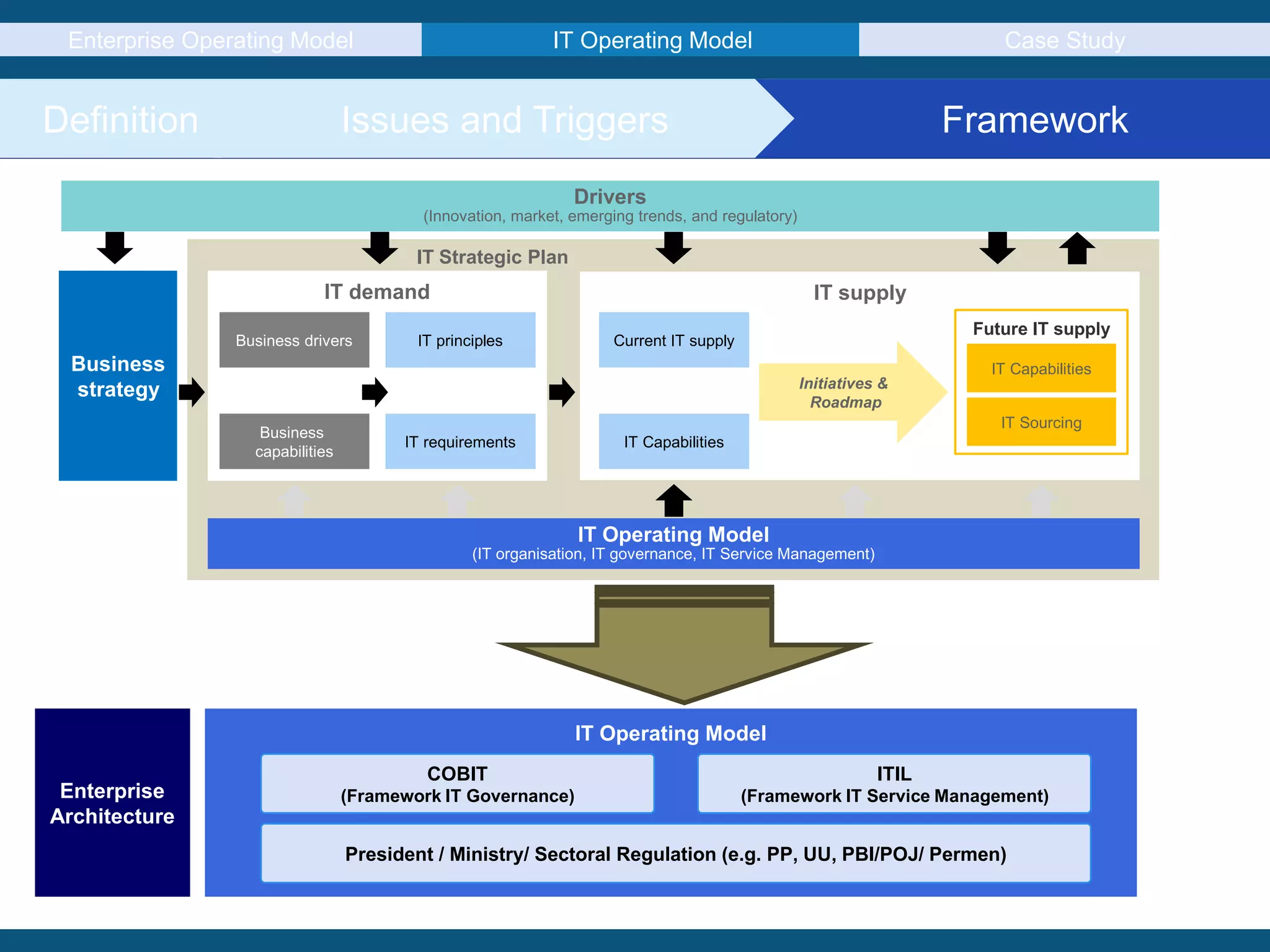
IT Operating Model
(IT organisation, IT governance, IT Service Management)
IT supply
Initiatives &
Roadmap
IT demand
Business
strategy
Business drivers
IT requirements
IT principles
Future IT supply
Drivers
(Innovation, market, emerging trends, and regulatory)
Business
capabilities
Current IT supply
IT Capabilities
IT Capabilities
IT Strategic Plan
IT Sourcing
IT Operating Model
COBIT
(Framework IT Governance)
ITIL
(Framework IT Service Management)
President / Ministry/ Sectoral Regulation (e.g. PP, UU, PBI/POJ/ Permen)
Enterprise
Architecture
Case Study
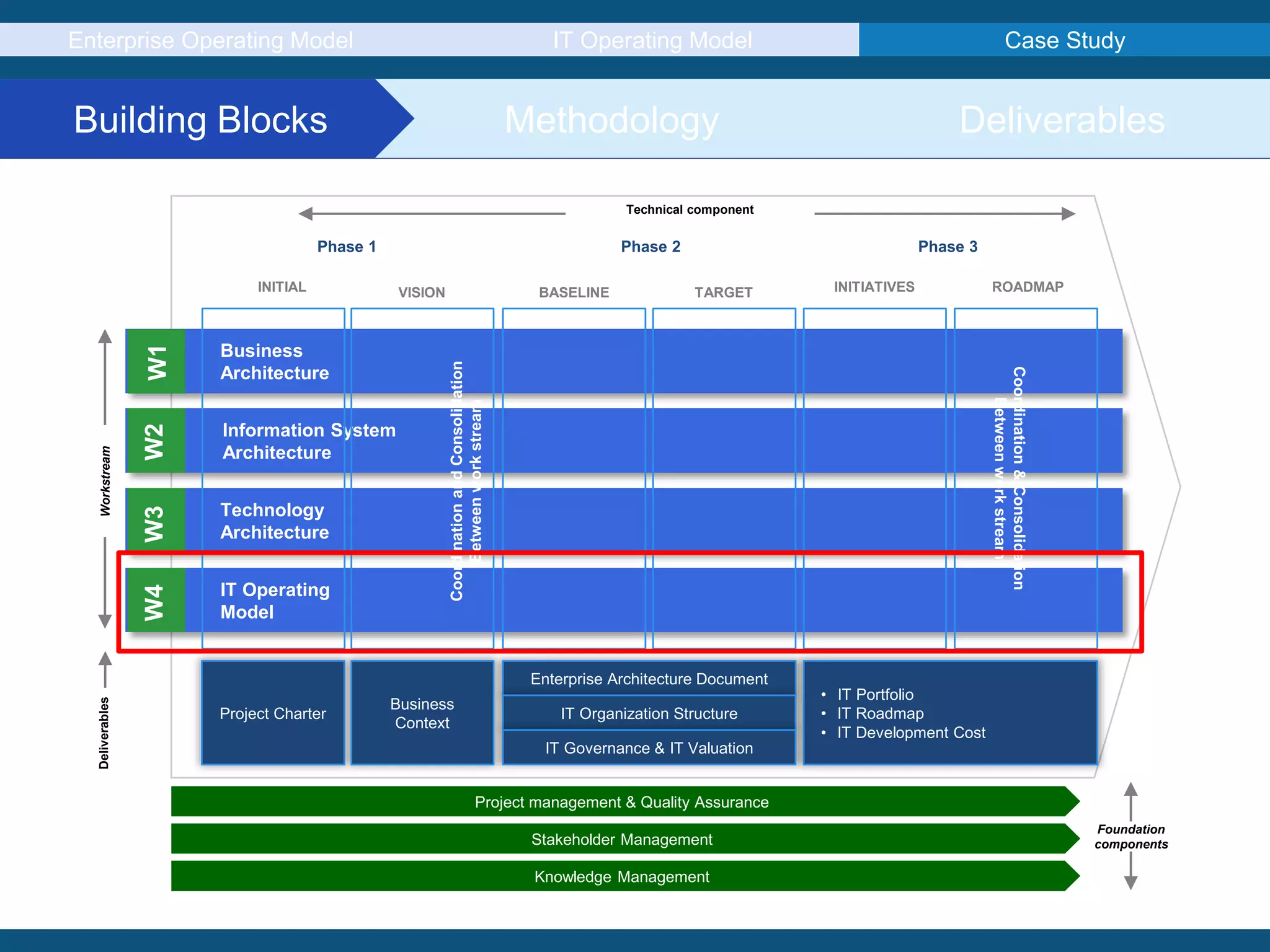
Enterprise Operating Model IT Operating Model Case Study
Building Blocks Methodology Deliverables
Business
Architecture
Information System
Architecture
IT Operating
Model
VISION INITIATIVESTARGETBASELINE
Technology
Architecture
Workstream
Technical component
Knowledge Management
Stakeholder Management
Project management & Quality Assurance
Foundation
components
ROADMAP
Phase 1
Coordination&Consolidation
Betweenworkstream
INITIAL
Deliverables
W1W2W3W4
Project Charter
Business
Context
Enterprise Architecture Document
• IT Portfolio
• IT Roadmap
• IT Development Cost
IT Organization Structure
IT Governance & IT Valuation
CoordinationandConsolidation
Betweenworkstream
Phase 2 Phase 3
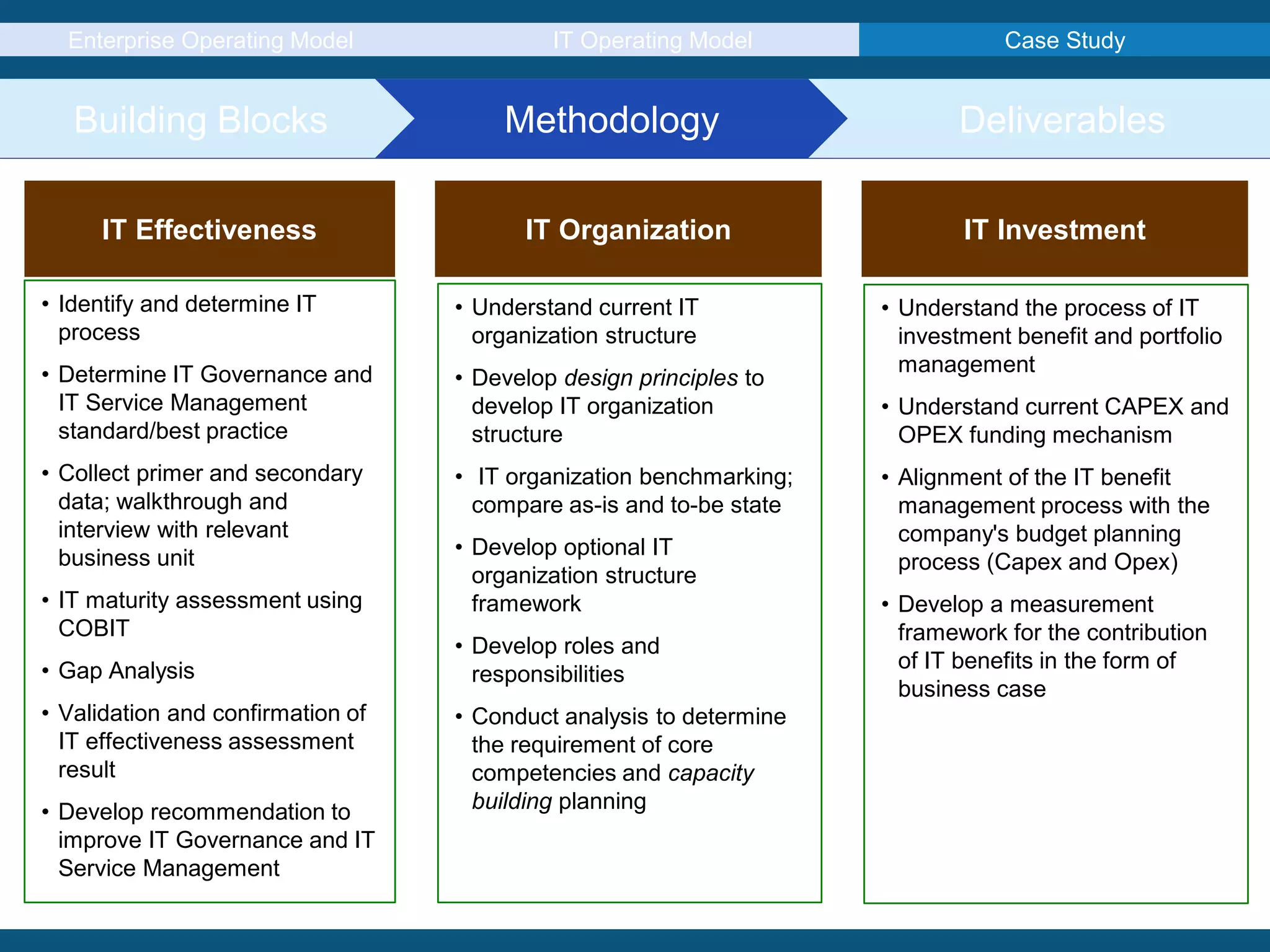
Enterprise Operating Model IT Operating Model Case Study
Building Blocks Methodology Deliverables
IT Effectiveness IT Organization IT Investment
• Identify and determine IT
process
• Determine IT Governance and
IT Service Management
standard/best practice
• Collect primer and secondary
data; walkthrough and
interview with relevant
business unit
• IT maturity assessment using
COBIT
• Gap Analysis
• Validation and confirmation of
IT effectiveness assessment
result
• Develop recommendation to
improve IT Governance and IT
Service Management
• Understand current IT
organization structure
• Develop design principles to
develop IT organization
structure
• IT organization benchmarking;
compare as-is and to-be state
• Develop optional IT
organization structure
framework
• Develop roles and
responsibilities
• Conduct analysis to determine
the requirement of core
competencies and capacity
building planning
• Understand the process of IT
investment benefit and portfolio
management
• Understand current CAPEX and
OPEX funding mechanism
• Alignment of the IT benefit
management process with the
company's budget planning
process (Capex and Opex)
• Develop a measurement
framework for the contribution
of IT benefits in the form of
business case
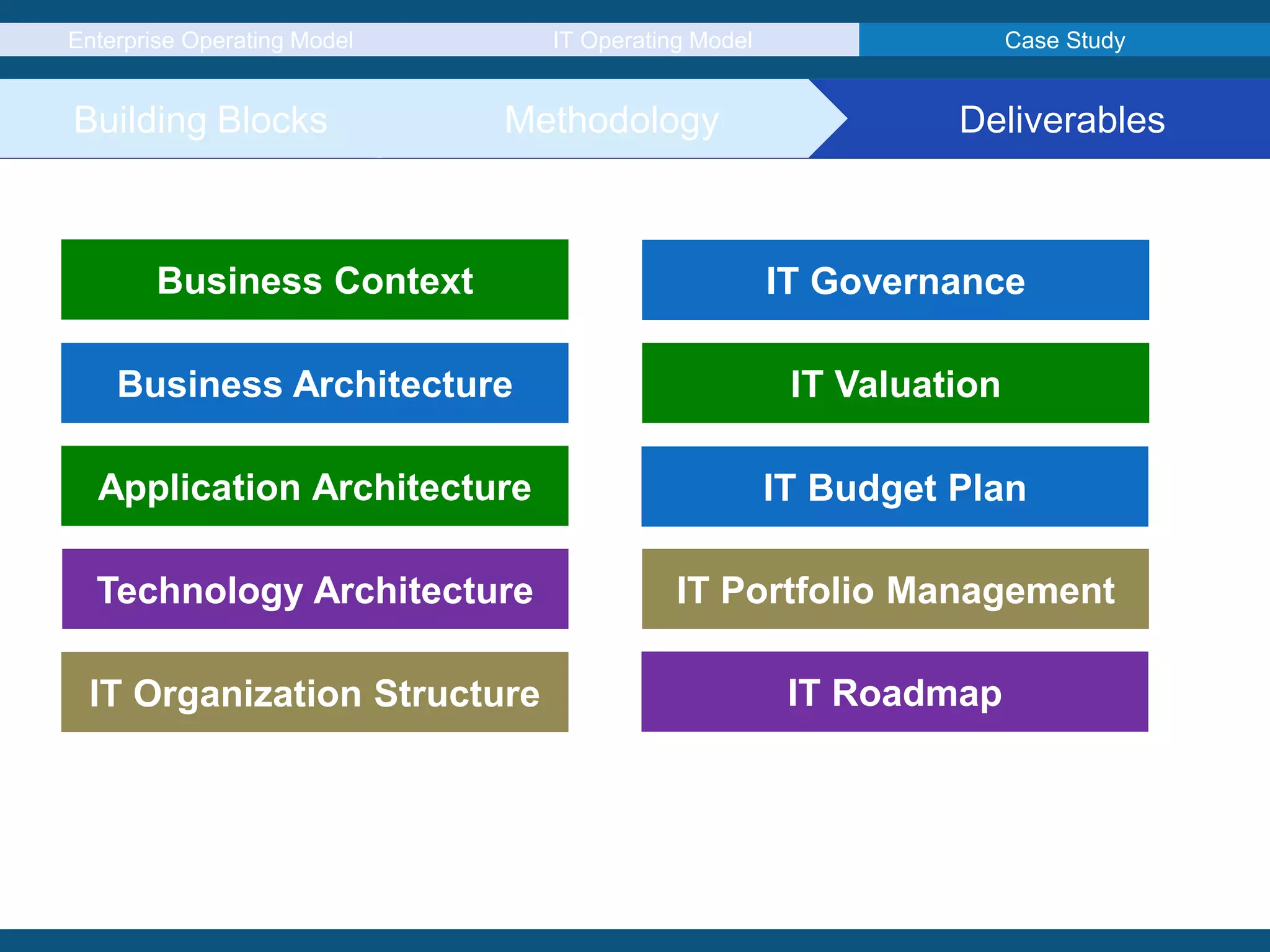
Enterprise Operating Model IT Operating Model Case Study
Building Blocks Methodology Deliverables
Business Context
Business Architecture
Application Architecture
Technology Architecture
IT Organization Structure
IT Governance
IT Valuation
IT Budget Plan
IT Portfolio Management
IT Roadmap
Thank You
eryk.pratama@gmail.com
https://proferyk.blogspot.co.id

IT Operating Model - Fundamental

  • 1.
    IT Operating Model bridgebetween strategy and operations Eryk Budi Pratama July 31th, 2018
  • 2.
    Agenda 01 02 03 Enterprise Operating Model ITOperating Model Case Study Network Security Technology – Next Generation Firewall Network Security – Next Generation Firewall
  • 3.
  • 4.
    Enterprise Operating ModelIT Operating Model Case Study Definition Operating Model Quadrant Operationalize Strategy Source: “Define Your Operating Model”, Harvard Business Review, 2008 An operating model defines how strategy will be executed • It does so by outlining the business and organization structure, and providing direction on processes, IT infrastructure, decision governance, and performance metrics • An operating model describes a more actionable view of an organization than strategy, and as such serves as the foundation for execution Selecting an operating model is a commitment to a way of doing business both today and into the future Without a clear operating model, organizations struggle to bring pre- existing, efficient capabilities and processes to new strategic initiatives Research indicates that companies with a foundational, clearly defined operating model report significantly greater performance across a range of outcome metrics, including operational efficiency, customer intimacy, product leadership, and strategic agility
  • 5.
    Enterprise Operating ModelIT Operating Model Case Study Definition Operating Model Quadrant Operationalize Strategy Coordination • Shared customers, services, or suppliers • Operationally unique business units • Business unit control over process design • Shared customer/supplier data • IT application decisions made in business u nits • Consensus processes for designing IT infrastructure services Unification • Shared customers, services, or suppliers • Globally integrated business processes, often wit h support of enterprise systems • Standardized processes designed by designated process owners • Business units have similar or overlapping opera tions • Centralized management often applying function al, process, and/or business unit matrices • IT decisions made centrally Diversification • Few (if any) shared customers or suppliers • Independent transactions across business u nits • Operationally unique business units • Autonomous business management • Business unit control over process design • Few data standards across business units • Most IT decisions made within business units Replication • Few (if any) shared customers • Independent transactions aggregated at a high l evel • Operationally similar business units • Autonomous business unit leaders with limited di scretion over processes • Centralized control over process design • Standardized data definitions, but data locally ow ned with some aggregation at parent level • Centrally mandated IT services Processintegration Process standardizationLow High LowHigh Source: Framework adapted from “Define Your Operating Model”, Harvard Business Review, 2008; terms of “Holding Company” and “Operating Company” from 3/1/11 brief, “Improving AMEDD’s organizational performance”
  • 6.
    Enterprise Operating ModelIT Operating Model Case Study Definition Operating Model Quadrant Operationalize Strategy An operating model provides a blueprint to operationalize the client’s strategy Corporate Strategy Operating Model What is our competitive environment? • Competitors • Regulation • Market share and concentration What Is our product and market strategy? • Products and services • Customers • Marketing and brand • Competitive advantage How will we allocate resources and measure results? • Capital allocation • Performance scorecard How do we operationalize our strategy? • Business structure • Organizational structure • Operating locations • Technology • Governance and decision-making • Performance metrics and accountability An operating model translates strategic intent into operational capabilities, serving as the foundation for execution
  • 7.
  • 8.
    Enterprise Operating ModelIT Operating Model Case Study Definition Issues and Triggers Framework What is an IT Operating Model? Why is it important? • Creates an integrated view of how IT services will be provided • Provides a consolidated description of each IT function and the underlying processes • Supported by a diagram of how all elements will fit together • Illustrates and articulates how IT operates • Decreases duplicated activity across organizational boundaries through increased clarity of roles • Promotes service consistency through process standardization
  • 9.
    Enterprise Operating ModelIT Operating Model Case Study Definition Issues and Triggers Framework IT Strategic Planning & Governance IT Operating Model Enterprise Architecture “What should IT be doing for the business ?” “How does IT structure itself to deliver on the strategy ?” How does IT organize busines s processes and technologies to deliver on the strategy ?” Solutions to facilitate development of a company’s statement of the future state IT vision it is building toward in terms of guiding principles, investment plans & priorities, sourcing, skills and governance. Strategy is reflected as a series of strategic initiatives, delivered t hrough development of a sound IT operating model. Solutions to facilitate the transformation of IT structures necessary to deliver the strategy . Operating models address key characteristics of the IT function such as organizational structure, processes, roles & responsibilities, sourcing, locations, etc. Solutions to facilitate the design and governance of structured models for both business and technical architecture across the enterprise. Enterprise architecture addresses dev elopment and governance of sound policies, guidelines, standards, and models necessa ry to guide strategic initiatives. ITSP ITOM EA
  • 10.
    Enterprise Operating ModelIT Operating Model Case Study Definition Issues and Triggers Framework The IT department wants to be more client focused The role of business relationship managers needs better defining New roles created without aligned change control considerations How to understand the budgetary impact of reorganizing the IT department Client issues and triggers
  • 11.
    Enterprise Operating ModelIT Operating Model Case Study Definition Issues and Triggers Framework IT Operating Model (IT organisation, IT governance, IT Service Management) IT supply Initiatives & Roadmap IT demand Business strategy Business drivers IT requirements IT principles Future IT supply Drivers (Innovation, market, emerging trends, and regulatory) Business capabilities Current IT supply IT Capabilities IT Capabilities IT Strategic Plan IT Sourcing IT Operating Model COBIT (Framework IT Governance) ITIL (Framework IT Service Management) President / Ministry/ Sectoral Regulation (e.g. PP, UU, PBI/POJ/ Permen) Enterprise Architecture
  • 12.
  • 13.
    Enterprise Operating ModelIT Operating Model Case Study Building Blocks Methodology Deliverables Business Architecture Information System Architecture IT Operating Model VISION INITIATIVESTARGETBASELINE Technology Architecture Workstream Technical component Knowledge Management Stakeholder Management Project management & Quality Assurance Foundation components ROADMAP Phase 1 Coordination&Consolidation Betweenworkstream INITIAL Deliverables W1W2W3W4 Project Charter Business Context Enterprise Architecture Document • IT Portfolio • IT Roadmap • IT Development Cost IT Organization Structure IT Governance & IT Valuation CoordinationandConsolidation Betweenworkstream Phase 2 Phase 3
  • 14.
    Enterprise Operating ModelIT Operating Model Case Study Building Blocks Methodology Deliverables IT Effectiveness IT Organization IT Investment • Identify and determine IT process • Determine IT Governance and IT Service Management standard/best practice • Collect primer and secondary data; walkthrough and interview with relevant business unit • IT maturity assessment using COBIT • Gap Analysis • Validation and confirmation of IT effectiveness assessment result • Develop recommendation to improve IT Governance and IT Service Management • Understand current IT organization structure • Develop design principles to develop IT organization structure • IT organization benchmarking; compare as-is and to-be state • Develop optional IT organization structure framework • Develop roles and responsibilities • Conduct analysis to determine the requirement of core competencies and capacity building planning • Understand the process of IT investment benefit and portfolio management • Understand current CAPEX and OPEX funding mechanism • Alignment of the IT benefit management process with the company's budget planning process (Capex and Opex) • Develop a measurement framework for the contribution of IT benefits in the form of business case
  • 15.
    Enterprise Operating ModelIT Operating Model Case Study Building Blocks Methodology Deliverables Business Context Business Architecture Application Architecture Technology Architecture IT Organization Structure IT Governance IT Valuation IT Budget Plan IT Portfolio Management IT Roadmap
  • 16.