The Return of the  Prodigal Web   Carole Goble Information Management Group The University of Manchester, UK [email_address]
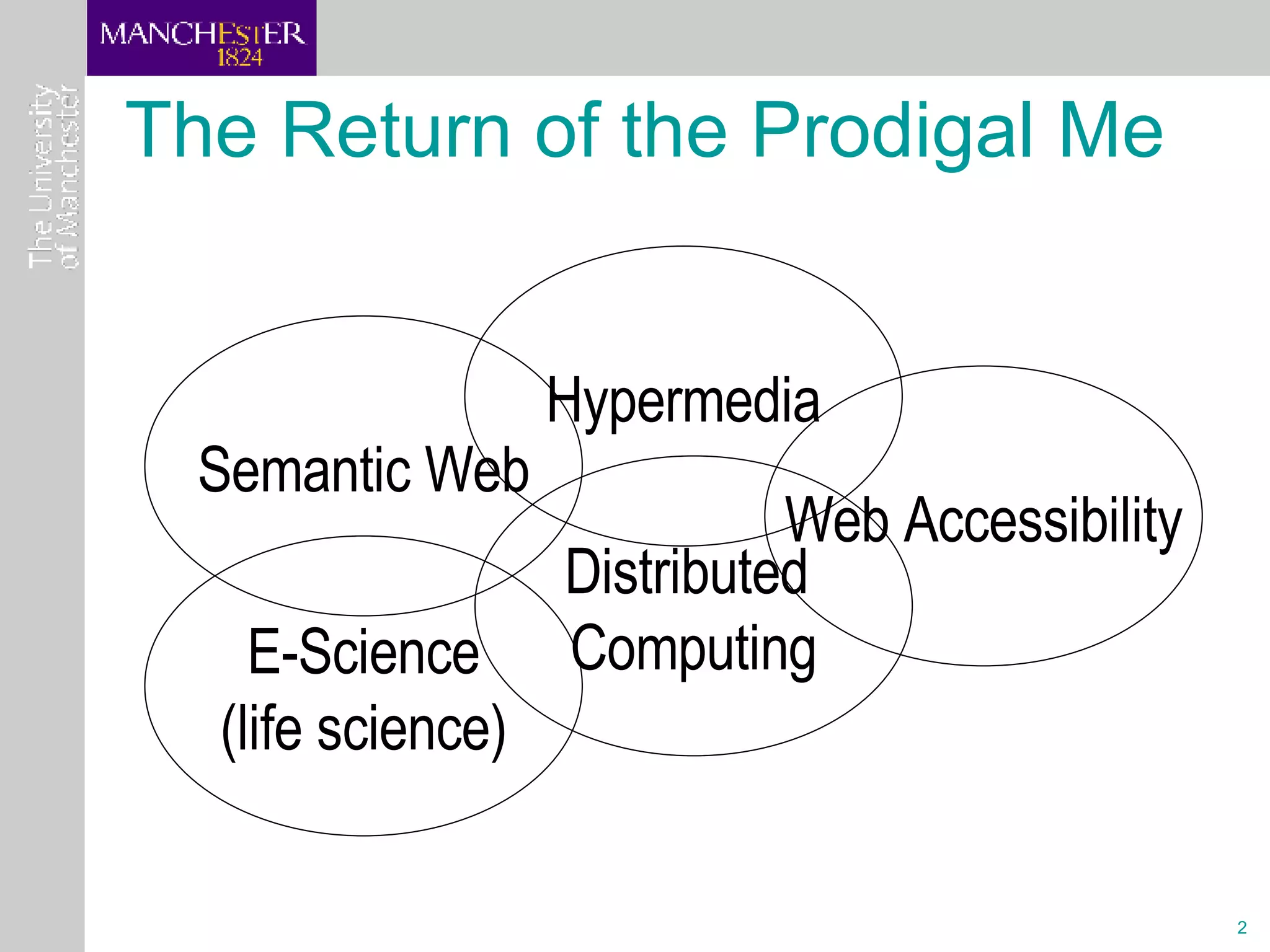
The Return of the Prodigal Me Semantic Web E-Science (life science) Distributed  Computing Hypermedia Web Accessibility
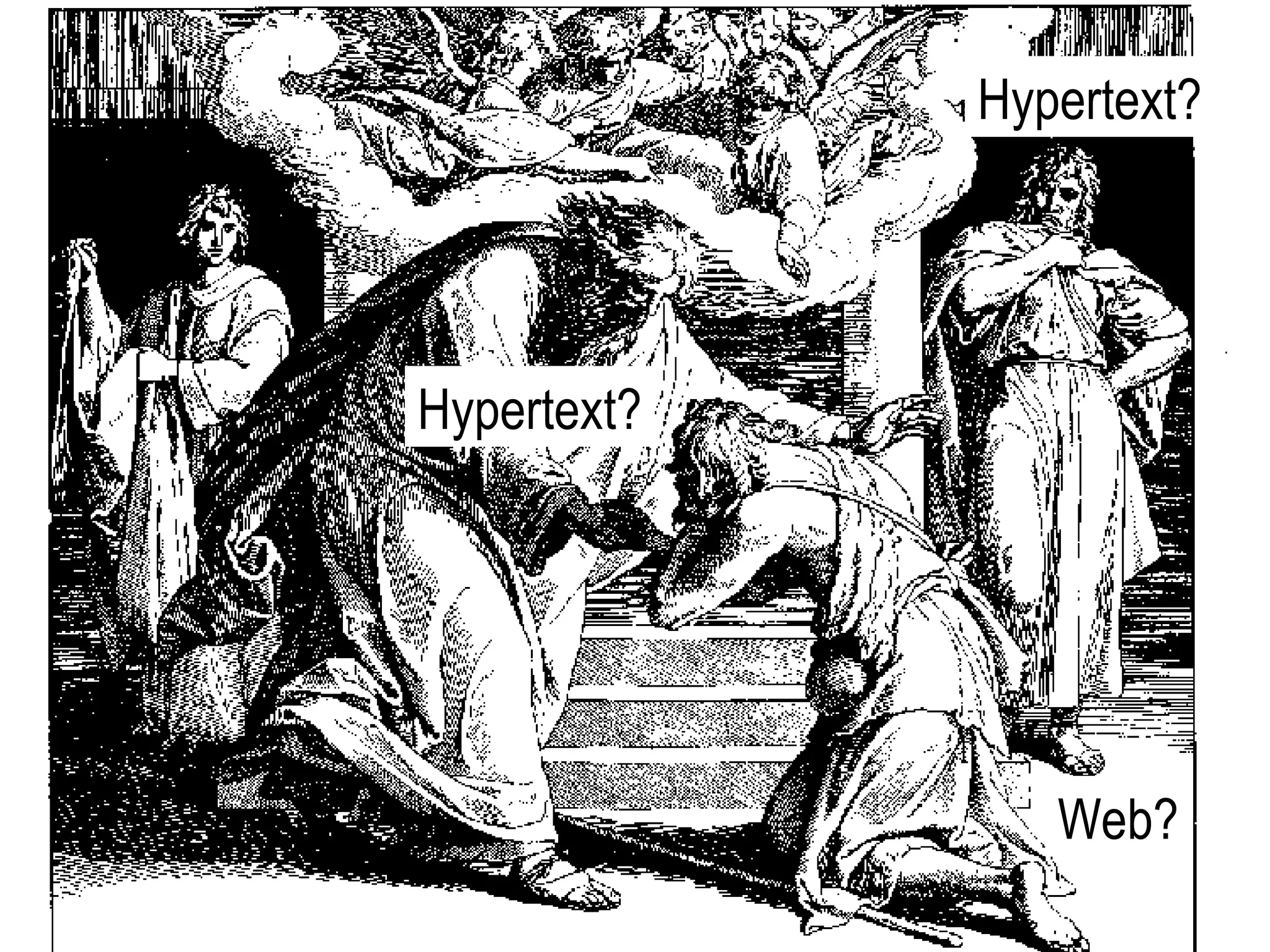
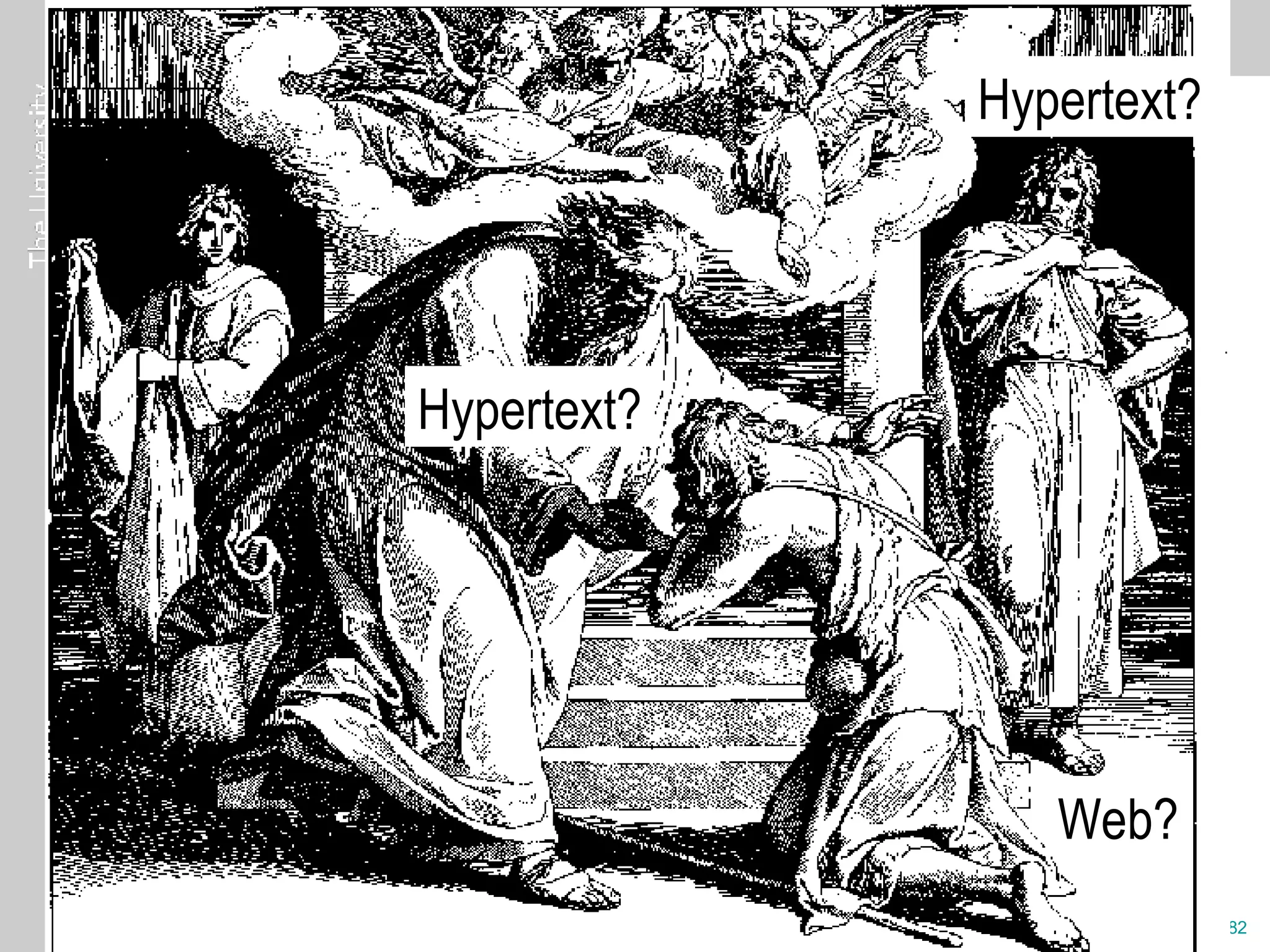
Hypertext? Web? Hypertext?
What’s the Story? Hypertext, and its offspring the Web, envisioned collective intelligence. Both propose technical infrastructure and social infrastructure to do this. The Web “made riotous living”. Two evolutions of the Web – Web 2.0 and Semantic Web – could (potentially) return the Web to the Hypertext family. By stealth. We have applications that show this. “ We should make merry, and be glad”. How? Is it done? Lessons learned? Why bother?
Spot the Difference Competition The Return of the Prodigal Web, Carole Goble Back to the Future with Hypertext: A Tale of Two or Three Conferences, Wendy Hall Back to the Future: Hypertext the Way It Used To Be, Ted Nelson and Robert Adamson Smith   Hypertext Tragedy,  A Panel Is Simon trying to tell us something?
Back in the Day Or Back to the Future….
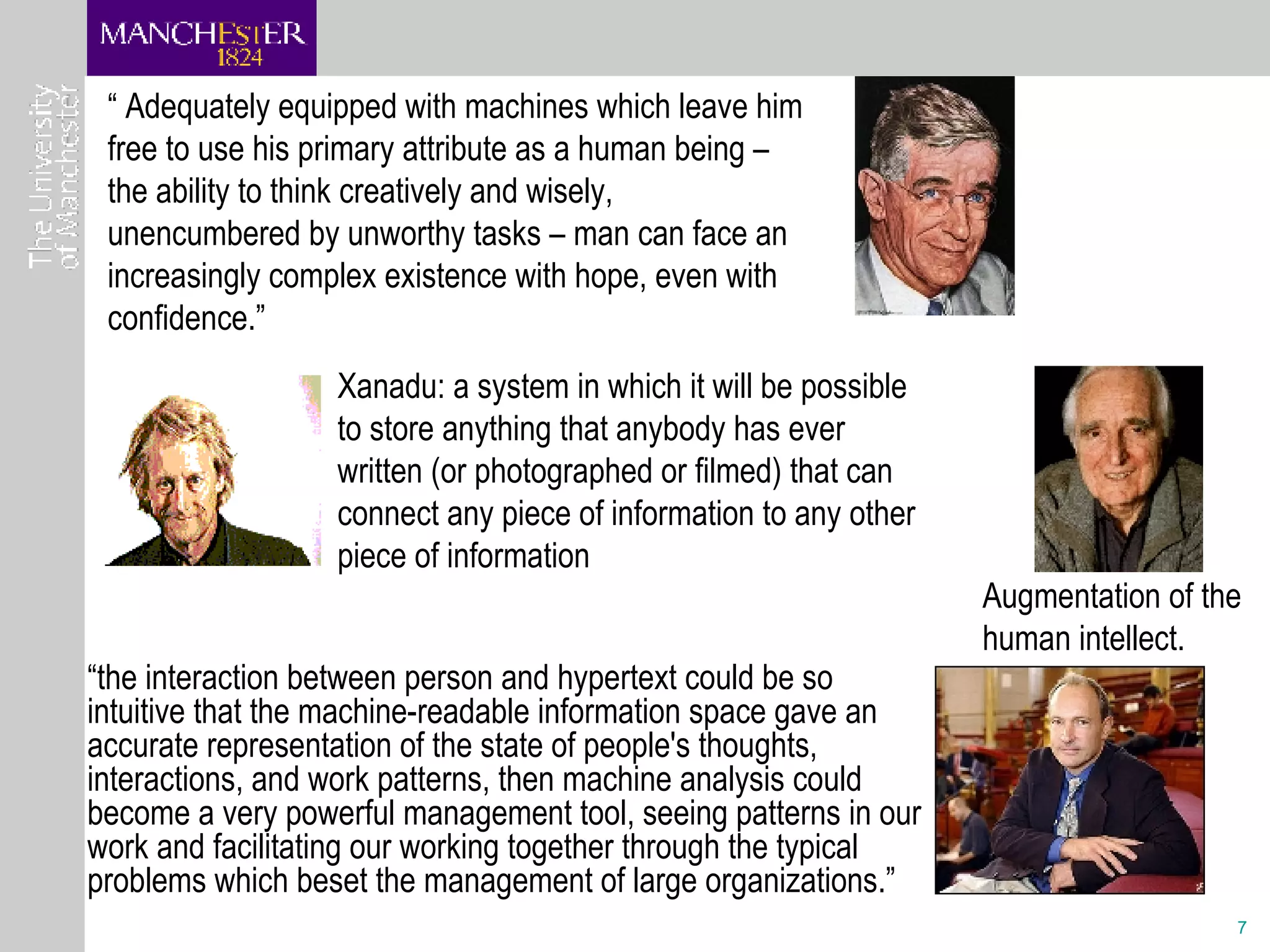
Xanadu: a system in which it will be possible to store anything that anybody has ever written (or photographed or filmed) that can connect any piece of information to any other piece of information Augmentation of the human intellect. “  Adequately equipped with machines which leave him free to use his primary attribute as a human being – the ability to think creatively and wisely, unencumbered by unworthy tasks – man can face an increasingly complex existence with hope, even with confidence.” “ the interaction between person and hypertext could be so intuitive that the machine-readable information space gave an accurate representation of the state of people's thoughts, interactions, and work patterns, then machine analysis could become a very powerful management tool, seeing patterns in our work and facilitating our working together through the typical problems which beset the management of large organizations.”
A  universal medium for  harvesting and harnessing   collective intelligence   making and using  connections  between   decoupled  content  and   decoupled  people.
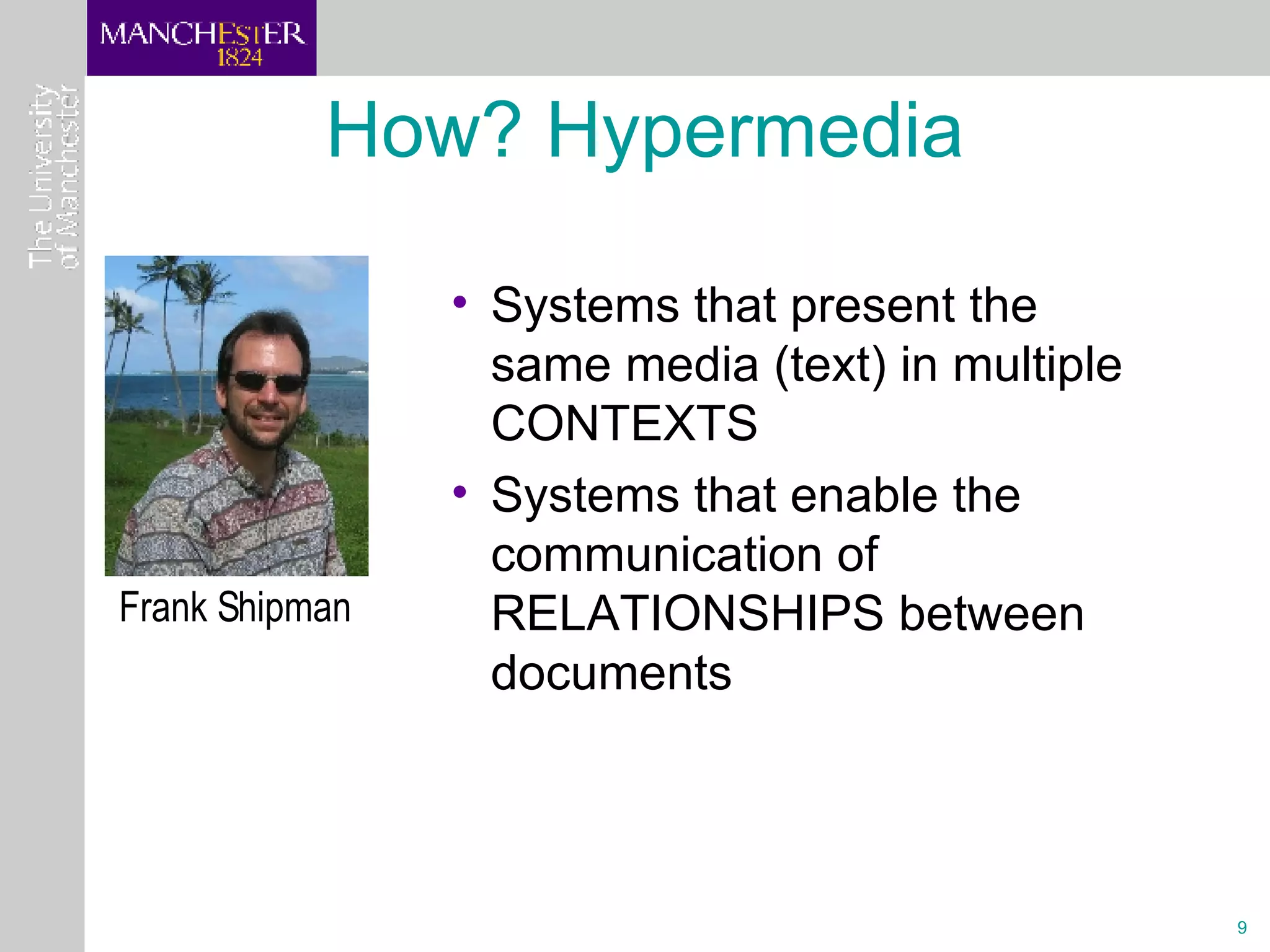
How? Hypermedia Systems that present the same media (text) in multiple  CONTEXTS Systems that enable the communication of RELATIONSHIPS between documents Frank Shipman
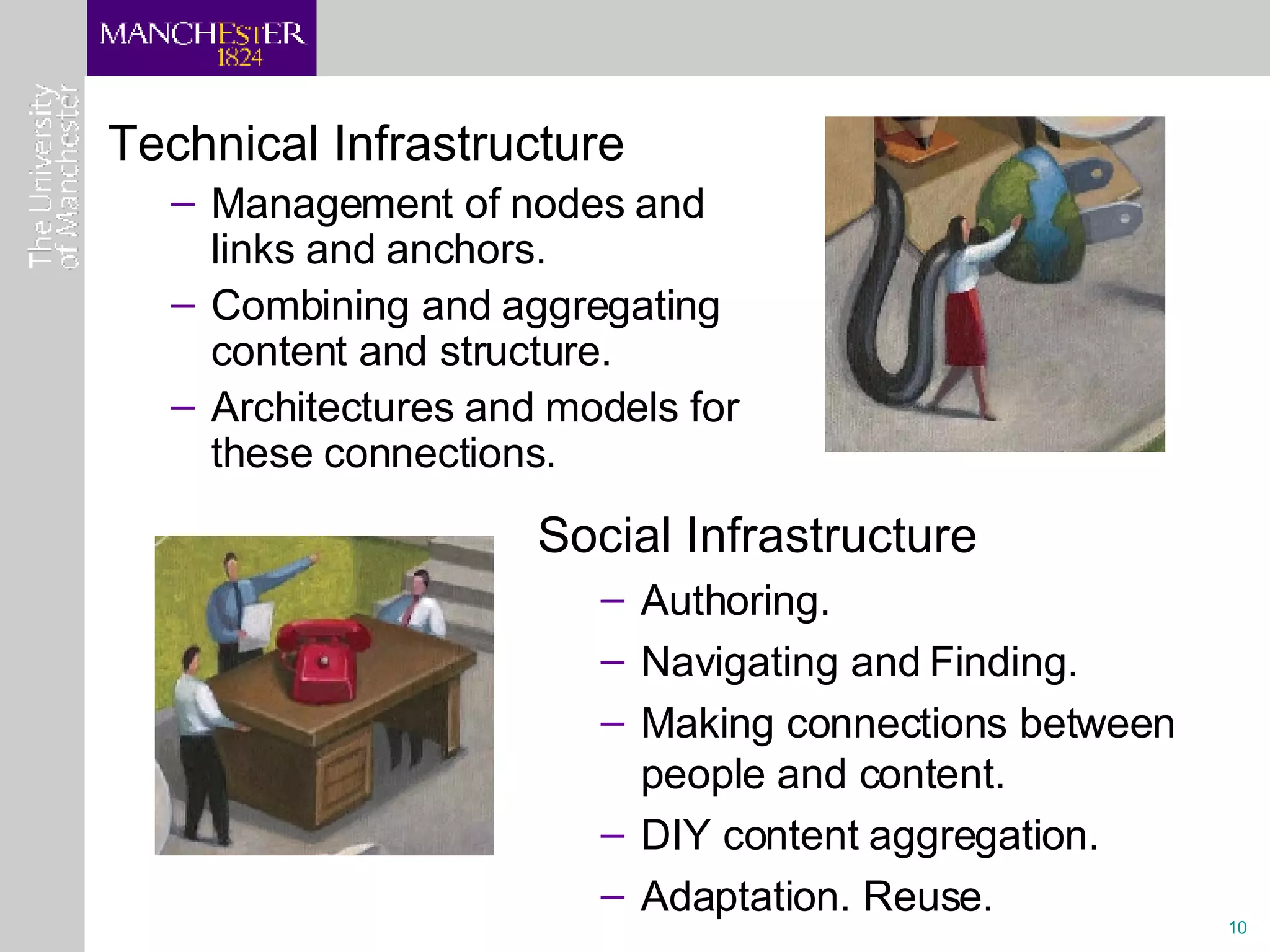
Technical Infrastructure Management of nodes and links and anchors. Combining and aggregating content and structure. Architectures and models for these connections. Social Infrastructure Authoring. Navigating and Finding. Making connections between people and content. DIY content aggregation. Adaptation. Reuse.
Build Hypermedia Create Content and Connections Cruise it. Use it.
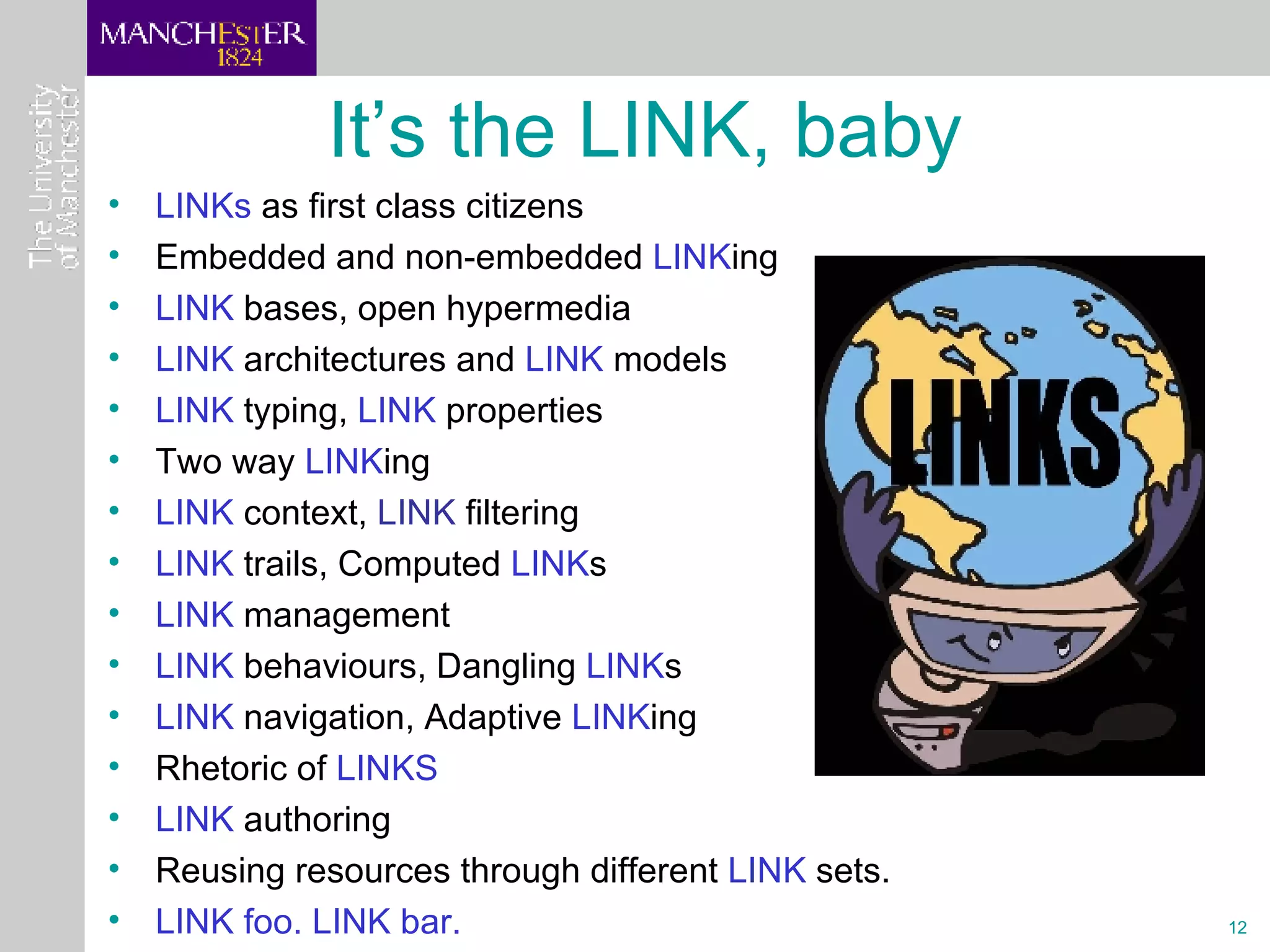
It’s the LINK, baby LINKs  as first class citizens Embedded and non-embedded  LINK ing LINK  bases, open hypermedia LINK  architectures and  LINK  models LINK  typing,  LINK  properties Two way  LINK ing LINK   context,  LINK  filtering LINK  trails, Computed  LINK s LINK  management LINK  behaviours, Dangling  LINK s LINK  navigation, Adaptive  LINK ing Rhetoric of  LINKS LINK  authoring Reusing resources through different  LINK  sets. LINK foo. LINK bar.
 
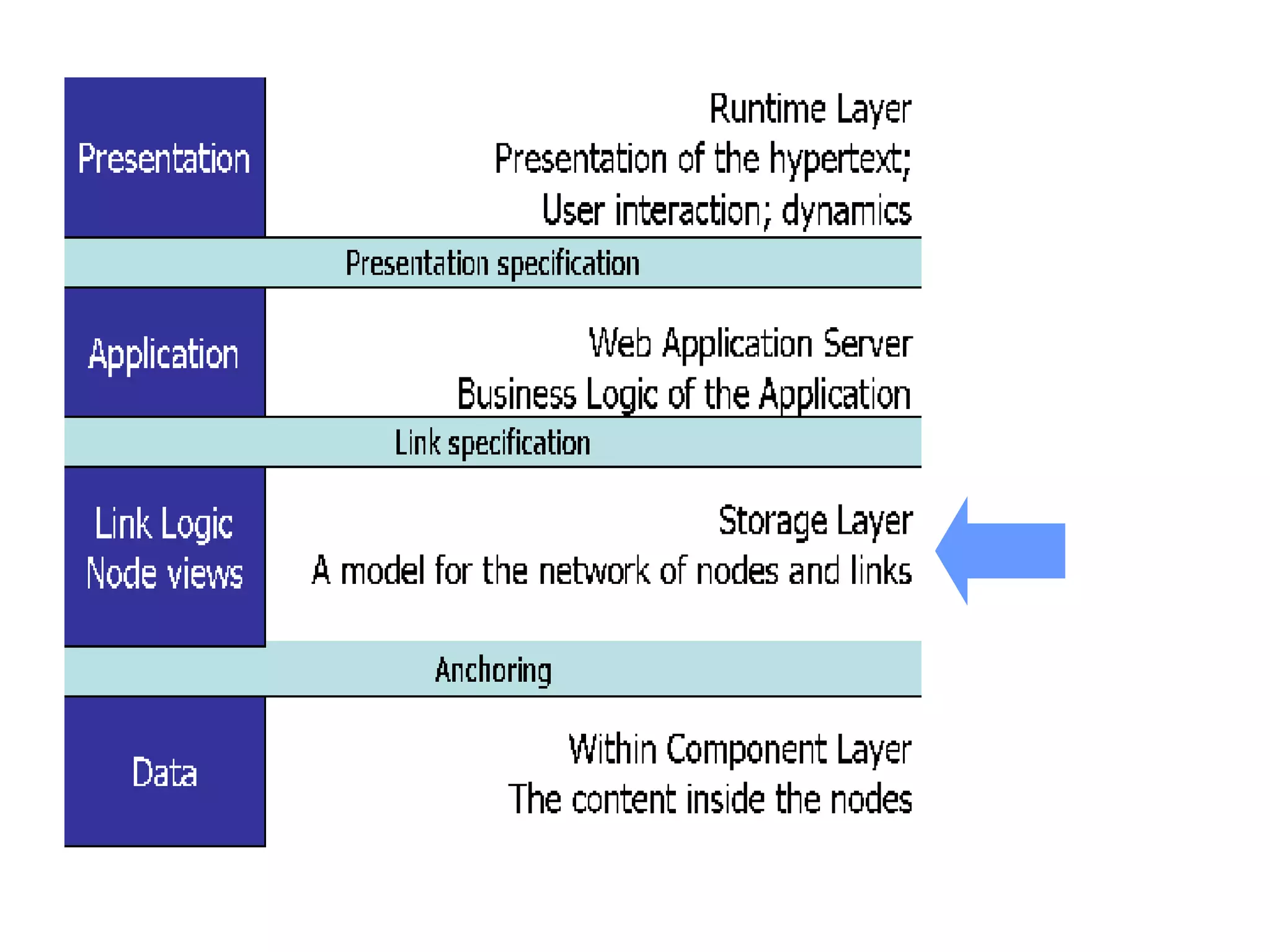
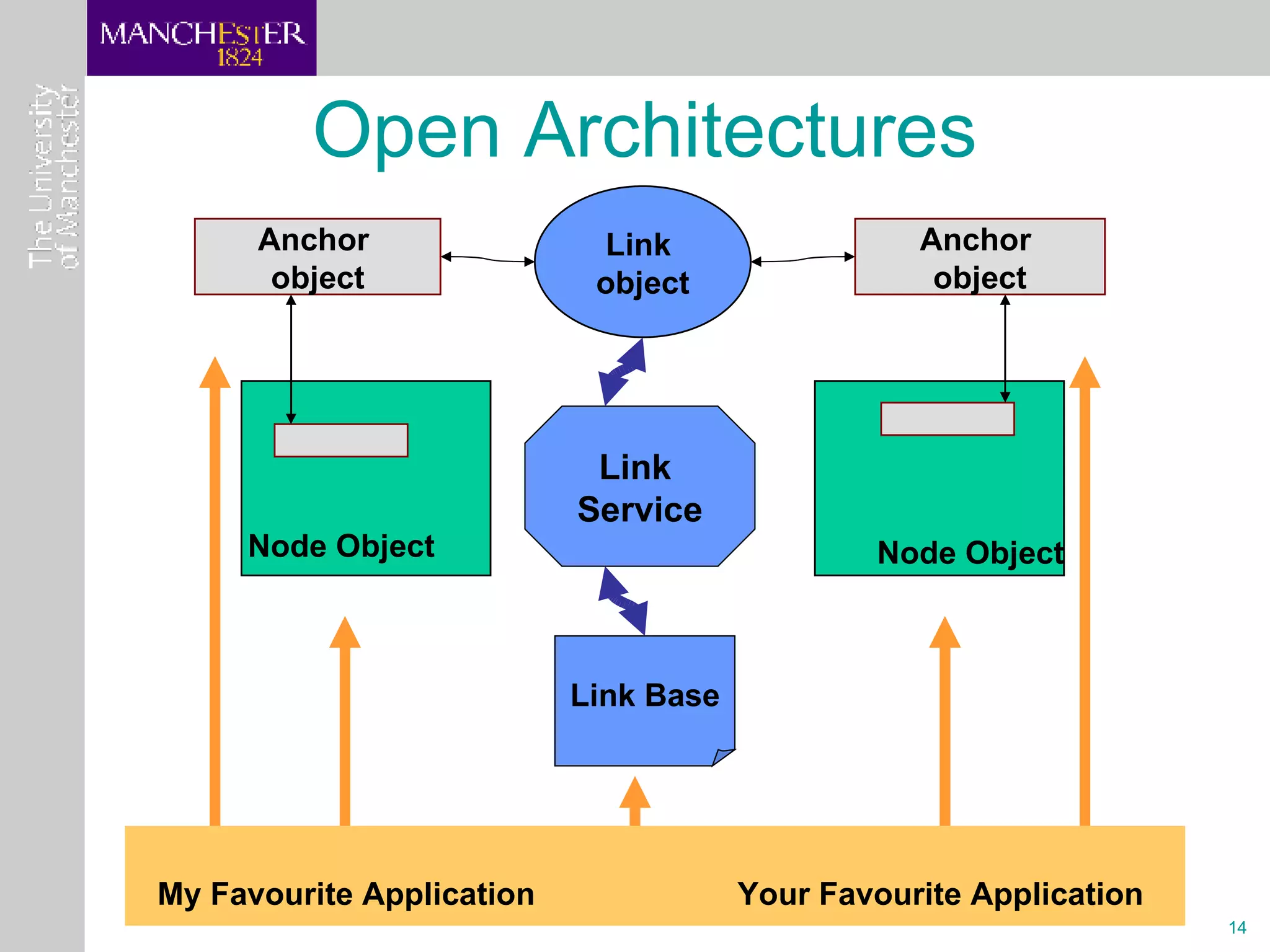
Open Architectures Anchor  object Link  object Anchor  object Node Object Node Object Link Base Link  Service My Favourite Application Your Favourite Application
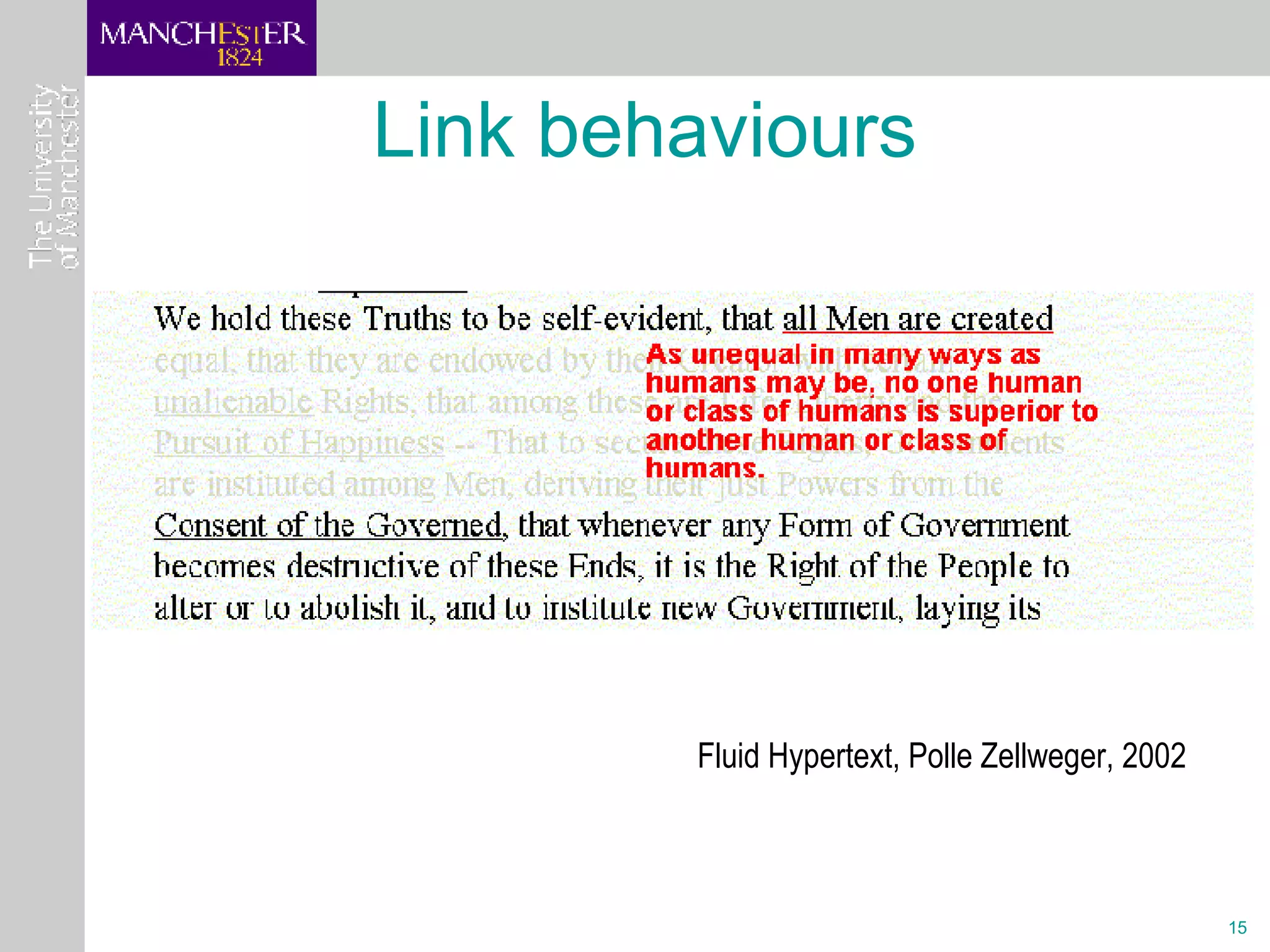
Link behaviours Fluid Hypertext, Polle Zellweger, 2002
Link types Normal Links Citation  source, pioneer, credit, leads, eponym Background FutureWork Refutation Support Methodology Data Generalize Specialize Abstraction Example Formalization Application Commentary Links Comment critical, supportive RelatedWork misrepresents, vacuum, ignores, isSupersededBy, isRefutedBy, isSupportedBy, redundant ProblemPosing trivial, unimportant, impossible, ill-posed, solved, ambitious Thesis trivial, unimportant, irrelevant, redherring, contradict, dubious, counterexample, inelegant, simplistic, arbitrary, unmotivated Argumentation invalid,  insufficient, immaterial, misleading, alternative, strawman Data inadequate, dubious, ignores, irrelevant, inapplicable, misinterpreted Style boring,  unimaginative, incoherent, arrogant, rambling, awkward Argument  deduction, induction, analogy, intuition solution Summarization Detail AlternateView Rewrite Explanation Simplification Complication Update Correction Continuation http:// www.eastgate.com/HypertextNow/archives/Trigg.html [Randall Trigg, 83]
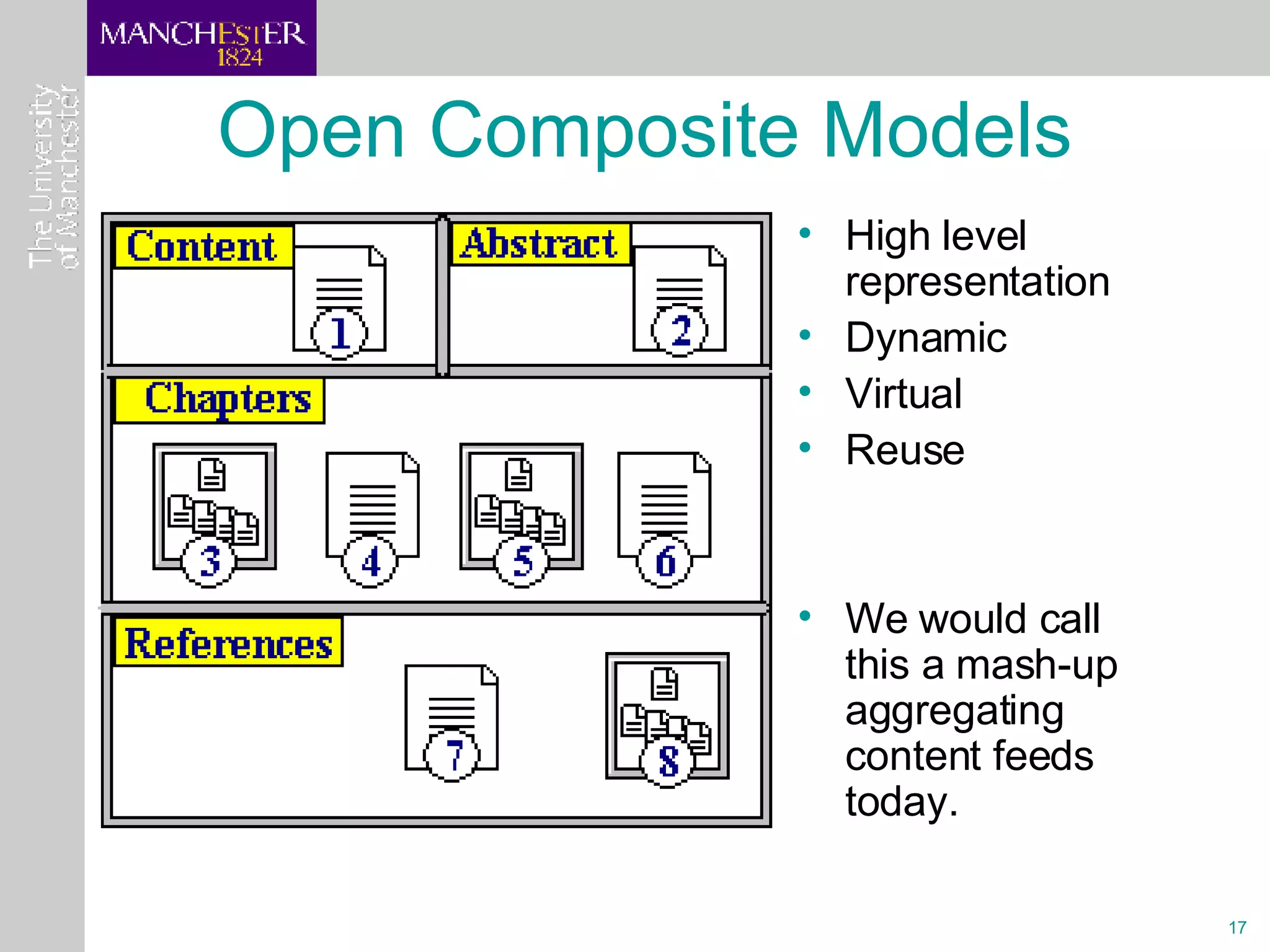
Open Composite Models High level representation Dynamic Virtual Reuse We would call this a mash-up aggregating content feeds today.
I’m sure Ted will tell you all about Transclusion.
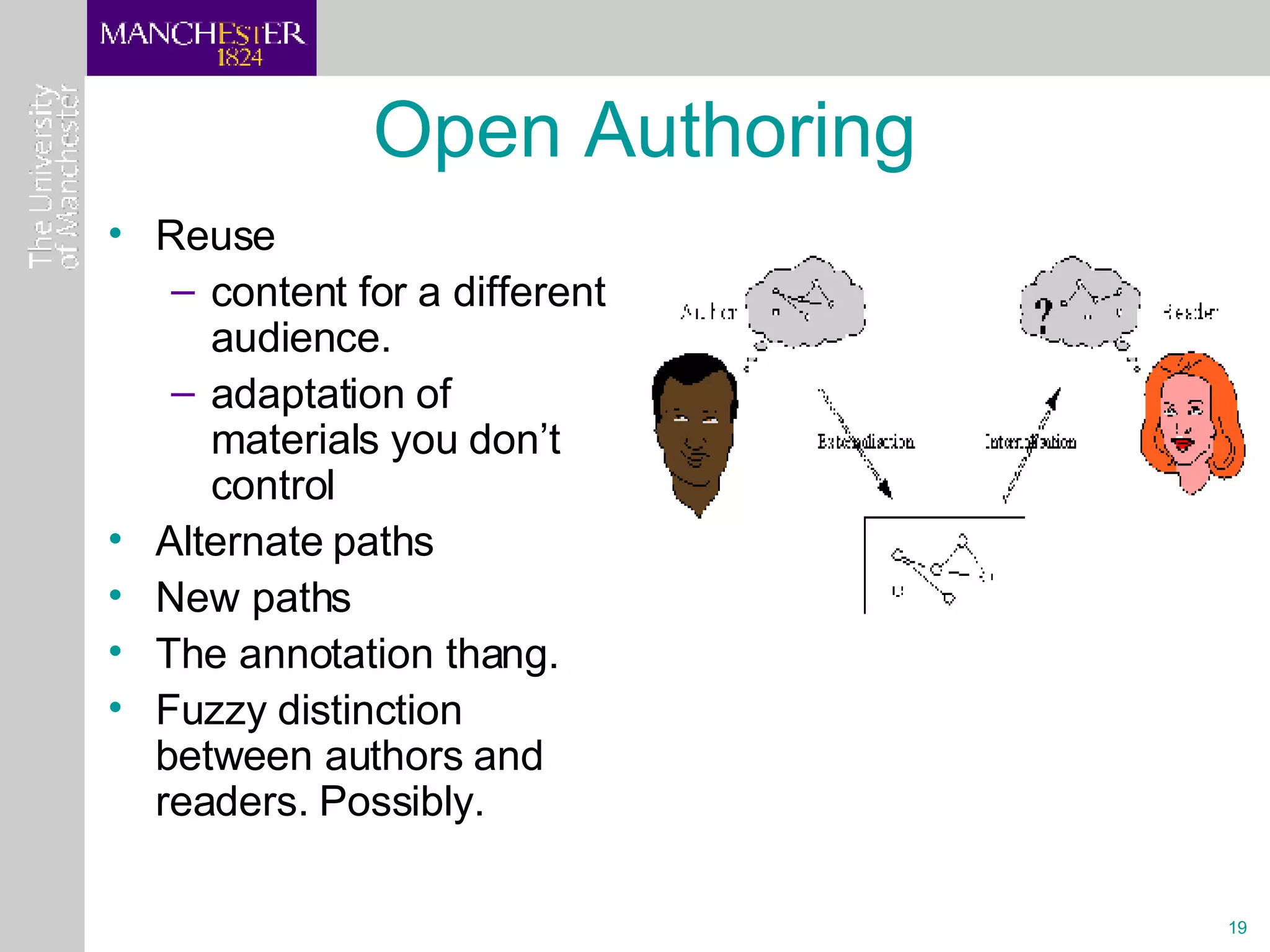
Open Authoring Reuse content for a different audience. adaptation of materials you don’t control Alternate paths New paths The annotation thang. Fuzzy distinction between authors and readers. Possibly.
Open Well yes…but a Closed System mentality. Come and look in MY system. Kind of assumption that content was limited and controlled Closed Authoring and Closed Architectures
The Web
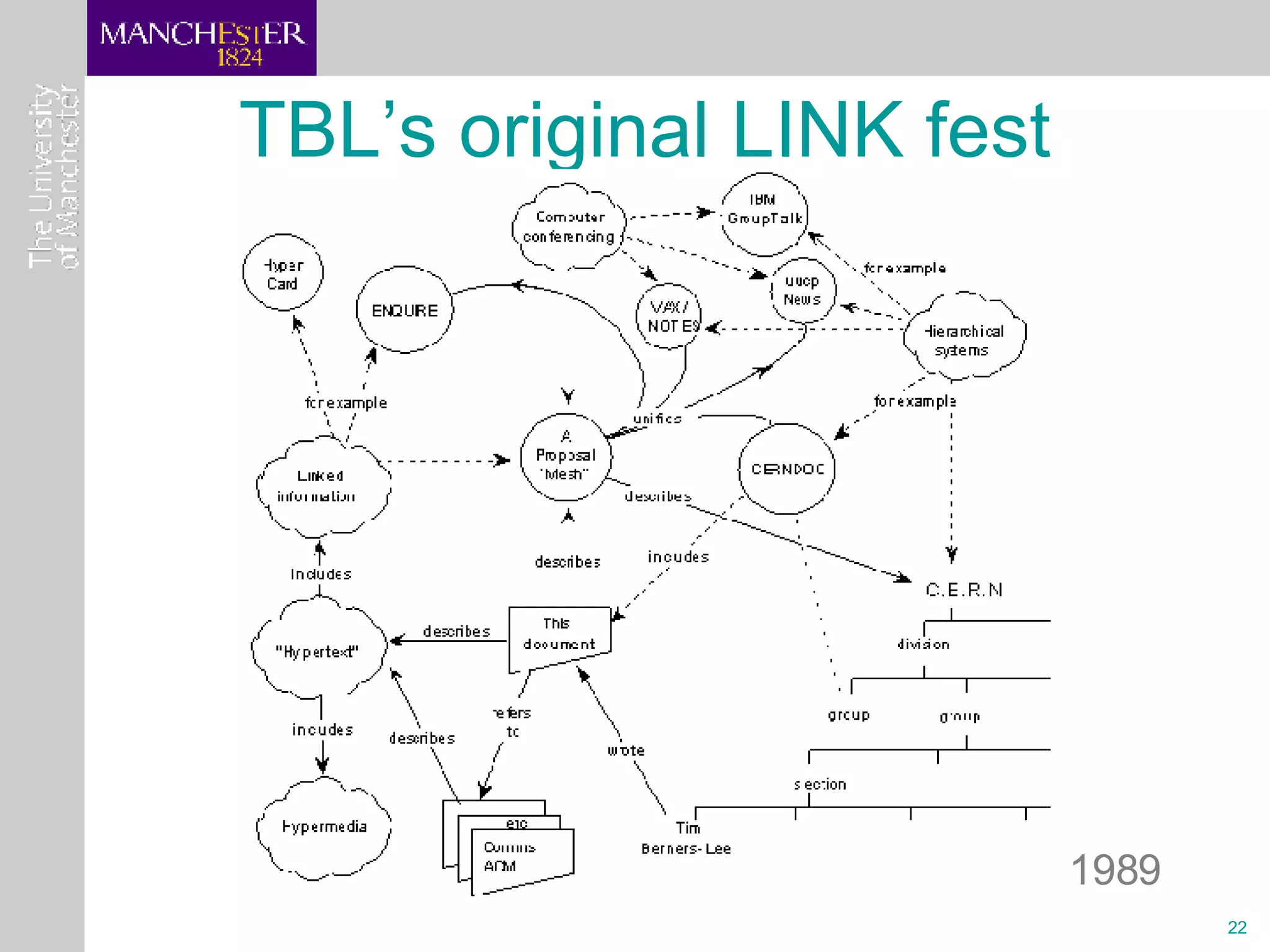
TBL’s original LINK fest 1989
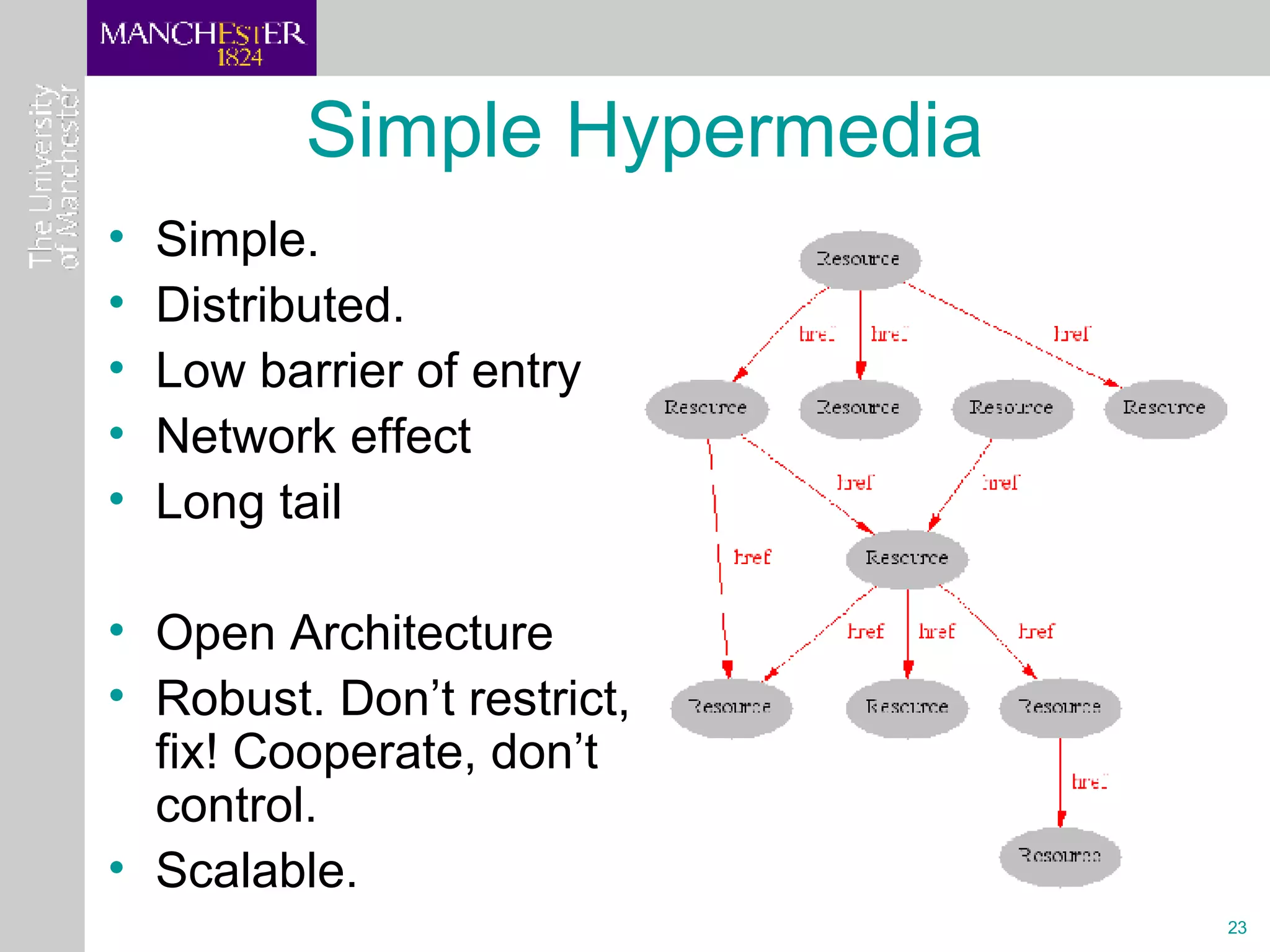
Simple Hypermedia Simple. Distributed. Low barrier of entry Network effect Long tail Open Architecture Robust. Don’t restrict, fix! Cooperate, don’t control. Scalable.
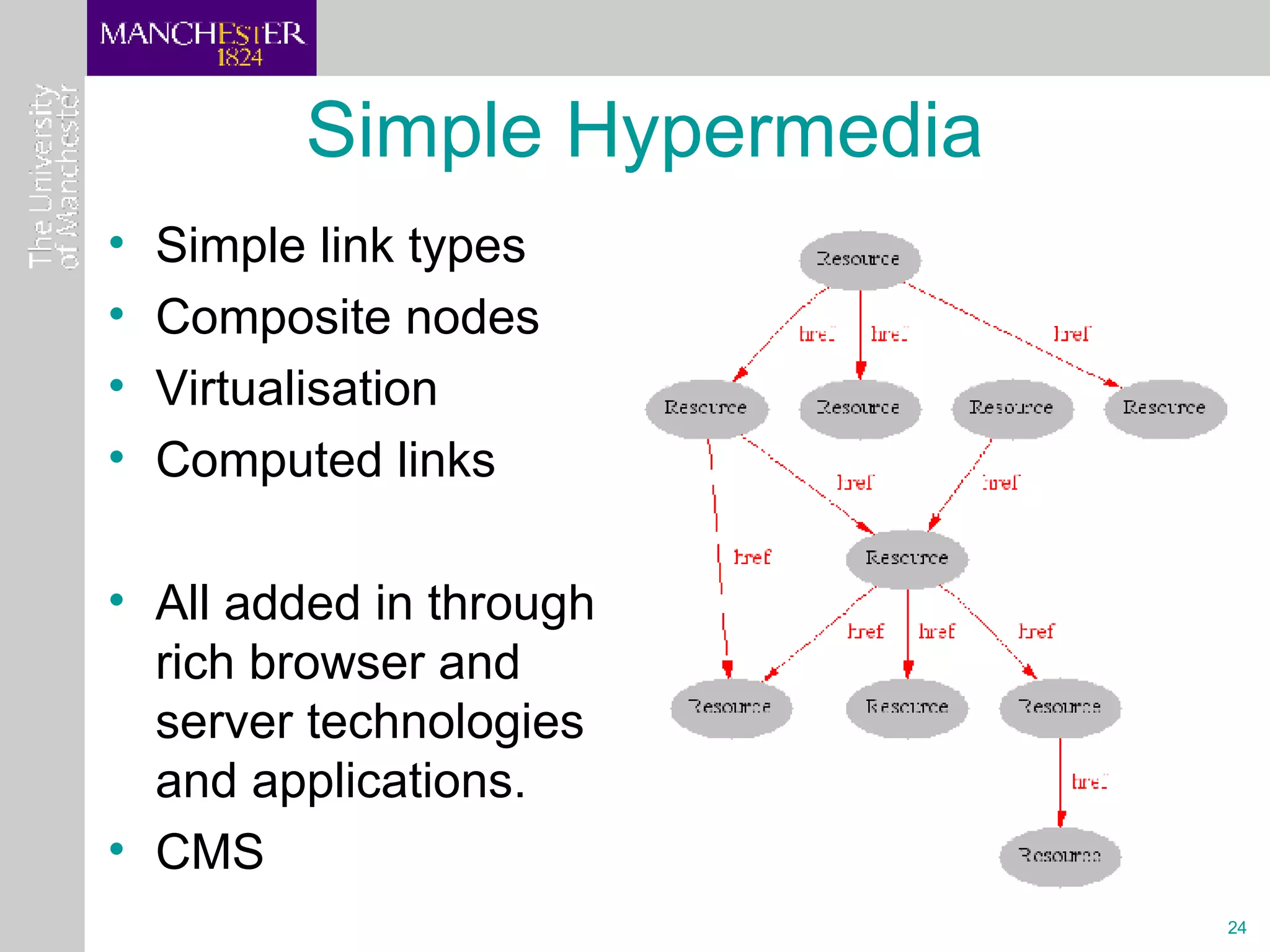
Simple Hypermedia Simple link types Composite nodes Virtualisation Computed links All added in through rich browser and server technologies and applications. CMS
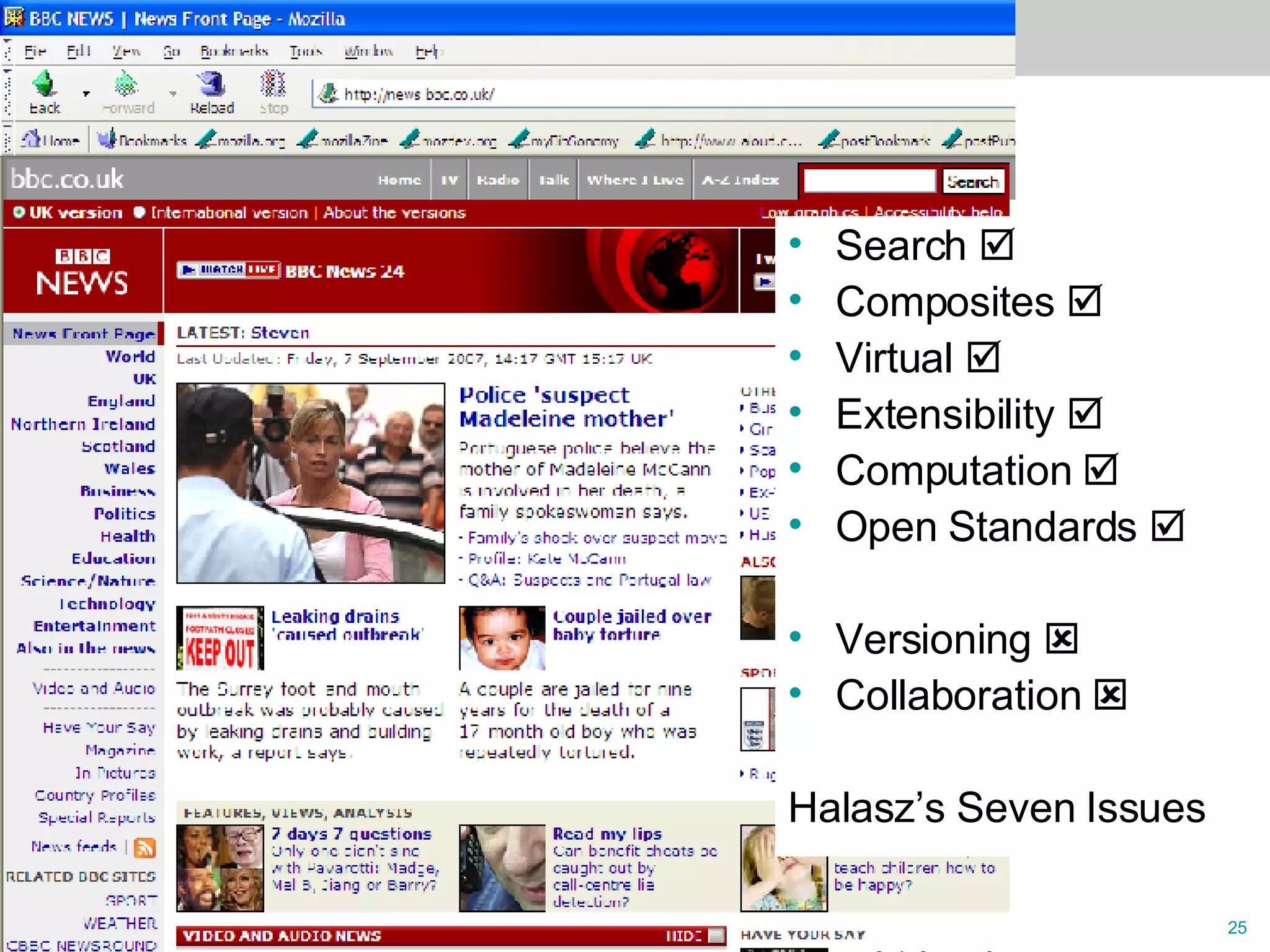
Search   Composites   Virtual   Extensibility   Computation   Open Standards   Versioning   Collaboration   Halasz’s Seven Issues
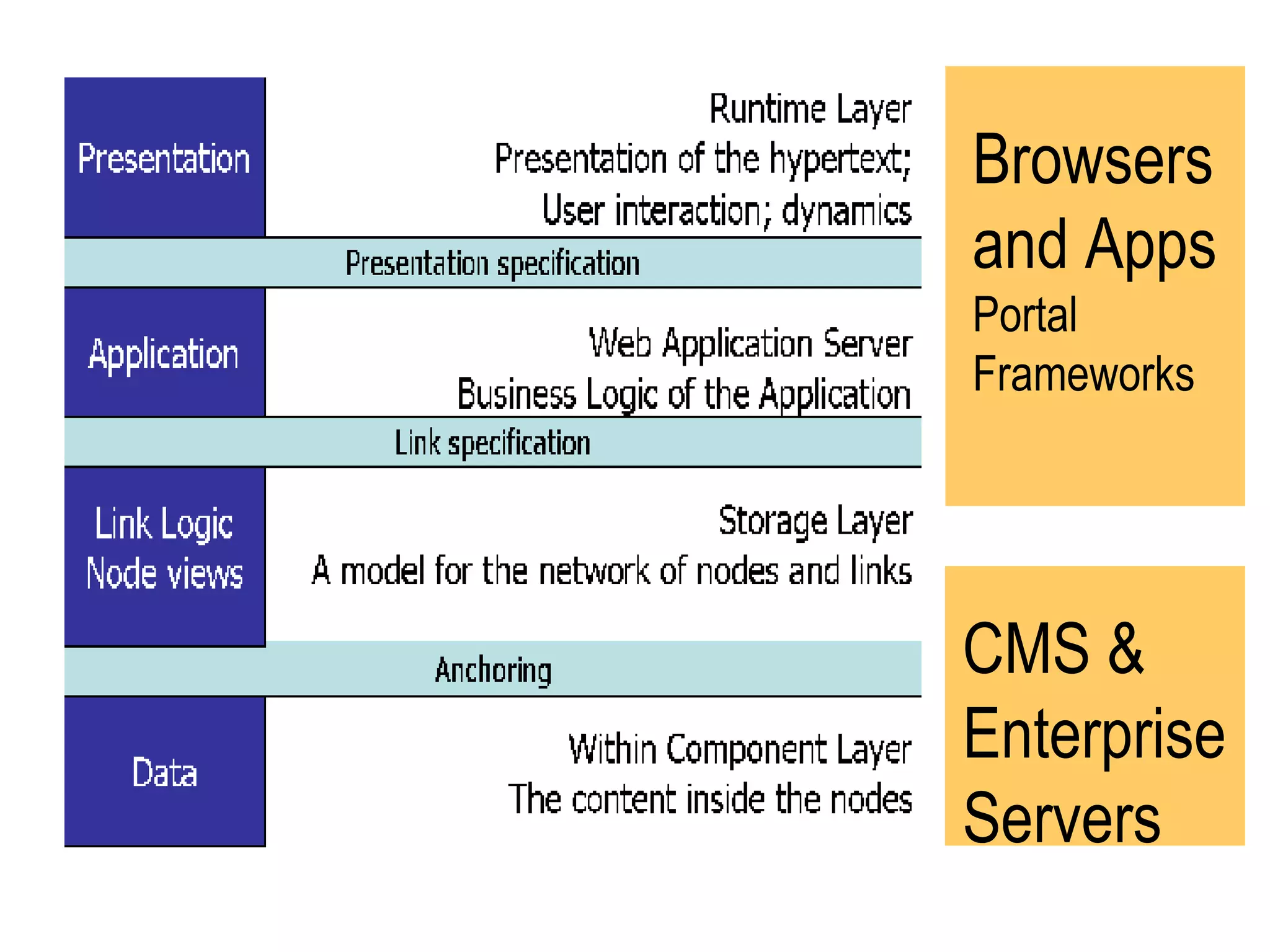
Browsers and Apps Portal Frameworks CMS & EnterpriseServers
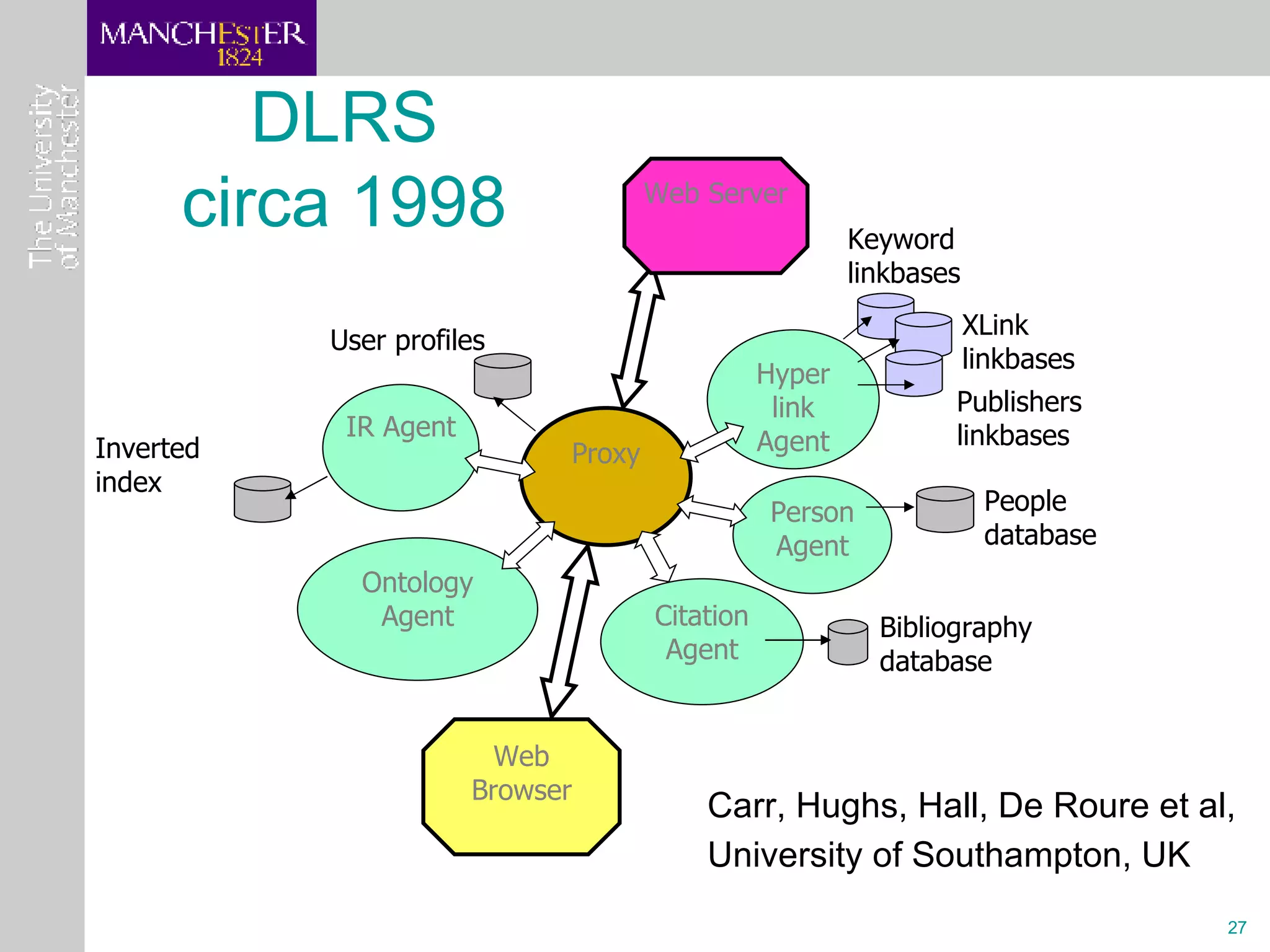
DLRS circa 1998 Publishers linkbases People database Keyword linkbases Proxy Hyper link Agent XLink linkbases User profiles Person Agent Citation Agent Bibliography database IR Agent Inverted index Ontology Agent Web Browser Web Server Carr, Hughs, Hall, De Roure et al,  University of Southampton, UK
Do links appear? Sure! Google rocks because of Links. XLink – but that never took off….. Open hypermedia in Content Management Systems on a big scale  Active Navigation - Dynamic Link Injection  Hyperwave - Collaborative Information Management”  Web + Open Hypermedia is an extra layer of software engineering.   Wikis
But lets face it, its still  Node-Centric There is no Link Model.  Makes Context and Management Harder. Links are embedded in the Applications. Captive in their systems. No infrastructure outside the application or the browser. No Third Party Link Authoring  (except shared bookmarking) User participation is Reader Participation.
The Parting of the Ways…
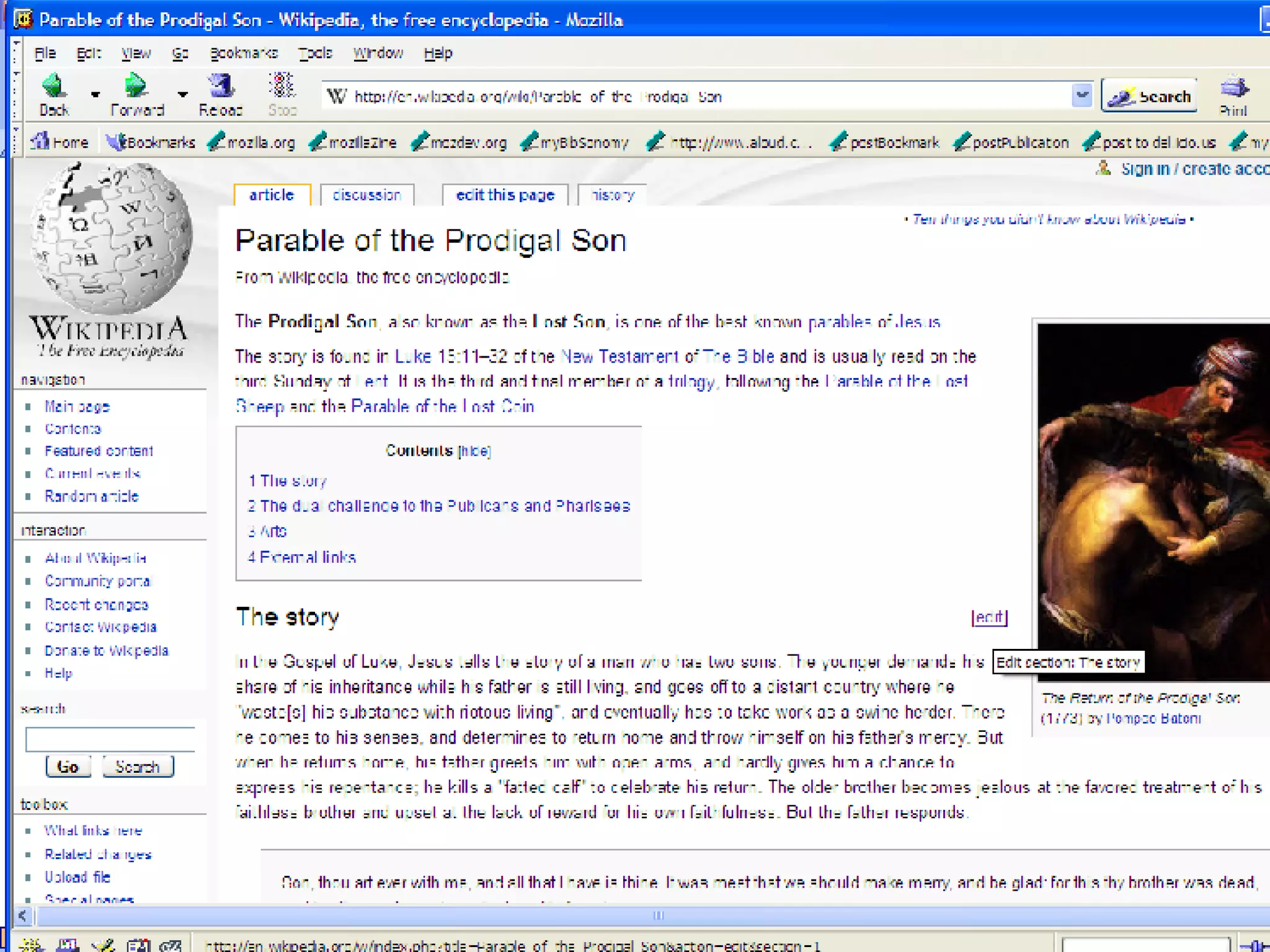
The Web “made riotous living”
 
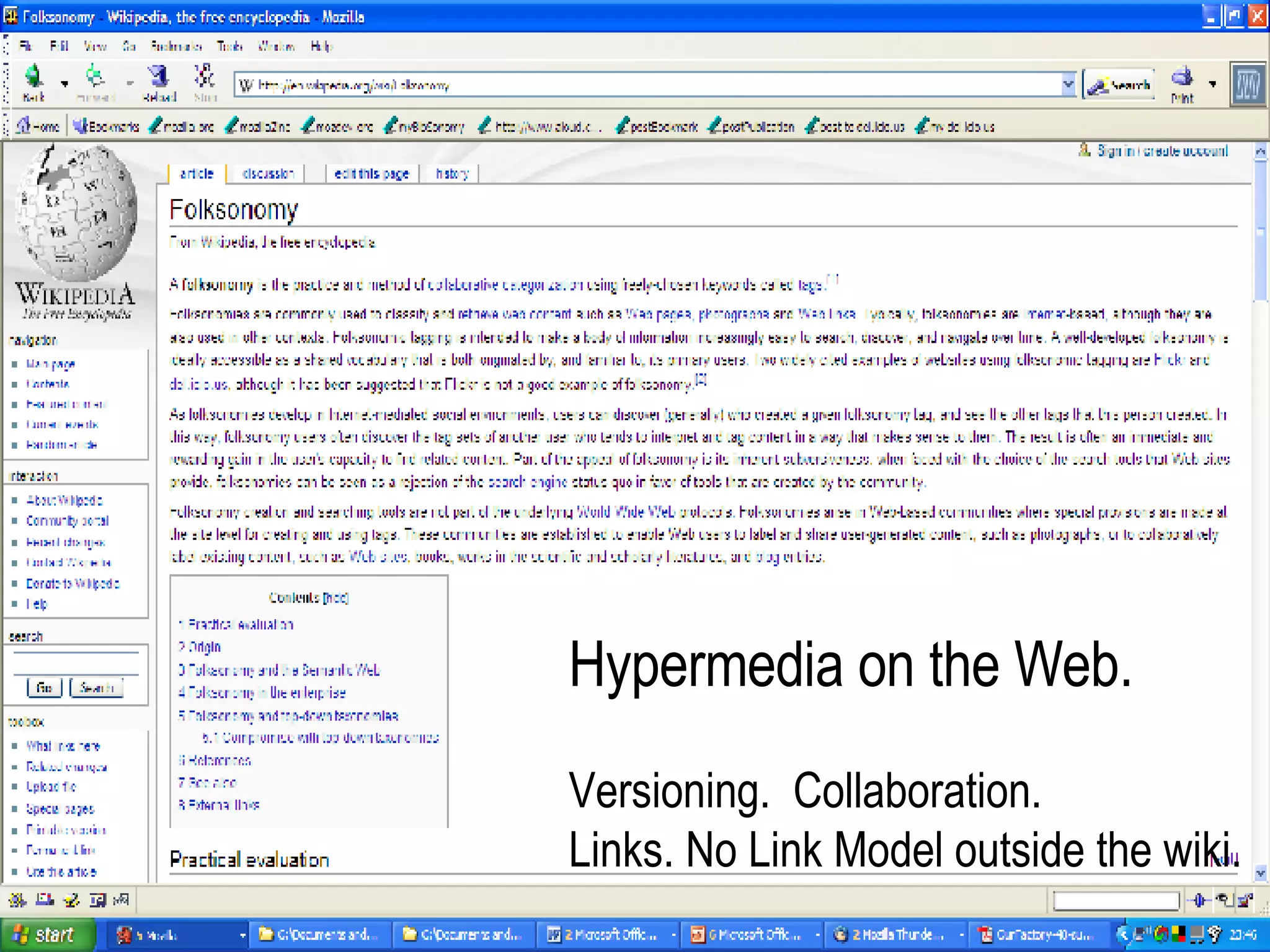
Hypermedia on the Web. Versioning.  Collaboration. Links. No Link Model outside the wiki.
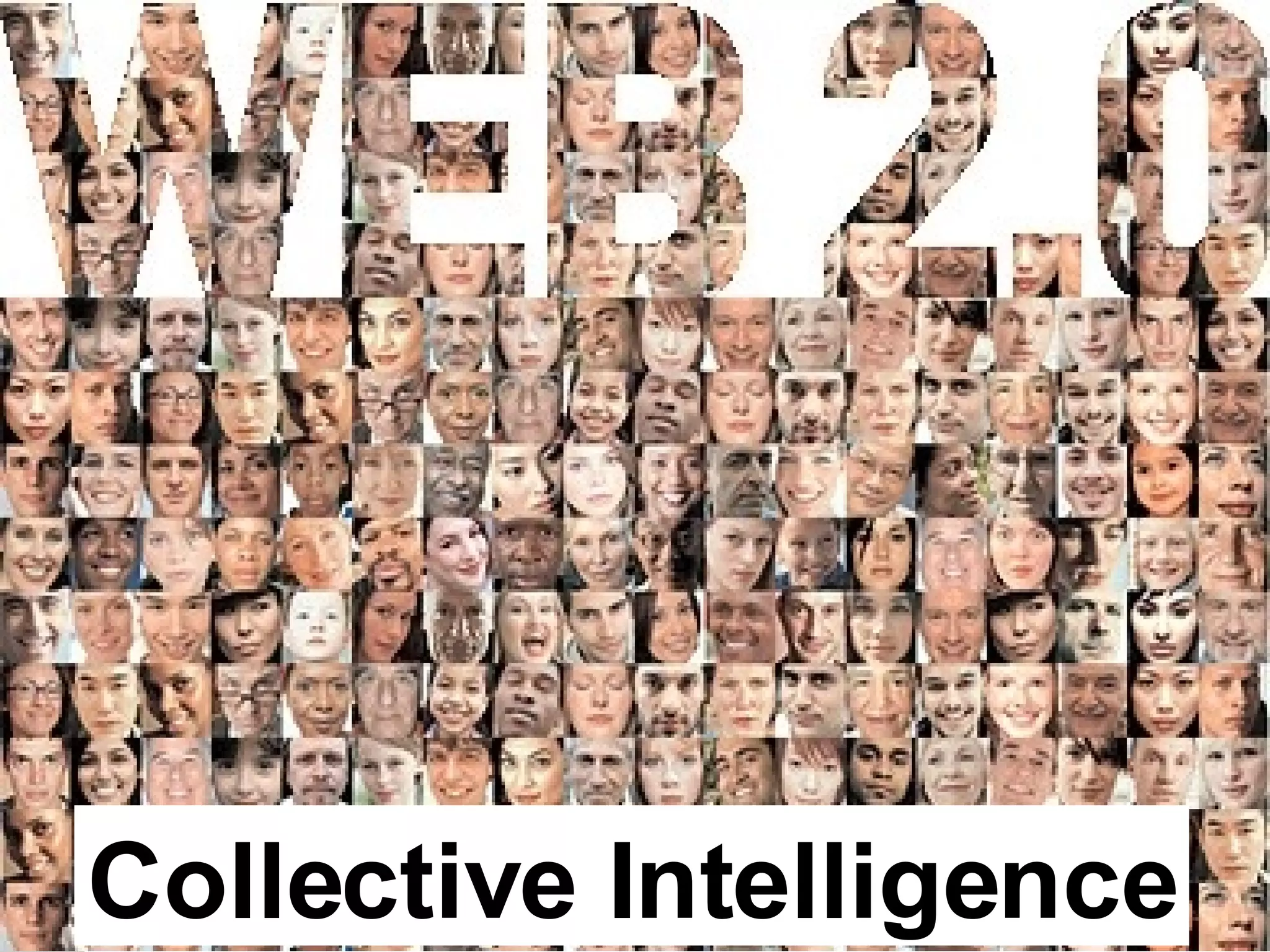
Collective Intelligence
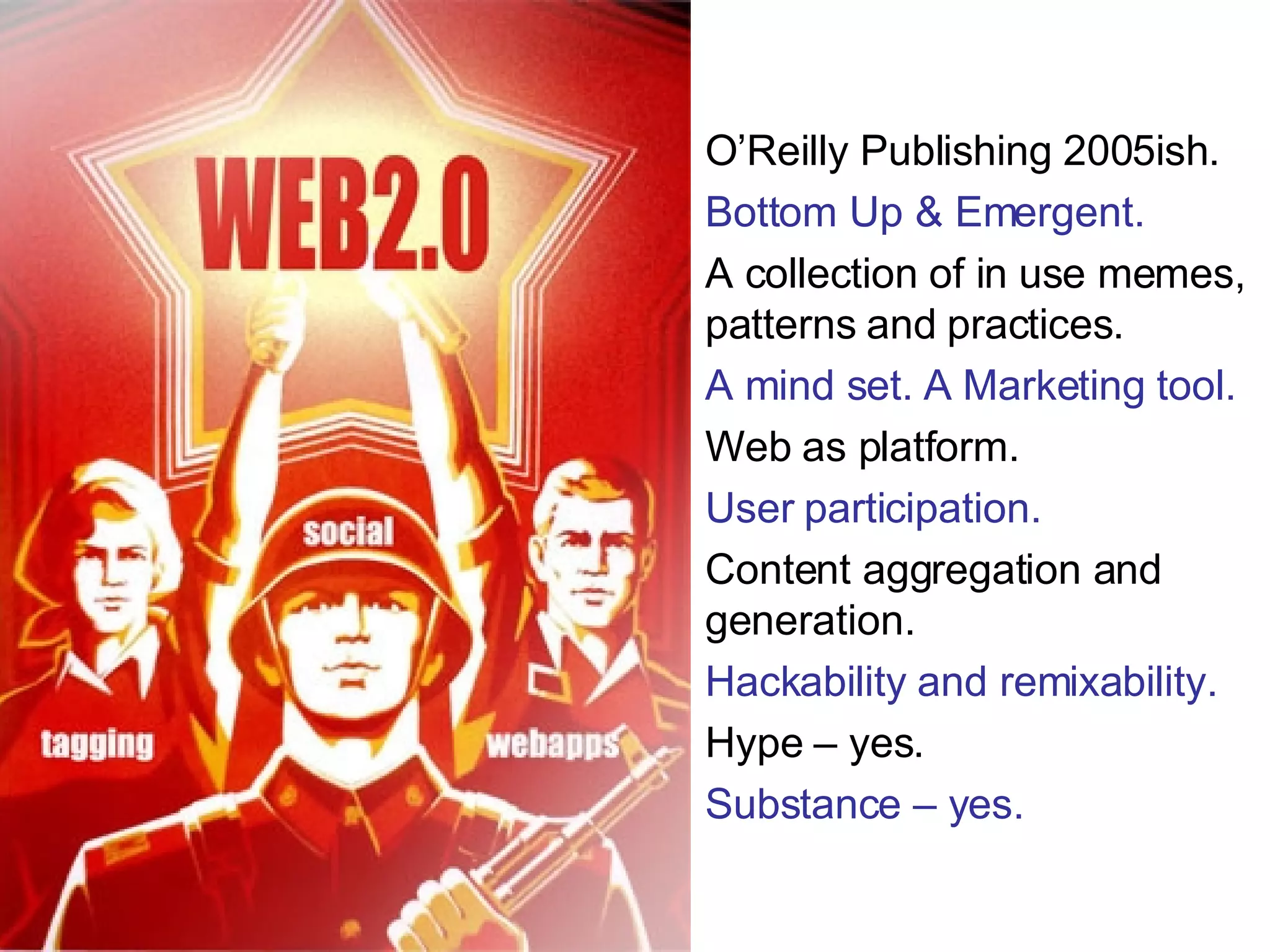
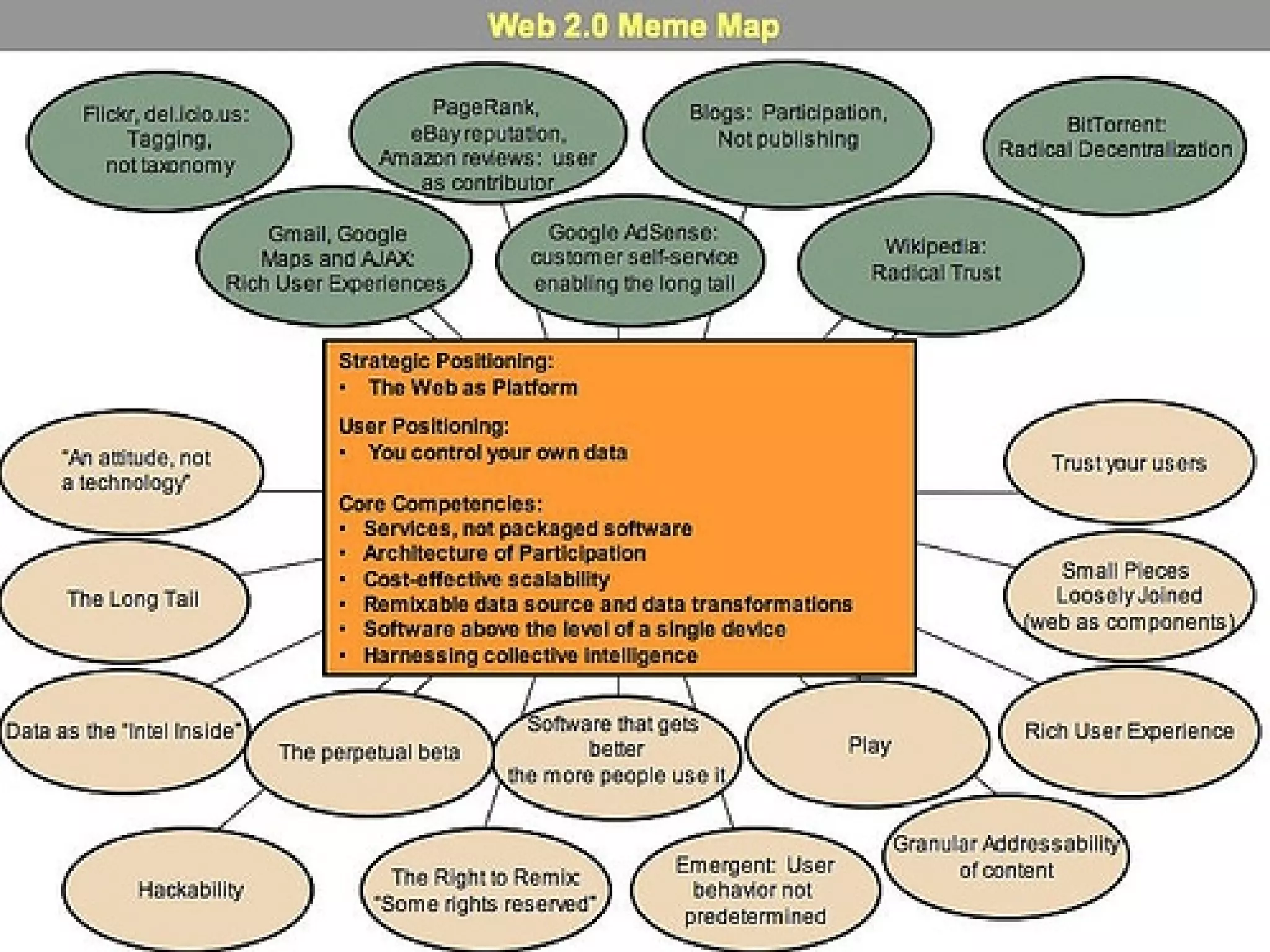
O’Reilly Publishing 2005ish. Bottom Up & Emergent. A collection of in use memes, patterns and practices. A mind set. A Marketing tool. Web as platform. User participation. Content aggregation and generation. Hackability and remixability. Hype – yes. Substance – yes.
 
Web is a Platform
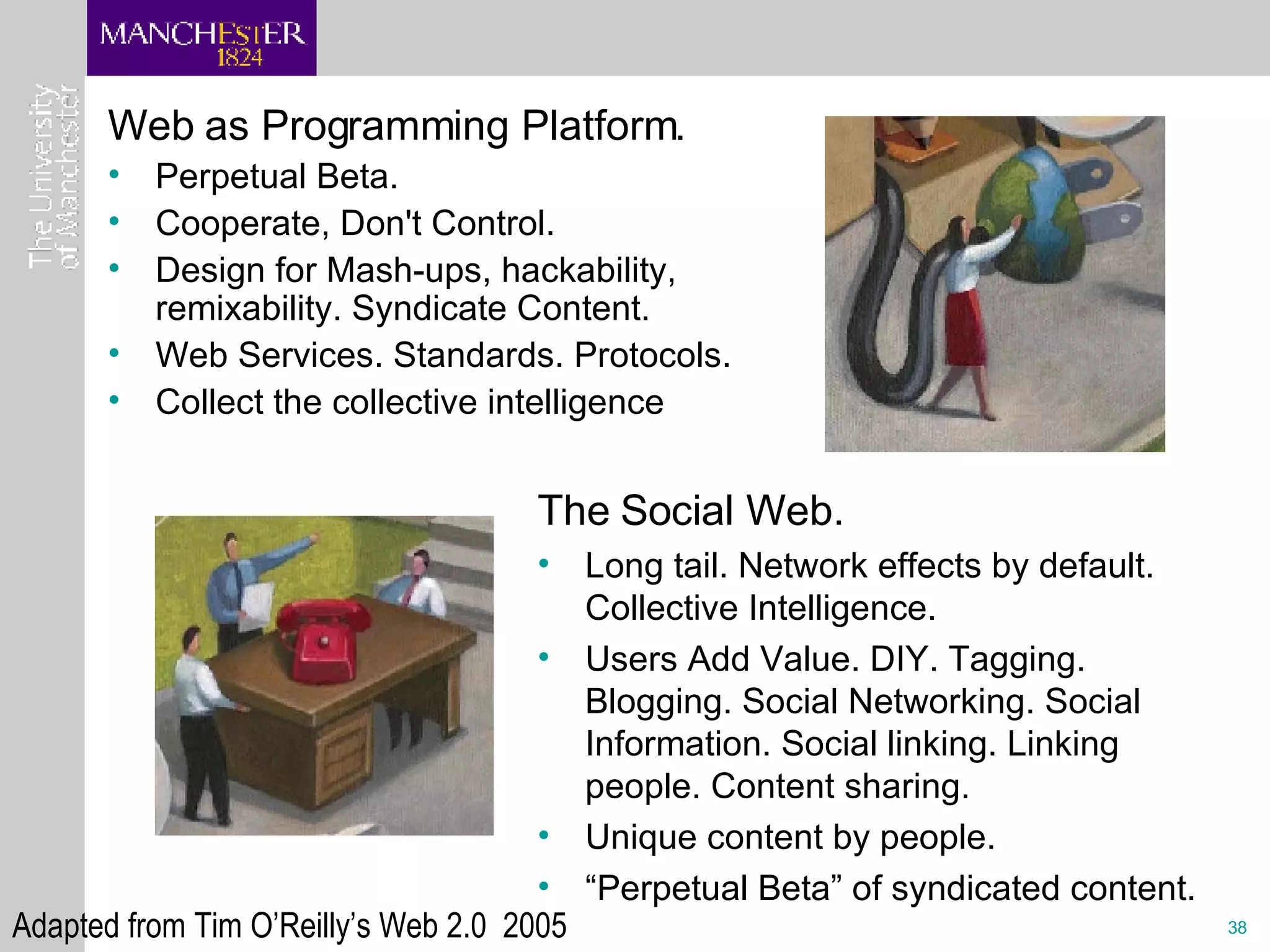
Web as Programming Platform. Perpetual Beta. Cooperate, Don't Control. Design for Mash-ups, hackability, remixability. Syndicate Content.  Web Services. Standards. Protocols. Collect the collective intelligence The Social Web.  Long tail. Network effects by default. Collective Intelligence. Users Add Value. DIY. Tagging. Blogging. Social Networking. Social Information. Social linking. Linking people. Content sharing. Unique content by people. “ Perpetual Beta” of syndicated content. Adapted from Tim O’Reilly’s Web 2.0  2005
The Social Web RSS
 
 
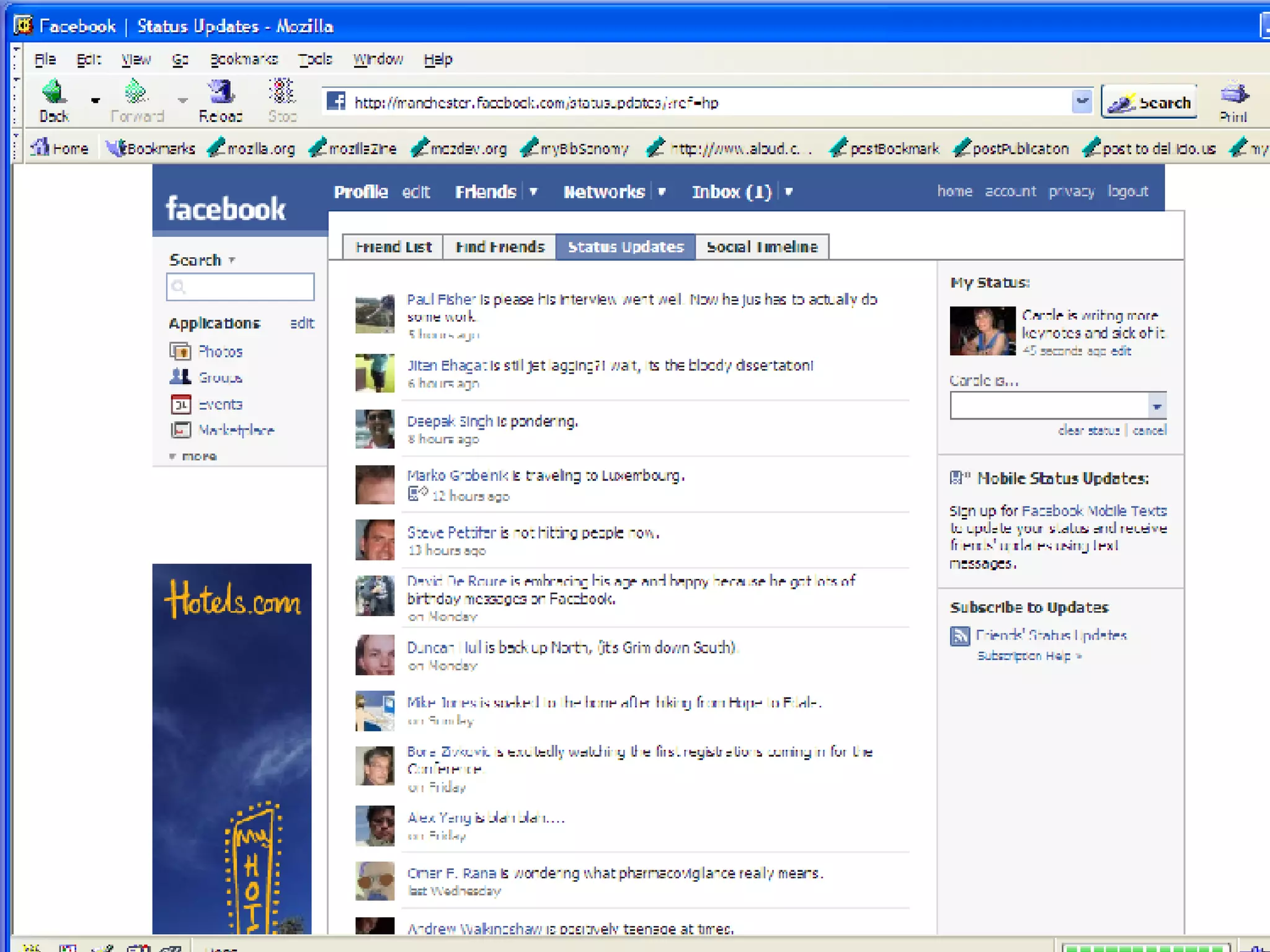
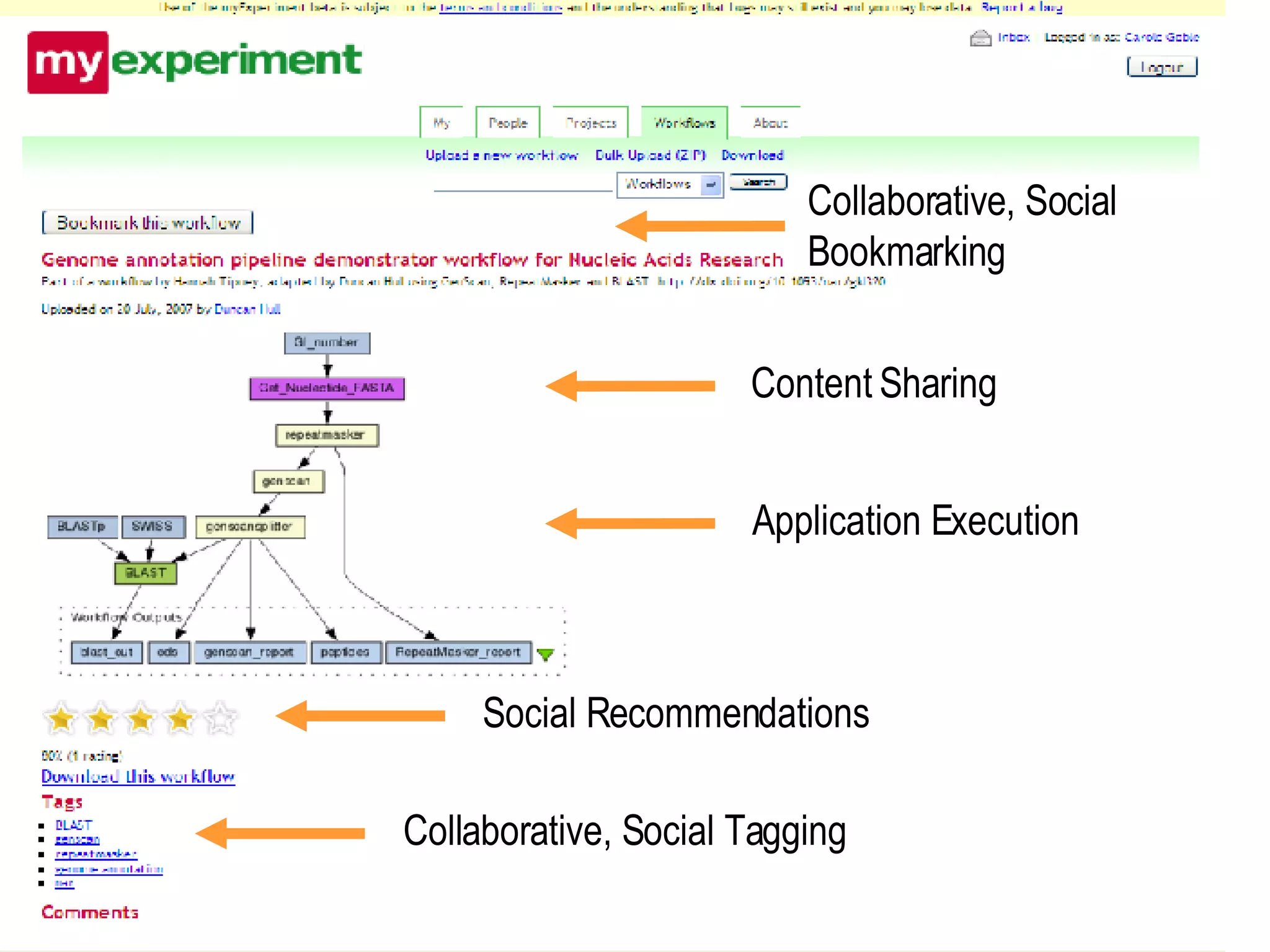
Social Recommendations Collaborative, Social Tagging Collaborative, Social Bookmarking Content Sharing Application Execution
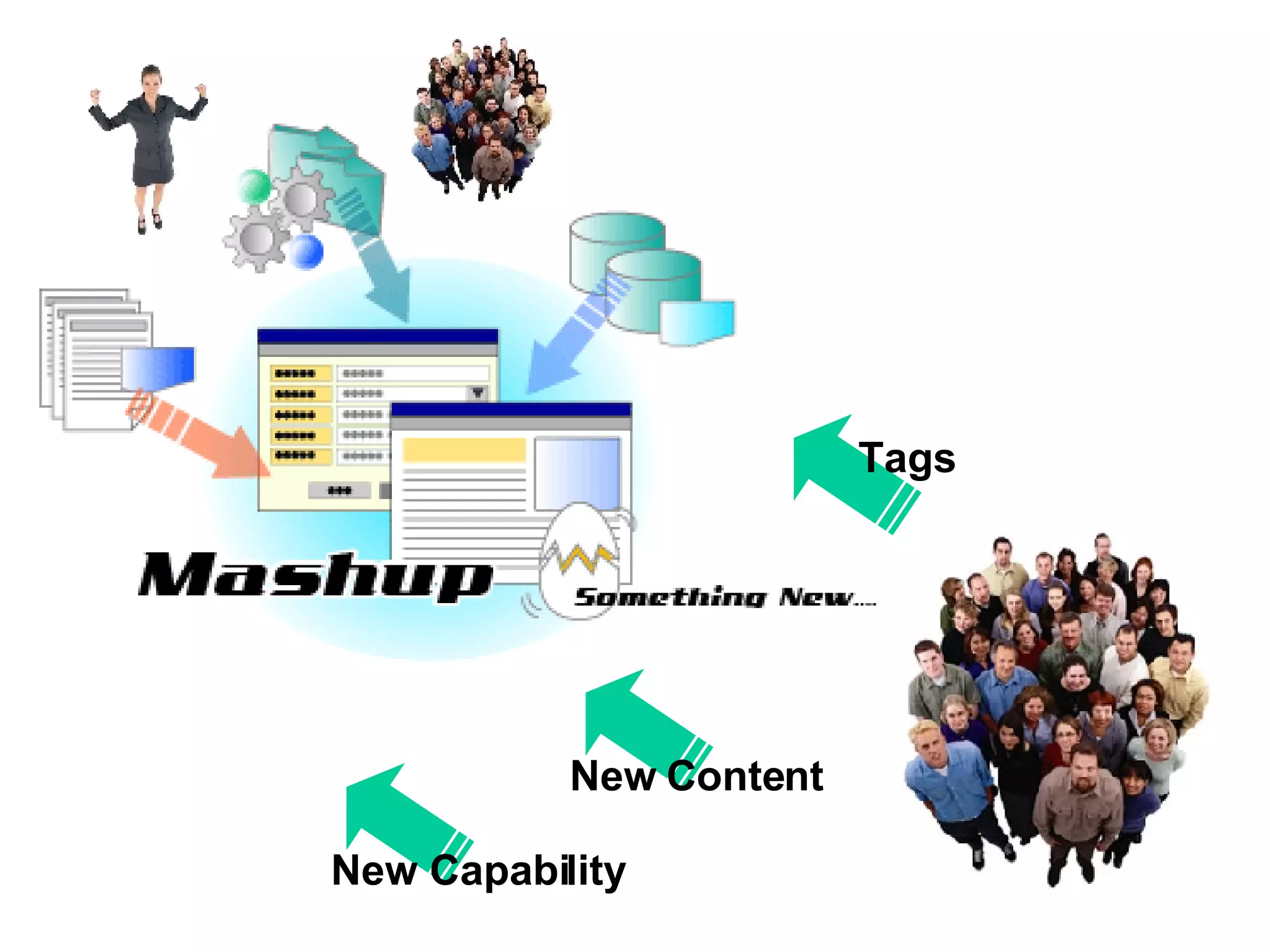
Tags New Content New Capability
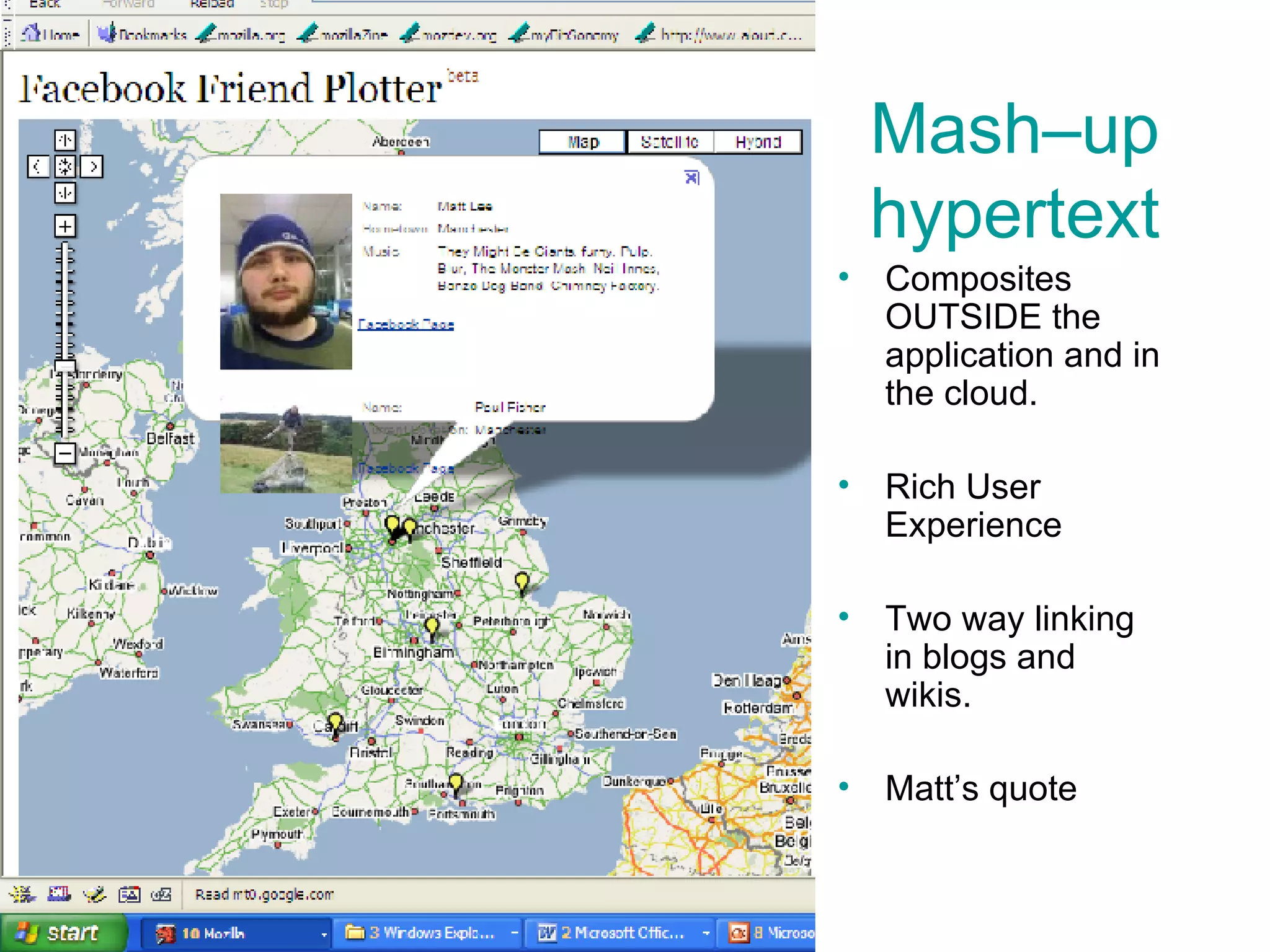
Mash–up hypertext Composites OUTSIDE the application and in the cloud. Rich User Experience Two way linking in blogs and wikis. Matt’s quote
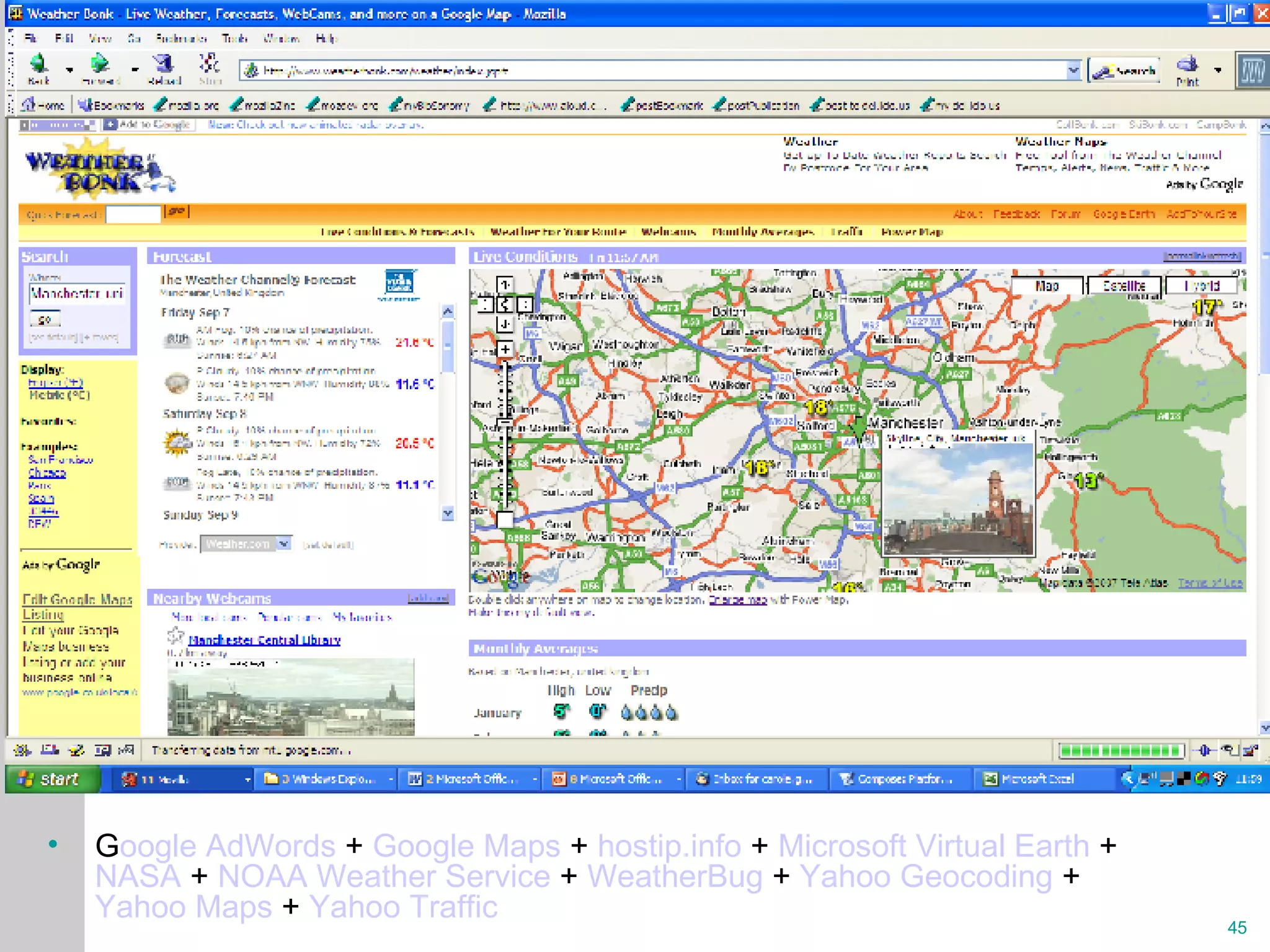
G oogle  AdWords  +  Google Maps  +  hostip.info  +  Microsoft Virtual Earth  +  NASA  +  NOAA Weather Service  +  WeatherBug  +  Yahoo  Geocoding  +  Yahoo Maps  +  Yahoo Traffic
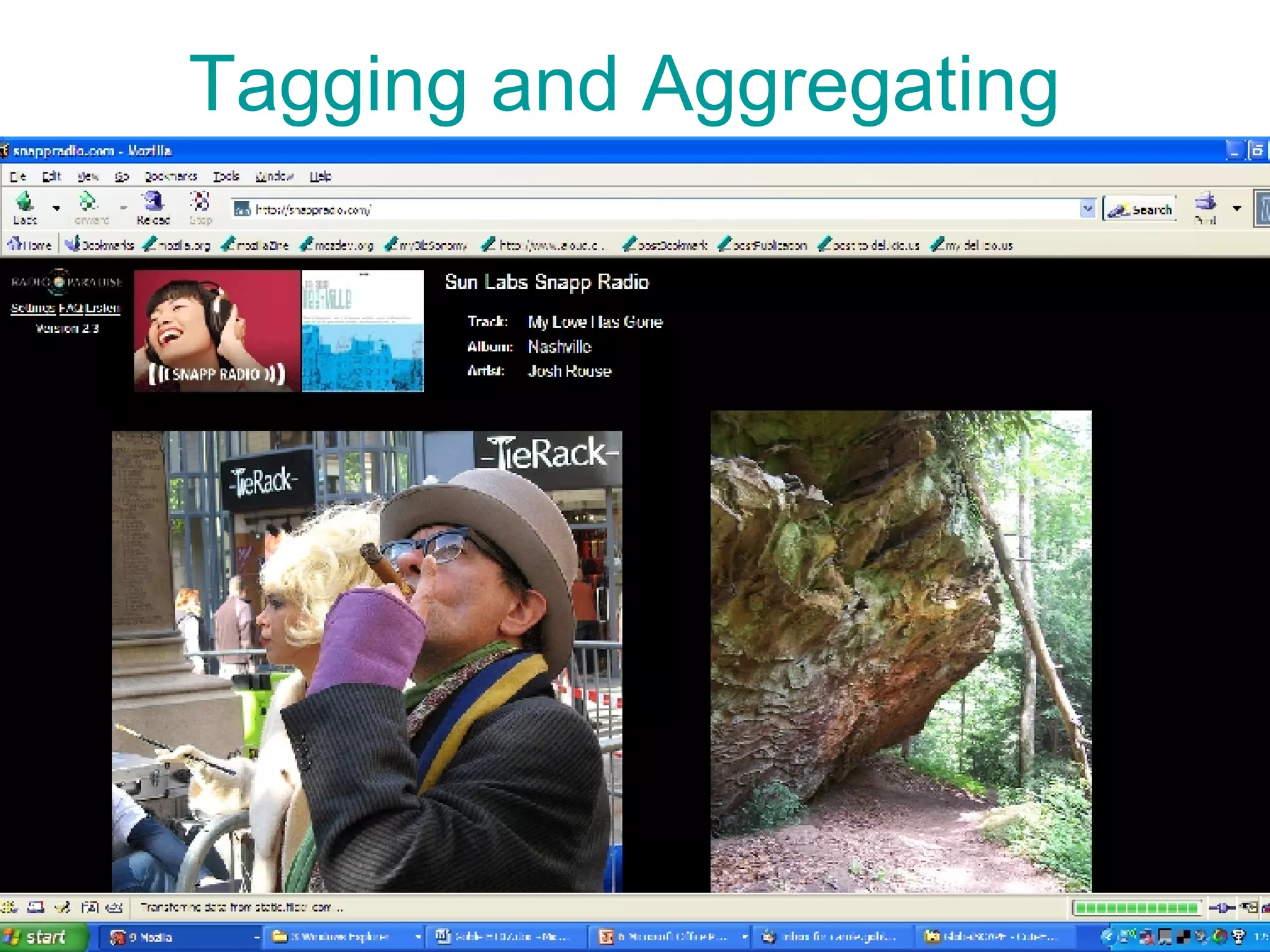
Tagging and Aggregating
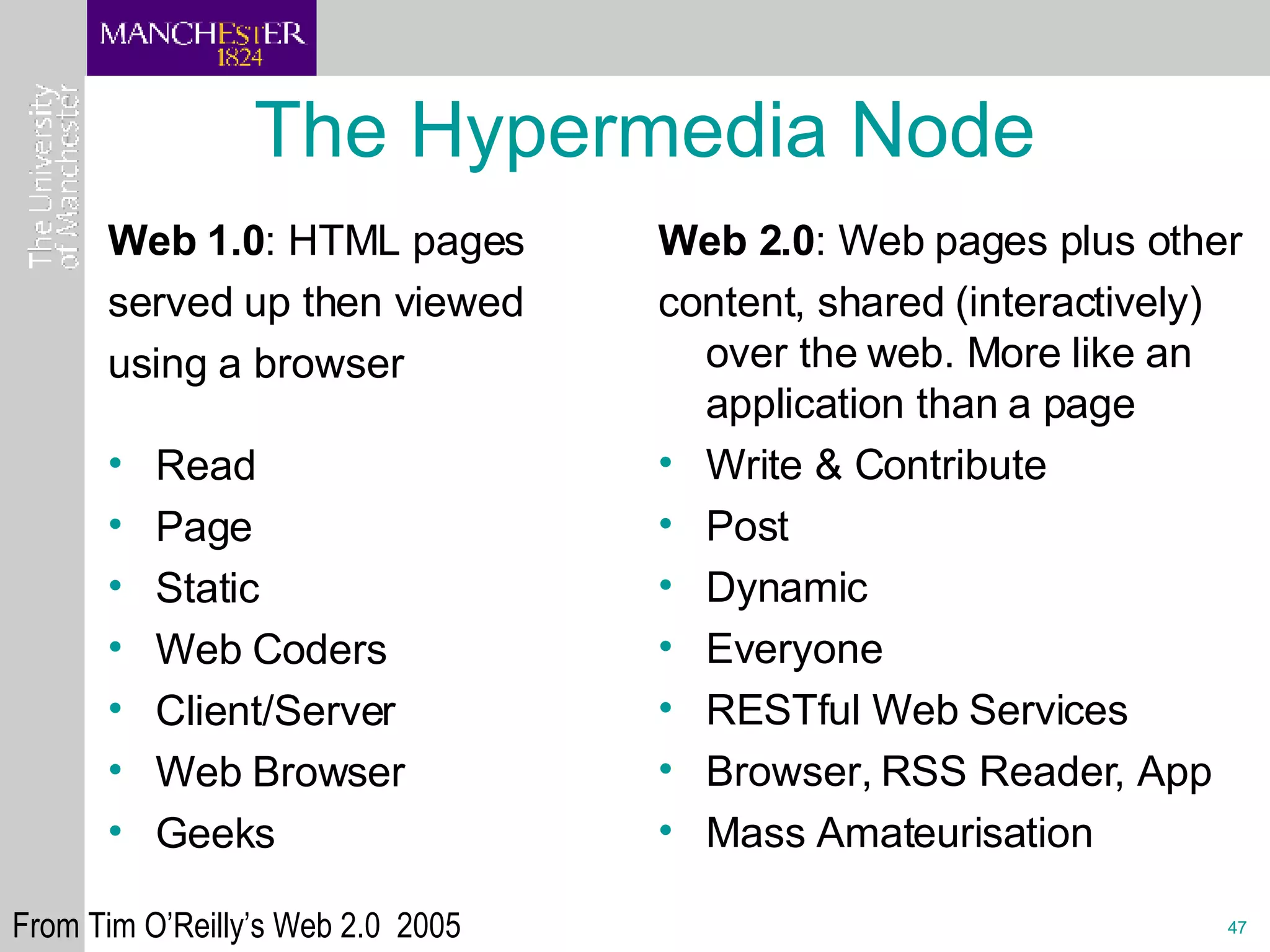
The Hypermedia Node Web 1.0 : HTML pages served up then viewed using a browser Read  Page Static  Web Coders  Client/Server  Web Browser Geeks Web 2.0 : Web pages plus other content, shared (interactively) over the web. More like an application than a page Write & Contribute Post Dynamic Everyone RESTful Web Services Browser, RSS Reader, App Mass Amateurisation From Tim O’Reilly’s Web 2.0  2005
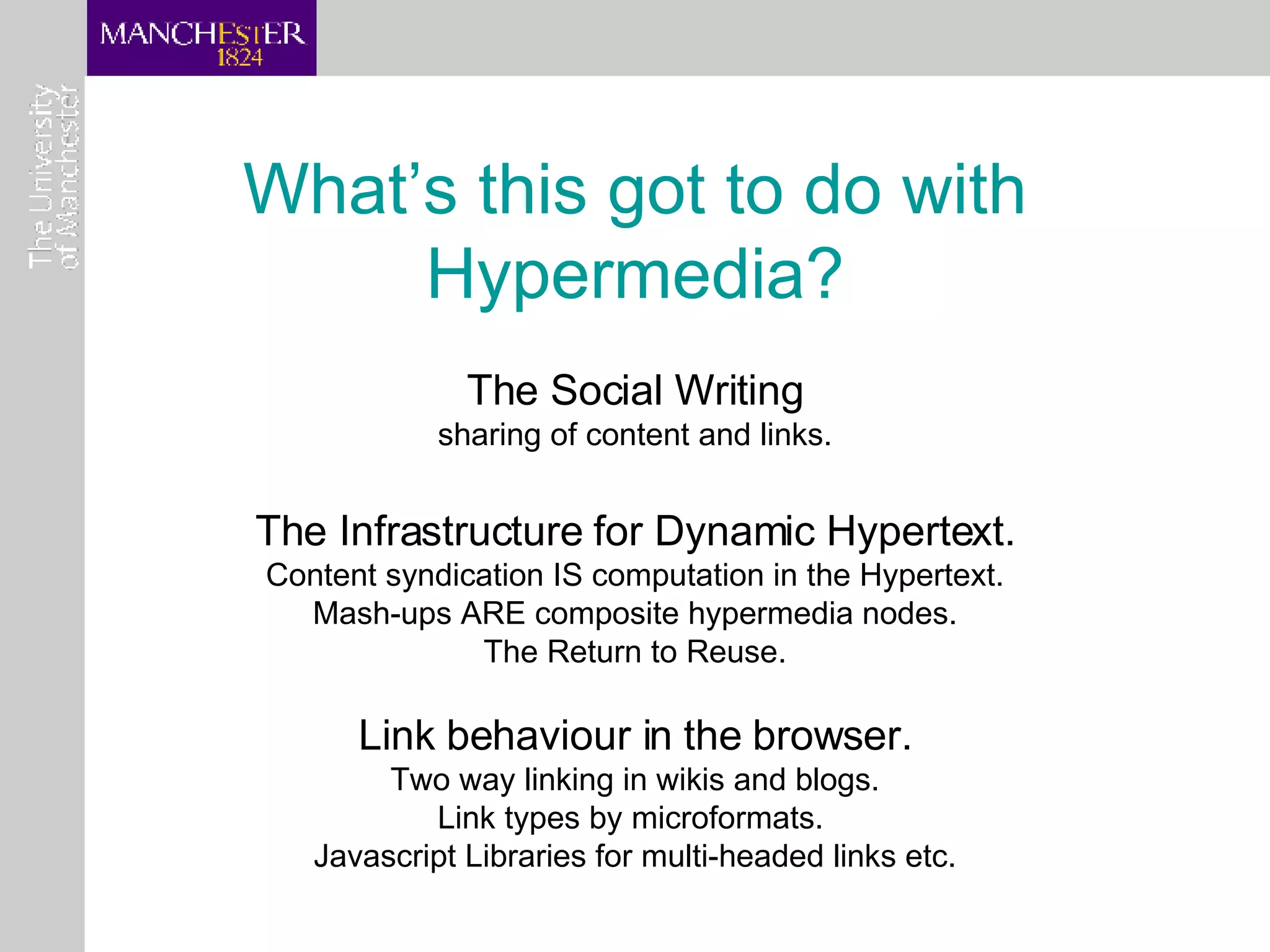
What’s this got to do with Hypermedia? The Social Writing sharing of content and links. The Infrastructure for Dynamic Hypertext. Content syndication IS computation in the Hypertext. Mash-ups ARE composite hypermedia nodes. The Return to Reuse. Link behaviour in the browser. Two way linking in wikis and blogs. Link types by microformats.  Javascript Libraries for multi-headed links etc.
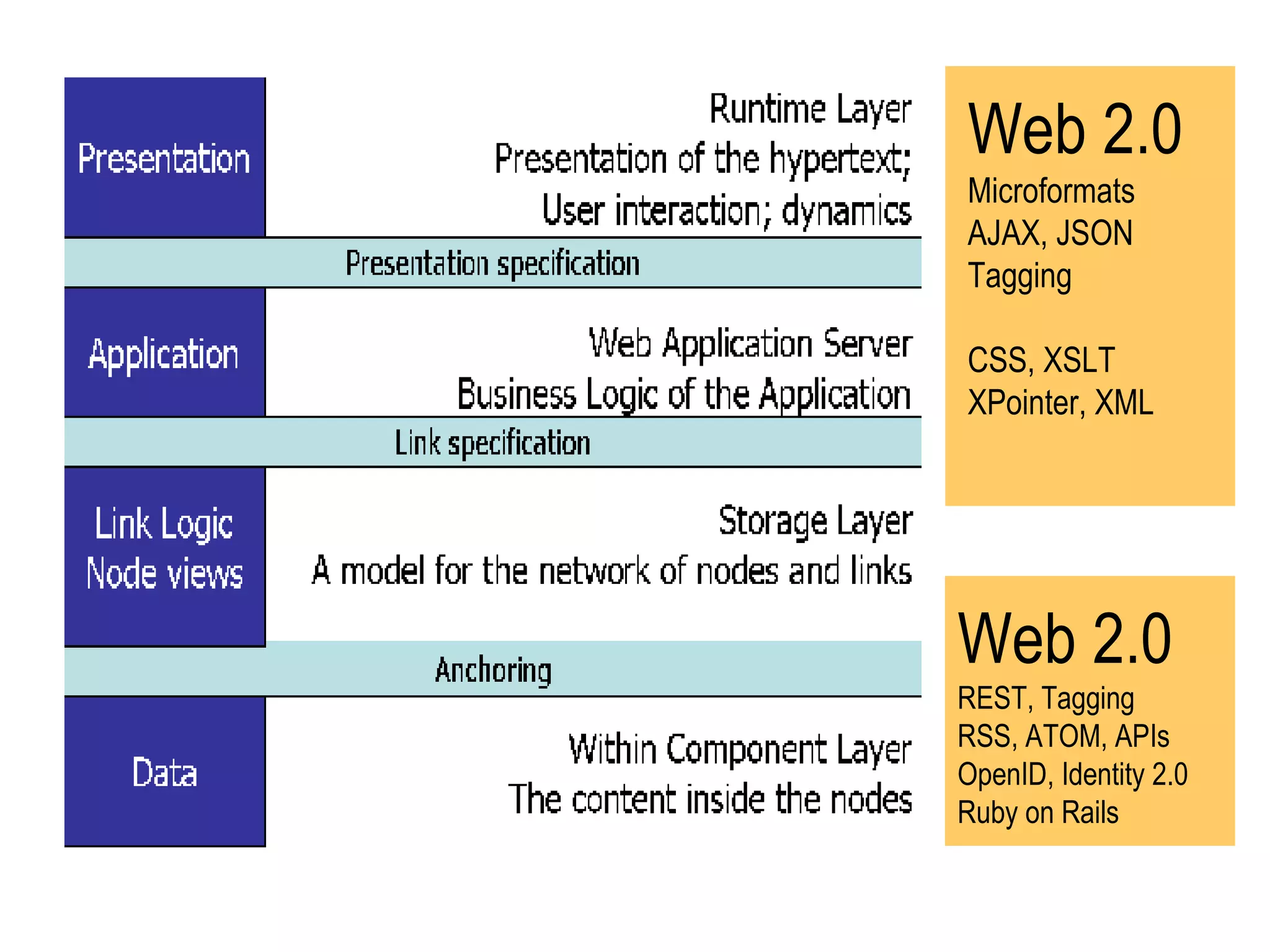
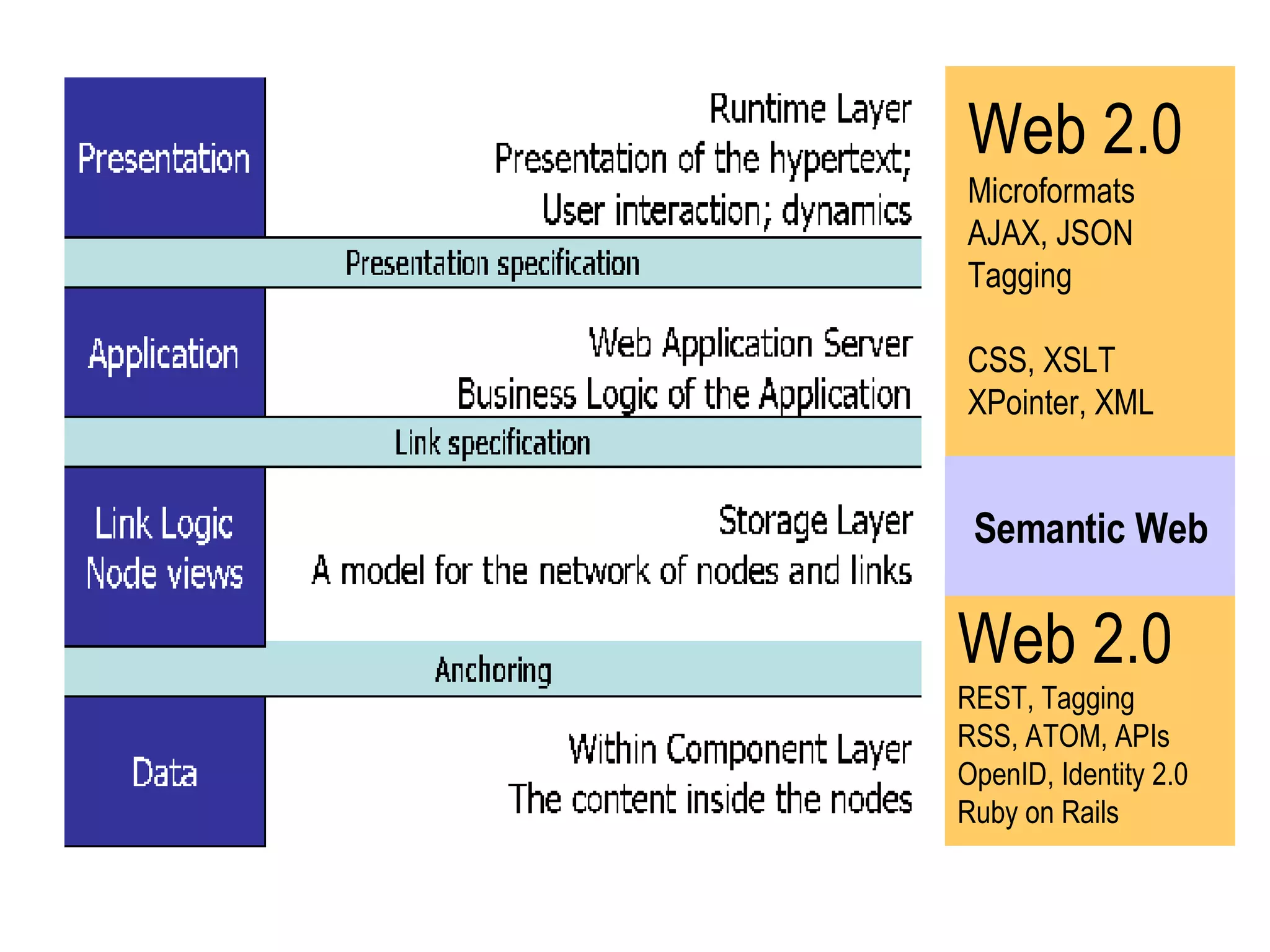
Web 2.0 Microformats  AJAX, JSON Tagging  CSS, XSLT XPointer, XML Web 2.0 REST, Tagging RSS, ATOM, APIs OpenID, Identity 2.0 Ruby on Rails
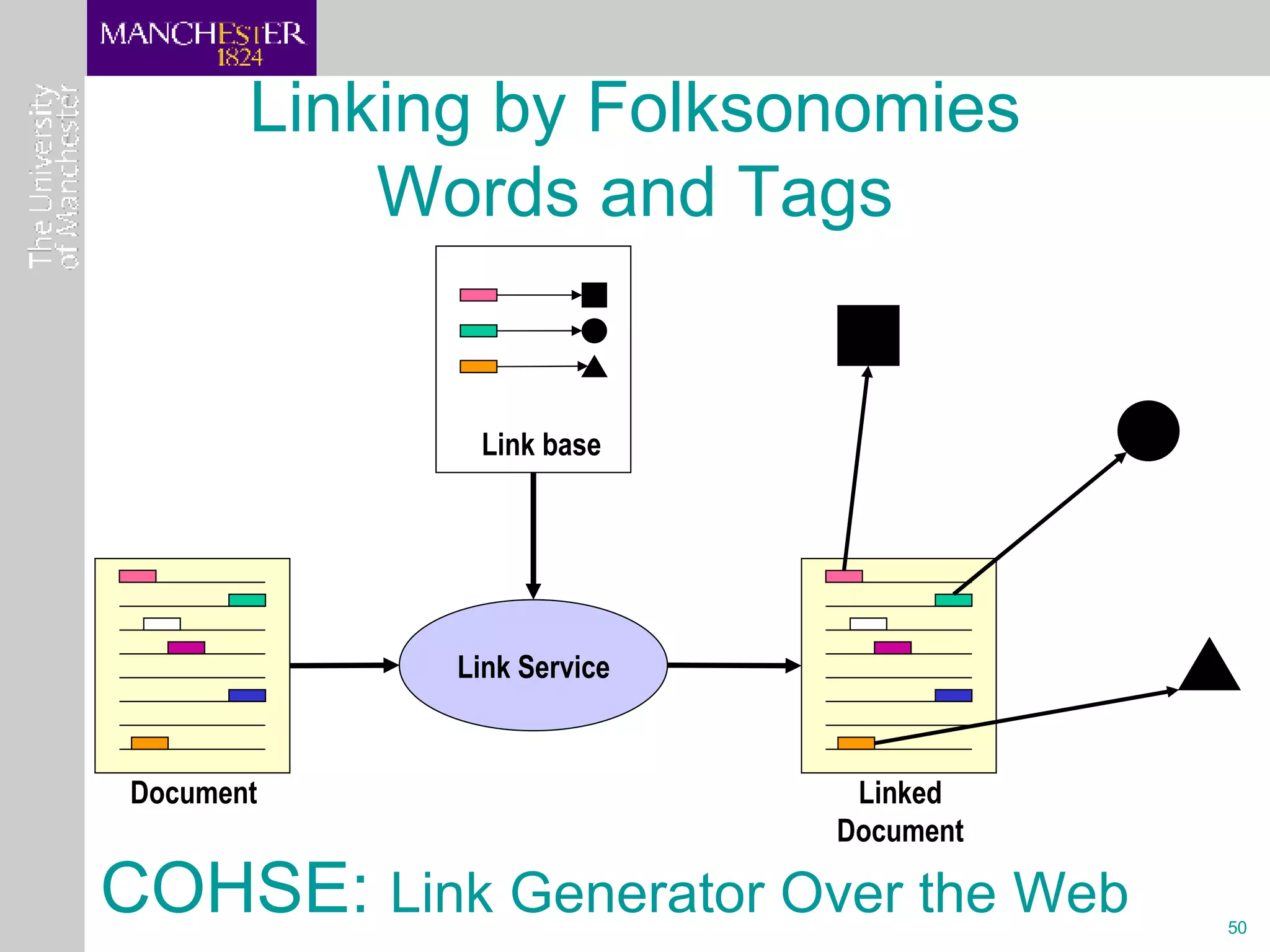
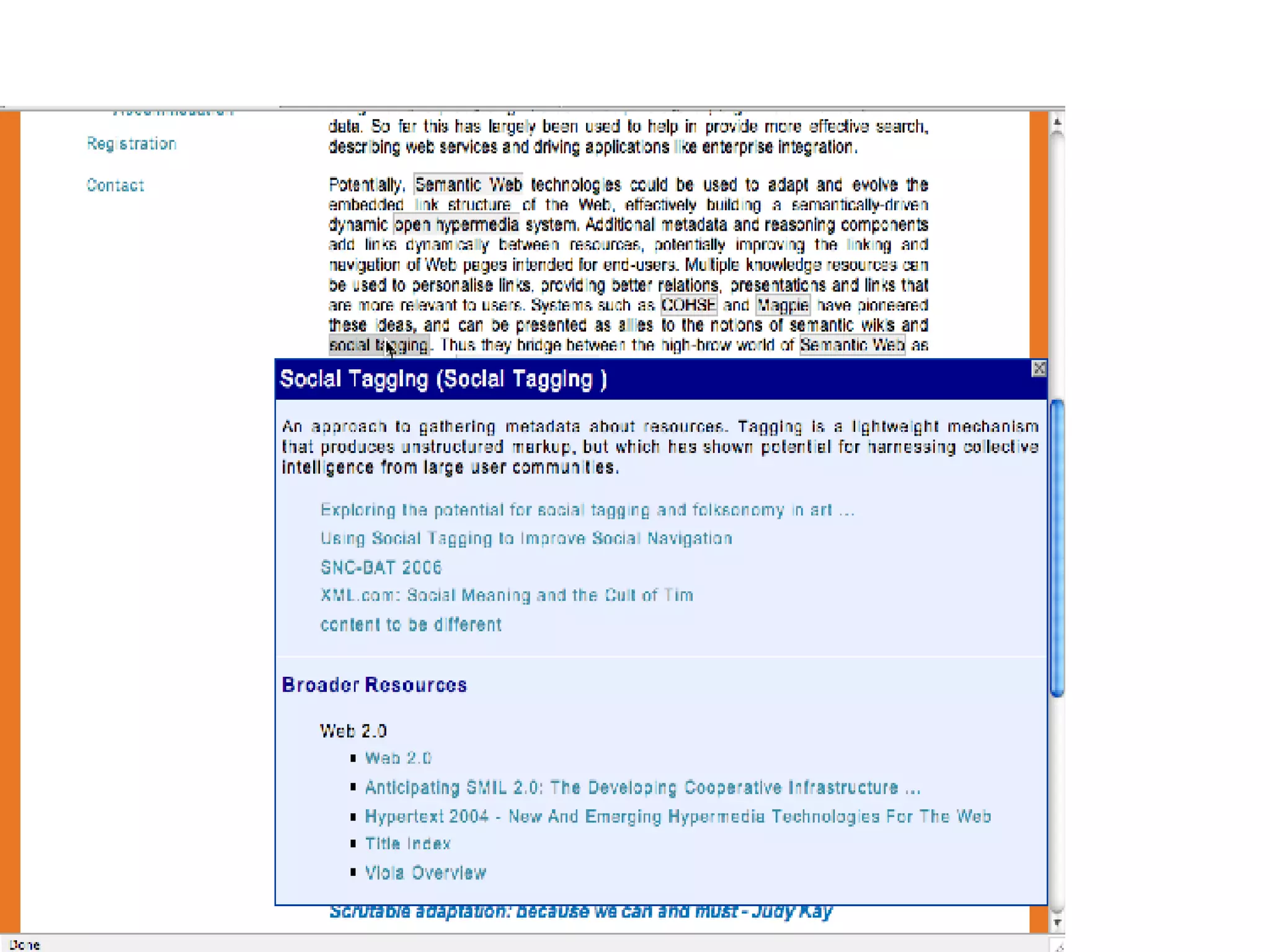
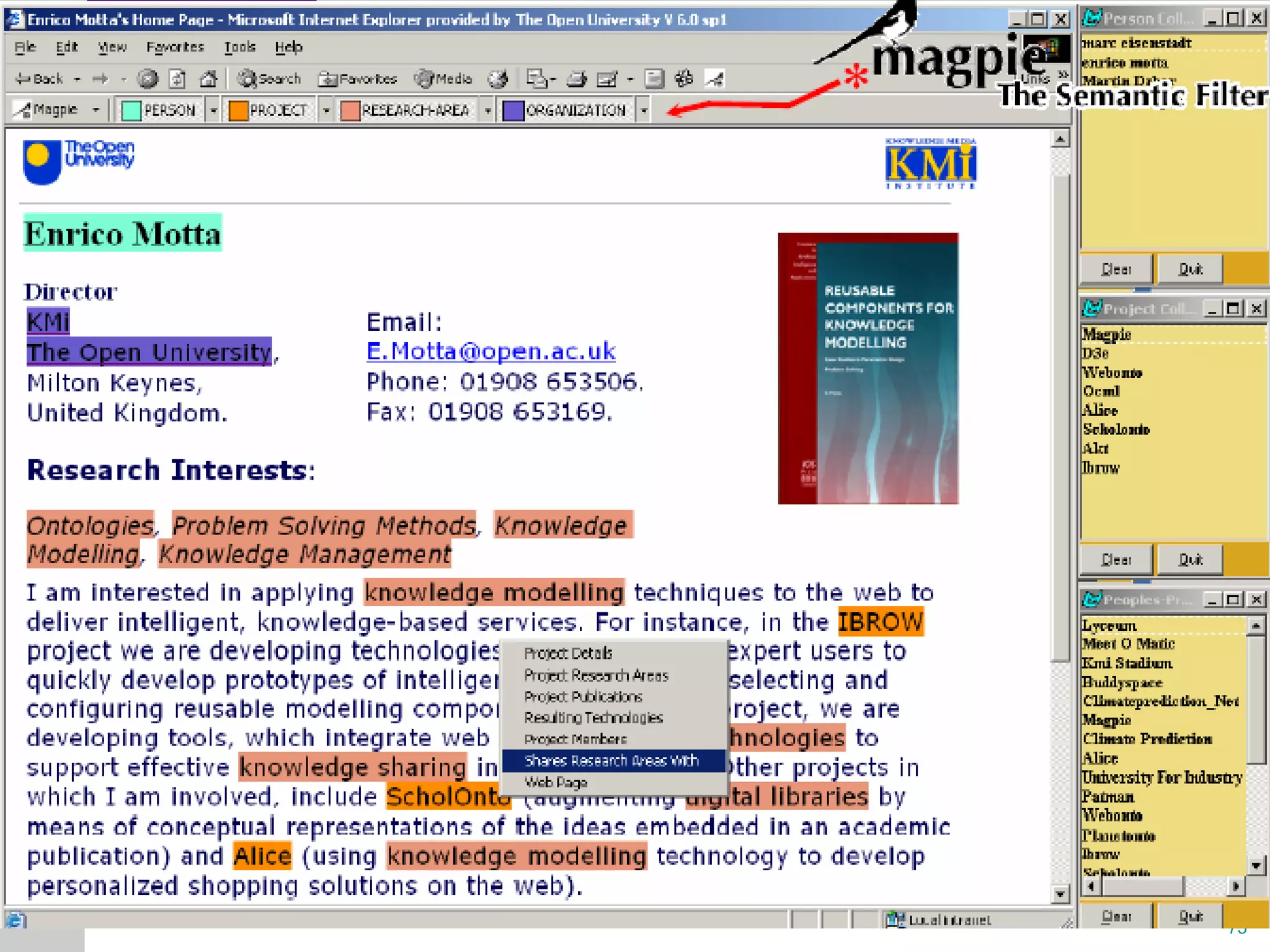
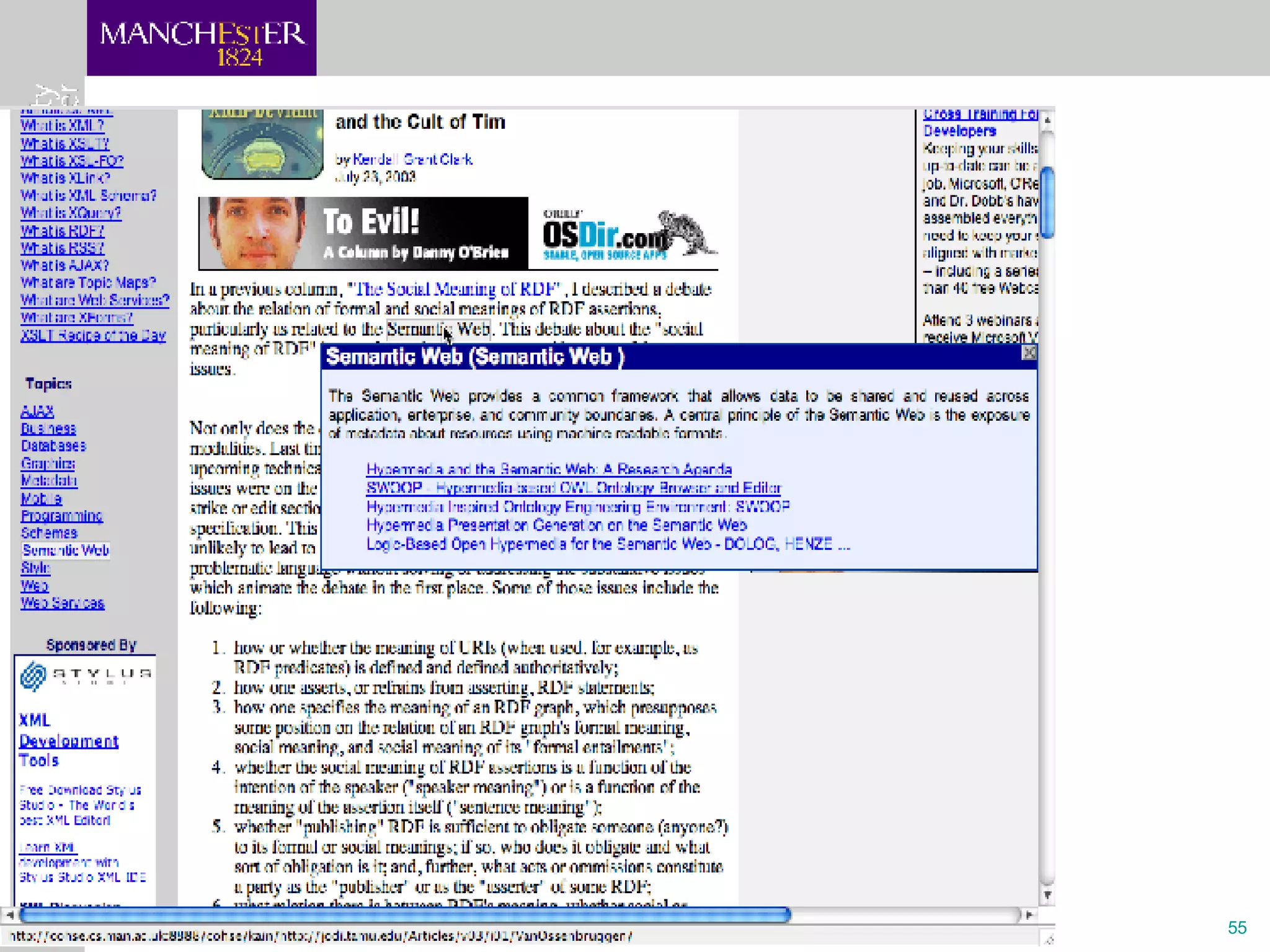
Linking by Folksonomies Words and Tags COHSE:  Link Generator Over the Web Link Service Link base Document Linked Document
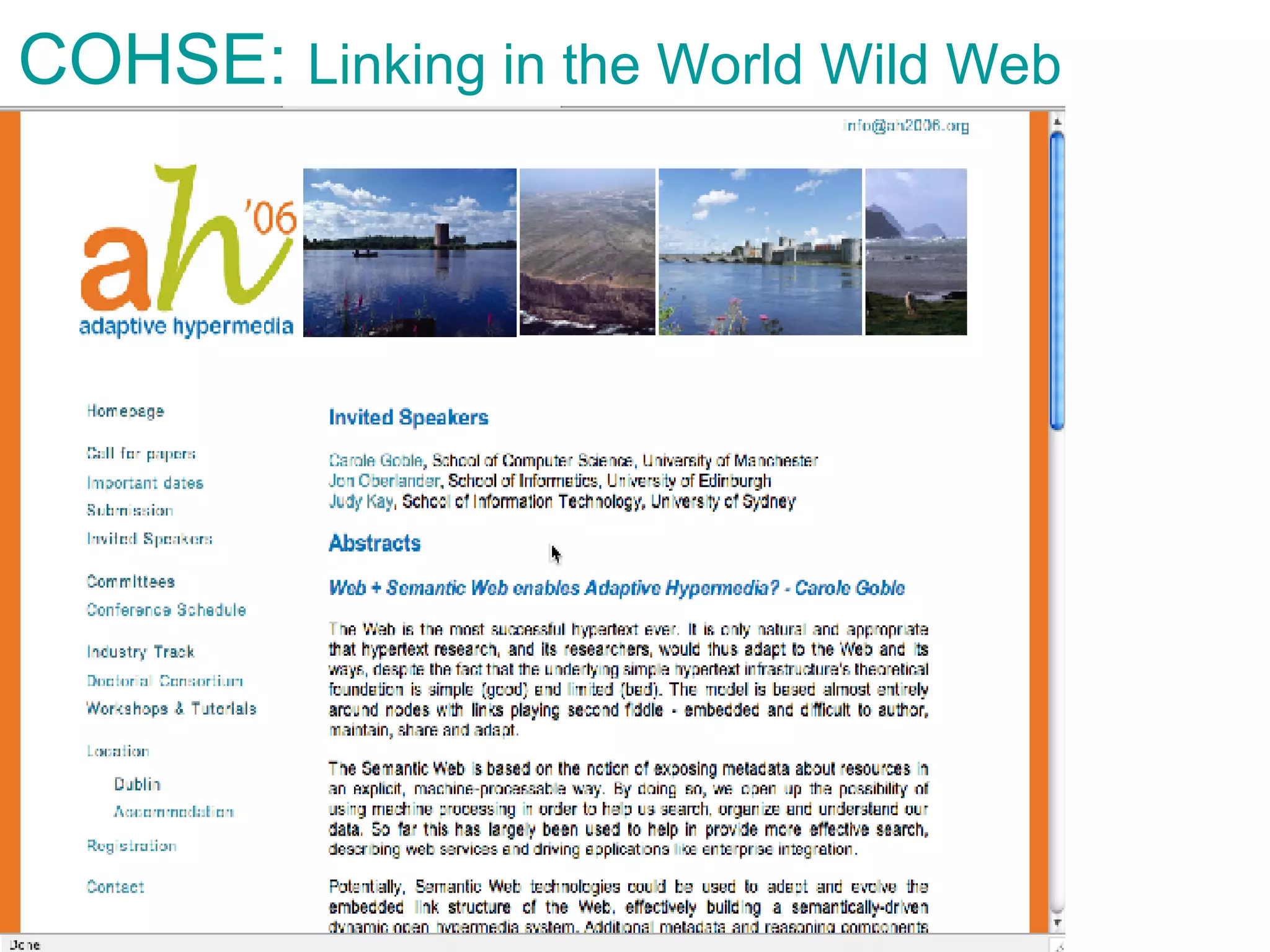
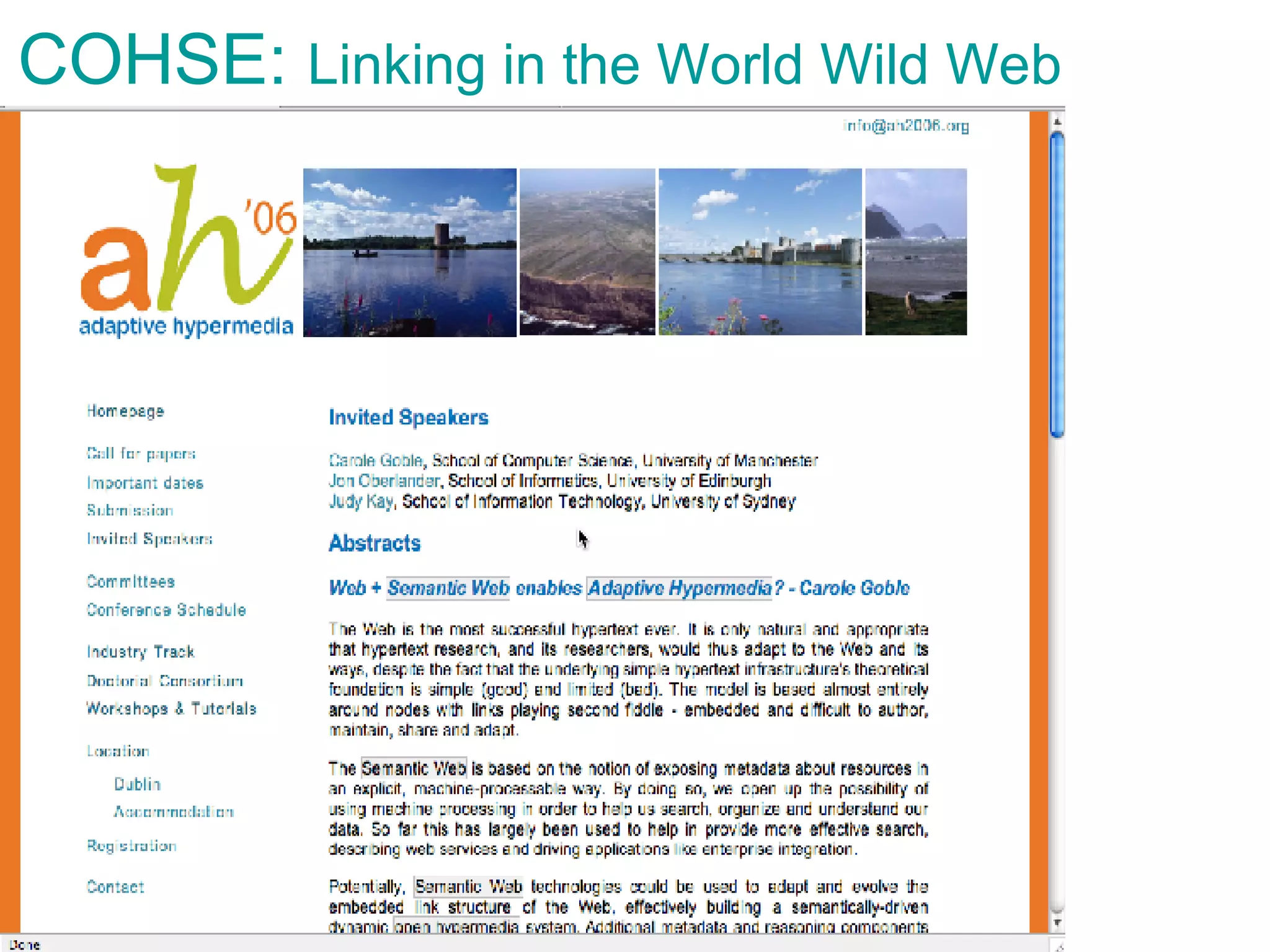
COHSE:  Linking in the World Wild Web


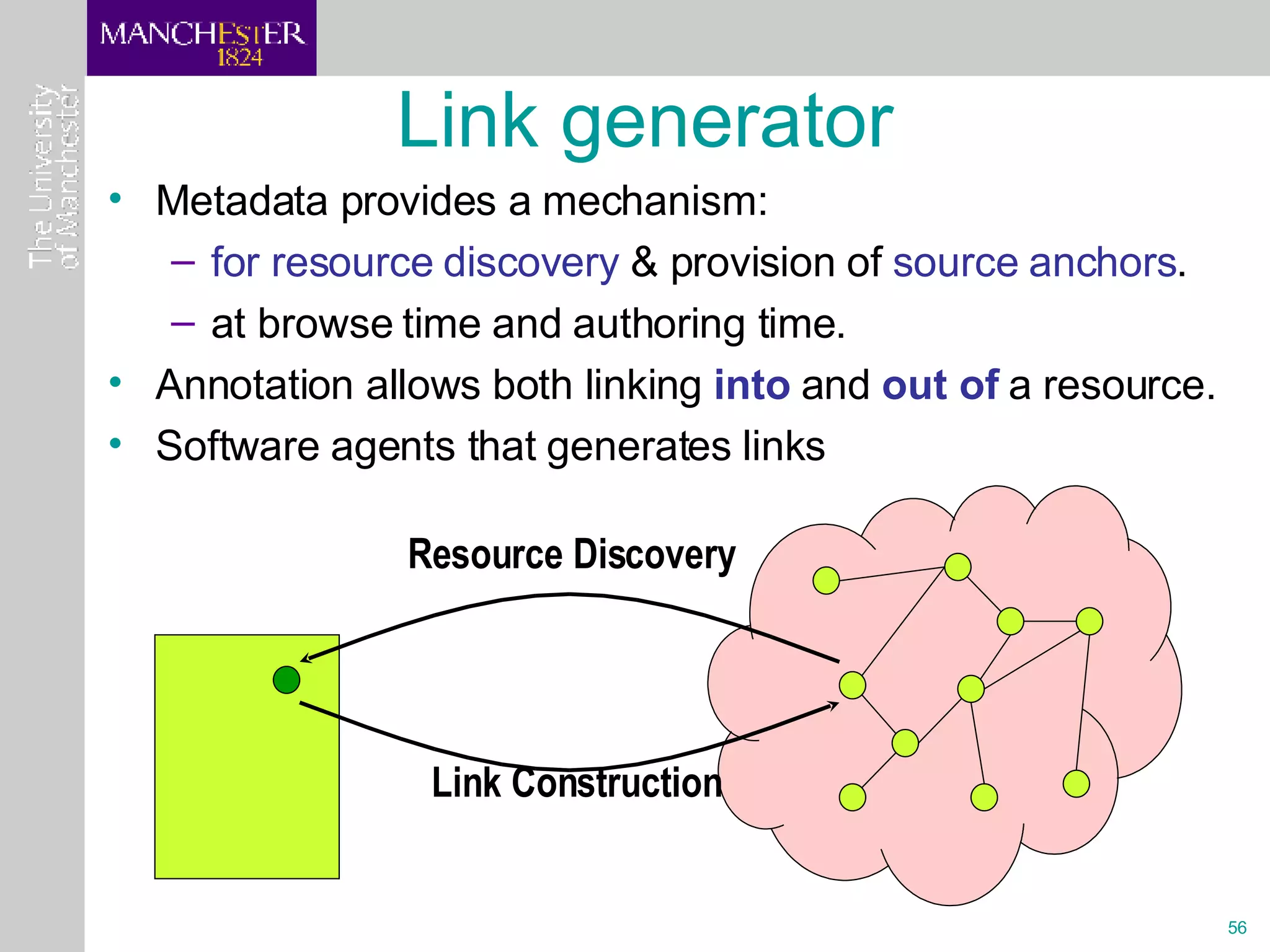
Link generator Metadata provides a mechanism: for resource discovery  & provision of  source anchors .  at browse time and authoring time. Annotation allows both linking  into  and  out of  a resource. Software agents that generates links Resource Discovery Link Construction
Mind the Gap!    Linking is tags, APIs and browser Link model? No information model and information integration mechanism Tags and folksonomies - a bit hit and miss Controlled vocabularies? Back in the day we talked about Conceptual Hypermedia Systems.
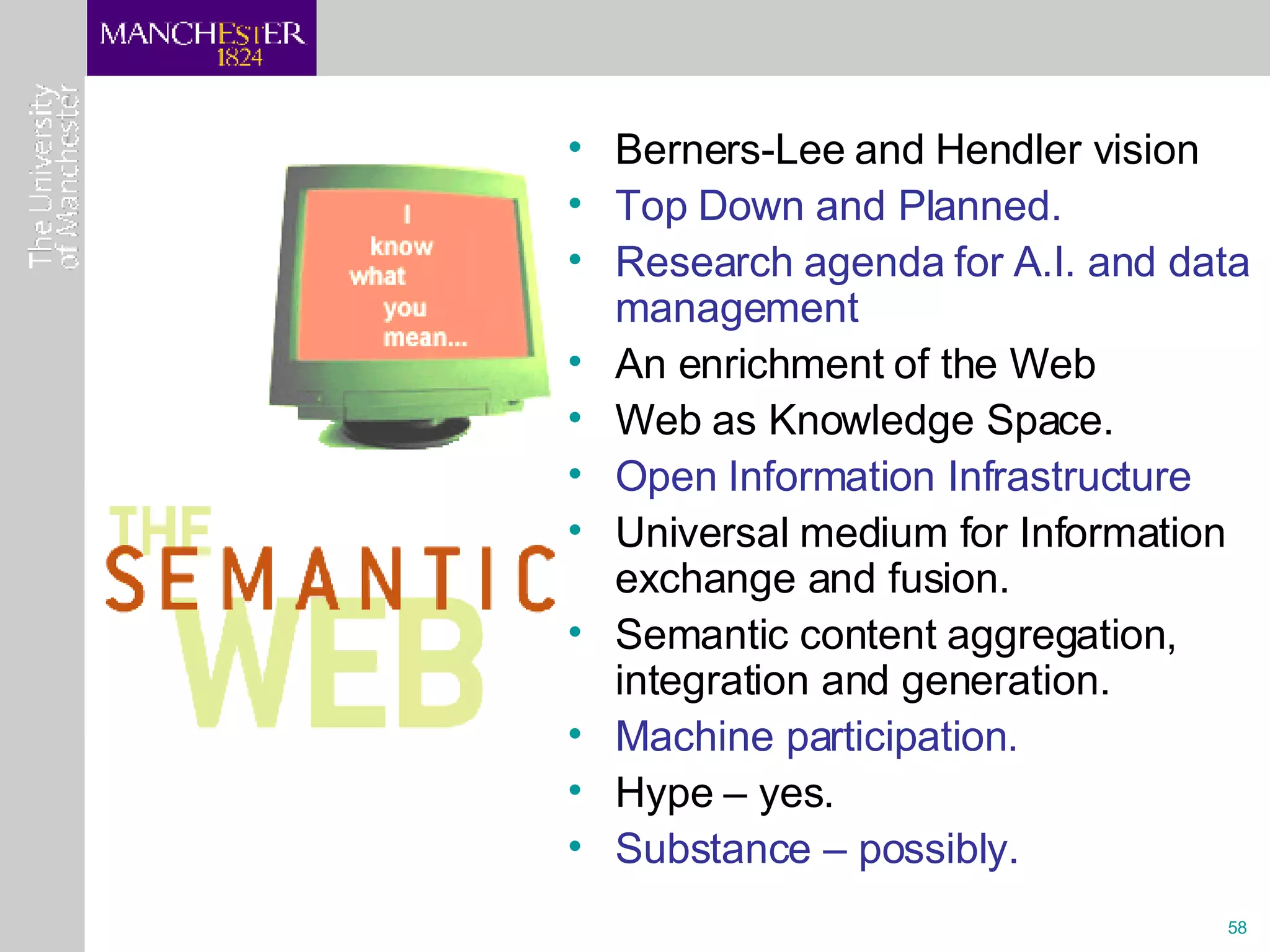
Berners-Lee and Hendler vision Top Down and Planned.   Research agenda for A.I. and data management An enrichment of the Web Web as Knowledge Space. Open Information Infrastructure Universal medium for Information exchange and fusion. Semantic content aggregation, integration and generation. Machine participation. Hype – yes. Substance – possibly.
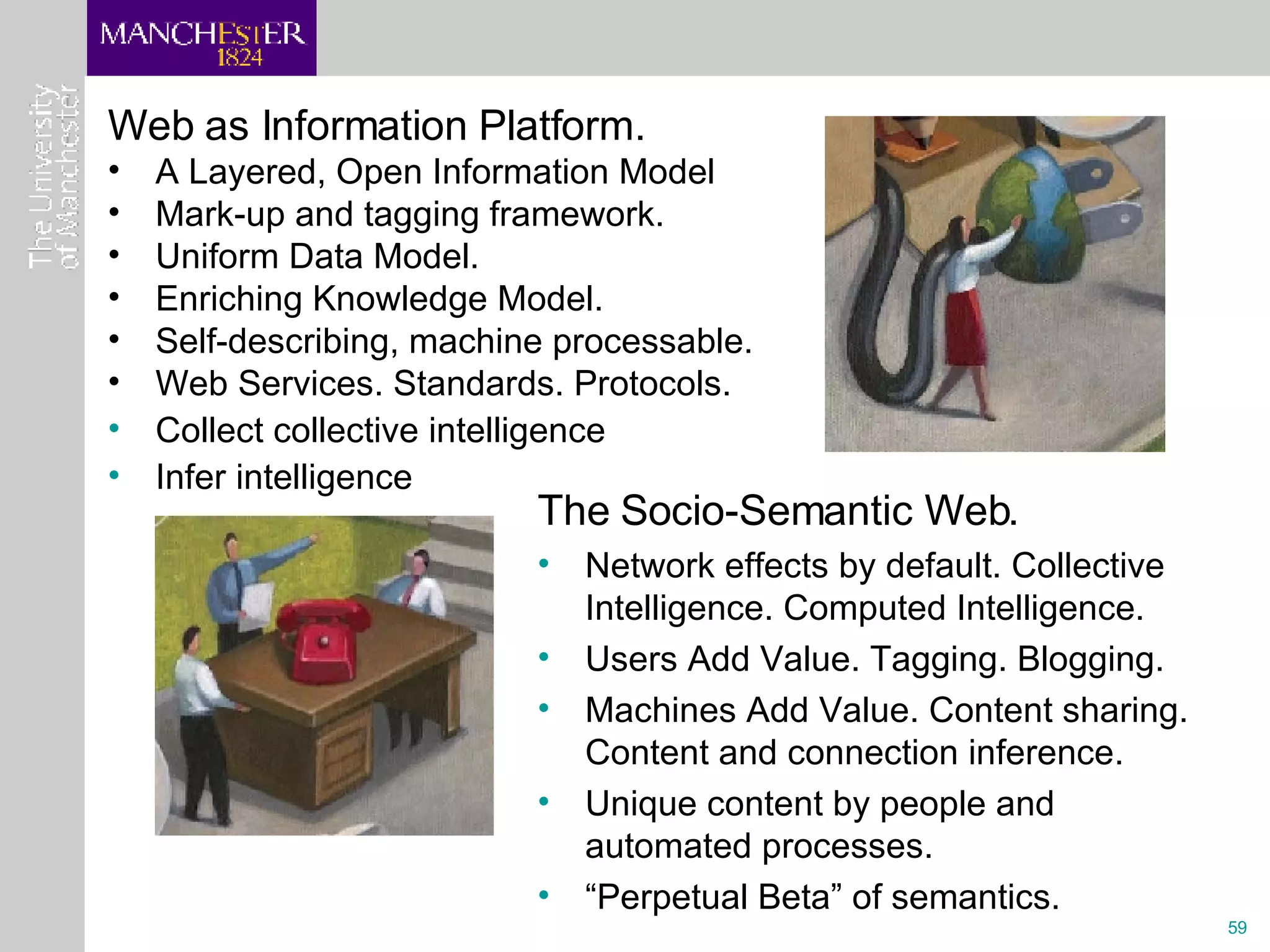
Web as Information Platform. A Layered, Open Information Model  Mark-up and tagging framework. Uniform Data Model. Enriching Knowledge Model. Self-describing, machine processable. Web Services. Standards. Protocols. Collect collective intelligence Infer intelligence The Socio-Semantic Web.  Network effects by default. Collective Intelligence. Computed Intelligence. Users Add Value. Tagging. Blogging.  Machines Add Value. Content sharing. Content and connection inference. Unique content by people and automated processes. “ Perpetual Beta” of semantics.
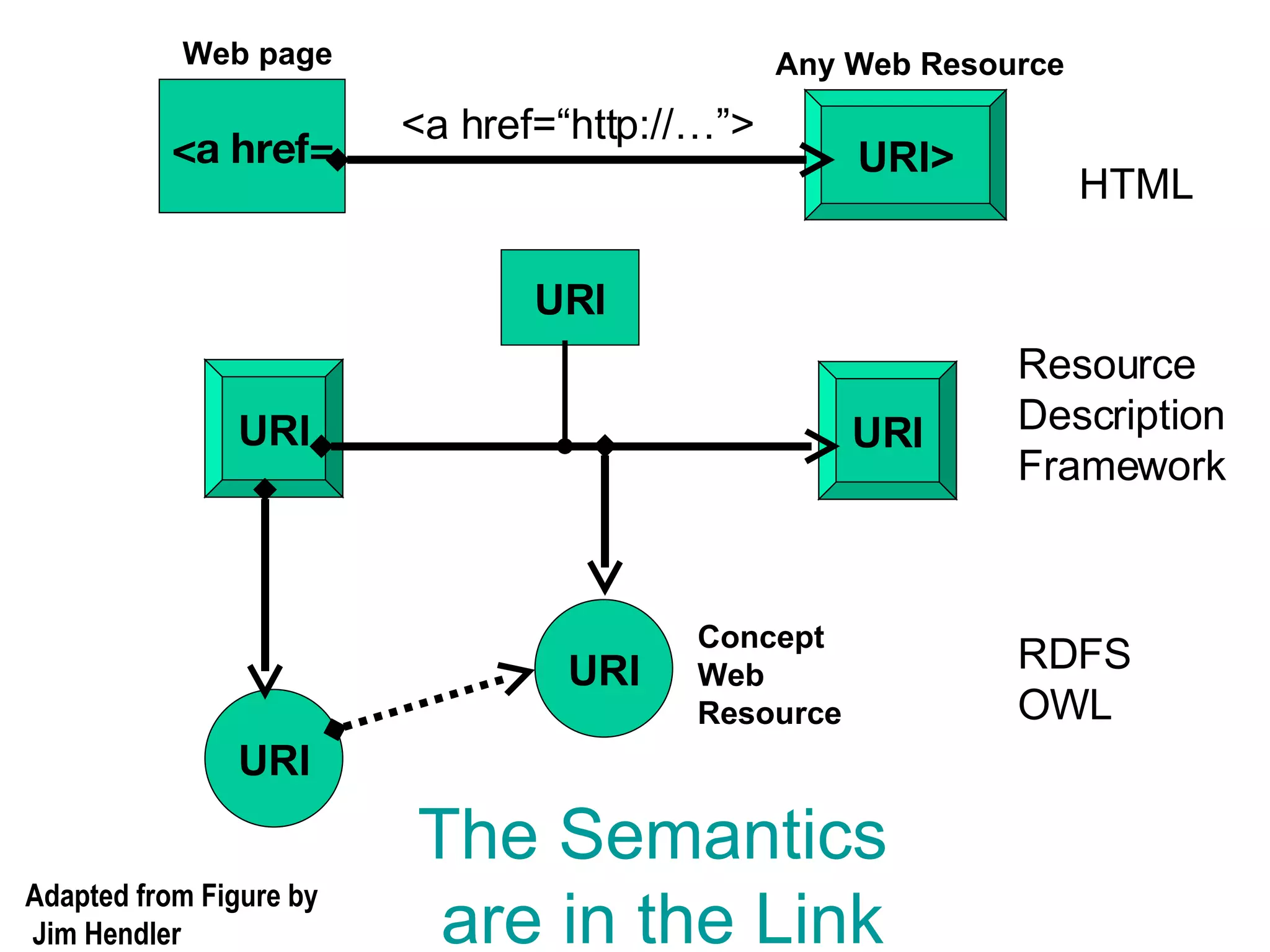
The Semantics  are in the Link URI> <a href= HTML Web page Any Web Resource <a href=“http://…”> Adapted from Figure by Jim Hendler URI URI URI Resource Description Framework URI URI Concept Web Resource RDFS OWL
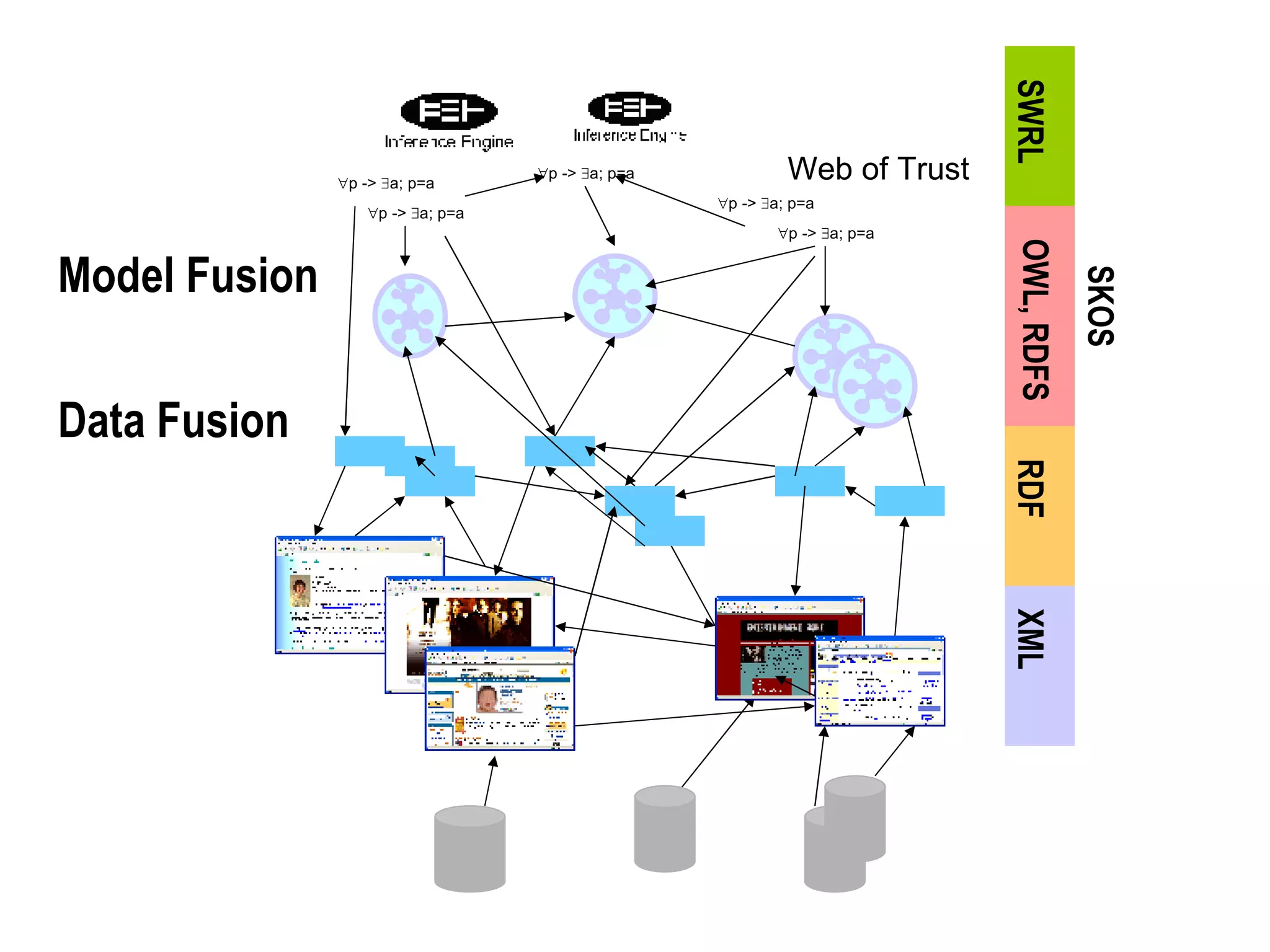
 p ->   a; p=a  p ->   a; p=a  p ->   a; p=a  p ->   a; p=a  p ->   a; p=a Web of Trust Data Fusion Model Fusion RDF OWL, RDFS SWRL XML SKOS
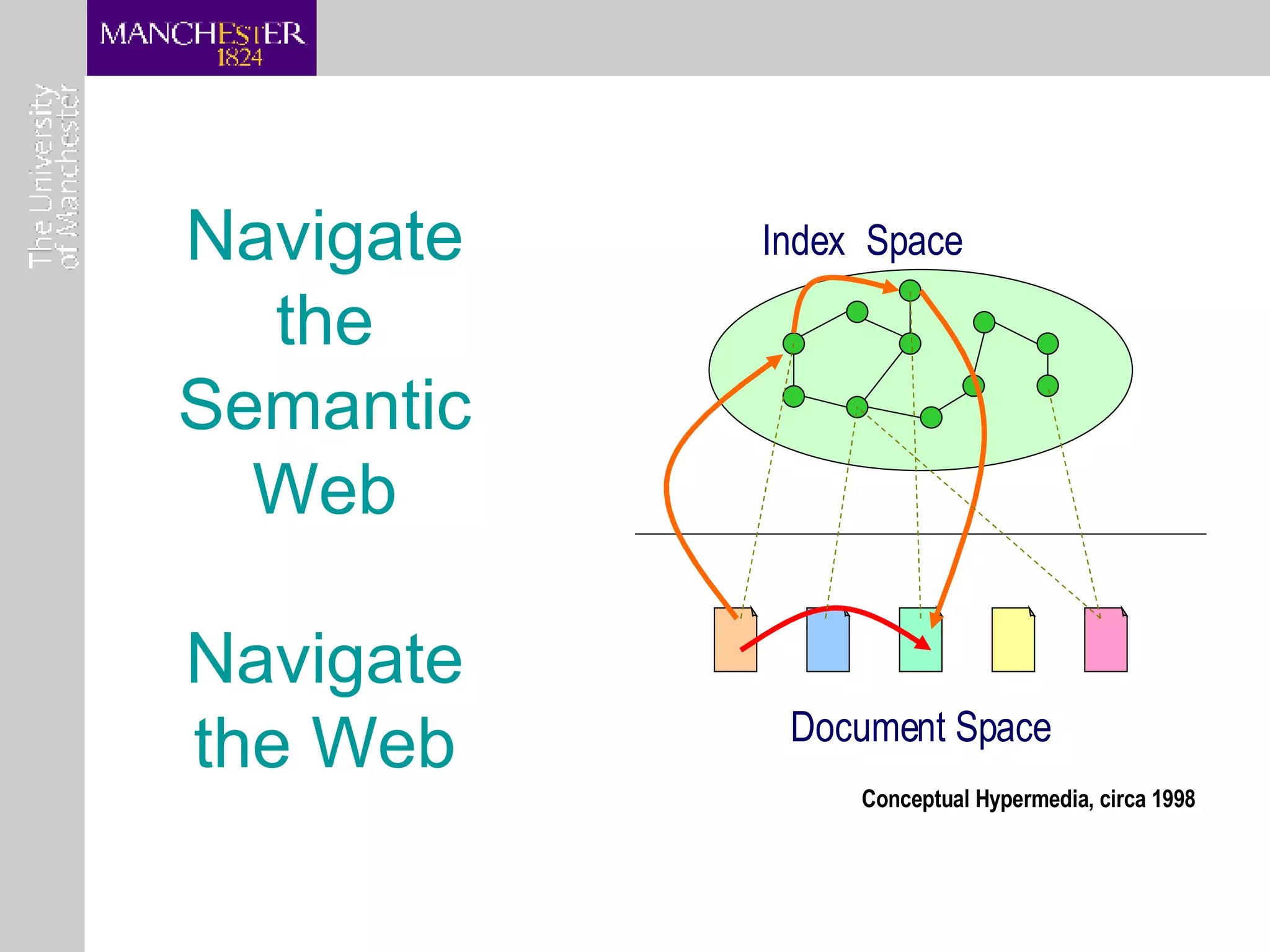
Navigate the Semantic Web Navigate the Web
Navigate the Semantic Web Navigate the Web Conceptual Hypermedia, circa 1998 Index  Space Document Space
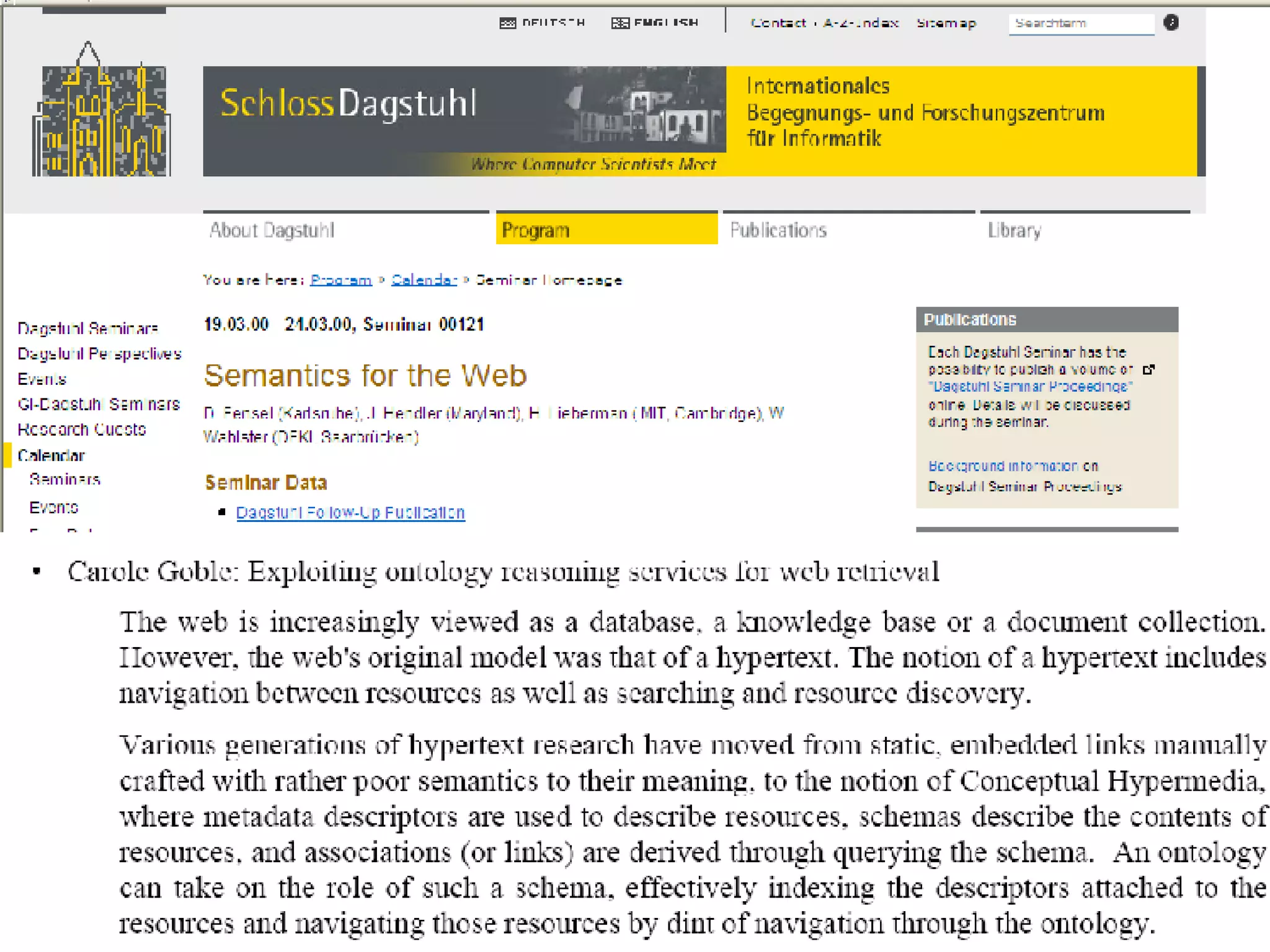
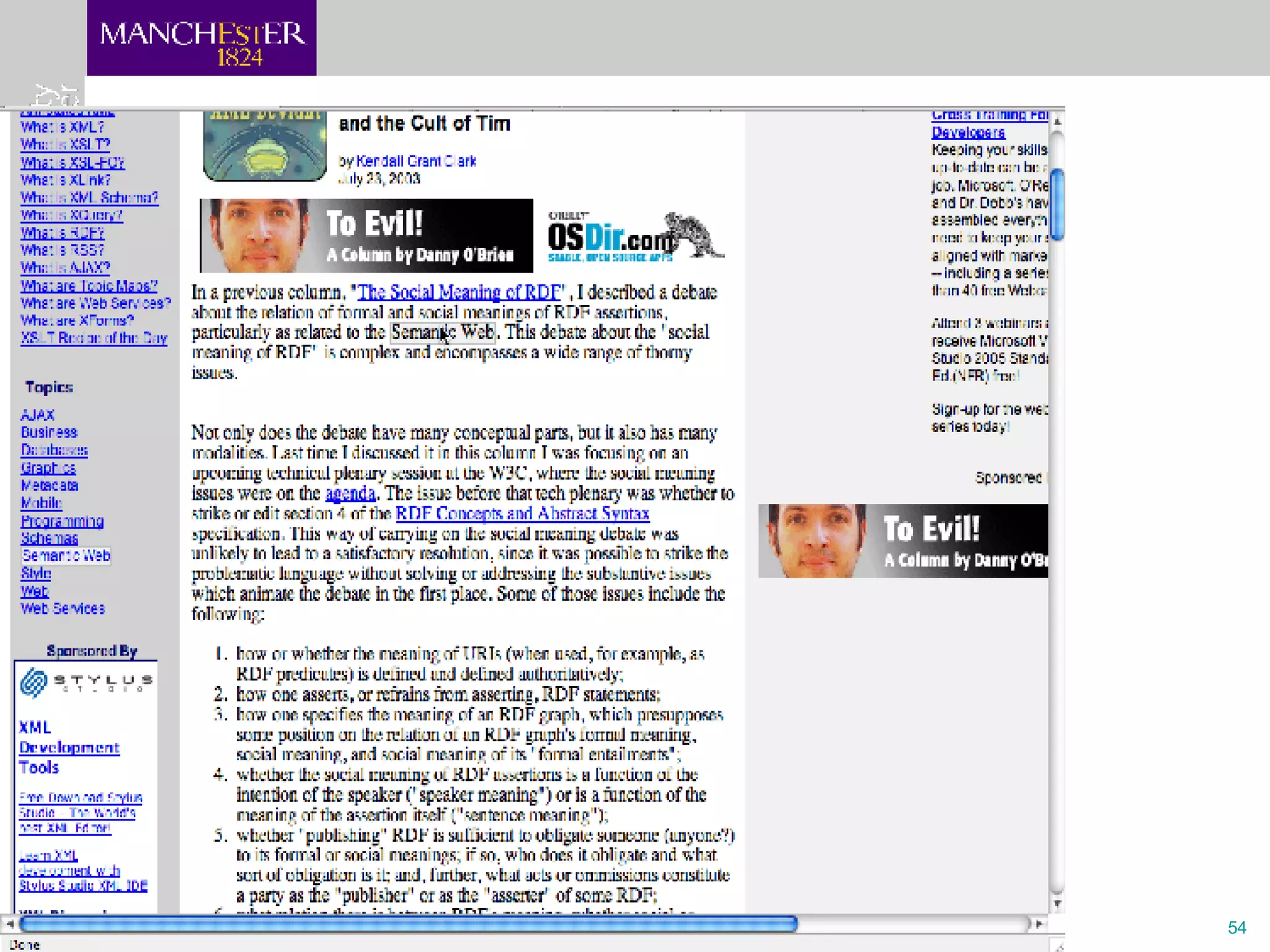
Back in the Day…. Dagstuhl 2000
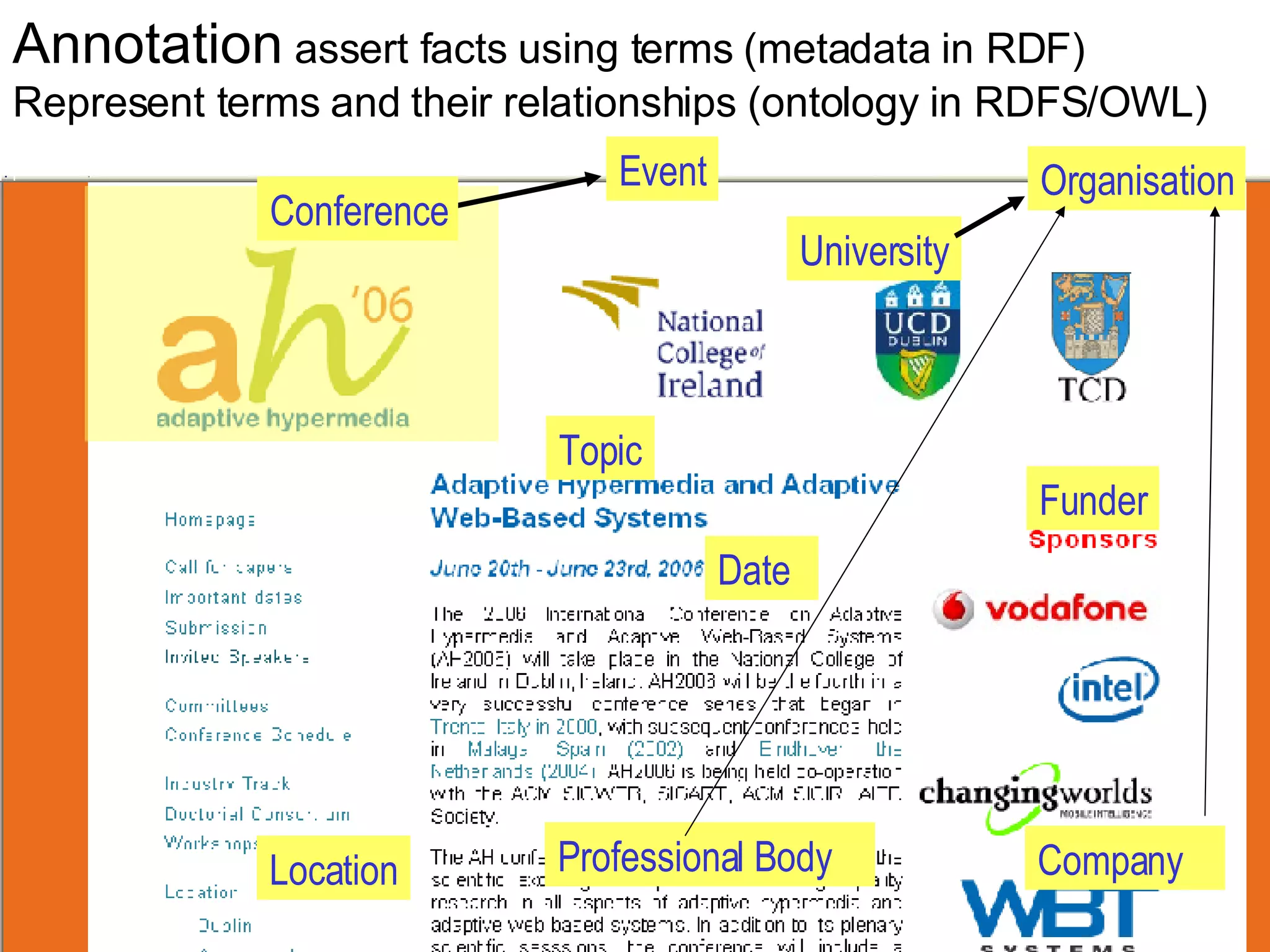
Topic Location Date University Company Funder Annotation  assert facts using terms (metadata in RDF) Represent terms and their relationships (ontology in RDFS/OWL) Conference Event Organisation Professional Body
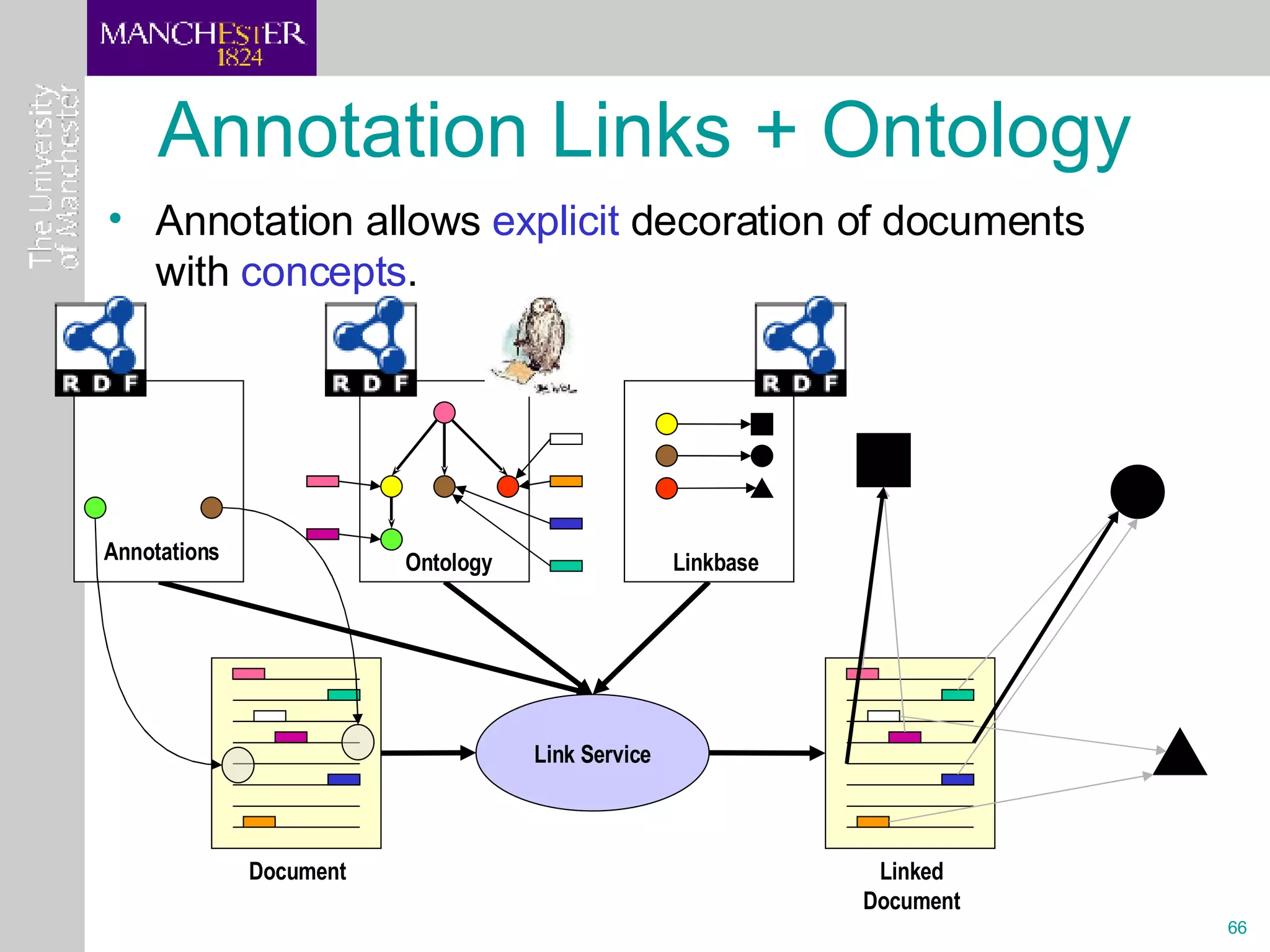
Annotation Links + Ontology Annotation allows  explicit  decoration of documents with  concepts .  Link Service Document Linked Document Ontology Linkbase Annotations
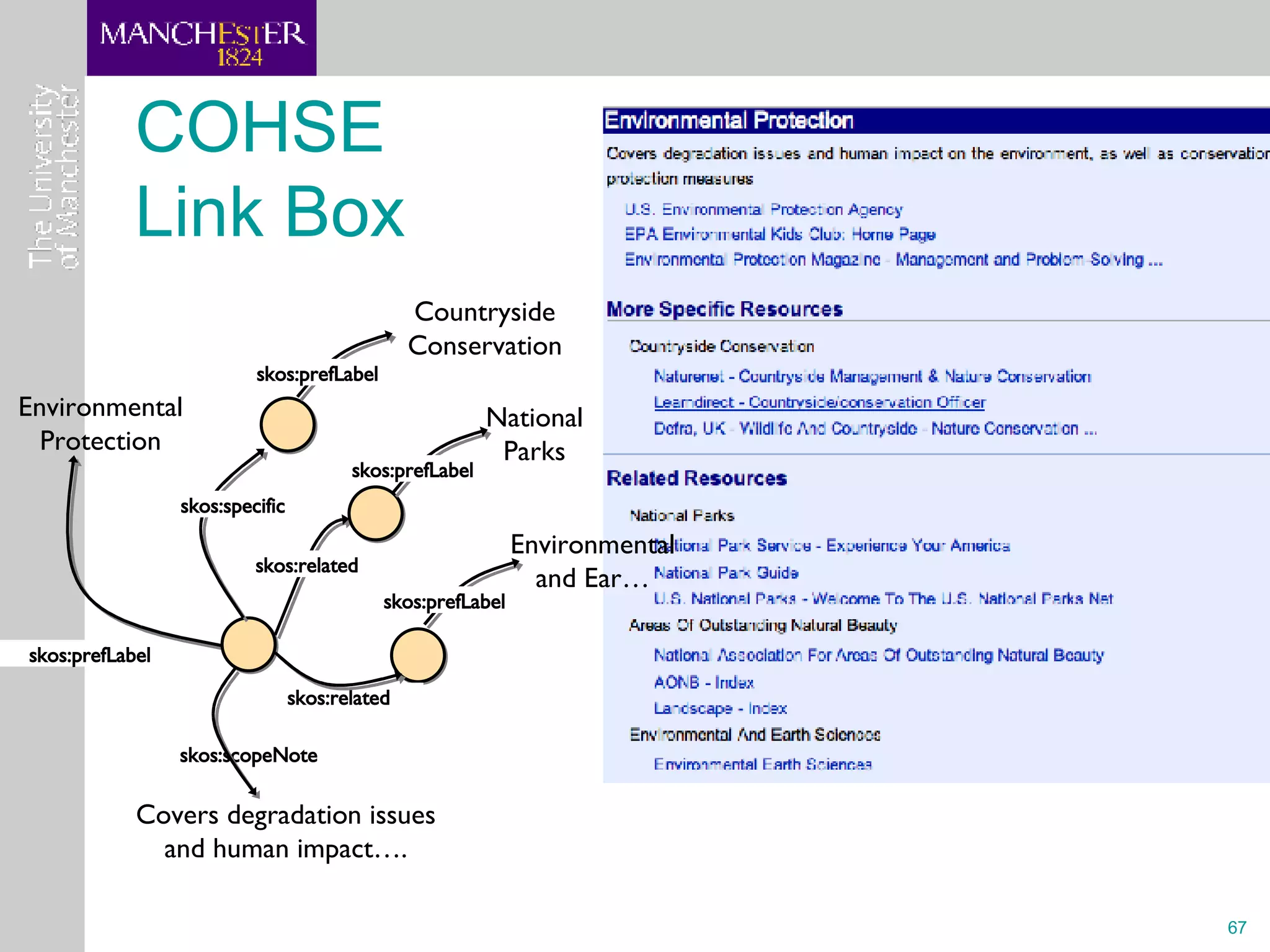
COHSE  Link Box skos:prefLabel Covers degradation issues and human impact…. skos:scopeNote Environmental Protection Countryside Conservation skos:specific skos:prefLabel skos:related skos:related skos:prefLabel skos:prefLabel National Parks Environmental and Ear…
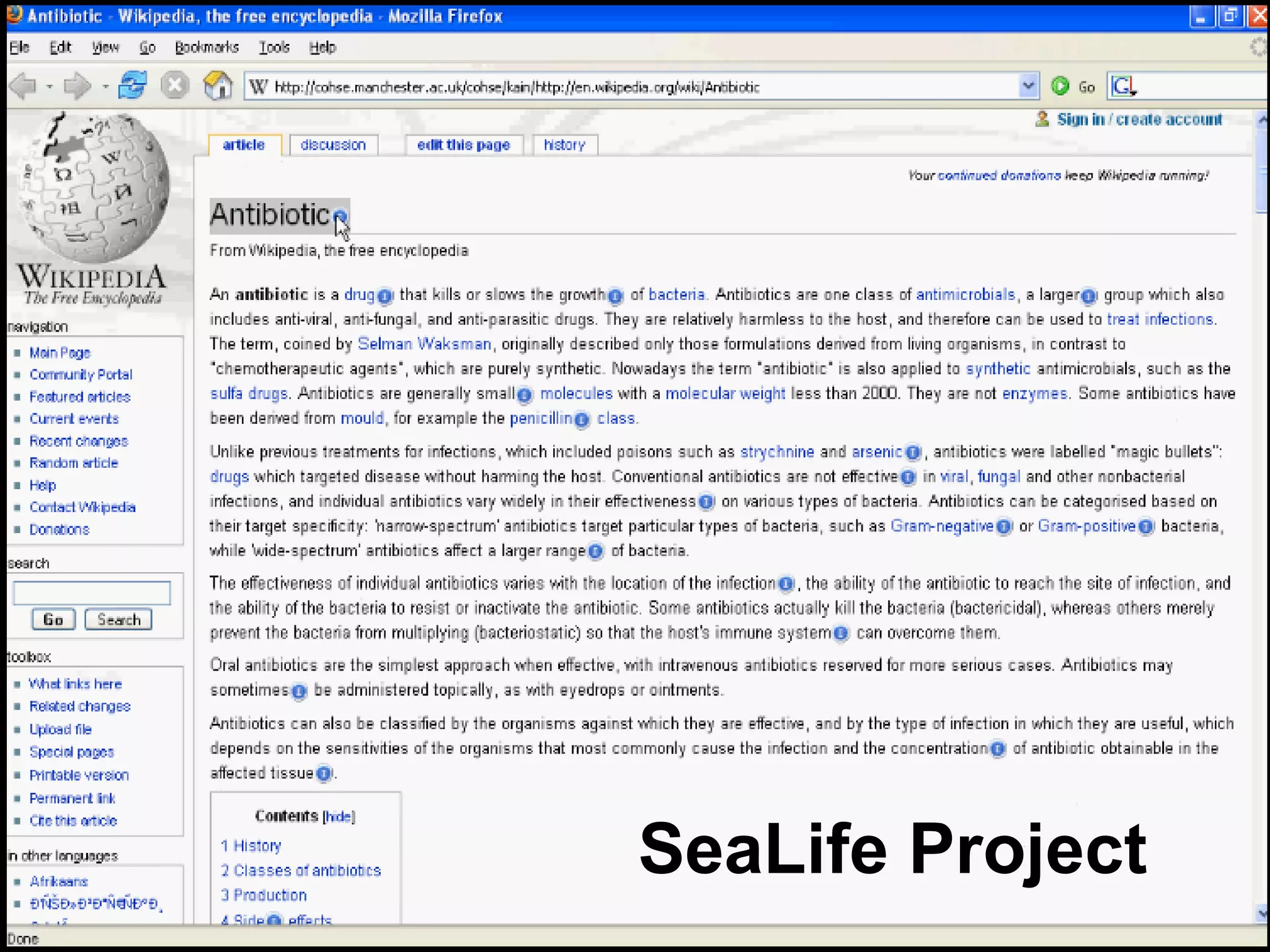
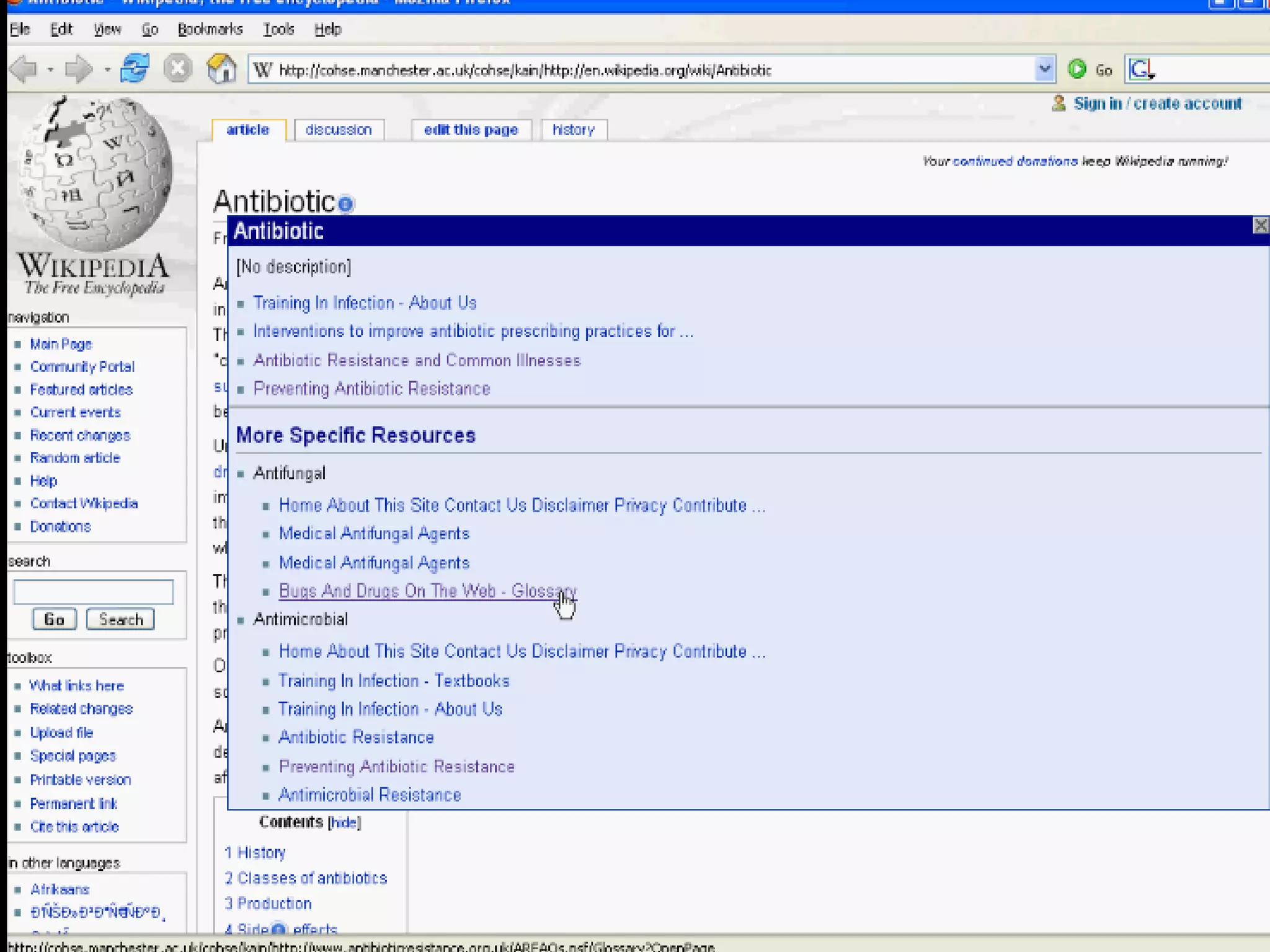
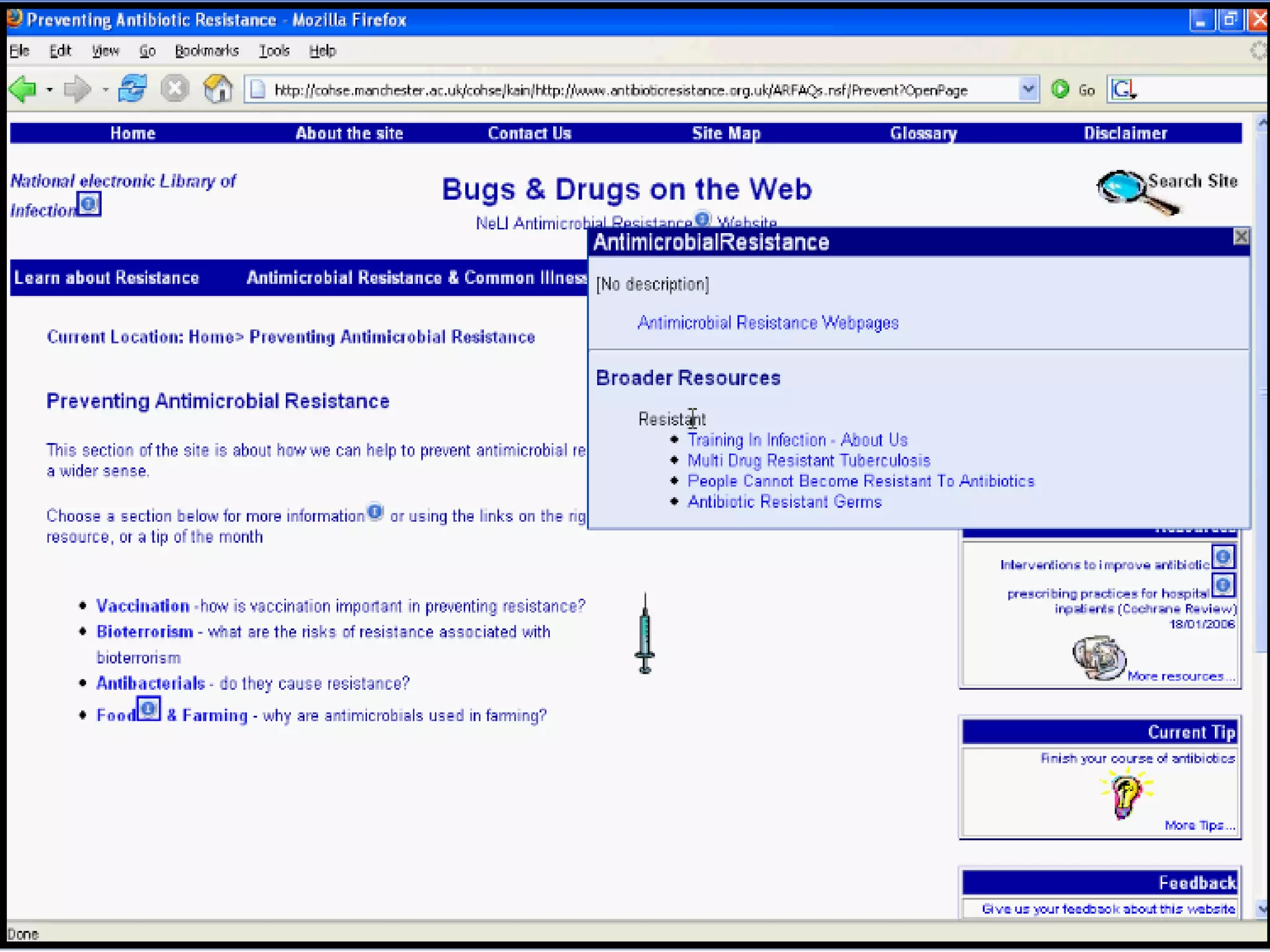
SeaLife Project
 
 
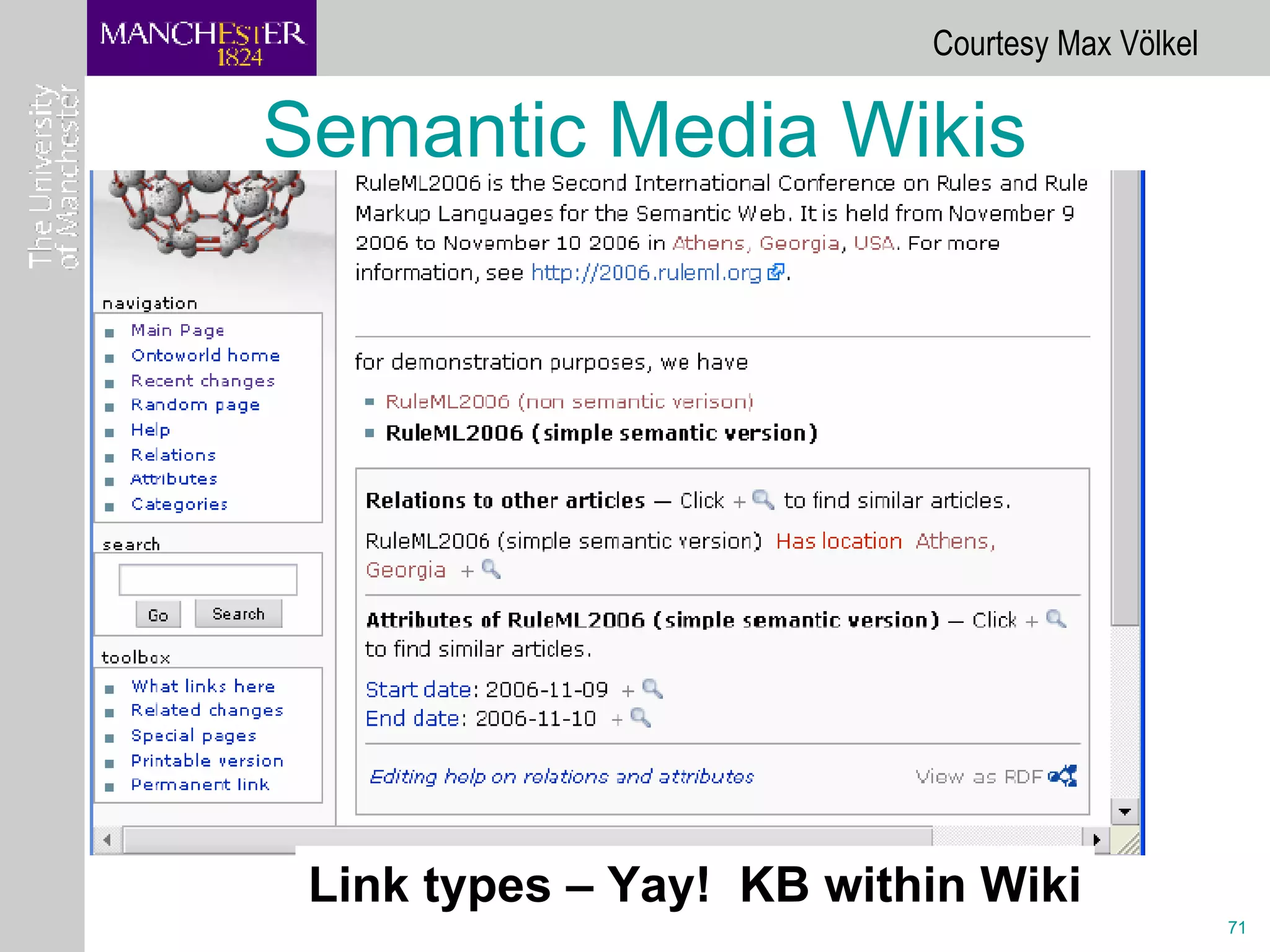
Semantic Media Wikis Link types – Yay!  KB within Wiki Courtesy Max  Völkel
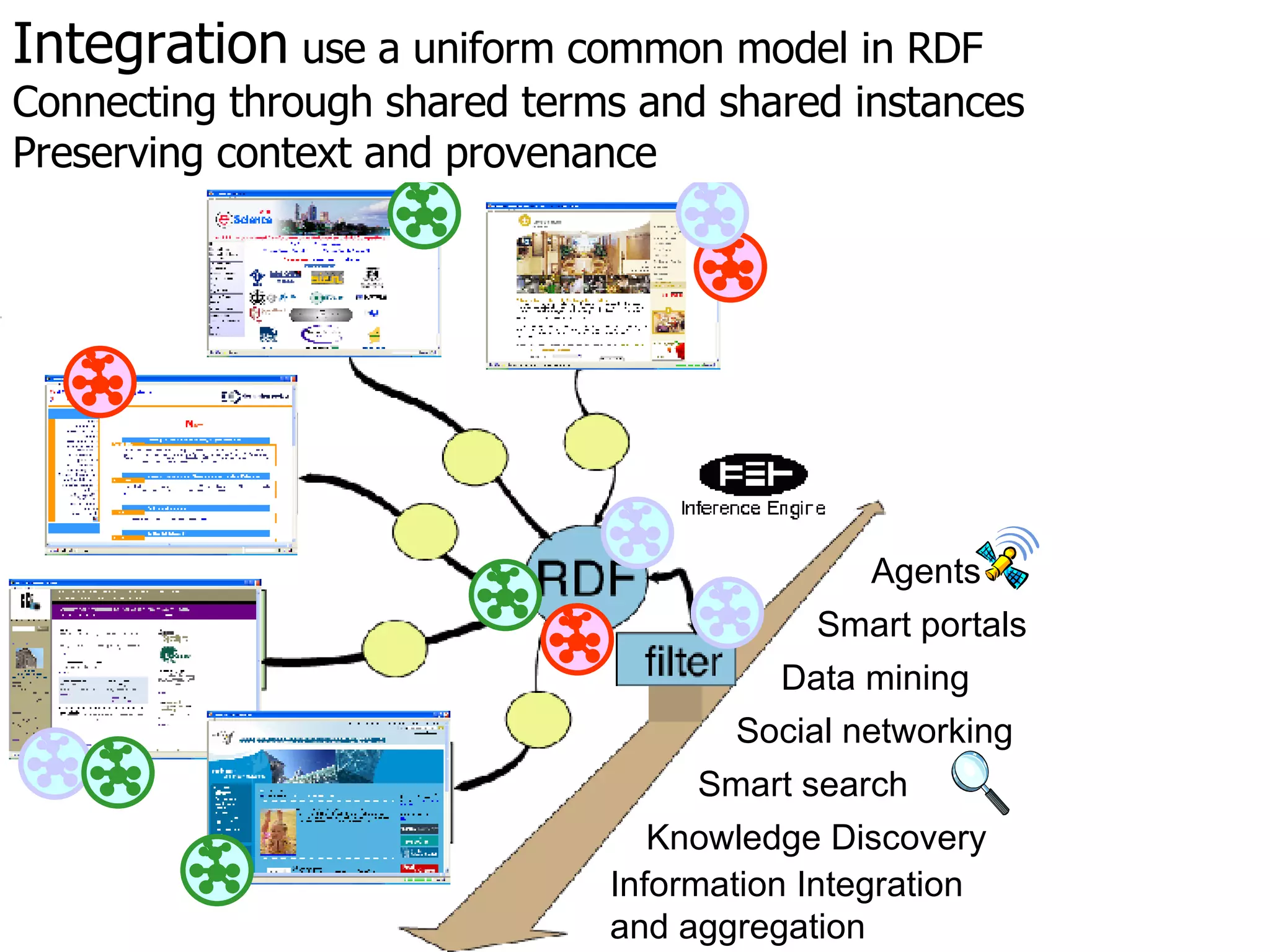
Integration  use a uniform common model in RDF Connecting through shared terms and shared instances Preserving context and provenance Data mining Knowledge Discovery Smart search Social networking Smart portals Agents Information Integration and aggregation
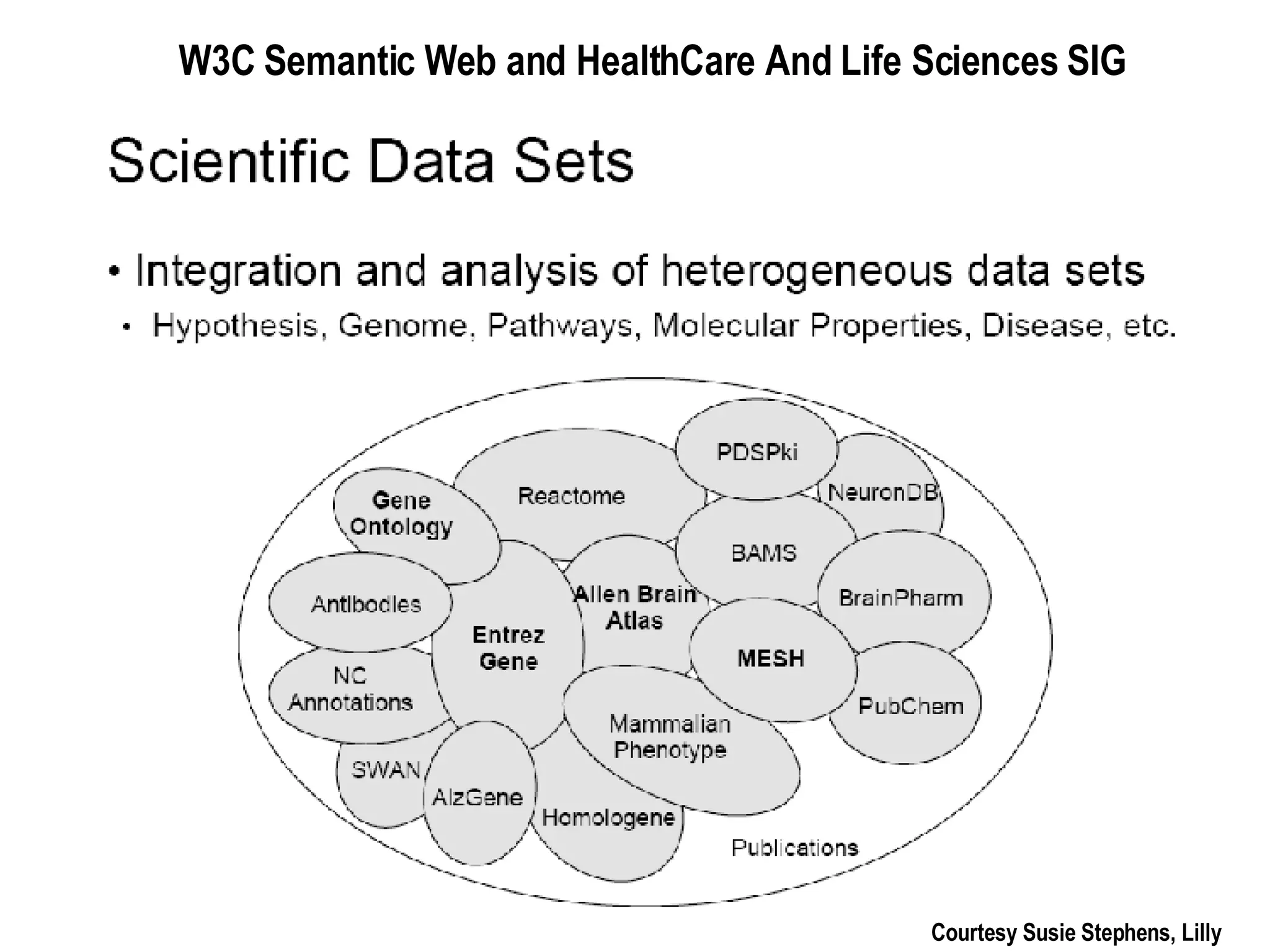
W3C Semantic Web and HealthCare And Life Sciences SIG  Courtesy Susie Stephens, Lilly
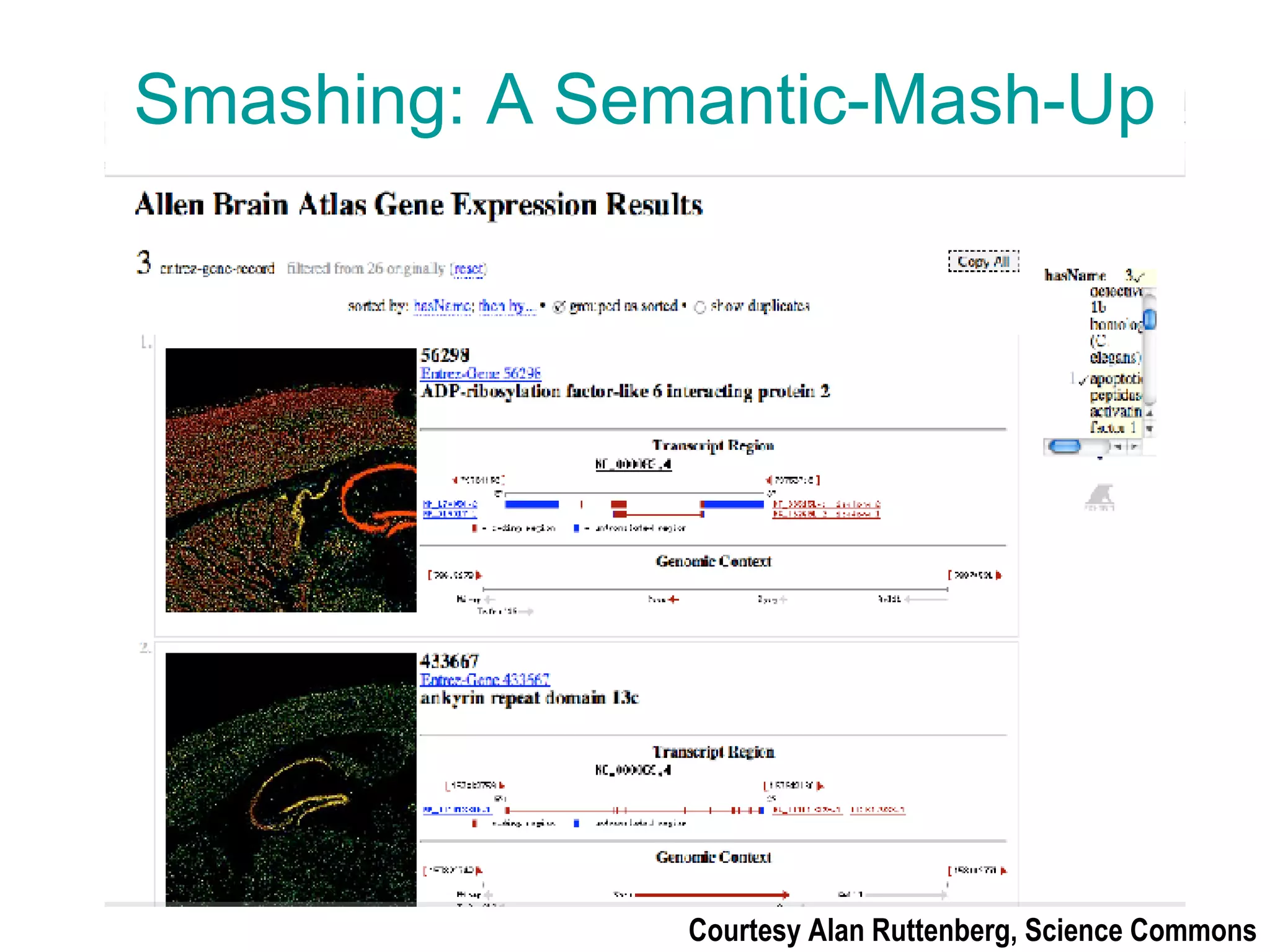
Smashing: A Semantic-Mash-Up Courtesy Alan Ruttenberg, Science Commons
 
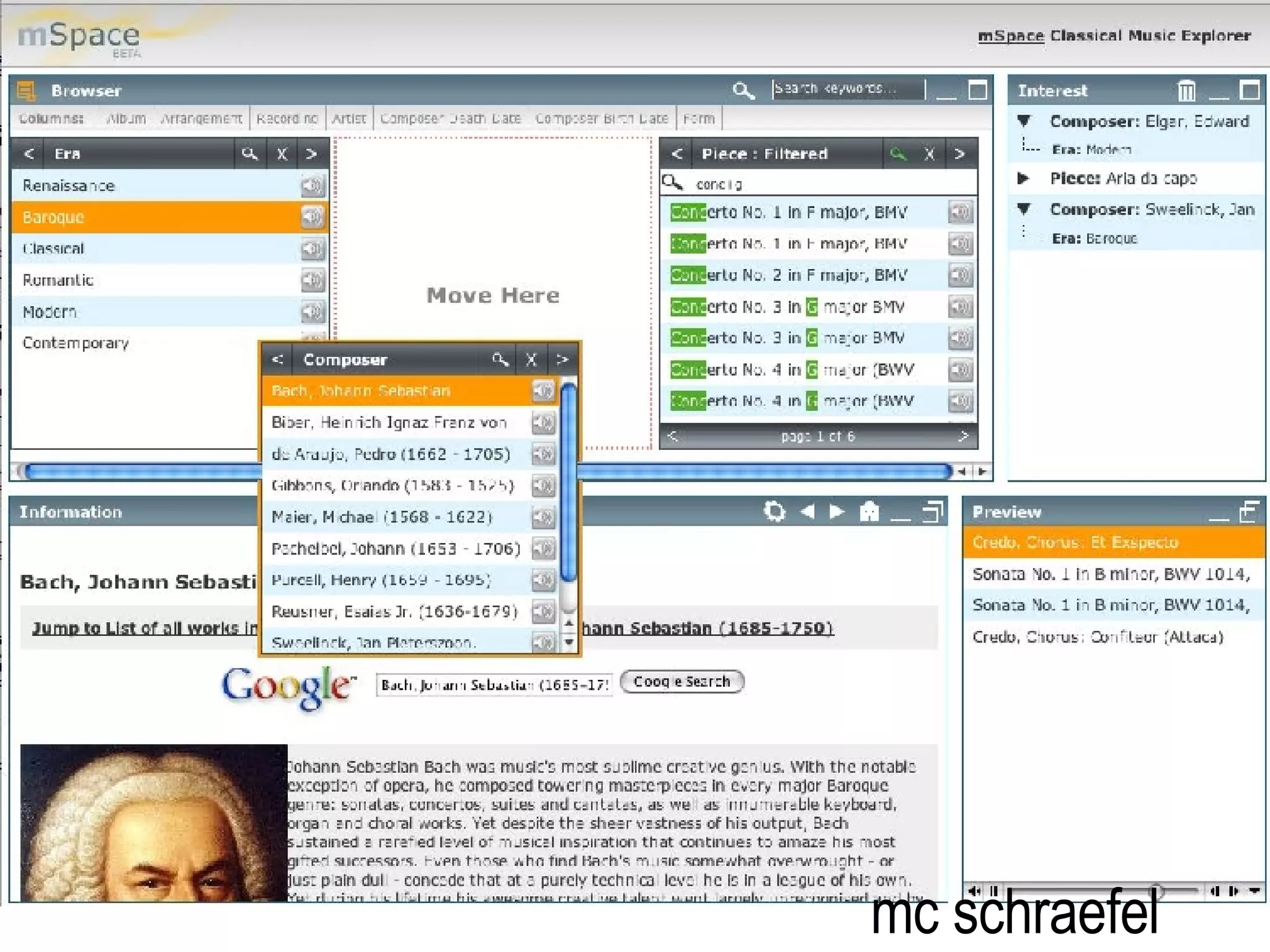
mc schraefel
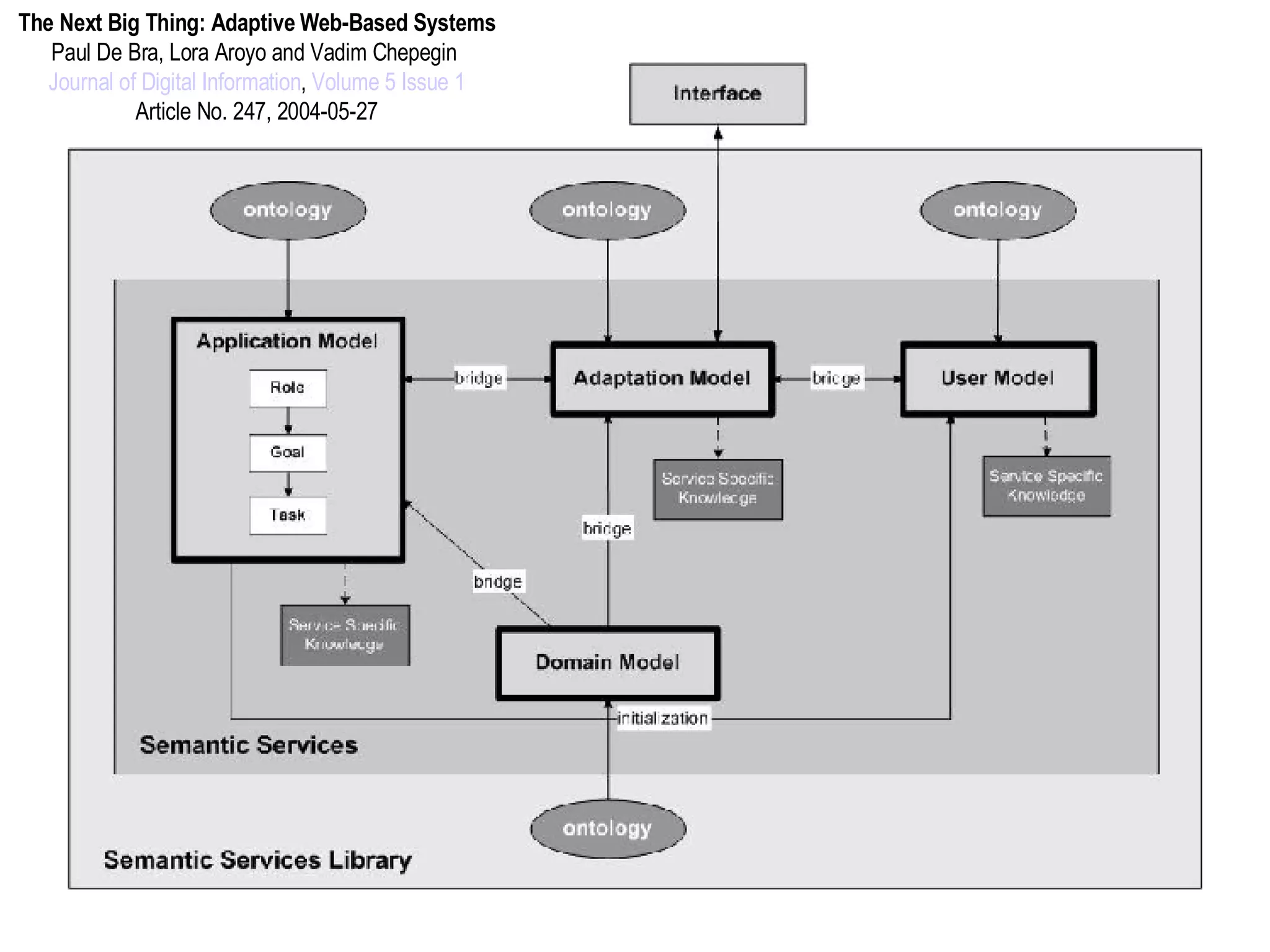
The Next Big Thing: Adaptive Web-Based Systems Paul De Bra, Lora Aroyo and Vadim Chepegin  Journal of Digital Information ,  Volume 5 Issue 1 Article No. 247, 2004-05-27
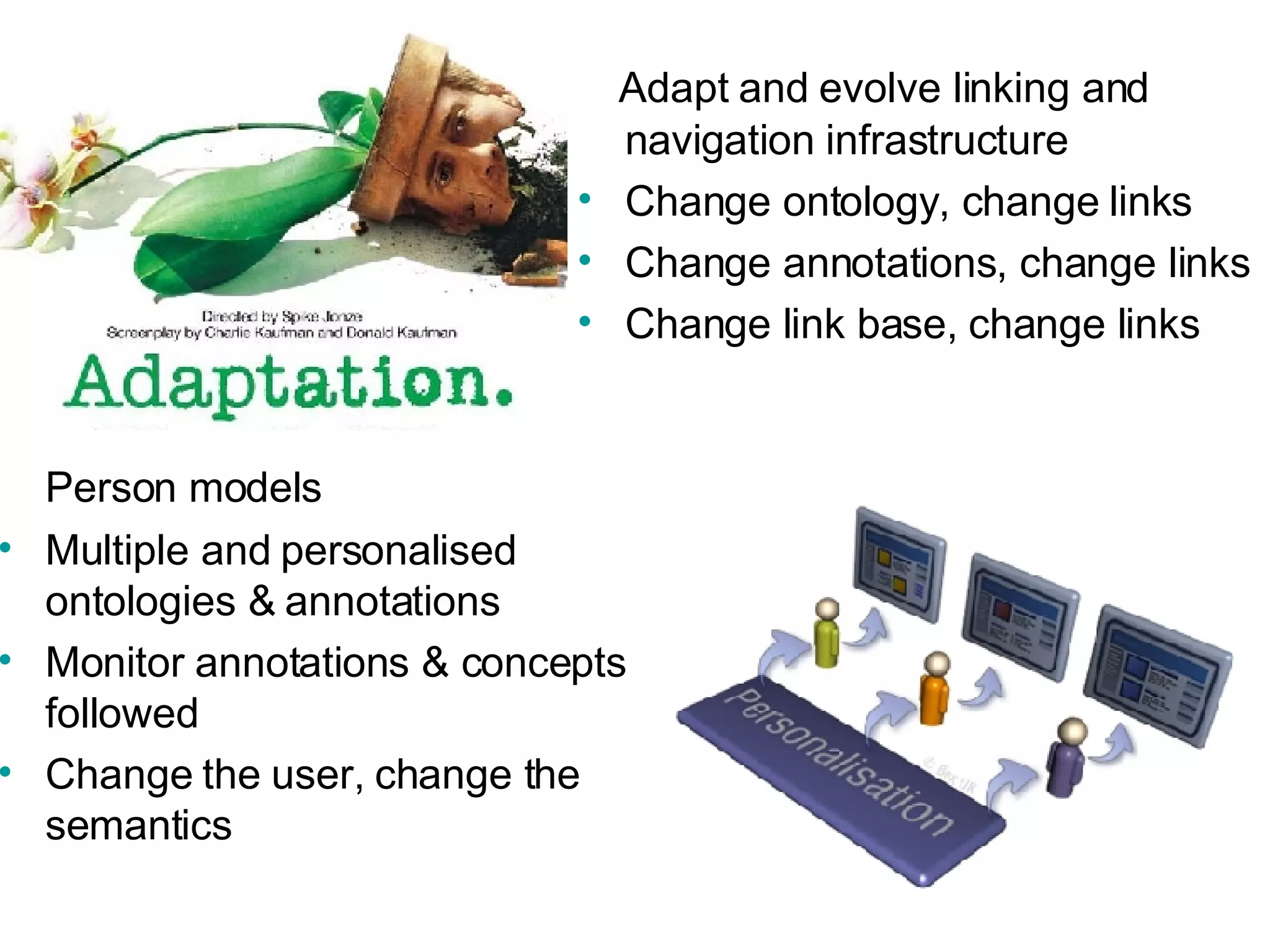
Adapt and evolve linking and navigation infrastructure Change ontology, change links Change annotations, change links Change link base, change links Person models Multiple and personalised ontologies & annotations Monitor annotations & concepts followed Change the user, change the semantics
Web 2.0 Microformats  AJAX, JSON Tagging  CSS, XSLT XPointer, XML Web 2.0 REST, Tagging RSS, ATOM, APIs OpenID, Identity 2.0 Ruby on Rails Semantic Web
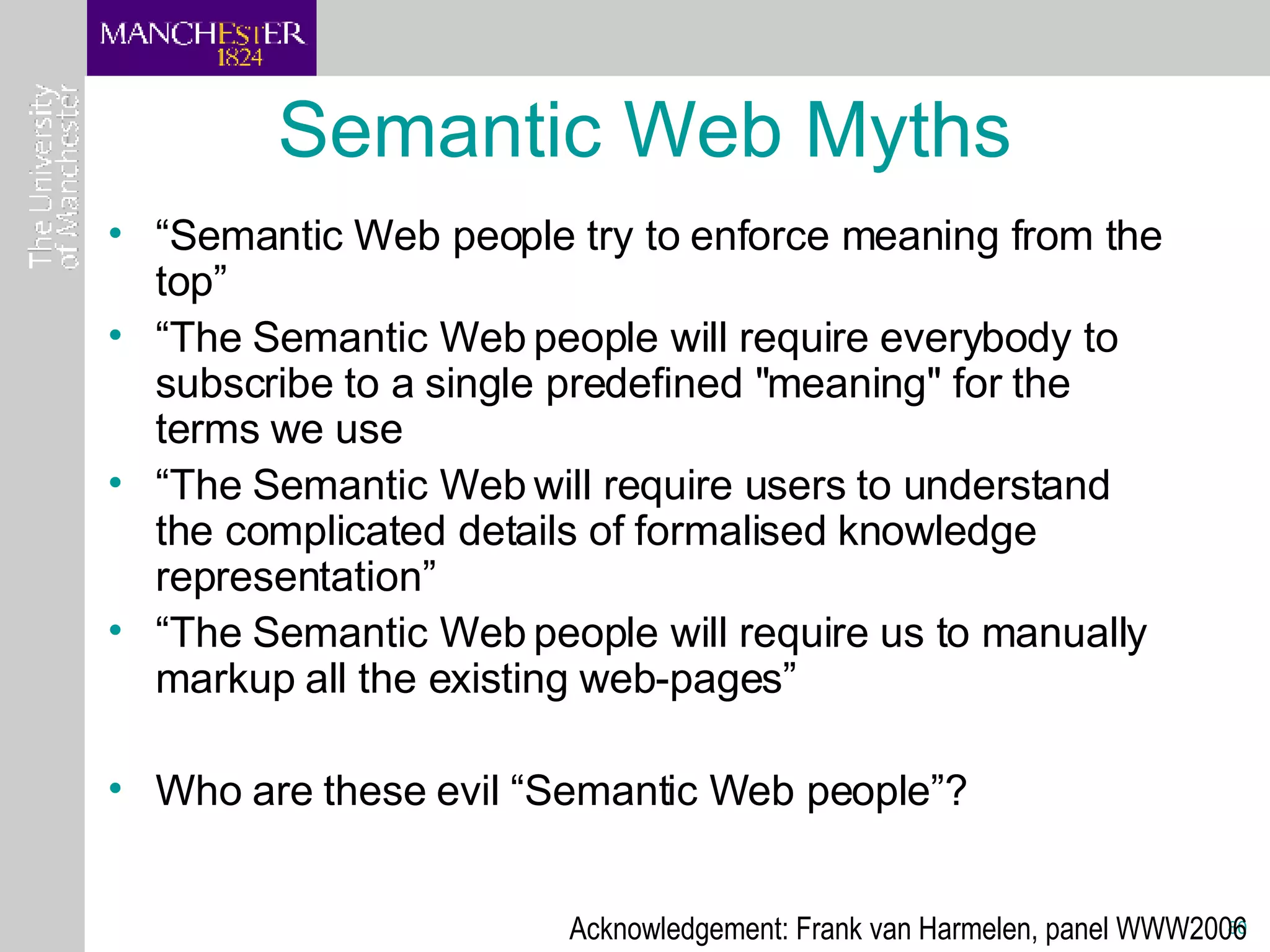
Semantic Web Myths “ Semantic Web people try to enforce meaning from the top” “ The Semantic Web people will require everybody to subscribe to a single predefined &quot;meaning&quot; for the terms we use “ The Semantic Web will require users to understand the complicated details of formalised knowledge representation” “ The Semantic Web people will require us to manually markup all the existing web-pages” Who are these evil “Semantic Web people”? Acknowledgement: Frank van Harmelen, panel WWW2006
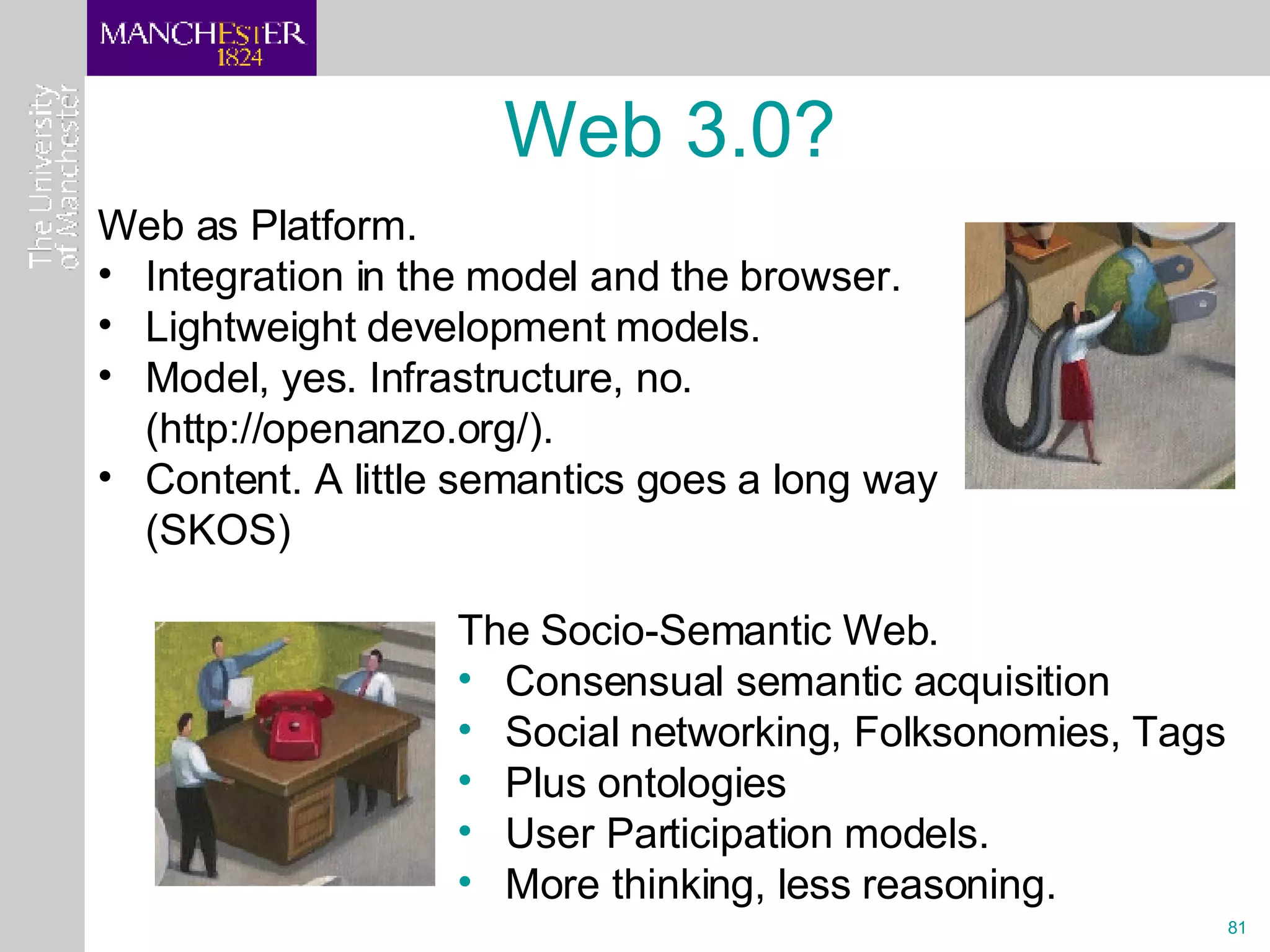
Web as Platform. Integration in the model and the browser. Lightweight development models. Model, yes. Infrastructure, no. (http://openanzo.org/). Content. A little semantics goes a long way (SKOS) Web 3.0? The Socio-Semantic Web.  Consensual semantic acquisition Social networking, Folksonomies, Tags Plus ontologies User Participation models. More thinking, less reasoning.
Hypertext? Web? Hypertext?
“ We should make merry  and be glad” Hypermedia as collective intelligence  We can do Memex. But not in the way the visionaries thought. We let in the oiks. Really open, on a scale unpredicted. Really social infrastructure. Open Hypermedia as the mechanism Links are thriving. Its done. Get over it. Do we need to bother with a formal link model? Versioning and anchor models are still missing… Hypermedia authoring by Semantic Model authoring Was link management, Now RDF management Was dangling links, Now dead annotation and XPointer frailty Was link authoring, now ontology authoring But once author a model it becomes a closed system. Surely?
“We should make merry and be glad” Hypermedia as collective intelligence  Not in the way the visionaries thought. Really Open. We let in the oiks. Open Hypermedia as the mechanism Composites & Links are thriving. Its done. Get over it. Why bother with a formal link model?  Versioning and anchor models are still missing…. Hypermedia authoring by Semantic Model authoring Was link management, Now RDF management Was dangling links, Now stale annotation and XPointer frailty. Was link authoring, now ontology authoring
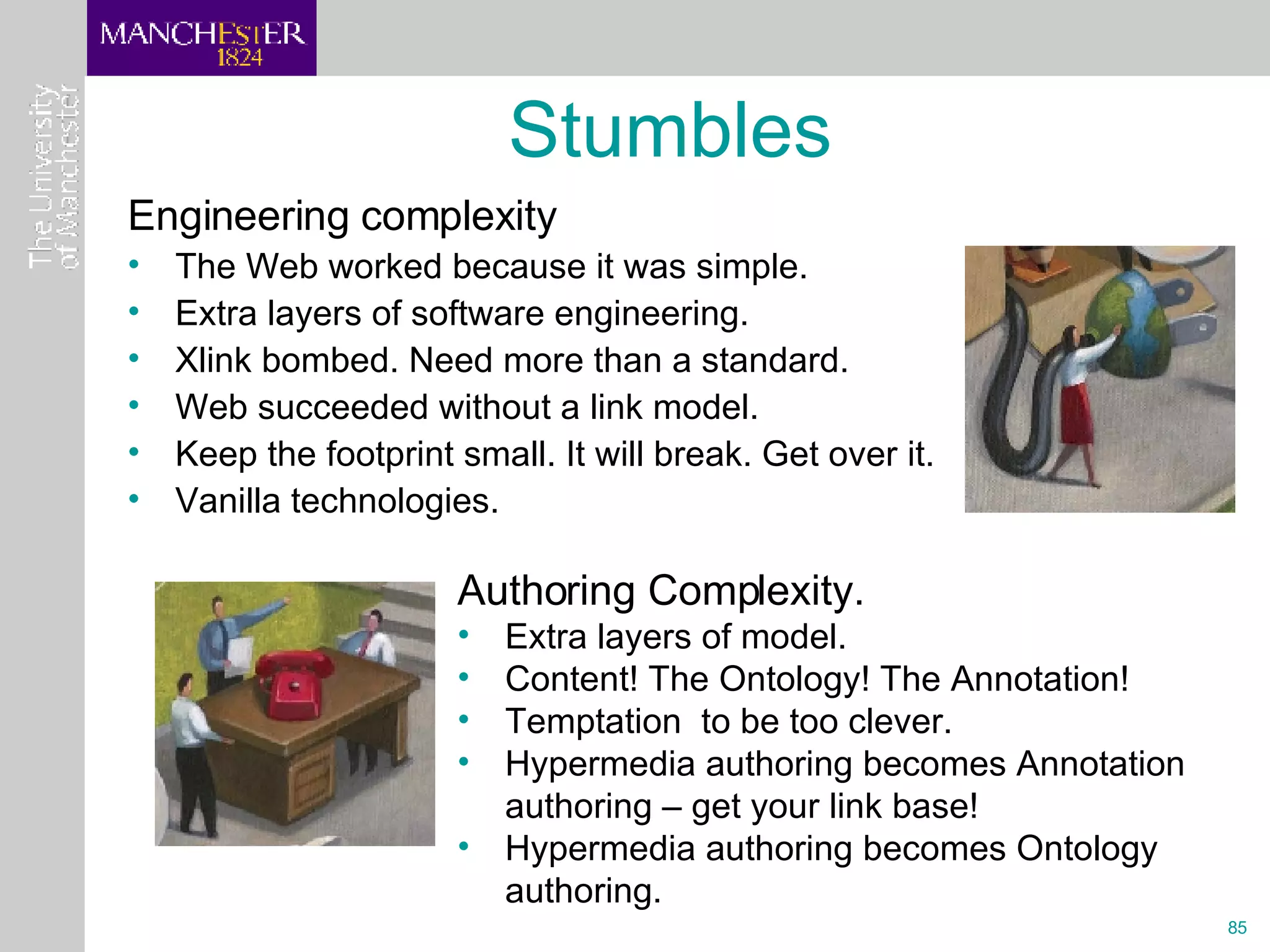
Engineering complexity The Web worked because it was simple. Extra layers of software engineering. Xlink bombed. Need more than a standard. Web succeeded without a link model. Keep the footprint small. It will break. Get over it. Vanilla technologies.  Stumbles Authoring Complexity.  Extra layers of model.  Content! The Ontology! The Annotation! Temptation  to be too clever. Hypermedia authoring becomes Annotation authoring – get your link base! Hypermedia authoring becomes Ontology authoring.
But ontology authoring and annotation authoring isn’t hypermedia authoring
Seduced by knowledge … The ontology model is seductive way of driving the navigation between resources But a Model of knowledge is NOT a Model of Navigation You know about Hypermedia, Hypermedia design, Hypermedia patterns, Hypermedia navigation
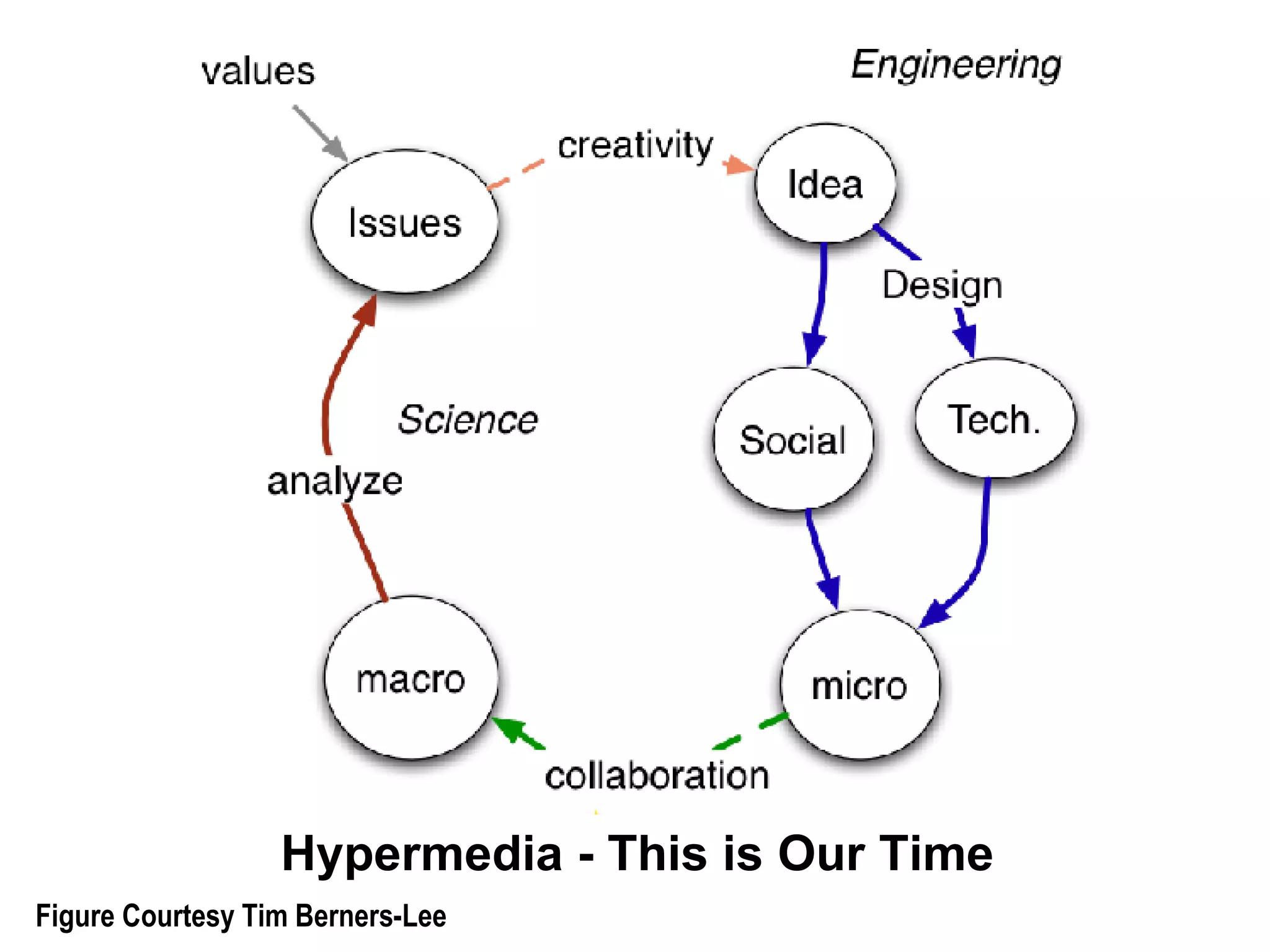
Hypermedia - This is Our Time Figure Courtesy Tim Berners-Lee
Big take homes Web 2.0 is deeply intertwingled with the hypertext vision Semantic Web isn’t the universal panacea. It has many of the same problems as oh.  It’s a myth that the Web doesn’t do links. Still more to do. You can help.  Embrace!
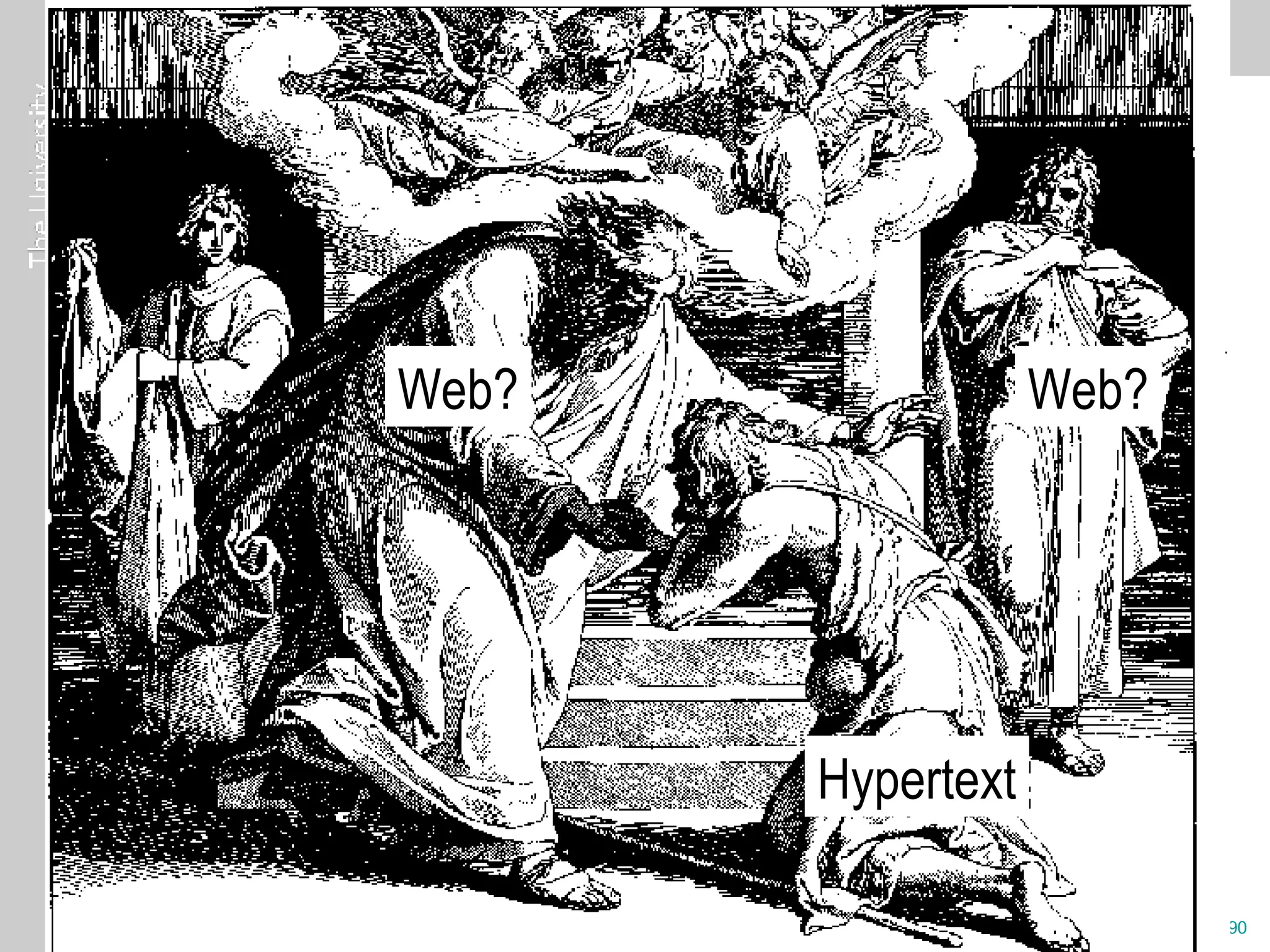
Hypertext Web? Web?
With thanks to… Sean Bechhofer, David De Roure Rest of the COHSE team: Yeliz Yesilada, Bernard Horan, Les Carr, Wendy Hall Simon Harper http://cohse.cs.manchester.ac.uk/ http://www.biotec.tu-dresden.de/sealife/
 
Questions…just what is Open? Are first class links worth the bother? “ I don’t want anyone with a GeoCities account pointing back to me” Is resource reuse only useful for closed teaching systems? Or closed enterprises? Open Hypermedia on the web – open to resources, closed to the application? Is the semantic web just link mashing?
Prodigal Son Returns How to help and what to learn from. What we did wrong and hence what will go wrong. Used mainly in teaching. Where do you get the links from?
This is why our time has come. Back to the future Your future is my past No. We are not waiting for the to catch up, the web is waiting for us. Could do if it wanted.  The prodigal son picture, relabelled.

Hypertext2007 Carole Goble Keynote - "The Return of the Prodigal Web"

  • 1.
    The Return ofthe Prodigal Web Carole Goble Information Management Group The University of Manchester, UK [email_address]
  • 2.
    The Return ofthe Prodigal Me Semantic Web E-Science (life science) Distributed Computing Hypermedia Web Accessibility
  • 3.
  • 4.
    What’s the Story?Hypertext, and its offspring the Web, envisioned collective intelligence. Both propose technical infrastructure and social infrastructure to do this. The Web “made riotous living”. Two evolutions of the Web – Web 2.0 and Semantic Web – could (potentially) return the Web to the Hypertext family. By stealth. We have applications that show this. “ We should make merry, and be glad”. How? Is it done? Lessons learned? Why bother?
  • 5.
    Spot the DifferenceCompetition The Return of the Prodigal Web, Carole Goble Back to the Future with Hypertext: A Tale of Two or Three Conferences, Wendy Hall Back to the Future: Hypertext the Way It Used To Be, Ted Nelson and Robert Adamson Smith  Hypertext Tragedy,  A Panel Is Simon trying to tell us something?
  • 6.
    Back in theDay Or Back to the Future….
  • 7.
    Xanadu: a systemin which it will be possible to store anything that anybody has ever written (or photographed or filmed) that can connect any piece of information to any other piece of information Augmentation of the human intellect. “ Adequately equipped with machines which leave him free to use his primary attribute as a human being – the ability to think creatively and wisely, unencumbered by unworthy tasks – man can face an increasingly complex existence with hope, even with confidence.” “ the interaction between person and hypertext could be so intuitive that the machine-readable information space gave an accurate representation of the state of people's thoughts, interactions, and work patterns, then machine analysis could become a very powerful management tool, seeing patterns in our work and facilitating our working together through the typical problems which beset the management of large organizations.”
  • 8.
    A universalmedium for harvesting and harnessing collective intelligence making and using connections between decoupled content and decoupled people.
  • 9.
    How? Hypermedia Systemsthat present the same media (text) in multiple CONTEXTS Systems that enable the communication of RELATIONSHIPS between documents Frank Shipman
  • 10.
    Technical Infrastructure Managementof nodes and links and anchors. Combining and aggregating content and structure. Architectures and models for these connections. Social Infrastructure Authoring. Navigating and Finding. Making connections between people and content. DIY content aggregation. Adaptation. Reuse.
  • 11.
    Build Hypermedia CreateContent and Connections Cruise it. Use it.
  • 12.
    It’s the LINK,baby LINKs as first class citizens Embedded and non-embedded LINK ing LINK bases, open hypermedia LINK architectures and LINK models LINK typing, LINK properties Two way LINK ing LINK context, LINK filtering LINK trails, Computed LINK s LINK management LINK behaviours, Dangling LINK s LINK navigation, Adaptive LINK ing Rhetoric of LINKS LINK authoring Reusing resources through different LINK sets. LINK foo. LINK bar.
  • 13.
  • 14.
    Open Architectures Anchor object Link object Anchor object Node Object Node Object Link Base Link Service My Favourite Application Your Favourite Application
  • 15.
    Link behaviours FluidHypertext, Polle Zellweger, 2002
  • 16.
    Link types NormalLinks Citation source, pioneer, credit, leads, eponym Background FutureWork Refutation Support Methodology Data Generalize Specialize Abstraction Example Formalization Application Commentary Links Comment critical, supportive RelatedWork misrepresents, vacuum, ignores, isSupersededBy, isRefutedBy, isSupportedBy, redundant ProblemPosing trivial, unimportant, impossible, ill-posed, solved, ambitious Thesis trivial, unimportant, irrelevant, redherring, contradict, dubious, counterexample, inelegant, simplistic, arbitrary, unmotivated Argumentation invalid, insufficient, immaterial, misleading, alternative, strawman Data inadequate, dubious, ignores, irrelevant, inapplicable, misinterpreted Style boring, unimaginative, incoherent, arrogant, rambling, awkward Argument deduction, induction, analogy, intuition solution Summarization Detail AlternateView Rewrite Explanation Simplification Complication Update Correction Continuation http:// www.eastgate.com/HypertextNow/archives/Trigg.html [Randall Trigg, 83]
  • 17.
    Open Composite ModelsHigh level representation Dynamic Virtual Reuse We would call this a mash-up aggregating content feeds today.
  • 18.
    I’m sure Tedwill tell you all about Transclusion.
  • 19.
    Open Authoring Reusecontent for a different audience. adaptation of materials you don’t control Alternate paths New paths The annotation thang. Fuzzy distinction between authors and readers. Possibly.
  • 20.
    Open Well yes…buta Closed System mentality. Come and look in MY system. Kind of assumption that content was limited and controlled Closed Authoring and Closed Architectures
  • 21.
  • 22.
  • 23.
    Simple Hypermedia Simple.Distributed. Low barrier of entry Network effect Long tail Open Architecture Robust. Don’t restrict, fix! Cooperate, don’t control. Scalable.
  • 24.
    Simple Hypermedia Simplelink types Composite nodes Virtualisation Computed links All added in through rich browser and server technologies and applications. CMS
  • 25.
    Search Composites  Virtual  Extensibility  Computation  Open Standards  Versioning  Collaboration  Halasz’s Seven Issues
  • 26.
    Browsers and AppsPortal Frameworks CMS & EnterpriseServers
  • 27.
    DLRS circa 1998Publishers linkbases People database Keyword linkbases Proxy Hyper link Agent XLink linkbases User profiles Person Agent Citation Agent Bibliography database IR Agent Inverted index Ontology Agent Web Browser Web Server Carr, Hughs, Hall, De Roure et al, University of Southampton, UK
  • 28.
    Do links appear?Sure! Google rocks because of Links. XLink – but that never took off….. Open hypermedia in Content Management Systems on a big scale Active Navigation - Dynamic Link Injection Hyperwave - Collaborative Information Management” Web + Open Hypermedia is an extra layer of software engineering.  Wikis
  • 29.
    But lets faceit, its still Node-Centric There is no Link Model. Makes Context and Management Harder. Links are embedded in the Applications. Captive in their systems. No infrastructure outside the application or the browser. No Third Party Link Authoring (except shared bookmarking) User participation is Reader Participation.
  • 30.
    The Parting ofthe Ways…
  • 31.
    The Web “maderiotous living”
  • 32.
  • 33.
    Hypermedia on theWeb. Versioning. Collaboration. Links. No Link Model outside the wiki.
  • 34.
  • 35.
    O’Reilly Publishing 2005ish.Bottom Up & Emergent. A collection of in use memes, patterns and practices. A mind set. A Marketing tool. Web as platform. User participation. Content aggregation and generation. Hackability and remixability. Hype – yes. Substance – yes.
  • 36.
  • 37.
    Web is aPlatform
  • 38.
    Web as ProgrammingPlatform. Perpetual Beta. Cooperate, Don't Control. Design for Mash-ups, hackability, remixability. Syndicate Content. Web Services. Standards. Protocols. Collect the collective intelligence The Social Web. Long tail. Network effects by default. Collective Intelligence. Users Add Value. DIY. Tagging. Blogging. Social Networking. Social Information. Social linking. Linking people. Content sharing. Unique content by people. “ Perpetual Beta” of syndicated content. Adapted from Tim O’Reilly’s Web 2.0 2005
  • 39.
  • 40.
  • 41.
  • 42.
    Social Recommendations Collaborative,Social Tagging Collaborative, Social Bookmarking Content Sharing Application Execution
  • 43.
    Tags New ContentNew Capability
  • 44.
    Mash–up hypertext CompositesOUTSIDE the application and in the cloud. Rich User Experience Two way linking in blogs and wikis. Matt’s quote
  • 45.
    G oogle AdWords + Google Maps + hostip.info + Microsoft Virtual Earth + NASA + NOAA Weather Service + WeatherBug + Yahoo Geocoding + Yahoo Maps + Yahoo Traffic
  • 46.
  • 47.
    The Hypermedia NodeWeb 1.0 : HTML pages served up then viewed using a browser Read Page Static Web Coders Client/Server Web Browser Geeks Web 2.0 : Web pages plus other content, shared (interactively) over the web. More like an application than a page Write & Contribute Post Dynamic Everyone RESTful Web Services Browser, RSS Reader, App Mass Amateurisation From Tim O’Reilly’s Web 2.0 2005
  • 48.
    What’s this gotto do with Hypermedia? The Social Writing sharing of content and links. The Infrastructure for Dynamic Hypertext. Content syndication IS computation in the Hypertext. Mash-ups ARE composite hypermedia nodes. The Return to Reuse. Link behaviour in the browser. Two way linking in wikis and blogs. Link types by microformats. Javascript Libraries for multi-headed links etc.
  • 49.
    Web 2.0 Microformats AJAX, JSON Tagging CSS, XSLT XPointer, XML Web 2.0 REST, Tagging RSS, ATOM, APIs OpenID, Identity 2.0 Ruby on Rails
  • 50.
    Linking by FolksonomiesWords and Tags COHSE: Link Generator Over the Web Link Service Link base Document Linked Document
  • 51.
    COHSE: Linkingin the World Wild Web
  • 52.
    COHSE: Linkingin the World Wild Web
  • 53.
  • 54.
  • 55.
  • 56.
    Link generator Metadataprovides a mechanism: for resource discovery & provision of source anchors . at browse time and authoring time. Annotation allows both linking into and out of a resource. Software agents that generates links Resource Discovery Link Construction
  • 57.
    Mind the Gap! Linking is tags, APIs and browser Link model? No information model and information integration mechanism Tags and folksonomies - a bit hit and miss Controlled vocabularies? Back in the day we talked about Conceptual Hypermedia Systems.
  • 58.
    Berners-Lee and Hendlervision Top Down and Planned. Research agenda for A.I. and data management An enrichment of the Web Web as Knowledge Space. Open Information Infrastructure Universal medium for Information exchange and fusion. Semantic content aggregation, integration and generation. Machine participation. Hype – yes. Substance – possibly.
  • 59.
    Web as InformationPlatform. A Layered, Open Information Model Mark-up and tagging framework. Uniform Data Model. Enriching Knowledge Model. Self-describing, machine processable. Web Services. Standards. Protocols. Collect collective intelligence Infer intelligence The Socio-Semantic Web. Network effects by default. Collective Intelligence. Computed Intelligence. Users Add Value. Tagging. Blogging. Machines Add Value. Content sharing. Content and connection inference. Unique content by people and automated processes. “ Perpetual Beta” of semantics.
  • 60.
    The Semantics are in the Link URI> <a href= HTML Web page Any Web Resource <a href=“http://…”> Adapted from Figure by Jim Hendler URI URI URI Resource Description Framework URI URI Concept Web Resource RDFS OWL
  • 61.
     p ->  a; p=a  p ->  a; p=a  p ->  a; p=a  p ->  a; p=a  p ->  a; p=a Web of Trust Data Fusion Model Fusion RDF OWL, RDFS SWRL XML SKOS
  • 62.
    Navigate the SemanticWeb Navigate the Web
  • 63.
    Navigate the SemanticWeb Navigate the Web Conceptual Hypermedia, circa 1998 Index  Space Document Space
  • 64.
    Back in theDay…. Dagstuhl 2000
  • 65.
    Topic Location DateUniversity Company Funder Annotation assert facts using terms (metadata in RDF) Represent terms and their relationships (ontology in RDFS/OWL) Conference Event Organisation Professional Body
  • 66.
    Annotation Links +Ontology Annotation allows explicit decoration of documents with concepts . Link Service Document Linked Document Ontology Linkbase Annotations
  • 67.
    COHSE LinkBox skos:prefLabel Covers degradation issues and human impact…. skos:scopeNote Environmental Protection Countryside Conservation skos:specific skos:prefLabel skos:related skos:related skos:prefLabel skos:prefLabel National Parks Environmental and Ear…
  • 68.
  • 69.
  • 70.
  • 71.
    Semantic Media WikisLink types – Yay! KB within Wiki Courtesy Max Völkel
  • 72.
    Integration usea uniform common model in RDF Connecting through shared terms and shared instances Preserving context and provenance Data mining Knowledge Discovery Smart search Social networking Smart portals Agents Information Integration and aggregation
  • 73.
    W3C Semantic Weband HealthCare And Life Sciences SIG Courtesy Susie Stephens, Lilly
  • 74.
    Smashing: A Semantic-Mash-UpCourtesy Alan Ruttenberg, Science Commons
  • 75.
  • 76.
  • 77.
    The Next BigThing: Adaptive Web-Based Systems Paul De Bra, Lora Aroyo and Vadim Chepegin Journal of Digital Information , Volume 5 Issue 1 Article No. 247, 2004-05-27
  • 78.
    Adapt and evolvelinking and navigation infrastructure Change ontology, change links Change annotations, change links Change link base, change links Person models Multiple and personalised ontologies & annotations Monitor annotations & concepts followed Change the user, change the semantics
  • 79.
    Web 2.0 Microformats AJAX, JSON Tagging CSS, XSLT XPointer, XML Web 2.0 REST, Tagging RSS, ATOM, APIs OpenID, Identity 2.0 Ruby on Rails Semantic Web
  • 80.
    Semantic Web Myths“ Semantic Web people try to enforce meaning from the top” “ The Semantic Web people will require everybody to subscribe to a single predefined &quot;meaning&quot; for the terms we use “ The Semantic Web will require users to understand the complicated details of formalised knowledge representation” “ The Semantic Web people will require us to manually markup all the existing web-pages” Who are these evil “Semantic Web people”? Acknowledgement: Frank van Harmelen, panel WWW2006
  • 81.
    Web as Platform.Integration in the model and the browser. Lightweight development models. Model, yes. Infrastructure, no. (http://openanzo.org/). Content. A little semantics goes a long way (SKOS) Web 3.0? The Socio-Semantic Web. Consensual semantic acquisition Social networking, Folksonomies, Tags Plus ontologies User Participation models. More thinking, less reasoning.
  • 82.
  • 83.
    “ We shouldmake merry and be glad” Hypermedia as collective intelligence We can do Memex. But not in the way the visionaries thought. We let in the oiks. Really open, on a scale unpredicted. Really social infrastructure. Open Hypermedia as the mechanism Links are thriving. Its done. Get over it. Do we need to bother with a formal link model? Versioning and anchor models are still missing… Hypermedia authoring by Semantic Model authoring Was link management, Now RDF management Was dangling links, Now dead annotation and XPointer frailty Was link authoring, now ontology authoring But once author a model it becomes a closed system. Surely?
  • 84.
    “We should makemerry and be glad” Hypermedia as collective intelligence Not in the way the visionaries thought. Really Open. We let in the oiks. Open Hypermedia as the mechanism Composites & Links are thriving. Its done. Get over it. Why bother with a formal link model? Versioning and anchor models are still missing…. Hypermedia authoring by Semantic Model authoring Was link management, Now RDF management Was dangling links, Now stale annotation and XPointer frailty. Was link authoring, now ontology authoring
  • 85.
    Engineering complexity TheWeb worked because it was simple. Extra layers of software engineering. Xlink bombed. Need more than a standard. Web succeeded without a link model. Keep the footprint small. It will break. Get over it. Vanilla technologies. Stumbles Authoring Complexity. Extra layers of model. Content! The Ontology! The Annotation! Temptation to be too clever. Hypermedia authoring becomes Annotation authoring – get your link base! Hypermedia authoring becomes Ontology authoring.
  • 86.
    But ontology authoringand annotation authoring isn’t hypermedia authoring
  • 87.
    Seduced by knowledge… The ontology model is seductive way of driving the navigation between resources But a Model of knowledge is NOT a Model of Navigation You know about Hypermedia, Hypermedia design, Hypermedia patterns, Hypermedia navigation
  • 88.
    Hypermedia - Thisis Our Time Figure Courtesy Tim Berners-Lee
  • 89.
    Big take homesWeb 2.0 is deeply intertwingled with the hypertext vision Semantic Web isn’t the universal panacea. It has many of the same problems as oh. It’s a myth that the Web doesn’t do links. Still more to do. You can help. Embrace!
  • 90.
  • 91.
    With thanks to…Sean Bechhofer, David De Roure Rest of the COHSE team: Yeliz Yesilada, Bernard Horan, Les Carr, Wendy Hall Simon Harper http://cohse.cs.manchester.ac.uk/ http://www.biotec.tu-dresden.de/sealife/
  • 92.
  • 93.
    Questions…just what isOpen? Are first class links worth the bother? “ I don’t want anyone with a GeoCities account pointing back to me” Is resource reuse only useful for closed teaching systems? Or closed enterprises? Open Hypermedia on the web – open to resources, closed to the application? Is the semantic web just link mashing?
  • 94.
    Prodigal Son ReturnsHow to help and what to learn from. What we did wrong and hence what will go wrong. Used mainly in teaching. Where do you get the links from?
  • 95.
    This is whyour time has come. Back to the future Your future is my past No. We are not waiting for the to catch up, the web is waiting for us. Could do if it wanted. The prodigal son picture, relabelled.