Creating Value
with HR-analytics:
The art of asking
the right questions
Drs. Ilse Schrijver
Ilse Schrijver Co-owner of Kleynenborgh, institute for enterpreneurship
Phd Student Employability of independent professionals
Project manager at Research centre of Employability
Introduction
&
Agenda
What is HR analytics?
Relevance of HR analytics?
Application of HR analytics
Required skills
Conclusion
What is HR
analytics?
A definition
HR analytics is “an evidence-based approach for making
better decisions on the people side of the business; it
consists of an array to tools and technologies, ranging from
simple reporting of HR metrics al the way up to predictive
modeling” (Bassi, 2011, p 16)
HR analytics is “an HR practice enabled by information
technology that uses predictive, visual and statistical
analysis of data related to HR processes, human capital,
organisational performance, and external economic
benchmarks to establish business impact and enable data-
driven decision making” (Marler & Boudreau, 2017)
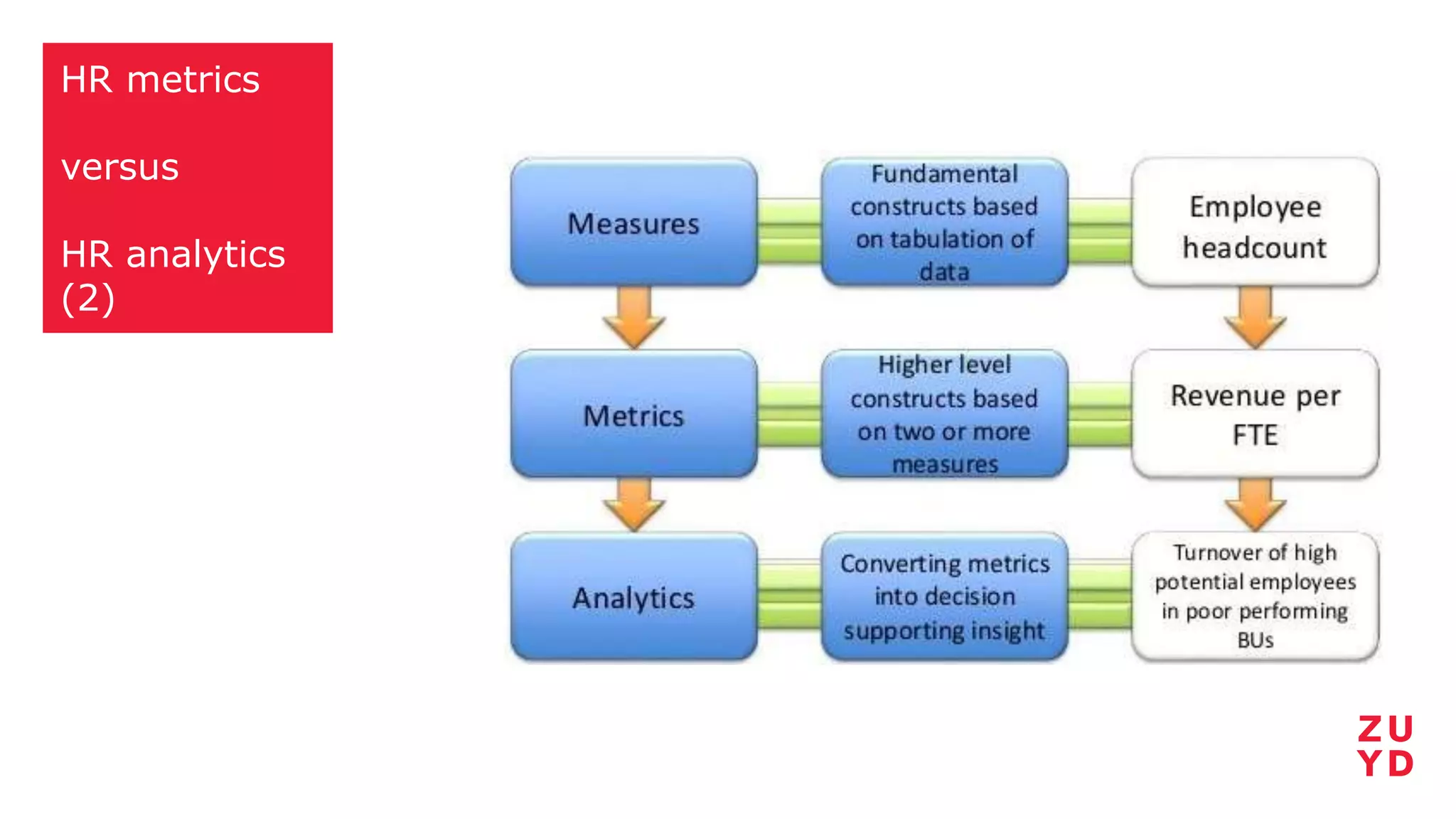
HR metrics
versus
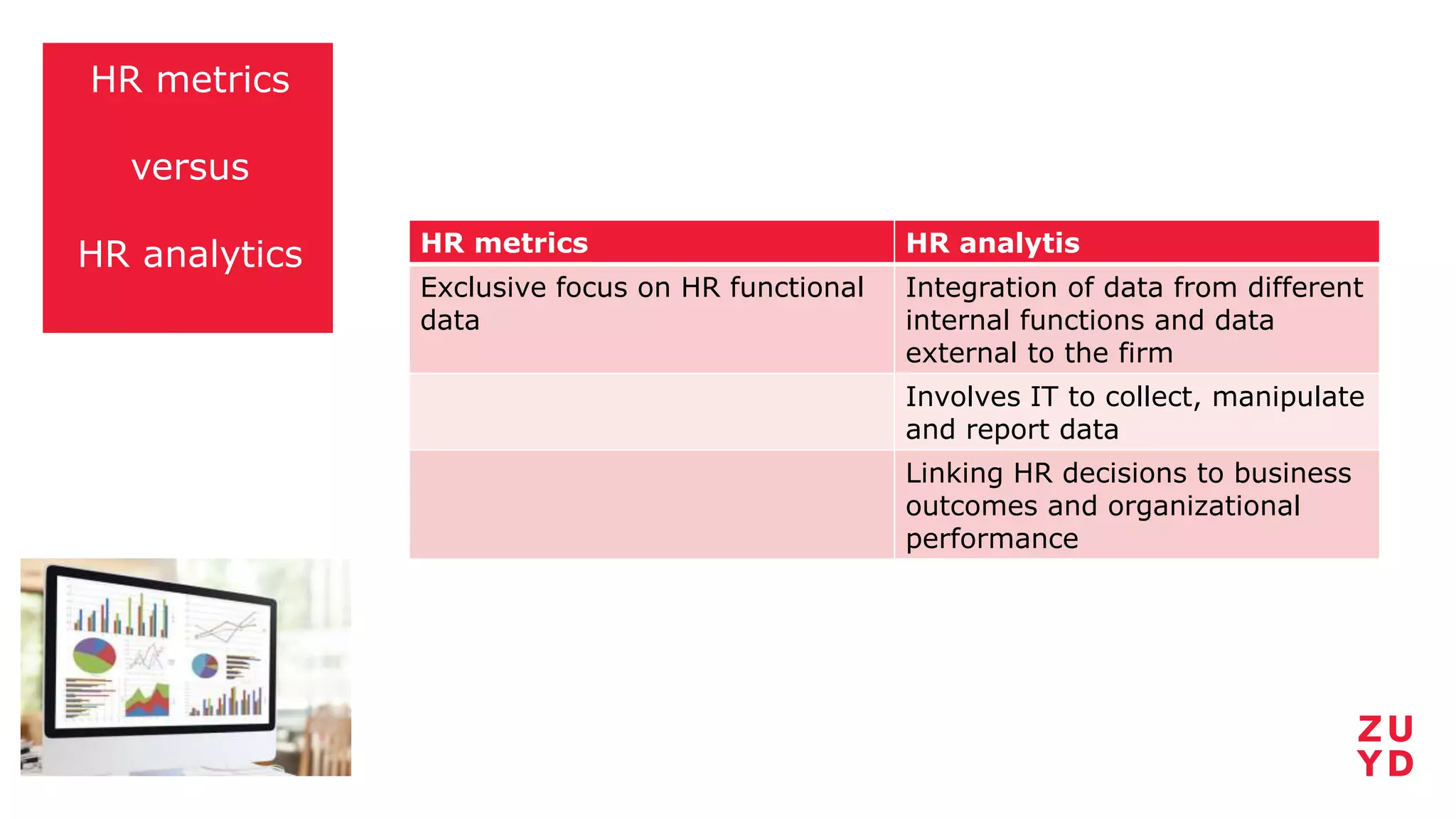
HR analytics HR metrics HR analytis
Exclusive focus on HR functional
data
Integration of data from different
internal functions and data
external to the firm
Involves IT to collect, manipulate
and report data
Linking HR decisions to business
outcomes and organizational
performance
HR metrics
versus
HR analytics
(2)
Relevance
of
HR analytics
”Lack of analytics about analytics”
(Rasmussen & Ulrich, 2015)
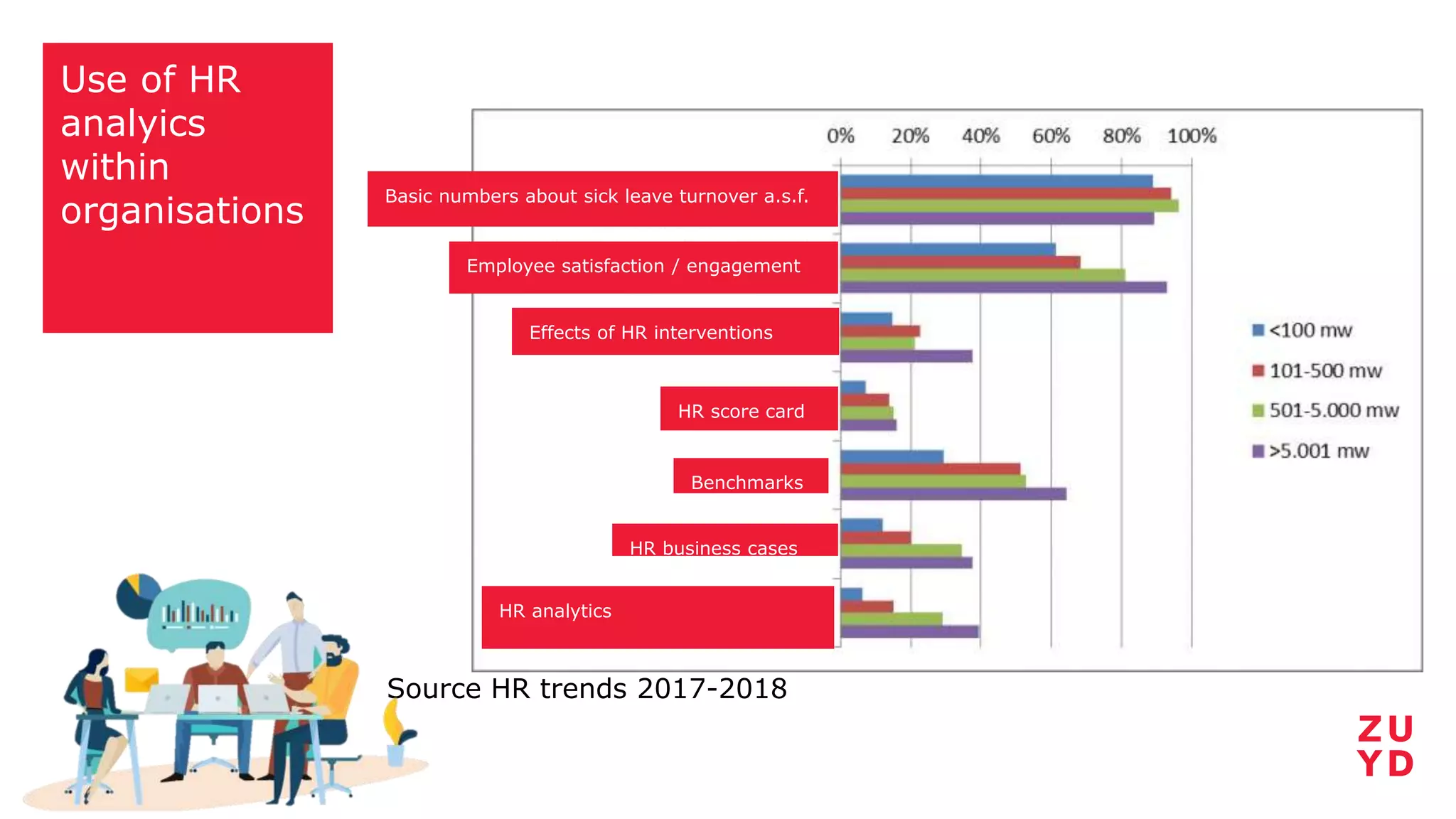
Use of HR
analyics
within
organisations
Source HR trends 2017-2018
Basic numbers about sick leave turnover a.s.f.
Employee satisfaction / engagement
Benchmarks
HR analytics
Effects of HR interventions
HR business cases
HR score card
Application
of
HR analytics
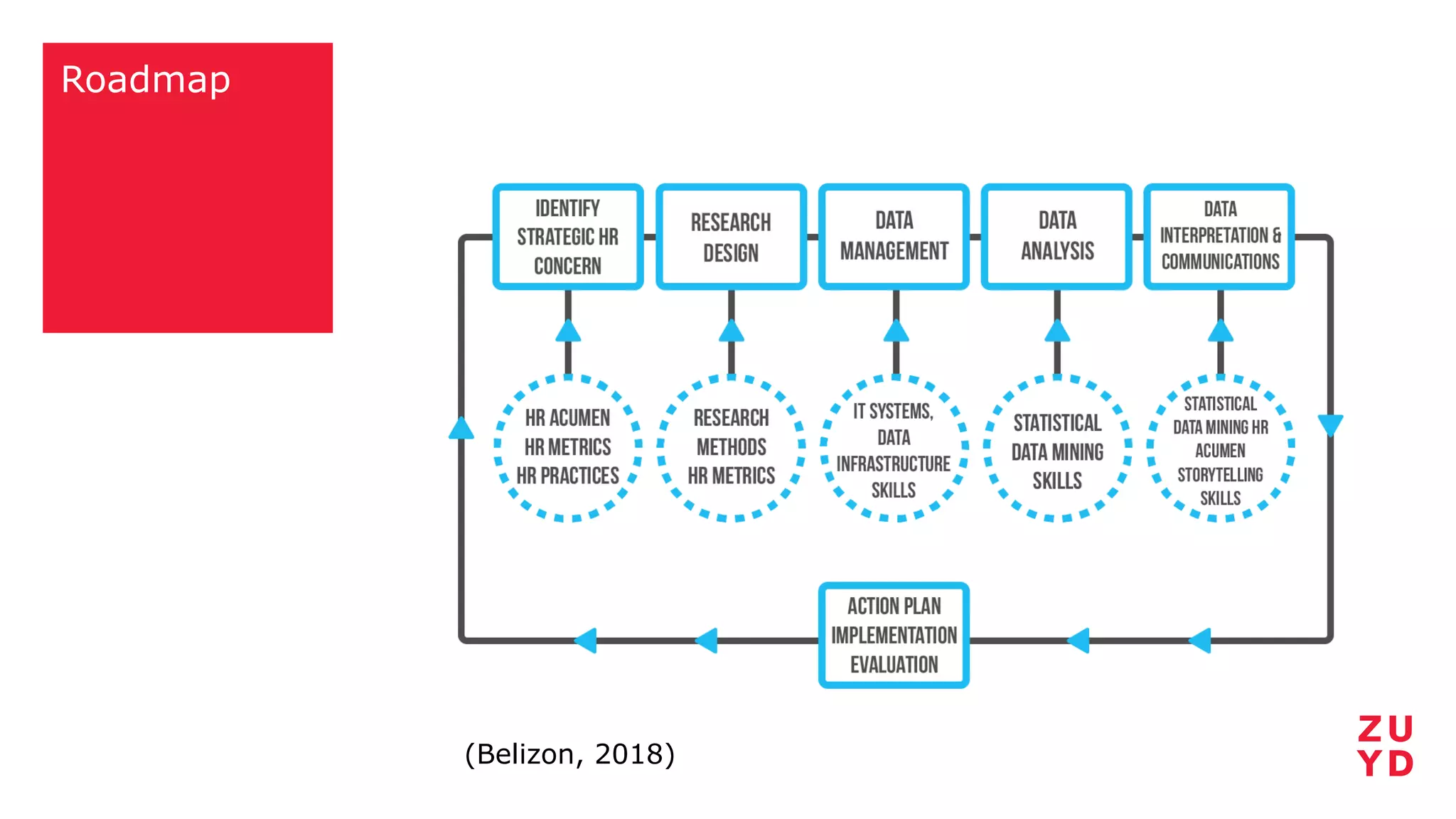
Roadmap
(Belizon, 2018)
Roadmap
Step 1:
Identify
strategic HR
concerns
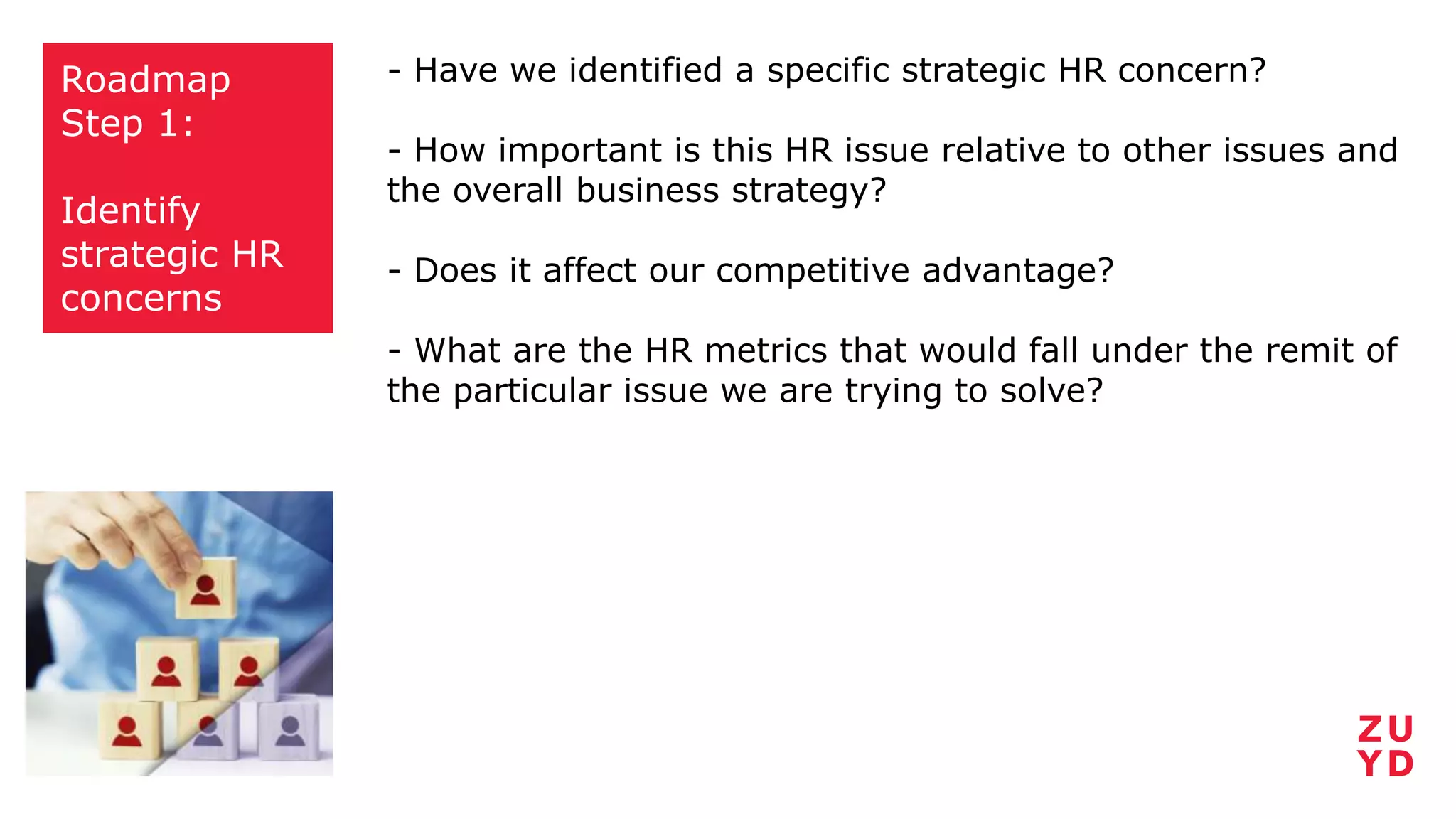
- Have we identified a specific strategic HR concern?
- How important is this HR issue relative to other issues and
the overall business strategy?
- Does it affect our competitive advantage?
- What are the HR metrics that would fall under the remit of
the particular issue we are trying to solve?
Roadmap
Step 2:
Research
methods/ HR
metrics
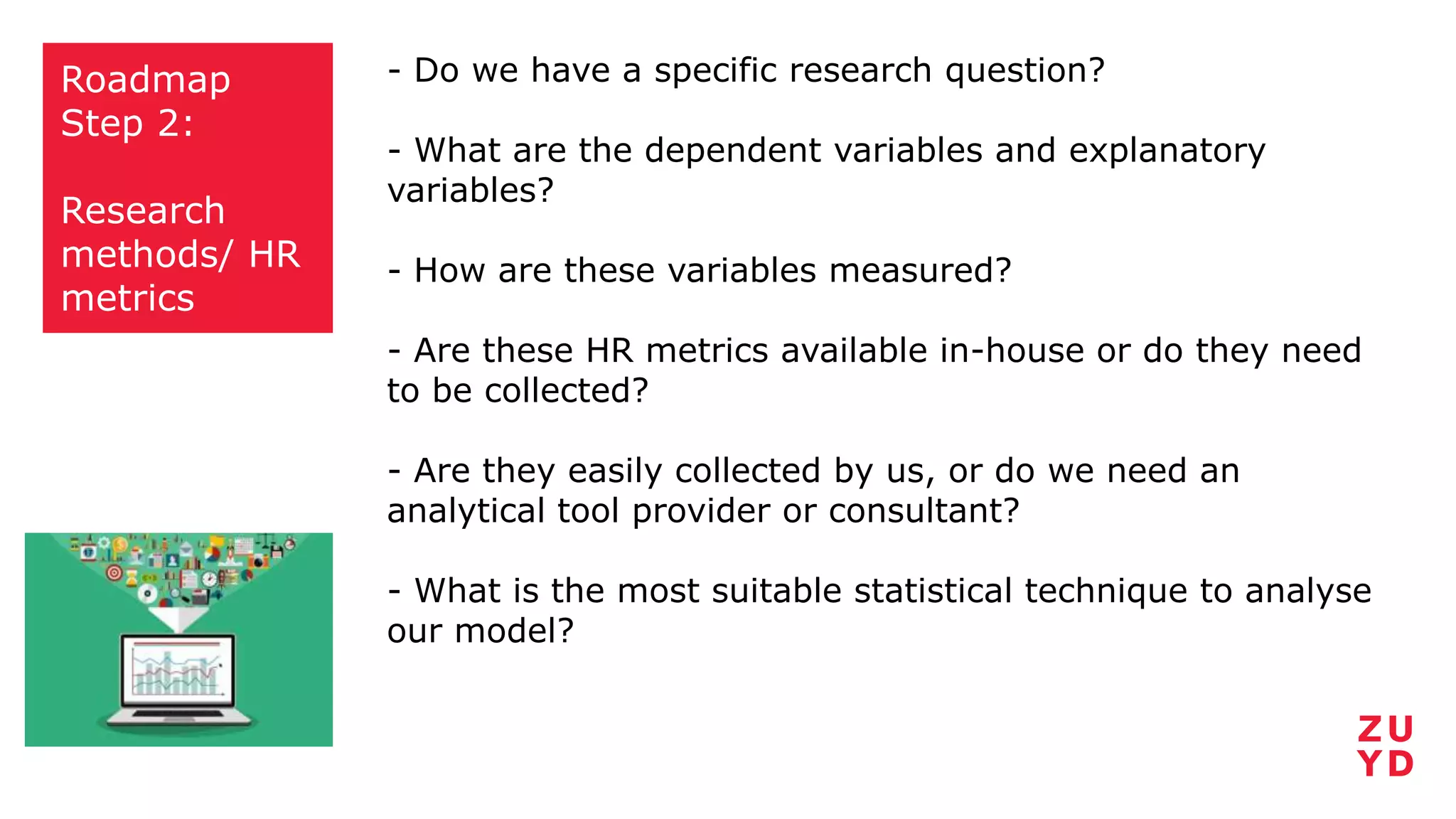
- Do we have a specific research question?
- What are the dependent variables and explanatory
variables?
- How are these variables measured?
- Are these HR metrics available in-house or do they need
to be collected?
- Are they easily collected by us, or do we need an
analytical tool provider or consultant?
- What is the most suitable statistical technique to analyse
our model?
Roadmap
Step 3:
Data
management
- How can we extract and interrogate the data we need to
test?
- Do they belong to different databases?
- Can we do it through a data warehouse system or do we
have to build one?
- If we need to integrate data from difference sources, what
software do we need?
Roadmap
Step 4:
Data analysis
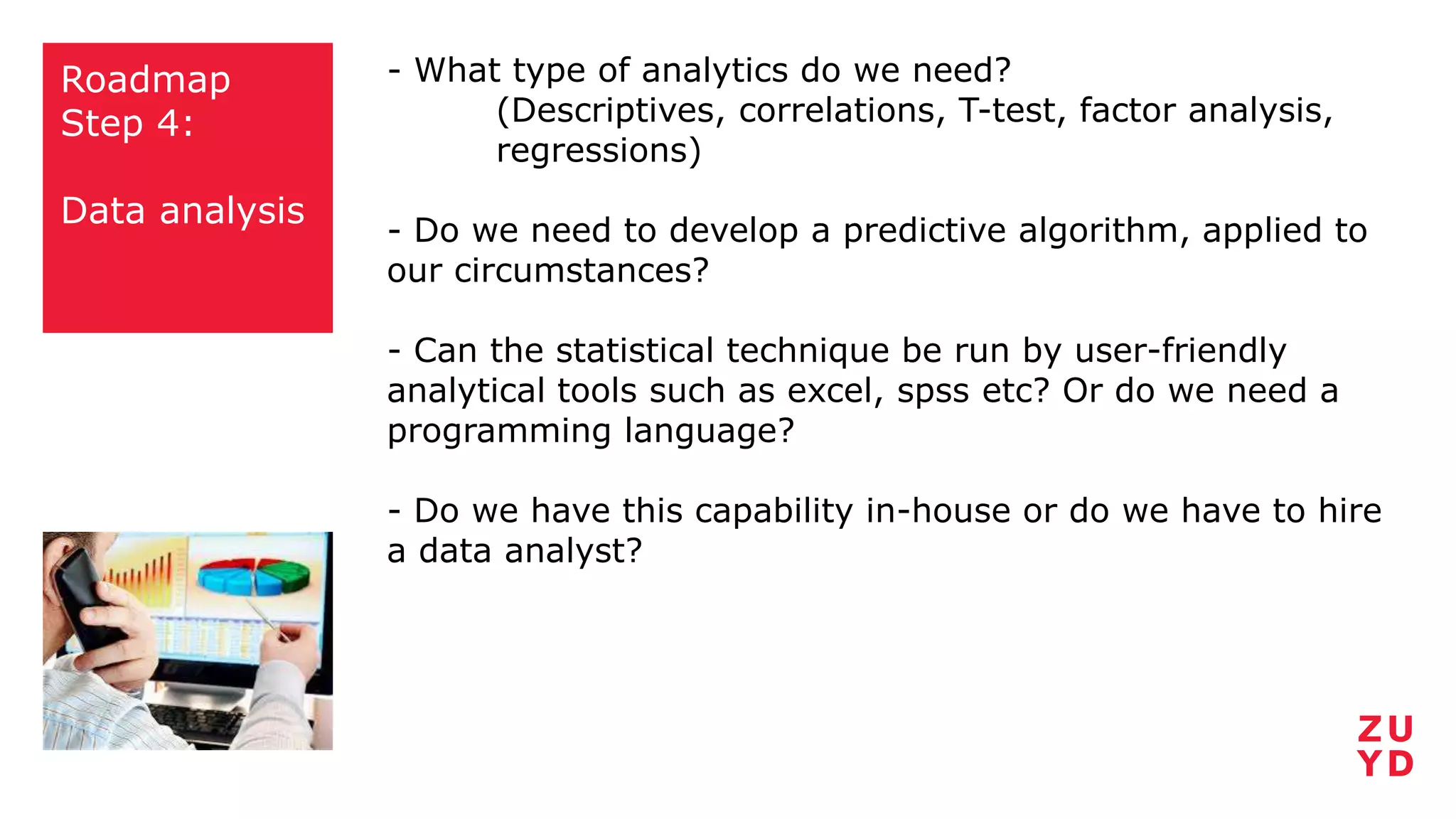
- What type of analytics do we need?
(Descriptives, correlations, T-test, factor analysis,
regressions)
- Do we need to develop a predictive algorithm, applied to
our circumstances?
- Can the statistical technique be run by user-friendly
analytical tools such as excel, spss etc? Or do we need a
programming language?
- Do we have this capability in-house or do we have to hire
a data analyst?
Roadmap
Step 5:
Data
interpretation
and
communication
- What does the output mean for the organisation or for a
specific HR practice?
- How can we present the results in such a way that is easy
to understand by HR and business people?
- How are we translating the statistical output into a story?
- Is the impact of this research quantifiable?
- What are the direct and indirect effects?
Roadmap
Step 6
Action Plan
Implementation
Evaluation
- Based on the output interpretation, what is the action plan
that should follow?
- How can we implement the action plan in an effective
way?
- What are the criteria for an evaluation of the action plan
and a timeframe?
Examples of
use of HR
analytics
Example Example 1
Business question: What is necessary with respect to
staffing in order to expand the business to Spain?
Analysis questions:
- What does the labour market in Spain look like?
- What is the effect on our current staff if we expand to
Spain?
Example 2
Business question: How can we, through change in HR
policy, increase customer satisfaction?
Analysis question:
- What is the relationship between employee engagement
and customer satisfaction
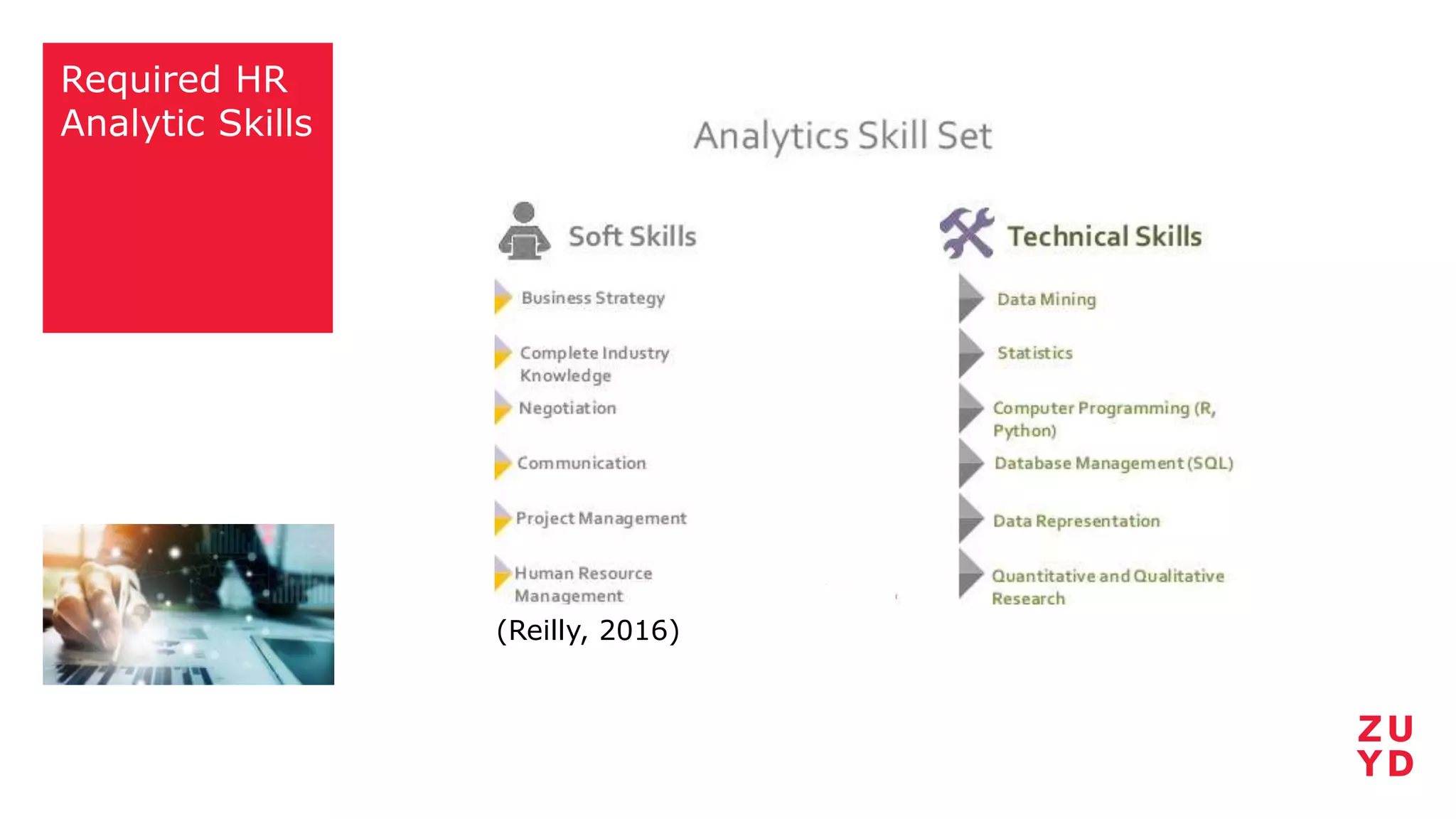
Required HR
Analytic Skills
(Reilly, 2016)
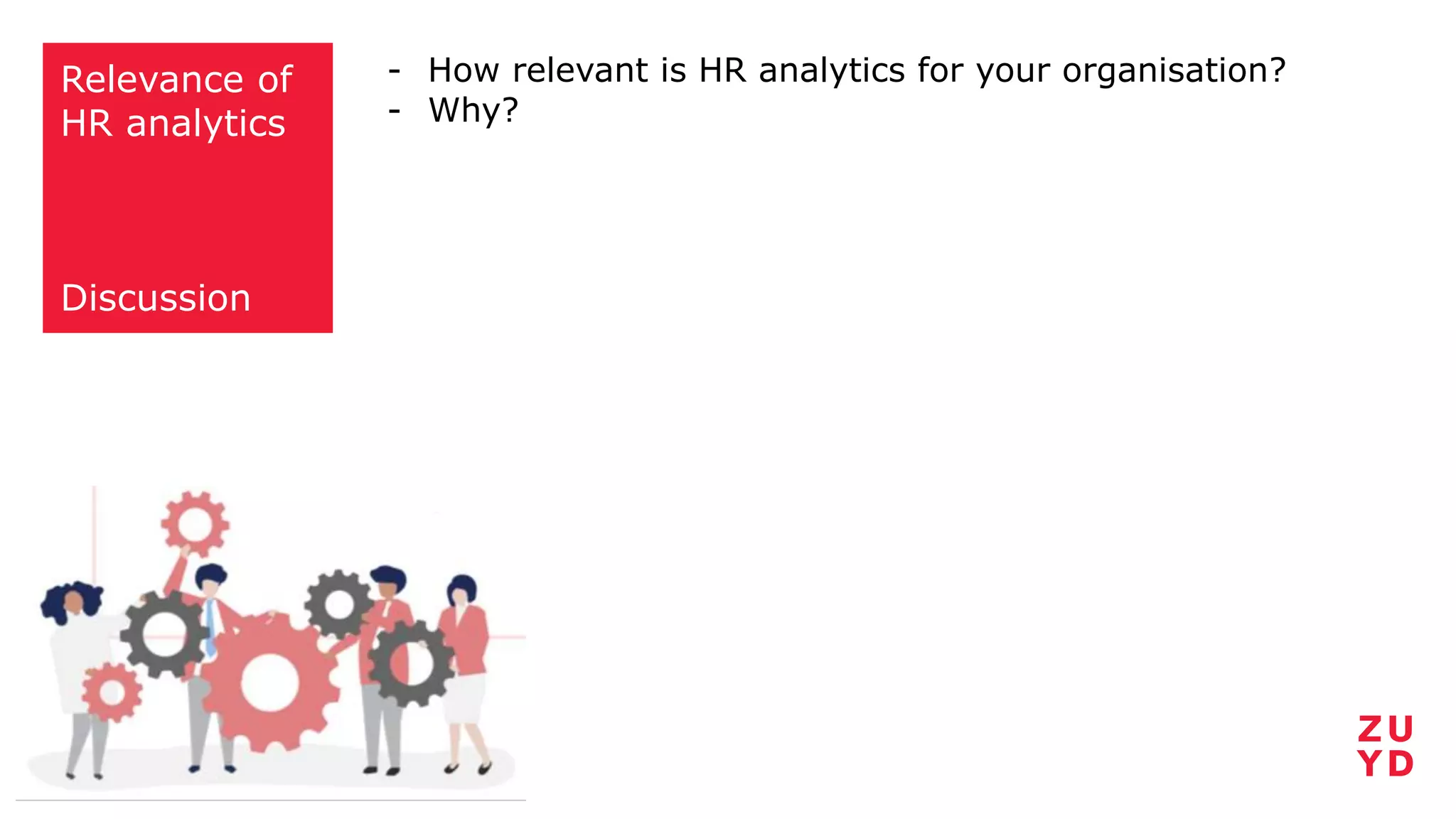
Relevance of
HR analytics
Discussion
- How relevant is HR analytics for your organisation?
- Why?
Conclusions
• HR analytics is not about analytics
• HR analytics is about asking the right question
• Employee’s are not numbers: they are human beings
Questions

Hr analytics versie hr techdag

  • 1.
    Creating Value with HR-analytics: Theart of asking the right questions Drs. Ilse Schrijver
  • 2.
    Ilse Schrijver Co-ownerof Kleynenborgh, institute for enterpreneurship Phd Student Employability of independent professionals Project manager at Research centre of Employability
  • 3.
    Introduction & Agenda What is HRanalytics? Relevance of HR analytics? Application of HR analytics Required skills Conclusion
  • 4.
    What is HR analytics? Adefinition HR analytics is “an evidence-based approach for making better decisions on the people side of the business; it consists of an array to tools and technologies, ranging from simple reporting of HR metrics al the way up to predictive modeling” (Bassi, 2011, p 16) HR analytics is “an HR practice enabled by information technology that uses predictive, visual and statistical analysis of data related to HR processes, human capital, organisational performance, and external economic benchmarks to establish business impact and enable data- driven decision making” (Marler & Boudreau, 2017)
  • 5.
    HR metrics versus HR analyticsHR metrics HR analytis Exclusive focus on HR functional data Integration of data from different internal functions and data external to the firm Involves IT to collect, manipulate and report data Linking HR decisions to business outcomes and organizational performance
  • 6.
  • 7.
    Relevance of HR analytics ”Lack ofanalytics about analytics” (Rasmussen & Ulrich, 2015)
  • 8.
    Use of HR analyics within organisations SourceHR trends 2017-2018 Basic numbers about sick leave turnover a.s.f. Employee satisfaction / engagement Benchmarks HR analytics Effects of HR interventions HR business cases HR score card
  • 9.
  • 10.
  • 11.
    Roadmap Step 1: Identify strategic HR concerns -Have we identified a specific strategic HR concern? - How important is this HR issue relative to other issues and the overall business strategy? - Does it affect our competitive advantage? - What are the HR metrics that would fall under the remit of the particular issue we are trying to solve?
  • 12.
    Roadmap Step 2: Research methods/ HR metrics -Do we have a specific research question? - What are the dependent variables and explanatory variables? - How are these variables measured? - Are these HR metrics available in-house or do they need to be collected? - Are they easily collected by us, or do we need an analytical tool provider or consultant? - What is the most suitable statistical technique to analyse our model?
  • 13.
    Roadmap Step 3: Data management - Howcan we extract and interrogate the data we need to test? - Do they belong to different databases? - Can we do it through a data warehouse system or do we have to build one? - If we need to integrate data from difference sources, what software do we need?
  • 14.
    Roadmap Step 4: Data analysis -What type of analytics do we need? (Descriptives, correlations, T-test, factor analysis, regressions) - Do we need to develop a predictive algorithm, applied to our circumstances? - Can the statistical technique be run by user-friendly analytical tools such as excel, spss etc? Or do we need a programming language? - Do we have this capability in-house or do we have to hire a data analyst?
  • 15.
    Roadmap Step 5: Data interpretation and communication - Whatdoes the output mean for the organisation or for a specific HR practice? - How can we present the results in such a way that is easy to understand by HR and business people? - How are we translating the statistical output into a story? - Is the impact of this research quantifiable? - What are the direct and indirect effects?
  • 16.
    Roadmap Step 6 Action Plan Implementation Evaluation -Based on the output interpretation, what is the action plan that should follow? - How can we implement the action plan in an effective way? - What are the criteria for an evaluation of the action plan and a timeframe?
  • 17.
    Examples of use ofHR analytics
  • 18.
    Example Example 1 Businessquestion: What is necessary with respect to staffing in order to expand the business to Spain? Analysis questions: - What does the labour market in Spain look like? - What is the effect on our current staff if we expand to Spain? Example 2 Business question: How can we, through change in HR policy, increase customer satisfaction? Analysis question: - What is the relationship between employee engagement and customer satisfaction
  • 19.
  • 20.
    Relevance of HR analytics Discussion -How relevant is HR analytics for your organisation? - Why?
  • 21.
    Conclusions • HR analyticsis not about analytics • HR analytics is about asking the right question • Employee’s are not numbers: they are human beings
  • 22.

Editor's Notes

  • #2 Welcome to the break out session about HR analytics,
  • #3 I am Ilse Schrijver, PhD student at the research centre for employability of Zuyd University. My research is about enhancing the employability of independent professionals and employees within organisations. HR analytics helps organisations, among other things, to gain insight into factors that influence the employability of employees, and innovative work behaviour. Today I’m going to help you to gain insight into the way HR analytics can help your organisation to perform better within economy 4.0.
  • #4 Digital transformation is a hot topic for HR professionals. New technologies and digitalization are driving an ever-growing number of opportunities for HR managers to measure the impact of HRM on the business, and to map out result-oriented actions. But while it’s one thing to talk about the digital transformation of HR, implementing it is another thing entirely. In this break out session, we will take a deep dive into the specifics of HR analytics: what is it, why is it necessary, and how do you go about it? And of course the kind of skills you need for it.
  • #5 Looking at both definitions, you see that there is still discussion about the definition of HR analytics. Although all definitions agree that HR analytics enables HR professionals to make data-driven decisions to attract, manage, and retain employees, which improves ROI. It helps leaders make decisions to create better work environments and maximize employee productivity. HR metrics are measures of key HRM outcomes, classified as efficiency, effectiveness or impact (Marler & Boudreau, 2017).
  • #6 HR metrics focus on the collection and reporting of static HR data: The characteristics and steering numbers of HR, for example, recruitment numbers such as the number of vacancies, sick leave, and so on. With HR Analytics, data collection is not the end but the starting point. This explicitly involves mapping the business impact of HR practices by combining these with other data, for example revenue or CBS data. Interaction: What kind of data do you collect within your organization? The step from HR metrics to HR analytics is not easy. You will not only take measurements so you will be able to tell something about the here and now, but you will also combine the results with relevant information at the organizational level with market developments and with the expected future developments. What do you hope to gain from HR analytics?
  • #7 Example An example of a measurement within the organisation is an employee headcount. With metrics you combine two variables, for example revenue per employee. HR analytics is about converting those metrics into insights that can support decisions. For example the answer to the question why there is a high turnover of high potentional employees. The answer to that may be that high potentional employees don’t like working within poor performing BU’s.
  • #8 There is very little and limited scientific evidence that help in deceding whetther to adopt HR analytics. In 2017, Marler & Boudreau conducted an evidence-based review of published peer-reviewed literature on HR analytics. They seached several publication databases, identified 60 articles, and of those, only 14 articles were in quality peer-reviewed journals. Before Marler & Boudreau, Rasmussen & Ulrich also came to the conclusion that there is a lack of analytics about analytics. Now you are probably asking yourself: how come? (of gewoon: WHY) Well, the difference between scientific research and HR analytics is that a business question is leading within HR analytics. This could explain why there is just little research about HR analytics.
  • #9 In 2015-2016, only 17% of all organisations were working with HR analytics. Last year this has risen to 22 percent. (Based on a research conducted by Berenschot) Organisations with a lot of employees are using HR analytics more than organisations with fewer employees. Toine Al & Irma Doze show in their research that 90% of HR managers they questioned, think that the use of HR analytics is very important. (Al & Doze, 2015). Therefore I expect that more and more organisations will start using HR analytics.
  • #10 At the moment, most HR decisions are based on gut feelings. Even when there is little or no evidence, people believe in a specific intervention. Due to congnitive dissonance, people even tend to ignore data that does not support their beliefs. Therefore it is important to find support on a strategic level for HR analytics. I like to show you a movie trailer. This movie is based on a true story, and it shows the impact that HR analytics, or more specific recruitment analytics can have. It also shows how difficult it is to let go of your beliefs and your gut feeling. The Oakland athletics baseball team has been losing for decades, and in the season of 2001, they also lose three important players. Billy, the CEO, by accident meets Peter Brand, a young economist who evaluate players by using statistics. Billy hires Peter and he starts looking for undervalued players. With their new statistical approach of baseball, they managed to get the team to win 20 games in a row. This movie shows, in a nutshell, the opportunities of recruitment analytics, an element of HR analytics. So even though there is little scientific evidence about the relevance of HR analytics, case evidence show us that there is a business case for it. In order to be useful, the HR data analyst needs to be able to depend on the data he is provided with. HR analytics is not about analysing as much data as possible, actually is not about more data at all. It is about data for informed decision making. So it is important to know a lot about the business setting, and to really understand the challenges of the organisation. Just like Peter knows about everything about baseball. You can not know enough about the complicated business problems when you are acting from a HR centre of Expertise: Peter needs to be in the field. Powerful HR analytics is more about strategic business focus, so that is where you need to be: in the field. A big risk in analysis is a journalistic approach: You know the story you want to tell and then go look for the data that supports that story. Just like all the other baseball teams did: You like a guy, and you want him on your team, so you say: This guy hits this many homeruns, so he needs to be on the team.
  • #11 To avoid that journalistic approach and also avoid actions based on your gut feeling the HR department must develop a roadmap, so they will be able to let HR analytics contribute to the performance of the organisation. This roadmap was developed by Belizon in 2018. We will discuss each step on the roadmap and after that we will discuss the skills needed to let HR analytics contribute to organisational performance. Belizon, M. 2018 downloaded october 14th 2019 from: https://www.analyticsinhr.com/blog/the-hr-analytics-management-cycle/
  • #12 An important precondition for being able to apply HR Analytics is support from management. They must be convinced that the results can contribute to the business results. This requires good management of expectations. The identification of an HR concern should be the first point of attention. Then we need to ask how important this HR issue is relative to others and the overall business strategy. Or is there any competitive advantage at stake? For this to happen, the HR professionals will need to spend time distilling which HR metrics fall under the specific HR issue they are trying to tackle. The answer to the business question helps to formulate policy or start a concrete project. A common mistake is that many times, questions are asked about a sympthom instead of the problem itself. For example: the increase of the turnover isn’t a problem, but the lack of explanation is. We can analyse all kinds of things, but in order to gain support for our suggestions, we need a clear business question. After the formulation of the business question we can start to ask questions for analysis.
  • #13 Research must be carefully designed. This is something that traces back to traditional research design methodologies. The fact that the organization may use big data and AI-powered analytical tools does not mean that the research design should be highly complicated. Within the research design, the HR analytics function needs to figure out whether the dependent and independent variables entail HR metrics they have available in-house or whether they will be sourced from outside databases. Maybe you need an HR analytics consultant to collect and analyze the data with specific data mining tools (such as sentiment analysis or psychometric profiles). This is also the moment when the team decides what sort of statistical technique should be deployed (e.g. t-tests, lineal regression, logistic regression, structural equation models, social network analysis, etc.).
  • #14 Data must be clean and that is often an issue. For example, because data has not been consistently recorded, for example after the commissioning of a new information system. Through acquisitions and mergers, breaks can occur in continuity, structure, systematics, and so on. In all those cases, the data must first be edited before the analyst can make useful analyses. ” In this step, you may conclude that you don’t have to know everything yourself. This step requires skills that will facilitate the interrogation of data across databases and integration of the data. Questions may be: can the data be interrogated and integrated together? What kind of software do we need to use? This is also a good moment to reflect on the possibility of building a long-term data warehouse, particularly if you are handling a strategic HR issue, which will have an on-going effect on organizational performance.
  • #15 The data analysis becomes obvious once the data is ready to be analyzed. The data analysis can be carried out in Excel, SPSS, RapidMinder, R or Python.
  • #16 After the data is analysed, you need to tell a convincing story. Storytelling is the key to getting the business side on board with the output the HR analytics function has just provided. The key issue here is to create a story based on the data. For example according to our data, if we apply yearly pay increases of 7%, employee engagement goes up by 15%.
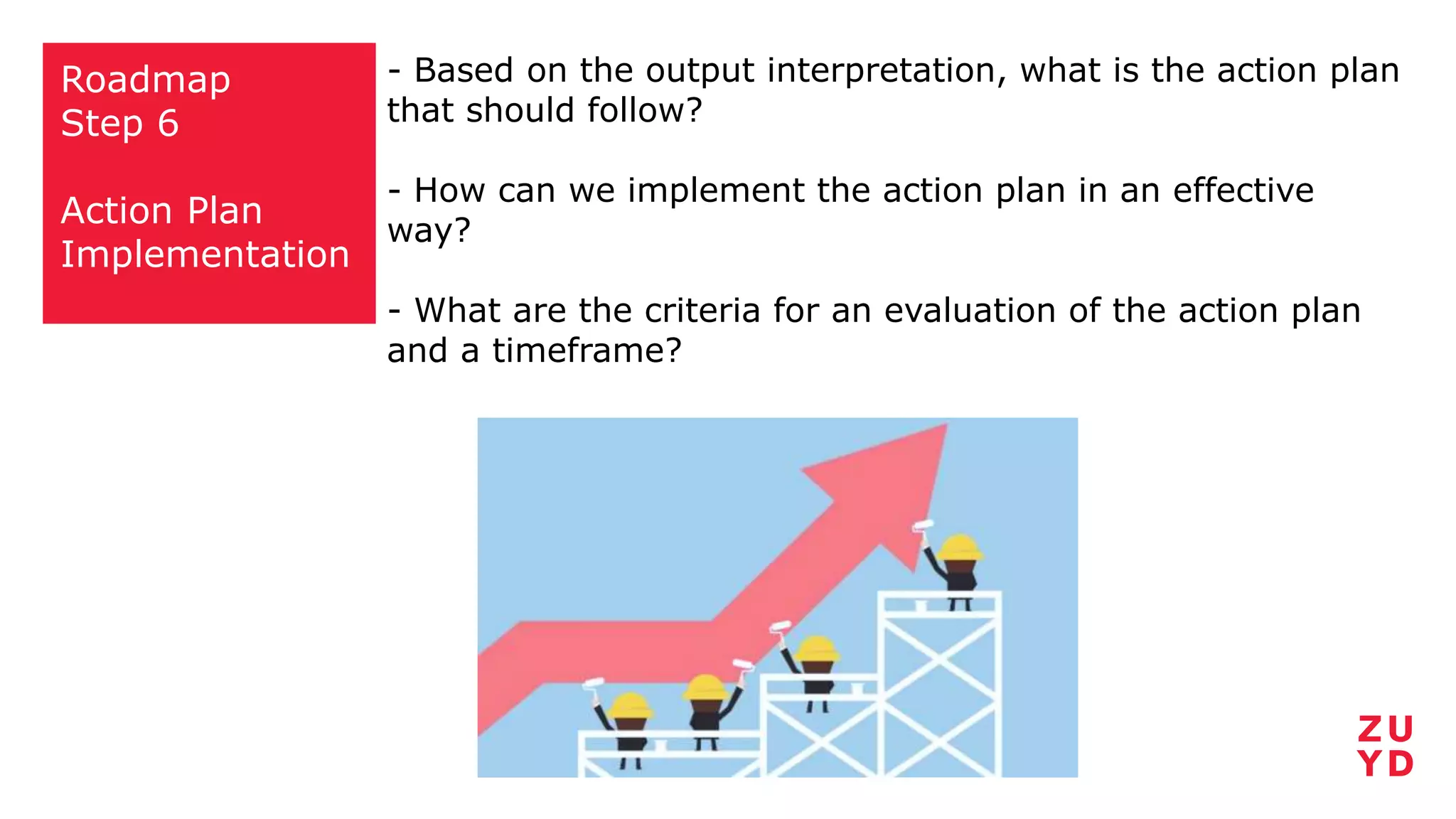
  • #17 Research and HR analytics by themselves do not change the organisation, or its behaviour. So the HR professionals should come up with a plan to solve the HR issue the team has been studying. They should come up with new recommendations. This plan must indeed be reviewed to measure the real impact of these interventions and to find out whether they were the most appropriate ones.
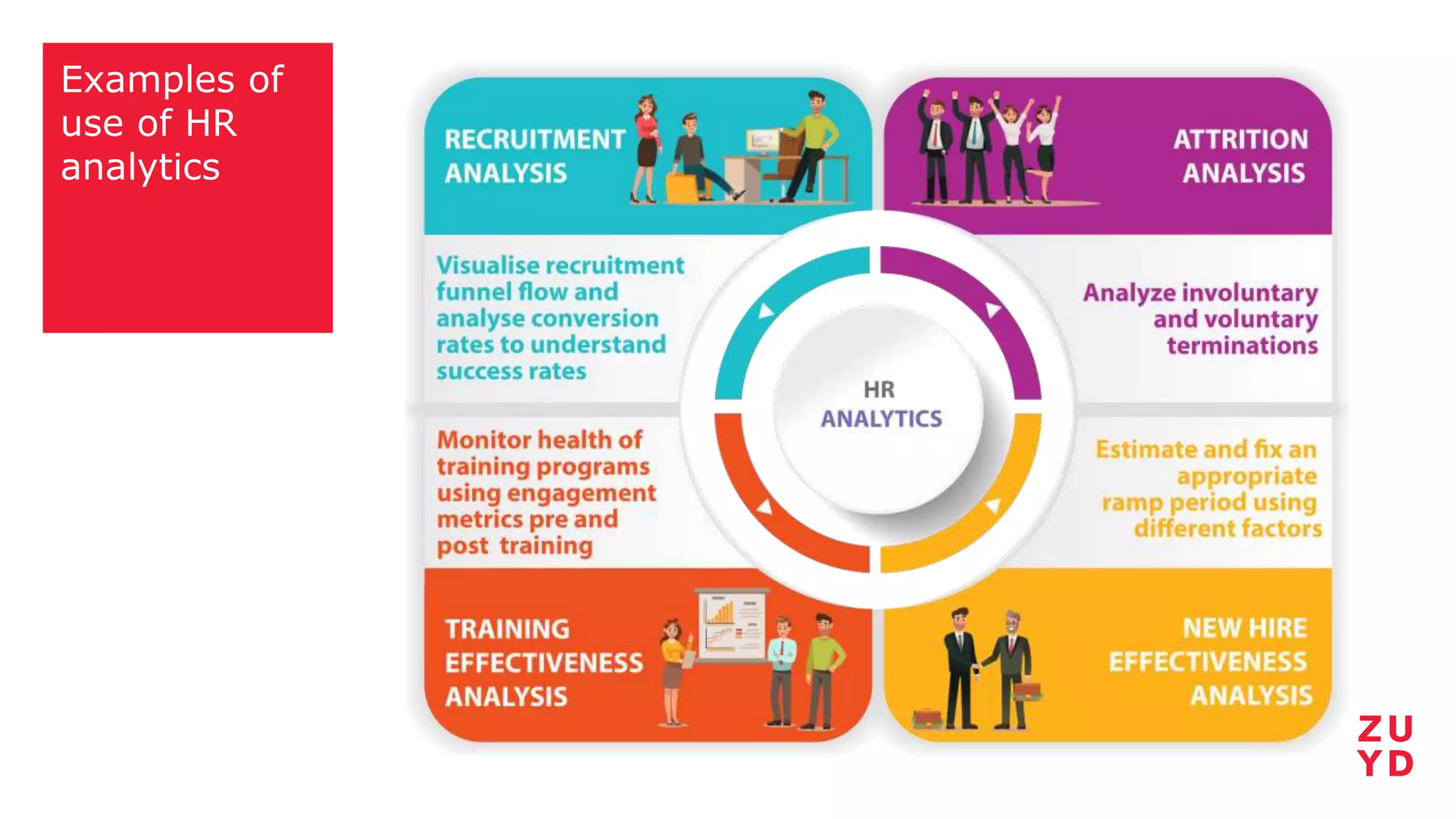
  • #18 Here we see some examples of the areas in which you can use HR analytics. For example, the effectiveness of training and education, the conversion rate of the recruitment funnel and so on.
  • #19 Here we see two examples of questions that can be answered by using HR analytics. Interaction: Formulate a relevant business question for your organisation Formulate analysis questions Discuss the questions with the person sitting next to you You see: asking the right question is the most important part of HR analytics. Without the right question you never get the right answer!
  • #20 It is necessary for HR professionals to develop the skills needed to perform HR analytics. But HR professionals are not attracted to HR because they will get the opportunity to work with data and analytics. So that will be a challenge. Skills an HR professional needs in order to work with HR analytics and get the best out of it: Knowledge of HR, off course! Knowledge of the business. Analytical skills, more specific data mining, statistics, research skills Communication skills like data representation Source: Reilly P (2016). The path towards predictive analytics, Member Paper 126, Institute for Employment Studies
  • #21 If HR analytics is relevant depends on the caracteristics of the organisation and the kind of business question. HR analytics is not the oracle that wil answer every HR-business question, but it can be the critical friend that helps the HR-professional to modernise his role. HR analytics helps the HR professional to substantiate his gut feeling with facts ... or perhaps to contradict his gut feeling and prevent an error. Amount of data Predictability of the context Technical versus human-intensive work context
  • #22 You do not need an ecosystem, or a massive budget, or a large team. You do need to know what HR issues you are facing and the HR metrics around it. You need courage and some energy to manipulate the data and to install software. Energy to follow the necessary steps. Patience to realise the little code you need is not so puzzling. Enthusiasm to discover that the heavy lifting of data analysis can be done by others, but also enough experience to know you need some exposure to it. Statistical techniques and tools are just means to an end. Means to better decision-making and to drive action. Do not forget that HR is about business and how people work in our business. Ultimately, they are not numbers, they are human beings. The HR analyst must make sure he is asking the right question and adds value to business decisions that create success. HR analytic is a promising field Most organisations don’t use HR analytics yet HR analytics requires new skills of the HR professional Any HR transformation has to take place with a clear objective in mind. It has to make sense for the business.
  • #23 Would anyone like to ask a question? Does anyone have a question for me?