The human
Information i/o…
◦ visual, auditory, haptic, movement
Information stored in memory
◦ sensory, short-term, long-term
Information processed and applied
◦ reasoning, problem solving, skill, error
Emotion influences human capabilities
Each person is different
3.
Vision
Two stages invision
• physical reception of stimulus
• processing and interpretation of stimulus
4.
The Eye- physicalreception
mechanism for receiving light and transforming it into electrical energy
light reflects from objects
images are focused upside-down on retina
retina contains rods for low light vision and cones for colour vision
ganglion cells (brain!) detect pattern and movement
5.
Interpreting the signal
Sizeand depth
◦ visual angle indicates how much of view object occupies
(relates to size and distance from eye)
◦ visual acuity is ability to perceive detail (limited)
◦ familiar objects perceived as constant size
(in spite of changes in visual angle when far away)
◦ cues like overlapping help perception of size and depth
6.
Interpreting the signal(cont)
Brightness
◦ subjective reaction to levels of light
◦ affected by luminance of object
◦ measured by just noticeable difference
◦ visual acuity increases with luminance as does flicker
Colour
◦ made up of hue, intensity, saturation
◦ cones sensitive to colour wavelengths
◦ blue acuity is lowest
◦ 8% males and 1% females colour blind
7.
Interpreting the signal(cont)
The visual system compensates for:
◦ movement
◦ changes in luminance.
Context is used to resolve ambiguity
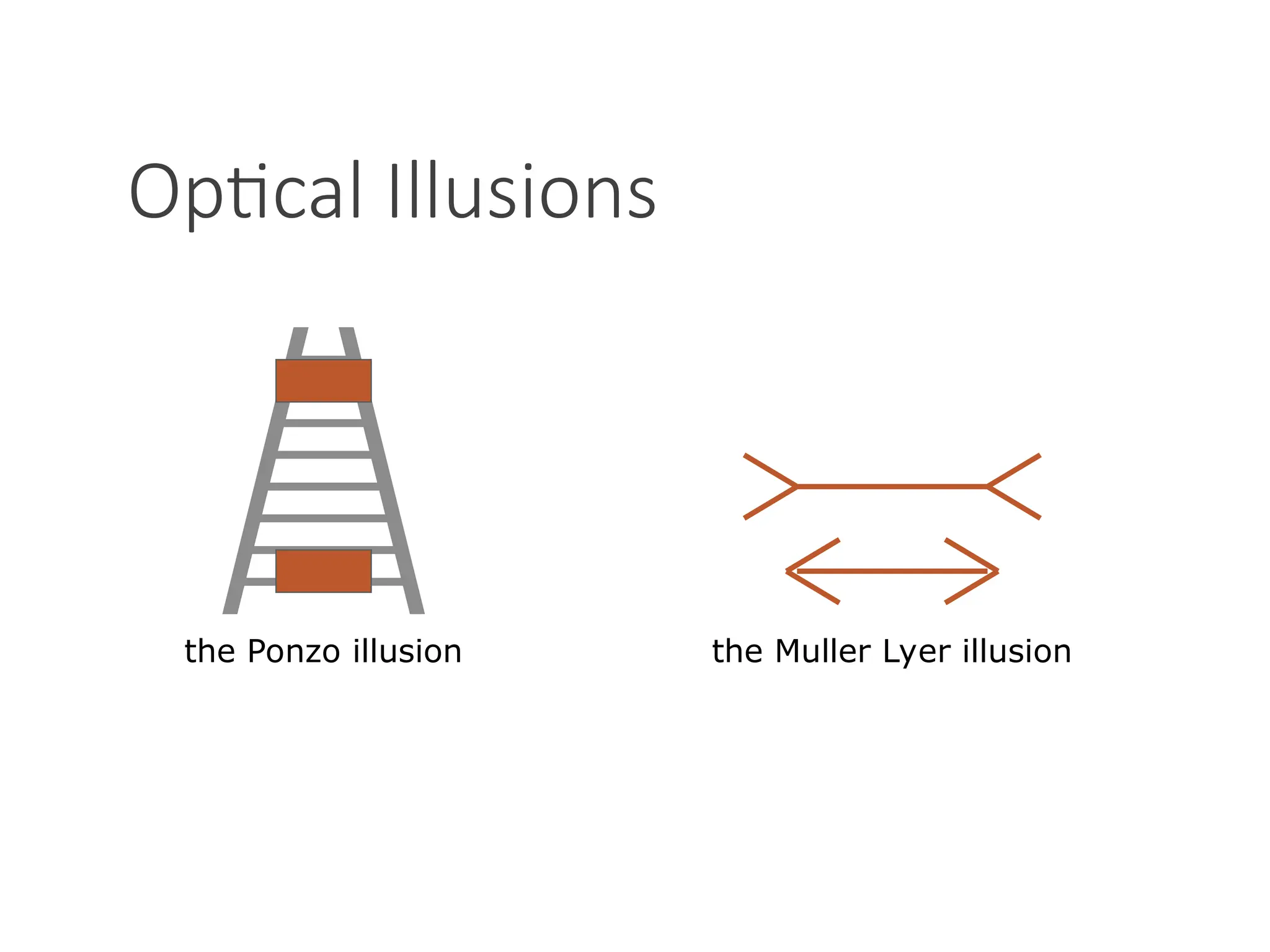
Optical illusions sometimes occur due to over compensation
Reading
Several stages:
◦ visualpattern perceived
◦ decoded using internal representation of language
◦ interpreted using knowledge of syntax, semantics, pragmatics
Reading involves saccades and fixations
Perception occurs during fixations
Word shape is important to recognition
Negative contrast improves reading from computer screen
10.
Hearing
Provides information aboutenvironment:
distances, directions, objects etc.
Physical apparatus:
◦ outer ear – protects inner and amplifies sound
◦ middle ear – transmits sound waves as
vibrations to inner ear
◦ inner ear – chemical transmitters are released
and cause impulses in auditory nerve
Sound
◦ pitch – sound frequency
◦ loudness – amplitude
◦ timbre – type or quality
11.
Hearing (cont)
Humans canhear frequencies from 20Hz to 15kHz
◦ less accurate distinguishing high frequencies than low.
Auditory system filters sounds
◦ can attend to sounds over background noise.
◦ for example, the cocktail party phenomenon.
12.
Touch
Provides important feedbackabout environment.
May be key sense for someone who is visually impaired.
Stimulus received via receptors in the skin:
◦ thermoreceptors – heat and cold
◦ nociceptors – pain
◦ mechanoreceptors – pressure
(some instant, some continuous)
Some areas more sensitive than others e.g. fingers.
Kinethesis - awareness of body position
◦ affects comfort and performance.
13.
Movement
Time taken torespond to stimulus:
reaction time + movement time
Movement time dependent on age, fitness etc.
Reaction time - dependent on stimulus type:
◦ visual ~ 200ms
◦ auditory ~ 150 ms
◦ pain ~ 700ms
Increasing reaction time decreases accuracy in the unskilled
operator but not in the skilled operator.
14.
Movement (cont)
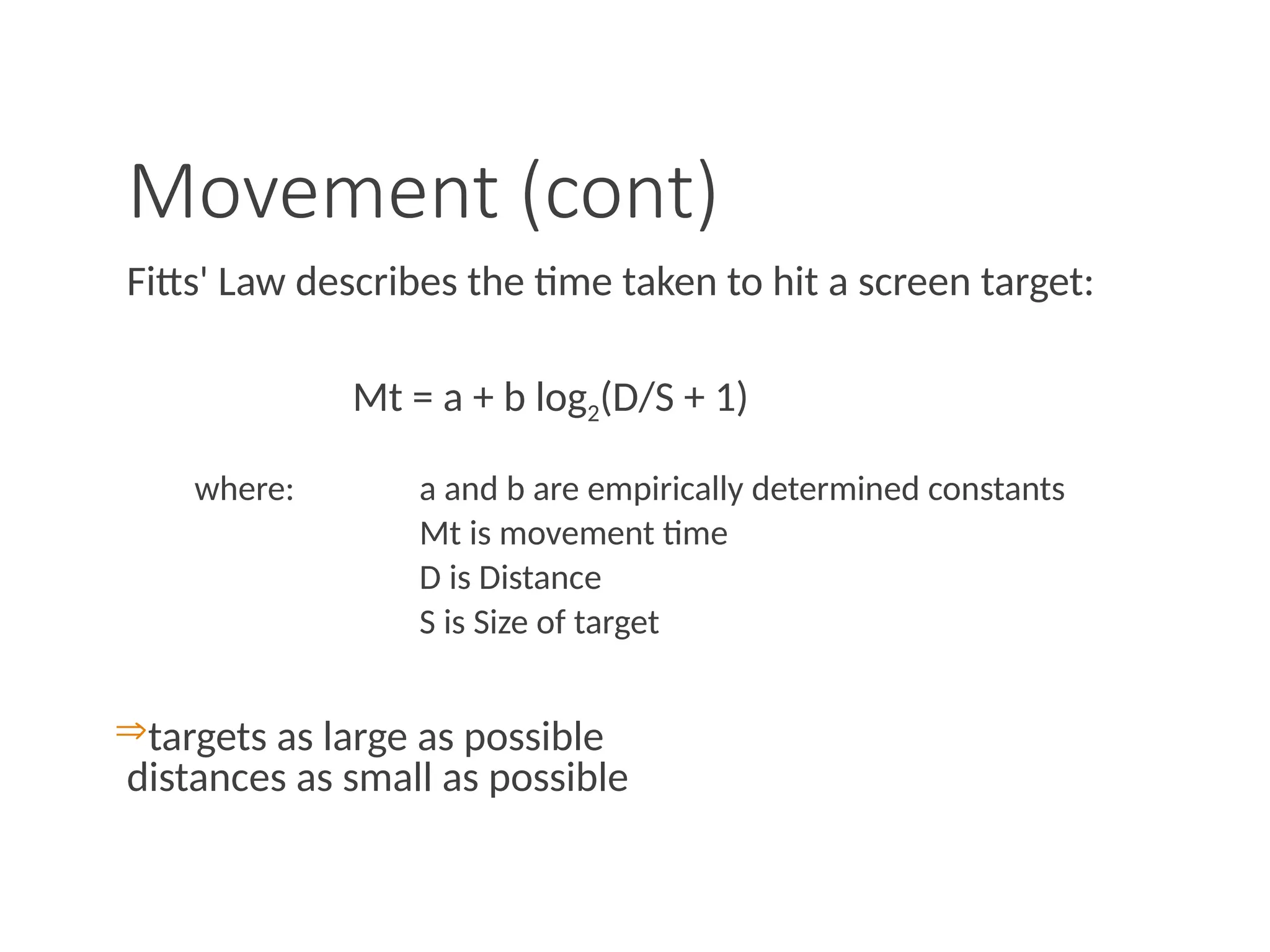
Fitts' Lawdescribes the time taken to hit a screen target:
Mt = a + b log2(D/S + 1)
where: a and b are empirically determined constants
Mt is movement time
D is Distance
S is Size of target
targets as large as possible
distances as small as possible
15.
Memory
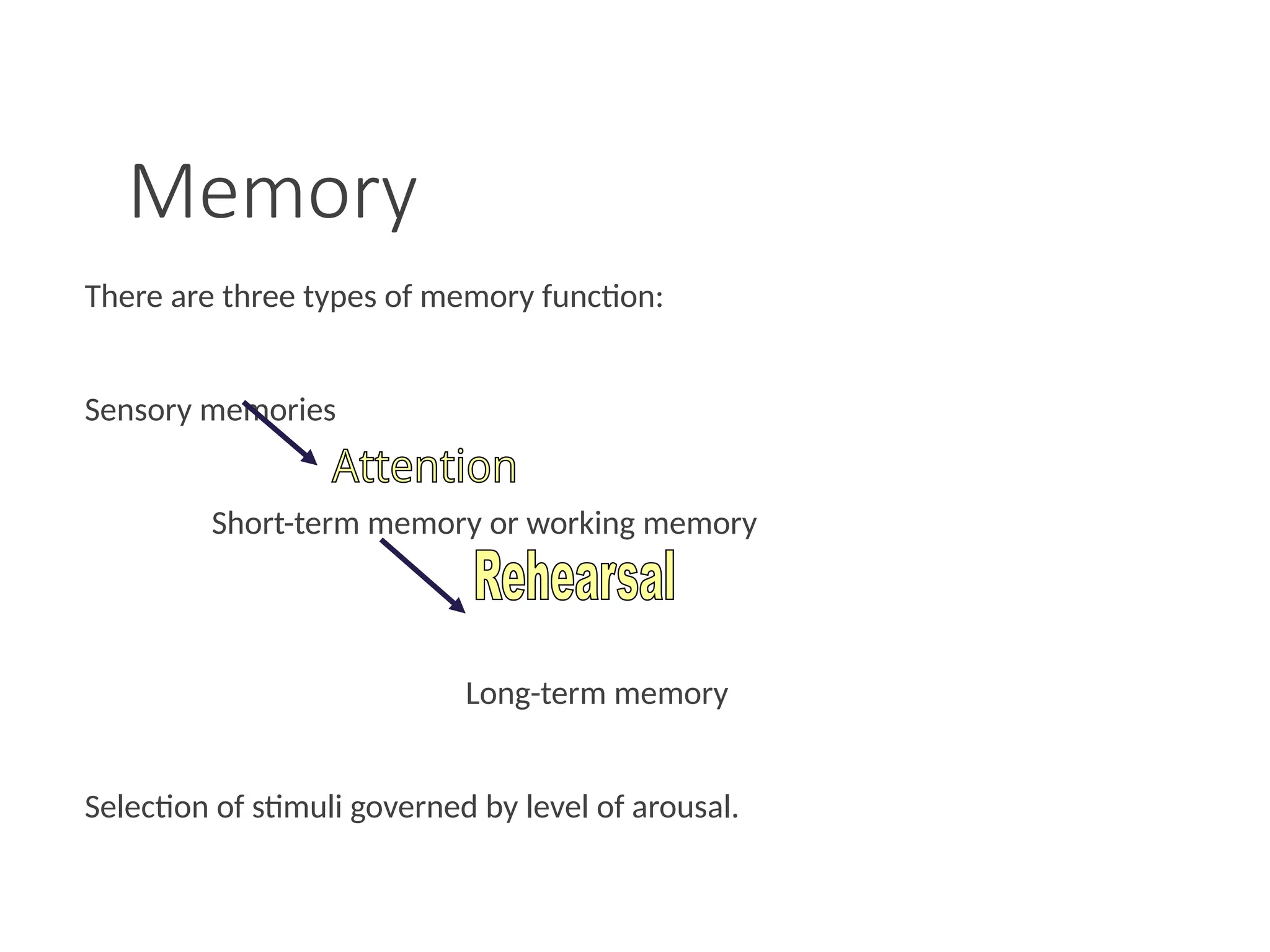
There are threetypes of memory function:
Sensory memories
Short-term memory or working memory
Long-term memory
Selection of stimuli governed by level of arousal.
Long-term memory (LTM)
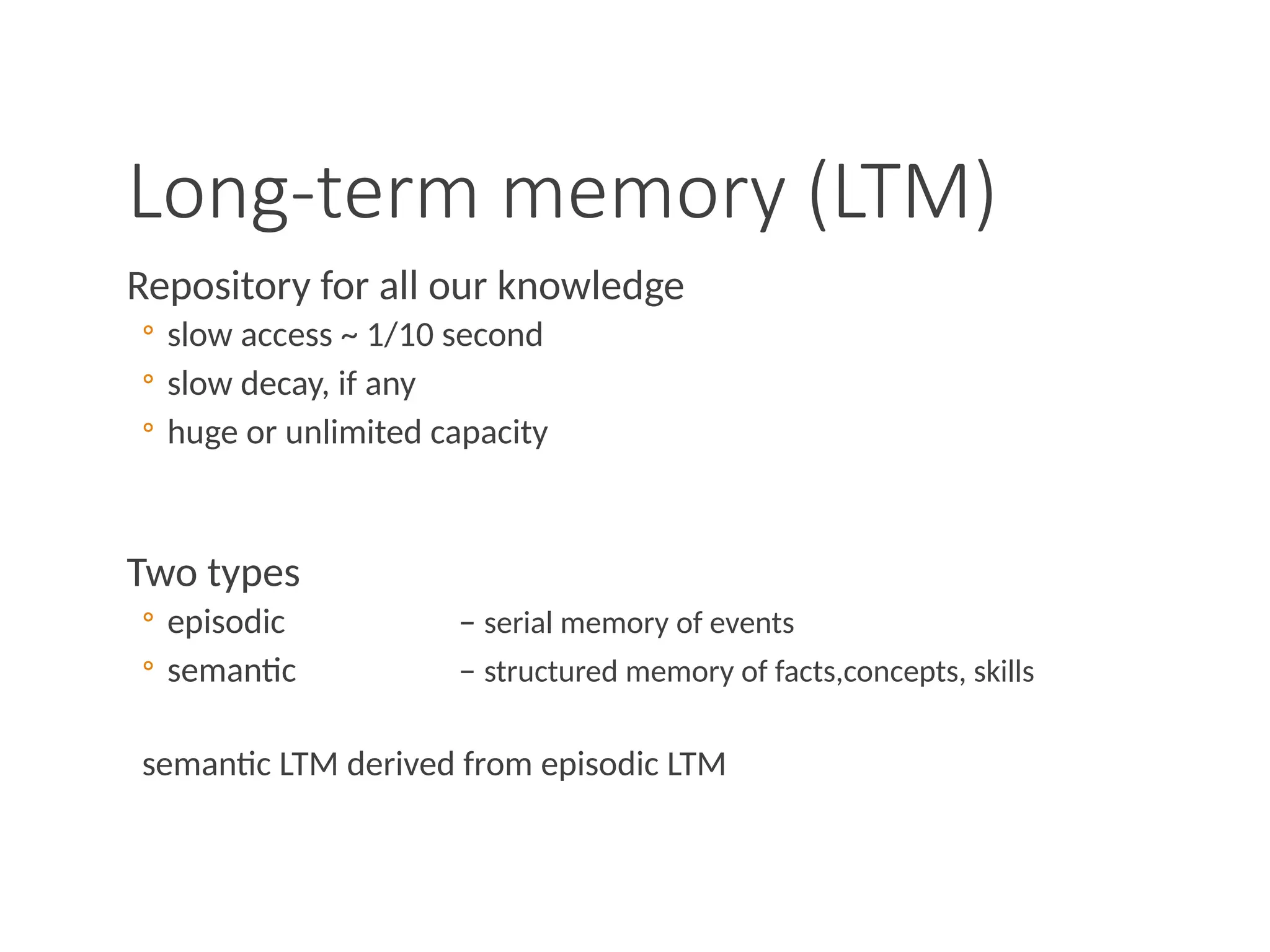
Repositoryfor all our knowledge
◦ slow access ~ 1/10 second
◦ slow decay, if any
◦ huge or unlimited capacity
Two types
◦ episodic – serial memory of events
◦ semantic – structured memory of facts,concepts, skills
semantic LTM derived from episodic LTM
19.
Long-term memory (cont.)
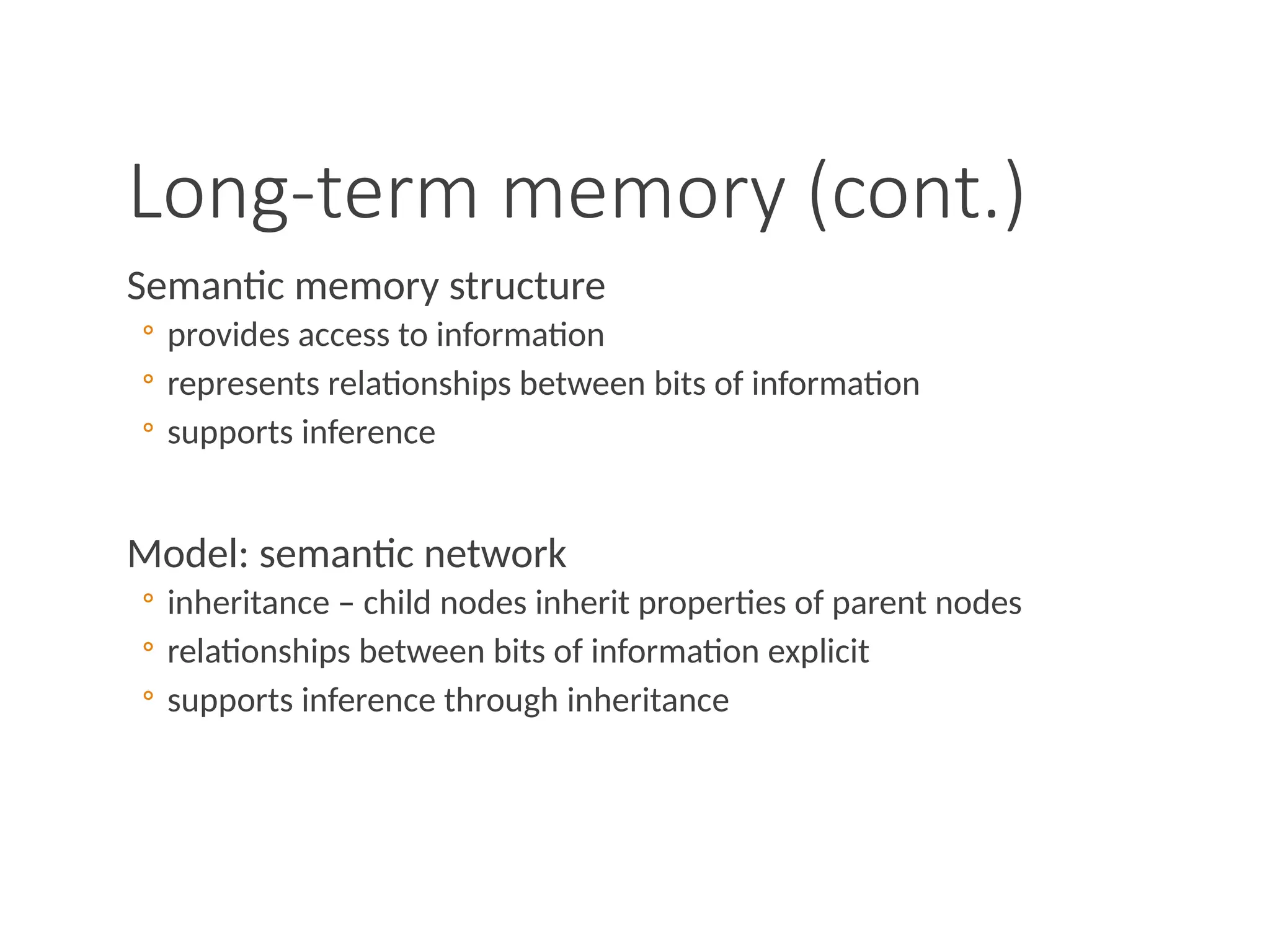
Semanticmemory structure
◦ provides access to information
◦ represents relationships between bits of information
◦ supports inference
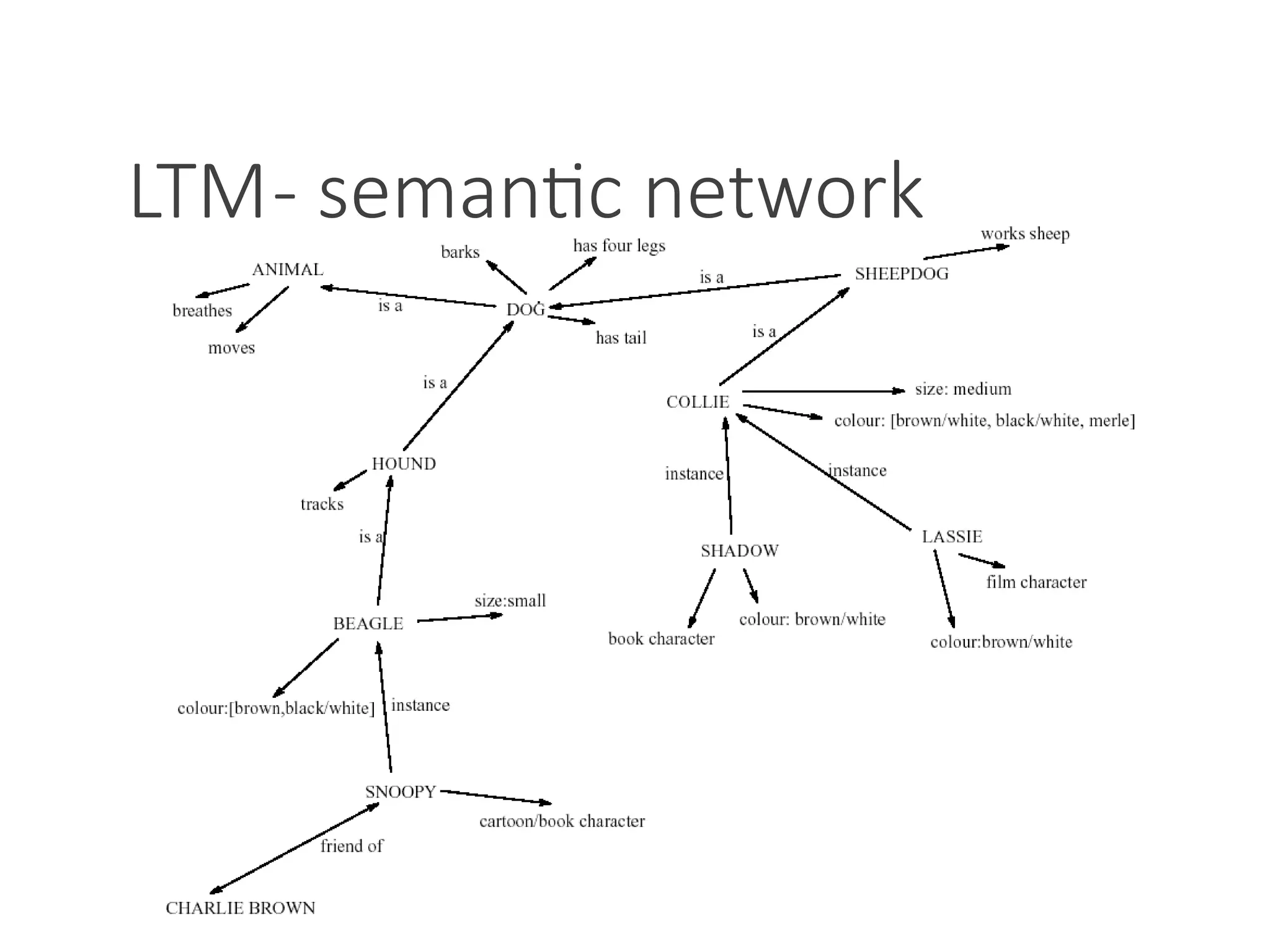
Model: semantic network
◦ inheritance – child nodes inherit properties of parent nodes
◦ relationships between bits of information explicit
◦ supports inference through inheritance
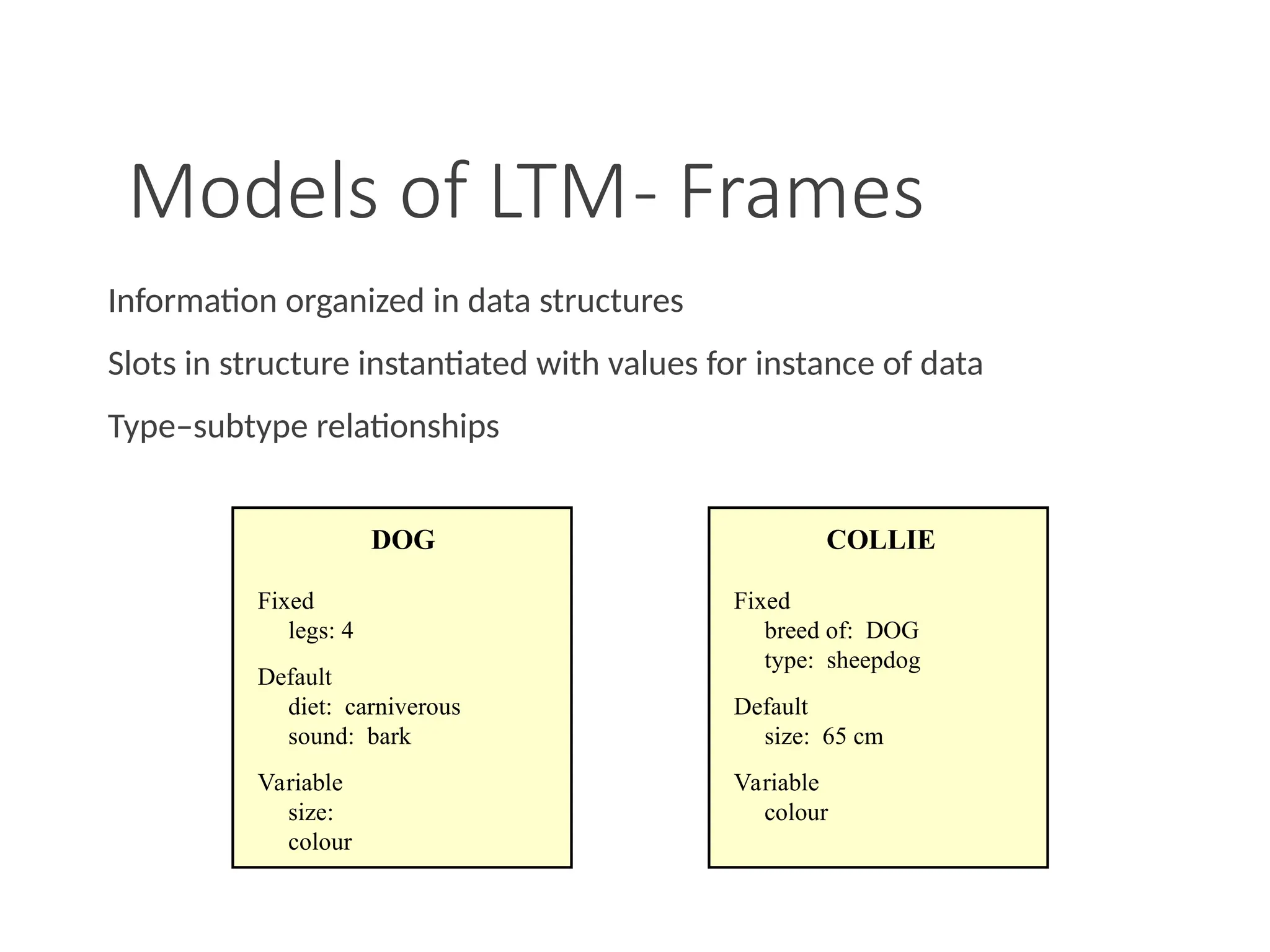
Models of LTM-Frames
Information organized in data structures
Slots in structure instantiated with values for instance of data
Type–subtype relationships
DOG
Fixed
legs: 4
Default
diet: carniverous
sound: bark
Variable
size:
colour
COLLIE
Fixed
breed of: DOG
type: sheepdog
Default
size: 65 cm
Variable
colour
22.
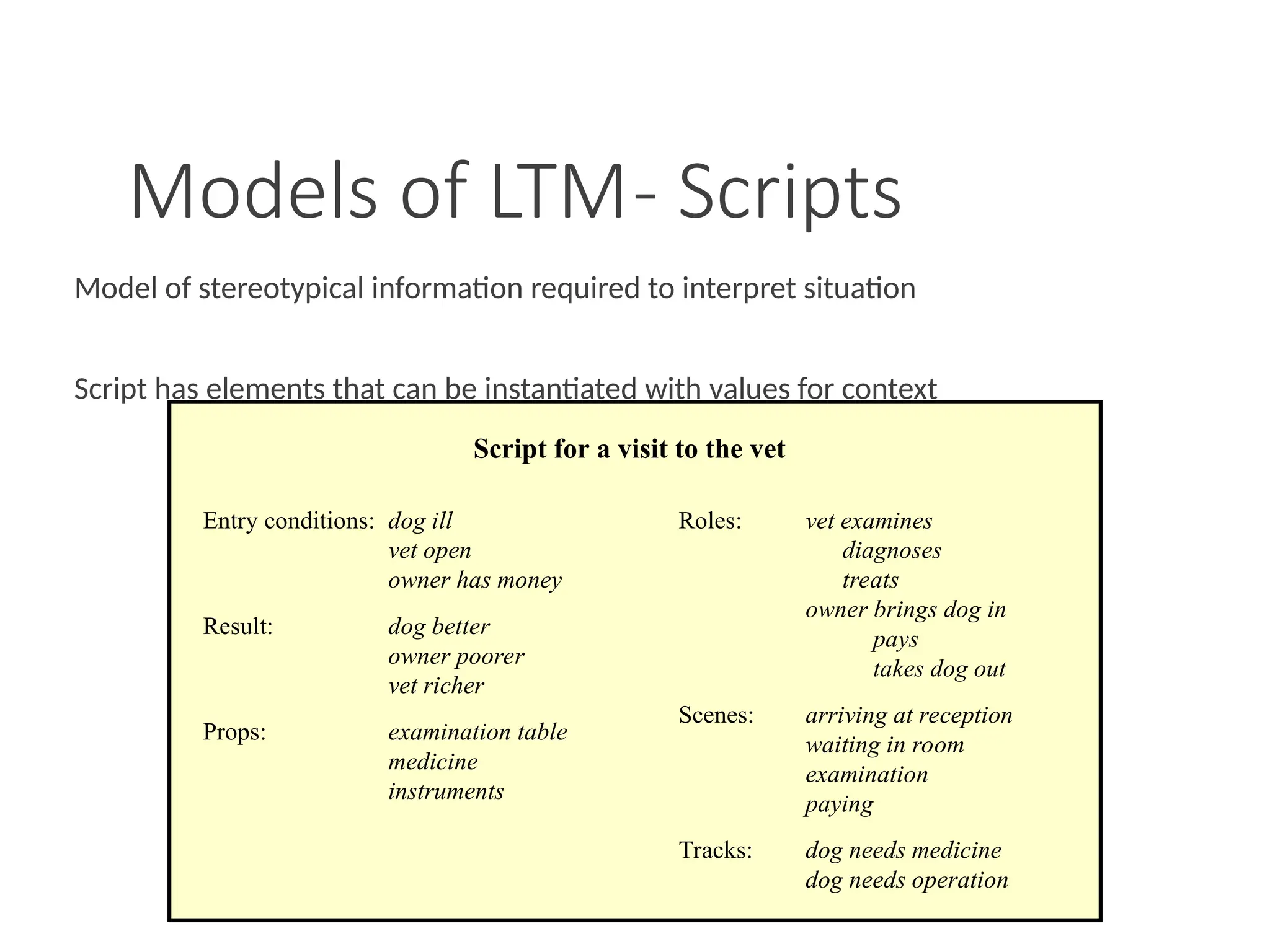
Models of LTM-Scripts
Model of stereotypical information required to interpret situation
Script has elements that can be instantiated with values for context
Script for a visit to the vet
Entry conditions: dog ill
vet open
owner has money
Result: dog better
owner poorer
vet richer
Props: examination table
medicine
instruments
Roles: vet examines
diagnoses
treats
owner brings dog in
pays
takes dog out
Scenes: arriving at reception
waiting in room
examination
paying
Tracks: dog needs medicine
dog needs operation
23.
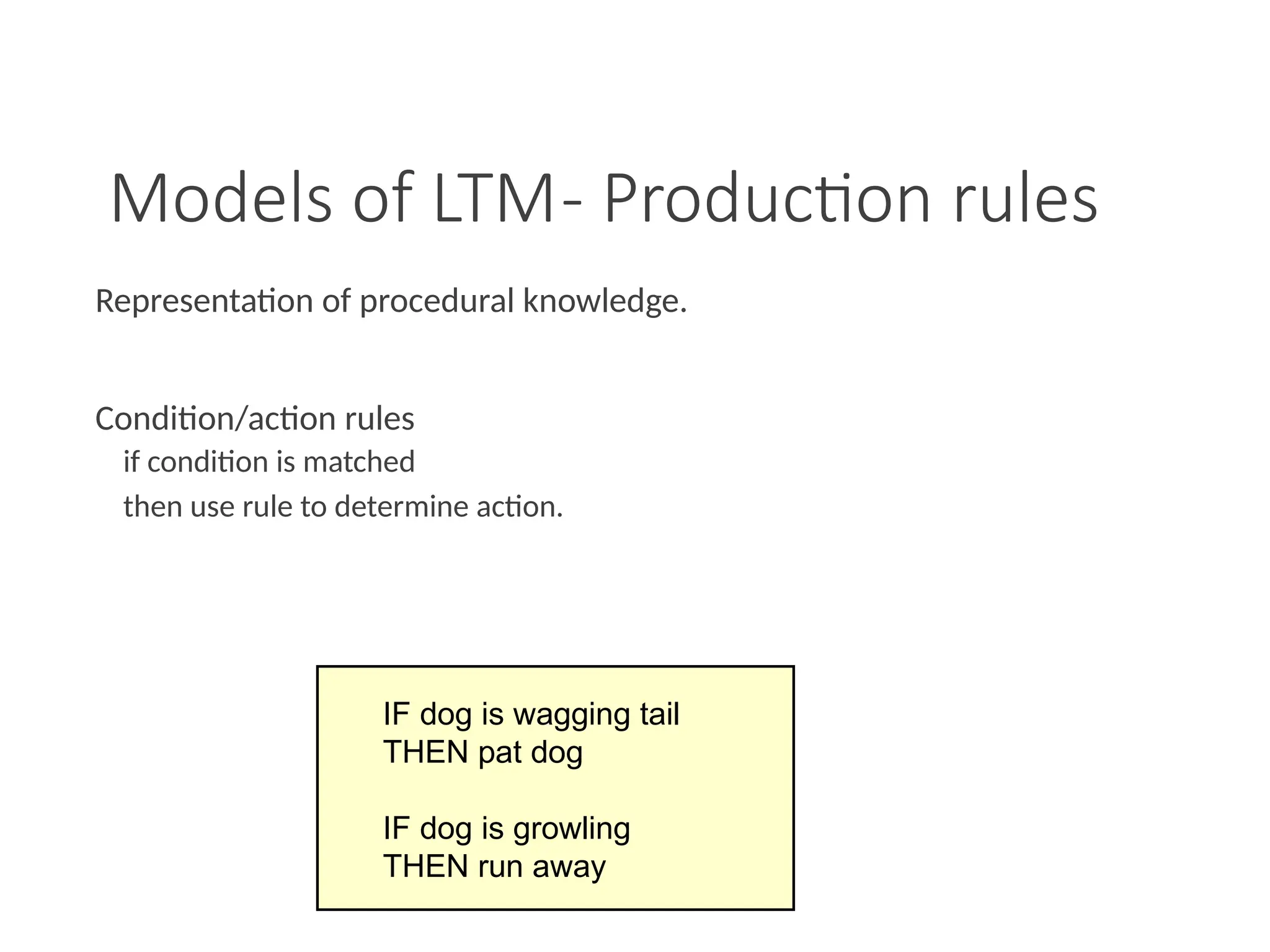
Models of LTM-Production rules
Representation of procedural knowledge.
Condition/action rules
if condition is matched
then use rule to determine action.
IF dog is wagging tail
THEN pat dog
IF dog is growling
THEN run away
24.
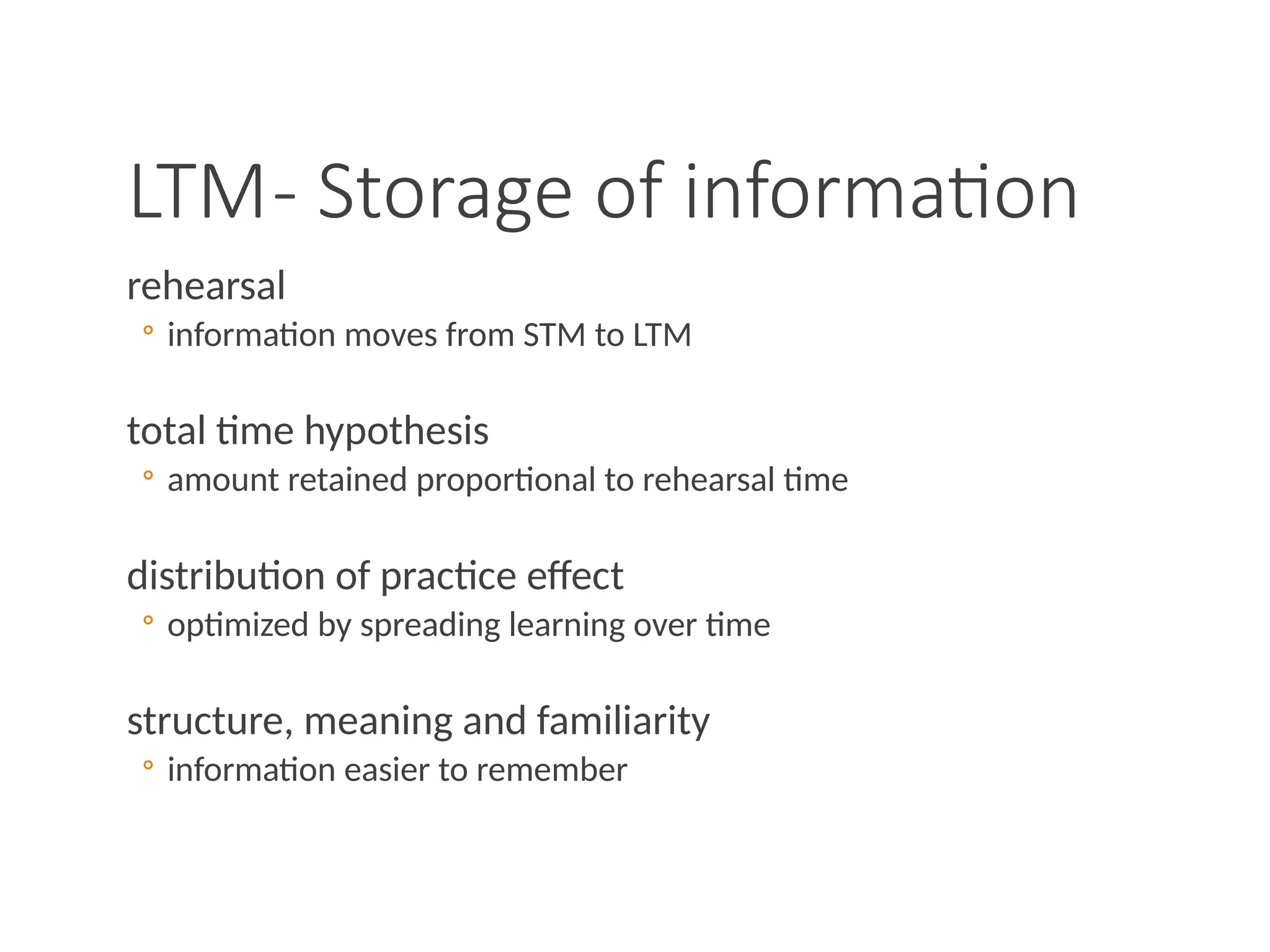
LTM- Storage ofinformation
rehearsal
◦ information moves from STM to LTM
total time hypothesis
◦ amount retained proportional to rehearsal time
distribution of practice effect
◦ optimized by spreading learning over time
structure, meaning and familiarity
◦ information easier to remember
25.
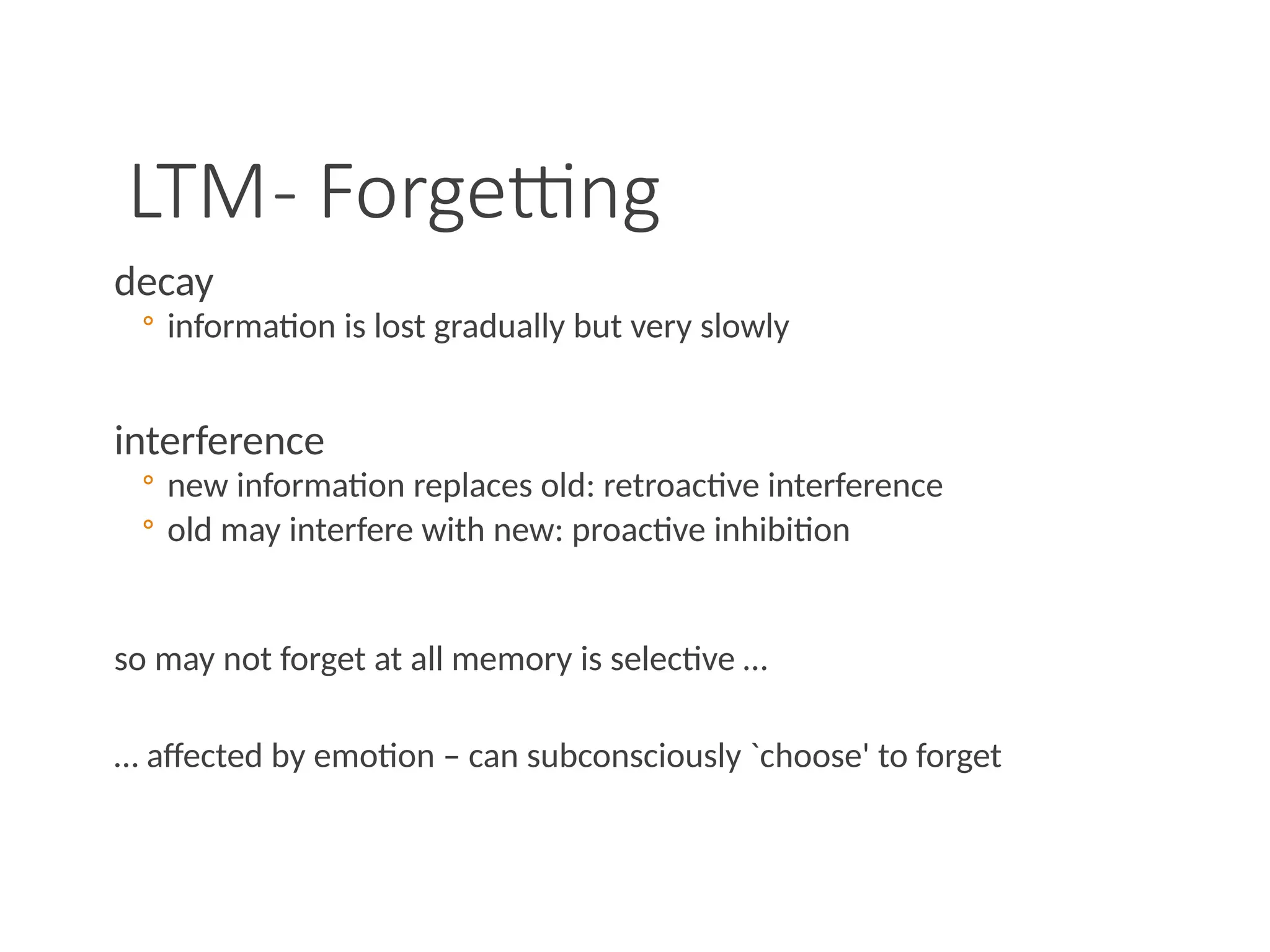
LTM- Forgetting
decay
◦ informationis lost gradually but very slowly
interference
◦ new information replaces old: retroactive interference
◦ old may interfere with new: proactive inhibition
so may not forget at all memory is selective …
… affected by emotion – can subconsciously `choose' to forget
26.
LTM- retrieval
recall
◦ informationreproduced from memory can be assisted by cues, e.g.
categories, imagery
recognition
◦ information gives knowledge that it has been seen before
◦ less complex than recall - information is cue
Deductive Reasoning
Deduction:
◦ derivelogically necessary conclusion from given premises.
e.g. If it is Friday then she will go to work
It is Friday
Therefore she will go to work.
Logical conclusion not necessarily true:
e.g. If it is raining then the ground is dry
It is raining
Therefore the ground is dry
29.
Deduction (cont.)
When truthand logical validity clash …
e.g. Some people are babies
Some babies cry
Inference - Some people cry
Correct?
People bring world knowledge to bear
30.
Inductive Reasoning
Induction:
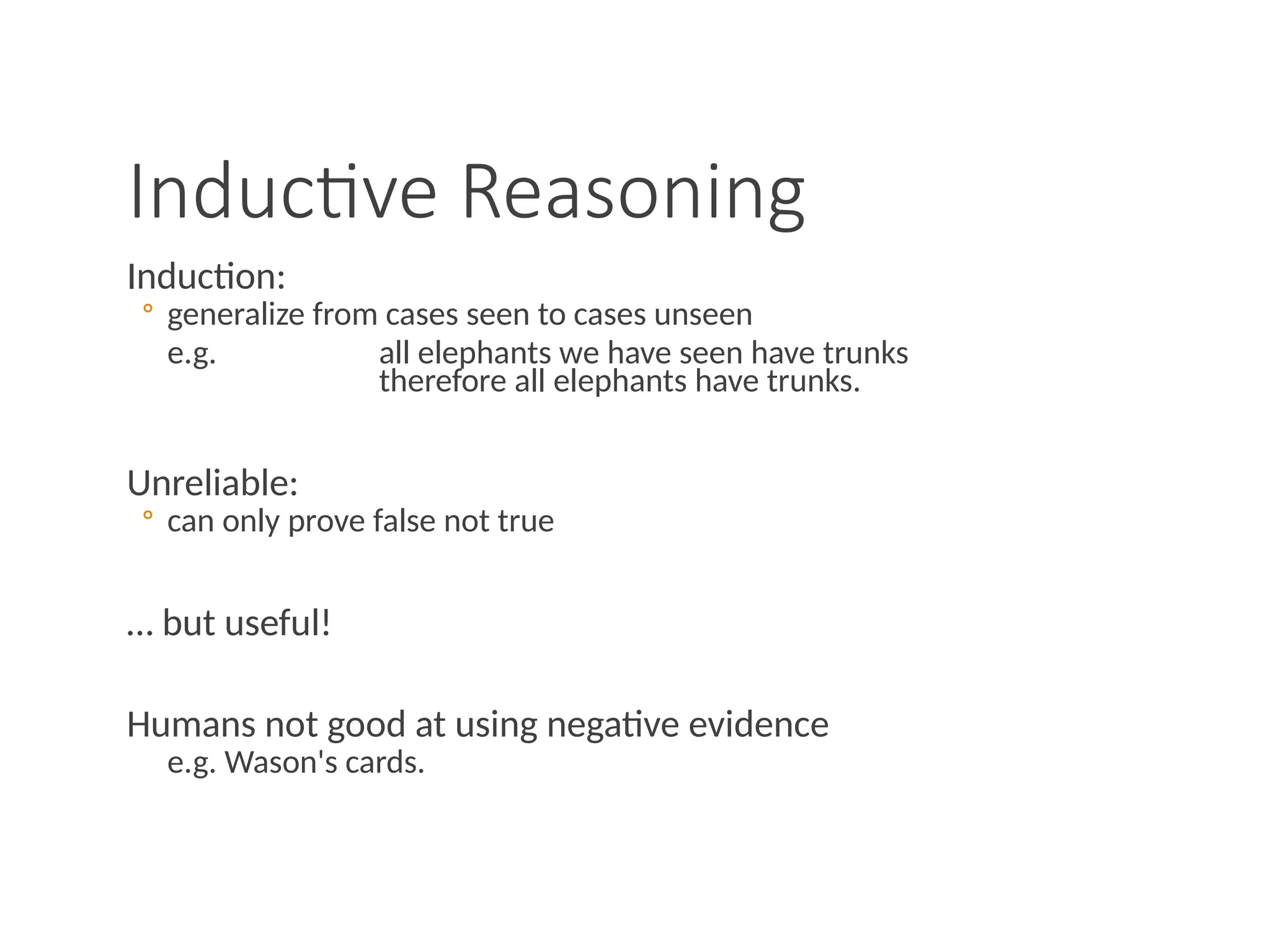
◦ generalizefrom cases seen to cases unseen
e.g. all elephants we have seen have trunks
therefore all elephants have trunks.
Unreliable:
◦ can only prove false not true
… but useful!
Humans not good at using negative evidence
e.g. Wason's cards.
31.
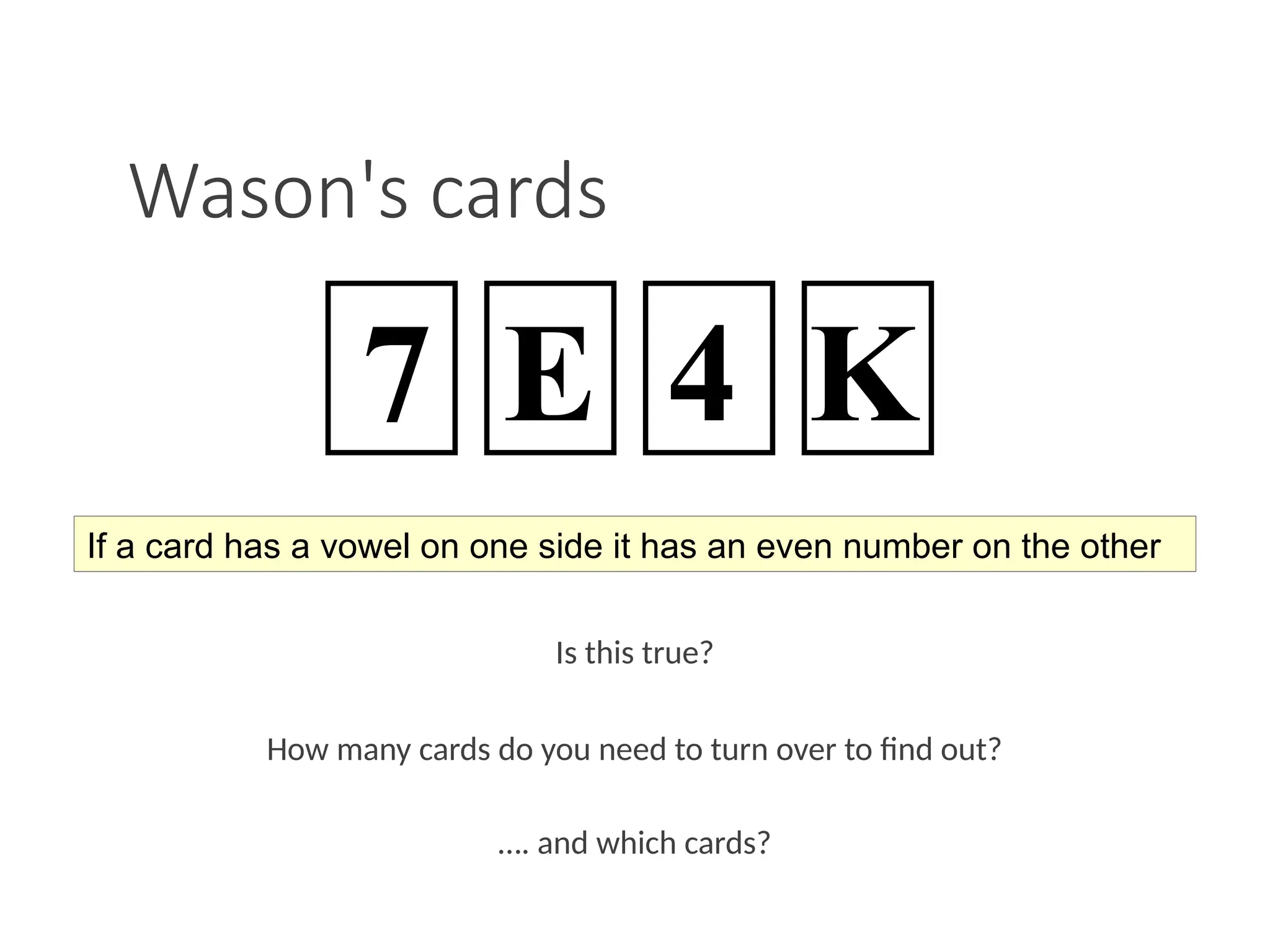
Wason's cards
Is thistrue?
How many cards do you need to turn over to find out?
…. and which cards?
If a card has a vowel on one side it has an even number on the other
7 E 4 K
32.
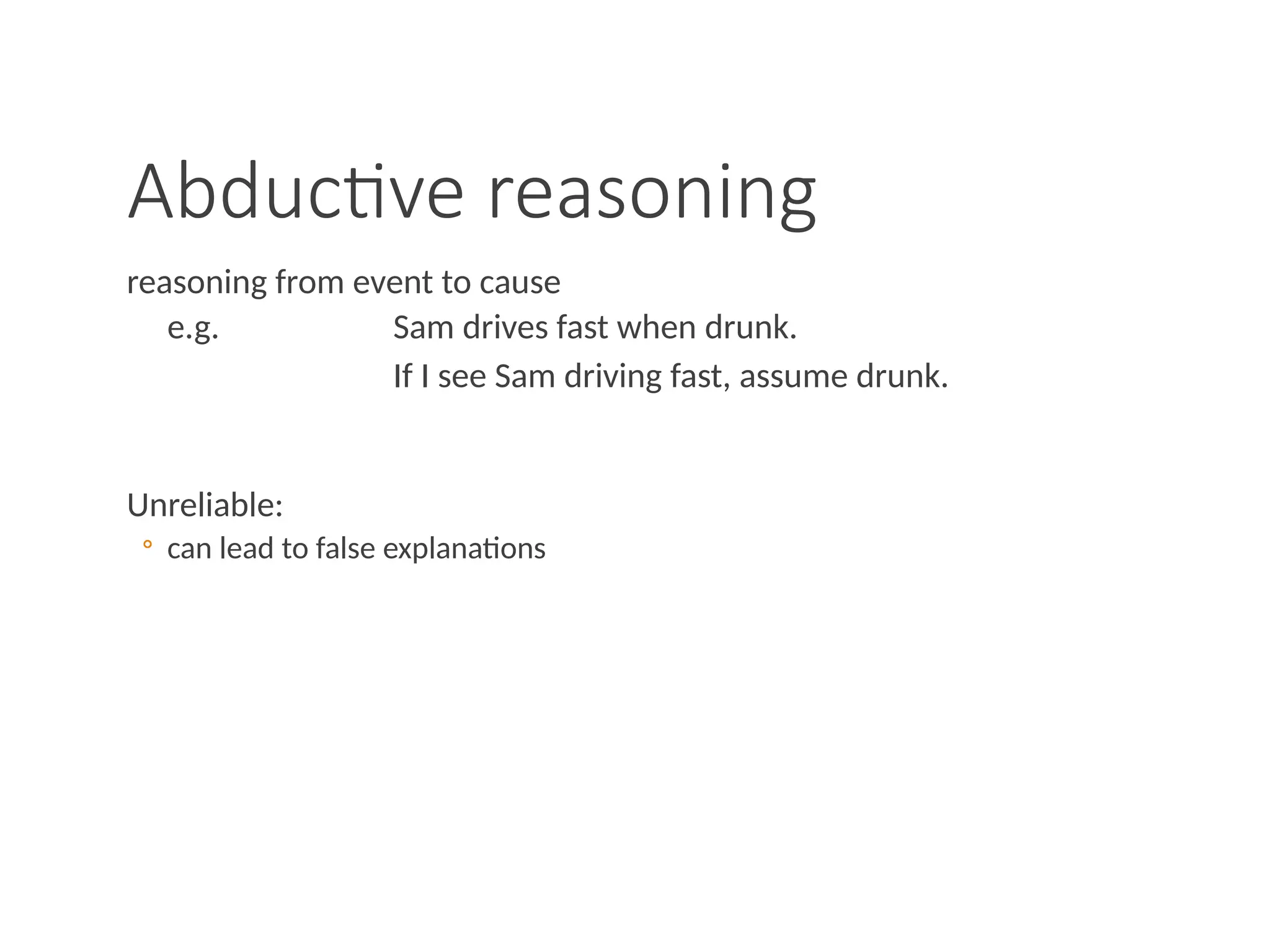
Abductive reasoning
reasoning fromevent to cause
e.g. Sam drives fast when drunk.
If I see Sam driving fast, assume drunk.
Unreliable:
◦ can lead to false explanations
33.
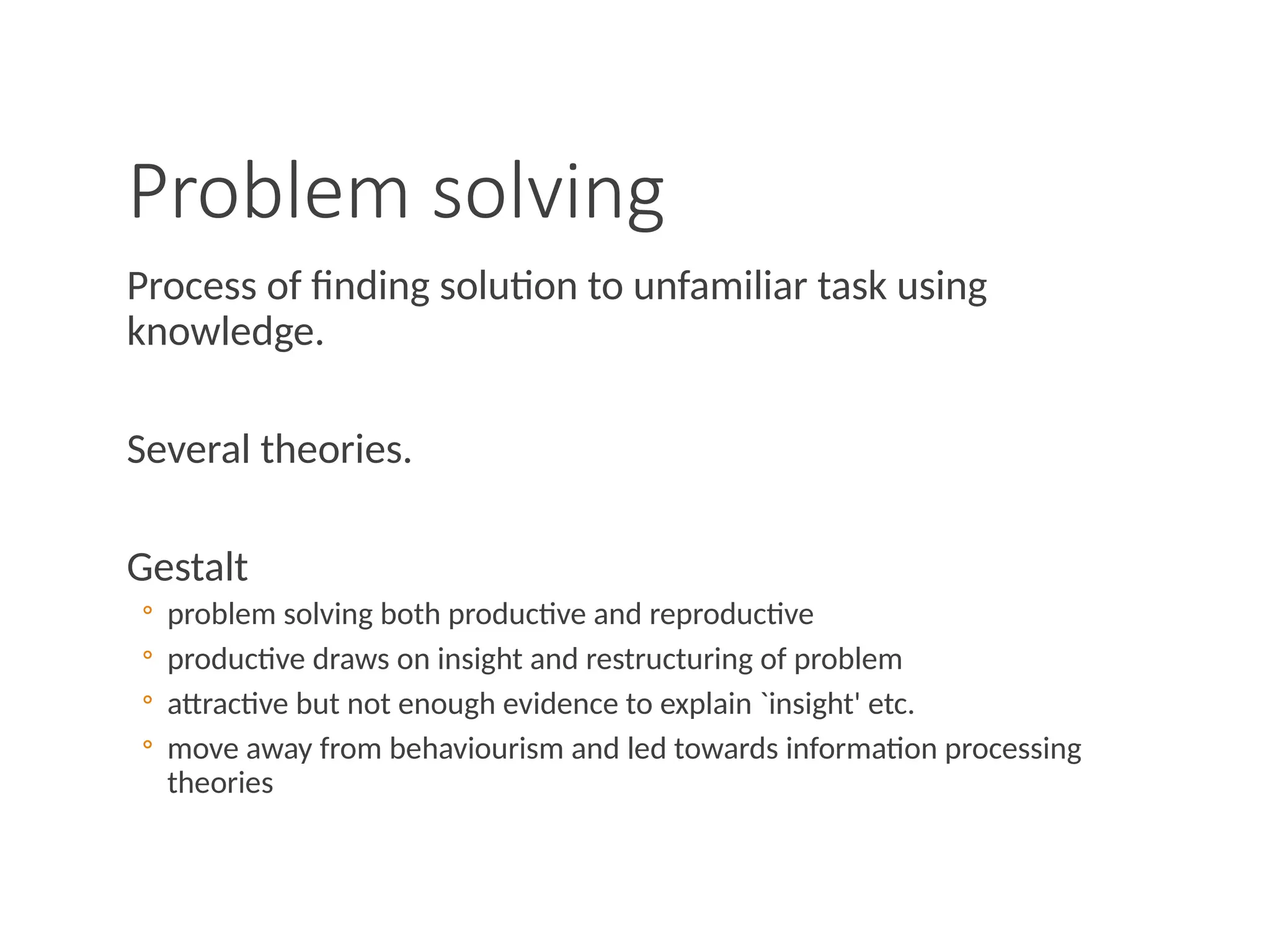
Problem solving
Process offinding solution to unfamiliar task using
knowledge.
Several theories.
Gestalt
◦ problem solving both productive and reproductive
◦ productive draws on insight and restructuring of problem
◦ attractive but not enough evidence to explain `insight' etc.
◦ move away from behaviourism and led towards information processing
theories
34.
Problem solving (cont.)
Problemspace theory
◦ problem space comprises problem states
◦ problem solving involves generating states using legal operators
◦ heuristics may be employed to select operators
e.g. means-ends analysis
◦ operates within human information processing system
e.g. STM limits etc.
◦ largely applied to problem solving in well-defined areas
e.g. puzzles rather than knowledge intensive areas
35.
Problem solving (cont.)
Analogy
◦analogical mapping:
◦ novel problems in new domain?
◦ use knowledge of similar problem from similar domain
◦ analogical mapping difficult if domains are semantically different
Skill acquisition
◦ skilled activity characterized by chunking
◦ lot of information is chunked to optimize STM
◦ conceptual rather than superficial grouping of problems
◦ information is structured more effectively
36.
Errors and mentalmodels
Types of error
slips
◦ right intention, but failed to do it right
◦ causes: poor physical skill,inattention etc.
◦ change to aspect of skilled behaviour can cause slip
mistakes
◦ wrong intention
◦ cause: incorrect understanding
humans create mental models to explain behaviour.
if wrong (different from actual system) errors can occur
37.
Emotion
Various theories ofhow emotion works
◦ James-Lange: emotion is our interpretation of a physiological response
to a stimuli
◦ Cannon: emotion is a psychological response to a stimuli
◦ Schacter-Singer: emotion is the result of our evaluation of our
physiological responses, in the light of the whole situation we are in
Emotion clearly involves both cognitive and physical
responses to stimuli
38.
Emotion (cont.)
The biologicalresponse to physical stimuli is called affect
Affect influences how we respond to situations
◦ positive creative problem solving
◦ negative narrow thinking
“Negative affect can make it harder to do even easy tasks; positive affect can
make it easier to do difficult tasks”
(Donald Norman)
39.
Emotion (cont.)
Implications forinterface design
◦ stress will increase the difficulty of problem solving
◦ relaxed users will be more forgiving of shortcomings in design
◦ aesthetically pleasing and rewarding interfaces will increase positive affect
40.
Individual differences
long term
–sex, physical and intellectual abilities
short term
– effect of stress or fatigue
changing
– age
Ask yourself:
will design decision exclude section of user population?
41.
Psychology and theDesign of
Interactive System
Some direct applications
◦ e.g. blue acuity is poor
blue should not be used for important detail
However, correct application generally requires understanding of
context in psychology, and an understanding of particular experimental
conditions
A lot of knowledge has been distilled in
◦ guidelines (chap 7)
◦ cognitive models (chap 12)
◦ experimental and analytic evaluation techniques (chap 9)