Exhibits Portfolio
Laurie A. Sedicino, MA MHP
Museum Curator
~ Creative Exhibits
~ Thoughtful Storylines
~ Engaging displays
Section 1
I have included many samples of the exhibitions
I have curated in this PowerPoint so you can get
a visual feel for my style, understand some of the
challenges I faced in each of the exhibitions, and
notice the evolution of my professional growth.
Thank you for taking the time to peruse my
exhibitions portfolio.
1. Georgia State University Student Project, Atlanta, GA,
2003
 RICHS: The Store that Married a City
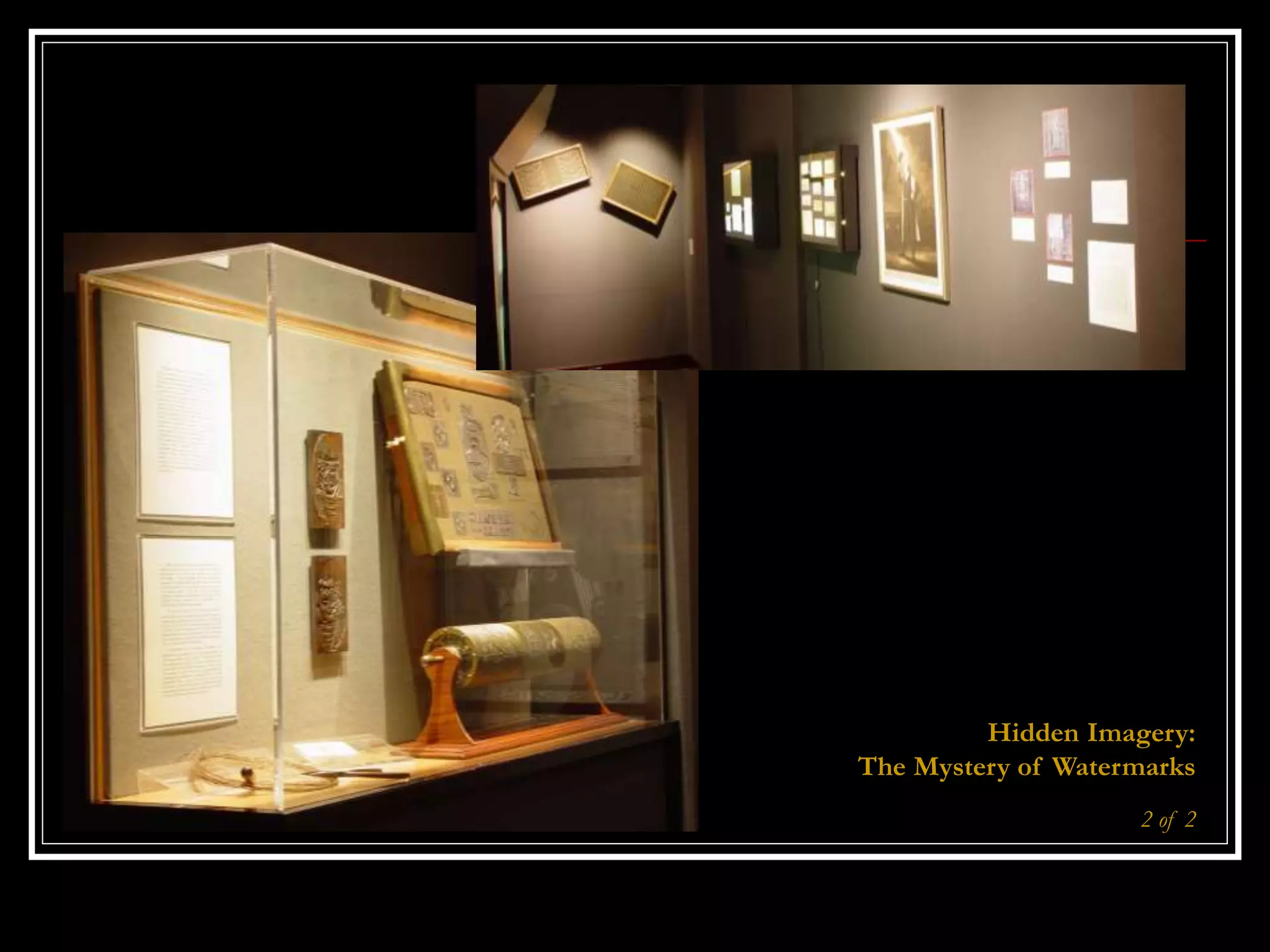
2. Robert C. Williams Paper Museum, Atlanta, GA, 2005-2007
 The Hand-Crafted Book: Dard Hunter’s Legacy
 Hidden Imagery: The Mystery of Watermarks
3. Legacy Museum on Main, LaGrange, GA, 2007-2012
 Area Covered Bridges: Timbers of Grace and Strength
Contents
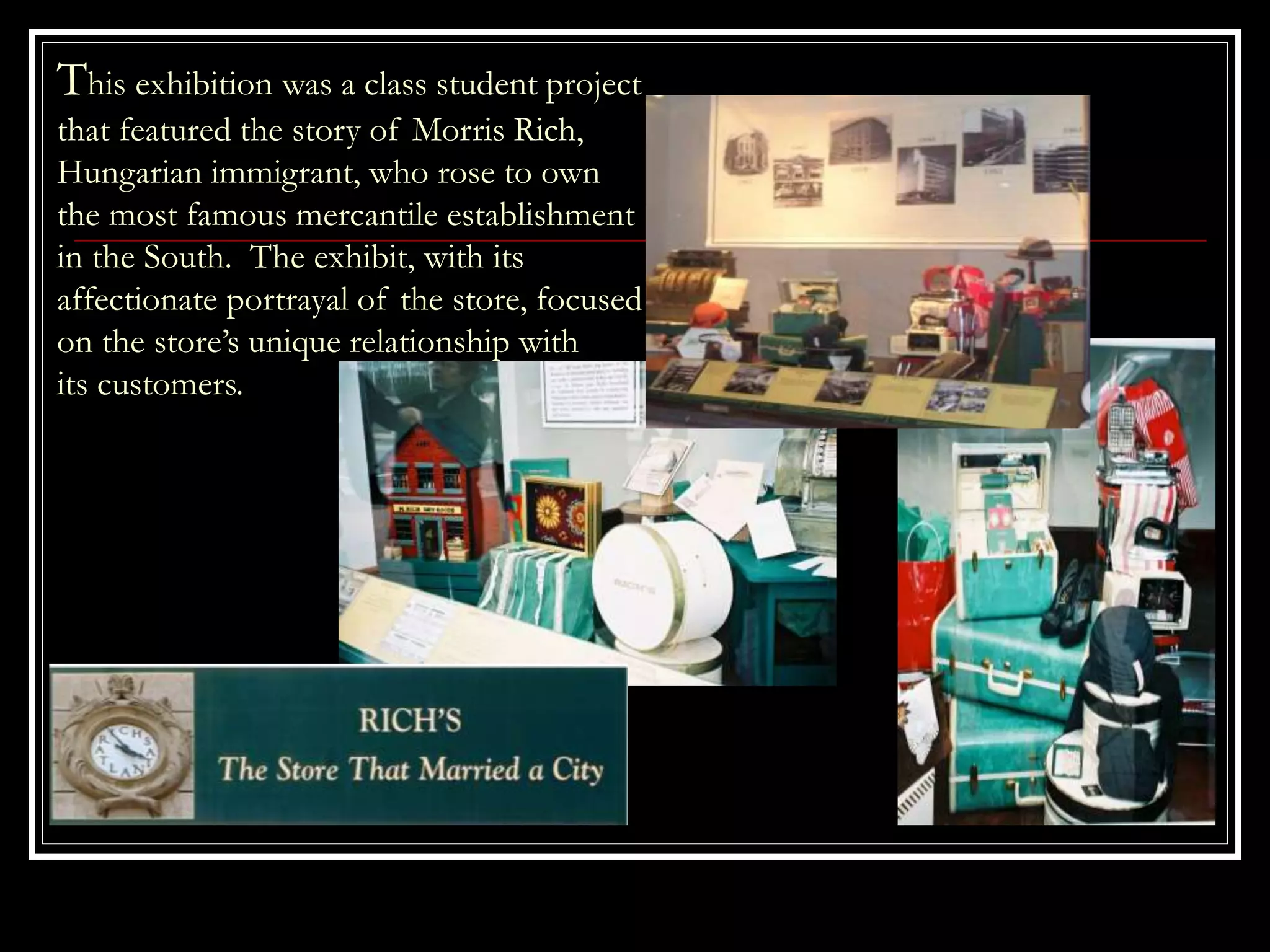
This exhibition was a class student project
that featured the story of Morris Rich,
Hungarian immigrant, who rose to own
the most famous mercantile establishment
in the South. The exhibit, with its
affectionate portrayal of the store, focused
on the store’s unique relationship with
its customers.
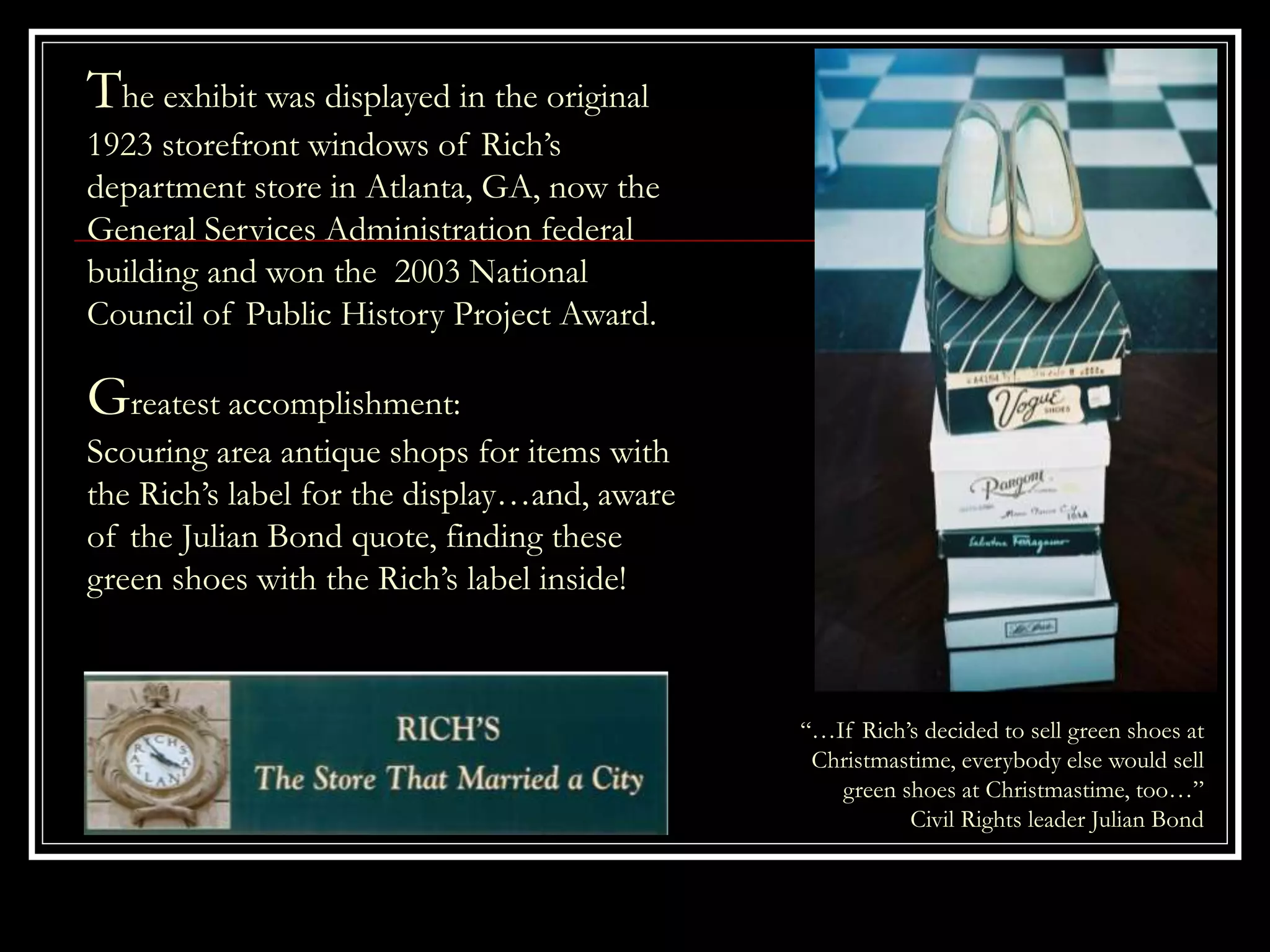
The exhibit was displayed in the original
1923 storefront windows of Rich’s
department store in Atlanta, GA, now the
General Services Administration federal
building and won the 2003 National
Council of Public History Project Award.
“…If Rich’s decided to sell green shoes at
Christmastime, everybody else would sell
green shoes at Christmastime, too…”
Civil Rights leader Julian Bond
Greatest accomplishment:
Scouring area antique shops for items with
the Rich’s label for the display…and, aware
of the Julian Bond quote, finding these
green shoes with the Rich’s label inside!
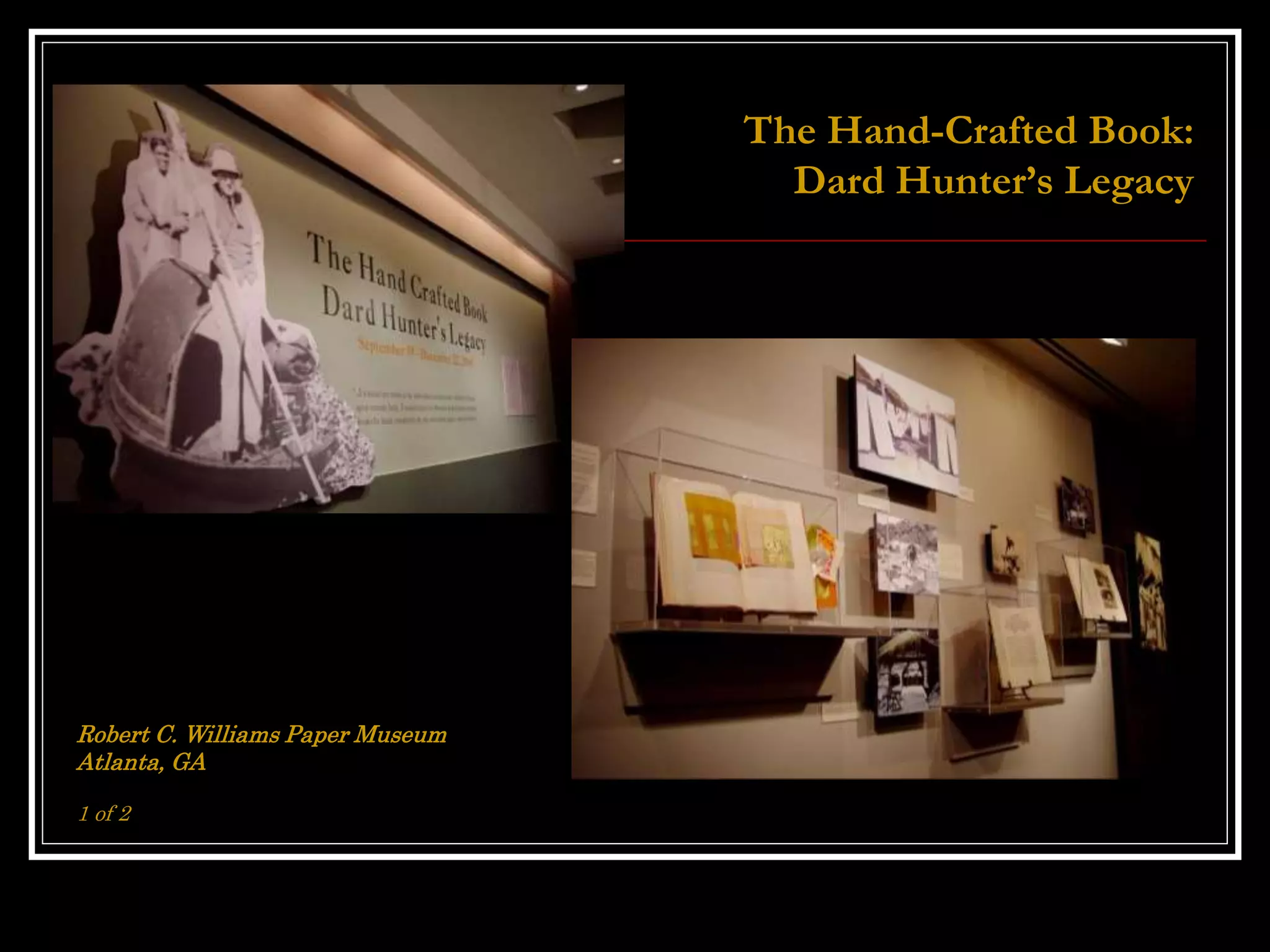
Robert C. Williams Paper Museum
Atlanta, GA
1 of 2
The Hand-Crafted Book:
Dard Hunter’s Legacy
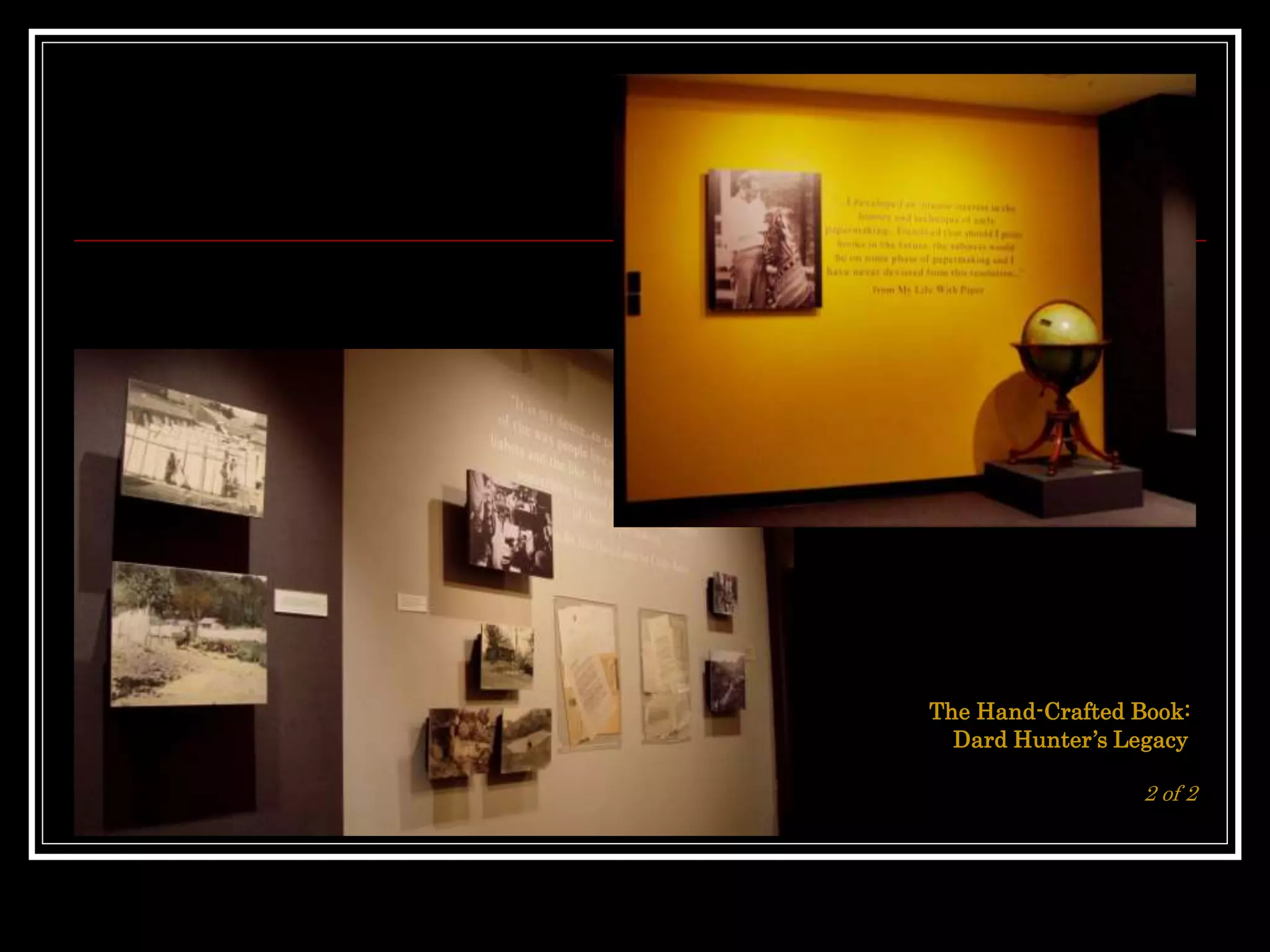
The Hand-Crafted Book:
Dard Hunter’s Legacy
2 of 2
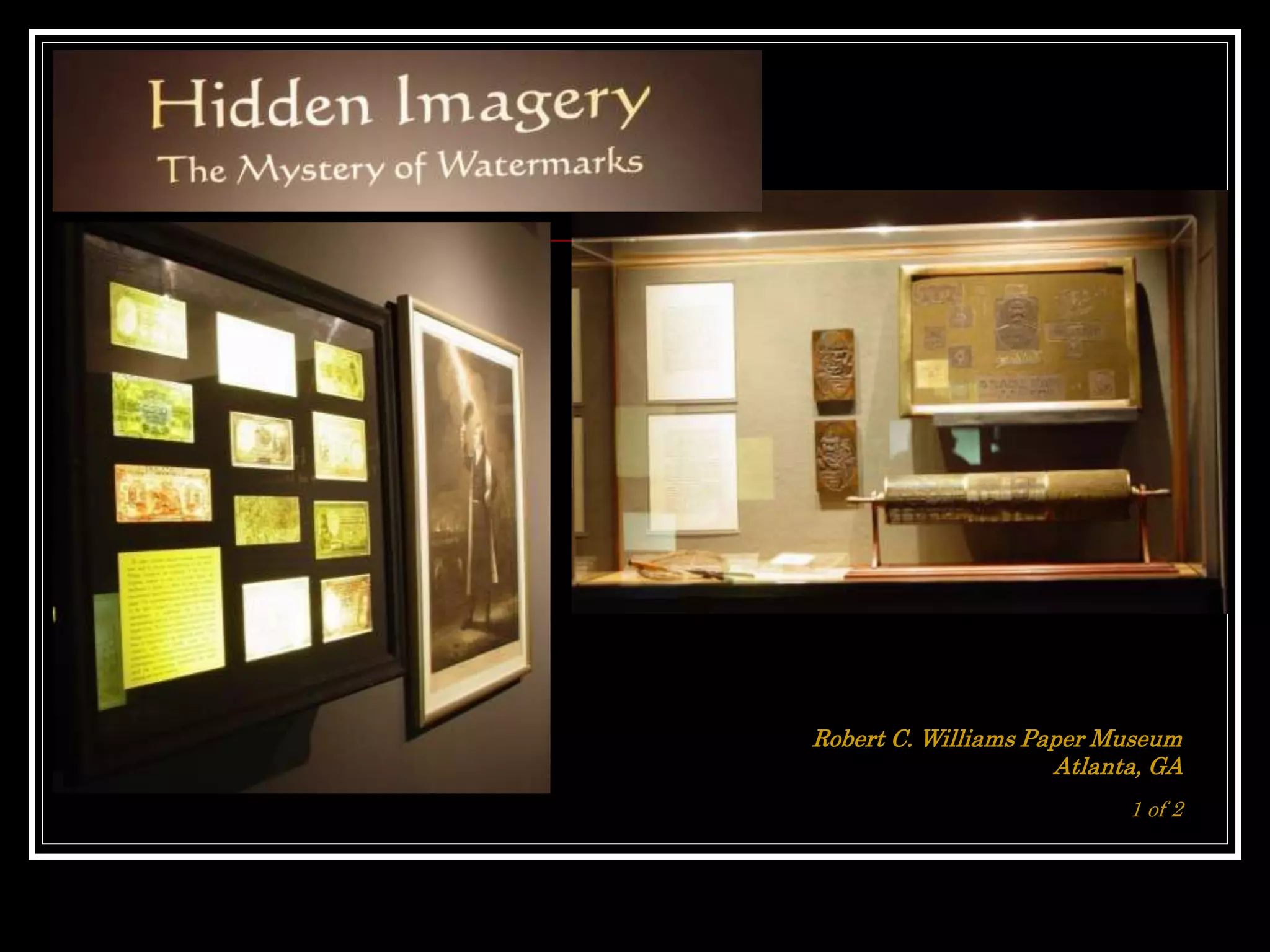
Robert C. Williams Paper Museum
Atlanta, GA
1 of 2
Hidden Imagery:
The Mystery of Watermarks
2 of 2
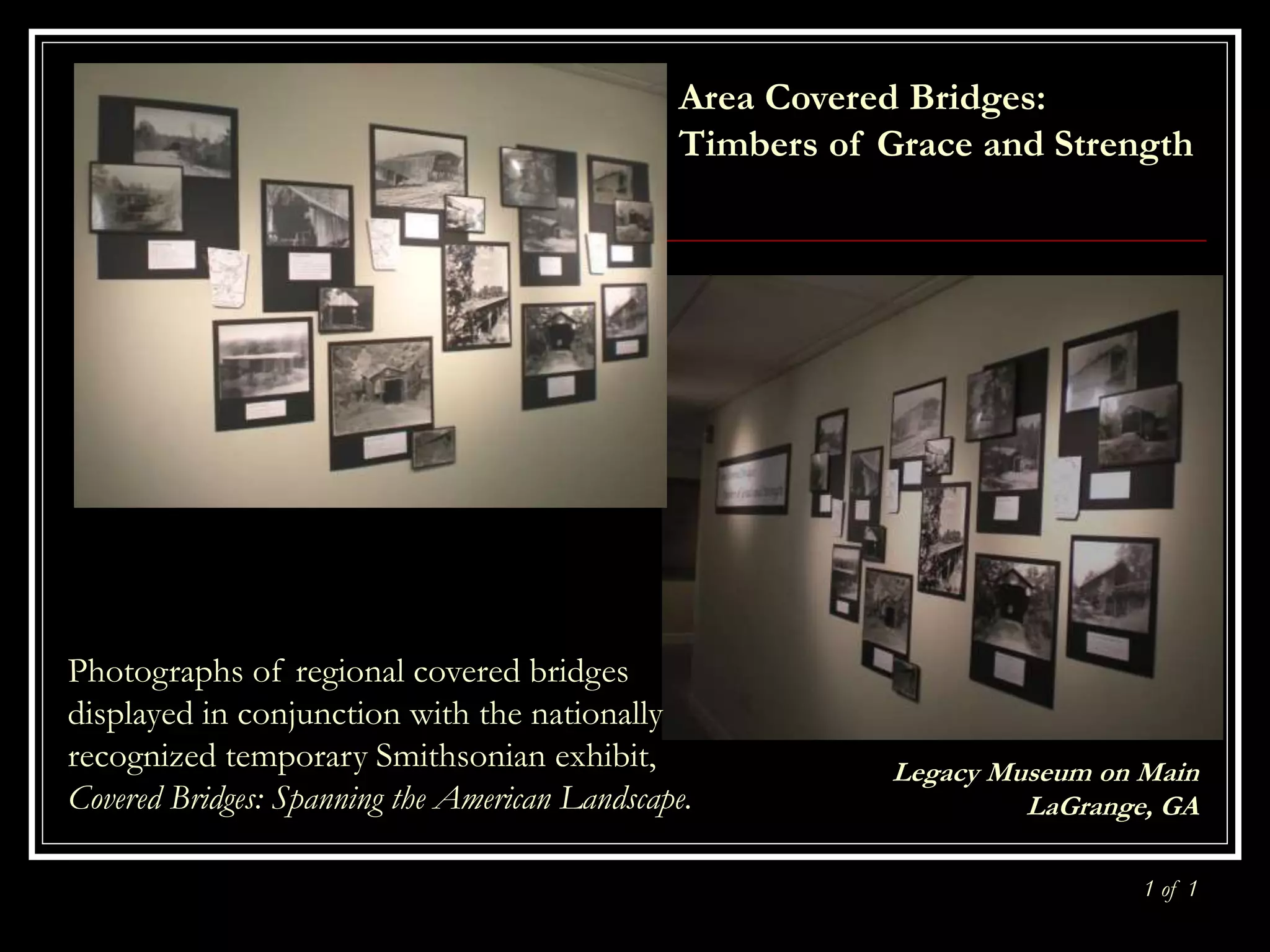
Legacy Museum on Main
LaGrange, GA
1 of 1
Area Covered Bridges:
Timbers of Grace and Strength
Photographs of regional covered bridges
displayed in conjunction with the nationally
recognized temporary Smithsonian exhibit,
Covered Bridges: Spanning the American Landscape.
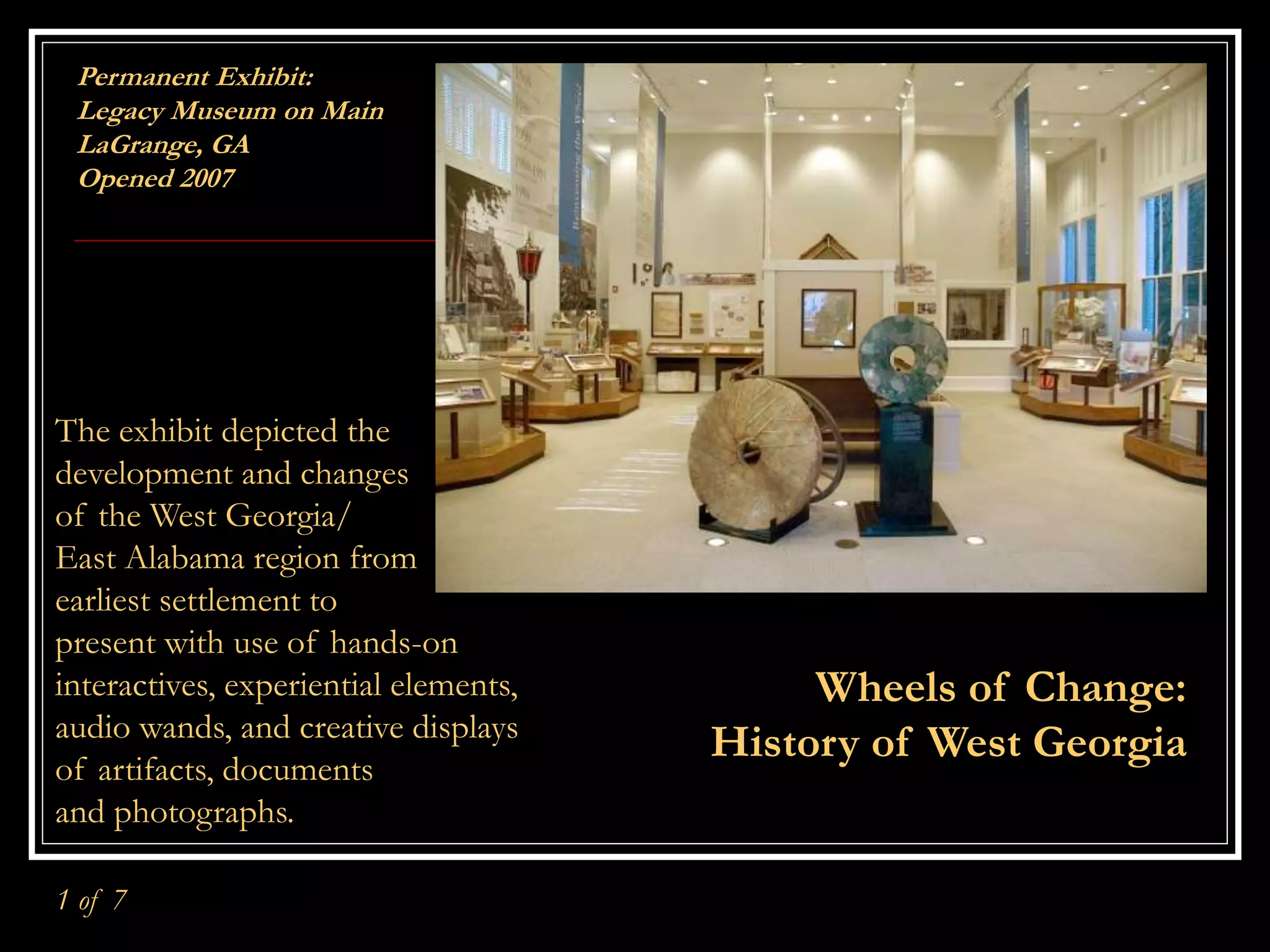
Permanent Exhibit:
Legacy Museum on Main
LaGrange, GA
Opened 2007
Wheels of Change:
History of West Georgia
The exhibit depicted the
development and changes
of the West Georgia/
East Alabama region from
earliest settlement to
present with use of hands-on
interactives, experiential elements,
audio wands, and creative displays
of artifacts, documents
and photographs.
1 of 7
Wheels of Change
2 of 7
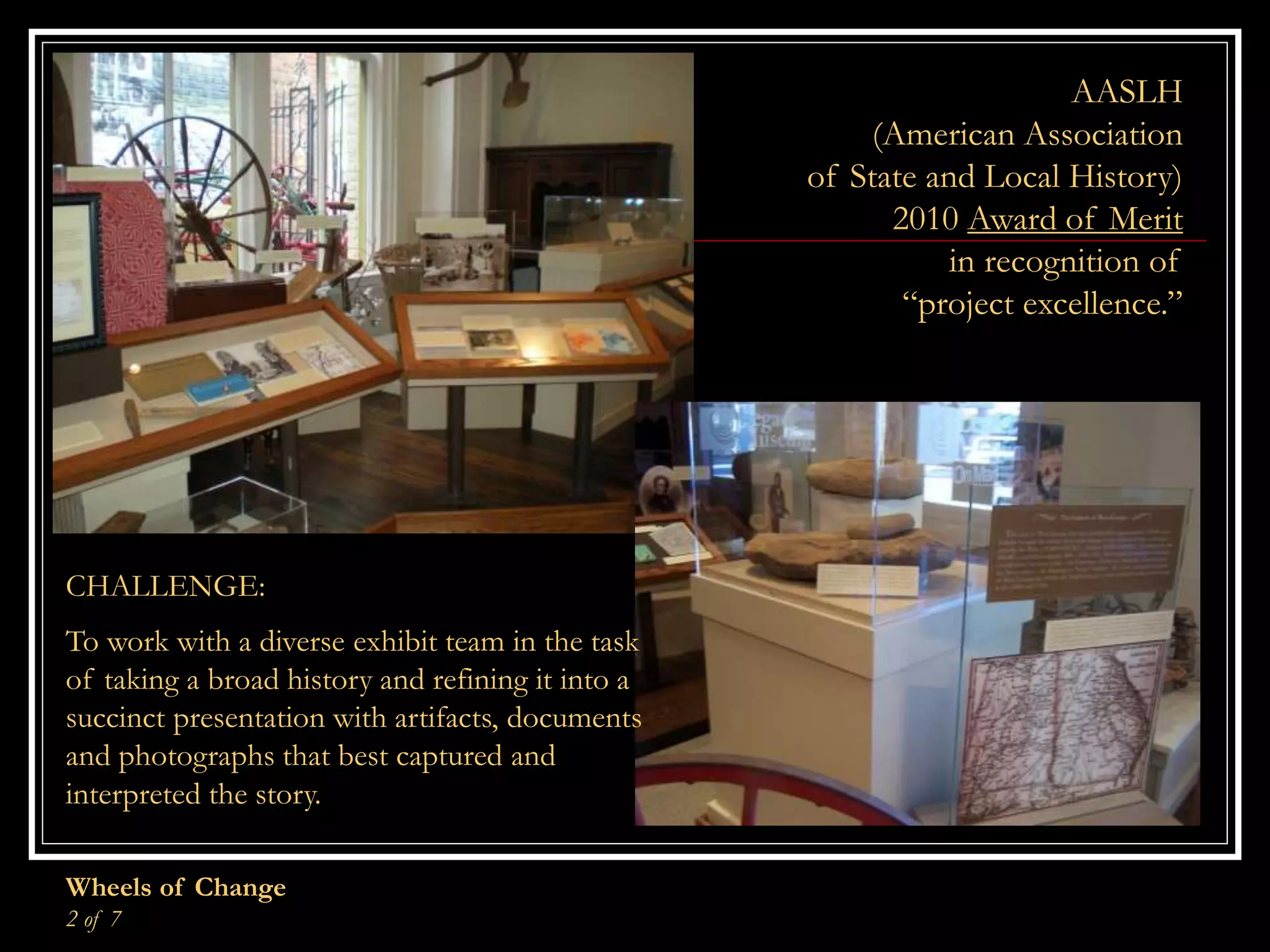
AASLH
(American Association
of State and Local History)
2010 Award of Merit
in recognition of
“project excellence.”
CHALLENGE:
To work with a diverse exhibit team in the task
of taking a broad history and refining it into a
succinct presentation with artifacts, documents
and photographs that best captured and
interpreted the story.
Wheels of Change
3 of 7
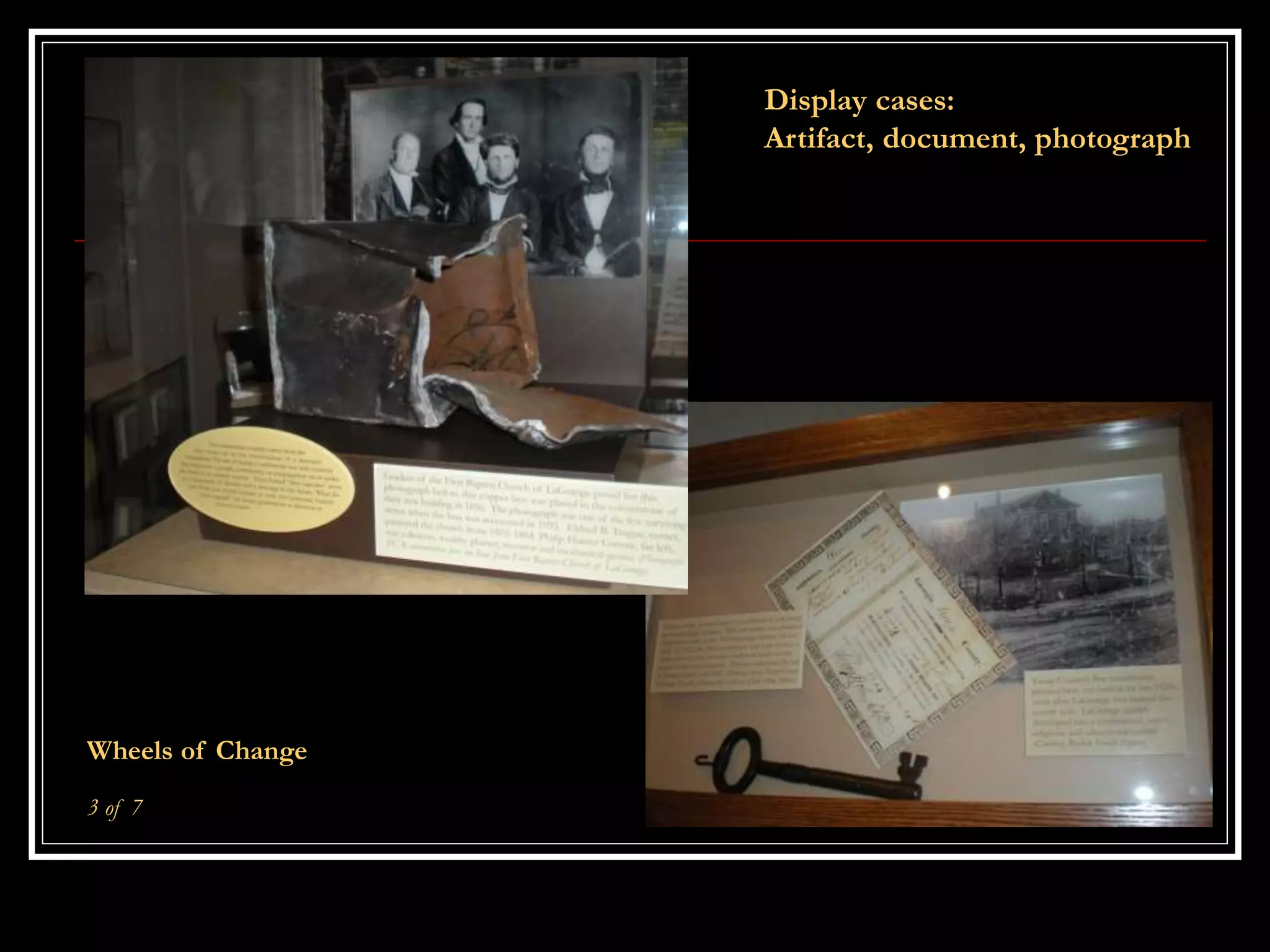
Display cases:
Artifact, document, photograph
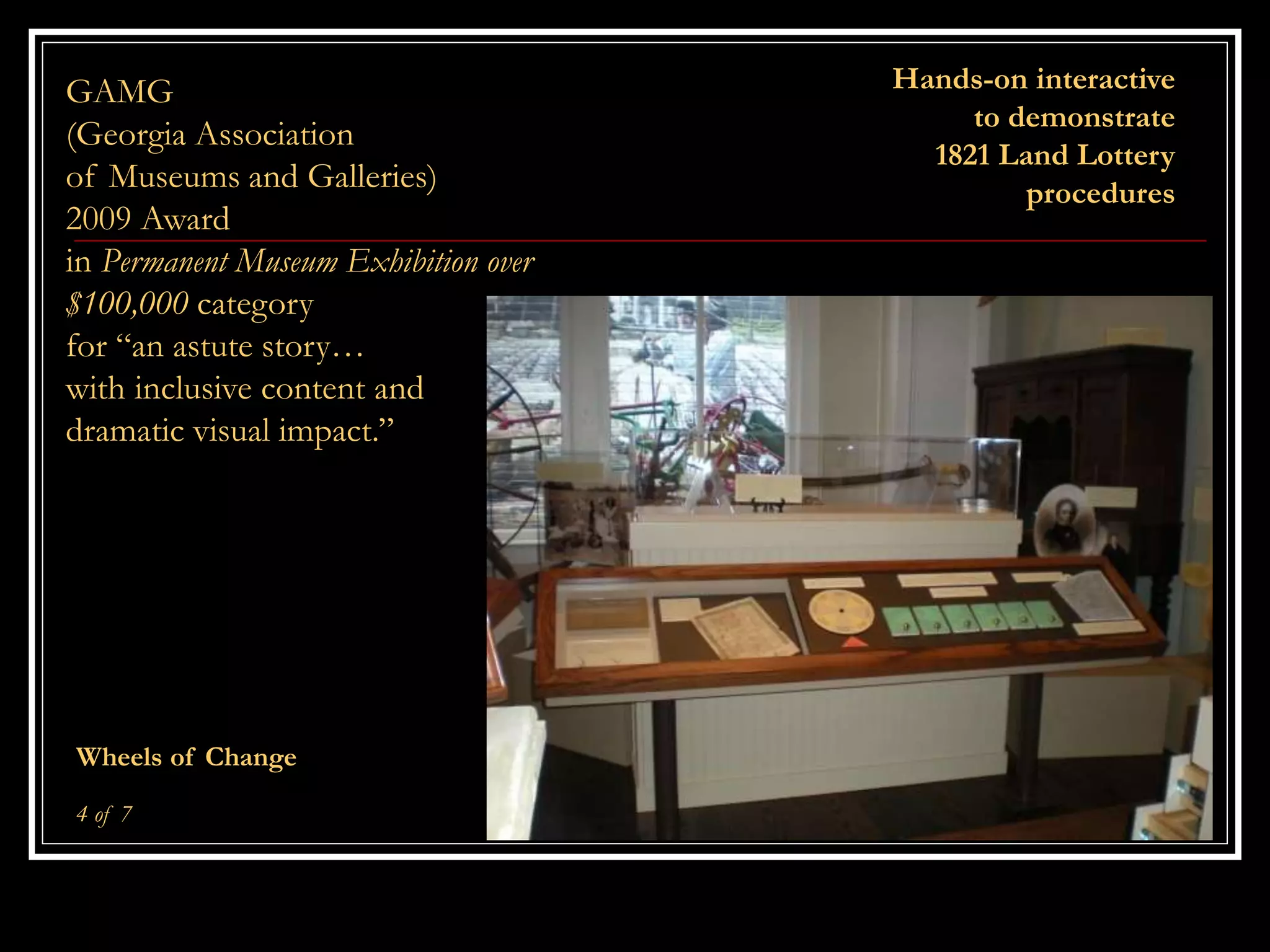
Hands-on interactive
to demonstrate
1821 Land Lottery
procedures
Wheels of Change
4 of 7
GAMG
(Georgia Association
of Museums and Galleries)
2009 Award
in Permanent Museum Exhibition over
$100,000 category
for “an astute story…
with inclusive content and
dramatic visual impact.”
Wheels of Change
5 of 7
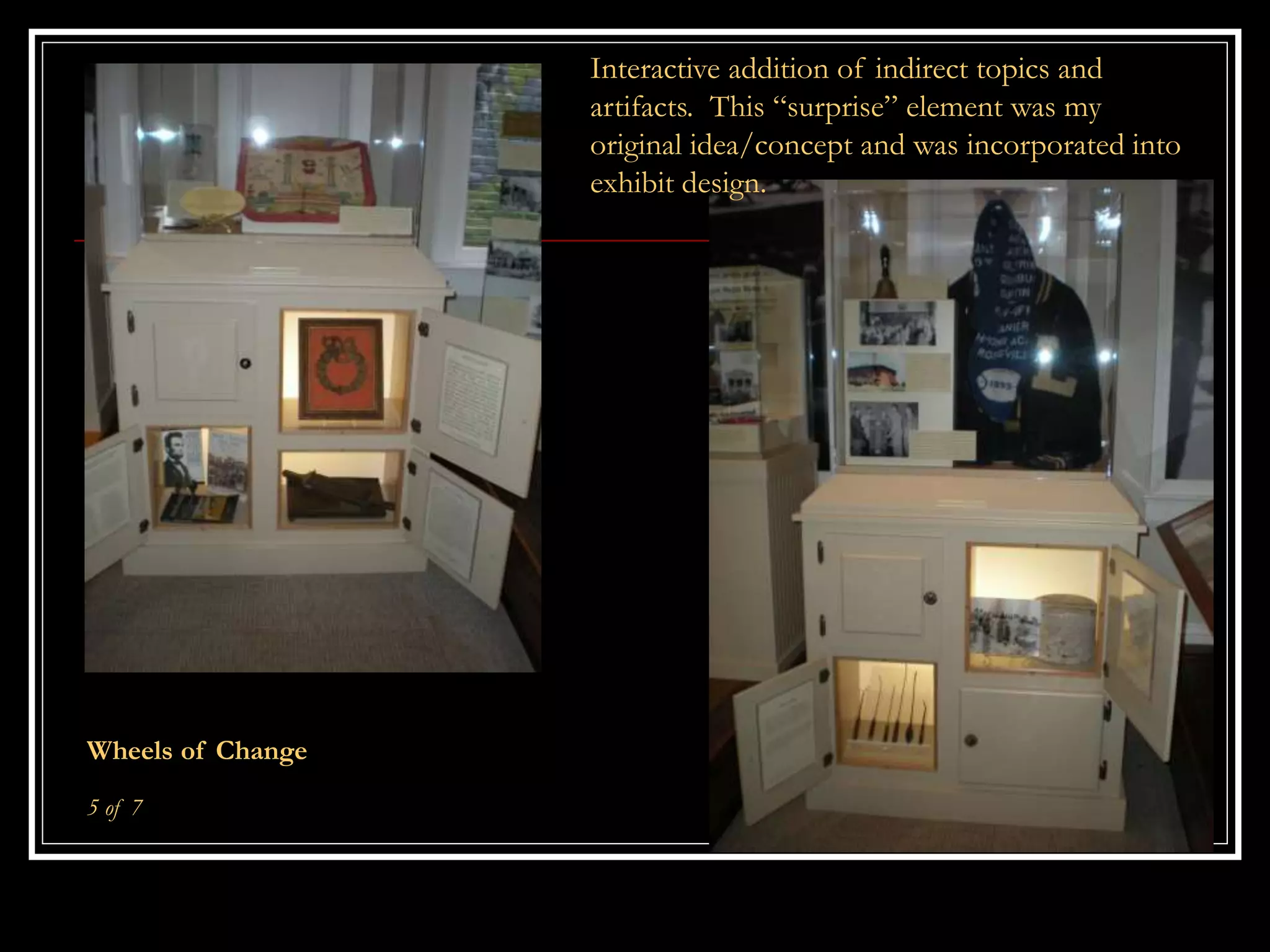
Interactive addition of indirect topics and
artifacts. This “surprise” element was my
original idea/concept and was incorporated into
exhibit design.
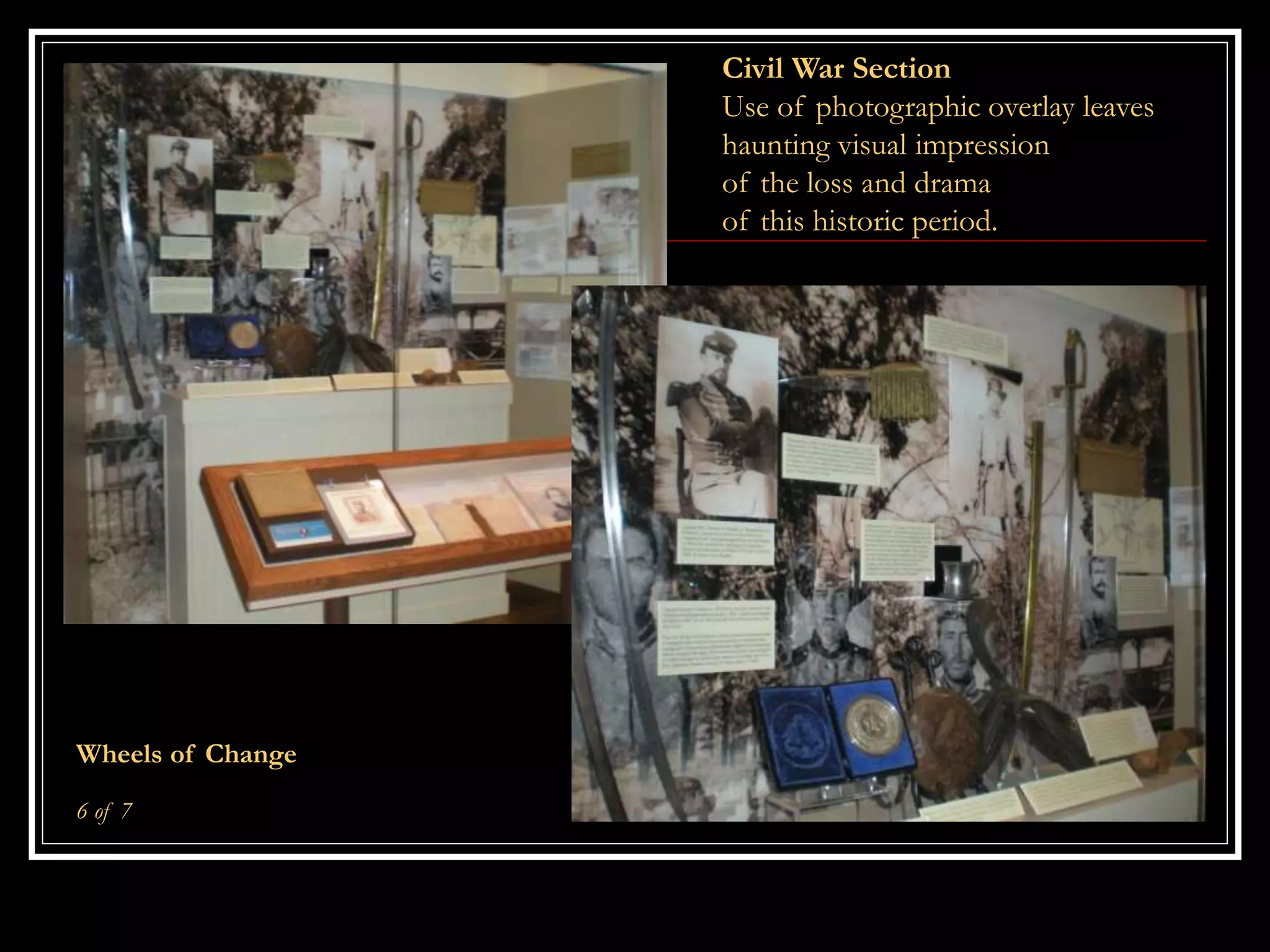
Civil War Section
Use of photographic overlay leaves
haunting visual impression
of the loss and drama
of this historic period.
Wheels of Change
6 of 7
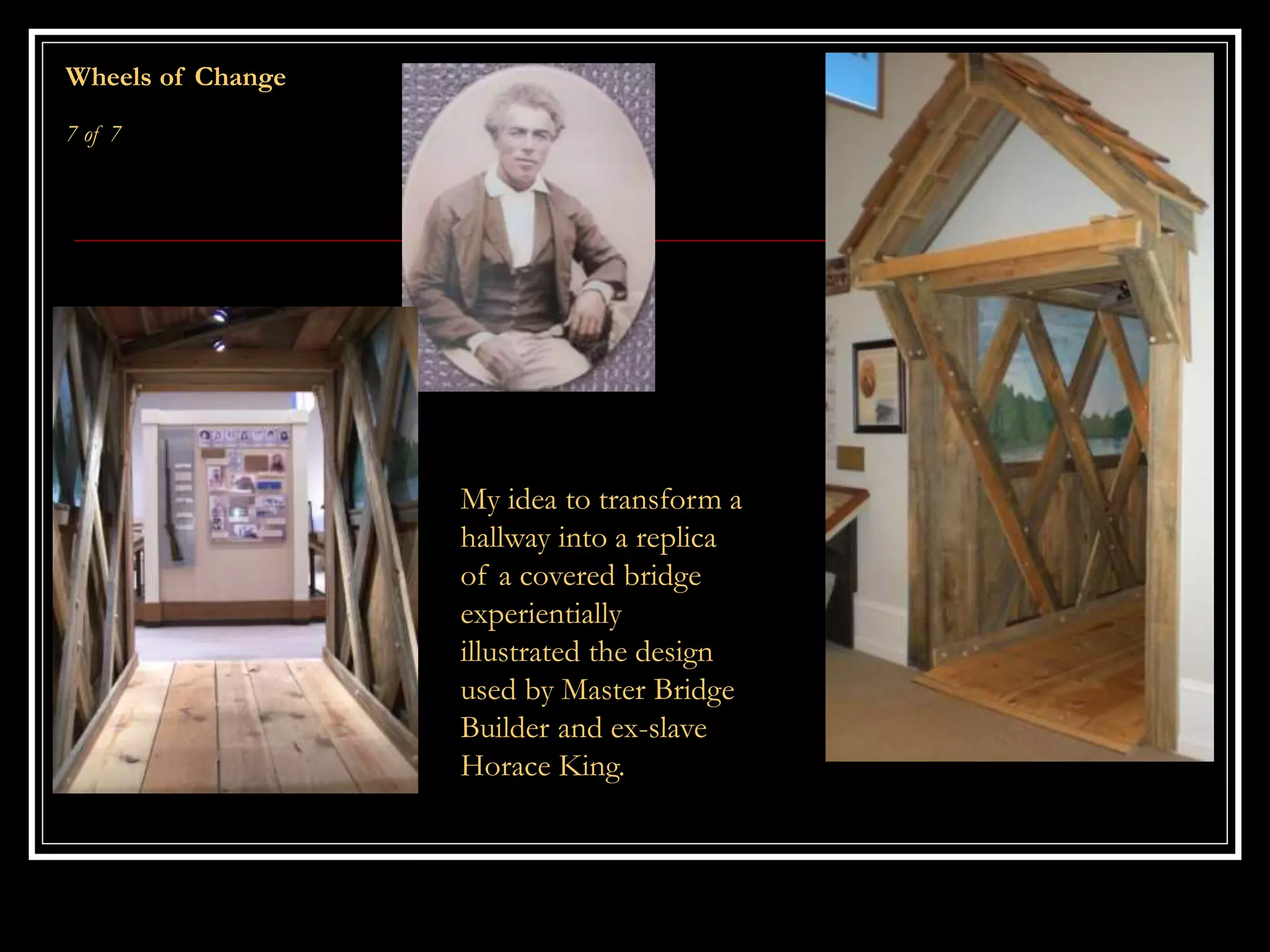
My idea to transform a
hallway into a replica
of a covered bridge
experientially
illustrated the design
used by Master Bridge
Builder and ex-slave
Horace King.
Wheels of Change
7 of 7
Celebrating 100 Years
of Boy Scouting
in West Georgia
Legacy Museum on Main
LaGrange, GA
1 of 3
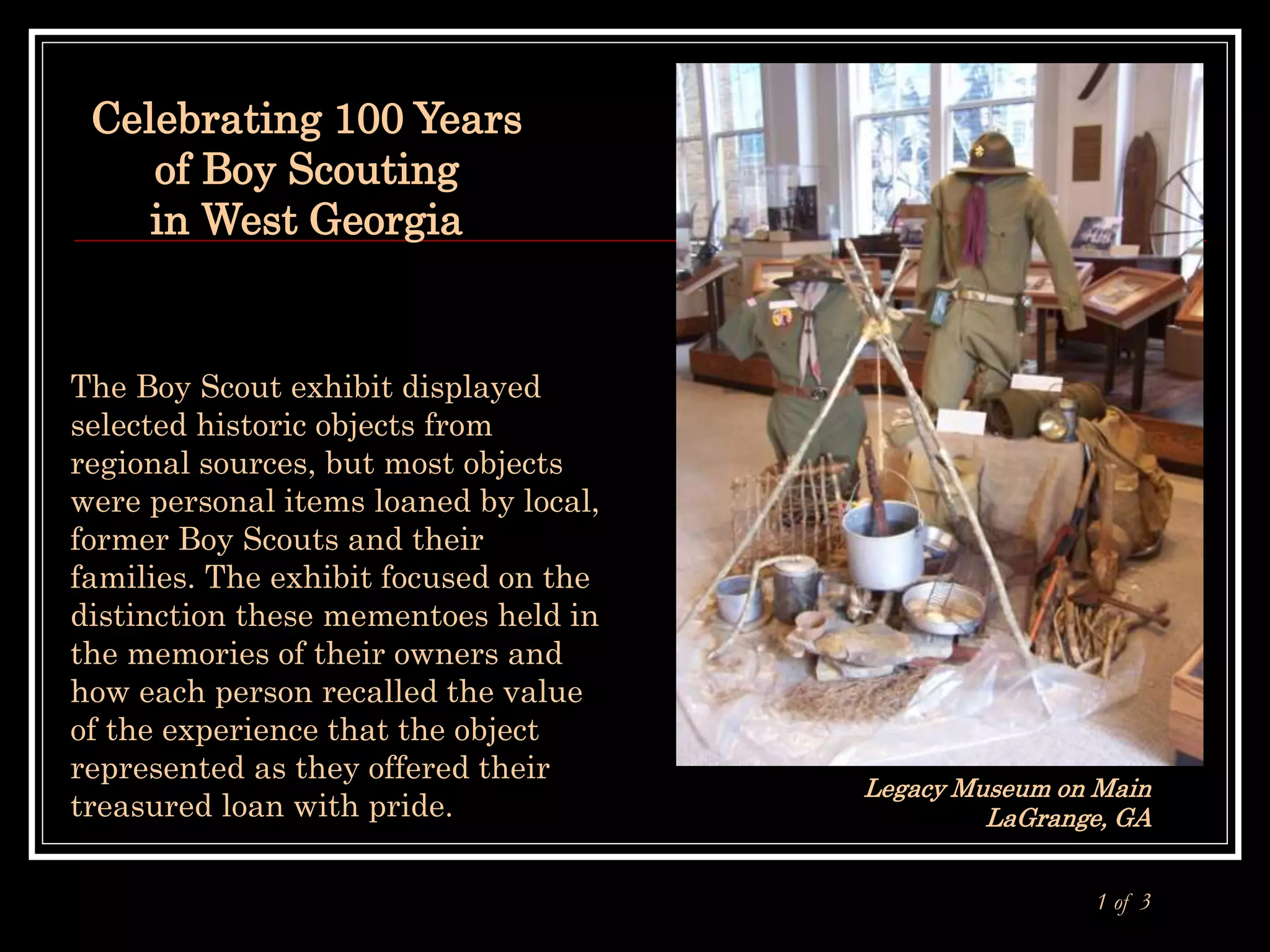
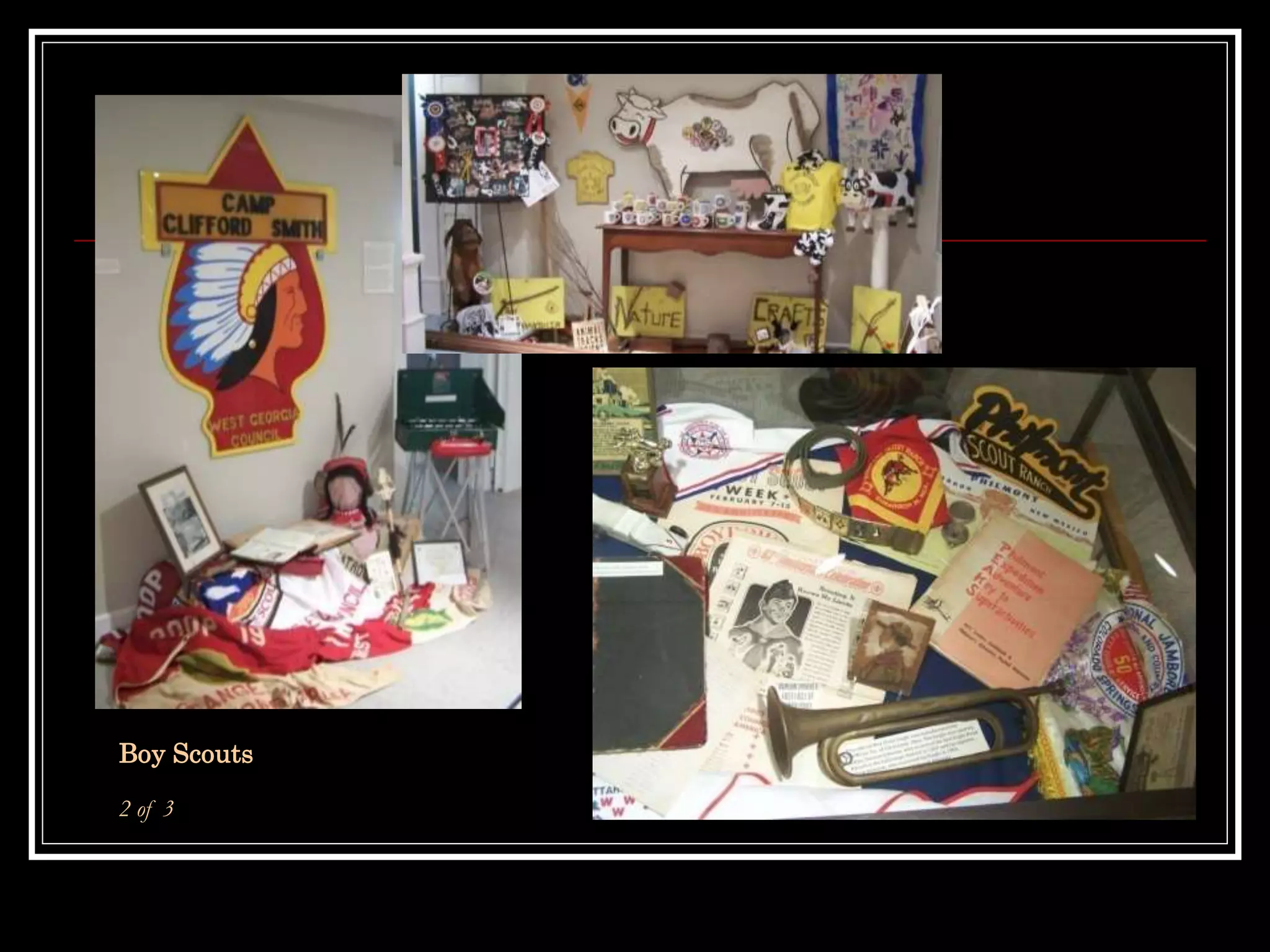
The Boy Scout exhibit displayed
selected historic objects from
regional sources, but most objects
were personal items loaned by local,
former Boy Scouts and their
families. The exhibit focused on the
distinction these mementoes held in
the memories of their owners and
how each person recalled the value
of the experience that the object
represented as they offered their
treasured loan with pride.
Boy Scouts
2 of 3
Boy Scouts
3 of 3
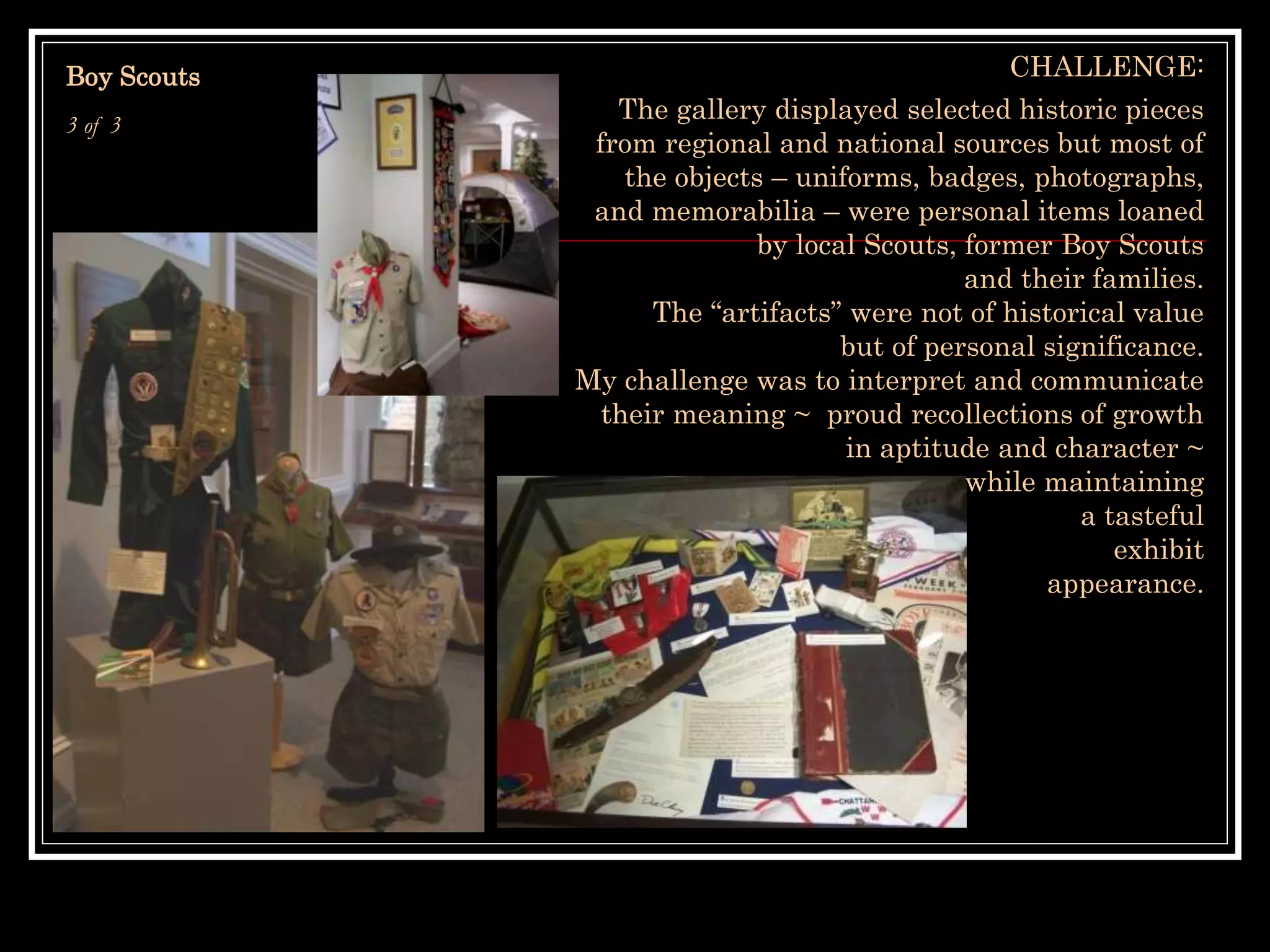
CHALLENGE:
The gallery displayed selected historic pieces
from regional and national sources but most of
the objects – uniforms, badges, photographs,
and memorabilia – were personal items loaned
by local Scouts, former Boy Scouts
and their families.
The “artifacts” were not of historical value
but of personal significance.
My challenge was to interpret and communicate
their meaning ~ proud recollections of growth
in aptitude and character ~
while maintaining
a tasteful
exhibit
appearance.
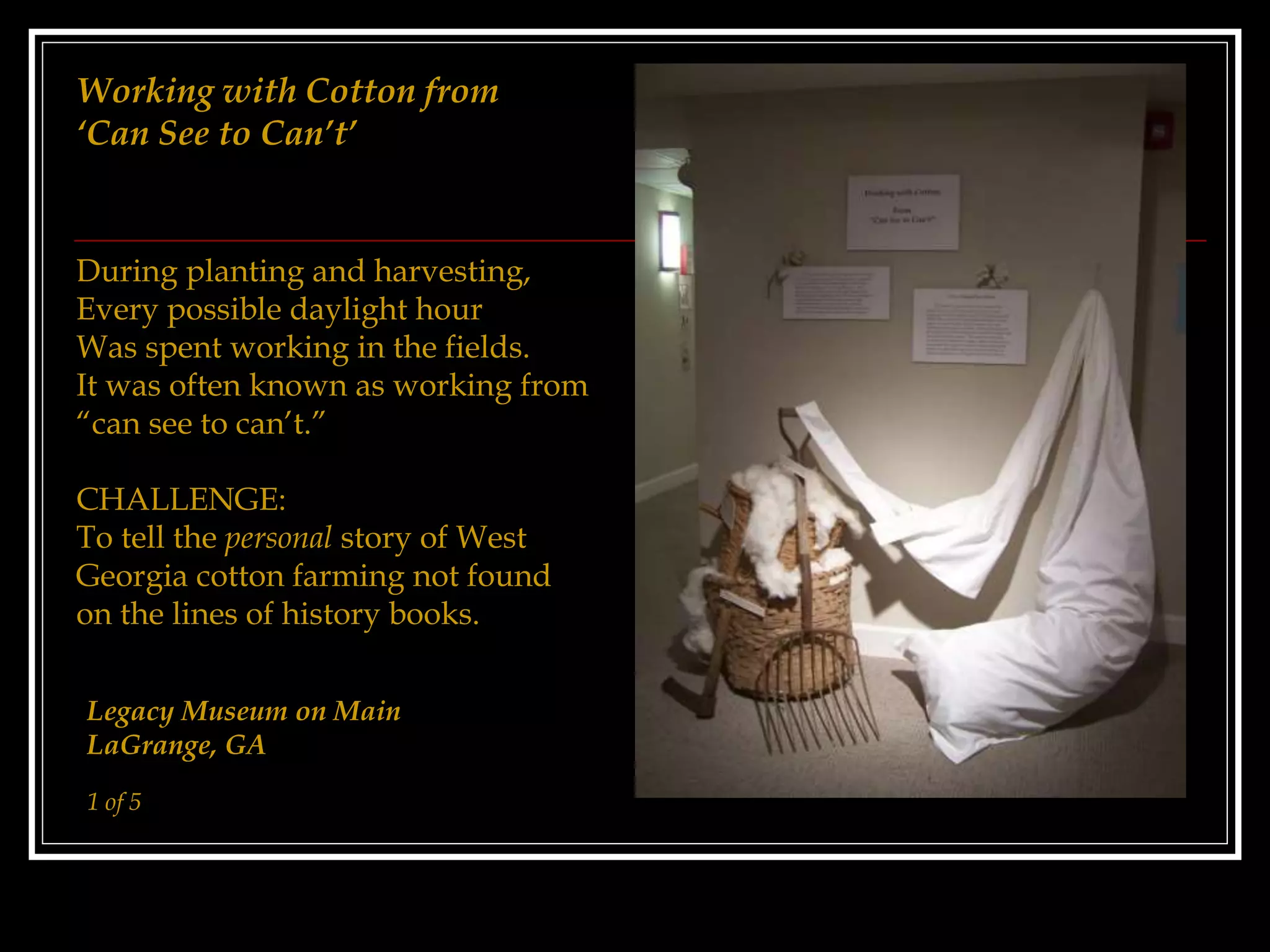
Working with Cotton from
‘Can See to Can’t’
During planting and harvesting,
Every possible daylight hour
Was spent working in the fields.
It was often known as working from
“can see to can’t.”
CHALLENGE:
To tell the personal story of West
Georgia cotton farming not found
on the lines of history books.
Legacy Museum on Main
LaGrange, GA
1 of 5
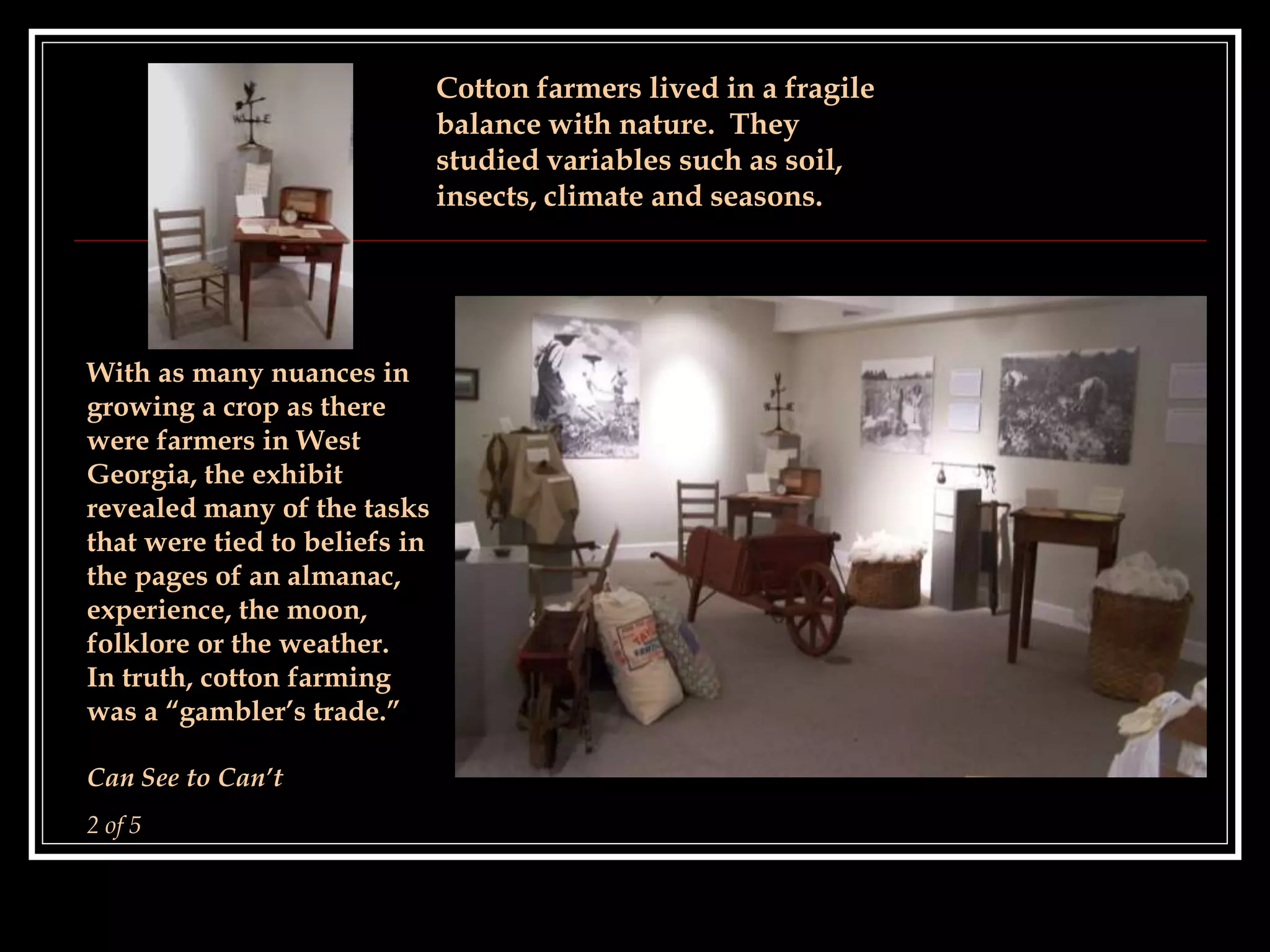
Cotton farmers lived in a fragile
balance with nature. They
studied variables such as soil,
insects, climate and seasons.
With as many nuances in
growing a crop as there
were farmers in West
Georgia, the exhibit
revealed many of the tasks
that were tied to beliefs in
the pages of an almanac,
experience, the moon,
folklore or the weather.
In truth, cotton farming
was a “gambler’s trade.”
Can See to Can’t
2 of 5
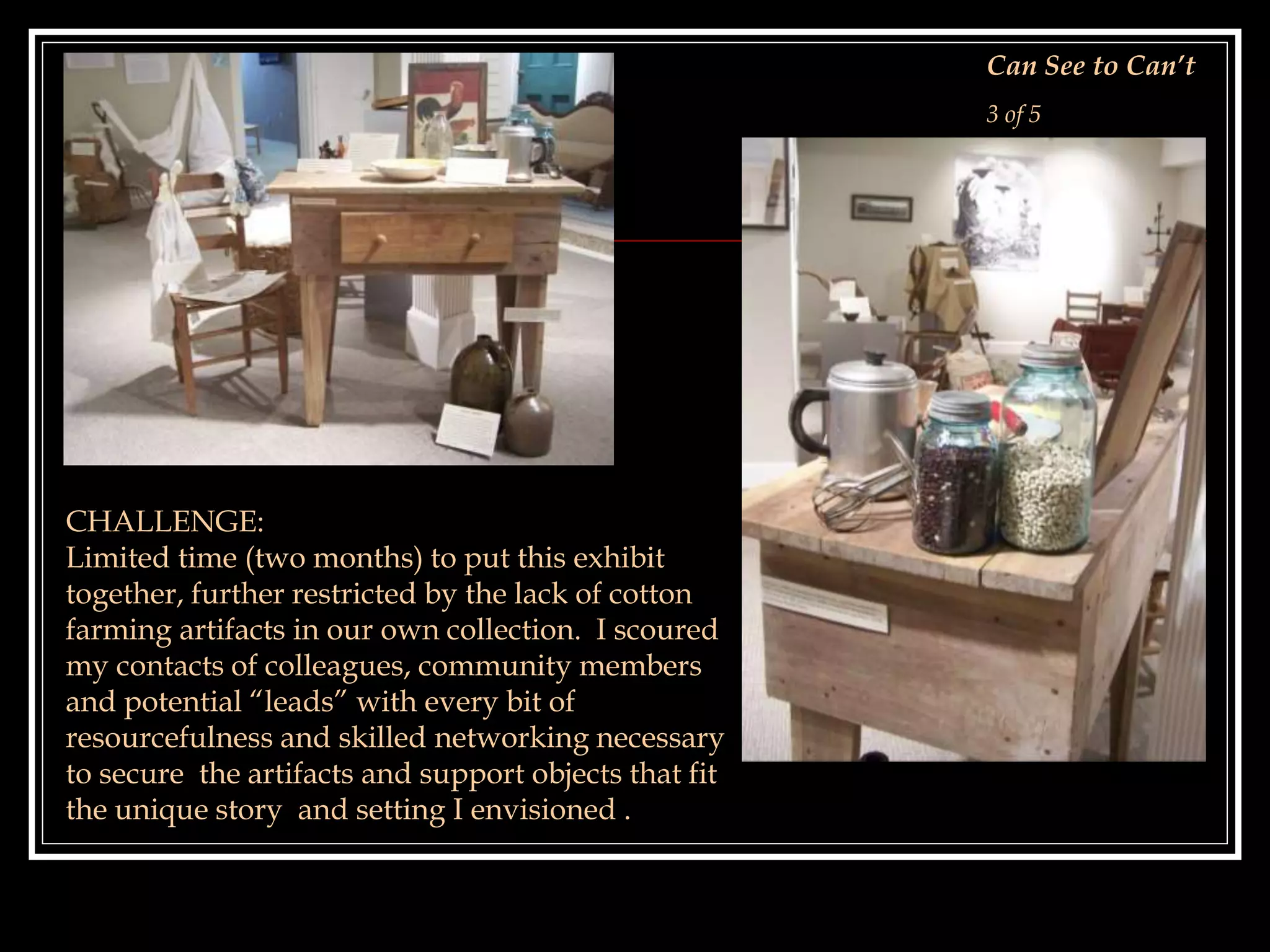
CHALLENGE:
Limited time (two months) to put this exhibit
together, further restricted by the lack of cotton
farming artifacts in our own collection. I scoured
my contacts of colleagues, community members
and potential “leads” with every bit of
resourcefulness and skilled networking necessary
to secure the artifacts and support objects that fit
the unique story and setting I envisioned .
Can See to Can’t
3 of 5
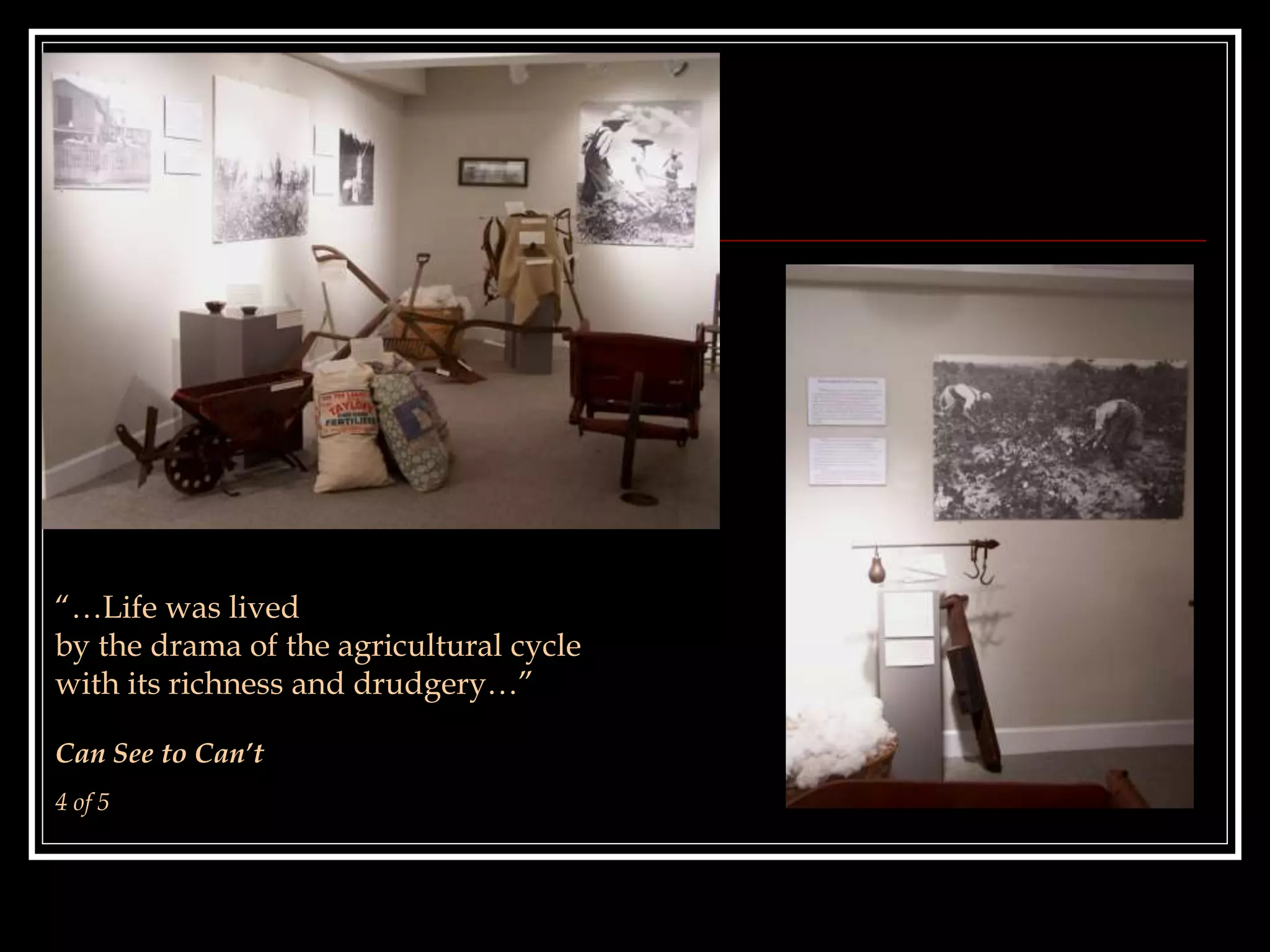
“…Life was lived
by the drama of the agricultural cycle
with its richness and drudgery…”
Can See to Can’t
4 of 5
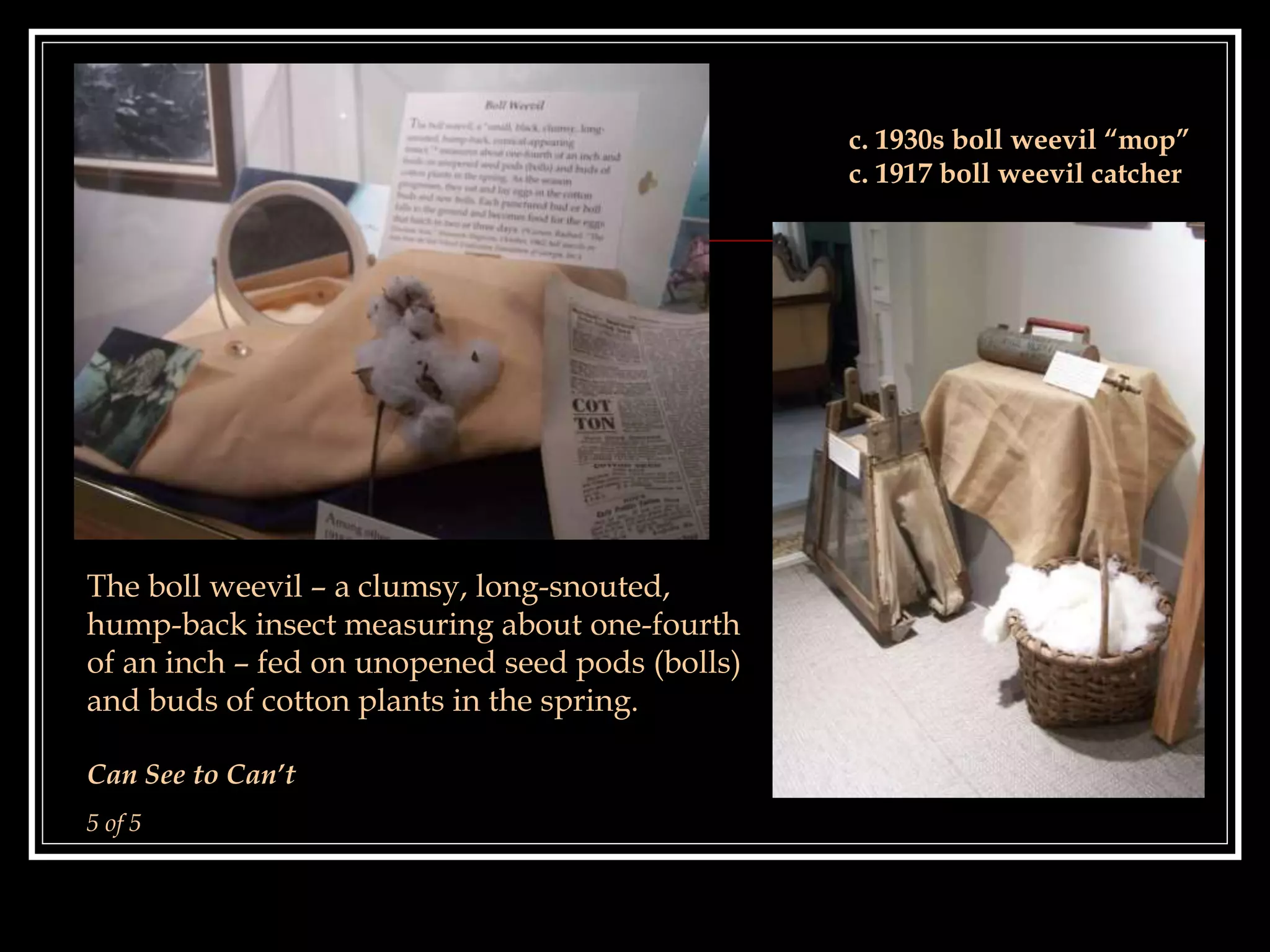
The boll weevil – a clumsy, long-snouted,
hump-back insect measuring about one-fourth
of an inch – fed on unopened seed pods (bolls)
and buds of cotton plants in the spring.
Can See to Can’t
5 of 5
c. 1930s boll weevil “mop”
c. 1917 boll weevil catcher

Exhibits portfolio.9.19.section.1

  • 1.
    Exhibits Portfolio Laurie A.Sedicino, MA MHP Museum Curator ~ Creative Exhibits ~ Thoughtful Storylines ~ Engaging displays Section 1
  • 2.
    I have includedmany samples of the exhibitions I have curated in this PowerPoint so you can get a visual feel for my style, understand some of the challenges I faced in each of the exhibitions, and notice the evolution of my professional growth. Thank you for taking the time to peruse my exhibitions portfolio.
  • 3.
    1. Georgia StateUniversity Student Project, Atlanta, GA, 2003  RICHS: The Store that Married a City 2. Robert C. Williams Paper Museum, Atlanta, GA, 2005-2007  The Hand-Crafted Book: Dard Hunter’s Legacy  Hidden Imagery: The Mystery of Watermarks 3. Legacy Museum on Main, LaGrange, GA, 2007-2012  Area Covered Bridges: Timbers of Grace and Strength Contents
  • 4.
    This exhibition wasa class student project that featured the story of Morris Rich, Hungarian immigrant, who rose to own the most famous mercantile establishment in the South. The exhibit, with its affectionate portrayal of the store, focused on the store’s unique relationship with its customers.
  • 5.
    The exhibit wasdisplayed in the original 1923 storefront windows of Rich’s department store in Atlanta, GA, now the General Services Administration federal building and won the 2003 National Council of Public History Project Award. “…If Rich’s decided to sell green shoes at Christmastime, everybody else would sell green shoes at Christmastime, too…” Civil Rights leader Julian Bond Greatest accomplishment: Scouring area antique shops for items with the Rich’s label for the display…and, aware of the Julian Bond quote, finding these green shoes with the Rich’s label inside!
  • 6.
    Robert C. WilliamsPaper Museum Atlanta, GA 1 of 2 The Hand-Crafted Book: Dard Hunter’s Legacy
  • 7.
    The Hand-Crafted Book: DardHunter’s Legacy 2 of 2
  • 8.
    Robert C. WilliamsPaper Museum Atlanta, GA 1 of 2
  • 9.
    Hidden Imagery: The Mysteryof Watermarks 2 of 2
  • 10.
    Legacy Museum onMain LaGrange, GA 1 of 1 Area Covered Bridges: Timbers of Grace and Strength Photographs of regional covered bridges displayed in conjunction with the nationally recognized temporary Smithsonian exhibit, Covered Bridges: Spanning the American Landscape.
  • 11.
    Permanent Exhibit: Legacy Museumon Main LaGrange, GA Opened 2007 Wheels of Change: History of West Georgia The exhibit depicted the development and changes of the West Georgia/ East Alabama region from earliest settlement to present with use of hands-on interactives, experiential elements, audio wands, and creative displays of artifacts, documents and photographs. 1 of 7
  • 12.
    Wheels of Change 2of 7 AASLH (American Association of State and Local History) 2010 Award of Merit in recognition of “project excellence.” CHALLENGE: To work with a diverse exhibit team in the task of taking a broad history and refining it into a succinct presentation with artifacts, documents and photographs that best captured and interpreted the story.
  • 13.
    Wheels of Change 3of 7 Display cases: Artifact, document, photograph
  • 14.
    Hands-on interactive to demonstrate 1821Land Lottery procedures Wheels of Change 4 of 7 GAMG (Georgia Association of Museums and Galleries) 2009 Award in Permanent Museum Exhibition over $100,000 category for “an astute story… with inclusive content and dramatic visual impact.”
  • 15.
    Wheels of Change 5of 7 Interactive addition of indirect topics and artifacts. This “surprise” element was my original idea/concept and was incorporated into exhibit design.
  • 16.
    Civil War Section Useof photographic overlay leaves haunting visual impression of the loss and drama of this historic period. Wheels of Change 6 of 7
  • 17.
    My idea totransform a hallway into a replica of a covered bridge experientially illustrated the design used by Master Bridge Builder and ex-slave Horace King. Wheels of Change 7 of 7
  • 18.
    Celebrating 100 Years ofBoy Scouting in West Georgia Legacy Museum on Main LaGrange, GA 1 of 3 The Boy Scout exhibit displayed selected historic objects from regional sources, but most objects were personal items loaned by local, former Boy Scouts and their families. The exhibit focused on the distinction these mementoes held in the memories of their owners and how each person recalled the value of the experience that the object represented as they offered their treasured loan with pride.
  • 19.
  • 20.
    Boy Scouts 3 of3 CHALLENGE: The gallery displayed selected historic pieces from regional and national sources but most of the objects – uniforms, badges, photographs, and memorabilia – were personal items loaned by local Scouts, former Boy Scouts and their families. The “artifacts” were not of historical value but of personal significance. My challenge was to interpret and communicate their meaning ~ proud recollections of growth in aptitude and character ~ while maintaining a tasteful exhibit appearance.
  • 21.
    Working with Cottonfrom ‘Can See to Can’t’ During planting and harvesting, Every possible daylight hour Was spent working in the fields. It was often known as working from “can see to can’t.” CHALLENGE: To tell the personal story of West Georgia cotton farming not found on the lines of history books. Legacy Museum on Main LaGrange, GA 1 of 5
  • 22.
    Cotton farmers livedin a fragile balance with nature. They studied variables such as soil, insects, climate and seasons. With as many nuances in growing a crop as there were farmers in West Georgia, the exhibit revealed many of the tasks that were tied to beliefs in the pages of an almanac, experience, the moon, folklore or the weather. In truth, cotton farming was a “gambler’s trade.” Can See to Can’t 2 of 5
  • 23.
    CHALLENGE: Limited time (twomonths) to put this exhibit together, further restricted by the lack of cotton farming artifacts in our own collection. I scoured my contacts of colleagues, community members and potential “leads” with every bit of resourcefulness and skilled networking necessary to secure the artifacts and support objects that fit the unique story and setting I envisioned . Can See to Can’t 3 of 5
  • 24.
    “…Life was lived bythe drama of the agricultural cycle with its richness and drudgery…” Can See to Can’t 4 of 5
  • 25.
    The boll weevil– a clumsy, long-snouted, hump-back insect measuring about one-fourth of an inch – fed on unopened seed pods (bolls) and buds of cotton plants in the spring. Can See to Can’t 5 of 5 c. 1930s boll weevil “mop” c. 1917 boll weevil catcher