+
Building a Foundation
for Leadership:
A Progress Report of the
Tennessee Civil War National
Heritage Area, 2003-2008
+
2
What is the Tennessee
Civil War National
Heritage Area?
With help from citizens from across the state,
the Tennessee Civil War National Heritage Area
tells the whole story of America’s greatest
challenge, 1860-75.
A partnership unit of the National Park Service,
the Heritage Area provides professional
services and matching funds for conservation
planning, historic site documentation, research,
interpretation, educational programming,
exhibits, heritage tourism, and park
development that encourages economic
development.
Administered by the Center for Historic
Preservation at Middle Tennessee State
University for the people and communities of
Tennessee, the Heritage Area tells the stories
and promotes the significant places of the Civil
War era, to diverse, statewide audiences in
diverse settings, through reciprocal public-
private partnerships. Our programs and
projects explore the themes of warfare,
occupation, the homefront, Emancipation, and
Reconstruction.
+ 3
Goal 1: A greater understanding of the national
significance of the Civil War as conveyed by places,
stories, and artifacts in Tennessee
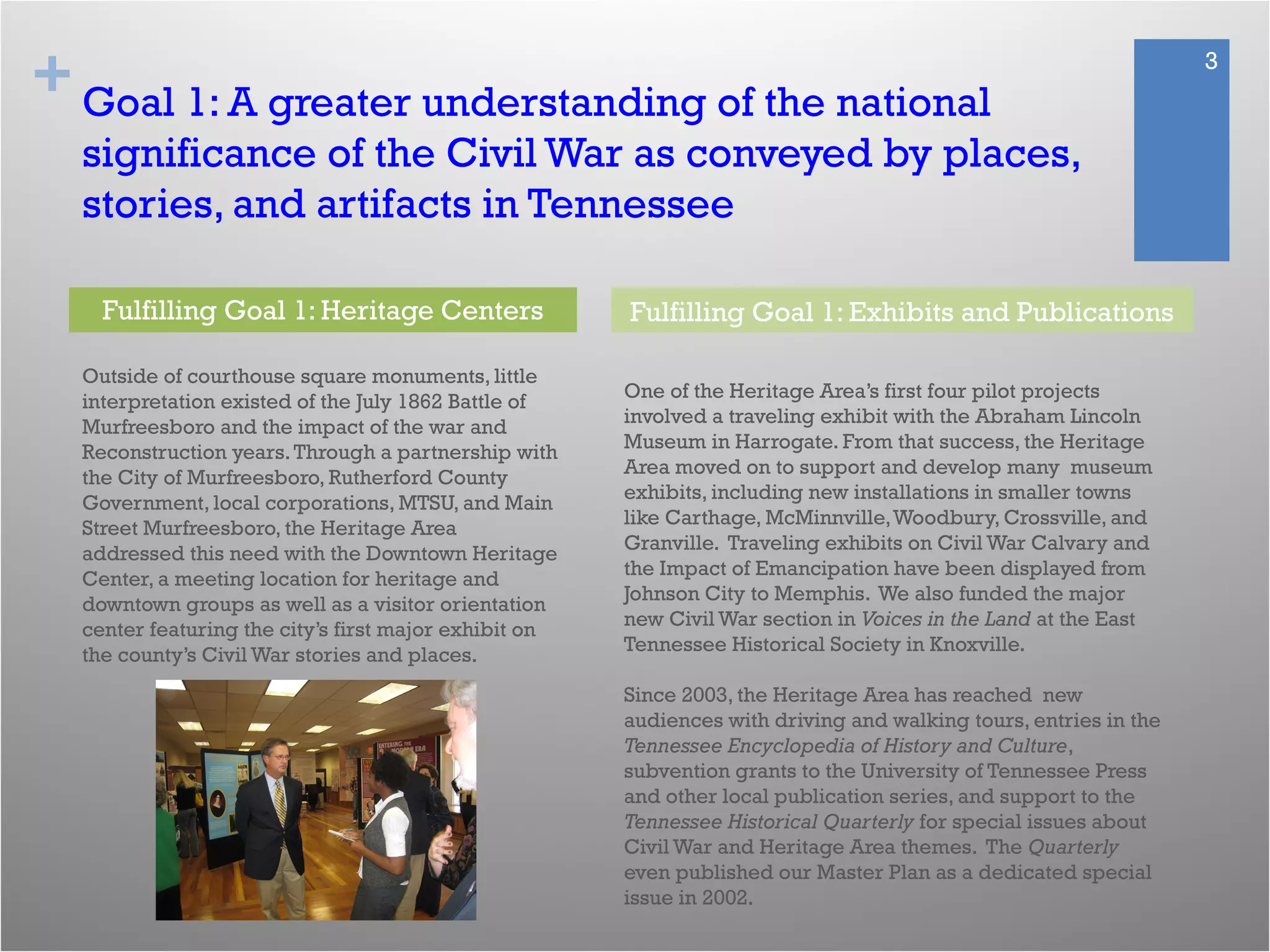
Outside of courthouse square monuments, little
interpretation existed of the July 1862 Battle of
Murfreesboro and the impact of the war and
Reconstruction years.Through a partnership with
the City of Murfreesboro, Rutherford County
Government, local corporations, MTSU, and Main
Street Murfreesboro, the Heritage Area
addressed this need with the Downtown Heritage
Center, a meeting location for heritage and
downtown groups as well as a visitor orientation
center featuring the city’s first major exhibit on
the county’s Civil War stories and places.
One of the Heritage Area’s first four pilot projects
involved a traveling exhibit with the Abraham Lincoln
Museum in Harrogate. From that success, the Heritage
Area moved on to support and develop many museum
exhibits, including new installations in smaller towns
like Carthage, McMinnville,Woodbury, Crossville, and
Granville. Traveling exhibits on Civil War Calvary and
the Impact of Emancipation have been displayed from
Johnson City to Memphis. We also funded the major
new Civil War section in Voices in the Land at the East
Tennessee Historical Society in Knoxville.
Since 2003, the Heritage Area has reached new
audiences with driving and walking tours, entries in the
Tennessee Encyclopedia of History and Culture,
subvention grants to the University of Tennessee Press
and other local publication series, and support to the
Tennessee Historical Quarterly for special issues about
Civil War and Heritage Area themes. The Quarterly
even published our Master Plan as a dedicated special
issue in 2002.
Fulfilling Goal 1: Heritage Centers Fulfilling Goal 1: Exhibits and Publications
+ 4
Fulfilling Goal One:Taking new evidence and
scholarly perspective to the public
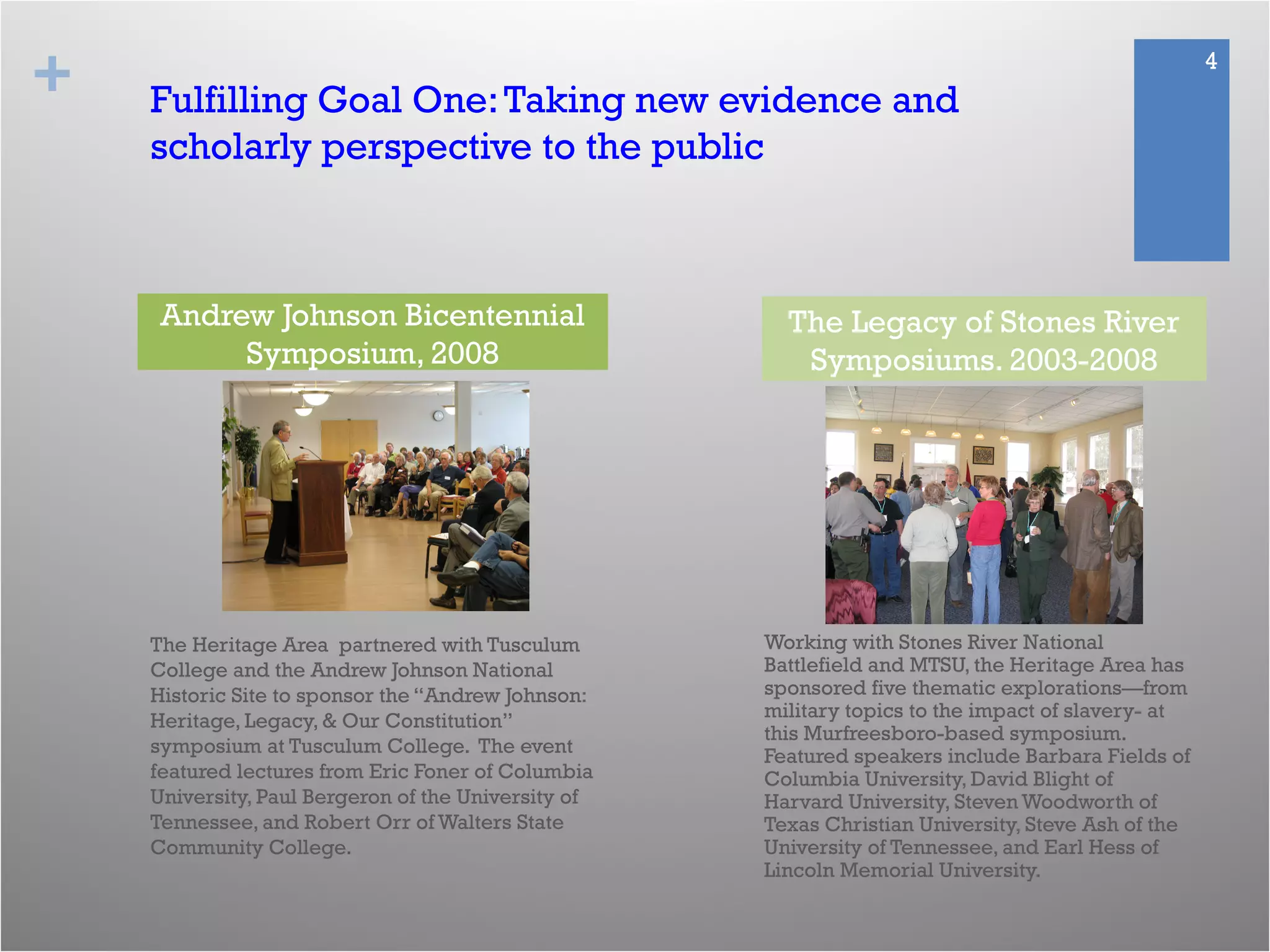
The Heritage Area partnered with Tusculum
College and the Andrew Johnson National
Historic Site to sponsor the “Andrew Johnson:
Heritage, Legacy, & Our Constitution”
symposium at Tusculum College. The event
featured lectures from Eric Foner of Columbia
University, Paul Bergeron of the University of
Tennessee, and Robert Orr of Walters State
Community College.
Working with Stones River National
Battlefield and MTSU, the Heritage Area has
sponsored five thematic explorations—from
military topics to the impact of slavery- at
this Murfreesboro-based symposium.
Featured speakers include Barbara Fields of
Columbia University, David Blight of
Harvard University, Steven Woodworth of
Texas Christian University, Steve Ash of the
University of Tennessee, and Earl Hess of
Lincoln Memorial University.
Andrew Johnson Bicentennial
Symposium, 2008
The Legacy of Stones River
Symposiums. 2003-2008
+ 5
Fulfilling Goal 1: Providing Educators with New Teaching
Materials and Curricula
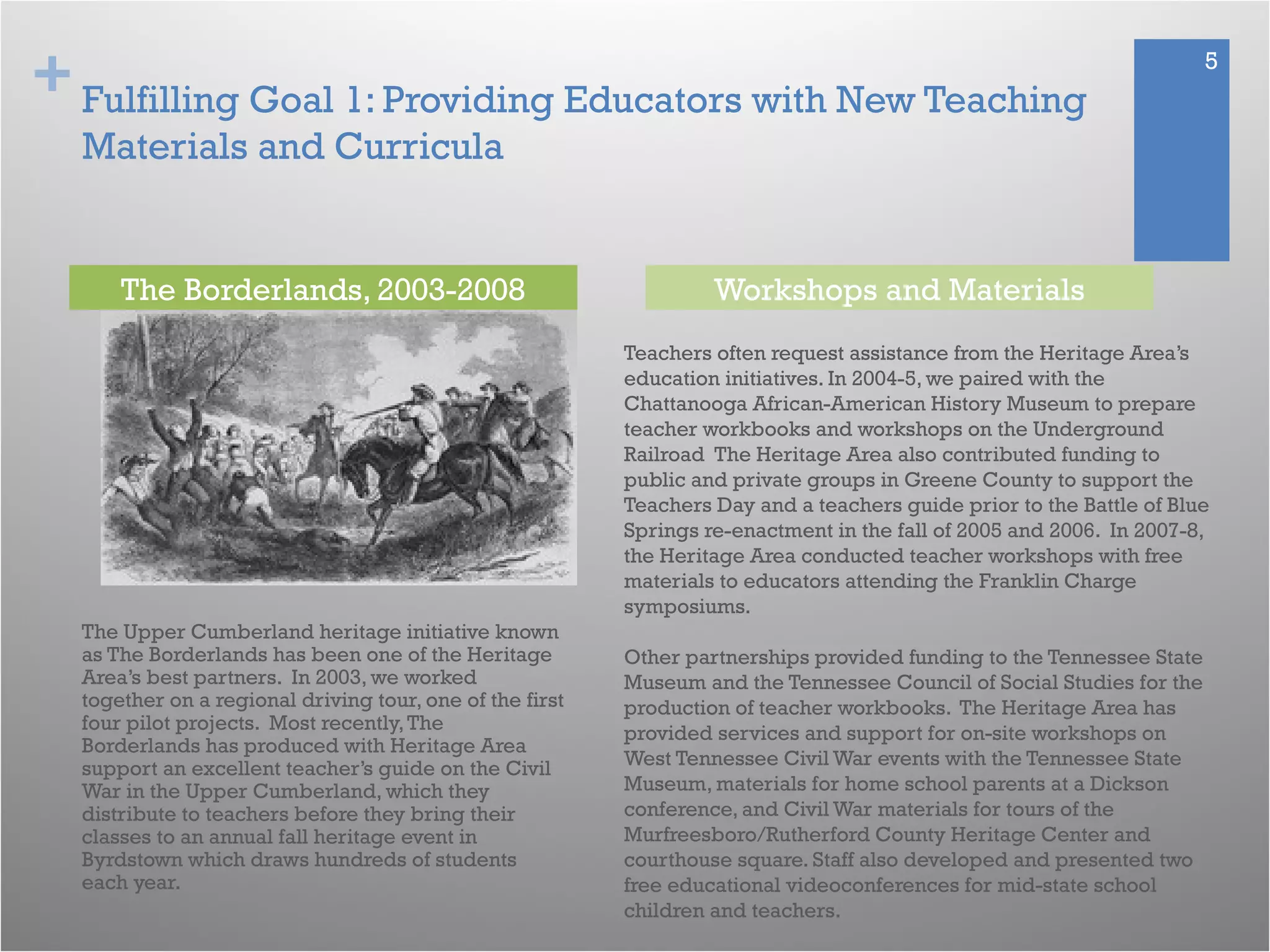
The Upper Cumberland heritage initiative known
as The Borderlands has been one of the Heritage
Area’s best partners. In 2003, we worked
together on a regional driving tour, one of the first
four pilot projects. Most recently,The
Borderlands has produced with Heritage Area
support an excellent teacher’s guide on the Civil
War in the Upper Cumberland, which they
distribute to teachers before they bring their
classes to an annual fall heritage event in
Byrdstown which draws hundreds of students
each year.
Teachers often request assistance from the Heritage Area’s
education initiatives. In 2004-5, we paired with the
Chattanooga African-American History Museum to prepare
teacher workbooks and workshops on the Underground
Railroad The Heritage Area also contributed funding to
public and private groups in Greene County to support the
Teachers Day and a teachers guide prior to the Battle of Blue
Springs re-enactment in the fall of 2005 and 2006. In 2007-8,
the Heritage Area conducted teacher workshops with free
materials to educators attending the Franklin Charge
symposiums.
Other partnerships provided funding to the Tennessee State
Museum and the Tennessee Council of Social Studies for the
production of teacher workbooks. The Heritage Area has
provided services and support for on-site workshops on
West Tennessee Civil War events with the Tennessee State
Museum, materials for home school parents at a Dickson
conference, and Civil War materials for tours of the
Murfreesboro/Rutherford County Heritage Center and
courthouse square. Staff also developed and presented two
free educational videoconferences for mid-state school
children and teachers.
The Borderlands, 2003-2008 Workshops and Materials
+ 6
Goal 2: Improving the conservation ethic for Civil
War-era properties, their surrounding landscapes,
their traditions, and their stories
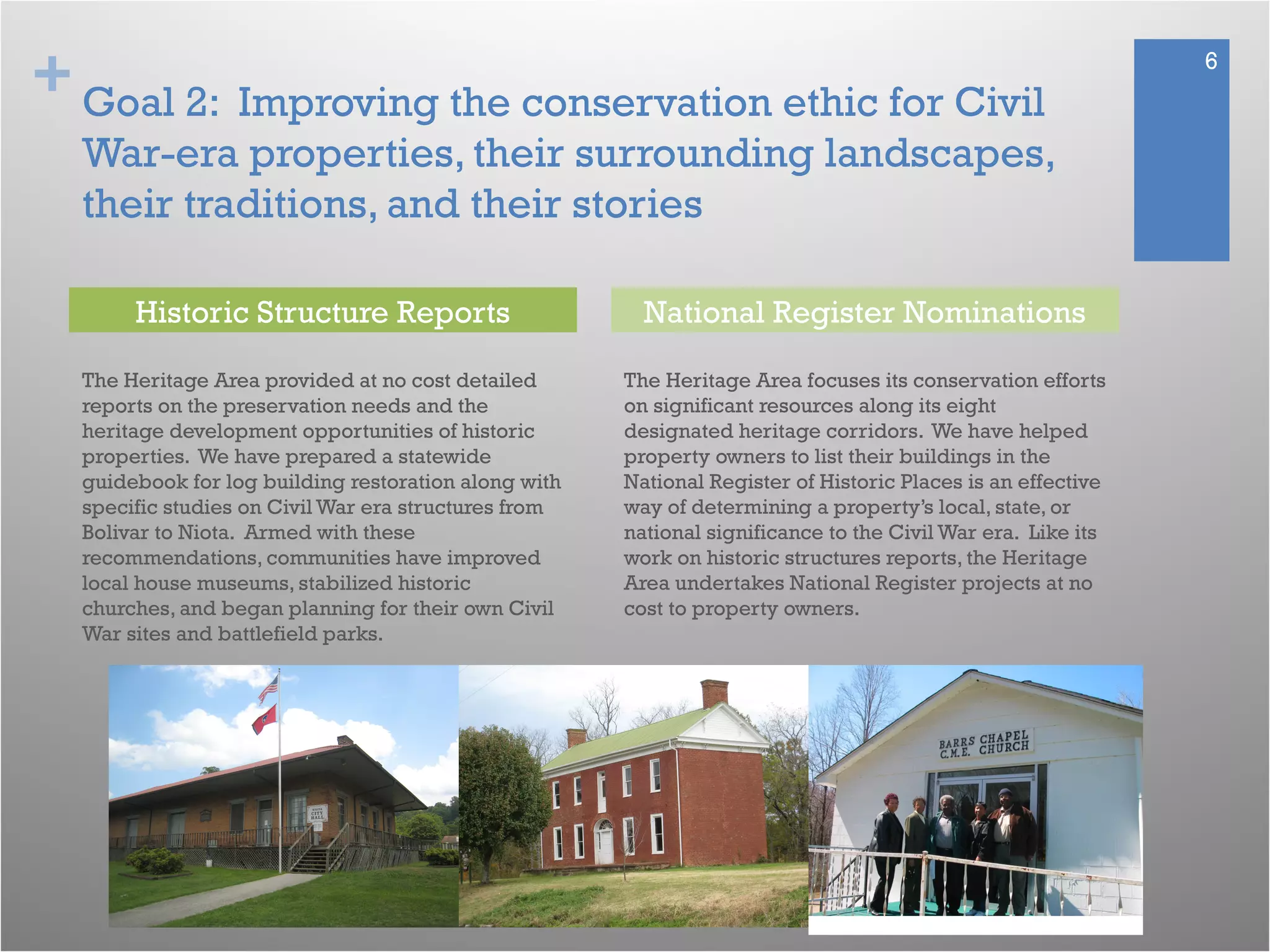
The Heritage Area provided at no cost detailed
reports on the preservation needs and the
heritage development opportunities of historic
properties. We have prepared a statewide
guidebook for log building restoration along with
specific studies on Civil War era structures from
Bolivar to Niota. Armed with these
recommendations, communities have improved
local house museums, stabilized historic
churches, and began planning for their own Civil
War sites and battlefield parks.
The Heritage Area focuses its conservation efforts
on significant resources along its eight
designated heritage corridors. We have helped
property owners to list their buildings in the
National Register of Historic Places is an effective
way of determining a property’s local, state, or
national significance to the Civil War era. Like its
work on historic structures reports, the Heritage
Area undertakes National Register projects at no
cost to property owners.
Historic Structure Reports National Register Nominations
+ 7Fulfilling Goal 2: Working with property owners and
communities to better conserve Civil War-era properties
and their surrounding landscapes
The continued expansion of this exciting natural and historical project for
the six counties along the Mississippi River is due to an innovative,
reciprocal partnership involving local residents, officials, and property
owners with the Tennessee Parks and Greenway Foundation,Tennessee
Wildlife Resources Agency, the Greater Memphis Regional Chamber of
Commerce, and the National Heritage Area.
The Heritage Area has provided over $100,000 in funding and support
and has worked with residents and partners to develop the original
Master Plan and Heritage Survey of the many significant river basin
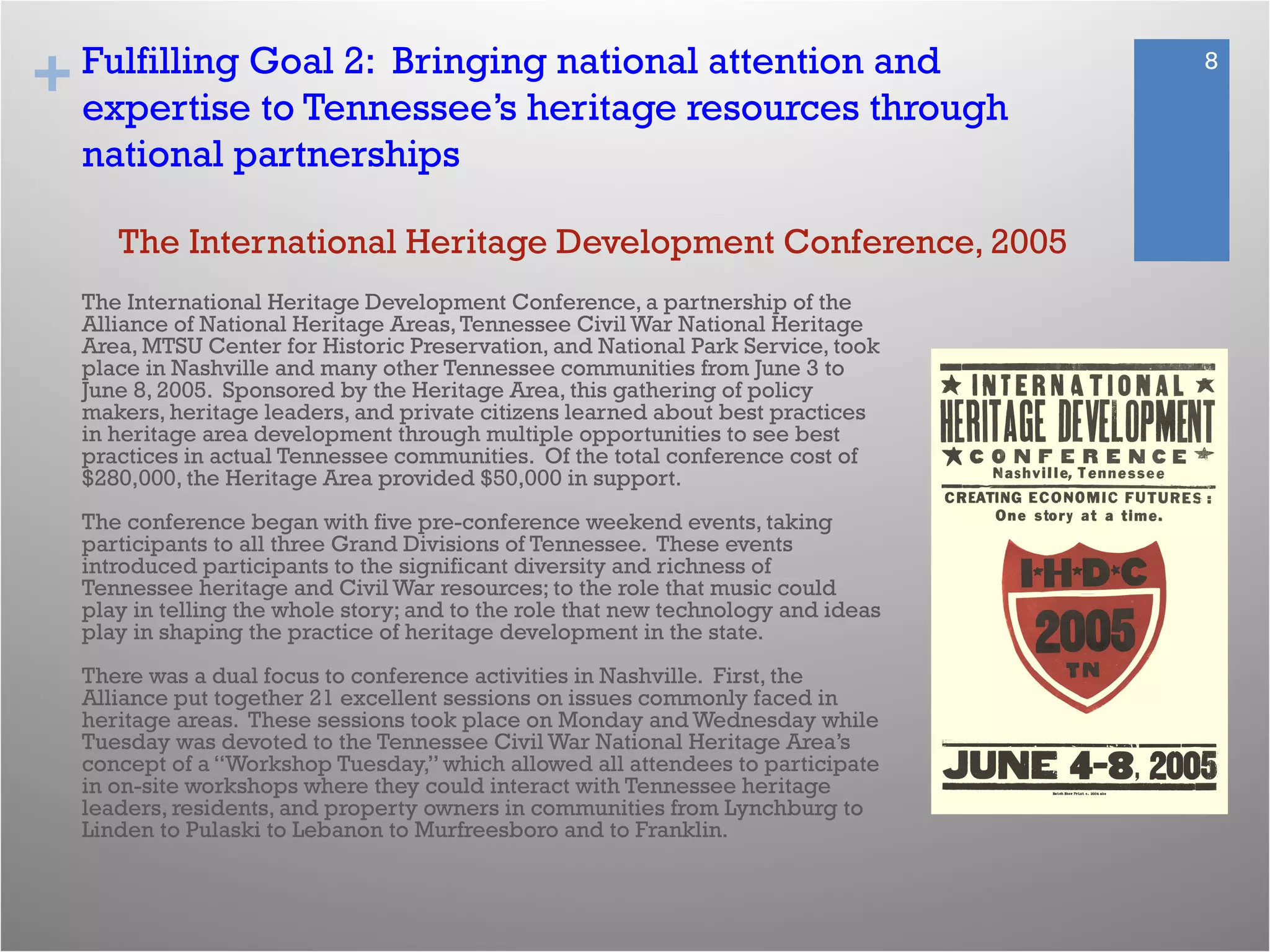
assets along Tennessee’s Mississippi River. At Randolph, the Heritage
Area has supported the preservation and redevelopment of historic Fort
Wright, which includes the only extant Confederate brick powder
magazine in the state.
Mississippi River Corridor - Tennessee, 2005-2008
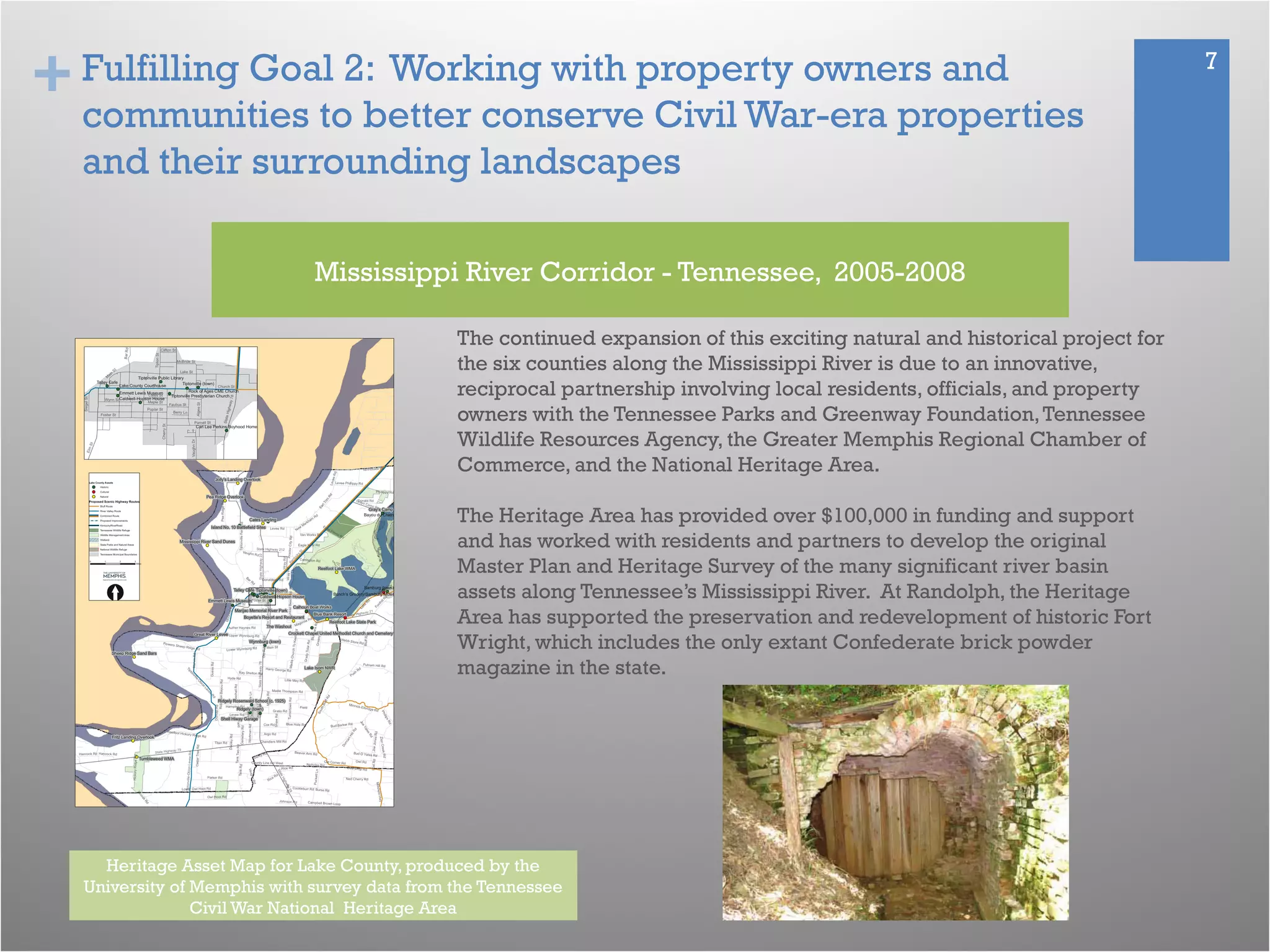
Heritage Asset Map for Lake County, produced by the
University of Memphis with survey data from the Tennessee
Civil War National Heritage Area
+ 8Fulfilling Goal 2: Bringing national attention and
expertise to Tennessee’s heritage resources through
national partnerships
The International Heritage Development Conference, a partnership of the
Alliance of National Heritage Areas,Tennessee Civil War National Heritage
Area, MTSU Center for Historic Preservation, and National Park Service, took
place in Nashville and many other Tennessee communities from June 3 to
June 8, 2005. Sponsored by the Heritage Area, this gathering of policy
makers, heritage leaders, and private citizens learned about best practices
in heritage area development through multiple opportunities to see best
practices in actual Tennessee communities. Of the total conference cost of
$280,000, the Heritage Area provided $50,000 in support.
The conference began with five pre-conference weekend events, taking
participants to all three Grand Divisions of Tennessee. These events
introduced participants to the significant diversity and richness of
Tennessee heritage and Civil War resources; to the role that music could
play in telling the whole story; and to the role that new technology and ideas
play in shaping the practice of heritage development in the state.
 
There was a dual focus to conference activities in Nashville. First, the
Alliance put together 21 excellent sessions on issues commonly faced in
heritage areas. These sessions took place on Monday and Wednesday while
Tuesday was devoted to the Tennessee Civil War National Heritage Area’s
concept of a “Workshop Tuesday,” which allowed all attendees to participate
in on-site workshops where they could interact with Tennessee heritage
leaders, residents, and property owners in communities from Lynchburg to
Linden to Pulaski to Lebanon to Murfreesboro and to Franklin.
The International Heritage Development Conference, 2005
+ 9
Fulfilling Goal 2: Preserving forgotten Civil War and
Reconstruction places through local partnerships
For decades, schools have occupied prominent locations in
communities across Tennessee. Many of the state’s historic schools,
although growing older, remain structurally sound and visually
pleasing examples of heritage, values, and style. Adaptive reuse for
older, historic schools allows these excellent examples of
architecture and design to continue to effectively serve their
communities in new and imaginative ways for generations.
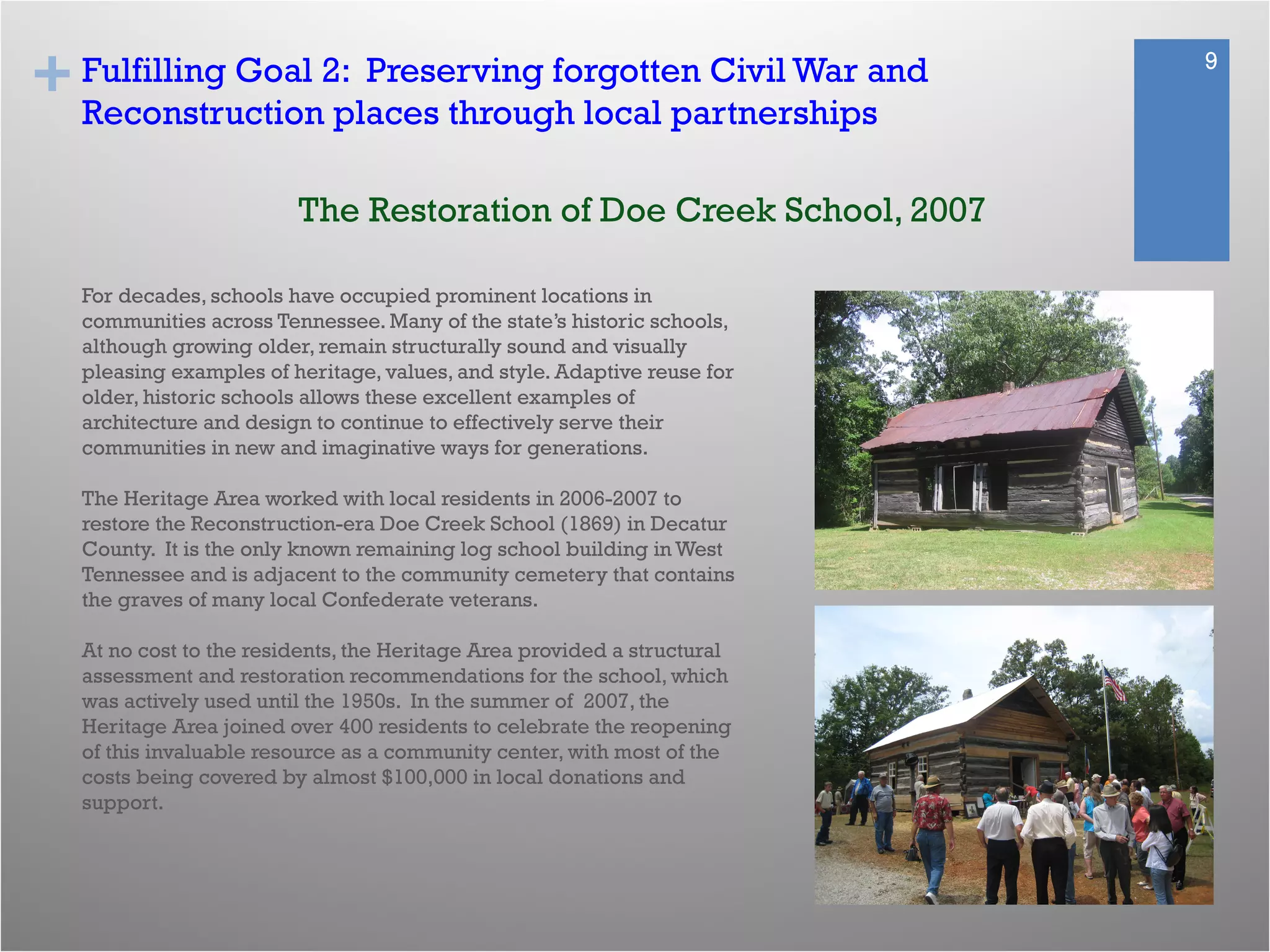
The Heritage Area worked with local residents in 2006-2007 to
restore the Reconstruction-era Doe Creek School (1869) in Decatur
County. It is the only known remaining log school building in West
Tennessee and is adjacent to the community cemetery that contains
the graves of many local Confederate veterans.
At no cost to the residents, the Heritage Area provided a structural
assessment and restoration recommendations for the school, which
was actively used until the 1950s. In the summer of 2007, the
Heritage Area joined over 400 residents to celebrate the reopening
of this invaluable resource as a community center, with most of the
costs being covered by almost $100,000 in local donations and
support.
The Restoration of Doe Creek School, 2007
+ 10
Fulfilling Goal 2: Enhancing our conservation ethic
through local, statewide, and national partnerships
In 2007, Heritage Area staff joined the State
Commissioner of Tourist Development and
UT’s Institute for Public Service to conduct
two sets of town hall forums in Maryville,
Sevierville, Knoxville, Gatlinburg, and Cosby
to discuss how sustainable tourism can
benefit these gateway communities to the
Great Smoky Mountains National Park.
The forums culminated in the 2-day Great
Smoky Mountains Sustainable Tourism
Summit in April 2008.The summit featured
the U.S. Secretary of the Interior; editor-in-
chief of National Geographic Traveler;
Director of the National Trust for Historic
Preservation’s Sustainability Initiative; Gov.
Phil Bredesen, U.S. Senator Lamar Alexander,
Congressmen David Davis, John Duncan, and
Heath Shuler, among many others. It
attracted 450 participants and led to the
development of new heritage projects in the
gateway communities.
Great Smokies Sustainable Tourism Summit, 2008
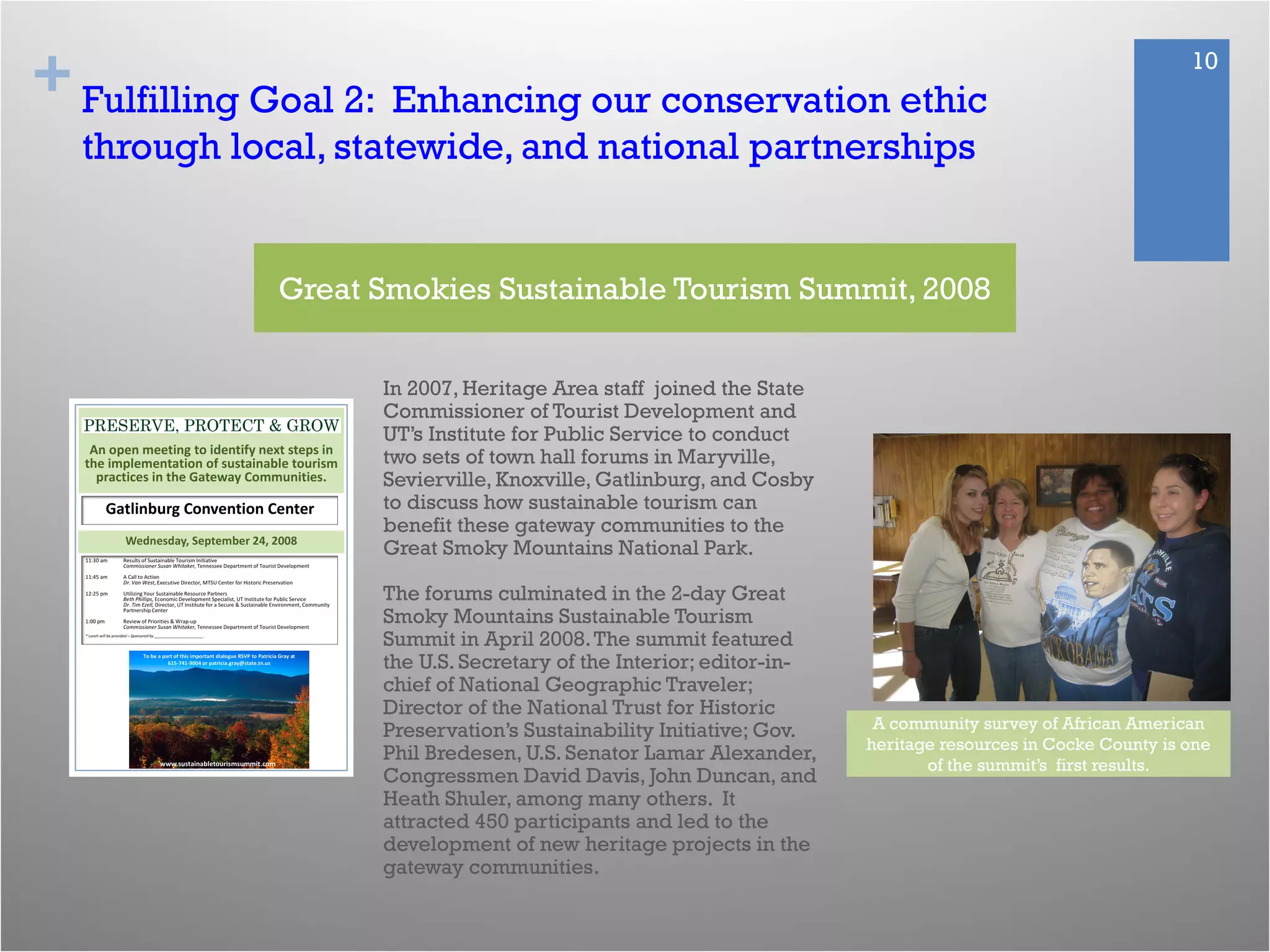
A community survey of African American
heritage resources in Cocke County is one
of the summit’s first results.
+ 11
Goal 3. Creating new public-private partnerships to achieve
Heritage Area goals of education, interpretation, and
conservation
The Heritage Area has worked effectively with local
governments, property owners, and non-profit groups to
create new battlefield parks and historic sites centered
on the Civil War era. In some cases, the Heritage Area
has added support to already successful battlefield
reclamation projects, like at Parker’s Crossroads
Battlefield in Henderson County and Fort Higley in Knox
County. At other locations, however, the Heritage Area
has provided key leadership in planning, development,
and advocacy.
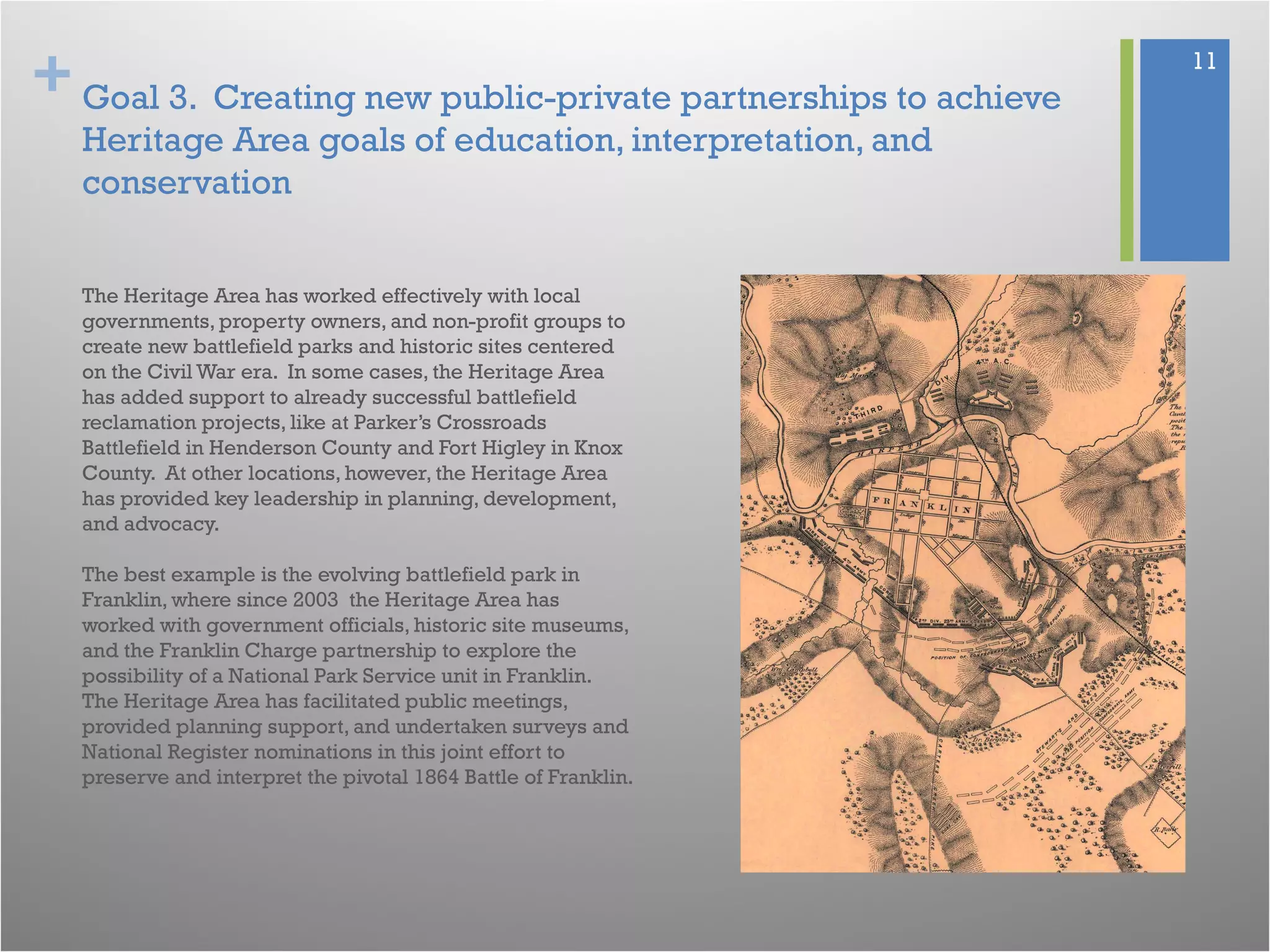
The best example is the evolving battlefield park in
Franklin, where since 2003 the Heritage Area has
worked with government officials, historic site museums,
and the Franklin Charge partnership to explore the
possibility of a National Park Service unit in Franklin.
The Heritage Area has facilitated public meetings,
provided planning support, and undertaken surveys and
National Register nominations in this joint effort to
preserve and interpret the pivotal 1864 Battle of Franklin.
+ 12
Fulfilling Goal 3: Leadership for Tennessee’s 150th
Anniversary of the Civil War
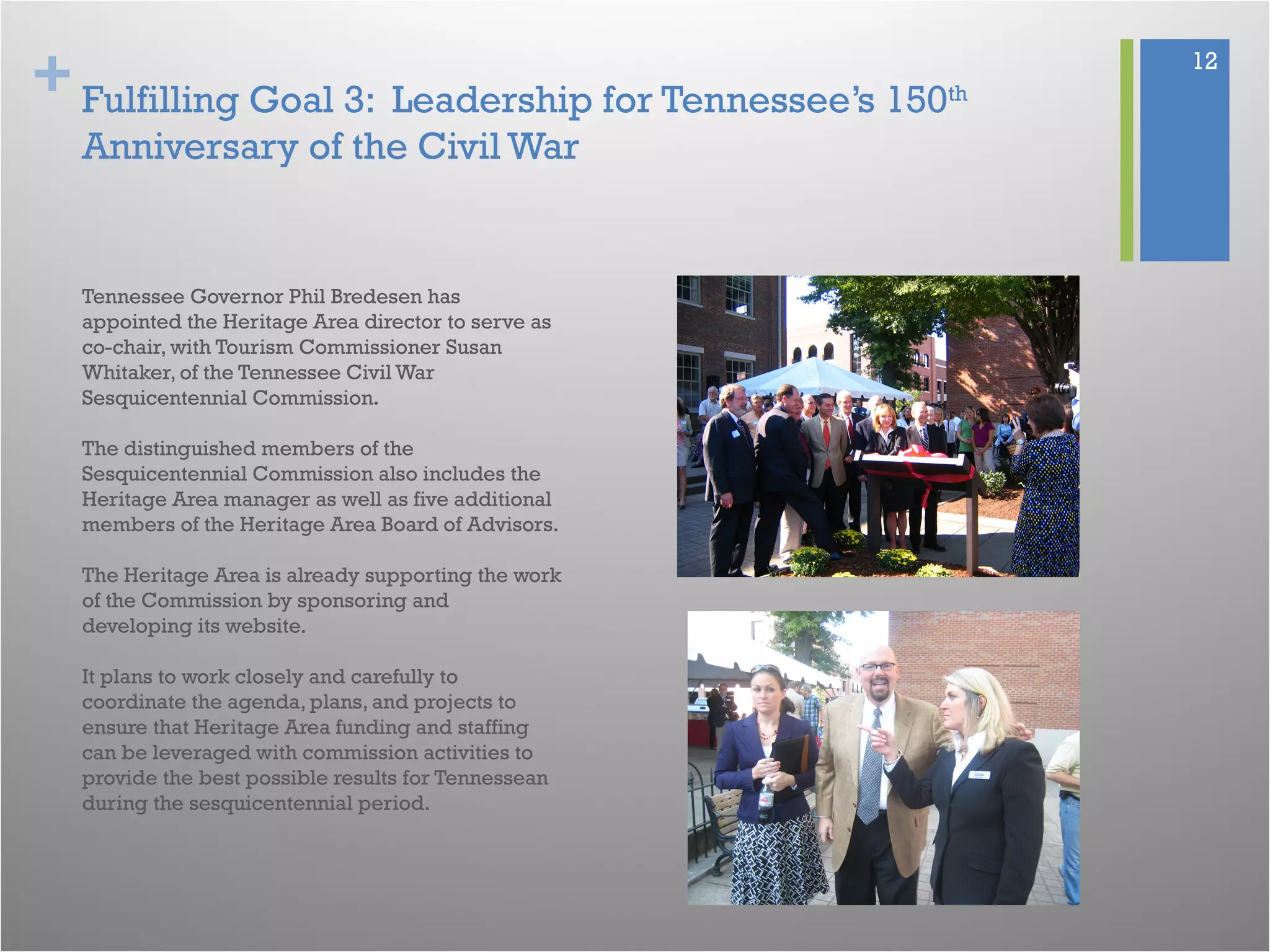
Tennessee Governor Phil Bredesen has
appointed the Heritage Area director to serve as
co-chair, with Tourism Commissioner Susan
Whitaker, of the Tennessee Civil War
Sesquicentennial Commission.
The distinguished members of the
Sesquicentennial Commission also includes the
Heritage Area manager as well as five additional
members of the Heritage Area Board of Advisors.
The Heritage Area is already supporting the work
of the Commission by sponsoring and
developing its website.
It plans to work closely and carefully to
coordinate the agenda, plans, and projects to
ensure that Heritage Area funding and staffing
can be leveraged with commission activities to
provide the best possible results for Tennessean
during the sesquicentennial period.
+ 13
Fulfilling Goal 4: Creating economic opportunities for property
owners and communities through sustainable heritage tourism,
adaptive reuse, and park creation and development
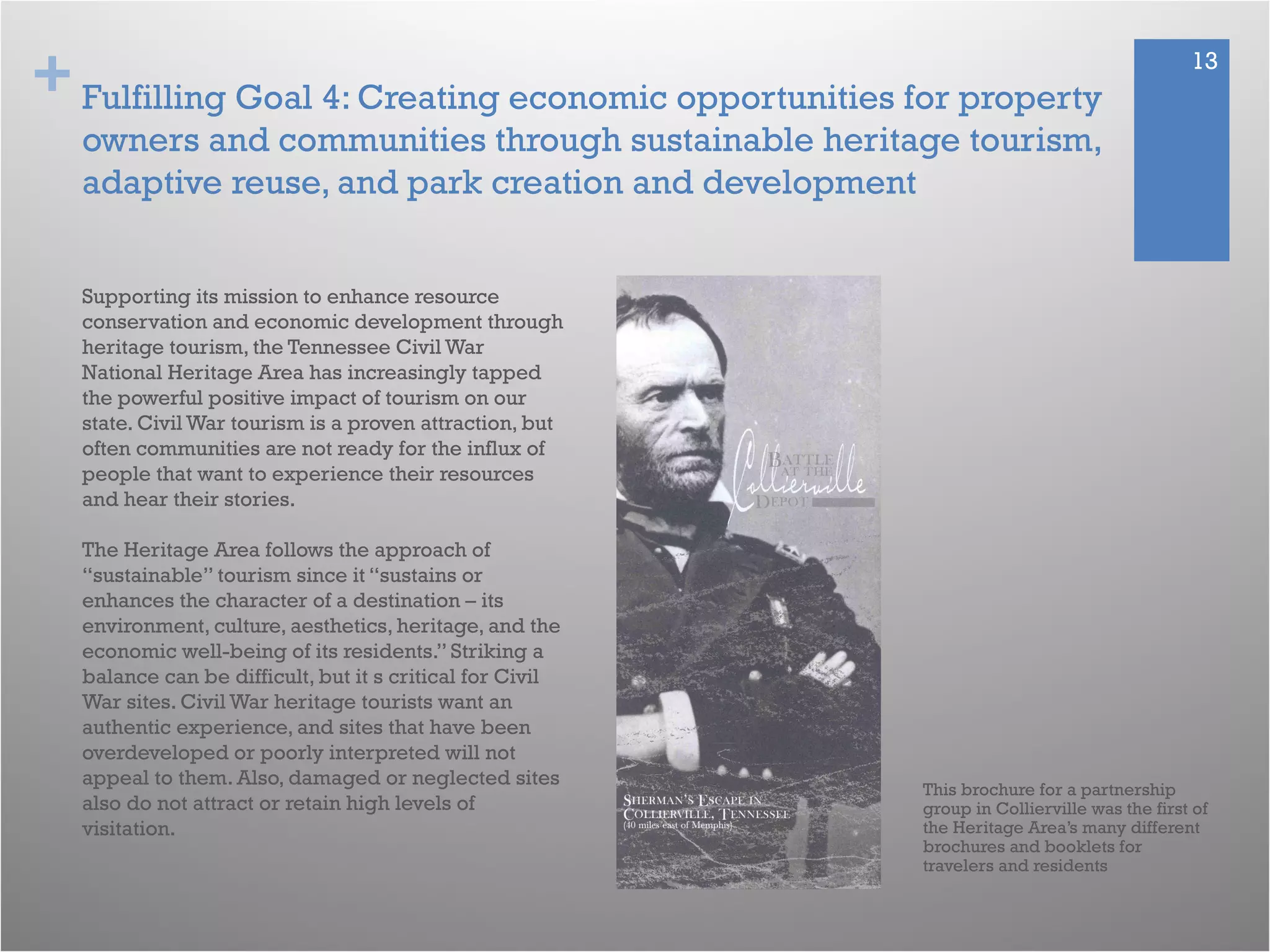
This brochure for a partnership
group in Collierville was the first of
the Heritage Area’s many different
brochures and booklets for
travelers and residents
Supporting its mission to enhance resource
conservation and economic development through
heritage tourism, the Tennessee Civil War
National Heritage Area has increasingly tapped
the powerful positive impact of tourism on our
state. Civil War tourism is a proven attraction, but
often communities are not ready for the influx of
people that want to experience their resources
and hear their stories.
The Heritage Area follows the approach of
“sustainable” tourism since it “sustains or
enhances the character of a destination – its
environment, culture, aesthetics, heritage, and the
economic well-being of its residents.” Striking a
balance can be difficult, but it s critical for Civil
War sites. Civil War heritage tourists want an
authentic experience, and sites that have been
overdeveloped or poorly interpreted will not
appeal to them. Also, damaged or neglected sites
also do not attract or retain high levels of
visitation.
+ 14
Fulfilling Goal 4 through adaptive reuse: the rebirth of
Longstreet Headquarters in Russellville, 2006-2008
One of the lesser known but truly significant stories
in Tennessee’s Civil War past is how Gen. James
Longstreet of Robert E. Lee’s Army of Northern
Virginia spent a cold, demanding winter in upper
East Tennessee.
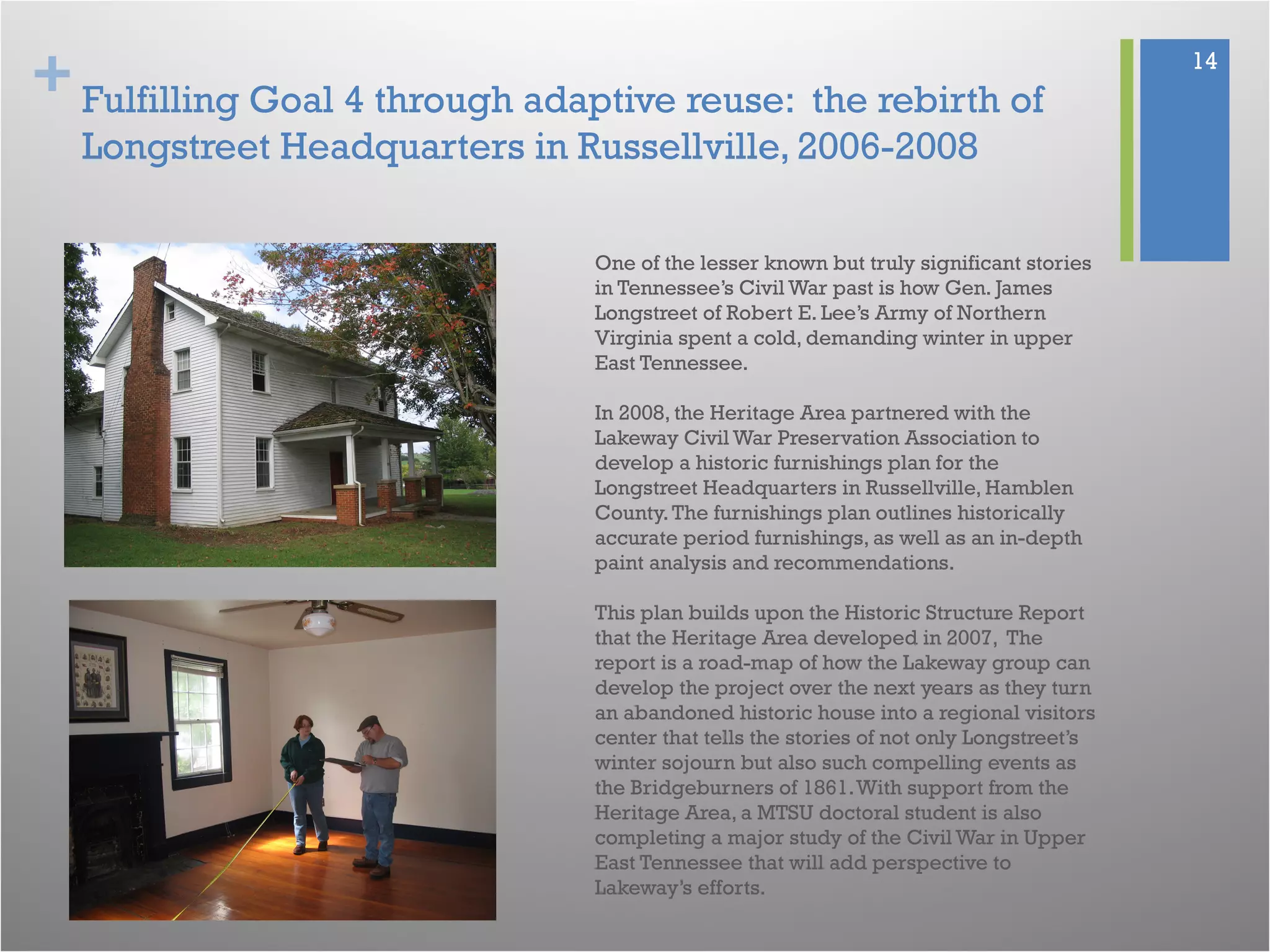
In 2008, the Heritage Area partnered with the
Lakeway Civil War Preservation Association to
develop a historic furnishings plan for the
Longstreet Headquarters in Russellville, Hamblen
County.The furnishings plan outlines historically
accurate period furnishings, as well as an in-depth
paint analysis and recommendations.
This plan builds upon the Historic Structure Report
that the Heritage Area developed in 2007, The
report is a road-map of how the Lakeway group can
develop the project over the next years as they turn
an abandoned historic house into a regional visitors
center that tells the stories of not only Longstreet’s
winter sojourn but also such compelling events as
the Bridgeburners of 1861.With support from the
Heritage Area, a MTSU doctoral student is also
completing a major study of the Civil War in Upper
East Tennessee that will add perspective to
Lakeway’s efforts.
+ 15
Fulfilling Goal 4 through regional heritage tourism:
Fighting for the Rails driving tour, 2007-08
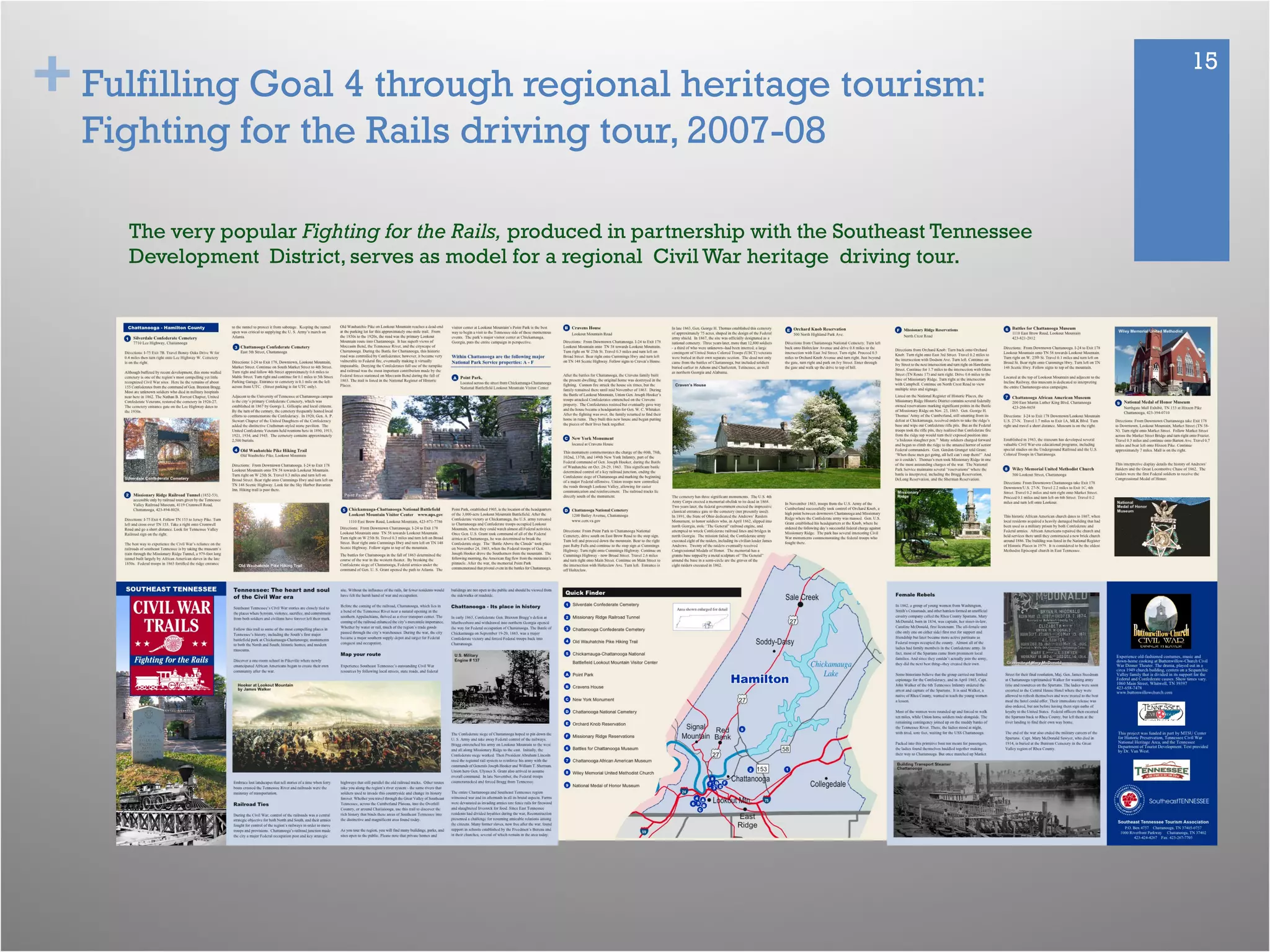
The very popular Fighting for the Rails, produced in partnership with the Southeast Tennessee
Development District, serves as model for a regional Civil War heritage driving tour.
+ 16
Fulfilling Goal 4 through statewide sustainable tourism
Funded by a grant from the Tennessee Department of
Transportation, and administered by the Tennessee
Department of Tourist Development, the new
Tennessee Civil War Trails is part of a multi-state
program that identifies, interprets, and directs
visitors to both well-known and lesser-known Civil
War sites using directional road signage and colorful
interpretive markers.The program also develops
free, state-wide driving tour brochures that direct
visitors to participant sites in the marker program;
these tours are available in hard copy at visitor
centers and online.
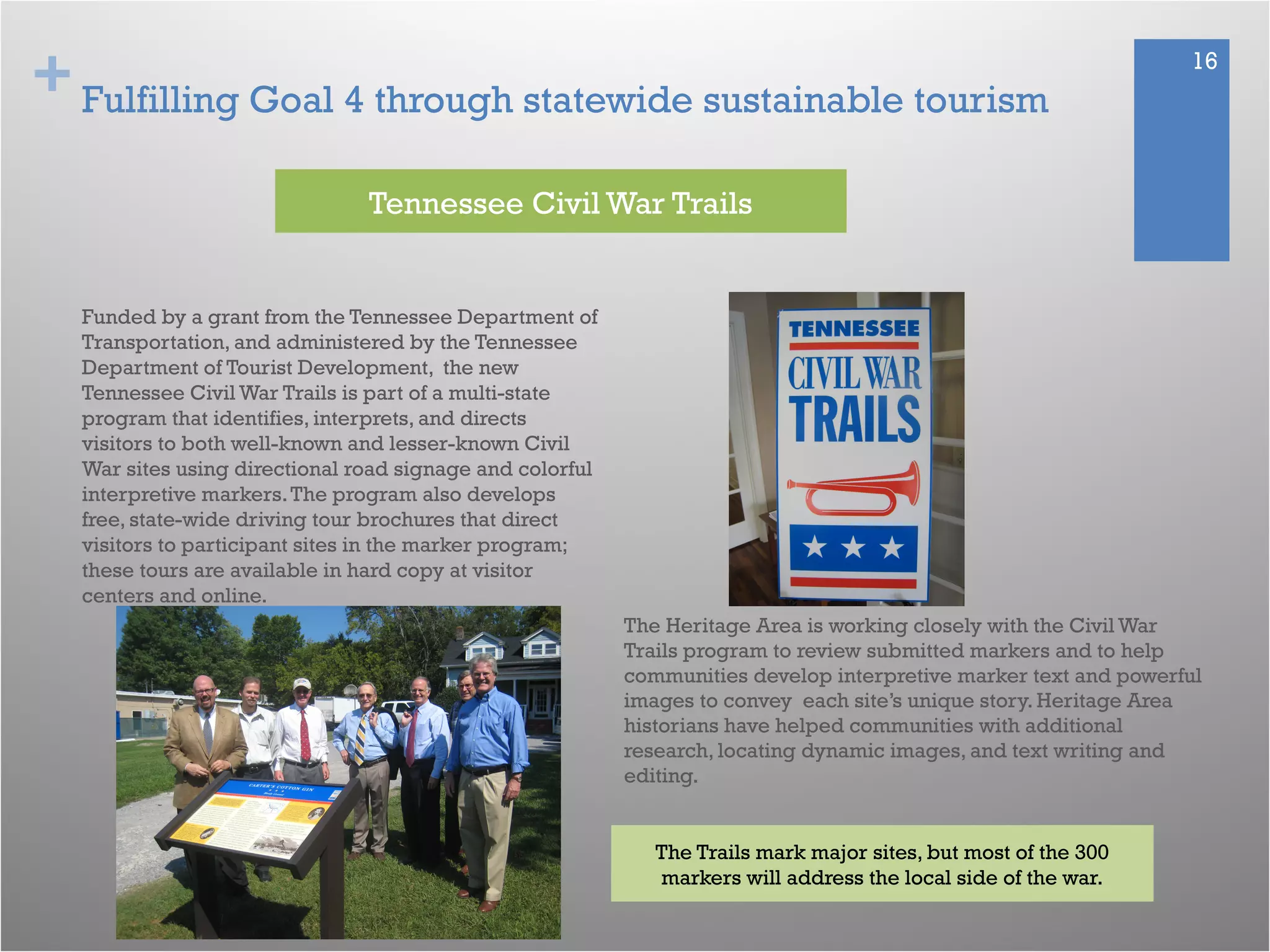
Tennessee Civil War Trails
The Trails mark major sites, but most of the 300
markers will address the local side of the war.
The Heritage Area is working closely with the Civil War
Trails program to review submitted markers and to help
communities develop interpretive marker text and powerful
images to convey each site’s unique story. Heritage Area
historians have helped communities with additional
research, locating dynamic images, and text writing and
editing.
+ 17
Fulfilling Goal 4 through stewardship training that
enables organizations to become more self-sufficient
Heritage development training is increasingly a core
mission for the Heritage Area. Our goal is to offer
communities the tools to become stewards of their heritage
sites and stories, and advocates for the preservation and
promotion of their history.Through educational sessions,
community forums, preservation planning, and building
reciprocal partnerships, Heritage Area staff use their
expertise to help individuals and organizations become
more self-sufficient in community-based preservation and
economic development .
In 2003-2006, the Heritage Area coordinated the Heritage
Development Institute, a training program through the
Alliance of National Heritage Areas. HDI programs were
conducted at national conferences and in numerous cities
across the country.The Heritage Area also assisted
organizations including Franklin’s Charge, Inc., Historic
Carnton Plantation, the East TN Preservation Alliance, the
Legal Aid Society, and many others with strategic planning
sessions to develop master plans, mission statements, and
organizational structure.
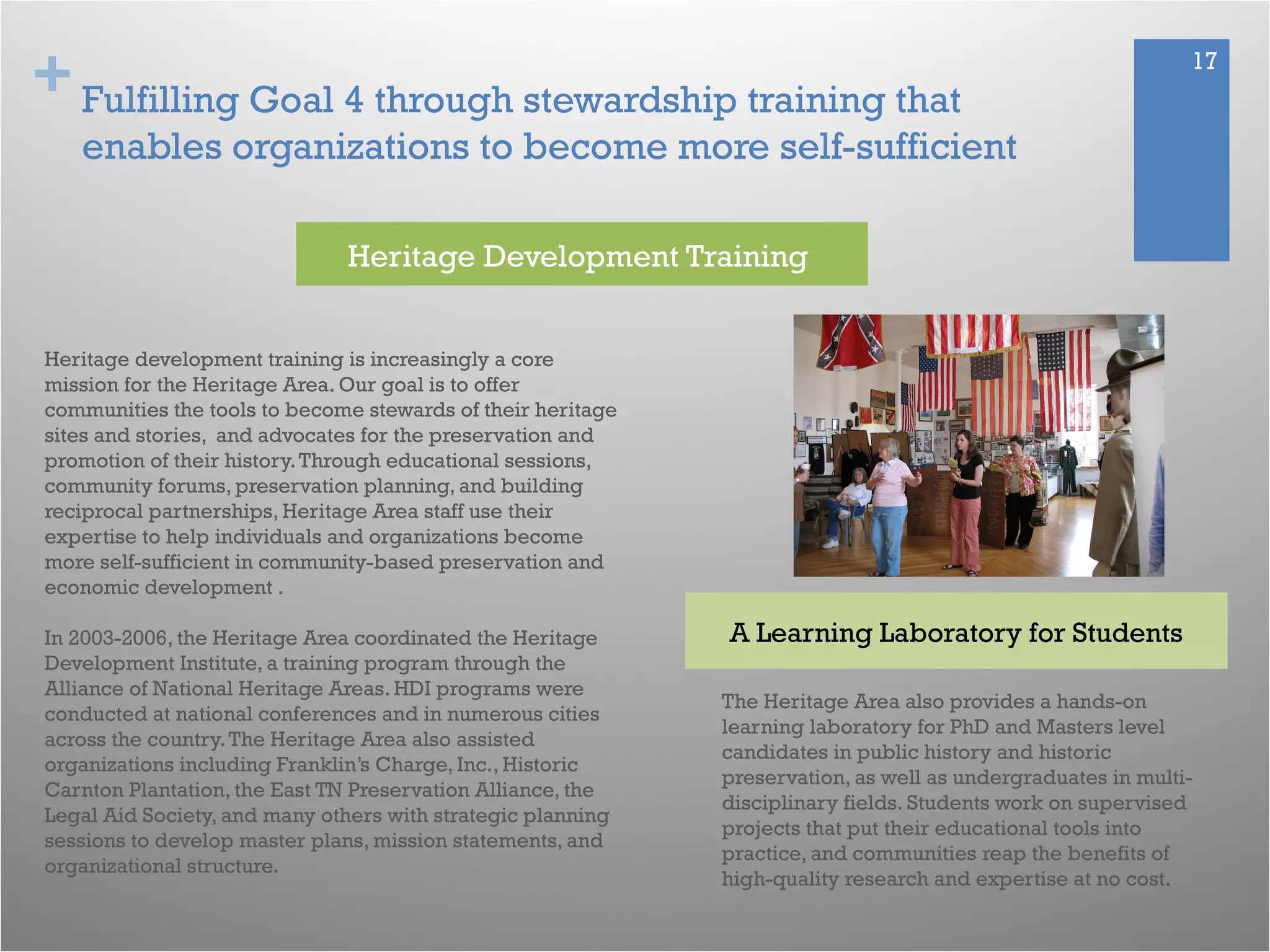
Heritage Development Training
A Learning Laboratory for Students
The Heritage Area also provides a hands-on
learning laboratory for PhD and Masters level
candidates in public history and historic
preservation, as well as undergraduates in multi-
disciplinary fields. Students work on supervised
projects that put their educational tools into
practice, and communities reap the benefits of
high-quality research and expertise at no cost.
+ 18
With Success Come Challenges
The Heritage Area has expanded its services and accomplished much since the approval of its
governing compact in 2001 and the completion of its management plan in 2003. The various best
practices and case studies in previous pages are a mere sampling of what has been done.
But with success come new challenges. The biggest are the rising expectations, from our local
partners to state government agencies, who are now more involved with Heritage Area projects than
ever before. Add to that is a growing popular interest, stroked no doubt by the approaching Civil War
Sesquicentennial starting in 2011.The result is that demands for assistance and funding from our
original authorized funding cap of $10 million (increased to $15 million by Congress in 2008) are at
all an time high. We are extremely grateful for the support we have received from Congress and the
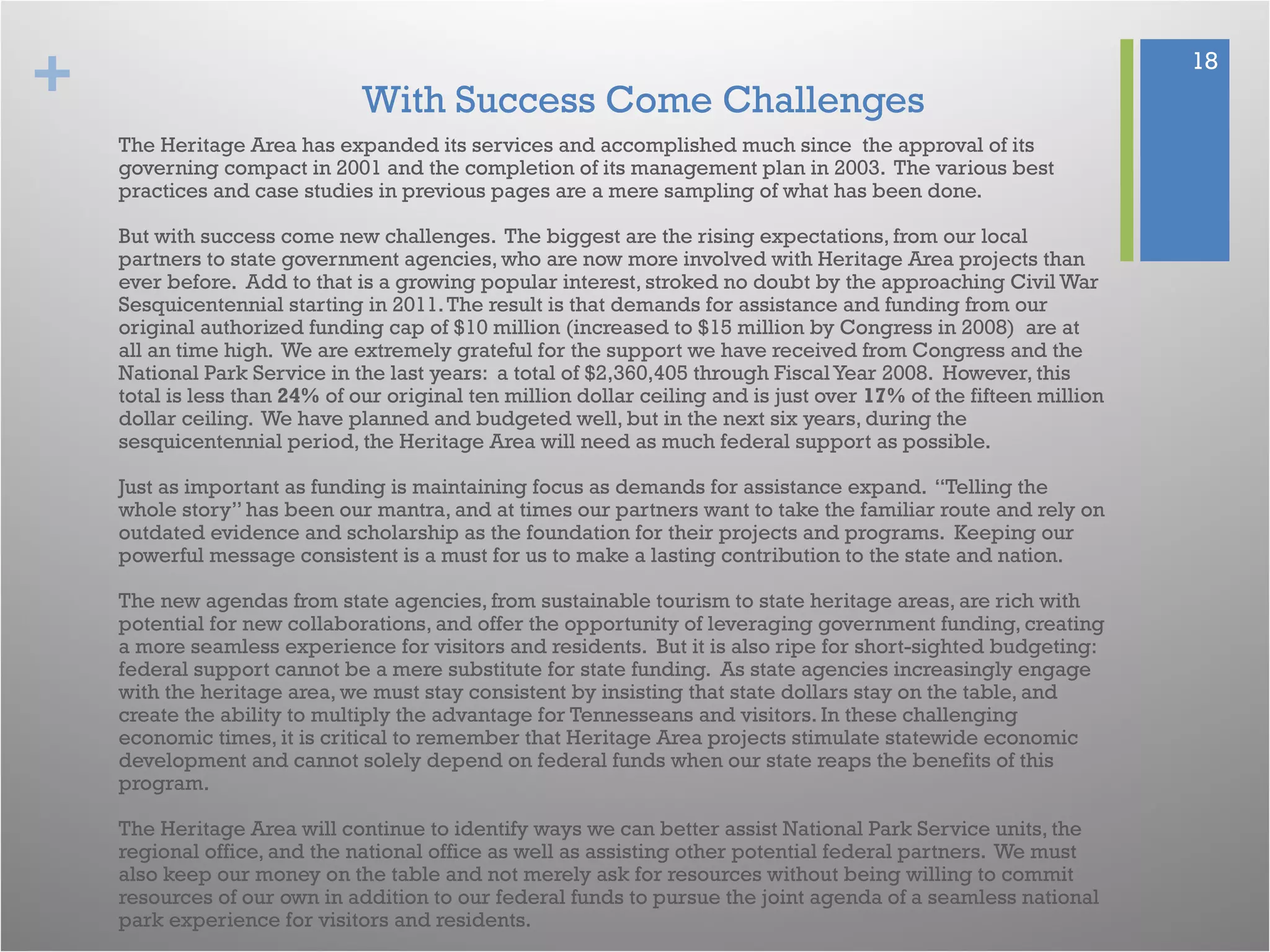
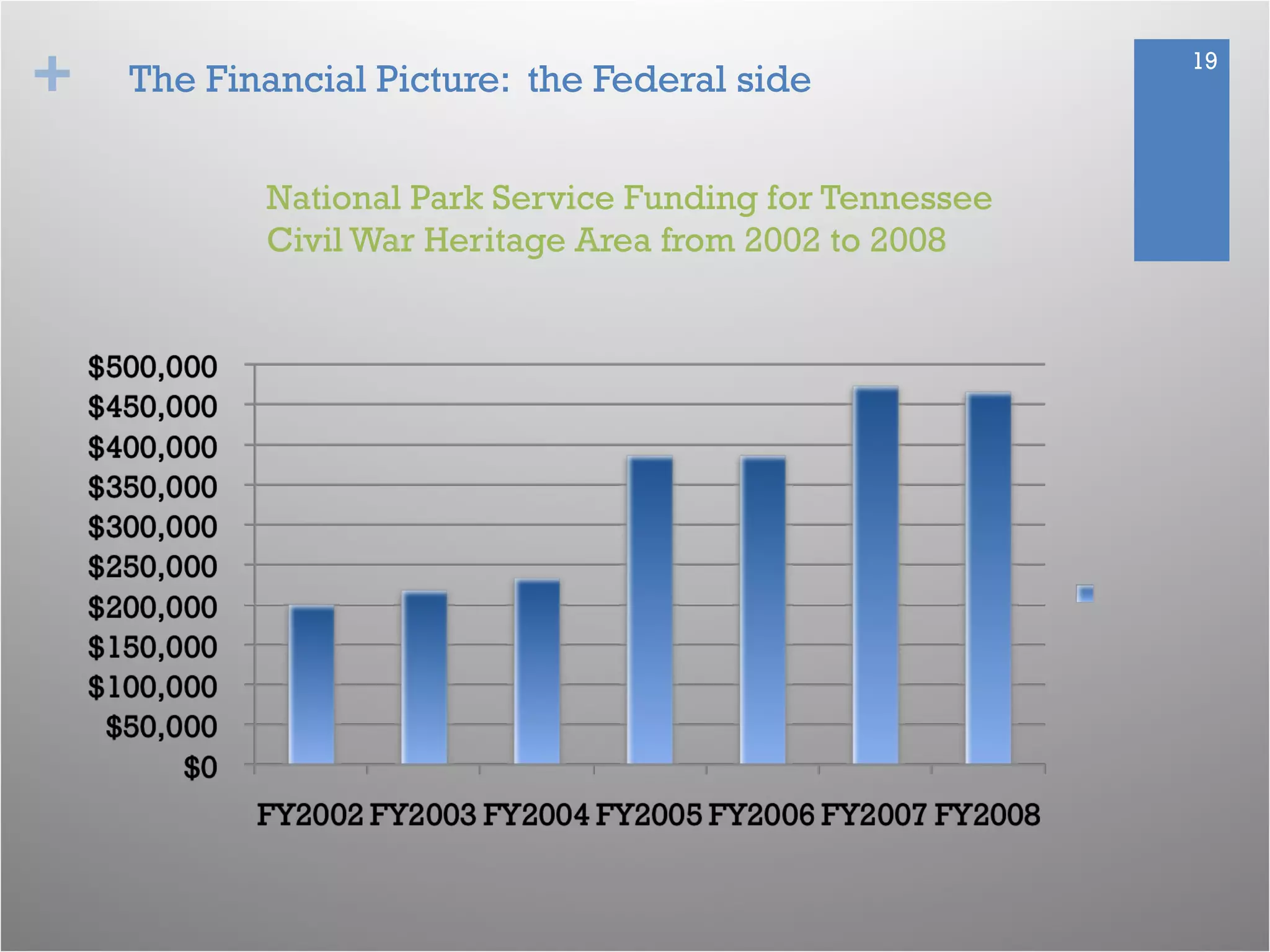
National Park Service in the last years: a total of $2,360,405 through FiscalYear 2008. However, this
total is less than 24% of our original ten million dollar ceiling and is just over 17% of the fifteen million
dollar ceiling. We have planned and budgeted well, but in the next six years, during the
sesquicentennial period, the Heritage Area will need as much federal support as possible.
Just as important as funding is maintaining focus as demands for assistance expand. “Telling the
whole story” has been our mantra, and at times our partners want to take the familiar route and rely on
outdated evidence and scholarship as the foundation for their projects and programs. Keeping our
powerful message consistent is a must for us to make a lasting contribution to the state and nation.
The new agendas from state agencies, from sustainable tourism to state heritage areas, are rich with
potential for new collaborations, and offer the opportunity of leveraging government funding, creating
a more seamless experience for visitors and residents. But it is also ripe for short-sighted budgeting:
federal support cannot be a mere substitute for state funding. As state agencies increasingly engage
with the heritage area, we must stay consistent by insisting that state dollars stay on the table, and
create the ability to multiply the advantage for Tennesseans and visitors. In these challenging
economic times, it is critical to remember that Heritage Area projects stimulate statewide economic
development and cannot solely depend on federal funds when our state reaps the benefits of this
program.
The Heritage Area will continue to identify ways we can better assist National Park Service units, the
regional office, and the national office as well as assisting other potential federal partners. We must
also keep our money on the table and not merely ask for resources without being willing to commit
resources of our own in addition to our federal funds to pursue the joint agenda of a seamless national
park experience for visitors and residents.
+ 19
The Financial Picture: the Federal side
National Park Service Funding for Tennessee
Civil War Heritage Area from 2002 to 2008
+ 20
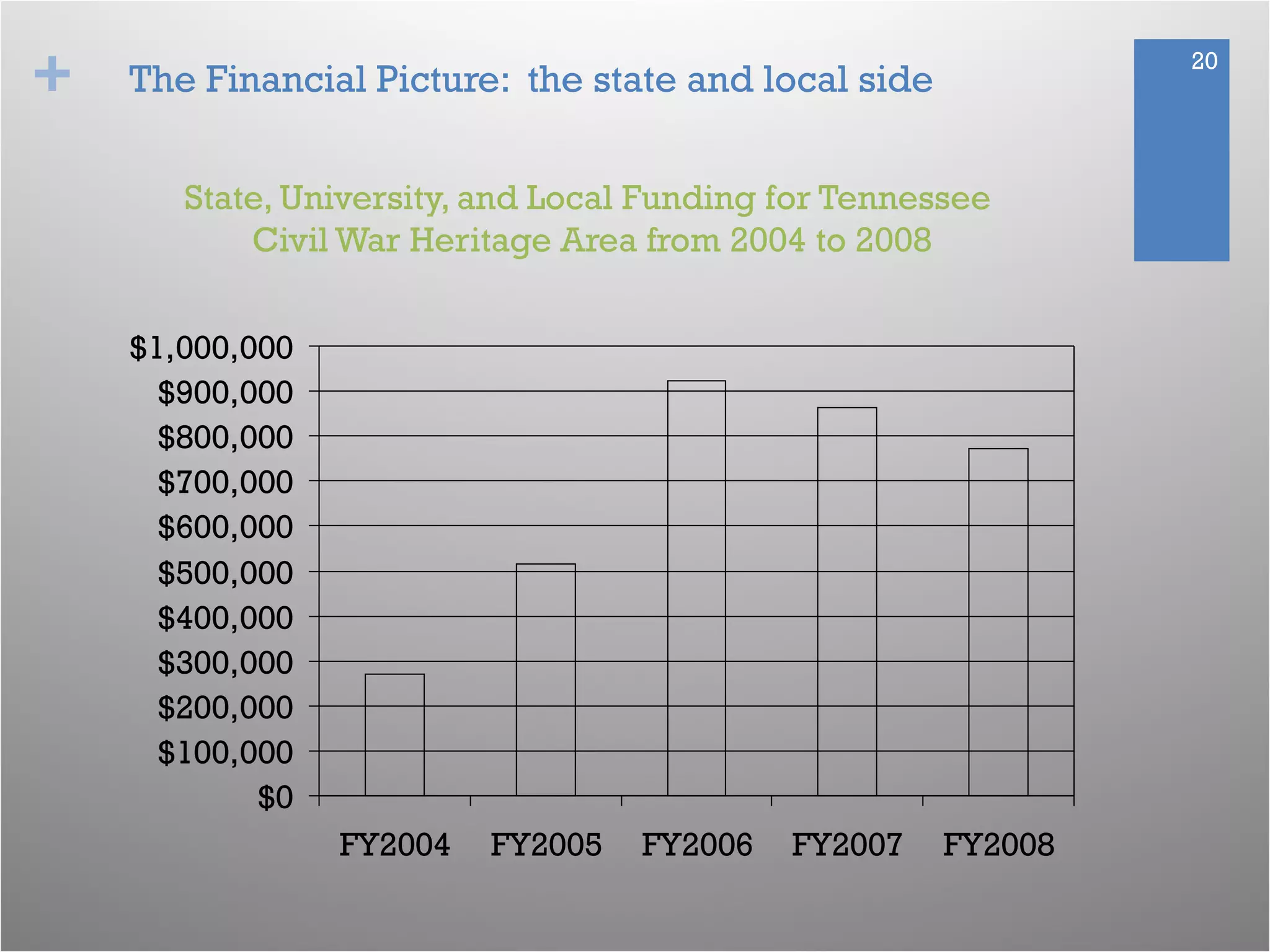
The Financial Picture: the state and local side
State, University, and Local Funding for Tennessee
Civil War Heritage Area from 2004 to 2008
$0
$100,000
$200,000
$300,000
$400,000
$500,000
$600,000
$700,000
$800,000
$900,000
$1,000,000
FY2004 FY2005 FY2006 FY2007 FY2008
+ 21
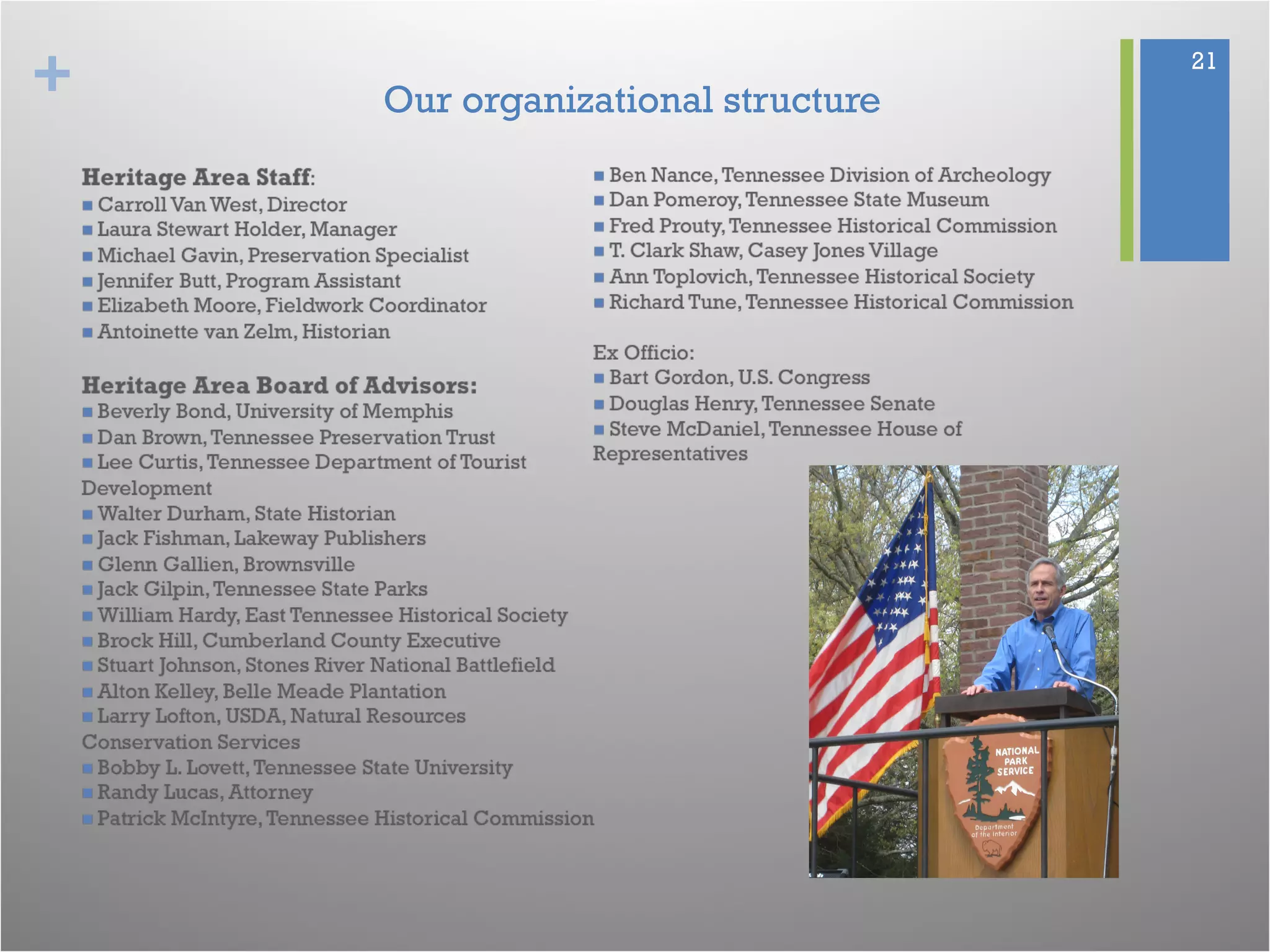
Our organizational structure

Tcwnha Progress Report 2008 Ppt Format Edited

  • 1.
    + Building a Foundation forLeadership: A Progress Report of the Tennessee Civil War National Heritage Area, 2003-2008
  • 2.
    + 2 What is theTennessee Civil War National Heritage Area? With help from citizens from across the state, the Tennessee Civil War National Heritage Area tells the whole story of America’s greatest challenge, 1860-75. A partnership unit of the National Park Service, the Heritage Area provides professional services and matching funds for conservation planning, historic site documentation, research, interpretation, educational programming, exhibits, heritage tourism, and park development that encourages economic development. Administered by the Center for Historic Preservation at Middle Tennessee State University for the people and communities of Tennessee, the Heritage Area tells the stories and promotes the significant places of the Civil War era, to diverse, statewide audiences in diverse settings, through reciprocal public- private partnerships. Our programs and projects explore the themes of warfare, occupation, the homefront, Emancipation, and Reconstruction.
  • 3.
    + 3 Goal 1:A greater understanding of the national significance of the Civil War as conveyed by places, stories, and artifacts in Tennessee Outside of courthouse square monuments, little interpretation existed of the July 1862 Battle of Murfreesboro and the impact of the war and Reconstruction years.Through a partnership with the City of Murfreesboro, Rutherford County Government, local corporations, MTSU, and Main Street Murfreesboro, the Heritage Area addressed this need with the Downtown Heritage Center, a meeting location for heritage and downtown groups as well as a visitor orientation center featuring the city’s first major exhibit on the county’s Civil War stories and places. One of the Heritage Area’s first four pilot projects involved a traveling exhibit with the Abraham Lincoln Museum in Harrogate. From that success, the Heritage Area moved on to support and develop many museum exhibits, including new installations in smaller towns like Carthage, McMinnville,Woodbury, Crossville, and Granville. Traveling exhibits on Civil War Calvary and the Impact of Emancipation have been displayed from Johnson City to Memphis. We also funded the major new Civil War section in Voices in the Land at the East Tennessee Historical Society in Knoxville. Since 2003, the Heritage Area has reached new audiences with driving and walking tours, entries in the Tennessee Encyclopedia of History and Culture, subvention grants to the University of Tennessee Press and other local publication series, and support to the Tennessee Historical Quarterly for special issues about Civil War and Heritage Area themes. The Quarterly even published our Master Plan as a dedicated special issue in 2002. Fulfilling Goal 1: Heritage Centers Fulfilling Goal 1: Exhibits and Publications
  • 4.
    + 4 Fulfilling GoalOne:Taking new evidence and scholarly perspective to the public The Heritage Area partnered with Tusculum College and the Andrew Johnson National Historic Site to sponsor the “Andrew Johnson: Heritage, Legacy, & Our Constitution” symposium at Tusculum College. The event featured lectures from Eric Foner of Columbia University, Paul Bergeron of the University of Tennessee, and Robert Orr of Walters State Community College. Working with Stones River National Battlefield and MTSU, the Heritage Area has sponsored five thematic explorations—from military topics to the impact of slavery- at this Murfreesboro-based symposium. Featured speakers include Barbara Fields of Columbia University, David Blight of Harvard University, Steven Woodworth of Texas Christian University, Steve Ash of the University of Tennessee, and Earl Hess of Lincoln Memorial University. Andrew Johnson Bicentennial Symposium, 2008 The Legacy of Stones River Symposiums. 2003-2008
  • 5.
    + 5 Fulfilling Goal1: Providing Educators with New Teaching Materials and Curricula The Upper Cumberland heritage initiative known as The Borderlands has been one of the Heritage Area’s best partners. In 2003, we worked together on a regional driving tour, one of the first four pilot projects. Most recently,The Borderlands has produced with Heritage Area support an excellent teacher’s guide on the Civil War in the Upper Cumberland, which they distribute to teachers before they bring their classes to an annual fall heritage event in Byrdstown which draws hundreds of students each year. Teachers often request assistance from the Heritage Area’s education initiatives. In 2004-5, we paired with the Chattanooga African-American History Museum to prepare teacher workbooks and workshops on the Underground Railroad The Heritage Area also contributed funding to public and private groups in Greene County to support the Teachers Day and a teachers guide prior to the Battle of Blue Springs re-enactment in the fall of 2005 and 2006. In 2007-8, the Heritage Area conducted teacher workshops with free materials to educators attending the Franklin Charge symposiums. Other partnerships provided funding to the Tennessee State Museum and the Tennessee Council of Social Studies for the production of teacher workbooks. The Heritage Area has provided services and support for on-site workshops on West Tennessee Civil War events with the Tennessee State Museum, materials for home school parents at a Dickson conference, and Civil War materials for tours of the Murfreesboro/Rutherford County Heritage Center and courthouse square. Staff also developed and presented two free educational videoconferences for mid-state school children and teachers. The Borderlands, 2003-2008 Workshops and Materials
  • 6.
    + 6 Goal 2:Improving the conservation ethic for Civil War-era properties, their surrounding landscapes, their traditions, and their stories The Heritage Area provided at no cost detailed reports on the preservation needs and the heritage development opportunities of historic properties. We have prepared a statewide guidebook for log building restoration along with specific studies on Civil War era structures from Bolivar to Niota. Armed with these recommendations, communities have improved local house museums, stabilized historic churches, and began planning for their own Civil War sites and battlefield parks. The Heritage Area focuses its conservation efforts on significant resources along its eight designated heritage corridors. We have helped property owners to list their buildings in the National Register of Historic Places is an effective way of determining a property’s local, state, or national significance to the Civil War era. Like its work on historic structures reports, the Heritage Area undertakes National Register projects at no cost to property owners. Historic Structure Reports National Register Nominations
  • 7.
    + 7Fulfilling Goal2: Working with property owners and communities to better conserve Civil War-era properties and their surrounding landscapes The continued expansion of this exciting natural and historical project for the six counties along the Mississippi River is due to an innovative, reciprocal partnership involving local residents, officials, and property owners with the Tennessee Parks and Greenway Foundation,Tennessee Wildlife Resources Agency, the Greater Memphis Regional Chamber of Commerce, and the National Heritage Area. The Heritage Area has provided over $100,000 in funding and support and has worked with residents and partners to develop the original Master Plan and Heritage Survey of the many significant river basin assets along Tennessee’s Mississippi River. At Randolph, the Heritage Area has supported the preservation and redevelopment of historic Fort Wright, which includes the only extant Confederate brick powder magazine in the state. Mississippi River Corridor - Tennessee, 2005-2008 Heritage Asset Map for Lake County, produced by the University of Memphis with survey data from the Tennessee Civil War National Heritage Area
  • 8.
    + 8Fulfilling Goal2: Bringing national attention and expertise to Tennessee’s heritage resources through national partnerships The International Heritage Development Conference, a partnership of the Alliance of National Heritage Areas,Tennessee Civil War National Heritage Area, MTSU Center for Historic Preservation, and National Park Service, took place in Nashville and many other Tennessee communities from June 3 to June 8, 2005. Sponsored by the Heritage Area, this gathering of policy makers, heritage leaders, and private citizens learned about best practices in heritage area development through multiple opportunities to see best practices in actual Tennessee communities. Of the total conference cost of $280,000, the Heritage Area provided $50,000 in support. The conference began with five pre-conference weekend events, taking participants to all three Grand Divisions of Tennessee. These events introduced participants to the significant diversity and richness of Tennessee heritage and Civil War resources; to the role that music could play in telling the whole story; and to the role that new technology and ideas play in shaping the practice of heritage development in the state.   There was a dual focus to conference activities in Nashville. First, the Alliance put together 21 excellent sessions on issues commonly faced in heritage areas. These sessions took place on Monday and Wednesday while Tuesday was devoted to the Tennessee Civil War National Heritage Area’s concept of a “Workshop Tuesday,” which allowed all attendees to participate in on-site workshops where they could interact with Tennessee heritage leaders, residents, and property owners in communities from Lynchburg to Linden to Pulaski to Lebanon to Murfreesboro and to Franklin. The International Heritage Development Conference, 2005
  • 9.
    + 9 Fulfilling Goal2: Preserving forgotten Civil War and Reconstruction places through local partnerships For decades, schools have occupied prominent locations in communities across Tennessee. Many of the state’s historic schools, although growing older, remain structurally sound and visually pleasing examples of heritage, values, and style. Adaptive reuse for older, historic schools allows these excellent examples of architecture and design to continue to effectively serve their communities in new and imaginative ways for generations. The Heritage Area worked with local residents in 2006-2007 to restore the Reconstruction-era Doe Creek School (1869) in Decatur County. It is the only known remaining log school building in West Tennessee and is adjacent to the community cemetery that contains the graves of many local Confederate veterans. At no cost to the residents, the Heritage Area provided a structural assessment and restoration recommendations for the school, which was actively used until the 1950s. In the summer of 2007, the Heritage Area joined over 400 residents to celebrate the reopening of this invaluable resource as a community center, with most of the costs being covered by almost $100,000 in local donations and support. The Restoration of Doe Creek School, 2007
  • 10.
    + 10 Fulfilling Goal2: Enhancing our conservation ethic through local, statewide, and national partnerships In 2007, Heritage Area staff joined the State Commissioner of Tourist Development and UT’s Institute for Public Service to conduct two sets of town hall forums in Maryville, Sevierville, Knoxville, Gatlinburg, and Cosby to discuss how sustainable tourism can benefit these gateway communities to the Great Smoky Mountains National Park. The forums culminated in the 2-day Great Smoky Mountains Sustainable Tourism Summit in April 2008.The summit featured the U.S. Secretary of the Interior; editor-in- chief of National Geographic Traveler; Director of the National Trust for Historic Preservation’s Sustainability Initiative; Gov. Phil Bredesen, U.S. Senator Lamar Alexander, Congressmen David Davis, John Duncan, and Heath Shuler, among many others. It attracted 450 participants and led to the development of new heritage projects in the gateway communities. Great Smokies Sustainable Tourism Summit, 2008 A community survey of African American heritage resources in Cocke County is one of the summit’s first results.
  • 11.
    + 11 Goal 3.Creating new public-private partnerships to achieve Heritage Area goals of education, interpretation, and conservation The Heritage Area has worked effectively with local governments, property owners, and non-profit groups to create new battlefield parks and historic sites centered on the Civil War era. In some cases, the Heritage Area has added support to already successful battlefield reclamation projects, like at Parker’s Crossroads Battlefield in Henderson County and Fort Higley in Knox County. At other locations, however, the Heritage Area has provided key leadership in planning, development, and advocacy. The best example is the evolving battlefield park in Franklin, where since 2003 the Heritage Area has worked with government officials, historic site museums, and the Franklin Charge partnership to explore the possibility of a National Park Service unit in Franklin. The Heritage Area has facilitated public meetings, provided planning support, and undertaken surveys and National Register nominations in this joint effort to preserve and interpret the pivotal 1864 Battle of Franklin.
  • 12.
    + 12 Fulfilling Goal3: Leadership for Tennessee’s 150th Anniversary of the Civil War Tennessee Governor Phil Bredesen has appointed the Heritage Area director to serve as co-chair, with Tourism Commissioner Susan Whitaker, of the Tennessee Civil War Sesquicentennial Commission. The distinguished members of the Sesquicentennial Commission also includes the Heritage Area manager as well as five additional members of the Heritage Area Board of Advisors. The Heritage Area is already supporting the work of the Commission by sponsoring and developing its website. It plans to work closely and carefully to coordinate the agenda, plans, and projects to ensure that Heritage Area funding and staffing can be leveraged with commission activities to provide the best possible results for Tennessean during the sesquicentennial period.
  • 13.
    + 13 Fulfilling Goal4: Creating economic opportunities for property owners and communities through sustainable heritage tourism, adaptive reuse, and park creation and development This brochure for a partnership group in Collierville was the first of the Heritage Area’s many different brochures and booklets for travelers and residents Supporting its mission to enhance resource conservation and economic development through heritage tourism, the Tennessee Civil War National Heritage Area has increasingly tapped the powerful positive impact of tourism on our state. Civil War tourism is a proven attraction, but often communities are not ready for the influx of people that want to experience their resources and hear their stories. The Heritage Area follows the approach of “sustainable” tourism since it “sustains or enhances the character of a destination – its environment, culture, aesthetics, heritage, and the economic well-being of its residents.” Striking a balance can be difficult, but it s critical for Civil War sites. Civil War heritage tourists want an authentic experience, and sites that have been overdeveloped or poorly interpreted will not appeal to them. Also, damaged or neglected sites also do not attract or retain high levels of visitation.
  • 14.
    + 14 Fulfilling Goal4 through adaptive reuse: the rebirth of Longstreet Headquarters in Russellville, 2006-2008 One of the lesser known but truly significant stories in Tennessee’s Civil War past is how Gen. James Longstreet of Robert E. Lee’s Army of Northern Virginia spent a cold, demanding winter in upper East Tennessee. In 2008, the Heritage Area partnered with the Lakeway Civil War Preservation Association to develop a historic furnishings plan for the Longstreet Headquarters in Russellville, Hamblen County.The furnishings plan outlines historically accurate period furnishings, as well as an in-depth paint analysis and recommendations. This plan builds upon the Historic Structure Report that the Heritage Area developed in 2007, The report is a road-map of how the Lakeway group can develop the project over the next years as they turn an abandoned historic house into a regional visitors center that tells the stories of not only Longstreet’s winter sojourn but also such compelling events as the Bridgeburners of 1861.With support from the Heritage Area, a MTSU doctoral student is also completing a major study of the Civil War in Upper East Tennessee that will add perspective to Lakeway’s efforts.
  • 15.
    + 15 Fulfilling Goal4 through regional heritage tourism: Fighting for the Rails driving tour, 2007-08 The very popular Fighting for the Rails, produced in partnership with the Southeast Tennessee Development District, serves as model for a regional Civil War heritage driving tour.
  • 16.
    + 16 Fulfilling Goal4 through statewide sustainable tourism Funded by a grant from the Tennessee Department of Transportation, and administered by the Tennessee Department of Tourist Development, the new Tennessee Civil War Trails is part of a multi-state program that identifies, interprets, and directs visitors to both well-known and lesser-known Civil War sites using directional road signage and colorful interpretive markers.The program also develops free, state-wide driving tour brochures that direct visitors to participant sites in the marker program; these tours are available in hard copy at visitor centers and online. Tennessee Civil War Trails The Trails mark major sites, but most of the 300 markers will address the local side of the war. The Heritage Area is working closely with the Civil War Trails program to review submitted markers and to help communities develop interpretive marker text and powerful images to convey each site’s unique story. Heritage Area historians have helped communities with additional research, locating dynamic images, and text writing and editing.
  • 17.
    + 17 Fulfilling Goal4 through stewardship training that enables organizations to become more self-sufficient Heritage development training is increasingly a core mission for the Heritage Area. Our goal is to offer communities the tools to become stewards of their heritage sites and stories, and advocates for the preservation and promotion of their history.Through educational sessions, community forums, preservation planning, and building reciprocal partnerships, Heritage Area staff use their expertise to help individuals and organizations become more self-sufficient in community-based preservation and economic development . In 2003-2006, the Heritage Area coordinated the Heritage Development Institute, a training program through the Alliance of National Heritage Areas. HDI programs were conducted at national conferences and in numerous cities across the country.The Heritage Area also assisted organizations including Franklin’s Charge, Inc., Historic Carnton Plantation, the East TN Preservation Alliance, the Legal Aid Society, and many others with strategic planning sessions to develop master plans, mission statements, and organizational structure. Heritage Development Training A Learning Laboratory for Students The Heritage Area also provides a hands-on learning laboratory for PhD and Masters level candidates in public history and historic preservation, as well as undergraduates in multi- disciplinary fields. Students work on supervised projects that put their educational tools into practice, and communities reap the benefits of high-quality research and expertise at no cost.
  • 18.
    + 18 With SuccessCome Challenges The Heritage Area has expanded its services and accomplished much since the approval of its governing compact in 2001 and the completion of its management plan in 2003. The various best practices and case studies in previous pages are a mere sampling of what has been done. But with success come new challenges. The biggest are the rising expectations, from our local partners to state government agencies, who are now more involved with Heritage Area projects than ever before. Add to that is a growing popular interest, stroked no doubt by the approaching Civil War Sesquicentennial starting in 2011.The result is that demands for assistance and funding from our original authorized funding cap of $10 million (increased to $15 million by Congress in 2008) are at all an time high. We are extremely grateful for the support we have received from Congress and the National Park Service in the last years: a total of $2,360,405 through FiscalYear 2008. However, this total is less than 24% of our original ten million dollar ceiling and is just over 17% of the fifteen million dollar ceiling. We have planned and budgeted well, but in the next six years, during the sesquicentennial period, the Heritage Area will need as much federal support as possible. Just as important as funding is maintaining focus as demands for assistance expand. “Telling the whole story” has been our mantra, and at times our partners want to take the familiar route and rely on outdated evidence and scholarship as the foundation for their projects and programs. Keeping our powerful message consistent is a must for us to make a lasting contribution to the state and nation. The new agendas from state agencies, from sustainable tourism to state heritage areas, are rich with potential for new collaborations, and offer the opportunity of leveraging government funding, creating a more seamless experience for visitors and residents. But it is also ripe for short-sighted budgeting: federal support cannot be a mere substitute for state funding. As state agencies increasingly engage with the heritage area, we must stay consistent by insisting that state dollars stay on the table, and create the ability to multiply the advantage for Tennesseans and visitors. In these challenging economic times, it is critical to remember that Heritage Area projects stimulate statewide economic development and cannot solely depend on federal funds when our state reaps the benefits of this program. The Heritage Area will continue to identify ways we can better assist National Park Service units, the regional office, and the national office as well as assisting other potential federal partners. We must also keep our money on the table and not merely ask for resources without being willing to commit resources of our own in addition to our federal funds to pursue the joint agenda of a seamless national park experience for visitors and residents.
  • 19.
    + 19 The FinancialPicture: the Federal side National Park Service Funding for Tennessee Civil War Heritage Area from 2002 to 2008
  • 20.
    + 20 The FinancialPicture: the state and local side State, University, and Local Funding for Tennessee Civil War Heritage Area from 2004 to 2008 $0 $100,000 $200,000 $300,000 $400,000 $500,000 $600,000 $700,000 $800,000 $900,000 $1,000,000 FY2004 FY2005 FY2006 FY2007 FY2008
  • 21.