Eucalyptus,
Nimbus &
OpenNebula
About Us
Amar Myana Latika Patil
I’m a Software Developer I’m a Software Developer
I work at Security Brigade Infosec Pvt. Ltd. I work at TCS Consultancy Ltd.
I’m working from last 3 years. I’m working from last 2 years.
Abstract
• Eucalyptus, Nimbus & OpenNebula are major Open-Source
Cloud-Computing Software Platforms
• Manage the provisioning of virtual machines for a cloud
providing IaaS
• Commercial cloud services charge, by the hour, for CPU time
• It might be more cost effective for the organization to purchase
hardware to create its own private cloud.
• These software products are designed to allow an organization
to set up a private group of machines as their own cloud.
• These three frameworks represent three different points of
interest in the design space of this particular type of open-
source cloud.
Analysis
• We will discuss how these software frameworks act as
managers that stand in the middle of a number of other
software components.
• We will analyze how core decisions in the basic architecture and
overall structure of Eucalyptus, Nimbus and OpenNebula impact
the kind of settings and applications for which each framework
is most suitable.
• We will identify several opportunities for improving these
software stacks by identifying some of the challenges that are
common to all three.
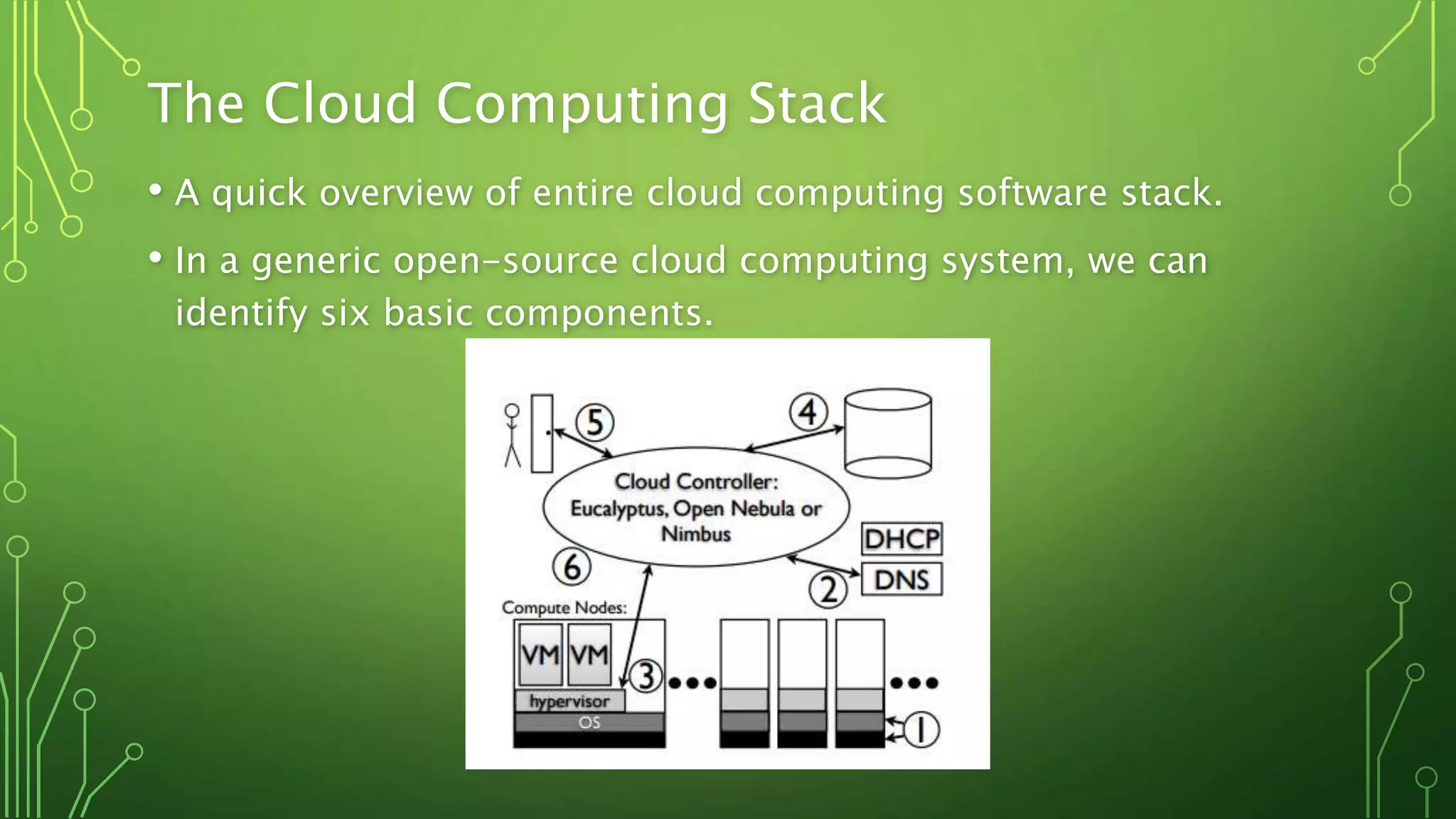
The Cloud Computing Stack
• A quick overview of entire cloud computing software stack.
• In a generic open-source cloud computing system, we can
identify six basic components.
• First, we hardware and operating system that are on the various
physical machines in the system.
• The second component is the network. This includes the DNS,
DHCP and the subnet organization of the physical machines.
• The third component is the virtual machine hypervisor, (also
known as a Virtual Machine Monitor or VMM).
• The fourth component is an archive of VM disk images.
• The fifth component is the front-end for users.
• The last component is the cloud framework itself, where
Eucalyptus, OpenNebula and Nimbus are placed.
Eucalyptus
• EUCALYPTUS stands for Elastic Utility Computing Architecture
for Linking Your Program To Useful System.
• It is open source software that was developed by University of
California-Santa Barbara for Cloud Computing to implement
Infrastructure as a Service.
• Eucalyptus provide an EC2 -compatible cloud Computing
Platform and S3- compatible Cloud Storage thus its services are
available through EC2/S3 compatible APIs.
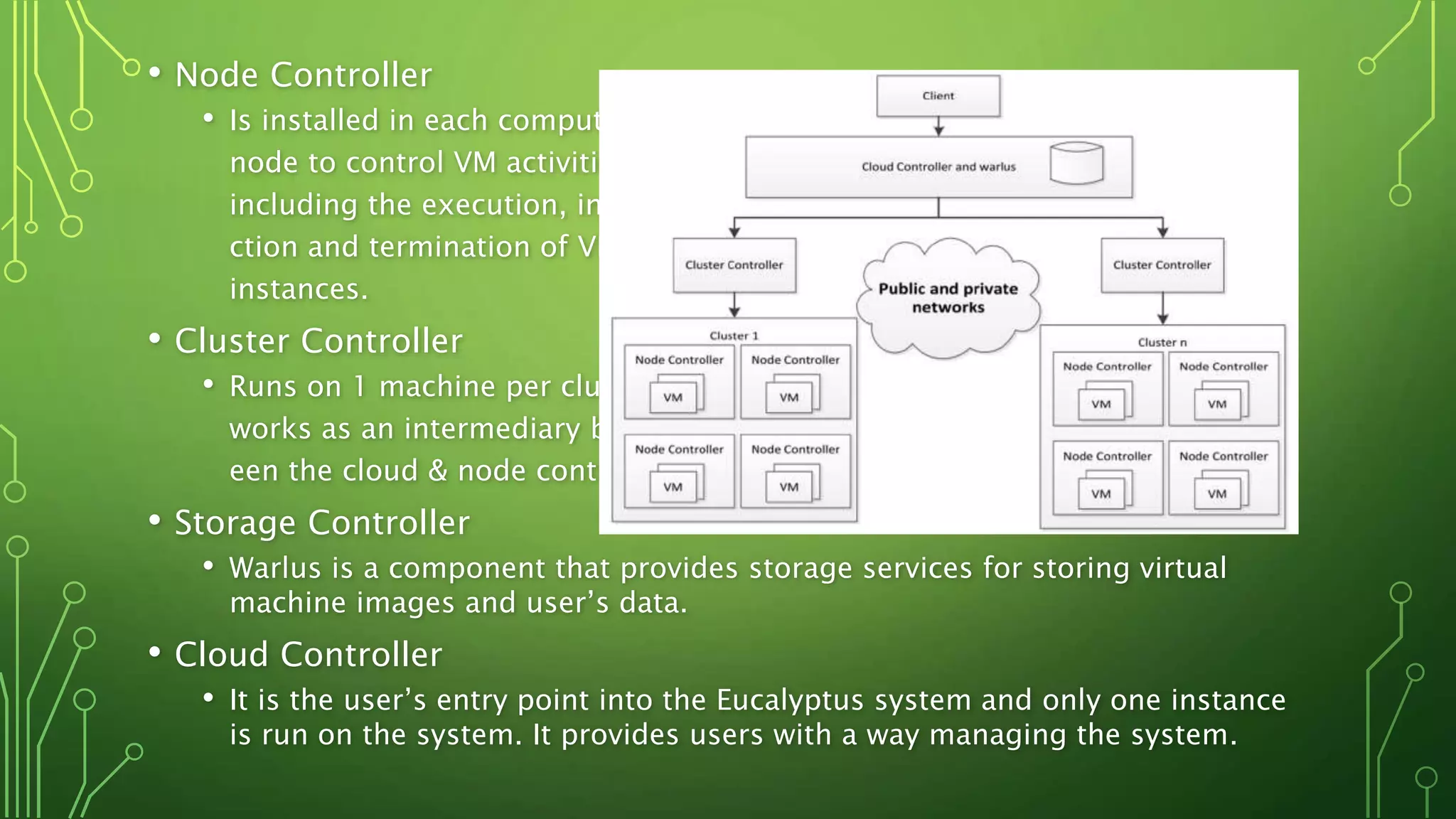
• The Eucalyptus system is composed of a 5 main components
interacting together; Client, Cloud Controller, Storage
Controller (Walrus), Cluster Controller and a Node Controller.
• Node Controller
• Is installed in each compute
node to control VM activities,
including the execution, inspe-
ction and termination of VM
instances.
• Cluster Controller
• Runs on 1 machine per cluster &
works as an intermediary betw-
een the cloud & node controller.
• Storage Controller
• Warlus is a component that provides storage services for storing virtual
machine images and user’s data.
• Cloud Controller
• It is the user’s entry point into the Eucalyptus system and only one instance
is run on the system. It provides users with a way managing the system.
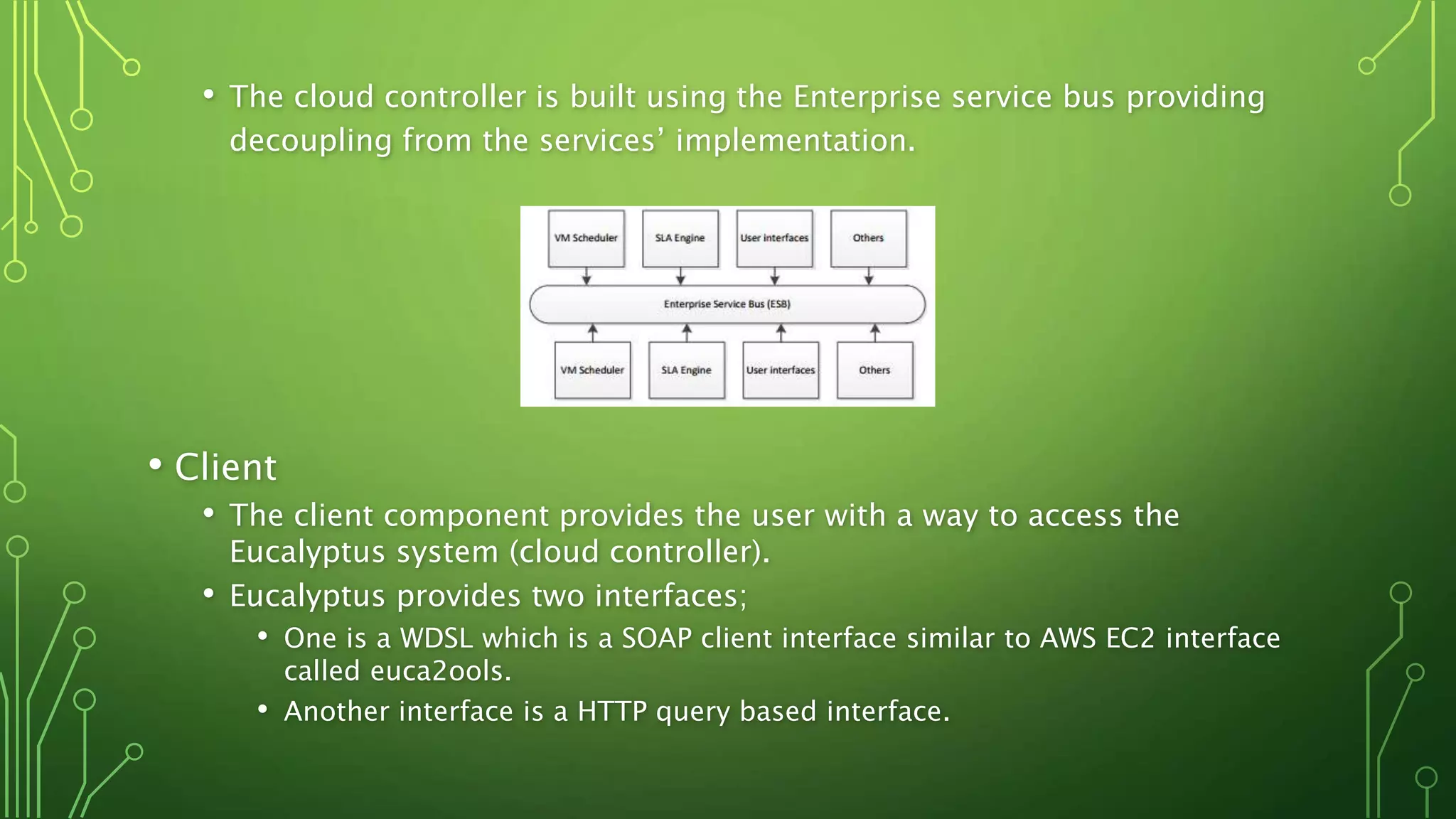
• The cloud controller is built using the Enterprise service bus providing
decoupling from the services’ implementation.
• Client
• The client component provides the user with a way to access the
Eucalyptus system (cloud controller).
• Eucalyptus provides two interfaces;
• One is a WDSL which is a SOAP client interface similar to AWS EC2 interface
called euca2ools.
• Another interface is a HTTP query based interface.
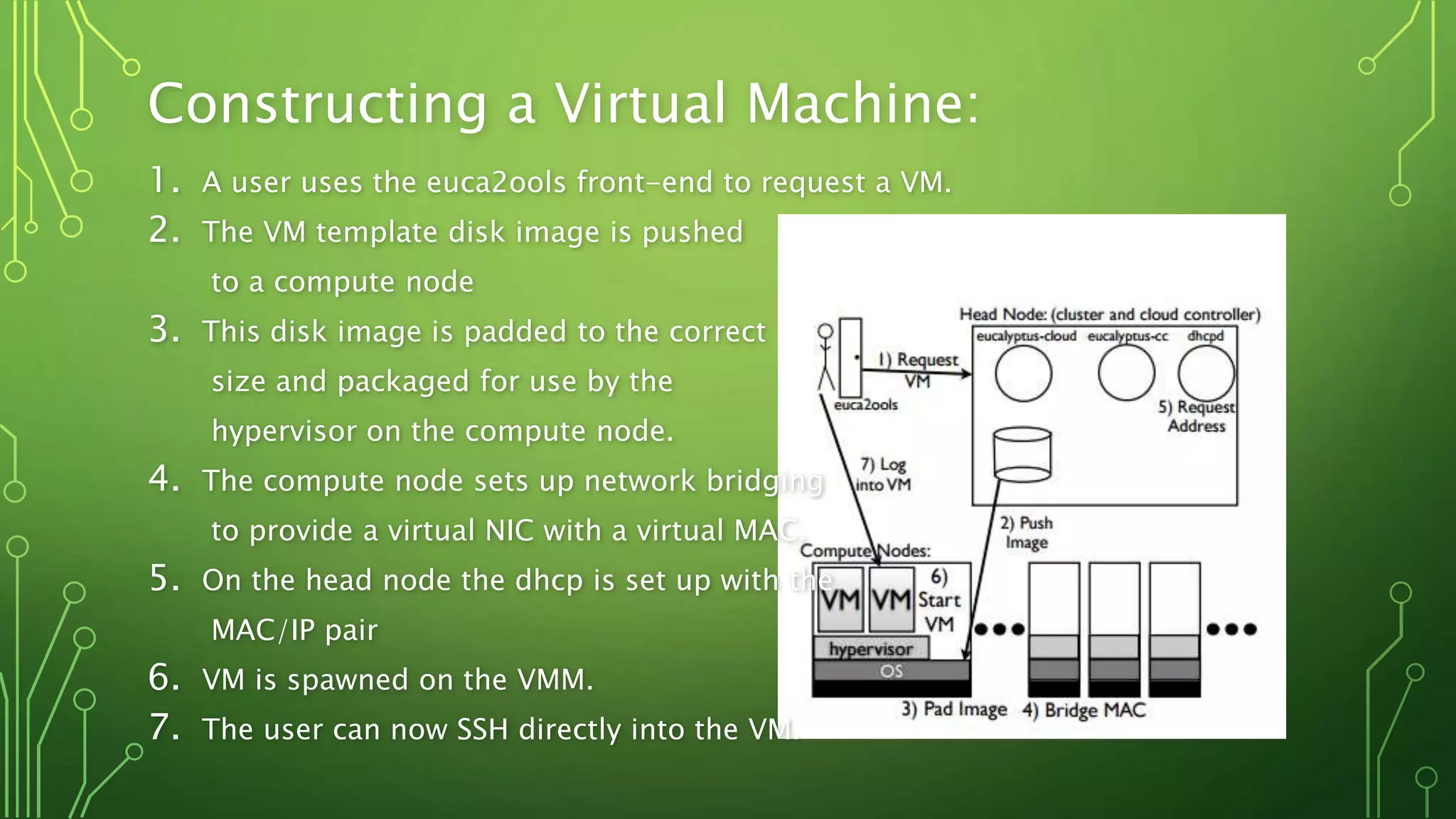
Constructing a Virtual Machine:
1. A user uses the euca2ools front-end to request a VM.
2. The VM template disk image is pushed
to a compute node
3. This disk image is padded to the correct
size and packaged for use by the
hypervisor on the compute node.
4. The compute node sets up network bridging
to provide a virtual NIC with a virtual MAC.
5. On the head node the dhcp is set up with the
MAC/IP pair
6. VM is spawned on the VMM.
7. The user can now SSH directly into the VM.
Nimbus
• Nimbus is another open source IaaS implementation framework
which came online September 2005.
• Nimbus allows a client to lease remote resources by deploying
virtual machines (VMs) on those resources and configuring
them to represent an environment desired by the user.
• It was formerly known as the "Virtual Workspace Service" (VWS)
but the "workspace service" is technically just one the
components in the software collection.
• Nimbus was designed with the goal of turning clusters into
clouds mainly to be used in scientific applications.
System Architecture And Design
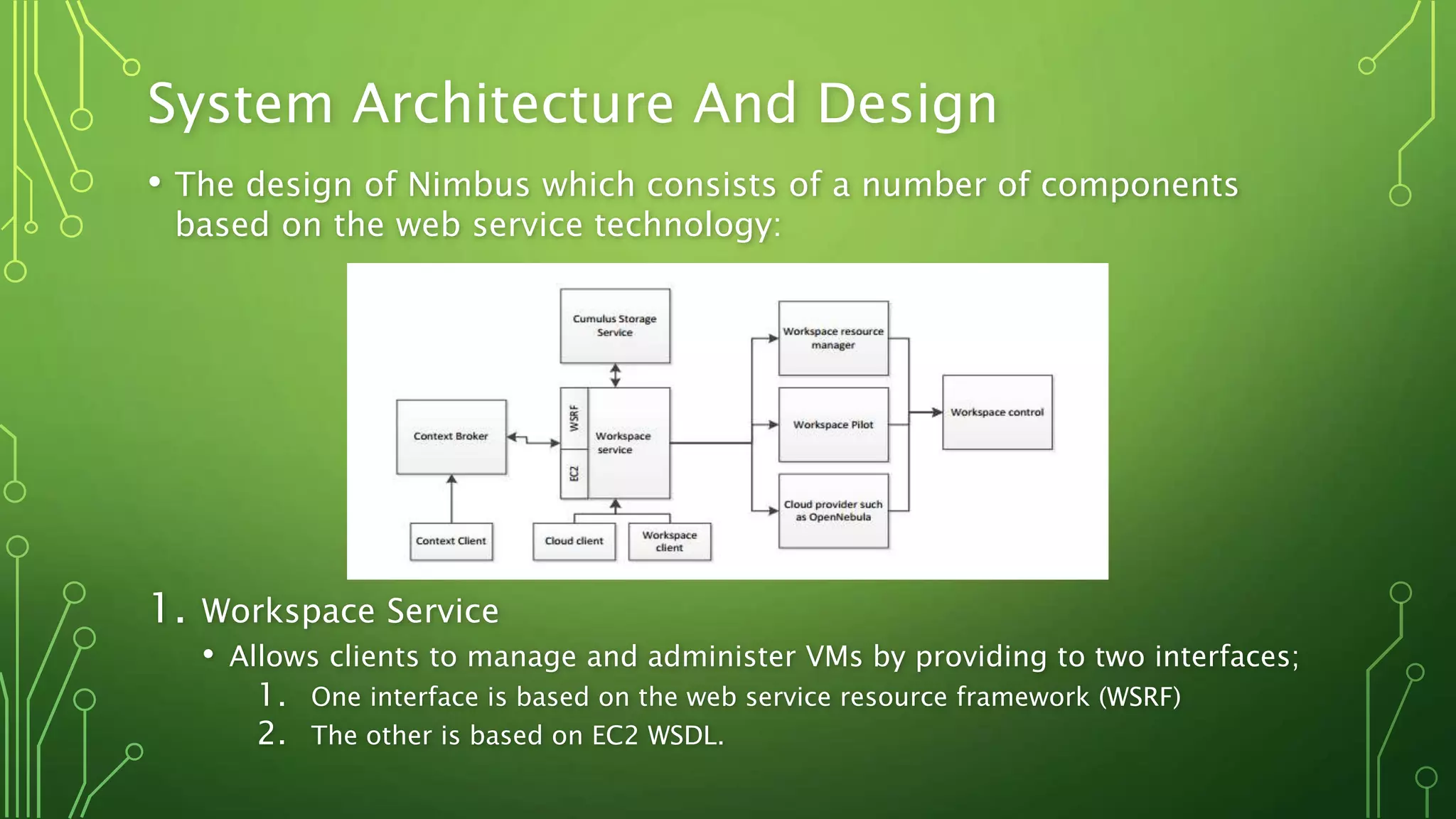
• The design of Nimbus which consists of a number of components
based on the web service technology:
1. Workspace Service
• Allows clients to manage and administer VMs by providing to two interfaces;
1. One interface is based on the web service resource framework (WSRF)
2. The other is based on EC2 WSDL.
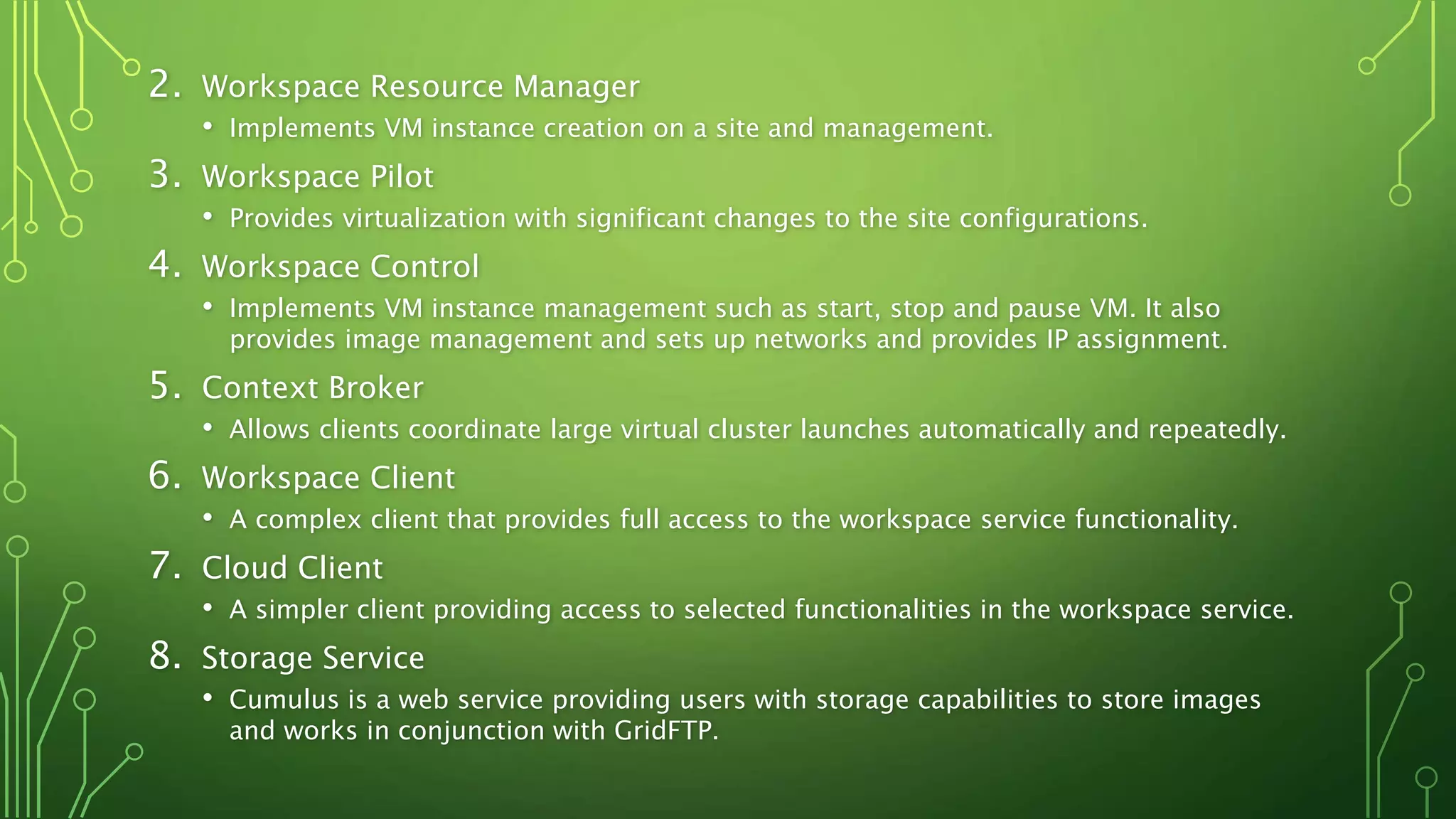
2. Workspace Resource Manager
• Implements VM instance creation on a site and management.
3. Workspace Pilot
• Provides virtualization with significant changes to the site configurations.
4. Workspace Control
• Implements VM instance management such as start, stop and pause VM. It also
provides image management and sets up networks and provides IP assignment.
5. Context Broker
• Allows clients coordinate large virtual cluster launches automatically and repeatedly.
6. Workspace Client
• A complex client that provides full access to the workspace service functionality.
7. Cloud Client
• A simpler client providing access to selected functionalities in the workspace service.
8. Storage Service
• Cumulus is a web service providing users with storage capabilities to store images
and works in conjunction with GridFTP.
Constructing A Virtual Machine:
1. A user uses cloud-client to request a VM.
2. Nimbus will SSH into a compute node.
3. The VM template disk image is pushed to the
compute node.
4. On the compute node, the disk image is
padded to the correct size and configured.
5. The compute node sets up network bridging
to provide a virtual NIC with a virtual MAC.
6. A dhcp server on the compute node is
configured with a MAC/IP pair.
7. VM is spawned on the VMM.
8. The user can now SSH directly into the VM.
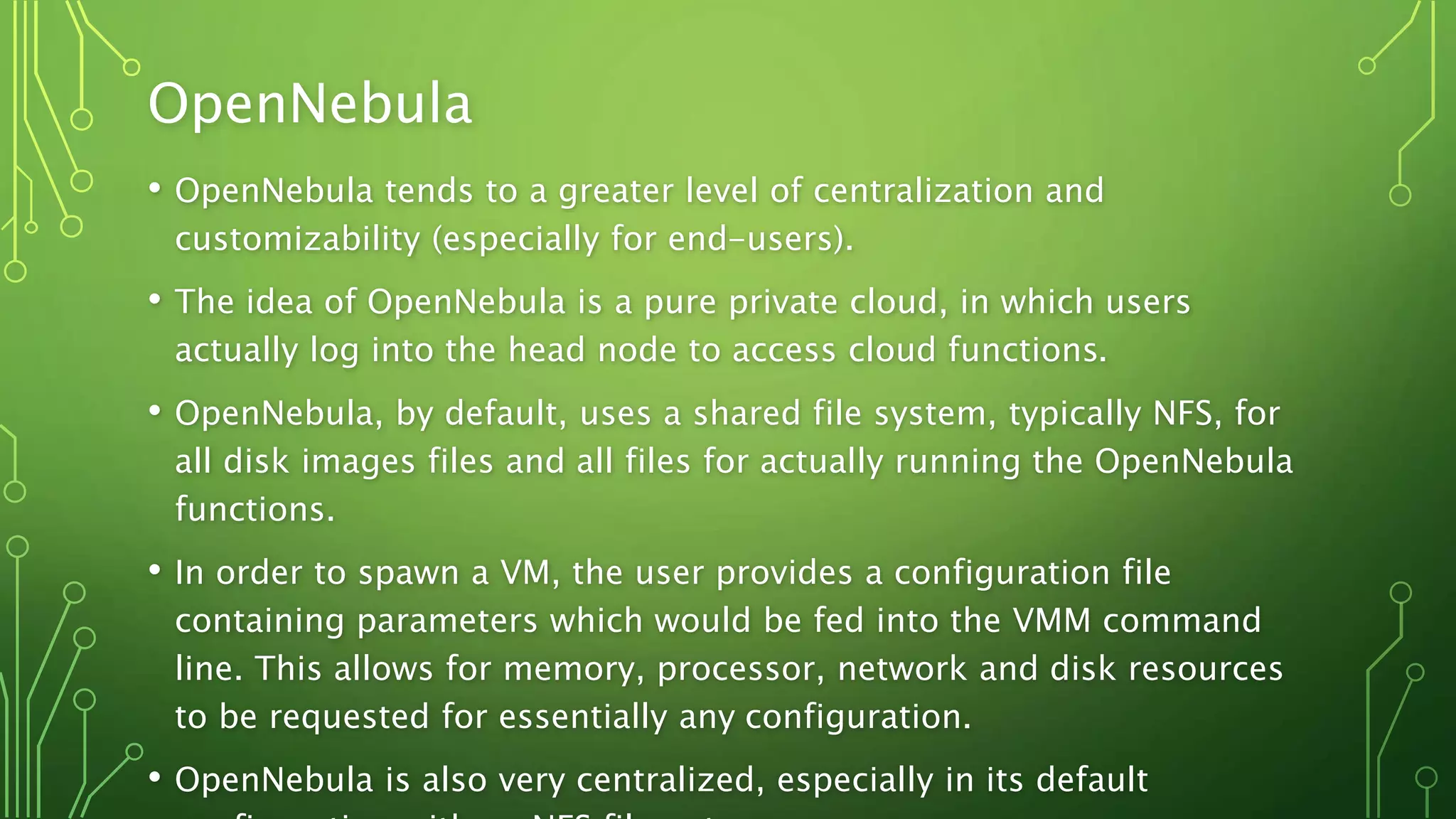
OpenNebula
• OpenNebula tends to a greater level of centralization and
customizability (especially for end-users).
• The idea of OpenNebula is a pure private cloud, in which users
actually log into the head node to access cloud functions.
• OpenNebula, by default, uses a shared file system, typically NFS, for
all disk images files and all files for actually running the OpenNebula
functions.
• In order to spawn a VM, the user provides a configuration file
containing parameters which would be fed into the VMM command
line. This allows for memory, processor, network and disk resources
to be requested for essentially any configuration.
• OpenNebula is also very centralized, especially in its default
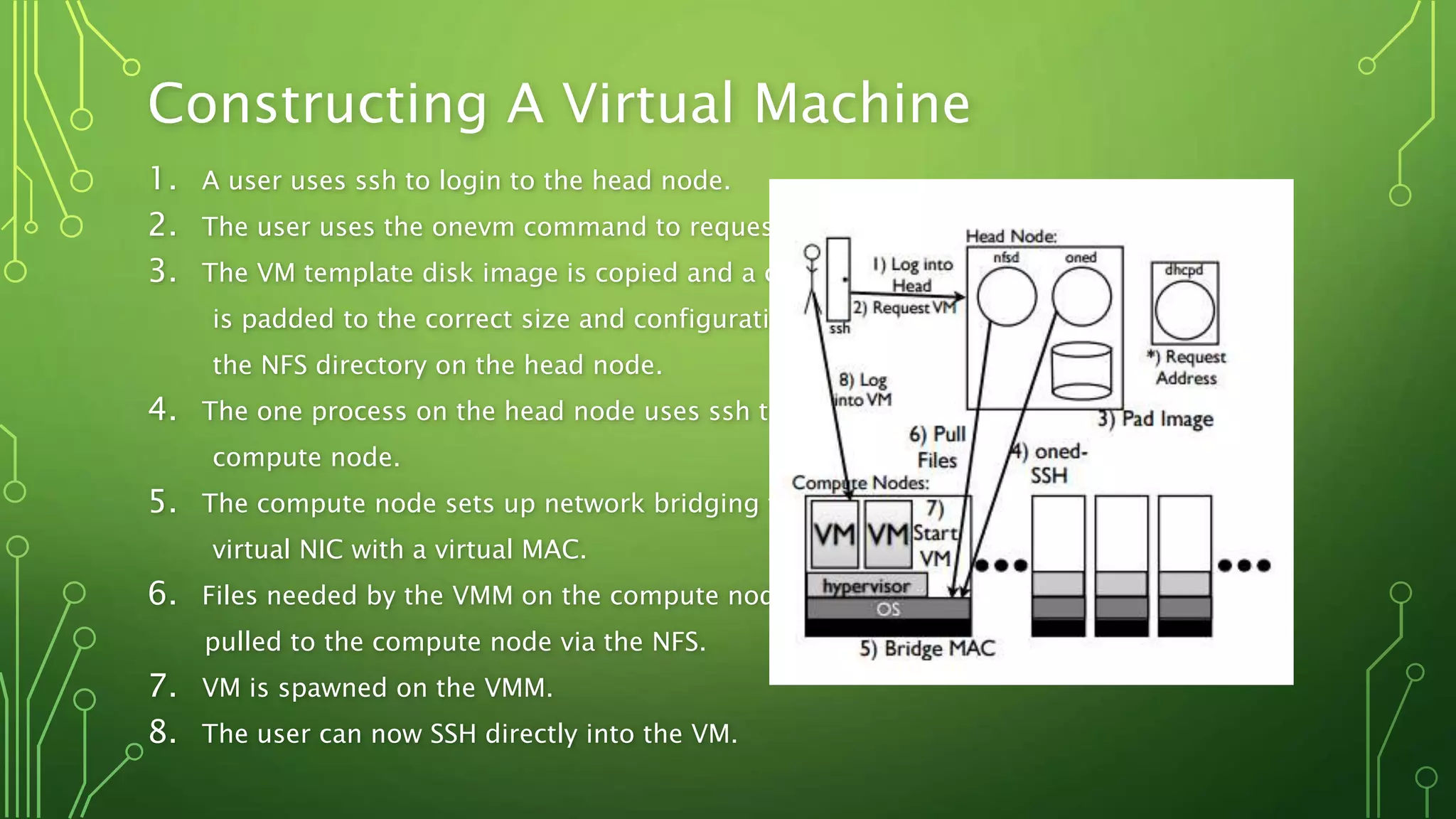
Constructing A Virtual Machine
1. A user uses ssh to login to the head node.
2. The user uses the onevm command to request a VM.
3. The VM template disk image is copied and a copy
is padded to the correct size and configuration within
the NFS directory on the head node.
4. The one process on the head node uses ssh to log into a
compute node.
5. The compute node sets up network bridging to provide a
virtual NIC with a virtual MAC.
6. Files needed by the VMM on the compute node will be
pulled to the compute node via the NFS.
7. VM is spawned on the VMM.
8. The user can now SSH directly into the VM.
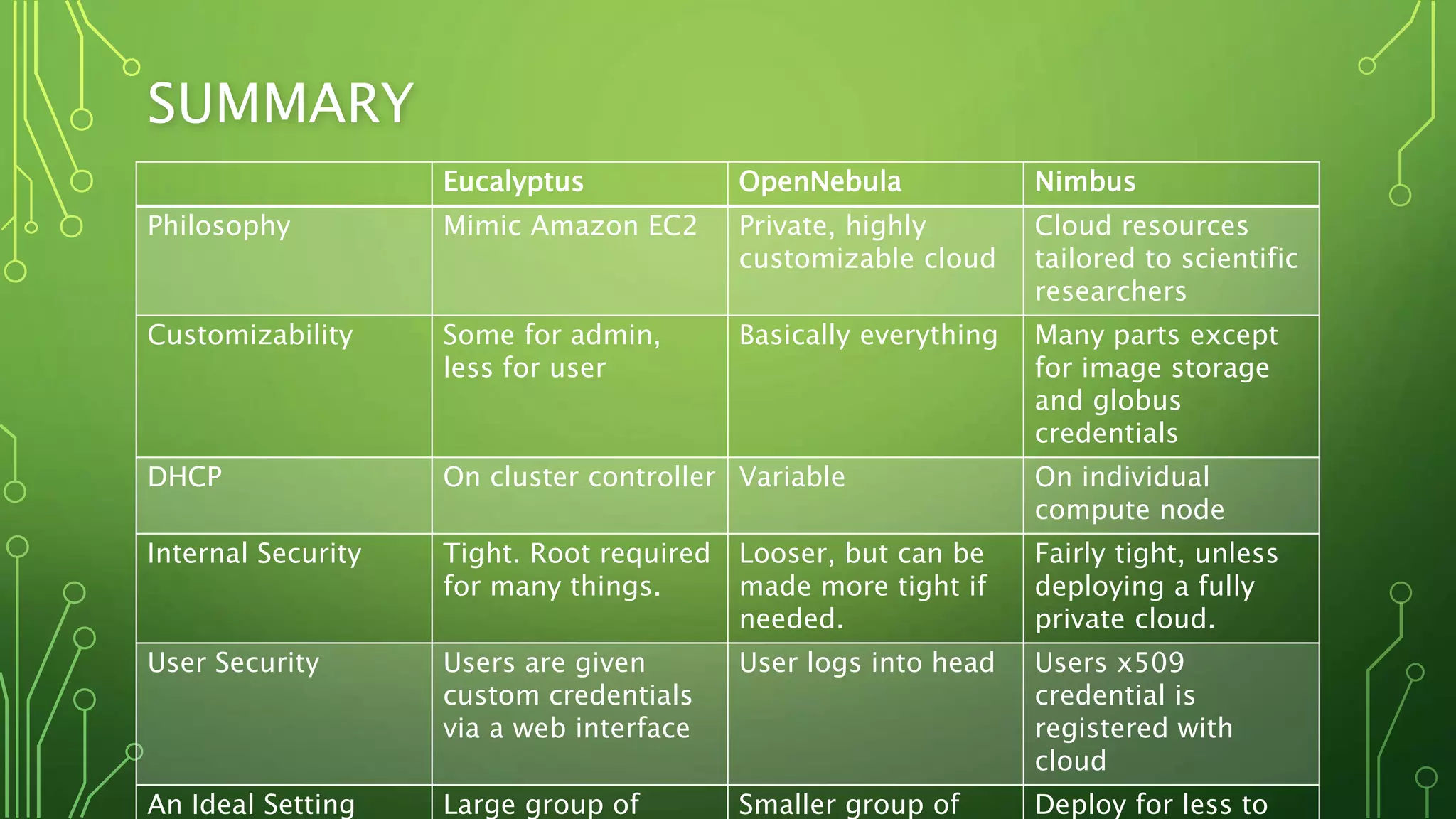
SUMMARY
Eucalyptus OpenNebula Nimbus
Philosophy Mimic Amazon EC2 Private, highly
customizable cloud
Cloud resources
tailored to scientific
researchers
Customizability Some for admin,
less for user
Basically everything Many parts except
for image storage
and globus
credentials
DHCP On cluster controller Variable On individual
compute node
Internal Security Tight. Root required
for many things.
Looser, but can be
made more tight if
needed.
Fairly tight, unless
deploying a fully
private cloud.
User Security Users are given
custom credentials
via a web interface
User logs into head Users x509
credential is
registered with
cloud
An Ideal Setting Large group of Smaller group of Deploy for less to
THANK YOU

Eucalyptus, Nimbus & OpenNebula

  • 1.
  • 2.
    About Us Amar MyanaLatika Patil I’m a Software Developer I’m a Software Developer I work at Security Brigade Infosec Pvt. Ltd. I work at TCS Consultancy Ltd. I’m working from last 3 years. I’m working from last 2 years.
  • 3.
    Abstract • Eucalyptus, Nimbus& OpenNebula are major Open-Source Cloud-Computing Software Platforms • Manage the provisioning of virtual machines for a cloud providing IaaS • Commercial cloud services charge, by the hour, for CPU time • It might be more cost effective for the organization to purchase hardware to create its own private cloud. • These software products are designed to allow an organization to set up a private group of machines as their own cloud. • These three frameworks represent three different points of interest in the design space of this particular type of open- source cloud.
  • 4.
    Analysis • We willdiscuss how these software frameworks act as managers that stand in the middle of a number of other software components. • We will analyze how core decisions in the basic architecture and overall structure of Eucalyptus, Nimbus and OpenNebula impact the kind of settings and applications for which each framework is most suitable. • We will identify several opportunities for improving these software stacks by identifying some of the challenges that are common to all three.
  • 5.
    The Cloud ComputingStack • A quick overview of entire cloud computing software stack. • In a generic open-source cloud computing system, we can identify six basic components.
  • 6.
    • First, wehardware and operating system that are on the various physical machines in the system. • The second component is the network. This includes the DNS, DHCP and the subnet organization of the physical machines. • The third component is the virtual machine hypervisor, (also known as a Virtual Machine Monitor or VMM). • The fourth component is an archive of VM disk images. • The fifth component is the front-end for users. • The last component is the cloud framework itself, where Eucalyptus, OpenNebula and Nimbus are placed.
  • 7.
    Eucalyptus • EUCALYPTUS standsfor Elastic Utility Computing Architecture for Linking Your Program To Useful System. • It is open source software that was developed by University of California-Santa Barbara for Cloud Computing to implement Infrastructure as a Service. • Eucalyptus provide an EC2 -compatible cloud Computing Platform and S3- compatible Cloud Storage thus its services are available through EC2/S3 compatible APIs. • The Eucalyptus system is composed of a 5 main components interacting together; Client, Cloud Controller, Storage Controller (Walrus), Cluster Controller and a Node Controller.
  • 8.
    • Node Controller •Is installed in each compute node to control VM activities, including the execution, inspe- ction and termination of VM instances. • Cluster Controller • Runs on 1 machine per cluster & works as an intermediary betw- een the cloud & node controller. • Storage Controller • Warlus is a component that provides storage services for storing virtual machine images and user’s data. • Cloud Controller • It is the user’s entry point into the Eucalyptus system and only one instance is run on the system. It provides users with a way managing the system.
  • 9.
    • The cloudcontroller is built using the Enterprise service bus providing decoupling from the services’ implementation. • Client • The client component provides the user with a way to access the Eucalyptus system (cloud controller). • Eucalyptus provides two interfaces; • One is a WDSL which is a SOAP client interface similar to AWS EC2 interface called euca2ools. • Another interface is a HTTP query based interface.
  • 10.
    Constructing a VirtualMachine: 1. A user uses the euca2ools front-end to request a VM. 2. The VM template disk image is pushed to a compute node 3. This disk image is padded to the correct size and packaged for use by the hypervisor on the compute node. 4. The compute node sets up network bridging to provide a virtual NIC with a virtual MAC. 5. On the head node the dhcp is set up with the MAC/IP pair 6. VM is spawned on the VMM. 7. The user can now SSH directly into the VM.
  • 11.
    Nimbus • Nimbus isanother open source IaaS implementation framework which came online September 2005. • Nimbus allows a client to lease remote resources by deploying virtual machines (VMs) on those resources and configuring them to represent an environment desired by the user. • It was formerly known as the "Virtual Workspace Service" (VWS) but the "workspace service" is technically just one the components in the software collection. • Nimbus was designed with the goal of turning clusters into clouds mainly to be used in scientific applications.
  • 12.
    System Architecture AndDesign • The design of Nimbus which consists of a number of components based on the web service technology: 1. Workspace Service • Allows clients to manage and administer VMs by providing to two interfaces; 1. One interface is based on the web service resource framework (WSRF) 2. The other is based on EC2 WSDL.
  • 13.
    2. Workspace ResourceManager • Implements VM instance creation on a site and management. 3. Workspace Pilot • Provides virtualization with significant changes to the site configurations. 4. Workspace Control • Implements VM instance management such as start, stop and pause VM. It also provides image management and sets up networks and provides IP assignment. 5. Context Broker • Allows clients coordinate large virtual cluster launches automatically and repeatedly. 6. Workspace Client • A complex client that provides full access to the workspace service functionality. 7. Cloud Client • A simpler client providing access to selected functionalities in the workspace service. 8. Storage Service • Cumulus is a web service providing users with storage capabilities to store images and works in conjunction with GridFTP.
  • 14.
    Constructing A VirtualMachine: 1. A user uses cloud-client to request a VM. 2. Nimbus will SSH into a compute node. 3. The VM template disk image is pushed to the compute node. 4. On the compute node, the disk image is padded to the correct size and configured. 5. The compute node sets up network bridging to provide a virtual NIC with a virtual MAC. 6. A dhcp server on the compute node is configured with a MAC/IP pair. 7. VM is spawned on the VMM. 8. The user can now SSH directly into the VM.
  • 15.
    OpenNebula • OpenNebula tendsto a greater level of centralization and customizability (especially for end-users). • The idea of OpenNebula is a pure private cloud, in which users actually log into the head node to access cloud functions. • OpenNebula, by default, uses a shared file system, typically NFS, for all disk images files and all files for actually running the OpenNebula functions. • In order to spawn a VM, the user provides a configuration file containing parameters which would be fed into the VMM command line. This allows for memory, processor, network and disk resources to be requested for essentially any configuration. • OpenNebula is also very centralized, especially in its default
  • 16.
    Constructing A VirtualMachine 1. A user uses ssh to login to the head node. 2. The user uses the onevm command to request a VM. 3. The VM template disk image is copied and a copy is padded to the correct size and configuration within the NFS directory on the head node. 4. The one process on the head node uses ssh to log into a compute node. 5. The compute node sets up network bridging to provide a virtual NIC with a virtual MAC. 6. Files needed by the VMM on the compute node will be pulled to the compute node via the NFS. 7. VM is spawned on the VMM. 8. The user can now SSH directly into the VM.
  • 17.
    SUMMARY Eucalyptus OpenNebula Nimbus PhilosophyMimic Amazon EC2 Private, highly customizable cloud Cloud resources tailored to scientific researchers Customizability Some for admin, less for user Basically everything Many parts except for image storage and globus credentials DHCP On cluster controller Variable On individual compute node Internal Security Tight. Root required for many things. Looser, but can be made more tight if needed. Fairly tight, unless deploying a fully private cloud. User Security Users are given custom credentials via a web interface User logs into head Users x509 credential is registered with cloud An Ideal Setting Large group of Smaller group of Deploy for less to
  • 18.