Employing ForteBio Octet platform for the
development of a dual-binding potency assay
and as a highly versatile tool for early stage
product analysis
Carson Cameron, MS
Analytical Development Research Associate
KBI Biopharma
1
Who is KBI
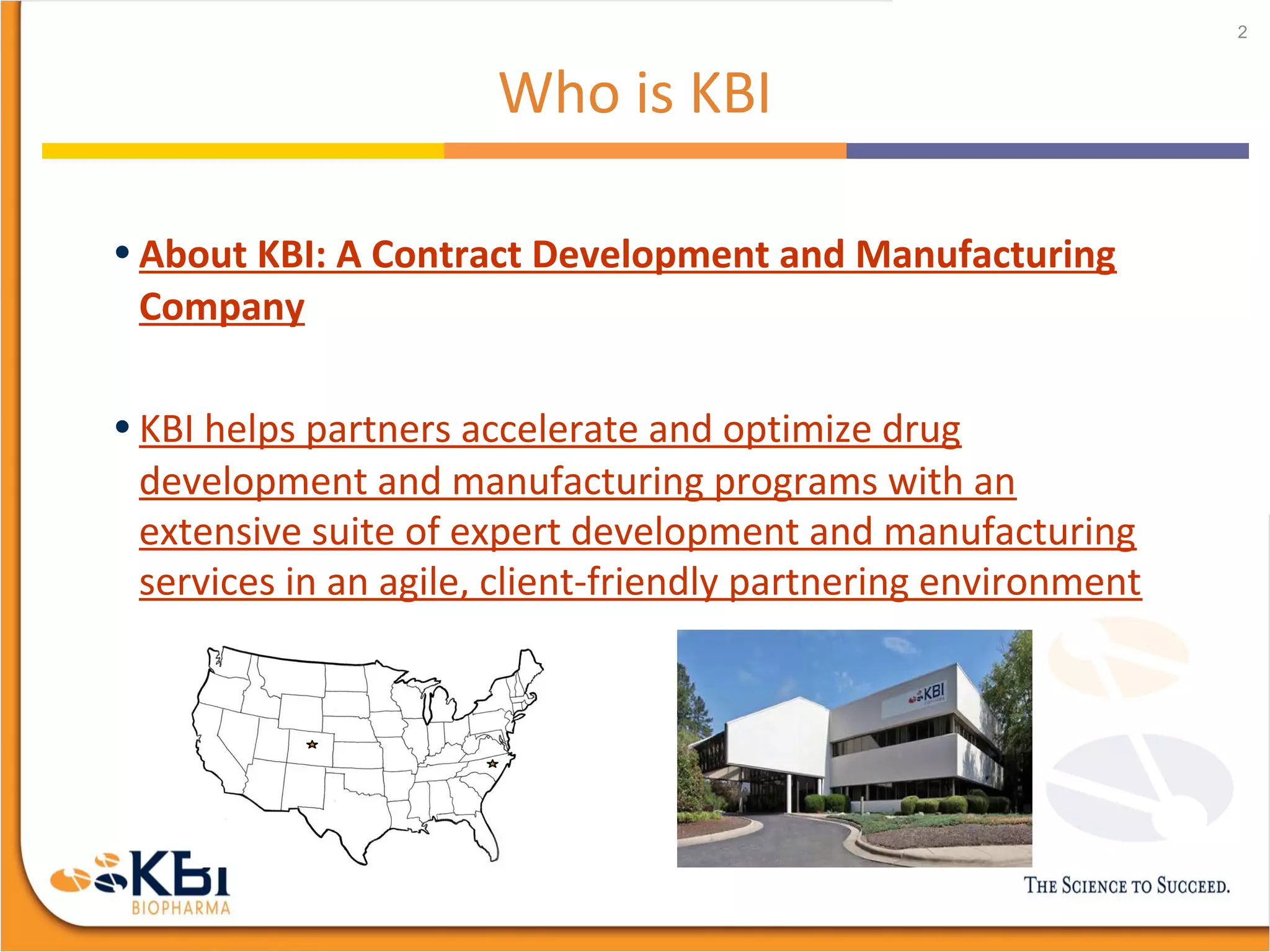
• About KBI: A Contract Development and Manufacturing
Company
• KBI helps partners accelerate and optimize drug
development and manufacturing programs with an
extensive suite of expert development and manufacturing
services in an agile, client-friendly partnering environment
2
Role of Analytical Development
•Development
• Method Development
• Method Optimization
• PD support (CLD, Upstream
and Downstream)
• Lots of Samples!
•Quality Control
• Method Qualification
• Stricter Requirements
• Fewer Samples
3
Challenge: Technology that can be utilized in a Q.C.
and in a high-throughput fashion
Answer: ForteBio Octet
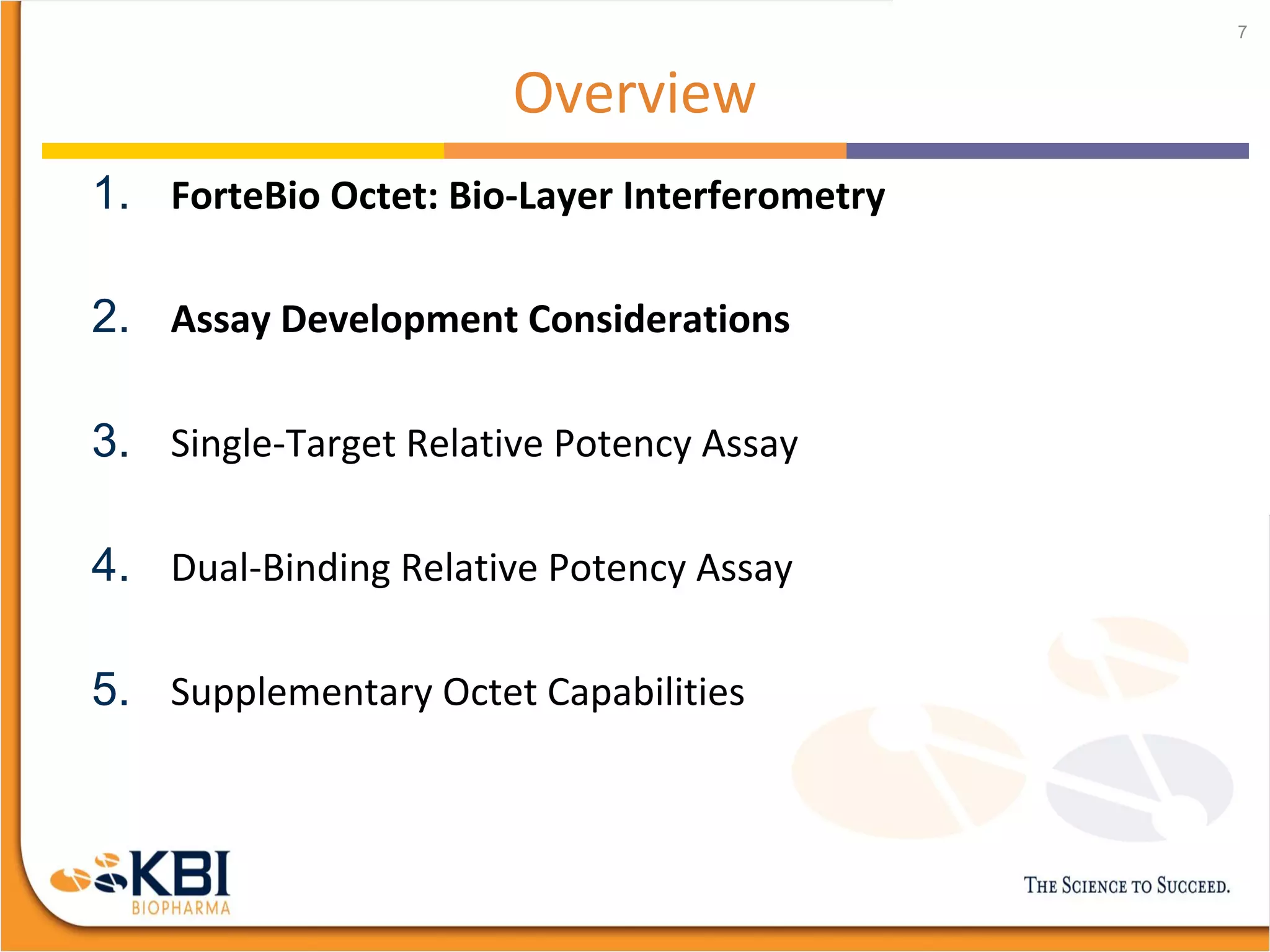
Overview
1. ForteBio Octet: Bio-Layer Interferometry
2. Assay Development Considerations
3. Single-Target Relative Potency Assay
4. Dual-Binding Relative Potency Assay
5. Supplementary Octet Capabilities
4
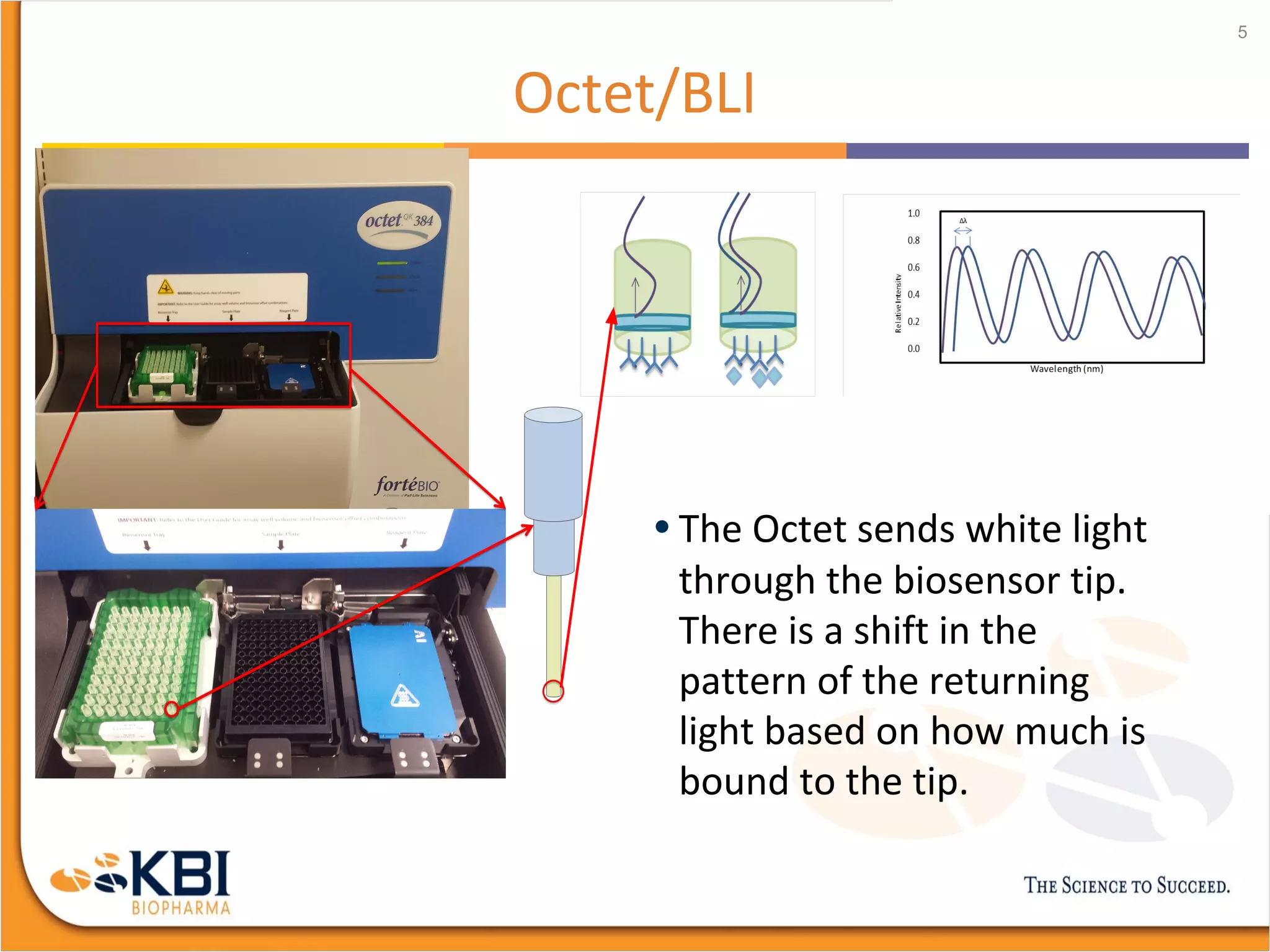
Octet/BLI
5
• The Octet sends white light
through the biosensor tip.
There is a shift in the
pattern of the returning
light based on how much is
bound to the tip.
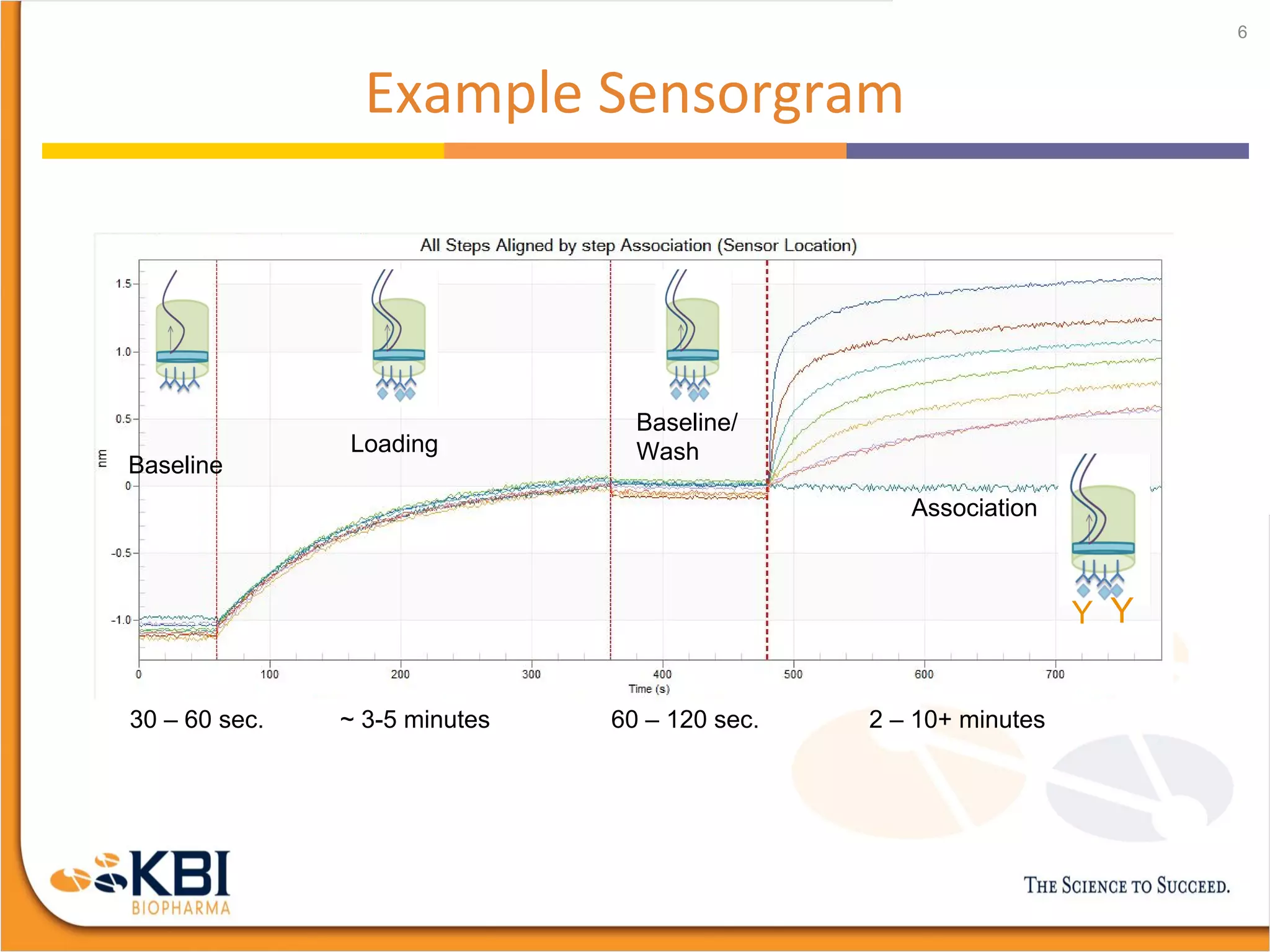
Example Sensorgram
6
Baseline
30 – 60 sec.
Loading
~ 3-5 minutes
Baseline/
Wash
60 – 120 sec.
Association
2 – 10+ minutes
Y Y
Overview
1. ForteBio Octet: Bio-Layer Interferometry
2. Assay Development Considerations
3. Single-Target Relative Potency Assay
4. Dual-Binding Relative Potency Assay
5. Supplementary Octet Capabilities
7
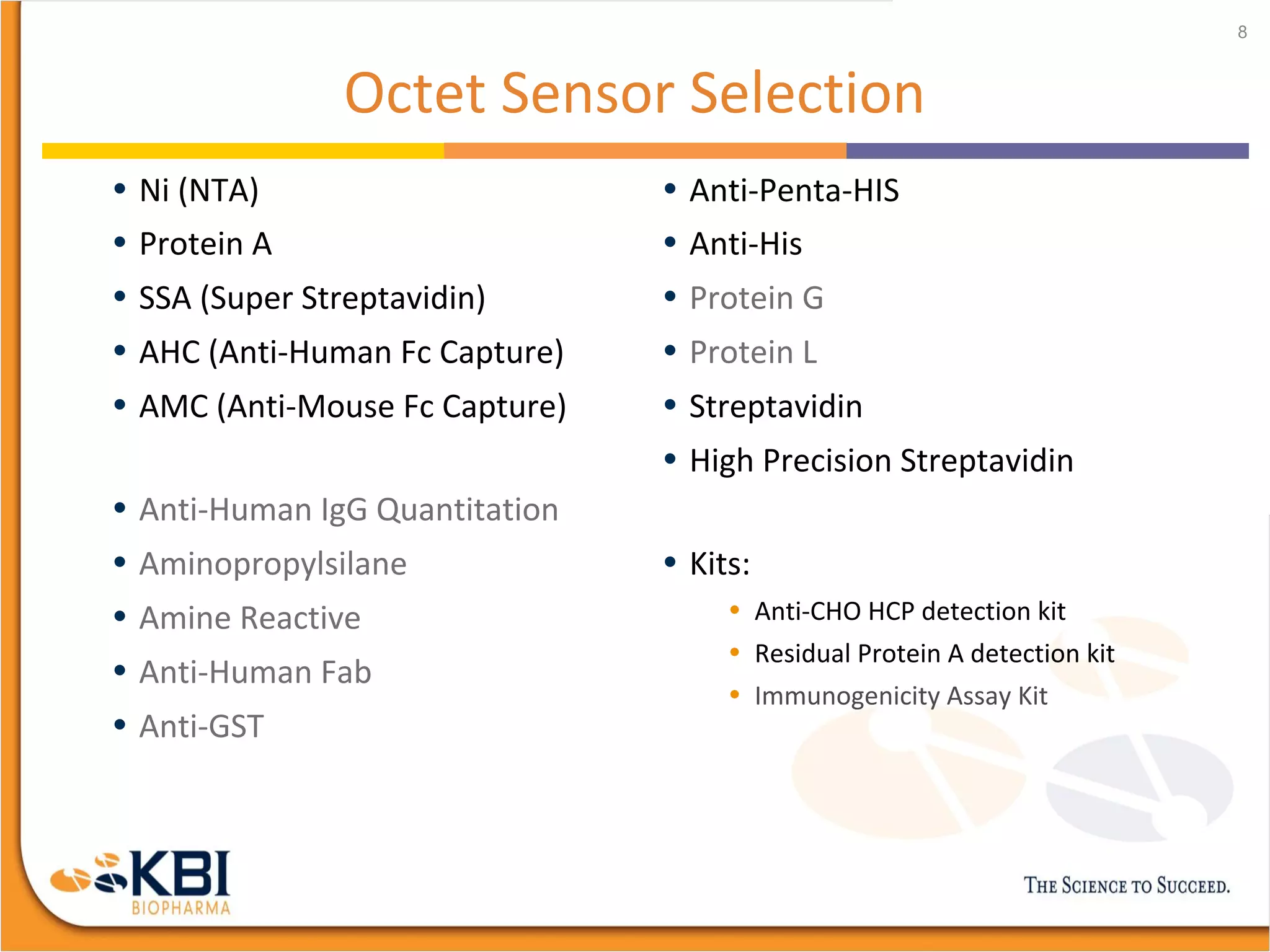
Octet Sensor Selection
• Ni (NTA)
• Protein A
• SSA (Super Streptavidin)
• AHC (Anti-Human Fc Capture)
• AMC (Anti-Mouse Fc Capture)
• Anti-Human IgG Quantitation
• Aminopropylsilane
• Amine Reactive
• Anti-Human Fab
• Anti-GST
• Anti-Penta-HIS
• Anti-His
• Protein G
• Protein L
• Streptavidin
• High Precision Streptavidin
• Kits:
• Anti-CHO HCP detection kit
• Residual Protein A detection kit
• Immunogenicity Assay Kit
8
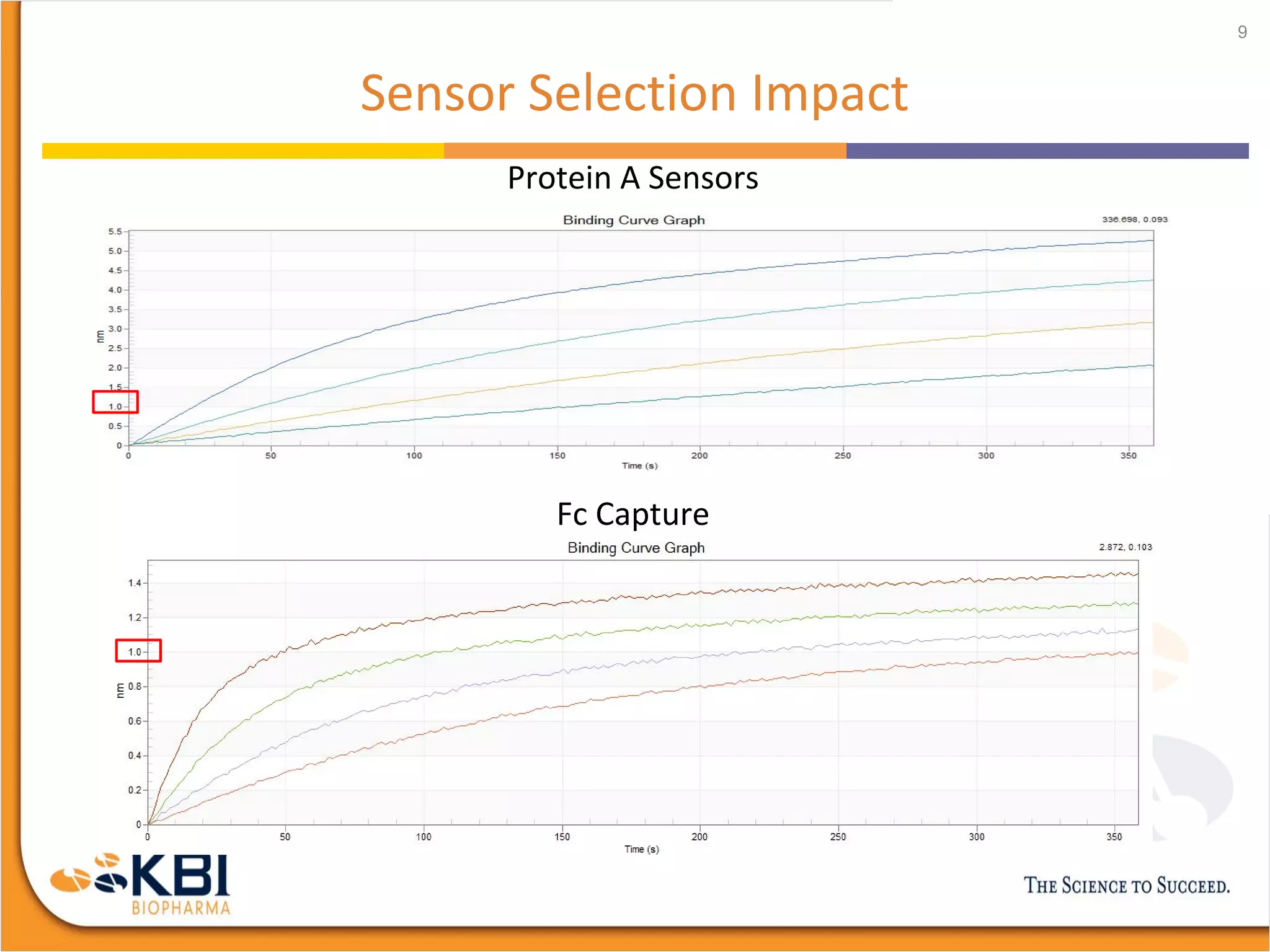
Sensor Selection Impact
9
Protein A Sensors
Fc Capture
Overview
1. ForteBio Octet: Bio-Layer Interferometry
2. Assay Development on the Octet instrument
3. Single-Target Relative Potency Assay
4. Dual-Binding Relative Potency Assay
5. Supplementary Octet Capabilities
10
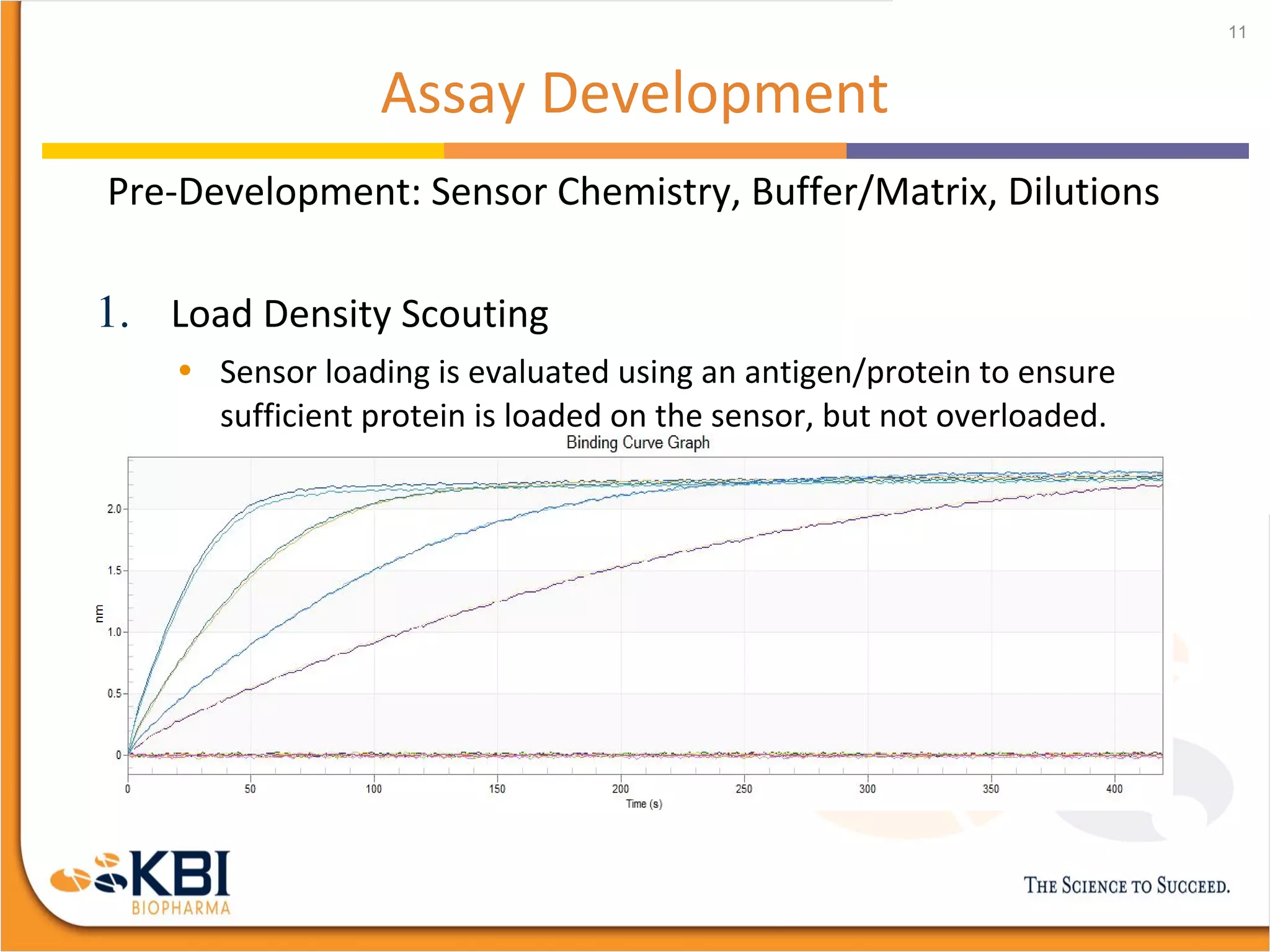
Assay Development
Pre-Development: Sensor Chemistry, Buffer/Matrix, Dilutions
1. Load Density Scouting
• Sensor loading is evaluated using an antigen/protein to ensure
sufficient protein is loaded on the sensor, but not overloaded.
11
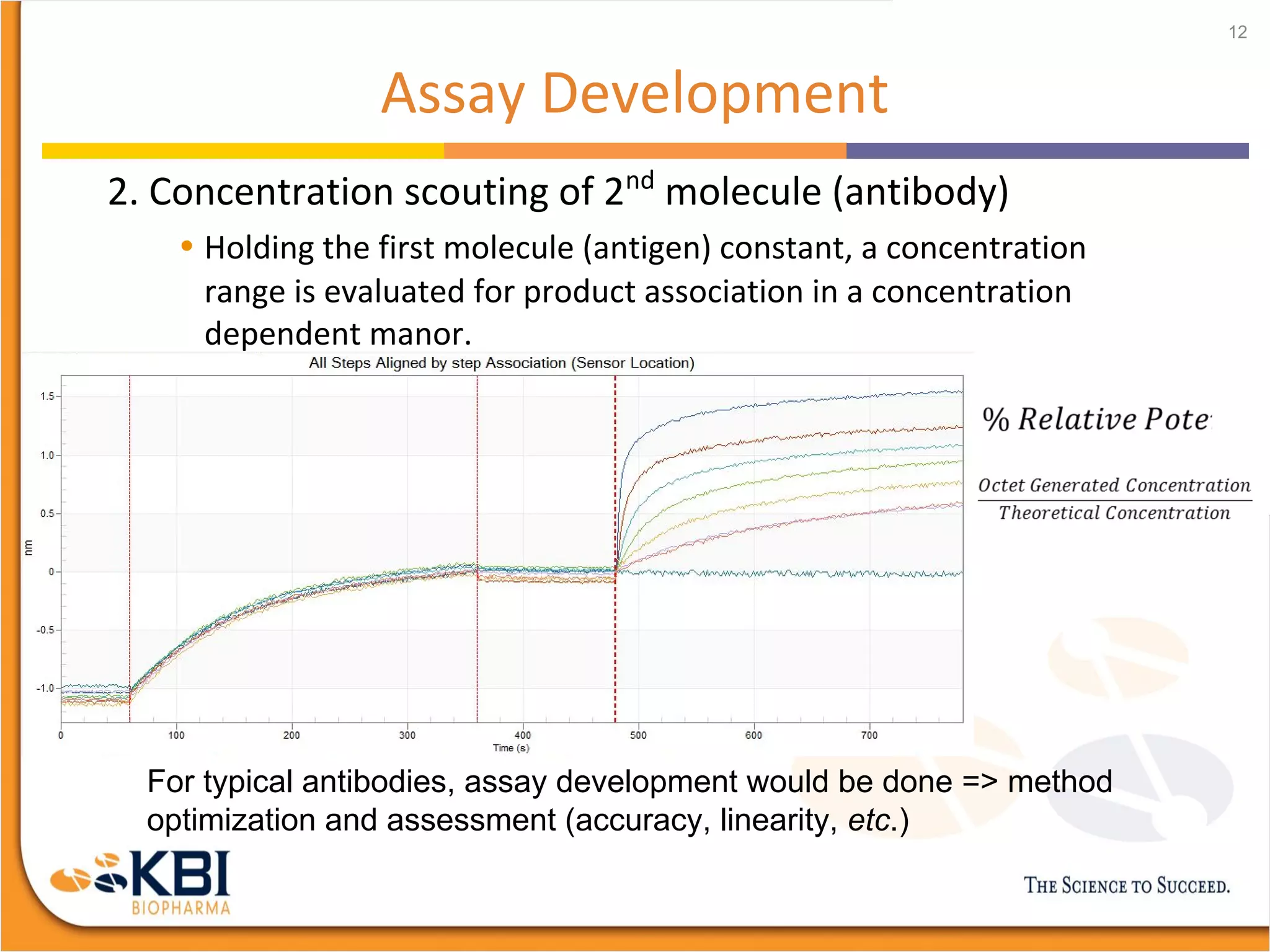
Assay Development
2. Concentration scouting of 2nd
molecule (antibody)
• Holding the first molecule (antigen) constant, a concentration
range is evaluated for product association in a concentration
dependent manor.
12
For typical antibodies, assay development would be done => method
optimization and assessment (accuracy, linearity, etc.)
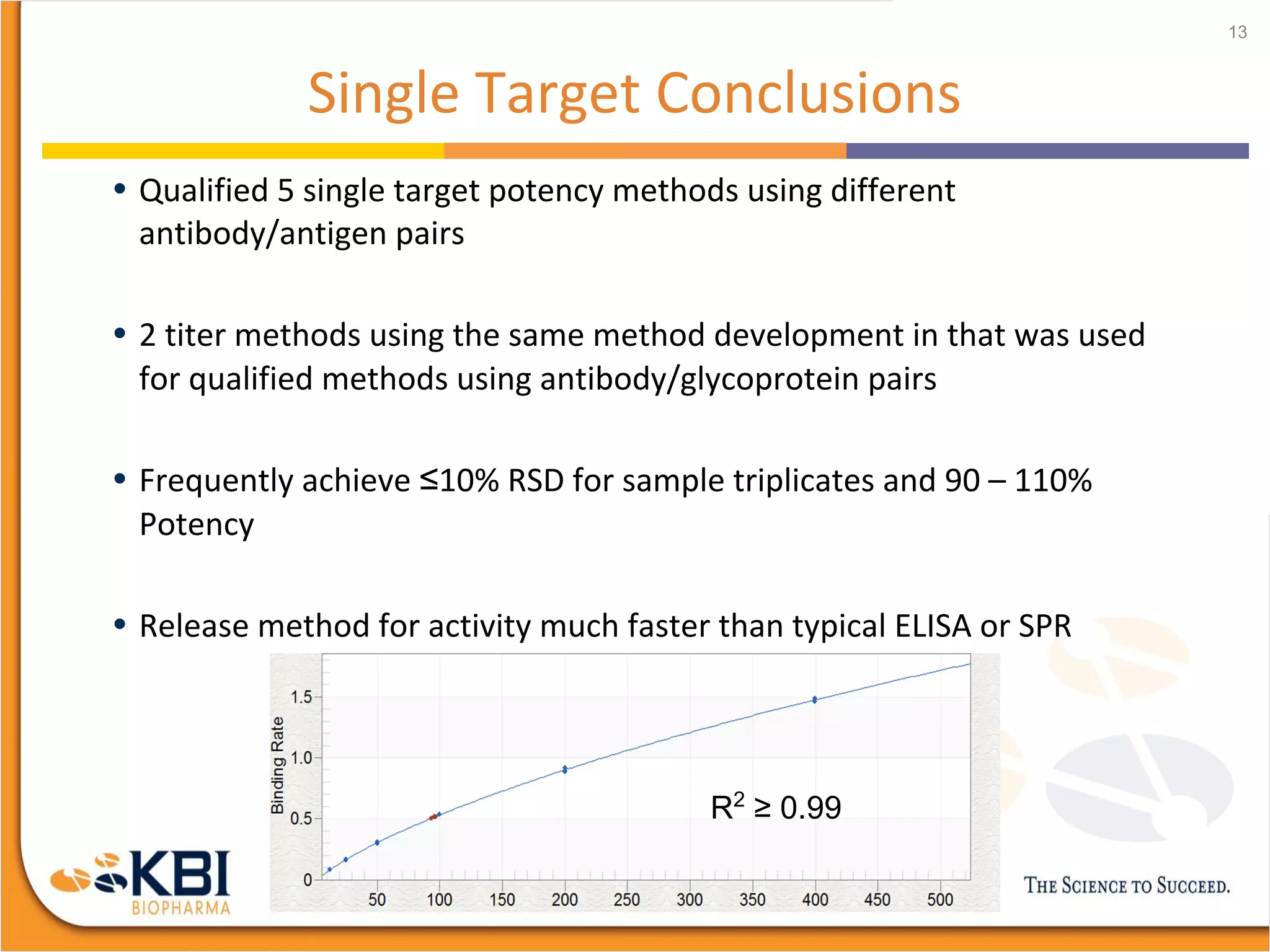
Single Target Conclusions
• Qualified 5 single target potency methods using different
antibody/antigen pairs
• 2 titer methods using the same method development in that was used
for qualified methods using antibody/glycoprotein pairs
• Frequently achieve ≤10% RSD for sample triplicates and 90 – 110%
Potency
• Release method for activity much faster than typical ELISA or SPR
13
R2
≥ 0.99
Overview
1. ForteBio Octet: Bio-Layer Interferometry
2. Assay Development on the Octet instrument
3. Single-Target Relative Potency Assay
4. Dual-Binding Relative Potency Assay
5. Supplementary Octet Capabilities
14
Need for a Dual Binding Potency
• New Bispecific molecules and fusion proteins drive the
need for dual binding potency assays
• BLI technology reduces impact of non-specific binding
when compared to an ELISA, though development is not as
direct as a single binding potency assay
15
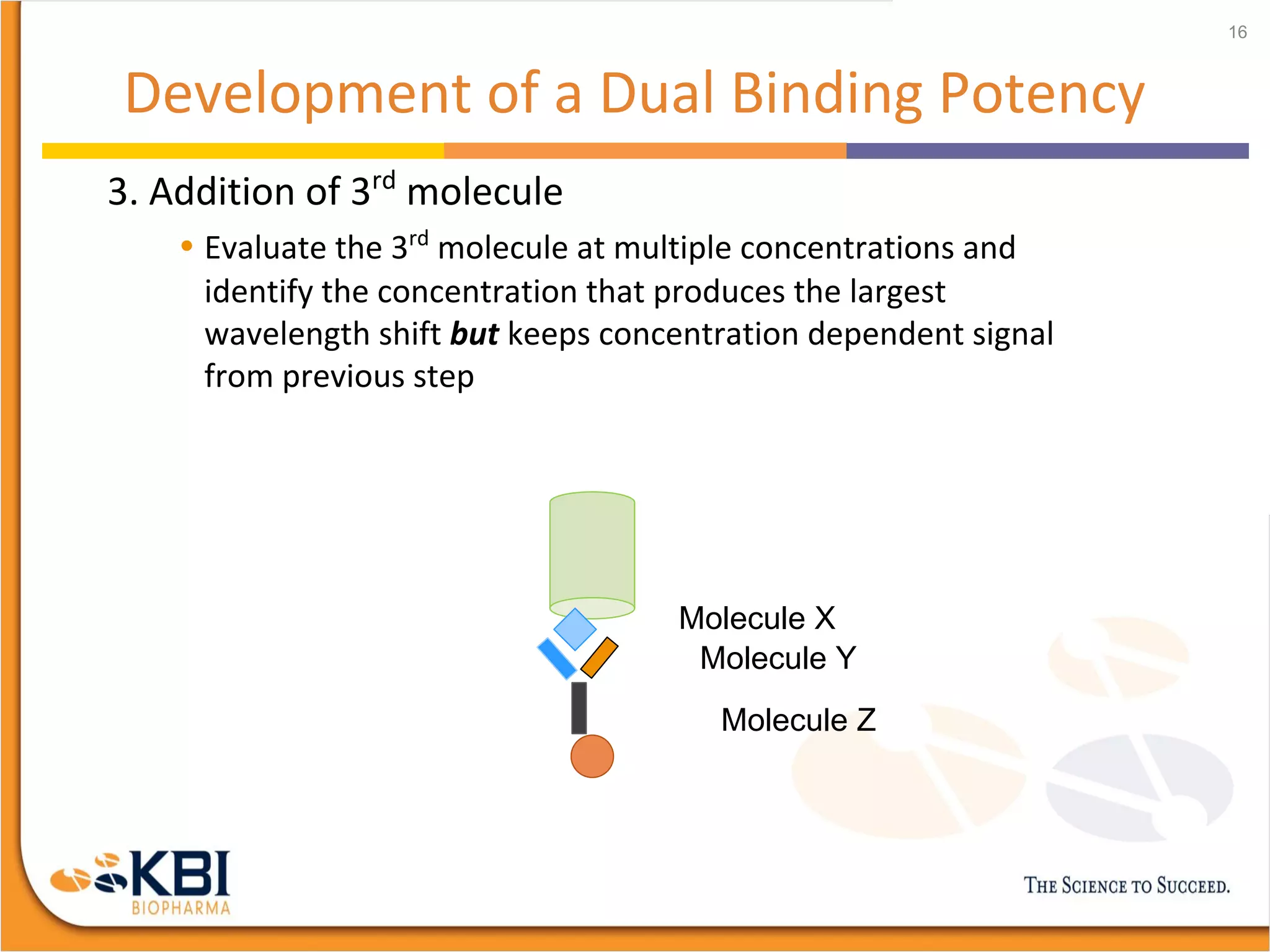
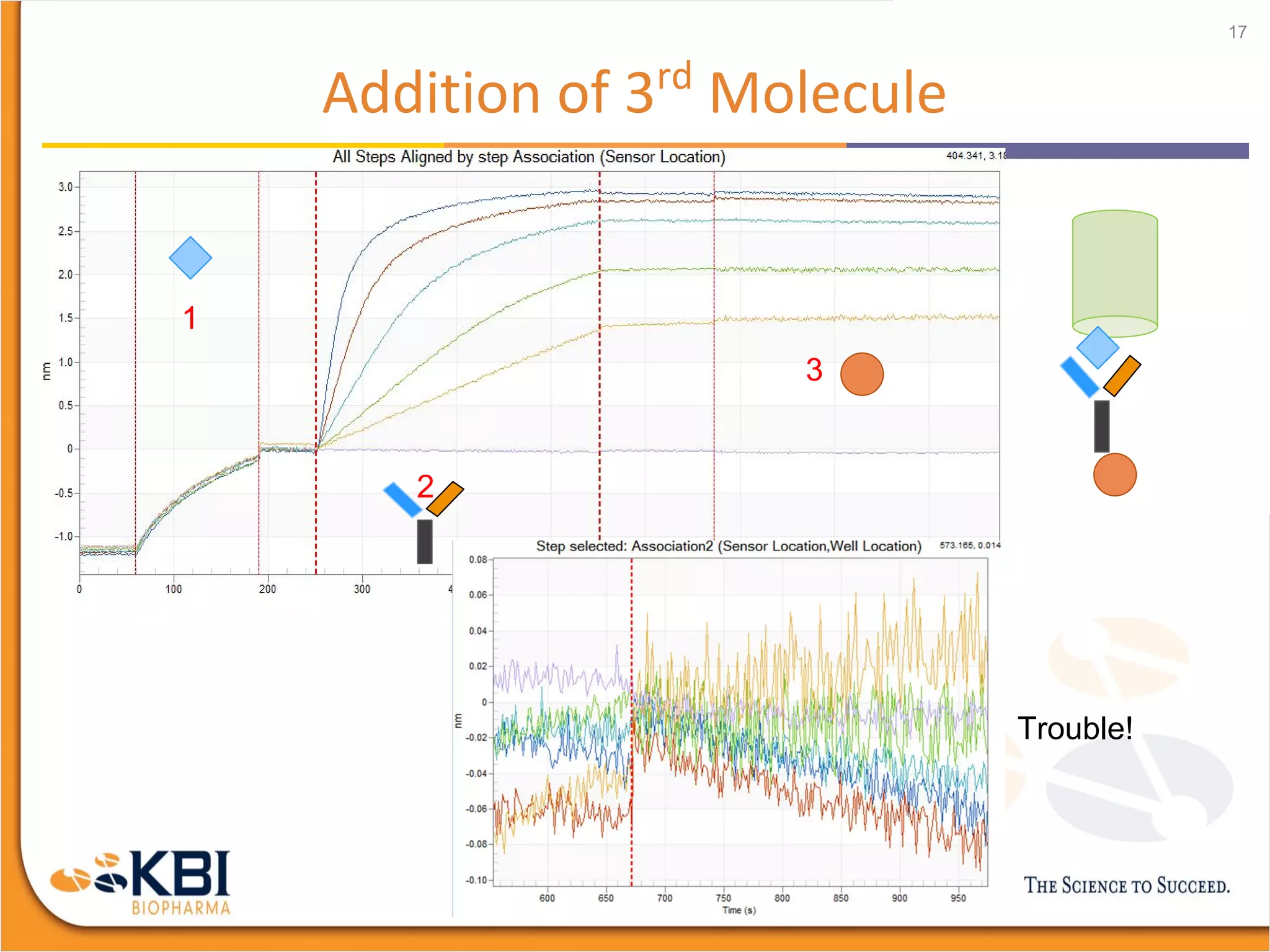
Development of a Dual Binding Potency
3. Addition of 3rd
molecule
• Evaluate the 3rd
molecule at multiple concentrations and
identify the concentration that produces the largest
wavelength shift but keeps concentration dependent signal
from previous step
16
Molecule X
Molecule Y
Molecule Z
Addition of 3rd
Molecule
17
1
2
3
Trouble!
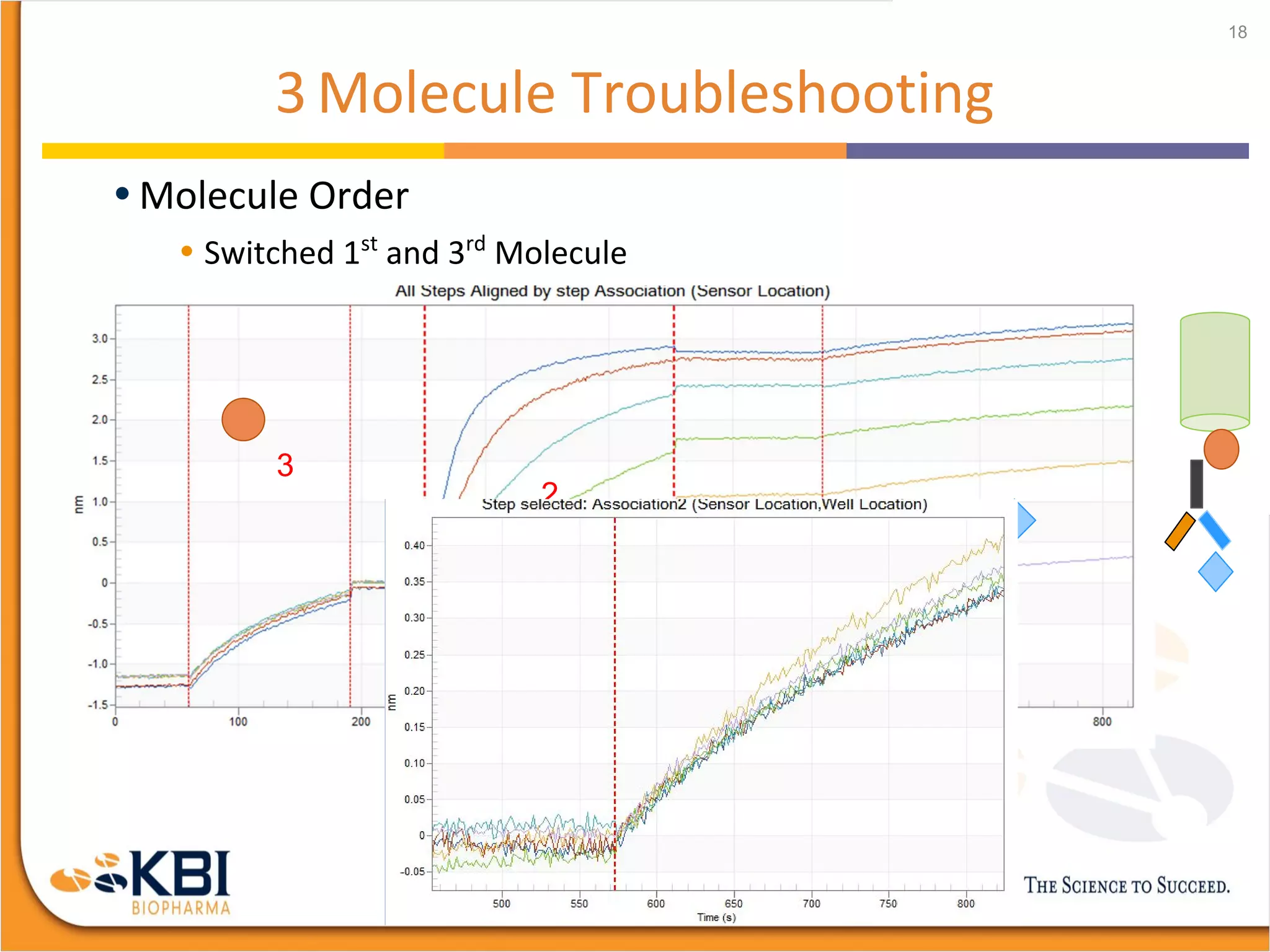
3 Molecule Troubleshooting
• Molecule Order
• Switched 1st
and 3rd
Molecule
18
1
2
3
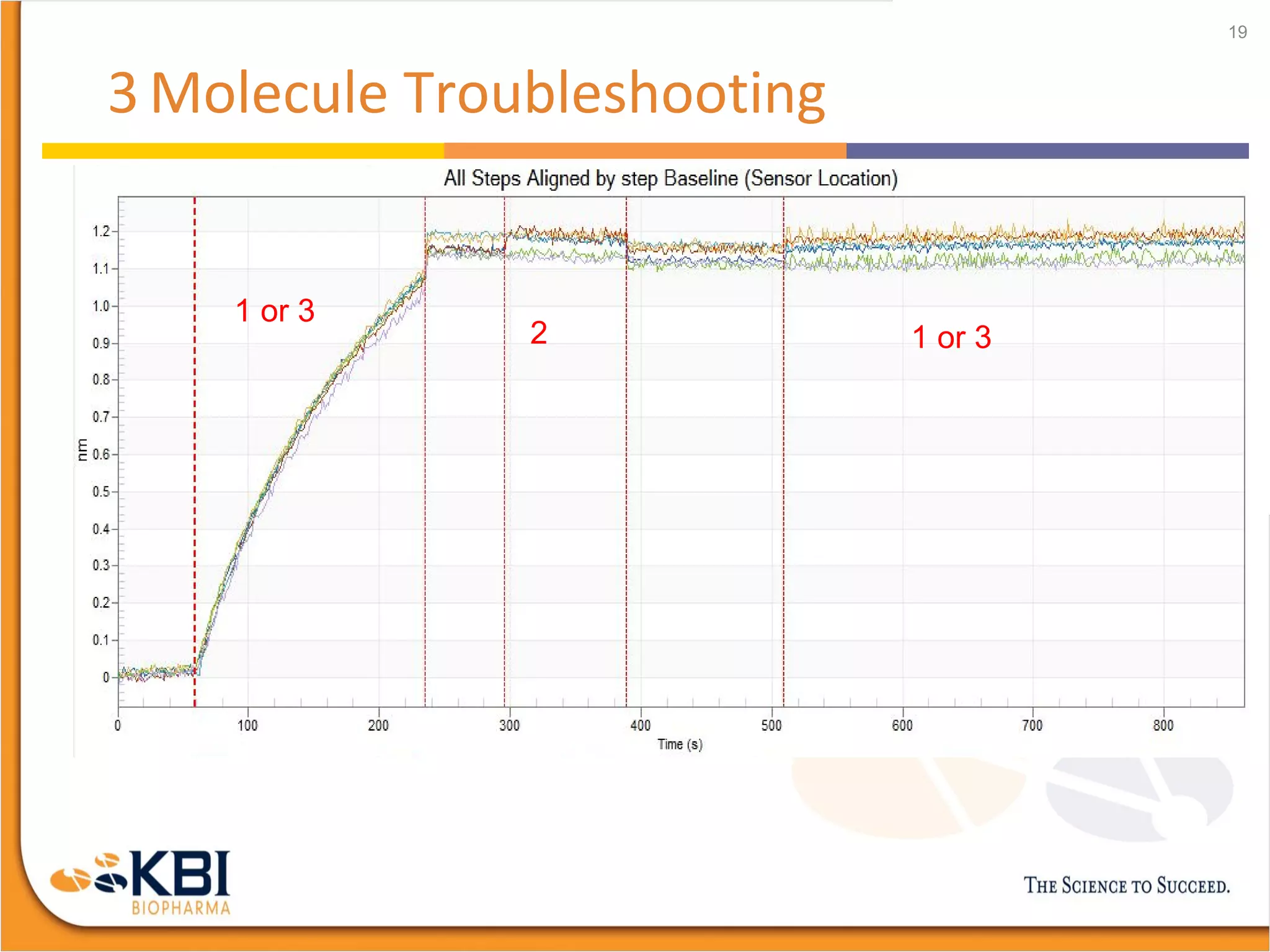
3 Molecule Troubleshooting
• Sensors:
• Ni (NTA), Fc Capture, Streptavidin
• 1st
and 3rd
Molecules (antigens)
• His-Tagged and/or Biotinylated of the following
• Full Length Molecule (Transmembrane)
• Extracellular Domain only
• Partial Sequence (ECD and part of Transmembrane portion)
• Non-Tagged antigens
• Pre-incubating Fc Fusion with the 3rd
Molecule
19
1 or 3
1 or 32
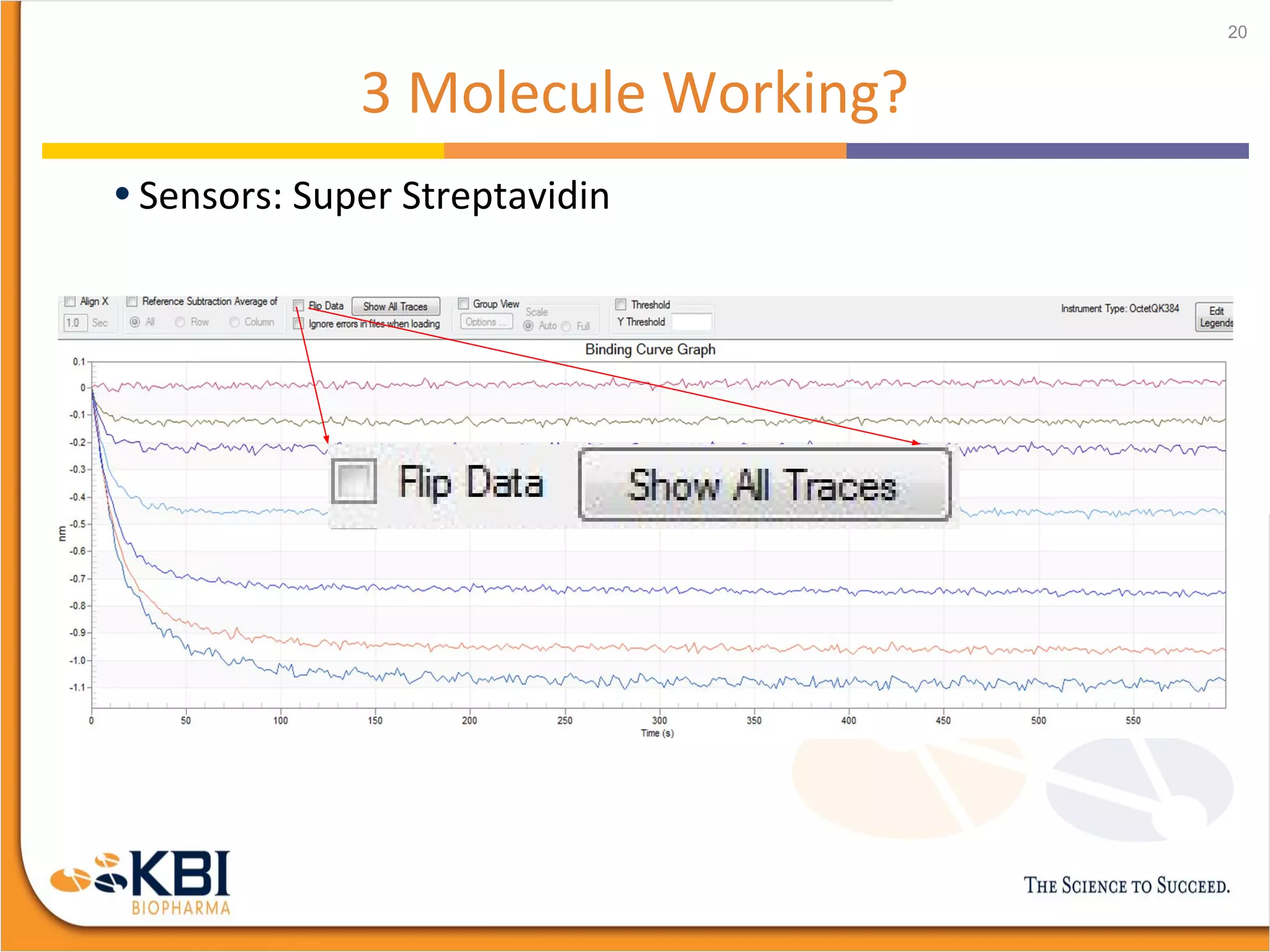
3 Molecule Working?
• Sensors: Super Streptavidin
20
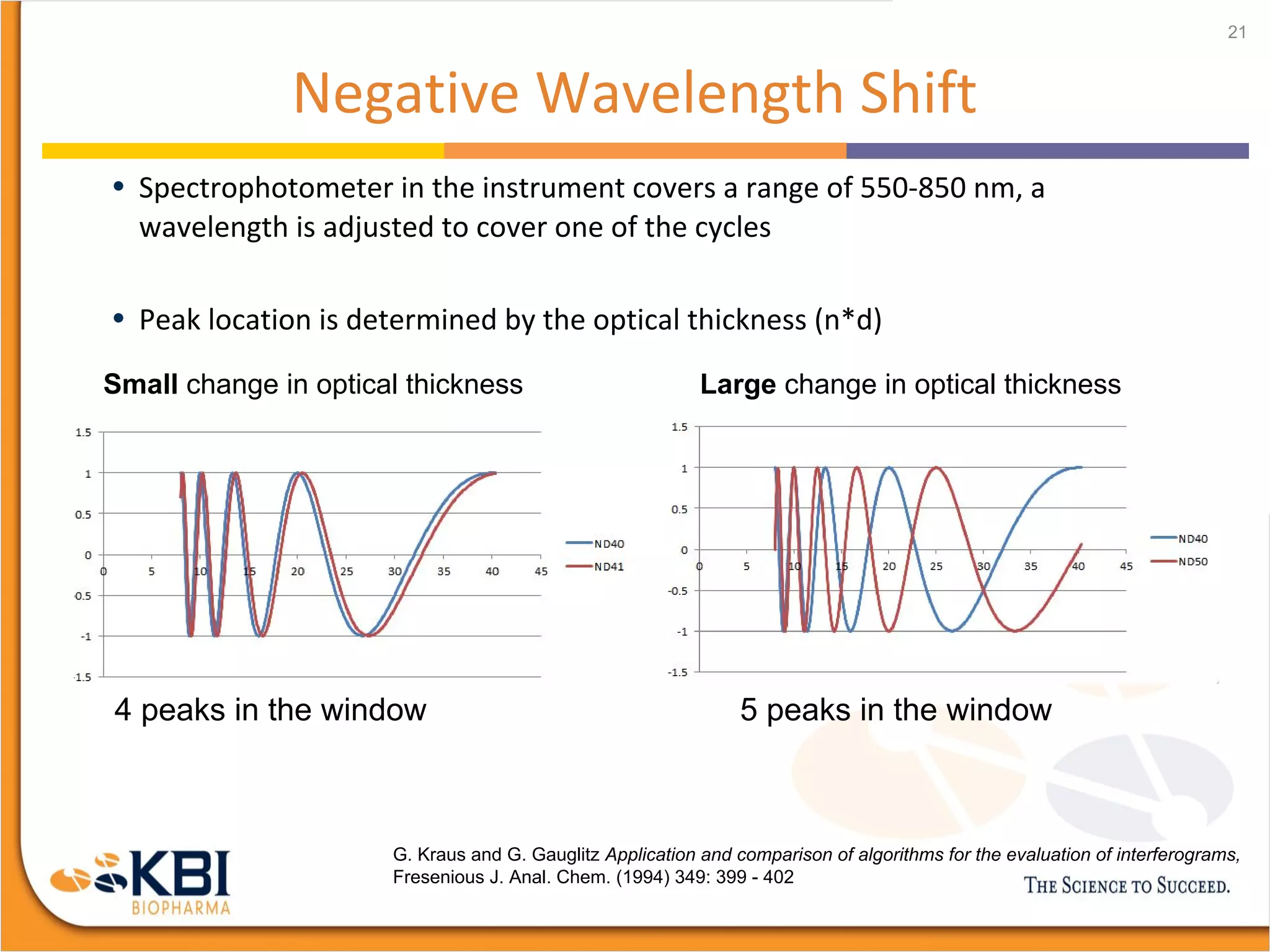
Negative Wavelength Shift
• Spectrophotometer in the instrument covers a range of 550-850 nm, a
wavelength is adjusted to cover one of the cycles
• Peak location is determined by the optical thickness (n*d)
21
Small change in optical thickness Large change in optical thickness
4 peaks in the window 5 peaks in the window
G. Kraus and G. Gauglitz Application and comparison of algorithms for the evaluation of interferograms,
Fresenious J. Anal. Chem. (1994) 349: 399 - 402
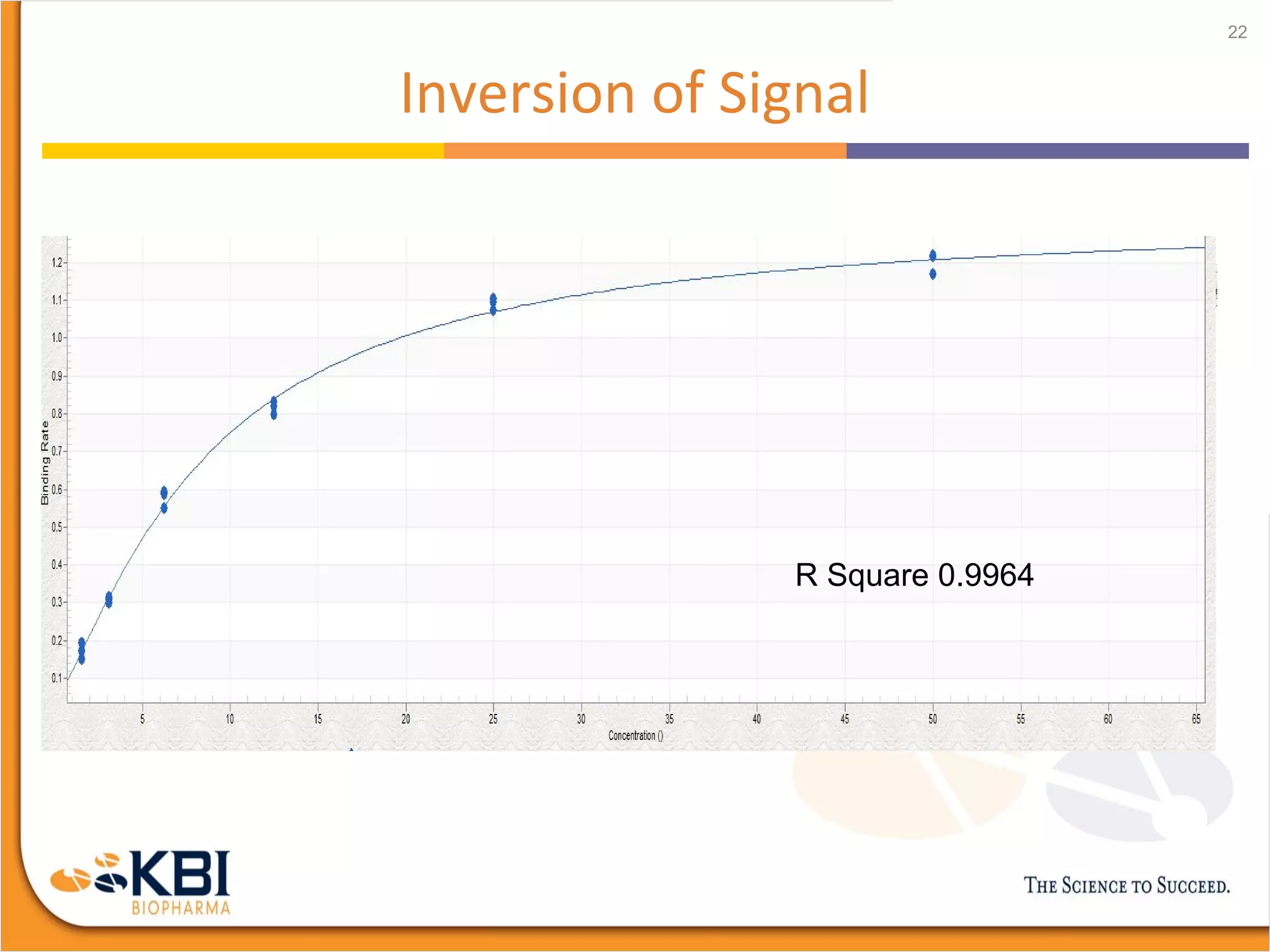
Inversion of Signal
22
R Square 0.9964
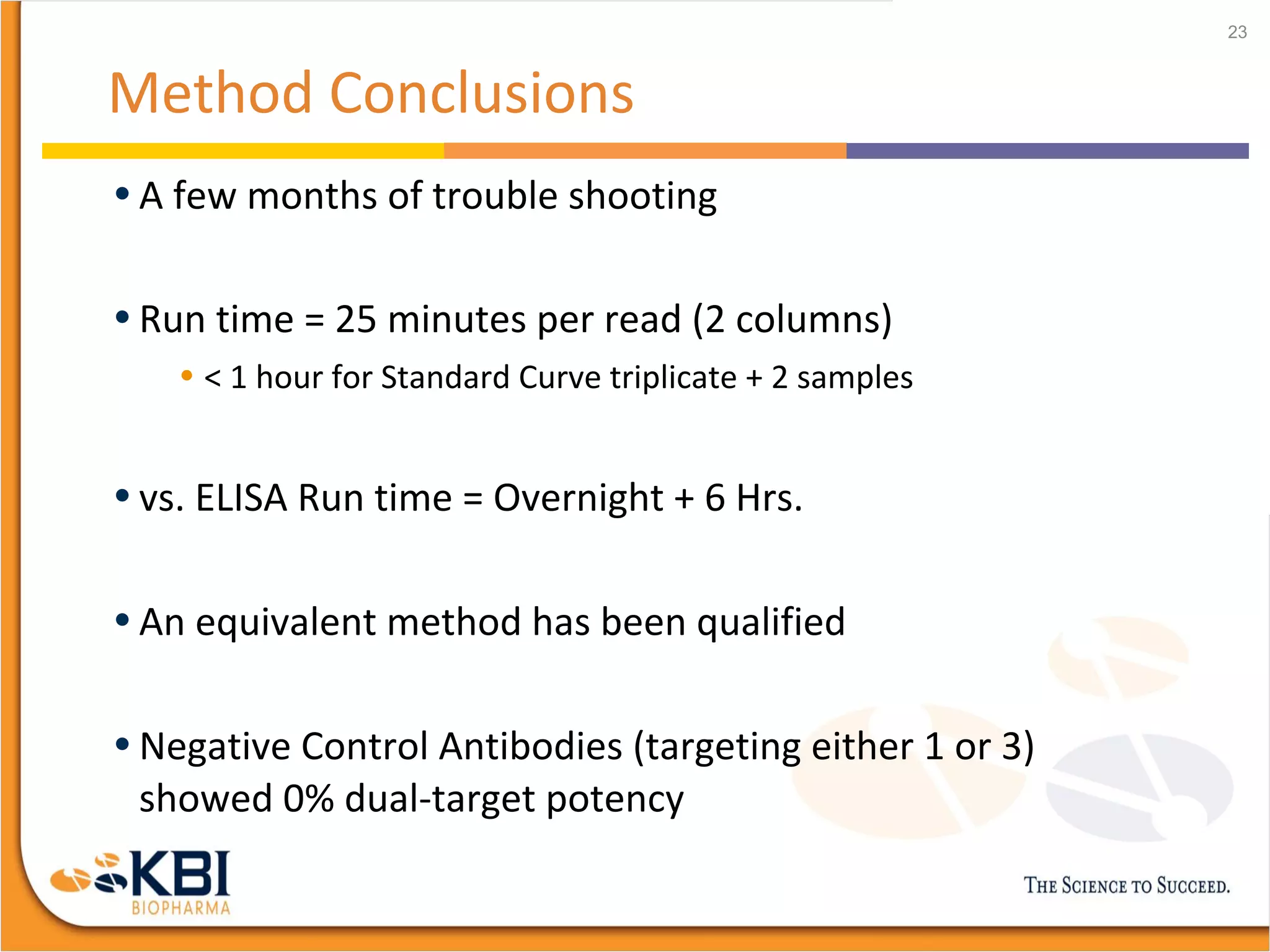
Method Conclusions
• A few months of trouble shooting
• Run time = 25 minutes per read (2 columns)
• < 1 hour for Standard Curve triplicate + 2 samples
• vs. ELISA Run time = Overnight + 6 Hrs.
• An equivalent method has been qualified
• Negative Control Antibodies (targeting either 1 or 3)
showed 0% dual-target potency
23
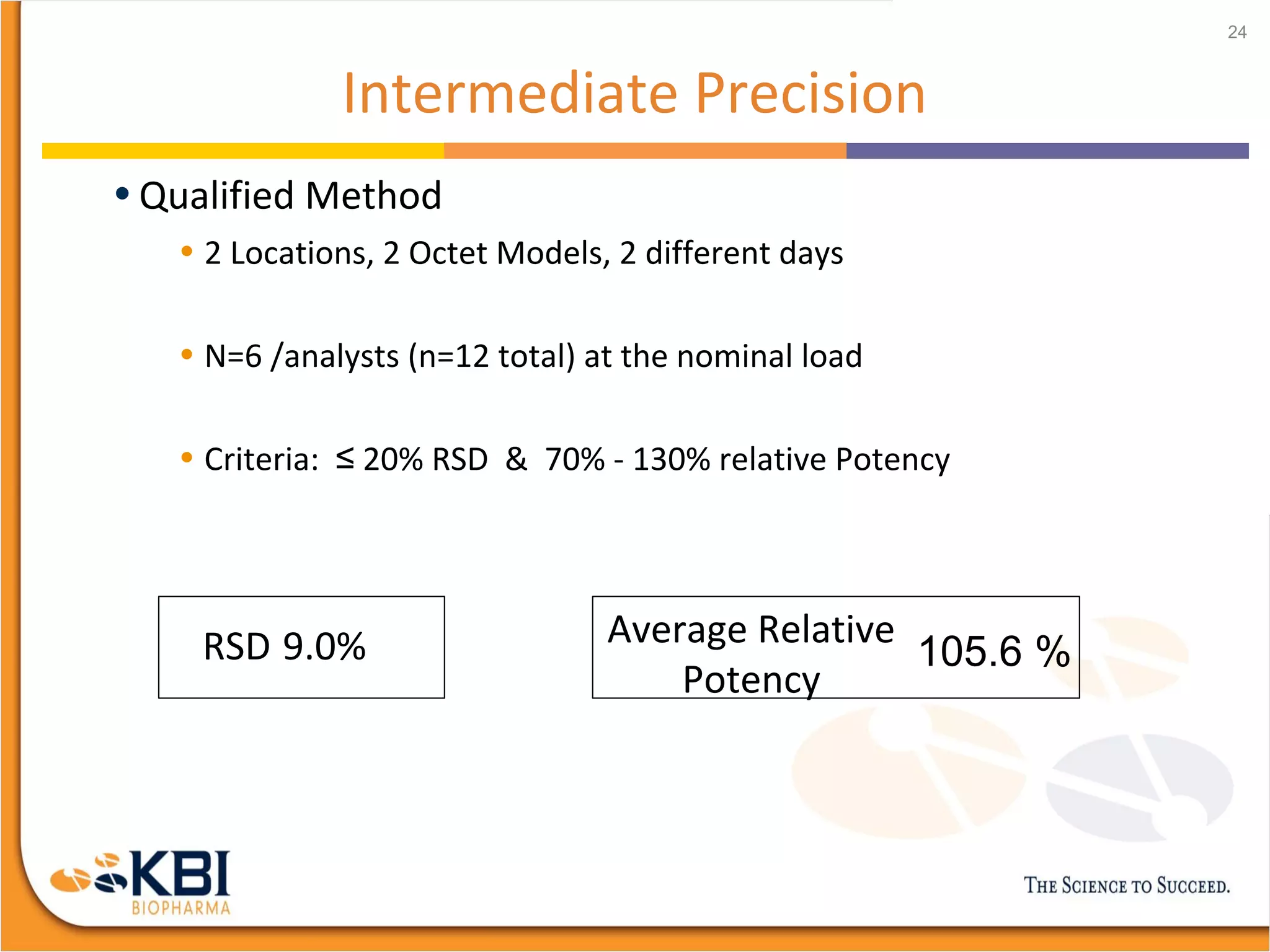
Intermediate Precision
• Qualified Method
• 2 Locations, 2 Octet Models, 2 different days
• N=6 /analysts (n=12 total) at the nominal load
• Criteria: ≤ 20% RSD & 70% - 130% relative Potency
24
RSD 9.0% Average Relative
Potency
105.6 %
Overview
1. ForteBio Octet: Bio-Layer Interferometry
2. Assay Development on the Octet instrument
3. Single-Target Relative Potency Assay
4. Dual-Binding Relative Potency Assay
5. Supplementary Octet Capabilities
25
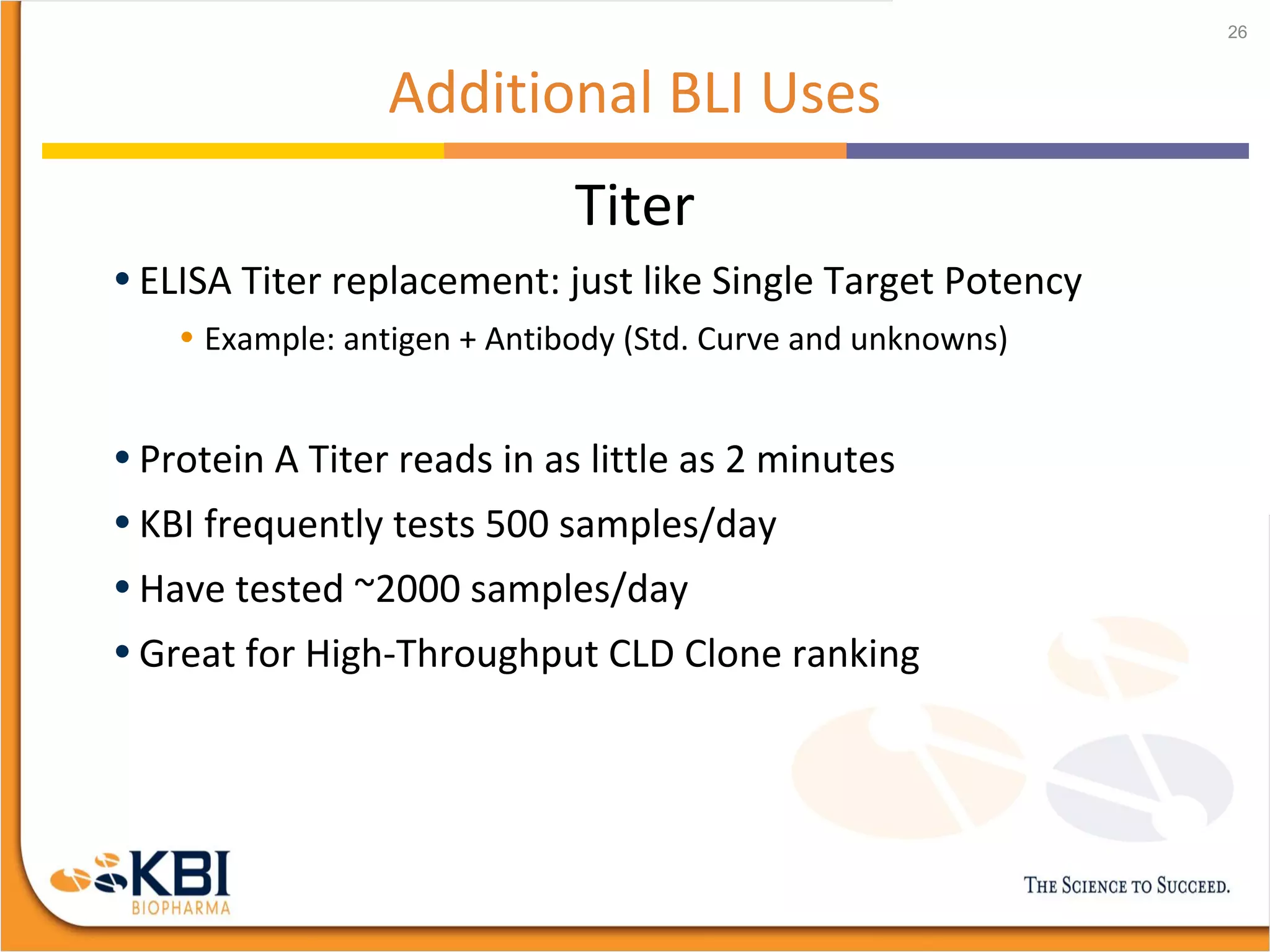
Additional BLI Uses
Titer
• ELISA Titer replacement: just like Single Target Potency
• Example: antigen + Antibody (Std. Curve and unknowns)
• Protein A Titer reads in as little as 2 minutes
• KBI frequently tests 500 samples/day
• Have tested ~2000 samples/day
• Great for High-Throughput CLD Clone ranking
26
Additional BLI Uses
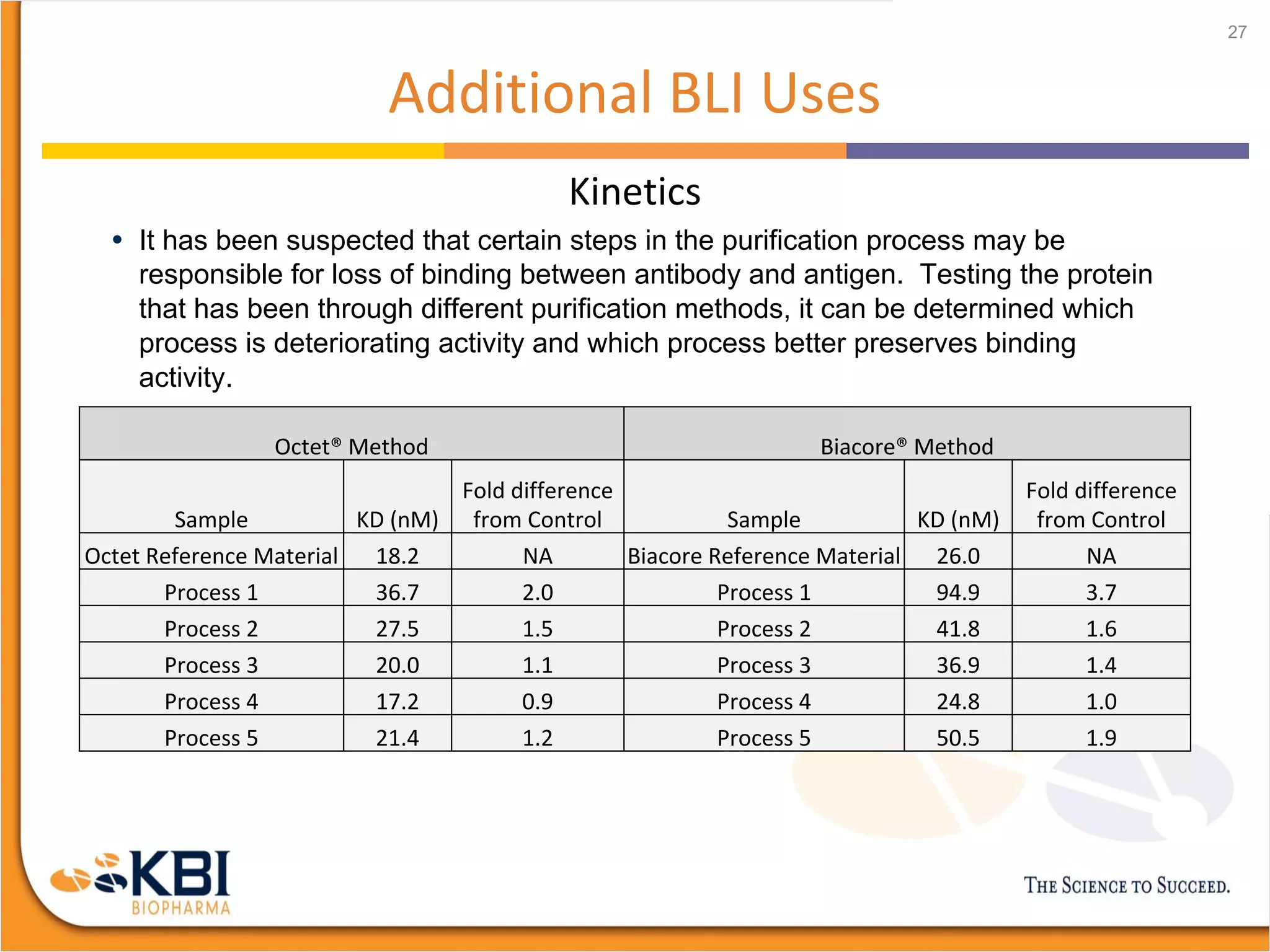
Kinetics
• It has been suspected that certain steps in the purification process may be
responsible for loss of binding between antibody and antigen. Testing the protein
that has been through different purification methods, it can be determined which
process is deteriorating activity and which process better preserves binding
activity.
27
Association Dissociation
Octet® Method Biacore® Method
Sample KD (nM)
Fold difference
from Control Sample KD (nM)
Fold difference
from Control
Octet Reference Material 18.2 NA Biacore Reference Material 26.0 NA
Process 1 36.7 2.0 Process 1 94.9 3.7
Process 2 27.5 1.5 Process 2 41.8 1.6
Process 3 20.0 1.1 Process 3 36.9 1.4
Process 4 17.2 0.9 Process 4 24.8 1.0
Process 5 21.4 1.2 Process 5 50.5 1.9
Additional BLI Uses
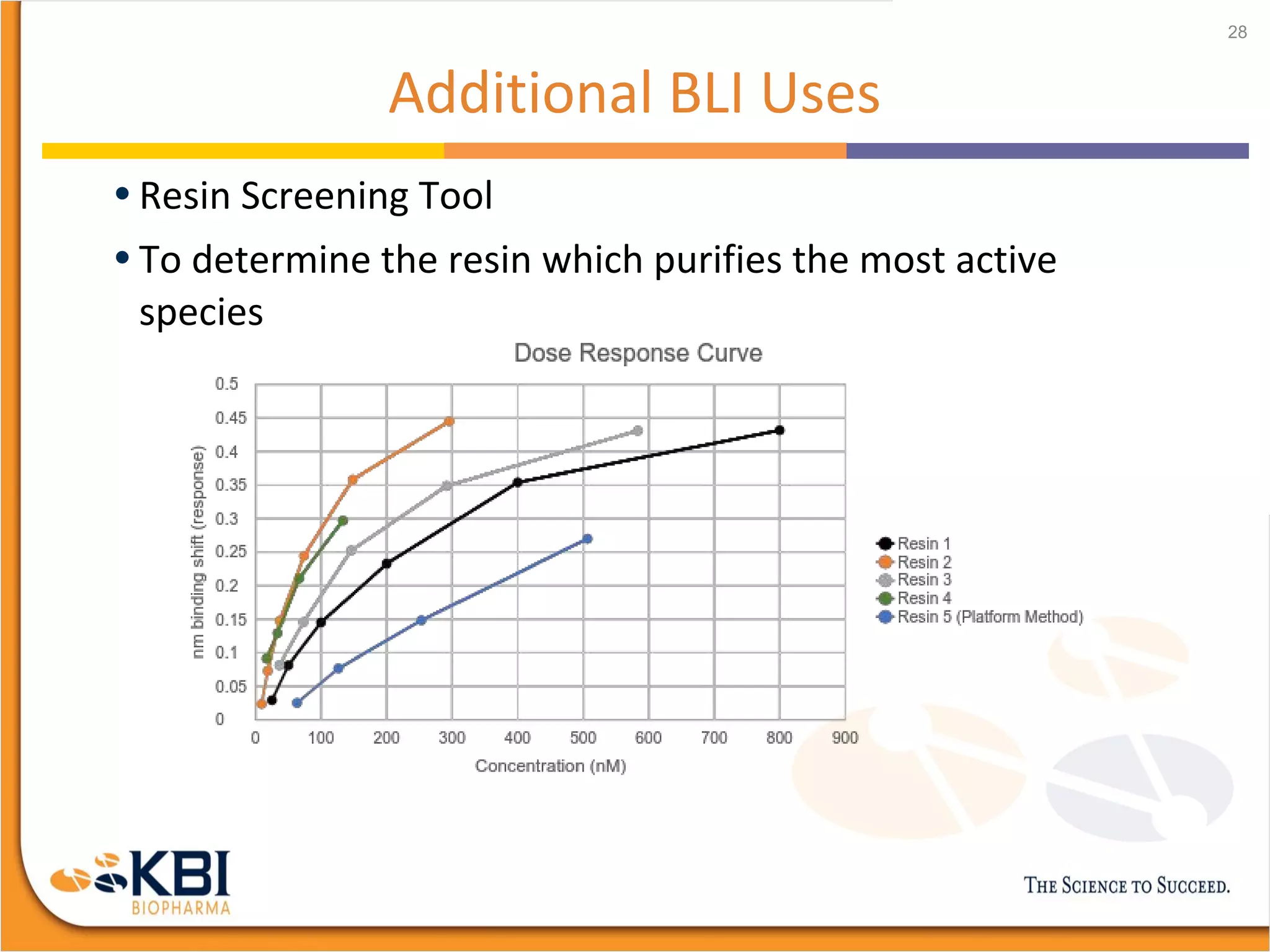
• Resin Screening Tool
• To determine the resin which purifies the most active
species
28
Conclusions
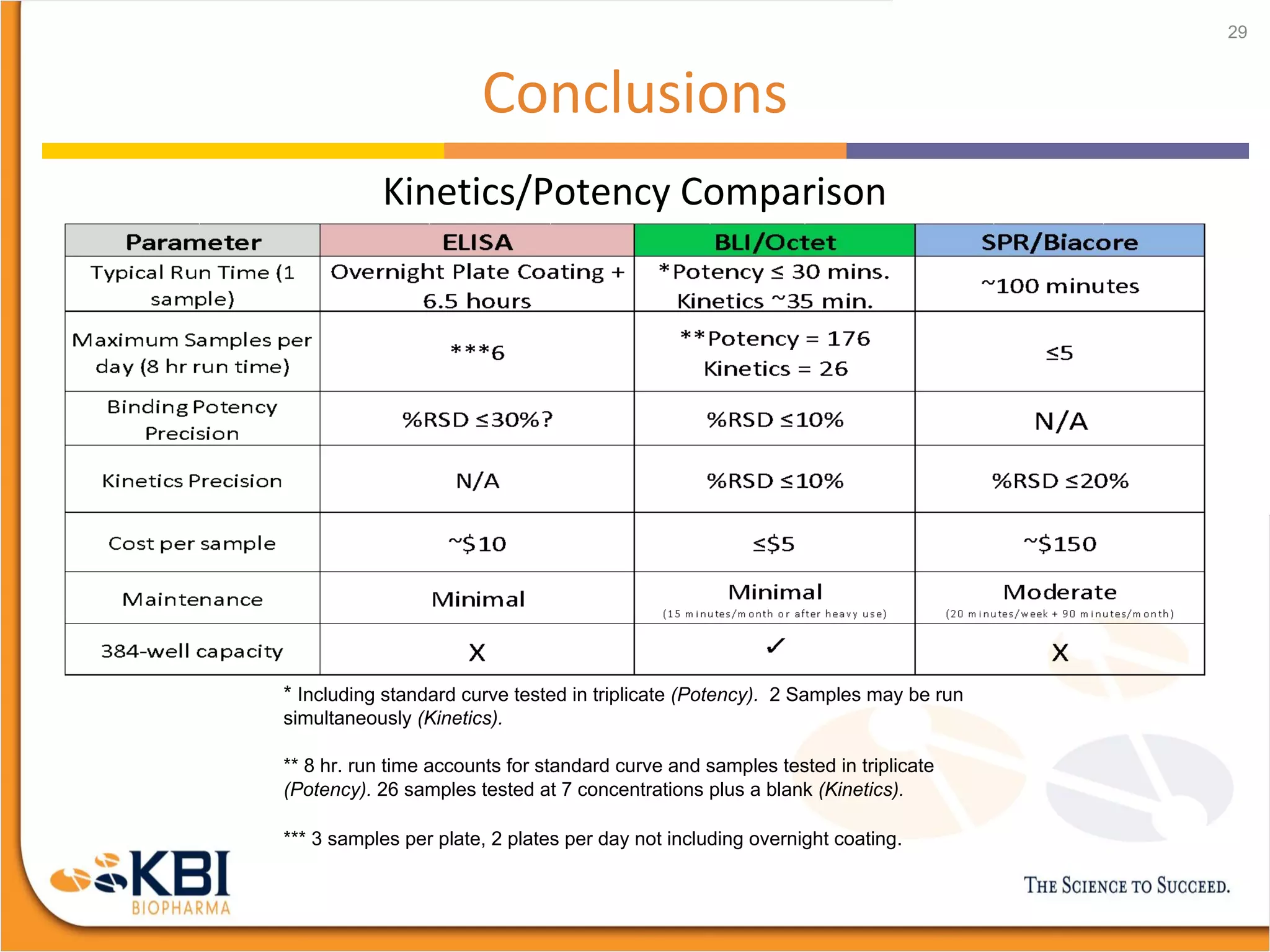
Kinetics/Potency Comparison
29
* Including standard curve tested in triplicate (Potency). 2 Samples may be run
simultaneously (Kinetics).
** 8 hr. run time accounts for standard curve and samples tested in triplicate
(Potency). 26 samples tested at 7 concentrations plus a blank (Kinetics).
*** 3 samples per plate, 2 plates per day not including overnight coating.
Acknowledgements
• Major Thanks to ForteBio!
• AD Team
• James Smedley III, Ph.D.
• Nathan Oien, Ph.D.
• Brendan Peacor, Ph.D.
• Srilaxmi Sarikonda
• Kyle Jones
• Teena Jagadish
• Analyst II – Melissa Ragan
• SPR Data – Spandana Kankanala
30

Employing ForteBio Octet platform for the development of a dual-binding potency assay

  • 1.
    Employing ForteBio Octetplatform for the development of a dual-binding potency assay and as a highly versatile tool for early stage product analysis Carson Cameron, MS Analytical Development Research Associate KBI Biopharma 1
  • 2.
    Who is KBI •About KBI: A Contract Development and Manufacturing Company • KBI helps partners accelerate and optimize drug development and manufacturing programs with an extensive suite of expert development and manufacturing services in an agile, client-friendly partnering environment 2
  • 3.
    Role of AnalyticalDevelopment •Development • Method Development • Method Optimization • PD support (CLD, Upstream and Downstream) • Lots of Samples! •Quality Control • Method Qualification • Stricter Requirements • Fewer Samples 3 Challenge: Technology that can be utilized in a Q.C. and in a high-throughput fashion Answer: ForteBio Octet
  • 4.
    Overview 1. ForteBio Octet:Bio-Layer Interferometry 2. Assay Development Considerations 3. Single-Target Relative Potency Assay 4. Dual-Binding Relative Potency Assay 5. Supplementary Octet Capabilities 4
  • 5.
    Octet/BLI 5 • The Octetsends white light through the biosensor tip. There is a shift in the pattern of the returning light based on how much is bound to the tip.
  • 6.
    Example Sensorgram 6 Baseline 30 –60 sec. Loading ~ 3-5 minutes Baseline/ Wash 60 – 120 sec. Association 2 – 10+ minutes Y Y
  • 7.
    Overview 1. ForteBio Octet:Bio-Layer Interferometry 2. Assay Development Considerations 3. Single-Target Relative Potency Assay 4. Dual-Binding Relative Potency Assay 5. Supplementary Octet Capabilities 7
  • 8.
    Octet Sensor Selection •Ni (NTA) • Protein A • SSA (Super Streptavidin) • AHC (Anti-Human Fc Capture) • AMC (Anti-Mouse Fc Capture) • Anti-Human IgG Quantitation • Aminopropylsilane • Amine Reactive • Anti-Human Fab • Anti-GST • Anti-Penta-HIS • Anti-His • Protein G • Protein L • Streptavidin • High Precision Streptavidin • Kits: • Anti-CHO HCP detection kit • Residual Protein A detection kit • Immunogenicity Assay Kit 8
  • 9.
  • 10.
    Overview 1. ForteBio Octet:Bio-Layer Interferometry 2. Assay Development on the Octet instrument 3. Single-Target Relative Potency Assay 4. Dual-Binding Relative Potency Assay 5. Supplementary Octet Capabilities 10
  • 11.
    Assay Development Pre-Development: SensorChemistry, Buffer/Matrix, Dilutions 1. Load Density Scouting • Sensor loading is evaluated using an antigen/protein to ensure sufficient protein is loaded on the sensor, but not overloaded. 11
  • 12.
    Assay Development 2. Concentrationscouting of 2nd molecule (antibody) • Holding the first molecule (antigen) constant, a concentration range is evaluated for product association in a concentration dependent manor. 12 For typical antibodies, assay development would be done => method optimization and assessment (accuracy, linearity, etc.)
  • 13.
    Single Target Conclusions •Qualified 5 single target potency methods using different antibody/antigen pairs • 2 titer methods using the same method development in that was used for qualified methods using antibody/glycoprotein pairs • Frequently achieve ≤10% RSD for sample triplicates and 90 – 110% Potency • Release method for activity much faster than typical ELISA or SPR 13 R2 ≥ 0.99
  • 14.
    Overview 1. ForteBio Octet:Bio-Layer Interferometry 2. Assay Development on the Octet instrument 3. Single-Target Relative Potency Assay 4. Dual-Binding Relative Potency Assay 5. Supplementary Octet Capabilities 14
  • 15.
    Need for aDual Binding Potency • New Bispecific molecules and fusion proteins drive the need for dual binding potency assays • BLI technology reduces impact of non-specific binding when compared to an ELISA, though development is not as direct as a single binding potency assay 15
  • 16.
    Development of aDual Binding Potency 3. Addition of 3rd molecule • Evaluate the 3rd molecule at multiple concentrations and identify the concentration that produces the largest wavelength shift but keeps concentration dependent signal from previous step 16 Molecule X Molecule Y Molecule Z
  • 17.
  • 18.
    3 Molecule Troubleshooting •Molecule Order • Switched 1st and 3rd Molecule 18 1 2 3
  • 19.
    3 Molecule Troubleshooting •Sensors: • Ni (NTA), Fc Capture, Streptavidin • 1st and 3rd Molecules (antigens) • His-Tagged and/or Biotinylated of the following • Full Length Molecule (Transmembrane) • Extracellular Domain only • Partial Sequence (ECD and part of Transmembrane portion) • Non-Tagged antigens • Pre-incubating Fc Fusion with the 3rd Molecule 19 1 or 3 1 or 32
  • 20.
    3 Molecule Working? •Sensors: Super Streptavidin 20
  • 21.
    Negative Wavelength Shift •Spectrophotometer in the instrument covers a range of 550-850 nm, a wavelength is adjusted to cover one of the cycles • Peak location is determined by the optical thickness (n*d) 21 Small change in optical thickness Large change in optical thickness 4 peaks in the window 5 peaks in the window G. Kraus and G. Gauglitz Application and comparison of algorithms for the evaluation of interferograms, Fresenious J. Anal. Chem. (1994) 349: 399 - 402
  • 22.
  • 23.
    Method Conclusions • Afew months of trouble shooting • Run time = 25 minutes per read (2 columns) • < 1 hour for Standard Curve triplicate + 2 samples • vs. ELISA Run time = Overnight + 6 Hrs. • An equivalent method has been qualified • Negative Control Antibodies (targeting either 1 or 3) showed 0% dual-target potency 23
  • 24.
    Intermediate Precision • QualifiedMethod • 2 Locations, 2 Octet Models, 2 different days • N=6 /analysts (n=12 total) at the nominal load • Criteria: ≤ 20% RSD & 70% - 130% relative Potency 24 RSD 9.0% Average Relative Potency 105.6 %
  • 25.
    Overview 1. ForteBio Octet:Bio-Layer Interferometry 2. Assay Development on the Octet instrument 3. Single-Target Relative Potency Assay 4. Dual-Binding Relative Potency Assay 5. Supplementary Octet Capabilities 25
  • 26.
    Additional BLI Uses Titer •ELISA Titer replacement: just like Single Target Potency • Example: antigen + Antibody (Std. Curve and unknowns) • Protein A Titer reads in as little as 2 minutes • KBI frequently tests 500 samples/day • Have tested ~2000 samples/day • Great for High-Throughput CLD Clone ranking 26
  • 27.
    Additional BLI Uses Kinetics •It has been suspected that certain steps in the purification process may be responsible for loss of binding between antibody and antigen. Testing the protein that has been through different purification methods, it can be determined which process is deteriorating activity and which process better preserves binding activity. 27 Association Dissociation Octet® Method Biacore® Method Sample KD (nM) Fold difference from Control Sample KD (nM) Fold difference from Control Octet Reference Material 18.2 NA Biacore Reference Material 26.0 NA Process 1 36.7 2.0 Process 1 94.9 3.7 Process 2 27.5 1.5 Process 2 41.8 1.6 Process 3 20.0 1.1 Process 3 36.9 1.4 Process 4 17.2 0.9 Process 4 24.8 1.0 Process 5 21.4 1.2 Process 5 50.5 1.9
  • 28.
    Additional BLI Uses •Resin Screening Tool • To determine the resin which purifies the most active species 28
  • 29.
    Conclusions Kinetics/Potency Comparison 29 * Includingstandard curve tested in triplicate (Potency). 2 Samples may be run simultaneously (Kinetics). ** 8 hr. run time accounts for standard curve and samples tested in triplicate (Potency). 26 samples tested at 7 concentrations plus a blank (Kinetics). *** 3 samples per plate, 2 plates per day not including overnight coating.
  • 30.
    Acknowledgements • Major Thanksto ForteBio! • AD Team • James Smedley III, Ph.D. • Nathan Oien, Ph.D. • Brendan Peacor, Ph.D. • Srilaxmi Sarikonda • Kyle Jones • Teena Jagadish • Analyst II – Melissa Ragan • SPR Data – Spandana Kankanala 30