The Domain Name System ABDUL GAFOOR KV Big leap software solution Pvt Ltd
History of DNS Invented in 1983 and first used in ARPANET Jon Postel, Paul Mockapetris  HOST.TXT Tree of domain name have two or more part  Eg: www.bigleaponline.com
Host names IP Addresses are great for computers IP address includes information used for routing. IP addresses are tough for humans to remember. IP addresses are impossible to guess. ever guessed at the name of a WWW site?
The Domain Name System The  domain name system  is usually used to translate a host name into an IP address and vice versa. Domain names comprise a hierarchy so that names are unique, yet easy to remember.
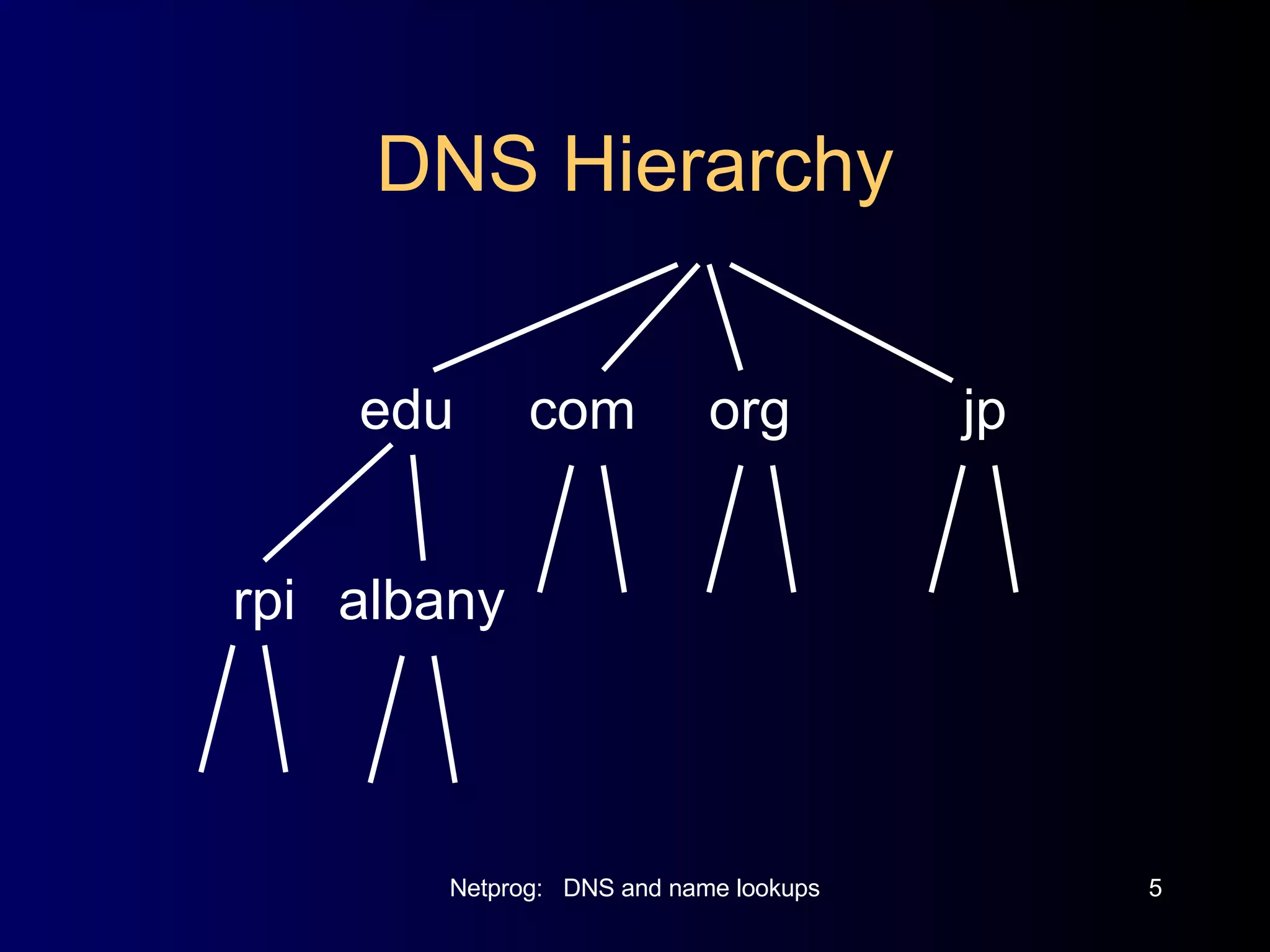
DNS Hierarchy edu com org jp rpi albany
Host name structure Each host name is made up of a sequence of  labels  separated by periods. Each label can be up to 63 characters The total name can be at most 255 characters. Examples: whitehouse.gov barney.the.purple.dinosaur.com monica.cs.rpi.edu
Domain Name The domain name for a host is the sequence of labels that lead from the host (leaf node in the naming tree) to the top of the worldwide naming tree. A domain is a subtree of the worldwide naming tree.
Top level domains edu, gov, com, net, org, mil , … Countries each have a top level domain (2 letter domain name). New top level domains include: .aero  .biz  .coop  .info  .name  .pro
DNS Organization Distributed Database The organization that owns a domain name is responsible for running  a DNS server that can provide the mapping between hostnames within the domain to IP addresses. So - some machine run by RPI is responsible for everything within the rpi.edu domain.
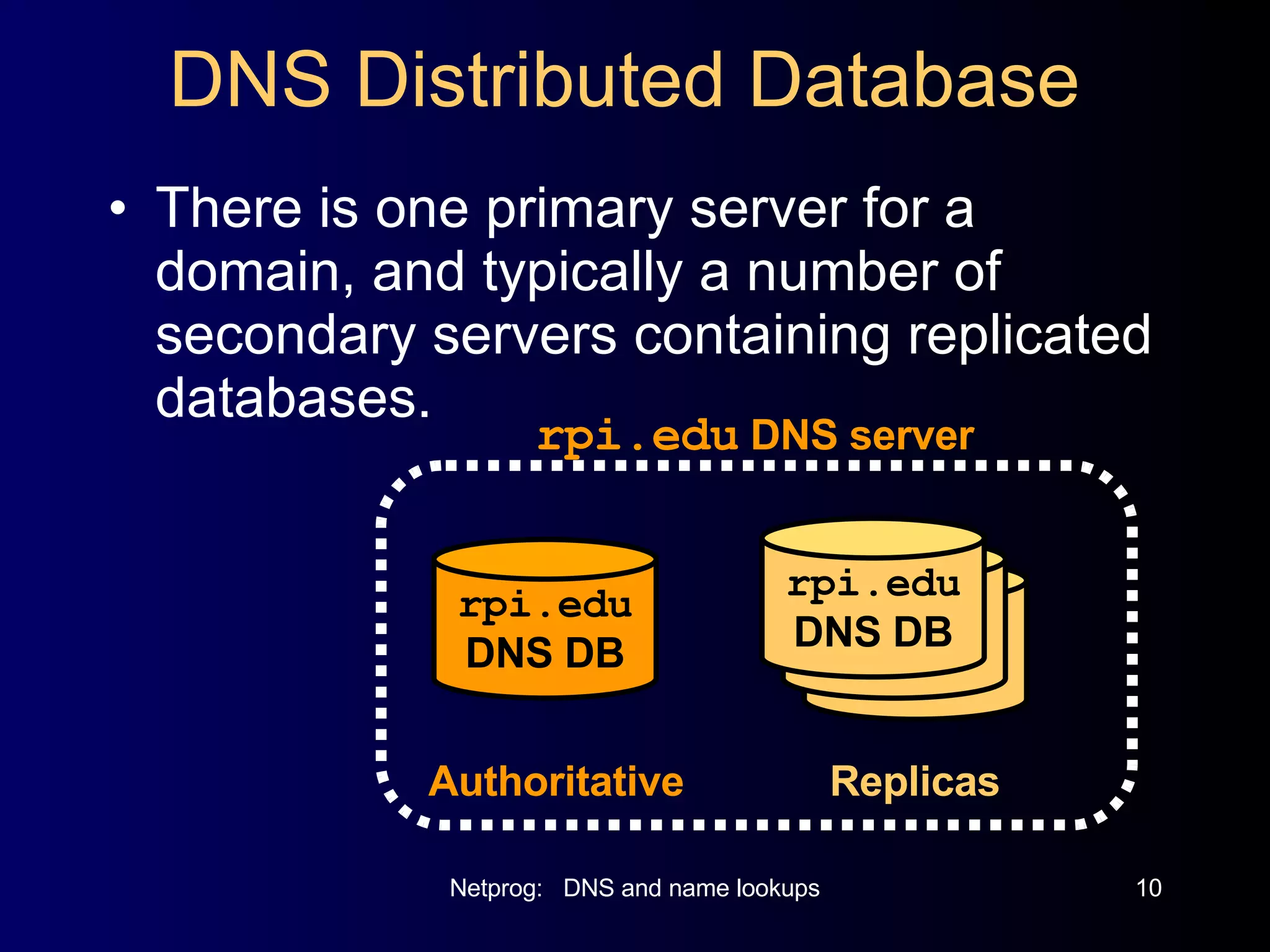
DNS Distributed Database There is one primary server for a domain, and typically a number of secondary servers containing replicated databases. rpi.edu DNS DB rpi.edu DNS DB rpi.edu DNS DB Authoritative rpi.edu DNS DB Replicas rpi.edu  DNS server
DNS Clients A DNS client is called a  resolver .
DNS Servers Servers handle requests for their domain directly. Servers handle requests for other domains by contacting remote DNS server(s). Servers cache external mappings.
Server - Server Communication If a server is asked to provide the mapping for a host outside it’s domain (and the mapping is not in the server cache): The server finds a nameserver for the target domain. The server asks the nameserver to provide the host name to IP translation. To find the right nameserver, use DNS!
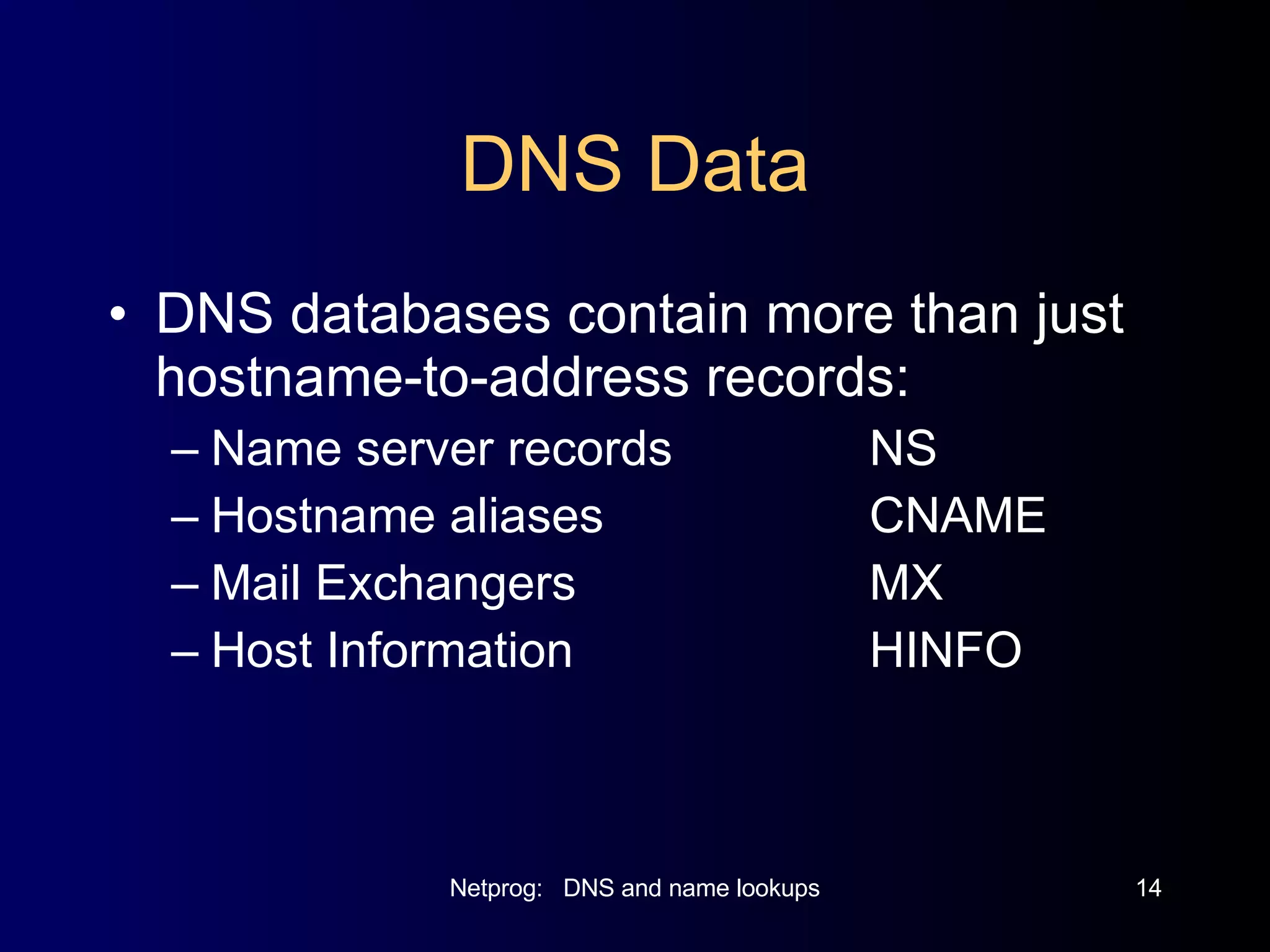
DNS Data DNS databases contain more than just hostname-to-address records: Name server records NS Hostname aliases  CNAME Mail Exchangers MX Host Information HINFO
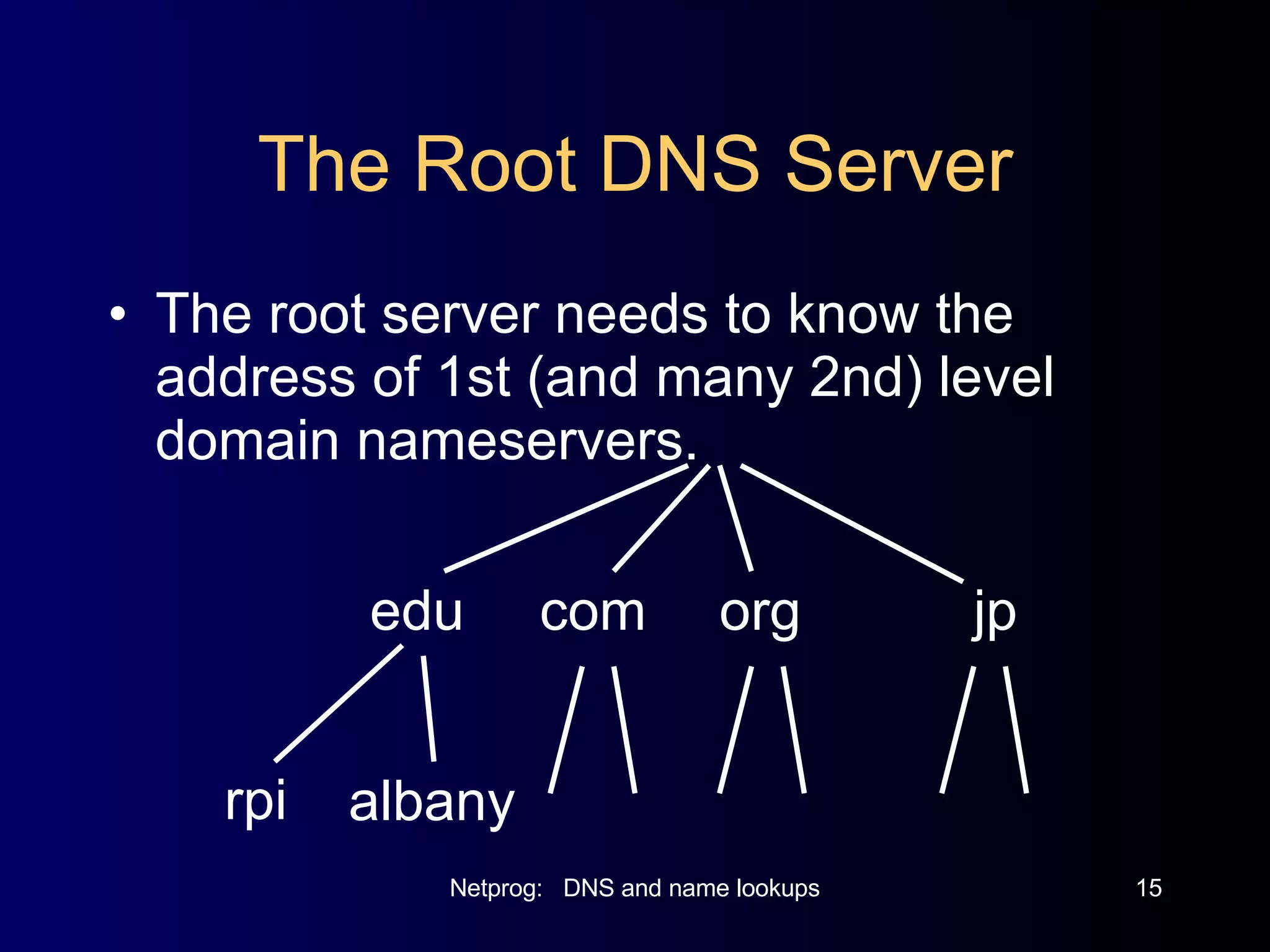
The Root DNS Server The root server needs to know the address of 1st (and many 2nd) level domain nameservers. rpi edu com org jp albany
Server Operation  If a server has no clue about where to find the address for a hostname, ask the root server. The root server will tell you what nameserver to contact. A request may get forwarded a few times.
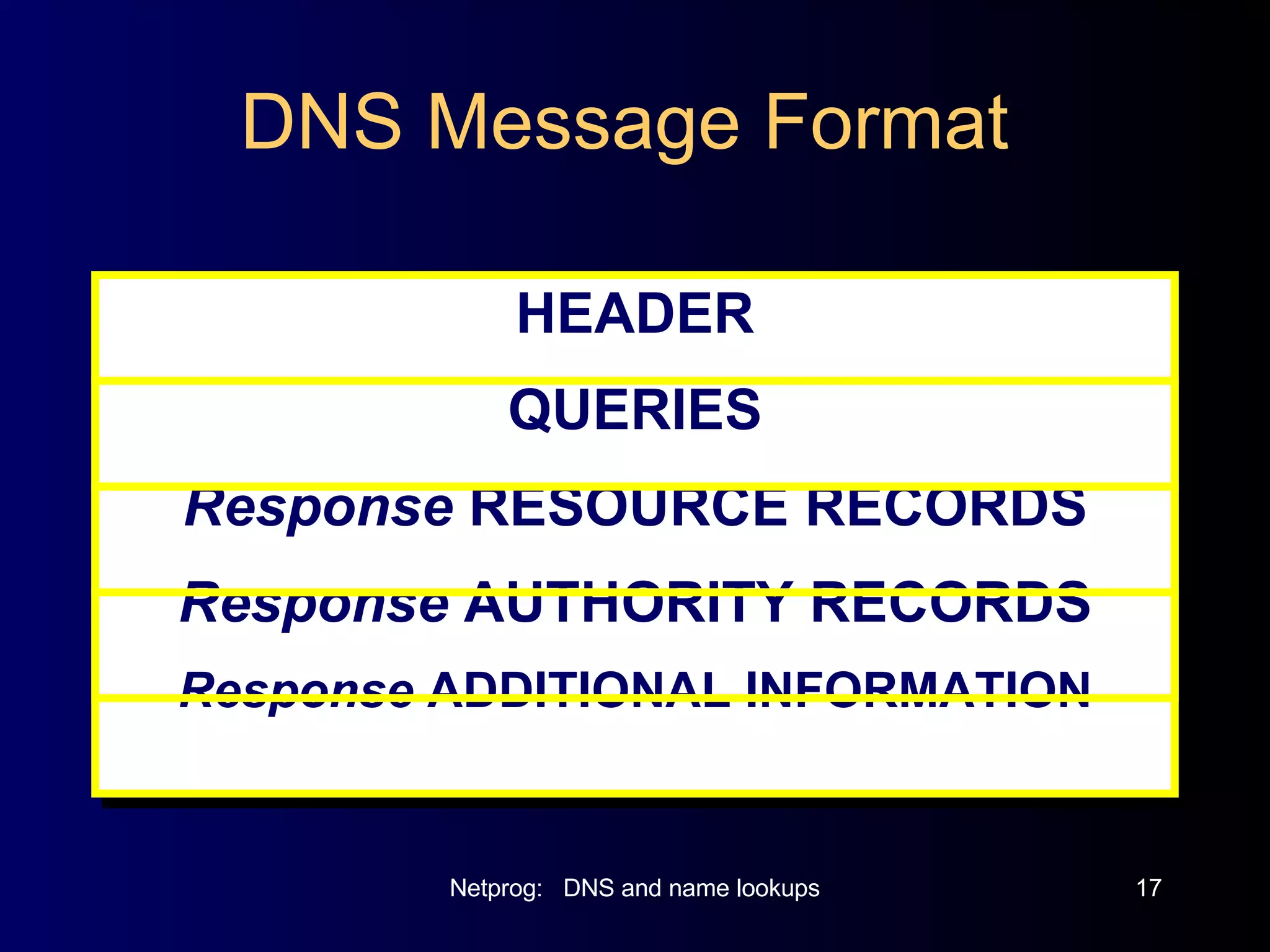
DNS Message Format HEADER QUERIES Response  RESOURCE RECORDS Response  AUTHORITY RECORDS Response  ADDITIONAL INFORMATION
Recursion A request can indicate that recursion is desired - this tells the server to find out the answer (possibly by contacting other servers). If recursion is not requested - the response may be a list of other name servers to contact.
Question Format Name: domain name (or IP address) Query type (A, NS, MX, …) Query class (1 for IP)
UDP & TCP Both UDP and TCP are used: TCP for transfers of entire database to secondary servers (replication). UDP for lookups If more than 512 bytes in response - requestor resubmits request using TCP.
Thanks

Domain Name System

  • 1.
    The Domain NameSystem ABDUL GAFOOR KV Big leap software solution Pvt Ltd
  • 2.
    History of DNSInvented in 1983 and first used in ARPANET Jon Postel, Paul Mockapetris HOST.TXT Tree of domain name have two or more part Eg: www.bigleaponline.com
  • 3.
    Host names IPAddresses are great for computers IP address includes information used for routing. IP addresses are tough for humans to remember. IP addresses are impossible to guess. ever guessed at the name of a WWW site?
  • 4.
    The Domain NameSystem The domain name system is usually used to translate a host name into an IP address and vice versa. Domain names comprise a hierarchy so that names are unique, yet easy to remember.
  • 5.
    DNS Hierarchy educom org jp rpi albany
  • 6.
    Host name structureEach host name is made up of a sequence of labels separated by periods. Each label can be up to 63 characters The total name can be at most 255 characters. Examples: whitehouse.gov barney.the.purple.dinosaur.com monica.cs.rpi.edu
  • 7.
    Domain Name Thedomain name for a host is the sequence of labels that lead from the host (leaf node in the naming tree) to the top of the worldwide naming tree. A domain is a subtree of the worldwide naming tree.
  • 8.
    Top level domainsedu, gov, com, net, org, mil , … Countries each have a top level domain (2 letter domain name). New top level domains include: .aero .biz .coop .info .name .pro
  • 9.
    DNS Organization DistributedDatabase The organization that owns a domain name is responsible for running a DNS server that can provide the mapping between hostnames within the domain to IP addresses. So - some machine run by RPI is responsible for everything within the rpi.edu domain.
  • 10.
    DNS Distributed DatabaseThere is one primary server for a domain, and typically a number of secondary servers containing replicated databases. rpi.edu DNS DB rpi.edu DNS DB rpi.edu DNS DB Authoritative rpi.edu DNS DB Replicas rpi.edu DNS server
  • 11.
    DNS Clients ADNS client is called a resolver .
  • 12.
    DNS Servers Servershandle requests for their domain directly. Servers handle requests for other domains by contacting remote DNS server(s). Servers cache external mappings.
  • 13.
    Server - ServerCommunication If a server is asked to provide the mapping for a host outside it’s domain (and the mapping is not in the server cache): The server finds a nameserver for the target domain. The server asks the nameserver to provide the host name to IP translation. To find the right nameserver, use DNS!
  • 14.
    DNS Data DNSdatabases contain more than just hostname-to-address records: Name server records NS Hostname aliases CNAME Mail Exchangers MX Host Information HINFO
  • 15.
    The Root DNSServer The root server needs to know the address of 1st (and many 2nd) level domain nameservers. rpi edu com org jp albany
  • 16.
    Server Operation If a server has no clue about where to find the address for a hostname, ask the root server. The root server will tell you what nameserver to contact. A request may get forwarded a few times.
  • 17.
    DNS Message FormatHEADER QUERIES Response RESOURCE RECORDS Response AUTHORITY RECORDS Response ADDITIONAL INFORMATION
  • 18.
    Recursion A requestcan indicate that recursion is desired - this tells the server to find out the answer (possibly by contacting other servers). If recursion is not requested - the response may be a list of other name servers to contact.
  • 19.
    Question Format Name:domain name (or IP address) Query type (A, NS, MX, …) Query class (1 for IP)
  • 20.
    UDP & TCPBoth UDP and TCP are used: TCP for transfers of entire database to secondary servers (replication). UDP for lookups If more than 512 bytes in response - requestor resubmits request using TCP.
  • 21.