Student name: 
hazem al maliki 
DNS 
Domain Name Systems
2 
Domain Name System 
 DNS Overview 
 DNS Zones 
 Forward 
 Reverse 
 Fowarding 
 DNS Delegation/Parenting 
 Mail Exchangers
3 
Overview 
 On the Internet, the Domain Name System (DNS) 
associates various sorts of information with 
domain names 
 Serves as the "phone book" for the Internet 
 Translates human-readable computer hostnames into 
IP addresses 
 Required bynetworking equipment to delivering information 
 Also stores other information 
 Such as the list of mail exchange servers that accept email for 
a given domain. 
 By providing a worldwide keyword-based redirection 
service, the Domain Name System is an essential 
component of the modern Internet
4 
Uses 
 The most basic use of DNS is to 
translate hostnames to IP addresses. 
 Very much like a phone book 
 For example, what is the internet address 
of en.wikipedia.org? 
 The Domain Name System can be used to tell 
you it is 66.230.200.100
5 
Uses 
 DNS also has other important uses 
 DNS makes it possible 
 Assign Internet destinations to the human organization or 
concern they represent 
 Independent of the physical routing hierarchy represented by 
the numerical
6 
How DNS works
7 
How DNS Works - Theory 
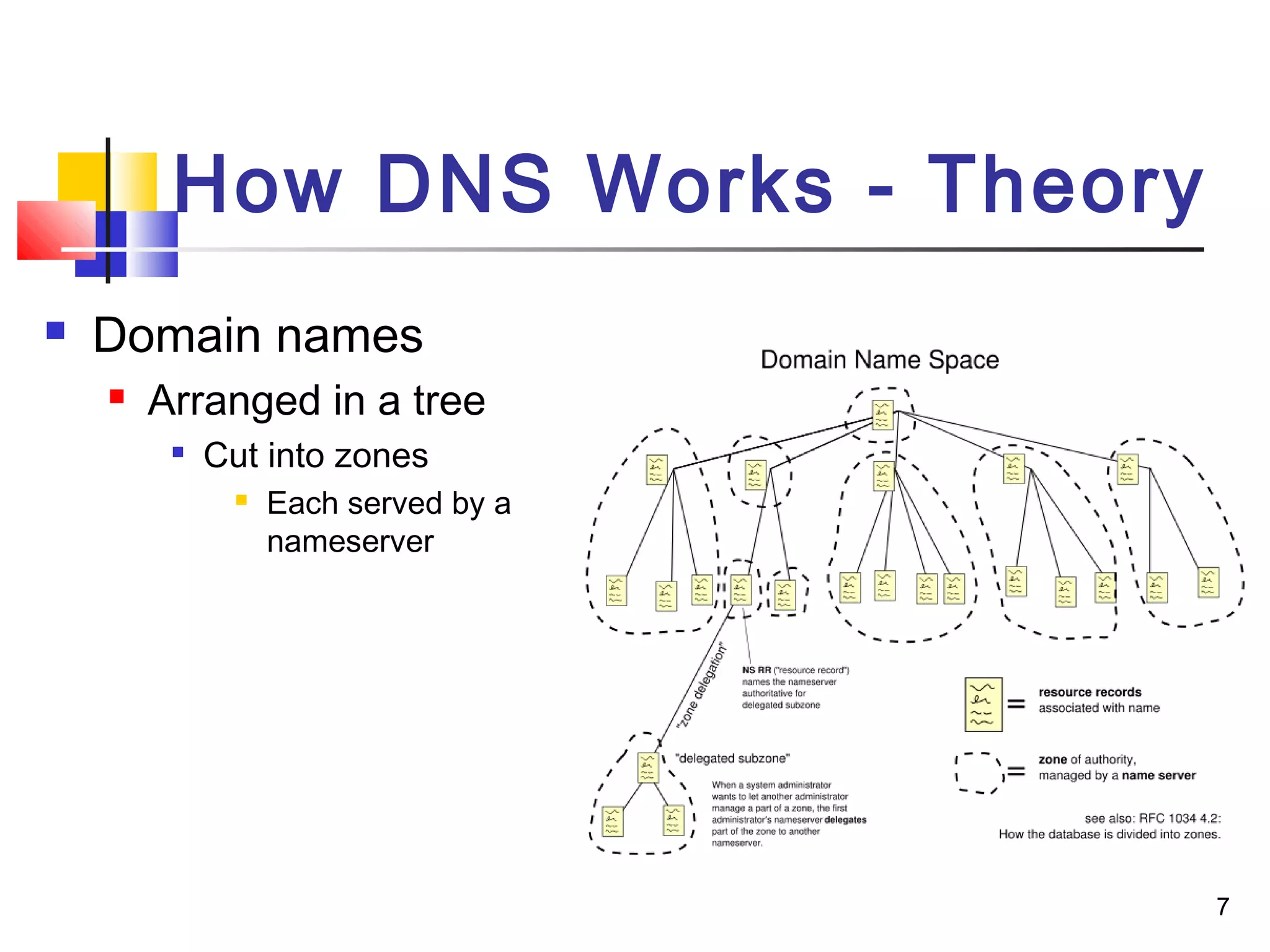
 Domain names 
 Arranged in a tree 
 Cut into zones 
 Each served by a 
nameserver
8 
How DNS Works - Theory 
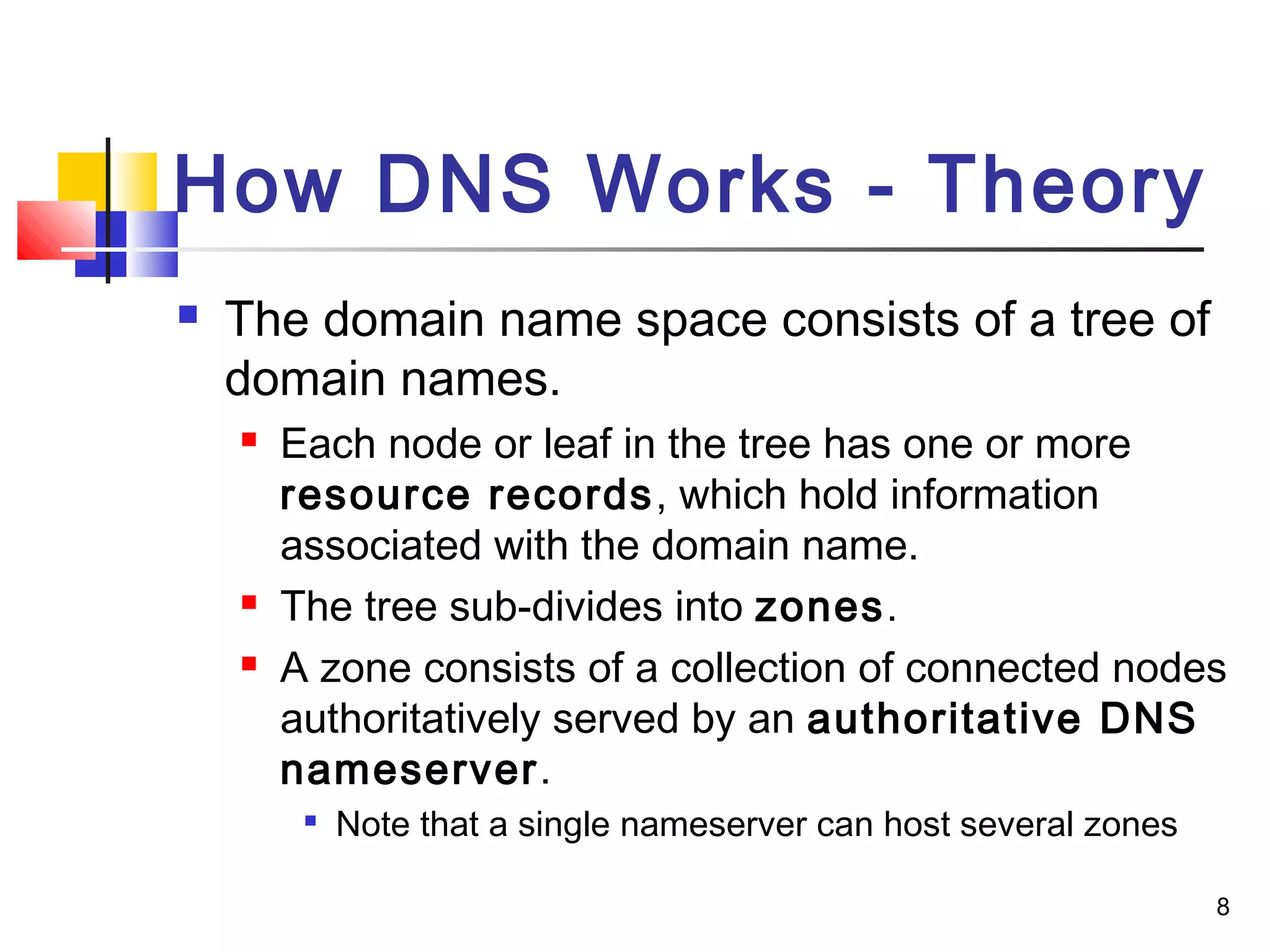
 The domain name space consists of a tree of 
domain names. 
 Each node or leaf in the tree has one or more 
resource records, which hold information 
associated with the domain name. 
 The tree sub-divides into zones. 
 A zone consists of a collection of connected nodes 
authoritatively served by an authoritative DNS 
nameserver. 
 Note that a single nameserver can host several zones
9 
How DNS Works - Theory 
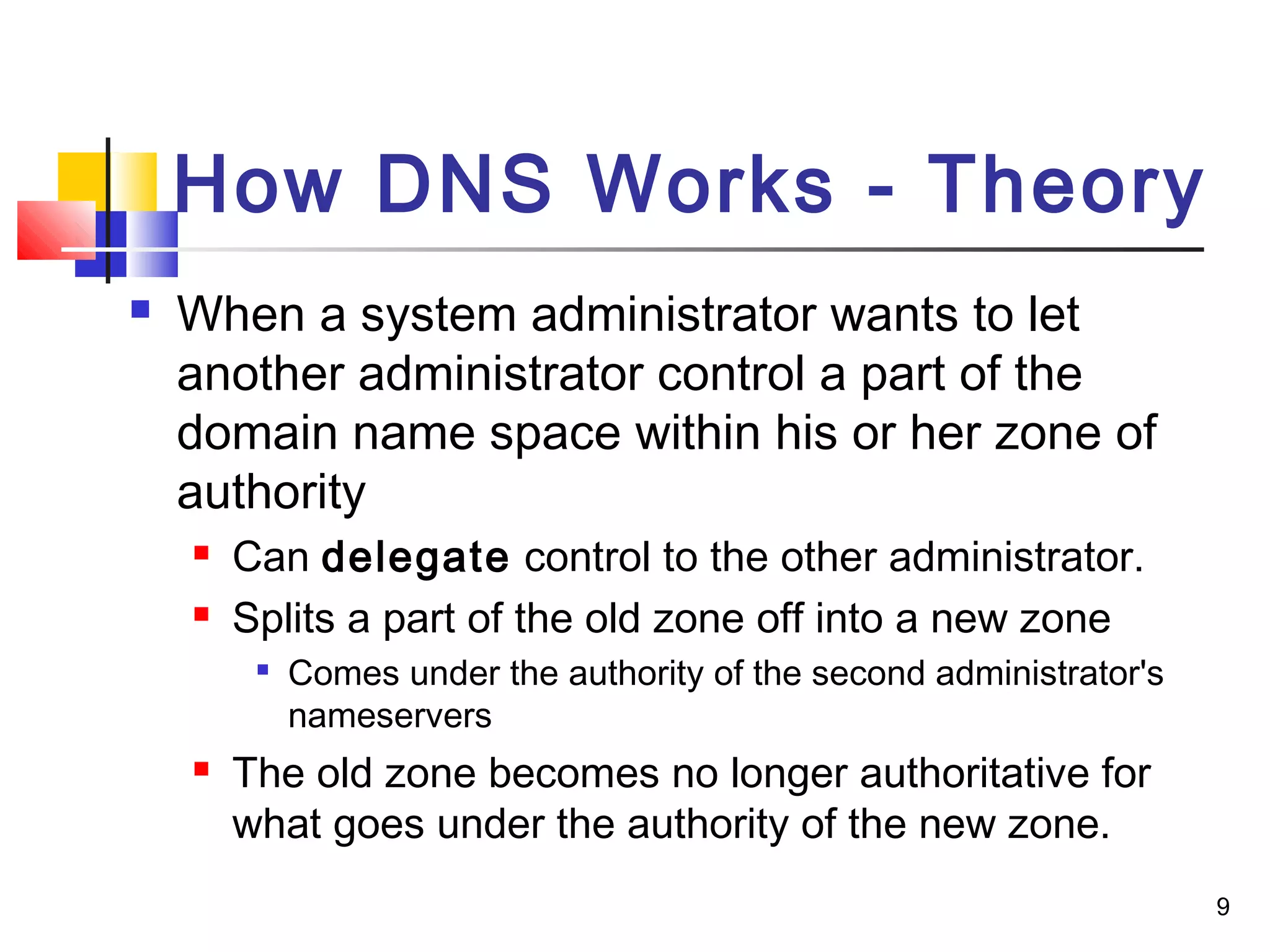
 When a system administrator wants to let 
another administrator control a part of the 
domain name space within his or her zone of 
authority 
 Can delegate control to the other administrator. 
 Splits a part of the old zone off into a new zone 
 Comes under the authority of the second administrator's 
nameservers 
 The old zone becomes no longer authoritative for 
what goes under the authority of the new zone.
10 
Types of DNS records 
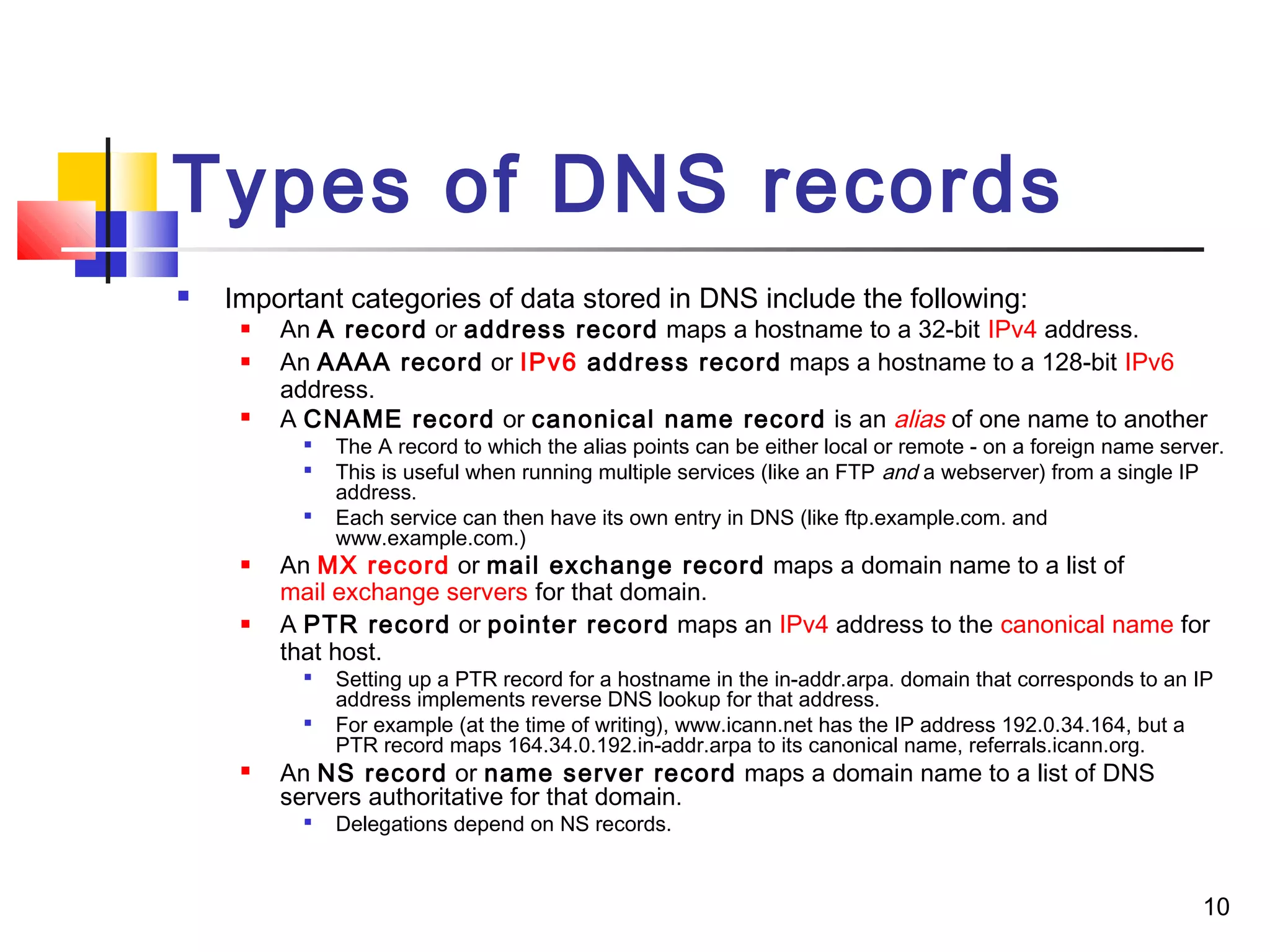
 Important categories of data stored in DNS include the following: 
 An A record or address record maps a hostname to a 32-bit IPv4 address. 
 An AAAA record or IPv6 address record maps a hostname to a 128-bit IPv6 
address. 
 A CNAME record or canonical name record is an alias of one name to another 
 The A record to which the alias points can be either local or remote - on a foreign name server. 
 This is useful when running multiple services (like an FTP and a webserver) from a single IP 
address. 
 Each service can then have its own entry in DNS (like ftp.example.com. and 
www.example.com.) 
 An MX record or mail exchange record maps a domain name to a list of 
mail exchange servers for that domain. 
 A PTR record or pointer record maps an IPv4 address to the canonical name for 
that host. 
 Setting up a PTR record for a hostname in the in-addr.arpa. domain that corresponds to an IP 
address implements reverse DNS lookup for that address. 
 For example (at the time of writing), www.icann.net has the IP address 192.0.34.164, but a 
PTR record maps 164.34.0.192.in-addr.arpa to its canonical name, referrals.icann.org. 
 An NS record or name server record maps a domain name to a list of DNS 
servers authoritative for that domain. 
 Delegations depend on NS records.
11 
DNS Zones 
Forward
12 
DNS Reverse Lookup 
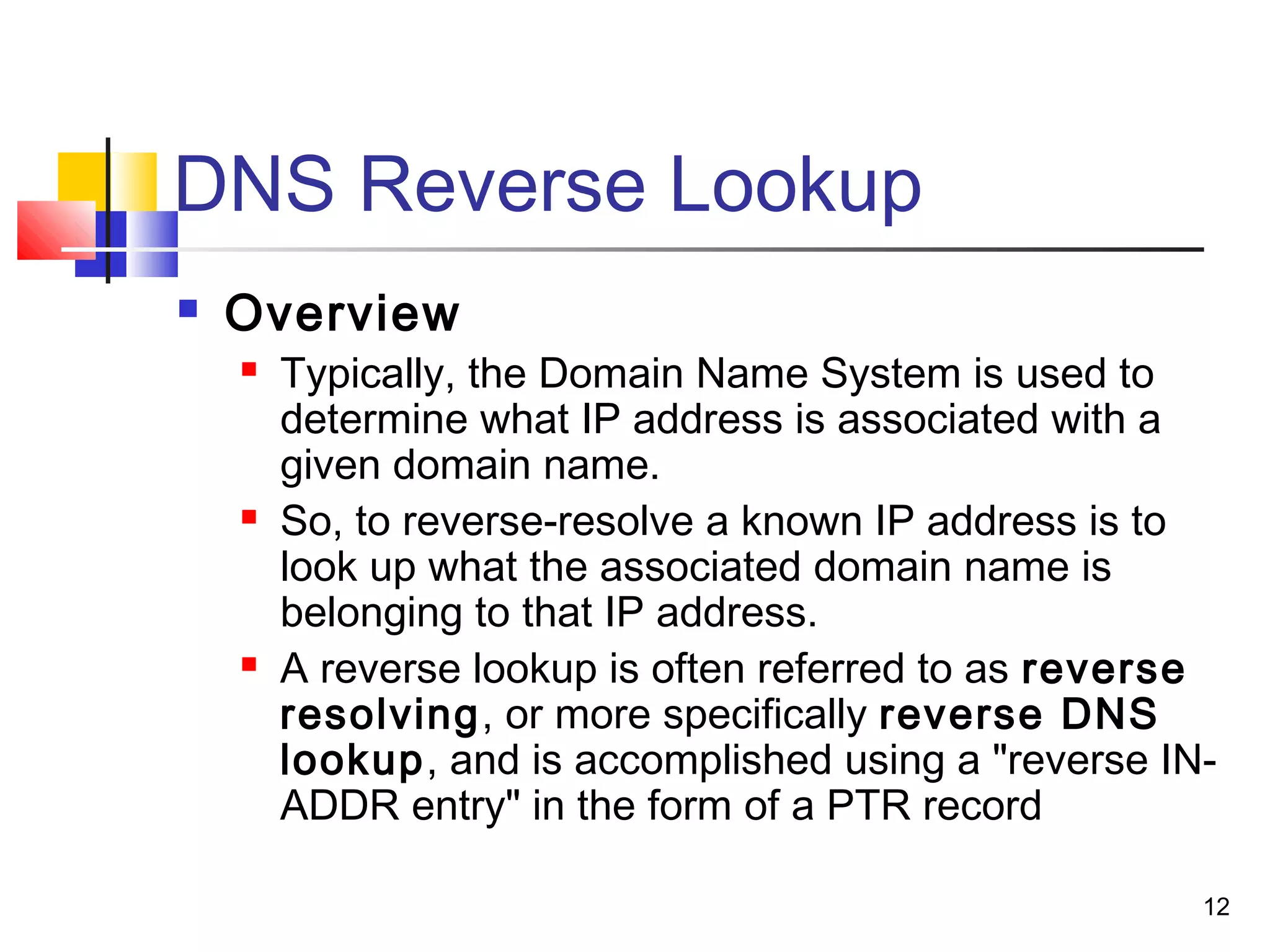
 Overview 
 Typically, the Domain Name System is used to 
determine what IP address is associated with a 
given domain name. 
 So, to reverse-resolve a known IP address is to 
look up what the associated domain name is 
belonging to that IP address. 
 A reverse lookup is often referred to as reverse 
resolving, or more specifically reverse DNS 
lookup, and is accomplished using a "reverse IN-ADDR 
entry" in the form of a PTR record
13 
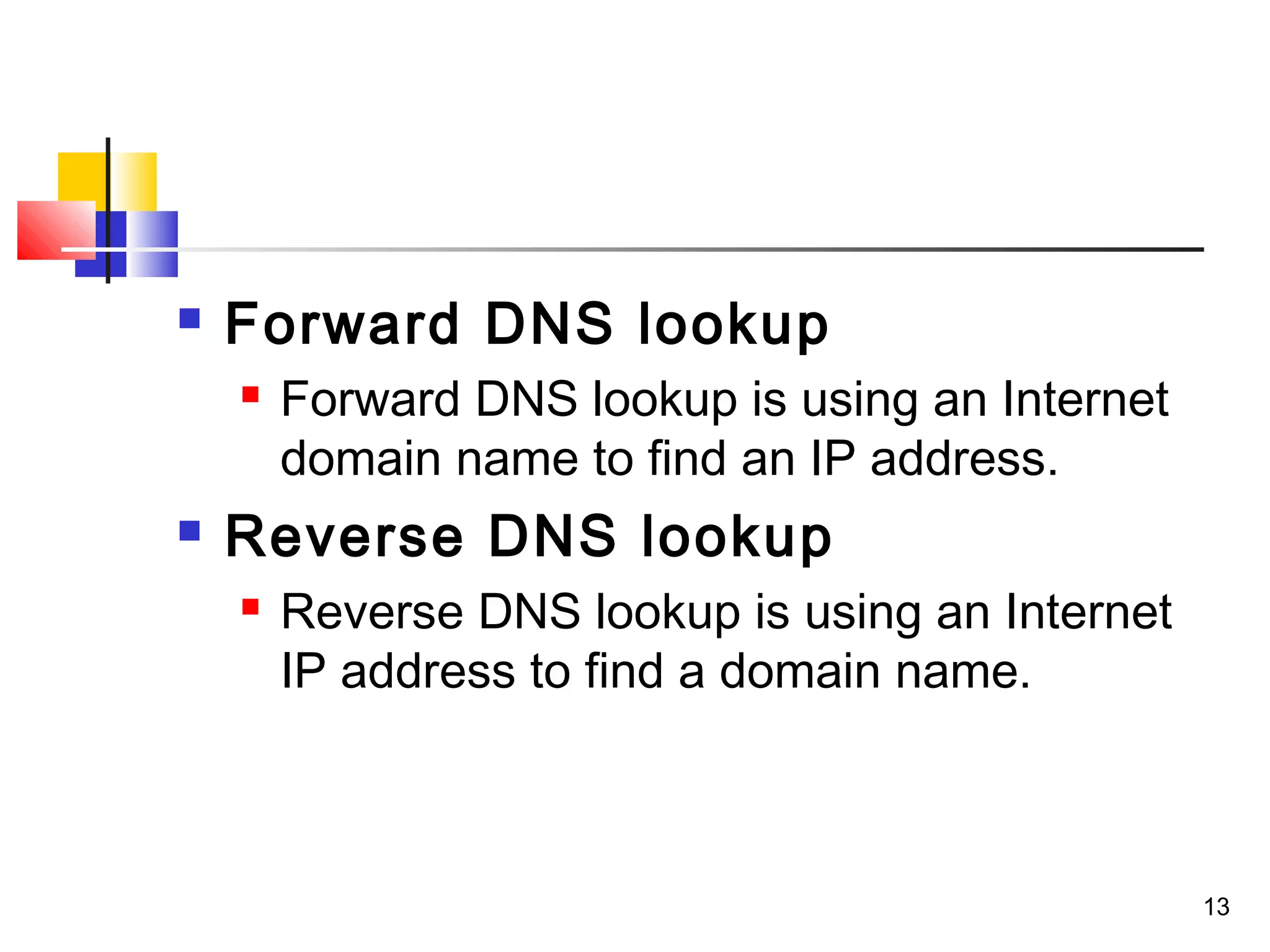
 Forward DNS lookup 
 Forward DNS lookup is using an Internet 
domain name to find an IP address. 
 Reverse DNS lookup 
 Reverse DNS lookup is using an Internet 
IP address to find a domain name.
14 
DNS Zones 
Forwarding
15 
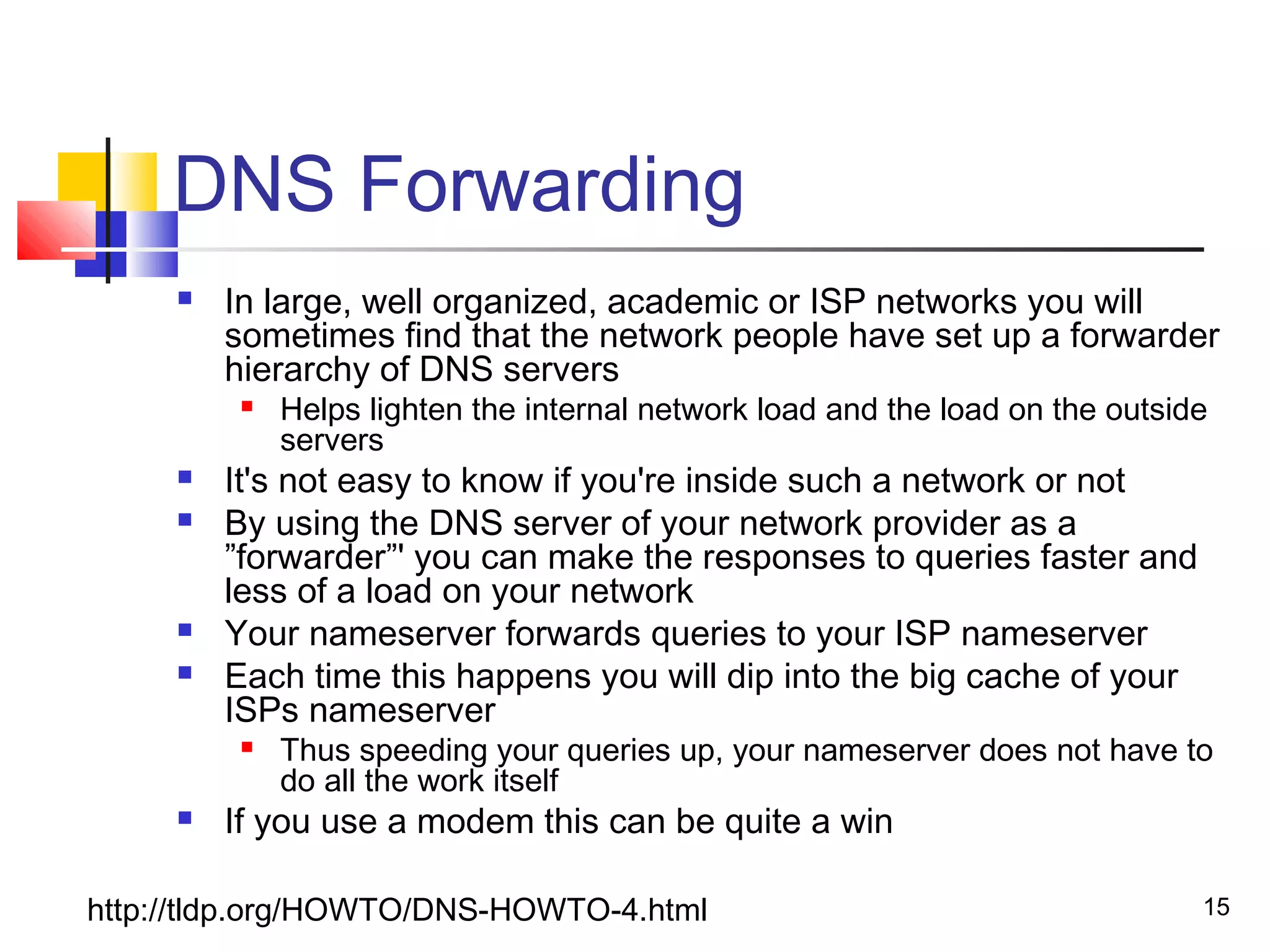
DNS Forwarding 
 In large, well organized, academic or ISP networks you will 
sometimes find that the network people have set up a forwarder 
hierarchy of DNS servers 
 Helps lighten the internal network load and the load on the outside 
servers 
 It's not easy to know if you're inside such a network or not 
 By using the DNS server of your network provider as a 
”forwarder”' you can make the responses to queries faster and 
less of a load on your network 
 Your nameserver forwards queries to your ISP nameserver 
 Each time this happens you will dip into the big cache of your 
ISPs nameserver 
 Thus speeding your queries up, your nameserver does not have to 
do all the work itself 
 If you use a modem this can be quite a win 
http://tldp.org/HOWTO/DNS-HOWTO-4.html
16 
Mail Exchangers 
Covered in previous section: 
How DNS Works In Practice 
- Other Applications

Dns1111111111

  • 1.
    Student name: hazemal maliki DNS Domain Name Systems
  • 2.
    2 Domain NameSystem  DNS Overview  DNS Zones  Forward  Reverse  Fowarding  DNS Delegation/Parenting  Mail Exchangers
  • 3.
    3 Overview On the Internet, the Domain Name System (DNS) associates various sorts of information with domain names  Serves as the "phone book" for the Internet  Translates human-readable computer hostnames into IP addresses  Required bynetworking equipment to delivering information  Also stores other information  Such as the list of mail exchange servers that accept email for a given domain.  By providing a worldwide keyword-based redirection service, the Domain Name System is an essential component of the modern Internet
  • 4.
    4 Uses The most basic use of DNS is to translate hostnames to IP addresses.  Very much like a phone book  For example, what is the internet address of en.wikipedia.org?  The Domain Name System can be used to tell you it is 66.230.200.100
  • 5.
    5 Uses DNS also has other important uses  DNS makes it possible  Assign Internet destinations to the human organization or concern they represent  Independent of the physical routing hierarchy represented by the numerical
  • 6.
    6 How DNSworks
  • 7.
    7 How DNSWorks - Theory  Domain names  Arranged in a tree  Cut into zones  Each served by a nameserver
  • 8.
    8 How DNSWorks - Theory  The domain name space consists of a tree of domain names.  Each node or leaf in the tree has one or more resource records, which hold information associated with the domain name.  The tree sub-divides into zones.  A zone consists of a collection of connected nodes authoritatively served by an authoritative DNS nameserver.  Note that a single nameserver can host several zones
  • 9.
    9 How DNSWorks - Theory  When a system administrator wants to let another administrator control a part of the domain name space within his or her zone of authority  Can delegate control to the other administrator.  Splits a part of the old zone off into a new zone  Comes under the authority of the second administrator's nameservers  The old zone becomes no longer authoritative for what goes under the authority of the new zone.
  • 10.
    10 Types ofDNS records  Important categories of data stored in DNS include the following:  An A record or address record maps a hostname to a 32-bit IPv4 address.  An AAAA record or IPv6 address record maps a hostname to a 128-bit IPv6 address.  A CNAME record or canonical name record is an alias of one name to another  The A record to which the alias points can be either local or remote - on a foreign name server.  This is useful when running multiple services (like an FTP and a webserver) from a single IP address.  Each service can then have its own entry in DNS (like ftp.example.com. and www.example.com.)  An MX record or mail exchange record maps a domain name to a list of mail exchange servers for that domain.  A PTR record or pointer record maps an IPv4 address to the canonical name for that host.  Setting up a PTR record for a hostname in the in-addr.arpa. domain that corresponds to an IP address implements reverse DNS lookup for that address.  For example (at the time of writing), www.icann.net has the IP address 192.0.34.164, but a PTR record maps 164.34.0.192.in-addr.arpa to its canonical name, referrals.icann.org.  An NS record or name server record maps a domain name to a list of DNS servers authoritative for that domain.  Delegations depend on NS records.
  • 11.
    11 DNS Zones Forward
  • 12.
    12 DNS ReverseLookup  Overview  Typically, the Domain Name System is used to determine what IP address is associated with a given domain name.  So, to reverse-resolve a known IP address is to look up what the associated domain name is belonging to that IP address.  A reverse lookup is often referred to as reverse resolving, or more specifically reverse DNS lookup, and is accomplished using a "reverse IN-ADDR entry" in the form of a PTR record
  • 13.
    13  ForwardDNS lookup  Forward DNS lookup is using an Internet domain name to find an IP address.  Reverse DNS lookup  Reverse DNS lookup is using an Internet IP address to find a domain name.
  • 14.
    14 DNS Zones Forwarding
  • 15.
    15 DNS Forwarding  In large, well organized, academic or ISP networks you will sometimes find that the network people have set up a forwarder hierarchy of DNS servers  Helps lighten the internal network load and the load on the outside servers  It's not easy to know if you're inside such a network or not  By using the DNS server of your network provider as a ”forwarder”' you can make the responses to queries faster and less of a load on your network  Your nameserver forwards queries to your ISP nameserver  Each time this happens you will dip into the big cache of your ISPs nameserver  Thus speeding your queries up, your nameserver does not have to do all the work itself  If you use a modem this can be quite a win http://tldp.org/HOWTO/DNS-HOWTO-4.html
  • 16.
    16 Mail Exchangers Covered in previous section: How DNS Works In Practice - Other Applications