MARIE CHRIS S. PORTILLAS
MS Gen. Sci. Ed.
 The measure of relationship between
two or more variables or two or more
sets of data.
Correlation
Co-variation
 because analysis is focused mainly on
how two variables co – vary or co –
differ.
 represents the extent or degree of
relationships between two variables
may be positive, negative, or zero.
Correlation coefficient
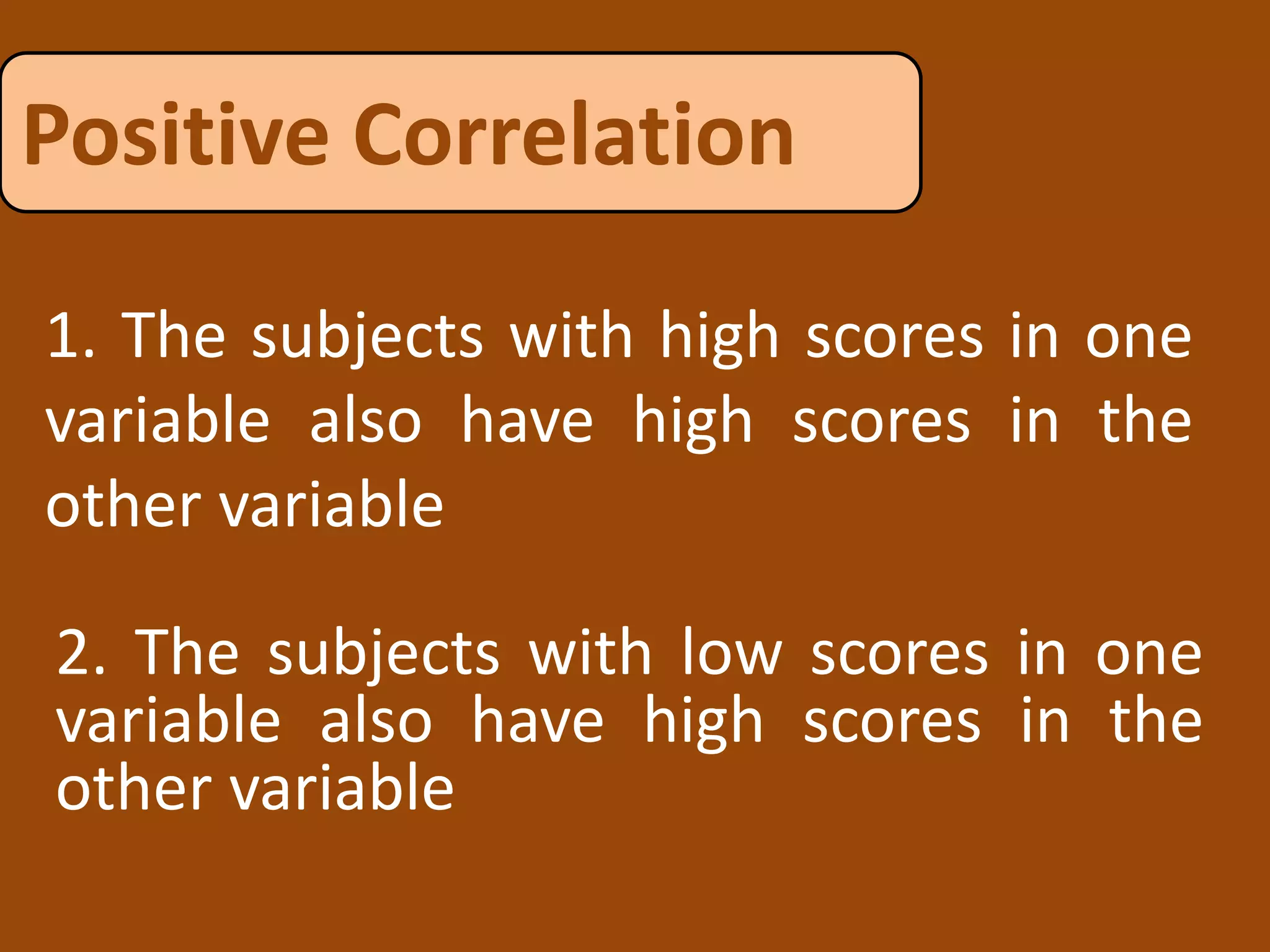
1. The subjects with high scores in one
variable also have high scores in the
other variable
Positive Correlation
2. The subjects with low scores in one
variable also have high scores in the
other variable
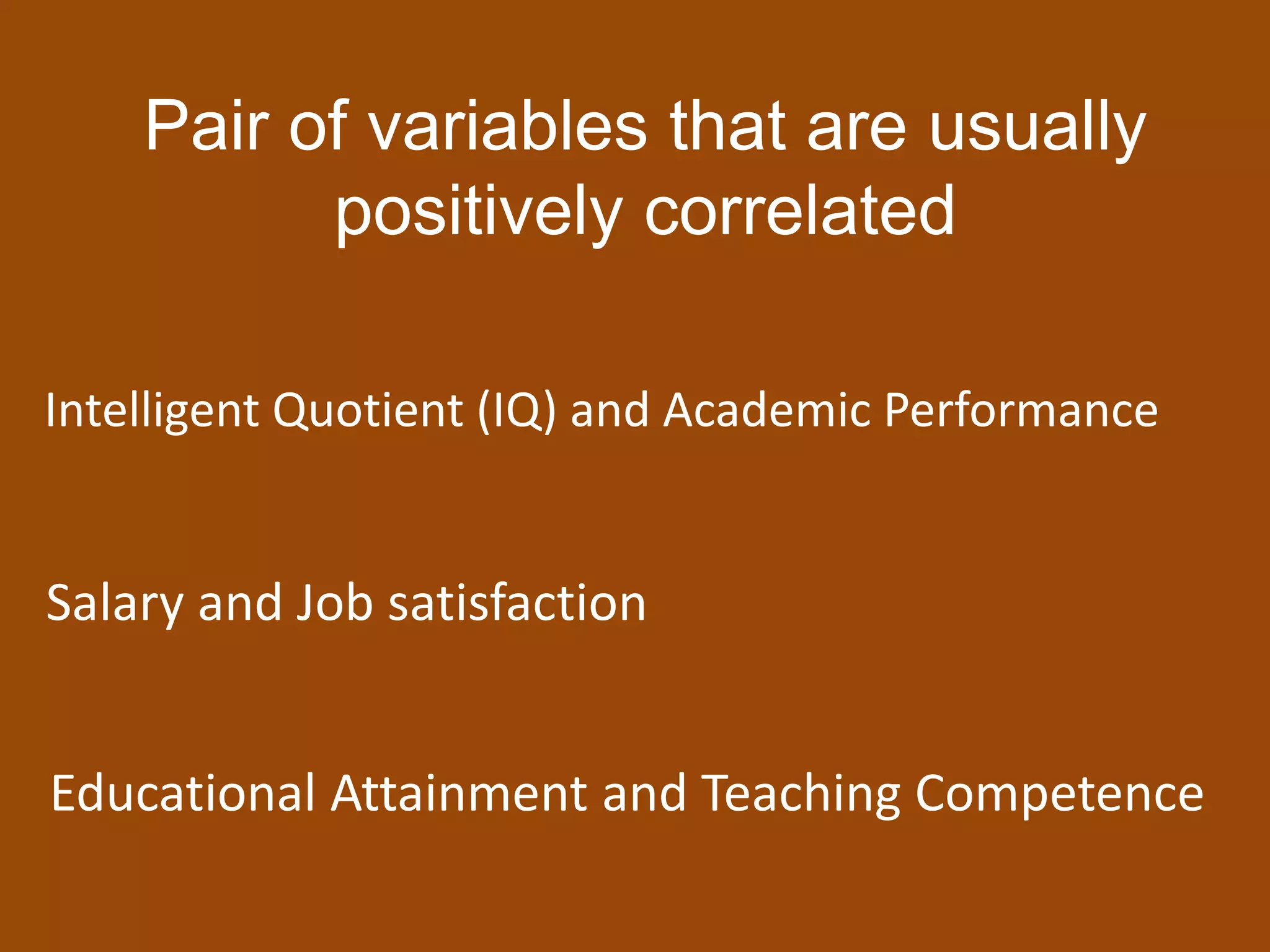
Pair of variables that are usually
positively correlated
Intelligent Quotient (IQ) and Academic Performance
Salary and Job satisfaction
Educational Attainment and Teaching Competence
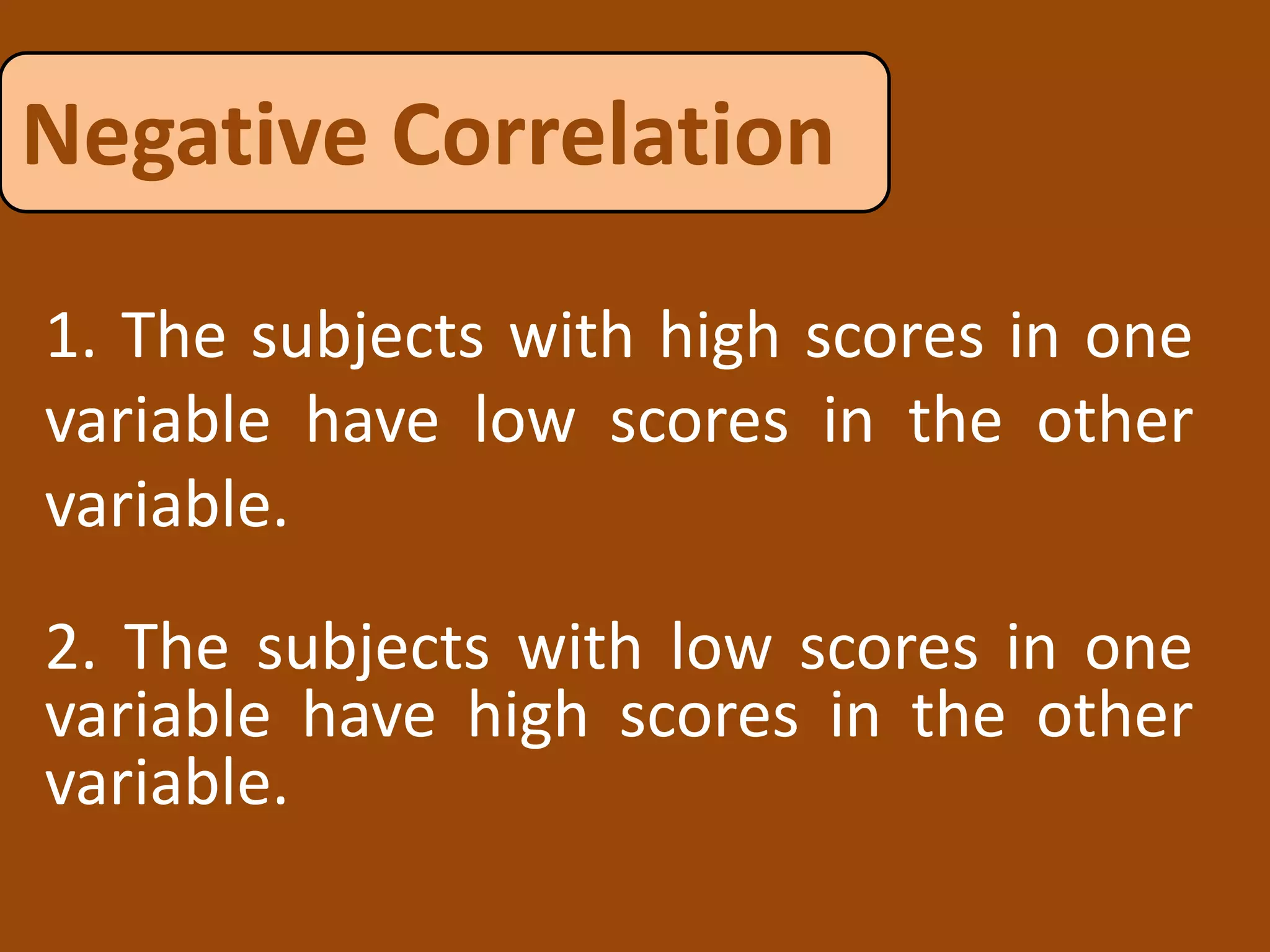
Negative Correlation
1. The subjects with high scores in one
variable have low scores in the other
variable.
2. The subjects with low scores in one
variable have high scores in the other
variable.
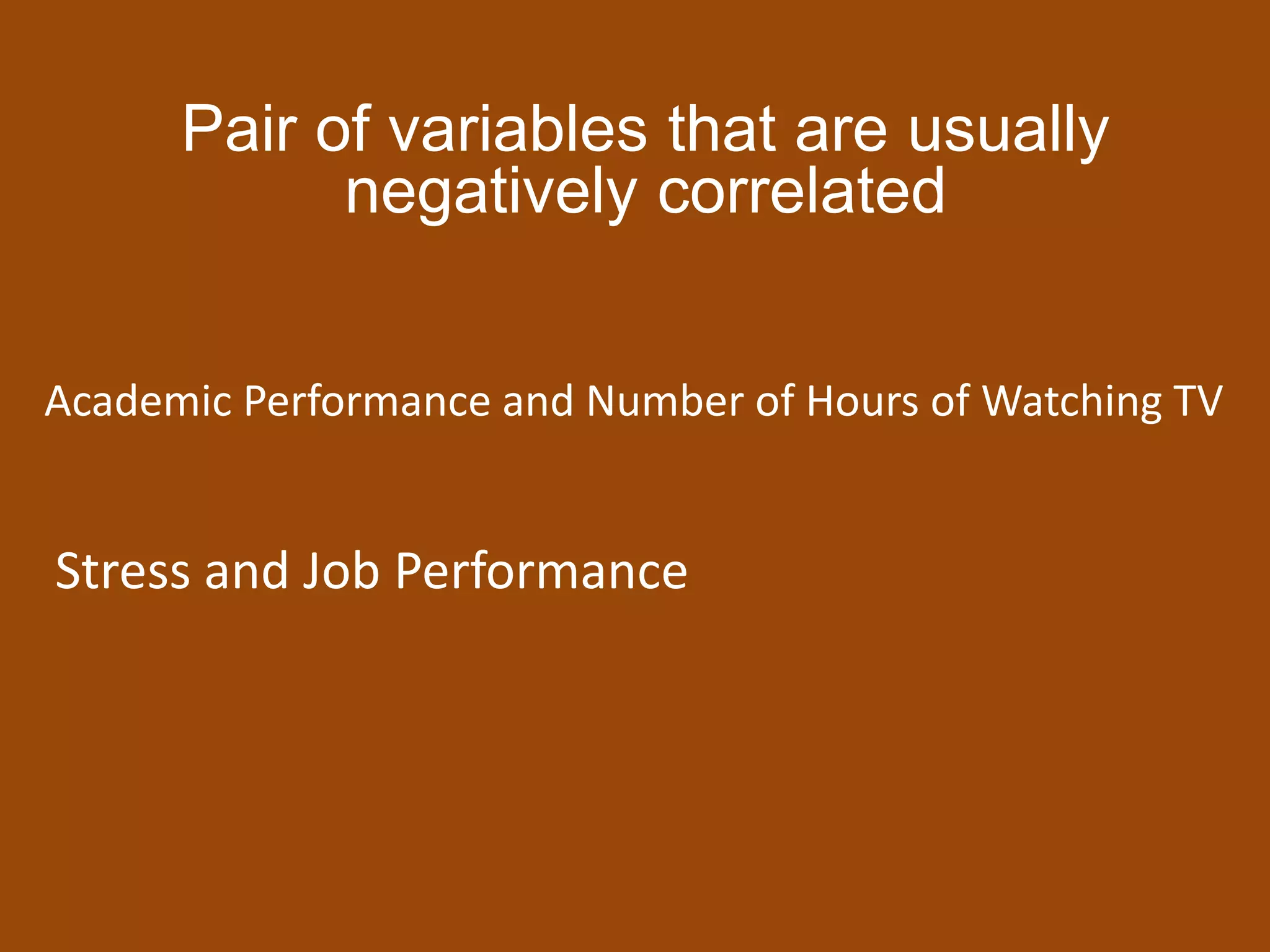
Pair of variables that are usually
negatively correlated
Academic Performance and Number of Hours of Watching TV
Stress and Job Performance
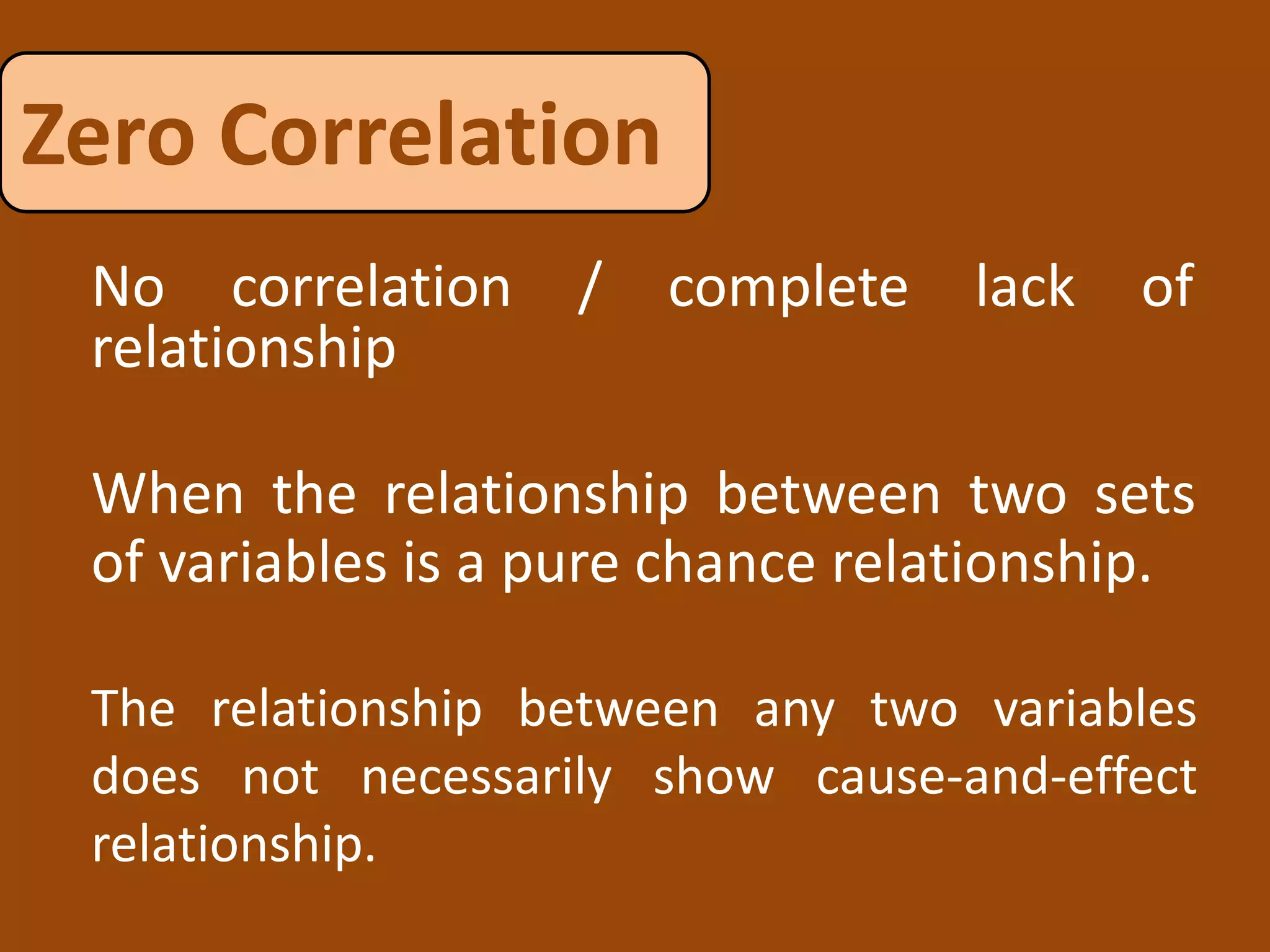
Zero Correlation
When the relationship between two sets
of variables is a pure chance relationship.
No correlation / complete lack of
relationship
The relationship between any two variables
does not necessarily show cause-and-effect
relationship.
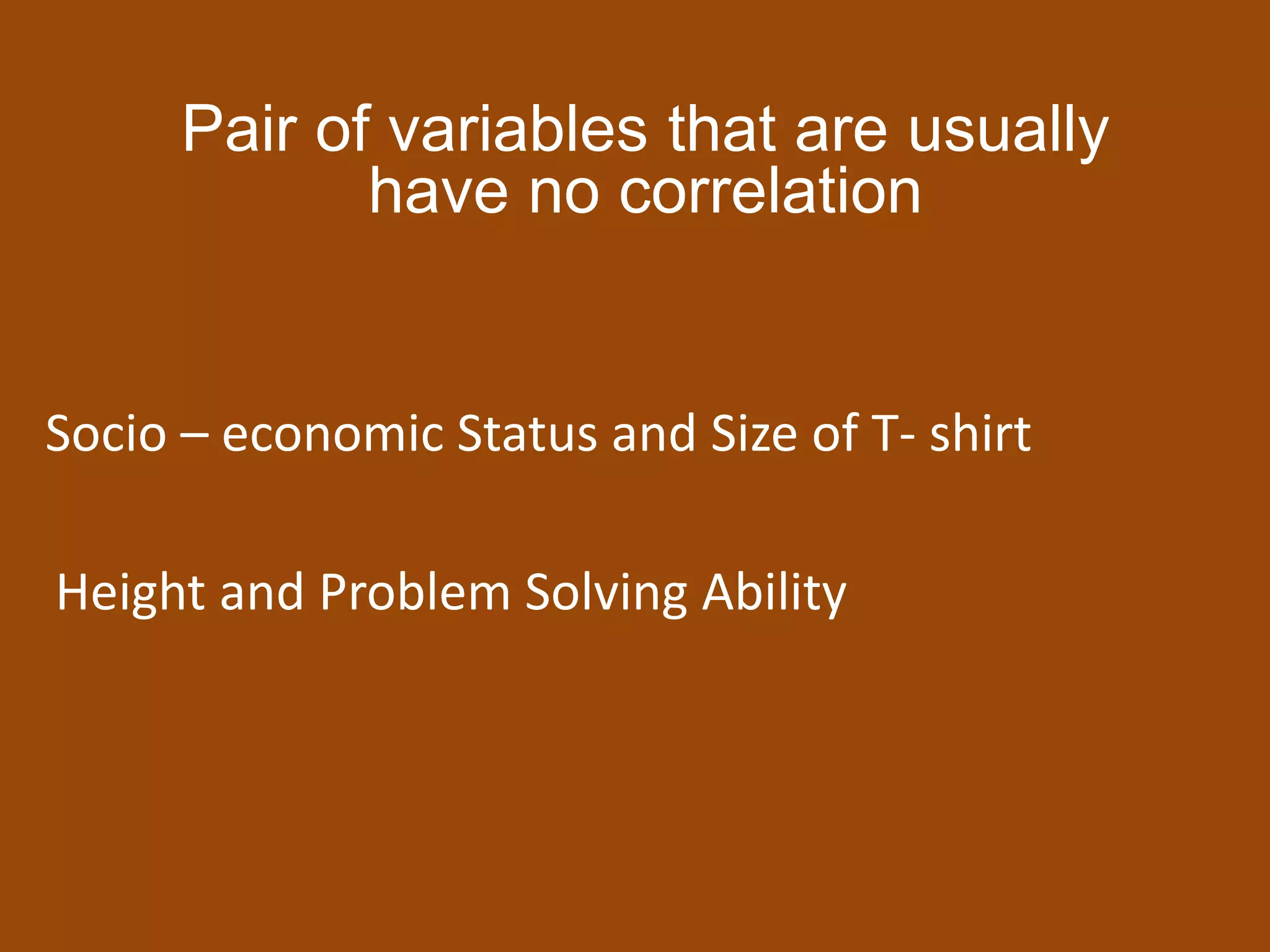
Pair of variables that are usually
have no correlation
Socio – economic Status and Size of T- shirt
Height and Problem Solving Ability
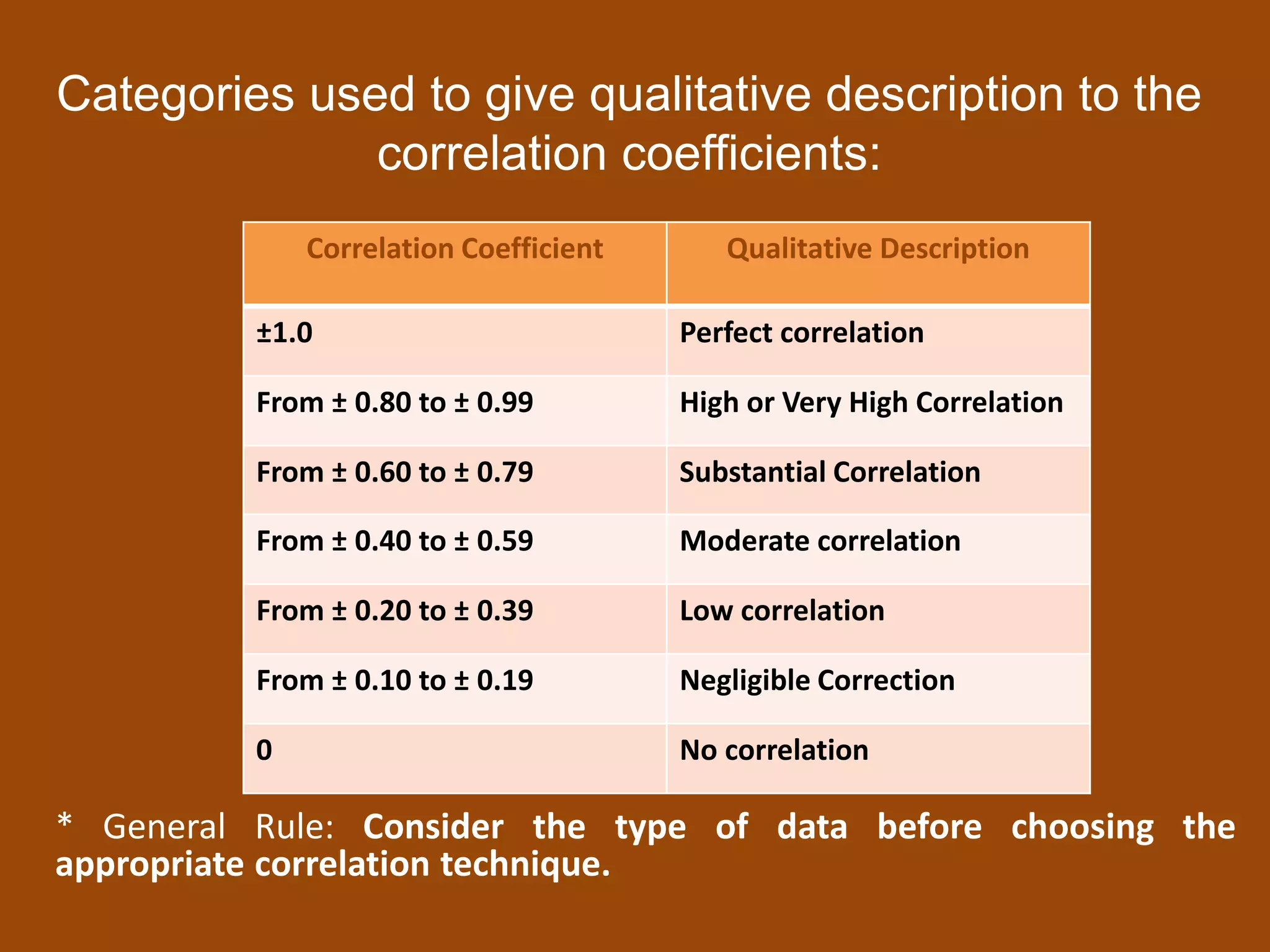
Categories used to give qualitative description to the
correlation coefficients:
Correlation Coefficient Qualitative Description
±1.0 Perfect correlation
From ± 0.80 to ± 0.99 High or Very High Correlation
From ± 0.60 to ± 0.79 Substantial Correlation
From ± 0.40 to ± 0.59 Moderate correlation
From ± 0.20 to ± 0.39 Low correlation
From ± 0.10 to ± 0.19 Negligible Correction
0 No correlation
* General Rule: Consider the type of data before choosing the
appropriate correlation technique.
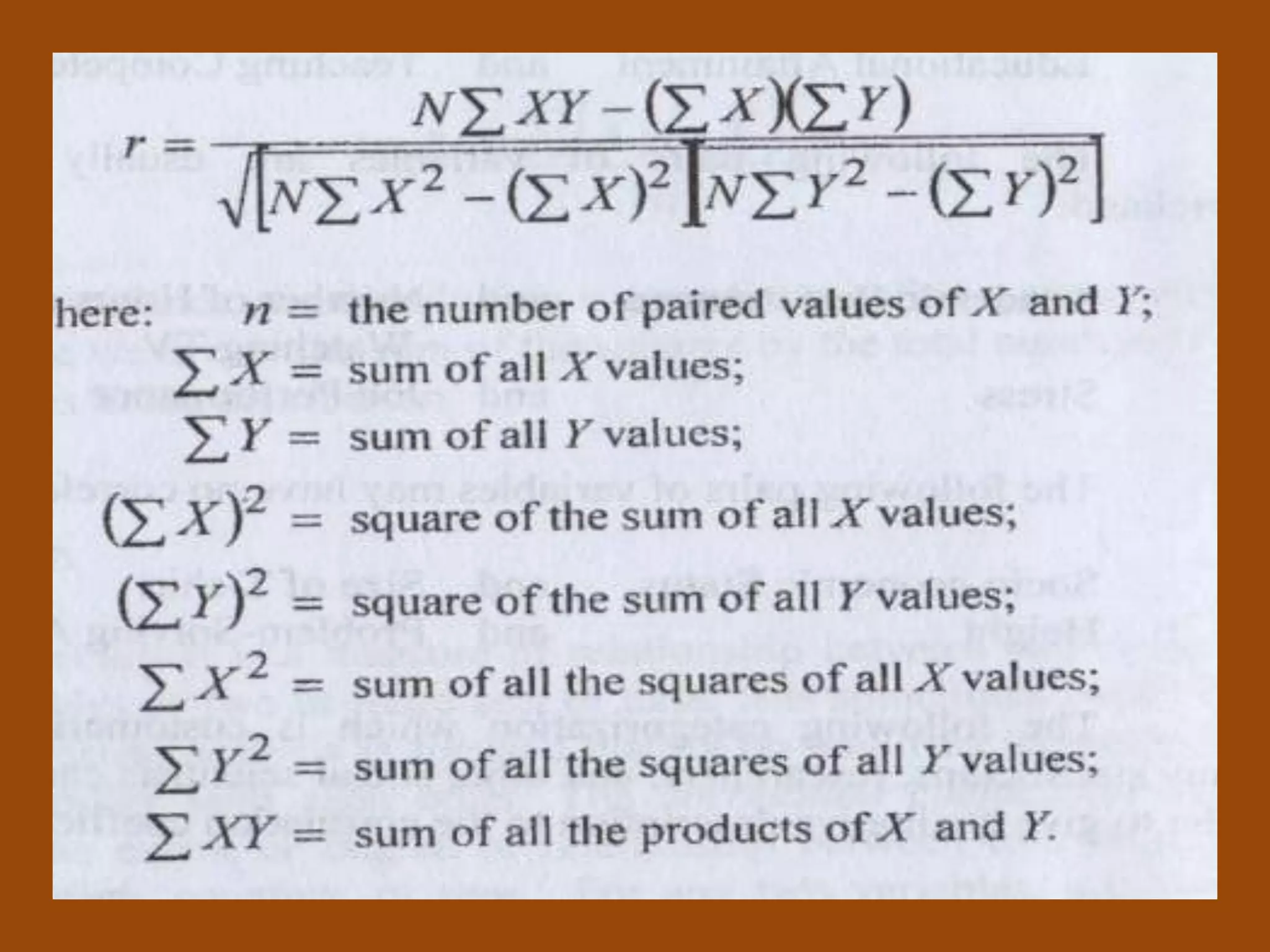
Is a measure of relationship
between two variables that are
usually of the interval type of data.
Pearson Product –Moment Correlation Coefficient
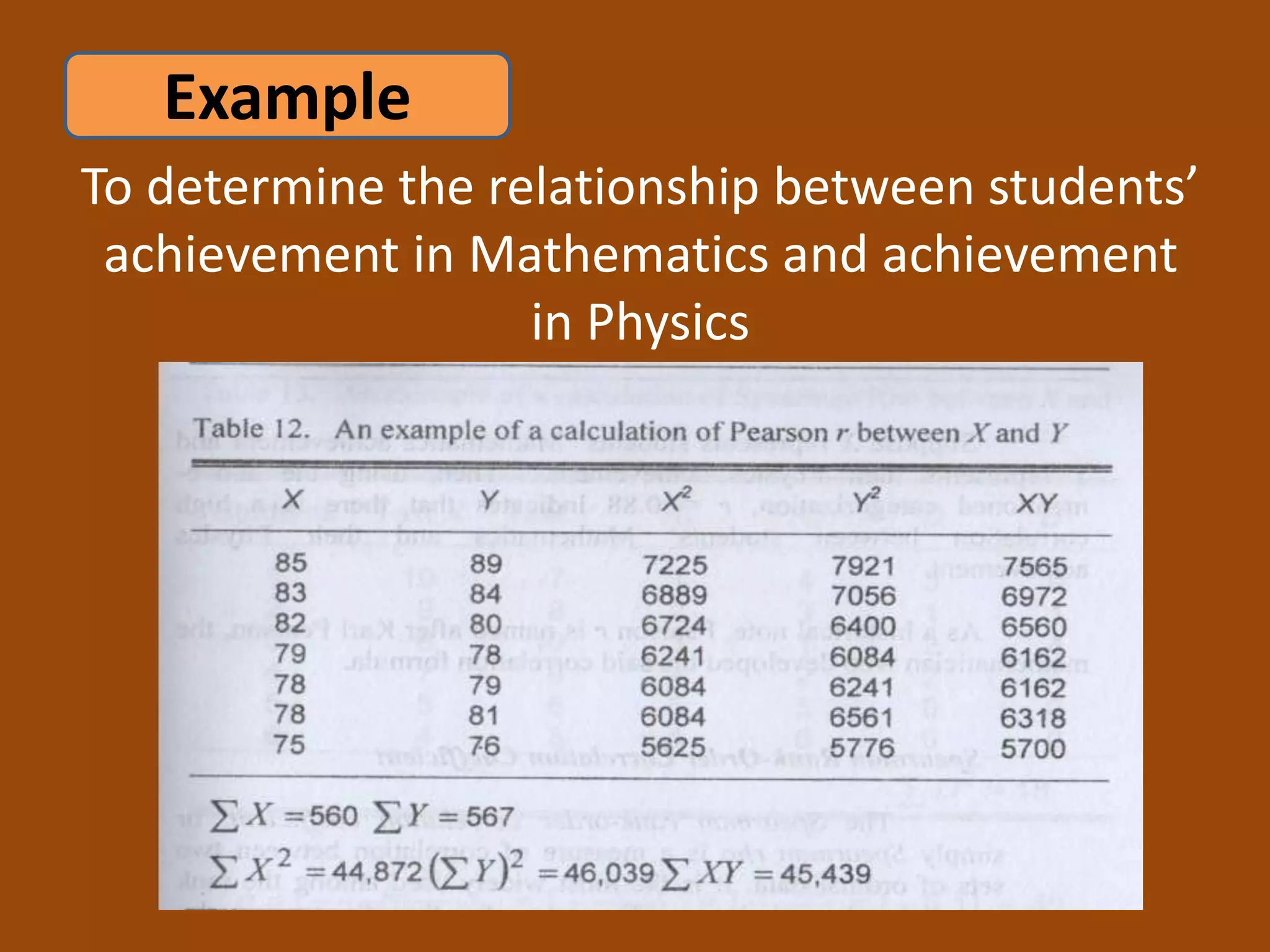
To determine the relationship between students’
achievement in Mathematics and achievement
in Physics
Example
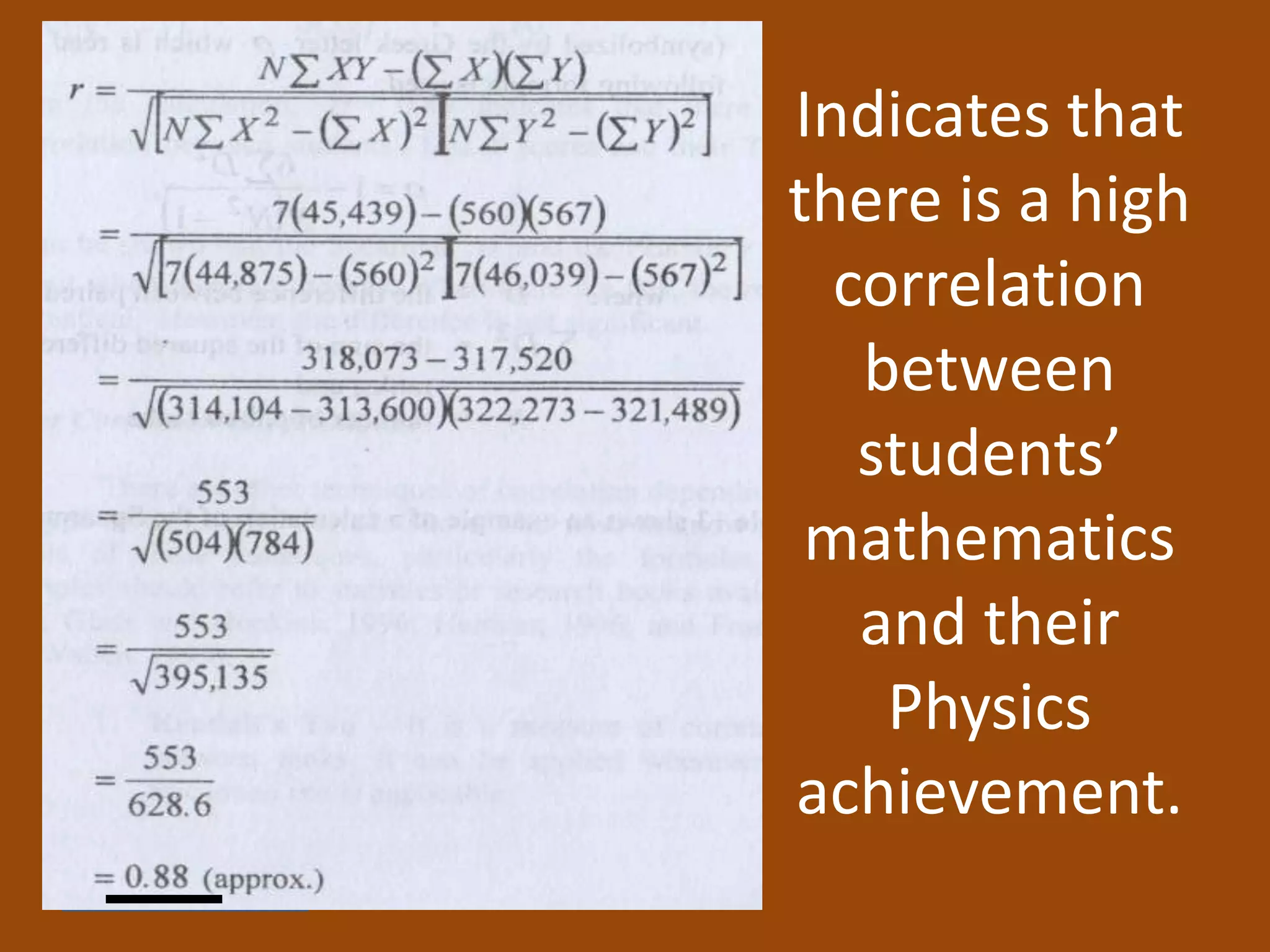
Indicates that
there is a high
correlation
between
students’
mathematics
and their
Physics
achievement.
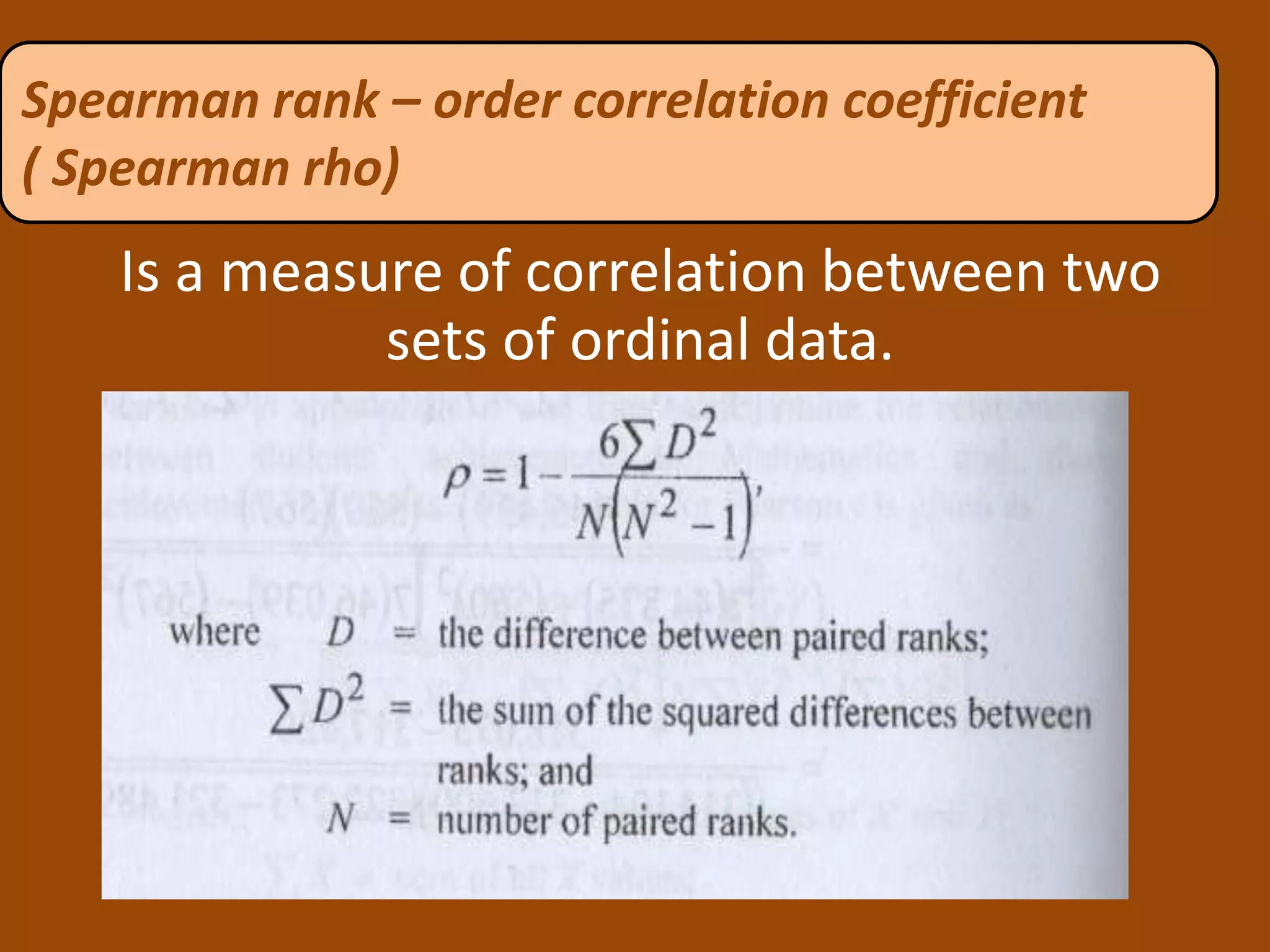
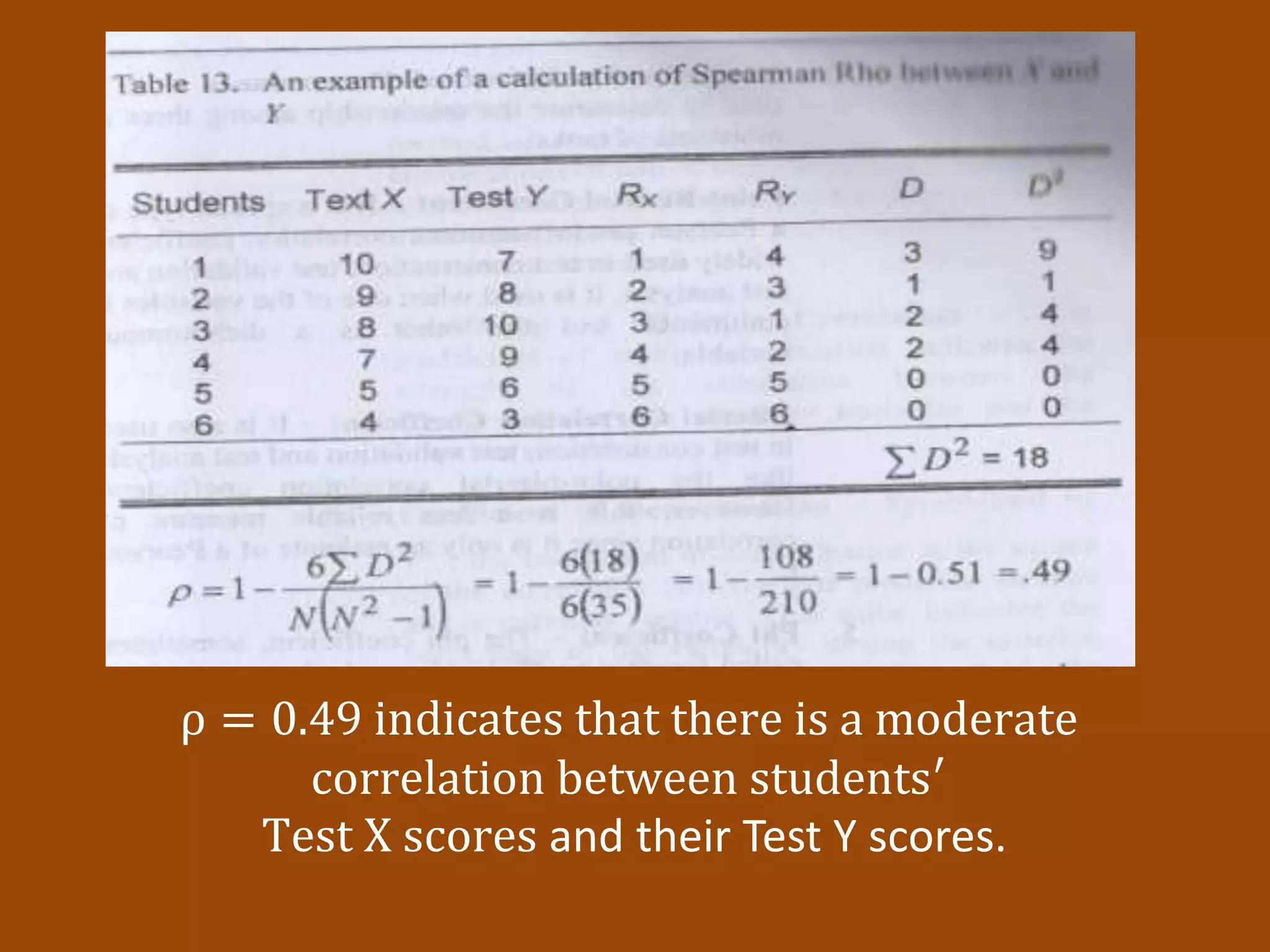
Is a measure of correlation between two
sets of ordinal data.
Spearman rank – order correlation coefficient
( Spearman rho)
ρ = 0.49 indicates that there is a moderate
correlation between students′
Test X scores and their Test Y scores.
Other
Correlational
Techniques
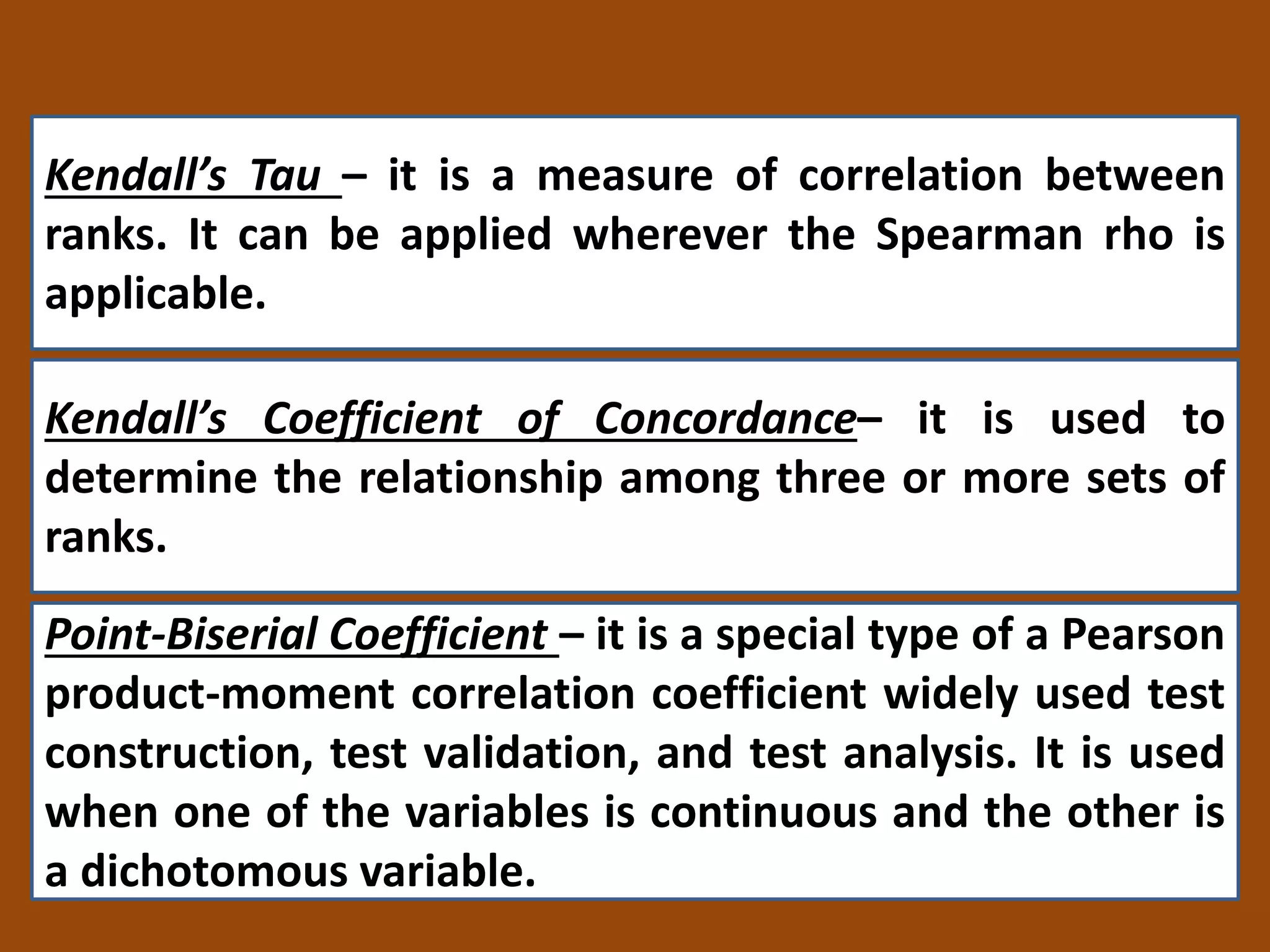
Kendall’s Tau – it is a measure of correlation between
ranks. It can be applied wherever the Spearman rho is
applicable.
Kendall’s Coefficient of Concordance– it is used to
determine the relationship among three or more sets of
ranks.
Point-Biserial Coefficient – it is a special type of a Pearson
product-moment correlation coefficient widely used test
construction, test validation, and test analysis. It is used
when one of the variables is continuous and the other is
a dichotomous variable.
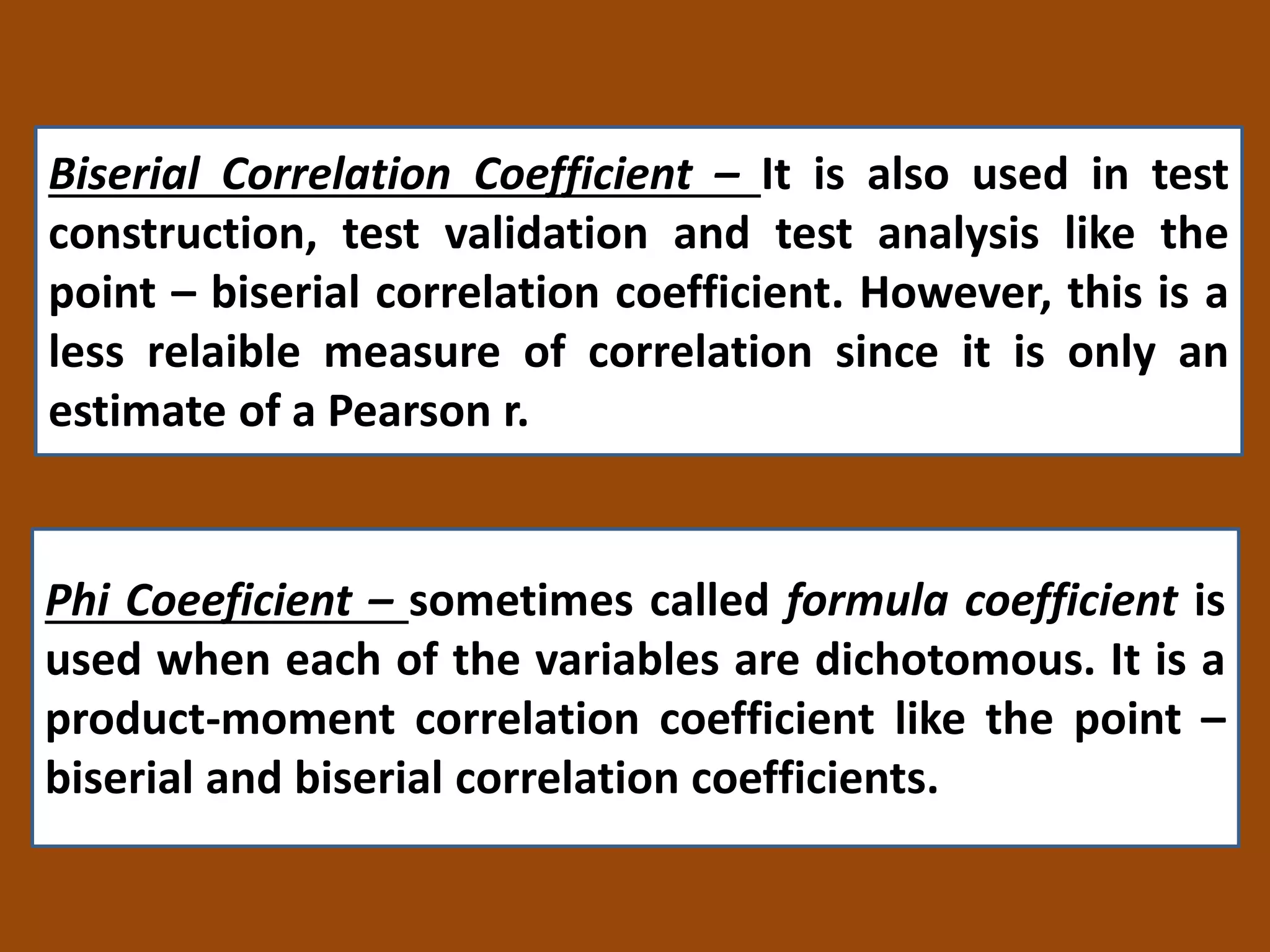
Biserial Correlation Coefficient – It is also used in test
construction, test validation and test analysis like the
point – biserial correlation coefficient. However, this is a
less relaible measure of correlation since it is only an
estimate of a Pearson r.
Phi Coeeficient – sometimes called formula coefficient is
used when each of the variables are dichotomous. It is a
product-moment correlation coefficient like the point –
biserial and biserial correlation coefficients.
Tetrachoric Correlation Coefficient – it is a measure of
correlation between data that can be reduced to two
dichotomies. However, like the biserial coefficient, it is
quite unreliable since it is only an estimate of Pearson r.
Partial Correlation – whenever two or more variables are
correlated, there may be a possibility that yet other
variables may explain any relationship that is found.
These other variables can be controlled through a
correlational technique called partial correlation. In other
words, it is used to remove the effect of one variable on
the correlation between two variables.
Multiple Regression – it is a technique that enables
researchers to determine a correlation between a
criterion variable ( dependent) and the best combination
of two or more predictor variables ( independent). In
other words, it is a method of analyzing the collective
and separate contributions of two or more independent
variables to the variation of a dependent variable. It can
be equally well in both experimental and non –
experimental research.
Coeffiecient of Multiple Correlation- the coefficient of
multiple correlation indicates the strength of the
correlation between the combination of the predictor
variables and the criterion variable.
Coefficient of Determination (r2)- is the square of the
correlation between one predictor variable and a
criterion variable. This value indicates the percentage of
the variability among the criterion values that can be
attributed to differences in the values on the predictor
variable.
i.e., if the correlation coefficient between IQ and
Mathematics achievement for a group of high school
students is 0.80, then 64 percent of the differences in
students’ mathematics achievement can be attributed to
differences in their IQ.
Discrimination Function Analysis – it is a technique used
in the same way as the multiple regression analysis.
However, it is only appropriate for categorical variable
i.e., it involves membership in a group or category rather
than scores on continuum.
Factor Analysis – it is a technique that allows a
researcher to determine if many variables can be
described by a few factors. It involves a search for
clusters of variables, all of which are correlated worth
each other. Each cluster represents a factor. In other
words, it is the goal of this technique to reduce the
number of variables by grouping those which have low,
moderate, or high correlation with one another into
factors.
Path Analysis – it is used to test the possibility of causal
connection among three or more variables. The essential
idea behind this technique is to formulate a theory about
the possible causes of a particular phenomenon
i.e., to identify causal variables that could explain why
phenomenon occurs, and then to determine whether
correlations among all the variables are consistent with
the theory.
Four basic steps ( Fraenkel and Walle, 1993)
1. A theory that links several variables is
formulated to explain a particular phenomenon
of interest.
2. The variables specified by the theory are then
measured in some way.
3. Correlation coefficients are computed to
indicate the strength of the of the relationship
between each of the pairs of variables
postulated in the theory.
4. Relationships among the correlation coefficients
are analyzed in relation to the theory.
Tests for Comparison
The t – test for Difference
between Means
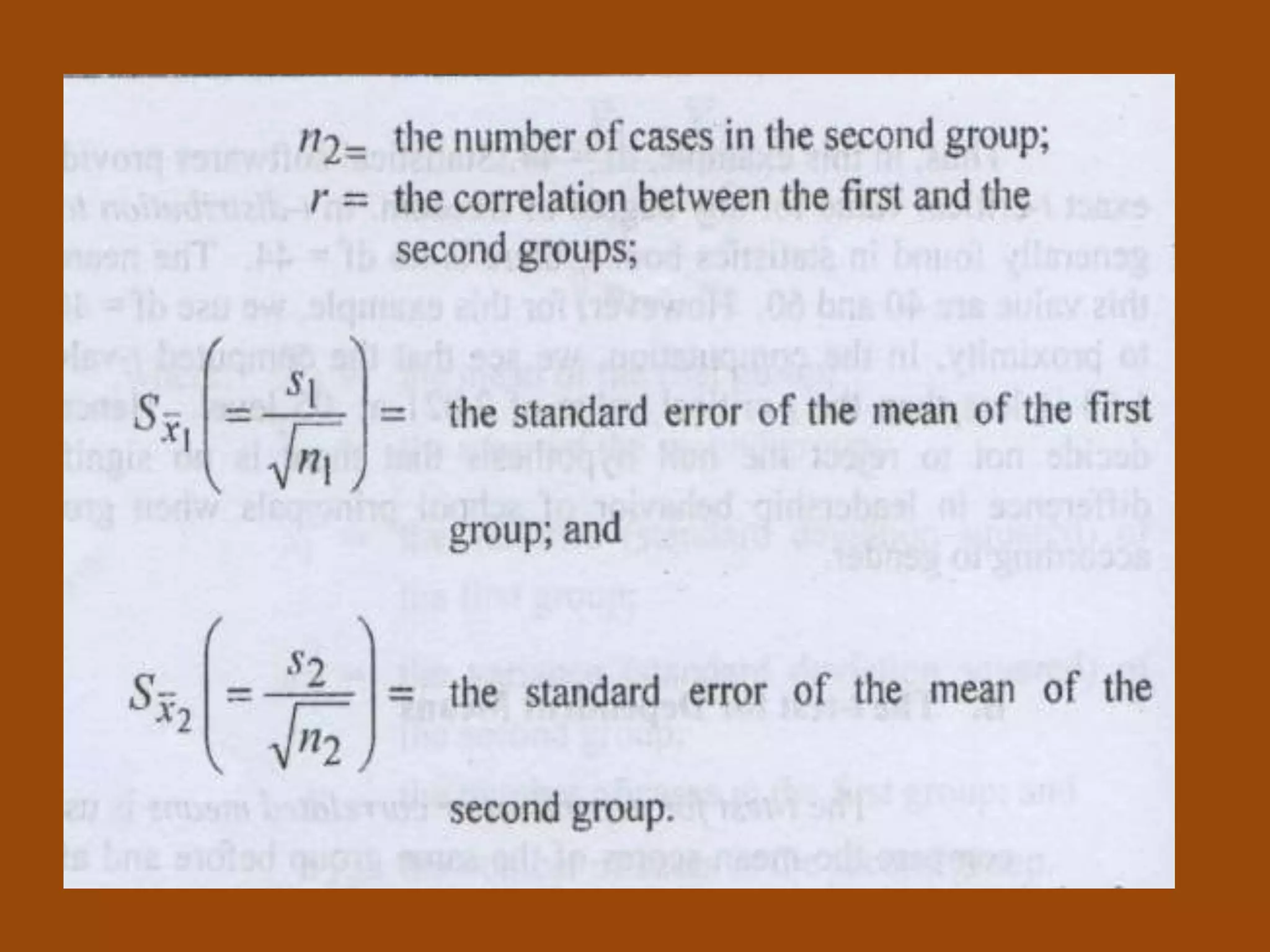
The t- test is a parametric test used to
determine whether a difference between the
means of two groups and the standard error
of difference between means.
The t – test for Independent
Means
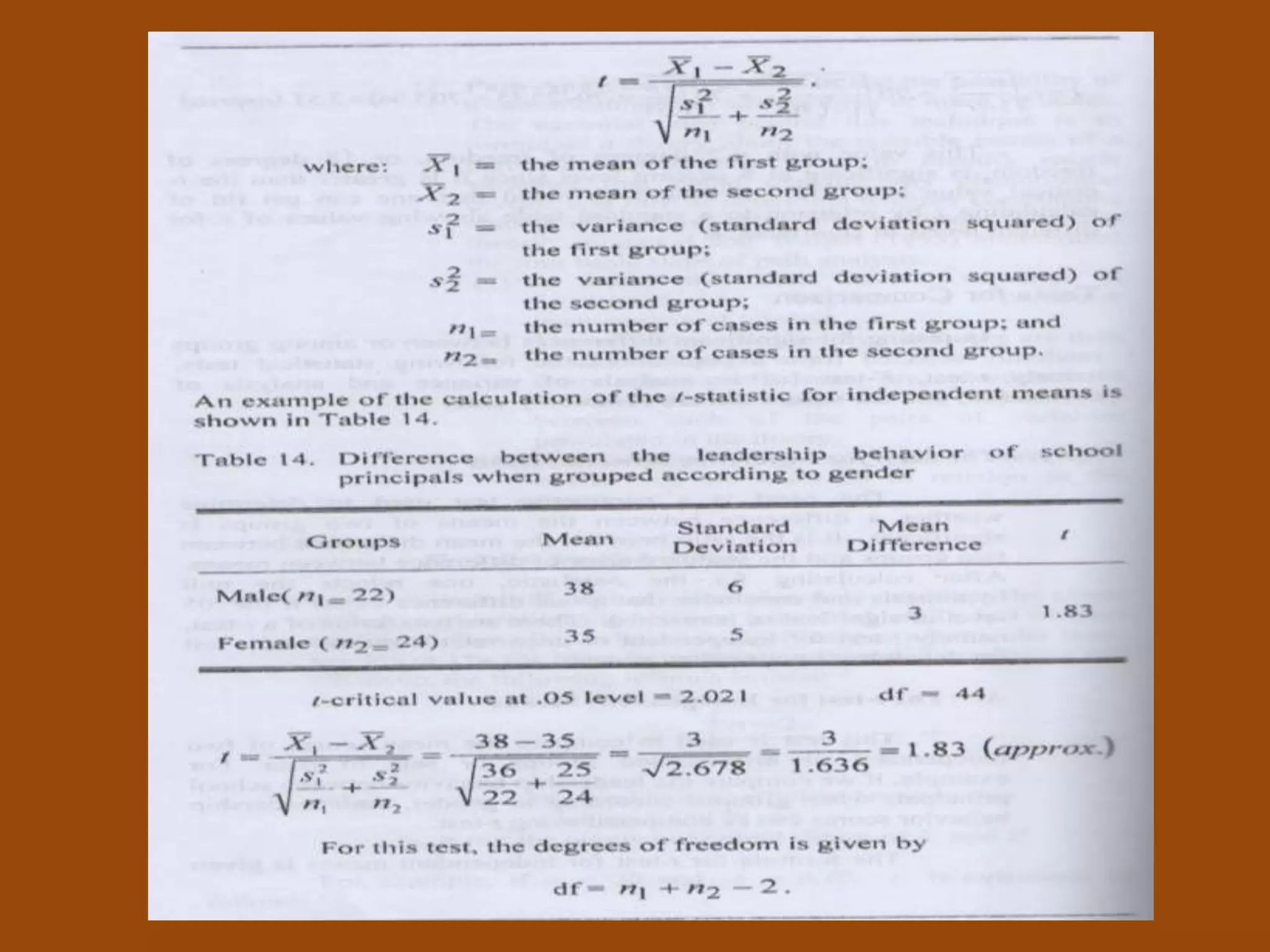
Used to compare the mean scores of two
independent or uncorrelated groups or sets
of data.
The t – test for Dependent
Means
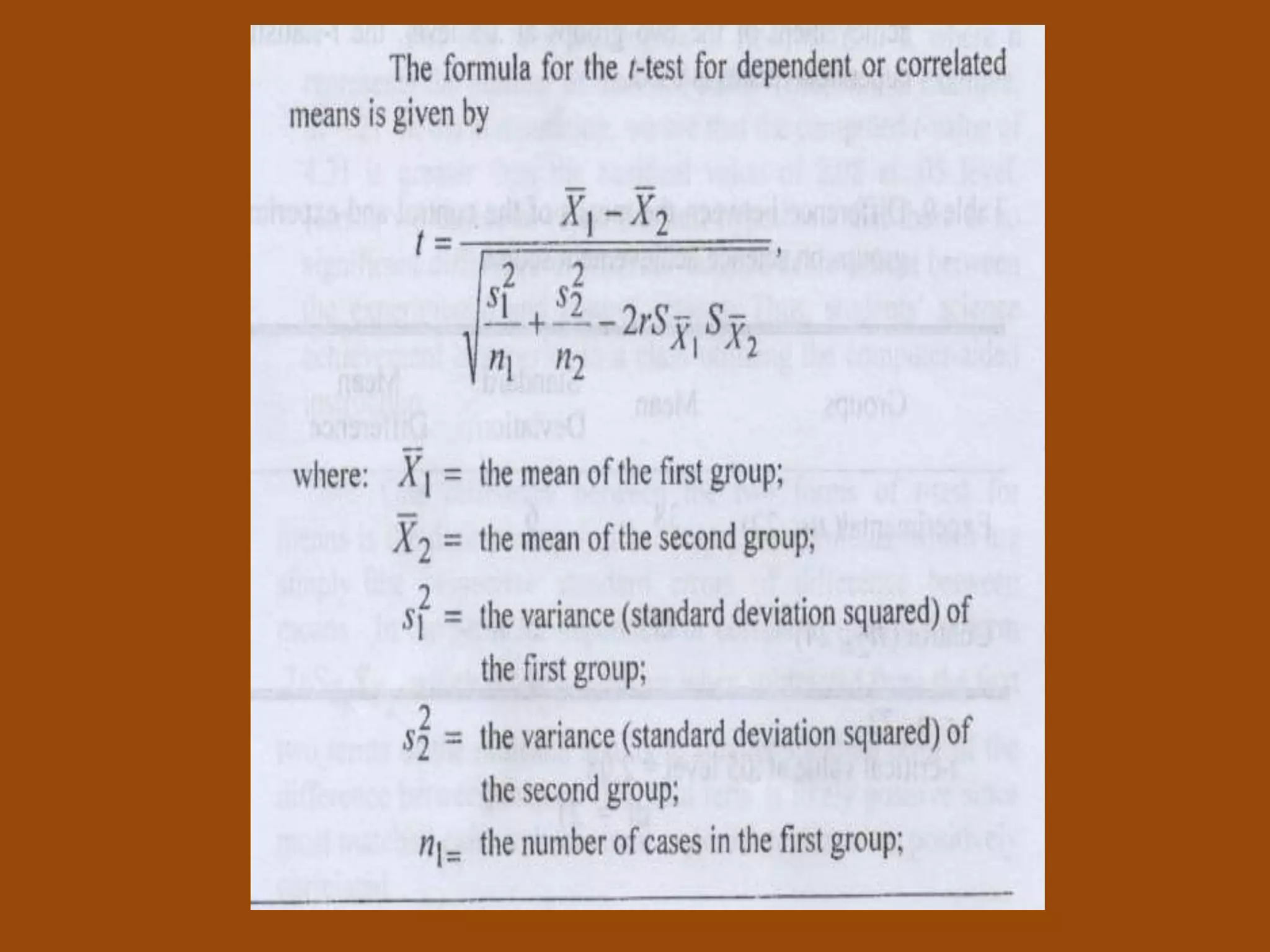
Used to compare the mean scores of
the same group before and after a treatment
is given to see if there is any observed gain,
or when the research design involves two
matched groups.
Also used when the same subjects
receive two different treatments in the study.
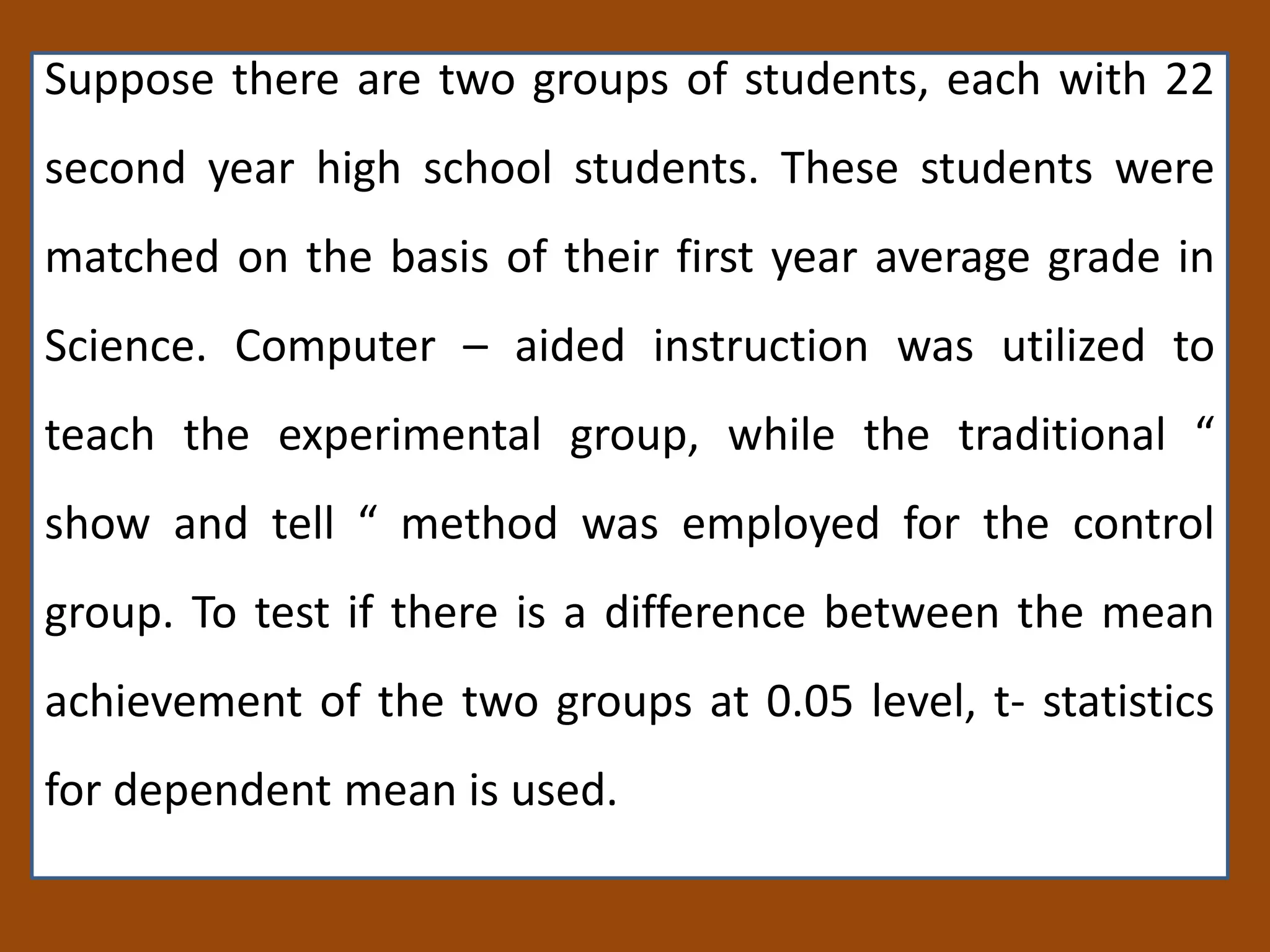
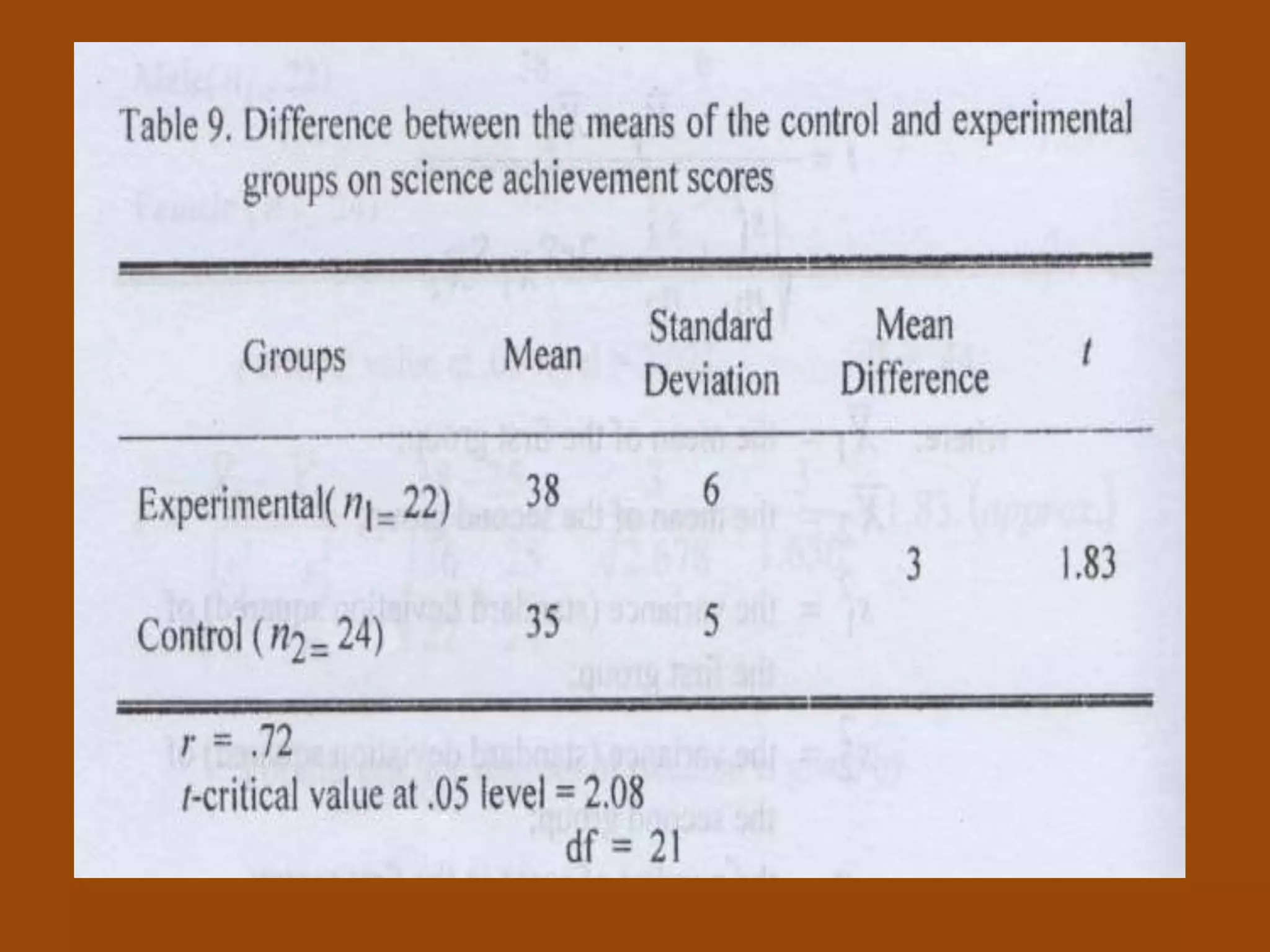
Suppose there are two groups of students, each with 22
second year high school students. These students were
matched on the basis of their first year average grade in
Science. Computer – aided instruction was utilized to
teach the experimental group, while the traditional “
show and tell “ method was employed for the control
group. To test if there is a difference between the mean
achievement of the two groups at 0.05 level, t- statistics
for dependent mean is used.
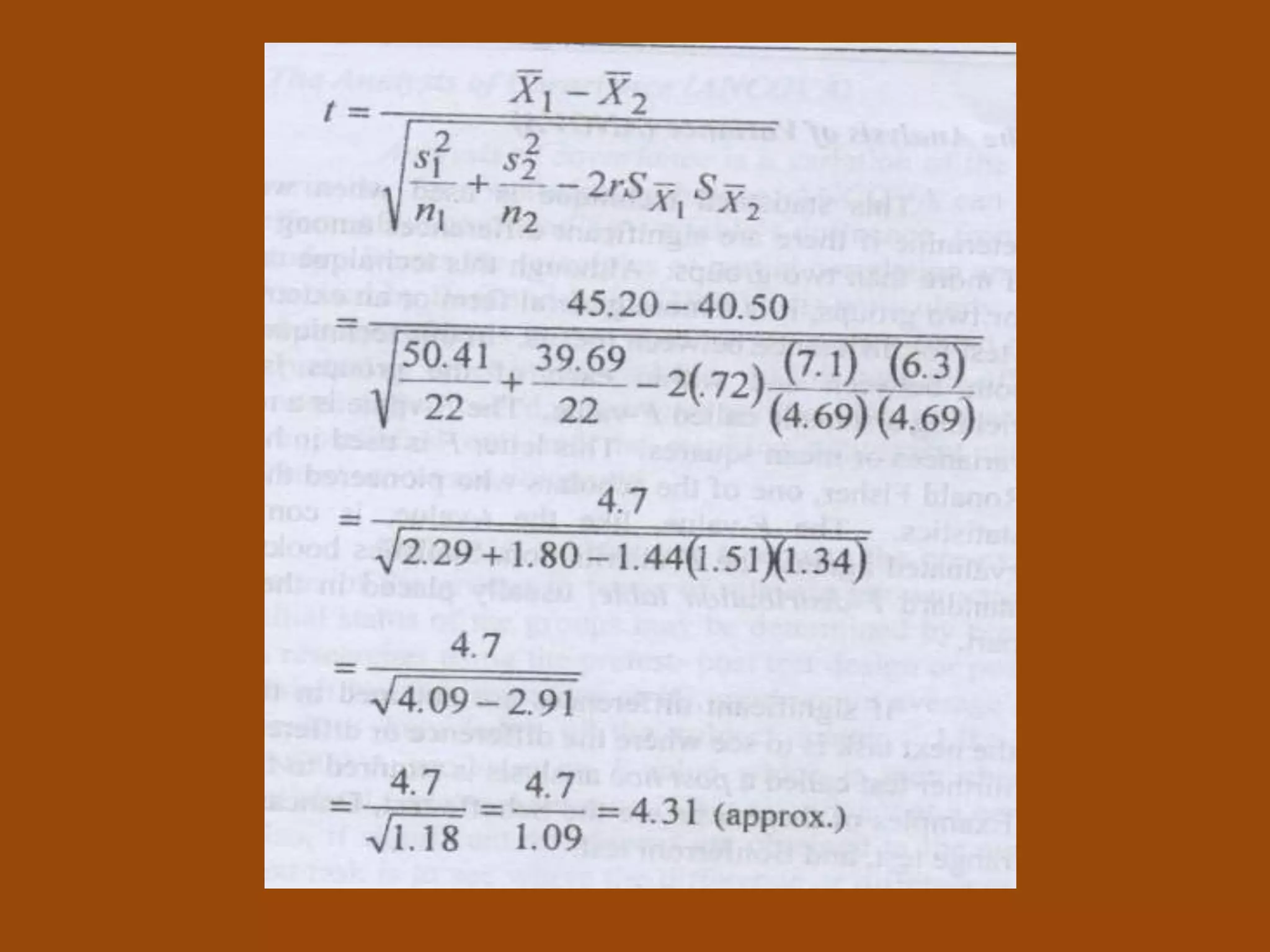
In the computation, we see that the computed t-
value of 4.31 is greater than the t- critical value of
2.08 at 0.5 level. Hence, we decide to reject the
null hypothesis that there is no significant
difference between the experimental and control
classes. Thus, students science achievement is
superior in a class utilizing the computer – aided
instruction.
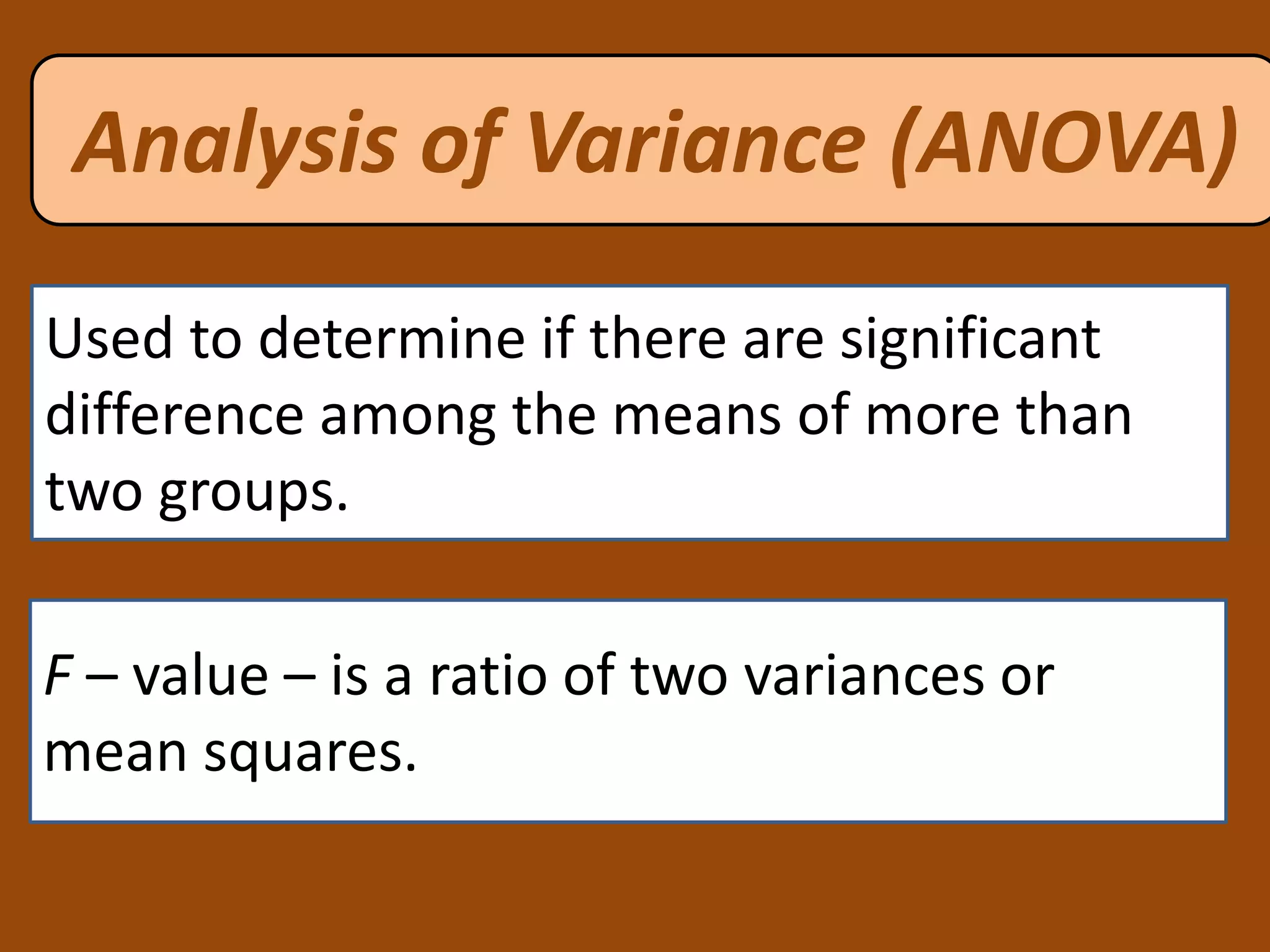
Used to determine if there are significant
difference among the means of more than
two groups.
Analysis of Variance (ANOVA)
F – value – is a ratio of two variances or
mean squares.
Analysis of Covariance
(ANCOVA)
Is a variation of the analysis of variance.
As a statistical technique, it can remove the
effect of confounding variable’ influence
from a certain study. It uses the principles of
partial correlation and ANOVA.
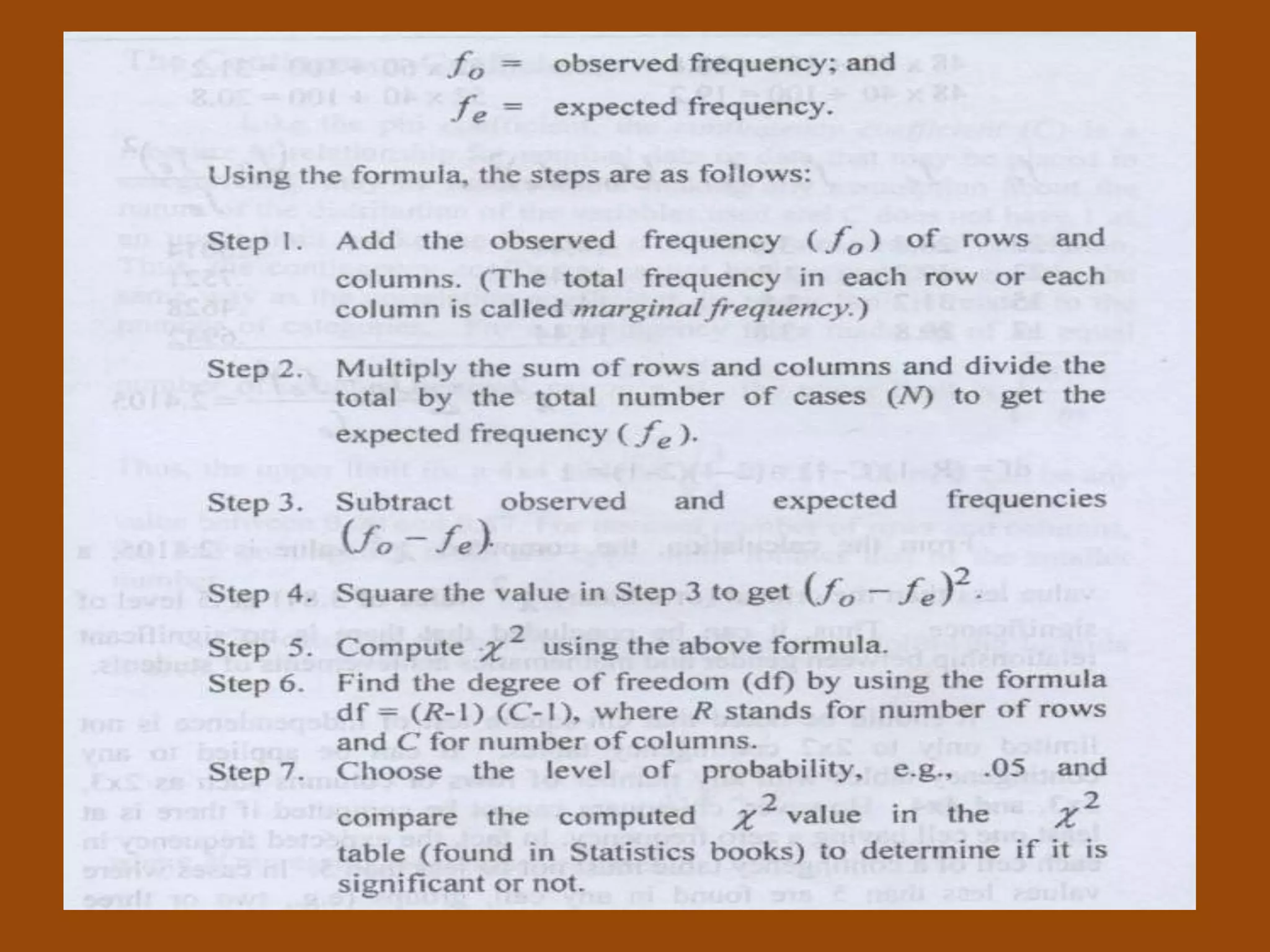
Chi – square test
Is probably the most widely used non-
parametric test. It is a test used as a test of
significance when data to be treated are
expressed in frequencies or those that are in
terms of percentages or proportion which
can be reduced to frequencies.
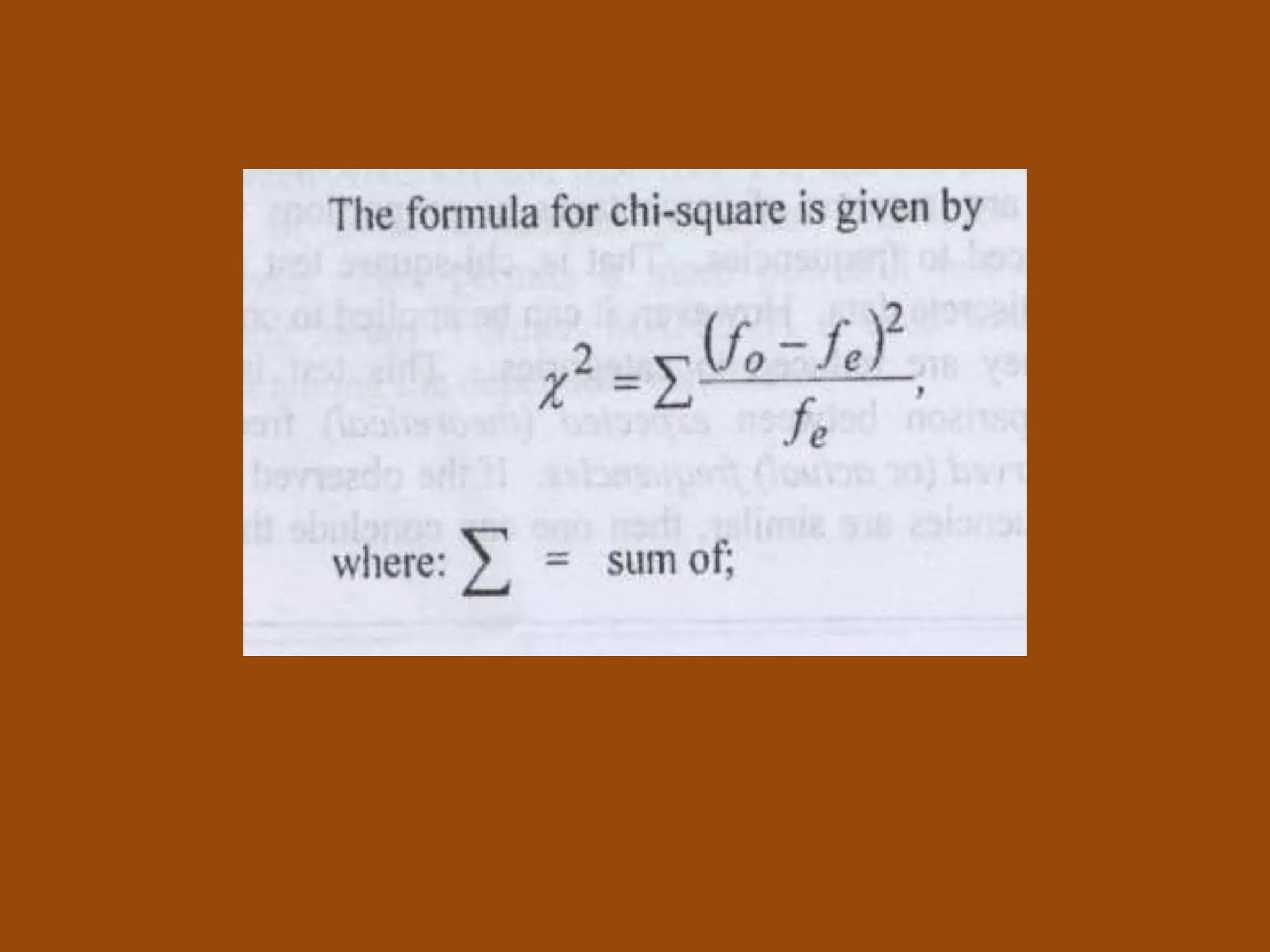
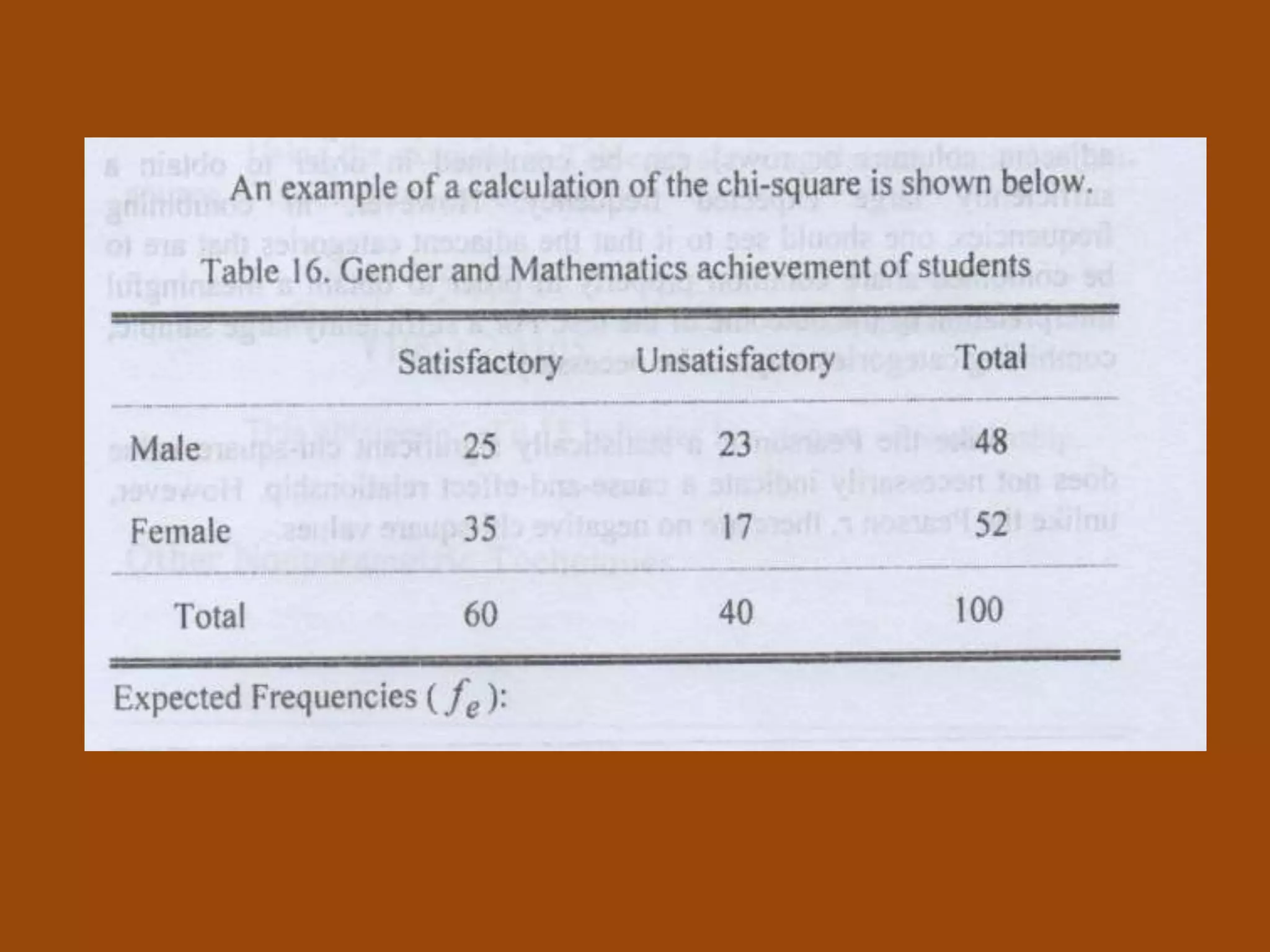
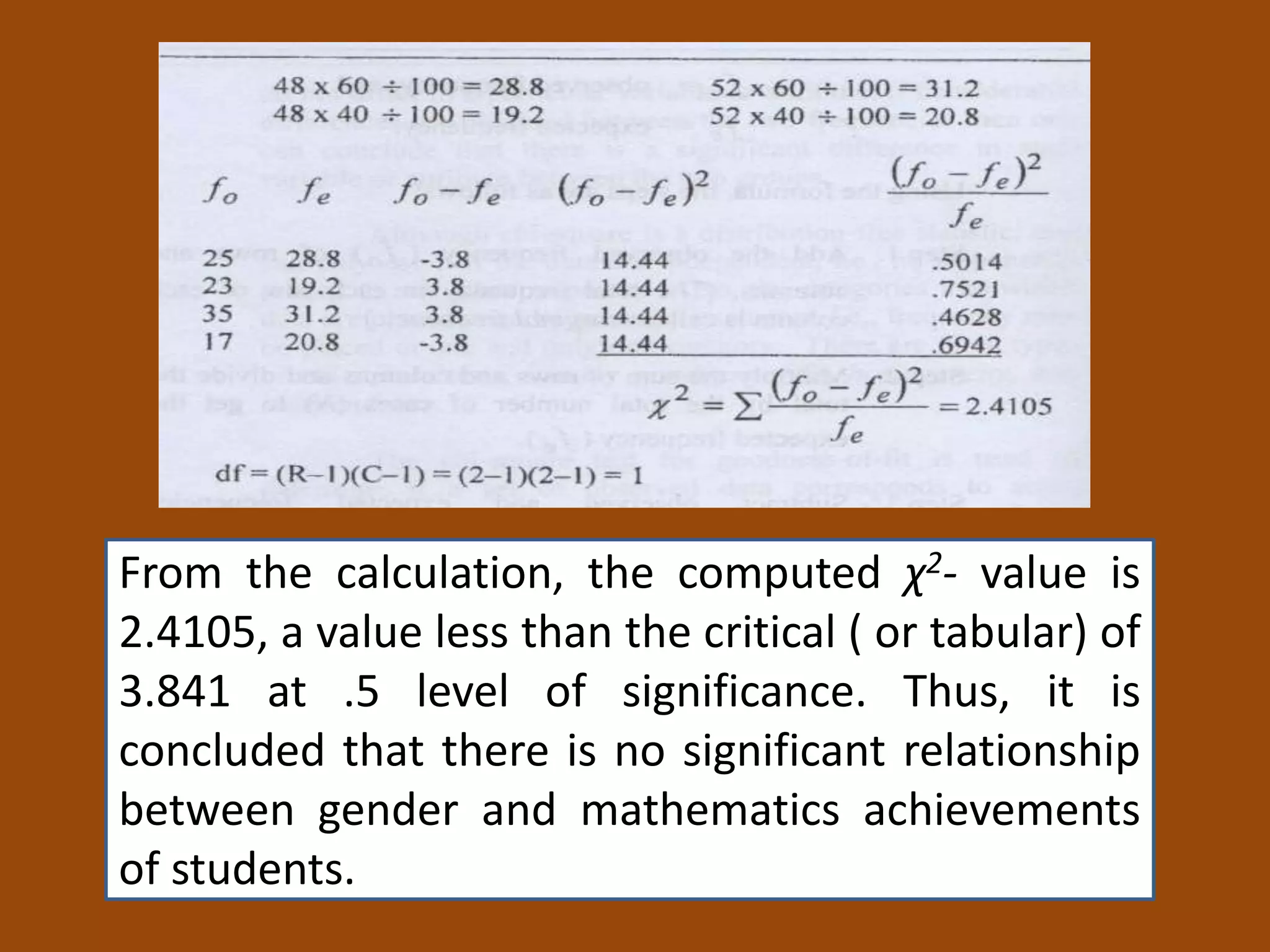
From the calculation, the computed χ2- value is
2.4105, a value less than the critical ( or tabular) of
3.841 at .5 level of significance. Thus, it is
concluded that there is no significant relationship
between gender and mathematics achievements
of students.
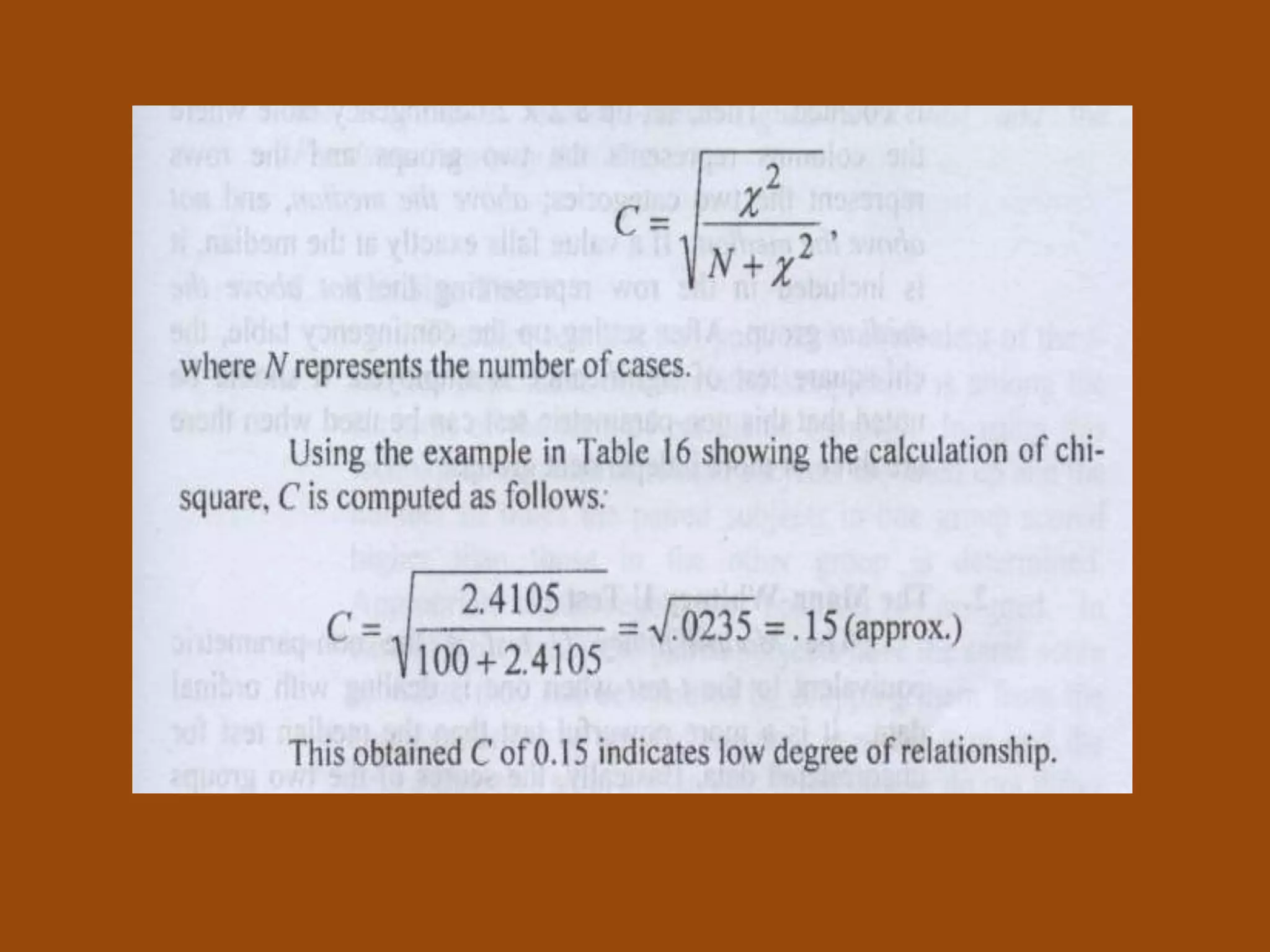
The Contingency coefficient
- Is a descriptive statistic which measures
the degree of relationship between two
categorical variables.
Data processing
Data processing
Data processing

Data processing

  • 2.
    MARIE CHRIS S.PORTILLAS MS Gen. Sci. Ed.
  • 3.
     The measureof relationship between two or more variables or two or more sets of data. Correlation
  • 4.
    Co-variation  because analysisis focused mainly on how two variables co – vary or co – differ.
  • 5.
     represents theextent or degree of relationships between two variables may be positive, negative, or zero. Correlation coefficient
  • 6.
    1. The subjectswith high scores in one variable also have high scores in the other variable Positive Correlation 2. The subjects with low scores in one variable also have high scores in the other variable
  • 7.
    Pair of variablesthat are usually positively correlated Intelligent Quotient (IQ) and Academic Performance Salary and Job satisfaction Educational Attainment and Teaching Competence
  • 8.
    Negative Correlation 1. Thesubjects with high scores in one variable have low scores in the other variable. 2. The subjects with low scores in one variable have high scores in the other variable.
  • 9.
    Pair of variablesthat are usually negatively correlated Academic Performance and Number of Hours of Watching TV Stress and Job Performance
  • 10.
    Zero Correlation When therelationship between two sets of variables is a pure chance relationship. No correlation / complete lack of relationship The relationship between any two variables does not necessarily show cause-and-effect relationship.
  • 11.
    Pair of variablesthat are usually have no correlation Socio – economic Status and Size of T- shirt Height and Problem Solving Ability
  • 12.
    Categories used togive qualitative description to the correlation coefficients: Correlation Coefficient Qualitative Description ±1.0 Perfect correlation From ± 0.80 to ± 0.99 High or Very High Correlation From ± 0.60 to ± 0.79 Substantial Correlation From ± 0.40 to ± 0.59 Moderate correlation From ± 0.20 to ± 0.39 Low correlation From ± 0.10 to ± 0.19 Negligible Correction 0 No correlation * General Rule: Consider the type of data before choosing the appropriate correlation technique.
  • 13.
    Is a measureof relationship between two variables that are usually of the interval type of data. Pearson Product –Moment Correlation Coefficient
  • 15.
    To determine therelationship between students’ achievement in Mathematics and achievement in Physics Example
  • 16.
    Indicates that there isa high correlation between students’ mathematics and their Physics achievement.
  • 17.
    Is a measureof correlation between two sets of ordinal data. Spearman rank – order correlation coefficient ( Spearman rho)
  • 18.
    ρ = 0.49indicates that there is a moderate correlation between students′ Test X scores and their Test Y scores.
  • 19.
  • 20.
    Kendall’s Tau –it is a measure of correlation between ranks. It can be applied wherever the Spearman rho is applicable. Kendall’s Coefficient of Concordance– it is used to determine the relationship among three or more sets of ranks. Point-Biserial Coefficient – it is a special type of a Pearson product-moment correlation coefficient widely used test construction, test validation, and test analysis. It is used when one of the variables is continuous and the other is a dichotomous variable.
  • 21.
    Biserial Correlation Coefficient– It is also used in test construction, test validation and test analysis like the point – biserial correlation coefficient. However, this is a less relaible measure of correlation since it is only an estimate of a Pearson r. Phi Coeeficient – sometimes called formula coefficient is used when each of the variables are dichotomous. It is a product-moment correlation coefficient like the point – biserial and biserial correlation coefficients.
  • 22.
    Tetrachoric Correlation Coefficient– it is a measure of correlation between data that can be reduced to two dichotomies. However, like the biserial coefficient, it is quite unreliable since it is only an estimate of Pearson r. Partial Correlation – whenever two or more variables are correlated, there may be a possibility that yet other variables may explain any relationship that is found. These other variables can be controlled through a correlational technique called partial correlation. In other words, it is used to remove the effect of one variable on the correlation between two variables.
  • 23.
    Multiple Regression –it is a technique that enables researchers to determine a correlation between a criterion variable ( dependent) and the best combination of two or more predictor variables ( independent). In other words, it is a method of analyzing the collective and separate contributions of two or more independent variables to the variation of a dependent variable. It can be equally well in both experimental and non – experimental research. Coeffiecient of Multiple Correlation- the coefficient of multiple correlation indicates the strength of the correlation between the combination of the predictor variables and the criterion variable.
  • 24.
    Coefficient of Determination(r2)- is the square of the correlation between one predictor variable and a criterion variable. This value indicates the percentage of the variability among the criterion values that can be attributed to differences in the values on the predictor variable. i.e., if the correlation coefficient between IQ and Mathematics achievement for a group of high school students is 0.80, then 64 percent of the differences in students’ mathematics achievement can be attributed to differences in their IQ.
  • 25.
    Discrimination Function Analysis– it is a technique used in the same way as the multiple regression analysis. However, it is only appropriate for categorical variable i.e., it involves membership in a group or category rather than scores on continuum. Factor Analysis – it is a technique that allows a researcher to determine if many variables can be described by a few factors. It involves a search for clusters of variables, all of which are correlated worth each other. Each cluster represents a factor. In other words, it is the goal of this technique to reduce the number of variables by grouping those which have low, moderate, or high correlation with one another into factors.
  • 26.
    Path Analysis –it is used to test the possibility of causal connection among three or more variables. The essential idea behind this technique is to formulate a theory about the possible causes of a particular phenomenon i.e., to identify causal variables that could explain why phenomenon occurs, and then to determine whether correlations among all the variables are consistent with the theory.
  • 27.
    Four basic steps( Fraenkel and Walle, 1993) 1. A theory that links several variables is formulated to explain a particular phenomenon of interest. 2. The variables specified by the theory are then measured in some way. 3. Correlation coefficients are computed to indicate the strength of the of the relationship between each of the pairs of variables postulated in the theory. 4. Relationships among the correlation coefficients are analyzed in relation to the theory.
  • 28.
  • 29.
    The t –test for Difference between Means The t- test is a parametric test used to determine whether a difference between the means of two groups and the standard error of difference between means.
  • 30.
    The t –test for Independent Means Used to compare the mean scores of two independent or uncorrelated groups or sets of data.
  • 32.
    The t –test for Dependent Means Used to compare the mean scores of the same group before and after a treatment is given to see if there is any observed gain, or when the research design involves two matched groups. Also used when the same subjects receive two different treatments in the study.
  • 35.
    Suppose there aretwo groups of students, each with 22 second year high school students. These students were matched on the basis of their first year average grade in Science. Computer – aided instruction was utilized to teach the experimental group, while the traditional “ show and tell “ method was employed for the control group. To test if there is a difference between the mean achievement of the two groups at 0.05 level, t- statistics for dependent mean is used.
  • 38.
    In the computation,we see that the computed t- value of 4.31 is greater than the t- critical value of 2.08 at 0.5 level. Hence, we decide to reject the null hypothesis that there is no significant difference between the experimental and control classes. Thus, students science achievement is superior in a class utilizing the computer – aided instruction.
  • 39.
    Used to determineif there are significant difference among the means of more than two groups. Analysis of Variance (ANOVA) F – value – is a ratio of two variances or mean squares.
  • 40.
    Analysis of Covariance (ANCOVA) Isa variation of the analysis of variance. As a statistical technique, it can remove the effect of confounding variable’ influence from a certain study. It uses the principles of partial correlation and ANOVA.
  • 41.
    Chi – squaretest Is probably the most widely used non- parametric test. It is a test used as a test of significance when data to be treated are expressed in frequencies or those that are in terms of percentages or proportion which can be reduced to frequencies.
  • 45.
    From the calculation,the computed χ2- value is 2.4105, a value less than the critical ( or tabular) of 3.841 at .5 level of significance. Thus, it is concluded that there is no significant relationship between gender and mathematics achievements of students.
  • 46.
    The Contingency coefficient -Is a descriptive statistic which measures the degree of relationship between two categorical variables.