Collaboration:
                    What Works and Why

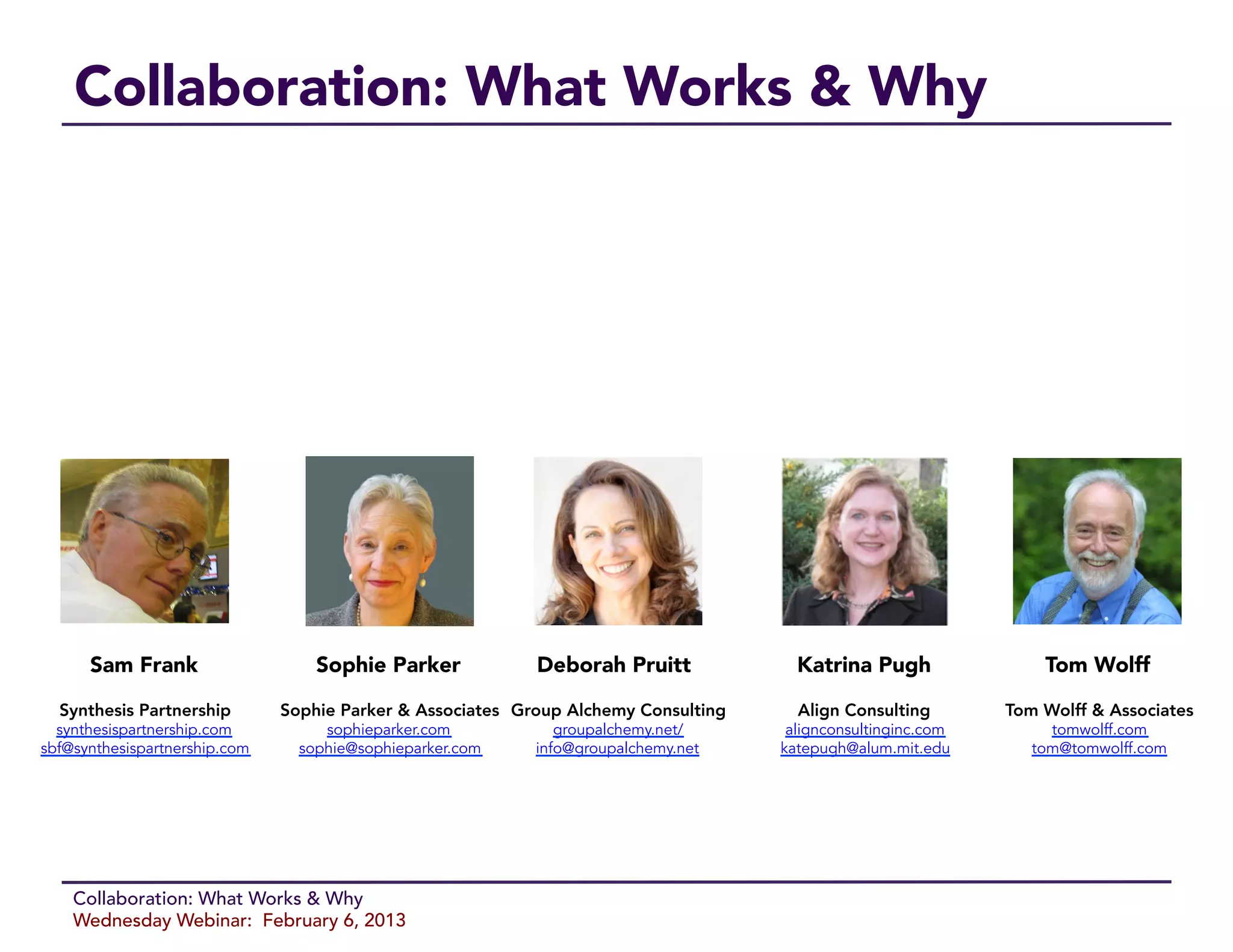
            Sam Frank, Sophie Parker, Deborah Pruitt,
                     Kate Pugh, Tom Wolff

                         February 6, 2013

A Service
   Of:                                Sponsored by:
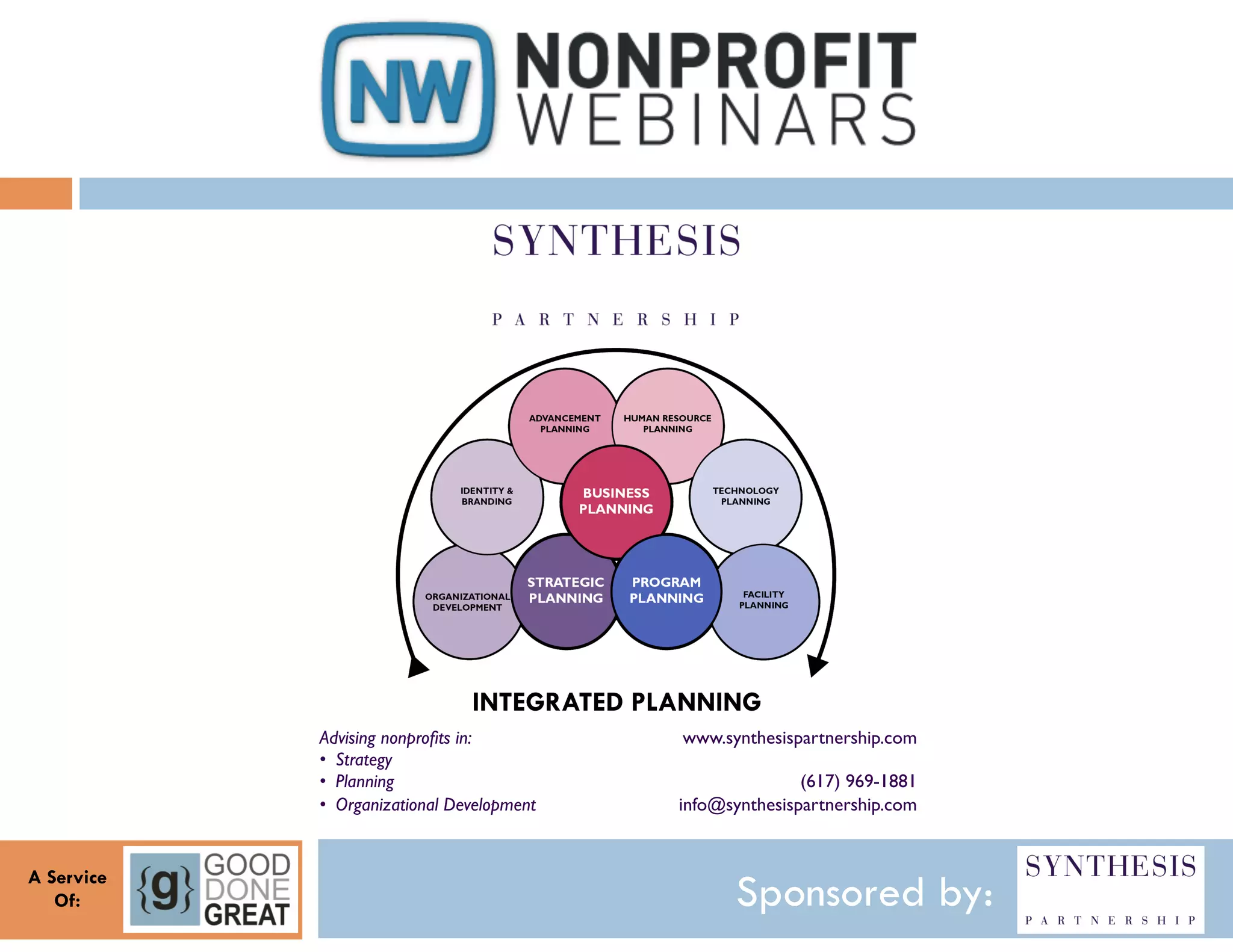
INTEGRATED PLANNING
            Advising nonprofits in:!               www.synthesispartnership.com!
            •  Strategy!                                                      !
            •  Planning!                                        (617) 969-1881!
            •  Organizational Development!       info@synthesispartnership.com!
                                             !

A Service
   Of:                                                  Sponsored by:
Affordable collaborative data
             management in the cloud.

A Service
   Of:                         Sponsored by:
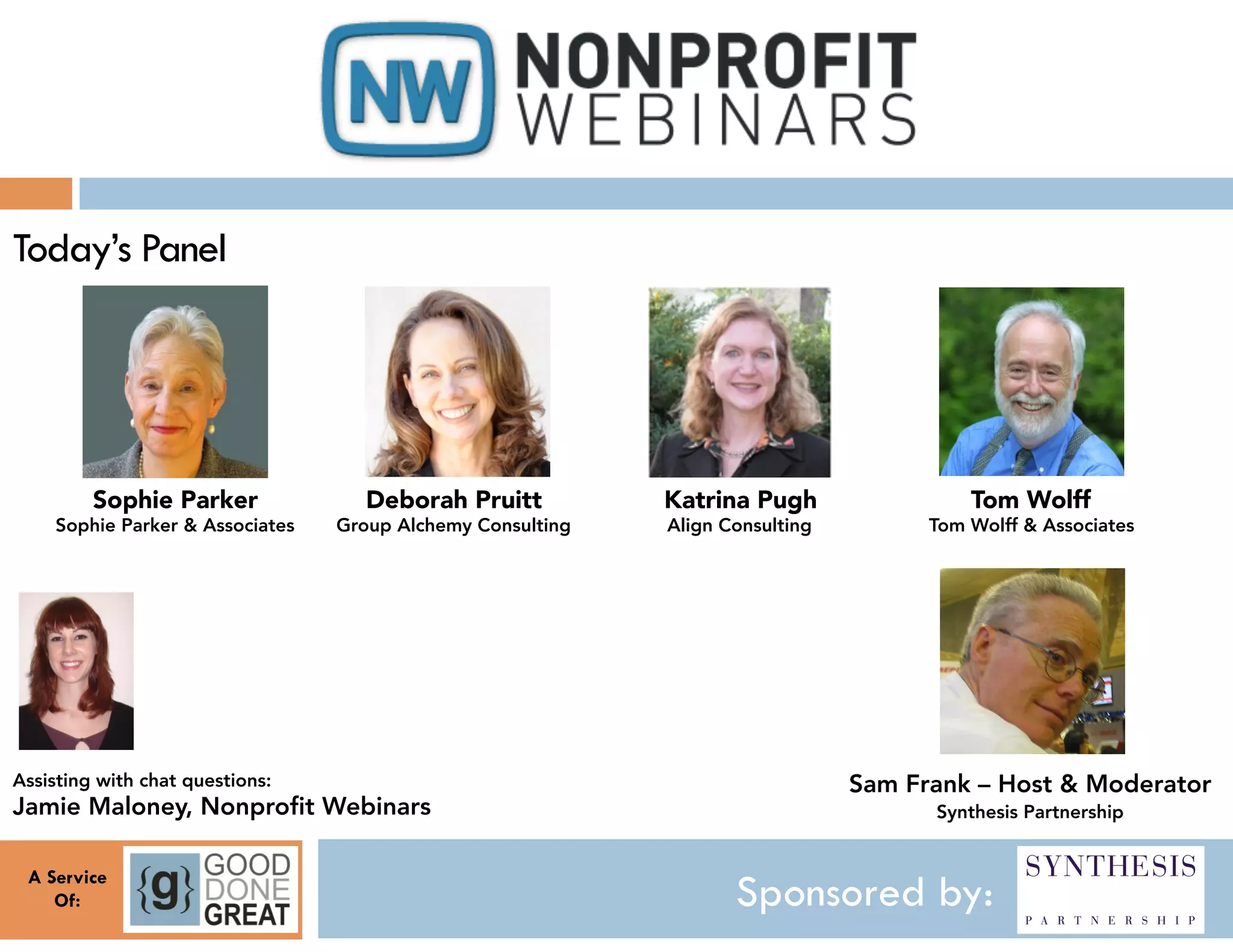
Today’s Panel


         Sophie Parker                Deborah Pruitt           Katrina Pugh                   Tom Wolff
     Sophie Parker & Associates
   Group Alchemy Consulting
   Align Consulting
         Tom Wolff & Associates


Assisting with chat questions:
                                                    Sam Frank – Host & Moderator
Jamie Maloney, Nonprofit Webinars
                                                        Synthesis Partnership


 A Service
    Of:                                                                Sponsored by:
Collaboration: What Works & Why


      Sam Frank
                   Sophie Parker
            Deborah Pruitt
             Katrina Pugh
               Tom Wolff

  Synthesis Partnership
       Sophie Parker & Associates
 Group Alchemy Consulting
     Align Consulting
       Tom Wolff & Associates
  synthesispartnership.com          sophieparker.com            groupalchemy.net/       alignconsultinginc.com        tomwolff.com
sbf@synthesispartnership.com     sophie@sophieparker.com     info@groupalchemy.net     katepugh@alum.mit.edu        tom@tomwolff.com


    Collaboration: What Works & Why
    Wednesday Webinar: February 6, 2013
Collaborative Solutions


                                          Tom Wolff

                                      Tom Wolff & Associates
                                           tomwolff.com
                                         tom@tomwolff.com


Collaboration: What Works & Why
Wednesday Webinar: February 6, 2013
What are collaborative solutions?
•  Doing together that which we cannot do alone
•  A collaboration is a group of individuals and/or
   organizations with a common interest who agree to
   work together toward a common goal.


from S.Fawcett et.al
Collaboration: What Works & Why
Wednesday Webinar: February 6, 2013
Why encourage collaborative solutions?
•  To create social change
•  To encourage social innovation
•  Expand interventions to the whole community
•  To do more with less when there are budget cuts
•  To address limitations of the health and human
   service systems
•  To promote civic engagement
•  To build healthy communities


Collaboration: What Works & Why
Wednesday Webinar: February 6, 2013
Six principles for successful coalitions
1.  Engage a broad spectrum of the community
2.  Encourage true collaboration as the form of
    exchange
3.  Practice democracy
4.  Employ an ecological approach that emphasizes
    individual in his/her setting.
5.  Take action
6.  Engage your spirituality as your compass for social
    change


from Tom Wolff, The Power of Collaborative Solutions (2010)

Collaboration: What Works & Why
Wednesday Webinar: February 6, 2013
The Continuum of Collaboration
Networking
Exchanging information for mutual benefit.
Coordination
Exchanging information and modifying activities for mutual
benefit.
Cooperation
Exchanging information, modifying activities, and sharing
resources for mutual benefit and to achieve a common purpose.
Collaboration
Exchanging information, modifying activities, sharing resources,
and enhancing the capacity of another for mutual benefit and to
achieve a common purpose by sharing risks, resources,
responsibilities, and rewards.

from Arthur Himmelman
Collaboration: What Works & Why
Wednesday Webinar: February 6, 2013
Factors Affecting
a Coalition’s Capacity to Create Change
•  Having a clear vision and mission
•  Action planning for community and systems change
•  Developing and supporting leadership
•  Documentation and ongoing feedback on programs
•  Technical assistance and support
•  Securing financial resources for the work
•  Making outcomes matter
•  Name and manage conflict


from Roussus and Fawcett and Rosenthal
Collaboration: What Works & Why
Wednesday Webinar: February 6, 2013
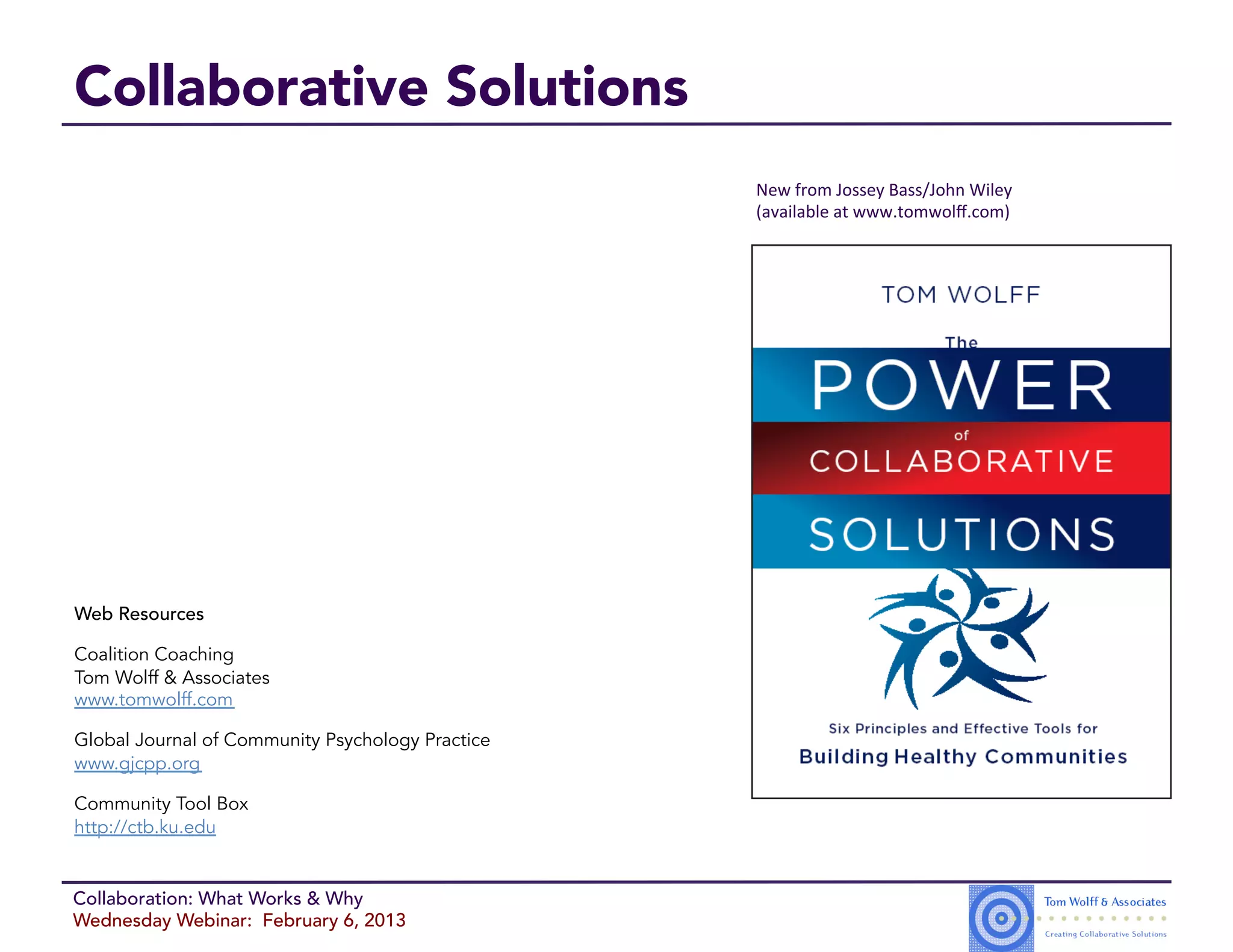
Collaborative Solutions
                                                  New$from$Jossey$Bass/John$Wiley$
                                                  (available$at$www.tomwolff.com)$


Web Resources

Coalition Coaching
Tom Wolff & Associates
www.tomwolff.com

Global Journal of Community Psychology Practice
www.gjcpp.org

Community Tool Box
http://ctb.ku.edu


Collaboration: What Works & Why
Wednesday Webinar: February 6, 2013
Knowledge Networks for Impact


                                        Katrina Pugh

                                        Align Consulting
                                       alignconsultinginc.com
                                      katepugh@alum.mit.edu


Collaboration: What Works & Why
Wednesday Webinar: February 6, 2013
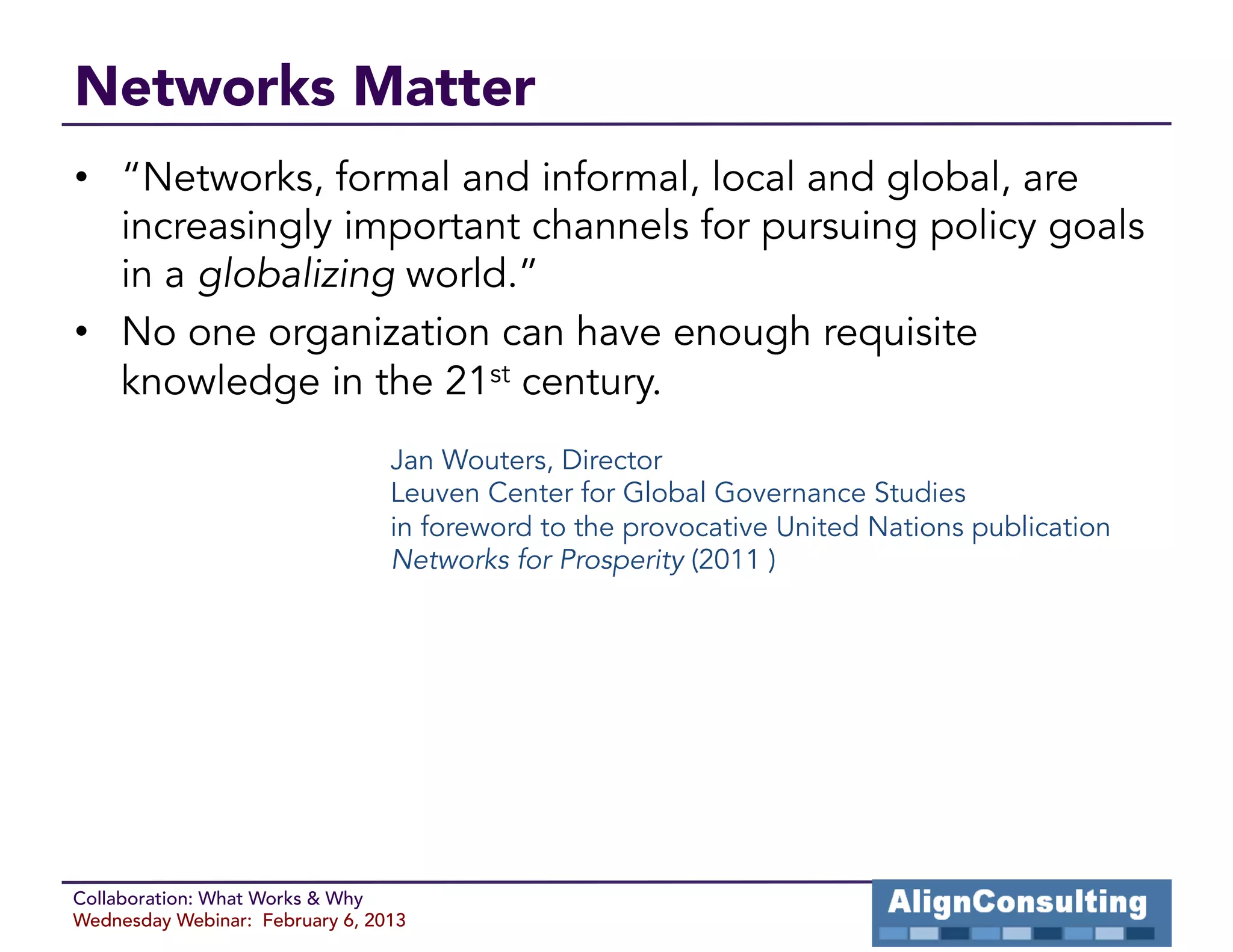
Networks Matter
•  “Networks, formal and informal, local and global, are
   increasingly important channels for pursuing policy goals
   in a globalizing world.”
•  No one organization can have enough requisite
   knowledge in the 21st century.
                                 Jan Wouters, Director
                                 Leuven Center for Global Governance Studies
                                 in foreword to the provocative United Nations publication
                                 Networks for Prosperity (2011 )


Collaboration: What Works & Why
Wednesday Webinar: February 6, 2013
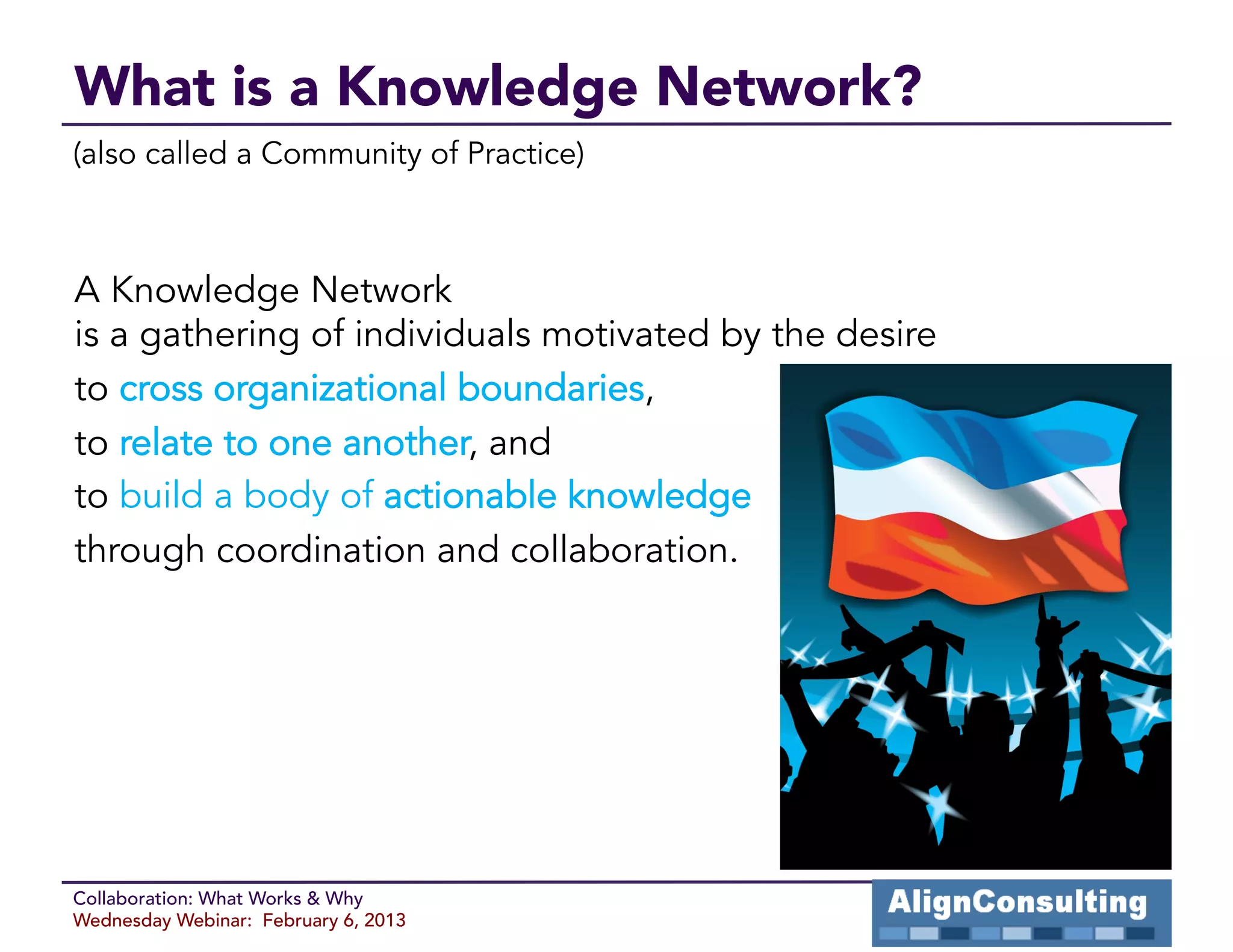
What is a Knowledge Network?
(also called a Community of Practice)


A Knowledge Network
is a gathering of individuals motivated by the desire
to cross organizational boundaries,
to relate to one another, and
to build a body of actionable knowledge
through coordination and collaboration.


Collaboration: What Works & Why
Wednesday Webinar: February 6, 2013
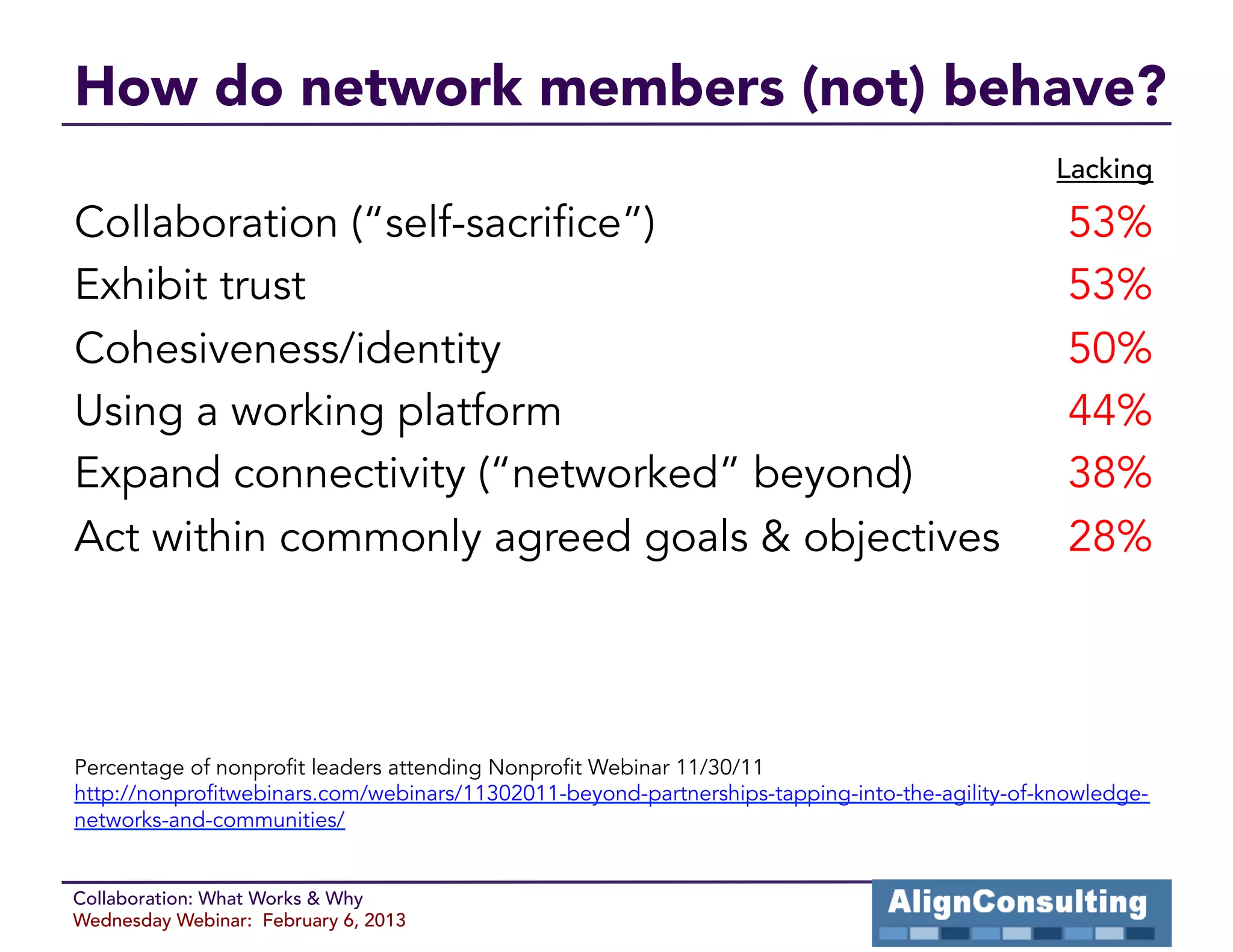
How do network members (not) behave?
                                                                                               Lacking

Collaboration (“self-sacrifice”)                                                                 53%
Exhibit trust                                                                                    53%
Cohesiveness/identity                                                                            50%
Using a working platform                                                                         44%
Expand connectivity (“networked” beyond)                                                         38%
Act within commonly agreed goals & objectives                                                    28%


Percentage of nonprofit leaders attending Nonprofit Webinar 11/30/11
http://nonprofitwebinars.com/webinars/11302011-beyond-partnerships-tapping-into-the-agility-of-knowledge-
networks-and-communities/


Collaboration: What Works & Why
Wednesday Webinar: February 6, 2013
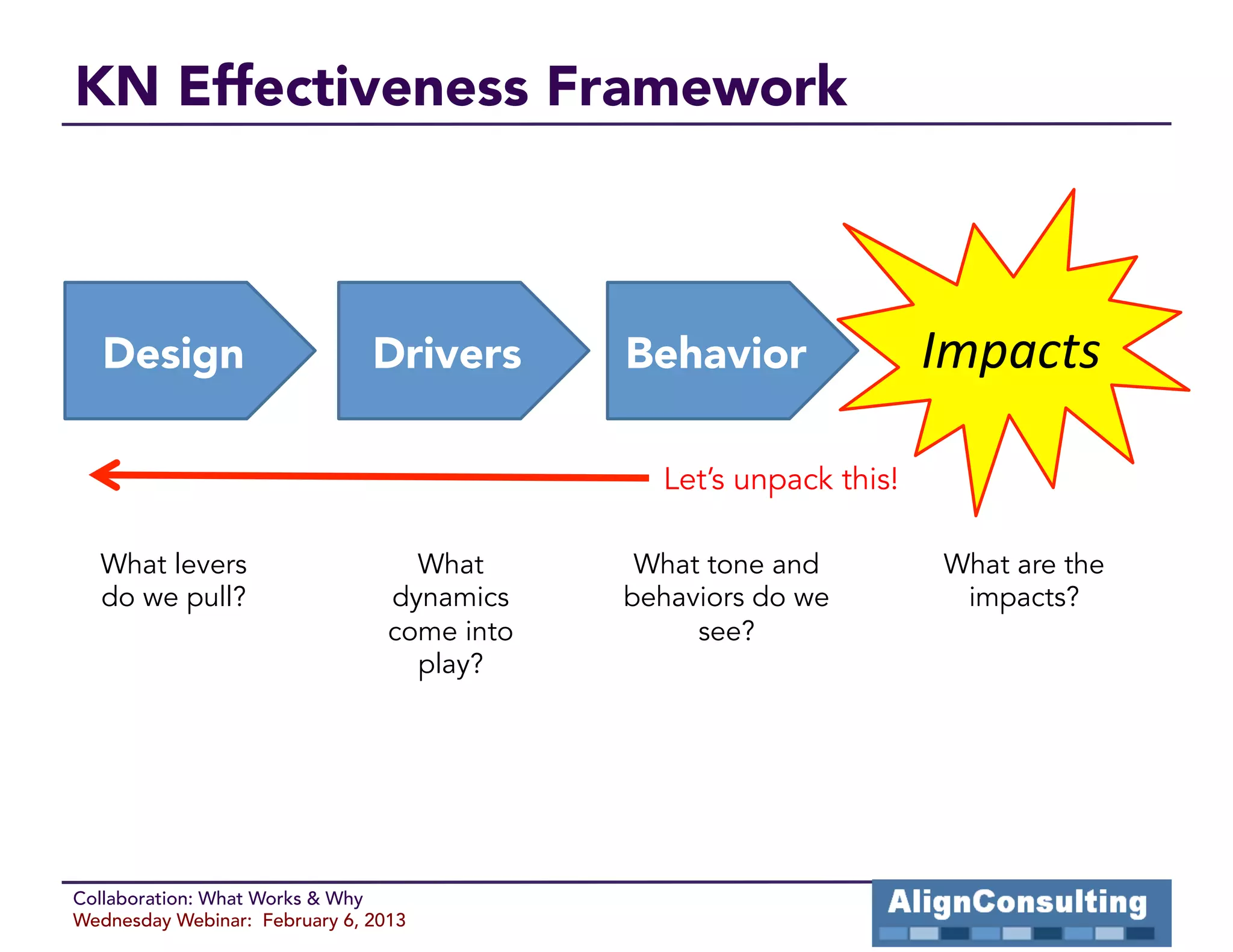
KN Effectiveness Framework


   Design
                     Drivers
      Behavior
              Impacts(

                                               Let’s unpack this!

  What levers                      What       What tone and         What are the
  do we pull?                    dynamics    behaviors do we         impacts?
                                 come into        see?
                                   play?


Collaboration: What Works & Why
Wednesday Webinar: February 6, 2013
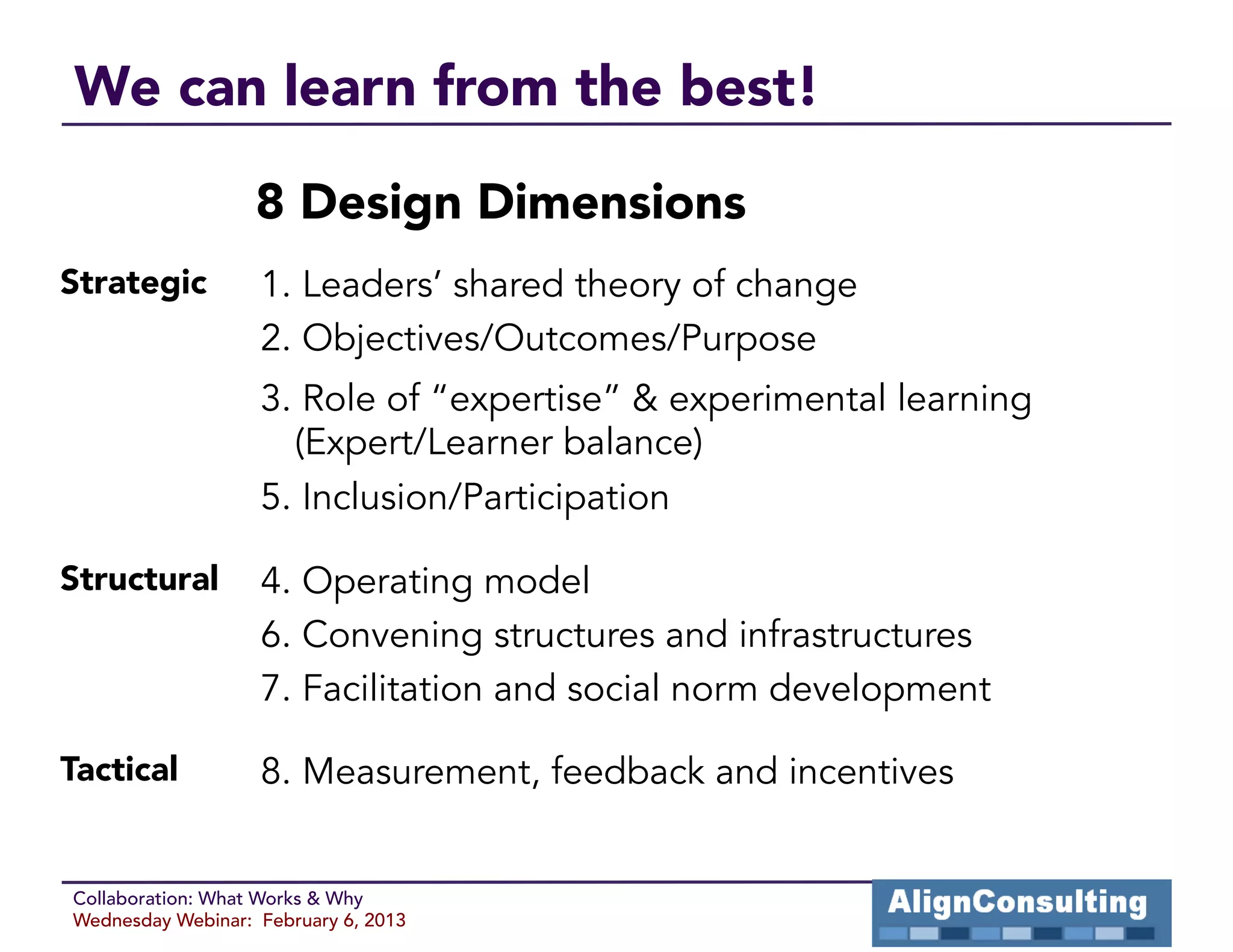
We can learn from the best!

                   8 Design Dimensions         


Strategic 
        1. Leaders’ shared theory of change
                   2. Objectives/Outcomes/Purpose
                   3. Role of “expertise” & experimental learning
                     (Expert/Learner balance)
                   5. Inclusion/Participation

Structural
        4. Operating model
                   6. Convening structures and infrastructures
                   7. Facilitation and social norm development

Tactical
          8. Measurement, feedback and incentives


Collaboration: What Works & Why
Wednesday Webinar: February 6, 2013
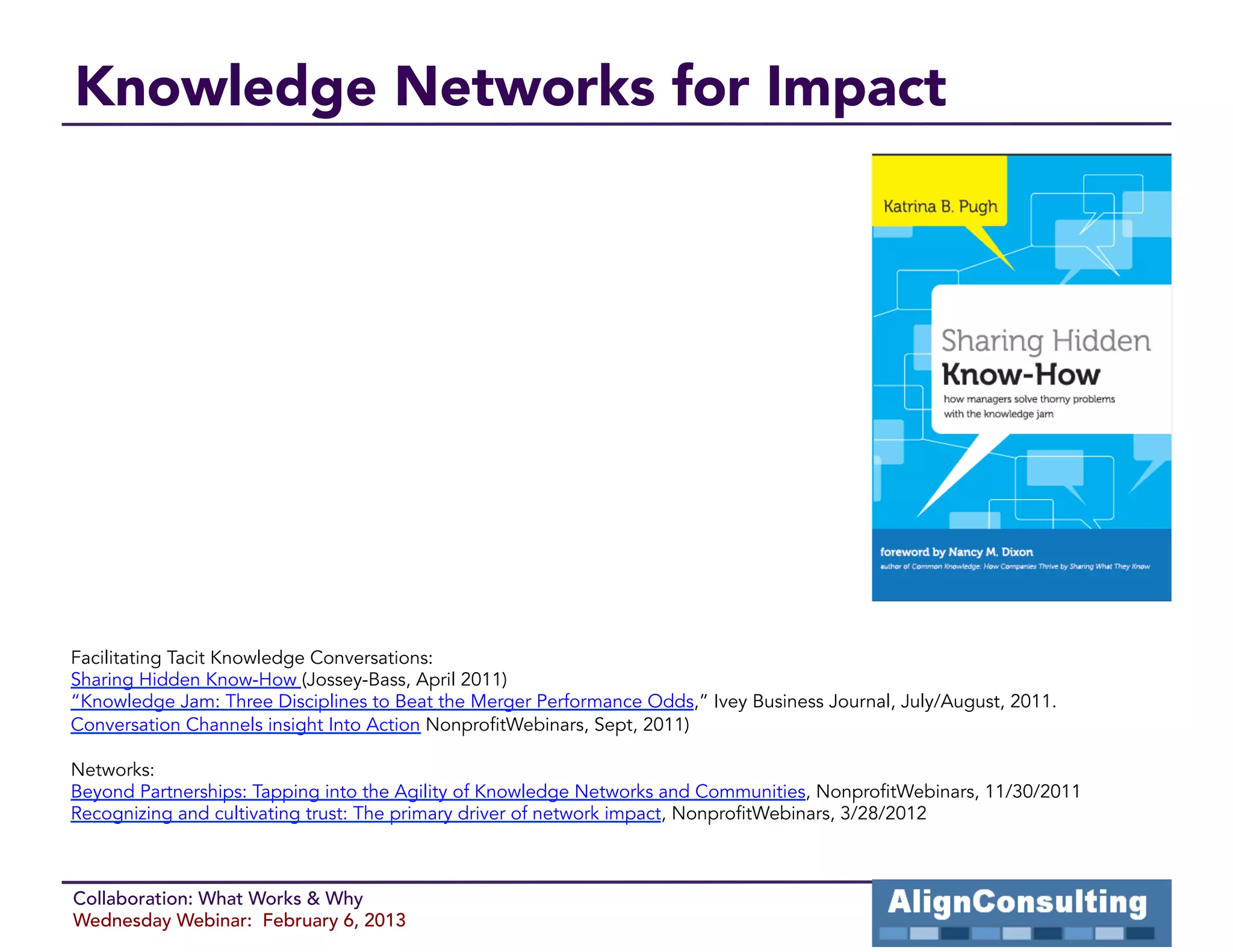
Knowledge Networks for Impact


Facilitating Tacit Knowledge Conversations:
Sharing Hidden Know-How (Jossey-Bass, April 2011)
“Knowledge Jam: Three Disciplines to Beat the Merger Performance Odds,” Ivey Business Journal, July/August, 2011.
Conversation Channels insight Into Action NonprofitWebinars, Sept, 2011)

Networks:
Beyond Partnerships: Tapping into the Agility of Knowledge Networks and Communities, NonprofitWebinars, 11/30/2011
Recognizing and cultivating trust: The primary driver of network impact, NonprofitWebinars, 3/28/2012


Collaboration: What Works & Why
Wednesday Webinar: February 6, 2013
Connecting


                                          Sophie Parker

                                      Sophie Parker & Associates
                                           sophieparker.com
                                        sophie@sophieparker.com


Collaboration: What Works & Why
Wednesday Webinar: February 6, 2013
Interacting


“If you want a future that’s distinct from the past, you
have to be with people who you aren’t used to being
with and have conversations that you’re not used to
having.”


Peter Block


Collaboration: What Works & Why
Wednesday Webinar: February 6, 2013
Connection before Content


Connection occurs when we speak of what matters.
We make connections through:
•  Questions
•  Listening & not giving advice
•  Breaking bread


Collaboration: What Works & Why
Wednesday Webinar: February 6, 2013
Secrets of Collaboration


                                         Deborah Pruitt

                                      Group Alchemy Consulting
                                           groupalchemy.net/
                                        info@groupalchemy.net


Collaboration: What Works & Why
Wednesday Webinar: February 6, 2013
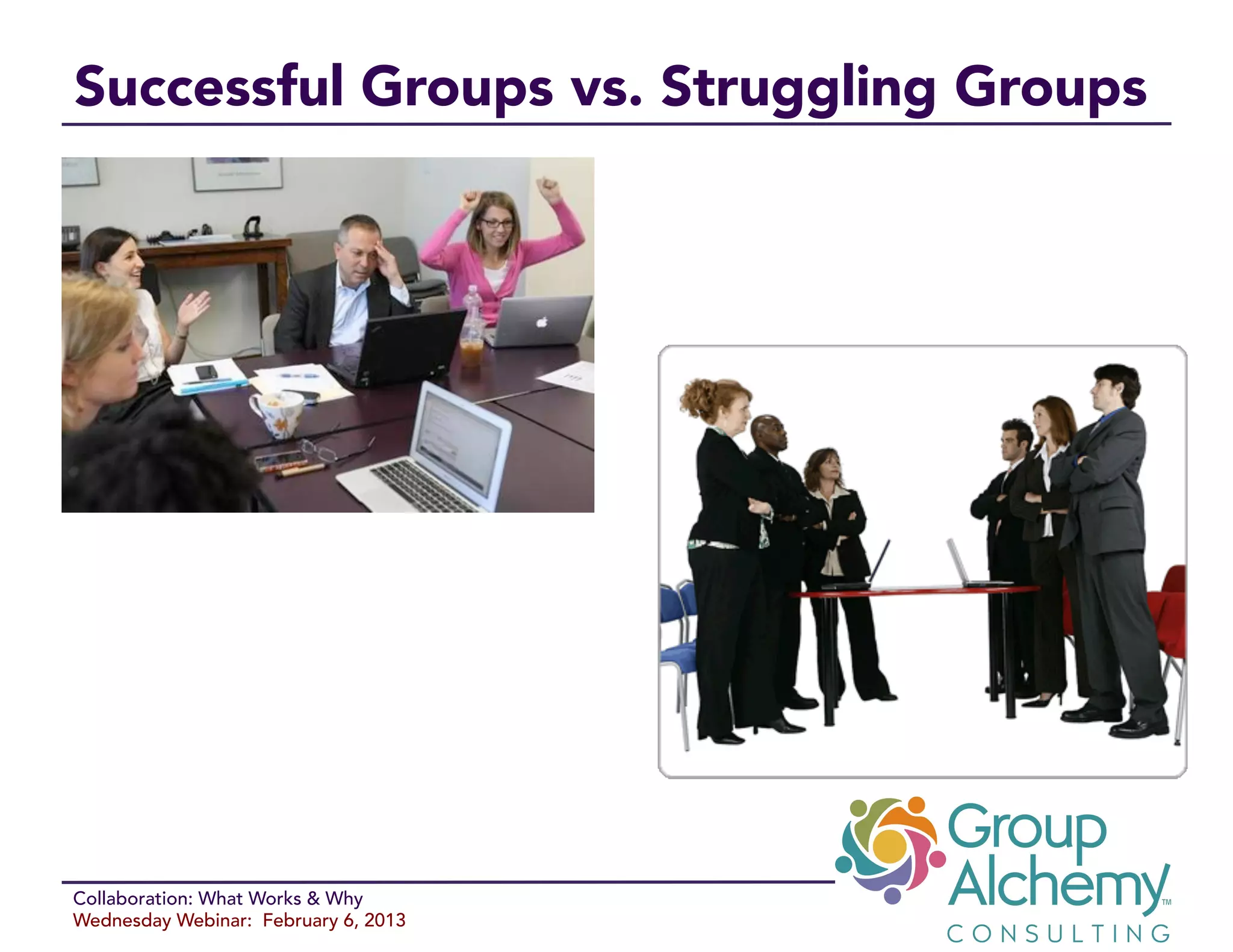
Successful Groups vs. Struggling Groups


Collaboration: What Works & Why
Wednesday Webinar: February 6, 2013
How to prevent… 

   •  Frustration, pettiness and tension.
   •  Disengagement.
   •  Lack of group energy and creativity.


Collaboration: What Works & Why
Wednesday Webinar: February 6, 2013
Learn how to…
   •  set a foundation for high-level collaboration in any
      work relationship or group - quickly and reliably.
   •  prevent typical breakdowns that drag the group
      down and break trust.
   •  have more impact in every relationship.
   •  make a critical mindset shift.


Collaboration: What Works & Why
Wednesday Webinar: February 6, 2013
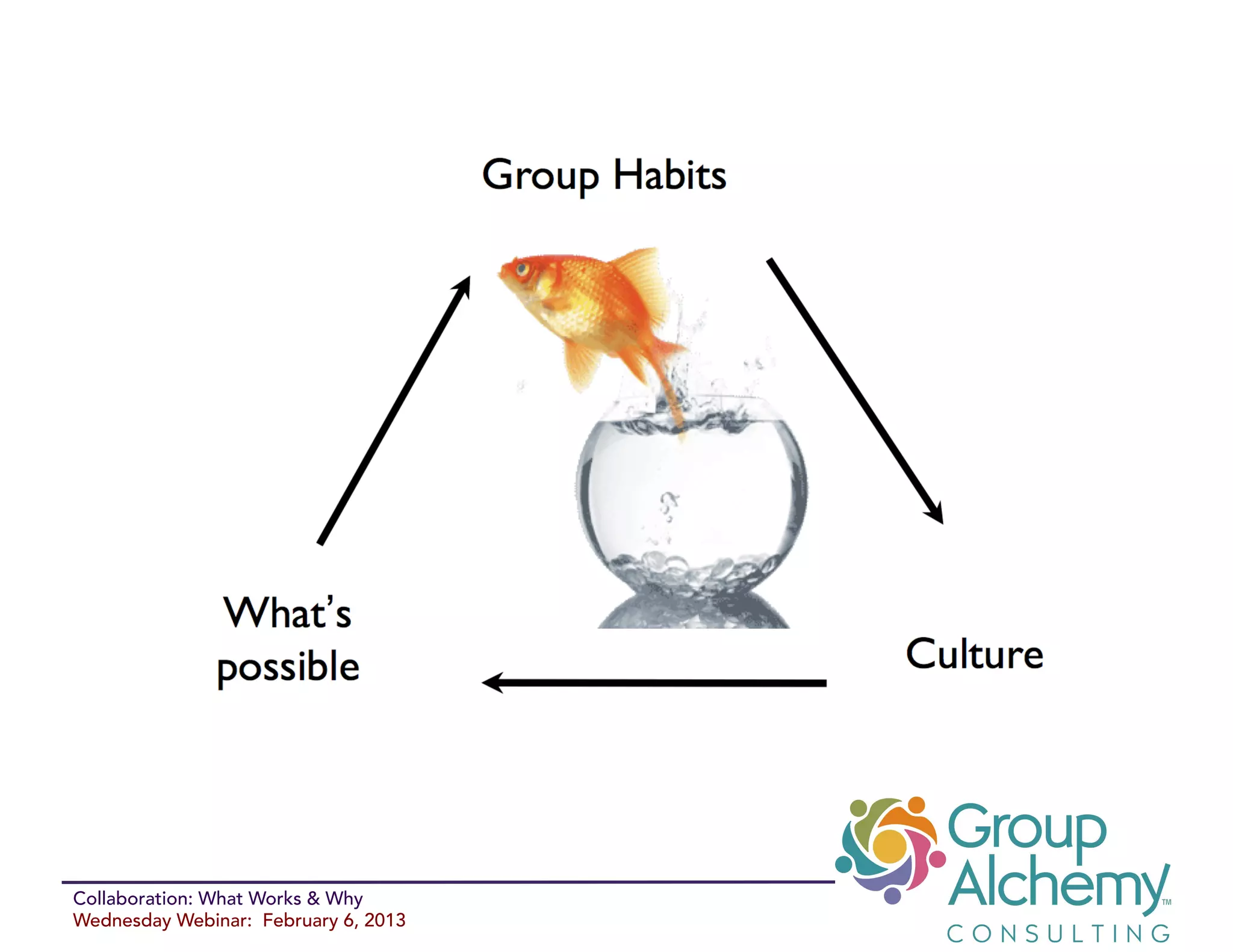
Mindset Shift

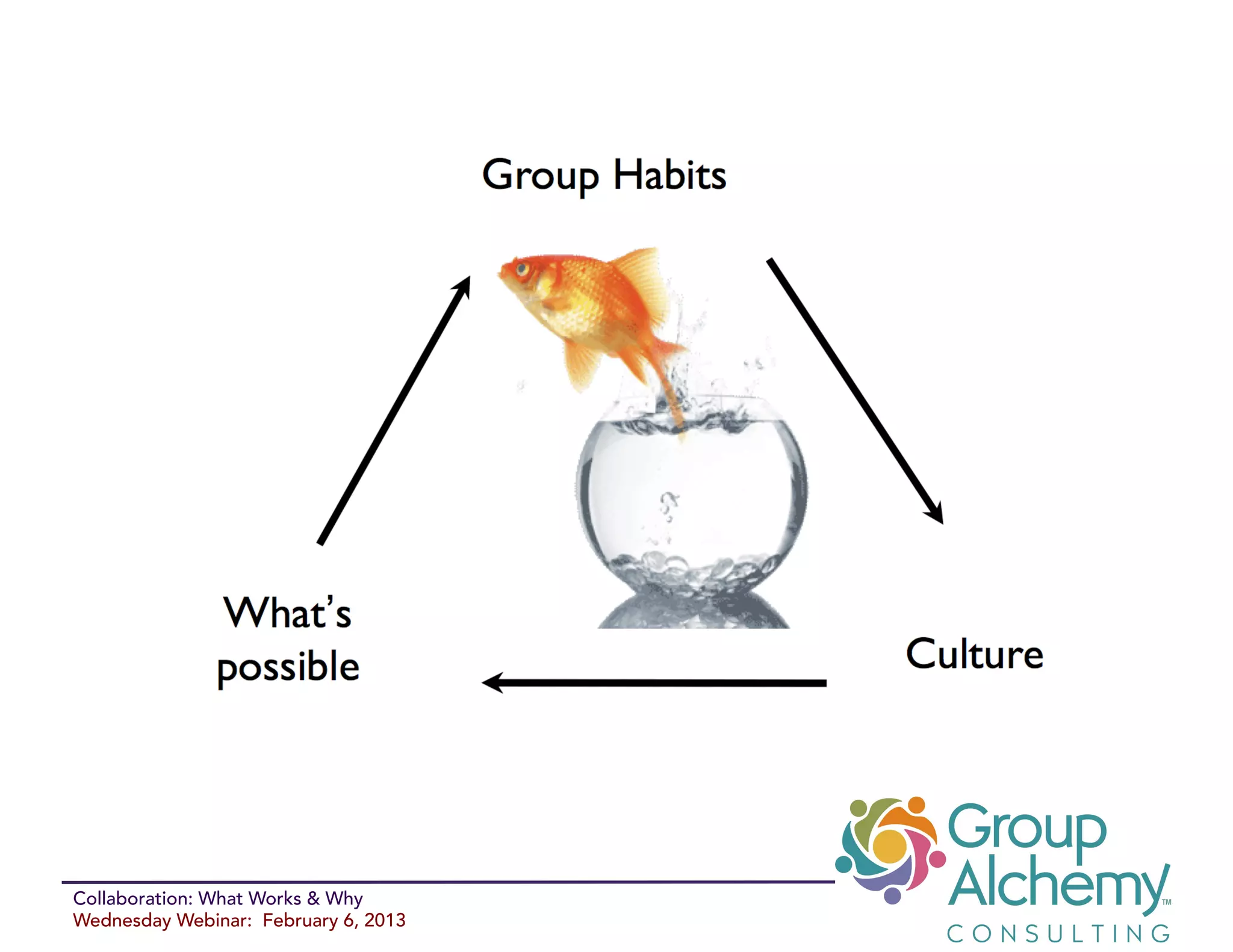
   Prioritize building the culture in your group with
   attention and intention.


Collaboration: What Works & Why
Wednesday Webinar: February 6, 2013
Collaboration: What Works & Why
Wednesday Webinar: February 6, 2013
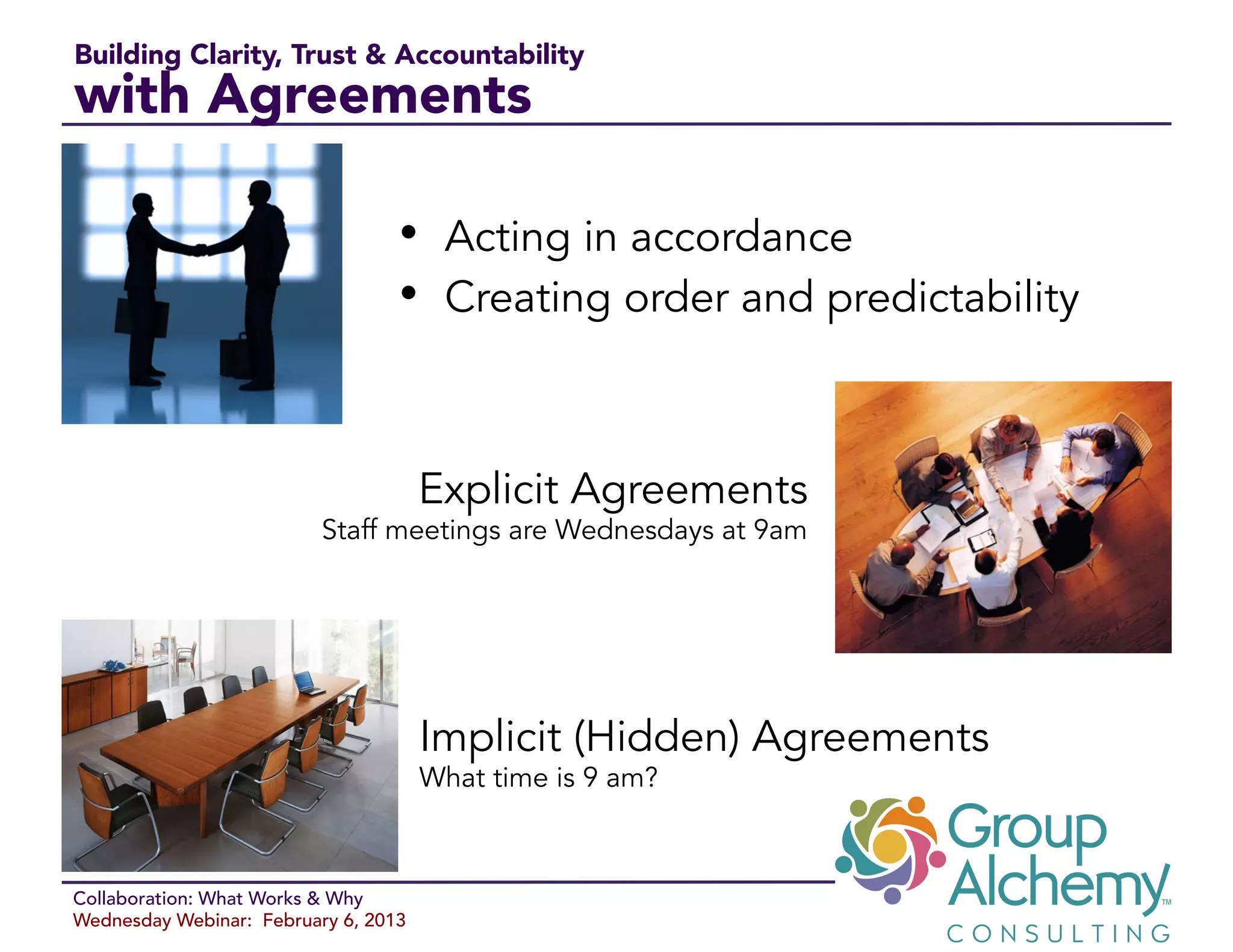
Building Clarity, Trust & Accountability
with Agreements

                                  •  Acting in accordance
                                  •  Creating order and predictability


                                      Explicit Agreements
                          Staff meetings are Wednesdays at 9am$


                                      Implicit (Hidden) Agreements
                                      What time is 9 am?


Collaboration: What Works & Why
Wednesday Webinar: February 6, 2013
Collaboration: What Works & Why
Wednesday Webinar: February 6, 2013
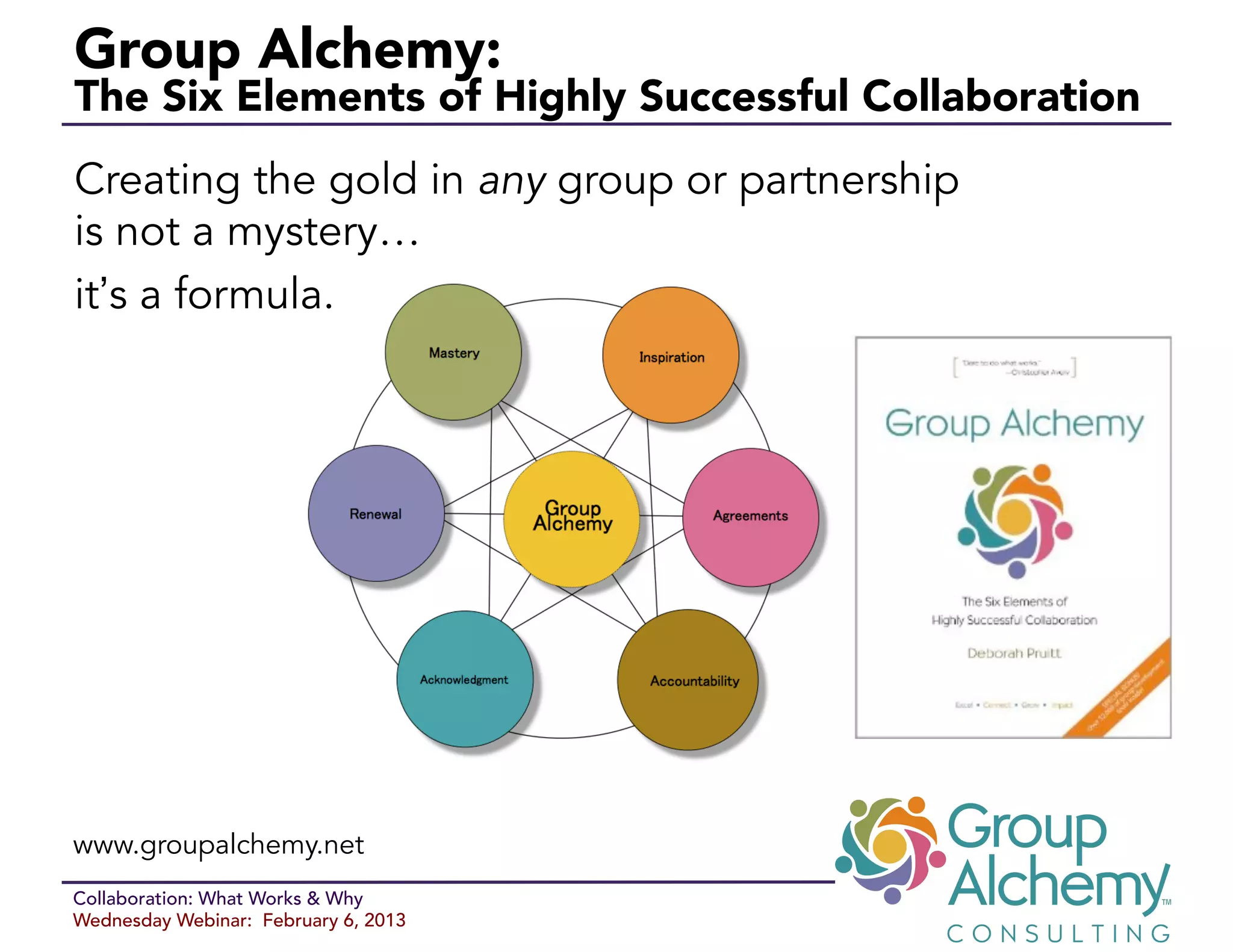
Group Alchemy:
The Six Elements of Highly Successful Collaboration
Creating the gold in any group or partnership
is not a mystery…
it’s a formula.


www.groupalchemy.net
Collaboration: What Works & Why
Wednesday Webinar: February 6, 2013
Barriers: What are your biggest concerns?
•    Turf and Competition
•    Bad history
•    Failure to Act
•    Lack of a Common Vision
•    Failure to provide and create collaborative leadership
•    Minimal organizational structure
•    Costs outweigh the benefits
•    Not engaging self-interest
•    Overcoalitioned community


from Wolff & Kaye From the Ground Up

Collaboration: What Works & Why
Wednesday Webinar: February 6, 2013
Find listings for our current season
               of webinars and register at:

                 NonprofitWebinars.com


A Service
   Of:                            Sponsored by:

Collaboration: What Works and Why

  • 1.
    Collaboration: What Works and Why Sam Frank, Sophie Parker, Deborah Pruitt, Kate Pugh, Tom Wolff February 6, 2013 A Service Of: Sponsored by:
  • 2.
    INTEGRATED PLANNING Advising nonprofits in:! www.synthesispartnership.com! •  Strategy! ! •  Planning! (617) 969-1881! •  Organizational Development! info@synthesispartnership.com! ! A Service Of: Sponsored by:
  • 3.
    Affordable collaborative data management in the cloud. A Service Of: Sponsored by:
  • 4.
    Today’s Panel Sophie Parker Deborah Pruitt Katrina Pugh Tom Wolff Sophie Parker & Associates Group Alchemy Consulting Align Consulting Tom Wolff & Associates Assisting with chat questions: Sam Frank – Host & Moderator Jamie Maloney, Nonprofit Webinars Synthesis Partnership A Service Of: Sponsored by:
  • 5.
    Collaboration: What Works& Why Sam Frank Sophie Parker Deborah Pruitt Katrina Pugh Tom Wolff Synthesis Partnership Sophie Parker & Associates Group Alchemy Consulting Align Consulting Tom Wolff & Associates synthesispartnership.com sophieparker.com groupalchemy.net/ alignconsultinginc.com tomwolff.com sbf@synthesispartnership.com sophie@sophieparker.com info@groupalchemy.net katepugh@alum.mit.edu tom@tomwolff.com Collaboration: What Works & Why Wednesday Webinar: February 6, 2013
  • 6.
    Collaborative Solutions Tom Wolff Tom Wolff & Associates tomwolff.com tom@tomwolff.com Collaboration: What Works & Why Wednesday Webinar: February 6, 2013
  • 7.
    What are collaborativesolutions? •  Doing together that which we cannot do alone •  A collaboration is a group of individuals and/or organizations with a common interest who agree to work together toward a common goal. from S.Fawcett et.al Collaboration: What Works & Why Wednesday Webinar: February 6, 2013
  • 8.
    Why encourage collaborativesolutions? •  To create social change •  To encourage social innovation •  Expand interventions to the whole community •  To do more with less when there are budget cuts •  To address limitations of the health and human service systems •  To promote civic engagement •  To build healthy communities Collaboration: What Works & Why Wednesday Webinar: February 6, 2013
  • 9.
    Six principles forsuccessful coalitions 1.  Engage a broad spectrum of the community 2.  Encourage true collaboration as the form of exchange 3.  Practice democracy 4.  Employ an ecological approach that emphasizes individual in his/her setting. 5.  Take action 6.  Engage your spirituality as your compass for social change from Tom Wolff, The Power of Collaborative Solutions (2010) Collaboration: What Works & Why Wednesday Webinar: February 6, 2013
  • 10.
    The Continuum ofCollaboration Networking Exchanging information for mutual benefit. Coordination Exchanging information and modifying activities for mutual benefit. Cooperation Exchanging information, modifying activities, and sharing resources for mutual benefit and to achieve a common purpose. Collaboration Exchanging information, modifying activities, sharing resources, and enhancing the capacity of another for mutual benefit and to achieve a common purpose by sharing risks, resources, responsibilities, and rewards. from Arthur Himmelman Collaboration: What Works & Why Wednesday Webinar: February 6, 2013
  • 11.
    Factors Affecting a Coalition’sCapacity to Create Change •  Having a clear vision and mission •  Action planning for community and systems change •  Developing and supporting leadership •  Documentation and ongoing feedback on programs •  Technical assistance and support •  Securing financial resources for the work •  Making outcomes matter •  Name and manage conflict from Roussus and Fawcett and Rosenthal Collaboration: What Works & Why Wednesday Webinar: February 6, 2013
  • 12.
    Collaborative Solutions New$from$Jossey$Bass/John$Wiley$ (available$at$www.tomwolff.com)$ Web Resources Coalition Coaching Tom Wolff & Associates www.tomwolff.com Global Journal of Community Psychology Practice www.gjcpp.org Community Tool Box http://ctb.ku.edu Collaboration: What Works & Why Wednesday Webinar: February 6, 2013
  • 13.
    Knowledge Networks forImpact Katrina Pugh Align Consulting alignconsultinginc.com katepugh@alum.mit.edu Collaboration: What Works & Why Wednesday Webinar: February 6, 2013
  • 14.
    Networks Matter •  “Networks,formal and informal, local and global, are increasingly important channels for pursuing policy goals in a globalizing world.” •  No one organization can have enough requisite knowledge in the 21st century. Jan Wouters, Director Leuven Center for Global Governance Studies in foreword to the provocative United Nations publication Networks for Prosperity (2011 ) Collaboration: What Works & Why Wednesday Webinar: February 6, 2013
  • 15.
    What is aKnowledge Network? (also called a Community of Practice) A Knowledge Network is a gathering of individuals motivated by the desire to cross organizational boundaries, to relate to one another, and to build a body of actionable knowledge through coordination and collaboration. Collaboration: What Works & Why Wednesday Webinar: February 6, 2013
  • 16.
    How do networkmembers (not) behave? Lacking Collaboration (“self-sacrifice”) 53% Exhibit trust 53% Cohesiveness/identity 50% Using a working platform 44% Expand connectivity (“networked” beyond) 38% Act within commonly agreed goals & objectives 28% Percentage of nonprofit leaders attending Nonprofit Webinar 11/30/11 http://nonprofitwebinars.com/webinars/11302011-beyond-partnerships-tapping-into-the-agility-of-knowledge- networks-and-communities/ Collaboration: What Works & Why Wednesday Webinar: February 6, 2013
  • 17.
    KN Effectiveness Framework Design Drivers Behavior Impacts( Let’s unpack this! What levers What What tone and What are the do we pull? dynamics behaviors do we impacts? come into see? play? Collaboration: What Works & Why Wednesday Webinar: February 6, 2013
  • 18.
    We can learnfrom the best! 8 Design Dimensions Strategic 1. Leaders’ shared theory of change 2. Objectives/Outcomes/Purpose 3. Role of “expertise” & experimental learning (Expert/Learner balance) 5. Inclusion/Participation Structural 4. Operating model 6. Convening structures and infrastructures 7. Facilitation and social norm development Tactical 8. Measurement, feedback and incentives Collaboration: What Works & Why Wednesday Webinar: February 6, 2013
  • 19.
    Knowledge Networks forImpact Facilitating Tacit Knowledge Conversations: Sharing Hidden Know-How (Jossey-Bass, April 2011) “Knowledge Jam: Three Disciplines to Beat the Merger Performance Odds,” Ivey Business Journal, July/August, 2011. Conversation Channels insight Into Action NonprofitWebinars, Sept, 2011) Networks: Beyond Partnerships: Tapping into the Agility of Knowledge Networks and Communities, NonprofitWebinars, 11/30/2011 Recognizing and cultivating trust: The primary driver of network impact, NonprofitWebinars, 3/28/2012 Collaboration: What Works & Why Wednesday Webinar: February 6, 2013
  • 20.
    Connecting Sophie Parker Sophie Parker & Associates sophieparker.com sophie@sophieparker.com Collaboration: What Works & Why Wednesday Webinar: February 6, 2013
  • 21.
    Interacting “If you wanta future that’s distinct from the past, you have to be with people who you aren’t used to being with and have conversations that you’re not used to having.” Peter Block Collaboration: What Works & Why Wednesday Webinar: February 6, 2013
  • 22.
    Connection before Content Connectionoccurs when we speak of what matters. We make connections through: •  Questions •  Listening & not giving advice •  Breaking bread Collaboration: What Works & Why Wednesday Webinar: February 6, 2013
  • 23.
    Secrets of Collaboration Deborah Pruitt Group Alchemy Consulting groupalchemy.net/ info@groupalchemy.net Collaboration: What Works & Why Wednesday Webinar: February 6, 2013
  • 24.
    Successful Groups vs.Struggling Groups Collaboration: What Works & Why Wednesday Webinar: February 6, 2013
  • 25.
    How to prevent… •  Frustration, pettiness and tension. •  Disengagement. •  Lack of group energy and creativity. Collaboration: What Works & Why Wednesday Webinar: February 6, 2013
  • 26.
    Learn how to… •  set a foundation for high-level collaboration in any work relationship or group - quickly and reliably. •  prevent typical breakdowns that drag the group down and break trust. •  have more impact in every relationship. •  make a critical mindset shift. Collaboration: What Works & Why Wednesday Webinar: February 6, 2013
  • 27.
    Mindset Shift Prioritize building the culture in your group with attention and intention. Collaboration: What Works & Why Wednesday Webinar: February 6, 2013
  • 28.
    Collaboration: What Works& Why Wednesday Webinar: February 6, 2013
  • 29.
    Building Clarity, Trust& Accountability with Agreements •  Acting in accordance •  Creating order and predictability Explicit Agreements Staff meetings are Wednesdays at 9am$ Implicit (Hidden) Agreements What time is 9 am? Collaboration: What Works & Why Wednesday Webinar: February 6, 2013
  • 30.
    Collaboration: What Works& Why Wednesday Webinar: February 6, 2013
  • 31.
    Group Alchemy: The SixElements of Highly Successful Collaboration Creating the gold in any group or partnership is not a mystery… it’s a formula. www.groupalchemy.net Collaboration: What Works & Why Wednesday Webinar: February 6, 2013
  • 32.
    Barriers: What areyour biggest concerns? •  Turf and Competition •  Bad history •  Failure to Act •  Lack of a Common Vision •  Failure to provide and create collaborative leadership •  Minimal organizational structure •  Costs outweigh the benefits •  Not engaging self-interest •  Overcoalitioned community from Wolff & Kaye From the Ground Up Collaboration: What Works & Why Wednesday Webinar: February 6, 2013
  • 33.
    Find listings forour current season of webinars and register at: NonprofitWebinars.com A Service Of: Sponsored by: