Lesson 4: Measuring Physiological Responses

                          Exam Question:

 Ella loves Yoga. She finds it relaxing and it helps her to deal with
                  the stressful activities of her day.

    a) What brainwave pattern would Ella show during a Yoga
                session? Explain your response.

 b) Which device would best measure Ella’s brainwave pattern?
                   Explain your response.

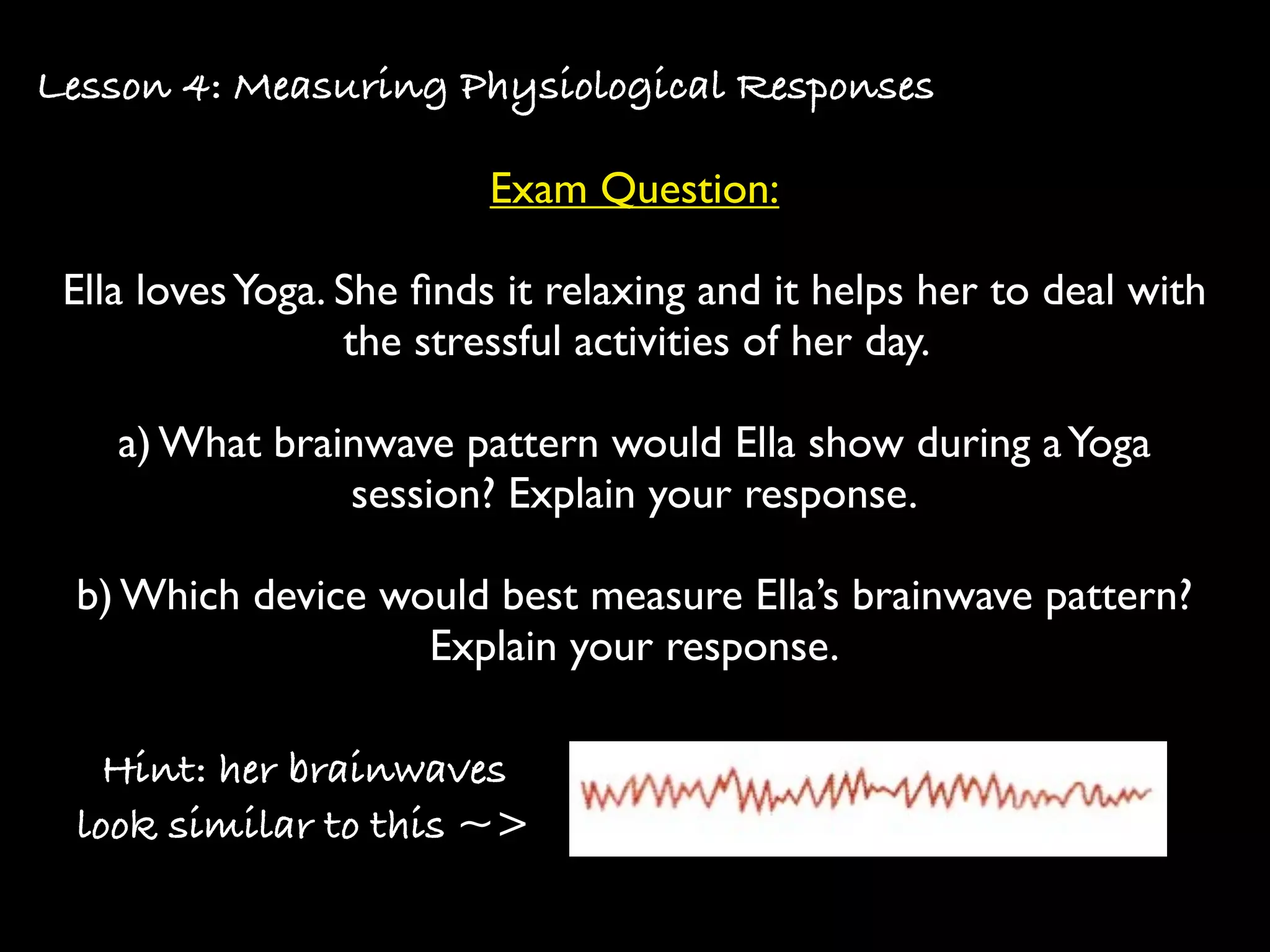
   Hint: her brainwaves
 look similar to this ~>
Model Response

a) Alfa waves because Ella is in a meditative state, awake
 but very relaxed, which is associated with reasonably
high frequency (but not as high as beta waves) and low
     amplitude (but slightly higher than beta waves)
                       brainwaves.

 b) An Electroencephalograph (EEG) because it detects,
 amplifies and records electrical activity in the brain in
                the form of brainwaves.
Is
                                              th
                                                 is
                                            or pu
                                               .... p p
                                                   .... o
                                                       .... ss
                                                           .. ? es
                                                               ??? sed


http://www.youtube.com/watch?v=t27suXgfi8w
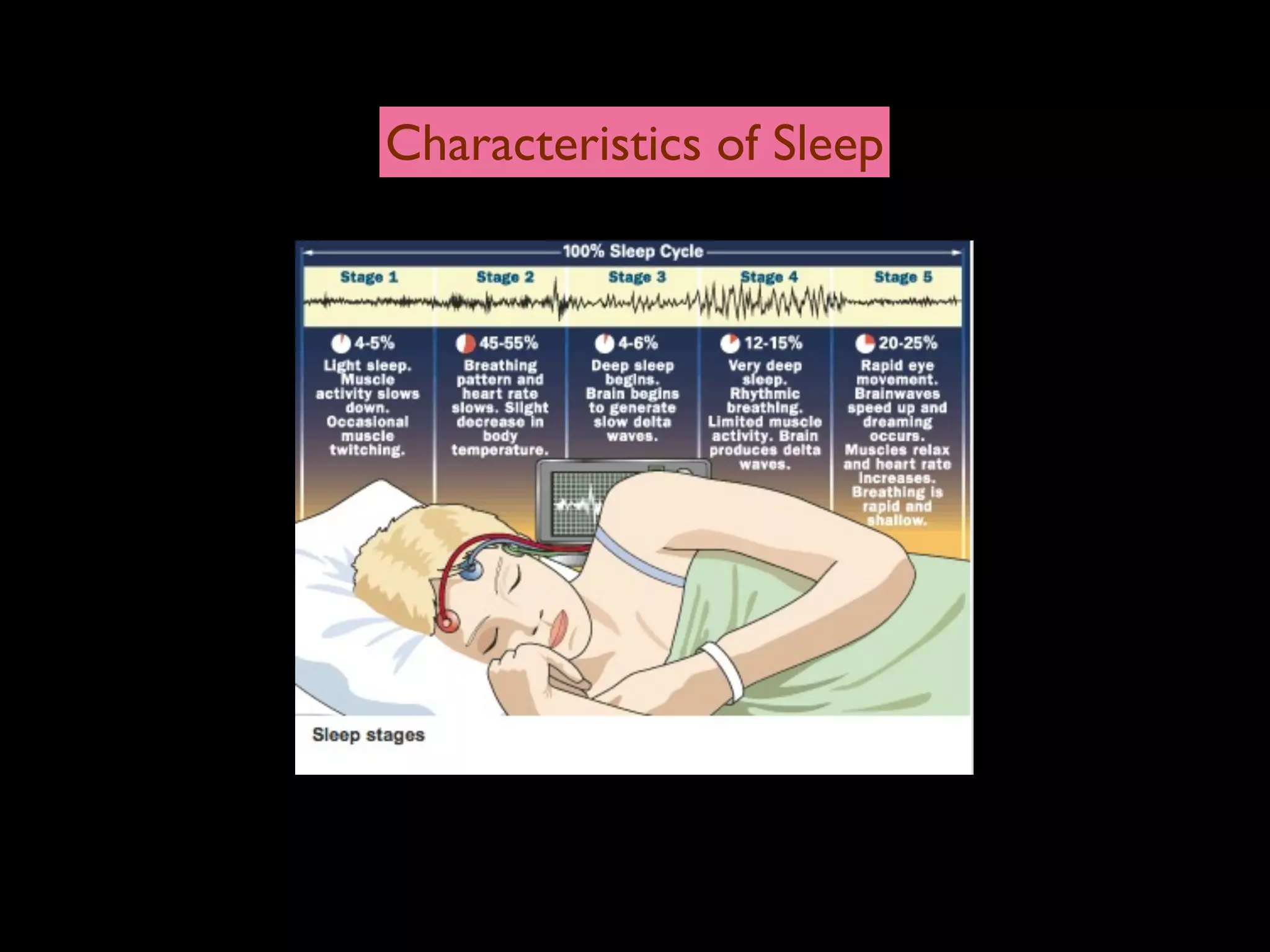
Characteristics of Sleep
NREM Sleep Non-rapid eye movement sleep

NREM sleep includes those stages not associated with rapid
eye movements. Adults spend approximately 80 percent of
their nights sleep in NREM, and typically the first half of the
night has more NREM sleep than the second half.

NREM is essential to the physical growth and repair of the
body. Research has found the amount of NREM increases after
vigorous exercise (Vein et al., 1991).

NREM is dream free about 90% of the time, dreams tend to be
more short lived and fragmented than those in REM.
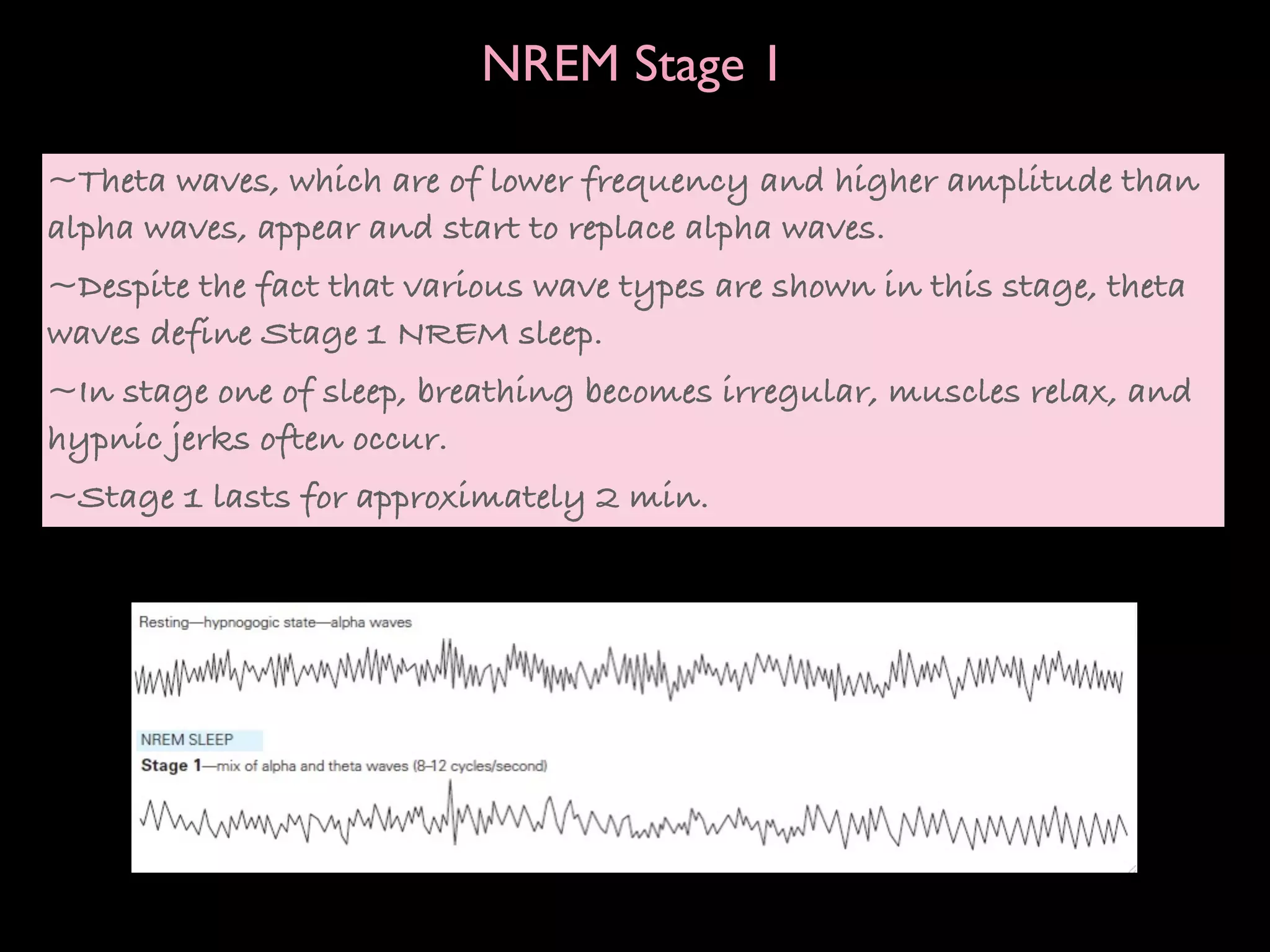
NREM Stage 1

~Theta waves, which are of lower frequency and higher amplitude than
alpha waves, appear and start to replace alpha waves.
~Despite the fact that various wave types are shown in this stage, theta
waves define Stage 1 NREM sleep.
~In stage one of sleep, breathing becomes irregular, muscles relax, and
hypnic jerks often occur.
~Stage 1 lasts for approximately 2 min.
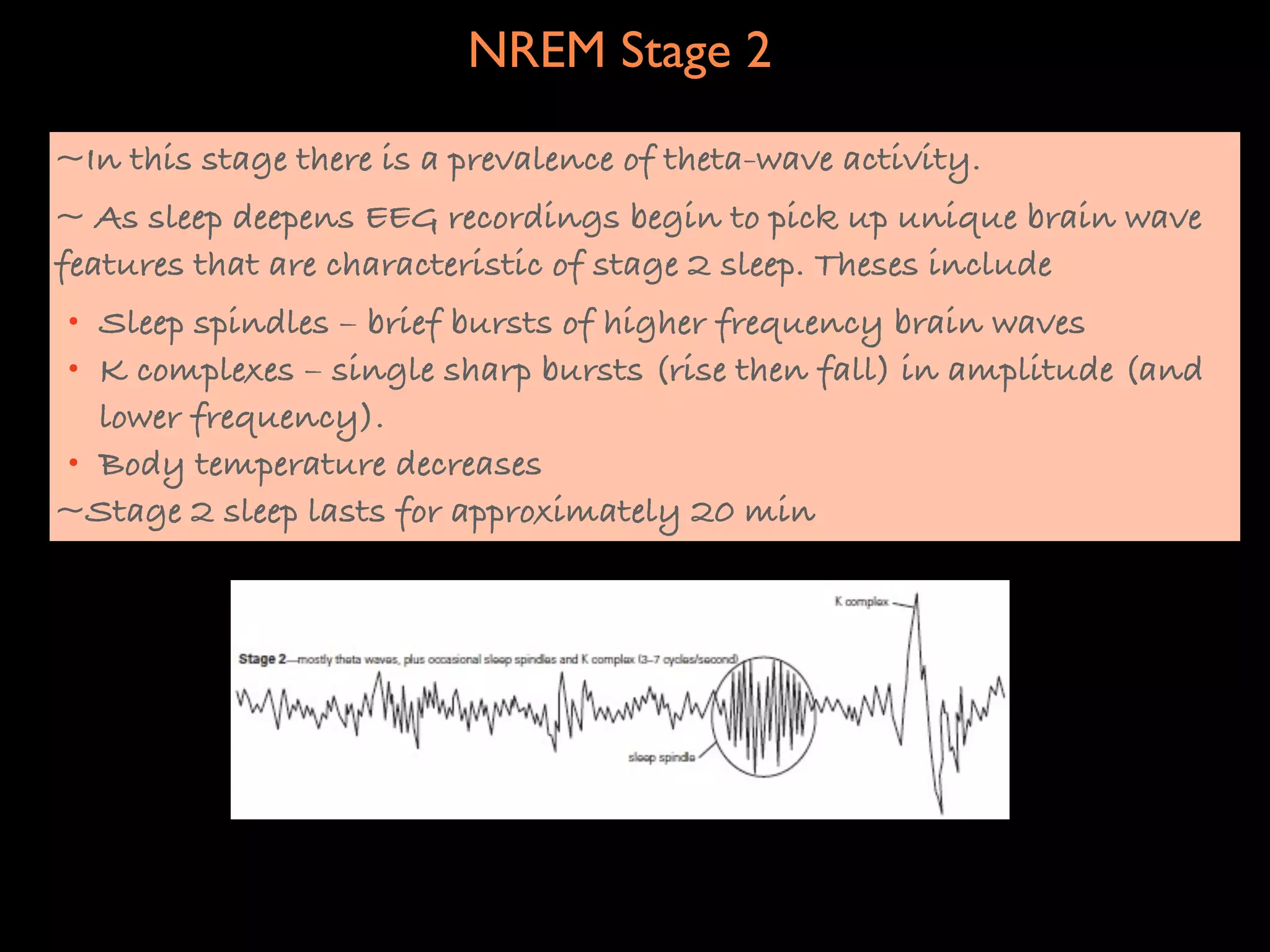
NREM Stage 2
~In this stage there is a prevalence of theta-wave activity.
~ As sleep deepens EEG recordings begin to pick up unique brain wave
features that are characteristic of stage 2 sleep. Theses include
• Sleep spindles – brief bursts of higher frequency brain waves
• K complexes – single sharp bursts (rise then fall) in amplitude (and
  lower frequency).
• Body temperature decreases
~Stage 2 sleep lasts for approximately 20 min
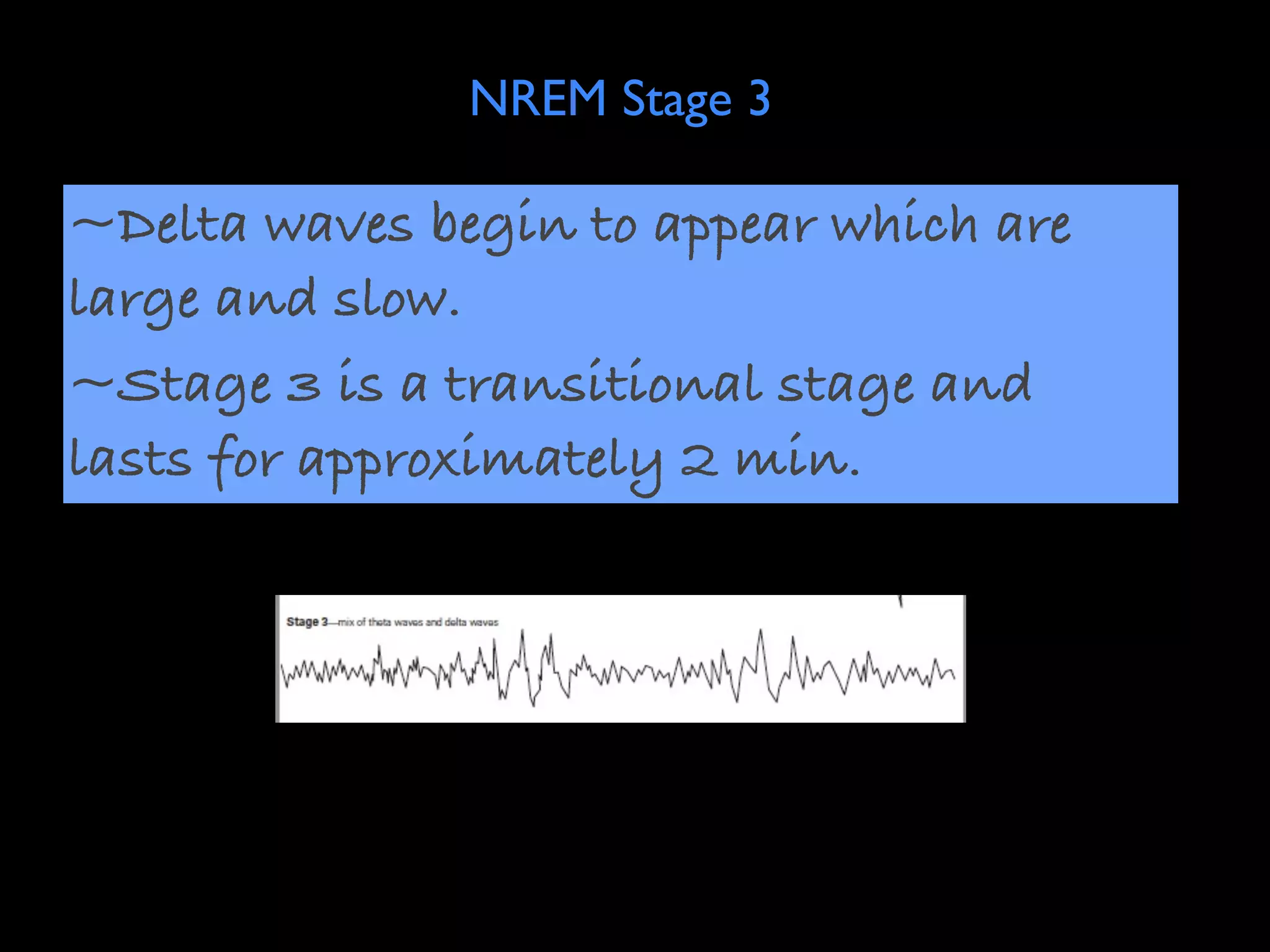
NREM Stage 3

~Delta waves begin to appear which are
large and slow.
~Stage 3 is a transitional stage and
lasts for approximately 2 min.
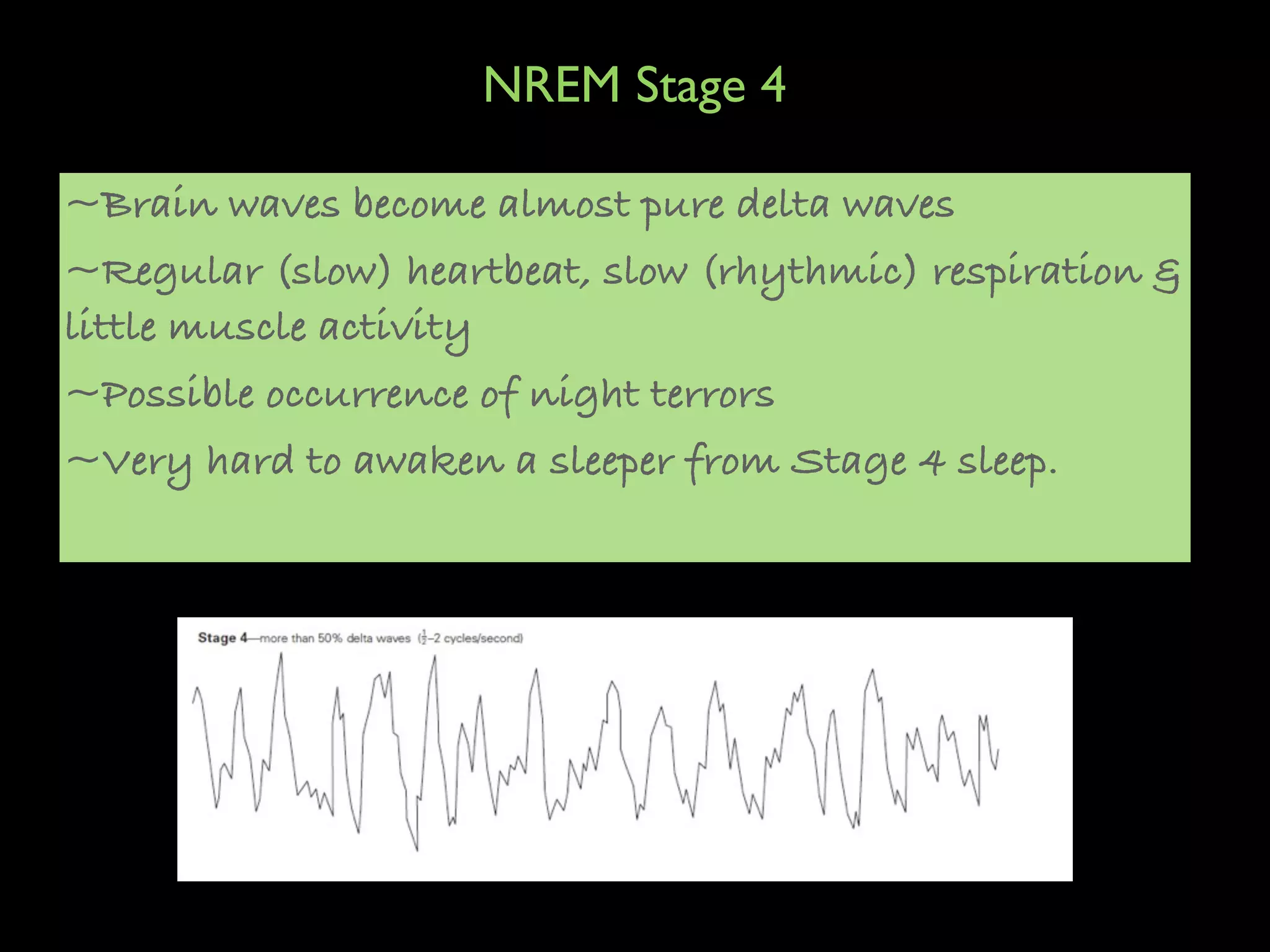
NREM Stage 4

~Brain waves become almost pure delta waves
~Regular (slow) heartbeat, slow (rhythmic) respiration &
little muscle activity
~Possible occurrence of night terrors
~Very hard to awaken a sleeper from Stage 4 sleep.
REM ~ Rapid Eye Movement
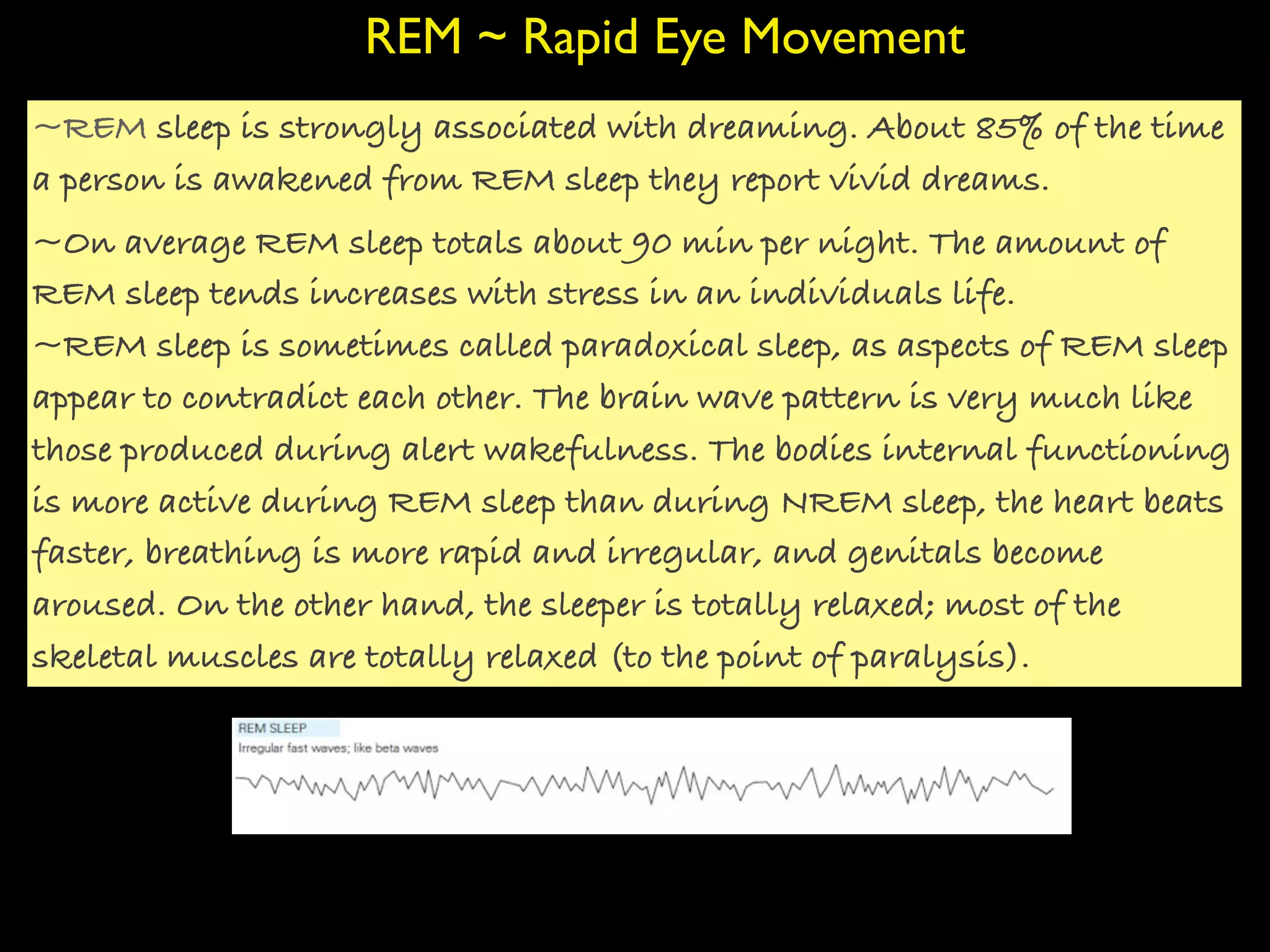
~REM sleep is strongly associated with dreaming. About 85% of the time
a person is awakened from REM sleep they report vivid dreams.
~On average REM sleep totals about 90 min per night. The amount of
REM sleep tends increases with stress in an individuals life.
~REM sleep is sometimes called paradoxical sleep, as aspects of REM sleep
appear to contradict each other. The brain wave pattern is very much like
those produced during alert wakefulness. The bodies internal functioning
is more active during REM sleep than during NREM sleep, the heart beats
faster, breathing is more rapid and irregular, and genitals become
aroused. On the other hand, the sleeper is totally relaxed; most of the
skeletal muscles are totally relaxed (to the point of paralysis).
Patterns of Sleep
An adult sleeps for approximately 8 hrs per night progressing through cycles of about 1.5
hours. Periods of deep sleep (NREM4) occur earlier in the night, and periods of REM sleep occur,
on average every 90 minutes.


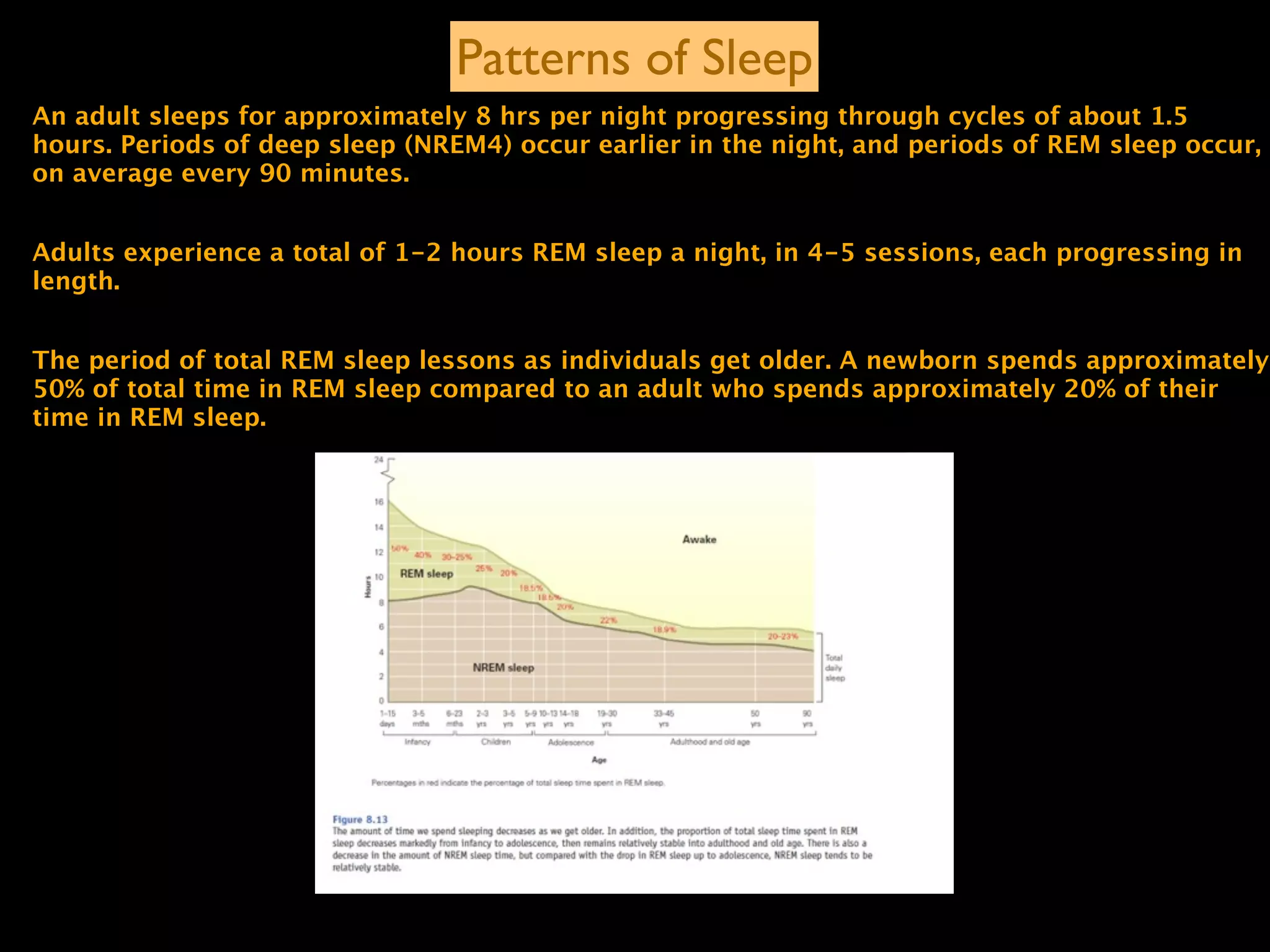
Adults experience a total of 1-2 hours REM sleep a night, in 4-5 sessions, each progressing in
length.


The period of total REM sleep lessons as individuals get older. A newborn spends approximately
50% of total time in REM sleep compared to an adult who spends approximately 20% of their
time in REM sleep.
WHY DO WE SLEEP?
Survival Theories


  Focuses on when and why different species sleep

      Sleep depends on the need to find food

Sleep depends on an animal’s vulnerability to predators

              Sleep conserves energy
Limitations of Survival Theories

  Survival theories fail to explain why we MUST sleep


Survival theories state that sleeping offers security from
 predators, however the loss of awareness while asleep
               contradicts this statement.
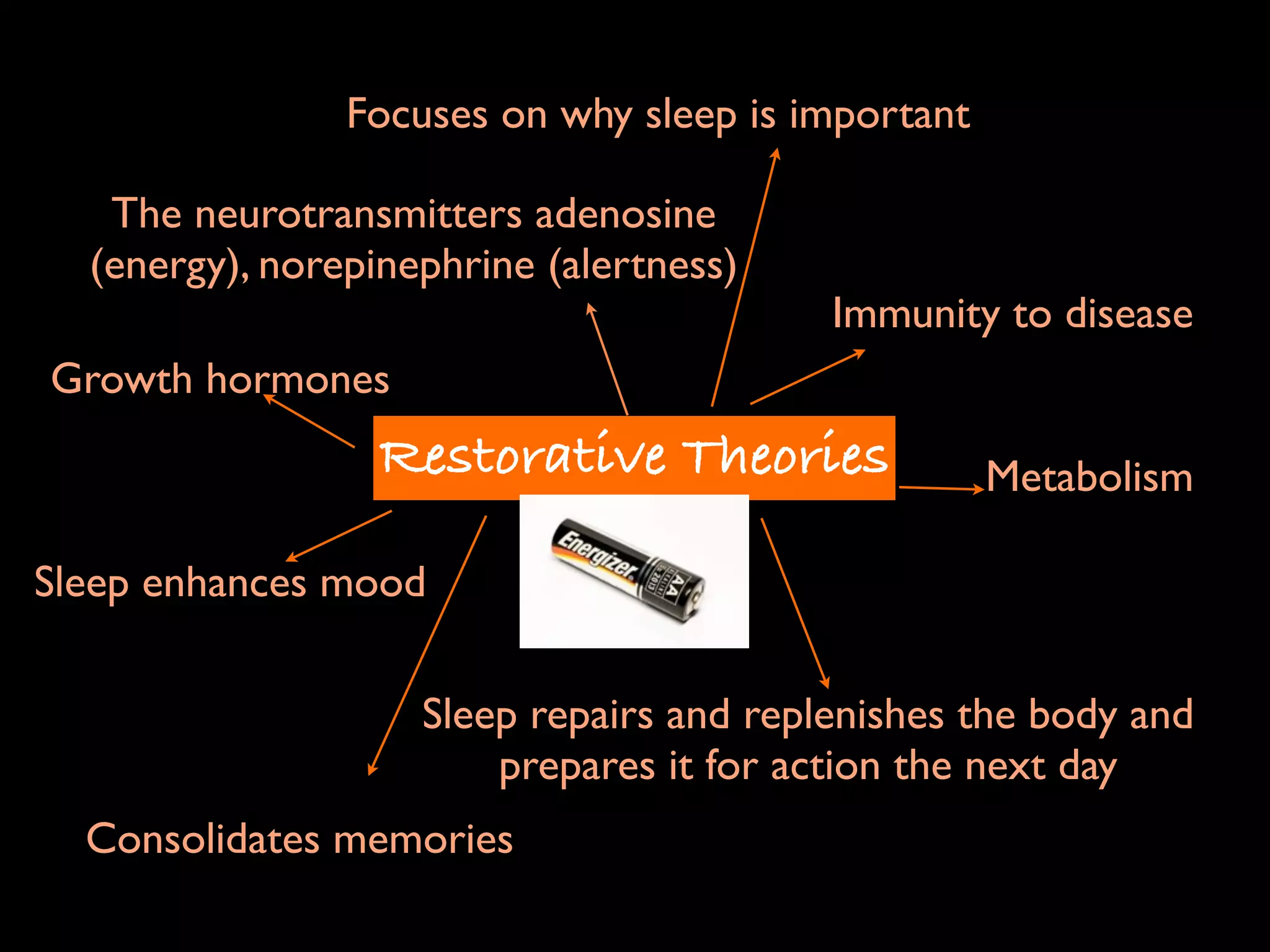
Focuses on why sleep is important

   The neurotransmitters adenosine
  (energy), norepinephrine (alertness)
                                          Immunity to disease
Growth hormones
                  Restorative Theories              Metabolism

Sleep enhances mood

                    Sleep repairs and replenishes the body and
                        prepares it for action the next day
  Consolidates memories
Limitations of Restorative Theories

  Lack of physical activity does not reduce the amount
                     of sleep needed


The body does not completely “rest” during sleep (REM)
          as assumed by restorative theories

Characteristics and patterns of sleep

  • 1.
    Lesson 4: MeasuringPhysiological Responses Exam Question: Ella loves Yoga. She finds it relaxing and it helps her to deal with the stressful activities of her day. a) What brainwave pattern would Ella show during a Yoga session? Explain your response. b) Which device would best measure Ella’s brainwave pattern? Explain your response. Hint: her brainwaves look similar to this ~>
  • 2.
    Model Response a) Alfawaves because Ella is in a meditative state, awake but very relaxed, which is associated with reasonably high frequency (but not as high as beta waves) and low amplitude (but slightly higher than beta waves) brainwaves. b) An Electroencephalograph (EEG) because it detects, amplifies and records electrical activity in the brain in the form of brainwaves.
  • 3.
    Is th is or pu .... p p .... o .... ss .. ? es ??? sed http://www.youtube.com/watch?v=t27suXgfi8w
  • 4.
  • 5.
    NREM Sleep Non-rapideye movement sleep NREM sleep includes those stages not associated with rapid eye movements. Adults spend approximately 80 percent of their nights sleep in NREM, and typically the first half of the night has more NREM sleep than the second half. NREM is essential to the physical growth and repair of the body. Research has found the amount of NREM increases after vigorous exercise (Vein et al., 1991). NREM is dream free about 90% of the time, dreams tend to be more short lived and fragmented than those in REM.
  • 6.
    NREM Stage 1 ~Thetawaves, which are of lower frequency and higher amplitude than alpha waves, appear and start to replace alpha waves. ~Despite the fact that various wave types are shown in this stage, theta waves define Stage 1 NREM sleep. ~In stage one of sleep, breathing becomes irregular, muscles relax, and hypnic jerks often occur. ~Stage 1 lasts for approximately 2 min.
  • 7.
    NREM Stage 2 ~Inthis stage there is a prevalence of theta-wave activity. ~ As sleep deepens EEG recordings begin to pick up unique brain wave features that are characteristic of stage 2 sleep. Theses include • Sleep spindles – brief bursts of higher frequency brain waves • K complexes – single sharp bursts (rise then fall) in amplitude (and lower frequency). • Body temperature decreases ~Stage 2 sleep lasts for approximately 20 min
  • 8.
    NREM Stage 3 ~Deltawaves begin to appear which are large and slow. ~Stage 3 is a transitional stage and lasts for approximately 2 min.
  • 9.
    NREM Stage 4 ~Brainwaves become almost pure delta waves ~Regular (slow) heartbeat, slow (rhythmic) respiration & little muscle activity ~Possible occurrence of night terrors ~Very hard to awaken a sleeper from Stage 4 sleep.
  • 10.
    REM ~ RapidEye Movement ~REM sleep is strongly associated with dreaming. About 85% of the time a person is awakened from REM sleep they report vivid dreams. ~On average REM sleep totals about 90 min per night. The amount of REM sleep tends increases with stress in an individuals life. ~REM sleep is sometimes called paradoxical sleep, as aspects of REM sleep appear to contradict each other. The brain wave pattern is very much like those produced during alert wakefulness. The bodies internal functioning is more active during REM sleep than during NREM sleep, the heart beats faster, breathing is more rapid and irregular, and genitals become aroused. On the other hand, the sleeper is totally relaxed; most of the skeletal muscles are totally relaxed (to the point of paralysis).
  • 11.
    Patterns of Sleep Anadult sleeps for approximately 8 hrs per night progressing through cycles of about 1.5 hours. Periods of deep sleep (NREM4) occur earlier in the night, and periods of REM sleep occur, on average every 90 minutes. Adults experience a total of 1-2 hours REM sleep a night, in 4-5 sessions, each progressing in length. The period of total REM sleep lessons as individuals get older. A newborn spends approximately 50% of total time in REM sleep compared to an adult who spends approximately 20% of their time in REM sleep.
  • 12.
    WHY DO WESLEEP?
  • 13.
    Survival Theories Focuses on when and why different species sleep Sleep depends on the need to find food Sleep depends on an animal’s vulnerability to predators Sleep conserves energy
  • 14.
    Limitations of SurvivalTheories Survival theories fail to explain why we MUST sleep Survival theories state that sleeping offers security from predators, however the loss of awareness while asleep contradicts this statement.
  • 15.
    Focuses on whysleep is important The neurotransmitters adenosine (energy), norepinephrine (alertness) Immunity to disease Growth hormones Restorative Theories Metabolism Sleep enhances mood Sleep repairs and replenishes the body and prepares it for action the next day Consolidates memories
  • 16.
    Limitations of RestorativeTheories Lack of physical activity does not reduce the amount of sleep needed The body does not completely “rest” during sleep (REM) as assumed by restorative theories