Computer Architecture
SP-15
05:- Instruction Set Architecture and Design
Review
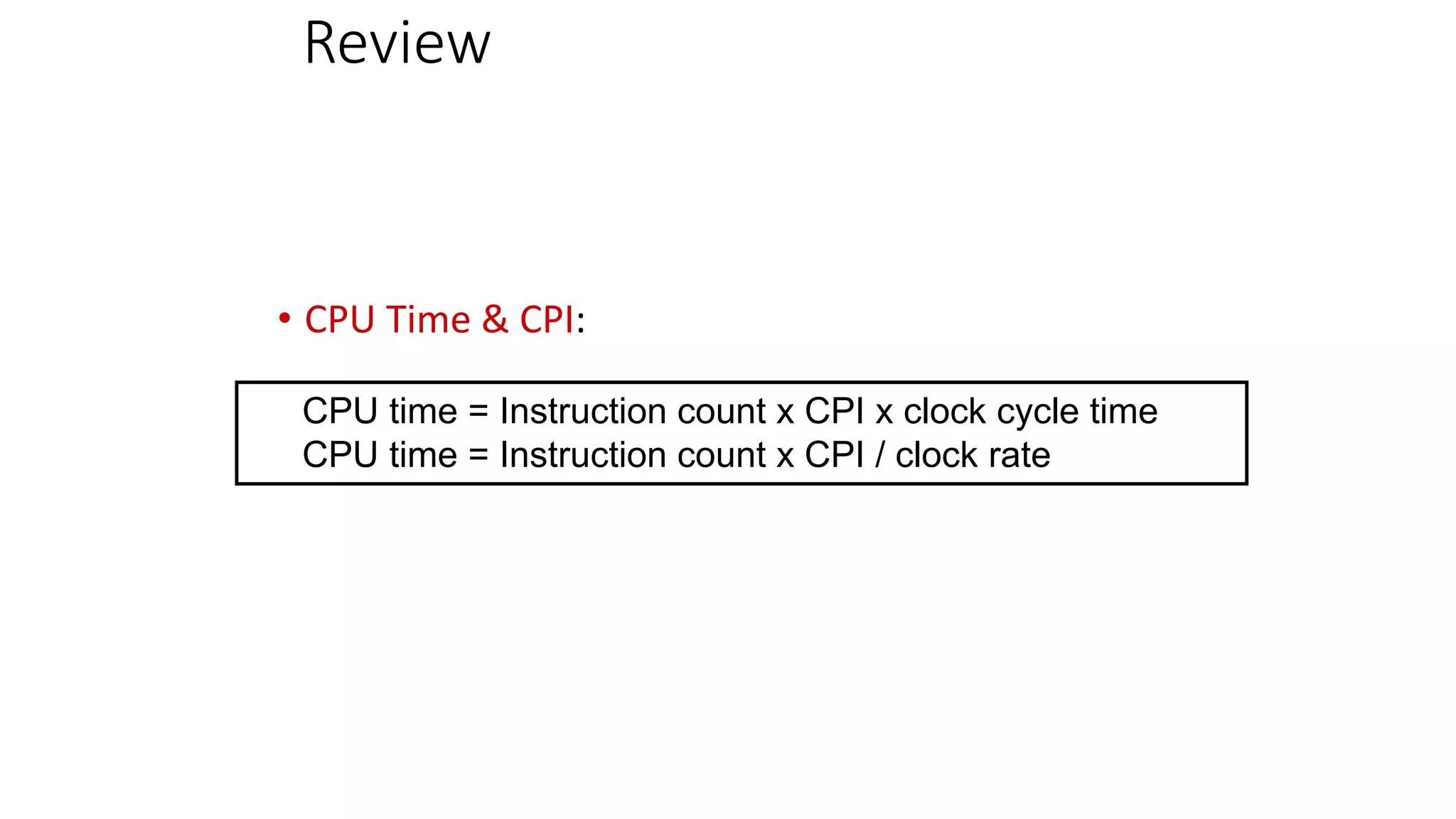
• CPU Time & CPI:
CPU time = Instruction count x CPI x clock cycle time
CPU time = Instruction count x CPI / clock rate
Outline
• Instruction Set Overview
• Classifying Instruction Set Architectures (ISAs) 
• Memory Addressing
• Types of Instructions
• MIPS Instruction Set Design (Topic of next lecture)
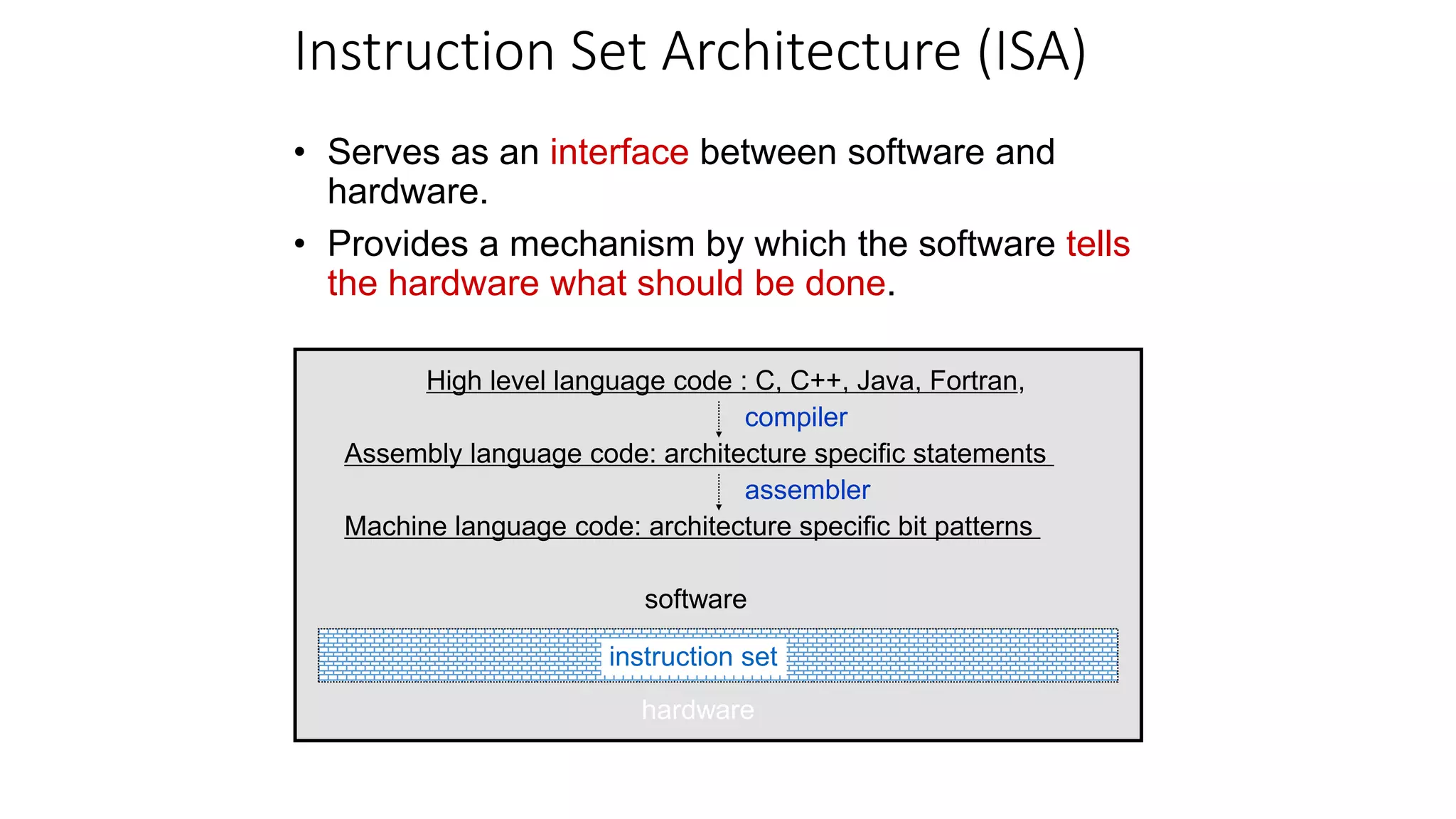
Instruction Set Architecture (ISA)
• Serves as an interface between software and
hardware.
• Provides a mechanism by which the software tells
the hardware what should be done.
instruction set
High level language code : C, C++, Java, Fortran,
hardware
Assembly language code: architecture specific statements
Machine language code: architecture specific bit patterns
software
compiler
assembler
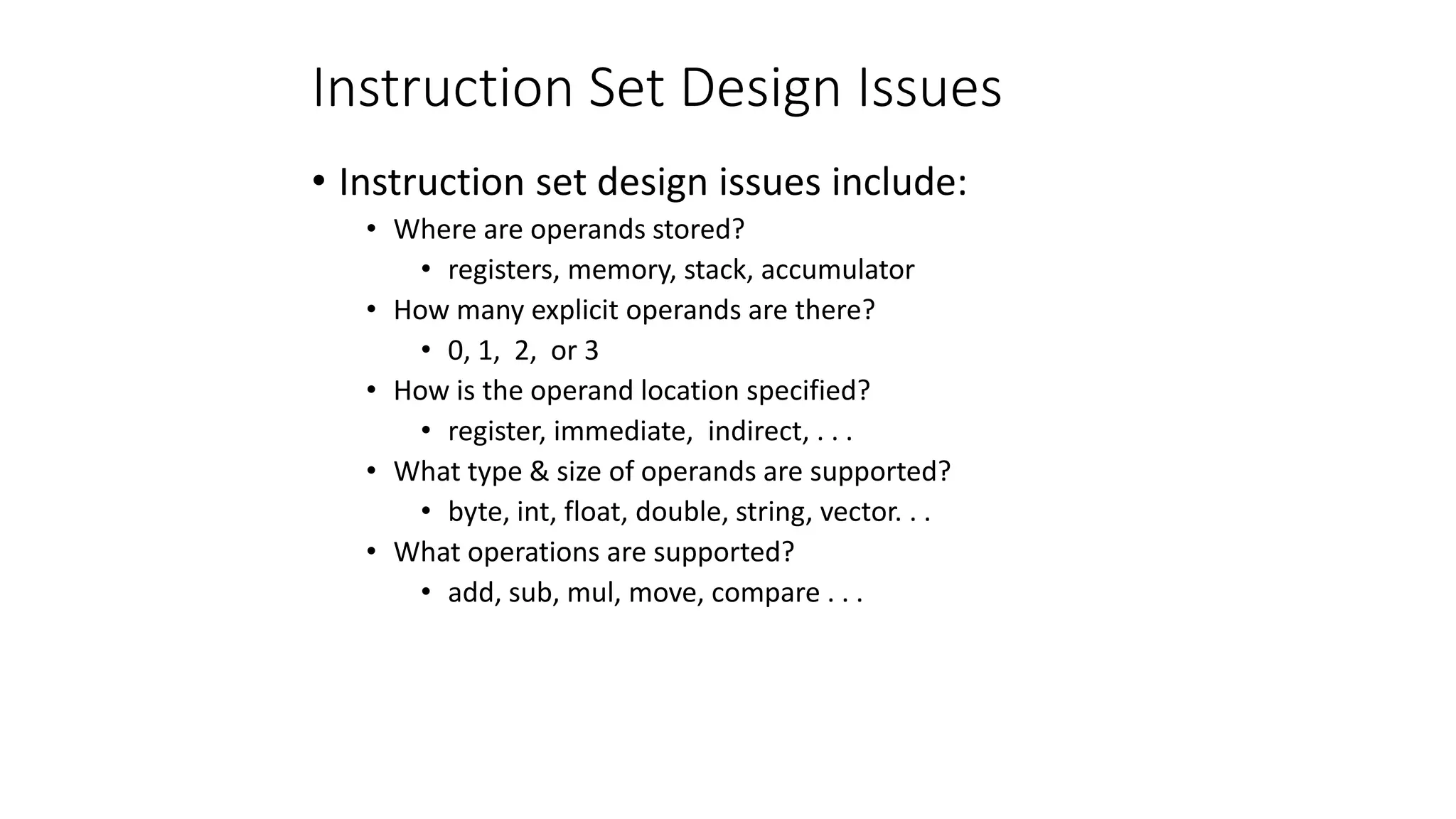
Instruction Set Design Issues
• Instruction set design issues include:
• Where are operands stored?
• registers, memory, stack, accumulator
• How many explicit operands are there?
• 0, 1, 2, or 3
• How is the operand location specified?
• register, immediate, indirect, . . .
• What type & size of operands are supported?
• byte, int, float, double, string, vector. . .
• What operations are supported?
• add, sub, mul, move, compare . . .
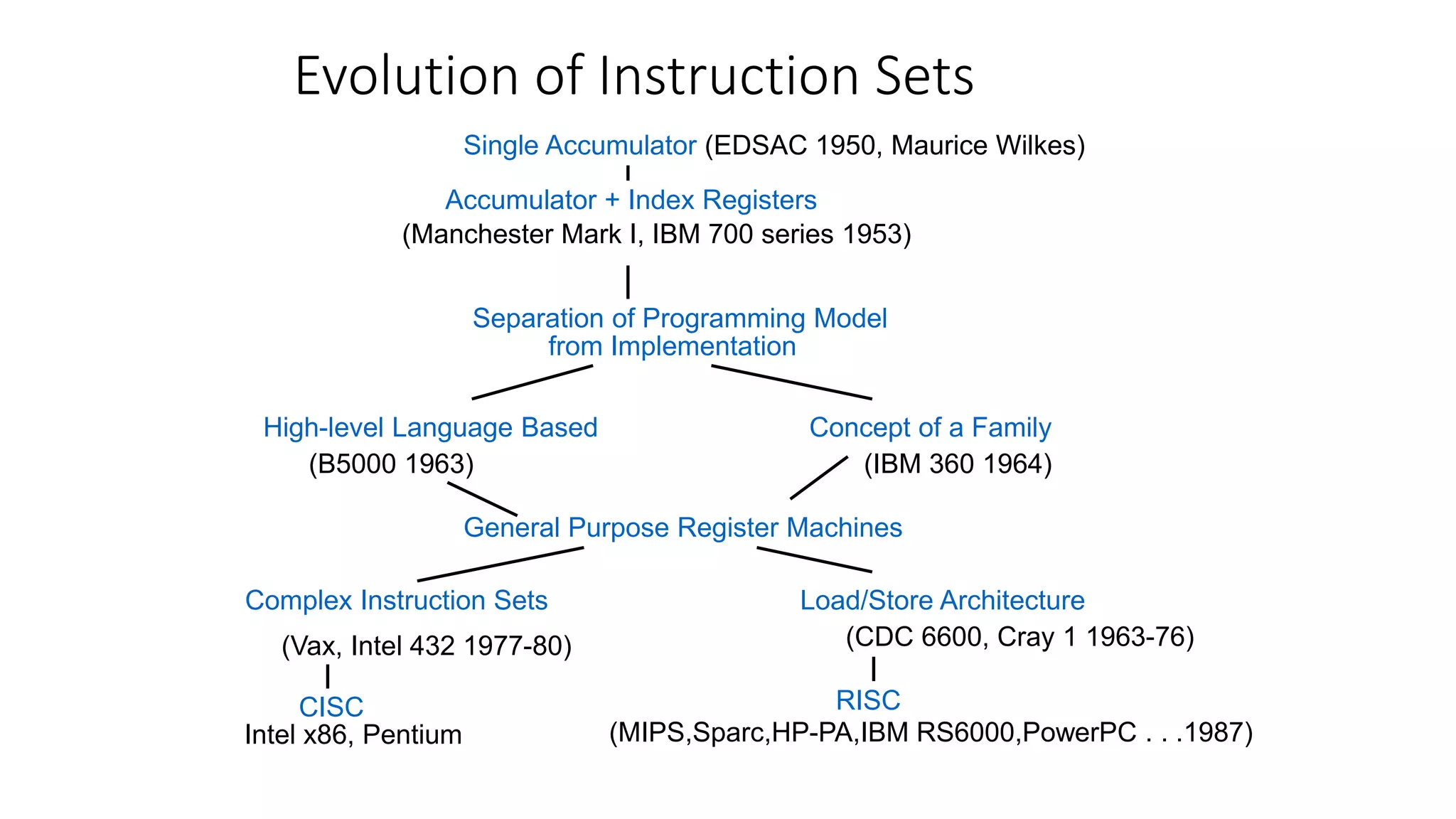
Evolution of Instruction Sets
Single Accumulator (EDSAC 1950, Maurice Wilkes)
Accumulator + Index Registers
(Manchester Mark I, IBM 700 series 1953)
Separation of Programming Model
from Implementation
High-level Language Based Concept of a Family
(B5000 1963) (IBM 360 1964)
General Purpose Register Machines
Complex Instruction Sets Load/Store Architecture
RISC
(Vax, Intel 432 1977-80) (CDC 6600, Cray 1 1963-76)
(MIPS,Sparc,HP-PA,IBM RS6000,PowerPC . . .1987)
CISC
Intel x86, Pentium
Classifying ISAs
Accumulator (before 1960, e.g. 68HC11):
1-address add A acc acc + mem[A]
Stack (1960s to 1970s):
0-address add tos tos + next
Memory-Memory (1970s to 1980s):
2-address add A, B mem[A] mem[A] + mem[B]
3-address add A, B, C mem[A] mem[B] + mem[C]
Register-Memory (1970s to present, e.g. 80x86):
2-address add R1, A R1 R1 + mem[A]
load R1, A R1 mem[A]
Register-Register (Load/Store) (1960s to present, e.g. MIPS):
3-address add R1, R2, R3 R1 R2 + R3
load R1, R2 R1 mem[R2]
store R1, R2 mem[R1] R2
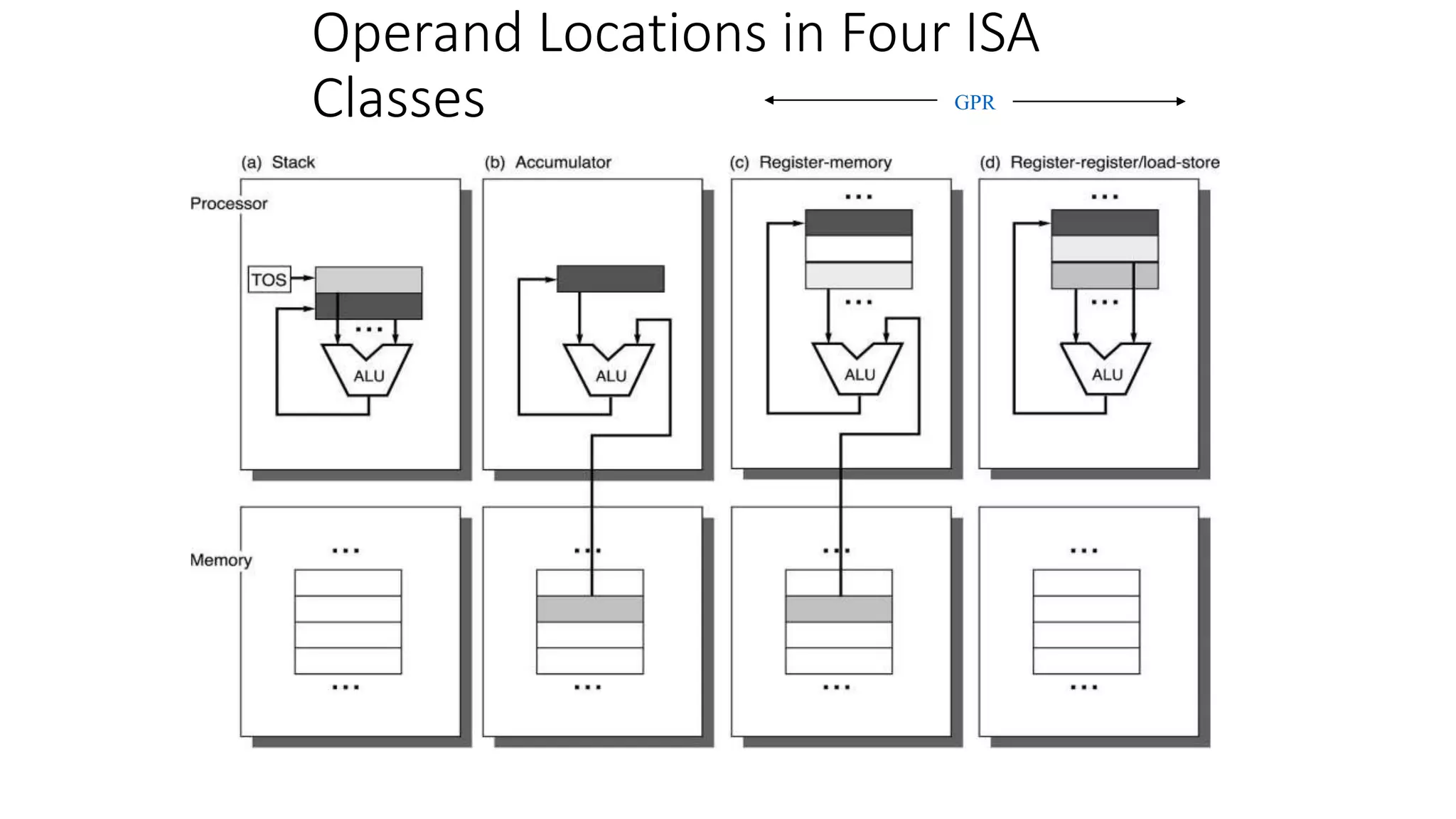
Operand Locations in Four ISA
Classes GPR
Code Sequence C = A + B
for Four Instruction Sets
Stack Accumulator Register
(register-memory)
Register (load-
store)
Push A
Push B
Add
Pop C
Load A
Add B
Store C
Load R1, A
Add R1, B
Store C, R1
Load R1,A
Load R2, B
Add R3, R1, R2
Store C, R3
memory memory
acc = acc + mem[C] R1 = R1 + mem[C] R3 = R1 + R2
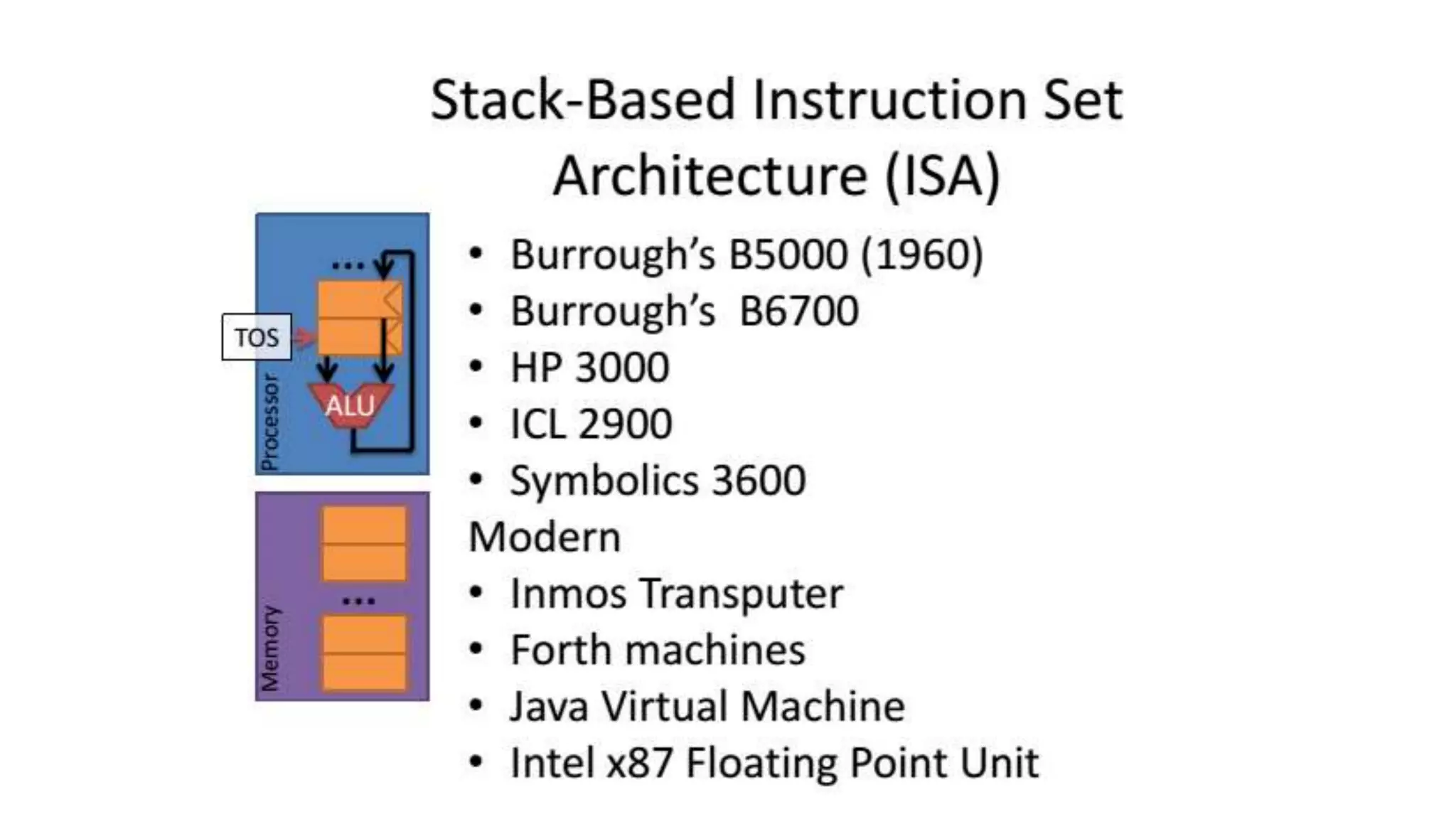
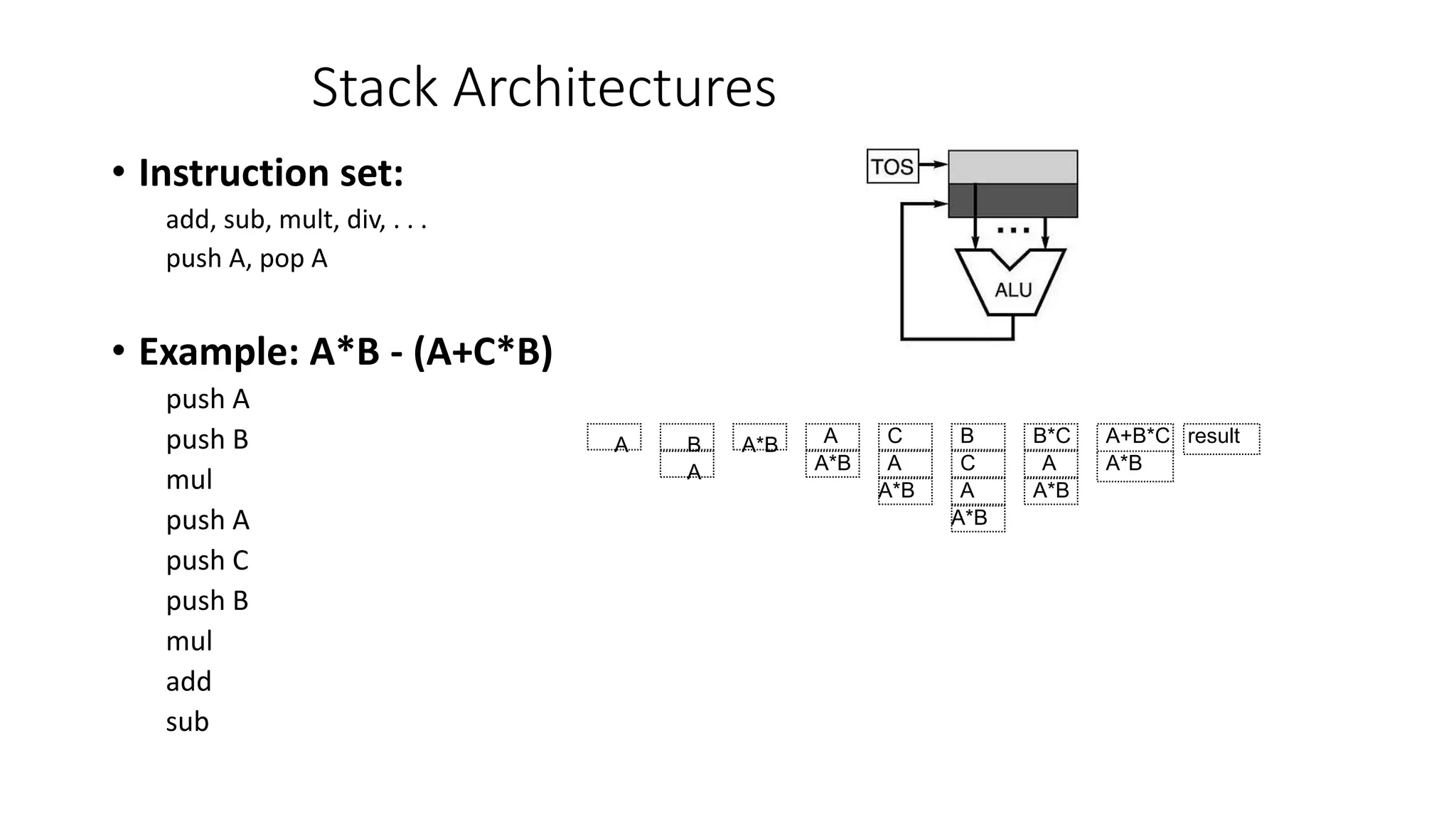
Stack Architectures
• Instruction set:
add, sub, mult, div, . . .
push A, pop A
• Example: A*B - (A+C*B)
push A
push B
mul
push A
push C
push B
mul
add
sub
A B
A
A*B
A*B
A*B
A*B
A
A
C
A*B
A A*B
A C B B*C A+B*C result
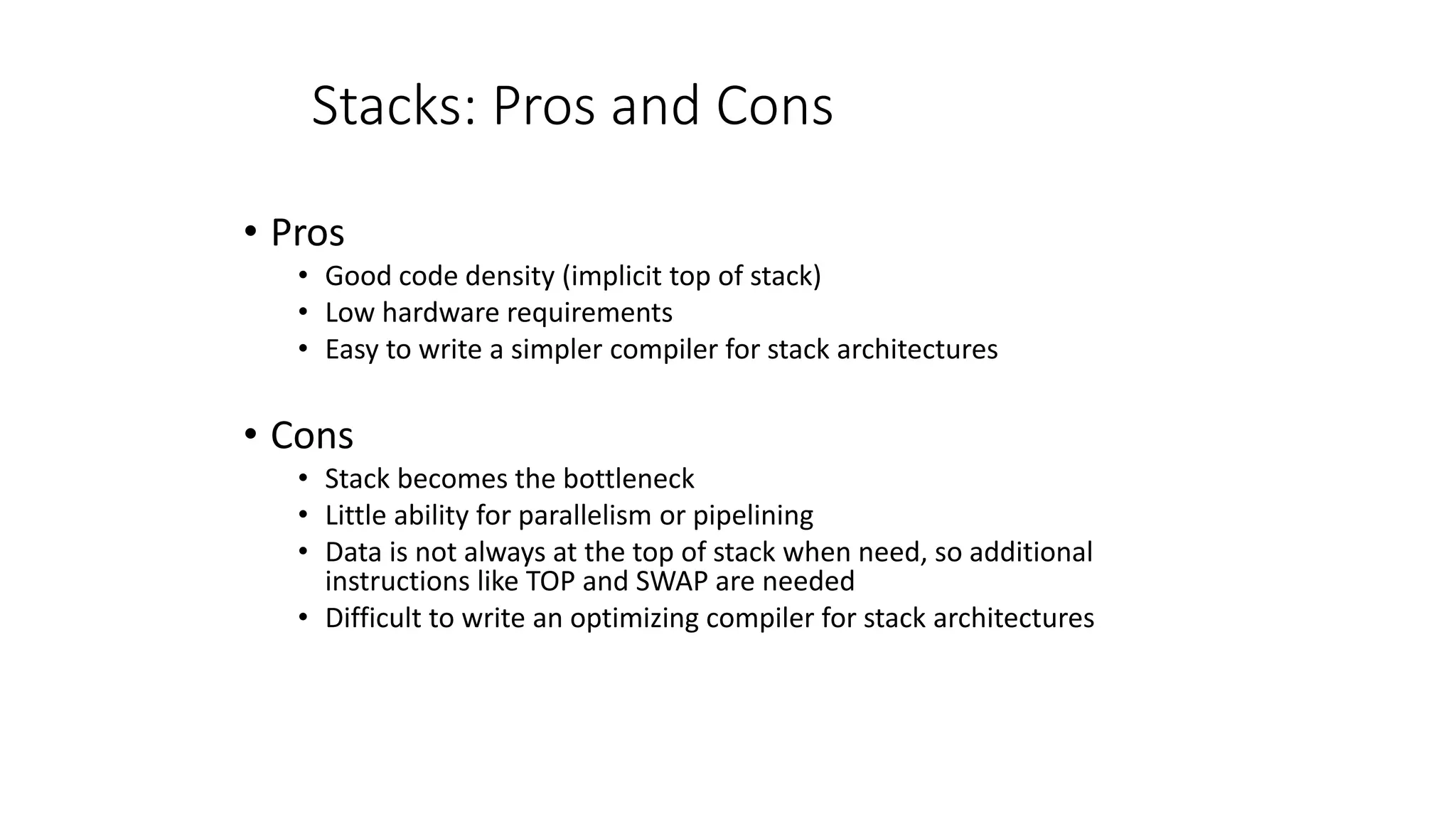
Stacks: Pros and Cons
• Pros
• Good code density (implicit top of stack)
• Low hardware requirements
• Easy to write a simpler compiler for stack architectures
• Cons
• Stack becomes the bottleneck
• Little ability for parallelism or pipelining
• Data is not always at the top of stack when need, so additional
instructions like TOP and SWAP are needed
• Difficult to write an optimizing compiler for stack architectures
Accumulator Architectures
• Instruction set:
add A, sub A, mult A, div A, . . .
load A, store A
• Example: A*B - (A+C*B)
load B
mul C
add A
store D
load A
mul B
sub D
B B*C A+B*C AA+B*C A*B result
acc = acc +,-,*,/ mem[A]
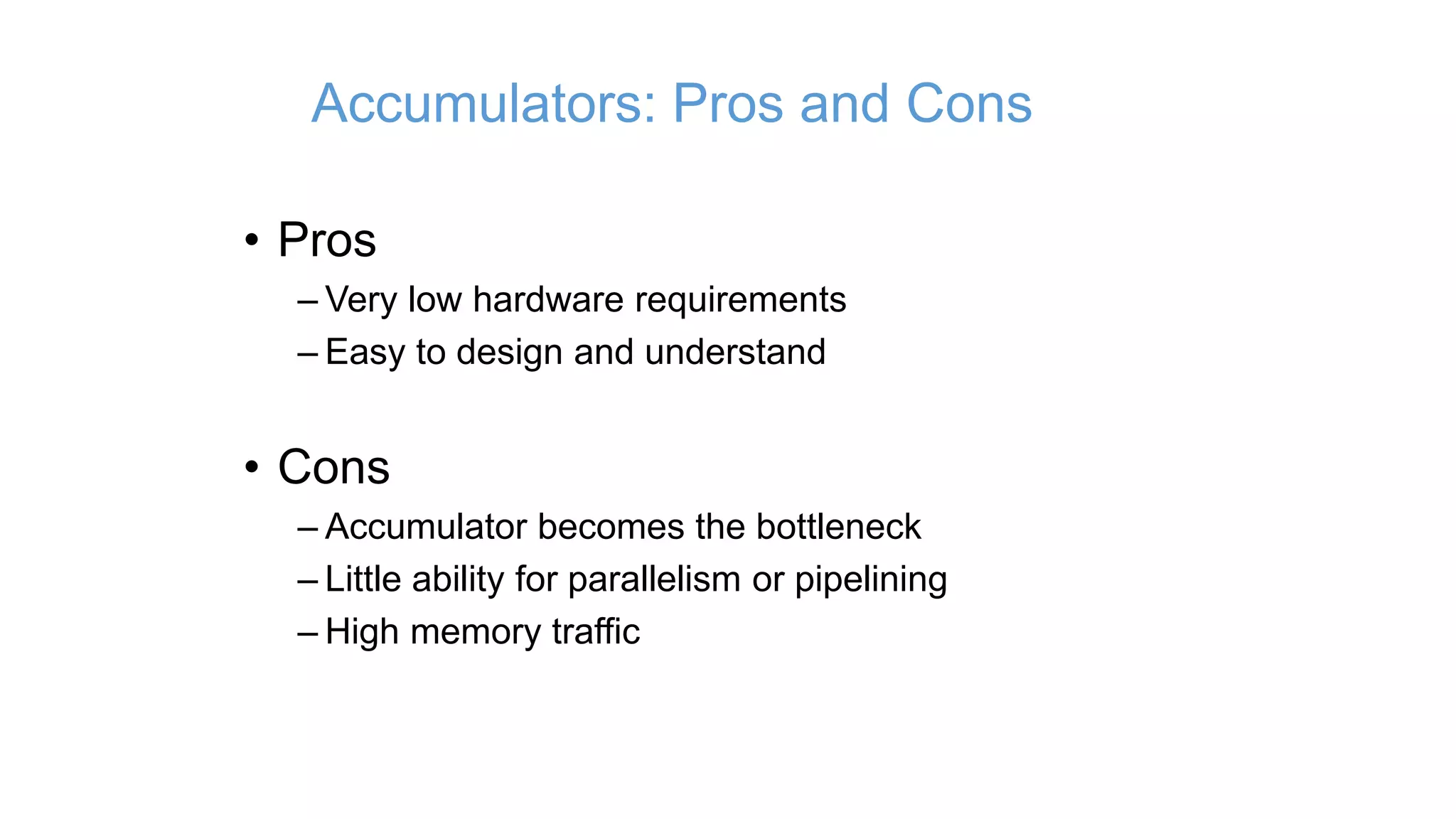
Accumulators: Pros and Cons
• Pros
– Very low hardware requirements
– Easy to design and understand
• Cons
– Accumulator becomes the bottleneck
– Little ability for parallelism or pipelining
– High memory traffic
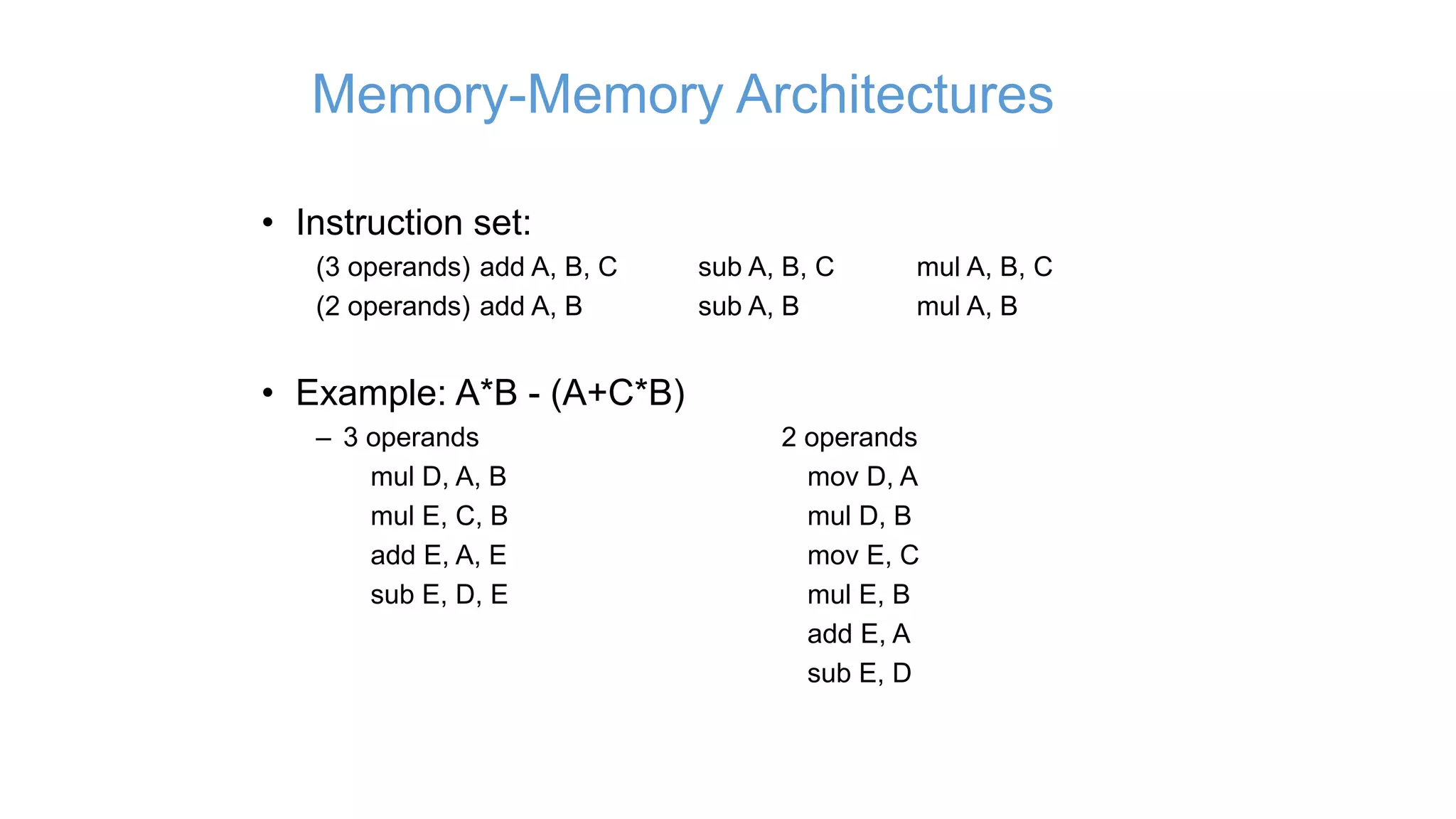
Memory-Memory Architectures
• Instruction set:
(3 operands) add A, B, C sub A, B, C mul A, B, C
(2 operands) add A, B sub A, B mul A, B
• Example: A*B - (A+C*B)
– 3 operands 2 operands
mul D, A, B mov D, A
mul E, C, B mul D, B
add E, A, E mov E, C
sub E, D, E mul E, B
add E, A
sub E, D
Memory-Memory:
Pros and Cons
• Pros
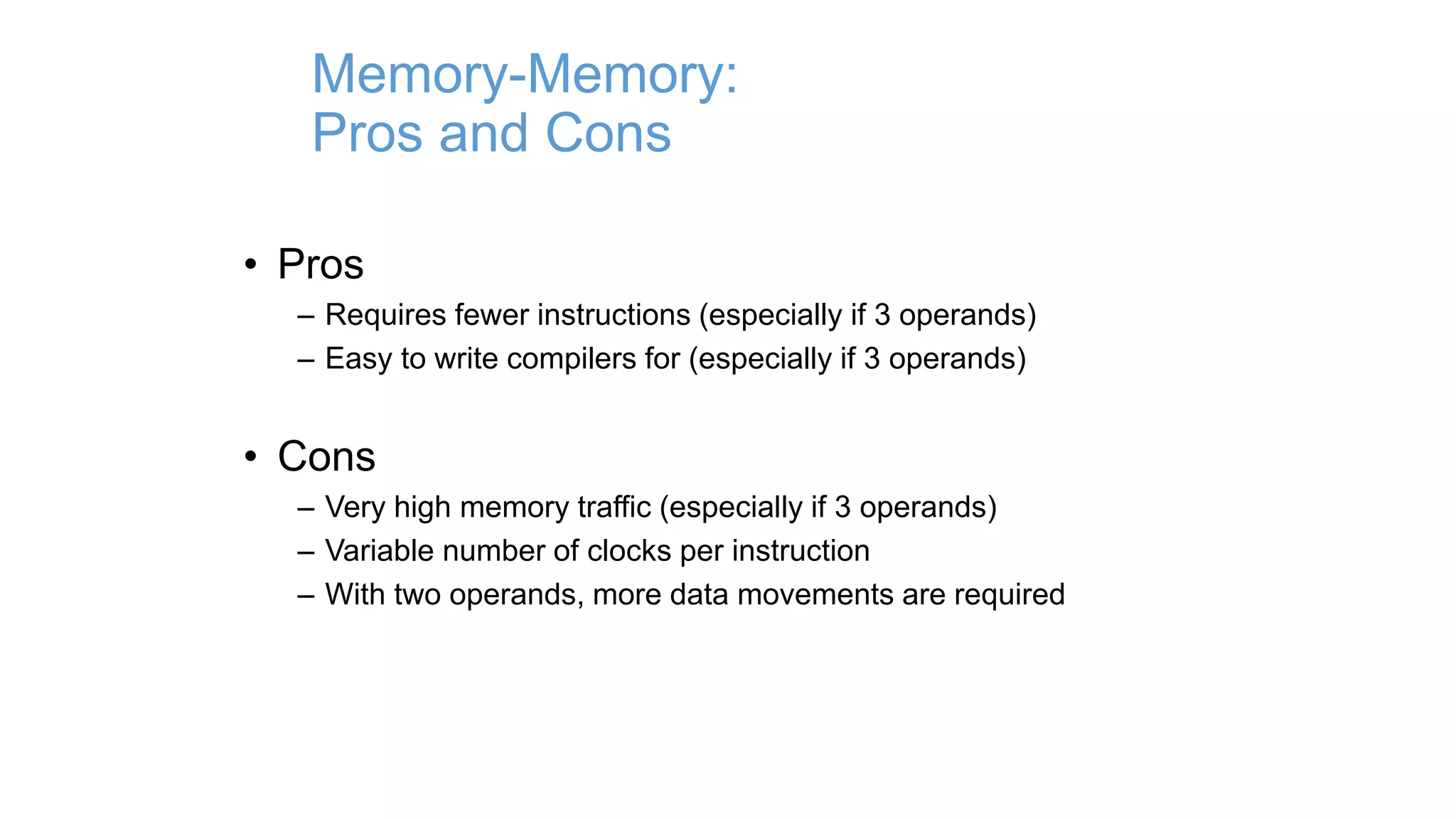
– Requires fewer instructions (especially if 3 operands)
– Easy to write compilers for (especially if 3 operands)
• Cons
– Very high memory traffic (especially if 3 operands)
– Variable number of clocks per instruction
– With two operands, more data movements are required
Register-Memory Architectures
• Instruction set:
add R1, A sub R1, A mul R1, B
load R1, A store R1, A
• Example: A*B - (A+C*B)
load R1, A
mul R1, B /* A*B */
store R1, D
load R2, C
mul R2, B /* C*B */
add R2, A /* A + CB */
sub R2, D /* AB - (A + C*B) */
R1 = R1 +,-,*,/ mem[B]
Memory-Register:
Pros and Cons
• Pros
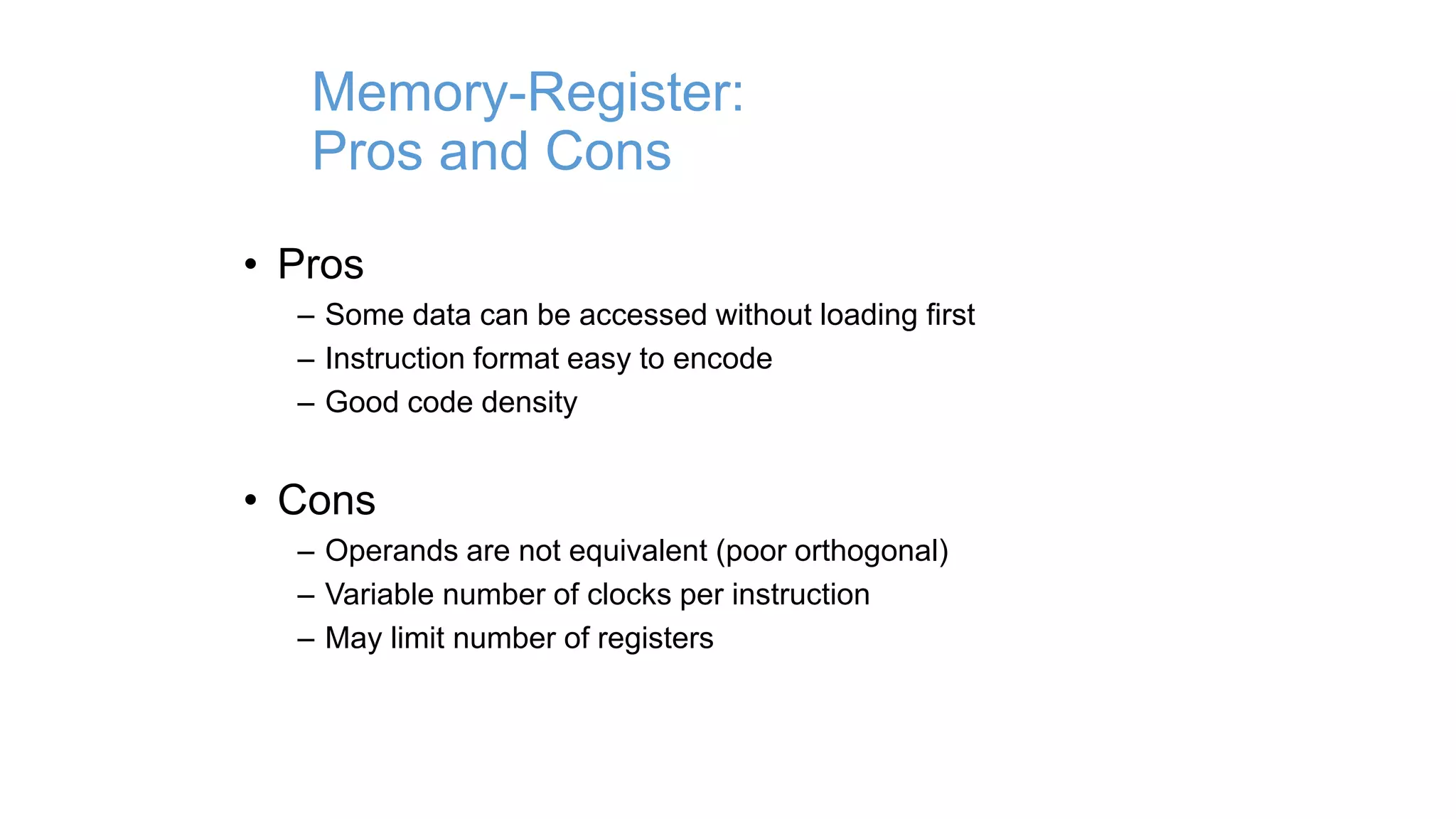
– Some data can be accessed without loading first
– Instruction format easy to encode
– Good code density
• Cons
– Operands are not equivalent (poor orthogonal)
– Variable number of clocks per instruction
– May limit number of registers
Load-Store Architectures
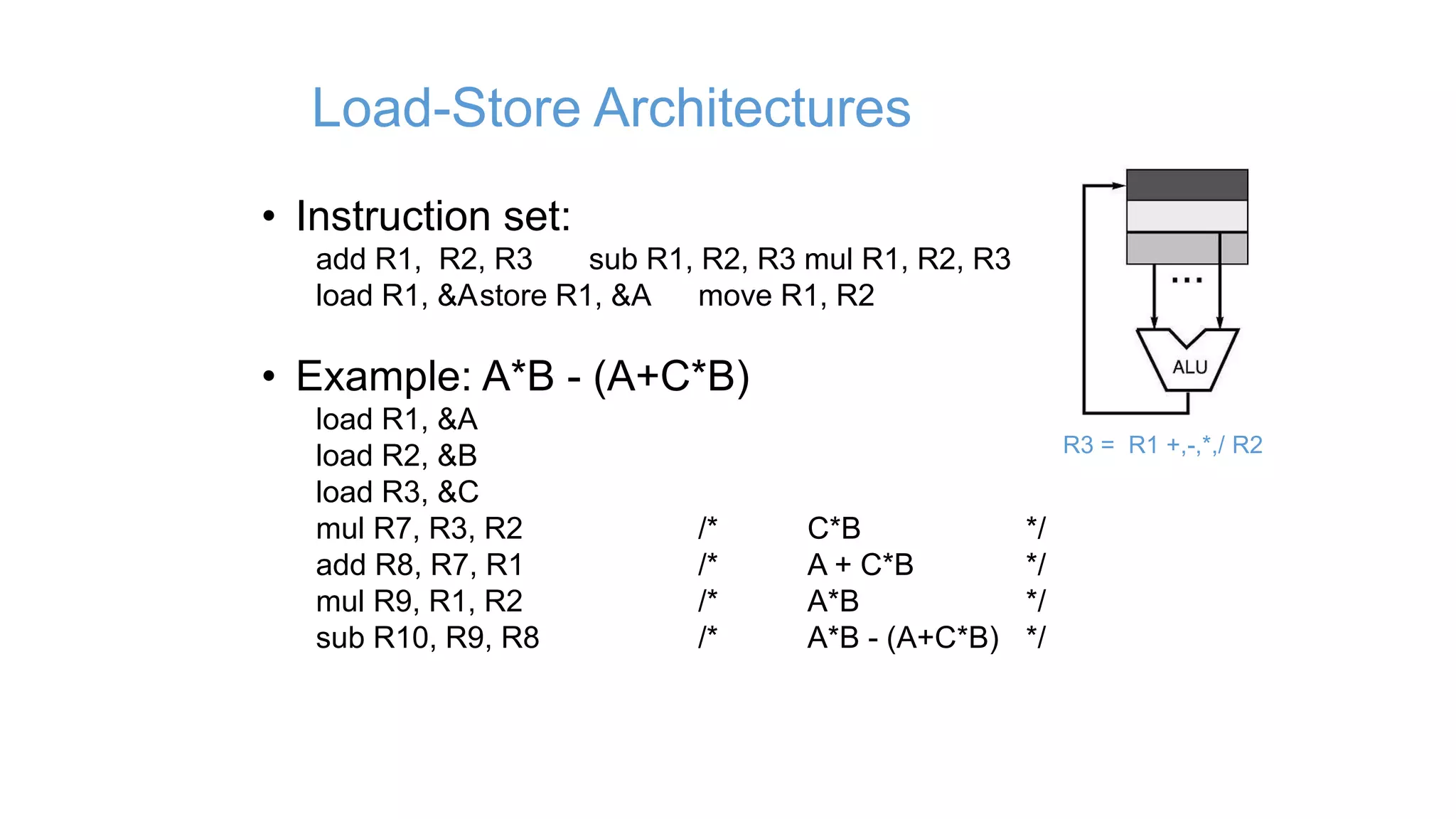
• Instruction set:
add R1, R2, R3 sub R1, R2, R3 mul R1, R2, R3
load R1, &Astore R1, &A move R1, R2
• Example: A*B - (A+C*B)
load R1, &A
load R2, &B
load R3, &C
mul R7, R3, R2 /* C*B */
add R8, R7, R1 /* A + C*B */
mul R9, R1, R2 /* A*B */
sub R10, R9, R8 /* A*B - (A+C*B) */
R3 = R1 +,-,*,/ R2
Load-Store:
Pros and Cons
• Pros
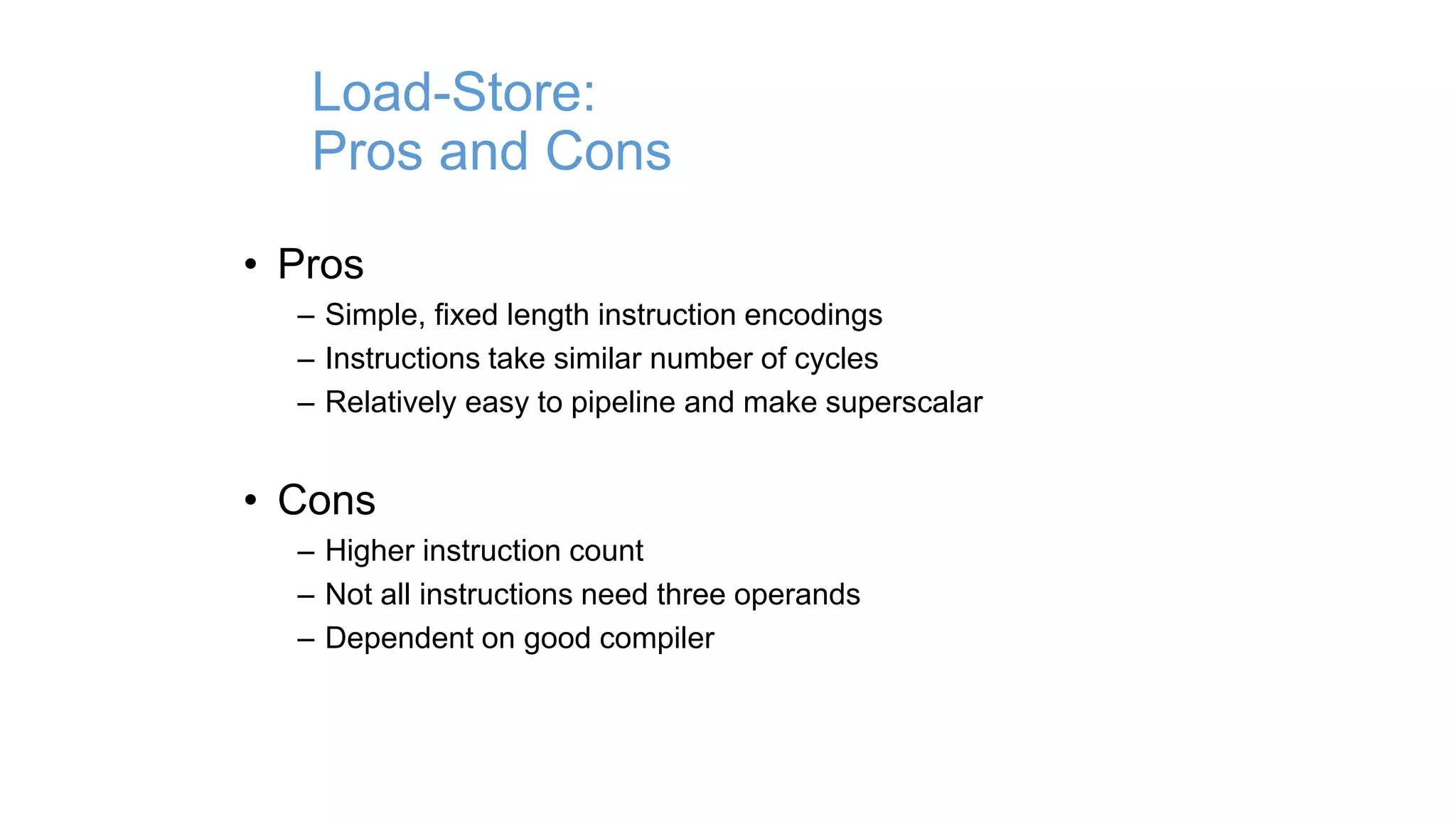
– Simple, fixed length instruction encodings
– Instructions take similar number of cycles
– Relatively easy to pipeline and make superscalar
• Cons
– Higher instruction count
– Not all instructions need three operands
– Dependent on good compiler
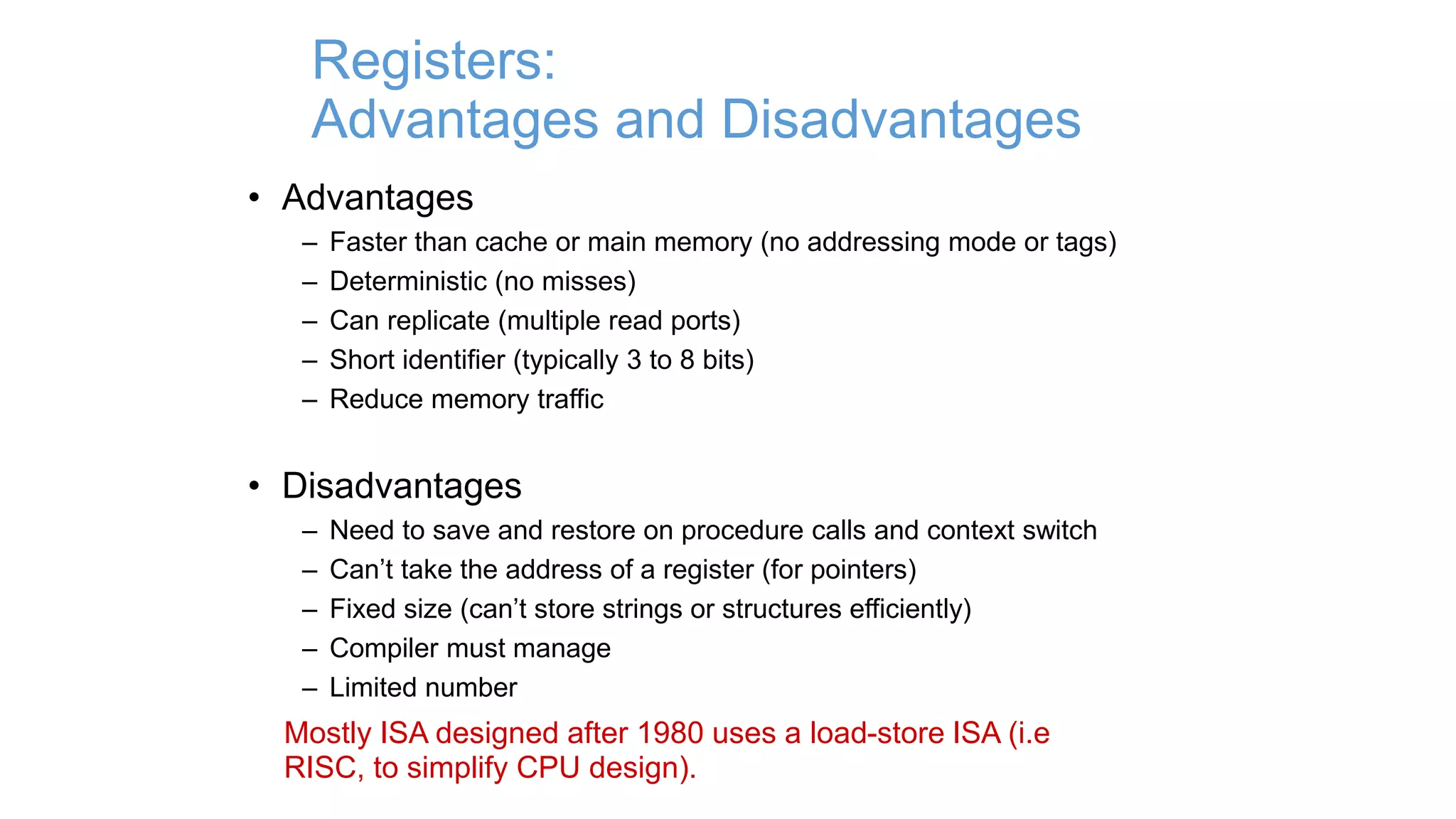
Registers:
Advantages and Disadvantages
• Advantages
– Faster than cache or main memory (no addressing mode or tags)
– Deterministic (no misses)
– Can replicate (multiple read ports)
– Short identifier (typically 3 to 8 bits)
– Reduce memory traffic
• Disadvantages
– Need to save and restore on procedure calls and context switch
– Can’t take the address of a register (for pointers)
– Fixed size (can’t store strings or structures efficiently)
– Compiler must manage
– Limited number
Mostly ISA designed after 1980 uses a load-store ISA (i.e
RISC, to simplify CPU design).
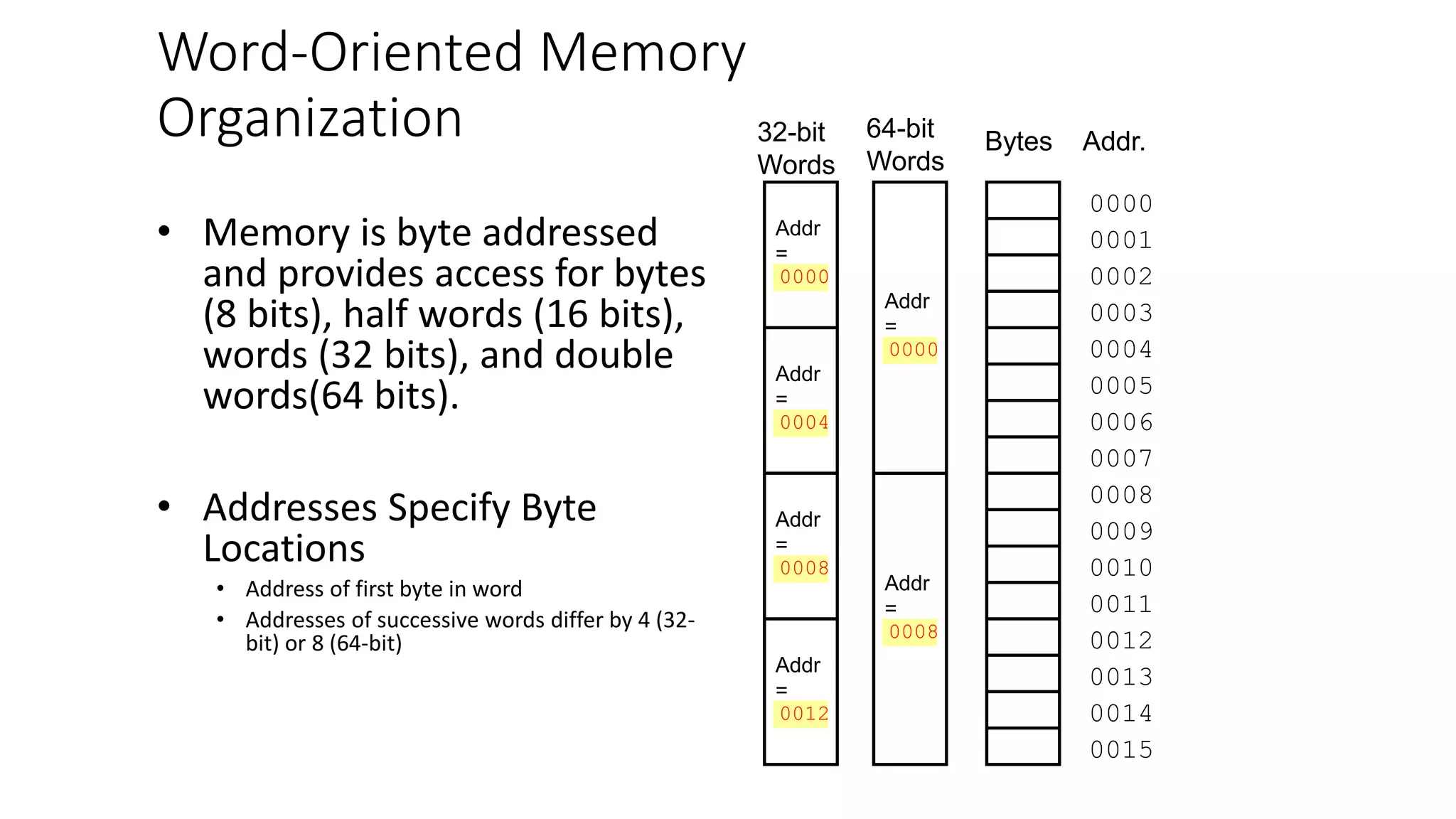
Word-Oriented Memory
Organization
• Memory is byte addressed
and provides access for bytes
(8 bits), half words (16 bits),
words (32 bits), and double
words(64 bits).
• Addresses Specify Byte
Locations
• Address of first byte in word
• Addresses of successive words differ by 4 (32-
bit) or 8 (64-bit)
0000
0001
0002
0003
0004
0005
0006
0007
0008
0009
0010
0011
32-bit
Words
Bytes Addr.
0012
0013
0014
0015
64-bit
Words
Addr
=
??
Addr
=
??
Addr
=
??
Addr
=
??
Addr
=
??
Addr
=
??
0000
0004
0008
0012
0000
0008
Byte Ordering
• How should bytes within multi-byte word be ordered in
memory?
• Conventions
• Sun’s, Mac’s are “Big Endian” machines
• Least significant byte has highest address
• Alphas, PC’s are “Little Endian” machines
• Least significant byte has lowest address
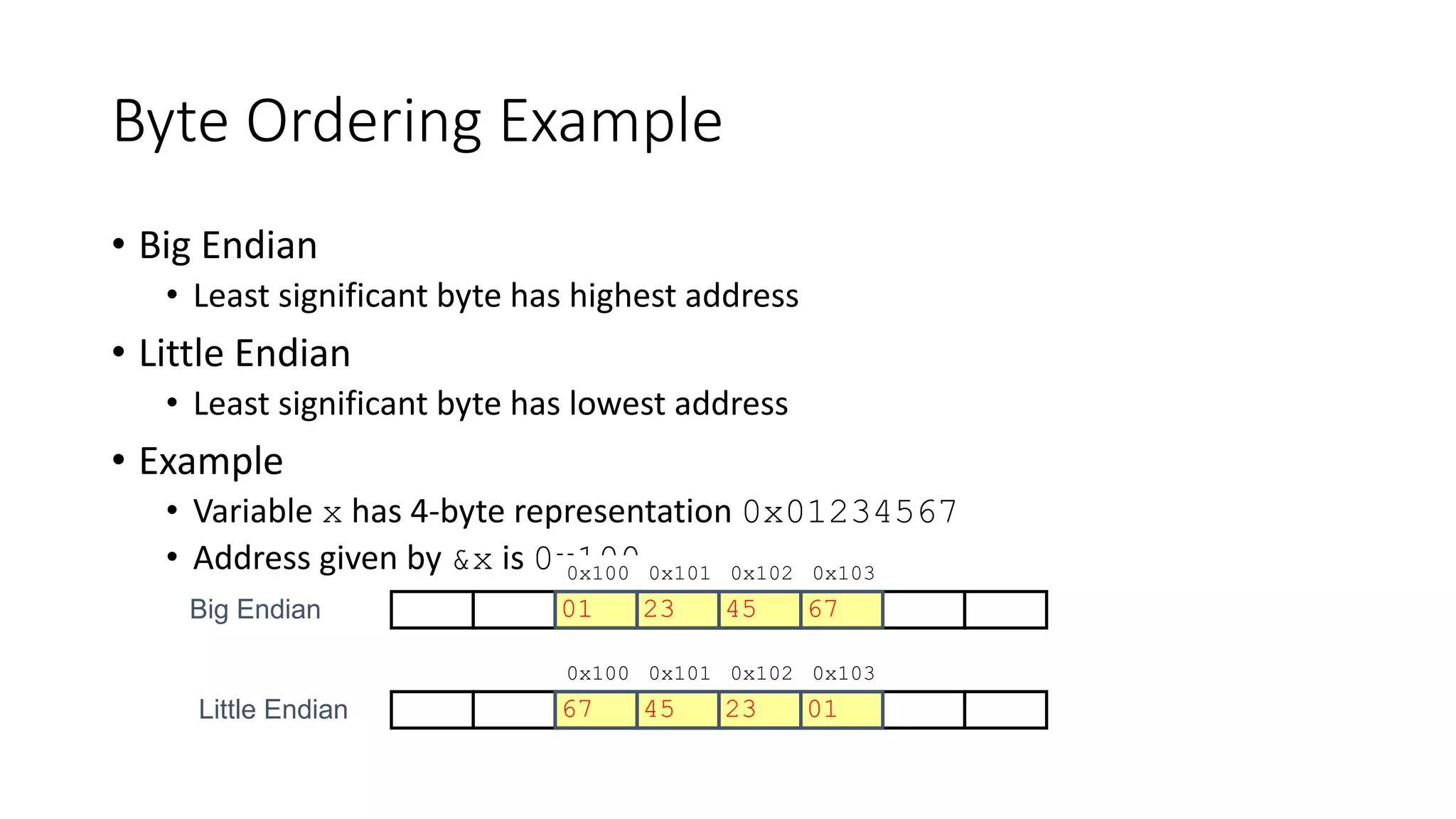
Byte Ordering Example
• Big Endian
• Least significant byte has highest address
• Little Endian
• Least significant byte has lowest address
• Example
• Variable x has 4-byte representation 0x01234567
• Address given by &x is 0x1000x100 0x101 0x102 0x103
01 23 45 67
0x100 0x101 0x102 0x103
67 45 23 01
Big Endian
Little Endian
01 23 45 67
67 45 23 01
Types of Addressing Modes (VAX)
Addressing Mode Example Action
1.Register direct Add R4, R3 R4 <- R4 + R3
2.Immediate Add R4, #3 R4 <- R4 + 3
3.Displacement Add R4, 100(R1) R4 <- R4 + M[100 + R1]
4.Register indirect Add R4, (R1) R4 <- R4 + M[R1]
5.Indexed Add R4, (R1 + R2) R4 <- R4 + M[R1 + R2]
6.Direct Add R4, (1000) R4 <- R4 + M[1000]
7.Memory Indirect Add R4, @(R3) R4 <- R4 + M[M[R3]]
8.Autoincrement Add R4, (R2)+ R4 <- R4 + M[R2]
R2 <- R2 + d
9.Autodecrement Add R4, (R2)- R4 <- R4 + M[R2]
R2 <- R2 - d
10. Scaled Add R4, 100(R2)[R3] R4 <- R4 +
M[100 + R2 + R3*d]
• Studies by [Clark and Emer] indicate that modes 1-4 account for 93% of
all operands on the VAX.
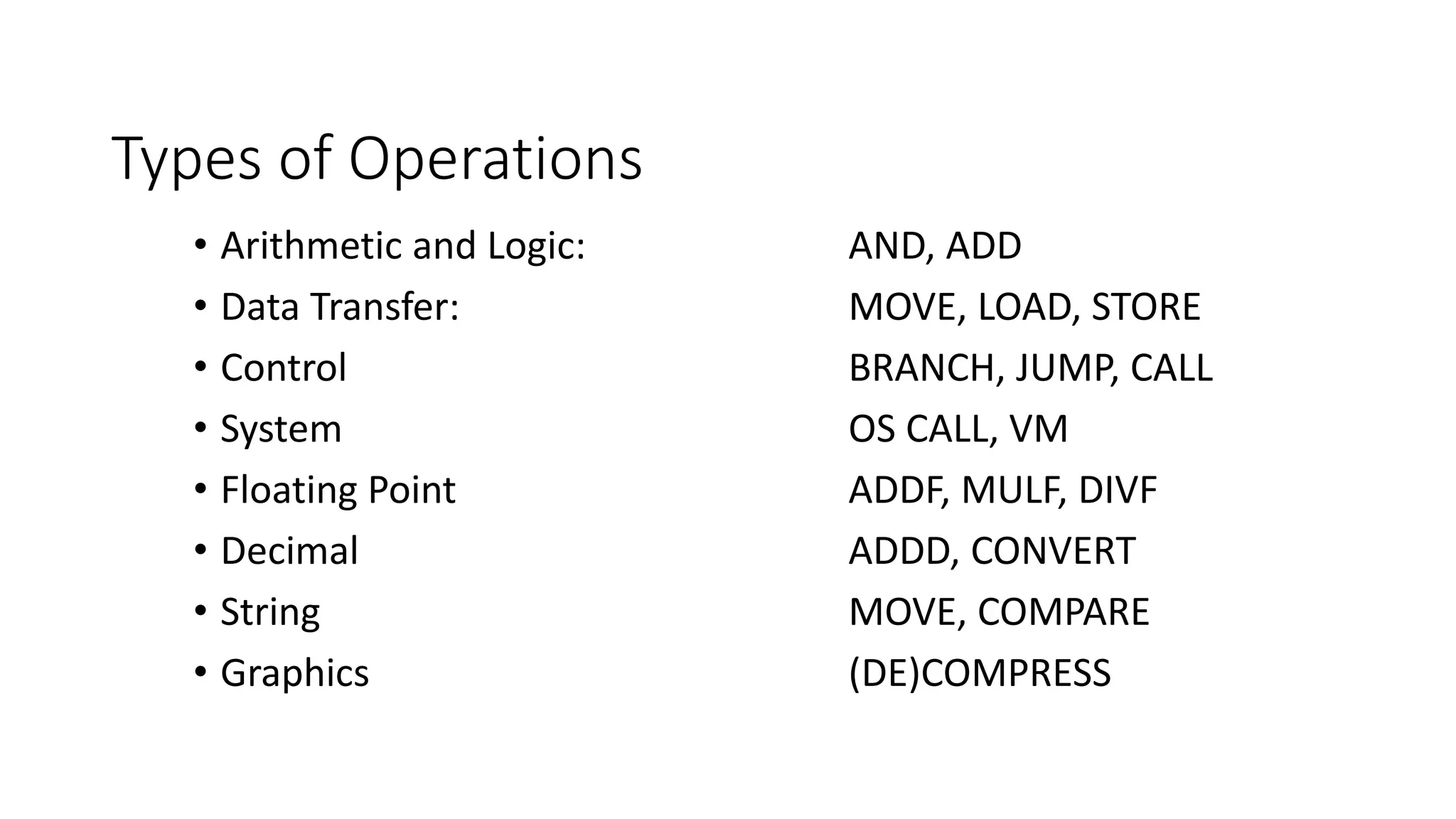
Types of Operations
• Arithmetic and Logic: AND, ADD
• Data Transfer: MOVE, LOAD, STORE
• Control BRANCH, JUMP, CALL
• System OS CALL, VM
• Floating Point ADDF, MULF, DIVF
• Decimal ADDD, CONVERT
• String MOVE, COMPARE
• Graphics (DE)COMPRESS
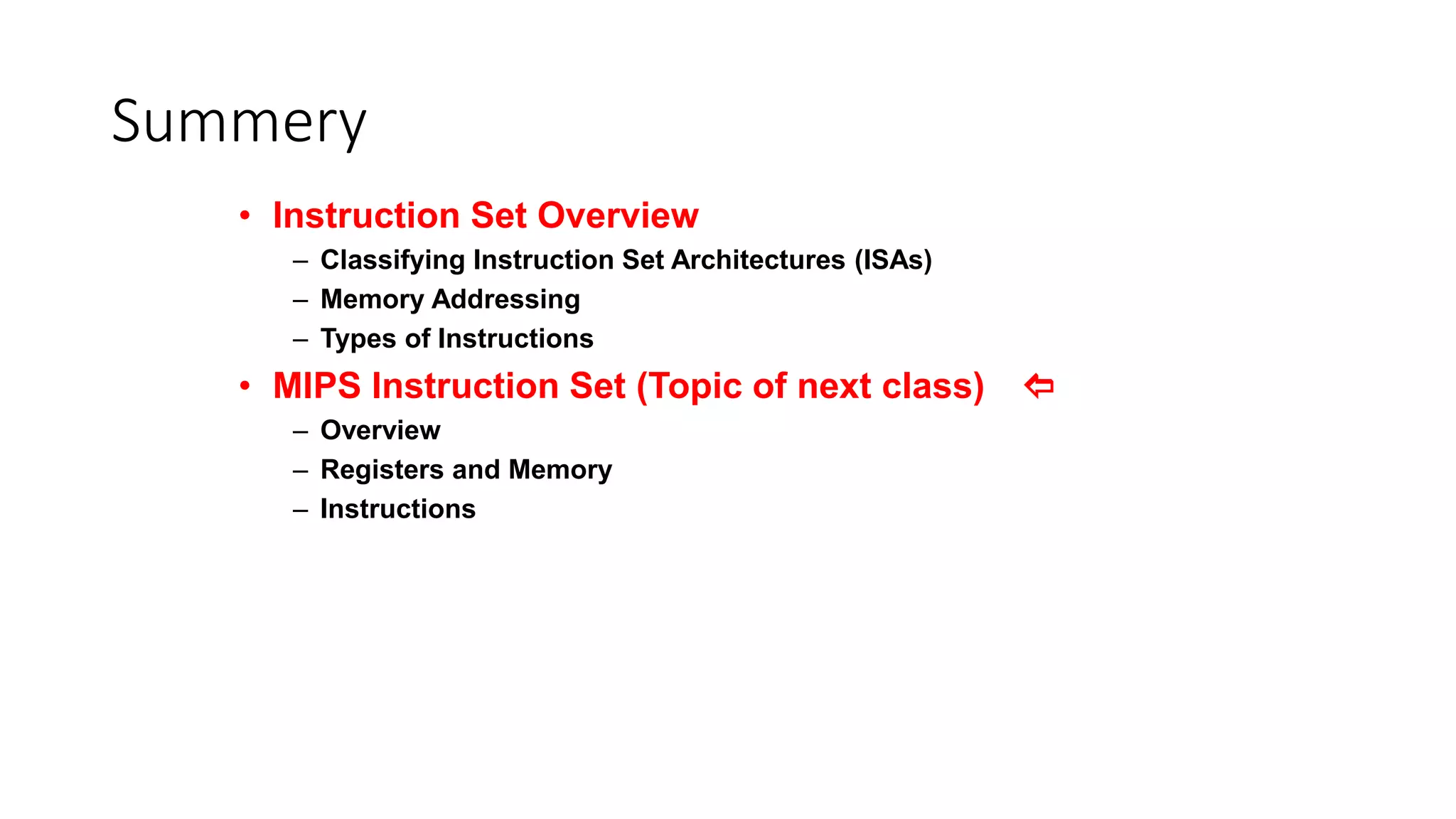
Summery
• Instruction Set Overview
– Classifying Instruction Set Architectures (ISAs)
– Memory Addressing
– Types of Instructions
• MIPS Instruction Set (Topic of next class) 
– Overview
– Registers and Memory
– Instructions
Coming up Next
Instructing Set Design Continue
MIPS Instruction Set (CASE Study)
C u ……. Take Care,,,

05 instruction set design and architecture

  • 1.
  • 2.
    Review • CPU Time& CPI: CPU time = Instruction count x CPI x clock cycle time CPU time = Instruction count x CPI / clock rate
  • 3.
    Outline • Instruction SetOverview • Classifying Instruction Set Architectures (ISAs) • Memory Addressing • Types of Instructions • MIPS Instruction Set Design (Topic of next lecture)
  • 8.
    Instruction Set Architecture(ISA) • Serves as an interface between software and hardware. • Provides a mechanism by which the software tells the hardware what should be done. instruction set High level language code : C, C++, Java, Fortran, hardware Assembly language code: architecture specific statements Machine language code: architecture specific bit patterns software compiler assembler
  • 9.
    Instruction Set DesignIssues • Instruction set design issues include: • Where are operands stored? • registers, memory, stack, accumulator • How many explicit operands are there? • 0, 1, 2, or 3 • How is the operand location specified? • register, immediate, indirect, . . . • What type & size of operands are supported? • byte, int, float, double, string, vector. . . • What operations are supported? • add, sub, mul, move, compare . . .
  • 10.
    Evolution of InstructionSets Single Accumulator (EDSAC 1950, Maurice Wilkes) Accumulator + Index Registers (Manchester Mark I, IBM 700 series 1953) Separation of Programming Model from Implementation High-level Language Based Concept of a Family (B5000 1963) (IBM 360 1964) General Purpose Register Machines Complex Instruction Sets Load/Store Architecture RISC (Vax, Intel 432 1977-80) (CDC 6600, Cray 1 1963-76) (MIPS,Sparc,HP-PA,IBM RS6000,PowerPC . . .1987) CISC Intel x86, Pentium
  • 11.
    Classifying ISAs Accumulator (before1960, e.g. 68HC11): 1-address add A acc acc + mem[A] Stack (1960s to 1970s): 0-address add tos tos + next Memory-Memory (1970s to 1980s): 2-address add A, B mem[A] mem[A] + mem[B] 3-address add A, B, C mem[A] mem[B] + mem[C] Register-Memory (1970s to present, e.g. 80x86): 2-address add R1, A R1 R1 + mem[A] load R1, A R1 mem[A] Register-Register (Load/Store) (1960s to present, e.g. MIPS): 3-address add R1, R2, R3 R1 R2 + R3 load R1, R2 R1 mem[R2] store R1, R2 mem[R1] R2
  • 12.
    Operand Locations inFour ISA Classes GPR
  • 13.
    Code Sequence C= A + B for Four Instruction Sets Stack Accumulator Register (register-memory) Register (load- store) Push A Push B Add Pop C Load A Add B Store C Load R1, A Add R1, B Store C, R1 Load R1,A Load R2, B Add R3, R1, R2 Store C, R3 memory memory acc = acc + mem[C] R1 = R1 + mem[C] R3 = R1 + R2
  • 15.
    Stack Architectures • Instructionset: add, sub, mult, div, . . . push A, pop A • Example: A*B - (A+C*B) push A push B mul push A push C push B mul add sub A B A A*B A*B A*B A*B A A C A*B A A*B A C B B*C A+B*C result
  • 16.
    Stacks: Pros andCons • Pros • Good code density (implicit top of stack) • Low hardware requirements • Easy to write a simpler compiler for stack architectures • Cons • Stack becomes the bottleneck • Little ability for parallelism or pipelining • Data is not always at the top of stack when need, so additional instructions like TOP and SWAP are needed • Difficult to write an optimizing compiler for stack architectures
  • 17.
    Accumulator Architectures • Instructionset: add A, sub A, mult A, div A, . . . load A, store A • Example: A*B - (A+C*B) load B mul C add A store D load A mul B sub D B B*C A+B*C AA+B*C A*B result acc = acc +,-,*,/ mem[A]
  • 18.
    Accumulators: Pros andCons • Pros – Very low hardware requirements – Easy to design and understand • Cons – Accumulator becomes the bottleneck – Little ability for parallelism or pipelining – High memory traffic
  • 19.
    Memory-Memory Architectures • Instructionset: (3 operands) add A, B, C sub A, B, C mul A, B, C (2 operands) add A, B sub A, B mul A, B • Example: A*B - (A+C*B) – 3 operands 2 operands mul D, A, B mov D, A mul E, C, B mul D, B add E, A, E mov E, C sub E, D, E mul E, B add E, A sub E, D
  • 20.
    Memory-Memory: Pros and Cons •Pros – Requires fewer instructions (especially if 3 operands) – Easy to write compilers for (especially if 3 operands) • Cons – Very high memory traffic (especially if 3 operands) – Variable number of clocks per instruction – With two operands, more data movements are required
  • 21.
    Register-Memory Architectures • Instructionset: add R1, A sub R1, A mul R1, B load R1, A store R1, A • Example: A*B - (A+C*B) load R1, A mul R1, B /* A*B */ store R1, D load R2, C mul R2, B /* C*B */ add R2, A /* A + CB */ sub R2, D /* AB - (A + C*B) */ R1 = R1 +,-,*,/ mem[B]
  • 22.
    Memory-Register: Pros and Cons •Pros – Some data can be accessed without loading first – Instruction format easy to encode – Good code density • Cons – Operands are not equivalent (poor orthogonal) – Variable number of clocks per instruction – May limit number of registers
  • 23.
    Load-Store Architectures • Instructionset: add R1, R2, R3 sub R1, R2, R3 mul R1, R2, R3 load R1, &Astore R1, &A move R1, R2 • Example: A*B - (A+C*B) load R1, &A load R2, &B load R3, &C mul R7, R3, R2 /* C*B */ add R8, R7, R1 /* A + C*B */ mul R9, R1, R2 /* A*B */ sub R10, R9, R8 /* A*B - (A+C*B) */ R3 = R1 +,-,*,/ R2
  • 24.
    Load-Store: Pros and Cons •Pros – Simple, fixed length instruction encodings – Instructions take similar number of cycles – Relatively easy to pipeline and make superscalar • Cons – Higher instruction count – Not all instructions need three operands – Dependent on good compiler
  • 25.
    Registers: Advantages and Disadvantages •Advantages – Faster than cache or main memory (no addressing mode or tags) – Deterministic (no misses) – Can replicate (multiple read ports) – Short identifier (typically 3 to 8 bits) – Reduce memory traffic • Disadvantages – Need to save and restore on procedure calls and context switch – Can’t take the address of a register (for pointers) – Fixed size (can’t store strings or structures efficiently) – Compiler must manage – Limited number Mostly ISA designed after 1980 uses a load-store ISA (i.e RISC, to simplify CPU design).
  • 26.
    Word-Oriented Memory Organization • Memoryis byte addressed and provides access for bytes (8 bits), half words (16 bits), words (32 bits), and double words(64 bits). • Addresses Specify Byte Locations • Address of first byte in word • Addresses of successive words differ by 4 (32- bit) or 8 (64-bit) 0000 0001 0002 0003 0004 0005 0006 0007 0008 0009 0010 0011 32-bit Words Bytes Addr. 0012 0013 0014 0015 64-bit Words Addr = ?? Addr = ?? Addr = ?? Addr = ?? Addr = ?? Addr = ?? 0000 0004 0008 0012 0000 0008
  • 27.
    Byte Ordering • Howshould bytes within multi-byte word be ordered in memory? • Conventions • Sun’s, Mac’s are “Big Endian” machines • Least significant byte has highest address • Alphas, PC’s are “Little Endian” machines • Least significant byte has lowest address
  • 28.
    Byte Ordering Example •Big Endian • Least significant byte has highest address • Little Endian • Least significant byte has lowest address • Example • Variable x has 4-byte representation 0x01234567 • Address given by &x is 0x1000x100 0x101 0x102 0x103 01 23 45 67 0x100 0x101 0x102 0x103 67 45 23 01 Big Endian Little Endian 01 23 45 67 67 45 23 01
  • 29.
    Types of AddressingModes (VAX) Addressing Mode Example Action 1.Register direct Add R4, R3 R4 <- R4 + R3 2.Immediate Add R4, #3 R4 <- R4 + 3 3.Displacement Add R4, 100(R1) R4 <- R4 + M[100 + R1] 4.Register indirect Add R4, (R1) R4 <- R4 + M[R1] 5.Indexed Add R4, (R1 + R2) R4 <- R4 + M[R1 + R2] 6.Direct Add R4, (1000) R4 <- R4 + M[1000] 7.Memory Indirect Add R4, @(R3) R4 <- R4 + M[M[R3]] 8.Autoincrement Add R4, (R2)+ R4 <- R4 + M[R2] R2 <- R2 + d 9.Autodecrement Add R4, (R2)- R4 <- R4 + M[R2] R2 <- R2 - d 10. Scaled Add R4, 100(R2)[R3] R4 <- R4 + M[100 + R2 + R3*d] • Studies by [Clark and Emer] indicate that modes 1-4 account for 93% of all operands on the VAX.
  • 30.
    Types of Operations •Arithmetic and Logic: AND, ADD • Data Transfer: MOVE, LOAD, STORE • Control BRANCH, JUMP, CALL • System OS CALL, VM • Floating Point ADDF, MULF, DIVF • Decimal ADDD, CONVERT • String MOVE, COMPARE • Graphics (DE)COMPRESS
  • 36.
    Summery • Instruction SetOverview – Classifying Instruction Set Architectures (ISAs) – Memory Addressing – Types of Instructions • MIPS Instruction Set (Topic of next class) – Overview – Registers and Memory – Instructions
  • 37.
    Coming up Next InstructingSet Design Continue MIPS Instruction Set (CASE Study) C u ……. Take Care,,,