




1

Sustainable Development and
   Competitive Advantage

           Unit 5:


Sustainable Development
       Indicators


          © Jeremy B Williams 2012
2


               Outline
1) An introduction to indicators
2) The Bellagio Principles
3) Macro measures of sustainability
4) Corporate measures
5) The credibility of sustainability
   reporting
6) Summary and conclusions


               © Jeremy B Williams 2012
3


     1) AN INTRODUCTION TO
           INDICATORS
• Indicators help us to quantify and simplify
  phenomena in order to better understand
  the complexity of reality

• They give historical perspective of the
  current state of affairs and clues as to the
  likely direction of change in these affairs
  into the future.
                   © Jeremy B Williams 2012
4


      Are all indicators useful?
• There are occasions where indicators are used
  frequently but inappropriately

• The use of the rate of GDP growth as a measure of
  the change in value of national output of goods
  and services from year to year is perfectly valid

• It is less appropriate to use such an index to make
  judgements about the level of societal welfare.


                    © Jeremy B Williams 2012
5


     GDP and its detractors…
  ‘If a truckload of toxic chemicals spills somewhere, the
 money spent cleaning it up is added to the GDP. If nearby
  residents can no longer use their wells for water, their
  expenditures on bottled water is added to GDP. If they
become sick from exposure to the substance, their medical
costs are also added to the official measure of well-being’.


                     Mike Nickerson, The Sustainability
                                 Project, Ontario, 1997
                              Source:http://www.foe.co.uk/campaigns/sustainable_development/progress/annex1.html


                      © Jeremy B Williams 2012
6


                   GDP and its detractors…

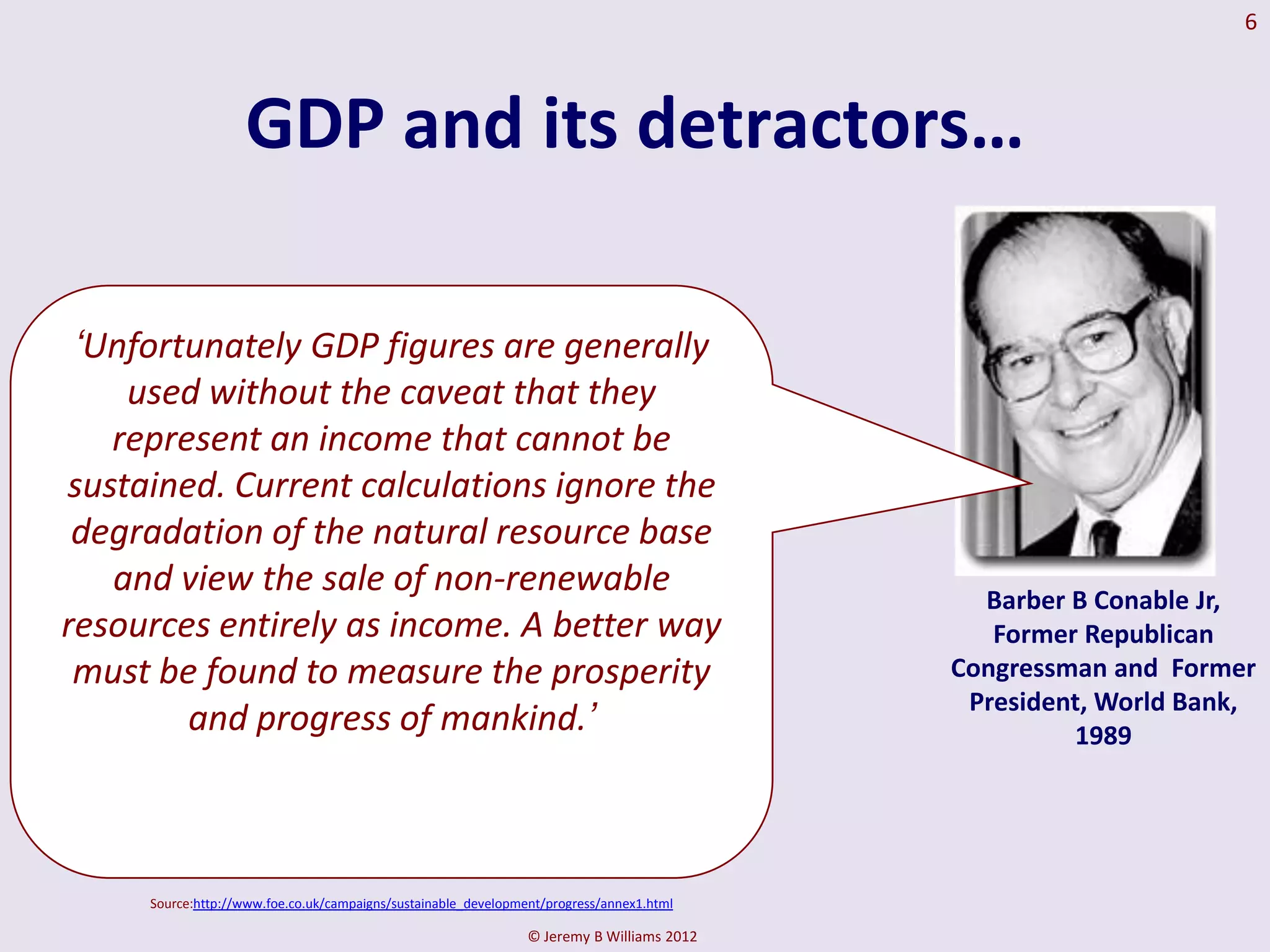
 ‘Unfortunately GDP figures are generally
    used without the caveat that they
   represent an income that cannot be
sustained. Current calculations ignore the
 degradation of the natural resource base
   and view the sale of non-renewable                                                        Barber B Conable Jr,
resources entirely as income. A better way                                                    Former Republican
 must be found to measure the prosperity                                                   Congressman and Former
                                                                                            President, World Bank,
        and progress of mankind.’                                                                   1989


     Source:http://www.foe.co.uk/campaigns/sustainable_development/progress/annex1.html

                                                                © Jeremy B Williams 2012
7


GDP and its detractors…
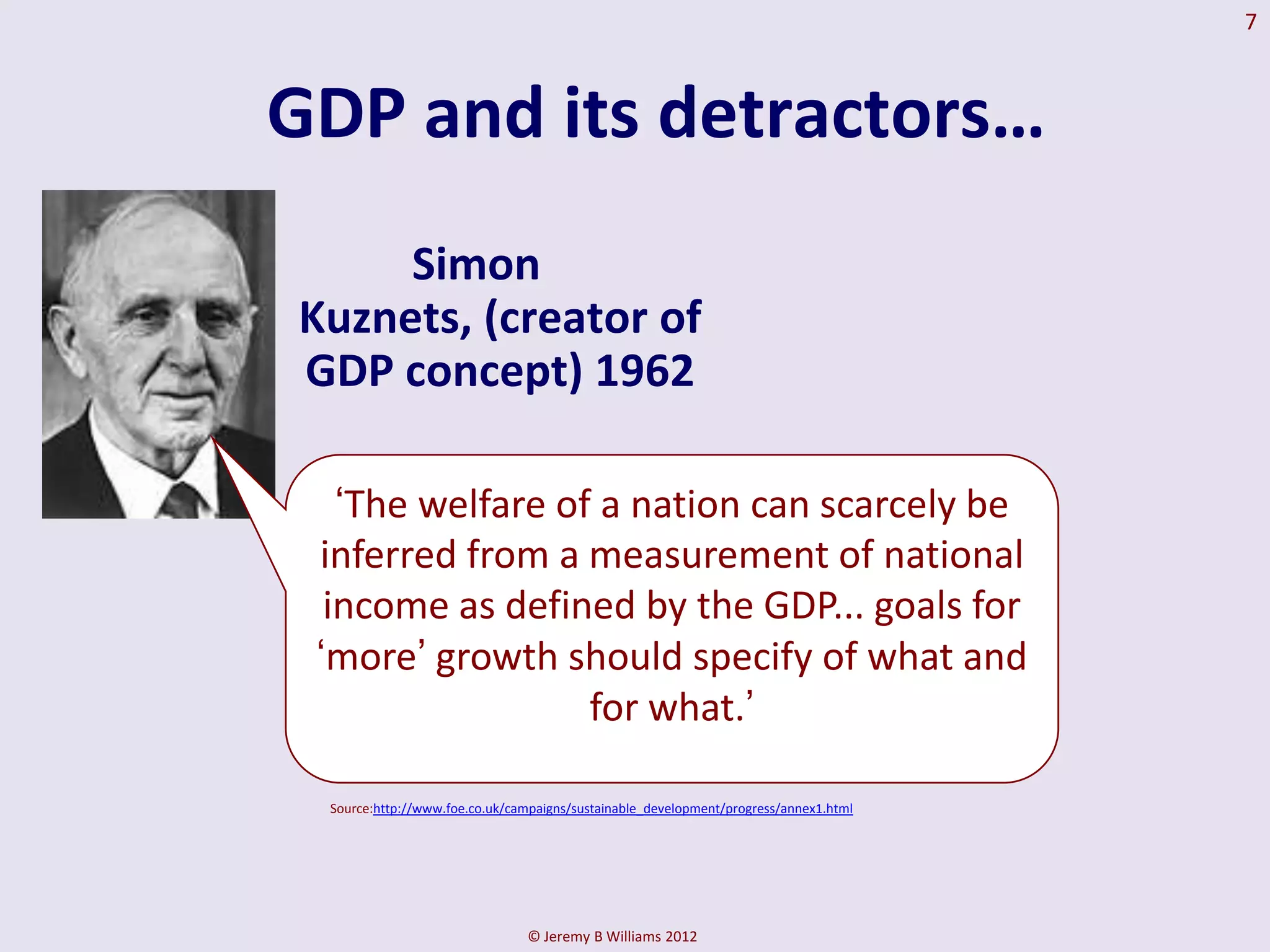
     Simon
Kuznets, (creator of
GDP concept) 1962

   „The welfare of a nation can scarcely be
 inferred from a measurement of national
  income as defined by the GDP... goals for
 „more‟ growth should specify of what and
                  for what.‟

 Source:http://www.foe.co.uk/campaigns/sustainable_development/progress/annex1.html


                               © Jeremy B Williams 2012
8


  Criticisms of GDP as an indicator of
          economic well-being
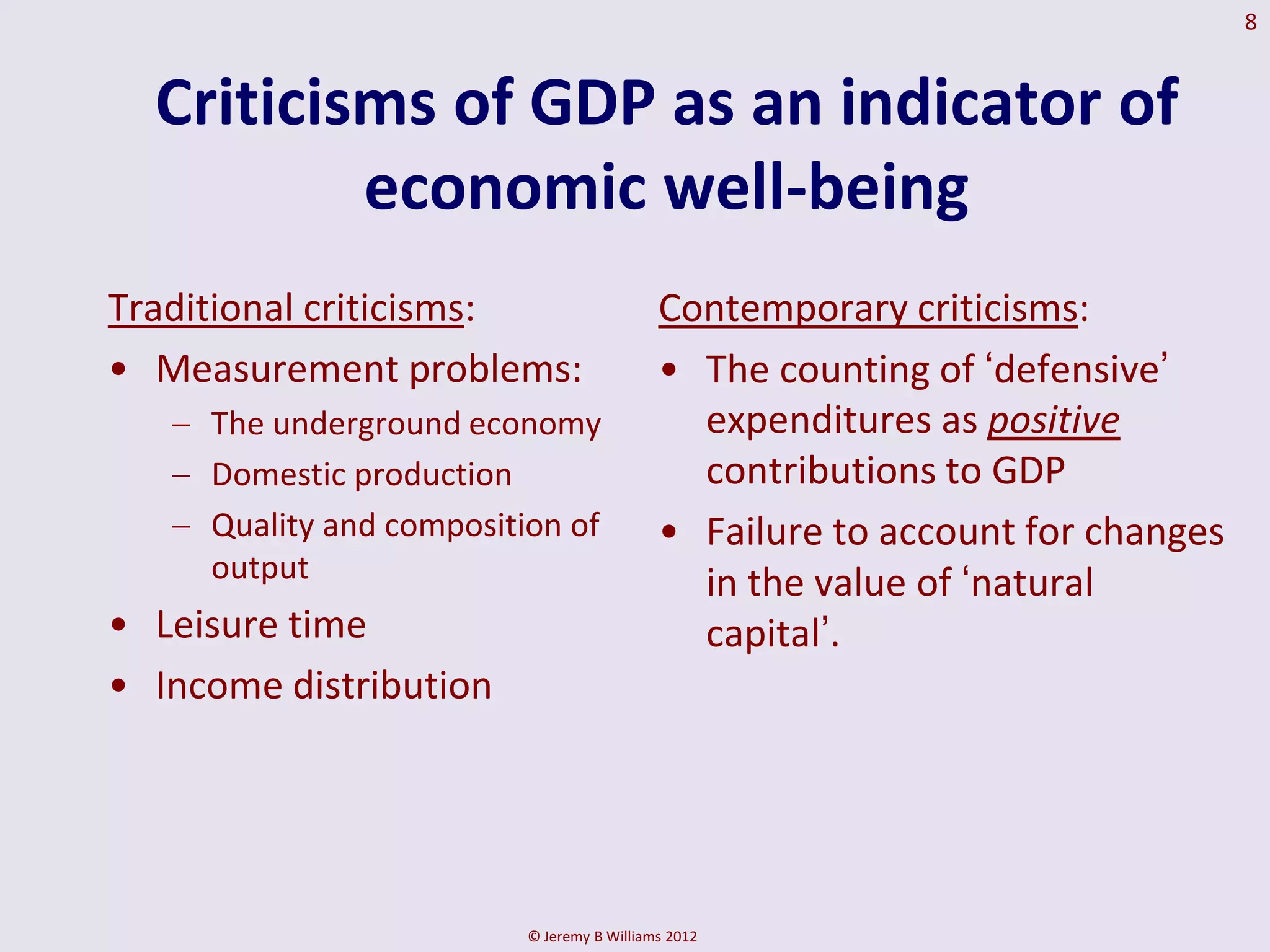
Traditional criticisms:                     Contemporary criticisms:
• Measurement problems:                     • The counting of „defensive‟
     The underground economy                  expenditures as positive
     Domestic production                      contributions to GDP
     Quality and composition of             • Failure to account for changes
     output                                   in the value of „natural
• Leisure time                                capital‟.
• Income distribution


                          © Jeremy B Williams 2012
9

           So what makes a good
          sustainability indicator?
• A key element in the design of a sustainability indicator is to have
  an appreciation of the values, goals and aspirations of the target
  audience

• This indicator will provide useful feedback on issues the
  community knows about, but it will also provide information
  about issues that are central to sustainable development, yet
  poorly understood; e.g. ecosystem health and how this might
  impact on human health

• Different communities will have much in common, but sometimes
  this commonality might manifest itself in different ways.


                             © Jeremy B Williams 2012
10

   Balance between general and
          specific criteria
• Indicators will be selected based on general selection
  criteria (e.g. simplicity, validity, time-series data,
  affordability of data, ability to aggregate information,
  sensitivity and reliability), but also on the basis of
  context-specific conditions

• Sustainability practitioners must avoid falling into the
  same trap as the national income accountants – a
  careful selection process is required to determine the
  indicator that is most relevant to a given context (i.e.
  region, economic sector, institution)

                      © Jeremy B Williams 2012
11

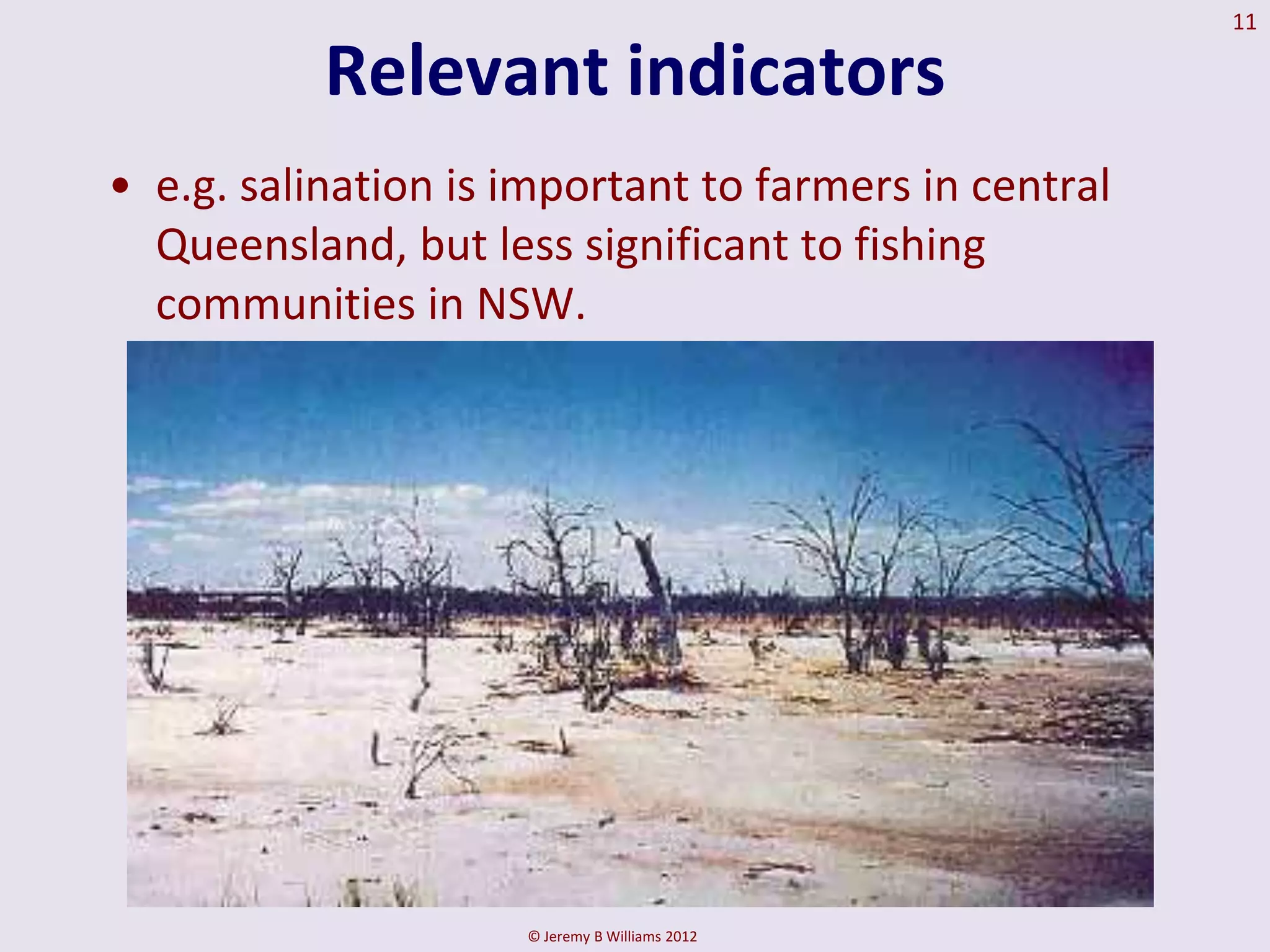
           Relevant indicators
• e.g. salination is important to farmers in central
  Queensland, but less significant to fishing
  communities in NSW.


                     © Jeremy B Williams 2012
12


 The evolution of sustainability
         of indicators
• Early efforts at
  sustainability
  reporting followed the
  Brundtland Report in
  the shape of national
  State of the
  Environment (SoE)
  reports using the
  DPSIR model


                    © Jeremy B Williams 2012
13


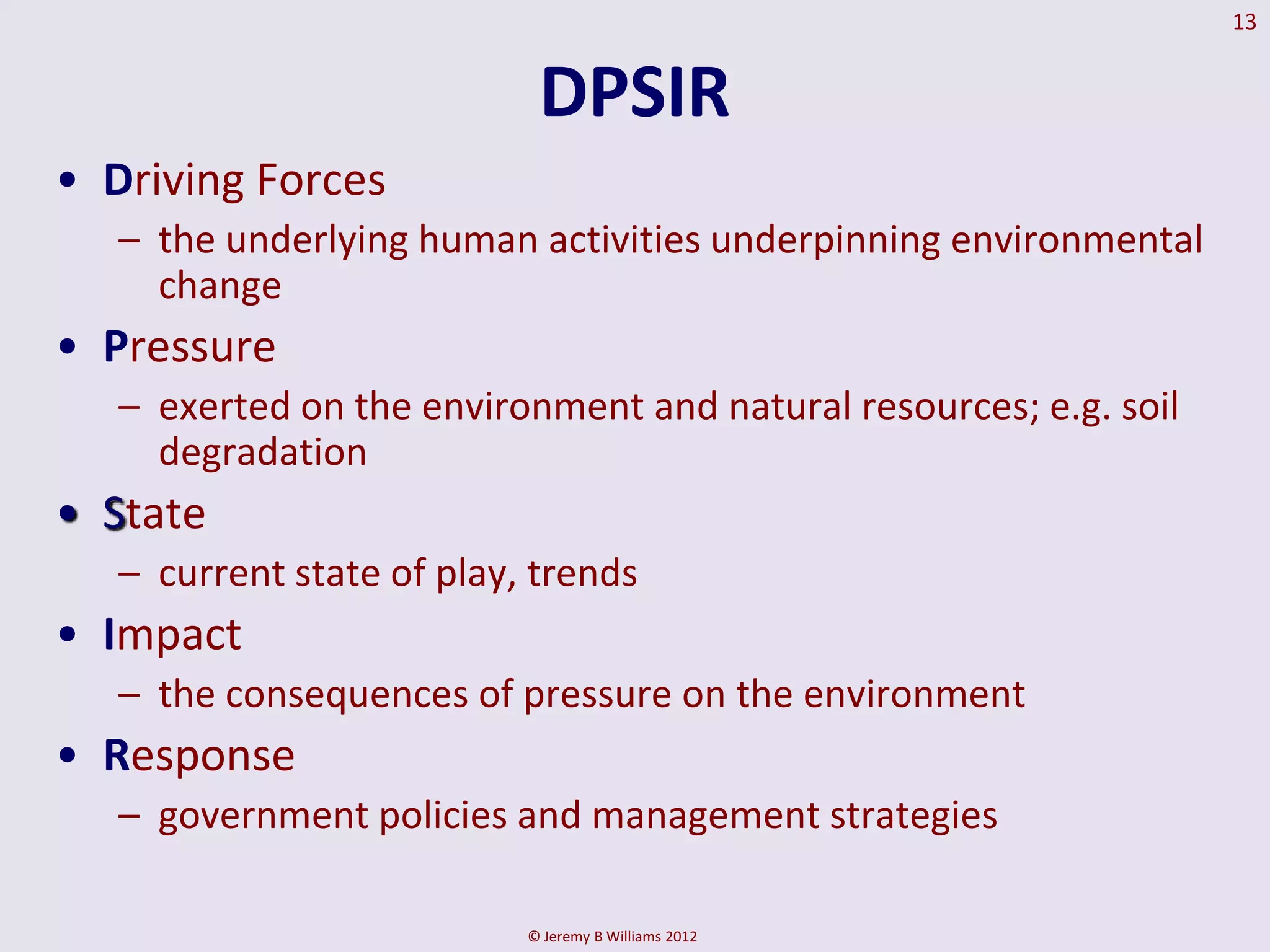
                            DPSIR
• Driving Forces
   – the underlying human activities underpinning environmental
     change
• Pressure
   – exerted on the environment and natural resources; e.g. soil
     degradation
• State
   – current state of play, trends
• Impact
   – the consequences of pressure on the environment
• Response
   – government policies and management strategies

                           © Jeremy B Williams 2012
14


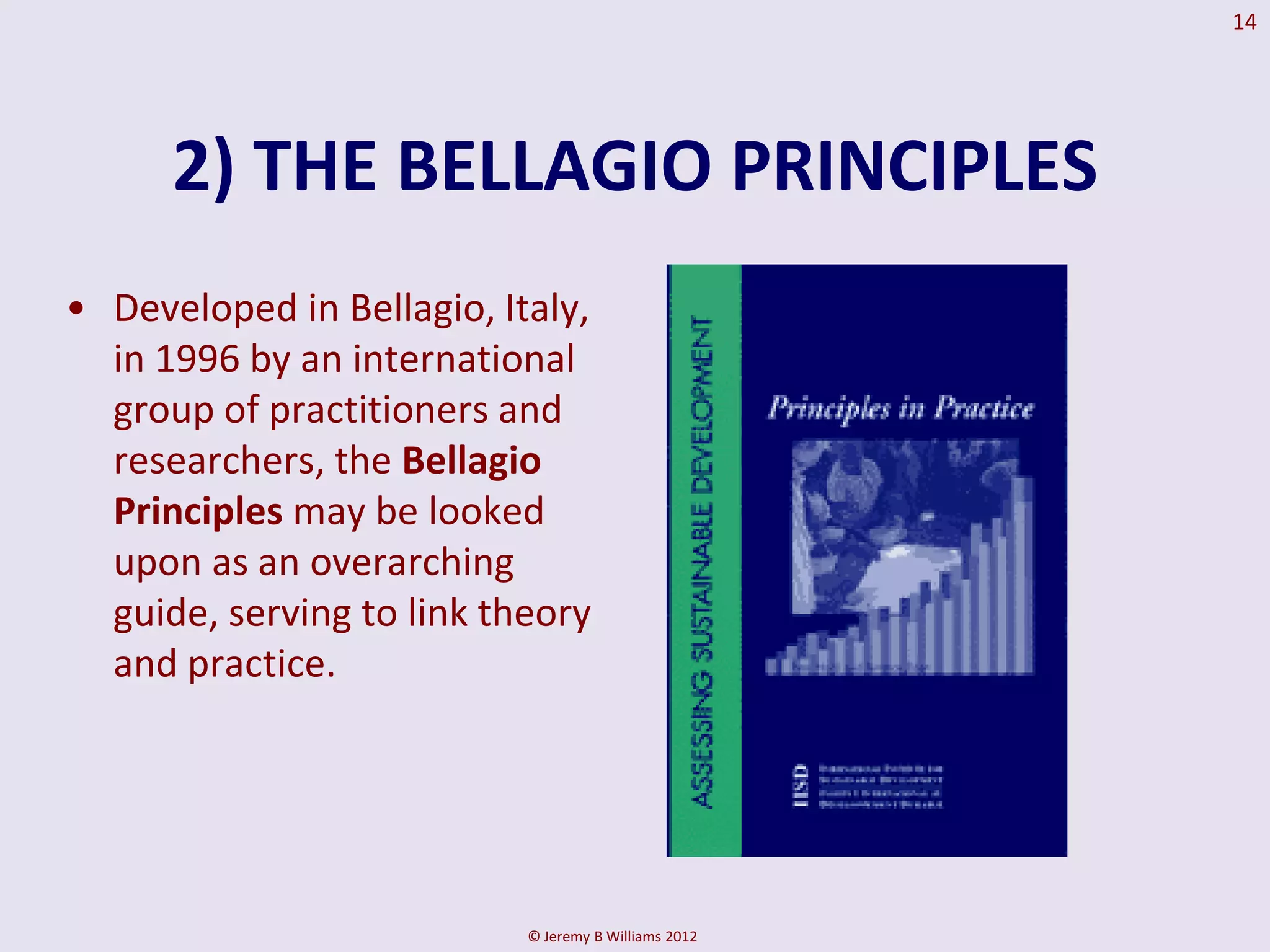
      2) THE BELLAGIO PRINCIPLES
• Developed in Bellagio, Italy,
  in 1996 by an international
  group of practitioners and
  researchers, the Bellagio
  Principles may be looked
  upon as an overarching
  guide, serving to link theory
  and practice.


                           © Jeremy B Williams 2012
15


    Overview of the 10 Principles
• The principles focus on the assessment of progress toward
  sustainability in 4 areas:
• Principle 1: a vision of sustainable development and clear
  goals that provide a practical definition of that vision
• Principles 2 – 5: deal with the content of any assessment and
  the need to merge a sense of the overall system with a
  practical focus on current priority issues
• Principles 6 – 8: deal with key issues of the process of
  assessment
• Principles 9 & 10: deal with the necessity of establishing a
  continuing capacity for assessment.


   Source: http://www.iisd.org/measure/principles/bp.asp


                                                           © Jeremy B Williams 2012
16


     3) MACRO MEASURES OF
         SUSTAINABILITY
• Leading examples include:
   – UN Human Development Index (HDI)
   – Genuine Progress Indicator (GPI)
   – Index of Sustainable Economic Welfare
     (ISEW)
   – Ecological Footprint


                 © Jeremy B Williams 2012
17
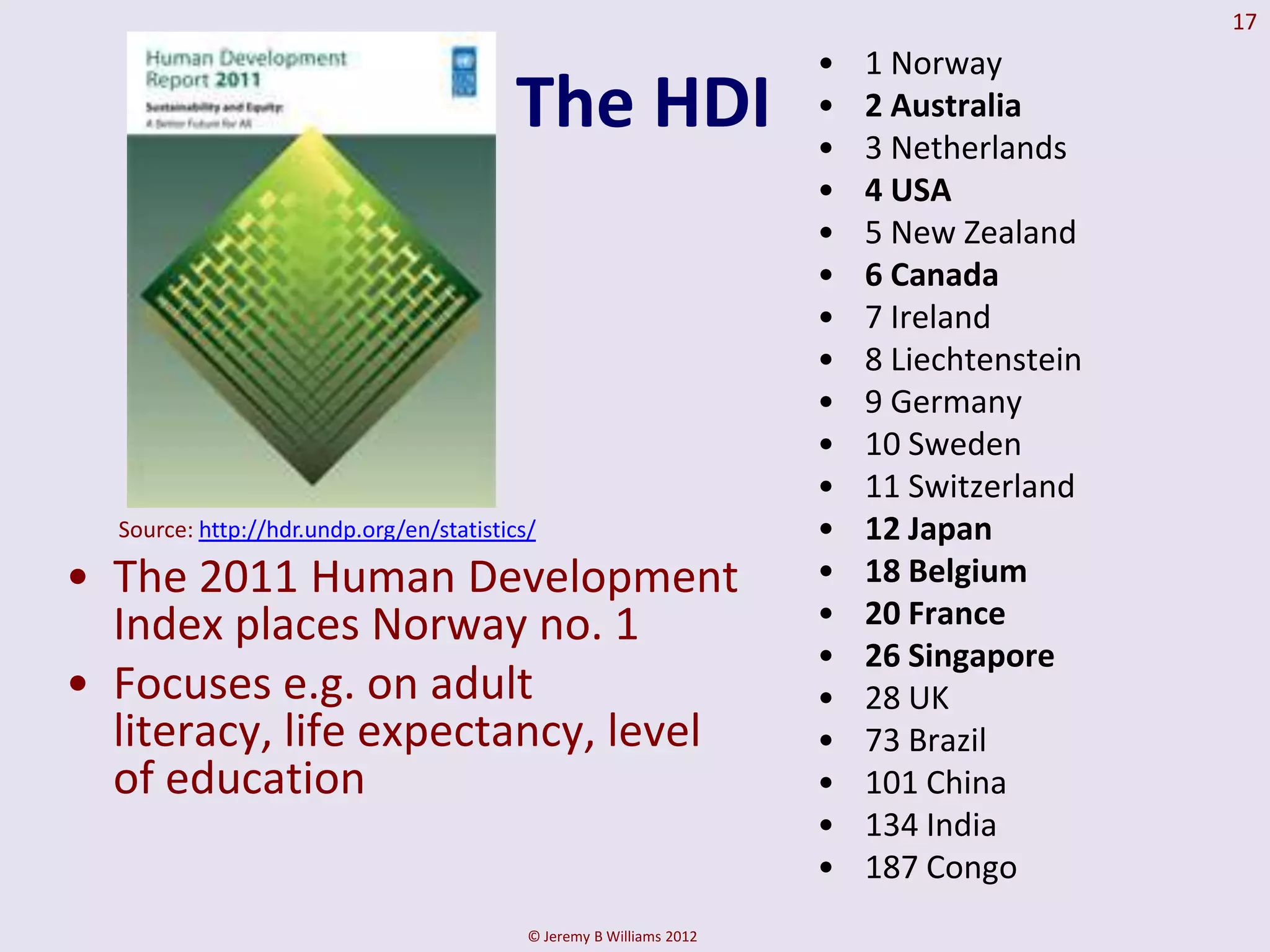
                                                                      •   1 Norway
                                         The HDI                      •
                                                                      •
                                                                          2 Australia
                                                                          3 Netherlands
                                                                      •   4 USA
                                                                      •   5 New Zealand
                                                                      •   6 Canada
                                                                      •   7 Ireland
                                                                      •   8 Liechtenstein
                                                                      •   9 Germany
                                                                      •   10 Sweden
                                                                      •   11 Switzerland
  Source: http://hdr.undp.org/en/statistics/                          •   12 Japan
• The 2011 Human Development                                          •   18 Belgium
  Index places Norway no. 1                                           •   20 France
                                                                      •   26 Singapore
• Focuses e.g. on adult                                               •   28 UK
  literacy, life expectancy, level                                    •   73 Brazil
  of education                                                        •   101 China
                                                                      •   134 India
                                                                      •   187 Congo
                                           © Jeremy B Williams 2012
18


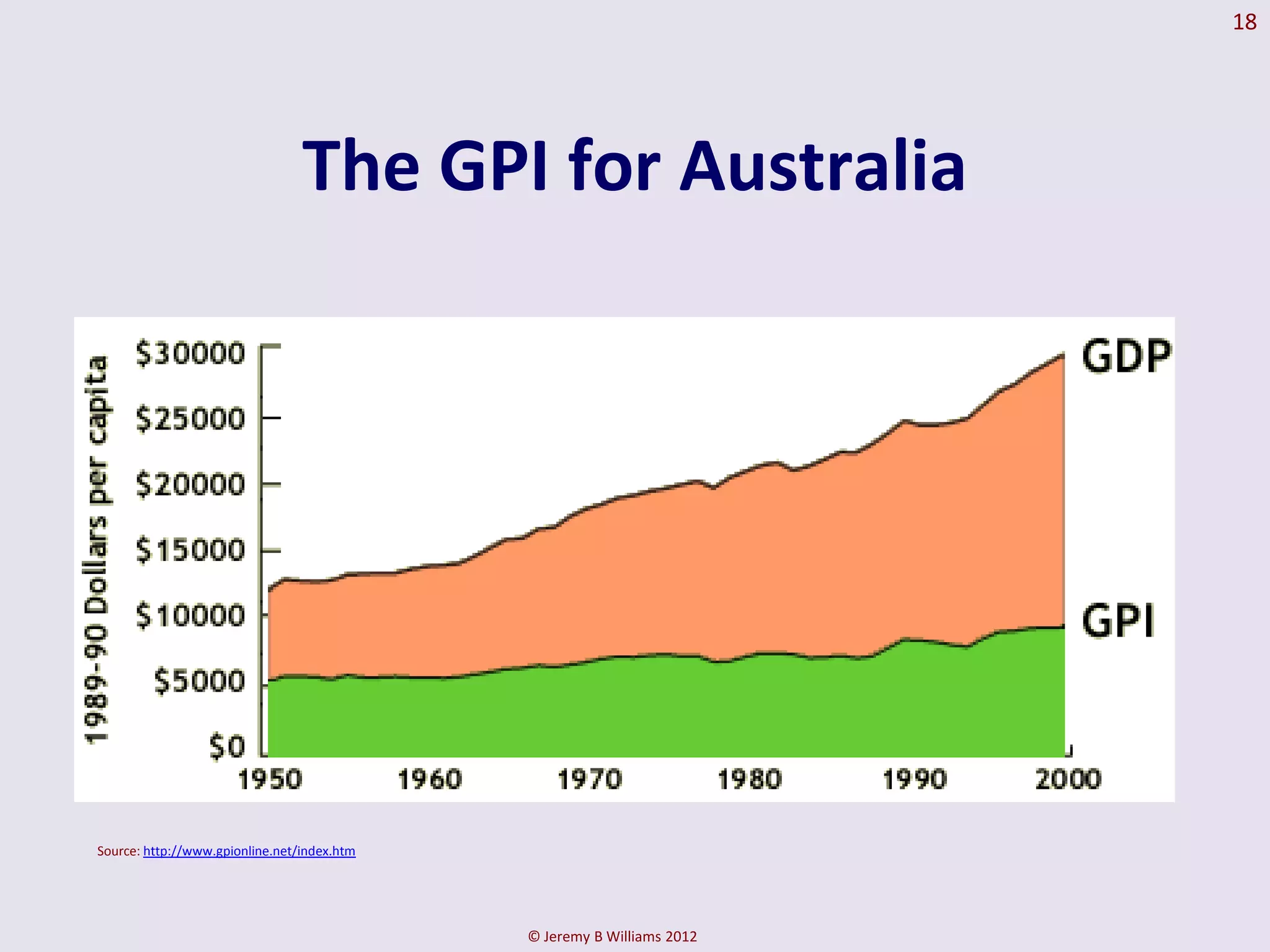
                                 The GPI for Australia


Source: http://www.gpionline.net/index.htm


                                             © Jeremy B Williams 2012
19


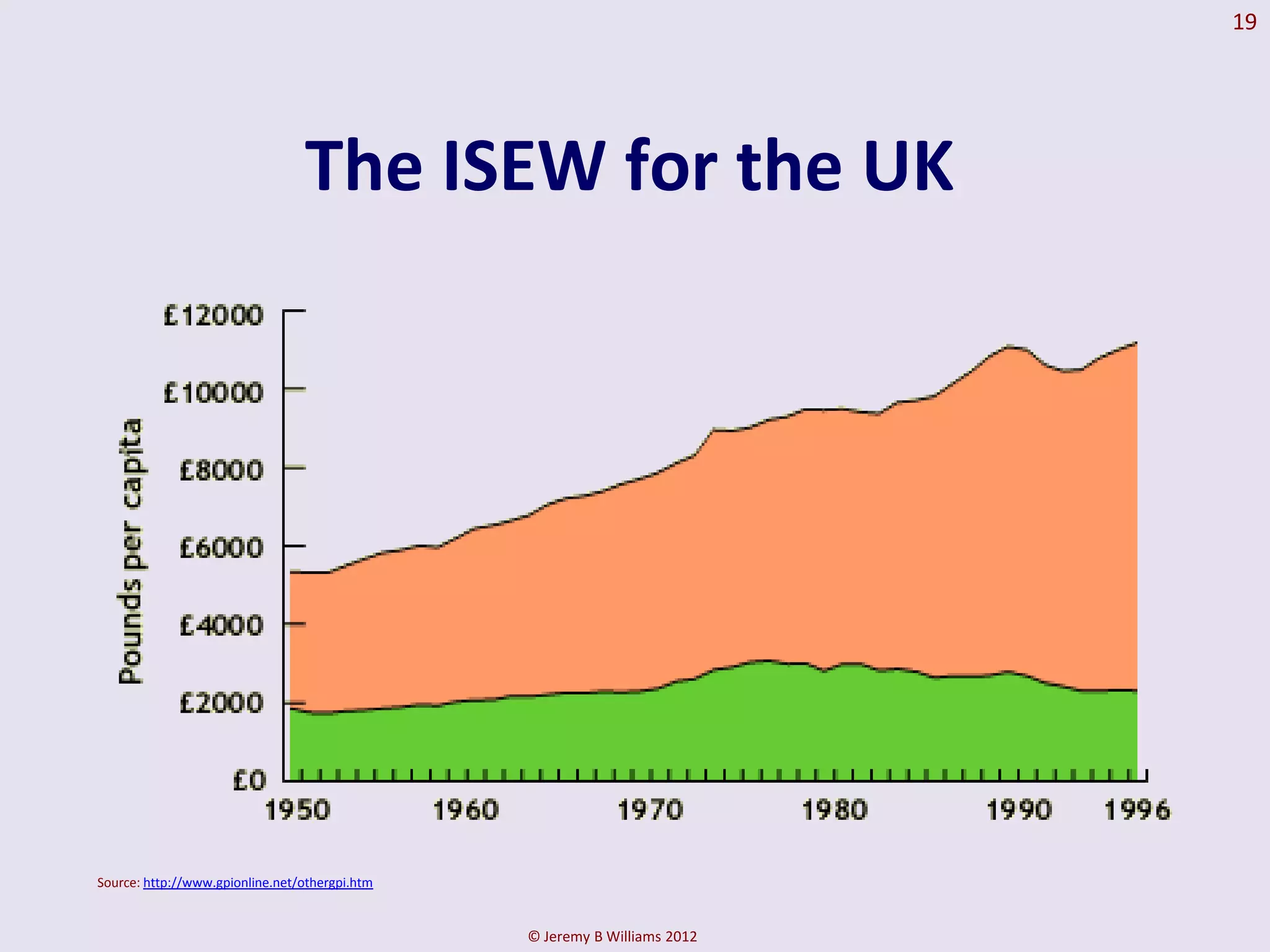
                                 The ISEW for the UK


Source: http://www.gpionline.net/othergpi.htm


                                                © Jeremy B Williams 2012
20


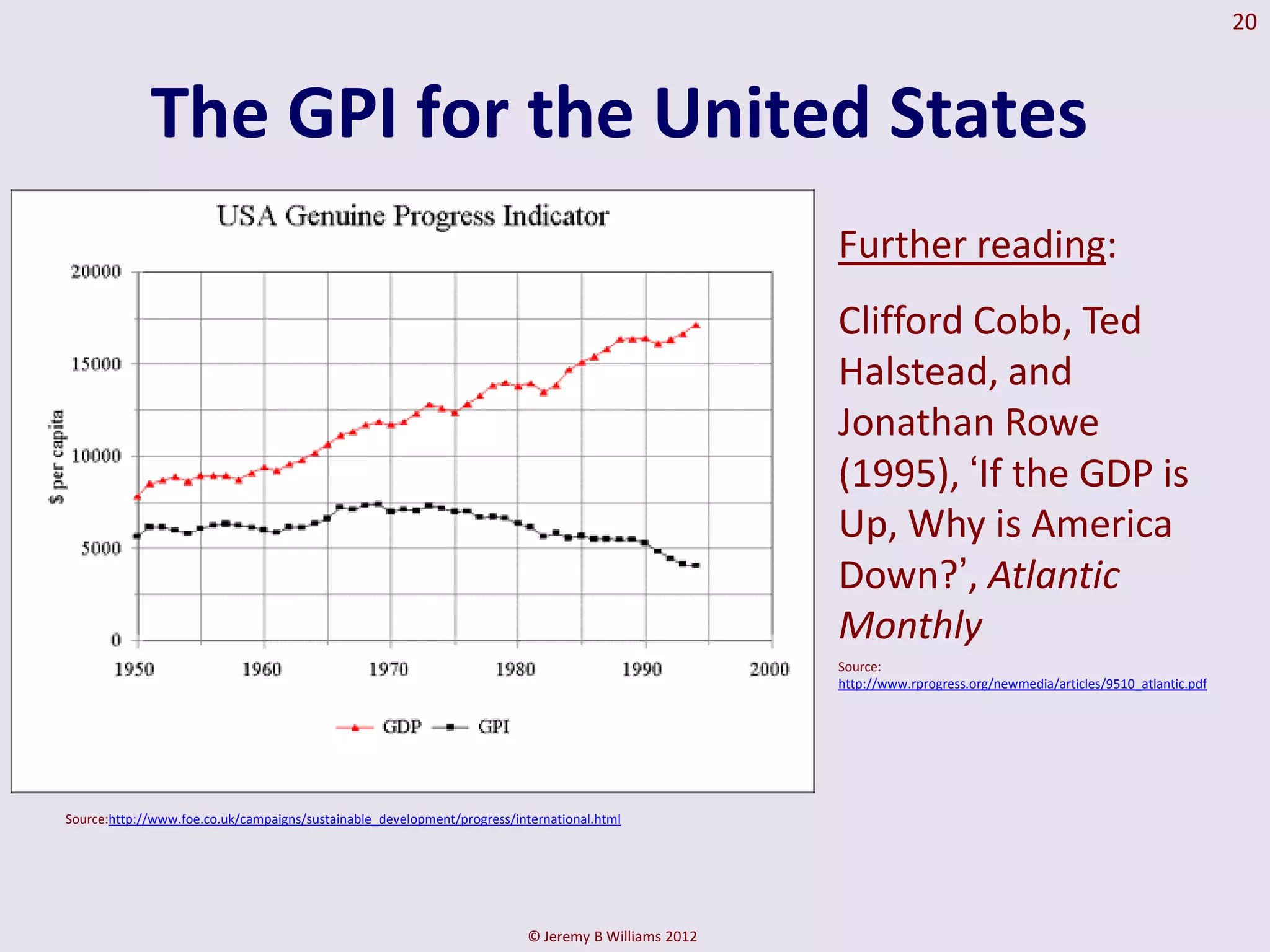
             The GPI for the United States
                                                                                                     Further reading:
                                                                                                     Clifford Cobb, Ted
                                                                                                     Halstead, and
                                                                                                     Jonathan Rowe
                                                                                                     (1995), „If the GDP is
                                                                                                     Up, Why is America
                                                                                                     Down?‟, Atlantic
                                                                                                     Monthly
                                                                                                     Source:
                                                                                                     http://www.rprogress.org/newmedia/articles/9510_atlantic.pdf


Source:http://www.foe.co.uk/campaigns/sustainable_development/progress/international.html


                                                                          © Jeremy B Williams 2012
21

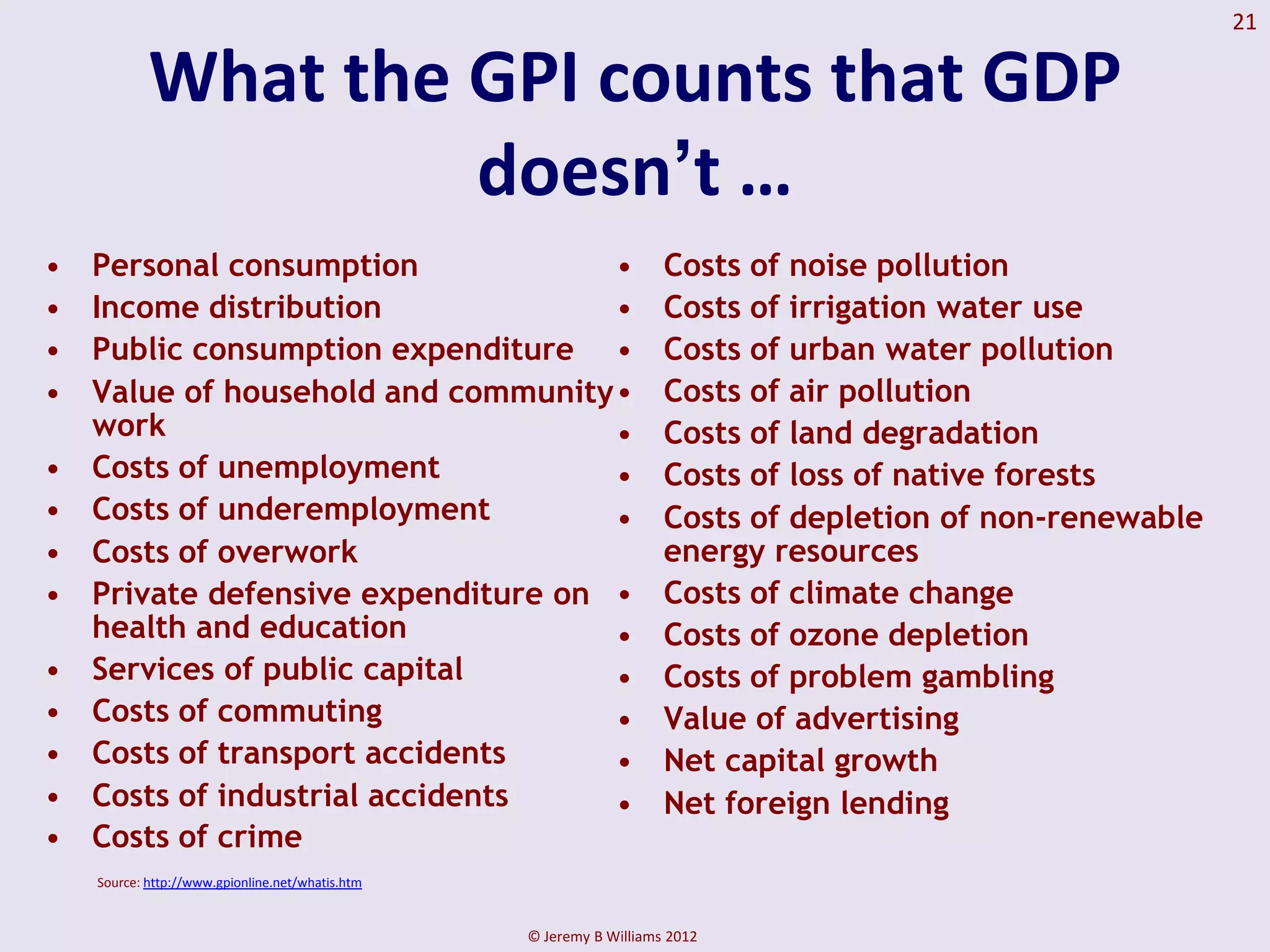
            What the GPI counts that GDP
                     doesn’t …
•   Personal consumption             •                               Costs of noise pollution
•   Income distribution              •                               Costs of irrigation water use
•   Public consumption expenditure •                                 Costs of urban water pollution
•   Value of household and community •                               Costs of air pollution
    work                             •                               Costs of land degradation
•   Costs of unemployment            •                               Costs of loss of native forests
•   Costs of underemployment         •                               Costs of depletion of non-renewable
•   Costs of overwork                                                energy resources
•   Private defensive expenditure on •                               Costs of climate change
    health and education             •                               Costs of ozone depletion
•   Services of public capital       •                               Costs of problem gambling
•   Costs of commuting               •                               Value of advertising
•   Costs of transport accidents     •                               Net capital growth
•   Costs of industrial accidents    •                               Net foreign lending
•   Costs of crime
    Source: http://www.gpionline.net/whatis.htm


                                                  © Jeremy B Williams 2012
22


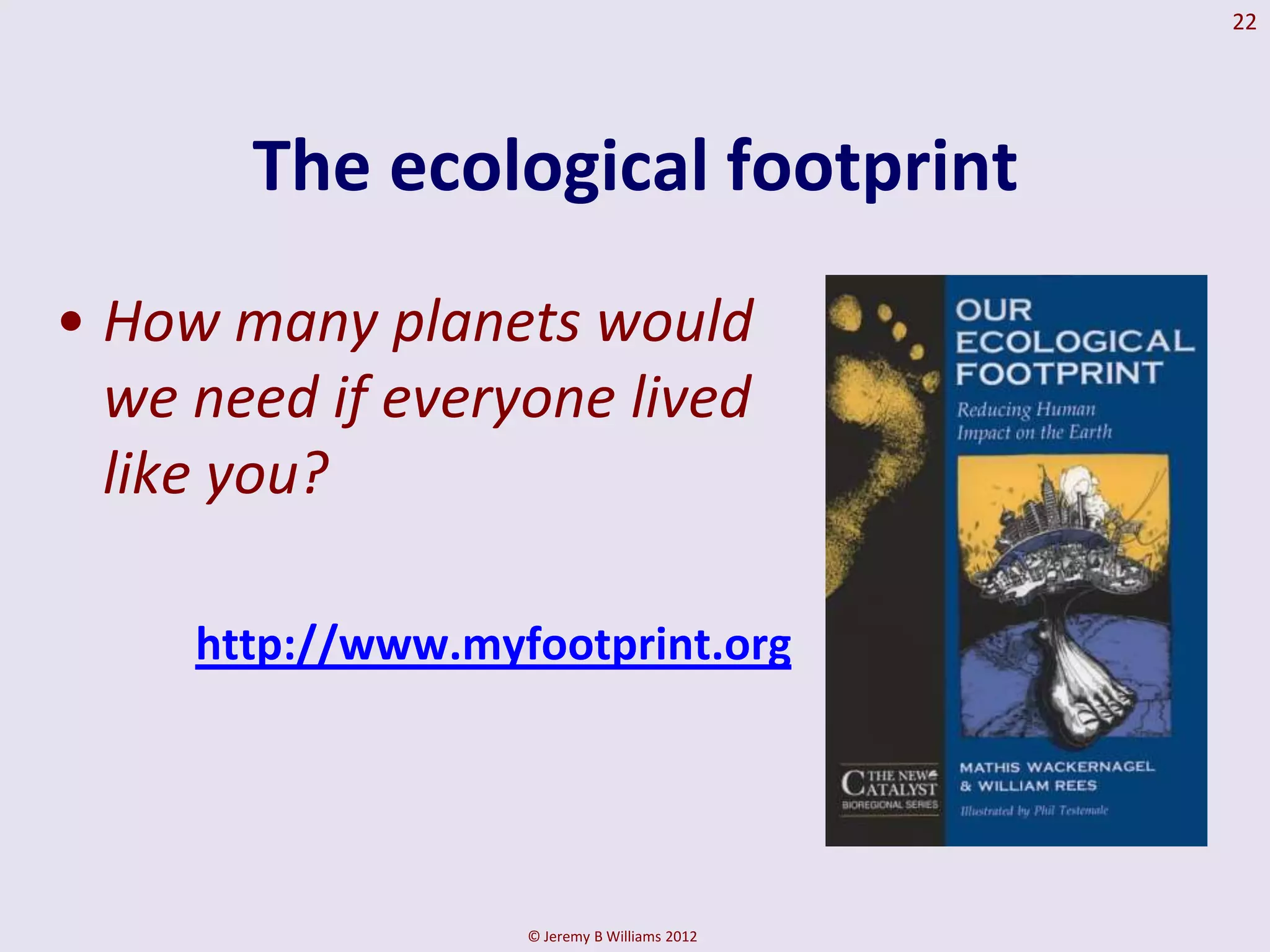
       The ecological footprint
• How many planets would
  we need if everyone lived
  like you?

     http://www.myfootprint.org


                   © Jeremy B Williams 2012
23


     4) CORPORATE MEASURES
• One of the leaders in the quest to develop internationally
  accepted standards for triple bottom line reporting is the
  Global Reporting Initiative (GRI)
  http://www.globalreporting.org/
• 1st draft of reporting guidelines (G1) was piloted by 21
  companies during 1999-2000
• 2nd version of the guidelines (G2) was released in 2002
• Version 3 (G3) came out in 2006
• Since this time, more than 1500 companies worldwide
  have used the guidelines, making it the de facto global
  standard for reporting


                        © Jeremy B Williams 2012
24


      5) THE CREDIBILITY OF
    SUSTAINABILITY REPORTING
• FTSE4Good index has come under attack
  because > 3/4 of the FTSE 100 are in it –
  questions are being asked about the stringency
  of standards

• Similar criticisms have been levelled at the
  Dow Jones Sustainability Indexes (DJSI).


                    © Jeremy B Williams 2012
25


                  ‘Greenwash’
• „Greenwash‟ is defined as disinformation disseminated
  by a business so as to present an environmentally
  responsible public image
• BP, the world‟s second largest oil company and one of
  the world‟s largest corporations, advertised its new
  identity as a leader in moving the world „Beyond
  Petroleum‟
• It made much its $45 million purchase of the largest
  solar energy corporation, Solarex. But BP continues to
  spend billions on oil exploration in Alaska alone.


                       © Jeremy B Williams 2012
26


         ‘Greenwash’ (cont’d)
• Shell, the world‟s third largest oil company,
  continues with its ad series „Profits or
  Principles‟ which touts Shell‟s commitment to
  renewable energy sources and features photos
  of lush green forests, yet Shell spends < 1% of
  its annual investments on renewables.


                   © Jeremy B Williams 2012
27


              6) SUMMARY AND
                CONCLUSIONS
• Sustainability indicators are important because, in the words
  of Peter Drucker, “what isn‟t measured, isn‟t managed”

• The SoE reporting that emerged after the Brundtland Report
  provided a useful impetus for sustainability reporting

• Approaches have become more sophisticated as efforts like
  the Bellagio Principles project and the GRI have served to
  provide guidance to businesses and other organisations.


                          © Jeremy B Williams 2012
28


     Summary and conclusions
            (cont’d)
• Much remains to be done, and it would be
  fatuous to assume that sustainability reporting is
  an „advanced science‟

• Greenwash is likely to prevail so long as the
  ecological consciousness of the majority of
  businesses remains underdeveloped of non-
  existent.


                     © Jeremy B Williams 2012
29


© Jeremy B Williams 2012
30


              Case Study:
   Growing Pains in China

Sustainable Development and Competitive
               Advantage


               © Jeremy B Williams 2012
31


Think

 © Jeremy B Williams 2012
32


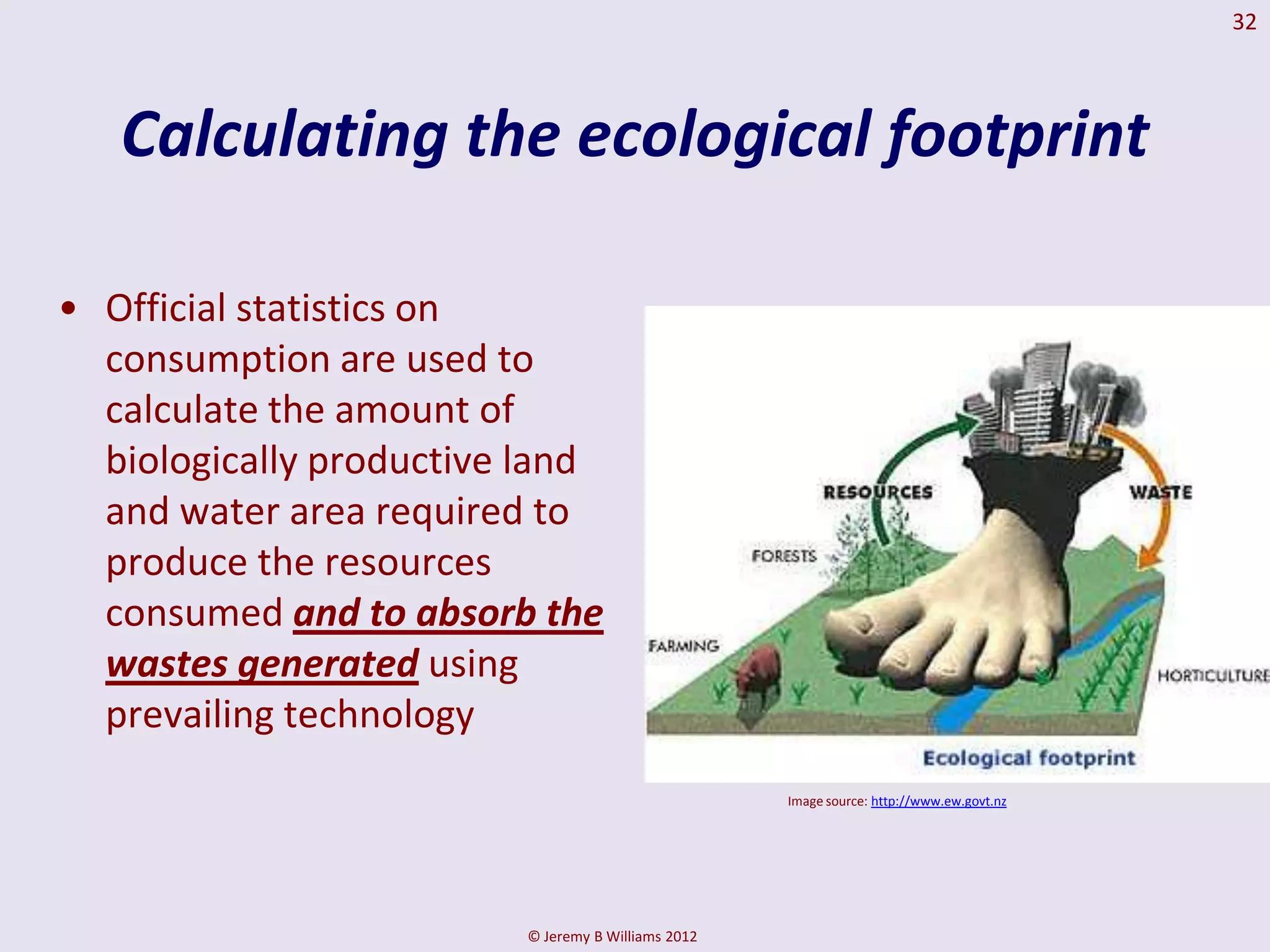
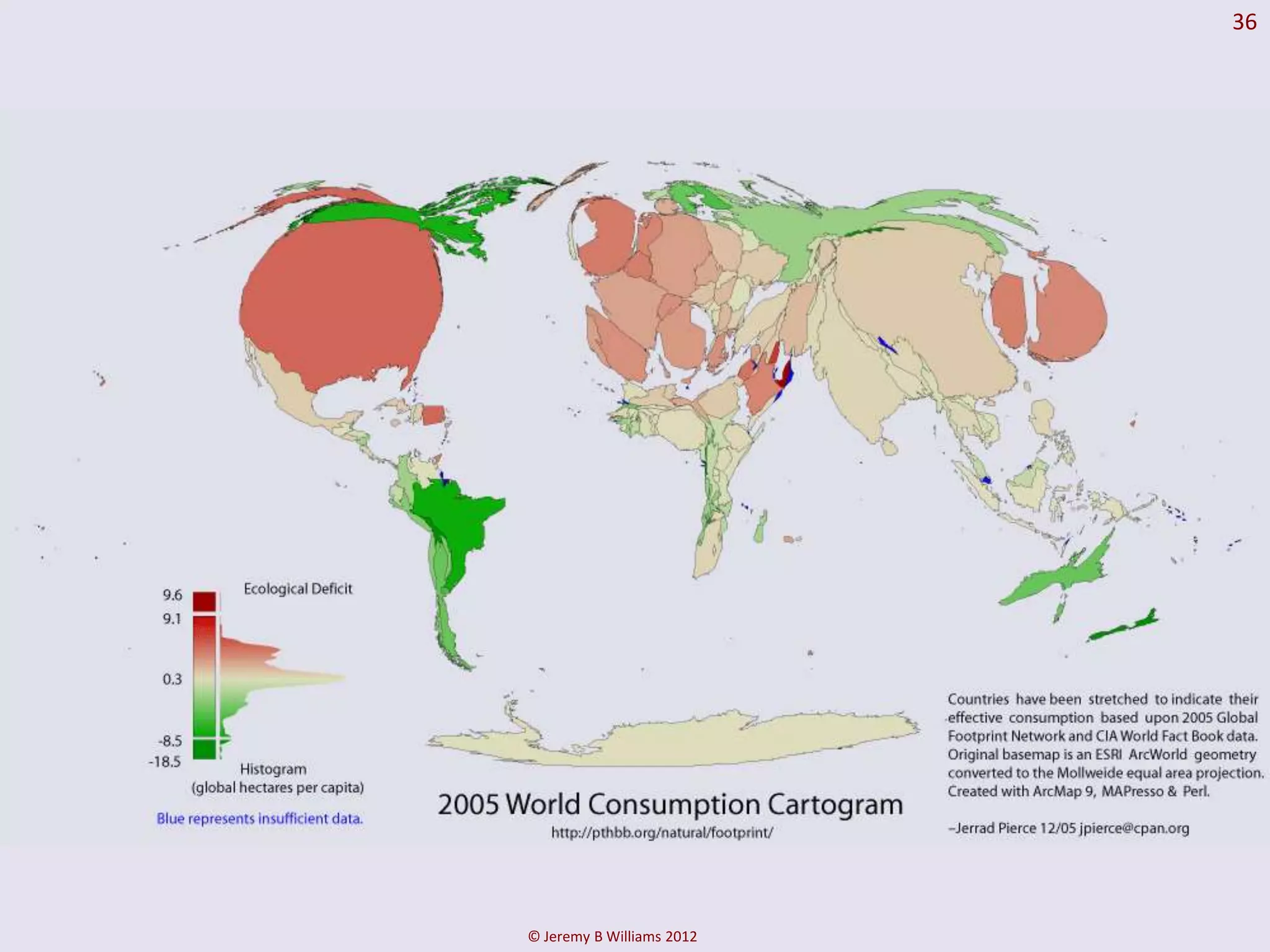
   Calculating the ecological footprint

• Official statistics on
  consumption are used to
  calculate the amount of
  biologically productive land
  and water area required to
  produce the resources
  consumed and to absorb the
  wastes generated using
  prevailing technology
                                                    Image source: http://www.ew.govt.nz


                         © Jeremy B Williams 2012
33


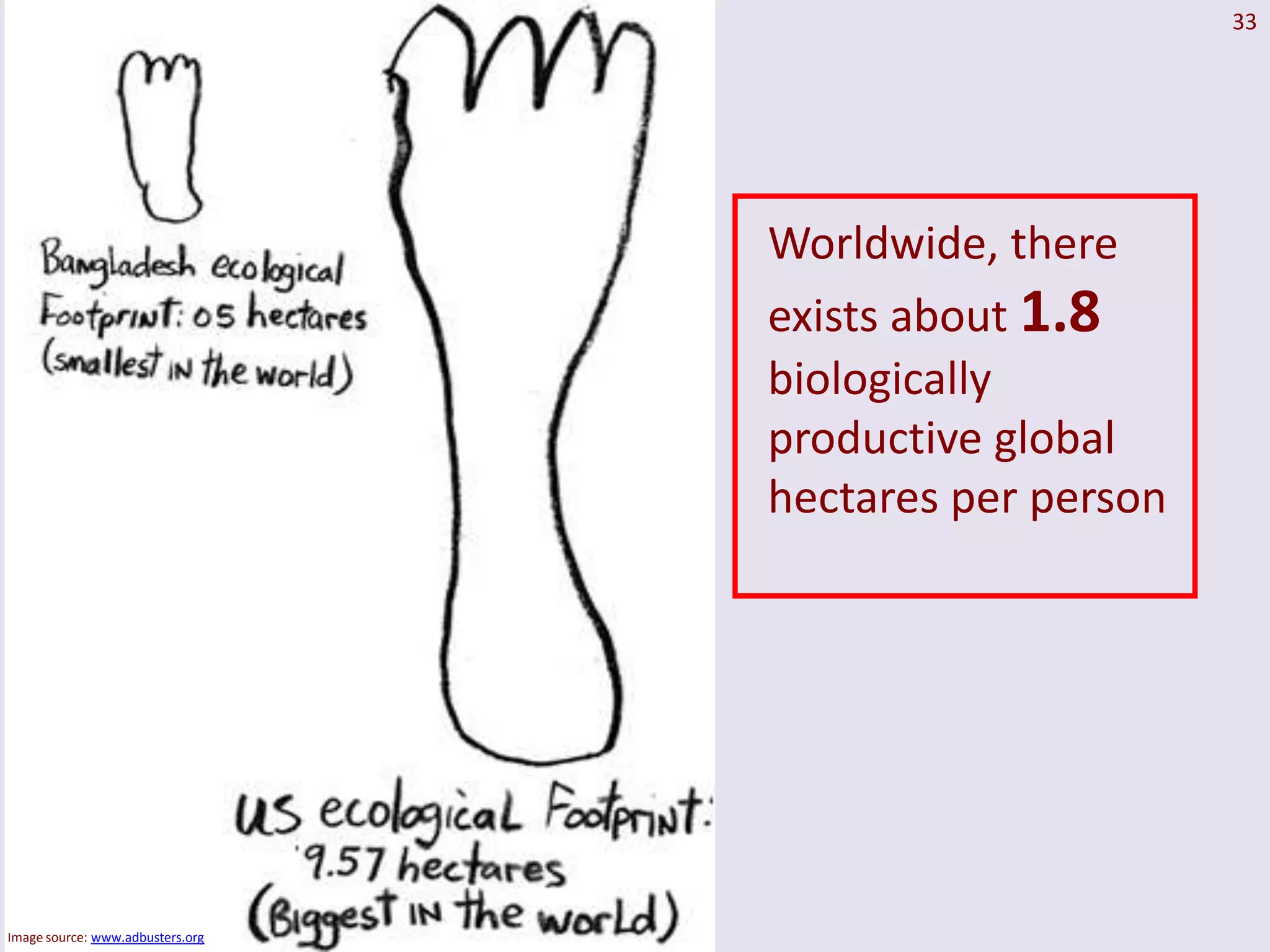
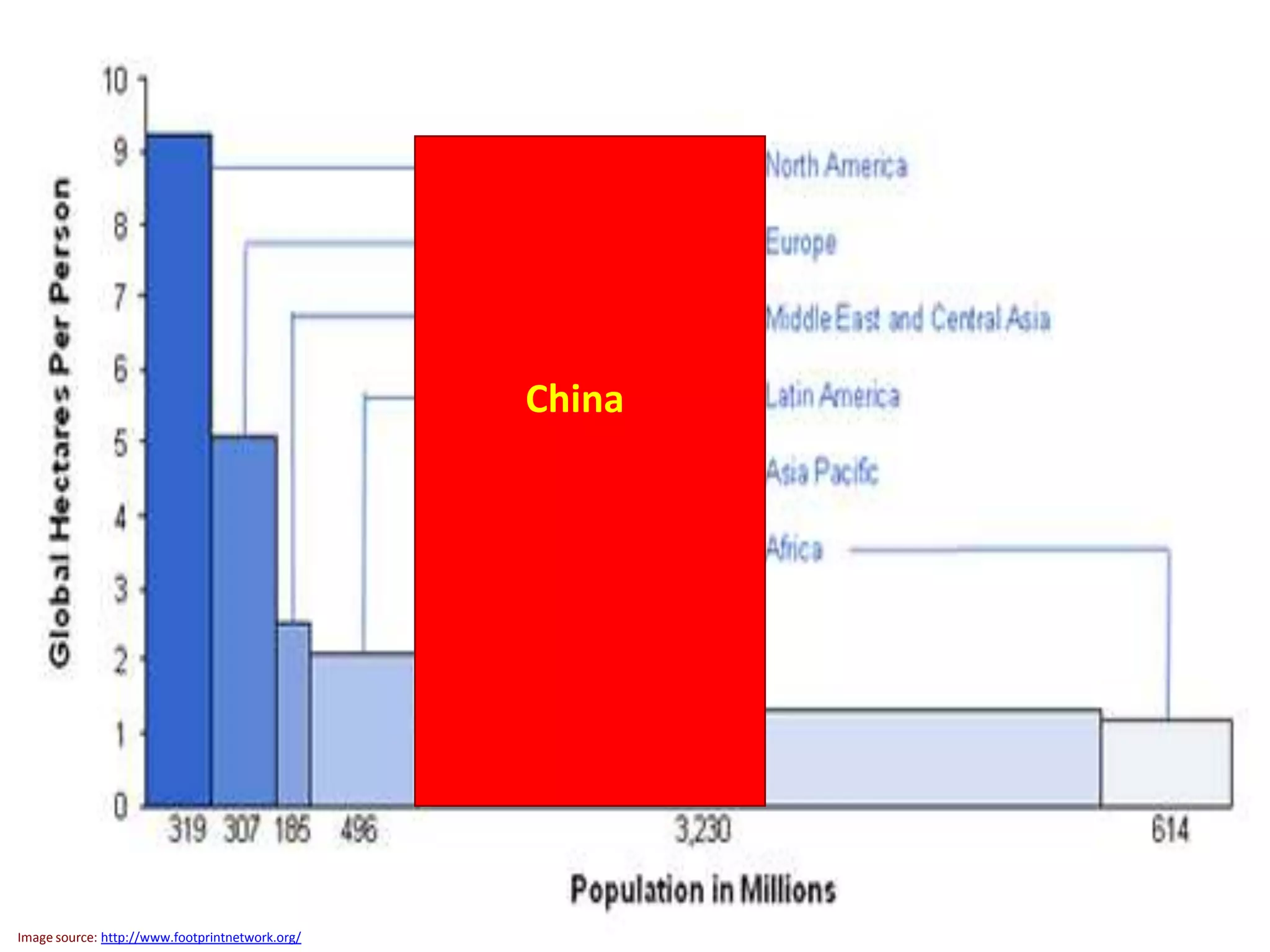
                                                             Worldwide, there
                                                             exists about 1.8
                                                             biologically
                                                             productive global
                                                             hectares per person


Image source: www.adbusters.org   © Jeremy B Williams 2012
34


Image source: http://www.footprintnetwork.org/   © Jeremy B Williams 2012
35


Image source: http://www.footprintnetwork.org/   © Jeremy B Williams 2012
36


© Jeremy B Williams 2012
37


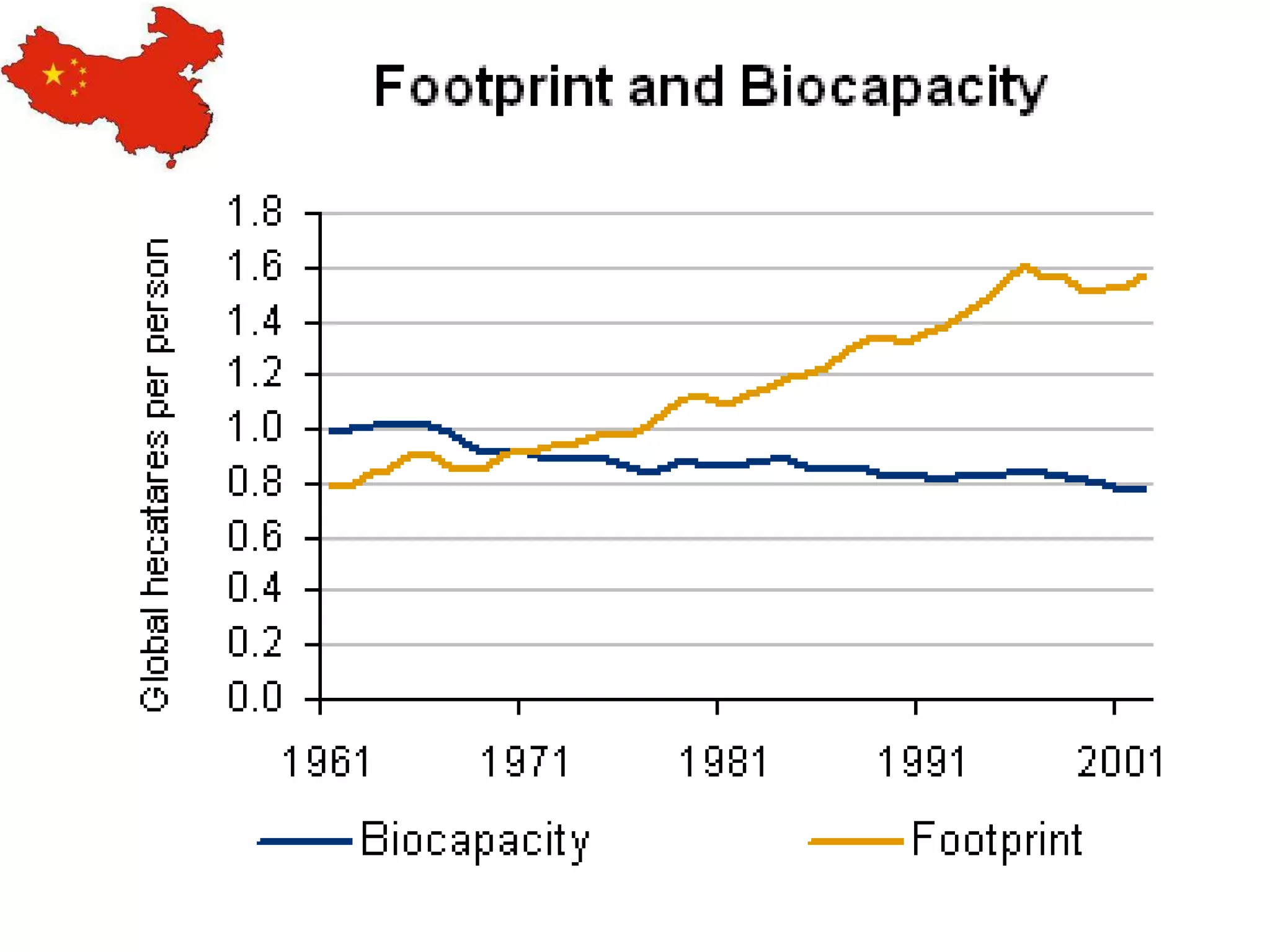
                                                 China


Image source: http://www.footprintnetwork.org/   © Jeremy B Williams 2012
38


© Jeremy B Williams 2012
39

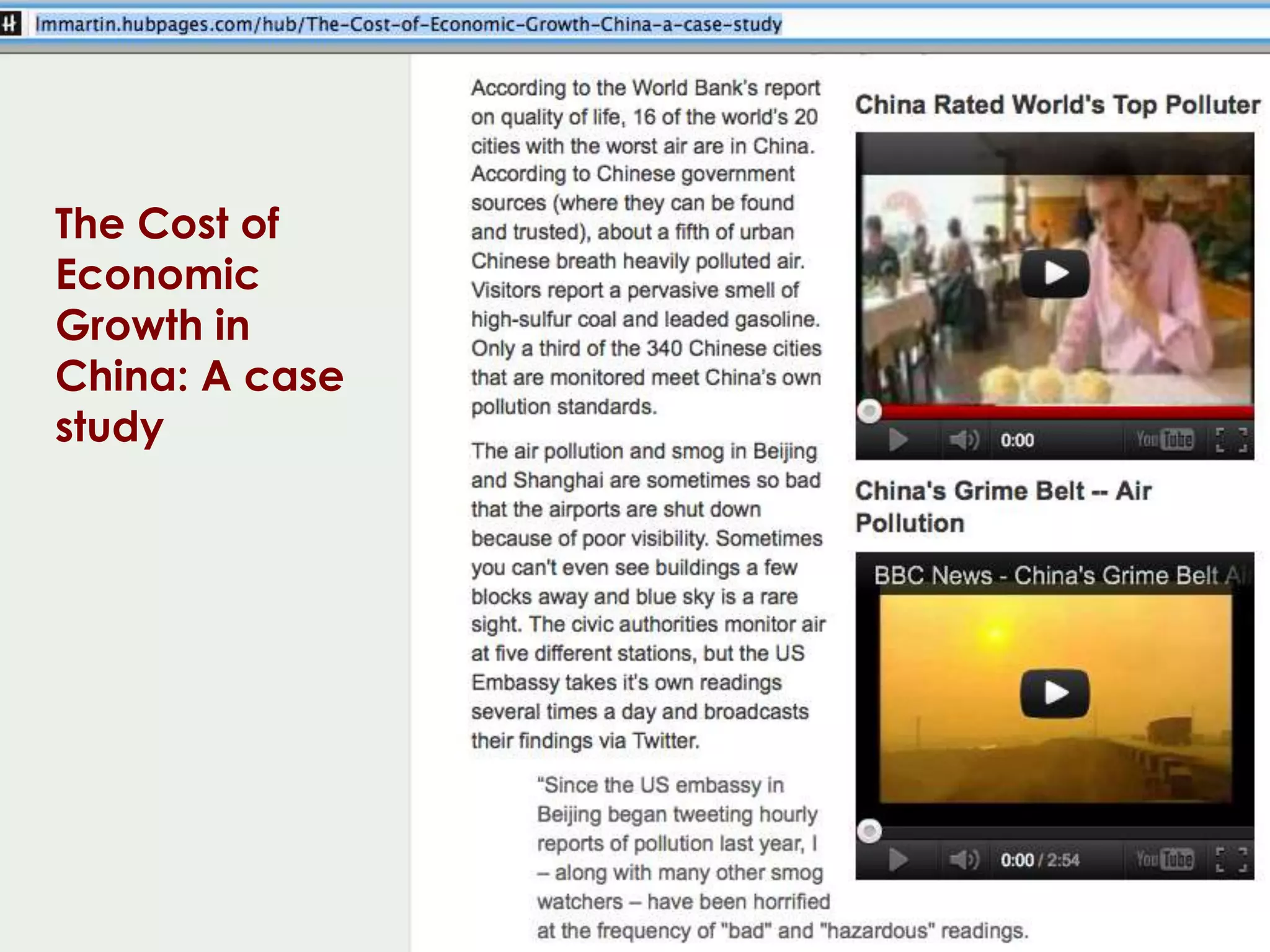
 Environmental Cost of China's Growth (NYT, Aug 2007)


The Cost of
Economic
Growth in
China: A case
study


video.nytimes.com     © Jeremy B Williams 2012
40


Discuss

  © Jeremy B Williams 2012
41


      Consider, for example …
• What if all Chinese people lived like
  North Americans?
• What needs to be measured (to be
  managed)?
• Can ecological degradation be
  reversed? If so, how?
• If not, what are the possible
  geopolitical consequences?

                  © Jeremy B Williams 2012
42


Deliver

 © Jeremy B Williams 2012
43


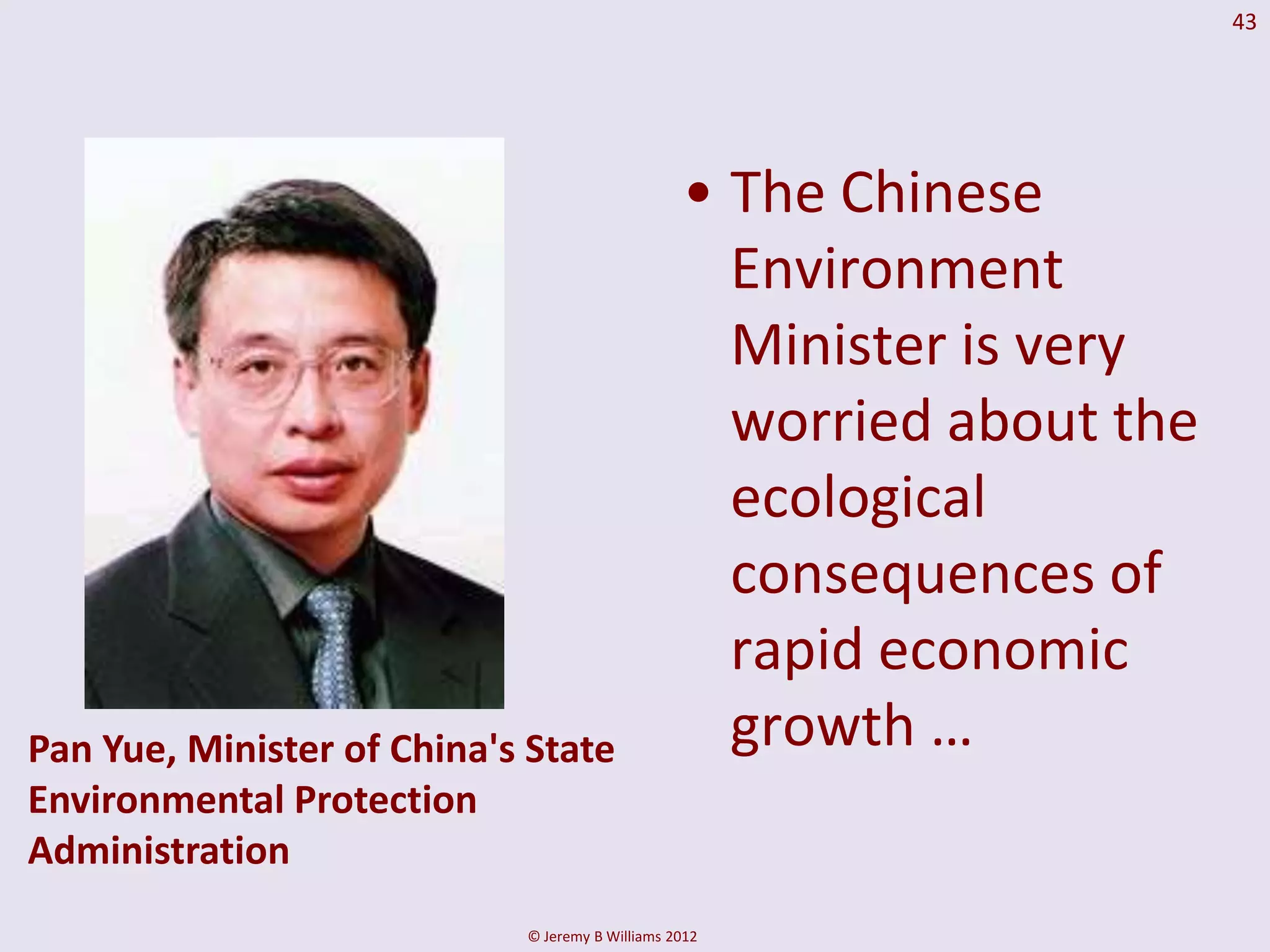
                                                 • The Chinese
                                                   Environment
                                                   Minister is very
                                                   worried about the
                                                   ecological
                                                   consequences of
                                                   rapid economic
Pan Yue, Minister of China's State                 growth …
Environmental Protection
Administration
                            © Jeremy B Williams 2012
44


• Fortunately for Mr Yue, a group of erudite, and
  highly respected ecological economists are
  confident they have the solutions
• A number of teams from are scheduled to give a
  10-minute presentation to Mr Yue.


                    © Jeremy B Williams 2012

Unit 5, GRE401

  • 1.
    1 Sustainable Development and Competitive Advantage Unit 5: Sustainable Development Indicators © Jeremy B Williams 2012
  • 2.
    2 Outline 1) An introduction to indicators 2) The Bellagio Principles 3) Macro measures of sustainability 4) Corporate measures 5) The credibility of sustainability reporting 6) Summary and conclusions © Jeremy B Williams 2012
  • 3.
    3 1) AN INTRODUCTION TO INDICATORS • Indicators help us to quantify and simplify phenomena in order to better understand the complexity of reality • They give historical perspective of the current state of affairs and clues as to the likely direction of change in these affairs into the future. © Jeremy B Williams 2012
  • 4.
    4 Are all indicators useful? • There are occasions where indicators are used frequently but inappropriately • The use of the rate of GDP growth as a measure of the change in value of national output of goods and services from year to year is perfectly valid • It is less appropriate to use such an index to make judgements about the level of societal welfare. © Jeremy B Williams 2012
  • 5.
    5 GDP and its detractors… ‘If a truckload of toxic chemicals spills somewhere, the money spent cleaning it up is added to the GDP. If nearby residents can no longer use their wells for water, their expenditures on bottled water is added to GDP. If they become sick from exposure to the substance, their medical costs are also added to the official measure of well-being’. Mike Nickerson, The Sustainability Project, Ontario, 1997 Source:http://www.foe.co.uk/campaigns/sustainable_development/progress/annex1.html © Jeremy B Williams 2012
  • 6.
    6 GDP and its detractors… ‘Unfortunately GDP figures are generally used without the caveat that they represent an income that cannot be sustained. Current calculations ignore the degradation of the natural resource base and view the sale of non-renewable Barber B Conable Jr, resources entirely as income. A better way Former Republican must be found to measure the prosperity Congressman and Former President, World Bank, and progress of mankind.’ 1989 Source:http://www.foe.co.uk/campaigns/sustainable_development/progress/annex1.html © Jeremy B Williams 2012
  • 7.
    7 GDP and itsdetractors… Simon Kuznets, (creator of GDP concept) 1962 „The welfare of a nation can scarcely be inferred from a measurement of national income as defined by the GDP... goals for „more‟ growth should specify of what and for what.‟ Source:http://www.foe.co.uk/campaigns/sustainable_development/progress/annex1.html © Jeremy B Williams 2012
  • 8.
    8 Criticismsof GDP as an indicator of economic well-being Traditional criticisms: Contemporary criticisms: • Measurement problems: • The counting of „defensive‟ The underground economy expenditures as positive Domestic production contributions to GDP Quality and composition of • Failure to account for changes output in the value of „natural • Leisure time capital‟. • Income distribution © Jeremy B Williams 2012
  • 9.
    9 So what makes a good sustainability indicator? • A key element in the design of a sustainability indicator is to have an appreciation of the values, goals and aspirations of the target audience • This indicator will provide useful feedback on issues the community knows about, but it will also provide information about issues that are central to sustainable development, yet poorly understood; e.g. ecosystem health and how this might impact on human health • Different communities will have much in common, but sometimes this commonality might manifest itself in different ways. © Jeremy B Williams 2012
  • 10.
    10 Balance between general and specific criteria • Indicators will be selected based on general selection criteria (e.g. simplicity, validity, time-series data, affordability of data, ability to aggregate information, sensitivity and reliability), but also on the basis of context-specific conditions • Sustainability practitioners must avoid falling into the same trap as the national income accountants – a careful selection process is required to determine the indicator that is most relevant to a given context (i.e. region, economic sector, institution) © Jeremy B Williams 2012
  • 11.
    11 Relevant indicators • e.g. salination is important to farmers in central Queensland, but less significant to fishing communities in NSW. © Jeremy B Williams 2012
  • 12.
    12 The evolutionof sustainability of indicators • Early efforts at sustainability reporting followed the Brundtland Report in the shape of national State of the Environment (SoE) reports using the DPSIR model © Jeremy B Williams 2012
  • 13.
    13 DPSIR • Driving Forces – the underlying human activities underpinning environmental change • Pressure – exerted on the environment and natural resources; e.g. soil degradation • State – current state of play, trends • Impact – the consequences of pressure on the environment • Response – government policies and management strategies © Jeremy B Williams 2012
  • 14.
    14 2) THE BELLAGIO PRINCIPLES • Developed in Bellagio, Italy, in 1996 by an international group of practitioners and researchers, the Bellagio Principles may be looked upon as an overarching guide, serving to link theory and practice. © Jeremy B Williams 2012
  • 15.
    15 Overview of the 10 Principles • The principles focus on the assessment of progress toward sustainability in 4 areas: • Principle 1: a vision of sustainable development and clear goals that provide a practical definition of that vision • Principles 2 – 5: deal with the content of any assessment and the need to merge a sense of the overall system with a practical focus on current priority issues • Principles 6 – 8: deal with key issues of the process of assessment • Principles 9 & 10: deal with the necessity of establishing a continuing capacity for assessment. Source: http://www.iisd.org/measure/principles/bp.asp © Jeremy B Williams 2012
  • 16.
    16 3) MACRO MEASURES OF SUSTAINABILITY • Leading examples include: – UN Human Development Index (HDI) – Genuine Progress Indicator (GPI) – Index of Sustainable Economic Welfare (ISEW) – Ecological Footprint © Jeremy B Williams 2012
  • 17.
    17 • 1 Norway The HDI • • 2 Australia 3 Netherlands • 4 USA • 5 New Zealand • 6 Canada • 7 Ireland • 8 Liechtenstein • 9 Germany • 10 Sweden • 11 Switzerland Source: http://hdr.undp.org/en/statistics/ • 12 Japan • The 2011 Human Development • 18 Belgium Index places Norway no. 1 • 20 France • 26 Singapore • Focuses e.g. on adult • 28 UK literacy, life expectancy, level • 73 Brazil of education • 101 China • 134 India • 187 Congo © Jeremy B Williams 2012
  • 18.
    18 The GPI for Australia Source: http://www.gpionline.net/index.htm © Jeremy B Williams 2012
  • 19.
    19 The ISEW for the UK Source: http://www.gpionline.net/othergpi.htm © Jeremy B Williams 2012
  • 20.
    20 The GPI for the United States Further reading: Clifford Cobb, Ted Halstead, and Jonathan Rowe (1995), „If the GDP is Up, Why is America Down?‟, Atlantic Monthly Source: http://www.rprogress.org/newmedia/articles/9510_atlantic.pdf Source:http://www.foe.co.uk/campaigns/sustainable_development/progress/international.html © Jeremy B Williams 2012
  • 21.
    21 What the GPI counts that GDP doesn’t … • Personal consumption • Costs of noise pollution • Income distribution • Costs of irrigation water use • Public consumption expenditure • Costs of urban water pollution • Value of household and community • Costs of air pollution work • Costs of land degradation • Costs of unemployment • Costs of loss of native forests • Costs of underemployment • Costs of depletion of non-renewable • Costs of overwork energy resources • Private defensive expenditure on • Costs of climate change health and education • Costs of ozone depletion • Services of public capital • Costs of problem gambling • Costs of commuting • Value of advertising • Costs of transport accidents • Net capital growth • Costs of industrial accidents • Net foreign lending • Costs of crime Source: http://www.gpionline.net/whatis.htm © Jeremy B Williams 2012
  • 22.
    22 The ecological footprint • How many planets would we need if everyone lived like you? http://www.myfootprint.org © Jeremy B Williams 2012
  • 23.
    23 4) CORPORATE MEASURES • One of the leaders in the quest to develop internationally accepted standards for triple bottom line reporting is the Global Reporting Initiative (GRI) http://www.globalreporting.org/ • 1st draft of reporting guidelines (G1) was piloted by 21 companies during 1999-2000 • 2nd version of the guidelines (G2) was released in 2002 • Version 3 (G3) came out in 2006 • Since this time, more than 1500 companies worldwide have used the guidelines, making it the de facto global standard for reporting © Jeremy B Williams 2012
  • 24.
    24 5) THE CREDIBILITY OF SUSTAINABILITY REPORTING • FTSE4Good index has come under attack because > 3/4 of the FTSE 100 are in it – questions are being asked about the stringency of standards • Similar criticisms have been levelled at the Dow Jones Sustainability Indexes (DJSI). © Jeremy B Williams 2012
  • 25.
    25 ‘Greenwash’ • „Greenwash‟ is defined as disinformation disseminated by a business so as to present an environmentally responsible public image • BP, the world‟s second largest oil company and one of the world‟s largest corporations, advertised its new identity as a leader in moving the world „Beyond Petroleum‟ • It made much its $45 million purchase of the largest solar energy corporation, Solarex. But BP continues to spend billions on oil exploration in Alaska alone. © Jeremy B Williams 2012
  • 26.
    26 ‘Greenwash’ (cont’d) • Shell, the world‟s third largest oil company, continues with its ad series „Profits or Principles‟ which touts Shell‟s commitment to renewable energy sources and features photos of lush green forests, yet Shell spends < 1% of its annual investments on renewables. © Jeremy B Williams 2012
  • 27.
    27 6) SUMMARY AND CONCLUSIONS • Sustainability indicators are important because, in the words of Peter Drucker, “what isn‟t measured, isn‟t managed” • The SoE reporting that emerged after the Brundtland Report provided a useful impetus for sustainability reporting • Approaches have become more sophisticated as efforts like the Bellagio Principles project and the GRI have served to provide guidance to businesses and other organisations. © Jeremy B Williams 2012
  • 28.
    28 Summary and conclusions (cont’d) • Much remains to be done, and it would be fatuous to assume that sustainability reporting is an „advanced science‟ • Greenwash is likely to prevail so long as the ecological consciousness of the majority of businesses remains underdeveloped of non- existent. © Jeremy B Williams 2012
  • 29.
    29 © Jeremy BWilliams 2012
  • 30.
    30 Case Study: Growing Pains in China Sustainable Development and Competitive Advantage © Jeremy B Williams 2012
  • 31.
    31 Think © JeremyB Williams 2012
  • 32.
    32 Calculating the ecological footprint • Official statistics on consumption are used to calculate the amount of biologically productive land and water area required to produce the resources consumed and to absorb the wastes generated using prevailing technology Image source: http://www.ew.govt.nz © Jeremy B Williams 2012
  • 33.
    33 Worldwide, there exists about 1.8 biologically productive global hectares per person Image source: www.adbusters.org © Jeremy B Williams 2012
  • 34.
  • 35.
  • 36.
    36 © Jeremy BWilliams 2012
  • 37.
    37 China Image source: http://www.footprintnetwork.org/ © Jeremy B Williams 2012
  • 38.
    38 © Jeremy BWilliams 2012
  • 39.
    39 Environmental Costof China's Growth (NYT, Aug 2007) The Cost of Economic Growth in China: A case study video.nytimes.com © Jeremy B Williams 2012
  • 40.
    40 Discuss ©Jeremy B Williams 2012
  • 41.
    41 Consider, for example … • What if all Chinese people lived like North Americans? • What needs to be measured (to be managed)? • Can ecological degradation be reversed? If so, how? • If not, what are the possible geopolitical consequences? © Jeremy B Williams 2012
  • 42.
    42 Deliver © JeremyB Williams 2012
  • 43.
    43 • The Chinese Environment Minister is very worried about the ecological consequences of rapid economic Pan Yue, Minister of China's State growth … Environmental Protection Administration © Jeremy B Williams 2012
  • 44.
    44 • Fortunately forMr Yue, a group of erudite, and highly respected ecological economists are confident they have the solutions • A number of teams from are scheduled to give a 10-minute presentation to Mr Yue. © Jeremy B Williams 2012

Editor's Notes

  • #39 http://www.footprintnetwork.org/gfn_sub.php?content=footprint_china