Understanding Financial Statement
Audit Commissionerate, Delhi I
November 24, 2015
Presented by:
CA Gaurav Gupta
FCA, LLB, DISA
Partner
MGS & Co.
• Discusses overall performance
• Any strategic movement like acquisition etc
• Corporate Governance report
• Director’s responsibility statement
• Any major departures from applicable accounting standards
• True and fair view
• Going concern basis
• Employee and other details like energy conservation etc.
• Foreign exchange earning and outgo
Director’s Report
Study of Financials CA Gaurav Gupta 2
Director’s Report
• Financial highlights
• Amounts proposed for transfer to reserves
• Proposed dividend
• Important happenings, trends, future plans
• Explanation on auditor’s qualification
• Details of conservation of energy, technology absorption, foreign exchange
earning and outgo.
Director’s Report
Case Study -1
• Observations in Director’s report
“ During the year a major fire broke out at our Pune plant in August, 1999
resulting in substantial damage to the paper makin plant and the burning of
raw-material and finished goods. The company has lodged the insurance
claim. However, we were able to repair the plant and manufacturing
activities were restarted by end of February 2013. Due to stoppage of this
plant our profits have reduced substantially”.
- Whether CENVAT credit was reversed on input or input contained in work in progress
and finished goods destroyed by fire.
- Whether remission of duty on finished goods has been claimed.
- Whether any of the capital goods, which got damaged, have been cleared as scrap
and whether CENVAT credit was availed in the past on the said capital goods.
Director’s Report
Case Study -2
• Observations in Director’s report
“In order to strengthen marketing activities, your company have acquired
majority shares in ABC Marketing Ltd., which had become a subsidiary
company from this year”.
- Department can find out whether the company is supply of services or goods to the
subsidiary company or vice-versa.
- Transactions between related parties
Director’s Report
Case Study - 3
• Observations in Director’s report
“Your company has initiated various actions to meet the challenges of the
market. Among the steps taken are introduction of state of the art new
products, provision of technical and engineering services and starting of e-
commerce marketing. Your company is among the first few in the country to
start trading though web-site”.
• Exact system of trading on e-com basis should be found out to verify correctness of
payment of duty.
- New line of business – Cenvat /credit – setting up
Director’s Report
Case Study – 4
• Observations in Director’s report
“Performance and profitability: During the year under reference your Company has
incurred a loss of ` 9002.73 lackh ( for 18 months) on a turnover of ` 8785.39 Lakhs
The expenses to the extent of ` 3589.20 lakhs has been charged to the profit and loss
account pertaining to earlier years. The loss is mainly attributable to higher
depreciation, write off of slow and non-moving and obsolete inventory, as suggested
by the concurrent auditors appointed by the lead bank and higher interest burden. In
addition there has been increase in cost of raw materials and components consumed
which could not be absorbed in the selling price.”
- Details of write-off of slow, non-moving and obsolete inventory.
- Whether these have been sold subsequently and whether CENVAT availed has been
reversed.
- What is the impact of increase in raw-material cost to PLA/ CENVAT ratio.
- Expenses of previous years- Does it include inputs on which credit was availed in the
past.
• Basic Accounting policies
• Nature of assets and liabilities
• Revenue Recognition
• Provisions, contingent liabilities - List of Show Cause Notice(s) issued, if any and their
present Status.
• Mandatory detailed information under New Schedule VI
• Segment reporting
• Related party transactions including their balances
• Capital and other Commitments
• Expenditure in foreign Currency
• In certain Cases, unpaid Statutory liabilities
Notes forming part
Study of Financials CA Gaurav Gupta 8
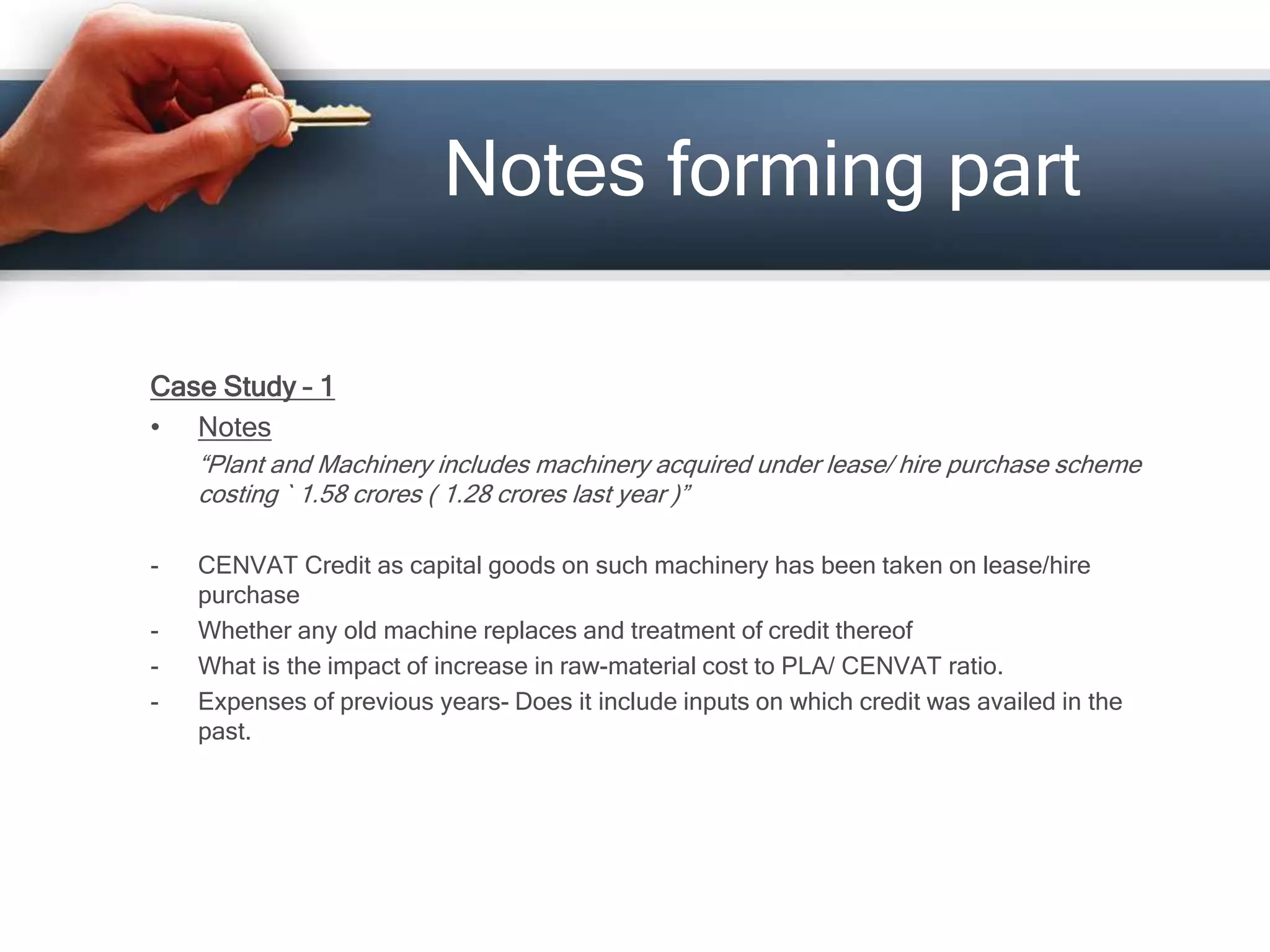
Case Study – 1
• Notes
“Plant and Machinery includes machinery acquired under lease/ hire purchase scheme
costing ` 1.58 crores ( 1.28 crores last year )”
- CENVAT Credit as capital goods on such machinery has been taken on lease/hire
purchase
- Whether any old machine replaces and treatment of credit thereof
- What is the impact of increase in raw-material cost to PLA/ CENVAT ratio.
- Expenses of previous years- Does it include inputs on which credit was availed in the
past.
Notes forming part
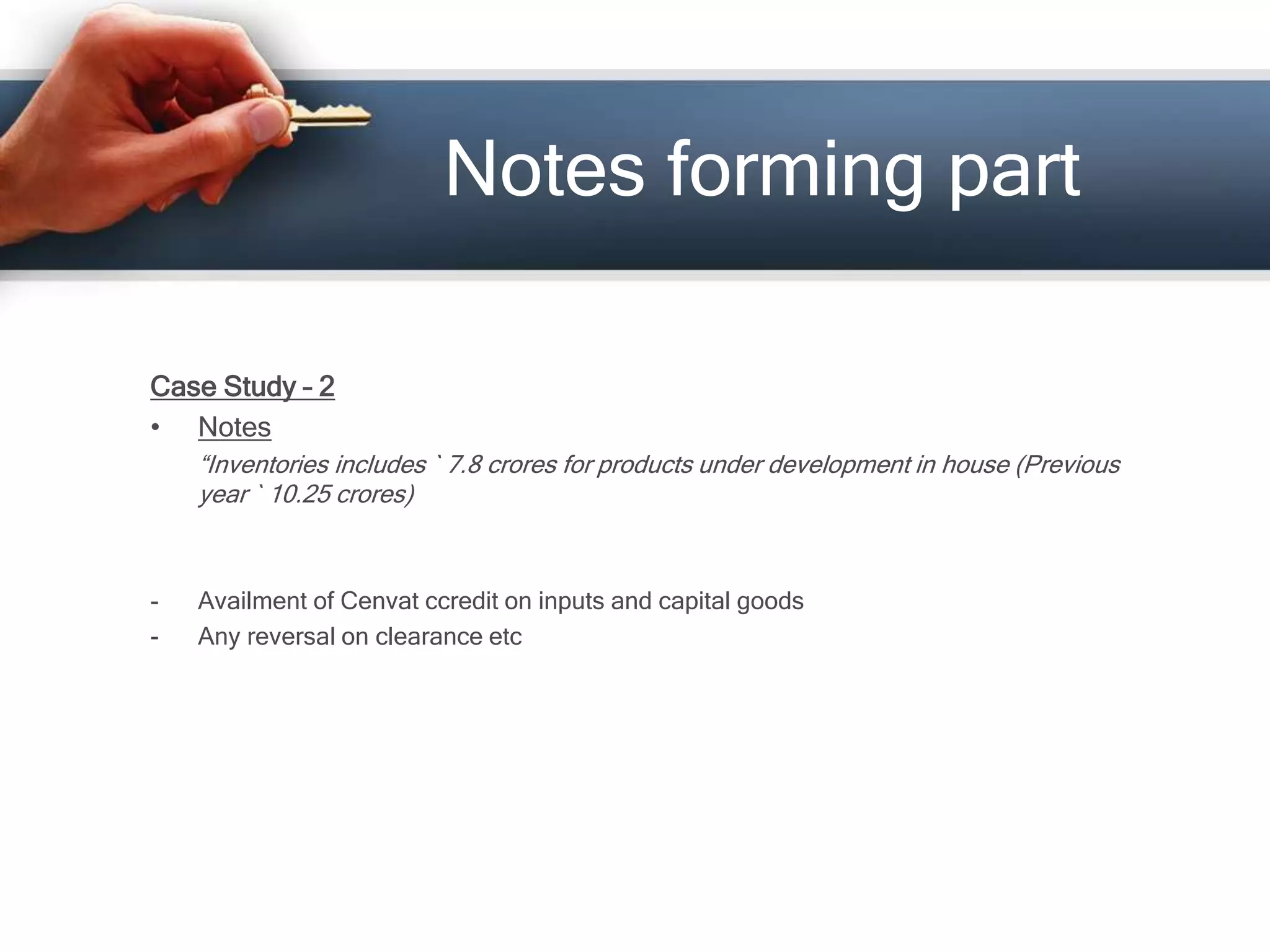
Case Study – 2
• Notes
“Inventories includes ` 7.8 crores for products under development in house (Previous
year ` 10.25 crores)
- Availment of Cenvat ccredit on inputs and capital goods
- Any reversal on clearance etc
Notes forming part
Case Study – 2
• Notes
“Inventories includes ` 7.8 crores for products under development in house (Previous
year ` 10.25 crores)
- Availment of Cenvat ccredit on inputs and capital goods
- Any reversal on clearance etc
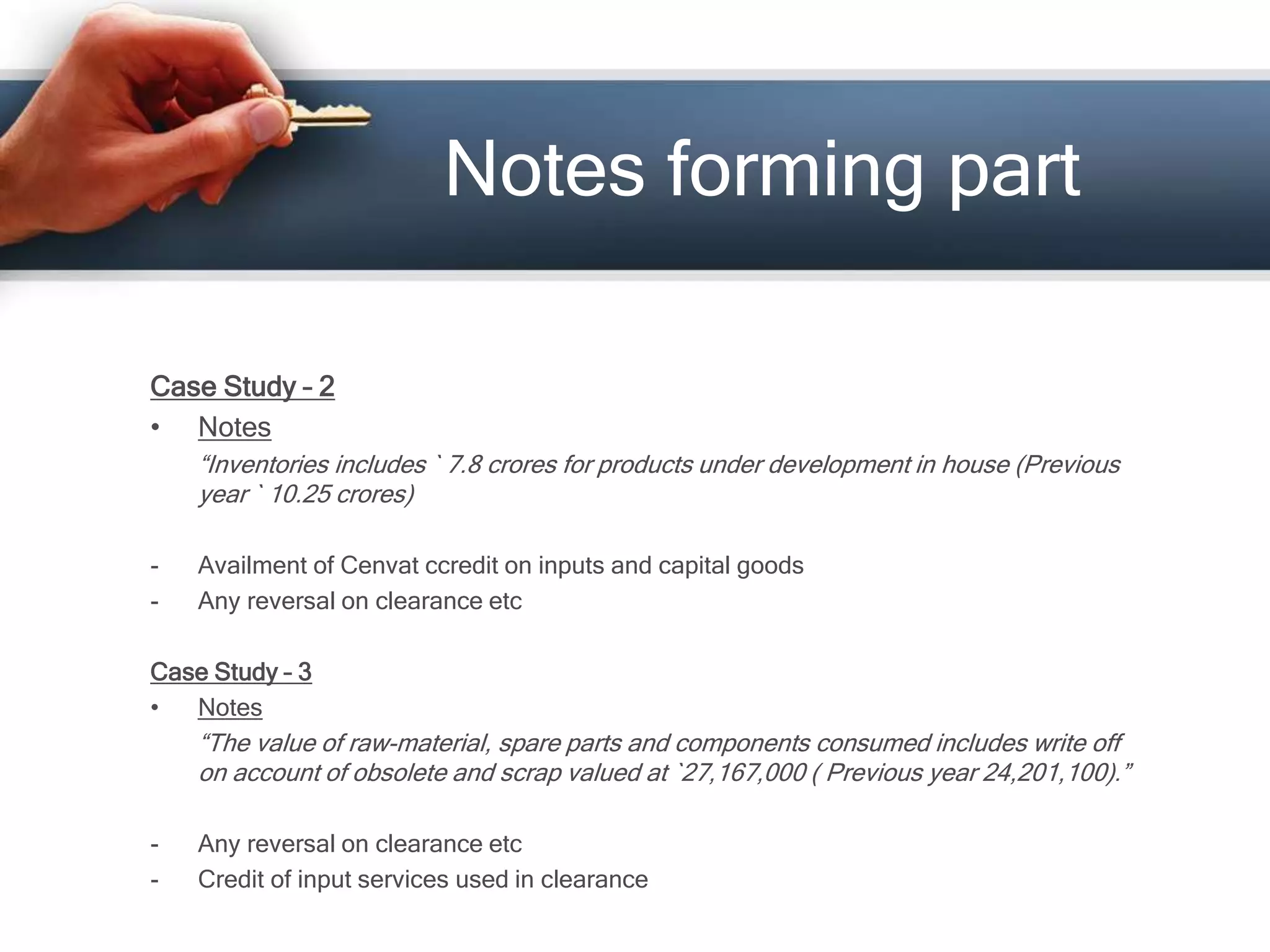
Case Study – 3
• Notes
“The value of raw-material, spare parts and components consumed includes write off
on account of obsolete and scrap valued at `27,167,000 ( Previous year 24,201,100).”
- Any reversal on clearance etc
- Credit of input services used in clearance
Notes forming part
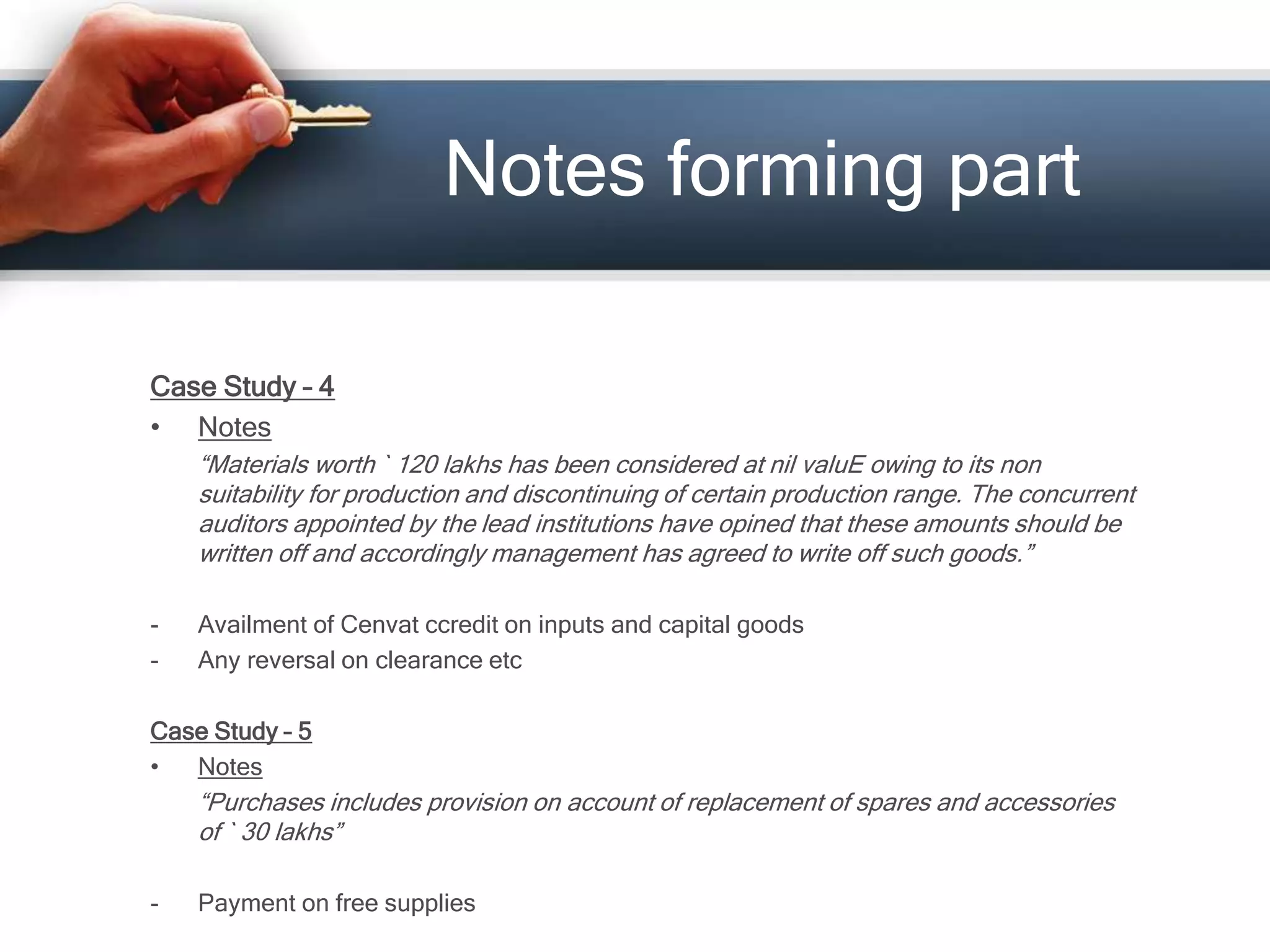
Case Study – 4
• Notes
“Materials worth ` 120 lakhs has been considered at nil valuE owing to its non
suitability for production and discontinuing of certain production range. The concurrent
auditors appointed by the lead institutions have opined that these amounts should be
written off and accordingly management has agreed to write off such goods.”
- Availment of Cenvat ccredit on inputs and capital goods
- Any reversal on clearance etc
Case Study – 5
• Notes
“Purchases includes provision on account of replacement of spares and accessories
of ` 30 lakhs”
- Payment on free supplies
Notes forming part
• TYPES OF RATIOS
- Profitability Ratios : GP Ratio / NP Ratio
- Activity Ratios : Turnover Ratio, Stock Ratio, Material Consumption ratio
- Liquidity Ratios : Current Ratio ,
- Stability Ratios (Capital Structure/Leverage Ratios) : Debt Equity, ROI
Ratio Analysis
• Period of Review
Every audit should invariably cover the retrospective period up to the previous audit by the
Departmental Audit Party or the last 5 years (limited to the commencement of levy on a
particular service) whichever is less and should extend up to the last completed Financial
Year preceding the date of Commencement of audit.
All Company Balance sheet contain figures for two years.
Understanding period
Study of Financials CA Gaurav Gupta 14
• Focus of review
o Money Measurement Concept
o Cost Concept
o Going Concern Concept
o Accrual / Cash concept
o Consistency
o Disclosure
o Substance over form
Financial Statements
Study of Financials CA Gaurav Gupta 15
• Account codes with balances
• Classification of assets and Liabilities
• Movement included in summary
• Opening and closing balances
• Detailed codes – understanding of recording of ledgers
• Monthly movement – provides review of pattern of income and expense
• Taxation accounts and their balances
• Debit and credit movements in sales / Services accounts
• Minor heads also displayed
• Discounts
• Bad debts
Trial Balance
Study of Financials CA Gaurav Gupta 16
• List of all Ledger Accounts wherein entries have taken place.
• List of Ledger Accounts relevant from Service Tax point of view.
• Balance of Service Tax payable / Cenvat Credit
Trial Balance
Study of Financials CA Gaurav Gupta 17
• Main heads
o Assets
o Liabilities
o Capital
o Subsidiary Books
o Cash Book
o Purchases / Purchase return
o Sales / Sales return
o Bills receivable / payable
o journal
Balance sheet
Study of Financials CA Gaurav Gupta 18
• Consolidation of Subsidiary financials
• Fixed assets statement – loss of assets / relinquishment
• Revenue from operations
• Cash flow – receipts from debtors
• Major heads to be examined
• Advances / Outstanding debtors
• Unearned incomes / Deferred incomes
• Capital Advances
• Security deposits
• Unpaid creditors
• Detail of other income
Balance sheet
Study of Financials CA Gaurav Gupta 19
• Reverse charge mechanism- under this mechanism, the recipient of services is liable to
pay service tax (e.g. GTA Services, services received from abroad, etc.). It is to be
ensured that assessee must have paid his liability on such items.
• Reimbursement- unless the concept of pure agent is applicable, reimbursement are
includible in the value of taxable services. Reconciliation should cover all receivables
including reimbursement, sale of goods etc,
• Netting of expenses/ Income- Netting of Income with amount payable should also be
checked as liability of Service Tax does not absolve on netting. The same can be verified
from ledger/ credit notes/ debit notes.
• VAT payment on certain transaction- VAT put in case of certain transaction should be
as to arrive at then taxable value, nature and classification such transaction include-
• Commercial or Industrial Construction Services
• Complex Construction Services
• Works Contract Services
• Annual Maintenance Services
Items requiring special
mention
Study of Financials CA Gaurav Gupta 20
• Clause 14 of the tax audit report (Form 3CD) provides information about amount of
depreciation under Section 32 of the Income Tax Act, 1961 and that of CENVAT credit
availed by the service providers on capital goods.
• Clause 22(a) of the Tax Audit Report (Form 3CD) gives the details of credit available and
carried forward to the next year. Hence, the Auditor can authenticate the amount of credit
carried forward in the service tax returns with the information provided in terms of this
clause.
• Clause 22(b) of the Tax Audit Report (Form 3CD) also gives information regarding prior
period incomes and expenses booked in the year under Tax Audit. The Auditor shall
ensure that service tax is paid on these amount in case they are subject to service tax.
• Clause 30 of the Tax audit report (Form 3CD) provides the information relating to Cost
Audit. If such an audit has been carried out, the Auditor should examine the Cost Audit
Report.
Tax Audit report
Study of Financials CA Gaurav Gupta 21
• Applicable Net gain / Loss on foreign transaction
• Bargain agreements
• Free of cost services to group companies and employees
• Corporate Guarantee
• Form 26AS
• Change in ratios
• Form 3CEB – Arms length value with sister concerns
• Any demands under other laws – unearthed revenue
Other important Points
Study of Financials CA Gaurav Gupta 22
Disclaimer
This presentation has been prepared for internal use of ICAI and its members. The contents of this document are
solely for informational purpose. It does not constitute professional advice or a formal recommendation. The
presentation is made with utmost professional caution but in no manner guarantees the content for use by any
person. It is suggested to go through original statute / notification / circular / pronouncements before relying on the
matter given. The presentation is meant for general guidance and no responsibility for loss arising to any person
acting or refraining from acting as a result of any material contained in this presentation will be accepted by us.
Professional advice recommended to be sought before any action or refrainment.
CA Gaurav Gupta
Partner
MGS & Co.
507 B, D-Mall, Netaji Subhash Palace, Delhi - 110034
+91 11 32962487
+91 11 2735 2487
+91 98110 13940
cagauravmgs@gmail.com
Thank you

Understanding Financial Statement

  • 1.
    Understanding Financial Statement AuditCommissionerate, Delhi I November 24, 2015 Presented by: CA Gaurav Gupta FCA, LLB, DISA Partner MGS & Co.
  • 2.
    • Discusses overallperformance • Any strategic movement like acquisition etc • Corporate Governance report • Director’s responsibility statement • Any major departures from applicable accounting standards • True and fair view • Going concern basis • Employee and other details like energy conservation etc. • Foreign exchange earning and outgo Director’s Report Study of Financials CA Gaurav Gupta 2
  • 3.
    Director’s Report • Financialhighlights • Amounts proposed for transfer to reserves • Proposed dividend • Important happenings, trends, future plans • Explanation on auditor’s qualification • Details of conservation of energy, technology absorption, foreign exchange earning and outgo.
  • 4.
    Director’s Report Case Study-1 • Observations in Director’s report “ During the year a major fire broke out at our Pune plant in August, 1999 resulting in substantial damage to the paper makin plant and the burning of raw-material and finished goods. The company has lodged the insurance claim. However, we were able to repair the plant and manufacturing activities were restarted by end of February 2013. Due to stoppage of this plant our profits have reduced substantially”. - Whether CENVAT credit was reversed on input or input contained in work in progress and finished goods destroyed by fire. - Whether remission of duty on finished goods has been claimed. - Whether any of the capital goods, which got damaged, have been cleared as scrap and whether CENVAT credit was availed in the past on the said capital goods.
  • 5.
    Director’s Report Case Study-2 • Observations in Director’s report “In order to strengthen marketing activities, your company have acquired majority shares in ABC Marketing Ltd., which had become a subsidiary company from this year”. - Department can find out whether the company is supply of services or goods to the subsidiary company or vice-versa. - Transactions between related parties
  • 6.
    Director’s Report Case Study- 3 • Observations in Director’s report “Your company has initiated various actions to meet the challenges of the market. Among the steps taken are introduction of state of the art new products, provision of technical and engineering services and starting of e- commerce marketing. Your company is among the first few in the country to start trading though web-site”. • Exact system of trading on e-com basis should be found out to verify correctness of payment of duty. - New line of business – Cenvat /credit – setting up
  • 7.
    Director’s Report Case Study– 4 • Observations in Director’s report “Performance and profitability: During the year under reference your Company has incurred a loss of ` 9002.73 lackh ( for 18 months) on a turnover of ` 8785.39 Lakhs The expenses to the extent of ` 3589.20 lakhs has been charged to the profit and loss account pertaining to earlier years. The loss is mainly attributable to higher depreciation, write off of slow and non-moving and obsolete inventory, as suggested by the concurrent auditors appointed by the lead bank and higher interest burden. In addition there has been increase in cost of raw materials and components consumed which could not be absorbed in the selling price.” - Details of write-off of slow, non-moving and obsolete inventory. - Whether these have been sold subsequently and whether CENVAT availed has been reversed. - What is the impact of increase in raw-material cost to PLA/ CENVAT ratio. - Expenses of previous years- Does it include inputs on which credit was availed in the past.
  • 8.
    • Basic Accountingpolicies • Nature of assets and liabilities • Revenue Recognition • Provisions, contingent liabilities - List of Show Cause Notice(s) issued, if any and their present Status. • Mandatory detailed information under New Schedule VI • Segment reporting • Related party transactions including their balances • Capital and other Commitments • Expenditure in foreign Currency • In certain Cases, unpaid Statutory liabilities Notes forming part Study of Financials CA Gaurav Gupta 8
  • 9.
    Case Study –1 • Notes “Plant and Machinery includes machinery acquired under lease/ hire purchase scheme costing ` 1.58 crores ( 1.28 crores last year )” - CENVAT Credit as capital goods on such machinery has been taken on lease/hire purchase - Whether any old machine replaces and treatment of credit thereof - What is the impact of increase in raw-material cost to PLA/ CENVAT ratio. - Expenses of previous years- Does it include inputs on which credit was availed in the past. Notes forming part
  • 10.
    Case Study –2 • Notes “Inventories includes ` 7.8 crores for products under development in house (Previous year ` 10.25 crores) - Availment of Cenvat ccredit on inputs and capital goods - Any reversal on clearance etc Notes forming part
  • 11.
    Case Study –2 • Notes “Inventories includes ` 7.8 crores for products under development in house (Previous year ` 10.25 crores) - Availment of Cenvat ccredit on inputs and capital goods - Any reversal on clearance etc Case Study – 3 • Notes “The value of raw-material, spare parts and components consumed includes write off on account of obsolete and scrap valued at `27,167,000 ( Previous year 24,201,100).” - Any reversal on clearance etc - Credit of input services used in clearance Notes forming part
  • 12.
    Case Study –4 • Notes “Materials worth ` 120 lakhs has been considered at nil valuE owing to its non suitability for production and discontinuing of certain production range. The concurrent auditors appointed by the lead institutions have opined that these amounts should be written off and accordingly management has agreed to write off such goods.” - Availment of Cenvat ccredit on inputs and capital goods - Any reversal on clearance etc Case Study – 5 • Notes “Purchases includes provision on account of replacement of spares and accessories of ` 30 lakhs” - Payment on free supplies Notes forming part
  • 13.
    • TYPES OFRATIOS - Profitability Ratios : GP Ratio / NP Ratio - Activity Ratios : Turnover Ratio, Stock Ratio, Material Consumption ratio - Liquidity Ratios : Current Ratio , - Stability Ratios (Capital Structure/Leverage Ratios) : Debt Equity, ROI Ratio Analysis
  • 14.
    • Period ofReview Every audit should invariably cover the retrospective period up to the previous audit by the Departmental Audit Party or the last 5 years (limited to the commencement of levy on a particular service) whichever is less and should extend up to the last completed Financial Year preceding the date of Commencement of audit. All Company Balance sheet contain figures for two years. Understanding period Study of Financials CA Gaurav Gupta 14
  • 15.
    • Focus ofreview o Money Measurement Concept o Cost Concept o Going Concern Concept o Accrual / Cash concept o Consistency o Disclosure o Substance over form Financial Statements Study of Financials CA Gaurav Gupta 15
  • 16.
    • Account codeswith balances • Classification of assets and Liabilities • Movement included in summary • Opening and closing balances • Detailed codes – understanding of recording of ledgers • Monthly movement – provides review of pattern of income and expense • Taxation accounts and their balances • Debit and credit movements in sales / Services accounts • Minor heads also displayed • Discounts • Bad debts Trial Balance Study of Financials CA Gaurav Gupta 16
  • 17.
    • List ofall Ledger Accounts wherein entries have taken place. • List of Ledger Accounts relevant from Service Tax point of view. • Balance of Service Tax payable / Cenvat Credit Trial Balance Study of Financials CA Gaurav Gupta 17
  • 18.
    • Main heads oAssets o Liabilities o Capital o Subsidiary Books o Cash Book o Purchases / Purchase return o Sales / Sales return o Bills receivable / payable o journal Balance sheet Study of Financials CA Gaurav Gupta 18
  • 19.
    • Consolidation ofSubsidiary financials • Fixed assets statement – loss of assets / relinquishment • Revenue from operations • Cash flow – receipts from debtors • Major heads to be examined • Advances / Outstanding debtors • Unearned incomes / Deferred incomes • Capital Advances • Security deposits • Unpaid creditors • Detail of other income Balance sheet Study of Financials CA Gaurav Gupta 19
  • 20.
    • Reverse chargemechanism- under this mechanism, the recipient of services is liable to pay service tax (e.g. GTA Services, services received from abroad, etc.). It is to be ensured that assessee must have paid his liability on such items. • Reimbursement- unless the concept of pure agent is applicable, reimbursement are includible in the value of taxable services. Reconciliation should cover all receivables including reimbursement, sale of goods etc, • Netting of expenses/ Income- Netting of Income with amount payable should also be checked as liability of Service Tax does not absolve on netting. The same can be verified from ledger/ credit notes/ debit notes. • VAT payment on certain transaction- VAT put in case of certain transaction should be as to arrive at then taxable value, nature and classification such transaction include- • Commercial or Industrial Construction Services • Complex Construction Services • Works Contract Services • Annual Maintenance Services Items requiring special mention Study of Financials CA Gaurav Gupta 20
  • 21.
    • Clause 14of the tax audit report (Form 3CD) provides information about amount of depreciation under Section 32 of the Income Tax Act, 1961 and that of CENVAT credit availed by the service providers on capital goods. • Clause 22(a) of the Tax Audit Report (Form 3CD) gives the details of credit available and carried forward to the next year. Hence, the Auditor can authenticate the amount of credit carried forward in the service tax returns with the information provided in terms of this clause. • Clause 22(b) of the Tax Audit Report (Form 3CD) also gives information regarding prior period incomes and expenses booked in the year under Tax Audit. The Auditor shall ensure that service tax is paid on these amount in case they are subject to service tax. • Clause 30 of the Tax audit report (Form 3CD) provides the information relating to Cost Audit. If such an audit has been carried out, the Auditor should examine the Cost Audit Report. Tax Audit report Study of Financials CA Gaurav Gupta 21
  • 22.
    • Applicable Netgain / Loss on foreign transaction • Bargain agreements • Free of cost services to group companies and employees • Corporate Guarantee • Form 26AS • Change in ratios • Form 3CEB – Arms length value with sister concerns • Any demands under other laws – unearthed revenue Other important Points Study of Financials CA Gaurav Gupta 22
  • 23.
    Disclaimer This presentation hasbeen prepared for internal use of ICAI and its members. The contents of this document are solely for informational purpose. It does not constitute professional advice or a formal recommendation. The presentation is made with utmost professional caution but in no manner guarantees the content for use by any person. It is suggested to go through original statute / notification / circular / pronouncements before relying on the matter given. The presentation is meant for general guidance and no responsibility for loss arising to any person acting or refraining from acting as a result of any material contained in this presentation will be accepted by us. Professional advice recommended to be sought before any action or refrainment. CA Gaurav Gupta Partner MGS & Co. 507 B, D-Mall, Netaji Subhash Palace, Delhi - 110034 +91 11 32962487 +91 11 2735 2487 +91 98110 13940 cagauravmgs@gmail.com Thank you