Class 2
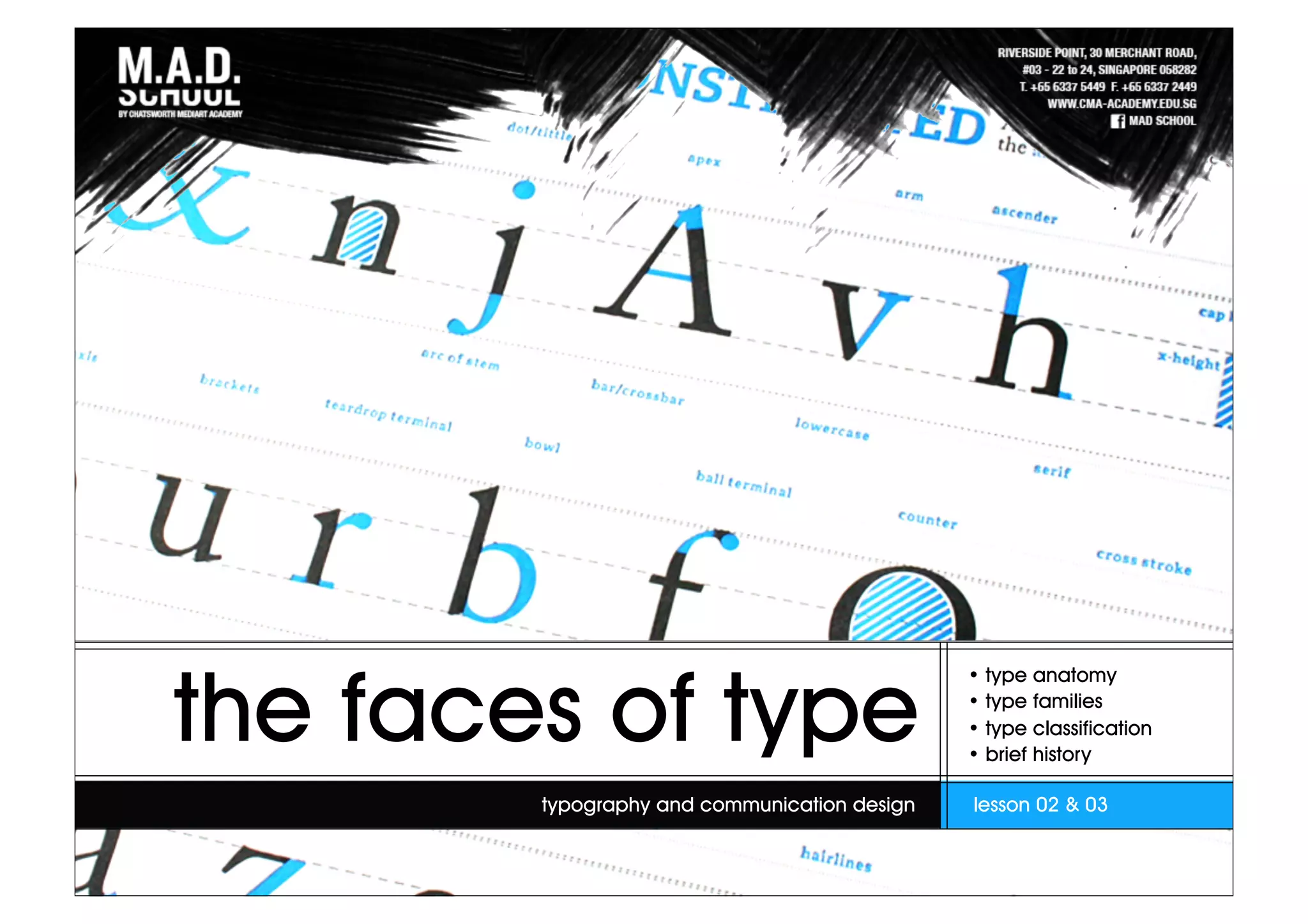
typography and communication design lesson 02 & 03
the faces of type
• type anatomy
• type families
• type classification
• brief history
anatomy
Double chin?
Big feet?
Bowed Legs?
“you just want me for
my body ”
Tall & Curvy?
type
little details will tell you
alot about your type.
GO AHEAD AND CHECK THEM OUT.
IT’S NOT SHALLOW.
IT’S YOUR JOB.
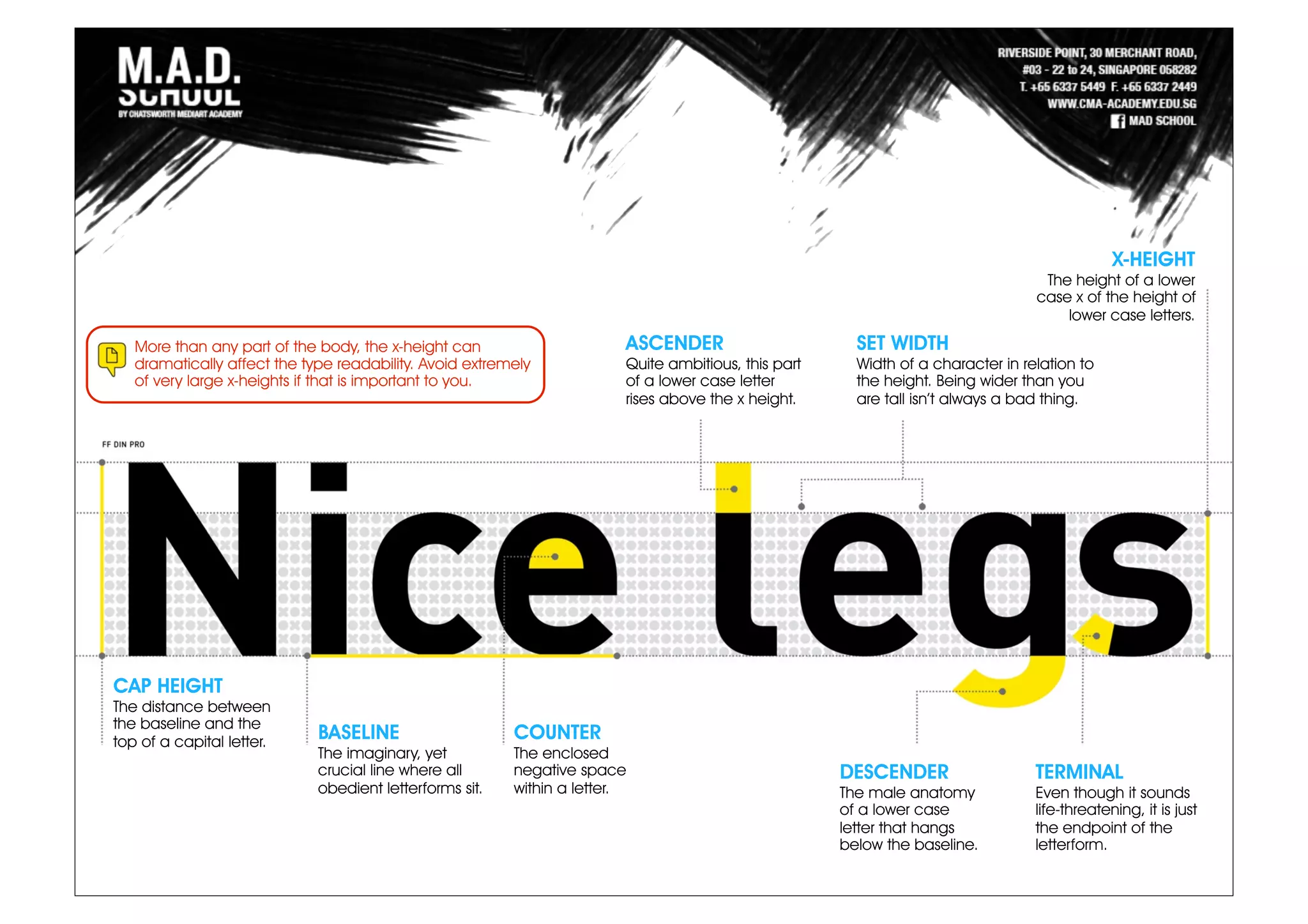
More than any part of the body, the x-height can
dramatically affect the type readability. Avoid extremely
of very large x-heights if that is important to you.
ASCENDER
Quite ambitious, this part
of a lower case letter
rises above the x height.
SET WIDTH
Width of a character in relation to
the height. Being wider than you
are tall isn’t always a bad thing.
X-HEIGHT
The height of a lower
case x of the height of
lower case letters.
CAP HEIGHT
The distance between
the baseline and the
top of a capital letter.
BASELINE
The imaginary, yet
crucial line where all
obedient letterforms sit.
COUNTER
The enclosed
negative space
within a letter.
DESCENDER
The male anatomy
of a lower case
letter that hangs
below the baseline.
TERMINAL
Even though it sounds
life-threatening, it is just
the endpoint of the
letterform.
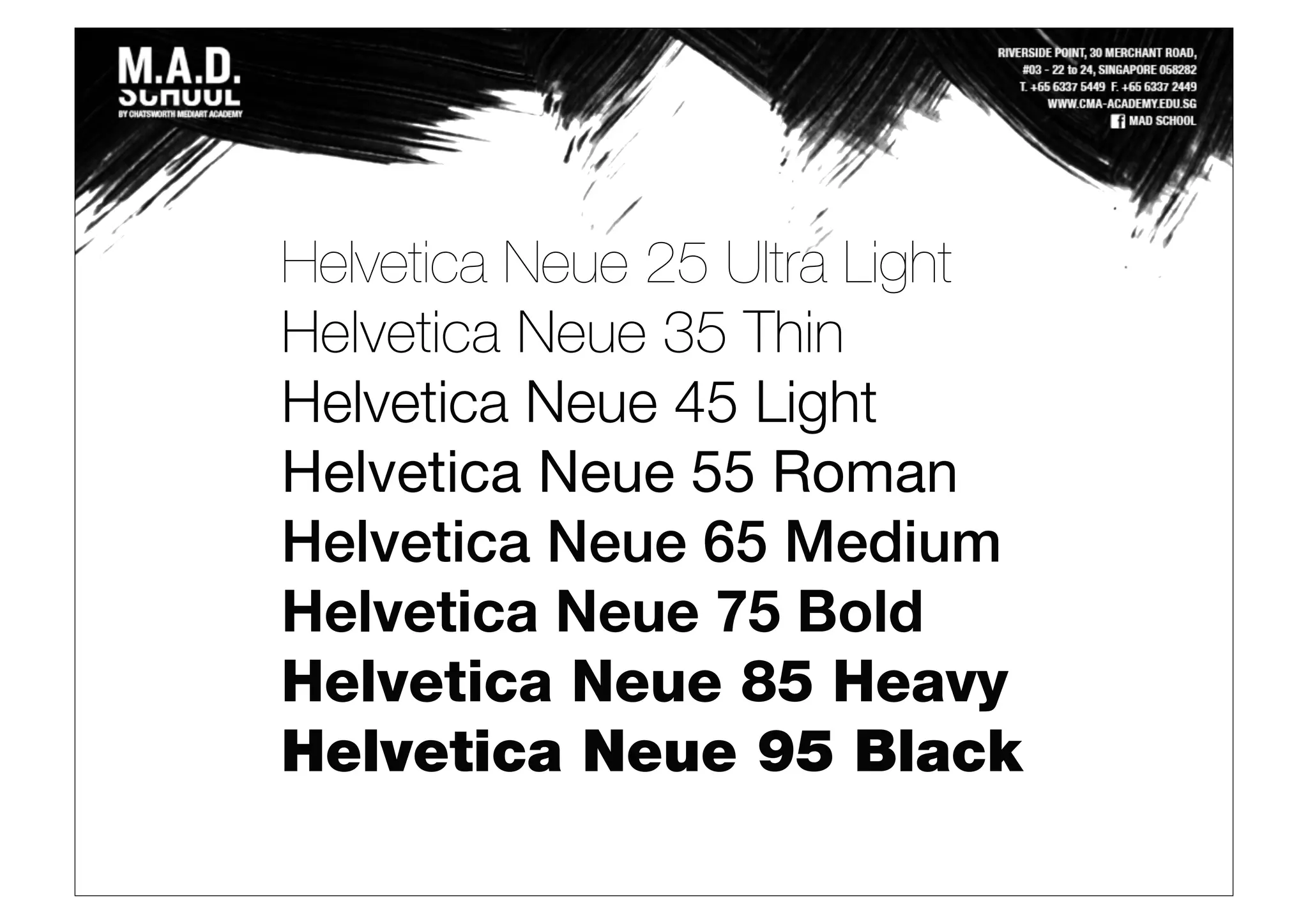
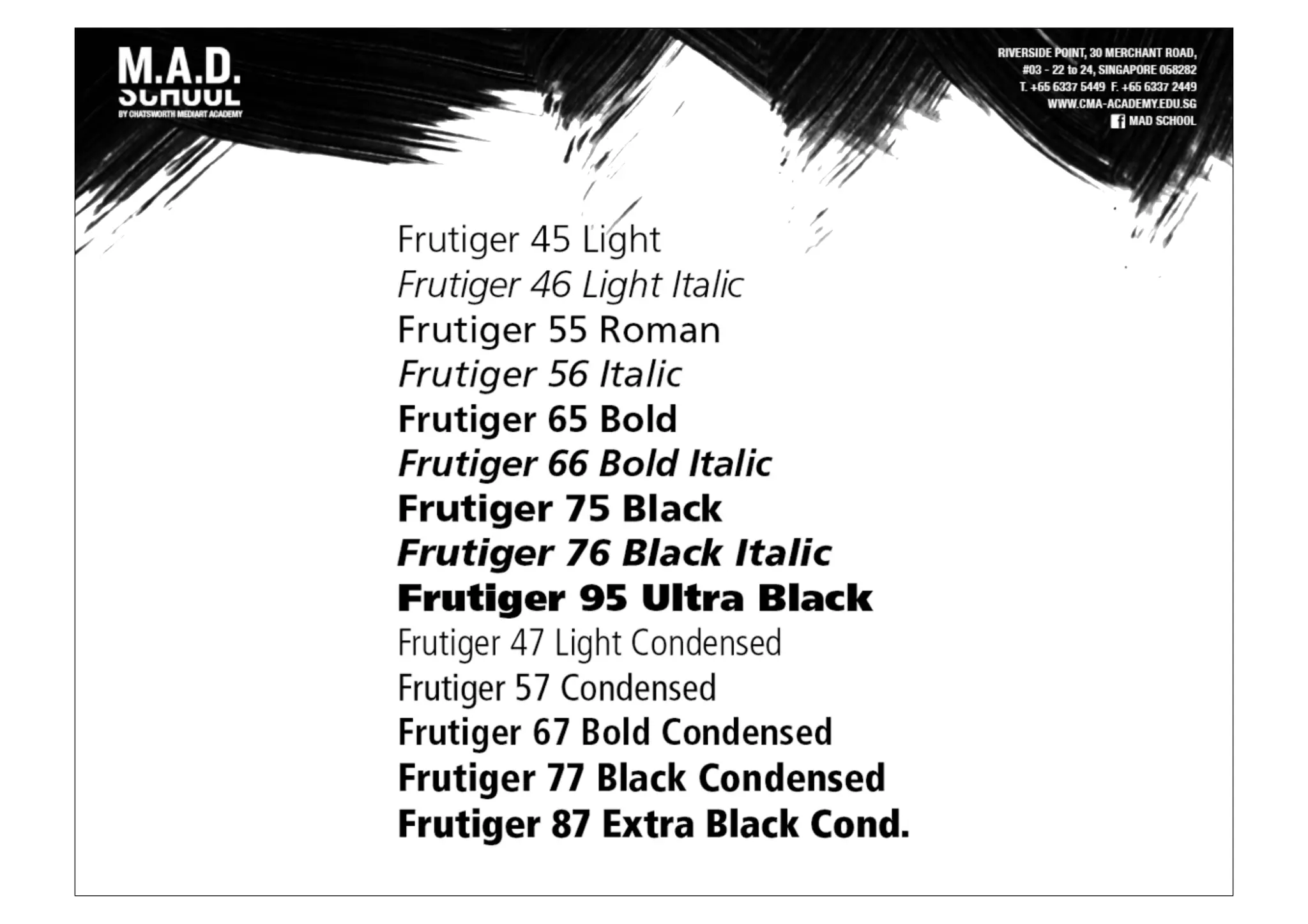
A font consists of a set of character of consistent design.
A font family extends this to become a set of fonts, designed to work together.
A family consist of the variations (styles) of the basic font.
The names of the variations or styles are not consistent, and alternatives are
given with the descriptions.
The most basic variations are bold and italics. Most well-designed fonts have
at least these. The family may consist of more.
Here are some of the most common.
families
type
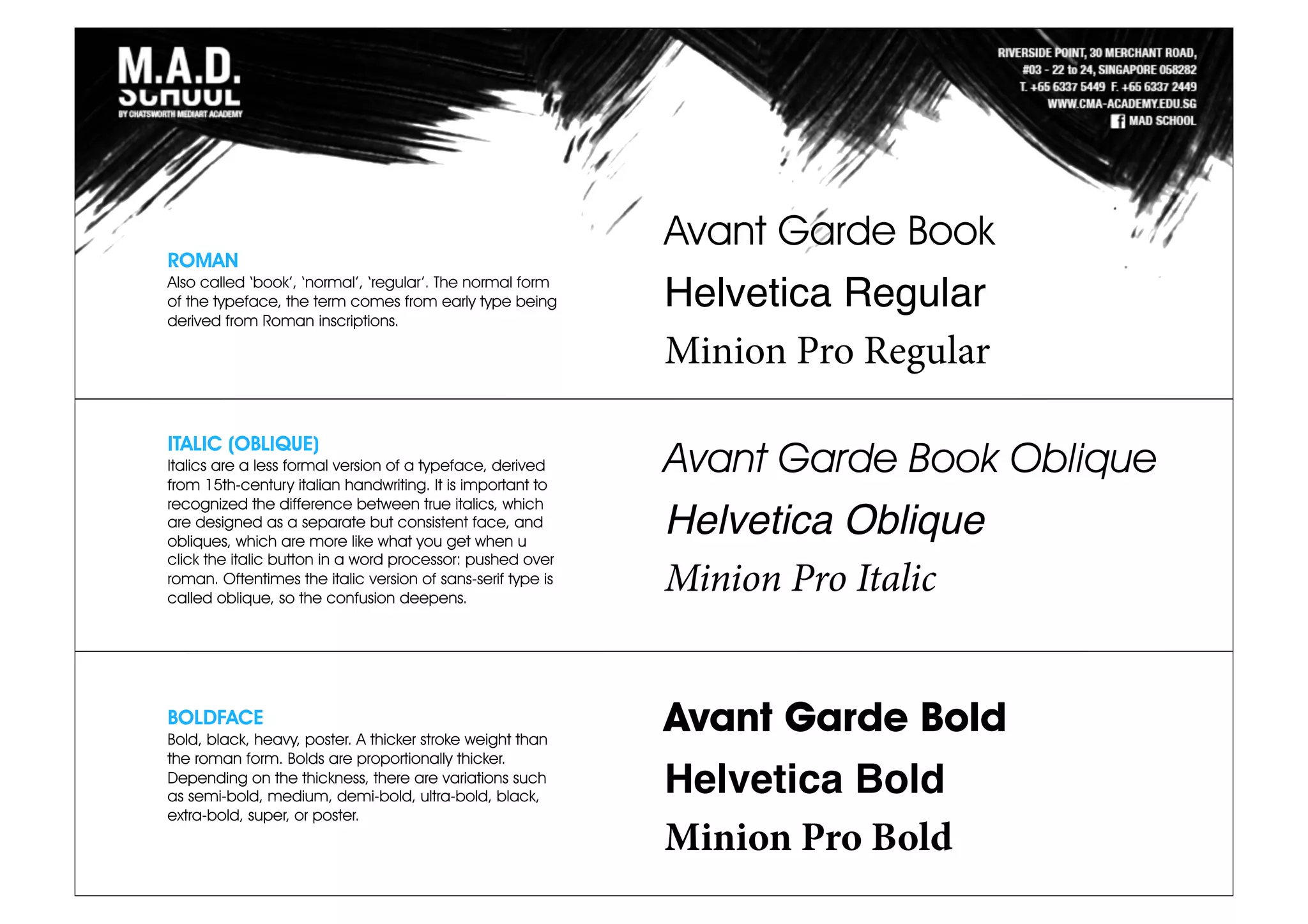
ROMAN
Also called ‘book’, ‘normal’, ‘regular’. The normal form
of the typeface, the term comes from early type being
derived from Roman inscriptions.
ITALIC (OBLIQUE)
Italics are a less formal version of a typeface, derived
from 15th-century italian handwriting. It is important to
recognized the difference between true italics, which
are designed as a separate but consistent face, and
obliques, which are more like what you get when u
click the italic button in a word processor: pushed over
roman. Oftentimes the italic version of sans-serif type is
called oblique, so the confusion deepens.
BOLDFACE
Bold, black, heavy, poster. A thicker stroke weight than
the roman form. Bolds are proportionally thicker.
Depending on the thickness, there are variations such
as semi-bold, medium, demi-bold, ultra-bold, black,
extra-bold, super, or poster.
Avant Garde Book
Helvetica Regular
Minion Pro Regular
Avant Garde Book Oblique
Helvetica Oblique
Minion Pro Italic
Avant Garde Bold
Helvetica Bold
Minion Pro Bold
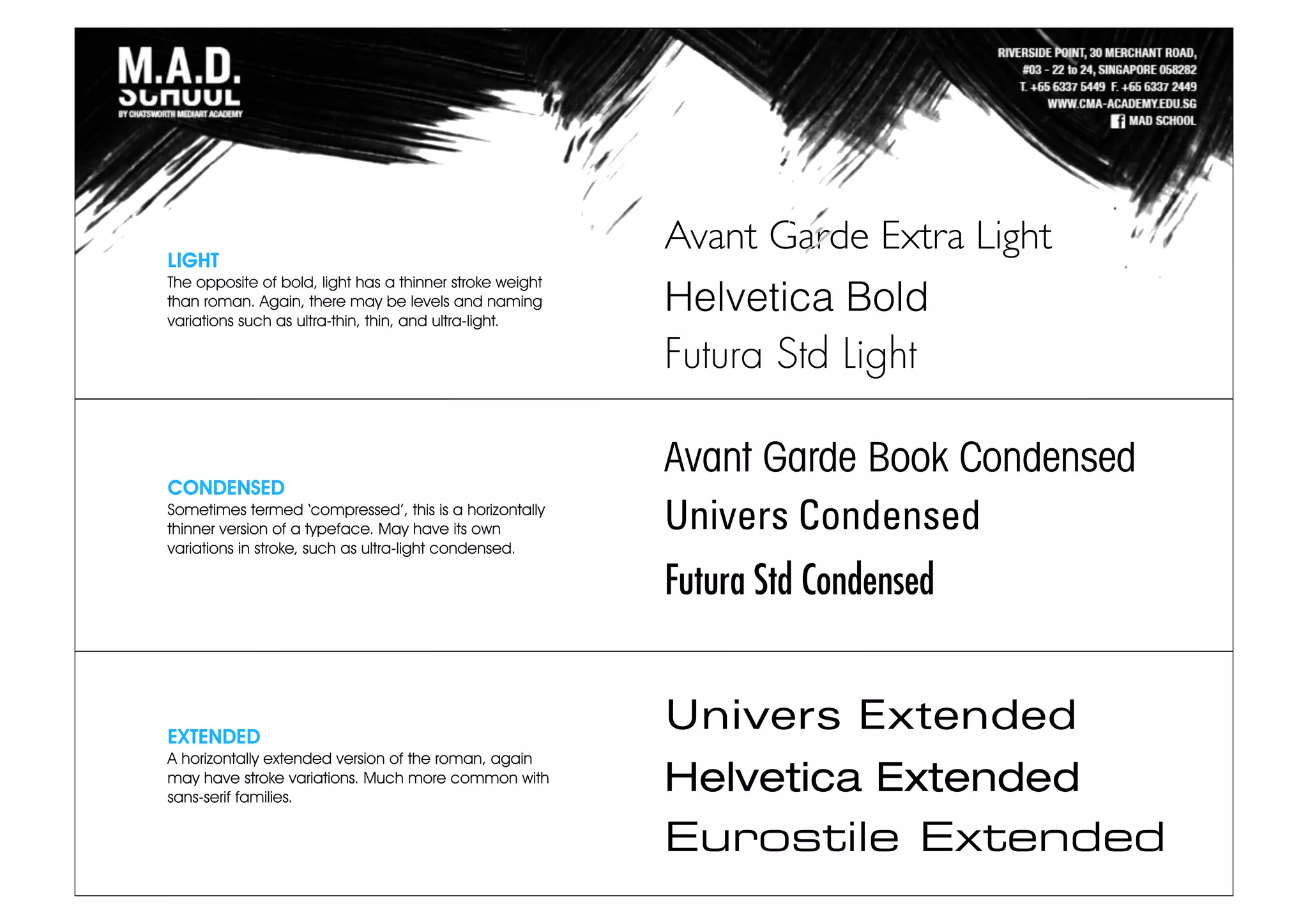
LIGHT
The opposite of bold, light has a thinner stroke weight
than roman. Again, there may be levels and naming
variations such as ultra-thin, thin, and ultra-light.
CONDENSED
Sometimes termed ‘compressed’, this is a horizontally
thinner version of a typeface. May have its own
variations in stroke, such as ultra-light condensed.
EXTENDED
A horizontally extended version of the roman, again
may have stroke variations. Much more common with
sans-serif families.
Avant Garde Extra Light
Helvetica Bold
Futura Std Light
Avant Garde Book Condensed
Univers Condensed
Futura Std Condensed
Univers Extended
Helvetica Extended
Eurostile Extended
A basic system for classifying typefaces was devised in the nineteenth
century, when printers sought to identify a heritage for their own craft
analogous to that of art history.
Humanist letterforms are closely connected to calligraphy and the
movement of the hand. Transitional and modern typefaces are more
abstract and less organic. These three main groups correspond roughly
to the Renaissance, Baroque, and Enlightenment periods in art and
literature.
Designers in the twentieth and twenty-first centuries have continued to
create new typefaces based on historic characteristics.
classification
type
Type classification, while helpful, is often confusing and even
controversial.
Type classification is also helpful in pairing typefaces for projects,
sometimes based on historical proximity but also by noting similar
features that unify the typefaces, such as axis or x-height.
In some cases, by finding enough disparity in the small features,
very different typefaces become complementary.
Part 1: Classifying Serif Typefaces
Part 2: Classifying Sans Typefaces
Part 1
Classifying
Serif Typefaces
Humanist / Old-Styled / Transitional / Modern / Slab Serif
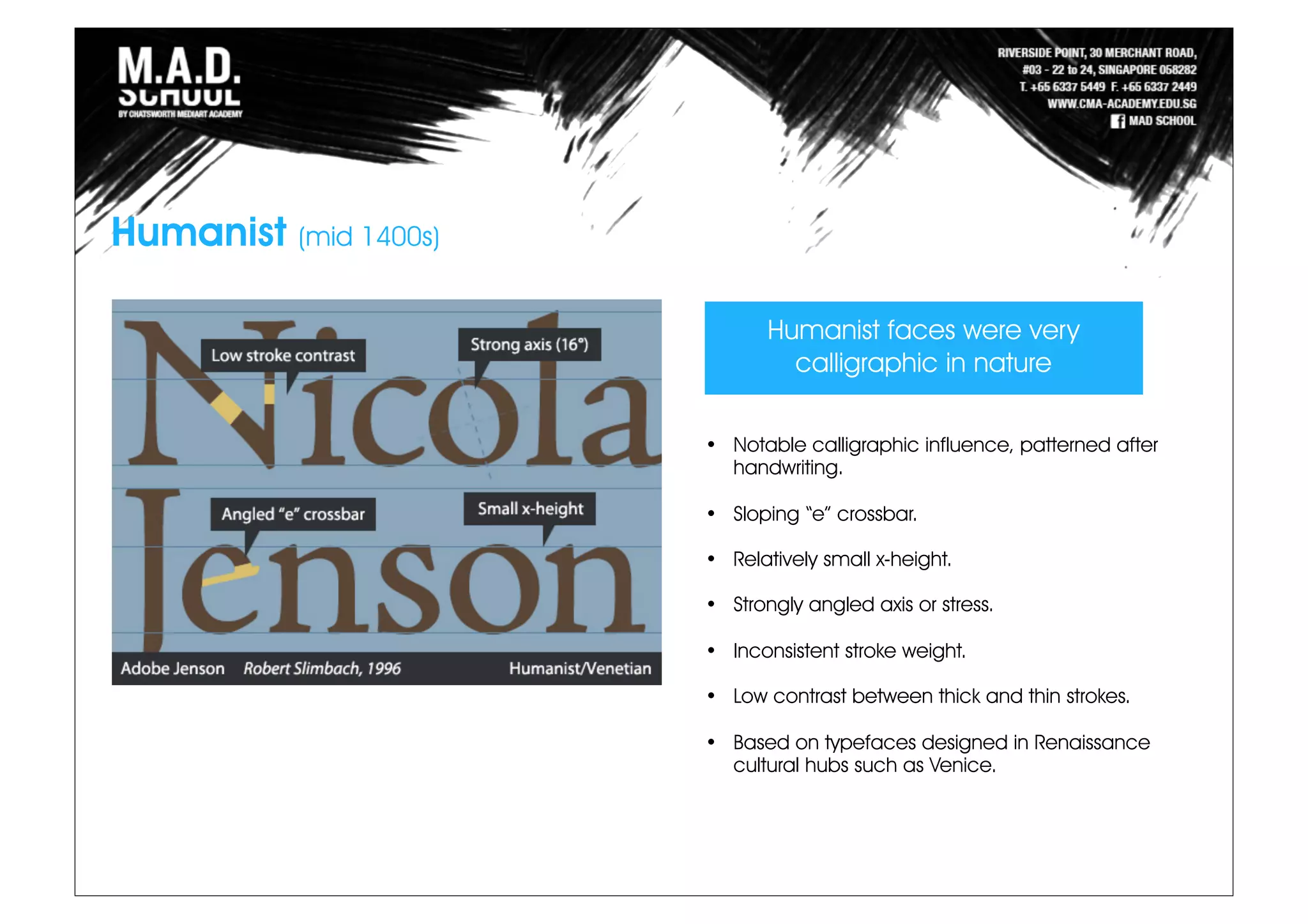
Humanist faces were very
calligraphic in nature
• Notable calligraphic influence, patterned after
handwriting.
• Sloping “e” crossbar.
• Relatively small x-height.
• Strongly angled axis or stress.
• Inconsistent stroke weight.
• Low contrast between thick and thin strokes.
• Based on typefaces designed in Renaissance
cultural hubs such as Venice.
Humanist (mid 1400s)
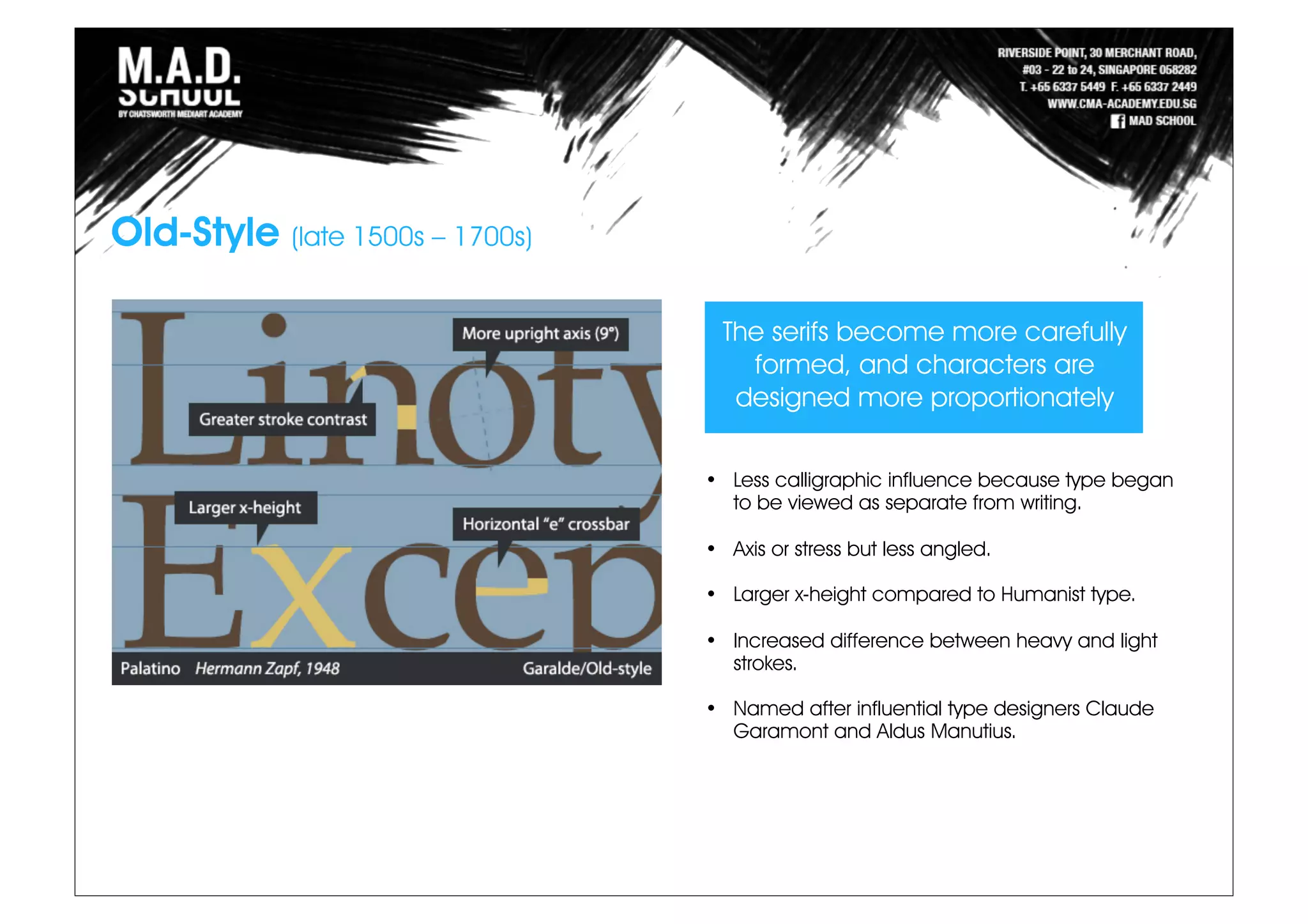
Old-Style (late 1500s – 1700s)
The serifs become more carefully
formed, and characters are
designed more proportionately
• Less calligraphic influence because type began
to be viewed as separate from writing.
• Axis or stress but less angled.
• Larger x-height compared to Humanist type.
• Increased difference between heavy and light
strokes.
• Named after influential type designers Claude
Garamont and Aldus Manutius.
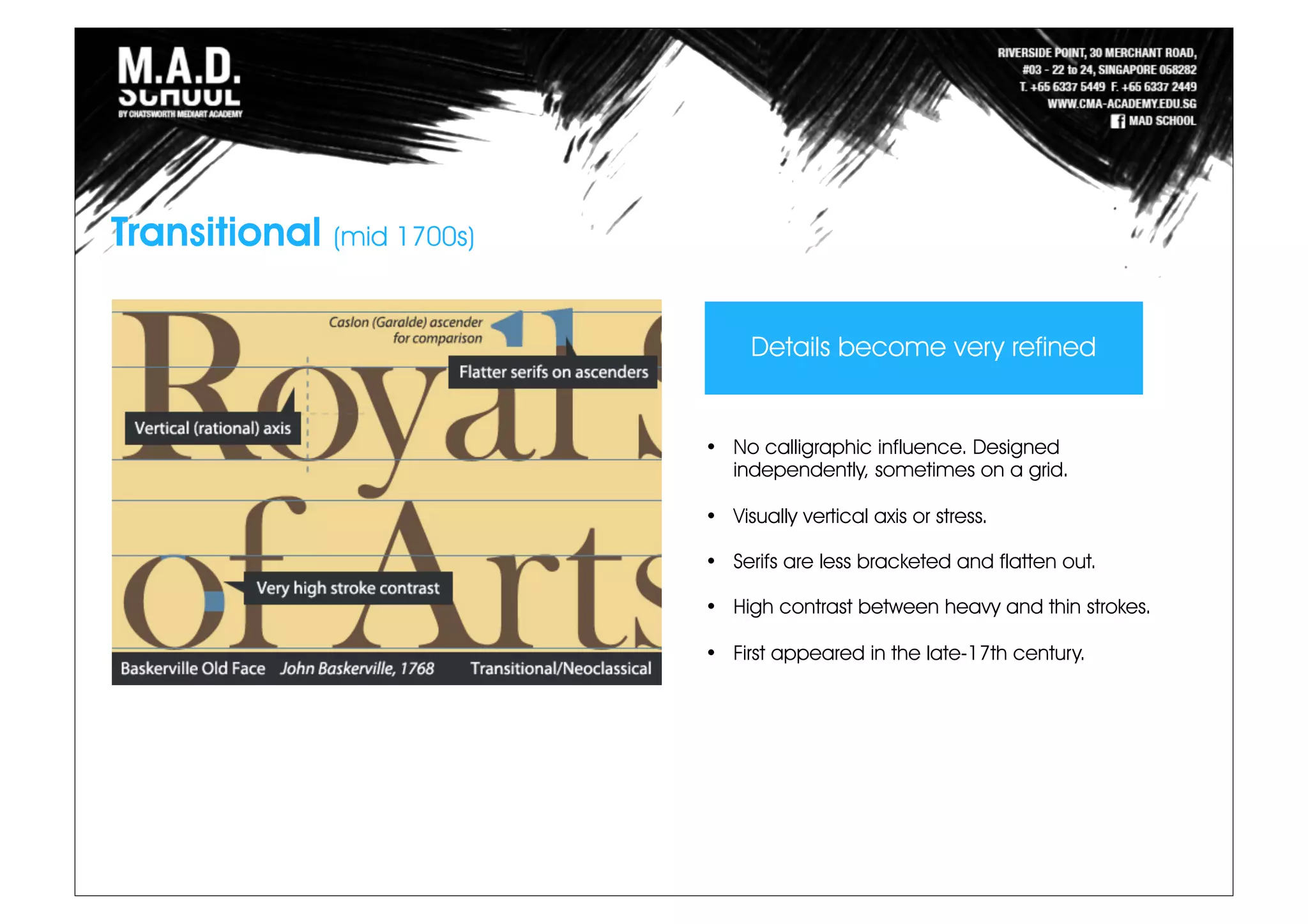
Transitional (mid 1700s)
• No calligraphic influence. Designed
independently, sometimes on a grid.
• Visually vertical axis or stress.
• Serifs are less bracketed and flatten out.
• High contrast between heavy and thin strokes.
• First appeared in the late-17th century.
Details become very refined
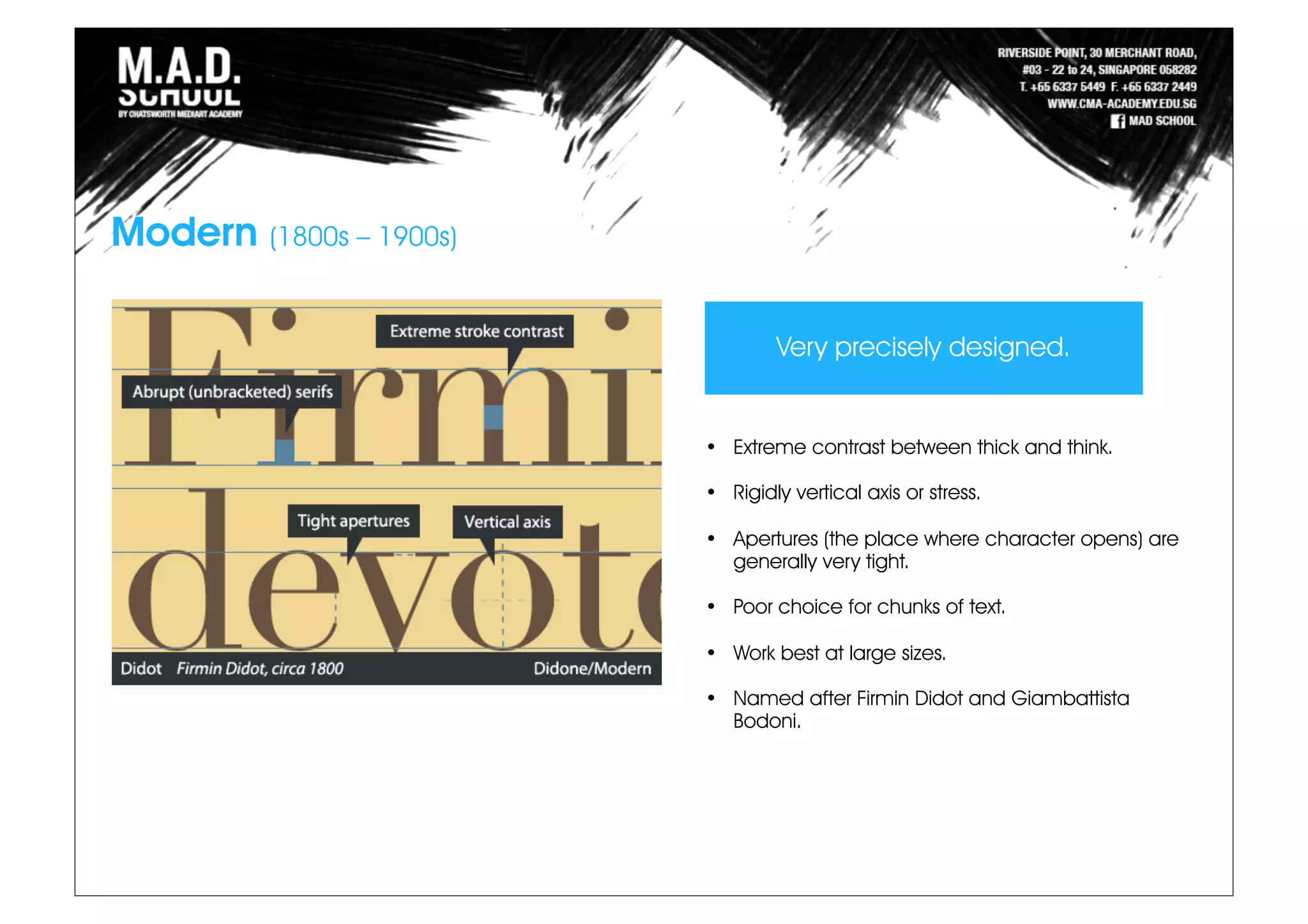
Modern (1800s – 1900s)
• Extreme contrast between thick and think.
• Rigidly vertical axis or stress.
• Apertures (the place where character opens) are
generally very tight.
• Poor choice for chunks of text.
• Work best at large sizes.
• Named after Firmin Didot and Giambattista
Bodoni.
Very precisely designed.
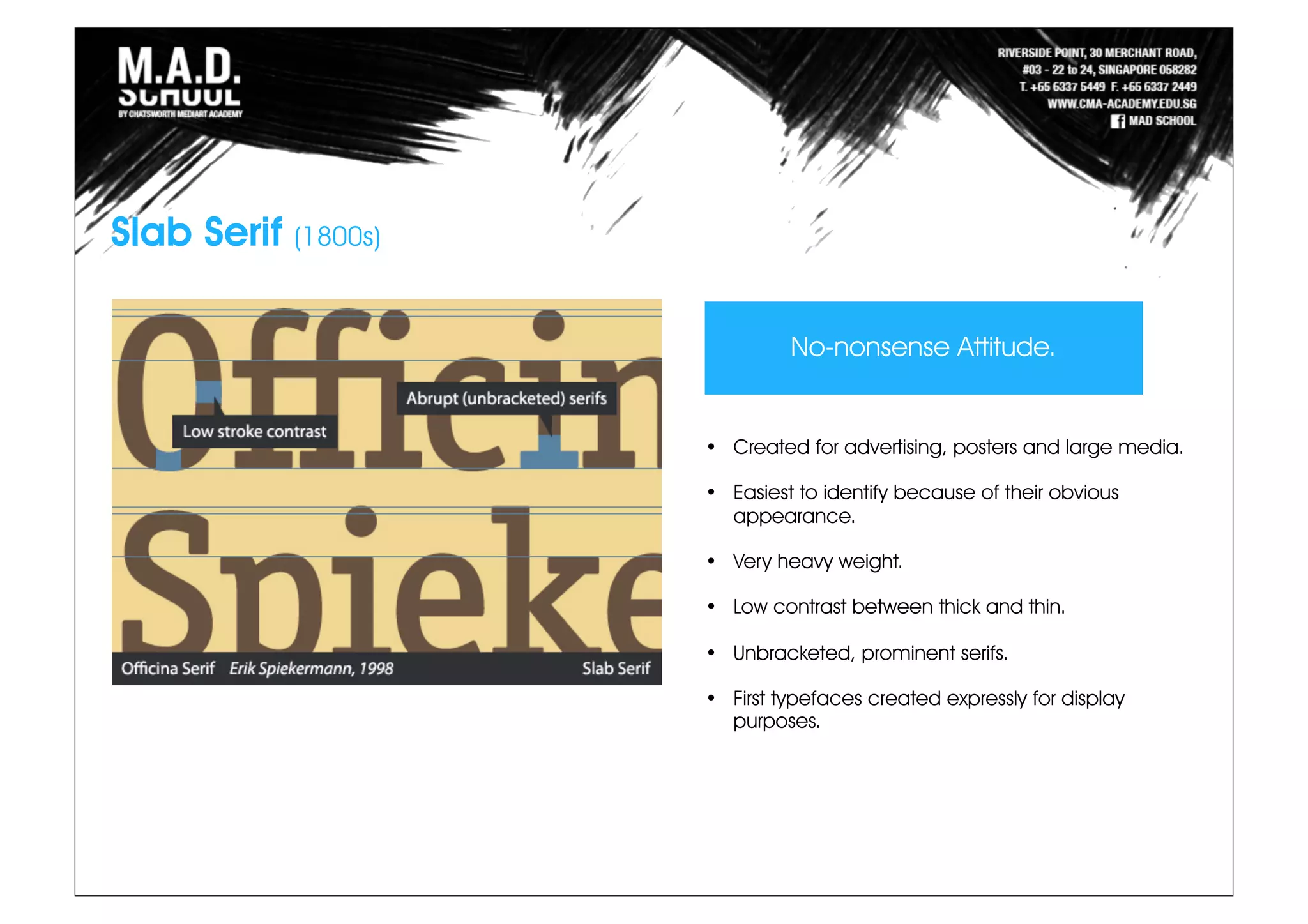
Slab Serif (1800s)
• Created for advertising, posters and large media.
• Easiest to identify because of their obvious
appearance.
• Very heavy weight.
• Low contrast between thick and thin.
• Unbracketed, prominent serifs.
• First typefaces created expressly for display
purposes.
No-nonsense Attitude.
EXERCISE 2
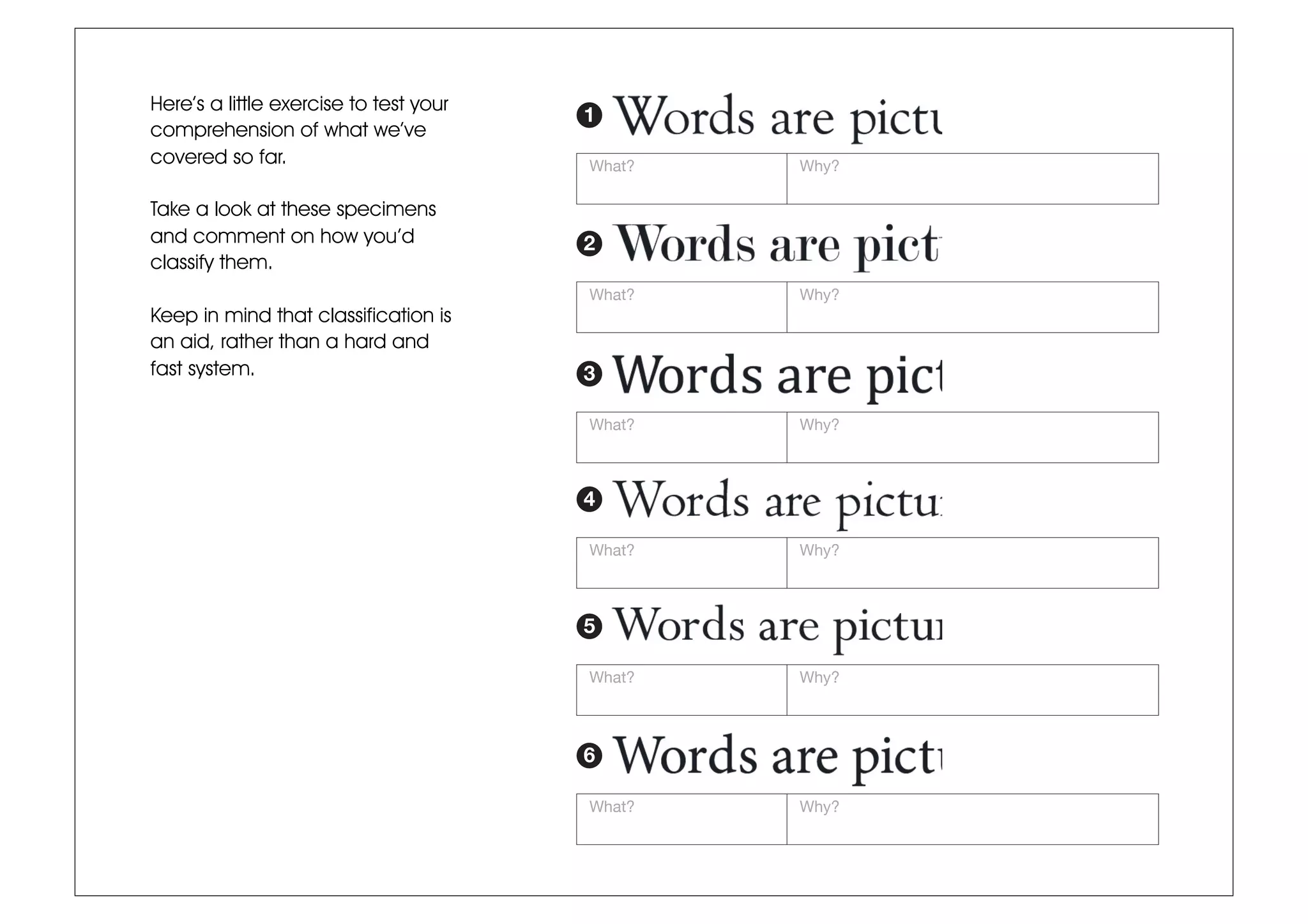
Here’s a little exercise to test your
comprehension of what we’ve
covered so far.
Take a look at these specimens
and comment on how you’d
classify them.
Keep in mind that classification is
an aid, rather than a hard and
fast system.
1
What? Why?
2
What? Why?
3
What? Why?
4
What? Why?
5
What? Why?
6
What? Why?
Part 2
Classifying
Sans Typefaces
Grotesque / Neo-Grotesque / Humanist / Geometric
Grotesque (1800s)
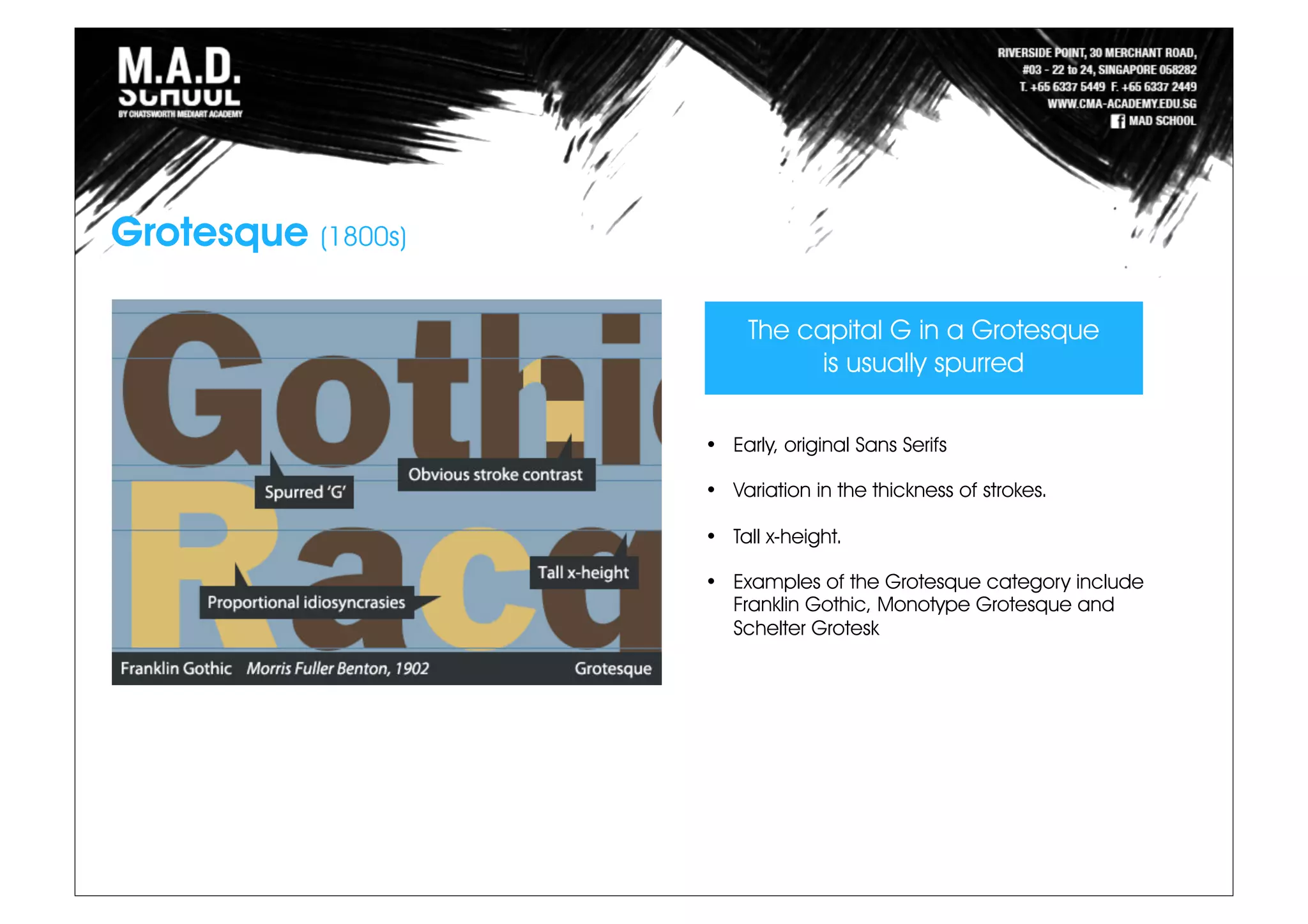
The capital G in a Grotesque
is usually spurred
• Early, original Sans Serifs
• Variation in the thickness of strokes.
• Tall x-height.
• Examples of the Grotesque category include
Franklin Gothic, Monotype Grotesque and
Schelter Grotesk
Neo-Grotesque
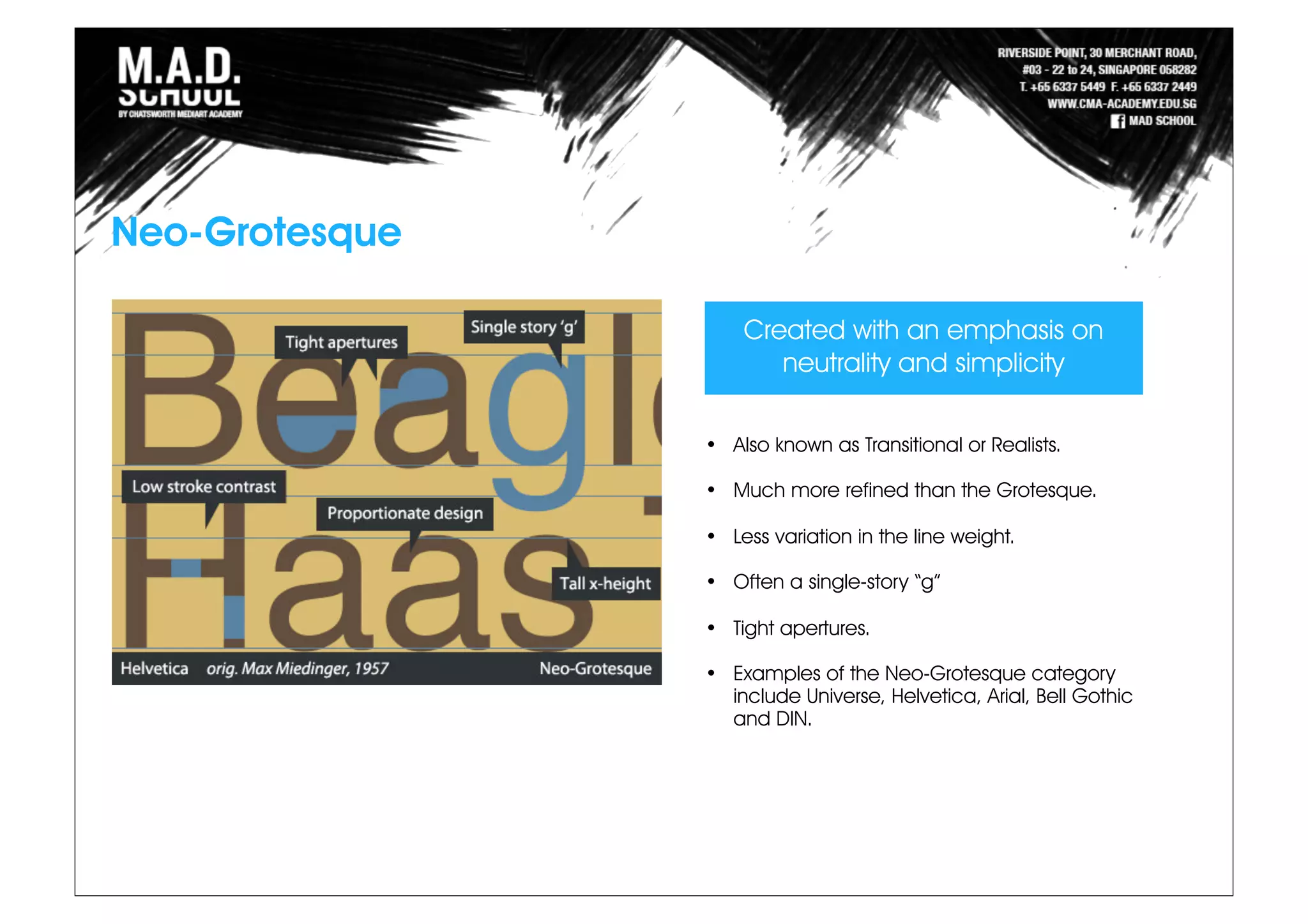
Created with an emphasis on
neutrality and simplicity
• Also known as Transitional or Realists.
• Much more refined than the Grotesque.
• Less variation in the line weight.
• Often a single-story “g”
• Tight apertures.
• Examples of the Neo-Grotesque category
include Universe, Helvetica, Arial, Bell Gothic
and DIN.
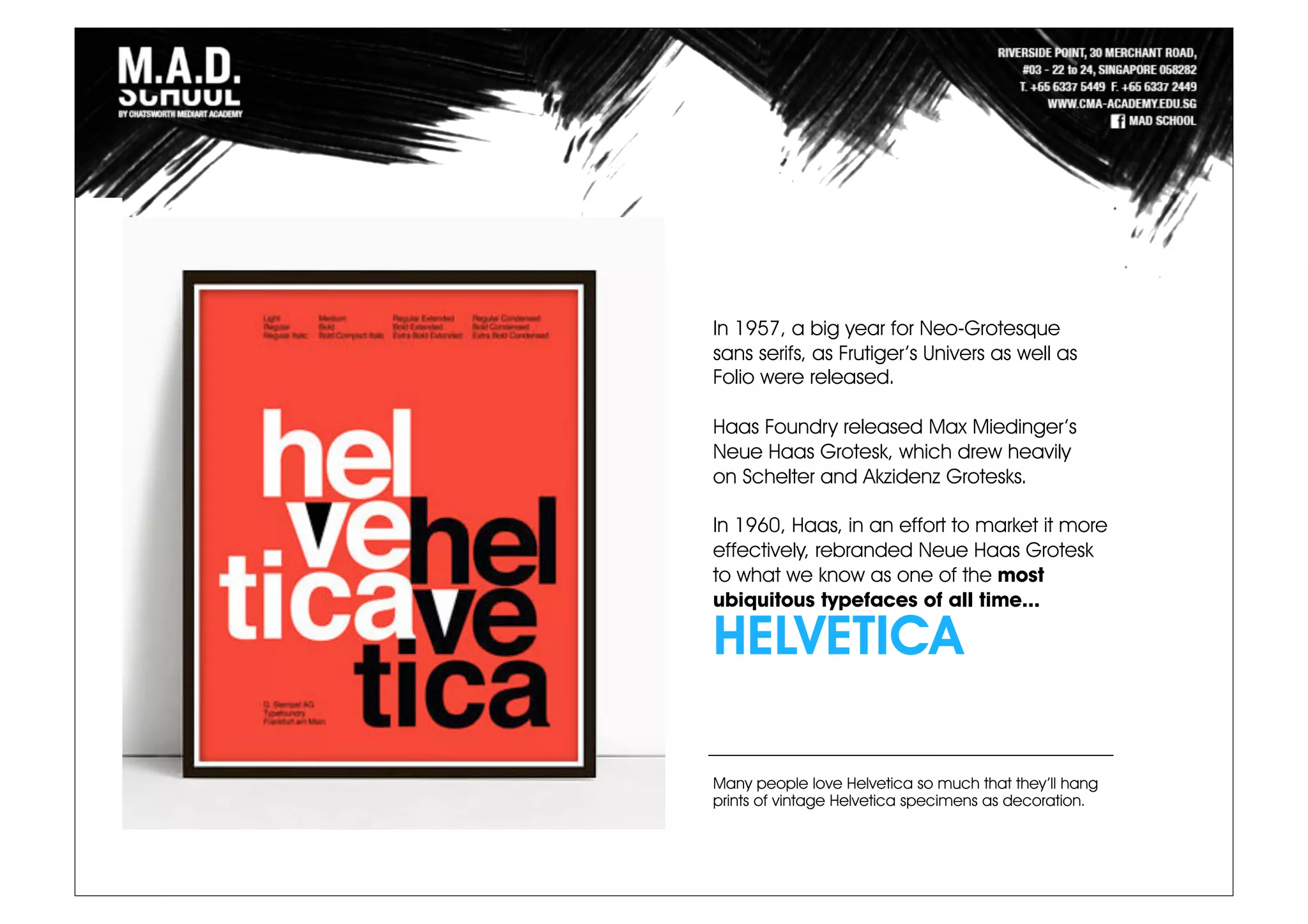
In 1957, a big year for Neo-Grotesque
sans serifs, as Frutiger’s Univers as well as
Folio were released.
Haas Foundry released Max Miedinger’s
Neue Haas Grotesk, which drew heavily
on Schelter and Akzidenz Grotesks.
In 1960, Haas, in an effort to market it more
effectively, rebranded Neue Haas Grotesk
to what we know as one of the most
ubiquitous typefaces of all time...
HELVETICA
Many people love Helvetica so much that they’ll hang
prints of vintage Helvetica specimens as decoration.
Humanist
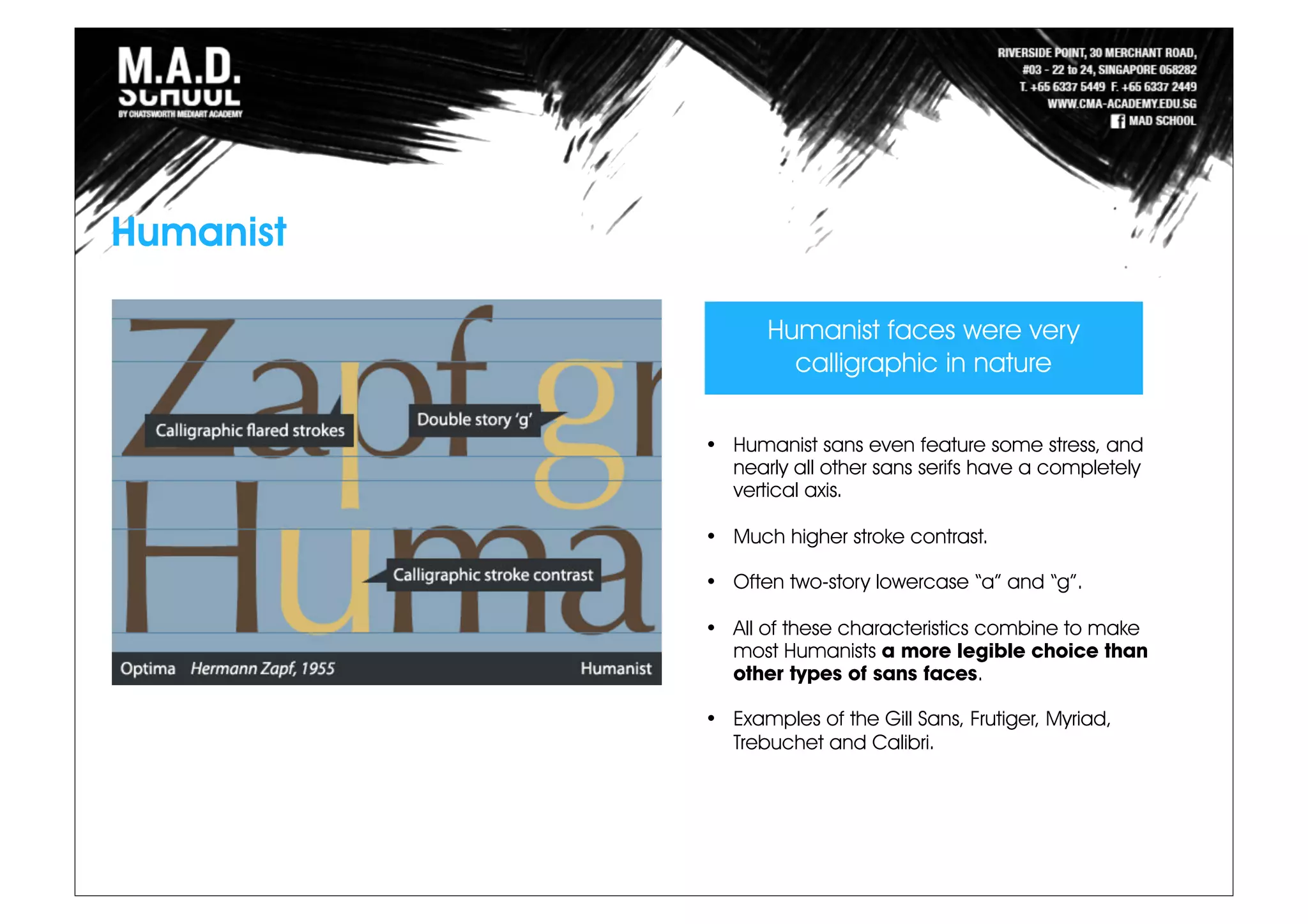
• Humanist sans even feature some stress, and
nearly all other sans serifs have a completely
vertical axis.
• Much higher stroke contrast.
• Often two-story lowercase “a” and “g”.
• All of these characteristics combine to make
most Humanists a more legible choice than
other types of sans faces.
• Examples of the Gill Sans, Frutiger, Myriad,
Trebuchet and Calibri.
Humanist faces were very
calligraphic in nature
Geometric
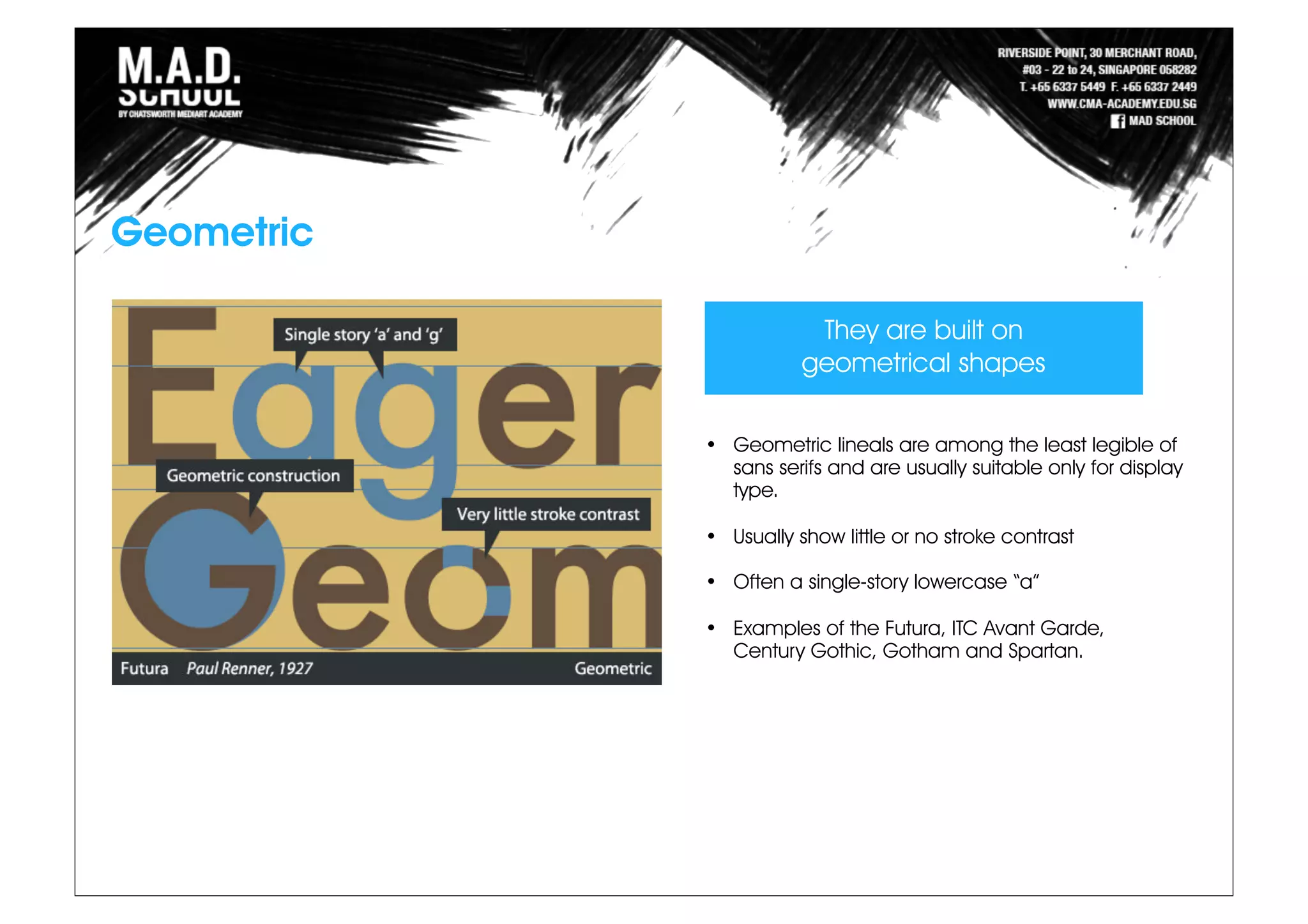
• Geometric lineals are among the least legible of
sans serifs and are usually suitable only for display
type.
• Usually show little or no stroke contrast
• Often a single-story lowercase “a”
• Examples of the Futura, ITC Avant Garde,
Century Gothic, Gotham and Spartan.
They are built on
geometrical shapes
History of
Typography
video
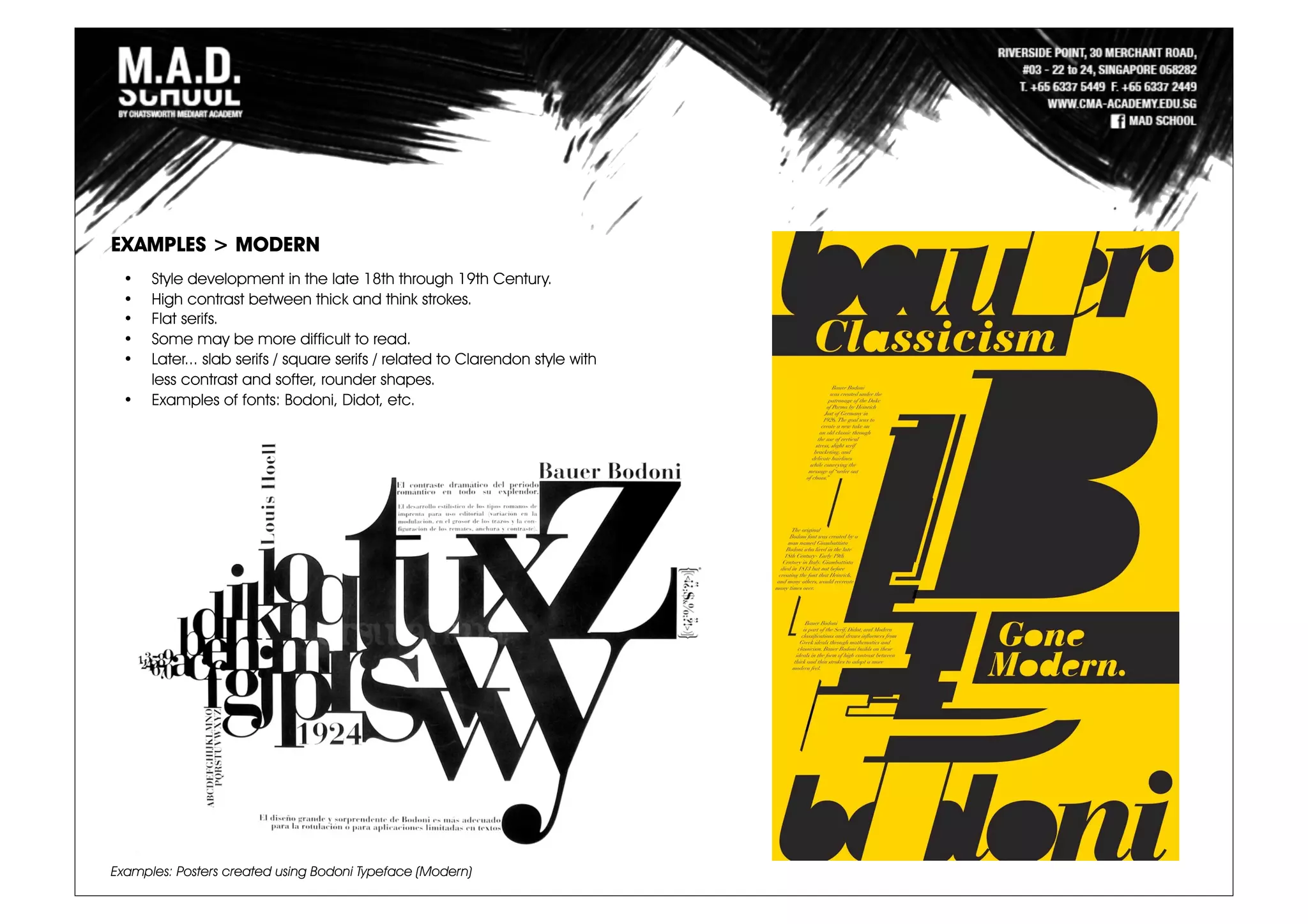
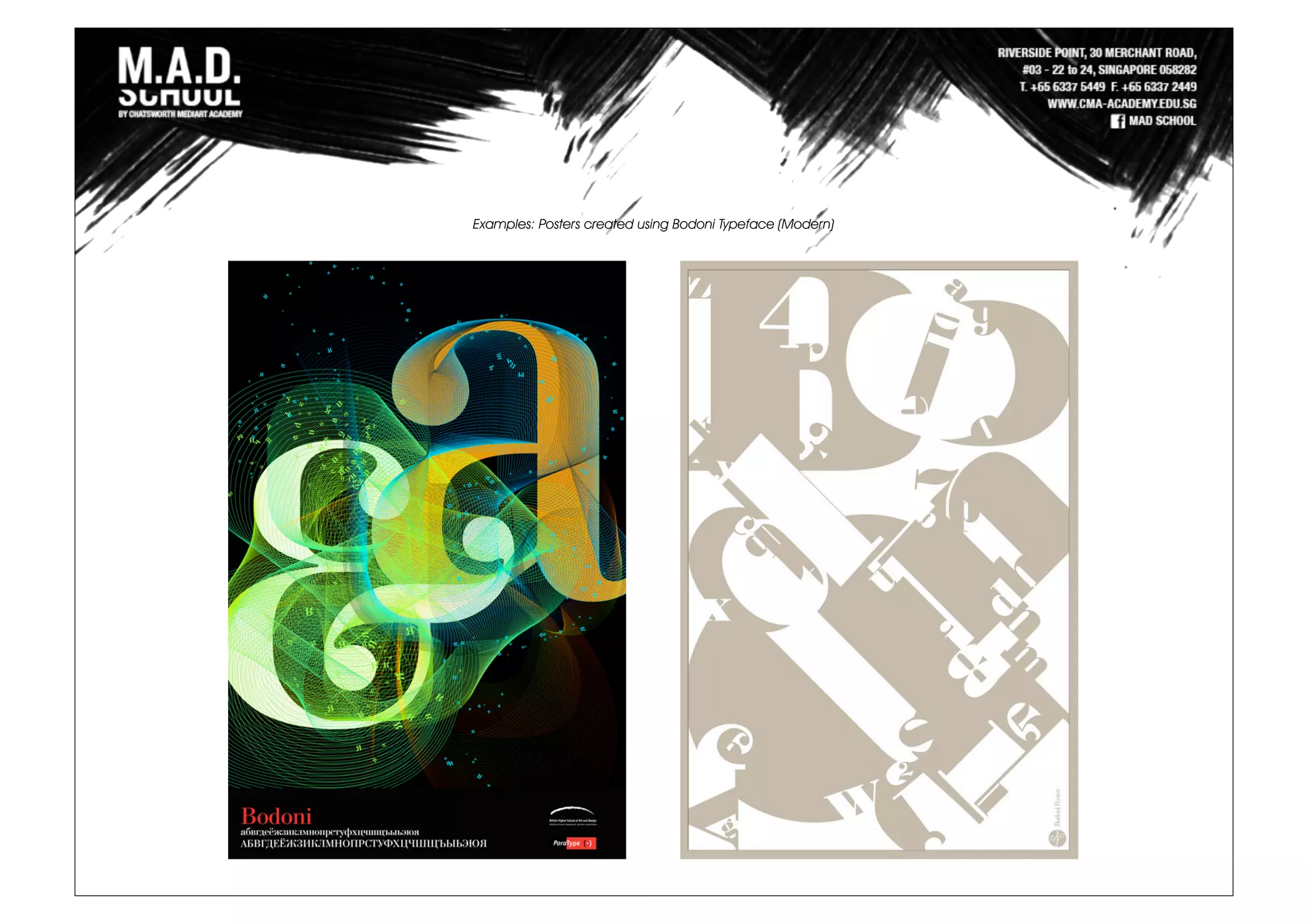
Examples: Posters created using Bodoni Typeface (Modern)
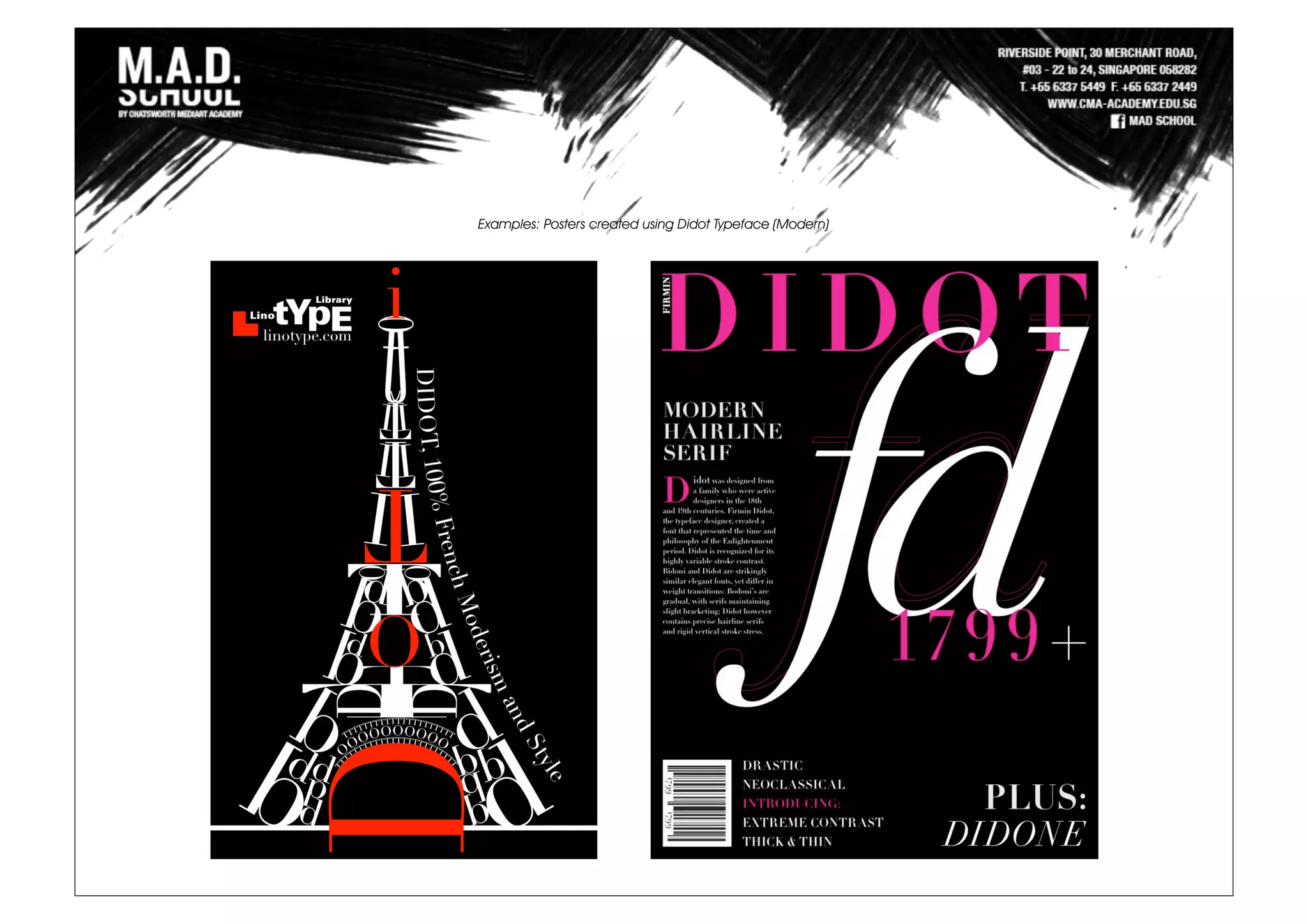
EXAMPLES > MODERN
• Style development in the late 18th through 19th Century.
• High contrast between thick and think strokes.
• Flat serifs.
• Some may be more difficult to read.
• Later... slab serifs / square serifs / related to Clarendon style with
less contrast and softer, rounder shapes.
• Examples of fonts: Bodoni, Didot, etc.
Examples: Posters created using Bodoni Typeface (Modern)
Examples: Posters created using Didot Typeface (Modern)
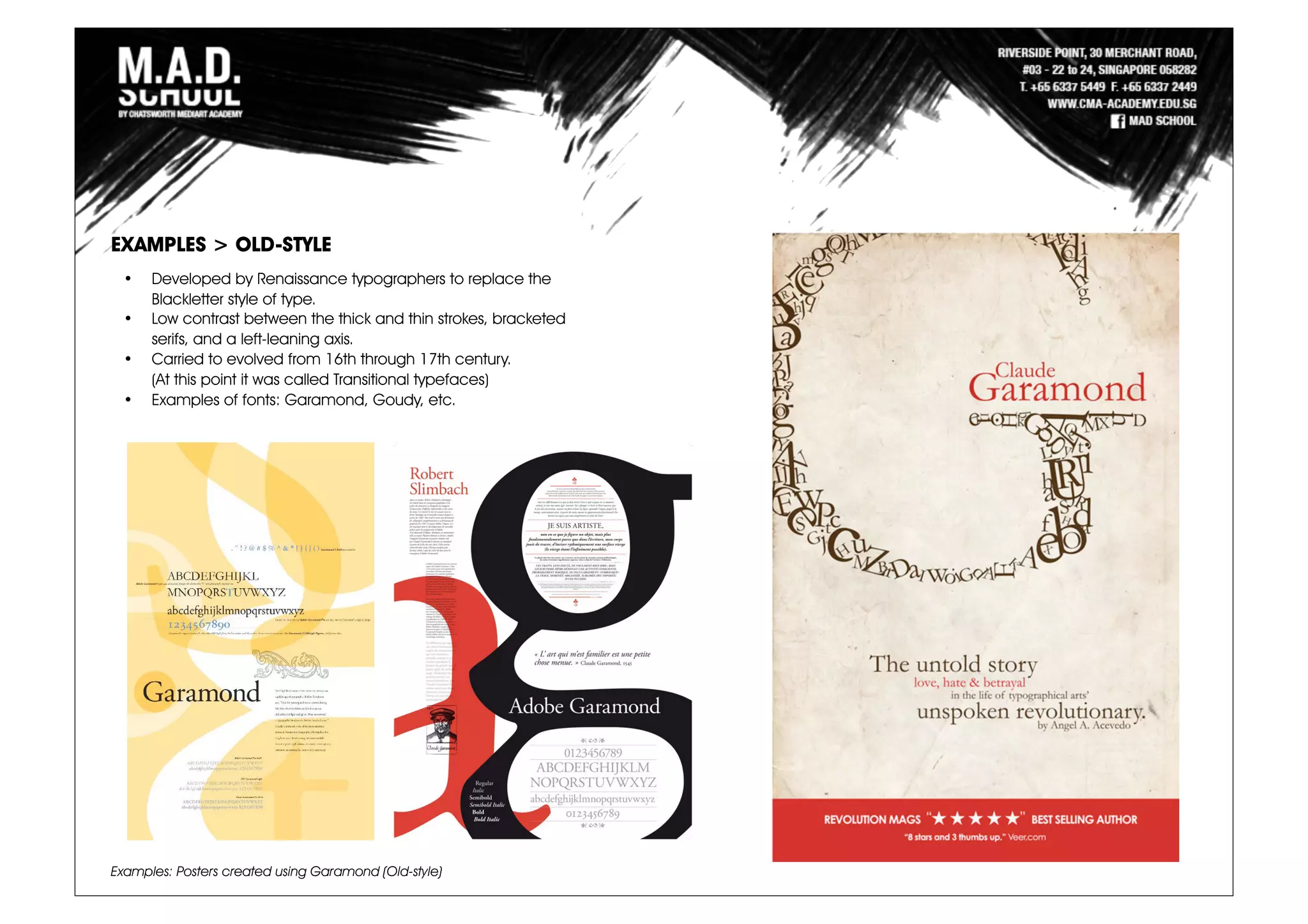
Examples: Posters created using Garamond (Old-style)
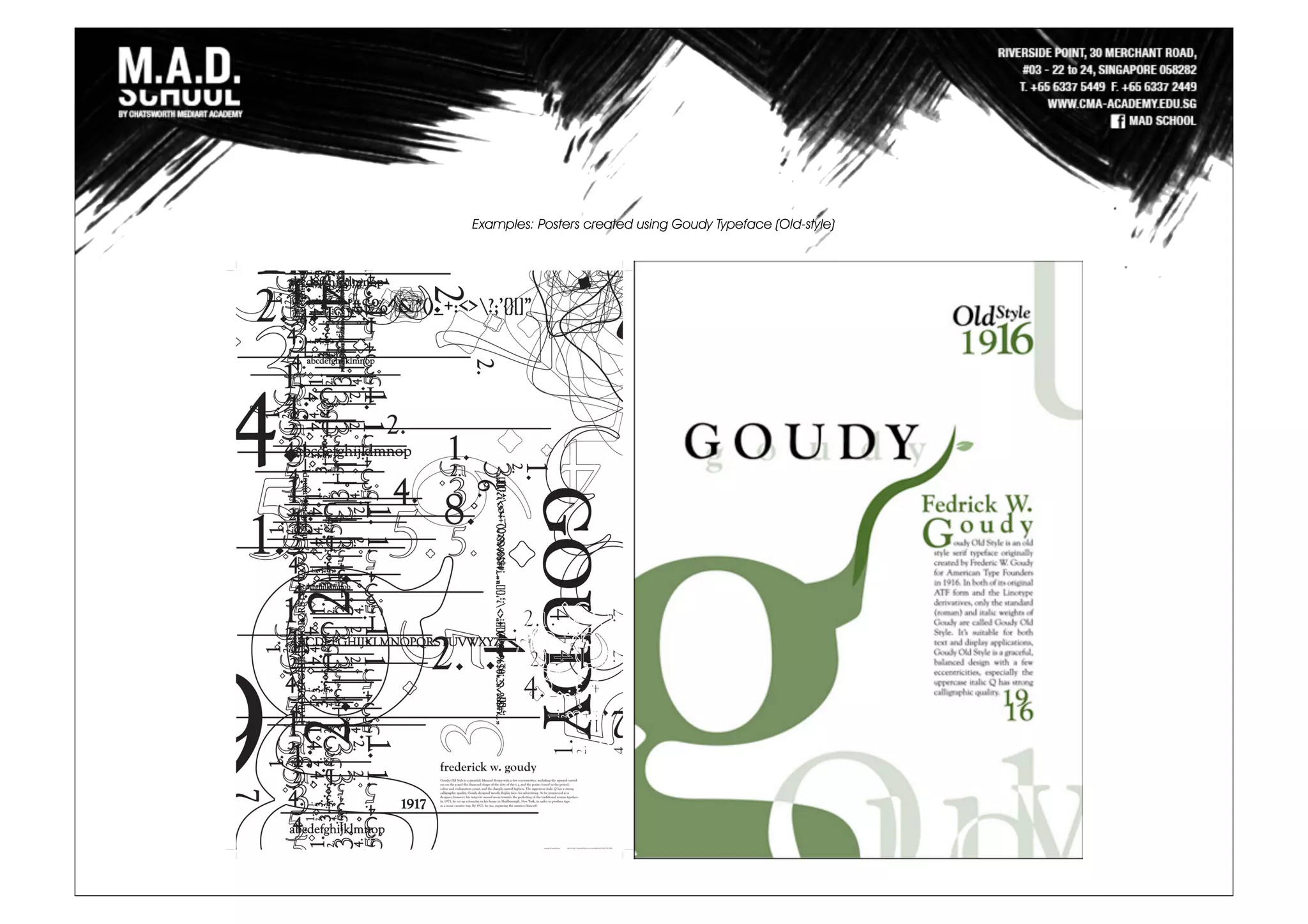
EXAMPLES > OLD-STYLE
• Developed by Renaissance typographers to replace the
Blackletter style of type.
• Low contrast between the thick and thin strokes, bracketed
serifs, and a left-leaning axis.
• Carried to evolved from 16th through 17th century.
(At this point it was called Transitional typefaces)
• Examples of fonts: Garamond, Goudy, etc.
Examples: Posters created using Goudy Typeface (Old-style)
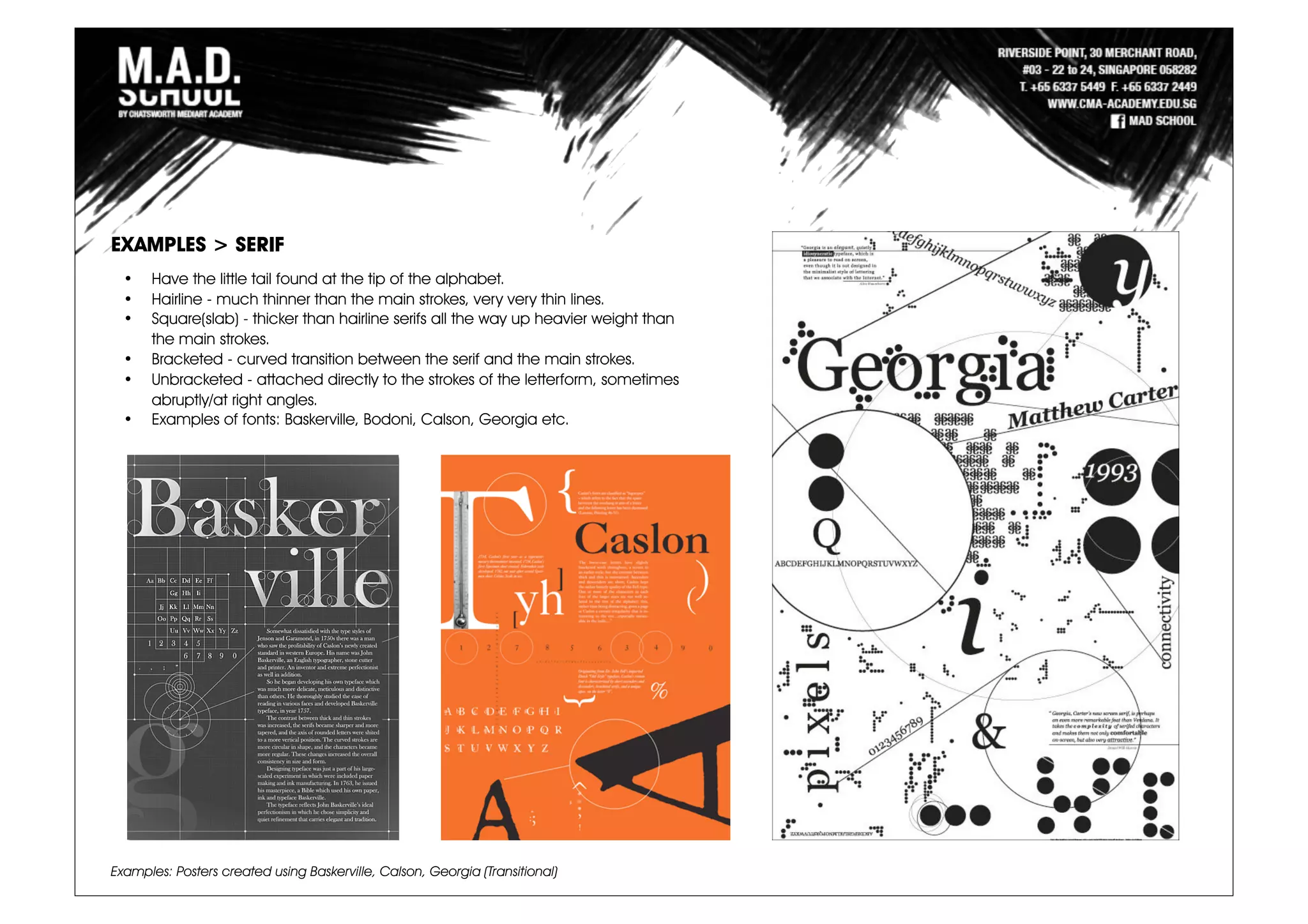
Examples: Posters created using Baskerville, Calson, Georgia (Transitional)
EXAMPLES > SERIF
• Have the little tail found at the tip of the alphabet.
• Hairline - much thinner than the main strokes, very very thin lines.
• Square(slab) - thicker than hairline serifs all the way up heavier weight than
the main strokes.
• Bracketed - curved transition between the serif and the main strokes.
• Unbracketed - attached directly to the strokes of the letterform, sometimes
abruptly/at right angles.
• Examples of fonts: Baskerville, Bodoni, Calson, Georgia etc.
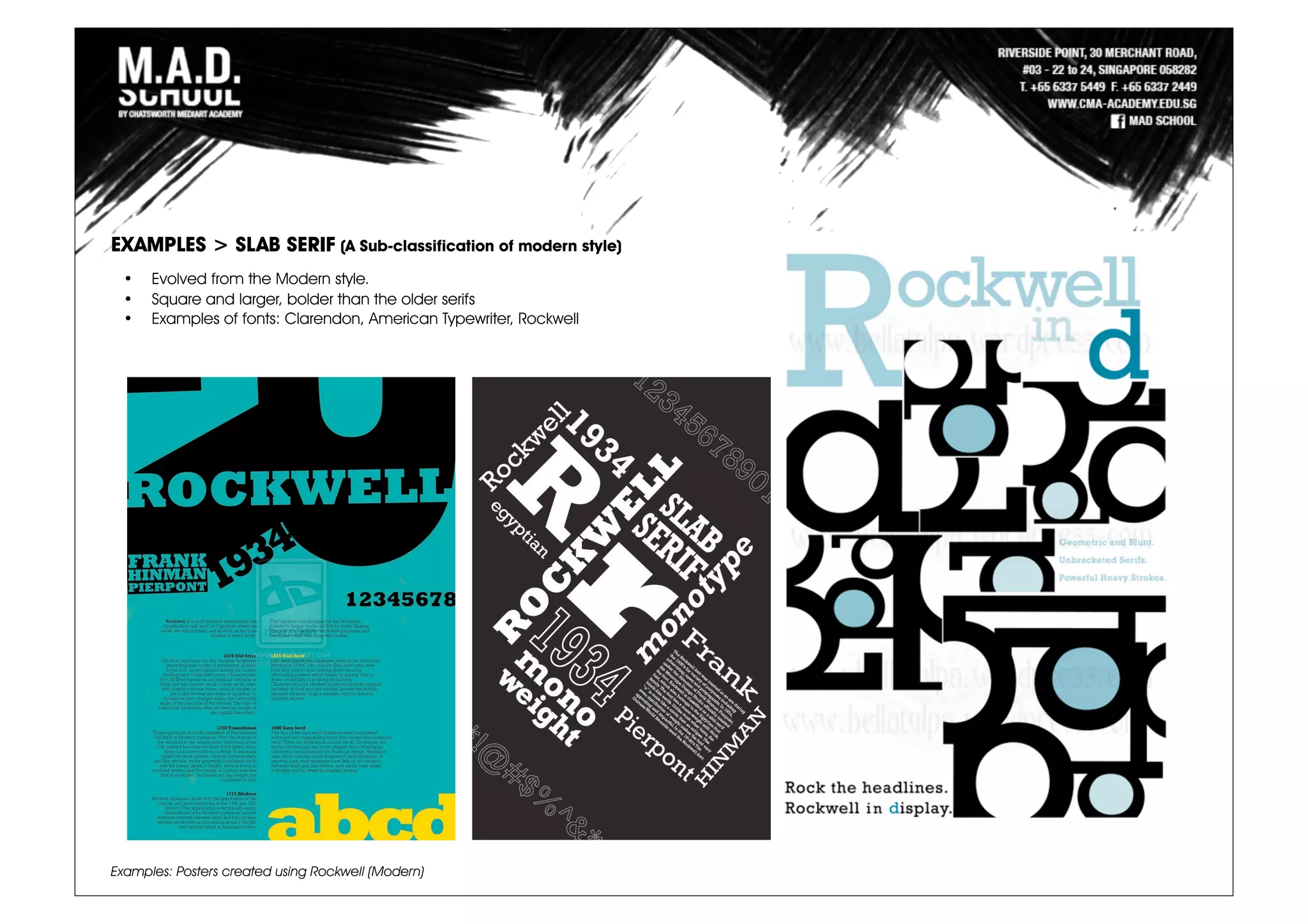
Examples: Posters created using Rockwell (Modern)
EXAMPLES > SLAB SERIF (A Sub-classification of modern style)
• Evolved from the Modern style.
• Square and larger, bolder than the older serifs
• Examples of fonts: Clarendon, American Typewriter, Rockwell
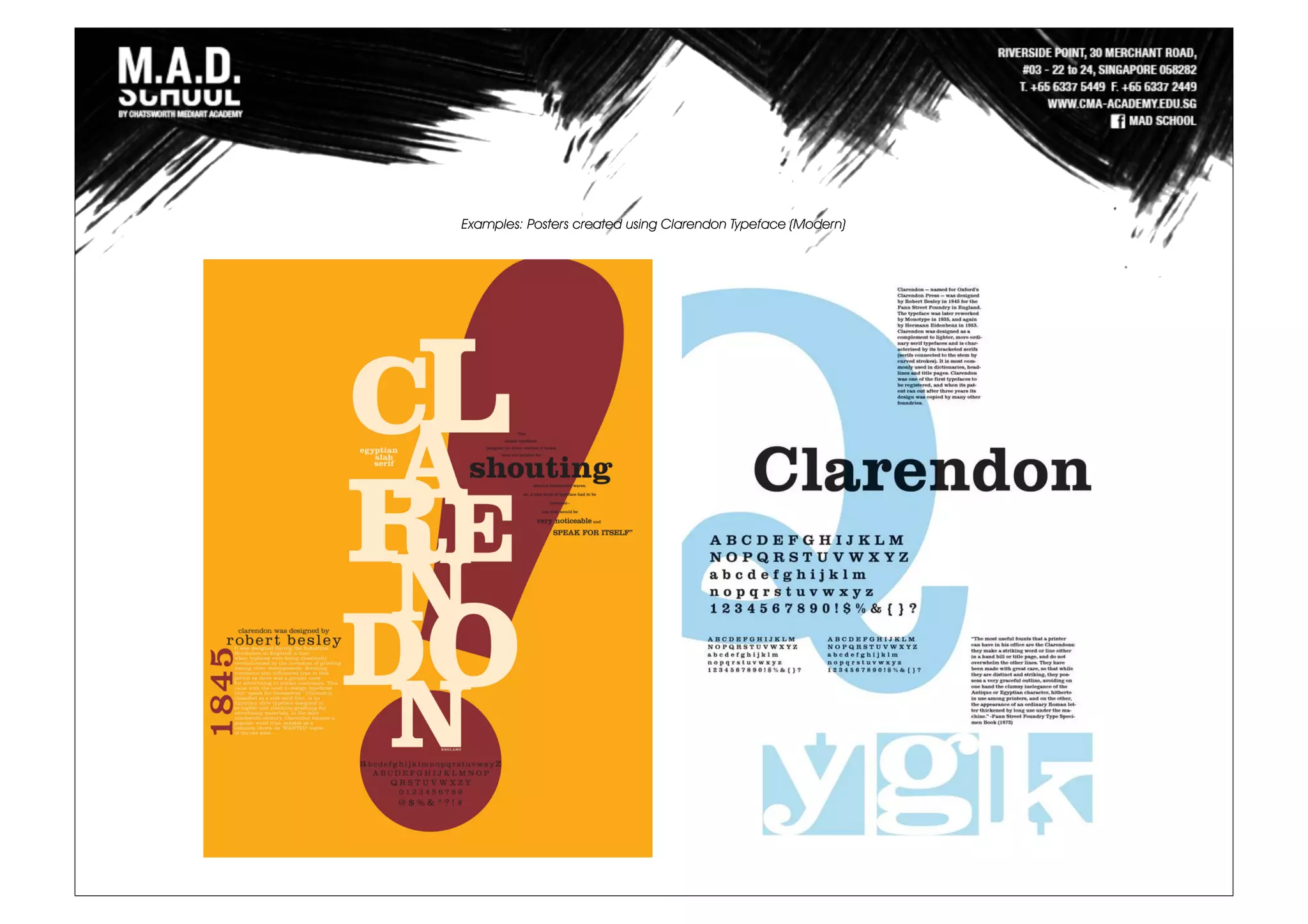
Examples: Posters created using Clarendon Typeface (Modern)
last but not least...
info
good to know
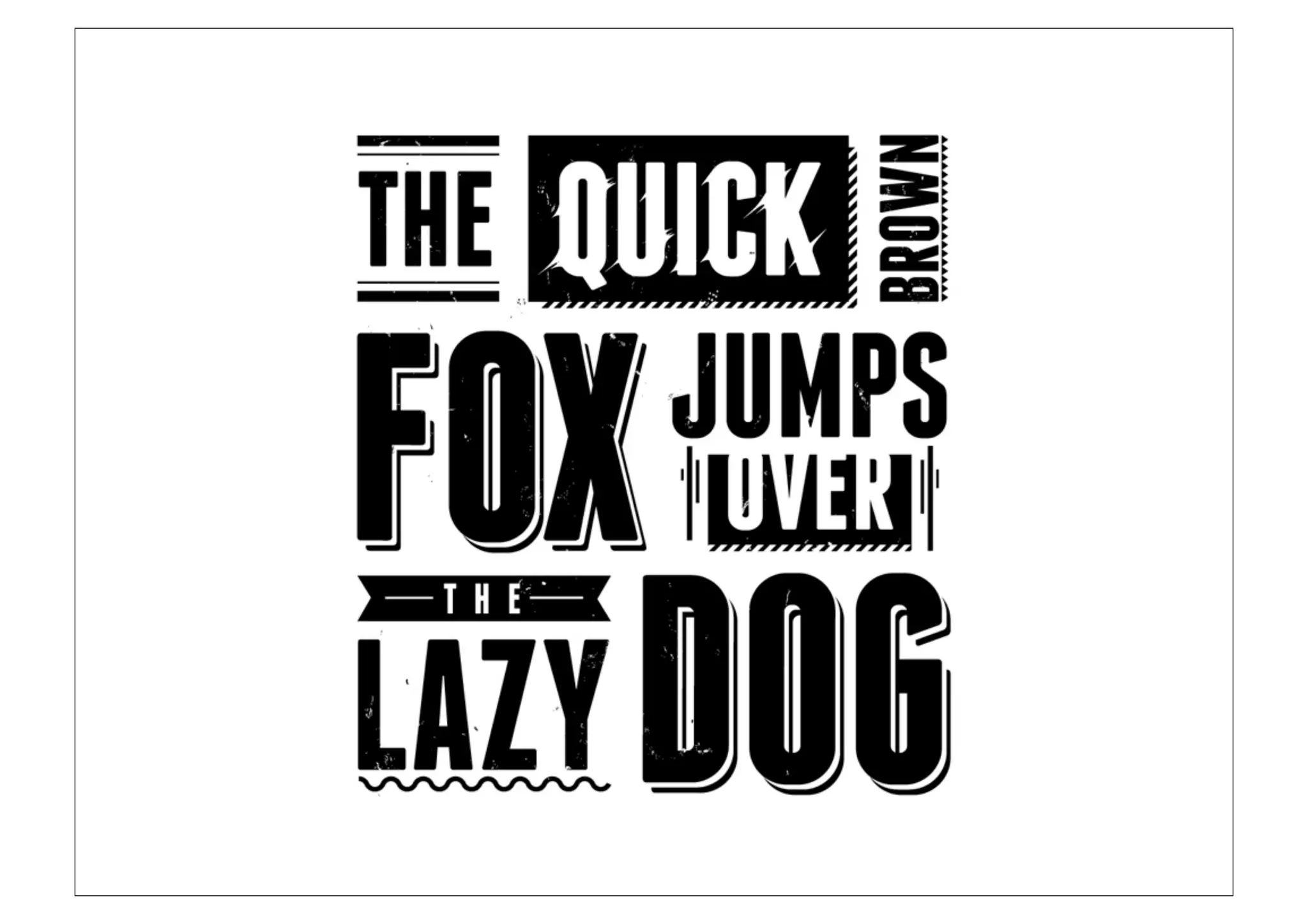
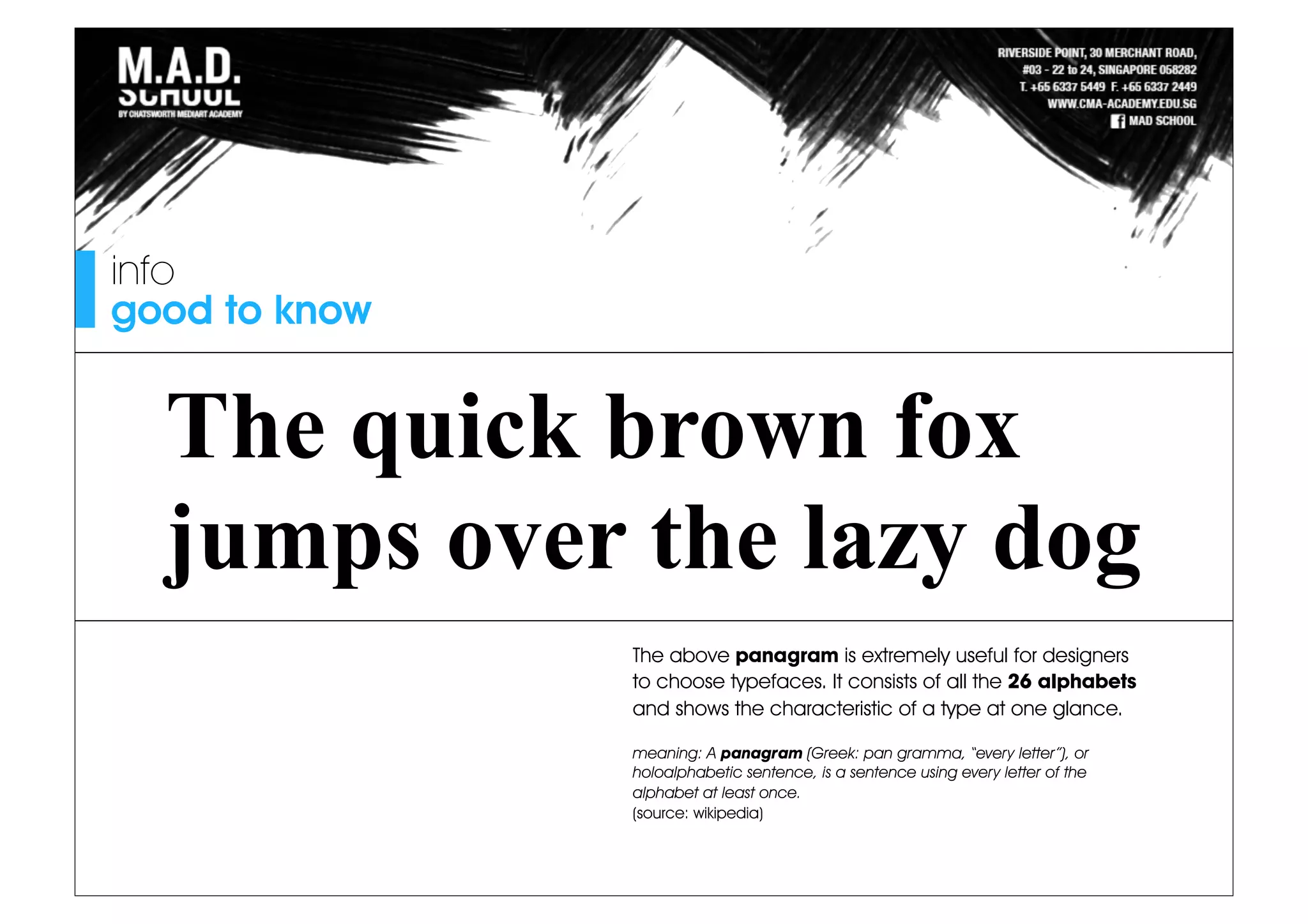
The quick brown fox
jumps over the lazy dog
The above panagram is extremely useful for designers
to choose typefaces. It consists of all the 26 alphabets
and shows the characteristic of a type at one glance.
meaning: A panagram (Greek: pan gramma, “every letter”), or
holoalphabetic sentence, is a sentence using every letter of the
alphabet at least once.
(source: wikipedia)
SEE YOU IN THE NEXT LESSON
THANK YOU

Typography class 2

  • 1.
  • 2.
    typography and communicationdesign lesson 02 & 03 the faces of type • type anatomy • type families • type classification • brief history
  • 3.
    anatomy Double chin? Big feet? BowedLegs? “you just want me for my body ” Tall & Curvy? type
  • 4.
    little details willtell you alot about your type. GO AHEAD AND CHECK THEM OUT. IT’S NOT SHALLOW. IT’S YOUR JOB.
  • 5.
    More than anypart of the body, the x-height can dramatically affect the type readability. Avoid extremely of very large x-heights if that is important to you. ASCENDER Quite ambitious, this part of a lower case letter rises above the x height. SET WIDTH Width of a character in relation to the height. Being wider than you are tall isn’t always a bad thing. X-HEIGHT The height of a lower case x of the height of lower case letters. CAP HEIGHT The distance between the baseline and the top of a capital letter. BASELINE The imaginary, yet crucial line where all obedient letterforms sit. COUNTER The enclosed negative space within a letter. DESCENDER The male anatomy of a lower case letter that hangs below the baseline. TERMINAL Even though it sounds life-threatening, it is just the endpoint of the letterform.
  • 6.
    A font consistsof a set of character of consistent design. A font family extends this to become a set of fonts, designed to work together. A family consist of the variations (styles) of the basic font. The names of the variations or styles are not consistent, and alternatives are given with the descriptions. The most basic variations are bold and italics. Most well-designed fonts have at least these. The family may consist of more. Here are some of the most common. families type
  • 7.
    ROMAN Also called ‘book’,‘normal’, ‘regular’. The normal form of the typeface, the term comes from early type being derived from Roman inscriptions. ITALIC (OBLIQUE) Italics are a less formal version of a typeface, derived from 15th-century italian handwriting. It is important to recognized the difference between true italics, which are designed as a separate but consistent face, and obliques, which are more like what you get when u click the italic button in a word processor: pushed over roman. Oftentimes the italic version of sans-serif type is called oblique, so the confusion deepens. BOLDFACE Bold, black, heavy, poster. A thicker stroke weight than the roman form. Bolds are proportionally thicker. Depending on the thickness, there are variations such as semi-bold, medium, demi-bold, ultra-bold, black, extra-bold, super, or poster. Avant Garde Book Helvetica Regular Minion Pro Regular Avant Garde Book Oblique Helvetica Oblique Minion Pro Italic Avant Garde Bold Helvetica Bold Minion Pro Bold
  • 8.
    LIGHT The opposite ofbold, light has a thinner stroke weight than roman. Again, there may be levels and naming variations such as ultra-thin, thin, and ultra-light. CONDENSED Sometimes termed ‘compressed’, this is a horizontally thinner version of a typeface. May have its own variations in stroke, such as ultra-light condensed. EXTENDED A horizontally extended version of the roman, again may have stroke variations. Much more common with sans-serif families. Avant Garde Extra Light Helvetica Bold Futura Std Light Avant Garde Book Condensed Univers Condensed Futura Std Condensed Univers Extended Helvetica Extended Eurostile Extended
  • 11.
    A basic systemfor classifying typefaces was devised in the nineteenth century, when printers sought to identify a heritage for their own craft analogous to that of art history. Humanist letterforms are closely connected to calligraphy and the movement of the hand. Transitional and modern typefaces are more abstract and less organic. These three main groups correspond roughly to the Renaissance, Baroque, and Enlightenment periods in art and literature. Designers in the twentieth and twenty-first centuries have continued to create new typefaces based on historic characteristics. classification type
  • 12.
    Type classification, whilehelpful, is often confusing and even controversial. Type classification is also helpful in pairing typefaces for projects, sometimes based on historical proximity but also by noting similar features that unify the typefaces, such as axis or x-height. In some cases, by finding enough disparity in the small features, very different typefaces become complementary. Part 1: Classifying Serif Typefaces Part 2: Classifying Sans Typefaces
  • 13.
    Part 1 Classifying Serif Typefaces Humanist/ Old-Styled / Transitional / Modern / Slab Serif
  • 14.
    Humanist faces werevery calligraphic in nature • Notable calligraphic influence, patterned after handwriting. • Sloping “e” crossbar. • Relatively small x-height. • Strongly angled axis or stress. • Inconsistent stroke weight. • Low contrast between thick and thin strokes. • Based on typefaces designed in Renaissance cultural hubs such as Venice. Humanist (mid 1400s)
  • 15.
    Old-Style (late 1500s– 1700s) The serifs become more carefully formed, and characters are designed more proportionately • Less calligraphic influence because type began to be viewed as separate from writing. • Axis or stress but less angled. • Larger x-height compared to Humanist type. • Increased difference between heavy and light strokes. • Named after influential type designers Claude Garamont and Aldus Manutius.
  • 16.
    Transitional (mid 1700s) •No calligraphic influence. Designed independently, sometimes on a grid. • Visually vertical axis or stress. • Serifs are less bracketed and flatten out. • High contrast between heavy and thin strokes. • First appeared in the late-17th century. Details become very refined
  • 17.
    Modern (1800s –1900s) • Extreme contrast between thick and think. • Rigidly vertical axis or stress. • Apertures (the place where character opens) are generally very tight. • Poor choice for chunks of text. • Work best at large sizes. • Named after Firmin Didot and Giambattista Bodoni. Very precisely designed.
  • 18.
    Slab Serif (1800s) •Created for advertising, posters and large media. • Easiest to identify because of their obvious appearance. • Very heavy weight. • Low contrast between thick and thin. • Unbracketed, prominent serifs. • First typefaces created expressly for display purposes. No-nonsense Attitude.
  • 19.
  • 20.
    Here’s a littleexercise to test your comprehension of what we’ve covered so far. Take a look at these specimens and comment on how you’d classify them. Keep in mind that classification is an aid, rather than a hard and fast system. 1 What? Why? 2 What? Why? 3 What? Why? 4 What? Why? 5 What? Why? 6 What? Why?
  • 21.
    Part 2 Classifying Sans Typefaces Grotesque/ Neo-Grotesque / Humanist / Geometric
  • 22.
    Grotesque (1800s) The capitalG in a Grotesque is usually spurred • Early, original Sans Serifs • Variation in the thickness of strokes. • Tall x-height. • Examples of the Grotesque category include Franklin Gothic, Monotype Grotesque and Schelter Grotesk
  • 23.
    Neo-Grotesque Created with anemphasis on neutrality and simplicity • Also known as Transitional or Realists. • Much more refined than the Grotesque. • Less variation in the line weight. • Often a single-story “g” • Tight apertures. • Examples of the Neo-Grotesque category include Universe, Helvetica, Arial, Bell Gothic and DIN.
  • 24.
    In 1957, abig year for Neo-Grotesque sans serifs, as Frutiger’s Univers as well as Folio were released. Haas Foundry released Max Miedinger’s Neue Haas Grotesk, which drew heavily on Schelter and Akzidenz Grotesks. In 1960, Haas, in an effort to market it more effectively, rebranded Neue Haas Grotesk to what we know as one of the most ubiquitous typefaces of all time... HELVETICA Many people love Helvetica so much that they’ll hang prints of vintage Helvetica specimens as decoration.
  • 25.
    Humanist • Humanist sanseven feature some stress, and nearly all other sans serifs have a completely vertical axis. • Much higher stroke contrast. • Often two-story lowercase “a” and “g”. • All of these characteristics combine to make most Humanists a more legible choice than other types of sans faces. • Examples of the Gill Sans, Frutiger, Myriad, Trebuchet and Calibri. Humanist faces were very calligraphic in nature
  • 26.
    Geometric • Geometric linealsare among the least legible of sans serifs and are usually suitable only for display type. • Usually show little or no stroke contrast • Often a single-story lowercase “a” • Examples of the Futura, ITC Avant Garde, Century Gothic, Gotham and Spartan. They are built on geometrical shapes
  • 27.
  • 28.
    Examples: Posters createdusing Bodoni Typeface (Modern) EXAMPLES > MODERN • Style development in the late 18th through 19th Century. • High contrast between thick and think strokes. • Flat serifs. • Some may be more difficult to read. • Later... slab serifs / square serifs / related to Clarendon style with less contrast and softer, rounder shapes. • Examples of fonts: Bodoni, Didot, etc.
  • 29.
    Examples: Posters createdusing Bodoni Typeface (Modern)
  • 30.
    Examples: Posters createdusing Didot Typeface (Modern)
  • 31.
    Examples: Posters createdusing Garamond (Old-style) EXAMPLES > OLD-STYLE • Developed by Renaissance typographers to replace the Blackletter style of type. • Low contrast between the thick and thin strokes, bracketed serifs, and a left-leaning axis. • Carried to evolved from 16th through 17th century. (At this point it was called Transitional typefaces) • Examples of fonts: Garamond, Goudy, etc.
  • 32.
    Examples: Posters createdusing Goudy Typeface (Old-style)
  • 33.
    Examples: Posters createdusing Baskerville, Calson, Georgia (Transitional) EXAMPLES > SERIF • Have the little tail found at the tip of the alphabet. • Hairline - much thinner than the main strokes, very very thin lines. • Square(slab) - thicker than hairline serifs all the way up heavier weight than the main strokes. • Bracketed - curved transition between the serif and the main strokes. • Unbracketed - attached directly to the strokes of the letterform, sometimes abruptly/at right angles. • Examples of fonts: Baskerville, Bodoni, Calson, Georgia etc.
  • 34.
    Examples: Posters createdusing Rockwell (Modern) EXAMPLES > SLAB SERIF (A Sub-classification of modern style) • Evolved from the Modern style. • Square and larger, bolder than the older serifs • Examples of fonts: Clarendon, American Typewriter, Rockwell
  • 35.
    Examples: Posters createdusing Clarendon Typeface (Modern)
  • 36.
    last but notleast...
  • 38.
    info good to know Thequick brown fox jumps over the lazy dog The above panagram is extremely useful for designers to choose typefaces. It consists of all the 26 alphabets and shows the characteristic of a type at one glance. meaning: A panagram (Greek: pan gramma, “every letter”), or holoalphabetic sentence, is a sentence using every letter of the alphabet at least once. (source: wikipedia)
  • 39.
    SEE YOU INTHE NEXT LESSON THANK YOU