Submitted to:

Dr. SARLA KUMARI

Submitted by:
Jatin garg
(11107027)
MECHANICAL
The Phase Rule
• It was first presented by Gibbs in 1875.
• It is very useful to understand the effect of intensive

variables, such as temperature, pressure, or
concentration, on the equilibrium between phases as
well as between chemical constituents.
• It is used to deduce the number of degrees of freedom
(f) for a system. Sometimes called: “the variance of the
system”.
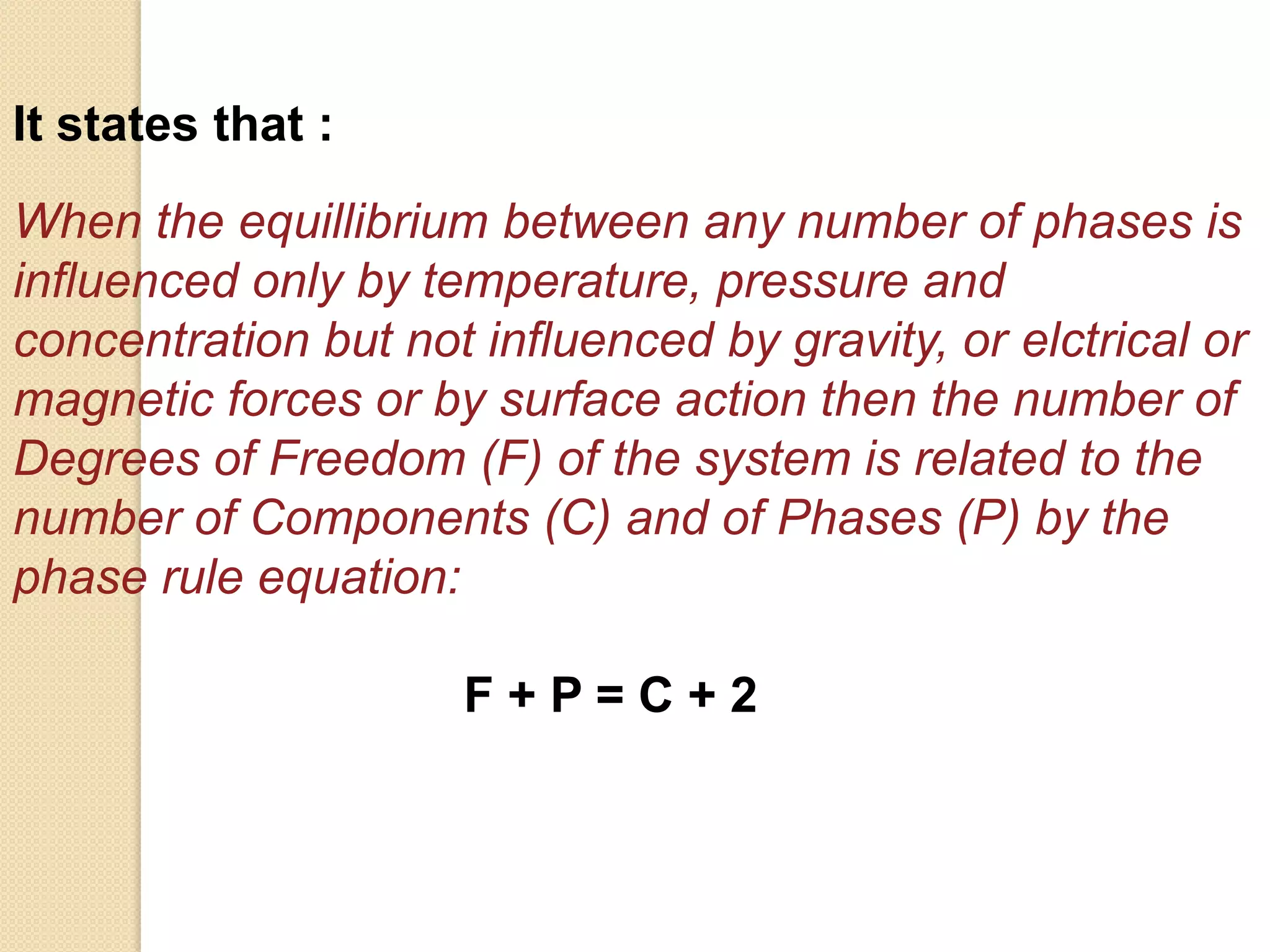
It states that :
When the equillibrium between any number of phases is
influenced only by temperature, pressure and
concentration but not influenced by gravity, or elctrical or
magnetic forces or by surface action then the number of
Degrees of Freedom (F) of the system is related to the
number of Components (C) and of Phases (P) by the
phase rule equation:

F+P=C+2
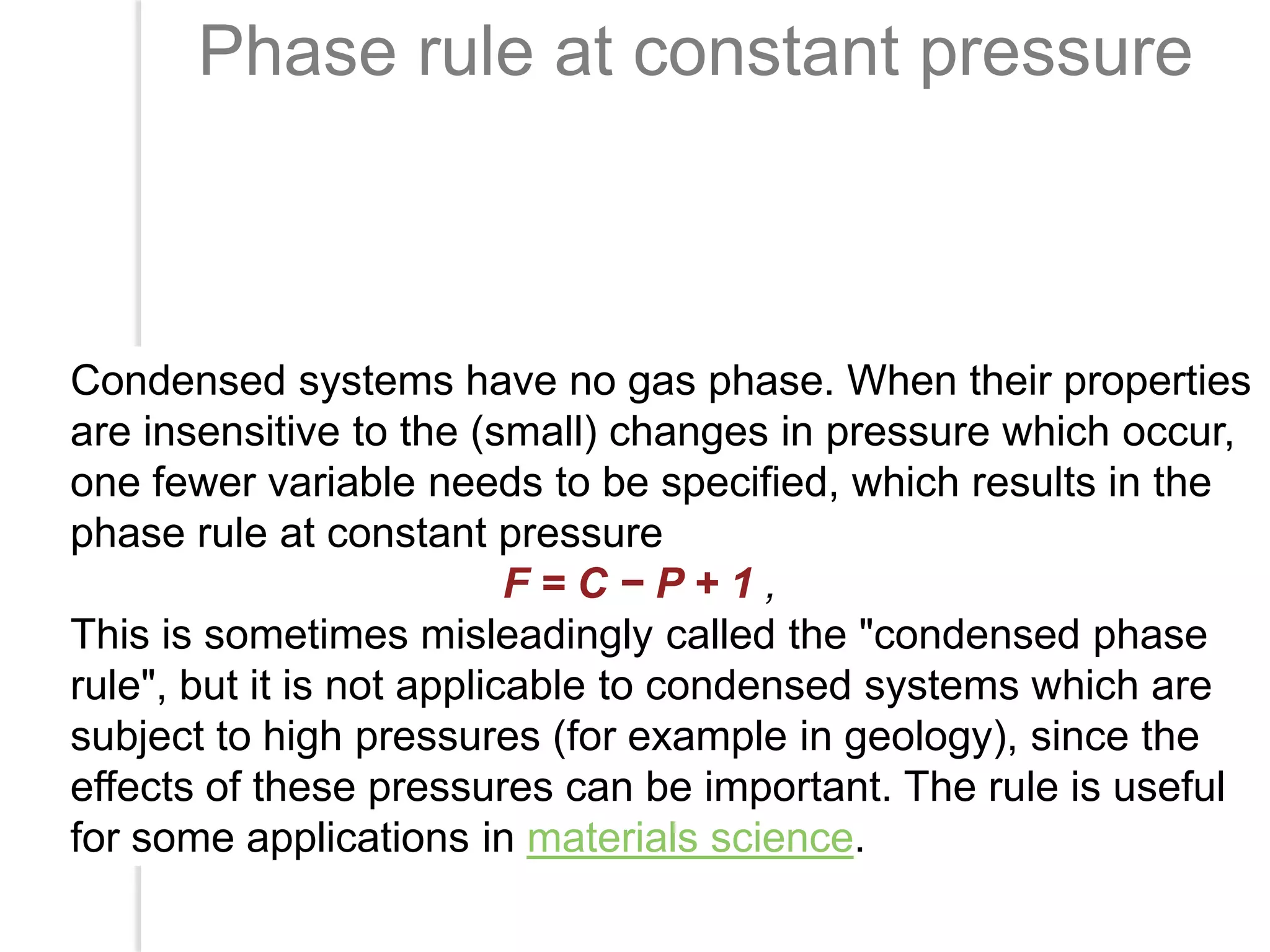
Phase rule at constant pressure

Condensed systems have no gas phase. When their properties
are insensitive to the (small) changes in pressure which occur,
one fewer variable needs to be specified, which results in the
phase rule at constant pressure
F=C−P+1,
This is sometimes misleadingly called the "condensed phase
rule", but it is not applicable to condensed systems which are
subject to high pressures (for example in geology), since the
effects of these pressures can be important. The rule is useful
for some applications in materials science.
Terminology used…..
Phase:
A phase is defined as any homogeneous and
physically distinct part of a system having all physical
and chemical properties the same throughout the
system. A system may consist of one phase or
more than one phase.
E.g.
 A system containing only liquid water is one-phase
system
 A system containing liquid water and water vapour
(gas) is a two phase system
 A system containing liquid water, water vapour and
solid ice is a three phase system.
 Pure substances (solid, liquid, or gas) made of one
chemical species only, is considered as one phase,
Contd….
Component:
The term component is defined as the least number of
independent chemical constituents in terms of which the
composition of every phase can be expressed by
means of a chemical equation.
E.g.
 Water system has three phases, ice, water and water
vapour and the composition of all these phases is
expressed in terms of one chemical individual water. Thus
water system has one component only.
 Similarly Sulphur system has four phases: rhombic
sulphur, monoclinic sulphur liquid sulphur and sulphur
vapour and the composition of all these phases is
expressed by one chemical individual sulphur. Therefore
Sulphur system is one component system.
Thus, all the phases in one component system is
expressed by only one chemical individual.
Contd…..


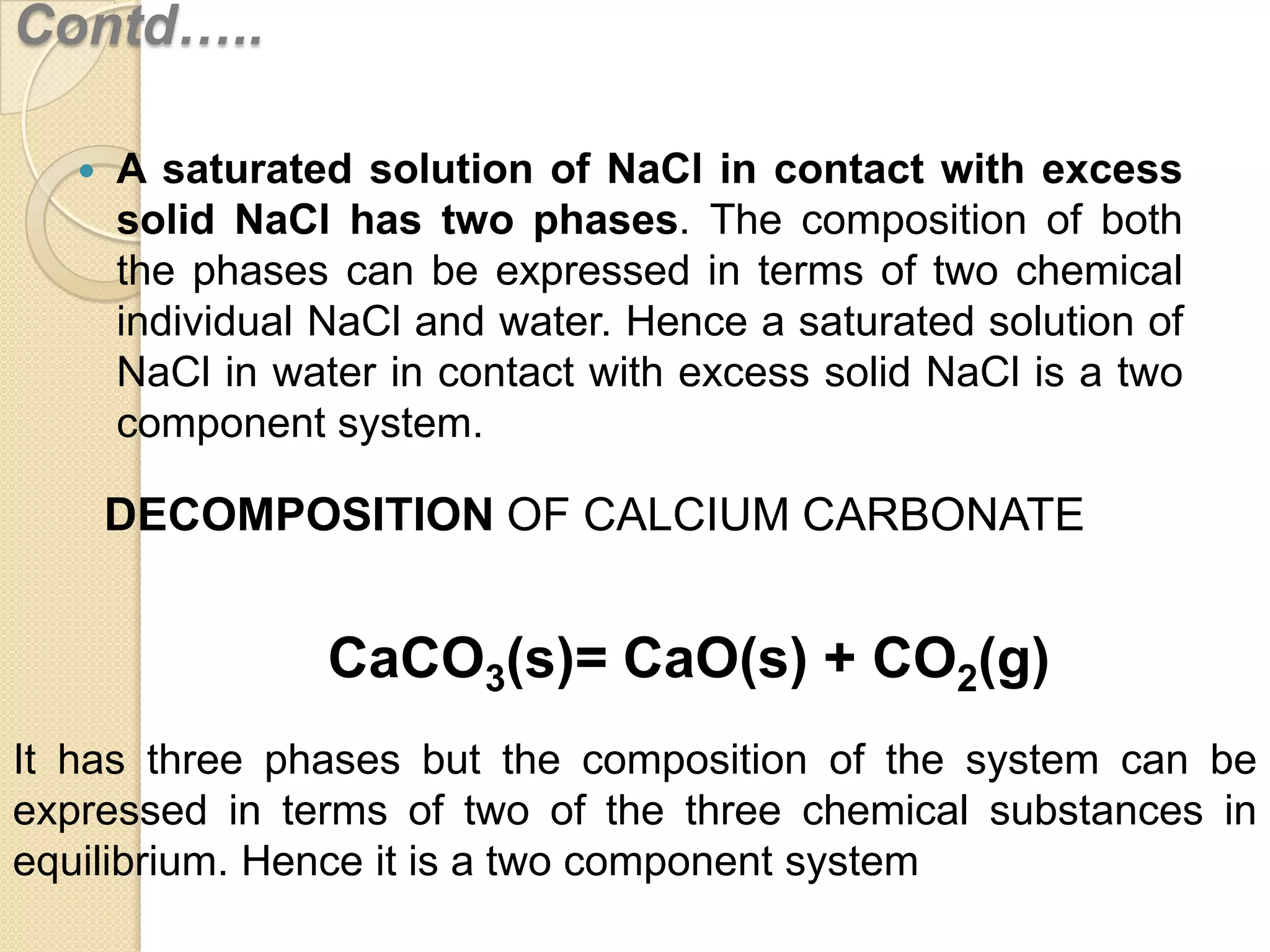
A saturated solution of NaCl in contact with excess
solid NaCl has two phases. The composition of both
the phases can be expressed in terms of two chemical
individual NaCl and water. Hence a saturated solution of
NaCl in water in contact with excess solid NaCl is a two
component system.

DECOMPOSITION OF CALCIUM CARBONATE

CaCO3(s)= CaO(s) + CO2(g)
It has three phases but the composition of the system can be
expressed in terms of two of the three chemical substances in
equilibrium. Hence it is a two component system
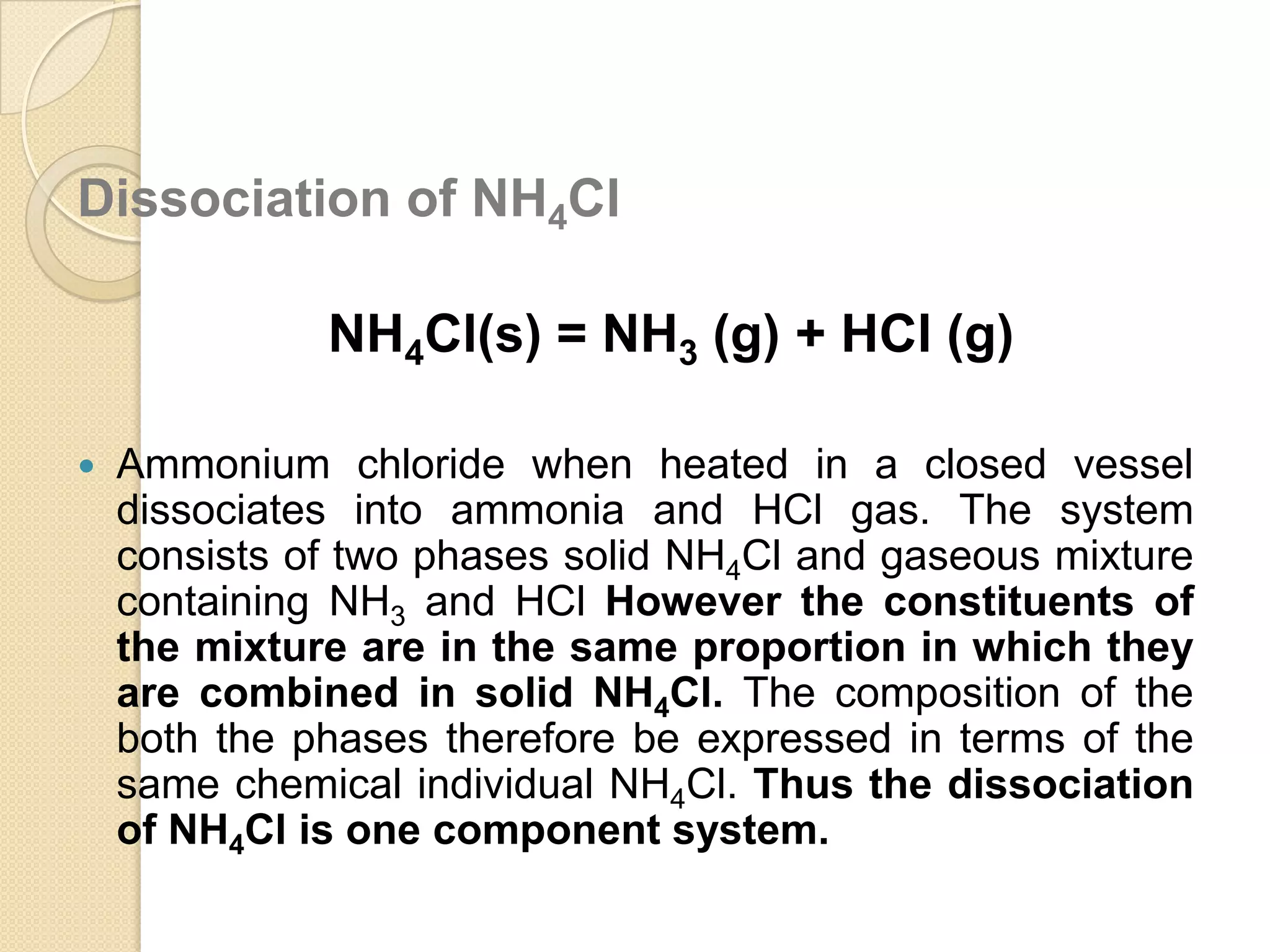
Dissociation of NH4Cl

NH4Cl(s) = NH3 (g) + HCl (g)


Ammonium chloride when heated in a closed vessel
dissociates into ammonia and HCl gas. The system
consists of two phases solid NH4Cl and gaseous mixture
containing NH3 and HCl However the constituents of
the mixture are in the same proportion in which they
are combined in solid NH4Cl. The composition of the
both the phases therefore be expressed in terms of the
same chemical individual NH4Cl. Thus the dissociation
of NH4Cl is one component system.
DEGREES OF FREEDOM(F)
It is defined as the least number of variable factors of a system
which must be specified so that the remaining variables are
fixed automatically and the system is completely defined.
E.g.

MONOVARIANT or UNIVARIANT SYSTEM
For Water = Water Vapour system, F=1, The system has two
variables, P and T. At definite T, the vapour pressure of water can have
only one fixed value. Thus if one variable is specified , the other is fixed
automatically. Hence this system has one degree of freedom, it is
MONOVARIANT or UNIVARIANT.
BIVARIANT SYSTEM
For a pure gas, PV=RT, if P and T values are specified there can have
be only one definite value of V or that the volume is fixed automatically.
Thus it has two degrees of freedom, the system is BIVARIANT.
TRIVARIANT SYSTEM
A mixture of two or more gases is completely defined only when P,
T and Composition are specified. If P and T be specified the third
variable i.e. composition may be varied. Since it is necessary to
specify three variables to define the system completely, it has three
degrees. Thus it is TRIVARIANT.

NONVARIANT SYSTEM
For ice, water, water vapour system, F=0, In this system, the three
phases coexist at the freezing point of water. Since the freezing
temperature of water has a definite value, the vapour pressure of
water has also a fixed value. Since both the variables are already
fixed, the system is defined automatically and there being no need
to specify any variable. Hence this system has no degree of
freedom.
Advantages of Phase Rule
• Phase rule is applicable to both Chemical and Physical equilibria.
• Phase rule is applicable to macroscopic systems and hence no
information is required regarding molecular or micro structure.
• We can conveniently classify equilibrium states in terms of phases,
components and degrees of freedom.
• The behaviour of system can be predicted under diff. conditions.
• According to phase rule, diff. systems behave similarly if they have
same degrees of freedom.

• Phase rule helps in deciding under a giving set of conditions:
1) Existence of equilibrium among various substances.
2) Interconvergence of substance or
3) Disappearance of some of the substances.
Limitations of Phase Rule
• Phase rule is applicable only for those systems which are in
equilibrium. It is not much use for those systems which attain the
equilibrium state very slowly.
• Only three degrees of freedom viz, temperature, pressure and
components are allowed to influence the equilibrium systems.
• Under the same conditions of temperature and pressure, all the
phases of the system must be present.
• It considers only the number of phases, rather than their
amounts.
Applying the phase rule to:
•One-component systems.
• Binary systems.
• Liquid-vapor equilibrium.
• Temperature-composition diagrams.
Phase Rule in One-Component
Systems
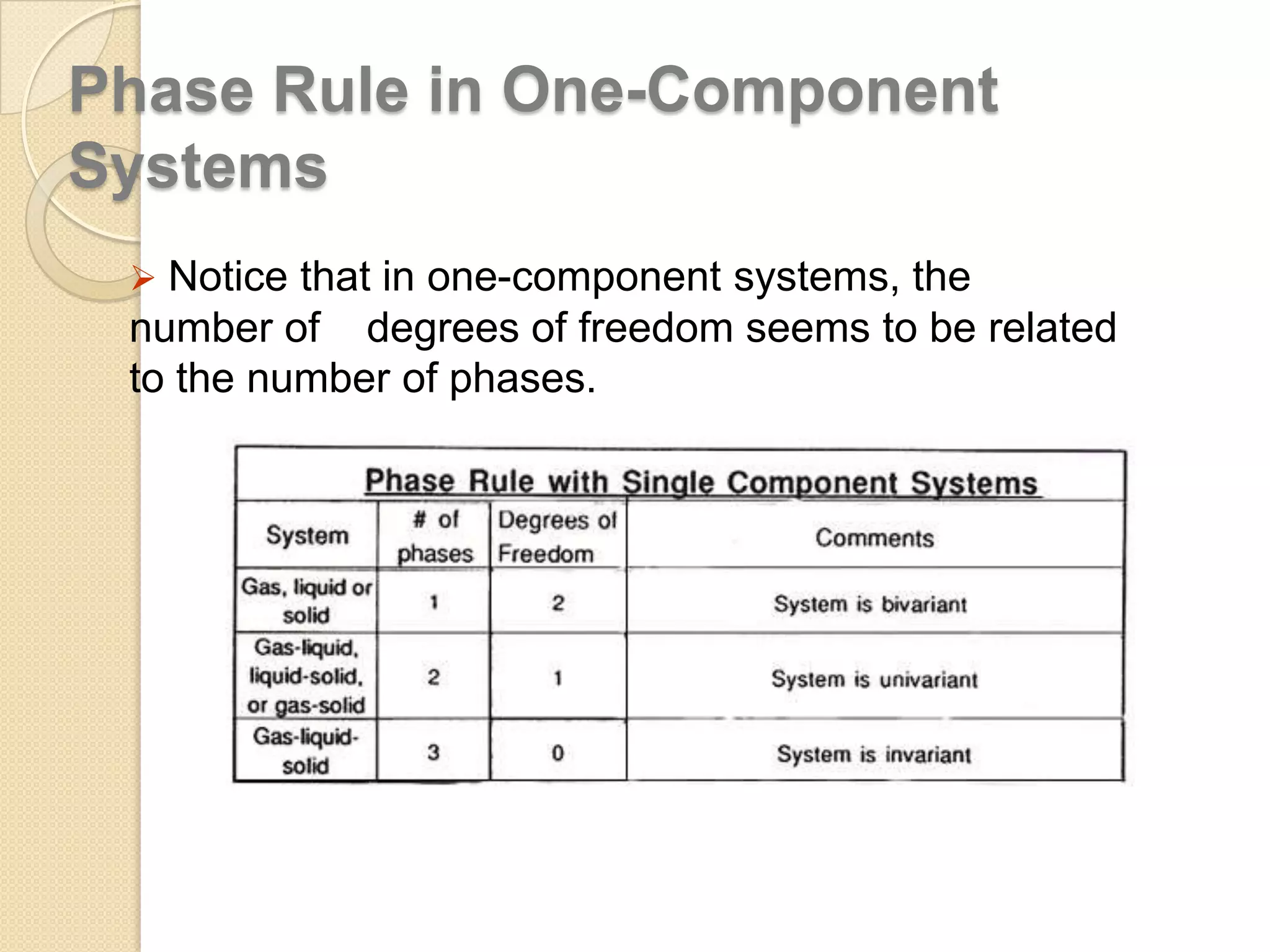
 Notice that in one-component systems, the

number of degrees of freedom seems to be related
to the number of phases.
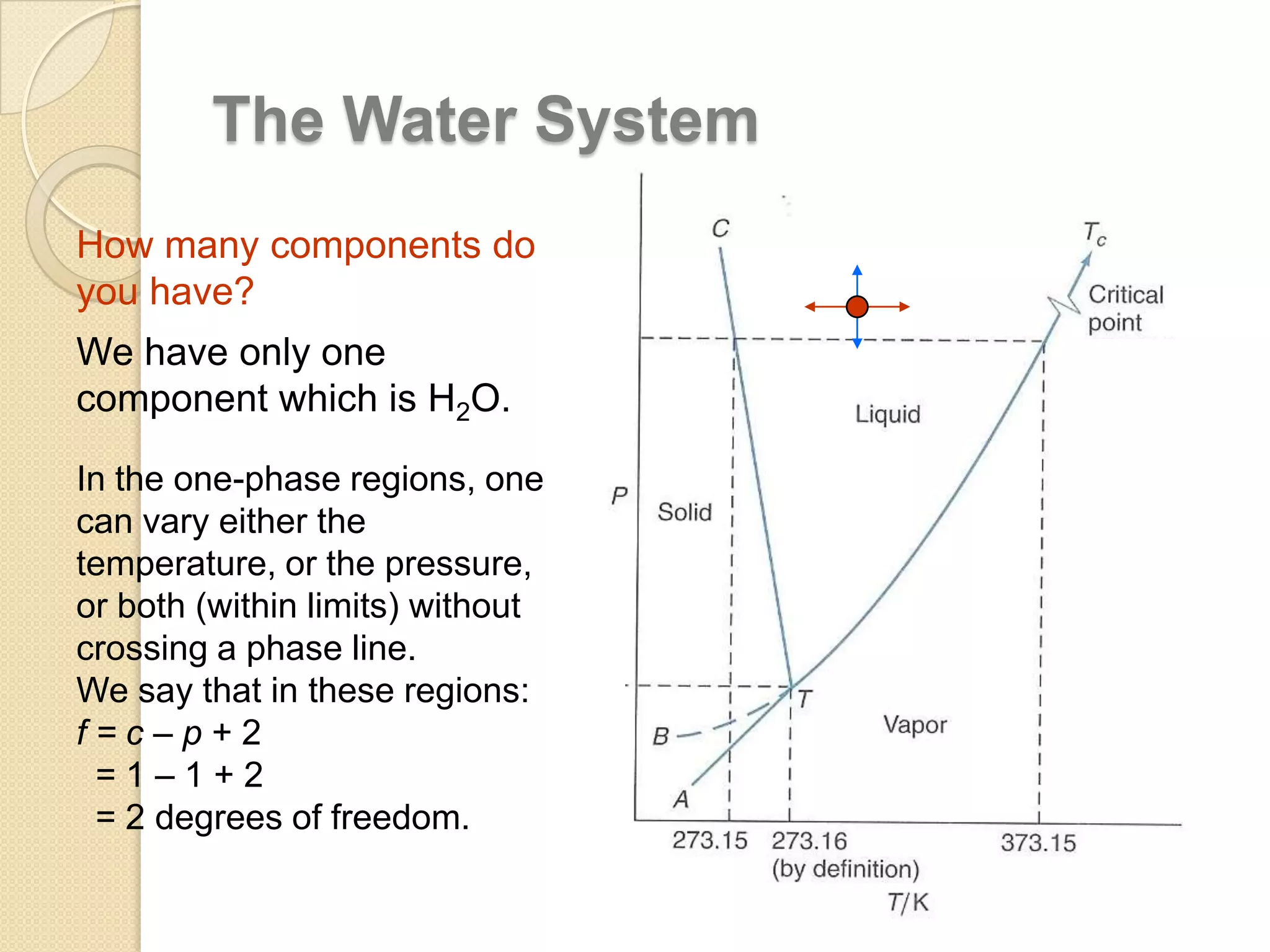
The Water System
How many components do
you have?
We have only one
component which is H2O.
In the one-phase regions, one
can vary either the
temperature, or the pressure,
or both (within limits) without
crossing a phase line.
We say that in these regions:
f=c–p+2
=1–1+2
= 2 degrees of freedom.
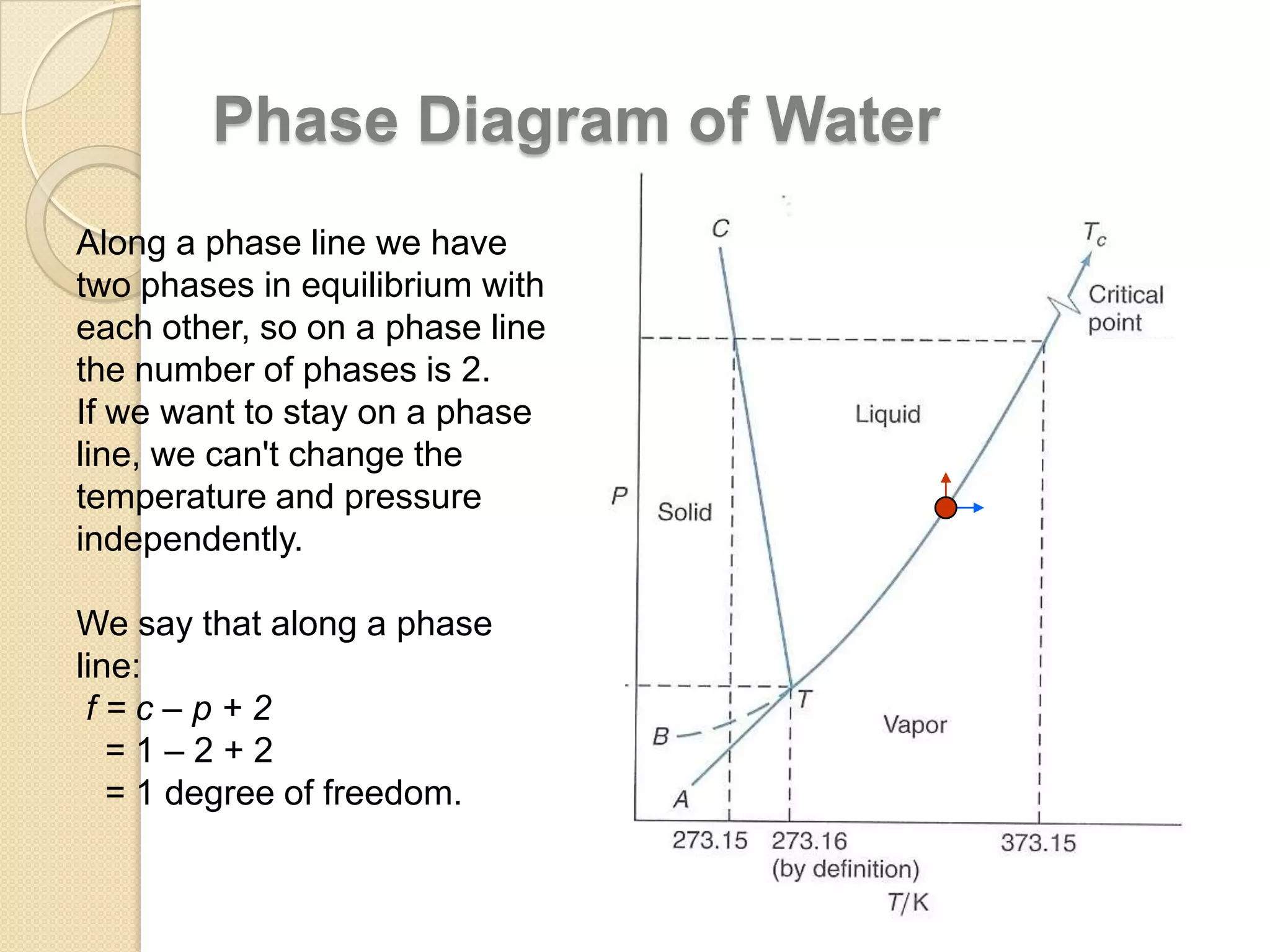
Phase Diagram of Water
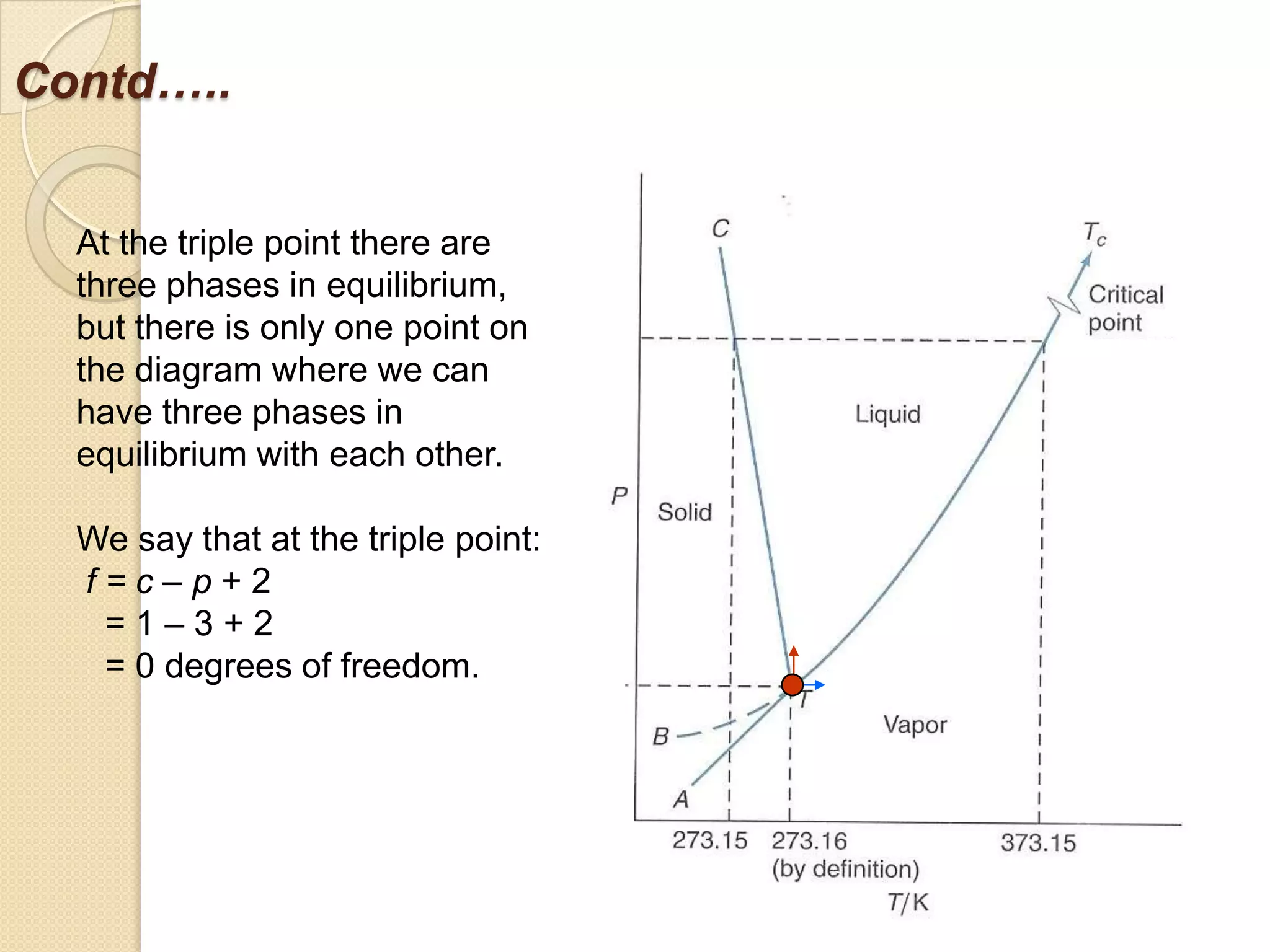
Along a phase line we have
two phases in equilibrium with
each other, so on a phase line
the number of phases is 2.
If we want to stay on a phase
line, we can't change the
temperature and pressure
independently.
We say that along a phase
line:
f=c–p+2
=1–2+2
= 1 degree of freedom.
Contd…..
At the triple point there are
three phases in equilibrium,
but there is only one point on
the diagram where we can
have three phases in
equilibrium with each other.
We say that at the triple point:
f=c–p+2
=1–3+2
= 0 degrees of freedom.
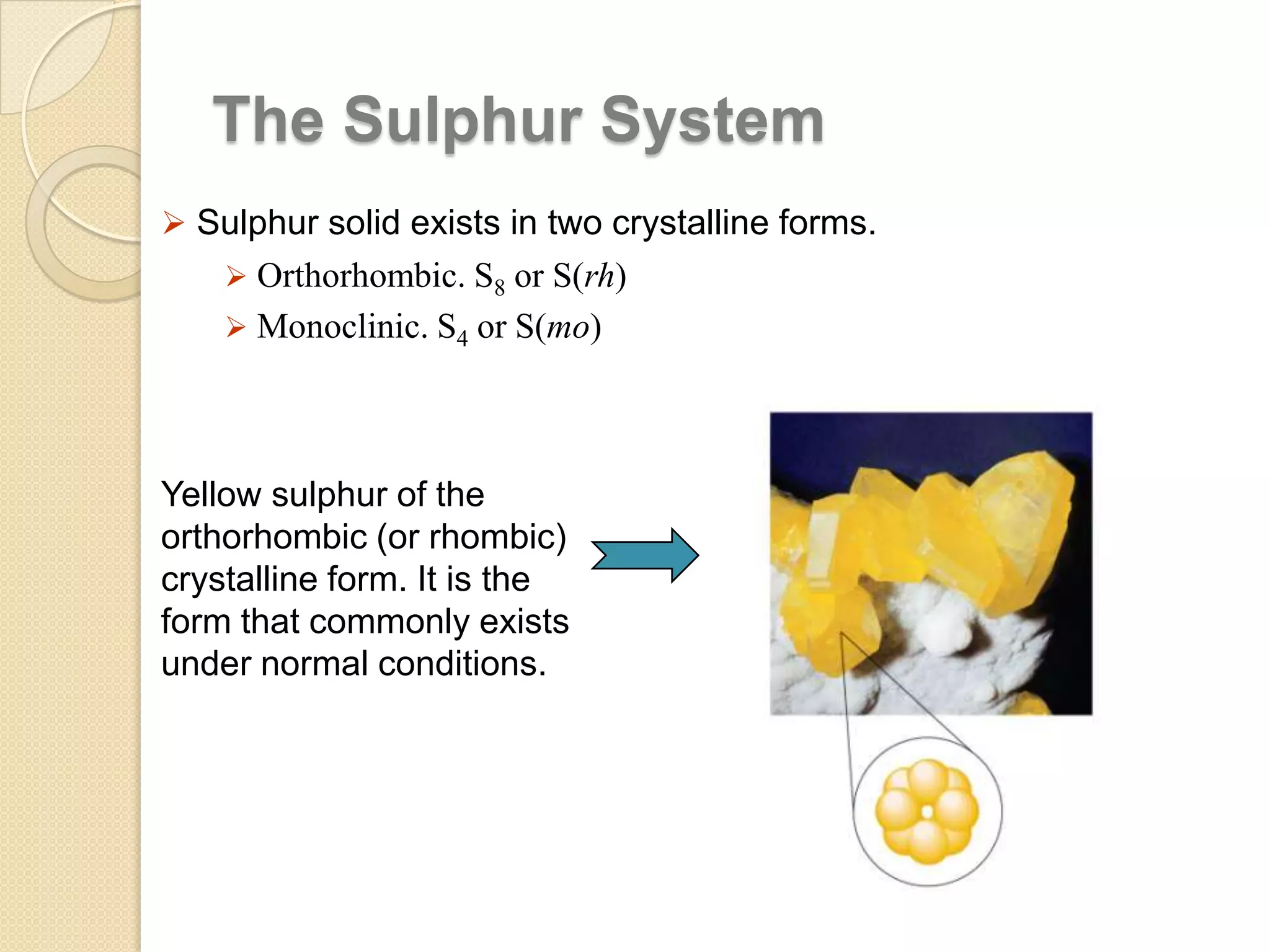
The Sulphur System
 Sulphur solid exists in two crystalline forms.
 Orthorhombic. S8 or S(rh)

 Monoclinic. S4 or S(mo)

Yellow sulphur of the
orthorhombic (or rhombic)
crystalline form. It is the
form that commonly exists
under normal conditions.
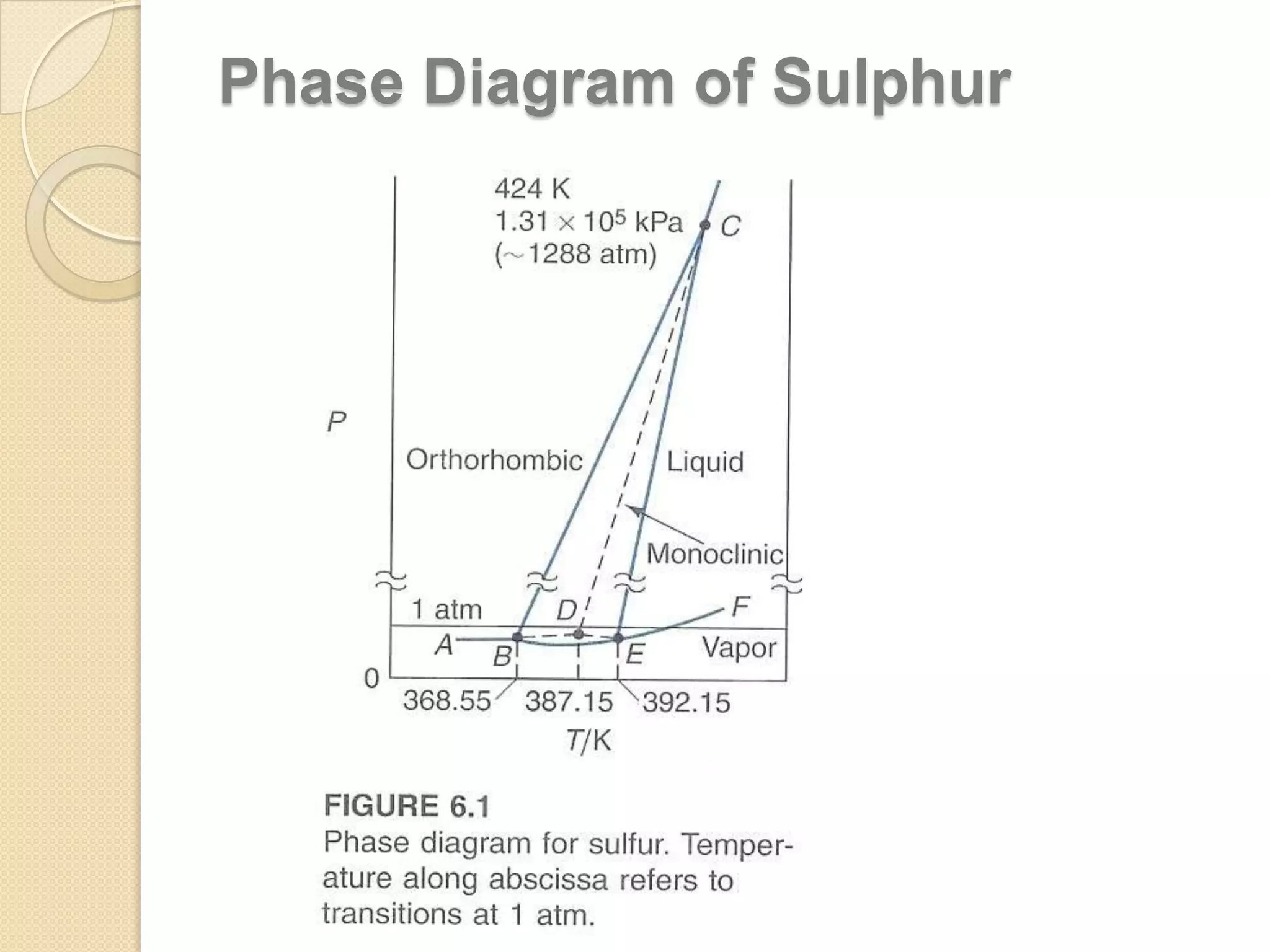
Phase Diagram of Sulphur
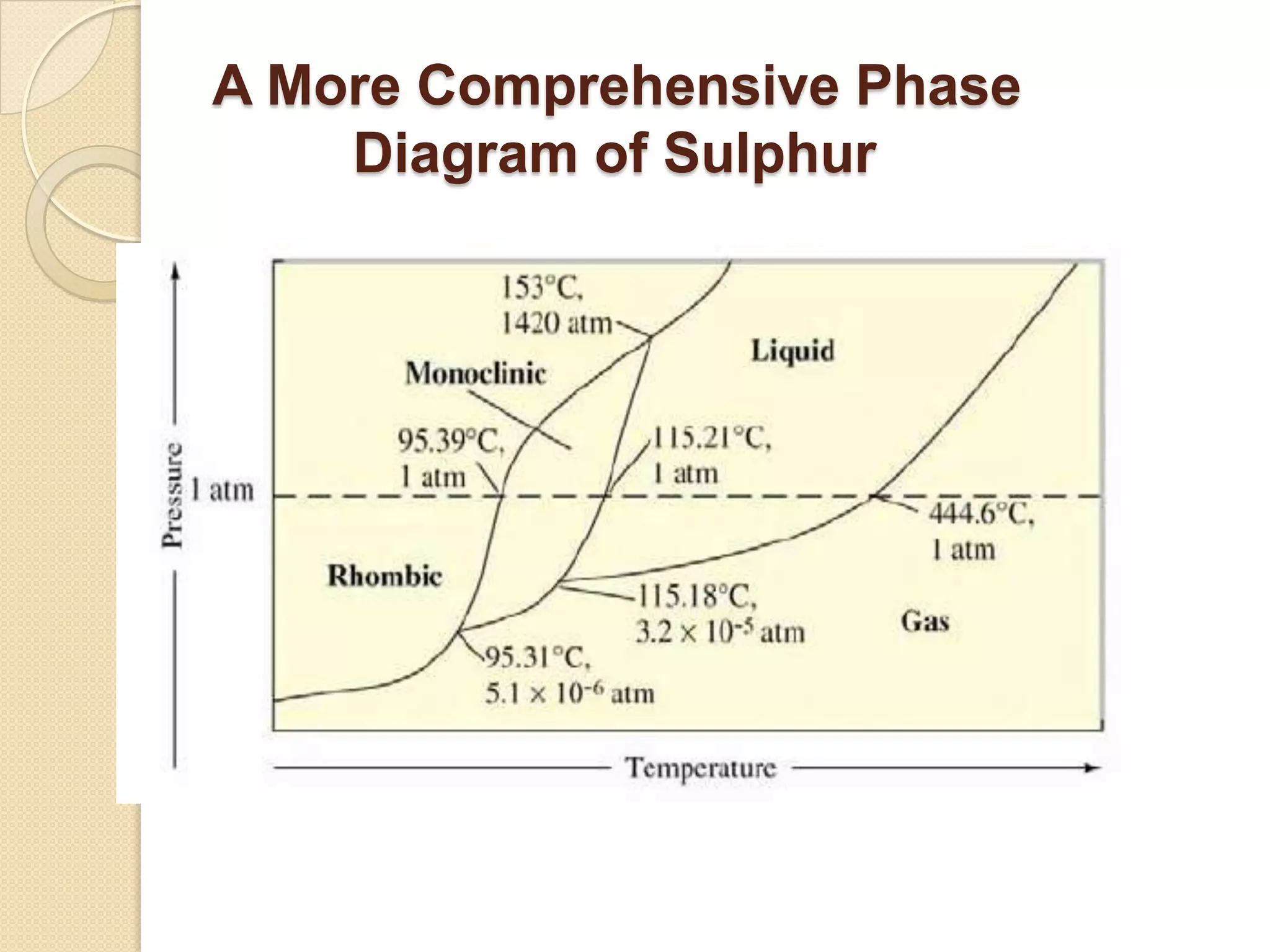
A More Comprehensive Phase
Diagram of Sulphur
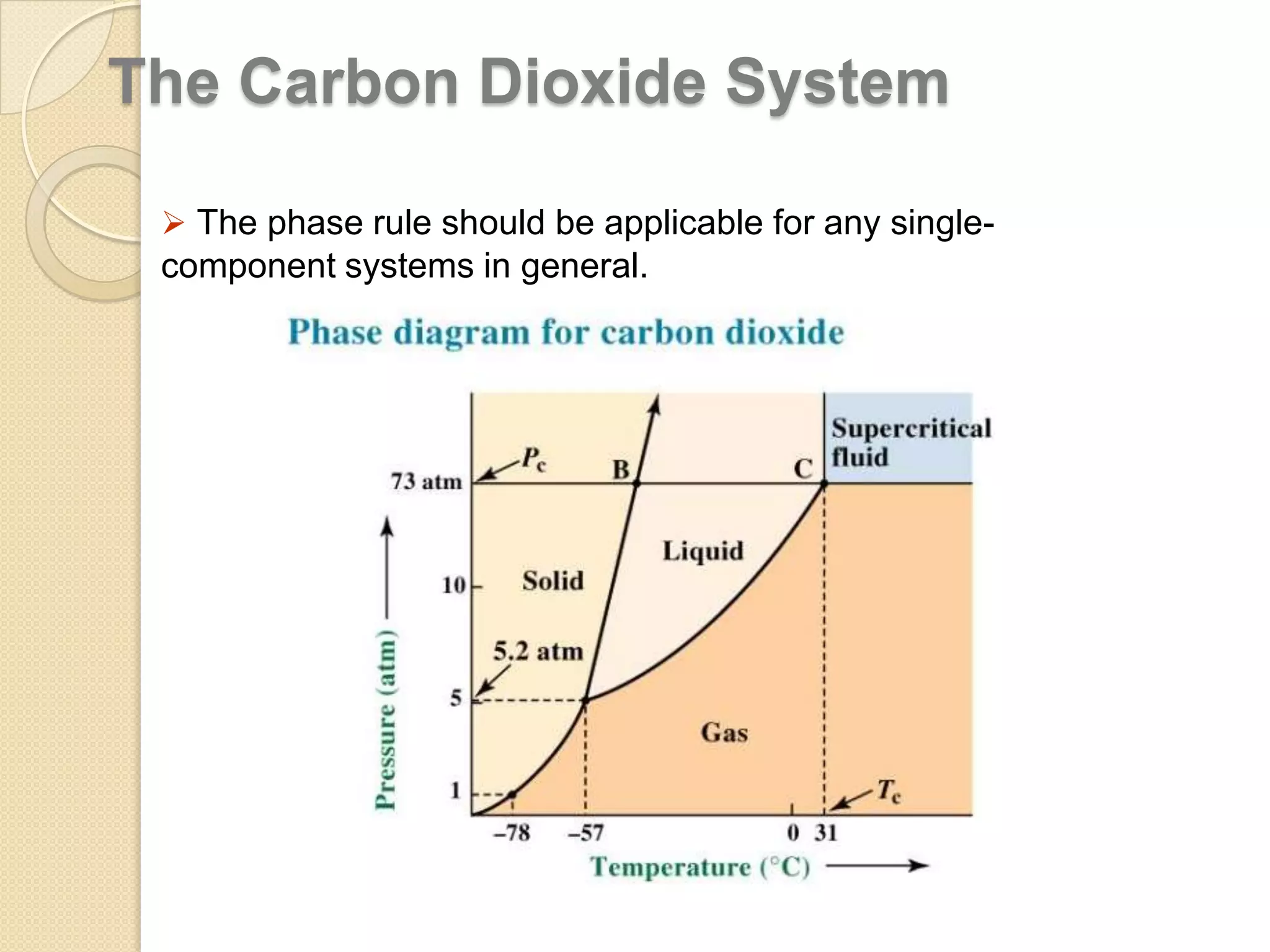
The Carbon Dioxide System
 The phase rule should be applicable for any single-

component systems in general.
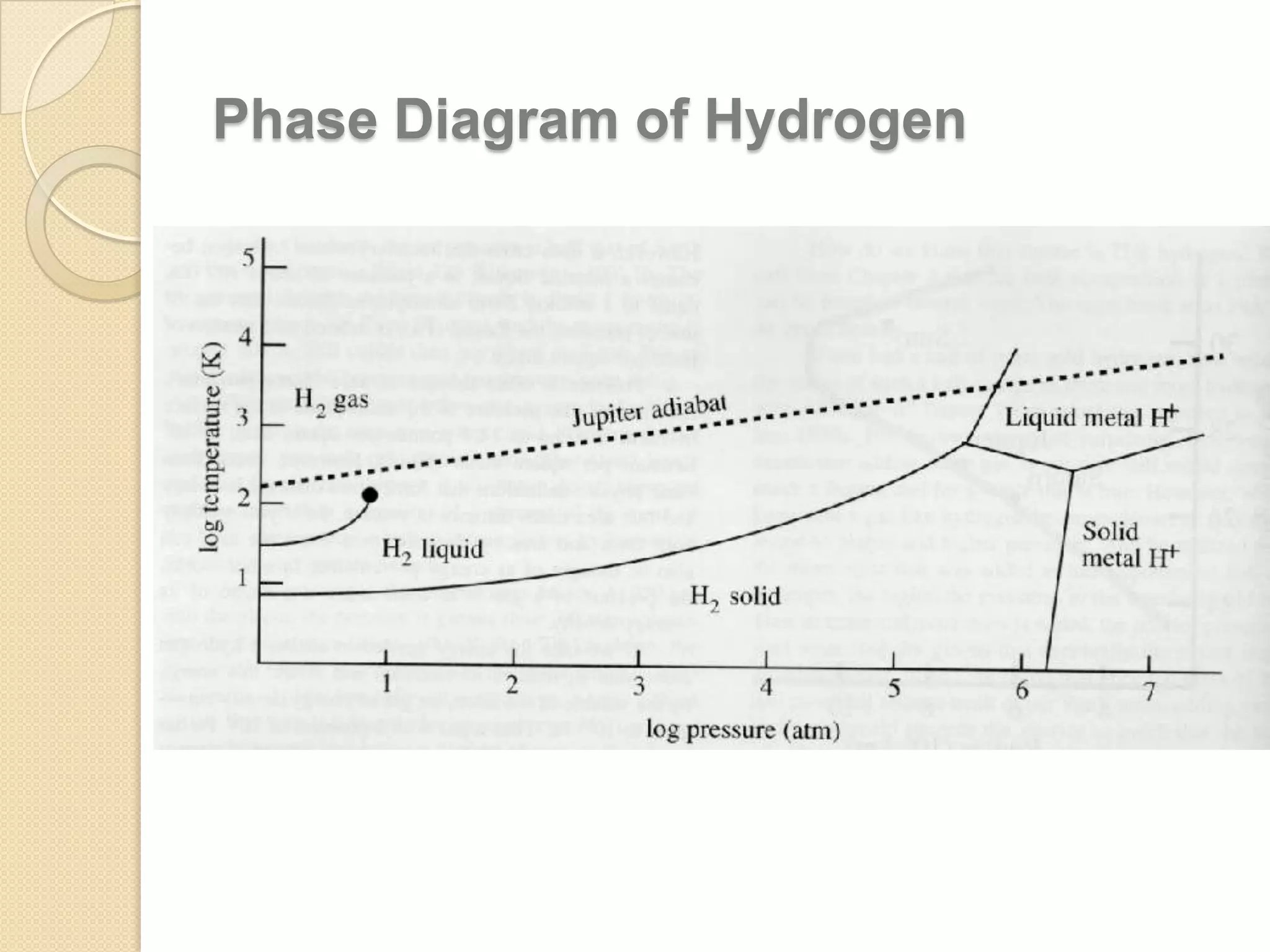
Phase Diagram of Hydrogen
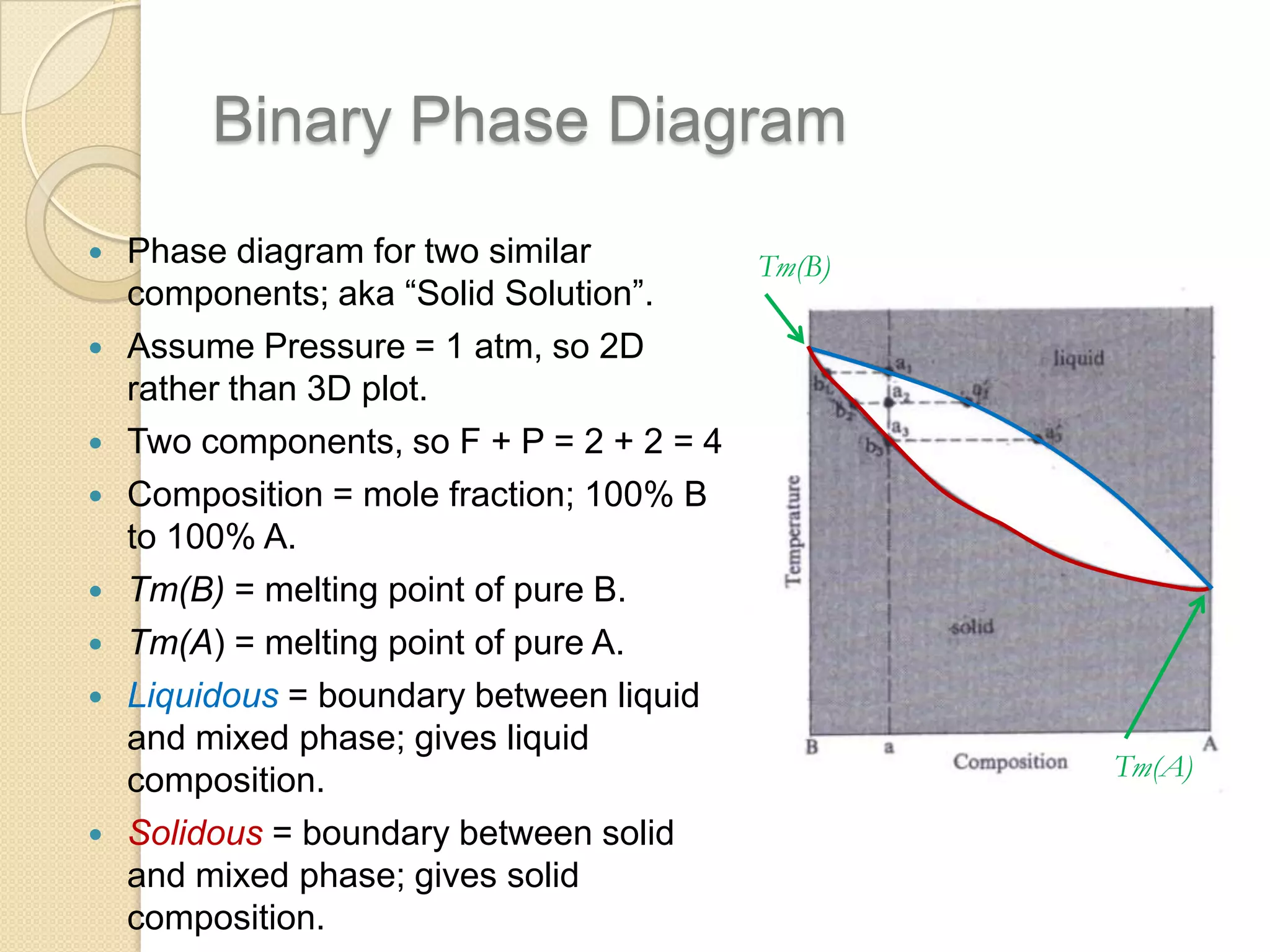
Binary Phase Diagram











Phase diagram for two similar
Tm(B)
components; aka “Solid Solution”.
Assume Pressure = 1 atm, so 2D
rather than 3D plot.
Two components, so F + P = 2 + 2 = 4
Composition = mole fraction; 100% B
to 100% A.
Tm(B) = melting point of pure B.
Tm(A) = melting point of pure A.
Liquidous = boundary between liquid
and mixed phase; gives liquid
composition.
Solidous = boundary between solid
and mixed phase; gives solid
composition.

Tm(A)
Contd….









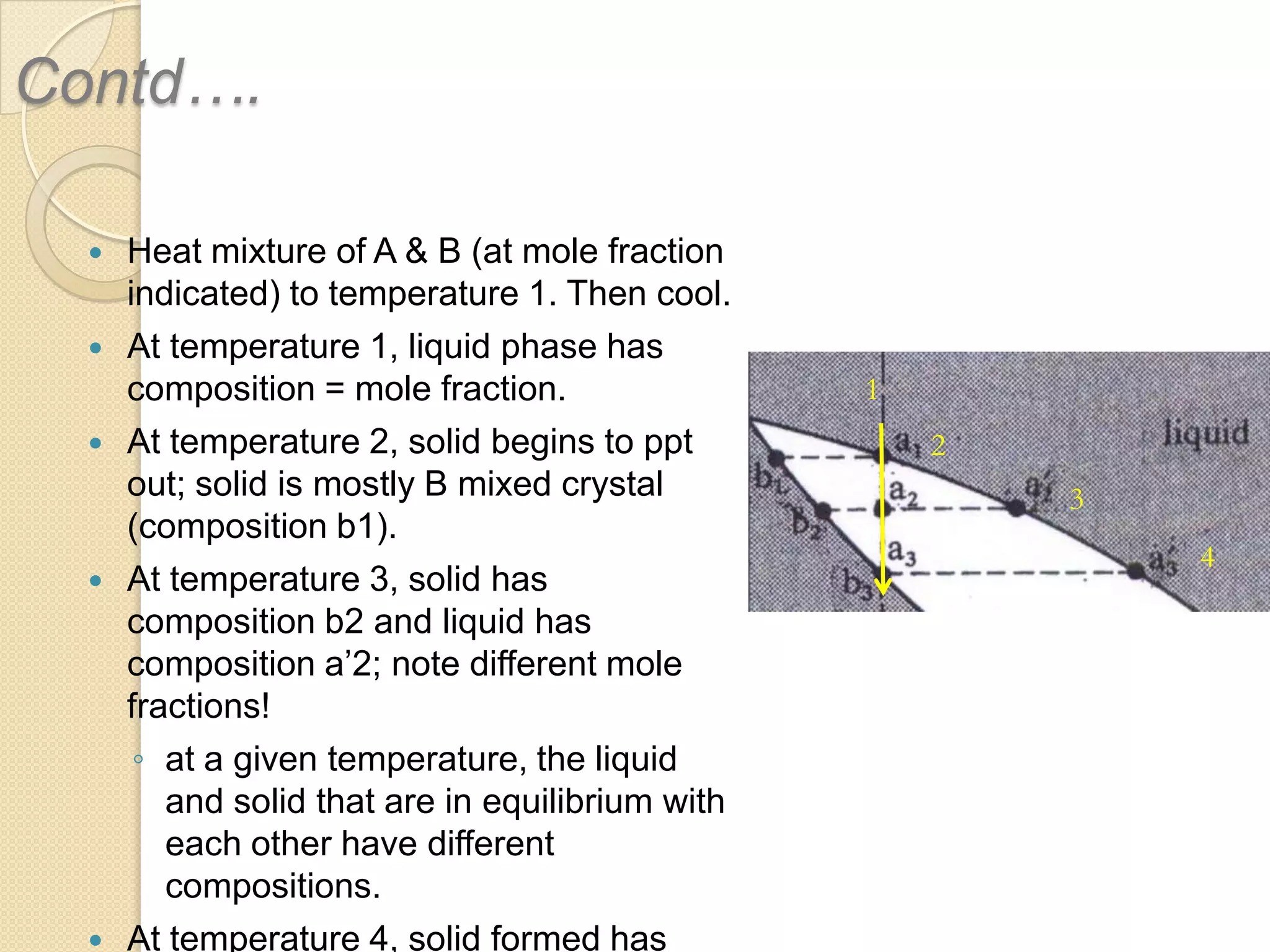
Heat mixture of A & B (at mole fraction
indicated) to temperature 1. Then cool.
At temperature 1, liquid phase has
composition = mole fraction.
At temperature 2, solid begins to ppt
out; solid is mostly B mixed crystal
(composition b1).
At temperature 3, solid has
composition b2 and liquid has
composition a’2; note different mole
fractions!
◦ at a given temperature, the liquid
and solid that are in equilibrium with
each other have different
compositions.
At temperature 4, solid formed has

1

2
3

4
Contd….


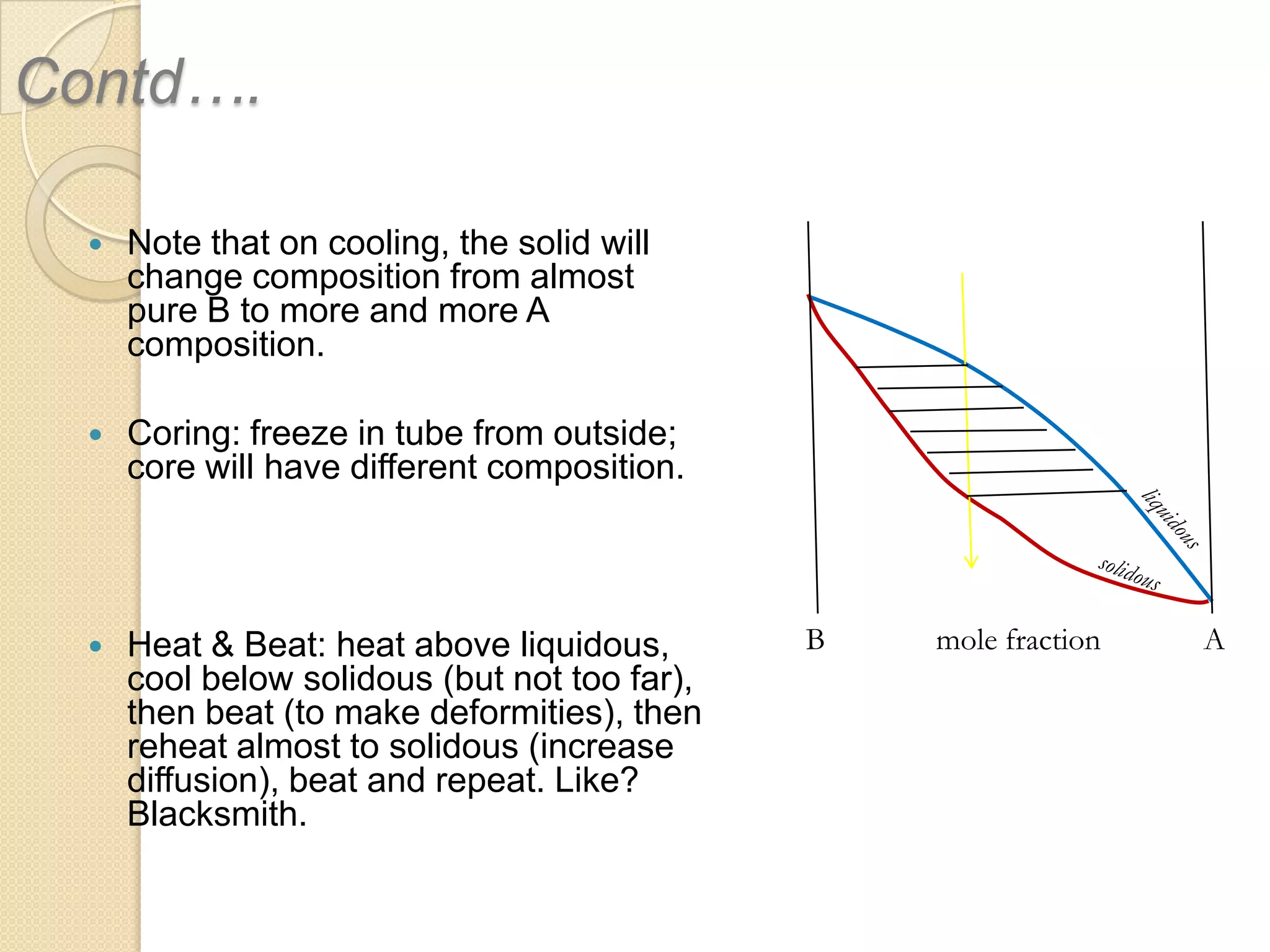
Note that on cooling, the solid will
change composition from almost
pure B to more and more A
composition.



Coring: freeze in tube from outside;
core will have different composition.



Heat & Beat: heat above liquidous,
cool below solidous (but not too far),
then beat (to make deformities), then
reheat almost to solidous (increase
diffusion), beat and repeat. Like?
Blacksmith.

B

mole fraction

A
Contd….
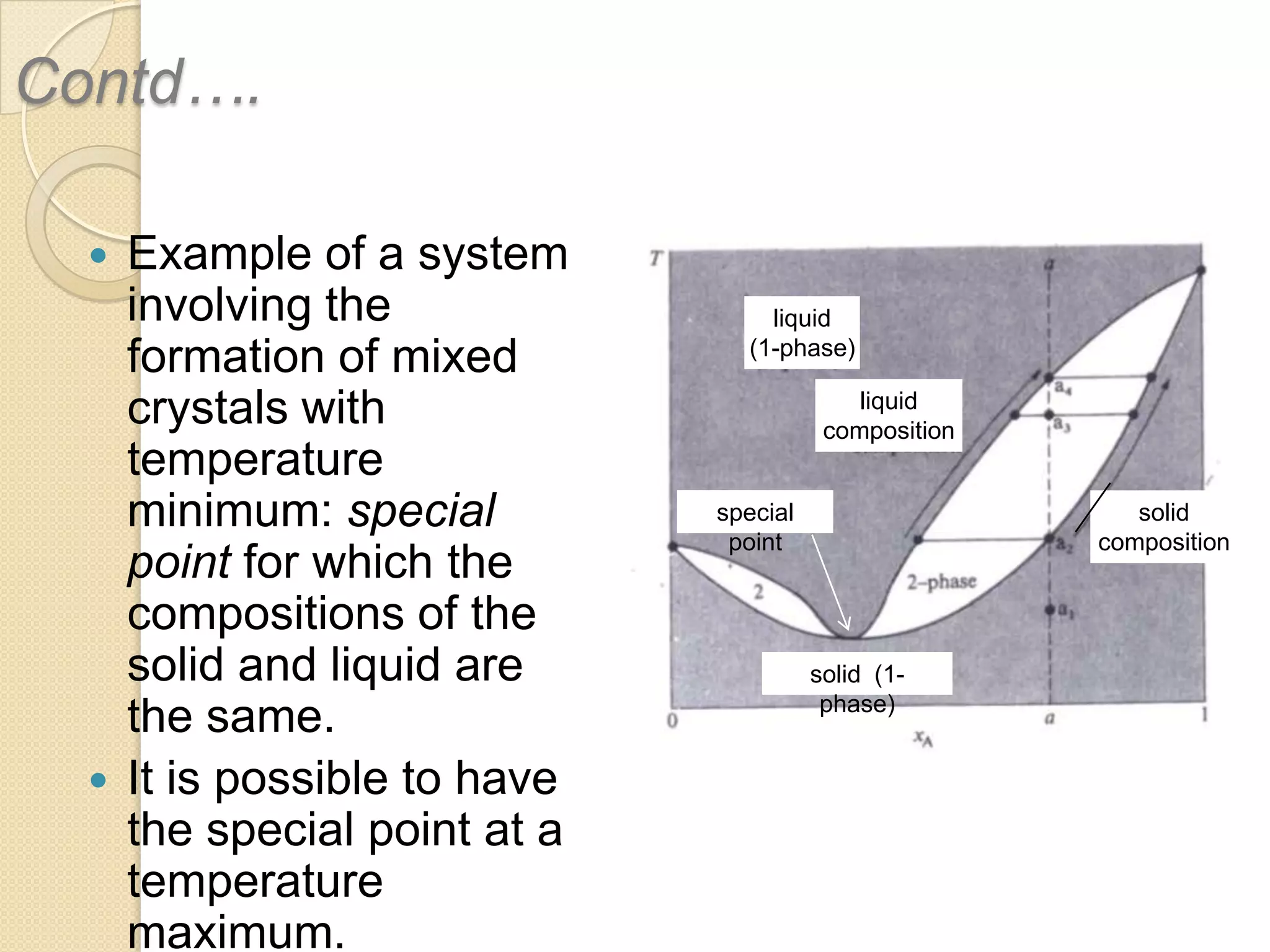
Example of a system
involving the
formation of mixed
crystals with
temperature
minimum: special
point for which the
compositions of the
solid and liquid are
the same.
 It is possible to have
the special point at a
temperature
maximum.


liquid
(1-phase)
liquid
composition
special
point

solid
composition

solid (1phase)
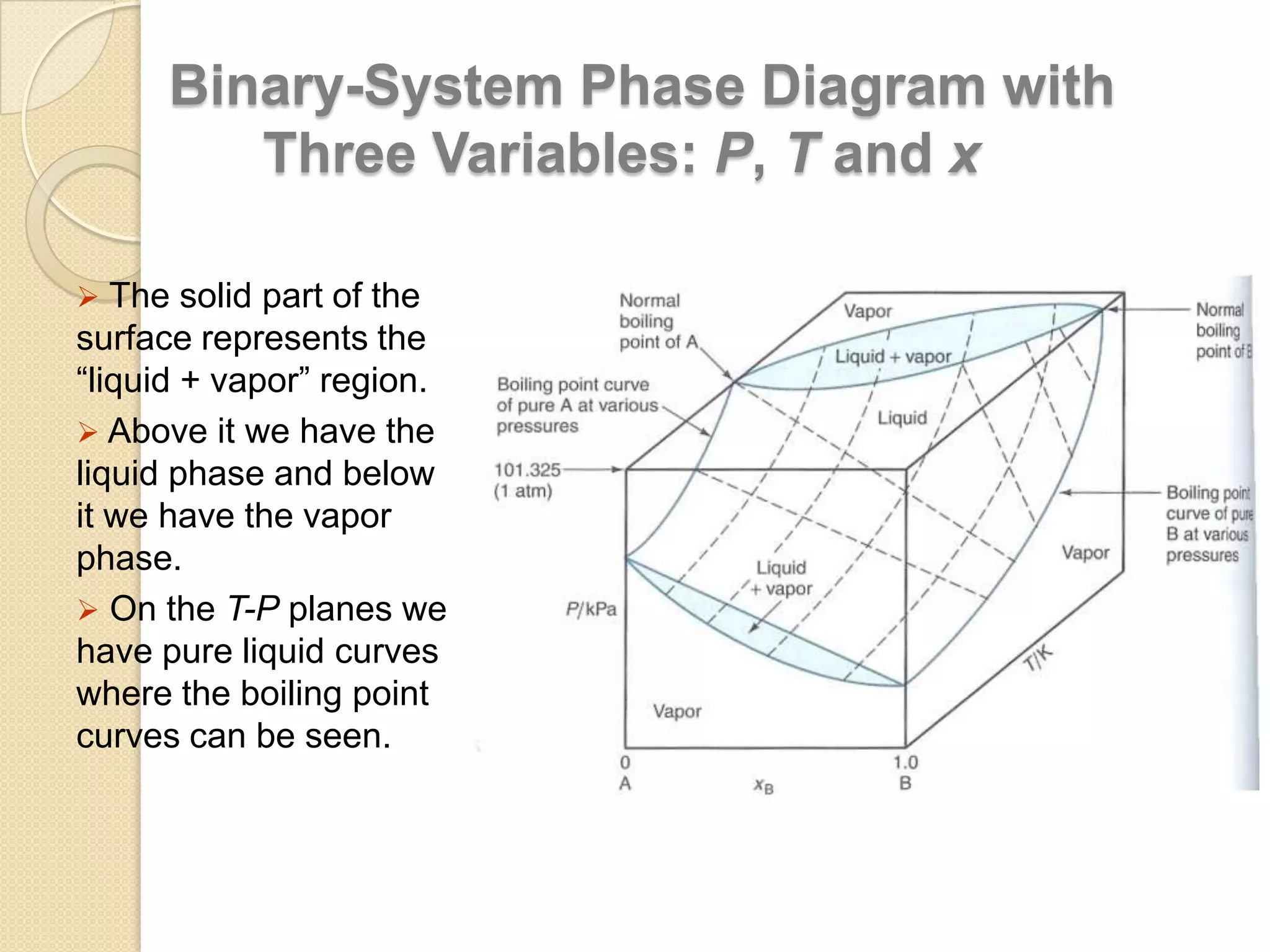
Binary-System Phase Diagram with
Three Variables: P, T and x
 The solid part of the

surface represents the
“liquid + vapor” region.
 Above it we have the
liquid phase and below
it we have the vapor
phase.
 On the T-P planes we
have pure liquid curves
where the boiling point
curves can be seen.
Contd….
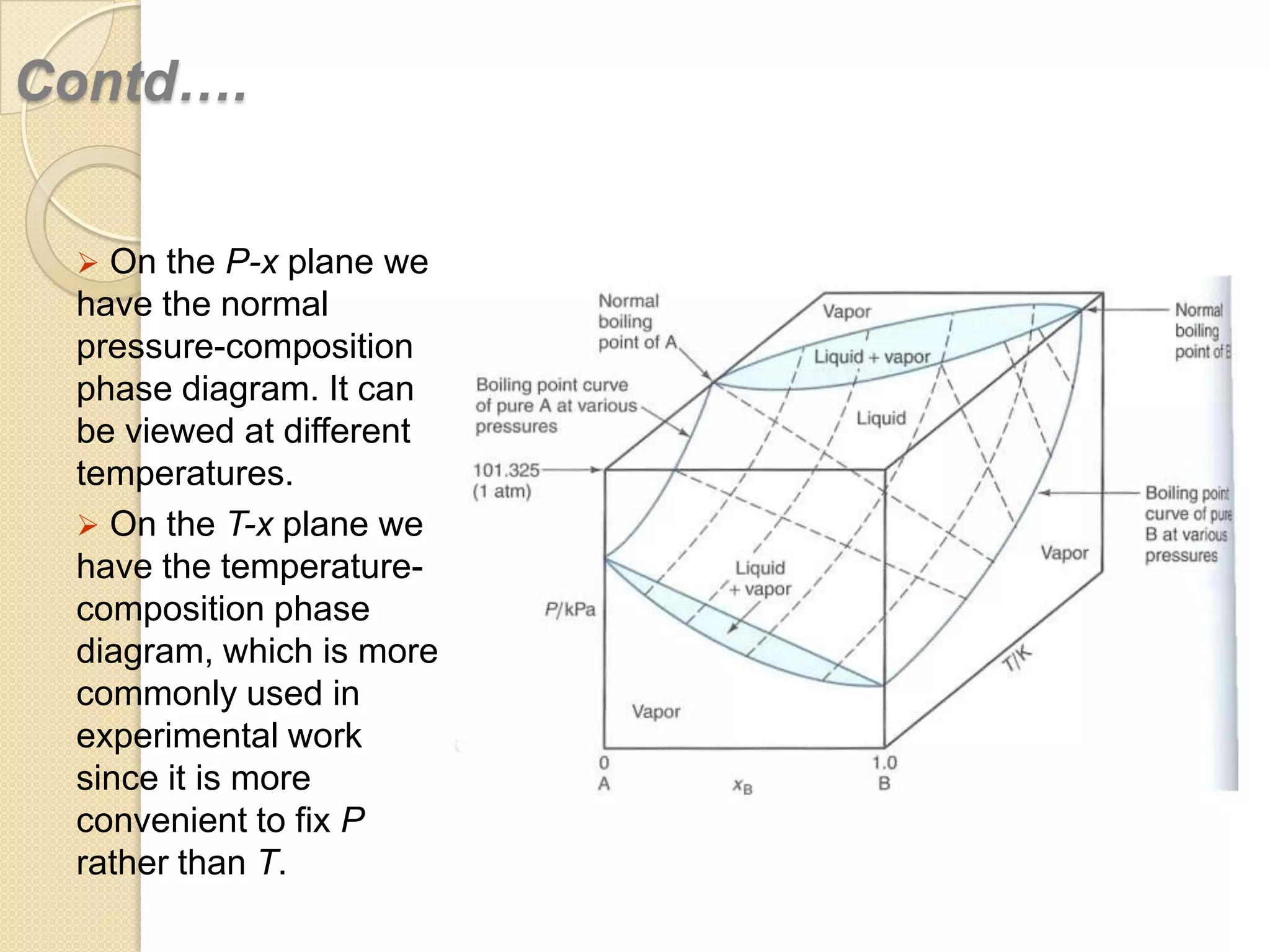
 On the P-x plane we

have the normal
pressure-composition
phase diagram. It can
be viewed at different
temperatures.
 On the T-x plane we
have the temperaturecomposition phase
diagram, which is more
commonly used in
experimental work
since it is more
convenient to fix P
rather than T.
Eutectic Phase Diagram


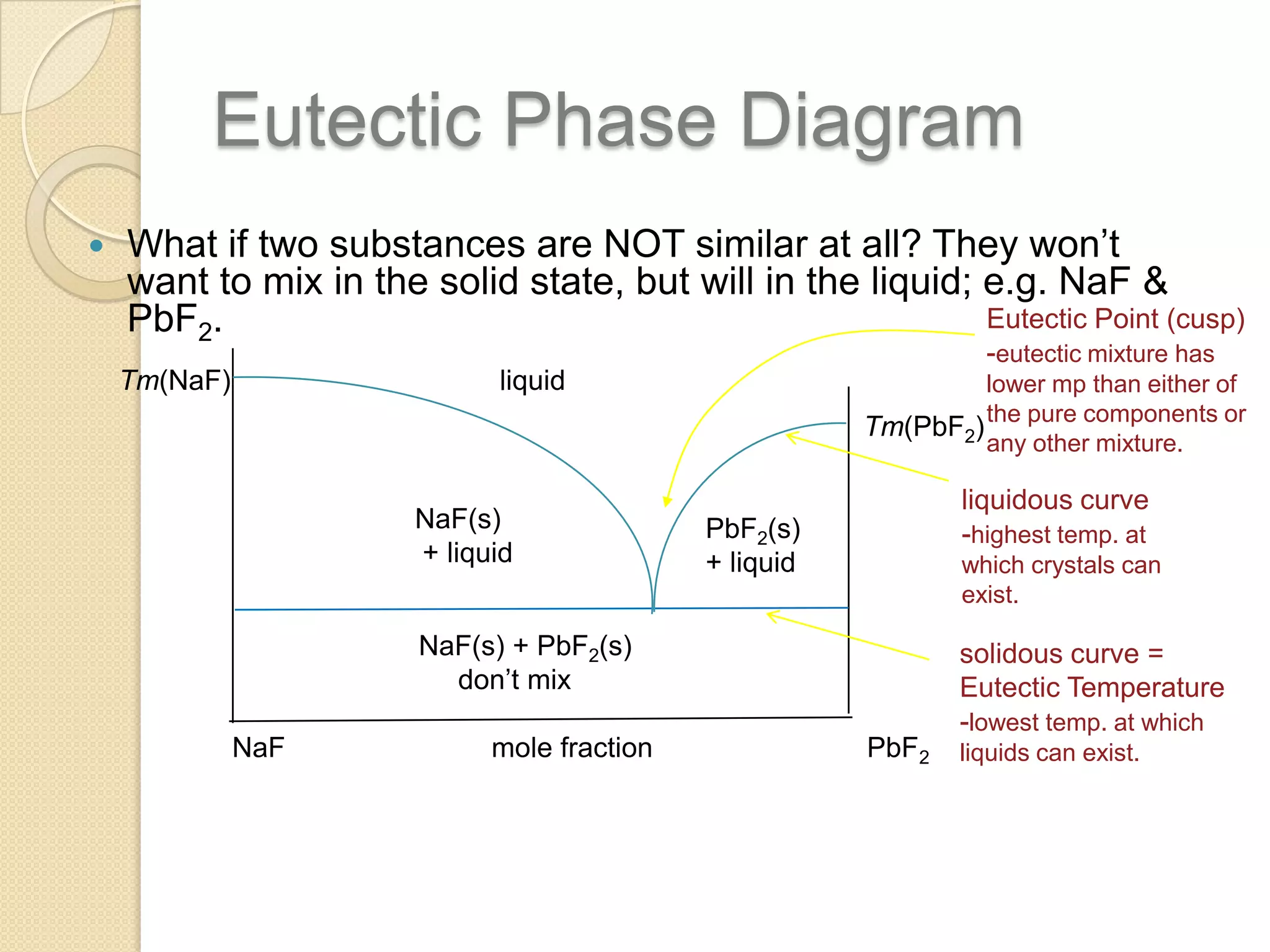
What if two substances are NOT similar at all? They won’t
want to mix in the solid state, but will in the liquid; e.g. NaF &
Eutectic Point (cusp)
PbF2.
-eutectic mixture has

Tm(NaF)

liquid

NaF(s)
+ liquid

lower mp than either of
Tm(PbF2) the pure components or
any other mixture.

liquidous curve
-highest temp. at

PbF2(s)
+ liquid

which crystals can
exist.

NaF(s) + PbF2(s)
don’t mix
NaF

mole fraction

solidous curve =
Eutectic Temperature
-lowest temp. at which
PbF2

liquids can exist.
Contd….


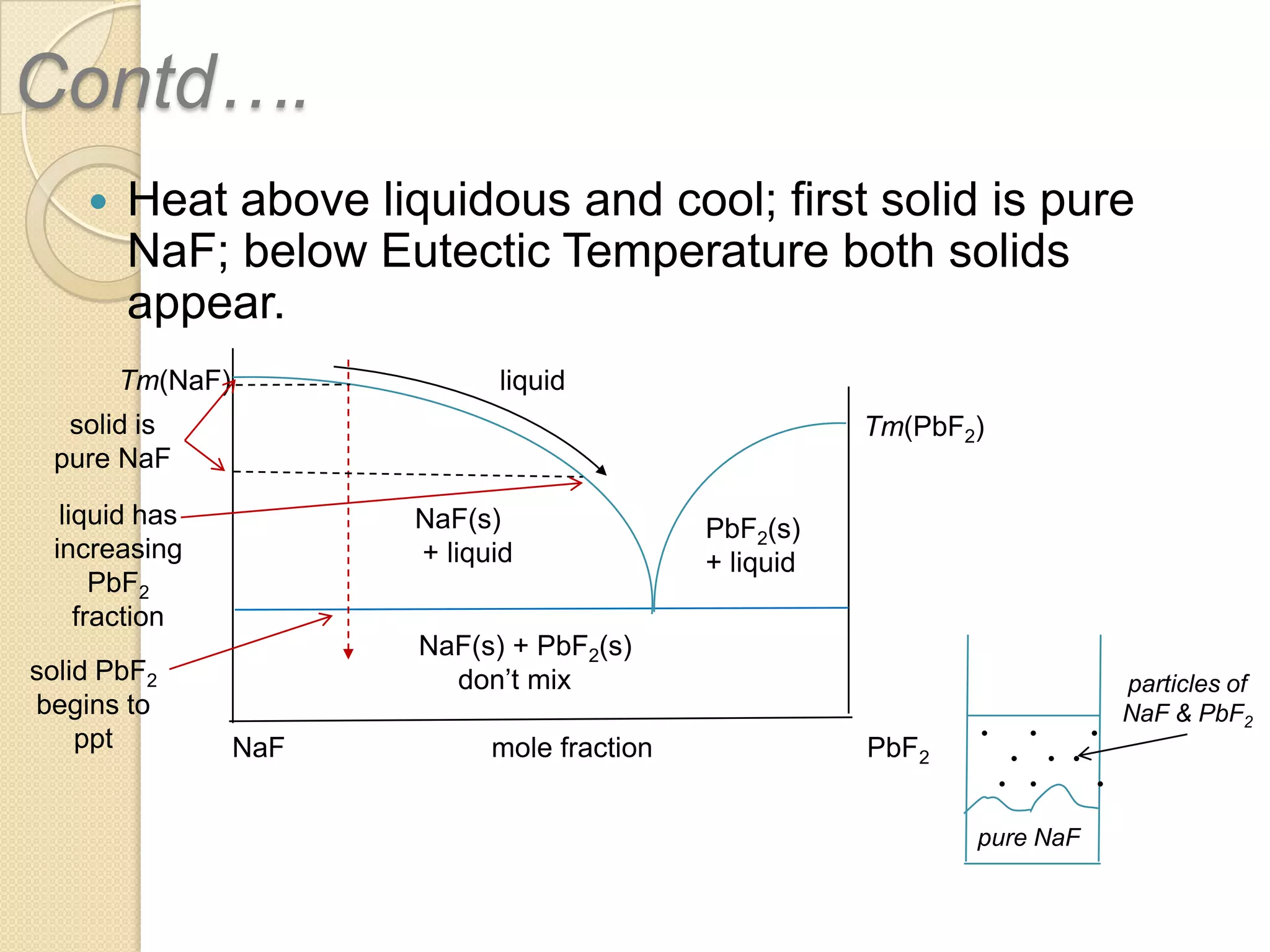
Heat above liquidous and cool; first solid is pure
NaF; below Eutectic Temperature both solids
appear.
Tm(NaF)

liquid

solid is
pure NaF

Tm(PbF2)

liquid has
increasing
PbF2
fraction
solid PbF2
begins to
ppt

NaF(s)
+ liquid

PbF2(s)
+ liquid

NaF(s) + PbF2(s)
don’t mix
NaF

mole fraction

PbF2

•

•
•
•

•
• •

•

pure NaF

•

particles of
NaF & PbF2
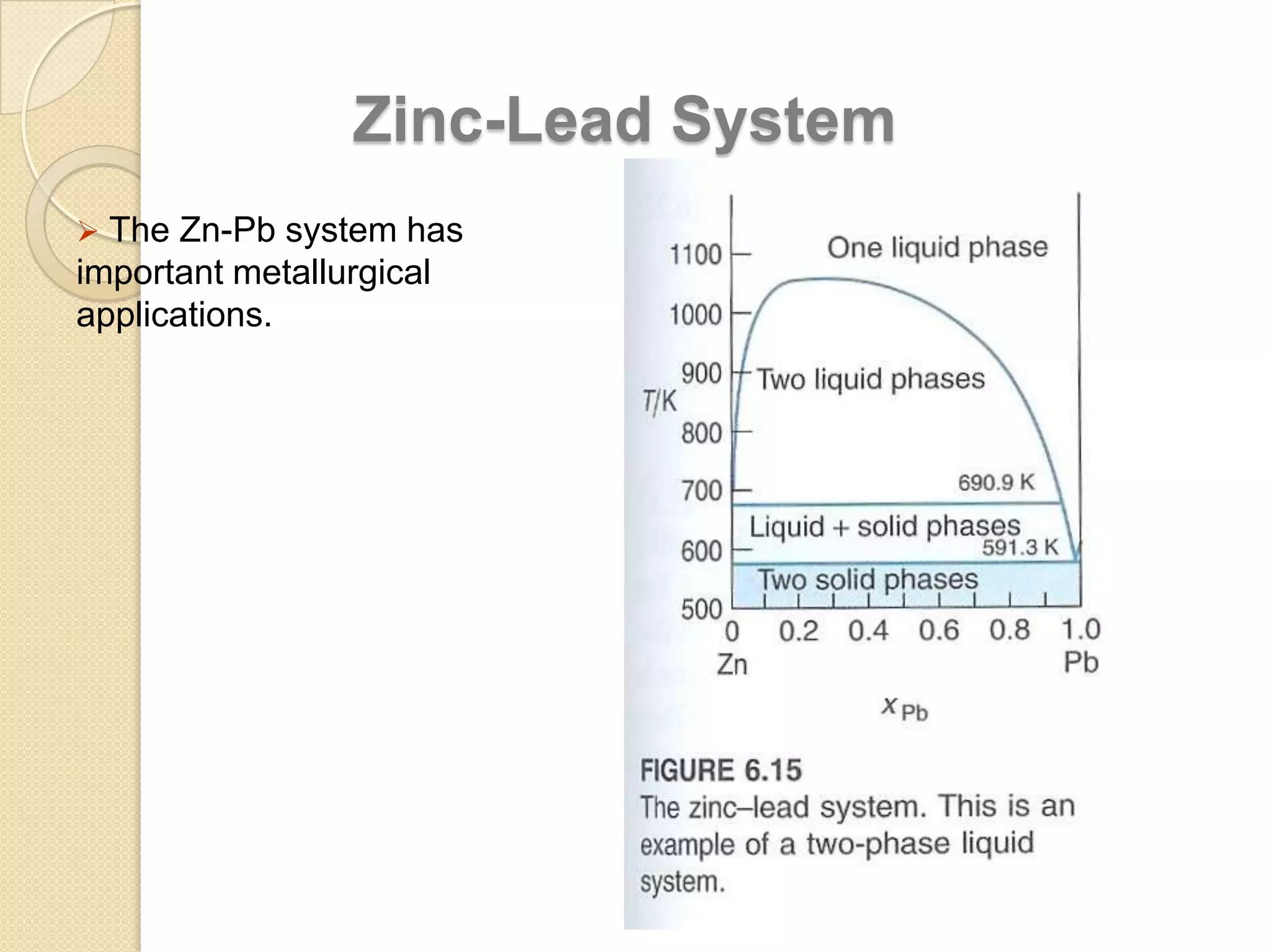
Zinc-Lead System
 The Zn-Pb system has

important metallurgical
applications.
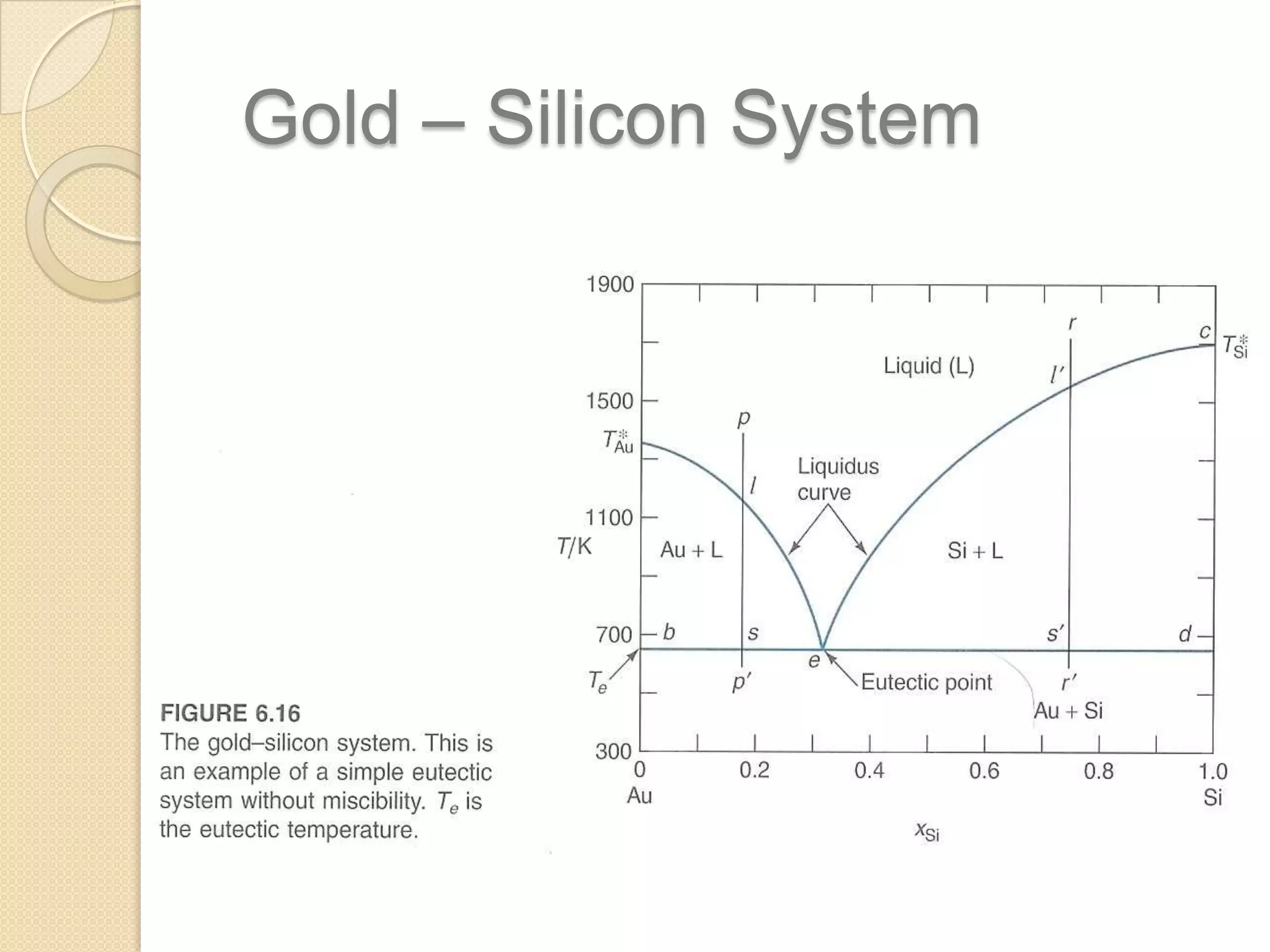
Gold – Silicon System
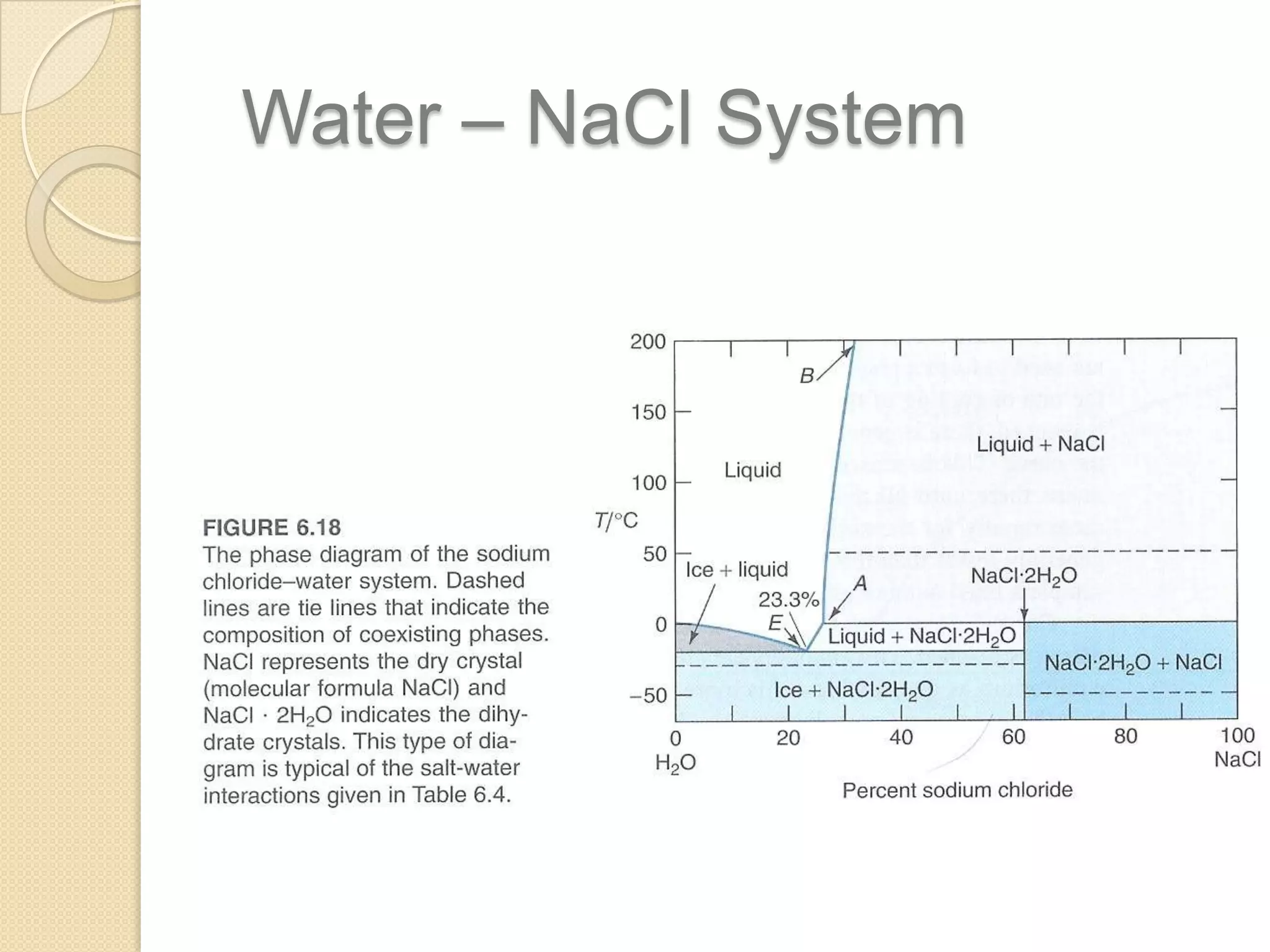
Water – NaCl System
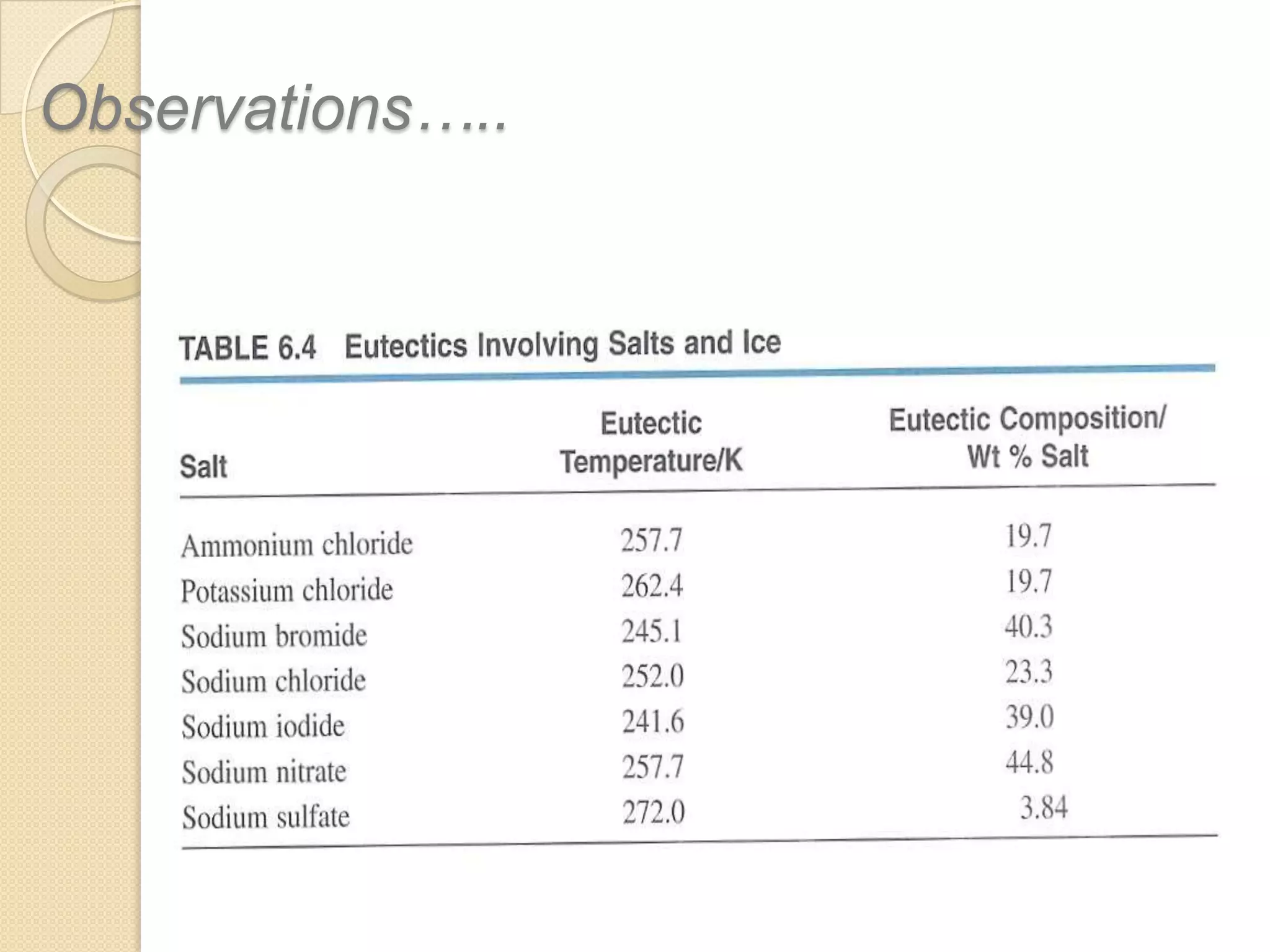
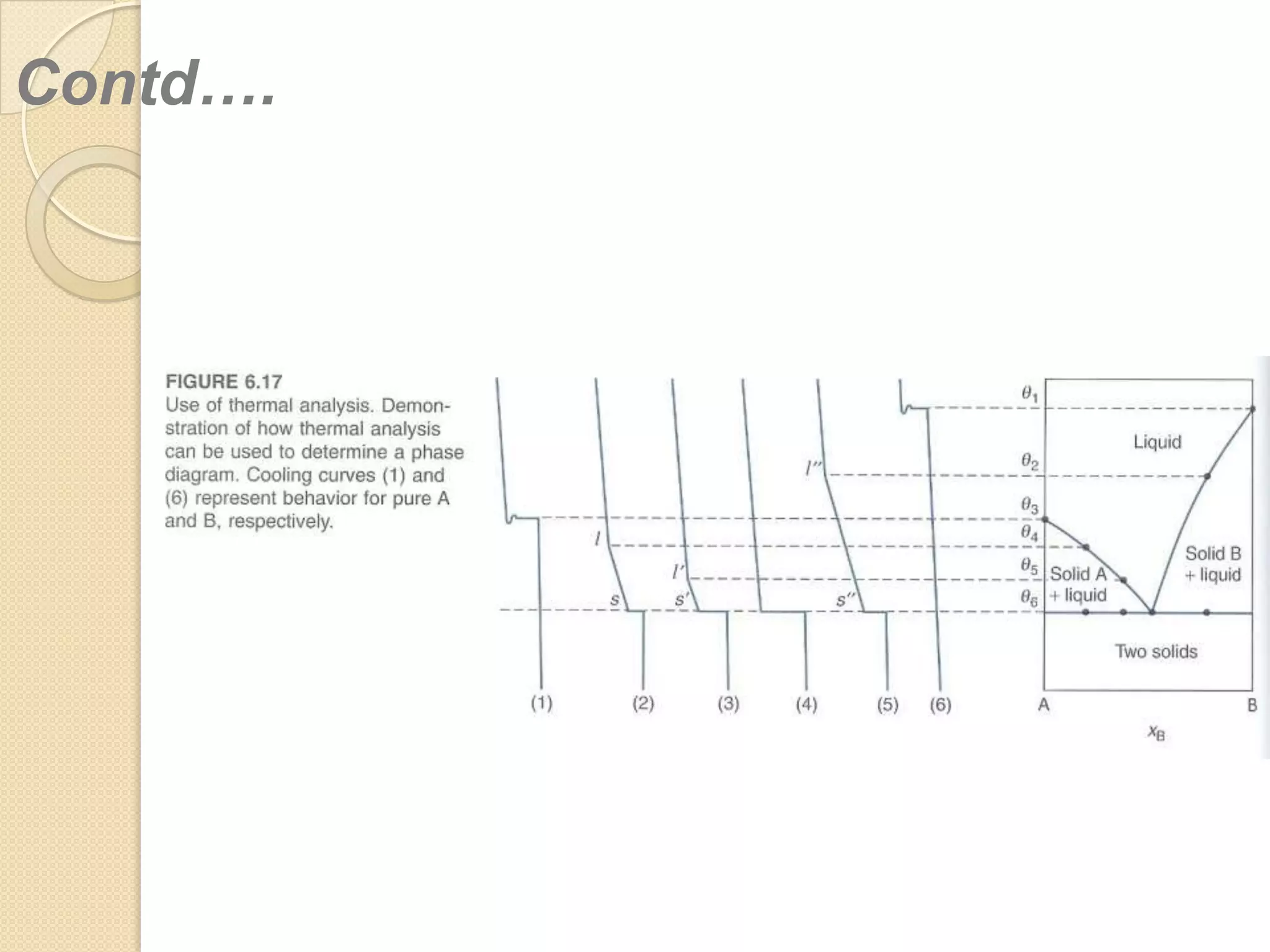
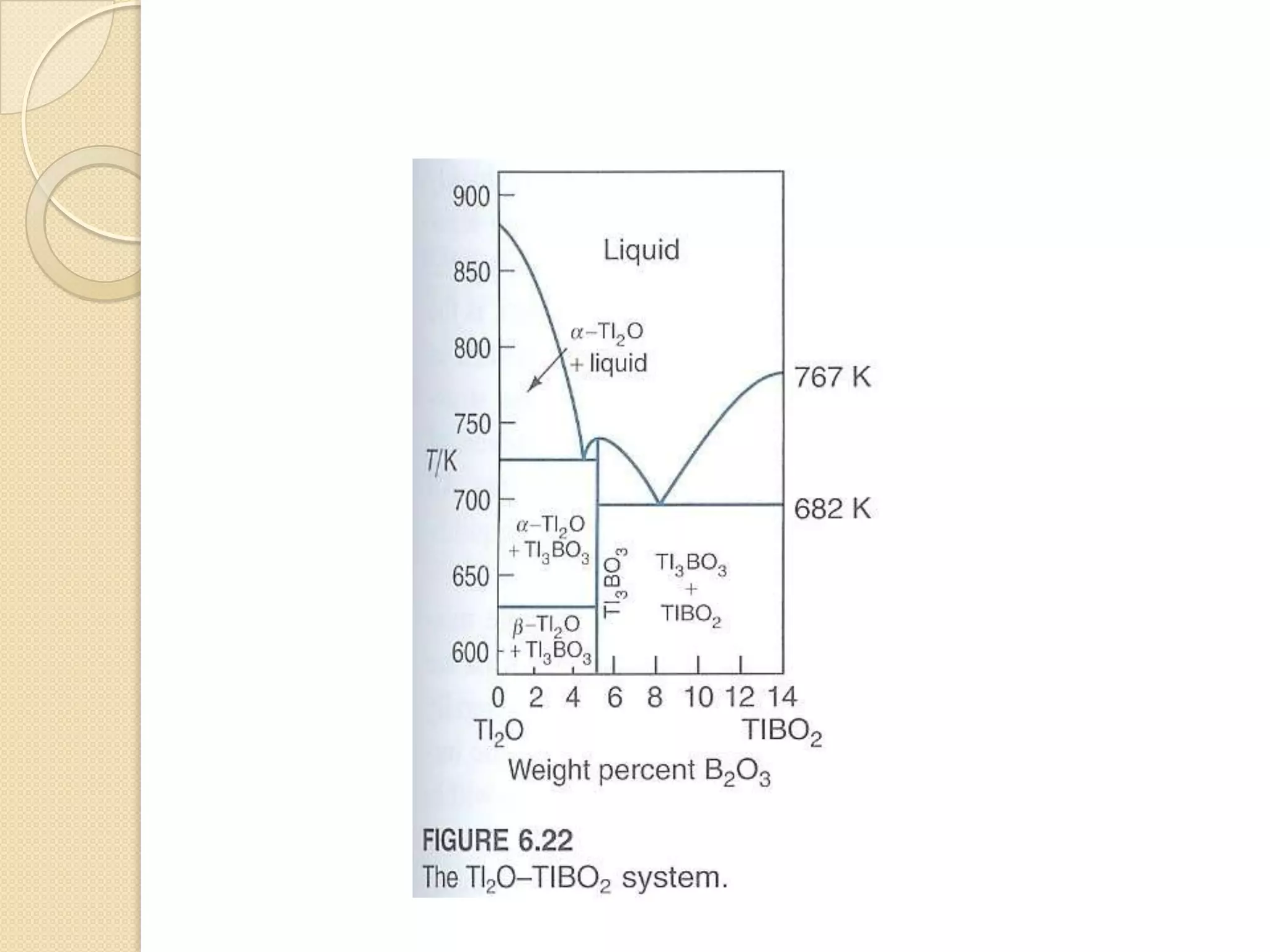
Observations…..
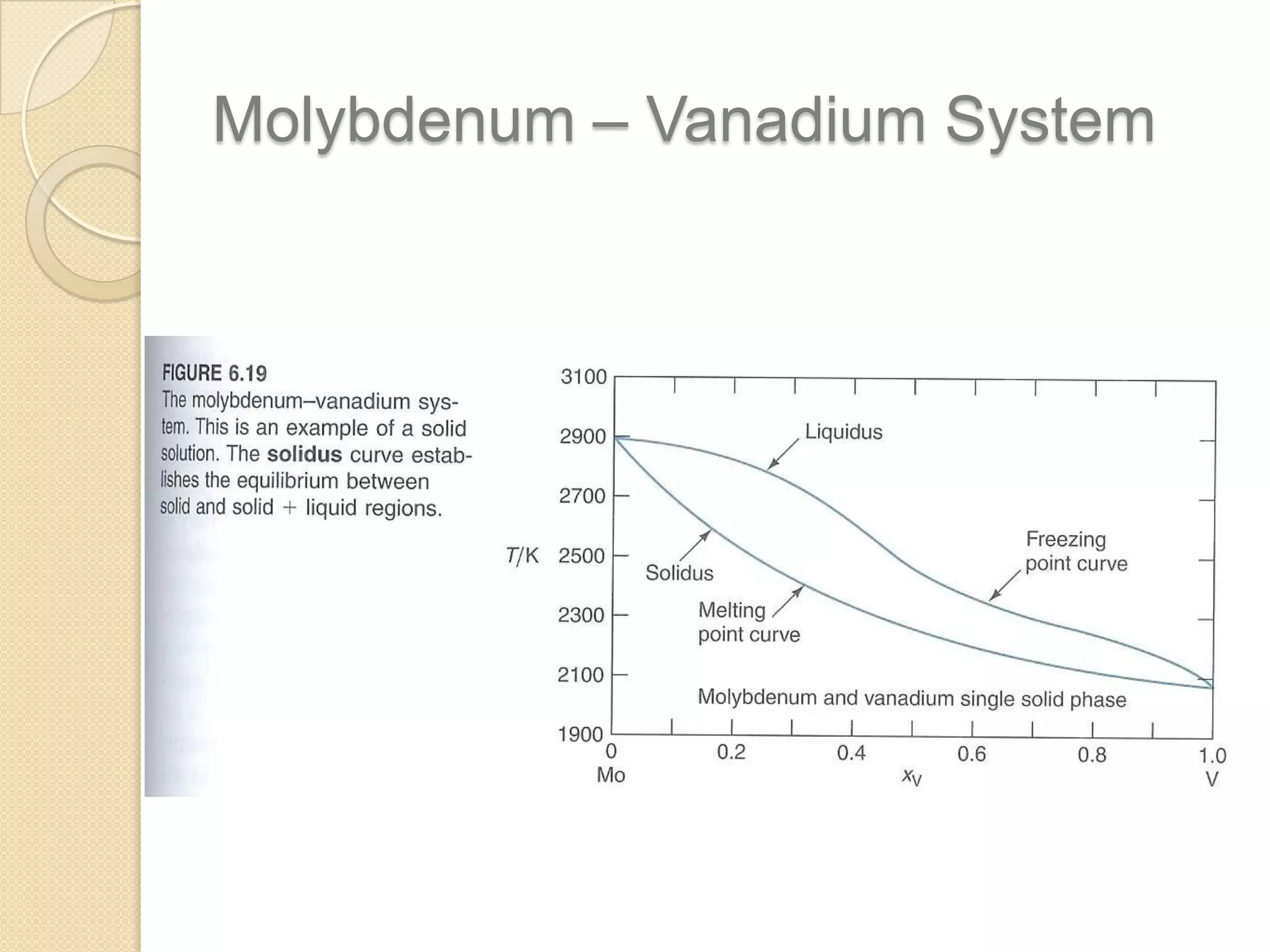
Molybdenum – Vanadium System
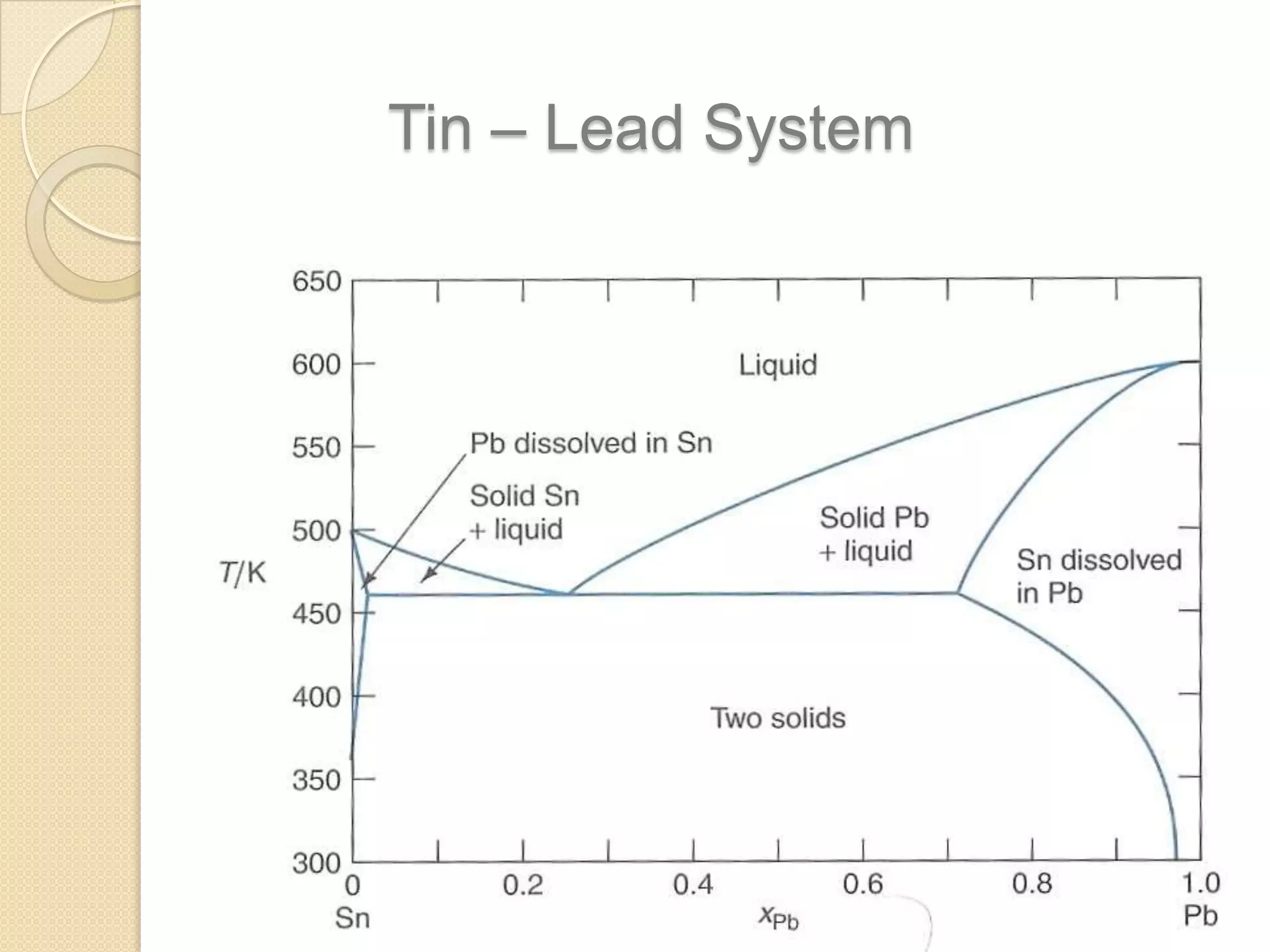
Tin – Lead System
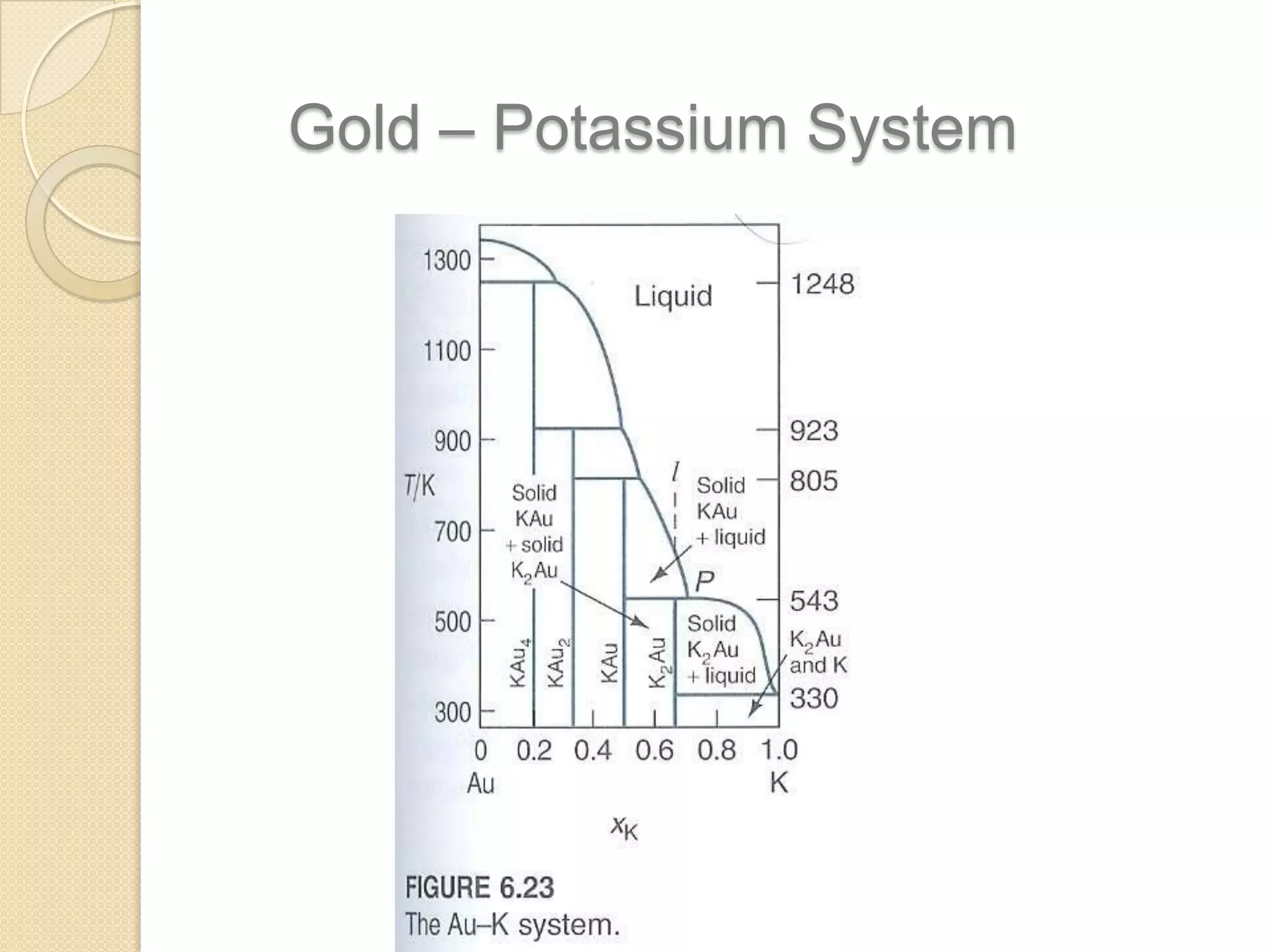
Gold – Potassium System
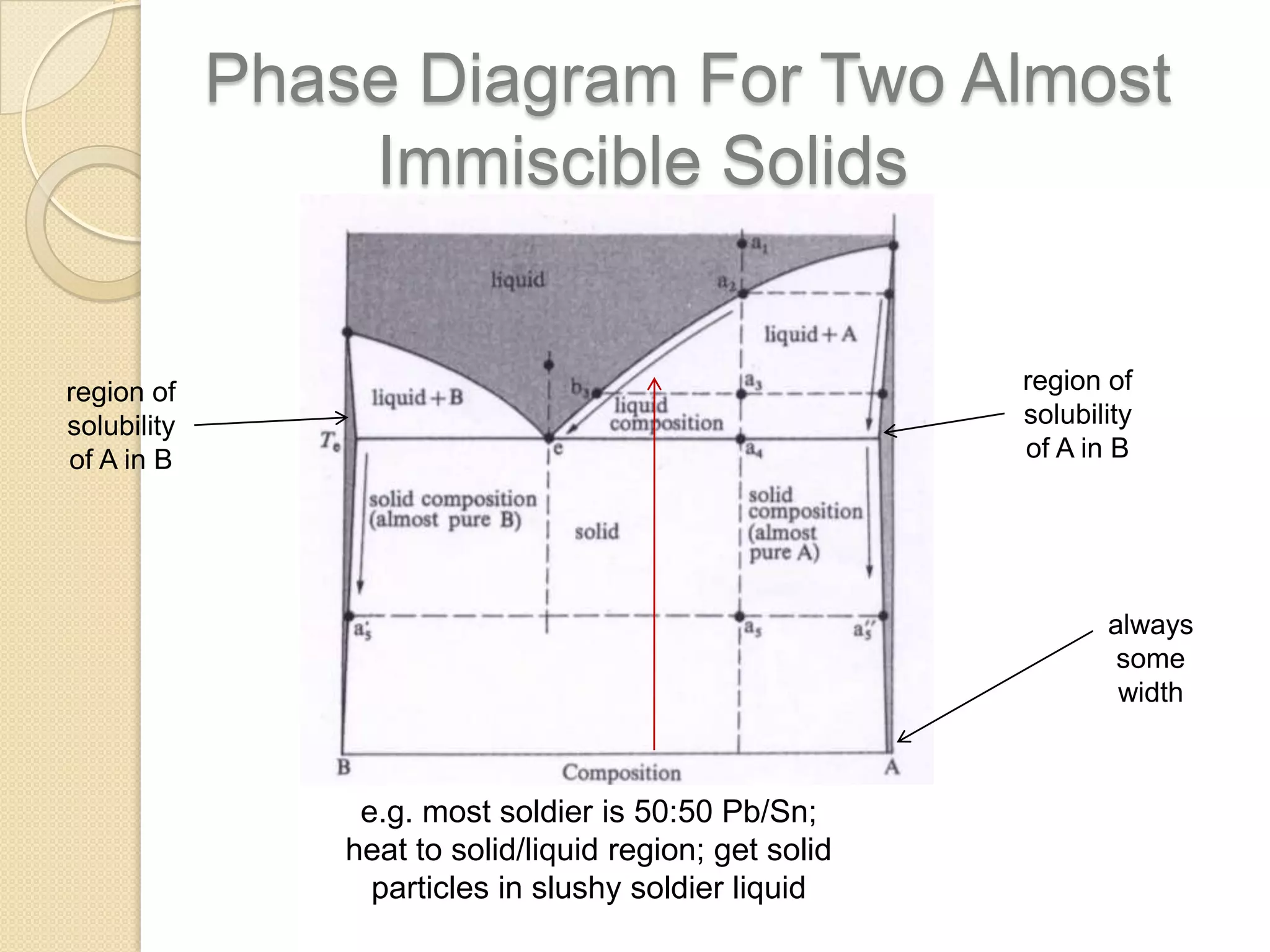
Phase Diagram For Two Almost
Immiscible Solids
region of
solubility
of A in B

region of
solubility
of A in B

always
some
width

e.g. most soldier is 50:50 Pb/Sn;
heat to solid/liquid region; get solid
particles in slushy soldier liquid
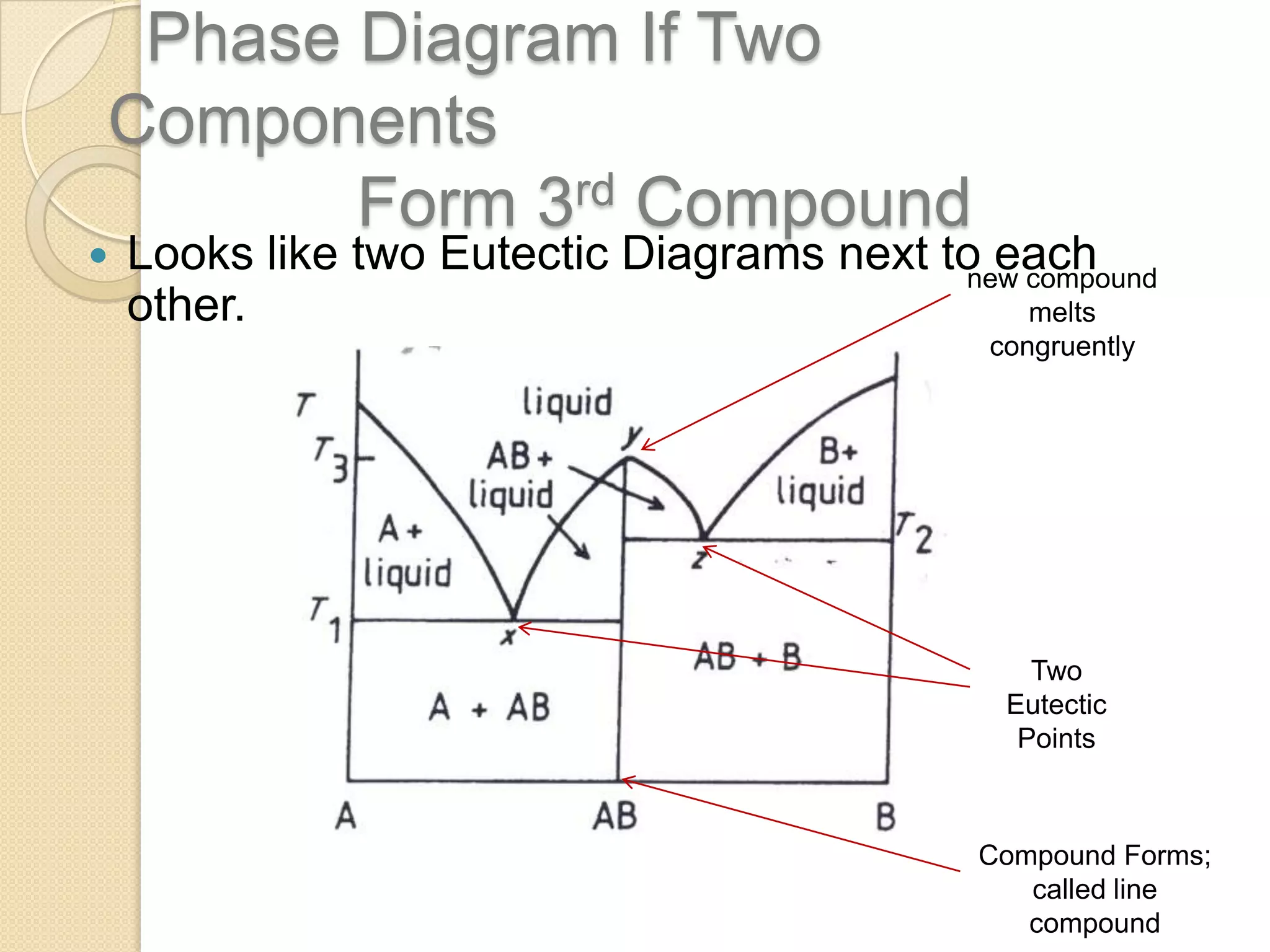
Phase Diagram If Two
Components
Form 3rd Compound



Looks like two Eutectic Diagrams next to each
new compound
other.
melts
congruently

Two
Eutectic
Points

Compound Forms;
called line
compound
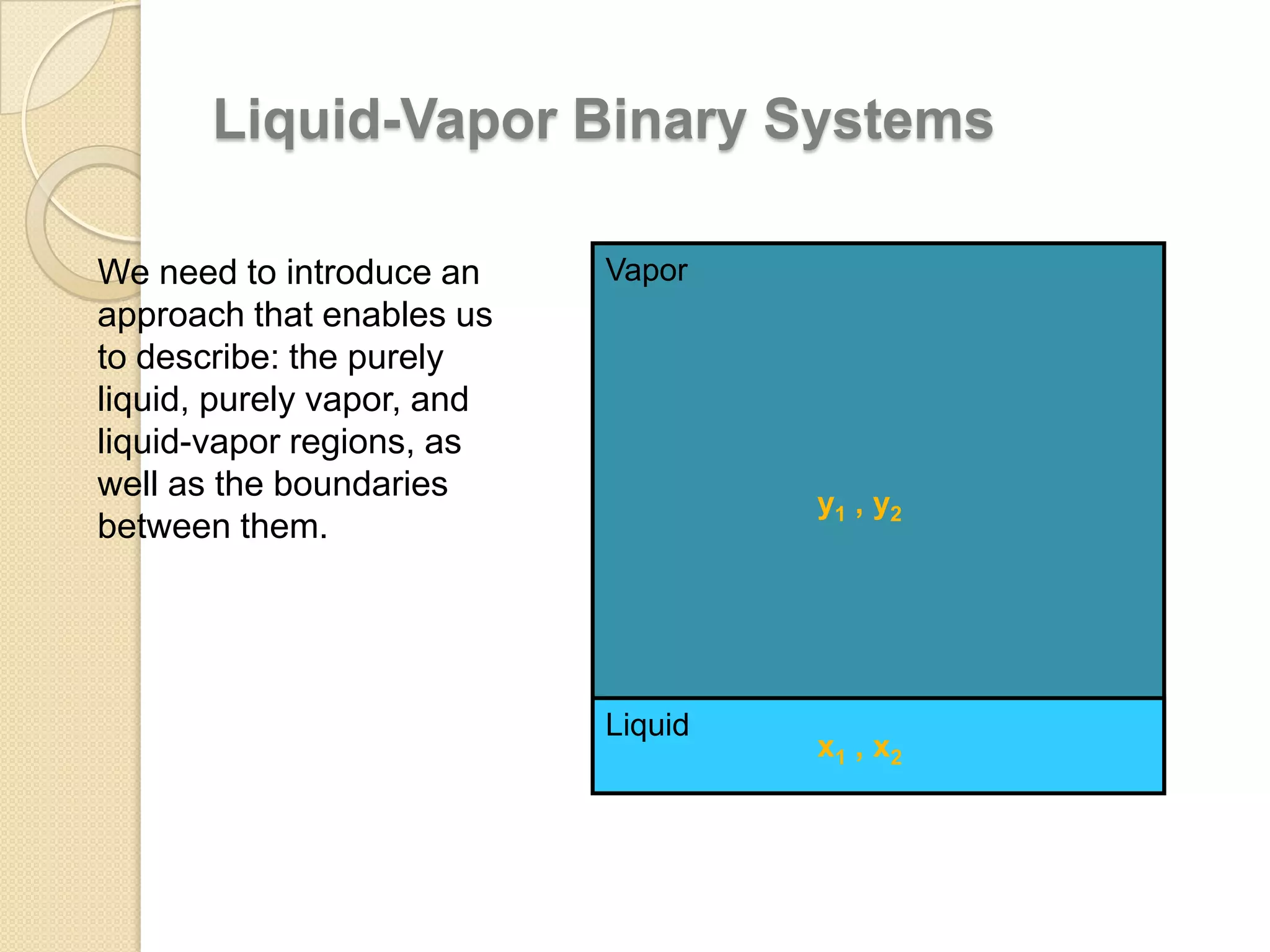
Liquid-Vapor Binary Systems
We need to introduce an
approach that enables us
to describe: the purely
liquid, purely vapor, and
liquid-vapor regions, as
well as the boundaries
between them.

Vapor

y1 , y2

Liquid

x1 , x2
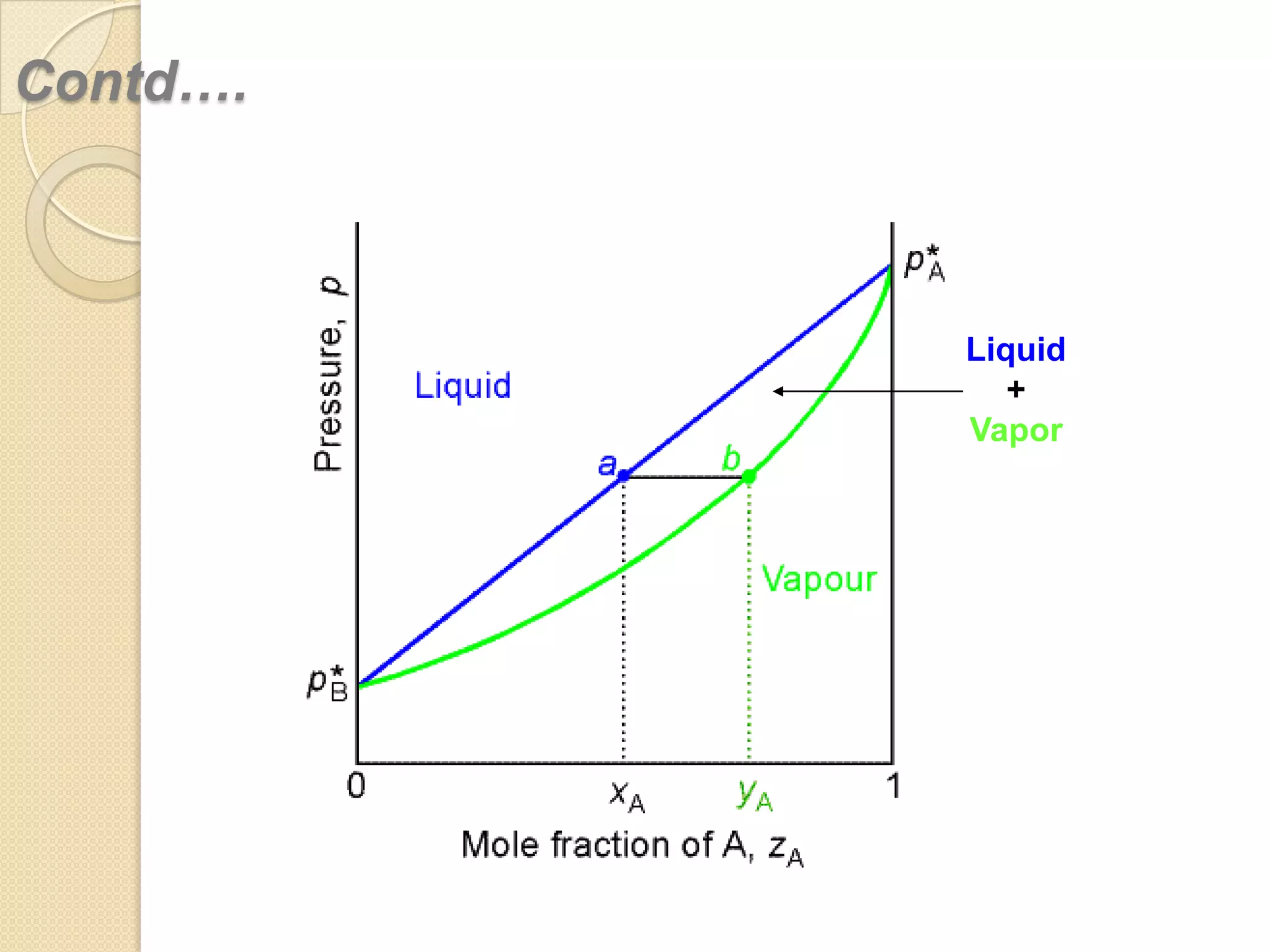
Contd….

Liquid
+
Vapor
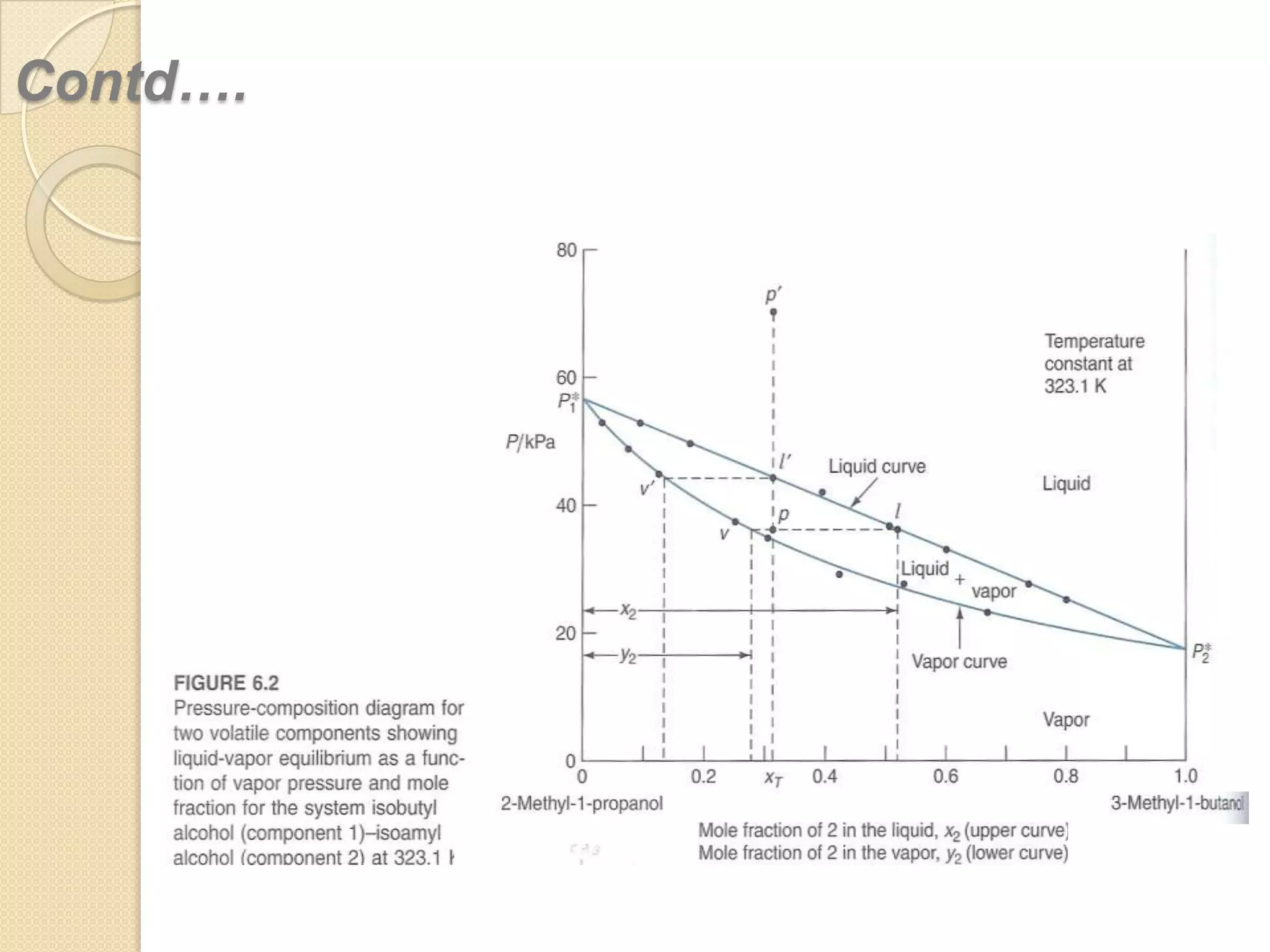
Contd….
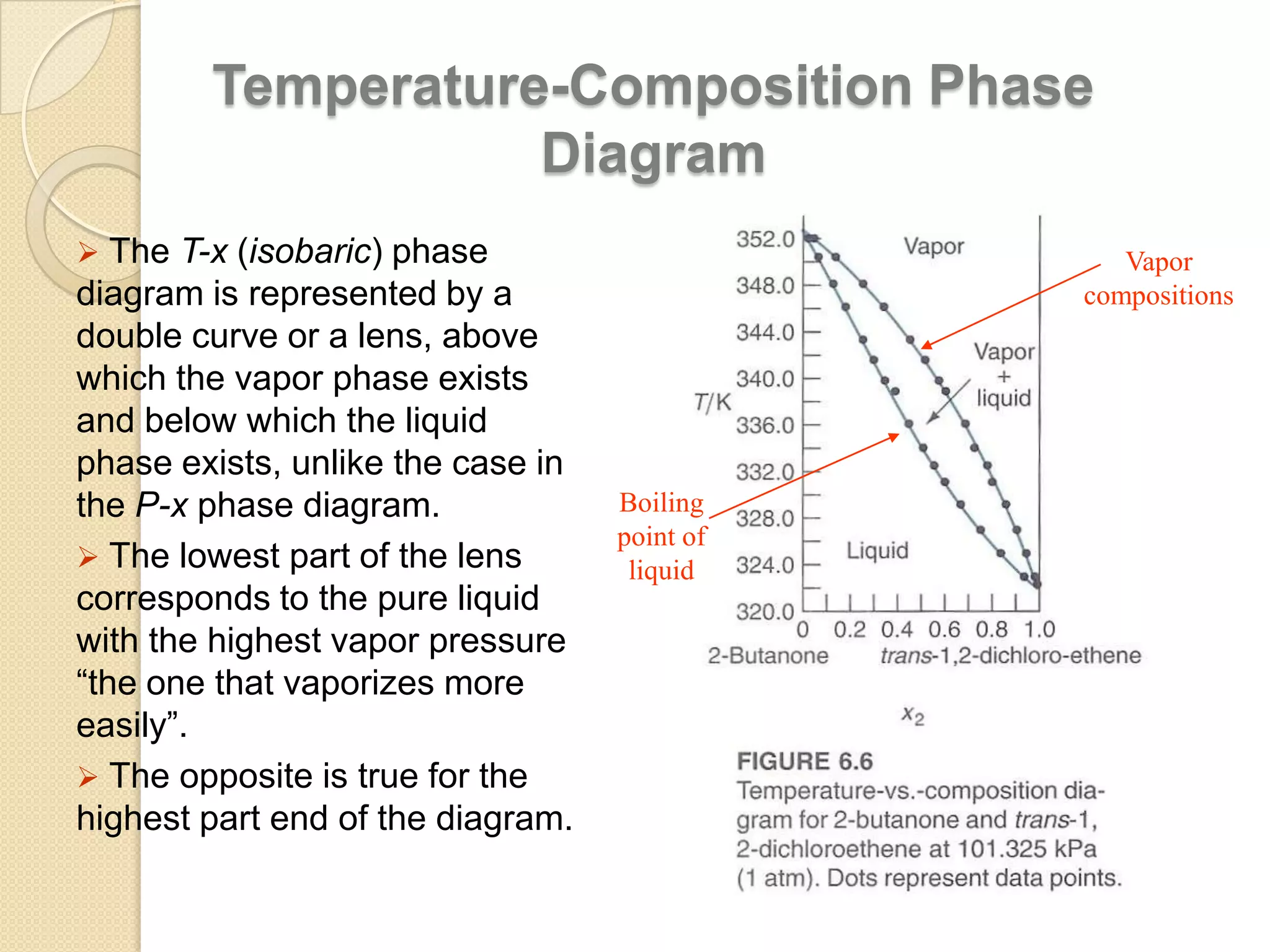
Temperature-Composition Phase
Diagram
 The T-x (isobaric) phase

diagram is represented by a
double curve or a lens, above
which the vapor phase exists
and below which the liquid
phase exists, unlike the case in
the P-x phase diagram.
 The lowest part of the lens
corresponds to the pure liquid
with the highest vapor pressure
“the one that vaporizes more
easily”.
 The opposite is true for the
highest part end of the diagram.

Vapor
compositions

Boiling
point of
liquid
Contd….
Bibliography

• www.google.co.in
• www.wikipedia.org
• www.sciencemania.com
Thanks……

The phase rule

  • 1.
    Submitted to: Dr. SARLAKUMARI Submitted by: Jatin garg (11107027) MECHANICAL
  • 2.
    The Phase Rule •It was first presented by Gibbs in 1875. • It is very useful to understand the effect of intensive variables, such as temperature, pressure, or concentration, on the equilibrium between phases as well as between chemical constituents. • It is used to deduce the number of degrees of freedom (f) for a system. Sometimes called: “the variance of the system”.
  • 3.
    It states that: When the equillibrium between any number of phases is influenced only by temperature, pressure and concentration but not influenced by gravity, or elctrical or magnetic forces or by surface action then the number of Degrees of Freedom (F) of the system is related to the number of Components (C) and of Phases (P) by the phase rule equation: F+P=C+2
  • 4.
    Phase rule atconstant pressure Condensed systems have no gas phase. When their properties are insensitive to the (small) changes in pressure which occur, one fewer variable needs to be specified, which results in the phase rule at constant pressure F=C−P+1, This is sometimes misleadingly called the "condensed phase rule", but it is not applicable to condensed systems which are subject to high pressures (for example in geology), since the effects of these pressures can be important. The rule is useful for some applications in materials science.
  • 5.
    Terminology used….. Phase: A phaseis defined as any homogeneous and physically distinct part of a system having all physical and chemical properties the same throughout the system. A system may consist of one phase or more than one phase. E.g.  A system containing only liquid water is one-phase system  A system containing liquid water and water vapour (gas) is a two phase system  A system containing liquid water, water vapour and solid ice is a three phase system.  Pure substances (solid, liquid, or gas) made of one chemical species only, is considered as one phase,
  • 6.
    Contd…. Component: The term componentis defined as the least number of independent chemical constituents in terms of which the composition of every phase can be expressed by means of a chemical equation. E.g.  Water system has three phases, ice, water and water vapour and the composition of all these phases is expressed in terms of one chemical individual water. Thus water system has one component only.  Similarly Sulphur system has four phases: rhombic sulphur, monoclinic sulphur liquid sulphur and sulphur vapour and the composition of all these phases is expressed by one chemical individual sulphur. Therefore Sulphur system is one component system. Thus, all the phases in one component system is expressed by only one chemical individual.
  • 7.
    Contd…..  A saturated solutionof NaCl in contact with excess solid NaCl has two phases. The composition of both the phases can be expressed in terms of two chemical individual NaCl and water. Hence a saturated solution of NaCl in water in contact with excess solid NaCl is a two component system. DECOMPOSITION OF CALCIUM CARBONATE CaCO3(s)= CaO(s) + CO2(g) It has three phases but the composition of the system can be expressed in terms of two of the three chemical substances in equilibrium. Hence it is a two component system
  • 8.
    Dissociation of NH4Cl NH4Cl(s)= NH3 (g) + HCl (g)  Ammonium chloride when heated in a closed vessel dissociates into ammonia and HCl gas. The system consists of two phases solid NH4Cl and gaseous mixture containing NH3 and HCl However the constituents of the mixture are in the same proportion in which they are combined in solid NH4Cl. The composition of the both the phases therefore be expressed in terms of the same chemical individual NH4Cl. Thus the dissociation of NH4Cl is one component system.
  • 9.
    DEGREES OF FREEDOM(F) Itis defined as the least number of variable factors of a system which must be specified so that the remaining variables are fixed automatically and the system is completely defined. E.g. MONOVARIANT or UNIVARIANT SYSTEM For Water = Water Vapour system, F=1, The system has two variables, P and T. At definite T, the vapour pressure of water can have only one fixed value. Thus if one variable is specified , the other is fixed automatically. Hence this system has one degree of freedom, it is MONOVARIANT or UNIVARIANT. BIVARIANT SYSTEM For a pure gas, PV=RT, if P and T values are specified there can have be only one definite value of V or that the volume is fixed automatically. Thus it has two degrees of freedom, the system is BIVARIANT.
  • 10.
    TRIVARIANT SYSTEM A mixtureof two or more gases is completely defined only when P, T and Composition are specified. If P and T be specified the third variable i.e. composition may be varied. Since it is necessary to specify three variables to define the system completely, it has three degrees. Thus it is TRIVARIANT. NONVARIANT SYSTEM For ice, water, water vapour system, F=0, In this system, the three phases coexist at the freezing point of water. Since the freezing temperature of water has a definite value, the vapour pressure of water has also a fixed value. Since both the variables are already fixed, the system is defined automatically and there being no need to specify any variable. Hence this system has no degree of freedom.
  • 11.
    Advantages of PhaseRule • Phase rule is applicable to both Chemical and Physical equilibria. • Phase rule is applicable to macroscopic systems and hence no information is required regarding molecular or micro structure. • We can conveniently classify equilibrium states in terms of phases, components and degrees of freedom. • The behaviour of system can be predicted under diff. conditions. • According to phase rule, diff. systems behave similarly if they have same degrees of freedom. • Phase rule helps in deciding under a giving set of conditions: 1) Existence of equilibrium among various substances. 2) Interconvergence of substance or 3) Disappearance of some of the substances.
  • 12.
    Limitations of PhaseRule • Phase rule is applicable only for those systems which are in equilibrium. It is not much use for those systems which attain the equilibrium state very slowly. • Only three degrees of freedom viz, temperature, pressure and components are allowed to influence the equilibrium systems. • Under the same conditions of temperature and pressure, all the phases of the system must be present. • It considers only the number of phases, rather than their amounts.
  • 13.
    Applying the phaserule to: •One-component systems. • Binary systems. • Liquid-vapor equilibrium. • Temperature-composition diagrams.
  • 14.
    Phase Rule inOne-Component Systems  Notice that in one-component systems, the number of degrees of freedom seems to be related to the number of phases.
  • 15.
    The Water System Howmany components do you have? We have only one component which is H2O. In the one-phase regions, one can vary either the temperature, or the pressure, or both (within limits) without crossing a phase line. We say that in these regions: f=c–p+2 =1–1+2 = 2 degrees of freedom.
  • 16.
    Phase Diagram ofWater Along a phase line we have two phases in equilibrium with each other, so on a phase line the number of phases is 2. If we want to stay on a phase line, we can't change the temperature and pressure independently. We say that along a phase line: f=c–p+2 =1–2+2 = 1 degree of freedom.
  • 17.
    Contd….. At the triplepoint there are three phases in equilibrium, but there is only one point on the diagram where we can have three phases in equilibrium with each other. We say that at the triple point: f=c–p+2 =1–3+2 = 0 degrees of freedom.
  • 18.
    The Sulphur System Sulphur solid exists in two crystalline forms.  Orthorhombic. S8 or S(rh)  Monoclinic. S4 or S(mo) Yellow sulphur of the orthorhombic (or rhombic) crystalline form. It is the form that commonly exists under normal conditions.
  • 19.
  • 20.
    A More ComprehensivePhase Diagram of Sulphur
  • 21.
    The Carbon DioxideSystem  The phase rule should be applicable for any single- component systems in general.
  • 22.
  • 23.
    Binary Phase Diagram         Phasediagram for two similar Tm(B) components; aka “Solid Solution”. Assume Pressure = 1 atm, so 2D rather than 3D plot. Two components, so F + P = 2 + 2 = 4 Composition = mole fraction; 100% B to 100% A. Tm(B) = melting point of pure B. Tm(A) = melting point of pure A. Liquidous = boundary between liquid and mixed phase; gives liquid composition. Solidous = boundary between solid and mixed phase; gives solid composition. Tm(A)
  • 24.
    Contd….      Heat mixture ofA & B (at mole fraction indicated) to temperature 1. Then cool. At temperature 1, liquid phase has composition = mole fraction. At temperature 2, solid begins to ppt out; solid is mostly B mixed crystal (composition b1). At temperature 3, solid has composition b2 and liquid has composition a’2; note different mole fractions! ◦ at a given temperature, the liquid and solid that are in equilibrium with each other have different compositions. At temperature 4, solid formed has 1 2 3 4
  • 25.
    Contd….  Note that oncooling, the solid will change composition from almost pure B to more and more A composition.  Coring: freeze in tube from outside; core will have different composition.  Heat & Beat: heat above liquidous, cool below solidous (but not too far), then beat (to make deformities), then reheat almost to solidous (increase diffusion), beat and repeat. Like? Blacksmith. B mole fraction A
  • 26.
    Contd…. Example of asystem involving the formation of mixed crystals with temperature minimum: special point for which the compositions of the solid and liquid are the same.  It is possible to have the special point at a temperature maximum.  liquid (1-phase) liquid composition special point solid composition solid (1phase)
  • 27.
    Binary-System Phase Diagramwith Three Variables: P, T and x  The solid part of the surface represents the “liquid + vapor” region.  Above it we have the liquid phase and below it we have the vapor phase.  On the T-P planes we have pure liquid curves where the boiling point curves can be seen.
  • 28.
    Contd….  On theP-x plane we have the normal pressure-composition phase diagram. It can be viewed at different temperatures.  On the T-x plane we have the temperaturecomposition phase diagram, which is more commonly used in experimental work since it is more convenient to fix P rather than T.
  • 29.
    Eutectic Phase Diagram  Whatif two substances are NOT similar at all? They won’t want to mix in the solid state, but will in the liquid; e.g. NaF & Eutectic Point (cusp) PbF2. -eutectic mixture has Tm(NaF) liquid NaF(s) + liquid lower mp than either of Tm(PbF2) the pure components or any other mixture. liquidous curve -highest temp. at PbF2(s) + liquid which crystals can exist. NaF(s) + PbF2(s) don’t mix NaF mole fraction solidous curve = Eutectic Temperature -lowest temp. at which PbF2 liquids can exist.
  • 30.
    Contd….  Heat above liquidousand cool; first solid is pure NaF; below Eutectic Temperature both solids appear. Tm(NaF) liquid solid is pure NaF Tm(PbF2) liquid has increasing PbF2 fraction solid PbF2 begins to ppt NaF(s) + liquid PbF2(s) + liquid NaF(s) + PbF2(s) don’t mix NaF mole fraction PbF2 • • • • • • • • pure NaF • particles of NaF & PbF2
  • 31.
    Zinc-Lead System  TheZn-Pb system has important metallurgical applications.
  • 32.
  • 33.
  • 34.
  • 35.
  • 36.
  • 39.
  • 40.
    Phase Diagram ForTwo Almost Immiscible Solids region of solubility of A in B region of solubility of A in B always some width e.g. most soldier is 50:50 Pb/Sn; heat to solid/liquid region; get solid particles in slushy soldier liquid
  • 41.
    Phase Diagram IfTwo Components Form 3rd Compound  Looks like two Eutectic Diagrams next to each new compound other. melts congruently Two Eutectic Points Compound Forms; called line compound
  • 42.
    Liquid-Vapor Binary Systems Weneed to introduce an approach that enables us to describe: the purely liquid, purely vapor, and liquid-vapor regions, as well as the boundaries between them. Vapor y1 , y2 Liquid x1 , x2
  • 43.
  • 44.
  • 45.
    Temperature-Composition Phase Diagram  TheT-x (isobaric) phase diagram is represented by a double curve or a lens, above which the vapor phase exists and below which the liquid phase exists, unlike the case in the P-x phase diagram.  The lowest part of the lens corresponds to the pure liquid with the highest vapor pressure “the one that vaporizes more easily”.  The opposite is true for the highest part end of the diagram. Vapor compositions Boiling point of liquid
  • 46.
  • 47.
  • 48.