

The Waite Research Institute

 FOODplus Research Centre

                                           Scientific Seminar Series – 2010


                                                       #3a


                                                               Dr Tanya Little


Life Impact | The University of Adelaide
Dr Tanya Little
University of Adelaide Discipline of Medicine
NHMRC Centre of Clinical Research Excellence (CCRE) in
Nutritional Physiology, Interventions and Outcomes
   Gastrointestinal (GI) sensing of dietary fat
     Which factors determine the GI responses to
      dietary fat?

   Oral detection of dietary fat
     Relationships between:
      ▪ dietary fat intake and body weight
      ▪ oral and GI sensitivity
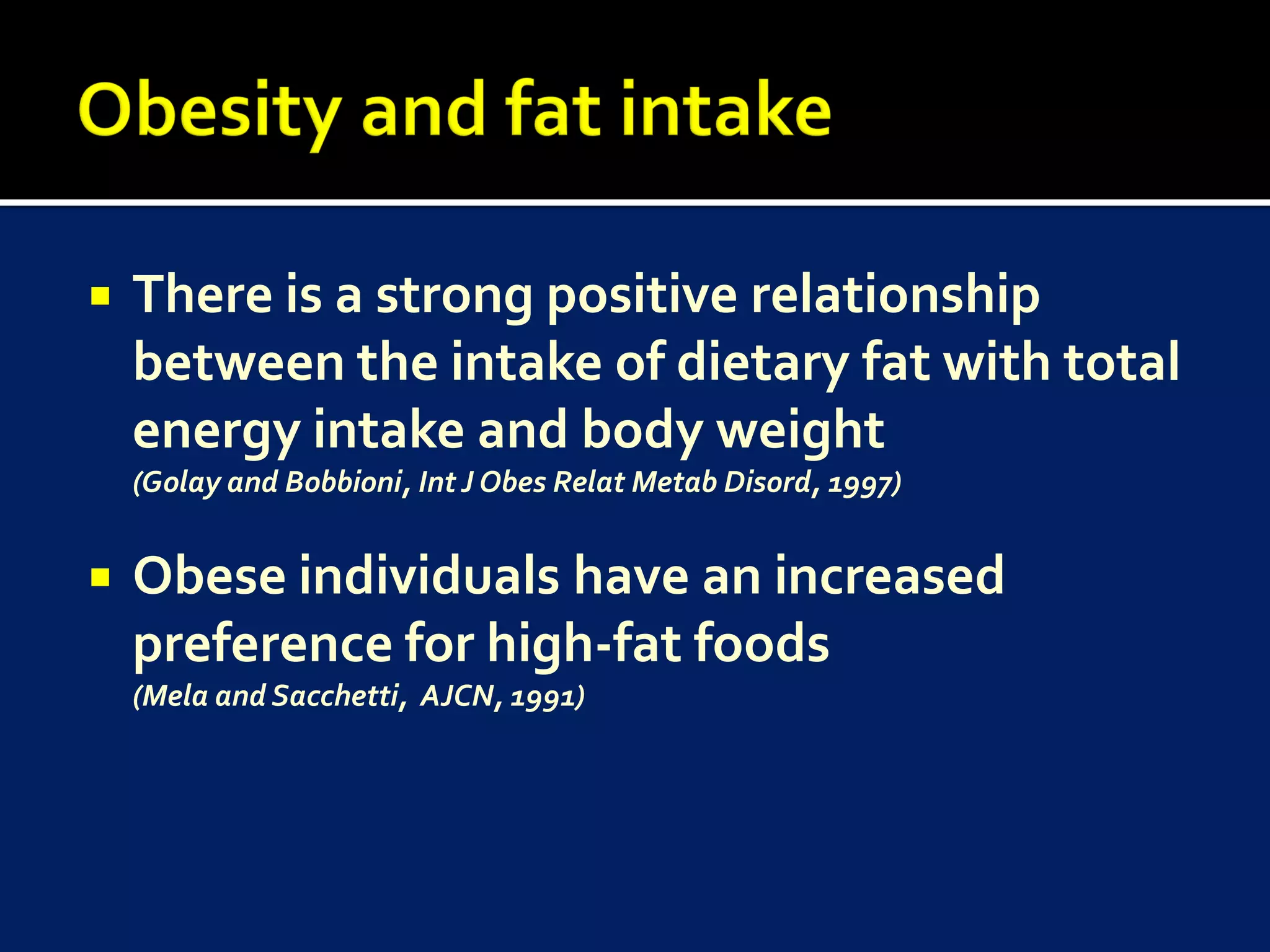
   There is a strong positive relationship
    between the intake of dietary fat with total
    energy intake and body weight
    (Golay and Bobbioni, Int J Obes Relat Metab Disord, 1997)


   Obese individuals have an increased
    preference for high-fat foods
    (Mela and Sacchetti, AJCN, 1991)
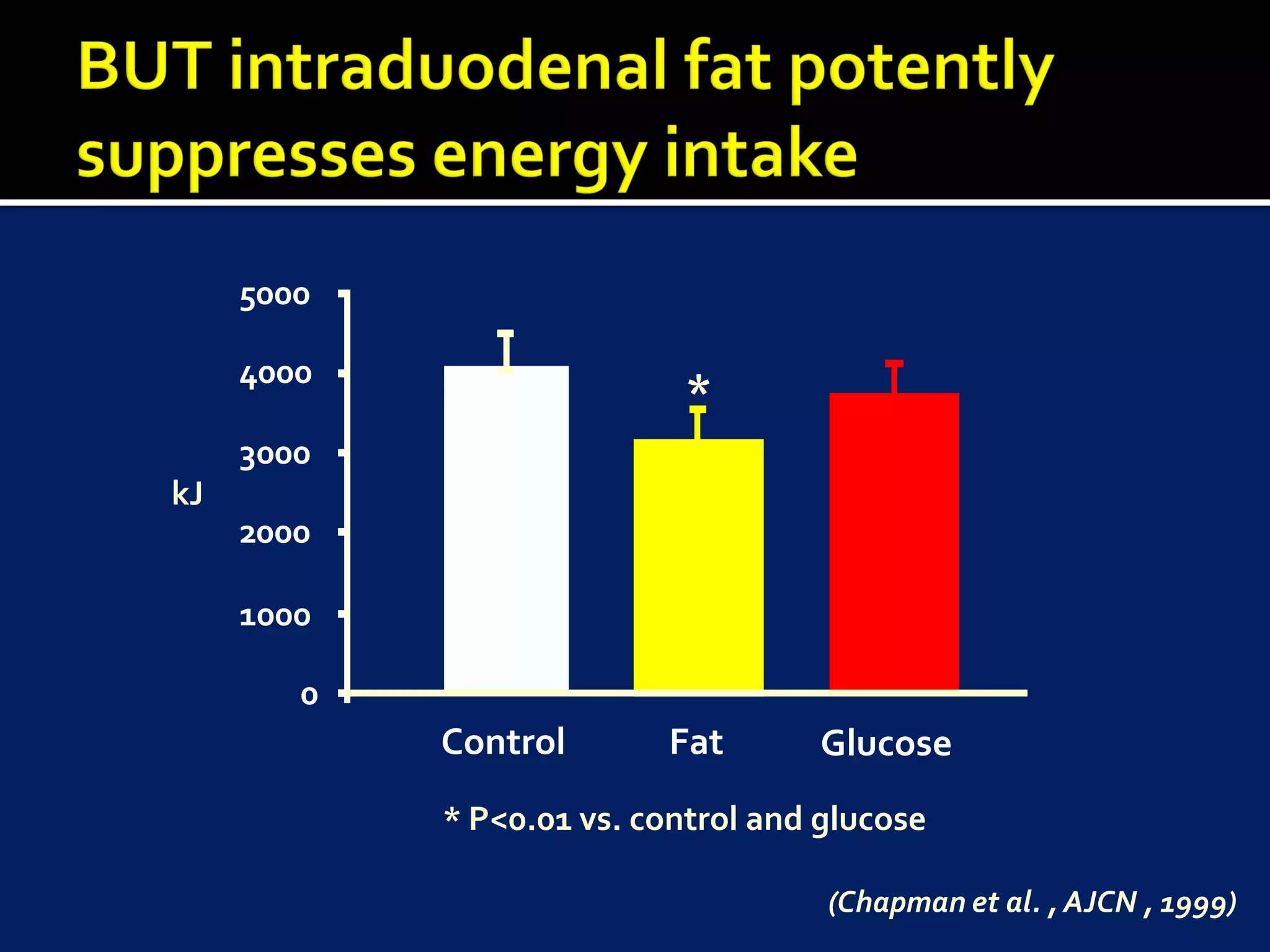
5000

4000
                      *
                      *
3000

2000

1000

   0
       Control       Fat       Glucose
       * P<0.01 vs. control and glucose

                                (Chapman et al. , AJCN , 1999)
   We examine downstream effects of fat
    sensing identified in cell line and animal
    studies. For example, changes in:
     GI motility
     plasma concentrations of GI peptides
     food intake
   Expression of fat sensing receptors in small
    intestinal biopsies
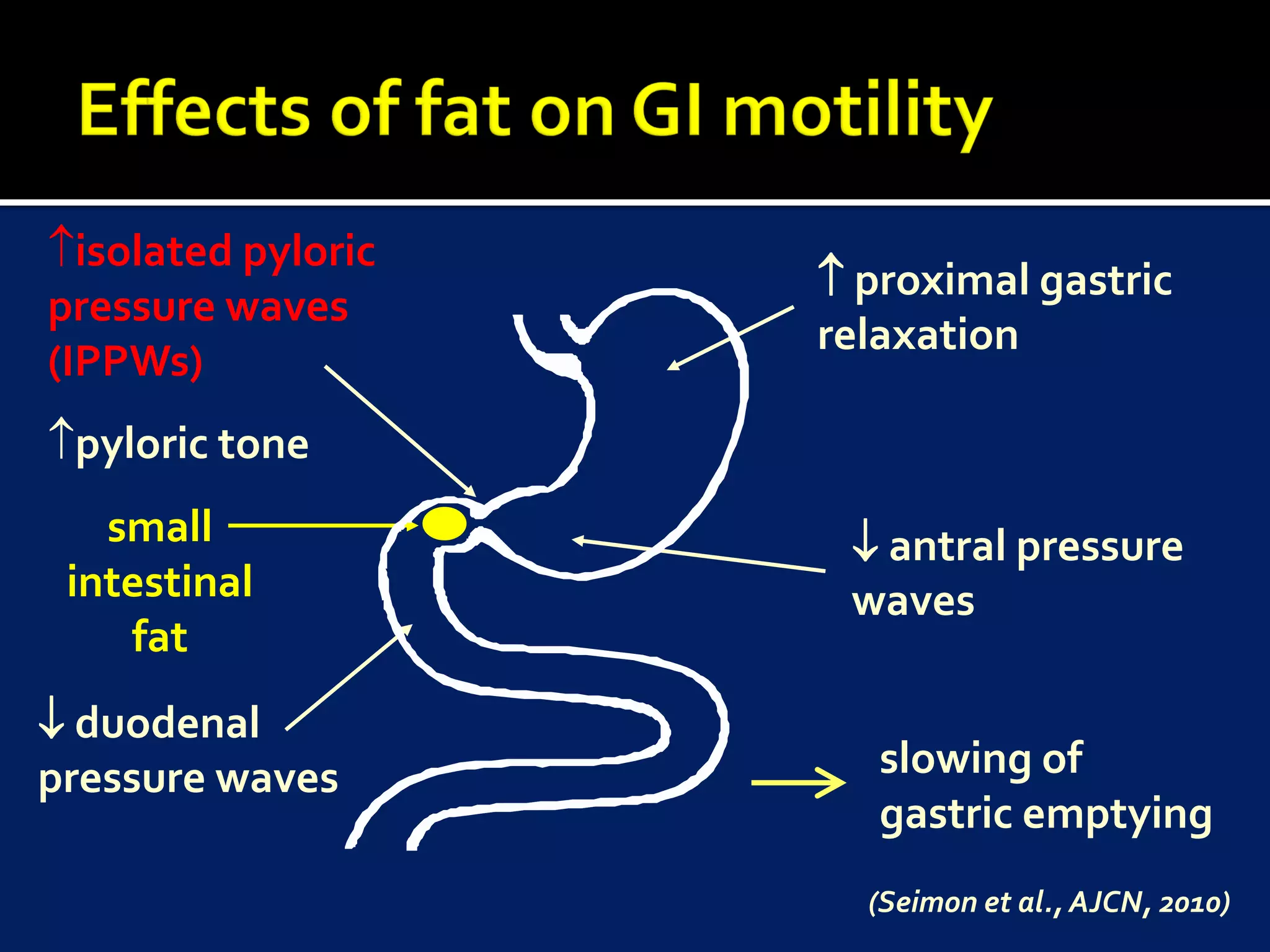
isolated pyloric
                     proximal gastric
pressure waves
                    relaxation
(IPPWs)
pyloric tone
   small              antral pressure
 intestinal          waves
    fat
 duodenal
pressure waves         slowing of
                       gastric emptying
                      (Seimon et al., AJCN, 2010)
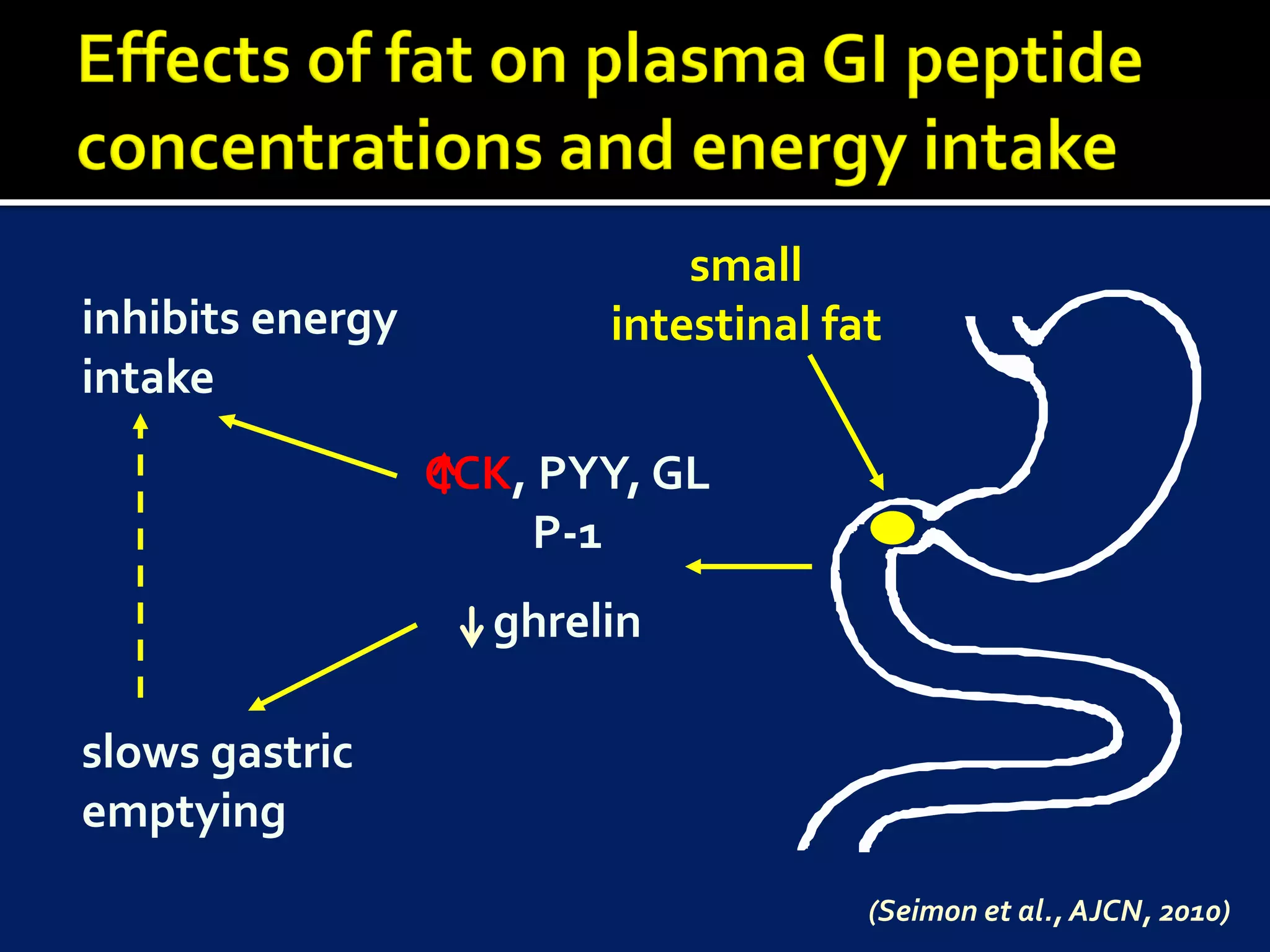
small
inhibits energy          intestinal fat
intake
                  CCK, PYY, GL
                      P-1
                    ghrelin

slows gastric
emptying
                                      (Seimon et al., AJCN, 2010)
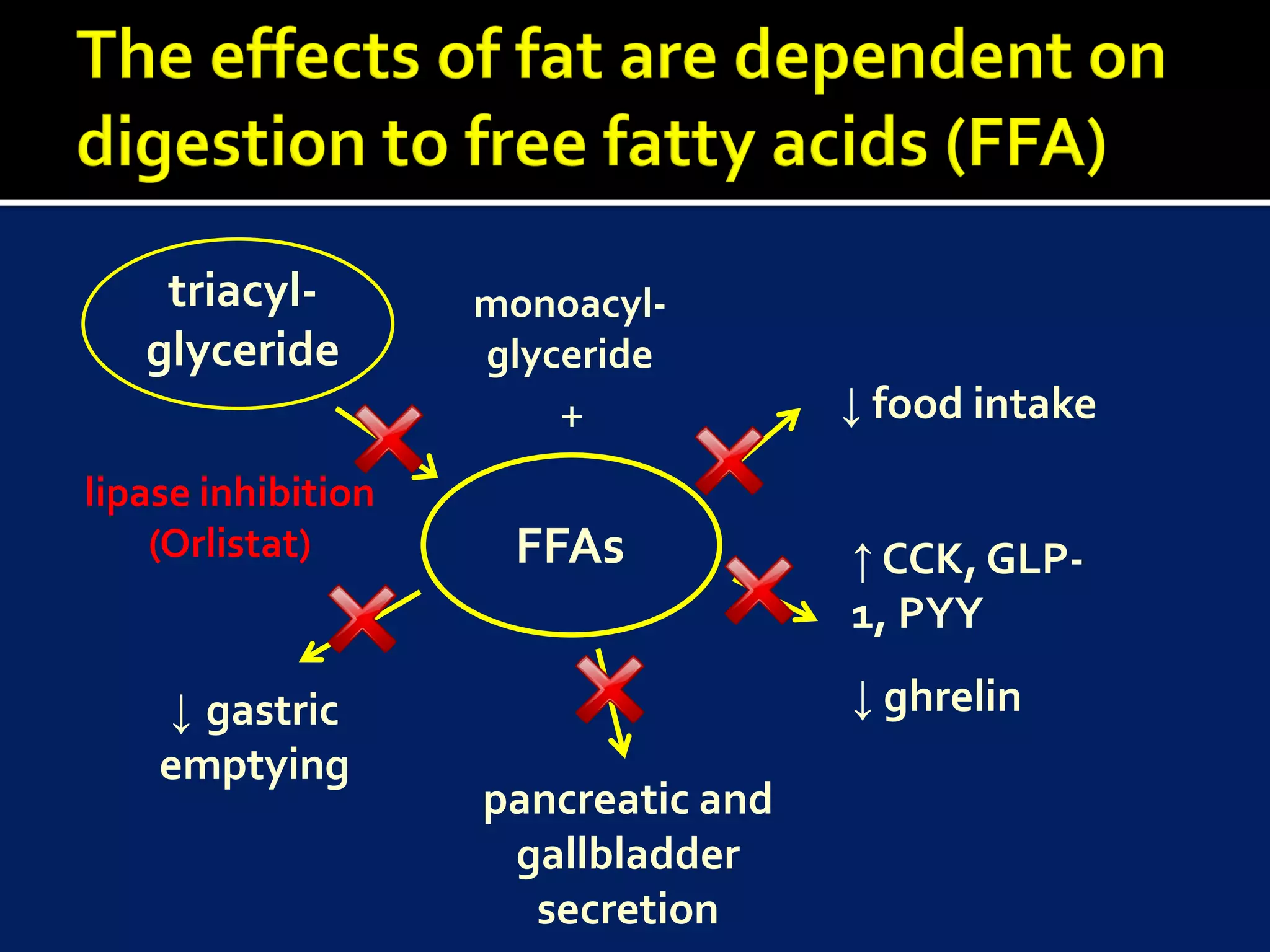
triacyl-        monoacyl-
   glyceride        glyceride
                                      ↓ Food intake
                                      ↓ food intake
                       +
lipase inhibition
    (Orlistat)       FFAs             ↑ CCK, GLP-1,
                                       ↑ CCK, GLP-
                                      PYY
                                       1, PYY

    ↓ gastric                         ↓ ghrelin
                                       ↓ ghrelin
    emptying         Pancreatic and
                    pancreatic and
                       gallbladder
                     gallbladder
                        secretion
                      secretion
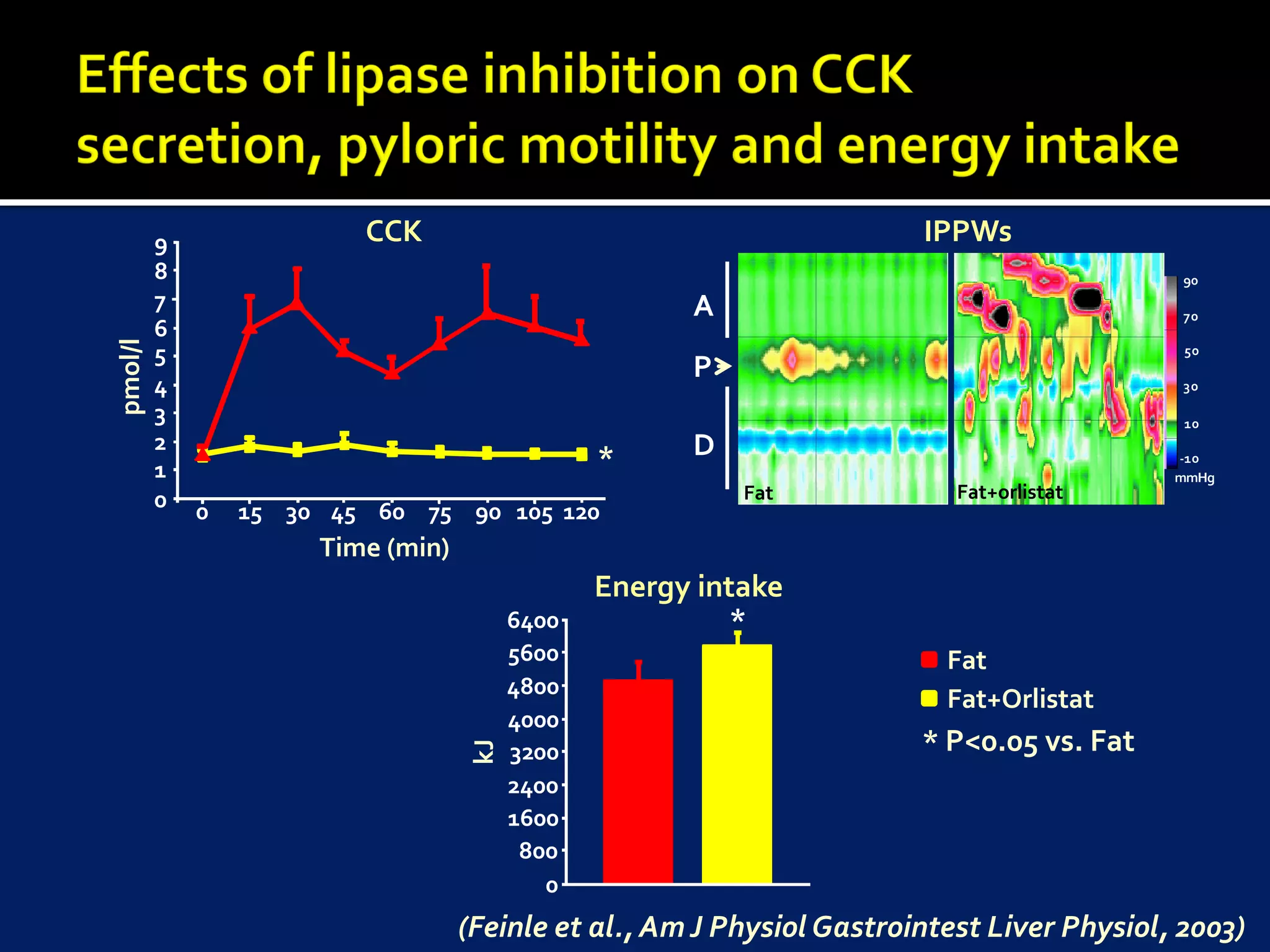
9               CCK                                           IPPWs
         8                                                                                  90
         7                                           A                                      70
         6
pmol/l


         5                                                                                  50
                                                     P
         4                                                                                  30

         3                                                                                  10
         2                                           D
         1                                     *                                           -10
                                                                                           mmHg
         0                                               Fat              Fat+orlistat
             0   15 30 45 60 75 90 105 120
                      Time (min)
                                               Energy intake
                                        6400             *
                                        5600                             Fat
                                        4800
                                                                         Fat+Orlistat
                                   (kJ) 4000                           * P<0.05 vs. Fat
                                    kJ


                                        3200
                                        2400
                                        1600
                                         800
                                           0
                                   (Feinle et al., Am J Physiol Gastrointest Liver Physiol, 2003)
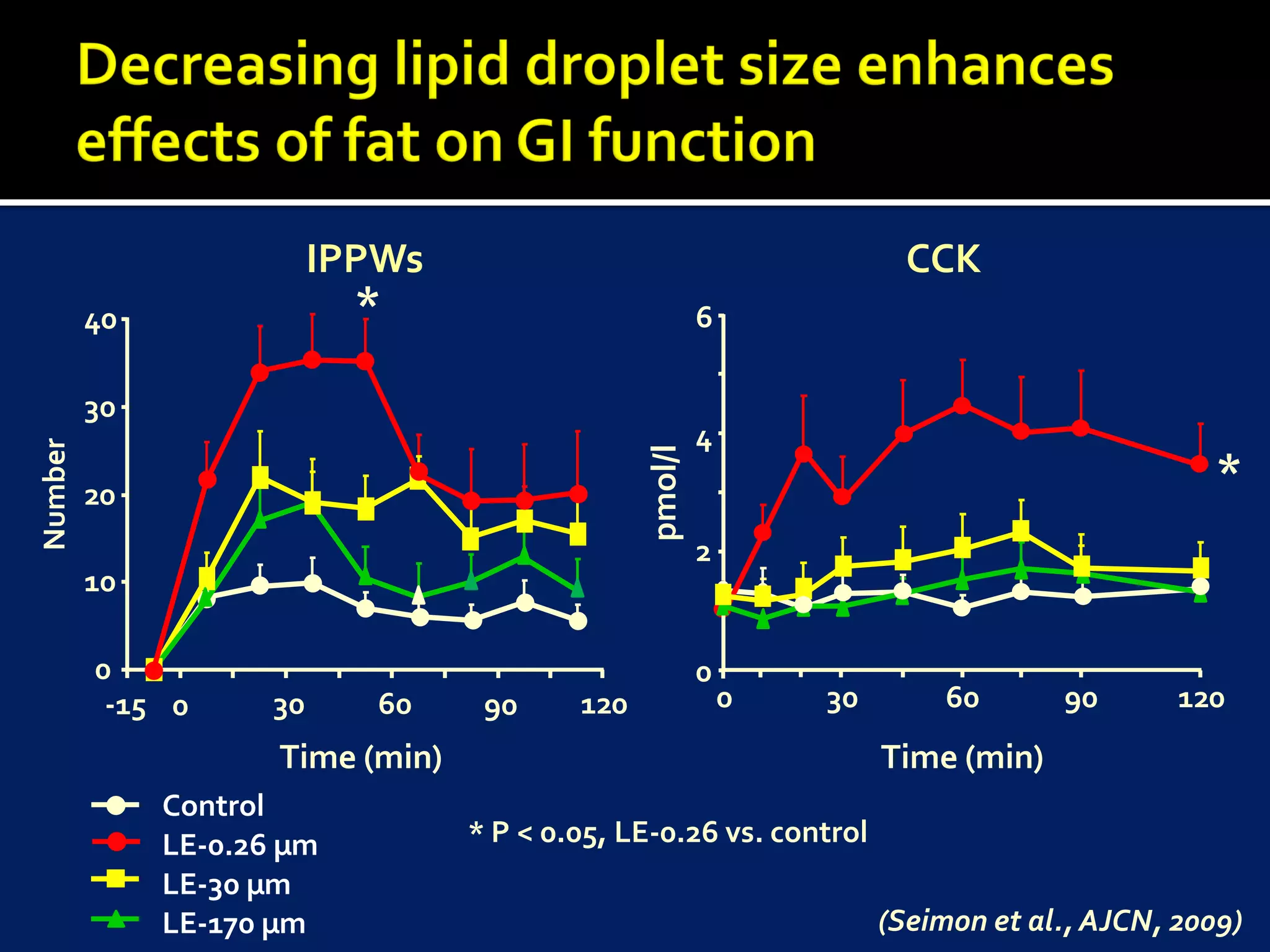
IPPWs                                         CCK
         40                 *                            6

         30
                                                         4
Number


                                                pmol/l
         20
                                                                                               *
                                                         2
         10

         0                                               0
          -15 0      30      60    90     120                0   30        60      90       120
                     Time (min)                                       Time (min)
              Control
              LE-0.26 µm          * P < 0.05, LE-0.26 vs. control
              LE-30 µm
              LE-170 µm                                               (Seimon et al., AJCN, 2009)
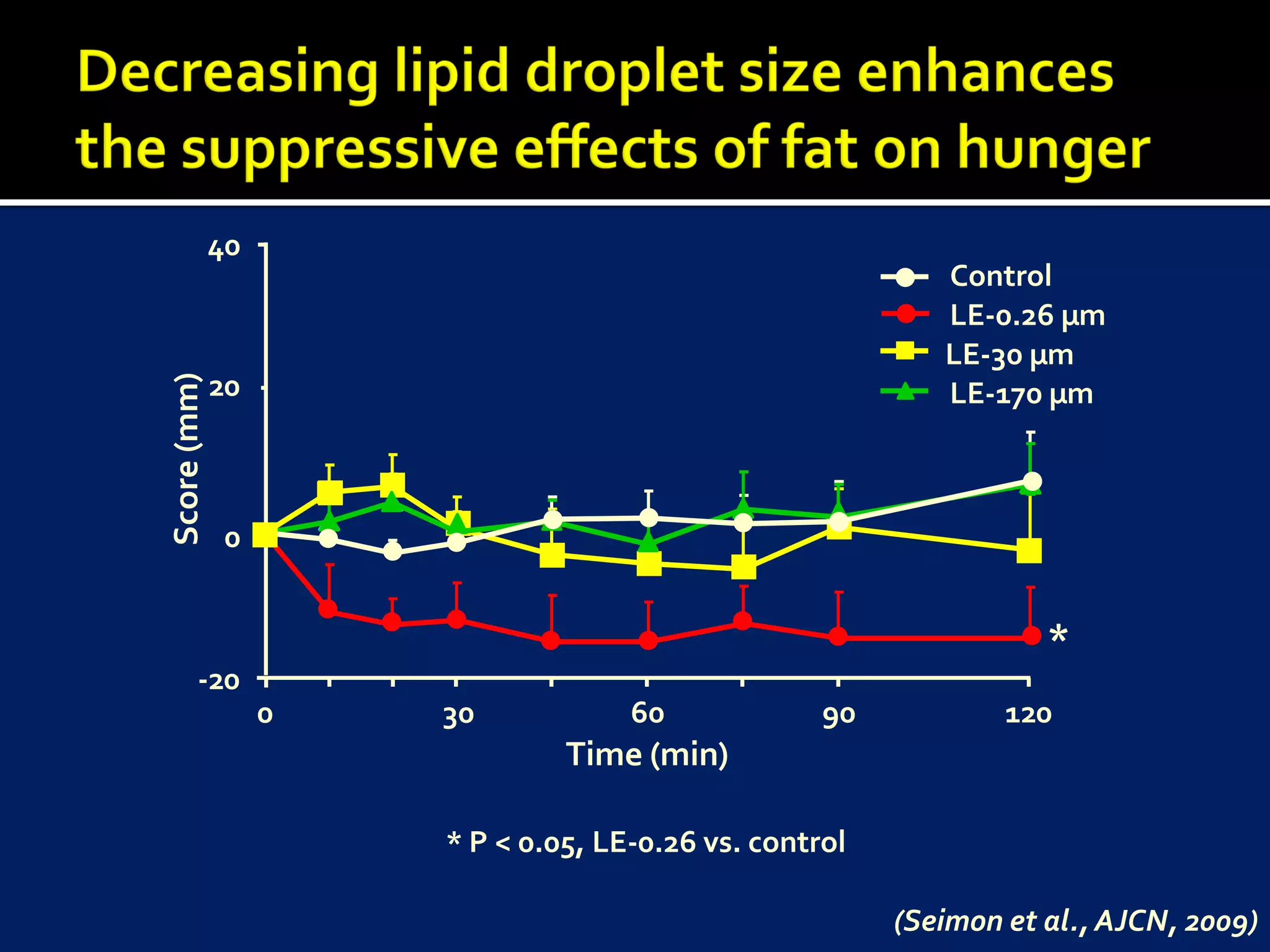
40
                                                           Control
                                                           LE-0.26 µm
                                                           LE-30 µm
Score (mm)


             20                                            LE-170 µm


              0


                                                                   *
       -20
                  0   30            60             90           120
                               Time (min)

                      * P < 0.05, LE-0.26 vs. control

                                                        (Seimon et al., AJCN, 2009)
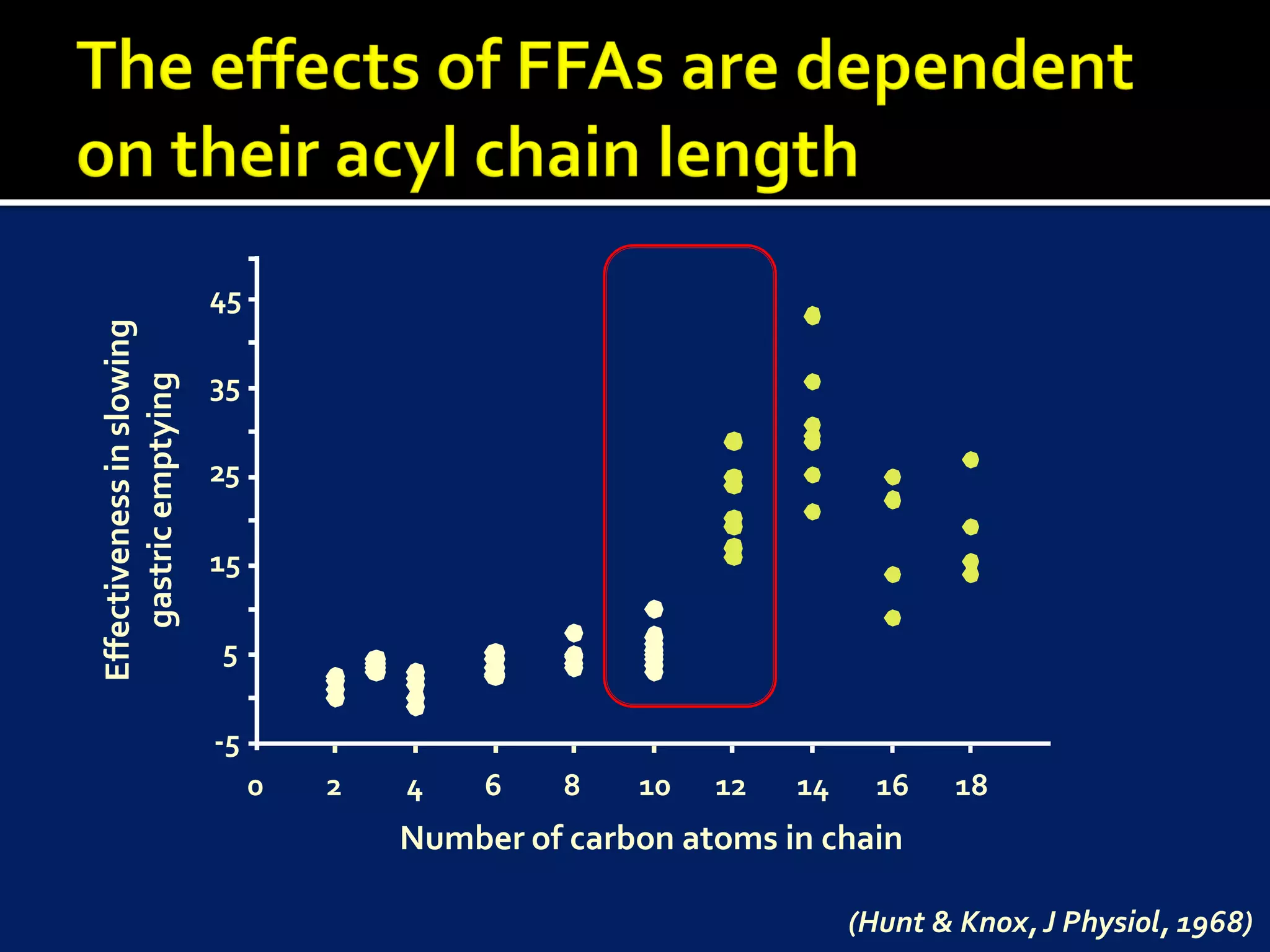
45
Effectiveness in slowing


                           35
    gastric emptying


                           25

                           15

                           5

                           -5
                                0   2   4    6    8   10   12   14     16   18
                                        Number of carbon atoms in chain

                                                                     (Hunt & Knox, J Physiol, 1968)
Pylorus                                  Energy intake
    120                              #        6000
    100
     80                                       4000
Total                                                                           *
      60
 No.
      40                                      2000
     20
      0                                           0
           Control     C10          C12                Control       C10       C12
           # vs control: P < 0.05
                                                       * vs control/C10: P < 0.05
                          (Feltrin et al., Am J Physiol Regul Integr Comp Physiol, 2004)
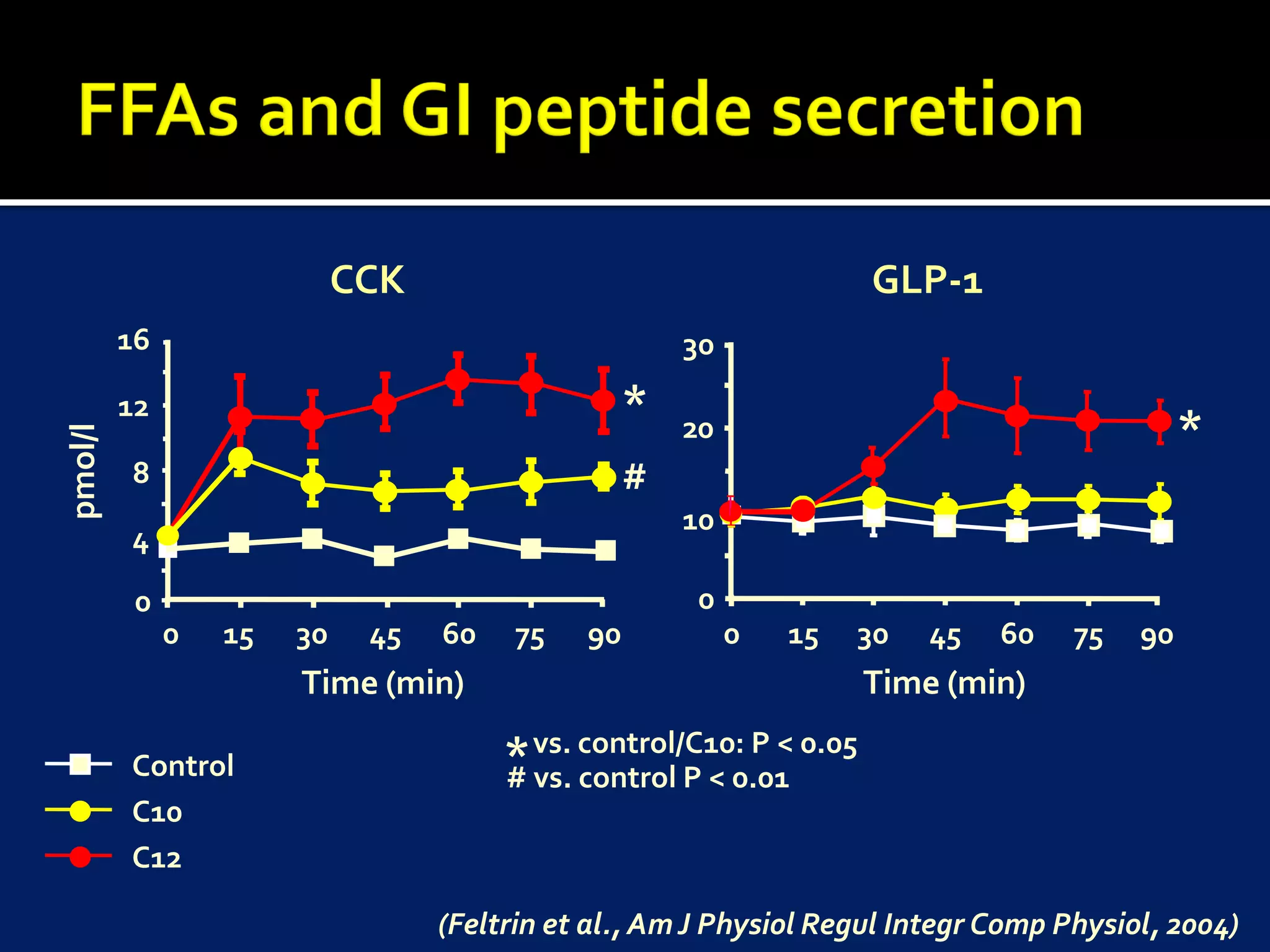
CCK                                      GLP-1
         16                                           30
         12                                       *   20                                     *
pmol/l


         8                                        #
                                                      10
         4
          0                                            0
              0   15   30    45   60   75    90            0   15   30   45   60   75   90
                       Time (min)                                    Time (min)

         Control                       * vs. control/C10: P < 0.05
                                       # vs. control P < 0.01
         C10
         C12

                                  (Feltrin et al., Am J Physiol Regul Integr Comp Physiol, 2004)
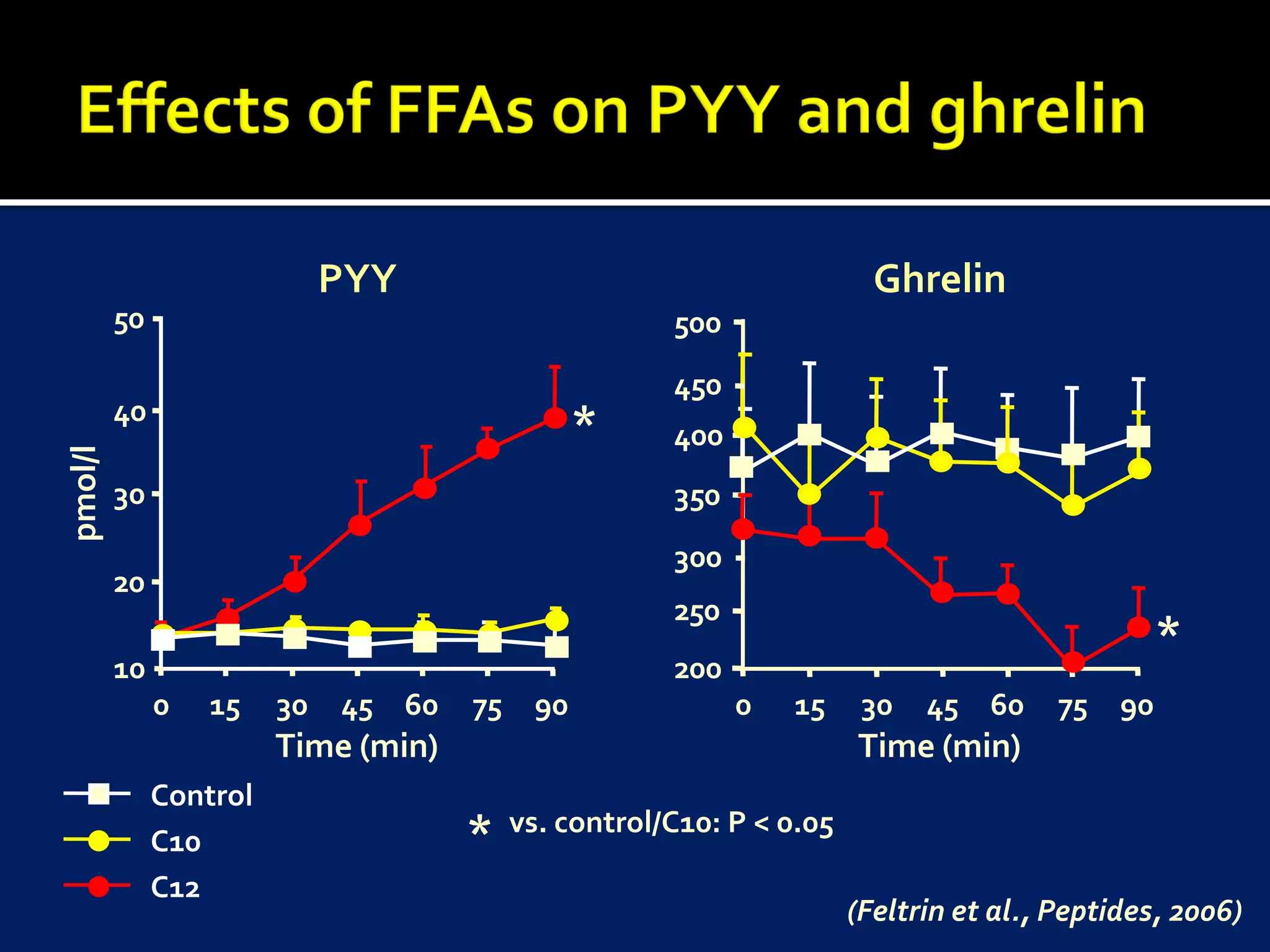
PYY                                        Ghrelin
         50                                           500
                                                      450
         40
                                                *     400
pmol/l


         30                                           350
                                                      300
         20
                                                      250
                                                                                                 *
         10                                           200
              0   15    30   45 60   75    90               0   15     30   45 60      75   90
                        Time (min)                                    Time (min)
              Control
                                     *    vs. control/C10: P < 0.05
              C10
              C12
                                                                      (Feltrin et al., Peptides, 2006)
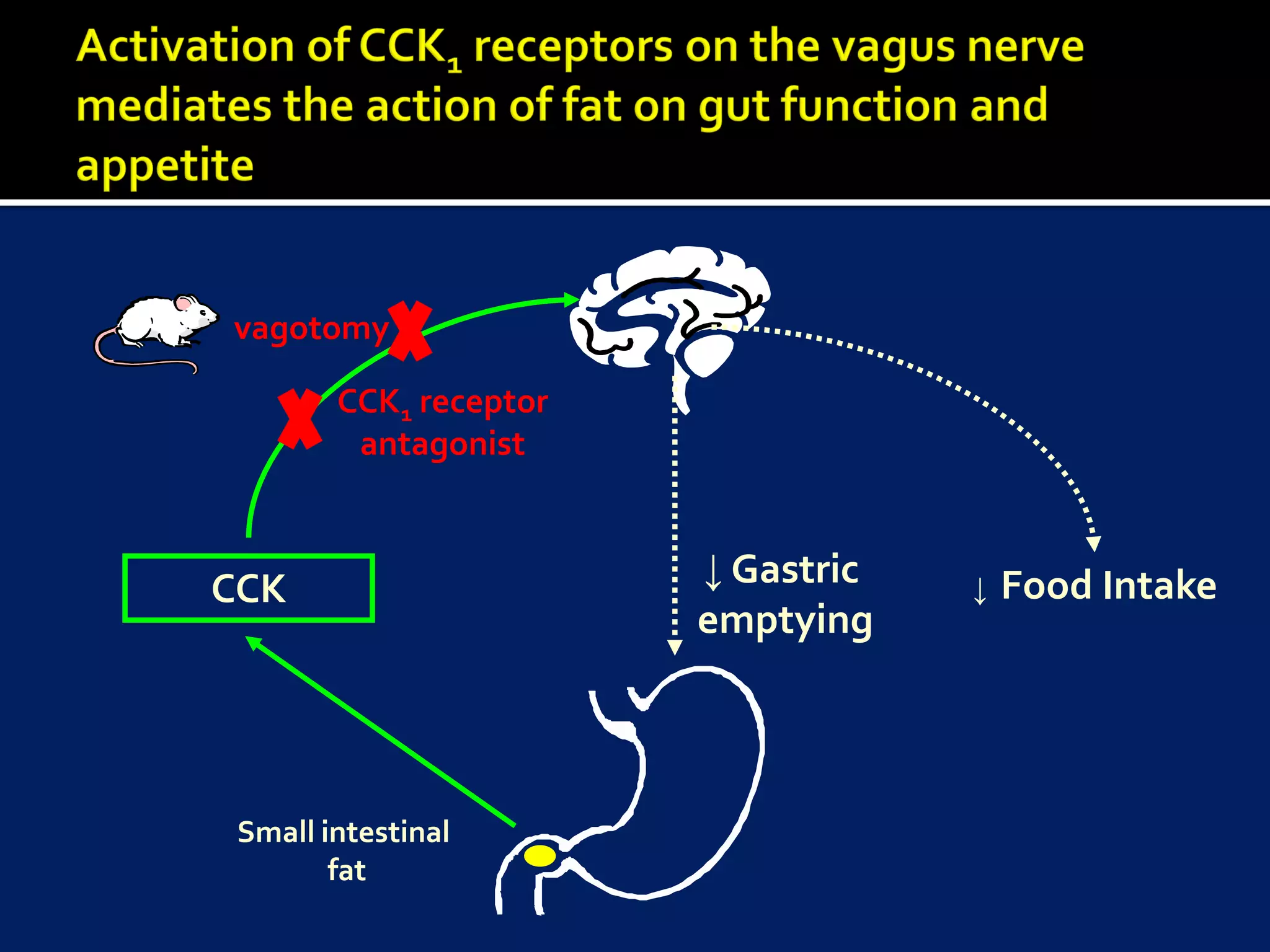
vagotomy

        CCK1 receptor
         antagonist


CCK                     ↓ Gastric   ↓   Food Intake
                        emptying


 Small intestinal
        fat
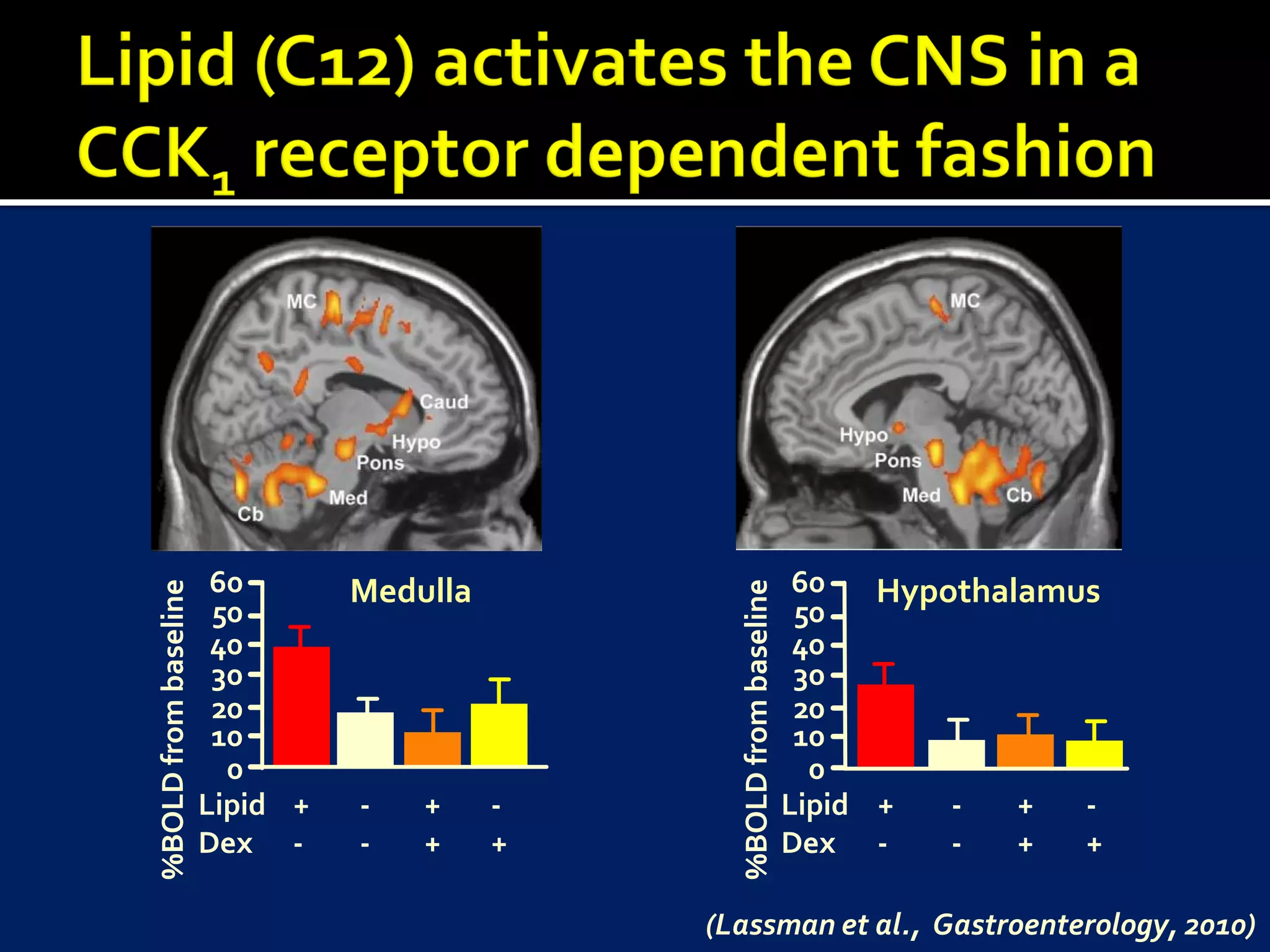
60       Medulla                                60   Hypothalamus
%BOLD from baseline


                                                %BOLD from baseline
                       50                                              50
                       40                                              40
                       30                                              30
                       20                                              20
                       10                                              10
                        0                                               0
                      Lipid +   -   +     -                           Lipid +   -   +  -
                      Dex -     -   +     +                           Dex -     -   +  +

                                              (Lassman et al., Gastroenterology, 2010)
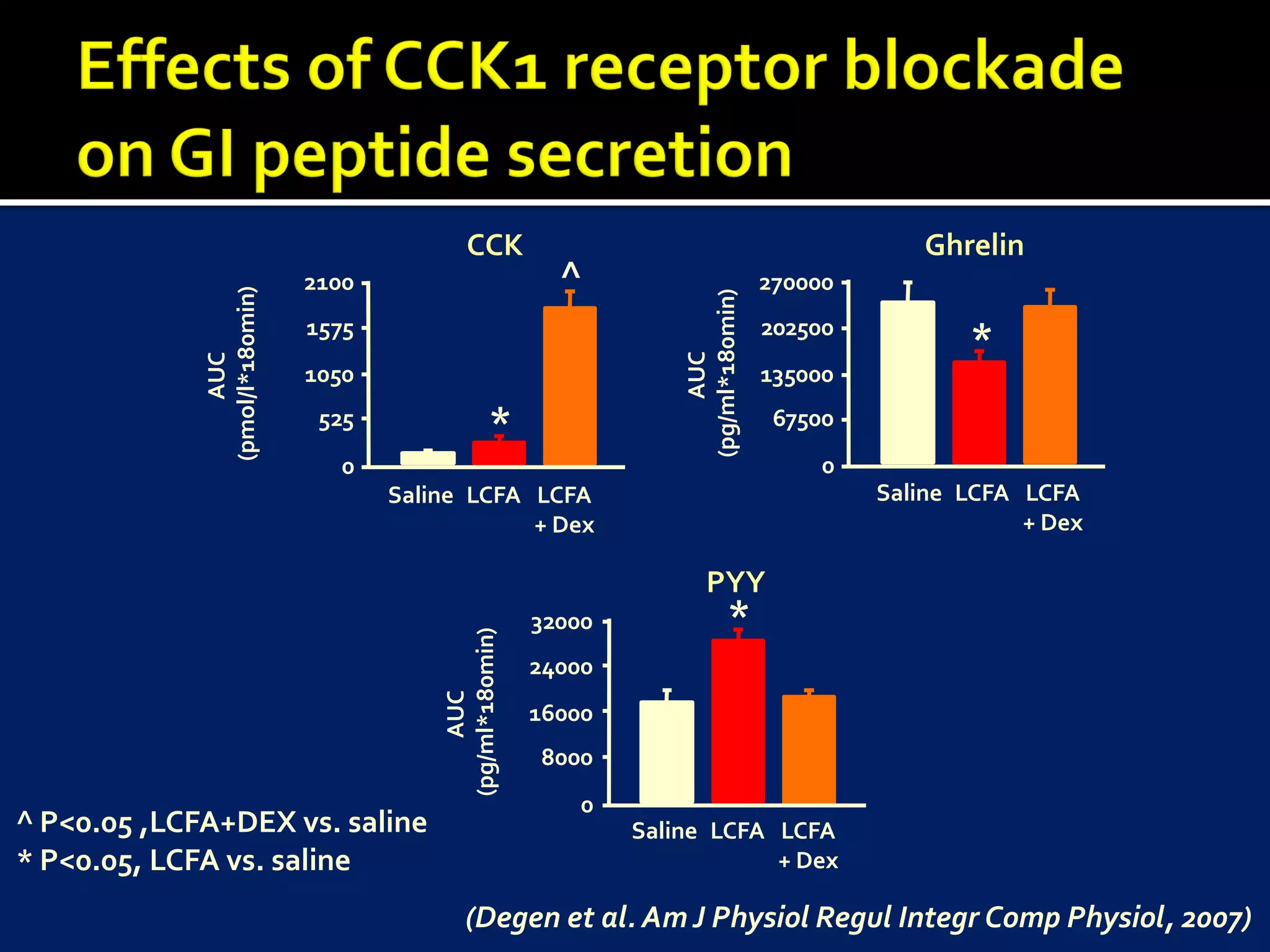
CCK                                                  Ghrelin
                               2100                          ^                          270000
             (pmol/l*180min)


                                                                       (pg/ml*180min)
                               1575                                                     202500
                                                                                                        *


                                                                            AUC
                  AUC


                               1050                                                     135000
                                525                  *                                   67500
                                  0                                                          0
                                      Saline LCFA LCFA                                           Saline LCFA LCFA
                                                  + Dex                                                      + Dex

                                                                            PYY
                                                           32000                 *
                                          (pg/ml*180min)


                                                           24000
                                               AUC


                                                           16000
                                                           8000
                                                               0
^ P<0.05 ,LCFA+DEX vs. saline                                      Saline LCFA LCFA
* P<0.05, LCFA vs. saline                                                      + Dex

                                               (Degen et al. Am J Physiol Regul Integr Comp Physiol, 2007)
10000                          ^
Energy intake (kcal)

                       8000
                                           *
                       6000

                       4000

                        2000

                          0
                               Saline      C18      C18+Lox
                                        Treatment

                                                      (Matzinger et al., Gut, 2000)
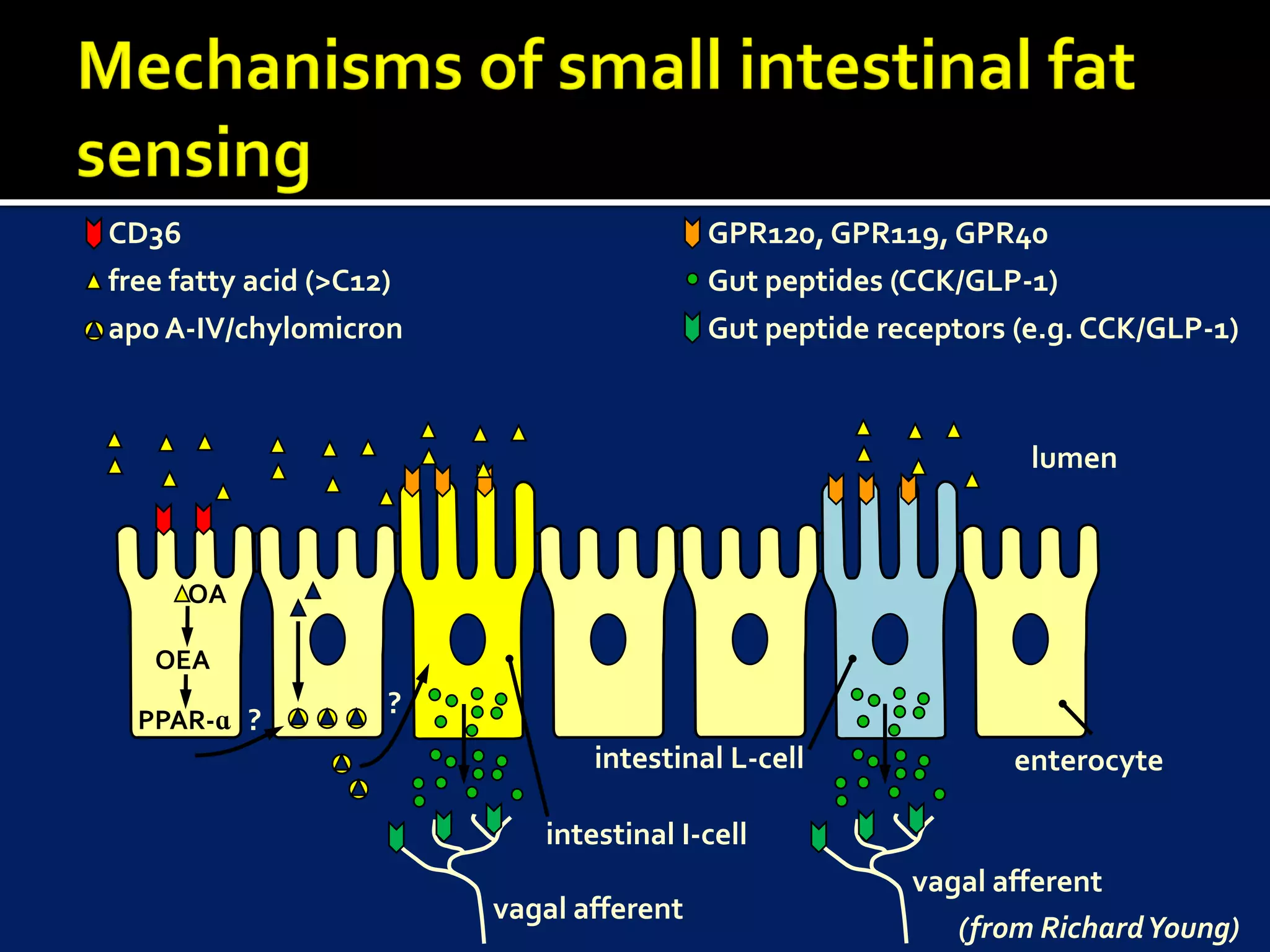
CD36                                      GPR120, GPR119, GPR40
free fatty acid (>C12)                    Gut peptides (CCK/GLP-1)
apo A-IV/chylomicron                      Gut peptide receptors (e.g. CCK/GLP-1)


                                                                 lumen


     OA

   OEA
                    ?
  PPAR-ɑ ?
                                intestinal L-cell              enterocyte

                            intestinal I-cell
                                                        vagal afferent
                         vagal afferent
                                                           (from Richard Young)
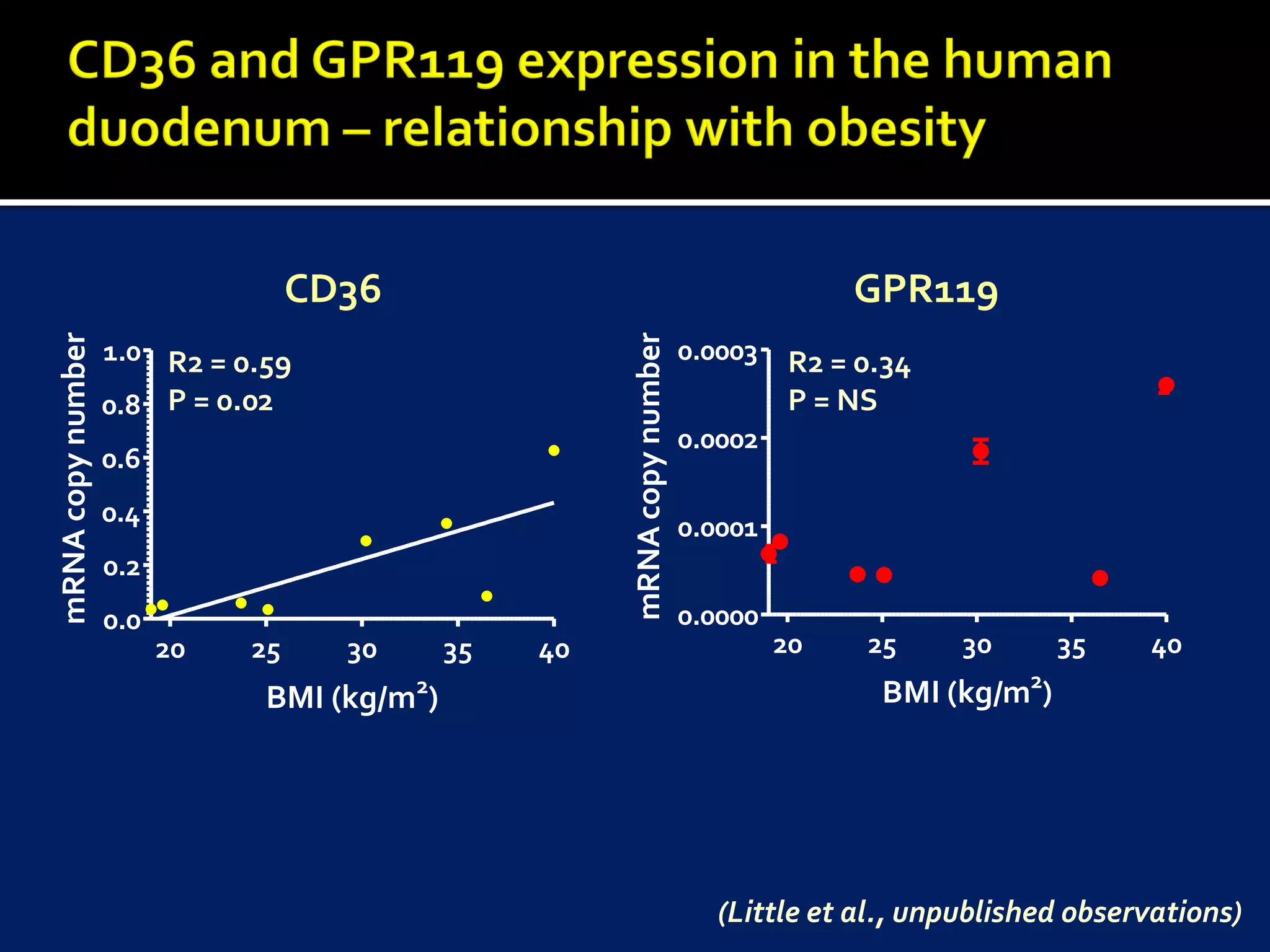
CD36                                                GPR119
mRNA copy number


                                                      mRNA copy number
                   1.0 R2 = 0.59                                         0.0003    R2 = 0.34
                   0.8 P = 0.02                                                    P = NS
                                                                         0.0002
                   0.6
                   0.4                                                   0.0001
                   0.2
                   0.0                                                   0.0000
                         20   25     30     35   40                               20    25     30      35   40
                              BMI (kg/m2)                                                BMI (kg/m2)


                                                                           (Little et al., unpublished observations)
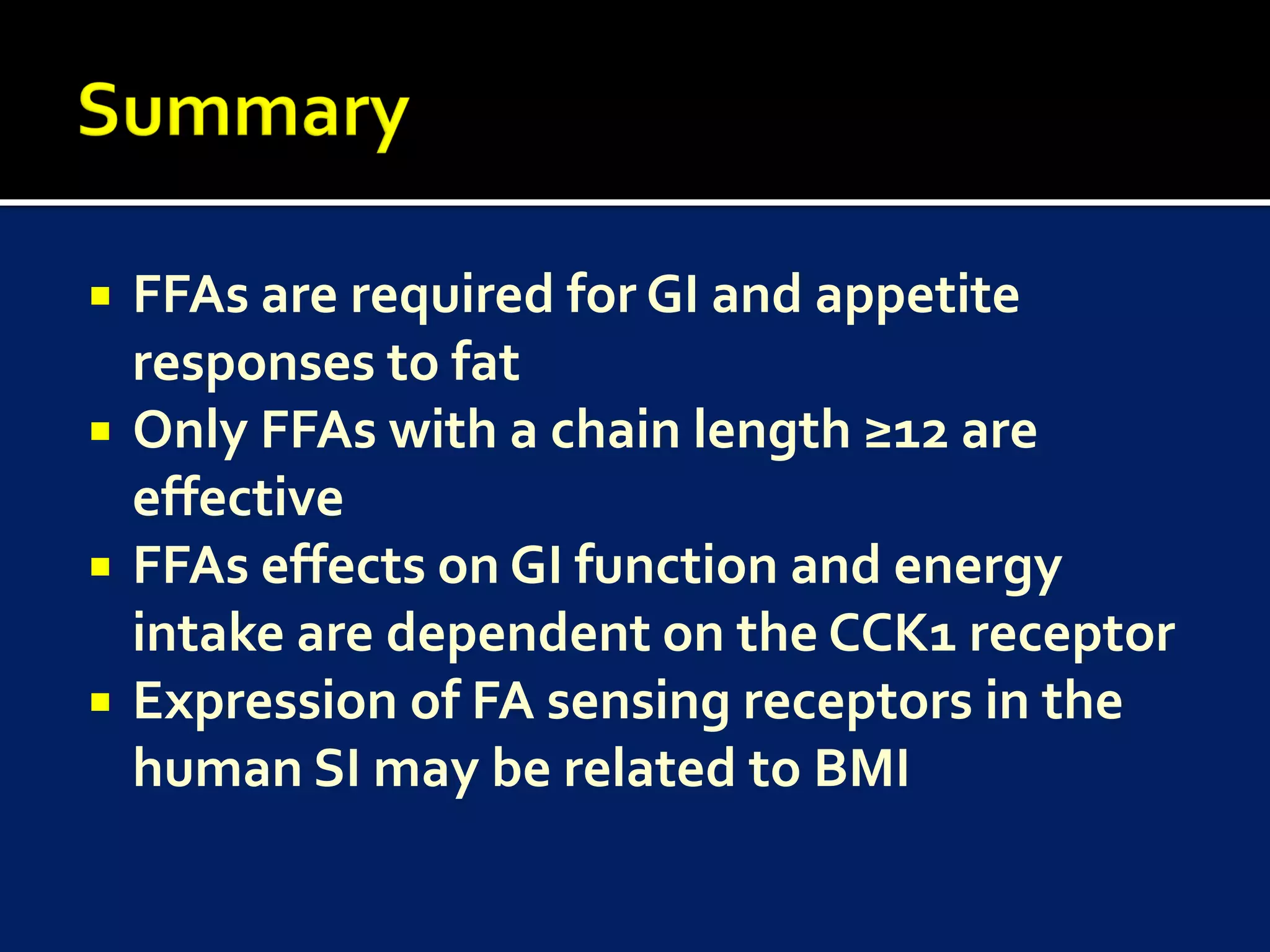
   FFAs are required for GI and appetite
    responses to fat
   Only FFAs with a chain length ≥12 are
    effective
   FFAs effects on GI function and energy
    intake are dependent on the CCK1 receptor
   Expression of FA sensing receptors in the
    human SI may be related to BMI
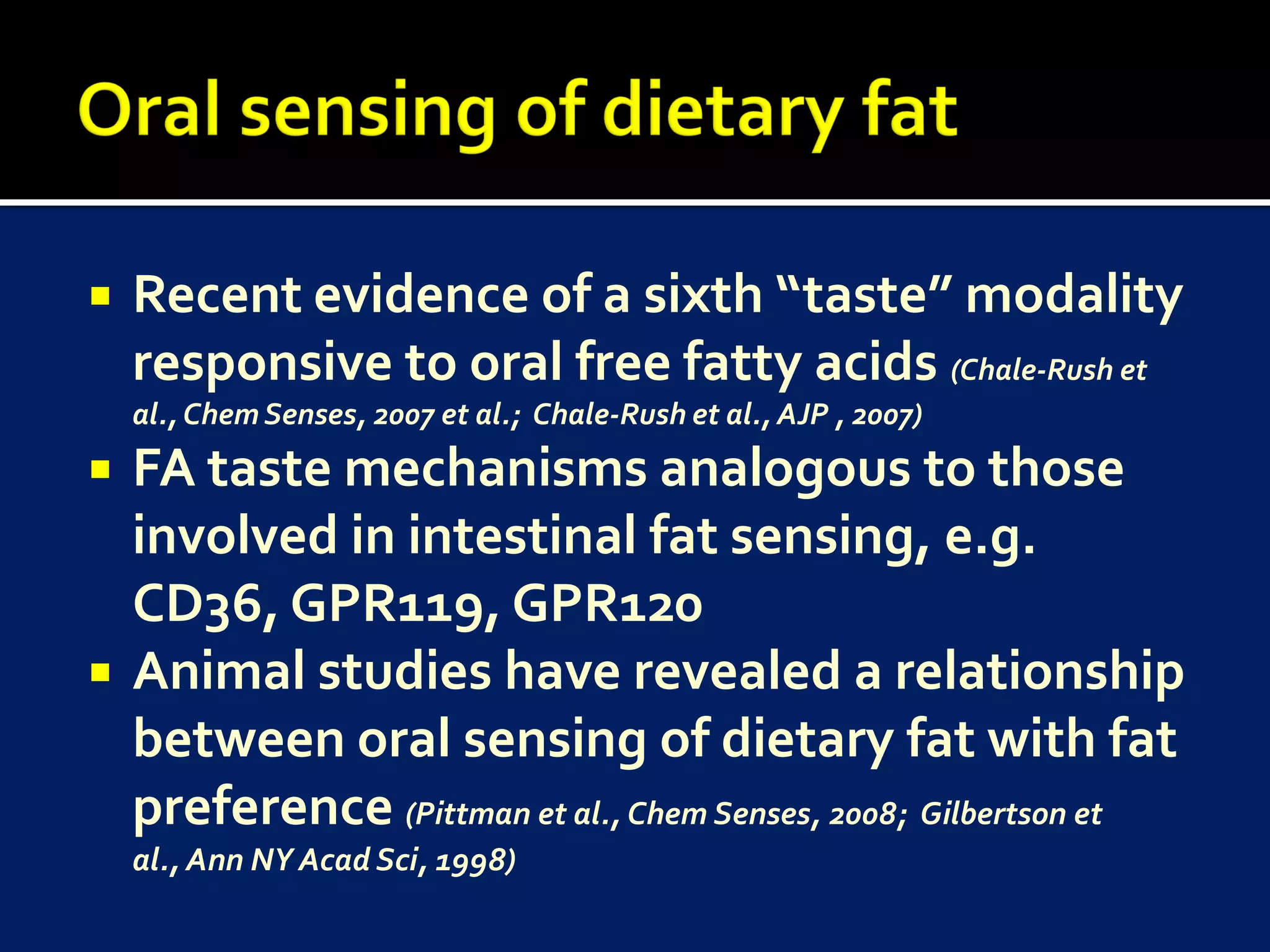
   Recent evidence of a sixth “taste” modality
    responsive to oral free fatty acids (Chale-Rush et
    al., Chem Senses, 2007 et al.; Chale-Rush et al., AJP , 2007)
   FA taste mechanisms analogous to those
    involved in intestinal fat sensing, e.g.
    CD36, GPR119, GPR120
   Animal studies have revealed a relationship
    between oral sensing of dietary fat with fat
    preference (Pittman et al., Chem Senses, 2008; Gilbertson et
    al., Ann NY Acad Sci, 1998)
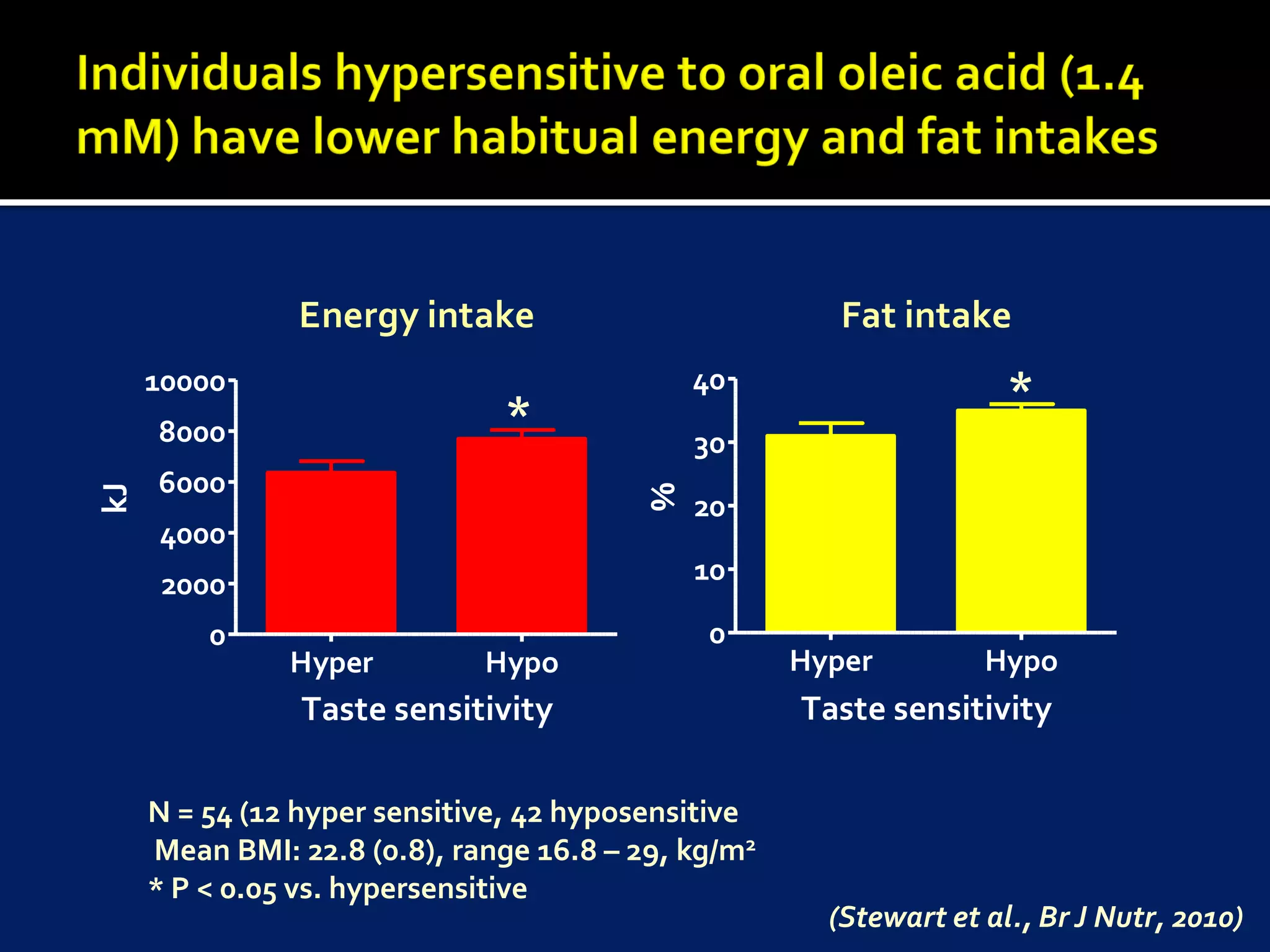
Energy intake                           Fat intake
     10000                                   40                     *
     8000                     *              30
     6000
kJ


                                         %
                                             20
     4000
      2000                                   10

         0                                    0
               Hyper         Hypo                   Hyper         Hypo
                Taste sensitivity                   Taste sensitivity

     N = 54 (12 hyper sensitive, 42 hyposensitive
     Mean BMI: 22.8 (0.8), range 16.8 – 29, kg/m2
     * P < 0.05 vs. hypersensitive
                                                      (Stewart et al., Br J Nutr, 2010)
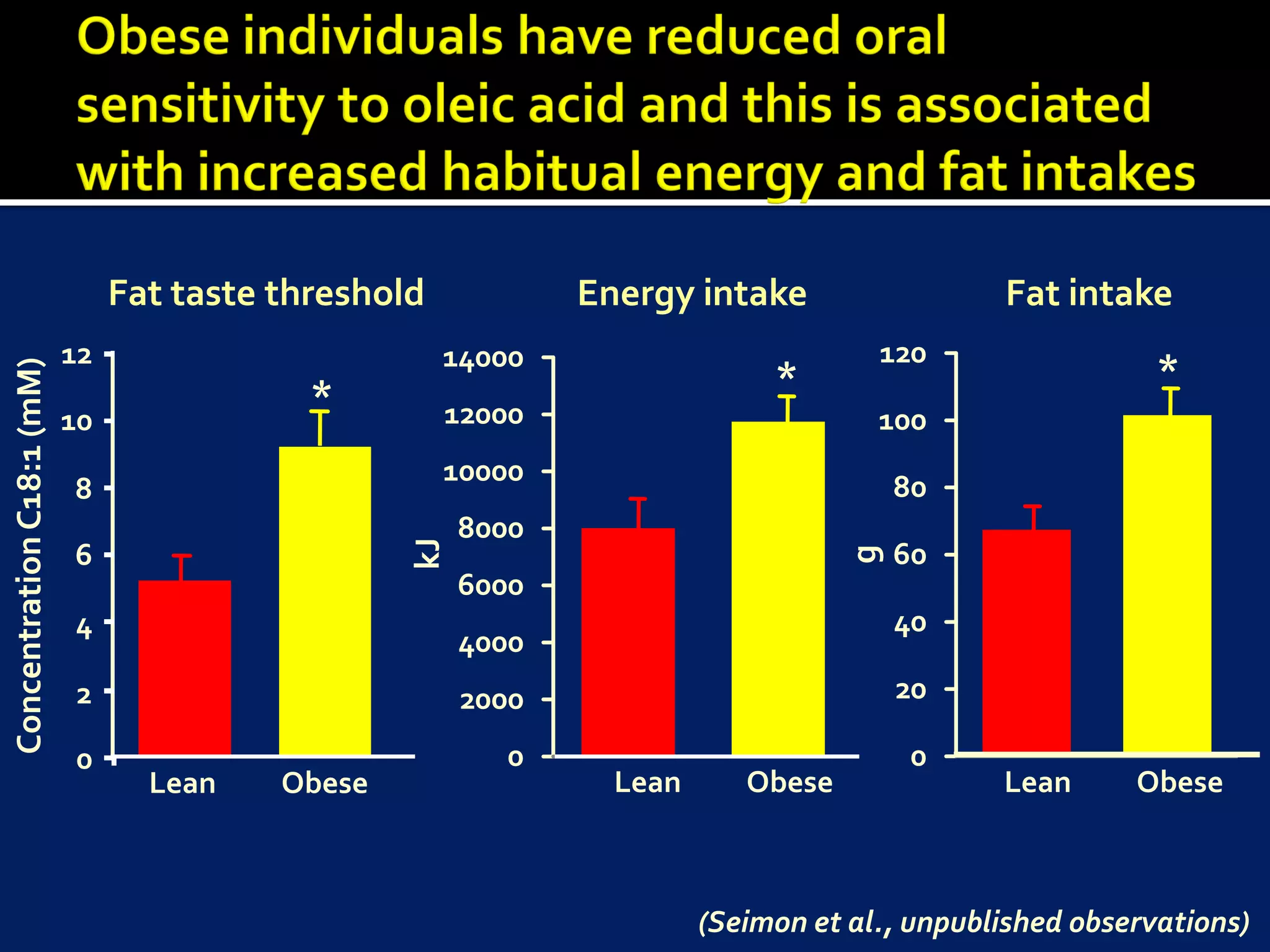
Fat taste threshold             Energy intake                          Fat intake
                           12                         14000                                   120         *     *
Concentration C18:1 (mM)


                                            *                                          *
                           10                         12000                                   100
                                                      10000
                           8                                                                      80


                                                                         Weight (g)
                                                         8000
                                                    kJ


                           6                                                                      60


                                                                                              g
                                                         6000
                           4                                                                      40
                                                         4000
                           2                             2000                                     20

                           0                               0                                       0
                                  Lean    Obese
                                             Lean         Obese   Lean                Obese            Lean   Obese


                                                                         (Seimon et al., unpublished observations)
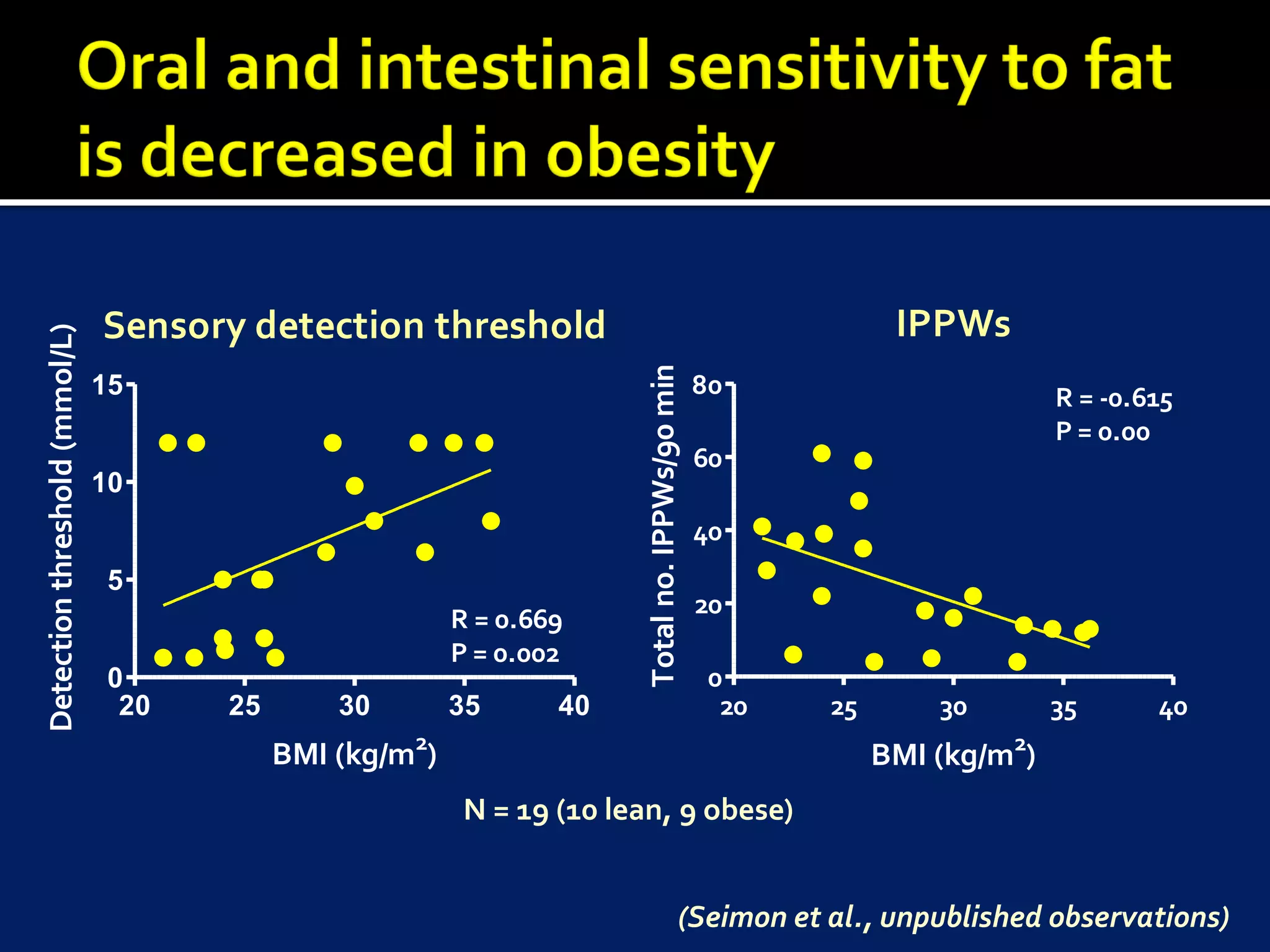
Sensory detection threshold                                                    IPPWs
Detection threshold (mmol/L)


                                                                        Total no. IPPWs/90 min
                               15                                                                80                        R = -0.615
                                                                                                                           P = 0.00
                                                                                                 60
                               10
                                                                                                 40
                                5
                                                                                                 20
                                                         R = 0.669
                                                         P = 0.002
                                0                                                                 0
                                 20   25       30        35      40                                20   25       30        35      40
                                           BMI (kg/m2)                                                       BMI (kg/m2)
                                                          N = 19 (10 lean, 9 obese)


                                                                                           (Seimon et al., unpublished observations)
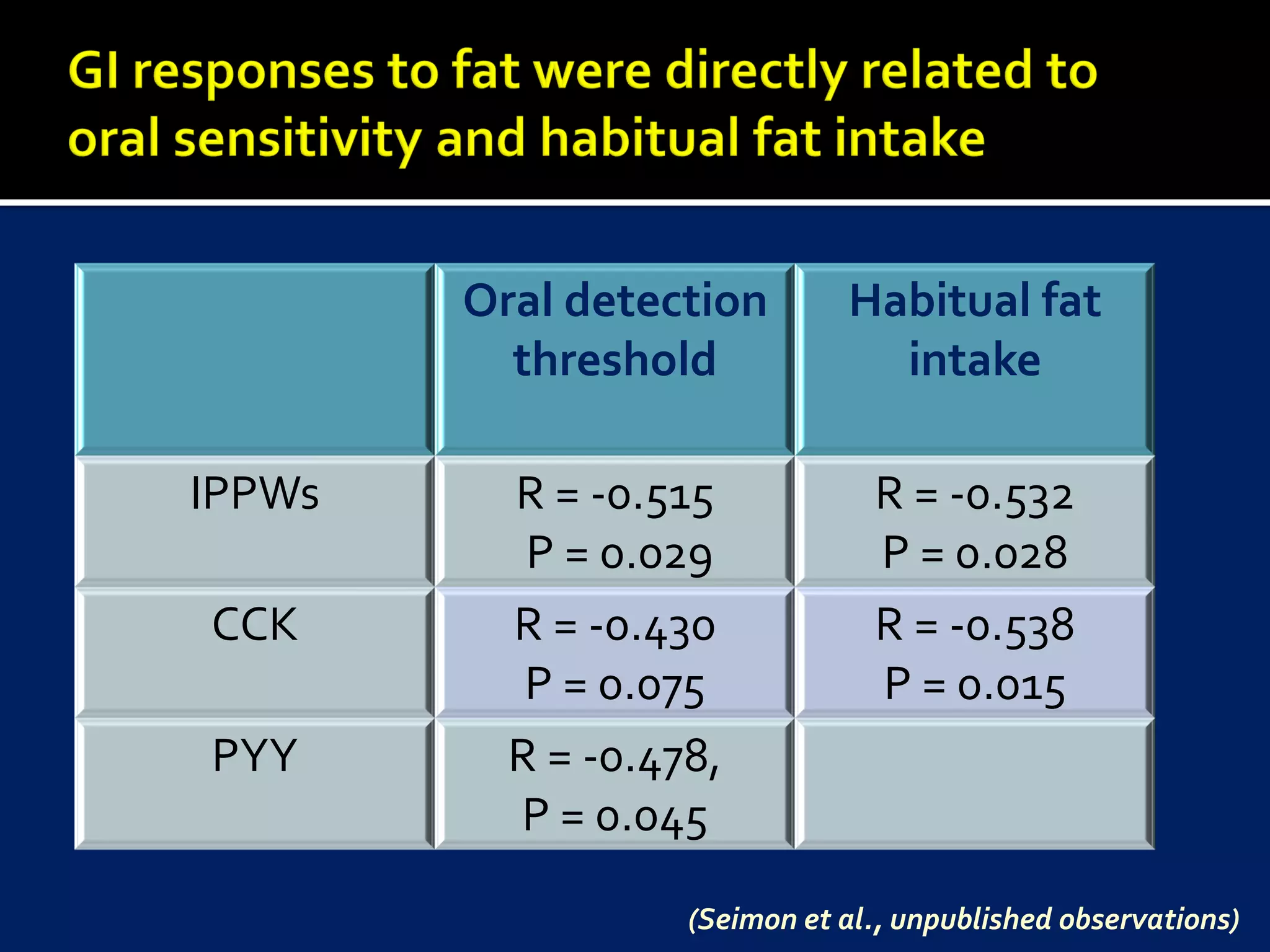
Oral detection        Habitual fat
          threshold             intake

IPPWs     R = -0.515            R = -0.532
           P = 0.029            P = 0.028
CCK       R = -0.430            R = -0.538
           P = 0.075            P = 0.015
PYY       R = -0.478,
          P = 0.045

                   (Seimon et al., unpublished observations)
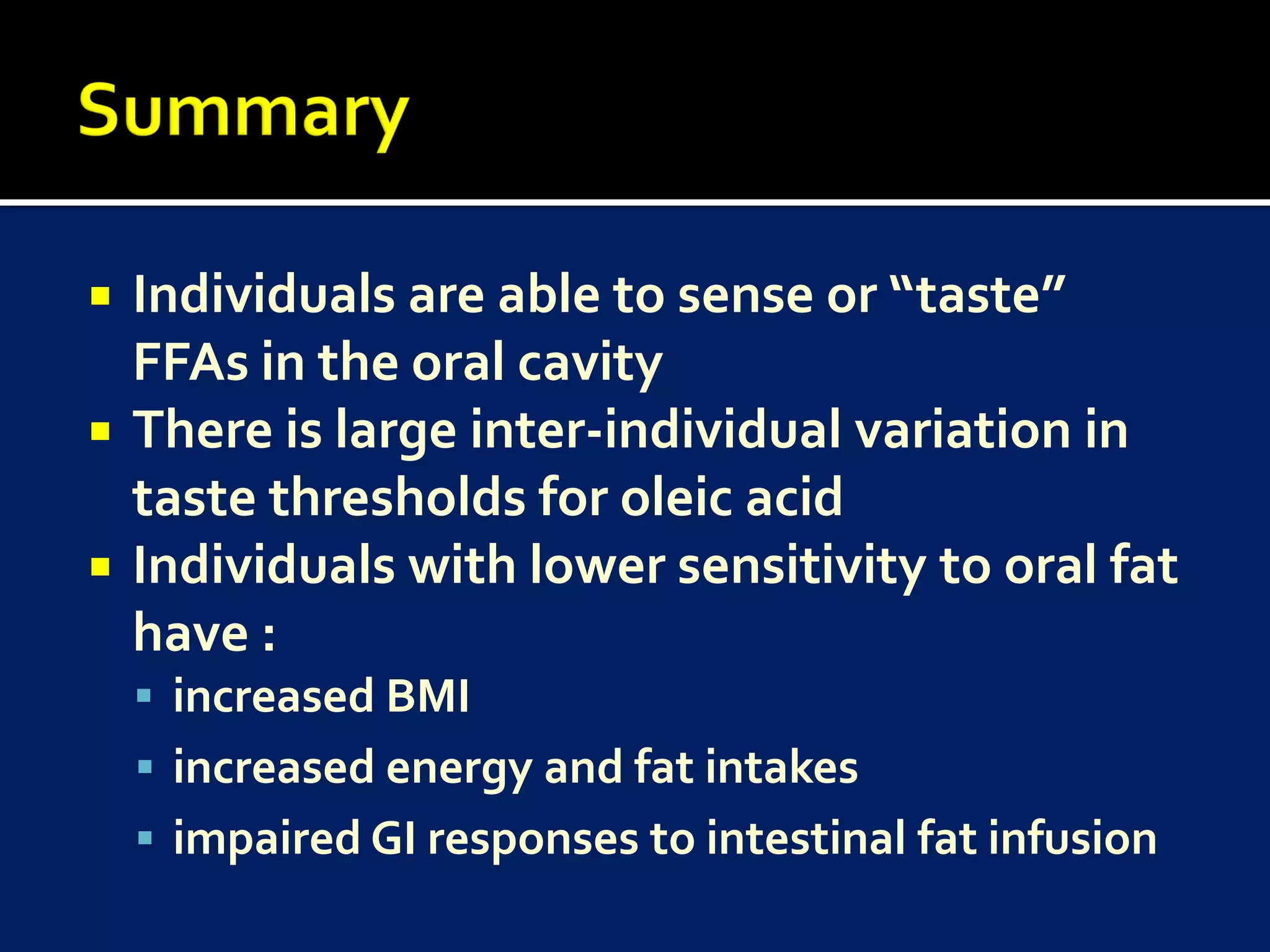
   Individuals are able to sense or “taste”
    FFAs in the oral cavity
   There is large inter-individual variation in
    taste thresholds for oleic acid
   Individuals with lower sensitivity to oral fat
    have :
     increased BMI
     increased energy and fat intakes
     impaired GI responses to intestinal fat infusion
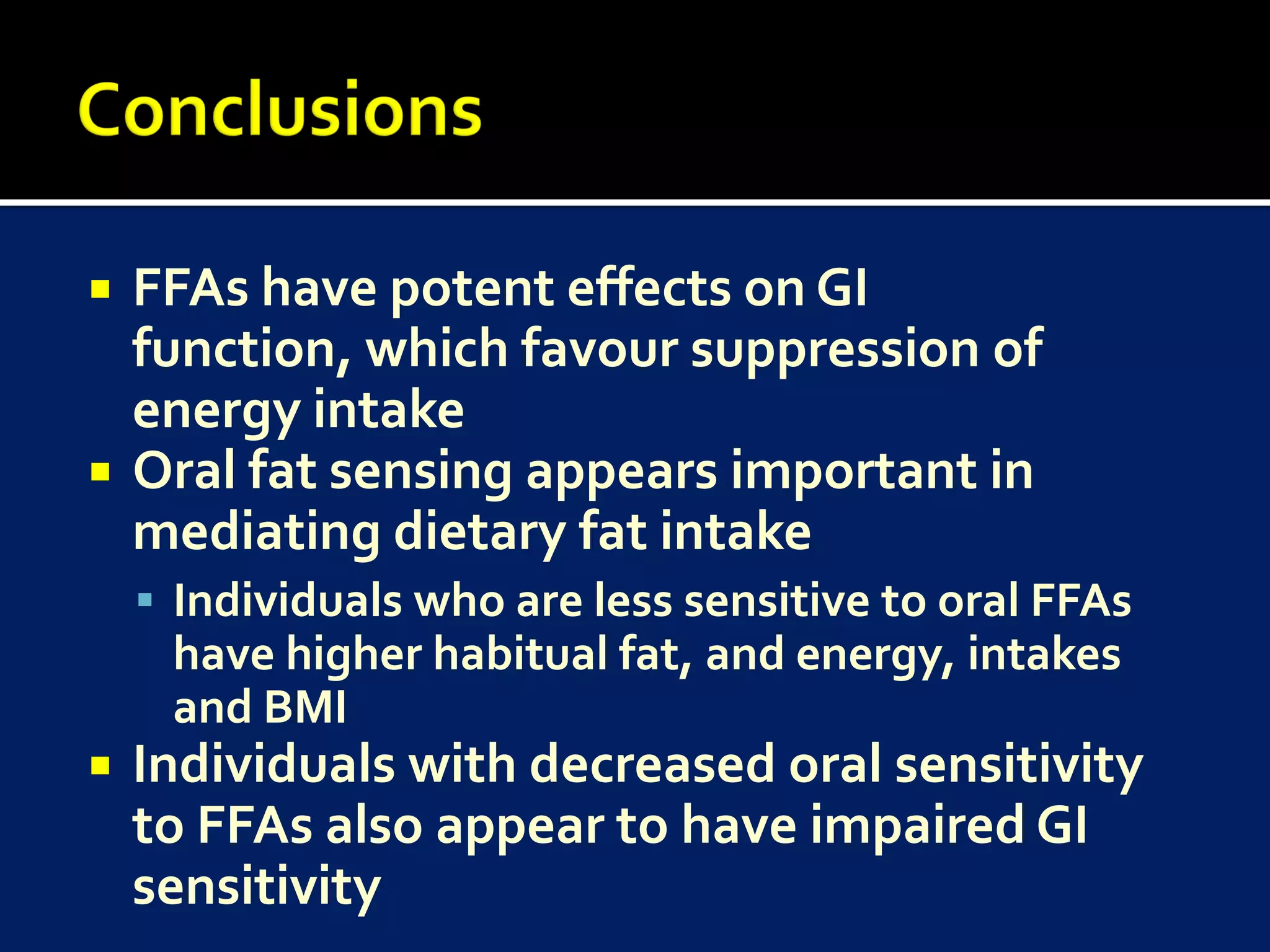
   FFAs have potent effects on GI
    function, which favour suppression of
    energy intake
   Oral fat sensing appears important in
    mediating dietary fat intake
     Individuals who are less sensitive to oral FFAs
     have higher habitual fat, and energy, intakes
     and BMI
   Individuals with decreased oral sensitivity
    to FFAs also appear to have impaired GI
    sensitivity
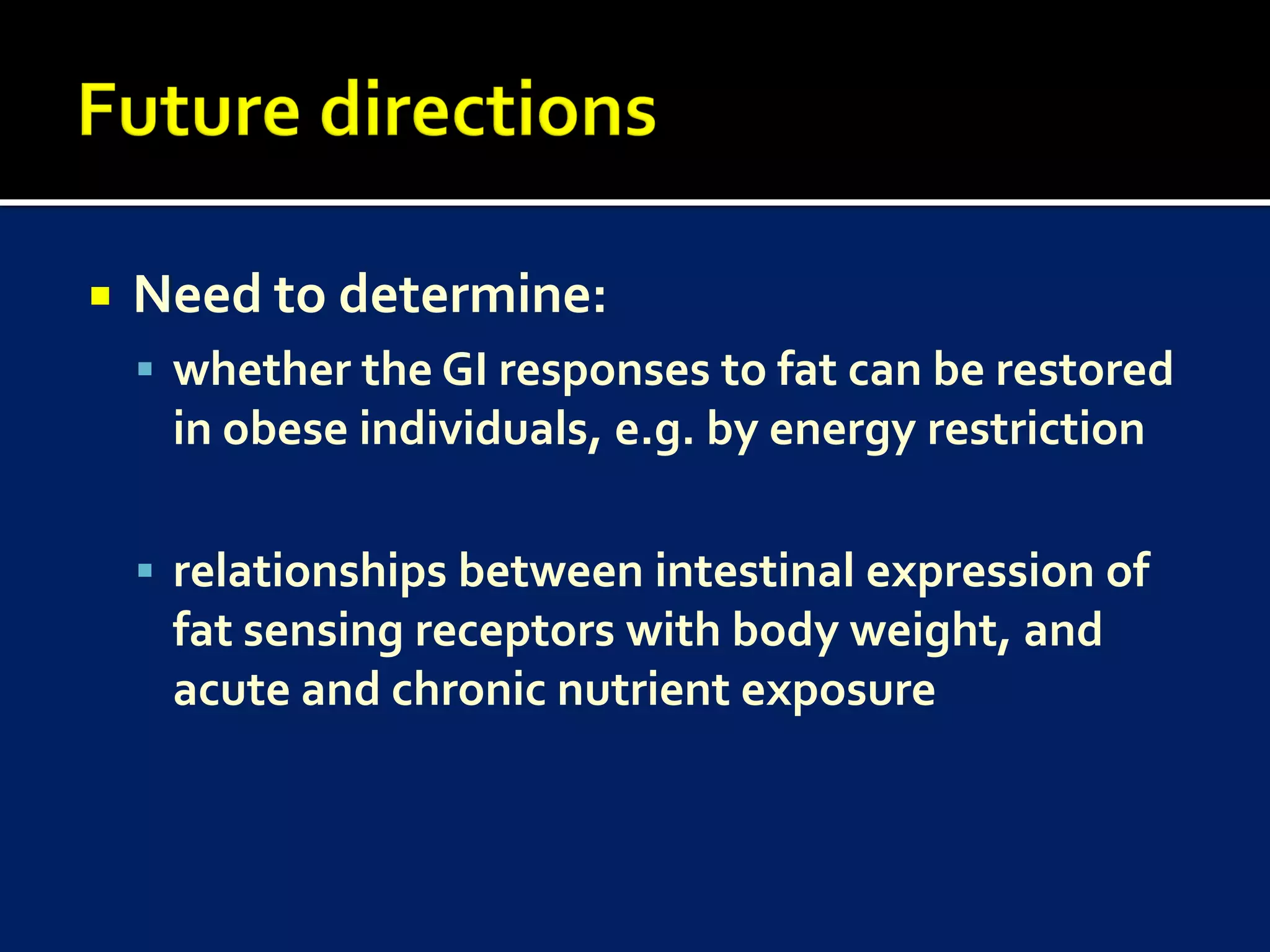
   Need to determine:
     whether the GI responses to fat can be restored
     in obese individuals, e.g. by energy restriction

     relationships between intestinal expression of
     fat sensing receptors with body weight, and
     acute and chronic nutrient exposure
   Assoc Prof Christine Feinle-Bisset
   Radhika Seimon
   Dr Richard Young
   Assoc Prof Chris Rayner
   Lena Brandlhuber

Deakin University
 Jessica Stewart
 Dr Russell Keast

Food and Satiety - part 1

  • 1.
    The Waite ResearchInstitute FOODplus Research Centre Scientific Seminar Series – 2010 #3a Dr Tanya Little Life Impact | The University of Adelaide
  • 2.
    Dr Tanya Little Universityof Adelaide Discipline of Medicine NHMRC Centre of Clinical Research Excellence (CCRE) in Nutritional Physiology, Interventions and Outcomes
  • 3.
    Gastrointestinal (GI) sensing of dietary fat  Which factors determine the GI responses to dietary fat?  Oral detection of dietary fat  Relationships between: ▪ dietary fat intake and body weight ▪ oral and GI sensitivity
  • 4.
    There is a strong positive relationship between the intake of dietary fat with total energy intake and body weight (Golay and Bobbioni, Int J Obes Relat Metab Disord, 1997)  Obese individuals have an increased preference for high-fat foods (Mela and Sacchetti, AJCN, 1991)
  • 5.
    5000 4000 * * 3000 2000 1000 0 Control Fat Glucose * P<0.01 vs. control and glucose (Chapman et al. , AJCN , 1999)
  • 6.
    We examine downstream effects of fat sensing identified in cell line and animal studies. For example, changes in:  GI motility  plasma concentrations of GI peptides  food intake  Expression of fat sensing receptors in small intestinal biopsies
  • 7.
    isolated pyloric  proximal gastric pressure waves relaxation (IPPWs) pyloric tone small  antral pressure intestinal waves fat  duodenal pressure waves slowing of gastric emptying (Seimon et al., AJCN, 2010)
  • 8.
    small inhibits energy intestinal fat intake CCK, PYY, GL P-1 ghrelin slows gastric emptying (Seimon et al., AJCN, 2010)
  • 9.
    triacyl- monoacyl- glyceride glyceride ↓ Food intake ↓ food intake + lipase inhibition (Orlistat) FFAs ↑ CCK, GLP-1, ↑ CCK, GLP- PYY 1, PYY ↓ gastric ↓ ghrelin ↓ ghrelin emptying Pancreatic and pancreatic and gallbladder gallbladder secretion secretion
  • 10.
    9 CCK IPPWs 8 90 7 A 70 6 pmol/l 5 50 P 4 30 3 10 2 D 1 * -10 mmHg 0 Fat Fat+orlistat 0 15 30 45 60 75 90 105 120 Time (min) Energy intake 6400 * 5600 Fat 4800 Fat+Orlistat (kJ) 4000 * P<0.05 vs. Fat kJ 3200 2400 1600 800 0 (Feinle et al., Am J Physiol Gastrointest Liver Physiol, 2003)
  • 11.
    IPPWs CCK 40 * 6 30 4 Number pmol/l 20 * 2 10 0 0 -15 0 30 60 90 120 0 30 60 90 120 Time (min) Time (min) Control LE-0.26 µm * P < 0.05, LE-0.26 vs. control LE-30 µm LE-170 µm (Seimon et al., AJCN, 2009)
  • 12.
    40 Control LE-0.26 µm LE-30 µm Score (mm) 20 LE-170 µm 0 * -20 0 30 60 90 120 Time (min) * P < 0.05, LE-0.26 vs. control (Seimon et al., AJCN, 2009)
  • 13.
    45 Effectiveness in slowing 35 gastric emptying 25 15 5 -5 0 2 4 6 8 10 12 14 16 18 Number of carbon atoms in chain (Hunt & Knox, J Physiol, 1968)
  • 14.
    Pylorus Energy intake 120 # 6000 100 80 4000 Total * 60 No. 40 2000 20 0 0 Control C10 C12 Control C10 C12 # vs control: P < 0.05 * vs control/C10: P < 0.05 (Feltrin et al., Am J Physiol Regul Integr Comp Physiol, 2004)
  • 15.
    CCK GLP-1 16 30 12 * 20 * pmol/l 8 # 10 4 0 0 0 15 30 45 60 75 90 0 15 30 45 60 75 90 Time (min) Time (min) Control * vs. control/C10: P < 0.05 # vs. control P < 0.01 C10 C12 (Feltrin et al., Am J Physiol Regul Integr Comp Physiol, 2004)
  • 16.
    PYY Ghrelin 50 500 450 40 * 400 pmol/l 30 350 300 20 250 * 10 200 0 15 30 45 60 75 90 0 15 30 45 60 75 90 Time (min) Time (min) Control * vs. control/C10: P < 0.05 C10 C12 (Feltrin et al., Peptides, 2006)
  • 17.
    vagotomy CCK1 receptor antagonist CCK ↓ Gastric ↓ Food Intake emptying Small intestinal fat
  • 18.
    60 Medulla 60 Hypothalamus %BOLD from baseline %BOLD from baseline 50 50 40 40 30 30 20 20 10 10 0 0 Lipid + - + - Lipid + - + - Dex - - + + Dex - - + + (Lassman et al., Gastroenterology, 2010)
  • 19.
    CCK Ghrelin 2100 ^ 270000 (pmol/l*180min) (pg/ml*180min) 1575 202500 * AUC AUC 1050 135000 525 * 67500 0 0 Saline LCFA LCFA Saline LCFA LCFA + Dex + Dex PYY 32000 * (pg/ml*180min) 24000 AUC 16000 8000 0 ^ P<0.05 ,LCFA+DEX vs. saline Saline LCFA LCFA * P<0.05, LCFA vs. saline + Dex (Degen et al. Am J Physiol Regul Integr Comp Physiol, 2007)
  • 20.
    10000 ^ Energy intake (kcal) 8000 * 6000 4000 2000 0 Saline C18 C18+Lox Treatment (Matzinger et al., Gut, 2000)
  • 21.
    CD36 GPR120, GPR119, GPR40 free fatty acid (>C12) Gut peptides (CCK/GLP-1) apo A-IV/chylomicron Gut peptide receptors (e.g. CCK/GLP-1) lumen OA OEA ? PPAR-ɑ ? intestinal L-cell enterocyte intestinal I-cell vagal afferent vagal afferent (from Richard Young)
  • 22.
    CD36 GPR119 mRNA copy number mRNA copy number 1.0 R2 = 0.59 0.0003 R2 = 0.34 0.8 P = 0.02 P = NS 0.0002 0.6 0.4 0.0001 0.2 0.0 0.0000 20 25 30 35 40 20 25 30 35 40 BMI (kg/m2) BMI (kg/m2) (Little et al., unpublished observations)
  • 23.
    FFAs are required for GI and appetite responses to fat  Only FFAs with a chain length ≥12 are effective  FFAs effects on GI function and energy intake are dependent on the CCK1 receptor  Expression of FA sensing receptors in the human SI may be related to BMI
  • 24.
    Recent evidence of a sixth “taste” modality responsive to oral free fatty acids (Chale-Rush et al., Chem Senses, 2007 et al.; Chale-Rush et al., AJP , 2007)  FA taste mechanisms analogous to those involved in intestinal fat sensing, e.g. CD36, GPR119, GPR120  Animal studies have revealed a relationship between oral sensing of dietary fat with fat preference (Pittman et al., Chem Senses, 2008; Gilbertson et al., Ann NY Acad Sci, 1998)
  • 25.
    Energy intake Fat intake 10000 40 * 8000 * 30 6000 kJ % 20 4000 2000 10 0 0 Hyper Hypo Hyper Hypo Taste sensitivity Taste sensitivity N = 54 (12 hyper sensitive, 42 hyposensitive Mean BMI: 22.8 (0.8), range 16.8 – 29, kg/m2 * P < 0.05 vs. hypersensitive (Stewart et al., Br J Nutr, 2010)
  • 26.
    Fat taste threshold Energy intake Fat intake 12 14000 120 * * Concentration C18:1 (mM) * * 10 12000 100 10000 8 80 Weight (g) 8000 kJ 6 60 g 6000 4 40 4000 2 2000 20 0 0 0 Lean Obese Lean Obese Lean Obese Lean Obese (Seimon et al., unpublished observations)
  • 27.
    Sensory detection threshold IPPWs Detection threshold (mmol/L) Total no. IPPWs/90 min 15 80 R = -0.615 P = 0.00 60 10 40 5 20 R = 0.669 P = 0.002 0 0 20 25 30 35 40 20 25 30 35 40 BMI (kg/m2) BMI (kg/m2) N = 19 (10 lean, 9 obese) (Seimon et al., unpublished observations)
  • 28.
    Oral detection Habitual fat threshold intake IPPWs R = -0.515 R = -0.532 P = 0.029 P = 0.028 CCK R = -0.430 R = -0.538 P = 0.075 P = 0.015 PYY R = -0.478, P = 0.045 (Seimon et al., unpublished observations)
  • 29.
    Individuals are able to sense or “taste” FFAs in the oral cavity  There is large inter-individual variation in taste thresholds for oleic acid  Individuals with lower sensitivity to oral fat have :  increased BMI  increased energy and fat intakes  impaired GI responses to intestinal fat infusion
  • 30.
    FFAs have potent effects on GI function, which favour suppression of energy intake  Oral fat sensing appears important in mediating dietary fat intake  Individuals who are less sensitive to oral FFAs have higher habitual fat, and energy, intakes and BMI  Individuals with decreased oral sensitivity to FFAs also appear to have impaired GI sensitivity
  • 31.
    Need to determine:  whether the GI responses to fat can be restored in obese individuals, e.g. by energy restriction  relationships between intestinal expression of fat sensing receptors with body weight, and acute and chronic nutrient exposure
  • 32.
    Assoc Prof Christine Feinle-Bisset  Radhika Seimon  Dr Richard Young  Assoc Prof Chris Rayner  Lena Brandlhuber Deakin University  Jessica Stewart  Dr Russell Keast