May 2008 Dennis Deacon –  [email_address]
Agenda What is SEO Relevancy Keywords Search Engines: How content is obtained Site / Domain Factors Page Factors Links Other optimization ideas
What is Search Engine Optimization? A subset of Search Engine Marketing Sometimes considered to be unique to SEM Focuses on the natural, organic relevancy and ranking of content in search results. Some practices extended into Search Engine Marketing (i.e. obtaining links)
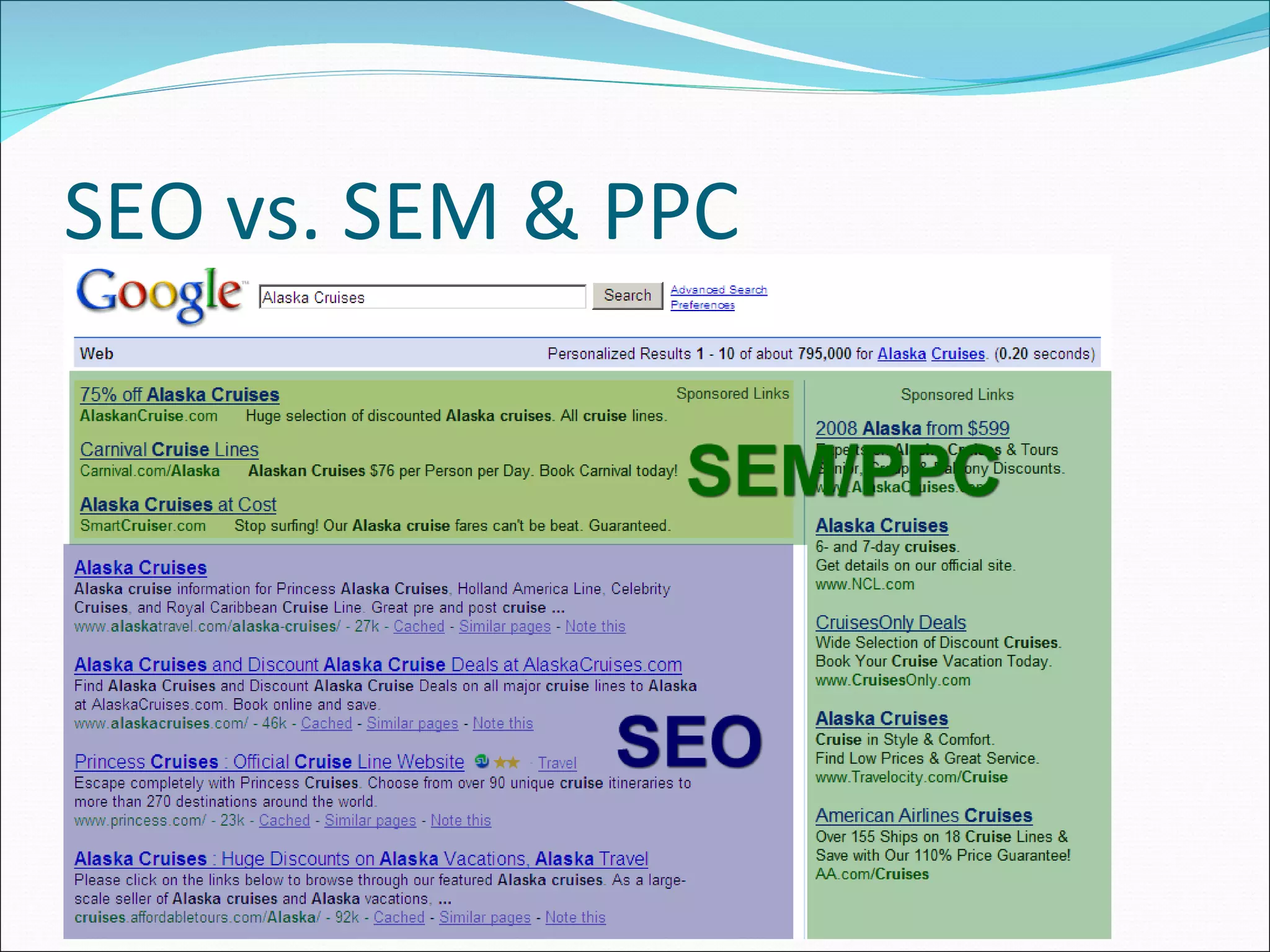
Then, what is Search Engine Marketing? The act of promoting content. The overall activity around using search engines to market a site or online entity. Includes: Search Engine Optimization Paid Inclusion Pay Per Click (PPC)
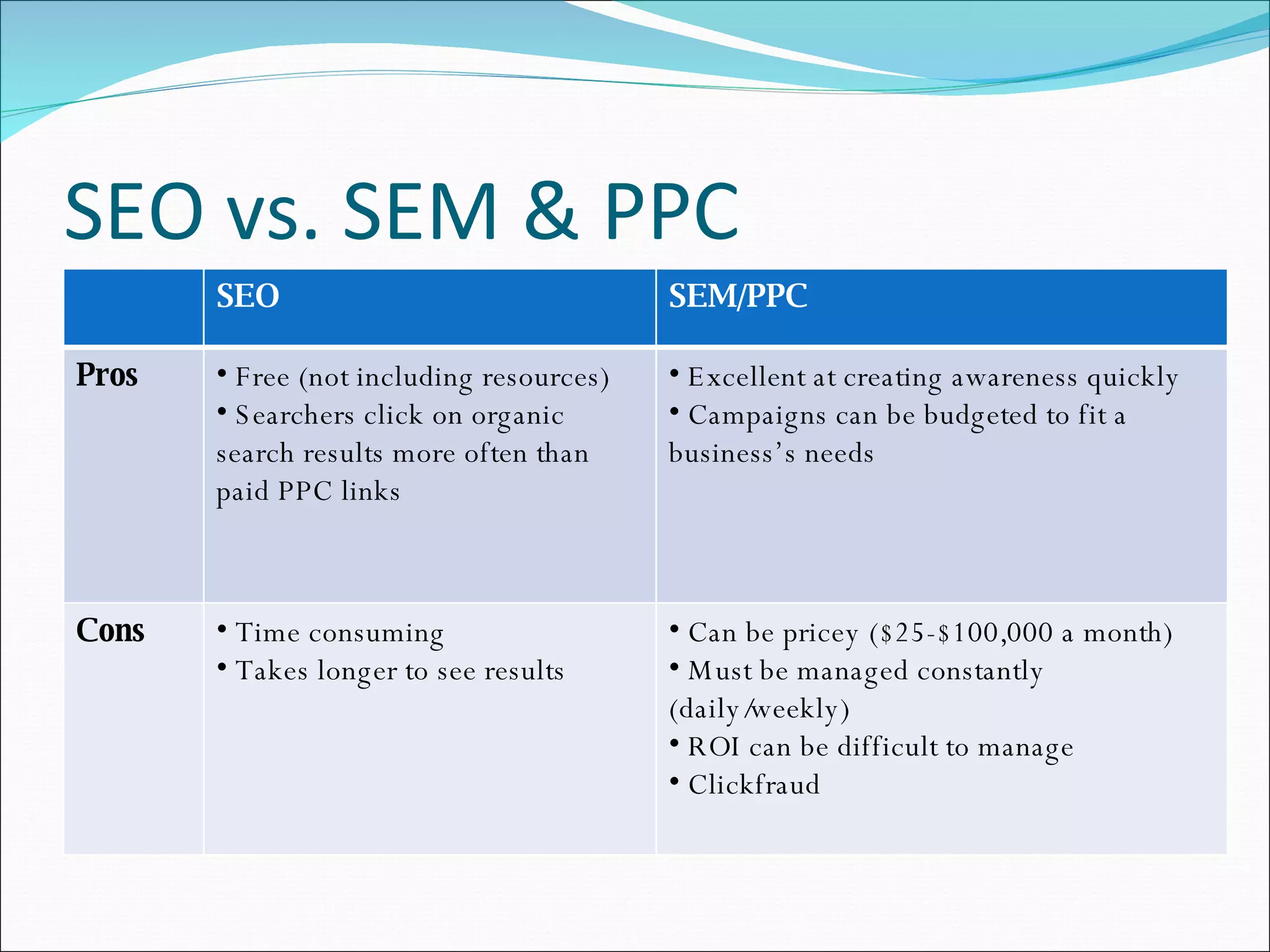
SEO vs. SEM & PPC
SEO vs. SEM & PPC SEO SEM/PPC Pros Free (not including resources)  Searchers click on organic search results more often than paid PPC links Excellent at creating awareness quickly Campaigns can be budgeted to fit a business’s needs Cons Time consuming Takes longer to see results Can be pricey ($25-$100,000 a month) Must be managed constantly (daily/weekly) ROI can be difficult to manage Clickfraud
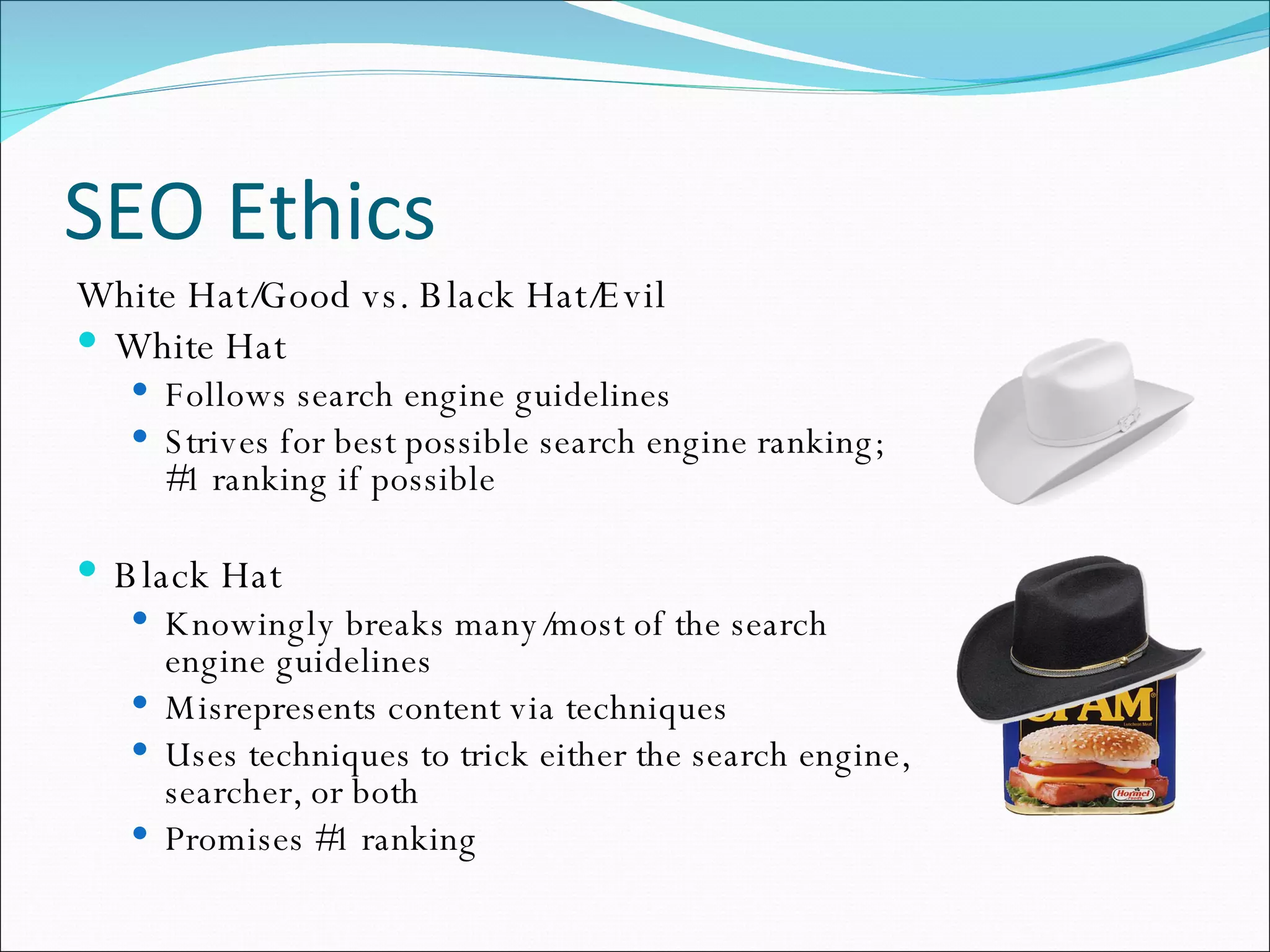
SEO Ethics White Hat/Good vs. Black Hat/Evil White Hat Follows search engine guidelines Strives for best possible search engine ranking; #1 ranking if possible Black Hat Knowingly breaks many/most of the search engine guidelines Misrepresents content via techniques Uses techniques to trick either the search engine, searcher, or both Promises #1 ranking
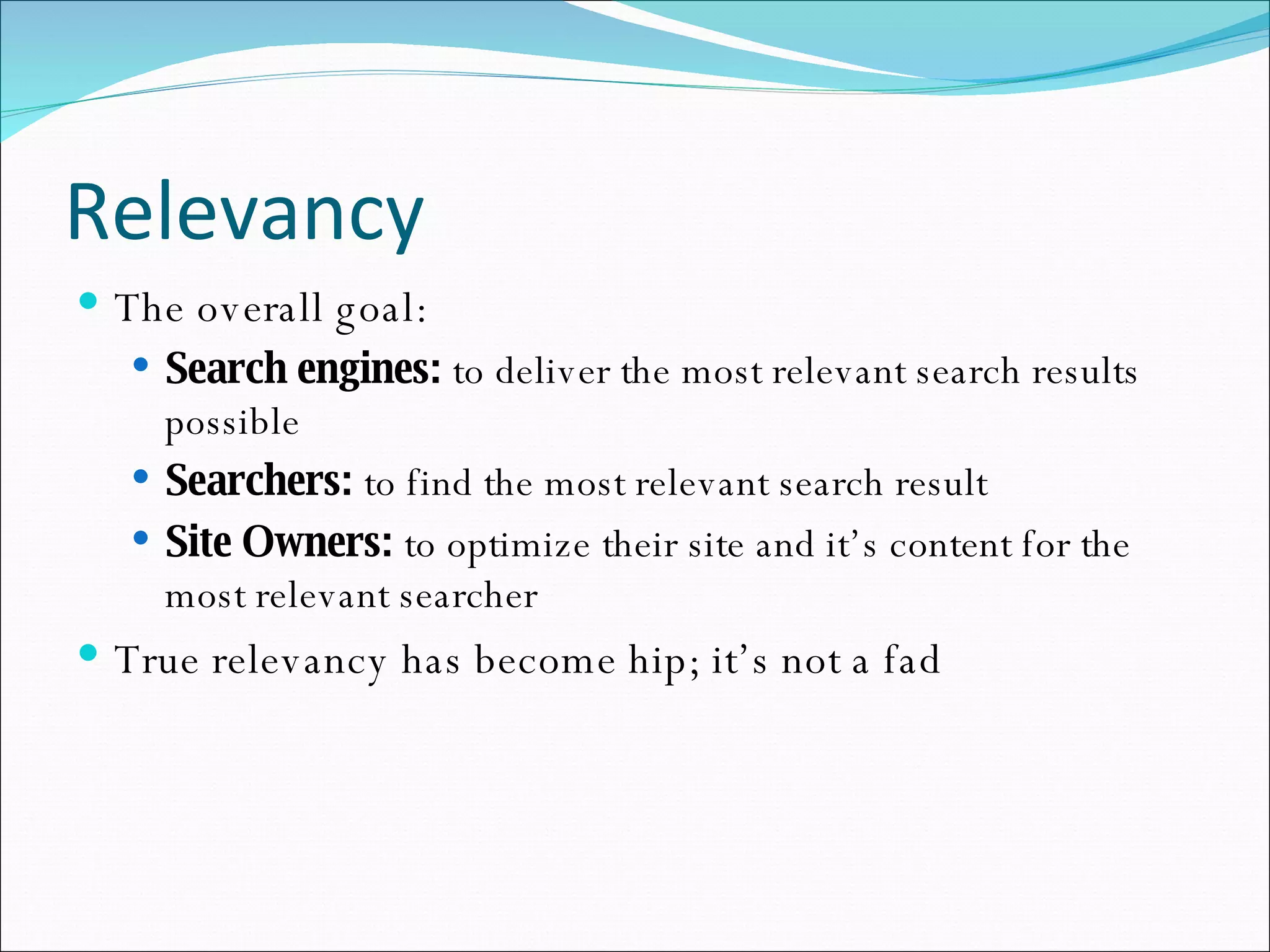
Relevancy The overall goal: Search engines:  to deliver the most relevant search results possible Searchers:  to find the most relevant search result Site Owners:  to optimize their site and it’s content for the most relevant searcher True relevancy has become hip; it’s not a fad
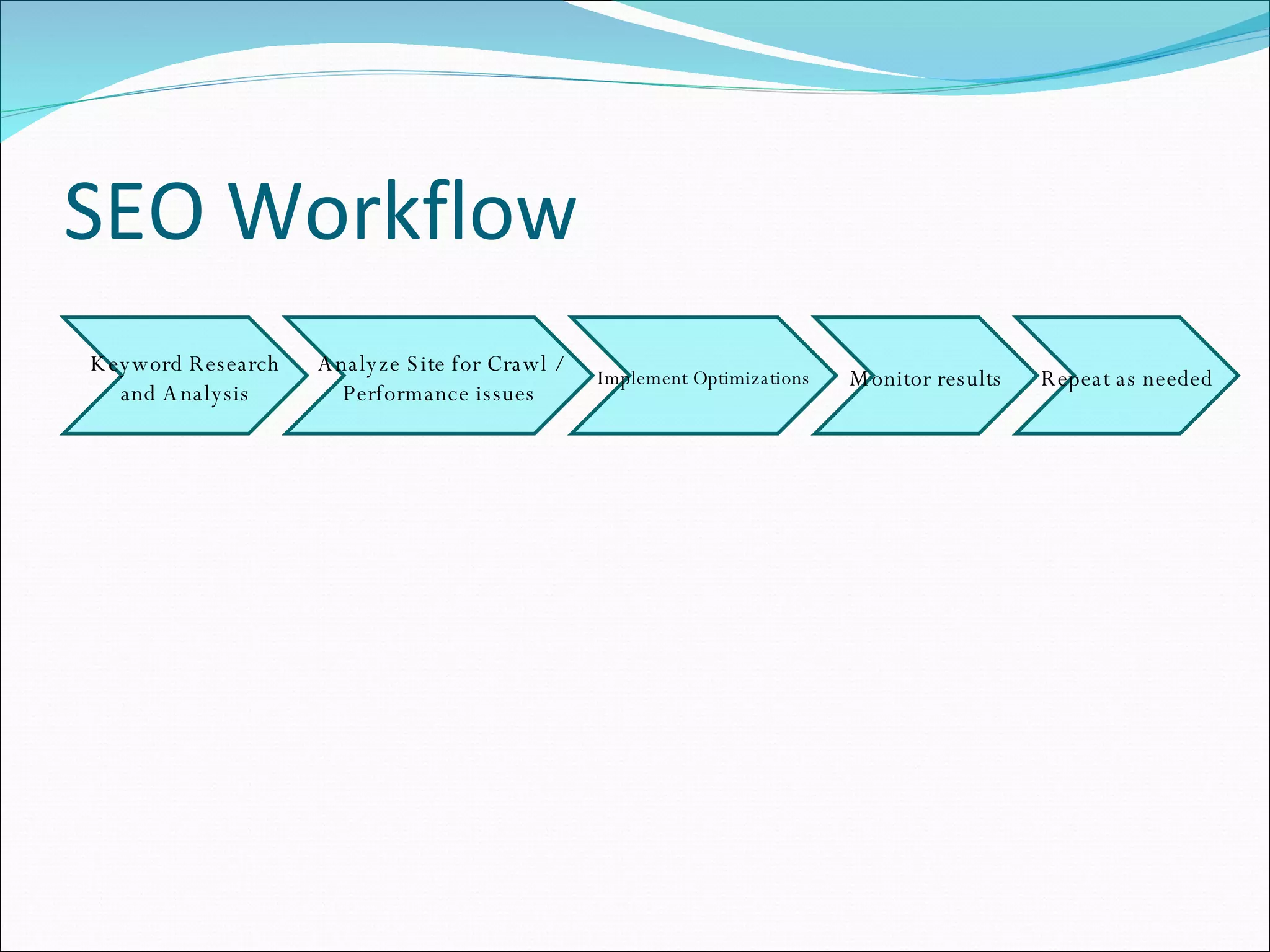
SEO Workflow Keyword Research and Analysis Analyze Site for Crawl / Performance issues Implement Optimizations Monitor results Repeat as needed
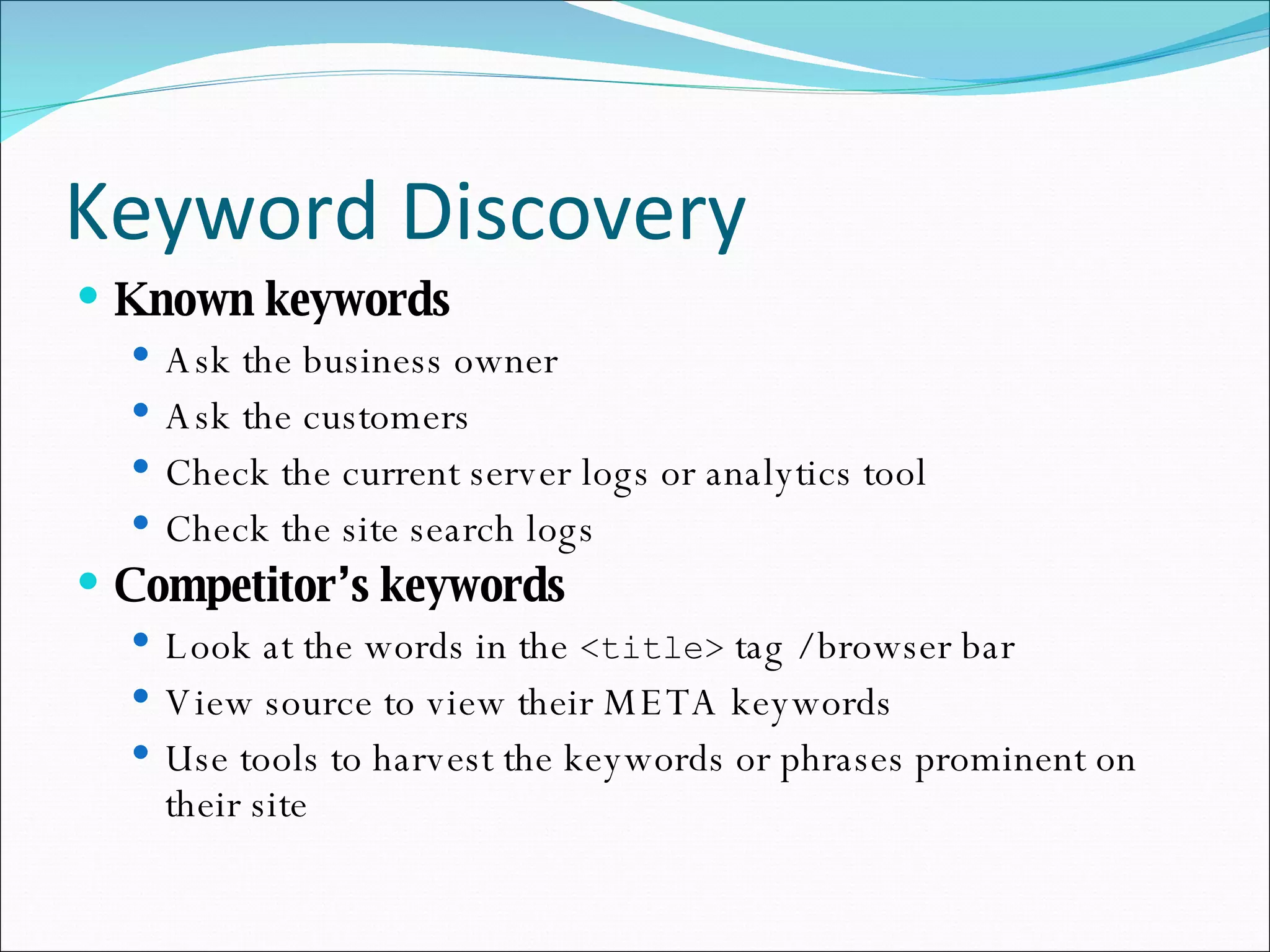
Keywords The core of Search Engine Optimization Keywords are the terms used by searchers to find information The goal is to leverage and implement the same keywords throughout your content in a natural manner, to match the audience who’s searching for your information and you’re looking to attract Keyword discovery and analysis is never ending
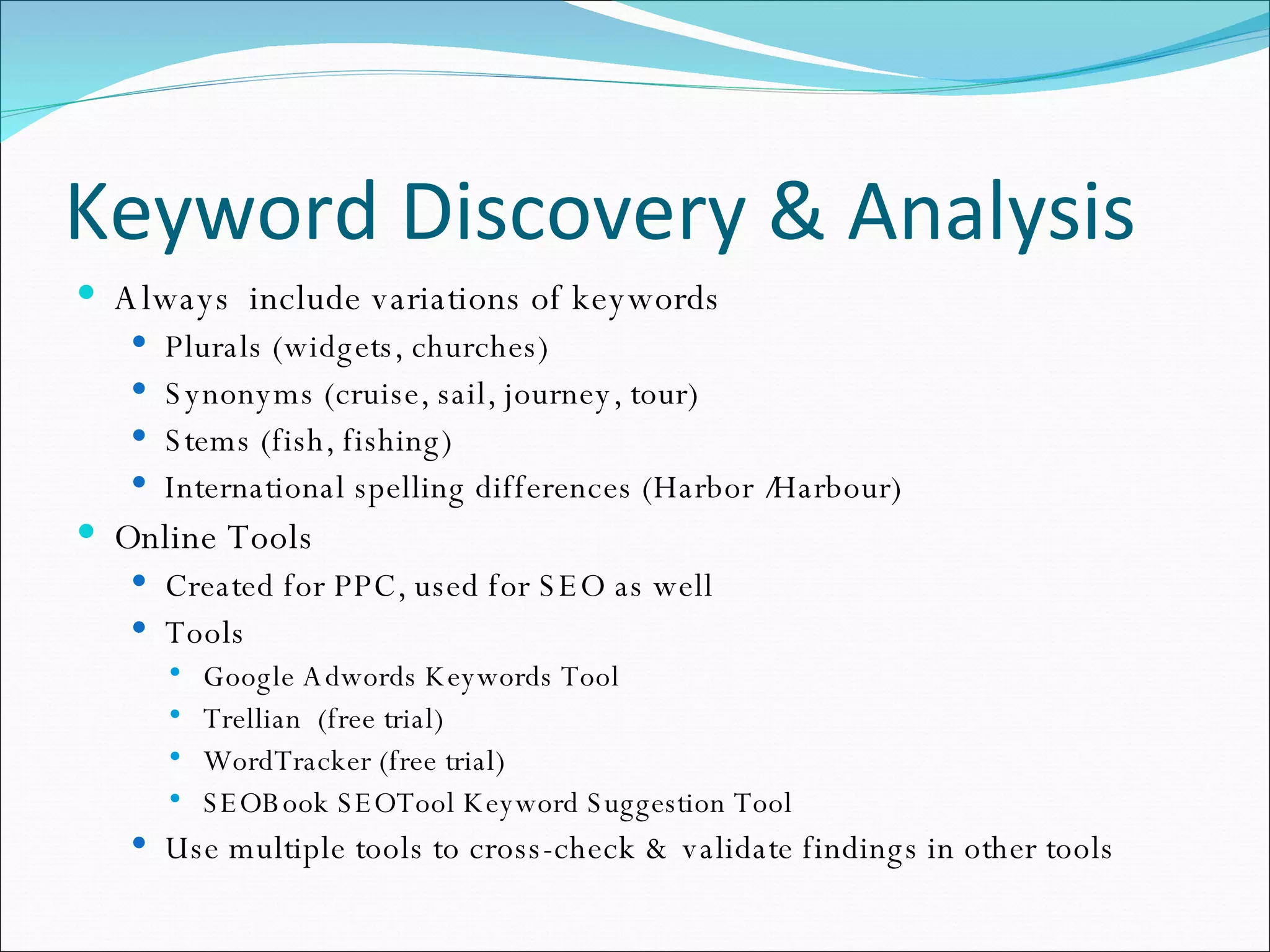
Keyword Discovery Known keywords Ask the business owner Ask the customers Check the current server logs or analytics tool Check the site search logs Competitor’s keywords Look at the words in the  <title>  tag / browser bar View source to view their META keywords Use tools to harvest the keywords or phrases prominent on their site
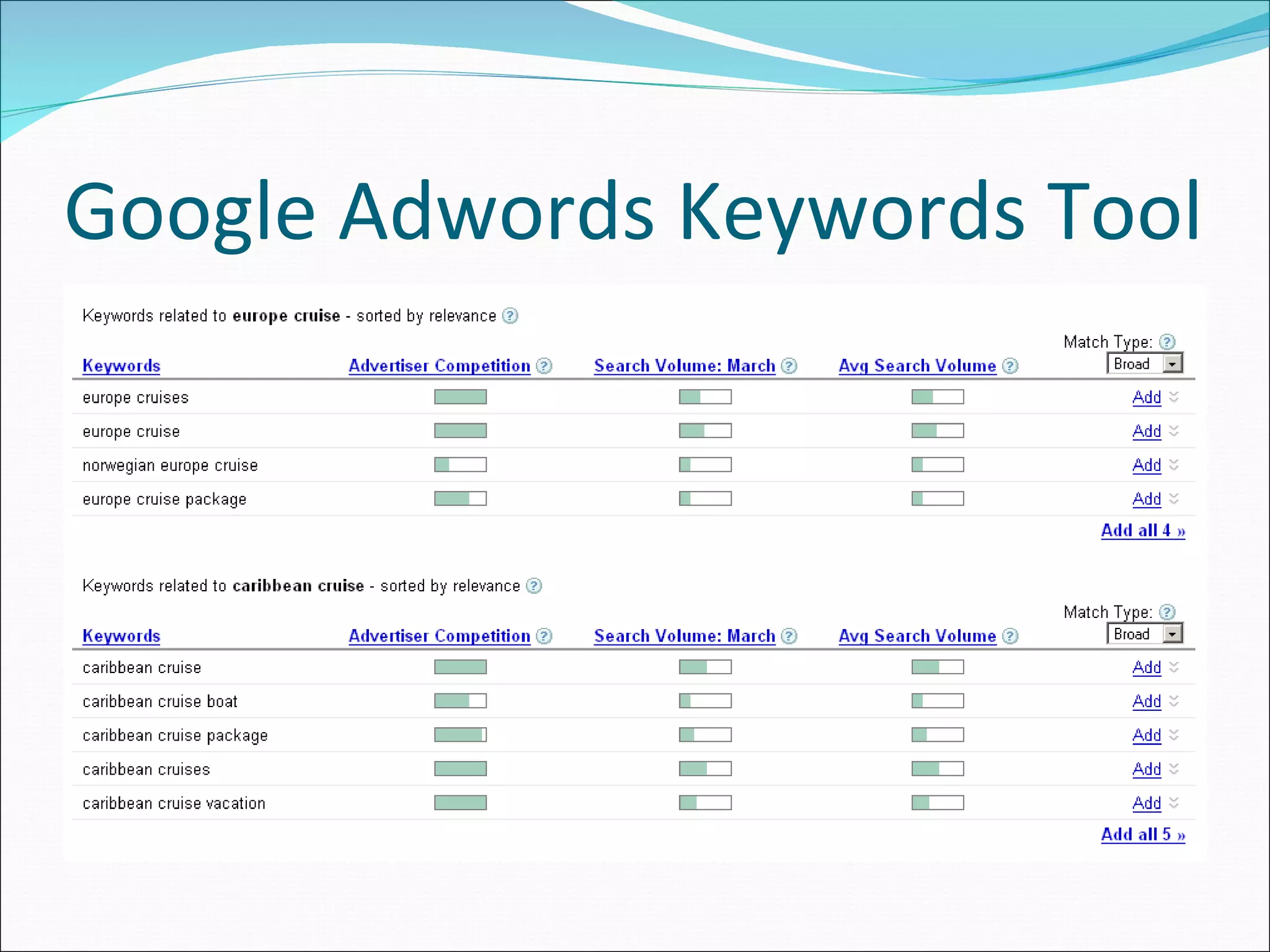
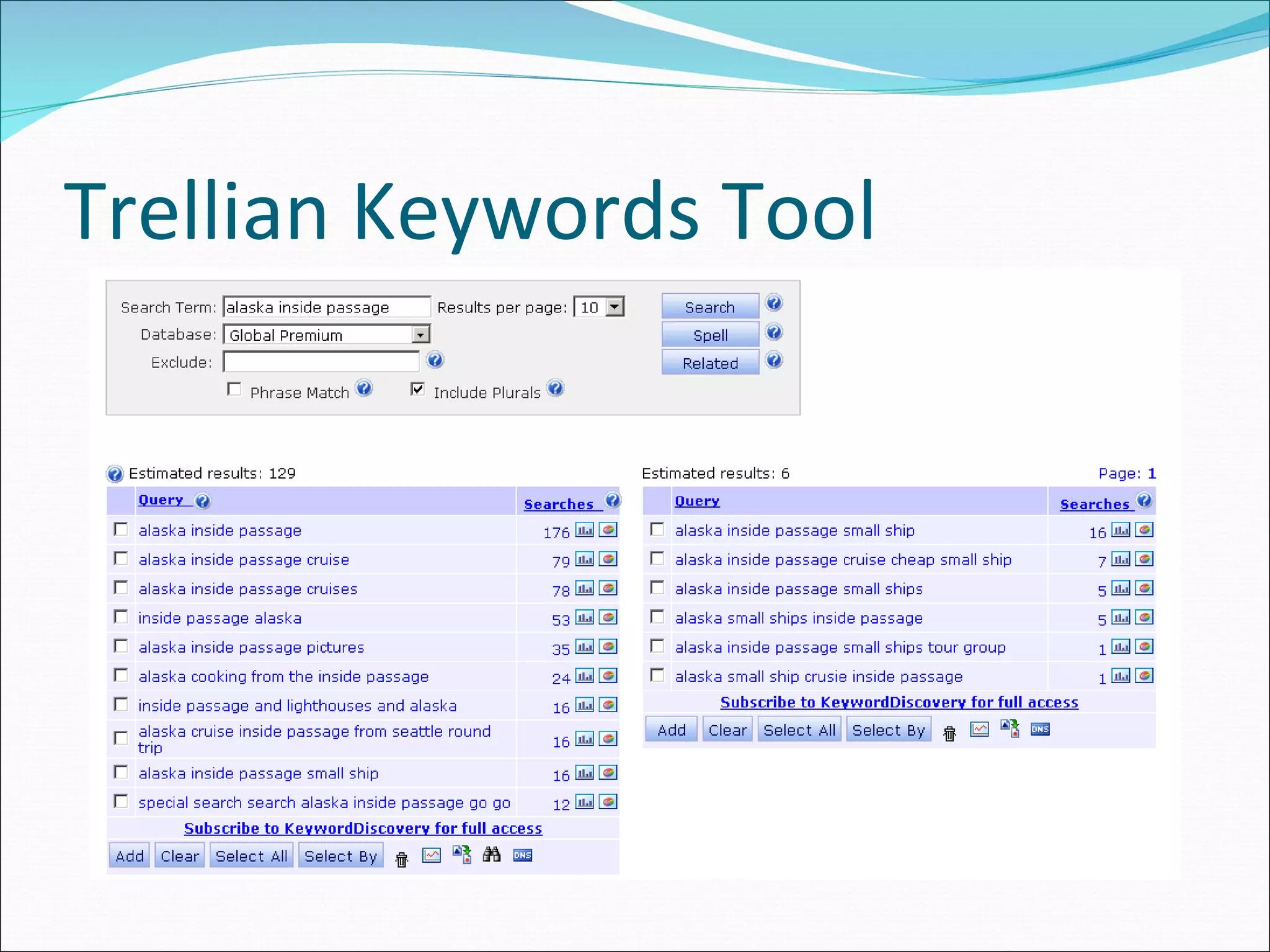
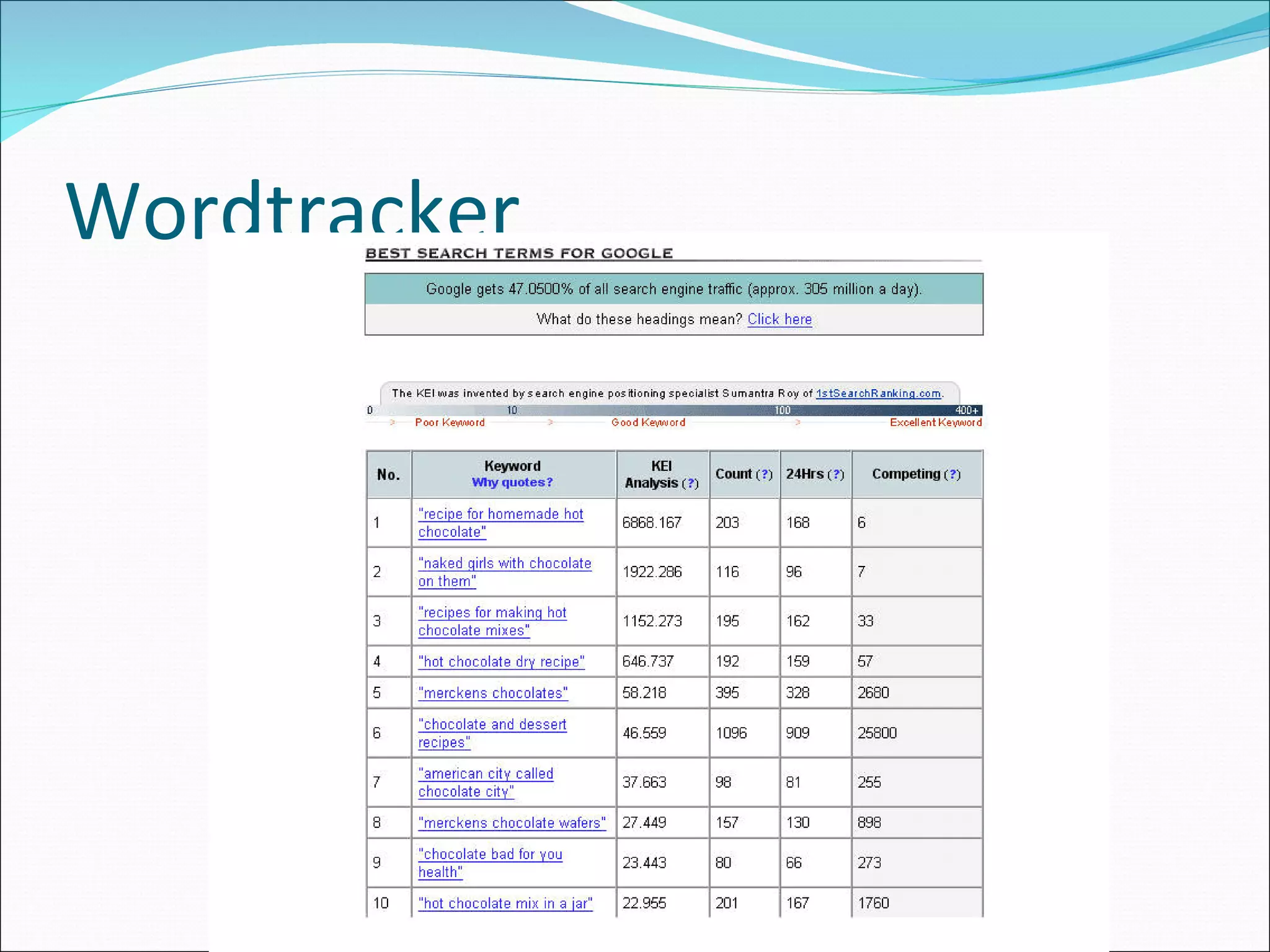
Keyword Discovery & Analysis Always  include variations of keywords Plurals (widgets, churches) Synonyms (cruise, sail, journey, tour) Stems (fish, fishing) International spelling differences (Harbor /Harbour) Online Tools Created for PPC, used for SEO as well Tools Google Adwords Keywords Tool Trellian  (free trial) WordTracker (free trial) SEOBook SEOTool Keyword Suggestion Tool Use multiple tools to cross-check & validate findings in other tools
Google Adwords Keywords Tool
Trellian Keywords Tool
Wordtracker
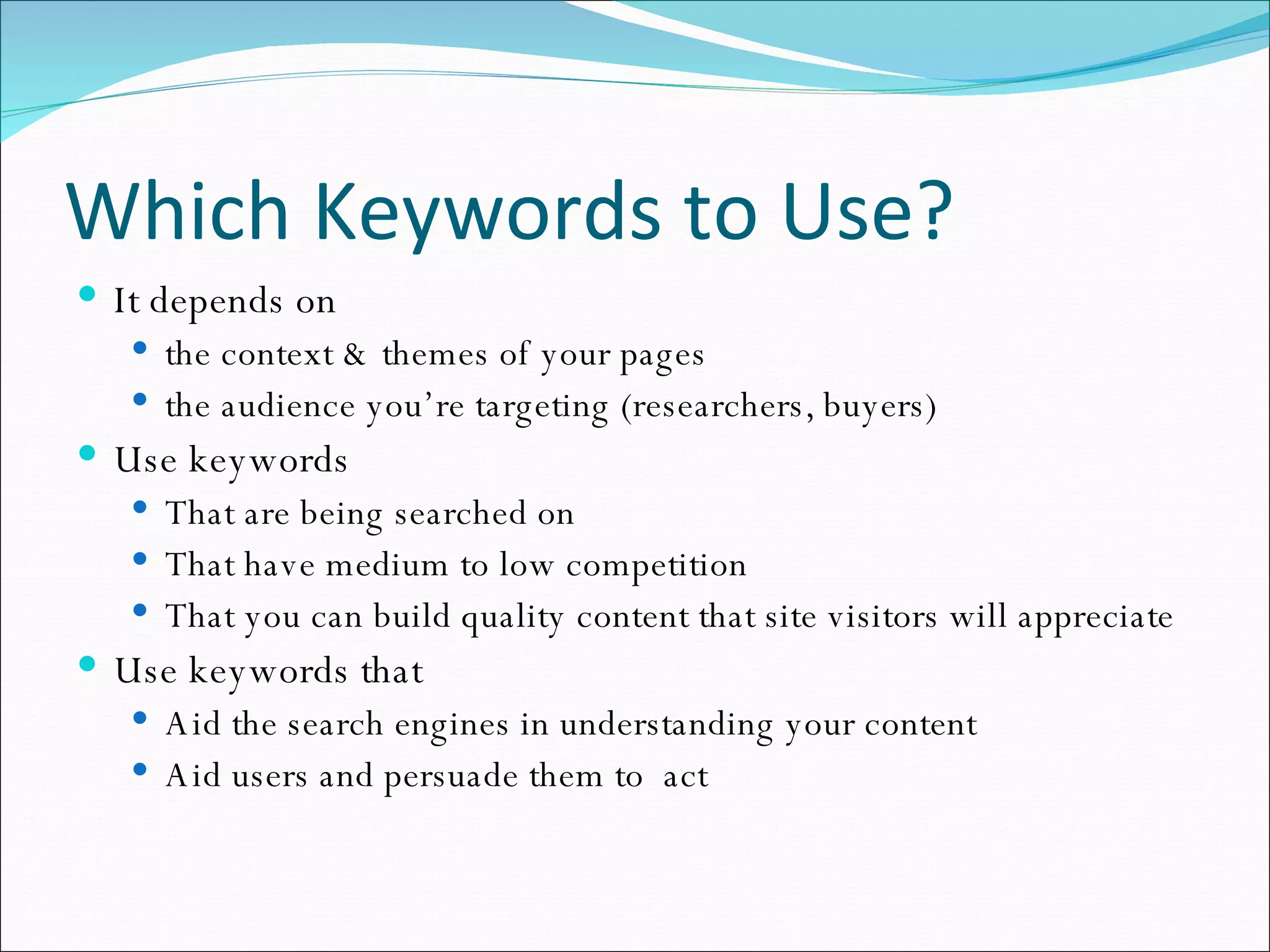
Which Keywords to Use? It depends on  the context & themes of your pages the audience you’re targeting (researchers, buyers) Use keywords That are being searched on That have medium to low competition That you can build quality content that site visitors will appreciate  Use keywords that Aid the search engines in understanding your content Aid users and persuade them to  act
Organize Site/Content in Themes Possible direction of search engines to determine relevancy Site/folder structure Content text Link text
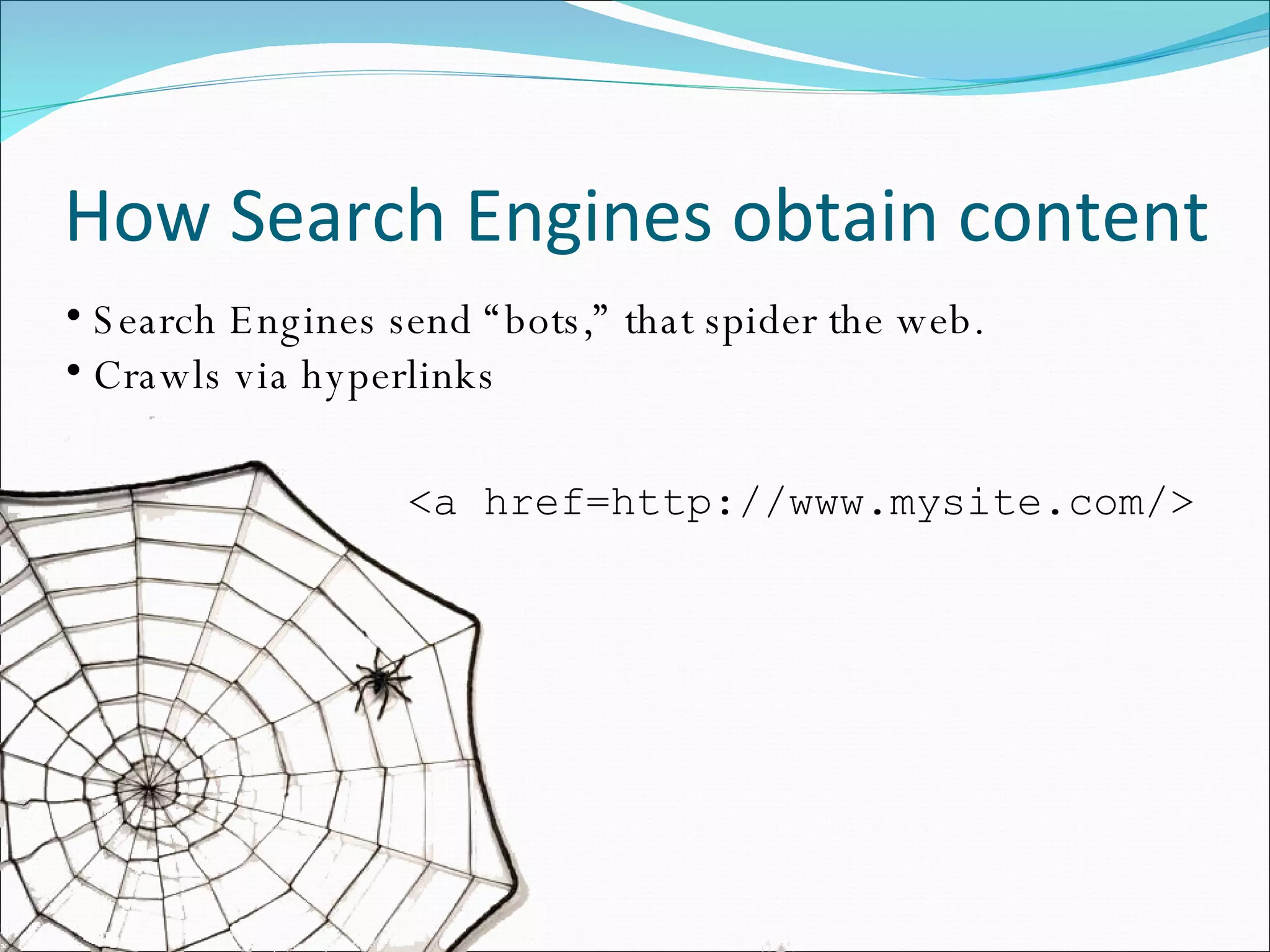
How Search Engines obtain content Search Engines send “bots,” that spider the web. Crawls via hyperlinks <a href=http://www.mysite.com/>
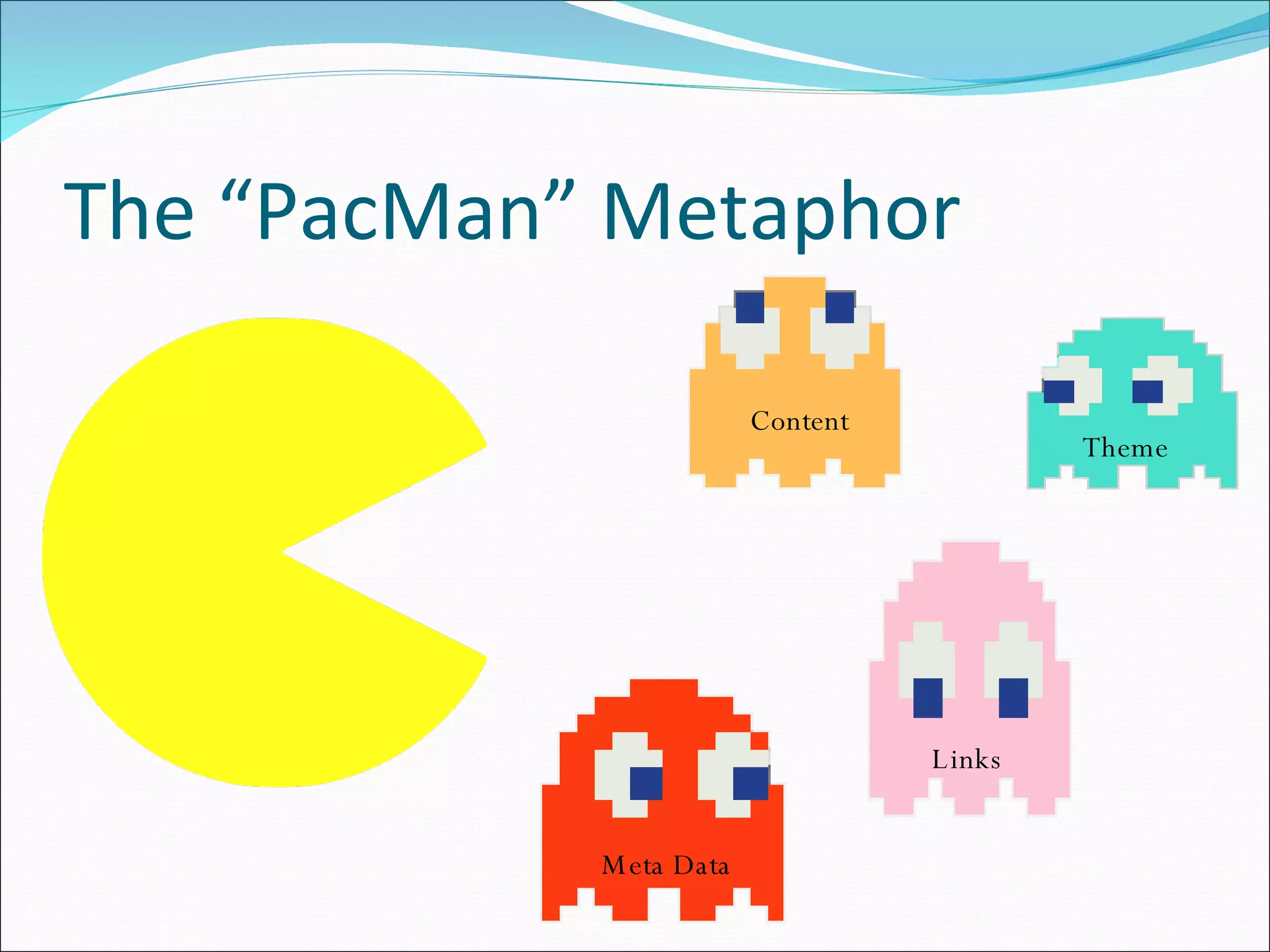
The “PacMan” Metaphor Content Meta Data Links Theme
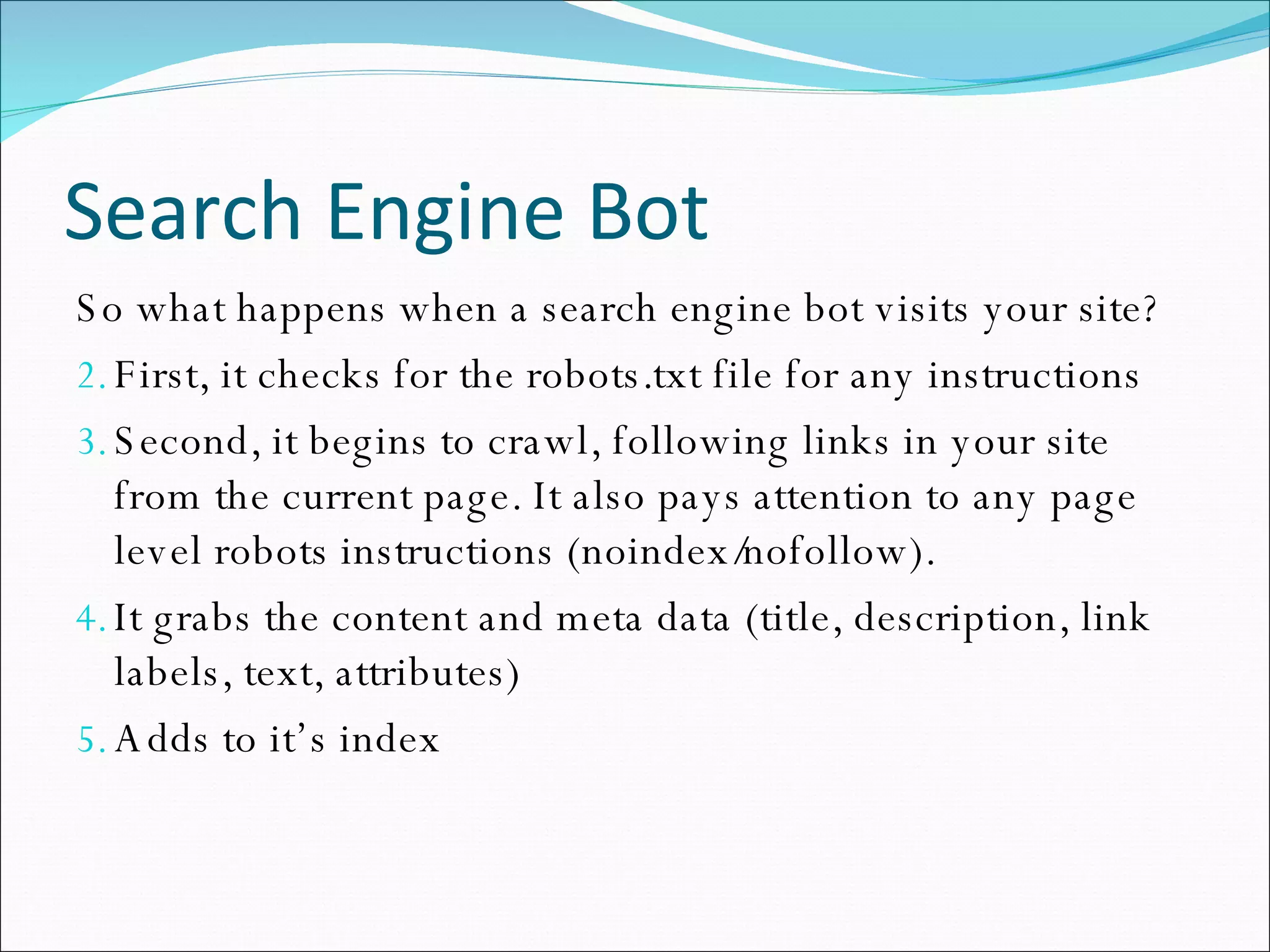
Search Engine Bot So what happens when a search engine bot visits your site? First, it checks for the robots.txt file for any instructions Second, it begins to crawl, following links in your site from the current page. It also pays attention to any page level robots instructions (noindex/nofollow). It grabs the content and meta data (title, description, link labels, text, attributes) Adds to it’s index
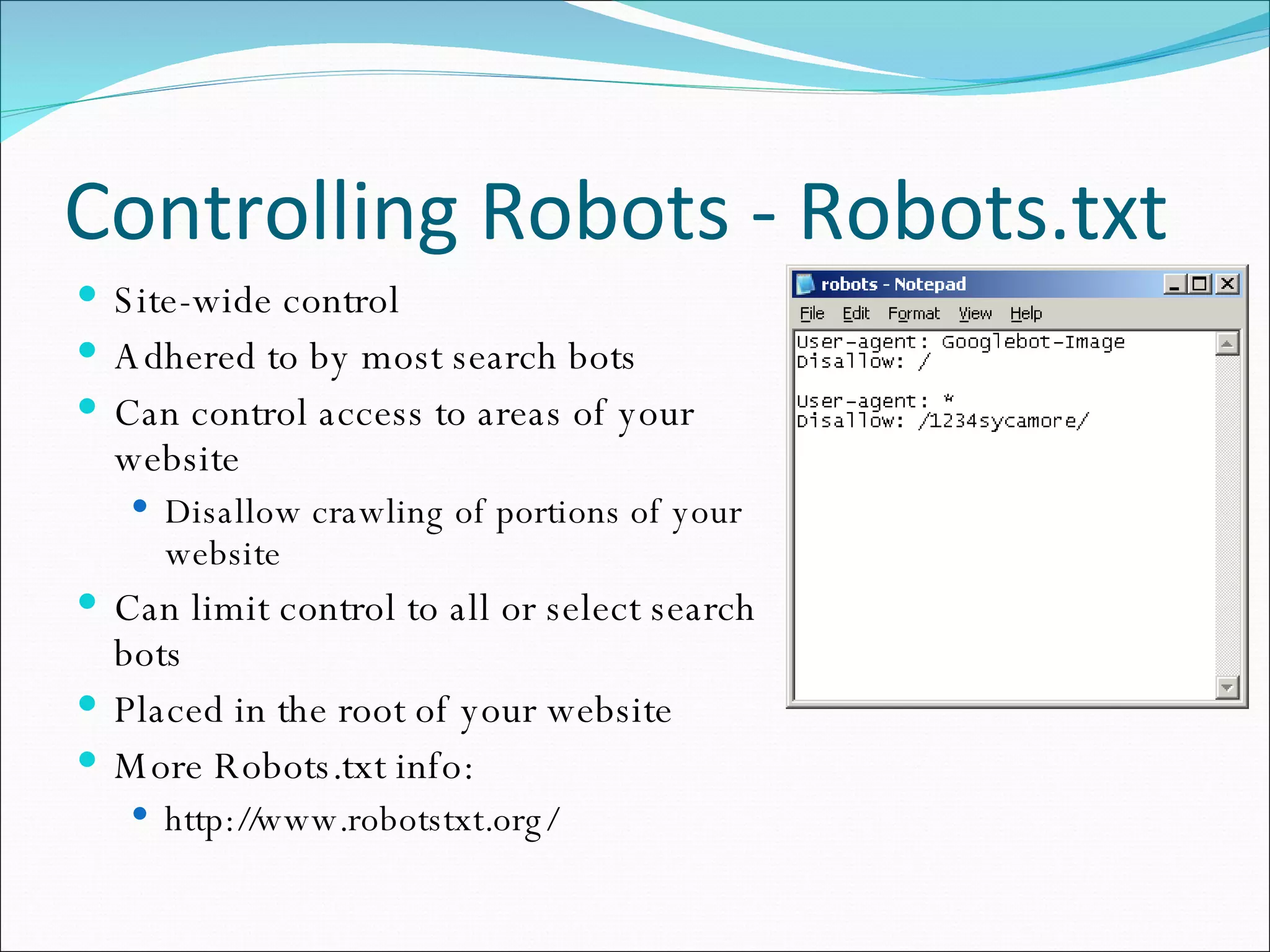
Controlling Robots - Robots.txt Site-wide control Adhered to by most search bots Can control access to areas of your website Disallow crawling of portions of your website Can limit control to all or select search bots Placed in the root of your website More Robots.txt info: http://www.robotstxt.org/
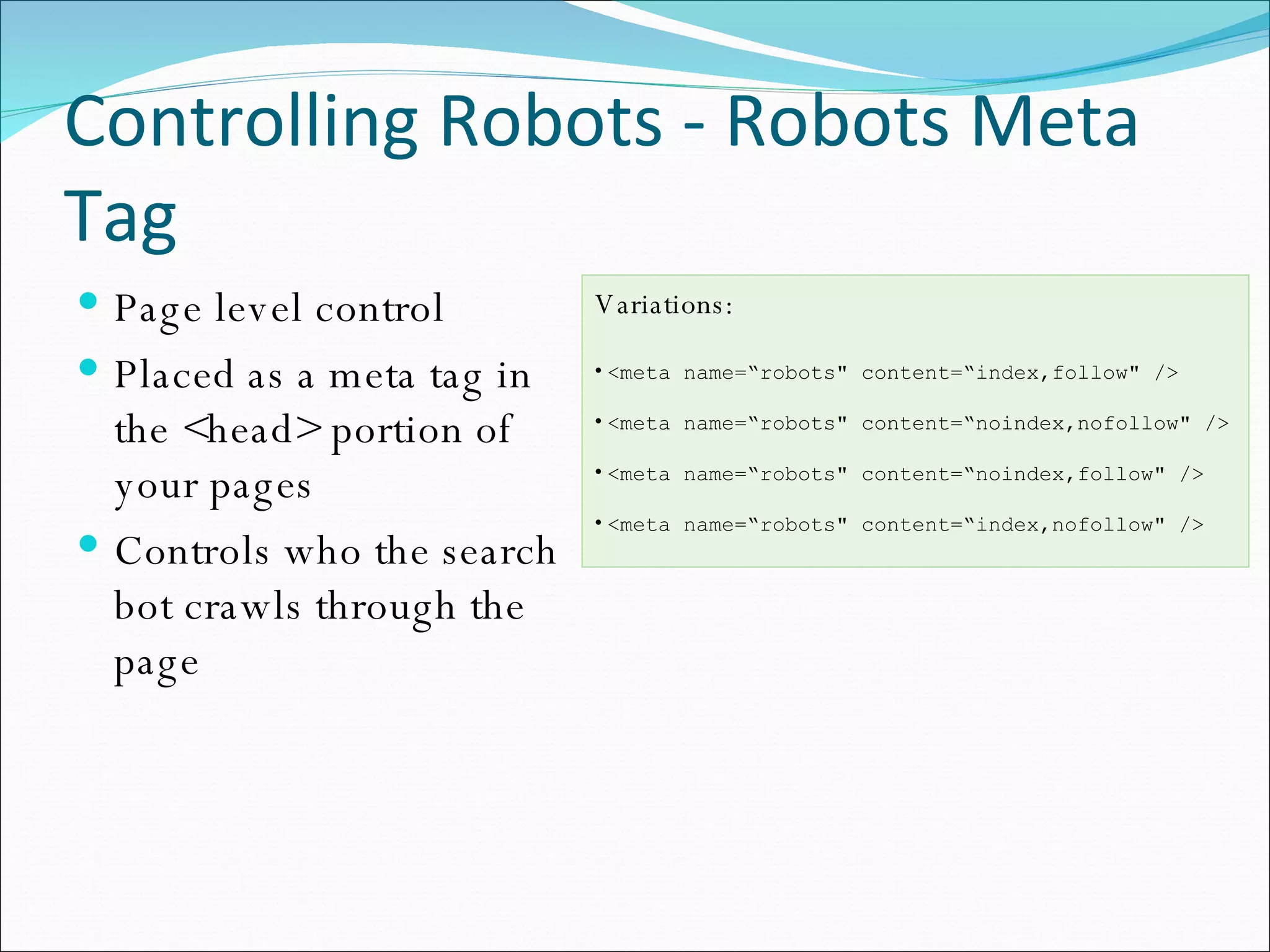
Controlling Robots - Robots Meta Tag Page level control Placed as a meta tag in the <head> portion of your pages Controls who the search bot crawls through the page Variations: <meta name=“robots&quot; content=“index,follow&quot; /> <meta name=“robots&quot; content=“noindex,nofollow&quot; /> <meta name=“robots&quot; content=“noindex,follow&quot; /> <meta name=“robots&quot; content=“index,nofollow&quot; />
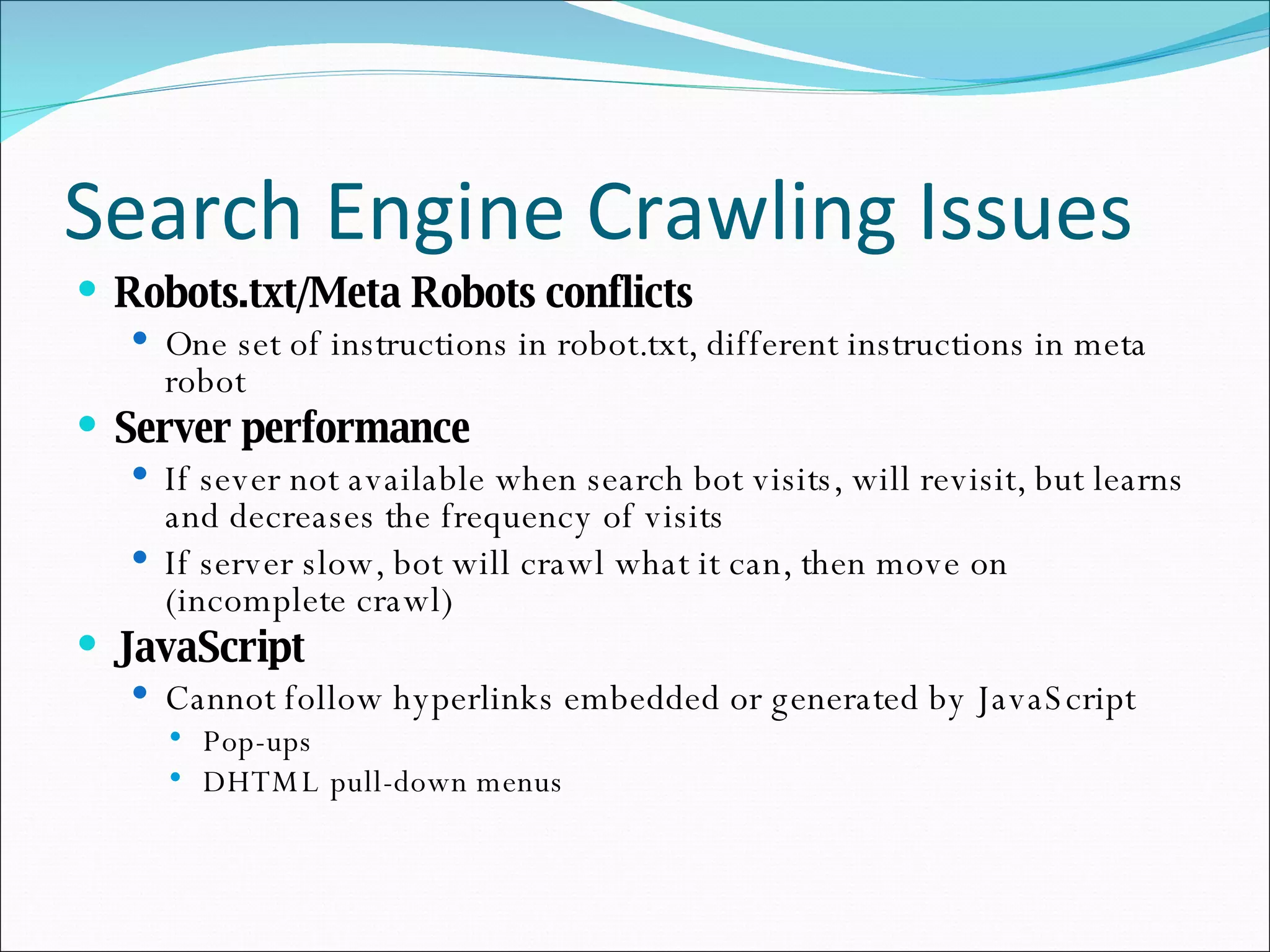
Search Engine Crawling Issues Robots.txt/Meta Robots conflicts One set of instructions in robot.txt, different instructions in meta robot Server performance If sever not available when search bot visits, will revisit, but learns and decreases the frequency of visits If server slow, bot will crawl what it can, then move on (incomplete crawl) JavaScript Cannot follow hyperlinks embedded or generated by JavaScript Pop-ups DHTML pull-down menus
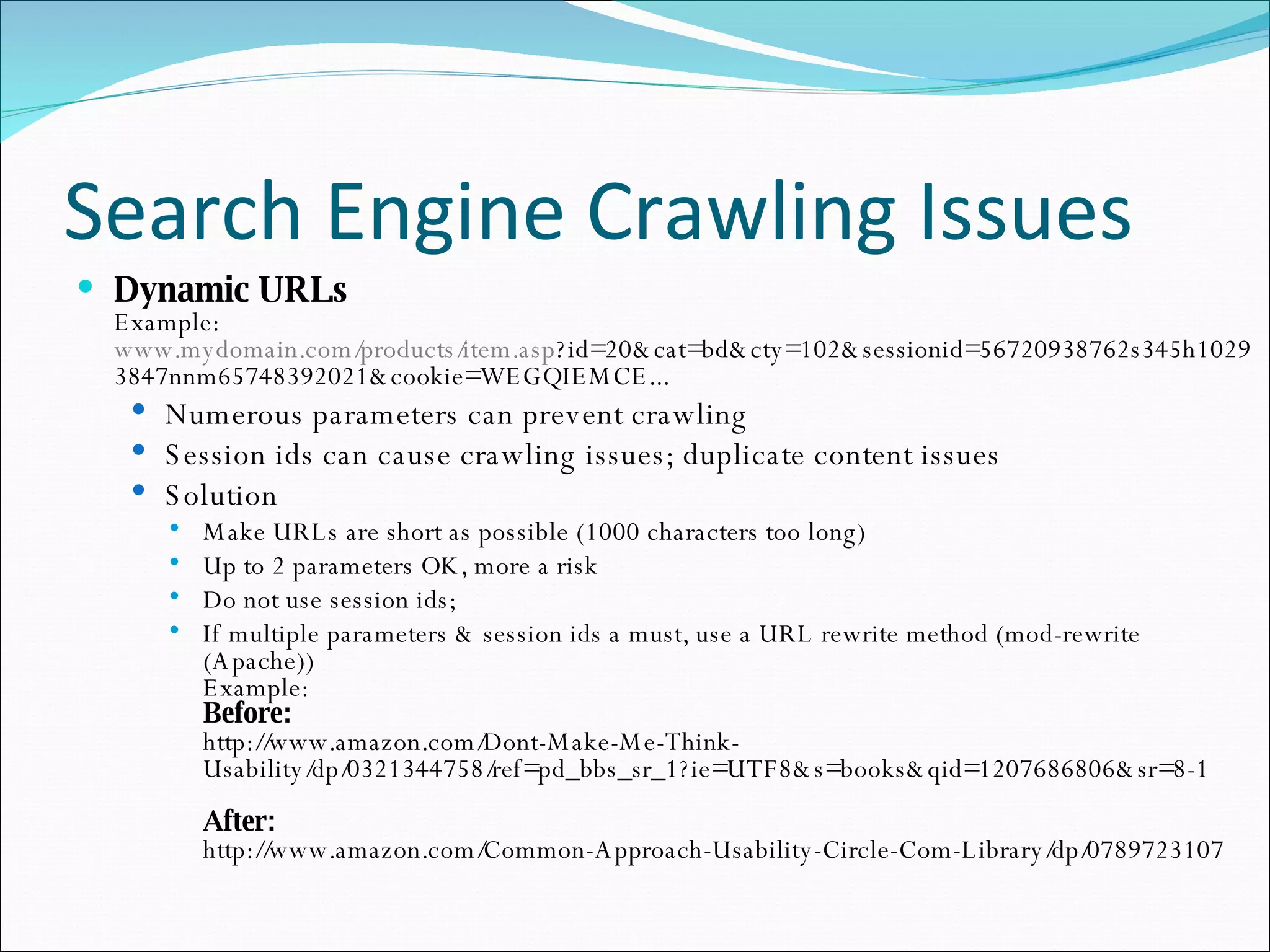
Search Engine Crawling Issues Dynamic URLs Example: www.mydomain.com/products/item.asp ?id=20&cat=bd&cty=102&sessionid=56720938762s345h10293847nnm65748392021&cookie=WEGQIEMCE... Numerous parameters can prevent crawling Session ids can cause crawling issues; duplicate content issues Solution Make URLs are short as possible (1000 characters too long) Up to 2 parameters OK, more a risk Do not use session ids;  If multiple parameters & session ids a must, use a URL rewrite method (mod-rewrite (Apache)) Example: Before:  http://www.amazon.com/Dont-Make-Me-Think-Usability/dp/0321344758/ref=pd_bbs_sr_1?ie=UTF8&s=books&qid=1207686806&sr=8-1 After: http://www.amazon.com/Common-Approach-Usability-Circle-Com-Library/dp/0789723107
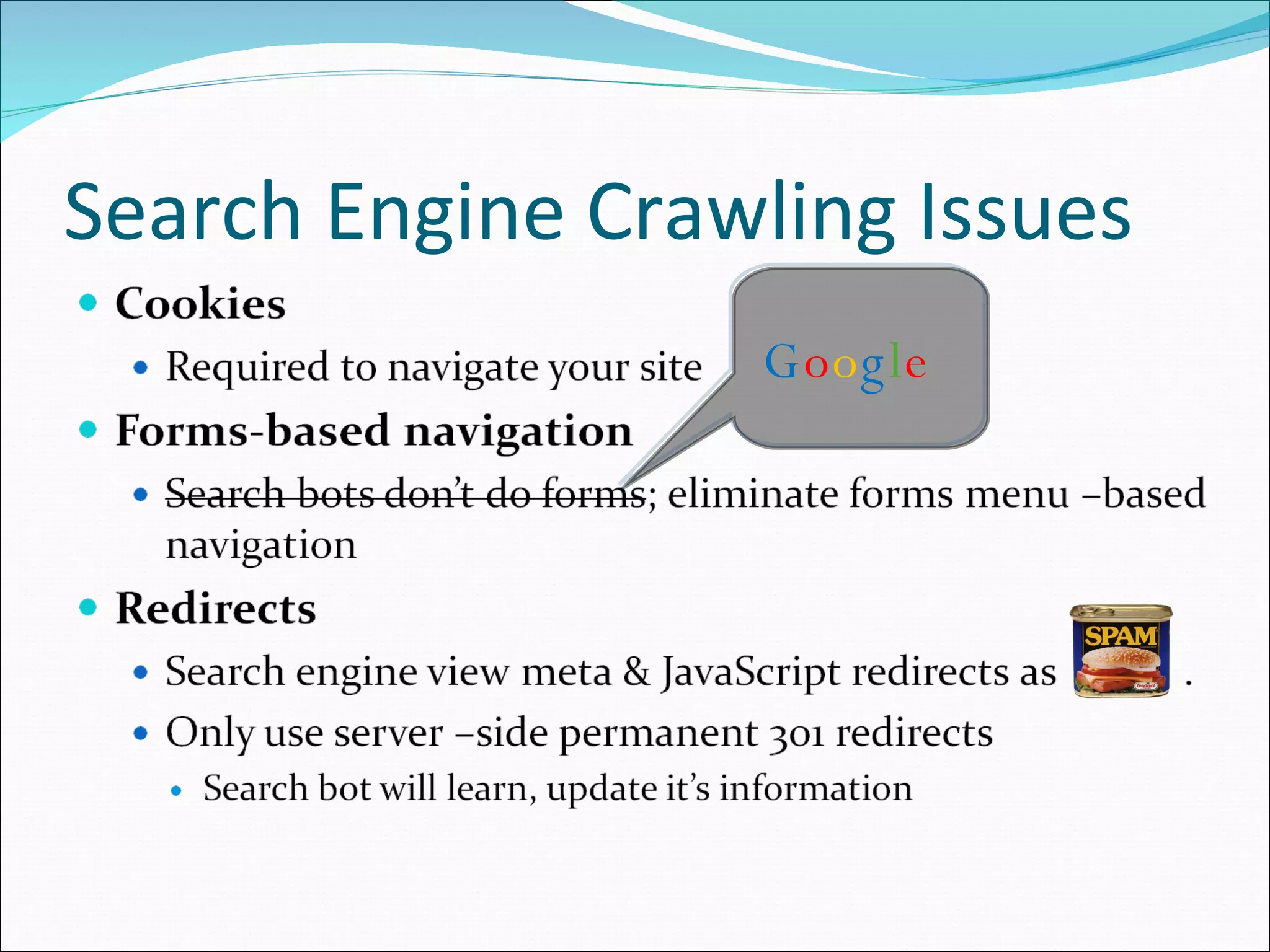
Search Engine Crawling Issues G o o g l e
Search Engine Crawling Issues
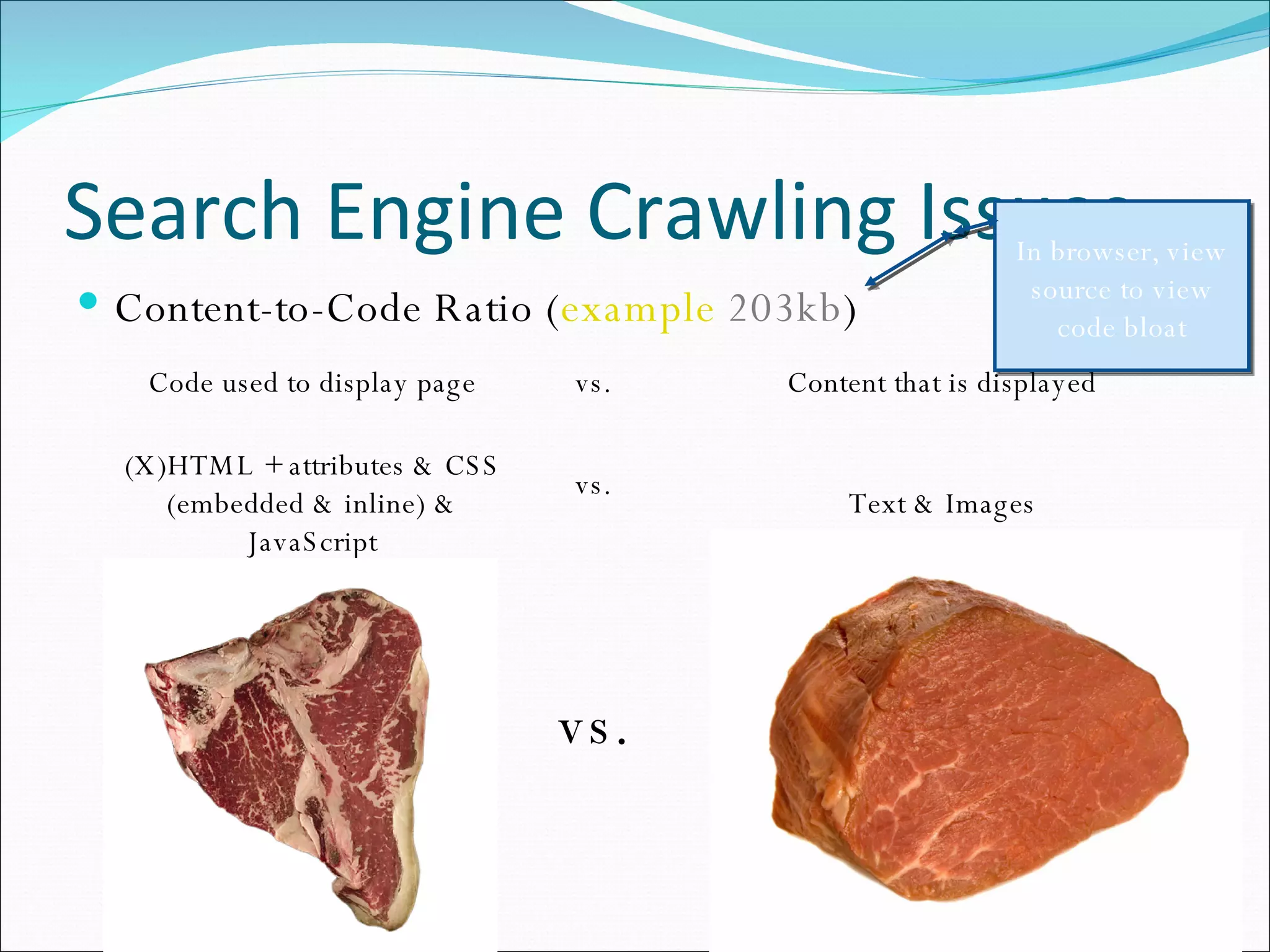
Search Engine Crawling Issues Content-to-Code Ratio ( example   203kb ) In browser, view source to view code bloat Code used to display page vs. Content that is displayed (X)HTML + attributes & CSS (embedded & inline) & JavaScript vs. Text & Images vs.
Search Engine Indexing How to: Obtain links to your site from authoritative sources Will get crawled/indexed organically Submit your site to the search engines Google Yahoo MSN Ask (?) What about the others? Monitor your indexed pages
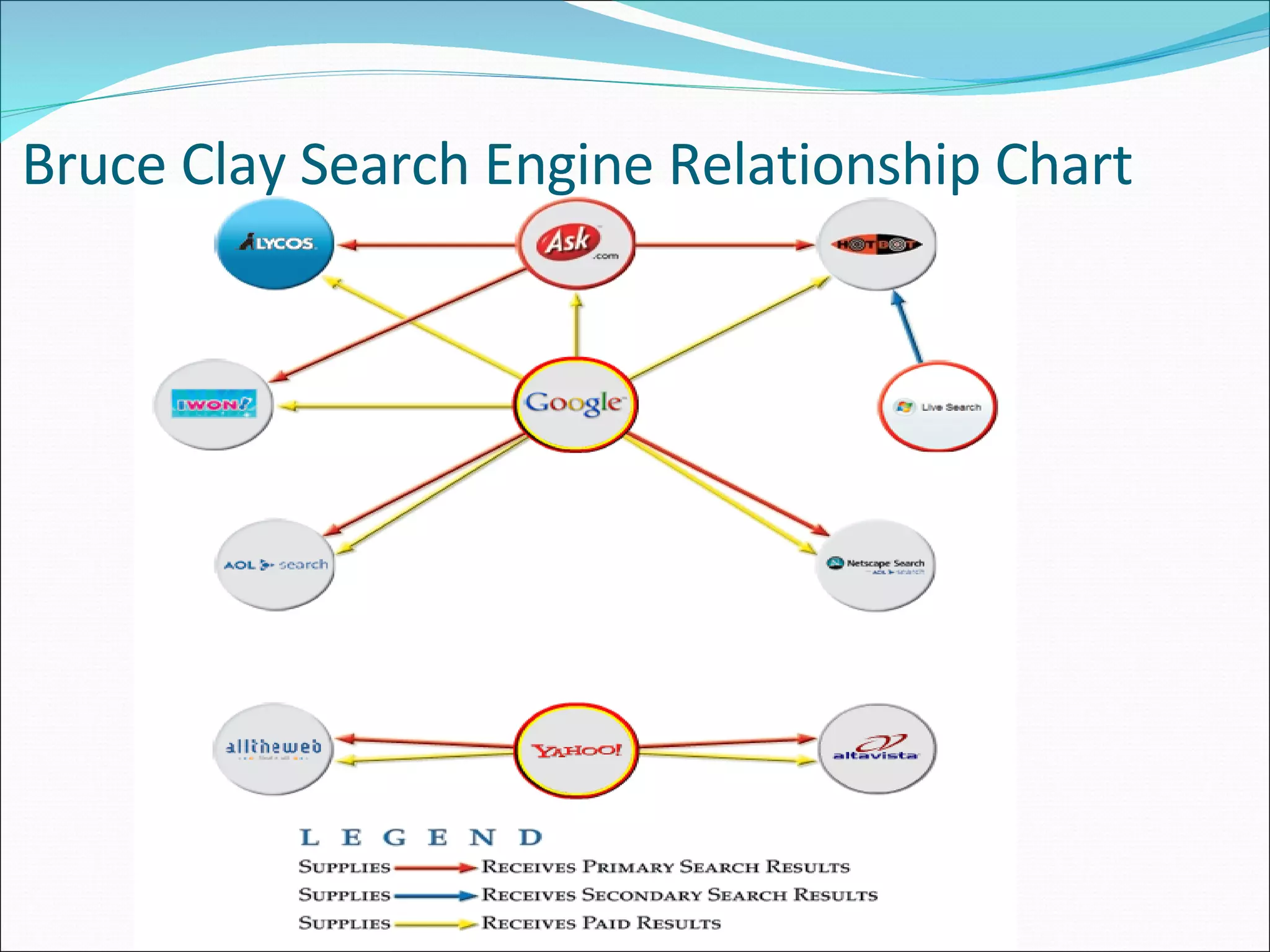
Bruce Clay Search Engine Relationship Chart
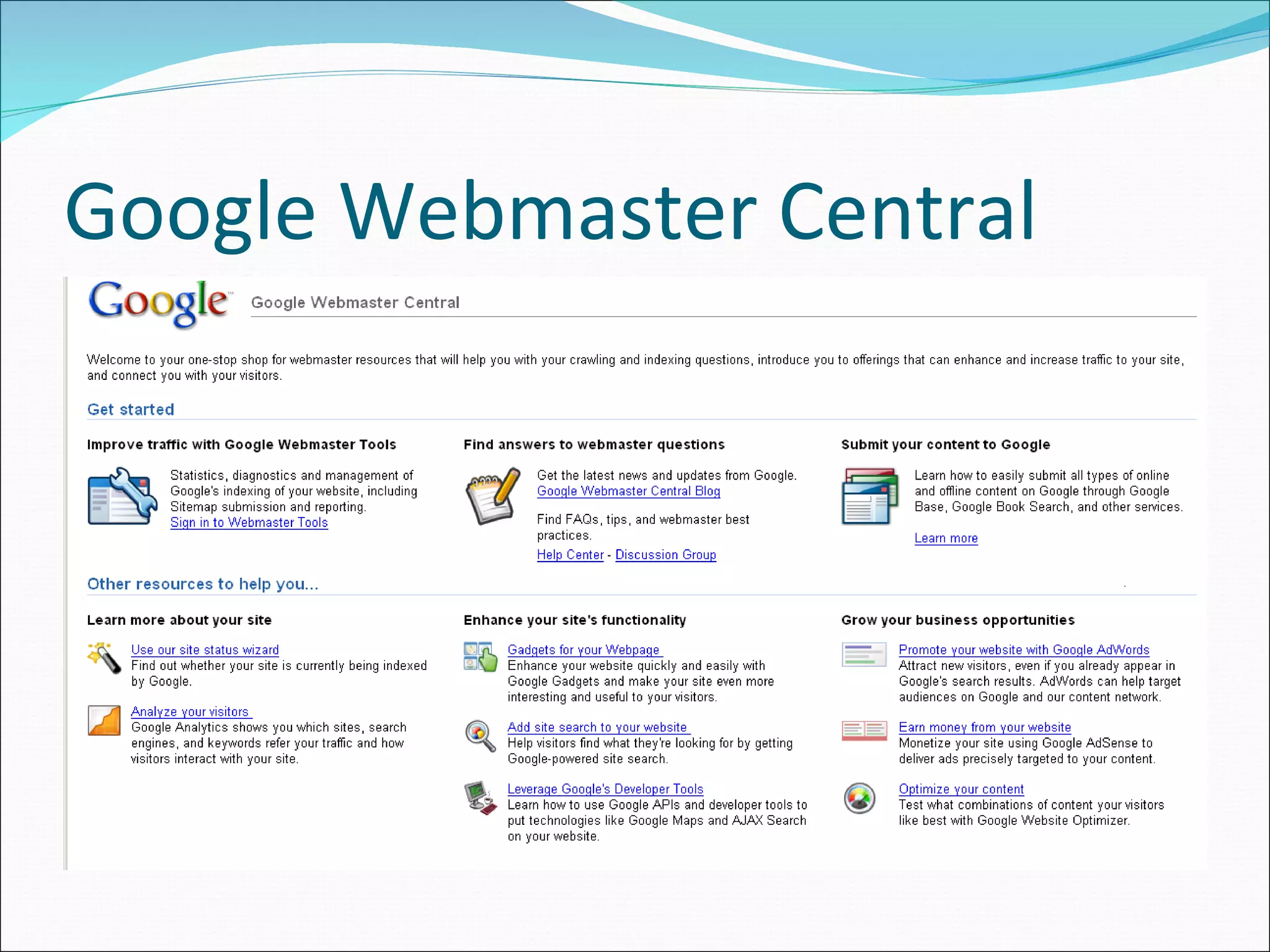
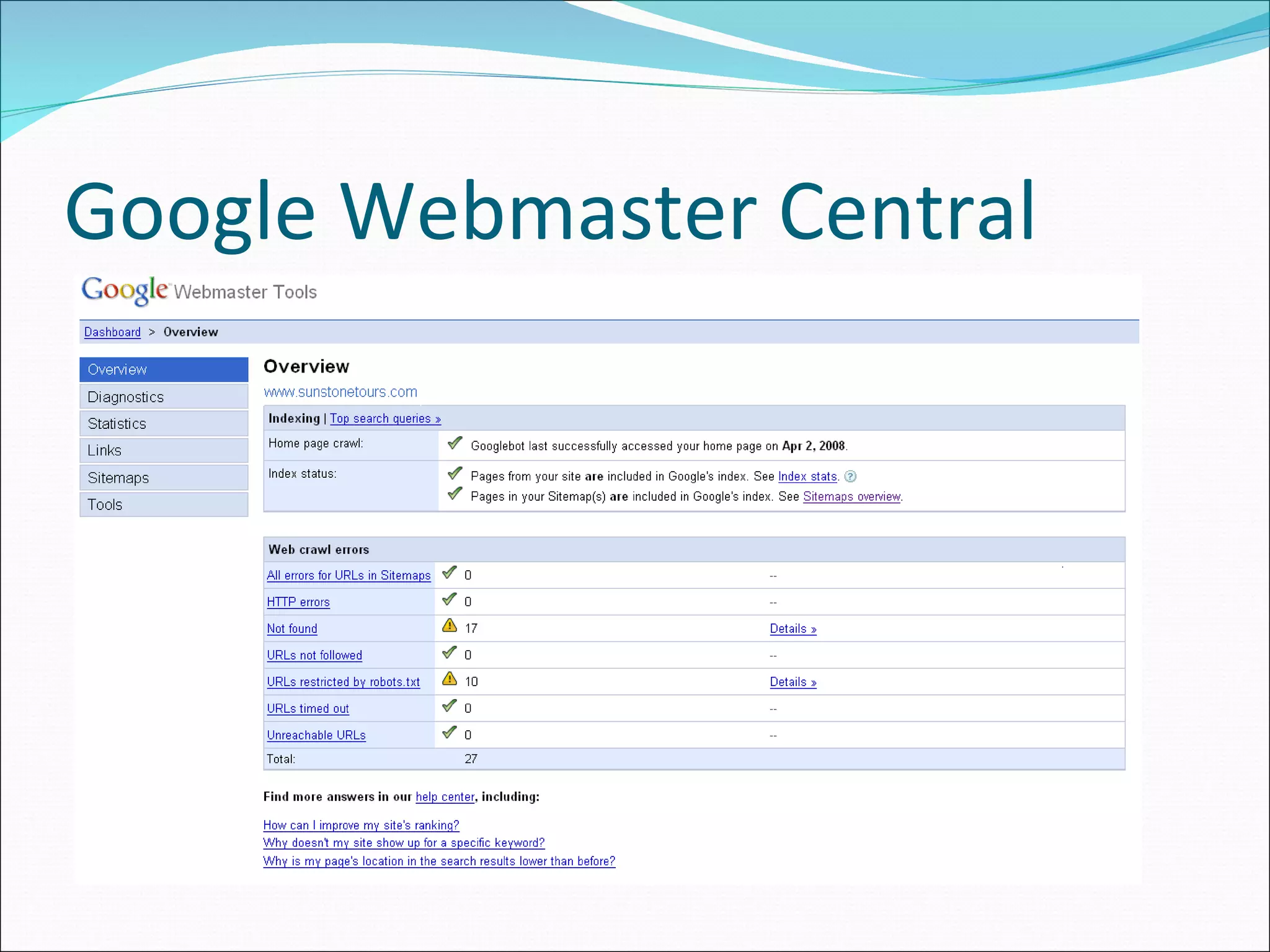
Google Webmaster Central
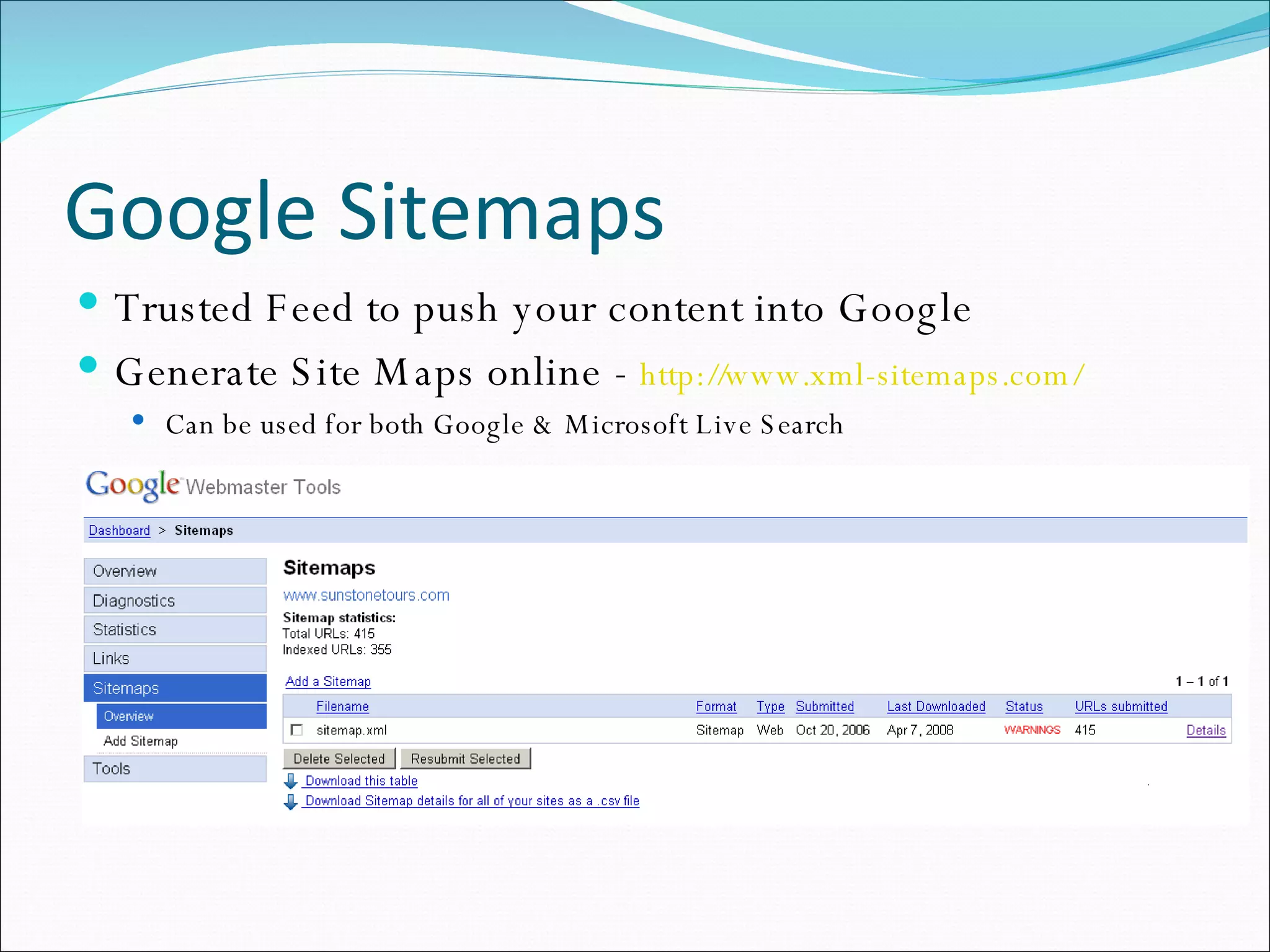
Google Sitemaps Trusted Feed to push your content into Google Generate Site Maps online -  http://www.xml-sitemaps.com/ Can be used for both Google & Microsoft Live Search
Implementing Optimization Domain / Site Page Elements Links
Domain / Site Optimization Age of site Builds prominence, credentials Inbound link popularity into site Topical inbound link relevancy into site Link/Content topical theme Frequency of new inbound links Number of queries over time where site appears in results Keywords in Domain Keywords in folder structure
Page Optimization Age of document Freshness of document Page filename (use keywords, hyphens as separators) #/Quality/Relevance of inbound/outbound links Page theme (content focused on a single topic, not topically scattered) Leverage CSS layouts with external stylesheets and external JavaScript to increase Content-to-Code ratio
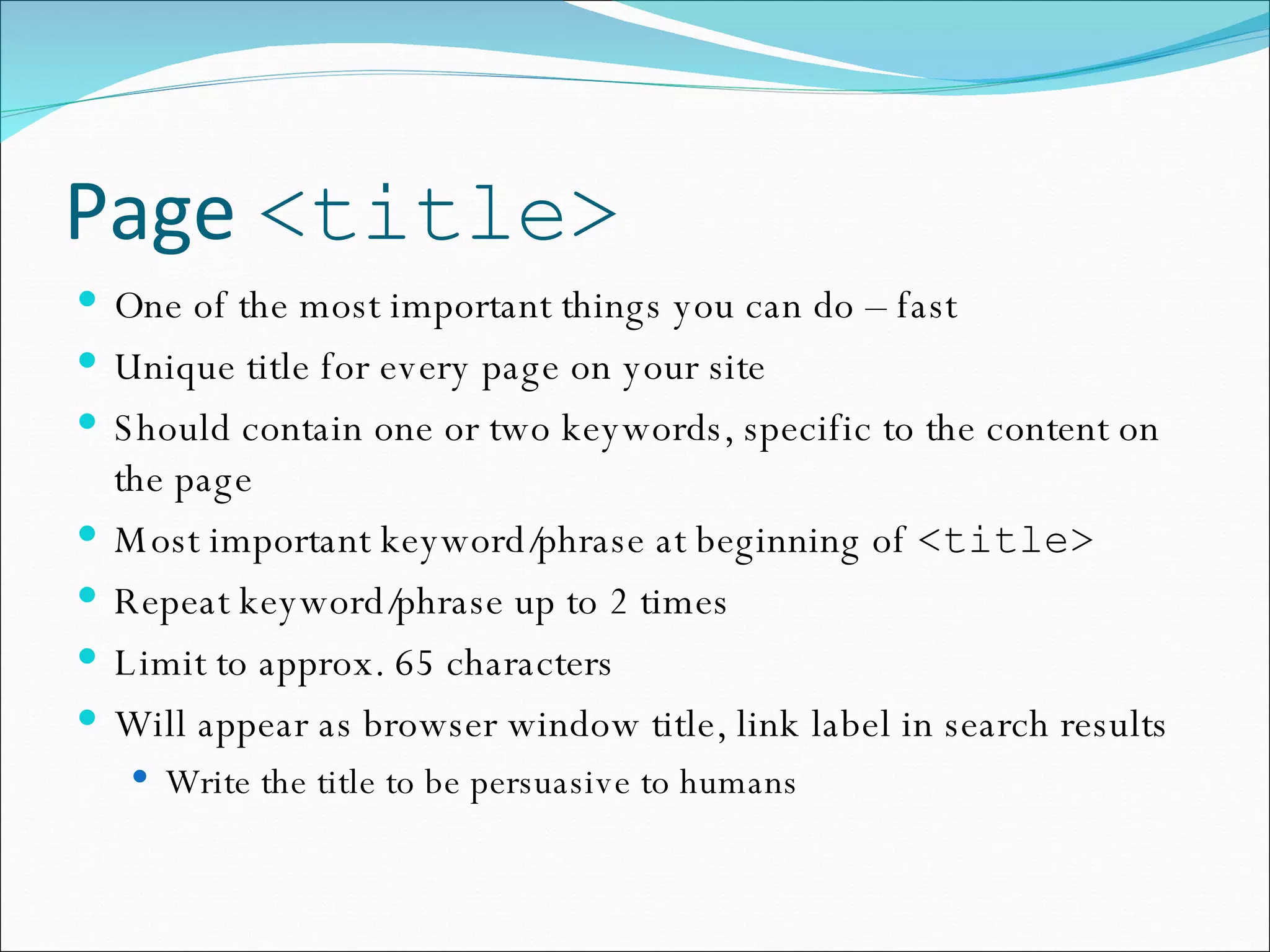
Page  <title> One of the most important things you can do – fast Unique title for every page on your site Should contain one or two keywords, specific to the content on the page Most important keyword/phrase at beginning of  <title> Repeat keyword/phrase up to 2 times Limit to approx. 65 characters Will appear as browser window title, link label in search results Write the title to be persuasive to humans
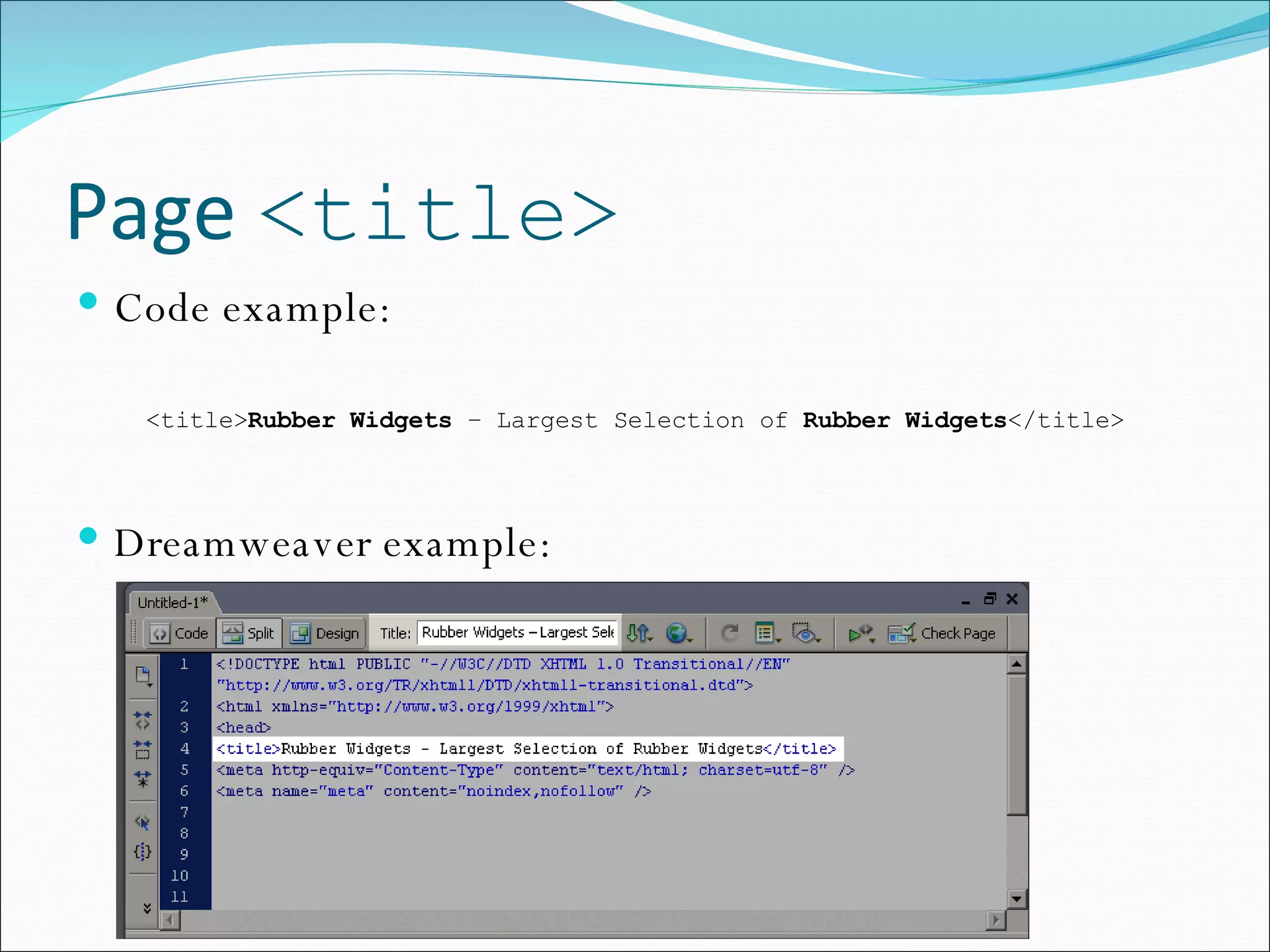
Page  <title> Code example: <title> Rubber Widgets  – Largest Selection of  Rubber Widgets </title> Dreamweaver example:
Page  <title> What about dynamic pages? Use variables in the  <title>  to interject keywords for the content of that page/record Example: <title><%Prod_Name%> - Best Select of <%Prod_Name%></title>
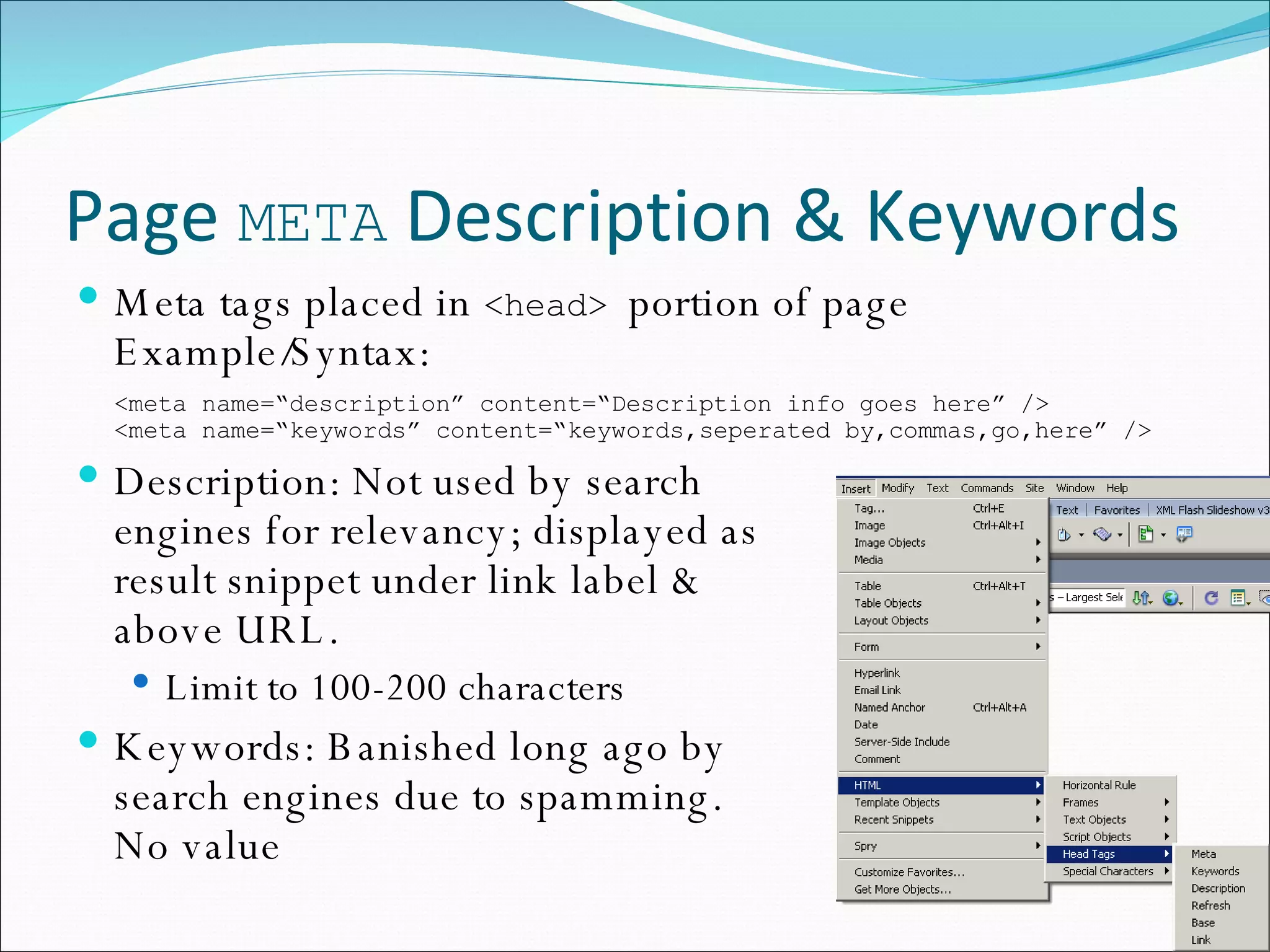
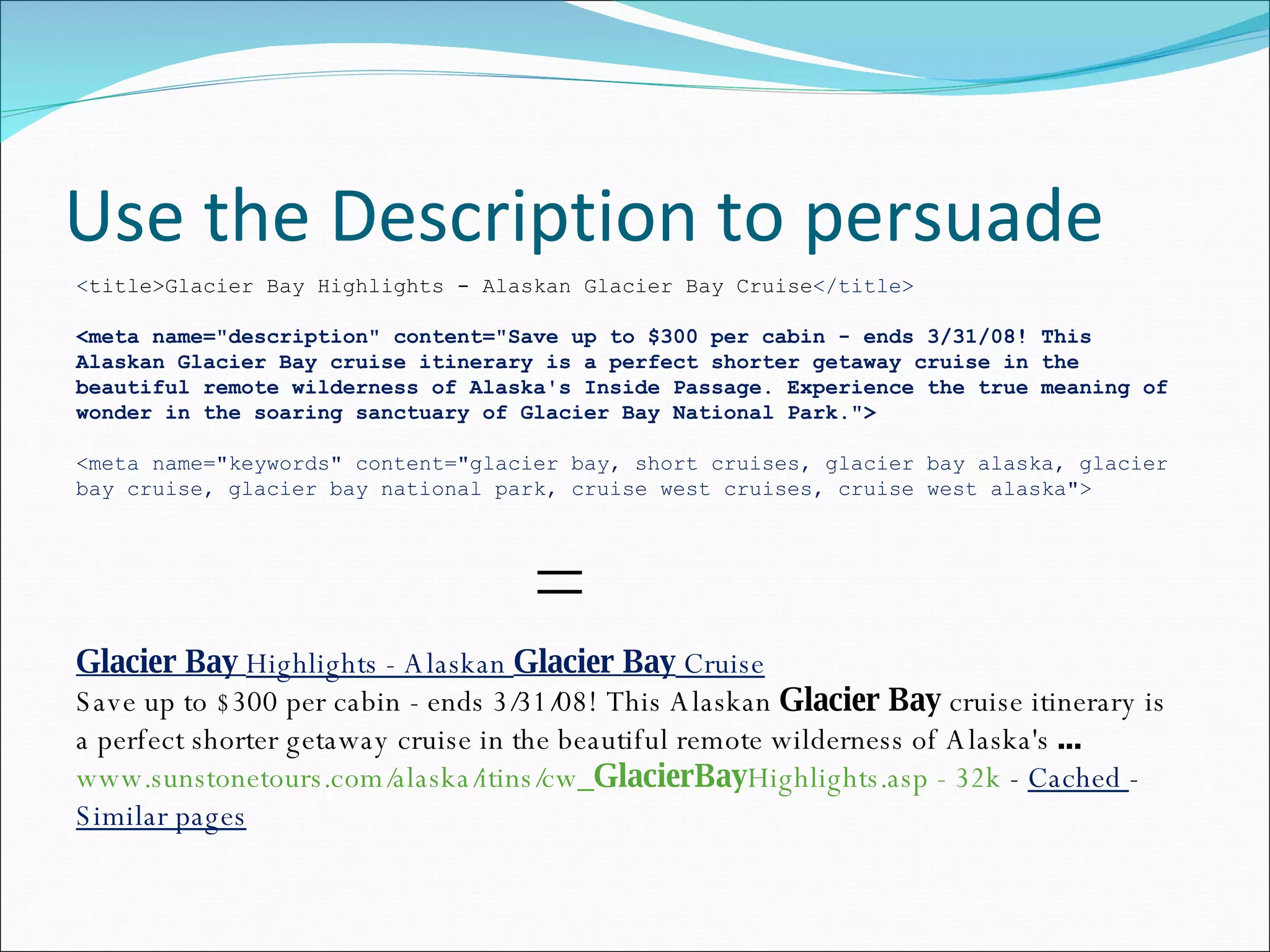
Page  META  Description & Keywords Meta tags placed in  <head>  portion of page Example/Syntax: <meta name=“description” content=“Description info goes here” /> <meta name=“keywords” content=“keywords,seperated by,commas,go,here” /> Description: Not used by search  engines for relevancy; displayed as  result snippet under link label &  above URL. Limit to 100-200 characters Keywords: Banished long ago by  search engines due to spamming.  No value
Use the Description to persuade Glacier Bay  Highlights - Alaskan  Glacier Bay  Cruise Save up to $300 per cabin - ends 3/31/08! This Alaskan  Glacier Bay  cruise itinerary is a perfect shorter getaway cruise in the beautiful remote wilderness of Alaska's  ... www.sunstonetours.com/alaska/itins/cw_ GlacierBay Highlights.asp - 32k  -  Cached  -  Similar pages < title>Glacier Bay Highlights - Alaskan Glacier Bay Cruise </title> <meta name=&quot;description&quot; content=&quot;Save up to $300 per cabin - ends 3/31/08! This Alaskan Glacier Bay cruise itinerary is a perfect shorter getaway cruise in the beautiful remote wilderness of Alaska's Inside Passage. Experience the true meaning of wonder in the soaring sanctuary of Glacier Bay National Park.&quot;> <meta name=&quot;keywords&quot; content=&quot;glacier bay, short cruises, glacier bay alaska, glacier bay cruise, glacier bay national park, cruise west cruises, cruise west alaska&quot;> =
Content / Body Text Everything visible in a web browser Keywords implemented should support the overall theme of the page Factors Keyword prominence: where on the page it appears Main keywords at beginning of content, supporting keywords throughout the middle, then the primary repeated again near the end of the content Keyword density: how often your keywords appear in relation to all other words on the page (goal: 5-7%) Keyword frequency: number of occurrences on the page Search engines also look at content around the keywords; check for theme relevancy
HTML Headings <h#> Include primary or supporting keywords in your highest heading tag (<h1>) Place supporting keywords in these heading tags <h2> … <h6> Make sure it makes sense to humans Use CSS to format the look of standard HTML headings If graphical text desired for headings, consider image replacement methods
Emphasizing Keywords Emphasize text & keywords to show search engines & users that “this is important” to the theme of the page. Use <strong> for bold Use <em> for emphasize Do not use <b> or <i> (outdated/obsolete) Only emphasize short segments of words (1-4 words).  Any more loses impact & value of emphasis; everything is emphasized; dilutes keyword meaning
Images Give your images descriptive filename Include keywords where it makes sense Use the alt attribute to provide information about the image Short description of image Include keywords where it makes sense Make sure it makes sense to humans Aids in usability Don’t stuff keywords here; considered  Don’t use images in place of text. If required, consider image replacement techniques
Links Important part of overall search algorithm However, not as important as it once was… Links within your site to pages within your site (internal links) have some value Inbound links to your site/pages/content from quality, authoritative sources (external links) considered unbiased, proof that your content is quality The link’s anchor text is very important Should contain relevant keywords Raises the link’s value
Inbound Link Best Practices Obtain links only from quality, authoritative sources related or relevant to your site Strive for top sites (example: CNN, Wikipedia) Top sites have good PageRank  Google term for the quality of inbound links Can view PageRank levels from Google Toolbar Top sites have been around a while Links to any page on your site; not just homepage Deep linking good Do not obtain links from “shady” sources Link farms, rings Link exchanges from sources of little/no Page Rank Do not purchase links from others
Link Building Ideas Blogs   create a blog link to your site comment on other subject related, relevant blogs RSS Feed Syndication Syndicate information from your site / blog to be displayed on other websites Control the anchor text Press Releases  submitted to online PR distributors Link back to your site Articles   topics of expertise, syndicated on the web Link back to your site Industry Sources / Subject Authority Websites
Who’s linking to you Google – Webmaster Central Internal & External (inbound) links Yahoo – link:[URL]
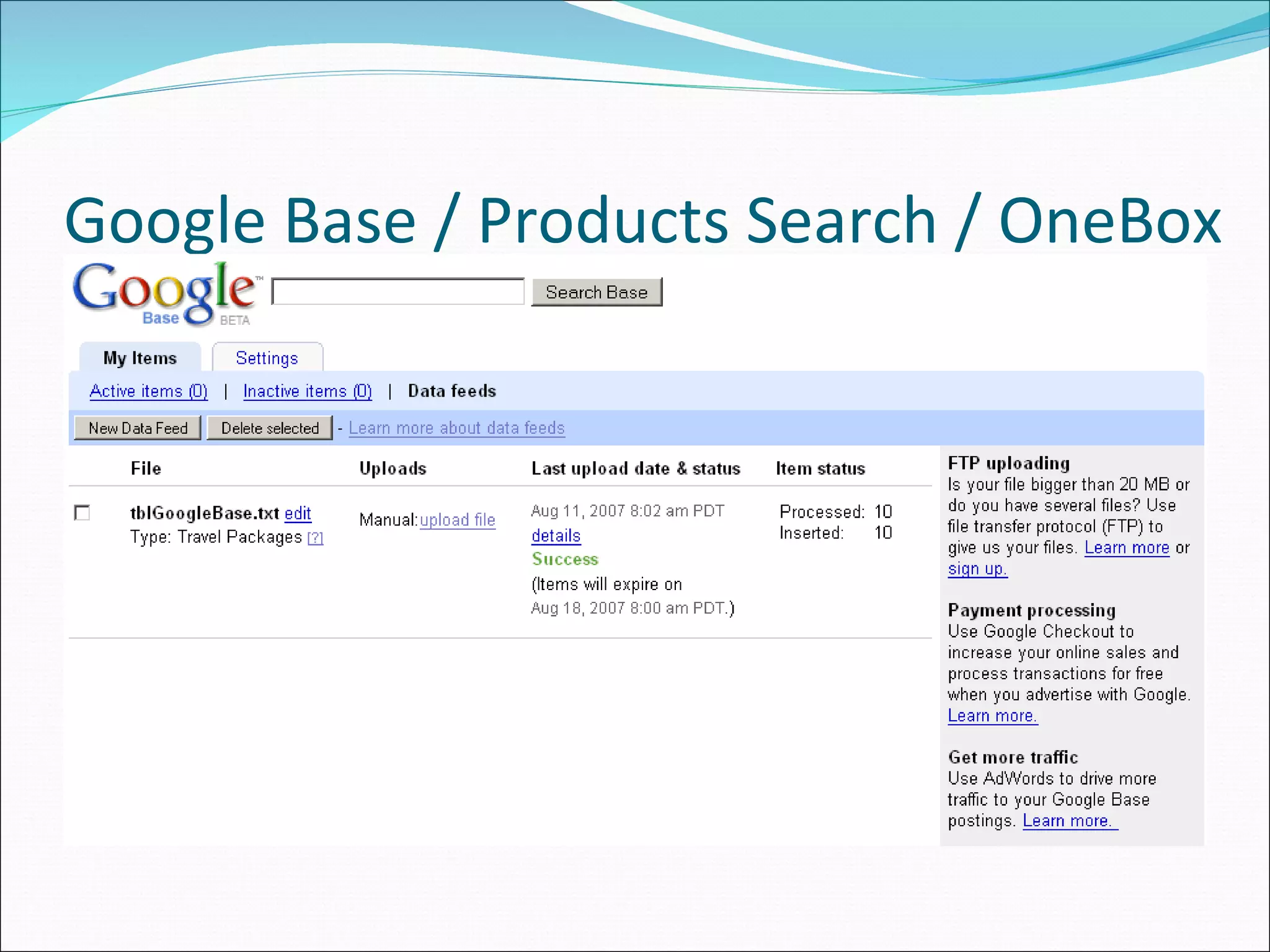
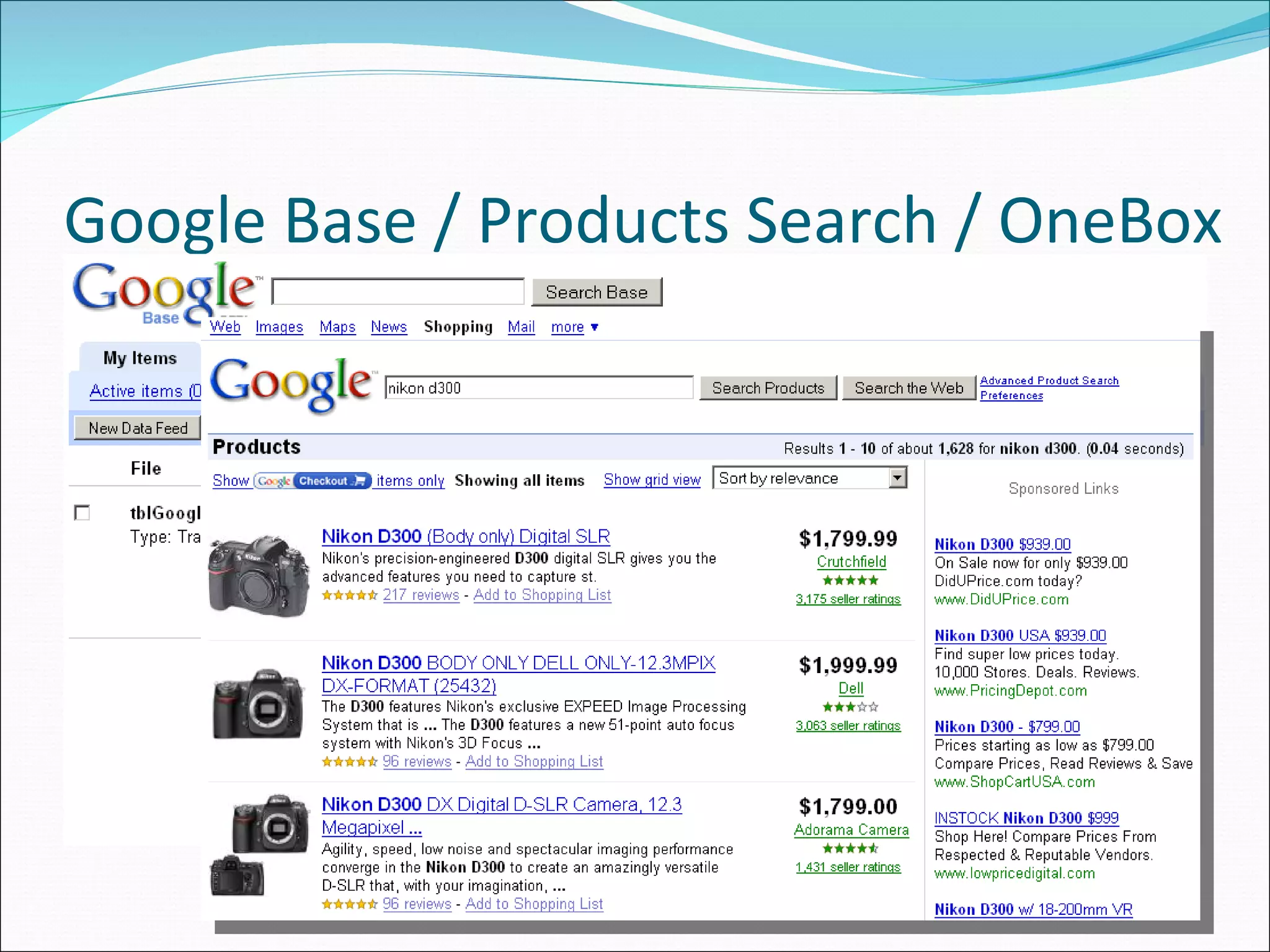
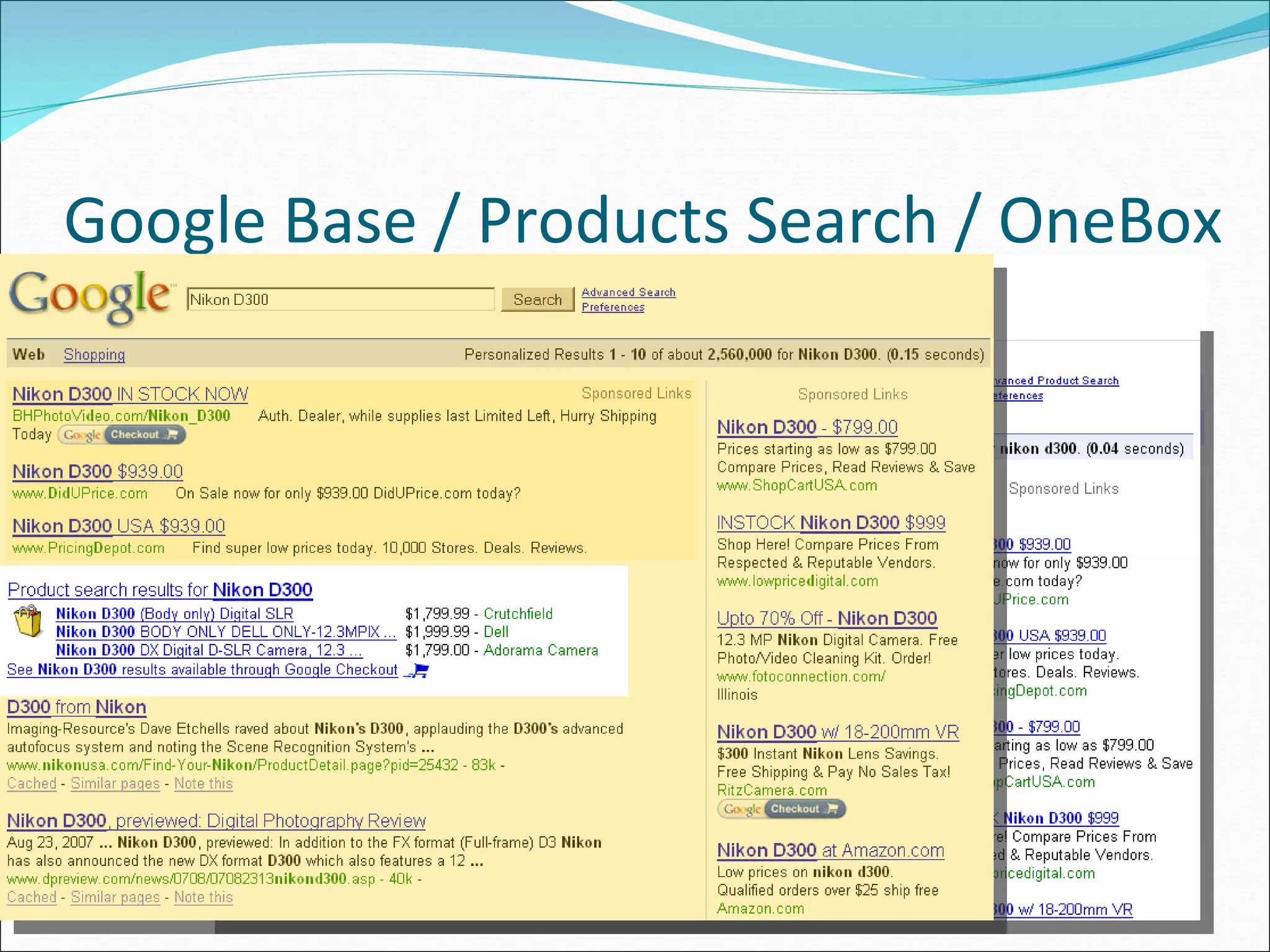
Other Optimization Ideas Google Base / Product Search / One Box Google Base: Online database of products. Originally created for classifieds Can upload information about your products Google Product Search (formerly Froogle) Shopping search engine providing searchable index of products for purchase Google One Box For certain keywords, displays content above the organic search results
Google Base / Products Search / OneBox
Analyze/Monitor your site Use an Analytics tool to monitor your site Visits Conversions Referrals Sites, URLS, Keywords Use a Monitoring tool to monitor your site’s ranking Ranking (based on keyword) Research competitors Age Inbound links Keywords used
Content is King!
Summary Perform detailed keyword analysis Make sure your site is crawlable Use Web Standards to create clean, light pages Implement keywords on appropriate page elements Obtain links from quality, authoritative sources Design/implement with the user first, then the search engine in mind Catch this and like videos at  http://www.youtube.com/user/m0serious
Resources Search Engine Relationships Bruce Clay’s Search Engine Relationship Chart Keyword Tools (online) Google AdWords: Keyword Tool Trellian Keyword Discovery Wordtracker SEOBook SEOTools Keyword Suggestion Tool Keyword Tools (client-based) Web CEO
Resources Analytics Google Analytics  (Web-based - Free) Stat Counter  (Web-based - Free) Mint  (Web-based - Fee) Omniture  (Web-based - Fee) Webtrends  (Web-based – Fee) Monitoring Web CEO  (Client-based – Trial/Fee) SEO Tool Rank Checker  (Web-based – Free/Fee) SEO for Firefox  (Browser-based) Google Toolbar  (Browser-based)
Resources Books Search Engine Marketing – Mike Moran & Bill Hunt Search Engine Optimization for Dummies – Peter Kent Building Findable Websites – Aaron Walter Search Marketing Strategies – James Colborn Web Analytics Demystified – Eric Peterson Web Metrics – Jim Sterne The Online Copywriter’s Handbook – Robert Bly
Resources Web Sites Search Engine Land SEOmoz Web Engine Watch Podcasts (search for these in iTunes or Google) Daily SearchCast SEO 101 Online Courses Lynda.com – Search Engine Optimization
Questions? Dennis Deacon – deconspray@gmail.com Blog:  http://dennisdeacon.wordpress.com

Search Engine Optimization (SEO)

  • 1.
    May 2008 DennisDeacon – [email_address]
  • 2.
    Agenda What isSEO Relevancy Keywords Search Engines: How content is obtained Site / Domain Factors Page Factors Links Other optimization ideas
  • 3.
    What is SearchEngine Optimization? A subset of Search Engine Marketing Sometimes considered to be unique to SEM Focuses on the natural, organic relevancy and ranking of content in search results. Some practices extended into Search Engine Marketing (i.e. obtaining links)
  • 4.
    Then, what isSearch Engine Marketing? The act of promoting content. The overall activity around using search engines to market a site or online entity. Includes: Search Engine Optimization Paid Inclusion Pay Per Click (PPC)
  • 5.
  • 6.
    SEO vs. SEM& PPC SEO SEM/PPC Pros Free (not including resources) Searchers click on organic search results more often than paid PPC links Excellent at creating awareness quickly Campaigns can be budgeted to fit a business’s needs Cons Time consuming Takes longer to see results Can be pricey ($25-$100,000 a month) Must be managed constantly (daily/weekly) ROI can be difficult to manage Clickfraud
  • 7.
    SEO Ethics WhiteHat/Good vs. Black Hat/Evil White Hat Follows search engine guidelines Strives for best possible search engine ranking; #1 ranking if possible Black Hat Knowingly breaks many/most of the search engine guidelines Misrepresents content via techniques Uses techniques to trick either the search engine, searcher, or both Promises #1 ranking
  • 8.
    Relevancy The overallgoal: Search engines: to deliver the most relevant search results possible Searchers: to find the most relevant search result Site Owners: to optimize their site and it’s content for the most relevant searcher True relevancy has become hip; it’s not a fad
  • 9.
    SEO Workflow KeywordResearch and Analysis Analyze Site for Crawl / Performance issues Implement Optimizations Monitor results Repeat as needed
  • 10.
    Keywords The coreof Search Engine Optimization Keywords are the terms used by searchers to find information The goal is to leverage and implement the same keywords throughout your content in a natural manner, to match the audience who’s searching for your information and you’re looking to attract Keyword discovery and analysis is never ending
  • 11.
    Keyword Discovery Knownkeywords Ask the business owner Ask the customers Check the current server logs or analytics tool Check the site search logs Competitor’s keywords Look at the words in the <title> tag / browser bar View source to view their META keywords Use tools to harvest the keywords or phrases prominent on their site
  • 12.
    Keyword Discovery &Analysis Always include variations of keywords Plurals (widgets, churches) Synonyms (cruise, sail, journey, tour) Stems (fish, fishing) International spelling differences (Harbor /Harbour) Online Tools Created for PPC, used for SEO as well Tools Google Adwords Keywords Tool Trellian (free trial) WordTracker (free trial) SEOBook SEOTool Keyword Suggestion Tool Use multiple tools to cross-check & validate findings in other tools
  • 13.
  • 14.
  • 15.
  • 16.
    Which Keywords toUse? It depends on the context & themes of your pages the audience you’re targeting (researchers, buyers) Use keywords That are being searched on That have medium to low competition That you can build quality content that site visitors will appreciate Use keywords that Aid the search engines in understanding your content Aid users and persuade them to act
  • 17.
    Organize Site/Content inThemes Possible direction of search engines to determine relevancy Site/folder structure Content text Link text
  • 18.
    How Search Enginesobtain content Search Engines send “bots,” that spider the web. Crawls via hyperlinks <a href=http://www.mysite.com/>
  • 19.
    The “PacMan” MetaphorContent Meta Data Links Theme
  • 20.
    Search Engine BotSo what happens when a search engine bot visits your site? First, it checks for the robots.txt file for any instructions Second, it begins to crawl, following links in your site from the current page. It also pays attention to any page level robots instructions (noindex/nofollow). It grabs the content and meta data (title, description, link labels, text, attributes) Adds to it’s index
  • 21.
    Controlling Robots -Robots.txt Site-wide control Adhered to by most search bots Can control access to areas of your website Disallow crawling of portions of your website Can limit control to all or select search bots Placed in the root of your website More Robots.txt info: http://www.robotstxt.org/
  • 22.
    Controlling Robots -Robots Meta Tag Page level control Placed as a meta tag in the <head> portion of your pages Controls who the search bot crawls through the page Variations: <meta name=“robots&quot; content=“index,follow&quot; /> <meta name=“robots&quot; content=“noindex,nofollow&quot; /> <meta name=“robots&quot; content=“noindex,follow&quot; /> <meta name=“robots&quot; content=“index,nofollow&quot; />
  • 23.
    Search Engine CrawlingIssues Robots.txt/Meta Robots conflicts One set of instructions in robot.txt, different instructions in meta robot Server performance If sever not available when search bot visits, will revisit, but learns and decreases the frequency of visits If server slow, bot will crawl what it can, then move on (incomplete crawl) JavaScript Cannot follow hyperlinks embedded or generated by JavaScript Pop-ups DHTML pull-down menus
  • 24.
    Search Engine CrawlingIssues Dynamic URLs Example: www.mydomain.com/products/item.asp ?id=20&cat=bd&cty=102&sessionid=56720938762s345h10293847nnm65748392021&cookie=WEGQIEMCE... Numerous parameters can prevent crawling Session ids can cause crawling issues; duplicate content issues Solution Make URLs are short as possible (1000 characters too long) Up to 2 parameters OK, more a risk Do not use session ids; If multiple parameters & session ids a must, use a URL rewrite method (mod-rewrite (Apache)) Example: Before: http://www.amazon.com/Dont-Make-Me-Think-Usability/dp/0321344758/ref=pd_bbs_sr_1?ie=UTF8&s=books&qid=1207686806&sr=8-1 After: http://www.amazon.com/Common-Approach-Usability-Circle-Com-Library/dp/0789723107
  • 25.
    Search Engine CrawlingIssues G o o g l e
  • 26.
  • 27.
    Search Engine CrawlingIssues Content-to-Code Ratio ( example 203kb ) In browser, view source to view code bloat Code used to display page vs. Content that is displayed (X)HTML + attributes & CSS (embedded & inline) & JavaScript vs. Text & Images vs.
  • 28.
    Search Engine IndexingHow to: Obtain links to your site from authoritative sources Will get crawled/indexed organically Submit your site to the search engines Google Yahoo MSN Ask (?) What about the others? Monitor your indexed pages
  • 29.
    Bruce Clay SearchEngine Relationship Chart
  • 30.
  • 31.
  • 32.
    Google Sitemaps TrustedFeed to push your content into Google Generate Site Maps online - http://www.xml-sitemaps.com/ Can be used for both Google & Microsoft Live Search
  • 33.
    Implementing Optimization Domain/ Site Page Elements Links
  • 34.
    Domain / SiteOptimization Age of site Builds prominence, credentials Inbound link popularity into site Topical inbound link relevancy into site Link/Content topical theme Frequency of new inbound links Number of queries over time where site appears in results Keywords in Domain Keywords in folder structure
  • 35.
    Page Optimization Ageof document Freshness of document Page filename (use keywords, hyphens as separators) #/Quality/Relevance of inbound/outbound links Page theme (content focused on a single topic, not topically scattered) Leverage CSS layouts with external stylesheets and external JavaScript to increase Content-to-Code ratio
  • 36.
    Page <title>One of the most important things you can do – fast Unique title for every page on your site Should contain one or two keywords, specific to the content on the page Most important keyword/phrase at beginning of <title> Repeat keyword/phrase up to 2 times Limit to approx. 65 characters Will appear as browser window title, link label in search results Write the title to be persuasive to humans
  • 37.
    Page <title>Code example: <title> Rubber Widgets – Largest Selection of Rubber Widgets </title> Dreamweaver example:
  • 38.
    Page <title>What about dynamic pages? Use variables in the <title> to interject keywords for the content of that page/record Example: <title><%Prod_Name%> - Best Select of <%Prod_Name%></title>
  • 39.
    Page META Description & Keywords Meta tags placed in <head> portion of page Example/Syntax: <meta name=“description” content=“Description info goes here” /> <meta name=“keywords” content=“keywords,seperated by,commas,go,here” /> Description: Not used by search engines for relevancy; displayed as result snippet under link label & above URL. Limit to 100-200 characters Keywords: Banished long ago by search engines due to spamming. No value
  • 40.
    Use the Descriptionto persuade Glacier Bay Highlights - Alaskan Glacier Bay Cruise Save up to $300 per cabin - ends 3/31/08! This Alaskan Glacier Bay cruise itinerary is a perfect shorter getaway cruise in the beautiful remote wilderness of Alaska's ... www.sunstonetours.com/alaska/itins/cw_ GlacierBay Highlights.asp - 32k - Cached - Similar pages < title>Glacier Bay Highlights - Alaskan Glacier Bay Cruise </title> <meta name=&quot;description&quot; content=&quot;Save up to $300 per cabin - ends 3/31/08! This Alaskan Glacier Bay cruise itinerary is a perfect shorter getaway cruise in the beautiful remote wilderness of Alaska's Inside Passage. Experience the true meaning of wonder in the soaring sanctuary of Glacier Bay National Park.&quot;> <meta name=&quot;keywords&quot; content=&quot;glacier bay, short cruises, glacier bay alaska, glacier bay cruise, glacier bay national park, cruise west cruises, cruise west alaska&quot;> =
  • 41.
    Content / BodyText Everything visible in a web browser Keywords implemented should support the overall theme of the page Factors Keyword prominence: where on the page it appears Main keywords at beginning of content, supporting keywords throughout the middle, then the primary repeated again near the end of the content Keyword density: how often your keywords appear in relation to all other words on the page (goal: 5-7%) Keyword frequency: number of occurrences on the page Search engines also look at content around the keywords; check for theme relevancy
  • 42.
    HTML Headings <h#>Include primary or supporting keywords in your highest heading tag (<h1>) Place supporting keywords in these heading tags <h2> … <h6> Make sure it makes sense to humans Use CSS to format the look of standard HTML headings If graphical text desired for headings, consider image replacement methods
  • 43.
    Emphasizing Keywords Emphasizetext & keywords to show search engines & users that “this is important” to the theme of the page. Use <strong> for bold Use <em> for emphasize Do not use <b> or <i> (outdated/obsolete) Only emphasize short segments of words (1-4 words). Any more loses impact & value of emphasis; everything is emphasized; dilutes keyword meaning
  • 44.
    Images Give yourimages descriptive filename Include keywords where it makes sense Use the alt attribute to provide information about the image Short description of image Include keywords where it makes sense Make sure it makes sense to humans Aids in usability Don’t stuff keywords here; considered Don’t use images in place of text. If required, consider image replacement techniques
  • 45.
    Links Important partof overall search algorithm However, not as important as it once was… Links within your site to pages within your site (internal links) have some value Inbound links to your site/pages/content from quality, authoritative sources (external links) considered unbiased, proof that your content is quality The link’s anchor text is very important Should contain relevant keywords Raises the link’s value
  • 46.
    Inbound Link BestPractices Obtain links only from quality, authoritative sources related or relevant to your site Strive for top sites (example: CNN, Wikipedia) Top sites have good PageRank Google term for the quality of inbound links Can view PageRank levels from Google Toolbar Top sites have been around a while Links to any page on your site; not just homepage Deep linking good Do not obtain links from “shady” sources Link farms, rings Link exchanges from sources of little/no Page Rank Do not purchase links from others
  • 47.
    Link Building IdeasBlogs create a blog link to your site comment on other subject related, relevant blogs RSS Feed Syndication Syndicate information from your site / blog to be displayed on other websites Control the anchor text Press Releases submitted to online PR distributors Link back to your site Articles topics of expertise, syndicated on the web Link back to your site Industry Sources / Subject Authority Websites
  • 48.
    Who’s linking toyou Google – Webmaster Central Internal & External (inbound) links Yahoo – link:[URL]
  • 49.
    Other Optimization IdeasGoogle Base / Product Search / One Box Google Base: Online database of products. Originally created for classifieds Can upload information about your products Google Product Search (formerly Froogle) Shopping search engine providing searchable index of products for purchase Google One Box For certain keywords, displays content above the organic search results
  • 50.
    Google Base /Products Search / OneBox
  • 51.
    Google Base /Products Search / OneBox
  • 52.
    Google Base /Products Search / OneBox
  • 53.
    Analyze/Monitor your siteUse an Analytics tool to monitor your site Visits Conversions Referrals Sites, URLS, Keywords Use a Monitoring tool to monitor your site’s ranking Ranking (based on keyword) Research competitors Age Inbound links Keywords used
  • 54.
  • 55.
    Summary Perform detailedkeyword analysis Make sure your site is crawlable Use Web Standards to create clean, light pages Implement keywords on appropriate page elements Obtain links from quality, authoritative sources Design/implement with the user first, then the search engine in mind Catch this and like videos at http://www.youtube.com/user/m0serious
  • 56.
    Resources Search EngineRelationships Bruce Clay’s Search Engine Relationship Chart Keyword Tools (online) Google AdWords: Keyword Tool Trellian Keyword Discovery Wordtracker SEOBook SEOTools Keyword Suggestion Tool Keyword Tools (client-based) Web CEO
  • 57.
    Resources Analytics GoogleAnalytics (Web-based - Free) Stat Counter (Web-based - Free) Mint (Web-based - Fee) Omniture (Web-based - Fee) Webtrends (Web-based – Fee) Monitoring Web CEO (Client-based – Trial/Fee) SEO Tool Rank Checker (Web-based – Free/Fee) SEO for Firefox (Browser-based) Google Toolbar (Browser-based)
  • 58.
    Resources Books SearchEngine Marketing – Mike Moran & Bill Hunt Search Engine Optimization for Dummies – Peter Kent Building Findable Websites – Aaron Walter Search Marketing Strategies – James Colborn Web Analytics Demystified – Eric Peterson Web Metrics – Jim Sterne The Online Copywriter’s Handbook – Robert Bly
  • 59.
    Resources Web SitesSearch Engine Land SEOmoz Web Engine Watch Podcasts (search for these in iTunes or Google) Daily SearchCast SEO 101 Online Courses Lynda.com – Search Engine Optimization
  • 60.
    Questions? Dennis Deacon– deconspray@gmail.com Blog: http://dennisdeacon.wordpress.com