CENTRAL MECHANICAL ENGINEERING RESEARCH INSTITUTE (CMERI)
        COUNCIL OF SCIENTIFIC AND INDUSTRIAL RESEARCH (CSIR)
                              INDIA
At the end of the talk, you would be able to-

Design Your Own Polariscope At A Cost Within $50.
Definition of mechanical stress: Internal forces acting inside a deformable body.
Reasons for such internal forces:
-Due to applied external forces.
-Atomic forces.
-Forces generated due to thermal expansion of the body.
-Due to vibrations ………………. And many MORE.
Consequences:
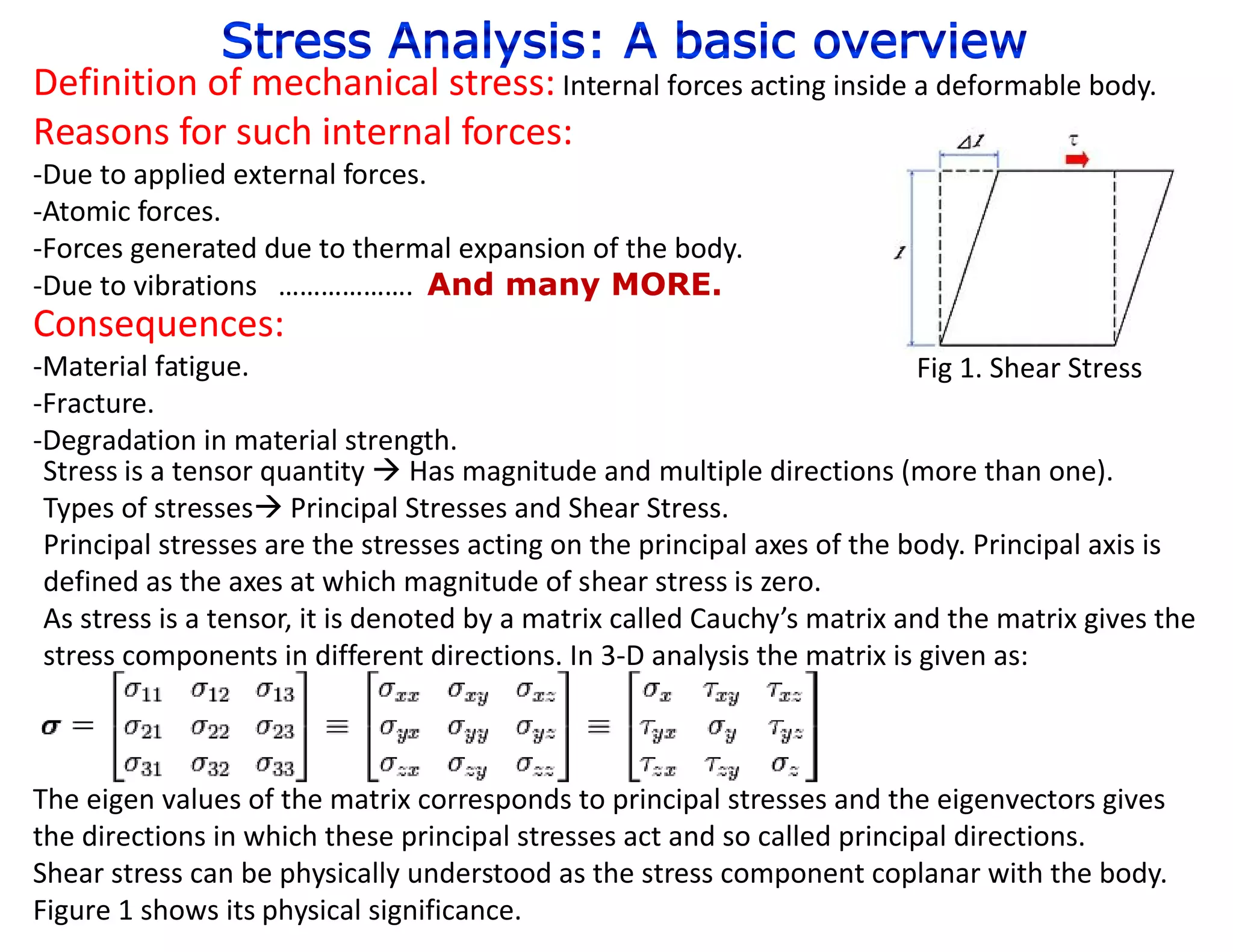
-Material fatigue.                                                         Fig 1. Shear Stress
-Fracture.
-Degradation in material strength.
 Stress is a tensor quantity  Has magnitude and multiple directions (more than one).
 Types of stresses Principal Stresses and Shear Stress.
 Principal stresses are the stresses acting on the principal axes of the body. Principal axis is
 defined as the axes at which magnitude of shear stress is zero.
 As stress is a tensor, it is denoted by a matrix called Cauchy’s matrix and the matrix gives the
 stress components in different directions. In 3-D analysis the matrix is given as:


The eigen values of the matrix corresponds to principal stresses and the eigenvectors gives
the directions in which these principal stresses act and so called principal directions.
Shear stress can be physically understood as the stress component coplanar with the body.
Figure 1 shows its physical significance.
Birefringence in physics is defined as a property of some materials like Calcite, Glass, Plastics
to exhibit double refractive indices when stress is present in the material. In other words, a
stressed birefringent material shows different refractive indices to a beam of light in different
directions and hence light will be subjected to different phase retardation along different
directions. The effect in mechanics is known as photo-elasticity.

The effect of birefringence can be felt if polarized light is incident on such materials.
If monochromatic polarized light source is used to illuminate such stressed birefringent object
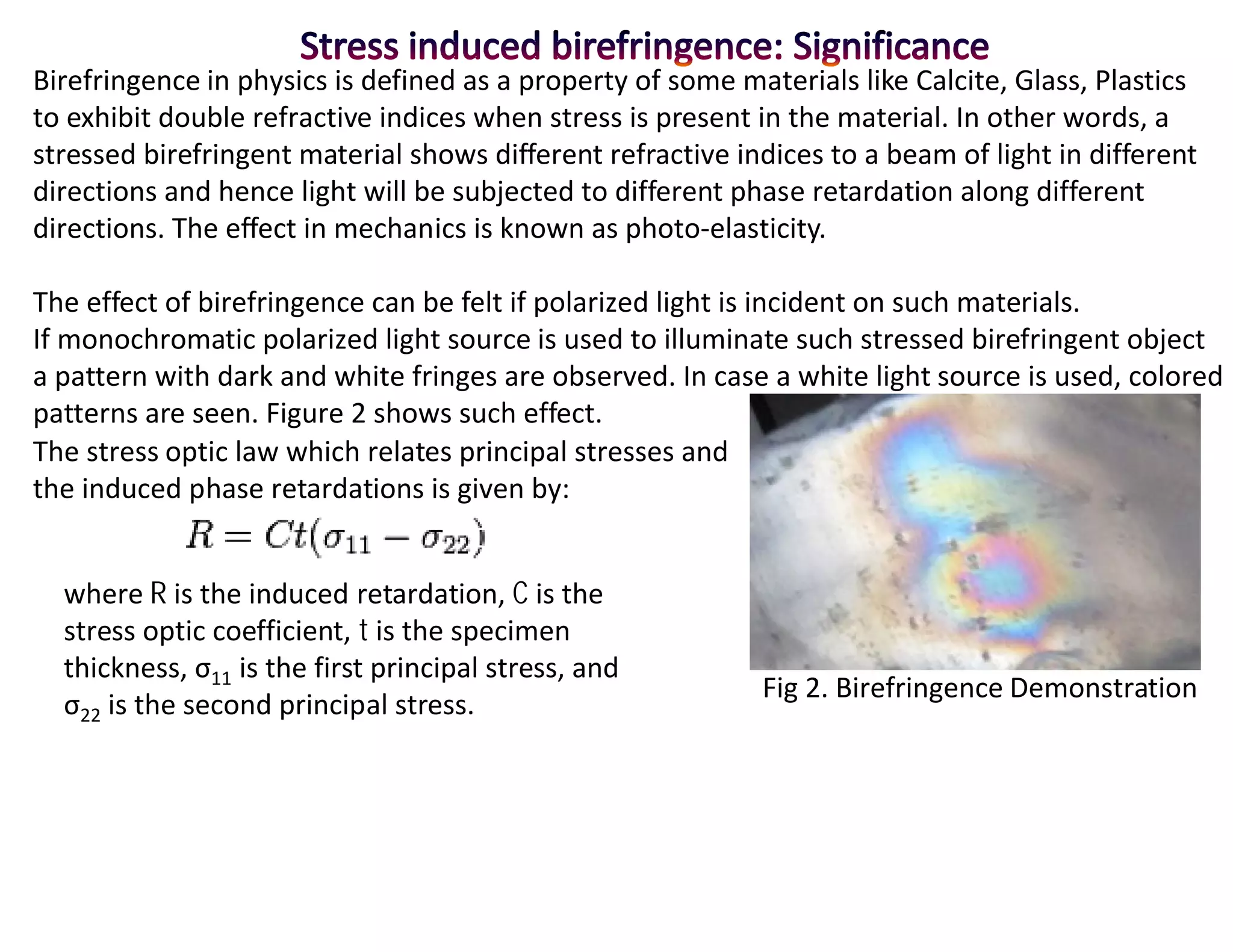
a pattern with dark and white fringes are observed. In case a white light source is used, colored
patterns are seen. Figure 2 shows such effect.
The stress optic law which relates principal stresses and
the induced phase retardations is given by:


  where R is the induced retardation, C is the
  stress optic coefficient, t is the specimen
  thickness, σ11 is the first principal stress, and
                                                            Fig 2. Birefringence Demonstration
  σ22 is the second principal stress.
A polariscope is an instrument for analysis of stress in a birefringent material. If the material is
not birefringent, say for example metals, the material is coated with a thin layer of known
birefringent material. Different types of polariscope are available in theory and in market. We
have designed and developed a Gray field polariscope (GFP) for stress analysis, as it is very simple
and includes least complex mathematics.

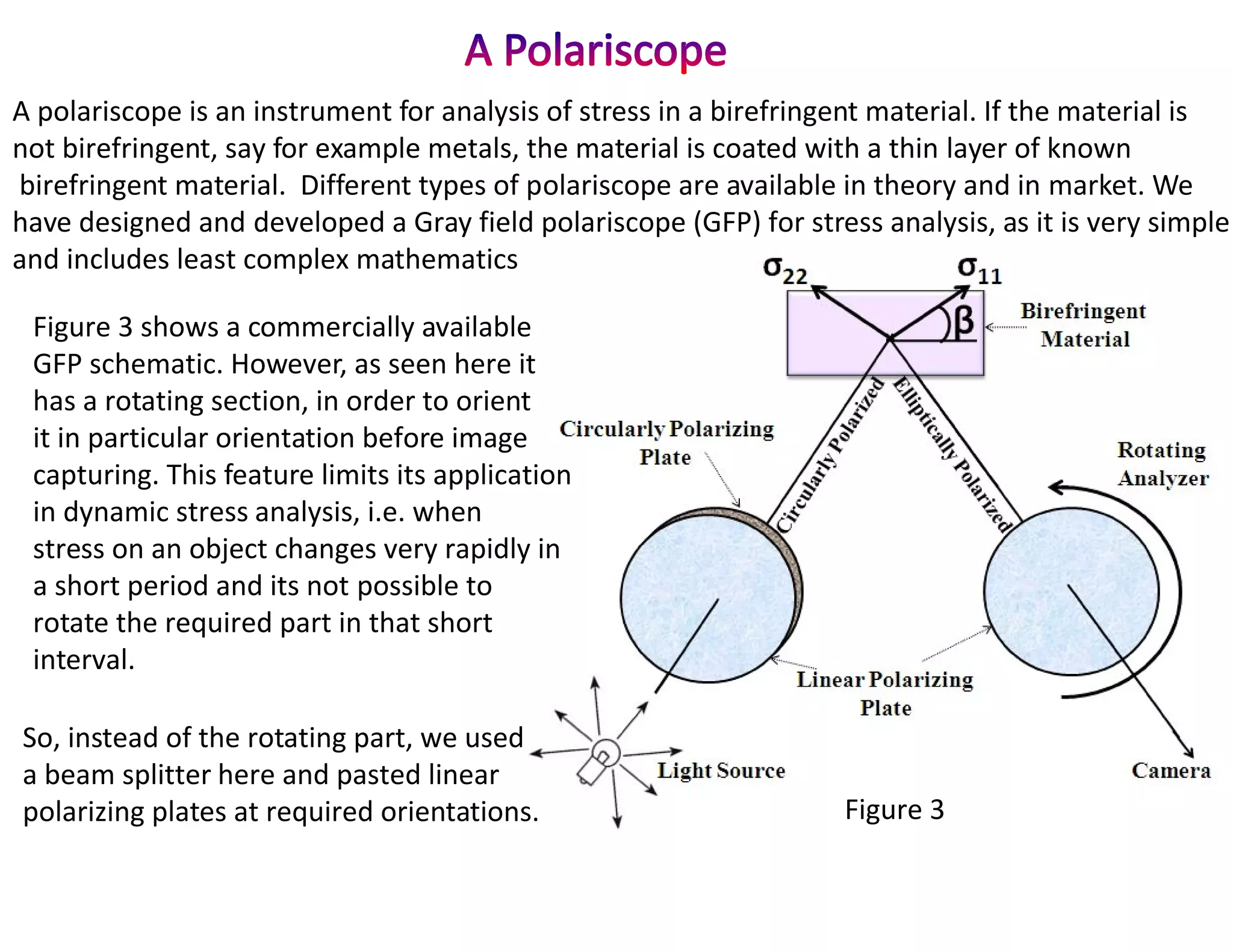
 Figure 3 shows a commercially available
 GFP schematic. However, as seen here it
 has a rotating section, in order to orient
 it in particular orientation before image
 capturing. This feature limits its application
 in dynamic stress analysis, i.e. when
 stress on an object changes very rapidly in
 a short period and its not possible to
 rotate the required part in that short
 interval.

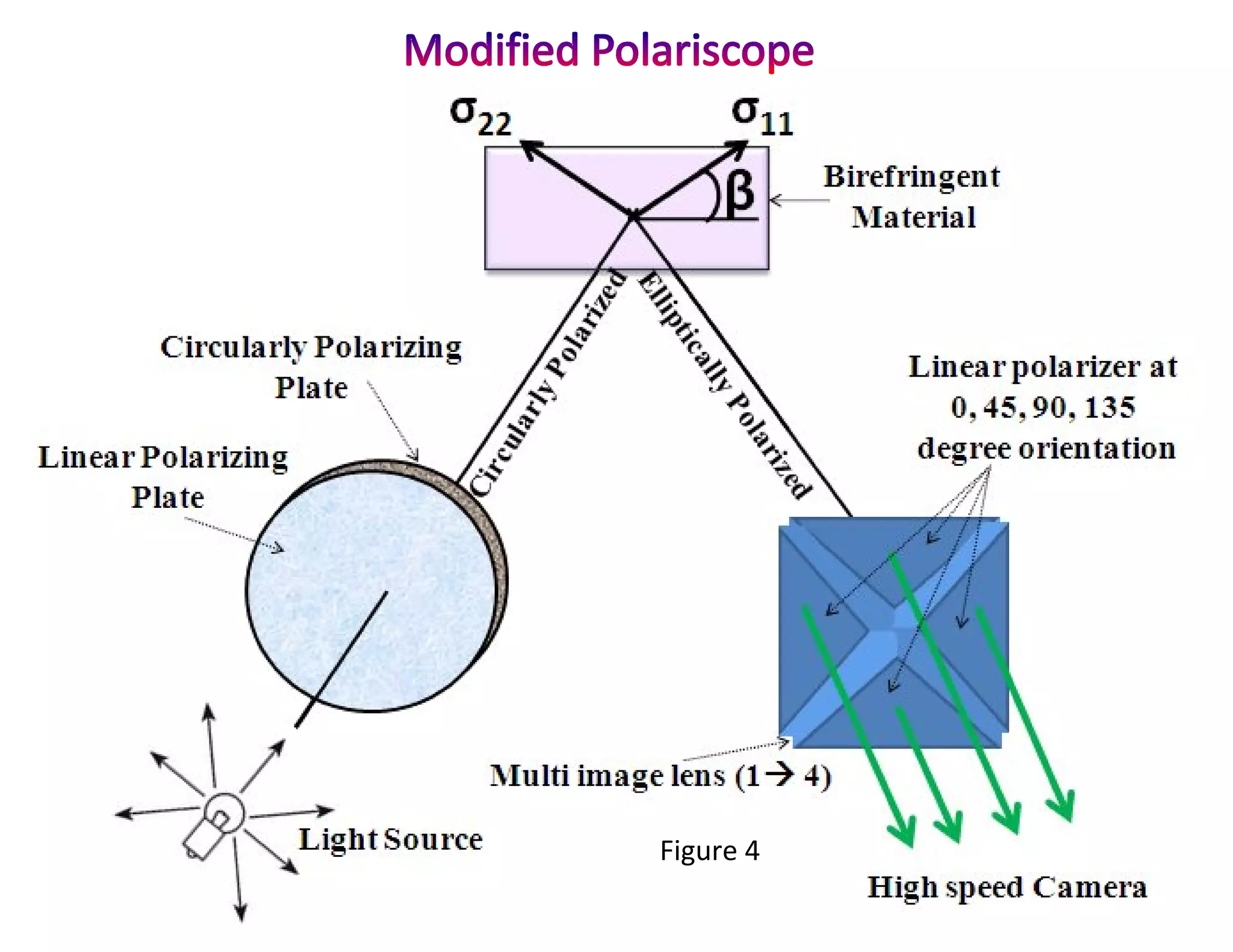
So, instead of the rotating part, we used
a beam splitter here and pasted linear
polarizing plates at required orientations.                         Figure 3
Figure 4
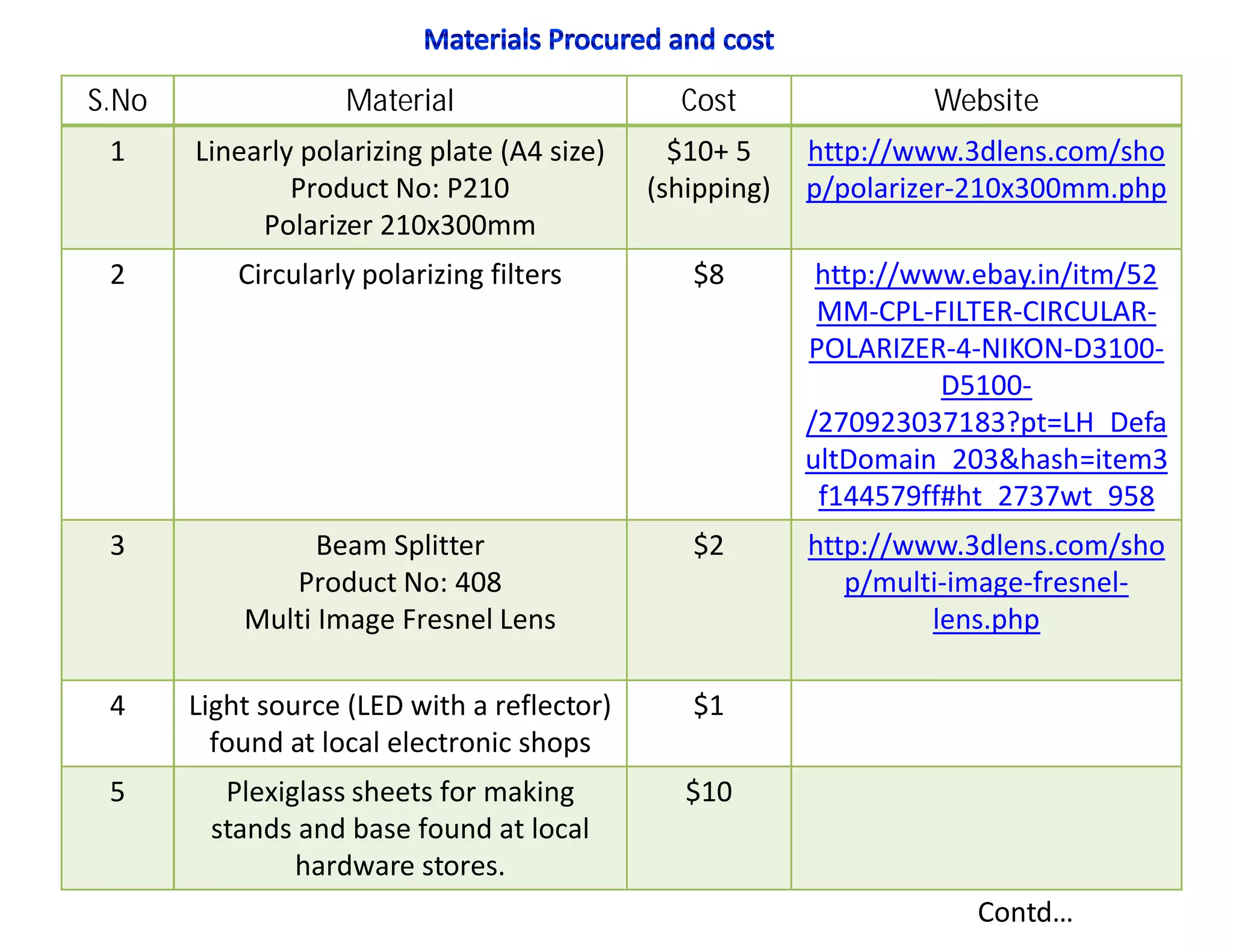
S.No                Material                   Cost                Website
 1     Linearly polarizing plate (A4 size)     $10+ 5     http://www.3dlens.com/sho
               Product No: P210              (shipping)   p/polarizer-210x300mm.php
            Polarizer 210x300mm
 2         Circularly polarizing filters        $8         http://www.ebay.in/itm/52
                                                           MM-CPL-FILTER-CIRCULAR-
                                                          POLARIZER-4-NIKON-D3100-
                                                                    D5100-
                                                          /270923037183?pt=LH_Defa
                                                          ultDomain_203&hash=item3
                                                           f144579ff#ht_2737wt_958
 3               Beam Splitter                  $2        http://www.3dlens.com/sho
              Product No: 408                                p/multi-image-fresnel-
           Multi Image Fresnel Lens                                lens.php

 4     Light source (LED with a reflector)      $1
         found at local electronic shops
 5       Plexiglass sheets for making           $10
        stands and base found at local
               hardware stores.
                                                                      Contd…
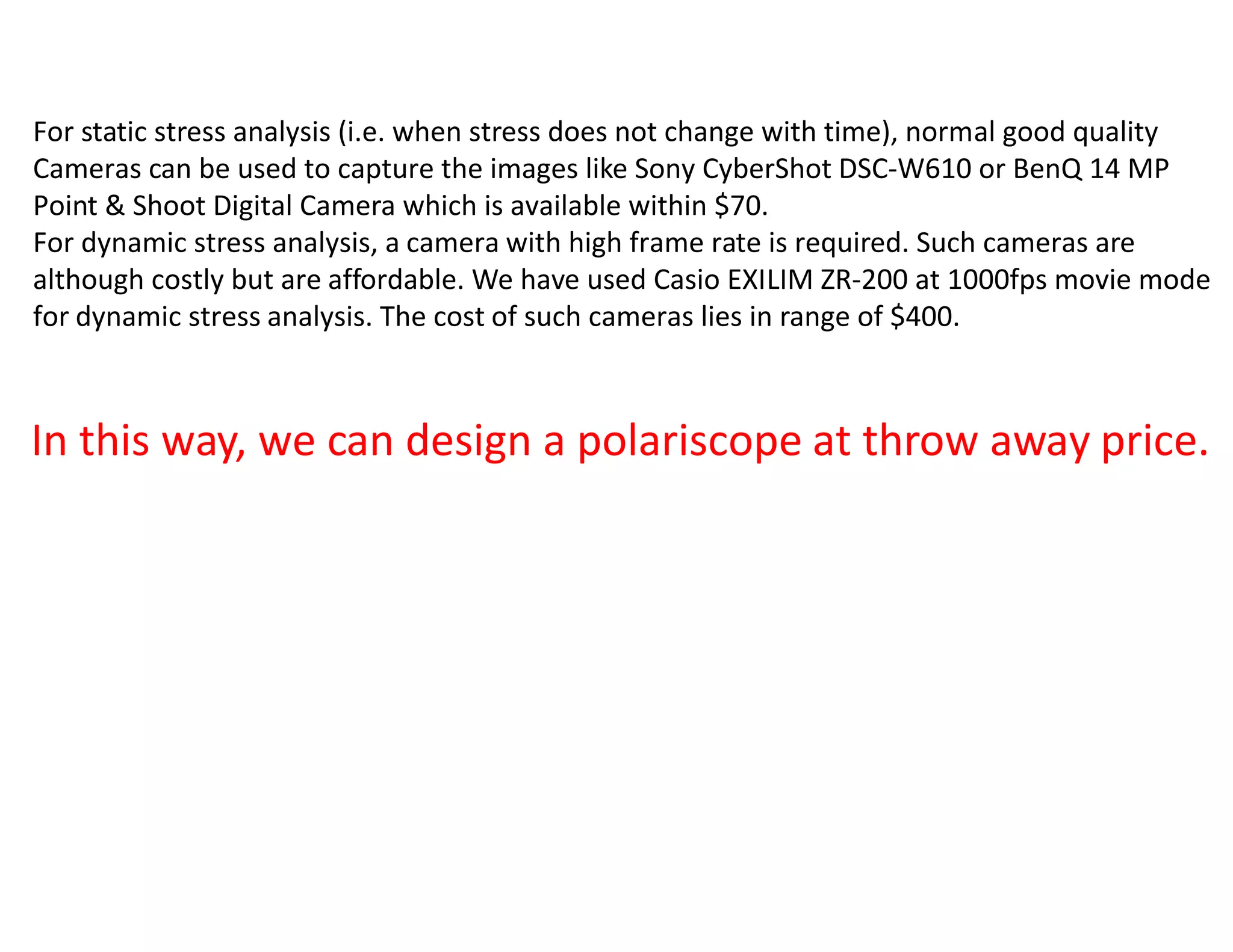
For static stress analysis (i.e. when stress does not change with time), normal good quality
Cameras can be used to capture the images like Sony CyberShot DSC-W610 or BenQ 14 MP
Point & Shoot Digital Camera which is available within $70.
For dynamic stress analysis, a camera with high frame rate is required. Such cameras are
although costly but are affordable. We have used Casio EXILIM ZR-200 at 1000fps movie mode
for dynamic stress analysis. The cost of such cameras lies in range of $400.


In this way, we can design a polariscope at throw away price.
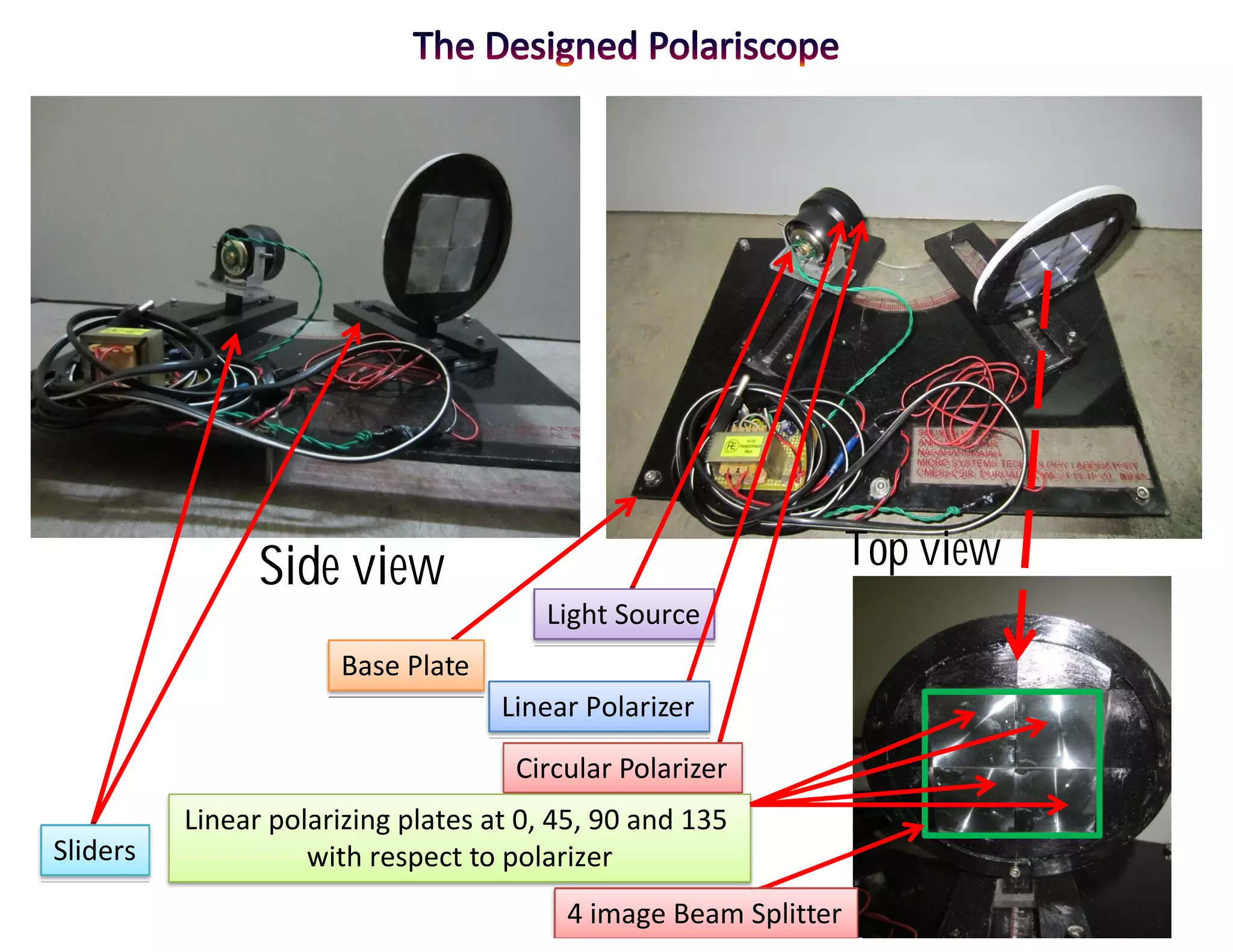
Side view                                        Top view
                                        Light Source
                      Base Plate
                                    Linear Polarizer
                                     Circular Polarizer
          Linear polarizing plates at 0, 45, 90 and 135
Sliders             with respect to polarizer
                                         4 image Beam Splitter
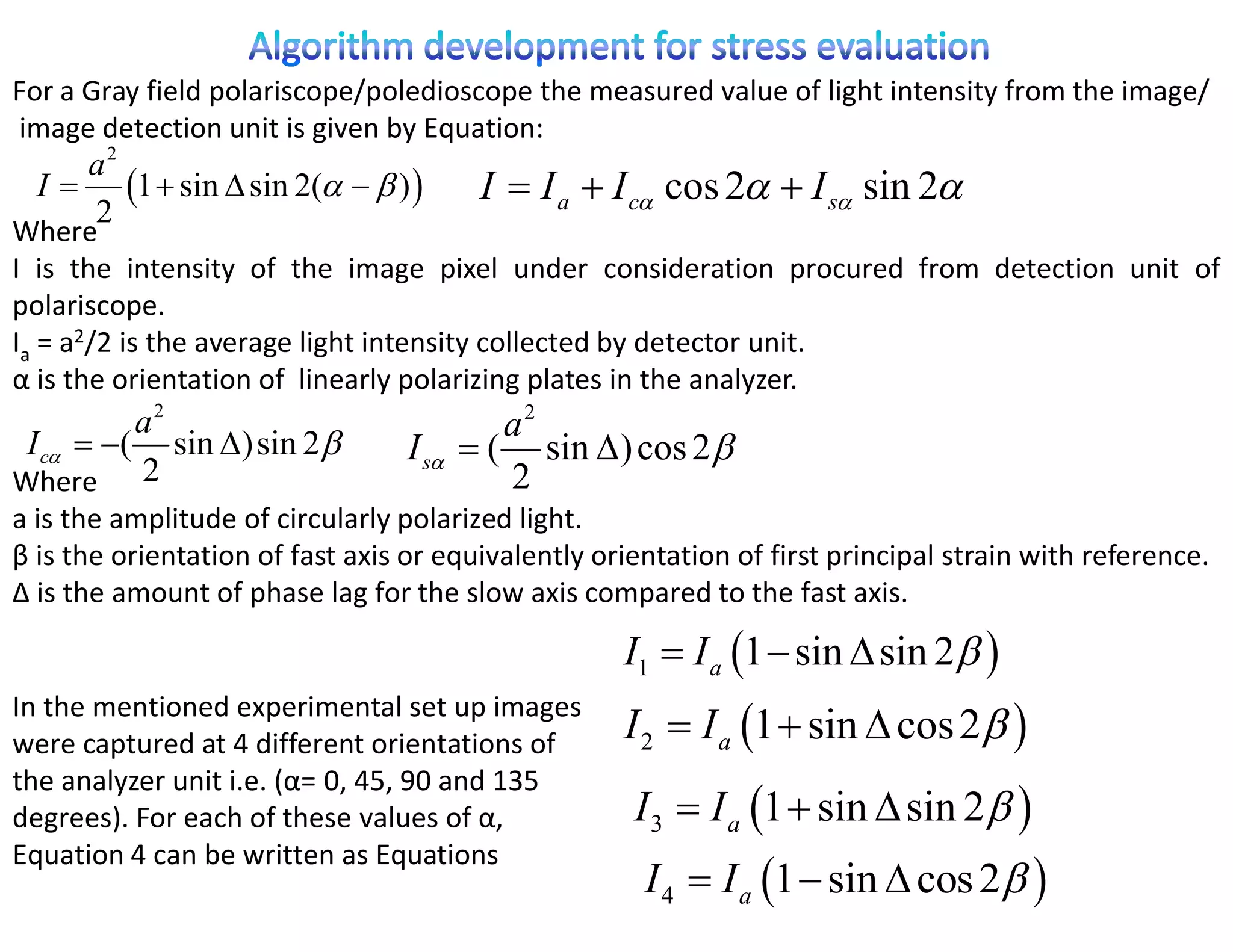
For a Gray field polariscope/poledioscope the measured value of light intensity from the image/
image detection unit is given by Equation:
     a2
  I  1  sin  sin 2(   )           I  I a  I c cos 2  I s sin 2
     2
Where
I is the intensity of the image pixel under consideration procured from detection unit of
polariscope.
Ia = a2/2 is the average light intensity collected by detector unit.
α is the orientation of linearly polarizing plates in the analyzer.
          a2                                a2
 I c  ( sin ) sin 2          I s    ( sin ) cos 2 
Where 2                                     2
a is the amplitude of circularly polarized light.
β is the orientation of fast axis or equivalently orientation of first principal strain with reference.
Δ is the amount of phase lag for the slow axis compared to the fast axis.

                                                    I1  I a 1  sin  sin 2 
                                                    I 2  I a 1  sin  cos 2 
In the mentioned experimental set up images
were captured at 4 different orientations of
the analyzer unit i.e. (α= 0, 45, 90 and 135
degrees). For each of these values of α,             I 3  I a 1  sin  sin 2 
Equation 4 can be written as Equations
                                                      I 4  I a 1  sin  cos 2 
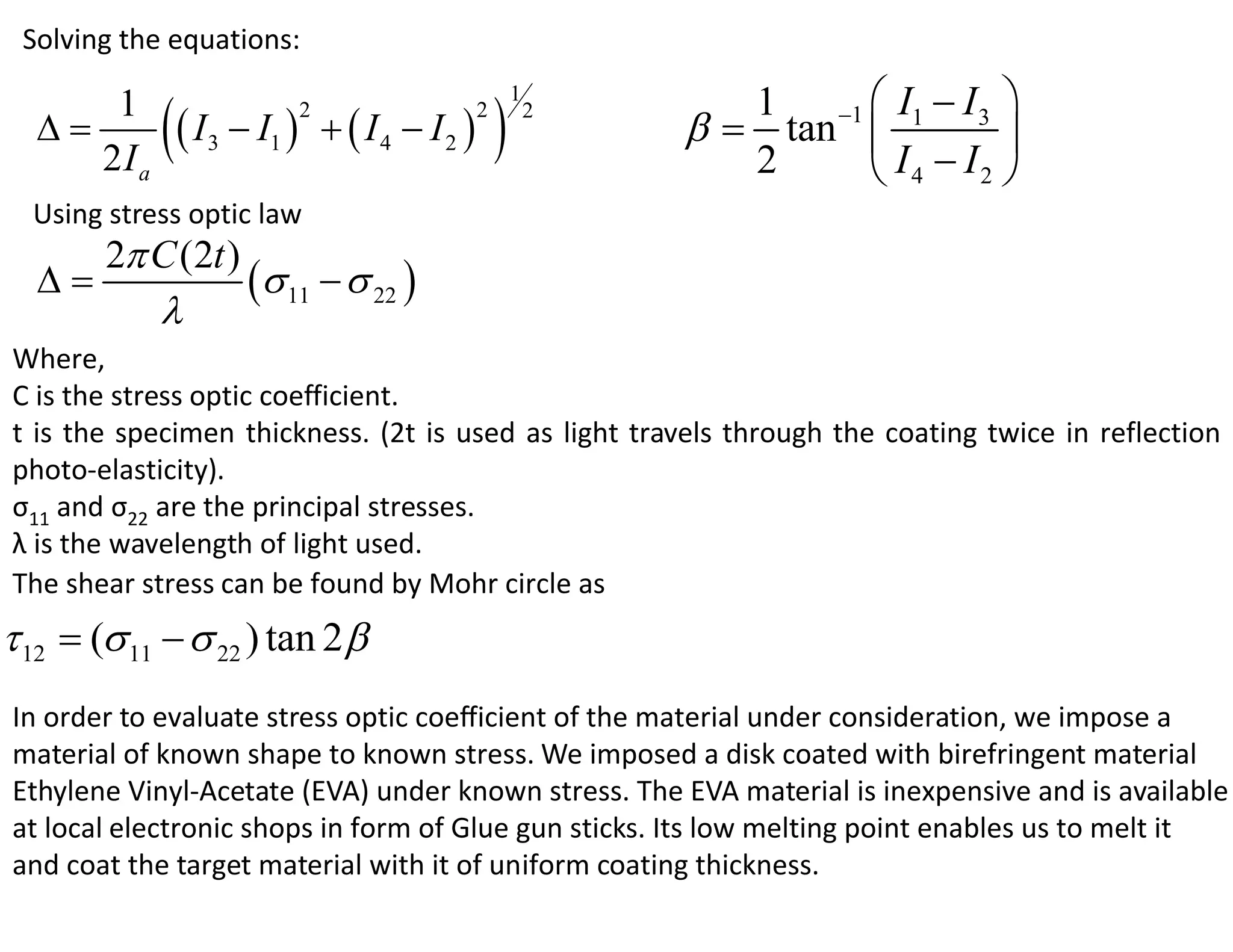
Solving the equations:

                                                                1 1  I1  I 3 
             I  I                            
                                                     1
      1
                             I4  I2                      tan 
                         2                   2           2
                                                                                
                                                                       I4  I2 
                3    1
     2Ia                                                        2    
  Using stress optic law
     2 C (2t )
               11   22 
        
Where,
C is the stress optic coefficient.
t is the specimen thickness. (2t is used as light travels through the coating twice in reflection
photo-elasticity).
σ11 and σ22 are the principal stresses.
λ is the wavelength of light used.
The shear stress can be found by Mohr circle as
 12  ( 11   22 ) tan 2 
In order to evaluate stress optic coefficient of the material under consideration, we impose a
material of known shape to known stress. We imposed a disk coated with birefringent material
Ethylene Vinyl-Acetate (EVA) under known stress. The EVA material is inexpensive and is available
at local electronic shops in form of Glue gun sticks. Its low melting point enables us to melt it
and coat the target material with it of uniform coating thickness.
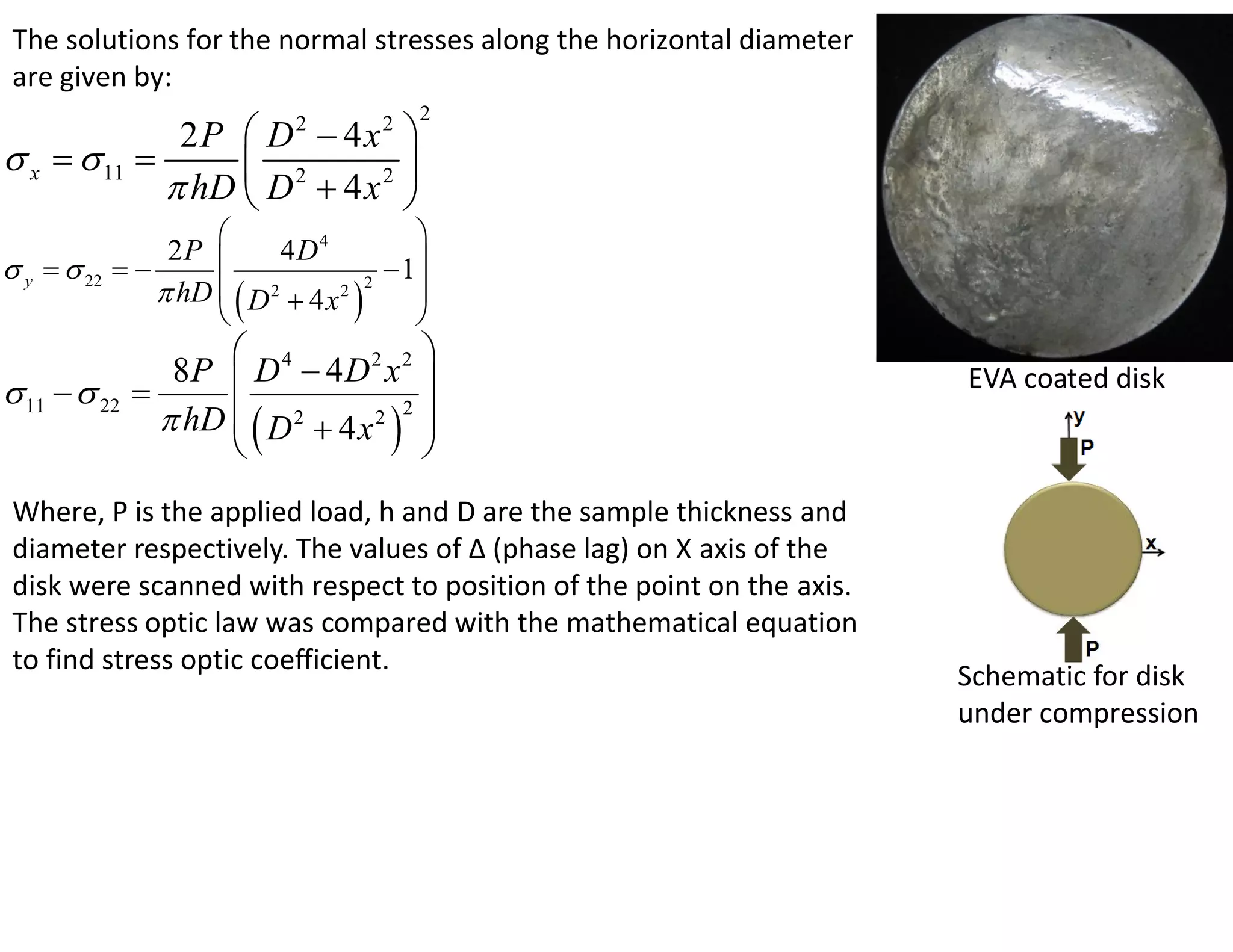
The solutions for the normal stresses along the horizontal diameter
 are given by:
                                            2
              2P  D  4x     2        2
 x   11                    
              hD  D 2  4 x 2 
                                           
                 2P        4D4
 y   22                              1
                 hD   D 2  4 x 2  2
                                            
                                           
                                       
                 8P  D 4  4 D 2 x 2                                  EVA coated disk
 11   22   
                 hD   D 2  4 x 2 2 
                                       
 Where, P is the applied load, h and D are the sample thickness and
 diameter respectively. The values of Δ (phase lag) on X axis of the
 disk were scanned with respect to position of the point on the axis.
 The stress optic law was compared with the mathematical equation
 to find stress optic coefficient.
                                                                        Schematic for disk
                                                                        under compression
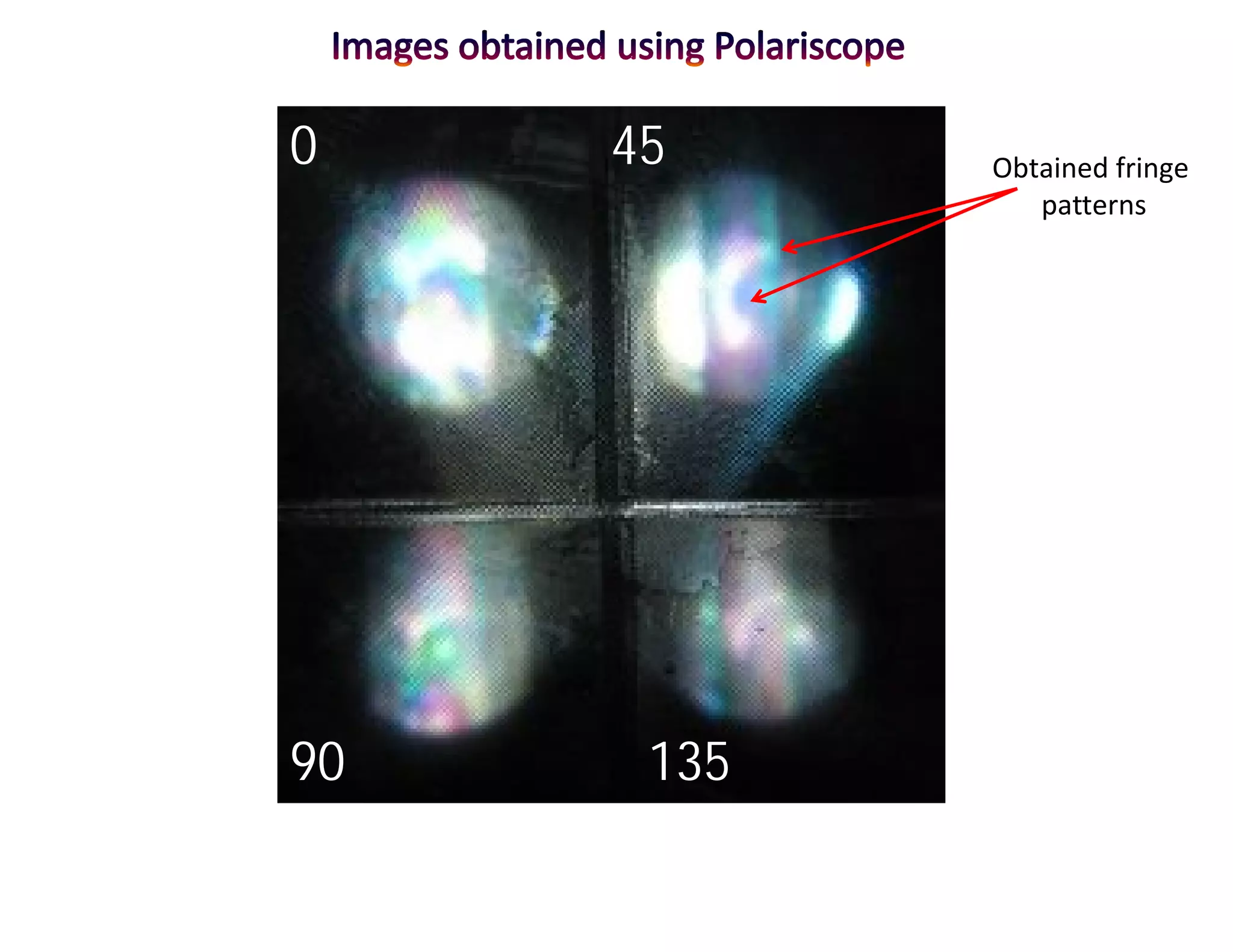
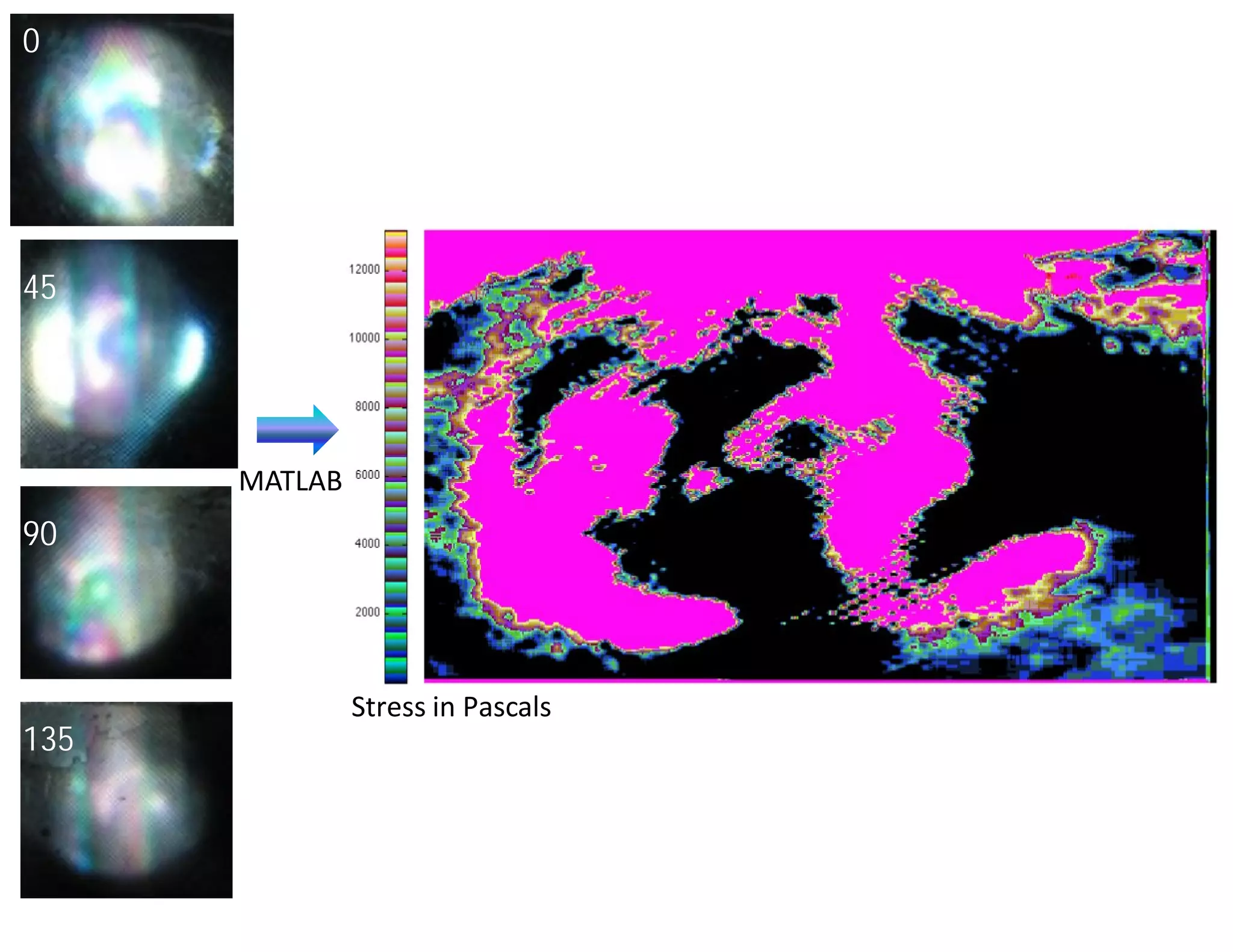
0    45     Obtained fringe
               patterns


90    135
0


45


      MATLAB
90


               Stress in Pascals
135
A very low costly polariscope for accurate and complete stress analysis is thus presented.

The design is useful for amateurs, hobbyists, students as well as researchers who are keen to
Pursue experimental stress analysis at least cost.
In case of any design related queries feel free to contact at:
somandal88@rediffmail.com
somandal88@cmeri.res.in

For algorithm related queries contact at:
anirudhkumar2@gmail.com
Polariscope: Practical Design

  • 1.
    CENTRAL MECHANICAL ENGINEERINGRESEARCH INSTITUTE (CMERI) COUNCIL OF SCIENTIFIC AND INDUSTRIAL RESEARCH (CSIR) INDIA
  • 2.
    At the endof the talk, you would be able to- Design Your Own Polariscope At A Cost Within $50.
  • 3.
    Definition of mechanicalstress: Internal forces acting inside a deformable body. Reasons for such internal forces: -Due to applied external forces. -Atomic forces. -Forces generated due to thermal expansion of the body. -Due to vibrations ………………. And many MORE. Consequences: -Material fatigue. Fig 1. Shear Stress -Fracture. -Degradation in material strength. Stress is a tensor quantity  Has magnitude and multiple directions (more than one). Types of stresses Principal Stresses and Shear Stress. Principal stresses are the stresses acting on the principal axes of the body. Principal axis is defined as the axes at which magnitude of shear stress is zero. As stress is a tensor, it is denoted by a matrix called Cauchy’s matrix and the matrix gives the stress components in different directions. In 3-D analysis the matrix is given as: The eigen values of the matrix corresponds to principal stresses and the eigenvectors gives the directions in which these principal stresses act and so called principal directions. Shear stress can be physically understood as the stress component coplanar with the body. Figure 1 shows its physical significance.
  • 4.
    Birefringence in physicsis defined as a property of some materials like Calcite, Glass, Plastics to exhibit double refractive indices when stress is present in the material. In other words, a stressed birefringent material shows different refractive indices to a beam of light in different directions and hence light will be subjected to different phase retardation along different directions. The effect in mechanics is known as photo-elasticity. The effect of birefringence can be felt if polarized light is incident on such materials. If monochromatic polarized light source is used to illuminate such stressed birefringent object a pattern with dark and white fringes are observed. In case a white light source is used, colored patterns are seen. Figure 2 shows such effect. The stress optic law which relates principal stresses and the induced phase retardations is given by: where R is the induced retardation, C is the stress optic coefficient, t is the specimen thickness, σ11 is the first principal stress, and Fig 2. Birefringence Demonstration σ22 is the second principal stress.
  • 5.
    A polariscope isan instrument for analysis of stress in a birefringent material. If the material is not birefringent, say for example metals, the material is coated with a thin layer of known birefringent material. Different types of polariscope are available in theory and in market. We have designed and developed a Gray field polariscope (GFP) for stress analysis, as it is very simple and includes least complex mathematics. Figure 3 shows a commercially available GFP schematic. However, as seen here it has a rotating section, in order to orient it in particular orientation before image capturing. This feature limits its application in dynamic stress analysis, i.e. when stress on an object changes very rapidly in a short period and its not possible to rotate the required part in that short interval. So, instead of the rotating part, we used a beam splitter here and pasted linear polarizing plates at required orientations. Figure 3
  • 6.
  • 7.
    S.No Material Cost Website 1 Linearly polarizing plate (A4 size) $10+ 5 http://www.3dlens.com/sho Product No: P210 (shipping) p/polarizer-210x300mm.php Polarizer 210x300mm 2 Circularly polarizing filters $8 http://www.ebay.in/itm/52 MM-CPL-FILTER-CIRCULAR- POLARIZER-4-NIKON-D3100- D5100- /270923037183?pt=LH_Defa ultDomain_203&hash=item3 f144579ff#ht_2737wt_958 3 Beam Splitter $2 http://www.3dlens.com/sho Product No: 408 p/multi-image-fresnel- Multi Image Fresnel Lens lens.php 4 Light source (LED with a reflector) $1 found at local electronic shops 5 Plexiglass sheets for making $10 stands and base found at local hardware stores. Contd…
  • 8.
    For static stressanalysis (i.e. when stress does not change with time), normal good quality Cameras can be used to capture the images like Sony CyberShot DSC-W610 or BenQ 14 MP Point & Shoot Digital Camera which is available within $70. For dynamic stress analysis, a camera with high frame rate is required. Such cameras are although costly but are affordable. We have used Casio EXILIM ZR-200 at 1000fps movie mode for dynamic stress analysis. The cost of such cameras lies in range of $400. In this way, we can design a polariscope at throw away price.
  • 9.
    Side view Top view Light Source Base Plate Linear Polarizer Circular Polarizer Linear polarizing plates at 0, 45, 90 and 135 Sliders with respect to polarizer 4 image Beam Splitter
  • 10.
    For a Grayfield polariscope/poledioscope the measured value of light intensity from the image/ image detection unit is given by Equation: a2 I  1  sin  sin 2(   )  I  I a  I c cos 2  I s sin 2 2 Where I is the intensity of the image pixel under consideration procured from detection unit of polariscope. Ia = a2/2 is the average light intensity collected by detector unit. α is the orientation of linearly polarizing plates in the analyzer. a2 a2 I c  ( sin ) sin 2 I s  ( sin ) cos 2  Where 2 2 a is the amplitude of circularly polarized light. β is the orientation of fast axis or equivalently orientation of first principal strain with reference. Δ is the amount of phase lag for the slow axis compared to the fast axis. I1  I a 1  sin  sin 2  I 2  I a 1  sin  cos 2  In the mentioned experimental set up images were captured at 4 different orientations of the analyzer unit i.e. (α= 0, 45, 90 and 135 degrees). For each of these values of α, I 3  I a 1  sin  sin 2  Equation 4 can be written as Equations I 4  I a 1  sin  cos 2 
  • 11.
    Solving the equations: 1 1  I1  I 3   I  I   1 1    I4  I2    tan  2 2 2  I4  I2  3 1 2Ia 2  Using stress optic law 2 C (2t )   11   22   Where, C is the stress optic coefficient. t is the specimen thickness. (2t is used as light travels through the coating twice in reflection photo-elasticity). σ11 and σ22 are the principal stresses. λ is the wavelength of light used. The shear stress can be found by Mohr circle as  12  ( 11   22 ) tan 2  In order to evaluate stress optic coefficient of the material under consideration, we impose a material of known shape to known stress. We imposed a disk coated with birefringent material Ethylene Vinyl-Acetate (EVA) under known stress. The EVA material is inexpensive and is available at local electronic shops in form of Glue gun sticks. Its low melting point enables us to melt it and coat the target material with it of uniform coating thickness.
  • 12.
    The solutions forthe normal stresses along the horizontal diameter are given by: 2 2P  D  4x  2 2  x   11     hD  D 2  4 x 2    2P  4D4  y   22   1  hD   D 2  4 x 2  2      8P  D 4  4 D 2 x 2  EVA coated disk  11   22   hD   D 2  4 x 2 2    Where, P is the applied load, h and D are the sample thickness and diameter respectively. The values of Δ (phase lag) on X axis of the disk were scanned with respect to position of the point on the axis. The stress optic law was compared with the mathematical equation to find stress optic coefficient. Schematic for disk under compression
  • 13.
    0 45 Obtained fringe patterns 90 135
  • 14.
    0 45 MATLAB 90 Stress in Pascals 135
  • 15.
    A very lowcostly polariscope for accurate and complete stress analysis is thus presented. The design is useful for amateurs, hobbyists, students as well as researchers who are keen to Pursue experimental stress analysis at least cost.
  • 16.
    In case ofany design related queries feel free to contact at: somandal88@rediffmail.com somandal88@cmeri.res.in For algorithm related queries contact at: anirudhkumar2@gmail.com