Programmatic + Premium:
Current Practices and Future Trends
A Digiday State of the Industry
Survey with OpenX


             ®


March 2013
Table of Contents

About this Paper                                                     2

Current State of Programmatic Trading                                4

How “Fair” is Programmatic Trading                                   6

Does the Right Technology Make a Difference?                         8

Or is Inventory Quality the Key to Improving Programmatic Trading?   9

Turning to “Programmatic Premium”                                    10

Moving Forward: Improving Programmatic                               12

Conclusions                                                          15

Methodology                                                          16


                                                                          ®
About this Paper

According to the respondents in our survey, trading digital       We’ve framed this survey, and resulting analysis/discussion,
advertising programmatically may either be the path to            as an examination of what it means to transact advertising
strategically applying technology to create a more perfect        programmatically, with an eye to maintaining the quality,
marketplace for both buyers and sellers – or a threat to
publisher’s business.                                             and content.

Publishers, fearing the commoditization of the inventory          In the following analysis, we’ll look at current industry practice
surrounding their expensively produced content and                with respect to programmatic trading, and try to predict some
painstakingly nurtured audiences, have every right to guard       future trends based on an examination of responses from
their investment. They want to make sure that any system that     more than 800 digital buyers, sellers and intermediaries who
removes “friction” doesn’t also remove the distinction of their   make this marketplace at once so vibrant and complex.
brand and the quality of their adjacencies, as measured by
audience engagement. And, understandably, they want to
preserve the professional relationships that forge the bedrock
of their sustainable revenue growth.

Guess what? So do buyers.

Our research shows that digital ad buyers also value those
direct relationships with publishers, and – while they view
their role in the process as getting the best deal possible –


Page 2
                                                                                                                                       ®
Along the way, we’ll observe that:

   Both publishers and buyers are committed to              “Programmatic Premium” is a term more familiar to
   programmatic trading, and both plan to invest more
   in the year ahead than they did in the past 12 months.
                                                            Clearly, neither side thinks the current system
   Overall, the percentage of inventory traded              is perfect.
   programmatically, along with the revenue it
                                                            o   Publishers top 3 concerns: controlling CPM/pricing by
   generates, is poised to grow rapidly in the
                                                                advertiser or segment, maintaining direct relationships
   coming year.
                                                                with buyers, and controlling ad quality.
   Publishers and buyers are using all sales channels
                                                            o   Buyers want more data to inform their bids, exposure
   to sell/buy online ads – and some achieve markedly
                                                                to inventory not currently available to them, and
   better success with programmatic than others.
                                                                preferred access to inventory.
   There are elements of the traditional direct sales
                                                            Regardless of how quickly programmatic trading
   process that publishers feel can be replaced
                                                            spreads, neither publishers nor buyers want to give
   programmatically,
   billing/ reconciliation, and optimization.
                                                            engender.
   There is some work to be done before publishers
                                                            Publishers need the right technology foundation in
   feel good about programmatic selling – they
                                                            order to engage in programmatic trading. Of those
   see themselves at a disadvantage. Many buyers
                                                            publishers who engage in programmatic selling, 81
   acknowledge this fear and are concerned about this
                                                            percent report they use an ad server that has exchange
   perceived imbalance adversely impacting programmatic
                                                            capabilities integrated into the platform.
   trading.

   Publishers, as well as buyers, are trading both
   premium and remnant inventory programmatically,
   but with stark differences in how much they are
   reporting of each.


Page 3
                                                                                                                          ®
Current State of
Programmatic Trading
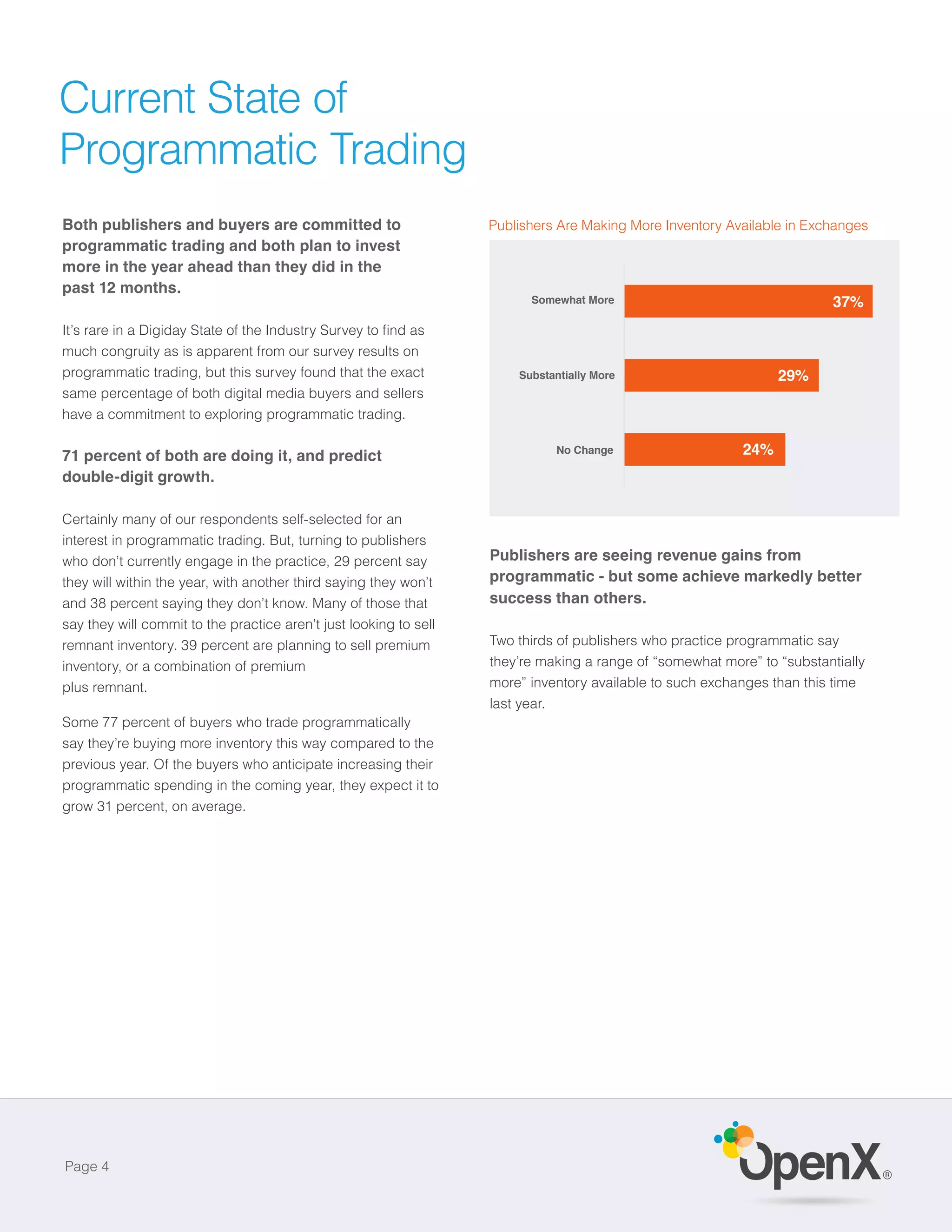
Both publishers and buyers are committed to                        Publishers Are Making More Inventory Available in Exchanges
programmatic trading and both plan to invest
more in the year ahead than they did in the
past 12 months.
                                                                         Somewhat More
                                                                           Somewhat More                                37%


much congruity as is apparent from our survey results on
programmatic trading, but this survey found that the exact             Substantially More
                                                                         Substantially More                     29%
same percentage of both digital media buyers and sellers
have a commitment to exploring programmatic trading.


71 percent of both are doing it, and predict                                  No Change
                                                                               No Change                  24%
double-digit growth.

Certainly many of our respondents self-selected for an
interest in programmatic trading. But, turning to publishers
who don’t currently engage in the practice, 29 percent say         Publishers are seeing revenue gains from
they will within the year, with another third saying they won’t    programmatic - but some achieve markedly better
and 38 percent saying they don’t know. Many of those that          success than others.
say they will commit to the practice aren’t just looking to sell
remnant inventory. 39 percent are planning to sell premium         Two thirds of publishers who practice programmatic say
inventory, or a combination of premium                             they’re making a range of “somewhat more” to “substantially
plus remnant.                                                      more” inventory available to such exchanges than this time
                                                                   last year.
Some 77 percent of buyers who trade programmatically
say they’re buying more inventory this way compared to the
previous year. Of the buyers who anticipate increasing their
programmatic spending in the coming year, they expect it to
grow 31 percent, on average.


Page 4
                                                                                                                                 ®
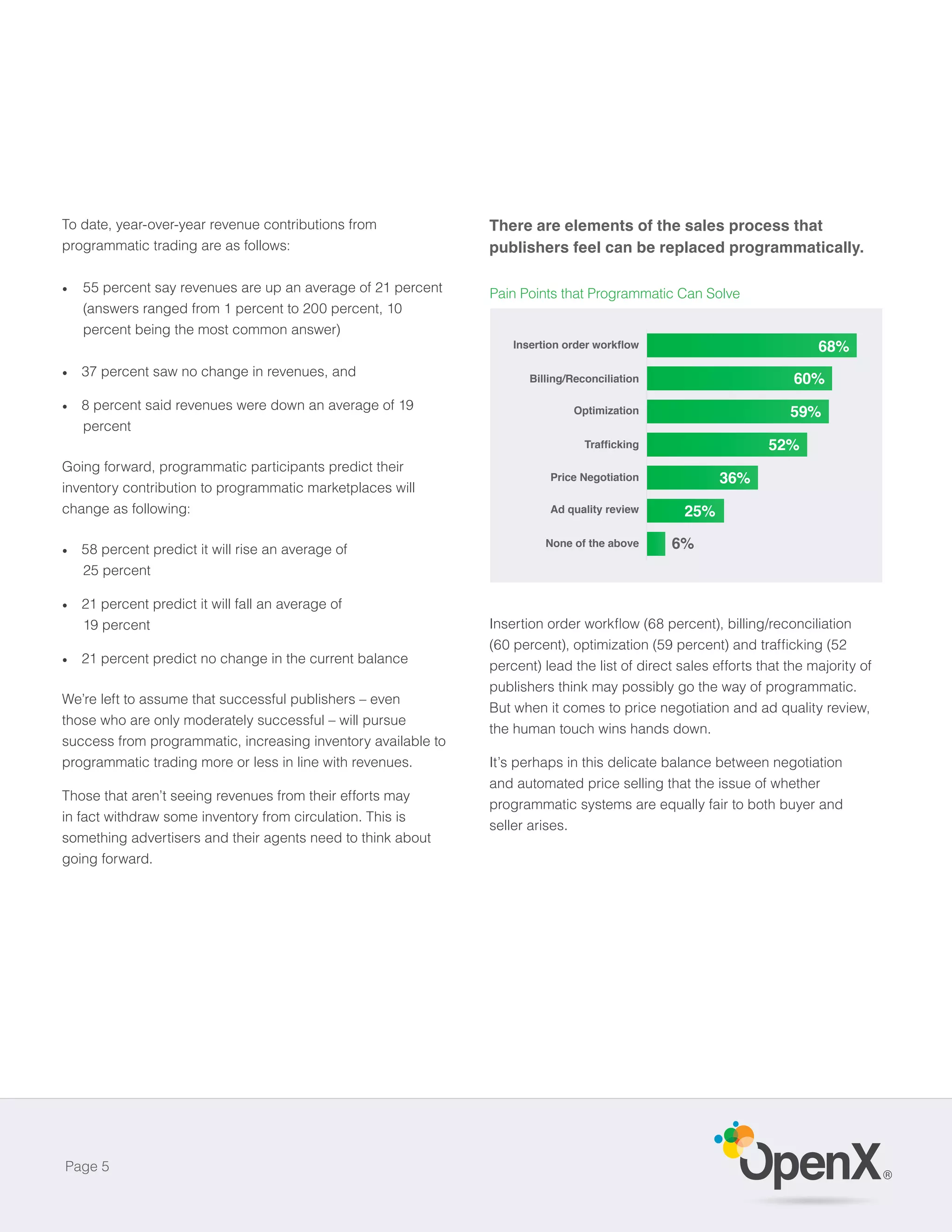
To date, year-over-year revenue contributions from             There are elements of the sales process that
programmatic trading are as follows:                           publishers feel can be replaced programmatically.

   55 percent say revenues are up an average of 21 percent     Pain Points that Programmatic Can Solve
   (answers ranged from 1 percent to 200 percent, 10
   percent being the most common answer)
                                                                                                                         68%
   37 percent saw no change in revenues, and                          Billing/Reconciliation
                                                                             Billing/Reconciliation                  60%
   8 percent said revenues were down an average of 19                            Optimization
                                                                                    Optimization                     59%
   percent
                                                                                                                   52%
Going forward, programmatic participants predict their
                                                                           PricePrice Negotiation
                                                                                 Negotiation                 36%
inventory contribution to programmatic marketplaces will
change as following:                                                       Ad quality review
                                                                               Ad quality review       25%

   58 percent predict it will rise an average of
                                                                          NoneNone of the above
                                                                               of the above           6%
   25 percent

   21 percent predict it will fall an average of
   19 percent

   21 percent predict no change in the current balance
                                                               percent) lead the list of direct sales efforts that the majority of
                                                               publishers think may possibly go the way of programmatic.
We’re left to assume that successful publishers – even
                                                               But when it comes to price negotiation and ad quality review,
those who are only moderately successful – will pursue
                                                               the human touch wins hands down.
success from programmatic, increasing inventory available to
programmatic trading more or less in line with revenues.       It’s perhaps in this delicate balance between negotiation
                                                               and automated price selling that the issue of whether
Those that aren’t seeing revenues from their efforts may
                                                               programmatic systems are equally fair to both buyer and
in fact withdraw some inventory from circulation. This is
                                                               seller arises.
something advertisers and their agents need to think about
going forward.


Page 5
                                                                                                                                     ®
How “Fair” Is
Programmatic Trading?
Going straight to the heart of the matter, we asked both


both buyers and sellers equally. While the choices selected
                                                                      Publishers
                                                                      Publishers
seemed to differ dramatically between the respondent

                                                                            No
                                                                            No                         45%
programmatically – the comments provided by those who


were more in synch. Sellers, of course, tend to think the            Don't know              30%
system favors buyers. While a nearly equivalent number of
buyers profess not to know whether such trading is equally
fair to each, the comments of those believing it unfair indicate           Yes
                                                                           Yes           25%


There is some work to be done before publishers                        Buyer
feel good about programmatic selling – they see
themselves at a disadvantage. Encouragingly,                                No
                                                                            No    18%
many buyers acknowledge this fear and are
concerned about this perceived imbalance
                                                                                                 44%
adversely impacting programmatic trading.


                                                                           Yes
                                                                           Yes               38%
because they control the marketplace by controlling the
inventory upon which it functions, saying, “At this point,
publishers have more leverage as they hold back inventory
from these new platforms. But, that will change.”

Most publishers who said the system is biased, said trading

                                                                   and buy it cheaply, because the seller does not know the
                                                                   value.”


   “As a premium publisher [I believe] the advantage goes
                                                                   massive reach on top sites for bottom dollar. Meanwhile,
   to the advertisers that are buying our inventory at below-
                                                                   publishers are playing catch up, and struggling
   market rates. Until the eCPM starts climbing to match
                                                                   to optimize the balance between direct sales and
   direct sales eCPM, the advantage will never be to the
                                                                   programmatic buying in their yield strategies, and in
   seller.”
                                                                   particular trying to limit CPM erosion.”
   Buyers are “calling the shots on price, and you play the
   game or don’t get the volume. Buyers are biased too
   much towards audience and not enough towards context.”


Page 6
                                                                                                                              ®
Jumping ahead to the cause of the perceived imbalance,
one publisher observed, “The sell side still doesn’t have
the insight, controls and automation to really optimize yield
and manage an integrated direct/indirect strategy.” Another,        for buyers is directly in the buying activity, while the
posing a solution said, “I think that publishers with premium
inventory need to make sure they can still command a price          and data management side, which is less easy to
closer to premium than public. Buyers need to know the              leverage quickly.”

                                                                    “There are not yet enough buyers of programmatic
In fact, they do.                                                   ads to inform the market pricing. Exchange buying is
                                                                    unrealistically cheap today. That will change as more
Buyers who perceive an imbalance in the system, largely
                                                                    buyers move to programmatic tools.”
in their favor, seem as concerned as publishers to level

                                                                 Or, as one summed it up, “it’s a great time to be a
comments are from buyers who employ programmatic                 programmatic media buyer.” Concern for sellers was evident
buying:


                                                                 market share to lesser known digital properties,” even as they
   enough tools for publisher balance.”

                                                                 remnant or even unsold.”
   sales and obtain low CPMs. However, as publishers get
                                                                 Speaking for the undecided, one buyer said, “The sell side
                                                                 needs to invest in their people, data and infrastructure in
   command rates consistent with the value and reduce the
                                                                 order to fully manage yield and supply.”


   Until publishers wise up and stop creating ad avails, their
   inventory will continue to be undervalued. Less inventory
   means more quality to the exchange. Greed is keeping
   the price low for buyers.”


Page 7
                                                                                                                                  ®
Does the Right Technology
Make a Difference?
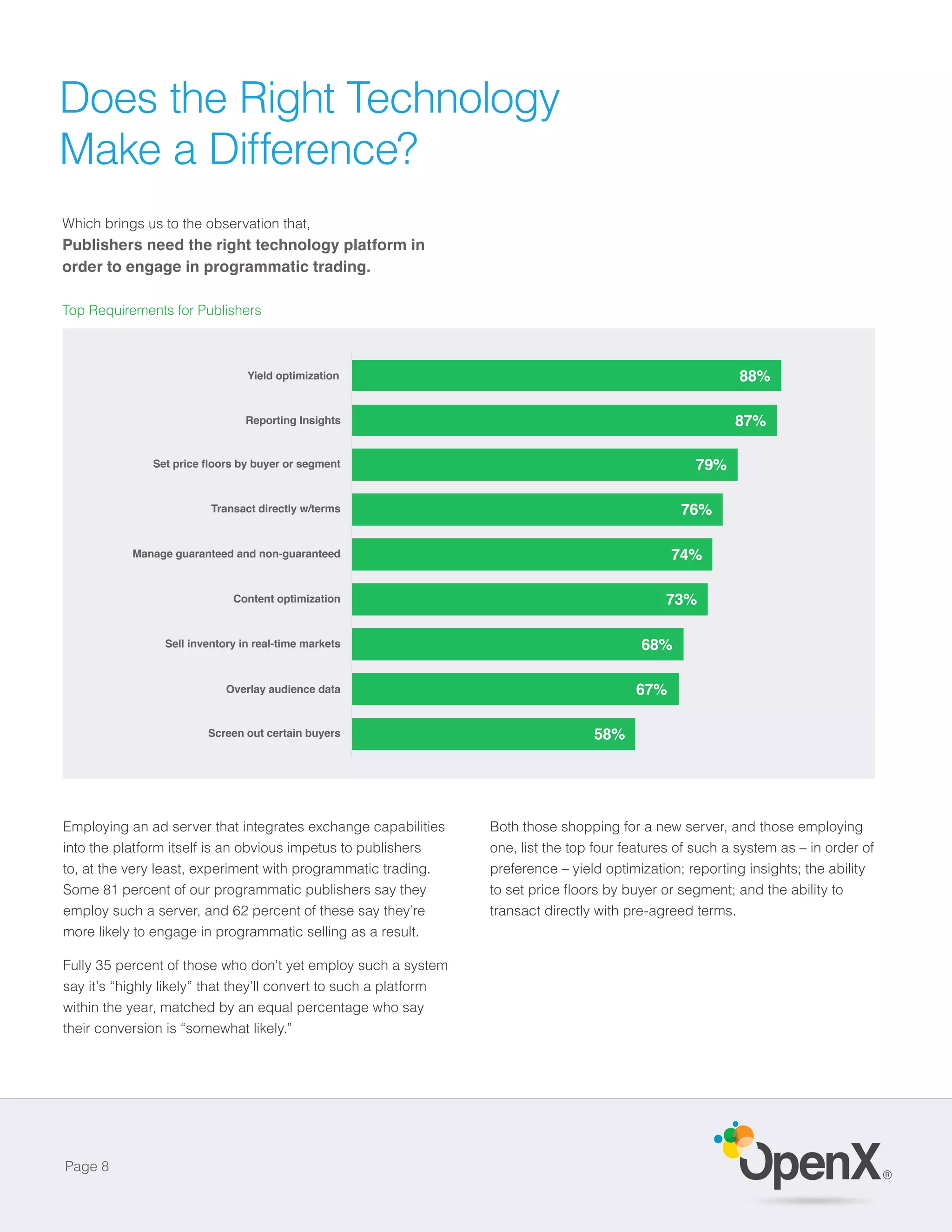
Which brings us to the observation that,
Publishers need the right technology platform in
order to engage in programmatic trading.

Top Requirements for Publishers


                                Yield optimization
                                Yield optimization                                                            88%

                               Reporting Insights
                                Reporting Insights                                                          87%

                                                                                                     79%

                         Transact directly w/terms
                        Transact directly w/terms                                                  76%

           Manage guaranteed and non-guaranteed
         Manage guaranteed and non-guaranteed                                                    74%

                             Content optimization
                            Content optimization                                                73%

                Sell inventory in real-time markets
               Sell inventory in real-time markets                                          68%

                            Overlay audience data
                           Overlay audience data                                           67%

                        Screen out certain buyers
                       Screen out certain buyers                                    58%


Employing an ad server that integrates exchange capabilities       Both those shopping for a new server, and those employing
into the platform itself is an obvious impetus to publishers       one, list the top four features of such a system as – in order of
to, at the very least, experiment with programmatic trading.       preference – yield optimization; reporting insights; the ability
Some 81 percent of our programmatic publishers say they
employ such a server, and 62 percent of these say they’re          transact directly with pre-agreed terms.
more likely to engage in programmatic selling as a result.

Fully 35 percent of those who don’t yet employ such a system
say it’s “highly likely” that they’ll convert to such a platform
within the year, matched by an equal percentage who say
their conversion is “somewhat likely.”


Page 8
                                                                                                                                       ®
Or is Inventory Quality the Key to Increasing
Adoption of Programmatic Trading?
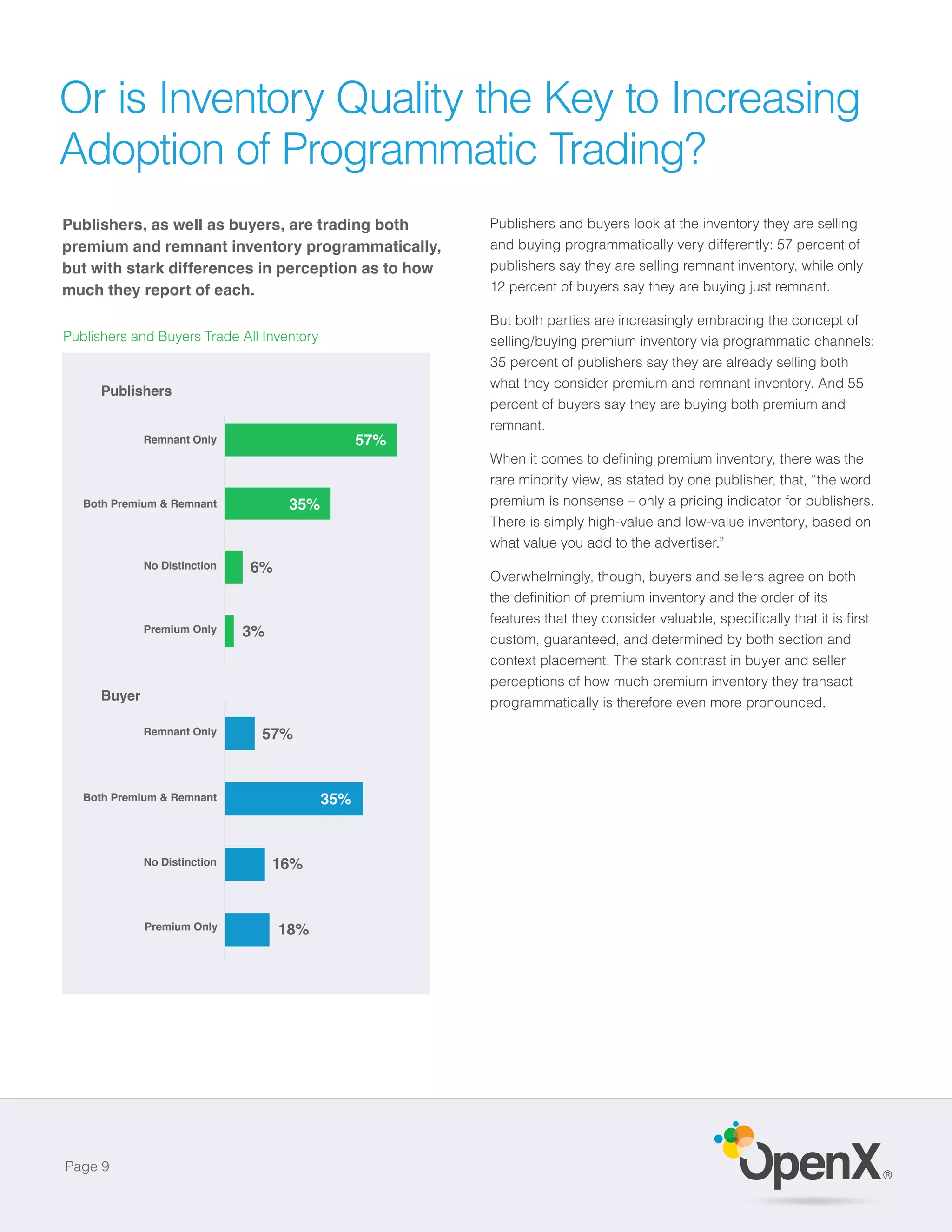
Publishers, as well as buyers, are trading both            Publishers and buyers look at the inventory they are selling
premium and remnant inventory programmatically,            and buying programmatically very differently: 57 percent of
but with stark differences in perception as to how         publishers say they are selling remnant inventory, while only
much they report of each.                                  12 percent of buyers say they are buying just remnant.

                                                           But both parties are increasingly embracing the concept of
Publishers and Buyers Trade All Inventory                  selling/buying premium inventory via programmatic channels:
                                                           35 percent of publishers say they are already selling both
                                                           what they consider premium and remnant inventory. And 55
      Publishers
                                                           percent of buyers say they are buying both premium and
                                                           remnant.
               Remnant Only
                 Remnant Only                        57%

                                                           rare minority view, as stated by one publisher, that, “the word
   Both Premium & Remnant
         Both Premium & Remnant          35%               premium is nonsense – only a pricing indicator for publishers.
                                                           There is simply high-value and low-value inventory, based on
                                                           what value you add to the advertiser.”
               No Distinction
                  No Distinction   6%
                                                           Overwhelmingly, though, buyers and sellers agree on both


               Premium Only
                  Premium Only     3%                      custom, guaranteed, and determined by both section and
                                                           context placement. The stark contrast in buyer and seller
                                                           perceptions of how much premium inventory they transact
      Buyer                                                programmatically is therefore even more pronounced.

               Remnant Only
                 Remnant Only       57%


   Both Premium & Remnant
        Both Premium & Remnant                 35%


               No Distinction
                  No Distinction        16%


               Premium Only
                  Premium Only          18%


Page 9
                                                                                                                             ®
Turning to “Programmatic Premium”

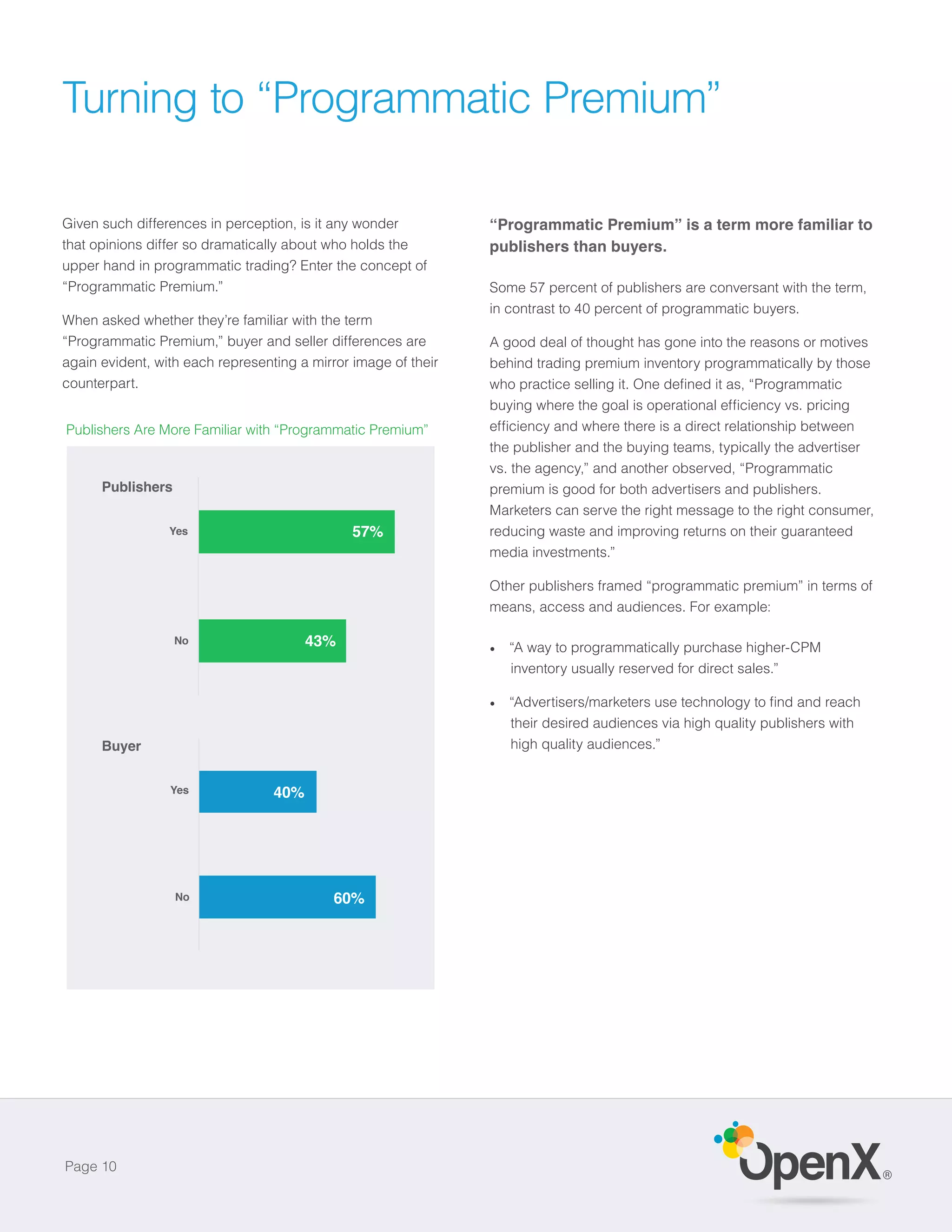
Given such differences in perception, is it any wonder          “Programmatic Premium” is a term more familiar to
that opinions differ so dramatically about who holds the        publishers than buyers.
upper hand in programmatic trading? Enter the concept of
“Programmatic Premium.”                                         Some 57 percent of publishers are conversant with the term,
                                                                in contrast to 40 percent of programmatic buyers.
When asked whether they’re familiar with the term
“Programmatic Premium,” buyer and seller differences are        A good deal of thought has gone into the reasons or motives
again evident, with each representing a mirror image of their   behind trading premium inventory programmatically by those
counterpart.


Publishers Are More Familiar with “Programmatic Premium”
                                                                the publisher and the buying teams, typically the advertiser
                                                                vs. the agency,” and another observed, “Programmatic
      Publishers                                                premium is good for both advertisers and publishers.
                                                                Marketers can serve the right message to the right consumer,
                 Yes
                   Yes                         57%              reducing waste and improving returns on their guaranteed
                                                                media investments.”

                                                                Other publishers framed “programmatic premium” in terms of
                                                                means, access and audiences. For example:

                   No
                    No                  43%                        “A way to programmatically purchase higher-CPM
                                                                   inventory usually reserved for direct sales.”


                                                                   their desired audiences via high quality publishers with
      Buyer                                                        high quality audiences.”


                 Yes
                  Yes             40%


                   No
                    No                      60%


Page 10
                                                                                                                               ®
There’s an element of real-time access to how respondents
                                                                it did so in remarkably similar terms. Programmatic premium
buying my above-the-fold inventory on pages with popular/       often involves a guarantee, either of the sites themselves,
engaging content.” It’s often driven by data – e.g. “Getting    guaranteed placements, audience, or date/time. Plus the
additional revenue based on additional data made available      quality of the publisher brand matters to buyers.
to seller” – and by pre-negotiated terms. The concept of
                                                                It may be exchange or DSP facilitated, and could be private.
premium brands also plays a role, as in this publisher’s

                                                                then the system matches premium publishers who can get to
programmatic channel at a previously agreed upon price.” To
                                                                those audiences.” Buyers see it as quality inventory, not “run
many, it implies quality, premier placement, and by extension
                                                                of site junk.” Transacting premium inventory programmatically
                                                                certainly elicits the idea of convenience, for example, “No
Media, Rich Data and Rich Results.”
                                                                longer needing insertion orders to obtain premium inventory


end, programmatic premium may be determined in the eye of       minimum number of impressions to buy in a month.”
the beholder, or in this case, the buyer.


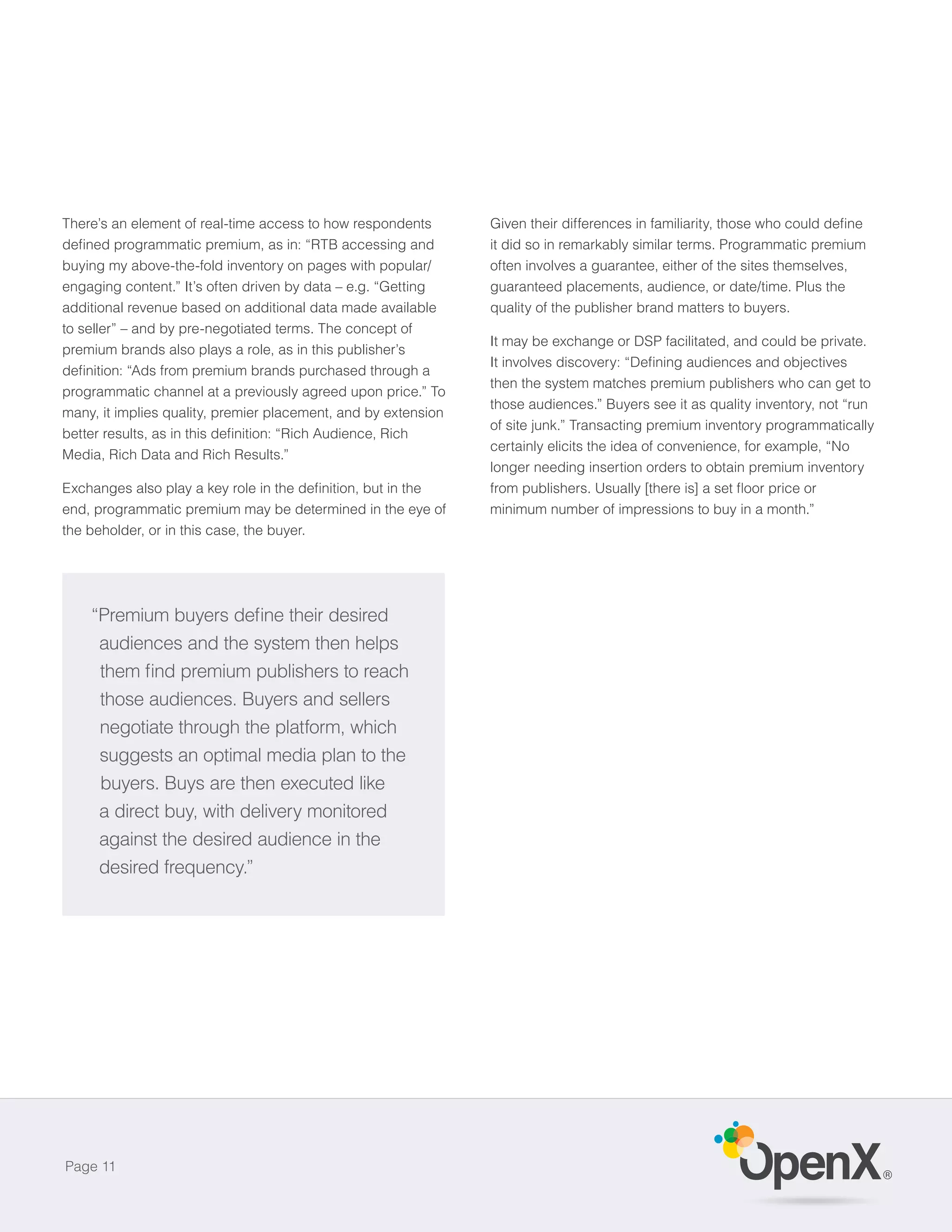
     audiences and the system then helps


     those audiences. Buyers and sellers
     negotiate through the platform, which
     suggests an optimal media plan to the
     buyers. Buys are then executed like
     a direct buy, with delivery monitored
     against the desired audience in the
     desired frequency.”


Page 11
                                                                                                                                 ®
Moving Forward:
Improving Programmatic
                                                                So despite their stated preference to buy direct, 61 percent
for publishers and buyers to engage in even more                are open to changing how they buy, as long as they get
programmatic trade.
                                                                advantages of programmatic trading.
Publishers’ top three concerns around programmatic trade
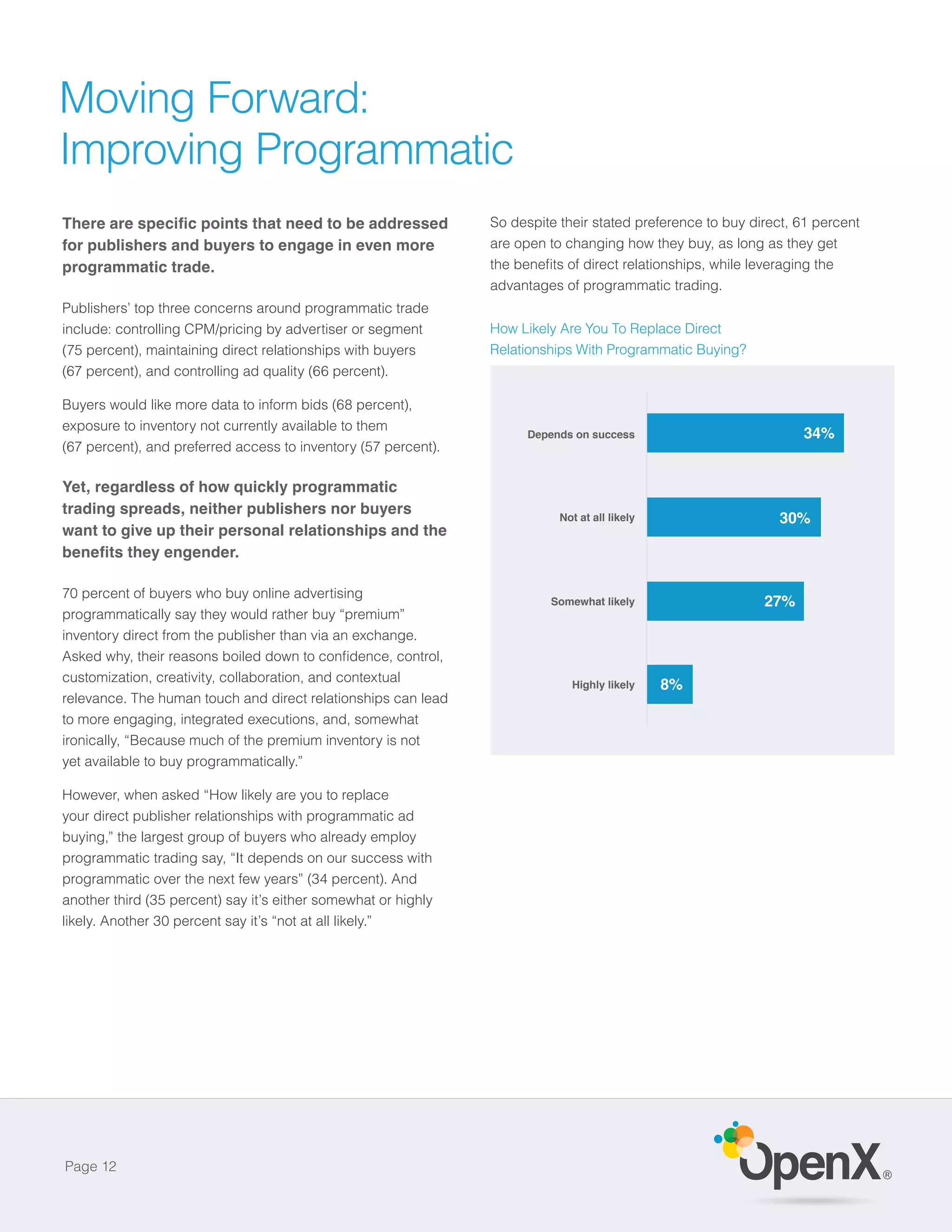
include: controlling CPM/pricing by advertiser or segment       How Likely Are You To Replace Direct
(75 percent), maintaining direct relationships with buyers      Relationships With Programmatic Buying?
(67 percent), and controlling ad quality (66 percent).

Buyers would like more data to inform bids (68 percent),
exposure to inventory not currently available to them
                                                                      Depends on success
                                                                      Depends on success                          34%
(67 percent), and preferred access to inventory (57 percent).

Yet, regardless of how quickly programmatic
trading spreads, neither publishers nor buyers                             Not at all likely
                                                                            Not at all likely                 30%
want to give up their personal relationships and the


70 percent of buyers who buy online advertising
                                                                          Somewhat likely
                                                                         Somewhat likely                    27%
programmatically say they would rather buy “premium”
inventory direct from the publisher than via an exchange.


customization, creativity, collaboration, and contextual                     Highly likely
                                                                             Highly likely      8%
relevance. The human touch and direct relationships can lead
to more engaging, integrated executions, and, somewhat
ironically, “Because much of the premium inventory is not
yet available to buy programmatically.”

However, when asked “How likely are you to replace
your direct publisher relationships with programmatic ad
buying,” the largest group of buyers who already employ
programmatic trading say, “It depends on our success with
programmatic over the next few years” (34 percent). And
another third (35 percent) say it’s either somewhat or highly
likely. Another 30 percent say it’s “not at all likely.”


Page 12
                                                                                                                               ®
Among the reasons the small number of programmatic                Those DSPs who blamed advertisers for slowing the adoption
buyers said they are “highly likely” to replace direct            of exchange spending faulted a lack of education and a
relationships with programmatic buying were the following:        resistance to change. One who blamed agencies implied that
                                                                  they were trying to use DSP platforms to solve their clients
   “This is the future of advertising; pulling together media     direct response needs, and not for the things programmatic
   planning.”                                                     trading was created to address. Without assigning blame,
                                                                  others said there’s a lack of industry awareness on how both
   “If 100 publishers called me in a week (not unusual), I bet
   fewer than 5 have something unique or different to say.”
                                                                  for buyers and premium CPMs for publishers.” Concerns over
   “We have better data on what drives the client business        brand safety, competitive separation, lack of quality inventory,
   results than do publishers.”                                   predictability and creative freedom all deter adoption.


                                                                  “Programmatic Premium,” to paint the most complete picture
The rise of demand-side platforms (DSP) in the mix will           of what programmatic trading could become.


percent) of DSPs in our study said that 91-100 percent of
their inventory is transacted via Real-Time Bidding. And
81 percent of those who don’t currently trade with private
exchanges would do so if they had exposure to inventory
not available elsewhere.

According to most of these trading specialists, it’s publishers
who are holding back the advance of programmatic trading.
Answering the question, “what is holding back spending on
exchanges?” DSPs said:

   “Publishers are still hesitant and afraid of the open market
   and need to become comfortable that large brands have
   shifted their spend to RTB, and publishers need to follow
   suit if they want to capture these buyers.”

   “Publishers not opening up more of their inventory to the
   exchanges.”

   “Lack of super premium inventory made available to
   exchanges.”

   “Inventory quality and transparency.”


Page 13
                                                                                                                                     ®
“Programmatic Premium is nothing but            Such buys/deals are then executed like
     making high-quality publisher inventory        a direct buy/deal, with delivery monitored
     available through automated sales              against desired audience at desired
     channels (with direct and controlled access
     to buyers and similarly, to sellers) so that   Finally, it is reduction (and not elimination)
                                                    of human decision-making in the serving of
    digital media are improved. Premium             digital ads. Programmatic Premium needs
                                                    tremendous efforts in educating buyers
                                                    and sellers. Once the concept is validated,
    publishers to reach those audiences.            it will bring more money, drive innovation
                                                    and drive display space in next few
    their premium inventory packages and            quarters. However, the actual concept itself
    reach out to buyers. Buyers and sellers can     will evolve in the next few quarters, based
    negotiate through [an automated platform]
    and agree on an optimal media plan.


Page 14
                                                                                                     ®
Conclusions

Programmatic media trading has taken hold, and both            Improving the quality of inventory that is traded
publishers and buyers are on the verge of upping the ante      programmatically will go a long way towards helping both
in the resources and inventory that they commit to some        sides agree to trade more truly “premium” inventory in
kind of exchange trading. But, the majority of buyers and      this way.
sellers seem driven to try to preserve the quality of
                                                               Buyers will insist on the integration of more data to inform
their relationships.
                                                               their bids, will pursue the kinds of exchanges that promise
To some, the two forces seem antithetical. But the vast        them inventory not currently available, and preferred access
difference in programmatic trading success we observe          to such inventory. In short – the extent to which they are
among publishers – not to mention the charitable comments      drawn to such systems will mirror the degree to which they
of buyers – lead us to believe that publishers with better     replicate the kinds of one-to-one, direct sales relationships
                                                               they currently enjoy. If such systems can introduce them
in this new environment.
                                                               relationships, both the number of publishers with whom they
As programmatic is employed by publishers to improve the
                                                               do business, and the level of spending, will rise dramatically.

impose better pricing and customer differentiation controls;


customers to more automated markets; and exert more
control over the quality of advertising that is traded
through such systems.


Page 15
                                                                                                                                 ®
Methodology

Over the course of three weeks, Digiday polled its opted-in    Digiday – The Authority on Digital Media,
base of leading digital media and marketing pros. Some 843     Marketing and Advertising.

media buyers (237), or media traders or other intermediaries   Digiday is a media company and community for professionals
(257). Each was then segmented into groups based on their      who work in the digital media, marketing and advertising
experience in having employed programmatic media buying,       industry. Our mission is to connect the industry with insightful
and their answers analyzed.                                    analysis and perspective, as well as each other. We provide
                                                               key insights and information through our online publications
About OpenX                                                    and conferences that cover the changes, trends -- and why
                                                               they matter. The focus is on quality, not quantity, and honesty
OpenX is a global leader in digital and mobile advertising     instead of spin. We cover the industry with an expertise,
technology. OpenX’s vision is to unleash the full economic
potential of digital media companies. OpenX products,          team at Digiday is driven to produce the highest quality
including OpenX Enterprise, OpenX Market, OpenX Lift and       publications, conferences, and resources for our industry.
JumpTime provide a unique Software-as-a-Service platform       See Digiday.com to read or subscribe to our publications or
by combining ad serving, an ad exchange, a Supply Side         for information on events; join Digiday LinkedIn or Facebook
Platform and content valuation.                                groups; follow us on Twitter @Digiday; or tune into live-
                                                               streamed and archived video coverage of our events on our
OpenX is based in Los Angeles and is backed by leading
                                                               Vimeo channel.
investors including Accel Partners, Index Ventures, SAP
Ventures, and Samsung Venture Investment Corporation.

OpenX is a trademark of OpenX Limited.


Page 16
                                                                                                                                  ®
For More Information
 www.openx.com
 sales@openx.com
 (626) 466-1141


© 2013 - All Rights Reserved
                               ®

OpenX WhitePaper: Programmatic + Premium: Current Practices and Future Trends

  • 1.
    Programmatic + Premium: CurrentPractices and Future Trends A Digiday State of the Industry Survey with OpenX ® March 2013
  • 2.
    Table of Contents Aboutthis Paper 2 Current State of Programmatic Trading 4 How “Fair” is Programmatic Trading 6 Does the Right Technology Make a Difference? 8 Or is Inventory Quality the Key to Improving Programmatic Trading? 9 Turning to “Programmatic Premium” 10 Moving Forward: Improving Programmatic 12 Conclusions 15 Methodology 16 ®
  • 3.
    About this Paper Accordingto the respondents in our survey, trading digital We’ve framed this survey, and resulting analysis/discussion, advertising programmatically may either be the path to as an examination of what it means to transact advertising strategically applying technology to create a more perfect programmatically, with an eye to maintaining the quality, marketplace for both buyers and sellers – or a threat to publisher’s business. and content. Publishers, fearing the commoditization of the inventory In the following analysis, we’ll look at current industry practice surrounding their expensively produced content and with respect to programmatic trading, and try to predict some painstakingly nurtured audiences, have every right to guard future trends based on an examination of responses from their investment. They want to make sure that any system that more than 800 digital buyers, sellers and intermediaries who removes “friction” doesn’t also remove the distinction of their make this marketplace at once so vibrant and complex. brand and the quality of their adjacencies, as measured by audience engagement. And, understandably, they want to preserve the professional relationships that forge the bedrock of their sustainable revenue growth. Guess what? So do buyers. Our research shows that digital ad buyers also value those direct relationships with publishers, and – while they view their role in the process as getting the best deal possible – Page 2 ®
  • 4.
    Along the way,we’ll observe that: Both publishers and buyers are committed to “Programmatic Premium” is a term more familiar to programmatic trading, and both plan to invest more in the year ahead than they did in the past 12 months. Clearly, neither side thinks the current system Overall, the percentage of inventory traded is perfect. programmatically, along with the revenue it o Publishers top 3 concerns: controlling CPM/pricing by generates, is poised to grow rapidly in the advertiser or segment, maintaining direct relationships coming year. with buyers, and controlling ad quality. Publishers and buyers are using all sales channels o Buyers want more data to inform their bids, exposure to sell/buy online ads – and some achieve markedly to inventory not currently available to them, and better success with programmatic than others. preferred access to inventory. There are elements of the traditional direct sales Regardless of how quickly programmatic trading process that publishers feel can be replaced spreads, neither publishers nor buyers want to give programmatically, billing/ reconciliation, and optimization. engender. There is some work to be done before publishers Publishers need the right technology foundation in feel good about programmatic selling – they order to engage in programmatic trading. Of those see themselves at a disadvantage. Many buyers publishers who engage in programmatic selling, 81 acknowledge this fear and are concerned about this percent report they use an ad server that has exchange perceived imbalance adversely impacting programmatic capabilities integrated into the platform. trading. Publishers, as well as buyers, are trading both premium and remnant inventory programmatically, but with stark differences in how much they are reporting of each. Page 3 ®
  • 5.
    Current State of ProgrammaticTrading Both publishers and buyers are committed to Publishers Are Making More Inventory Available in Exchanges programmatic trading and both plan to invest more in the year ahead than they did in the past 12 months. Somewhat More Somewhat More 37% much congruity as is apparent from our survey results on programmatic trading, but this survey found that the exact Substantially More Substantially More 29% same percentage of both digital media buyers and sellers have a commitment to exploring programmatic trading. 71 percent of both are doing it, and predict No Change No Change 24% double-digit growth. Certainly many of our respondents self-selected for an interest in programmatic trading. But, turning to publishers who don’t currently engage in the practice, 29 percent say Publishers are seeing revenue gains from they will within the year, with another third saying they won’t programmatic - but some achieve markedly better and 38 percent saying they don’t know. Many of those that success than others. say they will commit to the practice aren’t just looking to sell remnant inventory. 39 percent are planning to sell premium Two thirds of publishers who practice programmatic say inventory, or a combination of premium they’re making a range of “somewhat more” to “substantially plus remnant. more” inventory available to such exchanges than this time last year. Some 77 percent of buyers who trade programmatically say they’re buying more inventory this way compared to the previous year. Of the buyers who anticipate increasing their programmatic spending in the coming year, they expect it to grow 31 percent, on average. Page 4 ®
  • 6.
    To date, year-over-yearrevenue contributions from There are elements of the sales process that programmatic trading are as follows: publishers feel can be replaced programmatically. 55 percent say revenues are up an average of 21 percent Pain Points that Programmatic Can Solve (answers ranged from 1 percent to 200 percent, 10 percent being the most common answer) 68% 37 percent saw no change in revenues, and Billing/Reconciliation Billing/Reconciliation 60% 8 percent said revenues were down an average of 19 Optimization Optimization 59% percent 52% Going forward, programmatic participants predict their PricePrice Negotiation Negotiation 36% inventory contribution to programmatic marketplaces will change as following: Ad quality review Ad quality review 25% 58 percent predict it will rise an average of NoneNone of the above of the above 6% 25 percent 21 percent predict it will fall an average of 19 percent 21 percent predict no change in the current balance percent) lead the list of direct sales efforts that the majority of publishers think may possibly go the way of programmatic. We’re left to assume that successful publishers – even But when it comes to price negotiation and ad quality review, those who are only moderately successful – will pursue the human touch wins hands down. success from programmatic, increasing inventory available to programmatic trading more or less in line with revenues. It’s perhaps in this delicate balance between negotiation and automated price selling that the issue of whether Those that aren’t seeing revenues from their efforts may programmatic systems are equally fair to both buyer and in fact withdraw some inventory from circulation. This is seller arises. something advertisers and their agents need to think about going forward. Page 5 ®
  • 7.
    How “Fair” Is ProgrammaticTrading? Going straight to the heart of the matter, we asked both both buyers and sellers equally. While the choices selected Publishers Publishers seemed to differ dramatically between the respondent No No 45% programmatically – the comments provided by those who were more in synch. Sellers, of course, tend to think the Don't know 30% system favors buyers. While a nearly equivalent number of buyers profess not to know whether such trading is equally fair to each, the comments of those believing it unfair indicate Yes Yes 25% There is some work to be done before publishers Buyer feel good about programmatic selling – they see themselves at a disadvantage. Encouragingly, No No 18% many buyers acknowledge this fear and are concerned about this perceived imbalance 44% adversely impacting programmatic trading. Yes Yes 38% because they control the marketplace by controlling the inventory upon which it functions, saying, “At this point, publishers have more leverage as they hold back inventory from these new platforms. But, that will change.” Most publishers who said the system is biased, said trading and buy it cheaply, because the seller does not know the value.” “As a premium publisher [I believe] the advantage goes massive reach on top sites for bottom dollar. Meanwhile, to the advertisers that are buying our inventory at below- publishers are playing catch up, and struggling market rates. Until the eCPM starts climbing to match to optimize the balance between direct sales and direct sales eCPM, the advantage will never be to the programmatic buying in their yield strategies, and in seller.” particular trying to limit CPM erosion.” Buyers are “calling the shots on price, and you play the game or don’t get the volume. Buyers are biased too much towards audience and not enough towards context.” Page 6 ®
  • 8.
    Jumping ahead tothe cause of the perceived imbalance, one publisher observed, “The sell side still doesn’t have the insight, controls and automation to really optimize yield and manage an integrated direct/indirect strategy.” Another, for buyers is directly in the buying activity, while the posing a solution said, “I think that publishers with premium inventory need to make sure they can still command a price and data management side, which is less easy to closer to premium than public. Buyers need to know the leverage quickly.” “There are not yet enough buyers of programmatic In fact, they do. ads to inform the market pricing. Exchange buying is unrealistically cheap today. That will change as more Buyers who perceive an imbalance in the system, largely buyers move to programmatic tools.” in their favor, seem as concerned as publishers to level Or, as one summed it up, “it’s a great time to be a comments are from buyers who employ programmatic programmatic media buyer.” Concern for sellers was evident buying: market share to lesser known digital properties,” even as they enough tools for publisher balance.” remnant or even unsold.” sales and obtain low CPMs. However, as publishers get Speaking for the undecided, one buyer said, “The sell side needs to invest in their people, data and infrastructure in command rates consistent with the value and reduce the order to fully manage yield and supply.” Until publishers wise up and stop creating ad avails, their inventory will continue to be undervalued. Less inventory means more quality to the exchange. Greed is keeping the price low for buyers.” Page 7 ®
  • 9.
    Does the RightTechnology Make a Difference? Which brings us to the observation that, Publishers need the right technology platform in order to engage in programmatic trading. Top Requirements for Publishers Yield optimization Yield optimization 88% Reporting Insights Reporting Insights 87% 79% Transact directly w/terms Transact directly w/terms 76% Manage guaranteed and non-guaranteed Manage guaranteed and non-guaranteed 74% Content optimization Content optimization 73% Sell inventory in real-time markets Sell inventory in real-time markets 68% Overlay audience data Overlay audience data 67% Screen out certain buyers Screen out certain buyers 58% Employing an ad server that integrates exchange capabilities Both those shopping for a new server, and those employing into the platform itself is an obvious impetus to publishers one, list the top four features of such a system as – in order of to, at the very least, experiment with programmatic trading. preference – yield optimization; reporting insights; the ability Some 81 percent of our programmatic publishers say they employ such a server, and 62 percent of these say they’re transact directly with pre-agreed terms. more likely to engage in programmatic selling as a result. Fully 35 percent of those who don’t yet employ such a system say it’s “highly likely” that they’ll convert to such a platform within the year, matched by an equal percentage who say their conversion is “somewhat likely.” Page 8 ®
  • 10.
    Or is InventoryQuality the Key to Increasing Adoption of Programmatic Trading? Publishers, as well as buyers, are trading both Publishers and buyers look at the inventory they are selling premium and remnant inventory programmatically, and buying programmatically very differently: 57 percent of but with stark differences in perception as to how publishers say they are selling remnant inventory, while only much they report of each. 12 percent of buyers say they are buying just remnant. But both parties are increasingly embracing the concept of Publishers and Buyers Trade All Inventory selling/buying premium inventory via programmatic channels: 35 percent of publishers say they are already selling both what they consider premium and remnant inventory. And 55 Publishers percent of buyers say they are buying both premium and remnant. Remnant Only Remnant Only 57% rare minority view, as stated by one publisher, that, “the word Both Premium & Remnant Both Premium & Remnant 35% premium is nonsense – only a pricing indicator for publishers. There is simply high-value and low-value inventory, based on what value you add to the advertiser.” No Distinction No Distinction 6% Overwhelmingly, though, buyers and sellers agree on both Premium Only Premium Only 3% custom, guaranteed, and determined by both section and context placement. The stark contrast in buyer and seller perceptions of how much premium inventory they transact Buyer programmatically is therefore even more pronounced. Remnant Only Remnant Only 57% Both Premium & Remnant Both Premium & Remnant 35% No Distinction No Distinction 16% Premium Only Premium Only 18% Page 9 ®
  • 11.
    Turning to “ProgrammaticPremium” Given such differences in perception, is it any wonder “Programmatic Premium” is a term more familiar to that opinions differ so dramatically about who holds the publishers than buyers. upper hand in programmatic trading? Enter the concept of “Programmatic Premium.” Some 57 percent of publishers are conversant with the term, in contrast to 40 percent of programmatic buyers. When asked whether they’re familiar with the term “Programmatic Premium,” buyer and seller differences are A good deal of thought has gone into the reasons or motives again evident, with each representing a mirror image of their behind trading premium inventory programmatically by those counterpart. Publishers Are More Familiar with “Programmatic Premium” the publisher and the buying teams, typically the advertiser vs. the agency,” and another observed, “Programmatic Publishers premium is good for both advertisers and publishers. Marketers can serve the right message to the right consumer, Yes Yes 57% reducing waste and improving returns on their guaranteed media investments.” Other publishers framed “programmatic premium” in terms of means, access and audiences. For example: No No 43% “A way to programmatically purchase higher-CPM inventory usually reserved for direct sales.” their desired audiences via high quality publishers with Buyer high quality audiences.” Yes Yes 40% No No 60% Page 10 ®
  • 12.
    There’s an elementof real-time access to how respondents it did so in remarkably similar terms. Programmatic premium buying my above-the-fold inventory on pages with popular/ often involves a guarantee, either of the sites themselves, engaging content.” It’s often driven by data – e.g. “Getting guaranteed placements, audience, or date/time. Plus the additional revenue based on additional data made available quality of the publisher brand matters to buyers. to seller” – and by pre-negotiated terms. The concept of It may be exchange or DSP facilitated, and could be private. premium brands also plays a role, as in this publisher’s then the system matches premium publishers who can get to programmatic channel at a previously agreed upon price.” To those audiences.” Buyers see it as quality inventory, not “run many, it implies quality, premier placement, and by extension of site junk.” Transacting premium inventory programmatically certainly elicits the idea of convenience, for example, “No Media, Rich Data and Rich Results.” longer needing insertion orders to obtain premium inventory end, programmatic premium may be determined in the eye of minimum number of impressions to buy in a month.” the beholder, or in this case, the buyer. audiences and the system then helps those audiences. Buyers and sellers negotiate through the platform, which suggests an optimal media plan to the buyers. Buys are then executed like a direct buy, with delivery monitored against the desired audience in the desired frequency.” Page 11 ®
  • 13.
    Moving Forward: Improving Programmatic So despite their stated preference to buy direct, 61 percent for publishers and buyers to engage in even more are open to changing how they buy, as long as they get programmatic trade. advantages of programmatic trading. Publishers’ top three concerns around programmatic trade include: controlling CPM/pricing by advertiser or segment How Likely Are You To Replace Direct (75 percent), maintaining direct relationships with buyers Relationships With Programmatic Buying? (67 percent), and controlling ad quality (66 percent). Buyers would like more data to inform bids (68 percent), exposure to inventory not currently available to them Depends on success Depends on success 34% (67 percent), and preferred access to inventory (57 percent). Yet, regardless of how quickly programmatic trading spreads, neither publishers nor buyers Not at all likely Not at all likely 30% want to give up their personal relationships and the 70 percent of buyers who buy online advertising Somewhat likely Somewhat likely 27% programmatically say they would rather buy “premium” inventory direct from the publisher than via an exchange. customization, creativity, collaboration, and contextual Highly likely Highly likely 8% relevance. The human touch and direct relationships can lead to more engaging, integrated executions, and, somewhat ironically, “Because much of the premium inventory is not yet available to buy programmatically.” However, when asked “How likely are you to replace your direct publisher relationships with programmatic ad buying,” the largest group of buyers who already employ programmatic trading say, “It depends on our success with programmatic over the next few years” (34 percent). And another third (35 percent) say it’s either somewhat or highly likely. Another 30 percent say it’s “not at all likely.” Page 12 ®
  • 14.
    Among the reasonsthe small number of programmatic Those DSPs who blamed advertisers for slowing the adoption buyers said they are “highly likely” to replace direct of exchange spending faulted a lack of education and a relationships with programmatic buying were the following: resistance to change. One who blamed agencies implied that they were trying to use DSP platforms to solve their clients “This is the future of advertising; pulling together media direct response needs, and not for the things programmatic planning.” trading was created to address. Without assigning blame, others said there’s a lack of industry awareness on how both “If 100 publishers called me in a week (not unusual), I bet fewer than 5 have something unique or different to say.” for buyers and premium CPMs for publishers.” Concerns over “We have better data on what drives the client business brand safety, competitive separation, lack of quality inventory, results than do publishers.” predictability and creative freedom all deter adoption. “Programmatic Premium,” to paint the most complete picture The rise of demand-side platforms (DSP) in the mix will of what programmatic trading could become. percent) of DSPs in our study said that 91-100 percent of their inventory is transacted via Real-Time Bidding. And 81 percent of those who don’t currently trade with private exchanges would do so if they had exposure to inventory not available elsewhere. According to most of these trading specialists, it’s publishers who are holding back the advance of programmatic trading. Answering the question, “what is holding back spending on exchanges?” DSPs said: “Publishers are still hesitant and afraid of the open market and need to become comfortable that large brands have shifted their spend to RTB, and publishers need to follow suit if they want to capture these buyers.” “Publishers not opening up more of their inventory to the exchanges.” “Lack of super premium inventory made available to exchanges.” “Inventory quality and transparency.” Page 13 ®
  • 15.
    “Programmatic Premium isnothing but Such buys/deals are then executed like making high-quality publisher inventory a direct buy/deal, with delivery monitored available through automated sales against desired audience at desired channels (with direct and controlled access to buyers and similarly, to sellers) so that Finally, it is reduction (and not elimination) of human decision-making in the serving of digital media are improved. Premium digital ads. Programmatic Premium needs tremendous efforts in educating buyers and sellers. Once the concept is validated, publishers to reach those audiences. it will bring more money, drive innovation and drive display space in next few their premium inventory packages and quarters. However, the actual concept itself reach out to buyers. Buyers and sellers can will evolve in the next few quarters, based negotiate through [an automated platform] and agree on an optimal media plan. Page 14 ®
  • 16.
    Conclusions Programmatic media tradinghas taken hold, and both Improving the quality of inventory that is traded publishers and buyers are on the verge of upping the ante programmatically will go a long way towards helping both in the resources and inventory that they commit to some sides agree to trade more truly “premium” inventory in kind of exchange trading. But, the majority of buyers and this way. sellers seem driven to try to preserve the quality of Buyers will insist on the integration of more data to inform their relationships. their bids, will pursue the kinds of exchanges that promise To some, the two forces seem antithetical. But the vast them inventory not currently available, and preferred access difference in programmatic trading success we observe to such inventory. In short – the extent to which they are among publishers – not to mention the charitable comments drawn to such systems will mirror the degree to which they of buyers – lead us to believe that publishers with better replicate the kinds of one-to-one, direct sales relationships they currently enjoy. If such systems can introduce them in this new environment. relationships, both the number of publishers with whom they As programmatic is employed by publishers to improve the do business, and the level of spending, will rise dramatically. impose better pricing and customer differentiation controls; customers to more automated markets; and exert more control over the quality of advertising that is traded through such systems. Page 15 ®
  • 17.
    Methodology Over the courseof three weeks, Digiday polled its opted-in Digiday – The Authority on Digital Media, base of leading digital media and marketing pros. Some 843 Marketing and Advertising. media buyers (237), or media traders or other intermediaries Digiday is a media company and community for professionals (257). Each was then segmented into groups based on their who work in the digital media, marketing and advertising experience in having employed programmatic media buying, industry. Our mission is to connect the industry with insightful and their answers analyzed. analysis and perspective, as well as each other. We provide key insights and information through our online publications About OpenX and conferences that cover the changes, trends -- and why they matter. The focus is on quality, not quantity, and honesty OpenX is a global leader in digital and mobile advertising instead of spin. We cover the industry with an expertise, technology. OpenX’s vision is to unleash the full economic potential of digital media companies. OpenX products, team at Digiday is driven to produce the highest quality including OpenX Enterprise, OpenX Market, OpenX Lift and publications, conferences, and resources for our industry. JumpTime provide a unique Software-as-a-Service platform See Digiday.com to read or subscribe to our publications or by combining ad serving, an ad exchange, a Supply Side for information on events; join Digiday LinkedIn or Facebook Platform and content valuation. groups; follow us on Twitter @Digiday; or tune into live- streamed and archived video coverage of our events on our OpenX is based in Los Angeles and is backed by leading Vimeo channel. investors including Accel Partners, Index Ventures, SAP Ventures, and Samsung Venture Investment Corporation. OpenX is a trademark of OpenX Limited. Page 16 ®
  • 18.
    For More Information www.openx.com sales@openx.com (626) 466-1141 © 2013 - All Rights Reserved ®