NORMAL
PROBABILITY
CURVE
K.THIYAGU, Assistant Professor, Department of Education, Central University of Kerala, Kasaragod
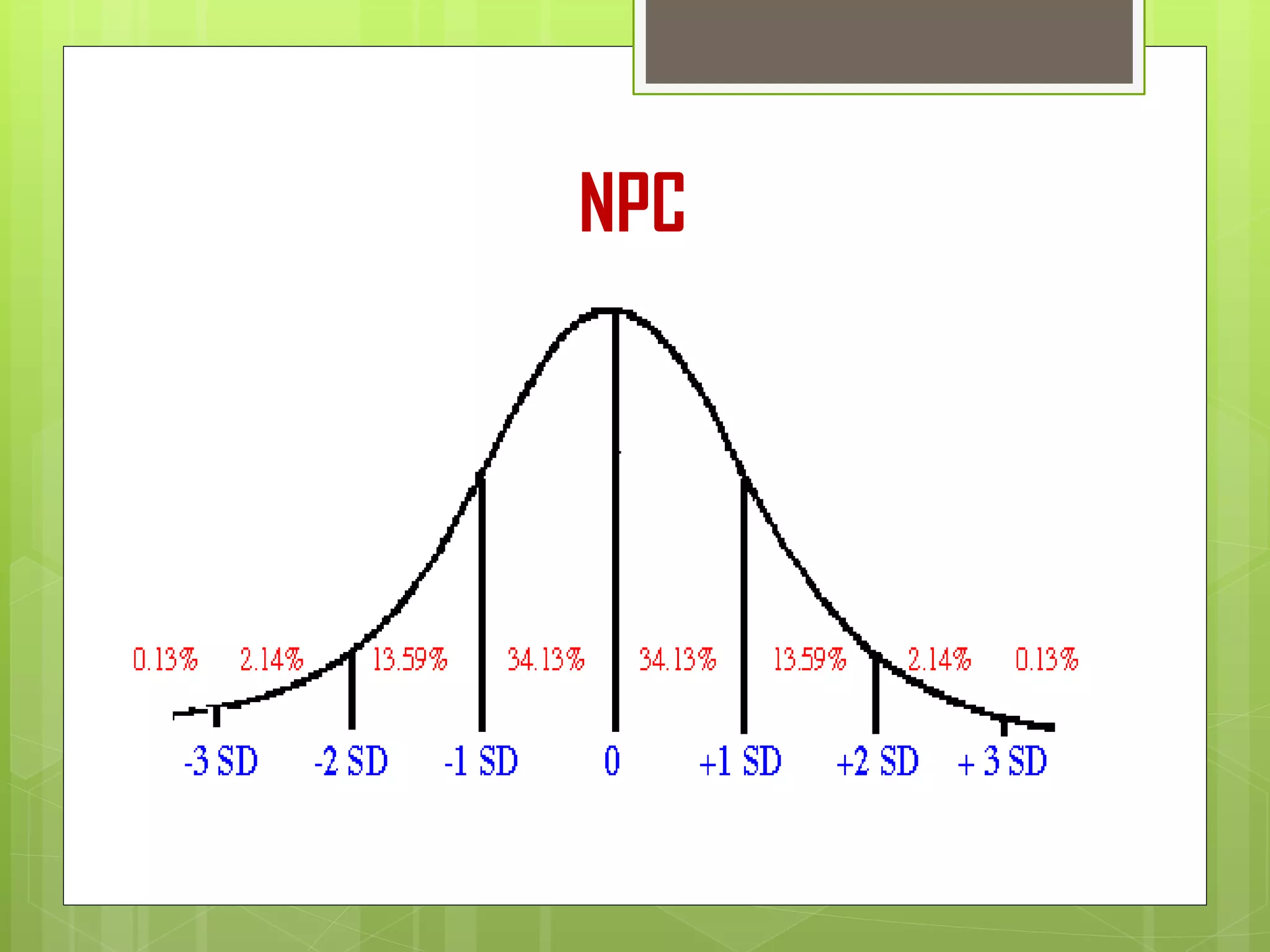
NPC
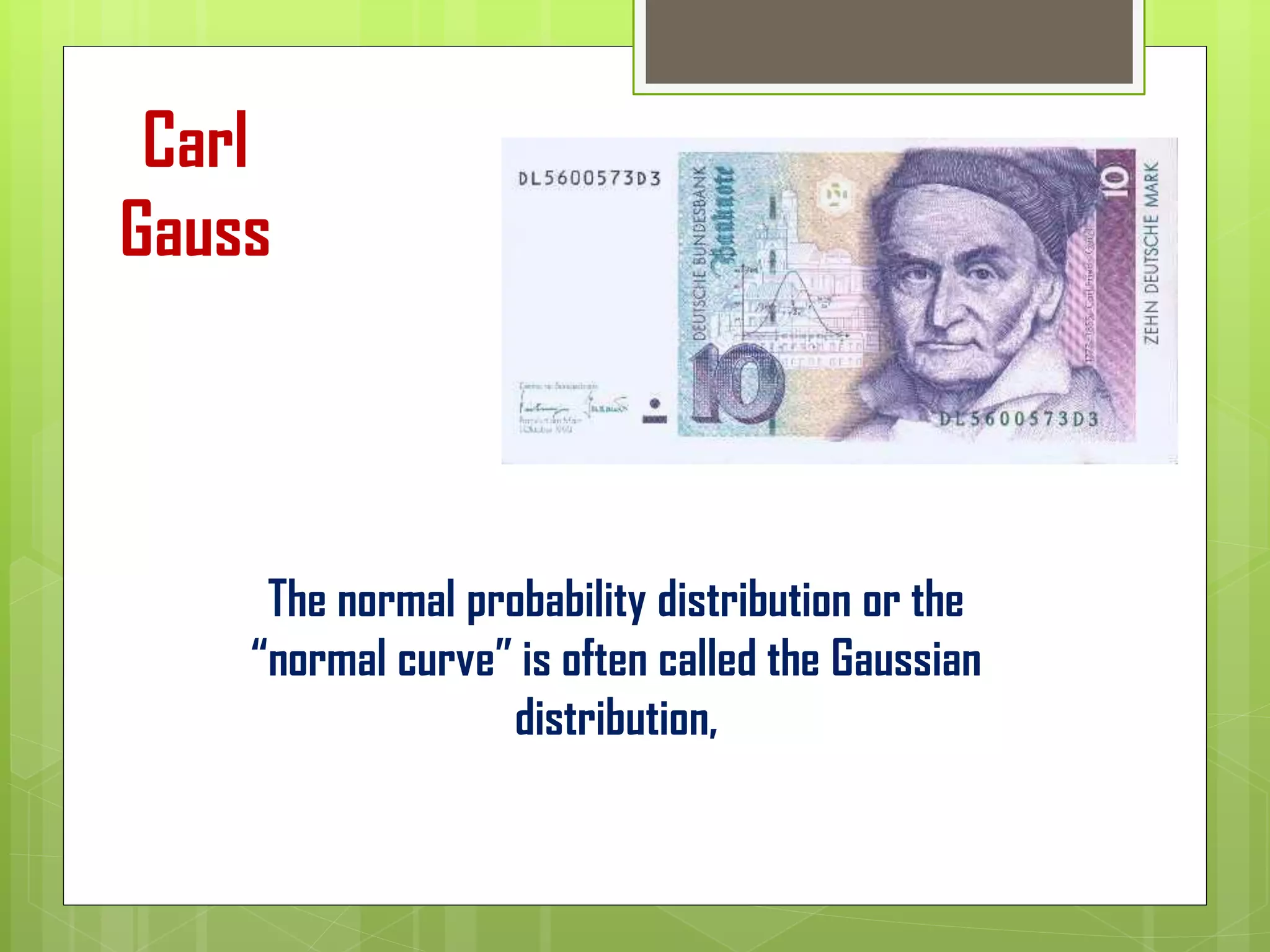
The normal probability distribution or the
“normal curve” is often called the Gaussian
distribution,
Carl
Gauss
❑ The normal distribution was first discovered by De-
moivre in 1733 to solve problems in games or
chances.
❑ Later it was applied in natural and social science by
the French Mathematician La Place (1949).
❑ This concept further developed by Gauss.
❑ The literal meaning of the term normal is average.
NPC
J.P. Guilford has defined normal probability curve
comprehensively.
“Normal probability curve is well defined, well
structure, mathematical curve, having a
distribution of the scores with mean, median and
modes are equal.
NPC
Bell Shaped Curve
The shape of the curve is like that of a bell.
Mean = Median = Mode
 Mean, median and mode carry the equal value.
/ same numerical value mean, median and
mode
 Therefore they fall at the same point on the
curve
Unimodal
 Since the mean , median and mode lye at one
point of the curve it is unimodal in nature.
Perfectly Symmetricality
 It means the curve inclines towards both sides
equally from the centre of the curve.
 Thus we get equal halves on both sides from the
central point.
 The curve is not skewed. Therefore the values of
the measure of skewness is zero
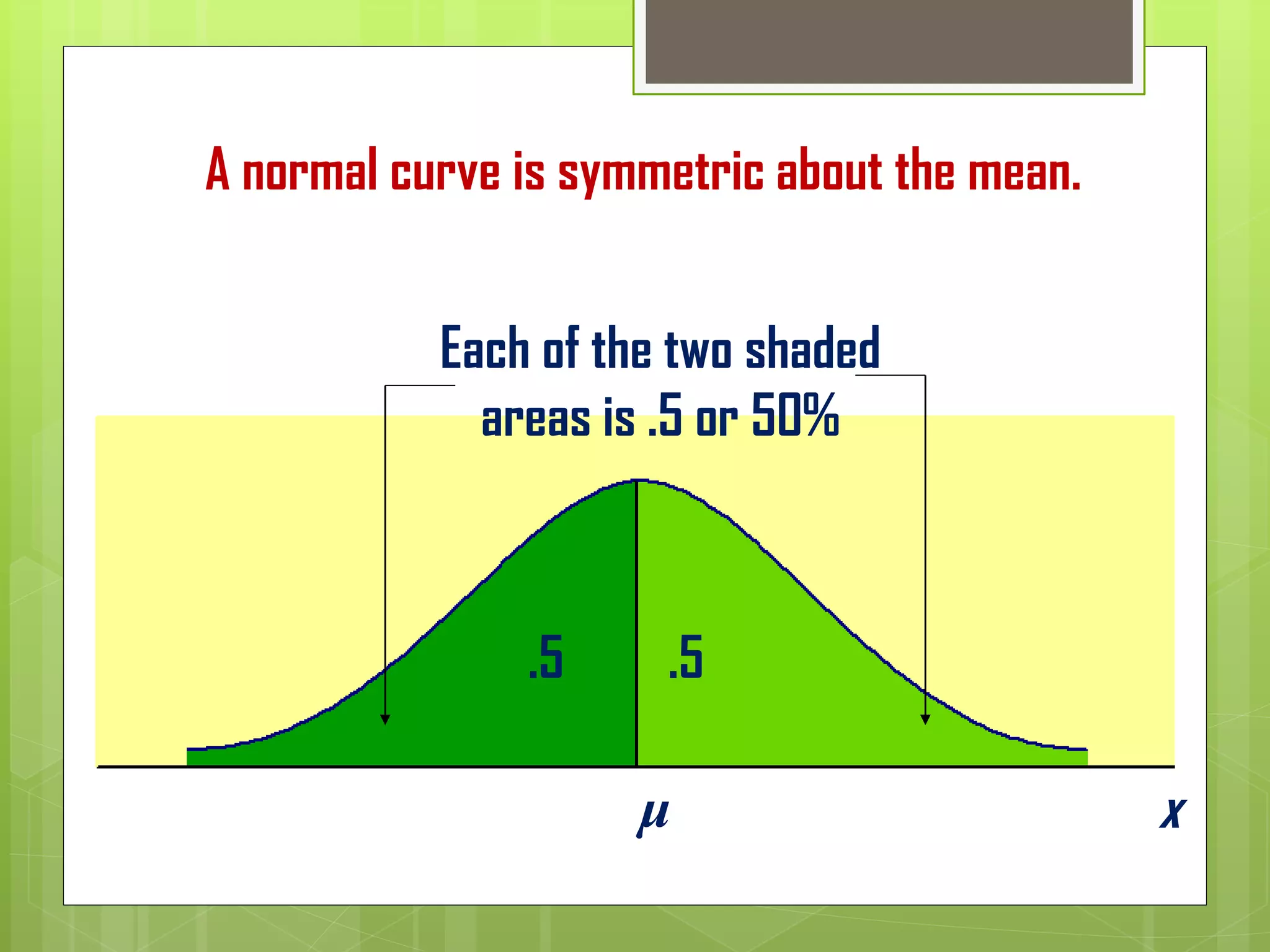
A normal curve is symmetric about the mean.
Each of the two shaded
areas is .5 or 50%
.5.5
μ x
Asymptotic
 The curve does not touch the base or OX axis
on both sides.
 Thus it extends from negative infinity to
positive infinitive.
Distance of the Curve
 For practical purpose the base line of the
curve is divided into six sigma distance from
 Most of the cases I.e.99.73% are covered
within such distance
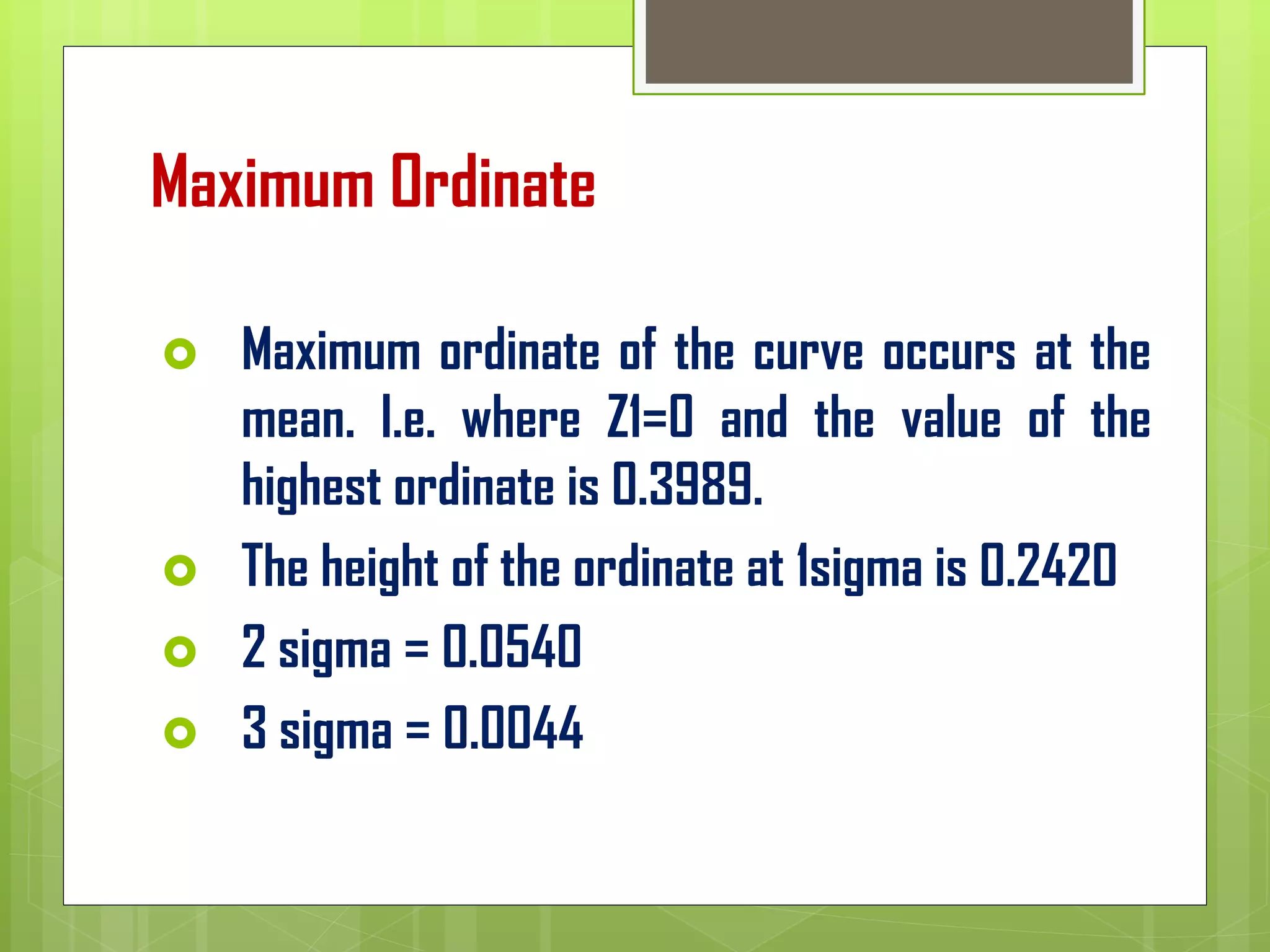
Maximum Ordinate
 Maximum ordinate of the curve occurs at the
mean. I.e. where Z1=0 and the value of the
highest ordinate is 0.3989.
 The height of the ordinate at 1sigma is 0.2420
 2 sigma = 0.0540
 3 sigma = 0.0044
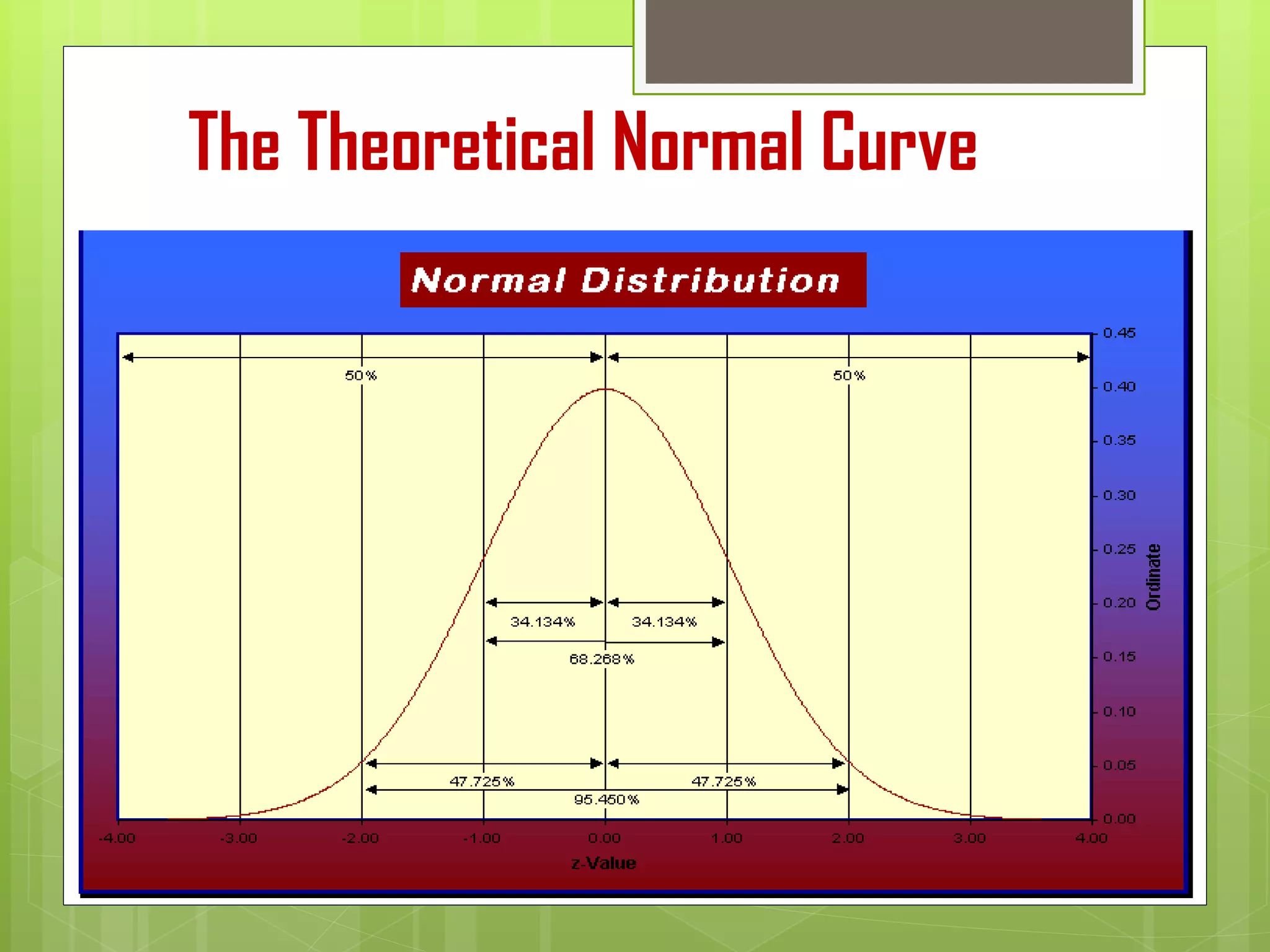
The Theoretical Normal Curve
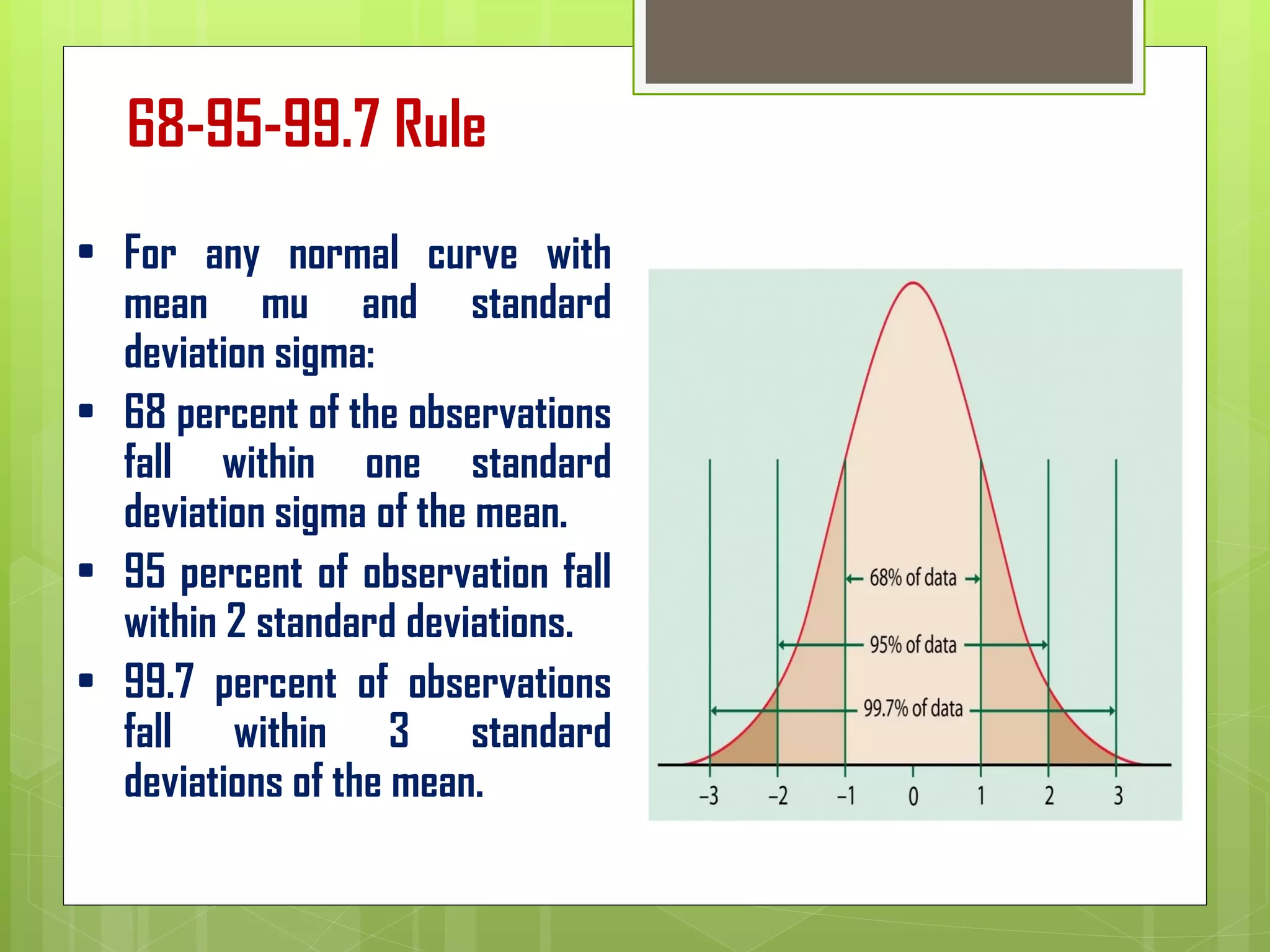
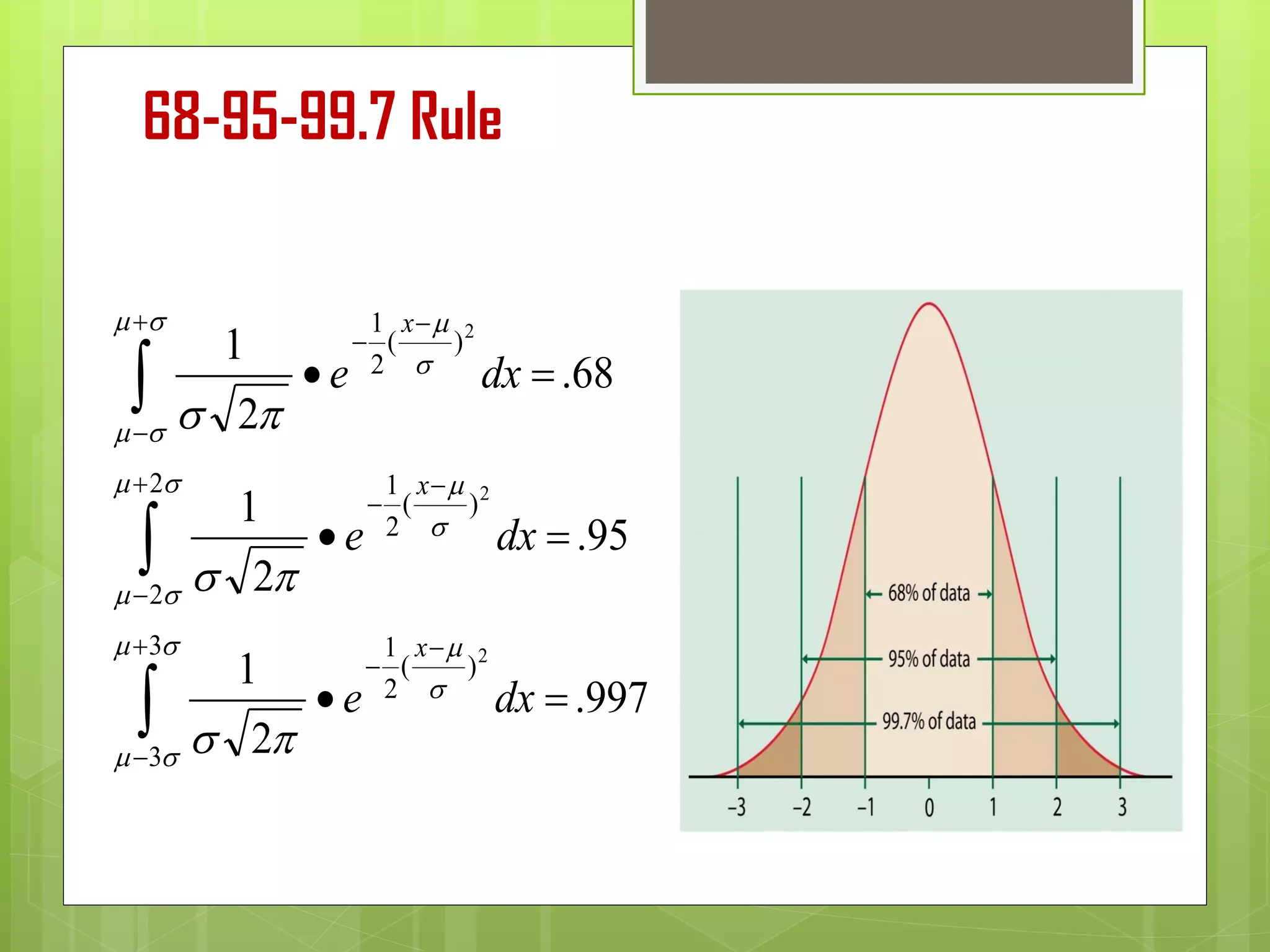
68-95-99.7 Rule
• For any normal curve with
mean mu and standard
deviation sigma:
• 68 percent of the observations
fall within one standard
deviation sigma of the mean.
• 95 percent of observation fall
within 2 standard deviations.
• 99.7 percent of observations
fall within 3 standard
deviations of the mean.
x
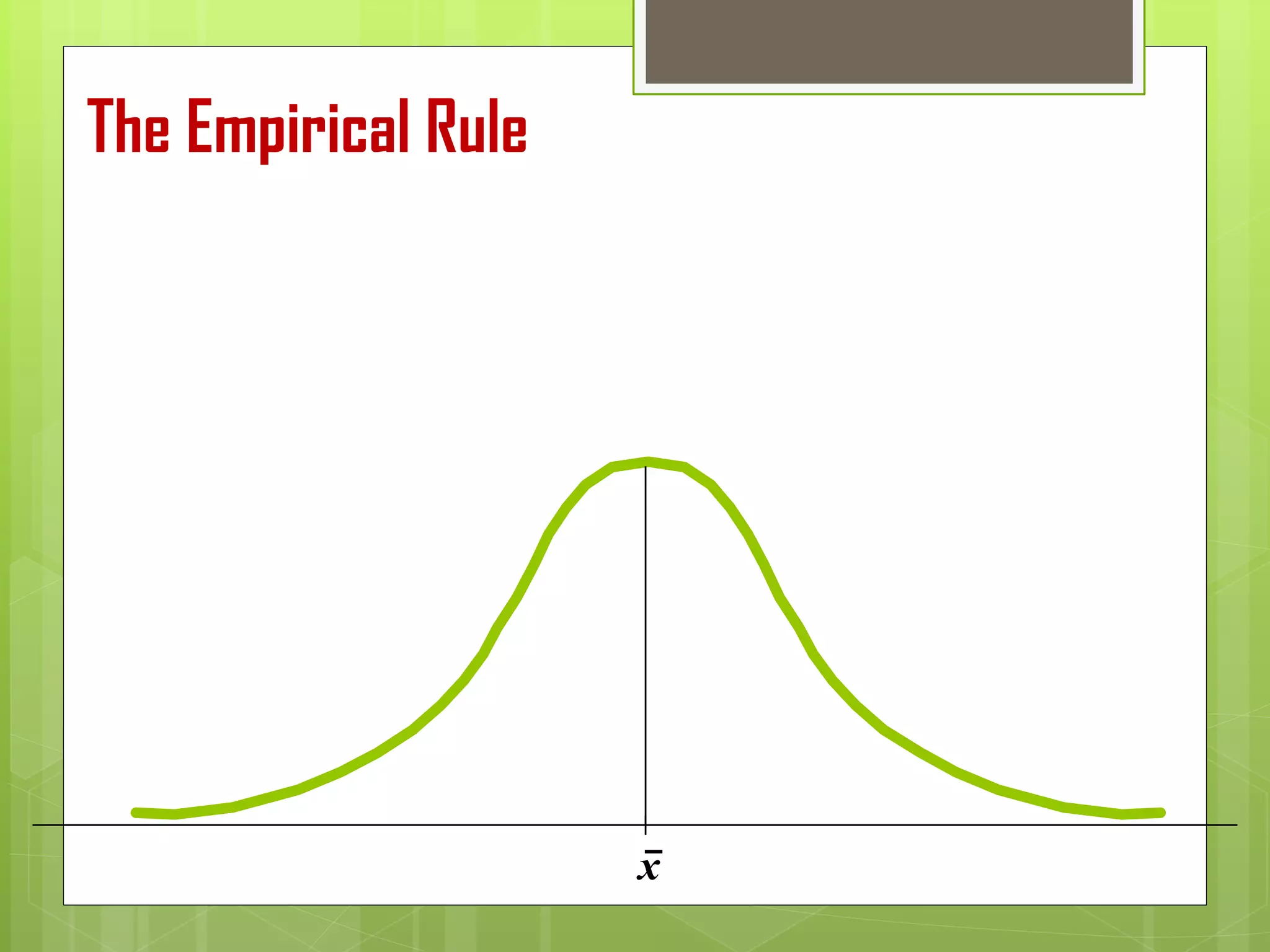
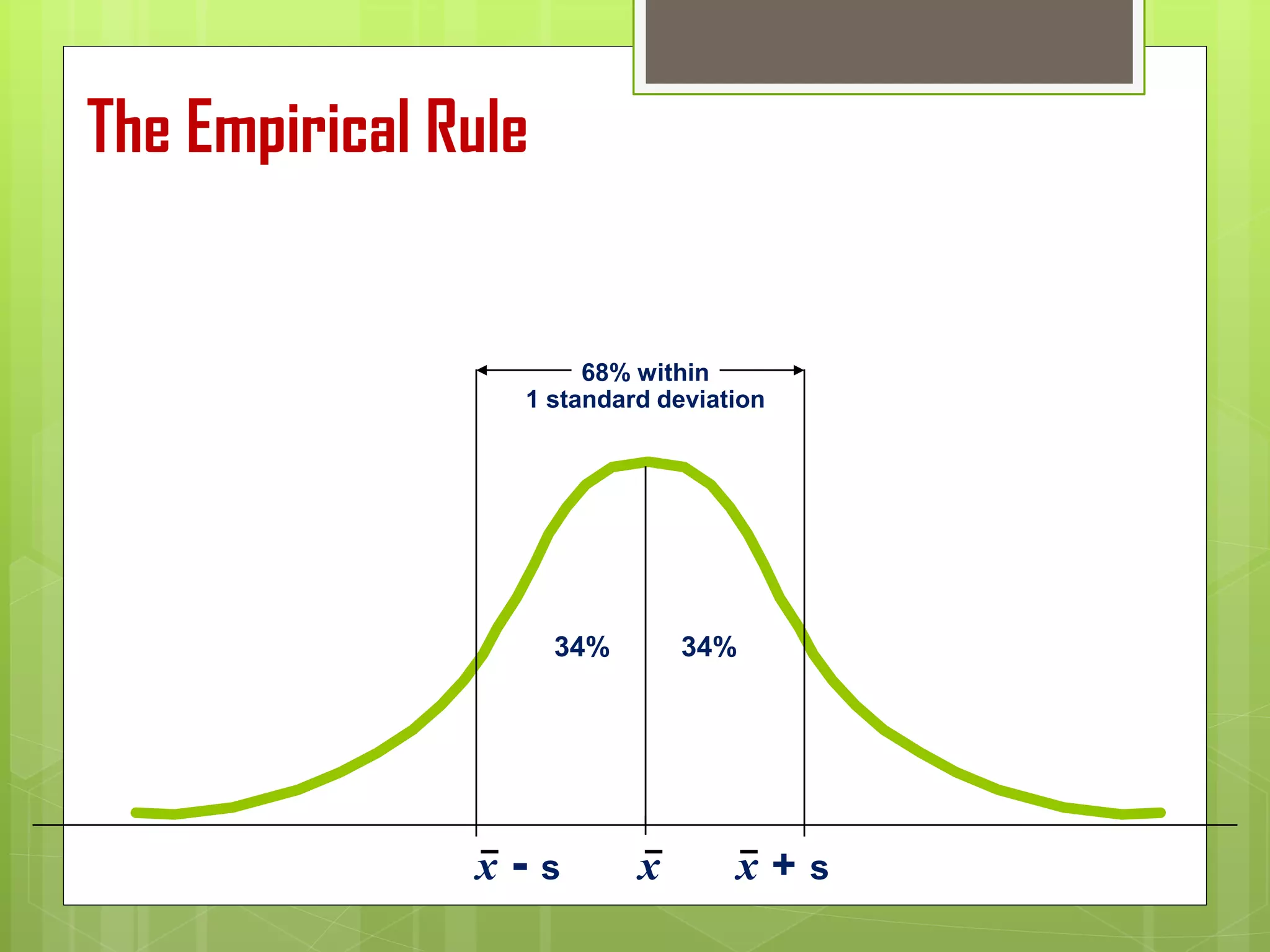
The Empirical Rule
x - s x x + s
68% within
1 standard deviation
34% 34%
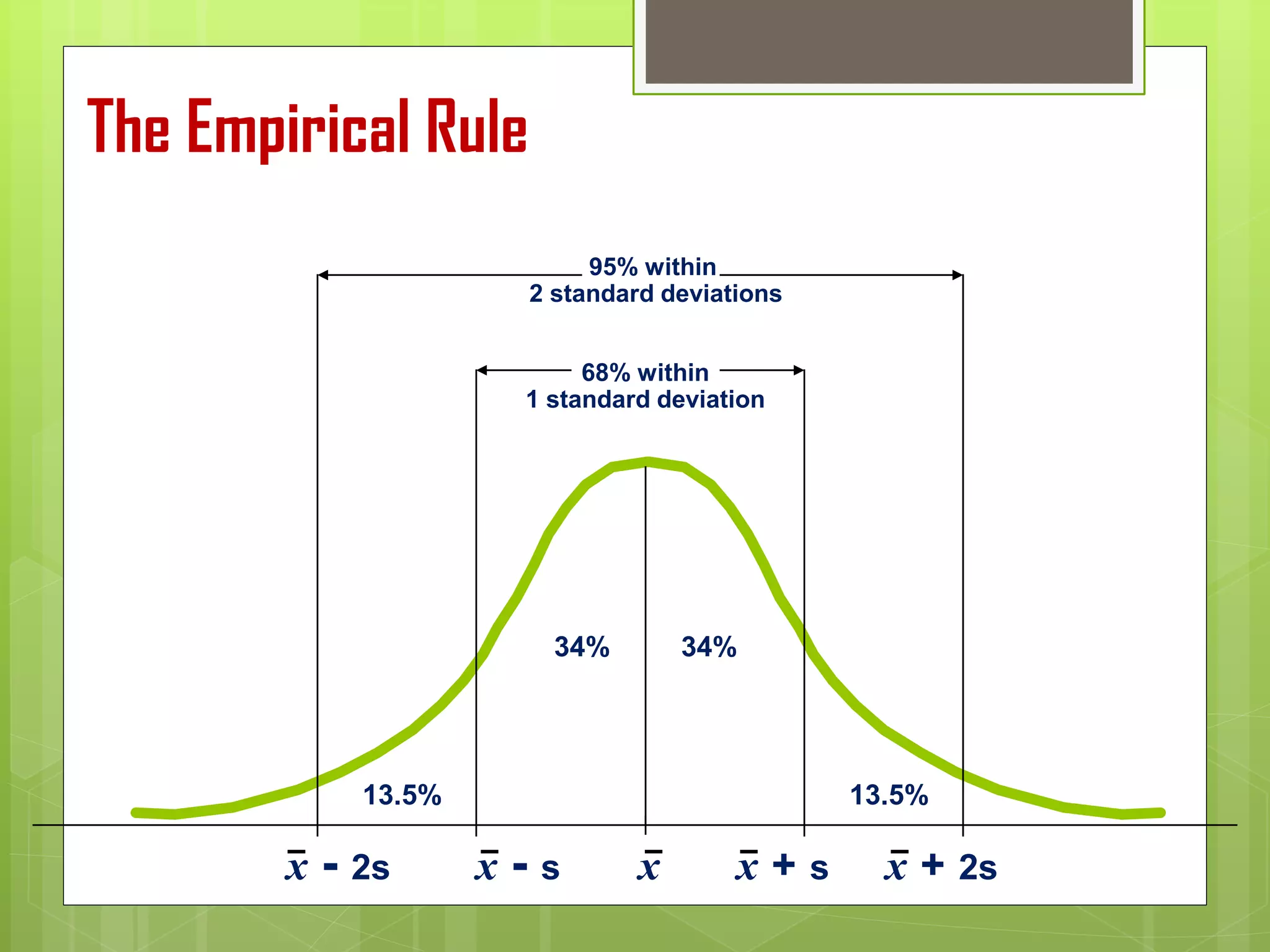
The Empirical Rule
x - 2s x - s x x + 2sx + s
68% within
1 standard deviation
34% 34%
95% within
2 standard deviations
13.5% 13.5%
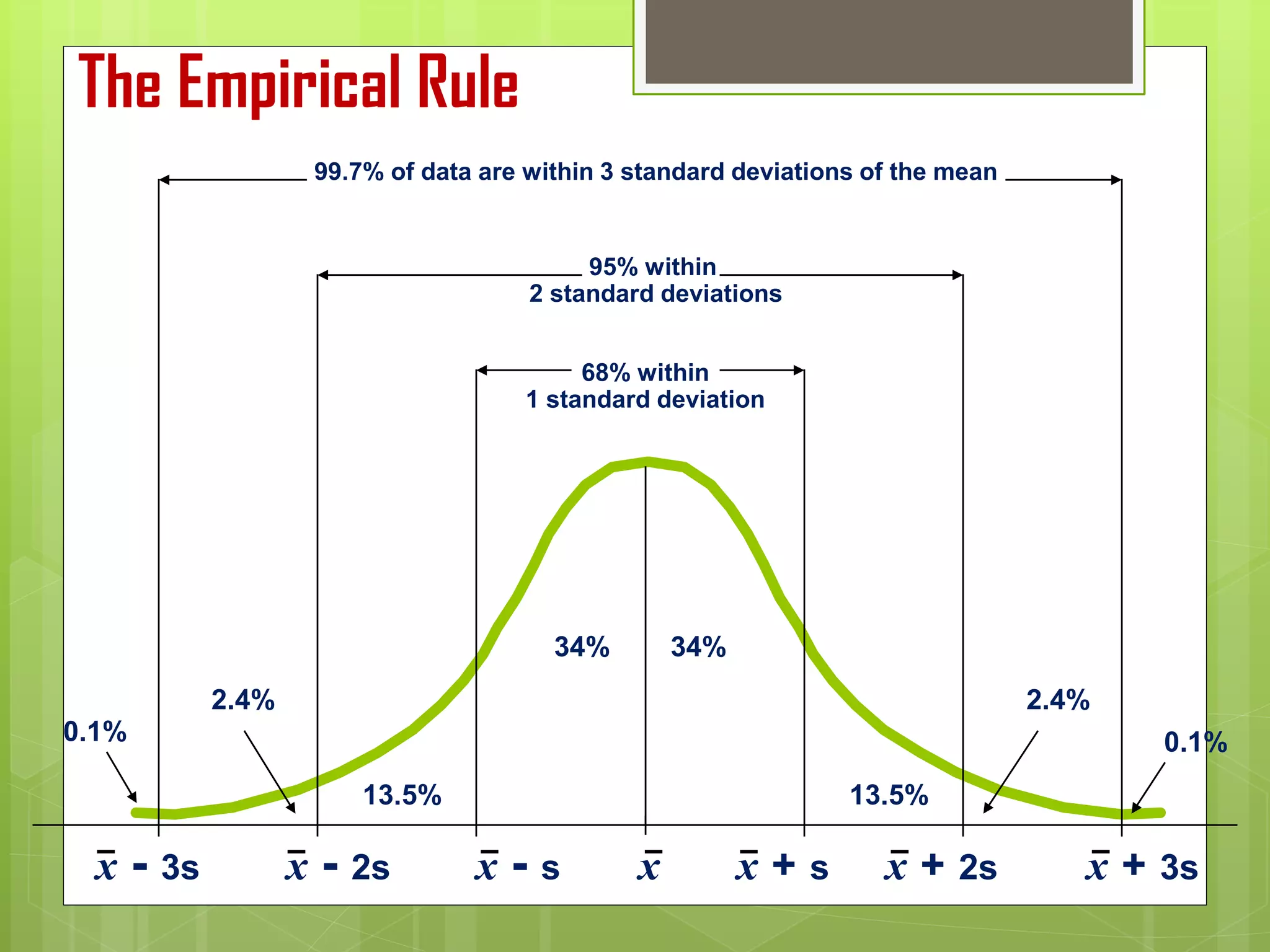
The Empirical Rule
x - 3s x - 2s x - s x x + 2s x + 3sx + s
68% within
1 standard deviation
34% 34%
95% within
2 standard deviations
99.7% of data are within 3 standard deviations of the mean
0.1% 0.1%
2.4% 2.4%
13.5% 13.5%
The Empirical Rule
68-95-99.7 Rule
997.
2
1
95.
2
1
68.
2
1
3
3
)(
2
1
2
2
)(
2
1
)(
2
1
2
2
2
=•
=•
=•



+
−
−
−
+
−
−
−
+
−
−
−















dxe
dxe
dxe
x
x
x
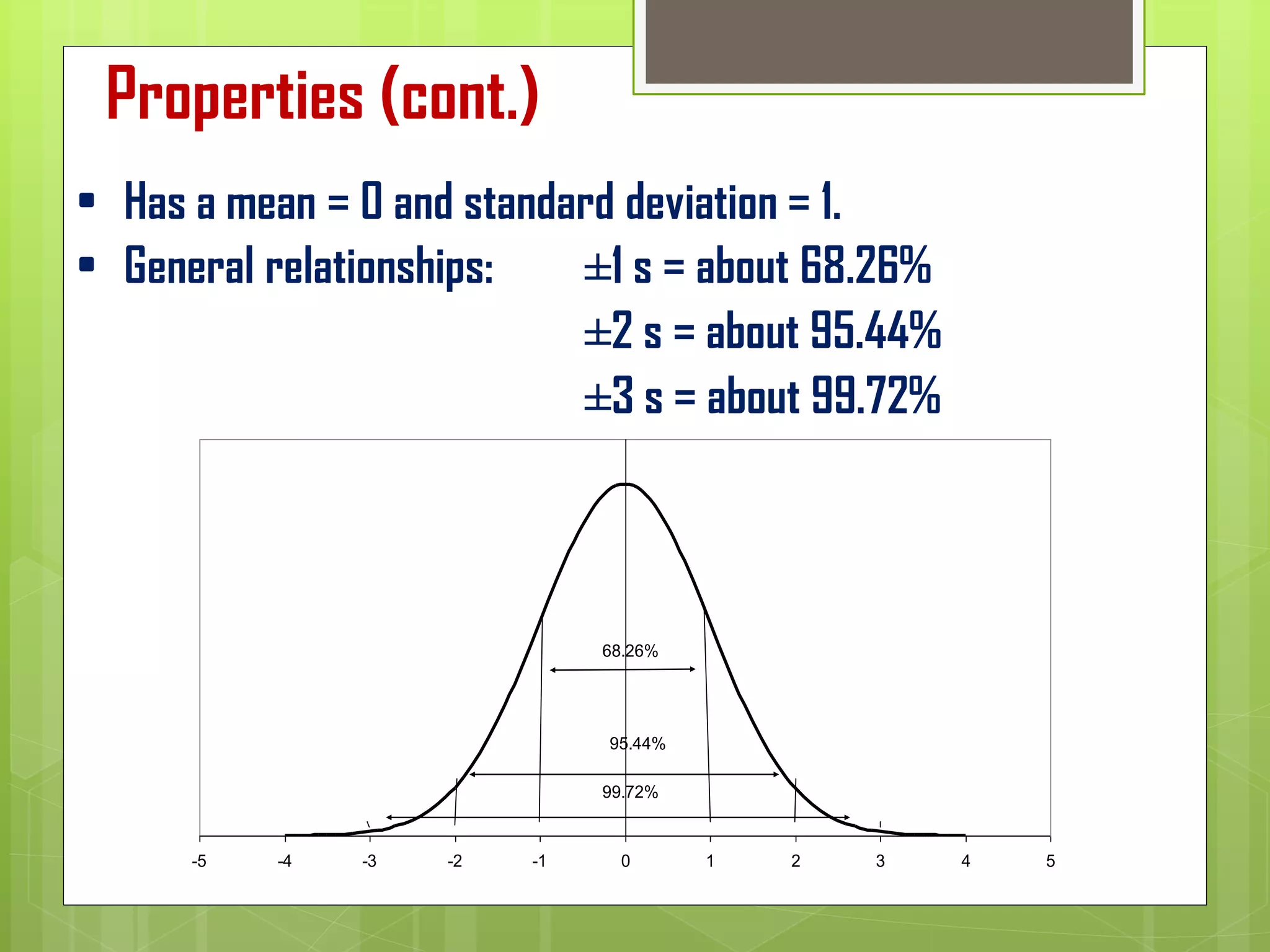
Properties (cont.)
• Has a mean = 0 and standard deviation = 1.
• General relationships: ±1 s = about 68.26%
±2 s = about 95.44%
±3 s = about 99.72%
-5 -4 -3 -2 -1 0 1 2 3 4 5
68.26%
95.44%
99.72%
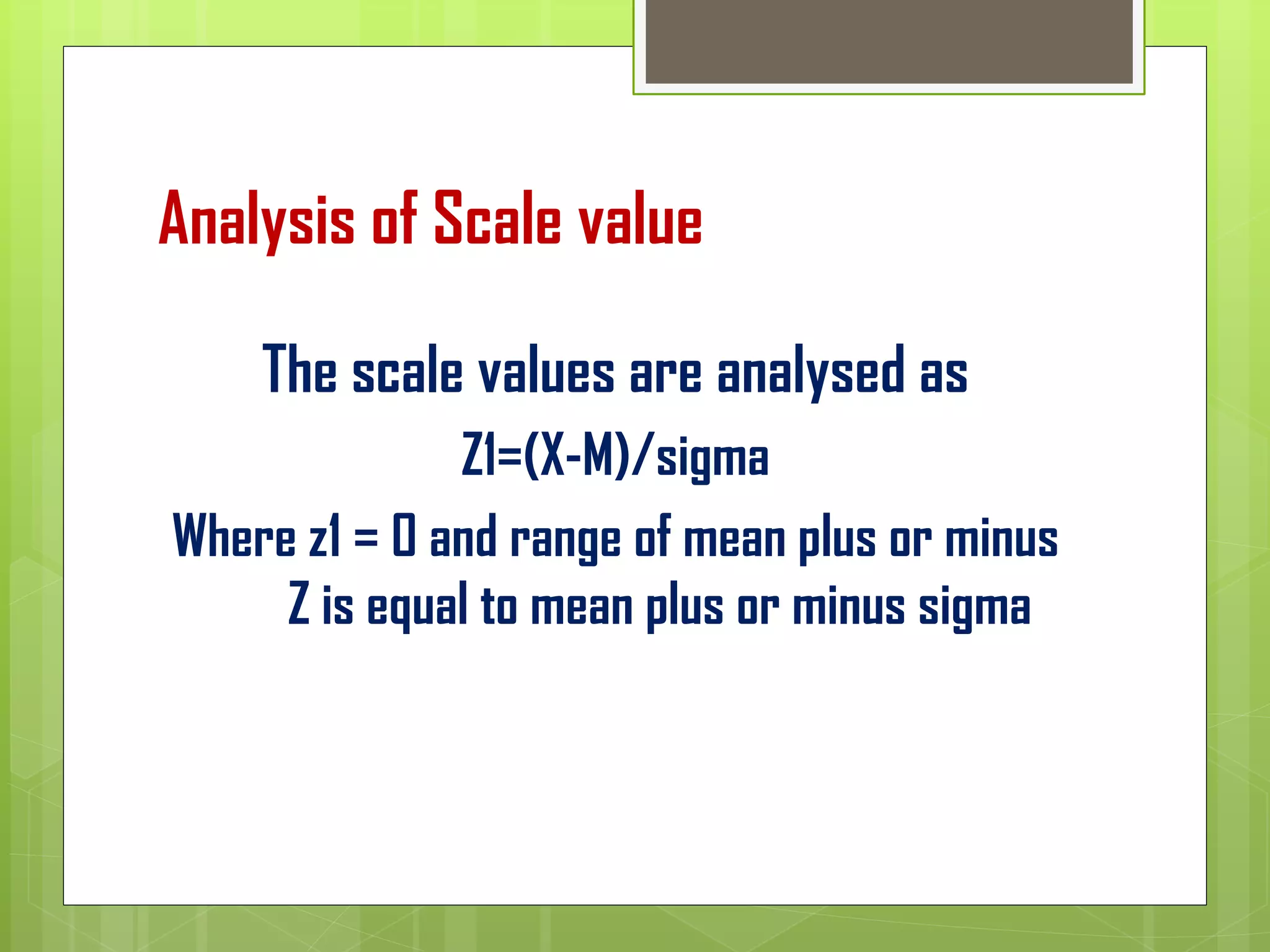
Analysis of Scale value
The scale values are analysed as
Z1=(X-M)/sigma
Where z1 = 0 and range of mean plus or minus
Z is equal to mean plus or minus sigma
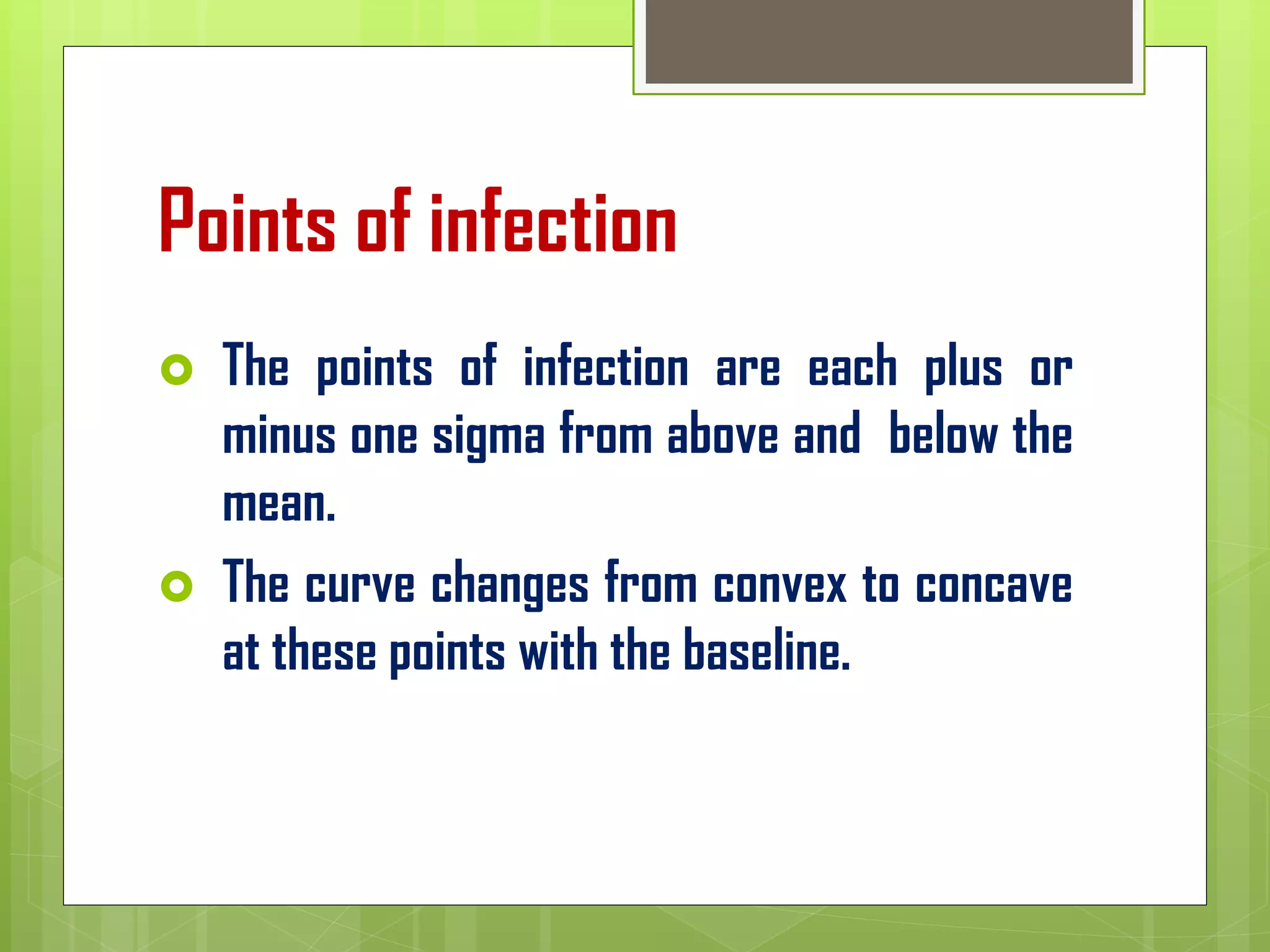
Points of infection
 The points of infection are each plus or
minus one sigma from above and below the
mean.
 The curve changes from convex to concave
at these points with the baseline.
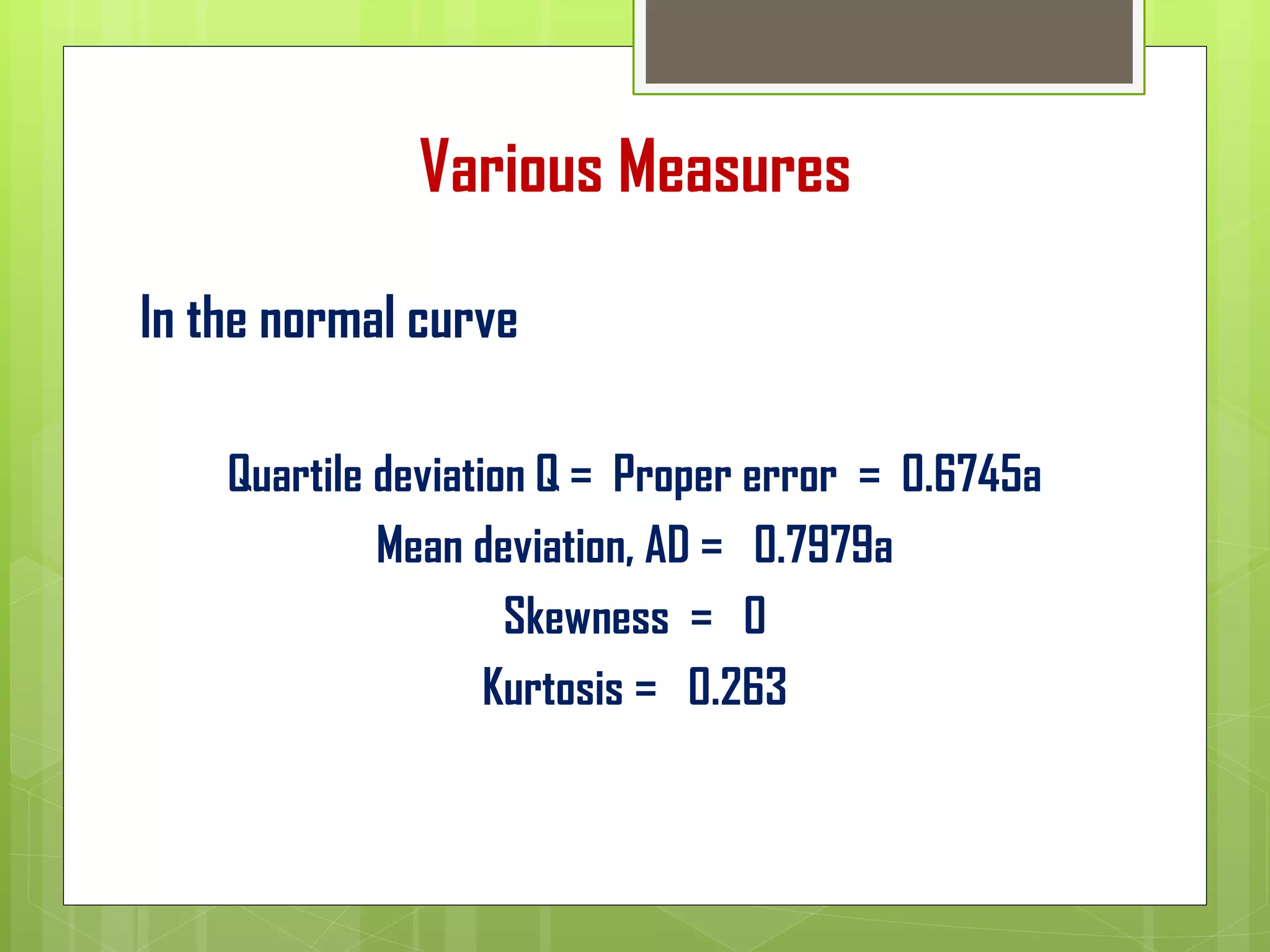
Various Measures
In the normal curve
Quartile deviation Q = Proper error = 0.6745a
Mean deviation, AD = 0.7979a
Skewness = 0
Kurtosis = 0.263
APPLICATIONS OF THE NORMAL PROBABILITY CURVE
To normalize a frequency distribution. It is an important step in standardizing a
psychological test or inventory.
To test the significance of observations in experiments, findings them relationships
with the chance fluctuations or errors that are result of sampling procedures.
To generalize about population from which the samples are drawn by calculating the
standard error of mean and other statistics.
To compare two distributions. The NPC is used to compare two distributions.
To determine the difficulty values. The Z scores are used to determine the difficulty
values of test items.
To classify the groups. The Normal Probability Curve (NPC) is used for classifying
the groups and assigning grades to individuals.
To determine the level of significance. The levels of significance of statistics results
are determined in terms of NPC limits.
To scale responses to opinionnaires, judgement, ratings or rankings by
transforming them numerical values.
Skewness
K.THIYAGU, Assistant Professor, Department of Education, Central University of Kerala, Kasaragod
Skewness
❑ Skewness means asymmetrical nature / lack of
symmetry
❑ The degree of departure from symmetry is called
skewness.
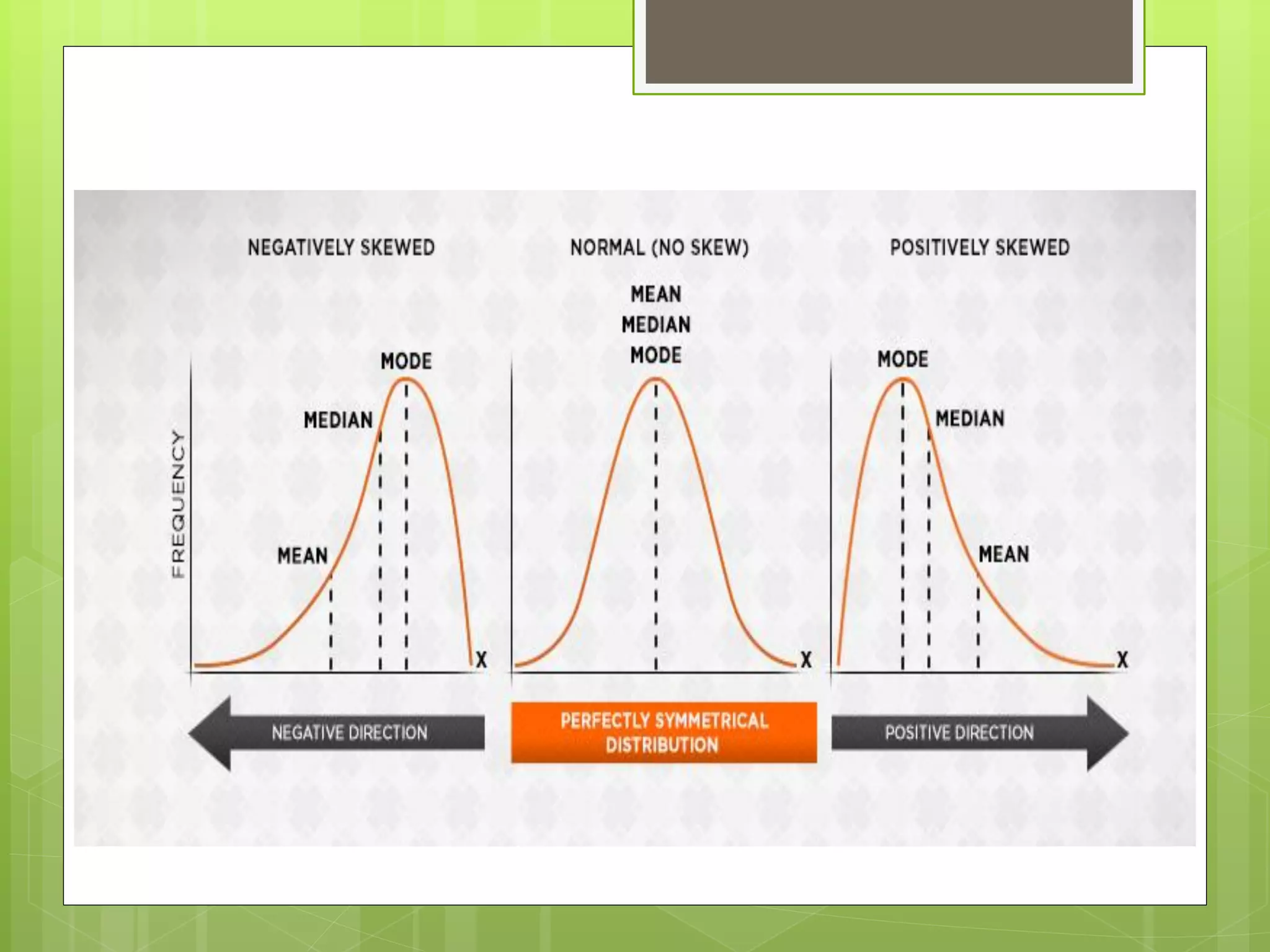
❑ The distribution in which mean, Median and Mode fall on
different points or different places is known as skewed
distribution and this tendency of distribution is known as
skewness.
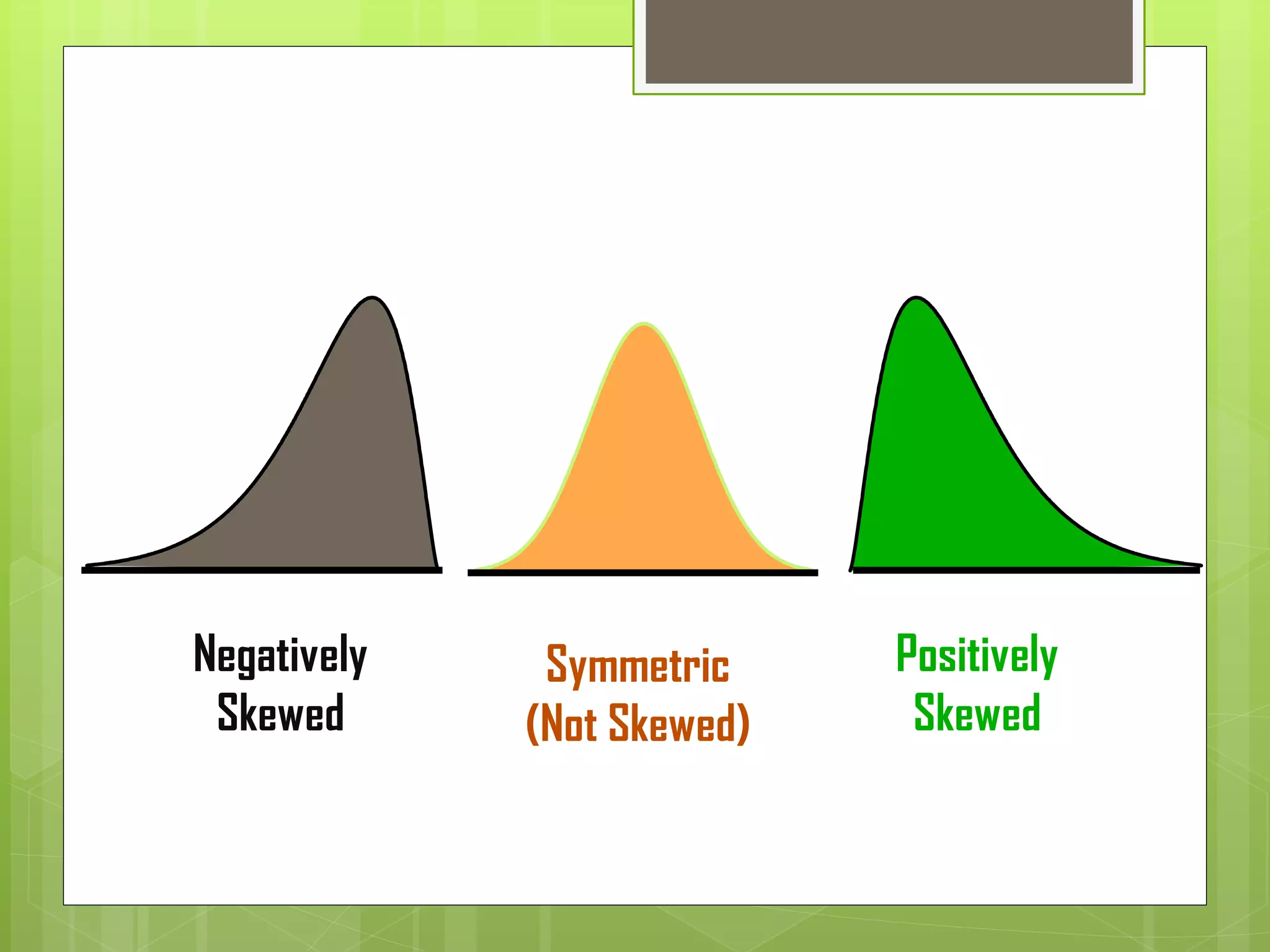
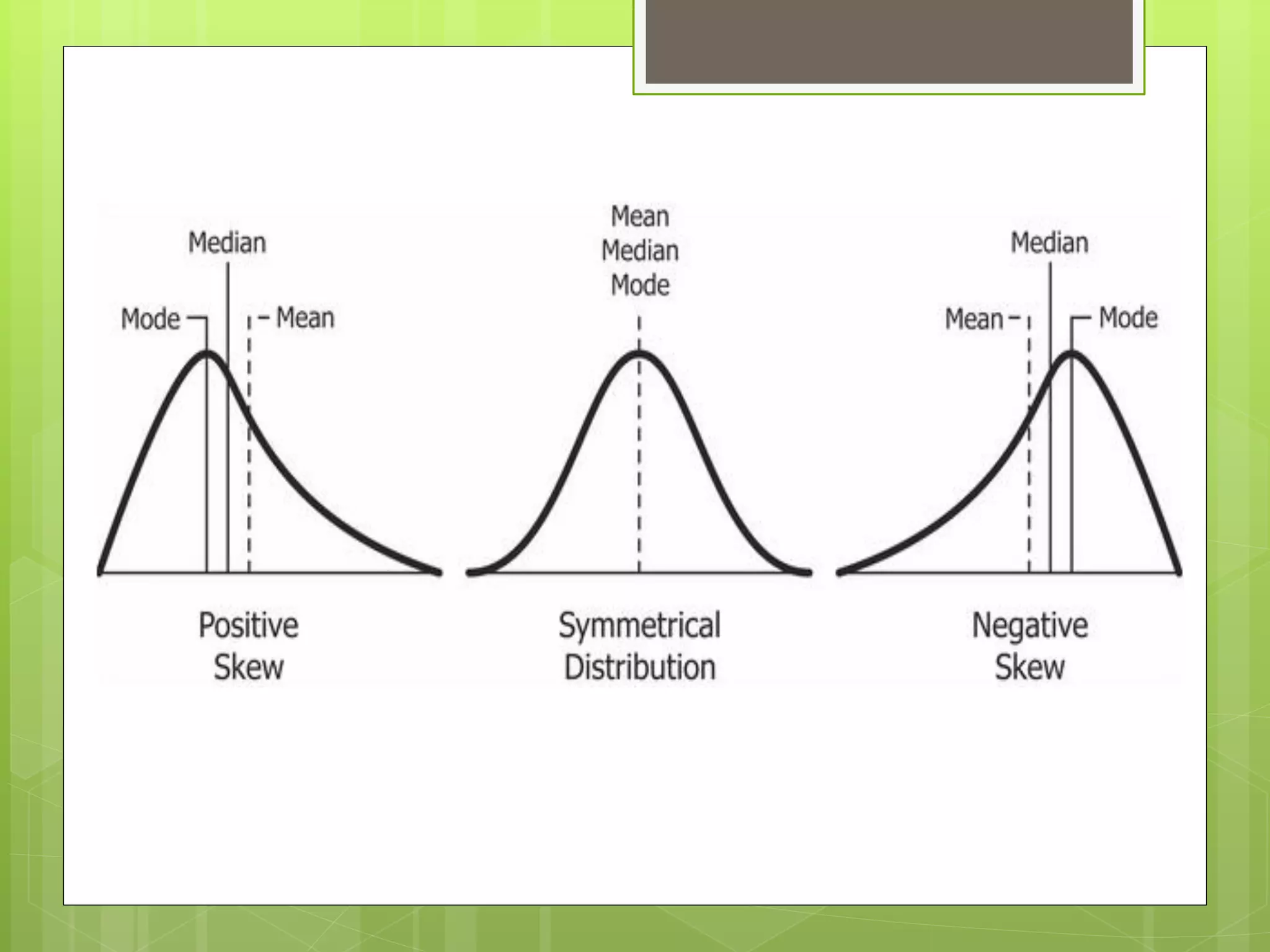
Negatively
Skewed
Positively
Skewed
Symmetric
(Not Skewed)
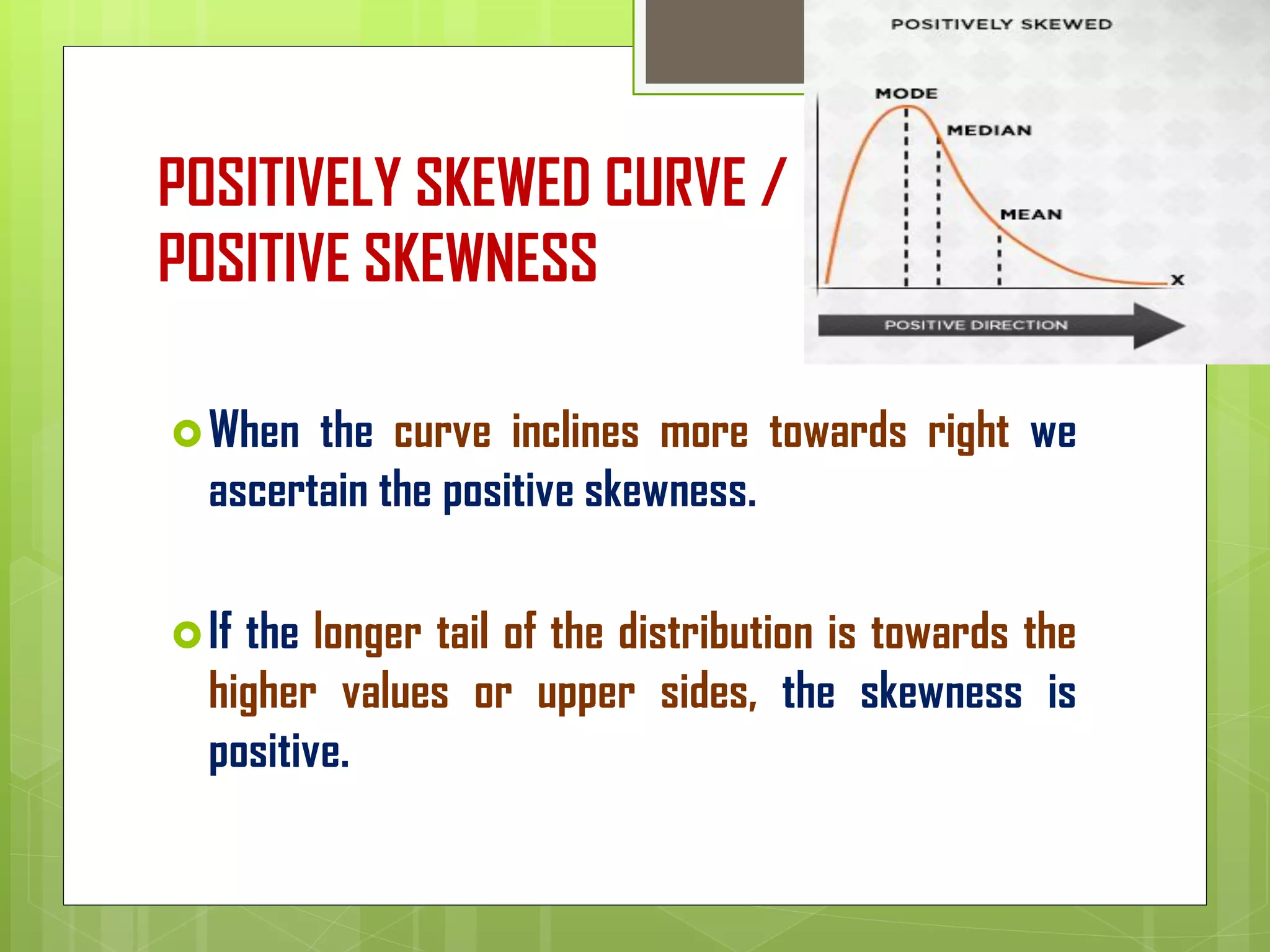
POSITIVELY SKEWED CURVE /
POSITIVE SKEWNESS
When the curve inclines more towards right we
ascertain the positive skewness.
If the longer tail of the distribution is towards the
higher values or upper sides, the skewness is
positive.
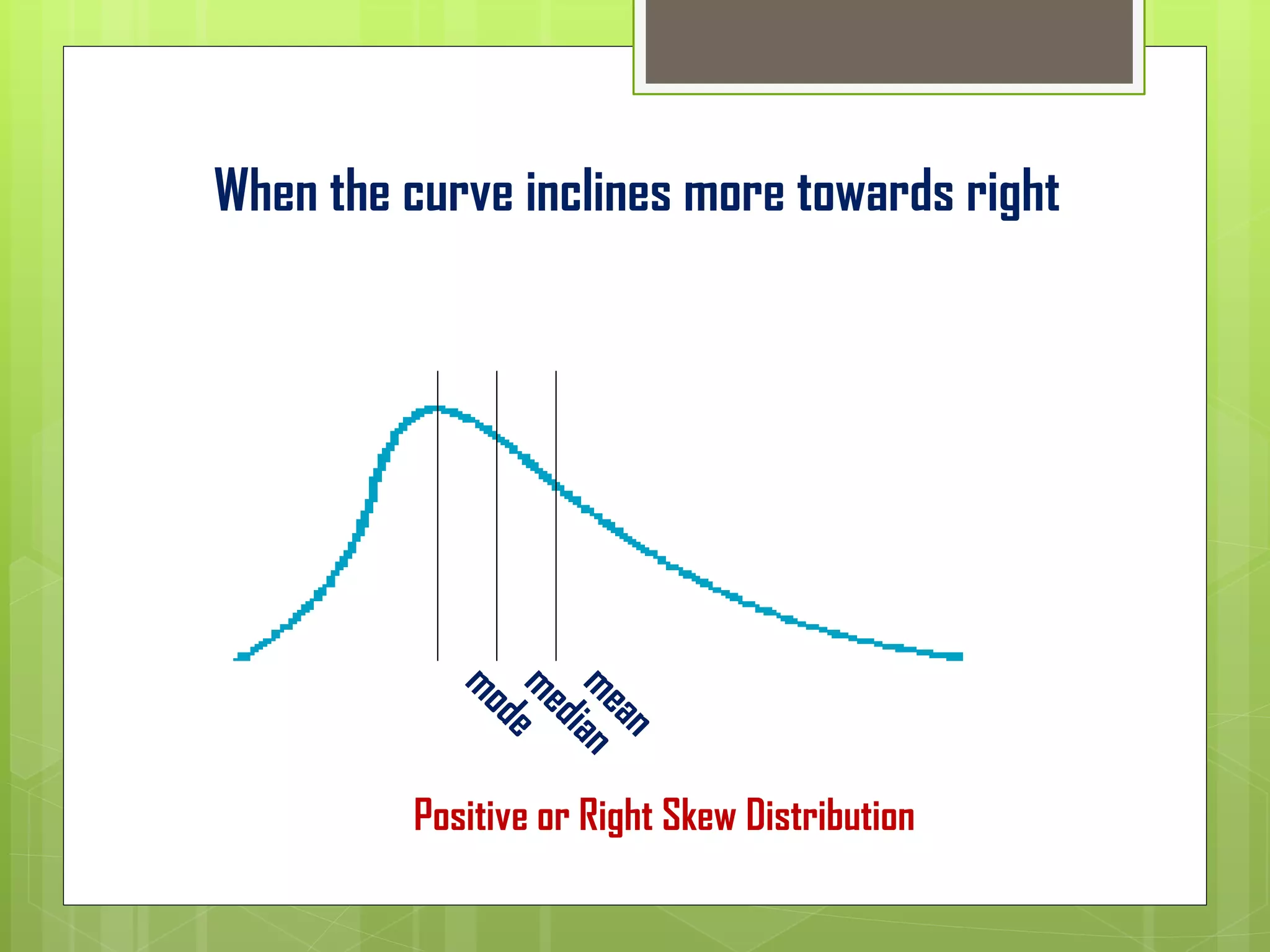
When the curve inclines more towards right
Positive or Right Skew Distribution
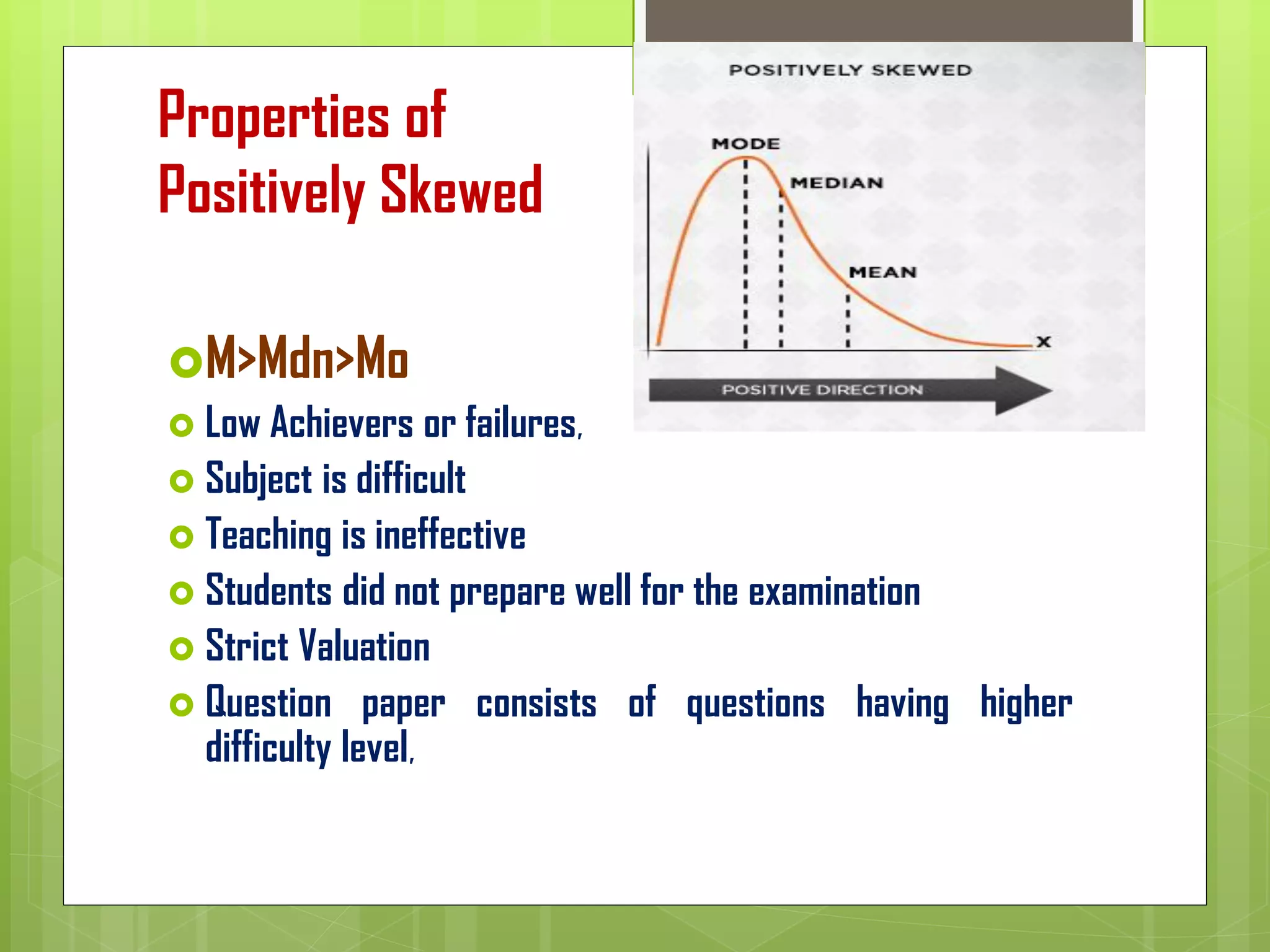
Properties of
Positively Skewed
M>Mdn>Mo
 Low Achievers or failures,
 Subject is difficult
 Teaching is ineffective
 Students did not prepare well for the examination
 Strict Valuation
 Question paper consists of questions having higher
difficulty level,
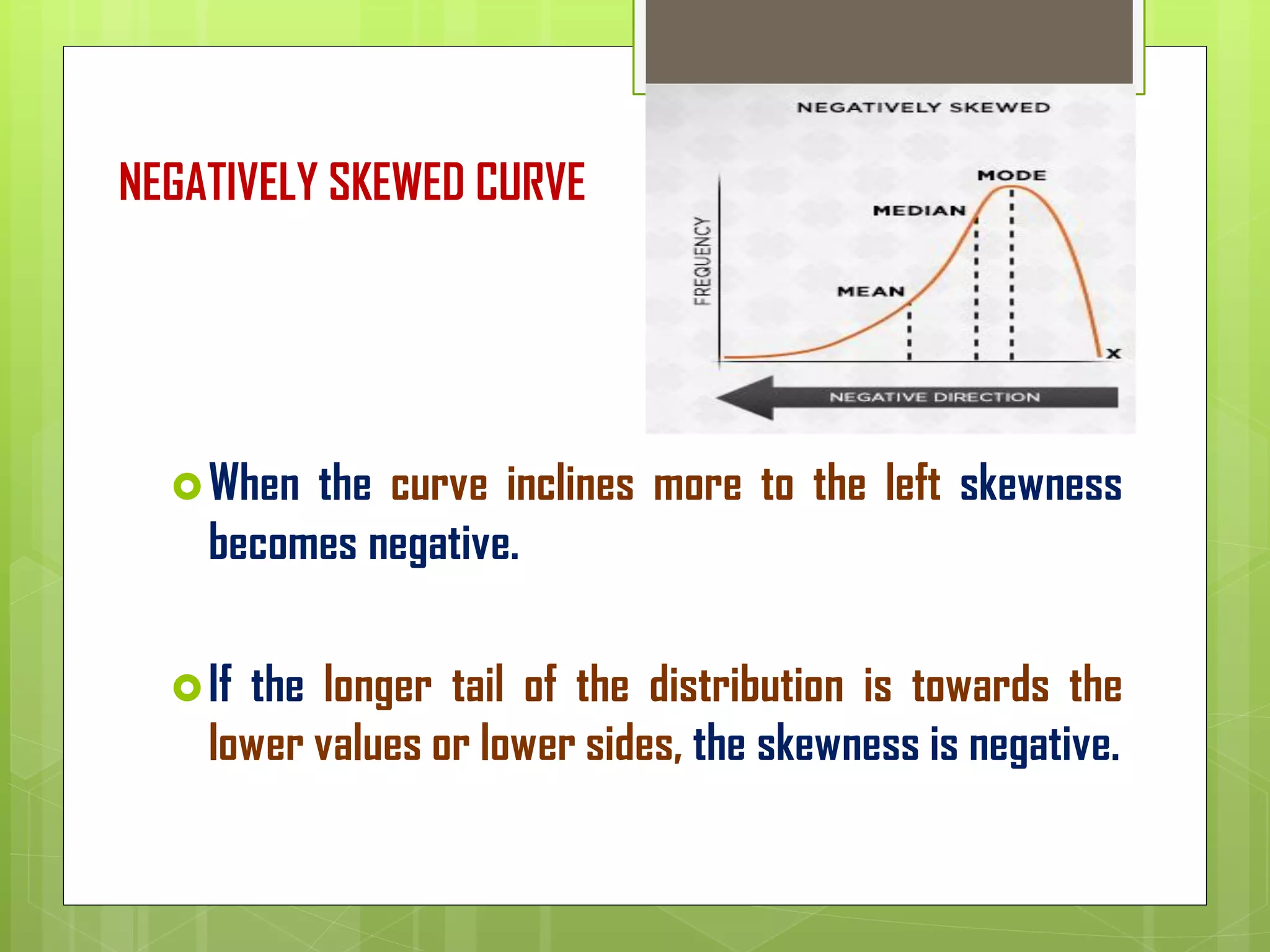
NEGATIVELY SKEWED CURVE
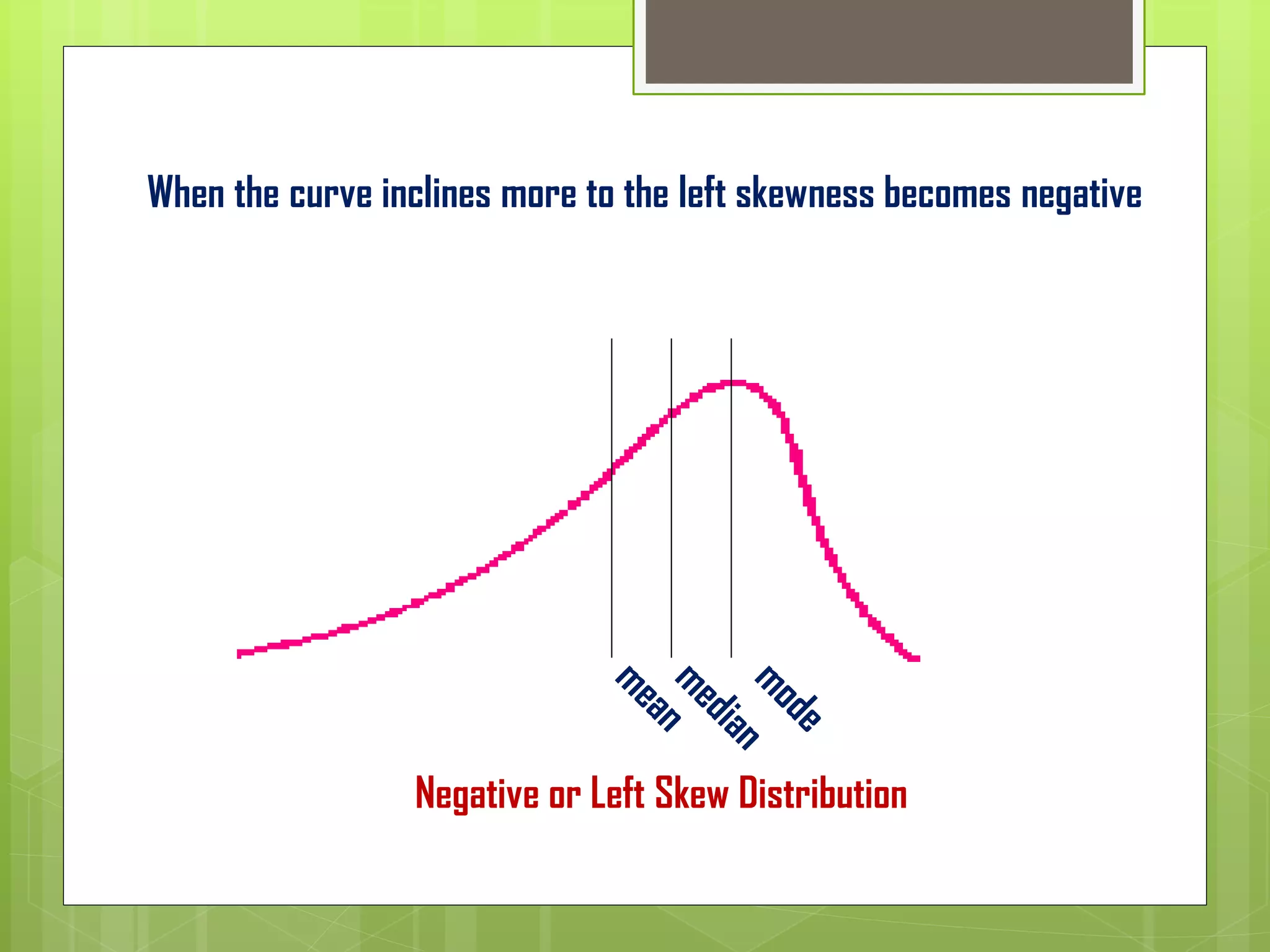
When the curve inclines more to the left skewness
becomes negative.
If the longer tail of the distribution is towards the
lower values or lower sides, the skewness is negative.
When the curve inclines more to the left skewness becomes negative
Negative or Left Skew Distribution
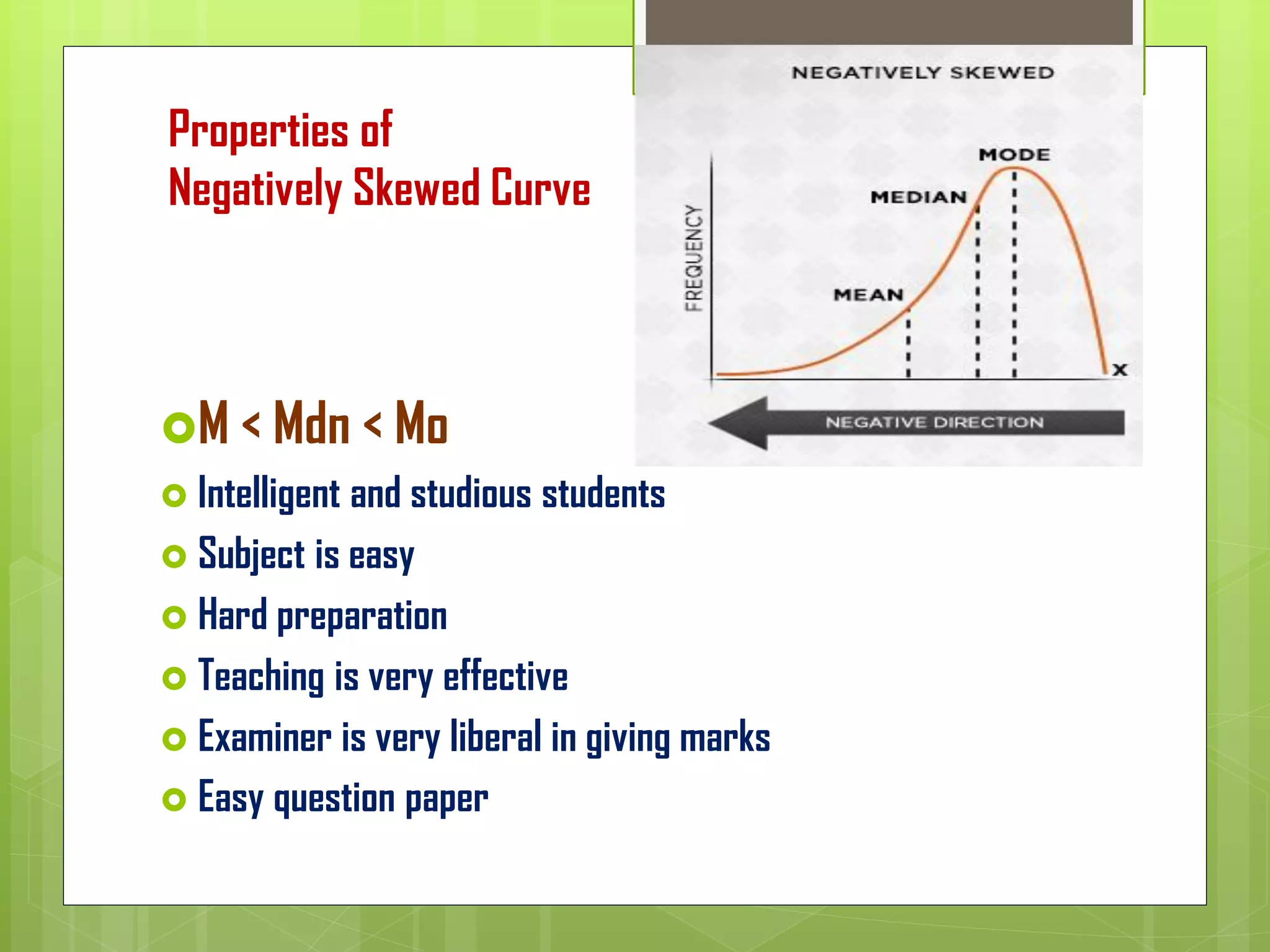
Properties of
Negatively Skewed Curve
M < Mdn < Mo
 Intelligent and studious students
 Subject is easy
 Hard preparation
 Teaching is very effective
 Examiner is very liberal in giving marks
 Easy question paper
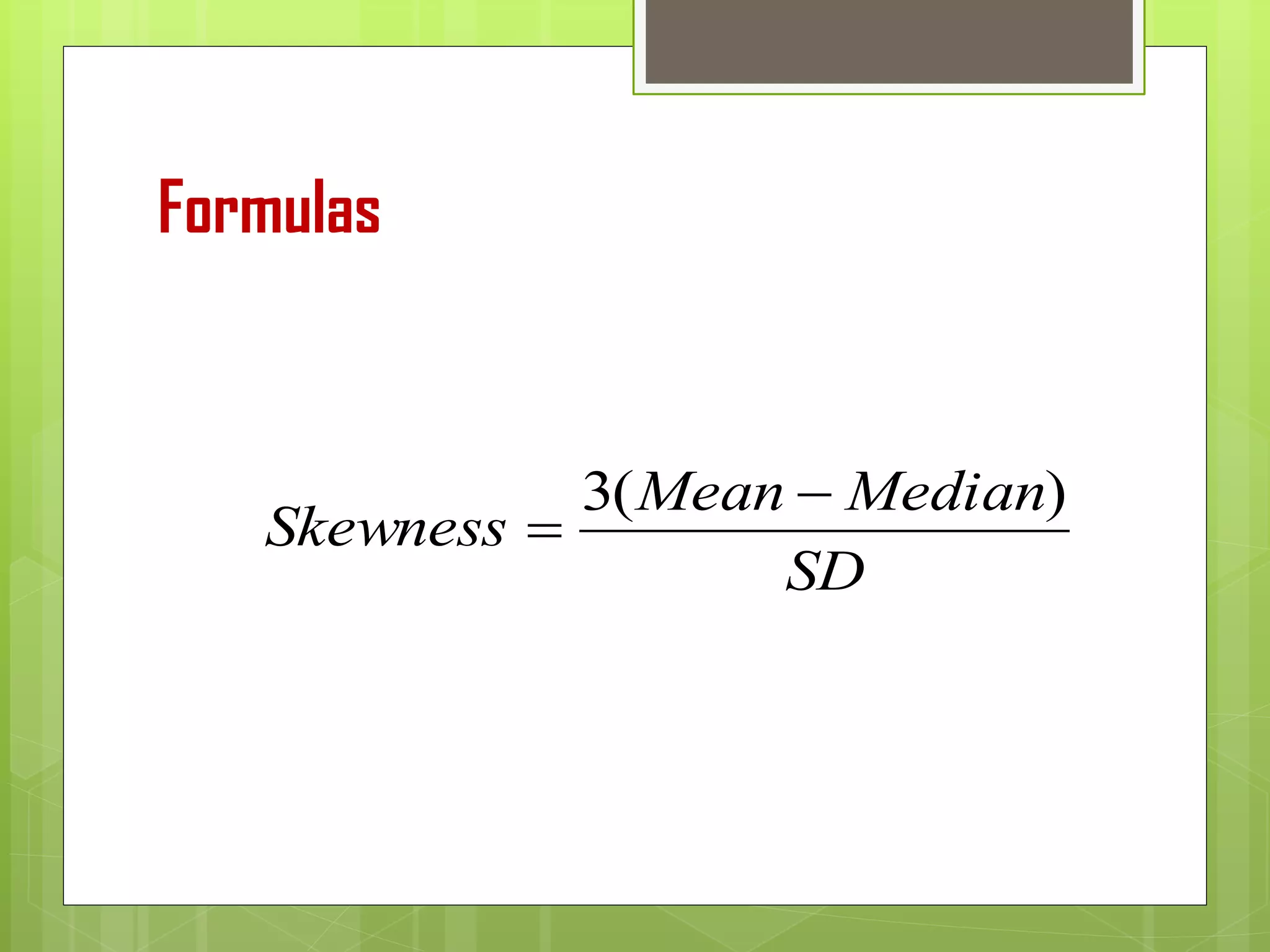
Formulas
SD
MedianMean
Skewness
)(3 −
=
Skewness
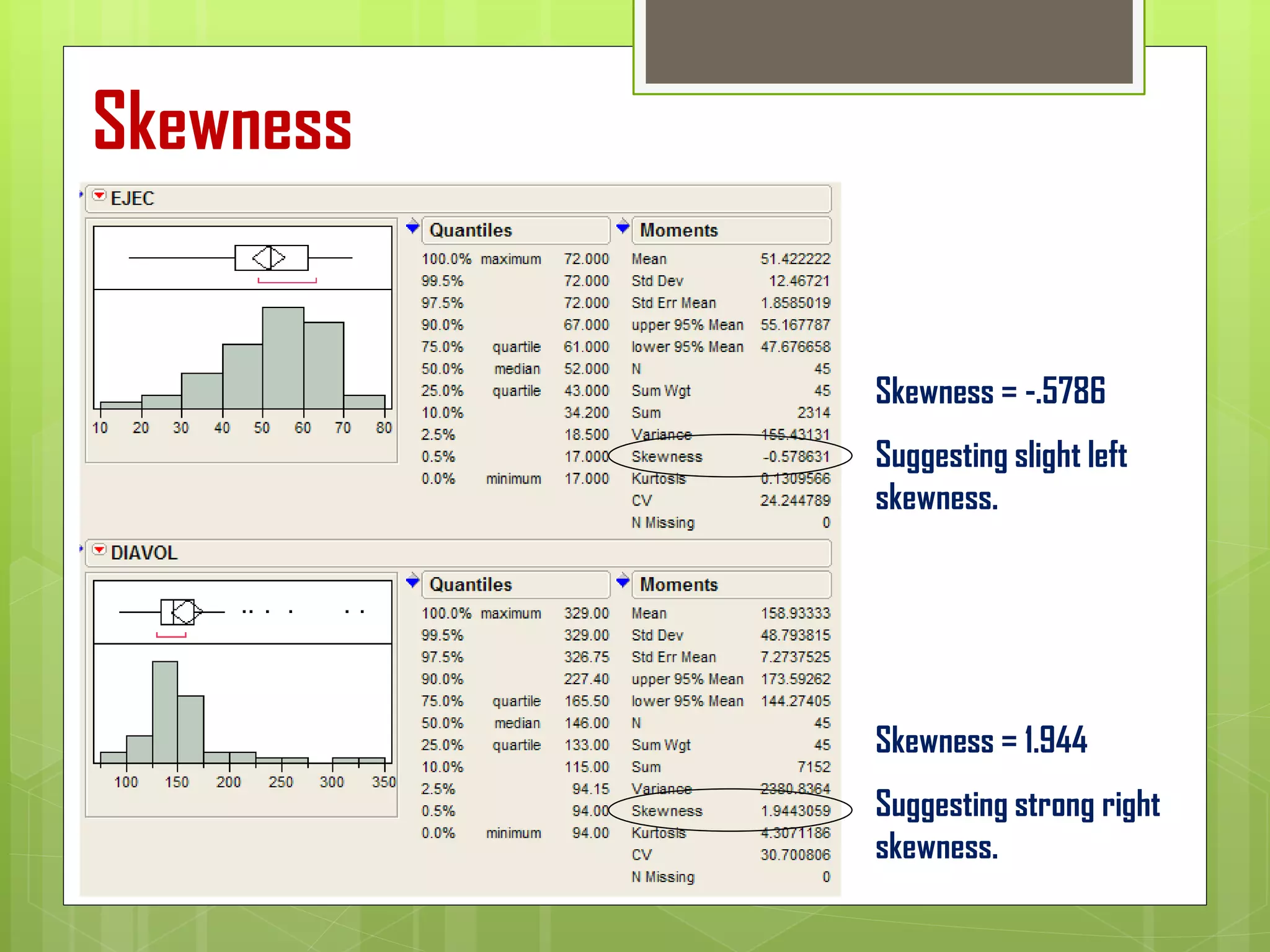
Skewness = -.5786
Suggesting slight left
skewness.
Skewness = 1.944
Suggesting strong right
skewness.
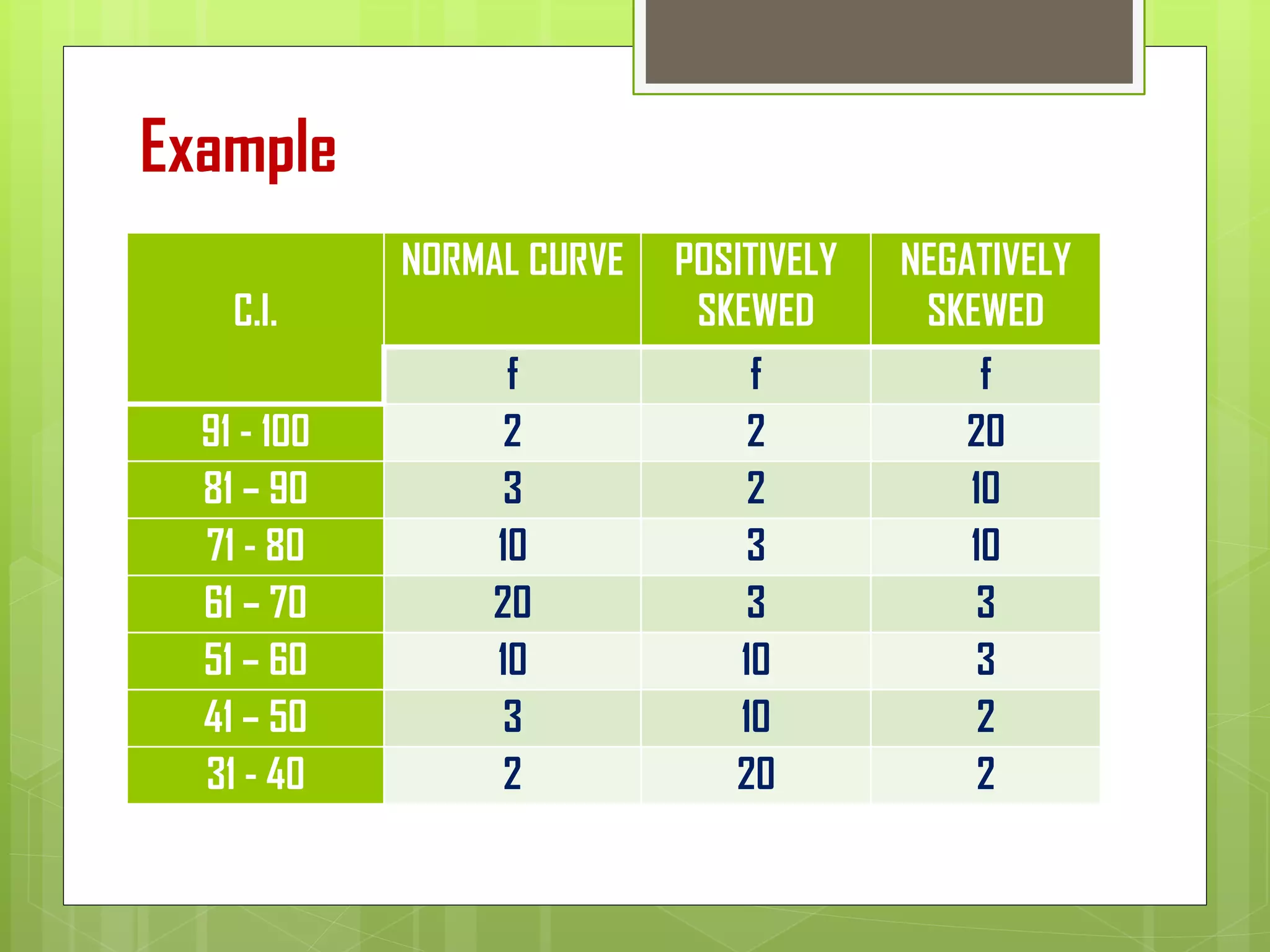
C.I.
NORMAL CURVE POSITIVELY
SKEWED
NEGATIVELY
SKEWED
f f f
91 - 100 2 2 20
81 – 90 3 2 10
71 - 80 10 3 10
61 – 70 20 3 3
51 – 60 10 10 3
41 – 50 3 10 2
31 - 40 2 20 2
Example
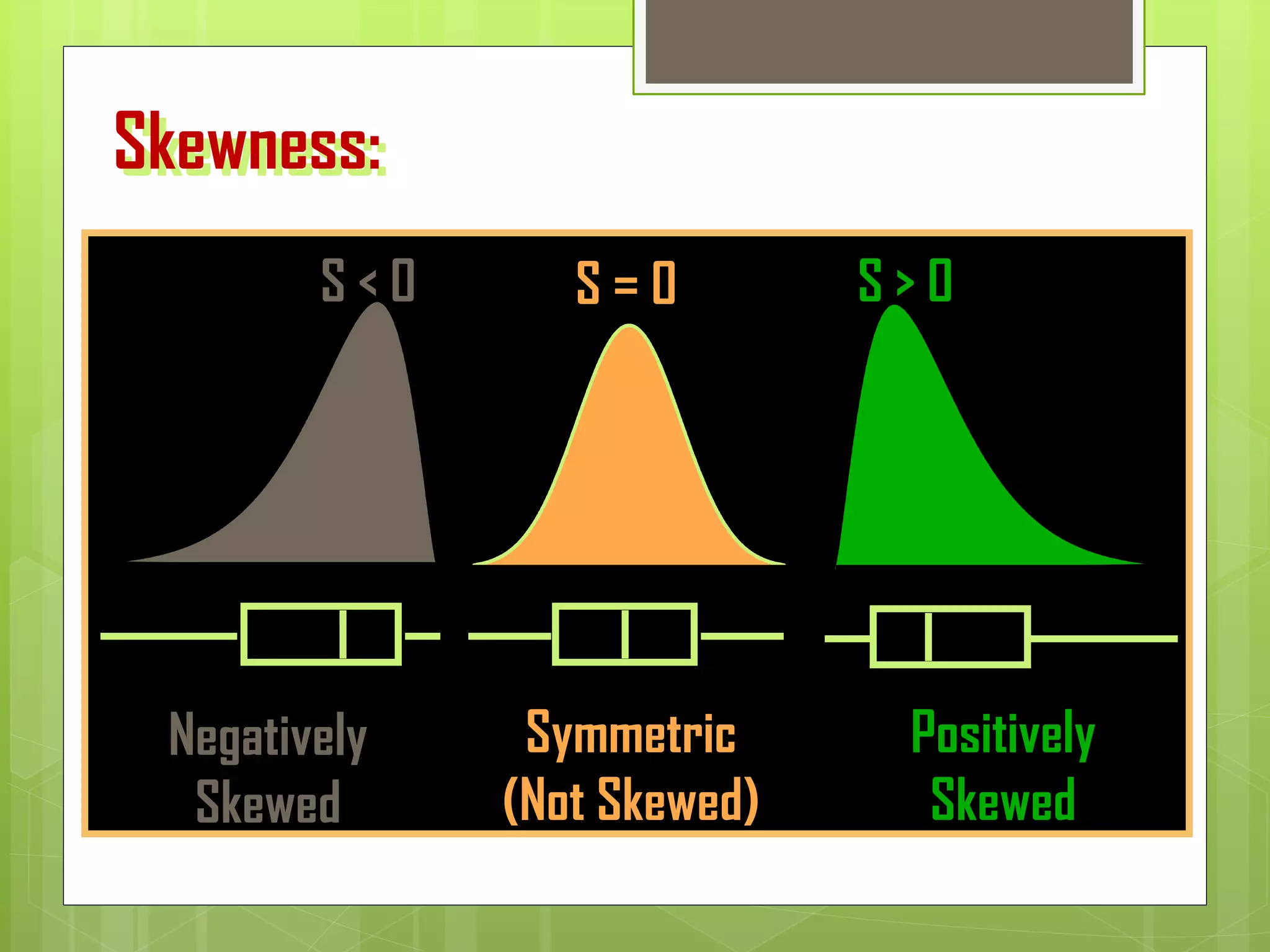
Skewness:
Negatively
Skewed
Positively
Skewed
Symmetric
(Not Skewed)
S < 0 S = 0 S > 0
KURTOSIS
Kurtosis
 The Kurtosis of a distribution refers to its ‘curvedness’ or
‘peakedness’.
 The distributions may have the same mean and the same
variance and may be equally skewed, but one of them may be
more peaked than the other.
 Kurtosis refers to peakness or flatness of a normal curve.
Kurtosis
 In some distribution the values of mean, median and mode
are the same. But if a curve is drawn from the distribution
then the height of curve is either more or less than the
normal probability curve, since such type of deviation is
related with the crest of the curve, it is called kurtosis.
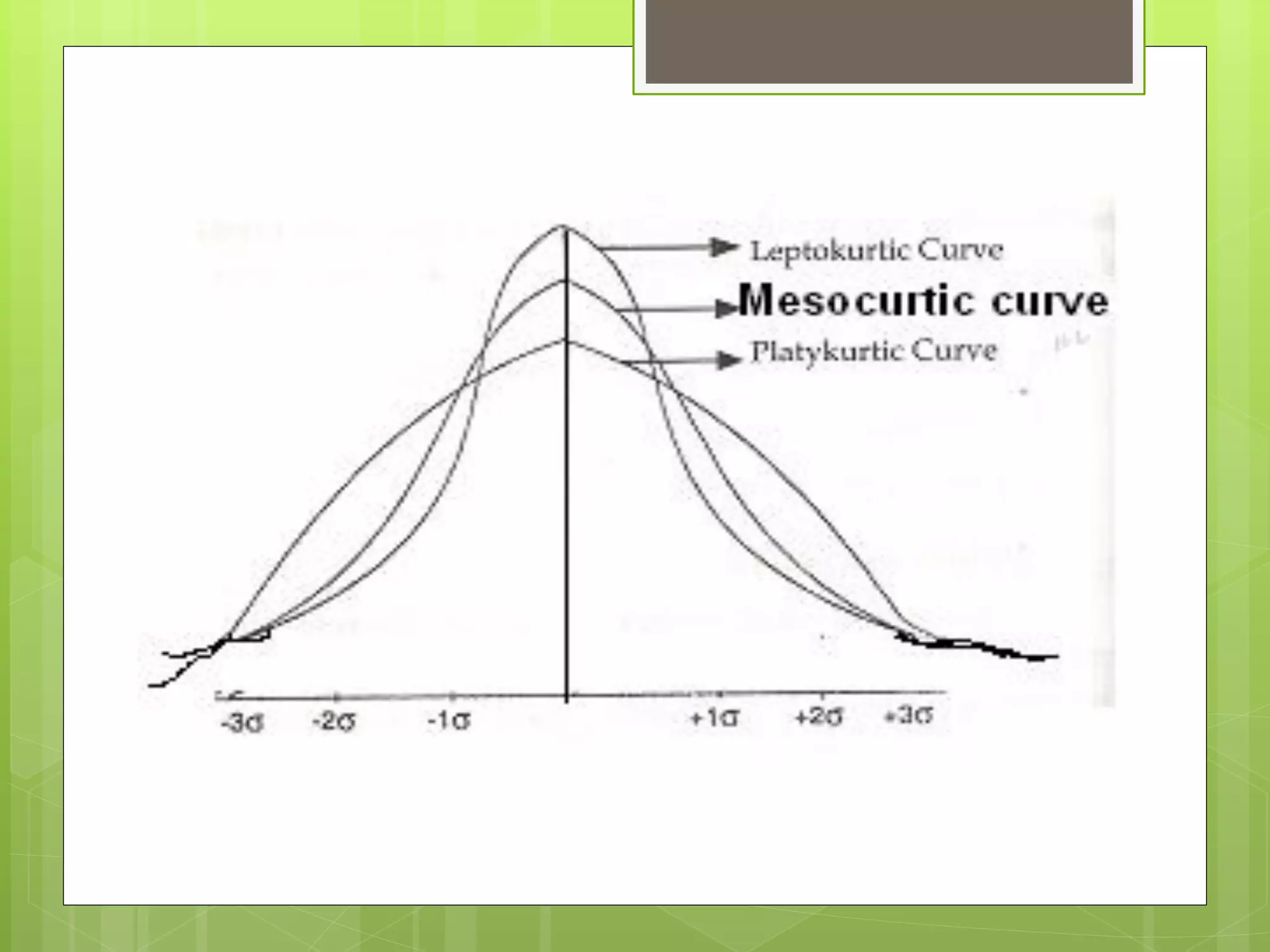
 The curves with kurtosis are of two types
1) Leptokurtic curve and
2) Playtykurtic curve
Kurtosis
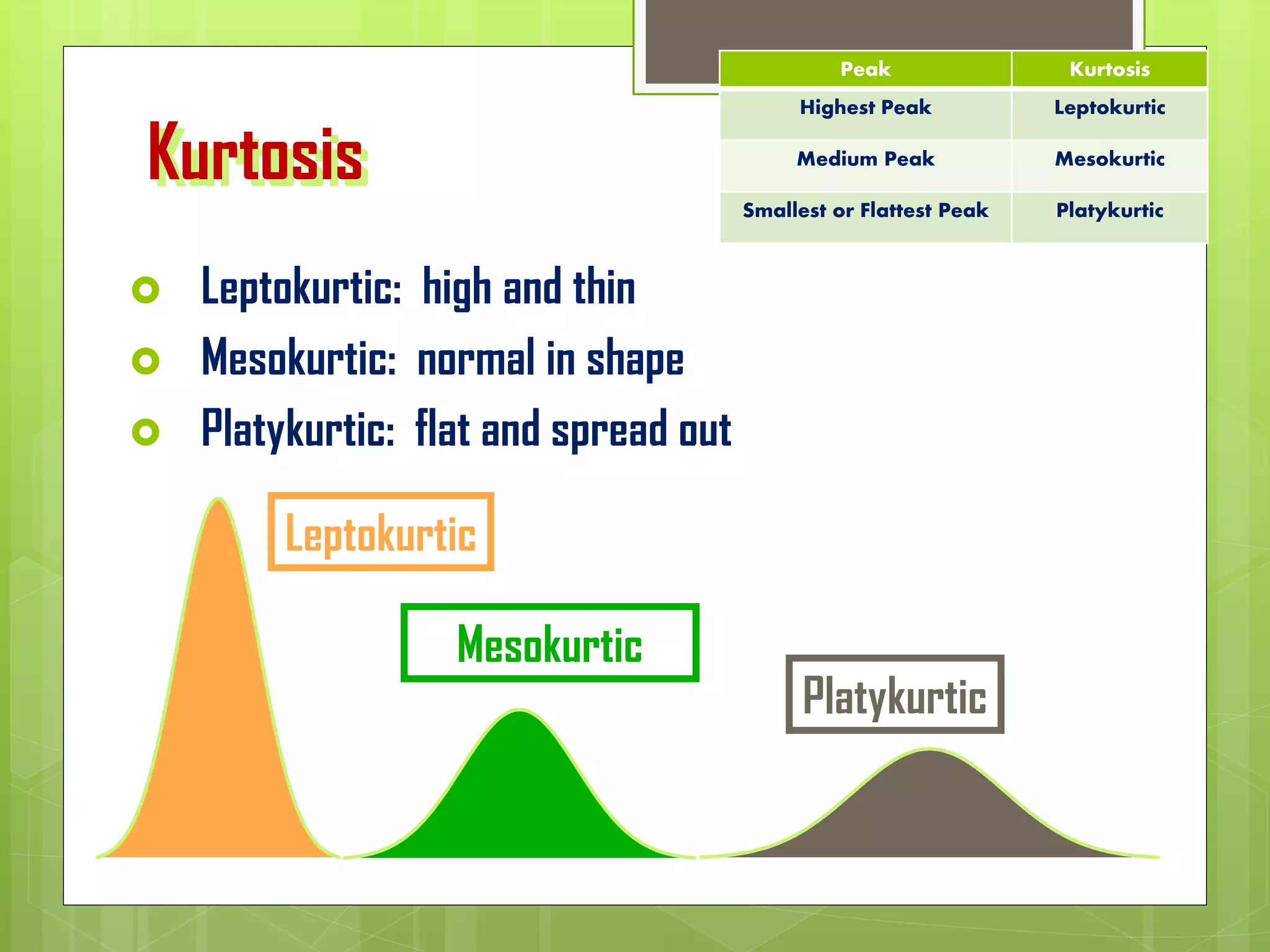
 Leptokurtic: high and thin
 Mesokurtic: normal in shape
 Platykurtic: flat and spread out
Leptokurtic
Mesokurtic
Platykurtic
Peak Kurtosis
Highest Peak Leptokurtic
Medium Peak Mesokurtic
Smallest or Flattest Peak Platykurtic
Leptokurtic
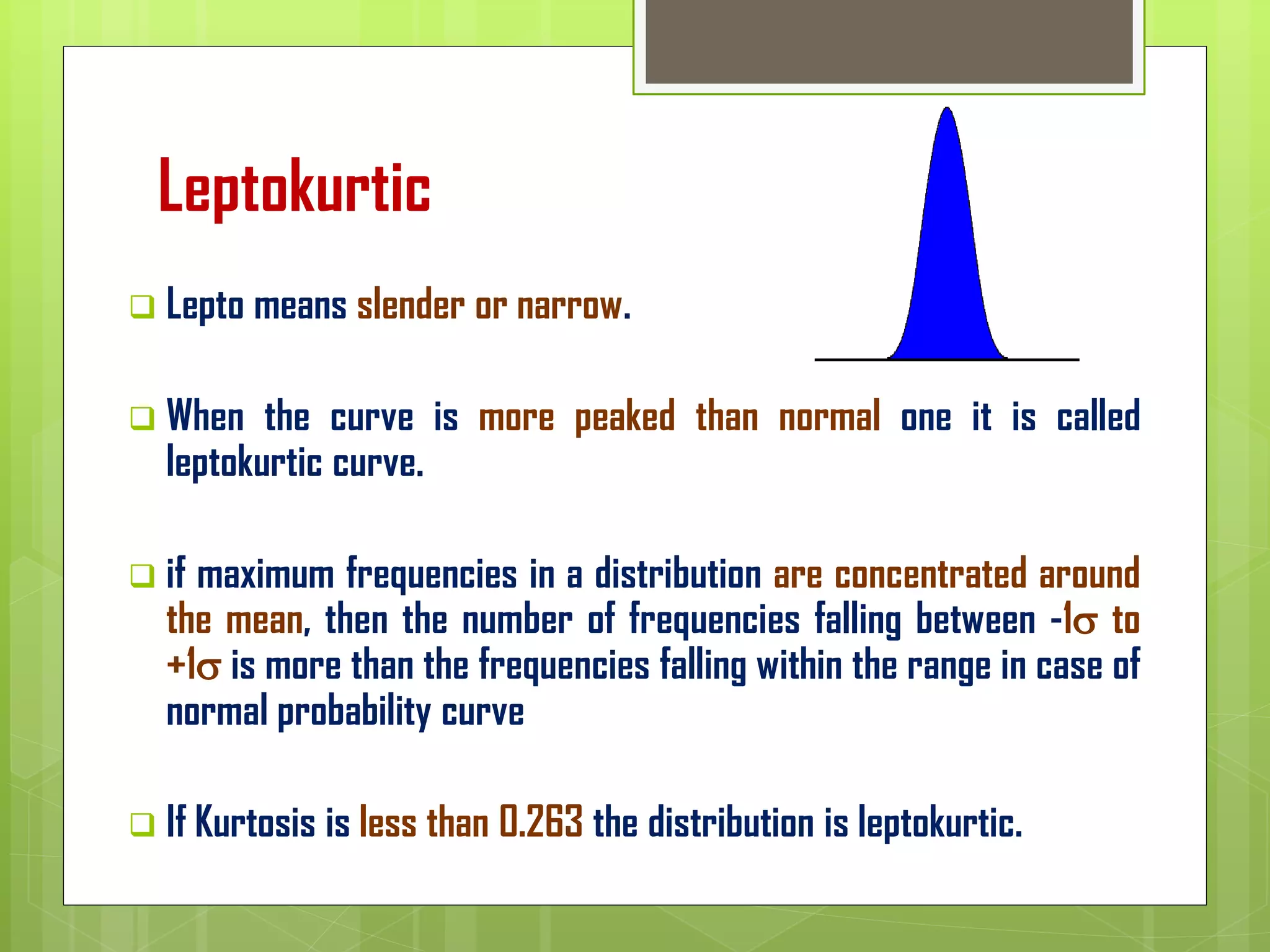
❑ Lepto means slender or narrow.
❑ When the curve is more peaked than normal one it is called
leptokurtic curve.
❑ if maximum frequencies in a distribution are concentrated around
the mean, then the number of frequencies falling between -1 to
+1 is more than the frequencies falling within the range in case of
normal probability curve
❑ If Kurtosis is less than 0.263 the distribution is leptokurtic.
Inferences from the leptokurtic curve
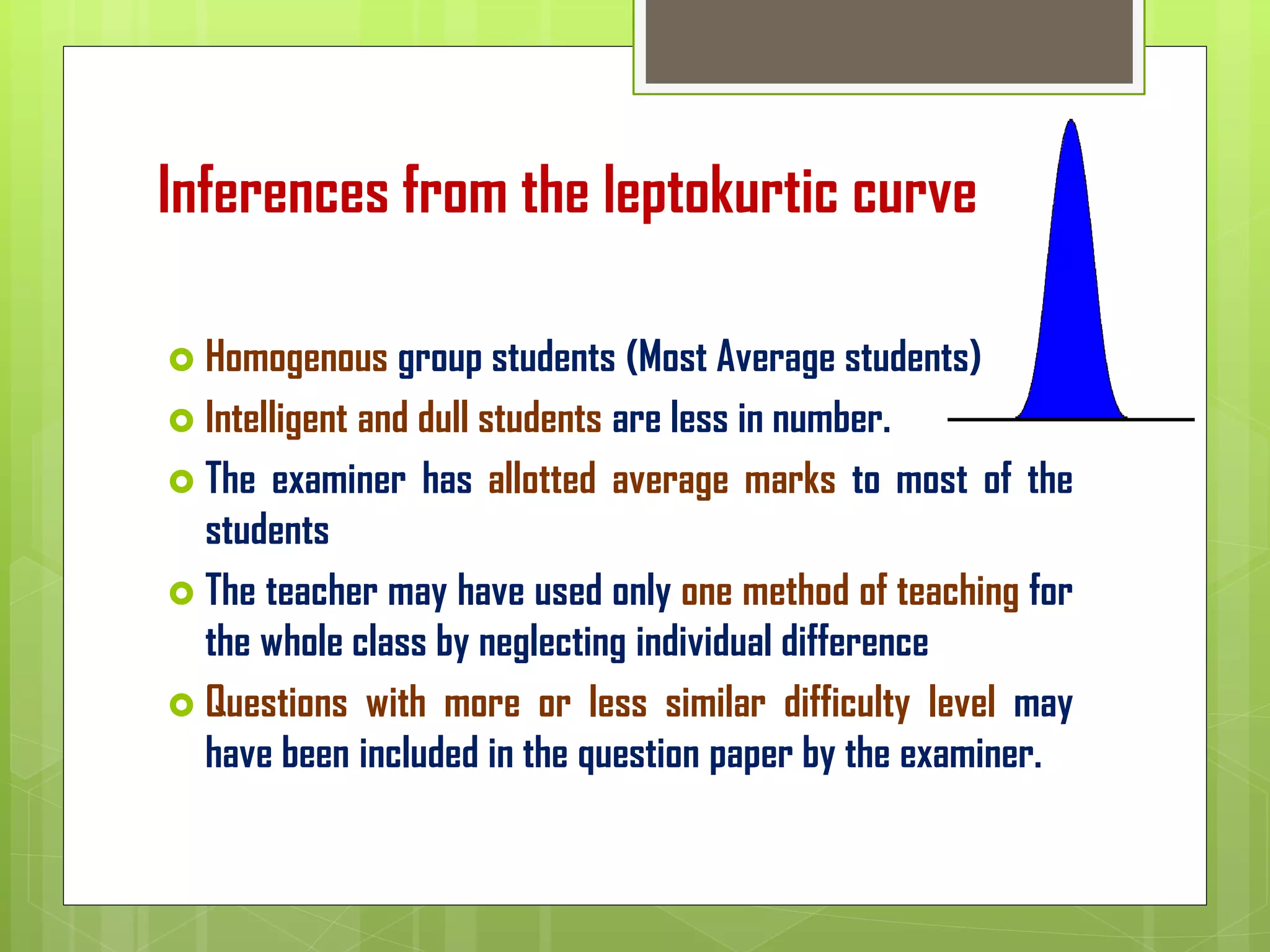
 Homogenous group students (Most Average students)
 Intelligent and dull students are less in number.
 The examiner has allotted average marks to most of the
students
 The teacher may have used only one method of teaching for
the whole class by neglecting individual difference
 Questions with more or less similar difficulty level may
have been included in the question paper by the examiner.
Platykurtic
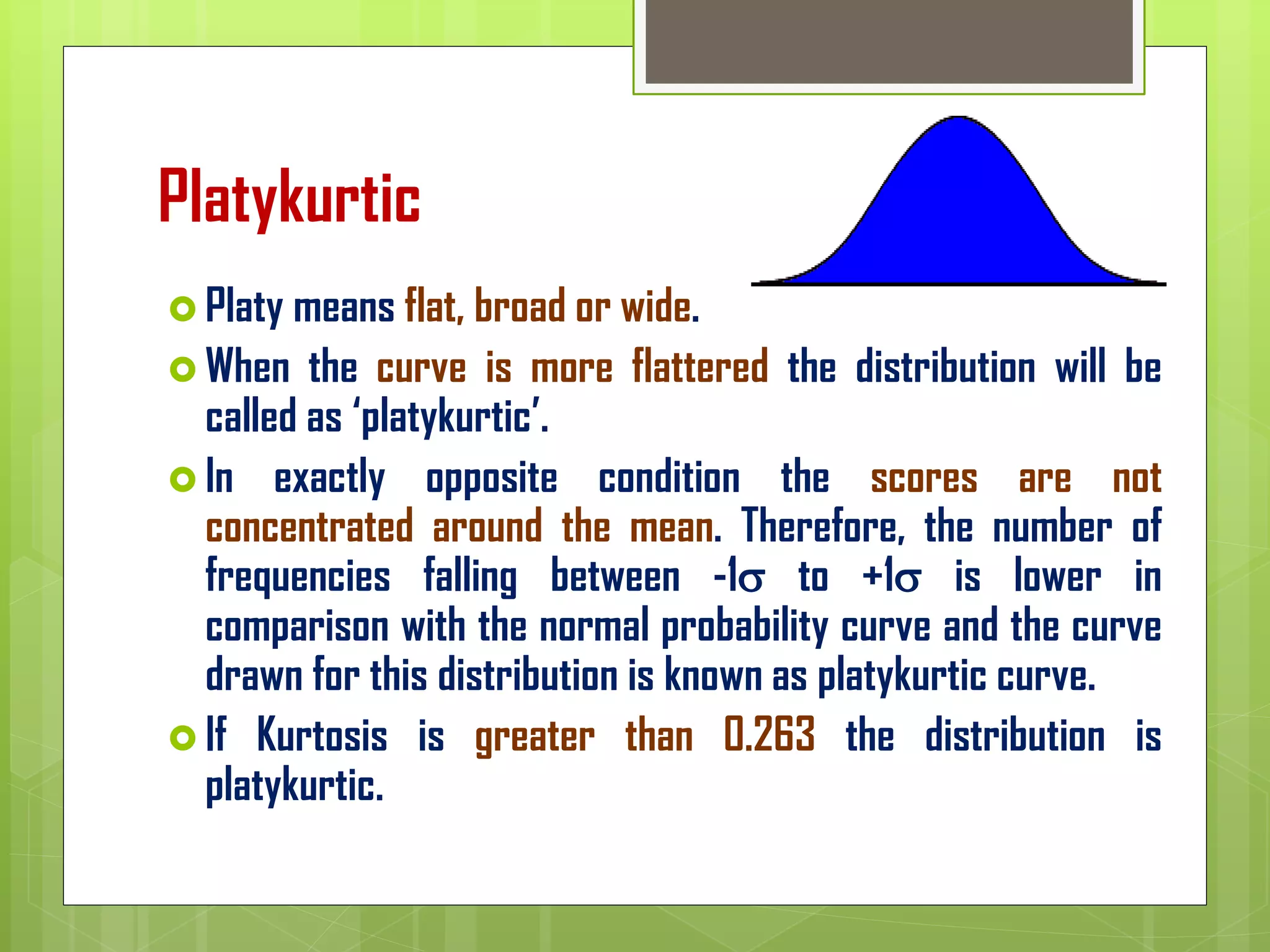
 Platy means flat, broad or wide.
 When the curve is more flattered the distribution will be
called as ‘platykurtic’.
 In exactly opposite condition the scores are not
concentrated around the mean. Therefore, the number of
frequencies falling between -1 to +1 is lower in
comparison with the normal probability curve and the curve
drawn for this distribution is known as platykurtic curve.
 If Kurtosis is greater than 0.263 the distribution is
platykurtic.
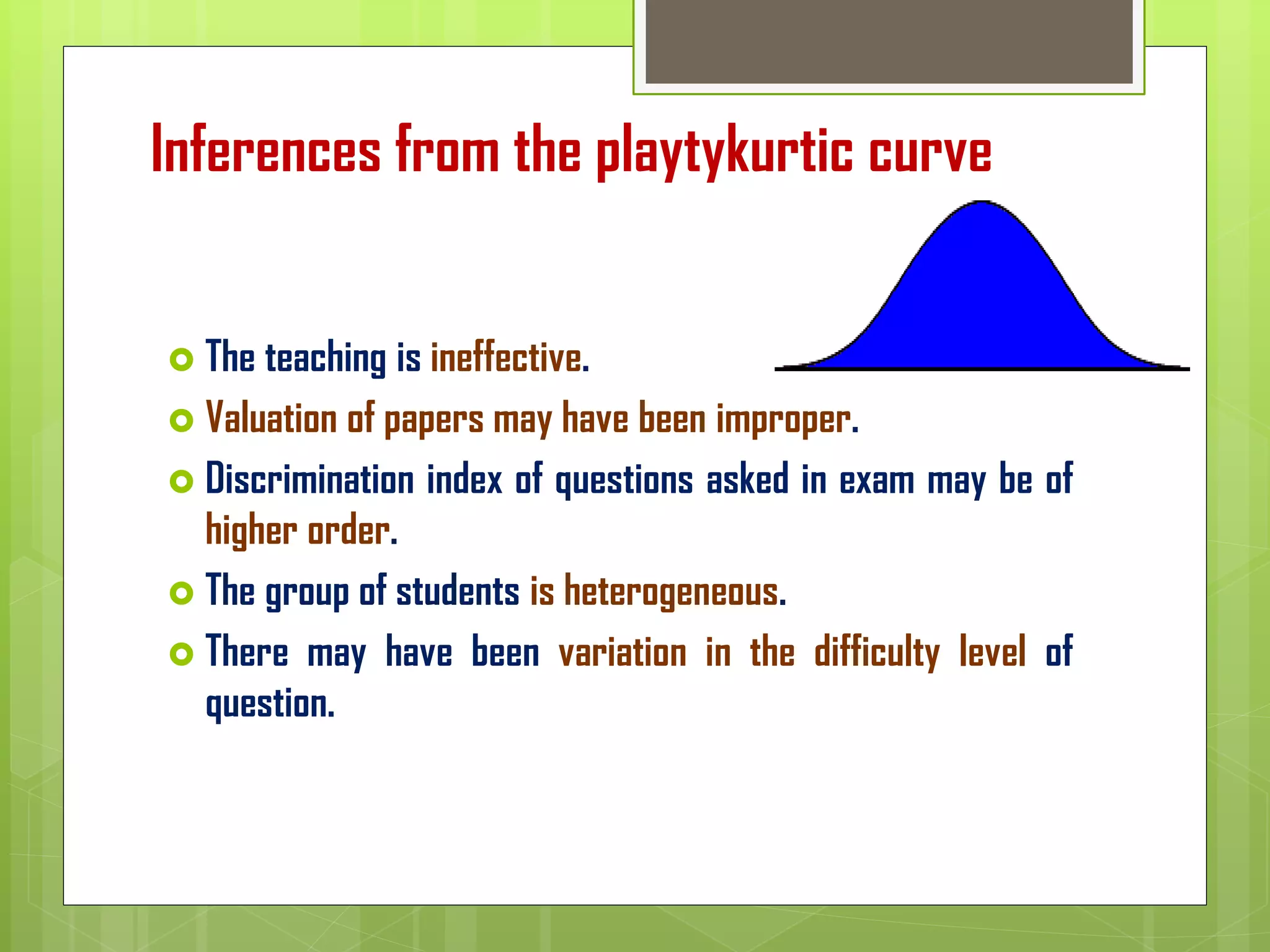
Inferences from the playtykurtic curve
 The teaching is ineffective.
 Valuation of papers may have been improper.
 Discrimination index of questions asked in exam may be of
higher order.
 The group of students is heterogeneous.
 There may have been variation in the difficulty level of
question.
REASONS FOR DIVERGENCE FROM NORMALITY /
FACTORS AFFECTIVING DIVEREGENCE IN THE NORMAL CURVE
 Improper selection of sample / Biased selection of sample:
 Improper construction of a test / Test construction Error:
 Improper administration of a test / Test Administration
Error:
 Using Unsuitable test:
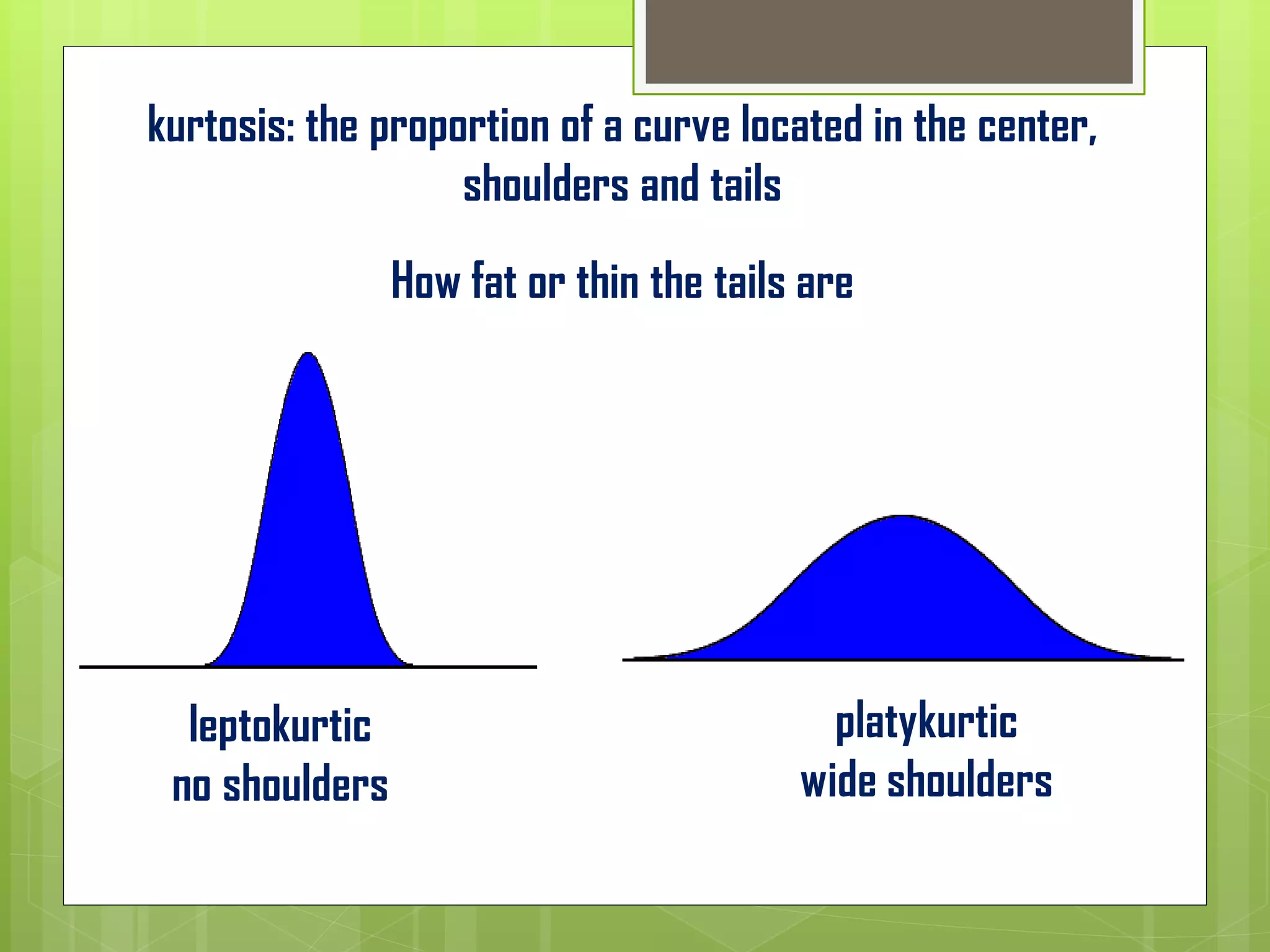
kurtosis: the proportion of a curve located in the center,
shoulders and tails
How fat or thin the tails are
leptokurtic
no shoulders
platykurtic
wide shoulders
Thank You

Npc, skewness and kurtosis

  • 1.
    NORMAL PROBABILITY CURVE K.THIYAGU, Assistant Professor,Department of Education, Central University of Kerala, Kasaragod
  • 2.
  • 3.
    The normal probabilitydistribution or the “normal curve” is often called the Gaussian distribution, Carl Gauss
  • 4.
    ❑ The normaldistribution was first discovered by De- moivre in 1733 to solve problems in games or chances. ❑ Later it was applied in natural and social science by the French Mathematician La Place (1949). ❑ This concept further developed by Gauss. ❑ The literal meaning of the term normal is average. NPC
  • 5.
    J.P. Guilford hasdefined normal probability curve comprehensively. “Normal probability curve is well defined, well structure, mathematical curve, having a distribution of the scores with mean, median and modes are equal. NPC
  • 6.
    Bell Shaped Curve Theshape of the curve is like that of a bell.
  • 7.
    Mean = Median= Mode  Mean, median and mode carry the equal value. / same numerical value mean, median and mode  Therefore they fall at the same point on the curve
  • 8.
    Unimodal  Since themean , median and mode lye at one point of the curve it is unimodal in nature.
  • 9.
    Perfectly Symmetricality  Itmeans the curve inclines towards both sides equally from the centre of the curve.  Thus we get equal halves on both sides from the central point.  The curve is not skewed. Therefore the values of the measure of skewness is zero
  • 10.
    A normal curveis symmetric about the mean. Each of the two shaded areas is .5 or 50% .5.5 μ x
  • 11.
    Asymptotic  The curvedoes not touch the base or OX axis on both sides.  Thus it extends from negative infinity to positive infinitive.
  • 12.
    Distance of theCurve  For practical purpose the base line of the curve is divided into six sigma distance from  Most of the cases I.e.99.73% are covered within such distance
  • 13.
    Maximum Ordinate  Maximumordinate of the curve occurs at the mean. I.e. where Z1=0 and the value of the highest ordinate is 0.3989.  The height of the ordinate at 1sigma is 0.2420  2 sigma = 0.0540  3 sigma = 0.0044
  • 14.
  • 15.
    68-95-99.7 Rule • Forany normal curve with mean mu and standard deviation sigma: • 68 percent of the observations fall within one standard deviation sigma of the mean. • 95 percent of observation fall within 2 standard deviations. • 99.7 percent of observations fall within 3 standard deviations of the mean.
  • 16.
  • 17.
    x - sx x + s 68% within 1 standard deviation 34% 34% The Empirical Rule
  • 18.
    x - 2sx - s x x + 2sx + s 68% within 1 standard deviation 34% 34% 95% within 2 standard deviations 13.5% 13.5% The Empirical Rule
  • 19.
    x - 3sx - 2s x - s x x + 2s x + 3sx + s 68% within 1 standard deviation 34% 34% 95% within 2 standard deviations 99.7% of data are within 3 standard deviations of the mean 0.1% 0.1% 2.4% 2.4% 13.5% 13.5% The Empirical Rule
  • 20.
  • 21.
    Properties (cont.) • Hasa mean = 0 and standard deviation = 1. • General relationships: ±1 s = about 68.26% ±2 s = about 95.44% ±3 s = about 99.72% -5 -4 -3 -2 -1 0 1 2 3 4 5 68.26% 95.44% 99.72%
  • 22.
    Analysis of Scalevalue The scale values are analysed as Z1=(X-M)/sigma Where z1 = 0 and range of mean plus or minus Z is equal to mean plus or minus sigma
  • 23.
    Points of infection The points of infection are each plus or minus one sigma from above and below the mean.  The curve changes from convex to concave at these points with the baseline.
  • 24.
    Various Measures In thenormal curve Quartile deviation Q = Proper error = 0.6745a Mean deviation, AD = 0.7979a Skewness = 0 Kurtosis = 0.263
  • 25.
    APPLICATIONS OF THENORMAL PROBABILITY CURVE To normalize a frequency distribution. It is an important step in standardizing a psychological test or inventory. To test the significance of observations in experiments, findings them relationships with the chance fluctuations or errors that are result of sampling procedures. To generalize about population from which the samples are drawn by calculating the standard error of mean and other statistics. To compare two distributions. The NPC is used to compare two distributions. To determine the difficulty values. The Z scores are used to determine the difficulty values of test items. To classify the groups. The Normal Probability Curve (NPC) is used for classifying the groups and assigning grades to individuals. To determine the level of significance. The levels of significance of statistics results are determined in terms of NPC limits. To scale responses to opinionnaires, judgement, ratings or rankings by transforming them numerical values.
  • 26.
    Skewness K.THIYAGU, Assistant Professor,Department of Education, Central University of Kerala, Kasaragod
  • 27.
    Skewness ❑ Skewness meansasymmetrical nature / lack of symmetry ❑ The degree of departure from symmetry is called skewness. ❑ The distribution in which mean, Median and Mode fall on different points or different places is known as skewed distribution and this tendency of distribution is known as skewness.
  • 29.
  • 30.
    POSITIVELY SKEWED CURVE/ POSITIVE SKEWNESS When the curve inclines more towards right we ascertain the positive skewness. If the longer tail of the distribution is towards the higher values or upper sides, the skewness is positive.
  • 31.
    When the curveinclines more towards right Positive or Right Skew Distribution
  • 33.
    Properties of Positively Skewed M>Mdn>Mo Low Achievers or failures,  Subject is difficult  Teaching is ineffective  Students did not prepare well for the examination  Strict Valuation  Question paper consists of questions having higher difficulty level,
  • 34.
    NEGATIVELY SKEWED CURVE Whenthe curve inclines more to the left skewness becomes negative. If the longer tail of the distribution is towards the lower values or lower sides, the skewness is negative.
  • 35.
    When the curveinclines more to the left skewness becomes negative Negative or Left Skew Distribution
  • 36.
    Properties of Negatively SkewedCurve M < Mdn < Mo  Intelligent and studious students  Subject is easy  Hard preparation  Teaching is very effective  Examiner is very liberal in giving marks  Easy question paper
  • 37.
  • 38.
    Skewness Skewness = -.5786 Suggestingslight left skewness. Skewness = 1.944 Suggesting strong right skewness.
  • 39.
    C.I. NORMAL CURVE POSITIVELY SKEWED NEGATIVELY SKEWED ff f 91 - 100 2 2 20 81 – 90 3 2 10 71 - 80 10 3 10 61 – 70 20 3 3 51 – 60 10 10 3 41 – 50 3 10 2 31 - 40 2 20 2 Example
  • 40.
  • 41.
  • 42.
    Kurtosis  The Kurtosisof a distribution refers to its ‘curvedness’ or ‘peakedness’.  The distributions may have the same mean and the same variance and may be equally skewed, but one of them may be more peaked than the other.  Kurtosis refers to peakness or flatness of a normal curve.
  • 43.
    Kurtosis  In somedistribution the values of mean, median and mode are the same. But if a curve is drawn from the distribution then the height of curve is either more or less than the normal probability curve, since such type of deviation is related with the crest of the curve, it is called kurtosis.  The curves with kurtosis are of two types 1) Leptokurtic curve and 2) Playtykurtic curve
  • 44.
    Kurtosis  Leptokurtic: highand thin  Mesokurtic: normal in shape  Platykurtic: flat and spread out Leptokurtic Mesokurtic Platykurtic Peak Kurtosis Highest Peak Leptokurtic Medium Peak Mesokurtic Smallest or Flattest Peak Platykurtic
  • 46.
    Leptokurtic ❑ Lepto meansslender or narrow. ❑ When the curve is more peaked than normal one it is called leptokurtic curve. ❑ if maximum frequencies in a distribution are concentrated around the mean, then the number of frequencies falling between -1 to +1 is more than the frequencies falling within the range in case of normal probability curve ❑ If Kurtosis is less than 0.263 the distribution is leptokurtic.
  • 47.
    Inferences from theleptokurtic curve  Homogenous group students (Most Average students)  Intelligent and dull students are less in number.  The examiner has allotted average marks to most of the students  The teacher may have used only one method of teaching for the whole class by neglecting individual difference  Questions with more or less similar difficulty level may have been included in the question paper by the examiner.
  • 48.
    Platykurtic  Platy meansflat, broad or wide.  When the curve is more flattered the distribution will be called as ‘platykurtic’.  In exactly opposite condition the scores are not concentrated around the mean. Therefore, the number of frequencies falling between -1 to +1 is lower in comparison with the normal probability curve and the curve drawn for this distribution is known as platykurtic curve.  If Kurtosis is greater than 0.263 the distribution is platykurtic.
  • 49.
    Inferences from theplaytykurtic curve  The teaching is ineffective.  Valuation of papers may have been improper.  Discrimination index of questions asked in exam may be of higher order.  The group of students is heterogeneous.  There may have been variation in the difficulty level of question.
  • 50.
    REASONS FOR DIVERGENCEFROM NORMALITY / FACTORS AFFECTIVING DIVEREGENCE IN THE NORMAL CURVE  Improper selection of sample / Biased selection of sample:  Improper construction of a test / Test construction Error:  Improper administration of a test / Test Administration Error:  Using Unsuitable test:
  • 51.
    kurtosis: the proportionof a curve located in the center, shoulders and tails How fat or thin the tails are leptokurtic no shoulders platykurtic wide shoulders
  • 52.