WORKING WITH
OPENING MS WORD 2007
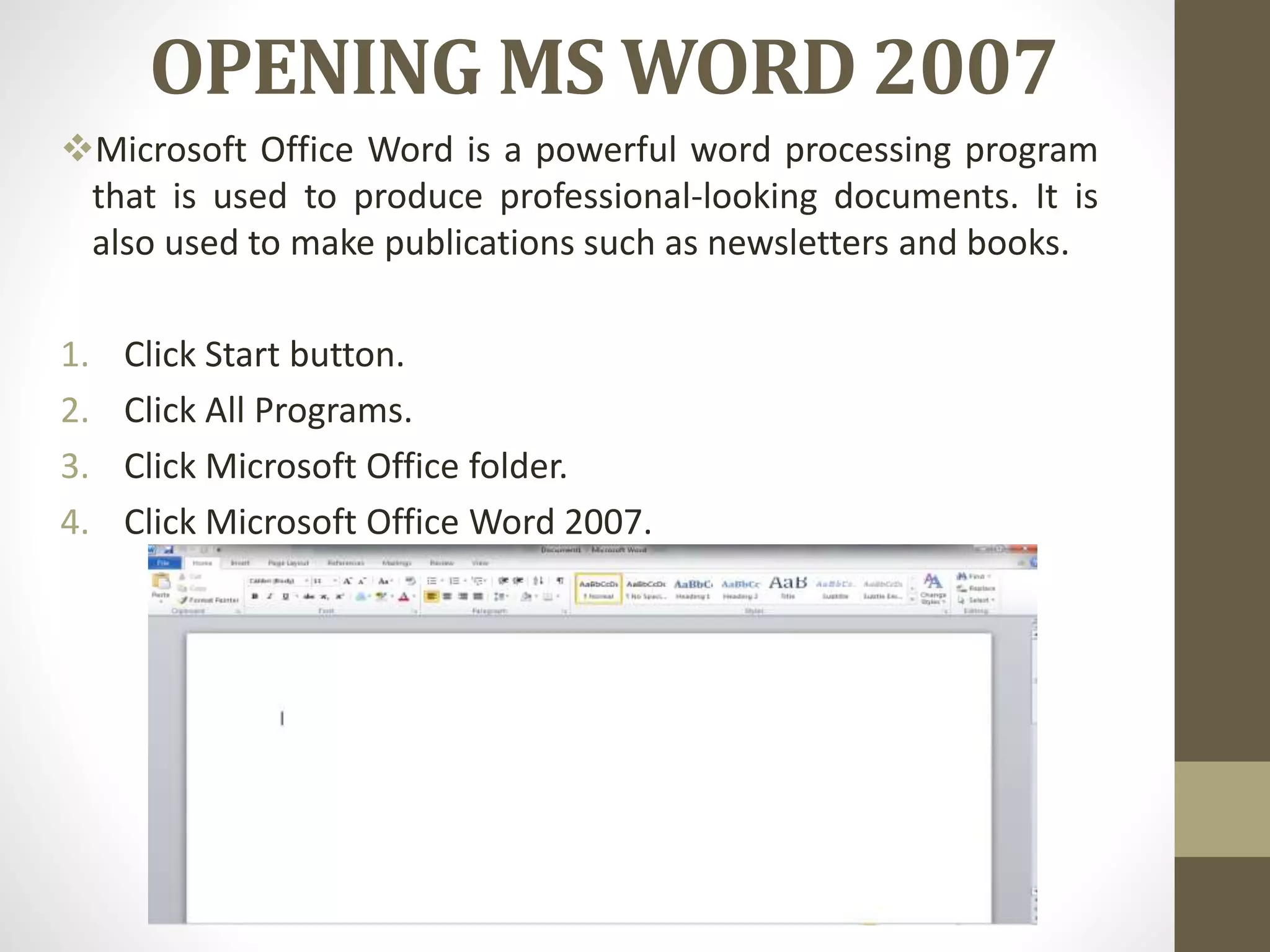
Microsoft Office Word is a powerful word processing program
that is used to produce professional-looking documents. It is
also used to make publications such as newsletters and books.
1. Click Start button.
2. Click All Programs.
3. Click Microsoft Office folder.
4. Click Microsoft Office Word 2007.
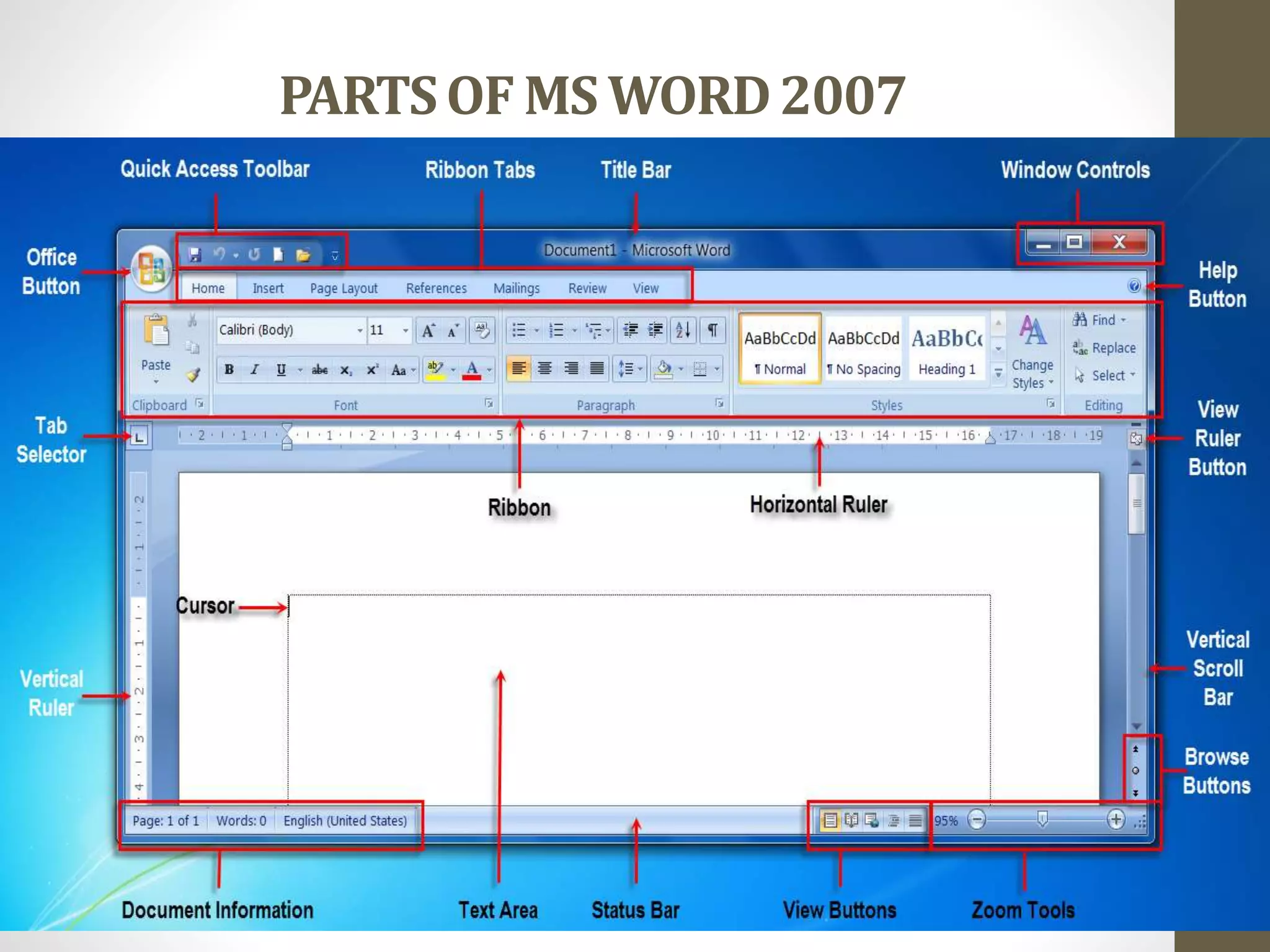
PARTSOF MS WORD2007
TABSOF THE RIBBON
• In MS Word 2007, the menus are replaced by ribbons.
These are the contents of the ribbon tabs you can use to
create your documents:
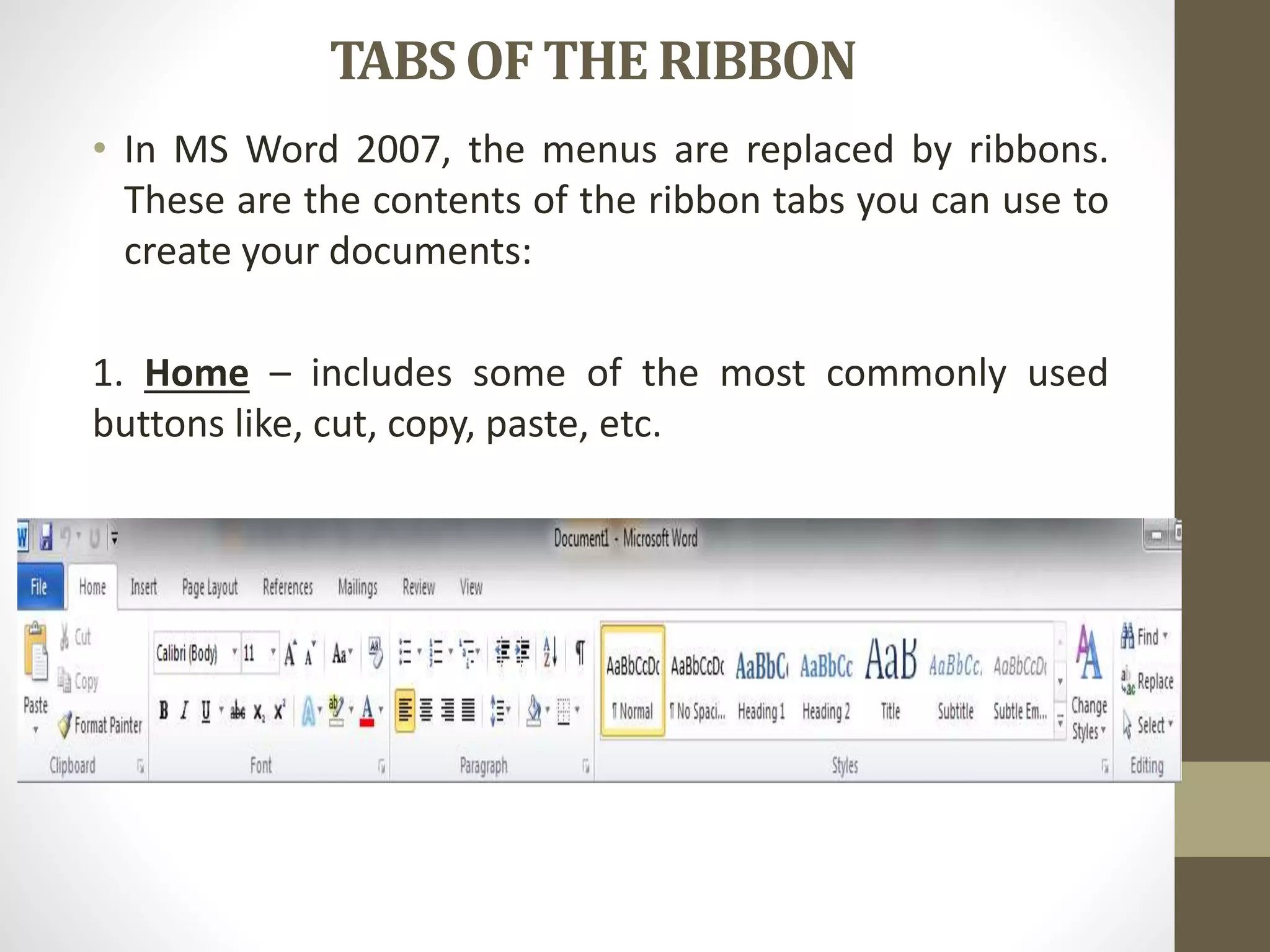
1. Home – includes some of the most commonly used
buttons like, cut, copy, paste, etc.
TABSOF THE RIBBON
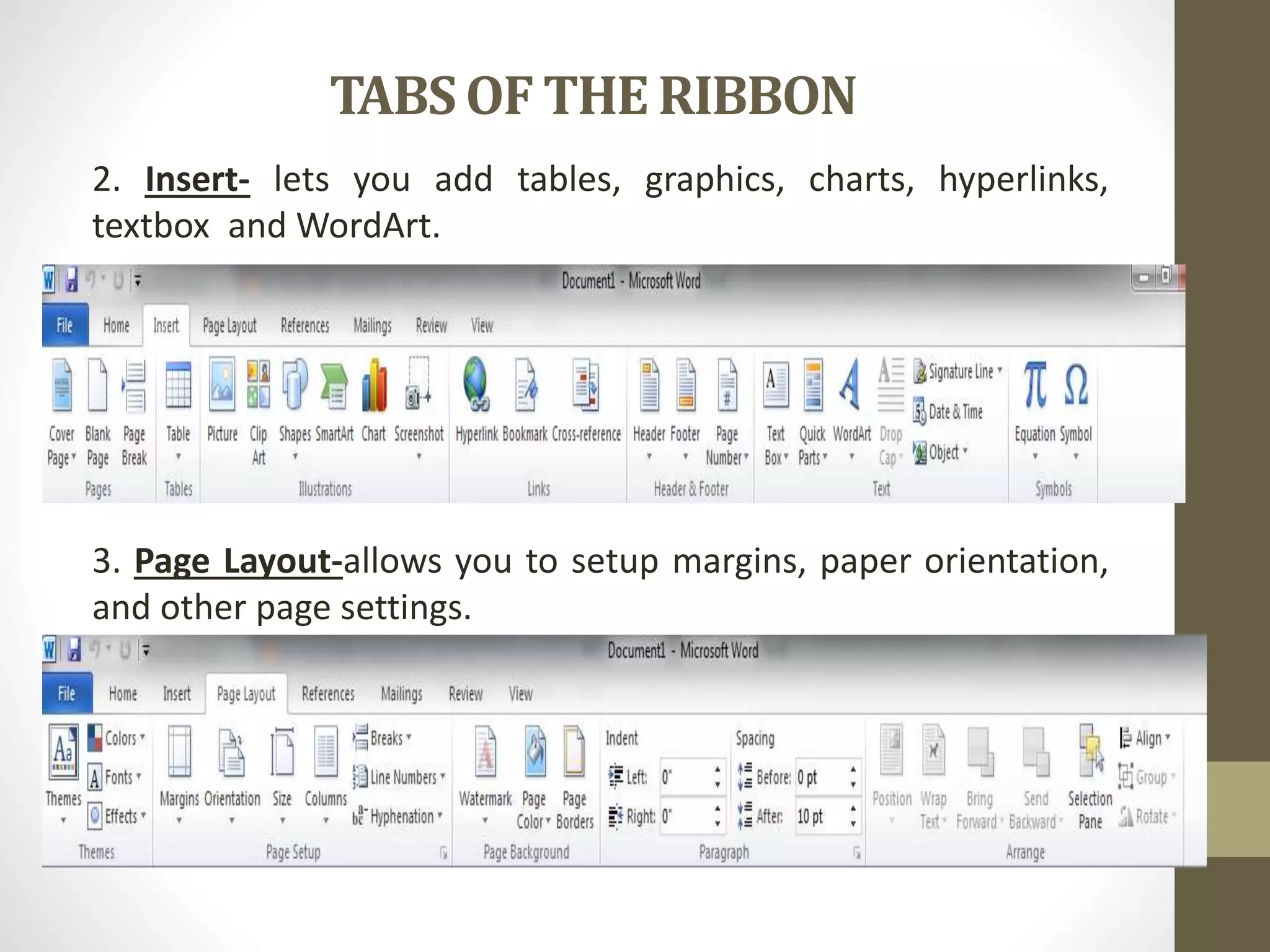
2. Insert- lets you add tables, graphics, charts, hyperlinks,
textbox and WordArt.
3. Page Layout-allows you to setup margins, paper orientation,
and other page settings.
TABSOF THE RIBBON
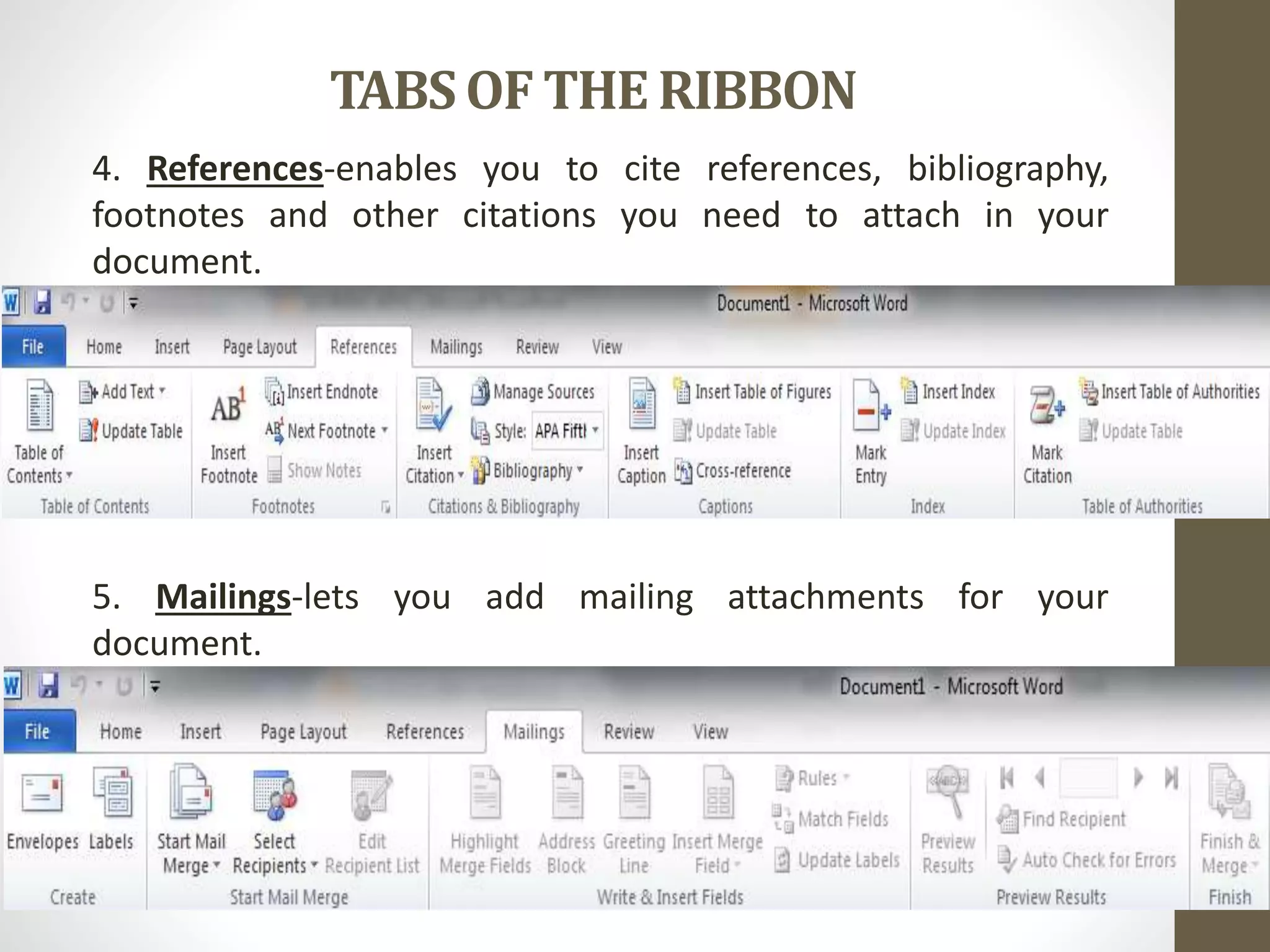
4. References-enables you to cite references, bibliography,
footnotes and other citations you need to attach in your
document.
5. Mailings-lets you add mailing attachments for your
document.
TABSOF THE RIBBON
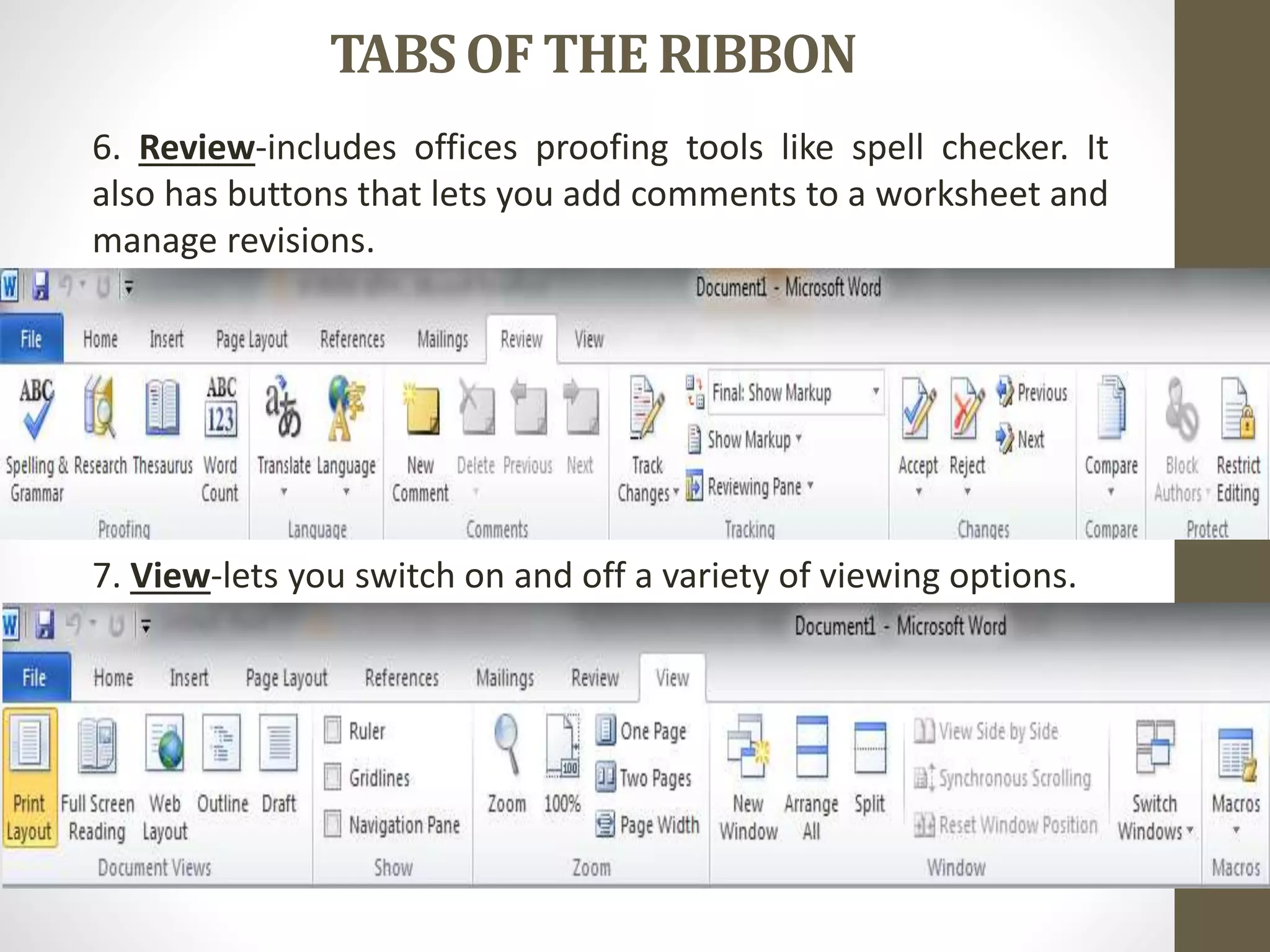
6. Review-includes offices proofing tools like spell checker. It
also has buttons that lets you add comments to a worksheet and
manage revisions.
7. View-lets you switch on and off a variety of viewing options.
TABSOF THE RIBBON
8. Contextual Tab-Whenever an object such as a chart, a picture
or a table is selected, specific tools for working with that object
will appear in the Ribbon.
You can collapse the ribbon by double-clicking any tab or
right-clicking the tab, and then clicking Minimize the Ribbon.
Or press Ctrl+F1.
CREATINGA SIMPLEDOCUMENT
Let’s create a simple letter document. Follow the instructions
below:
1. Click on the document sheet and type your address and
date as illustrated below.
2. Press the Enter key twice and type your salutation.
3. Press the enter key and type the body of your letter.
4. Press the Enter key thrice and type the closing of your letter.
FREQUENTLYUSEDTOOLSAND COMMANDS
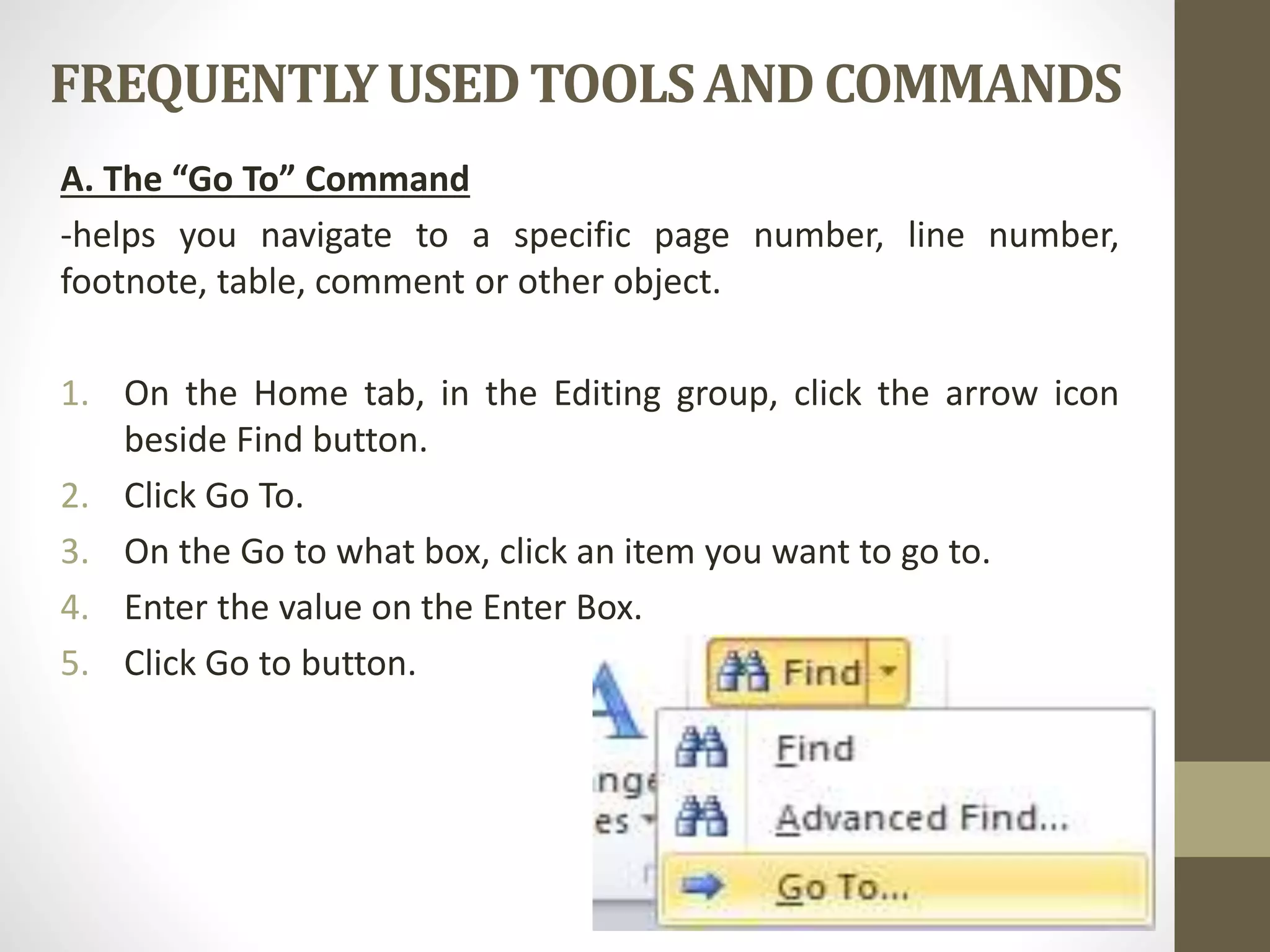
A. The “Go To” Command
-helps you navigate to a specific page number, line number,
footnote, table, comment or other object.
1. On the Home tab, in the Editing group, click the arrow icon
beside Find button.
2. Click Go To.
3. On the Go to what box, click an item you want to go to.
4. Enter the value on the Enter Box.
5. Click Go to button.
FREQUENTLYUSEDTOOLSAND COMMANDS
B. Page Break
- If you want a page to end at a particular point in your text, you
can insert a Page Break.
1. Click on the point in your document that you want to add a
page break.
2. Click the Insert tab.
3. On the Pages group, click Page Break.
C. Drag and Drop
1. Select the text you want to move. Example: Chris
2. Click the highlighted text then drag it to the location where you
want to place it.
FREQUENTLYUSEDTOOLSAND COMMANDS
B. Page Break
- If you want a page to end at a particular point in your text, you
can insert a Page Break.
1. Click on the point in your document that you want to add a
page break.
2. Click the Insert tab.
3. On the Pages group, click Page Break.
C. Drag and Drop
1. Select the text you want to move. Example: Chris
2. Click the highlighted text then drag it to the location where you
want to place it.
FREQUENTLYUSEDTOOLSAND COMMANDS
D. Zooming In and Out
- To view the zoom tools, click the View tab. On the zoom group
are the tools you can use in zooming in and out your document.
1. To view the document in a normal view, click 100% button.
2. To specify the zoom level, click the Zoom button.
3. Enter the zoom percentage.
4. Click Ok button.
E. Using the Scroll Bars
- To move to different part of your document, use the scroll bar
on the right side of the Word window.
1. To do this, click the up and down arrows to move one line at a
time.
FREQUENTLYUSEDTOOLSAND COMMANDS
2. To move up or down the page one at a time, click the double-
arrows under the down arrow of the scroll bar.
3. To show or hide the ruler, click the View ruler button on top of
the up arrow of the scroll bar.
F. The Undo and Repeat Command
-You can undo your actions in your document by clicking the
Undo button located at the Quick Access Toolbar or you can
press Ctrl+Z on your keyboard.
DISPLAYING THE THUMBNAIL VIEW
• In the Show/Hide group under View tab, check Thumbnails.
SAVING A FILE
1. Click the Office button at the top left side of the
window.
2. Click Save or Save As.
If you want to save your file on other format, point your
mouse to Save As then click among the available saving
options.
3. The Save As window will appear. Find the folder where
you want to save the file.
4. Type the filename of your document.
5. Click Save.
PRINTING A DOCUMENT
1. Click the Office button on the top left corner of the
window.
2. Click Print.
3. Choose a printer where you want to print your
document.
4. Type the number of copies you want to print.
5. Choose the pages you want to print.
6. Click the Ok button.
CLOSING A DOCUMENT
1. Click the Office button on the top left corner of the
window.
2. Click Close.
EXITING MS WORD 2007
1. Click the Office button on the top left corner of the
window.
2. Click Exit Word.
Or you can just click the Close button at the top right
corner of the window.
OPENING AN EXISTING DOCUMENT
1. Click the Office button on the top left corner of the
window.
2. Click your file on the Recent Document box.
3. If you cannot find your file on the Recent Document
box, click Open on the Office drop down menu.
4. The Open window will appear. Find the file you want to
open.
5. Once found, select it and click the Open button.
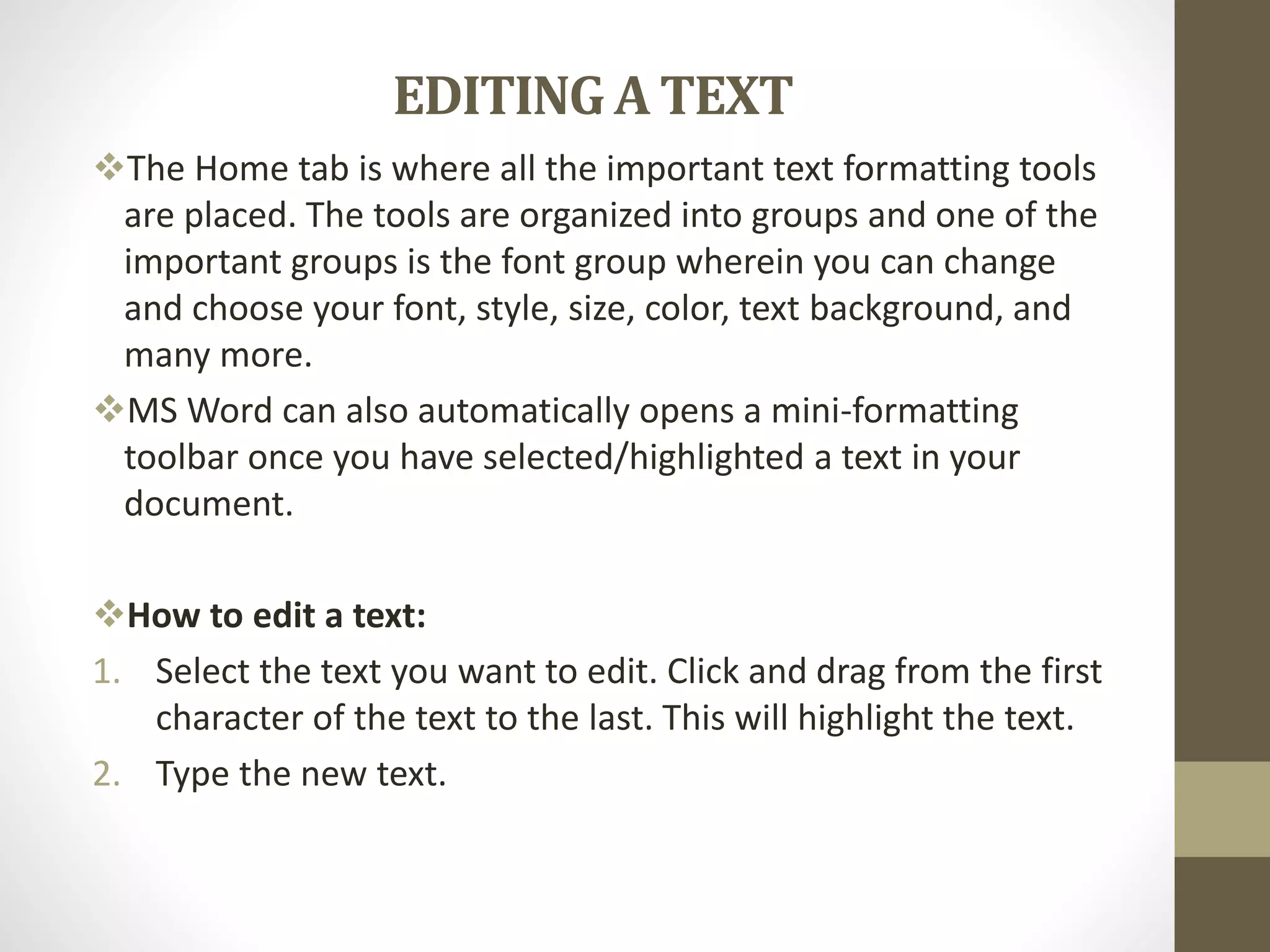
EDITING A TEXT
The Home tab is where all the important text formatting tools
are placed. The tools are organized into groups and one of the
important groups is the font group wherein you can change
and choose your font, style, size, color, text background, and
many more.
MS Word can also automatically opens a mini-formatting
toolbar once you have selected/highlighted a text in your
document.
How to edit a text:
1. Select the text you want to edit. Click and drag from the first
character of the text to the last. This will highlight the text.
2. Type the new text.
FORMATTINGA TEXT
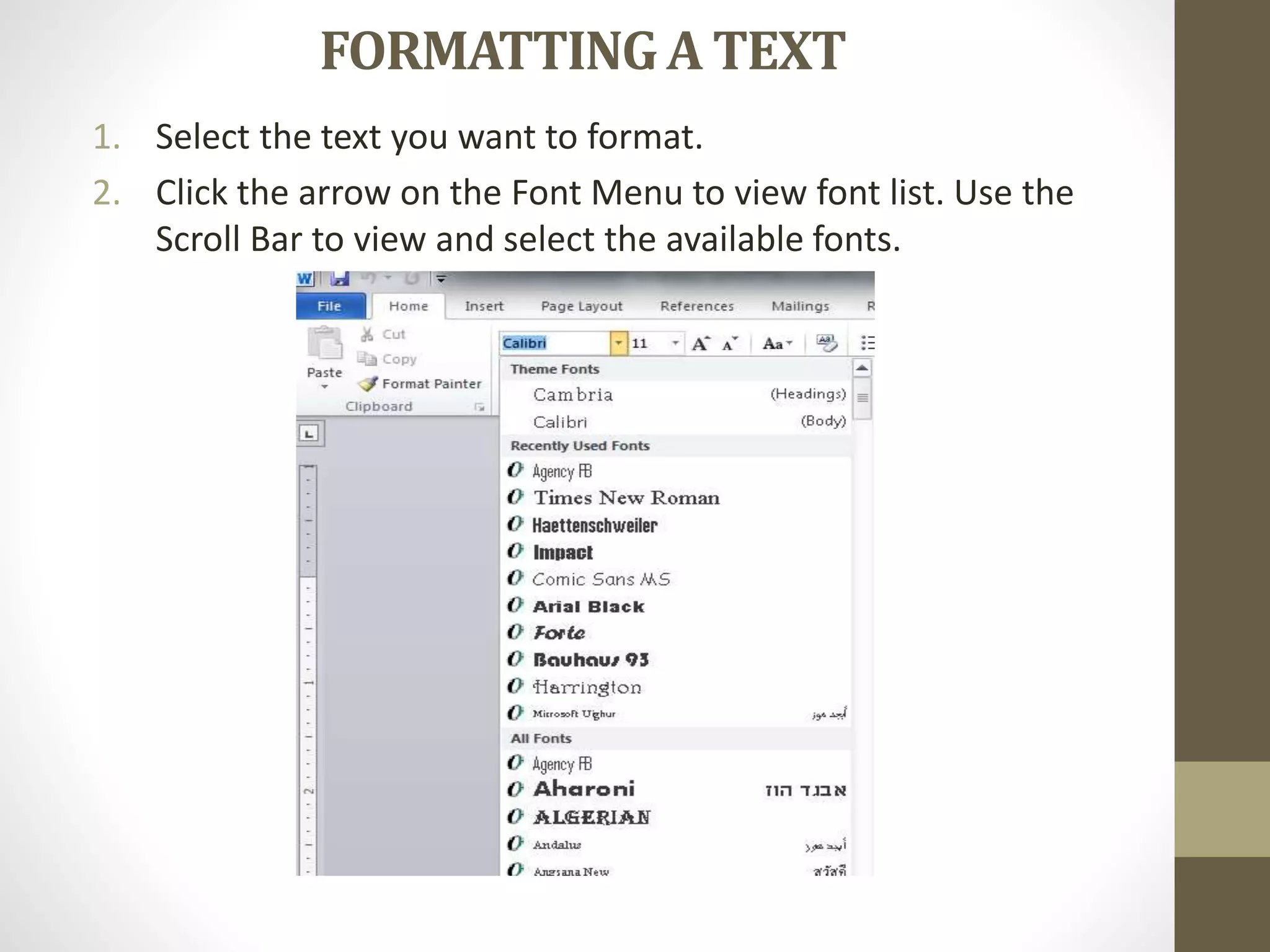
1. Select the text you want to format.
2. Click the arrow on the Font Menu to view font list. Use the
Scroll Bar to view and select the available fonts.
FORMATTINGA TEXT
3. Click the font of you choice. Example: Algerian
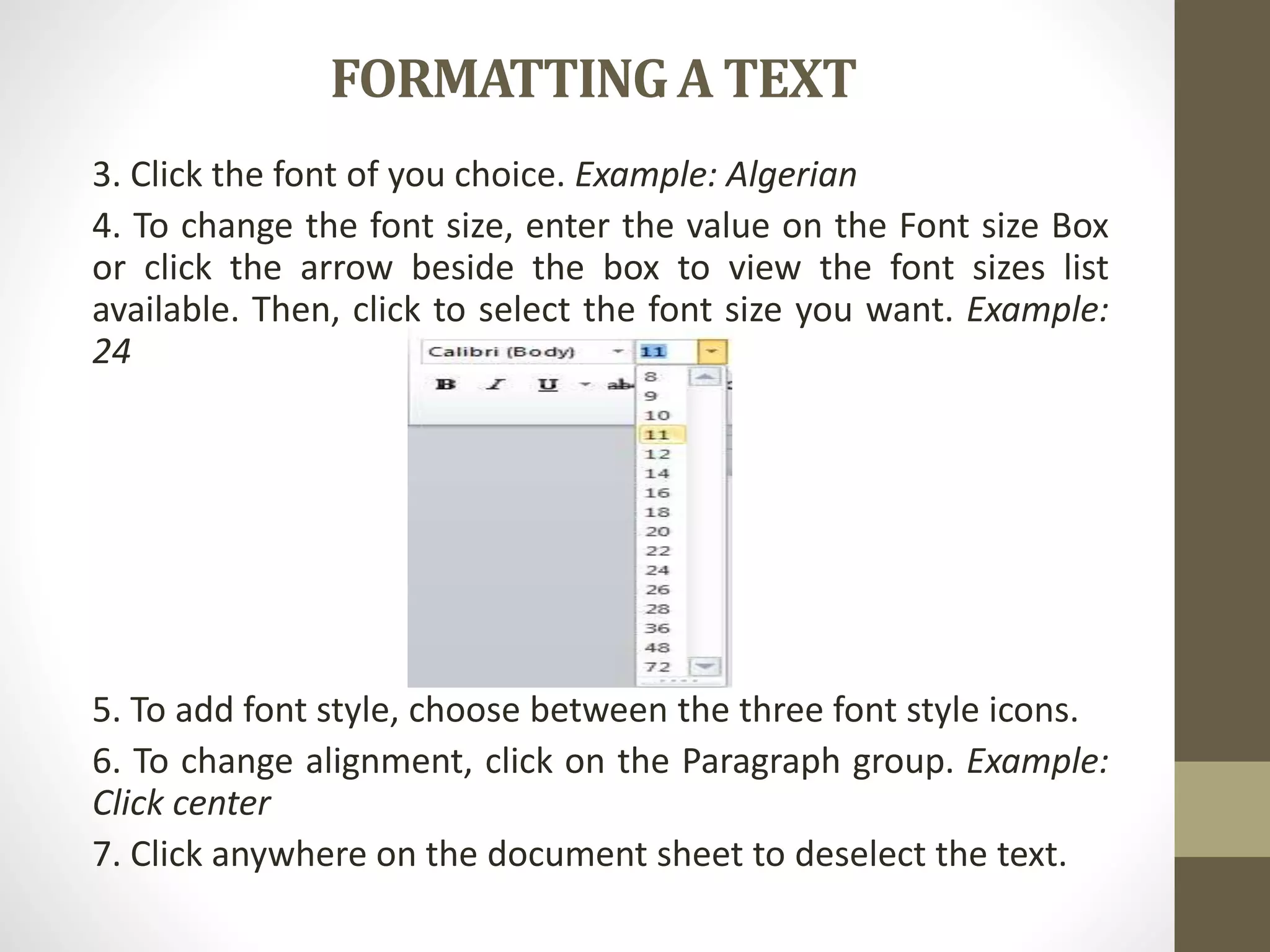
4. To change the font size, enter the value on the Font size Box
or click the arrow beside the box to view the font sizes list
available. Then, click to select the font size you want. Example:
24
5. To add font style, choose between the three font style icons.
6. To change alignment, click on the Paragraph group. Example:
Click center
7. Click anywhere on the document sheet to deselect the text.
COPYING TEXT
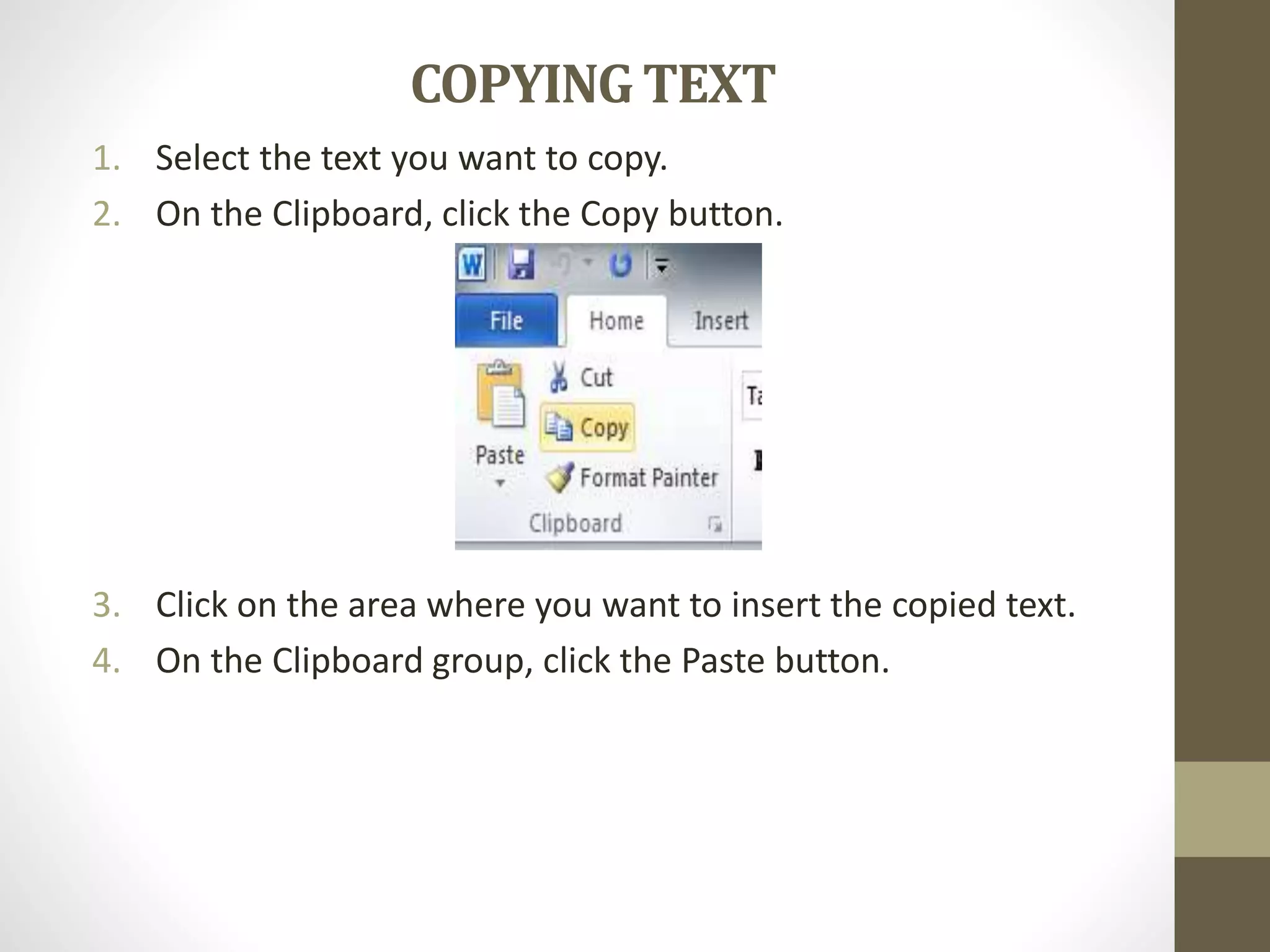
1. Select the text you want to copy.
2. On the Clipboard, click the Copy button.
3. Click on the area where you want to insert the copied text.
4. On the Clipboard group, click the Paste button.
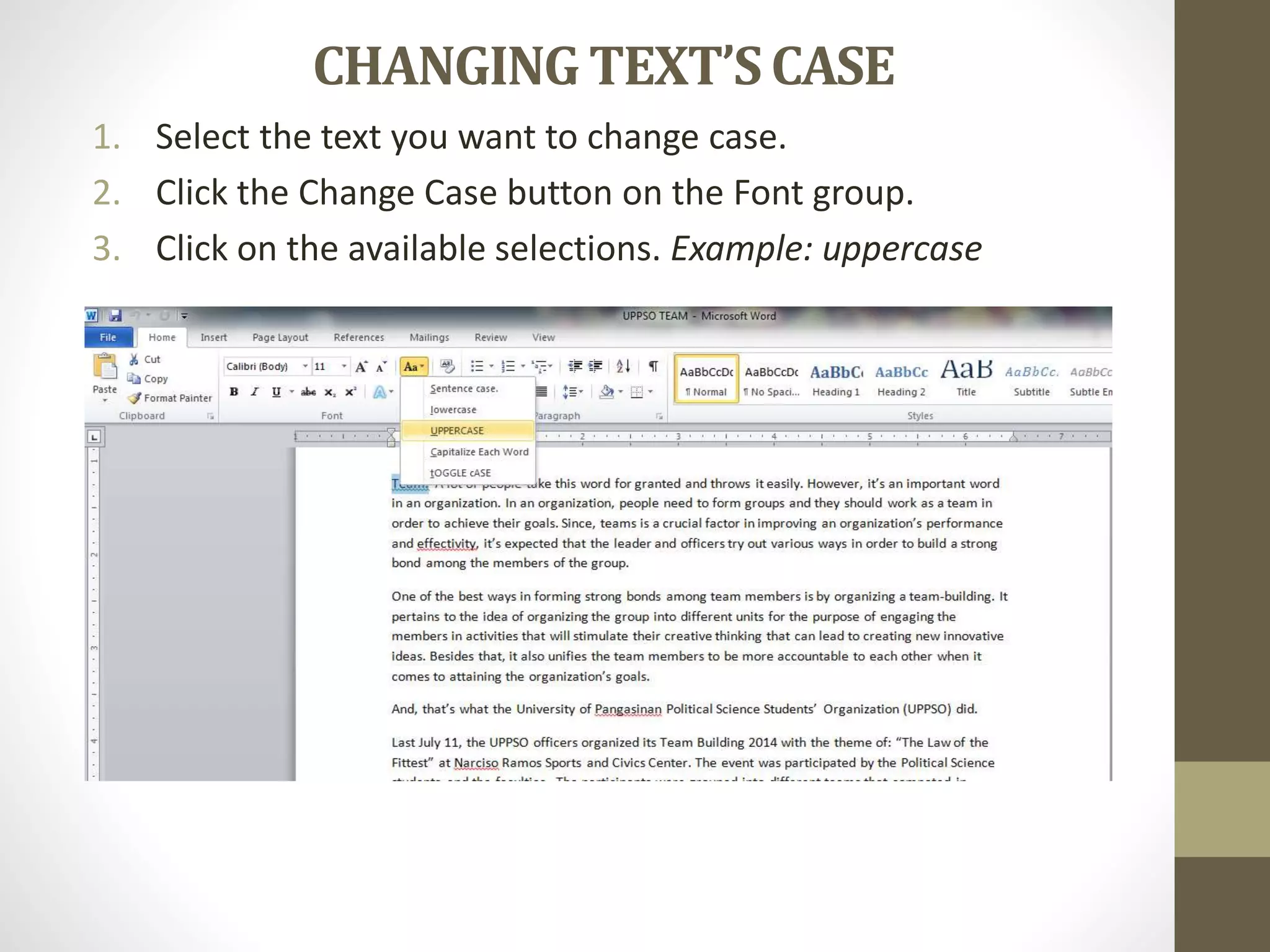
CHANGING TEXT’SCASE
1. Select the text you want to change case.
2. Click the Change Case button on the Font group.
3. Click on the available selections. Example: uppercase
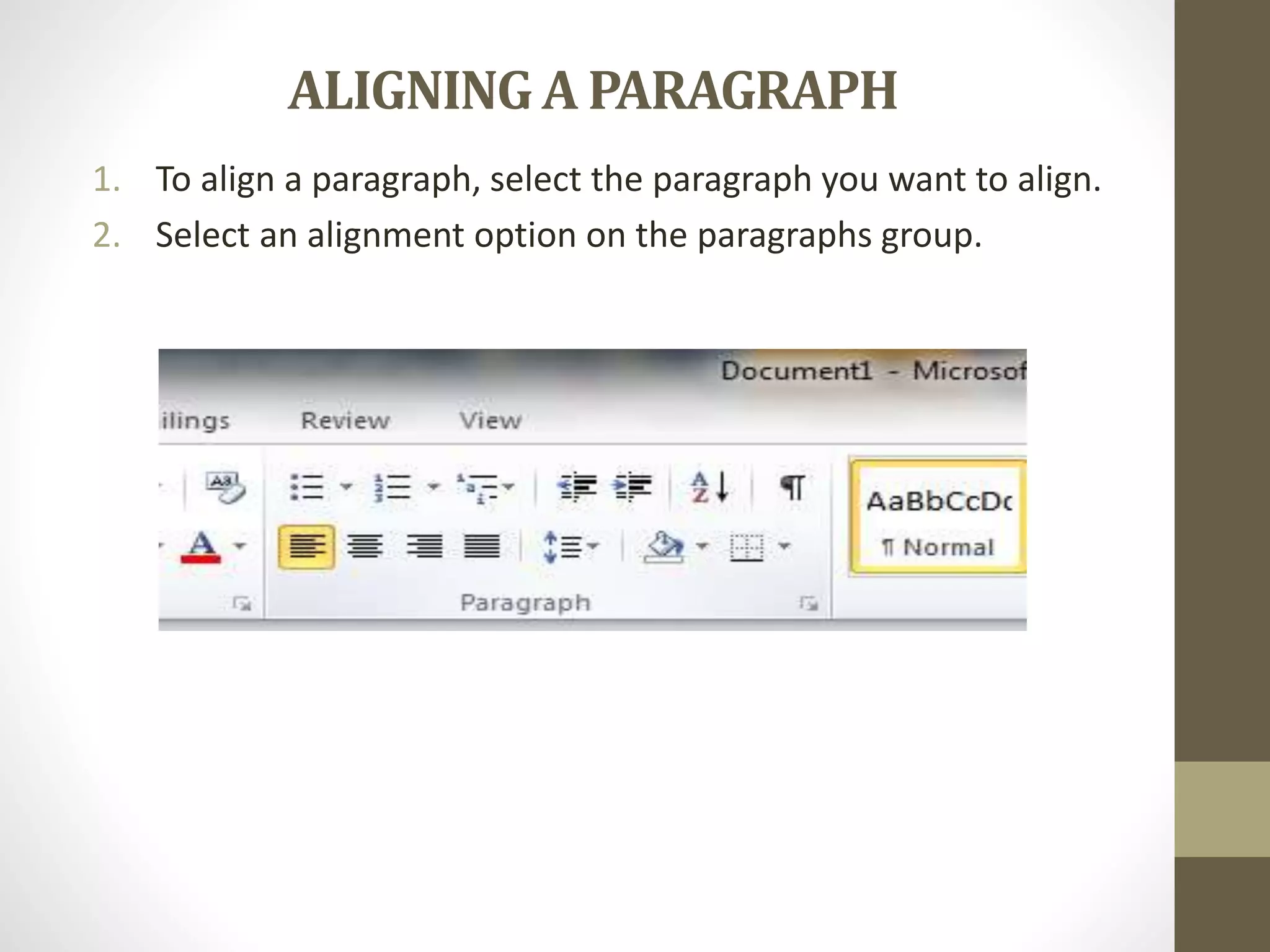
ALIGNING A PARAGRAPH
1. To align a paragraph, select the paragraph you want to align.
2. Select an alignment option on the paragraphs group.
CHECK SPELLINGAND GRAMMAR
As you type your text, MS Word will automatically check the
spelling of the words you type. The following clues will show if
you have some errors in your document:
-Wavy Red Underlines- indicate possible spelling problems
-Wavy Green Underlines-indicate possible grammatical fragments
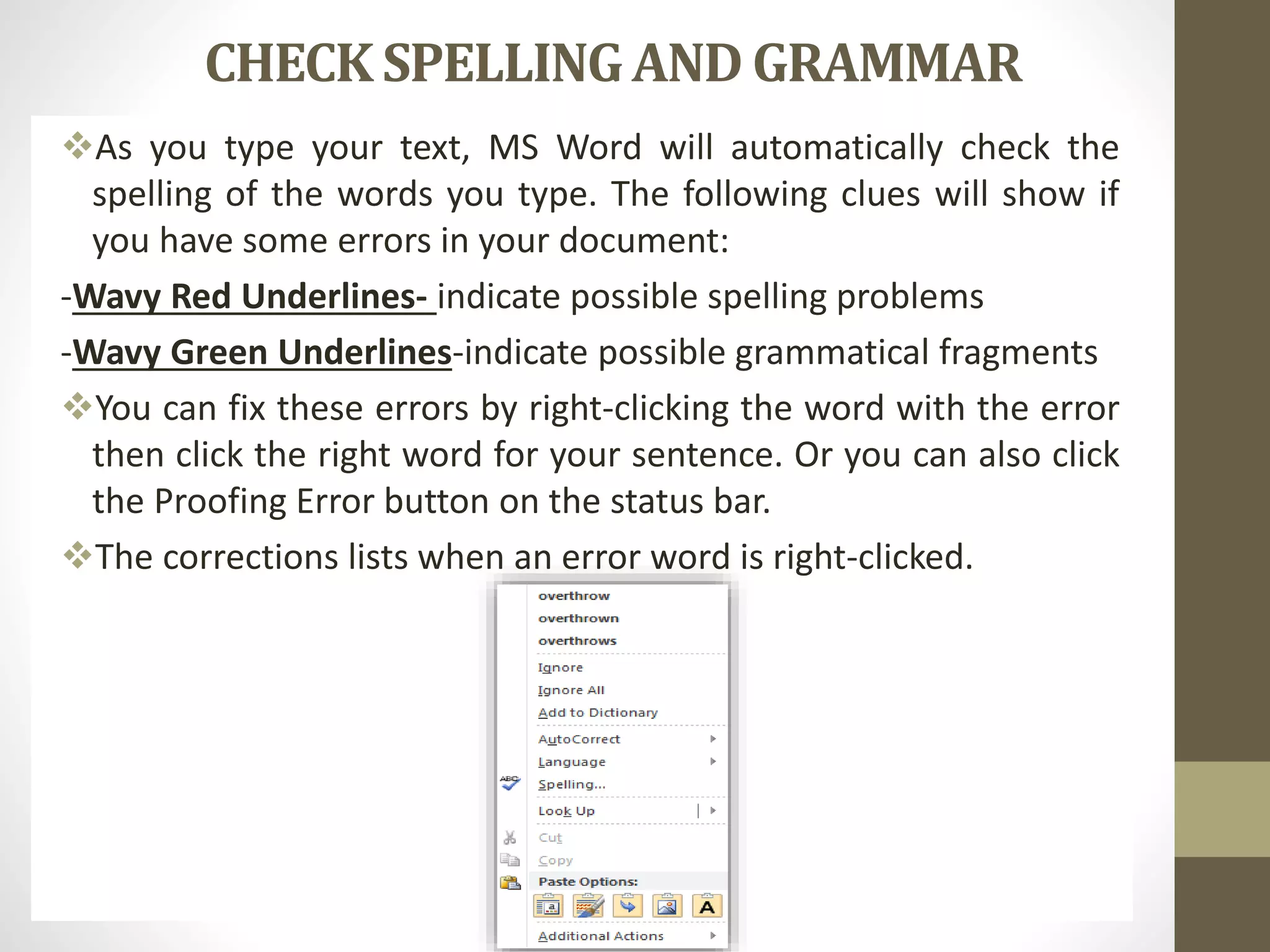
You can fix these errors by right-clicking the word with the error
then click the right word for your sentence. Or you can also click
the Proofing Error button on the status bar.
The corrections lists when an error word is right-clicked.
CHECK SPELLINGAND GRAMMAR
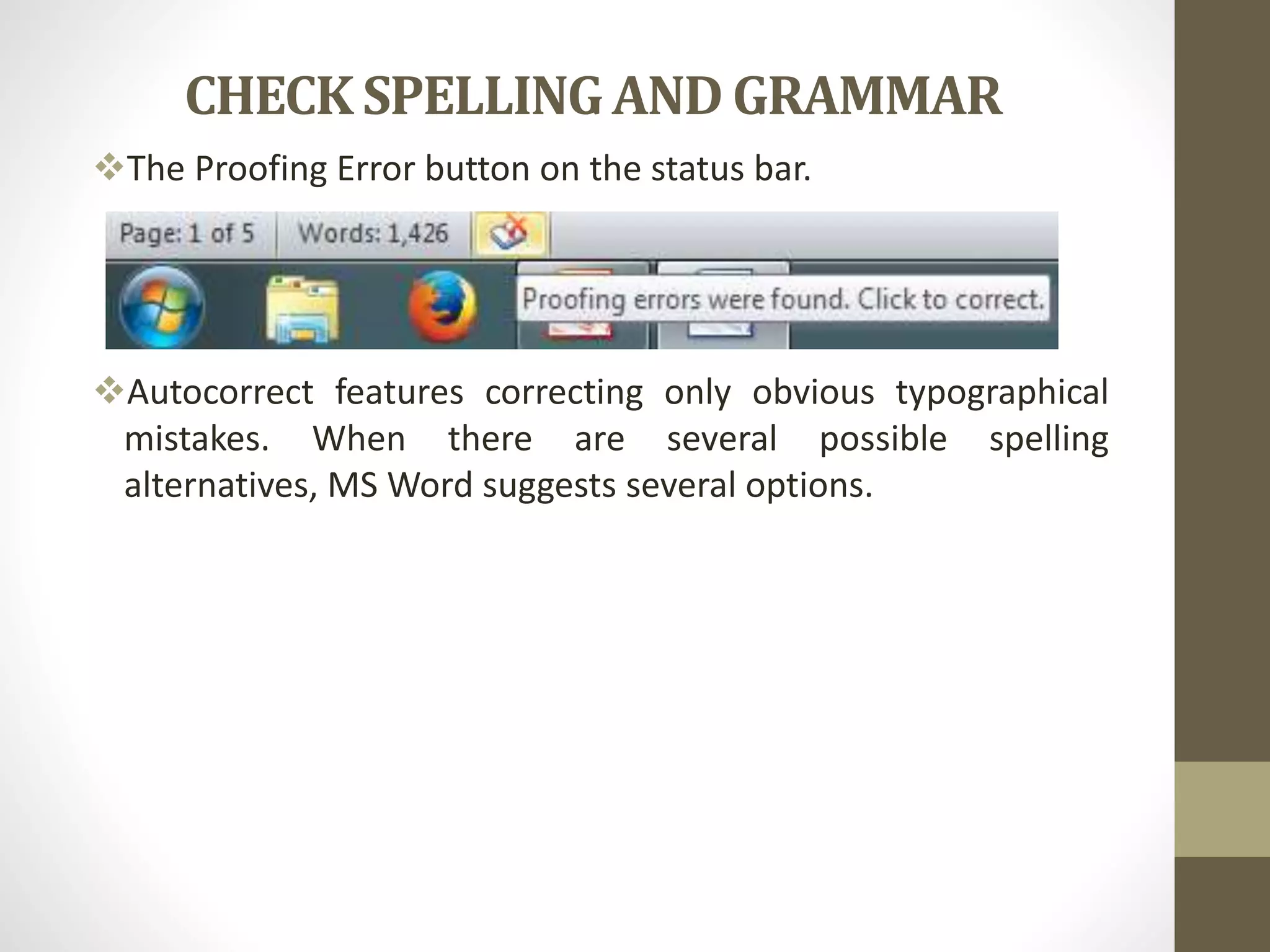
The Proofing Error button on the status bar.
Autocorrect features correcting only obvious typographical
mistakes. When there are several possible spelling
alternatives, MS Word suggests several options.
TURNINGOFFGRAMMARFEATURE
1. Click the Office button.
2. Click Word Options.
3. A dialog box will appear, click Proofing.
4. Uncheck the Mark grammar errors as you
type checkbox and check grammar with
spelling checkbox.
FORMATTINGA PARAGRAPH
1. Select the paragraph you want to format. Or click to place
the insertion point inside the target paragraph.
2. On the Home tab, in the Paragraph group click the Line
Spacing button. Or right-click the paragraph then click
Paragraph.
3. The Paragraph dialog box will appear. On the General
Options, click Justified for the Alignment.
4. On the Indention Options, in Special box click First Line by
0.5”.
5. Click Double on the Line Spacing box.
6. Click OK.
KEYWORDSHORTCUTSFORFORMATTING
A PARAGRAPH
SET LINE SPACING
CTRL+1 Single-space lines
CTRL+2 Double-space lines
CTRL+5 Set 1.5 line spacing
CTRL+0 (zero) Add or remove one
line space preceding a
paragraph
KEYWORDSHORTCUTSFORFORMATTING
A PARAGRAPH
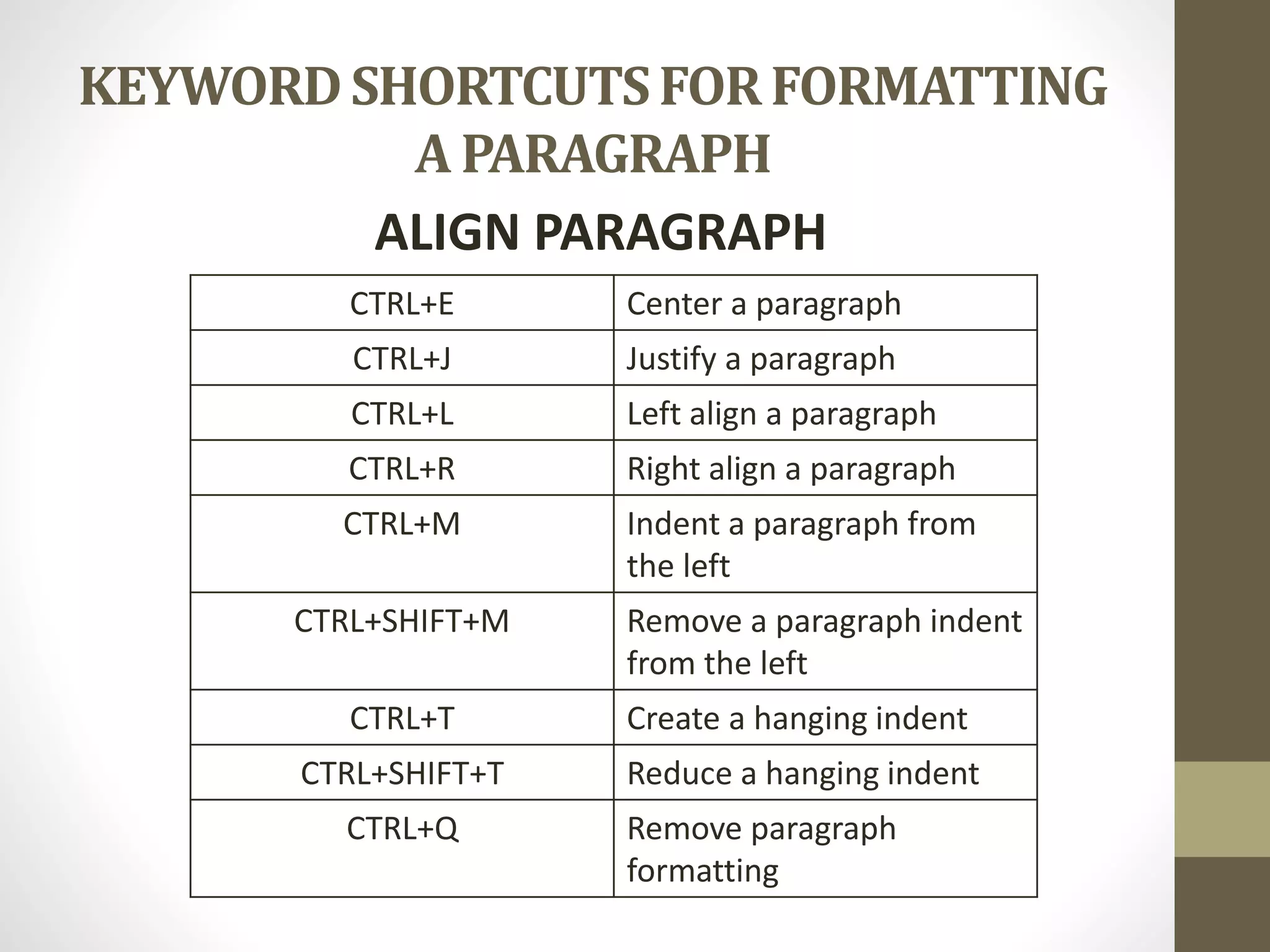
ALIGN PARAGRAPH
CTRL+E Center a paragraph
CTRL+J Justify a paragraph
CTRL+L Left align a paragraph
CTRL+R Right align a paragraph
CTRL+M Indent a paragraph from
the left
CTRL+SHIFT+M Remove a paragraph indent
from the left
CTRL+T Create a hanging indent
CTRL+SHIFT+T Reduce a hanging indent
CTRL+Q Remove paragraph
formatting
INSERTING A NEW PAGE
1. Click on where you want to insert a new page.
2. On the Insert tab in the Pages group, click Blank Page.
FORMAT DOCUMENTS IN COLUMNS
1. On the Editing group under the Home Tab, click Select.
2. Click Select All.
3. Click the Page Layout tab. On the Page Setup group, click Columns.
4. Select the column type you want. Example: Two
5. If you want to view more columns, click More columns. The
column dialog box will appear.
6. To change the number of columns, enter the value on the Number
of Columns box.
7. If you want to put division of columns, click the Line between
checkbox.
8. Click Ok button.
ADDING BORDERSANDSHADINGS
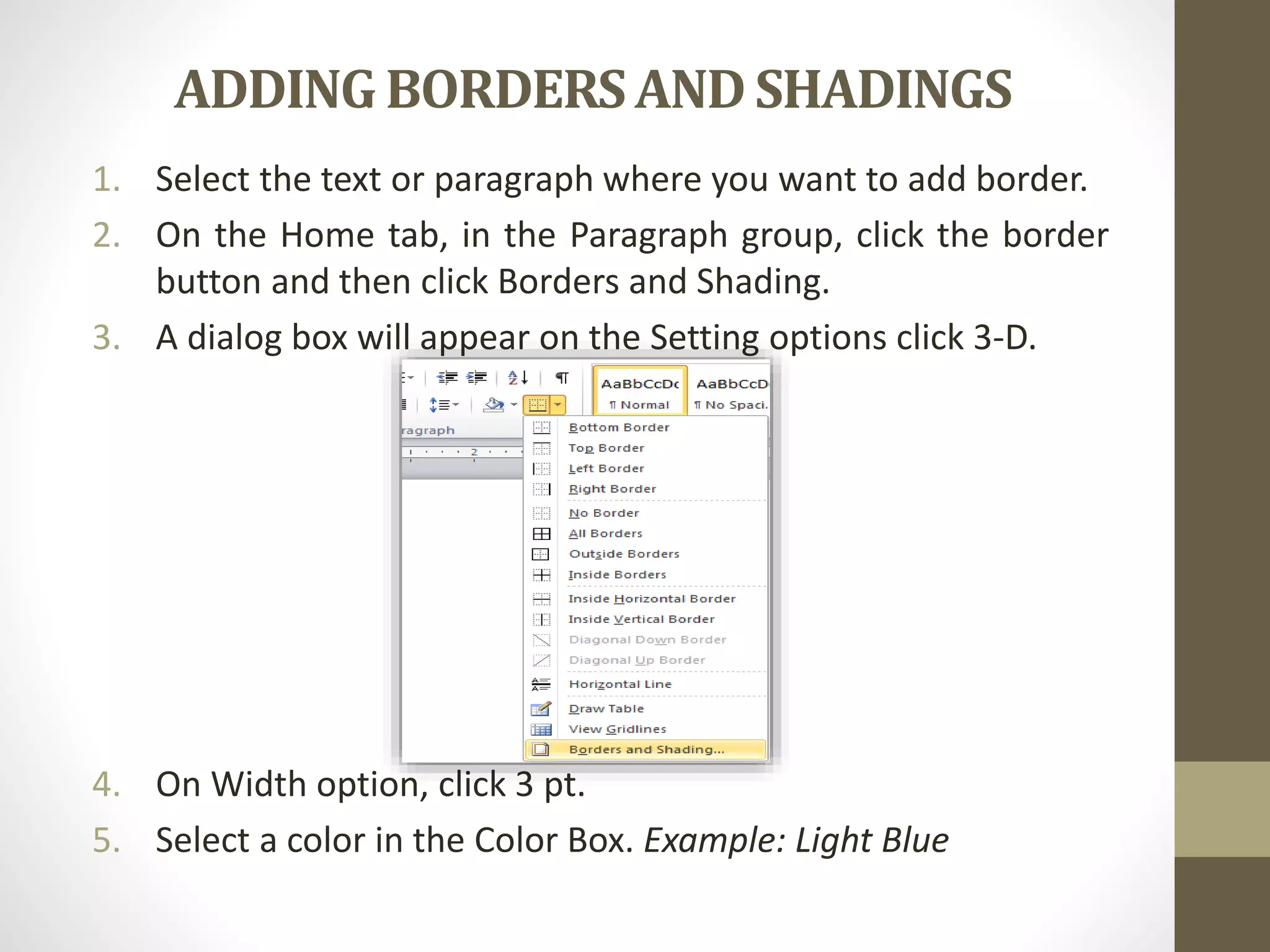
1. Select the text or paragraph where you want to add border.
2. On the Home tab, in the Paragraph group, click the border
button and then click Borders and Shading.
3. A dialog box will appear on the Setting options click 3-D.
4. On Width option, click 3 pt.
5. Select a color in the Color Box. Example: Light Blue
ADDING BORDERSANDSHADINGS
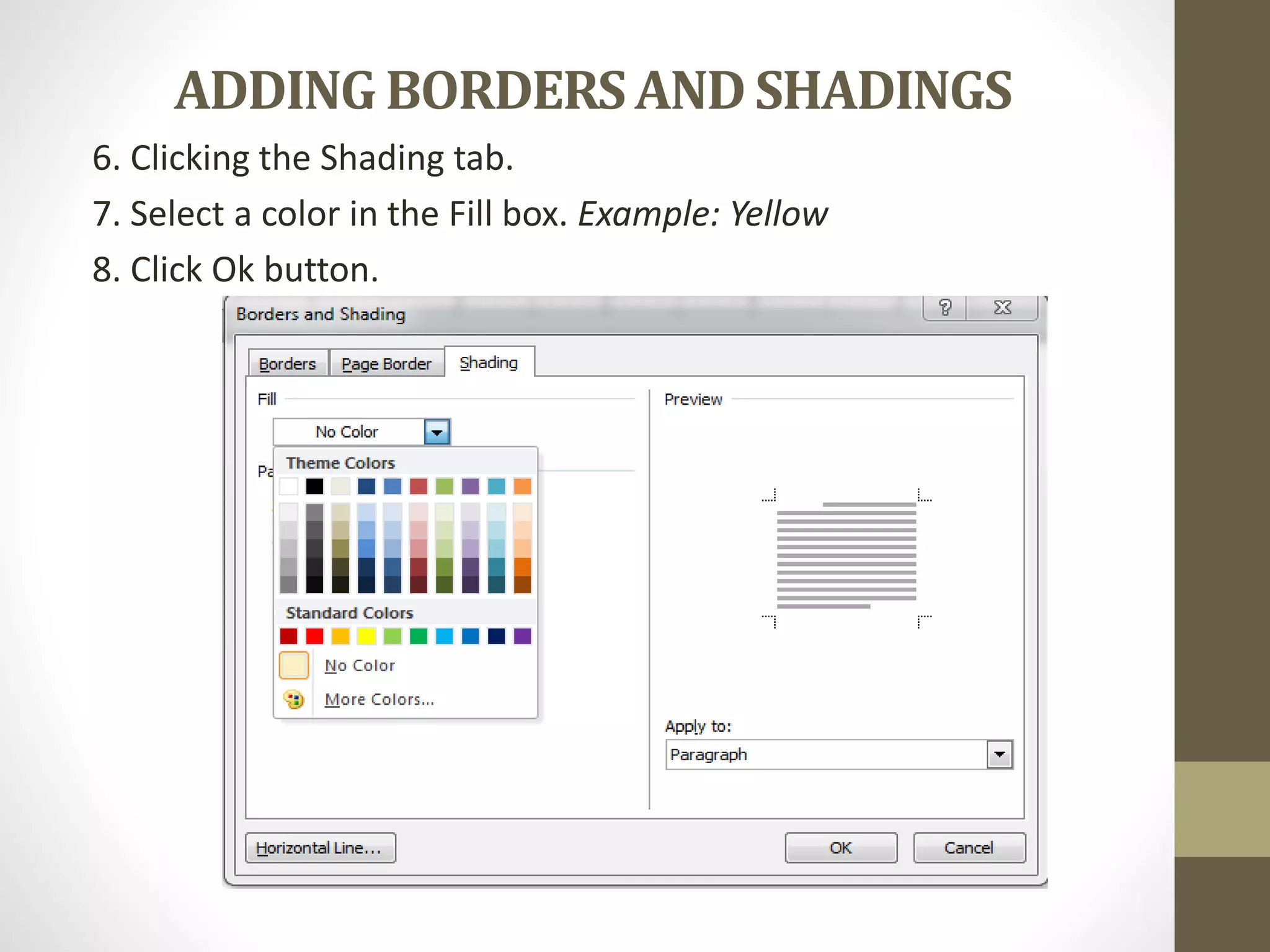
6. Clicking the Shading tab.
7. Select a color in the Fill box. Example: Yellow
8. Click Ok button.
ADDING BORDERSANDSHADINGS
The border and shading format was applied only on the
selected text. If you want to apply it to the selected
paragraphs, click Paragraph on the Apply box in the Borders
and Shading window.
To add border to entire page:
1. On the Paragraph group, click the border button then click
Borders and Shading.
2. Click Page Border tab.
3. On the Setting, click the style you want to apply. Example:
Box
4. On the Apply to click Whole Document.
5. Click Ok button.
ADDING BORDERSANDSHADINGS
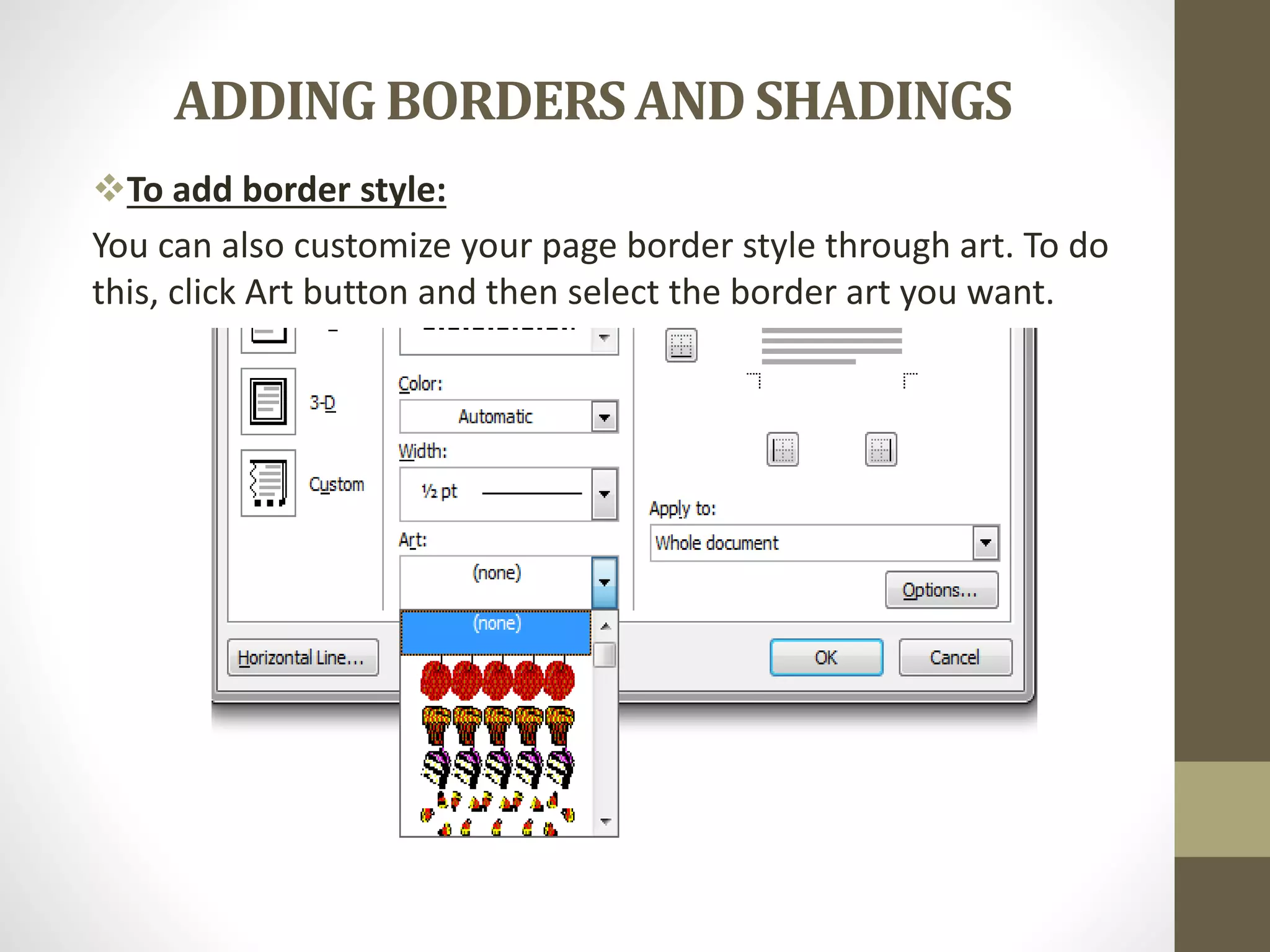
To add border style:
You can also customize your page border style through art. To do
this, click Art button and then select the border art you want.
INSERTINGCLIPARTS
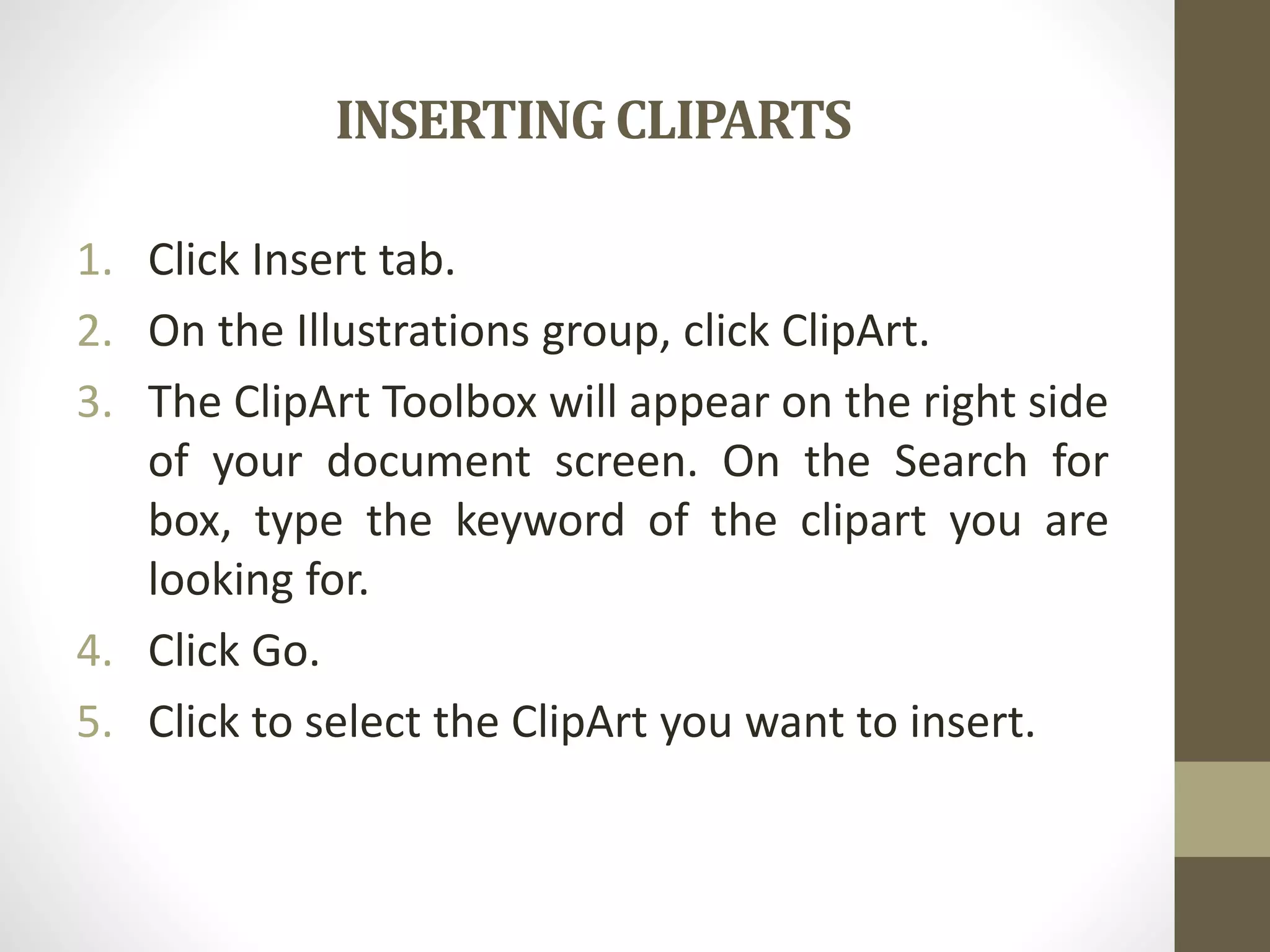
1. Click Insert tab.
2. On the Illustrations group, click ClipArt.
3. The ClipArt Toolbox will appear on the right side
of your document screen. On the Search for
box, type the keyword of the clipart you are
looking for.
4. Click Go.
5. Click to select the ClipArt you want to insert.
INSERTINGCLIPARTS
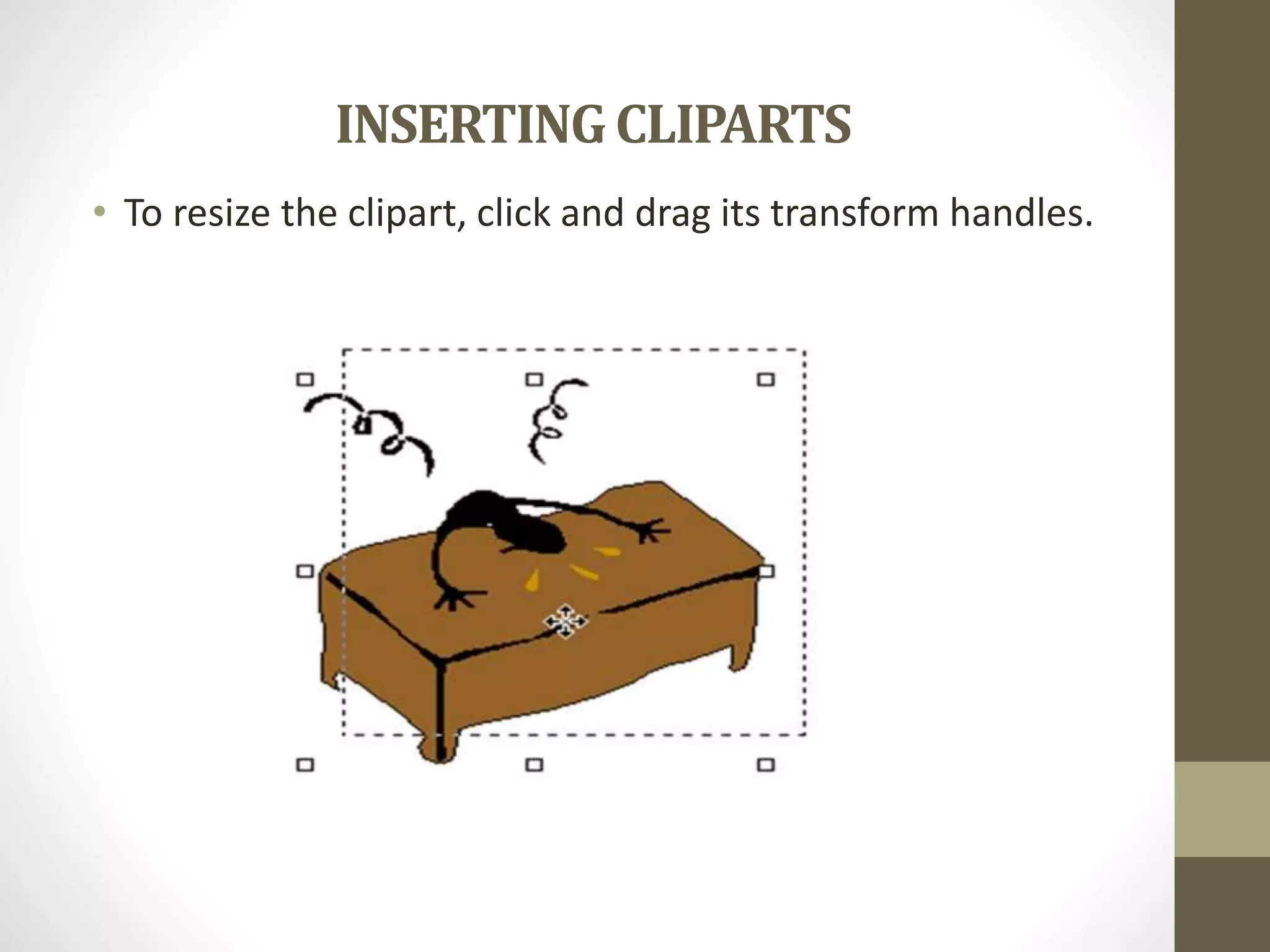
• To resize the clipart, click and drag its transform handles.
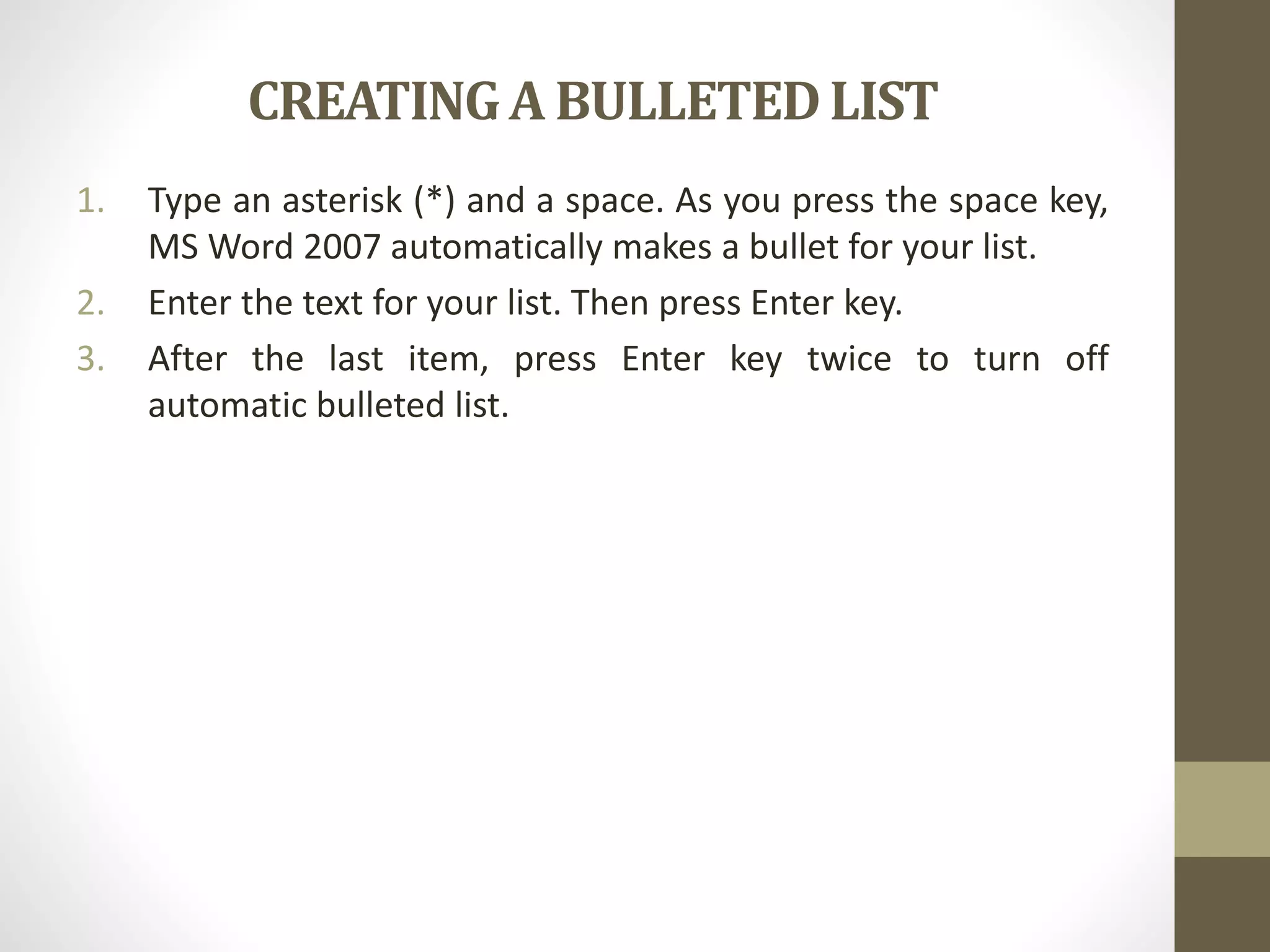
INSERTINGPICTURES
1. Click Insert tab.
2. On the Illustrations group, click Picture.
3. The Insert Picture box will appear. Browse and locate the file.
4. Click Insert button.
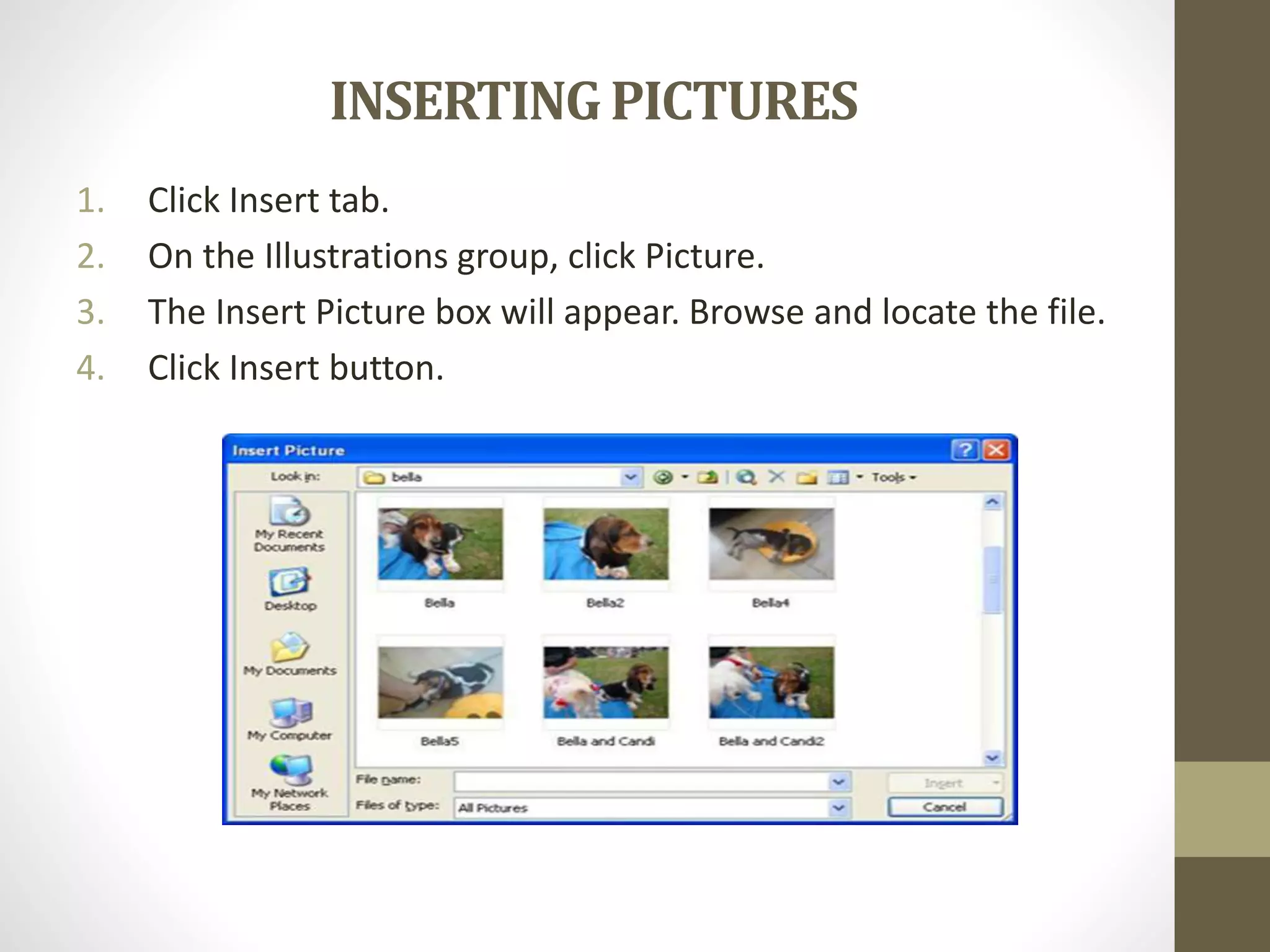
CROPPING PICTURES
1. Click the picture you want to crop.
2. Having the picture selected, the Picture Tools will appear.
3. On the Format tab, in Size group, click the Crop button.
4. Drag the handles using your mouse pointer until you arrived
at your desired result.
EDITING GRAPHICS
To edit an image, click on the image to activate the controls.
By clicking it, eight handles will appear around the image then
you can click and drag to adjust the size. The Picture Tools will
also appear on the title bad, and then you will be able to have
the controls for editing your image.
EDITING GRAPHICS
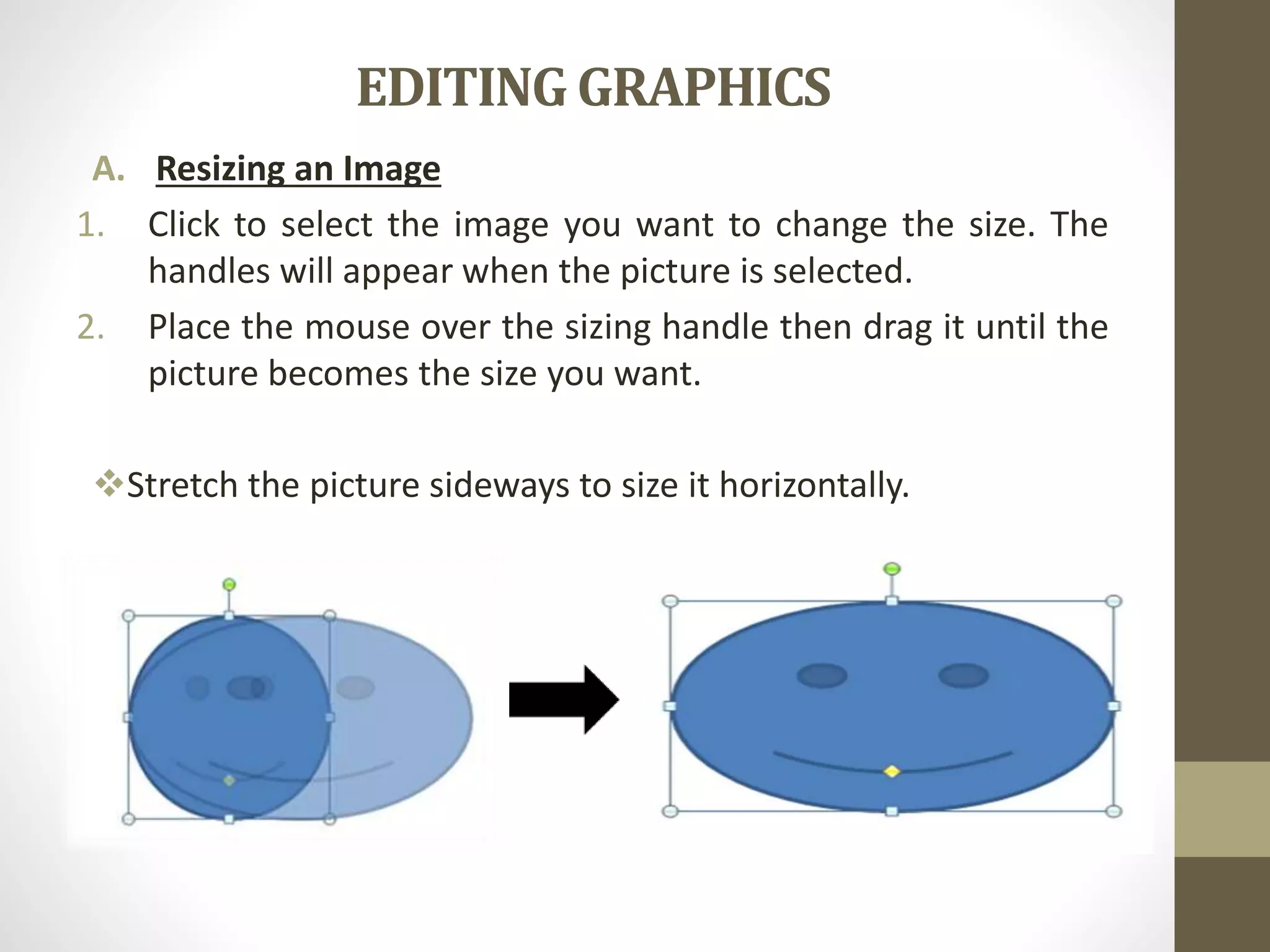
A. Resizing an Image
1. Click to select the image you want to change the size. The
handles will appear when the picture is selected.
2. Place the mouse over the sizing handle then drag it until the
picture becomes the size you want.
Stretch the picture sideways to size it horizontally.
EDITING GRAPHICS
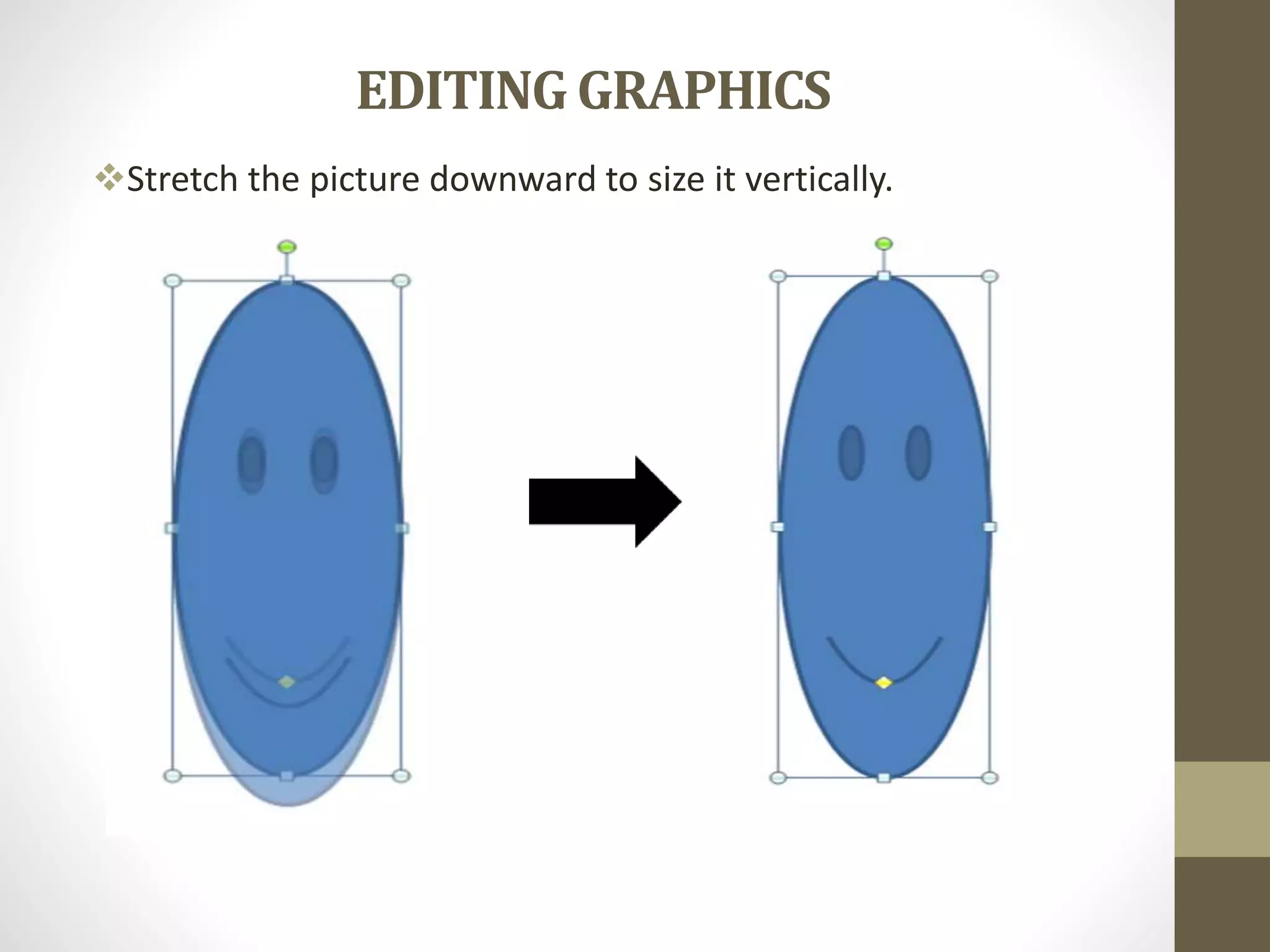
Stretch the picture downward to size it vertically.
EDITING GRAPHICS
B. Applying Styles on a Picture
1. Click to select the picture.
2. Under the Format tab, on Picture Styles group, click the
style you want. To view all styles, click the “more”
button.
WRAPPINGTEXT AROUNDA PICTURE
1. Insert the picture on a document which contain some
text.
2. Click to select the picture.
3. The Picture Tools and Format tab will appear. On the
Arrange group, click Text Wrapping.
4. Choose the text wrap you like. Example: Tight
 You can also right-click the image, point to Text
Wrapping, and then click Tight.
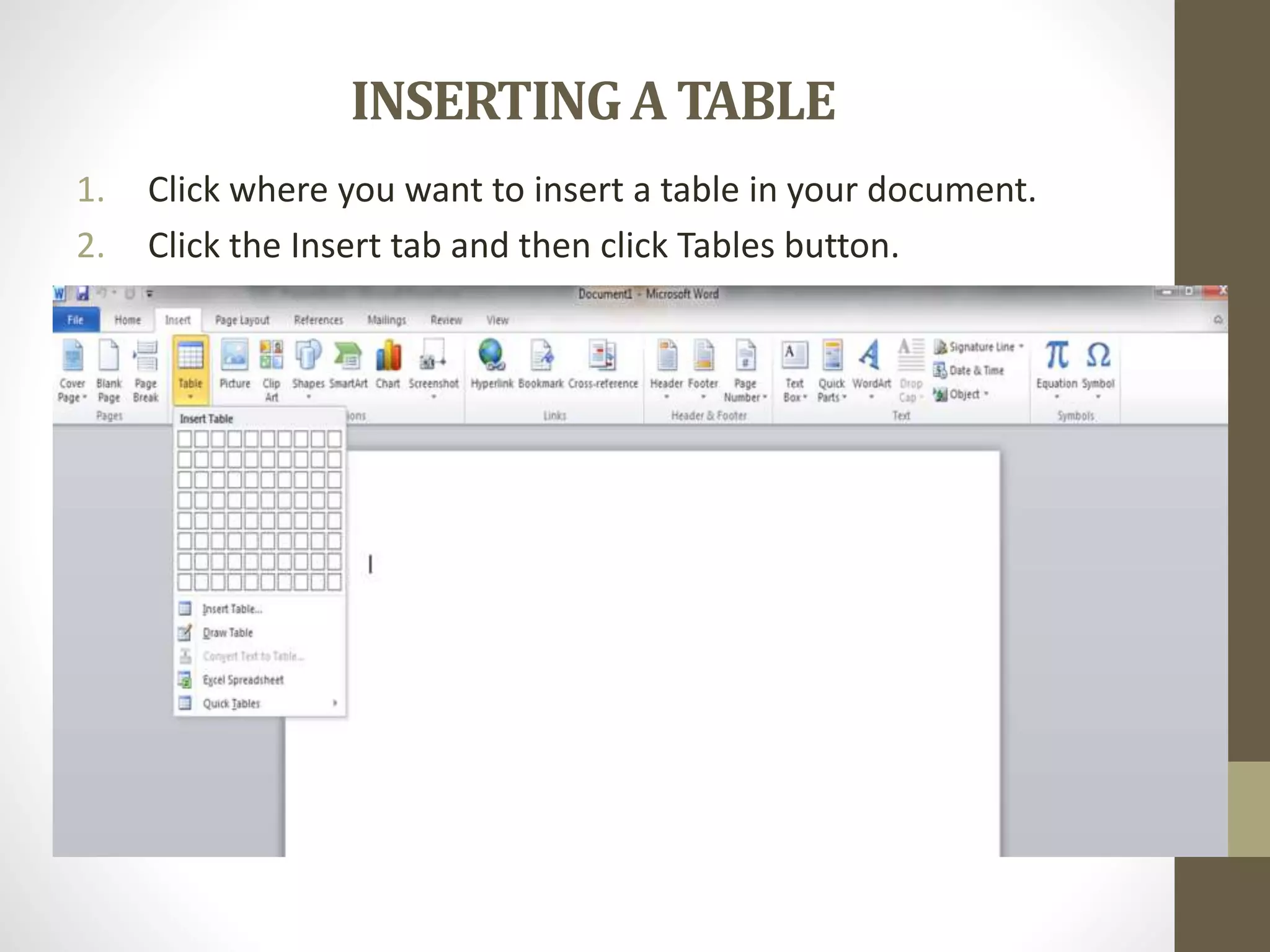
INSERTINGA TABLE
1. Click where you want to insert a table in your document.
2. Click the Insert tab and then click Tables button.
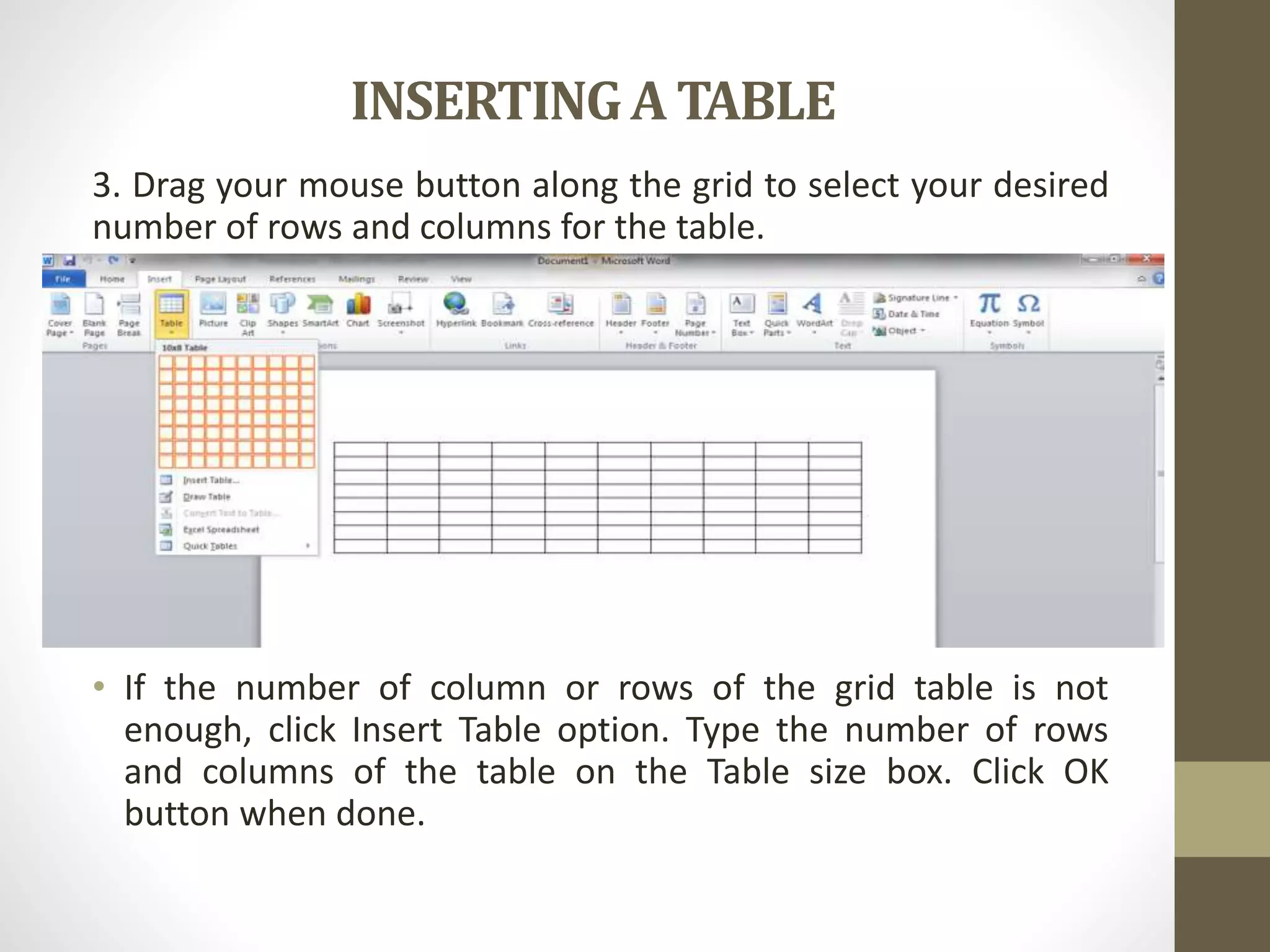
INSERTINGA TABLE
3. Drag your mouse button along the grid to select your desired
number of rows and columns for the table.
• If the number of column or rows of the grid table is not
enough, click Insert Table option. Type the number of rows
and columns of the table on the Table size box. Click OK
button when done.
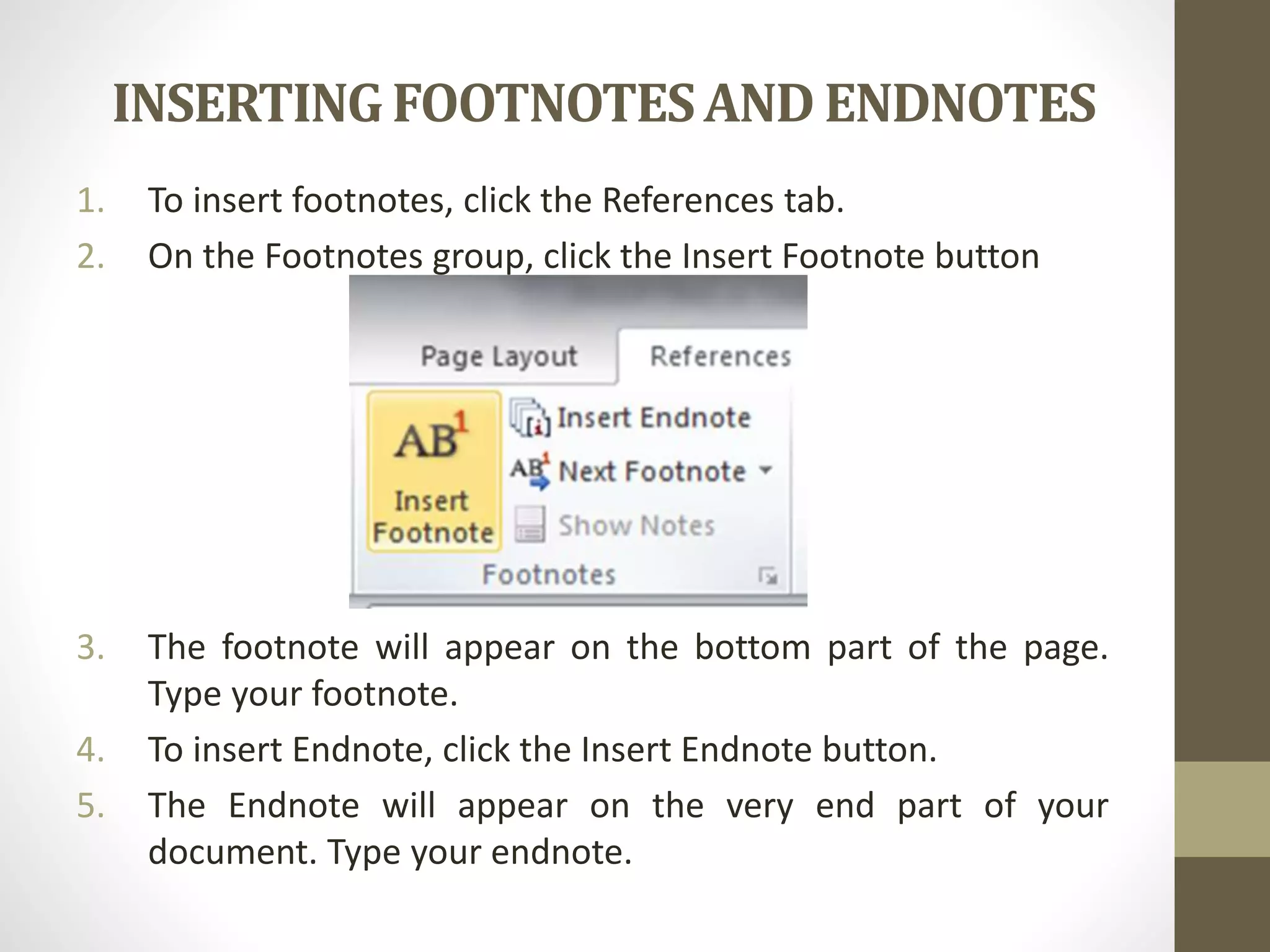
INSERTINGFOOTNOTESAND ENDNOTES
1. To insert footnotes, click the References tab.
2. On the Footnotes group, click the Insert Footnote button
3. The footnote will appear on the bottom part of the page.
Type your footnote.
4. To insert Endnote, click the Insert Endnote button.
5. The Endnote will appear on the very end part of your
document. Type your endnote.
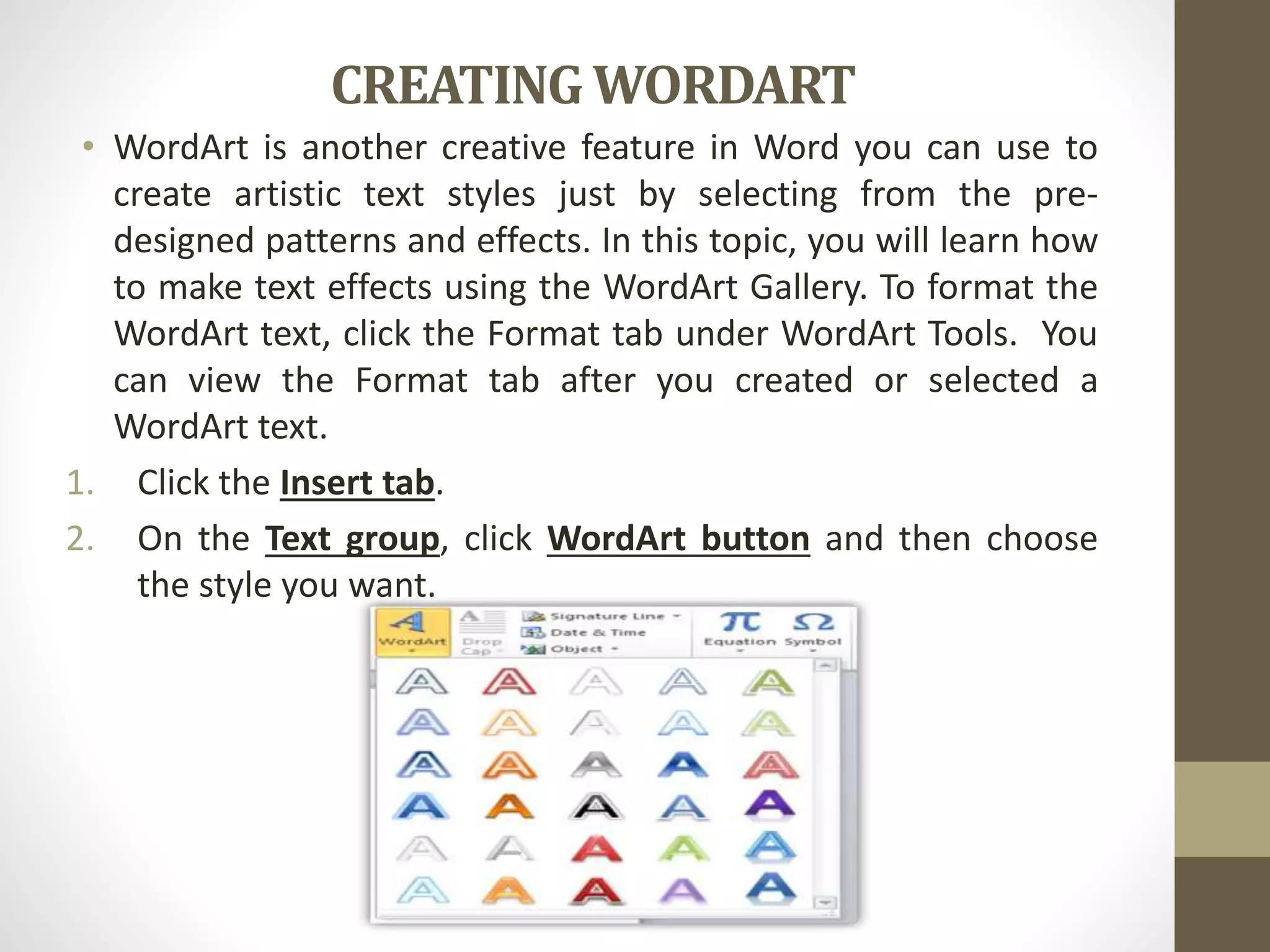
CREATINGWORDART
• WordArt is another creative feature in Word you can use to
create artistic text styles just by selecting from the pre-
designed patterns and effects. In this topic, you will learn how
to make text effects using the WordArt Gallery. To format the
WordArt text, click the Format tab under WordArt Tools. You
can view the Format tab after you created or selected a
WordArt text.
1. Click the Insert tab.
2. On the Text group, click WordArt button and then choose
the style you want.
CREATINGWORDART
3. The Edit WordArt Text dialog box will appear. Type your desired
text on the Text box.
4. Select a font type and size above the text box.
5. When finished, click OK button.
ADDING OR CHANGING A BACKGROUND
A. Creating a Texture Background
1. Click the Page Layout tab.
2. On the Page Background group. Click the Page Color button.
3. Click the Fill Effects.
4. The Fill Effects window will appear. Click the Texture tab.
5. Click on the available textures. Example: Water Droplets
6. Click OK button.
B. Creating a Picture Background
1. On the Fill effects window, click the Picture tab.
2. Click Select Picture.
3. The Select Picture window will appear. Locate your file in the
Look In box and click the picture that you want to be your
background.
4. Click Insert button.
5. Click OK button on the Fill Effects window.
ADDING OR CHANGING A BACKGROUND
C. Creating a Pattern Background
1. Click the Pattern tab in the Fill Effects window and then
select on the available options.
2. Click OK when done.
D. Creating a Gradient Background
1. Click the Gradient tab and then select on the available
options.
2. Click OK when done.
CREATINGA BULLETEDLIST
1. Type an asterisk (*) and a space. As you press the space key,
MS Word 2007 automatically makes a bullet for your list.
2. Enter the text for your list. Then press Enter key.
3. After the last item, press Enter key twice to turn off
automatic bulleted list.

MS Word 2007

  • 1.
  • 2.
    OPENING MS WORD2007 Microsoft Office Word is a powerful word processing program that is used to produce professional-looking documents. It is also used to make publications such as newsletters and books. 1. Click Start button. 2. Click All Programs. 3. Click Microsoft Office folder. 4. Click Microsoft Office Word 2007.
  • 3.
  • 4.
    TABSOF THE RIBBON •In MS Word 2007, the menus are replaced by ribbons. These are the contents of the ribbon tabs you can use to create your documents: 1. Home – includes some of the most commonly used buttons like, cut, copy, paste, etc.
  • 5.
    TABSOF THE RIBBON 2.Insert- lets you add tables, graphics, charts, hyperlinks, textbox and WordArt. 3. Page Layout-allows you to setup margins, paper orientation, and other page settings.
  • 6.
    TABSOF THE RIBBON 4.References-enables you to cite references, bibliography, footnotes and other citations you need to attach in your document. 5. Mailings-lets you add mailing attachments for your document.
  • 7.
    TABSOF THE RIBBON 6.Review-includes offices proofing tools like spell checker. It also has buttons that lets you add comments to a worksheet and manage revisions. 7. View-lets you switch on and off a variety of viewing options.
  • 8.
    TABSOF THE RIBBON 8.Contextual Tab-Whenever an object such as a chart, a picture or a table is selected, specific tools for working with that object will appear in the Ribbon. You can collapse the ribbon by double-clicking any tab or right-clicking the tab, and then clicking Minimize the Ribbon. Or press Ctrl+F1.
  • 9.
    CREATINGA SIMPLEDOCUMENT Let’s createa simple letter document. Follow the instructions below: 1. Click on the document sheet and type your address and date as illustrated below. 2. Press the Enter key twice and type your salutation. 3. Press the enter key and type the body of your letter. 4. Press the Enter key thrice and type the closing of your letter.
  • 10.
    FREQUENTLYUSEDTOOLSAND COMMANDS A. The“Go To” Command -helps you navigate to a specific page number, line number, footnote, table, comment or other object. 1. On the Home tab, in the Editing group, click the arrow icon beside Find button. 2. Click Go To. 3. On the Go to what box, click an item you want to go to. 4. Enter the value on the Enter Box. 5. Click Go to button.
  • 11.
    FREQUENTLYUSEDTOOLSAND COMMANDS B. PageBreak - If you want a page to end at a particular point in your text, you can insert a Page Break. 1. Click on the point in your document that you want to add a page break. 2. Click the Insert tab. 3. On the Pages group, click Page Break. C. Drag and Drop 1. Select the text you want to move. Example: Chris 2. Click the highlighted text then drag it to the location where you want to place it.
  • 12.
    FREQUENTLYUSEDTOOLSAND COMMANDS B. PageBreak - If you want a page to end at a particular point in your text, you can insert a Page Break. 1. Click on the point in your document that you want to add a page break. 2. Click the Insert tab. 3. On the Pages group, click Page Break. C. Drag and Drop 1. Select the text you want to move. Example: Chris 2. Click the highlighted text then drag it to the location where you want to place it.
  • 13.
    FREQUENTLYUSEDTOOLSAND COMMANDS D. ZoomingIn and Out - To view the zoom tools, click the View tab. On the zoom group are the tools you can use in zooming in and out your document. 1. To view the document in a normal view, click 100% button. 2. To specify the zoom level, click the Zoom button. 3. Enter the zoom percentage. 4. Click Ok button. E. Using the Scroll Bars - To move to different part of your document, use the scroll bar on the right side of the Word window. 1. To do this, click the up and down arrows to move one line at a time.
  • 14.
    FREQUENTLYUSEDTOOLSAND COMMANDS 2. Tomove up or down the page one at a time, click the double- arrows under the down arrow of the scroll bar. 3. To show or hide the ruler, click the View ruler button on top of the up arrow of the scroll bar. F. The Undo and Repeat Command -You can undo your actions in your document by clicking the Undo button located at the Quick Access Toolbar or you can press Ctrl+Z on your keyboard.
  • 15.
    DISPLAYING THE THUMBNAILVIEW • In the Show/Hide group under View tab, check Thumbnails. SAVING A FILE 1. Click the Office button at the top left side of the window. 2. Click Save or Save As. If you want to save your file on other format, point your mouse to Save As then click among the available saving options. 3. The Save As window will appear. Find the folder where you want to save the file. 4. Type the filename of your document. 5. Click Save.
  • 16.
    PRINTING A DOCUMENT 1.Click the Office button on the top left corner of the window. 2. Click Print. 3. Choose a printer where you want to print your document. 4. Type the number of copies you want to print. 5. Choose the pages you want to print. 6. Click the Ok button. CLOSING A DOCUMENT 1. Click the Office button on the top left corner of the window. 2. Click Close.
  • 17.
    EXITING MS WORD2007 1. Click the Office button on the top left corner of the window. 2. Click Exit Word. Or you can just click the Close button at the top right corner of the window. OPENING AN EXISTING DOCUMENT 1. Click the Office button on the top left corner of the window. 2. Click your file on the Recent Document box. 3. If you cannot find your file on the Recent Document box, click Open on the Office drop down menu. 4. The Open window will appear. Find the file you want to open. 5. Once found, select it and click the Open button.
  • 18.
    EDITING A TEXT TheHome tab is where all the important text formatting tools are placed. The tools are organized into groups and one of the important groups is the font group wherein you can change and choose your font, style, size, color, text background, and many more. MS Word can also automatically opens a mini-formatting toolbar once you have selected/highlighted a text in your document. How to edit a text: 1. Select the text you want to edit. Click and drag from the first character of the text to the last. This will highlight the text. 2. Type the new text.
  • 19.
    FORMATTINGA TEXT 1. Selectthe text you want to format. 2. Click the arrow on the Font Menu to view font list. Use the Scroll Bar to view and select the available fonts.
  • 20.
    FORMATTINGA TEXT 3. Clickthe font of you choice. Example: Algerian 4. To change the font size, enter the value on the Font size Box or click the arrow beside the box to view the font sizes list available. Then, click to select the font size you want. Example: 24 5. To add font style, choose between the three font style icons. 6. To change alignment, click on the Paragraph group. Example: Click center 7. Click anywhere on the document sheet to deselect the text.
  • 21.
    COPYING TEXT 1. Selectthe text you want to copy. 2. On the Clipboard, click the Copy button. 3. Click on the area where you want to insert the copied text. 4. On the Clipboard group, click the Paste button.
  • 22.
    CHANGING TEXT’SCASE 1. Selectthe text you want to change case. 2. Click the Change Case button on the Font group. 3. Click on the available selections. Example: uppercase
  • 23.
    ALIGNING A PARAGRAPH 1.To align a paragraph, select the paragraph you want to align. 2. Select an alignment option on the paragraphs group.
  • 24.
    CHECK SPELLINGAND GRAMMAR Asyou type your text, MS Word will automatically check the spelling of the words you type. The following clues will show if you have some errors in your document: -Wavy Red Underlines- indicate possible spelling problems -Wavy Green Underlines-indicate possible grammatical fragments You can fix these errors by right-clicking the word with the error then click the right word for your sentence. Or you can also click the Proofing Error button on the status bar. The corrections lists when an error word is right-clicked.
  • 25.
    CHECK SPELLINGAND GRAMMAR TheProofing Error button on the status bar. Autocorrect features correcting only obvious typographical mistakes. When there are several possible spelling alternatives, MS Word suggests several options.
  • 26.
    TURNINGOFFGRAMMARFEATURE 1. Click theOffice button. 2. Click Word Options. 3. A dialog box will appear, click Proofing. 4. Uncheck the Mark grammar errors as you type checkbox and check grammar with spelling checkbox.
  • 27.
    FORMATTINGA PARAGRAPH 1. Selectthe paragraph you want to format. Or click to place the insertion point inside the target paragraph. 2. On the Home tab, in the Paragraph group click the Line Spacing button. Or right-click the paragraph then click Paragraph. 3. The Paragraph dialog box will appear. On the General Options, click Justified for the Alignment. 4. On the Indention Options, in Special box click First Line by 0.5”. 5. Click Double on the Line Spacing box. 6. Click OK.
  • 28.
    KEYWORDSHORTCUTSFORFORMATTING A PARAGRAPH SET LINESPACING CTRL+1 Single-space lines CTRL+2 Double-space lines CTRL+5 Set 1.5 line spacing CTRL+0 (zero) Add or remove one line space preceding a paragraph
  • 29.
    KEYWORDSHORTCUTSFORFORMATTING A PARAGRAPH ALIGN PARAGRAPH CTRL+ECenter a paragraph CTRL+J Justify a paragraph CTRL+L Left align a paragraph CTRL+R Right align a paragraph CTRL+M Indent a paragraph from the left CTRL+SHIFT+M Remove a paragraph indent from the left CTRL+T Create a hanging indent CTRL+SHIFT+T Reduce a hanging indent CTRL+Q Remove paragraph formatting
  • 30.
    INSERTING A NEWPAGE 1. Click on where you want to insert a new page. 2. On the Insert tab in the Pages group, click Blank Page. FORMAT DOCUMENTS IN COLUMNS 1. On the Editing group under the Home Tab, click Select. 2. Click Select All. 3. Click the Page Layout tab. On the Page Setup group, click Columns. 4. Select the column type you want. Example: Two 5. If you want to view more columns, click More columns. The column dialog box will appear. 6. To change the number of columns, enter the value on the Number of Columns box. 7. If you want to put division of columns, click the Line between checkbox. 8. Click Ok button.
  • 31.
    ADDING BORDERSANDSHADINGS 1. Selectthe text or paragraph where you want to add border. 2. On the Home tab, in the Paragraph group, click the border button and then click Borders and Shading. 3. A dialog box will appear on the Setting options click 3-D. 4. On Width option, click 3 pt. 5. Select a color in the Color Box. Example: Light Blue
  • 32.
    ADDING BORDERSANDSHADINGS 6. Clickingthe Shading tab. 7. Select a color in the Fill box. Example: Yellow 8. Click Ok button.
  • 33.
    ADDING BORDERSANDSHADINGS The borderand shading format was applied only on the selected text. If you want to apply it to the selected paragraphs, click Paragraph on the Apply box in the Borders and Shading window. To add border to entire page: 1. On the Paragraph group, click the border button then click Borders and Shading. 2. Click Page Border tab. 3. On the Setting, click the style you want to apply. Example: Box 4. On the Apply to click Whole Document. 5. Click Ok button.
  • 34.
    ADDING BORDERSANDSHADINGS To addborder style: You can also customize your page border style through art. To do this, click Art button and then select the border art you want.
  • 35.
    INSERTINGCLIPARTS 1. Click Inserttab. 2. On the Illustrations group, click ClipArt. 3. The ClipArt Toolbox will appear on the right side of your document screen. On the Search for box, type the keyword of the clipart you are looking for. 4. Click Go. 5. Click to select the ClipArt you want to insert.
  • 36.
    INSERTINGCLIPARTS • To resizethe clipart, click and drag its transform handles.
  • 37.
    INSERTINGPICTURES 1. Click Inserttab. 2. On the Illustrations group, click Picture. 3. The Insert Picture box will appear. Browse and locate the file. 4. Click Insert button.
  • 38.
    CROPPING PICTURES 1. Clickthe picture you want to crop. 2. Having the picture selected, the Picture Tools will appear. 3. On the Format tab, in Size group, click the Crop button. 4. Drag the handles using your mouse pointer until you arrived at your desired result.
  • 39.
    EDITING GRAPHICS To editan image, click on the image to activate the controls. By clicking it, eight handles will appear around the image then you can click and drag to adjust the size. The Picture Tools will also appear on the title bad, and then you will be able to have the controls for editing your image.
  • 40.
    EDITING GRAPHICS A. Resizingan Image 1. Click to select the image you want to change the size. The handles will appear when the picture is selected. 2. Place the mouse over the sizing handle then drag it until the picture becomes the size you want. Stretch the picture sideways to size it horizontally.
  • 41.
    EDITING GRAPHICS Stretch thepicture downward to size it vertically.
  • 42.
    EDITING GRAPHICS B. ApplyingStyles on a Picture 1. Click to select the picture. 2. Under the Format tab, on Picture Styles group, click the style you want. To view all styles, click the “more” button.
  • 43.
    WRAPPINGTEXT AROUNDA PICTURE 1.Insert the picture on a document which contain some text. 2. Click to select the picture. 3. The Picture Tools and Format tab will appear. On the Arrange group, click Text Wrapping. 4. Choose the text wrap you like. Example: Tight  You can also right-click the image, point to Text Wrapping, and then click Tight.
  • 44.
    INSERTINGA TABLE 1. Clickwhere you want to insert a table in your document. 2. Click the Insert tab and then click Tables button.
  • 45.
    INSERTINGA TABLE 3. Dragyour mouse button along the grid to select your desired number of rows and columns for the table. • If the number of column or rows of the grid table is not enough, click Insert Table option. Type the number of rows and columns of the table on the Table size box. Click OK button when done.
  • 46.
    INSERTINGFOOTNOTESAND ENDNOTES 1. Toinsert footnotes, click the References tab. 2. On the Footnotes group, click the Insert Footnote button 3. The footnote will appear on the bottom part of the page. Type your footnote. 4. To insert Endnote, click the Insert Endnote button. 5. The Endnote will appear on the very end part of your document. Type your endnote.
  • 47.
    CREATINGWORDART • WordArt isanother creative feature in Word you can use to create artistic text styles just by selecting from the pre- designed patterns and effects. In this topic, you will learn how to make text effects using the WordArt Gallery. To format the WordArt text, click the Format tab under WordArt Tools. You can view the Format tab after you created or selected a WordArt text. 1. Click the Insert tab. 2. On the Text group, click WordArt button and then choose the style you want.
  • 48.
    CREATINGWORDART 3. The EditWordArt Text dialog box will appear. Type your desired text on the Text box. 4. Select a font type and size above the text box. 5. When finished, click OK button.
  • 49.
    ADDING OR CHANGINGA BACKGROUND A. Creating a Texture Background 1. Click the Page Layout tab. 2. On the Page Background group. Click the Page Color button. 3. Click the Fill Effects. 4. The Fill Effects window will appear. Click the Texture tab. 5. Click on the available textures. Example: Water Droplets 6. Click OK button. B. Creating a Picture Background 1. On the Fill effects window, click the Picture tab. 2. Click Select Picture. 3. The Select Picture window will appear. Locate your file in the Look In box and click the picture that you want to be your background. 4. Click Insert button. 5. Click OK button on the Fill Effects window.
  • 50.
    ADDING OR CHANGINGA BACKGROUND C. Creating a Pattern Background 1. Click the Pattern tab in the Fill Effects window and then select on the available options. 2. Click OK when done. D. Creating a Gradient Background 1. Click the Gradient tab and then select on the available options. 2. Click OK when done.
  • 51.
    CREATINGA BULLETEDLIST 1. Typean asterisk (*) and a space. As you press the space key, MS Word 2007 automatically makes a bullet for your list. 2. Enter the text for your list. Then press Enter key. 3. After the last item, press Enter key twice to turn off automatic bulleted list.