
Marketing Management MBA CP 205
Developing Product Strategy
Learning Objectives: Know what are the characteristics of products and how can they be classified? Know how can a company build and manage its product mix and product lines? Know how can companies combine products to create strong co-brands or ingredient brands? Know how can companies use packaging, labeling, warranties, and guarantees as marketing tools? Developing Product Strategy
Developing Product Strategy Anything that can be offered to a market to  satisfy a want or need. Product
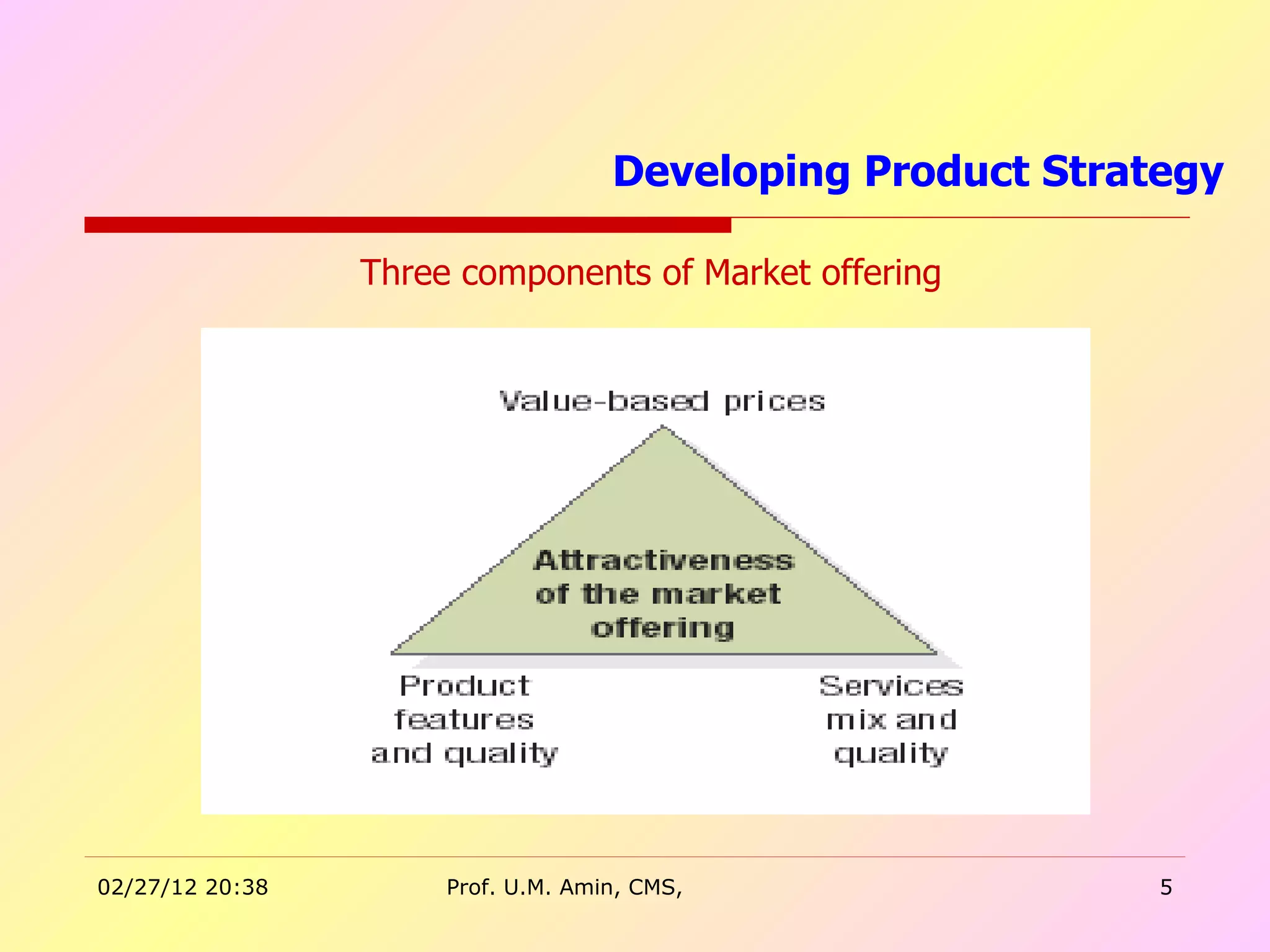
Three components of Market offering Developing Product Strategy
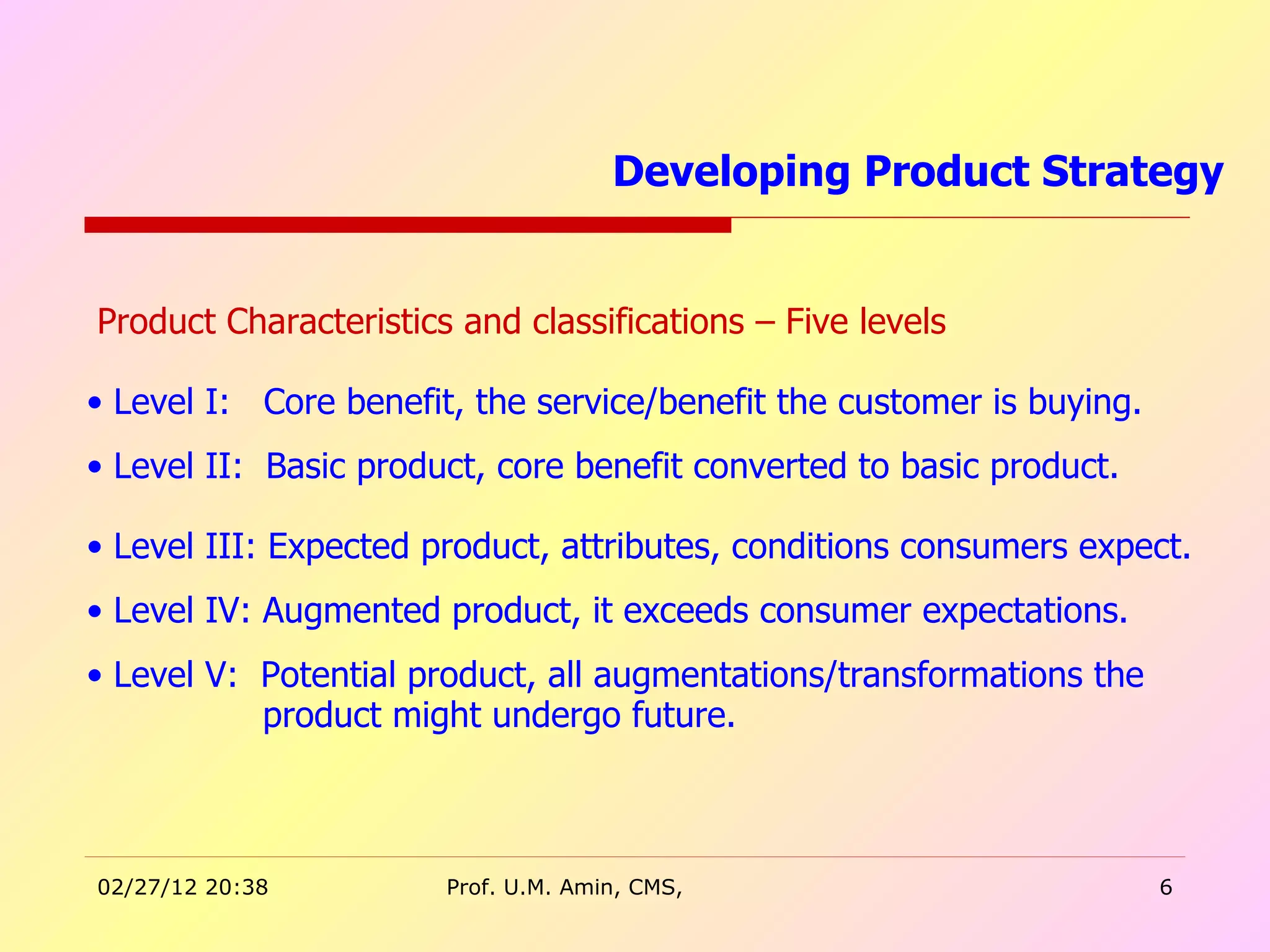
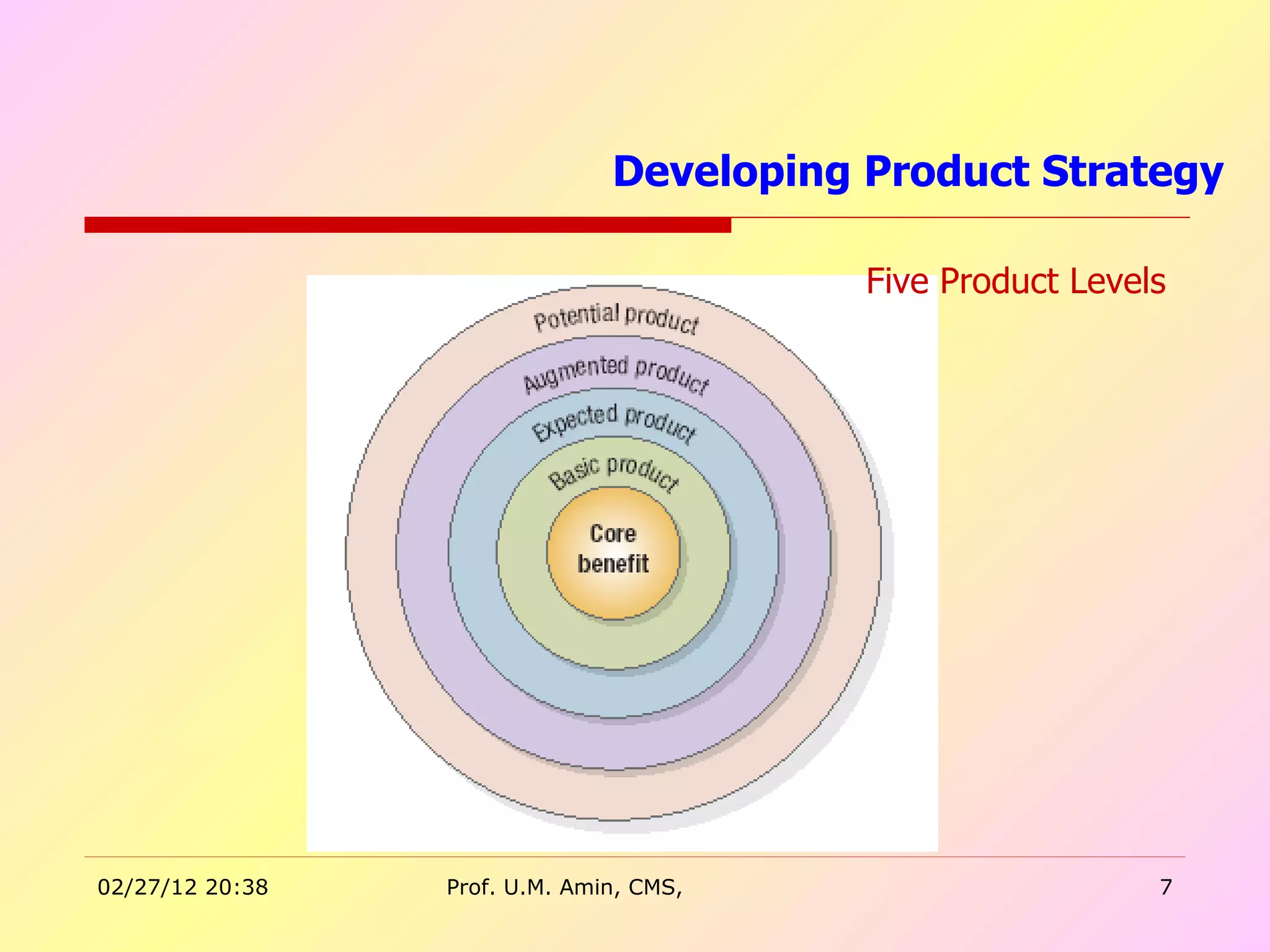
Product Characteristics and classifications – Five levels Level I:  Core benefit, the service/benefit the customer is buying. Level II:  Basic product, core benefit converted to basic product. Level III: Expected product, attributes, conditions consumers expect. Level IV: Augmented product, it exceeds consumer expectations. Level V:  Potential product, all augmentations/transformations the  product might undergo future. Developing Product Strategy
Developing Product Strategy  Five Product Levels
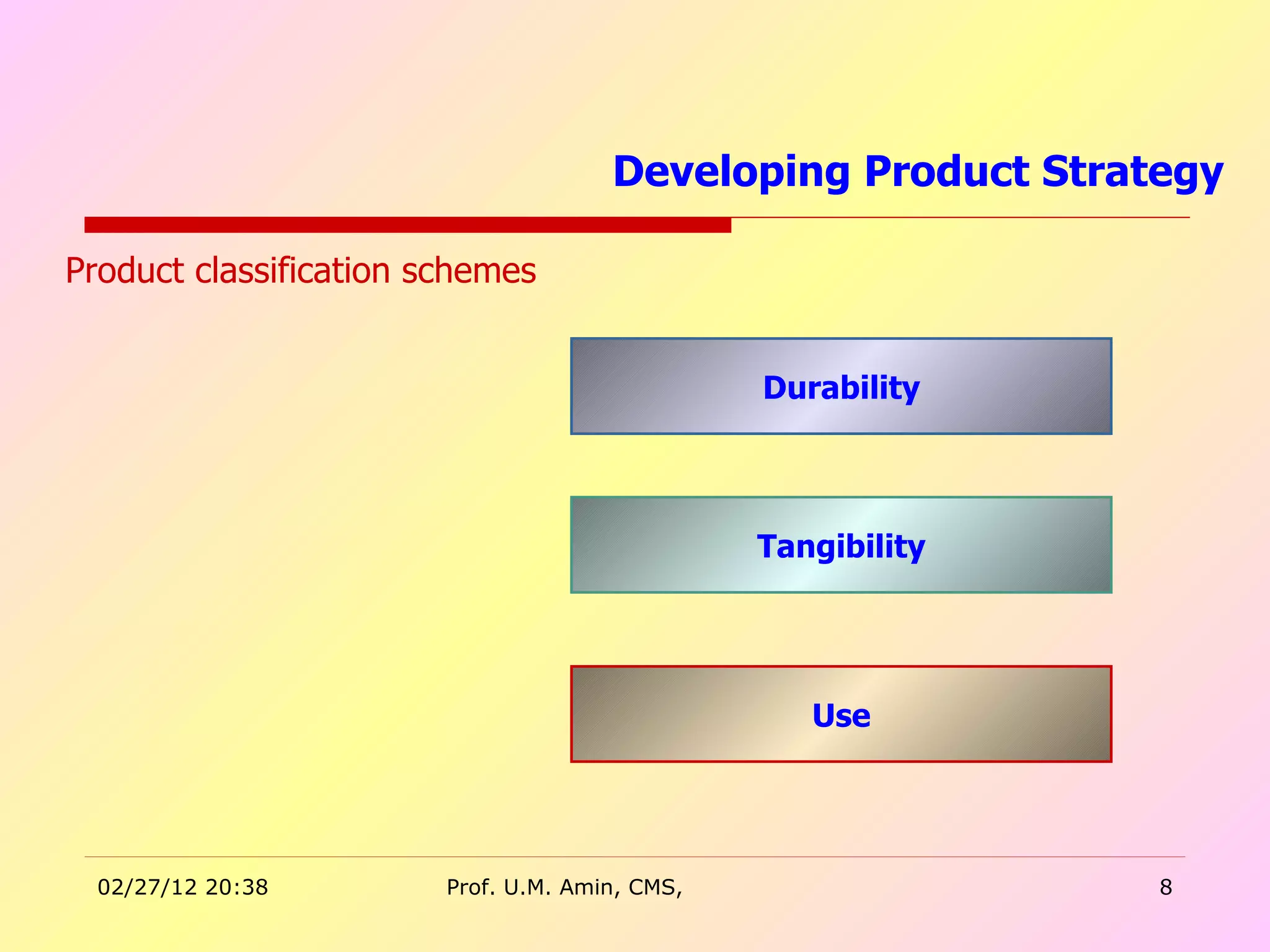
Product classification schemes  Developing Product Strategy  Durability Use Tangibility
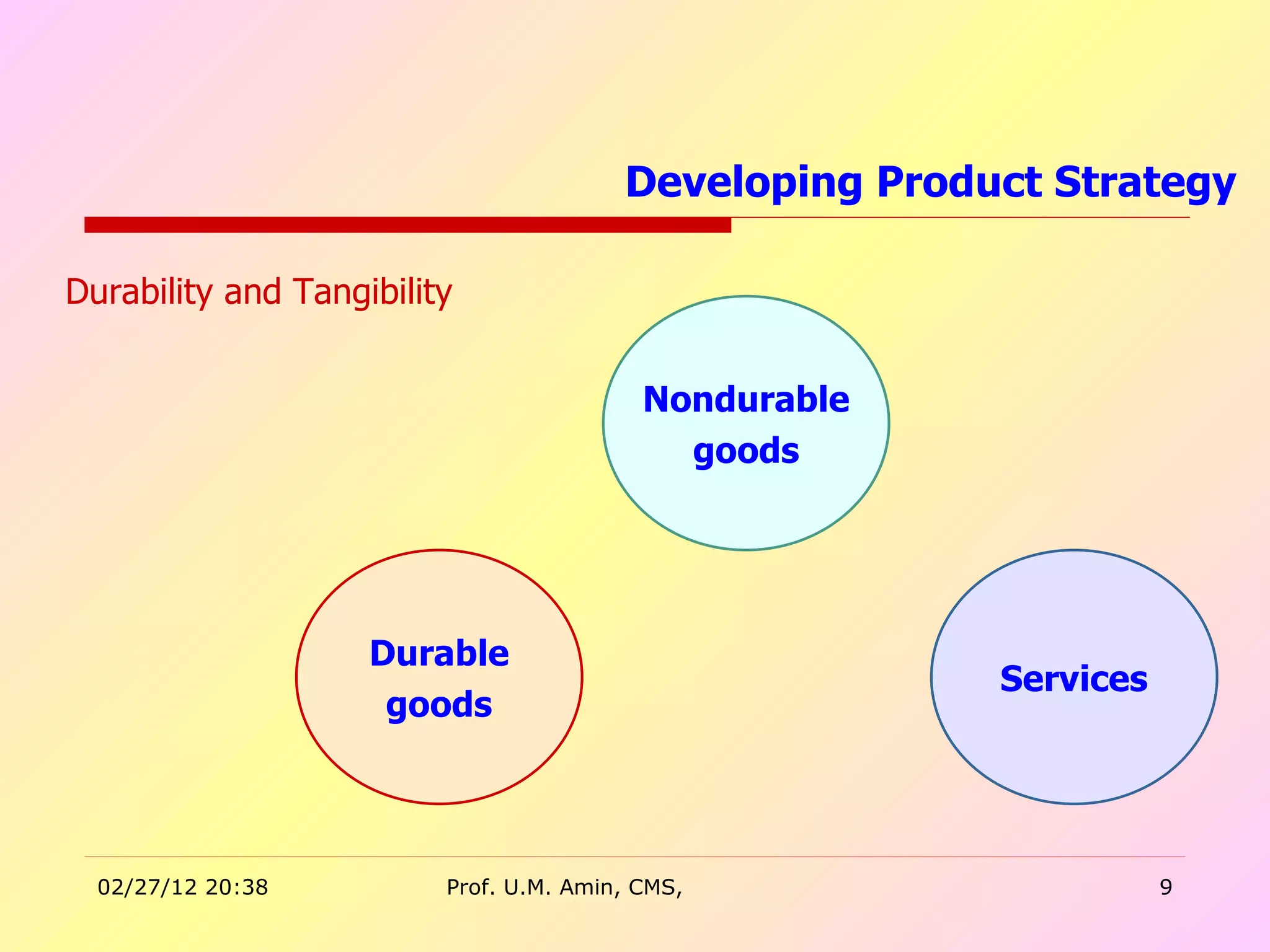
Developing Product Strategy Nondurable goods Services Durable goods Durability and Tangibility
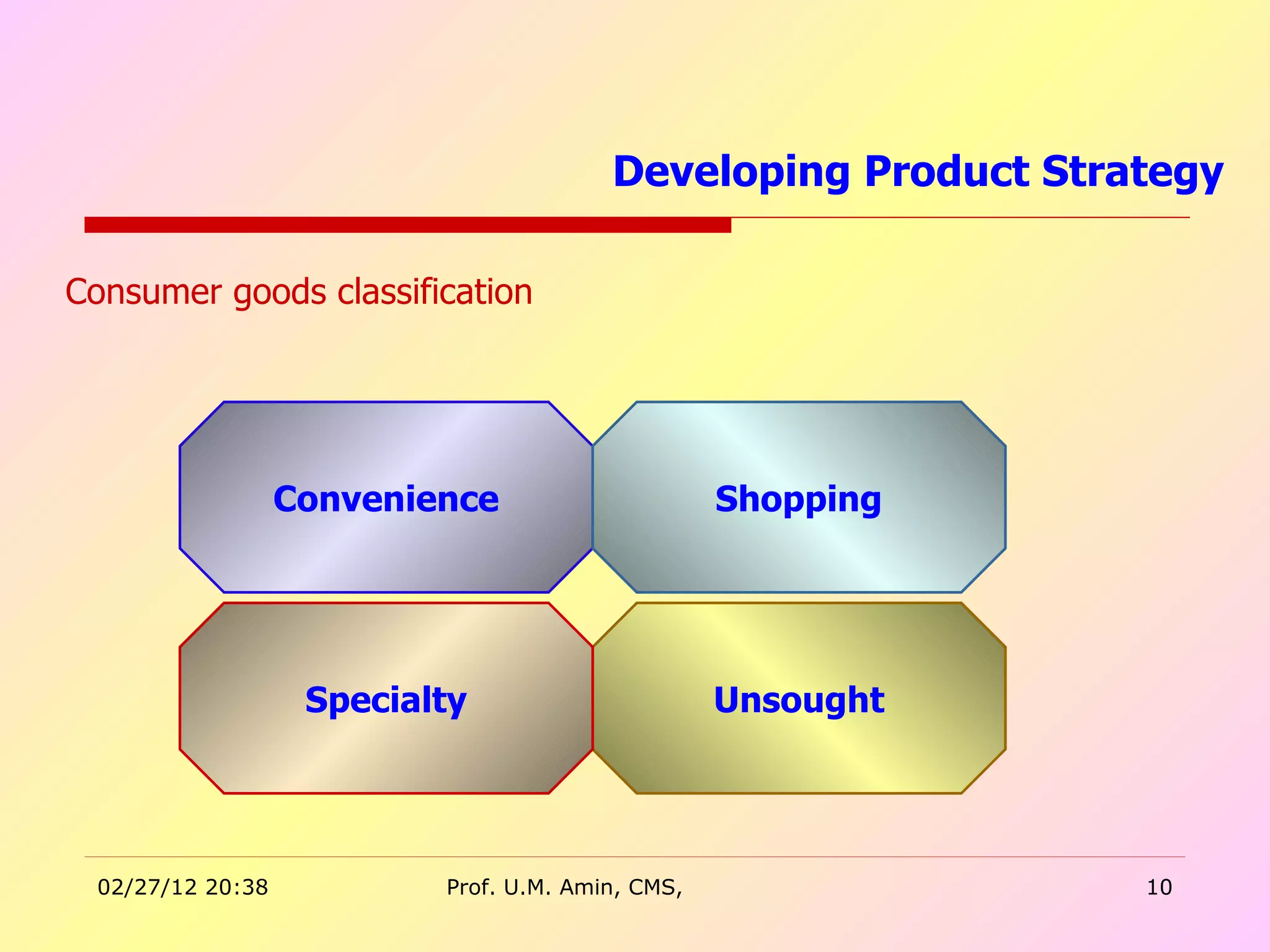
Developing Product Strategy  Convenience Unsought Shopping Specialty Consumer goods classification
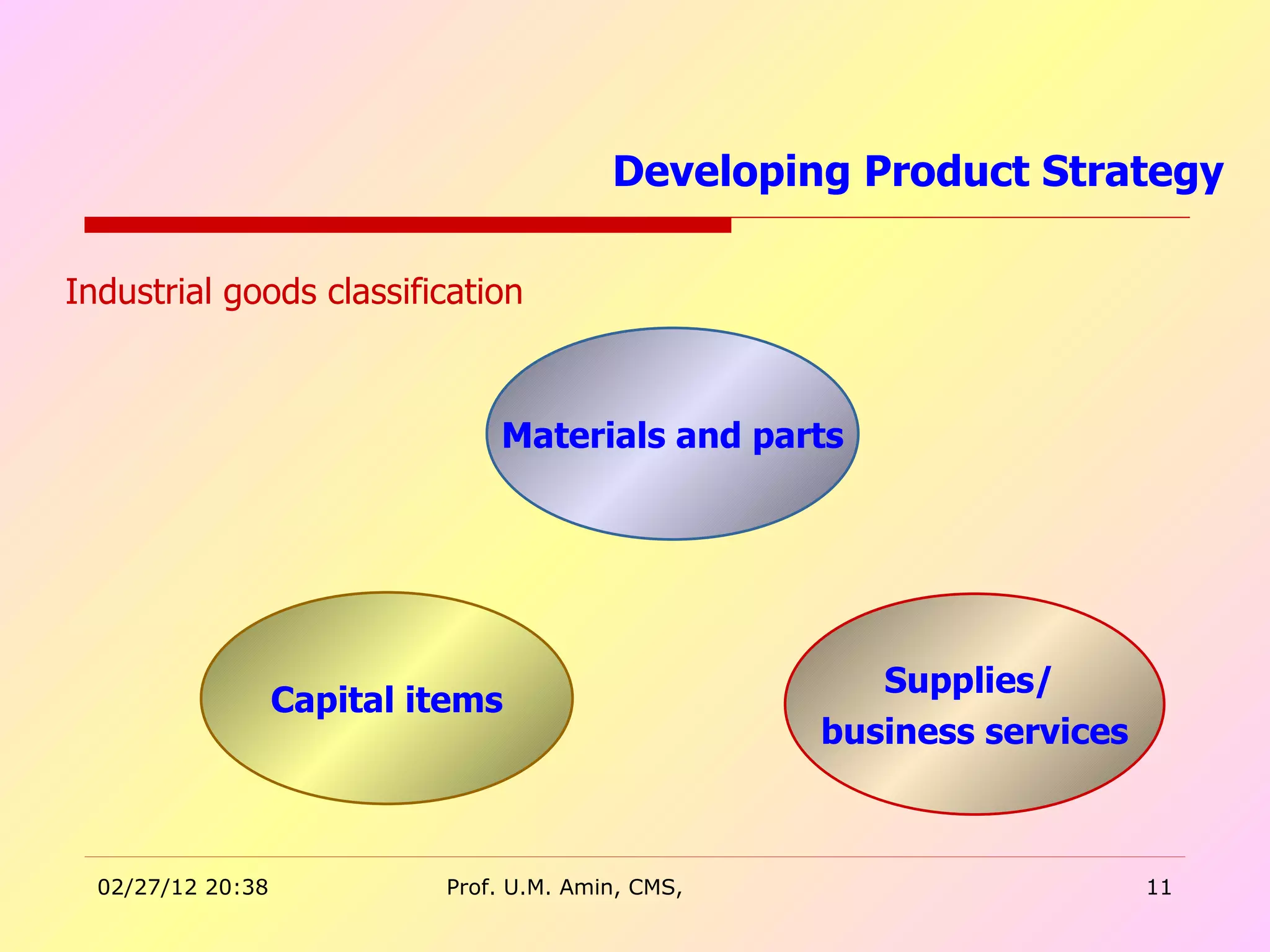
Developing Product Strategy  Materials and parts Supplies/  business services Capital items Industrial goods classification
Product Differentiation To be branded, products must be differentiated. Products can be  differentiated based on the following: Form, like size, shape or physical structure. Features, refer to supplements to the basic form.  Performance quality, level at which the product’s primary  characteristics operate. Conformance quality, degree to which all the produced units are  identical and meet the promised specifications. Developing Product Strategy
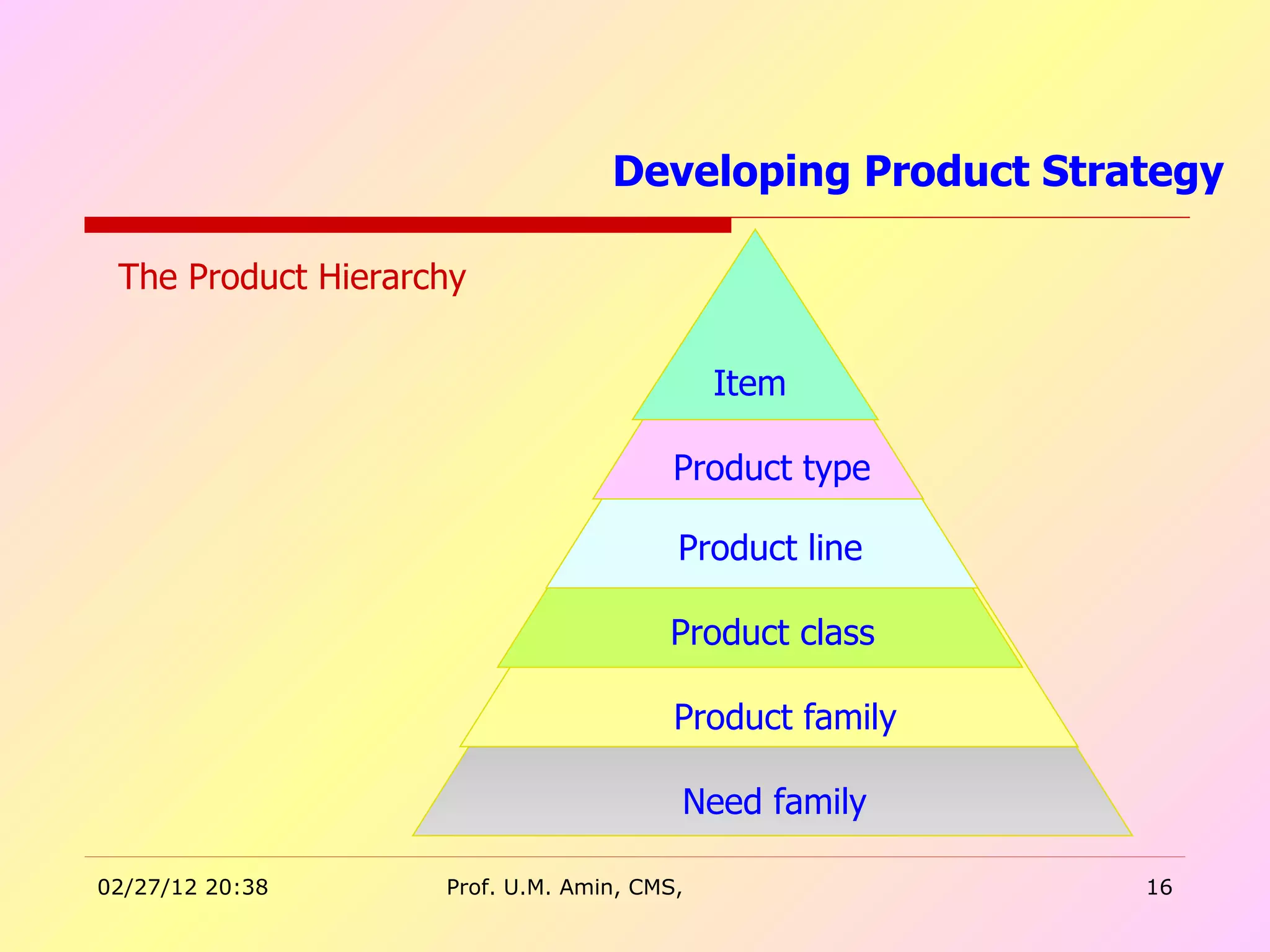
Durability, is a measure of the product’s expected operating life  under natural or stressful conditions. Reliability, is a measure of the probability that a product will not  malfunction or fail with in a specified time period.  Reparability, is measure of ease of fixing a product when it.  malfunctions or fails. Style, describes the product’s look and feel. The product Hierarchy  The product hierarchy stretches from basic needs to the products that satisfy these needs. There are six levels of product hierarchy:  Developing Product Strategy
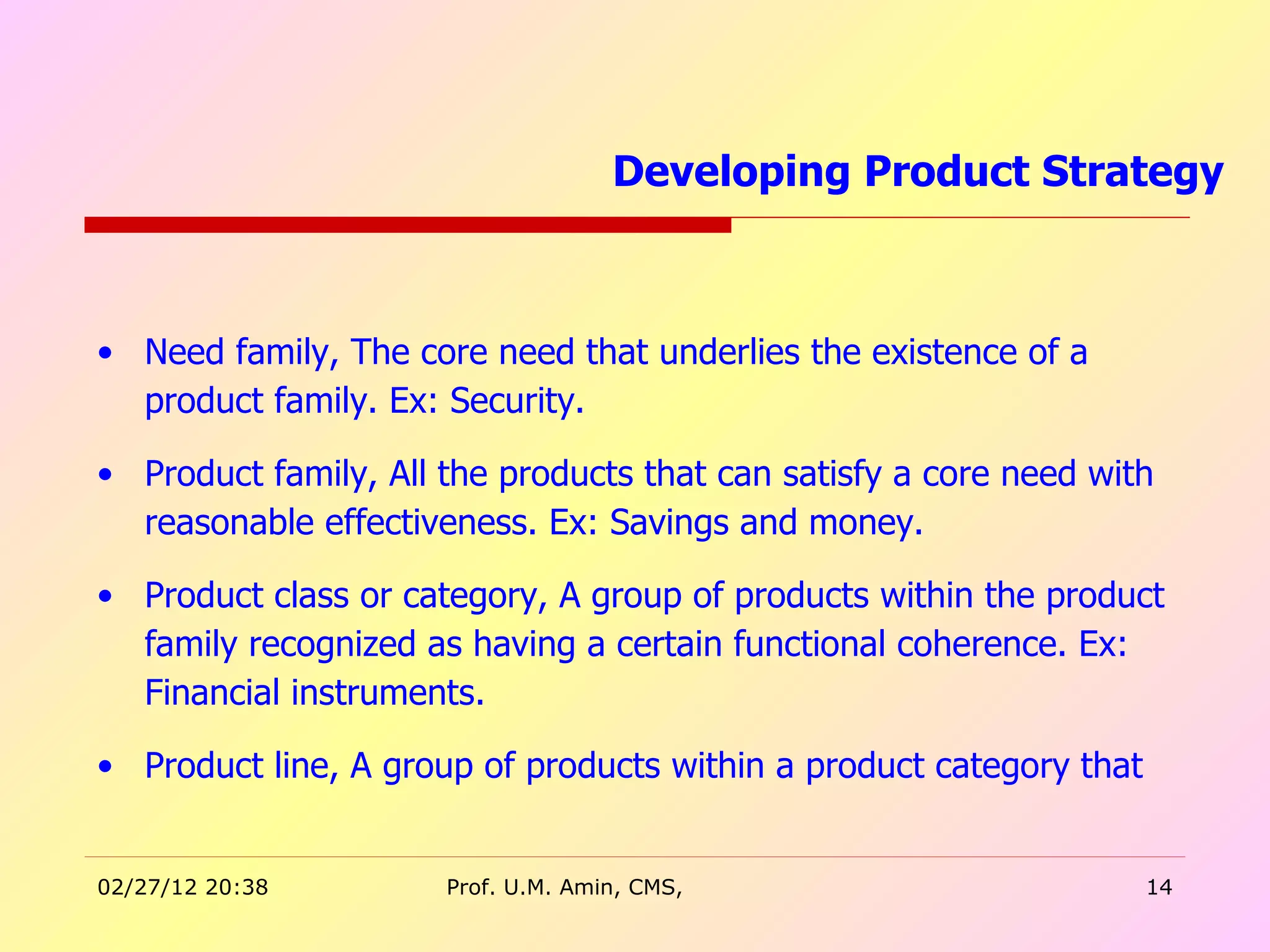
Need family, The core need that underlies the existence of a product family. Ex: Security. Product family, All the products that can satisfy a core need with reasonable effectiveness. Ex: Savings and money.  Product class or category, A group of products within the product family recognized as having a certain functional coherence. Ex: Financial instruments. Product line, A group of products within a product category that Developing Product Strategy
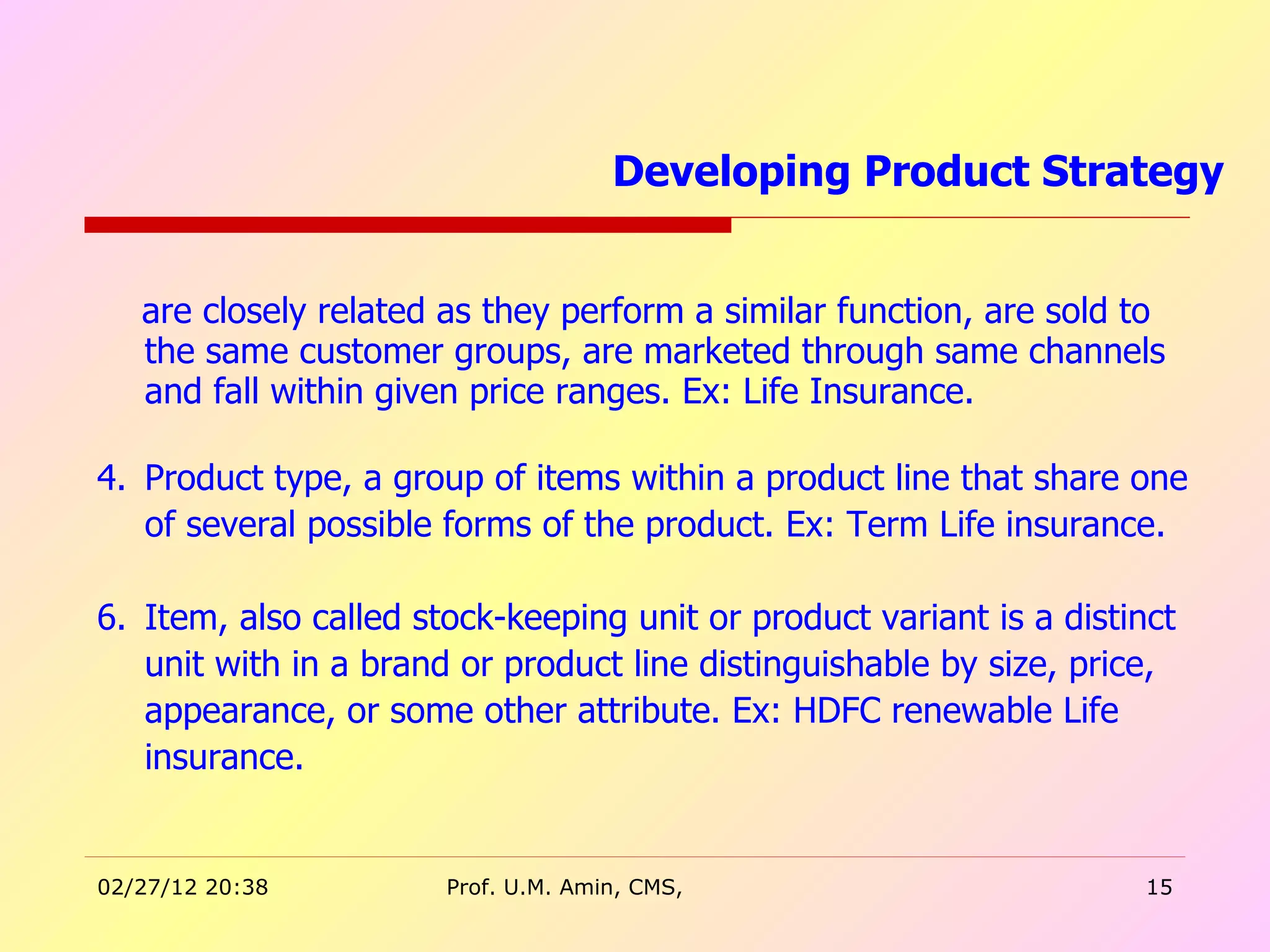
are closely related as they perform a similar function, are sold to the same customer groups, are marketed through same channels and fall within given price ranges. Ex: Life Insurance. Product type, a group of items within a product line that share one of several possible forms of the product. Ex: Term Life insurance.  Item, also called stock-keeping unit or product variant is a distinct unit with in a brand or product line distinguishable by size, price, appearance, or some other attribute. Ex: HDFC renewable Life insurance. Developing Product Strategy
Developing Product Strategy  The Product Hierarchy Need family Product family Product class Product line Product type Item
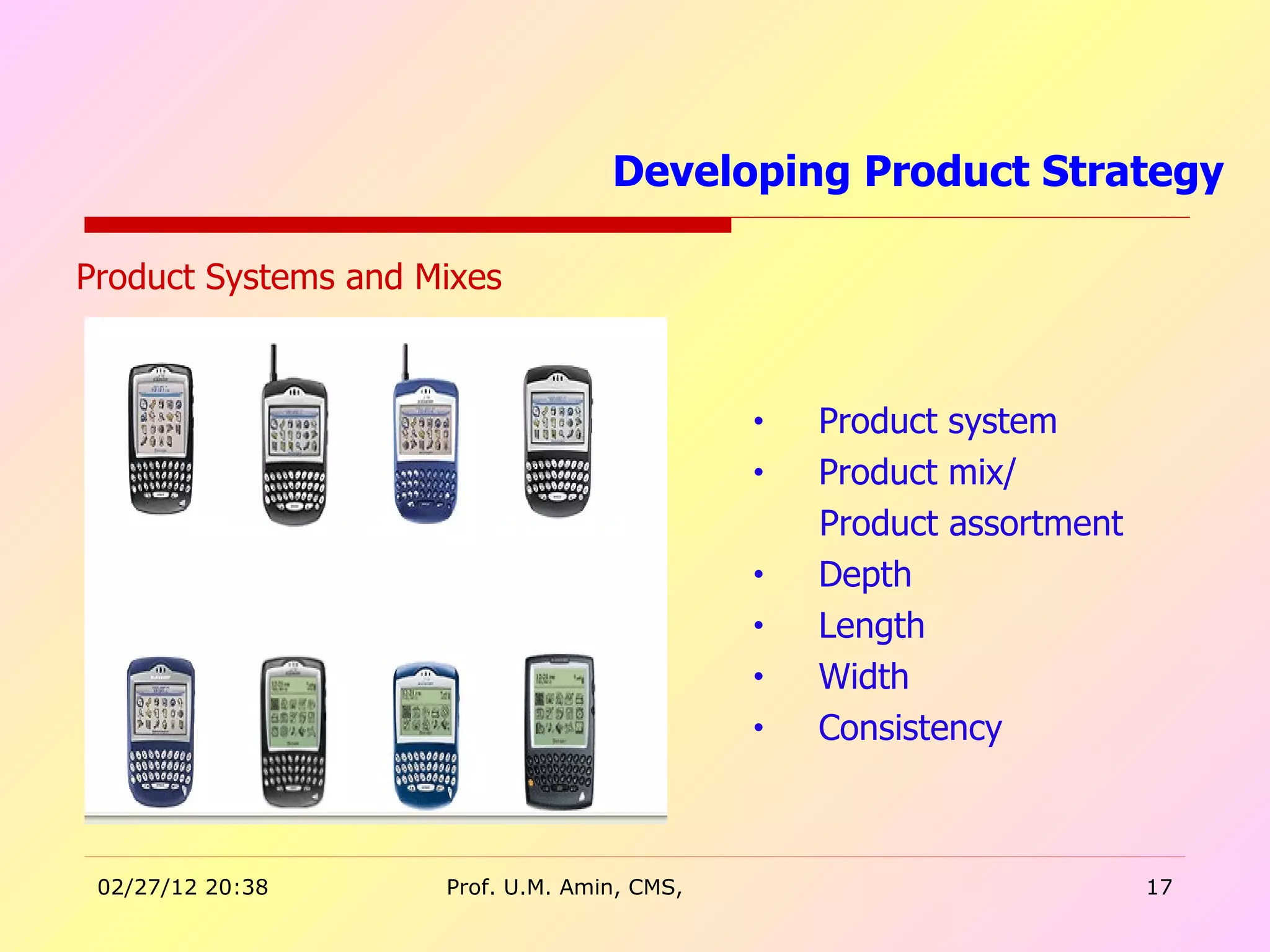
Developing Product Strategy  Product system Product mix/ Product assortment Depth Length Width Consistency Product Systems and Mixes
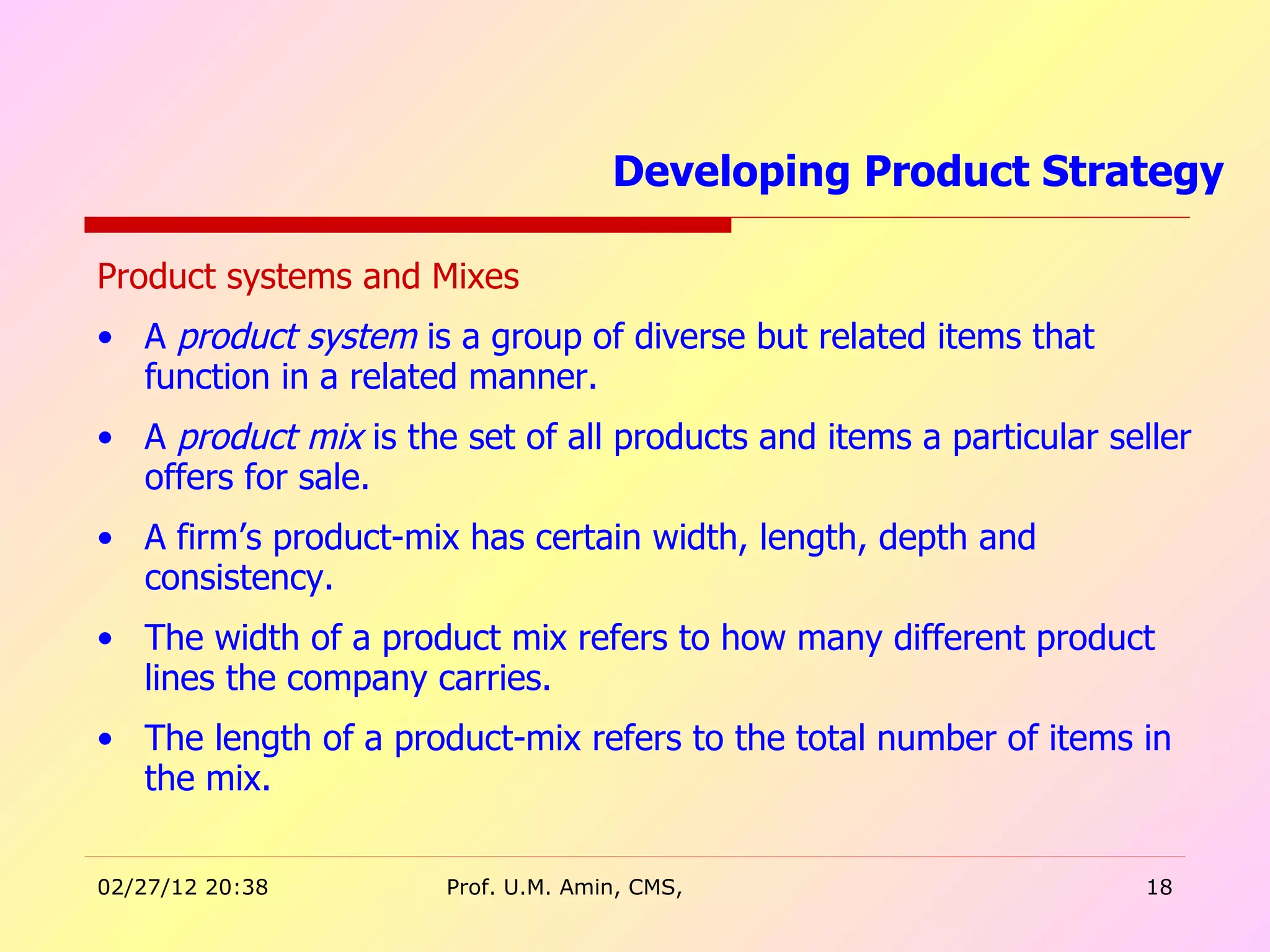
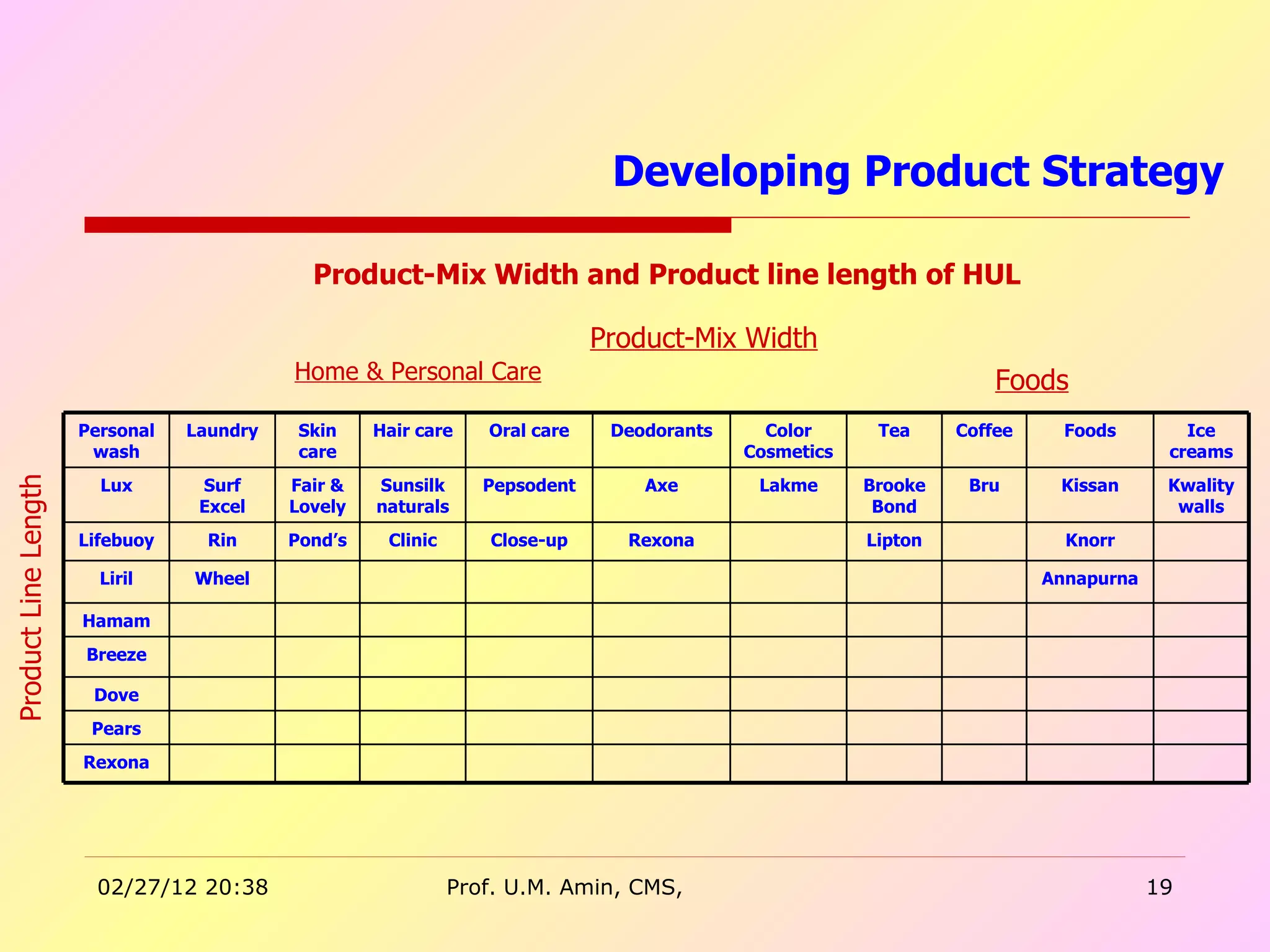
Product systems and Mixes A  product system  is a group of diverse but related items that function in a related manner. A  product mix  is the set of all products and items a particular seller offers for sale.  A firm’s product-mix has certain width, length, depth and consistency. The width of a product mix refers to how many different product lines the company carries.  The length of a product-mix refers to the total number of items in the mix. Developing Product Strategy
Developing Product Strategy  Product-Mix Width Home & Personal Care Foods Product Line Length Product-Mix Width and Product line length of HUL Rexona Pears Dove Breeze Hamam Annapurna Wheel Liril Knorr Lipton Rexona Close-up Clinic Pond’s Rin Lifebuoy Kwality walls Kissan Bru Brooke Bond Lakme Axe Pepsodent Sunsilk naturals Fair & Lovely Surf Excel Lux Ice creams Foods Coffee Tea Color Cosmetics Deodorants Oral care Hair care Skin care Laundry Personal wash
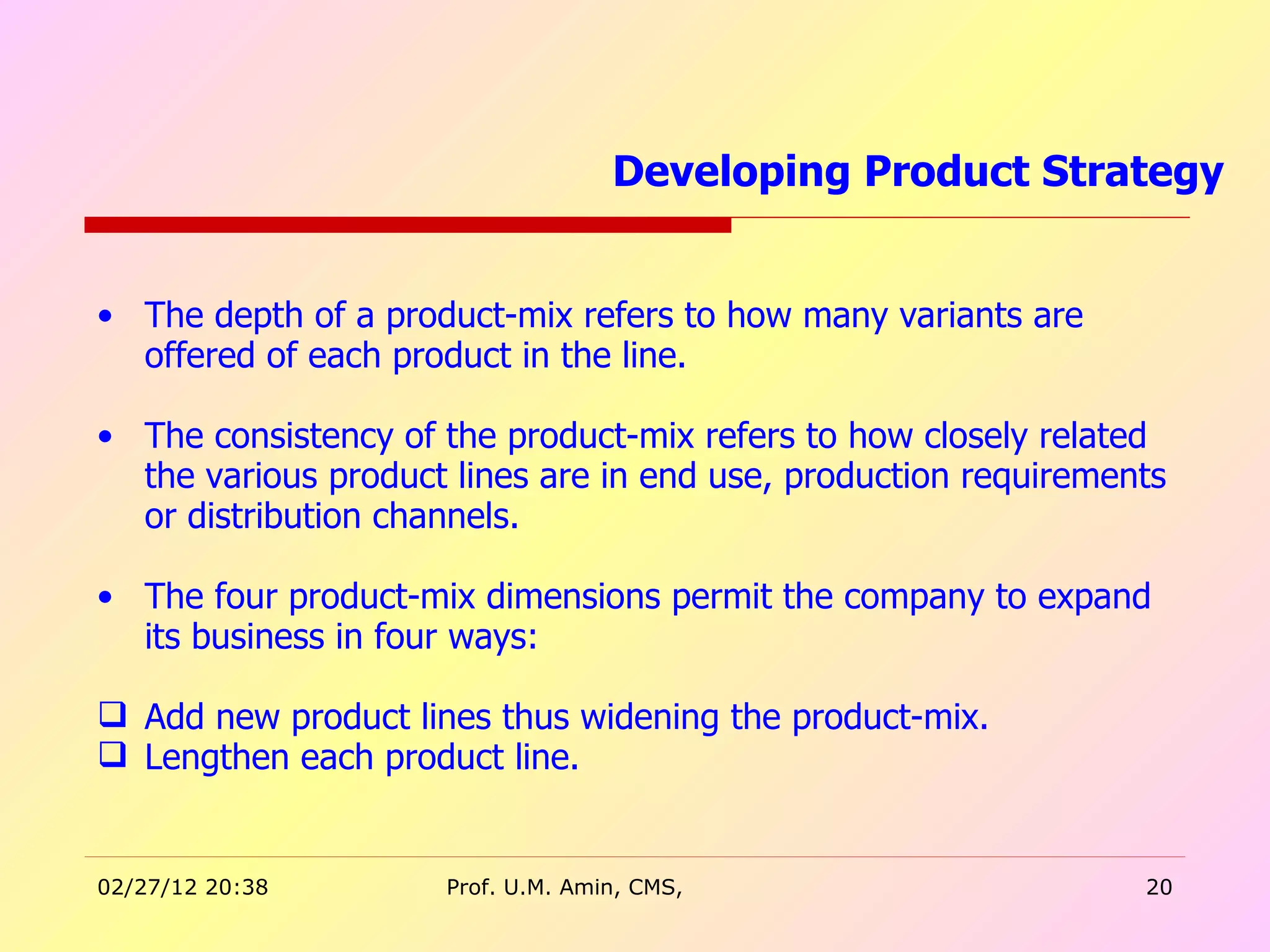
The depth of a product-mix refers to how many variants are offered of each product in the line. The consistency of the product-mix refers to how closely related the various product lines are in end use, production requirements or distribution channels.  The four product-mix dimensions permit the company to expand its business in four ways: Add new product lines thus widening the product-mix. Lengthen each product line. Developing Product Strategy
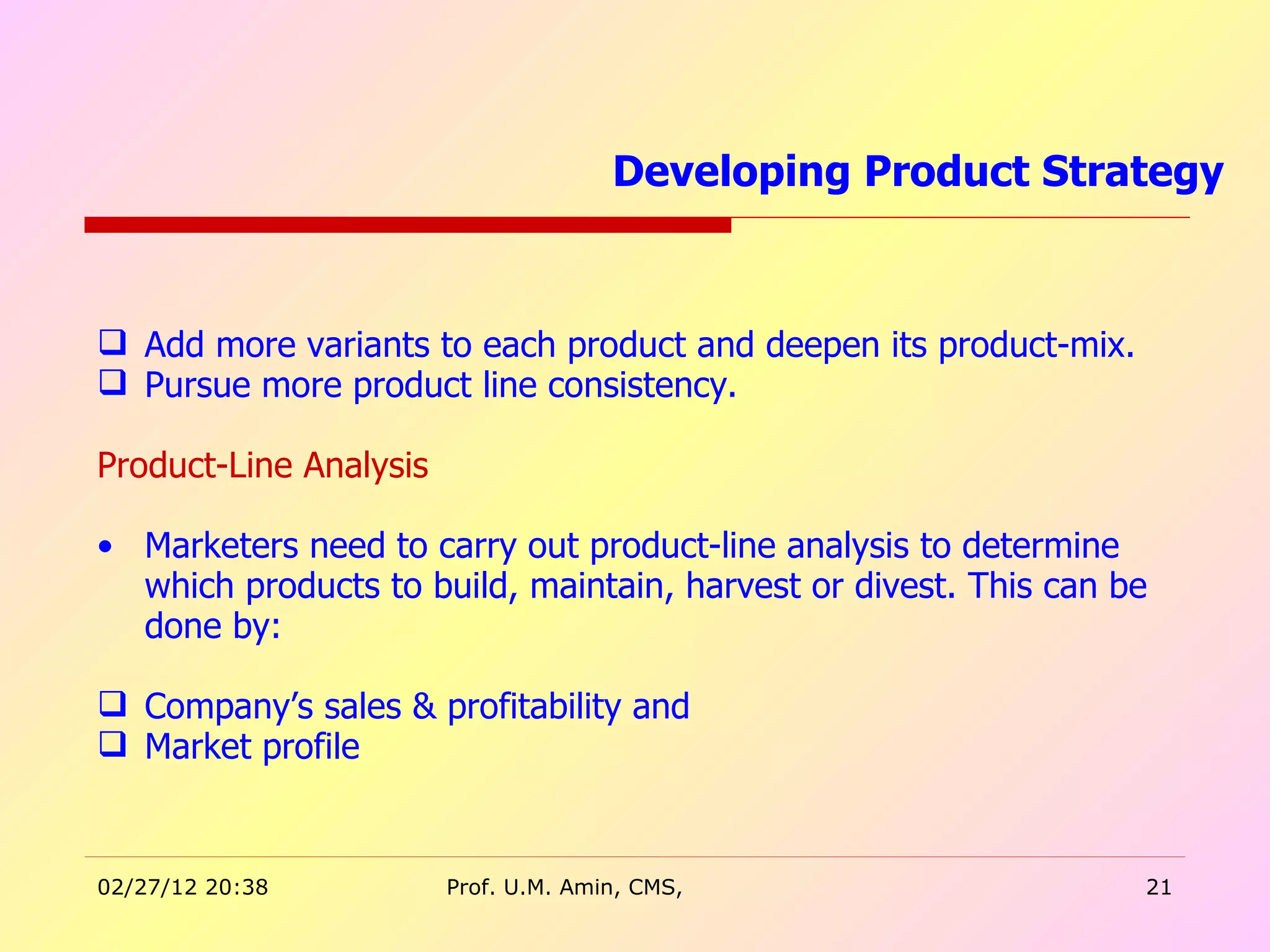
Add more variants to each product and deepen its product-mix. Pursue more product line consistency. Product-Line Analysis Marketers need to carry out product-line analysis to determine which products to build, maintain, harvest or divest. This can be done by: Company’s sales & profitability and Market profile Developing Product Strategy
Every company’s product portfolio contains products with different sales volumes and margins.  A company can classify its products into four types that yield different gross margins depending on sales volume & promotion: Core product , produce high sales volumes, are heavily promoted but with low margins because they are viewed as undifferentiated. Staples, items with lower sales volumes and no promotion – yield somewhat higher margins. Specialties, items with lower sales volume that might be highly promoted, yield higher margins. Developing Product Strategy
Convenience items, spares that consumers buy from where they buy original equipment, can carry higher margins. Companies must realize that these items differ in their potential for being priced higher or advertised more as the ways to increase their sales, margins or both. Market profile involves reviewing how the product line is positioned against competitors.  Product-line analysis provides information on product line length and product-mix pricing.  Developing Product Strategy
Company objectives influence product-line length. The objectives may be: To induce up selling, To create a product line that facilitates cross selling and  To create a product line that protects against economic ups and downs. Companies seeking high market share & market growth generally carry longer product lines while companies seeking higher margins carry shorter product lines. Developing Product Strategy
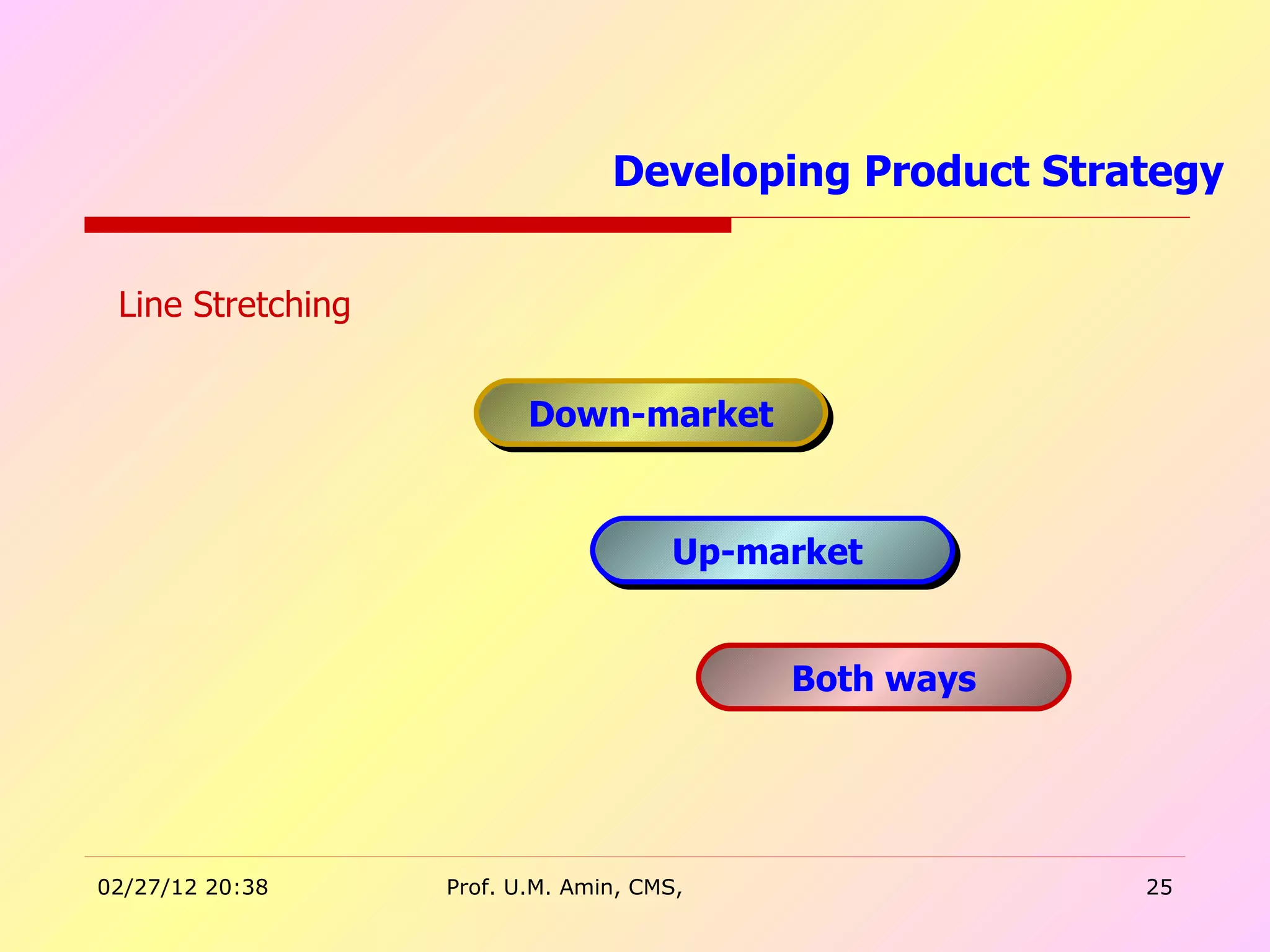
Down-market Up-market  Both ways Line Stretching Developing Product Strategy
A company increases its product length in two ways: Line stretching and Line filling Line stretching  occurs when the company lengthens its product line beyond the current range. In down-market stretch, a company positioned in the middle market may introduce a lower priced line.   Developing Product Strategy
It may be due to the following: The company may notice strong growth opportunities as mass retailers. The company may wish to tie lower end competitors who might move up-market.  The company may find that the middle market is stagnating or declining. Company may wish to enter high end of the market to seek more growth, higher margins or simply to position itself as full line manufacturer.  Developing Product Strategy
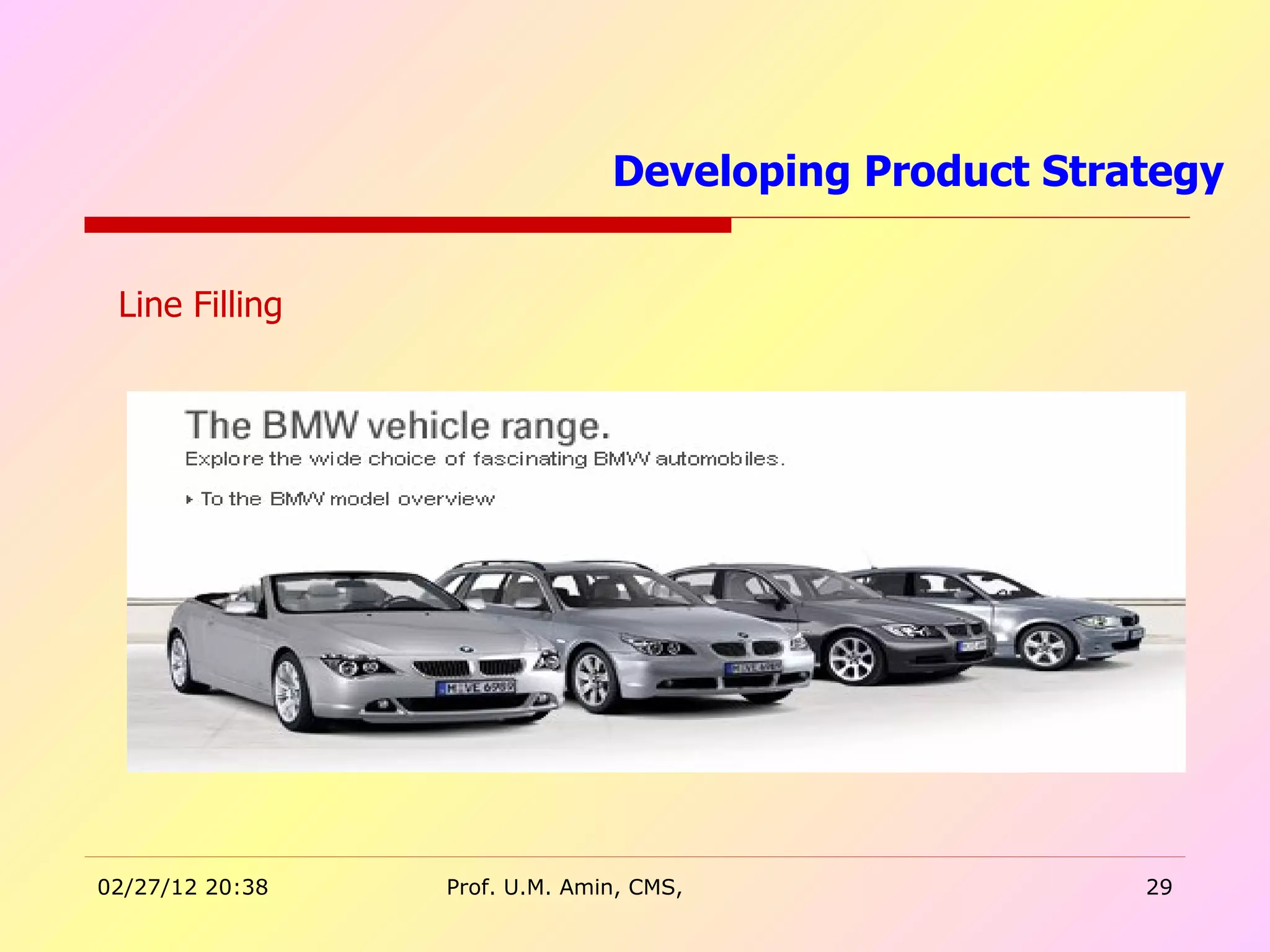
Two way stretch : Companies serving middle market may decide to stretch product line in both directions.  Line filling  involves adding more items within the present range. It is undertaken to: Reach incremental profits. Satisfy dealers who complain about lost sales due to missing items. Try to utilize excess capacity. Plug holes to keep out competitors. Be the leading full line company. Developing Product Strategy
Developing Product Strategy  Line Filling
Co-Branding and Ingredient Branding Co-branding also called dual branding or brand bundling involves combining two or more existing well known brands into a new joint product and/or marketed together in some fashion. It could be same company co-branding, joint venture co-branding, mutiple-sponser co-branding or retail co-branding.  Ingredient branding is a special type of co-branding that involves creating brand equity for materials, components or parts that are necessarily contained within other branded products.  Developing Product Strategy
Packaging, Labeling, Warranties, and Guarantees Packaging (the 5 th  P) can be defined as all activities of designing and producing a container for a product.  Packages may include upto three levels of materials. Several factors have resulted in growing use of packaging as a marketing tool. These are: Self service. Consumer affluence Developing Product Strategy
Company and brand image. Innovation opportunity. Packaging must achieve the following objectives: Identify the brand. Convey descriptive and persuasive information. Facilitate product transportation and protection. Assist at home storage. Aid product consumption. Developing Product Strategy
To achieve the marketing objectives, the aesthetics and functional components of packaging must be chosen carefully. Aesthetic considerations relate to size, shape, material, color, text and graphics. Functionally, structural design is crucial.  The packaging should be re-sealable, tamper-proof, and convenient to use.  Labeling Sellers must label products which could be a simple tag or an elaborately designed graphic that is part of the package.  Developing Product Strategy
Label performs several functions: It identifies the product or brand. The label may grade the product. It may describe the product. Label might promote the product.  Warranties and Guarantees Warranties are formal statements of expected product performance by the manufacturer and are legally enforceable. Some companies give general while others give specific guarantees. Developing Product Strategy
Recap: What are the characteristics of products and how can they be classified? How can a company build and manage its product mix and product lines? How can companies combine products to create strong co-brands or ingredient brands? How can companies use packaging, labeling, warranties, and guarantees as marketing tools? Developing Product Strategy

Mm.10.10

  • 1.
  • 2.
  • 3.
    Learning Objectives: Knowwhat are the characteristics of products and how can they be classified? Know how can a company build and manage its product mix and product lines? Know how can companies combine products to create strong co-brands or ingredient brands? Know how can companies use packaging, labeling, warranties, and guarantees as marketing tools? Developing Product Strategy
  • 4.
    Developing Product StrategyAnything that can be offered to a market to satisfy a want or need. Product
  • 5.
    Three components ofMarket offering Developing Product Strategy
  • 6.
    Product Characteristics andclassifications – Five levels Level I: Core benefit, the service/benefit the customer is buying. Level II: Basic product, core benefit converted to basic product. Level III: Expected product, attributes, conditions consumers expect. Level IV: Augmented product, it exceeds consumer expectations. Level V: Potential product, all augmentations/transformations the product might undergo future. Developing Product Strategy
  • 7.
    Developing Product Strategy Five Product Levels
  • 8.
    Product classification schemes Developing Product Strategy Durability Use Tangibility
  • 9.
    Developing Product StrategyNondurable goods Services Durable goods Durability and Tangibility
  • 10.
    Developing Product Strategy Convenience Unsought Shopping Specialty Consumer goods classification
  • 11.
    Developing Product Strategy Materials and parts Supplies/ business services Capital items Industrial goods classification
  • 12.
    Product Differentiation Tobe branded, products must be differentiated. Products can be differentiated based on the following: Form, like size, shape or physical structure. Features, refer to supplements to the basic form. Performance quality, level at which the product’s primary characteristics operate. Conformance quality, degree to which all the produced units are identical and meet the promised specifications. Developing Product Strategy
  • 13.
    Durability, is ameasure of the product’s expected operating life under natural or stressful conditions. Reliability, is a measure of the probability that a product will not malfunction or fail with in a specified time period. Reparability, is measure of ease of fixing a product when it. malfunctions or fails. Style, describes the product’s look and feel. The product Hierarchy The product hierarchy stretches from basic needs to the products that satisfy these needs. There are six levels of product hierarchy: Developing Product Strategy
  • 14.
    Need family, Thecore need that underlies the existence of a product family. Ex: Security. Product family, All the products that can satisfy a core need with reasonable effectiveness. Ex: Savings and money. Product class or category, A group of products within the product family recognized as having a certain functional coherence. Ex: Financial instruments. Product line, A group of products within a product category that Developing Product Strategy
  • 15.
    are closely relatedas they perform a similar function, are sold to the same customer groups, are marketed through same channels and fall within given price ranges. Ex: Life Insurance. Product type, a group of items within a product line that share one of several possible forms of the product. Ex: Term Life insurance. Item, also called stock-keeping unit or product variant is a distinct unit with in a brand or product line distinguishable by size, price, appearance, or some other attribute. Ex: HDFC renewable Life insurance. Developing Product Strategy
  • 16.
    Developing Product Strategy The Product Hierarchy Need family Product family Product class Product line Product type Item
  • 17.
    Developing Product Strategy Product system Product mix/ Product assortment Depth Length Width Consistency Product Systems and Mixes
  • 18.
    Product systems andMixes A product system is a group of diverse but related items that function in a related manner. A product mix is the set of all products and items a particular seller offers for sale. A firm’s product-mix has certain width, length, depth and consistency. The width of a product mix refers to how many different product lines the company carries. The length of a product-mix refers to the total number of items in the mix. Developing Product Strategy
  • 19.
    Developing Product Strategy Product-Mix Width Home & Personal Care Foods Product Line Length Product-Mix Width and Product line length of HUL Rexona Pears Dove Breeze Hamam Annapurna Wheel Liril Knorr Lipton Rexona Close-up Clinic Pond’s Rin Lifebuoy Kwality walls Kissan Bru Brooke Bond Lakme Axe Pepsodent Sunsilk naturals Fair & Lovely Surf Excel Lux Ice creams Foods Coffee Tea Color Cosmetics Deodorants Oral care Hair care Skin care Laundry Personal wash
  • 20.
    The depth ofa product-mix refers to how many variants are offered of each product in the line. The consistency of the product-mix refers to how closely related the various product lines are in end use, production requirements or distribution channels. The four product-mix dimensions permit the company to expand its business in four ways: Add new product lines thus widening the product-mix. Lengthen each product line. Developing Product Strategy
  • 21.
    Add more variantsto each product and deepen its product-mix. Pursue more product line consistency. Product-Line Analysis Marketers need to carry out product-line analysis to determine which products to build, maintain, harvest or divest. This can be done by: Company’s sales & profitability and Market profile Developing Product Strategy
  • 22.
    Every company’s productportfolio contains products with different sales volumes and margins. A company can classify its products into four types that yield different gross margins depending on sales volume & promotion: Core product , produce high sales volumes, are heavily promoted but with low margins because they are viewed as undifferentiated. Staples, items with lower sales volumes and no promotion – yield somewhat higher margins. Specialties, items with lower sales volume that might be highly promoted, yield higher margins. Developing Product Strategy
  • 23.
    Convenience items, sparesthat consumers buy from where they buy original equipment, can carry higher margins. Companies must realize that these items differ in their potential for being priced higher or advertised more as the ways to increase their sales, margins or both. Market profile involves reviewing how the product line is positioned against competitors. Product-line analysis provides information on product line length and product-mix pricing. Developing Product Strategy
  • 24.
    Company objectives influenceproduct-line length. The objectives may be: To induce up selling, To create a product line that facilitates cross selling and To create a product line that protects against economic ups and downs. Companies seeking high market share & market growth generally carry longer product lines while companies seeking higher margins carry shorter product lines. Developing Product Strategy
  • 25.
    Down-market Up-market Both ways Line Stretching Developing Product Strategy
  • 26.
    A company increasesits product length in two ways: Line stretching and Line filling Line stretching occurs when the company lengthens its product line beyond the current range. In down-market stretch, a company positioned in the middle market may introduce a lower priced line. Developing Product Strategy
  • 27.
    It may bedue to the following: The company may notice strong growth opportunities as mass retailers. The company may wish to tie lower end competitors who might move up-market. The company may find that the middle market is stagnating or declining. Company may wish to enter high end of the market to seek more growth, higher margins or simply to position itself as full line manufacturer. Developing Product Strategy
  • 28.
    Two way stretch: Companies serving middle market may decide to stretch product line in both directions. Line filling involves adding more items within the present range. It is undertaken to: Reach incremental profits. Satisfy dealers who complain about lost sales due to missing items. Try to utilize excess capacity. Plug holes to keep out competitors. Be the leading full line company. Developing Product Strategy
  • 29.
  • 30.
    Co-Branding and IngredientBranding Co-branding also called dual branding or brand bundling involves combining two or more existing well known brands into a new joint product and/or marketed together in some fashion. It could be same company co-branding, joint venture co-branding, mutiple-sponser co-branding or retail co-branding. Ingredient branding is a special type of co-branding that involves creating brand equity for materials, components or parts that are necessarily contained within other branded products. Developing Product Strategy
  • 31.
    Packaging, Labeling, Warranties,and Guarantees Packaging (the 5 th P) can be defined as all activities of designing and producing a container for a product. Packages may include upto three levels of materials. Several factors have resulted in growing use of packaging as a marketing tool. These are: Self service. Consumer affluence Developing Product Strategy
  • 32.
    Company and brandimage. Innovation opportunity. Packaging must achieve the following objectives: Identify the brand. Convey descriptive and persuasive information. Facilitate product transportation and protection. Assist at home storage. Aid product consumption. Developing Product Strategy
  • 33.
    To achieve themarketing objectives, the aesthetics and functional components of packaging must be chosen carefully. Aesthetic considerations relate to size, shape, material, color, text and graphics. Functionally, structural design is crucial. The packaging should be re-sealable, tamper-proof, and convenient to use. Labeling Sellers must label products which could be a simple tag or an elaborately designed graphic that is part of the package. Developing Product Strategy
  • 34.
    Label performs severalfunctions: It identifies the product or brand. The label may grade the product. It may describe the product. Label might promote the product. Warranties and Guarantees Warranties are formal statements of expected product performance by the manufacturer and are legally enforceable. Some companies give general while others give specific guarantees. Developing Product Strategy
  • 35.
    Recap: What arethe characteristics of products and how can they be classified? How can a company build and manage its product mix and product lines? How can companies combine products to create strong co-brands or ingredient brands? How can companies use packaging, labeling, warranties, and guarantees as marketing tools? Developing Product Strategy