1For more information visit reedglobal.com.cn/salary-guides
reedglobal.com.cn/salary-guidesChina
Market
Insight
2014
2 For more information visit reedglobal.com.cn/salary-guides
Welcome to our 2014 China Market Insight. We have drawn on the
insight and expertise of our teams in Australia, China, Hong Kong,
Singapore and South Korea to provide an overview of labour market
trends across the Asia Pacific region, as well as shedding light on some
of the specific challenges facing individual geographical markets.
We have surveyed employees and employers across the region to gauge confidence levels,
as well as charting their concerns and priorities for the year ahead.
We hope you find the information in this guide useful and would be delighted to hear from you if
you have any observations or questions about the resourcing challenges the market may present
this year.
Don’t forget to visit reedglobal.com.cn/salary-guides to find further information on feelings in
the workplace and sector specific overviews for the year ahead.
We look forward to working with you throughout 2014.
Best wishes
Tristan Bullworthy
Regional Managing Director, Asia Pacific
Introduction
3For more information visit reedglobal.com.cn/salary-guides
The data presented on ‘Satisfaction & Stability’ and ‘Talent Management’
has been provided by research carried out using an online panel of 798
employees and employers working in a variety of industry sectors and job
levels across the Asia Pacific region.
Once the results were compiled, we were then able to breakdown the responses by looking at
specific areas of business interest.
Methodology
4 For more information visit reedglobal.com.cn/salary-guides
A year of transition
2013 has been a year of transition for the Asia Pacific region, as the employment market shifts
from being employer-driven to candidate-driven. Our research shows a healthy level of optimism,
with more than three quarters (79.8%) of the workforce feeling secure in their role. However,
satisfaction levels are not as healthy and less than half (43.3%) of employees across the region
describe themselves as satisfied or very satisfied in their roles.
Job seeking on the rise
Given this sense of security and confidence among the workforce, coupled with lower satisfaction
levels in their current role, it is not surprising to see that almost three quarters (72.3%) are actively
seeking a new job or plan to look within the next twelve months. This is most pronounced in China
(82.9%), with Australia being the exception (46.9%). However, the recent change in government
in Australia has brought about a period of adjustment, which will undoubtedly have a temporary
impact on the confidence of businesses and employees alike.
Talent gap?
More than half of businesses (58%) believe there is a skills shortage in their organisation and
this was most keenly felt in Australia (67.4%) and Singapore (62.3%). While the sense of a skills
shortage was less evident in China (39.4%), three quarters (76.9%) of Chinese employers are
concerned about the impact of a skills shortage on their business performance – compared to an
average of 70.2% across the Asia Pacific region.
The majority of businesses (71.1%) are also worried about losing talent from their organisation
and this is most pronounced in Australia (77.2%) – perhaps an indication that employers are
gearing up for employees to make a move after holding firm through the uncertainty of a change of
government.
Remuneration and reward
Despite the intense competition for talent, only one in four businesses (25%) has invested in
training and development for their staff. Interestingly, 70.9% of employees across the region
had not received a pay rise in the last twelve months. However, many staff are not looking for a
monetary incentive, with flexible hours cited as having the most positive impact on their life and
happiness.
APAC Market Overview
5For more information visit reedglobal.com.cn/salary-guides
The land of opportunity
The Chinese economy is in a period of transition as it looks to strengthen its skill base and develop
beyond its reputation as a manufacturing powerhouse. There is a need to attract and retain talent
to drive the economy forward and that is why REED is committed to growing its presence within
the Chinese market, bringing its heritage of 53 years at the forefront of executive recruitment to
support businesses in China.
These are exciting times for China and in the year ahead we forecast healthy opportunities
for candidates seeking roles in the FMCG, health & life sciences, technology, finance and
automotive sectors.
The talent pipeline
As the Chinese economy matures, there is a balance to be struck between driving growth and
creating a sustainable environment in which to live and work. A skilled workforce is central to this
and this is something that is currently being debated at the highest level. There has been some
encouraging data published in recent months, which shows how China is establishing itself as a
skills-led economy.
Firstly, home grown graduates are now on an equal footing with those who have studied overseas.
In some instances, graduates from Chinese universities have the advantage as they are perceived
by employers to be more in tune with the local market. This endorsement from businesses for the
Chinese Higher Education System can only help to support the drive for talent.
Secondly, recent research reveals a greater appetite among Chinese graduates to work for local
companies. Viewed as more stable and secure roles, this is an equally ringing endorsement from
young Chinese graduates in their home grown enterprises.
Planning for the future
With plans in place to increase opportunities for workers at every level, China is demonstrating its
commitment to a skilled workforce. For example, enhanced rights for rural workers enabling them
to live where they work, will open the door to improved education and cultural experiences for
themselves and their families.
Attraction and retention strategies for 2014
While plans are in place to shore up the skills pipeline in the long term, there is an immediate need
among businesses to secure and retain talented employees. In terms of attraction, employers
need to ensure they have an efficient recruitment process in place. In a candidate-driven market
there are no excuses for businesses that lose out on the best person for the job due to a drawn
out process.
Businesses also need to look at the remuneration package in a wider context, taking into consideration
competition from neighbouring economic centres. Our work with executive-level candidates shows
us that it’s not always the role that pays the most that wins the day. In fact, a rigorous training and
development programme can often be more persuasive for ambitious candidates.
China Market Overview
6 For more information visit reedglobal.com.cn/salary-guides
Australia
46.9%
China
82.9%
South
Korea
75%
Hong
Kong
77.9%
Singapore
73.8%
How satisfied are you
in your current role?
Where are all the jobseekers?
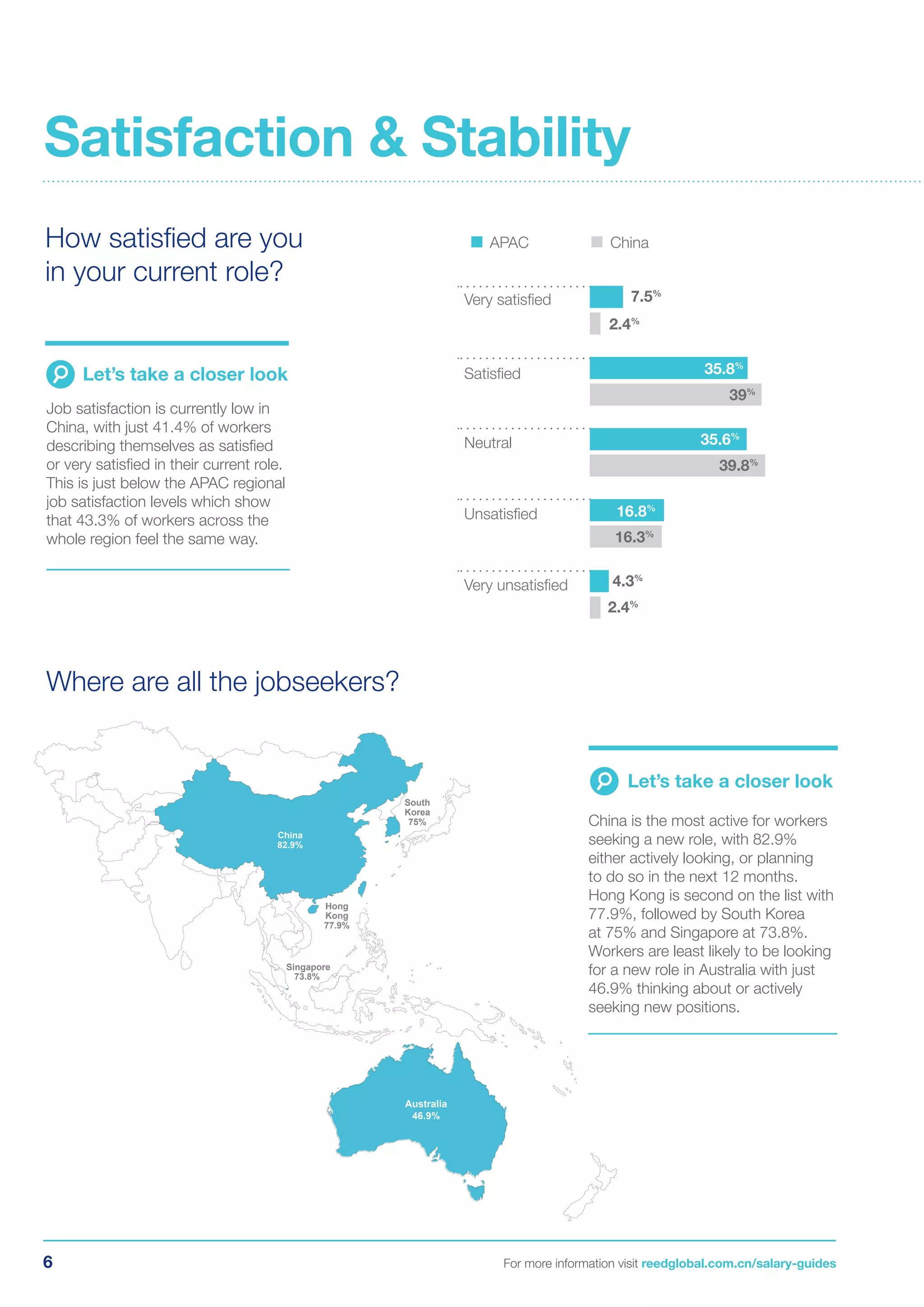
Job satisfaction is currently low in
China, with just 41.4% of workers
describing themselves as satisfied
or very satisfied in their current role.
This is just below the APAC regional
job satisfaction levels which show
that 43.3% of workers across the
whole region feel the same way.
Let’s take a closer look
China is the most active for workers
seeking a new role, with 82.9%
either actively looking, or planning
to do so in the next 12 months.
Hong Kong is second on the list with
77.9%, followed by South Korea
at 75% and Singapore at 73.8%.
Workers are least likely to be looking
for a new role in Australia with just
46.9% thinking about or actively
seeking new positions.
Let’s take a closer look
Very satisfied
APAC China
Satisfied
Unsatisfied
Very unsatisfied
Neutral
7.5%
2.4%
35.8%
39%
35.6%
39.8%
16.8%
16.3%
4.3%
2.4%
Satisfaction & Stability
7For more information visit reedglobal.com.cn/salary-guides
How secure do you consider your current role to be?
How stable is the workforce
in your organisation?
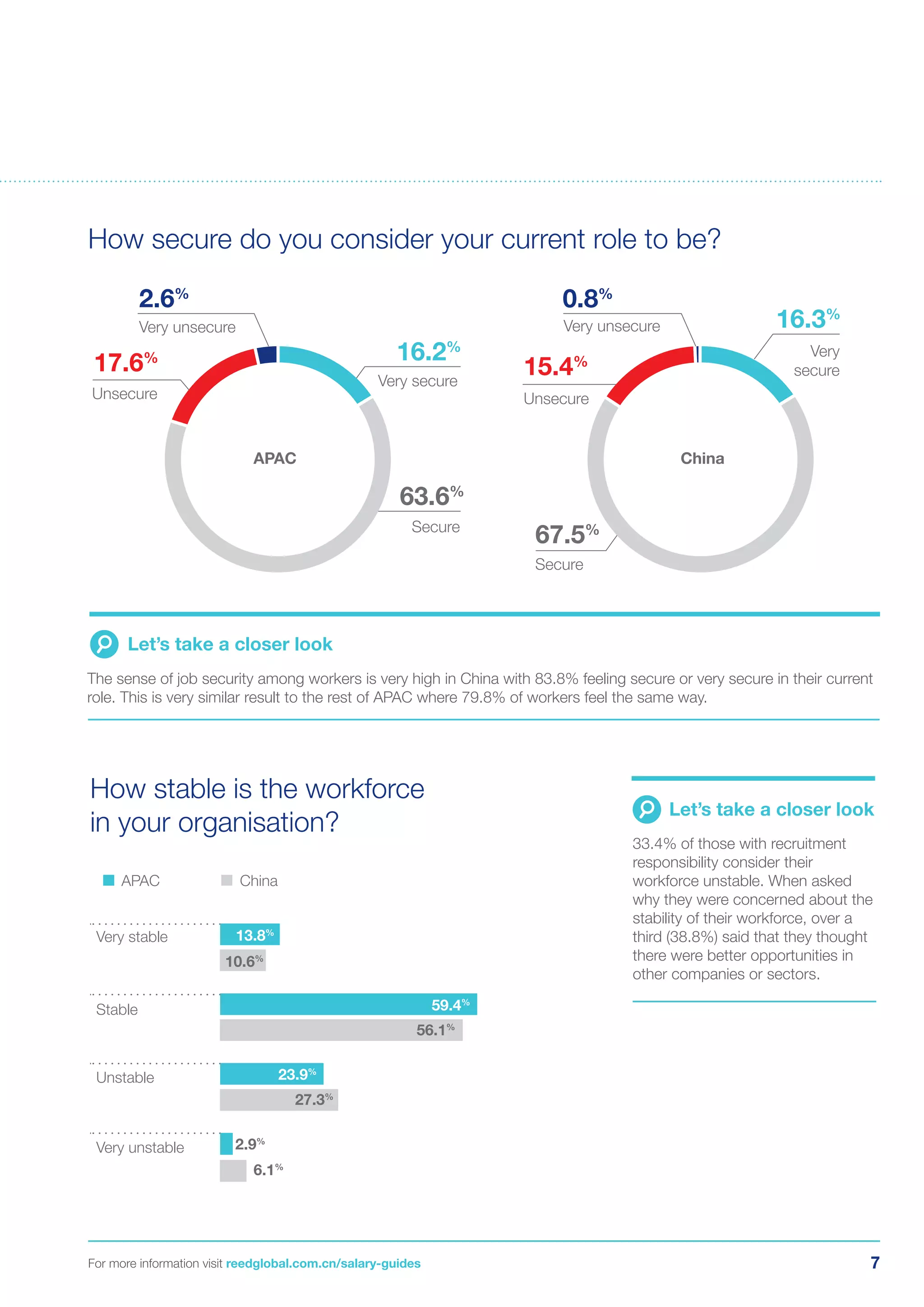
The sense of job security among workers is very high in China with 83.8% feeling secure or very secure in their current
role. This is very similar result to the rest of APAC where 79.8% of workers feel the same way.
Let’s take a closer look
33.4% of those with recruitment
responsibility consider their
workforce unstable. When asked
why they were concerned about the
stability of their workforce, over a
third (38.8%) said that they thought
there were better opportunities in
other companies or sectors.
Let’s take a closer look
Very secure
Secure
APAC
Unsecure
Very unsecure
17.6%
2.6%
16.2%
63.6%
Unsecure
Very
secure
Secure
Very unsecure
67.5%
0.8%
15.4%
16.3%
China
Very stable
APAC China
Stable
Very unstable
Unstable
13.8%
10.6%
56.1%
59.4%
23.9%
27.3%
2.9%
6.1%
8 For more information visit reedglobal.com.cn/salary-guides
Are you worried about losing talented
individuals from your organisation?
Which of the following methods is your organisation
deploying to maintain or even grow talent levels?
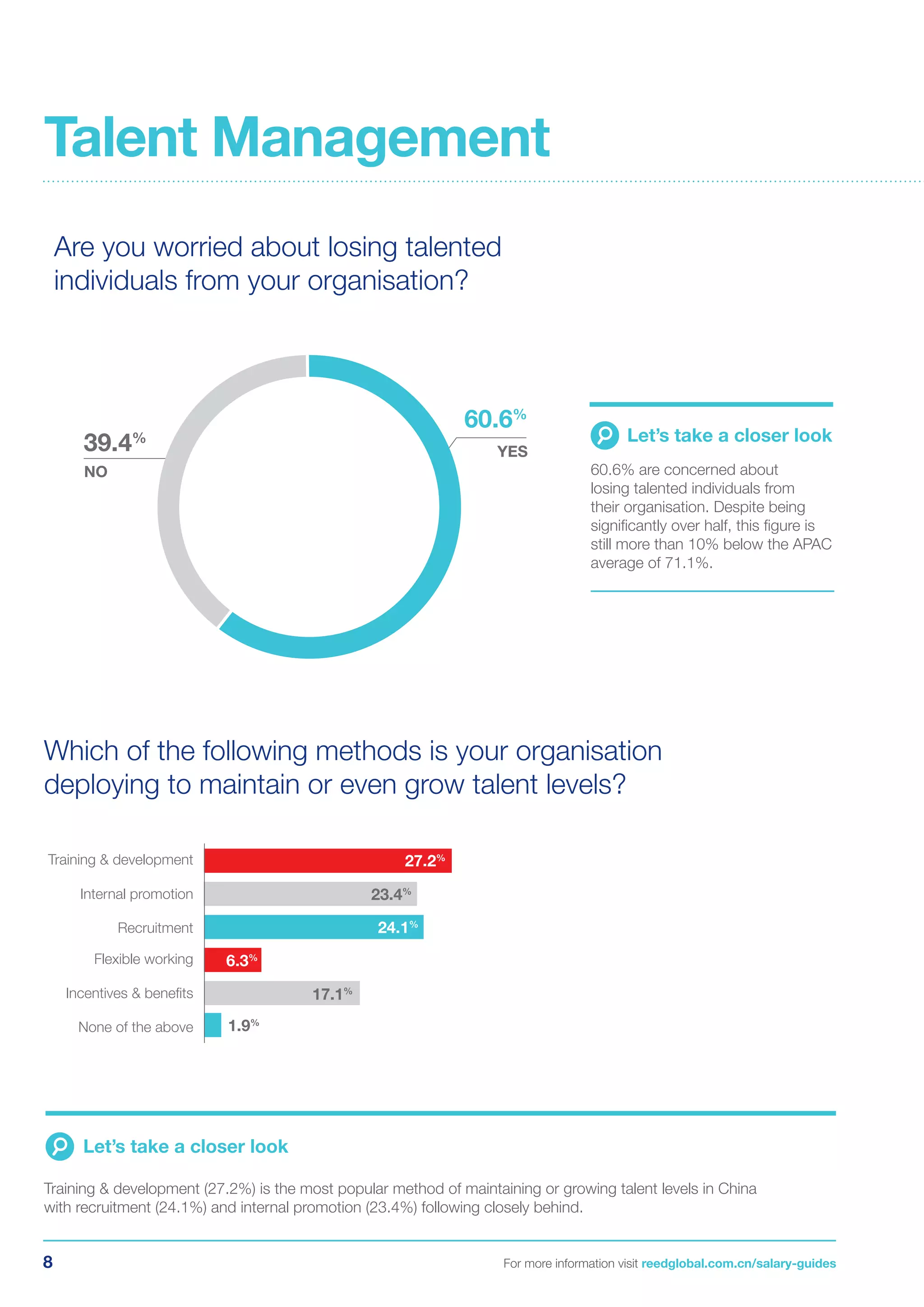
60.6% are concerned about
losing talented individuals from
their organisation. Despite being
significantly over half, this figure is
still more than 10% below the APAC
average of 71.1%.
Let’s take a closer look
Training & development (27.2%) is the most popular method of maintaining or growing talent levels in China
with recruitment (24.1%) and internal promotion (23.4%) following closely behind.
Let’s take a closer look
YES
NO
39.4%
60.6%
How secure do you consider your current role to be?
27.2%
23.4%
6.3%
24.1%
17.1%Incentives & benefits
Training & development
Internal promotion
Flexible working
Recruitment
1.9%
None of the above
Talent Management
9For more information visit reedglobal.com.cn/salary-guides
Do you have skills gaps
in your organisation?
Are skills gaps having a
negative impact on your
organisation’s performance /
growth potential?
Which of the following
have you received in
the last 12 months?
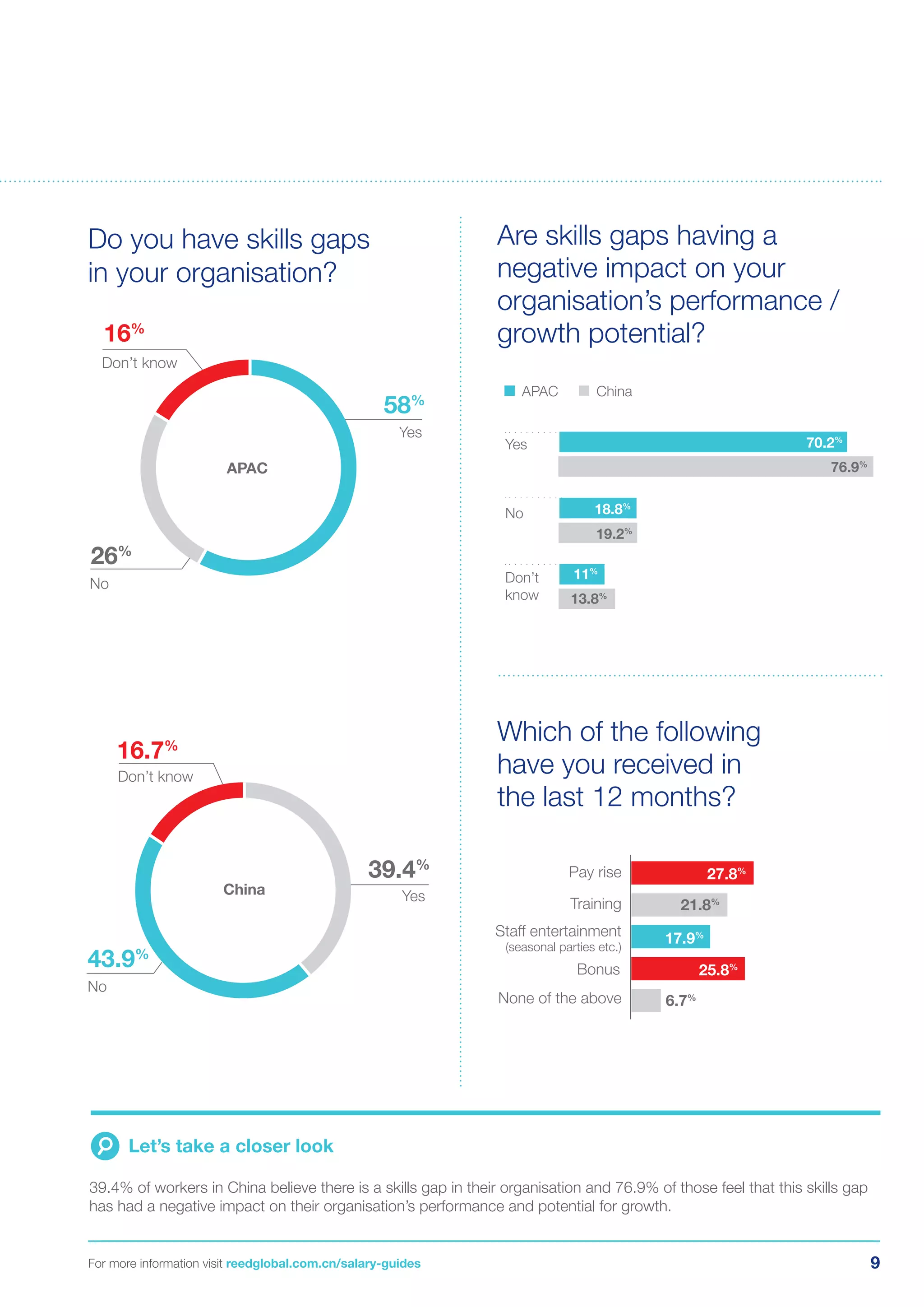
39.4% of workers in China believe there is a skills gap in their organisation and 76.9% of those feel that this skills gap
has had a negative impact on their organisation’s performance and potential for growth.
Let’s take a closer look
27.8%
21.8%
17.9%
25.8%
6.7%
Pay rise
Training
Bonus
None of the above
Staff entertainment
(seasonal parties etc.)
Yes
APAC China
No
Don’t
know
70.2%
76.9%
18.8%
19.2%
11%
13.8%
No
APAC
Don’t know
Yes
16%
58%
26%
No
China
Don’t know
Yes
39.4%
16.7%
43.9%
36%
Yes
58%
No
China
Don’t know
Yes
39.4%
16.7%
43.9%
6%
10 For the 2014 Technology market overview visit reedglobal.com.cn/salary-guides
At REED we think it’s important to be experts in our field, and provide the best possible
recruitment advice to the candidates and clients we work with.
As part of our commitment to this, we stay completely up-to-date with the latest relevant news,
and produce monthly online digests to share essential updates and promote discussion.
We call this Business Connect, a monthly e-newsletter bringing you news, views and
developments relevant to global business today.
To subscribe to receive Business Connect direct to your inbox,
go to www.reedgateway.co.uk/international
Industry Insight
12 For more information visit reedglobal.com.cn/salary-guides
Actuarial, Energy & Resources,
Human Resources, Insurance,
Legal, Property & Construction,
Sales & Marketing, Technology
reedglobal.com.cn/salary-guides
REED China & Hong Kong

Market-Insight_China_WEB

  • 1.
    1For more informationvisit reedglobal.com.cn/salary-guides reedglobal.com.cn/salary-guidesChina Market Insight 2014
  • 2.
    2 For moreinformation visit reedglobal.com.cn/salary-guides Welcome to our 2014 China Market Insight. We have drawn on the insight and expertise of our teams in Australia, China, Hong Kong, Singapore and South Korea to provide an overview of labour market trends across the Asia Pacific region, as well as shedding light on some of the specific challenges facing individual geographical markets. We have surveyed employees and employers across the region to gauge confidence levels, as well as charting their concerns and priorities for the year ahead. We hope you find the information in this guide useful and would be delighted to hear from you if you have any observations or questions about the resourcing challenges the market may present this year. Don’t forget to visit reedglobal.com.cn/salary-guides to find further information on feelings in the workplace and sector specific overviews for the year ahead. We look forward to working with you throughout 2014. Best wishes Tristan Bullworthy Regional Managing Director, Asia Pacific Introduction
  • 3.
    3For more informationvisit reedglobal.com.cn/salary-guides The data presented on ‘Satisfaction & Stability’ and ‘Talent Management’ has been provided by research carried out using an online panel of 798 employees and employers working in a variety of industry sectors and job levels across the Asia Pacific region. Once the results were compiled, we were then able to breakdown the responses by looking at specific areas of business interest. Methodology
  • 4.
    4 For moreinformation visit reedglobal.com.cn/salary-guides A year of transition 2013 has been a year of transition for the Asia Pacific region, as the employment market shifts from being employer-driven to candidate-driven. Our research shows a healthy level of optimism, with more than three quarters (79.8%) of the workforce feeling secure in their role. However, satisfaction levels are not as healthy and less than half (43.3%) of employees across the region describe themselves as satisfied or very satisfied in their roles. Job seeking on the rise Given this sense of security and confidence among the workforce, coupled with lower satisfaction levels in their current role, it is not surprising to see that almost three quarters (72.3%) are actively seeking a new job or plan to look within the next twelve months. This is most pronounced in China (82.9%), with Australia being the exception (46.9%). However, the recent change in government in Australia has brought about a period of adjustment, which will undoubtedly have a temporary impact on the confidence of businesses and employees alike. Talent gap? More than half of businesses (58%) believe there is a skills shortage in their organisation and this was most keenly felt in Australia (67.4%) and Singapore (62.3%). While the sense of a skills shortage was less evident in China (39.4%), three quarters (76.9%) of Chinese employers are concerned about the impact of a skills shortage on their business performance – compared to an average of 70.2% across the Asia Pacific region. The majority of businesses (71.1%) are also worried about losing talent from their organisation and this is most pronounced in Australia (77.2%) – perhaps an indication that employers are gearing up for employees to make a move after holding firm through the uncertainty of a change of government. Remuneration and reward Despite the intense competition for talent, only one in four businesses (25%) has invested in training and development for their staff. Interestingly, 70.9% of employees across the region had not received a pay rise in the last twelve months. However, many staff are not looking for a monetary incentive, with flexible hours cited as having the most positive impact on their life and happiness. APAC Market Overview
  • 5.
    5For more informationvisit reedglobal.com.cn/salary-guides The land of opportunity The Chinese economy is in a period of transition as it looks to strengthen its skill base and develop beyond its reputation as a manufacturing powerhouse. There is a need to attract and retain talent to drive the economy forward and that is why REED is committed to growing its presence within the Chinese market, bringing its heritage of 53 years at the forefront of executive recruitment to support businesses in China. These are exciting times for China and in the year ahead we forecast healthy opportunities for candidates seeking roles in the FMCG, health & life sciences, technology, finance and automotive sectors. The talent pipeline As the Chinese economy matures, there is a balance to be struck between driving growth and creating a sustainable environment in which to live and work. A skilled workforce is central to this and this is something that is currently being debated at the highest level. There has been some encouraging data published in recent months, which shows how China is establishing itself as a skills-led economy. Firstly, home grown graduates are now on an equal footing with those who have studied overseas. In some instances, graduates from Chinese universities have the advantage as they are perceived by employers to be more in tune with the local market. This endorsement from businesses for the Chinese Higher Education System can only help to support the drive for talent. Secondly, recent research reveals a greater appetite among Chinese graduates to work for local companies. Viewed as more stable and secure roles, this is an equally ringing endorsement from young Chinese graduates in their home grown enterprises. Planning for the future With plans in place to increase opportunities for workers at every level, China is demonstrating its commitment to a skilled workforce. For example, enhanced rights for rural workers enabling them to live where they work, will open the door to improved education and cultural experiences for themselves and their families. Attraction and retention strategies for 2014 While plans are in place to shore up the skills pipeline in the long term, there is an immediate need among businesses to secure and retain talented employees. In terms of attraction, employers need to ensure they have an efficient recruitment process in place. In a candidate-driven market there are no excuses for businesses that lose out on the best person for the job due to a drawn out process. Businesses also need to look at the remuneration package in a wider context, taking into consideration competition from neighbouring economic centres. Our work with executive-level candidates shows us that it’s not always the role that pays the most that wins the day. In fact, a rigorous training and development programme can often be more persuasive for ambitious candidates. China Market Overview
  • 6.
    6 For moreinformation visit reedglobal.com.cn/salary-guides Australia 46.9% China 82.9% South Korea 75% Hong Kong 77.9% Singapore 73.8% How satisfied are you in your current role? Where are all the jobseekers? Job satisfaction is currently low in China, with just 41.4% of workers describing themselves as satisfied or very satisfied in their current role. This is just below the APAC regional job satisfaction levels which show that 43.3% of workers across the whole region feel the same way. Let’s take a closer look China is the most active for workers seeking a new role, with 82.9% either actively looking, or planning to do so in the next 12 months. Hong Kong is second on the list with 77.9%, followed by South Korea at 75% and Singapore at 73.8%. Workers are least likely to be looking for a new role in Australia with just 46.9% thinking about or actively seeking new positions. Let’s take a closer look Very satisfied APAC China Satisfied Unsatisfied Very unsatisfied Neutral 7.5% 2.4% 35.8% 39% 35.6% 39.8% 16.8% 16.3% 4.3% 2.4% Satisfaction & Stability
  • 7.
    7For more informationvisit reedglobal.com.cn/salary-guides How secure do you consider your current role to be? How stable is the workforce in your organisation? The sense of job security among workers is very high in China with 83.8% feeling secure or very secure in their current role. This is very similar result to the rest of APAC where 79.8% of workers feel the same way. Let’s take a closer look 33.4% of those with recruitment responsibility consider their workforce unstable. When asked why they were concerned about the stability of their workforce, over a third (38.8%) said that they thought there were better opportunities in other companies or sectors. Let’s take a closer look Very secure Secure APAC Unsecure Very unsecure 17.6% 2.6% 16.2% 63.6% Unsecure Very secure Secure Very unsecure 67.5% 0.8% 15.4% 16.3% China Very stable APAC China Stable Very unstable Unstable 13.8% 10.6% 56.1% 59.4% 23.9% 27.3% 2.9% 6.1%
  • 8.
    8 For moreinformation visit reedglobal.com.cn/salary-guides Are you worried about losing talented individuals from your organisation? Which of the following methods is your organisation deploying to maintain or even grow talent levels? 60.6% are concerned about losing talented individuals from their organisation. Despite being significantly over half, this figure is still more than 10% below the APAC average of 71.1%. Let’s take a closer look Training & development (27.2%) is the most popular method of maintaining or growing talent levels in China with recruitment (24.1%) and internal promotion (23.4%) following closely behind. Let’s take a closer look YES NO 39.4% 60.6% How secure do you consider your current role to be? 27.2% 23.4% 6.3% 24.1% 17.1%Incentives & benefits Training & development Internal promotion Flexible working Recruitment 1.9% None of the above Talent Management
  • 9.
    9For more informationvisit reedglobal.com.cn/salary-guides Do you have skills gaps in your organisation? Are skills gaps having a negative impact on your organisation’s performance / growth potential? Which of the following have you received in the last 12 months? 39.4% of workers in China believe there is a skills gap in their organisation and 76.9% of those feel that this skills gap has had a negative impact on their organisation’s performance and potential for growth. Let’s take a closer look 27.8% 21.8% 17.9% 25.8% 6.7% Pay rise Training Bonus None of the above Staff entertainment (seasonal parties etc.) Yes APAC China No Don’t know 70.2% 76.9% 18.8% 19.2% 11% 13.8% No APAC Don’t know Yes 16% 58% 26% No China Don’t know Yes 39.4% 16.7% 43.9% 36% Yes 58% No China Don’t know Yes 39.4% 16.7% 43.9% 6%
  • 10.
    10 For the2014 Technology market overview visit reedglobal.com.cn/salary-guides At REED we think it’s important to be experts in our field, and provide the best possible recruitment advice to the candidates and clients we work with. As part of our commitment to this, we stay completely up-to-date with the latest relevant news, and produce monthly online digests to share essential updates and promote discussion. We call this Business Connect, a monthly e-newsletter bringing you news, views and developments relevant to global business today. To subscribe to receive Business Connect direct to your inbox, go to www.reedgateway.co.uk/international Industry Insight
  • 11.
    12 For moreinformation visit reedglobal.com.cn/salary-guides Actuarial, Energy & Resources, Human Resources, Insurance, Legal, Property & Construction, Sales & Marketing, Technology reedglobal.com.cn/salary-guides REED China & Hong Kong