1
CS 2740 Knowledge Representation M. Hauskrecht
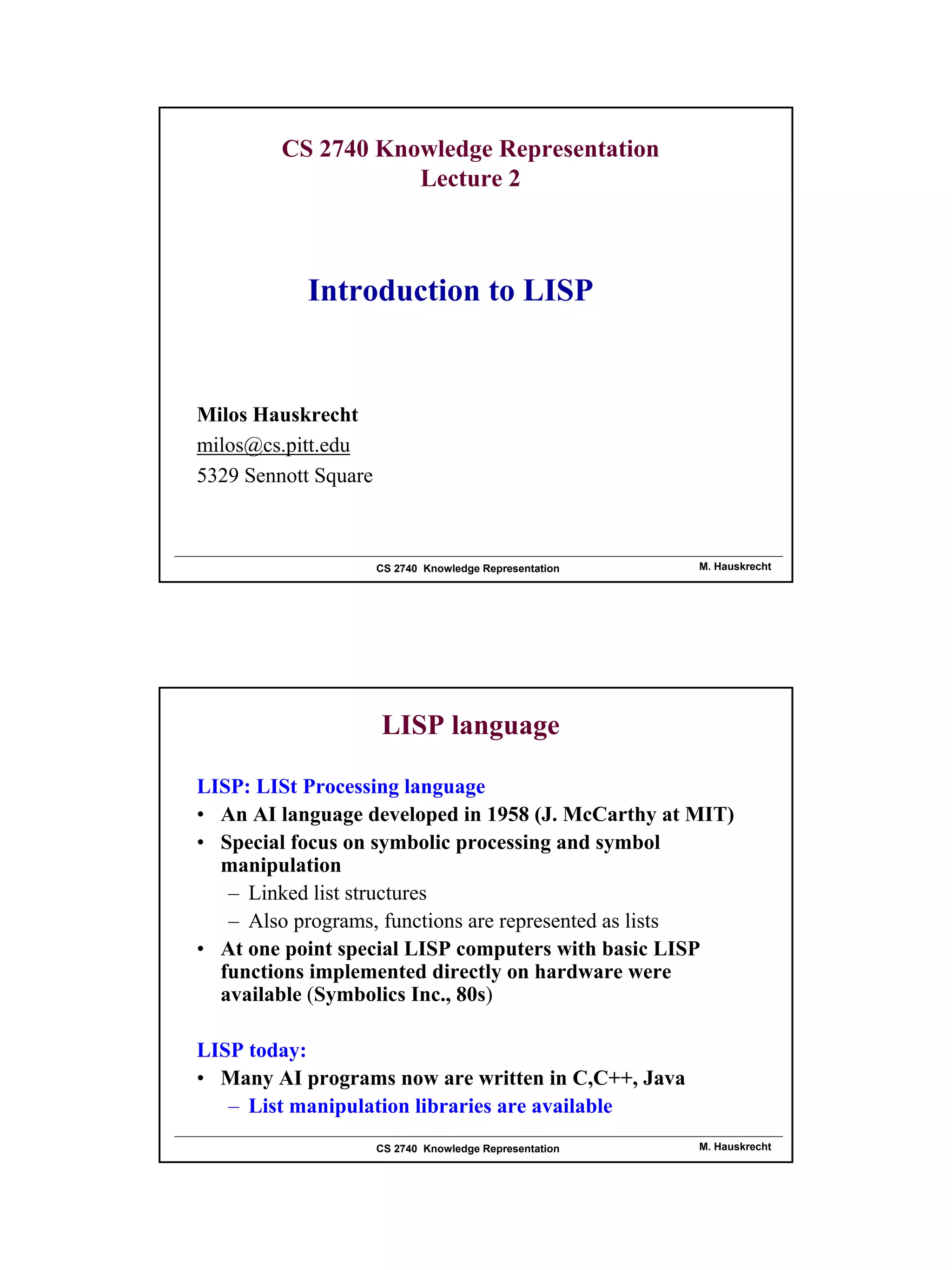
CS 2740 Knowledge Representation
Lecture 2
Milos Hauskrecht
milos@cs.pitt.edu
5329 Sennott Square
Introduction to LISP
CS 2740 Knowledge Representation M. Hauskrecht
LISP language
LISP: LISt Processing language
• An AI language developed in 1958 (J. McCarthy at MIT)
• Special focus on symbolic processing and symbol
manipulation
– Linked list structures
– Also programs, functions are represented as lists
• At one point special LISP computers with basic LISP
functions implemented directly on hardware were
available (Symbolics Inc., 80s)
LISP today:
• Many AI programs now are written in C,C++, Java
– List manipulation libraries are available
2
CS 2740 Knowledge Representation M. Hauskrecht
LISP language
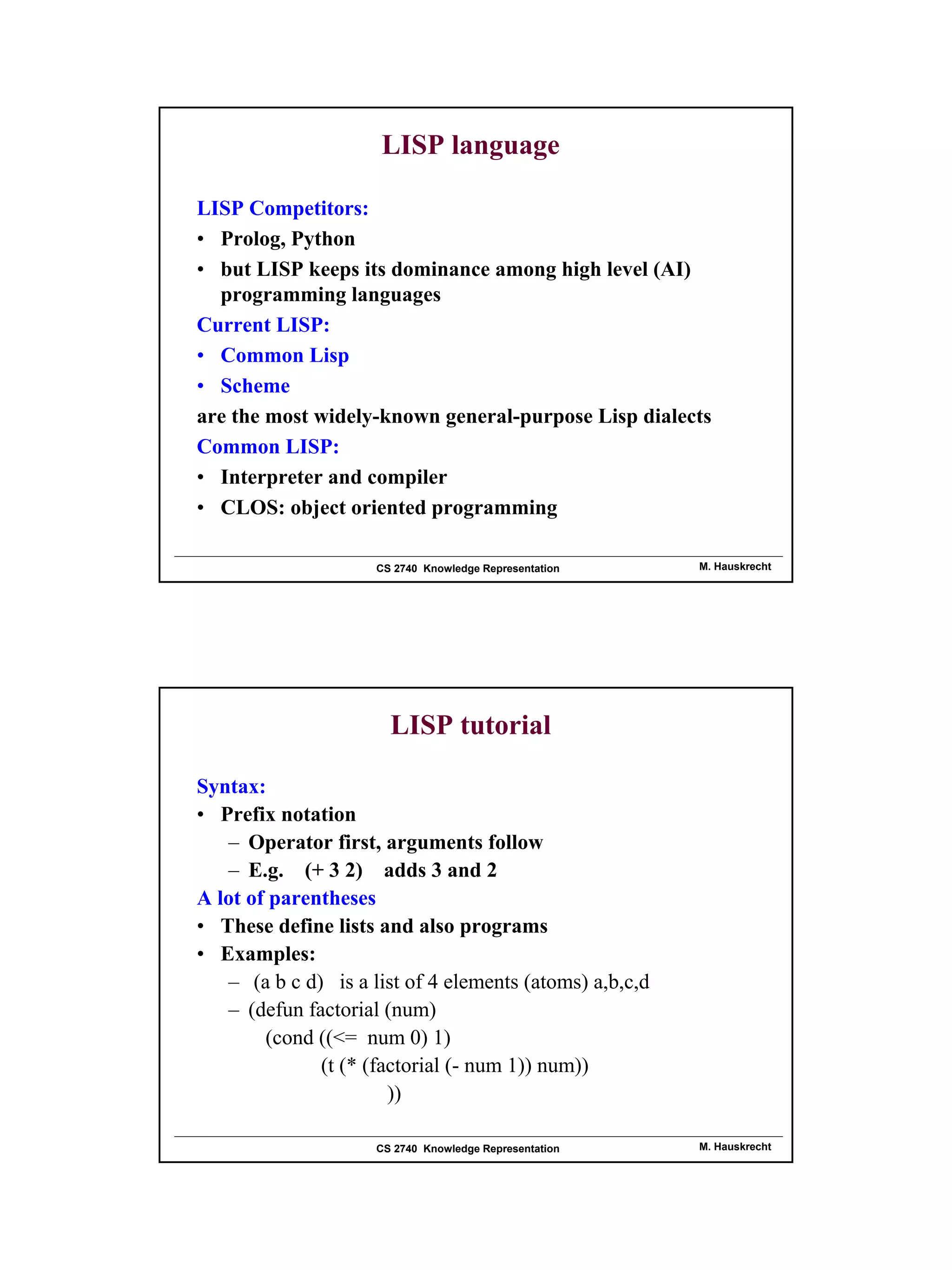
LISP Competitors:
• Prolog, Python
• but LISP keeps its dominance among high level (AI)
programming languages
Current LISP:
• Common Lisp
• Scheme
are the most widely-known general-purpose Lisp dialects
Common LISP:
• Interpreter and compiler
• CLOS: object oriented programming
CS 2740 Knowledge Representation M. Hauskrecht
LISP tutorial
Syntax:
• Prefix notation
– Operator first, arguments follow
– E.g. (+ 3 2) adds 3 and 2
A lot of parentheses
• These define lists and also programs
• Examples:
– (a b c d) is a list of 4 elements (atoms) a,b,c,d
– (defun factorial (num)
(cond ((<= num 0) 1)
(t (* (factorial (- num 1)) num))
))
3
CS 2740 Knowledge Representation M. Hauskrecht
LISP tutorial: data types
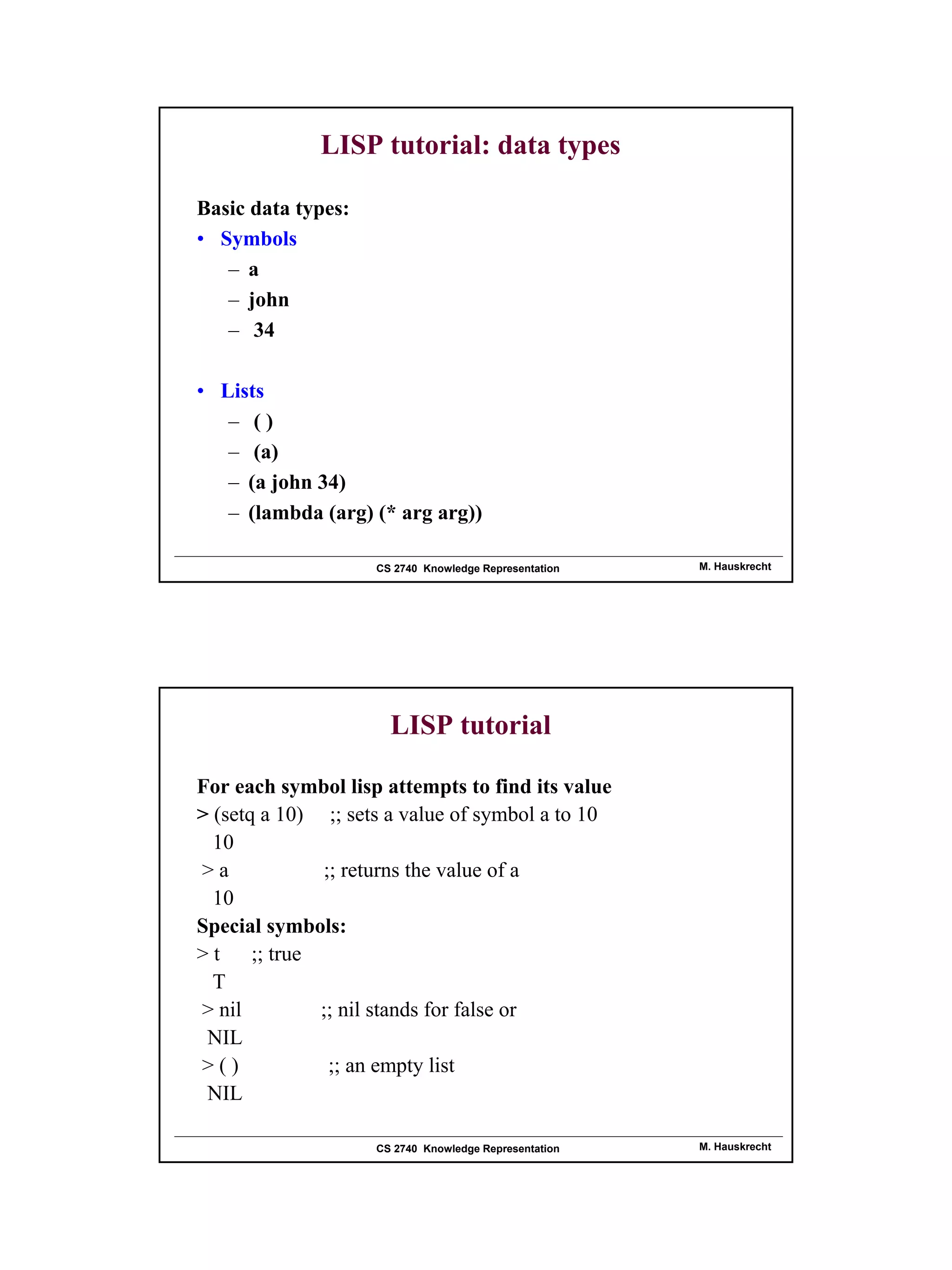
Basic data types:
• Symbols
– a
– john
– 34
• Lists
– ( )
– (a)
– (a john 34)
– (lambda (arg) (* arg arg))
CS 2740 Knowledge Representation M. Hauskrecht
LISP tutorial
For each symbol lisp attempts to find its value
> (setq a 10) ;; sets a value of symbol a to 10
10
> a ;; returns the value of a
10
Special symbols:
> t ;; true
T
> nil ;; nil stands for false or
NIL
> ( ) ;; an empty list
NIL
4
CS 2740 Knowledge Representation M. Hauskrecht
LISP tutorial
Lists represent function calls as well as basic data structures
> (factorial 3)
6
> (+ 2 4)
6
> (setq a ‘(john peter 34)) ;; quote means: do not eval the argument
(john peter 34)
> (setq a ‘((john 1) (peter 2)))
((john 1) (peter 2))
CS 2740 Knowledge Representation M. Hauskrecht
LISP tutorial: lists
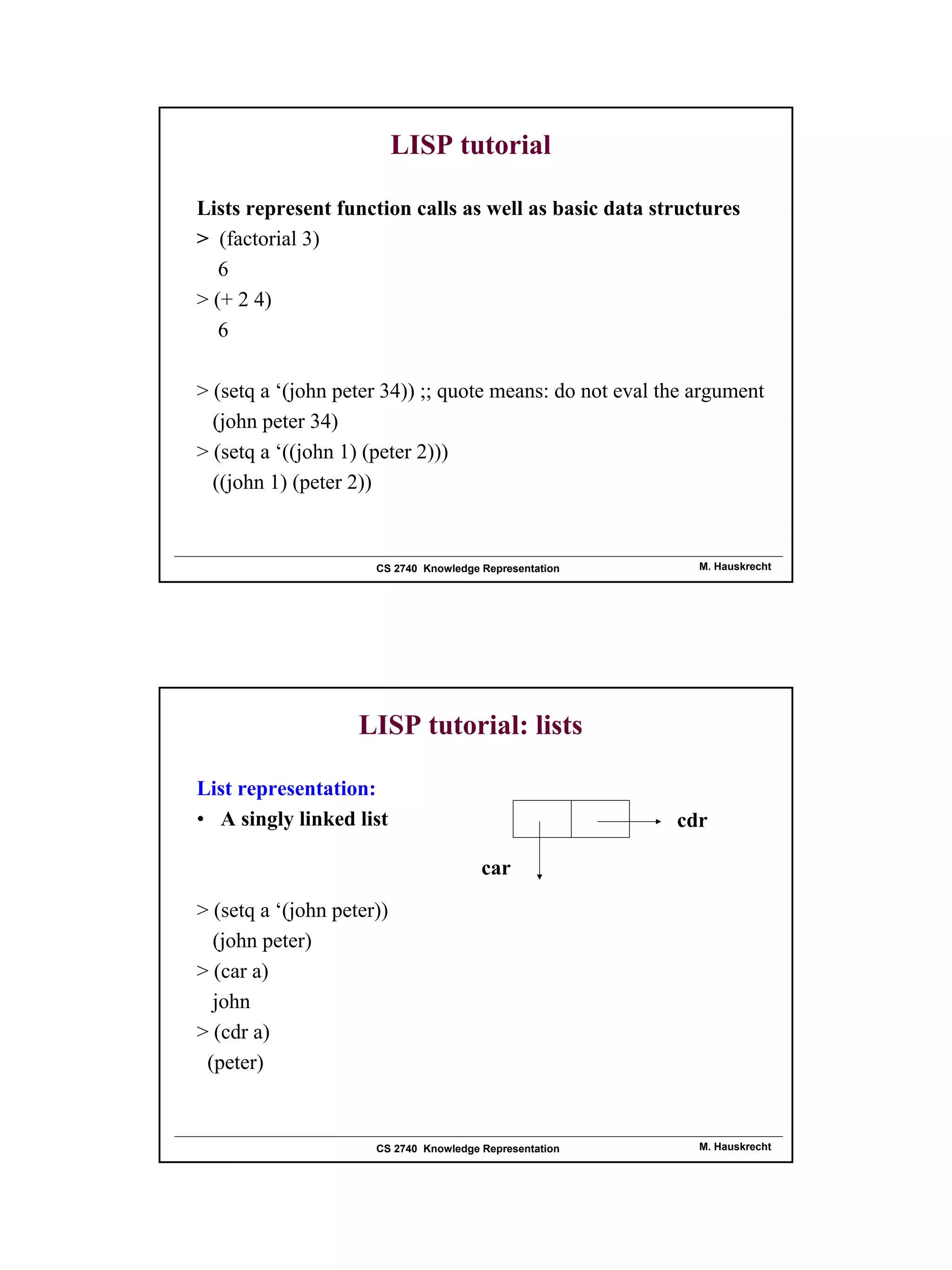
List representation:
• A singly linked list
> (setq a ‘(john peter))
(john peter)
> (car a)
john
> (cdr a)
(peter)
car
cdr
5
CS 2740 Knowledge Representation M. Hauskrecht
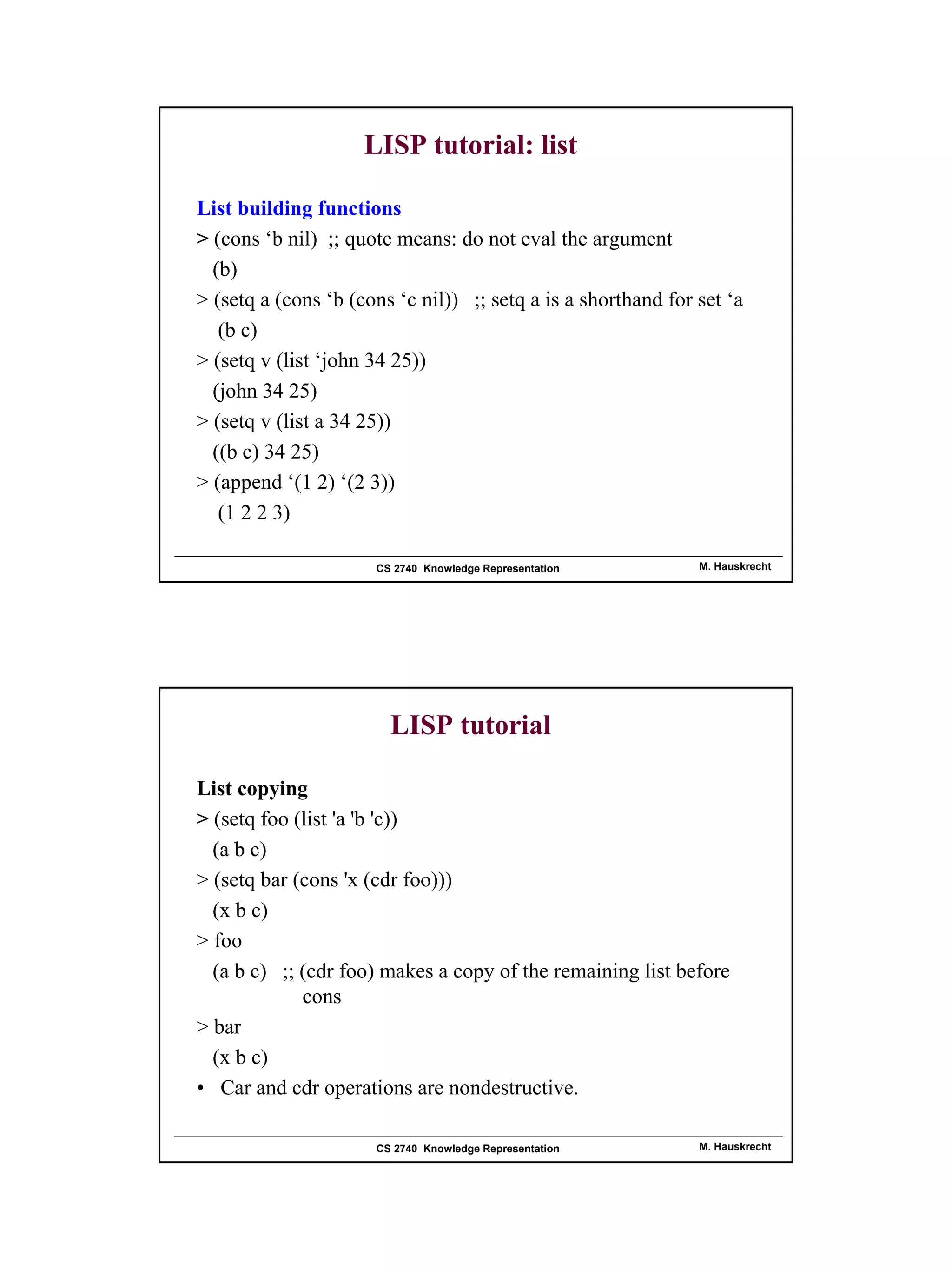
LISP tutorial: list
List building functions
> (cons ‘b nil) ;; quote means: do not eval the argument
(b)
> (setq a (cons ‘b (cons ‘c nil)) ;; setq a is a shorthand for set ‘a
(b c)
> (setq v (list ‘john 34 25))
(john 34 25)
> (setq v (list a 34 25))
((b c) 34 25)
> (append ‘(1 2) ‘(2 3))
(1 2 2 3)
CS 2740 Knowledge Representation M. Hauskrecht
LISP tutorial
List copying
> (setq foo (list 'a 'b 'c))
(a b c)
> (setq bar (cons 'x (cdr foo)))
(x b c)
> foo
(a b c) ;; (cdr foo) makes a copy of the remaining list before
cons
> bar
(x b c)
• Car and cdr operations are nondestructive.
6
CS 2740 Knowledge Representation M. Hauskrecht
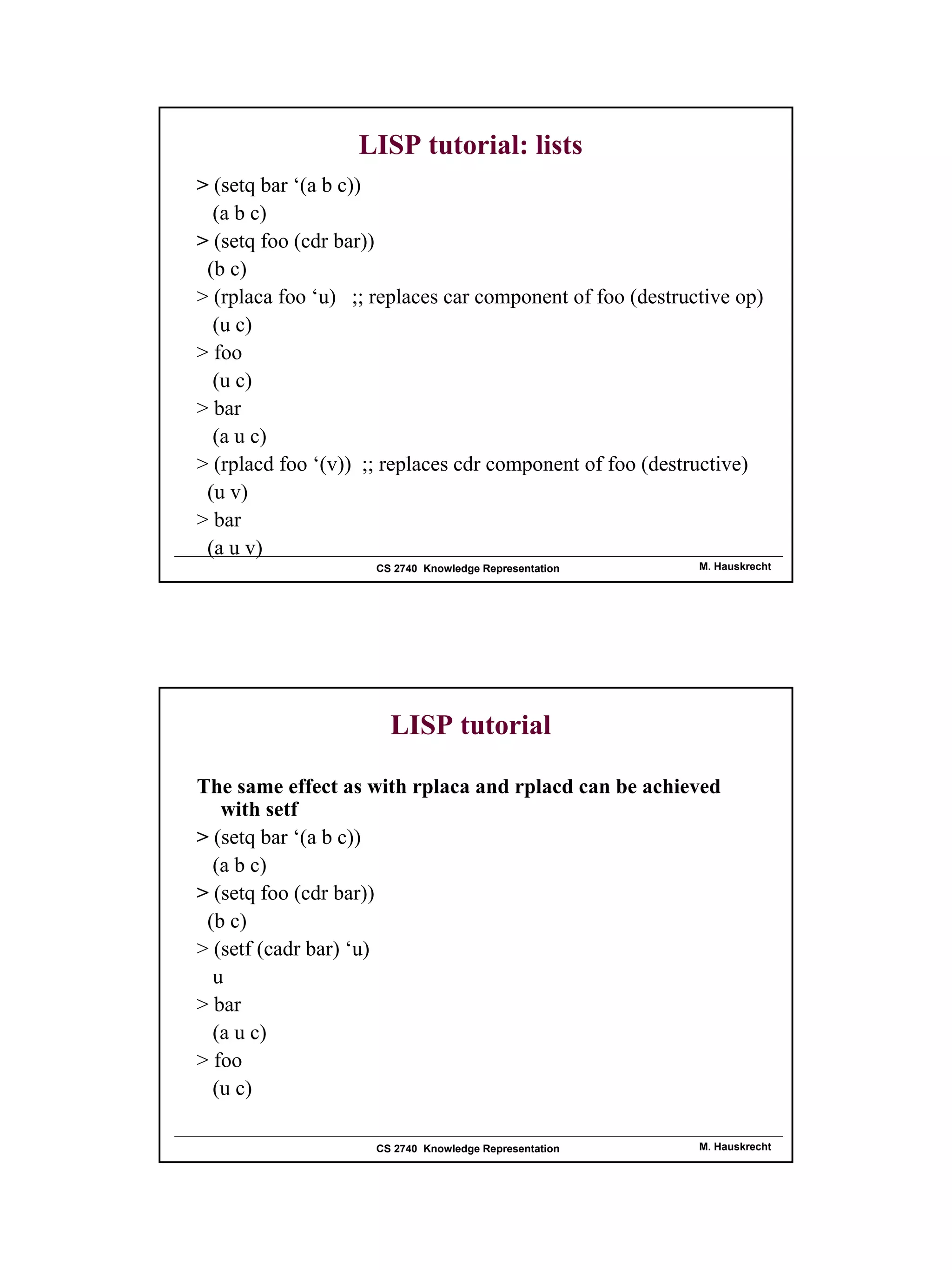
LISP tutorial: lists
> (setq bar ‘(a b c))
(a b c)
> (setq foo (cdr bar))
(b c)
> (rplaca foo ‘u) ;; replaces car component of foo (destructive op)
(u c)
> foo
(u c)
> bar
(a u c)
> (rplacd foo ‘(v)) ;; replaces cdr component of foo (destructive)
(u v)
> bar
(a u v)
CS 2740 Knowledge Representation M. Hauskrecht
LISP tutorial
The same effect as with rplaca and rplacd can be achieved
with setf
> (setq bar ‘(a b c))
(a b c)
> (setq foo (cdr bar))
(b c)
> (setf (cadr bar) ‘u)
u
> bar
(a u c)
> foo
(u c)
7
CS 2740 Knowledge Representation M. Hauskrecht
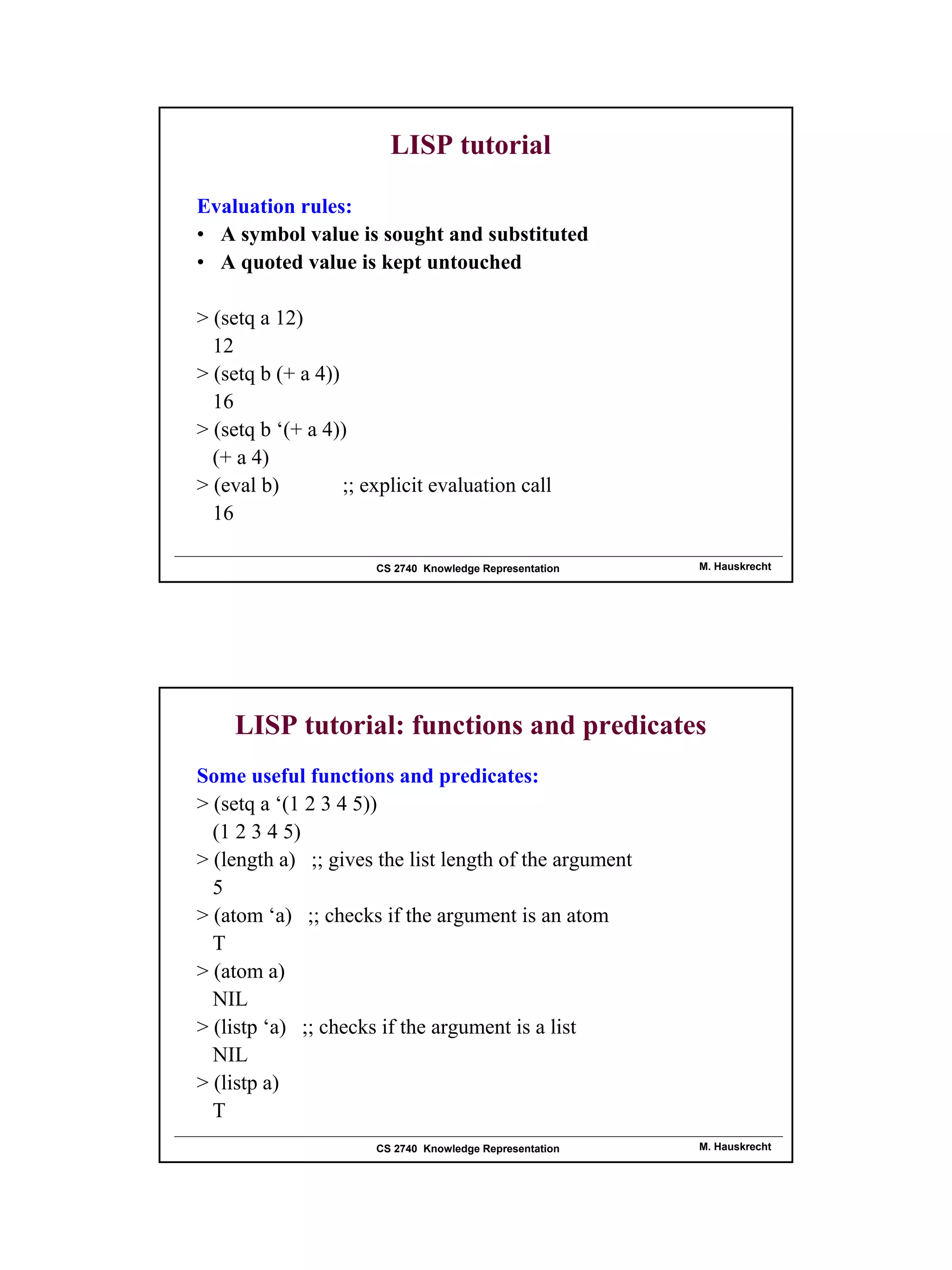
LISP tutorial
Evaluation rules:
• A symbol value is sought and substituted
• A quoted value is kept untouched
> (setq a 12)
12
> (setq b (+ a 4))
16
> (setq b ‘(+ a 4))
(+ a 4)
> (eval b) ;; explicit evaluation call
16
CS 2740 Knowledge Representation M. Hauskrecht
LISP tutorial: functions and predicates
Some useful functions and predicates:
> (setq a ‘(1 2 3 4 5))
(1 2 3 4 5)
> (length a) ;; gives the list length of the argument
5
> (atom ‘a) ;; checks if the argument is an atom
T
> (atom a)
NIL
> (listp ‘a) ;; checks if the argument is a list
NIL
> (listp a)
T
8
CS 2740 Knowledge Representation M. Hauskrecht
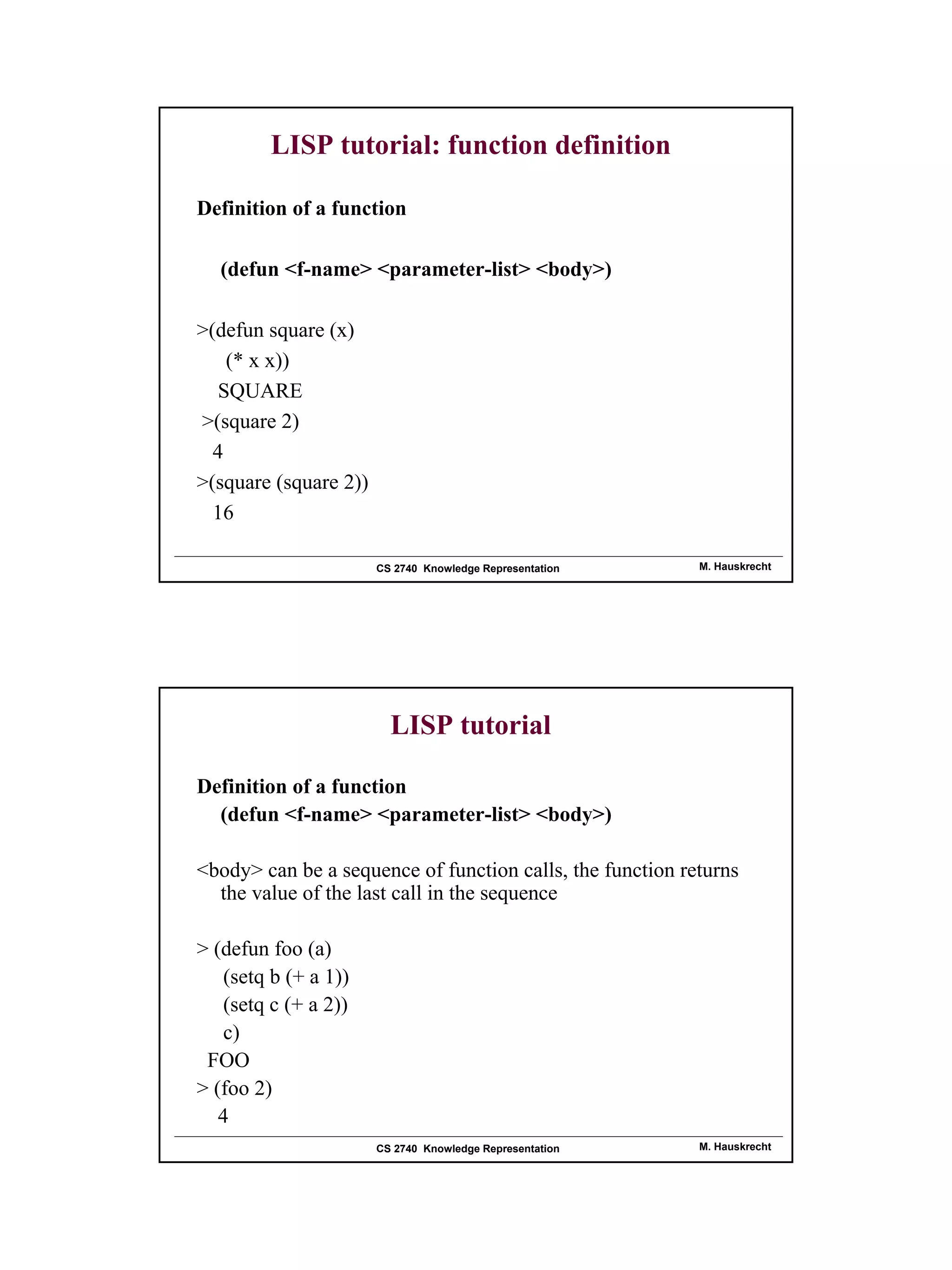
LISP tutorial: function definition
Definition of a function
(defun <f-name> <parameter-list> <body>)
>(defun square (x)
(* x x))
SQUARE
>(square 2)
4
>(square (square 2))
16
CS 2740 Knowledge Representation M. Hauskrecht
LISP tutorial
Definition of a function
(defun <f-name> <parameter-list> <body>)
<body> can be a sequence of function calls, the function returns
the value of the last call in the sequence
> (defun foo (a)
(setq b (+ a 1))
(setq c (+ a 2))
c)
FOO
> (foo 2)
4
9
CS 2740 Knowledge Representation M. Hauskrecht
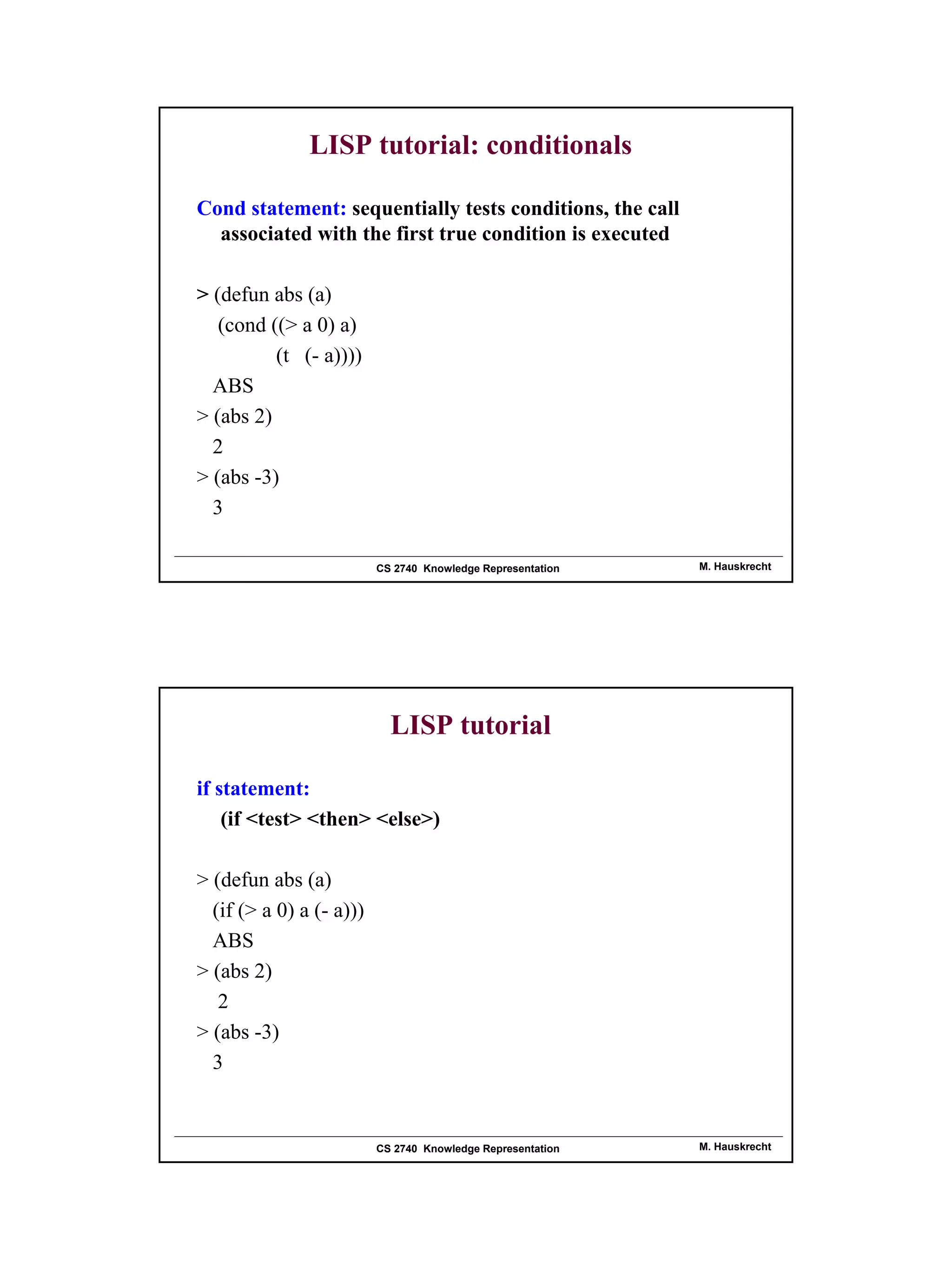
LISP tutorial: conditionals
Cond statement: sequentially tests conditions, the call
associated with the first true condition is executed
> (defun abs (a)
(cond ((> a 0) a)
(t (- a))))
ABS
> (abs 2)
2
> (abs -3)
3
CS 2740 Knowledge Representation M. Hauskrecht
LISP tutorial
if statement:
(if <test> <then> <else>)
> (defun abs (a)
(if (> a 0) a (- a)))
ABS
> (abs 2)
2
> (abs -3)
3
10
CS 2740 Knowledge Representation M. Hauskrecht
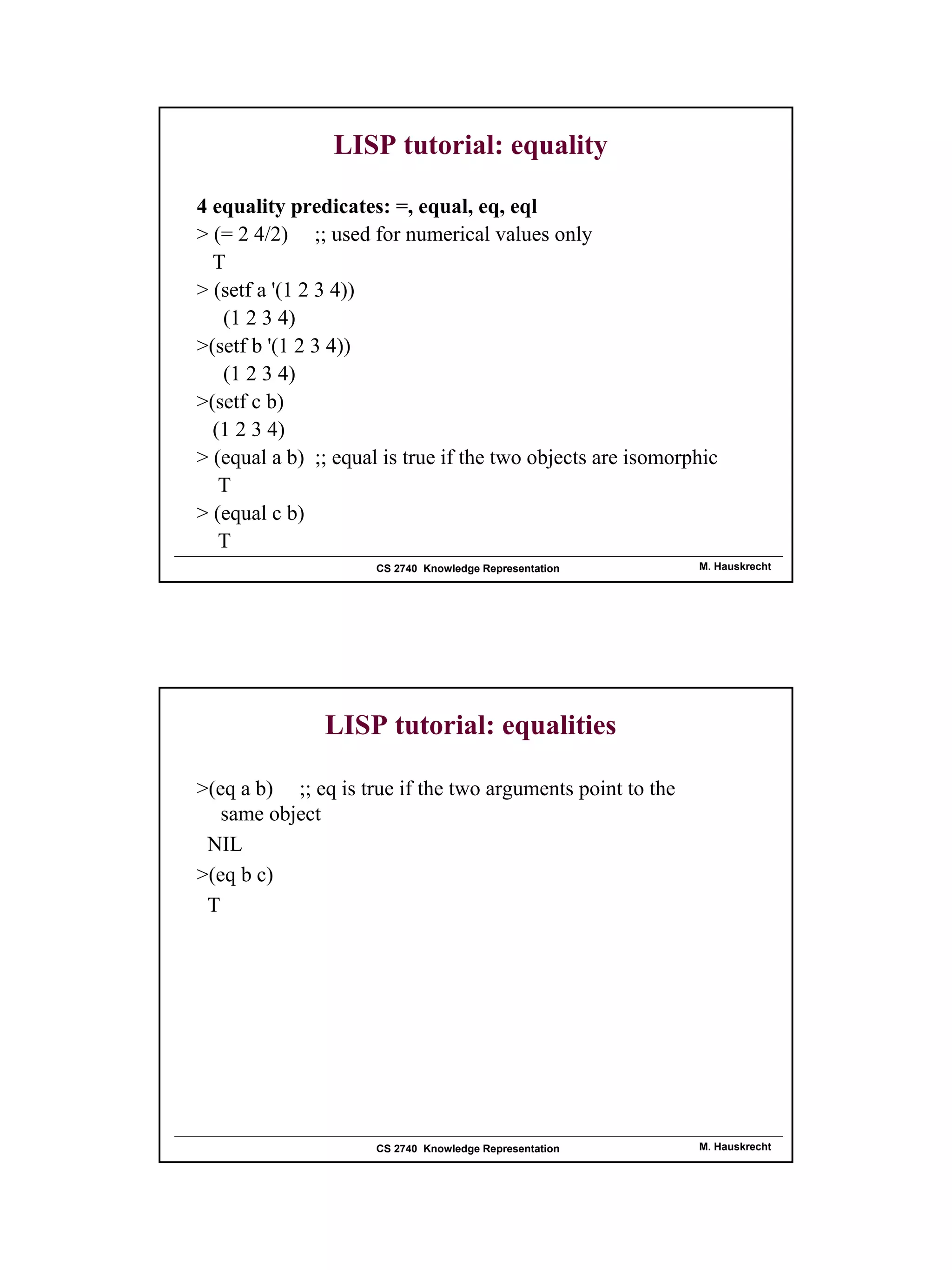
LISP tutorial: equality
4 equality predicates: =, equal, eq, eql
> (= 2 4/2) ;; used for numerical values only
T
> (setf a '(1 2 3 4))
(1 2 3 4)
>(setf b '(1 2 3 4))
(1 2 3 4)
>(setf c b)
(1 2 3 4)
> (equal a b) ;; equal is true if the two objects are isomorphic
T
> (equal c b)
T
CS 2740 Knowledge Representation M. Hauskrecht
LISP tutorial: equalities
>(eq a b) ;; eq is true if the two arguments point to the
same object
NIL
>(eq b c)
T
11
CS 2740 Knowledge Representation M. Hauskrecht
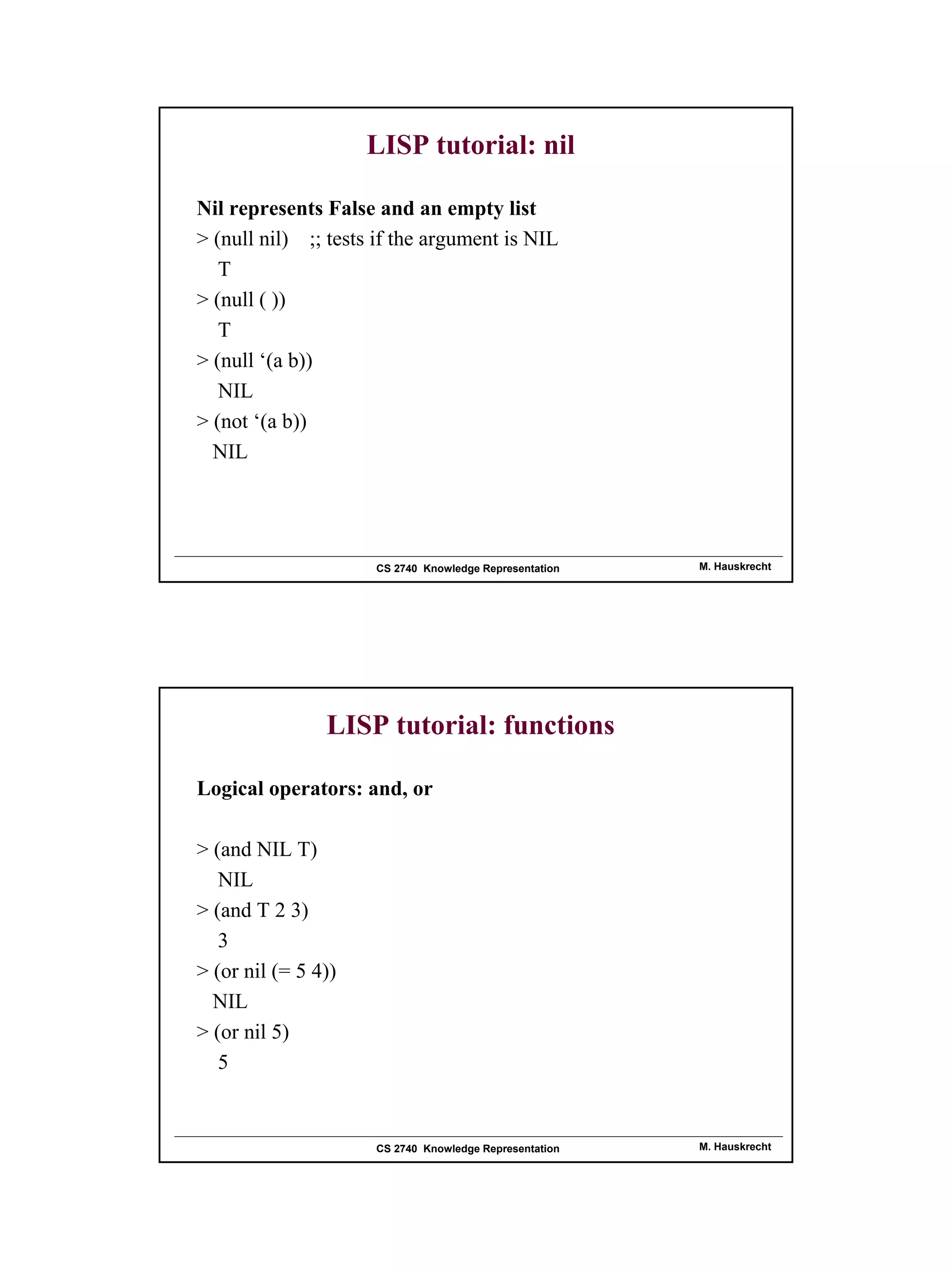
LISP tutorial: nil
Nil represents False and an empty list
> (null nil) ;; tests if the argument is NIL
T
> (null ( ))
T
> (null ‘(a b))
NIL
> (not ‘(a b))
NIL
CS 2740 Knowledge Representation M. Hauskrecht
LISP tutorial: functions
Logical operators: and, or
> (and NIL T)
NIL
> (and T 2 3)
3
> (or nil (= 5 4))
NIL
> (or nil 5)
5
12
CS 2740 Knowledge Representation M. Hauskrecht
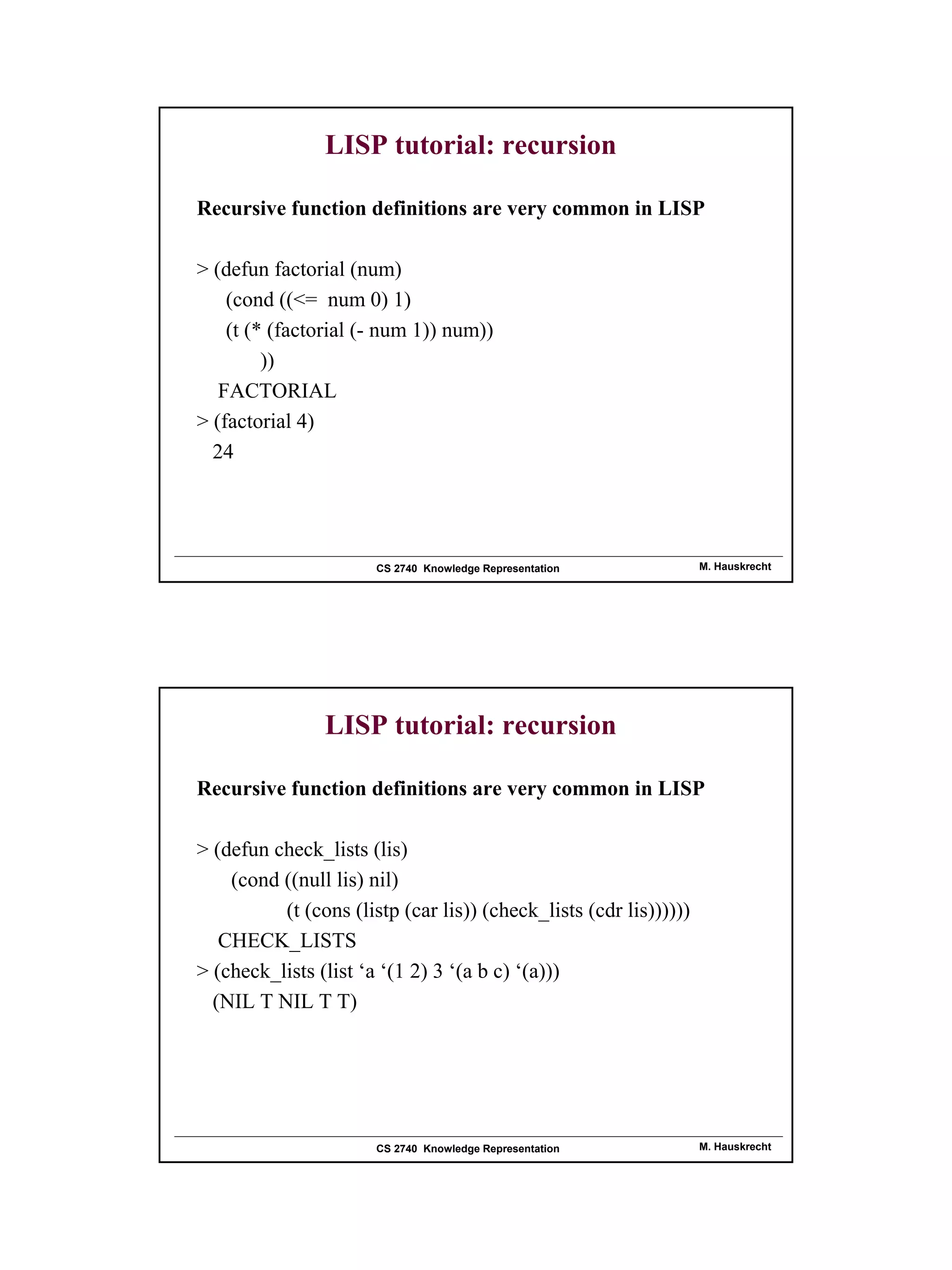
LISP tutorial: recursion
Recursive function definitions are very common in LISP
> (defun factorial (num)
(cond ((<= num 0) 1)
(t (* (factorial (- num 1)) num))
))
FACTORIAL
> (factorial 4)
24
CS 2740 Knowledge Representation M. Hauskrecht
LISP tutorial: recursion
Recursive function definitions are very common in LISP
> (defun check_lists (lis)
(cond ((null lis) nil)
(t (cons (listp (car lis)) (check_lists (cdr lis))))))
CHECK_LISTS
> (check_lists (list ‘a ‘(1 2) 3 ‘(a b c) ‘(a)))
(NIL T NIL T T)
13
CS 2740 Knowledge Representation M. Hauskrecht
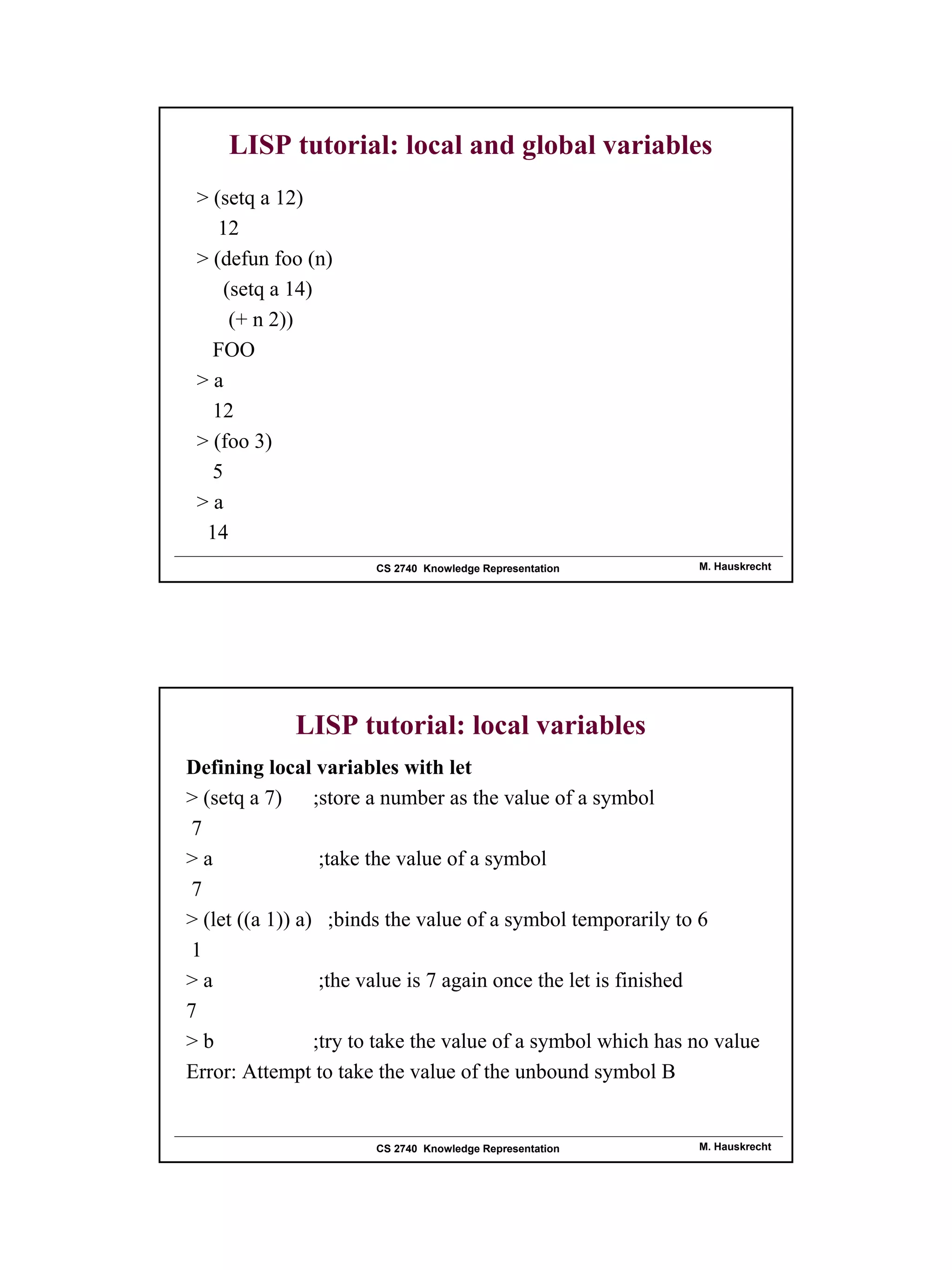
LISP tutorial: local and global variables
> (setq a 12)
12
> (defun foo (n)
(setq a 14)
(+ n 2))
FOO
> a
12
> (foo 3)
5
> a
14
CS 2740 Knowledge Representation M. Hauskrecht
LISP tutorial: local variables
Defining local variables with let
> (setq a 7) ;store a number as the value of a symbol
7
> a ;take the value of a symbol
7
> (let ((a 1)) a) ;binds the value of a symbol temporarily to 6
1
> a ;the value is 7 again once the let is finished
7
> b ;try to take the value of a symbol which has no value
Error: Attempt to take the value of the unbound symbol B
14
CS 2740 Knowledge Representation M. Hauskrecht
LISP tutorial: local variables
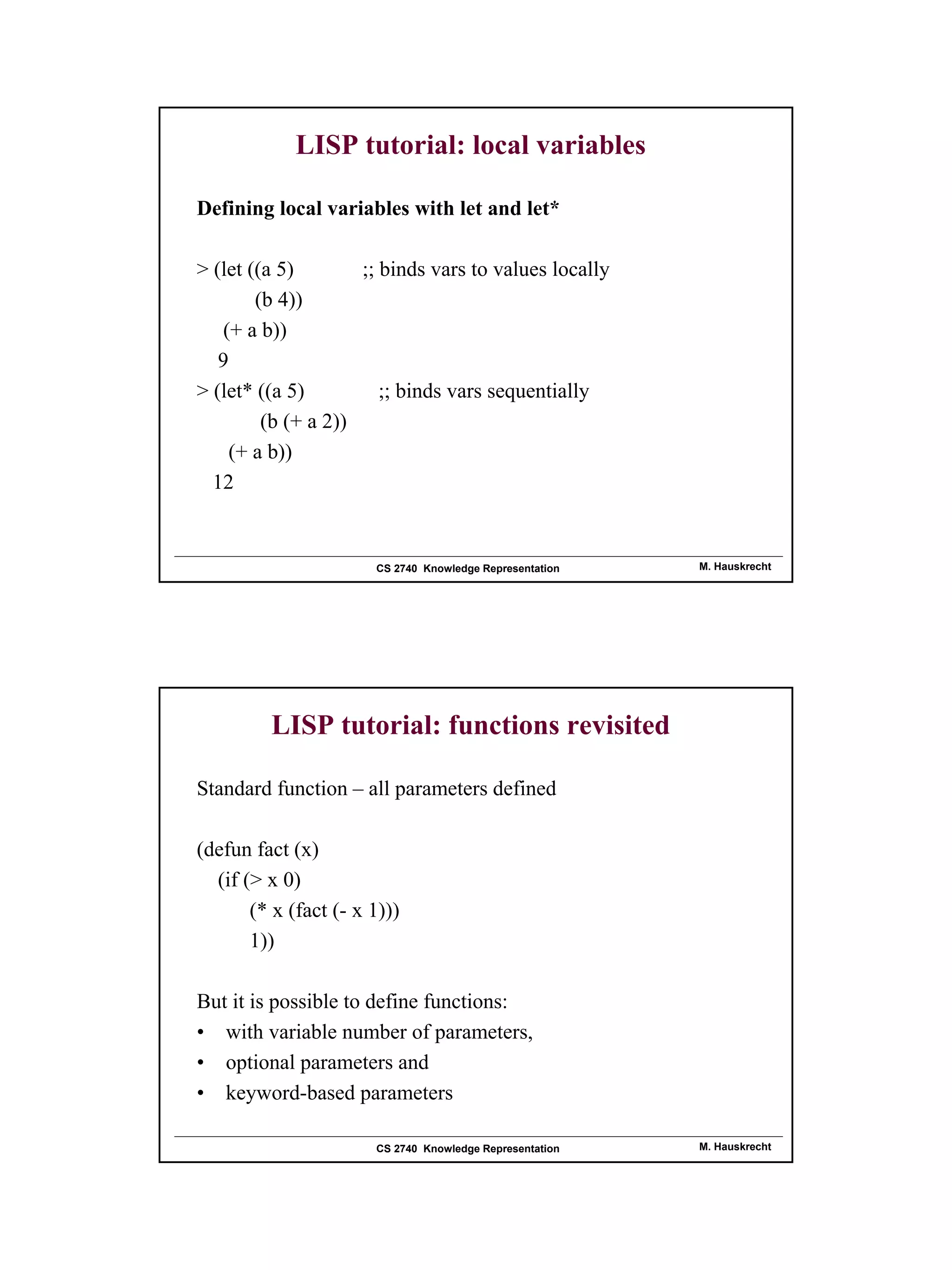
Defining local variables with let and let*
> (let ((a 5) ;; binds vars to values locally
(b 4))
(+ a b))
9
> (let* ((a 5) ;; binds vars sequentially
(b (+ a 2))
(+ a b))
12
CS 2740 Knowledge Representation M. Hauskrecht
LISP tutorial: functions revisited
Standard function – all parameters defined
(defun fact (x)
(if (> x 0)
(* x (fact (- x 1)))
1))
But it is possible to define functions:
• with variable number of parameters,
• optional parameters and
• keyword-based parameters
15
CS 2740 Knowledge Representation M. Hauskrecht
LISP tutorial: functions revisited
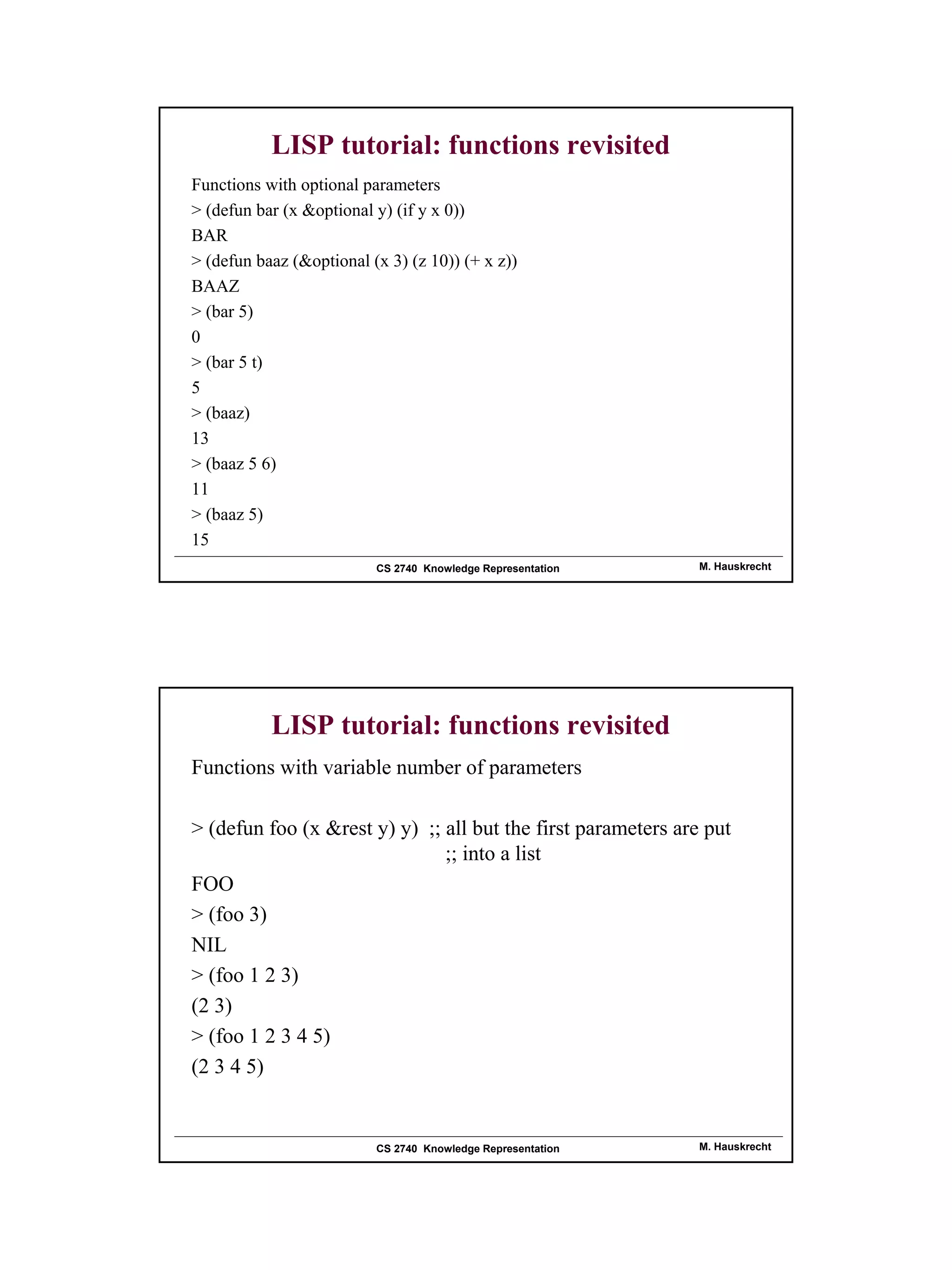
Functions with optional parameters
> (defun bar (x &optional y) (if y x 0))
BAR
> (defun baaz (&optional (x 3) (z 10)) (+ x z))
BAAZ
> (bar 5)
0
> (bar 5 t)
5
> (baaz)
13
> (baaz 5 6)
11
> (baaz 5)
15
CS 2740 Knowledge Representation M. Hauskrecht
LISP tutorial: functions revisited
Functions with variable number of parameters
> (defun foo (x &rest y) y) ;; all but the first parameters are put
;; into a list
FOO
> (foo 3)
NIL
> (foo 1 2 3)
(2 3)
> (foo 1 2 3 4 5)
(2 3 4 5)
16
CS 2740 Knowledge Representation M. Hauskrecht
LISP tutorial: functions revisited
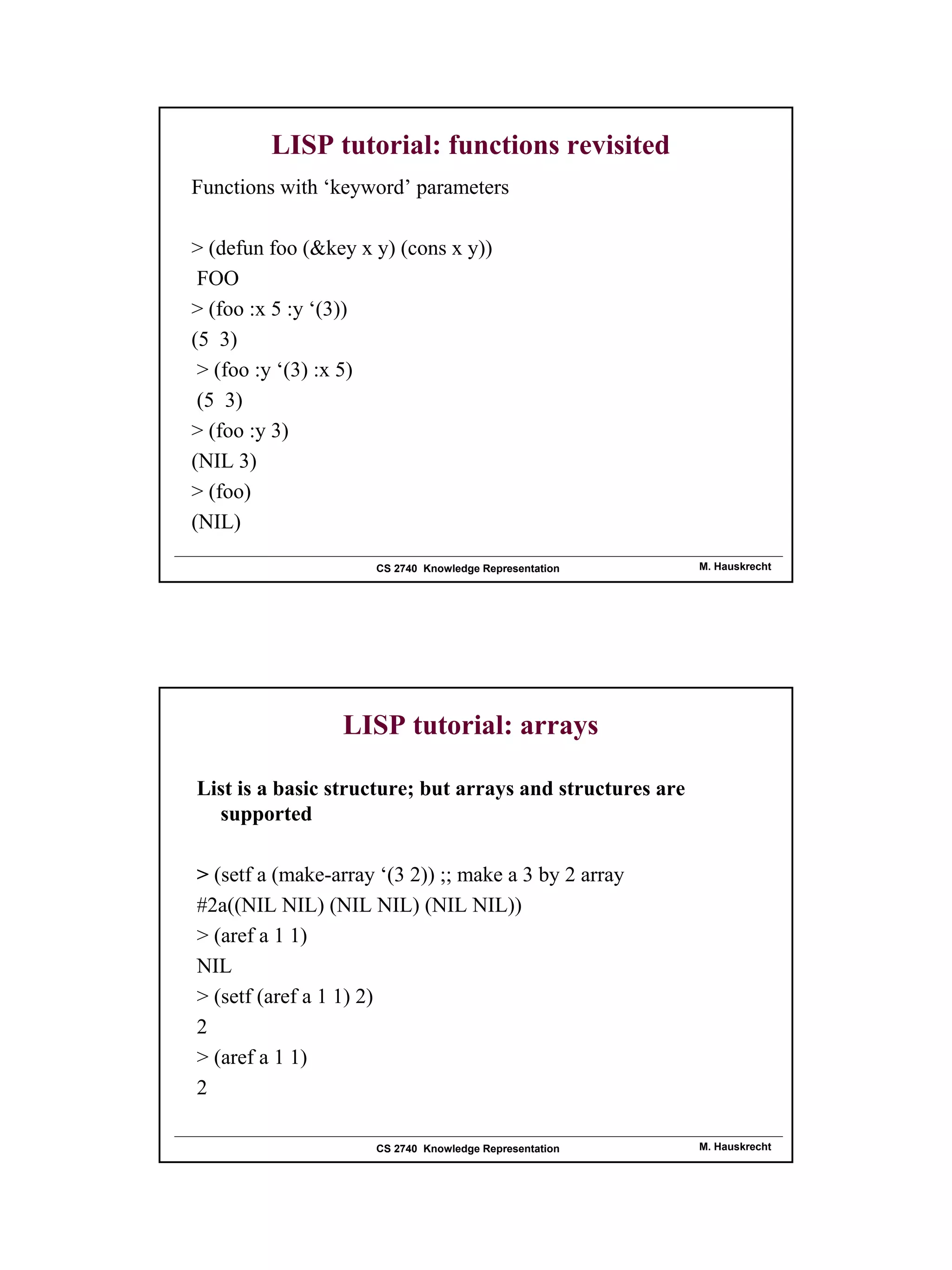
Functions with ‘keyword’ parameters
> (defun foo (&key x y) (cons x y))
FOO
> (foo :x 5 :y ‘(3))
(5 3)
> (foo :y ‘(3) :x 5)
(5 3)
> (foo :y 3)
(NIL 3)
> (foo)
(NIL)
CS 2740 Knowledge Representation M. Hauskrecht
LISP tutorial: arrays
List is a basic structure; but arrays and structures are
supported
> (setf a (make-array ‘(3 2)) ;; make a 3 by 2 array
#2a((NIL NIL) (NIL NIL) (NIL NIL))
> (aref a 1 1)
NIL
> (setf (aref a 1 1) 2)
2
> (aref a 1 1)
2
17
CS 2740 Knowledge Representation M. Hauskrecht
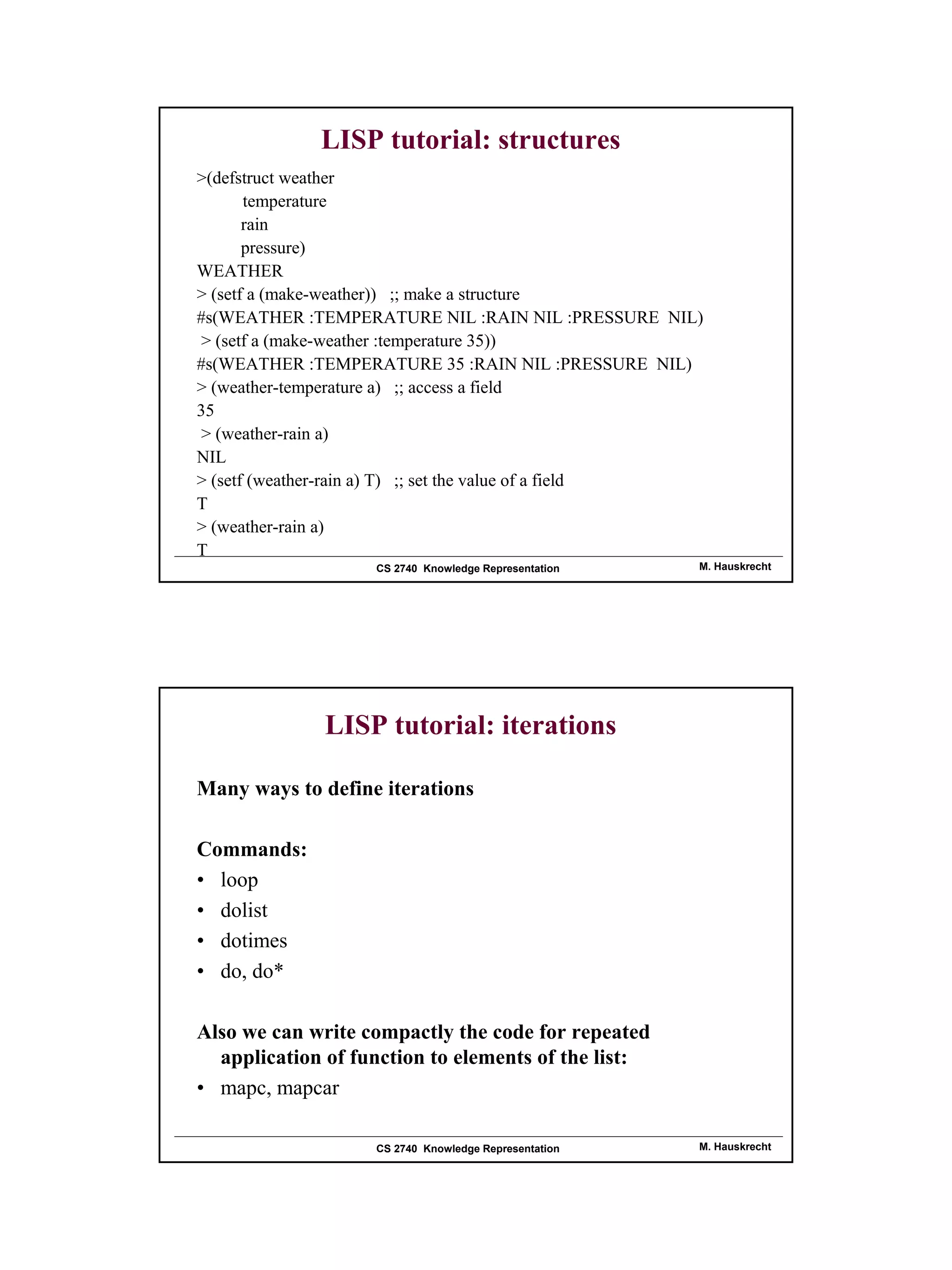
LISP tutorial: structures
>(defstruct weather
temperature
rain
pressure)
WEATHER
> (setf a (make-weather)) ;; make a structure
#s(WEATHER :TEMPERATURE NIL :RAIN NIL :PRESSURE NIL)
> (setf a (make-weather :temperature 35))
#s(WEATHER :TEMPERATURE 35 :RAIN NIL :PRESSURE NIL)
> (weather-temperature a) ;; access a field
35
> (weather-rain a)
NIL
> (setf (weather-rain a) T) ;; set the value of a field
T
> (weather-rain a)
T
CS 2740 Knowledge Representation M. Hauskrecht
LISP tutorial: iterations
Many ways to define iterations
Commands:
• loop
• dolist
• dotimes
• do, do*
Also we can write compactly the code for repeated
application of function to elements of the list:
• mapc, mapcar
18
CS 2740 Knowledge Representation M. Hauskrecht
LISP tutorial: iterations
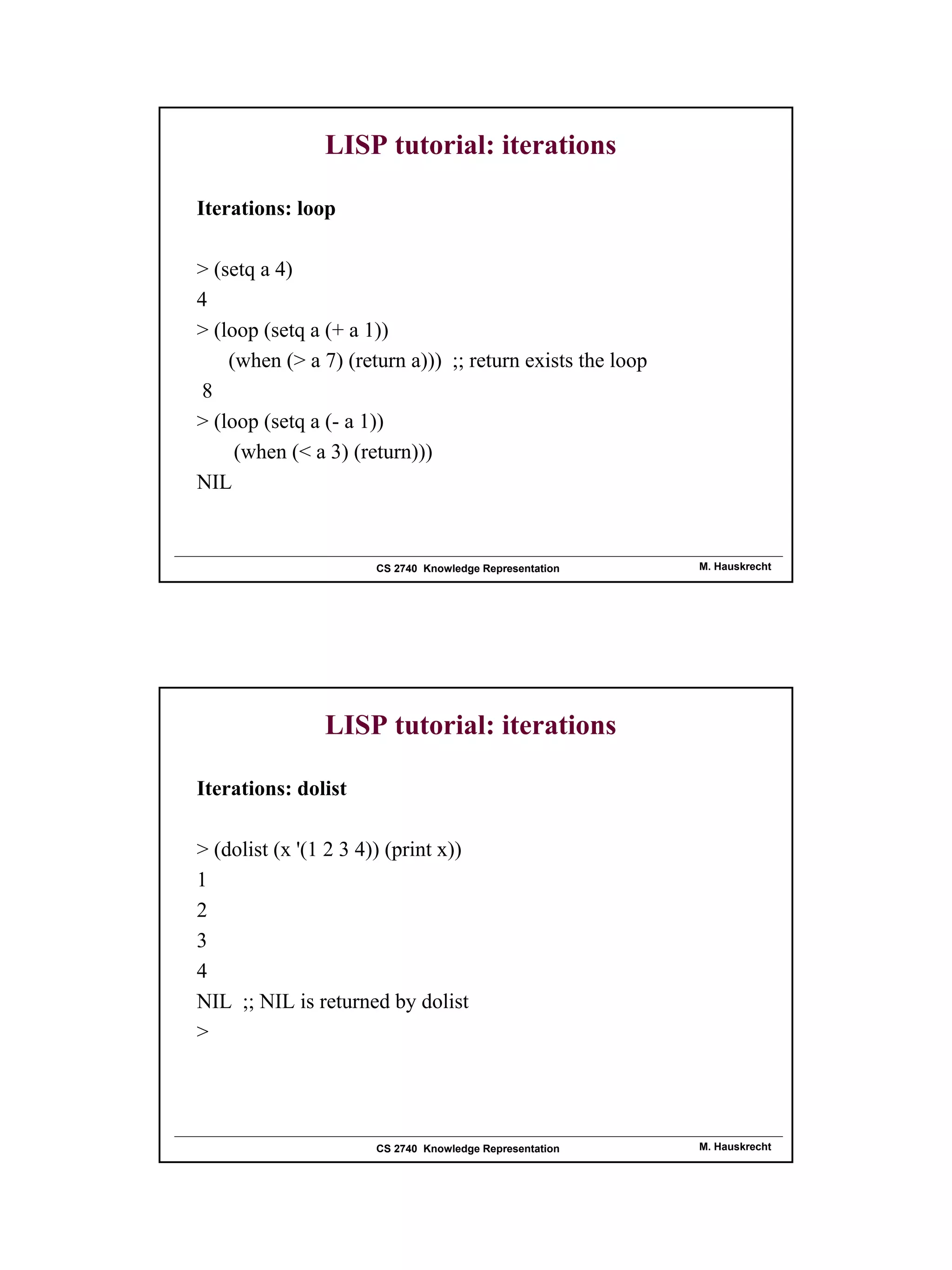
Iterations: loop
> (setq a 4)
4
> (loop (setq a (+ a 1))
(when (> a 7) (return a))) ;; return exists the loop
8
> (loop (setq a (- a 1))
(when (< a 3) (return)))
NIL
CS 2740 Knowledge Representation M. Hauskrecht
LISP tutorial: iterations
Iterations: dolist
> (dolist (x '(1 2 3 4)) (print x))
1
2
3
4
NIL ;; NIL is returned by dolist
>
19
CS 2740 Knowledge Representation M. Hauskrecht
LISP tutorial: iterations
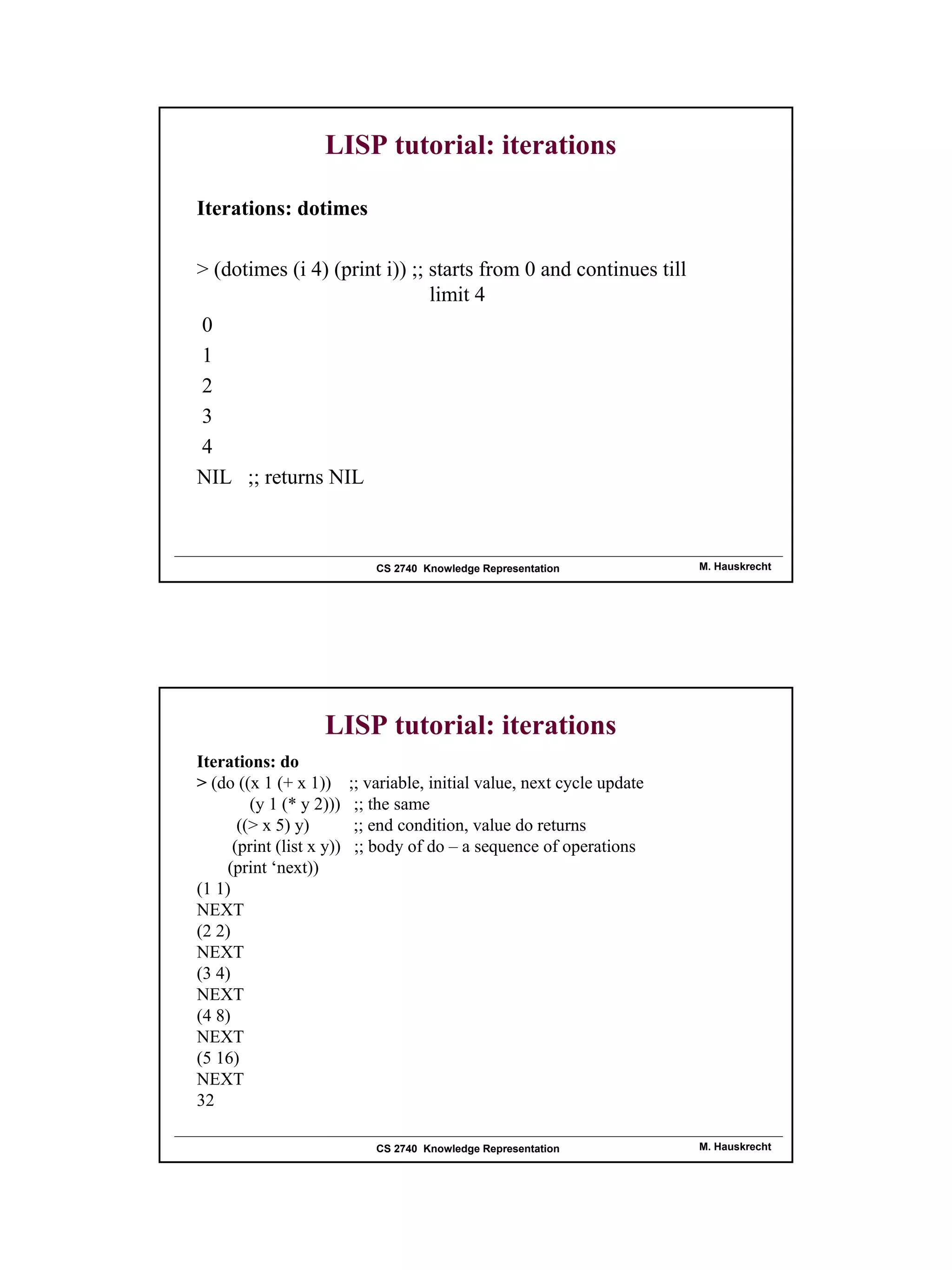
Iterations: dotimes
> (dotimes (i 4) (print i)) ;; starts from 0 and continues till
limit 4
0
1
2
3
4
NIL ;; returns NIL
CS 2740 Knowledge Representation M. Hauskrecht
LISP tutorial: iterations
Iterations: do
> (do ((x 1 (+ x 1)) ;; variable, initial value, next cycle update
(y 1 (* y 2))) ;; the same
((> x 5) y) ;; end condition, value do returns
(print (list x y)) ;; body of do – a sequence of operations
(print ‘next))
(1 1)
NEXT
(2 2)
NEXT
(3 4)
NEXT
(4 8)
NEXT
(5 16)
NEXT
32
20
CS 2740 Knowledge Representation M. Hauskrecht
LISP tutorial: iterations
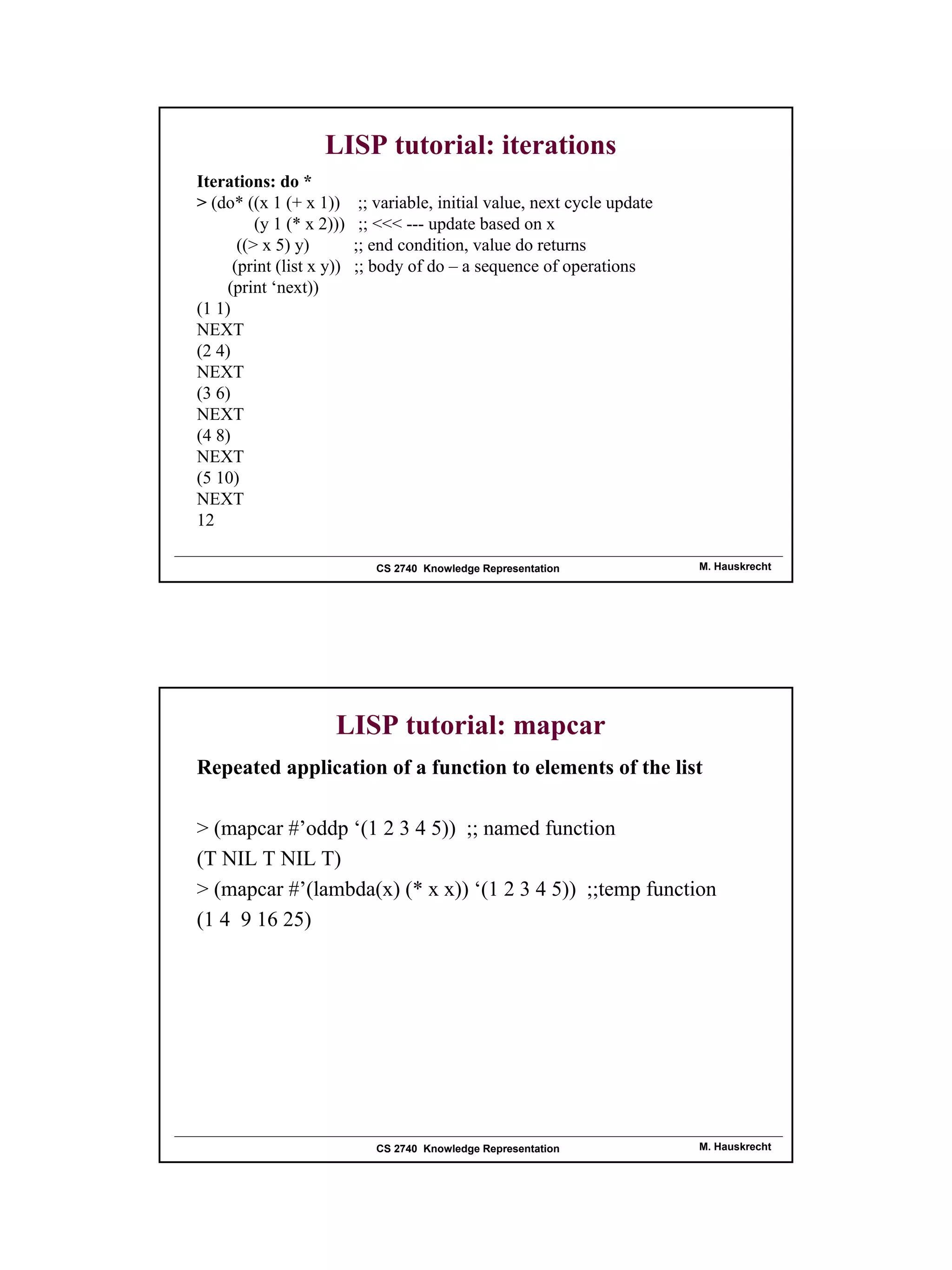
Iterations: do *
> (do* ((x 1 (+ x 1)) ;; variable, initial value, next cycle update
(y 1 (* x 2))) ;; <<< --- update based on x
((> x 5) y) ;; end condition, value do returns
(print (list x y)) ;; body of do – a sequence of operations
(print ‘next))
(1 1)
NEXT
(2 4)
NEXT
(3 6)
NEXT
(4 8)
NEXT
(5 10)
NEXT
12
CS 2740 Knowledge Representation M. Hauskrecht
LISP tutorial: mapcar
Repeated application of a function to elements of the list
> (mapcar #’oddp ‘(1 2 3 4 5)) ;; named function
(T NIL T NIL T)
> (mapcar #’(lambda(x) (* x x)) ‘(1 2 3 4 5)) ;;temp function
(1 4 9 16 25)
21
CS 2740 Knowledge Representation M. Hauskrecht
LISP tutorial
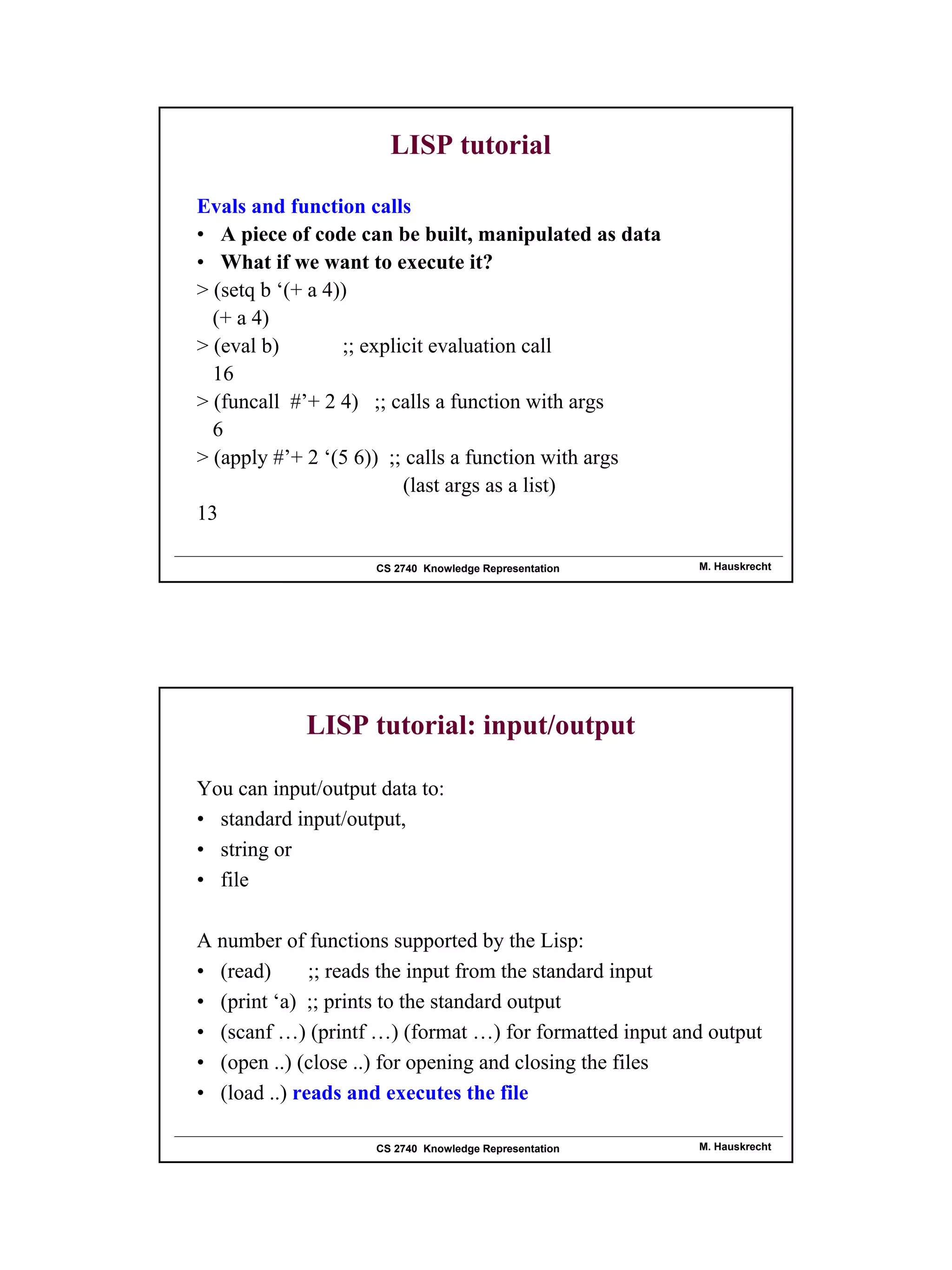
Evals and function calls
• A piece of code can be built, manipulated as data
• What if we want to execute it?
> (setq b ‘(+ a 4))
(+ a 4)
> (eval b) ;; explicit evaluation call
16
> (funcall #’+ 2 4) ;; calls a function with args
6
> (apply #’+ 2 ‘(5 6)) ;; calls a function with args
(last args as a list)
13
CS 2740 Knowledge Representation M. Hauskrecht
LISP tutorial: input/output
You can input/output data to:
• standard input/output,
• string or
• file
A number of functions supported by the Lisp:
• (read) ;; reads the input from the standard input
• (print ‘a) ;; prints to the standard output
• (scanf …) (printf …) (format …) for formatted input and output
• (open ..) (close ..) for opening and closing the files
• (load ..) reads and executes the file
22
CS 2740 Knowledge Representation M. Hauskrecht
LISP tutorial: program calls
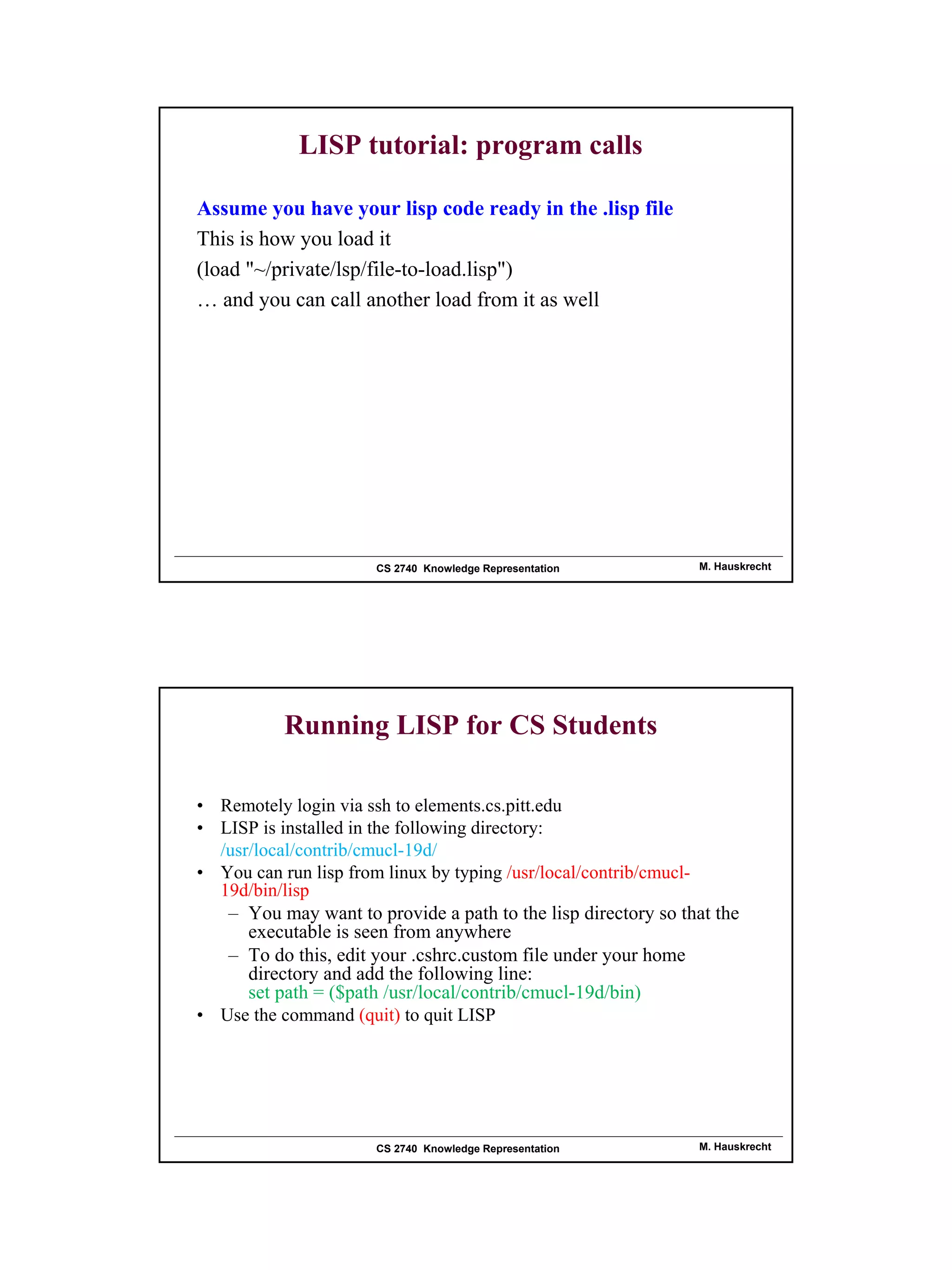
Assume you have your lisp code ready in the .lisp file
This is how you load it
(load "~/private/lsp/file-to-load.lisp")
… and you can call another load from it as well
CS 2740 Knowledge Representation M. Hauskrecht
Running LISP for CS Students
• Remotely login via ssh to elements.cs.pitt.edu
• LISP is installed in the following directory:
/usr/local/contrib/cmucl-19d/
• You can run lisp from linux by typing /usr/local/contrib/cmucl-
19d/bin/lisp
– You may want to provide a path to the lisp directory so that the
executable is seen from anywhere
– To do this, edit your .cshrc.custom file under your home
directory and add the following line:
set path = ($path /usr/local/contrib/cmucl-19d/bin)
• Use the command (quit) to quit LISP
23
CS 2740 Knowledge Representation M. Hauskrecht
Running LISP for Non-CS Students
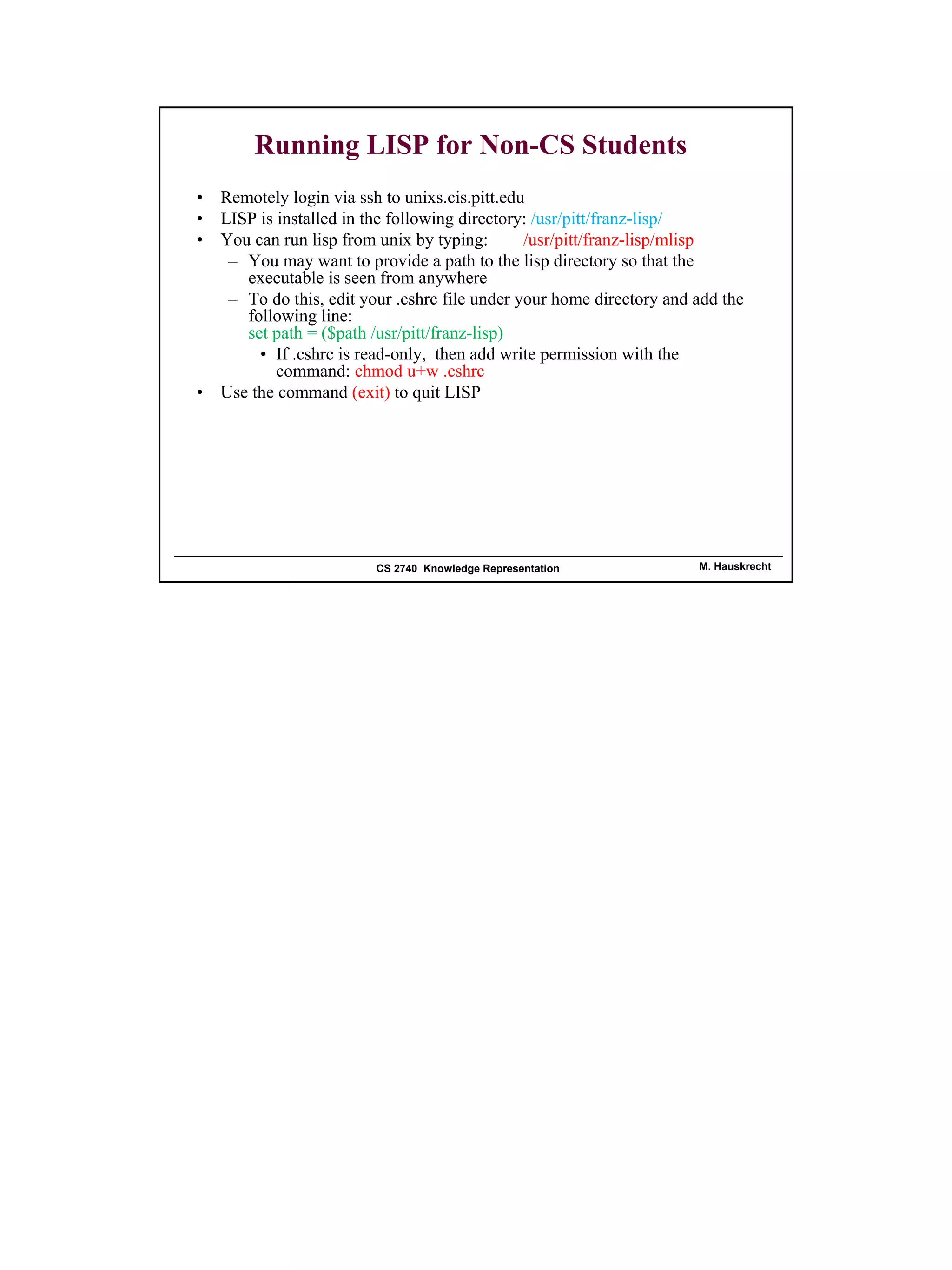
• Remotely login via ssh to unixs.cis.pitt.edu
• LISP is installed in the following directory: /usr/pitt/franz-lisp/
• You can run lisp from unix by typing: /usr/pitt/franz-lisp/mlisp
– You may want to provide a path to the lisp directory so that the
executable is seen from anywhere
– To do this, edit your .cshrc file under your home directory and add the
following line:
set path = ($path /usr/pitt/franz-lisp)
• If .cshrc is read-only, then add write permission with the
command: chmod u+w .cshrc
• Use the command (exit) to quit LISP

Lisp tutorial

  • 1.
    1 CS 2740 KnowledgeRepresentation M. Hauskrecht CS 2740 Knowledge Representation Lecture 2 Milos Hauskrecht milos@cs.pitt.edu 5329 Sennott Square Introduction to LISP CS 2740 Knowledge Representation M. Hauskrecht LISP language LISP: LISt Processing language • An AI language developed in 1958 (J. McCarthy at MIT) • Special focus on symbolic processing and symbol manipulation – Linked list structures – Also programs, functions are represented as lists • At one point special LISP computers with basic LISP functions implemented directly on hardware were available (Symbolics Inc., 80s) LISP today: • Many AI programs now are written in C,C++, Java – List manipulation libraries are available
  • 2.
    2 CS 2740 KnowledgeRepresentation M. Hauskrecht LISP language LISP Competitors: • Prolog, Python • but LISP keeps its dominance among high level (AI) programming languages Current LISP: • Common Lisp • Scheme are the most widely-known general-purpose Lisp dialects Common LISP: • Interpreter and compiler • CLOS: object oriented programming CS 2740 Knowledge Representation M. Hauskrecht LISP tutorial Syntax: • Prefix notation – Operator first, arguments follow – E.g. (+ 3 2) adds 3 and 2 A lot of parentheses • These define lists and also programs • Examples: – (a b c d) is a list of 4 elements (atoms) a,b,c,d – (defun factorial (num) (cond ((<= num 0) 1) (t (* (factorial (- num 1)) num)) ))
  • 3.
    3 CS 2740 KnowledgeRepresentation M. Hauskrecht LISP tutorial: data types Basic data types: • Symbols – a – john – 34 • Lists – ( ) – (a) – (a john 34) – (lambda (arg) (* arg arg)) CS 2740 Knowledge Representation M. Hauskrecht LISP tutorial For each symbol lisp attempts to find its value > (setq a 10) ;; sets a value of symbol a to 10 10 > a ;; returns the value of a 10 Special symbols: > t ;; true T > nil ;; nil stands for false or NIL > ( ) ;; an empty list NIL
  • 4.
    4 CS 2740 KnowledgeRepresentation M. Hauskrecht LISP tutorial Lists represent function calls as well as basic data structures > (factorial 3) 6 > (+ 2 4) 6 > (setq a ‘(john peter 34)) ;; quote means: do not eval the argument (john peter 34) > (setq a ‘((john 1) (peter 2))) ((john 1) (peter 2)) CS 2740 Knowledge Representation M. Hauskrecht LISP tutorial: lists List representation: • A singly linked list > (setq a ‘(john peter)) (john peter) > (car a) john > (cdr a) (peter) car cdr
  • 5.
    5 CS 2740 KnowledgeRepresentation M. Hauskrecht LISP tutorial: list List building functions > (cons ‘b nil) ;; quote means: do not eval the argument (b) > (setq a (cons ‘b (cons ‘c nil)) ;; setq a is a shorthand for set ‘a (b c) > (setq v (list ‘john 34 25)) (john 34 25) > (setq v (list a 34 25)) ((b c) 34 25) > (append ‘(1 2) ‘(2 3)) (1 2 2 3) CS 2740 Knowledge Representation M. Hauskrecht LISP tutorial List copying > (setq foo (list 'a 'b 'c)) (a b c) > (setq bar (cons 'x (cdr foo))) (x b c) > foo (a b c) ;; (cdr foo) makes a copy of the remaining list before cons > bar (x b c) • Car and cdr operations are nondestructive.
  • 6.
    6 CS 2740 KnowledgeRepresentation M. Hauskrecht LISP tutorial: lists > (setq bar ‘(a b c)) (a b c) > (setq foo (cdr bar)) (b c) > (rplaca foo ‘u) ;; replaces car component of foo (destructive op) (u c) > foo (u c) > bar (a u c) > (rplacd foo ‘(v)) ;; replaces cdr component of foo (destructive) (u v) > bar (a u v) CS 2740 Knowledge Representation M. Hauskrecht LISP tutorial The same effect as with rplaca and rplacd can be achieved with setf > (setq bar ‘(a b c)) (a b c) > (setq foo (cdr bar)) (b c) > (setf (cadr bar) ‘u) u > bar (a u c) > foo (u c)
  • 7.
    7 CS 2740 KnowledgeRepresentation M. Hauskrecht LISP tutorial Evaluation rules: • A symbol value is sought and substituted • A quoted value is kept untouched > (setq a 12) 12 > (setq b (+ a 4)) 16 > (setq b ‘(+ a 4)) (+ a 4) > (eval b) ;; explicit evaluation call 16 CS 2740 Knowledge Representation M. Hauskrecht LISP tutorial: functions and predicates Some useful functions and predicates: > (setq a ‘(1 2 3 4 5)) (1 2 3 4 5) > (length a) ;; gives the list length of the argument 5 > (atom ‘a) ;; checks if the argument is an atom T > (atom a) NIL > (listp ‘a) ;; checks if the argument is a list NIL > (listp a) T
  • 8.
    8 CS 2740 KnowledgeRepresentation M. Hauskrecht LISP tutorial: function definition Definition of a function (defun <f-name> <parameter-list> <body>) >(defun square (x) (* x x)) SQUARE >(square 2) 4 >(square (square 2)) 16 CS 2740 Knowledge Representation M. Hauskrecht LISP tutorial Definition of a function (defun <f-name> <parameter-list> <body>) <body> can be a sequence of function calls, the function returns the value of the last call in the sequence > (defun foo (a) (setq b (+ a 1)) (setq c (+ a 2)) c) FOO > (foo 2) 4
  • 9.
    9 CS 2740 KnowledgeRepresentation M. Hauskrecht LISP tutorial: conditionals Cond statement: sequentially tests conditions, the call associated with the first true condition is executed > (defun abs (a) (cond ((> a 0) a) (t (- a)))) ABS > (abs 2) 2 > (abs -3) 3 CS 2740 Knowledge Representation M. Hauskrecht LISP tutorial if statement: (if <test> <then> <else>) > (defun abs (a) (if (> a 0) a (- a))) ABS > (abs 2) 2 > (abs -3) 3
  • 10.
    10 CS 2740 KnowledgeRepresentation M. Hauskrecht LISP tutorial: equality 4 equality predicates: =, equal, eq, eql > (= 2 4/2) ;; used for numerical values only T > (setf a '(1 2 3 4)) (1 2 3 4) >(setf b '(1 2 3 4)) (1 2 3 4) >(setf c b) (1 2 3 4) > (equal a b) ;; equal is true if the two objects are isomorphic T > (equal c b) T CS 2740 Knowledge Representation M. Hauskrecht LISP tutorial: equalities >(eq a b) ;; eq is true if the two arguments point to the same object NIL >(eq b c) T
  • 11.
    11 CS 2740 KnowledgeRepresentation M. Hauskrecht LISP tutorial: nil Nil represents False and an empty list > (null nil) ;; tests if the argument is NIL T > (null ( )) T > (null ‘(a b)) NIL > (not ‘(a b)) NIL CS 2740 Knowledge Representation M. Hauskrecht LISP tutorial: functions Logical operators: and, or > (and NIL T) NIL > (and T 2 3) 3 > (or nil (= 5 4)) NIL > (or nil 5) 5
  • 12.
    12 CS 2740 KnowledgeRepresentation M. Hauskrecht LISP tutorial: recursion Recursive function definitions are very common in LISP > (defun factorial (num) (cond ((<= num 0) 1) (t (* (factorial (- num 1)) num)) )) FACTORIAL > (factorial 4) 24 CS 2740 Knowledge Representation M. Hauskrecht LISP tutorial: recursion Recursive function definitions are very common in LISP > (defun check_lists (lis) (cond ((null lis) nil) (t (cons (listp (car lis)) (check_lists (cdr lis)))))) CHECK_LISTS > (check_lists (list ‘a ‘(1 2) 3 ‘(a b c) ‘(a))) (NIL T NIL T T)
  • 13.
    13 CS 2740 KnowledgeRepresentation M. Hauskrecht LISP tutorial: local and global variables > (setq a 12) 12 > (defun foo (n) (setq a 14) (+ n 2)) FOO > a 12 > (foo 3) 5 > a 14 CS 2740 Knowledge Representation M. Hauskrecht LISP tutorial: local variables Defining local variables with let > (setq a 7) ;store a number as the value of a symbol 7 > a ;take the value of a symbol 7 > (let ((a 1)) a) ;binds the value of a symbol temporarily to 6 1 > a ;the value is 7 again once the let is finished 7 > b ;try to take the value of a symbol which has no value Error: Attempt to take the value of the unbound symbol B
  • 14.
    14 CS 2740 KnowledgeRepresentation M. Hauskrecht LISP tutorial: local variables Defining local variables with let and let* > (let ((a 5) ;; binds vars to values locally (b 4)) (+ a b)) 9 > (let* ((a 5) ;; binds vars sequentially (b (+ a 2)) (+ a b)) 12 CS 2740 Knowledge Representation M. Hauskrecht LISP tutorial: functions revisited Standard function – all parameters defined (defun fact (x) (if (> x 0) (* x (fact (- x 1))) 1)) But it is possible to define functions: • with variable number of parameters, • optional parameters and • keyword-based parameters
  • 15.
    15 CS 2740 KnowledgeRepresentation M. Hauskrecht LISP tutorial: functions revisited Functions with optional parameters > (defun bar (x &optional y) (if y x 0)) BAR > (defun baaz (&optional (x 3) (z 10)) (+ x z)) BAAZ > (bar 5) 0 > (bar 5 t) 5 > (baaz) 13 > (baaz 5 6) 11 > (baaz 5) 15 CS 2740 Knowledge Representation M. Hauskrecht LISP tutorial: functions revisited Functions with variable number of parameters > (defun foo (x &rest y) y) ;; all but the first parameters are put ;; into a list FOO > (foo 3) NIL > (foo 1 2 3) (2 3) > (foo 1 2 3 4 5) (2 3 4 5)
  • 16.
    16 CS 2740 KnowledgeRepresentation M. Hauskrecht LISP tutorial: functions revisited Functions with ‘keyword’ parameters > (defun foo (&key x y) (cons x y)) FOO > (foo :x 5 :y ‘(3)) (5 3) > (foo :y ‘(3) :x 5) (5 3) > (foo :y 3) (NIL 3) > (foo) (NIL) CS 2740 Knowledge Representation M. Hauskrecht LISP tutorial: arrays List is a basic structure; but arrays and structures are supported > (setf a (make-array ‘(3 2)) ;; make a 3 by 2 array #2a((NIL NIL) (NIL NIL) (NIL NIL)) > (aref a 1 1) NIL > (setf (aref a 1 1) 2) 2 > (aref a 1 1) 2
  • 17.
    17 CS 2740 KnowledgeRepresentation M. Hauskrecht LISP tutorial: structures >(defstruct weather temperature rain pressure) WEATHER > (setf a (make-weather)) ;; make a structure #s(WEATHER :TEMPERATURE NIL :RAIN NIL :PRESSURE NIL) > (setf a (make-weather :temperature 35)) #s(WEATHER :TEMPERATURE 35 :RAIN NIL :PRESSURE NIL) > (weather-temperature a) ;; access a field 35 > (weather-rain a) NIL > (setf (weather-rain a) T) ;; set the value of a field T > (weather-rain a) T CS 2740 Knowledge Representation M. Hauskrecht LISP tutorial: iterations Many ways to define iterations Commands: • loop • dolist • dotimes • do, do* Also we can write compactly the code for repeated application of function to elements of the list: • mapc, mapcar
  • 18.
    18 CS 2740 KnowledgeRepresentation M. Hauskrecht LISP tutorial: iterations Iterations: loop > (setq a 4) 4 > (loop (setq a (+ a 1)) (when (> a 7) (return a))) ;; return exists the loop 8 > (loop (setq a (- a 1)) (when (< a 3) (return))) NIL CS 2740 Knowledge Representation M. Hauskrecht LISP tutorial: iterations Iterations: dolist > (dolist (x '(1 2 3 4)) (print x)) 1 2 3 4 NIL ;; NIL is returned by dolist >
  • 19.
    19 CS 2740 KnowledgeRepresentation M. Hauskrecht LISP tutorial: iterations Iterations: dotimes > (dotimes (i 4) (print i)) ;; starts from 0 and continues till limit 4 0 1 2 3 4 NIL ;; returns NIL CS 2740 Knowledge Representation M. Hauskrecht LISP tutorial: iterations Iterations: do > (do ((x 1 (+ x 1)) ;; variable, initial value, next cycle update (y 1 (* y 2))) ;; the same ((> x 5) y) ;; end condition, value do returns (print (list x y)) ;; body of do – a sequence of operations (print ‘next)) (1 1) NEXT (2 2) NEXT (3 4) NEXT (4 8) NEXT (5 16) NEXT 32
  • 20.
    20 CS 2740 KnowledgeRepresentation M. Hauskrecht LISP tutorial: iterations Iterations: do * > (do* ((x 1 (+ x 1)) ;; variable, initial value, next cycle update (y 1 (* x 2))) ;; <<< --- update based on x ((> x 5) y) ;; end condition, value do returns (print (list x y)) ;; body of do – a sequence of operations (print ‘next)) (1 1) NEXT (2 4) NEXT (3 6) NEXT (4 8) NEXT (5 10) NEXT 12 CS 2740 Knowledge Representation M. Hauskrecht LISP tutorial: mapcar Repeated application of a function to elements of the list > (mapcar #’oddp ‘(1 2 3 4 5)) ;; named function (T NIL T NIL T) > (mapcar #’(lambda(x) (* x x)) ‘(1 2 3 4 5)) ;;temp function (1 4 9 16 25)
  • 21.
    21 CS 2740 KnowledgeRepresentation M. Hauskrecht LISP tutorial Evals and function calls • A piece of code can be built, manipulated as data • What if we want to execute it? > (setq b ‘(+ a 4)) (+ a 4) > (eval b) ;; explicit evaluation call 16 > (funcall #’+ 2 4) ;; calls a function with args 6 > (apply #’+ 2 ‘(5 6)) ;; calls a function with args (last args as a list) 13 CS 2740 Knowledge Representation M. Hauskrecht LISP tutorial: input/output You can input/output data to: • standard input/output, • string or • file A number of functions supported by the Lisp: • (read) ;; reads the input from the standard input • (print ‘a) ;; prints to the standard output • (scanf …) (printf …) (format …) for formatted input and output • (open ..) (close ..) for opening and closing the files • (load ..) reads and executes the file
  • 22.
    22 CS 2740 KnowledgeRepresentation M. Hauskrecht LISP tutorial: program calls Assume you have your lisp code ready in the .lisp file This is how you load it (load "~/private/lsp/file-to-load.lisp") … and you can call another load from it as well CS 2740 Knowledge Representation M. Hauskrecht Running LISP for CS Students • Remotely login via ssh to elements.cs.pitt.edu • LISP is installed in the following directory: /usr/local/contrib/cmucl-19d/ • You can run lisp from linux by typing /usr/local/contrib/cmucl- 19d/bin/lisp – You may want to provide a path to the lisp directory so that the executable is seen from anywhere – To do this, edit your .cshrc.custom file under your home directory and add the following line: set path = ($path /usr/local/contrib/cmucl-19d/bin) • Use the command (quit) to quit LISP
  • 23.
    23 CS 2740 KnowledgeRepresentation M. Hauskrecht Running LISP for Non-CS Students • Remotely login via ssh to unixs.cis.pitt.edu • LISP is installed in the following directory: /usr/pitt/franz-lisp/ • You can run lisp from unix by typing: /usr/pitt/franz-lisp/mlisp – You may want to provide a path to the lisp directory so that the executable is seen from anywhere – To do this, edit your .cshrc file under your home directory and add the following line: set path = ($path /usr/pitt/franz-lisp) • If .cshrc is read-only, then add write permission with the command: chmod u+w .cshrc • Use the command (exit) to quit LISP