CS-311
Design and Analysis of
Algorithms
Muhammad Naman
Objectives
 Design algorithms using different
algorithms design techniques i.e. Divide
and Conquer, Dynamic Programming,
Greedy Algorithms & Backtracking etc for
different problem areas (sorting, pattern
matching, graphs, compression, encryption
etc.)
 Analyse Algorithms (estimate upper &
lower bounds without coding and running
the algorithms) and compare the efficiency
of more than one algorithm for a problem.
 Logically think and develop problem
solving skills
 Read and understand research papers in
this area
What is an Algorithm?
Although there is no universally
agreed-on wording to describe this
notion, there is general agreement
about what the concept means:
An algorithm is a sequence of
unambiguous instructions for solving
a problem, i.e., for obtaining a
required output for any legitimate
input in a finite amount of time.
What is an Algorithm?
The reference to "instructions" in the
definition implies that there is something
or someone capable of understanding and
following the instructions given.
We call this a "computer," keeping in mind
that before the electronic computer was
invented, the word "computer" meant a
human being involved in performing
numeric calculations.
Nowadays, of course, "computers" are
those ubiquitous electronic devices that
have become indispensable in almost
everything we do.
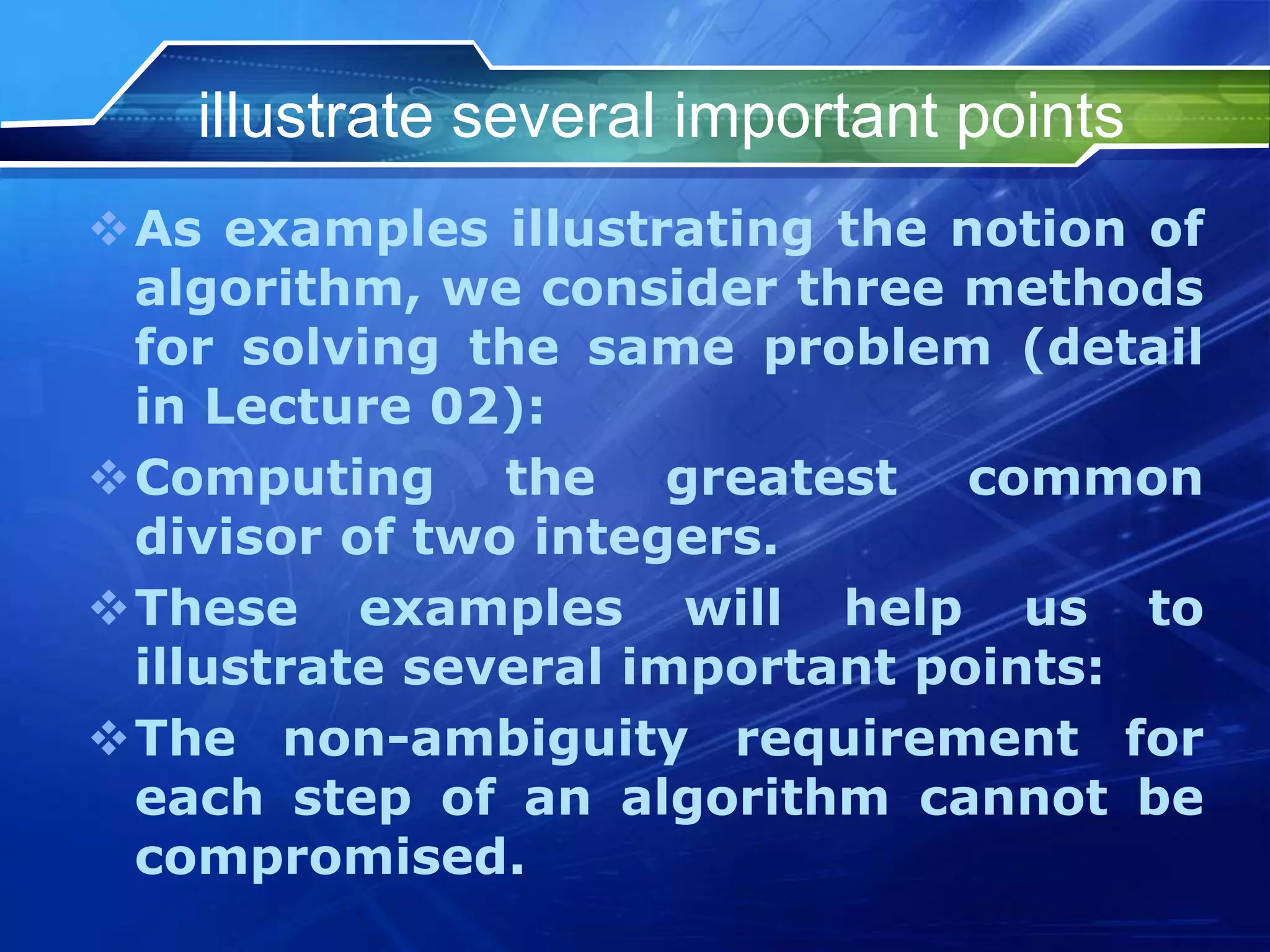
illustrate several important points
As examples illustrating the notion of
algorithm, we consider three methods
for solving the same problem (detail
in Lecture 02):
Computing the greatest common
divisor of two integers.
These examples will help us to
illustrate several important points:
The non-ambiguity requirement for
each step of an algorithm cannot be
compromised.
illustrate several important points
The range of inputs for which an
algorithm works has to be specified
carefully.
The same algorithm can be
represented in several different ways.
Several algorithms for solving the
same problem may exist.
Algorithms for the same problem can
be based on very different ideas and
can solve the problem with
dramatically different speeds.
Process to Solve a Problem
Understand the problem
Formulate a solution / algorithm
Design a program
Implement the program
Execute the code
Measure the performance
See if the solution is ok
Sorting Problem
Consider the problem of sorting
numbers.
INPUT: Sequence of n numbers
<a1,a2,a3, ….an>
OUTPUT: Permutation (reordering)
<a1`,a2`,a3`,….an`> of the input
sequence such that
a1`<a2`<a3`<…..<an`
Many algorithms are available.
Selection Sort
1. Get a list of unsorted numbers
2. Set a marker for the unsorted section at
the front of the list
3. Repeat steps 4 - 6 until one number
remains in the unsorted section
4. Compare all unsorted numbers in order to
select the smallest one
5. Swap this number with the first number in
the unsorted section
6. Advance the marker to the right one
position
7. Stop
Merge Sort
Algorithm
Divide sequence of m elements into two
sequences of m/2 elements
Conquer both sub-sequences using Merge
Sort (recursively)
Combine two sorted sub-sequences using
merge
Sorting Problem…..
Which sorting algorithm is best.
Implement both algorithms
See the result of simulation
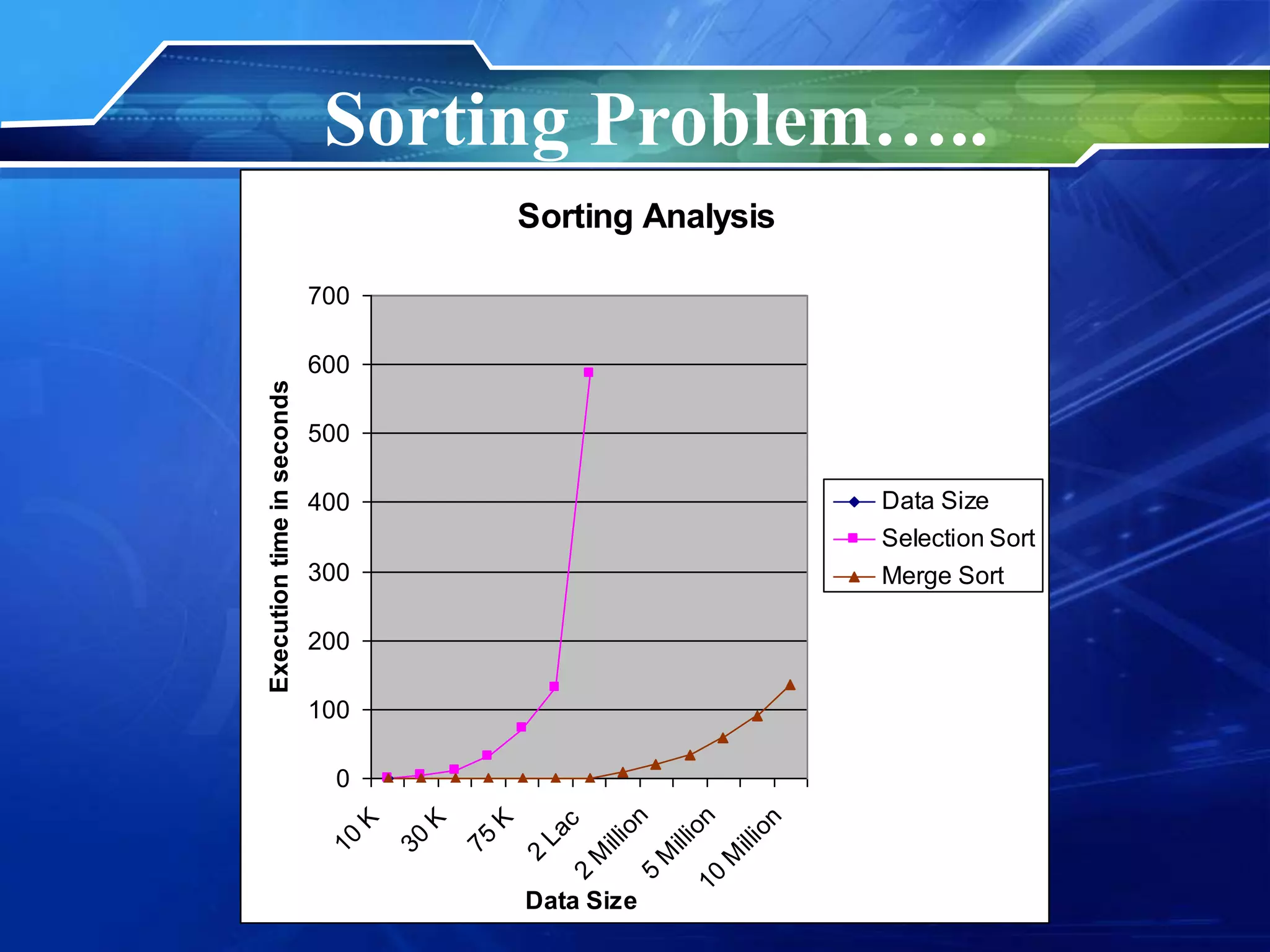
Sorting Problem…..
Sorting Analysis, processor speed 500MHz
Data Size
Selection Sort Merge Sort
10 K 1 0
20 K 4 0
30 K 11 0
50 K 31 0
75 K 72 0
1 Lac 132 0
2 Lac 586 1
1 Million 10
2 Million 21
3 Million 33
5 Million 60
7.5 Million 90
10 Million 136
Execution Time in Seconds
Sorting Problem…..
Sorting Analysis
0
100
200
300
400
500
600
700
1
0
K
3
0
K
7
5
K
2
L
a
c
2
M
i
l
l
i
o
n
5
M
i
l
l
i
o
n
1
0
M
i
l
l
i
o
n
Data Size
Execution
time
in
seconds
Data Size
Selection Sort
Merge Sort
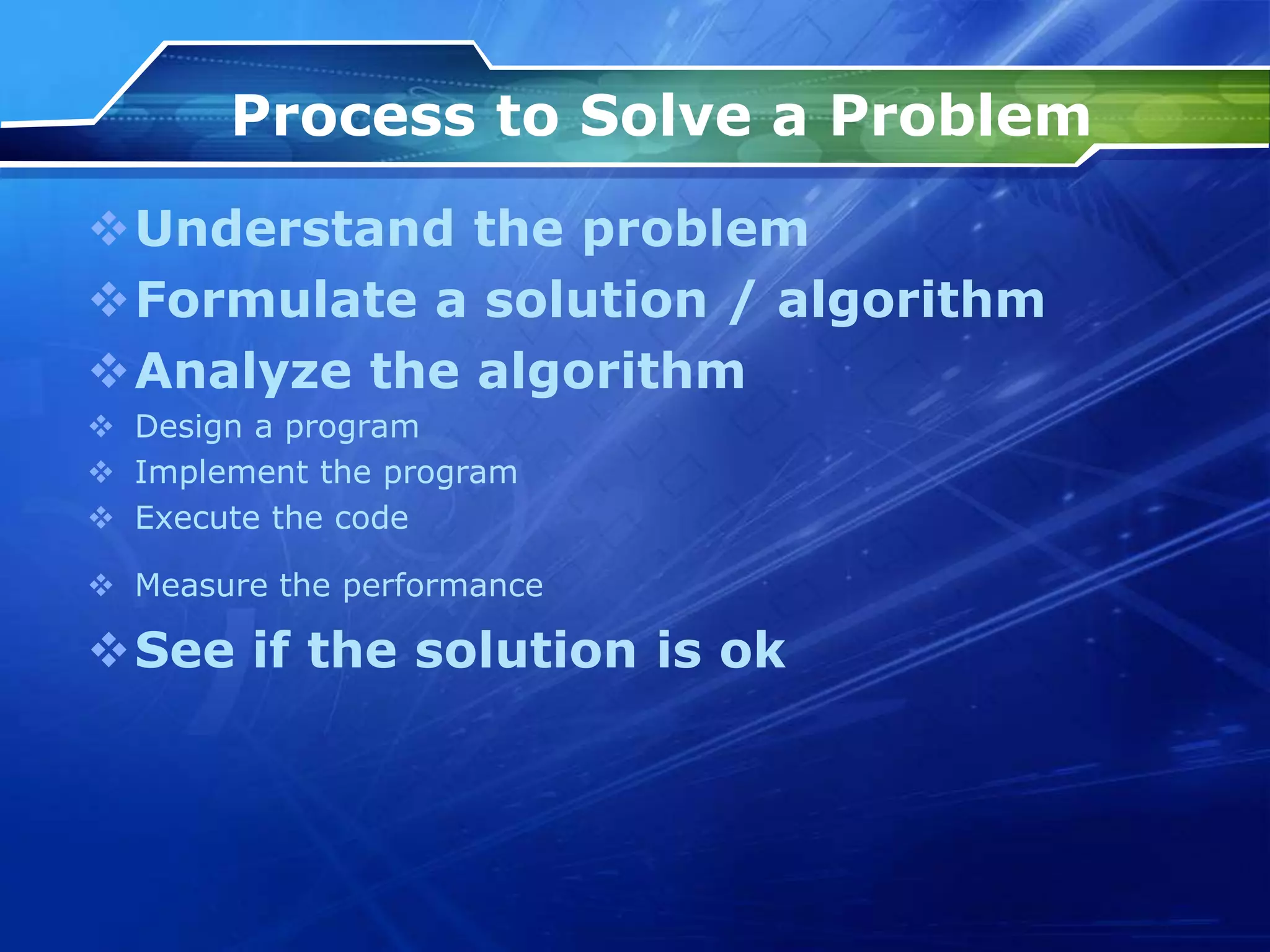
Process to Solve a Problem
Understand the problem
Formulate a solution / algorithm
Analyze the algorithm
 Design a program
 Implement the program
 Execute the code
 Measure the performance
See if the solution is ok
Algorithm Analysis
How to analyze an algorithm?
Predict the resources that the
algorithm requires
Memory
Communications Bandwidth
Logic gates etc
Most important is Computational Time
Algorithm Analysis
Important thing before analysis
 Model of the machine upon which the
algorithms is executed.
 Random Access Machine (RAM)
(Sequential)
Running Time:
 No. of primitive operations or “steps
executed”.
Algorithm Analysis
How do we write algorithms?
Pseudo Code:
 Similar construct / keywords as in a
high level programming languages, e.g.
in C, Pascal etc.
 Structured semantics of the high level
languages without caring about the
syntactic errors / grammatical rules
Algorithm Analysis
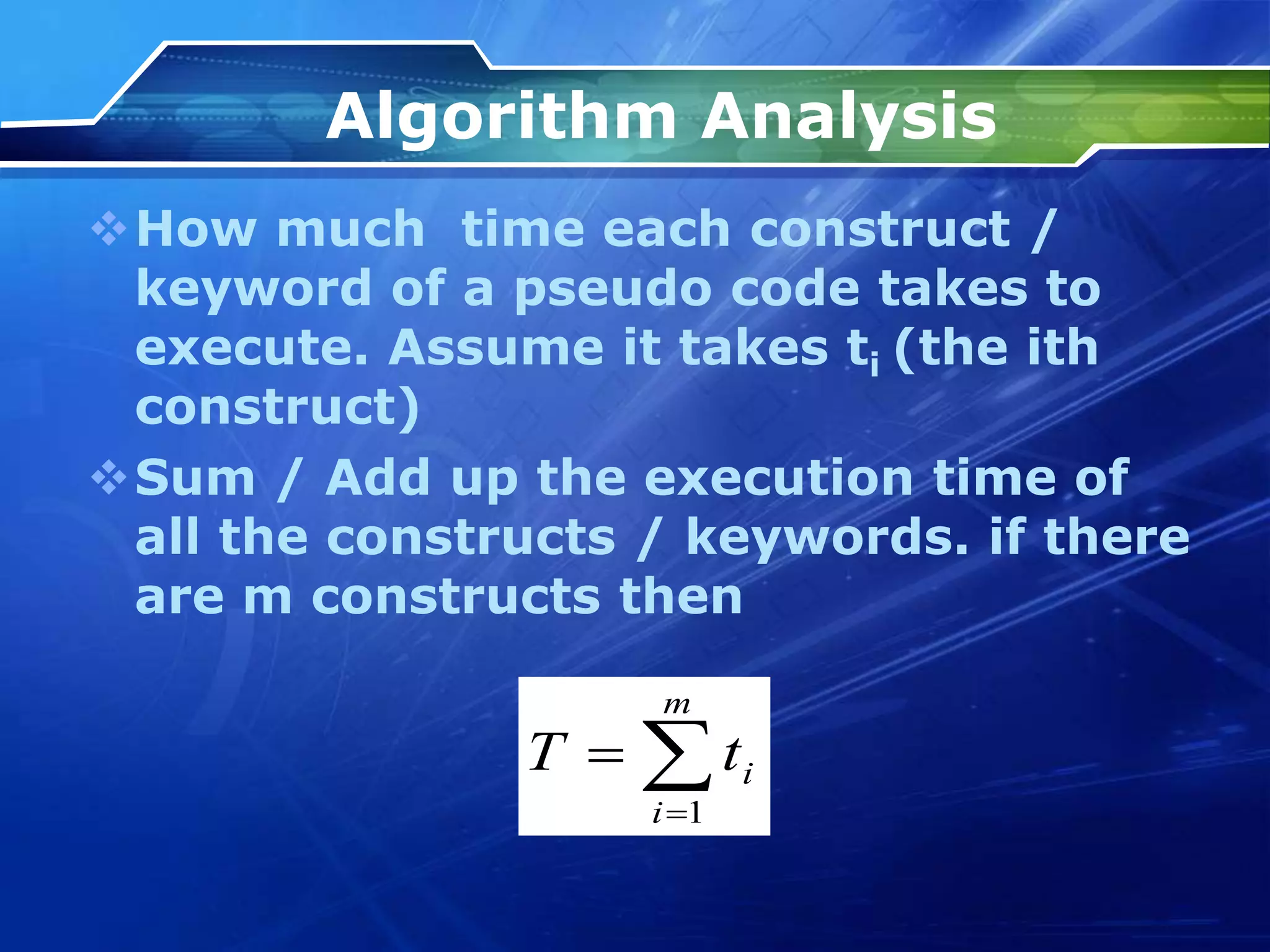
How much time each construct /
keyword of a pseudo code takes to
execute. Assume it takes ti (the ith
construct)
Sum / Add up the execution time of
all the constructs / keywords. if there
are m constructs then



m
i
i
t
T
1
Algorithm Analysis
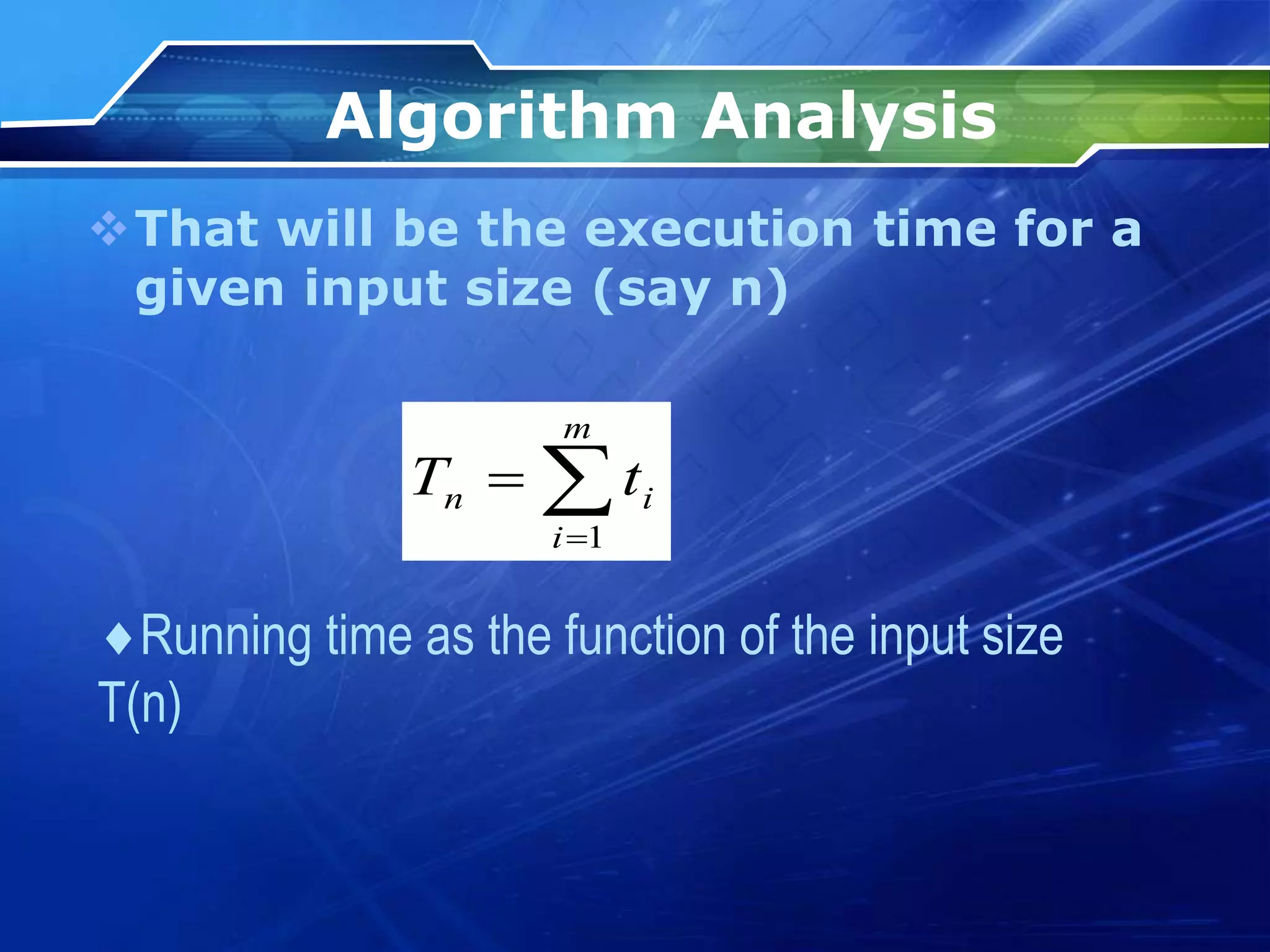
That will be the execution time for a
given input size (say n)



m
i
i
n t
T
1
Running time as the function of the input size
T(n)
Algorithm Analysis
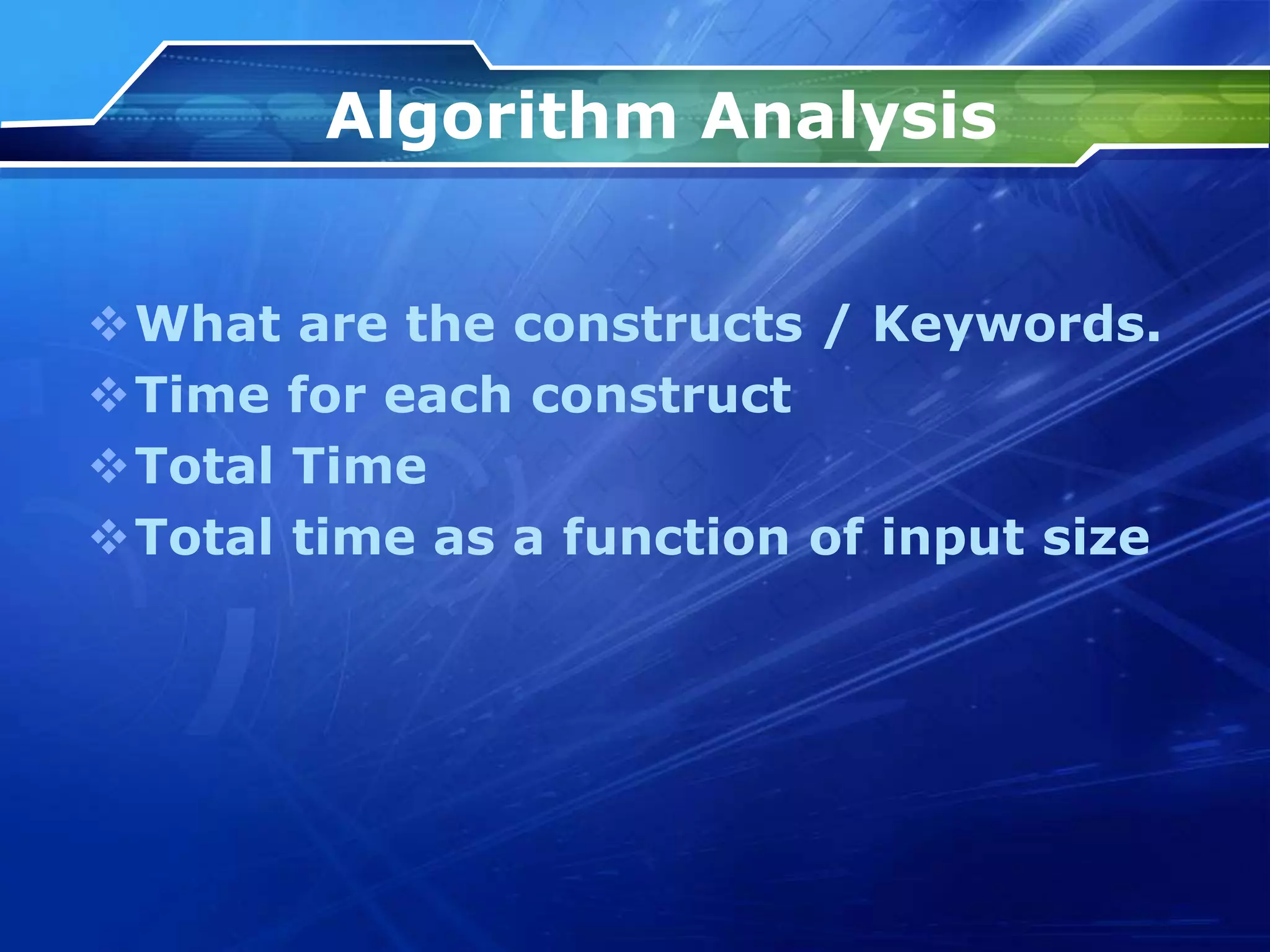
What are the constructs / Keywords.
Time for each construct
Total Time
Total time as a function of input size
Algorithm Analysis
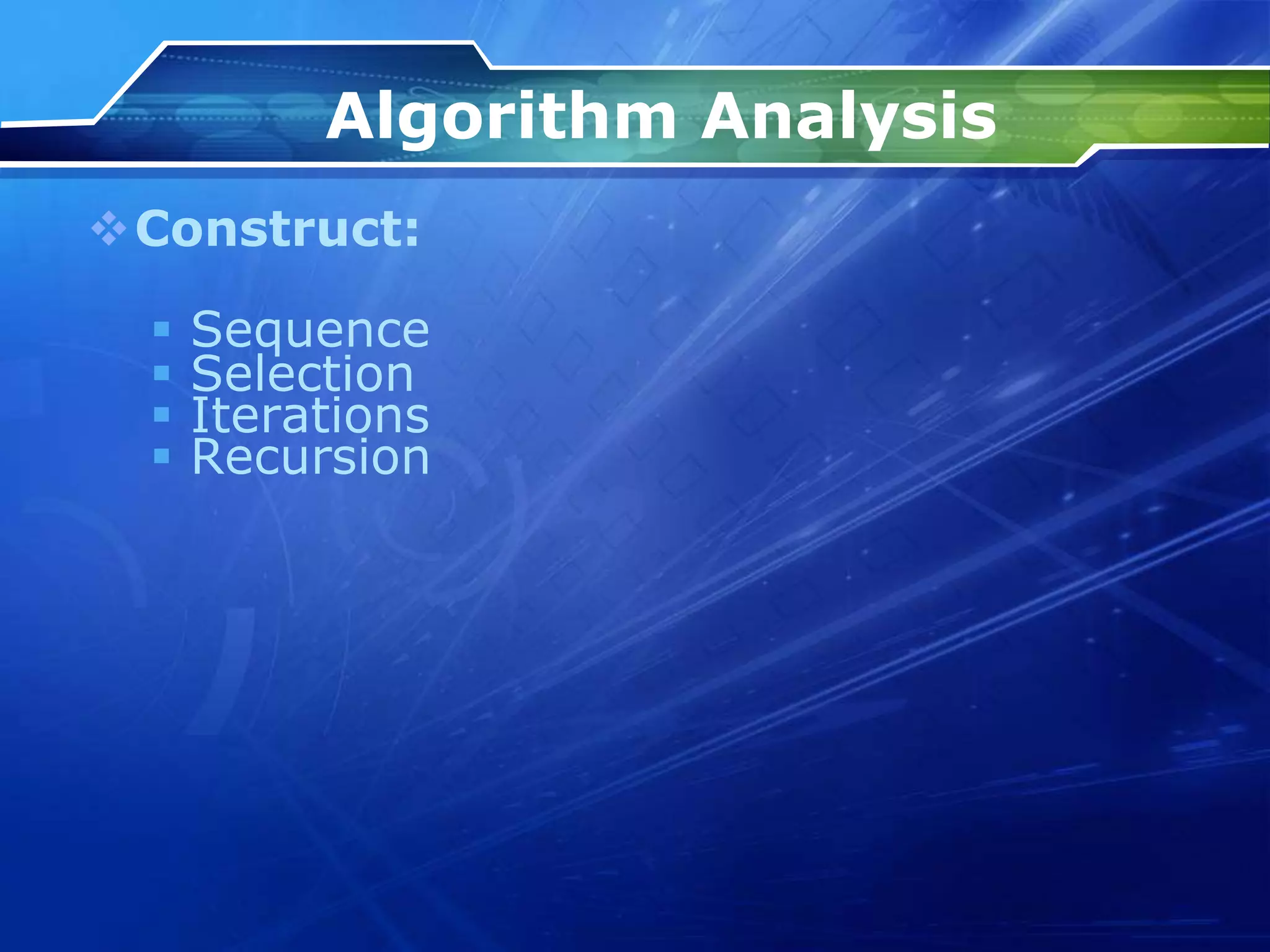
Construct:
 Sequence
 Selection
 Iterations
 Recursion
Algorithm Analysis
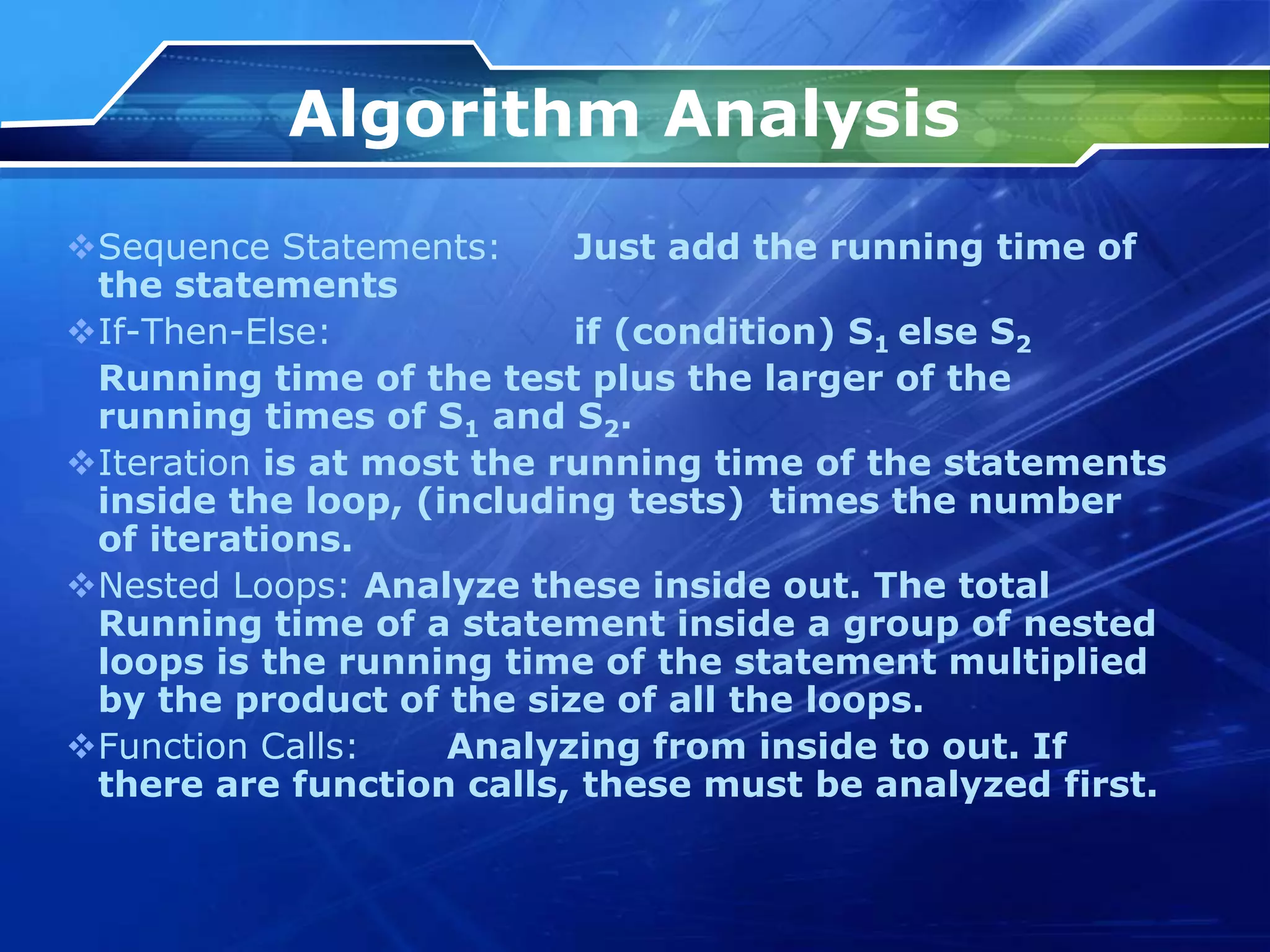
Sequence Statements: Just add the running time of
the statements
If-Then-Else: if (condition) S1 else S2
Running time of the test plus the larger of the
running times of S1 and S2.
Iteration is at most the running time of the statements
inside the loop, (including tests) times the number
of iterations.
Nested Loops: Analyze these inside out. The total
Running time of a statement inside a group of nested
loops is the running time of the statement multiplied
by the product of the size of all the loops.
Function Calls: Analyzing from inside to out. If
there are function calls, these must be analyzed first.
Home Work
 Read Mathematics Revision Handouts
available at photocopy shop
Solve Exercises Given at the end
Assignment # 1
 Due date Monday (12 September 2022) at
Commencement of Class.

Lecture 01-2.ppt

  • 1.
    CS-311 Design and Analysisof Algorithms Muhammad Naman
  • 2.
    Objectives  Design algorithmsusing different algorithms design techniques i.e. Divide and Conquer, Dynamic Programming, Greedy Algorithms & Backtracking etc for different problem areas (sorting, pattern matching, graphs, compression, encryption etc.)  Analyse Algorithms (estimate upper & lower bounds without coding and running the algorithms) and compare the efficiency of more than one algorithm for a problem.  Logically think and develop problem solving skills  Read and understand research papers in this area
  • 3.
    What is anAlgorithm? Although there is no universally agreed-on wording to describe this notion, there is general agreement about what the concept means: An algorithm is a sequence of unambiguous instructions for solving a problem, i.e., for obtaining a required output for any legitimate input in a finite amount of time.
  • 4.
    What is anAlgorithm?
  • 5.
    What is anAlgorithm? The reference to "instructions" in the definition implies that there is something or someone capable of understanding and following the instructions given. We call this a "computer," keeping in mind that before the electronic computer was invented, the word "computer" meant a human being involved in performing numeric calculations. Nowadays, of course, "computers" are those ubiquitous electronic devices that have become indispensable in almost everything we do.
  • 6.
    illustrate several importantpoints As examples illustrating the notion of algorithm, we consider three methods for solving the same problem (detail in Lecture 02): Computing the greatest common divisor of two integers. These examples will help us to illustrate several important points: The non-ambiguity requirement for each step of an algorithm cannot be compromised.
  • 7.
    illustrate several importantpoints The range of inputs for which an algorithm works has to be specified carefully. The same algorithm can be represented in several different ways. Several algorithms for solving the same problem may exist. Algorithms for the same problem can be based on very different ideas and can solve the problem with dramatically different speeds.
  • 8.
    Process to Solvea Problem Understand the problem Formulate a solution / algorithm Design a program Implement the program Execute the code Measure the performance See if the solution is ok
  • 9.
    Sorting Problem Consider theproblem of sorting numbers. INPUT: Sequence of n numbers <a1,a2,a3, ….an> OUTPUT: Permutation (reordering) <a1`,a2`,a3`,….an`> of the input sequence such that a1`<a2`<a3`<…..<an` Many algorithms are available.
  • 10.
    Selection Sort 1. Geta list of unsorted numbers 2. Set a marker for the unsorted section at the front of the list 3. Repeat steps 4 - 6 until one number remains in the unsorted section 4. Compare all unsorted numbers in order to select the smallest one 5. Swap this number with the first number in the unsorted section 6. Advance the marker to the right one position 7. Stop
  • 11.
    Merge Sort Algorithm Divide sequenceof m elements into two sequences of m/2 elements Conquer both sub-sequences using Merge Sort (recursively) Combine two sorted sub-sequences using merge
  • 12.
    Sorting Problem….. Which sortingalgorithm is best. Implement both algorithms See the result of simulation
  • 13.
    Sorting Problem….. Sorting Analysis,processor speed 500MHz Data Size Selection Sort Merge Sort 10 K 1 0 20 K 4 0 30 K 11 0 50 K 31 0 75 K 72 0 1 Lac 132 0 2 Lac 586 1 1 Million 10 2 Million 21 3 Million 33 5 Million 60 7.5 Million 90 10 Million 136 Execution Time in Seconds
  • 14.
  • 15.
    Process to Solvea Problem Understand the problem Formulate a solution / algorithm Analyze the algorithm  Design a program  Implement the program  Execute the code  Measure the performance See if the solution is ok
  • 16.
    Algorithm Analysis How toanalyze an algorithm? Predict the resources that the algorithm requires Memory Communications Bandwidth Logic gates etc Most important is Computational Time
  • 17.
    Algorithm Analysis Important thingbefore analysis  Model of the machine upon which the algorithms is executed.  Random Access Machine (RAM) (Sequential) Running Time:  No. of primitive operations or “steps executed”.
  • 18.
    Algorithm Analysis How dowe write algorithms? Pseudo Code:  Similar construct / keywords as in a high level programming languages, e.g. in C, Pascal etc.  Structured semantics of the high level languages without caring about the syntactic errors / grammatical rules
  • 19.
    Algorithm Analysis How muchtime each construct / keyword of a pseudo code takes to execute. Assume it takes ti (the ith construct) Sum / Add up the execution time of all the constructs / keywords. if there are m constructs then    m i i t T 1
  • 20.
    Algorithm Analysis That willbe the execution time for a given input size (say n)    m i i n t T 1 Running time as the function of the input size T(n)
  • 21.
    Algorithm Analysis What arethe constructs / Keywords. Time for each construct Total Time Total time as a function of input size
  • 22.
    Algorithm Analysis Construct:  Sequence Selection  Iterations  Recursion
  • 23.
    Algorithm Analysis Sequence Statements:Just add the running time of the statements If-Then-Else: if (condition) S1 else S2 Running time of the test plus the larger of the running times of S1 and S2. Iteration is at most the running time of the statements inside the loop, (including tests) times the number of iterations. Nested Loops: Analyze these inside out. The total Running time of a statement inside a group of nested loops is the running time of the statement multiplied by the product of the size of all the loops. Function Calls: Analyzing from inside to out. If there are function calls, these must be analyzed first.
  • 24.
    Home Work  ReadMathematics Revision Handouts available at photocopy shop Solve Exercises Given at the end Assignment # 1  Due date Monday (12 September 2022) at Commencement of Class.