Language and
the self
Who are you? Try to explain what your ‘self’ is.
Learning objectives
In this unit, you will:
■identify the ways in which language and personal identity
interact (AO4)
■explore the influence of a person’s self-identity on our use of
written and spoken language (AO3)
■analyse unseen texts to demonstrate how language interacts
with personal identity (AO1).
We are not born with a sense of self , or with any set of
the values and behaviours which we display
throughout our lives. It is during our early childhood
development of our physical, linguistic, social and
cognitive development that we identify ourselves as
distinct from others around us.
Self-identity is a vital part of who we are and how we interact with
others throughout our lives. We can have different elements which
make up our sense of self.
The sociologist Antony Giddens stresses its importance to
everything we do and the people we meet each day.
He says ‘What to do? How to act? Who to be? These are focal
questions for everyone living in circumstances of late modernity (in
the 21st century) – and ones which, on some level or another, all of
us answer, either discursively or through day-to-day social
behaviour’.
The development of the self starts from the earliest
days of life and continues to adapt and change as we
do. I
You will explore the many ways in which our sense of
self is influenced by the language we use and the
people we engage with during our life.

What are the ways in
which a young child
becomes aware of his/her
self-identity?
The influence of
language on
self–identity
Your voice is one instantly recognisable part
of you. Your individual speech pattern is
known as your idiolect.
The form of language you speak, which is
similar to that spoken in your geographical
area or social group, is your sociolect.
The influences of your gender, age, ethnicity, religion and beliefs,
family and friends, education, work and social patterns are all linked
in with the language you use to live your life and maintain your self-
identity.
You will see that some parts of your life are more significant to your
sense of self at certain times.
As an adolescent, you may be forming new identities and
relationships where common speech patterns help reinforce
solidarity.
Language may be important to maintain group identity, such as
where a minority language is threatened (e.g. Māori in New Zealand).
Discourse is an important part of our lives and
therefore the language and strategies we adopt
have a considerable influence on our sense of self.
People adopt strategies to manage conversations in
as harmonious a way as possible. Two important
language features are conversational maxims and
the conversational face.
Conversational
maxims
Whenever you speak, your intention is to make sense
to your listeners according to the rules and
conventions of the language. You may have many
different purposes when speaking – you may wish to
inform, question, greet, perform, gossip and many
more – but all of these purposes have conventions
which need to be followed.
Underlying all of the purposes for
speaking is the cooperative principle
that people wish to express relevant
information in a clear manner.
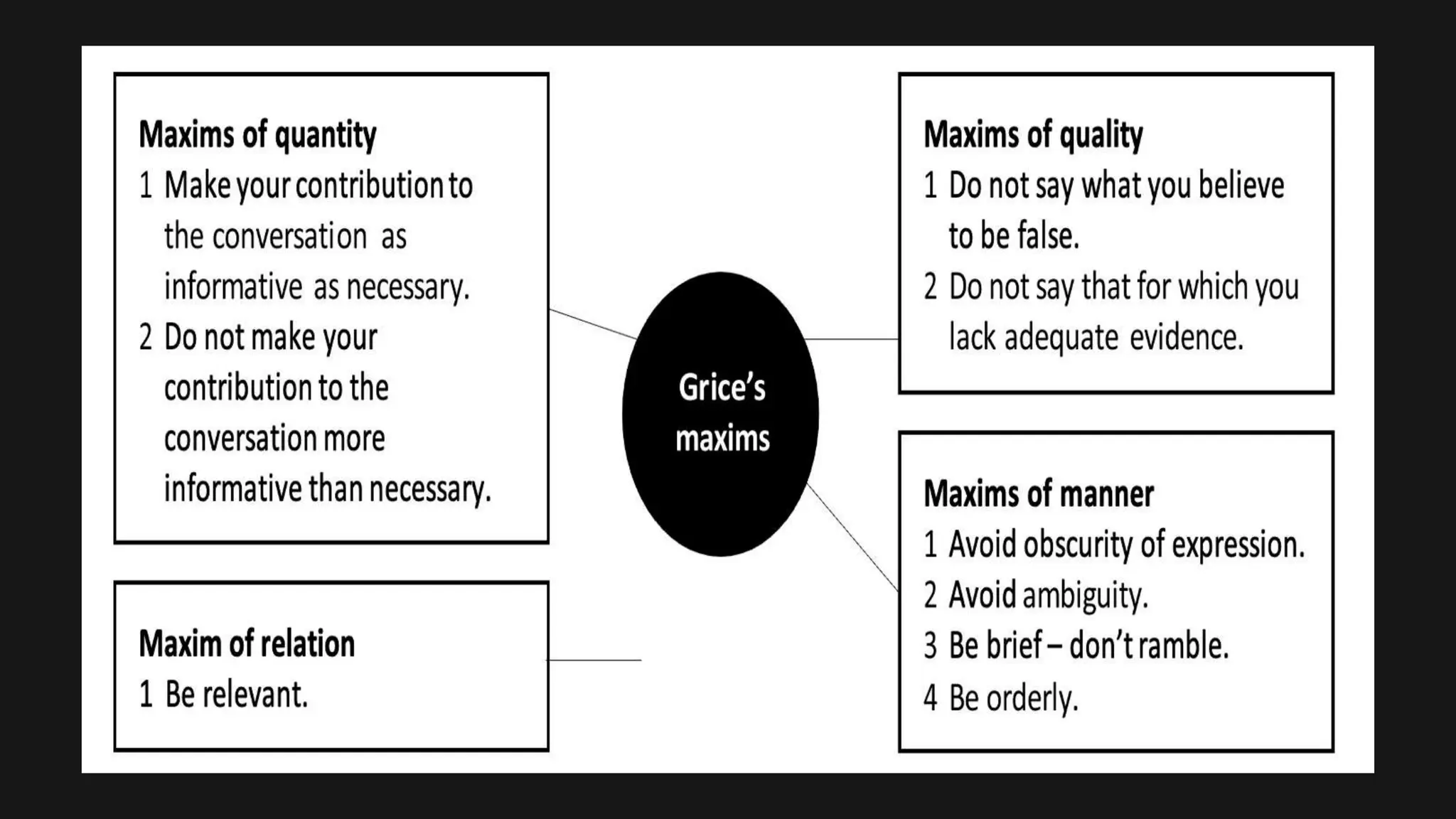
The philosopher Paul Grice established in 1975 the
guideline principles which are generally adopted in
conversation. These are maxims and not rules, since
they are broken in almost every conversation, but
they do provide a general framework for managing
conversation.
Conversational face
conversational face – each speaker’s sense
of his or her own linguistic image and worth.
The theory of face was initiated by Erving
Goffman in 1967 and developed by
Penelope Brown and Stephen Levinson in
1987.
face-threatening acts - acts or words which appear to
threaten the self-esteem of a speaker in conversation
positive politeness - strategies intended to minimize
the threat to the hearer’s self-esteem
negative politeness - strategies intended to avoid
giving offence by showing deference, for example, I
hope you don’t mind if I ...
positive politeness by being complimentary to the
person they are speaking to before starting a
potentially face-threatening act.
Such strategies are used to make the listener feel
good about themselves, their interests or
possessions, and are frequently used in situations
where the speakers know each other fairly well. For
example. ‘You look great/sad, can I help?’ ‘Would you
be so kind as to pass me the sugar?’.
negative politeness may be used to mitigate a
request or situation by the speaker, which they wish
to impose and which would potentially restrict the
freedom of someone else in the conversation. For
example, ‘You wouldn’t be able to pass me the sugar,
would you?’. In both of these circumstances the
speaker expects the listener will comply with their
request.
Theories of language
and self-identity
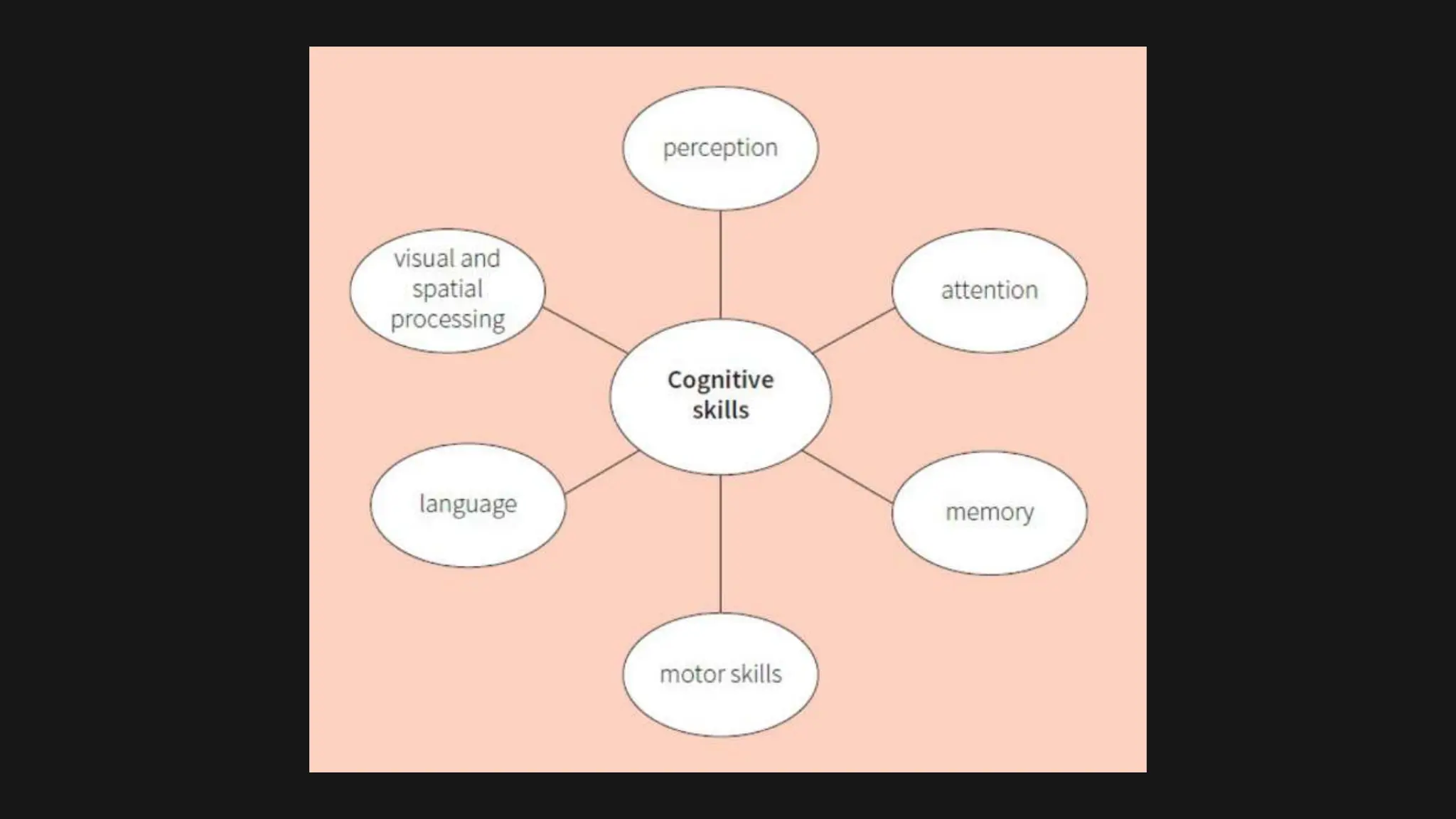
Cognitive skills: brain skills which are needed to perform any
mental and physical task. They are concerned with mechanisms
of carrying out these tasks, rather than with any knowledge.
Cognitive abilities are: perception, attention, memory, motor
skills, language and thought; visual and spatial processing.
Perception: recognition and interpretation through the senses.
Attention: being able to concentrate on a particular mental or
physical task and sustaining that concentration over other
distractions in the environment.
Memory: the storage and retrieval of information in the brain.
Memory is divided into short-term memory (the ability to actively
retain a small amount of information) and long Term memory
(where information is stored for an indefinite period of time and
can be retrieved).
Motor skills: the ability to move the body and to manipulate
objects
Language: the skill which changes sounds into words to be spoken
Visual and spatial processing: the ability to understand
relationships between objects and to visualise images and ideas in
the imagination
The main theories about the
cognitive abilities involved
in creating language
Historical background: Philosophers used to think
that language acquisition was part of a person’s
general ability to reason. They had no awareness of
cognitive abilities. Descartes, a French Philosopher
(1596–1650), thought that ‘it requires very little
reason to be able to speak.’
Using the brain to make meaning of the language
learned: Early in the 20th century, linguists realised
that learning a language was not just learning names
of objects and ideas, but it involved knowledge of
how to put meaning on the words and phrases
learned. Language is immensely complicated and so
linguists suggested that cognitive skills involving
the brain develop alongside the lexis and grammar
of a language learned.
Behavourism: Acquisition of the sense of self takes place
alongside the acquisition of language. Behaviourism theories
began in 1914 and stated that the development of the mind, and
also language, sprang directly from the child’s observation and
imitation of those in the world around them. According to
behaviourists, all thoughts and emotions are explained in terms of
encouraging desired behaviour (e.g. speaking and discouraging
unwanted traits). John Watson’s research, in 1913, was developed
by B.F. Skinner whose book Behaviour of Organisms was published
in 1938 and explored the ideas described here.
Empiricism: A theory which also states that our sense of self-
identity and our knowledge of language come through our senses
and experiences, and not through any reasoning or logical
argument. The theory was advanced by John Locke who
published a book in 1690 which argued that the mind at birth was
a ‘clean slate’ on which all experiences developed. He denied
that humans had any innate ideas and he believed that ideas of
the self, and also of language, came through experience. This
understanding of gaining knowledge through experience became
the basis of the scientific approach.
Innatism: This theory puts forward the idea that there
is something special about the human brain which
enables it to master the complexities of language. That
the mind is born with ideas goes against the ‘blank
slate’ or tabula rasa theory. Traditionally, innatism
refers to the philosophy of Plato (a Greek philosopher
living from 427–347 BCE) and Descartes (a French
mathematician and philosopher, 1596– 1650 AD) who
believed that ideas were in the mind at birth and given
by a supreme being.
Nativism: A theory, based in innatism, with the view
that the individual is born with genetic abilities
which include the development of language. Noam
Chomsky has been the leading proponent of the view
that the Language Acquisition Device enables the
initial development of language which then interacts
with an individual’s childhood experiences within a
society to produce both language and a sense of self.
to be continued...

Language and Self A level Cambridge presentation

  • 1.
  • 2.
    Who are you?Try to explain what your ‘self’ is.
  • 3.
    Learning objectives In thisunit, you will: ■identify the ways in which language and personal identity interact (AO4) ■explore the influence of a person’s self-identity on our use of written and spoken language (AO3) ■analyse unseen texts to demonstrate how language interacts with personal identity (AO1).
  • 4.
    We are notborn with a sense of self , or with any set of the values and behaviours which we display throughout our lives. It is during our early childhood development of our physical, linguistic, social and cognitive development that we identify ourselves as distinct from others around us.
  • 5.
    Self-identity is avital part of who we are and how we interact with others throughout our lives. We can have different elements which make up our sense of self. The sociologist Antony Giddens stresses its importance to everything we do and the people we meet each day. He says ‘What to do? How to act? Who to be? These are focal questions for everyone living in circumstances of late modernity (in the 21st century) – and ones which, on some level or another, all of us answer, either discursively or through day-to-day social behaviour’.
  • 6.
    The development ofthe self starts from the earliest days of life and continues to adapt and change as we do. I You will explore the many ways in which our sense of self is influenced by the language we use and the people we engage with during our life.
  • 7.
    What are theways in which a young child becomes aware of his/her self-identity?
  • 8.
    The influence of languageon self–identity
  • 9.
    Your voice isone instantly recognisable part of you. Your individual speech pattern is known as your idiolect.
  • 10.
    The form oflanguage you speak, which is similar to that spoken in your geographical area or social group, is your sociolect.
  • 11.
    The influences ofyour gender, age, ethnicity, religion and beliefs, family and friends, education, work and social patterns are all linked in with the language you use to live your life and maintain your self- identity. You will see that some parts of your life are more significant to your sense of self at certain times. As an adolescent, you may be forming new identities and relationships where common speech patterns help reinforce solidarity. Language may be important to maintain group identity, such as where a minority language is threatened (e.g. Māori in New Zealand).
  • 12.
    Discourse is animportant part of our lives and therefore the language and strategies we adopt have a considerable influence on our sense of self. People adopt strategies to manage conversations in as harmonious a way as possible. Two important language features are conversational maxims and the conversational face.
  • 13.
  • 14.
    Whenever you speak,your intention is to make sense to your listeners according to the rules and conventions of the language. You may have many different purposes when speaking – you may wish to inform, question, greet, perform, gossip and many more – but all of these purposes have conventions which need to be followed.
  • 15.
    Underlying all ofthe purposes for speaking is the cooperative principle that people wish to express relevant information in a clear manner.
  • 17.
    The philosopher PaulGrice established in 1975 the guideline principles which are generally adopted in conversation. These are maxims and not rules, since they are broken in almost every conversation, but they do provide a general framework for managing conversation.
  • 18.
  • 19.
    conversational face –each speaker’s sense of his or her own linguistic image and worth. The theory of face was initiated by Erving Goffman in 1967 and developed by Penelope Brown and Stephen Levinson in 1987.
  • 20.
    face-threatening acts -acts or words which appear to threaten the self-esteem of a speaker in conversation positive politeness - strategies intended to minimize the threat to the hearer’s self-esteem negative politeness - strategies intended to avoid giving offence by showing deference, for example, I hope you don’t mind if I ...
  • 21.
    positive politeness bybeing complimentary to the person they are speaking to before starting a potentially face-threatening act. Such strategies are used to make the listener feel good about themselves, their interests or possessions, and are frequently used in situations where the speakers know each other fairly well. For example. ‘You look great/sad, can I help?’ ‘Would you be so kind as to pass me the sugar?’.
  • 22.
    negative politeness maybe used to mitigate a request or situation by the speaker, which they wish to impose and which would potentially restrict the freedom of someone else in the conversation. For example, ‘You wouldn’t be able to pass me the sugar, would you?’. In both of these circumstances the speaker expects the listener will comply with their request.
  • 23.
  • 25.
    Cognitive skills: brainskills which are needed to perform any mental and physical task. They are concerned with mechanisms of carrying out these tasks, rather than with any knowledge. Cognitive abilities are: perception, attention, memory, motor skills, language and thought; visual and spatial processing. Perception: recognition and interpretation through the senses. Attention: being able to concentrate on a particular mental or physical task and sustaining that concentration over other distractions in the environment.
  • 26.
    Memory: the storageand retrieval of information in the brain. Memory is divided into short-term memory (the ability to actively retain a small amount of information) and long Term memory (where information is stored for an indefinite period of time and can be retrieved). Motor skills: the ability to move the body and to manipulate objects Language: the skill which changes sounds into words to be spoken Visual and spatial processing: the ability to understand relationships between objects and to visualise images and ideas in the imagination
  • 27.
    The main theoriesabout the cognitive abilities involved in creating language
  • 28.
    Historical background: Philosophersused to think that language acquisition was part of a person’s general ability to reason. They had no awareness of cognitive abilities. Descartes, a French Philosopher (1596–1650), thought that ‘it requires very little reason to be able to speak.’
  • 29.
    Using the brainto make meaning of the language learned: Early in the 20th century, linguists realised that learning a language was not just learning names of objects and ideas, but it involved knowledge of how to put meaning on the words and phrases learned. Language is immensely complicated and so linguists suggested that cognitive skills involving the brain develop alongside the lexis and grammar of a language learned.
  • 30.
    Behavourism: Acquisition ofthe sense of self takes place alongside the acquisition of language. Behaviourism theories began in 1914 and stated that the development of the mind, and also language, sprang directly from the child’s observation and imitation of those in the world around them. According to behaviourists, all thoughts and emotions are explained in terms of encouraging desired behaviour (e.g. speaking and discouraging unwanted traits). John Watson’s research, in 1913, was developed by B.F. Skinner whose book Behaviour of Organisms was published in 1938 and explored the ideas described here.
  • 31.
    Empiricism: A theorywhich also states that our sense of self- identity and our knowledge of language come through our senses and experiences, and not through any reasoning or logical argument. The theory was advanced by John Locke who published a book in 1690 which argued that the mind at birth was a ‘clean slate’ on which all experiences developed. He denied that humans had any innate ideas and he believed that ideas of the self, and also of language, came through experience. This understanding of gaining knowledge through experience became the basis of the scientific approach.
  • 32.
    Innatism: This theoryputs forward the idea that there is something special about the human brain which enables it to master the complexities of language. That the mind is born with ideas goes against the ‘blank slate’ or tabula rasa theory. Traditionally, innatism refers to the philosophy of Plato (a Greek philosopher living from 427–347 BCE) and Descartes (a French mathematician and philosopher, 1596– 1650 AD) who believed that ideas were in the mind at birth and given by a supreme being.
  • 33.
    Nativism: A theory,based in innatism, with the view that the individual is born with genetic abilities which include the development of language. Noam Chomsky has been the leading proponent of the view that the Language Acquisition Device enables the initial development of language which then interacts with an individual’s childhood experiences within a society to produce both language and a sense of self.
  • 34.