Creating value from customer-centric circular
business models - circularplaybook.fi
Investing in Circular Economy Businesses, WCEF 2019 Helsinki
Jyri Arponen, Senior Lead Sitra
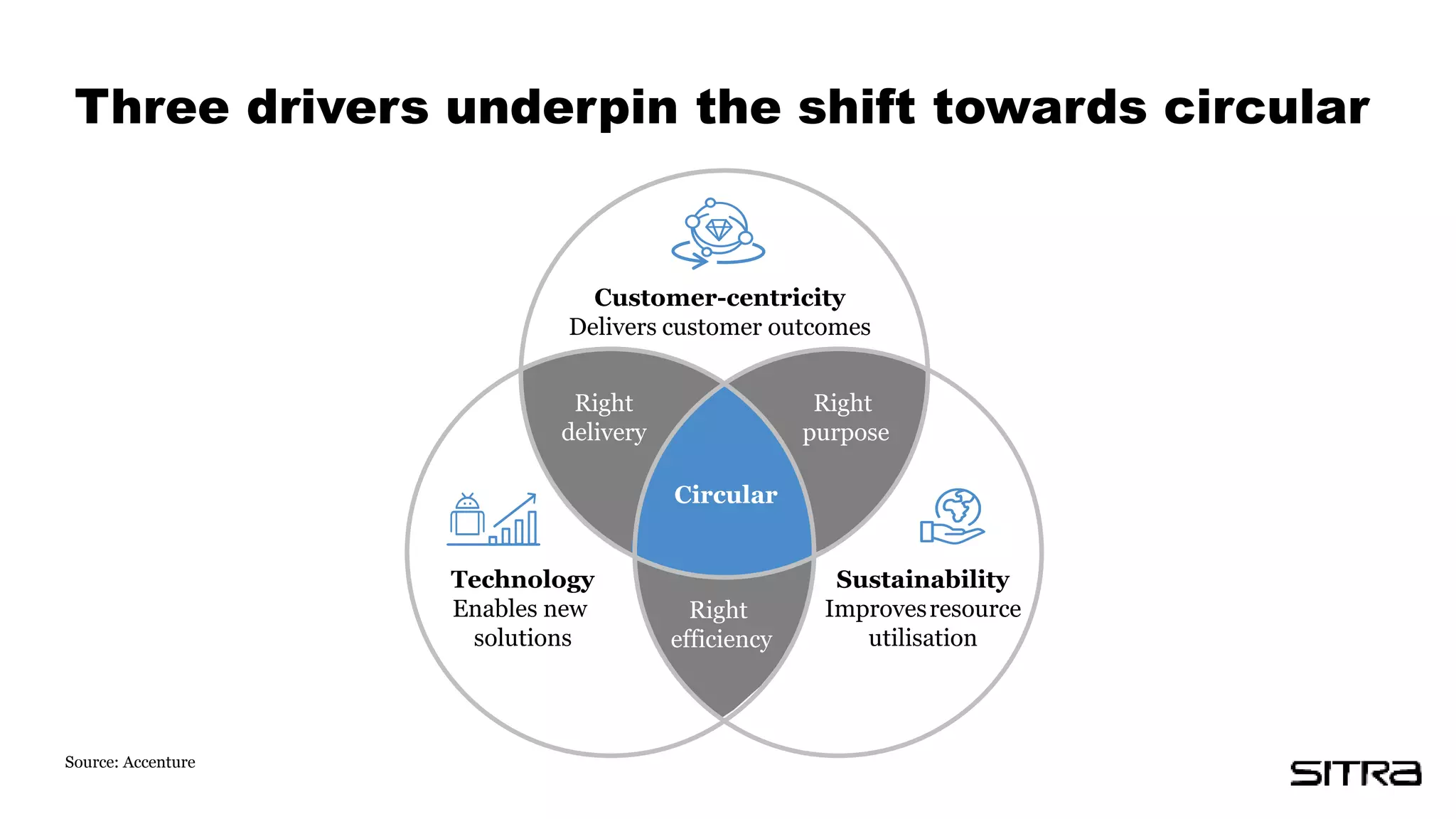
Three drivers underpin the shift towards circular
Circular
Technology
Enables new
solutions
Customer-centricity
Delivers customer outcomes
Sustainability
Improvesresource
utilisation
Right
purpose
Right
efficiency
Right
delivery
Source: Accenture
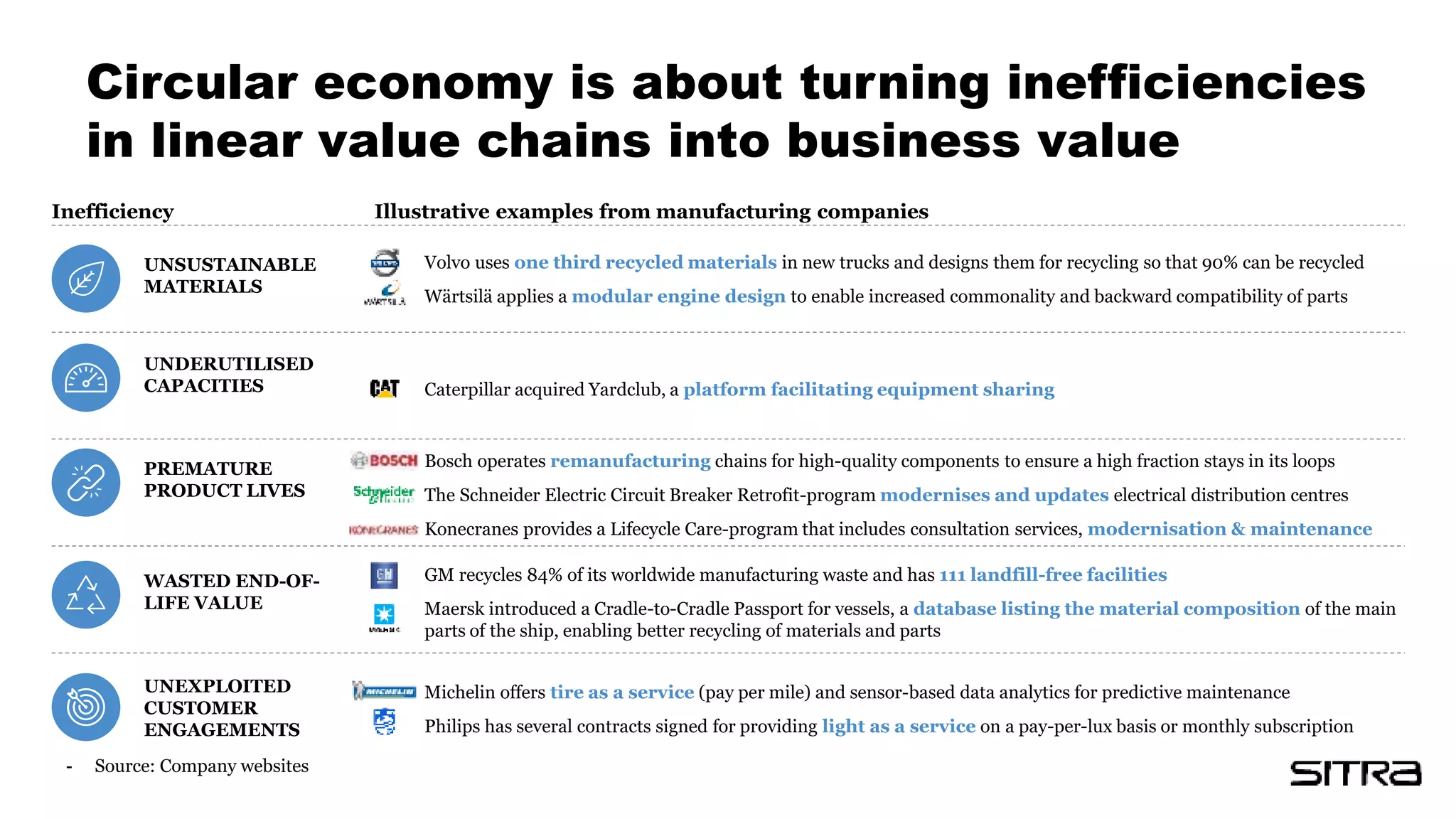
Circular economy is about turning inefficiencies
in linear value chains into business value
- Source: Company websites
Michelin offers tire as a service (pay per mile) and sensor-based data analytics for predictive maintenance
Philips has several contracts signed for providing light as a service on a pay-per-lux basis or monthly subscription
Caterpillar acquired Yardclub, a platform facilitating equipment sharing
GM recycles 84% of its worldwide manufacturing waste and has 111 landfill-free facilities
Maersk introduced a Cradle-to-Cradle Passport for vessels, a database listing the material composition of the main
parts of the ship, enabling better recycling of materials and parts
Bosch operates remanufacturing chains for high-quality components to ensure a high fraction stays in its loops
The Schneider Electric Circuit Breaker Retrofit-program modernises and updates electrical distribution centres
Konecranes provides a Lifecycle Care-program that includes consultation services, modernisation & maintenance
Volvo uses one third recycled materials in new trucks and designs them for recycling so that 90% can be recycled
Wärtsilä applies a modular engine design to enable increased commonality and backward compatibility of parts
PREMATURE
PRODUCT LIVES
WASTED END-OF-
LIFE VALUE
UNDERUTILISED
CAPACITIES
UNSUSTAINABLE
MATERIALS
UNEXPLOITED
CUSTOMER
ENGAGEMENTS
Illustrative examples from manufacturing companiesInefficiency
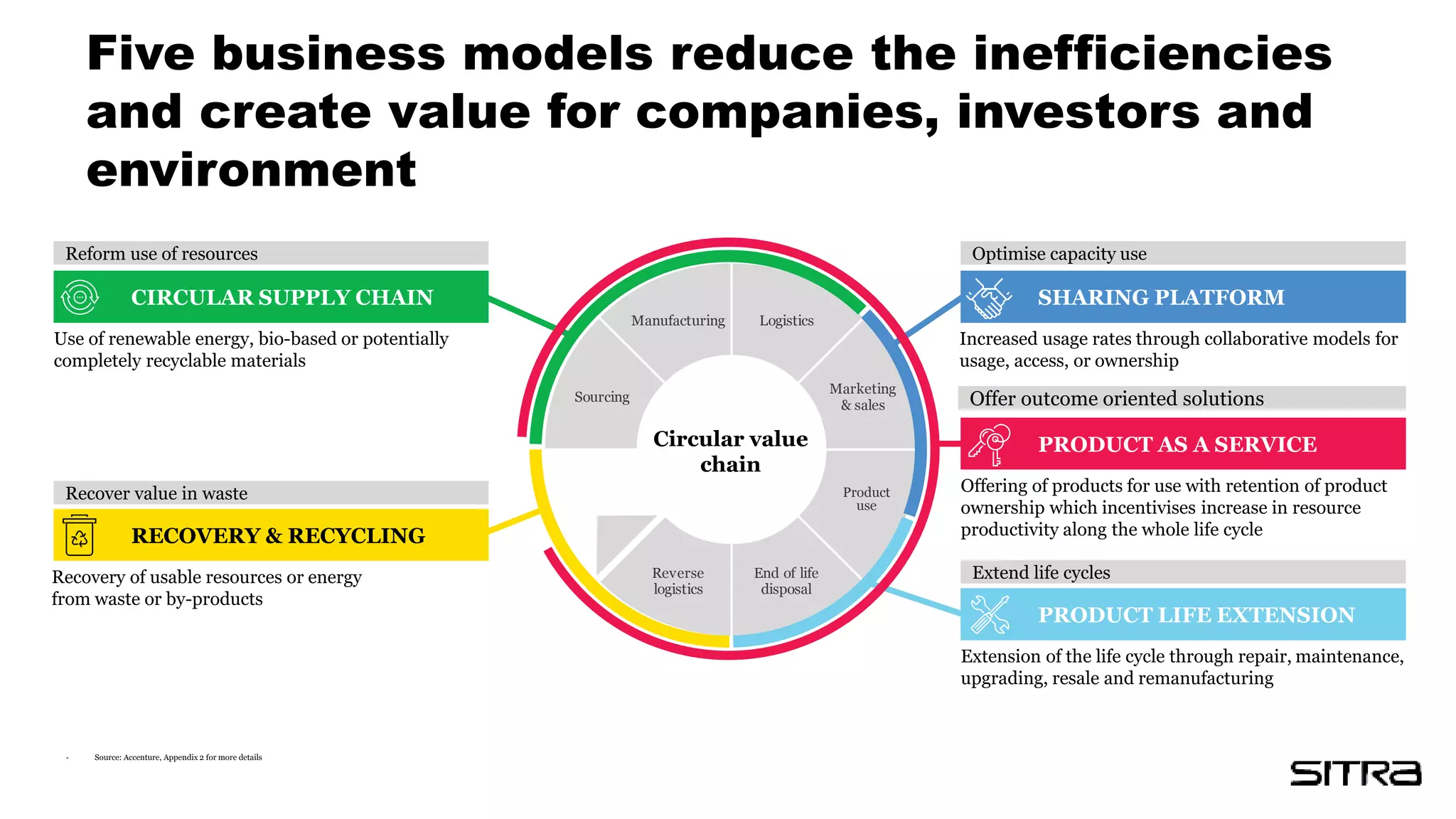
Five business models reduce the inefficiencies
and create value for companies, investors and
environment
- Source: Accenture, Appendix 2 for more details
Reform use of resources
CIRCULAR SUPPLY CHAIN
Use of renewable energy, bio-based or potentially
completely recyclable materials
Logistics
Marketing
& sales
End of life
disposal
Reverse
logistics
Sourcing
Manufacturing
Product
use
Circular value
chain
Optimise capacity use
SHARING PLATFORM
Increased usage rates through collaborative models for
usage, access, or ownership
Extend life cycles
PRODUCT LIFE EXTENSION
Extension of the life cycle through repair, maintenance,
upgrading, resale and remanufacturing
PRODUCT AS A SERVICE
Offering of products for use with retention of product
ownership which incentivises increase in resource
productivity along the whole life cycle
Recover value in waste
RECOVERY & RECYCLING
Recovery of usable resources or energy
from waste or by-products
Offer outcome oriented solutions
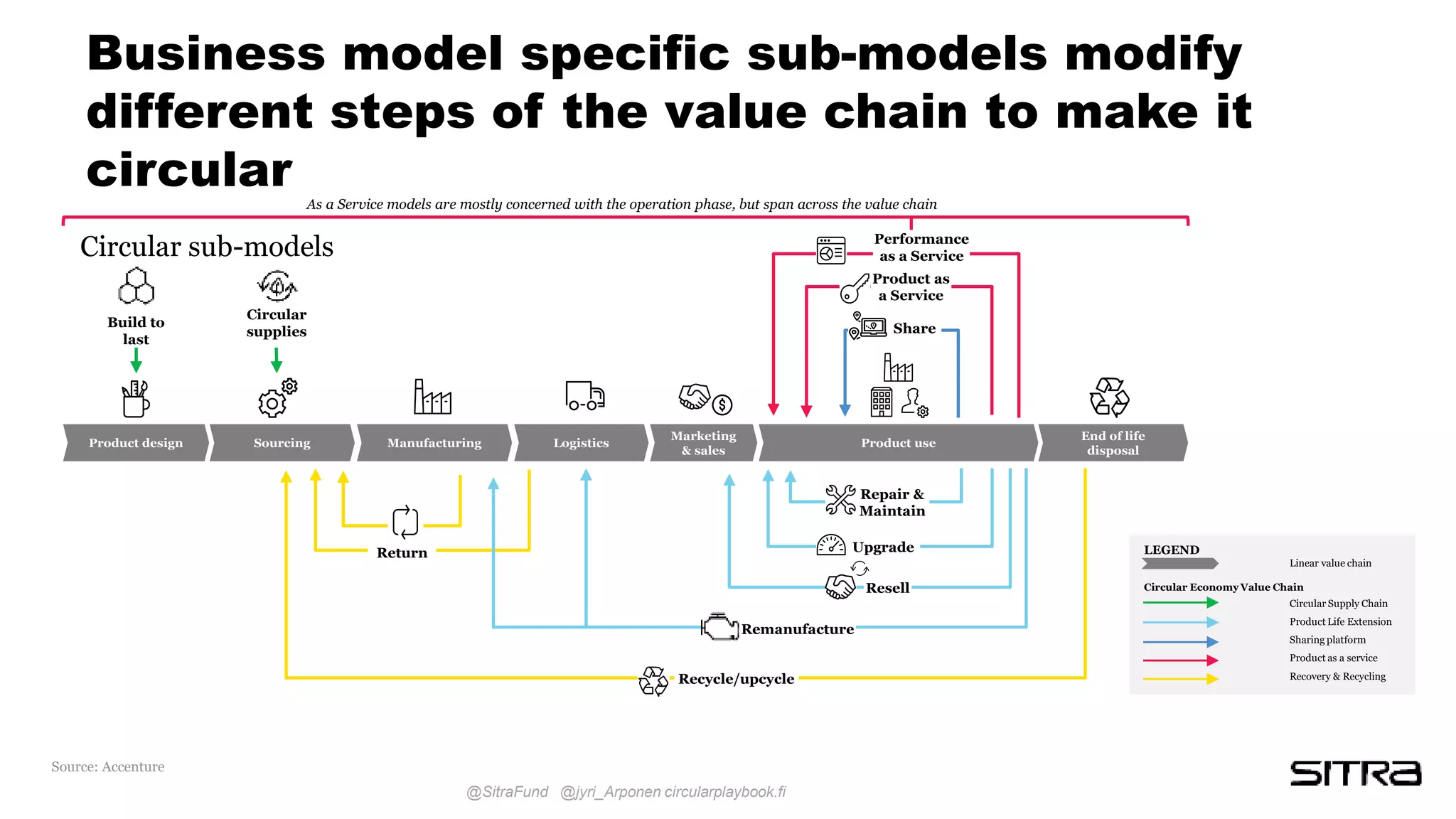
Business model specific sub-models modify
different steps of the value chain to make it
circular
Circular sub-models
Recycle/upcycle
Circular
supplies
Build to
last
Return
Repair &
Maintain
Resell
Remanufacture
Product design Sourcing Manufacturing Logistics Product use
End of life
disposal
Share
Product as
a Service
Performance
as a Service
As a Service models are mostly concerned with the operation phase, but span across the value chain
Marketing
& sales
Upgrade LEGEND
Linear value chain
Circular Economy Value Chain
Circular Supply Chain
Product Life Extension
Sharing platform
Product as a service
Recovery & Recycling
@SitraFund @jyri_Arponen circularplaybook.fi
Source: Accenture
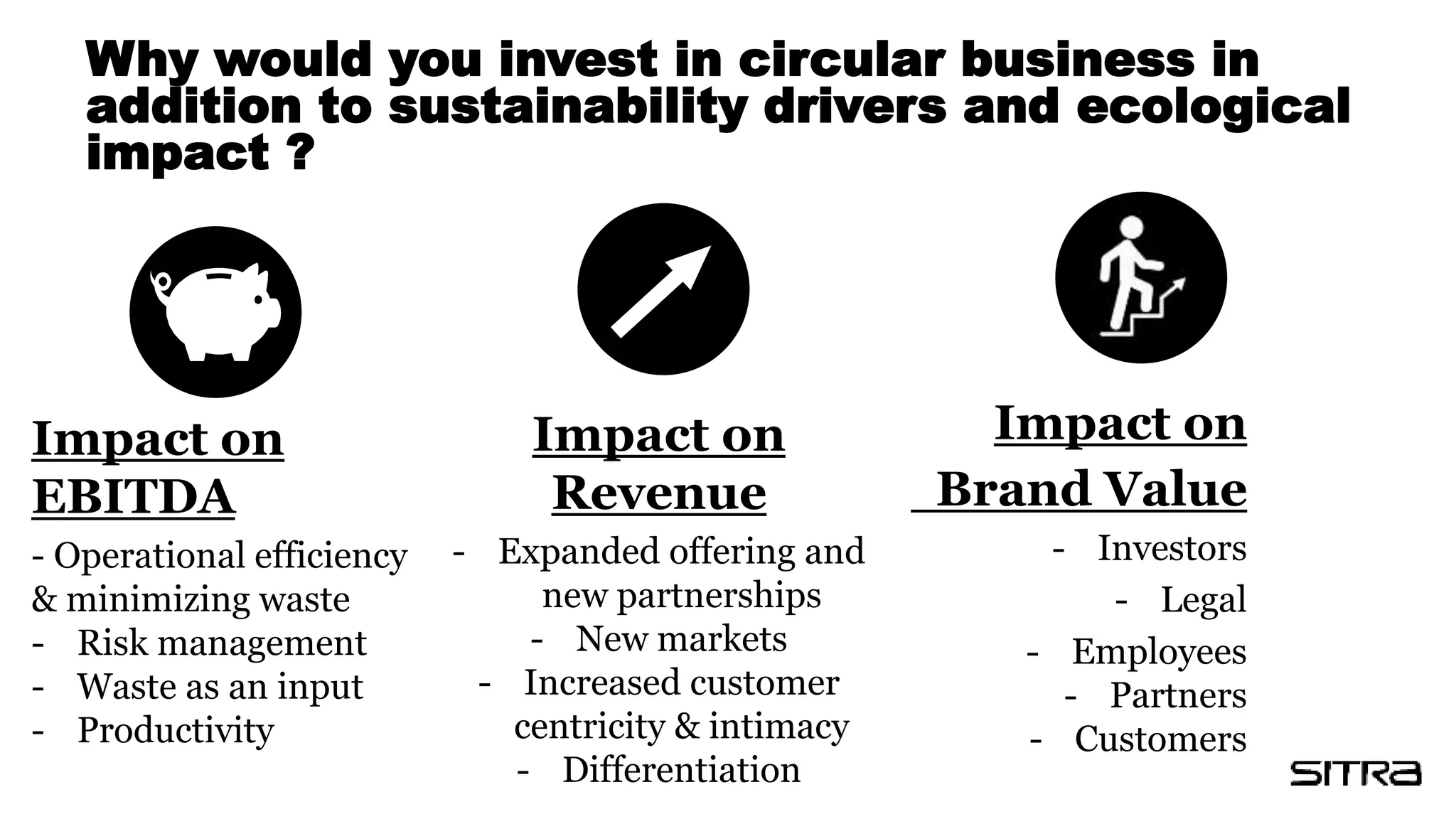
Why would you invest in circular business in
addition to sustainability drivers and ecological
impact ?
Impact on
EBITDA
- Operational efficiency
& minimizing waste
- Risk management
- Waste as an input
- Productivity
Impact on
Revenue
- Expanded offering and
new partnerships
- New markets
- Increased customer
centricity & intimacy
- Differentiation
Impact on
Brand Value
- Investors
- Legal
- Employees
- Partners
- Customers
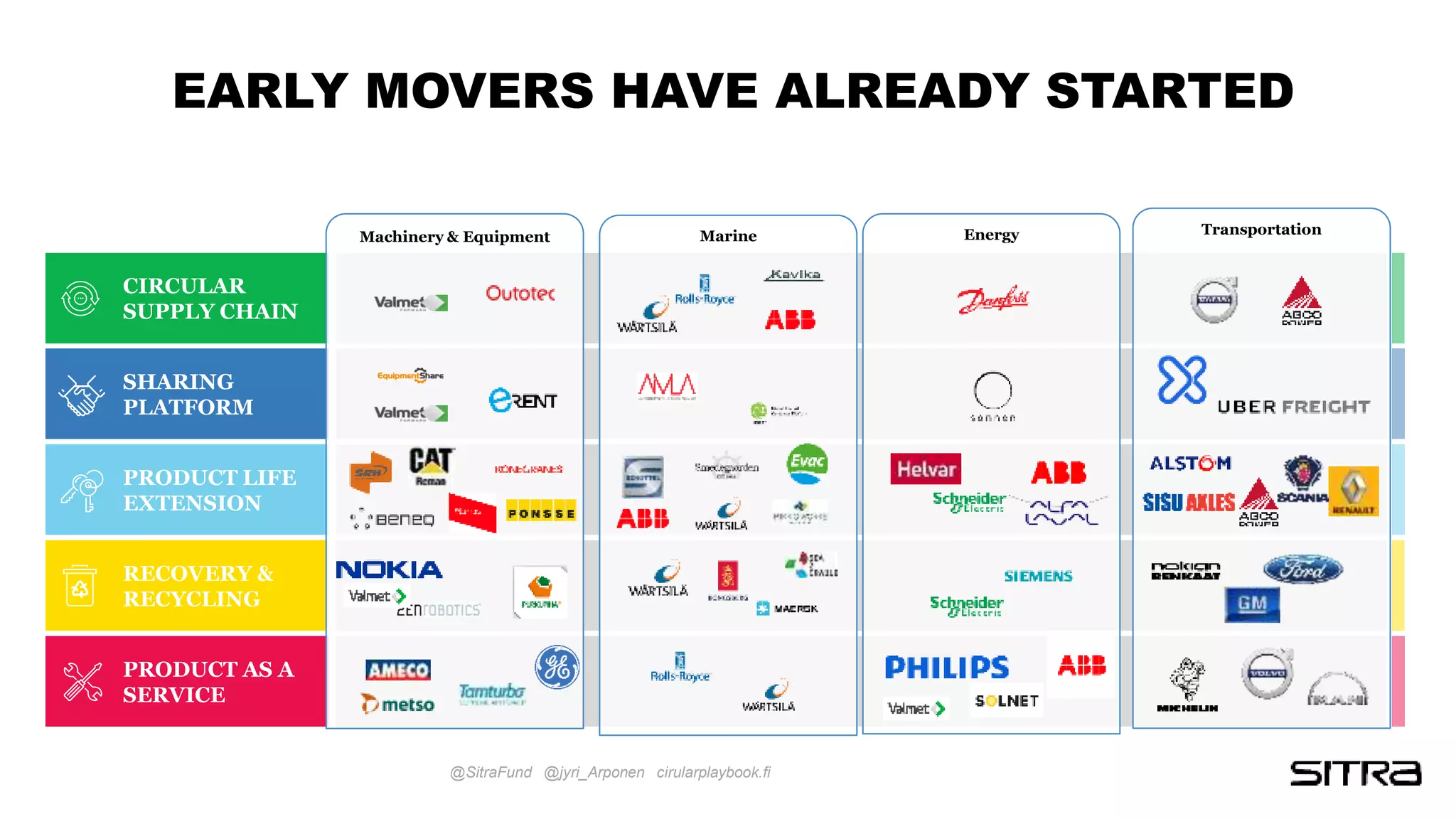
EARLY MOVERS HAVE ALREADY STARTED
CIRCULAR
SUPPLY CHAIN
SHARING
PLATFORM
PRODUCT LIFE
EXTENSION
PRODUCT AS A
SERVICE
RECOVERY &
RECYCLING
Machinery & Equipment Marine Energy Transportation
@SitraFund @jyri_Arponen cirularplaybook.fi
Legend:
Circular Economy value chain
Linear value chain
Circular Supply-Chain
Product Life-Extension
Sharing Platform
Recovery & Recycling
Product as a Service
Material
Processing
Component
Manufacturing
Use Phase
Assembly
Maintenance
2.0
Remanufacturing
2.0
Waste
(eliminate)
Collection
Resell / Reuse /
Refurbish
Other loops
Recycling &
energetic recovery
(minimize)
Product
Design
Repurpose Other loops
Closed-loop
recycling
Distribution
Circular
inputs
Sharing
Platform1
Product as
a Service2
Recycled
materials,
byproducts
1.5-2.5% annual growth
Annual growth rate
from initially 30%,
decreasing towards
10%
$400-600 bn global
additional revenues in
2030 through selected CE
business models
4-6% annual growth
Share of e-mobility
at 25-50% in 2030
1) peer-to-peer car and ride sharing; 2) mobility as a service
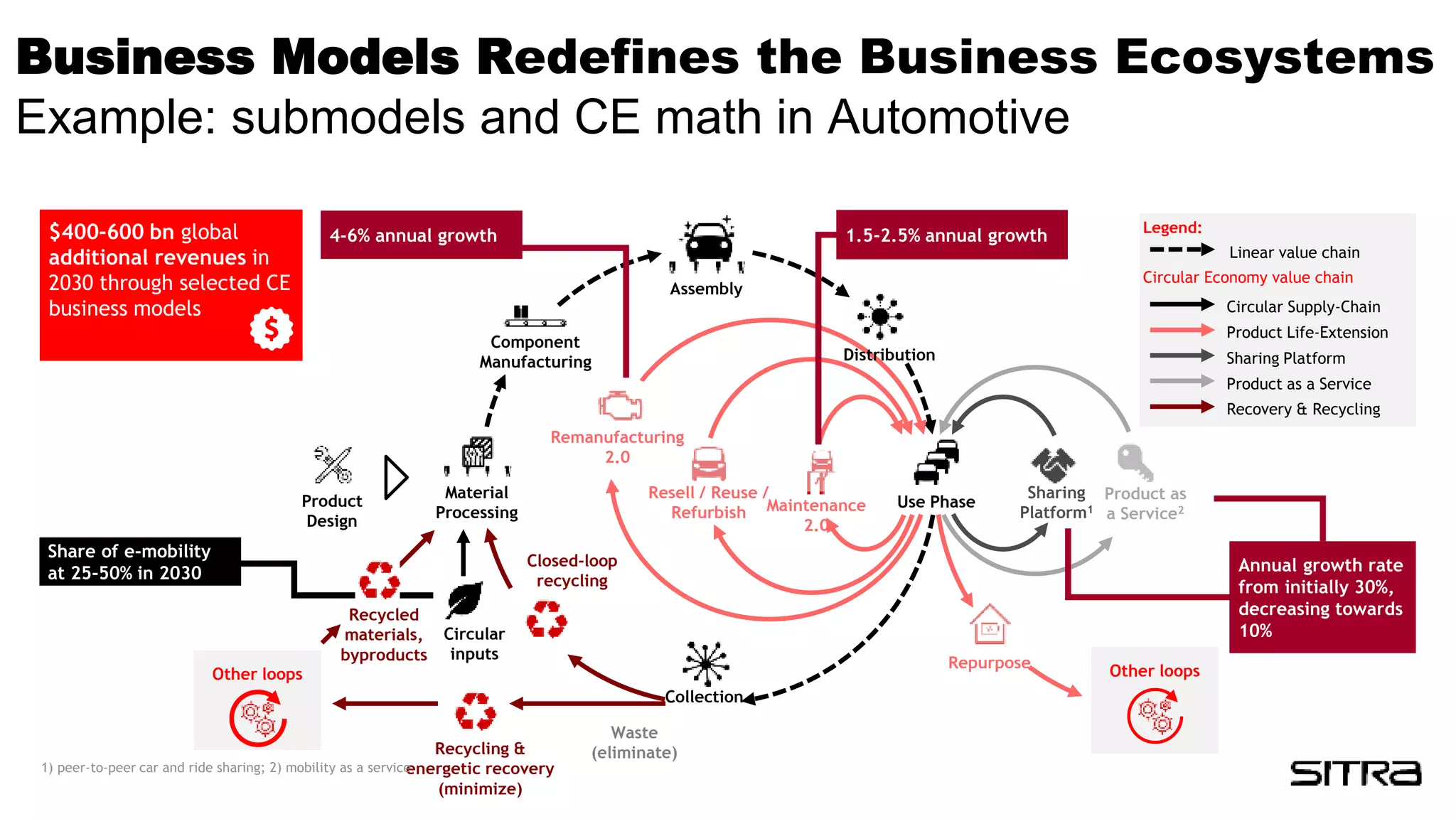
Business Models Redefines the Business Ecosystems
Example: submodels and CE math in Automotive
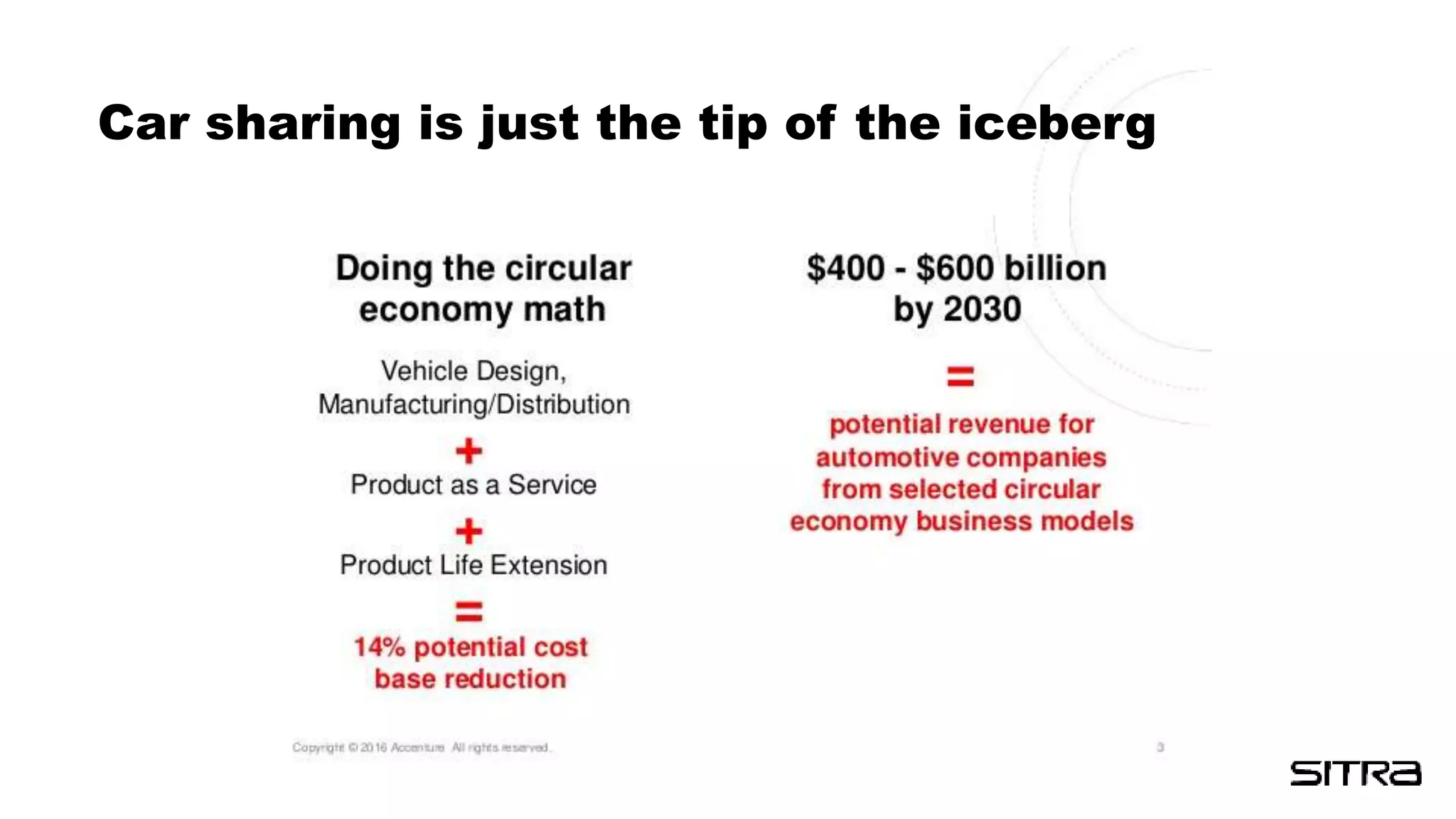
Car sharing is just the tip of the iceberg
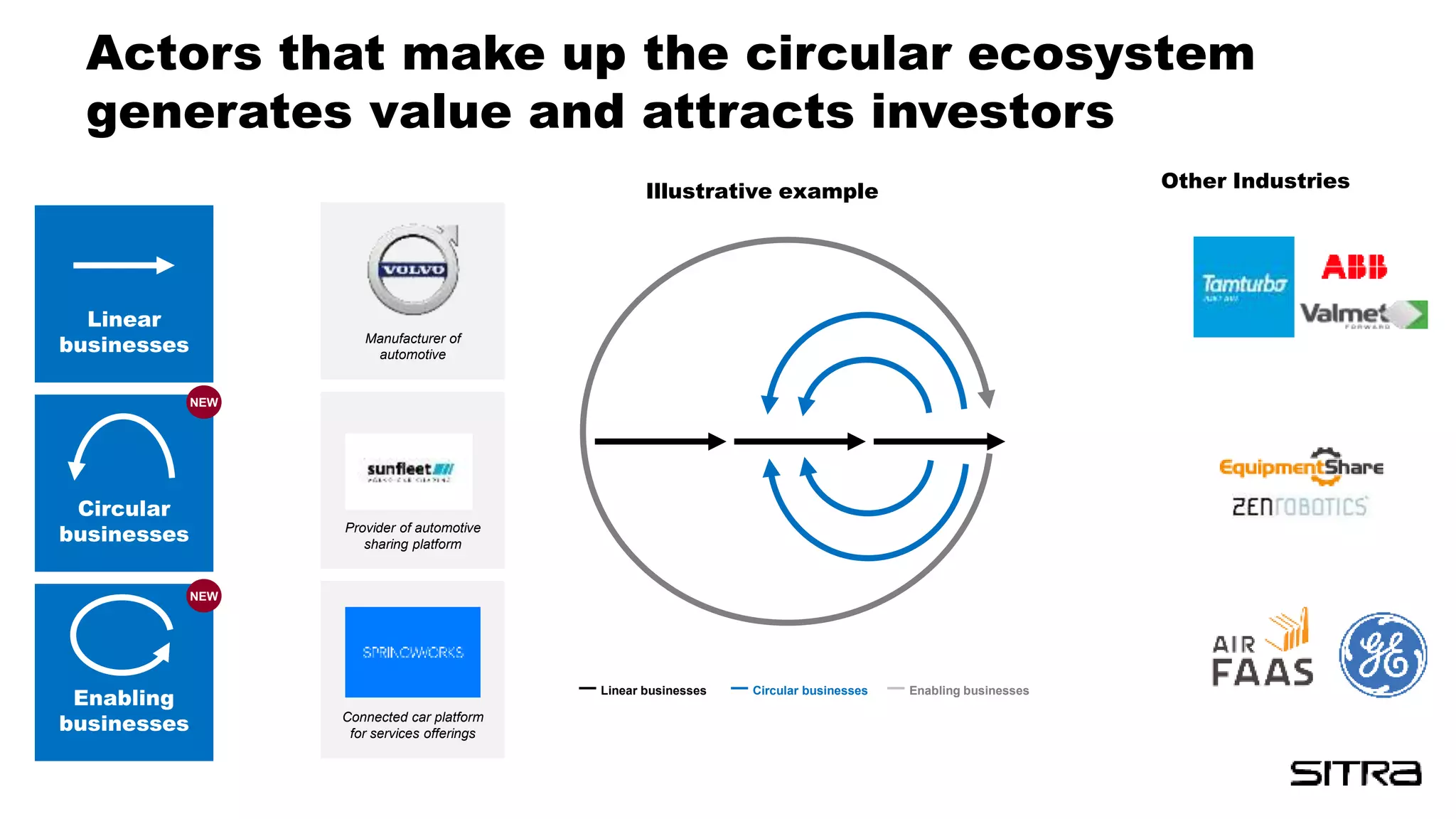
Actors that make up the circular ecosystem
generates value and attracts investors
Linear
businesses
Circular
businesses
Enabling
businesses
NEW
NEW
Manufacturer of
automotive
Provider of automotive
sharing platform
Connected car platform
for services offerings
Illustrative example
Linear businesses Circular businesses Enabling businesses
Other Industries
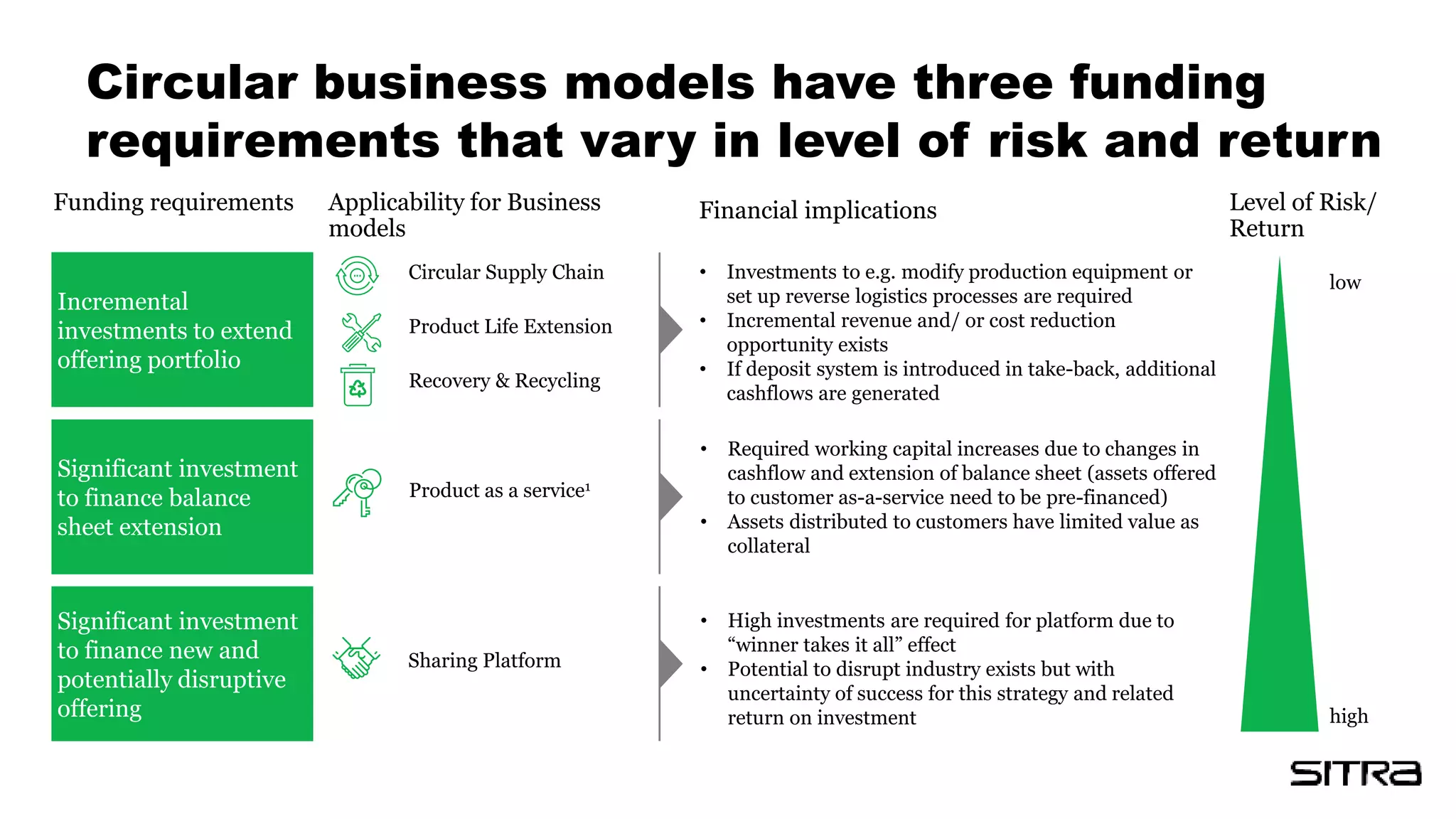
Circular business models have three funding
requirements that vary in level of risk and return
Applicability for Business
models
Financial implications
Incremental
investments to extend
offering portfolio
Significant investment
to finance new and
potentially disruptive
offering
Significant investment
to finance balance
sheet extension
• Investments to e.g. modify production equipment or
set up reverse logistics processes are required
• Incremental revenue and/ or cost reduction
opportunity exists
• If deposit system is introduced in take-back, additional
cashflows are generated
• High investments are required for platform due to
“winner takes it all” effect
• Potential to disrupt industry exists but with
uncertainty of success for this strategy and related
return on investment
• Required working capital increases due to changes in
cashflow and extension of balance sheet (assets offered
to customer as-a-service need to be pre-financed)
• Assets distributed to customers have limited value as
collateral
Product as a service1
Sharing Platform
Circular Supply Chain
Product Life Extension
Recovery & Recycling
Level of Risk/
Return
high
low
Funding requirements
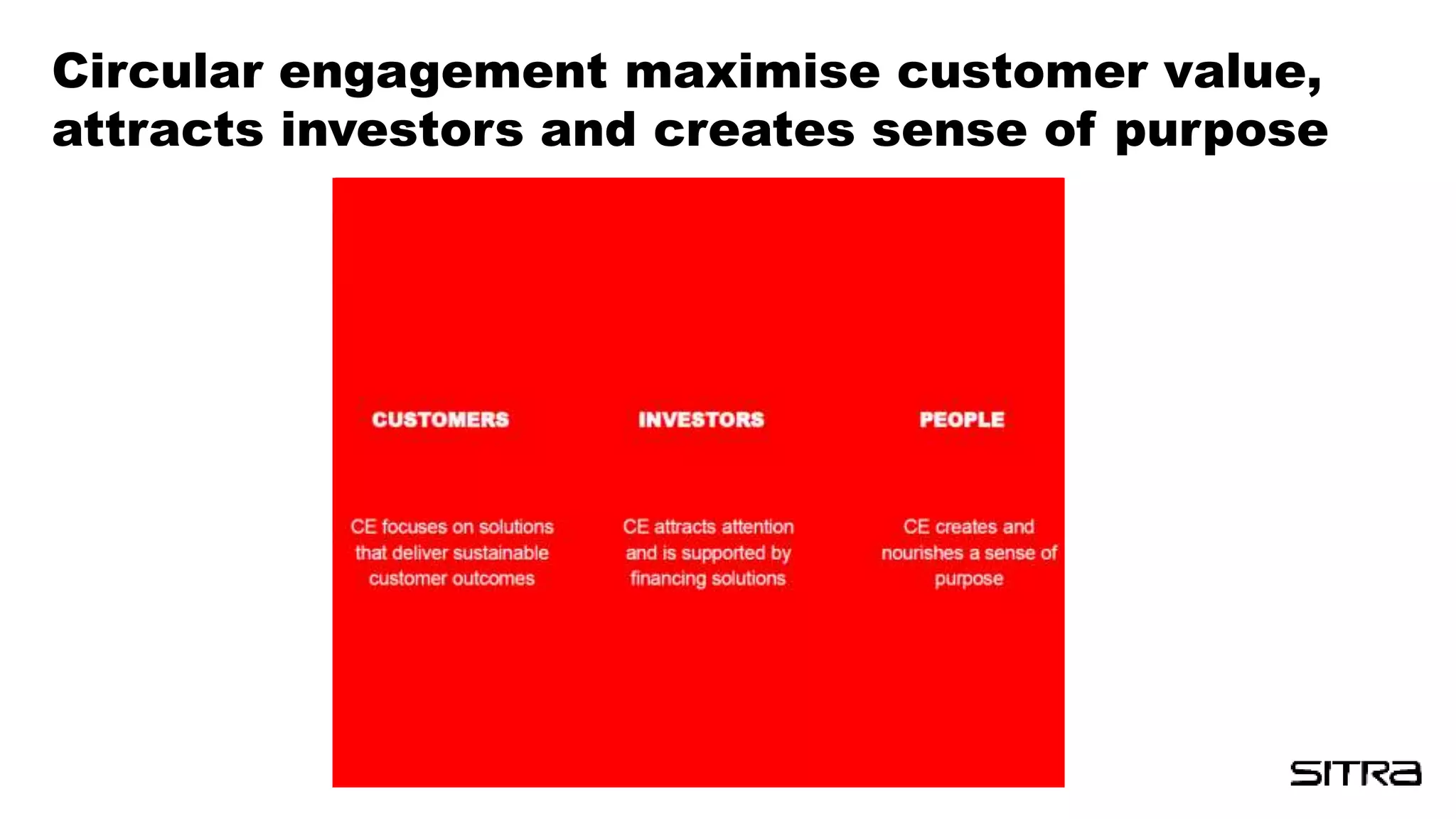
Circular engagement maximise customer value,
attracts investors and creates sense of purpose
circularplaybook.fi

Jyri Arponen WCEF2019: Creating value from customer-centric circular business models

  • 1.
    Creating value fromcustomer-centric circular business models - circularplaybook.fi Investing in Circular Economy Businesses, WCEF 2019 Helsinki Jyri Arponen, Senior Lead Sitra
  • 2.
    Three drivers underpinthe shift towards circular Circular Technology Enables new solutions Customer-centricity Delivers customer outcomes Sustainability Improvesresource utilisation Right purpose Right efficiency Right delivery Source: Accenture
  • 3.
    Circular economy isabout turning inefficiencies in linear value chains into business value - Source: Company websites Michelin offers tire as a service (pay per mile) and sensor-based data analytics for predictive maintenance Philips has several contracts signed for providing light as a service on a pay-per-lux basis or monthly subscription Caterpillar acquired Yardclub, a platform facilitating equipment sharing GM recycles 84% of its worldwide manufacturing waste and has 111 landfill-free facilities Maersk introduced a Cradle-to-Cradle Passport for vessels, a database listing the material composition of the main parts of the ship, enabling better recycling of materials and parts Bosch operates remanufacturing chains for high-quality components to ensure a high fraction stays in its loops The Schneider Electric Circuit Breaker Retrofit-program modernises and updates electrical distribution centres Konecranes provides a Lifecycle Care-program that includes consultation services, modernisation & maintenance Volvo uses one third recycled materials in new trucks and designs them for recycling so that 90% can be recycled Wärtsilä applies a modular engine design to enable increased commonality and backward compatibility of parts PREMATURE PRODUCT LIVES WASTED END-OF- LIFE VALUE UNDERUTILISED CAPACITIES UNSUSTAINABLE MATERIALS UNEXPLOITED CUSTOMER ENGAGEMENTS Illustrative examples from manufacturing companiesInefficiency
  • 4.
    Five business modelsreduce the inefficiencies and create value for companies, investors and environment - Source: Accenture, Appendix 2 for more details Reform use of resources CIRCULAR SUPPLY CHAIN Use of renewable energy, bio-based or potentially completely recyclable materials Logistics Marketing & sales End of life disposal Reverse logistics Sourcing Manufacturing Product use Circular value chain Optimise capacity use SHARING PLATFORM Increased usage rates through collaborative models for usage, access, or ownership Extend life cycles PRODUCT LIFE EXTENSION Extension of the life cycle through repair, maintenance, upgrading, resale and remanufacturing PRODUCT AS A SERVICE Offering of products for use with retention of product ownership which incentivises increase in resource productivity along the whole life cycle Recover value in waste RECOVERY & RECYCLING Recovery of usable resources or energy from waste or by-products Offer outcome oriented solutions
  • 5.
    Business model specificsub-models modify different steps of the value chain to make it circular Circular sub-models Recycle/upcycle Circular supplies Build to last Return Repair & Maintain Resell Remanufacture Product design Sourcing Manufacturing Logistics Product use End of life disposal Share Product as a Service Performance as a Service As a Service models are mostly concerned with the operation phase, but span across the value chain Marketing & sales Upgrade LEGEND Linear value chain Circular Economy Value Chain Circular Supply Chain Product Life Extension Sharing platform Product as a service Recovery & Recycling @SitraFund @jyri_Arponen circularplaybook.fi Source: Accenture
  • 6.
    Why would youinvest in circular business in addition to sustainability drivers and ecological impact ? Impact on EBITDA - Operational efficiency & minimizing waste - Risk management - Waste as an input - Productivity Impact on Revenue - Expanded offering and new partnerships - New markets - Increased customer centricity & intimacy - Differentiation Impact on Brand Value - Investors - Legal - Employees - Partners - Customers
  • 7.
    EARLY MOVERS HAVEALREADY STARTED CIRCULAR SUPPLY CHAIN SHARING PLATFORM PRODUCT LIFE EXTENSION PRODUCT AS A SERVICE RECOVERY & RECYCLING Machinery & Equipment Marine Energy Transportation @SitraFund @jyri_Arponen cirularplaybook.fi
  • 8.
    Legend: Circular Economy valuechain Linear value chain Circular Supply-Chain Product Life-Extension Sharing Platform Recovery & Recycling Product as a Service Material Processing Component Manufacturing Use Phase Assembly Maintenance 2.0 Remanufacturing 2.0 Waste (eliminate) Collection Resell / Reuse / Refurbish Other loops Recycling & energetic recovery (minimize) Product Design Repurpose Other loops Closed-loop recycling Distribution Circular inputs Sharing Platform1 Product as a Service2 Recycled materials, byproducts 1.5-2.5% annual growth Annual growth rate from initially 30%, decreasing towards 10% $400-600 bn global additional revenues in 2030 through selected CE business models 4-6% annual growth Share of e-mobility at 25-50% in 2030 1) peer-to-peer car and ride sharing; 2) mobility as a service Business Models Redefines the Business Ecosystems Example: submodels and CE math in Automotive
  • 9.
    Car sharing isjust the tip of the iceberg
  • 11.
    Actors that makeup the circular ecosystem generates value and attracts investors Linear businesses Circular businesses Enabling businesses NEW NEW Manufacturer of automotive Provider of automotive sharing platform Connected car platform for services offerings Illustrative example Linear businesses Circular businesses Enabling businesses Other Industries
  • 12.
    Circular business modelshave three funding requirements that vary in level of risk and return Applicability for Business models Financial implications Incremental investments to extend offering portfolio Significant investment to finance new and potentially disruptive offering Significant investment to finance balance sheet extension • Investments to e.g. modify production equipment or set up reverse logistics processes are required • Incremental revenue and/ or cost reduction opportunity exists • If deposit system is introduced in take-back, additional cashflows are generated • High investments are required for platform due to “winner takes it all” effect • Potential to disrupt industry exists but with uncertainty of success for this strategy and related return on investment • Required working capital increases due to changes in cashflow and extension of balance sheet (assets offered to customer as-a-service need to be pre-financed) • Assets distributed to customers have limited value as collateral Product as a service1 Sharing Platform Circular Supply Chain Product Life Extension Recovery & Recycling Level of Risk/ Return high low Funding requirements
  • 13.
    Circular engagement maximisecustomer value, attracts investors and creates sense of purpose
  • 14.

Editor's Notes

  • #7 Revenue: case valtavalo hyvä esimerkki