Lunch & Learn:
Introduction to
Online Reputation
Management

Presenter: Mathew Simonton
Date:      April 10th, 2013
Location: Formic Media
About Mathew

• Joined Formic Media in 2012!


• Launched Notevee in college, 2010-2011
    • Featured on KillerStartups.com and AppAppeal.com
    • Reviewed across smaller app/startup blogs

     “Notevee gives users a way to post social notes and hold
     conversations on specific topics. Users create conversation
     pages. These pages consist of images, video, notes and text
     related to a specific topic, event, person or anything else the
     user can think of.” -AppAppeal
What is Online Reputation
      Management?
Online Reputation Management – What?


• Building or enhancing a web identity in order to
  maintain a positive appearance on the internet
       • Maximizing positive and neutral content
       • Minimizing negative content
          • Removing negative content entirely,
            when possible
Online Reputation Management – Why?


• Establish identity
    • Establish or maintain a positive identity in
      the first place

• Guide users away from negative content

• Two types of management
   1. Preventative
   2. Reactionary
Case Study (Preventative)


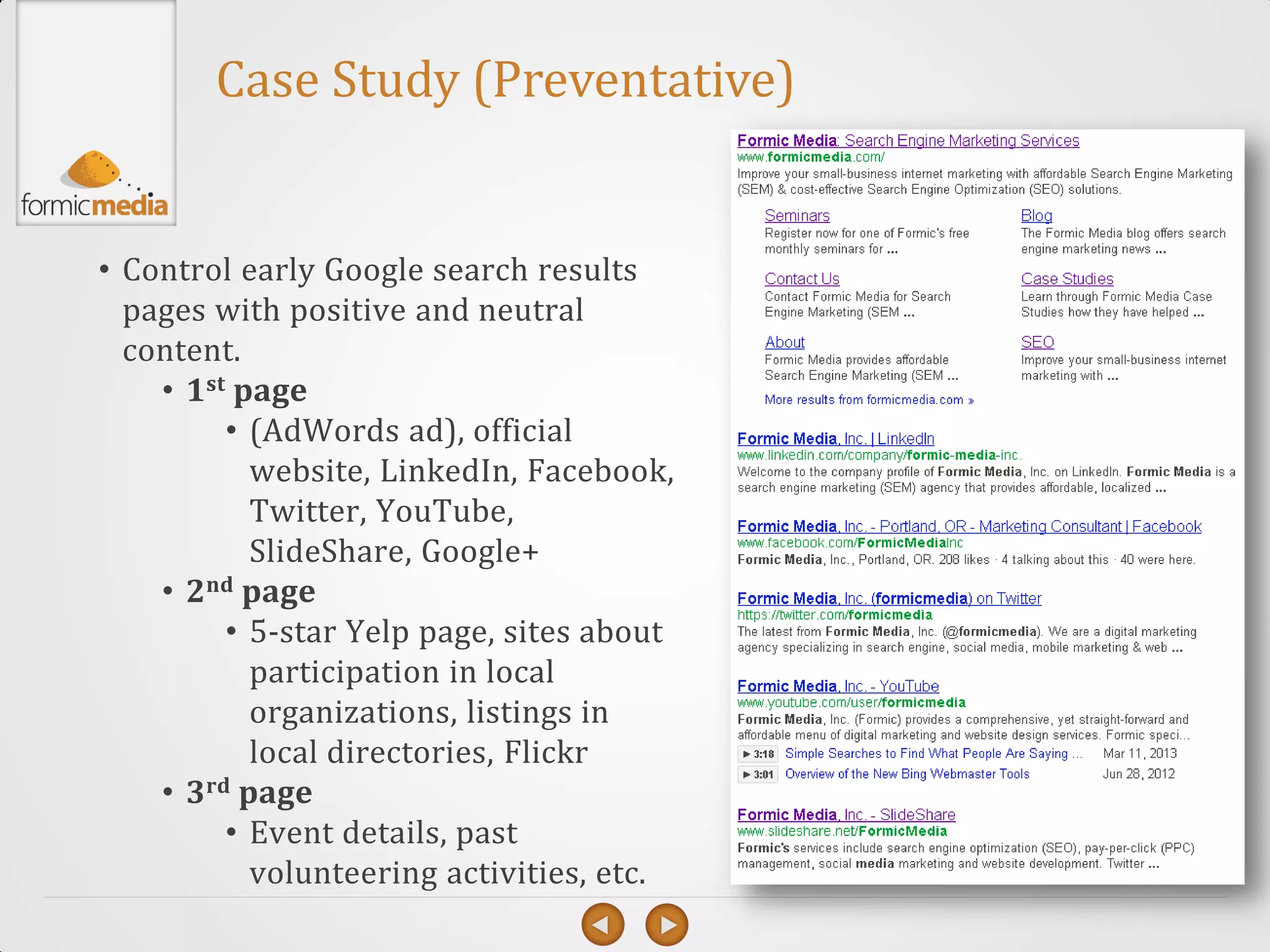
• Control early Google search results
  pages with positive and neutral
  content.
    • 1st page
         • (AdWords ad), official
           website, LinkedIn, Facebook,
           Twitter, YouTube,
           SlideShare, Google+
    • 2nd page
         • 5-star Yelp page, sites about
           participation in local
           organizations, listings in
           local directories, Flickr
    • 3rd page
         • Event details, past
           volunteering activities, etc.
Case Study (Reactionary)

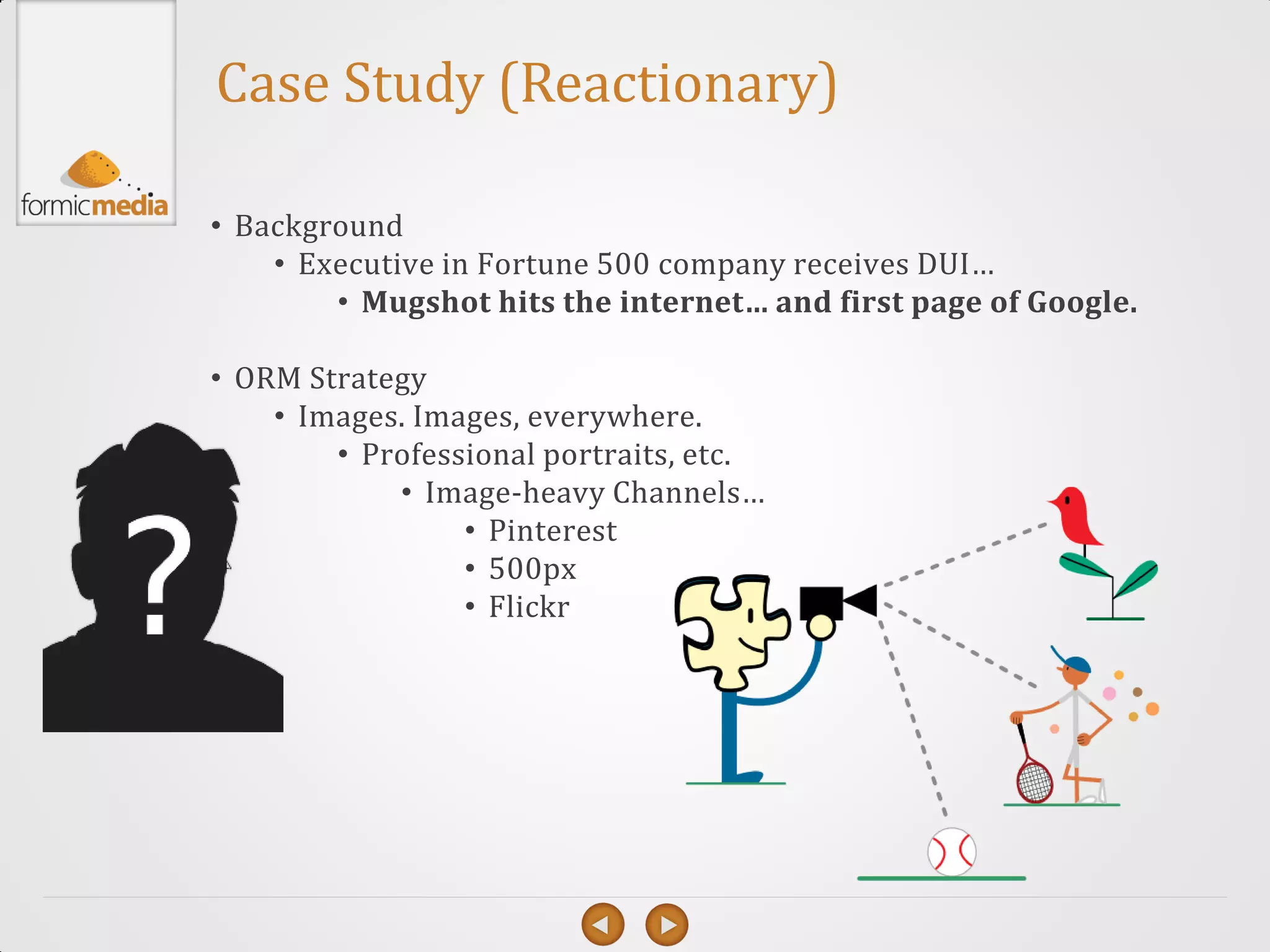
• Background
    • Executive in Fortune 500 company receives DUI…
        • Mugshot hits the internet… and first page of Google.

• ORM Strategy
    • Images. Images, everywhere.
        • Professional portraits, etc.
            • Image-heavy Channels…
                 • Pinterest
                 • 500px
                 • Flickr
Online Reputation Management – How?

• Content, content, and more content.
    • Top social networks
             • Facebook, Twitter, Google+, LinkedIn
        • Videos
             • Vimeo, Youtube
        • Images
             • all major social networks, Pinterest, Instagram,
               Flickr, 500px
        • Blogging platforms
             • blog on website, Blogger, Wordpress, Tumblr
        • Microsites
             • Google Sites, Weebly, Squidoo
        • “About” profile pages
             • Flavors.Me, Hi.Im, About.Me
        • and more
             • Docstoc, Scribd, SlideShare, Quora, etc.
Top Social Networks


• Facebook
• Twitter
• Google+
• LinkedIn

• Content
    • Images, video, text, engagement with others
Videos


• Vimeo
• YouTube

• (Images utilized too)
Images


• Pinterest
• Instagram
• Flickr
• 500px

• and all major social networks
Blogging Platforms


• Blogger (Blogspot)
• WordPress
• Tumblr

• Company/personal blog on own site
Microsites


• Google Sites

• Weebly

• Squidoo
“About” Profile Pages


• Flavors.Me

• Hi.Im

• About.Me

• Content…
    • Images, text, links
Etc.


• Docstoc

• SlideShare

• Scribd

• Quora

• Behance
Online Reputation Management – How?


• Monitor and respond to reviews online
    • Yelp
    • Google Places/+
    • Yahoo!
    • CitySearch
    • Merchant Circle, etc.
• Monitor and respond to comments online
    • Twitter
• Encourage clients/customers to review
• Have your own testimonials and case
  studies pages on your website
• Traditional media outreach
Online Reputation Management – How?

• ACTIVELY creating content
    • Regularly updating social platforms
        • New images, new videos, new text updates, etc.

• ENGAGING others
    • Engaging users across social media and blogging
      platforms

• Taking action IRL
    • Noteworthy, press-worthy actions
        • Exploiting press releases, additional coverage
          by other online users, etc.
Online Reputation Management – How?
                   ADVANCED
        • Exploiting search engines

            • Ex. Employing others to conduct searches in
              order to trick engines into believing certain
              organic trends. This can be done via business
              employees, family & friends, or for-hire
              individuals

            • Ex. Utilizing multiple connections by yourself
              (via proxies, other remote connections, etc.) and
              conducting searches in order to trick engines into
              believing particular organic trends.
Online Reputation Management – How?
                   ADVANCED
Online Reputation Management – How?
                   ADVANCED
Online Reputation Management – How?
                   ADVANCED
• Manipulating social media and its users

    • Creation (or purchase) of false social media accounts
         • Utilized to directly benefit personal or company account
         • Utilized to influence real users

    • Example
        • Mass creation of false social media accounts and other fake
          identities online in order to enhance reputation and influence
          other users
Tools

• Google Alerts
    • Keep an eye out for negativity.
• Google Analytics
    • Are people searching for negative things finding their way to
      your site?
         • Where are they going on your site?
• Google Blog Search
    • Keep an eye on the blogosphere
• Individual social media searches
    • Ex. What are people on Twitter saying about you or your
      business?
• Reverse image search
    • TinEye, Google Image search, etc.
• Review monitor and multi-location monitors.
    • Revinate, Chatmeter, etc.
• TweetDeck to monitor tweets
• Agency ()
Google Alerts

• Keep an eye out for yourself and your business
Google Analytics

• Are people searching for negative things finding their way to
  your site?
    • Where are they going on your site?
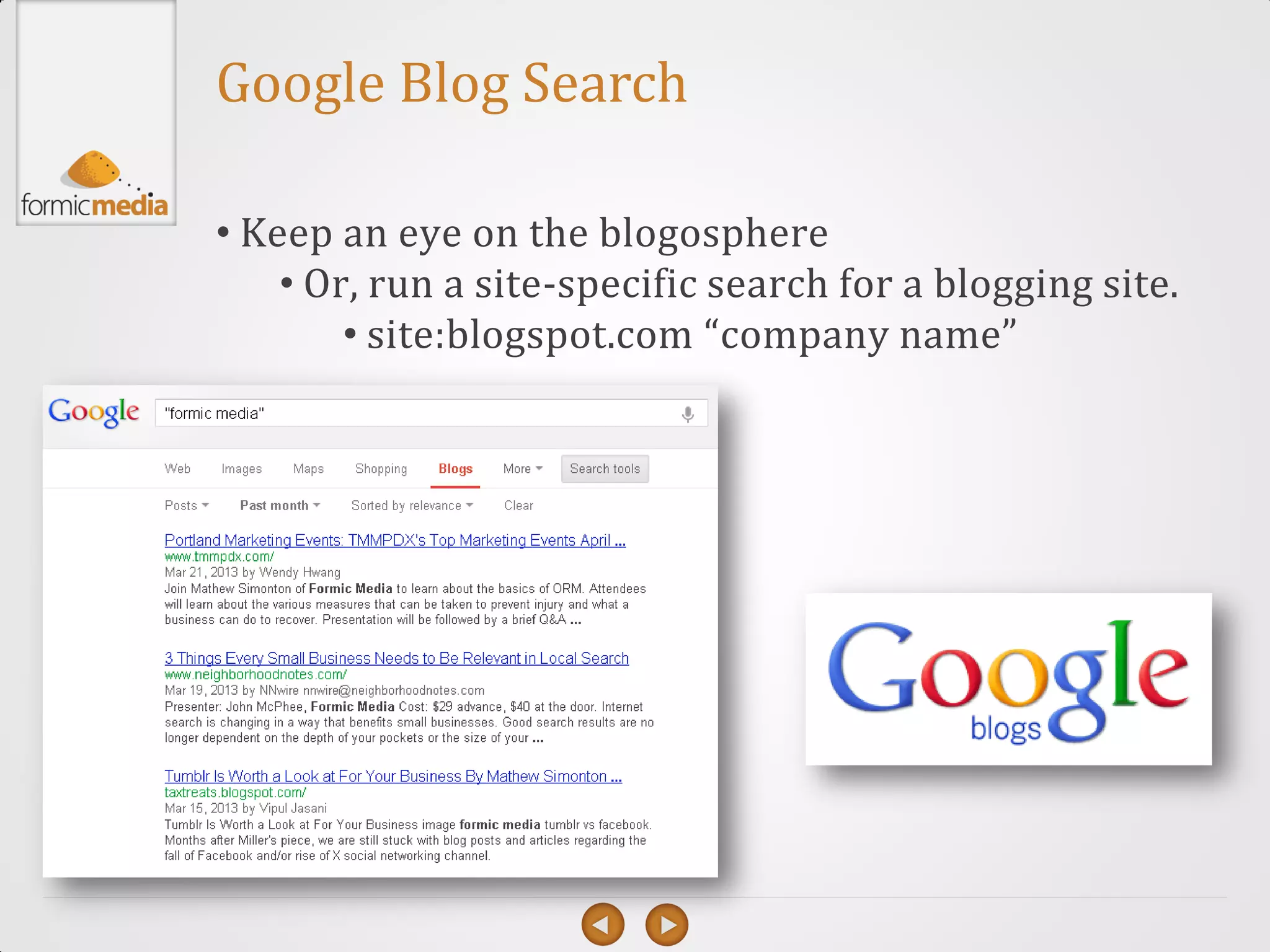
Google Blog Search

• Keep an eye on the blogosphere
    • Or, run a site-specific search for a blogging site.
        • site:blogspot.com “company name”
Individual Site and Social Media Searches
• What are people on Twitter, etc. saying about you
  or your business?
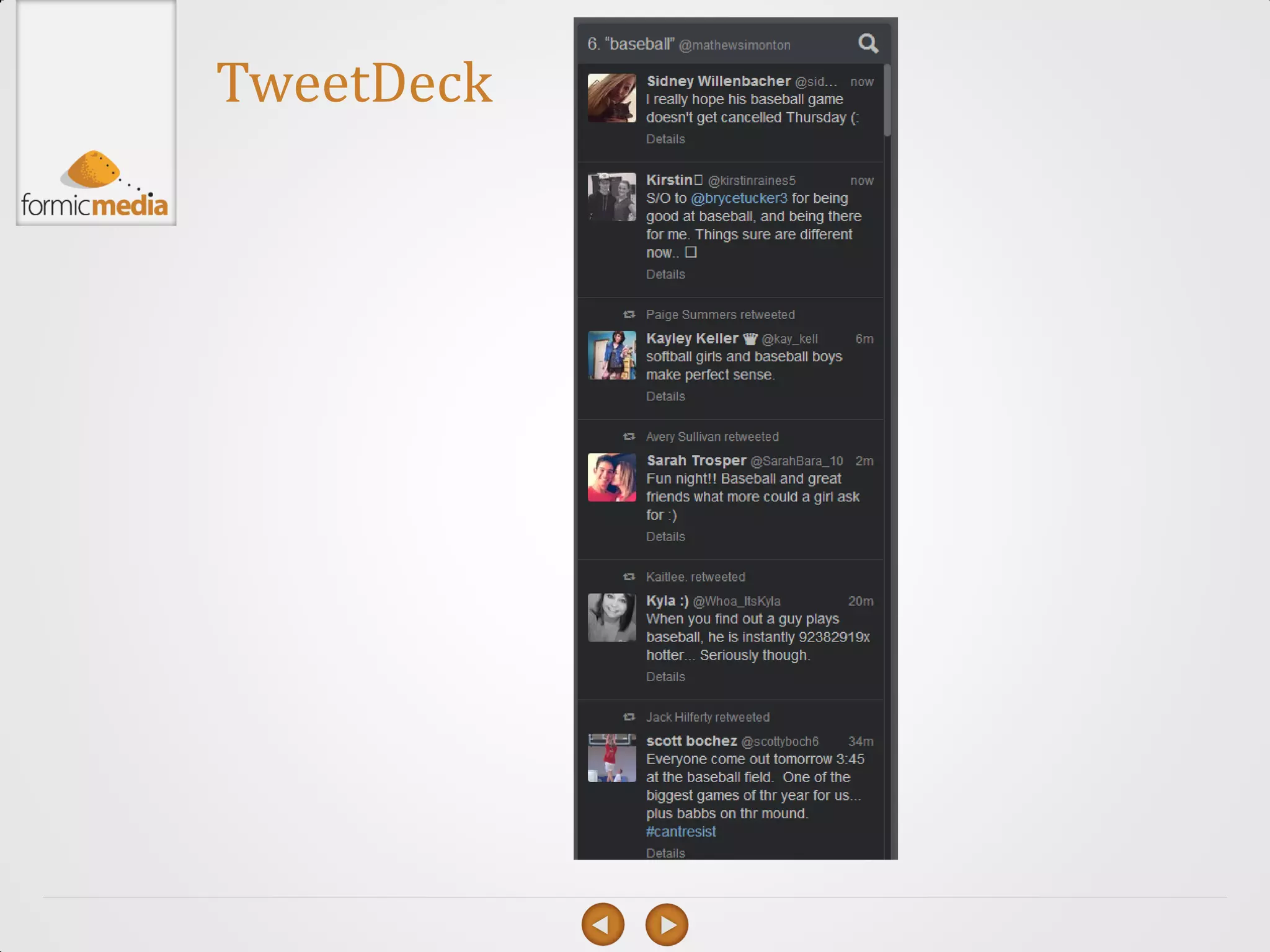
TweetDeck
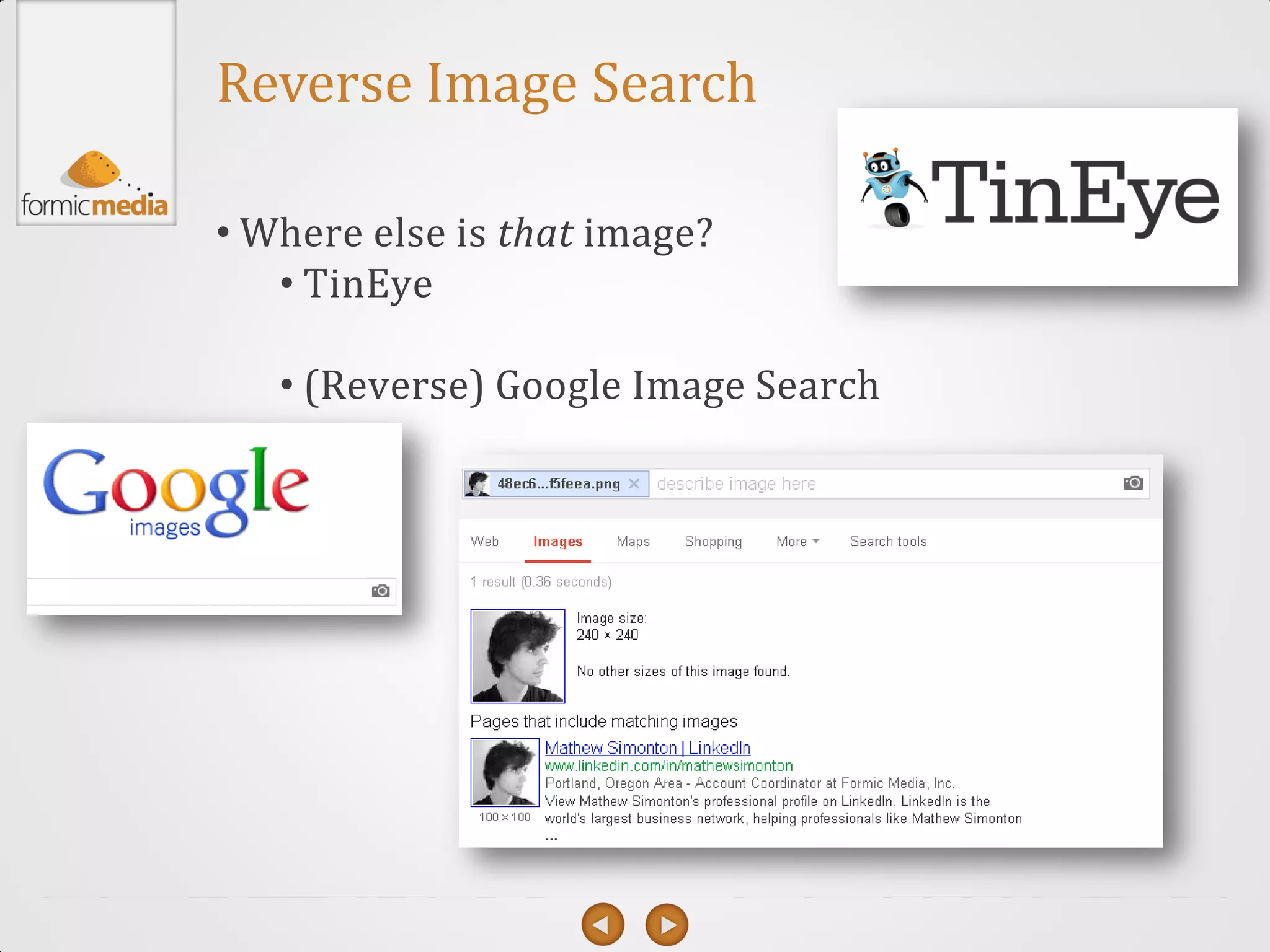
Reverse Image Search

• Where else is that image?
   • TinEye

   • (Reverse) Google Image Search
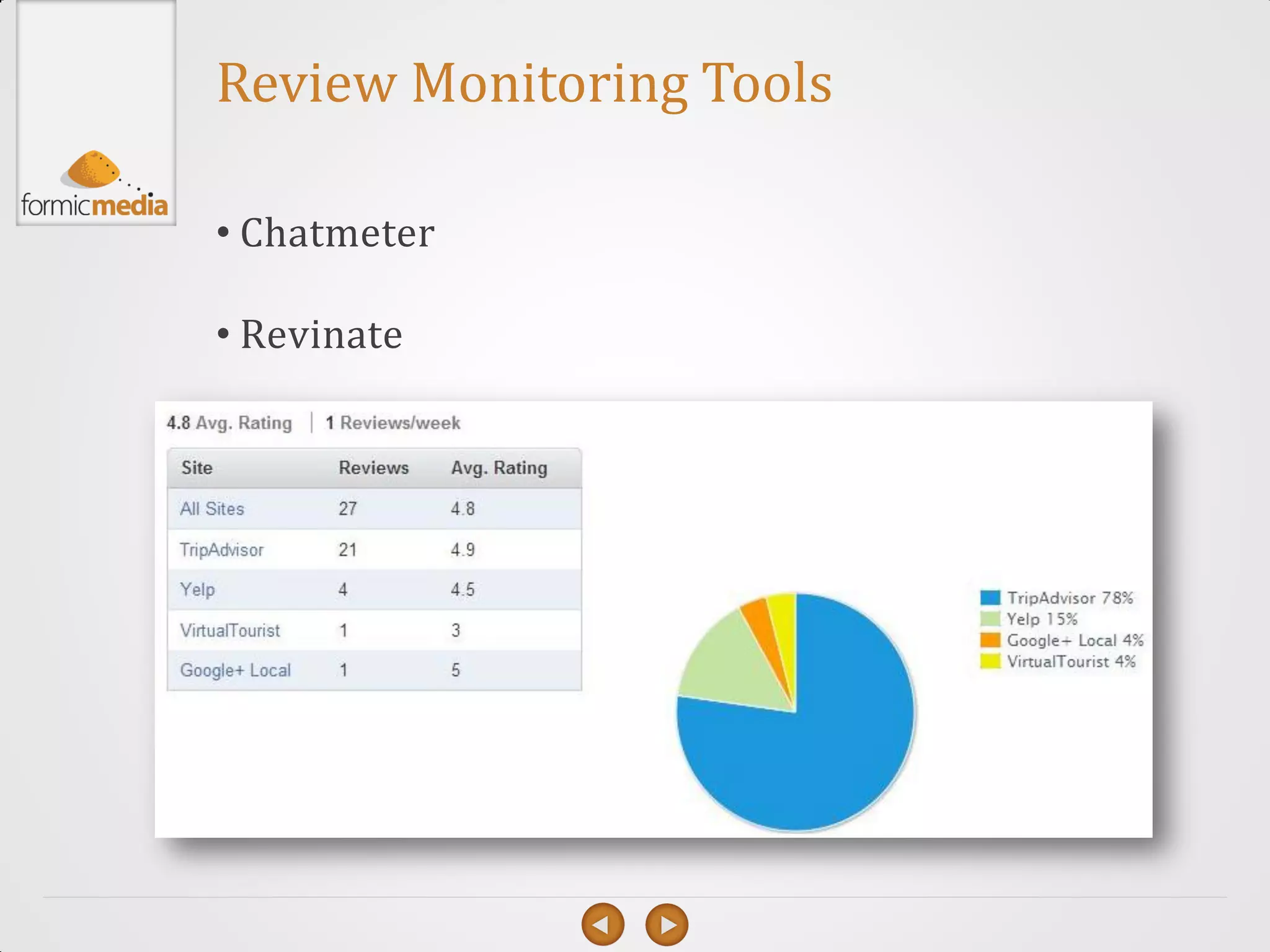
Review Monitoring Tools

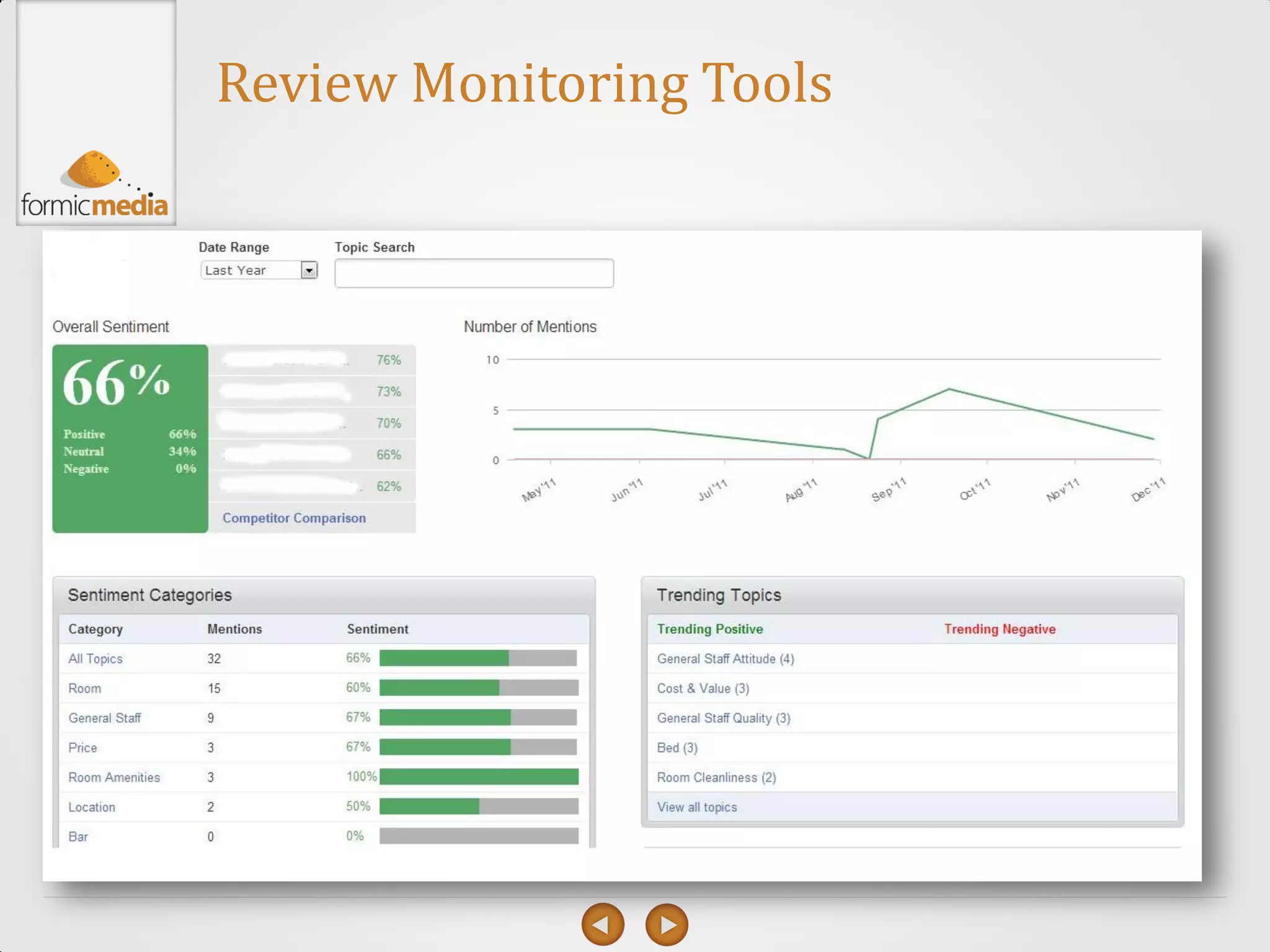
• Chatmeter

• Revinate
Review Monitoring Tools
Example – Dr. Sagun Tuli (Reactionary)
 • Patient’s husband writes a blog detailing his ordeal
   after his wife suffered a stroke after the operation

 • The doctor, Dr. Sagun Tuli, sues the patient’s husband.

 • The Boston Globe runs a front-page story about the
   situation.
      • Ends up on 1st page of Google results too.

 • Link to the Boston Globe story is now found 7 pages
   down in search results, according to Kevin Pho of
   KevinMD.com, behind…
     • Numerous personal websites
     • Social media profiles
     • Blog posts / articles
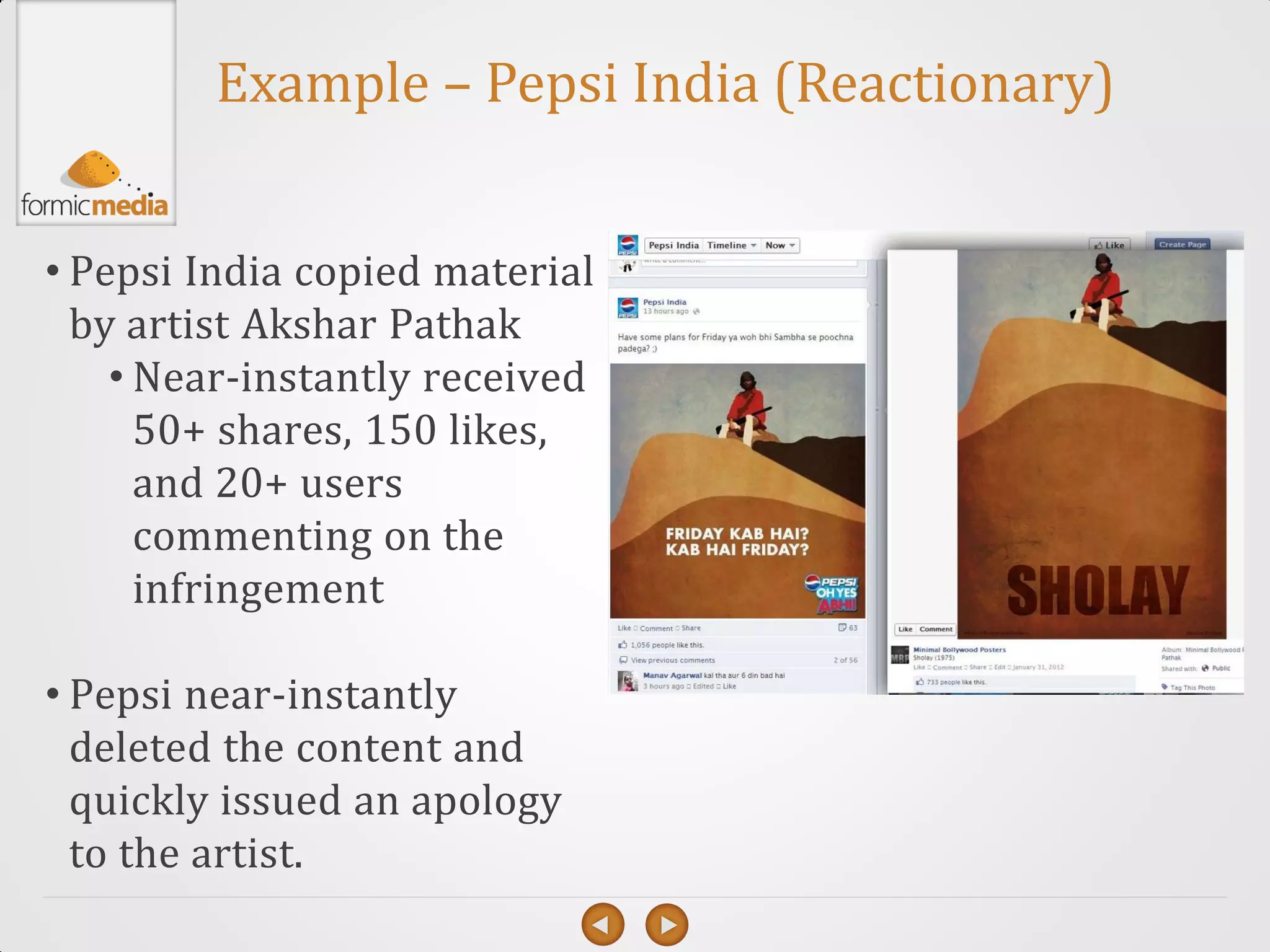
Example – Pepsi India (Reactionary)


• Pepsi India copied material
  by artist Akshar Pathak
    • Near-instantly received
      50+ shares, 150 likes,
      and 20+ users
      commenting on the
      infringement

• Pepsi near-instantly
  deleted the content and
  quickly issued an apology
  to the artist.
Lunch & Learn


            Thank you!
Tools at FormicMedia.com/ORM-Tools

             Questions?
Contact John McPhee for more information
         JohnM@formicmedia.com
            503.517.9059 x122

Introduction to Online Reputation Management (ORM)

  • 1.
    Lunch & Learn: Introductionto Online Reputation Management Presenter: Mathew Simonton Date: April 10th, 2013 Location: Formic Media
  • 2.
    About Mathew • JoinedFormic Media in 2012! • Launched Notevee in college, 2010-2011 • Featured on KillerStartups.com and AppAppeal.com • Reviewed across smaller app/startup blogs “Notevee gives users a way to post social notes and hold conversations on specific topics. Users create conversation pages. These pages consist of images, video, notes and text related to a specific topic, event, person or anything else the user can think of.” -AppAppeal
  • 3.
    What is OnlineReputation Management?
  • 4.
    Online Reputation Management– What? • Building or enhancing a web identity in order to maintain a positive appearance on the internet • Maximizing positive and neutral content • Minimizing negative content • Removing negative content entirely, when possible
  • 5.
    Online Reputation Management– Why? • Establish identity • Establish or maintain a positive identity in the first place • Guide users away from negative content • Two types of management 1. Preventative 2. Reactionary
  • 6.
    Case Study (Preventative) •Control early Google search results pages with positive and neutral content. • 1st page • (AdWords ad), official website, LinkedIn, Facebook, Twitter, YouTube, SlideShare, Google+ • 2nd page • 5-star Yelp page, sites about participation in local organizations, listings in local directories, Flickr • 3rd page • Event details, past volunteering activities, etc.
  • 7.
    Case Study (Reactionary) •Background • Executive in Fortune 500 company receives DUI… • Mugshot hits the internet… and first page of Google. • ORM Strategy • Images. Images, everywhere. • Professional portraits, etc. • Image-heavy Channels… • Pinterest • 500px • Flickr
  • 8.
    Online Reputation Management– How? • Content, content, and more content. • Top social networks • Facebook, Twitter, Google+, LinkedIn • Videos • Vimeo, Youtube • Images • all major social networks, Pinterest, Instagram, Flickr, 500px • Blogging platforms • blog on website, Blogger, Wordpress, Tumblr • Microsites • Google Sites, Weebly, Squidoo • “About” profile pages • Flavors.Me, Hi.Im, About.Me • and more • Docstoc, Scribd, SlideShare, Quora, etc.
  • 9.
    Top Social Networks •Facebook • Twitter • Google+ • LinkedIn • Content • Images, video, text, engagement with others
  • 10.
    Videos • Vimeo • YouTube •(Images utilized too)
  • 11.
    Images • Pinterest • Instagram •Flickr • 500px • and all major social networks
  • 12.
    Blogging Platforms • Blogger(Blogspot) • WordPress • Tumblr • Company/personal blog on own site
  • 13.
  • 14.
    “About” Profile Pages •Flavors.Me • Hi.Im • About.Me • Content… • Images, text, links
  • 15.
    Etc. • Docstoc • SlideShare •Scribd • Quora • Behance
  • 16.
    Online Reputation Management– How? • Monitor and respond to reviews online • Yelp • Google Places/+ • Yahoo! • CitySearch • Merchant Circle, etc. • Monitor and respond to comments online • Twitter • Encourage clients/customers to review • Have your own testimonials and case studies pages on your website • Traditional media outreach
  • 17.
    Online Reputation Management– How? • ACTIVELY creating content • Regularly updating social platforms • New images, new videos, new text updates, etc. • ENGAGING others • Engaging users across social media and blogging platforms • Taking action IRL • Noteworthy, press-worthy actions • Exploiting press releases, additional coverage by other online users, etc.
  • 18.
    Online Reputation Management– How? ADVANCED • Exploiting search engines • Ex. Employing others to conduct searches in order to trick engines into believing certain organic trends. This can be done via business employees, family & friends, or for-hire individuals • Ex. Utilizing multiple connections by yourself (via proxies, other remote connections, etc.) and conducting searches in order to trick engines into believing particular organic trends.
  • 19.
  • 20.
  • 21.
    Online Reputation Management– How? ADVANCED • Manipulating social media and its users • Creation (or purchase) of false social media accounts • Utilized to directly benefit personal or company account • Utilized to influence real users • Example • Mass creation of false social media accounts and other fake identities online in order to enhance reputation and influence other users
  • 22.
    Tools • Google Alerts • Keep an eye out for negativity. • Google Analytics • Are people searching for negative things finding their way to your site? • Where are they going on your site? • Google Blog Search • Keep an eye on the blogosphere • Individual social media searches • Ex. What are people on Twitter saying about you or your business? • Reverse image search • TinEye, Google Image search, etc. • Review monitor and multi-location monitors. • Revinate, Chatmeter, etc. • TweetDeck to monitor tweets • Agency ()
  • 23.
    Google Alerts • Keepan eye out for yourself and your business
  • 24.
    Google Analytics • Arepeople searching for negative things finding their way to your site? • Where are they going on your site?
  • 26.
    Google Blog Search •Keep an eye on the blogosphere • Or, run a site-specific search for a blogging site. • site:blogspot.com “company name”
  • 27.
    Individual Site andSocial Media Searches • What are people on Twitter, etc. saying about you or your business?
  • 28.
  • 29.
    Reverse Image Search •Where else is that image? • TinEye • (Reverse) Google Image Search
  • 30.
    Review Monitoring Tools •Chatmeter • Revinate
  • 31.
  • 32.
    Example – Dr.Sagun Tuli (Reactionary) • Patient’s husband writes a blog detailing his ordeal after his wife suffered a stroke after the operation • The doctor, Dr. Sagun Tuli, sues the patient’s husband. • The Boston Globe runs a front-page story about the situation. • Ends up on 1st page of Google results too. • Link to the Boston Globe story is now found 7 pages down in search results, according to Kevin Pho of KevinMD.com, behind… • Numerous personal websites • Social media profiles • Blog posts / articles
  • 33.
    Example – PepsiIndia (Reactionary) • Pepsi India copied material by artist Akshar Pathak • Near-instantly received 50+ shares, 150 likes, and 20+ users commenting on the infringement • Pepsi near-instantly deleted the content and quickly issued an apology to the artist.
  • 34.
    Lunch & Learn Thank you! Tools at FormicMedia.com/ORM-Tools Questions? Contact John McPhee for more information JohnM@formicmedia.com 503.517.9059 x122