Introduction to ANOVA
Presented by ;- Akash Ghanate
2018BBA01
Subject :- BUSINESS RESEARCH
Contents to be covered
Definition
*
Types of ANOVA
*
WHY DO AN ANOVA, NOT MULTIPLE T-TESTS?
*
Why ANOVA instead of multiple t-tests?
*
ANOVA Assumptions
*
ANOVA examples
*
Analysis of Variance
Definition
Analysis of variance (ANOVA) is a statistical test
for detecting differences in group means when
there is one parametric dependent variable &
one or more independent variables.
Extra about ANOVA
Many studies involve comparisons between more
than two groups of subjects.
If the outcome is numerical, ANOVA can be used to
compare the means between groups.
ANOVA is an abbreviation for the full name of the
method: ANalysis Of Variance
If the outcome is numerical, ANOVA can be used to
– Invented by R.A. Fisher in the 1920’s
Why do an ANOVA?
when there are 3 or more means being compared, statistical
significance can be ascertained by conducting one statistical test,
ANOVA, or by repeated t-tests.
Why not conduct repeated t-tests?
Each statistical test is conducted with a specified chance of making
a type I–error—the alpha level.
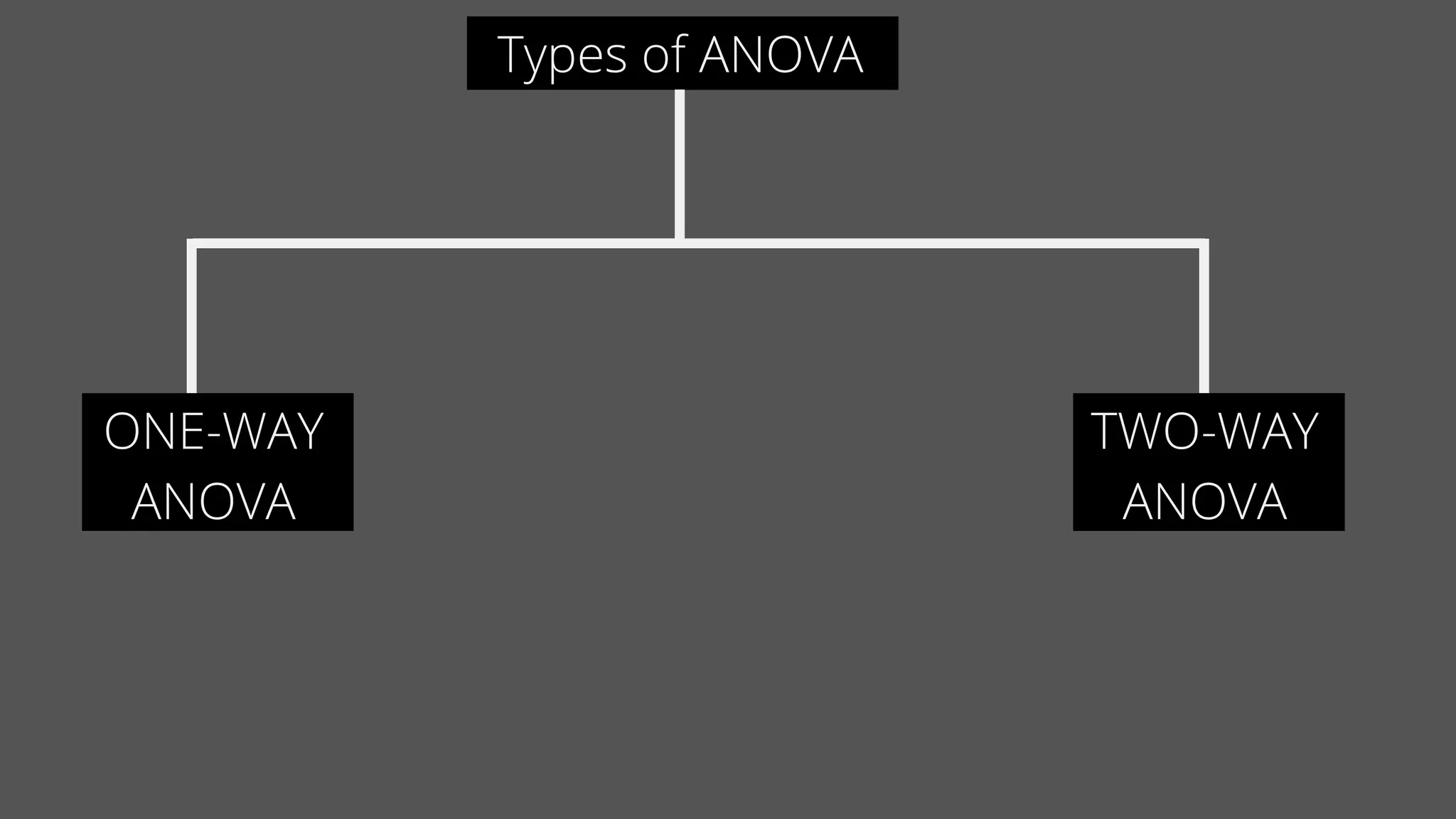
Types of ANOVA
ONE-WAY
ANOVA
TWO-WAY
ANOVA
ONE-WAY
ANOVA
A one-way ANOVA has just one independent variable. For
example, difference in IQ can be assessed by Country, and
County can have 2, 20, or more different categories to
compare.
TWO-WAY
ANOVA
A two-way ANOVA (are also called factorial ANOVA) refers to an
ANOVA using two independent variables.  Expanding the
example above, a 2-way ANOVA can examine differences in IQ
scores (the dependent variable) by Country (independent
variable 1) and Gender (independent variable 2).
N-Way ANOVA
A researcher can also use more than two independent
variables, and this is an n-way ANOVA (with n being the number
of independent variables you have). For example, potential
differences in IQ scores can be examined by Country, Gender,
Age group, Ethnicity, etc, simultaneously.
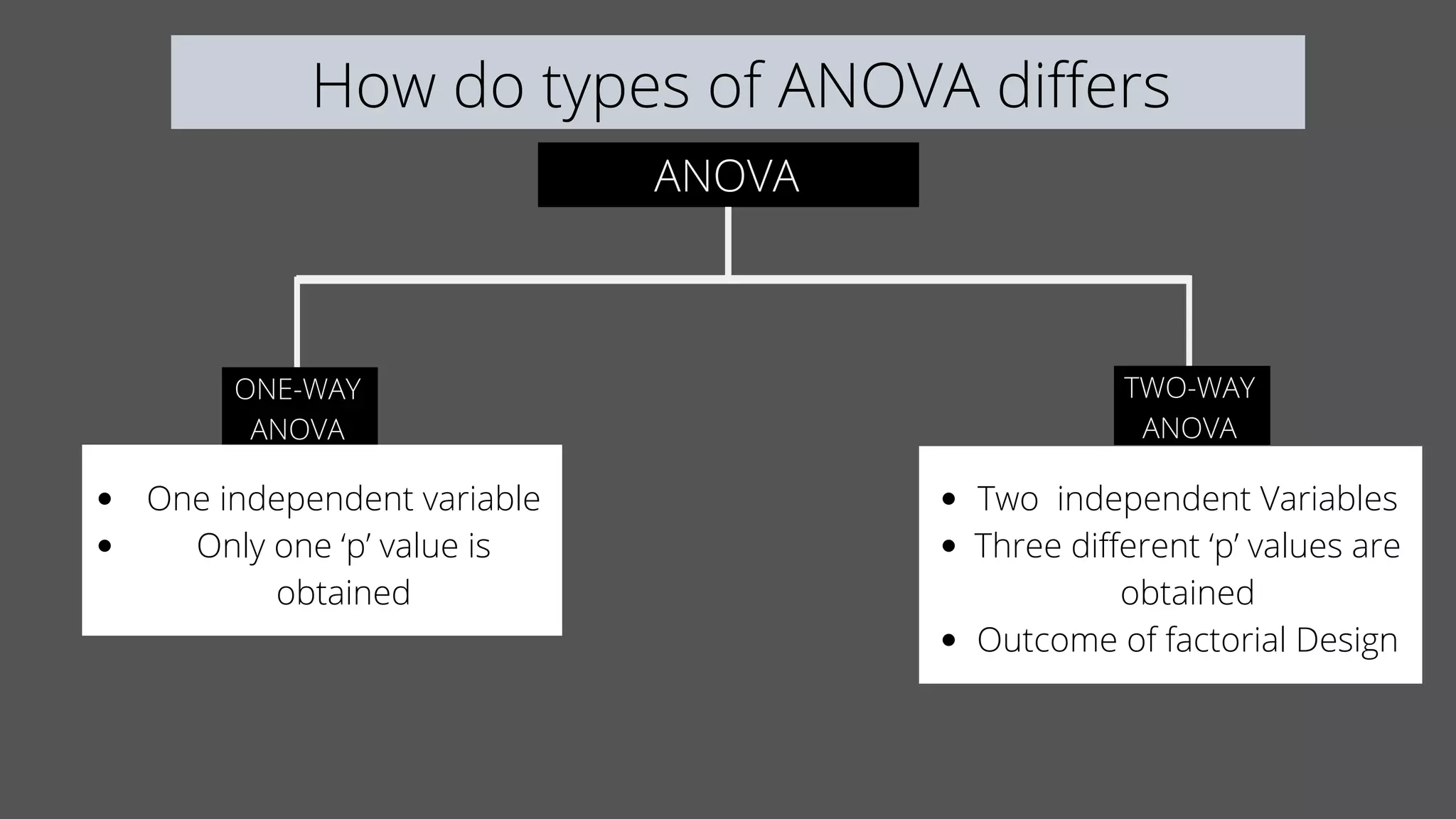
How do types of ANOVA differs
ANOVA
ONE-WAY
ANOVA
TWO-WAY
ANOVA
One independent variable
Only one ‘p’ value is
obtained
Two independent Variables
Three different ‘p’ values are
obtained
Outcome of factorial Design
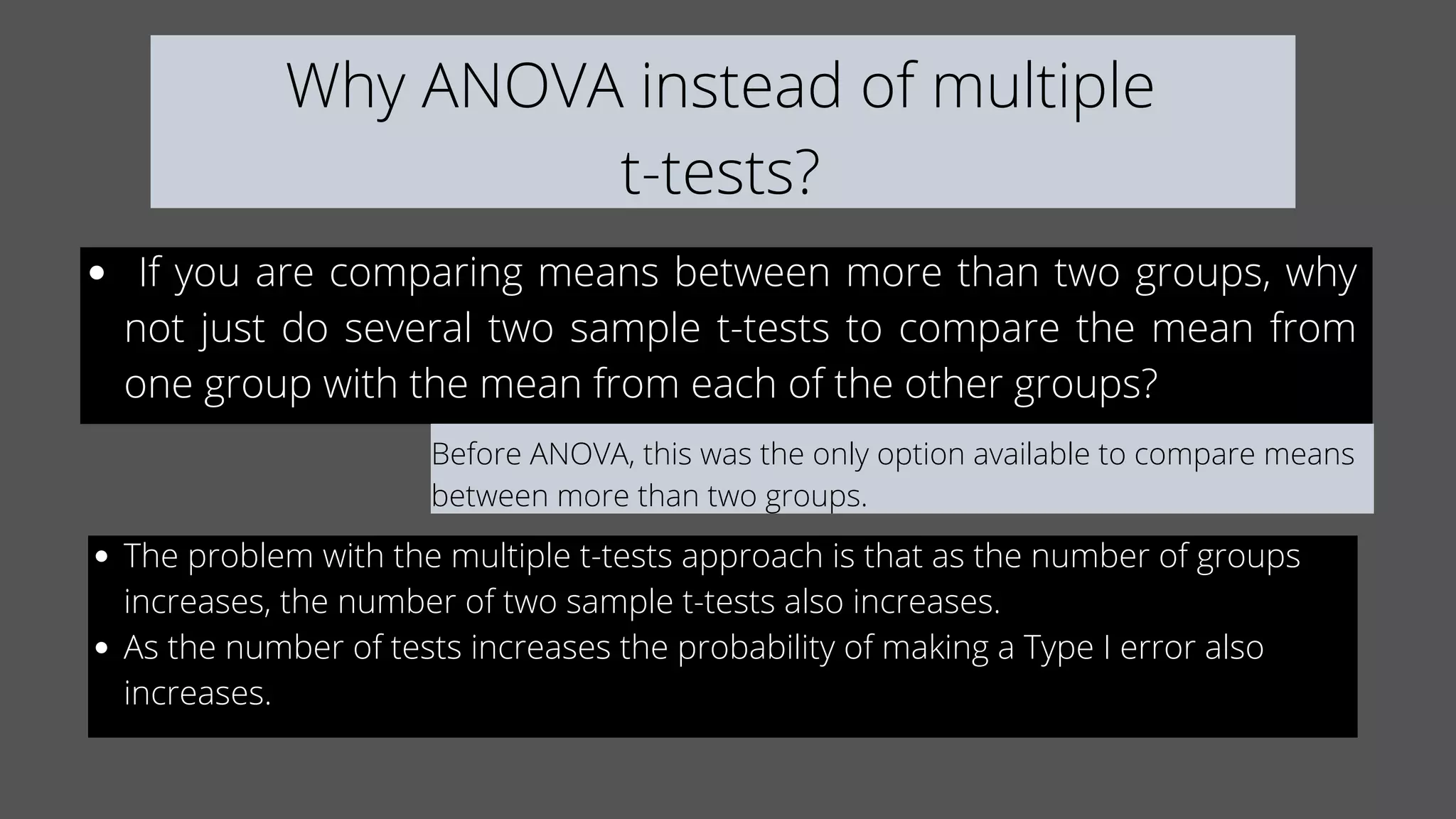
Why ANOVA instead of multiple
t-tests?
If you are comparing means between more than two groups, why
not just do several two sample t-tests to compare the mean from
one group with the mean from each of the other groups?
Before ANOVA, this was the only option available to compare means
between more than two groups.
The problem with the multiple t-tests approach is that as the number of groups
increases, the number of two sample t-tests also increases.
As the number of tests increases the probability of making a Type I error also
increases.
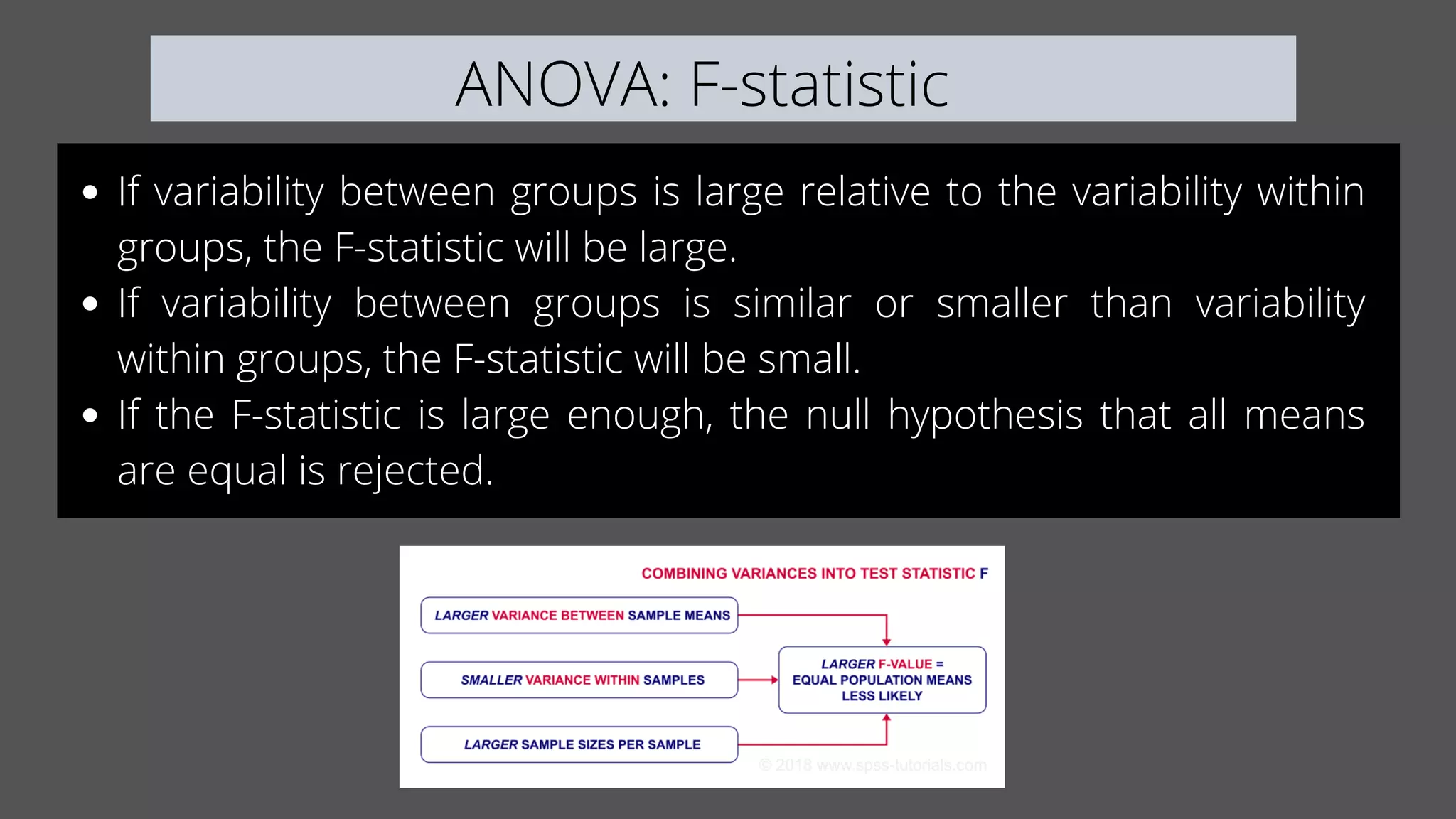
If variability between groups is large relative to the variability within
groups, the F-statistic will be large.
If variability between groups is similar or smaller than variability
within groups, the F-statistic will be small.
If the F-statistic is large enough, the null hypothesis that all means
are equal is rejected.
ANOVA: F-statistic
ANOVA assumptions
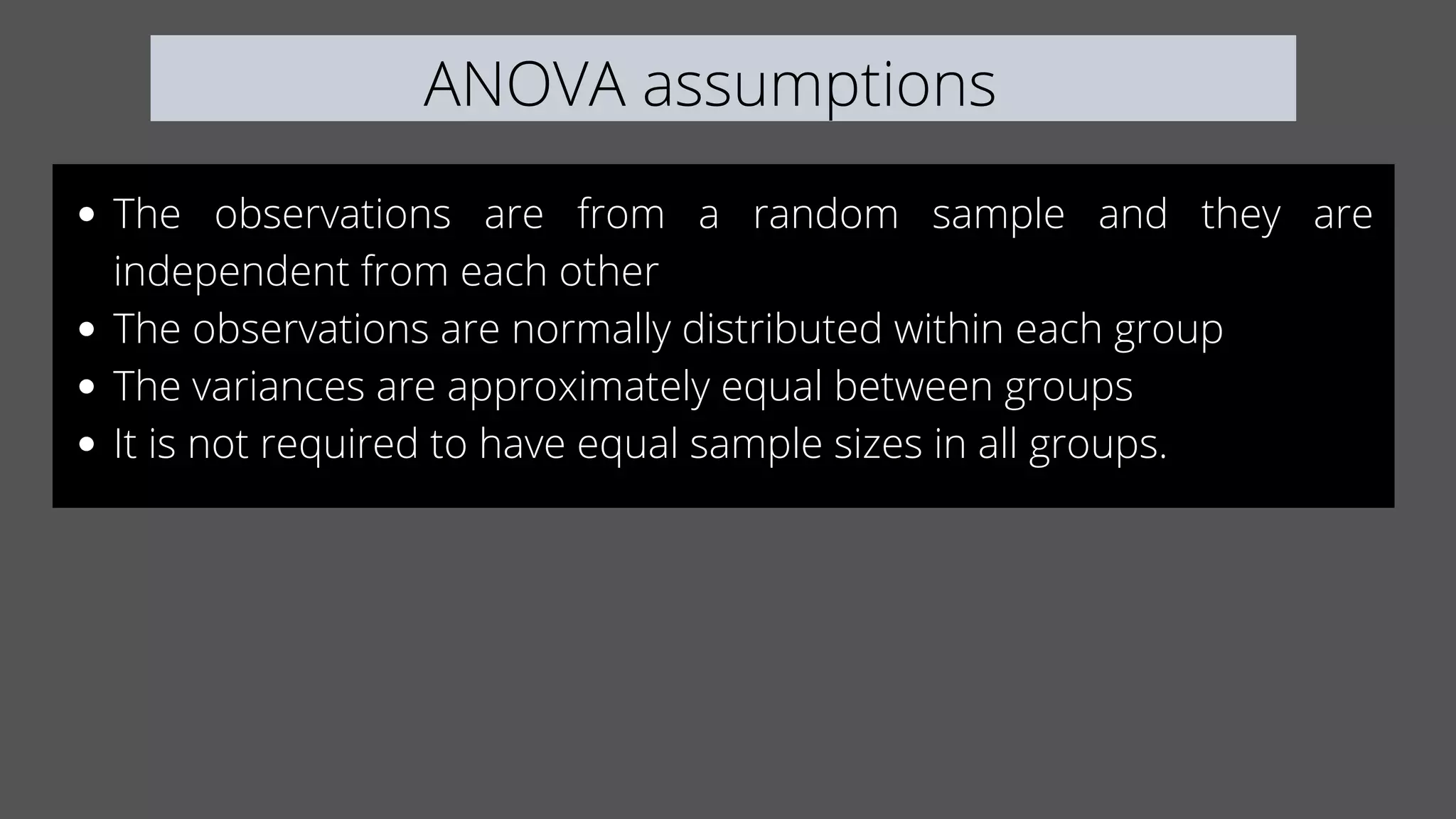
The observations are from a random sample and they are
independent from each other
The observations are normally distributed within each group
The variances are approximately equal between groups
It is not required to have equal sample sizes in all groups.
THE NULL HYPOTHESIS AND ALPHA LEVEL
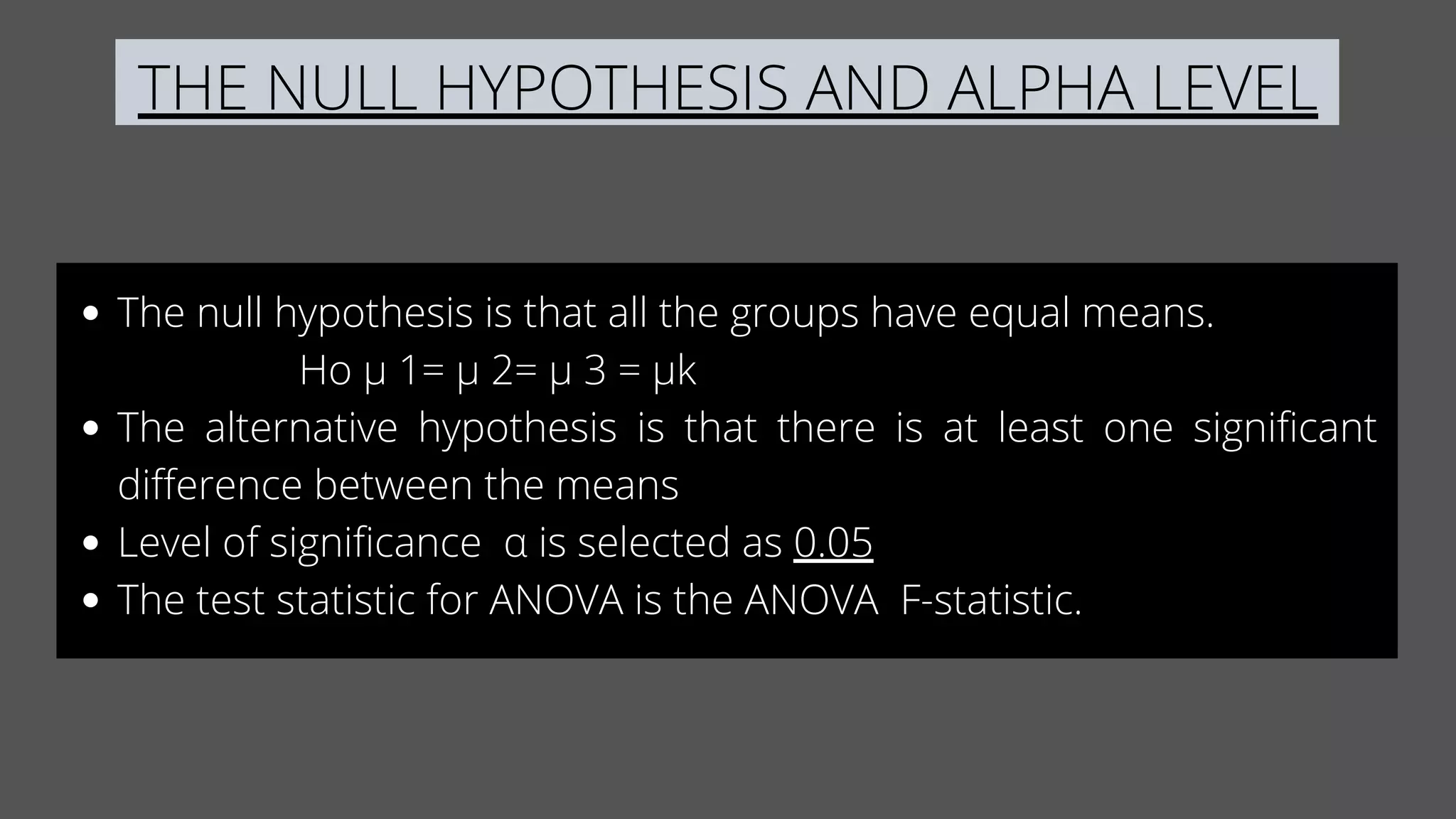
The null hypothesis is that all the groups have equal means.
The alternative hypothesis is that there is at least one significant
difference between the means
Level of significance Îą is selected as 0.05
The test statistic for ANOVA is the ANOVA F-statistic.
Ho Âľ 1= Âľ 2= Âľ 3 = Âľk
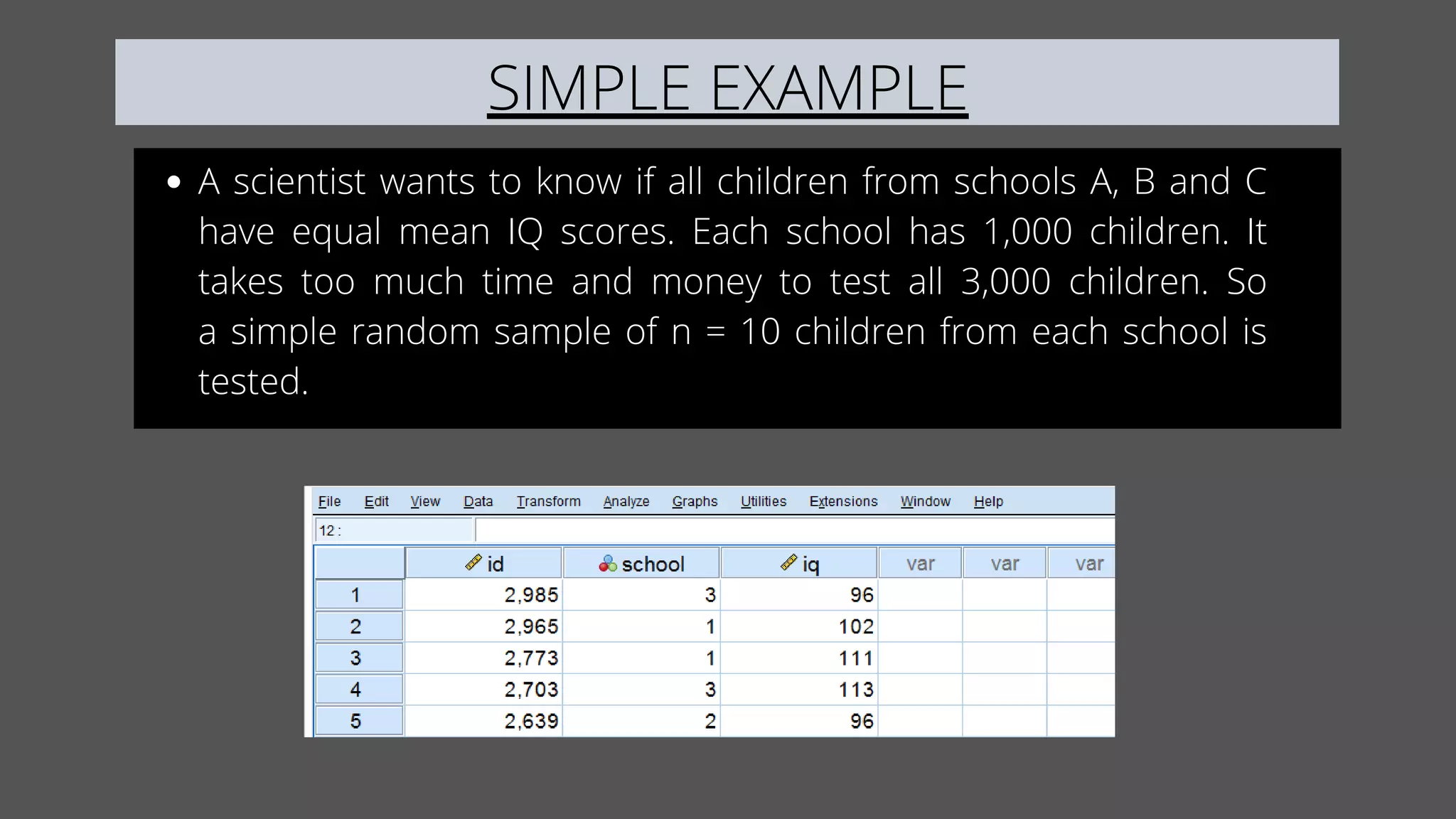
A scientist wants to know if all children from schools A, B and C
have equal mean IQ scores. Each school has 1,000 children. It
takes too much time and money to test all 3,000 children. So
a simple random sample of n = 10 children from each school is
tested.
SIMPLE EXAMPLE
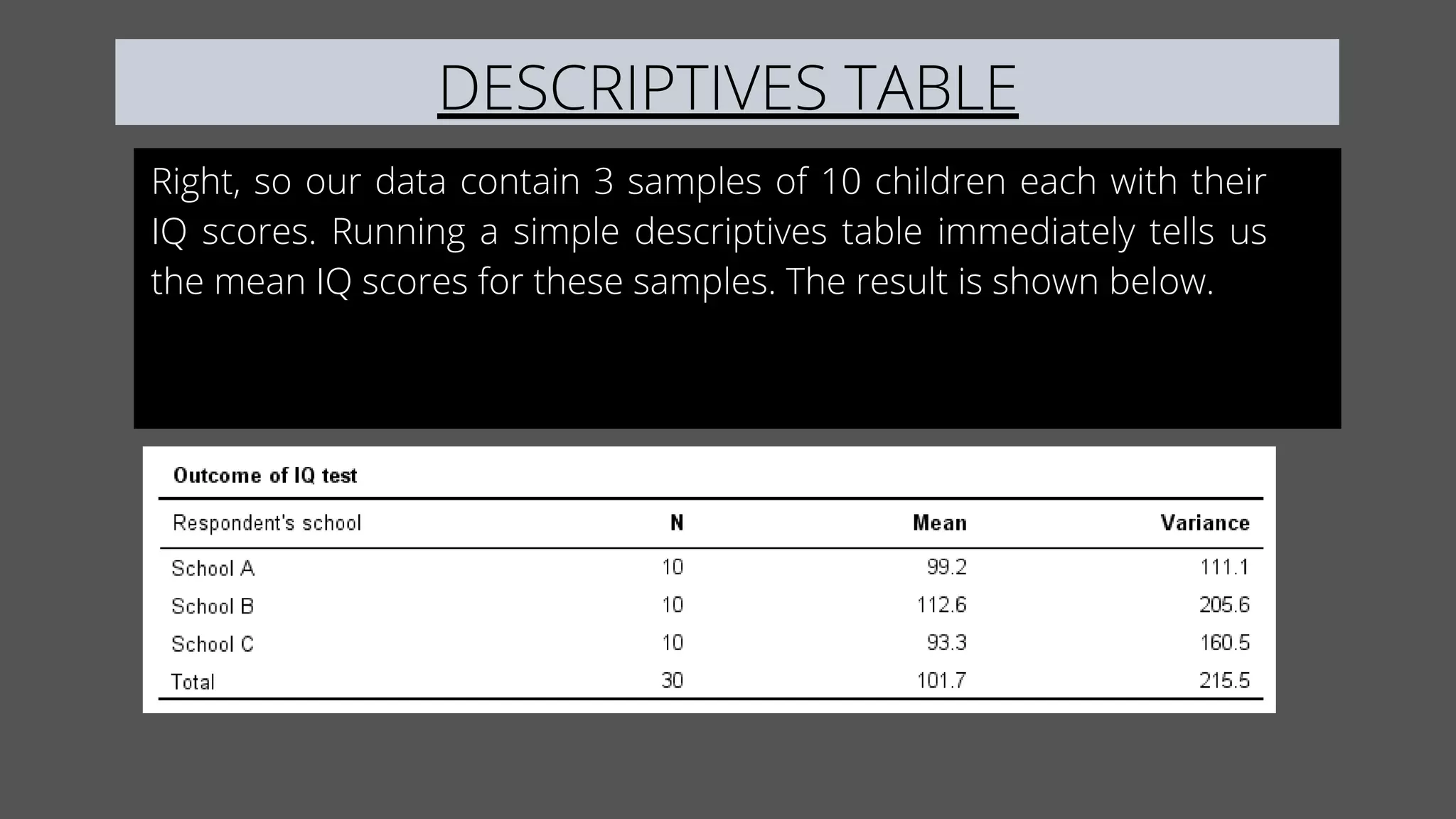
Right, so our data contain 3 samples of 10 children each with their
IQ scores. Running a simple descriptives table immediately tells us
the mean IQ scores for these samples. The result is shown below.
DESCRIPTIVES TABLE
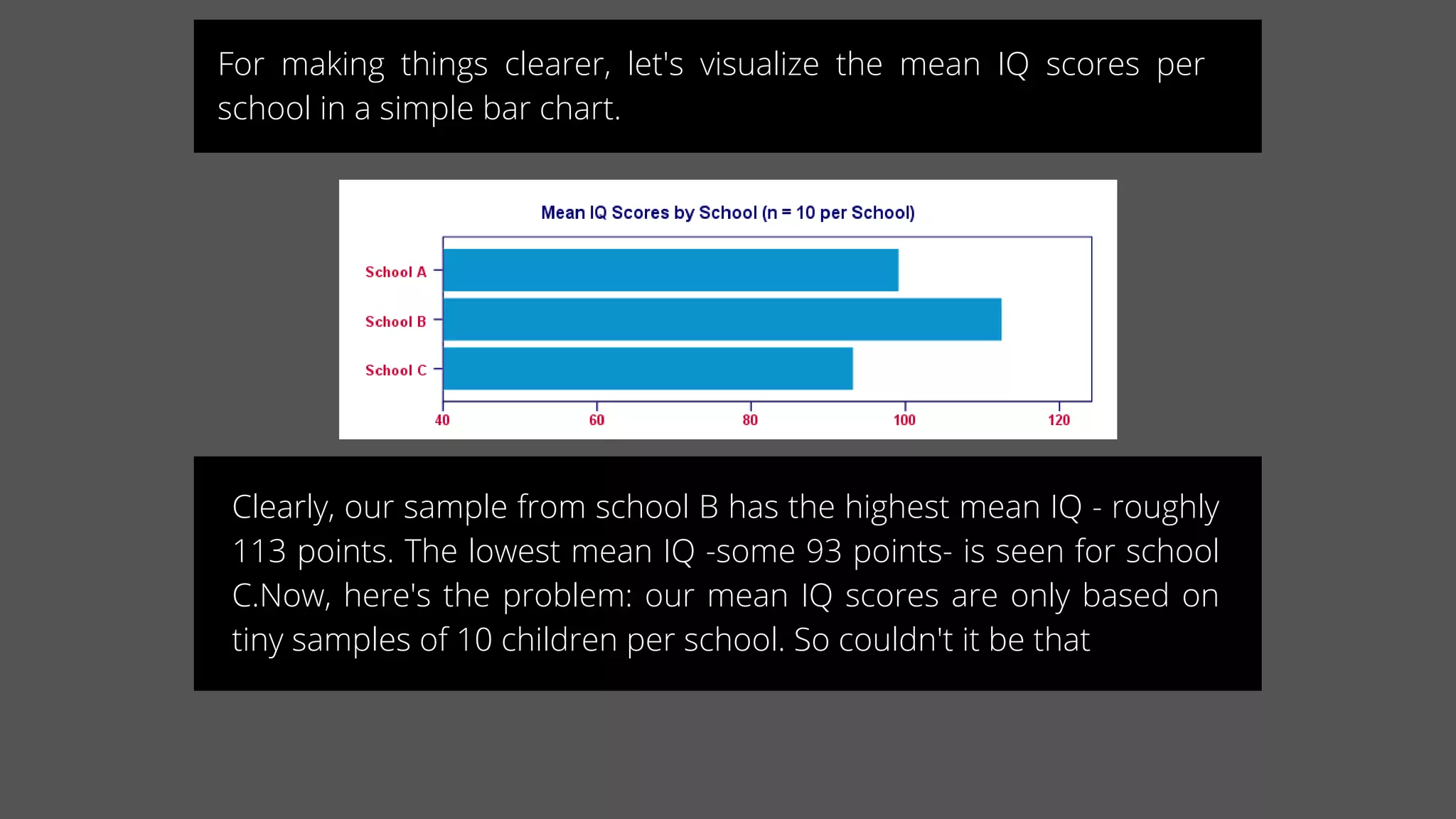
For making things clearer, let's visualize the mean IQ scores per
school in a simple bar chart.
Clearly, our sample from school B has the highest mean IQ - roughly
113 points. The lowest mean IQ -some 93 points- is seen for school
C.Now, here's the problem: our mean IQ scores are only based on
tiny samples of 10 children per school. So couldn't it be that
THANK
YOU

Introduction to ANOVA

  • 1.
    Introduction to ANOVA Presentedby ;- Akash Ghanate 2018BBA01 Subject :- BUSINESS RESEARCH
  • 2.
    Contents to becovered Definition * Types of ANOVA * WHY DO AN ANOVA, NOT MULTIPLE T-TESTS? * Why ANOVA instead of multiple t-tests? * ANOVA Assumptions * ANOVA examples *
  • 3.
    Analysis of Variance Definition Analysisof variance (ANOVA) is a statistical test for detecting differences in group means when there is one parametric dependent variable & one or more independent variables.
  • 4.
    Extra about ANOVA Manystudies involve comparisons between more than two groups of subjects. If the outcome is numerical, ANOVA can be used to compare the means between groups. ANOVA is an abbreviation for the full name of the method: ANalysis Of Variance If the outcome is numerical, ANOVA can be used to – Invented by R.A. Fisher in the 1920’s
  • 5.
    Why do anANOVA? when there are 3 or more means being compared, statistical significance can be ascertained by conducting one statistical test, ANOVA, or by repeated t-tests. Why not conduct repeated t-tests? Each statistical test is conducted with a specified chance of making a type I–error—the alpha level.
  • 6.
  • 7.
    ONE-WAY ANOVA A one-way ANOVAhas just one independent variable. For example, difference in IQ can be assessed by Country, and County can have 2, 20, or more different categories to compare.
  • 8.
    TWO-WAY ANOVA A two-way ANOVA(are also called factorial ANOVA) refers to an ANOVA using two independent variables.  Expanding the example above, a 2-way ANOVA can examine differences in IQ scores (the dependent variable) by Country (independent variable 1) and Gender (independent variable 2).
  • 9.
    N-Way ANOVA A researchercan also use more than two independent variables, and this is an n-way ANOVA (with n being the number of independent variables you have). For example, potential differences in IQ scores can be examined by Country, Gender, Age group, Ethnicity, etc, simultaneously.
  • 10.
    How do typesof ANOVA differs ANOVA ONE-WAY ANOVA TWO-WAY ANOVA One independent variable Only one ‘p’ value is obtained Two independent Variables Three different ‘p’ values are obtained Outcome of factorial Design
  • 11.
    Why ANOVA insteadof multiple t-tests? If you are comparing means between more than two groups, why not just do several two sample t-tests to compare the mean from one group with the mean from each of the other groups? Before ANOVA, this was the only option available to compare means between more than two groups. The problem with the multiple t-tests approach is that as the number of groups increases, the number of two sample t-tests also increases. As the number of tests increases the probability of making a Type I error also increases.
  • 12.
    If variability betweengroups is large relative to the variability within groups, the F-statistic will be large. If variability between groups is similar or smaller than variability within groups, the F-statistic will be small. If the F-statistic is large enough, the null hypothesis that all means are equal is rejected. ANOVA: F-statistic
  • 13.
    ANOVA assumptions The observationsare from a random sample and they are independent from each other The observations are normally distributed within each group The variances are approximately equal between groups It is not required to have equal sample sizes in all groups.
  • 14.
    THE NULL HYPOTHESISAND ALPHA LEVEL The null hypothesis is that all the groups have equal means. The alternative hypothesis is that there is at least one significant difference between the means Level of significance Îą is selected as 0.05 The test statistic for ANOVA is the ANOVA F-statistic. Ho Âľ 1= Âľ 2= Âľ 3 = Âľk
  • 15.
    A scientist wantsto know if all children from schools A, B and C have equal mean IQ scores. Each school has 1,000 children. It takes too much time and money to test all 3,000 children. So a simple random sample of n = 10 children from each school is tested. SIMPLE EXAMPLE
  • 16.
    Right, so ourdata contain 3 samples of 10 children each with their IQ scores. Running a simple descriptives table immediately tells us the mean IQ scores for these samples. The result is shown below. DESCRIPTIVES TABLE
  • 17.
    For making thingsclearer, let's visualize the mean IQ scores per school in a simple bar chart. Clearly, our sample from school B has the highest mean IQ - roughly 113 points. The lowest mean IQ -some 93 points- is seen for school C.Now, here's the problem: our mean IQ scores are only based on tiny samples of 10 children per school. So couldn't it be that
  • 18.