ACCEPT = YES
Karla Fisher ASD and Cynthia Arnold PhD
New Leaves Clinic
Introduction to a Neurodiversity


              (c) Copyright 2012 - New Leaves Clinic
               Freely distribute unaltered with credits
NEUORDIVERSITY INTRO
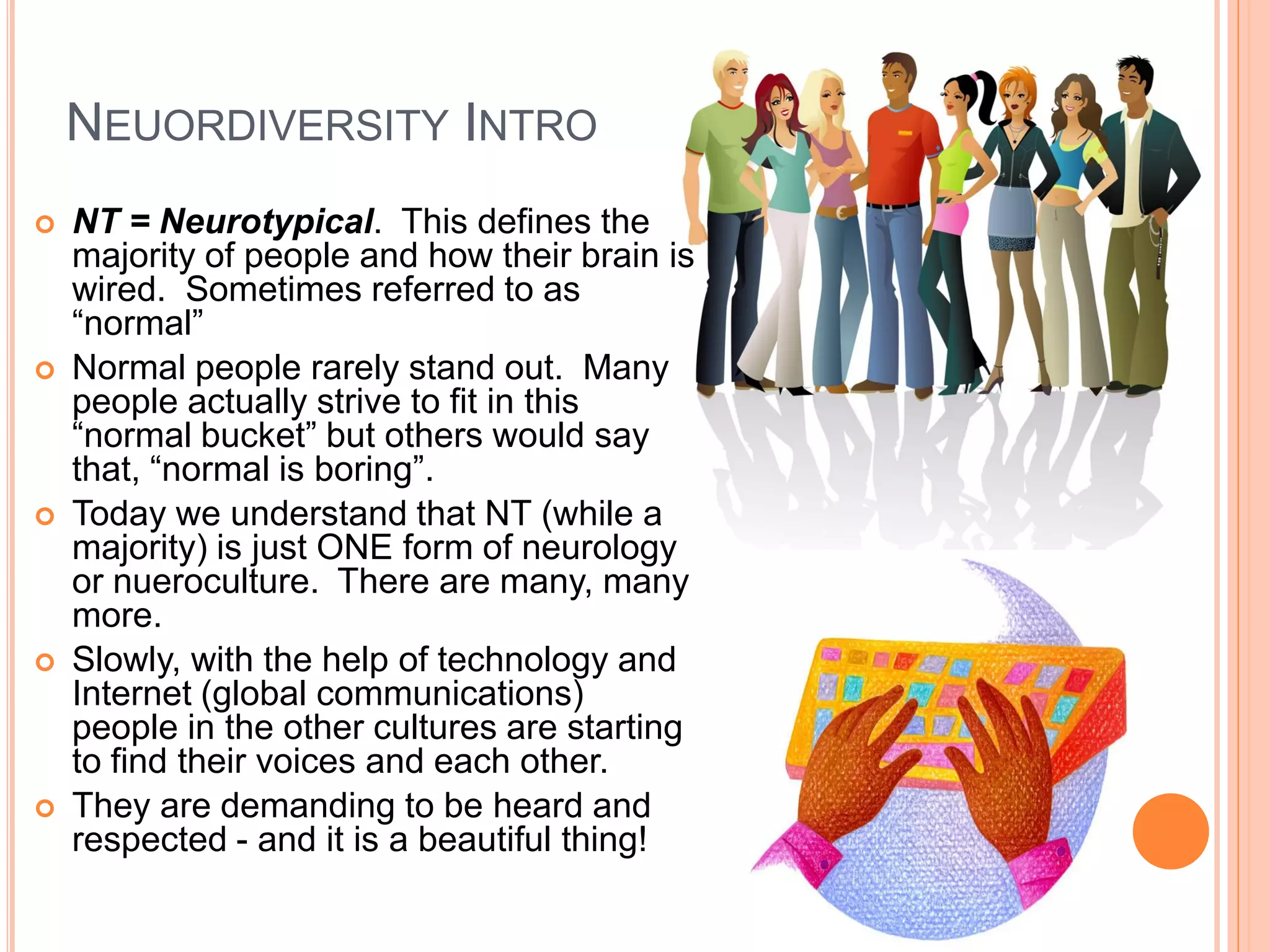
   NT = Neurotypical. This defines the
    majority of people and how their brain is
    wired. Sometimes referred to as
    “normal”
   Normal people rarely stand out. Many
    people actually strive to fit in this
    “normal bucket” but others would say
    that, “normal is boring”.
   Today we understand that NT (while a
    majority) is just ONE form of neurology
    or nueroculture. There are many, many
    more.
   Slowly, with the help of technology and
    Internet (global communications)
    people in the other cultures are starting
    to find their voices and each other.
   They are demanding to be heard and
    respected - and it is a beautiful thing!
ROLE MODELS
                                   * Video can also be located on Kfisherx Youtube Channel


       Click here for Video of Good Human Role Models


                                Watch the video carefully.
                                Can you identify the outlier
                                in this list of role models?


              Steve Jobs (High Tech)
              Vernon Smith (Economist)
              James Durbin (Musician)
              Ms. South Carolina (Beauty Pageant)
              Daniel Tammet (Author)
              Temple Grandin
ANSWERS PAGE
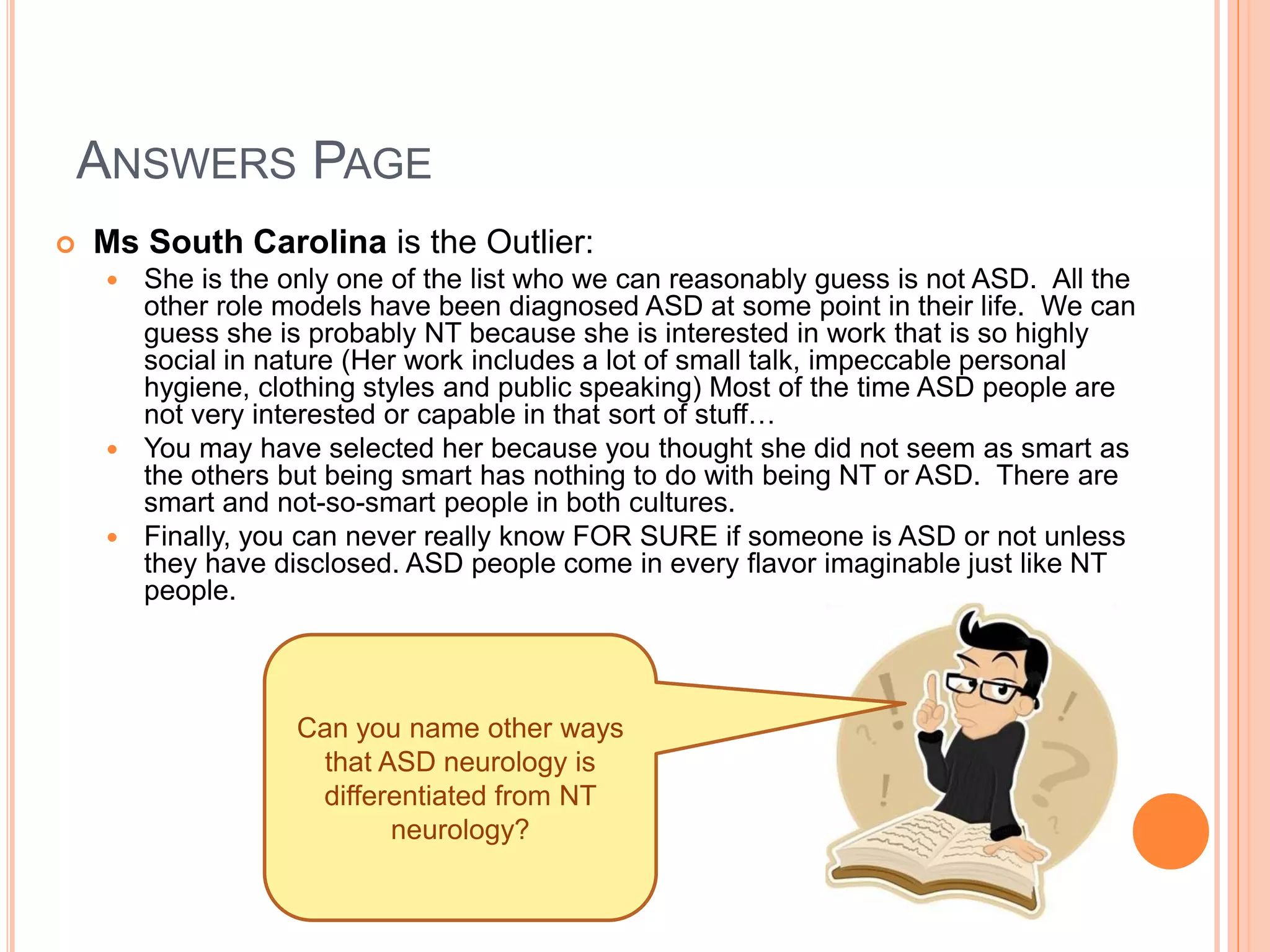
   Ms South Carolina is the Outlier:
     She is the only one of the list who we can reasonably guess is not ASD. All the
      other role models have been diagnosed ASD at some point in their life. We can
      guess she is probably NT because she is interested in work that is so highly
      social in nature (Her work includes a lot of small talk, impeccable personal
      hygiene, clothing styles and public speaking) Most of the time ASD people are
      not very interested or capable in that sort of stuff…
     You may have selected her because you thought she did not seem as smart as
      the others but being smart has nothing to do with being NT or ASD. There are
      smart and not-so-smart people in both cultures.
     Finally, you can never really know FOR SURE if someone is ASD or not unless
      they have disclosed. ASD people come in every flavor imaginable just like NT
      people.


                   Can you name other ways
                    that ASD neurology is
                    differentiated from NT
                          neurology?
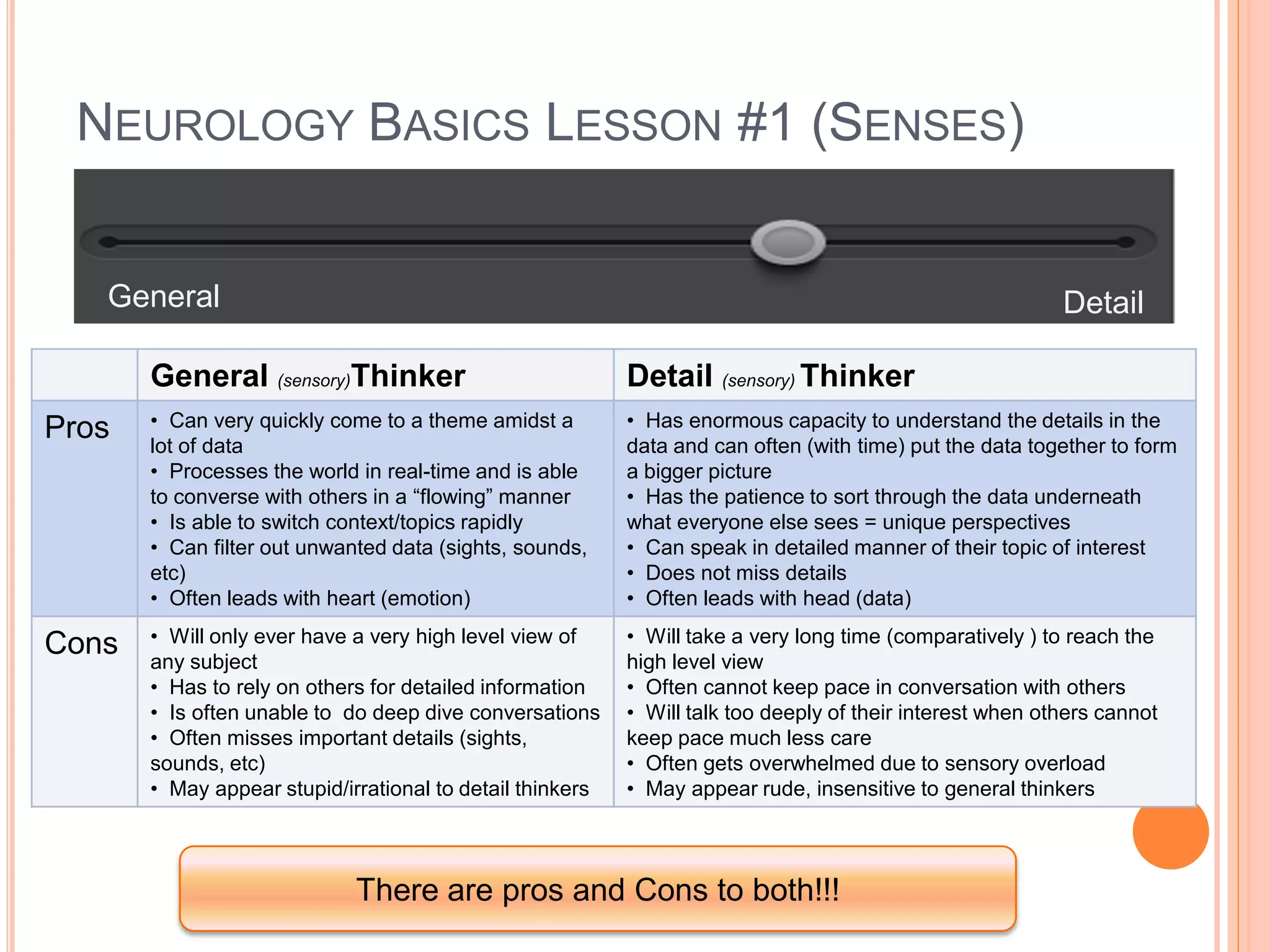
NEUROLOGY BASICS LESSON #1 (SENSES)


   General                                                                                                 Detail

       General (sensory)Thinker                            Detail (sensory) Thinker
Pros   • Can very quickly come to a theme amidst a         • Has enormous capacity to understand the details in the
       lot of data                                         data and can often (with time) put the data together to form
       • Processes the world in real-time and is able      a bigger picture
       to converse with others in a “flowing” manner       • Has the patience to sort through the data underneath
       • Is able to switch context/topics rapidly          what everyone else sees = unique perspectives
       • Can filter out unwanted data (sights, sounds,     • Can speak in detailed manner of their topic of interest
       etc)                                                • Does not miss details
       • Often leads with heart (emotion)                  • Often leads with head (data)

Cons   • Will only ever have a very high level view of     • Will take a very long time (comparatively ) to reach the
       any subject                                         high level view
       • Has to rely on others for detailed information    • Often cannot keep pace in conversation with others
       • Is often unable to do deep dive conversations     • Will talk too deeply of their interest when others cannot
       • Often misses important details (sights,           keep pace much less care
       sounds, etc)                                        • Often gets overwhelmed due to sensory overload
       • May appear stupid/irrational to detail thinkers   • May appear rude, insensitive to general thinkers


                             There are pros and Cons to both!!!
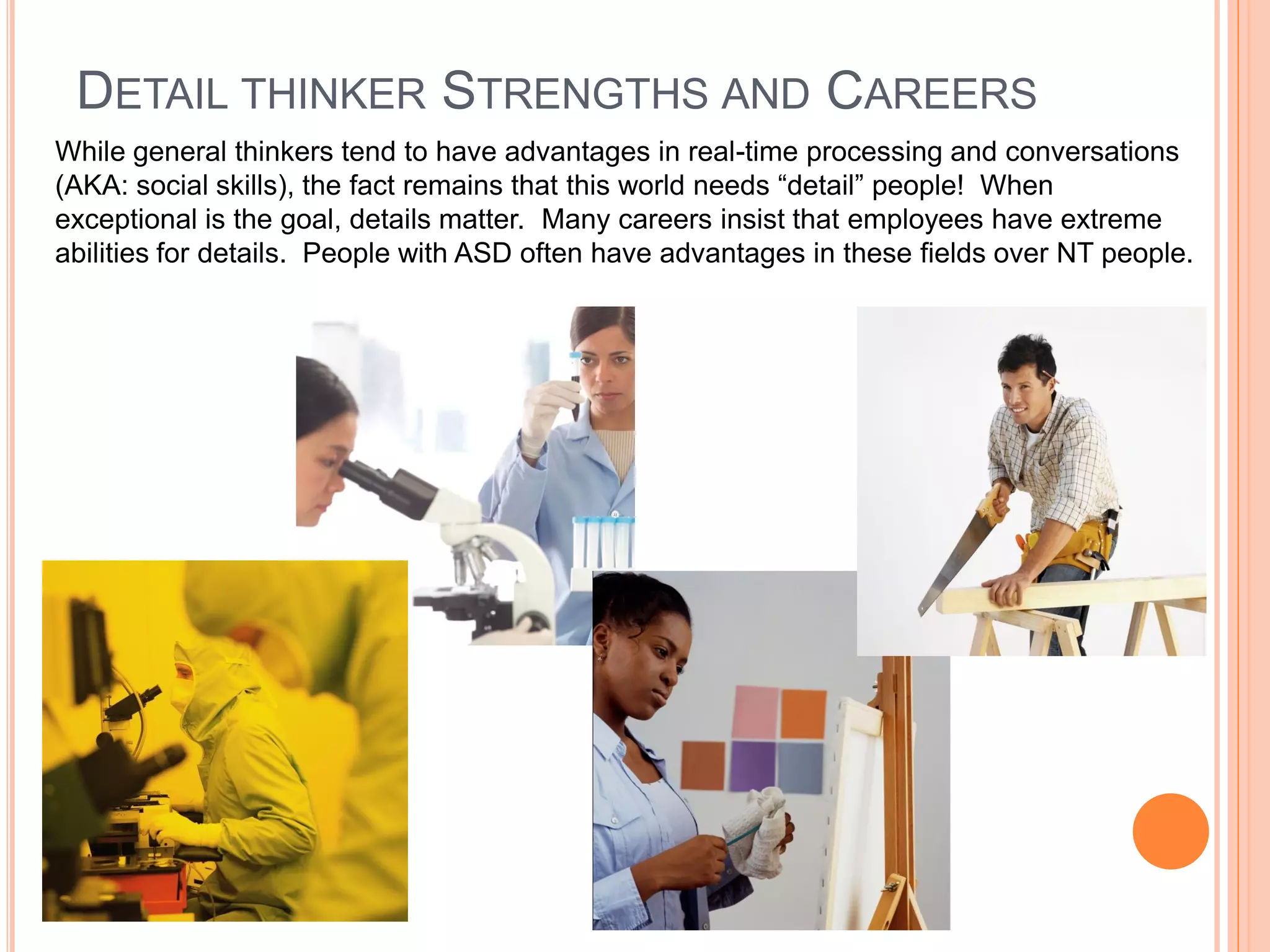
DETAIL THINKER STRENGTHS AND CAREERS
While general thinkers tend to have advantages in real-time processing and conversations
(AKA: social skills), the fact remains that this world needs “detail” people! When
exceptional is the goal, details matter. Many careers insist that employees have extreme
abilities for details. People with ASD often have advantages in these fields over NT people.
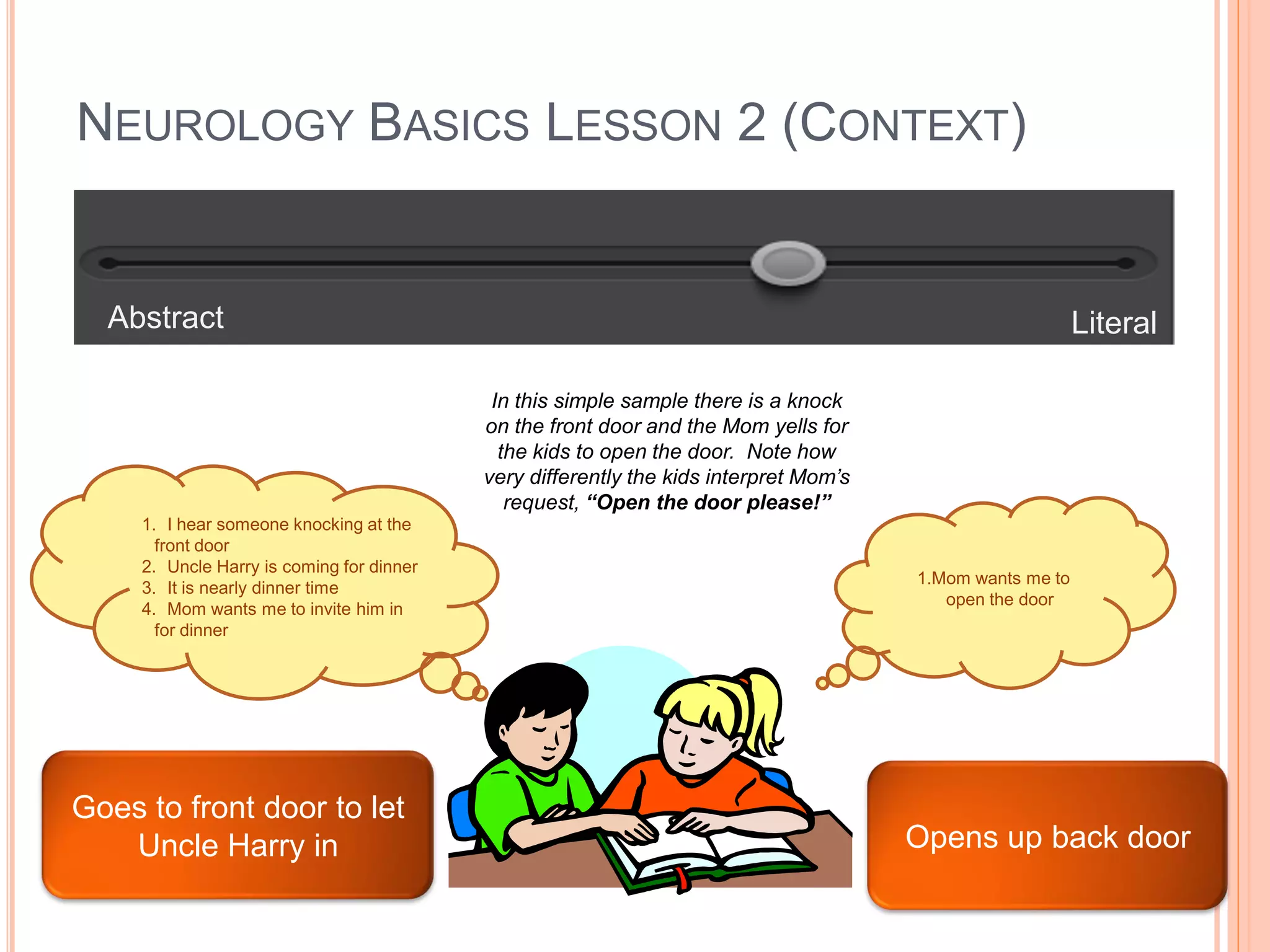
NEUROLOGY BASICS LESSON 2 (CONTEXT)


  Abstract                                                                                                 Literal

                                            In this simple sample there is a knock
                                           on the front door and the Mom yells for
                                             the kids to open the door. Note how
                                           very differently the kids interpret Mom’s
                                              request, “Open the door please!”
     1. I hear someone knocking at the
       front door
     2. Uncle Harry is coming for dinner
                                                                                       1.Mom wants me to
     3. It is nearly dinner time
                                                                                          open the door
     4. Mom wants me to invite him in
       for dinner


Goes to front door to let
   Uncle Harry in                                                                      Opens up back door
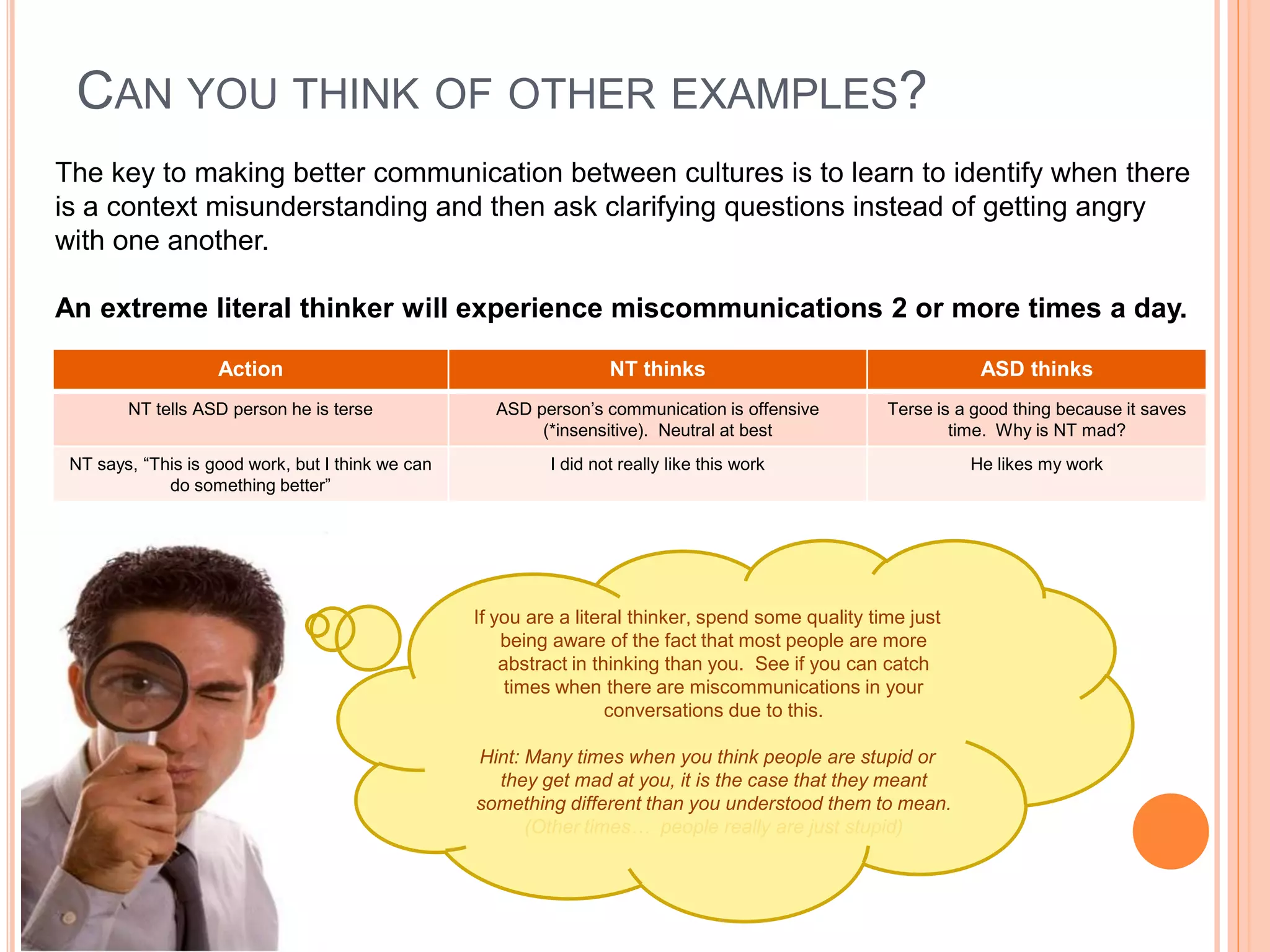
CAN YOU THINK OF OTHER EXAMPLES?
The key to making better communication between cultures is to learn to identify when there
is a context misunderstanding and then ask clarifying questions instead of getting angry
with one another.

An extreme literal thinker will experience miscommunications 2 or more times a day.

                    Action                                          NT thinks                                    ASD thinks
        NT tells ASD person he is terse              ASD person’s communication is offensive          Terse is a good thing because it saves
                                                          (*insensitive). Neutral at best                     time. Why is NT mad?
 NT says, “This is good work, but I think we can            I did not really like this work                     He likes my work
             do something better”


                                                   If you are a literal thinker, spend some quality time just
                                                       being aware of the fact that most people are more
                                                       abstract in thinking than you. See if you can catch
                                                        times when there are miscommunications in your
                                                                     conversations due to this.

                                                   Hint: Many times when you think people are stupid or
                                                     they get mad at you, it is the case that they meant
                                                   something different than you understood them to mean.
                                                         (Other times… people really are just stupid)
PREVALENCE
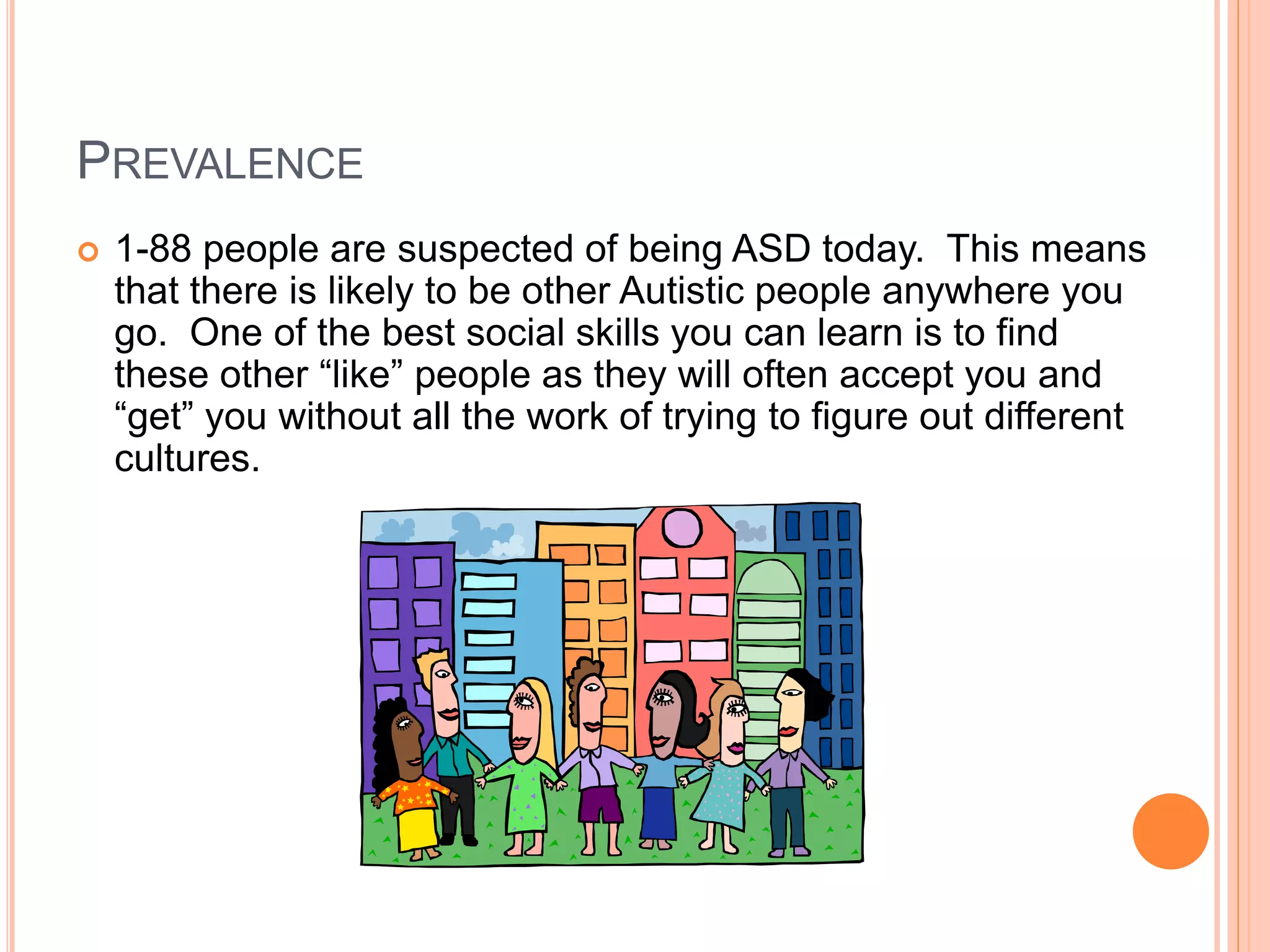
   1-88 people are suspected of being ASD today. This means
    that there is likely to be other Autistic people anywhere you
    go. One of the best social skills you can learn is to find
    these other “like” people as they will often accept you and
    “get” you without all the work of trying to figure out different
    cultures.
A WORD OF CAUTION -
                       Bad news travels in clogs and good news in slippers


   If you do Internet Searches on ASD, you will find lot of really negative press
 about Autism. This is due to an overall misunderstanding of what Autism is. For
 many, many years NT professionals did not take into account the perspective of
   actual Autistic people when writing about us. They only saw a difference and
 were incapable of understanding that difference. Today things are changing and
 many of us have been given a voice. We are helping the world to see us as we
                                         truly are.
 Because there is so much confusion about ASD there is also a lot of negative
 talk about finding cures or causes. Mostly this is from parents who have not yet
  accepted that ASD is part of who we are as people. The fact is that we do not
  need to be cured. We cannot parse the Autism from our being. We need to be
 accepted and supported. All of them who do accept agree that acceptance is a
                     “turning point” in their and their child’s lives.
  ……because what everyone must one day come to is the fact that we are
                      already the very best people we can be….


                      Autistic people!!!
THE AUTHORS
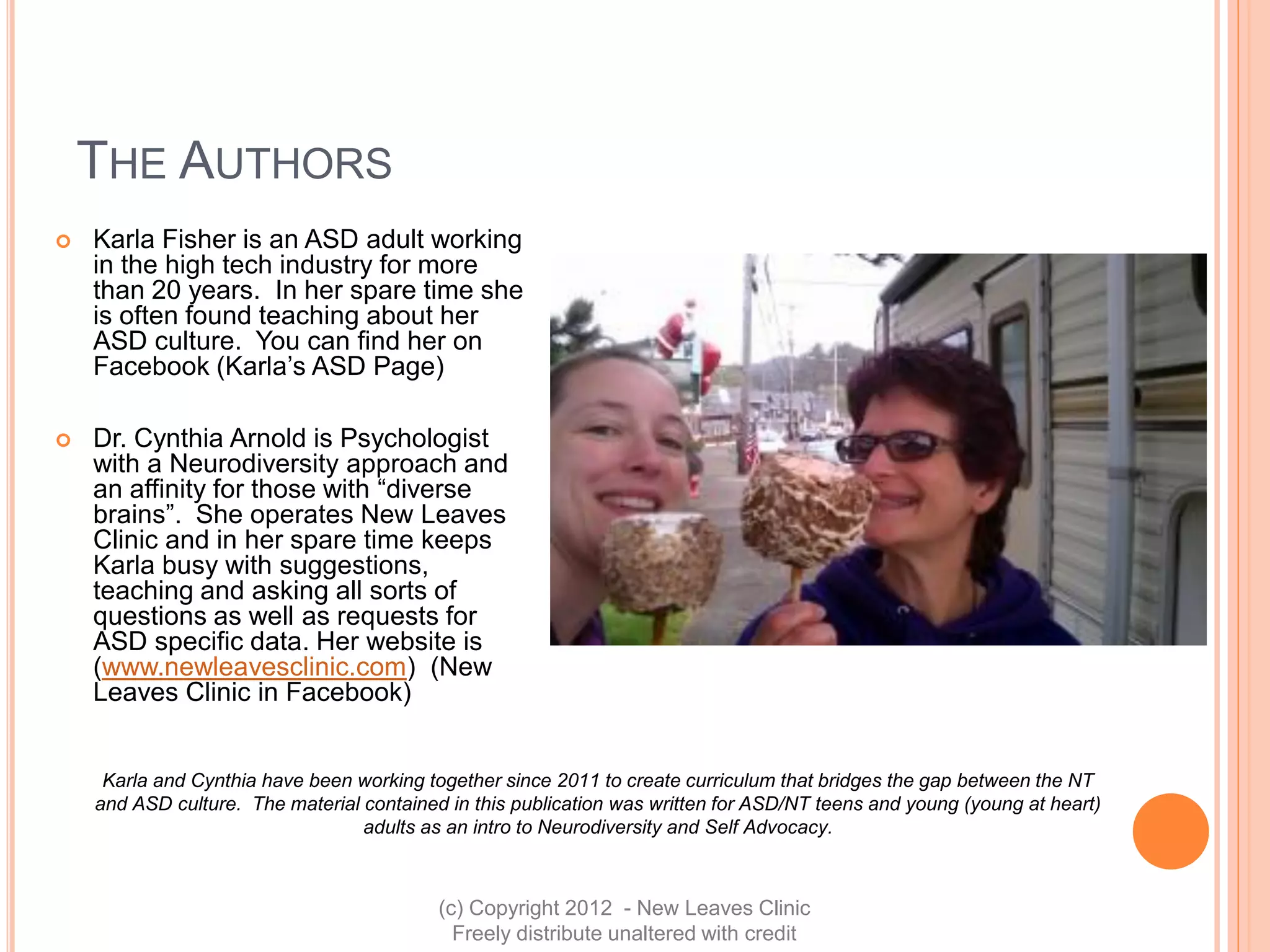
   Karla Fisher is an ASD adult working
    in the high tech industry for more
    than 20 years. In her spare time she
    is often found teaching about her
    ASD culture. You can find her on
    Facebook (Karla’s ASD Page)

   Dr. Cynthia Arnold is Psychologist
    with a Neurodiversity approach and
    an affinity for those with “diverse
    brains”. She operates New Leaves
    Clinic and in her spare time keeps
    Karla busy with suggestions,
    teaching and asking all sorts of
    questions as well as requests for
    ASD specific data. Her website is
    (www.newleavesclinic.com) (New
    Leaves Clinic in Facebook)


     Karla and Cynthia have been working together since 2011 to create curriculum that bridges the gap between the NT
    and ASD culture. The material contained in this publication was written for ASD/NT teens and young (young at heart)
                                  adults as an intro to Neurodiversity and Self Advocacy.


                                           (c) Copyright 2012 - New Leaves Clinic
                                             Freely distribute unaltered with credit

Intro toneurodiversityasd

  • 1.
    ACCEPT = YES KarlaFisher ASD and Cynthia Arnold PhD New Leaves Clinic Introduction to a Neurodiversity (c) Copyright 2012 - New Leaves Clinic Freely distribute unaltered with credits
  • 2.
    NEUORDIVERSITY INTRO  NT = Neurotypical. This defines the majority of people and how their brain is wired. Sometimes referred to as “normal”  Normal people rarely stand out. Many people actually strive to fit in this “normal bucket” but others would say that, “normal is boring”.  Today we understand that NT (while a majority) is just ONE form of neurology or nueroculture. There are many, many more.  Slowly, with the help of technology and Internet (global communications) people in the other cultures are starting to find their voices and each other.  They are demanding to be heard and respected - and it is a beautiful thing!
  • 3.
    ROLE MODELS * Video can also be located on Kfisherx Youtube Channel Click here for Video of Good Human Role Models Watch the video carefully. Can you identify the outlier in this list of role models?  Steve Jobs (High Tech)  Vernon Smith (Economist)  James Durbin (Musician)  Ms. South Carolina (Beauty Pageant)  Daniel Tammet (Author)  Temple Grandin
  • 4.
    ANSWERS PAGE  Ms South Carolina is the Outlier:  She is the only one of the list who we can reasonably guess is not ASD. All the other role models have been diagnosed ASD at some point in their life. We can guess she is probably NT because she is interested in work that is so highly social in nature (Her work includes a lot of small talk, impeccable personal hygiene, clothing styles and public speaking) Most of the time ASD people are not very interested or capable in that sort of stuff…  You may have selected her because you thought she did not seem as smart as the others but being smart has nothing to do with being NT or ASD. There are smart and not-so-smart people in both cultures.  Finally, you can never really know FOR SURE if someone is ASD or not unless they have disclosed. ASD people come in every flavor imaginable just like NT people. Can you name other ways that ASD neurology is differentiated from NT neurology?
  • 5.
    NEUROLOGY BASICS LESSON#1 (SENSES) General Detail General (sensory)Thinker Detail (sensory) Thinker Pros • Can very quickly come to a theme amidst a • Has enormous capacity to understand the details in the lot of data data and can often (with time) put the data together to form • Processes the world in real-time and is able a bigger picture to converse with others in a “flowing” manner • Has the patience to sort through the data underneath • Is able to switch context/topics rapidly what everyone else sees = unique perspectives • Can filter out unwanted data (sights, sounds, • Can speak in detailed manner of their topic of interest etc) • Does not miss details • Often leads with heart (emotion) • Often leads with head (data) Cons • Will only ever have a very high level view of • Will take a very long time (comparatively ) to reach the any subject high level view • Has to rely on others for detailed information • Often cannot keep pace in conversation with others • Is often unable to do deep dive conversations • Will talk too deeply of their interest when others cannot • Often misses important details (sights, keep pace much less care sounds, etc) • Often gets overwhelmed due to sensory overload • May appear stupid/irrational to detail thinkers • May appear rude, insensitive to general thinkers There are pros and Cons to both!!!
  • 6.
    DETAIL THINKER STRENGTHSAND CAREERS While general thinkers tend to have advantages in real-time processing and conversations (AKA: social skills), the fact remains that this world needs “detail” people! When exceptional is the goal, details matter. Many careers insist that employees have extreme abilities for details. People with ASD often have advantages in these fields over NT people.
  • 7.
    NEUROLOGY BASICS LESSON2 (CONTEXT) Abstract Literal In this simple sample there is a knock on the front door and the Mom yells for the kids to open the door. Note how very differently the kids interpret Mom’s request, “Open the door please!” 1. I hear someone knocking at the front door 2. Uncle Harry is coming for dinner 1.Mom wants me to 3. It is nearly dinner time open the door 4. Mom wants me to invite him in for dinner Goes to front door to let Uncle Harry in Opens up back door
  • 8.
    CAN YOU THINKOF OTHER EXAMPLES? The key to making better communication between cultures is to learn to identify when there is a context misunderstanding and then ask clarifying questions instead of getting angry with one another. An extreme literal thinker will experience miscommunications 2 or more times a day. Action NT thinks ASD thinks NT tells ASD person he is terse ASD person’s communication is offensive Terse is a good thing because it saves (*insensitive). Neutral at best time. Why is NT mad? NT says, “This is good work, but I think we can I did not really like this work He likes my work do something better” If you are a literal thinker, spend some quality time just being aware of the fact that most people are more abstract in thinking than you. See if you can catch times when there are miscommunications in your conversations due to this. Hint: Many times when you think people are stupid or they get mad at you, it is the case that they meant something different than you understood them to mean. (Other times… people really are just stupid)
  • 9.
    PREVALENCE  1-88 people are suspected of being ASD today. This means that there is likely to be other Autistic people anywhere you go. One of the best social skills you can learn is to find these other “like” people as they will often accept you and “get” you without all the work of trying to figure out different cultures.
  • 10.
    A WORD OFCAUTION - Bad news travels in clogs and good news in slippers  If you do Internet Searches on ASD, you will find lot of really negative press about Autism. This is due to an overall misunderstanding of what Autism is. For many, many years NT professionals did not take into account the perspective of actual Autistic people when writing about us. They only saw a difference and were incapable of understanding that difference. Today things are changing and many of us have been given a voice. We are helping the world to see us as we truly are.  Because there is so much confusion about ASD there is also a lot of negative talk about finding cures or causes. Mostly this is from parents who have not yet accepted that ASD is part of who we are as people. The fact is that we do not need to be cured. We cannot parse the Autism from our being. We need to be accepted and supported. All of them who do accept agree that acceptance is a “turning point” in their and their child’s lives.  ……because what everyone must one day come to is the fact that we are already the very best people we can be…. Autistic people!!!
  • 11.
    THE AUTHORS  Karla Fisher is an ASD adult working in the high tech industry for more than 20 years. In her spare time she is often found teaching about her ASD culture. You can find her on Facebook (Karla’s ASD Page)  Dr. Cynthia Arnold is Psychologist with a Neurodiversity approach and an affinity for those with “diverse brains”. She operates New Leaves Clinic and in her spare time keeps Karla busy with suggestions, teaching and asking all sorts of questions as well as requests for ASD specific data. Her website is (www.newleavesclinic.com) (New Leaves Clinic in Facebook) Karla and Cynthia have been working together since 2011 to create curriculum that bridges the gap between the NT and ASD culture. The material contained in this publication was written for ASD/NT teens and young (young at heart) adults as an intro to Neurodiversity and Self Advocacy. (c) Copyright 2012 - New Leaves Clinic Freely distribute unaltered with credit