Researching a Company PART II : INTERVIEW
Interview Preparation So, your great resum é  and effective cover letter have earned you an interview … What next? As one part of your interview preparation, we suggest that you spend some time researching the interviewing company.
Why Research a Company? First of all, you research a company as a way of demonstrating to the interviewer that you cared enough to learn something about them before coming in for the interview.  This involves research at its most basic level – their history, primary business, products, location(s), number of employees, etc.  The Internet can help with this basic research – in the case of many (or even most) companies, but not all.
Why Research a Company? As importantly, you are also researching a company in order to protect yourself from making a mistake –  e.g., taking a job that you wish that you could quit (because of something important about them that you didn't know or bother to find out before you started the job).  the purpose of this sort of research is to find out important information ahead of time (to the extent possible) before you take the job! More important for full-time employment.
Why Research a Company? On a practical level, the interviewer might ask questions similar to the following: What do you know about our company? Why do you want to work with us? What skills do you have that make you a good fit for our company? You don’t want just any job, you want this job.
Interview: Part of the Process Researching a company continues as you take part in the interview itself. Ask additional questions about anything that you couldn’t learn before the interview. This shows your interest in the company, and a mature approach to job hunting.
What Do You Want to Know? What are the mission, goals and vision of the company? What is the corporate culture like? What is the specific job you would do? Will the skills you care the most about in yourself get used? The last items calls for you to “know yourself!” Make a skills inventory.
Know the Employer size of firm or industry % annual sales growth in last 5 years current events & stock prices age of top management geographic locations/ home office who the competition is organizational goals organizational structure/career paths number of plants/stores, etc. products or services
Know Yourself Identify your transferable job skills Become aware of your strengths Be aware of your weaknesses Determine what you’re looking for in a job Know how you fit with the position or organization Conduct  information interviews
Can the Internet Help? Often, all you can find out about the companies online is limited:  names, addresses, phone and fax numbers, bottom line, credit rating, and such Some companies provide much more detailed information But don’t count on it
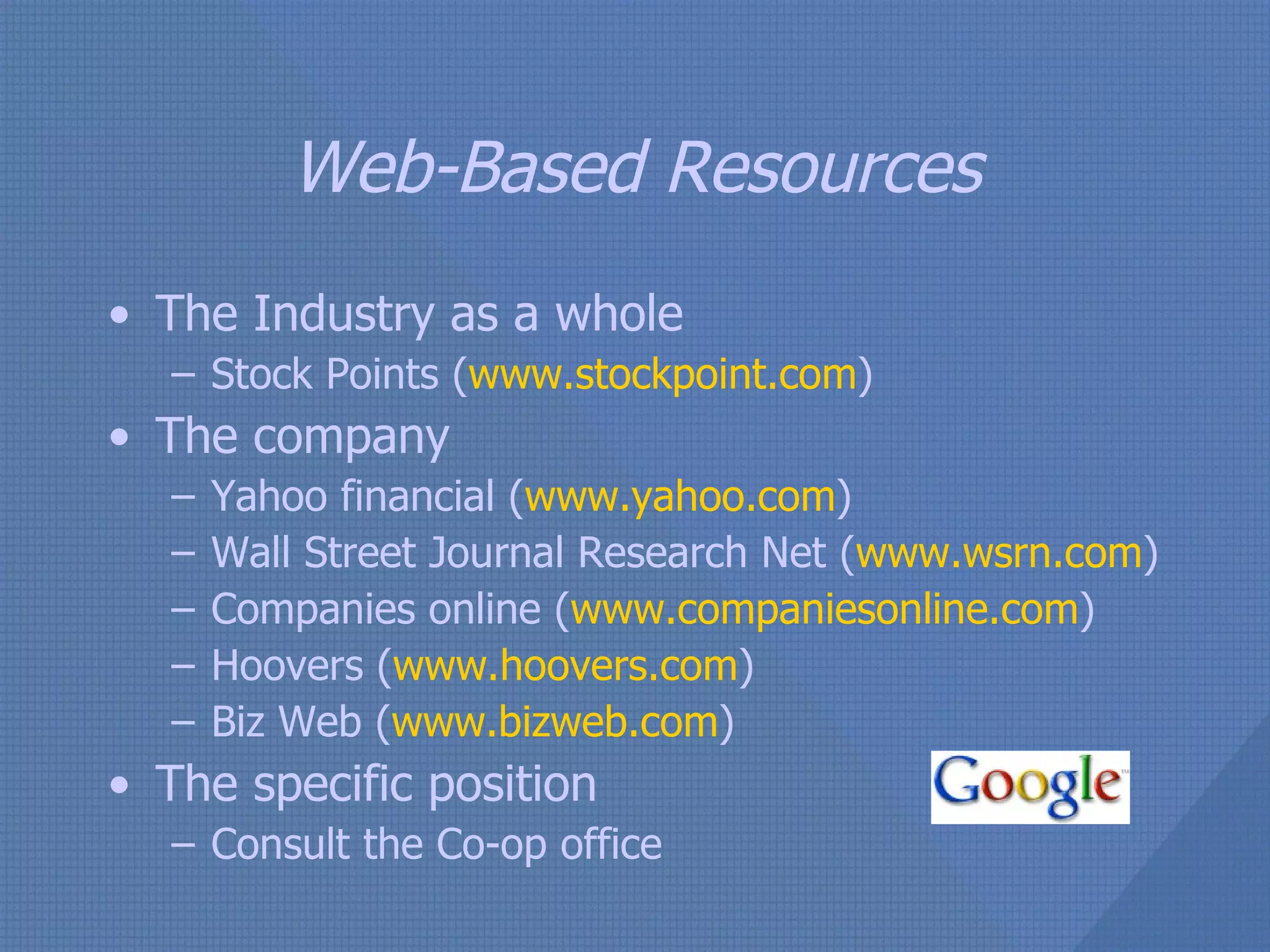
Web-Based Resources The Industry as a whole Stock Points ( www.stockpoint.com ) The company Yahoo financial ( www.yahoo.com ) Wall Street Journal Research Net ( www.wsrn.com ) Companies online ( www.companiesonline.com ) Hoovers ( www.hoovers.com ) Biz Web ( www.bizweb.com ) The specific position Consult the Co-op office
Where Else Can I Get Help? If you're going to go deeper and find out the information you really want to know, you're going to need to supplement online research with some offline research. You will need to talk to people, e.g., other students, to thoroughly research the companies that interest you.
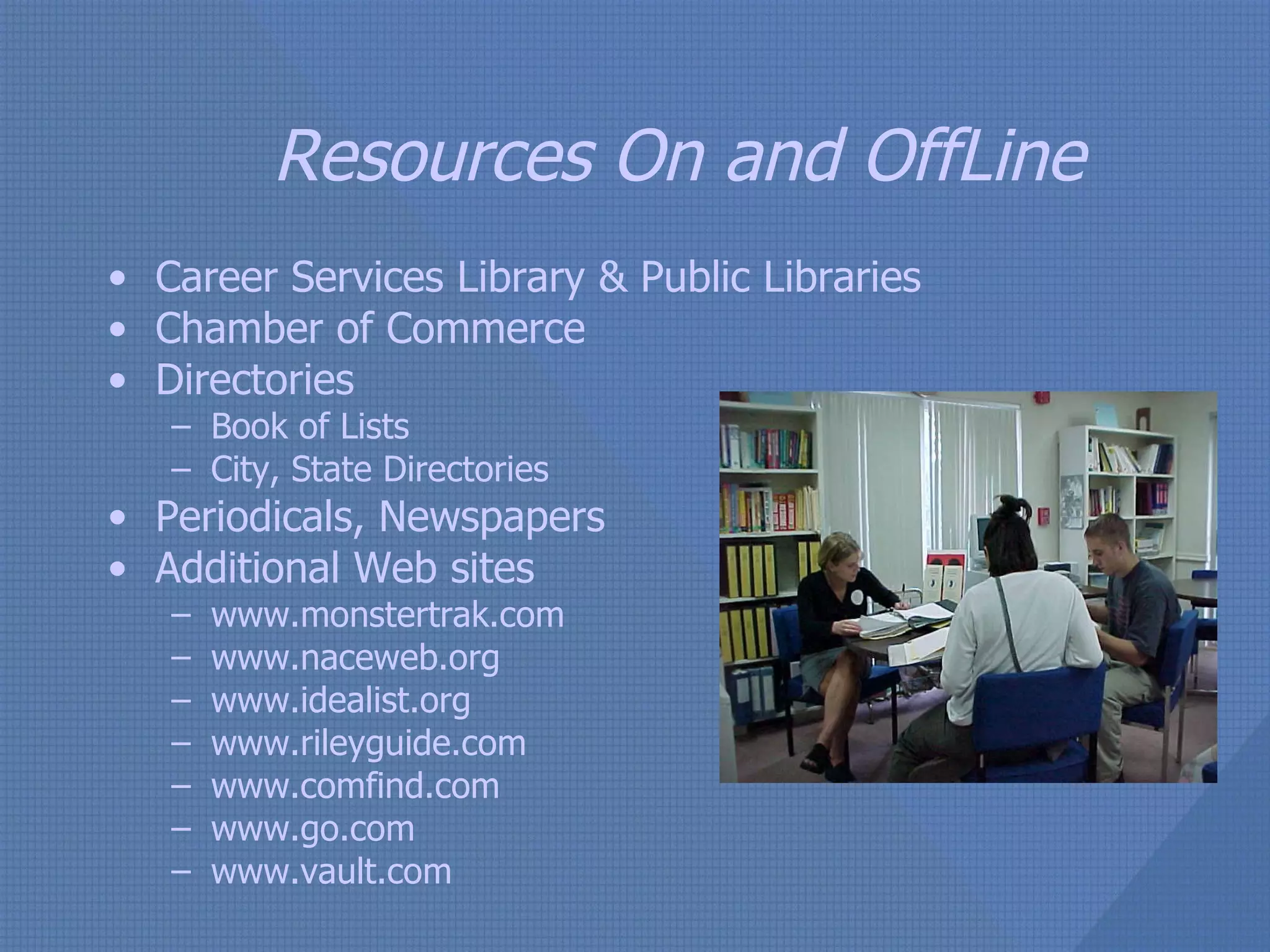
Resources On and OffLine Career Services Library & Public Libraries  Chamber of Commerce Directories Book of Lists City, State Directories Periodicals, Newspapers Additional Web sites www.monstertrak.com www.naceweb.org www.idealist.org www.rileyguide.com www.comfind.com www.go.com www.vault.com
Six Comforting Thoughts In a hiring interview, you are still doing research. Hiring interviews are not a science, they are an opportunity for communication. Often, the employer’s representative is as nervous as you are.
Six Comforting Thoughts You don’t have to memorize a lot of answers to difficult interview questions. Be yourself and answer honestly. The employer cares more about your future than about your past. No matter what handicap you have, it need not keep you from getting hired.
Questions to Ask Yourself What does this job involve? Do my skills truly match this job? Are these the kind of people I would like to work with, or not? If we like each other, and both want to work together, can I persuade them that there is something unique about me, that makes me different from 19 other people who can do the same tasks.
In Simple Terms Know yourself Know the employer Questions?

Interview Part 2

  • 1.
    Researching a CompanyPART II : INTERVIEW
  • 2.
    Interview Preparation So,your great resum é and effective cover letter have earned you an interview … What next? As one part of your interview preparation, we suggest that you spend some time researching the interviewing company.
  • 3.
    Why Research aCompany? First of all, you research a company as a way of demonstrating to the interviewer that you cared enough to learn something about them before coming in for the interview. This involves research at its most basic level – their history, primary business, products, location(s), number of employees, etc. The Internet can help with this basic research – in the case of many (or even most) companies, but not all.
  • 4.
    Why Research aCompany? As importantly, you are also researching a company in order to protect yourself from making a mistake – e.g., taking a job that you wish that you could quit (because of something important about them that you didn't know or bother to find out before you started the job). the purpose of this sort of research is to find out important information ahead of time (to the extent possible) before you take the job! More important for full-time employment.
  • 5.
    Why Research aCompany? On a practical level, the interviewer might ask questions similar to the following: What do you know about our company? Why do you want to work with us? What skills do you have that make you a good fit for our company? You don’t want just any job, you want this job.
  • 6.
    Interview: Part ofthe Process Researching a company continues as you take part in the interview itself. Ask additional questions about anything that you couldn’t learn before the interview. This shows your interest in the company, and a mature approach to job hunting.
  • 7.
    What Do YouWant to Know? What are the mission, goals and vision of the company? What is the corporate culture like? What is the specific job you would do? Will the skills you care the most about in yourself get used? The last items calls for you to “know yourself!” Make a skills inventory.
  • 8.
    Know the Employersize of firm or industry % annual sales growth in last 5 years current events & stock prices age of top management geographic locations/ home office who the competition is organizational goals organizational structure/career paths number of plants/stores, etc. products or services
  • 9.
    Know Yourself Identifyyour transferable job skills Become aware of your strengths Be aware of your weaknesses Determine what you’re looking for in a job Know how you fit with the position or organization Conduct information interviews
  • 10.
    Can the InternetHelp? Often, all you can find out about the companies online is limited: names, addresses, phone and fax numbers, bottom line, credit rating, and such Some companies provide much more detailed information But don’t count on it
  • 11.
    Web-Based Resources TheIndustry as a whole Stock Points ( www.stockpoint.com ) The company Yahoo financial ( www.yahoo.com ) Wall Street Journal Research Net ( www.wsrn.com ) Companies online ( www.companiesonline.com ) Hoovers ( www.hoovers.com ) Biz Web ( www.bizweb.com ) The specific position Consult the Co-op office
  • 12.
    Where Else CanI Get Help? If you're going to go deeper and find out the information you really want to know, you're going to need to supplement online research with some offline research. You will need to talk to people, e.g., other students, to thoroughly research the companies that interest you.
  • 13.
    Resources On andOffLine Career Services Library & Public Libraries Chamber of Commerce Directories Book of Lists City, State Directories Periodicals, Newspapers Additional Web sites www.monstertrak.com www.naceweb.org www.idealist.org www.rileyguide.com www.comfind.com www.go.com www.vault.com
  • 14.
    Six Comforting ThoughtsIn a hiring interview, you are still doing research. Hiring interviews are not a science, they are an opportunity for communication. Often, the employer’s representative is as nervous as you are.
  • 15.
    Six Comforting ThoughtsYou don’t have to memorize a lot of answers to difficult interview questions. Be yourself and answer honestly. The employer cares more about your future than about your past. No matter what handicap you have, it need not keep you from getting hired.
  • 16.
    Questions to AskYourself What does this job involve? Do my skills truly match this job? Are these the kind of people I would like to work with, or not? If we like each other, and both want to work together, can I persuade them that there is something unique about me, that makes me different from 19 other people who can do the same tasks.
  • 17.
    In Simple TermsKnow yourself Know the employer Questions?

Editor's Notes

  • #9 Table 13.2 provides more information
  • #14 20