Hybrid prediction model with missing value imputation for medical data
Archana Purwar ⇑
, Sandeep Kumar Singh
Department of Computer Science and Information Technology, JIIT Noida, India
a r t i c l e i n f o
Article history:
Available online 5 March 2015
Keywords:
Missing value imputation
Multilayer Perceptron (MLP)
K-means clustering
Data mining
a b s t r a c t
Accurate prediction in the presence of large number of missing values in the data set has always been a
challenging problem. Most of hybrid models to address this challenge have either deleted the missing
instances from the data set (popularly known as case deletion) or have used some default way to fill
the missing values. This paper, presents a novel hybrid prediction model with missing value imputation
(HPM-MI) that analyze various imputation techniques using simple K-means clustering and apply the
best one to a data set. The proposed hybrid model is the first one to use combination of K-means cluster-
ing with Multilayer Perceptron. K-means clustering is also used to validate class labels of given data
(incorrectly classified instances are deleted i.e. pattern extracted from original data) before applying clas-
sifier. The proposed system has significantly improved data quality by use of best imputation technique
after quantitative analysis of eleven imputation approaches. The efficiency of proposed model as predic-
tive classification system is investigated on three benchmark medical data sets namely Pima Indians
Diabetes, Wisconsin Breast Cancer, and Hepatitis from the UCI Repository of Machine Learning. In addi-
tion to accuracy, sensitivity, specificity; kappa statistics and the area under ROC are also computed. The
experimental results show HPM-MI has produced accuracy, sensitivity, specificity, kappa and ROC as
99.82%, 100%, 99.74%, 0.996 and 1.0 respectively for Pima Indian Diabetes data set, 99.39%, 99.31%,
99.54%, 0.986, and 1.0 respectively for breast cancer data set and 99.08%, 100%, 96.55%, 0.978 and 0.99
respectively for Hepatitis data set. Results are best in comparison with existing methods. Further, the per-
formance of our model is measured and analyzed as function of missing rate and train-test ratio using 2D
synthetic data set and Wisconsin Diagnostics Breast Cancer Data Sets. Results are promising and there-
fore the proposed model will be very useful in prediction for medical domain especially when numbers
of missing value are large in the data set.
Ó 2015 Elsevier Ltd. All rights reserved.
1. Introduction
Research in the field of predictive data mining for medical
applications is a significant and moving area. Generally, a medical
practitioner collects his/her knowledge from patient’s symptoms
and confirmed diagnosis. Diagnosis is usually made either by eval-
uating the current test results of the patients or by referring to the
previous decisions made on other patients with same test results.
The accuracy of diagnosis of patient’s disease like diabetes, breast
cancer and others is greatly relenting on a experts’ experience
(Meesad & Yen, 2003). Due to the pace at which numbers of
patients are increasing, it has become cumbersome to make
diagnostics decisions. On the other side, development of new
computational methods and tools makes relatively easy to make
decisions from dedicated databases of electronic patient records.
As an example, numerous classifiers have been developed for
diagnosis and screening of diabetes, cancer and liver disorders
(Seera & Lim, 2014). A number of classification systems have been
developed in the literature like RBQ, LVQ C4.5, CART, Bayesian Tree,
ANN + FNN, HPM, Sim + F2, real coded GA, and FMM-CART-RF to
support diagnosis of diabetes as well as breast cancer disease
(Seera & Lim, 2014). Various hybrid models are also proposed in
the literature (Kahramanli & Allahverdi, 2008; llango & Ramaraj,
2010; Patil, Joshi, & Toshniwal, 2010) namely hybrid system con-
sisting of artificial neural network and fuzzy neural network,
HPM consisting of K-means clustering with J48 and HPM with
F-score consisting of feature selection using F-score, K-means clus-
tering and SVM.
Researchers have developed a large number of classification
systems to improve accuracy of predictive classification. The pro-
posed model uses K-means clustering as a means to analyze 11
missing data imputation (MVI) techniques under study and selects
the best imputation method. This best imputation method is
applied on the data set before pattern extraction and subsequently
http://dx.doi.org/10.1016/j.eswa.2015.02.050
0957-4174/Ó 2015 Elsevier Ltd. All rights reserved.
⇑ Corresponding author.
E-mail addresses: archana.purwar@jiit.ac.in (A. Purwar), sandeepk.singh@jiit.ac.
in (S.K. Singh).
Expert Systems with Applications 42 (2015) 5621–5631
Contents lists available at ScienceDirect
Expert Systems with Applications
journal homepage: www.elsevier.com/locate/eswa
applying prediction. Moreover, to the best of our knowledge, none
of the hybrid prediction models have combined use of K-means
clustering and MLP for prediction of diseases.
This paper makes a novel contribution by first analyzing 11 MVI
techniques experimentally and finds the best method for handling
the missing values in the data set using K-means clustering.
Consequently, it improves the quality of data. Moreover, it also
aims at predictive classification using novel model that can classify
records in the test data set using training data set. Multi layer
Perceptron (MLP) has a capability to learn from examples and
can generalize beyond the training data (Carpenter & Markuzon,
1998; Downs, Harrison, Kennedy, & Cross, 1996; Mukhopadhyay,
Changhong, Huang, Mulong, & Palakal, 2002). Due to these charac-
teristics of neural networks, MLP with backpropagation is investi-
gated for developing a valid and useful prediction model. K-means
clustering is also used to develop proposed hybrid prediction
model with missing value imputation (HPM-MI) to extract correct
instances from data before applying MLP for classification.
Rest of the paper is grouped in five sections. Section 2describes
the study of data mining methods namely imputation methods,
K-means clustering, MLP and review of prediction models. Then,
Section 3depicts the proposed model. Evaluation of proposed
model is done in Section 4. Section 5 shows the results and its dis-
cussion. Finally, paper is concluded by Section 6.
2. Background study
This section reviews a few data mining methods and predictive
classification models.
2.1. Data mining methods
As the amount of data stored in medical databases is increasing,
there is growing need for efficient and effective techniques to
extract the information. Previous researches have given evidence
that medical diagnosis and prognosis is amended by employing
data mining techniques on clinical data (Hammer & Bonates,
2006; Saastamoinen & Ketola, 2006; Tsirogiannis et al., 2004).
This has been possible due to extensive availability of data mining
techniques and tools for data analysis. Predictive modeling
requires that the medical informatics researchers and practitioners
need to select the most appropriate strategy to cope with clinical
prediction problem (Bellazzi & Zupan, 2008). This section discusses
mining techniques used to develop the proposed model.
2.1.1. Missing value imputation
2.1.1.1. Introduction. In real-life databases, incomplete data or
information as shown in Table 1 is frequent owing to the presence
of missing values in the attributes. First row in Table 1 shows name
of the variables in the data set while other rows show the values of
these variables. The values denoted by ‘?’ in Table 1 represent the
missing values. Missing values can occur due to large number of
reasons such as errors in the manual data entry procedures, equip-
ment errors or incorrect measurements. The presence of missing
values (MVs) in data mining produces several problems in the
knowledge extraction process such as loss of efficiency,
complications in managing and analyzing data. It may also result
in bias decisions due to differences between missing and complete
data.
In order to solve these problems, two approaches are found in
the literature. First approach consists of missing data toleration
techniques which integrate the techniques of missing values han-
dling in specific data mining algorithms such as in classification
(David, 2007; Saar-Tsechansky, 2007), clustering (Hathaway &
Bezdek, 2002) and feature selection (Aussem & de Morais,
2008). Second type of approach consists of missing data imputa-
tion techniques which fill in missing values before using
complete-data methods on data sets. One advantage of imputa-
tion is that the treatment of missing data is independent of the
succeeding mining algorithm, and people can select a suitable
learning algorithm after imputation (Qin, Zhang, Zhu, Zhang, &
Zhang, 2007).
In our proposed HPM-MI, we have used best proven MVI
approach to fill the missing value before pattern extraction and
classification on the data set. We have validated our model on
three benchmark data sets i.e. Pima Indian Diabetes, Wisconsin
Breast Cancer and Hepatitis data set from UCI repository
(Newman, Hettich, Blake, & Merz, 2007) having 763, 16 and 167
missing values respectively and two complete data sets namely
2D synthetic data set as well as Wisconsin Diagnostics Breast
Cancer (WDBC) in which missing values were artificially induced.
2.1.1.2. Imputation techniques. In order to analyze the impact of
various MVI techniques (Koren, Bell, & Volinsky, 2009; Luengo,
García, & Herrera, 2011; Takács, Pilászy, & Németh, 2008), experi-
mentation is done to choose the best possible one to handle miss-
ing values present in the data sets under study. The following
approaches have been empirically assessed to find the missing
values:
 Case deletion: The examples that have any missing value in their
attributes are removed from the data set.
 Most Common Method (MC): Missing values present in the data
set is substituted by mean value for numerical and mode for
nominal attributes.
 Concept Most Common (CMC): This method calculates the miss-
ing values similar to MC method but it considers only the same
class in which MV is missing.
 K-Nearest Neighbor (KNNI): Firstly, this method finds the k near-
est neighbors and then, the most common value among all
neighbors is taken for nominal attributes, and the mean value
is used for numerical attributes.
 Weighted Imputation with K-Nearest Neighbor (WKNN): This
method calculates the distance of each missing value instances
from its neighbors. This distance is used to calculate the weight.
MV is computed by weighted mean for numerical attributes. For
nominal attributes, imputed value is the category with highest
weight.
 K-means Clustering Imputation (KMI): All the instances are clus-
tered using K-means clustering. The instances in each cluster
are considered nearest neighbors of each other. The missing
value is computed in similar manner as in KNNI method.
 Imputation with Fuzzy K-means Clustering (FKMI): After the fuzzy
clustering of the data set, missing values are computed as
weighed sum of all centroids, using the membership function
of each cluster as the weight.
 Support Vector Machines Imputation (SVMI): SVM model is
trained to predict missing attributes from the complete
instances which do not have missing values. During testing,
missing values are predicted using other attributes by setting
missing attribute as a class attribute whose value is intended
to be predicted.
Table 1
Sample data showing missing values by ‘?’.
A B C D E F G H Class
6 148 72 35 ? 33.6 0.62 50 Yes
1 85 66 29 ? 26.6 0.35 31 No
8 183 64 ? ? 23.3 0.67 32 Yes
1 89 66 23 94 28.1 0.16 21 No
? 137 40 35 168 43.1 2.28 33 Yes
5622 A. Purwar, S.K. Singh / Expert Systems with Applications 42 (2015) 5621–5631
Singular Value Decomposition Imputation (SVDI): In this method,
singular value decomposition is used to obtain a set of mutually
orthogonal expression patterns that can be linearly combined to
approximate the values of all attributes in the data set. In order
to do that, first SVDI estimates the MVs within the expected
maximization algorithm, and then it computes the singular
value decomposition and obtains the eigen values. Now, SVDI
can use the eigen values to apply a regression to the complete
attributes of the instance and to obtain an estimation of the
MV itself.
 Local Least Squares Imputation (LLSI): This method identifies k
similar instances and fits a least squares model between the
instances and the known part of the record with missing values
 Matrix Factorization: This method aims to get decompositions
whose product approximate the values of all attribute in the
data set. Then a missing value for a given feature can be com-
puted by the dot product of these vectors that corresponds to
a given instance and feature.
2.1.2. K-means clustering
Clustering methods partition data set into groups so that the
instances in one group are similar to each other, and as dissimilar
as possible from the objects in other groups. K-means clustering is
a partitioning algorithm that groups the n instances into k clusters
(user defined input parameter) so that intra-cluster similarity is
high but the inter-cluster similarity is low. Cluster similarity is
measured in regard to the mean value of the instances in a cluster.
K-means clustering consist of following steps (Kanungo et al.,
2002).
Let X = {x1,x2,x3,. . .,xn} be the set of n instances.
(1) Randomly select ‘k’ cluster centers as {v1,v2,. . .,vk}.
(2) Calculate the distance between each instance and cluster
centers.
(3) Assign instance to the cluster center whose distance from
the cluster center is minimum of all the cluster centers.
(4) Recalculate the new cluster center vi [1 6 i 6 k] for ith clus-
ter using:
vi ¼
1
ci
Xci
j¼1
xj ð1Þ
where, ‘ci’ represents the number of data points in ith cluster
and xj is the data point in ith cluster [1 6 j 6 ci].
(5) Recalculate the distance between each instance and new
obtained cluster centers.
(6) If no instance was reassigned then stop, otherwise repeat
from step 3.
In order to separate correctly classified instances from incorrect
ones, clustering is applied from the given data set before
classification.
2.1.3. Multilayer Perceptron (MLP) with backpropogation
MLP (Rumelhart, Hinton,  Williams, 1986) has been used ear-
lier for prediction of type-2 diabetes which is known to be strong
function approximation for prediction problems. MLP is a feed-
forward artificial neural network model that maps sets of input
data onto a set of appropriate outputs. A MLP consists of multiple
layers of nodes in a directed graph, with each layer fully connected
to the next one. Except for the input nodes, each node is a neuron
(or processing element) with a nonlinear activation function. MLP
is a modification of the standard linear perceptron and can distin-
guish data that are not linearly separable. It utilizes a supervised
learning technique called backpropagation for training the net-
work because it learns iteratively by processing data set of training
examples, comparing the network’s prediction for each example
with the actual known targets value known as class labels. For each
training example, the weights are modified so as to minimize the
mean squared error between the network prediction and the actual
target value. These modifications are made in the backward
direction.
MLP has been used as a classifier in the proposed HPM-MI
model for predictive classification due to its prominent character-
istics such as high tolerance to noisy data as well as their ability to
classify instances on which they have not been trained (Han 
Kamber, 2006).
2.2. Review of predictive classification Models
In present years, predictive classification techniques have been
applied in medical diagnosis successfully. Over the last few years
several researchers have shown the use of predictive data mining
to infer clinically relevant models from patient data and to provide
decision support in the medical field. Various prediction models
have been developed to support various medical decision making
tasks such as prediction of breast cancer, diabetes, liver and hepati-
tis disease (Luukka, 2011; Polat  Günesß, 2006; Seera  Lim, 2014).
Michie, Spiegelhalter, and Taylor (1994) have applied 22 diver-
gent algorithms to classify the diabetic patients and accuracy of
results varies from 67.6% to 77.7%. Adaptive Resonance Theory
Map–instance counting (ARTMAP-IC) produced 81% accuracy by
testing 576 samples which were used for training dataset, and
192 samples which were used as testing dataset (Carpenter 
Markuzon, 1998). Bioach et al. removed the tuples where the attri-
butes Plasma-Glucose level and Body mass index of patients were
recorded as having zero value in their study (Bioch, Meer, 
Potharst, 1996). They got an accuracy of 75.4% and 79.5% using
neural network and Bayesian approach respectively. Further,
hybrid prediction models (HPM) (Kahramanli  Allahverdi, 2008;
llango  Ramaraj, 2010; Patil et al., 2010) by Patil et al.,
Kahramanli et al., and Illango et al. gave an accuracy of 84.5%,
92.38% and 98.84% respectively. Kahramanli developed hybrid sys-
tem consisting of neural network and fuzzy neural network. The
model proposed by Patil et al. (2010) used the combination of K-
means clustering with decision tree classifier. Illango had further
increased the accuracy of diabetes disease by using F-score feature
selection method, K-means clustering and support vector machine
(SVM). Recently Seera et al. proposed a hybrid intelligent system
(Seera  Lim, 2014) that consists of Fuzzy Min max neural network,
the classification and regression tree, and Random Forest and com-
pared their model with Luukka (2011) and Örkcü and Bal (2011).
Table 2 shows that Serra et al. got the accuracy rate of 78.39%
and Lukka and Orkcu got accuracy of 75.97% and 77.60% in their
models respectively.
A lot of classification techniques have also been propounded for
the diagnosis of Wisconsin Breast Cancer Data Set. Among these,
C4.5 by Quinlan (1996), LDA by Ster and Dobinkar (1996) and
Table 2
The values of accuracy of classification made on Pima Indian Diabetes illness data
(Seera  Lim, 2014).
Method Accuracy (%)
Sim 75.29
Sim + F1 75.84
Sim + F2 75.97
Binary-coded GA 74.80
BP 73.80
Real-coded GA 77.60
FMM 69.28
FMM-CART 71.35
FMM-CART-RF 78.39
A. Purwar, S.K. Singh / Expert Systems with Applications 42 (2015) 5621–5631 5623
SVM by Bennett and Blue (1998) were proposed with accuracy of
94.74%, 96.8% and 97.2% respectively in the late nineties. Other
developed models were NEFCLASS, Fuzzy GA, LVQ, ANFIS, and
PSO-SVM (Chen et al., 2012). The most recent study has been done
by Seera et al. They have proposed FMM-CART-RF model and com-
pared their model with other methods (Seera  Lim, 2014). Results
obtained from their study are listed in Table 3. Accuracy rate shows
that none of them have achieved accuracy higher than 98.84% for
breast cancer data set.
Many hybrid methods have also been proposed to deal with the
automated diagnosis of hepatitis disease problem. Polat and Günesß
(2006) proposed a new diagnostic method based on a hybrid
feature selection (FS) method and artificial immune recognition sys-
tem (AIRS) using fuzzy resource allocation mechanism. The obtained
classification accuracy of the proposed system was 92.59%. In Polat
and Günesß (2007), an artificial immune recognition system (AIRS)
based on principal component analysis (PCA) was used for classifica-
tion, the reported accuracy was up to 94.12%. In Dogantekin,
Dogantekin, and Avci (2009), an adaptive network based on fuzzy
inference system combining with linear discriminant analysis
(LDA-ANFIS) was applied for automatic hepatitis diagnosis, and an
accuracy of 94.16% was obtained. Chen, Liu, Yang, Liu, and Wang
(2011) developed a hybrid model using local fisher discriminant
analysis (LFDA) and support vector machine and achieved an accu-
racy of 96.77%. Recently, Zangooei et al. have developed Support
Vector Regression (SVR) based classification model (Zangooei,
Habibi,  Alizadehsani, 2014) where its parameter values were opti-
mized by Non-dominated Sorting Genetic Algorithm-II (NSGA-II)
and compared with other models, results obtained from their study
are listed in Table 4. Accuracy rate shows that none of them have
achieved accuracy higher than 98.52% for Hepatitis data set.
Although all these work have demonstrated promising predic-
tion accurately, majority of papers have concentrated on how to
increase accuracy of their models. Presence of missing values that
affects the data quality and accuracy of mining results have not
been addressed properly in their work. Patil et al. (2010) used case
deletion and Seera and Lim (2014) have taken the default method
to handle the missing values in the data set. Research shows that
other imputation techniques perform better as compared to case
deletion and default methods, if the missing values are large in
number. Hence this paper proposes a novel HPM-MI with the goal
of improvisation data quality as well as accuracy. Further, it com-
pares results of proposed model with other results reviewed in
Tables 2–4.
3. Proposed system
In this paper, a hybrid prediction model with missing value
imputation (HPM-MI) is developed which is shown in Fig. 1 to deal
with predictive classification problem of medical patients. This
model comprises of three stages namely analysis and selection of
Imputation method using K-means clustering, pattern extraction
and Multilayer Perceptron with back propagation as training algo-
rithm. Fig 2 shows procedure of the proposed model and following
subsections describe the detailed study.
3.1. Missing value imputation
In this paper, we have analyzed 11 approaches to fill missing
values in incomplete data set in order to improve the quality of
Table 3
The values of accuracy of classification made on Breast Cancer data (Seera  Lim,
2014).
Method Accuracy (%)
BC FRPCA1 98.19
BC original 97.49
BC PCA 97.72
Sim 97.49
Sim + F1 97.10
Sim + F2 97.18
Binary-coded GA 94.00
BP 93.10
Real-coded GA 96.50
AIRS 97.20
Fuzzy-AIRS 98.51
Cooperative 96.69
Coevolution
Decompositìonal 95.93
Pedagogical 97.07
SVMs 96.50
FMM 95.26
FMM-CART 94.86
FMM-CART-RF 98.84
Table 4
The values of accuracy of classification made on hepatitis data (Zangooei et al., 2014).
Method Accuracy (%)
C4.5 83.60
BNND 90.00
Weighted9NN 92.90
FSM without rotations 88.40
LDA 86.40
FS-AIRS with fuzzy res 92.50
FS-fuzzy-AIRS 94.10
PCA-LSSVM 95.00
GA-SVM 89.60
LDA-ANFIS 94.10
J48 85.67
MLP 90.52
SVR NSGA-II 98.52
Analyse
Fig. 1. Hybrid prediction model with missing value imputation.
5624 A. Purwar, S.K. Singh / Expert Systems with Applications 42 (2015) 5621–5631
data. Detailed discussion of these approaches is already provided
in Section 2.1.1.
MVI is a crucial step incorporated in our proposed (HPM-MI)
model. The objective of this step is to find the best imputation
technique with respect to incomplete data set under study. As
no generalization can be made regarding best imputation
method. So we need to analyze empirically all of 11 MVI
approaches under study for a given data set. Selection of best
MVI method for incomplete data set is based on accuracy
achieved (ground truth) after applying mining task. For our pro-
posed model, we have chosen clustering as basis for selection of
best imputation technique. Imputation technique which has pro-
duced more compact clusters is chosen to impute missing values
in the data set. This imputed data set is used for pattern extrac-
tion while others are discarded.
Simple K-means clustering algorithm is applied on each
imputed data set. Clustering results produced by each imputed
data set are validated through their actual classes which are
known. As a result, performance of imputation techniques
applied on data sets under study is measured using incorrectly
classified instances produced by each imputed data set shown
in Tables 5–7 for diabetes, breast cancer, and Hepatitis data sets
respectively.
Imputation technique that gives least number of incorrectly
classified instances for a given data set is chosen as MVI technique
for that data set. Concept Most Common (CMC) method has given
minimum number of incorrectly classified instances in case of dia-
betes data as well as Hepatitis data set. Case deletion has per-
formed best in case of Wisconsin Breast Cancer Data. Therefore,
CMC (shown in ‘‘bold’’ text in Table 5 and Table 7) has been chosen
to handle the missing values for diabetes data set as well as
Hepatitis data set and case deletion (shown in ‘‘bold’’ text in
Table 6) is selected for breast cancer data set.
3.2. Pattern extraction
We have obtained wrongly classified instances, as shown in
Table 8 for the data sets under study after cluster validation done
in previous step. These instances were eliminated from best
imputed data set chosen for diabetes, breast cancer, and
Hepatitis data sets before applying classification.
3.3. Prediction using MLP (Multilayer Perceptron)
It has been proved that MLP with single hidden layer is able to
accurately approximate continuous functions (Cibenko, 1989). MLP
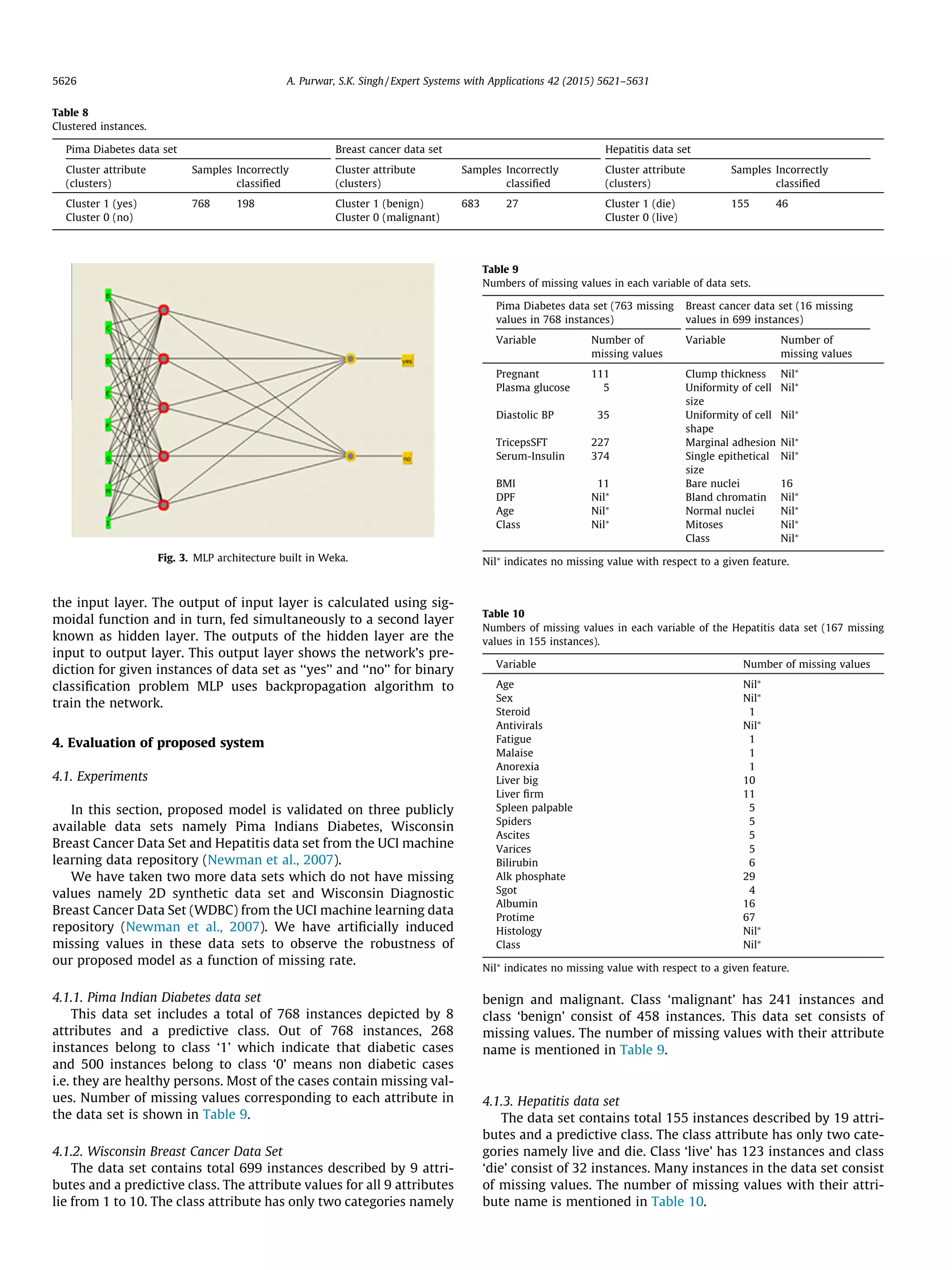
network architecture built by Weka as shown in Fig. 3 is used in
my proposed model as a classifier. It consists of an input layer,
one hidden layer, and an output layer. Each layer is made up of
neurons. The number of neurons in input layers is same as the
number of attributes or features present in each training example.
The attributes are fed simultaneously into the neurons making up
1. For a given data set D (having missing values) under study.
2. Obtain the imputed data sets i.e. D1, D2, D3….. , and D11 after employing 11 missing values
imputation approaches on data set D.
3. Use simple K-means clustering on D1, D2, D3….. , and D11 obtained from step 2.
4. Validate the clustering results obtained from 11 experiments using their actual classes.
5. Choose imputed data set that has produced least number of incorrectly classified instances and
discard other 10 imputed data sets.
6. Extract correctly classified instances from chosen imputed data set using K-means clustering.
7. Classify the extracted data using Multilayer Perceptron Model.
8. Evaluate the Performance of above model using accuracy, specificity, sensitivity, kappa and ROC.
9. Compare this model with previous models.
Fig. 2. Steps for developing HPM-MI model.
Table 5
Clustering results with 11 imputation methods for Pima Indian Diabetes data.
S. No. Imputation method Incorrectly classified instances (%)
1 CMC 25.78
2 FKMI 31.77
3 KMI 26.56
4 KNNI 27.99
5 LSSI 31.64
6 MC 32.42
7 SVDI 44.79
8 SVMI 31.51
9 WKNN 27.73
10 Case deletion 30.72
11 Matrix factorization 27.60
Bold values show the chosen MVI approach in our proposed model.
Table 6
Clustering results with 11 imputation methods for Wisconsin Breast Cancer Data.
S. No. Imputation method Incorrectly classified instances (%)
1 CMC 4.00
2 FKMI 4.00
3 KMI 4.00
4 KNNI 4.00
5 LSSI 4.00
6 MC 4.15
7 SVDI 4.29
8 SVMI 4.00
9 WKNN 4.00
10 Case deletion 3.95
11 Matrix factorization 4.15
Bold values show the chosen MVI approach in our proposed model.
Table 7
Clustering results with 11 imputation methods for hepatitis data.
S. No. Imputation method Incorrectly classified instances (%)
1 CMC 29.68
2 F KMI 30.32
3 KMI 30.32
4 KNNI 29.68
5 LSSI 29.68
6 MC 49.03
7 SVDI 30.97
8 SVMI 29.68
9 WKNN 29.68
10 Case deletion 37.50
11 Matrix factorization 33.55
Bold values show the chosen MVI approach in our proposed model.
A. Purwar, S.K. Singh / Expert Systems with Applications 42 (2015) 5621–5631 5625
the input layer. The output of input layer is calculated using sig-
moidal function and in turn, fed simultaneously to a second layer
known as hidden layer. The outputs of the hidden layer are the
input to output layer. This output layer shows the network’s pre-
diction for given instances of data set as ‘‘yes’’ and ‘‘no’’ for binary
classification problem MLP uses backpropagation algorithm to
train the network.
4. Evaluation of proposed system
4.1. Experiments
In this section, proposed model is validated on three publicly
available data sets namely Pima Indians Diabetes, Wisconsin
Breast Cancer Data Set and Hepatitis data set from the UCI machine
learning data repository (Newman et al., 2007).
We have taken two more data sets which do not have missing
values namely 2D synthetic data set and Wisconsin Diagnostic
Breast Cancer Data Set (WDBC) from the UCI machine learning data
repository (Newman et al., 2007). We have artificially induced
missing values in these data sets to observe the robustness of
our proposed model as a function of missing rate.
4.1.1. Pima Indian Diabetes data set
This data set includes a total of 768 instances depicted by 8
attributes and a predictive class. Out of 768 instances, 268
instances belong to class ‘1’ which indicate that diabetic cases
and 500 instances belong to class ‘0’ means non diabetic cases
i.e. they are healthy persons. Most of the cases contain missing val-
ues. Number of missing values corresponding to each attribute in
the data set is shown in Table 9.
4.1.2. Wisconsin Breast Cancer Data Set
The data set contains total 699 instances described by 9 attri-
butes and a predictive class. The attribute values for all 9 attributes
lie from 1 to 10. The class attribute has only two categories namely
benign and malignant. Class ‘malignant’ has 241 instances and
class ‘benign’ consist of 458 instances. This data set consists of
missing values. The number of missing values with their attribute
name is mentioned in Table 9.
4.1.3. Hepatitis data set
The data set contains total 155 instances described by 19 attri-
butes and a predictive class. The class attribute has only two cate-
gories namely live and die. Class ‘live’ has 123 instances and class
‘die’ consist of 32 instances. Many instances in the data set consist
of missing values. The number of missing values with their attri-
bute name is mentioned in Table 10.
Table 8
Clustered instances.
Pima Diabetes data set Breast cancer data set Hepatitis data set
Cluster attribute
(clusters)
Samples Incorrectly
classified
Cluster attribute
(clusters)
Samples Incorrectly
classified
Cluster attribute
(clusters)
Samples Incorrectly
classified
Cluster 1 (yes) 768 198 Cluster 1 (benign) 683 27 Cluster 1 (die) 155 46
Cluster 0 (no) Cluster 0 (malignant) Cluster 0 (live)
Fig. 3. MLP architecture built in Weka.
Table 9
Numbers of missing values in each variable of data sets.
Pima Diabetes data set (763 missing
values in 768 instances)
Breast cancer data set (16 missing
values in 699 instances)
Variable Number of
missing values
Variable Number of
missing values
Pregnant 111 Clump thickness Nil⁄
Plasma glucose 5 Uniformity of cell
size
Nil⁄
Diastolic BP 35 Uniformity of cell
shape
Nil⁄
TricepsSFT 227 Marginal adhesion Nil⁄
Serum-Insulin 374 Single epithetical
size
Nil⁄
BMI 11 Bare nuclei 16
DPF Nil⁄
Bland chromatin Nil⁄
Age Nil⁄
Normal nuclei Nil⁄
Class Nil⁄
Mitoses Nil⁄
Class Nil⁄
Nil⁄
indicates no missing value with respect to a given feature.
Table 10
Numbers of missing values in each variable of the Hepatitis data set (167 missing
values in 155 instances).
Variable Number of missing values
Age Nil⁄
Sex Nil⁄
Steroid 1
Antivirals Nil⁄
Fatigue 1
Malaise 1
Anorexia 1
Liver big 10
Liver firm 11
Spleen palpable 5
Spiders 5
Ascites 5
Varices 5
Bilirubin 6
Alk phosphate 29
Sgot 4
Albumin 16
Protime 67
Histology Nil⁄
Class Nil⁄
Nil⁄
indicates no missing value with respect to a given feature.
5626 A. Purwar, S.K. Singh / Expert Systems with Applications 42 (2015) 5621–5631
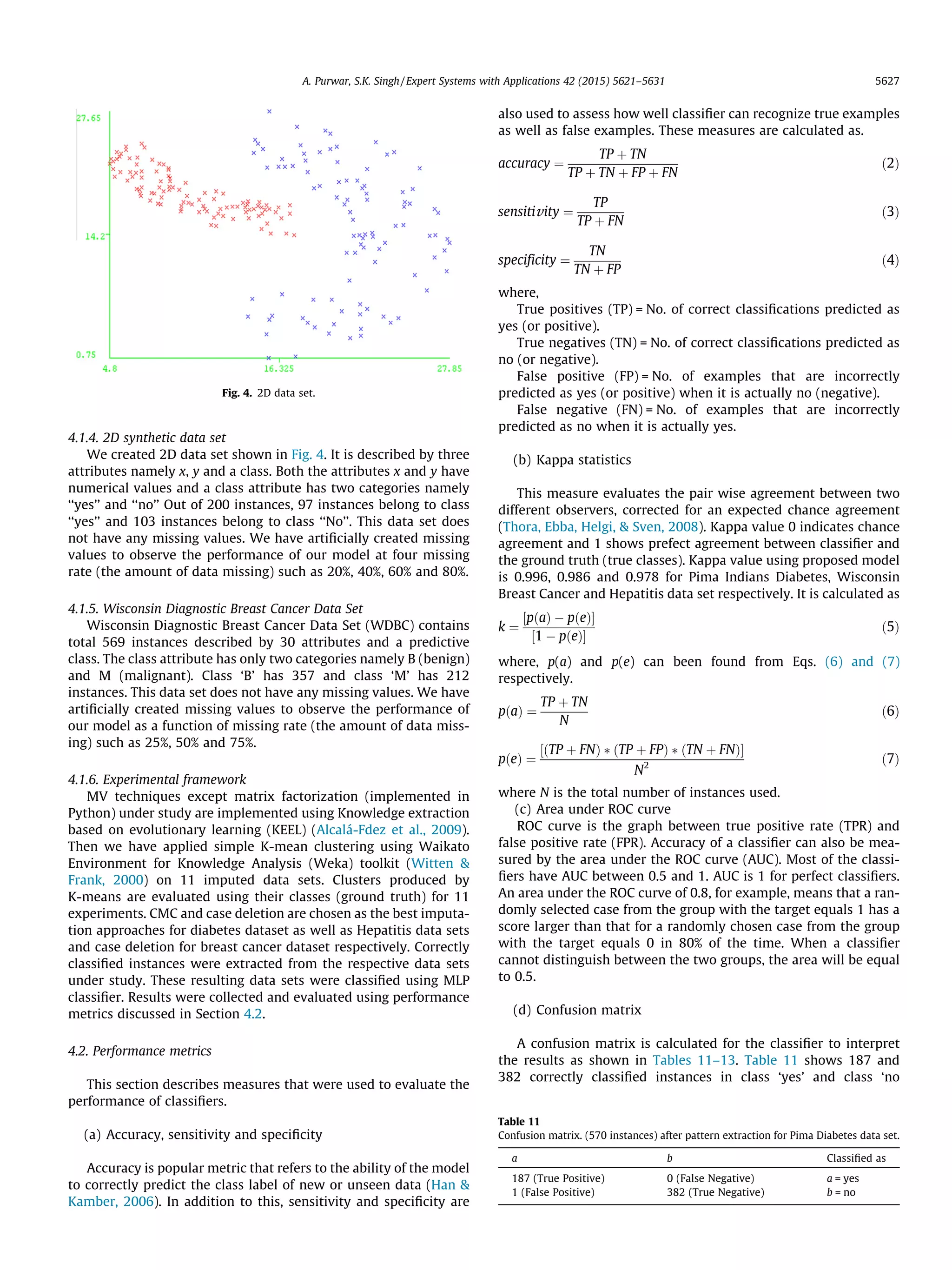
4.1.4. 2D synthetic data set
We created 2D data set shown in Fig. 4. It is described by three
attributes namely x, y and a class. Both the attributes x and y have
numerical values and a class attribute has two categories namely
‘‘yes’’ and ‘‘no’’ Out of 200 instances, 97 instances belong to class
‘‘yes’’ and 103 instances belong to class ‘‘No’’. This data set does
not have any missing values. We have artificially created missing
values to observe the performance of our model at four missing
rate (the amount of data missing) such as 20%, 40%, 60% and 80%.
4.1.5. Wisconsin Diagnostic Breast Cancer Data Set
Wisconsin Diagnostic Breast Cancer Data Set (WDBC) contains
total 569 instances described by 30 attributes and a predictive
class. The class attribute has only two categories namely B (benign)
and M (malignant). Class ‘B’ has 357 and class ‘M’ has 212
instances. This data set does not have any missing values. We have
artificially created missing values to observe the performance of
our model as a function of missing rate (the amount of data miss-
ing) such as 25%, 50% and 75%.
4.1.6. Experimental framework
MV techniques except matrix factorization (implemented in
Python) under study are implemented using Knowledge extraction
based on evolutionary learning (KEEL) (Alcalá-Fdez et al., 2009).
Then we have applied simple K-mean clustering using Waikato
Environment for Knowledge Analysis (Weka) toolkit (Witten 
Frank, 2000) on 11 imputed data sets. Clusters produced by
K-means are evaluated using their classes (ground truth) for 11
experiments. CMC and case deletion are chosen as the best imputa-
tion approaches for diabetes dataset as well as Hepatitis data sets
and case deletion for breast cancer dataset respectively. Correctly
classified instances were extracted from the respective data sets
under study. These resulting data sets were classified using MLP
classifier. Results were collected and evaluated using performance
metrics discussed in Section 4.2.
4.2. Performance metrics
This section describes measures that were used to evaluate the
performance of classifiers.
(a) Accuracy, sensitivity and specificity
Accuracy is popular metric that refers to the ability of the model
to correctly predict the class label of new or unseen data (Han 
Kamber, 2006). In addition to this, sensitivity and specificity are
also used to assess how well classifier can recognize true examples
as well as false examples. These measures are calculated as.
accuracy ¼
TP þ TN
TP þ TN þ FP þ FN
ð2Þ
sensitivity ¼
TP
TP þ FN
ð3Þ
specificity ¼
TN
TN þ FP
ð4Þ
where,
True positives (TP) = No. of correct classifications predicted as
yes (or positive).
True negatives (TN) = No. of correct classifications predicted as
no (or negative).
False positive (FP) = No. of examples that are incorrectly
predicted as yes (or positive) when it is actually no (negative).
False negative (FN) = No. of examples that are incorrectly
predicted as no when it is actually yes.
(b) Kappa statistics
This measure evaluates the pair wise agreement between two
different observers, corrected for an expected chance agreement
(Thora, Ebba, Helgi,  Sven, 2008). Kappa value 0 indicates chance
agreement and 1 shows prefect agreement between classifier and
the ground truth (true classes). Kappa value using proposed model
is 0.996, 0.986 and 0.978 for Pima Indians Diabetes, Wisconsin
Breast Cancer and Hepatitis data set respectively. It is calculated as
k ¼
½pðaÞ À pðeÞŠ
½1 À pðeÞŠ
ð5Þ
where, p(a) and p(e) can been found from Eqs. (6) and (7)
respectively.
pðaÞ ¼
TP þ TN
N
ð6Þ
pðeÞ ¼
½ðTP þ FNÞ Ã ðTP þ FPÞ Ã ðTN þ FNÞŠ
N2
ð7Þ
where N is the total number of instances used.
(c) Area under ROC curve
ROC curve is the graph between true positive rate (TPR) and
false positive rate (FPR). Accuracy of a classifier can also be mea-
sured by the area under the ROC curve (AUC). Most of the classi-
fiers have AUC between 0.5 and 1. AUC is 1 for perfect classifiers.
An area under the ROC curve of 0.8, for example, means that a ran-
domly selected case from the group with the target equals 1 has a
score larger than that for a randomly chosen case from the group
with the target equals 0 in 80% of the time. When a classifier
cannot distinguish between the two groups, the area will be equal
to 0.5.
(d) Confusion matrix
A confusion matrix is calculated for the classifier to interpret
the results as shown in Tables 11–13. Table 11 shows 187 and
382 correctly classified instances in class ‘yes’ and class ‘no
Fig. 4. 2D data set.
Table 11
Confusion matrix. (570 instances) after pattern extraction for Pima Diabetes data set.
a b Classified as
187 (True Positive) 0 (False Negative) a = yes
1 (False Positive) 382 (True Negative) b = no
A. Purwar, S.K. Singh / Expert Systems with Applications 42 (2015) 5621–5631 5627
’respectively for diabetes data set. Similarly, 432 are correctly
classified instances in class ‘‘benign’’ and 220 are correct instances
in class ‘‘malignant’’ for breast cancer data set, as shown in
Table 12. Table 13 shows 80, correctly classified instances in class
‘‘live’’ and 28, correct instances in class ‘‘die’’ for Hepatitis data set.
The diagonal elements of the matrix show the incorrect classifica-
tion made by classifier.
4.3. k-fold cross-validation
Cross-validation (Delen, Walker,  Kadam, 2005) is a statistical
method of evaluating and comparing learning algorithms by divid-
ing data into two segments. One is used to learn or train a model
and the other is used to validate the model. The basic form of
cross-validation is k-fold cross-validation. In this form, data set is
divided into k sub sets. Each sub set is tested via classifier con-
structed from the remaining (k-1) sub sets. Thus the k different test
results are obtained for each train–test pair. The average result
gives the test accuracy of the algorithm. We used 10 fold cross-
validations in our proposed HPM-MI since it reduces the bias asso-
ciated with random sampling.
5. Results and analysis
The results obtained from the proposed model are tabulated in
Table 14 for diabetes, Wisconsin Breast Cancer and Hepatitis data
sets. The following subsections give the detailed discussion of
results obtained for data sets used under experimental work.
5.1. Discussion for Pima Indian Diabetes data set
The accuracy of proposed HPM-MI (shown in ‘‘bold’’ text in
Table 15) is computed as 99.82%. We have also compared with
existing methods (Kahramanli  Allahverdi, 2008; Seera  Lim,
2014; llango  Ramaraj, 2010; Patil et al., 2010) in the literature
shown in Table 15. It is clearly evident from Table 15 that none
of the studies had the success rates higher than 98.92% for the
mentioned algorithms on Indian Pima Diabetes data set.
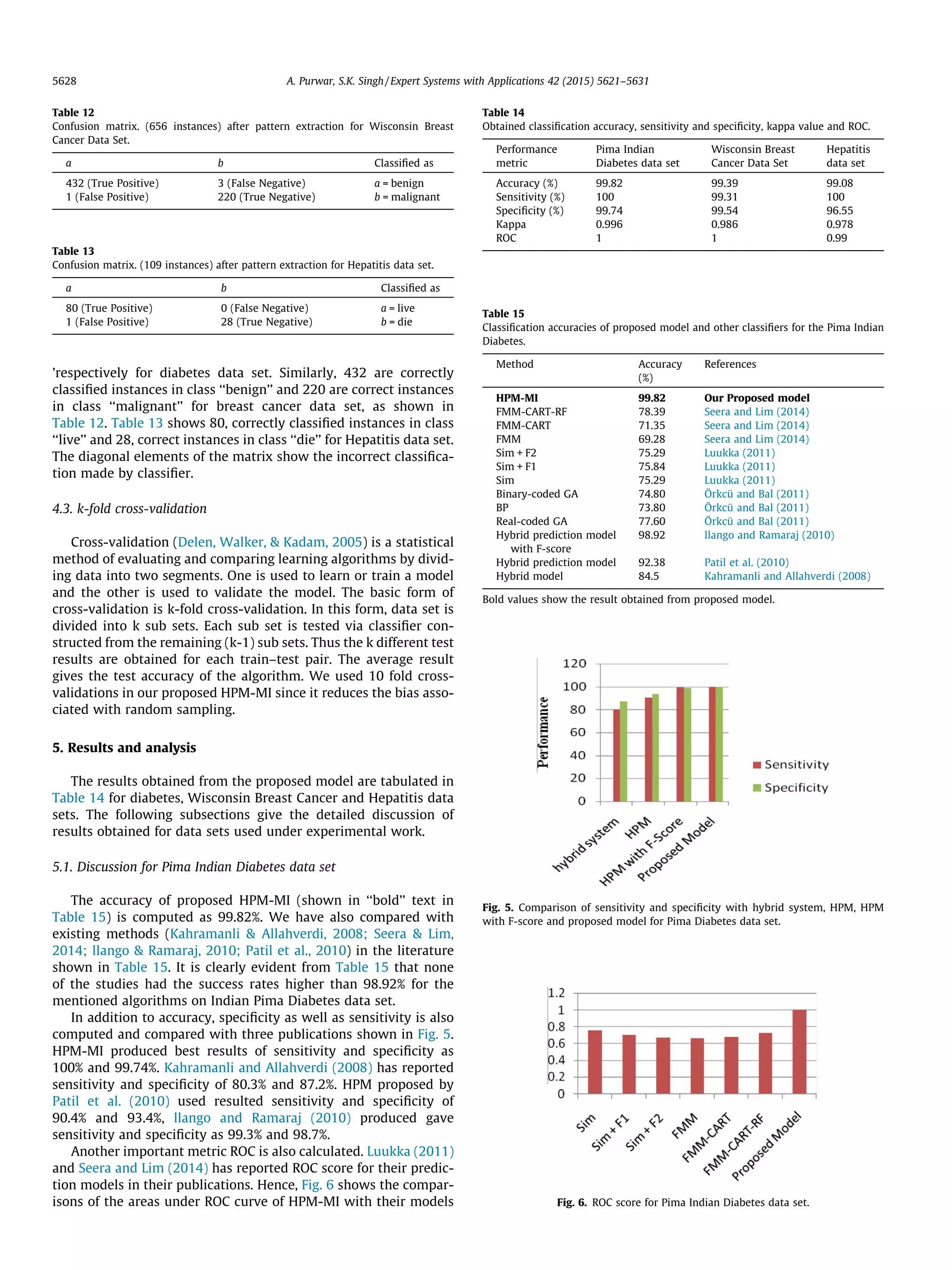
In addition to accuracy, specificity as well as sensitivity is also
computed and compared with three publications shown in Fig. 5.
HPM-MI produced best results of sensitivity and specificity as
100% and 99.74%. Kahramanli and Allahverdi (2008) has reported
sensitivity and specificity of 80.3% and 87.2%. HPM proposed by
Patil et al. (2010) used resulted sensitivity and specificity of
90.4% and 93.4%, llango and Ramaraj (2010) produced gave
sensitivity and specificity as 99.3% and 98.7%.
Another important metric ROC is also calculated. Luukka (2011)
and Seera and Lim (2014) has reported ROC score for their predic-
tion models in their publications. Hence, Fig. 6 shows the compar-
isons of the areas under ROC curve of HPM-MI with their models
Table 12
Confusion matrix. (656 instances) after pattern extraction for Wisconsin Breast
Cancer Data Set.
a b Classified as
432 (True Positive) 3 (False Negative) a = benign
1 (False Positive) 220 (True Negative) b = malignant
Table 13
Confusion matrix. (109 instances) after pattern extraction for Hepatitis data set.
a b Classified as
80 (True Positive) 0 (False Negative) a = live
1 (False Positive) 28 (True Negative) b = die
Table 14
Obtained classification accuracy, sensitivity and specificity, kappa value and ROC.
Performance
metric
Pima Indian
Diabetes data set
Wisconsin Breast
Cancer Data Set
Hepatitis
data set
Accuracy (%) 99.82 99.39 99.08
Sensitivity (%) 100 99.31 100
Specificity (%) 99.74 99.54 96.55
Kappa 0.996 0.986 0.978
ROC 1 1 0.99
Table 15
Classification accuracies of proposed model and other classifiers for the Pima Indian
Diabetes.
Method Accuracy
(%)
References
HPM-MI 99.82 Our Proposed model
FMM-CART-RF 78.39 Seera and Lim (2014)
FMM-CART 71.35 Seera and Lim (2014)
FMM 69.28 Seera and Lim (2014)
Sim + F2 75.29 Luukka (2011)
Sim + F1 75.84 Luukka (2011)
Sim 75.29 Luukka (2011)
Binary-coded GA 74.80 Örkcü and Bal (2011)
BP 73.80 Örkcü and Bal (2011)
Real-coded GA 77.60 Örkcü and Bal (2011)
Hybrid prediction model
with F-score
98.92 llango and Ramaraj (2010)
Hybrid prediction model 92.38 Patil et al. (2010)
Hybrid model 84.5 Kahramanli and Allahverdi (2008)
Bold values show the result obtained from proposed model.
Fig. 5. Comparison of sensitivity and specificity with hybrid system, HPM, HPM
with F-score and proposed model for Pima Diabetes data set.
Fig. 6. ROC score for Pima Indian Diabetes data set.
5628 A. Purwar, S.K. Singh / Expert Systems with Applications 42 (2015) 5621–5631
and HPM-MI has ranked highest as compared to recent methods
proposed by Luukka (2011) as well as (Seera  Lim, 2014).
Comparing the results produced by proposed model, we conclude
that the proposed hybrid prediction model (HPM) using missing
value imputation obtains very promising results in classifying the
possible diabetes patients. The proposed system can be very help-
ful to the physicians for their final decision on their patients as by
using such an efficient model they can make very accurate
decisions.
5.2. Discussion for Wisconsin Breast Cancer Data Set
The accuracy of HPM-MI (shown in ‘‘bold’’ text in Table 16) is
computed as 99.39%. We have also compared with existing meth-
ods as shown in Table 16. It is clearly evident from Table 16 that
none of the studies had the success rates higher than 98.84% for
the mentioned algorithms on Wisconsin Breast Cancer Diabetes
Data Set.
In addition to accuracy, specificity as well as sensitivity is also
computed. The values of sensitivity and specificity are 99.31%
and 99.54% respectively. The publications shown in Table 16 have
not mentioned sensitivity and specificity rates; hence no compar-
ison is made for these metrics.
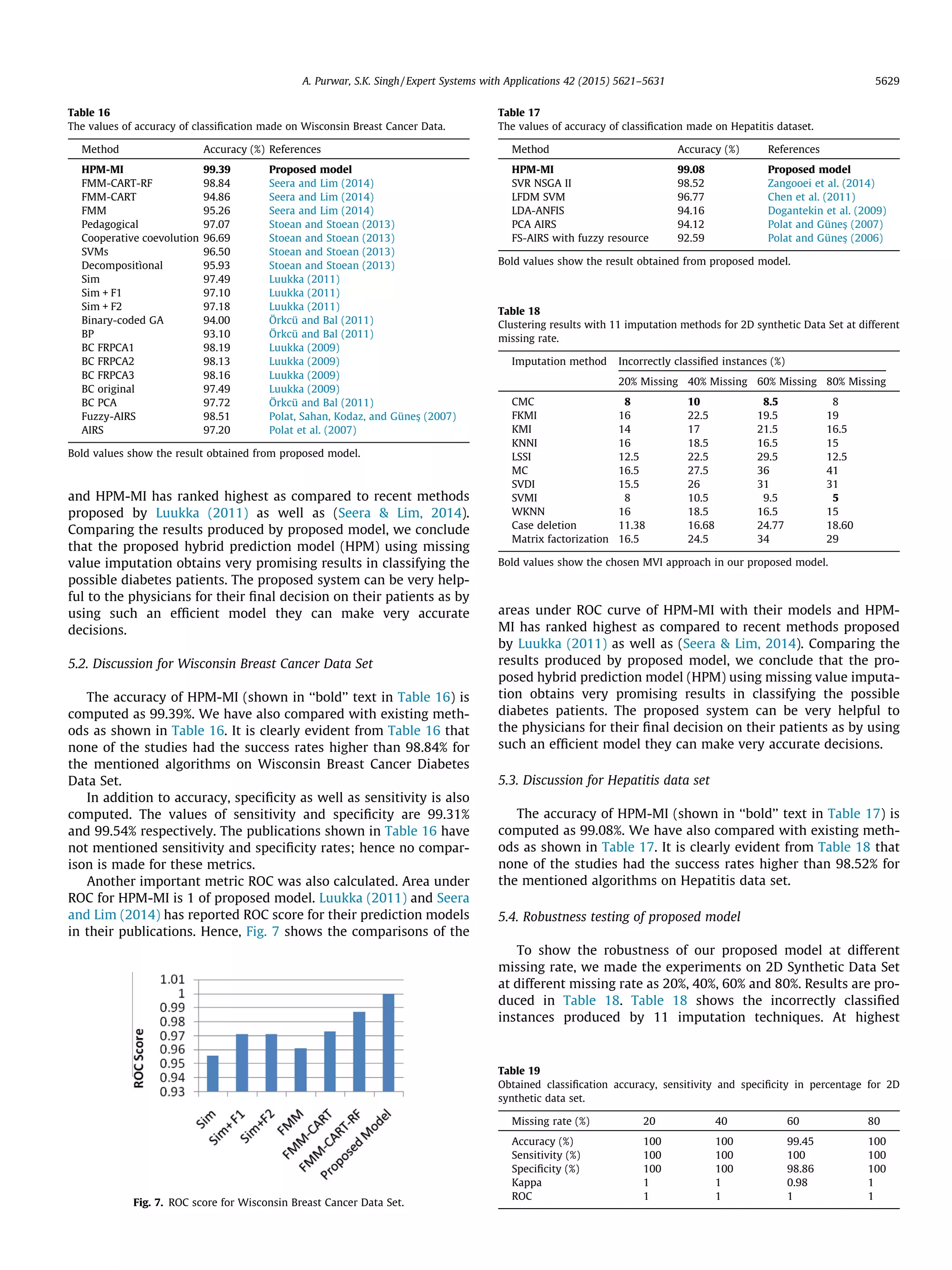
Another important metric ROC was also calculated. Area under
ROC for HPM-MI is 1 of proposed model. Luukka (2011) and Seera
and Lim (2014) has reported ROC score for their prediction models
in their publications. Hence, Fig. 7 shows the comparisons of the
areas under ROC curve of HPM-MI with their models and HPM-
MI has ranked highest as compared to recent methods proposed
by Luukka (2011) as well as (Seera  Lim, 2014). Comparing the
results produced by proposed model, we conclude that the pro-
posed hybrid prediction model (HPM) using missing value imputa-
tion obtains very promising results in classifying the possible
diabetes patients. The proposed system can be very helpful to
the physicians for their final decision on their patients as by using
such an efficient model they can make very accurate decisions.
5.3. Discussion for Hepatitis data set
The accuracy of HPM-MI (shown in ‘‘bold’’ text in Table 17) is
computed as 99.08%. We have also compared with existing meth-
ods as shown in Table 17. It is clearly evident from Table 18 that
none of the studies had the success rates higher than 98.52% for
the mentioned algorithms on Hepatitis data set.
5.4. Robustness testing of proposed model
To show the robustness of our proposed model at different
missing rate, we made the experiments on 2D Synthetic Data Set
at different missing rate as 20%, 40%, 60% and 80%. Results are pro-
duced in Table 18. Table 18 shows the incorrectly classified
instances produced by 11 imputation techniques. At highest
Table 16
The values of accuracy of classification made on Wisconsin Breast Cancer Data.
Method Accuracy (%) References
HPM-MI 99.39 Proposed model
FMM-CART-RF 98.84 Seera and Lim (2014)
FMM-CART 94.86 Seera and Lim (2014)
FMM 95.26 Seera and Lim (2014)
Pedagogical 97.07 Stoean and Stoean (2013)
Cooperative coevolution 96.69 Stoean and Stoean (2013)
SVMs 96.50 Stoean and Stoean (2013)
Decompositìonal 95.93 Stoean and Stoean (2013)
Sim 97.49 Luukka (2011)
Sim + F1 97.10 Luukka (2011)
Sim + F2 97.18 Luukka (2011)
Binary-coded GA 94.00 Örkcü and Bal (2011)
BP 93.10 Örkcü and Bal (2011)
BC FRPCA1 98.19 Luukka (2009)
BC FRPCA2 98.13 Luukka (2009)
BC FRPCA3 98.16 Luukka (2009)
BC original 97.49 Luukka (2009)
BC PCA 97.72 Örkcü and Bal (2011)
Fuzzy-AIRS 98.51 Polat, Sahan, Kodaz, and Günesß (2007)
AIRS 97.20 Polat et al. (2007)
Bold values show the result obtained from proposed model.
Fig. 7. ROC score for Wisconsin Breast Cancer Data Set.
Table 17
The values of accuracy of classification made on Hepatitis dataset.
Method Accuracy (%) References
HPM-MI 99.08 Proposed model
SVR NSGA II 98.52 Zangooei et al. (2014)
LFDM SVM 96.77 Chen et al. (2011)
LDA-ANFIS 94.16 Dogantekin et al. (2009)
PCA AIRS 94.12 Polat and Günesß (2007)
FS-AIRS with fuzzy resource 92.59 Polat and Günesß (2006)
Bold values show the result obtained from proposed model.
Table 18
Clustering results with 11 imputation methods for 2D synthetic Data Set at different
missing rate.
Imputation method Incorrectly classified instances (%)
20% Missing 40% Missing 60% Missing 80% Missing
CMC 8 10 8.5 8
FKMI 16 22.5 19.5 19
KMI 14 17 21.5 16.5
KNNI 16 18.5 16.5 15
LSSI 12.5 22.5 29.5 12.5
MC 16.5 27.5 36 41
SVDI 15.5 26 31 31
SVMI 8 10.5 9.5 5
WKNN 16 18.5 16.5 15
Case deletion 11.38 16.68 24.77 18.60
Matrix factorization 16.5 24.5 34 29
Bold values show the chosen MVI approach in our proposed model.
Table 19
Obtained classification accuracy, sensitivity and specificity in percentage for 2D
synthetic data set.
Missing rate (%) 20 40 60 80
Accuracy (%) 100 100 99.45 100
Sensitivity (%) 100 100 100 100
Specificity (%) 100 100 98.86 100
Kappa 1 1 0.98 1
ROC 1 1 1 1
A. Purwar, S.K. Singh / Expert Systems with Applications 42 (2015) 5621–5631 5629
missing rate SVMI (shown in ‘‘bold’’ text in Table 18) was chosen as
best imputation method and for other missing rate, CMC (shown in
‘‘bold’’ text in Table 18) was selected to impute the missing values
in the data set. Moreover, proposed model has produced good
results at different missing rates. Table 19 summarizes accuracy,
specificity, sensitivity, kappa and ROC value achieved at different
missing rates.
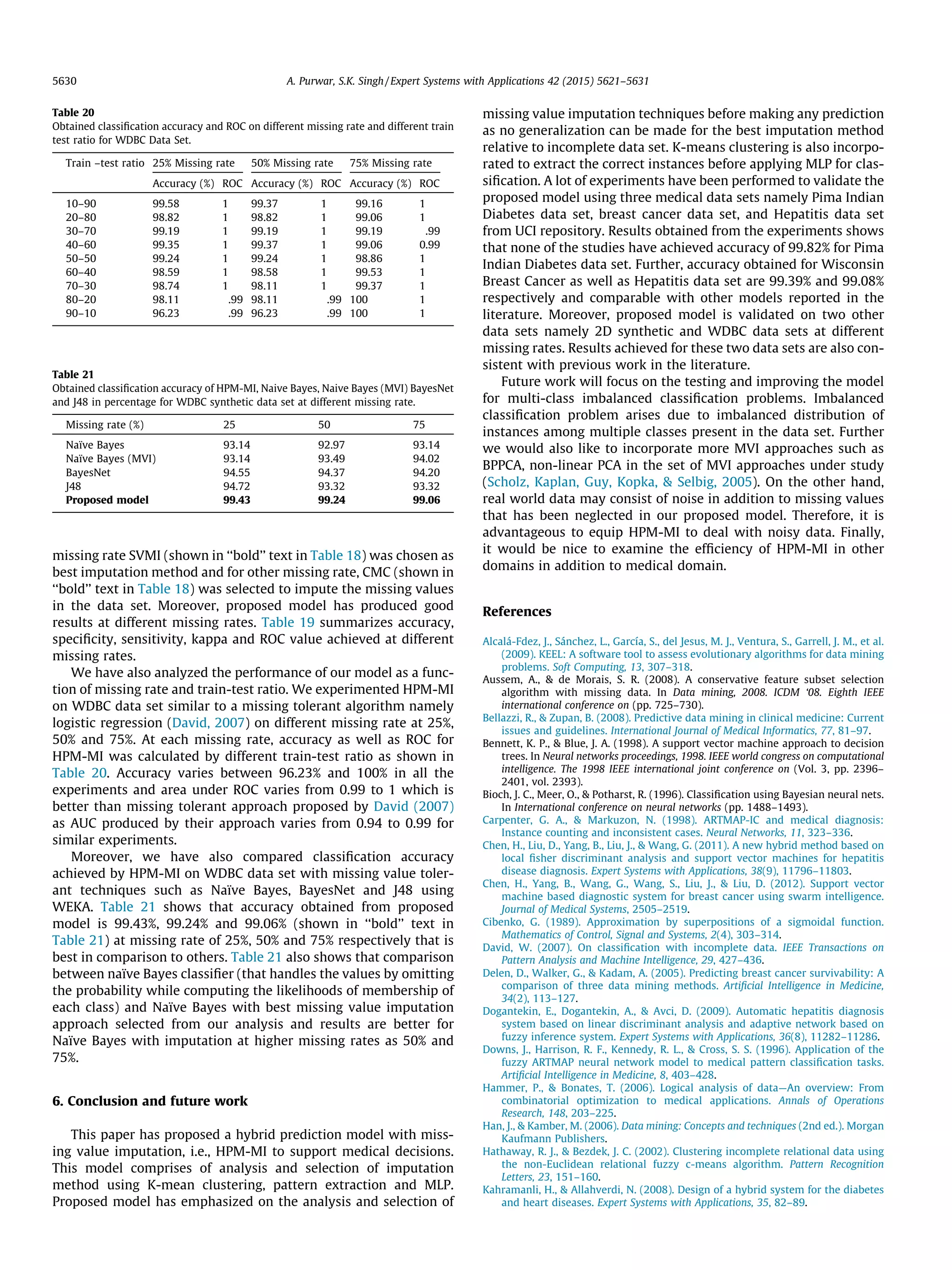
We have also analyzed the performance of our model as a func-
tion of missing rate and train-test ratio. We experimented HPM-MI
on WDBC data set similar to a missing tolerant algorithm namely
logistic regression (David, 2007) on different missing rate at 25%,
50% and 75%. At each missing rate, accuracy as well as ROC for
HPM-MI was calculated by different train-test ratio as shown in
Table 20. Accuracy varies between 96.23% and 100% in all the
experiments and area under ROC varies from 0.99 to 1 which is
better than missing tolerant approach proposed by David (2007)
as AUC produced by their approach varies from 0.94 to 0.99 for
similar experiments.
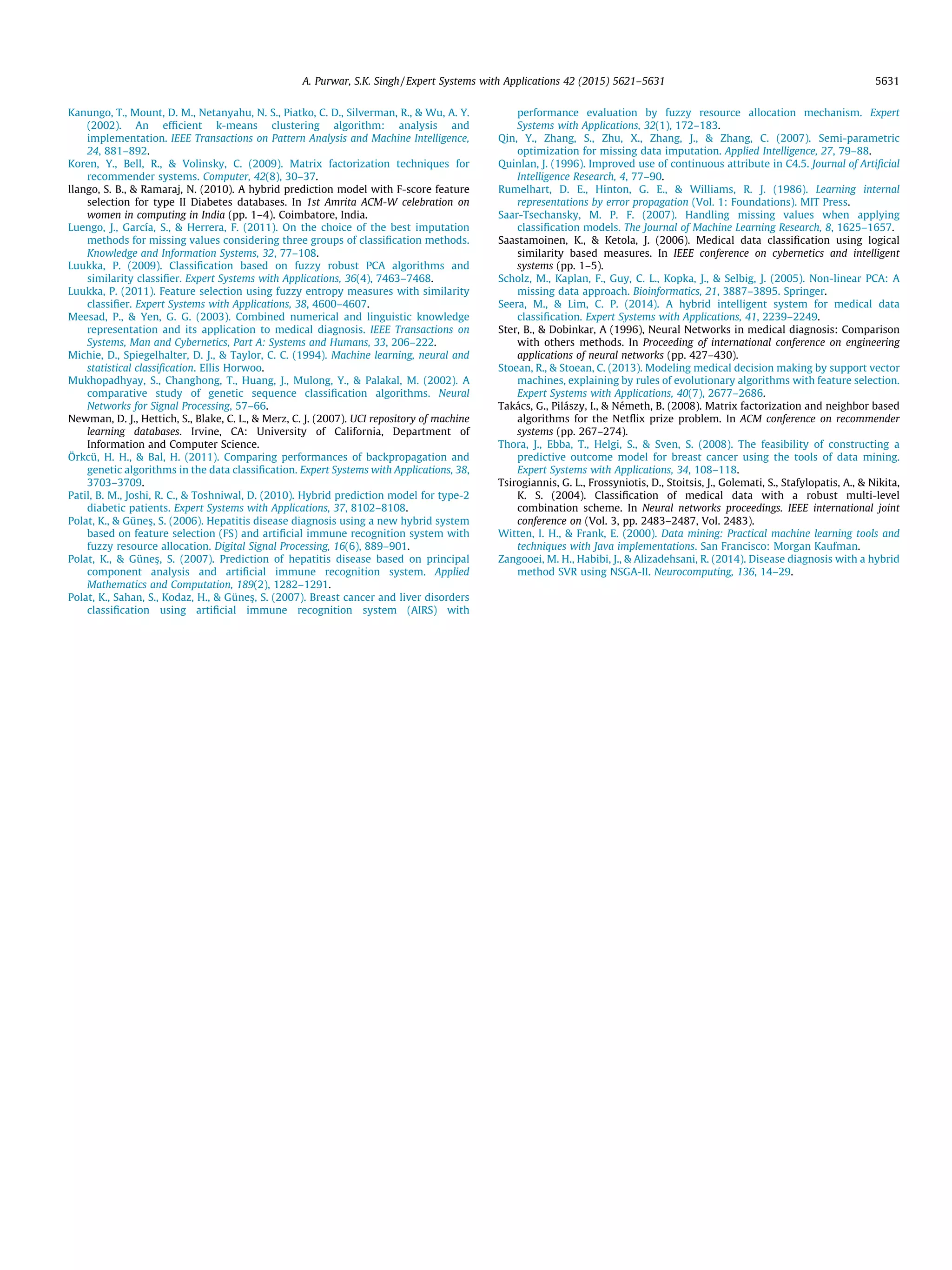
Moreover, we have also compared classification accuracy
achieved by HPM-MI on WDBC data set with missing value toler-
ant techniques such as Naïve Bayes, BayesNet and J48 using
WEKA. Table 21 shows that accuracy obtained from proposed
model is 99.43%, 99.24% and 99.06% (shown in ‘‘bold’’ text in
Table 21) at missing rate of 25%, 50% and 75% respectively that is
best in comparison to others. Table 21 also shows that comparison
between naïve Bayes classifier (that handles the values by omitting
the probability while computing the likelihoods of membership of
each class) and Naïve Bayes with best missing value imputation
approach selected from our analysis and results are better for
Naïve Bayes with imputation at higher missing rates as 50% and
75%.
6. Conclusion and future work
This paper has proposed a hybrid prediction model with miss-
ing value imputation, i.e., HPM-MI to support medical decisions.
This model comprises of analysis and selection of imputation
method using K-mean clustering, pattern extraction and MLP.
Proposed model has emphasized on the analysis and selection of
missing value imputation techniques before making any prediction
as no generalization can be made for the best imputation method
relative to incomplete data set. K-means clustering is also incorpo-
rated to extract the correct instances before applying MLP for clas-
sification. A lot of experiments have been performed to validate the
proposed model using three medical data sets namely Pima Indian
Diabetes data set, breast cancer data set, and Hepatitis data set
from UCI repository. Results obtained from the experiments shows
that none of the studies have achieved accuracy of 99.82% for Pima
Indian Diabetes data set. Further, accuracy obtained for Wisconsin
Breast Cancer as well as Hepatitis data set are 99.39% and 99.08%
respectively and comparable with other models reported in the
literature. Moreover, proposed model is validated on two other
data sets namely 2D synthetic and WDBC data sets at different
missing rates. Results achieved for these two data sets are also con-
sistent with previous work in the literature.
Future work will focus on the testing and improving the model
for multi-class imbalanced classification problems. Imbalanced
classification problem arises due to imbalanced distribution of
instances among multiple classes present in the data set. Further
we would also like to incorporate more MVI approaches such as
BPPCA, non-linear PCA in the set of MVI approaches under study
(Scholz, Kaplan, Guy, Kopka,  Selbig, 2005). On the other hand,
real world data may consist of noise in addition to missing values
that has been neglected in our proposed model. Therefore, it is
advantageous to equip HPM-MI to deal with noisy data. Finally,
it would be nice to examine the efficiency of HPM-MI in other
domains in addition to medical domain.
References
Alcalá-Fdez, J., Sánchez, L., García, S., del Jesus, M. J., Ventura, S., Garrell, J. M., et al.
(2009). KEEL: A software tool to assess evolutionary algorithms for data mining
problems. Soft Computing, 13, 307–318.
Aussem, A.,  de Morais, S. R. (2008). A conservative feature subset selection
algorithm with missing data. In Data mining, 2008. ICDM ‘08. Eighth IEEE
international conference on (pp. 725–730).
Bellazzi, R.,  Zupan, B. (2008). Predictive data mining in clinical medicine: Current
issues and guidelines. International Journal of Medical Informatics, 77, 81–97.
Bennett, K. P.,  Blue, J. A. (1998). A support vector machine approach to decision
trees. In Neural networks proceedings, 1998. IEEE world congress on computational
intelligence. The 1998 IEEE international joint conference on (Vol. 3, pp. 2396–
2401, vol. 2393).
Bioch, J. C., Meer, O.,  Potharst, R. (1996). Classification using Bayesian neural nets.
In International conference on neural networks (pp. 1488–1493).
Carpenter, G. A.,  Markuzon, N. (1998). ARTMAP-IC and medical diagnosis:
Instance counting and inconsistent cases. Neural Networks, 11, 323–336.
Chen, H., Liu, D., Yang, B., Liu, J.,  Wang, G. (2011). A new hybrid method based on
local fisher discriminant analysis and support vector machines for hepatitis
disease diagnosis. Expert Systems with Applications, 38(9), 11796–11803.
Chen, H., Yang, B., Wang, G., Wang, S., Liu, J.,  Liu, D. (2012). Support vector
machine based diagnostic system for breast cancer using swarm intelligence.
Journal of Medical Systems, 2505–2519.
Cibenko, G. (1989). Approximation by superpositions of a sigmoidal function.
Mathematics of Control, Signal and Systems, 2(4), 303–314.
David, W. (2007). On classification with incomplete data. IEEE Transactions on
Pattern Analysis and Machine Intelligence, 29, 427–436.
Delen, D., Walker, G.,  Kadam, A. (2005). Predicting breast cancer survivability: A
comparison of three data mining methods. Artificial Intelligence in Medicine,
34(2), 113–127.
Dogantekin, E., Dogantekin, A.,  Avci, D. (2009). Automatic hepatitis diagnosis
system based on linear discriminant analysis and adaptive network based on
fuzzy inference system. Expert Systems with Applications, 36(8), 11282–11286.
Downs, J., Harrison, R. F., Kennedy, R. L.,  Cross, S. S. (1996). Application of the
fuzzy ARTMAP neural network model to medical pattern classification tasks.
Artificial Intelligence in Medicine, 8, 403–428.
Hammer, P.,  Bonates, T. (2006). Logical analysis of data—An overview: From
combinatorial optimization to medical applications. Annals of Operations
Research, 148, 203–225.
Han, J.,  Kamber, M. (2006). Data mining: Concepts and techniques (2nd ed.). Morgan
Kaufmann Publishers.
Hathaway, R. J.,  Bezdek, J. C. (2002). Clustering incomplete relational data using
the non-Euclidean relational fuzzy c-means algorithm. Pattern Recognition
Letters, 23, 151–160.
Kahramanli, H.,  Allahverdi, N. (2008). Design of a hybrid system for the diabetes
and heart diseases. Expert Systems with Applications, 35, 82–89.
Table 20
Obtained classification accuracy and ROC on different missing rate and different train
test ratio for WDBC Data Set.
Train –test ratio 25% Missing rate 50% Missing rate 75% Missing rate
Accuracy (%) ROC Accuracy (%) ROC Accuracy (%) ROC
10–90 99.58 1 99.37 1 99.16 1
20–80 98.82 1 98.82 1 99.06 1
30–70 99.19 1 99.19 1 99.19 .99
40–60 99.35 1 99.37 1 99.06 0.99
50–50 99.24 1 99.24 1 98.86 1
60–40 98.59 1 98.58 1 99.53 1
70–30 98.74 1 98.11 1 99.37 1
80–20 98.11 .99 98.11 .99 100 1
90–10 96.23 .99 96.23 .99 100 1
Table 21
Obtained classification accuracy of HPM-MI, Naive Bayes, Naive Bayes (MVI) BayesNet
and J48 in percentage for WDBC synthetic data set at different missing rate.
Missing rate (%) 25 50 75
Naïve Bayes 93.14 92.97 93.14
Naïve Bayes (MVI) 93.14 93.49 94.02
BayesNet 94.55 94.37 94.20
J48 94.72 93.32 93.32
Proposed model 99.43 99.24 99.06
5630 A. Purwar, S.K. Singh / Expert Systems with Applications 42 (2015) 5621–5631
Kanungo, T., Mount, D. M., Netanyahu, N. S., Piatko, C. D., Silverman, R.,  Wu, A. Y.
(2002). An efficient k-means clustering algorithm: analysis and
implementation. IEEE Transactions on Pattern Analysis and Machine Intelligence,
24, 881–892.
Koren, Y., Bell, R.,  Volinsky, C. (2009). Matrix factorization techniques for
recommender systems. Computer, 42(8), 30–37.
llango, S. B.,  Ramaraj, N. (2010). A hybrid prediction model with F-score feature
selection for type II Diabetes databases. In 1st Amrita ACM-W celebration on
women in computing in India (pp. 1–4). Coimbatore, India.
Luengo, J., García, S.,  Herrera, F. (2011). On the choice of the best imputation
methods for missing values considering three groups of classification methods.
Knowledge and Information Systems, 32, 77–108.
Luukka, P. (2009). Classification based on fuzzy robust PCA algorithms and
similarity classifier. Expert Systems with Applications, 36(4), 7463–7468.
Luukka, P. (2011). Feature selection using fuzzy entropy measures with similarity
classifier. Expert Systems with Applications, 38, 4600–4607.
Meesad, P.,  Yen, G. G. (2003). Combined numerical and linguistic knowledge
representation and its application to medical diagnosis. IEEE Transactions on
Systems, Man and Cybernetics, Part A: Systems and Humans, 33, 206–222.
Michie, D., Spiegelhalter, D. J.,  Taylor, C. C. (1994). Machine learning, neural and
statistical classification. Ellis Horwoo.
Mukhopadhyay, S., Changhong, T., Huang, J., Mulong, Y.,  Palakal, M. (2002). A
comparative study of genetic sequence classification algorithms. Neural
Networks for Signal Processing, 57–66.
Newman, D. J., Hettich, S., Blake, C. L.,  Merz, C. J. (2007). UCI repository of machine
learning databases. Irvine, CA: University of California, Department of
Information and Computer Science.
Örkcü, H. H.,  Bal, H. (2011). Comparing performances of backpropagation and
genetic algorithms in the data classification. Expert Systems with Applications, 38,
3703–3709.
Patil, B. M., Joshi, R. C.,  Toshniwal, D. (2010). Hybrid prediction model for type-2
diabetic patients. Expert Systems with Applications, 37, 8102–8108.
Polat, K.,  Günesß, S. (2006). Hepatitis disease diagnosis using a new hybrid system
based on feature selection (FS) and artificial immune recognition system with
fuzzy resource allocation. Digital Signal Processing, 16(6), 889–901.
Polat, K.,  Günesß, S. (2007). Prediction of hepatitis disease based on principal
component analysis and artificial immune recognition system. Applied
Mathematics and Computation, 189(2), 1282–1291.
Polat, K., Sahan, S., Kodaz, H.,  Günesß, S. (2007). Breast cancer and liver disorders
classification using artificial immune recognition system (AIRS) with
performance evaluation by fuzzy resource allocation mechanism. Expert
Systems with Applications, 32(1), 172–183.
Qin, Y., Zhang, S., Zhu, X., Zhang, J.,  Zhang, C. (2007). Semi-parametric
optimization for missing data imputation. Applied Intelligence, 27, 79–88.
Quinlan, J. (1996). Improved use of continuous attribute in C4.5. Journal of Artificial
Intelligence Research, 4, 77–90.
Rumelhart, D. E., Hinton, G. E.,  Williams, R. J. (1986). Learning internal
representations by error propagation (Vol. 1: Foundations). MIT Press.
Saar-Tsechansky, M. P. F. (2007). Handling missing values when applying
classification models. The Journal of Machine Learning Research, 8, 1625–1657.
Saastamoinen, K.,  Ketola, J. (2006). Medical data classification using logical
similarity based measures. In IEEE conference on cybernetics and intelligent
systems (pp. 1–5).
Scholz, M., Kaplan, F., Guy, C. L., Kopka, J.,  Selbig, J. (2005). Non-linear PCA: A
missing data approach. Bioinformatics, 21, 3887–3895. Springer.
Seera, M.,  Lim, C. P. (2014). A hybrid intelligent system for medical data
classification. Expert Systems with Applications, 41, 2239–2249.
Ster, B.,  Dobinkar, A (1996), Neural Networks in medical diagnosis: Comparison
with others methods. In Proceeding of international conference on engineering
applications of neural networks (pp. 427–430).
Stoean, R.,  Stoean, C. (2013). Modeling medical decision making by support vector
machines, explaining by rules of evolutionary algorithms with feature selection.
Expert Systems with Applications, 40(7), 2677–2686.
Takács, G., Pilászy, I.,  Németh, B. (2008). Matrix factorization and neighbor based
algorithms for the Netflix prize problem. In ACM conference on recommender
systems (pp. 267–274).
Thora, J., Ebba, T., Helgi, S.,  Sven, S. (2008). The feasibility of constructing a
predictive outcome model for breast cancer using the tools of data mining.
Expert Systems with Applications, 34, 108–118.
Tsirogiannis, G. L., Frossyniotis, D., Stoitsis, J., Golemati, S., Stafylopatis, A.,  Nikita,
K. S. (2004). Classification of medical data with a robust multi-level
combination scheme. In Neural networks proceedings. IEEE international joint
conference on (Vol. 3, pp. 2483–2487, Vol. 2483).
Witten, I. H.,  Frank, E. (2000). Data mining: Practical machine learning tools and
techniques with Java implementations. San Francisco: Morgan Kaufman.
Zangooei, M. H., Habibi, J.,  Alizadehsani, R. (2014). Disease diagnosis with a hybrid
method SVR using NSGA-II. Neurocomputing, 136, 14–29.
A. Purwar, S.K. Singh / Expert Systems with Applications 42 (2015) 5621–5631 5631

Hybrid prediction model with missing value imputation for medical data 2015-good-sci

  • 1.
    Hybrid prediction modelwith missing value imputation for medical data Archana Purwar ⇑ , Sandeep Kumar Singh Department of Computer Science and Information Technology, JIIT Noida, India a r t i c l e i n f o Article history: Available online 5 March 2015 Keywords: Missing value imputation Multilayer Perceptron (MLP) K-means clustering Data mining a b s t r a c t Accurate prediction in the presence of large number of missing values in the data set has always been a challenging problem. Most of hybrid models to address this challenge have either deleted the missing instances from the data set (popularly known as case deletion) or have used some default way to fill the missing values. This paper, presents a novel hybrid prediction model with missing value imputation (HPM-MI) that analyze various imputation techniques using simple K-means clustering and apply the best one to a data set. The proposed hybrid model is the first one to use combination of K-means cluster- ing with Multilayer Perceptron. K-means clustering is also used to validate class labels of given data (incorrectly classified instances are deleted i.e. pattern extracted from original data) before applying clas- sifier. The proposed system has significantly improved data quality by use of best imputation technique after quantitative analysis of eleven imputation approaches. The efficiency of proposed model as predic- tive classification system is investigated on three benchmark medical data sets namely Pima Indians Diabetes, Wisconsin Breast Cancer, and Hepatitis from the UCI Repository of Machine Learning. In addi- tion to accuracy, sensitivity, specificity; kappa statistics and the area under ROC are also computed. The experimental results show HPM-MI has produced accuracy, sensitivity, specificity, kappa and ROC as 99.82%, 100%, 99.74%, 0.996 and 1.0 respectively for Pima Indian Diabetes data set, 99.39%, 99.31%, 99.54%, 0.986, and 1.0 respectively for breast cancer data set and 99.08%, 100%, 96.55%, 0.978 and 0.99 respectively for Hepatitis data set. Results are best in comparison with existing methods. Further, the per- formance of our model is measured and analyzed as function of missing rate and train-test ratio using 2D synthetic data set and Wisconsin Diagnostics Breast Cancer Data Sets. Results are promising and there- fore the proposed model will be very useful in prediction for medical domain especially when numbers of missing value are large in the data set. Ó 2015 Elsevier Ltd. All rights reserved. 1. Introduction Research in the field of predictive data mining for medical applications is a significant and moving area. Generally, a medical practitioner collects his/her knowledge from patient’s symptoms and confirmed diagnosis. Diagnosis is usually made either by eval- uating the current test results of the patients or by referring to the previous decisions made on other patients with same test results. The accuracy of diagnosis of patient’s disease like diabetes, breast cancer and others is greatly relenting on a experts’ experience (Meesad & Yen, 2003). Due to the pace at which numbers of patients are increasing, it has become cumbersome to make diagnostics decisions. On the other side, development of new computational methods and tools makes relatively easy to make decisions from dedicated databases of electronic patient records. As an example, numerous classifiers have been developed for diagnosis and screening of diabetes, cancer and liver disorders (Seera & Lim, 2014). A number of classification systems have been developed in the literature like RBQ, LVQ C4.5, CART, Bayesian Tree, ANN + FNN, HPM, Sim + F2, real coded GA, and FMM-CART-RF to support diagnosis of diabetes as well as breast cancer disease (Seera & Lim, 2014). Various hybrid models are also proposed in the literature (Kahramanli & Allahverdi, 2008; llango & Ramaraj, 2010; Patil, Joshi, & Toshniwal, 2010) namely hybrid system con- sisting of artificial neural network and fuzzy neural network, HPM consisting of K-means clustering with J48 and HPM with F-score consisting of feature selection using F-score, K-means clus- tering and SVM. Researchers have developed a large number of classification systems to improve accuracy of predictive classification. The pro- posed model uses K-means clustering as a means to analyze 11 missing data imputation (MVI) techniques under study and selects the best imputation method. This best imputation method is applied on the data set before pattern extraction and subsequently http://dx.doi.org/10.1016/j.eswa.2015.02.050 0957-4174/Ó 2015 Elsevier Ltd. All rights reserved. ⇑ Corresponding author. E-mail addresses: archana.purwar@jiit.ac.in (A. Purwar), sandeepk.singh@jiit.ac. in (S.K. Singh). Expert Systems with Applications 42 (2015) 5621–5631 Contents lists available at ScienceDirect Expert Systems with Applications journal homepage: www.elsevier.com/locate/eswa
  • 2.
    applying prediction. Moreover,to the best of our knowledge, none of the hybrid prediction models have combined use of K-means clustering and MLP for prediction of diseases. This paper makes a novel contribution by first analyzing 11 MVI techniques experimentally and finds the best method for handling the missing values in the data set using K-means clustering. Consequently, it improves the quality of data. Moreover, it also aims at predictive classification using novel model that can classify records in the test data set using training data set. Multi layer Perceptron (MLP) has a capability to learn from examples and can generalize beyond the training data (Carpenter & Markuzon, 1998; Downs, Harrison, Kennedy, & Cross, 1996; Mukhopadhyay, Changhong, Huang, Mulong, & Palakal, 2002). Due to these charac- teristics of neural networks, MLP with backpropagation is investi- gated for developing a valid and useful prediction model. K-means clustering is also used to develop proposed hybrid prediction model with missing value imputation (HPM-MI) to extract correct instances from data before applying MLP for classification. Rest of the paper is grouped in five sections. Section 2describes the study of data mining methods namely imputation methods, K-means clustering, MLP and review of prediction models. Then, Section 3depicts the proposed model. Evaluation of proposed model is done in Section 4. Section 5 shows the results and its dis- cussion. Finally, paper is concluded by Section 6. 2. Background study This section reviews a few data mining methods and predictive classification models. 2.1. Data mining methods As the amount of data stored in medical databases is increasing, there is growing need for efficient and effective techniques to extract the information. Previous researches have given evidence that medical diagnosis and prognosis is amended by employing data mining techniques on clinical data (Hammer & Bonates, 2006; Saastamoinen & Ketola, 2006; Tsirogiannis et al., 2004). This has been possible due to extensive availability of data mining techniques and tools for data analysis. Predictive modeling requires that the medical informatics researchers and practitioners need to select the most appropriate strategy to cope with clinical prediction problem (Bellazzi & Zupan, 2008). This section discusses mining techniques used to develop the proposed model. 2.1.1. Missing value imputation 2.1.1.1. Introduction. In real-life databases, incomplete data or information as shown in Table 1 is frequent owing to the presence of missing values in the attributes. First row in Table 1 shows name of the variables in the data set while other rows show the values of these variables. The values denoted by ‘?’ in Table 1 represent the missing values. Missing values can occur due to large number of reasons such as errors in the manual data entry procedures, equip- ment errors or incorrect measurements. The presence of missing values (MVs) in data mining produces several problems in the knowledge extraction process such as loss of efficiency, complications in managing and analyzing data. It may also result in bias decisions due to differences between missing and complete data. In order to solve these problems, two approaches are found in the literature. First approach consists of missing data toleration techniques which integrate the techniques of missing values han- dling in specific data mining algorithms such as in classification (David, 2007; Saar-Tsechansky, 2007), clustering (Hathaway & Bezdek, 2002) and feature selection (Aussem & de Morais, 2008). Second type of approach consists of missing data imputa- tion techniques which fill in missing values before using complete-data methods on data sets. One advantage of imputa- tion is that the treatment of missing data is independent of the succeeding mining algorithm, and people can select a suitable learning algorithm after imputation (Qin, Zhang, Zhu, Zhang, & Zhang, 2007). In our proposed HPM-MI, we have used best proven MVI approach to fill the missing value before pattern extraction and classification on the data set. We have validated our model on three benchmark data sets i.e. Pima Indian Diabetes, Wisconsin Breast Cancer and Hepatitis data set from UCI repository (Newman, Hettich, Blake, & Merz, 2007) having 763, 16 and 167 missing values respectively and two complete data sets namely 2D synthetic data set as well as Wisconsin Diagnostics Breast Cancer (WDBC) in which missing values were artificially induced. 2.1.1.2. Imputation techniques. In order to analyze the impact of various MVI techniques (Koren, Bell, & Volinsky, 2009; Luengo, García, & Herrera, 2011; Takács, Pilászy, & Németh, 2008), experi- mentation is done to choose the best possible one to handle miss- ing values present in the data sets under study. The following approaches have been empirically assessed to find the missing values: Case deletion: The examples that have any missing value in their attributes are removed from the data set. Most Common Method (MC): Missing values present in the data set is substituted by mean value for numerical and mode for nominal attributes. Concept Most Common (CMC): This method calculates the miss- ing values similar to MC method but it considers only the same class in which MV is missing. K-Nearest Neighbor (KNNI): Firstly, this method finds the k near- est neighbors and then, the most common value among all neighbors is taken for nominal attributes, and the mean value is used for numerical attributes. Weighted Imputation with K-Nearest Neighbor (WKNN): This method calculates the distance of each missing value instances from its neighbors. This distance is used to calculate the weight. MV is computed by weighted mean for numerical attributes. For nominal attributes, imputed value is the category with highest weight. K-means Clustering Imputation (KMI): All the instances are clus- tered using K-means clustering. The instances in each cluster are considered nearest neighbors of each other. The missing value is computed in similar manner as in KNNI method. Imputation with Fuzzy K-means Clustering (FKMI): After the fuzzy clustering of the data set, missing values are computed as weighed sum of all centroids, using the membership function of each cluster as the weight. Support Vector Machines Imputation (SVMI): SVM model is trained to predict missing attributes from the complete instances which do not have missing values. During testing, missing values are predicted using other attributes by setting missing attribute as a class attribute whose value is intended to be predicted. Table 1 Sample data showing missing values by ‘?’. A B C D E F G H Class 6 148 72 35 ? 33.6 0.62 50 Yes 1 85 66 29 ? 26.6 0.35 31 No 8 183 64 ? ? 23.3 0.67 32 Yes 1 89 66 23 94 28.1 0.16 21 No ? 137 40 35 168 43.1 2.28 33 Yes 5622 A. Purwar, S.K. Singh / Expert Systems with Applications 42 (2015) 5621–5631
  • 3.
    Singular Value DecompositionImputation (SVDI): In this method, singular value decomposition is used to obtain a set of mutually orthogonal expression patterns that can be linearly combined to approximate the values of all attributes in the data set. In order to do that, first SVDI estimates the MVs within the expected maximization algorithm, and then it computes the singular value decomposition and obtains the eigen values. Now, SVDI can use the eigen values to apply a regression to the complete attributes of the instance and to obtain an estimation of the MV itself. Local Least Squares Imputation (LLSI): This method identifies k similar instances and fits a least squares model between the instances and the known part of the record with missing values Matrix Factorization: This method aims to get decompositions whose product approximate the values of all attribute in the data set. Then a missing value for a given feature can be com- puted by the dot product of these vectors that corresponds to a given instance and feature. 2.1.2. K-means clustering Clustering methods partition data set into groups so that the instances in one group are similar to each other, and as dissimilar as possible from the objects in other groups. K-means clustering is a partitioning algorithm that groups the n instances into k clusters (user defined input parameter) so that intra-cluster similarity is high but the inter-cluster similarity is low. Cluster similarity is measured in regard to the mean value of the instances in a cluster. K-means clustering consist of following steps (Kanungo et al., 2002). Let X = {x1,x2,x3,. . .,xn} be the set of n instances. (1) Randomly select ‘k’ cluster centers as {v1,v2,. . .,vk}. (2) Calculate the distance between each instance and cluster centers. (3) Assign instance to the cluster center whose distance from the cluster center is minimum of all the cluster centers. (4) Recalculate the new cluster center vi [1 6 i 6 k] for ith clus- ter using: vi ¼ 1 ci Xci j¼1 xj ð1Þ where, ‘ci’ represents the number of data points in ith cluster and xj is the data point in ith cluster [1 6 j 6 ci]. (5) Recalculate the distance between each instance and new obtained cluster centers. (6) If no instance was reassigned then stop, otherwise repeat from step 3. In order to separate correctly classified instances from incorrect ones, clustering is applied from the given data set before classification. 2.1.3. Multilayer Perceptron (MLP) with backpropogation MLP (Rumelhart, Hinton, Williams, 1986) has been used ear- lier for prediction of type-2 diabetes which is known to be strong function approximation for prediction problems. MLP is a feed- forward artificial neural network model that maps sets of input data onto a set of appropriate outputs. A MLP consists of multiple layers of nodes in a directed graph, with each layer fully connected to the next one. Except for the input nodes, each node is a neuron (or processing element) with a nonlinear activation function. MLP is a modification of the standard linear perceptron and can distin- guish data that are not linearly separable. It utilizes a supervised learning technique called backpropagation for training the net- work because it learns iteratively by processing data set of training examples, comparing the network’s prediction for each example with the actual known targets value known as class labels. For each training example, the weights are modified so as to minimize the mean squared error between the network prediction and the actual target value. These modifications are made in the backward direction. MLP has been used as a classifier in the proposed HPM-MI model for predictive classification due to its prominent character- istics such as high tolerance to noisy data as well as their ability to classify instances on which they have not been trained (Han Kamber, 2006). 2.2. Review of predictive classification Models In present years, predictive classification techniques have been applied in medical diagnosis successfully. Over the last few years several researchers have shown the use of predictive data mining to infer clinically relevant models from patient data and to provide decision support in the medical field. Various prediction models have been developed to support various medical decision making tasks such as prediction of breast cancer, diabetes, liver and hepati- tis disease (Luukka, 2011; Polat Günesß, 2006; Seera Lim, 2014). Michie, Spiegelhalter, and Taylor (1994) have applied 22 diver- gent algorithms to classify the diabetic patients and accuracy of results varies from 67.6% to 77.7%. Adaptive Resonance Theory Map–instance counting (ARTMAP-IC) produced 81% accuracy by testing 576 samples which were used for training dataset, and 192 samples which were used as testing dataset (Carpenter Markuzon, 1998). Bioach et al. removed the tuples where the attri- butes Plasma-Glucose level and Body mass index of patients were recorded as having zero value in their study (Bioch, Meer, Potharst, 1996). They got an accuracy of 75.4% and 79.5% using neural network and Bayesian approach respectively. Further, hybrid prediction models (HPM) (Kahramanli Allahverdi, 2008; llango Ramaraj, 2010; Patil et al., 2010) by Patil et al., Kahramanli et al., and Illango et al. gave an accuracy of 84.5%, 92.38% and 98.84% respectively. Kahramanli developed hybrid sys- tem consisting of neural network and fuzzy neural network. The model proposed by Patil et al. (2010) used the combination of K- means clustering with decision tree classifier. Illango had further increased the accuracy of diabetes disease by using F-score feature selection method, K-means clustering and support vector machine (SVM). Recently Seera et al. proposed a hybrid intelligent system (Seera Lim, 2014) that consists of Fuzzy Min max neural network, the classification and regression tree, and Random Forest and com- pared their model with Luukka (2011) and Örkcü and Bal (2011). Table 2 shows that Serra et al. got the accuracy rate of 78.39% and Lukka and Orkcu got accuracy of 75.97% and 77.60% in their models respectively. A lot of classification techniques have also been propounded for the diagnosis of Wisconsin Breast Cancer Data Set. Among these, C4.5 by Quinlan (1996), LDA by Ster and Dobinkar (1996) and Table 2 The values of accuracy of classification made on Pima Indian Diabetes illness data (Seera Lim, 2014). Method Accuracy (%) Sim 75.29 Sim + F1 75.84 Sim + F2 75.97 Binary-coded GA 74.80 BP 73.80 Real-coded GA 77.60 FMM 69.28 FMM-CART 71.35 FMM-CART-RF 78.39 A. Purwar, S.K. Singh / Expert Systems with Applications 42 (2015) 5621–5631 5623
  • 4.
    SVM by Bennettand Blue (1998) were proposed with accuracy of 94.74%, 96.8% and 97.2% respectively in the late nineties. Other developed models were NEFCLASS, Fuzzy GA, LVQ, ANFIS, and PSO-SVM (Chen et al., 2012). The most recent study has been done by Seera et al. They have proposed FMM-CART-RF model and com- pared their model with other methods (Seera Lim, 2014). Results obtained from their study are listed in Table 3. Accuracy rate shows that none of them have achieved accuracy higher than 98.84% for breast cancer data set. Many hybrid methods have also been proposed to deal with the automated diagnosis of hepatitis disease problem. Polat and Günesß (2006) proposed a new diagnostic method based on a hybrid feature selection (FS) method and artificial immune recognition sys- tem (AIRS) using fuzzy resource allocation mechanism. The obtained classification accuracy of the proposed system was 92.59%. In Polat and Günesß (2007), an artificial immune recognition system (AIRS) based on principal component analysis (PCA) was used for classifica- tion, the reported accuracy was up to 94.12%. In Dogantekin, Dogantekin, and Avci (2009), an adaptive network based on fuzzy inference system combining with linear discriminant analysis (LDA-ANFIS) was applied for automatic hepatitis diagnosis, and an accuracy of 94.16% was obtained. Chen, Liu, Yang, Liu, and Wang (2011) developed a hybrid model using local fisher discriminant analysis (LFDA) and support vector machine and achieved an accu- racy of 96.77%. Recently, Zangooei et al. have developed Support Vector Regression (SVR) based classification model (Zangooei, Habibi, Alizadehsani, 2014) where its parameter values were opti- mized by Non-dominated Sorting Genetic Algorithm-II (NSGA-II) and compared with other models, results obtained from their study are listed in Table 4. Accuracy rate shows that none of them have achieved accuracy higher than 98.52% for Hepatitis data set. Although all these work have demonstrated promising predic- tion accurately, majority of papers have concentrated on how to increase accuracy of their models. Presence of missing values that affects the data quality and accuracy of mining results have not been addressed properly in their work. Patil et al. (2010) used case deletion and Seera and Lim (2014) have taken the default method to handle the missing values in the data set. Research shows that other imputation techniques perform better as compared to case deletion and default methods, if the missing values are large in number. Hence this paper proposes a novel HPM-MI with the goal of improvisation data quality as well as accuracy. Further, it com- pares results of proposed model with other results reviewed in Tables 2–4. 3. Proposed system In this paper, a hybrid prediction model with missing value imputation (HPM-MI) is developed which is shown in Fig. 1 to deal with predictive classification problem of medical patients. This model comprises of three stages namely analysis and selection of Imputation method using K-means clustering, pattern extraction and Multilayer Perceptron with back propagation as training algo- rithm. Fig 2 shows procedure of the proposed model and following subsections describe the detailed study. 3.1. Missing value imputation In this paper, we have analyzed 11 approaches to fill missing values in incomplete data set in order to improve the quality of Table 3 The values of accuracy of classification made on Breast Cancer data (Seera Lim, 2014). Method Accuracy (%) BC FRPCA1 98.19 BC original 97.49 BC PCA 97.72 Sim 97.49 Sim + F1 97.10 Sim + F2 97.18 Binary-coded GA 94.00 BP 93.10 Real-coded GA 96.50 AIRS 97.20 Fuzzy-AIRS 98.51 Cooperative 96.69 Coevolution Decompositìonal 95.93 Pedagogical 97.07 SVMs 96.50 FMM 95.26 FMM-CART 94.86 FMM-CART-RF 98.84 Table 4 The values of accuracy of classification made on hepatitis data (Zangooei et al., 2014). Method Accuracy (%) C4.5 83.60 BNND 90.00 Weighted9NN 92.90 FSM without rotations 88.40 LDA 86.40 FS-AIRS with fuzzy res 92.50 FS-fuzzy-AIRS 94.10 PCA-LSSVM 95.00 GA-SVM 89.60 LDA-ANFIS 94.10 J48 85.67 MLP 90.52 SVR NSGA-II 98.52 Analyse Fig. 1. Hybrid prediction model with missing value imputation. 5624 A. Purwar, S.K. Singh / Expert Systems with Applications 42 (2015) 5621–5631
  • 5.
    data. Detailed discussionof these approaches is already provided in Section 2.1.1. MVI is a crucial step incorporated in our proposed (HPM-MI) model. The objective of this step is to find the best imputation technique with respect to incomplete data set under study. As no generalization can be made regarding best imputation method. So we need to analyze empirically all of 11 MVI approaches under study for a given data set. Selection of best MVI method for incomplete data set is based on accuracy achieved (ground truth) after applying mining task. For our pro- posed model, we have chosen clustering as basis for selection of best imputation technique. Imputation technique which has pro- duced more compact clusters is chosen to impute missing values in the data set. This imputed data set is used for pattern extrac- tion while others are discarded. Simple K-means clustering algorithm is applied on each imputed data set. Clustering results produced by each imputed data set are validated through their actual classes which are known. As a result, performance of imputation techniques applied on data sets under study is measured using incorrectly classified instances produced by each imputed data set shown in Tables 5–7 for diabetes, breast cancer, and Hepatitis data sets respectively. Imputation technique that gives least number of incorrectly classified instances for a given data set is chosen as MVI technique for that data set. Concept Most Common (CMC) method has given minimum number of incorrectly classified instances in case of dia- betes data as well as Hepatitis data set. Case deletion has per- formed best in case of Wisconsin Breast Cancer Data. Therefore, CMC (shown in ‘‘bold’’ text in Table 5 and Table 7) has been chosen to handle the missing values for diabetes data set as well as Hepatitis data set and case deletion (shown in ‘‘bold’’ text in Table 6) is selected for breast cancer data set. 3.2. Pattern extraction We have obtained wrongly classified instances, as shown in Table 8 for the data sets under study after cluster validation done in previous step. These instances were eliminated from best imputed data set chosen for diabetes, breast cancer, and Hepatitis data sets before applying classification. 3.3. Prediction using MLP (Multilayer Perceptron) It has been proved that MLP with single hidden layer is able to accurately approximate continuous functions (Cibenko, 1989). MLP network architecture built by Weka as shown in Fig. 3 is used in my proposed model as a classifier. It consists of an input layer, one hidden layer, and an output layer. Each layer is made up of neurons. The number of neurons in input layers is same as the number of attributes or features present in each training example. The attributes are fed simultaneously into the neurons making up 1. For a given data set D (having missing values) under study. 2. Obtain the imputed data sets i.e. D1, D2, D3….. , and D11 after employing 11 missing values imputation approaches on data set D. 3. Use simple K-means clustering on D1, D2, D3….. , and D11 obtained from step 2. 4. Validate the clustering results obtained from 11 experiments using their actual classes. 5. Choose imputed data set that has produced least number of incorrectly classified instances and discard other 10 imputed data sets. 6. Extract correctly classified instances from chosen imputed data set using K-means clustering. 7. Classify the extracted data using Multilayer Perceptron Model. 8. Evaluate the Performance of above model using accuracy, specificity, sensitivity, kappa and ROC. 9. Compare this model with previous models. Fig. 2. Steps for developing HPM-MI model. Table 5 Clustering results with 11 imputation methods for Pima Indian Diabetes data. S. No. Imputation method Incorrectly classified instances (%) 1 CMC 25.78 2 FKMI 31.77 3 KMI 26.56 4 KNNI 27.99 5 LSSI 31.64 6 MC 32.42 7 SVDI 44.79 8 SVMI 31.51 9 WKNN 27.73 10 Case deletion 30.72 11 Matrix factorization 27.60 Bold values show the chosen MVI approach in our proposed model. Table 6 Clustering results with 11 imputation methods for Wisconsin Breast Cancer Data. S. No. Imputation method Incorrectly classified instances (%) 1 CMC 4.00 2 FKMI 4.00 3 KMI 4.00 4 KNNI 4.00 5 LSSI 4.00 6 MC 4.15 7 SVDI 4.29 8 SVMI 4.00 9 WKNN 4.00 10 Case deletion 3.95 11 Matrix factorization 4.15 Bold values show the chosen MVI approach in our proposed model. Table 7 Clustering results with 11 imputation methods for hepatitis data. S. No. Imputation method Incorrectly classified instances (%) 1 CMC 29.68 2 F KMI 30.32 3 KMI 30.32 4 KNNI 29.68 5 LSSI 29.68 6 MC 49.03 7 SVDI 30.97 8 SVMI 29.68 9 WKNN 29.68 10 Case deletion 37.50 11 Matrix factorization 33.55 Bold values show the chosen MVI approach in our proposed model. A. Purwar, S.K. Singh / Expert Systems with Applications 42 (2015) 5621–5631 5625
  • 6.
    the input layer.The output of input layer is calculated using sig- moidal function and in turn, fed simultaneously to a second layer known as hidden layer. The outputs of the hidden layer are the input to output layer. This output layer shows the network’s pre- diction for given instances of data set as ‘‘yes’’ and ‘‘no’’ for binary classification problem MLP uses backpropagation algorithm to train the network. 4. Evaluation of proposed system 4.1. Experiments In this section, proposed model is validated on three publicly available data sets namely Pima Indians Diabetes, Wisconsin Breast Cancer Data Set and Hepatitis data set from the UCI machine learning data repository (Newman et al., 2007). We have taken two more data sets which do not have missing values namely 2D synthetic data set and Wisconsin Diagnostic Breast Cancer Data Set (WDBC) from the UCI machine learning data repository (Newman et al., 2007). We have artificially induced missing values in these data sets to observe the robustness of our proposed model as a function of missing rate. 4.1.1. Pima Indian Diabetes data set This data set includes a total of 768 instances depicted by 8 attributes and a predictive class. Out of 768 instances, 268 instances belong to class ‘1’ which indicate that diabetic cases and 500 instances belong to class ‘0’ means non diabetic cases i.e. they are healthy persons. Most of the cases contain missing val- ues. Number of missing values corresponding to each attribute in the data set is shown in Table 9. 4.1.2. Wisconsin Breast Cancer Data Set The data set contains total 699 instances described by 9 attri- butes and a predictive class. The attribute values for all 9 attributes lie from 1 to 10. The class attribute has only two categories namely benign and malignant. Class ‘malignant’ has 241 instances and class ‘benign’ consist of 458 instances. This data set consists of missing values. The number of missing values with their attribute name is mentioned in Table 9. 4.1.3. Hepatitis data set The data set contains total 155 instances described by 19 attri- butes and a predictive class. The class attribute has only two cate- gories namely live and die. Class ‘live’ has 123 instances and class ‘die’ consist of 32 instances. Many instances in the data set consist of missing values. The number of missing values with their attri- bute name is mentioned in Table 10. Table 8 Clustered instances. Pima Diabetes data set Breast cancer data set Hepatitis data set Cluster attribute (clusters) Samples Incorrectly classified Cluster attribute (clusters) Samples Incorrectly classified Cluster attribute (clusters) Samples Incorrectly classified Cluster 1 (yes) 768 198 Cluster 1 (benign) 683 27 Cluster 1 (die) 155 46 Cluster 0 (no) Cluster 0 (malignant) Cluster 0 (live) Fig. 3. MLP architecture built in Weka. Table 9 Numbers of missing values in each variable of data sets. Pima Diabetes data set (763 missing values in 768 instances) Breast cancer data set (16 missing values in 699 instances) Variable Number of missing values Variable Number of missing values Pregnant 111 Clump thickness Nil⁄ Plasma glucose 5 Uniformity of cell size Nil⁄ Diastolic BP 35 Uniformity of cell shape Nil⁄ TricepsSFT 227 Marginal adhesion Nil⁄ Serum-Insulin 374 Single epithetical size Nil⁄ BMI 11 Bare nuclei 16 DPF Nil⁄ Bland chromatin Nil⁄ Age Nil⁄ Normal nuclei Nil⁄ Class Nil⁄ Mitoses Nil⁄ Class Nil⁄ Nil⁄ indicates no missing value with respect to a given feature. Table 10 Numbers of missing values in each variable of the Hepatitis data set (167 missing values in 155 instances). Variable Number of missing values Age Nil⁄ Sex Nil⁄ Steroid 1 Antivirals Nil⁄ Fatigue 1 Malaise 1 Anorexia 1 Liver big 10 Liver firm 11 Spleen palpable 5 Spiders 5 Ascites 5 Varices 5 Bilirubin 6 Alk phosphate 29 Sgot 4 Albumin 16 Protime 67 Histology Nil⁄ Class Nil⁄ Nil⁄ indicates no missing value with respect to a given feature. 5626 A. Purwar, S.K. Singh / Expert Systems with Applications 42 (2015) 5621–5631
  • 7.
    4.1.4. 2D syntheticdata set We created 2D data set shown in Fig. 4. It is described by three attributes namely x, y and a class. Both the attributes x and y have numerical values and a class attribute has two categories namely ‘‘yes’’ and ‘‘no’’ Out of 200 instances, 97 instances belong to class ‘‘yes’’ and 103 instances belong to class ‘‘No’’. This data set does not have any missing values. We have artificially created missing values to observe the performance of our model at four missing rate (the amount of data missing) such as 20%, 40%, 60% and 80%. 4.1.5. Wisconsin Diagnostic Breast Cancer Data Set Wisconsin Diagnostic Breast Cancer Data Set (WDBC) contains total 569 instances described by 30 attributes and a predictive class. The class attribute has only two categories namely B (benign) and M (malignant). Class ‘B’ has 357 and class ‘M’ has 212 instances. This data set does not have any missing values. We have artificially created missing values to observe the performance of our model as a function of missing rate (the amount of data miss- ing) such as 25%, 50% and 75%. 4.1.6. Experimental framework MV techniques except matrix factorization (implemented in Python) under study are implemented using Knowledge extraction based on evolutionary learning (KEEL) (Alcalá-Fdez et al., 2009). Then we have applied simple K-mean clustering using Waikato Environment for Knowledge Analysis (Weka) toolkit (Witten Frank, 2000) on 11 imputed data sets. Clusters produced by K-means are evaluated using their classes (ground truth) for 11 experiments. CMC and case deletion are chosen as the best imputa- tion approaches for diabetes dataset as well as Hepatitis data sets and case deletion for breast cancer dataset respectively. Correctly classified instances were extracted from the respective data sets under study. These resulting data sets were classified using MLP classifier. Results were collected and evaluated using performance metrics discussed in Section 4.2. 4.2. Performance metrics This section describes measures that were used to evaluate the performance of classifiers. (a) Accuracy, sensitivity and specificity Accuracy is popular metric that refers to the ability of the model to correctly predict the class label of new or unseen data (Han Kamber, 2006). In addition to this, sensitivity and specificity are also used to assess how well classifier can recognize true examples as well as false examples. These measures are calculated as. accuracy ¼ TP þ TN TP þ TN þ FP þ FN ð2Þ sensitivity ¼ TP TP þ FN ð3Þ specificity ¼ TN TN þ FP ð4Þ where, True positives (TP) = No. of correct classifications predicted as yes (or positive). True negatives (TN) = No. of correct classifications predicted as no (or negative). False positive (FP) = No. of examples that are incorrectly predicted as yes (or positive) when it is actually no (negative). False negative (FN) = No. of examples that are incorrectly predicted as no when it is actually yes. (b) Kappa statistics This measure evaluates the pair wise agreement between two different observers, corrected for an expected chance agreement (Thora, Ebba, Helgi, Sven, 2008). Kappa value 0 indicates chance agreement and 1 shows prefect agreement between classifier and the ground truth (true classes). Kappa value using proposed model is 0.996, 0.986 and 0.978 for Pima Indians Diabetes, Wisconsin Breast Cancer and Hepatitis data set respectively. It is calculated as k ¼ ½pðaÞ À pðeÞŠ ½1 À pðeÞŠ ð5Þ where, p(a) and p(e) can been found from Eqs. (6) and (7) respectively. pðaÞ ¼ TP þ TN N ð6Þ pðeÞ ¼ ½ðTP þ FNÞ Ã ðTP þ FPÞ Ã ðTN þ FNÞŠ N2 ð7Þ where N is the total number of instances used. (c) Area under ROC curve ROC curve is the graph between true positive rate (TPR) and false positive rate (FPR). Accuracy of a classifier can also be mea- sured by the area under the ROC curve (AUC). Most of the classi- fiers have AUC between 0.5 and 1. AUC is 1 for perfect classifiers. An area under the ROC curve of 0.8, for example, means that a ran- domly selected case from the group with the target equals 1 has a score larger than that for a randomly chosen case from the group with the target equals 0 in 80% of the time. When a classifier cannot distinguish between the two groups, the area will be equal to 0.5. (d) Confusion matrix A confusion matrix is calculated for the classifier to interpret the results as shown in Tables 11–13. Table 11 shows 187 and 382 correctly classified instances in class ‘yes’ and class ‘no Fig. 4. 2D data set. Table 11 Confusion matrix. (570 instances) after pattern extraction for Pima Diabetes data set. a b Classified as 187 (True Positive) 0 (False Negative) a = yes 1 (False Positive) 382 (True Negative) b = no A. Purwar, S.K. Singh / Expert Systems with Applications 42 (2015) 5621–5631 5627
  • 8.
    ’respectively for diabetesdata set. Similarly, 432 are correctly classified instances in class ‘‘benign’’ and 220 are correct instances in class ‘‘malignant’’ for breast cancer data set, as shown in Table 12. Table 13 shows 80, correctly classified instances in class ‘‘live’’ and 28, correct instances in class ‘‘die’’ for Hepatitis data set. The diagonal elements of the matrix show the incorrect classifica- tion made by classifier. 4.3. k-fold cross-validation Cross-validation (Delen, Walker, Kadam, 2005) is a statistical method of evaluating and comparing learning algorithms by divid- ing data into two segments. One is used to learn or train a model and the other is used to validate the model. The basic form of cross-validation is k-fold cross-validation. In this form, data set is divided into k sub sets. Each sub set is tested via classifier con- structed from the remaining (k-1) sub sets. Thus the k different test results are obtained for each train–test pair. The average result gives the test accuracy of the algorithm. We used 10 fold cross- validations in our proposed HPM-MI since it reduces the bias asso- ciated with random sampling. 5. Results and analysis The results obtained from the proposed model are tabulated in Table 14 for diabetes, Wisconsin Breast Cancer and Hepatitis data sets. The following subsections give the detailed discussion of results obtained for data sets used under experimental work. 5.1. Discussion for Pima Indian Diabetes data set The accuracy of proposed HPM-MI (shown in ‘‘bold’’ text in Table 15) is computed as 99.82%. We have also compared with existing methods (Kahramanli Allahverdi, 2008; Seera Lim, 2014; llango Ramaraj, 2010; Patil et al., 2010) in the literature shown in Table 15. It is clearly evident from Table 15 that none of the studies had the success rates higher than 98.92% for the mentioned algorithms on Indian Pima Diabetes data set. In addition to accuracy, specificity as well as sensitivity is also computed and compared with three publications shown in Fig. 5. HPM-MI produced best results of sensitivity and specificity as 100% and 99.74%. Kahramanli and Allahverdi (2008) has reported sensitivity and specificity of 80.3% and 87.2%. HPM proposed by Patil et al. (2010) used resulted sensitivity and specificity of 90.4% and 93.4%, llango and Ramaraj (2010) produced gave sensitivity and specificity as 99.3% and 98.7%. Another important metric ROC is also calculated. Luukka (2011) and Seera and Lim (2014) has reported ROC score for their predic- tion models in their publications. Hence, Fig. 6 shows the compar- isons of the areas under ROC curve of HPM-MI with their models Table 12 Confusion matrix. (656 instances) after pattern extraction for Wisconsin Breast Cancer Data Set. a b Classified as 432 (True Positive) 3 (False Negative) a = benign 1 (False Positive) 220 (True Negative) b = malignant Table 13 Confusion matrix. (109 instances) after pattern extraction for Hepatitis data set. a b Classified as 80 (True Positive) 0 (False Negative) a = live 1 (False Positive) 28 (True Negative) b = die Table 14 Obtained classification accuracy, sensitivity and specificity, kappa value and ROC. Performance metric Pima Indian Diabetes data set Wisconsin Breast Cancer Data Set Hepatitis data set Accuracy (%) 99.82 99.39 99.08 Sensitivity (%) 100 99.31 100 Specificity (%) 99.74 99.54 96.55 Kappa 0.996 0.986 0.978 ROC 1 1 0.99 Table 15 Classification accuracies of proposed model and other classifiers for the Pima Indian Diabetes. Method Accuracy (%) References HPM-MI 99.82 Our Proposed model FMM-CART-RF 78.39 Seera and Lim (2014) FMM-CART 71.35 Seera and Lim (2014) FMM 69.28 Seera and Lim (2014) Sim + F2 75.29 Luukka (2011) Sim + F1 75.84 Luukka (2011) Sim 75.29 Luukka (2011) Binary-coded GA 74.80 Örkcü and Bal (2011) BP 73.80 Örkcü and Bal (2011) Real-coded GA 77.60 Örkcü and Bal (2011) Hybrid prediction model with F-score 98.92 llango and Ramaraj (2010) Hybrid prediction model 92.38 Patil et al. (2010) Hybrid model 84.5 Kahramanli and Allahverdi (2008) Bold values show the result obtained from proposed model. Fig. 5. Comparison of sensitivity and specificity with hybrid system, HPM, HPM with F-score and proposed model for Pima Diabetes data set. Fig. 6. ROC score for Pima Indian Diabetes data set. 5628 A. Purwar, S.K. Singh / Expert Systems with Applications 42 (2015) 5621–5631
  • 9.
    and HPM-MI hasranked highest as compared to recent methods proposed by Luukka (2011) as well as (Seera Lim, 2014). Comparing the results produced by proposed model, we conclude that the proposed hybrid prediction model (HPM) using missing value imputation obtains very promising results in classifying the possible diabetes patients. The proposed system can be very help- ful to the physicians for their final decision on their patients as by using such an efficient model they can make very accurate decisions. 5.2. Discussion for Wisconsin Breast Cancer Data Set The accuracy of HPM-MI (shown in ‘‘bold’’ text in Table 16) is computed as 99.39%. We have also compared with existing meth- ods as shown in Table 16. It is clearly evident from Table 16 that none of the studies had the success rates higher than 98.84% for the mentioned algorithms on Wisconsin Breast Cancer Diabetes Data Set. In addition to accuracy, specificity as well as sensitivity is also computed. The values of sensitivity and specificity are 99.31% and 99.54% respectively. The publications shown in Table 16 have not mentioned sensitivity and specificity rates; hence no compar- ison is made for these metrics. Another important metric ROC was also calculated. Area under ROC for HPM-MI is 1 of proposed model. Luukka (2011) and Seera and Lim (2014) has reported ROC score for their prediction models in their publications. Hence, Fig. 7 shows the comparisons of the areas under ROC curve of HPM-MI with their models and HPM- MI has ranked highest as compared to recent methods proposed by Luukka (2011) as well as (Seera Lim, 2014). Comparing the results produced by proposed model, we conclude that the pro- posed hybrid prediction model (HPM) using missing value imputa- tion obtains very promising results in classifying the possible diabetes patients. The proposed system can be very helpful to the physicians for their final decision on their patients as by using such an efficient model they can make very accurate decisions. 5.3. Discussion for Hepatitis data set The accuracy of HPM-MI (shown in ‘‘bold’’ text in Table 17) is computed as 99.08%. We have also compared with existing meth- ods as shown in Table 17. It is clearly evident from Table 18 that none of the studies had the success rates higher than 98.52% for the mentioned algorithms on Hepatitis data set. 5.4. Robustness testing of proposed model To show the robustness of our proposed model at different missing rate, we made the experiments on 2D Synthetic Data Set at different missing rate as 20%, 40%, 60% and 80%. Results are pro- duced in Table 18. Table 18 shows the incorrectly classified instances produced by 11 imputation techniques. At highest Table 16 The values of accuracy of classification made on Wisconsin Breast Cancer Data. Method Accuracy (%) References HPM-MI 99.39 Proposed model FMM-CART-RF 98.84 Seera and Lim (2014) FMM-CART 94.86 Seera and Lim (2014) FMM 95.26 Seera and Lim (2014) Pedagogical 97.07 Stoean and Stoean (2013) Cooperative coevolution 96.69 Stoean and Stoean (2013) SVMs 96.50 Stoean and Stoean (2013) Decompositìonal 95.93 Stoean and Stoean (2013) Sim 97.49 Luukka (2011) Sim + F1 97.10 Luukka (2011) Sim + F2 97.18 Luukka (2011) Binary-coded GA 94.00 Örkcü and Bal (2011) BP 93.10 Örkcü and Bal (2011) BC FRPCA1 98.19 Luukka (2009) BC FRPCA2 98.13 Luukka (2009) BC FRPCA3 98.16 Luukka (2009) BC original 97.49 Luukka (2009) BC PCA 97.72 Örkcü and Bal (2011) Fuzzy-AIRS 98.51 Polat, Sahan, Kodaz, and Günesß (2007) AIRS 97.20 Polat et al. (2007) Bold values show the result obtained from proposed model. Fig. 7. ROC score for Wisconsin Breast Cancer Data Set. Table 17 The values of accuracy of classification made on Hepatitis dataset. Method Accuracy (%) References HPM-MI 99.08 Proposed model SVR NSGA II 98.52 Zangooei et al. (2014) LFDM SVM 96.77 Chen et al. (2011) LDA-ANFIS 94.16 Dogantekin et al. (2009) PCA AIRS 94.12 Polat and Günesß (2007) FS-AIRS with fuzzy resource 92.59 Polat and Günesß (2006) Bold values show the result obtained from proposed model. Table 18 Clustering results with 11 imputation methods for 2D synthetic Data Set at different missing rate. Imputation method Incorrectly classified instances (%) 20% Missing 40% Missing 60% Missing 80% Missing CMC 8 10 8.5 8 FKMI 16 22.5 19.5 19 KMI 14 17 21.5 16.5 KNNI 16 18.5 16.5 15 LSSI 12.5 22.5 29.5 12.5 MC 16.5 27.5 36 41 SVDI 15.5 26 31 31 SVMI 8 10.5 9.5 5 WKNN 16 18.5 16.5 15 Case deletion 11.38 16.68 24.77 18.60 Matrix factorization 16.5 24.5 34 29 Bold values show the chosen MVI approach in our proposed model. Table 19 Obtained classification accuracy, sensitivity and specificity in percentage for 2D synthetic data set. Missing rate (%) 20 40 60 80 Accuracy (%) 100 100 99.45 100 Sensitivity (%) 100 100 100 100 Specificity (%) 100 100 98.86 100 Kappa 1 1 0.98 1 ROC 1 1 1 1 A. Purwar, S.K. Singh / Expert Systems with Applications 42 (2015) 5621–5631 5629
  • 10.
    missing rate SVMI(shown in ‘‘bold’’ text in Table 18) was chosen as best imputation method and for other missing rate, CMC (shown in ‘‘bold’’ text in Table 18) was selected to impute the missing values in the data set. Moreover, proposed model has produced good results at different missing rates. Table 19 summarizes accuracy, specificity, sensitivity, kappa and ROC value achieved at different missing rates. We have also analyzed the performance of our model as a func- tion of missing rate and train-test ratio. We experimented HPM-MI on WDBC data set similar to a missing tolerant algorithm namely logistic regression (David, 2007) on different missing rate at 25%, 50% and 75%. At each missing rate, accuracy as well as ROC for HPM-MI was calculated by different train-test ratio as shown in Table 20. Accuracy varies between 96.23% and 100% in all the experiments and area under ROC varies from 0.99 to 1 which is better than missing tolerant approach proposed by David (2007) as AUC produced by their approach varies from 0.94 to 0.99 for similar experiments. Moreover, we have also compared classification accuracy achieved by HPM-MI on WDBC data set with missing value toler- ant techniques such as Naïve Bayes, BayesNet and J48 using WEKA. Table 21 shows that accuracy obtained from proposed model is 99.43%, 99.24% and 99.06% (shown in ‘‘bold’’ text in Table 21) at missing rate of 25%, 50% and 75% respectively that is best in comparison to others. Table 21 also shows that comparison between naïve Bayes classifier (that handles the values by omitting the probability while computing the likelihoods of membership of each class) and Naïve Bayes with best missing value imputation approach selected from our analysis and results are better for Naïve Bayes with imputation at higher missing rates as 50% and 75%. 6. Conclusion and future work This paper has proposed a hybrid prediction model with miss- ing value imputation, i.e., HPM-MI to support medical decisions. This model comprises of analysis and selection of imputation method using K-mean clustering, pattern extraction and MLP. Proposed model has emphasized on the analysis and selection of missing value imputation techniques before making any prediction as no generalization can be made for the best imputation method relative to incomplete data set. K-means clustering is also incorpo- rated to extract the correct instances before applying MLP for clas- sification. A lot of experiments have been performed to validate the proposed model using three medical data sets namely Pima Indian Diabetes data set, breast cancer data set, and Hepatitis data set from UCI repository. Results obtained from the experiments shows that none of the studies have achieved accuracy of 99.82% for Pima Indian Diabetes data set. Further, accuracy obtained for Wisconsin Breast Cancer as well as Hepatitis data set are 99.39% and 99.08% respectively and comparable with other models reported in the literature. Moreover, proposed model is validated on two other data sets namely 2D synthetic and WDBC data sets at different missing rates. Results achieved for these two data sets are also con- sistent with previous work in the literature. Future work will focus on the testing and improving the model for multi-class imbalanced classification problems. Imbalanced classification problem arises due to imbalanced distribution of instances among multiple classes present in the data set. Further we would also like to incorporate more MVI approaches such as BPPCA, non-linear PCA in the set of MVI approaches under study (Scholz, Kaplan, Guy, Kopka, Selbig, 2005). On the other hand, real world data may consist of noise in addition to missing values that has been neglected in our proposed model. Therefore, it is advantageous to equip HPM-MI to deal with noisy data. Finally, it would be nice to examine the efficiency of HPM-MI in other domains in addition to medical domain. References Alcalá-Fdez, J., Sánchez, L., García, S., del Jesus, M. J., Ventura, S., Garrell, J. M., et al. (2009). KEEL: A software tool to assess evolutionary algorithms for data mining problems. Soft Computing, 13, 307–318. Aussem, A., de Morais, S. R. (2008). A conservative feature subset selection algorithm with missing data. In Data mining, 2008. ICDM ‘08. Eighth IEEE international conference on (pp. 725–730). Bellazzi, R., Zupan, B. (2008). Predictive data mining in clinical medicine: Current issues and guidelines. International Journal of Medical Informatics, 77, 81–97. Bennett, K. P., Blue, J. A. (1998). A support vector machine approach to decision trees. In Neural networks proceedings, 1998. IEEE world congress on computational intelligence. The 1998 IEEE international joint conference on (Vol. 3, pp. 2396– 2401, vol. 2393). Bioch, J. C., Meer, O., Potharst, R. (1996). Classification using Bayesian neural nets. In International conference on neural networks (pp. 1488–1493). Carpenter, G. A., Markuzon, N. (1998). ARTMAP-IC and medical diagnosis: Instance counting and inconsistent cases. Neural Networks, 11, 323–336. Chen, H., Liu, D., Yang, B., Liu, J., Wang, G. (2011). A new hybrid method based on local fisher discriminant analysis and support vector machines for hepatitis disease diagnosis. Expert Systems with Applications, 38(9), 11796–11803. Chen, H., Yang, B., Wang, G., Wang, S., Liu, J., Liu, D. (2012). Support vector machine based diagnostic system for breast cancer using swarm intelligence. Journal of Medical Systems, 2505–2519. Cibenko, G. (1989). Approximation by superpositions of a sigmoidal function. Mathematics of Control, Signal and Systems, 2(4), 303–314. David, W. (2007). On classification with incomplete data. IEEE Transactions on Pattern Analysis and Machine Intelligence, 29, 427–436. Delen, D., Walker, G., Kadam, A. (2005). Predicting breast cancer survivability: A comparison of three data mining methods. Artificial Intelligence in Medicine, 34(2), 113–127. Dogantekin, E., Dogantekin, A., Avci, D. (2009). Automatic hepatitis diagnosis system based on linear discriminant analysis and adaptive network based on fuzzy inference system. Expert Systems with Applications, 36(8), 11282–11286. Downs, J., Harrison, R. F., Kennedy, R. L., Cross, S. S. (1996). Application of the fuzzy ARTMAP neural network model to medical pattern classification tasks. Artificial Intelligence in Medicine, 8, 403–428. Hammer, P., Bonates, T. (2006). Logical analysis of data—An overview: From combinatorial optimization to medical applications. Annals of Operations Research, 148, 203–225. Han, J., Kamber, M. (2006). Data mining: Concepts and techniques (2nd ed.). Morgan Kaufmann Publishers. Hathaway, R. J., Bezdek, J. C. (2002). Clustering incomplete relational data using the non-Euclidean relational fuzzy c-means algorithm. Pattern Recognition Letters, 23, 151–160. Kahramanli, H., Allahverdi, N. (2008). Design of a hybrid system for the diabetes and heart diseases. Expert Systems with Applications, 35, 82–89. Table 20 Obtained classification accuracy and ROC on different missing rate and different train test ratio for WDBC Data Set. Train –test ratio 25% Missing rate 50% Missing rate 75% Missing rate Accuracy (%) ROC Accuracy (%) ROC Accuracy (%) ROC 10–90 99.58 1 99.37 1 99.16 1 20–80 98.82 1 98.82 1 99.06 1 30–70 99.19 1 99.19 1 99.19 .99 40–60 99.35 1 99.37 1 99.06 0.99 50–50 99.24 1 99.24 1 98.86 1 60–40 98.59 1 98.58 1 99.53 1 70–30 98.74 1 98.11 1 99.37 1 80–20 98.11 .99 98.11 .99 100 1 90–10 96.23 .99 96.23 .99 100 1 Table 21 Obtained classification accuracy of HPM-MI, Naive Bayes, Naive Bayes (MVI) BayesNet and J48 in percentage for WDBC synthetic data set at different missing rate. Missing rate (%) 25 50 75 Naïve Bayes 93.14 92.97 93.14 Naïve Bayes (MVI) 93.14 93.49 94.02 BayesNet 94.55 94.37 94.20 J48 94.72 93.32 93.32 Proposed model 99.43 99.24 99.06 5630 A. Purwar, S.K. Singh / Expert Systems with Applications 42 (2015) 5621–5631
  • 11.
    Kanungo, T., Mount,D. M., Netanyahu, N. S., Piatko, C. D., Silverman, R., Wu, A. Y. (2002). An efficient k-means clustering algorithm: analysis and implementation. IEEE Transactions on Pattern Analysis and Machine Intelligence, 24, 881–892. Koren, Y., Bell, R., Volinsky, C. (2009). Matrix factorization techniques for recommender systems. Computer, 42(8), 30–37. llango, S. B., Ramaraj, N. (2010). A hybrid prediction model with F-score feature selection for type II Diabetes databases. In 1st Amrita ACM-W celebration on women in computing in India (pp. 1–4). Coimbatore, India. Luengo, J., García, S., Herrera, F. (2011). On the choice of the best imputation methods for missing values considering three groups of classification methods. Knowledge and Information Systems, 32, 77–108. Luukka, P. (2009). Classification based on fuzzy robust PCA algorithms and similarity classifier. Expert Systems with Applications, 36(4), 7463–7468. Luukka, P. (2011). Feature selection using fuzzy entropy measures with similarity classifier. Expert Systems with Applications, 38, 4600–4607. Meesad, P., Yen, G. G. (2003). Combined numerical and linguistic knowledge representation and its application to medical diagnosis. IEEE Transactions on Systems, Man and Cybernetics, Part A: Systems and Humans, 33, 206–222. Michie, D., Spiegelhalter, D. J., Taylor, C. C. (1994). Machine learning, neural and statistical classification. Ellis Horwoo. Mukhopadhyay, S., Changhong, T., Huang, J., Mulong, Y., Palakal, M. (2002). A comparative study of genetic sequence classification algorithms. Neural Networks for Signal Processing, 57–66. Newman, D. J., Hettich, S., Blake, C. L., Merz, C. J. (2007). UCI repository of machine learning databases. Irvine, CA: University of California, Department of Information and Computer Science. Örkcü, H. H., Bal, H. (2011). Comparing performances of backpropagation and genetic algorithms in the data classification. Expert Systems with Applications, 38, 3703–3709. Patil, B. M., Joshi, R. C., Toshniwal, D. (2010). Hybrid prediction model for type-2 diabetic patients. Expert Systems with Applications, 37, 8102–8108. Polat, K., Günesß, S. (2006). Hepatitis disease diagnosis using a new hybrid system based on feature selection (FS) and artificial immune recognition system with fuzzy resource allocation. Digital Signal Processing, 16(6), 889–901. Polat, K., Günesß, S. (2007). Prediction of hepatitis disease based on principal component analysis and artificial immune recognition system. Applied Mathematics and Computation, 189(2), 1282–1291. Polat, K., Sahan, S., Kodaz, H., Günesß, S. (2007). Breast cancer and liver disorders classification using artificial immune recognition system (AIRS) with performance evaluation by fuzzy resource allocation mechanism. Expert Systems with Applications, 32(1), 172–183. Qin, Y., Zhang, S., Zhu, X., Zhang, J., Zhang, C. (2007). Semi-parametric optimization for missing data imputation. Applied Intelligence, 27, 79–88. Quinlan, J. (1996). Improved use of continuous attribute in C4.5. Journal of Artificial Intelligence Research, 4, 77–90. Rumelhart, D. E., Hinton, G. E., Williams, R. J. (1986). Learning internal representations by error propagation (Vol. 1: Foundations). MIT Press. Saar-Tsechansky, M. P. F. (2007). Handling missing values when applying classification models. The Journal of Machine Learning Research, 8, 1625–1657. Saastamoinen, K., Ketola, J. (2006). Medical data classification using logical similarity based measures. In IEEE conference on cybernetics and intelligent systems (pp. 1–5). Scholz, M., Kaplan, F., Guy, C. L., Kopka, J., Selbig, J. (2005). Non-linear PCA: A missing data approach. Bioinformatics, 21, 3887–3895. Springer. Seera, M., Lim, C. P. (2014). A hybrid intelligent system for medical data classification. Expert Systems with Applications, 41, 2239–2249. Ster, B., Dobinkar, A (1996), Neural Networks in medical diagnosis: Comparison with others methods. In Proceeding of international conference on engineering applications of neural networks (pp. 427–430). Stoean, R., Stoean, C. (2013). Modeling medical decision making by support vector machines, explaining by rules of evolutionary algorithms with feature selection. Expert Systems with Applications, 40(7), 2677–2686. Takács, G., Pilászy, I., Németh, B. (2008). Matrix factorization and neighbor based algorithms for the Netflix prize problem. In ACM conference on recommender systems (pp. 267–274). Thora, J., Ebba, T., Helgi, S., Sven, S. (2008). The feasibility of constructing a predictive outcome model for breast cancer using the tools of data mining. Expert Systems with Applications, 34, 108–118. Tsirogiannis, G. L., Frossyniotis, D., Stoitsis, J., Golemati, S., Stafylopatis, A., Nikita, K. S. (2004). Classification of medical data with a robust multi-level combination scheme. In Neural networks proceedings. IEEE international joint conference on (Vol. 3, pp. 2483–2487, Vol. 2483). Witten, I. H., Frank, E. (2000). Data mining: Practical machine learning tools and techniques with Java implementations. San Francisco: Morgan Kaufman. Zangooei, M. H., Habibi, J., Alizadehsani, R. (2014). Disease diagnosis with a hybrid method SVR using NSGA-II. Neurocomputing, 136, 14–29. A. Purwar, S.K. Singh / Expert Systems with Applications 42 (2015) 5621–5631 5631