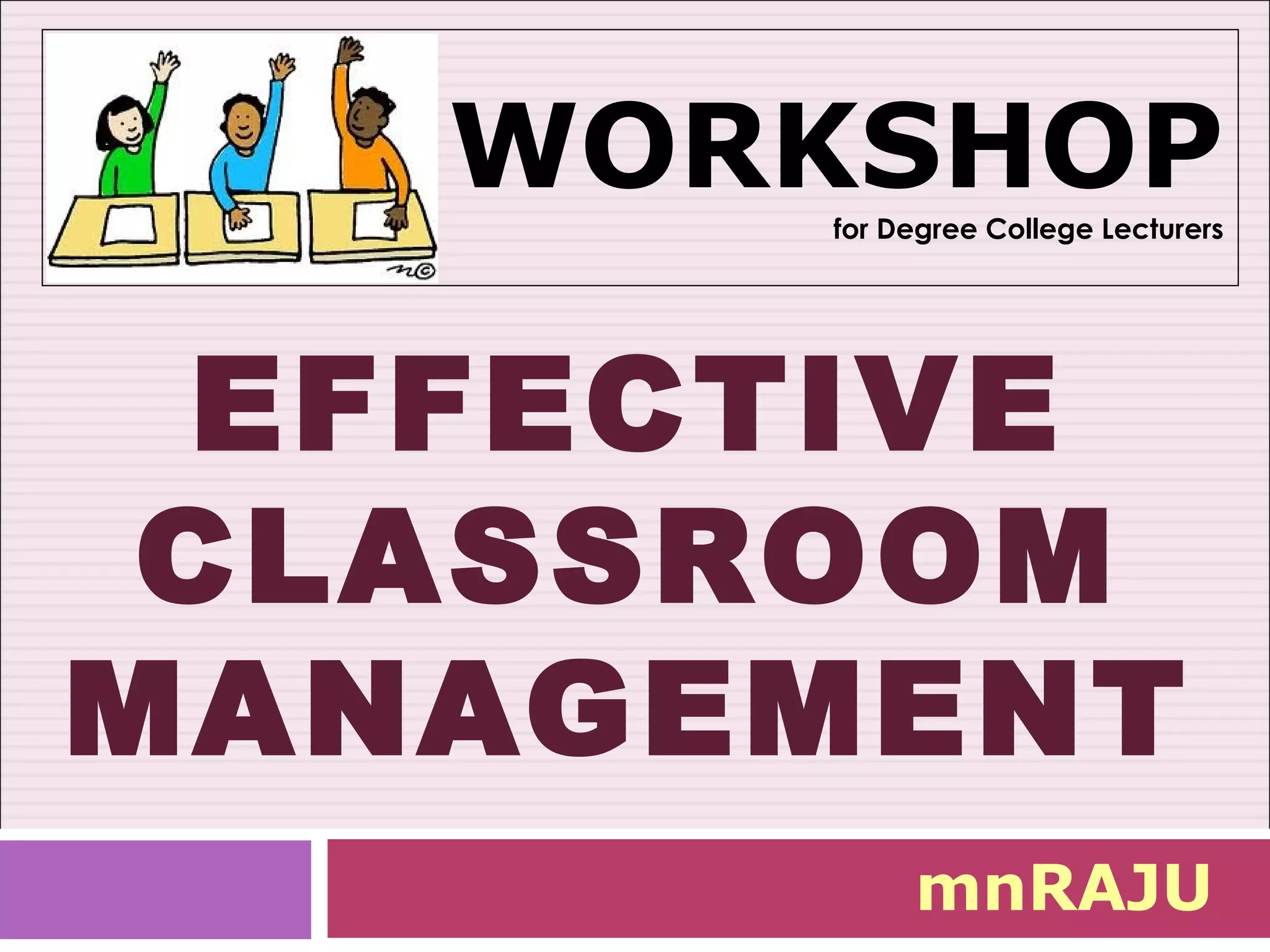







WORKSHOP
       for Degree College Lecturers


  EFFECTIVE
 CLASSROOM
MANAGEMENT
            mnRAJU
Icebreaker

1   Name & Qualifications
2 Best Teaching Experience     •   Speak to an
3   Favorite Subjects/Topics       unknown or
                                    less known
4   Achievements & Awards             colleague
5
                                   • Use ONLY
                                       English

                               • Do not write
                                         mnRAJU
Why Do We Teach?

   Knowledge
   Skills
   Application
   Information Literacy
                           mnRAJU
Why Do We Teach?

   Higher objectives of education
       Learning to Learn
       Learning to Live
       Learning to be Better

   Obligation to nation, college &
    students
   Professional satisfaction and growth
                                     mnRAJU
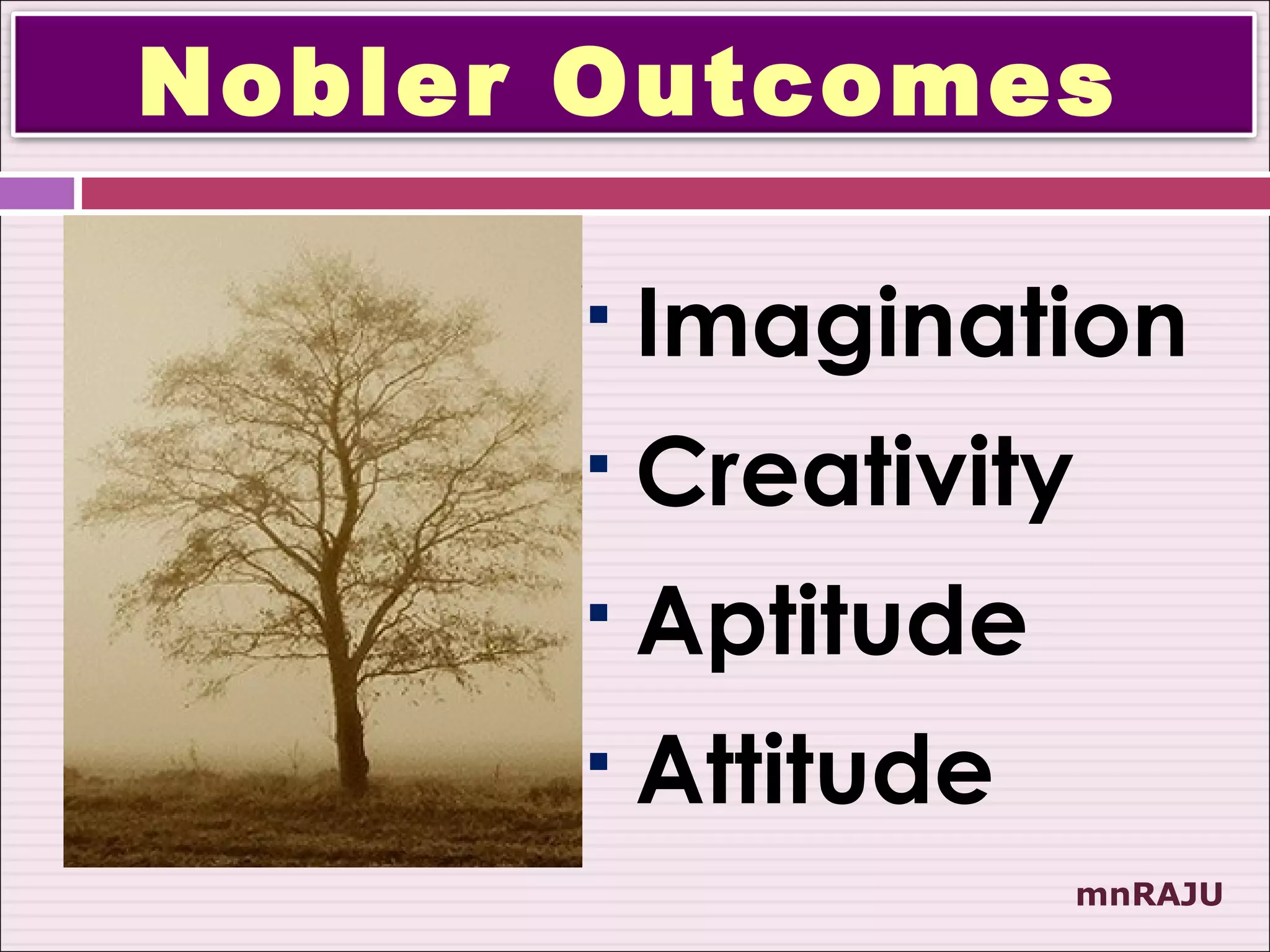
Nobler Outcomes

         Imagination
         Creativity
         Aptitude
         Attitude
                       mnRAJU
4 Types of Teachers
   A mediocre teacher
         tells.
   A good teacher
      explains.
 A superior teacher
  demonstrates.
A Great teacher
   inspires.            mnRAJU
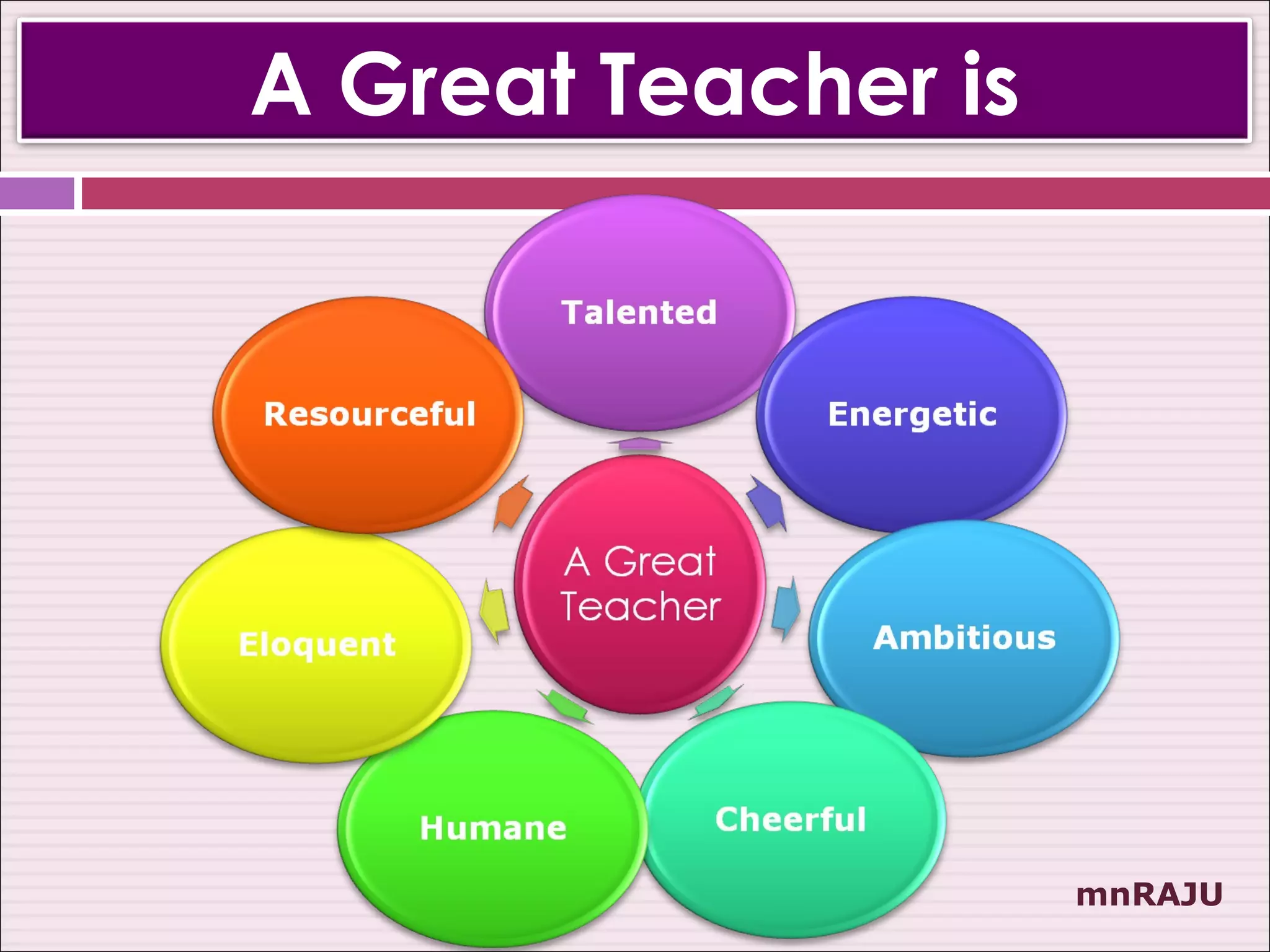
A Great Teacher is


                     mnRAJU
Activity - 1

              Recollect
Who was your best teacher at school/college?
        How did he/she inspire you?


                 Write


                 Share                  mnRAJU
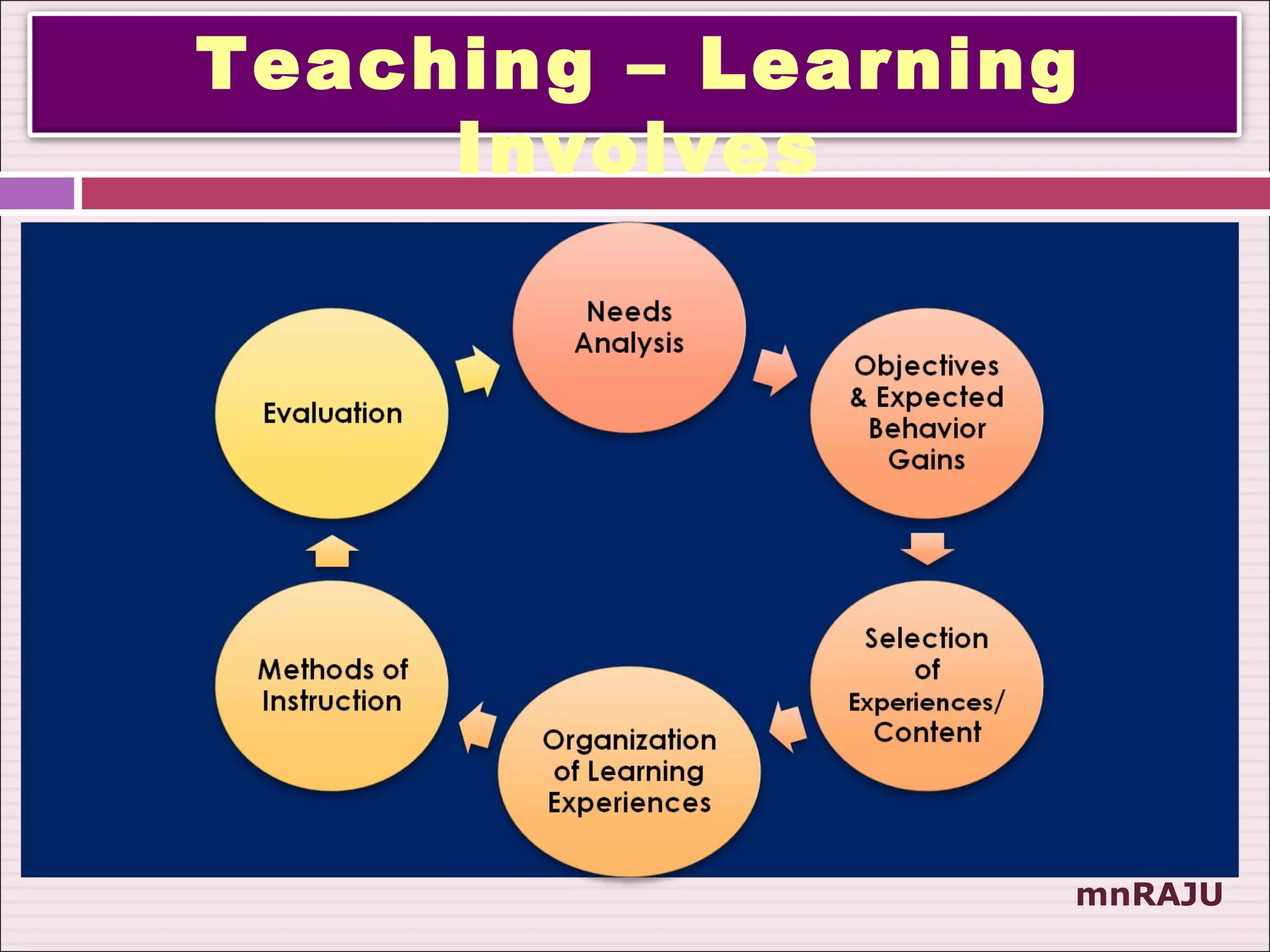
Teaching – Learning
     Involves


                  mnRAJU
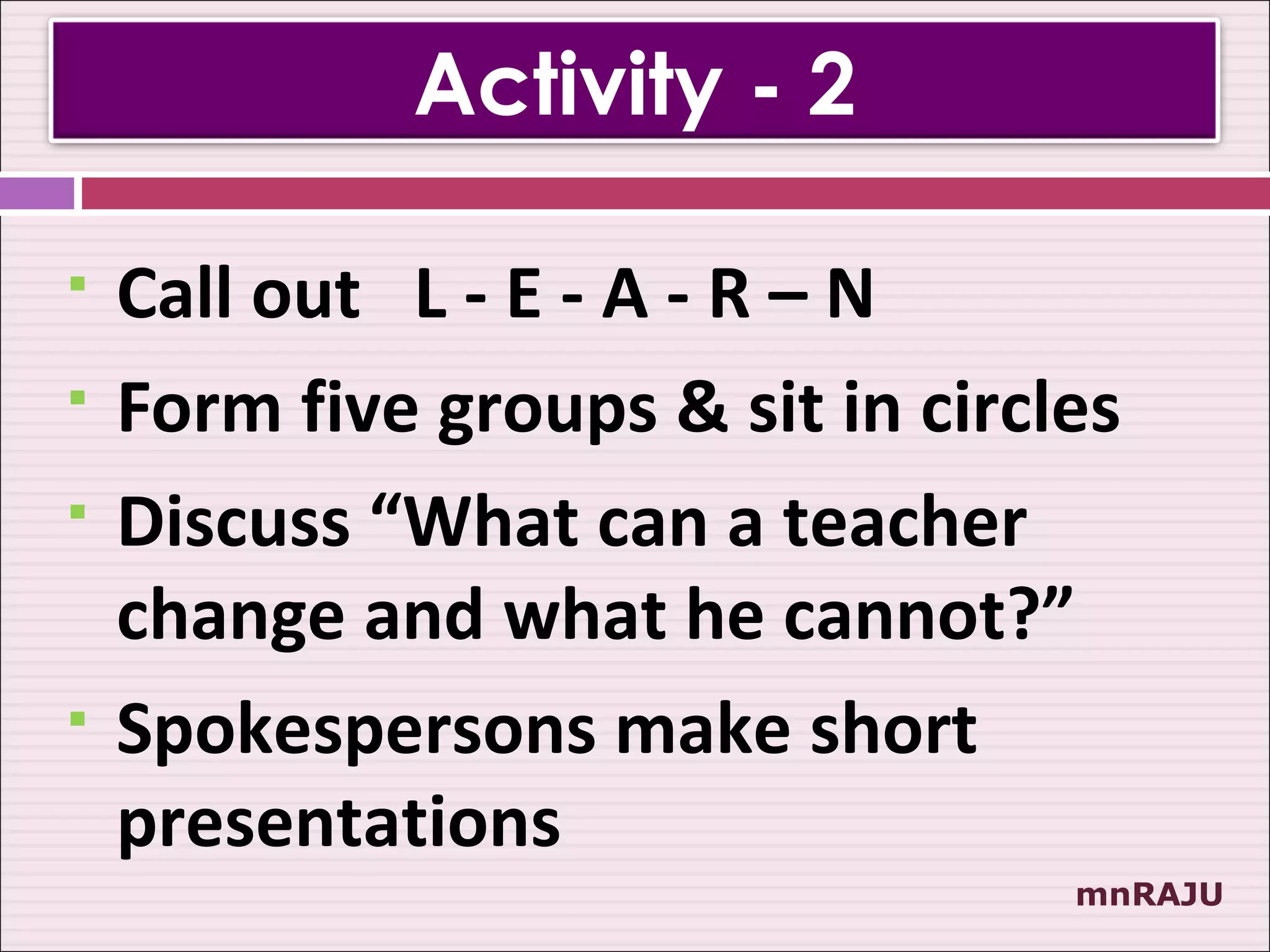
Activity - 2

   Call out L - E - A - R – N
   Form five groups & sit in circles
   Discuss “What can a teacher
    change and what he cannot?”
   Spokespersons make short
    presentations
                                   mnRAJU
A Great Teacher uses

  Effective
 Classroom
Management
Techniques
                   mnRAJU
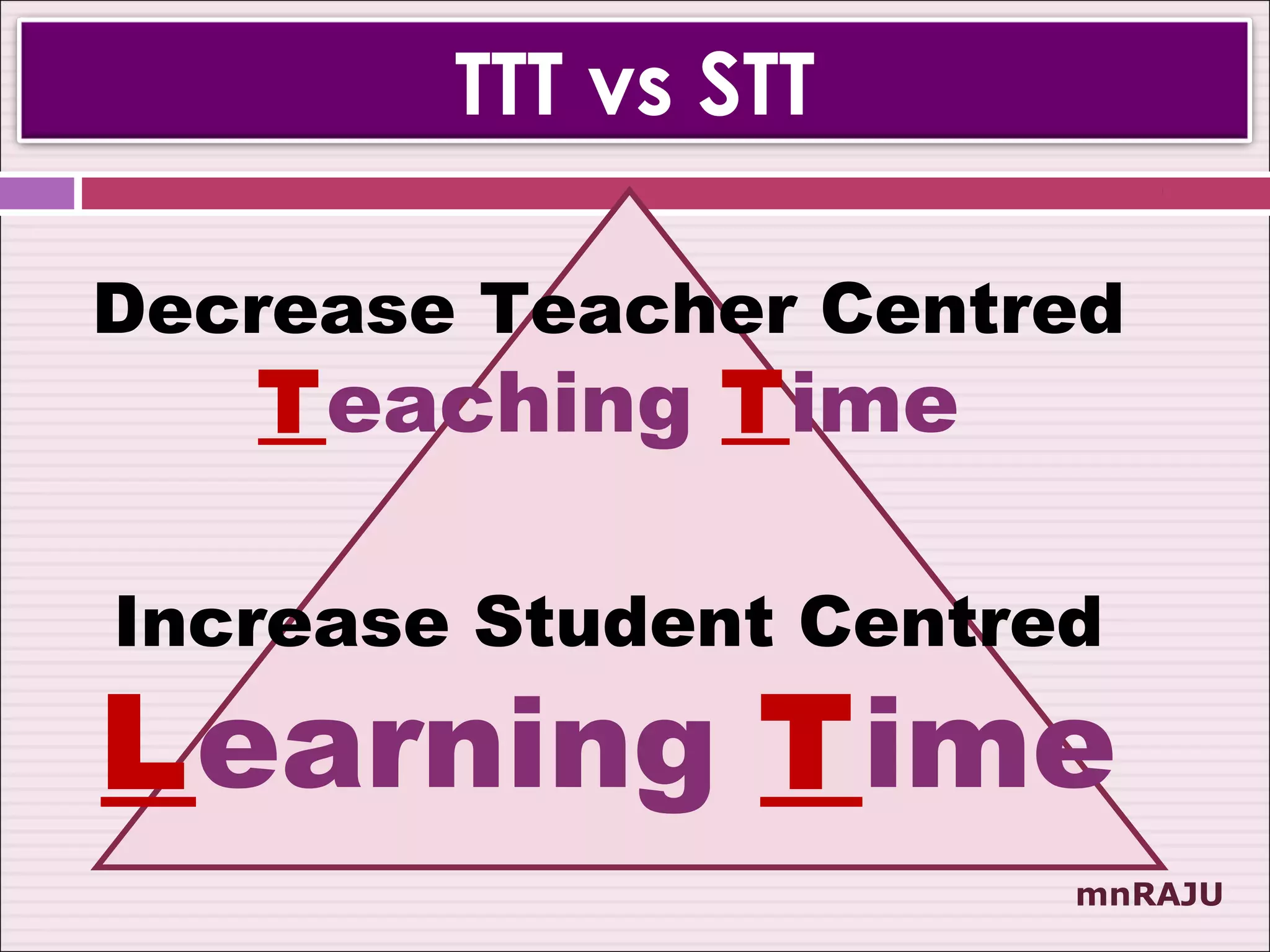
TTT vs STT

Decrease Teacher Centred
   Teaching Time

Increase Student Centred

Learning Time
                       mnRAJU
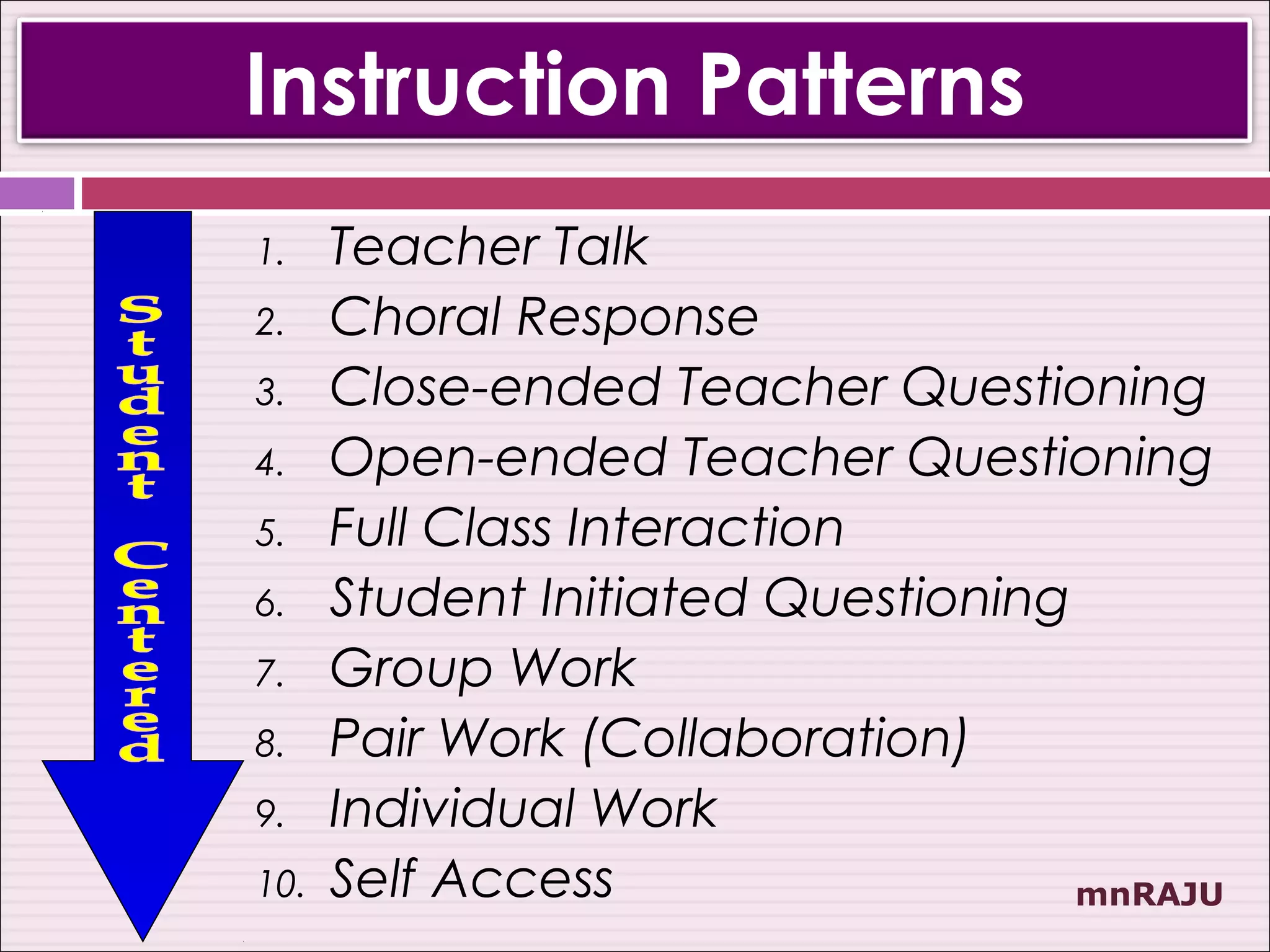
Instruction Patterns
1.    Teacher Talk
2.    Choral Response
3.    Close-ended Teacher Questioning
4.    Open-ended Teacher Questioning
5.    Full Class Interaction
6.    Student Initiated Questioning
7.    Group Work
8.    Pair Work (Collaboration)
9.    Individual Work
10.   Self Access                   mnRAJU
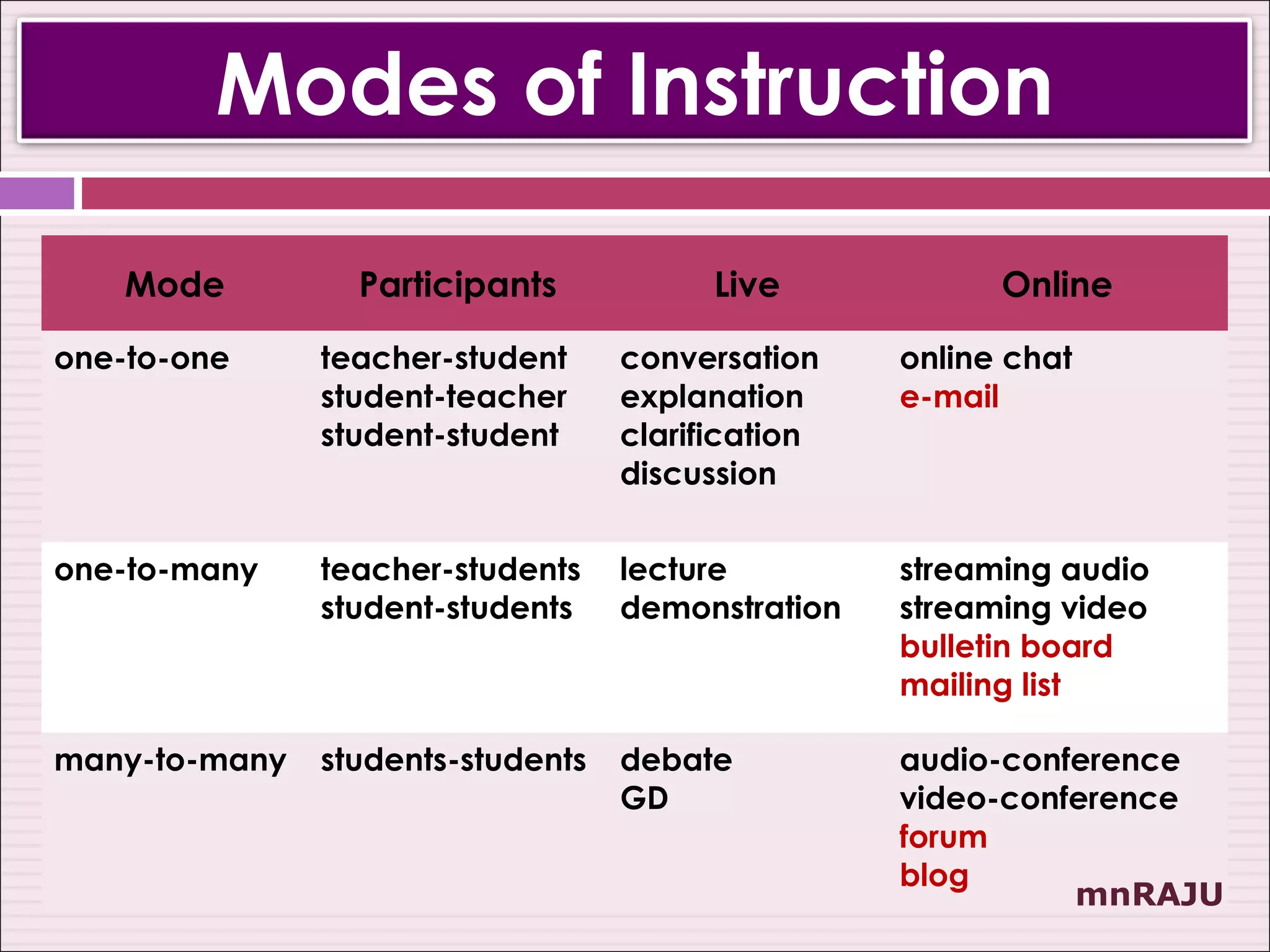
Modes of Instruction

    Mode         Participants            Live            Online

one-to-one     teacher-student     conversation    online chat
               student-teacher     explanation     e-mail
               student-student     clarification
                                   discussion


one-to-many    teacher-students    lecture         streaming audio
               student-students    demonstration   streaming video
                                                   bulletin board
                                                   mailing list

many-to-many   students-students   debate          audio-conference
                                   GD              video-conference
                                                   forum
                                                   blog
                                                             mnRAJU
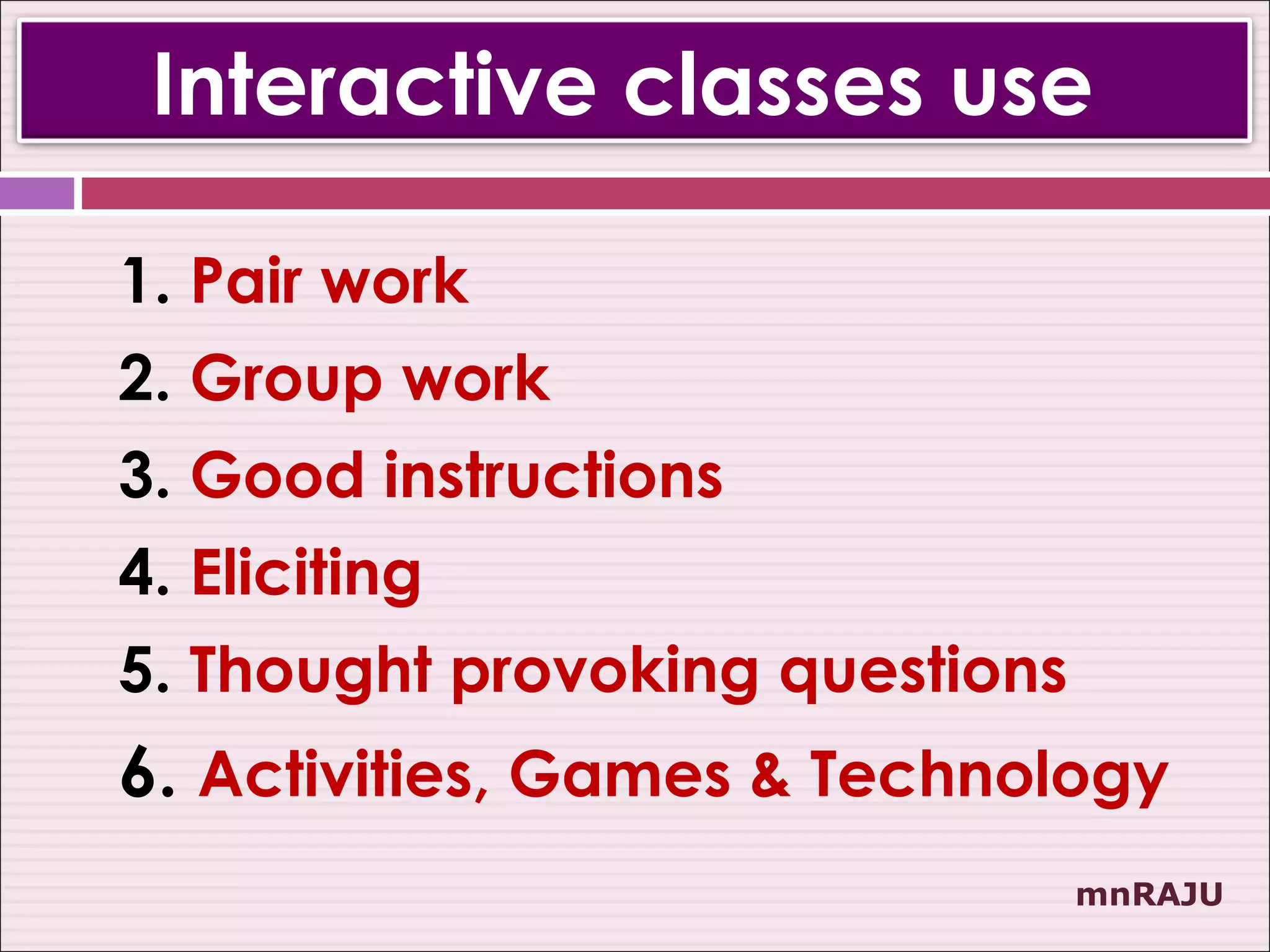
Interactive classes use

1. Pair work
2. Group work
3. Good instructions
4. Eliciting
5. Thought provoking questions
6. Activities, Games & Technology
                                 mnRAJU
mnRAJU
Pair Work
 Recall the Icebreaker

 Think of advantages of pair
work

 Form pairs

 Share your ideas with partner

 Share with class              mnRAJU
Pair Work - Advantages
 Greater opportunity for Application

 Learners gain confidence/overcome fear

 Real time feedback/response

 Peer learning

 Cooperation – a life skill
                                        mnRAJU
Pair Work - Review

   THINK – make notes
       form PAIRS

           SHARE with Partner
              SHARE with Class
                             mnRAJU
mnRAJU
Group Work
 Recall Activity -2

 Form groups

 Discuss advantages of group
work
 Arrive at consensus

 Share with class          mnRAJU
Group Work - Advantages
  More student participation time
  More listening time
  More fun
  Exchange of ideas
  Seeing others’ points of view
  Improved social skills
  Improved problem solving skills
                                   mnRAJU
Group Work - Review
   Explain the activity
   Arrange the groups
   Set time limit
   Give example/demonstration
   Move & Monitor
   Follow up
   Discuss the activity
                             mnRAJU
mnRAJU
Good Instructions are . . .
 Short
 Simple
 Precise
 Easy to follow
 Repeated
 Demonstrated
                        mnRAJU
Activity - 3


Follow the instructions in the handout.


                                     mnRAJU
mnRAJU
Ask,
Don’t Tell
         mnRAJU
Activity - 4


Elicit a specific response


                             mnRAJU
mnRAJU
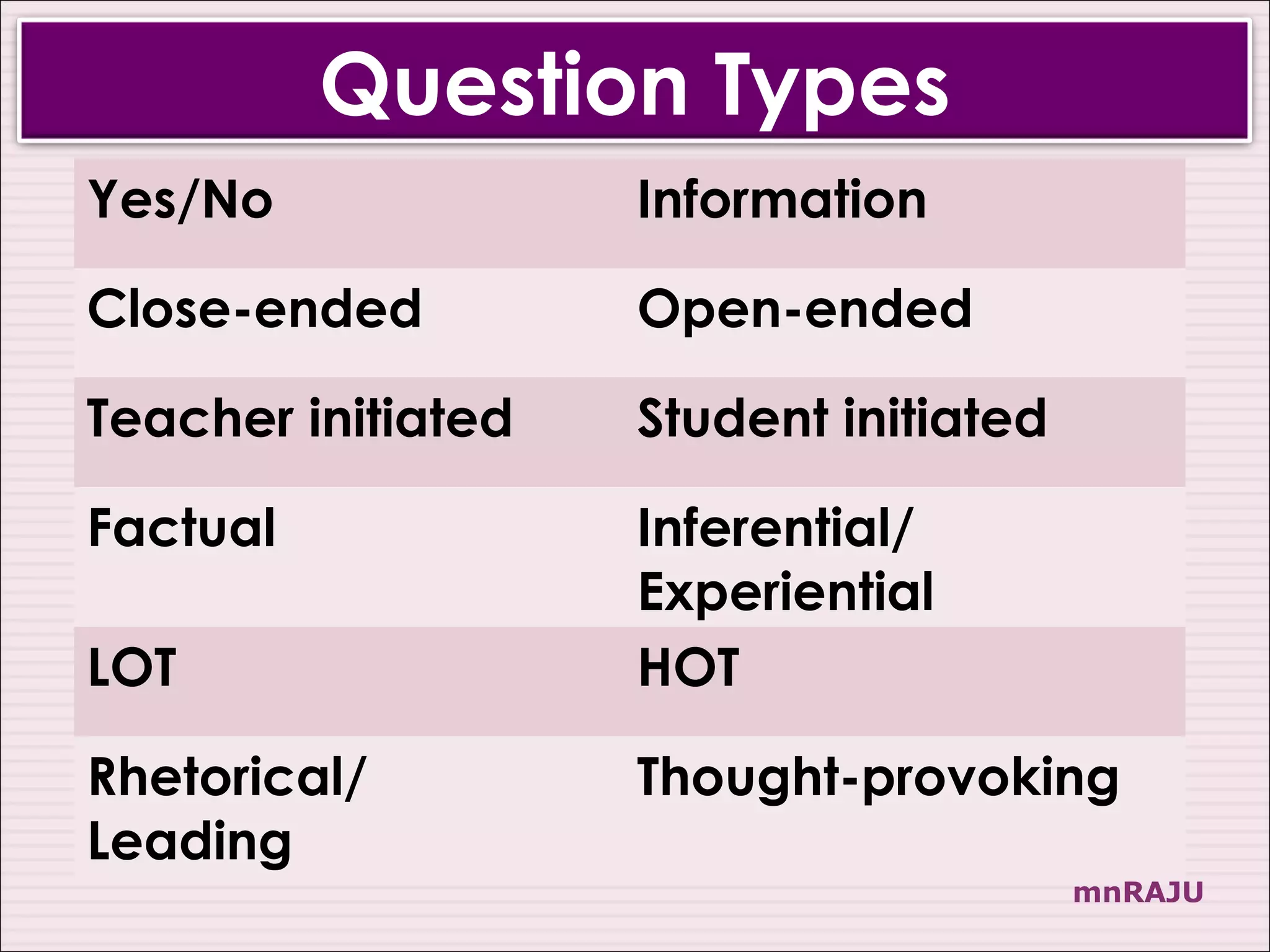
Question Types
Yes/No              Information

Close-ended         Open-ended

Teacher initiated   Student initiated

Factual             Inferential/
                    Experiential
LOT                 HOT

Rhetorical/         Thought-provoking
Leading
                                        mnRAJU
Responding to Questions
   Let students think and formulate
   Do not interrupt
   Show interest in answers
   Involve other students
   Ask follow-up questions
   Do not discourage students
                                  mnRAJU
Evaluation

   Include variety – HOT/LOT/FIVE
   Avoid routine questions
   Test application of learning
   Encourage imagination
   Encourage creativity
   Promote further learning
                                mnRAJU
Effective Evaluation

   Validity
   Reliability
   Washback
   Practicality
                           mnRAJU
mnRAJU
Visual Aids
 Realia
 Models
 Photographs, Charts
 Transparencies
 Slideshows
 Video Clips, Multimedia
                        mnRAJU
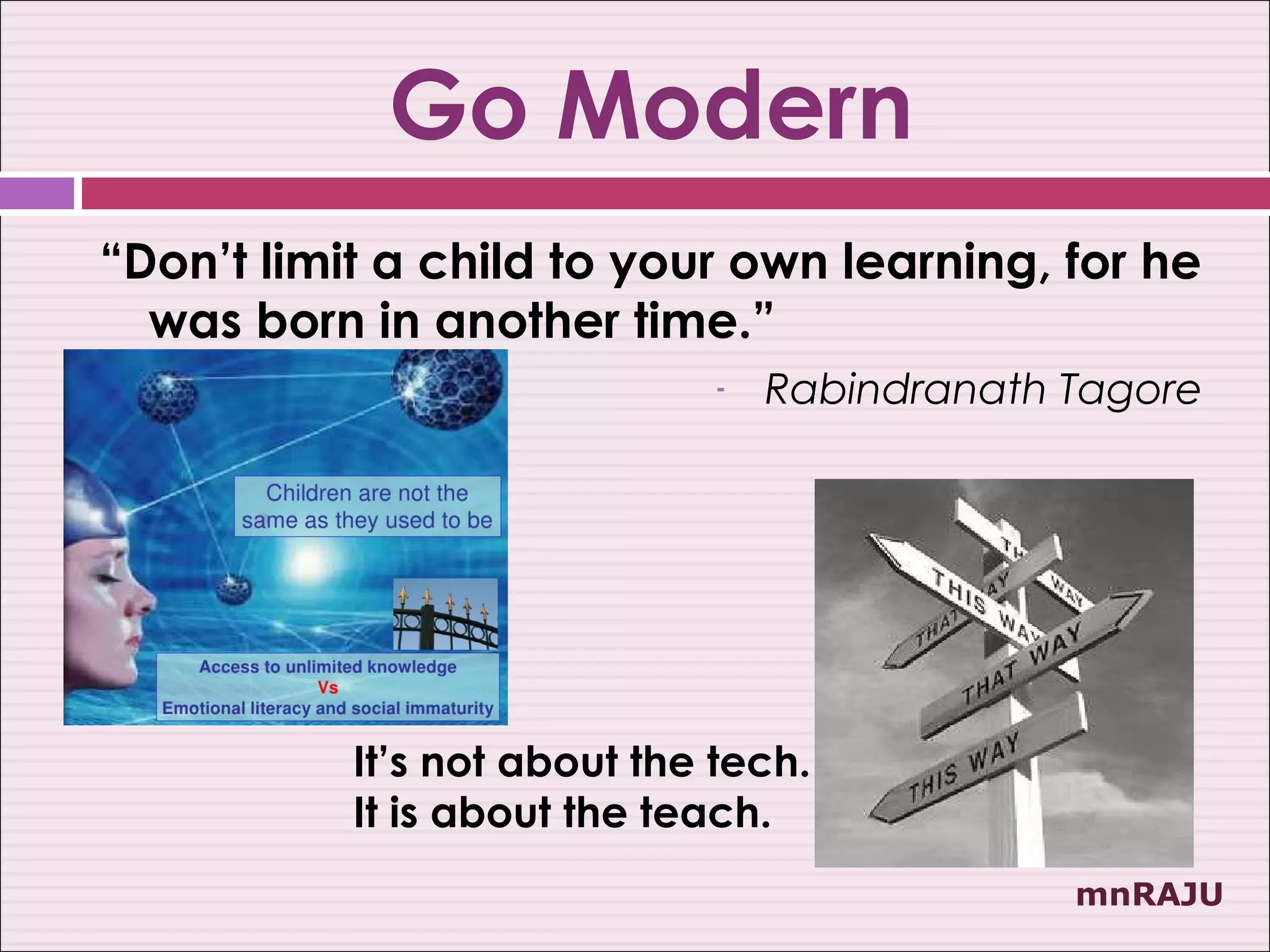
Go Modern
“Don’t limit a child to your own learning, for he
  was born in another time.”
                              -   Rabindranath Tagore


           It’s not about the tech.
           It is about the teach.
                                               mnRAJU
Current Technologies

   Internet
   Mobile Technologies
   Video Transmission
   Social Networking
   Blogs, podcasts, YouTube etc
                             mnRAJU
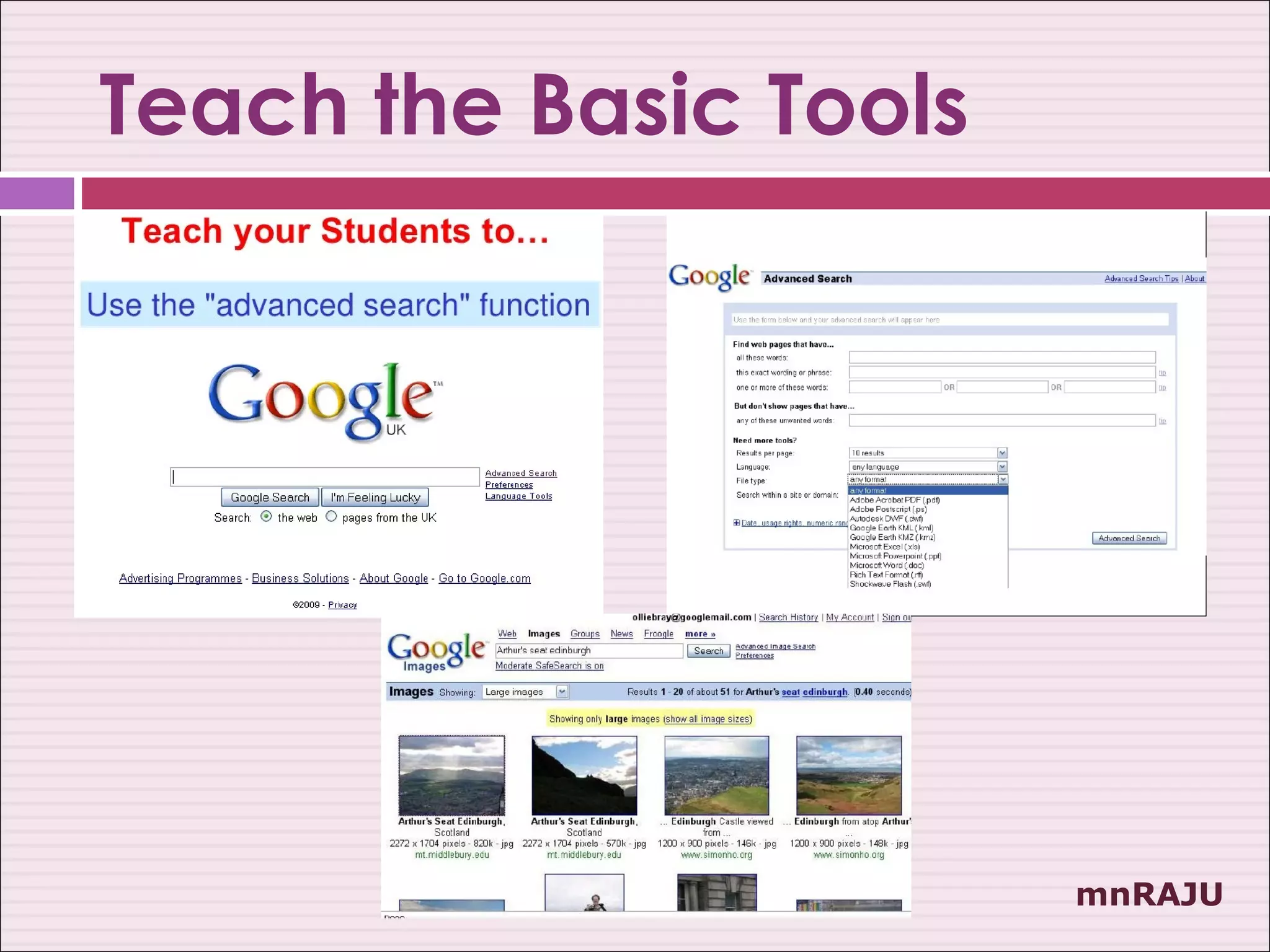
Teach the Basic Tools


                        mnRAJU
Edutainment

   Use podcasts, videos, audios,
    animation (www.goanimate.com)
   Use wikipedia etc
   Create your own website


                                mnRAJU
Emerging Technologies
   Internet2 (100 times faster)
   Wi-fi, Bluetooth, 802.11(versatile plug-ins)
   The Tablet PC
   Nanotechnology
   Thought-controlled Computing

                                           mnRAJU
How does it affect you?

 Accept Challenges
 Exploit Opportunities

 Don’t Stop Learning


                    mnRAJU
What you do
   TODAY


can IMPROVE
  ALL YOUR
TOMORROWS      mnRAJU
This slideshow is available at
   www.slideshare.net/lionnagaraju
www.authorstream.com/tag/lionnagaraju

           Send your comments to

    lionnagaraju@gmail.com
                                       mnRAJU

Effective Classroom Management

  • 1.
    WORKSHOP for Degree College Lecturers EFFECTIVE CLASSROOM MANAGEMENT mnRAJU
  • 2.
    Icebreaker 1 Name & Qualifications 2 Best Teaching Experience • Speak to an 3 Favorite Subjects/Topics unknown or less known 4 Achievements & Awards colleague 5 • Use ONLY English • Do not write mnRAJU
  • 3.
    Why Do WeTeach?  Knowledge  Skills  Application  Information Literacy mnRAJU
  • 4.
    Why Do WeTeach?  Higher objectives of education  Learning to Learn  Learning to Live  Learning to be Better  Obligation to nation, college & students  Professional satisfaction and growth mnRAJU
  • 5.
    Nobler Outcomes  Imagination  Creativity  Aptitude  Attitude mnRAJU
  • 6.
    4 Types ofTeachers A mediocre teacher tells. A good teacher explains. A superior teacher demonstrates. A Great teacher inspires. mnRAJU
  • 7.
    A Great Teacheris mnRAJU
  • 8.
    Activity - 1 Recollect Who was your best teacher at school/college? How did he/she inspire you? Write Share mnRAJU
  • 9.
    Teaching – Learning Involves mnRAJU
  • 10.
    Activity - 2  Call out L - E - A - R – N  Form five groups & sit in circles  Discuss “What can a teacher change and what he cannot?”  Spokespersons make short presentations mnRAJU
  • 11.
    A Great Teacheruses Effective Classroom Management Techniques mnRAJU
  • 12.
    TTT vs STT DecreaseTeacher Centred Teaching Time Increase Student Centred Learning Time mnRAJU
  • 13.
    Instruction Patterns 1. Teacher Talk 2. Choral Response 3. Close-ended Teacher Questioning 4. Open-ended Teacher Questioning 5. Full Class Interaction 6. Student Initiated Questioning 7. Group Work 8. Pair Work (Collaboration) 9. Individual Work 10. Self Access mnRAJU
  • 14.
    Modes of Instruction Mode Participants Live Online one-to-one teacher-student conversation online chat student-teacher explanation e-mail student-student clarification discussion one-to-many teacher-students lecture streaming audio student-students demonstration streaming video bulletin board mailing list many-to-many students-students debate audio-conference GD video-conference forum blog mnRAJU
  • 15.
    Interactive classes use 1.Pair work 2. Group work 3. Good instructions 4. Eliciting 5. Thought provoking questions 6. Activities, Games & Technology mnRAJU
  • 16.
  • 17.
    Pair Work  Recallthe Icebreaker  Think of advantages of pair work  Form pairs  Share your ideas with partner  Share with class mnRAJU
  • 18.
    Pair Work -Advantages  Greater opportunity for Application  Learners gain confidence/overcome fear  Real time feedback/response  Peer learning  Cooperation – a life skill mnRAJU
  • 19.
    Pair Work -Review  THINK – make notes  form PAIRS  SHARE with Partner  SHARE with Class mnRAJU
  • 20.
  • 21.
    Group Work  RecallActivity -2  Form groups  Discuss advantages of group work  Arrive at consensus  Share with class mnRAJU
  • 22.
    Group Work -Advantages  More student participation time  More listening time  More fun  Exchange of ideas  Seeing others’ points of view  Improved social skills  Improved problem solving skills mnRAJU
  • 23.
    Group Work -Review  Explain the activity  Arrange the groups  Set time limit  Give example/demonstration  Move & Monitor  Follow up  Discuss the activity mnRAJU
  • 24.
  • 25.
    Good Instructions are. . . Short Simple Precise Easy to follow Repeated Demonstrated mnRAJU
  • 26.
    Activity - 3 Followthe instructions in the handout. mnRAJU
  • 27.
  • 28.
  • 29.
    Activity - 4 Elicita specific response mnRAJU
  • 30.
  • 31.
    Question Types Yes/No Information Close-ended Open-ended Teacher initiated Student initiated Factual Inferential/ Experiential LOT HOT Rhetorical/ Thought-provoking Leading mnRAJU
  • 32.
    Responding to Questions  Let students think and formulate  Do not interrupt  Show interest in answers  Involve other students  Ask follow-up questions  Do not discourage students mnRAJU
  • 33.
    Evaluation  Include variety – HOT/LOT/FIVE  Avoid routine questions  Test application of learning  Encourage imagination  Encourage creativity  Promote further learning mnRAJU
  • 34.
    Effective Evaluation  Validity  Reliability  Washback  Practicality mnRAJU
  • 35.
  • 36.
    Visual Aids  Realia Models  Photographs, Charts  Transparencies  Slideshows  Video Clips, Multimedia mnRAJU
  • 37.
    Go Modern “Don’t limita child to your own learning, for he was born in another time.” - Rabindranath Tagore It’s not about the tech. It is about the teach. mnRAJU
  • 38.
    Current Technologies  Internet  Mobile Technologies  Video Transmission  Social Networking  Blogs, podcasts, YouTube etc mnRAJU
  • 39.
    Teach the BasicTools mnRAJU
  • 40.
    Edutainment  Use podcasts, videos, audios, animation (www.goanimate.com)  Use wikipedia etc  Create your own website mnRAJU
  • 41.
    Emerging Technologies  Internet2 (100 times faster)  Wi-fi, Bluetooth, 802.11(versatile plug-ins)  The Tablet PC  Nanotechnology  Thought-controlled Computing mnRAJU
  • 42.
    How does itaffect you?  Accept Challenges  Exploit Opportunities  Don’t Stop Learning mnRAJU
  • 43.
    What you do TODAY can IMPROVE ALL YOUR TOMORROWS mnRAJU
  • 44.
    This slideshow isavailable at www.slideshare.net/lionnagaraju www.authorstream.com/tag/lionnagaraju Send your comments to lionnagaraju@gmail.com mnRAJU

Editor's Notes

  • #2 Welcome to this induction programme for the recently promoted lecturers. I am RAJU, retired lecturer – your facilitator for this session. This 90 minute presentation aims at giving you an idea of what goes into the teaching-learning process, both inside the classroom and beyond the classroom. It touches upon the curricular and co-curricular activities that make the process of teaching-learning more effective. This presentation also aims at giving you an idea of factors relating to student evaluation.
  • #3 Let’s begin with an icebreaker. Call out the letters L E A R N by turns and form five groups. All Ls together, all Es in one place and likewise. Each group - sit in a circle or in a compact group. Discuss with the members of your group “why do we teach” and shortlist three important reasons. Nominate a spokesperson for your group and make one-minute presentations on your group’s views. Avoid repeating what the previous groups have already listed.
  • #4 Teaching-Learning should foresee the practical scope for giving students opportunities to know more, comprehend better, acquire both physical and mental skills. It should not just stop there. It should also aim at strengthening the application skills of the learners. This is particularly important because our system usually stops with the imparting of information. Information literacy is a student’s ability to distinguish, classify and tell apart what is what and what belongs where. This ability to discriminate is a basic educational objective.
  • #6 Expanding the horizons of imagination, inculcating a creative bent of mind and building the right aptitude and attitude are the responsibility of teachers, irrespective of the subject they teach, especially the humanities teachers. Teachers have a very significant responsibility to build right aptitudes and mold positive attitudes. Imagination and creativity need yo be infused into the young minds of our students at every opportunity.
  • #10 Teaching-Learning process is the next important concept that we need to understand clearly. Teaching-Learning is a comprehensive and all-encompassing term. It includes everything that happens in the sphere of educatoin, starting with the needs analysis and statement of expected outcomes, goes on to a detailed description of objectives for the course, then deals with the choice of educational experiences, teaching-learning content, appropriate materials, effective methodology of delivery and goes on to evaluation and beyond. It may also include thrust areas, value additions etc. Take a few minutes and discuss with your partner which aspects of curriculum does the teacher have a command over and which ones he does not.
  • #11 Let’s begin with an icebreaker. Call out the letters L E A R N by turns and form five groups. All Ls together, all Es in one place and likewise. Each group - sit in a circle or in a compact group. Discuss with the members of your group “why do we teach” and shortlist three important reasons. Nominate a spokesperson for your group and make one-minute presentations on your group’s views. Avoid repeating what the previous groups have already listed.
  • #17 What is it? How is it done? Have you ever used it?
  • #21 By splitting the students up into small groups, you will instantly increase communication, interaction and engagement because they will have to work with each other to complete the task. Once they have finished their group work, they may feel more comfortable sharing with the entire class because the spotlight will be distributed to three or four of them, instead of resting solely on the shoulders of one student.
  • #34 Keep these guidelines in mind when you administer any kind of evaluation. A good evaluation includes questions of various kinds – questions that promote both high order thinking and low order thinking. Questions may test the factual, inferential or experiential knowledge of students. Language teachers should include questions on vocabulary and subject teachers should test the knowledge of basic concepts and definitions. Where is this induction training happening? What is the most important objective of this induction? Can you define ‘induction’? How have you benefited from this induction so fare? These are four different kinds of questions. There should be at least a few questions included to test the student’s application, creativity and imagination in the target subject. Keep your students’ entry level behavior and expected exit level behavior in mind while designing evaluation. The answer sheet is a mirror report of the student’s mind.
  • #35 These four factors should be kept in mind while designing your evaluation tools. Validity refers to whether a test measures what it is supposed to measure. Reliability deals with the trustworthiness of the test results. Washback means the effect of testing on teaching and learning. Negative effects include teaching only to the test and memorizing possible test questions. Positive effects, if the test is valid, include focusing teaching upon what is important. Practicality is a matter of the extent to which the demands of the particular test can be met within the limits of existing resources including time, staff and test administration.
  • #37 Use of appropriately designed teaching aids makes the teaching-learning process highly effective. Each teacher may make a wise choice of the aids depending on factors such as availability of infrastructure, cost effectiveness, reusability, student achievement levels etc. The web is a very rich resource for ready-to-use teaching aids. However, be warned that it is a dense jungle where you may easily get lost, if you do not predetermine your exact needs. Activity: Which ones do you prefer and why?