
DOUBLE PATTERNING LITHOGRAPHY
FOR 32NM HALF PITCH NODE AND
BEYOND

By,
ManikandanSampathkumar
U84037635

S
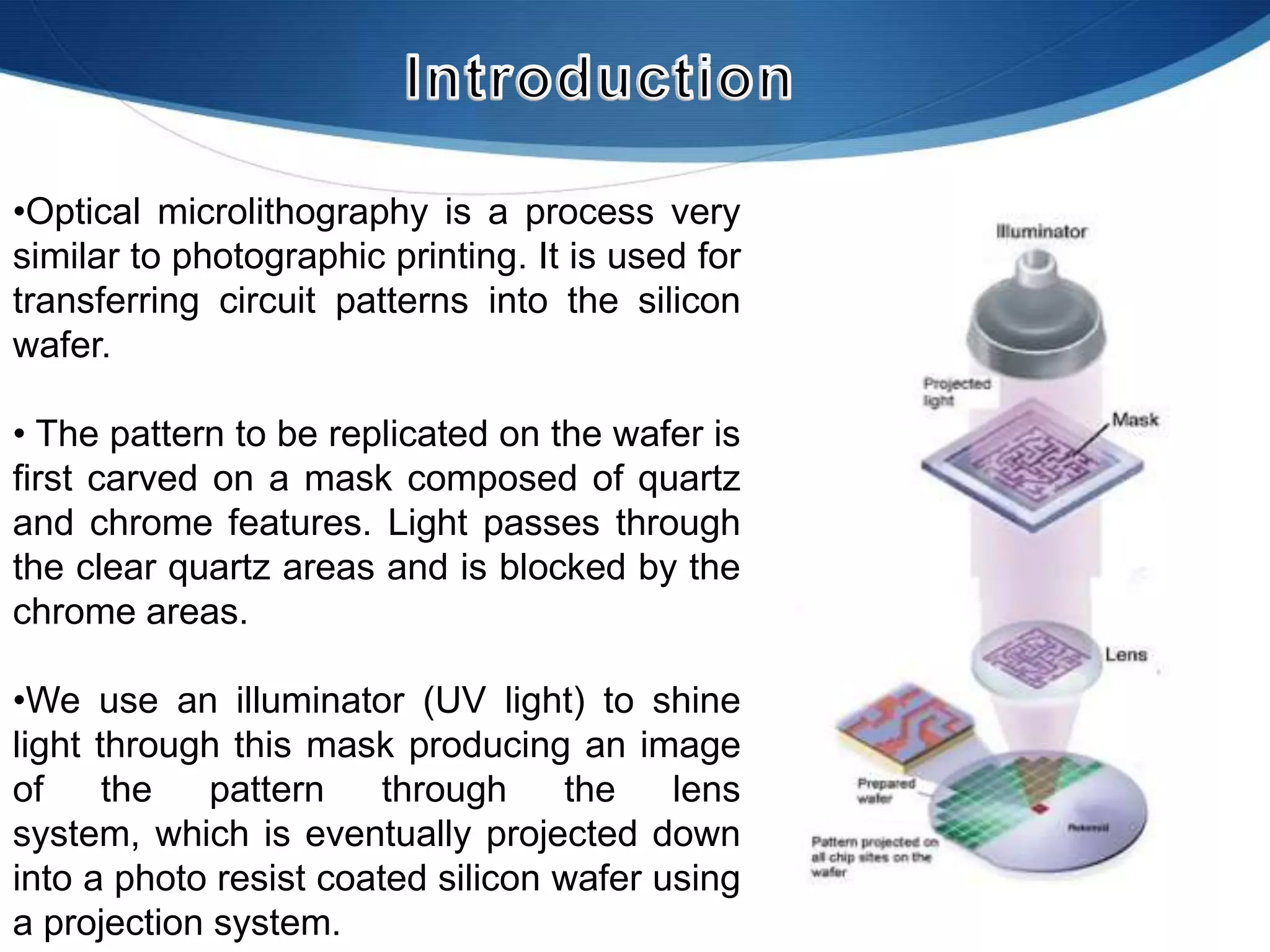
•Optical microlithography is a process very
similar to photographic printing. It is used for
transferring circuit patterns into the silicon
wafer.
• The pattern to be replicated on the wafer is
first carved on a mask composed of quartz
and chrome features. Light passes through
the clear quartz areas and is blocked by the
chrome areas.
•We use an illuminator (UV light) to shine
light through this mask producing an image
of
the
pattern
through
the
lens
system, which is eventually projected down
into a photo resist coated silicon wafer using
a projection system.
RAYLEIGH’S CRITERION

CD

=

CD = Resolution or minimum feature size ( Critical dimension).
k1 = Coefficient that encapsulates process related factors(k1 fac
λ= Wavelength of light used.
NA = Numerical aperture.

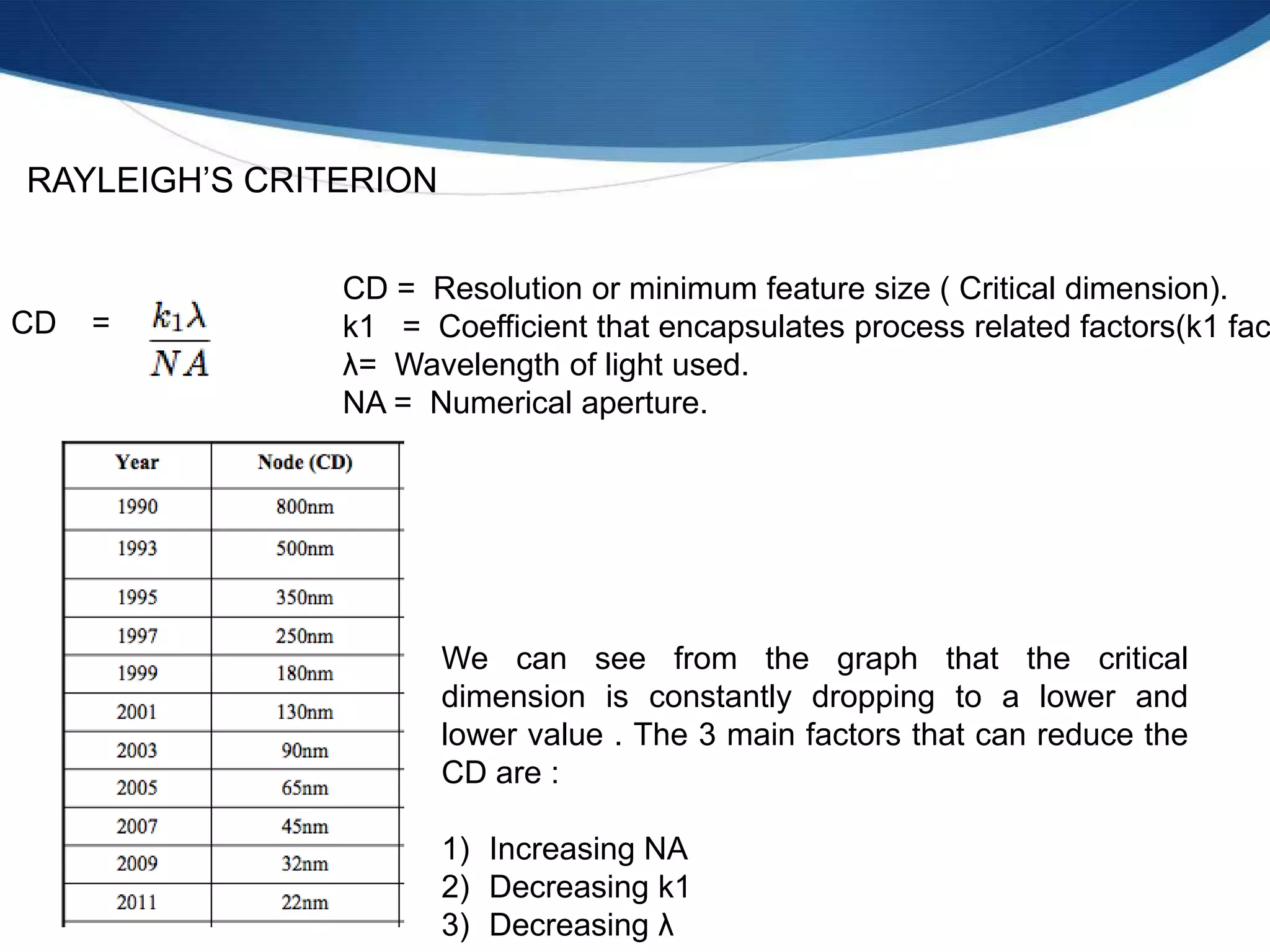
We can see from the graph that the critical
dimension is constantly dropping to a lower and
lower value . The 3 main factors that can reduce the
CD are :
1) Increasing NA
2) Decreasing k1
3) Decreasing λ
• Increasing NA ?

When the NA is increased beyond a value (0.93) , it has adverse effects on the
depth of focus , the formula is given by :
(k2 = another process related coefficient)
NA cannot be increased at the cost of reducing the depth of focus,which will reduce the
sharpness of the image printed .

•Decreasing λ?
When λis reduced below 193nm it faces a lot of technical issues cost, risk, and most
importantly throughput .
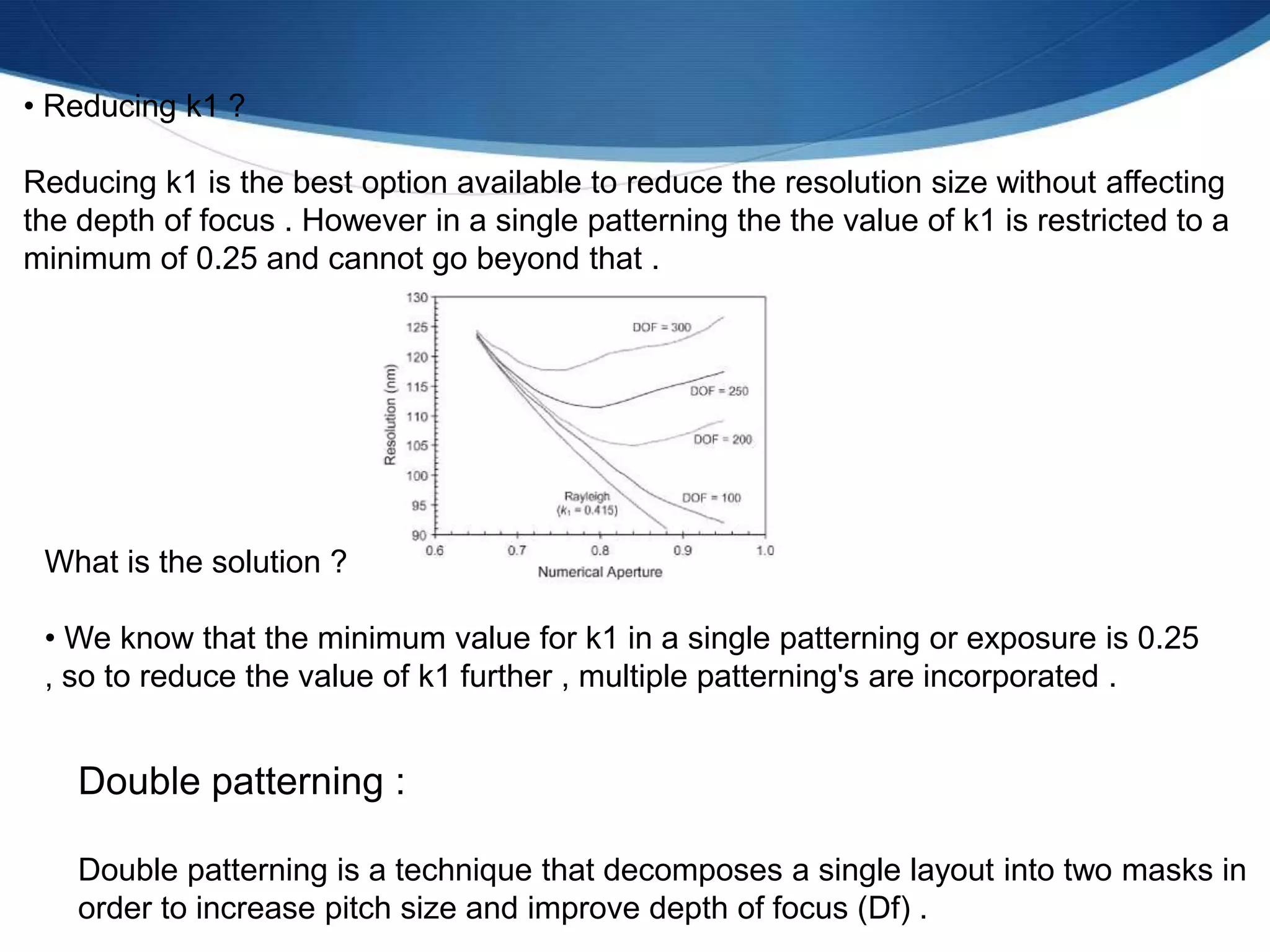
• Reducing k1 ?
Reducing k1 is the best option available to reduce the resolution size without affecting
the depth of focus . However in a single patterning the the value of k1 is restricted to a
minimum of 0.25 and cannot go beyond that .

What is the solution ?
• We know that the minimum value for k1 in a single patterning or exposure is 0.25
, so to reduce the value of k1 further , multiple patterning's are incorporated .

Double patterning :
Double patterning is a technique that decomposes a single layout into two masks in
order to increase pitch size and improve depth of focus (Df) .
•The basic idea is that if a pitch of interest is not achievable in a single lithography
step, the design is split over two lithography layers in a way that the minimum pitch
is relaxed with respect to the target pitch. In this way the effective k1 of the total
process (i.e., the combination of the two lithography steps) can drop below the
theoretical limit of 0.25 for a single patterning process. The increased pitch size
enables higher resolution and better printability.

So how does the process work ?
The easiest way to implement this is by transferring the first litho step into a hard mask
layer by etch and subsequent imaging and etching of a second photoresist layer. This
litho-etch-litho-etch approach can for instance be achieved either by double trench or
double line patterning.

Step 1
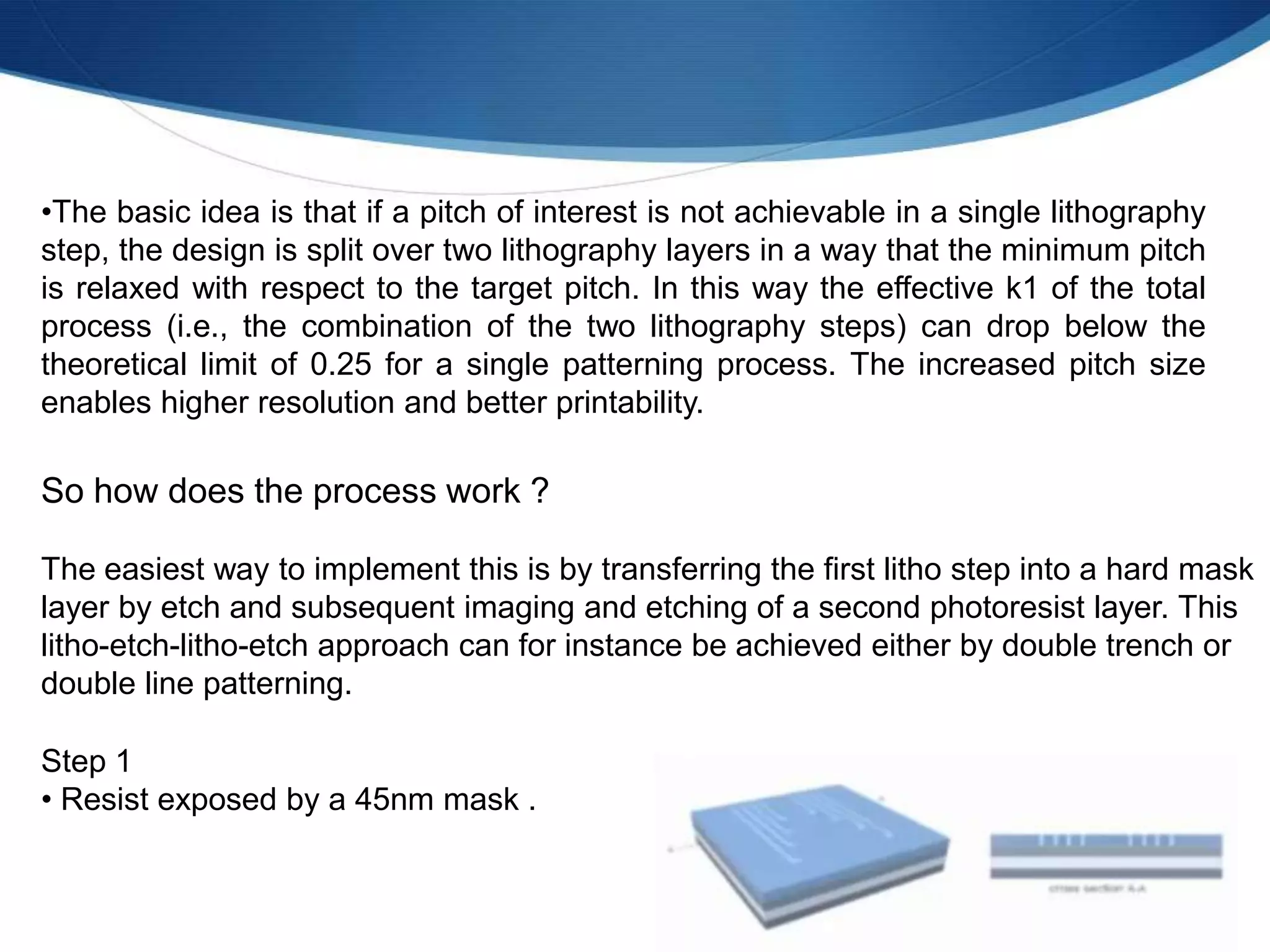
• Resist exposed by a 45nm mask .
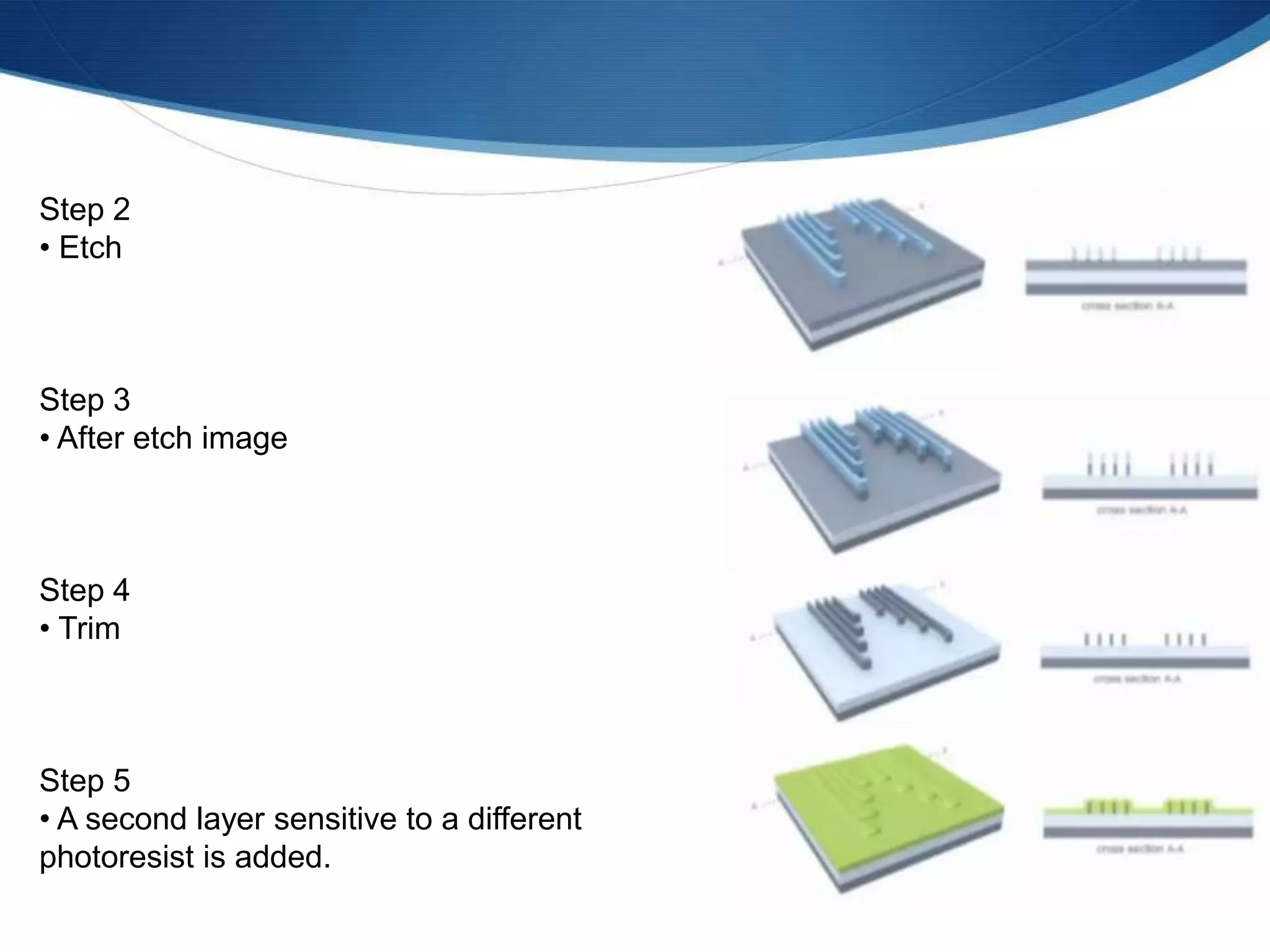
Step 2
• Etch

Step 3
• After etch image

Step 4
• Trim

Step 5
• A second layer sensitive to a different
photoresist is added.
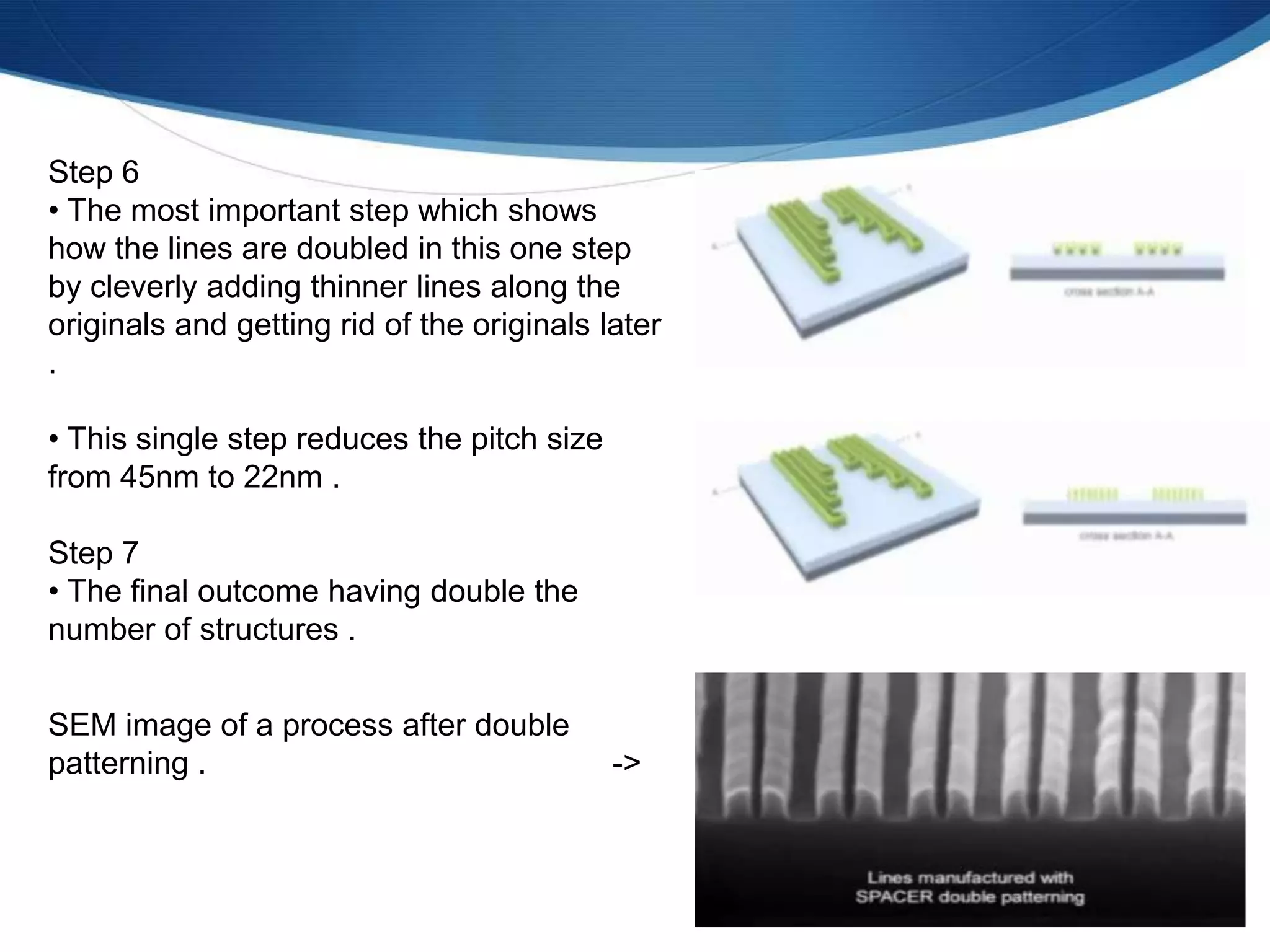
Step 6
• The most important step which shows
how the lines are doubled in this one step
by cleverly adding thinner lines along the
originals and getting rid of the originals later
.

• This single step reduces the pitch size
from 45nm to 22nm .
Step 7
• The final outcome having double the
number of structures .
SEM image of a process after double
patterning .

->
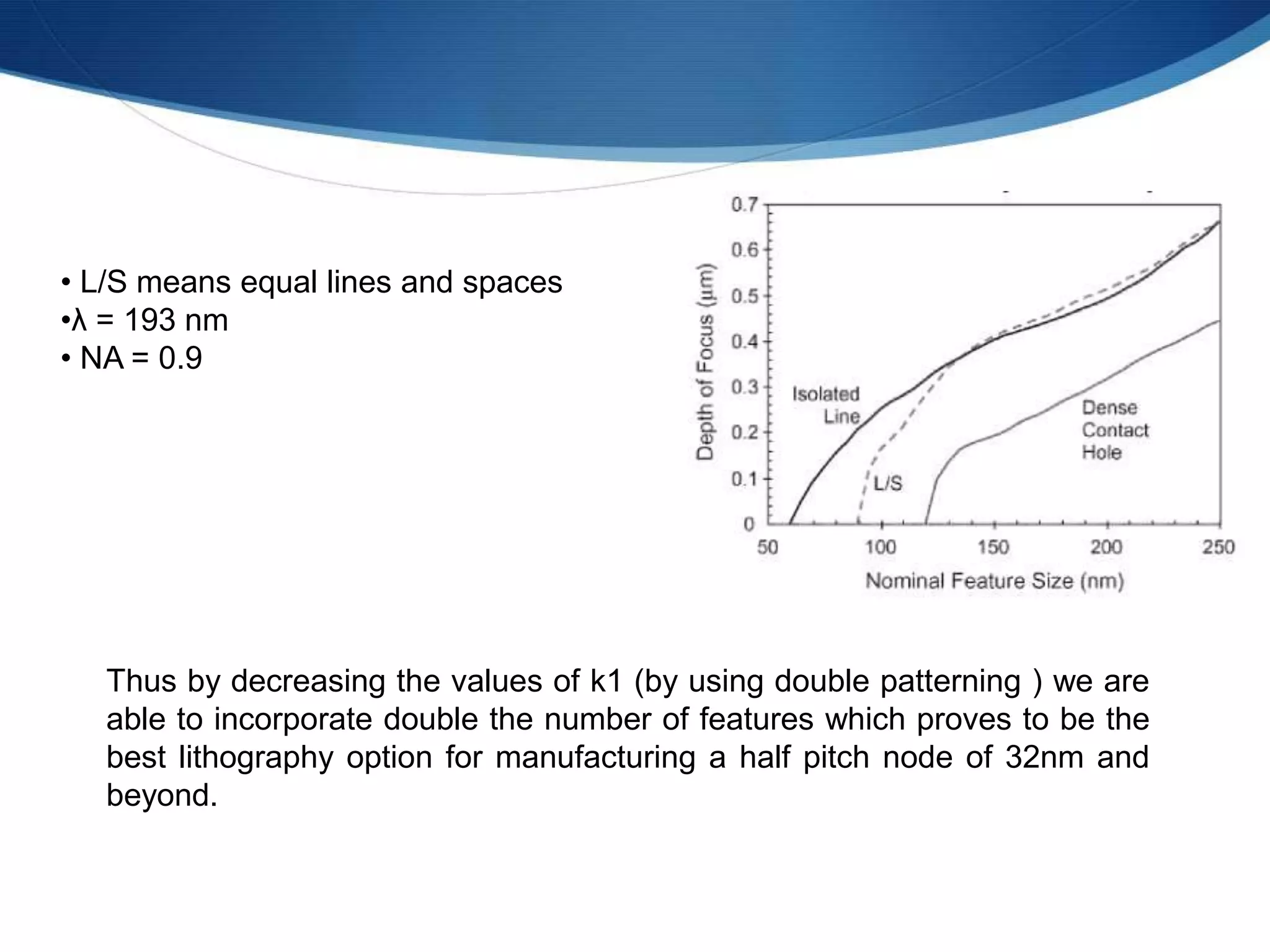
• L/S means equal lines and spaces
•λ = 193 nm
• NA = 0.9

Thus by decreasing the values of k1 (by using double patterning ) we are
able to incorporate double the number of features which proves to be the
best lithography option for manufacturing a half pitch node of 32nm and
beyond.
References :
• Mask design for single and double exposure optical microlithography: an inverse
imaging approach - AmynPoonawala
•Lithography Options for the 32 nm Half Pitch Node and Beyond - Kurt
Ronse, Philippe Jansen, R. Gronheid, Eric Hendrickx, M. Maenhoudt, Vincent
Wiaux, Anne-Marie Goethals, R. Jonckheere, and G. Vandenberghe , IEEE
spectrum
• ASML – Double patterning : The dual carriageway to smaller chip
• Fundamental principals of optical lithography : Chris Mack

Double patterning for 32nm and beyond

  • 1.
    DOUBLE PATTERNING LITHOGRAPHY FOR32NM HALF PITCH NODE AND BEYOND By, ManikandanSampathkumar U84037635 S
  • 2.
    •Optical microlithography isa process very similar to photographic printing. It is used for transferring circuit patterns into the silicon wafer. • The pattern to be replicated on the wafer is first carved on a mask composed of quartz and chrome features. Light passes through the clear quartz areas and is blocked by the chrome areas. •We use an illuminator (UV light) to shine light through this mask producing an image of the pattern through the lens system, which is eventually projected down into a photo resist coated silicon wafer using a projection system.
  • 3.
    RAYLEIGH’S CRITERION CD = CD =Resolution or minimum feature size ( Critical dimension). k1 = Coefficient that encapsulates process related factors(k1 fac λ= Wavelength of light used. NA = Numerical aperture. We can see from the graph that the critical dimension is constantly dropping to a lower and lower value . The 3 main factors that can reduce the CD are : 1) Increasing NA 2) Decreasing k1 3) Decreasing λ
  • 4.
    • Increasing NA? When the NA is increased beyond a value (0.93) , it has adverse effects on the depth of focus , the formula is given by : (k2 = another process related coefficient) NA cannot be increased at the cost of reducing the depth of focus,which will reduce the sharpness of the image printed . •Decreasing λ? When λis reduced below 193nm it faces a lot of technical issues cost, risk, and most importantly throughput .
  • 5.
    • Reducing k1? Reducing k1 is the best option available to reduce the resolution size without affecting the depth of focus . However in a single patterning the the value of k1 is restricted to a minimum of 0.25 and cannot go beyond that . What is the solution ? • We know that the minimum value for k1 in a single patterning or exposure is 0.25 , so to reduce the value of k1 further , multiple patterning's are incorporated . Double patterning : Double patterning is a technique that decomposes a single layout into two masks in order to increase pitch size and improve depth of focus (Df) .
  • 6.
    •The basic ideais that if a pitch of interest is not achievable in a single lithography step, the design is split over two lithography layers in a way that the minimum pitch is relaxed with respect to the target pitch. In this way the effective k1 of the total process (i.e., the combination of the two lithography steps) can drop below the theoretical limit of 0.25 for a single patterning process. The increased pitch size enables higher resolution and better printability. So how does the process work ? The easiest way to implement this is by transferring the first litho step into a hard mask layer by etch and subsequent imaging and etching of a second photoresist layer. This litho-etch-litho-etch approach can for instance be achieved either by double trench or double line patterning. Step 1 • Resist exposed by a 45nm mask .
  • 7.
    Step 2 • Etch Step3 • After etch image Step 4 • Trim Step 5 • A second layer sensitive to a different photoresist is added.
  • 8.
    Step 6 • Themost important step which shows how the lines are doubled in this one step by cleverly adding thinner lines along the originals and getting rid of the originals later . • This single step reduces the pitch size from 45nm to 22nm . Step 7 • The final outcome having double the number of structures . SEM image of a process after double patterning . ->
  • 9.
    • L/S meansequal lines and spaces •λ = 193 nm • NA = 0.9 Thus by decreasing the values of k1 (by using double patterning ) we are able to incorporate double the number of features which proves to be the best lithography option for manufacturing a half pitch node of 32nm and beyond.
  • 10.
    References : • Maskdesign for single and double exposure optical microlithography: an inverse imaging approach - AmynPoonawala •Lithography Options for the 32 nm Half Pitch Node and Beyond - Kurt Ronse, Philippe Jansen, R. Gronheid, Eric Hendrickx, M. Maenhoudt, Vincent Wiaux, Anne-Marie Goethals, R. Jonckheere, and G. Vandenberghe , IEEE spectrum • ASML – Double patterning : The dual carriageway to smaller chip • Fundamental principals of optical lithography : Chris Mack