








Design at Scale
Digital Experience (DX) Summit 2017
Chris Avore
@erova
Enabling systems thinking to design for a complex future
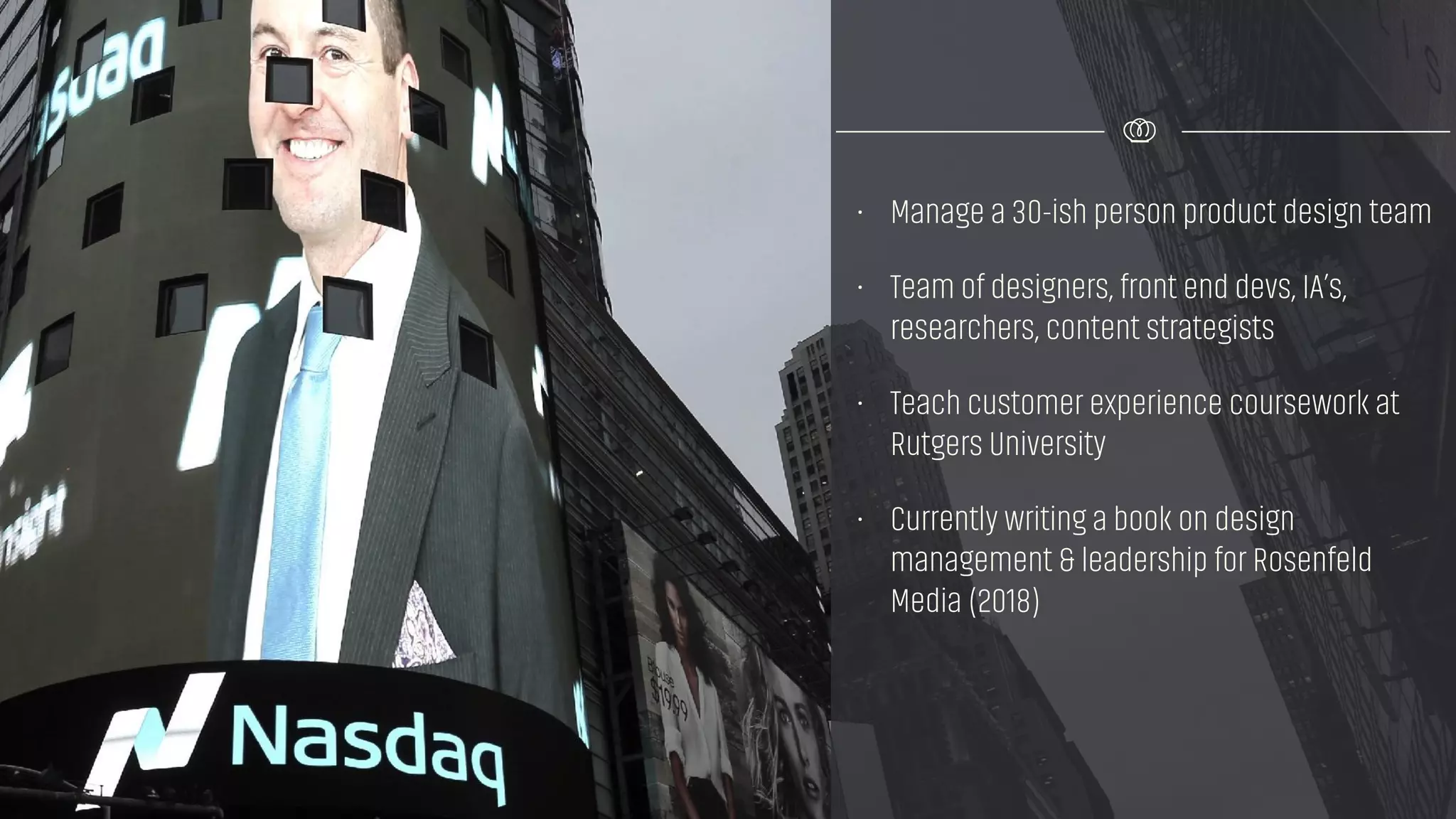
• Manage a 30-ish person product design team
• Team of designers, front end devs, IA’s,
researchers, content strategists
• Teach customer experience coursework at
Rutgers University
• Currently writing a book on design
management & leadership for Rosenfeld
Media (2018)
z
Mature industries that have
focused on more, better and
faster now need to adjust
their thinking to include
design as a key value
differentiator.
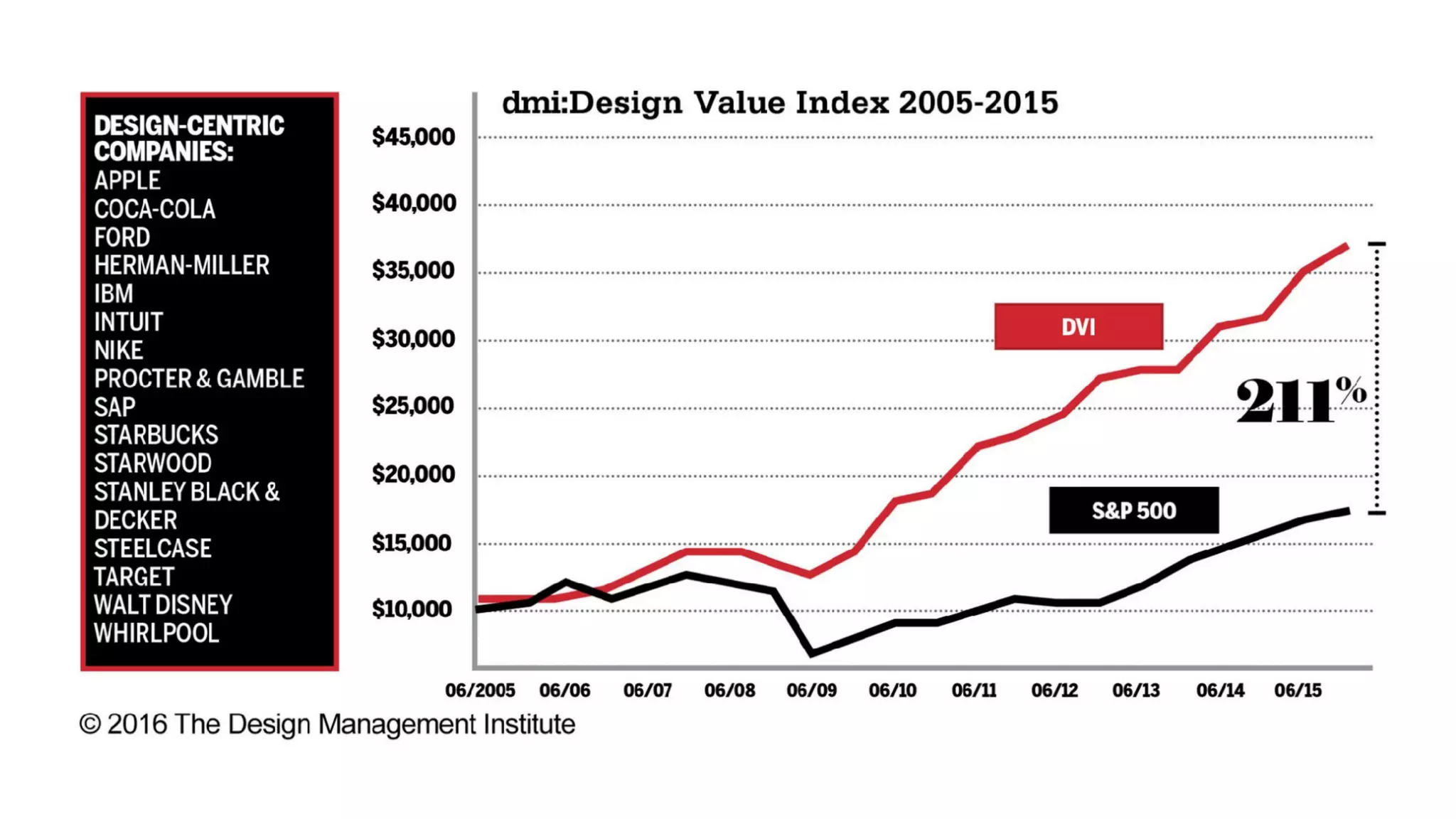
Top companies are leading
with design. Others that
aren’t willing to invest in
design because they think it
can’t be measured or tied to
ROI will fall behind.
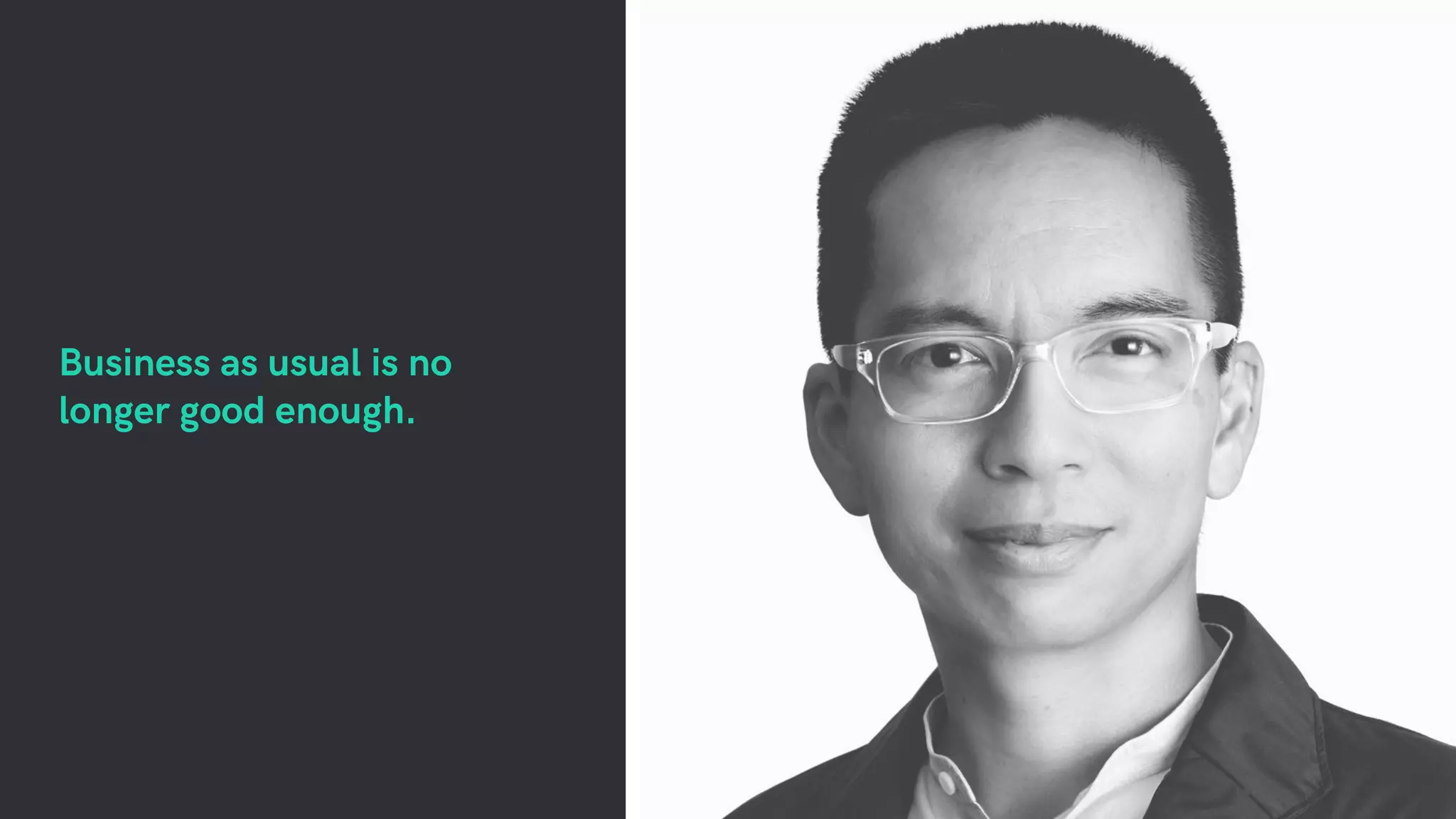
Business as usual is no
longer good enough.
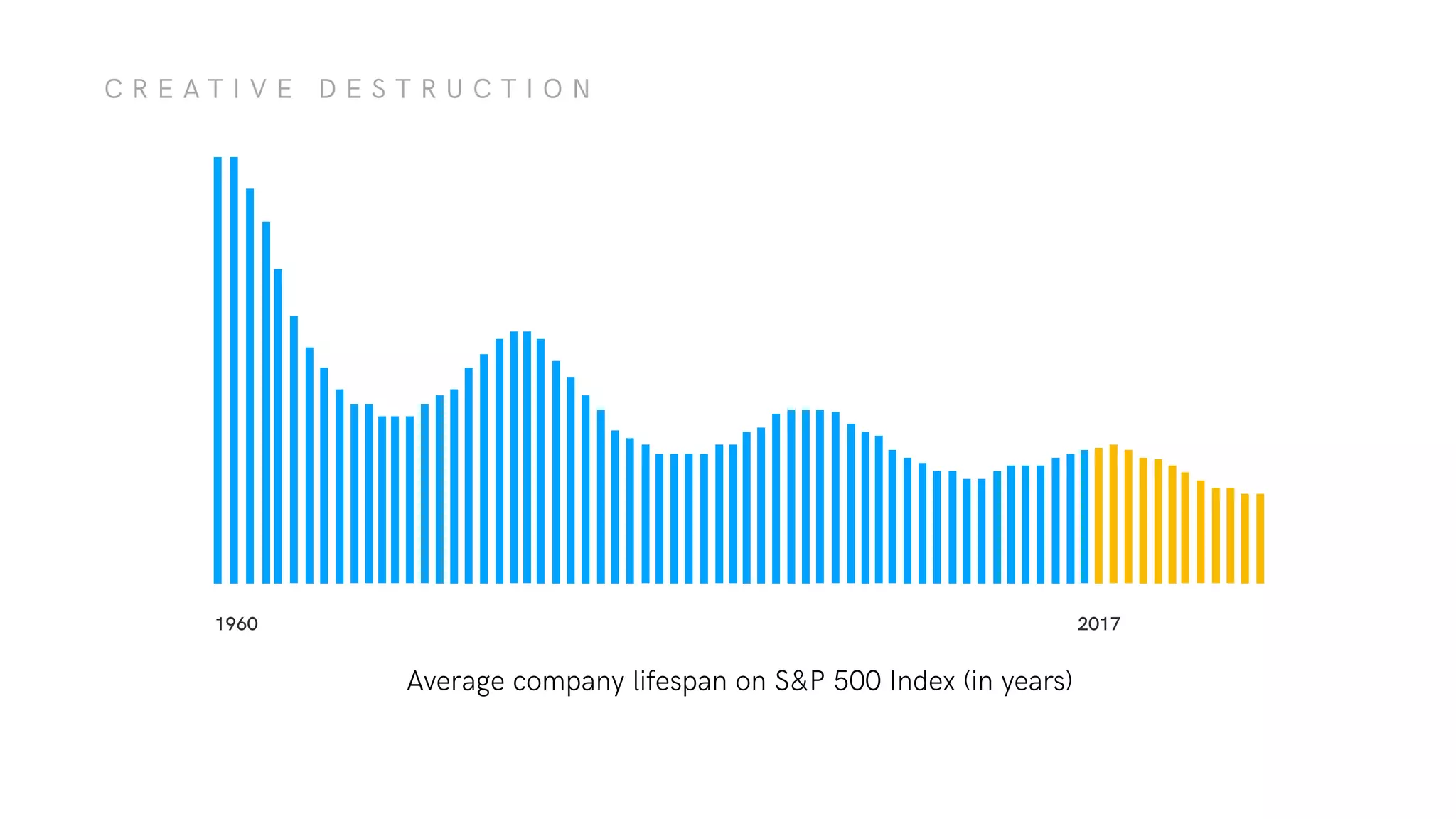
C R E A T I V E D E S T R U C T I O N
Average company lifespan on S&P 500 Index (in years)
1960 2017
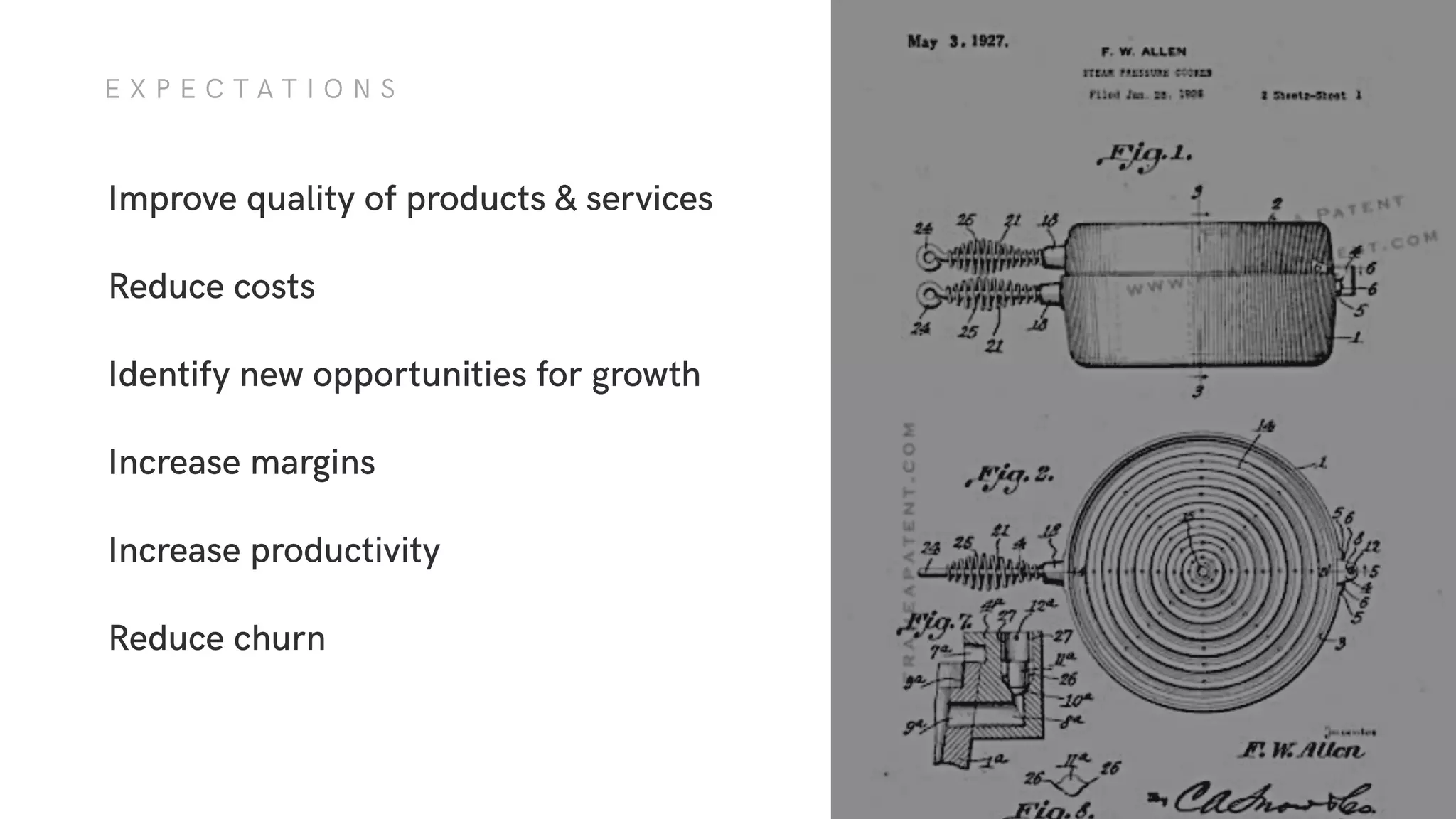
Improve quality of products & services
Reduce costs
Identify new opportunities for growth
Increase margins
Increase productivity
Reduce churn
E X P E C T A T I O N S
New competitors
New technologies
Growth pressure
Lower margins
Globalization
Talent/workforce challenges
More data to “help” us
and it all happens faster
than ever before
R E A L I T Y
Customer Experience
Complex Maze
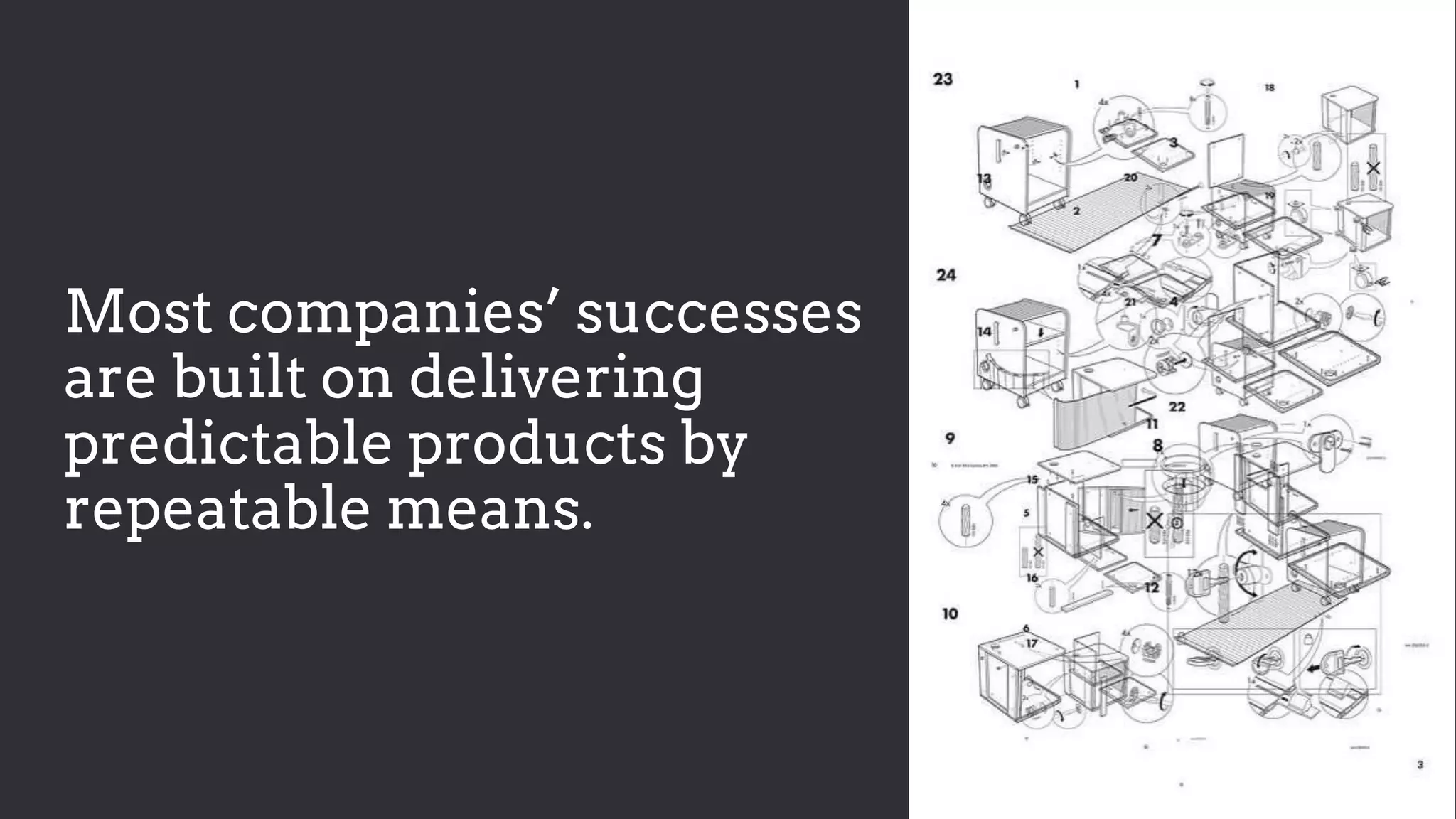
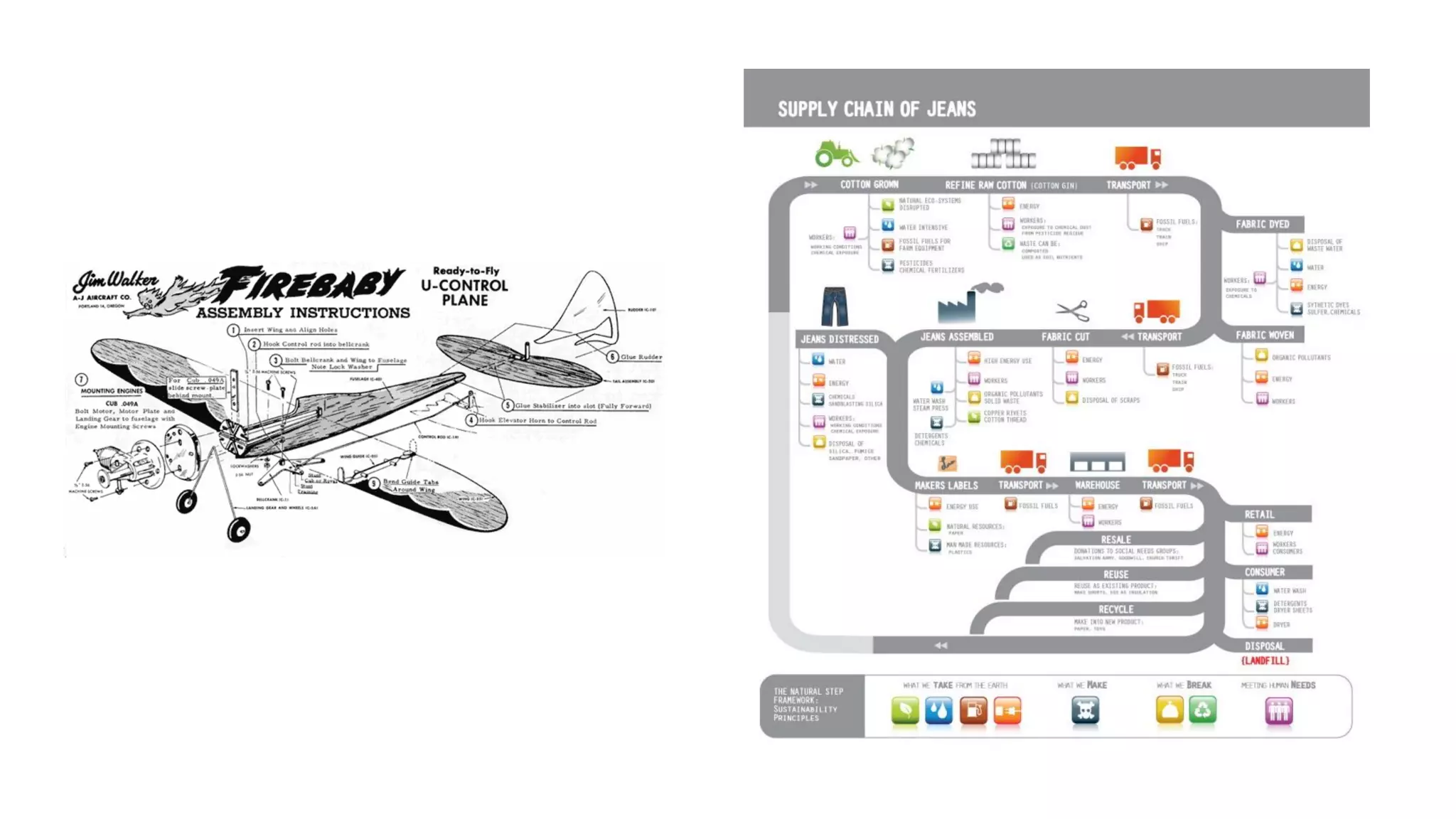
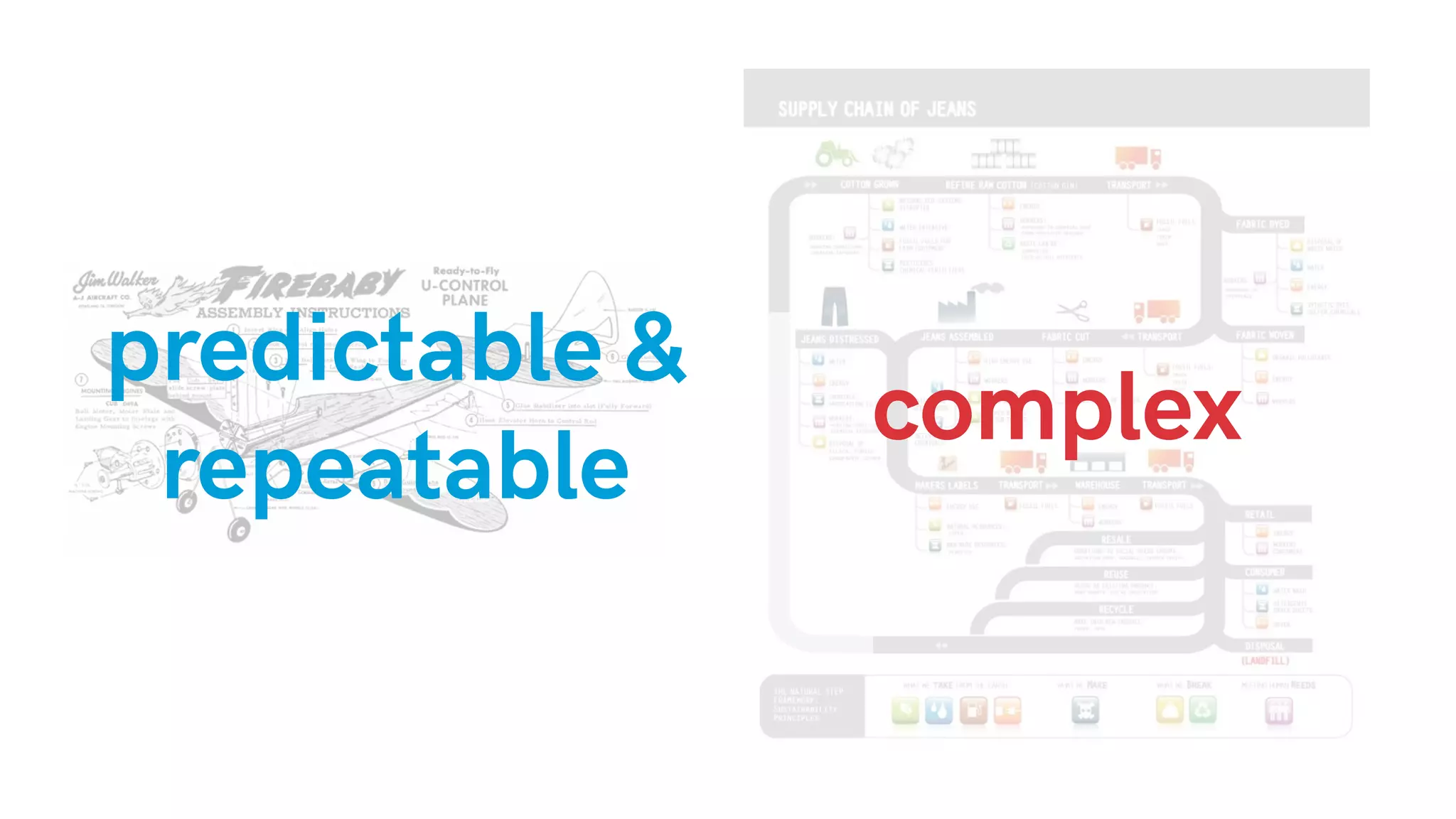
Most companies’ successes
are built on delivering
predictable products by
repeatable means.
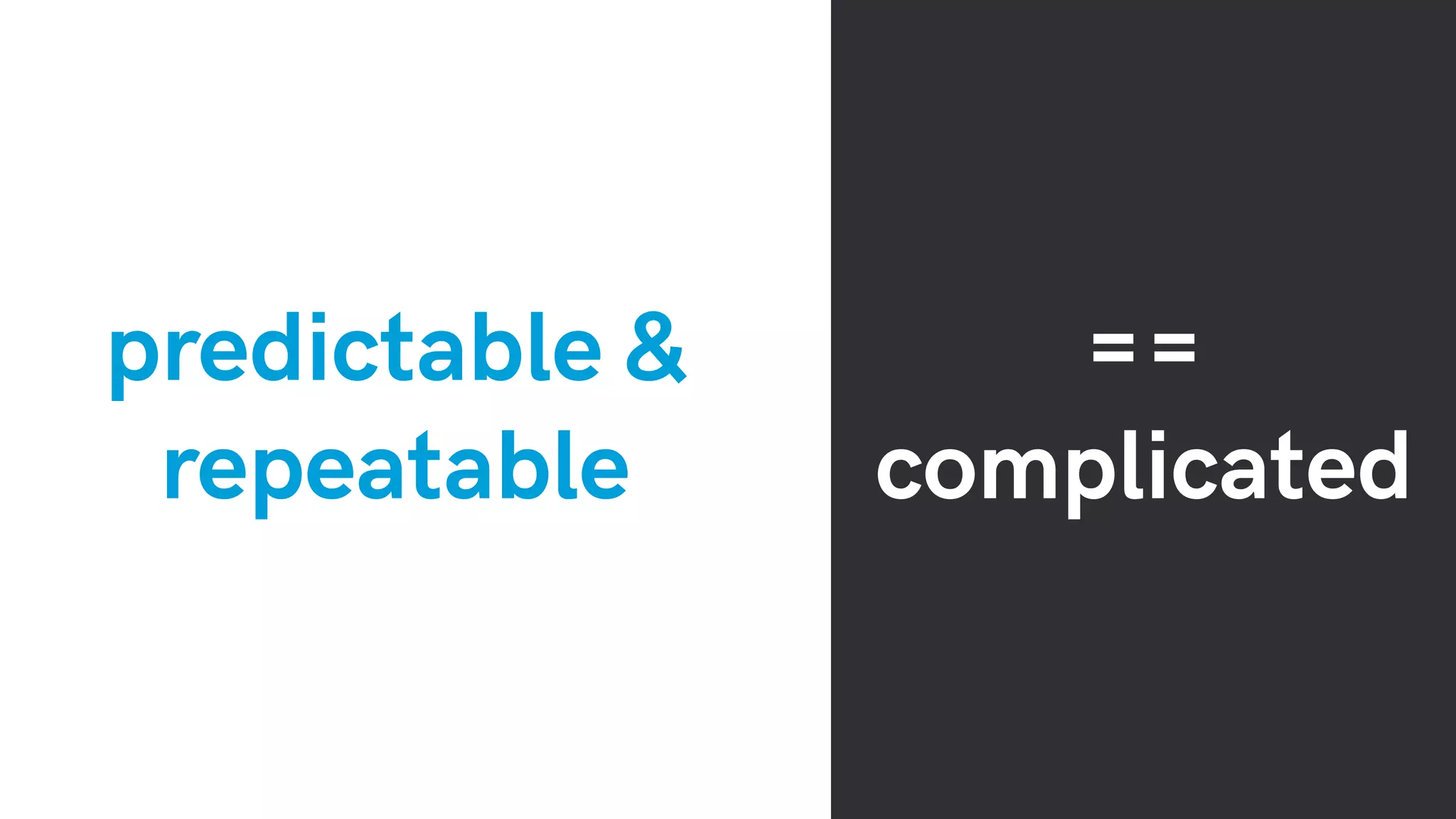
predictable &
repeatable
==
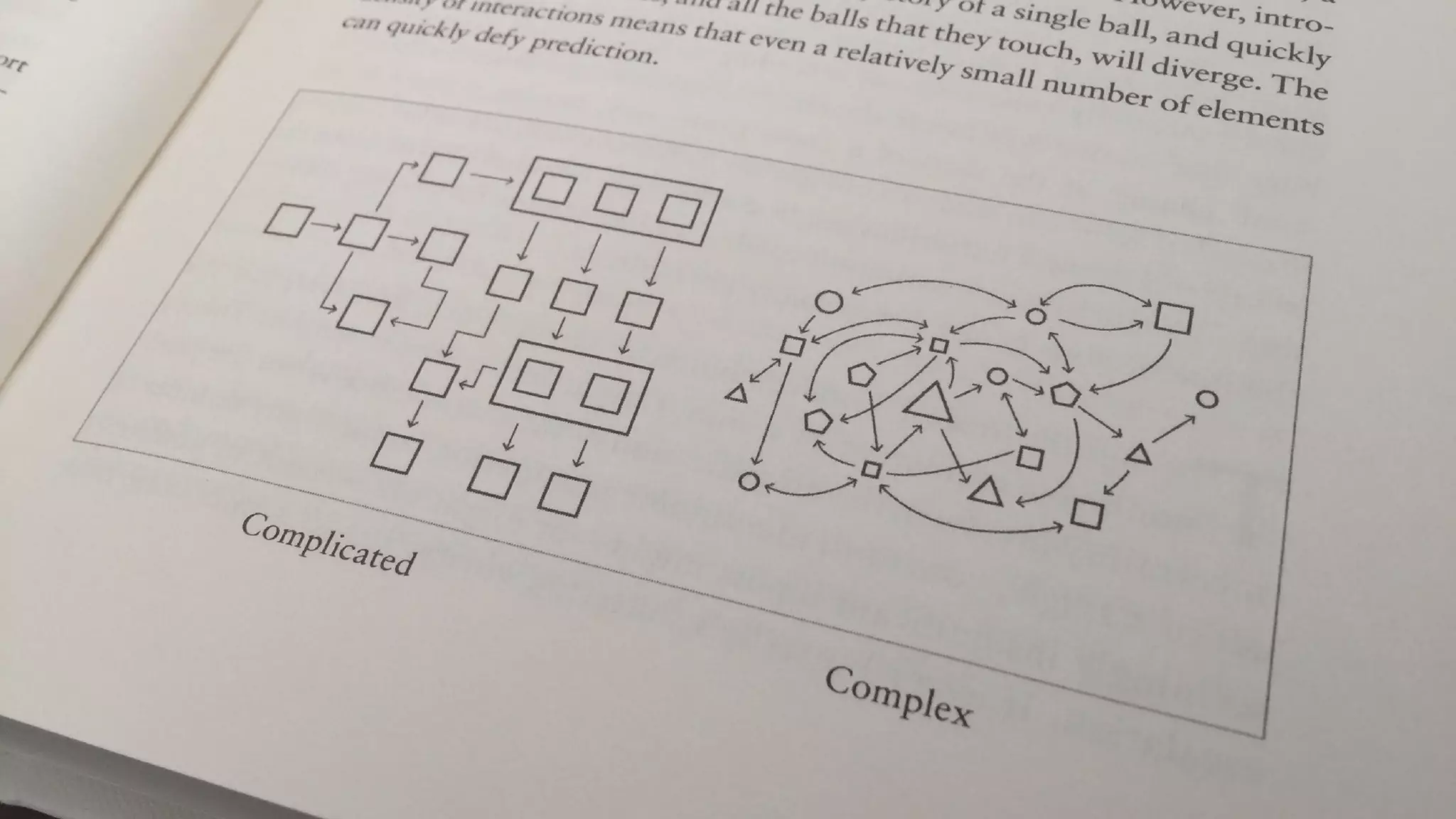
complicated
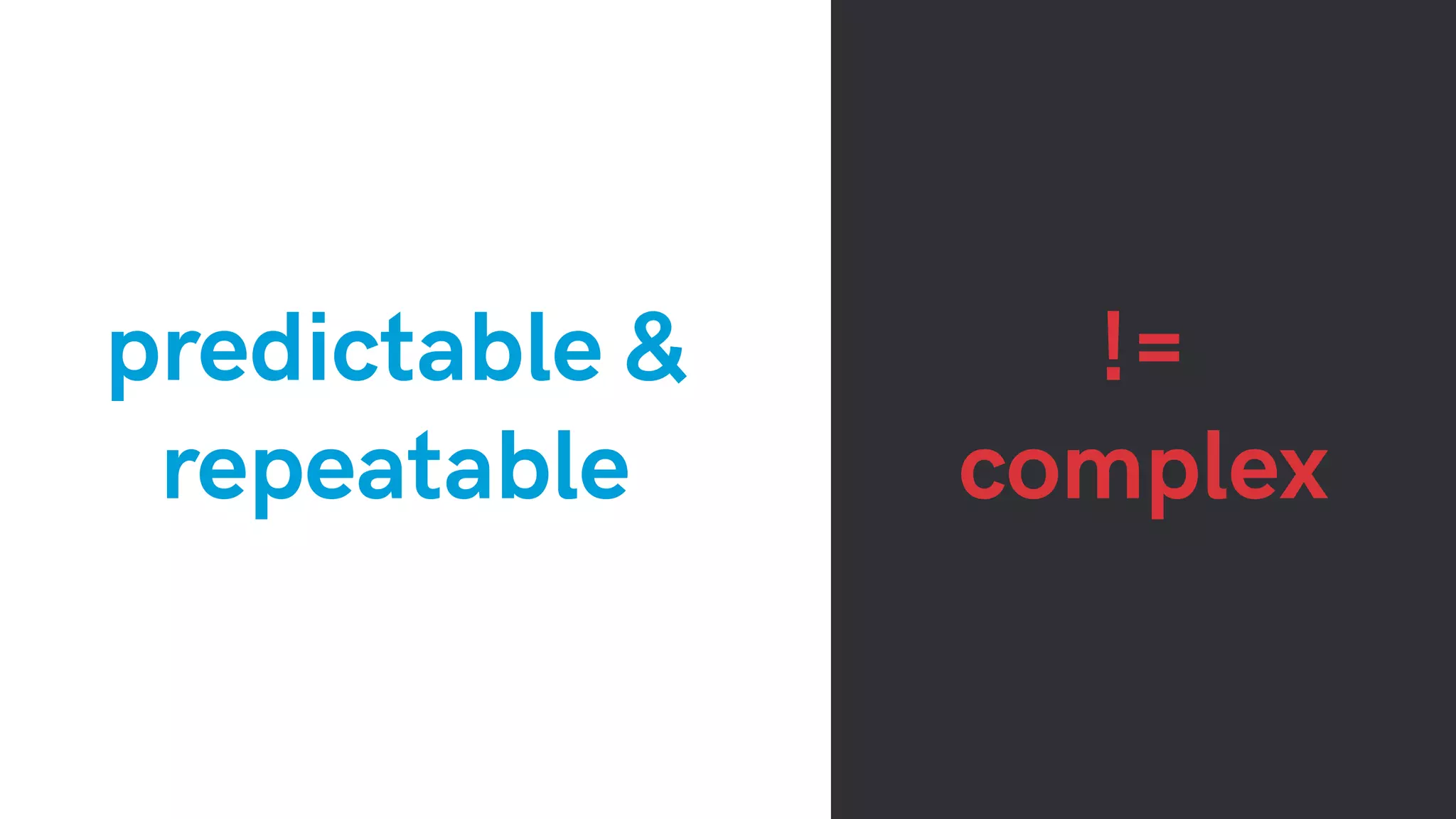
predictable &
repeatable
!=
complex
predictable &
repeatable
analysis
synthesis
logic
rationality
empiricism
efficiency
elimination of waste
best practices
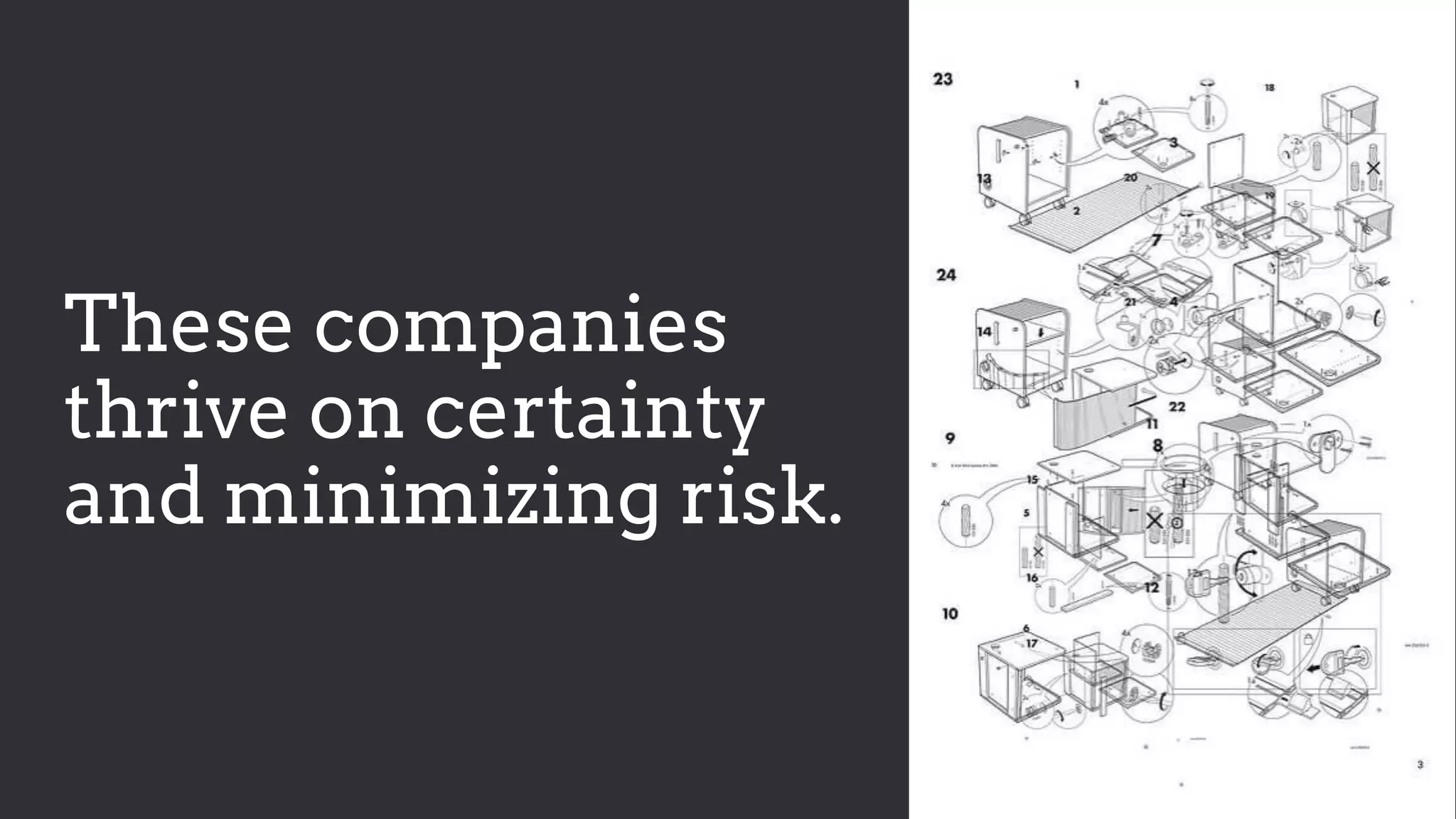
These companies
thrive on certainty
and minimizing risk.
Reductionisiom is the most natural
thing in the world to grasp.
It’s simply the belief that a whole
can be understood if you
understand its parts, and the
nature of their sum.
No one in her left brain could
reject reductionism.
Douglas Hofstrader, Godel, Escher, Bach: an Eternal Golden Braid
“
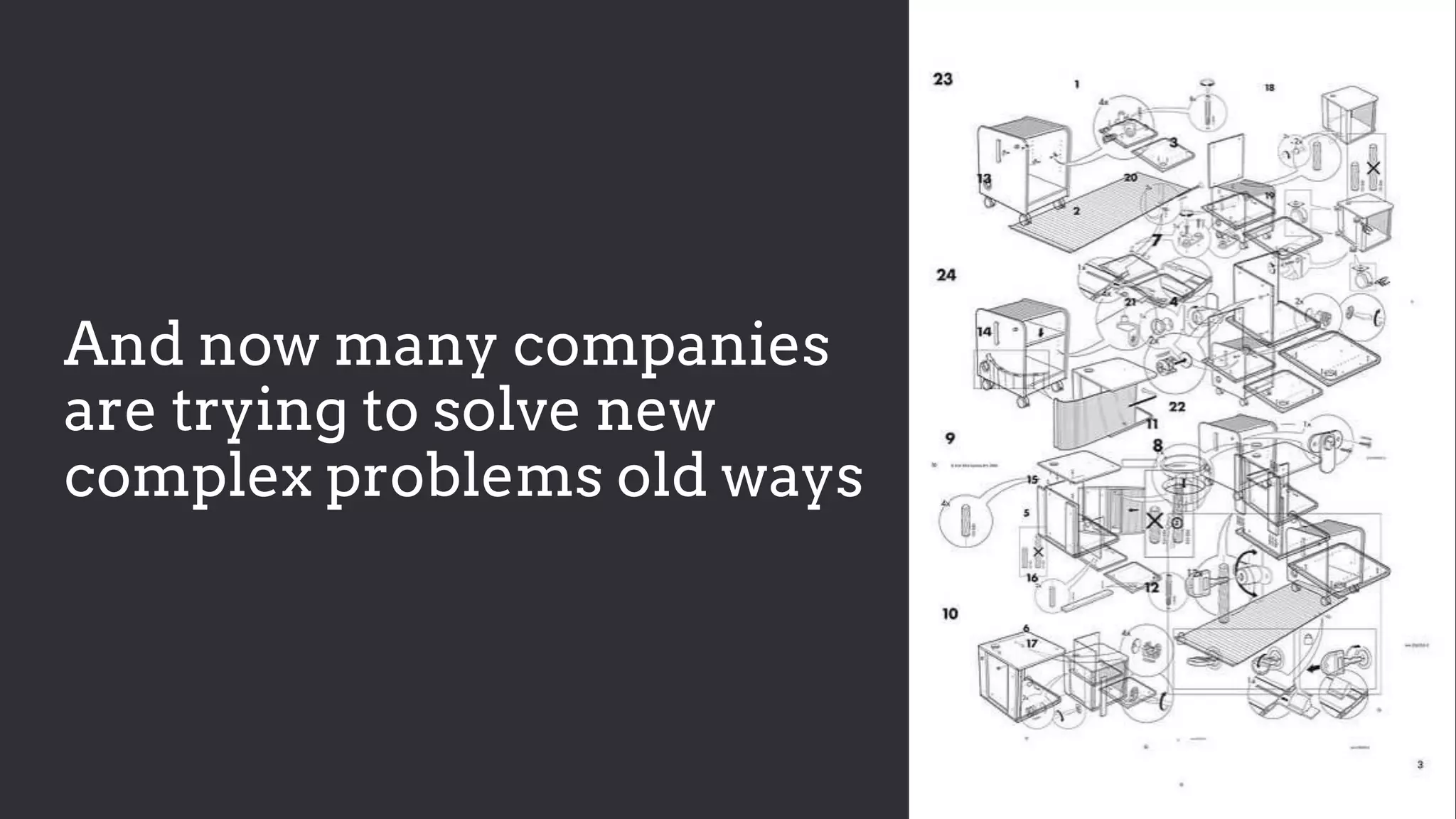
And now many companies
are trying to solve new
complex problems old ways
predictable &
repeatable
complex
C O M P L E X S Y S T E M S I N P R A C T I C E
Customer
Experience 2020
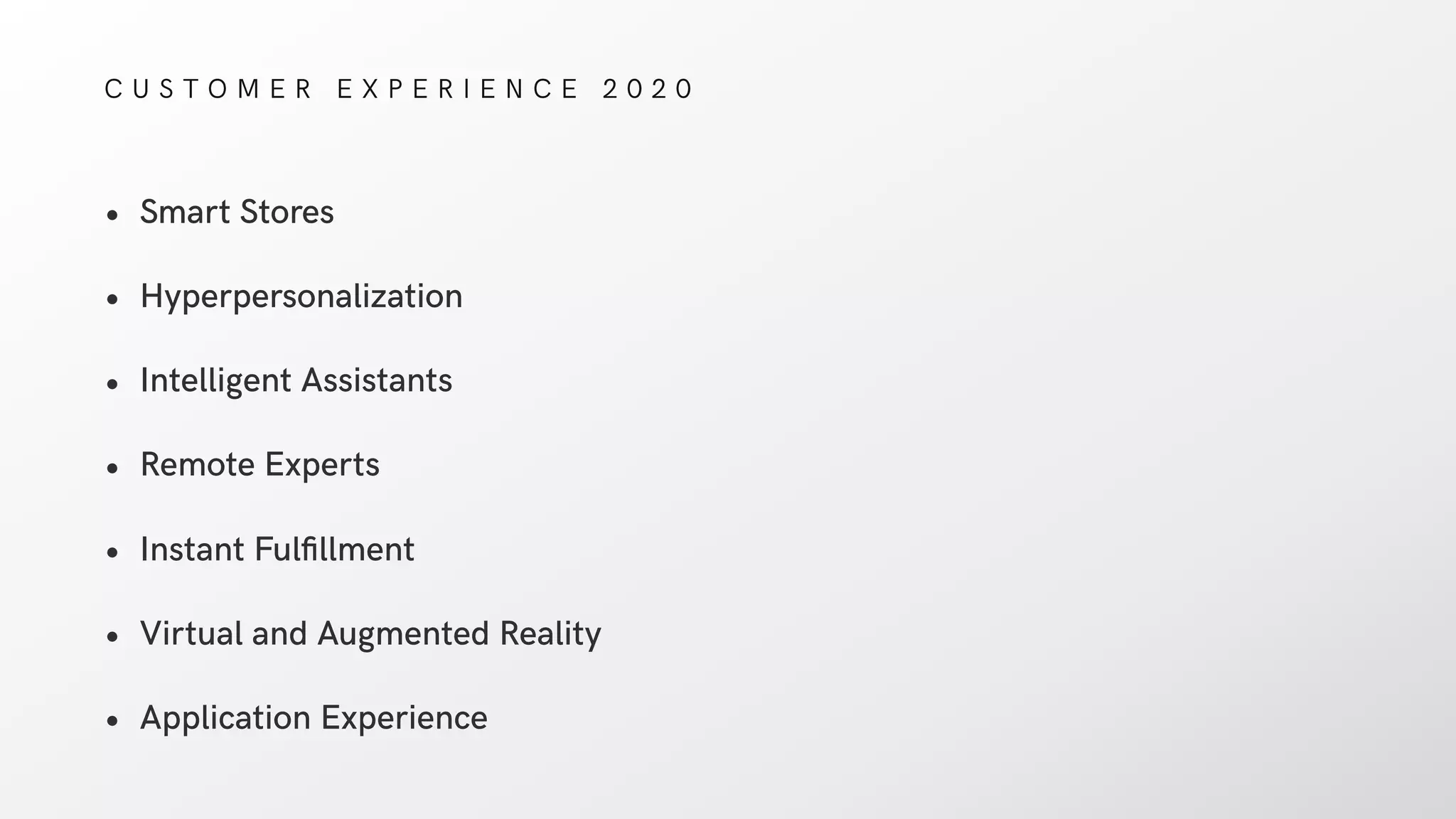
C U S T O M E R E X P E R I E N C E 2 0 2 0
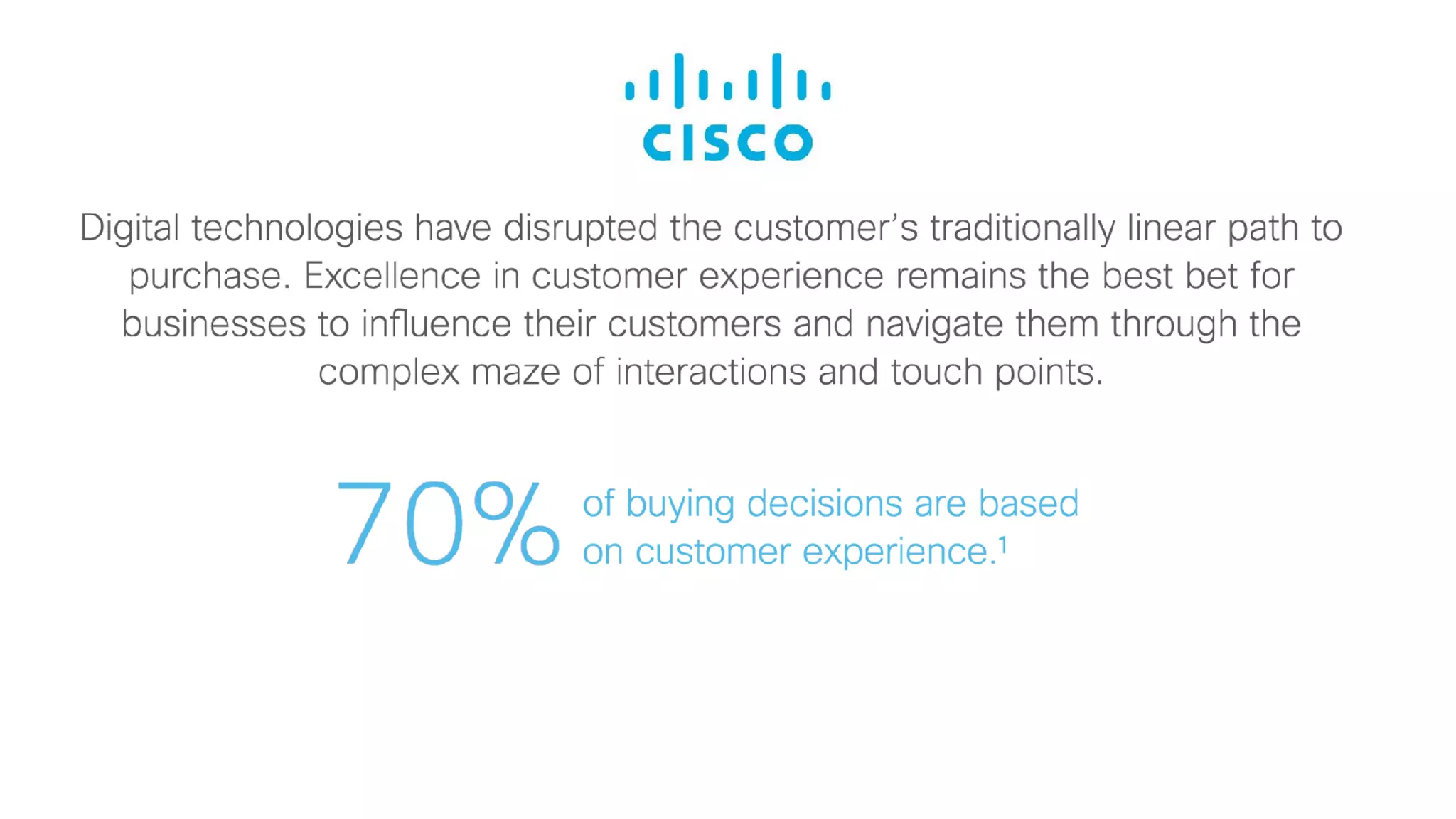
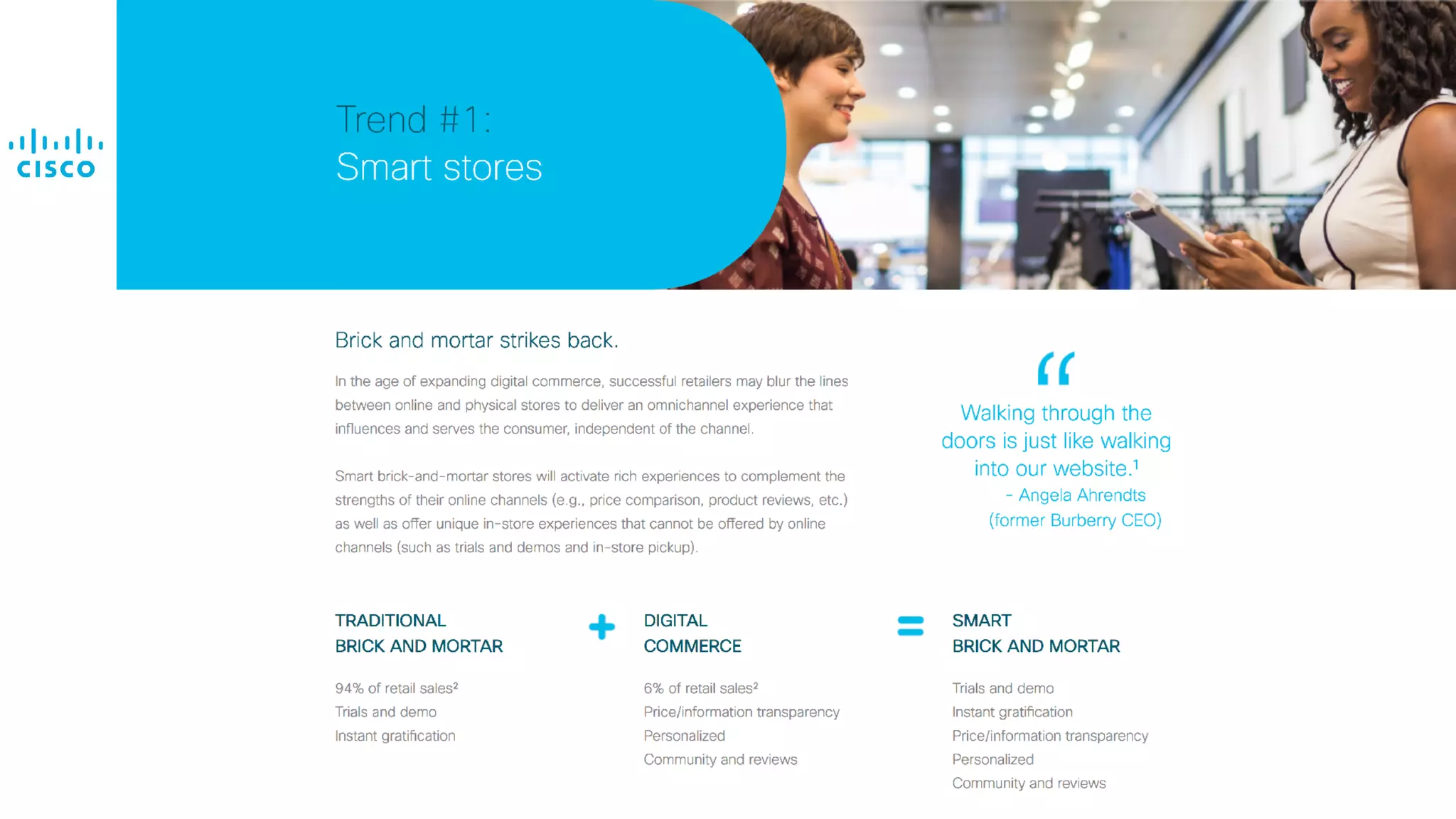
• Smart Stores
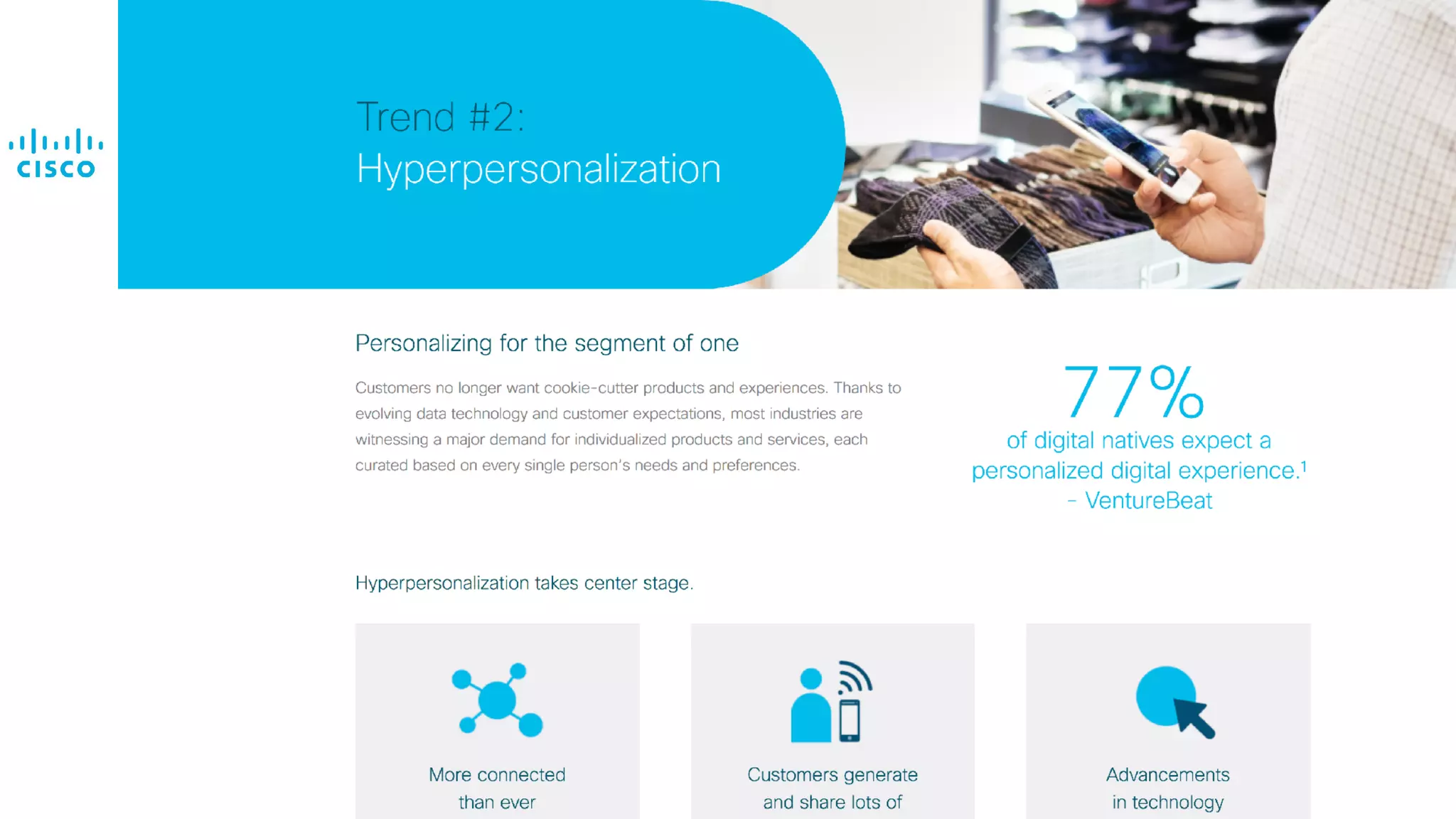
• Hyperpersonalization
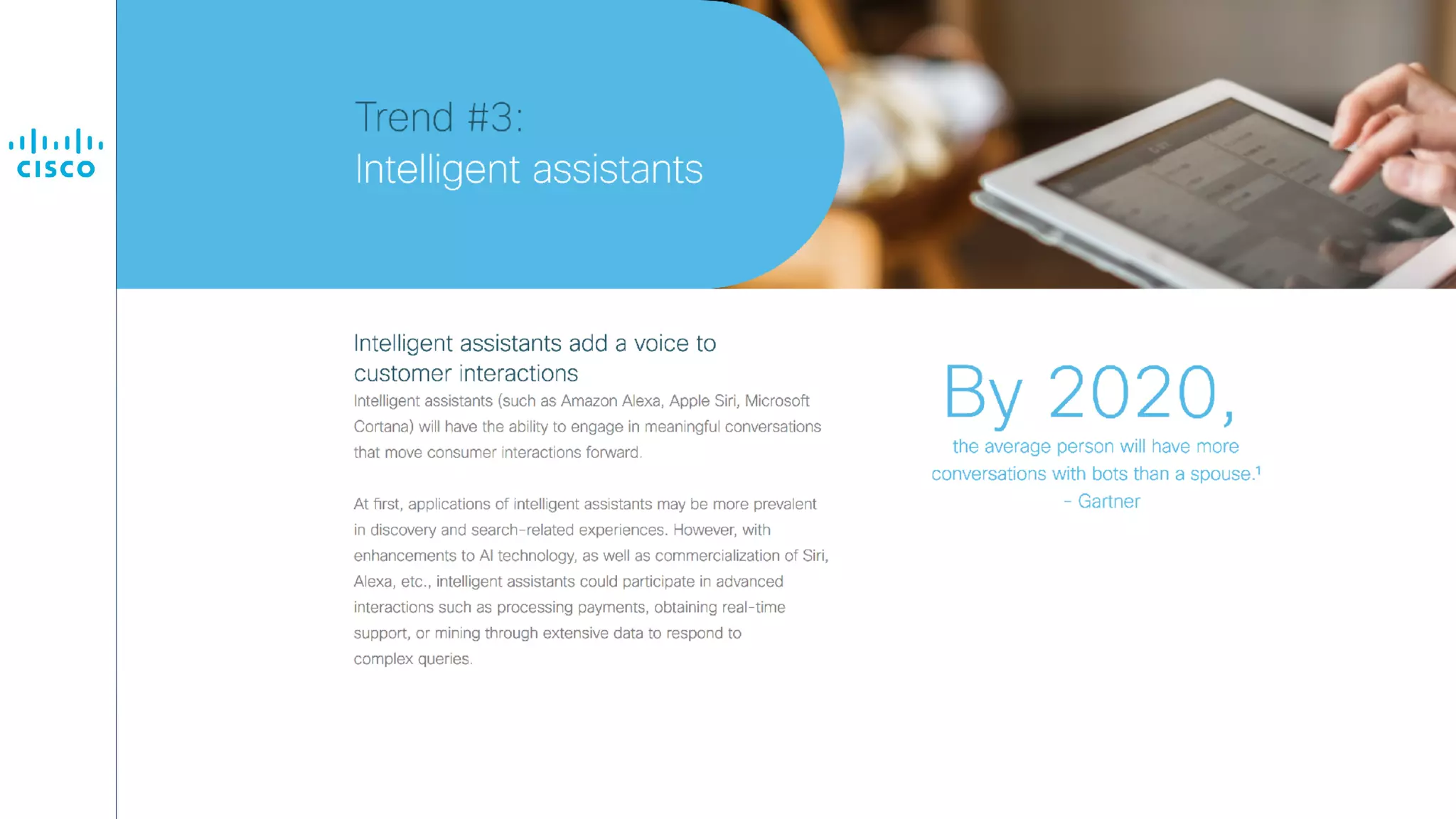
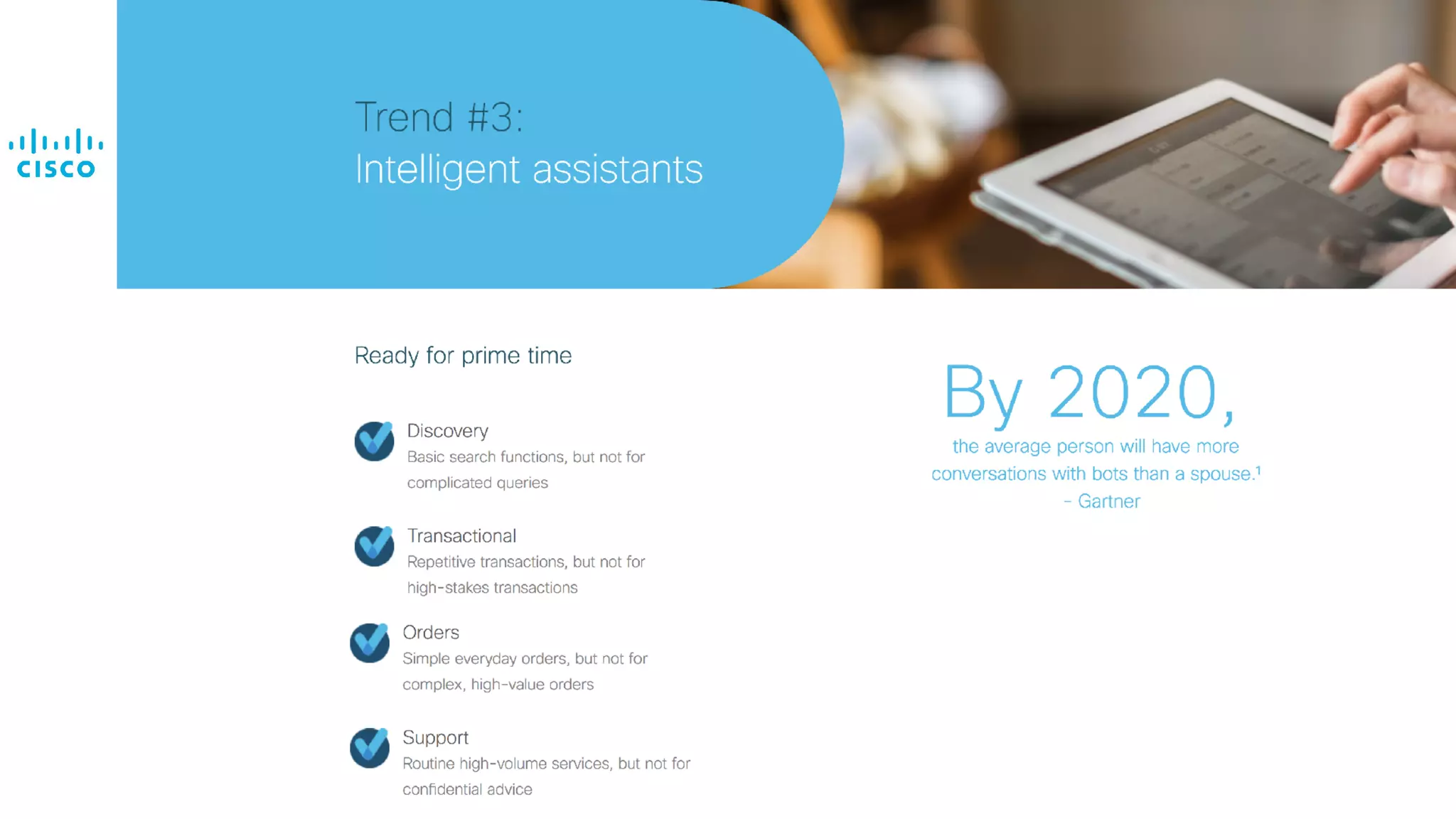
• Intelligent Assistants
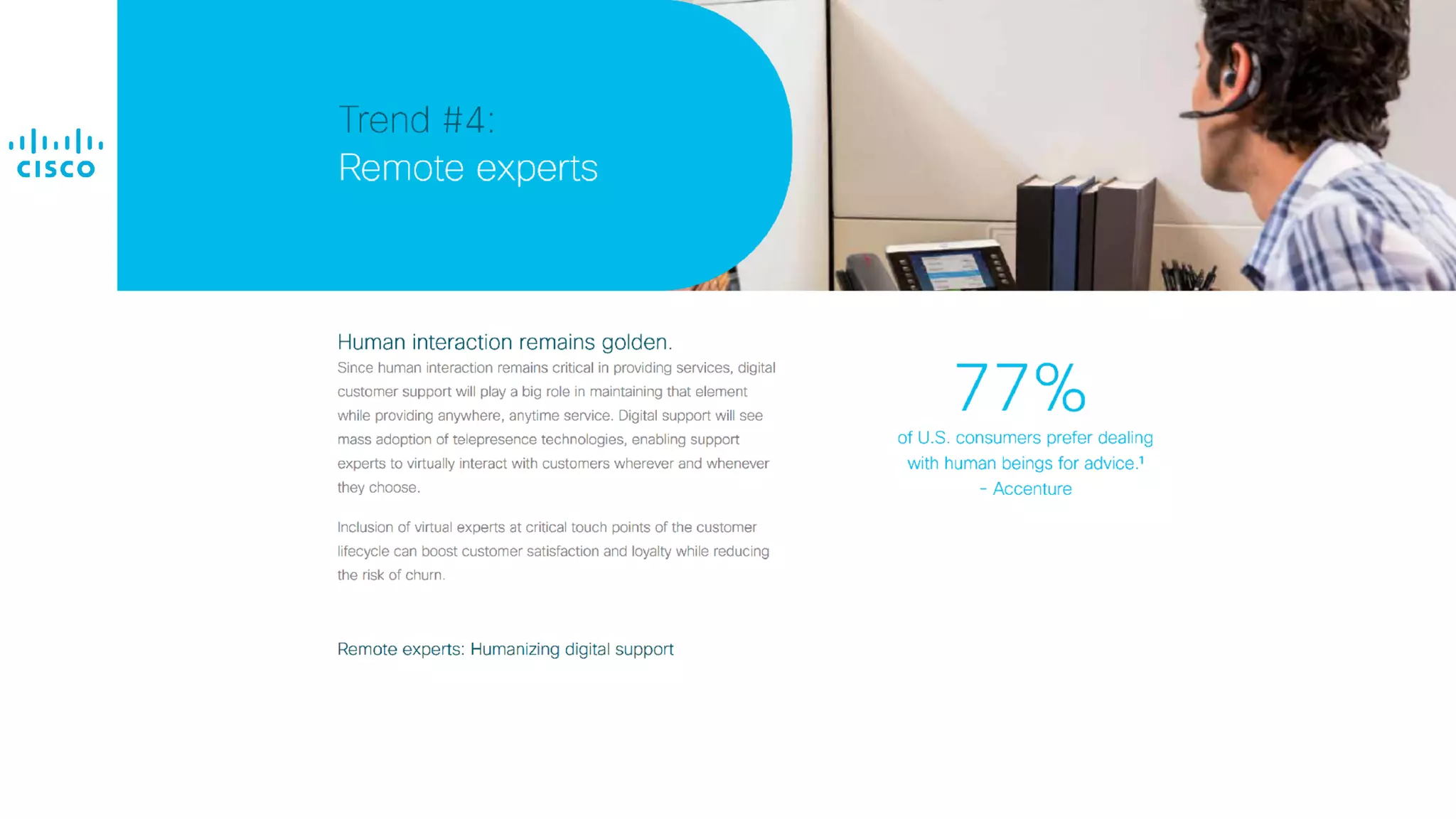
• Remote Experts
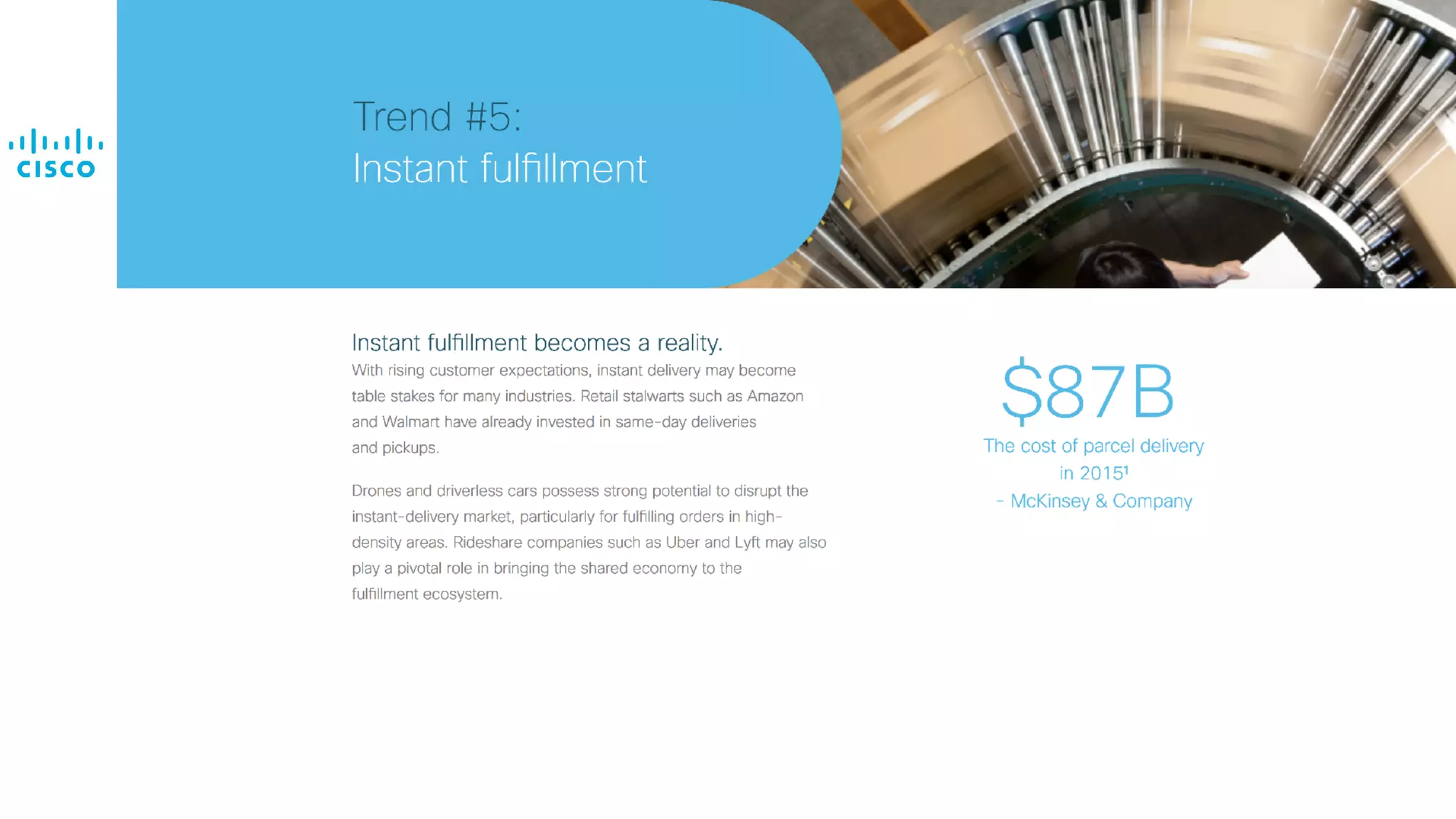
• Instant Fulfillment
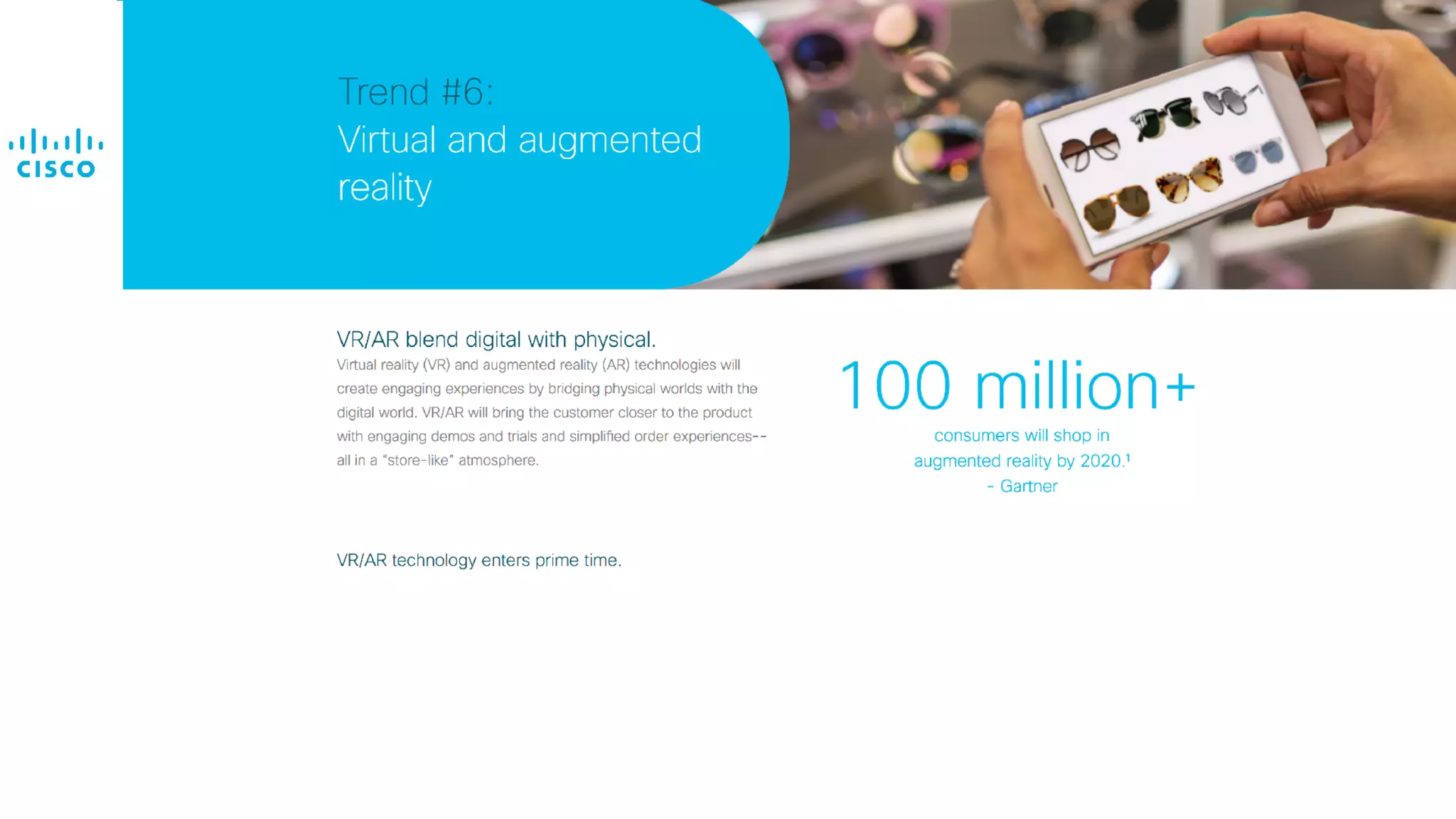
• Virtual and Augmented Reality
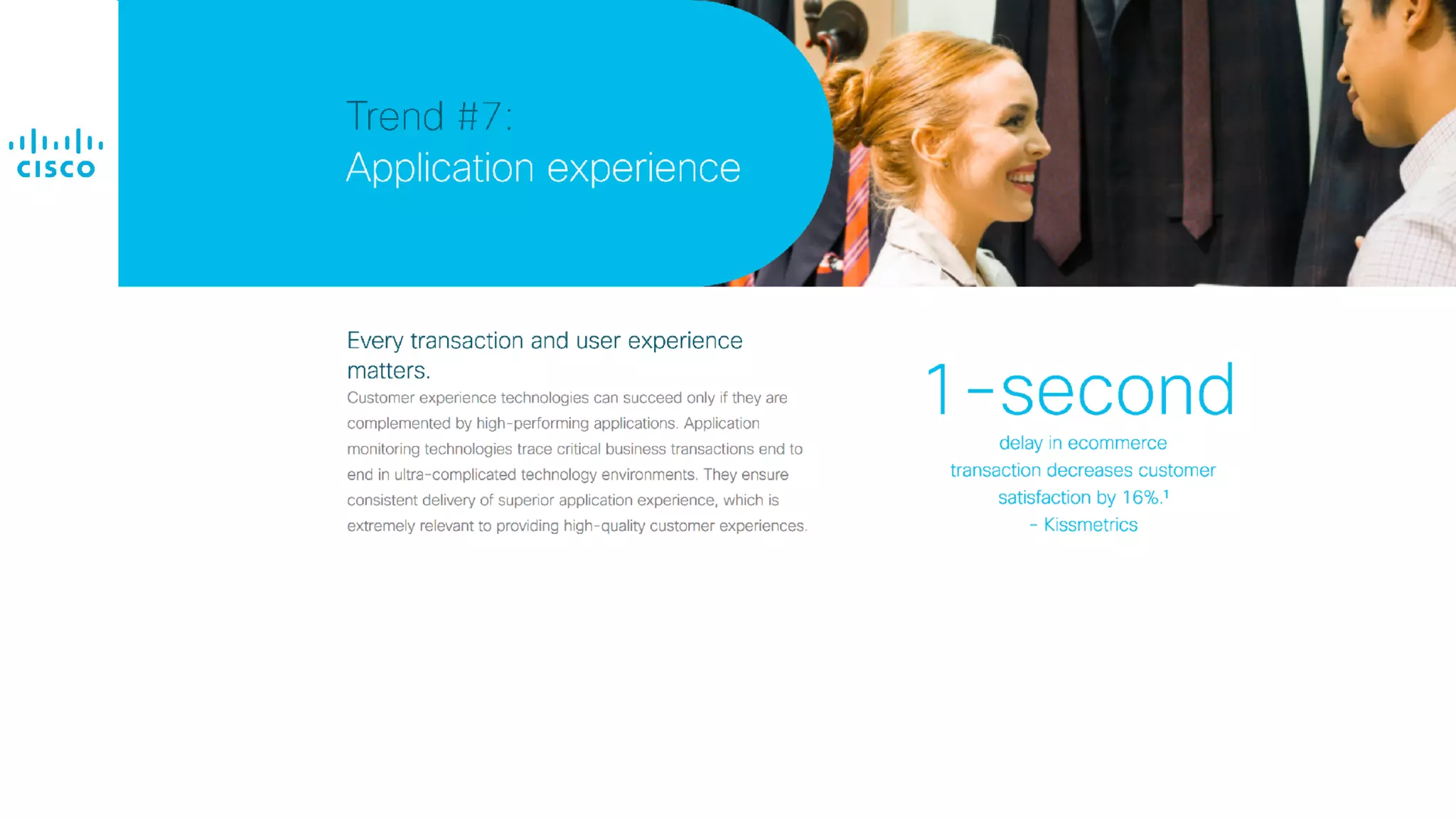
• Application Experience
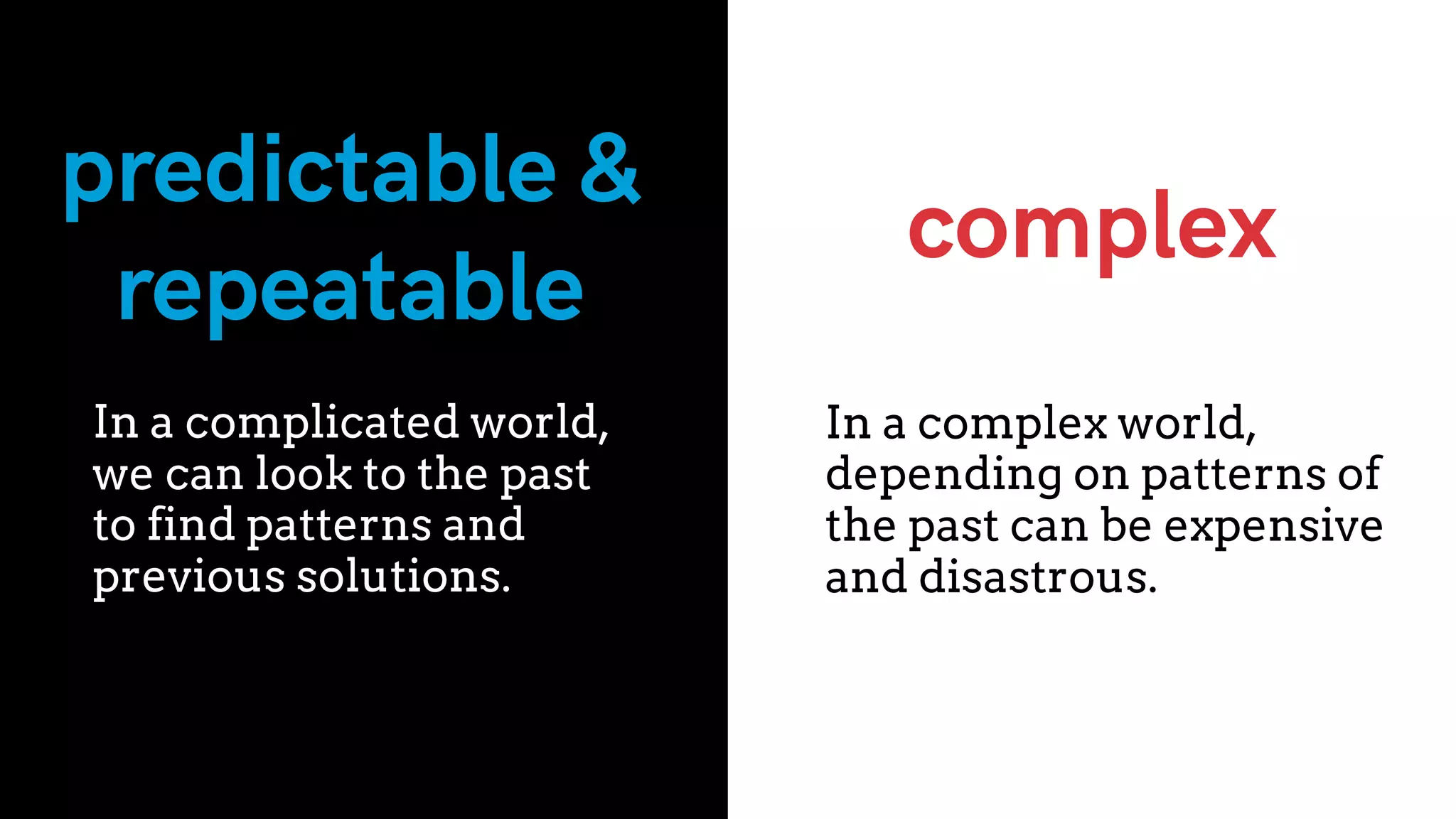
In a complicated world,
we can look to the past
to find patterns and
previous solutions.
predictable &
repeatable
complex
In a complex world,
depending on patterns of
the past can be expensive
and disastrous.
D E S I G N & S Y S T E M S T H I N K I N G
Is Design
Thinking
enough?
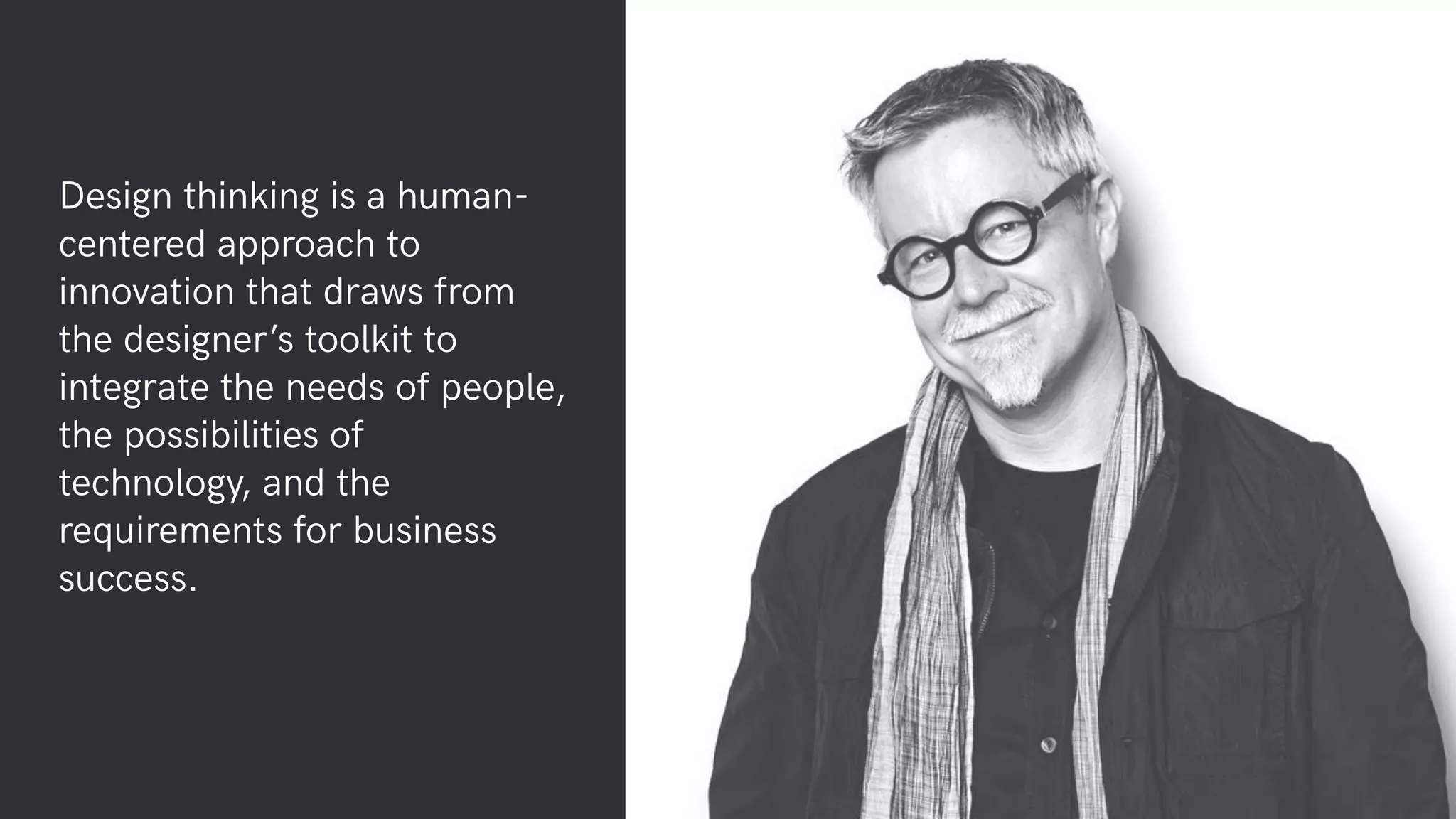
Design thinking is a human-
centered approach to
innovation that draws from
the designer’s toolkit to
integrate the needs of people,
the possibilities of
technology, and the
requirements for business
success.
W H A T I S D E S I G N T H I N K I N G ?
By using design thinking, we make
decisions based on what future
customers really want instead of
relying only on historical data or
making risky bets based on instinct
instead of evidence.
• fast iterations
• early and frequent interaction
with customers
• agile process design with less
hierarchy
• learning-by-doing approach via
prototypes, mockups, etc
I S D E S I G N T H I N K I N G E N O U G H ?
Design thinking may not do enough
to consider the responses of
controlling or optimizing parts of
systems when focusing on only
designing one or two segments
I S D E S I G N T H I N K I N G E N O U G H ?
Even though there are many
perspectives involved in parts of the
design process, the stakeholders give
input solely from their individual
experiences and never see how it fits
into the whole system.
I S D E S I G N T H I N K I N G E N O U G H ?
The designers’ role is
still to piece it all
together. 
Customer Experience
Complex Maze
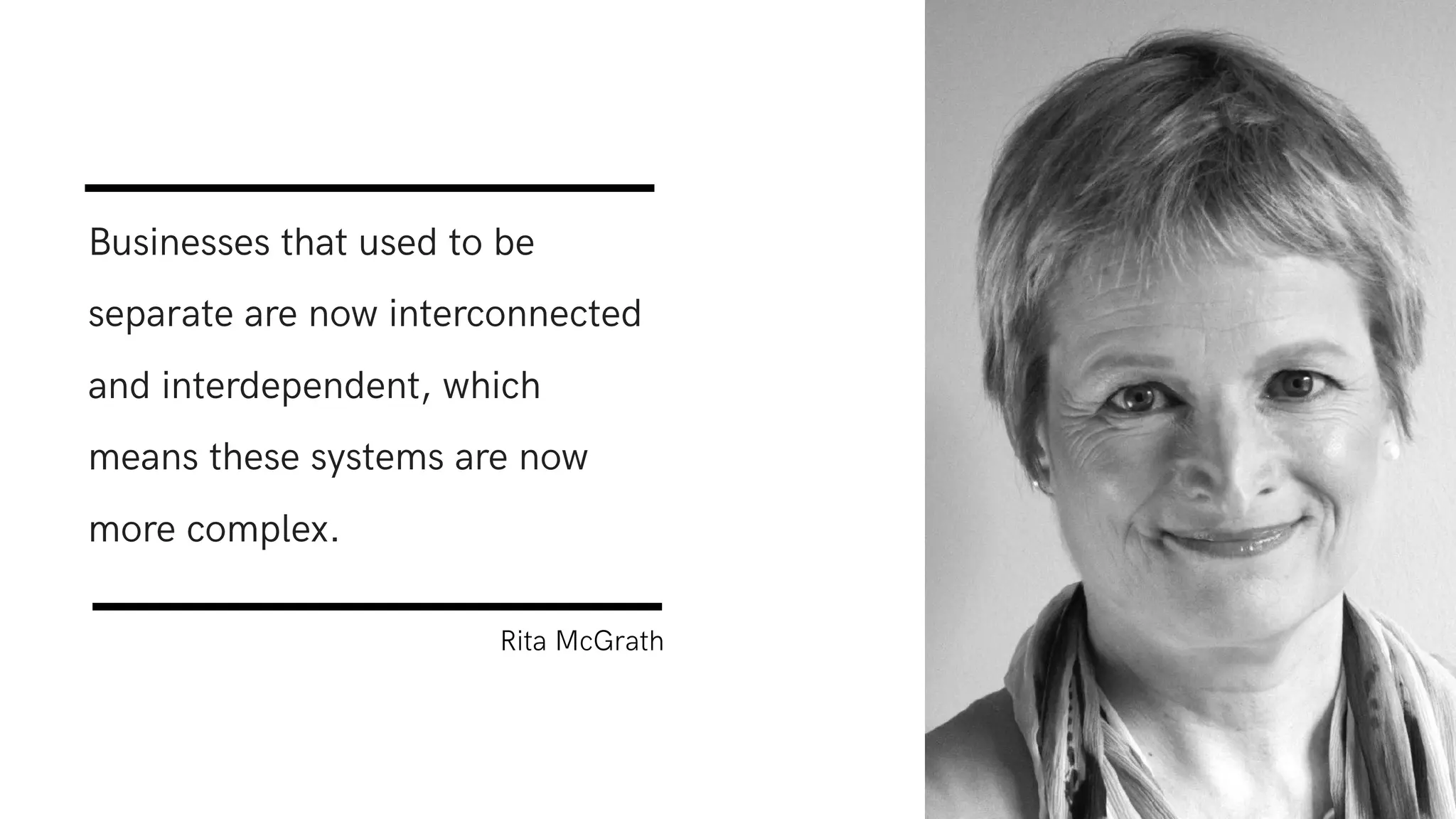
Businesses that used to be
separate are now interconnected
and interdependent, which
means these systems are now
more complex.
Rita McGrath
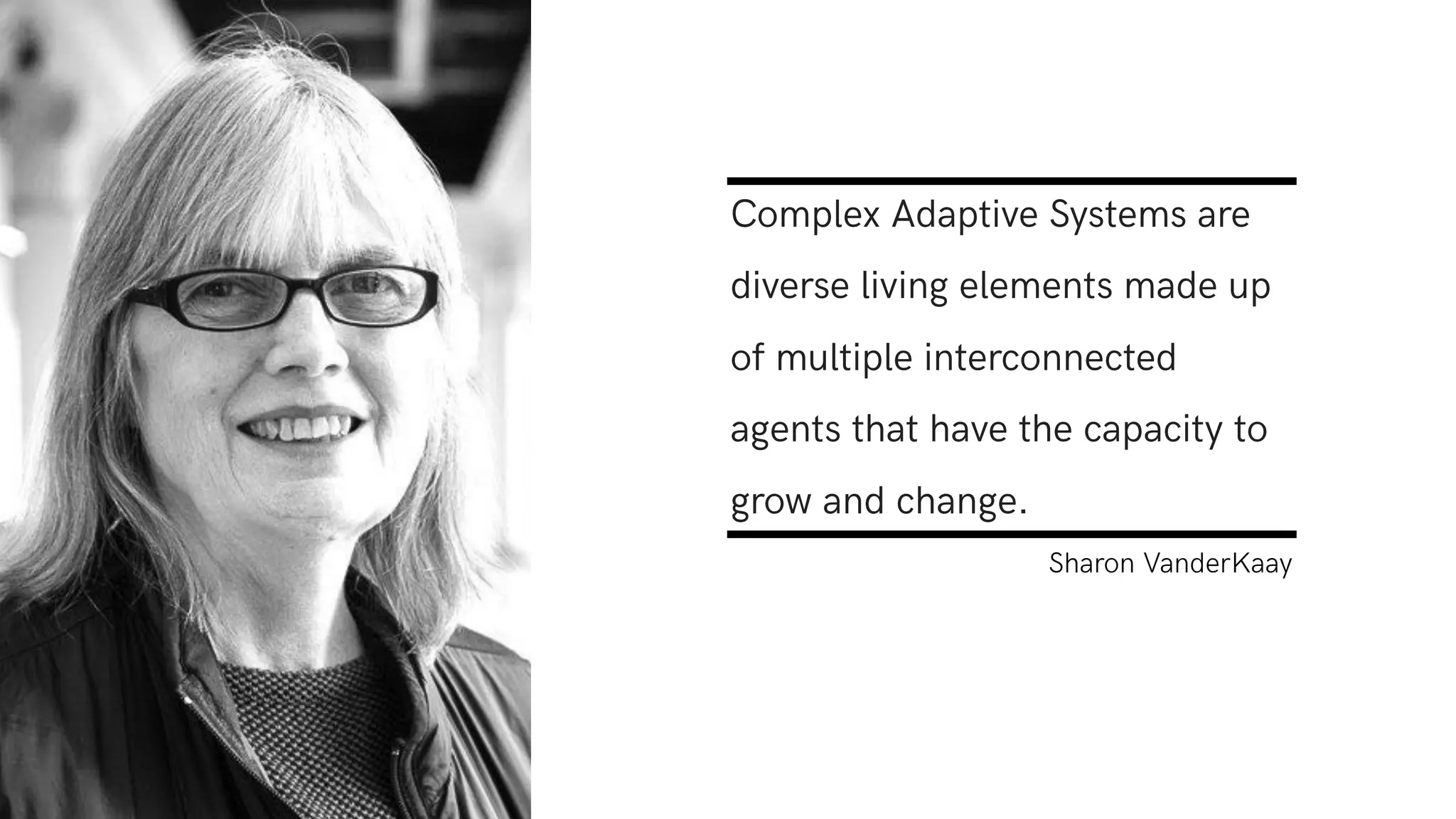
Complex Adaptive Systems are
diverse living elements made up
of multiple interconnected
agents that have the capacity to
grow and change.
Sharon VanderKaay
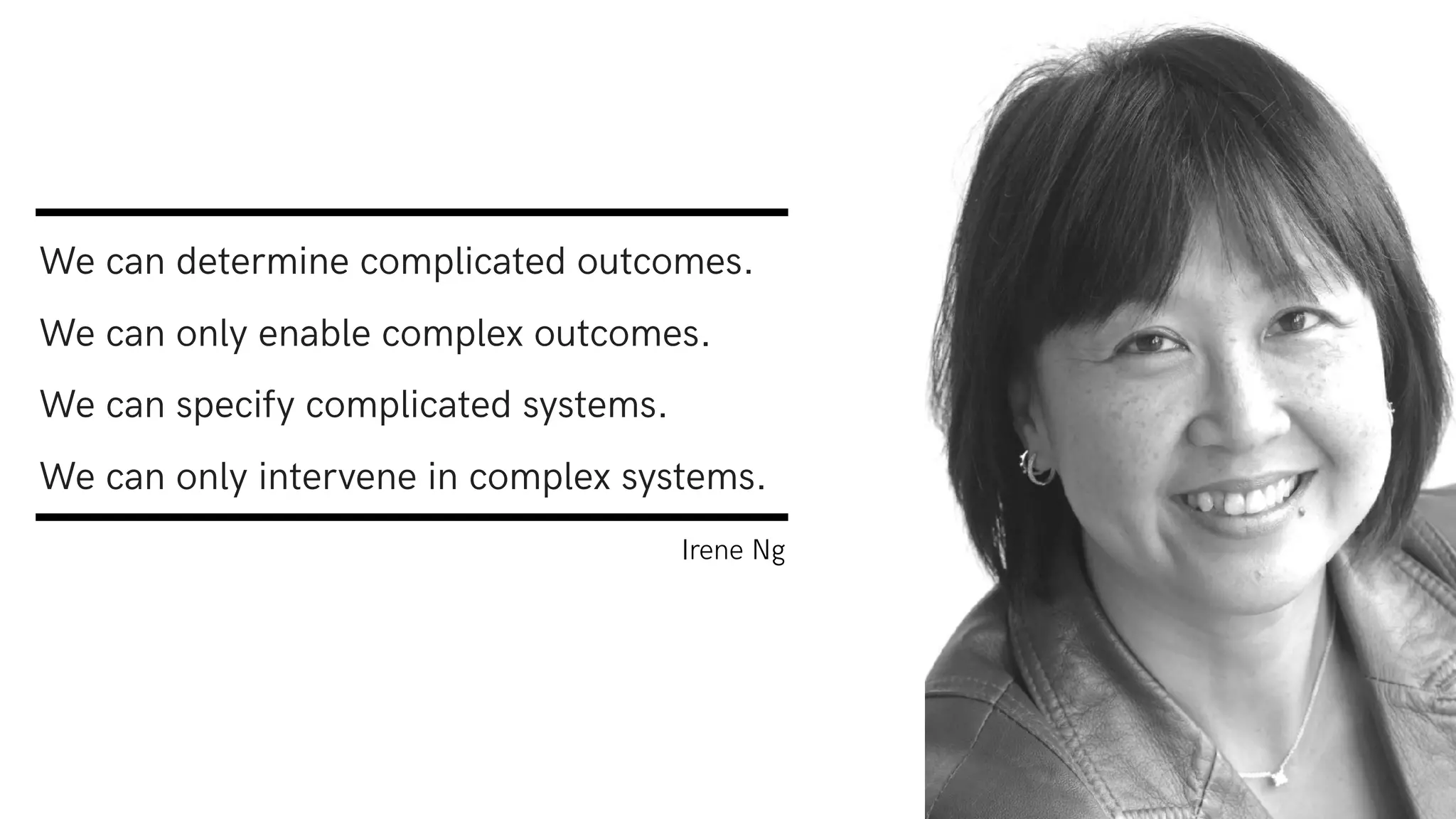
We can determine complicated outcomes.
We can only enable complex outcomes.
We can specify complicated systems.
We can only intervene in complex systems.
Irene Ng
Design thinking is no longer enough to
prepare for the complex challenges facing
our teams, products, and businesses.
We need to view these challenges through a
lens of systems thinking to survive, scale,
and thrive in a complex world.
Systems thinking is a management discipline that
concerns an understanding of a system by examining
the linkages and interactions between the components
that comprise the entirety of that defined system.
Systems thinking is a management discipline that
concerns an understanding of a system by examining
the linkages and interactions between the components
that comprise the entirety of that defined system.
linkages interactions
entirety of that defined system
Systems thinking is a management discipline that
concerns an understanding of a system by examining
the linkages and interactions between the components
that comprise the entirety of that defined system.entirety of that defined system
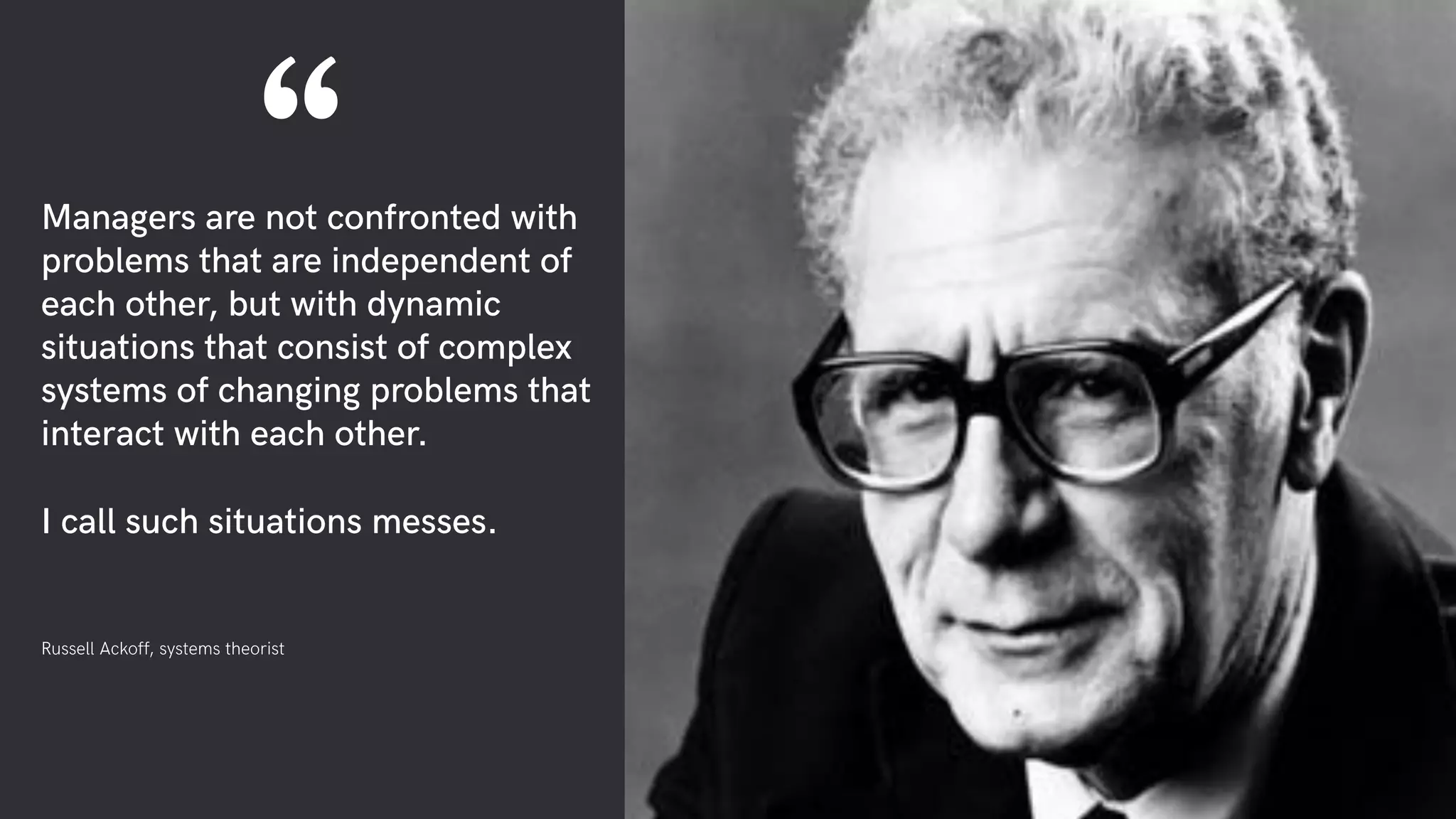
Managers are not confronted with
problems that are independent of
each other, but with dynamic
situations that consist of complex
systems of changing problems that
interact with each other.
I call such situations messes.
Russell Ackoff, systems theorist
“
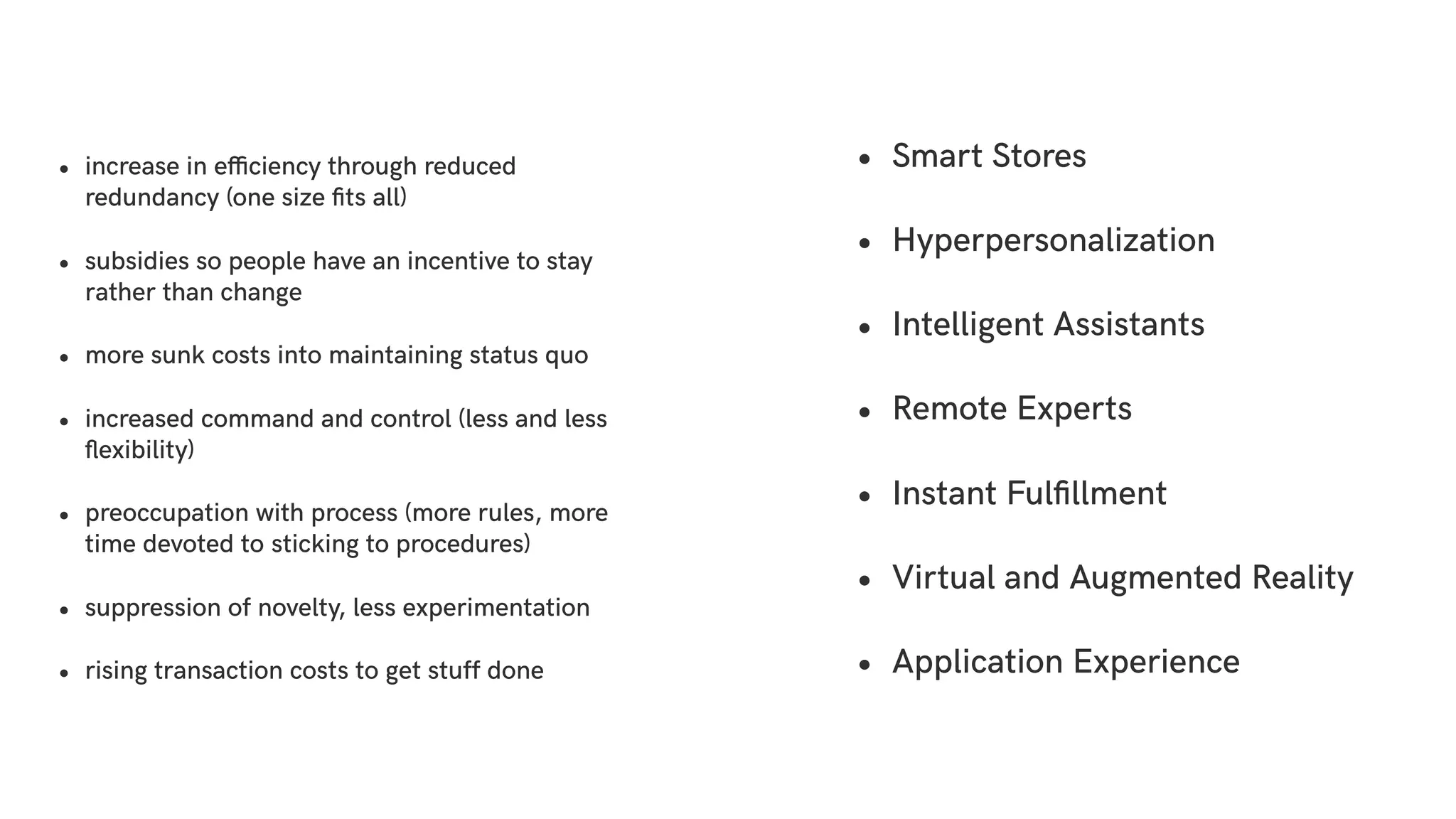
• increase in efficiency through reduced
redundancy (one size fits all)
• subsidies so people have an incentive to stay
rather than change
• more sunk costs into maintaining status quo
• increased command and control (less and less
flexibility)
• preoccupation with process (more rules, more
time devoted to sticking to procedures)
• suppression of novelty, less experimentation
• rising transaction costs to get stuff done
• Smart Stores
• Hyperpersonalization
• Intelligent Assistants
• Remote Experts
• Instant Fulfillment
• Virtual and Augmented Reality
• Application Experience
• increase in efficiency through reduced
redundancy (one size fits all)
• subsidies so people have an incentive to stay
rather than change
• more sunk costs into maintaining status quo
• increased command and control (less and less
flexibility)
• preoccupation with process (more rules, more
time devoted to sticking to procedures)
• suppression of novelty, less experimentation
• rising transaction costs to get stuff done
• Smart Stores
• Hyperpersonalization
• Intelligent Assistants
• Remote Experts
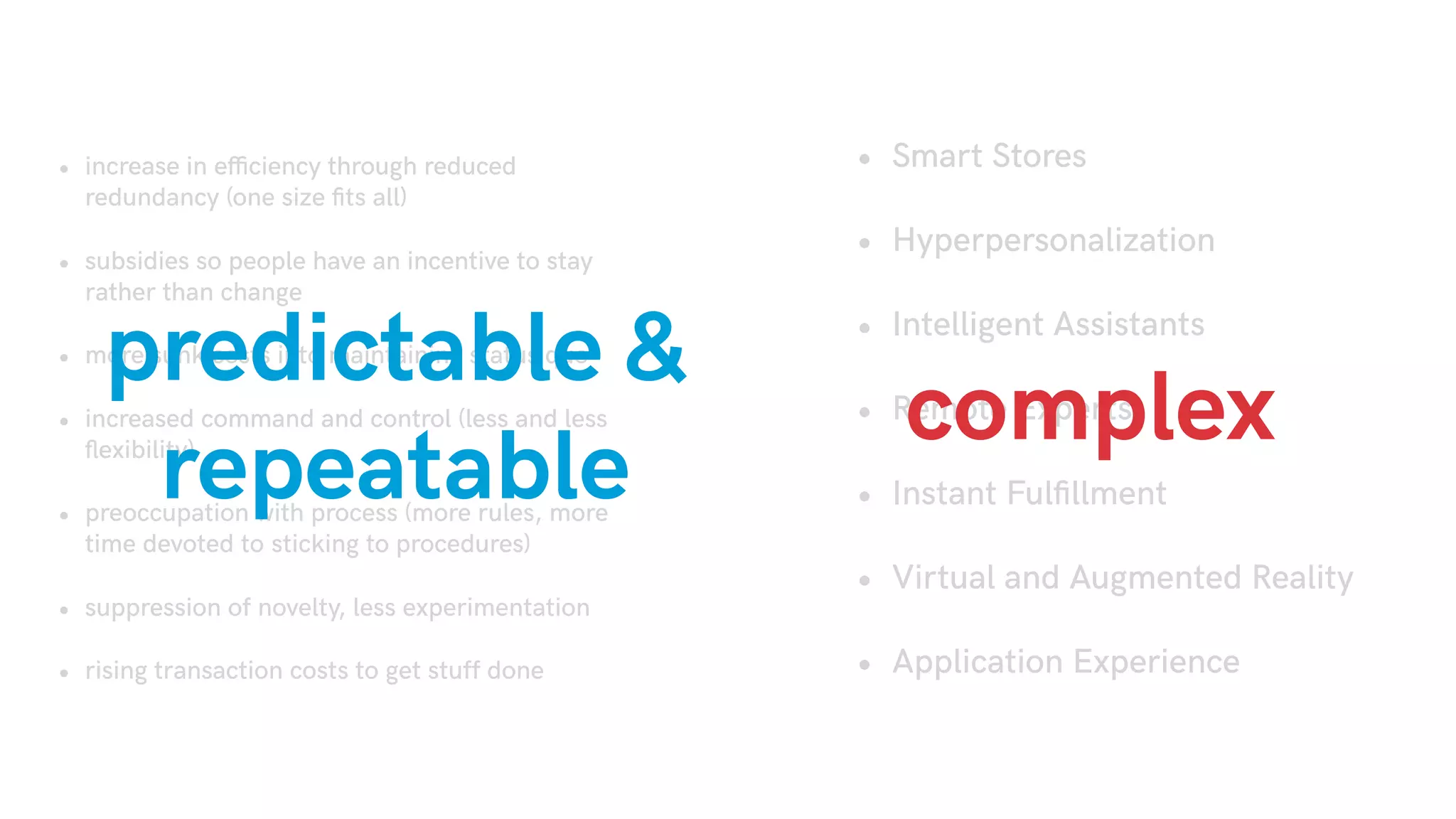
• Instant Fulfillment
• Virtual and Augmented Reality
• Application Experience
predictable &
repeatable
complex
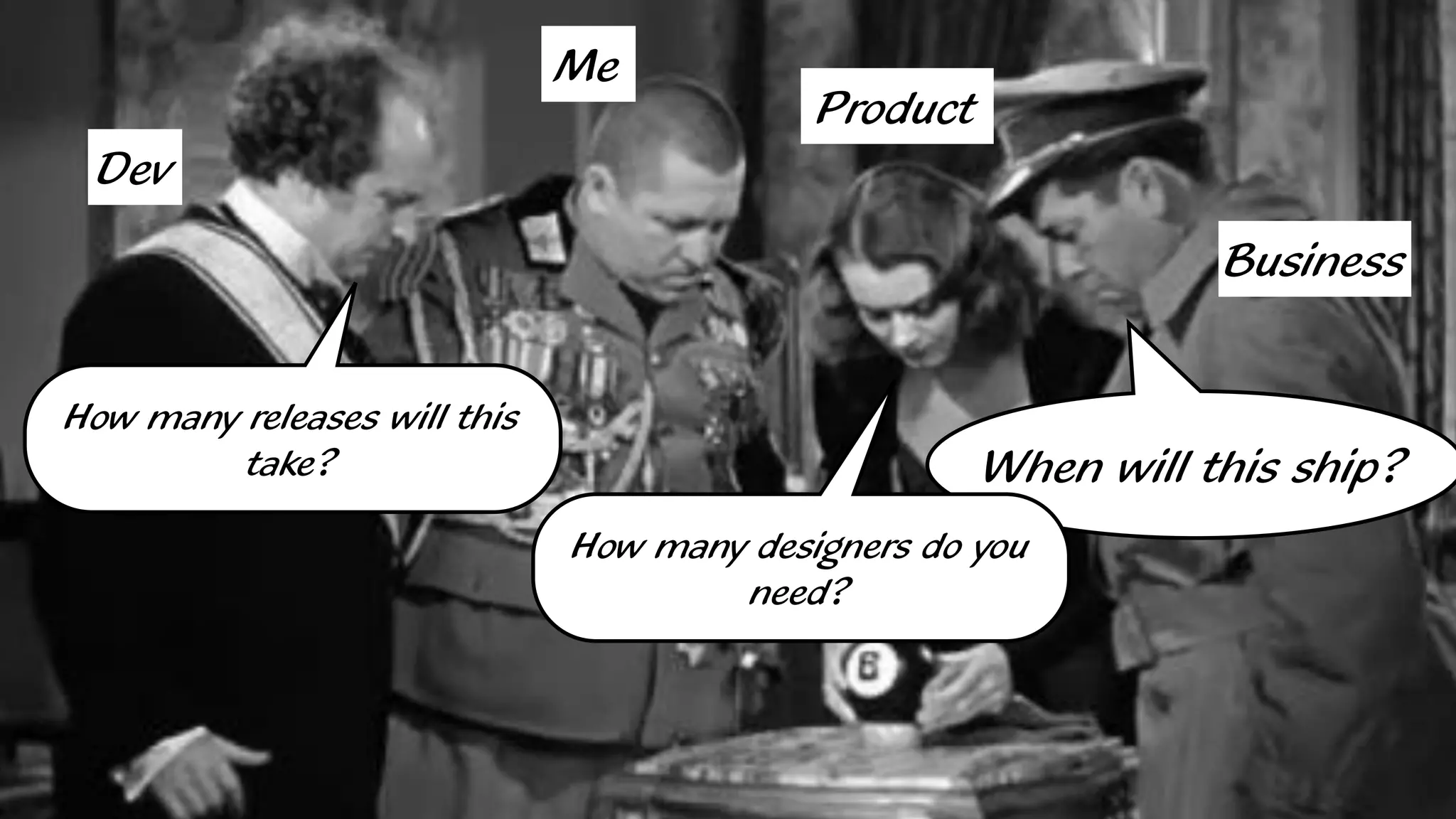
Business
Product
Me
Dev
When will this ship?
How many designers do you
need?
How many releases will this
take?
• How many releases will this take?
• How many designers do you need?
• When will this ship?
predictable &
repeatable
E M B R A C E D E S I G N I N G F O R C O M P L E X I T Y
Diversification
Modularity
Close Feedback Loops
Redundancy
1. Diversification of ideas
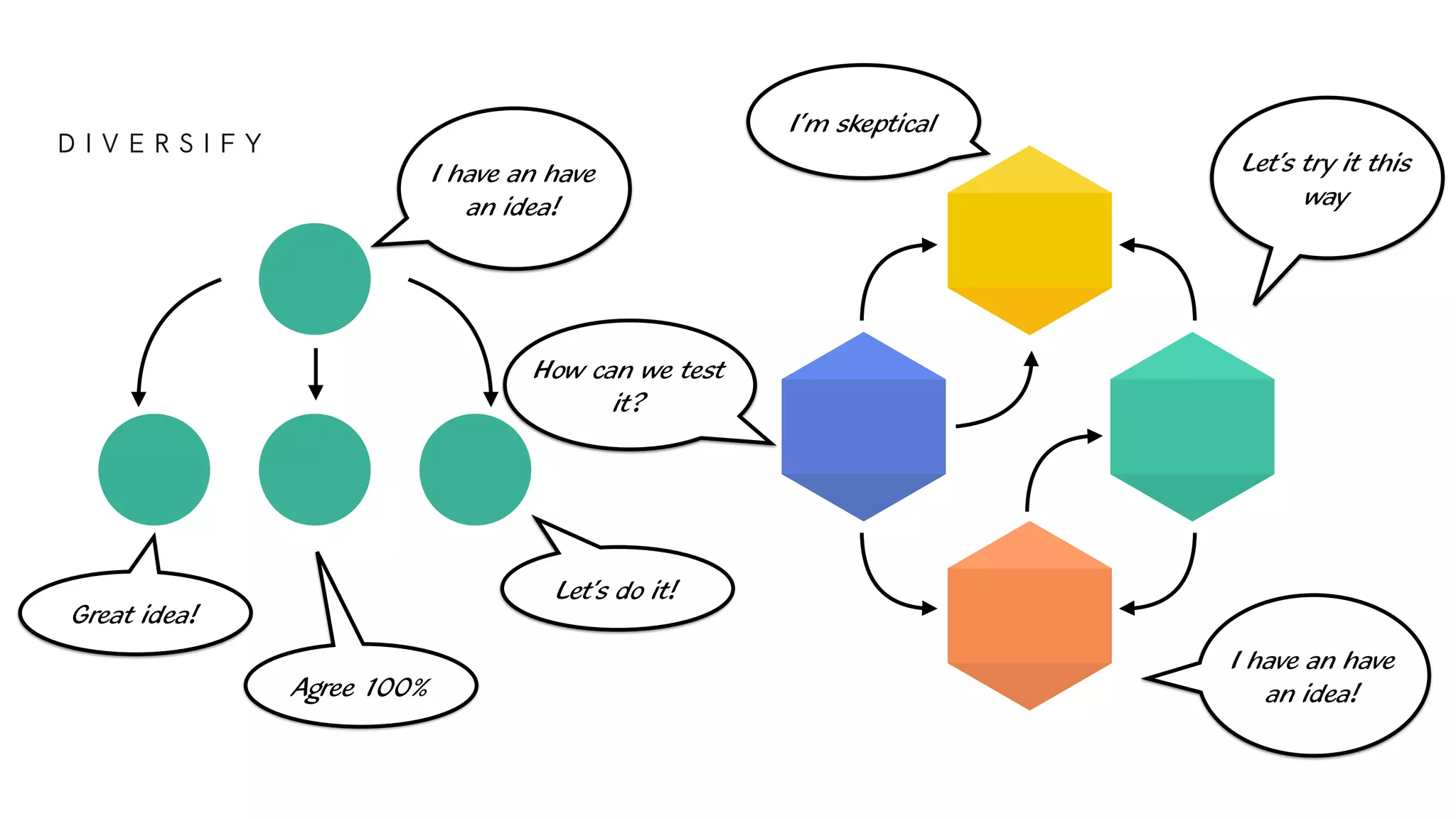
D I V E R S I F Y
I have an have
an idea!
Great idea!
Agree 100%
Let’s do it!
I have an have
an idea!
Let’s try it this
way
I’m skeptical
How can we test
it?
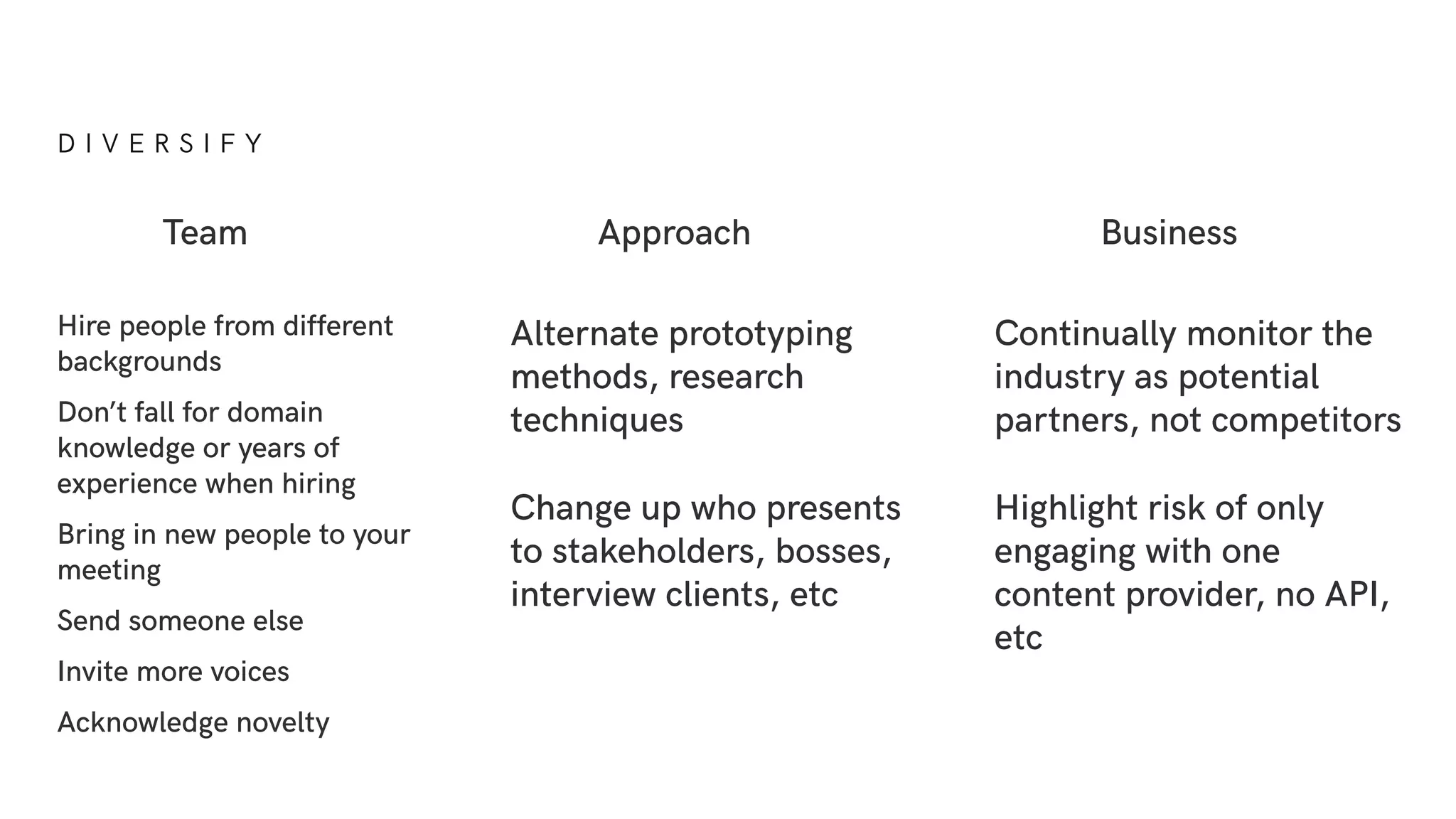
D I V E R S I F Y
Hire people from different
backgrounds
Don’t fall for domain
knowledge or years of
experience when hiring
Bring in new people to your
meeting
Send someone else
Invite more voices
Acknowledge novelty
Team Approach Business
Alternate prototyping
methods, research
techniques
Change up who presents
to stakeholders, bosses,
interview clients, etc
Continually monitor the
industry as potential
partners, not competitors
Highlight risk of only
engaging with one
content provider, no API,
etc
An organization that places high
value explicitly or implicitly on
getting along may be intolerant
of conflict,unusual ideas,or
voices from the margin.
D I V E R S I F Y
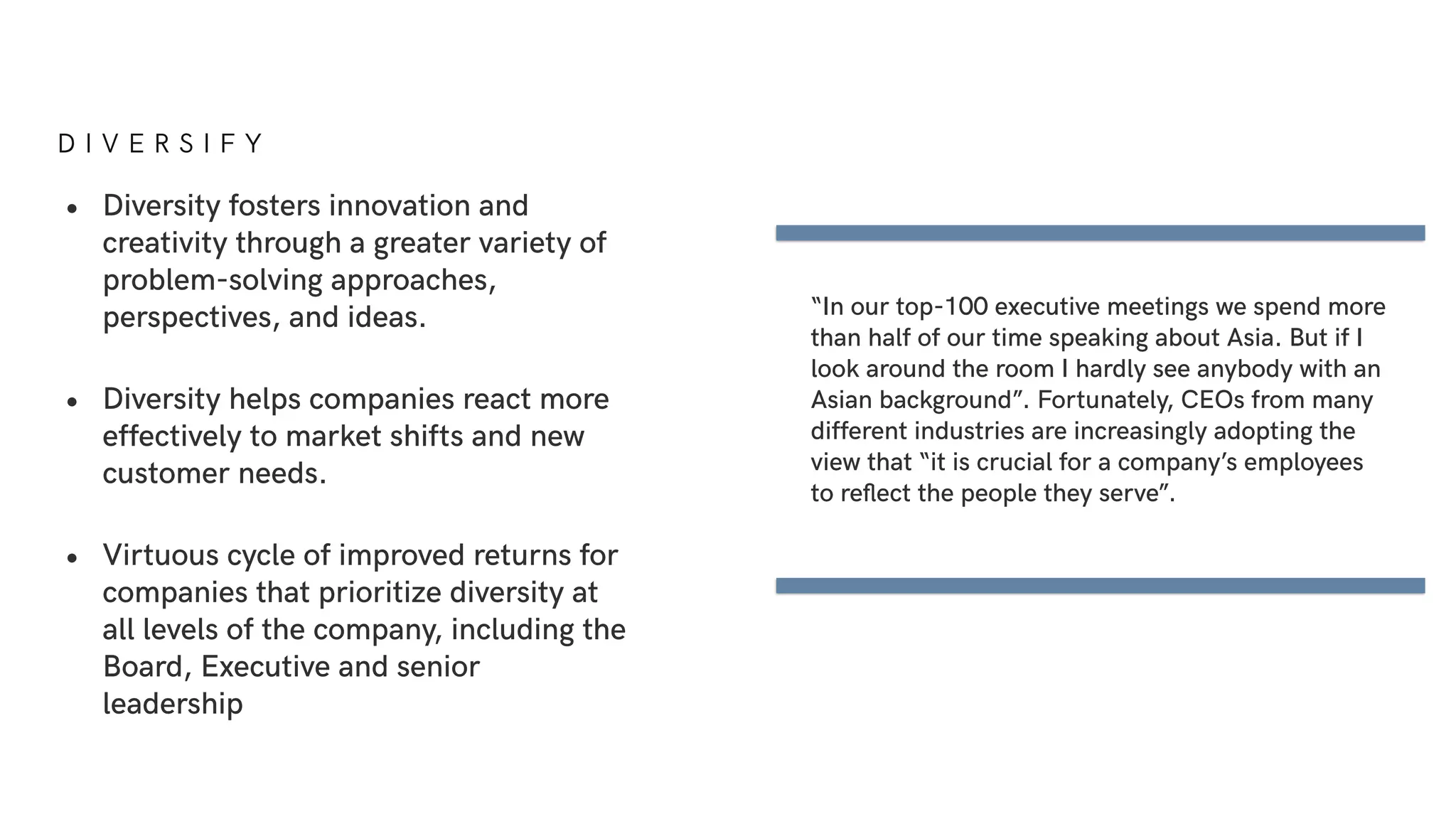
• Diversity fosters innovation and
creativity through a greater variety of
problem-solving approaches,
perspectives, and ideas.
• Diversity helps companies react more
effectively to market shifts and new
customer needs.
• Virtuous cycle of improved returns for
companies that prioritize diversity at
all levels of the company, including the
Board, Executive and senior
leadership
“In our top-100 executive meetings we spend more
than half of our time speaking about Asia. But if I
look around the room I hardly see anybody with an
Asian background”. Fortunately, CEOs from many
different industries are increasingly adopting the
view that “it is crucial for a company’s employees
to reflect the people they serve”.
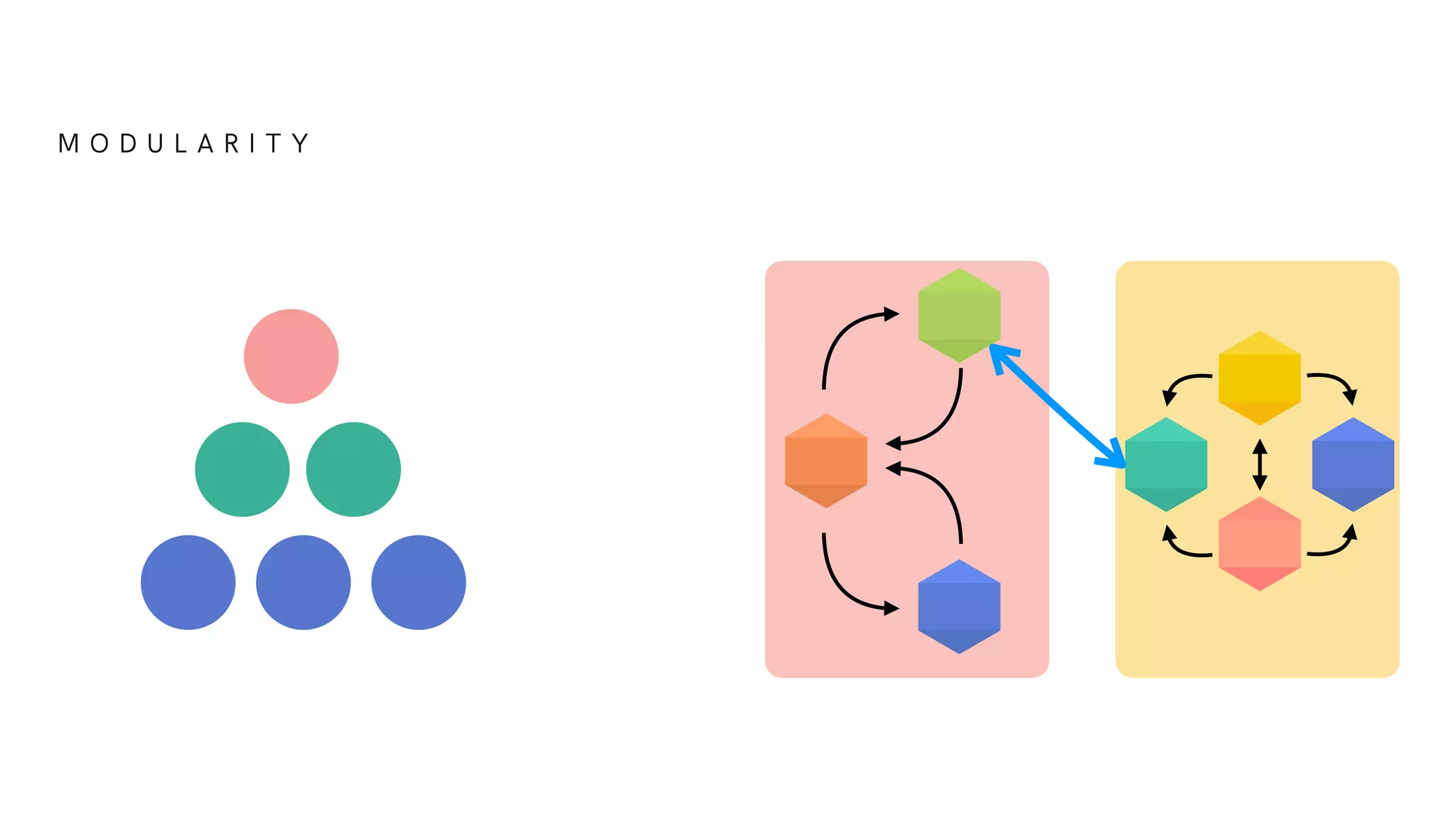
2. Modularity
M O D U L A R I T Y
M O D U L A R I T Y
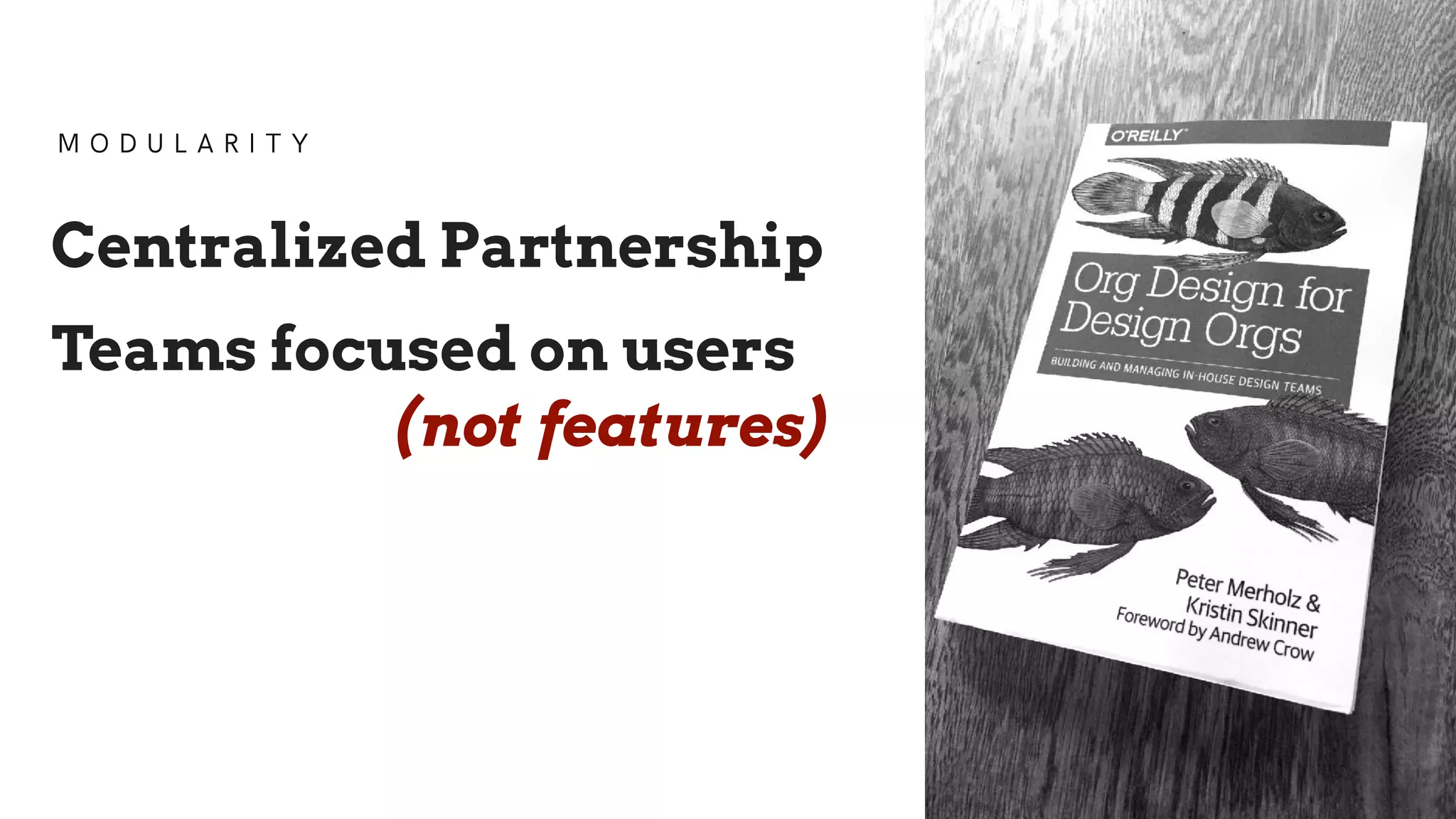
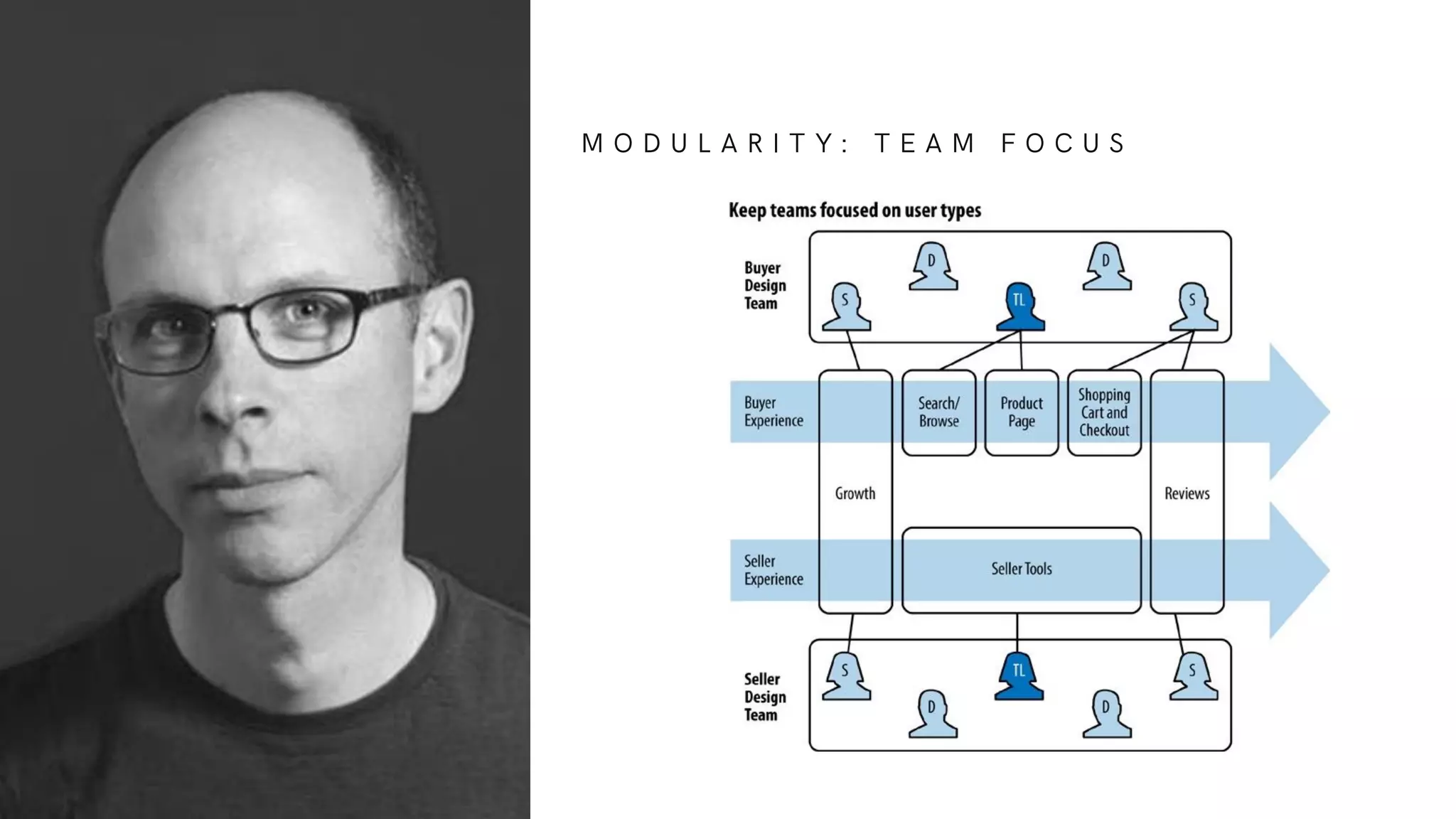
Centralized Partnership
Teams focused on users
(not features)
M O D U L A R I T Y : C E N T R A L I Z E D T E A M S
Design teams maintain commitment across
meaningful set of products & features
Maintain a holistic view across the entire
customer experience
Teams bring diverse skills to different projects
Freedom for designers to move across projects
Ability to load balance
M O D U L A R I T Y : T E A M F O C U S
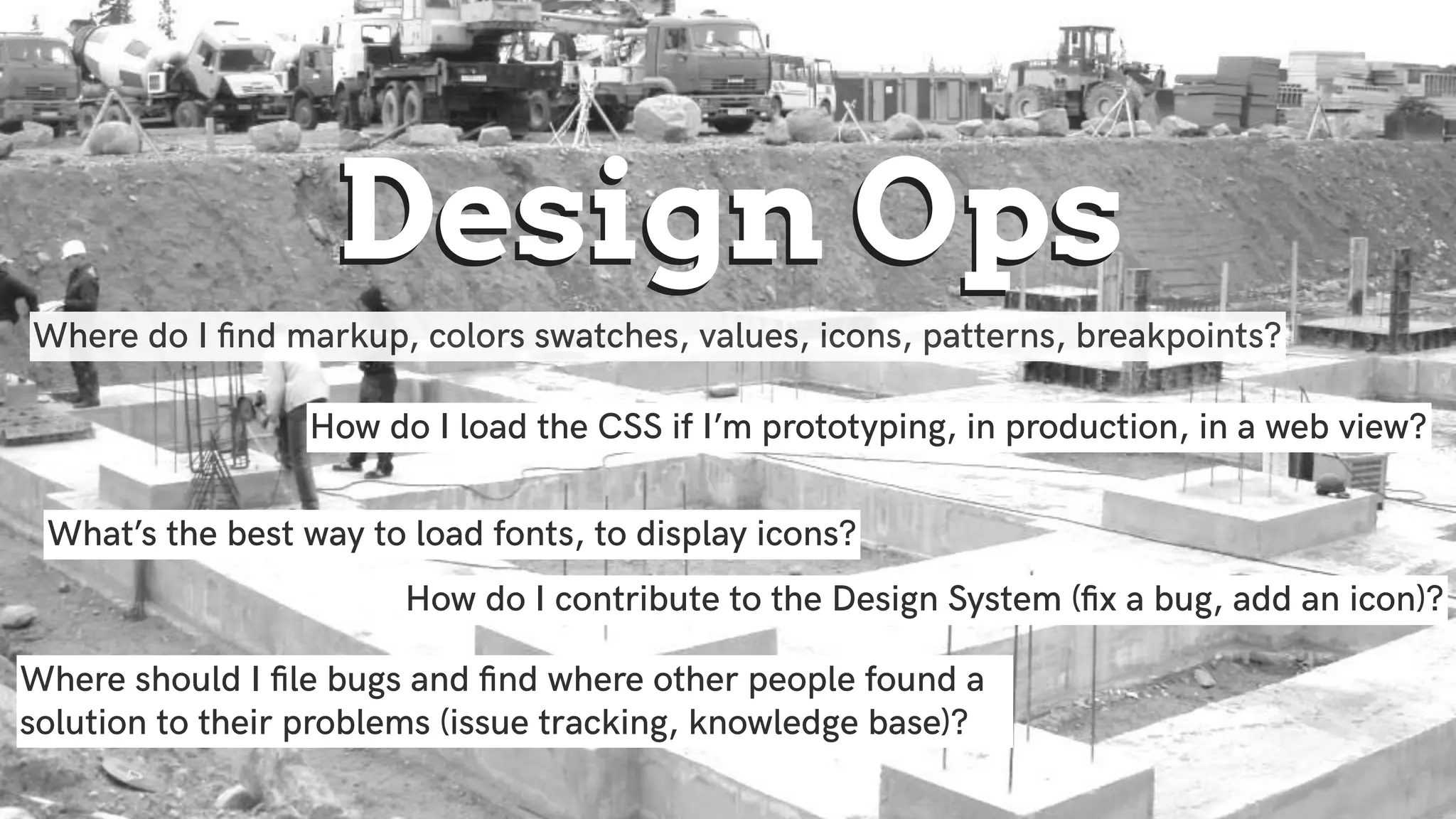
Design OpsDesign Ops
Where do I find markup, colors swatches, values, icons, patterns, breakpoints?
How do I load the CSS if I’m prototyping, in production, in a web view?
What’s the best way to load fonts, to display icons?
Where should I file bugs and find where other people found a
solution to their problems (issue tracking, knowledge base)?
How do I contribute to the Design System (fix a bug, add an icon)?
M O D U L A R I T Y
• Where your team sits in the
organization
• Research resources / pattern
libraries / style guide / design
systems
• Enable redundancy
Organizing your design team by
function (collaboration, data
visualization, etc) instead of
business unit or product increases
modularity.
3. Close feedback loops
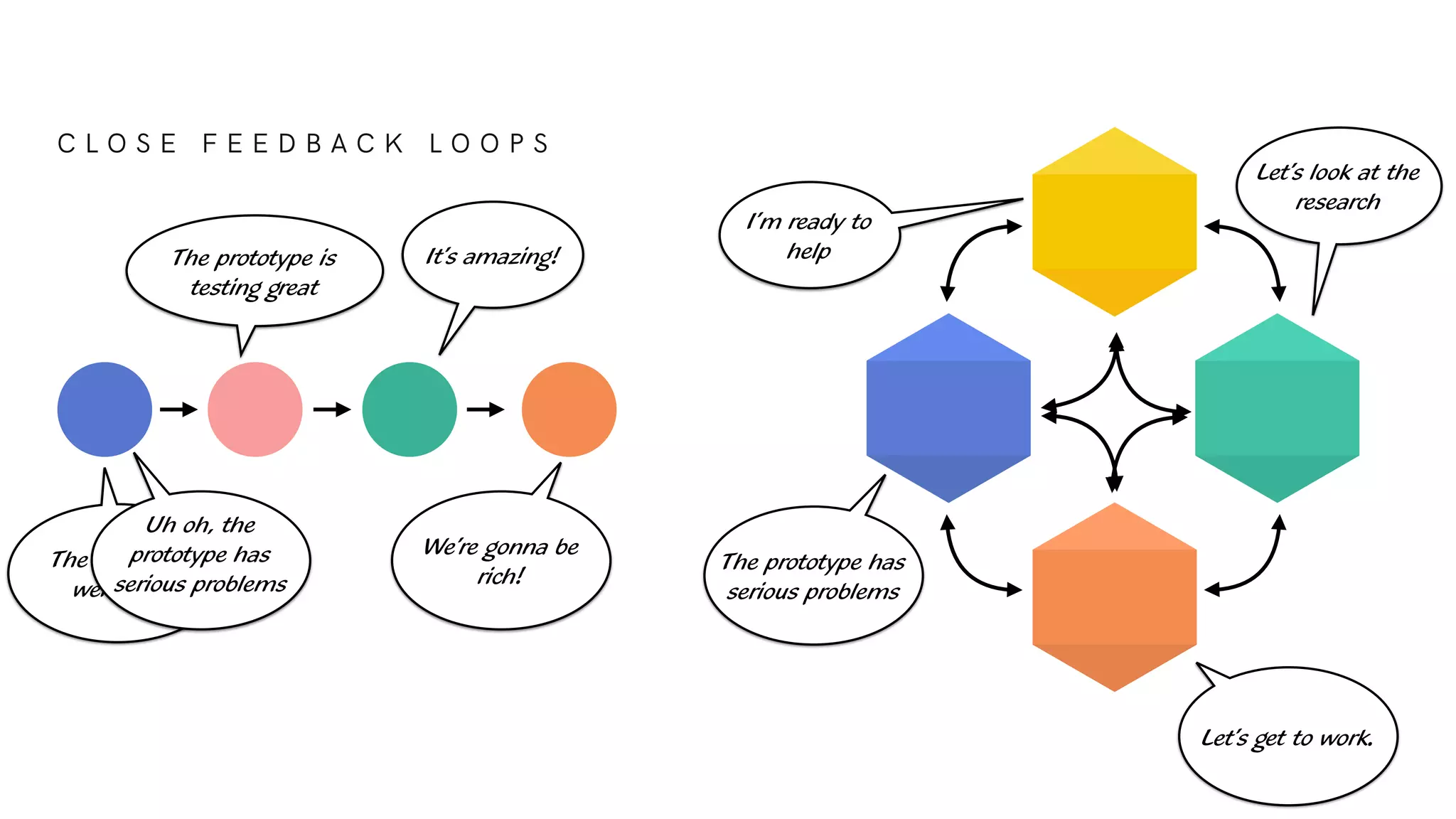
We’re gonna be
rich!
The prototype is
testing great
It’s amazing!
The prototype has
serious problems
Let’s get to work.
Let’s look at the
research
I’m ready to
help
The first test
went OK
Uh oh, the
prototype has
serious problems
C L O S E F E E D B A C K L O O P S
Don’t bring me
Bring me
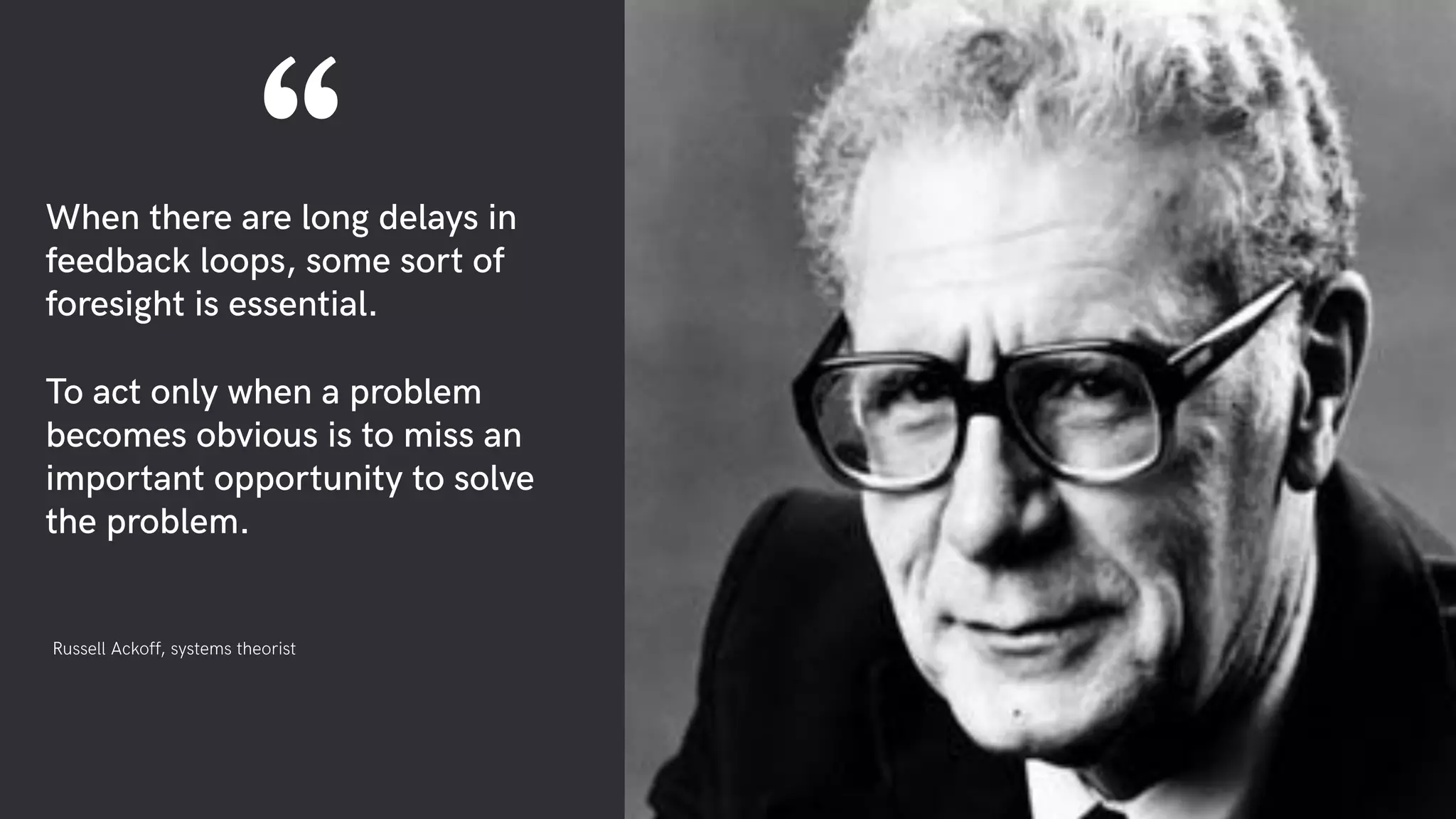
When there are long delays in
feedback loops, some sort of
foresight is essential.
To act only when a problem
becomes obvious is to miss an
important opportunity to solve
the problem.
Russell Ackoff, systems theorist
“
C L O S E F E E D B A C K L O O P S
As a design manager, it may not be
your responsibility to make sure all
parties are talking to each other, but
you can facilitate the conversations
and recognize who is missing.
• Invite business & product execs to
design studio
• Share design research with everyone
• Keep Support, Sales, Marketing
included
• Monitor thresholds & patterns, outliers
4. Redundancy
R E D U N D A N C Y
R E D U N D A N C Y
• Greater exposure to more themes, not
more people
• Cross-train designers so more people
know research, visual design, etc
• Teach product managers, stakeholders,
others how to apply design methods in
their daily work
• Move people to different projects so
others know what the projects are about
• Don’t over-rely on specialization
Teams in which different individuals
took turns leading the group were
more creative than teams in which
one person was consistently in charge
MIT Sloan Management Review
S U M M A R Y
• Diverse teams, approaches, and products
increase your ability to react to disruptive events
or take on new opportunities
• Modular teams can sustain disruption without
adversely affecting other parts of your
organization
• Longer, looser feedback loops mean disruptions
can go unnoticed
• Redundancy provides multiple sources of
productivity, knowledge, and leadership
• Designing for emergence gives you flexibility to
pivot or change when your feedback loops
indicate you should shift approach
These recommendations will be difficult
to implement in a business built for
optimization, efficiency, and maximum
returns based on minimum effort.
process is not a proxy for quality
Hi-Tech Over-Reliance
on Process Detector
Your businessYour business
Systems thinking prepares us for the risks
of the design challenges of tomorrow
In today’s business world,
design thinking and systems
thinking are considered
separate things.
The challenge remains how the
design thinking community can
learn from the systems thinking
community and vice versa.
Systems thinking prepares us for the risks
of the design challenges of tomorrow
Systems thinking can help
designers better understand
the world around them.
Systems thinking prepares us for the risks
of the design challenges of tomorrow
Designers can achieve more
sustainable designs by
following systems principles.
Systems thinking prepares us for the risks
of the design challenges of tomorrow
Design can be greatly
enhanced if it improves the
performance of the system as
a whole, even if you are
redesigning the part.
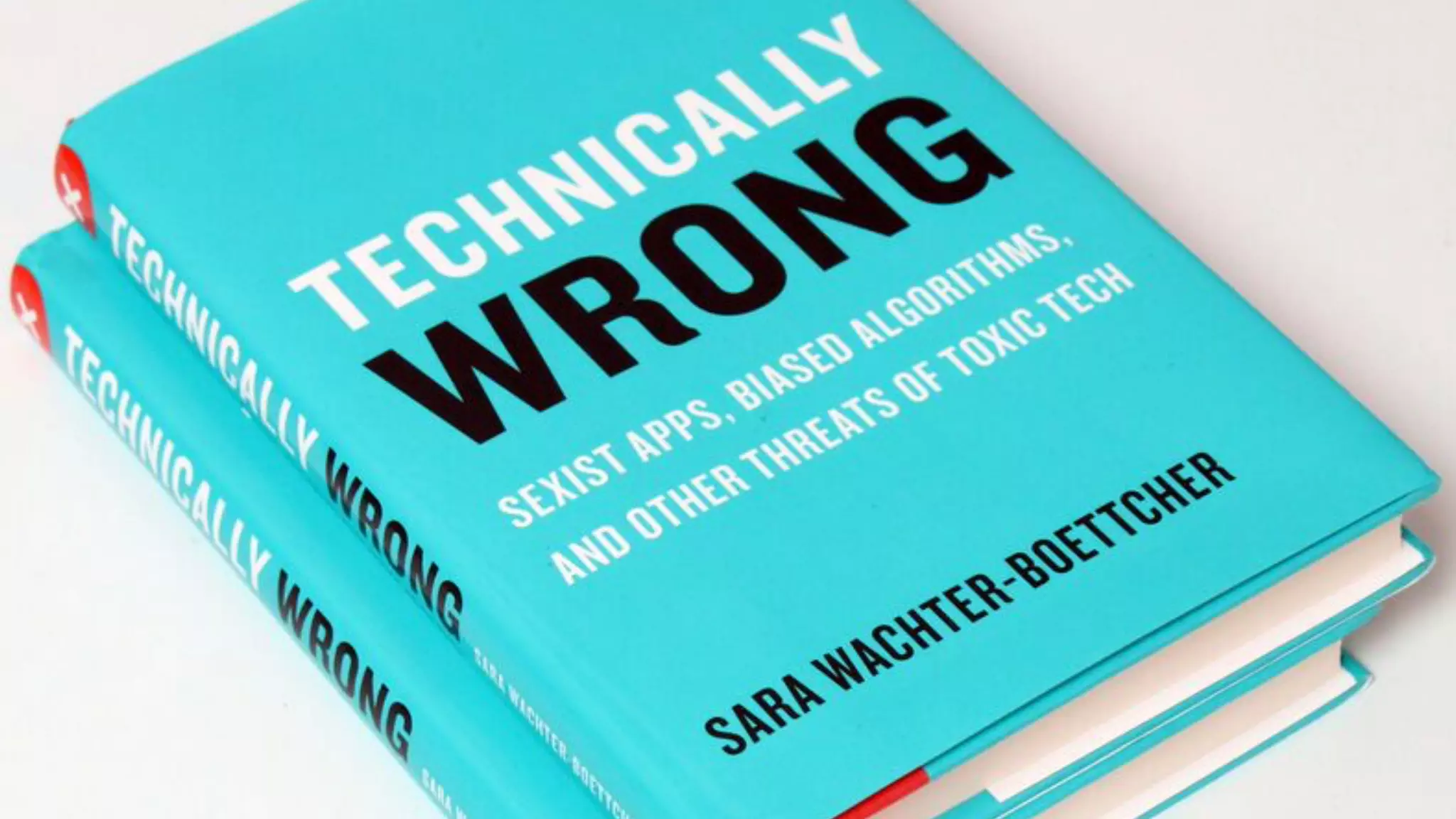
But Facebook’s unquestioning
commitment to the Hacker
Way—to a belief system that
puts technical solutions first,
and encourages programmers
and product teams to take risks
without thinking about their
implications—made it easy for
it to stay blind to the problem,
until it was far too late.
At a time when the world is more messy,
more crowded, more interconnected, more
interdependent, and more rapidly
changing than ever before, the more ways
of seeing, the better.
reclaim our intuition about
whole systems
hone our abilities to
understand parts
see interconnections
ask “what-if ” questions about
possible future behaviors
be creative and courageous
about system redesign
C H A N G E T H E M I N D S E T T O E N A B L E S C A L I N G
See your design team, service teams, as a part of an interdependent system
Appreciate and expect ambiguity
Account for non-linear progress
Replace scarcity-driven approaches with creating abundance
Embrace grassroots/bottom-up ideas & projects
Learn from experience, not just training
Strive for influence, not control
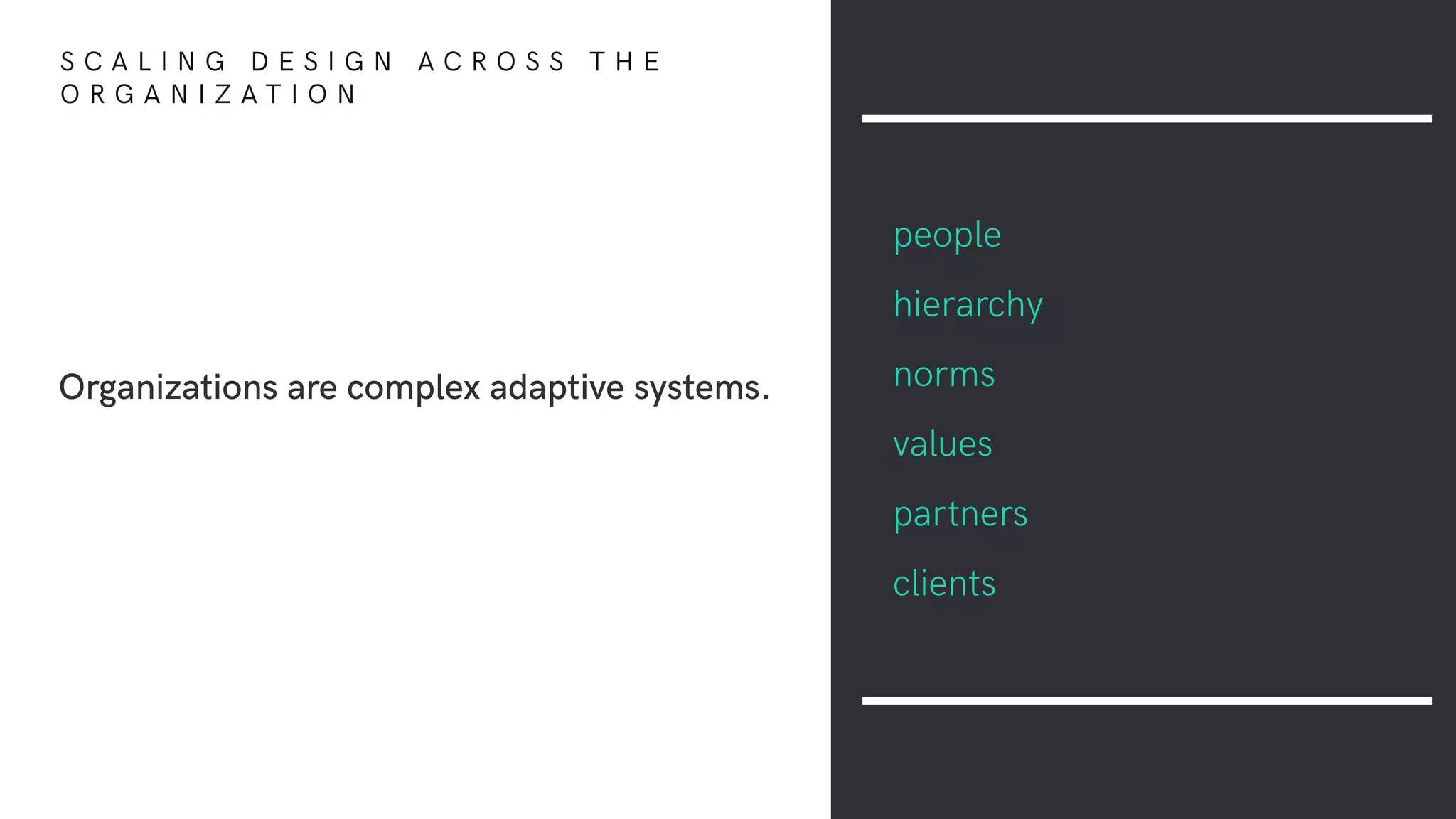
Organizations are complex adaptive systems.
people
hierarchy
norms
values
partners
clients
S C A L I N G D E S I G N A C R O S S T H E
O R G A N I Z A T I O N
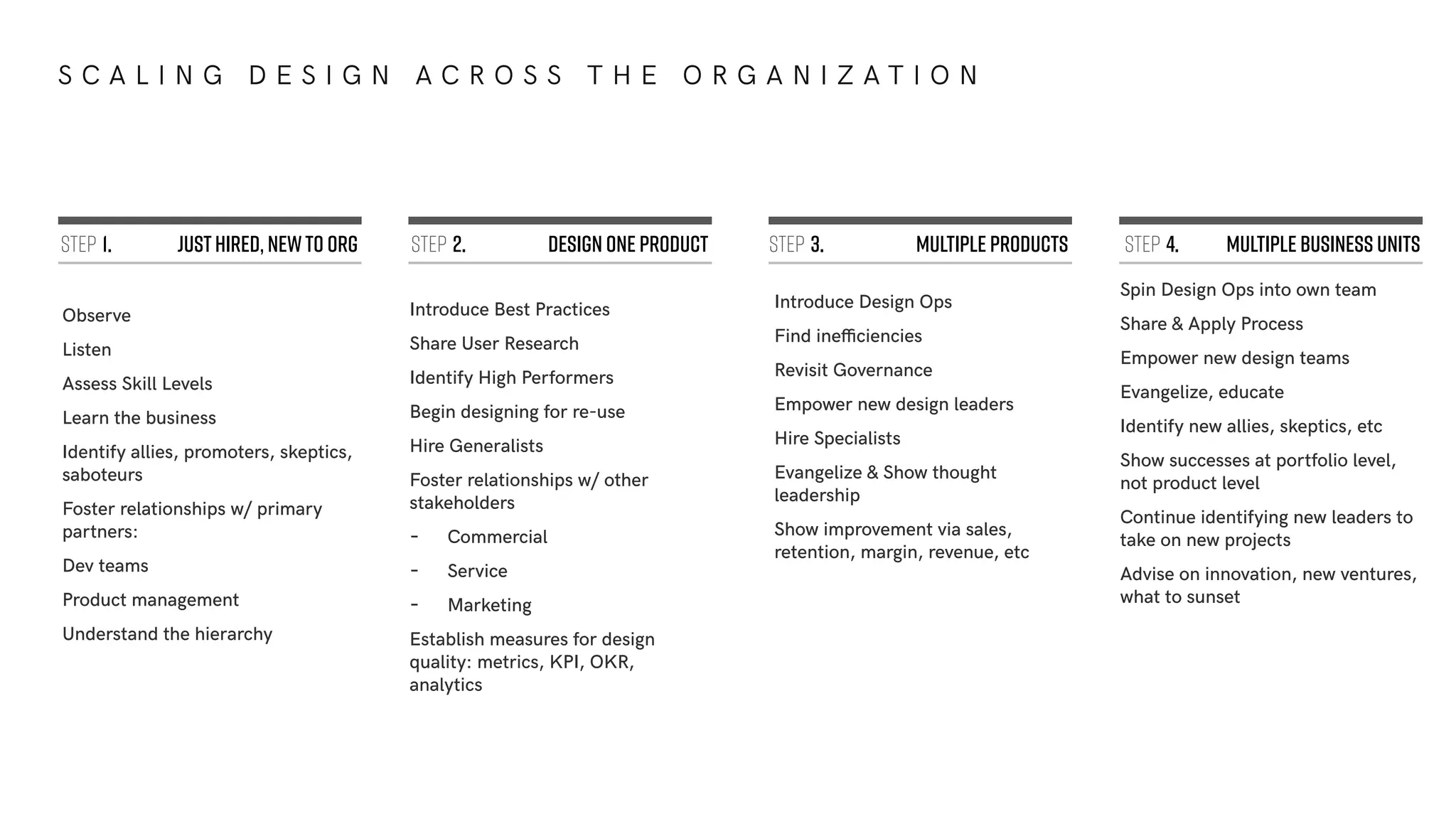
S C A L I N G D E S I G N A C R O S S T H E O R G A N I Z A T I O N
Observe
Listen
Assess Skill Levels
Learn the business
Identify allies, promoters, skeptics,
saboteurs
Foster relationships w/ primary
partners:
Dev teams
Product management
Understand the hierarchy
JustHired, Newto Org1.Step
Introduce Best Practices
Share User Research
Identify High Performers
Begin designing for re-use
Hire Generalists
Foster relationships w/ other
stakeholders
- Commercial
- Service
- Marketing
Establish measures for design
quality: metrics, KPI, OKR,
analytics
design one Product2.Step multiple products
Introduce Design Ops
Find inefficiencies
Revisit Governance
Empower new design leaders
Hire Specialists
Evangelize & Show thought
leadership
Show improvement via sales,
retention, margin, revenue, etc
3.Step multiple business units
Spin Design Ops into own team
Share & Apply Process
Empower new design teams
Evangelize, educate
Identify new allies, skeptics, etc
Show successes at portfolio level,
not product level
Continue identifying new leaders to
take on new projects
Advise on innovation, new ventures,
what to sunset
4.Step
Design at Scale
Chris Avore
@erova
@avore@erova.com
linkedin.com/in/chrisavore
Digital Experience (DX) Summit 2017
Thank you!

Design at Scale: Enabling Systems Thinking to Design for a Complex Future

  • 1.
    Design at Scale DigitalExperience (DX) Summit 2017 Chris Avore @erova Enabling systems thinking to design for a complex future
  • 2.
    • Manage a30-ish person product design team • Team of designers, front end devs, IA’s, researchers, content strategists • Teach customer experience coursework at Rutgers University • Currently writing a book on design management & leadership for Rosenfeld Media (2018) z
  • 4.
    Mature industries thathave focused on more, better and faster now need to adjust their thinking to include design as a key value differentiator.
  • 5.
    Top companies areleading with design. Others that aren’t willing to invest in design because they think it can’t be measured or tied to ROI will fall behind.
  • 6.
    Business as usualis no longer good enough.
  • 10.
    C R EA T I V E D E S T R U C T I O N Average company lifespan on S&P 500 Index (in years) 1960 2017
  • 11.
    Improve quality ofproducts & services Reduce costs Identify new opportunities for growth Increase margins Increase productivity Reduce churn E X P E C T A T I O N S
  • 12.
    New competitors New technologies Growthpressure Lower margins Globalization Talent/workforce challenges More data to “help” us and it all happens faster than ever before R E A L I T Y
  • 16.
  • 17.
    Most companies’ successes arebuilt on delivering predictable products by repeatable means.
  • 18.
  • 19.
  • 20.
  • 21.
  • 22.
    These companies thrive oncertainty and minimizing risk.
  • 23.
    Reductionisiom is themost natural thing in the world to grasp. It’s simply the belief that a whole can be understood if you understand its parts, and the nature of their sum. No one in her left brain could reject reductionism. Douglas Hofstrader, Godel, Escher, Bach: an Eternal Golden Braid “
  • 24.
    And now manycompanies are trying to solve new complex problems old ways
  • 26.
  • 28.
    C O MP L E X S Y S T E M S I N P R A C T I C E Customer Experience 2020
  • 38.
    C U ST O M E R E X P E R I E N C E 2 0 2 0 • Smart Stores • Hyperpersonalization • Intelligent Assistants • Remote Experts • Instant Fulfillment • Virtual and Augmented Reality • Application Experience
  • 39.
    In a complicatedworld, we can look to the past to find patterns and previous solutions. predictable & repeatable complex In a complex world, depending on patterns of the past can be expensive and disastrous.
  • 40.
    D E SI G N & S Y S T E M S T H I N K I N G Is Design Thinking enough?
  • 41.
    Design thinking isa human- centered approach to innovation that draws from the designer’s toolkit to integrate the needs of people, the possibilities of technology, and the requirements for business success.
  • 42.
    W H AT I S D E S I G N T H I N K I N G ? By using design thinking, we make decisions based on what future customers really want instead of relying only on historical data or making risky bets based on instinct instead of evidence. • fast iterations • early and frequent interaction with customers • agile process design with less hierarchy • learning-by-doing approach via prototypes, mockups, etc
  • 44.
    I S DE S I G N T H I N K I N G E N O U G H ? Design thinking may not do enough to consider the responses of controlling or optimizing parts of systems when focusing on only designing one or two segments
  • 45.
    I S DE S I G N T H I N K I N G E N O U G H ? Even though there are many perspectives involved in parts of the design process, the stakeholders give input solely from their individual experiences and never see how it fits into the whole system.
  • 46.
    I S DE S I G N T H I N K I N G E N O U G H ? The designers’ role is still to piece it all together. 
  • 47.
  • 48.
    Businesses that usedto be separate are now interconnected and interdependent, which means these systems are now more complex. Rita McGrath
  • 49.
    Complex Adaptive Systemsare diverse living elements made up of multiple interconnected agents that have the capacity to grow and change. Sharon VanderKaay
  • 50.
    We can determinecomplicated outcomes. We can only enable complex outcomes. We can specify complicated systems. We can only intervene in complex systems. Irene Ng
  • 51.
    Design thinking isno longer enough to prepare for the complex challenges facing our teams, products, and businesses.
  • 52.
    We need toview these challenges through a lens of systems thinking to survive, scale, and thrive in a complex world.
  • 53.
    Systems thinking isa management discipline that concerns an understanding of a system by examining the linkages and interactions between the components that comprise the entirety of that defined system.
  • 54.
    Systems thinking isa management discipline that concerns an understanding of a system by examining the linkages and interactions between the components that comprise the entirety of that defined system. linkages interactions entirety of that defined system
  • 55.
    Systems thinking isa management discipline that concerns an understanding of a system by examining the linkages and interactions between the components that comprise the entirety of that defined system.entirety of that defined system
  • 56.
    Managers are notconfronted with problems that are independent of each other, but with dynamic situations that consist of complex systems of changing problems that interact with each other. I call such situations messes. Russell Ackoff, systems theorist “
  • 57.
    • increase inefficiency through reduced redundancy (one size fits all) • subsidies so people have an incentive to stay rather than change • more sunk costs into maintaining status quo • increased command and control (less and less flexibility) • preoccupation with process (more rules, more time devoted to sticking to procedures) • suppression of novelty, less experimentation • rising transaction costs to get stuff done • Smart Stores • Hyperpersonalization • Intelligent Assistants • Remote Experts • Instant Fulfillment • Virtual and Augmented Reality • Application Experience
  • 58.
    • increase inefficiency through reduced redundancy (one size fits all) • subsidies so people have an incentive to stay rather than change • more sunk costs into maintaining status quo • increased command and control (less and less flexibility) • preoccupation with process (more rules, more time devoted to sticking to procedures) • suppression of novelty, less experimentation • rising transaction costs to get stuff done • Smart Stores • Hyperpersonalization • Intelligent Assistants • Remote Experts • Instant Fulfillment • Virtual and Augmented Reality • Application Experience predictable & repeatable complex
  • 59.
    Business Product Me Dev When will thisship? How many designers do you need? How many releases will this take?
  • 60.
    • How manyreleases will this take? • How many designers do you need? • When will this ship? predictable & repeatable
  • 61.
    E M BR A C E D E S I G N I N G F O R C O M P L E X I T Y Diversification Modularity Close Feedback Loops Redundancy
  • 62.
  • 63.
    D I VE R S I F Y I have an have an idea! Great idea! Agree 100% Let’s do it! I have an have an idea! Let’s try it this way I’m skeptical How can we test it?
  • 64.
    D I VE R S I F Y Hire people from different backgrounds Don’t fall for domain knowledge or years of experience when hiring Bring in new people to your meeting Send someone else Invite more voices Acknowledge novelty Team Approach Business Alternate prototyping methods, research techniques Change up who presents to stakeholders, bosses, interview clients, etc Continually monitor the industry as potential partners, not competitors Highlight risk of only engaging with one content provider, no API, etc
  • 65.
    An organization thatplaces high value explicitly or implicitly on getting along may be intolerant of conflict,unusual ideas,or voices from the margin.
  • 66.
    D I VE R S I F Y • Diversity fosters innovation and creativity through a greater variety of problem-solving approaches, perspectives, and ideas. • Diversity helps companies react more effectively to market shifts and new customer needs. • Virtuous cycle of improved returns for companies that prioritize diversity at all levels of the company, including the Board, Executive and senior leadership “In our top-100 executive meetings we spend more than half of our time speaking about Asia. But if I look around the room I hardly see anybody with an Asian background”. Fortunately, CEOs from many different industries are increasingly adopting the view that “it is crucial for a company’s employees to reflect the people they serve”.
  • 67.
  • 68.
    M O DU L A R I T Y
  • 69.
    M O DU L A R I T Y Centralized Partnership Teams focused on users (not features)
  • 70.
    M O DU L A R I T Y : C E N T R A L I Z E D T E A M S Design teams maintain commitment across meaningful set of products & features Maintain a holistic view across the entire customer experience Teams bring diverse skills to different projects Freedom for designers to move across projects Ability to load balance
  • 71.
    M O DU L A R I T Y : T E A M F O C U S
  • 72.
    Design OpsDesign Ops Wheredo I find markup, colors swatches, values, icons, patterns, breakpoints? How do I load the CSS if I’m prototyping, in production, in a web view? What’s the best way to load fonts, to display icons? Where should I file bugs and find where other people found a solution to their problems (issue tracking, knowledge base)? How do I contribute to the Design System (fix a bug, add an icon)?
  • 73.
    M O DU L A R I T Y • Where your team sits in the organization • Research resources / pattern libraries / style guide / design systems • Enable redundancy Organizing your design team by function (collaboration, data visualization, etc) instead of business unit or product increases modularity.
  • 74.
  • 75.
    We’re gonna be rich! Theprototype is testing great It’s amazing! The prototype has serious problems Let’s get to work. Let’s look at the research I’m ready to help The first test went OK Uh oh, the prototype has serious problems C L O S E F E E D B A C K L O O P S
  • 76.
  • 77.
    When there arelong delays in feedback loops, some sort of foresight is essential. To act only when a problem becomes obvious is to miss an important opportunity to solve the problem. Russell Ackoff, systems theorist “
  • 78.
    C L OS E F E E D B A C K L O O P S As a design manager, it may not be your responsibility to make sure all parties are talking to each other, but you can facilitate the conversations and recognize who is missing. • Invite business & product execs to design studio • Share design research with everyone • Keep Support, Sales, Marketing included • Monitor thresholds & patterns, outliers
  • 79.
  • 80.
    R E DU N D A N C Y
  • 81.
    R E DU N D A N C Y • Greater exposure to more themes, not more people • Cross-train designers so more people know research, visual design, etc • Teach product managers, stakeholders, others how to apply design methods in their daily work • Move people to different projects so others know what the projects are about • Don’t over-rely on specialization Teams in which different individuals took turns leading the group were more creative than teams in which one person was consistently in charge MIT Sloan Management Review
  • 82.
    S U MM A R Y • Diverse teams, approaches, and products increase your ability to react to disruptive events or take on new opportunities • Modular teams can sustain disruption without adversely affecting other parts of your organization • Longer, looser feedback loops mean disruptions can go unnoticed • Redundancy provides multiple sources of productivity, knowledge, and leadership • Designing for emergence gives you flexibility to pivot or change when your feedback loops indicate you should shift approach These recommendations will be difficult to implement in a business built for optimization, efficiency, and maximum returns based on minimum effort.
  • 83.
    process is nota proxy for quality
  • 84.
    Hi-Tech Over-Reliance on ProcessDetector Your businessYour business
  • 86.
    Systems thinking preparesus for the risks of the design challenges of tomorrow In today’s business world, design thinking and systems thinking are considered separate things. The challenge remains how the design thinking community can learn from the systems thinking community and vice versa.
  • 87.
    Systems thinking preparesus for the risks of the design challenges of tomorrow Systems thinking can help designers better understand the world around them.
  • 88.
    Systems thinking preparesus for the risks of the design challenges of tomorrow Designers can achieve more sustainable designs by following systems principles.
  • 89.
    Systems thinking preparesus for the risks of the design challenges of tomorrow Design can be greatly enhanced if it improves the performance of the system as a whole, even if you are redesigning the part.
  • 91.
    But Facebook’s unquestioning commitmentto the Hacker Way—to a belief system that puts technical solutions first, and encourages programmers and product teams to take risks without thinking about their implications—made it easy for it to stay blind to the problem, until it was far too late.
  • 92.
    At a timewhen the world is more messy, more crowded, more interconnected, more interdependent, and more rapidly changing than ever before, the more ways of seeing, the better. reclaim our intuition about whole systems hone our abilities to understand parts see interconnections ask “what-if ” questions about possible future behaviors be creative and courageous about system redesign
  • 93.
    C H AN G E T H E M I N D S E T T O E N A B L E S C A L I N G See your design team, service teams, as a part of an interdependent system Appreciate and expect ambiguity Account for non-linear progress Replace scarcity-driven approaches with creating abundance Embrace grassroots/bottom-up ideas & projects Learn from experience, not just training Strive for influence, not control
  • 94.
    Organizations are complexadaptive systems. people hierarchy norms values partners clients S C A L I N G D E S I G N A C R O S S T H E O R G A N I Z A T I O N
  • 95.
    S C AL I N G D E S I G N A C R O S S T H E O R G A N I Z A T I O N Observe Listen Assess Skill Levels Learn the business Identify allies, promoters, skeptics, saboteurs Foster relationships w/ primary partners: Dev teams Product management Understand the hierarchy JustHired, Newto Org1.Step Introduce Best Practices Share User Research Identify High Performers Begin designing for re-use Hire Generalists Foster relationships w/ other stakeholders - Commercial - Service - Marketing Establish measures for design quality: metrics, KPI, OKR, analytics design one Product2.Step multiple products Introduce Design Ops Find inefficiencies Revisit Governance Empower new design leaders Hire Specialists Evangelize & Show thought leadership Show improvement via sales, retention, margin, revenue, etc 3.Step multiple business units Spin Design Ops into own team Share & Apply Process Empower new design teams Evangelize, educate Identify new allies, skeptics, etc Show successes at portfolio level, not product level Continue identifying new leaders to take on new projects Advise on innovation, new ventures, what to sunset 4.Step
  • 96.
    Design at Scale ChrisAvore @erova @avore@erova.com linkedin.com/in/chrisavore Digital Experience (DX) Summit 2017 Thank you!