Demystifying the Social Web Brian Kelly UKOLN University of Bath Bath, UK UKOLN is supported by: This work is licensed under a Attribution-NonCommercial-ShareAlike 2.0 licence (but note caveat) Acceptable Use Policy Recording of this talk, taking photos, discussing the content using email, Twitter, blogs, etc. is permitted providing distractions to others is minimised. Resources bookmarked using ‘ readeast-2009 '  tag  http://www.ukoln.ac.uk/cultural-heritage/events/readeast-2009/ Email: [email_address] Twitter: http://twitter.com/briankelly/   Blog: http://ukwebfocus.wordpress.com/ Twitter hashtag: #readeast09
About Me Brian Kelly: National Web adviser to UK Universities and cultural heritage organisations Based at UKOLN, a national centre of expertise in digital information management and located at the University of Bath Involved in Web since January 1993 Over 300 presentations given since 1997 Current area of interest include Web 2.0, Web standards and Web accessibility Introduction
About This Session This session provides: A summary of the Web 2.0 and what it is  An introduction to various Social Web services  Small group activity on identifying: Potential benefits of the Social Web Barriers to deployment of such services.  The session will conclude by outlining approaches to addressing the barriers.
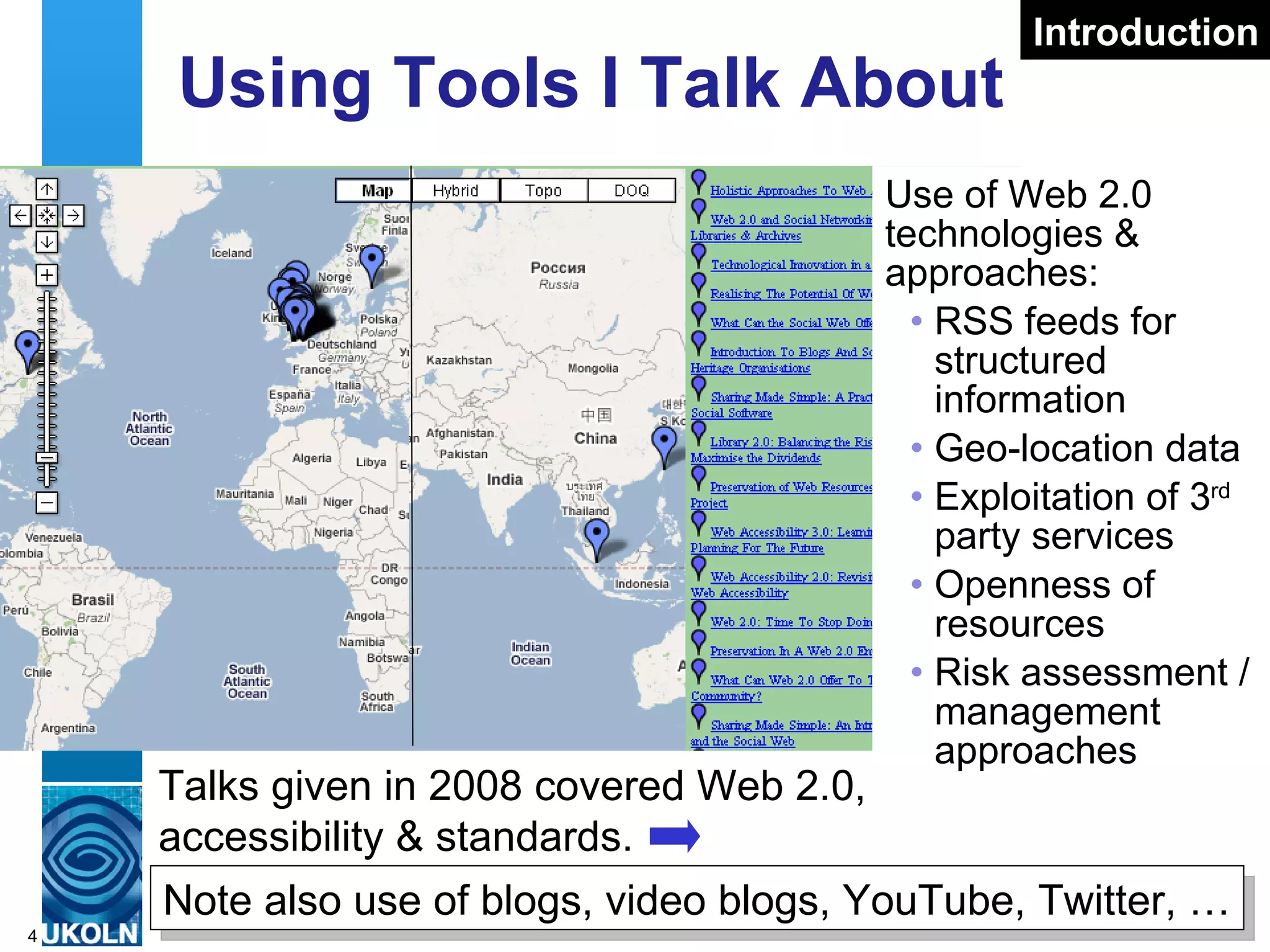
Using Tools I Talk About  Use of Web 2.0 technologies & approaches: RSS feeds for structured information Geo-location data Exploitation of 3 rd  party services Openness of resources Risk assessment / management approaches Talks given in 2008 covered Web 2.0, accessibility & standards. Introduction Note also use of blogs, video blogs, YouTube, Twitter, …
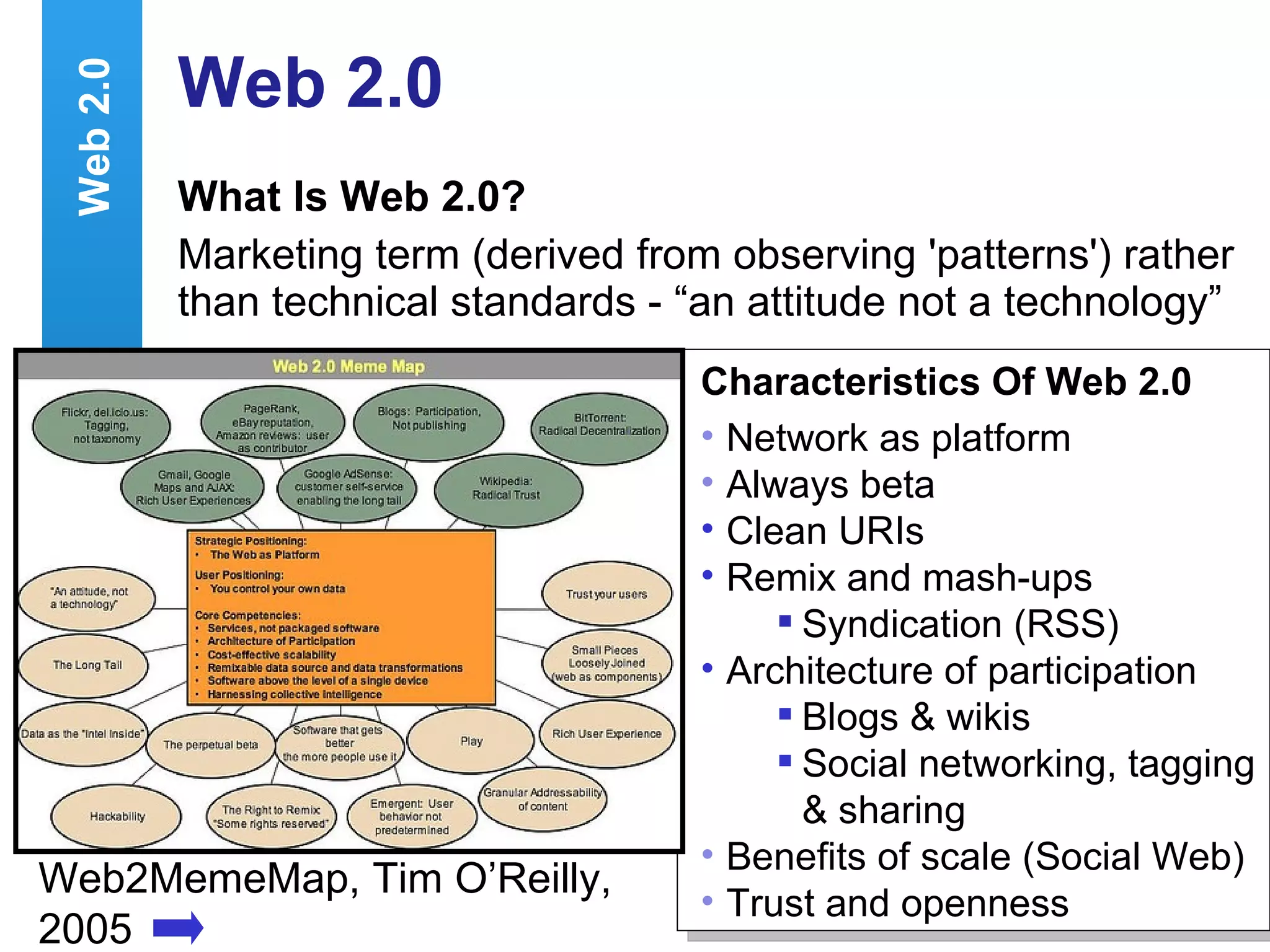
Web 2.0 What Is Web 2.0? Marketing term (derived from observing 'patterns') rather than technical standards - “an attitude not a technology”  Web2MemeMap, Tim O’Reilly, 2005 Characteristics Of Web 2.0 Network as platform Always beta Clean URIs Remix and mash-ups  Syndication (RSS) Architecture of participation Blogs & wikis Social networking, tagging & sharing Benefits of scale (Social Web) Trust and openness Web 2.0
Benefits of Web 2.0 Delivery Mechanisms (“network as platform”): Global outreach : maximise impact of and engagement with ideas Outsourced services : allowing organisations to focus on their strengths and small institutions to engage on more equal terms  Exploits infrastructure : the standards (e,g. RSS) & services (Google, Amazon, ..) now in place User Benefits: User can create content Can comment on other’s content Users no longer passive consumers of content
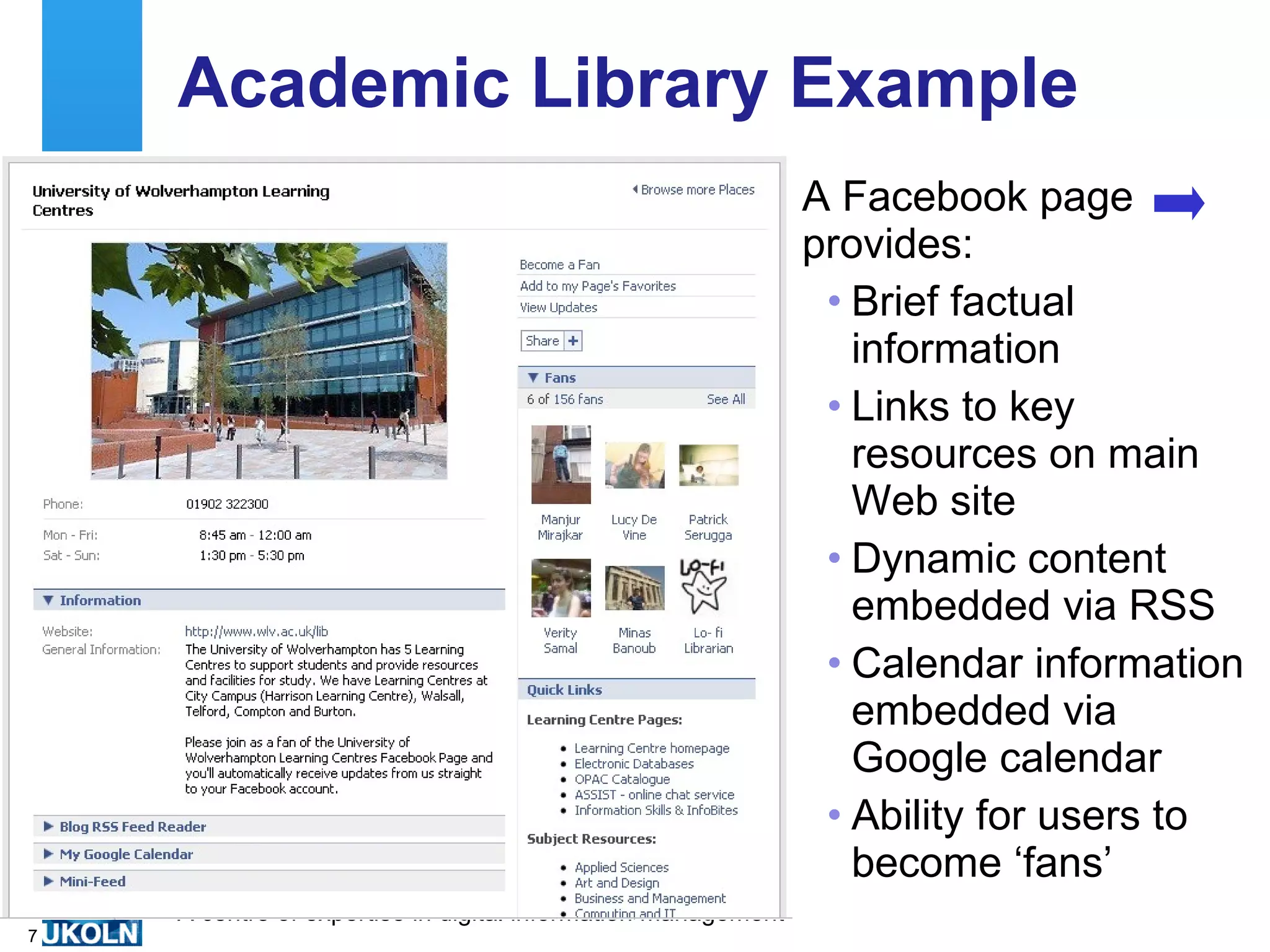
Academic Library Example A Facebook page provides: Brief factual information Links to key resources on main Web site Dynamic content embedded via RSS Calendar information embedded via Google calendar Ability for users to become ‘fans’
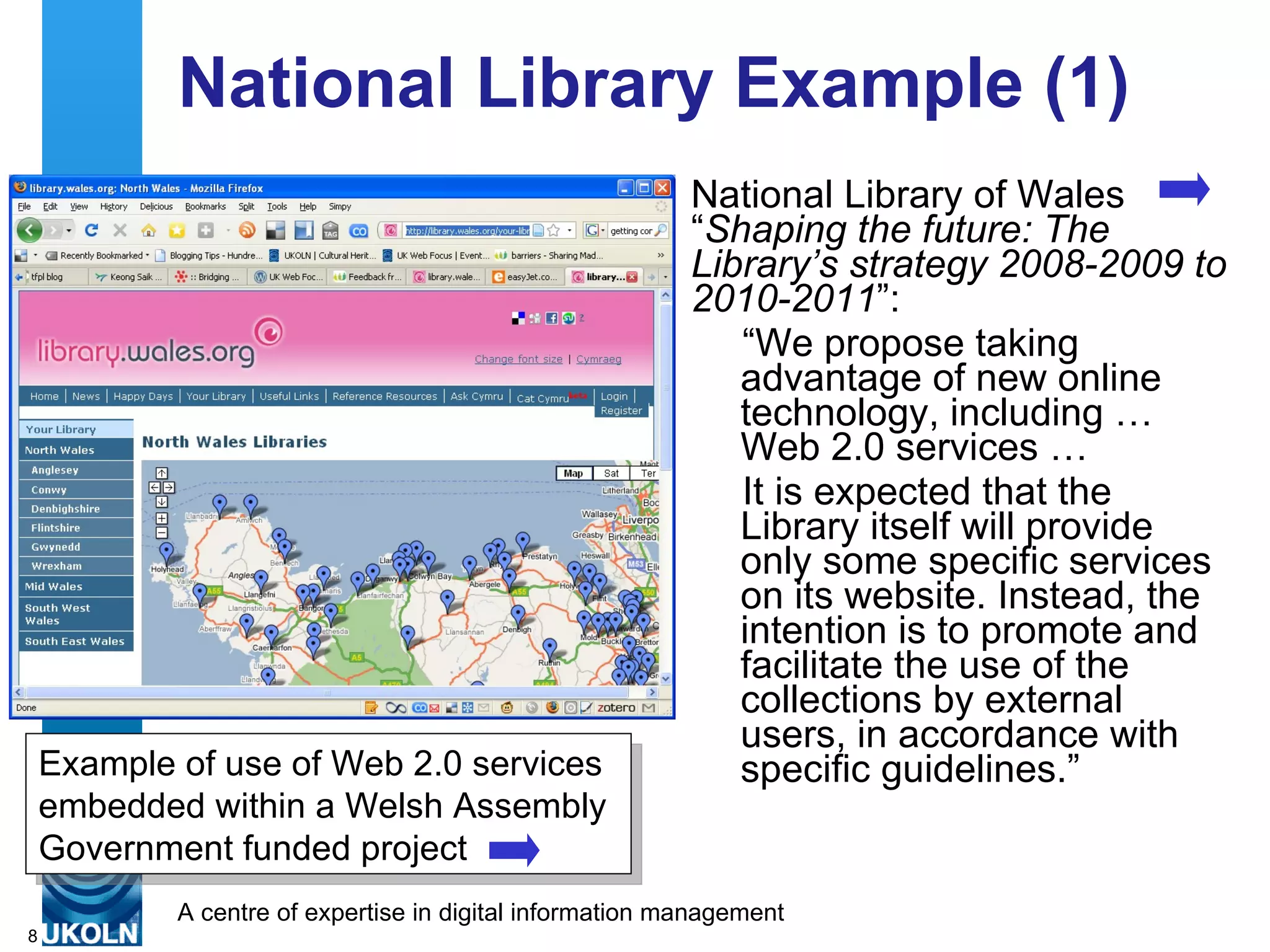
National Library Example (1) National Library of Wales “ Shaping the future: The Library’s strategy 2008-2009 to 2010-2011 ”: “ We propose taking advantage of new online technology, including … Web 2.0 services … It is expected that the Library itself will provide only some specific services on its website. Instead, the intention is to promote and facilitate the use of the collections by external users, in accordance with specific guidelines.” Example of use of Web 2.0 services embedded within a  Welsh Assembly Government funded project
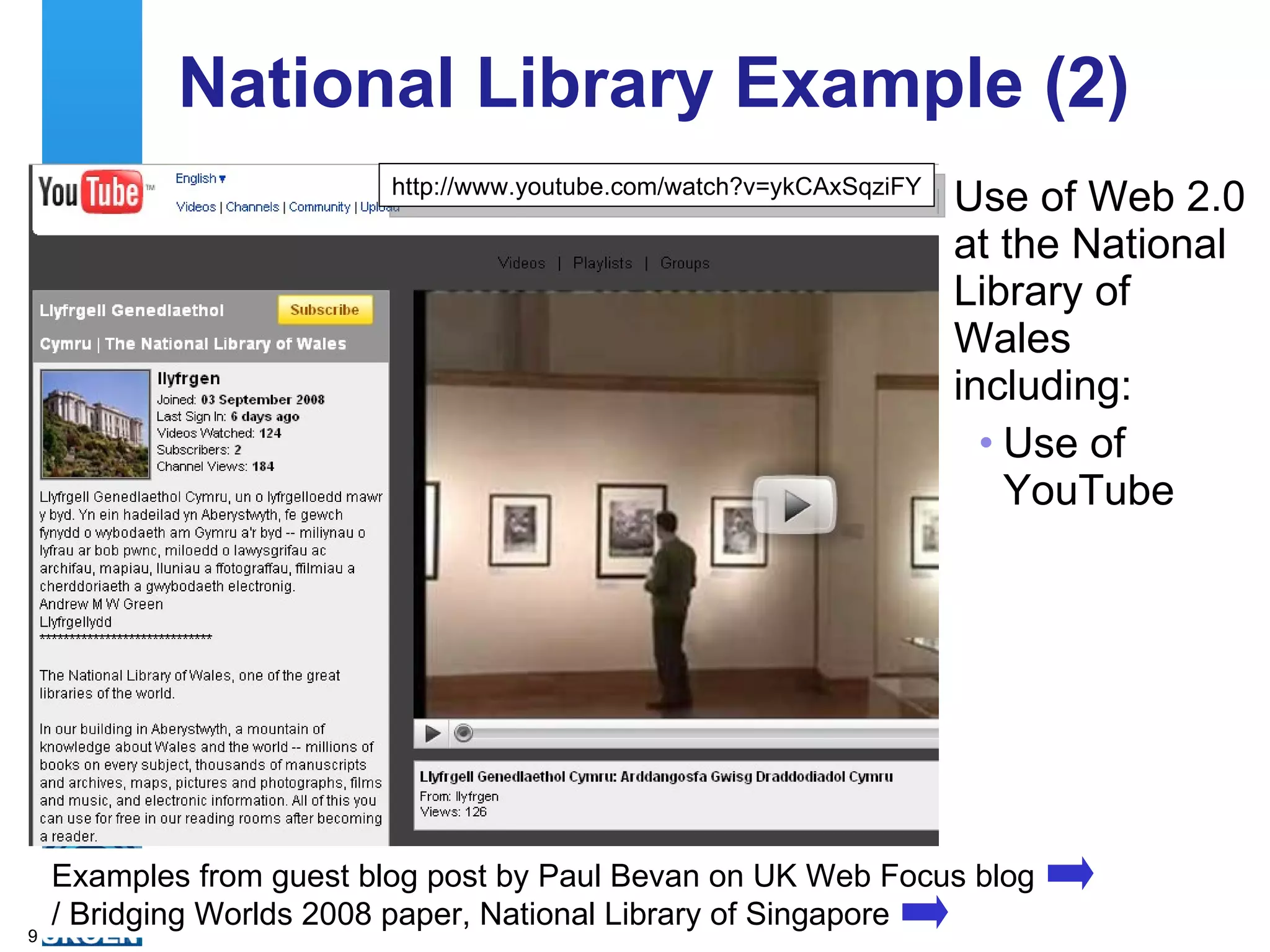
National Library Example (2) Use of Web 2.0 at the National Library of Wales including: Use of YouTube  Examples from guest blog post by Paul Bevan on UK Web Focus blog  / Bridging Worlds 2008 paper, National Library of Singapore http://www.youtube.com/watch?v=ykCAxSqziFY
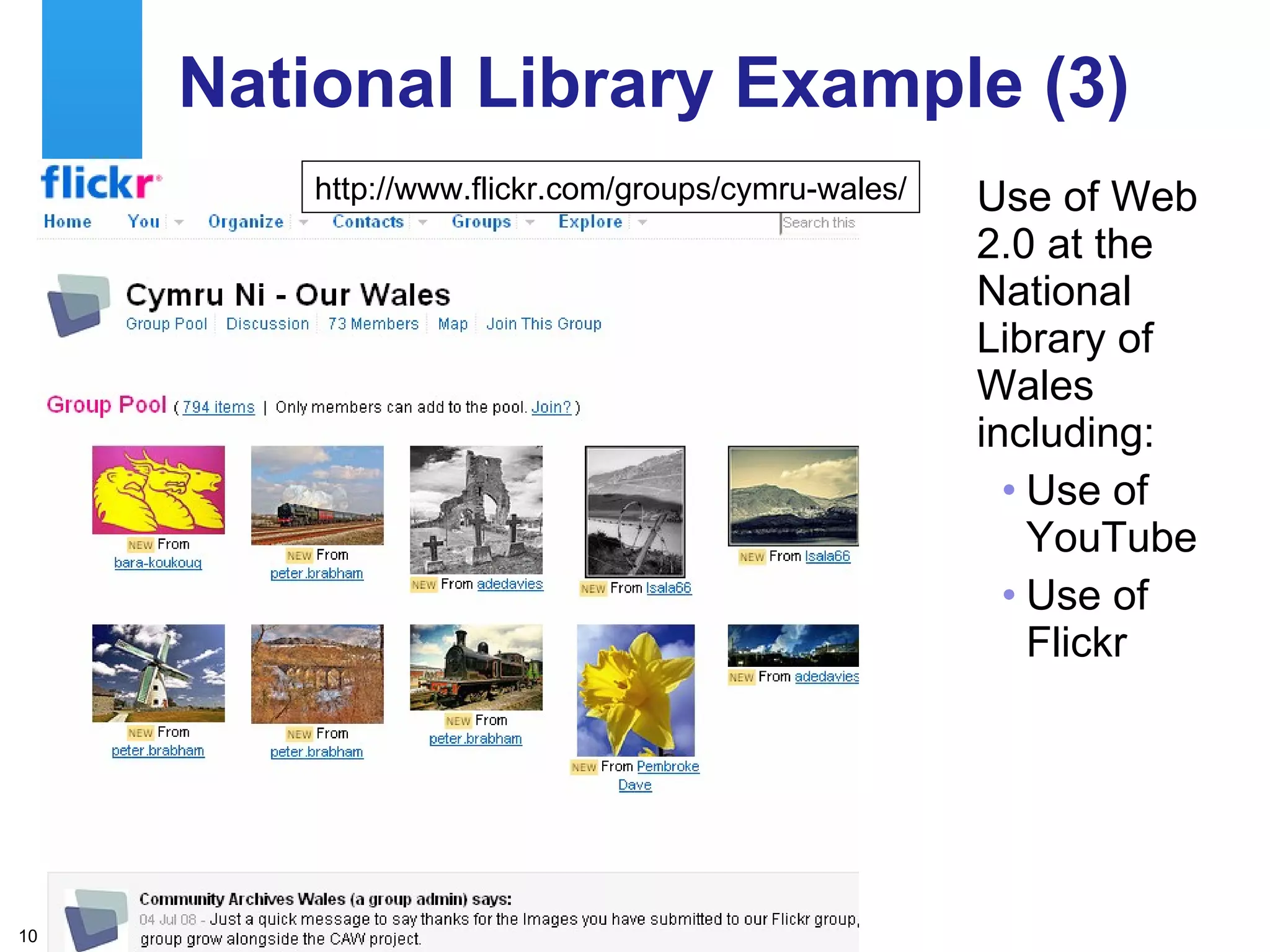
National Library Example (3) Use of Web 2.0 at the National Library of Wales including: Use of YouTube  Use of Flickr http://www.flickr.com/groups/cymru-wales/
Group Exercise In small groups: Identify uses of Web 2.0 which may be useful to your organisations Barriers to deployment of such services E
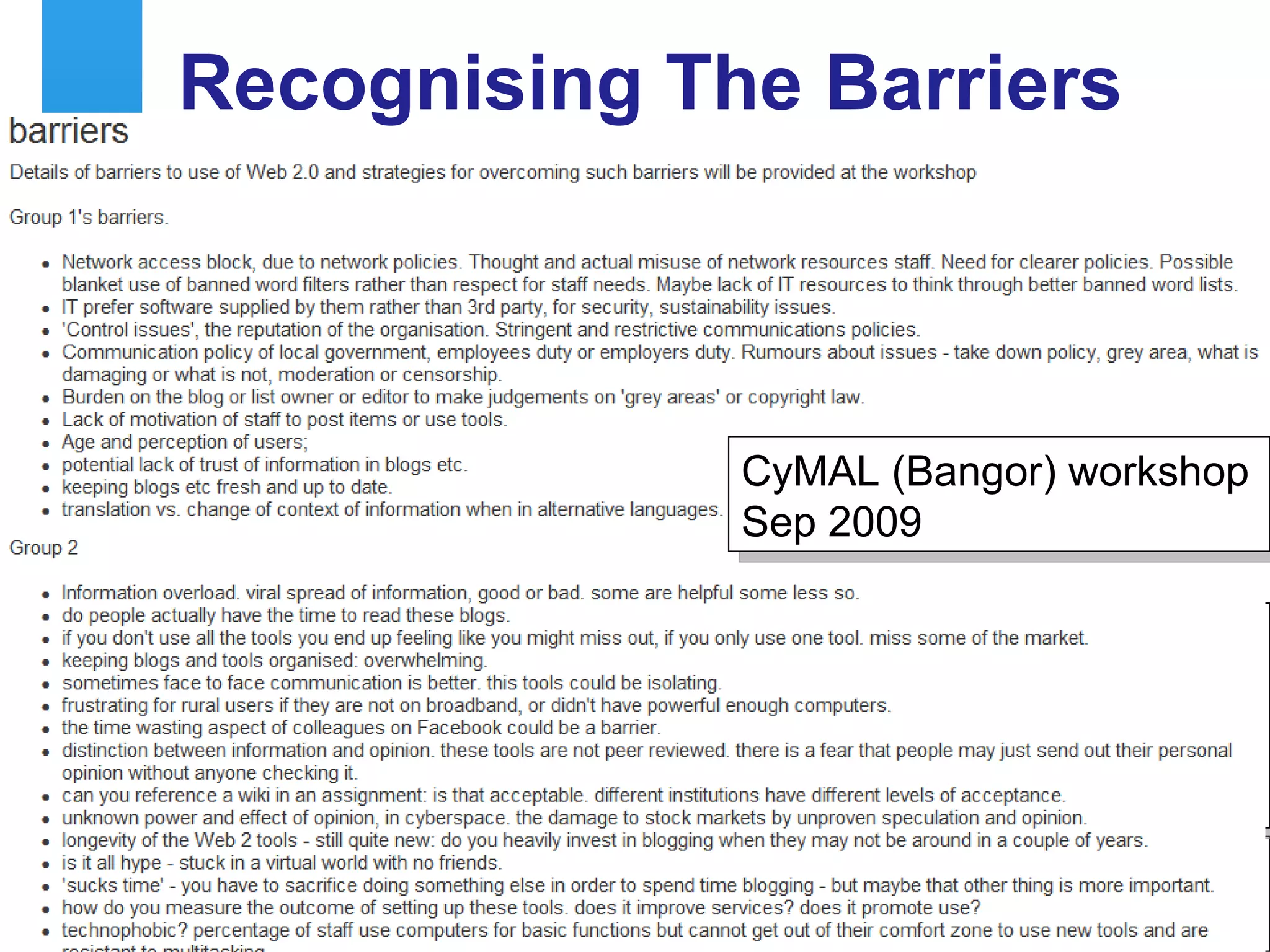
Recognising The Barriers CyMAL (Newport) workshop Sep 2009 Concerns identified in discussion group sessions at various UKOLN 1-day workshops for the cultural heritage sector  CyMAL (Bangor) workshop Sep 2009
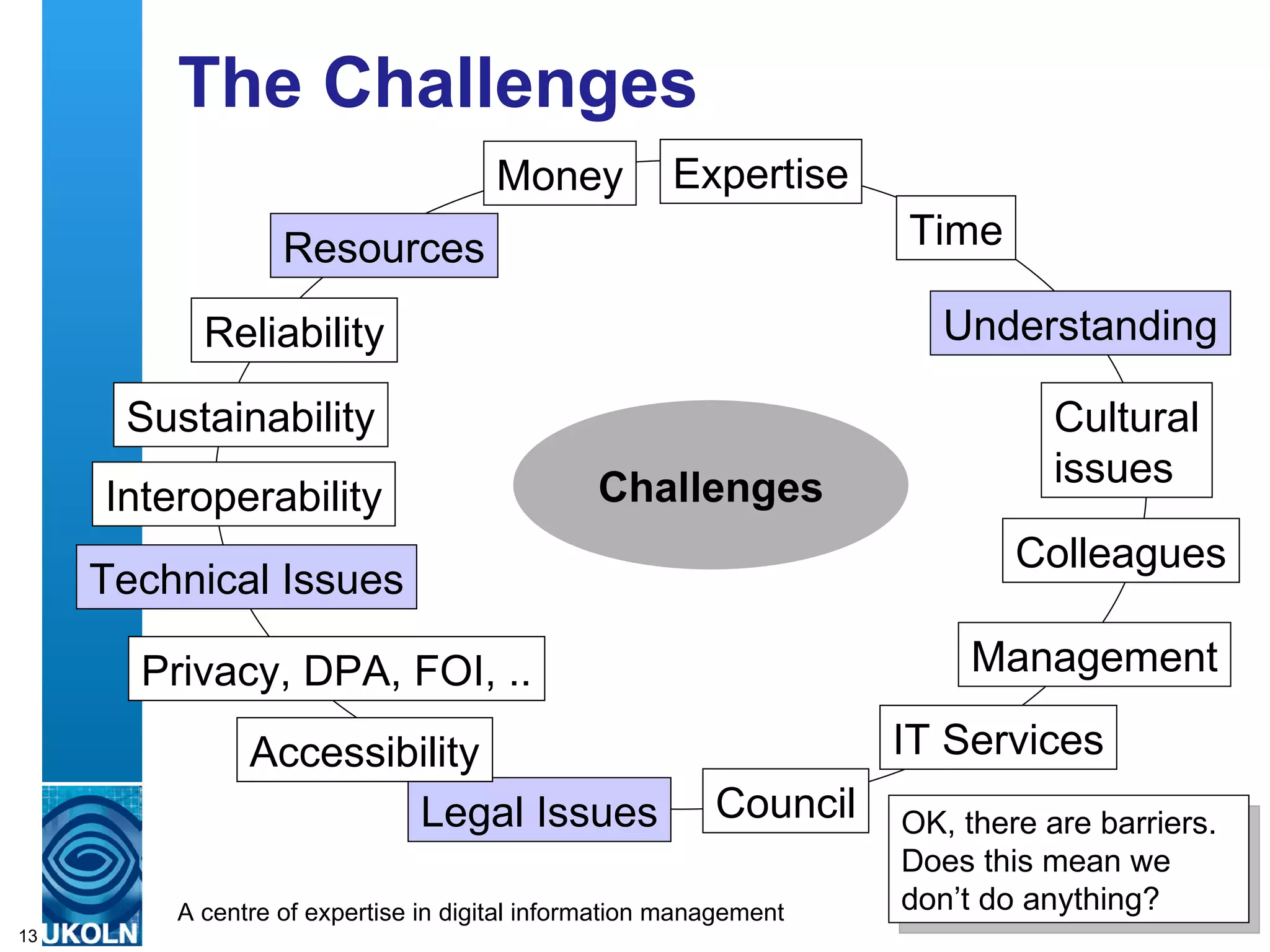
The Challenges Challenges Resources Expertise Time Money Understanding Legal Issues IT Services Colleagues Management Accessibility Sustainability Reliability Cultural issues Technical Issues Interoperability Privacy, DPA, FOI, .. Council OK, there are barriers. Does this mean we don’t do anything?
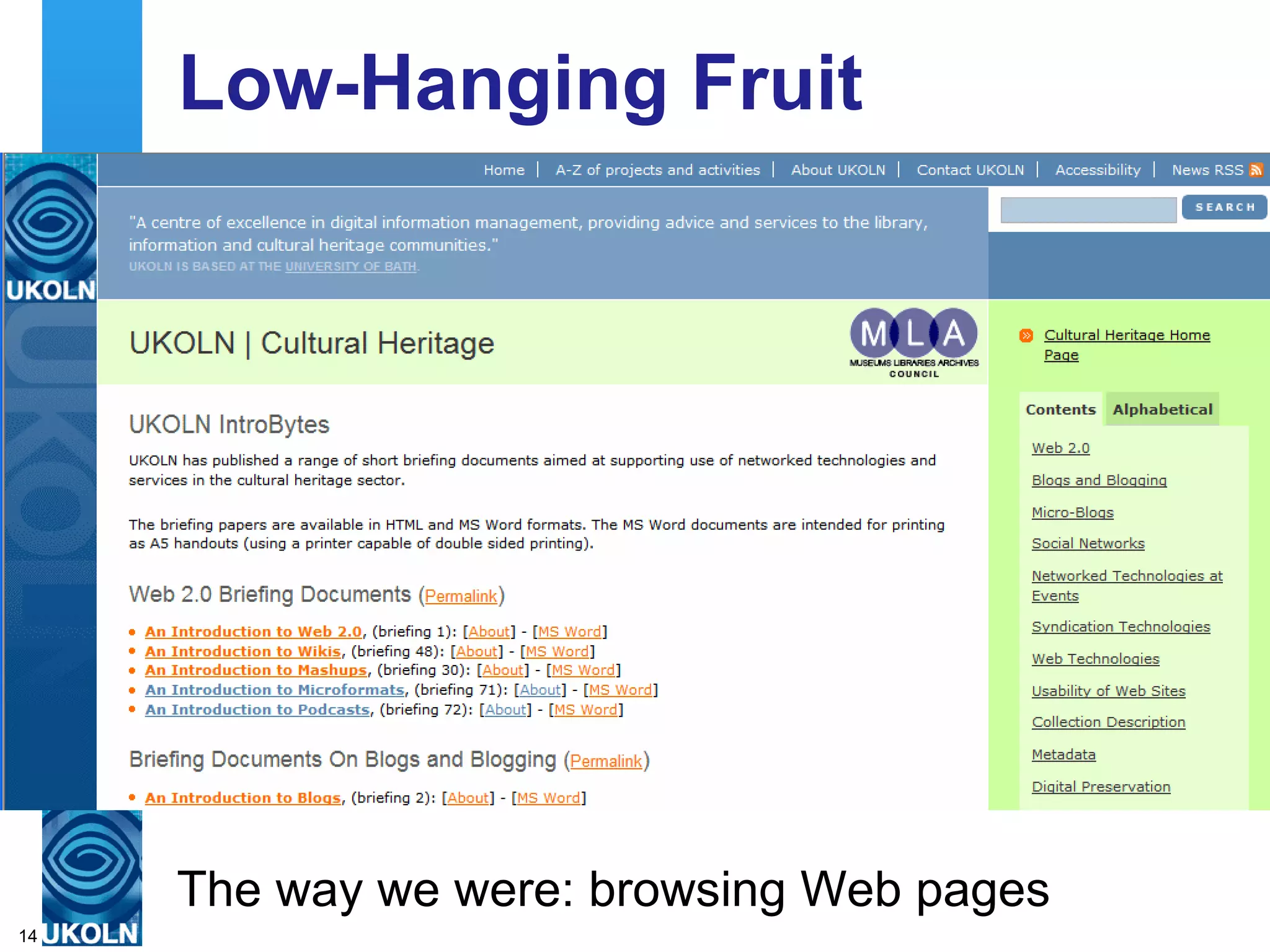
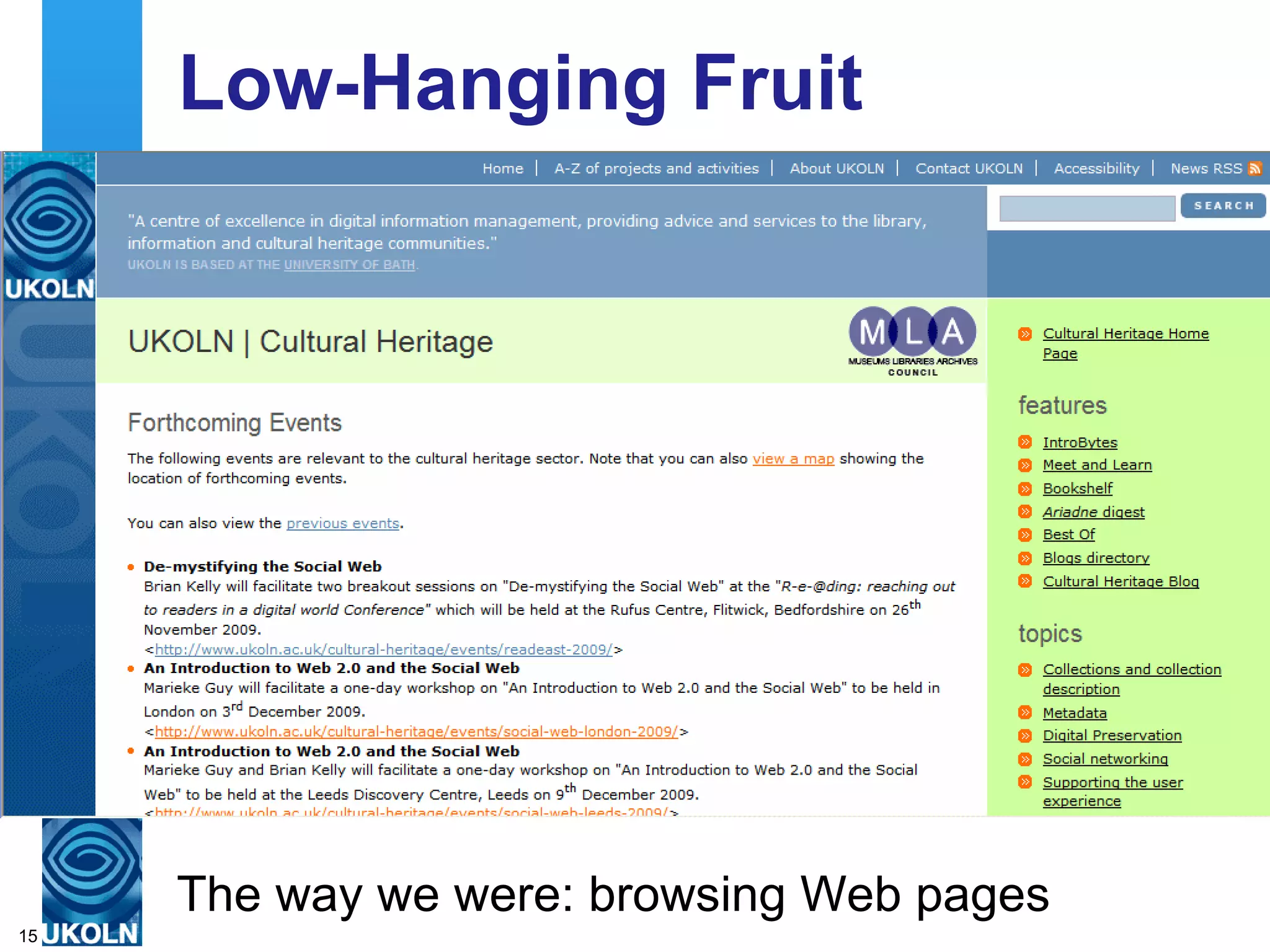
Low-Hanging Fruit The way we were: browsing Web pages
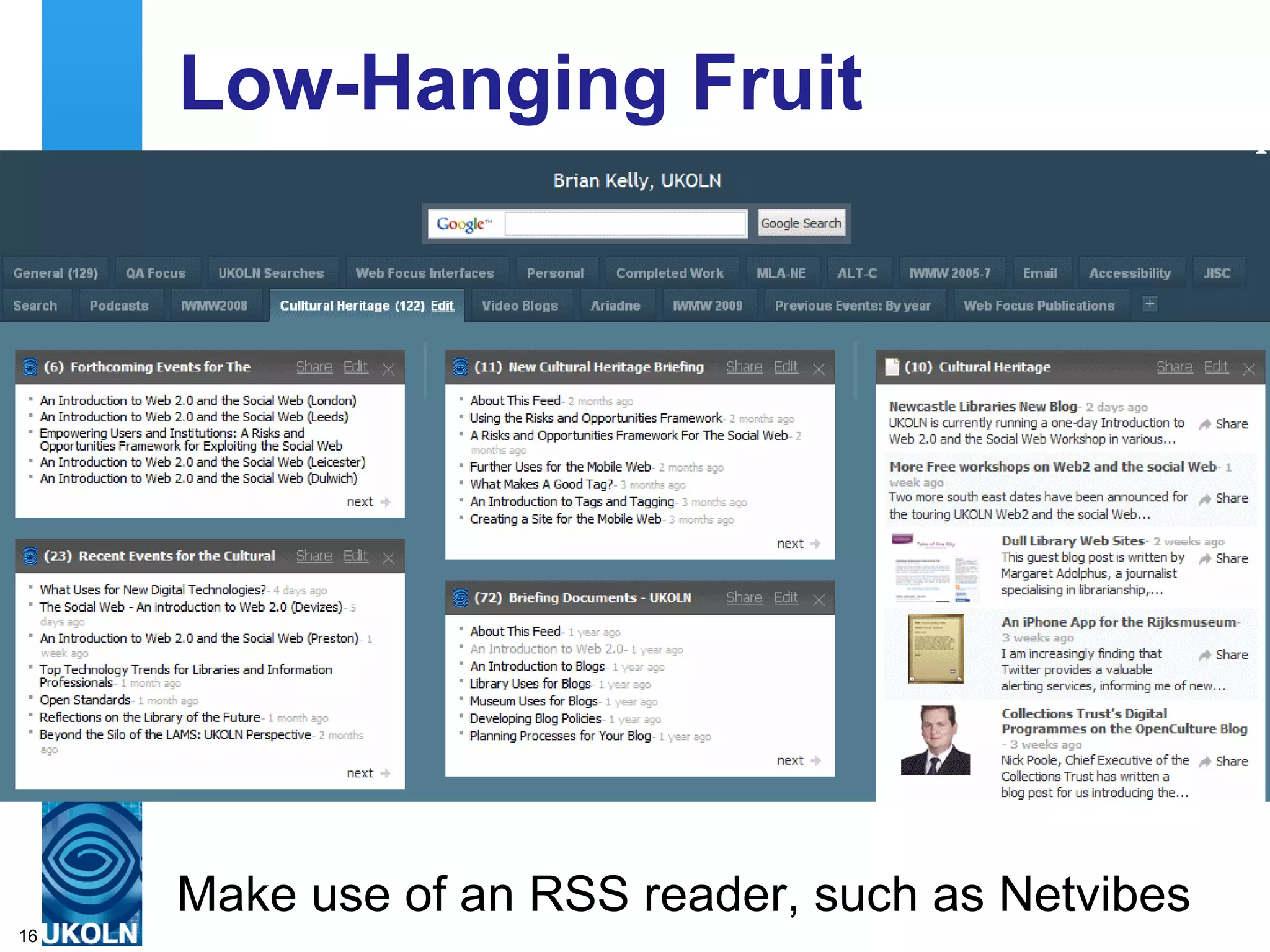
Low-Hanging Fruit Make use of an RSS reader, such as Netvibes
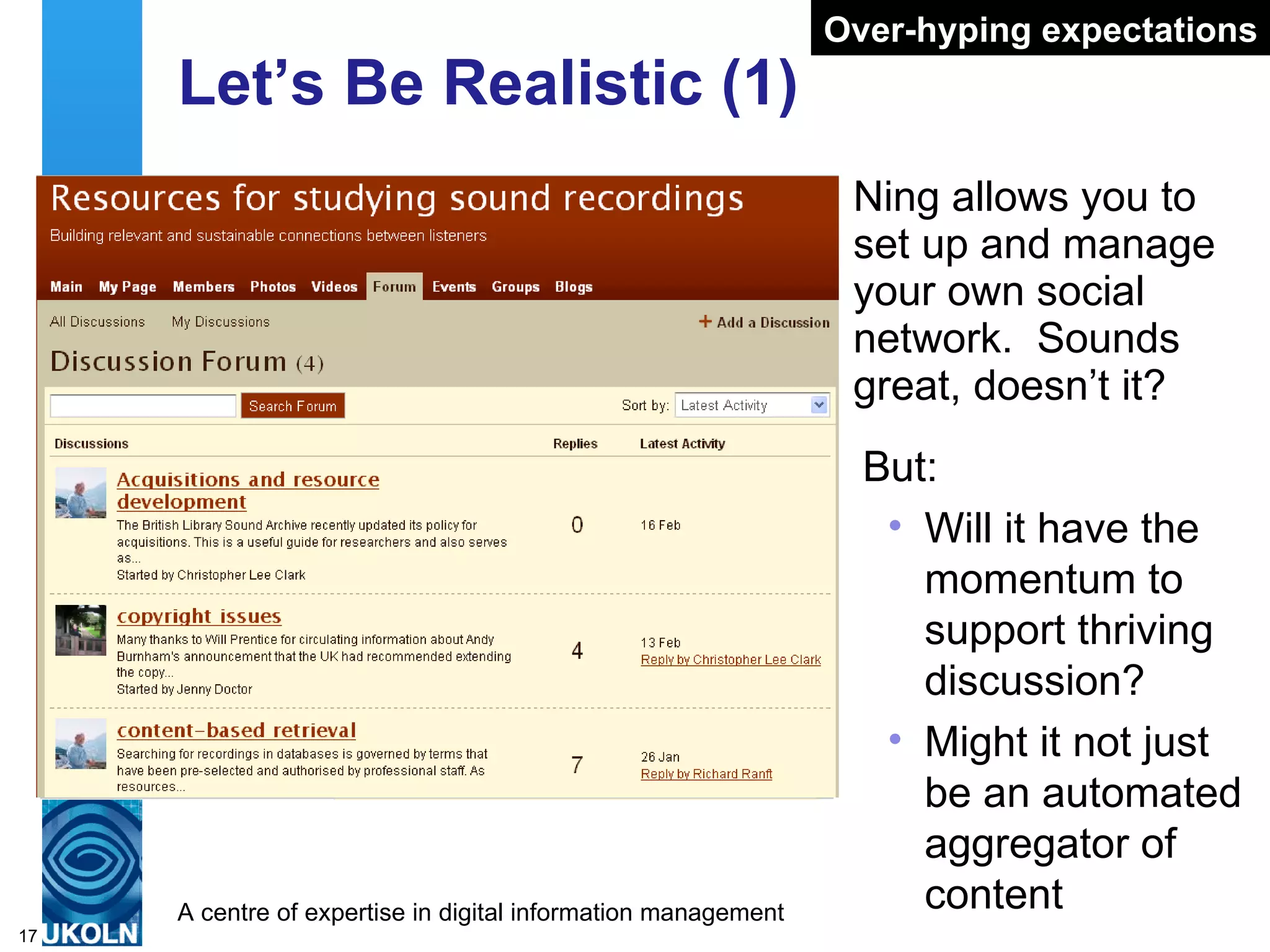
Let’s Be Realistic (1) Ning allows you to set up and manage your own social network.  Sounds great, doesn’t it? But: Will it have the momentum to support thriving discussion? Might it not just be an automated aggregator of content Over-hyping expectations
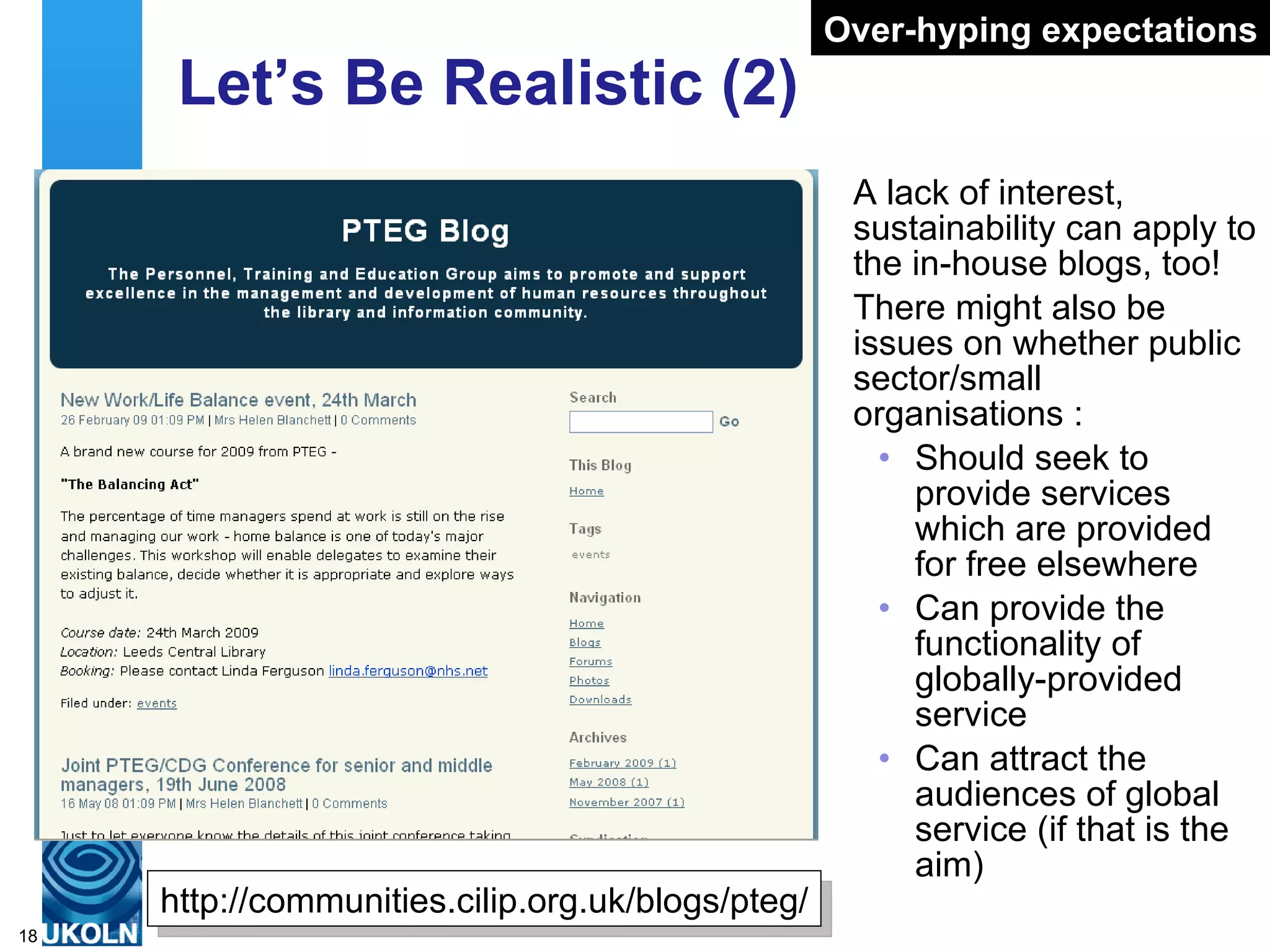
Let’s Be Realistic (2) A lack of interest, sustainability can apply to the in-house blogs, too! There might also be issues on whether public sector/small organisations : Should seek to provide services which are provided for free elsewhere Can provide the functionality of globally-provided service Can attract the audiences of global service (if that is the aim) Over-hyping expectations http://communities.cilip.org.uk/blogs/pteg/
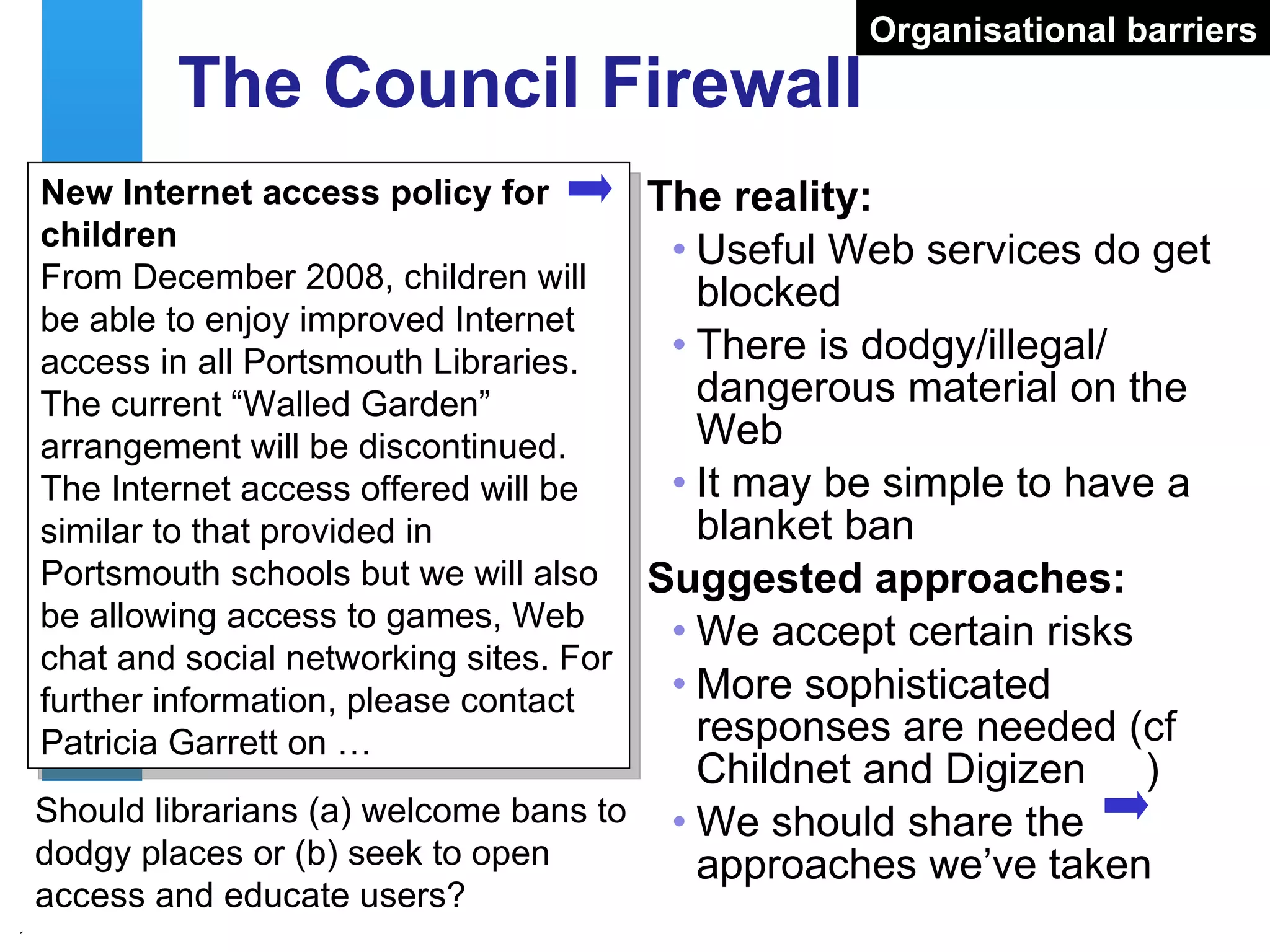
The Council Firewall The reality: Useful Web services do get blocked There is dodgy/illegal/ dangerous material on the Web It may be simple to have a blanket ban Suggested approaches: We accept certain risks More sophisticated responses are needed (cf Childnet and Digizen  ) We should share the approaches we’ve taken New Internet access policy for children From December 2008, children will be able to enjoy improved Internet access in all Portsmouth Libraries. The current “Walled Garden” arrangement will be discontinued. The Internet access offered will be similar to that provided in Portsmouth schools but we will also be allowing access to games, Web chat and social networking sites. For further information, please contact Patricia Garrett on … Should librarians (a) welcome bans to dodgy places or (b) seek to open access and educate users? Organisational barriers
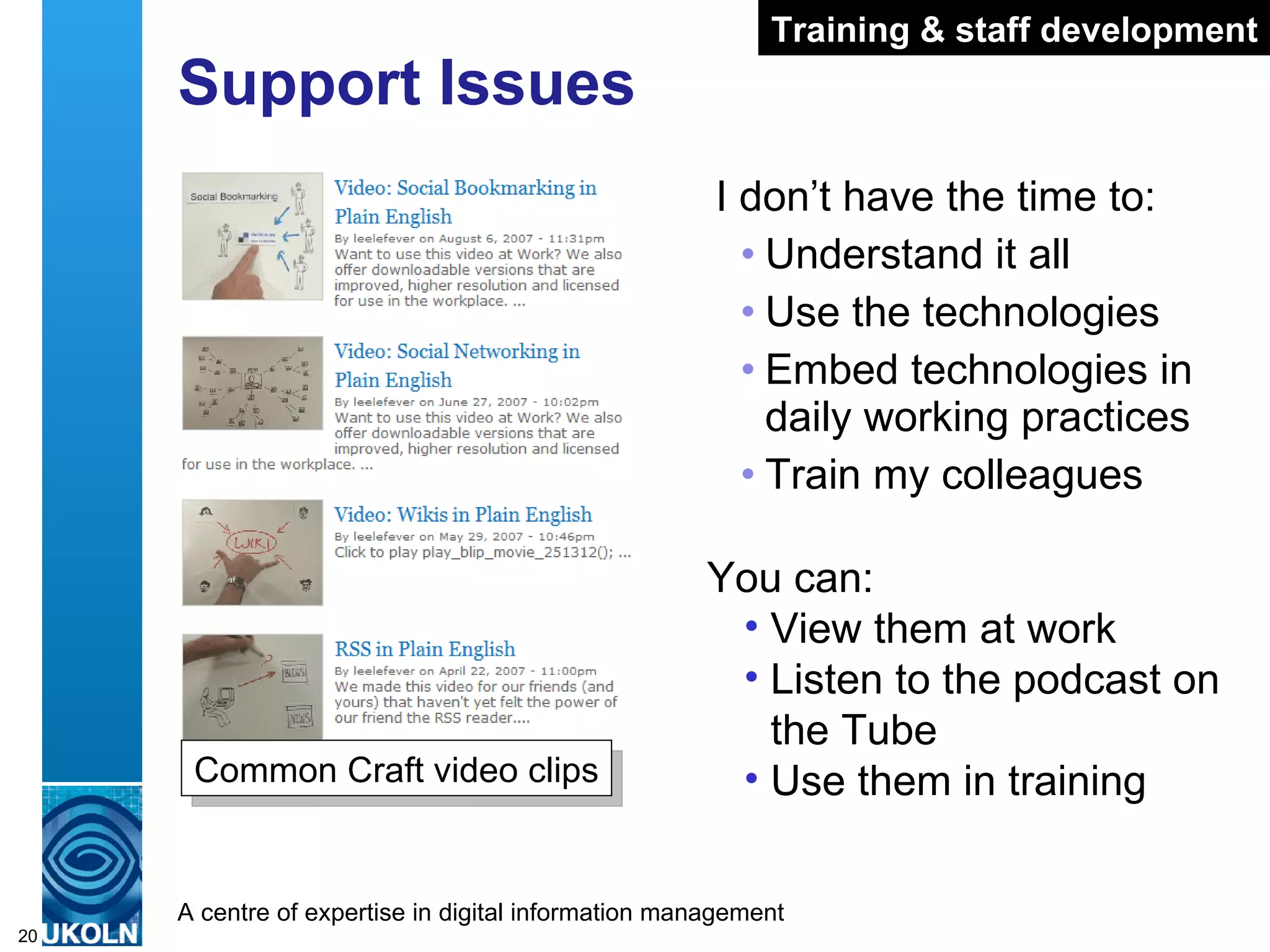
Support Issues I don’t have the time to: Understand it all Use the technologies Embed technologies in daily working practices Train my colleagues Common Craft video clips You can: View them at work Listen to the podcast on the Tube Use them in training Training & staff development
Some Concerns Sustainability What happens if Library 2.0 services: Are unreliable? Change their terms & conditions  (e.g. start charging)? Become bankrupt Interoperability What happens if Library 2.0 services: You can’t get the data back out? You only get the unstructured or poor quality data back out? You can’t get the comments, annotations, tags out? Sustainability / Interoperability Again, this can happen within our sector (e.g. AHDS)
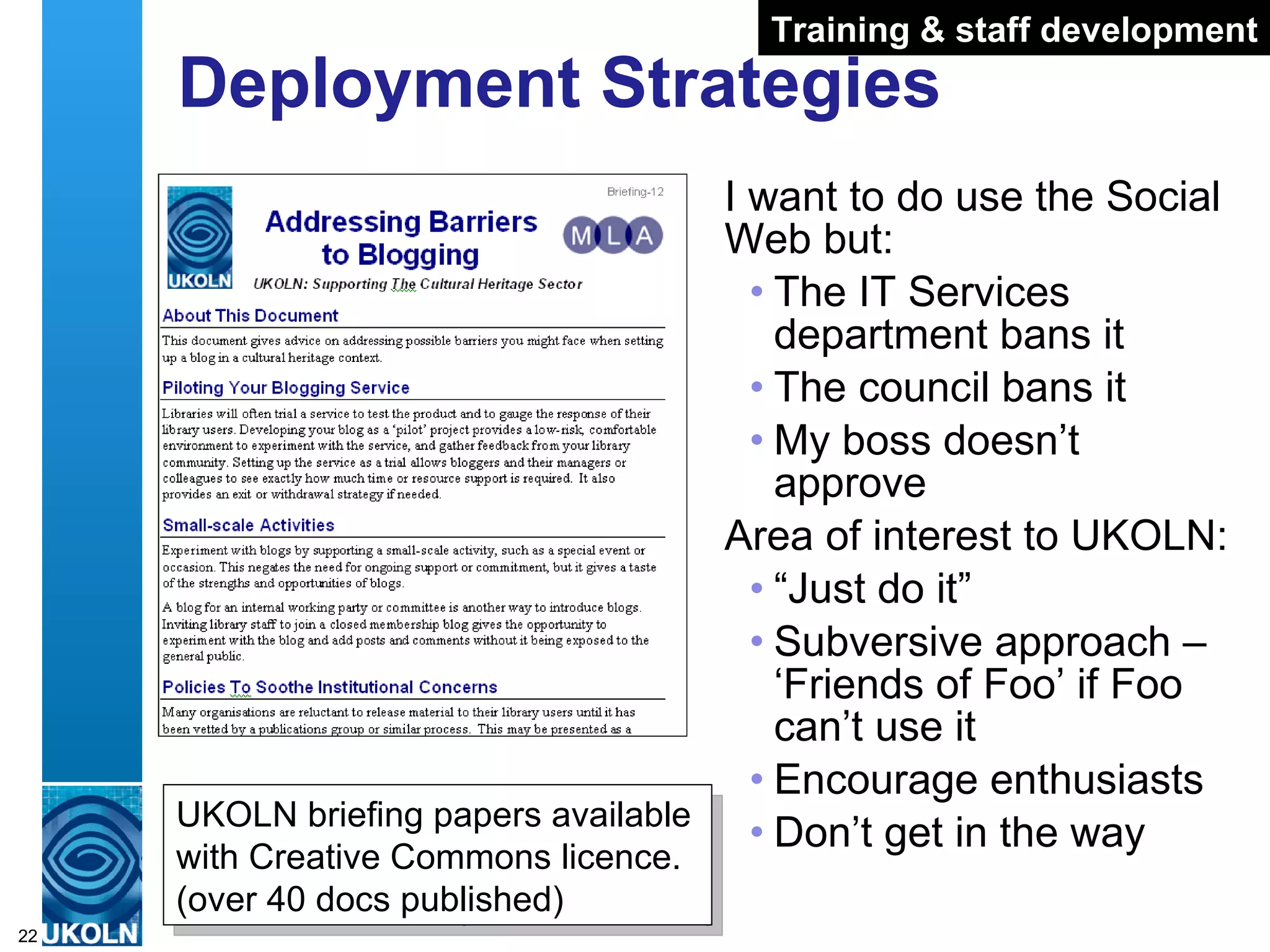
Deployment Strategies I want to do use the Social Web but: The IT Services department bans it The council bans it My boss doesn’t approve Area of interest to UKOLN: “ Just do it” Subversive approach – ‘Friends of Foo’ if Foo can’t use it Encourage enthusiasts Don’t get in the way UKOLN briefing papers available with Creative Commons licence. (over 40 docs published) Training & staff development
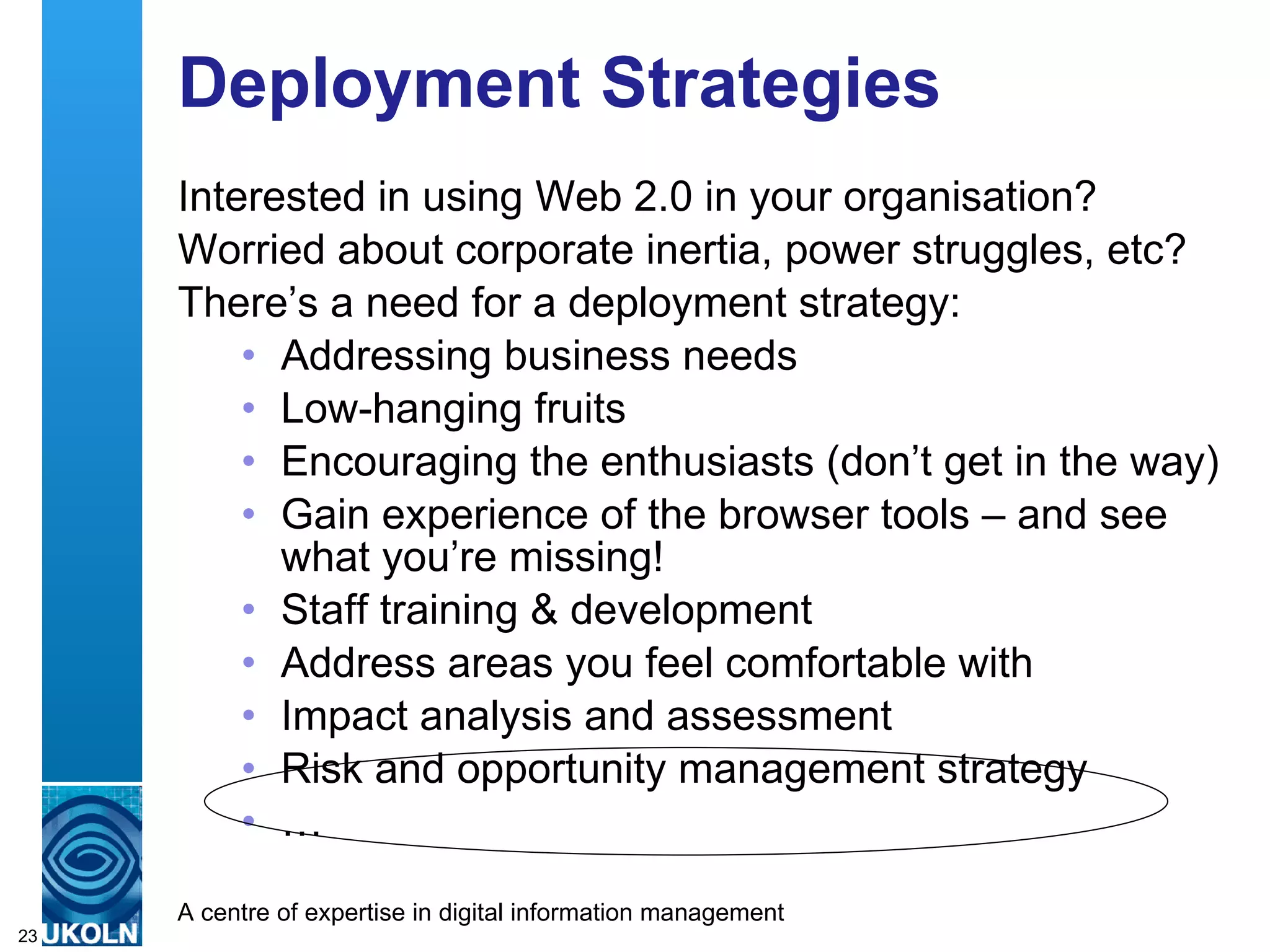
Deployment Strategies Interested in using Web 2.0 in your organisation? Worried about corporate inertia, power struggles, etc? There’s a need for a deployment strategy: Addressing business needs Low-hanging fruits Encouraging the enthusiasts (don’t get in the way) Gain experience of the browser tools – and see what you’re missing! Staff training & development Address areas you feel comfortable with Impact analysis and assessment Risk and opportunity management strategy …
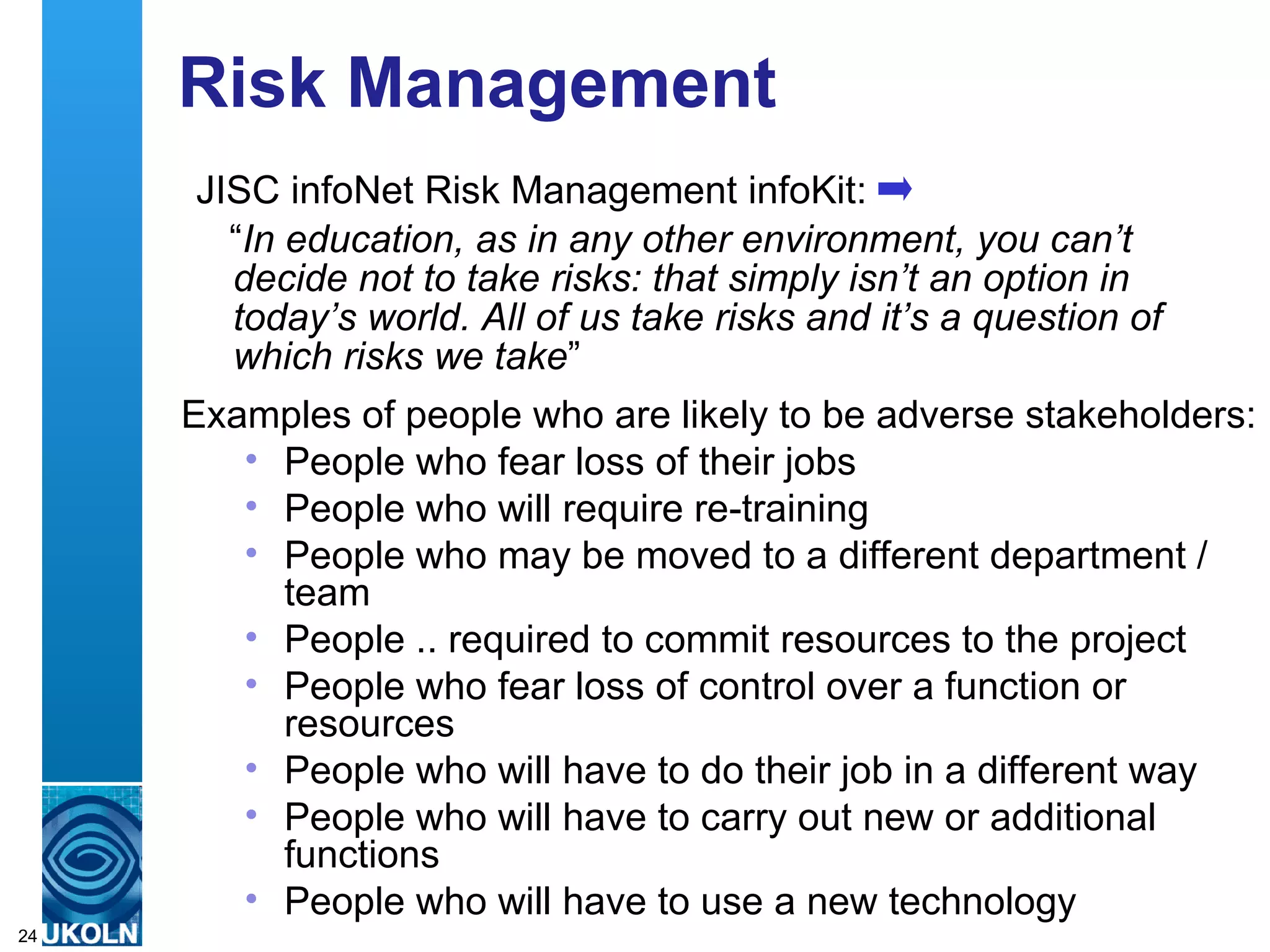
Risk Management  JISC infoNet Risk Management infoKit: “ In education, as in any other environment, you can’t decide not to take risks: that simply isn’t an option in today’s world. All of us take risks and it’s a question of which risks we take ”  Examples of people who are likely to be adverse stakeholders: People who fear loss of their jobs  People who will require re-training  People who may be moved to a different department / team  People .. required to commit resources to the project  People who fear loss of control over a function or resources  People who will have to do their job in a different way  People who will have to carry out new or additional functions  People who will have to use a new technology
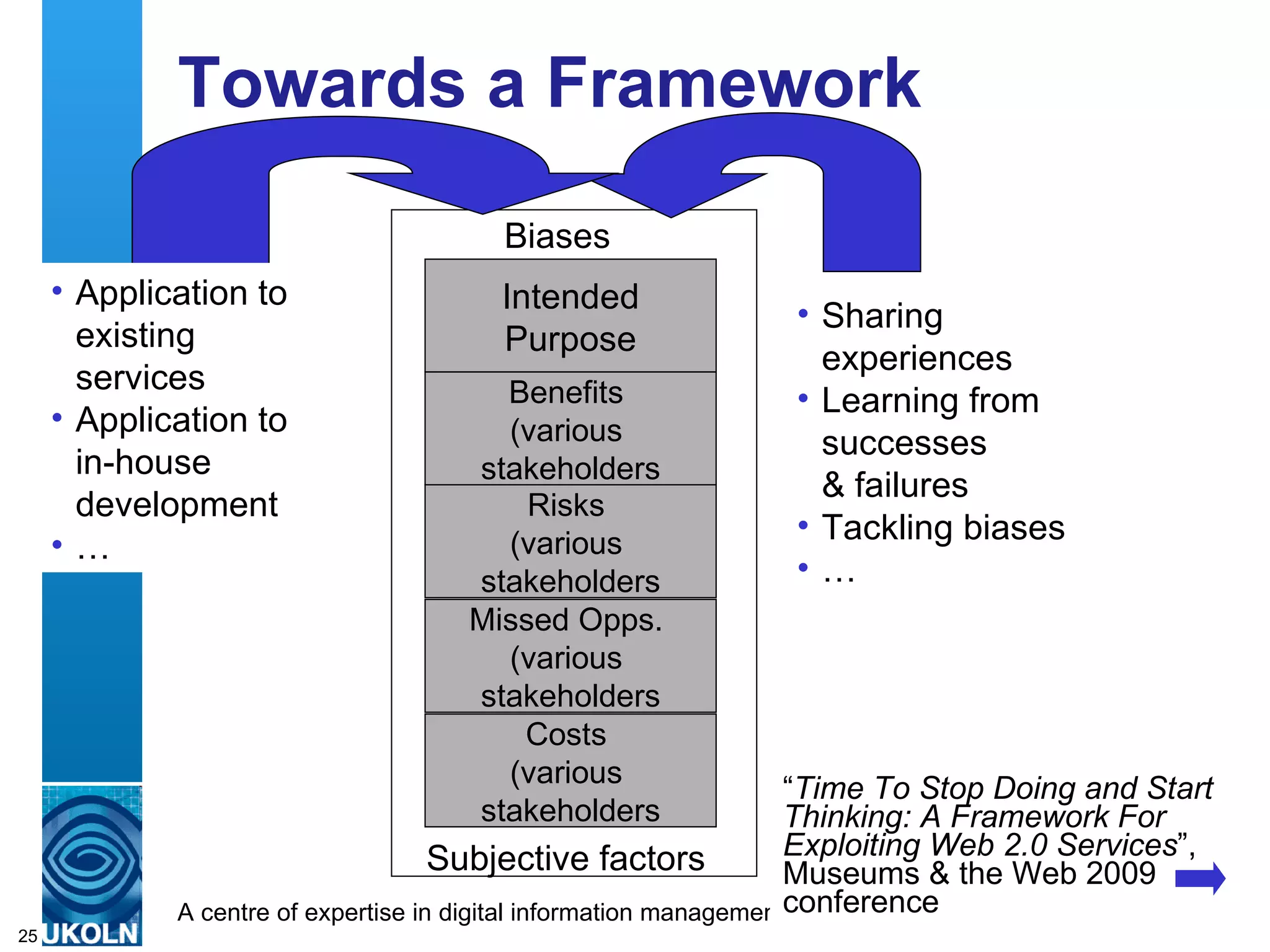
Towards a Framework “ Time To Stop Doing and Start Thinking: A Framework For Exploiting Web 2.0 Services ”, Museums & the Web 2009 conference Biases Subjective factors Intended Purpose Benefits  (various  stakeholders Risks  (various  stakeholders Missed Opps.  (various  stakeholders Costs  (various  stakeholders Sharing experiences Learning from successes & failures Tackling biases … Application to existing services Application to in-house development …
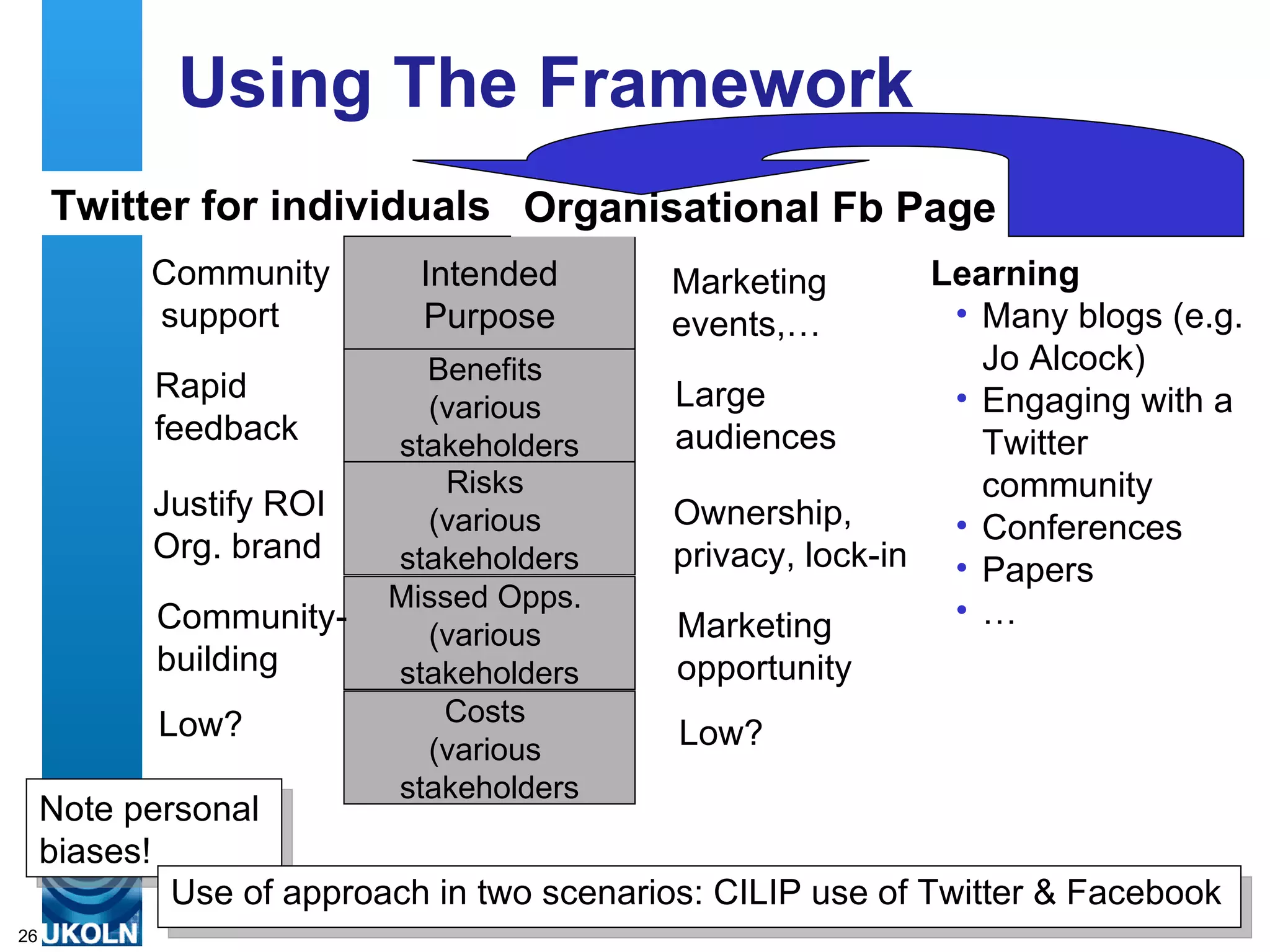
Using The Framework Use of approach in two scenarios: CILIP use of Twitter & Facebook Note personal  biases! Intended Purpose Benefits  (various  stakeholders Risks  (various  stakeholders Missed Opps.  (various  stakeholders Costs  (various  stakeholders Community  support Rapid  feedback Justify ROI Org. brand Community- building Low? Twitter for individuals Organisational Fb Page Marketing  events,…  Large  audiences Ownership,  privacy, lock-in Marketing  opportunity Low? Learning Many blogs (e.g. Jo Alcock) Engaging with a Twitter community Conferences Papers …
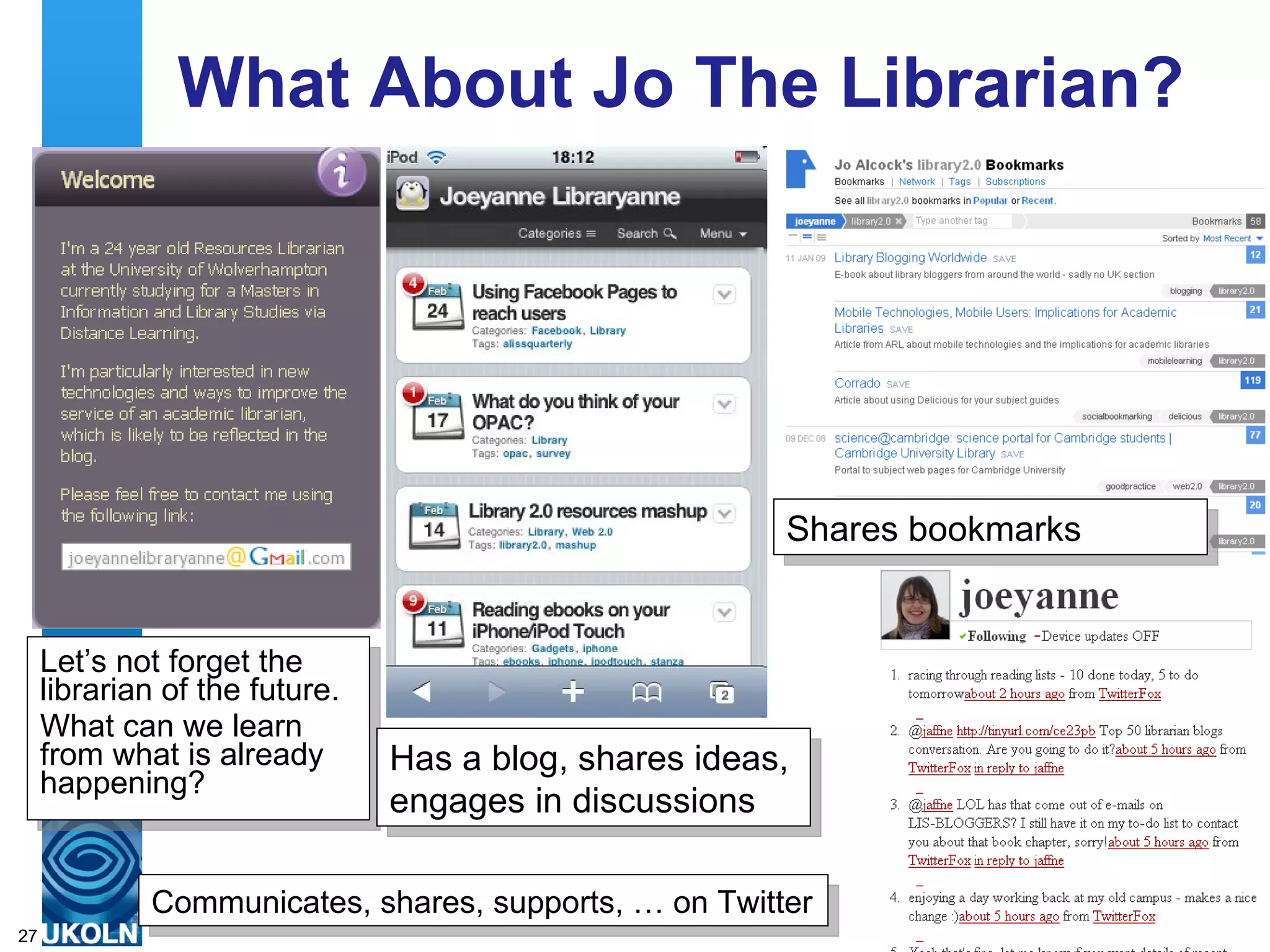
What About Jo The Librarian? Let’s not forget the librarian of the future. What can we learn from what is already happening? Has a blog, shares ideas, engages in discussions Shares bookmarks Communicates, shares, supports, … on Twitter
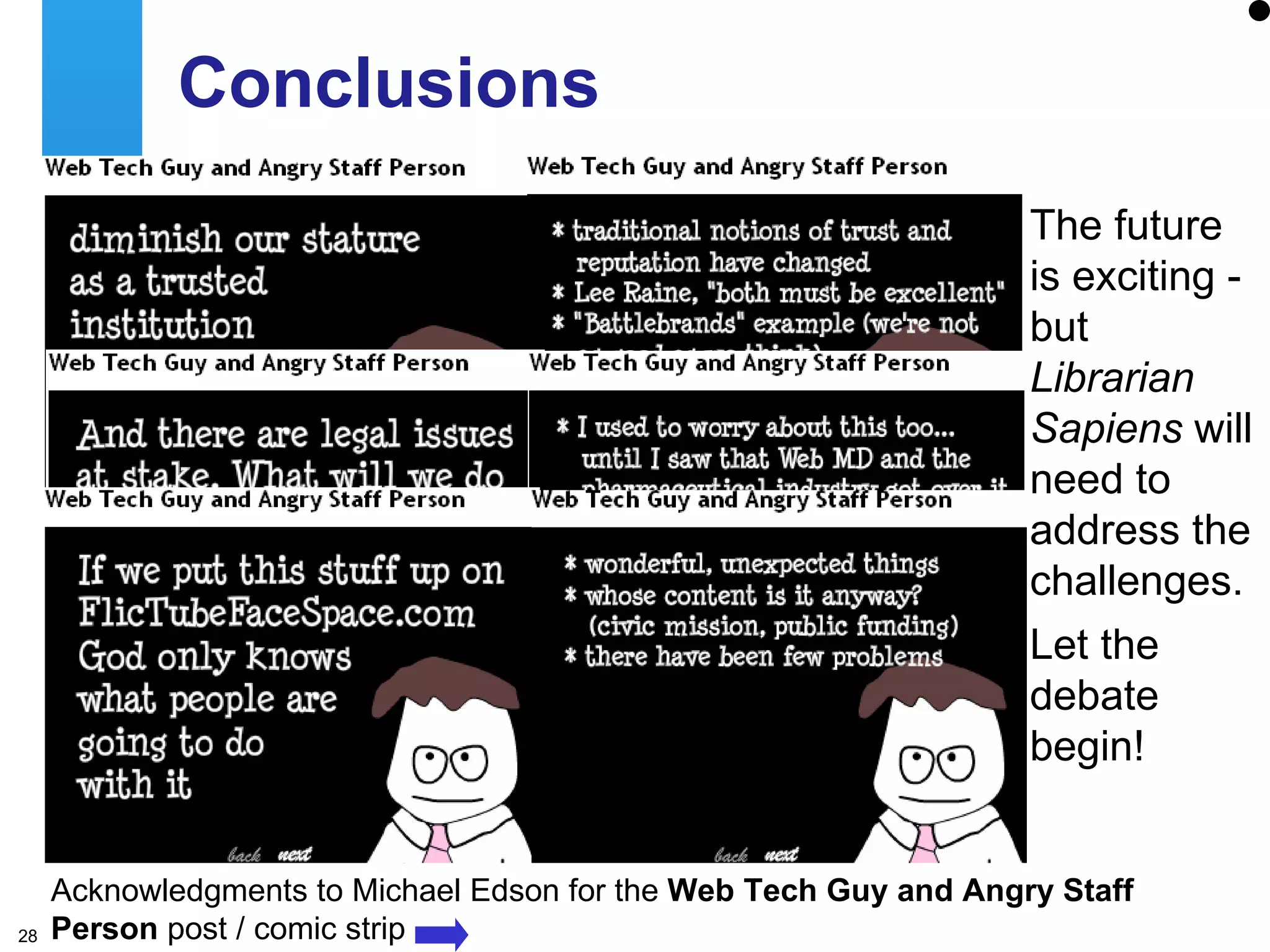
Conclusions The future is exciting - but  Librarian Sapiens  will need to address the challenges. Let the debate begin! Acknowledgments to Michael Edson for the  Web Tech Guy and Angry Staff Person  post / comic strip

Demystifying the Social Web

  • 1.
    Demystifying the SocialWeb Brian Kelly UKOLN University of Bath Bath, UK UKOLN is supported by: This work is licensed under a Attribution-NonCommercial-ShareAlike 2.0 licence (but note caveat) Acceptable Use Policy Recording of this talk, taking photos, discussing the content using email, Twitter, blogs, etc. is permitted providing distractions to others is minimised. Resources bookmarked using ‘ readeast-2009 ' tag http://www.ukoln.ac.uk/cultural-heritage/events/readeast-2009/ Email: [email_address] Twitter: http://twitter.com/briankelly/ Blog: http://ukwebfocus.wordpress.com/ Twitter hashtag: #readeast09
  • 2.
    About Me BrianKelly: National Web adviser to UK Universities and cultural heritage organisations Based at UKOLN, a national centre of expertise in digital information management and located at the University of Bath Involved in Web since January 1993 Over 300 presentations given since 1997 Current area of interest include Web 2.0, Web standards and Web accessibility Introduction
  • 3.
    About This SessionThis session provides: A summary of the Web 2.0 and what it is An introduction to various Social Web services Small group activity on identifying: Potential benefits of the Social Web Barriers to deployment of such services. The session will conclude by outlining approaches to addressing the barriers.
  • 4.
    Using Tools ITalk About Use of Web 2.0 technologies & approaches: RSS feeds for structured information Geo-location data Exploitation of 3 rd party services Openness of resources Risk assessment / management approaches Talks given in 2008 covered Web 2.0, accessibility & standards. Introduction Note also use of blogs, video blogs, YouTube, Twitter, …
  • 5.
    Web 2.0 WhatIs Web 2.0? Marketing term (derived from observing 'patterns') rather than technical standards - “an attitude not a technology” Web2MemeMap, Tim O’Reilly, 2005 Characteristics Of Web 2.0 Network as platform Always beta Clean URIs Remix and mash-ups Syndication (RSS) Architecture of participation Blogs & wikis Social networking, tagging & sharing Benefits of scale (Social Web) Trust and openness Web 2.0
  • 6.
    Benefits of Web2.0 Delivery Mechanisms (“network as platform”): Global outreach : maximise impact of and engagement with ideas Outsourced services : allowing organisations to focus on their strengths and small institutions to engage on more equal terms Exploits infrastructure : the standards (e,g. RSS) & services (Google, Amazon, ..) now in place User Benefits: User can create content Can comment on other’s content Users no longer passive consumers of content
  • 7.
    Academic Library ExampleA Facebook page provides: Brief factual information Links to key resources on main Web site Dynamic content embedded via RSS Calendar information embedded via Google calendar Ability for users to become ‘fans’
  • 8.
    National Library Example(1) National Library of Wales “ Shaping the future: The Library’s strategy 2008-2009 to 2010-2011 ”: “ We propose taking advantage of new online technology, including … Web 2.0 services … It is expected that the Library itself will provide only some specific services on its website. Instead, the intention is to promote and facilitate the use of the collections by external users, in accordance with specific guidelines.” Example of use of Web 2.0 services embedded within a Welsh Assembly Government funded project
  • 9.
    National Library Example(2) Use of Web 2.0 at the National Library of Wales including: Use of YouTube Examples from guest blog post by Paul Bevan on UK Web Focus blog / Bridging Worlds 2008 paper, National Library of Singapore http://www.youtube.com/watch?v=ykCAxSqziFY
  • 10.
    National Library Example(3) Use of Web 2.0 at the National Library of Wales including: Use of YouTube Use of Flickr http://www.flickr.com/groups/cymru-wales/
  • 11.
    Group Exercise Insmall groups: Identify uses of Web 2.0 which may be useful to your organisations Barriers to deployment of such services E
  • 12.
    Recognising The BarriersCyMAL (Newport) workshop Sep 2009 Concerns identified in discussion group sessions at various UKOLN 1-day workshops for the cultural heritage sector CyMAL (Bangor) workshop Sep 2009
  • 13.
    The Challenges ChallengesResources Expertise Time Money Understanding Legal Issues IT Services Colleagues Management Accessibility Sustainability Reliability Cultural issues Technical Issues Interoperability Privacy, DPA, FOI, .. Council OK, there are barriers. Does this mean we don’t do anything?
  • 14.
    Low-Hanging Fruit Theway we were: browsing Web pages
  • 15.
    Low-Hanging Fruit Theway we were: browsing Web pages
  • 16.
    Low-Hanging Fruit Makeuse of an RSS reader, such as Netvibes
  • 17.
    Let’s Be Realistic(1) Ning allows you to set up and manage your own social network. Sounds great, doesn’t it? But: Will it have the momentum to support thriving discussion? Might it not just be an automated aggregator of content Over-hyping expectations
  • 18.
    Let’s Be Realistic(2) A lack of interest, sustainability can apply to the in-house blogs, too! There might also be issues on whether public sector/small organisations : Should seek to provide services which are provided for free elsewhere Can provide the functionality of globally-provided service Can attract the audiences of global service (if that is the aim) Over-hyping expectations http://communities.cilip.org.uk/blogs/pteg/
  • 19.
    The Council FirewallThe reality: Useful Web services do get blocked There is dodgy/illegal/ dangerous material on the Web It may be simple to have a blanket ban Suggested approaches: We accept certain risks More sophisticated responses are needed (cf Childnet and Digizen ) We should share the approaches we’ve taken New Internet access policy for children From December 2008, children will be able to enjoy improved Internet access in all Portsmouth Libraries. The current “Walled Garden” arrangement will be discontinued. The Internet access offered will be similar to that provided in Portsmouth schools but we will also be allowing access to games, Web chat and social networking sites. For further information, please contact Patricia Garrett on … Should librarians (a) welcome bans to dodgy places or (b) seek to open access and educate users? Organisational barriers
  • 20.
    Support Issues Idon’t have the time to: Understand it all Use the technologies Embed technologies in daily working practices Train my colleagues Common Craft video clips You can: View them at work Listen to the podcast on the Tube Use them in training Training & staff development
  • 21.
    Some Concerns SustainabilityWhat happens if Library 2.0 services: Are unreliable? Change their terms & conditions (e.g. start charging)? Become bankrupt Interoperability What happens if Library 2.0 services: You can’t get the data back out? You only get the unstructured or poor quality data back out? You can’t get the comments, annotations, tags out? Sustainability / Interoperability Again, this can happen within our sector (e.g. AHDS)
  • 22.
    Deployment Strategies Iwant to do use the Social Web but: The IT Services department bans it The council bans it My boss doesn’t approve Area of interest to UKOLN: “ Just do it” Subversive approach – ‘Friends of Foo’ if Foo can’t use it Encourage enthusiasts Don’t get in the way UKOLN briefing papers available with Creative Commons licence. (over 40 docs published) Training & staff development
  • 23.
    Deployment Strategies Interestedin using Web 2.0 in your organisation? Worried about corporate inertia, power struggles, etc? There’s a need for a deployment strategy: Addressing business needs Low-hanging fruits Encouraging the enthusiasts (don’t get in the way) Gain experience of the browser tools – and see what you’re missing! Staff training & development Address areas you feel comfortable with Impact analysis and assessment Risk and opportunity management strategy …
  • 24.
    Risk Management JISC infoNet Risk Management infoKit: “ In education, as in any other environment, you can’t decide not to take risks: that simply isn’t an option in today’s world. All of us take risks and it’s a question of which risks we take ” Examples of people who are likely to be adverse stakeholders: People who fear loss of their jobs People who will require re-training People who may be moved to a different department / team People .. required to commit resources to the project People who fear loss of control over a function or resources People who will have to do their job in a different way People who will have to carry out new or additional functions People who will have to use a new technology
  • 25.
    Towards a Framework“ Time To Stop Doing and Start Thinking: A Framework For Exploiting Web 2.0 Services ”, Museums & the Web 2009 conference Biases Subjective factors Intended Purpose Benefits (various stakeholders Risks (various stakeholders Missed Opps. (various stakeholders Costs (various stakeholders Sharing experiences Learning from successes & failures Tackling biases … Application to existing services Application to in-house development …
  • 26.
    Using The FrameworkUse of approach in two scenarios: CILIP use of Twitter & Facebook Note personal biases! Intended Purpose Benefits (various stakeholders Risks (various stakeholders Missed Opps. (various stakeholders Costs (various stakeholders Community support Rapid feedback Justify ROI Org. brand Community- building Low? Twitter for individuals Organisational Fb Page Marketing events,… Large audiences Ownership, privacy, lock-in Marketing opportunity Low? Learning Many blogs (e.g. Jo Alcock) Engaging with a Twitter community Conferences Papers …
  • 27.
    What About JoThe Librarian? Let’s not forget the librarian of the future. What can we learn from what is already happening? Has a blog, shares ideas, engages in discussions Shares bookmarks Communicates, shares, supports, … on Twitter
  • 28.
    Conclusions The futureis exciting - but Librarian Sapiens will need to address the challenges. Let the debate begin! Acknowledgments to Michael Edson for the Web Tech Guy and Angry Staff Person post / comic strip