Data Privacy Challenges in the
DATA ANALYTICS
www.reallygreatsite.com
@iabac.org
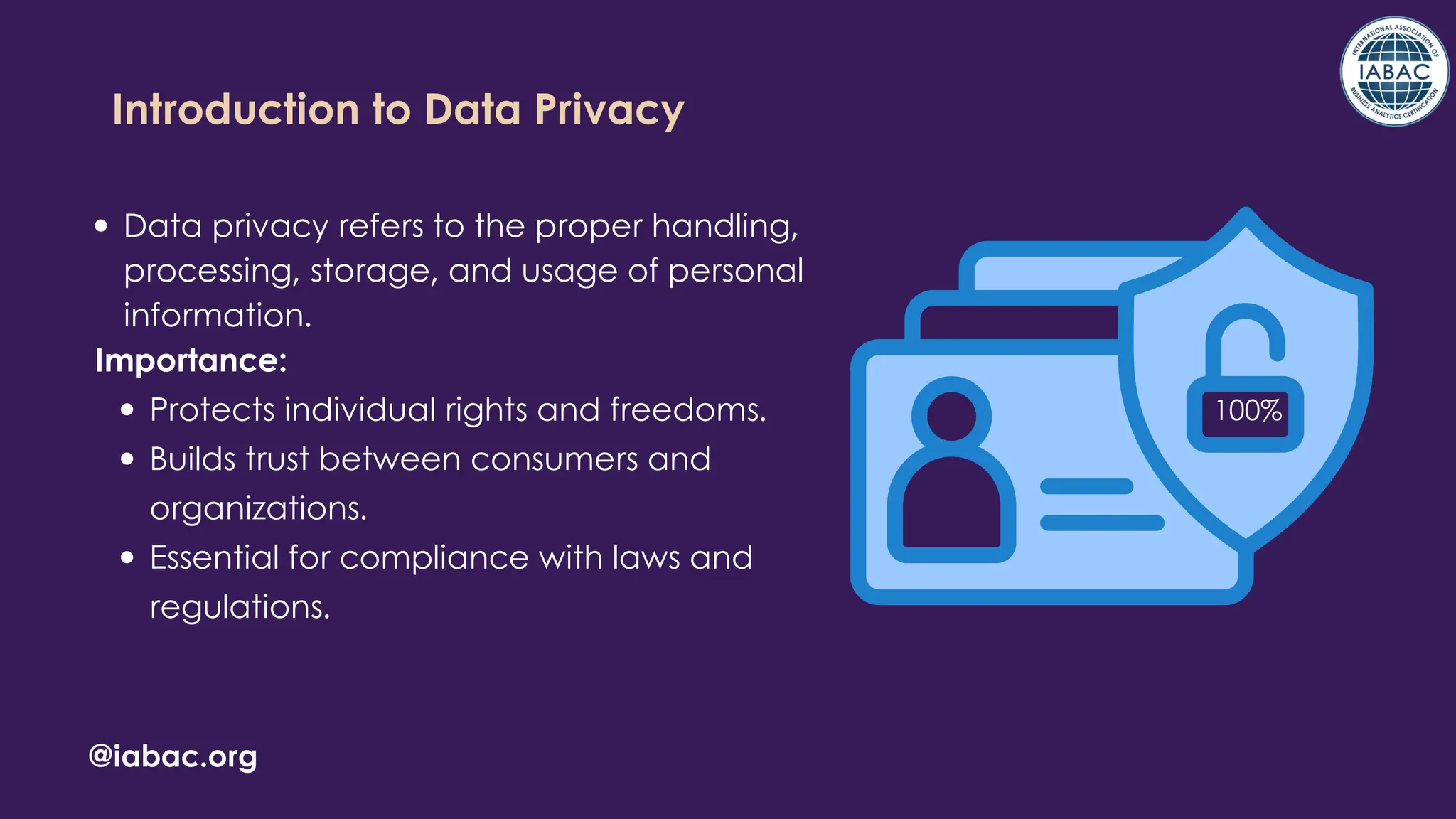
Introduction to Data Privacy
Data privacy refers to the proper handling,
processing, storage, and usage of personal
information.
Importance:
Protects individual rights and freedoms.
Builds trust between consumers and
organizations.
Essential for compliance with laws and
regulations.
100%
@iabac.org
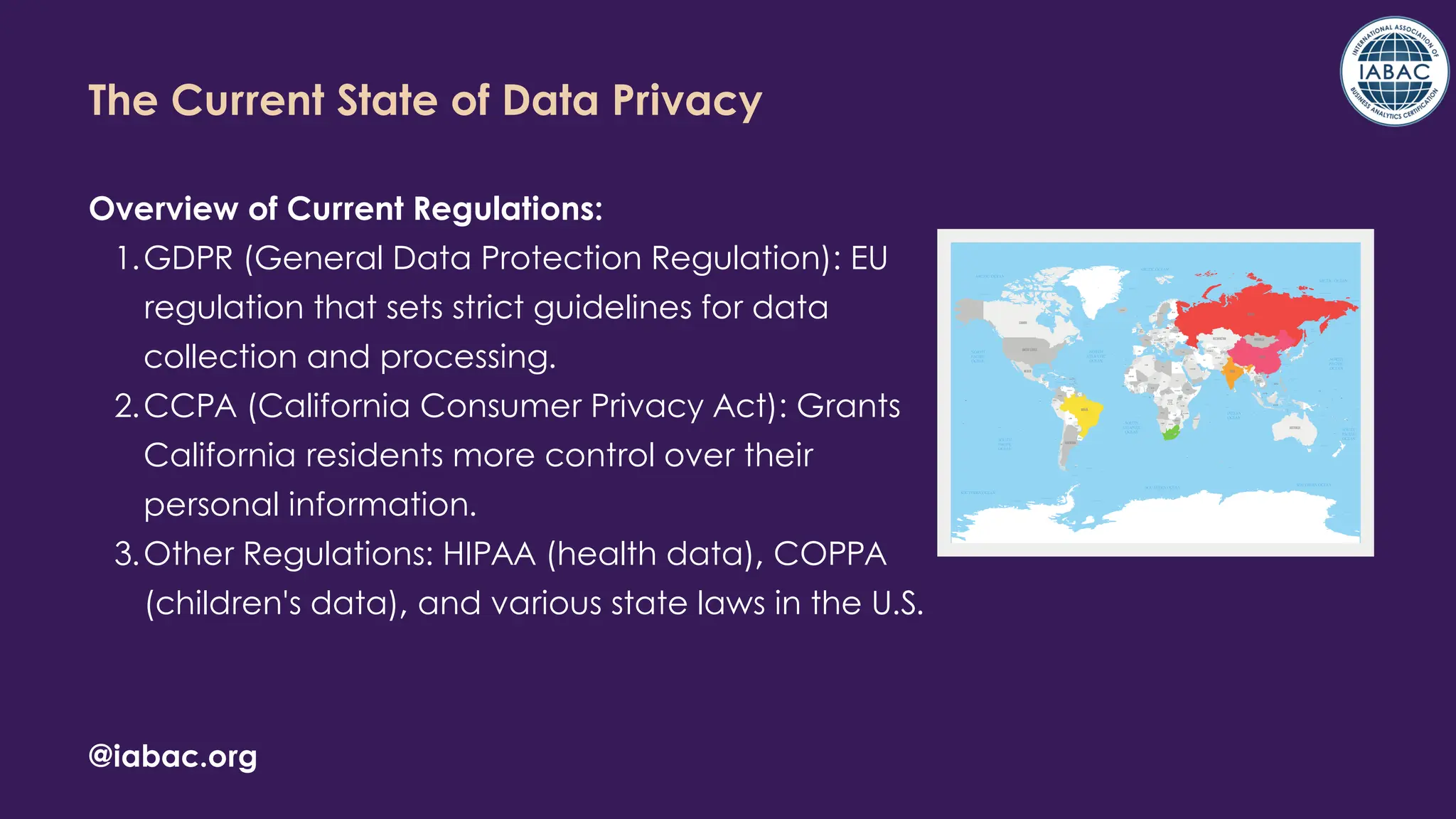
Overview of Current Regulations:
GDPR (General Data Protection Regulation): EU
regulation that sets strict guidelines for data
collection and processing.
1.
CCPA (California Consumer Privacy Act): Grants
California residents more control over their
personal information.
2.
Other Regulations: HIPAA (health data), COPPA
(children's data), and various state laws in the U.S.
3.
The Current State of Data Privacy
@iabac.org
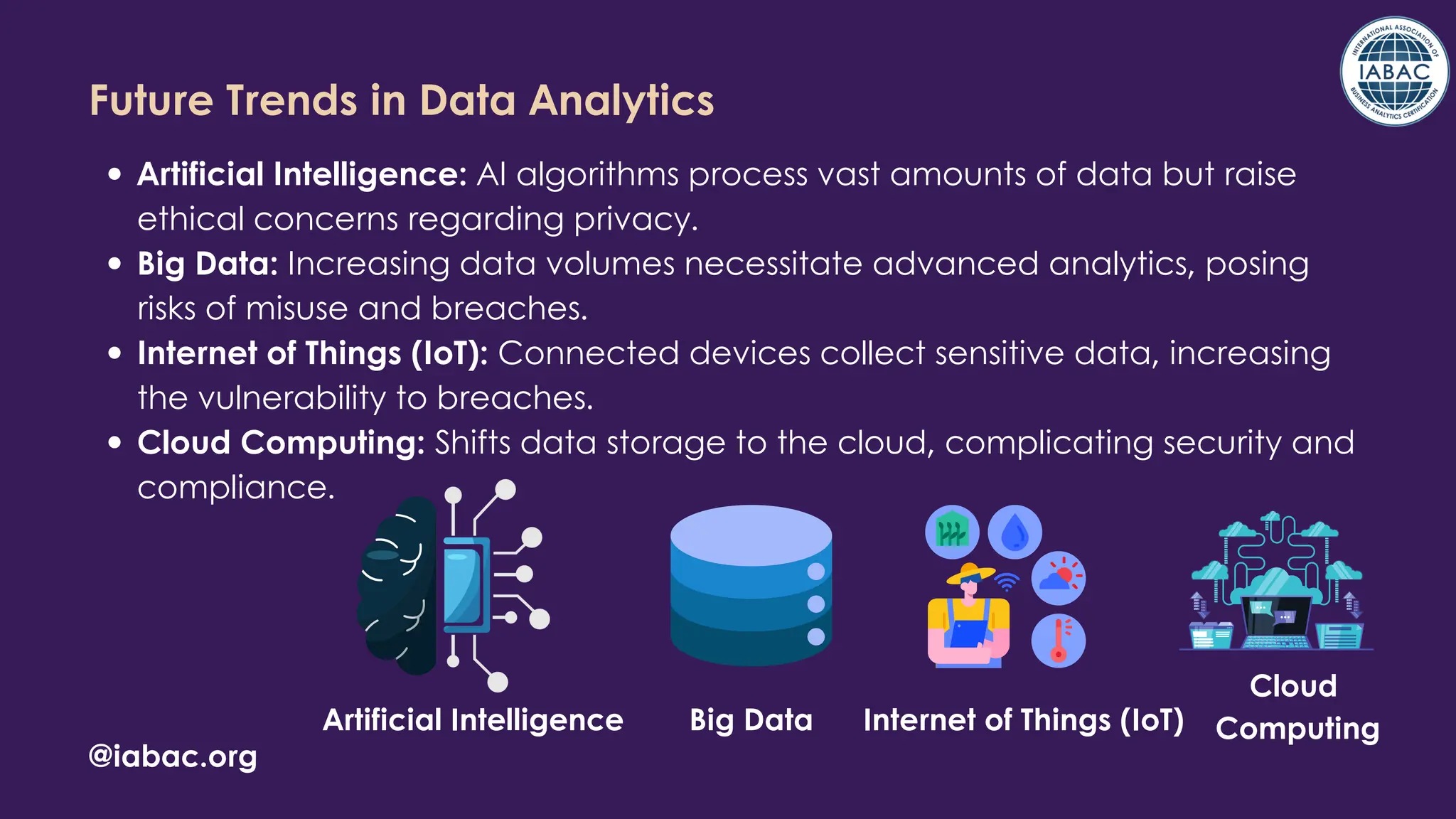
Artificial Intelligence: AI algorithms process vast amounts of data but raise
ethical concerns regarding privacy.
Big Data: Increasing data volumes necessitate advanced analytics, posing
risks of misuse and breaches.
Internet of Things (IoT): Connected devices collect sensitive data, increasing
the vulnerability to breaches.
Cloud Computing: Shifts data storage to the cloud, complicating security and
compliance.
@iabac.org
Future Trends in Data Analytics
Artificial Intelligence Big Data Internet of Things (IoT)
Cloud
Computing
Data Breaches: Increasingly sophisticated cyberattacks
expose sensitive data.
1.
User Consent: Difficulty in obtaining informed consent
due to complex privacy policies.
2.
Anonymization: Challenges in effectively anonymizing
data to protect individual identities.
3.
Data Sovereignty: Legal issues regarding where data is
stored and processed.
4.
Transparency: Lack of clarity in how data is used and
shared by organizations.
5.
@iabac.org
Key Data Privacy Challenges
@iabac.org
Data Breaches and Security Threats
Statistics:
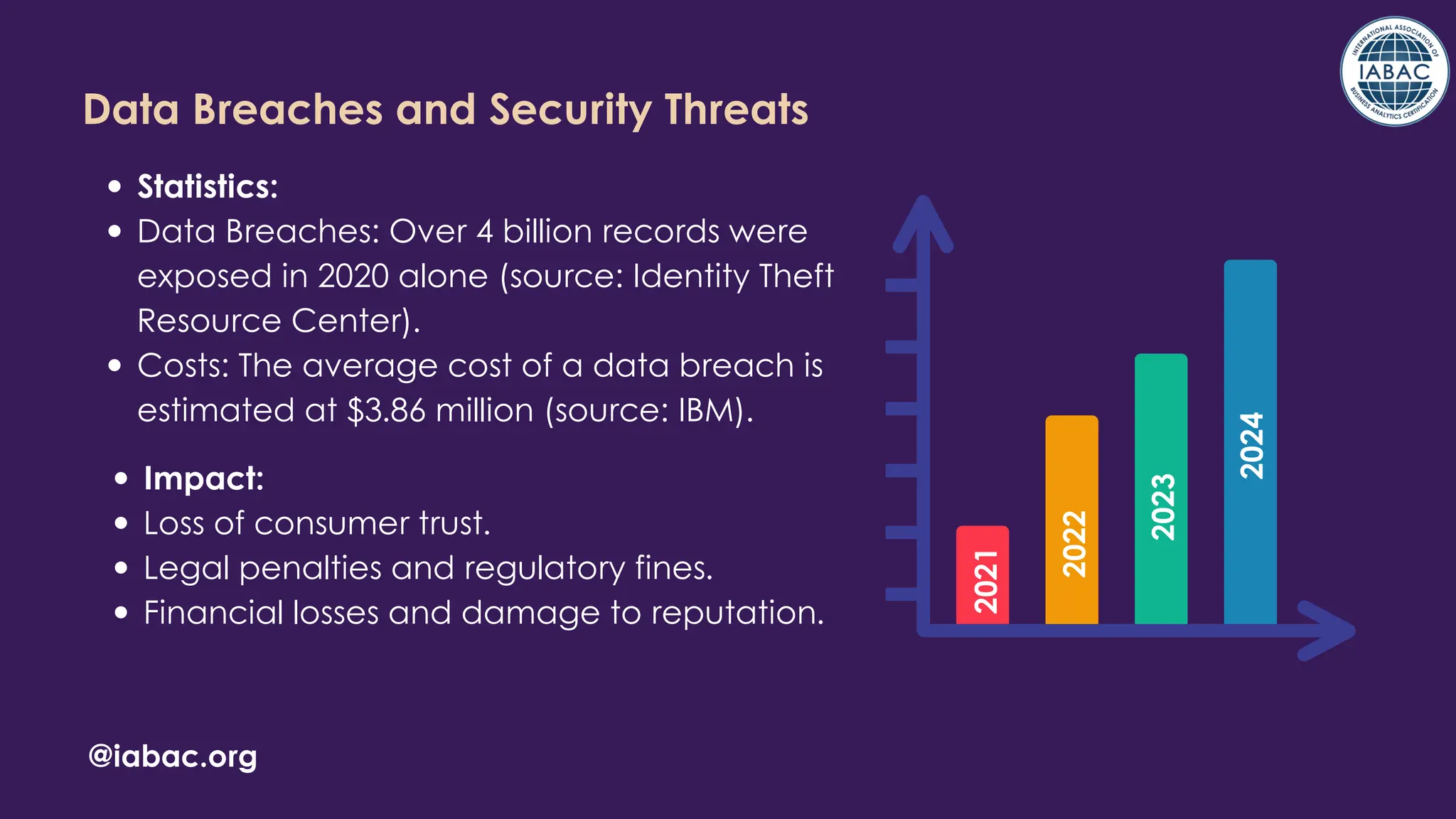
Data Breaches: Over 4 billion records were
exposed in 2020 alone (source: Identity Theft
Resource Center).
Costs: The average cost of a data breach is
estimated at $3.86 million (source: IBM).
Impact:
Loss of consumer trust.
Legal penalties and regulatory fines.
Financial losses and damage to reputation.
2021
2024
2023
2022
Importance of user consent in data collection:
Legal requirement under GDPR and CCPA.
Ethical obligation to respect individual autonomy.
Issues:
Complexity of consent forms leads to confusion.
Users often agree without fully understanding terms.
Solutions:
Simplifying consent processes.
Providing clear, accessible information about data use.
@iabac.org
User Consent and Transparency
@iabac.org
Anonymization Techniques
Overview of anonymization methods:
Data Masking: Hiding original data values.
Aggregation: Combining data points to prevent identification.
Differential Privacy: Adding noise to datasets to obscure individual data.
Effectiveness:
Not foolproof; challenges exist in re-identifying anonymized data.
Case studies showing failures of anonymization (e.g., re-identification of
data).
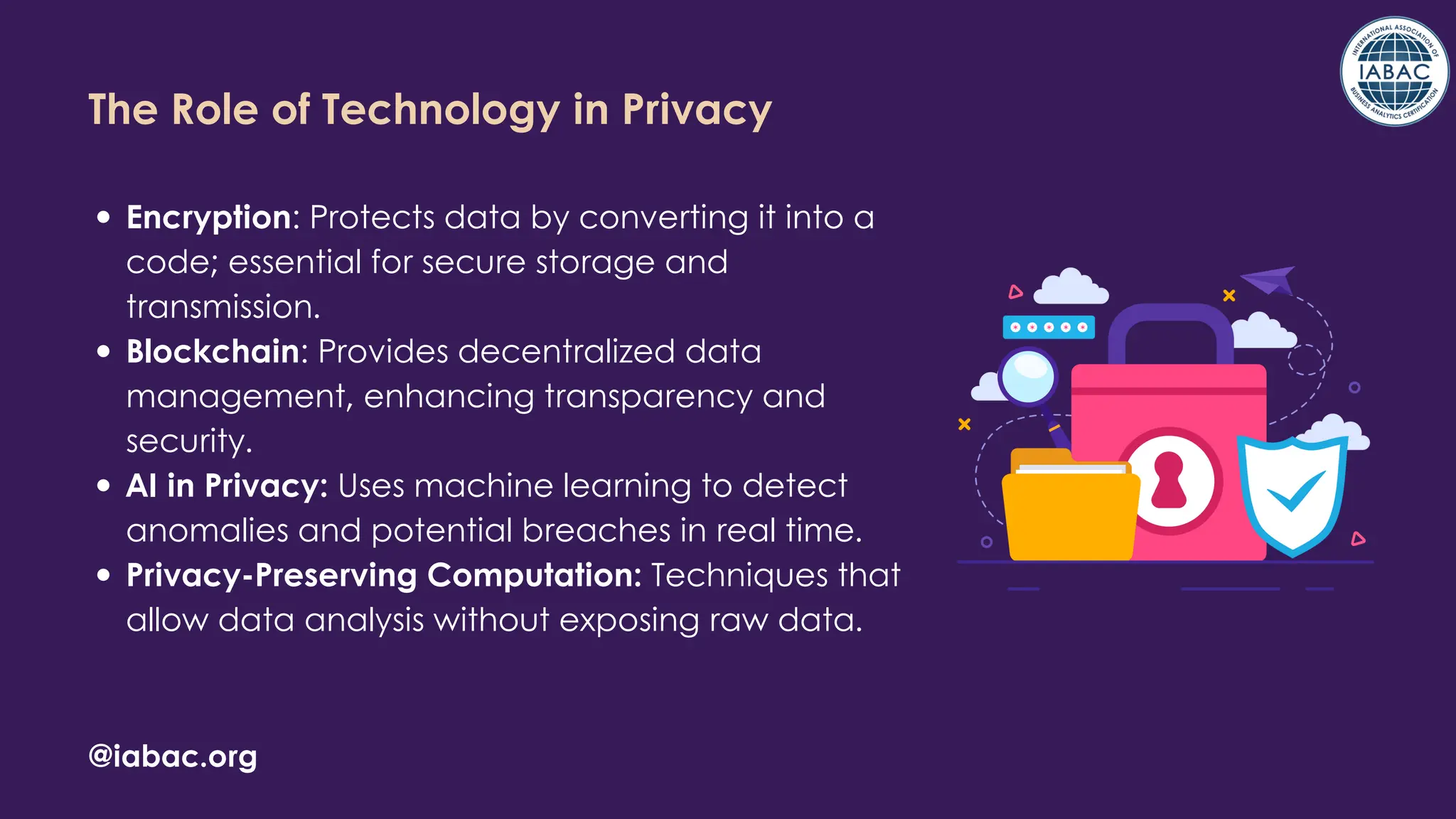
Encryption: Protects data by converting it into a
code; essential for secure storage and
transmission.
Blockchain: Provides decentralized data
management, enhancing transparency and
security.
AI in Privacy: Uses machine learning to detect
anomalies and potential breaches in real time.
Privacy-Preserving Computation: Techniques that
allow data analysis without exposing raw data.
@iabac.org
The Role of Technology in Privacy
@iabac.org
Regulatory Compliance Challenges
Issues businesses face:
Complexity of navigating multiple regulations across different
jurisdictions.
Keeping up with changing laws and standards.
Implementing compliance measures without hampering data analytics
capabilities.
Consequences of non-compliance:
Significant fines (e.g., GDPR penalties can be up to €20 million).
Legal action and reputational damage.
Future Outlook and Recommendations
Predictions for data privacy in analytics:
Increased regulatory scrutiny and enforcement.
Growing demand for privacy-centric technologies.
Shift towards user empowerment and control over personal data.
Best Practices:
Conduct regular data audits.
Implement robust security measures.
Foster a culture of privacy within organizations.
@iabac.org
@iabac.org
Thank You

Data Privacy Challenges in the Data Analytics Future

  • 1.
    Data Privacy Challengesin the DATA ANALYTICS www.reallygreatsite.com @iabac.org
  • 2.
    Introduction to DataPrivacy Data privacy refers to the proper handling, processing, storage, and usage of personal information. Importance: Protects individual rights and freedoms. Builds trust between consumers and organizations. Essential for compliance with laws and regulations. 100% @iabac.org
  • 3.
    Overview of CurrentRegulations: GDPR (General Data Protection Regulation): EU regulation that sets strict guidelines for data collection and processing. 1. CCPA (California Consumer Privacy Act): Grants California residents more control over their personal information. 2. Other Regulations: HIPAA (health data), COPPA (children's data), and various state laws in the U.S. 3. The Current State of Data Privacy @iabac.org
  • 4.
    Artificial Intelligence: AIalgorithms process vast amounts of data but raise ethical concerns regarding privacy. Big Data: Increasing data volumes necessitate advanced analytics, posing risks of misuse and breaches. Internet of Things (IoT): Connected devices collect sensitive data, increasing the vulnerability to breaches. Cloud Computing: Shifts data storage to the cloud, complicating security and compliance. @iabac.org Future Trends in Data Analytics Artificial Intelligence Big Data Internet of Things (IoT) Cloud Computing
  • 5.
    Data Breaches: Increasinglysophisticated cyberattacks expose sensitive data. 1. User Consent: Difficulty in obtaining informed consent due to complex privacy policies. 2. Anonymization: Challenges in effectively anonymizing data to protect individual identities. 3. Data Sovereignty: Legal issues regarding where data is stored and processed. 4. Transparency: Lack of clarity in how data is used and shared by organizations. 5. @iabac.org Key Data Privacy Challenges
  • 6.
    @iabac.org Data Breaches andSecurity Threats Statistics: Data Breaches: Over 4 billion records were exposed in 2020 alone (source: Identity Theft Resource Center). Costs: The average cost of a data breach is estimated at $3.86 million (source: IBM). Impact: Loss of consumer trust. Legal penalties and regulatory fines. Financial losses and damage to reputation. 2021 2024 2023 2022
  • 7.
    Importance of userconsent in data collection: Legal requirement under GDPR and CCPA. Ethical obligation to respect individual autonomy. Issues: Complexity of consent forms leads to confusion. Users often agree without fully understanding terms. Solutions: Simplifying consent processes. Providing clear, accessible information about data use. @iabac.org User Consent and Transparency
  • 8.
    @iabac.org Anonymization Techniques Overview ofanonymization methods: Data Masking: Hiding original data values. Aggregation: Combining data points to prevent identification. Differential Privacy: Adding noise to datasets to obscure individual data. Effectiveness: Not foolproof; challenges exist in re-identifying anonymized data. Case studies showing failures of anonymization (e.g., re-identification of data).
  • 9.
    Encryption: Protects databy converting it into a code; essential for secure storage and transmission. Blockchain: Provides decentralized data management, enhancing transparency and security. AI in Privacy: Uses machine learning to detect anomalies and potential breaches in real time. Privacy-Preserving Computation: Techniques that allow data analysis without exposing raw data. @iabac.org The Role of Technology in Privacy
  • 10.
    @iabac.org Regulatory Compliance Challenges Issuesbusinesses face: Complexity of navigating multiple regulations across different jurisdictions. Keeping up with changing laws and standards. Implementing compliance measures without hampering data analytics capabilities. Consequences of non-compliance: Significant fines (e.g., GDPR penalties can be up to €20 million). Legal action and reputational damage.
  • 11.
    Future Outlook andRecommendations Predictions for data privacy in analytics: Increased regulatory scrutiny and enforcement. Growing demand for privacy-centric technologies. Shift towards user empowerment and control over personal data. Best Practices: Conduct regular data audits. Implement robust security measures. Foster a culture of privacy within organizations. @iabac.org
  • 12.