Continuous Probability Distribution
Bipul Kumar Sarker
Lecturer
BBA Professional
Habibullah Bahar University College
Chapter-04
History of Normal Distribution
The normal distribution was first discovered by De Moivre (English
Mathematician) in 1733 as limiting case of binomial distribution. Later it
was applied in natural and social science by Laplace (French
Mathematician) in 1777. The normal distribution is also known as Gaussian
distribution in honor of Karl Friedrich Gauss(1809).
Bipul Kumar Sarker, Lecturer (BBA Professional), HBUC
3.3.1 Definition Of Normal Distribution:
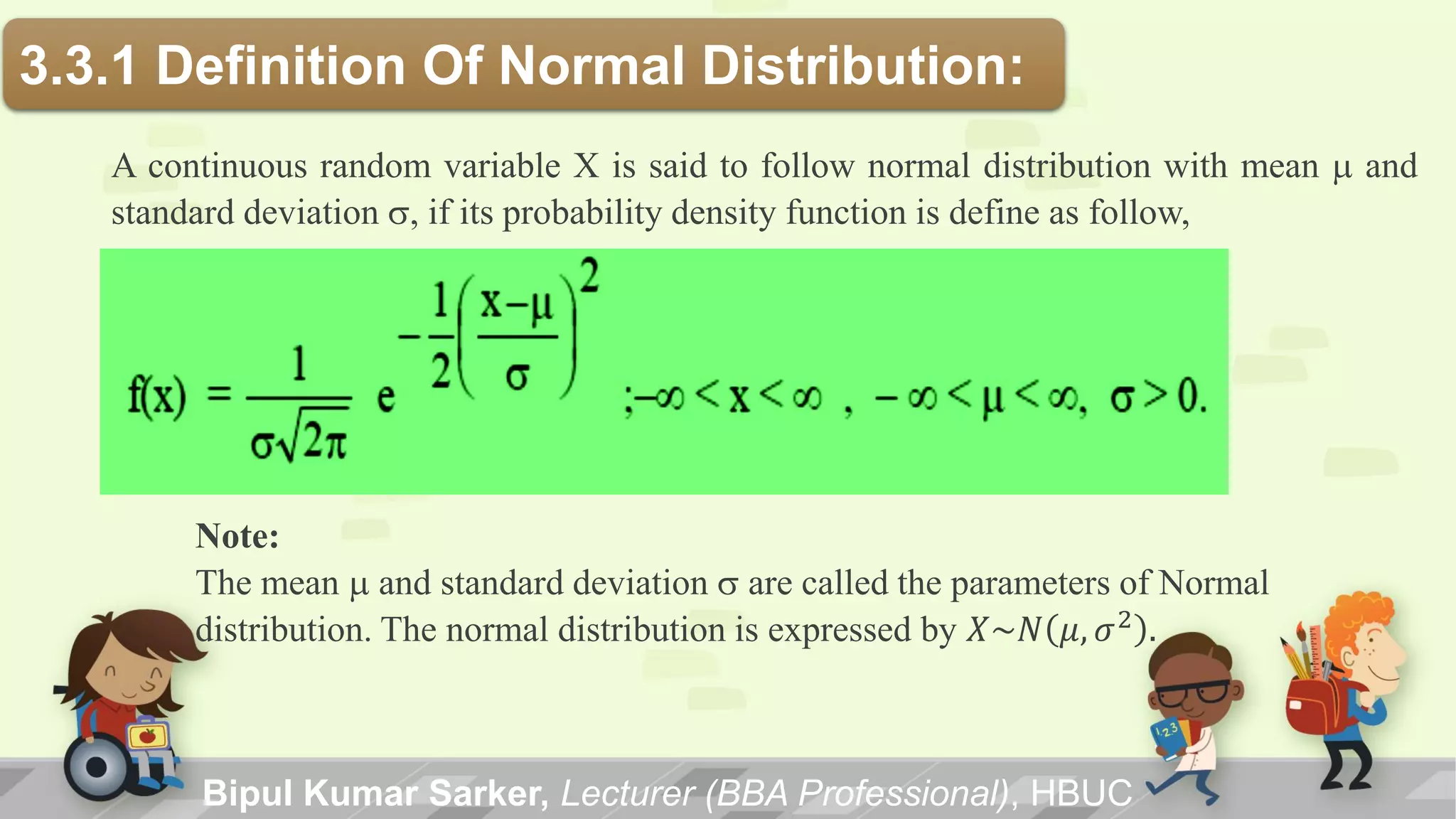
A continuous random variable X is said to follow normal distribution with mean m and
standard deviation s, if its probability density function is define as follow,
Note:
The mean m and standard deviation s are called the parameters of Normal
distribution. The normal distribution is expressed by 𝑋~𝑁 𝜇, 𝜎2 .
Bipul Kumar Sarker, Lecturer (BBA Professional), HBUC
3.3.2 Condition of Normal Distribution:
i. Normal distribution is a limiting form of the binomial distribution under the
following conditions.
a. n, the number of trials is indefinitely large ie., 𝑛 → ∞ and
b. Neither p nor q is very small.
ii. Normal distribution can also be obtained as a limiting form of Poisson distribution
with parameter 𝑚 → ∞
iii. Constants of normal distribution are mean = m, variation = 𝜎2, Standard deviation = s
Bipul Kumar Sarker, Lecturer (BBA Professional), HBUC
3.3.3 Normal Probability Curve:
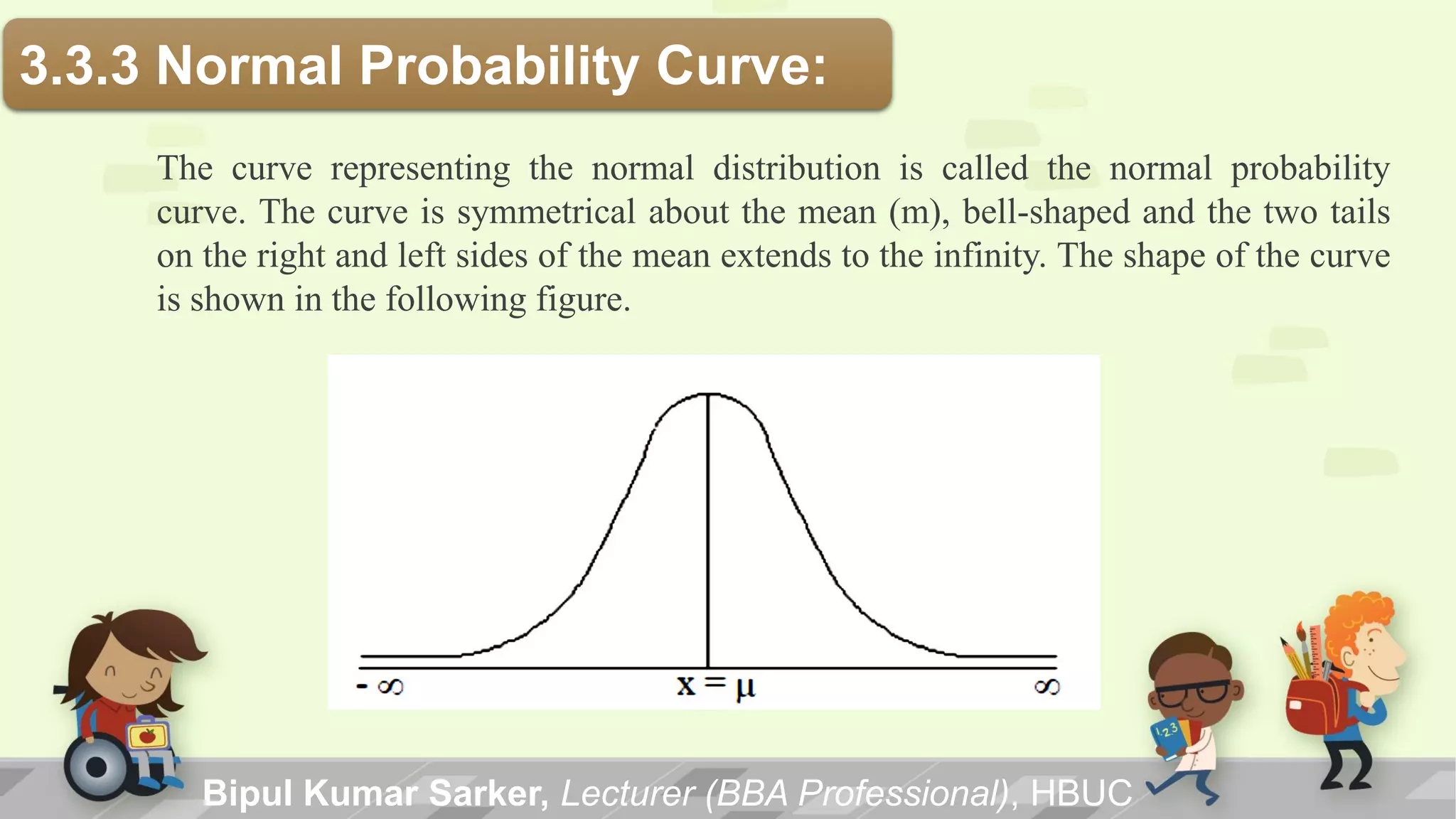
The curve representing the normal distribution is called the normal probability
curve. The curve is symmetrical about the mean (m), bell-shaped and the two tails
on the right and left sides of the mean extends to the infinity. The shape of the curve
is shown in the following figure.
Bipul Kumar Sarker, Lecturer (BBA Professional), HBUC
3.3.4 Properties of Normal Distribution:
i. The normal curve is bell shaped and is symmetric at x = m.
ii. Mean, median, and mode of the distribution are coincide
i.e., Mean = Median = Mode = m
iii. It has only one mode at x = m (i.e., unimodal)
iv. Since the curve is symmetrical, Skewness = 𝛽1 = 0 and Kurtosis = 𝛽2= 3
v. The points of inflection are at x = m ± s
Bipul Kumar Sarker, Lecturer (BBA Professional), HBUC
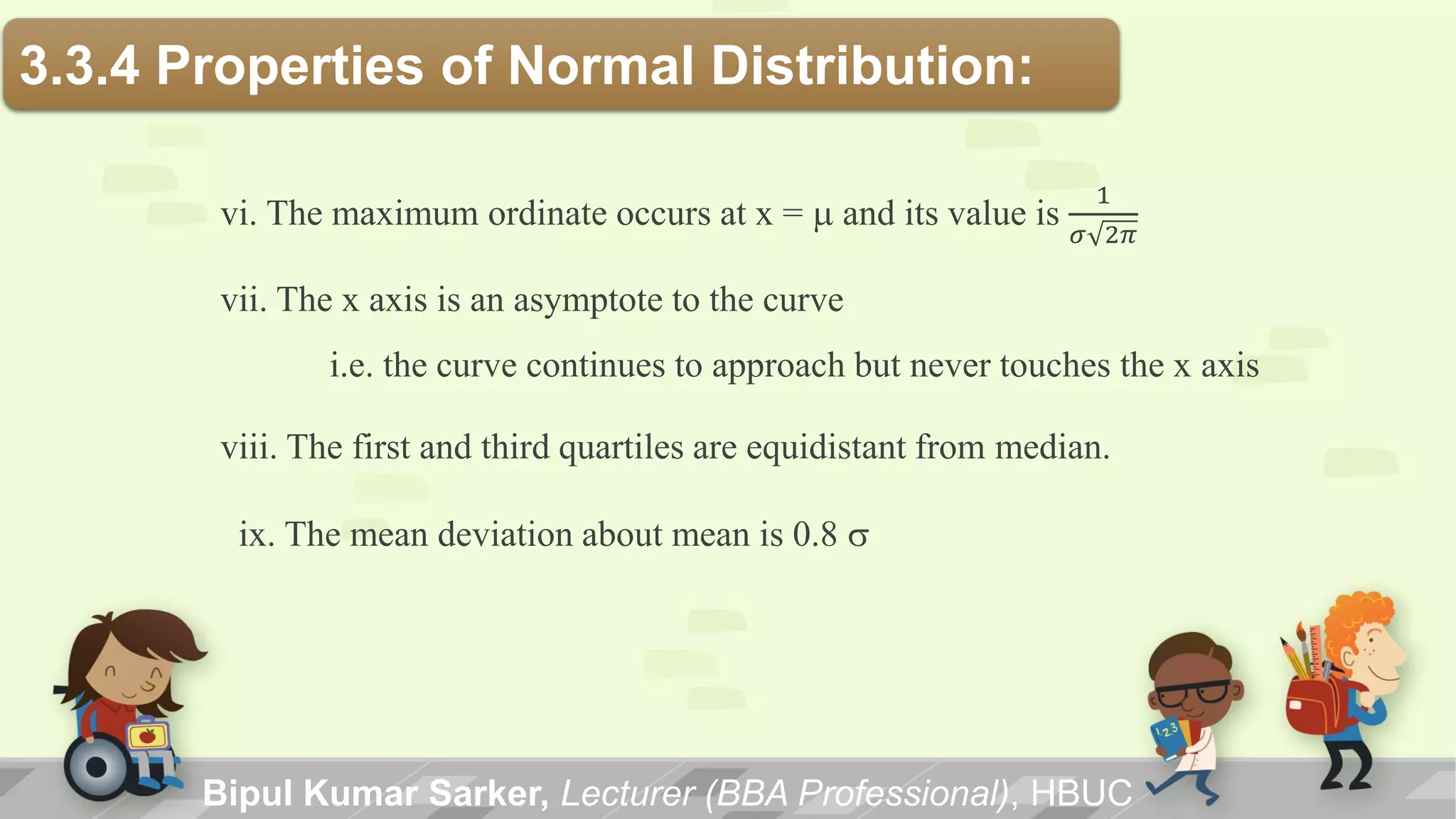
vi. The maximum ordinate occurs at x = m and its value is
1
𝜎 2𝜋
vii. The x axis is an asymptote to the curve
i.e. the curve continues to approach but never touches the x axis
viii. The first and third quartiles are equidistant from median.
ix. The mean deviation about mean is 0.8 s
3.3.4 Properties of Normal Distribution:
Bipul Kumar Sarker, Lecturer (BBA Professional), HBUC
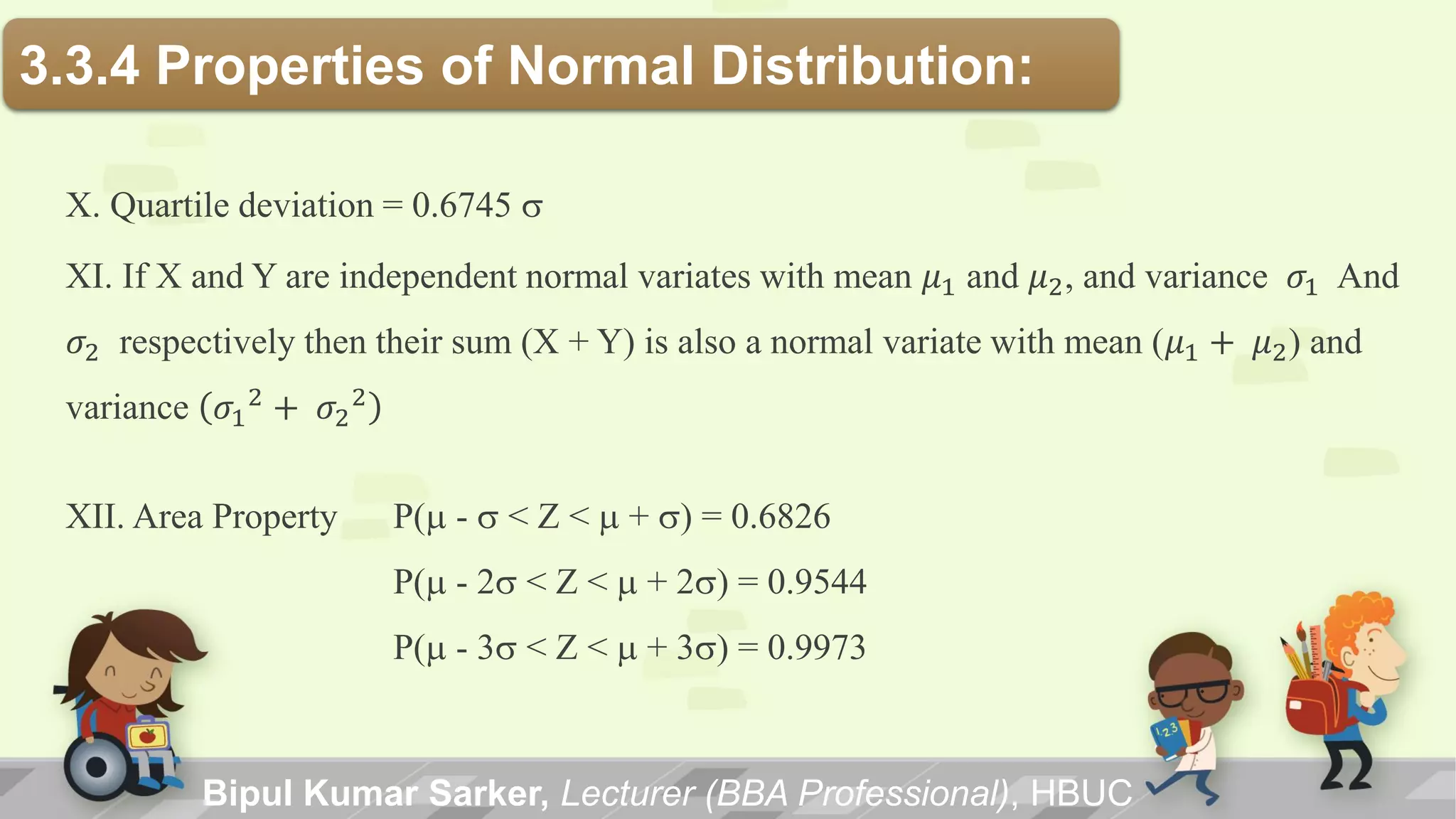
X. Quartile deviation = 0.6745 s
XI. If X and Y are independent normal variates with mean 𝜇1 and 𝜇2, and variance 𝜎1 And
𝜎2 respectively then their sum (X + Y) is also a normal variate with mean (𝜇1 + 𝜇2) and
variance 𝜎1
2 + 𝜎2
2
XII. Area Property P(m - s < Z < m + s) = 0.6826
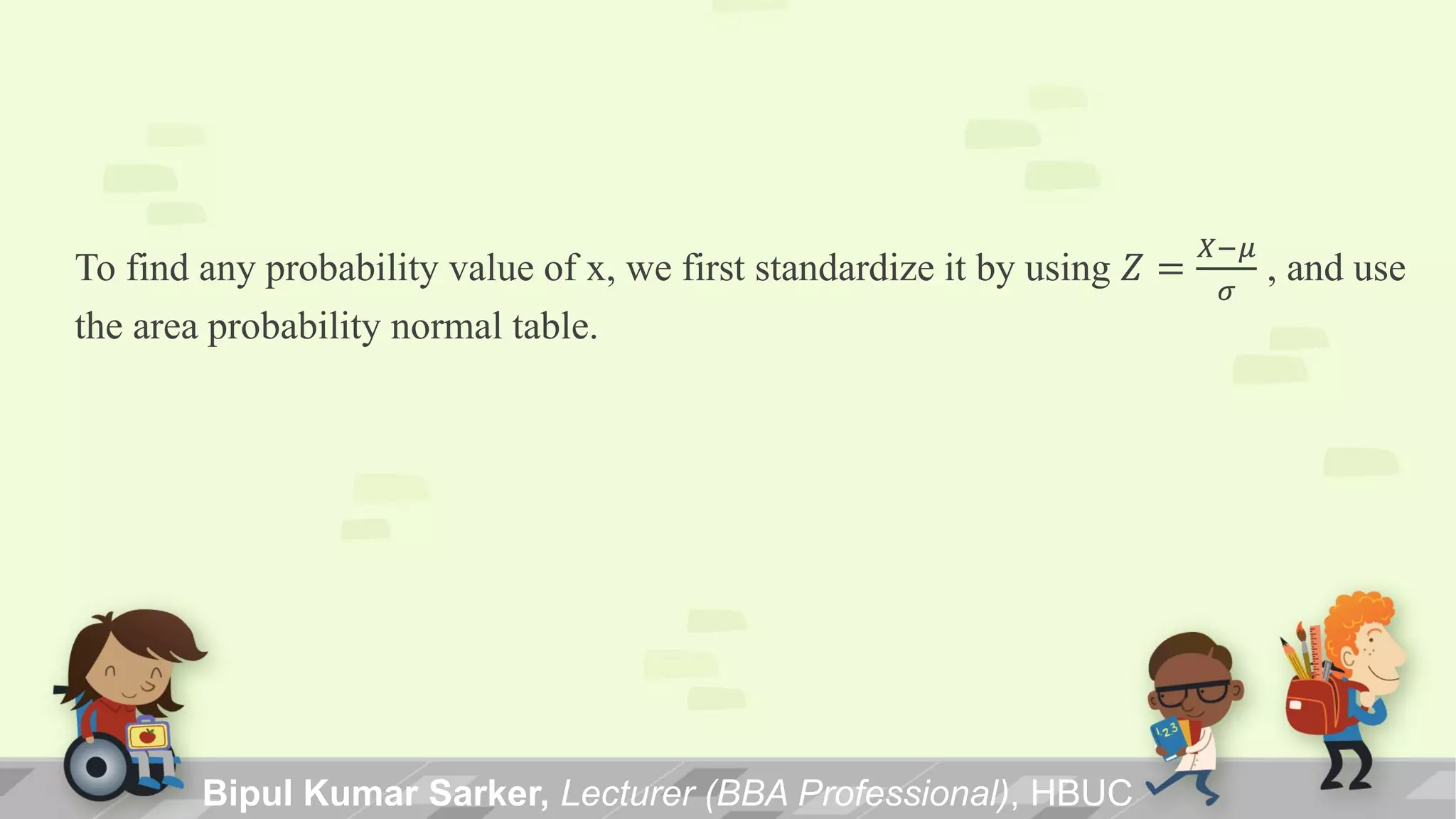
P(m - 2s < Z < m + 2s) = 0.9544
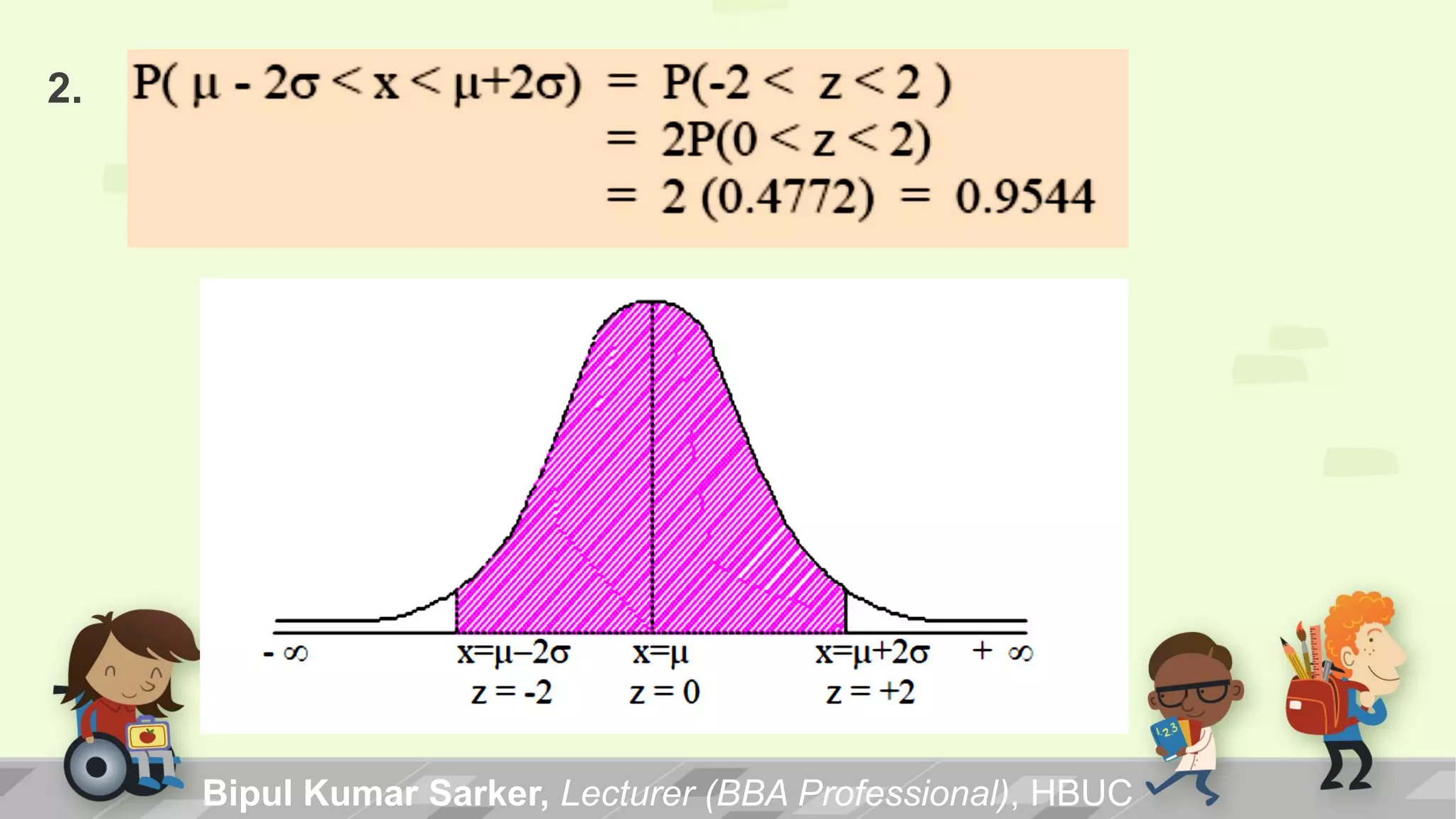
P(m - 3s < Z < m + 3s) = 0.9973
3.3.4 Properties of Normal Distribution:
Bipul Kumar Sarker, Lecturer (BBA Professional), HBUC
3.3.5 Standard Normal distribution:
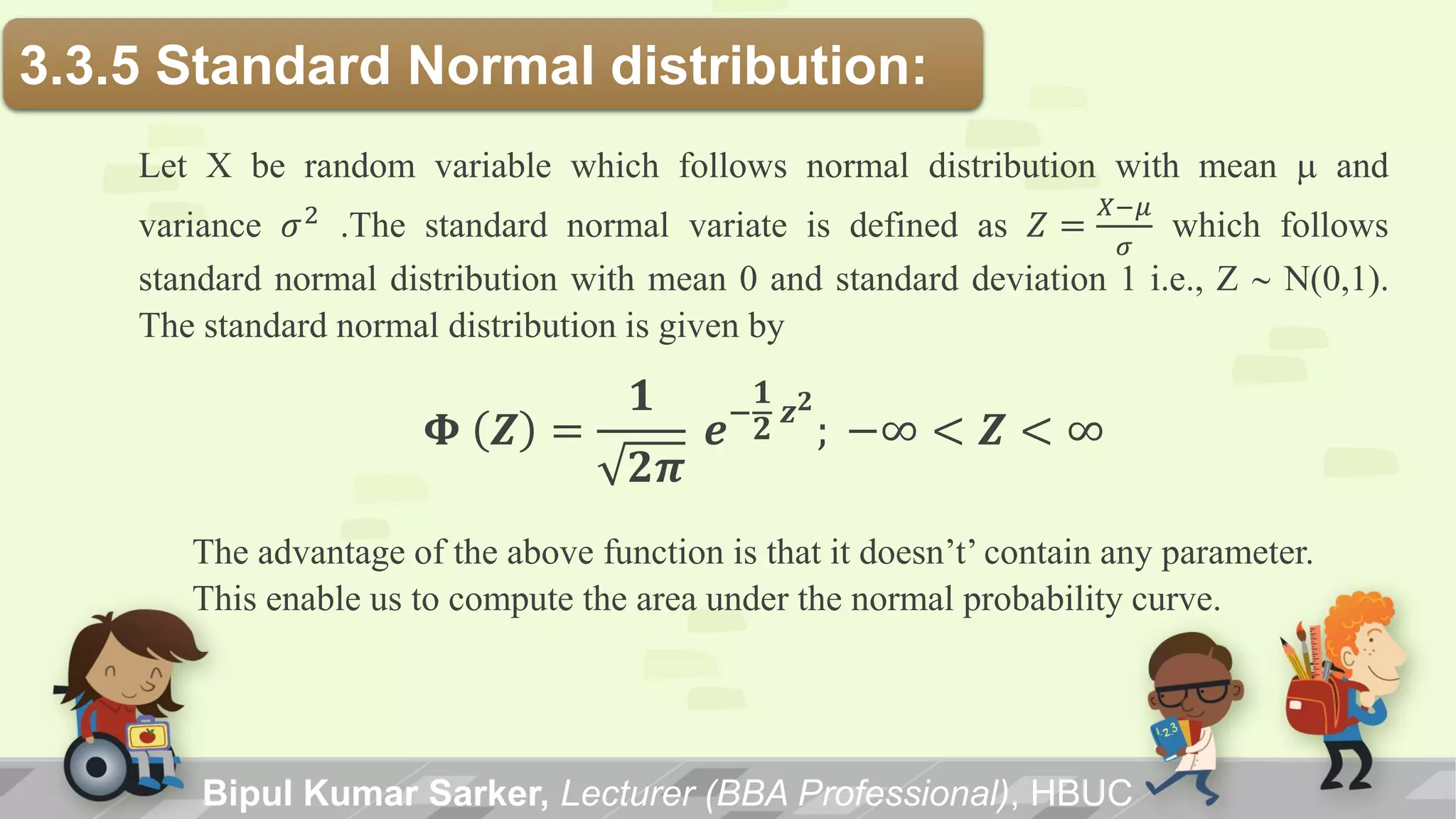
Let X be random variable which follows normal distribution with mean m and
variance 𝜎2
.The standard normal variate is defined as 𝑍 =
𝑋−𝜇
𝜎
which follows
standard normal distribution with mean 0 and standard deviation 1 i.e., Z ~ N(0,1).
The standard normal distribution is given by
𝚽 𝒁 =
𝟏
𝟐𝝅
𝒆−
𝟏
𝟐
𝒛 𝟐
; −∞ < 𝒁 < ∞
The advantage of the above function is that it doesn’t’ contain any parameter.
This enable us to compute the area under the normal probability curve.
Bipul Kumar Sarker, Lecturer (BBA Professional), HBUC
3.3.6 Area properties of Normal curve:
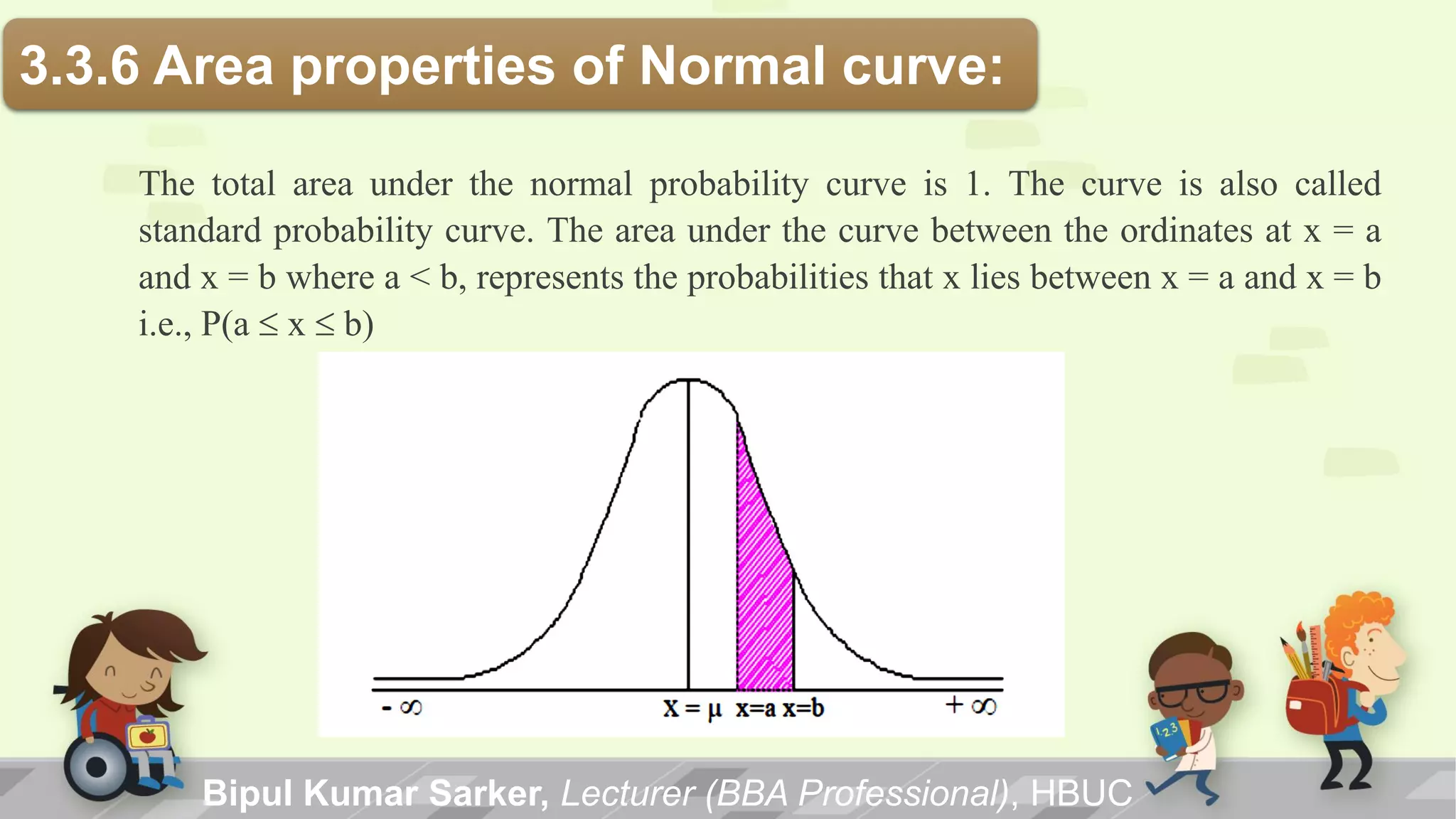
The total area under the normal probability curve is 1. The curve is also called
standard probability curve. The area under the curve between the ordinates at x = a
and x = b where a < b, represents the probabilities that x lies between x = a and x = b
i.e., P(a  x  b)
Bipul Kumar Sarker, Lecturer (BBA Professional), HBUC
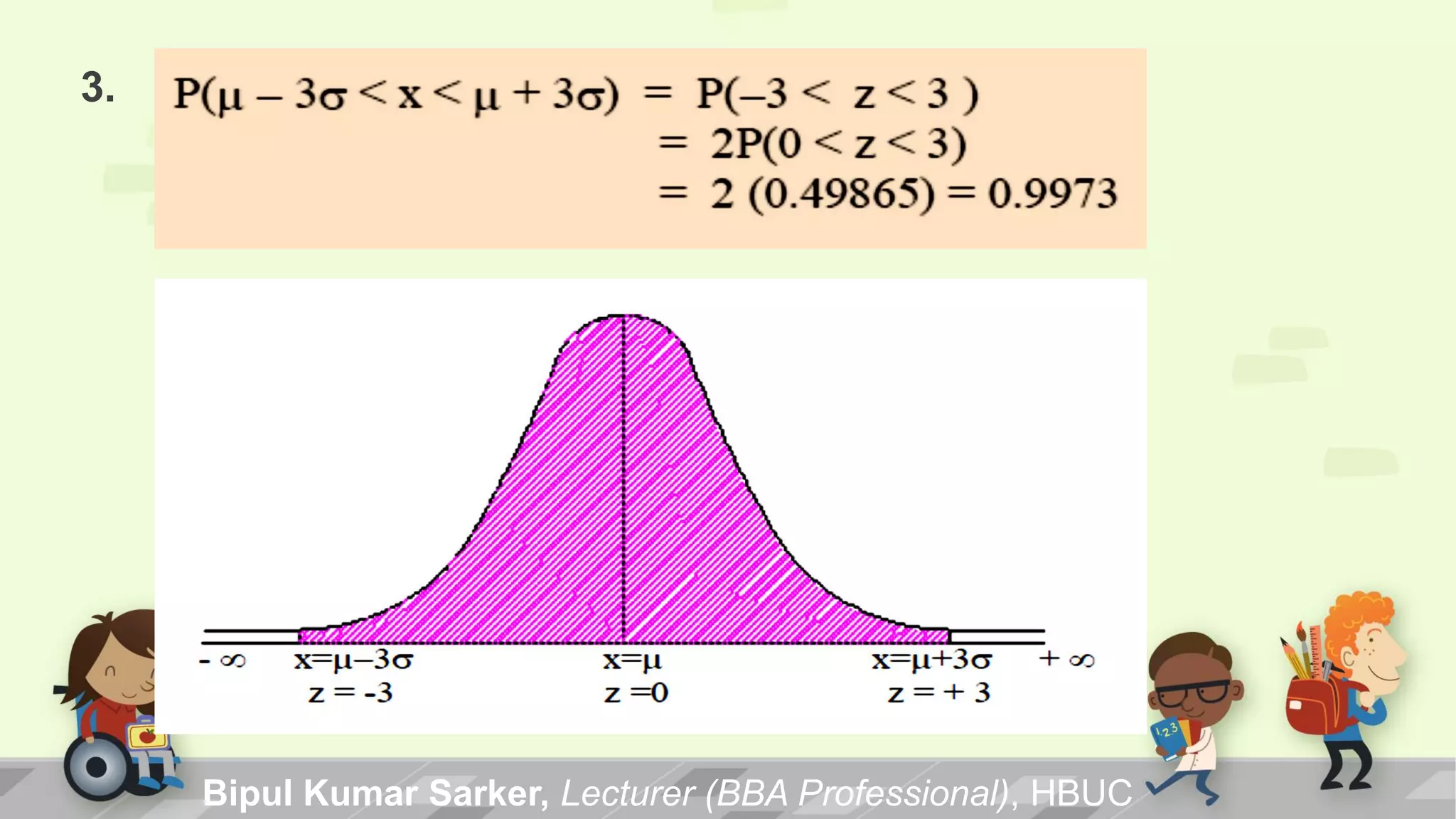
To find any probability value of x, we first standardize it by using 𝑍 =
𝑋−𝜇
𝜎
, and use
the area probability normal table.
Bipul Kumar Sarker, Lecturer (BBA Professional), HBUC
Example:
The probability that the normal random variable x to lie in the interval (m-s , m+s) is given by,
1.
Bipul Kumar Sarker, Lecturer (BBA Professional), HBUC
2.
Bipul Kumar Sarker, Lecturer (BBA Professional), HBUC
3.
Bipul Kumar Sarker, Lecturer (BBA Professional), HBUC
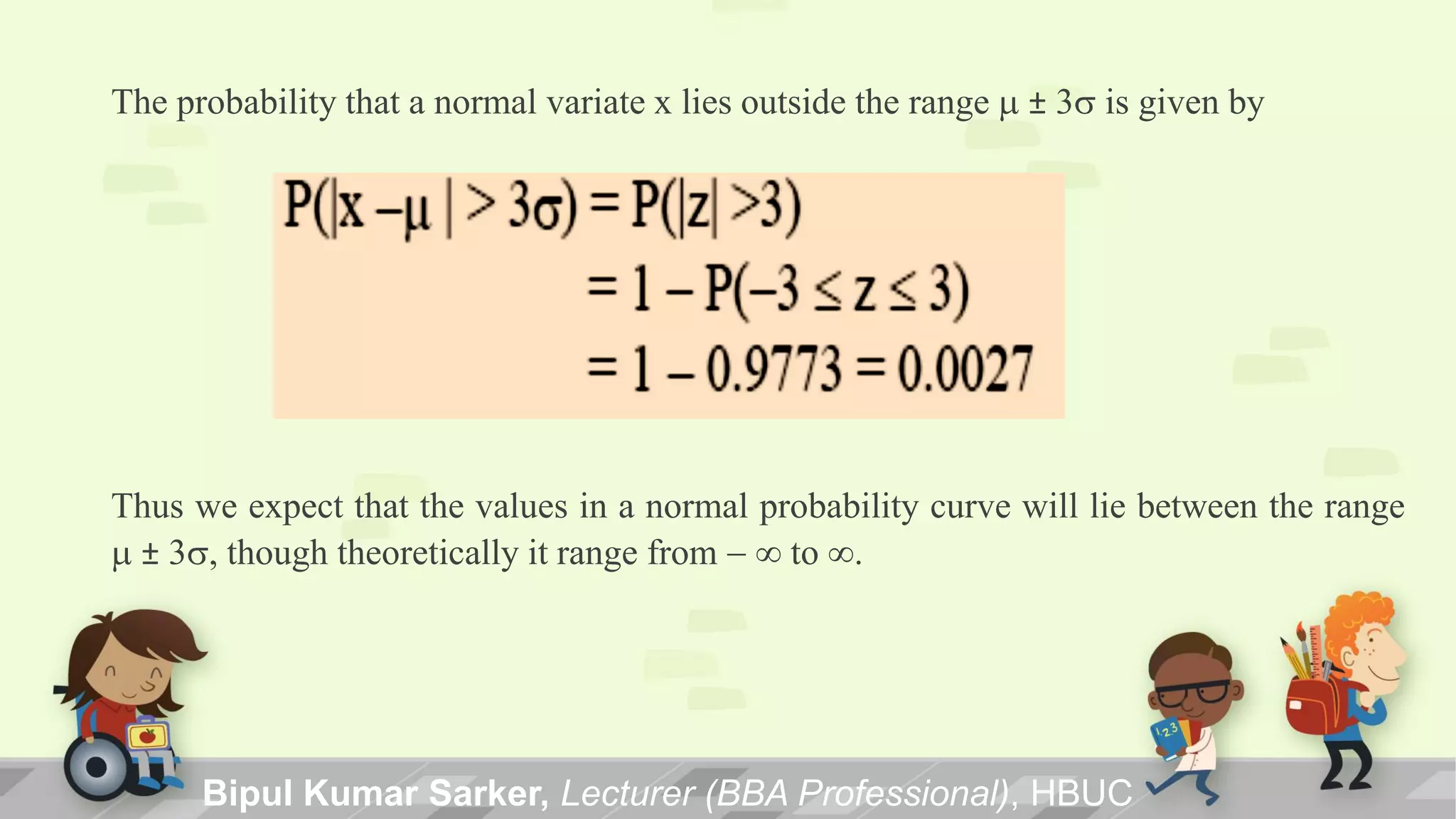
The probability that a normal variate x lies outside the range m ± 3s is given by
Thus we expect that the values in a normal probability curve will lie between the range
m ± 3s, though theoretically it range from -  to .
Bipul Kumar Sarker, Lecturer (BBA Professional), HBUC
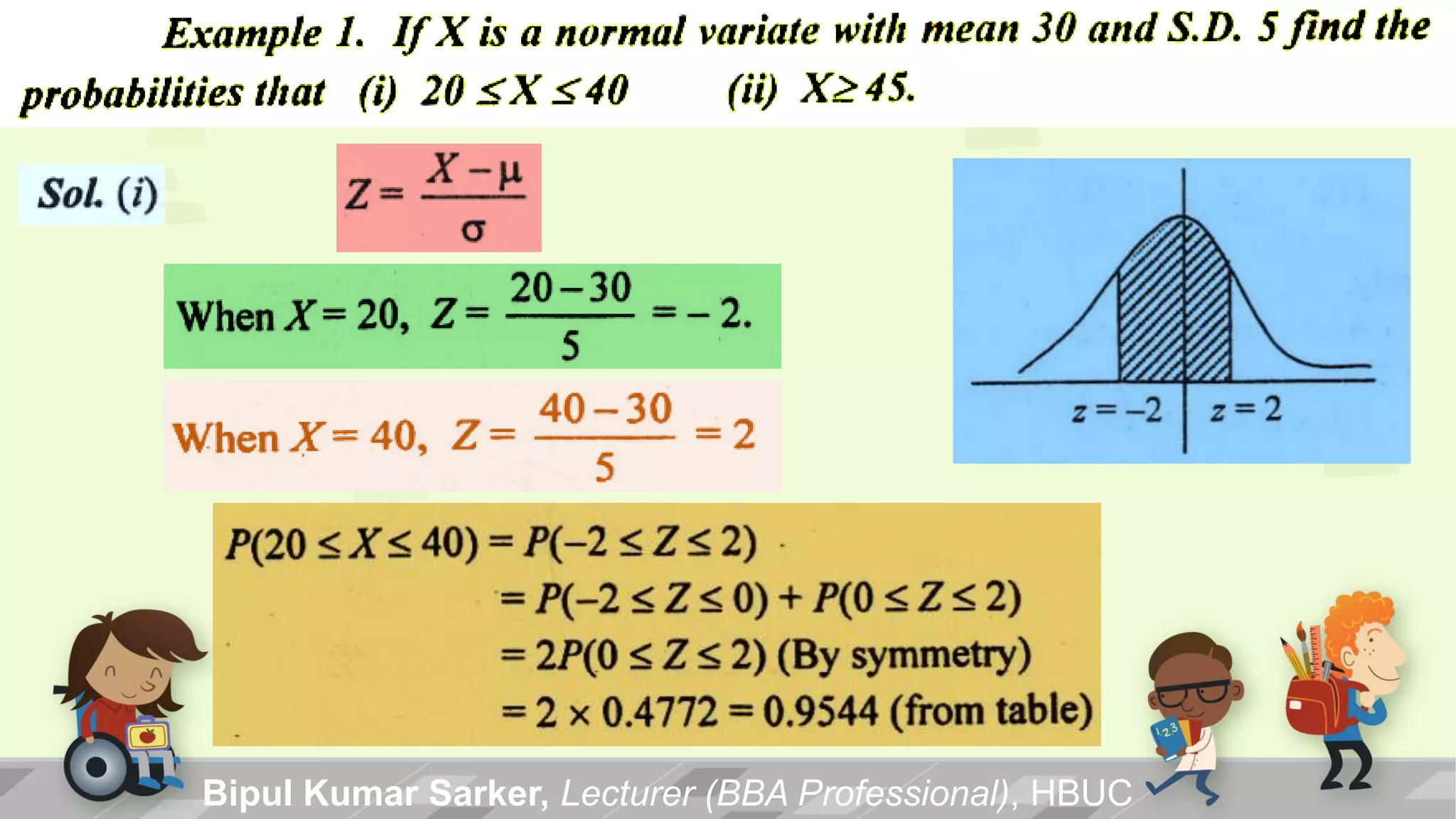
Example -01
Find the probability that the standard normal variate lies between 0 and 1.56
Solution:
−∞ 𝑍 = 0 𝑍 = 1.56 +∞
P(0< z< 1.56) = Area between z = 0 and z = 1.56
= 0.4406 (from table)
Bipul Kumar Sarker, Lecturer (BBA Professional), HBUC
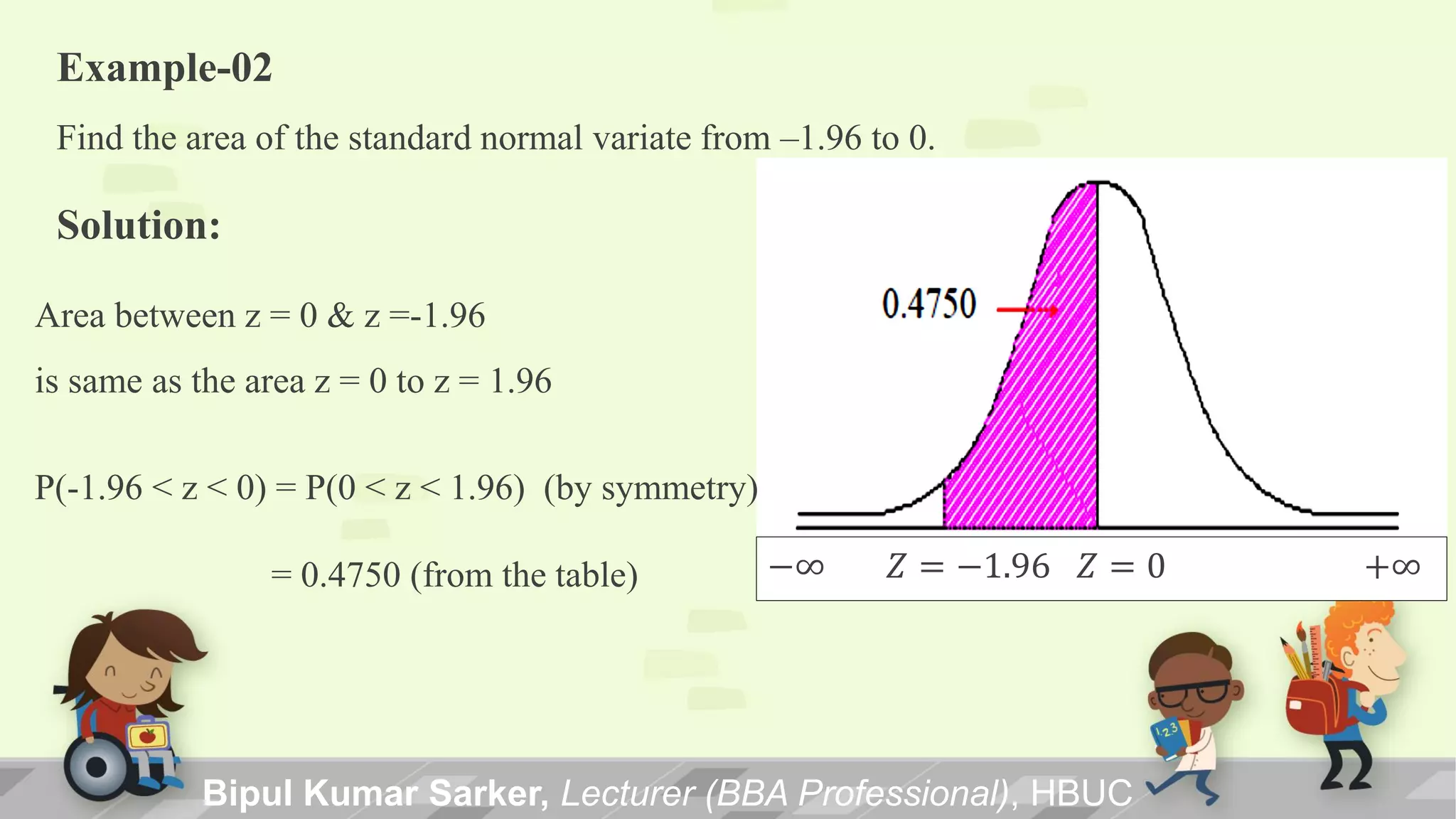
Example-02
Find the area of the standard normal variate from –1.96 to 0.
Solution:
−∞ 𝑍 = −1.96 𝑍 = 0 +∞
Area between z = 0 & z =-1.96
is same as the area z = 0 to z = 1.96
P(-1.96 < z < 0) = P(0 < z < 1.96) (by symmetry)
= 0.4750 (from the table)
Bipul Kumar Sarker, Lecturer (BBA Professional), HBUC
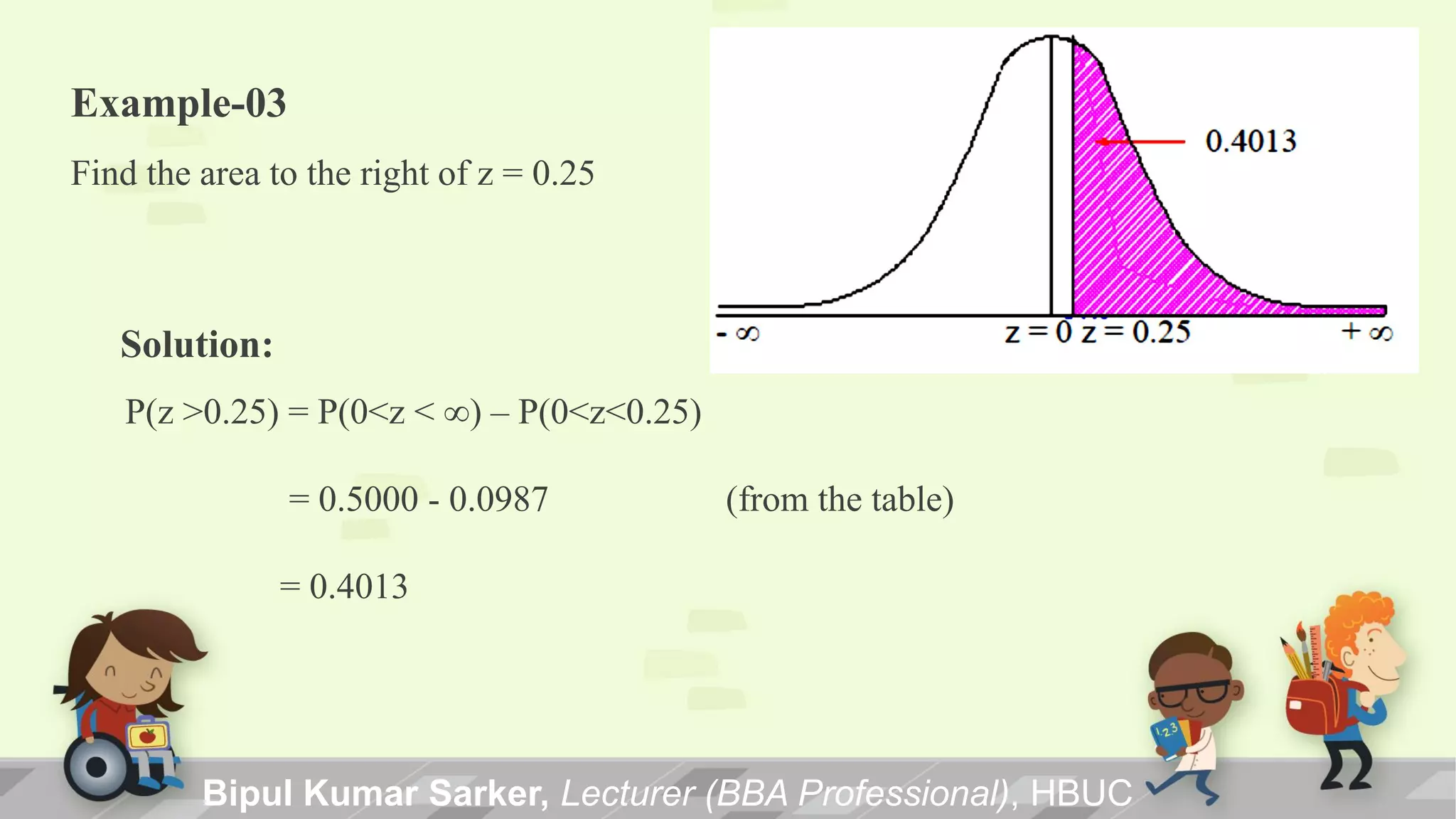
P(z >0.25) = P(0<z < ) – P(0<z<0.25)
= 0.5000 - 0.0987 (from the table)
= 0.4013
Example-03
Find the area to the right of z = 0.25
Solution:
Bipul Kumar Sarker, Lecturer (BBA Professional), HBUC
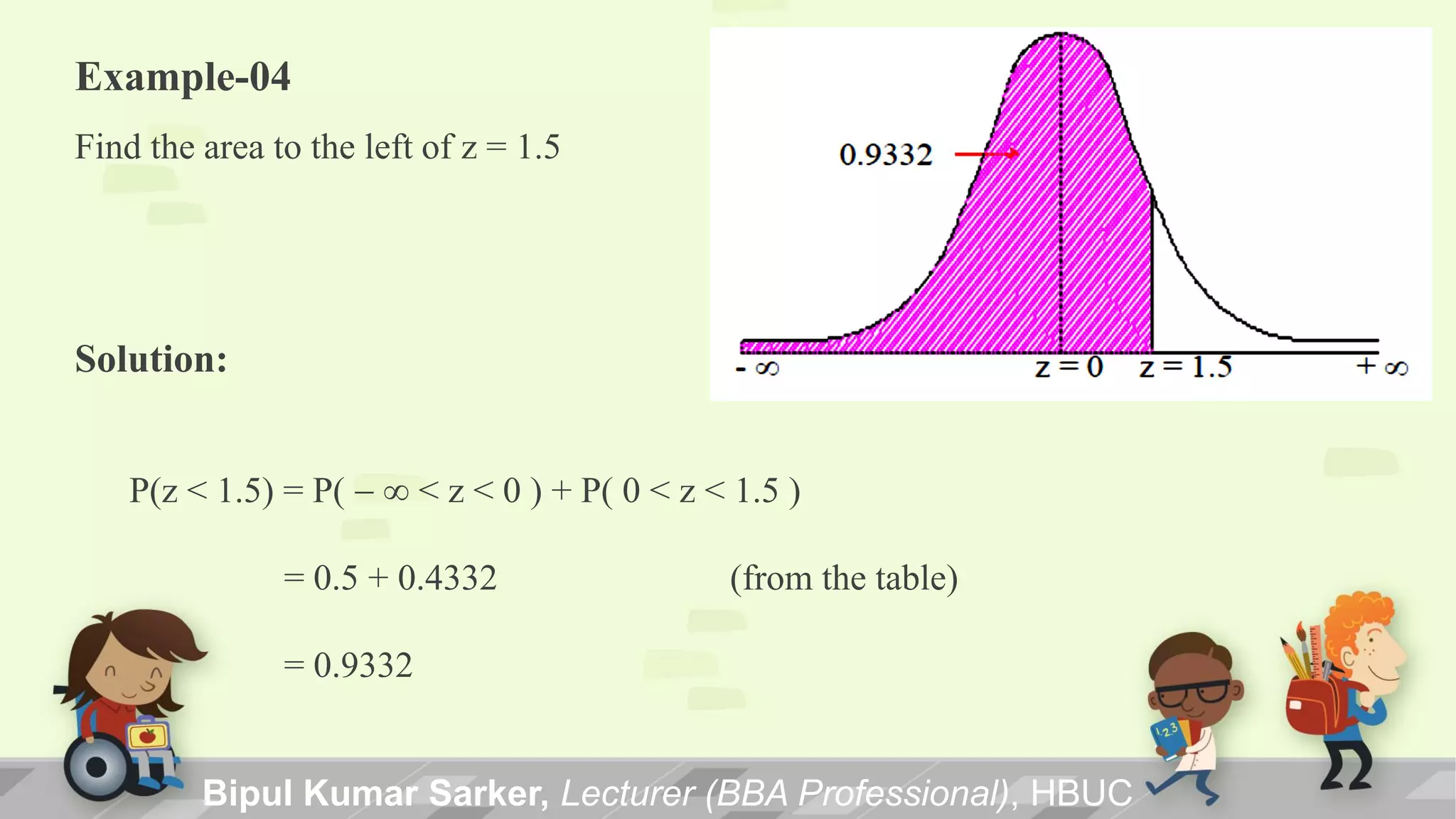
Example-04
Find the area to the left of z = 1.5
Solution:
P(z < 1.5) = P( -  < z < 0 ) + P( 0 < z < 1.5 )
= 0.5 + 0.4332 (from the table)
= 0.9332
Bipul Kumar Sarker, Lecturer (BBA Professional), HBUC
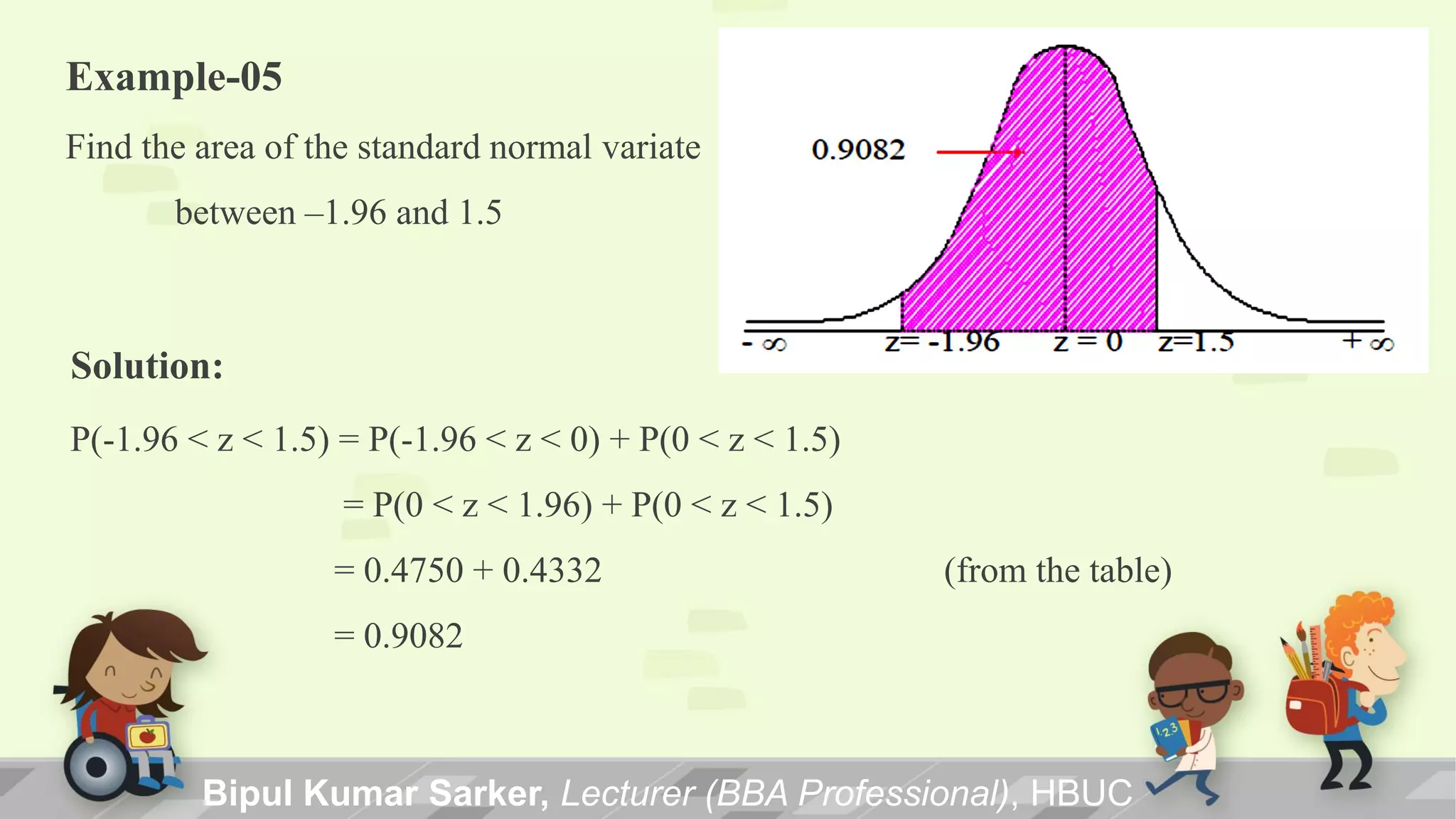
Example-05
Find the area of the standard normal variate
between –1.96 and 1.5
Solution:
P(-1.96 < z < 1.5) = P(-1.96 < z < 0) + P(0 < z < 1.5)
= P(0 < z < 1.96) + P(0 < z < 1.5)
= 0.4750 + 0.4332 (from the table)
= 0.9082
Bipul Kumar Sarker, Lecturer (BBA Professional), HBUC
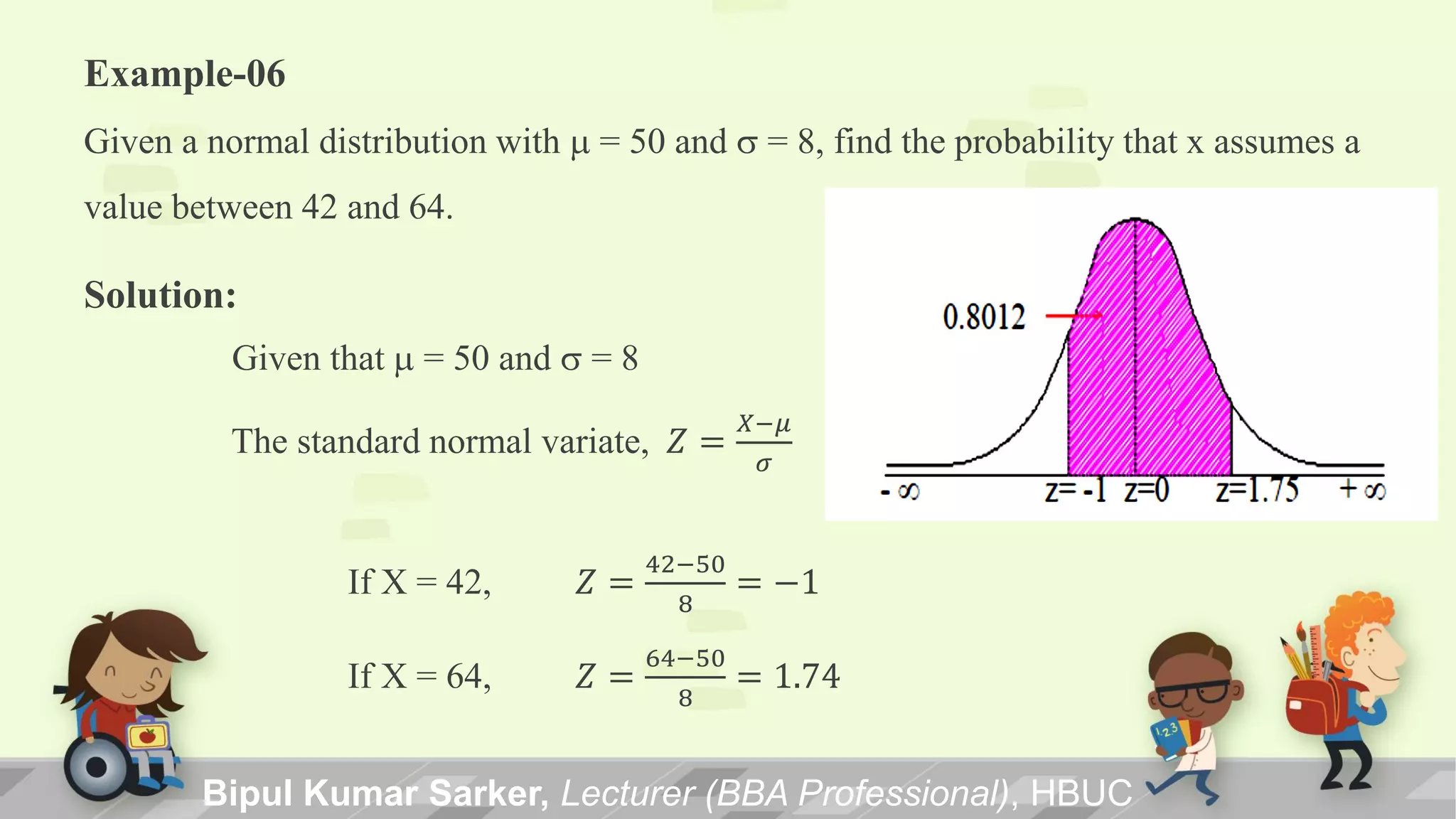
Example-06
Given a normal distribution with m = 50 and s = 8, find the probability that x assumes a
value between 42 and 64.
Solution:
Given that m = 50 and s = 8
The standard normal variate, 𝑍 =
𝑋−𝜇
𝜎
If X = 42, 𝑍 =
42−50
8
= −1
If X = 64, 𝑍 =
64−50
8
= 1.74
Bipul Kumar Sarker, Lecturer (BBA Professional), HBUC
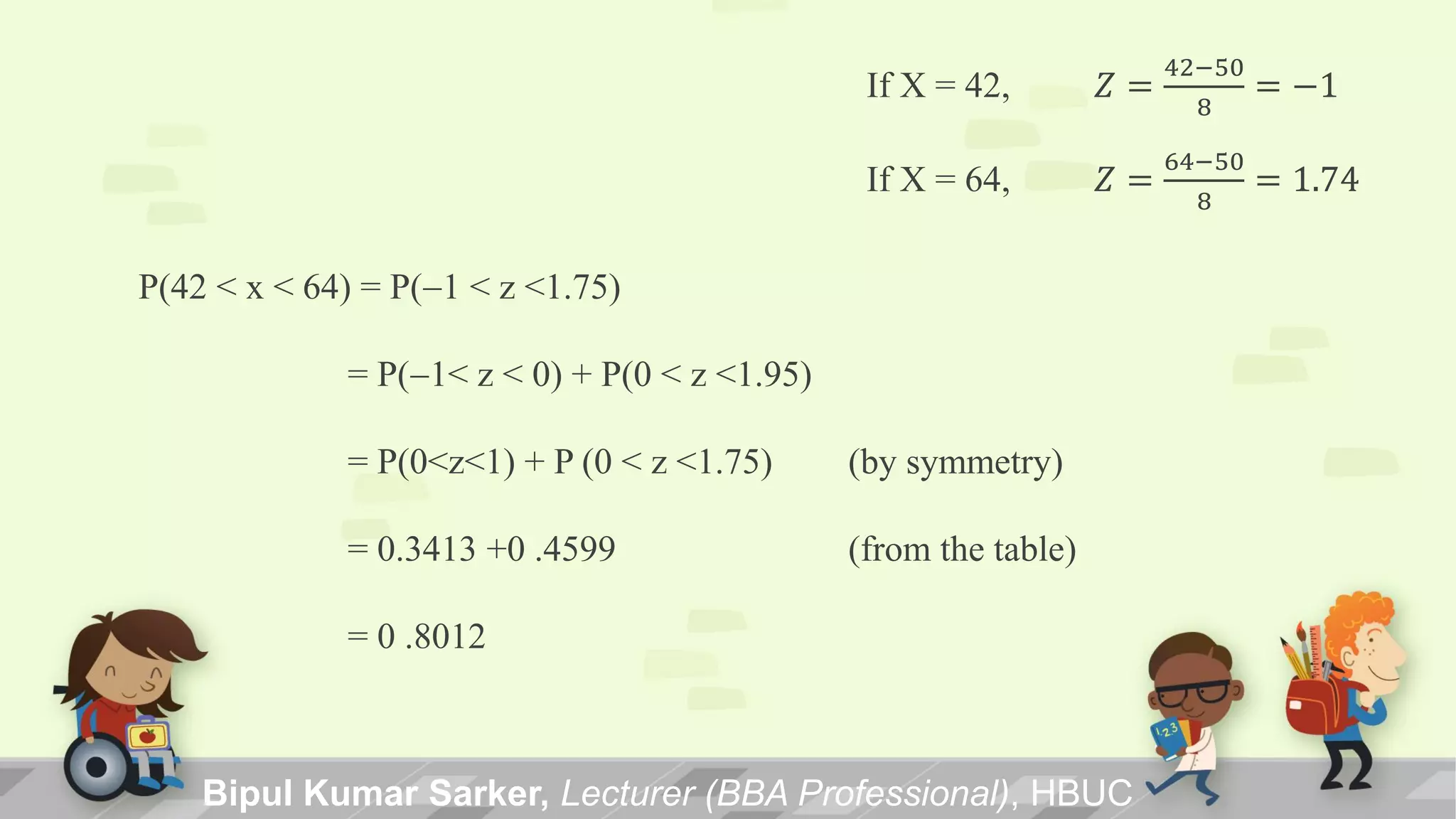
P(42 < x < 64) = P(-1 < z <1.75)
= P(-1< z < 0) + P(0 < z <1.95)
= P(0<z<1) + P (0 < z <1.75) (by symmetry)
= 0.3413 +0 .4599 (from the table)
= 0 .8012
If X = 42, 𝑍 =
42−50
8
= −1
If X = 64, 𝑍 =
64−50
8
= 1.74
Bipul Kumar Sarker, Lecturer (BBA Professional), HBUC
Example-07
Students of a class were given an aptitude test. Their marks were found to be normally
distributed with mean 60 and standard deviation 5. What percentage of students scored.
i) More than 60 marks
ii) Less than 56 marks
iii)Between 45 and 65 marks
Bipul Kumar Sarker, Lecturer (BBA Professional), HBUC
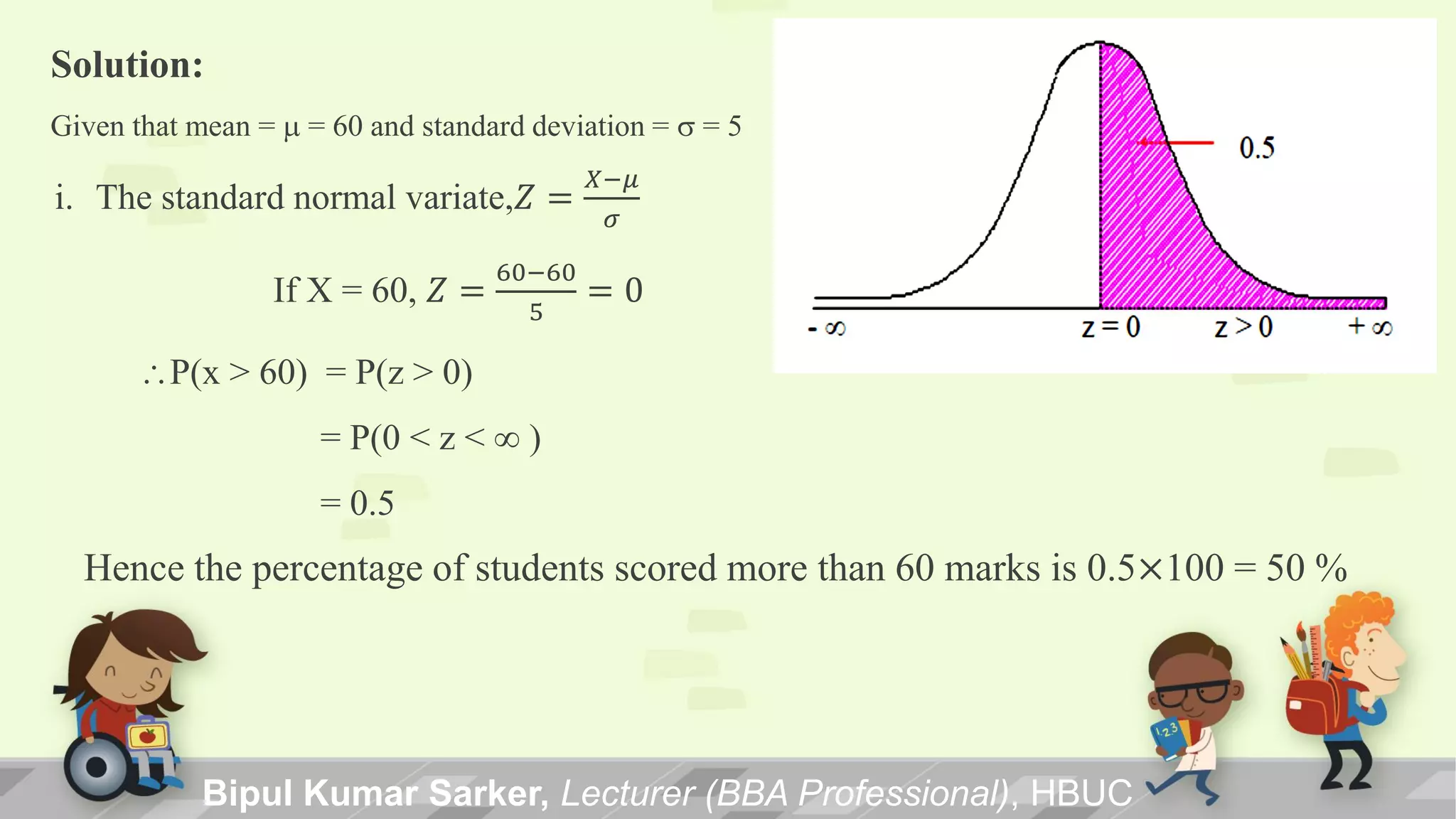
i. The standard normal variate,𝑍 =
𝑋−𝜇
𝜎
If X = 60, 𝑍 =
60−60
5
= 0
P(x > 60) = P(z > 0)
= P(0 < z <  )
= 0.5
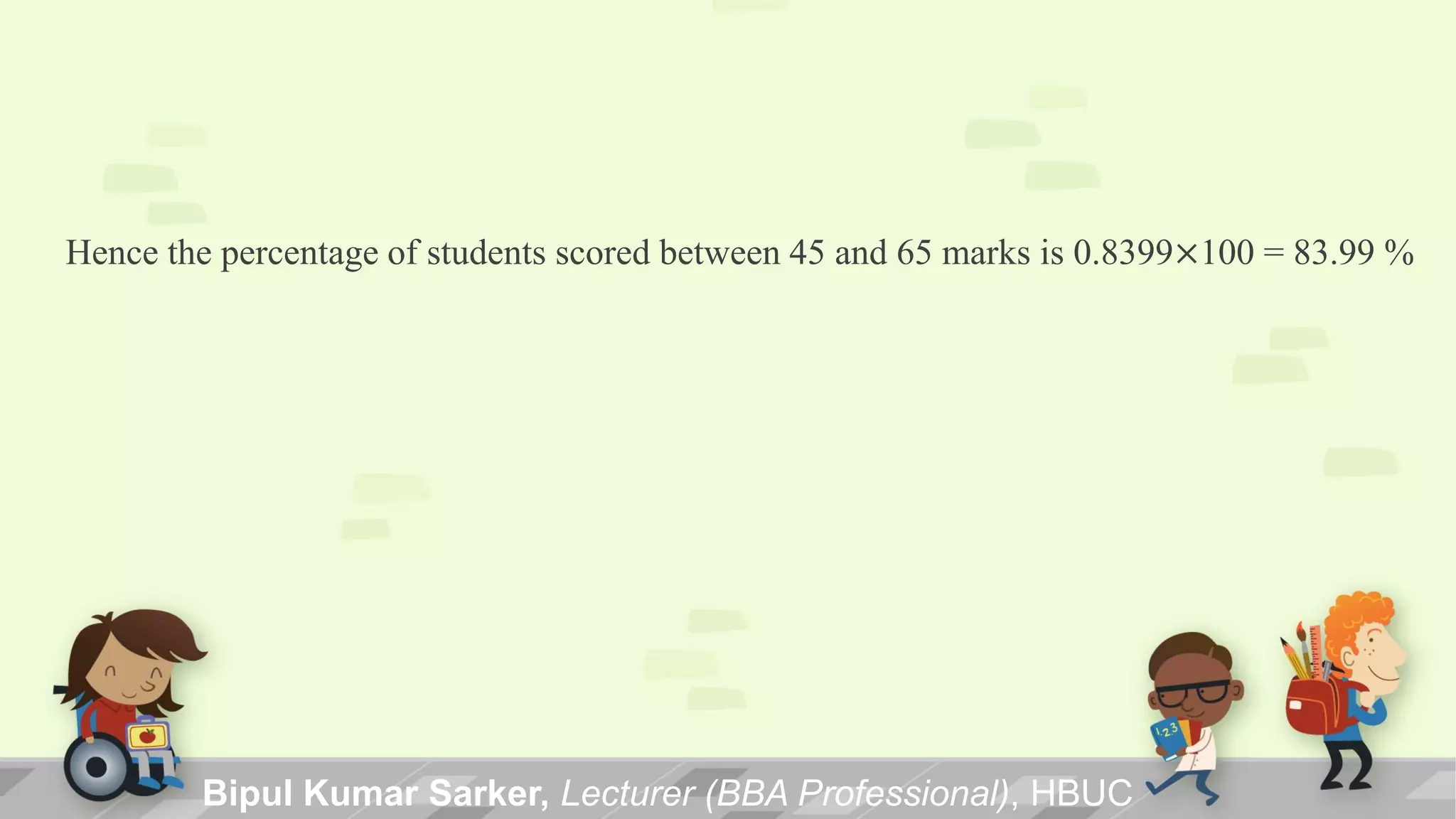
Hence the percentage of students scored more than 60 marks is 0.5×100 = 50 %
Solution:
Given that mean = m = 60 and standard deviation = s = 5
Bipul Kumar Sarker, Lecturer (BBA Professional), HBUC
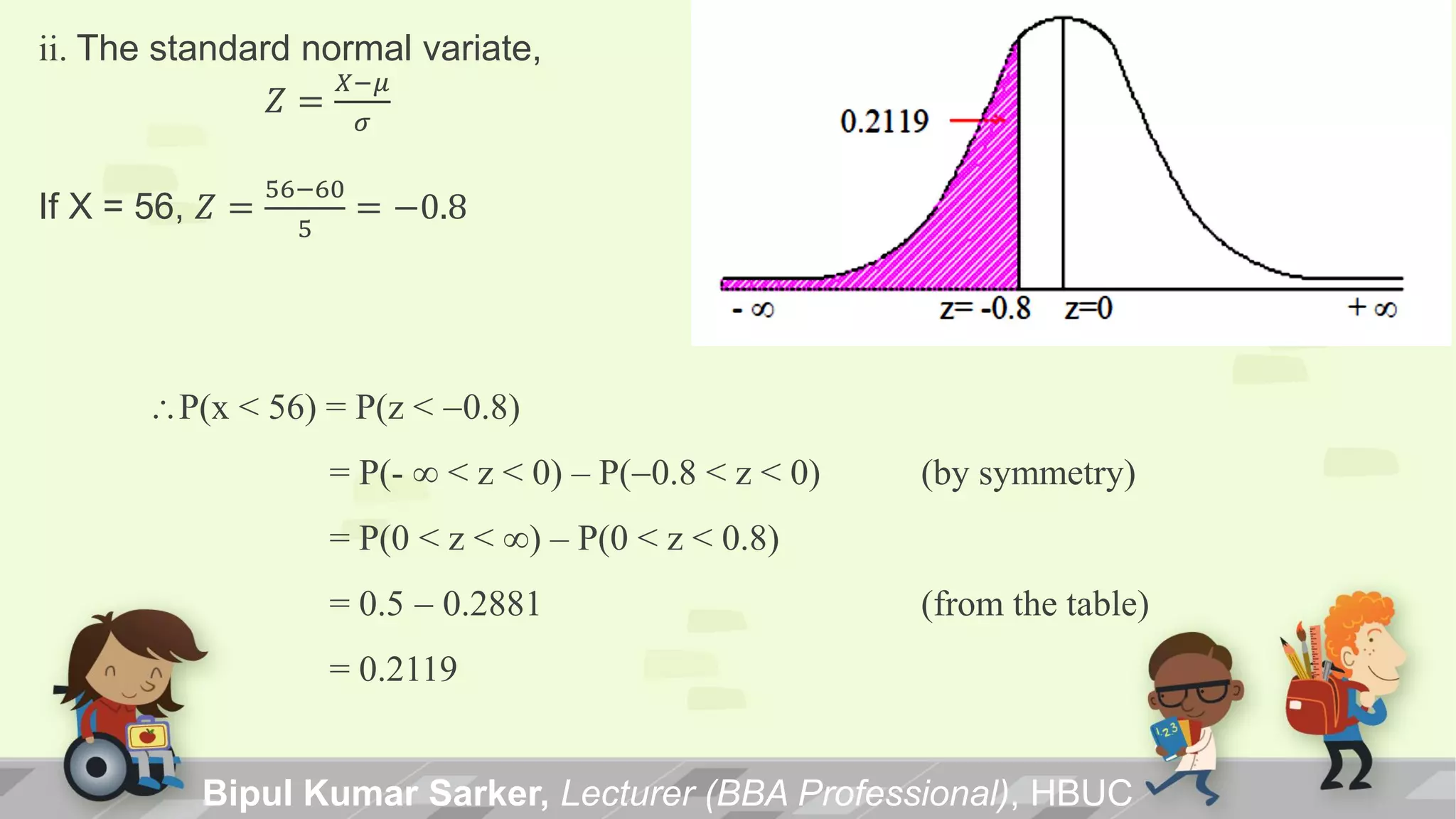
ii. The standard normal variate,
𝑍 =
𝑋−𝜇
𝜎
If X = 56, 𝑍 =
56−60
5
= −0.8
P(x < 56) = P(z < -0.8)
= P(-  < z < 0) – P(-0.8 < z < 0) (by symmetry)
= P(0 < z < ) – P(0 < z < 0.8)
= 0.5 - 0.2881 (from the table)
= 0.2119
Bipul Kumar Sarker, Lecturer (BBA Professional), HBUC
Hence the percentage of students score less than 56 marks is 0.2119×100 = 21.19 %
Bipul Kumar Sarker, Lecturer (BBA Professional), HBUC
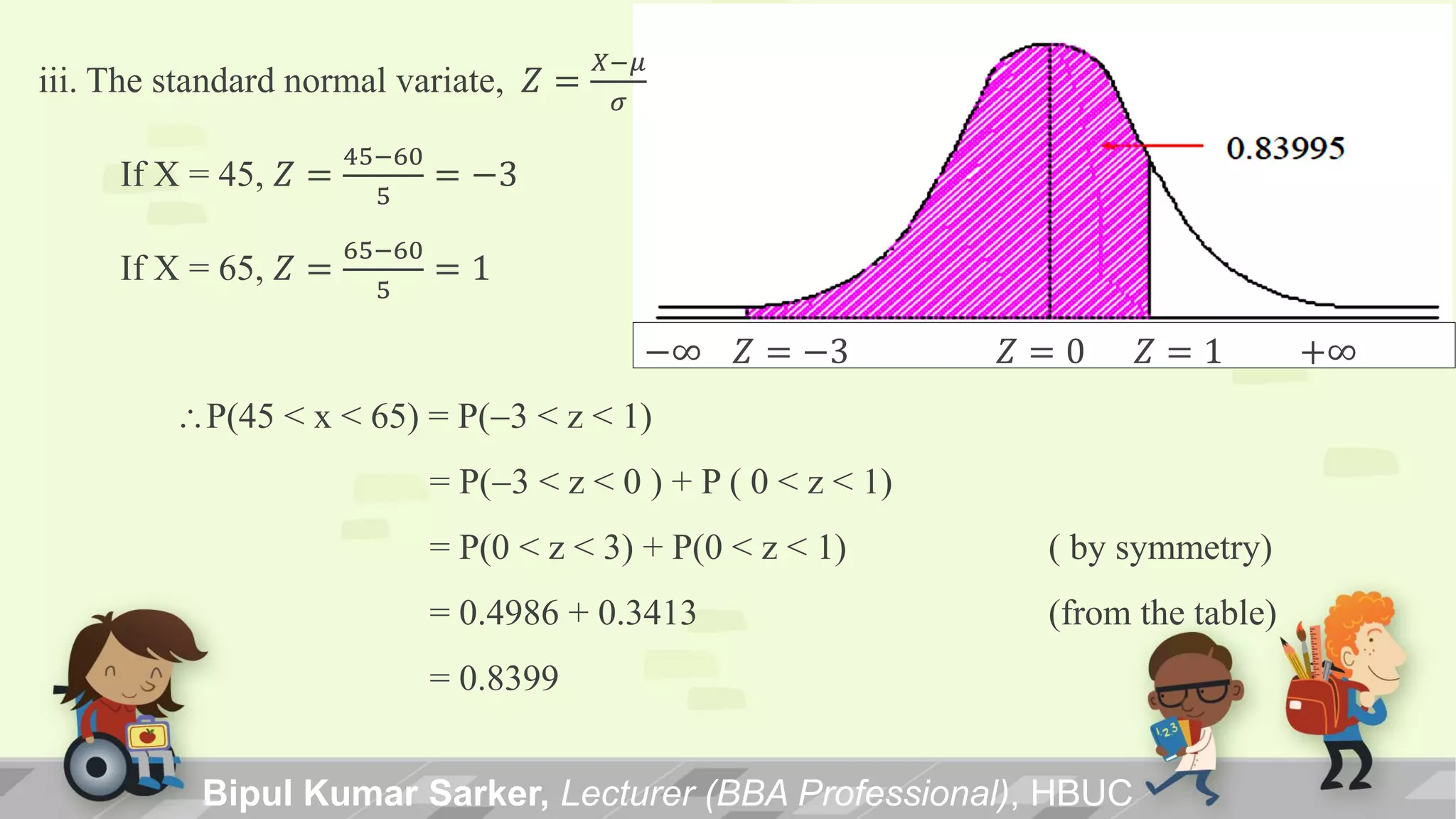
−∞ 𝑍 = −3 𝑍 = 0 𝑍 = 1 +∞
iii. The standard normal variate, 𝑍 =
𝑋−𝜇
𝜎
If X = 45, 𝑍 =
45−60
5
= −3
If X = 65, 𝑍 =
65−60
5
= 1
P(45 < x < 65) = P(-3 < z < 1)
= P(-3 < z < 0 ) + P ( 0 < z < 1)
= P(0 < z < 3) + P(0 < z < 1) ( by symmetry)
= 0.4986 + 0.3413 (from the table)
= 0.8399
Bipul Kumar Sarker, Lecturer (BBA Professional), HBUC
Hence the percentage of students scored between 45 and 65 marks is 0.8399×100 = 83.99 %
Bipul Kumar Sarker, Lecturer (BBA Professional), HBUC
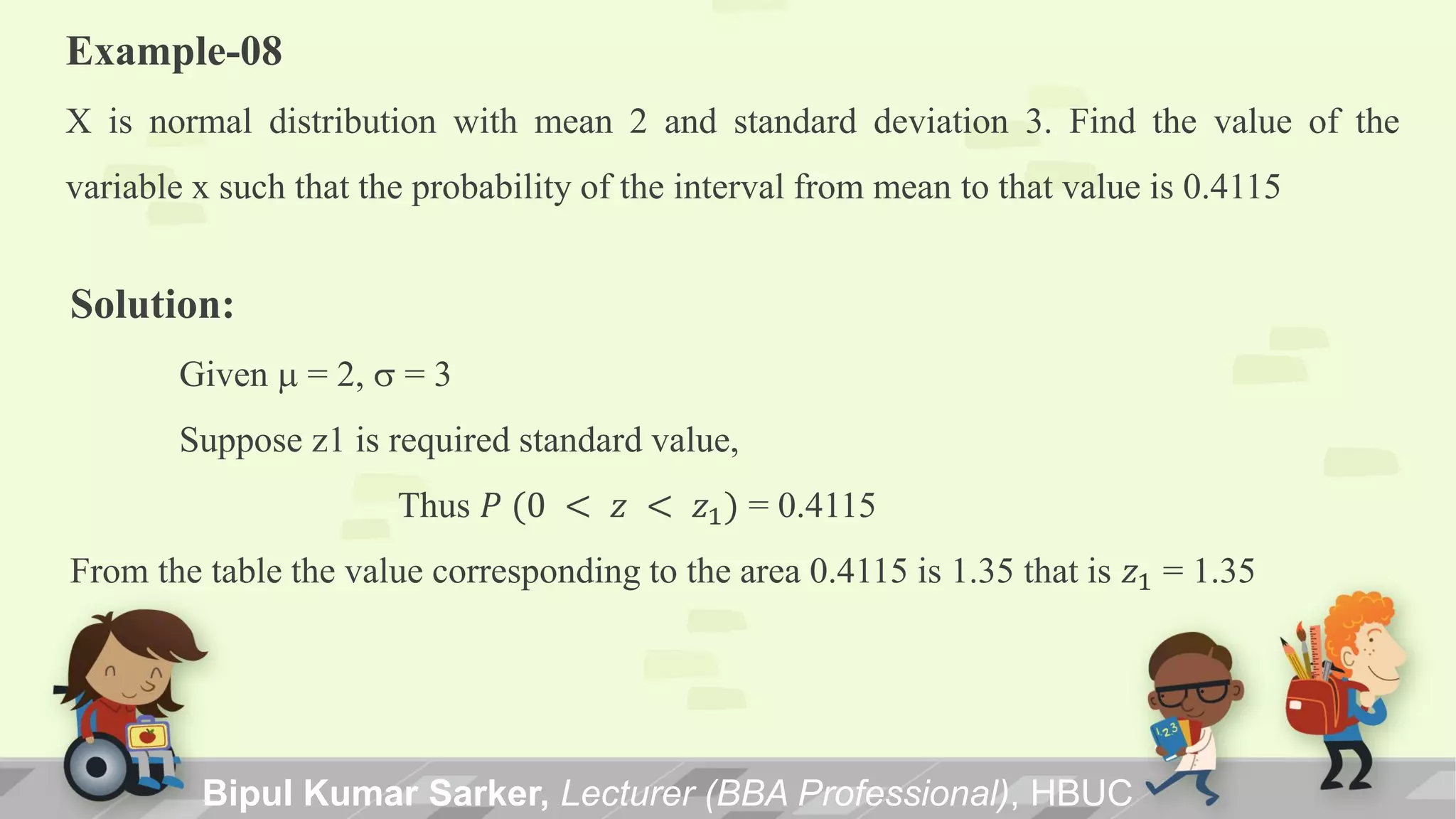
Example-08
X is normal distribution with mean 2 and standard deviation 3. Find the value of the
variable x such that the probability of the interval from mean to that value is 0.4115
Solution:
Given m = 2, s = 3
Suppose z1 is required standard value,
Thus 𝑃 (0 < 𝑧 < 𝑧1) = 0.4115
From the table the value corresponding to the area 0.4115 is 1.35 that is 𝑧1 = 1.35
Bipul Kumar Sarker, Lecturer (BBA Professional), HBUC
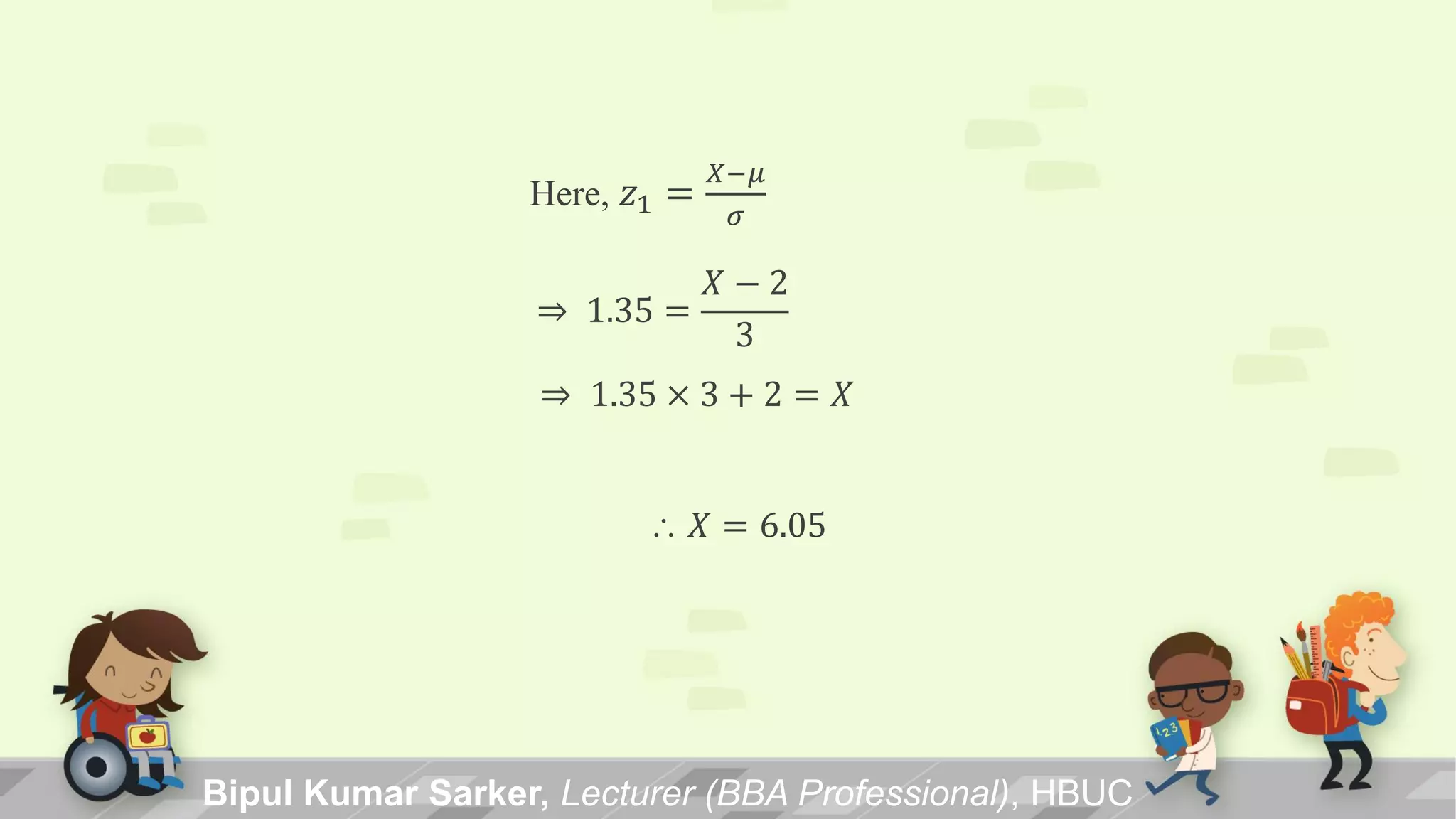
Here, 𝑧1 =
𝑋−𝜇
𝜎
⇒ 1.35 =
𝑋 − 2
3
⇒ 1.35 × 3 + 2 = 𝑋
 𝑋 = 6.05
Bipul Kumar Sarker, Lecturer (BBA Professional), HBUC

Continuous probability distribution

  • 1.
    Continuous Probability Distribution BipulKumar Sarker Lecturer BBA Professional Habibullah Bahar University College Chapter-04
  • 2.
    History of NormalDistribution The normal distribution was first discovered by De Moivre (English Mathematician) in 1733 as limiting case of binomial distribution. Later it was applied in natural and social science by Laplace (French Mathematician) in 1777. The normal distribution is also known as Gaussian distribution in honor of Karl Friedrich Gauss(1809). Bipul Kumar Sarker, Lecturer (BBA Professional), HBUC
  • 3.
    3.3.1 Definition OfNormal Distribution: A continuous random variable X is said to follow normal distribution with mean m and standard deviation s, if its probability density function is define as follow, Note: The mean m and standard deviation s are called the parameters of Normal distribution. The normal distribution is expressed by 𝑋~𝑁 𝜇, 𝜎2 . Bipul Kumar Sarker, Lecturer (BBA Professional), HBUC
  • 4.
    3.3.2 Condition ofNormal Distribution: i. Normal distribution is a limiting form of the binomial distribution under the following conditions. a. n, the number of trials is indefinitely large ie., 𝑛 → ∞ and b. Neither p nor q is very small. ii. Normal distribution can also be obtained as a limiting form of Poisson distribution with parameter 𝑚 → ∞ iii. Constants of normal distribution are mean = m, variation = 𝜎2, Standard deviation = s Bipul Kumar Sarker, Lecturer (BBA Professional), HBUC
  • 5.
    3.3.3 Normal ProbabilityCurve: The curve representing the normal distribution is called the normal probability curve. The curve is symmetrical about the mean (m), bell-shaped and the two tails on the right and left sides of the mean extends to the infinity. The shape of the curve is shown in the following figure. Bipul Kumar Sarker, Lecturer (BBA Professional), HBUC
  • 6.
    3.3.4 Properties ofNormal Distribution: i. The normal curve is bell shaped and is symmetric at x = m. ii. Mean, median, and mode of the distribution are coincide i.e., Mean = Median = Mode = m iii. It has only one mode at x = m (i.e., unimodal) iv. Since the curve is symmetrical, Skewness = 𝛽1 = 0 and Kurtosis = 𝛽2= 3 v. The points of inflection are at x = m ± s Bipul Kumar Sarker, Lecturer (BBA Professional), HBUC
  • 7.
    vi. The maximumordinate occurs at x = m and its value is 1 𝜎 2𝜋 vii. The x axis is an asymptote to the curve i.e. the curve continues to approach but never touches the x axis viii. The first and third quartiles are equidistant from median. ix. The mean deviation about mean is 0.8 s 3.3.4 Properties of Normal Distribution: Bipul Kumar Sarker, Lecturer (BBA Professional), HBUC
  • 8.
    X. Quartile deviation= 0.6745 s XI. If X and Y are independent normal variates with mean 𝜇1 and 𝜇2, and variance 𝜎1 And 𝜎2 respectively then their sum (X + Y) is also a normal variate with mean (𝜇1 + 𝜇2) and variance 𝜎1 2 + 𝜎2 2 XII. Area Property P(m - s < Z < m + s) = 0.6826 P(m - 2s < Z < m + 2s) = 0.9544 P(m - 3s < Z < m + 3s) = 0.9973 3.3.4 Properties of Normal Distribution: Bipul Kumar Sarker, Lecturer (BBA Professional), HBUC
  • 9.
    3.3.5 Standard Normaldistribution: Let X be random variable which follows normal distribution with mean m and variance 𝜎2 .The standard normal variate is defined as 𝑍 = 𝑋−𝜇 𝜎 which follows standard normal distribution with mean 0 and standard deviation 1 i.e., Z ~ N(0,1). The standard normal distribution is given by 𝚽 𝒁 = 𝟏 𝟐𝝅 𝒆− 𝟏 𝟐 𝒛 𝟐 ; −∞ < 𝒁 < ∞ The advantage of the above function is that it doesn’t’ contain any parameter. This enable us to compute the area under the normal probability curve. Bipul Kumar Sarker, Lecturer (BBA Professional), HBUC
  • 10.
    3.3.6 Area propertiesof Normal curve: The total area under the normal probability curve is 1. The curve is also called standard probability curve. The area under the curve between the ordinates at x = a and x = b where a < b, represents the probabilities that x lies between x = a and x = b i.e., P(a  x  b) Bipul Kumar Sarker, Lecturer (BBA Professional), HBUC
  • 11.
    To find anyprobability value of x, we first standardize it by using 𝑍 = 𝑋−𝜇 𝜎 , and use the area probability normal table. Bipul Kumar Sarker, Lecturer (BBA Professional), HBUC
  • 12.
    Example: The probability thatthe normal random variable x to lie in the interval (m-s , m+s) is given by, 1. Bipul Kumar Sarker, Lecturer (BBA Professional), HBUC
  • 13.
    2. Bipul Kumar Sarker,Lecturer (BBA Professional), HBUC
  • 14.
    3. Bipul Kumar Sarker,Lecturer (BBA Professional), HBUC
  • 15.
    The probability thata normal variate x lies outside the range m ± 3s is given by Thus we expect that the values in a normal probability curve will lie between the range m ± 3s, though theoretically it range from -  to . Bipul Kumar Sarker, Lecturer (BBA Professional), HBUC
  • 16.
    Example -01 Find theprobability that the standard normal variate lies between 0 and 1.56 Solution: −∞ 𝑍 = 0 𝑍 = 1.56 +∞ P(0< z< 1.56) = Area between z = 0 and z = 1.56 = 0.4406 (from table) Bipul Kumar Sarker, Lecturer (BBA Professional), HBUC
  • 17.
    Example-02 Find the areaof the standard normal variate from –1.96 to 0. Solution: −∞ 𝑍 = −1.96 𝑍 = 0 +∞ Area between z = 0 & z =-1.96 is same as the area z = 0 to z = 1.96 P(-1.96 < z < 0) = P(0 < z < 1.96) (by symmetry) = 0.4750 (from the table) Bipul Kumar Sarker, Lecturer (BBA Professional), HBUC
  • 18.
    P(z >0.25) =P(0<z < ) – P(0<z<0.25) = 0.5000 - 0.0987 (from the table) = 0.4013 Example-03 Find the area to the right of z = 0.25 Solution: Bipul Kumar Sarker, Lecturer (BBA Professional), HBUC
  • 19.
    Example-04 Find the areato the left of z = 1.5 Solution: P(z < 1.5) = P( -  < z < 0 ) + P( 0 < z < 1.5 ) = 0.5 + 0.4332 (from the table) = 0.9332 Bipul Kumar Sarker, Lecturer (BBA Professional), HBUC
  • 20.
    Example-05 Find the areaof the standard normal variate between –1.96 and 1.5 Solution: P(-1.96 < z < 1.5) = P(-1.96 < z < 0) + P(0 < z < 1.5) = P(0 < z < 1.96) + P(0 < z < 1.5) = 0.4750 + 0.4332 (from the table) = 0.9082 Bipul Kumar Sarker, Lecturer (BBA Professional), HBUC
  • 21.
    Example-06 Given a normaldistribution with m = 50 and s = 8, find the probability that x assumes a value between 42 and 64. Solution: Given that m = 50 and s = 8 The standard normal variate, 𝑍 = 𝑋−𝜇 𝜎 If X = 42, 𝑍 = 42−50 8 = −1 If X = 64, 𝑍 = 64−50 8 = 1.74 Bipul Kumar Sarker, Lecturer (BBA Professional), HBUC
  • 22.
    P(42 < x< 64) = P(-1 < z <1.75) = P(-1< z < 0) + P(0 < z <1.95) = P(0<z<1) + P (0 < z <1.75) (by symmetry) = 0.3413 +0 .4599 (from the table) = 0 .8012 If X = 42, 𝑍 = 42−50 8 = −1 If X = 64, 𝑍 = 64−50 8 = 1.74 Bipul Kumar Sarker, Lecturer (BBA Professional), HBUC
  • 23.
    Example-07 Students of aclass were given an aptitude test. Their marks were found to be normally distributed with mean 60 and standard deviation 5. What percentage of students scored. i) More than 60 marks ii) Less than 56 marks iii)Between 45 and 65 marks Bipul Kumar Sarker, Lecturer (BBA Professional), HBUC
  • 24.
    i. The standardnormal variate,𝑍 = 𝑋−𝜇 𝜎 If X = 60, 𝑍 = 60−60 5 = 0 P(x > 60) = P(z > 0) = P(0 < z <  ) = 0.5 Hence the percentage of students scored more than 60 marks is 0.5×100 = 50 % Solution: Given that mean = m = 60 and standard deviation = s = 5 Bipul Kumar Sarker, Lecturer (BBA Professional), HBUC
  • 25.
    ii. The standardnormal variate, 𝑍 = 𝑋−𝜇 𝜎 If X = 56, 𝑍 = 56−60 5 = −0.8 P(x < 56) = P(z < -0.8) = P(-  < z < 0) – P(-0.8 < z < 0) (by symmetry) = P(0 < z < ) – P(0 < z < 0.8) = 0.5 - 0.2881 (from the table) = 0.2119 Bipul Kumar Sarker, Lecturer (BBA Professional), HBUC
  • 26.
    Hence the percentageof students score less than 56 marks is 0.2119×100 = 21.19 % Bipul Kumar Sarker, Lecturer (BBA Professional), HBUC
  • 27.
    −∞ 𝑍 =−3 𝑍 = 0 𝑍 = 1 +∞ iii. The standard normal variate, 𝑍 = 𝑋−𝜇 𝜎 If X = 45, 𝑍 = 45−60 5 = −3 If X = 65, 𝑍 = 65−60 5 = 1 P(45 < x < 65) = P(-3 < z < 1) = P(-3 < z < 0 ) + P ( 0 < z < 1) = P(0 < z < 3) + P(0 < z < 1) ( by symmetry) = 0.4986 + 0.3413 (from the table) = 0.8399 Bipul Kumar Sarker, Lecturer (BBA Professional), HBUC
  • 28.
    Hence the percentageof students scored between 45 and 65 marks is 0.8399×100 = 83.99 % Bipul Kumar Sarker, Lecturer (BBA Professional), HBUC
  • 29.
    Example-08 X is normaldistribution with mean 2 and standard deviation 3. Find the value of the variable x such that the probability of the interval from mean to that value is 0.4115 Solution: Given m = 2, s = 3 Suppose z1 is required standard value, Thus 𝑃 (0 < 𝑧 < 𝑧1) = 0.4115 From the table the value corresponding to the area 0.4115 is 1.35 that is 𝑧1 = 1.35 Bipul Kumar Sarker, Lecturer (BBA Professional), HBUC
  • 30.
    Bipul Kumar Sarker,Lecturer (BBA Professional), HBUC Here, 𝑧1 = 𝑋−𝜇 𝜎 ⇒ 1.35 = 𝑋 − 2 3 ⇒ 1.35 × 3 + 2 = 𝑋 𝑋 = 6.05
  • 31.
    Bipul Kumar Sarker,Lecturer (BBA Professional), HBUC
  • 32.
    Bipul Kumar Sarker,Lecturer (BBA Professional), HBUC