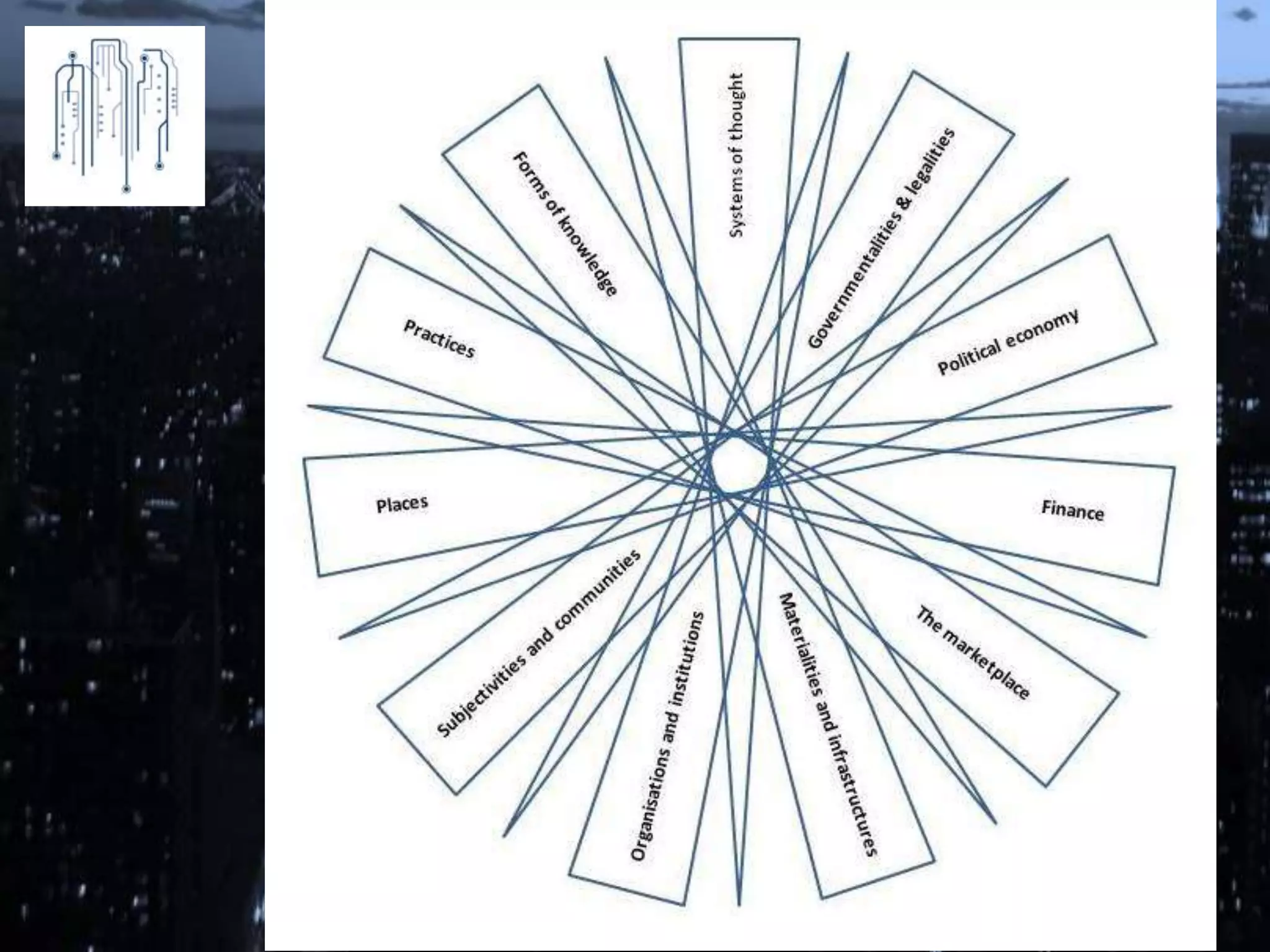
Code Acts in Education

Code Acts in Code/Space:
Making Sense of Software Mediated Education
Rob Kitchin
28/1/14, Stirling, Scotland
The Programmable City Project
NIRSA, NUIM
Introduction
•

•

Over time everyday life has become increasingly reliant on
software
... work, play, consumption, travel, communication, governance

•
•

It is almost impossible to live outside the orbit of software
Many systems would largely malfunction without software

•
•

Software, to varying degrees, conditions existence
Life and places are increasingly full of coded objects and coded
infrastructures that support coded processes and combine to
constitute coded assemblages
Coded Objects
•

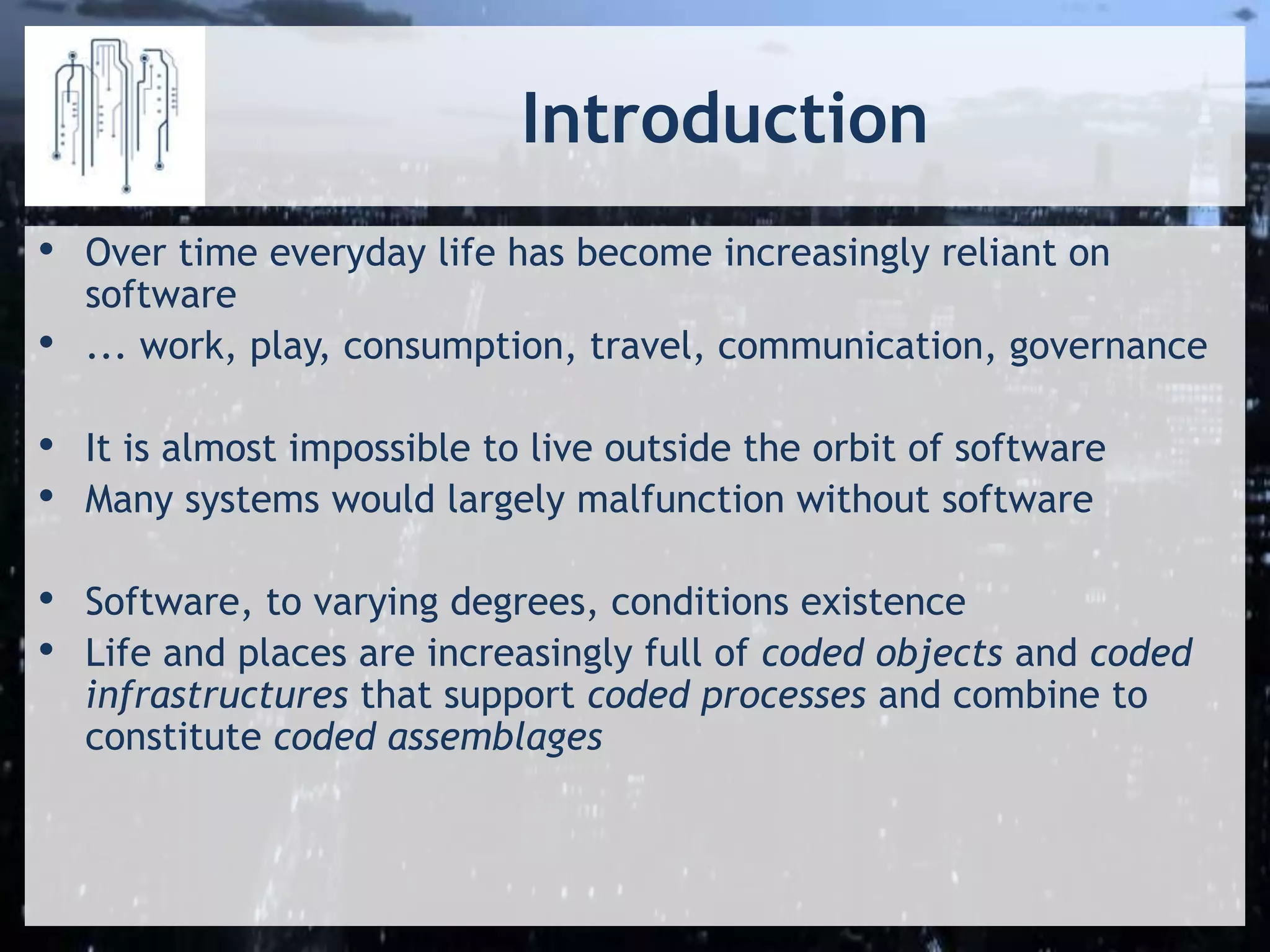
Machine-readable objects

•
•
•

Coded objects
Codejects (DVD player, washing machine, digital thermostat)
Logjects
• Impermeable logjects (MP3 player, GPS, camera)
• Permeable logjects (mobile phones, satellite television)
Coded infrastructures
•
•

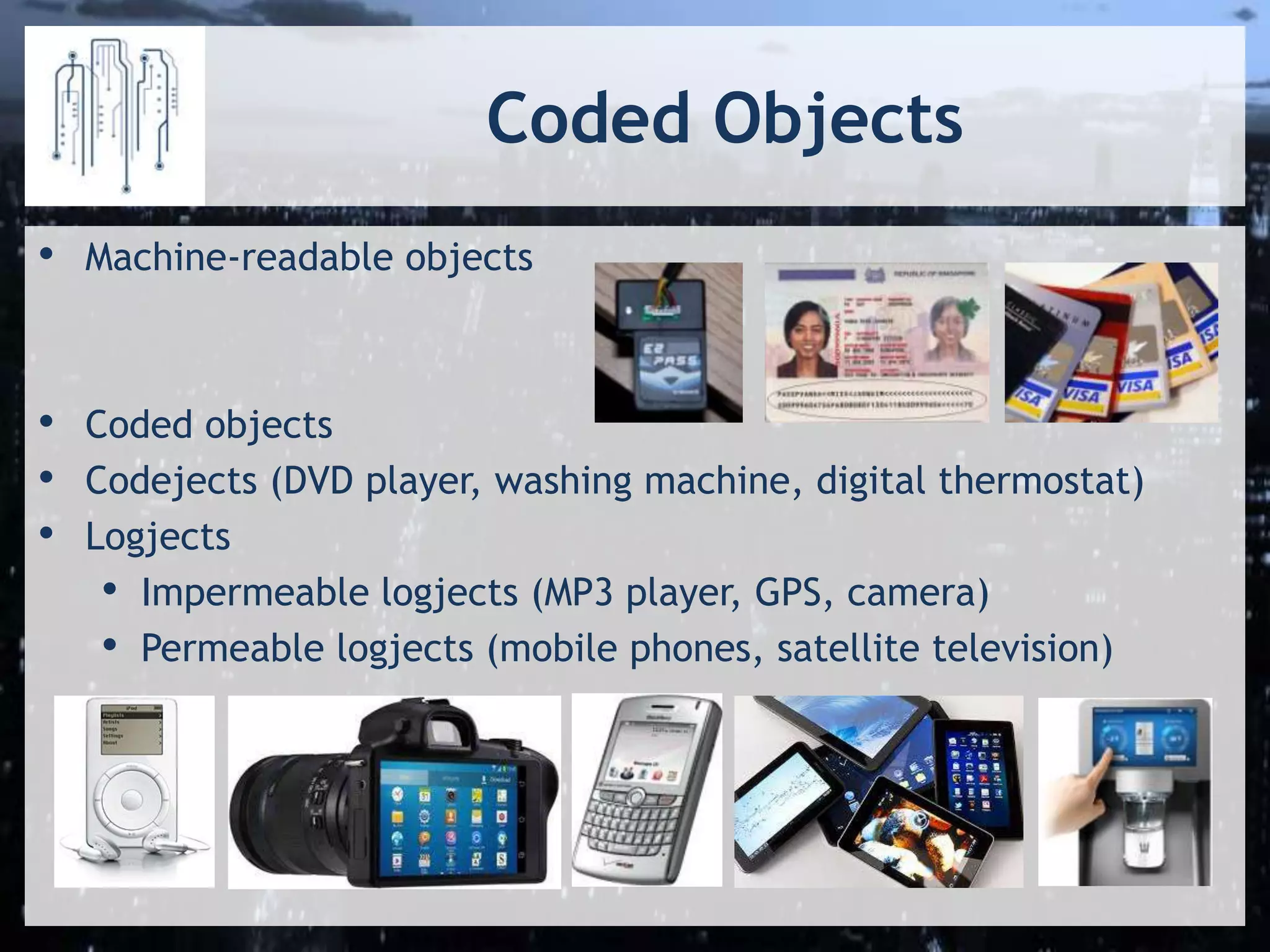
Coded infrastructure refers both to networks that link together
coded objects and infrastructure that is monitored and
regulated, either fully or in part, by code
Such coded infrastructure include:
•
•

•
•
•
•

computing networks (e.g. Internet, intranets)
communication and entertainment networks (e.g. mail, telephone, mobile phones,
television, radio, satellite)
utility networks (e.g. water, electricity, gas, sewerage)
transport and logistics networks (e.g. air, train, road, shipping)
financial networks (e.g. bank intranets, stock markets)
security and policing networks (e.g. surveillance cameras)
Coded processes
•

•
•
•

Coded processes refer to the transaction and flow of digital data
across coded infrastructure
Particularly important when they access, update, and monitor
relational databases that hold individual and institutional data
Such databases can be accessed at a distance and used to verify,
monitor (say for billing purposes) and regulate user access to a
network, update personal files
Many such coded processes relate to bank accounts, mortgages,
shares, taxation, insurance, health, crime, utility usage, service
usage
Coded assemblages
•

•

•

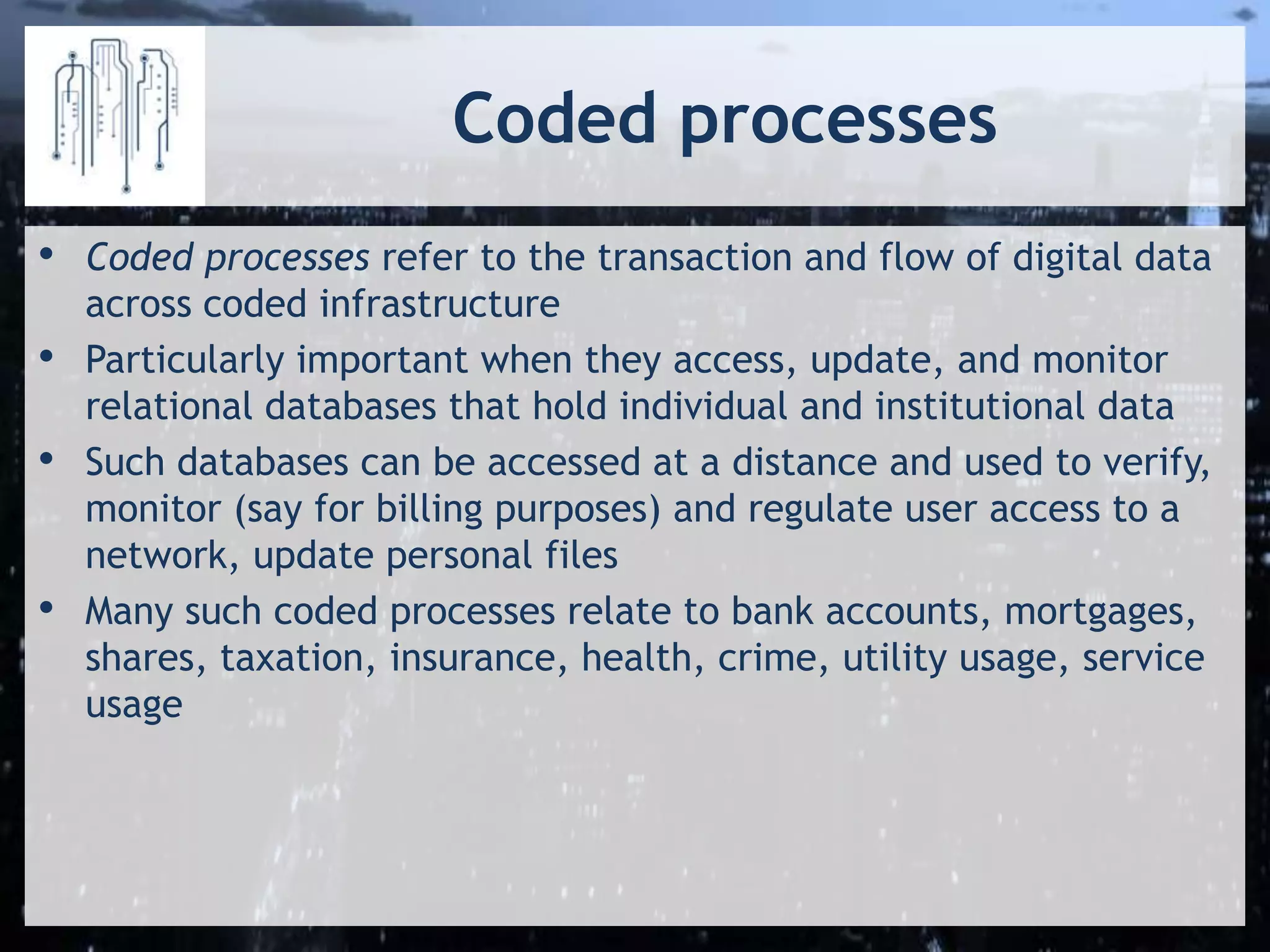
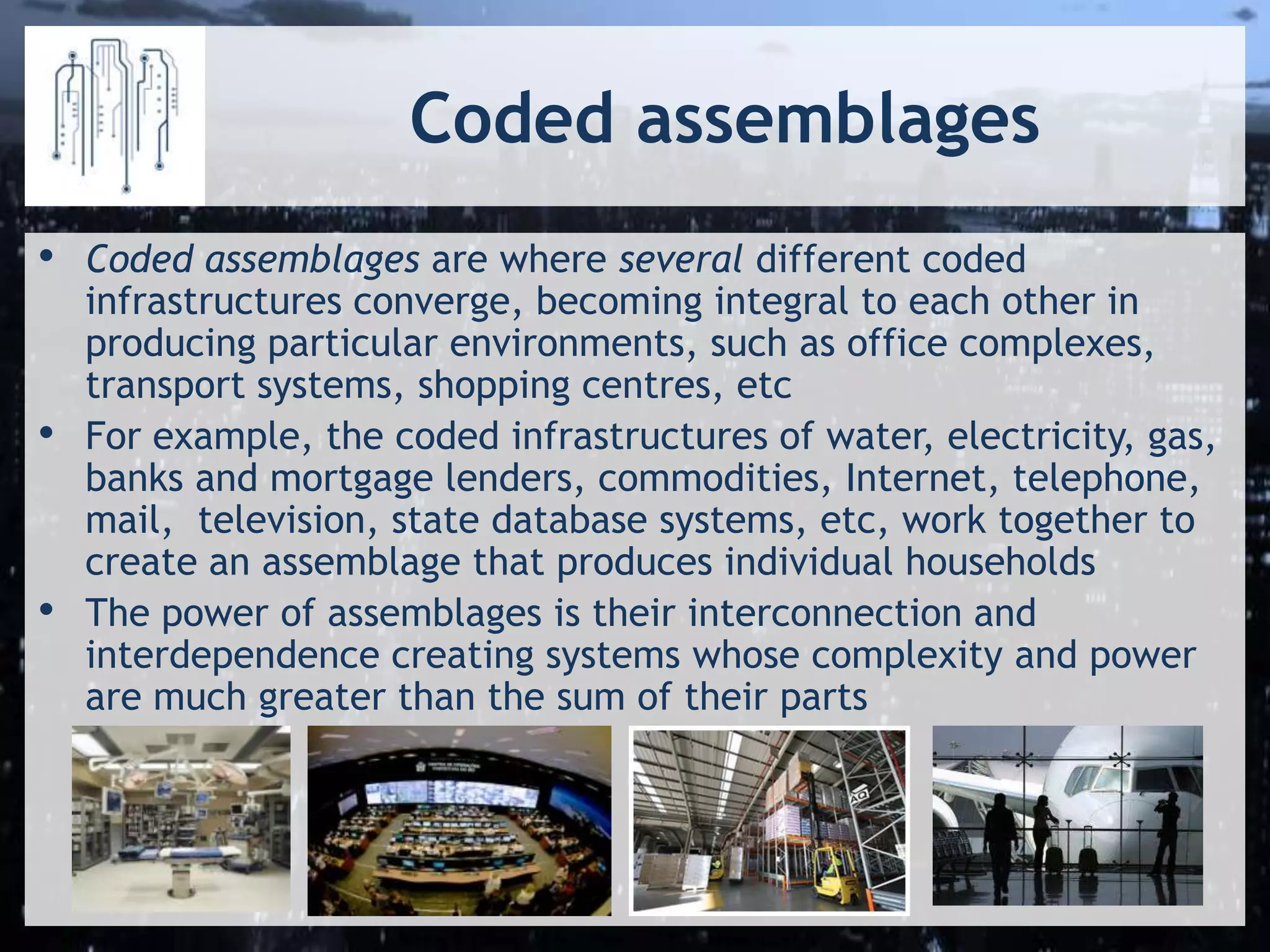
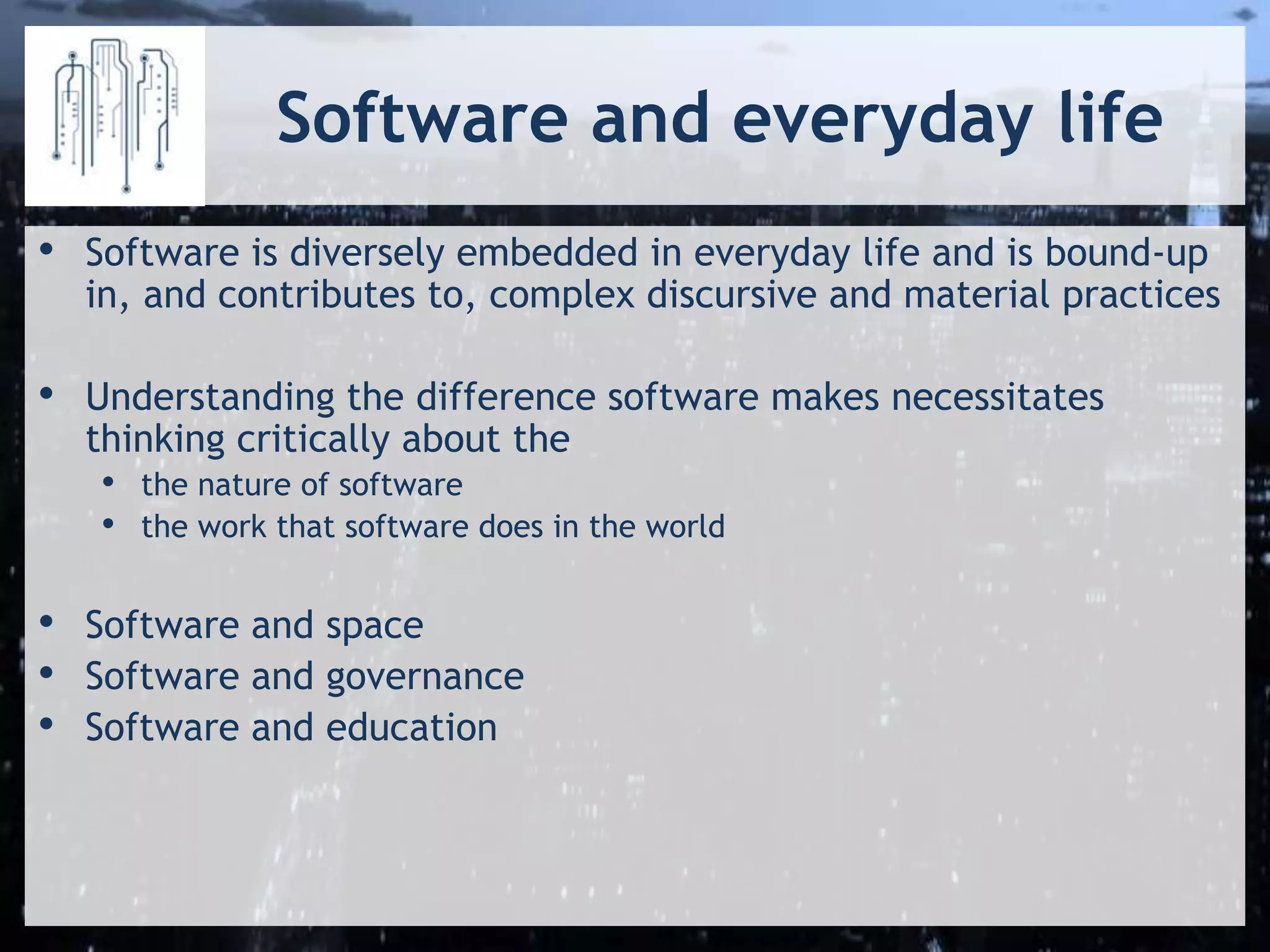
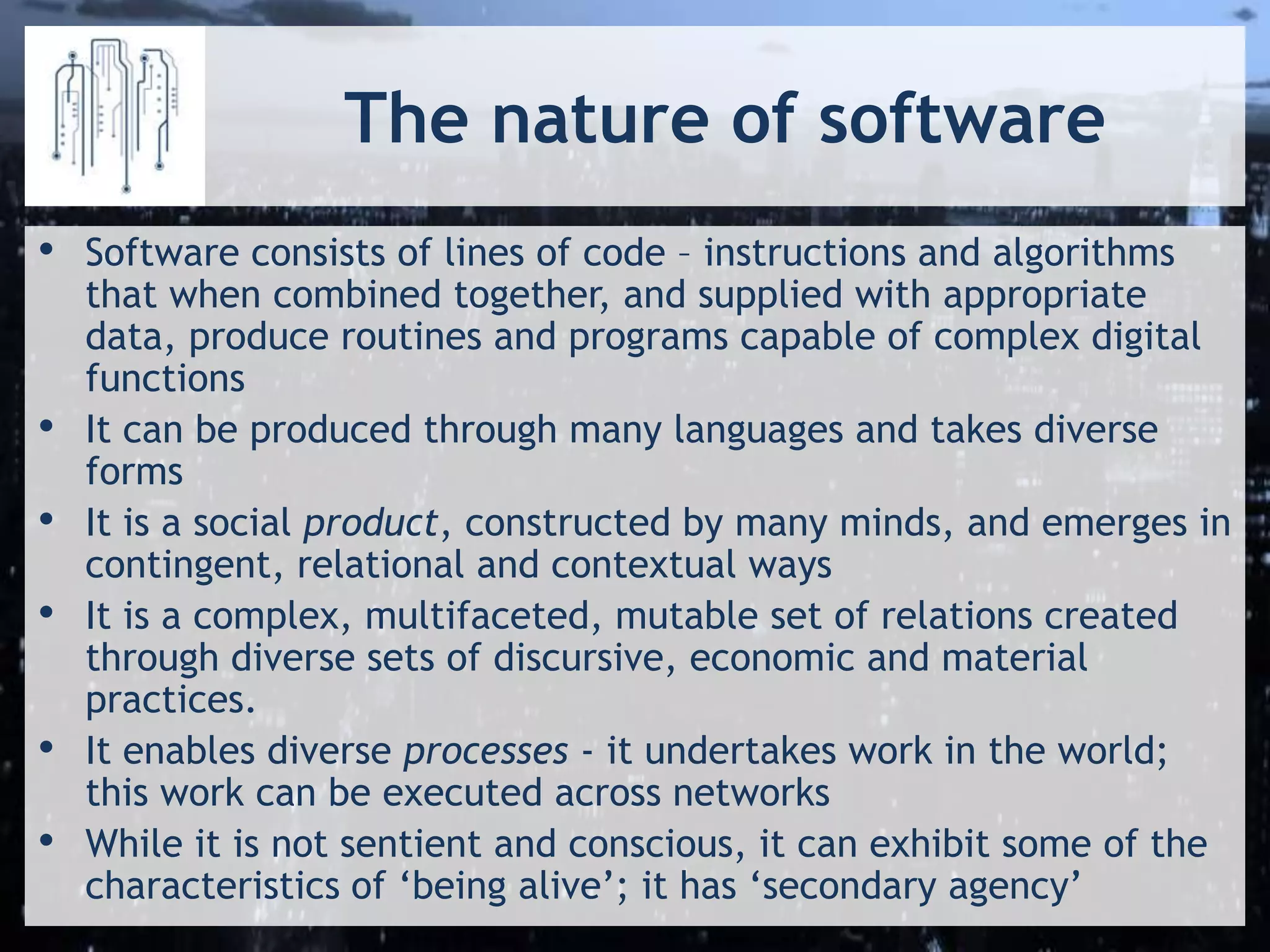
Coded assemblages are where several different coded
infrastructures converge, becoming integral to each other in
producing particular environments, such as office complexes,
transport systems, shopping centres, etc
For example, the coded infrastructures of water, electricity, gas,
banks and mortgage lenders, commodities, Internet, telephone,
mail, television, state database systems, etc, work together to
create an assemblage that produces individual households
The power of assemblages is their interconnection and
interdependence creating systems whose complexity and power
are much greater than the sum of their parts
Software and everyday life
•

Software is diversely embedded in everyday life and is bound-up
in, and contributes to, complex discursive and material practices

•

Understanding the difference software makes necessitates
thinking critically about the
• the nature of software
• the work that software does in the world

•
•
•

Software and space
Software and governance
Software and education
The nature of software
•

•
•
•
•
•

Software consists of lines of code – instructions and algorithms
that when combined together, and supplied with appropriate
data, produce routines and programs capable of complex digital
functions
It can be produced through many languages and takes diverse
forms
It is a social product, constructed by many minds, and emerges in
contingent, relational and contextual ways
It is a complex, multifaceted, mutable set of relations created
through diverse sets of discursive, economic and material
practices.
It enables diverse processes - it undertakes work in the world;
this work can be executed across networks
While it is not sentient and conscious, it can exhibit some of the
characteristics of ‘being alive’; it has ‘secondary agency’
The work software does
•

Software participates rather than simply represents the world
because it possesses high technicity

•

Technicity is the unfolding or evolutive power of technologies to
make things happen
Technicity is realised through a process of transduction

•

•
•

•

Transduction is the process by which ‘a domain structures itself
as a partial, always incomplete solution to a relational problem’;
it is the process of ontogenesis, the making anew of a domain
through reiterative and transformative individuations
Individuations consist of discursive and material practices that
result in a modulation in conditions of a person and their milieu
Each individuation provisionally solves a problem within a
domain, this replaced by new problems
The transduction of space
•

•
•
•
•

For example, a person travelling through a city constantly
changes their relation to their milieu thus posing a continuous
supply of new problems
Space is produced through transductive individuations
Space is constantly being bought into being ‘as an incomplete
solution to a relational problem’
The relational problem is ongoing encounters between
individuals and environment and the solution, to a greater or
lesser extent, is software
Relational problems include undertaking domestic tasks,
travelling between locations, conducting work, communicating
between people, and practicing consumption
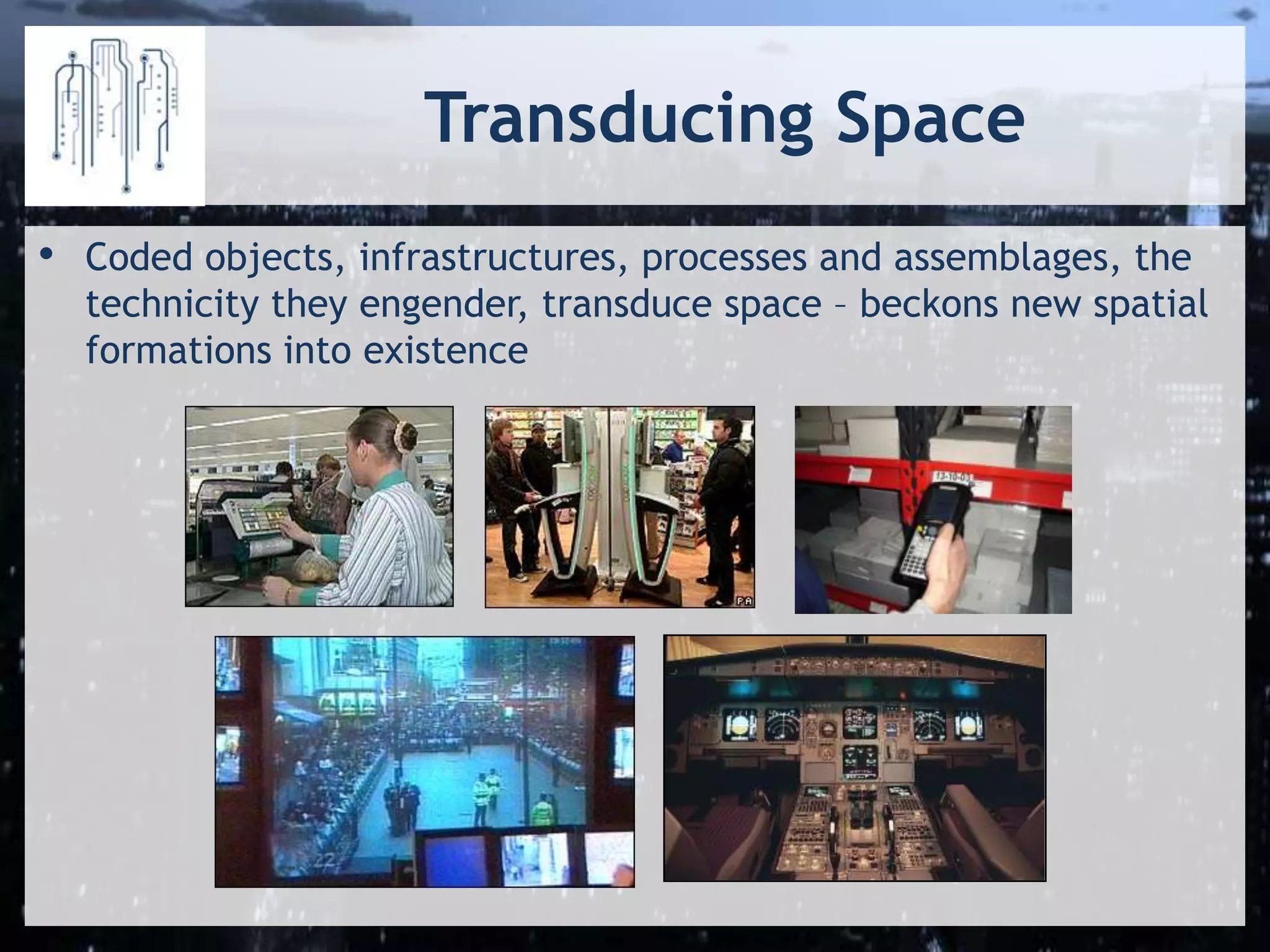
Transducing Space
•

Coded objects, infrastructures, processes and assemblages, the
technicity they engender, transduce space – beckons new spatial
formations into existence
Code/space
•
•

•
•

•

Code/spaces are spaces dependent on code to function wherein the materiality of everyday life and its attendant
virtual coding are mutually constituted
Here, the relationship between code and space is dyadic –
that is, without code the space would not be transduced as
intended (hence ‘code/space’ rather than ‘coded space’)
Old non-software means of doing things have sometimes
disappeared
Coded space is a transduction that is mediated by code, but
whose relationship is not dyadic
Software mediates the solution to a problem, but it is not
the only solution
Producing code/space
•

•

Code/spaces are non-deterministic and non-universal; they are
contingent and relational
How code/space actually operates and is experienced is open to
rupture:

•

•
•

•

•

embodied through the performances and interactions of the people
within the space (between people, and between people and code).
embedded within histories and geographies and emergent processes

In this sense, code/space is not consistently produced, always
manufactured and experienced the same
Instead, code/space is constantly in a state of becoming,
produced through individual performance and social interactions
that are mediated, consciously or unconsciously, in relation to
the mutual constitution of code/space
Code/spaces need to be analysed as complex systems with
emergent properties
Management/governance
•

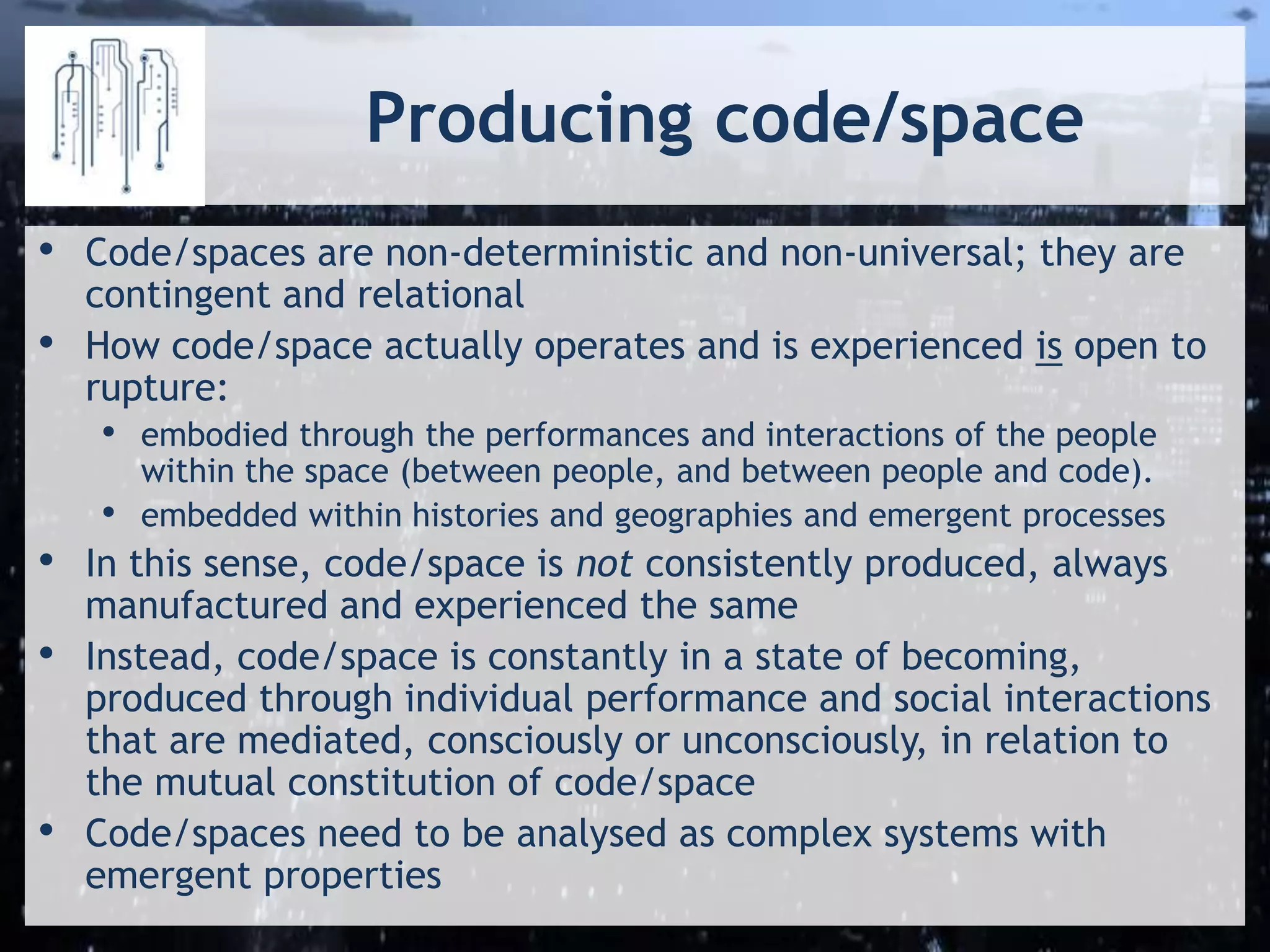
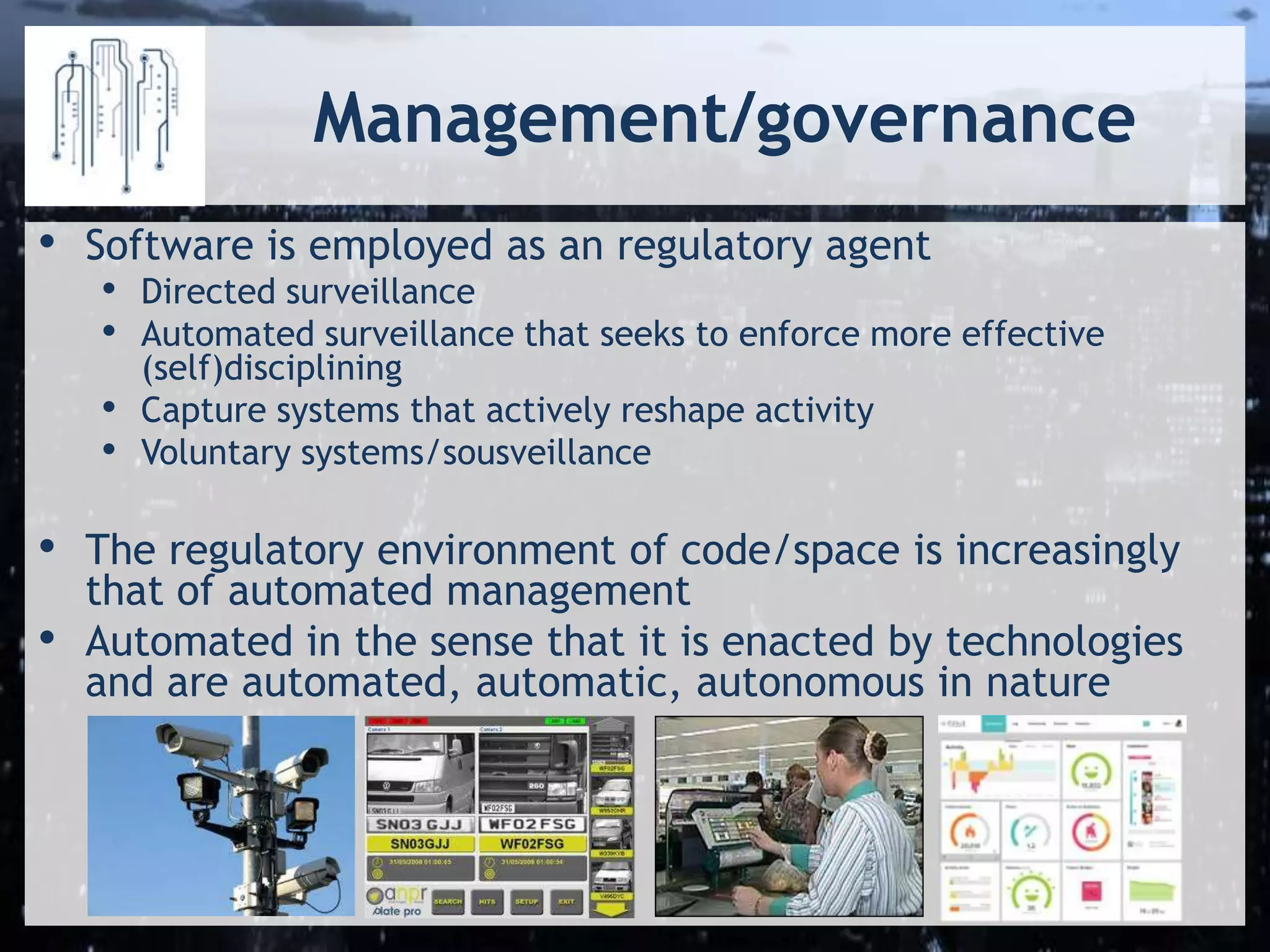
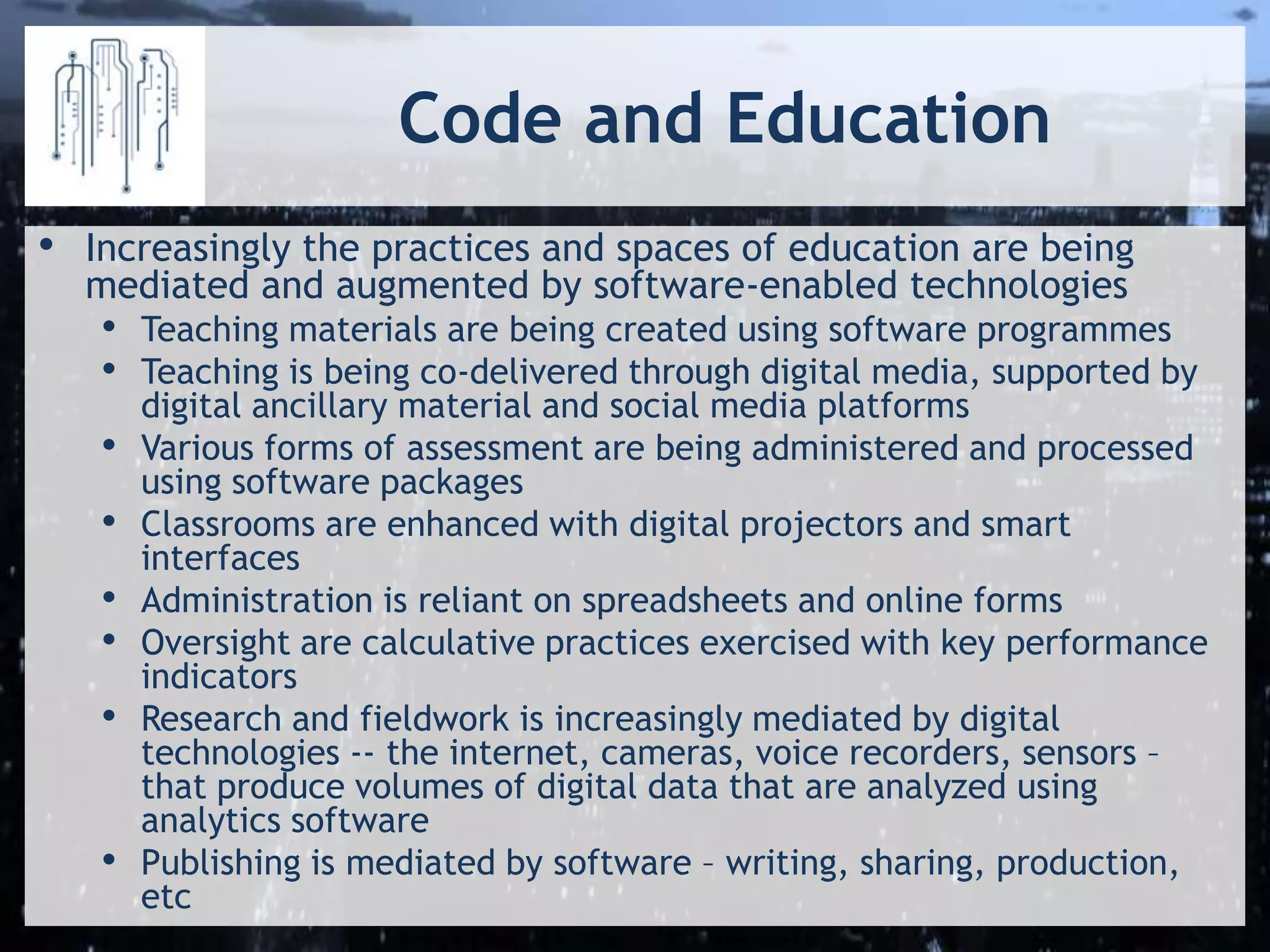
Software is employed as an regulatory agent
• Directed surveillance
• Automated surveillance that seeks to enforce more effective

•
•

(self)disciplining
Capture systems that actively reshape activity
Voluntary systems/sousveillance

• The regulatory environment of code/space is increasingly
•

that of automated management
Automated in the sense that it is enacted by technologies
and are automated, automatic, autonomous in nature
Code and Education
•

Increasingly the practices and spaces of education are being
mediated and augmented by software-enabled technologies

• Teaching materials are being created using software programmes
• Teaching is being co-delivered through digital media, supported by
•
•
•
•
•
•

digital ancillary material and social media platforms
Various forms of assessment are being administered and processed
using software packages
Classrooms are enhanced with digital projectors and smart
interfaces
Administration is reliant on spreadsheets and online forms
Oversight are calculative practices exercised with key performance
indicators
Research and fieldwork is increasingly mediated by digital
technologies -- the internet, cameras, voice recorders, sensors –
that produce volumes of digital data that are analyzed using
analytics software
Publishing is mediated by software – writing, sharing, production,
etc
Code and Education
•
•

•

Education takes place in coded spaces, code/space
Software is making a difference to:
• the way in which education is conceived and delivered
• the educational practices of education (teaching, admin,
research)
• the management and governance of education
Yet little critical attention has been paid to thinking
through role of code in reshaping the educational landscape
Code and Education

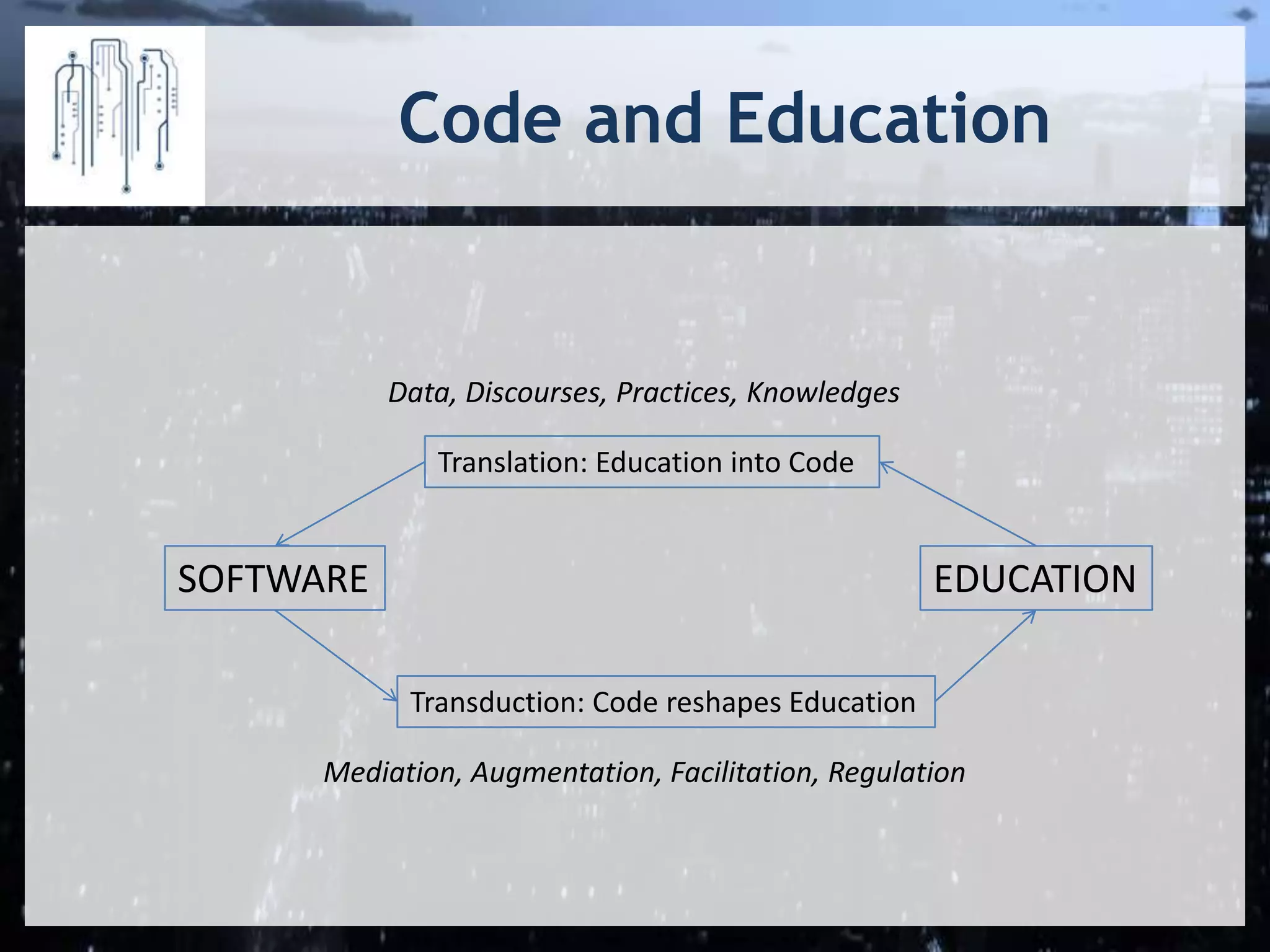
Data, Discourses, Practices, Knowledges
Translation: Education into Code

SOFTWARE

EDUCATION
Transduction: Code reshapes Education

Mediation, Augmentation, Facilitation, Regulation
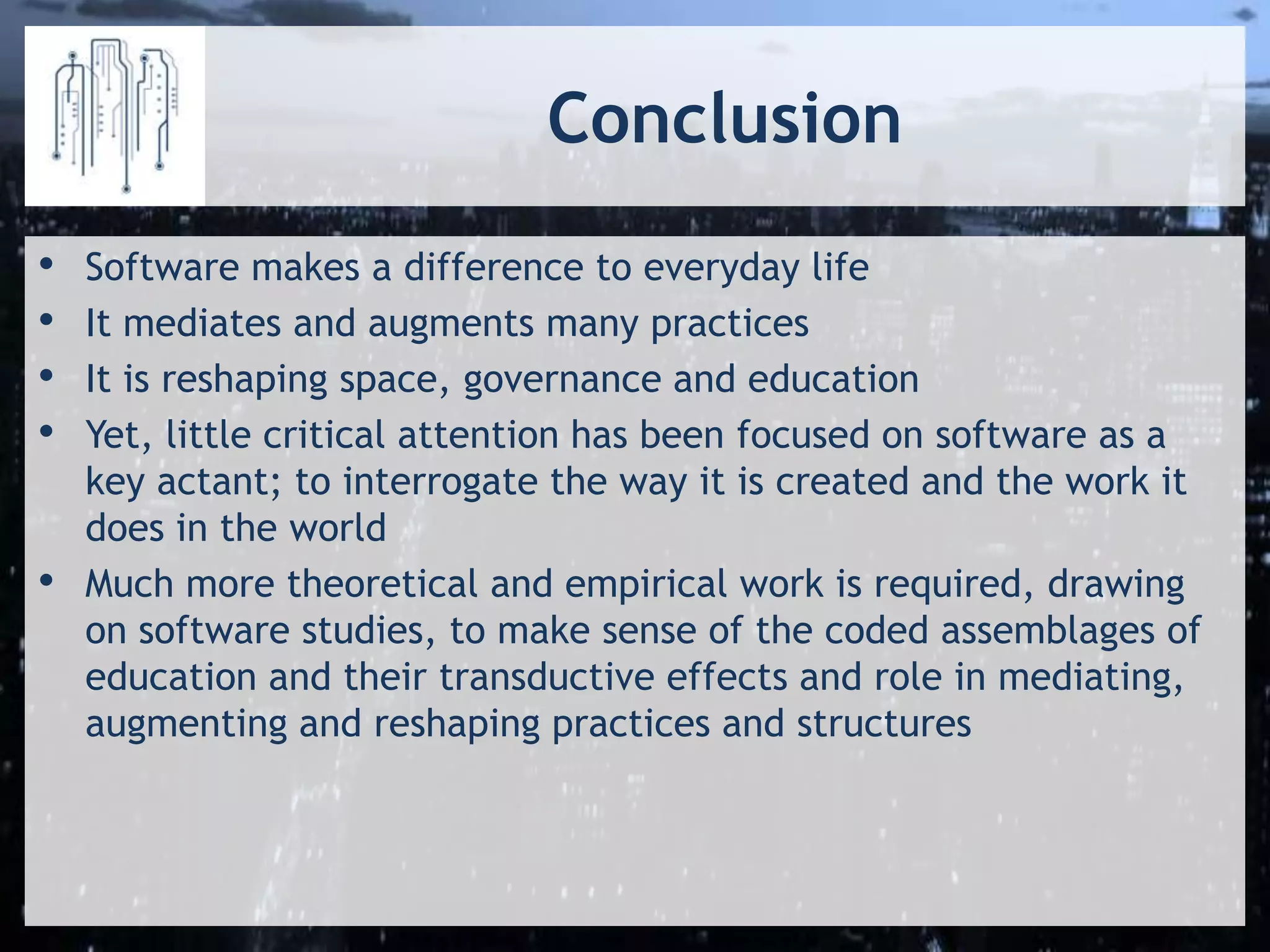
Conclusion
• Software makes a difference to everyday life
• It mediates and augments many practices
• It is reshaping space, governance and education
• Yet, little critical attention has been focused on software as a
•

key actant; to interrogate the way it is created and the work it
does in the world
Much more theoretical and empirical work is required, drawing
on software studies, to make sense of the coded assemblages of
education and their transductive effects and role in mediating,
augmenting and reshaping practices and structures
Thank you

Q&A
Rob.Kitchin@nuim.ie
@robkitchin
http://www.nuim.ie/progcity/

Code acts in code/space

  • 1.
    Code Acts inEducation Code Acts in Code/Space: Making Sense of Software Mediated Education Rob Kitchin 28/1/14, Stirling, Scotland The Programmable City Project NIRSA, NUIM
  • 2.
    Introduction • • Over time everydaylife has become increasingly reliant on software ... work, play, consumption, travel, communication, governance • • It is almost impossible to live outside the orbit of software Many systems would largely malfunction without software • • Software, to varying degrees, conditions existence Life and places are increasingly full of coded objects and coded infrastructures that support coded processes and combine to constitute coded assemblages
  • 3.
    Coded Objects • Machine-readable objects • • • Codedobjects Codejects (DVD player, washing machine, digital thermostat) Logjects • Impermeable logjects (MP3 player, GPS, camera) • Permeable logjects (mobile phones, satellite television)
  • 4.
    Coded infrastructures • • Coded infrastructurerefers both to networks that link together coded objects and infrastructure that is monitored and regulated, either fully or in part, by code Such coded infrastructure include: • • • • • • computing networks (e.g. Internet, intranets) communication and entertainment networks (e.g. mail, telephone, mobile phones, television, radio, satellite) utility networks (e.g. water, electricity, gas, sewerage) transport and logistics networks (e.g. air, train, road, shipping) financial networks (e.g. bank intranets, stock markets) security and policing networks (e.g. surveillance cameras)
  • 5.
    Coded processes • • • • Coded processesrefer to the transaction and flow of digital data across coded infrastructure Particularly important when they access, update, and monitor relational databases that hold individual and institutional data Such databases can be accessed at a distance and used to verify, monitor (say for billing purposes) and regulate user access to a network, update personal files Many such coded processes relate to bank accounts, mortgages, shares, taxation, insurance, health, crime, utility usage, service usage
  • 6.
    Coded assemblages • • • Coded assemblagesare where several different coded infrastructures converge, becoming integral to each other in producing particular environments, such as office complexes, transport systems, shopping centres, etc For example, the coded infrastructures of water, electricity, gas, banks and mortgage lenders, commodities, Internet, telephone, mail, television, state database systems, etc, work together to create an assemblage that produces individual households The power of assemblages is their interconnection and interdependence creating systems whose complexity and power are much greater than the sum of their parts
  • 7.
    Software and everydaylife • Software is diversely embedded in everyday life and is bound-up in, and contributes to, complex discursive and material practices • Understanding the difference software makes necessitates thinking critically about the • the nature of software • the work that software does in the world • • • Software and space Software and governance Software and education
  • 8.
    The nature ofsoftware • • • • • • Software consists of lines of code – instructions and algorithms that when combined together, and supplied with appropriate data, produce routines and programs capable of complex digital functions It can be produced through many languages and takes diverse forms It is a social product, constructed by many minds, and emerges in contingent, relational and contextual ways It is a complex, multifaceted, mutable set of relations created through diverse sets of discursive, economic and material practices. It enables diverse processes - it undertakes work in the world; this work can be executed across networks While it is not sentient and conscious, it can exhibit some of the characteristics of ‘being alive’; it has ‘secondary agency’
  • 10.
    The work softwaredoes • Software participates rather than simply represents the world because it possesses high technicity • Technicity is the unfolding or evolutive power of technologies to make things happen Technicity is realised through a process of transduction • • • • Transduction is the process by which ‘a domain structures itself as a partial, always incomplete solution to a relational problem’; it is the process of ontogenesis, the making anew of a domain through reiterative and transformative individuations Individuations consist of discursive and material practices that result in a modulation in conditions of a person and their milieu Each individuation provisionally solves a problem within a domain, this replaced by new problems
  • 11.
    The transduction ofspace • • • • • For example, a person travelling through a city constantly changes their relation to their milieu thus posing a continuous supply of new problems Space is produced through transductive individuations Space is constantly being bought into being ‘as an incomplete solution to a relational problem’ The relational problem is ongoing encounters between individuals and environment and the solution, to a greater or lesser extent, is software Relational problems include undertaking domestic tasks, travelling between locations, conducting work, communicating between people, and practicing consumption
  • 12.
    Transducing Space • Coded objects,infrastructures, processes and assemblages, the technicity they engender, transduce space – beckons new spatial formations into existence
  • 13.
    Code/space • • • • • Code/spaces are spacesdependent on code to function wherein the materiality of everyday life and its attendant virtual coding are mutually constituted Here, the relationship between code and space is dyadic – that is, without code the space would not be transduced as intended (hence ‘code/space’ rather than ‘coded space’) Old non-software means of doing things have sometimes disappeared Coded space is a transduction that is mediated by code, but whose relationship is not dyadic Software mediates the solution to a problem, but it is not the only solution
  • 14.
    Producing code/space • • Code/spaces arenon-deterministic and non-universal; they are contingent and relational How code/space actually operates and is experienced is open to rupture: • • • • • embodied through the performances and interactions of the people within the space (between people, and between people and code). embedded within histories and geographies and emergent processes In this sense, code/space is not consistently produced, always manufactured and experienced the same Instead, code/space is constantly in a state of becoming, produced through individual performance and social interactions that are mediated, consciously or unconsciously, in relation to the mutual constitution of code/space Code/spaces need to be analysed as complex systems with emergent properties
  • 15.
    Management/governance • Software is employedas an regulatory agent • Directed surveillance • Automated surveillance that seeks to enforce more effective • • (self)disciplining Capture systems that actively reshape activity Voluntary systems/sousveillance • The regulatory environment of code/space is increasingly • that of automated management Automated in the sense that it is enacted by technologies and are automated, automatic, autonomous in nature
  • 16.
    Code and Education • Increasinglythe practices and spaces of education are being mediated and augmented by software-enabled technologies • Teaching materials are being created using software programmes • Teaching is being co-delivered through digital media, supported by • • • • • • digital ancillary material and social media platforms Various forms of assessment are being administered and processed using software packages Classrooms are enhanced with digital projectors and smart interfaces Administration is reliant on spreadsheets and online forms Oversight are calculative practices exercised with key performance indicators Research and fieldwork is increasingly mediated by digital technologies -- the internet, cameras, voice recorders, sensors – that produce volumes of digital data that are analyzed using analytics software Publishing is mediated by software – writing, sharing, production, etc
  • 17.
    Code and Education • • • Educationtakes place in coded spaces, code/space Software is making a difference to: • the way in which education is conceived and delivered • the educational practices of education (teaching, admin, research) • the management and governance of education Yet little critical attention has been paid to thinking through role of code in reshaping the educational landscape
  • 18.
    Code and Education Data,Discourses, Practices, Knowledges Translation: Education into Code SOFTWARE EDUCATION Transduction: Code reshapes Education Mediation, Augmentation, Facilitation, Regulation
  • 19.
    Conclusion • Software makesa difference to everyday life • It mediates and augments many practices • It is reshaping space, governance and education • Yet, little critical attention has been focused on software as a • key actant; to interrogate the way it is created and the work it does in the world Much more theoretical and empirical work is required, drawing on software studies, to make sense of the coded assemblages of education and their transductive effects and role in mediating, augmenting and reshaping practices and structures
  • 20.