© Tan,Steinbach, Kumar Introduction to Data Mining 4/18/2004 ‹#›
Data Mining: Data
Lecture Notes for Chapter 2
Introduction to Data Mining
by
Tan, Steinbach, Kumar
© Tan,Steinbach, Kumar Introduction to Data Mining 4/18/2004 ‹#›
What is Data?
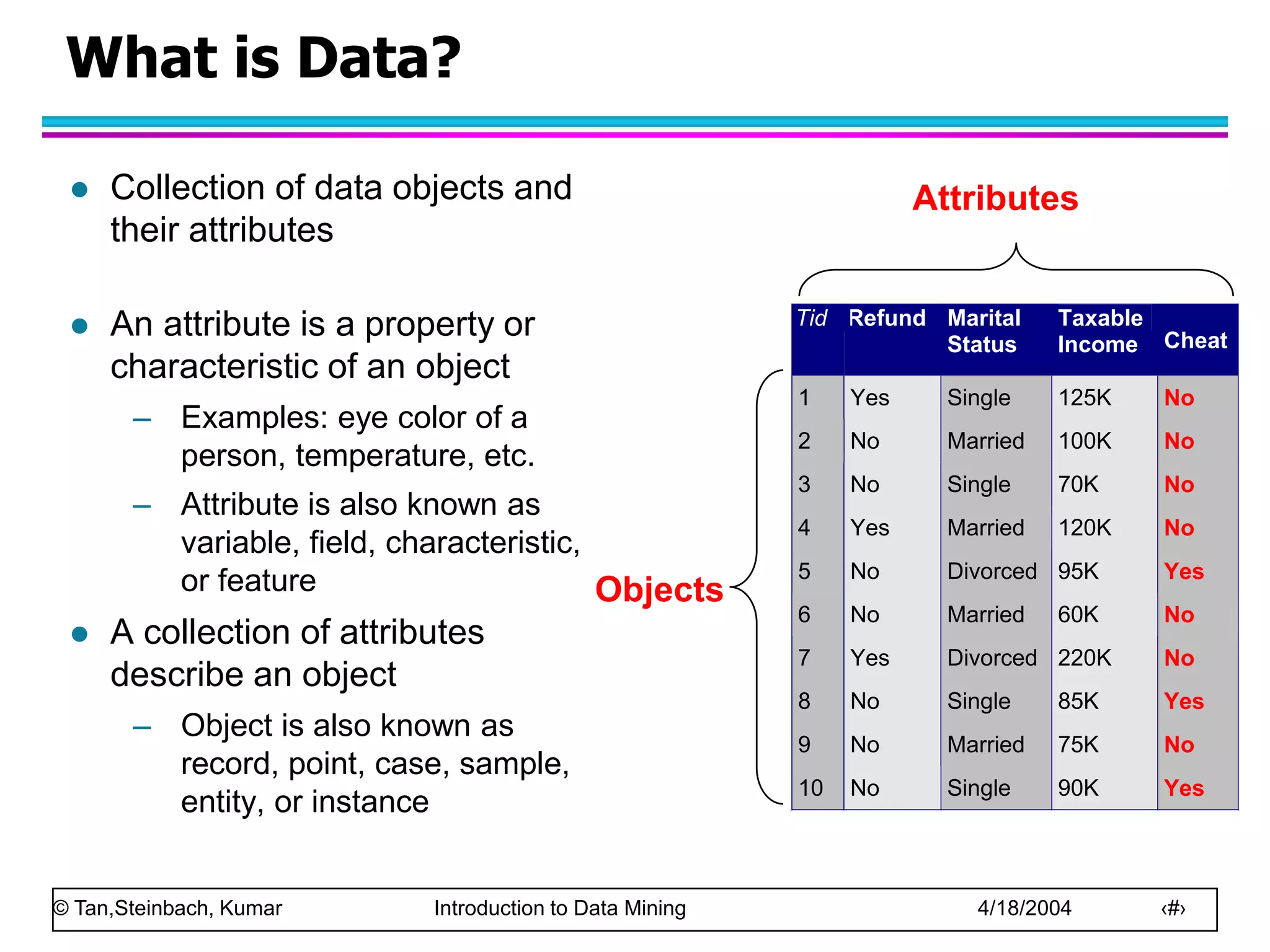
 Collection of data objects and
their attributes
 An attribute is a property or
characteristic of an object
– Examples: eye color of a
person, temperature, etc.
– Attribute is also known as
variable, field, characteristic,
or feature
 A collection of attributes
describe an object
– Object is also known as
record, point, case, sample,
entity, or instance
Tid Refund Marital
Status
Taxable
Income Cheat
1 Yes Single 125K No
2 No Married 100K No
3 No Single 70K No
4 Yes Married 120K No
5 No Divorced 95K Yes
6 No Married 60K No
7 Yes Divorced 220K No
8 No Single 85K Yes
9 No Married 75K No
10 No Single 90K Yes
10
Attributes
Objects
© Tan,Steinbach, Kumar Introduction to Data Mining 4/18/2004 ‹#›
Attribute Values
 Attribute values are numbers or symbols assigned
to an attribute
 Distinction between attributes and attribute values
– Same attribute can be mapped to different attribute
values
 Example: height can be measured in feet or meters
– Different attributes can be mapped to the same set of
values
 Example: Attribute values for ID and age are integers
 But properties of attribute values can be different
– ID has no limit but age has a maximum and minimum value
© Tan,Steinbach, Kumar Introduction to Data Mining 4/18/2004 ‹#›
Measurement of Length
 The way you measure an attribute is somewhat may not match
the attributes properties.
1
2
3
5
5
7
8
15
10 4
A
B
C
D
E
© Tan,Steinbach, Kumar Introduction to Data Mining 4/18/2004 ‹#›
Types of Attributes
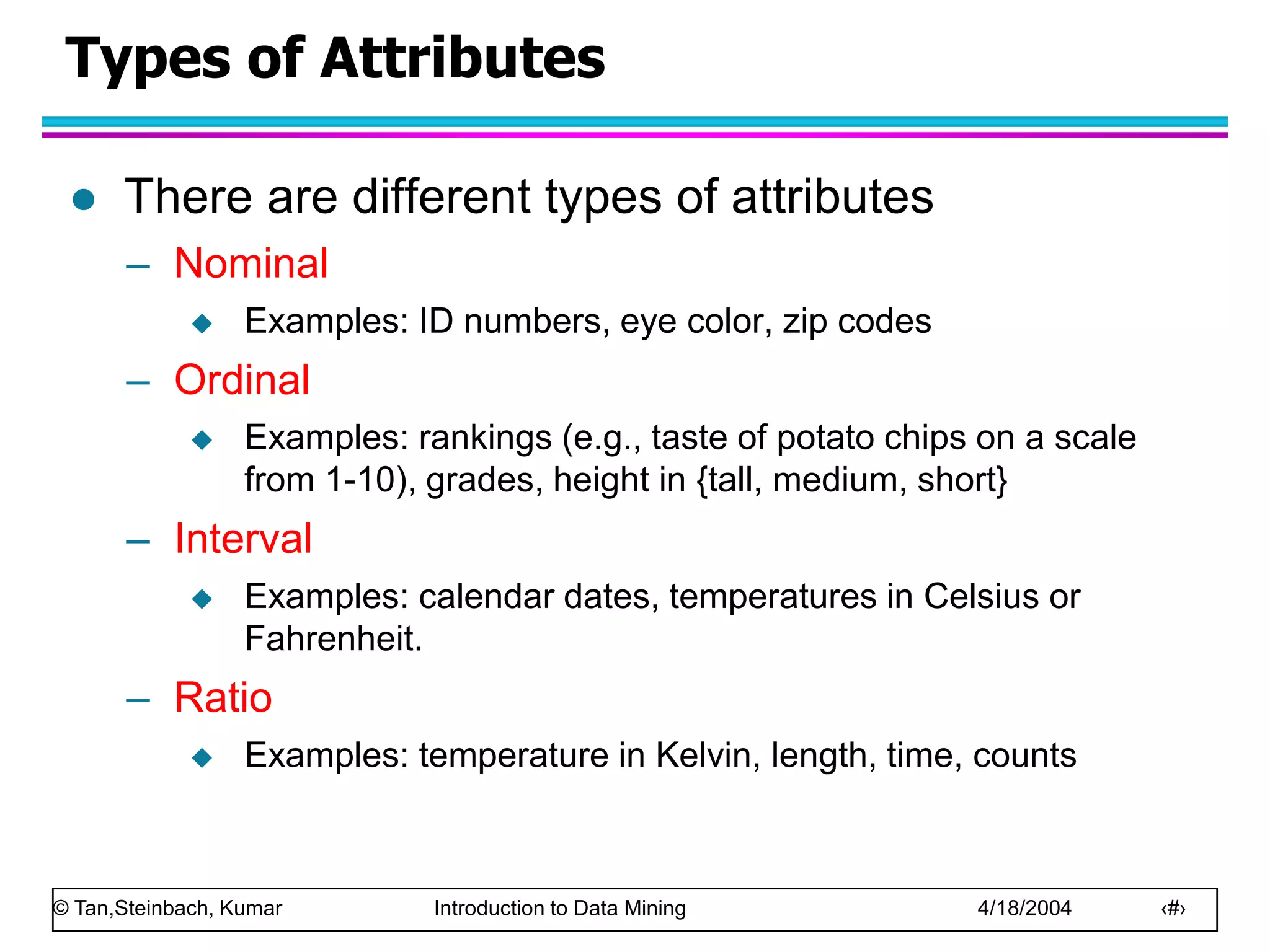
 There are different types of attributes
– Nominal
 Examples: ID numbers, eye color, zip codes
– Ordinal
 Examples: rankings (e.g., taste of potato chips on a scale
from 1-10), grades, height in {tall, medium, short}
– Interval
 Examples: calendar dates, temperatures in Celsius or
Fahrenheit.
– Ratio
 Examples: temperature in Kelvin, length, time, counts
© Tan,Steinbach, Kumar Introduction to Data Mining 4/18/2004 ‹#›
Properties of Attribute Values
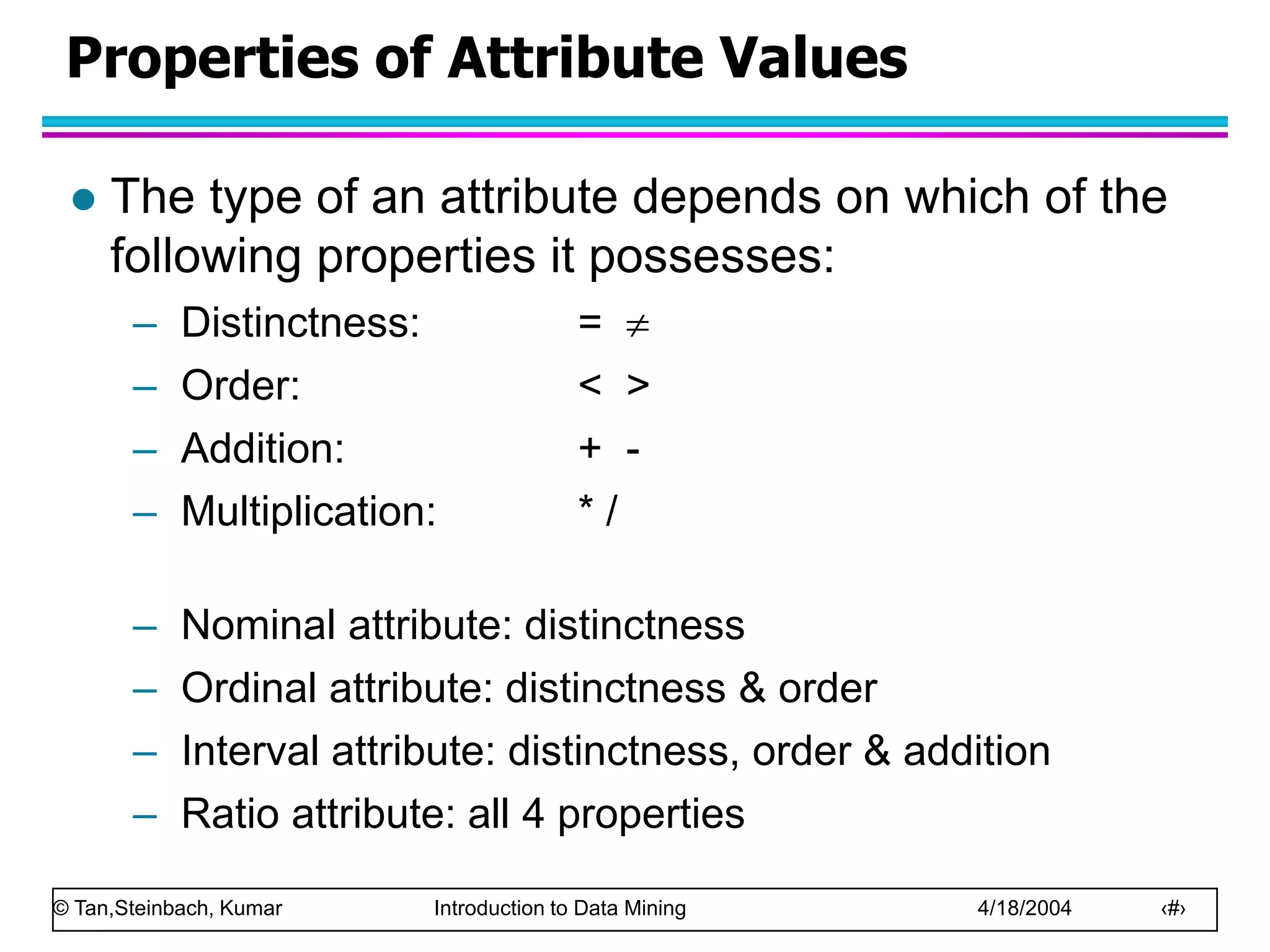
 The type of an attribute depends on which of the
following properties it possesses:
– Distinctness: = 
– Order: < >
– Addition: + -
– Multiplication: * /
– Nominal attribute: distinctness
– Ordinal attribute: distinctness & order
– Interval attribute: distinctness, order & addition
– Ratio attribute: all 4 properties
Attribute
Type
Description Examples Operations
Nominal The values of a nominal attribute are
just different names, i.e., nominal
attributes provide only enough
information to distinguish one object
from another. (=, )
zip codes, employee
ID numbers, eye color,
sex: {male, female}
mode, entropy,
contingency
correlation, 2 test
Ordinal The values of an ordinal attribute
provide enough information to order
objects. (<, >)
hardness of minerals,
{good, better, best},
grades, street numbers
median, percentiles,
rank correlation,
run tests, sign tests
Interval For interval attributes, the
differences between values are
meaningful, i.e., a unit of
measurement exists.
(+, - )
calendar dates,
temperature in Celsius
or Fahrenheit
mean, standard
deviation, Pearson's
correlation, t and F
tests
Ratio For ratio variables, both differences
and ratios are meaningful. (*, /)
temperature in Kelvin,
monetary quantities,
counts, age, mass,
length, electrical
current
geometric mean,
harmonic mean,
percent variation
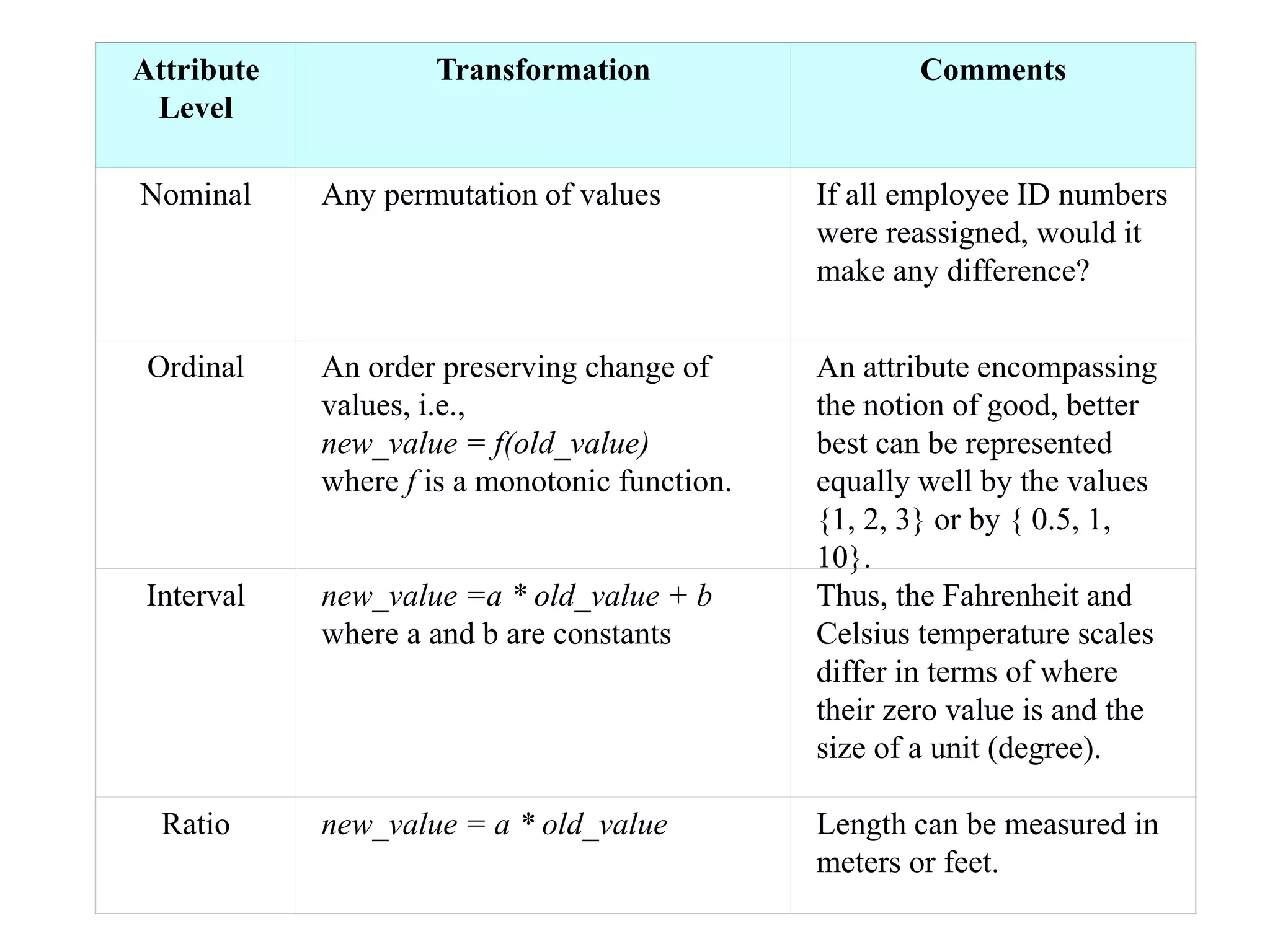
Attribute
Level
Transformation Comments
Nominal Any permutation of values If all employee ID numbers
were reassigned, would it
make any difference?
Ordinal An order preserving change of
values, i.e.,
new_value = f(old_value)
where f is a monotonic function.
An attribute encompassing
the notion of good, better
best can be represented
equally well by the values
{1, 2, 3} or by { 0.5, 1,
10}.
Interval new_value =a * old_value + b
where a and b are constants
Thus, the Fahrenheit and
Celsius temperature scales
differ in terms of where
their zero value is and the
size of a unit (degree).
Ratio new_value = a * old_value Length can be measured in
meters or feet.
© Tan,Steinbach, Kumar Introduction to Data Mining 4/18/2004 ‹#›
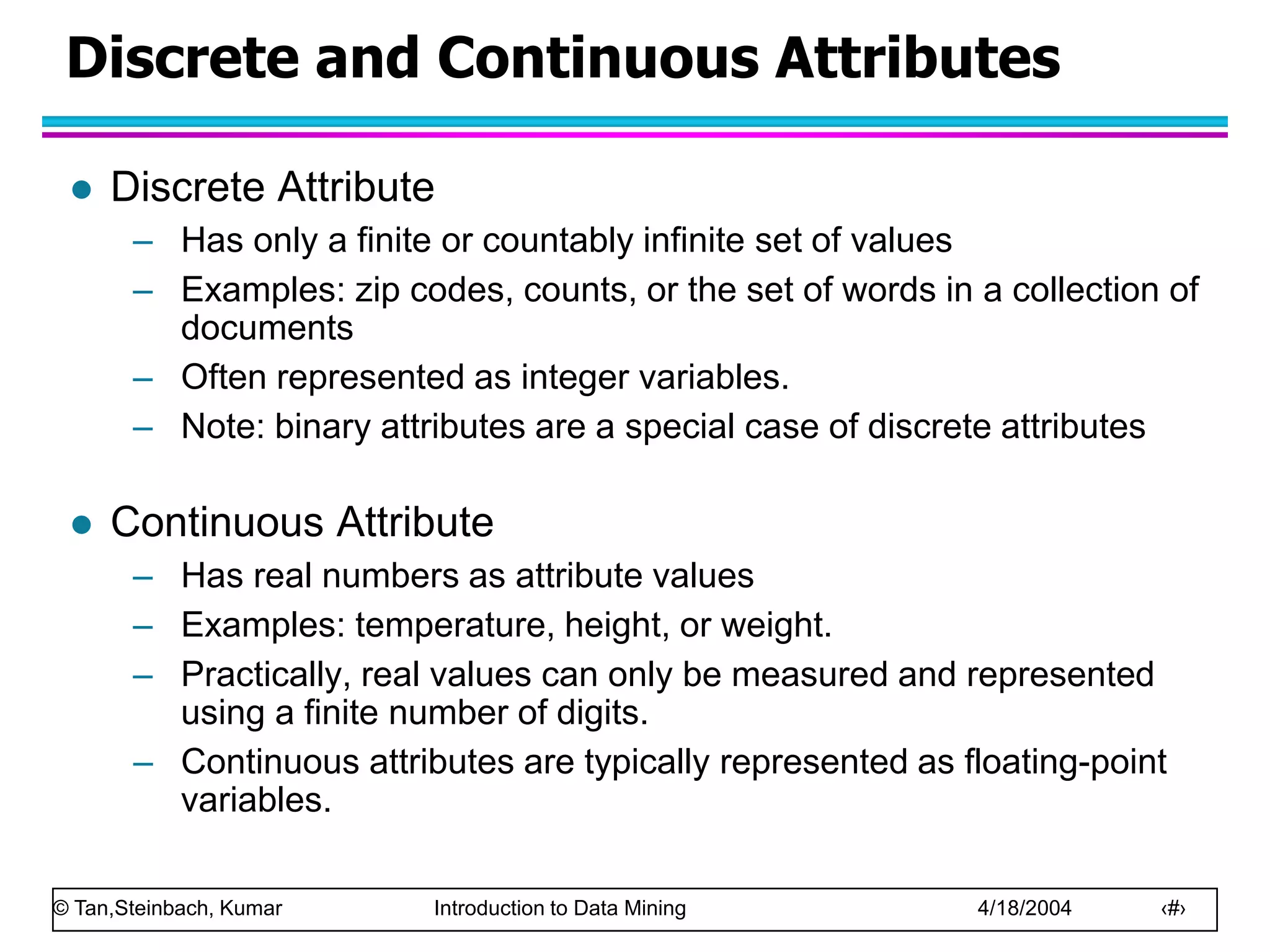
Discrete and Continuous Attributes
 Discrete Attribute
– Has only a finite or countably infinite set of values
– Examples: zip codes, counts, or the set of words in a collection of
documents
– Often represented as integer variables.
– Note: binary attributes are a special case of discrete attributes
 Continuous Attribute
– Has real numbers as attribute values
– Examples: temperature, height, or weight.
– Practically, real values can only be measured and represented
using a finite number of digits.
– Continuous attributes are typically represented as floating-point
variables.
© Tan,Steinbach, Kumar Introduction to Data Mining 4/18/2004 ‹#›
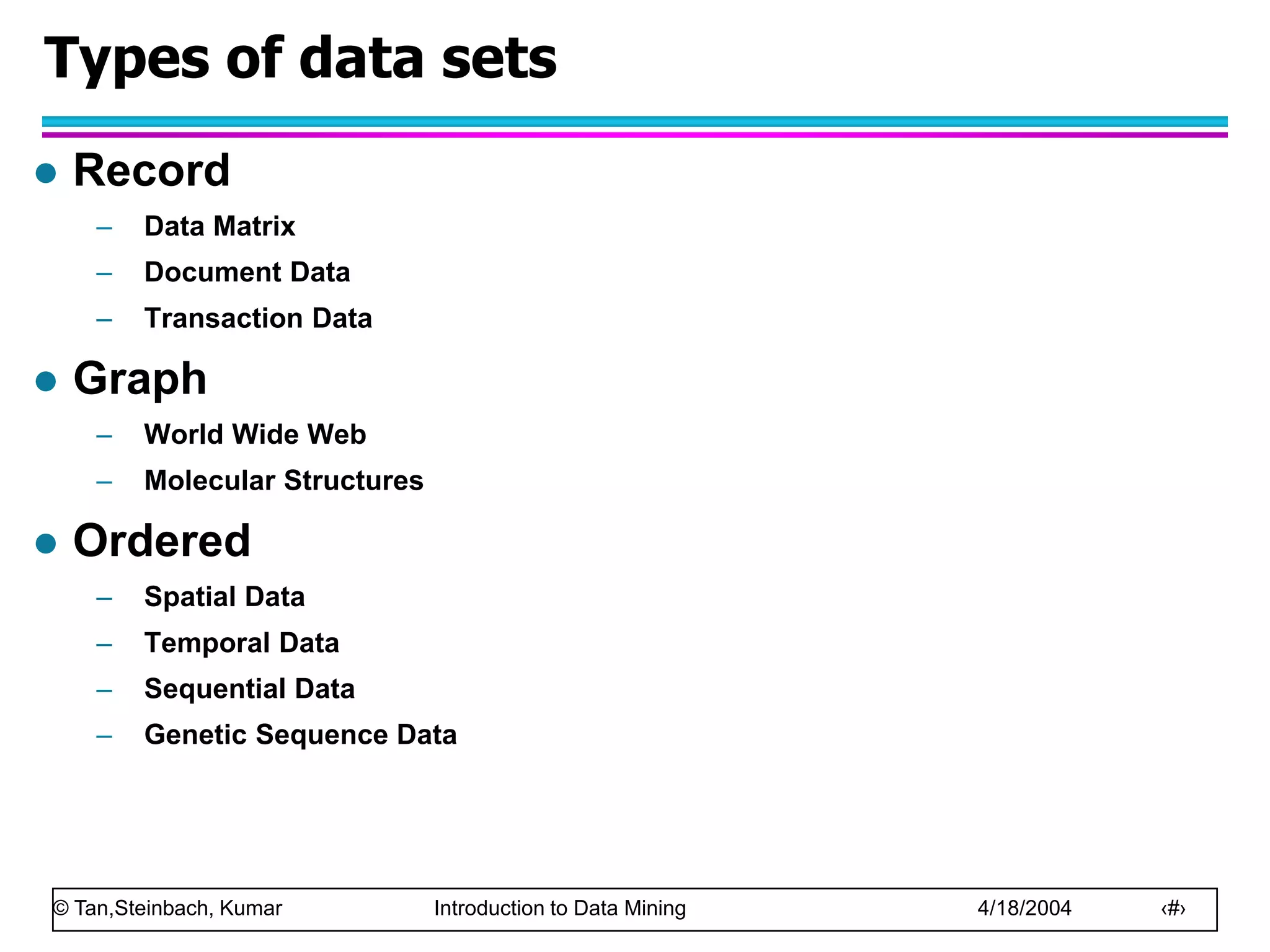
Types of data sets
 Record
– Data Matrix
– Document Data
– Transaction Data
 Graph
– World Wide Web
– Molecular Structures
 Ordered
– Spatial Data
– Temporal Data
– Sequential Data
– Genetic Sequence Data
© Tan,Steinbach, Kumar Introduction to Data Mining 4/18/2004 ‹#›
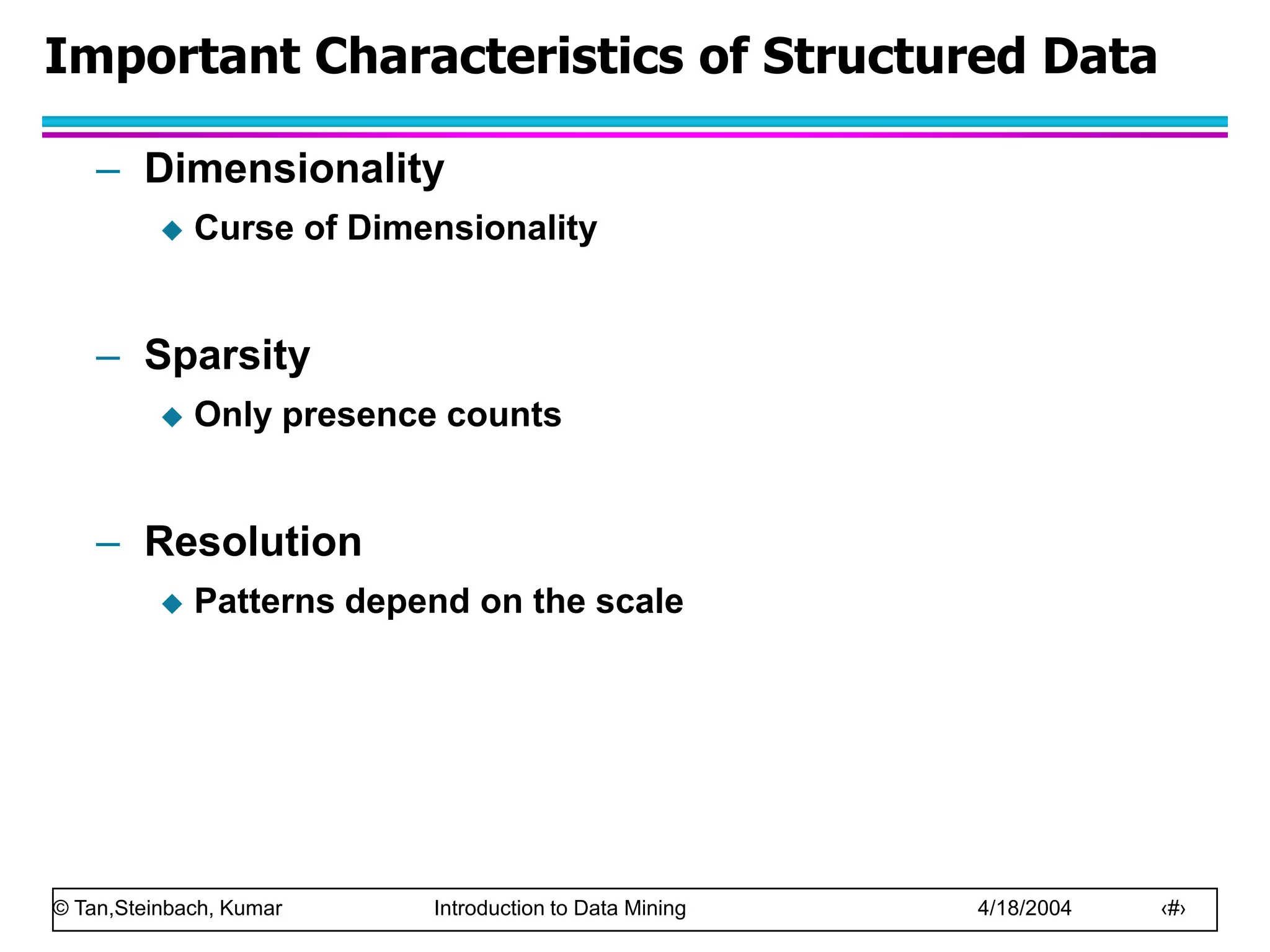
Important Characteristics of Structured Data
– Dimensionality
 Curse of Dimensionality
– Sparsity
 Only presence counts
– Resolution
 Patterns depend on the scale
© Tan,Steinbach, Kumar Introduction to Data Mining 4/18/2004 ‹#›
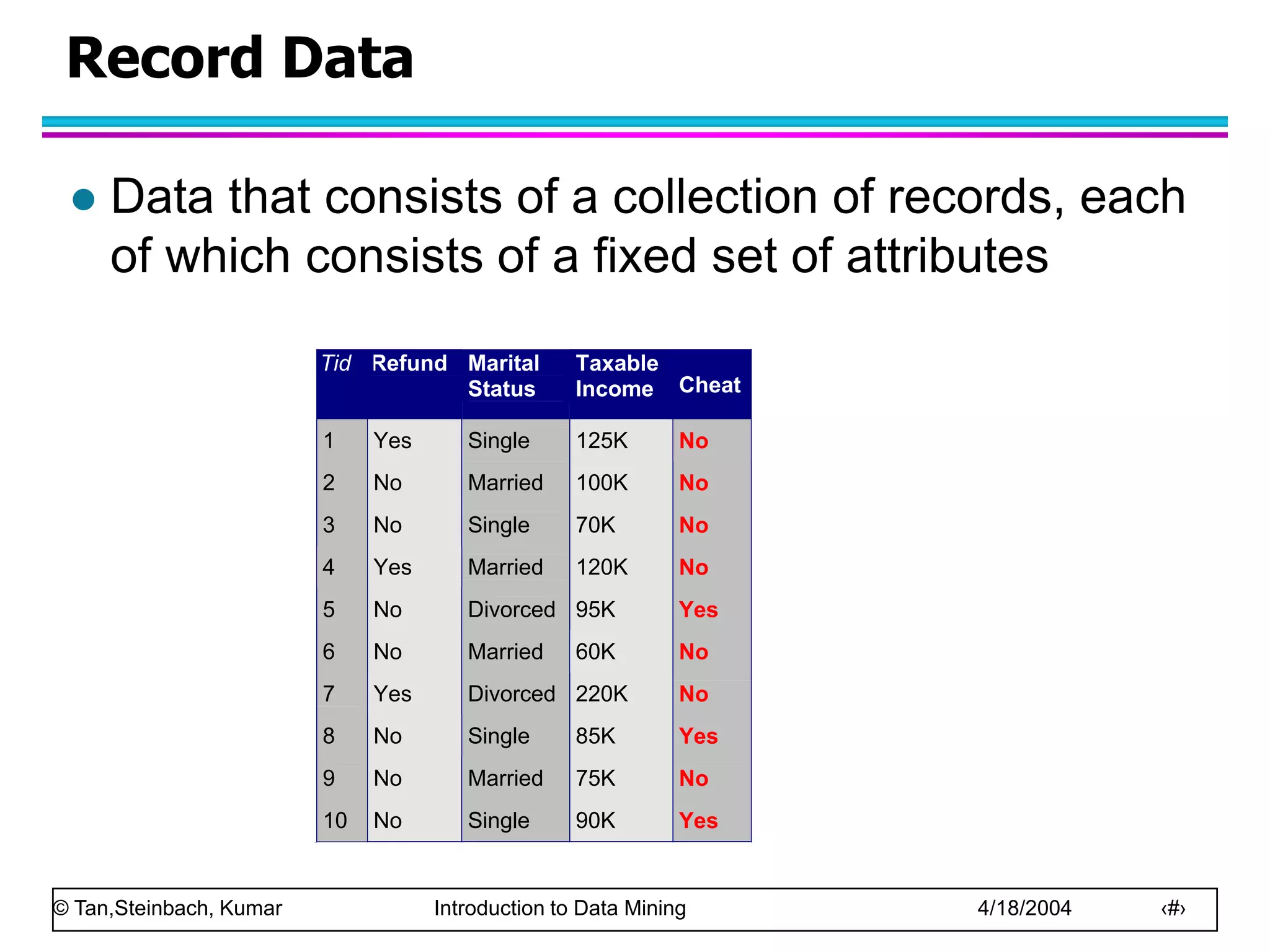
Record Data
 Data that consists of a collection of records, each
of which consists of a fixed set of attributes
Tid Refund Marital
Status
Taxable
Income Cheat
1 Yes Single 125K No
2 No Married 100K No
3 No Single 70K No
4 Yes Married 120K No
5 No Divorced 95K Yes
6 No Married 60K No
7 Yes Divorced 220K No
8 No Single 85K Yes
9 No Married 75K No
10 No Single 90K Yes
10
© Tan,Steinbach, Kumar Introduction to Data Mining 4/18/2004 ‹#›
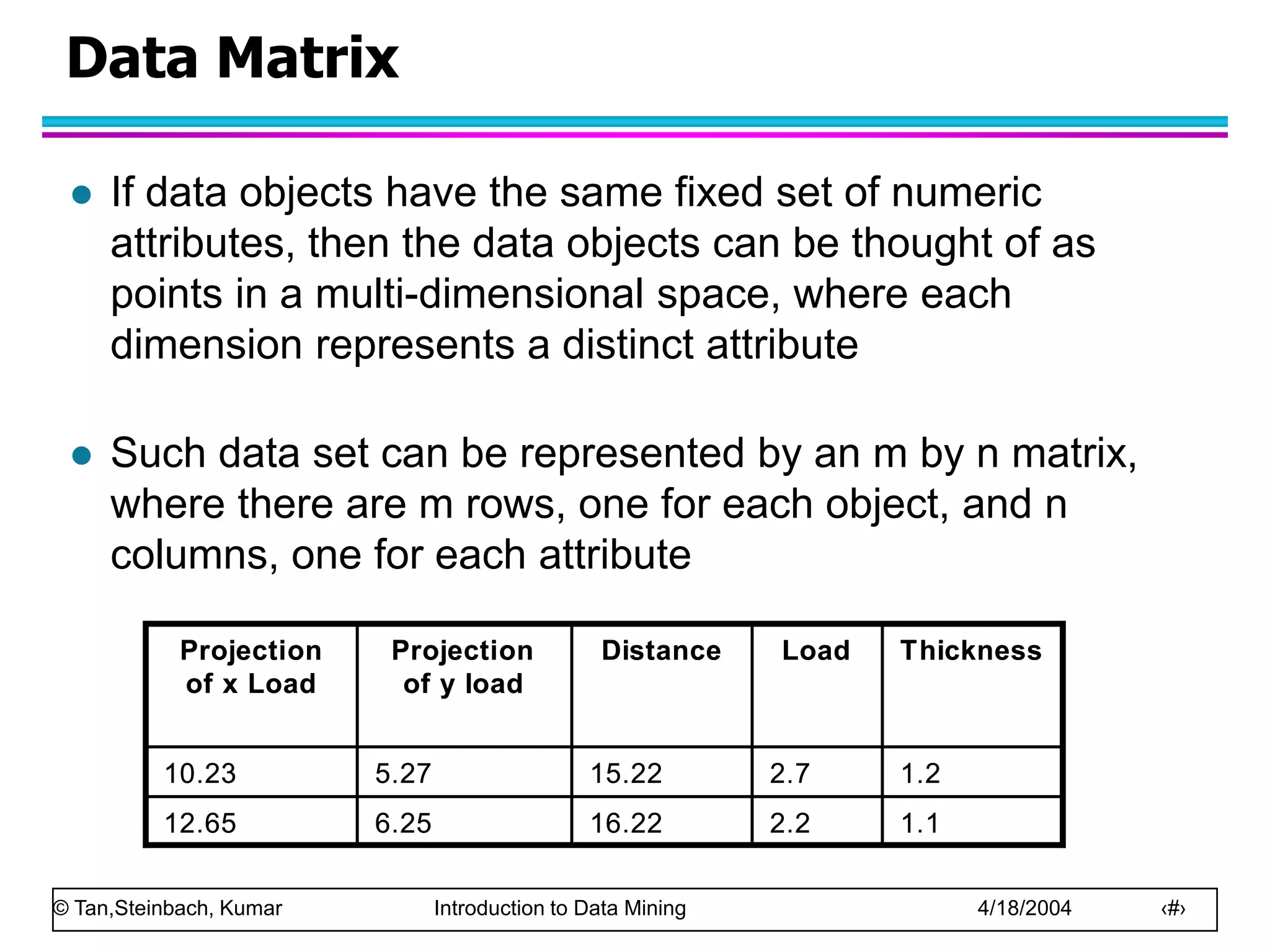
Data Matrix
 If data objects have the same fixed set of numeric
attributes, then the data objects can be thought of as
points in a multi-dimensional space, where each
dimension represents a distinct attribute
 Such data set can be represented by an m by n matrix,
where there are m rows, one for each object, and n
columns, one for each attribute
1.1
2.2
16.22
6.25
12.65
1.2
2.7
15.22
5.27
10.23
Thickness
Load
Distance
Projection
of y load
Projection
of x Load
1.1
2.2
16.22
6.25
12.65
1.2
2.7
15.22
5.27
10.23
Thickness
Load
Distance
Projection
of y load
Projection
of x Load
© Tan,Steinbach, Kumar Introduction to Data Mining 4/18/2004 ‹#›
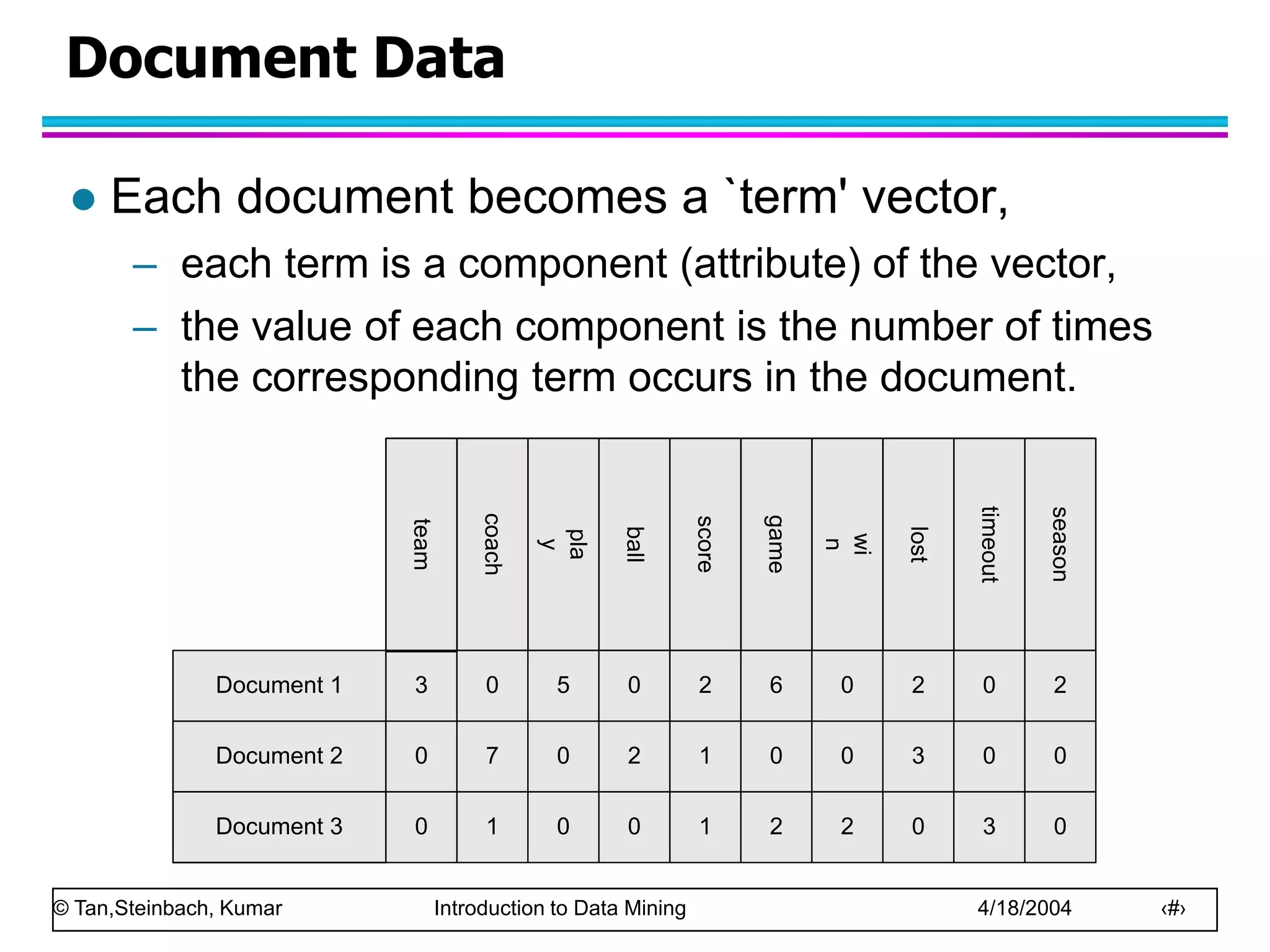
Document Data
 Each document becomes a `term' vector,
– each term is a component (attribute) of the vector,
– the value of each component is the number of times
the corresponding term occurs in the document.
Document 1
season
timeout
lost
wi
n
game
score
ball
pla
y
coach
team
Document 2
Document 3
3 0 5 0 2 6 0 2 0 2
0
0
7 0 2 1 0 0 3 0 0
1 0 0 1 2 2 0 3 0
© Tan,Steinbach, Kumar Introduction to Data Mining 4/18/2004 ‹#›
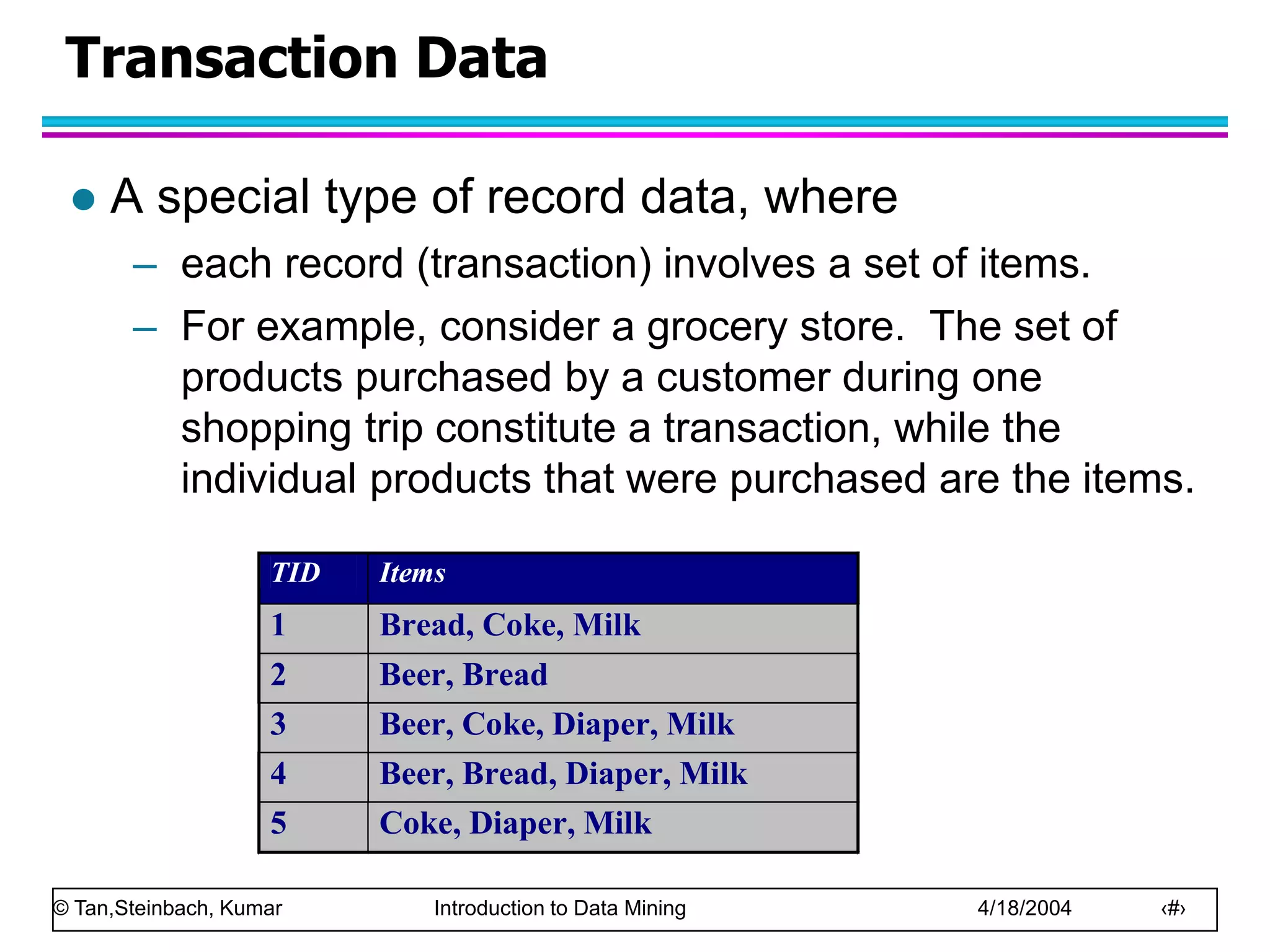
Transaction Data
 A special type of record data, where
– each record (transaction) involves a set of items.
– For example, consider a grocery store. The set of
products purchased by a customer during one
shopping trip constitute a transaction, while the
individual products that were purchased are the items.
TID Items
1 Bread, Coke, Milk
2 Beer, Bread
3 Beer, Coke, Diaper, Milk
4 Beer, Bread, Diaper, Milk
5 Coke, Diaper, Milk
© Tan,Steinbach, Kumar Introduction to Data Mining 4/18/2004 ‹#›
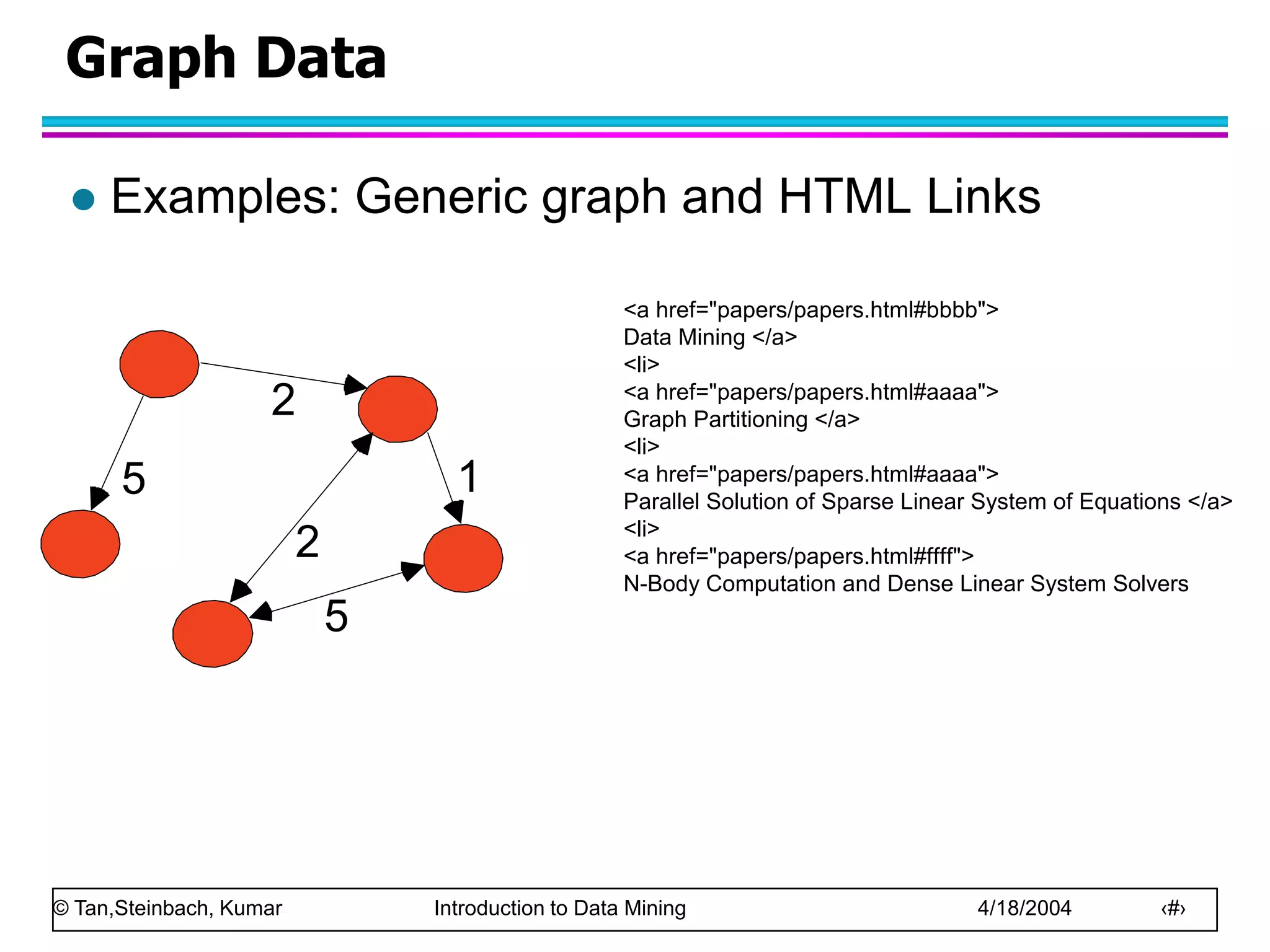
Graph Data
 Examples: Generic graph and HTML Links
5
2
1
2
5
<a href="papers/papers.html#bbbb">
Data Mining </a>
<li>
<a href="papers/papers.html#aaaa">
Graph Partitioning </a>
<li>
<a href="papers/papers.html#aaaa">
Parallel Solution of Sparse Linear System of Equations </a>
<li>
<a href="papers/papers.html#ffff">
N-Body Computation and Dense Linear System Solvers
© Tan,Steinbach, Kumar Introduction to Data Mining 4/18/2004 ‹#›
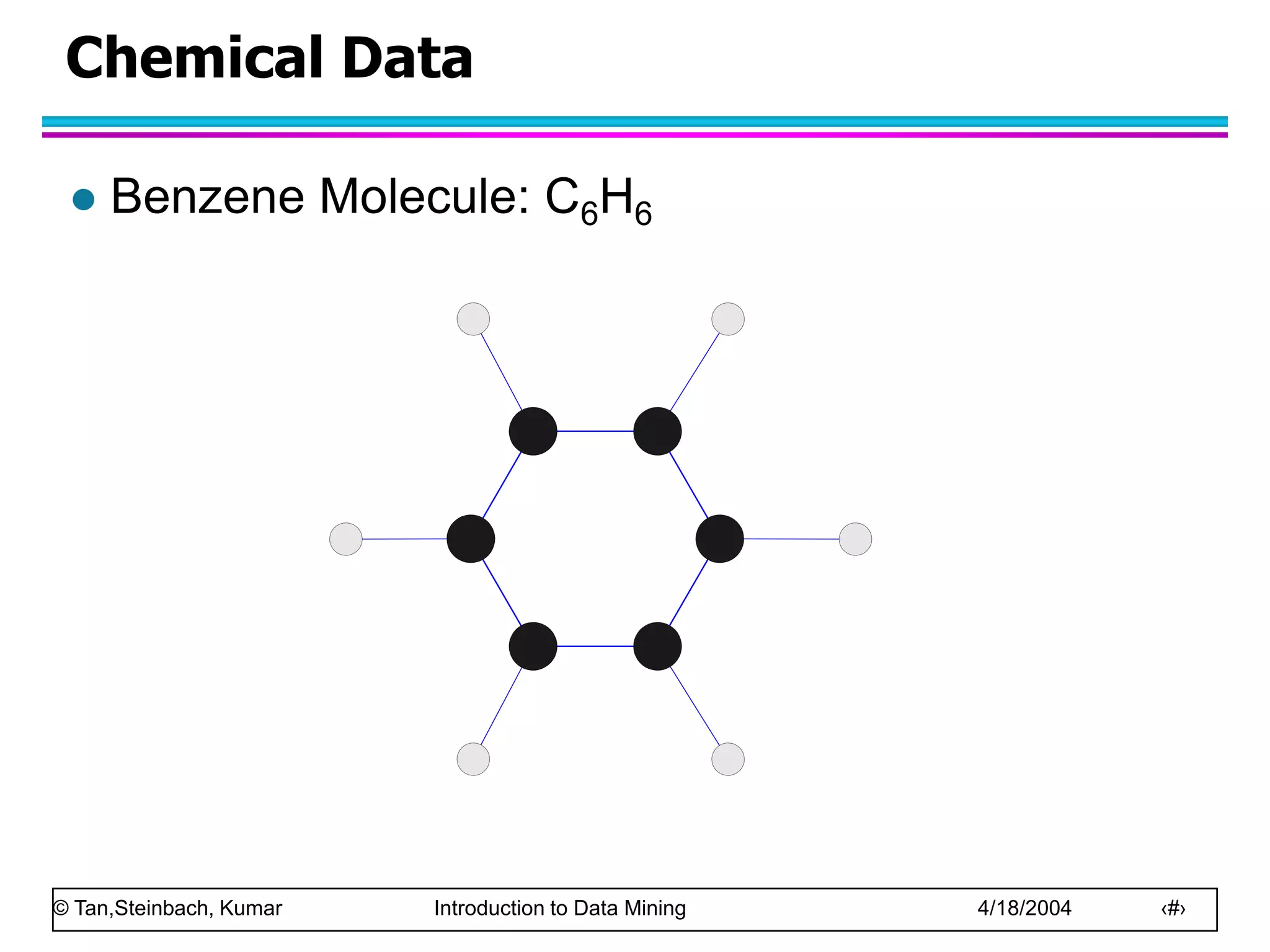
Chemical Data
 Benzene Molecule: C6H6
© Tan,Steinbach, Kumar Introduction to Data Mining 4/18/2004 ‹#›
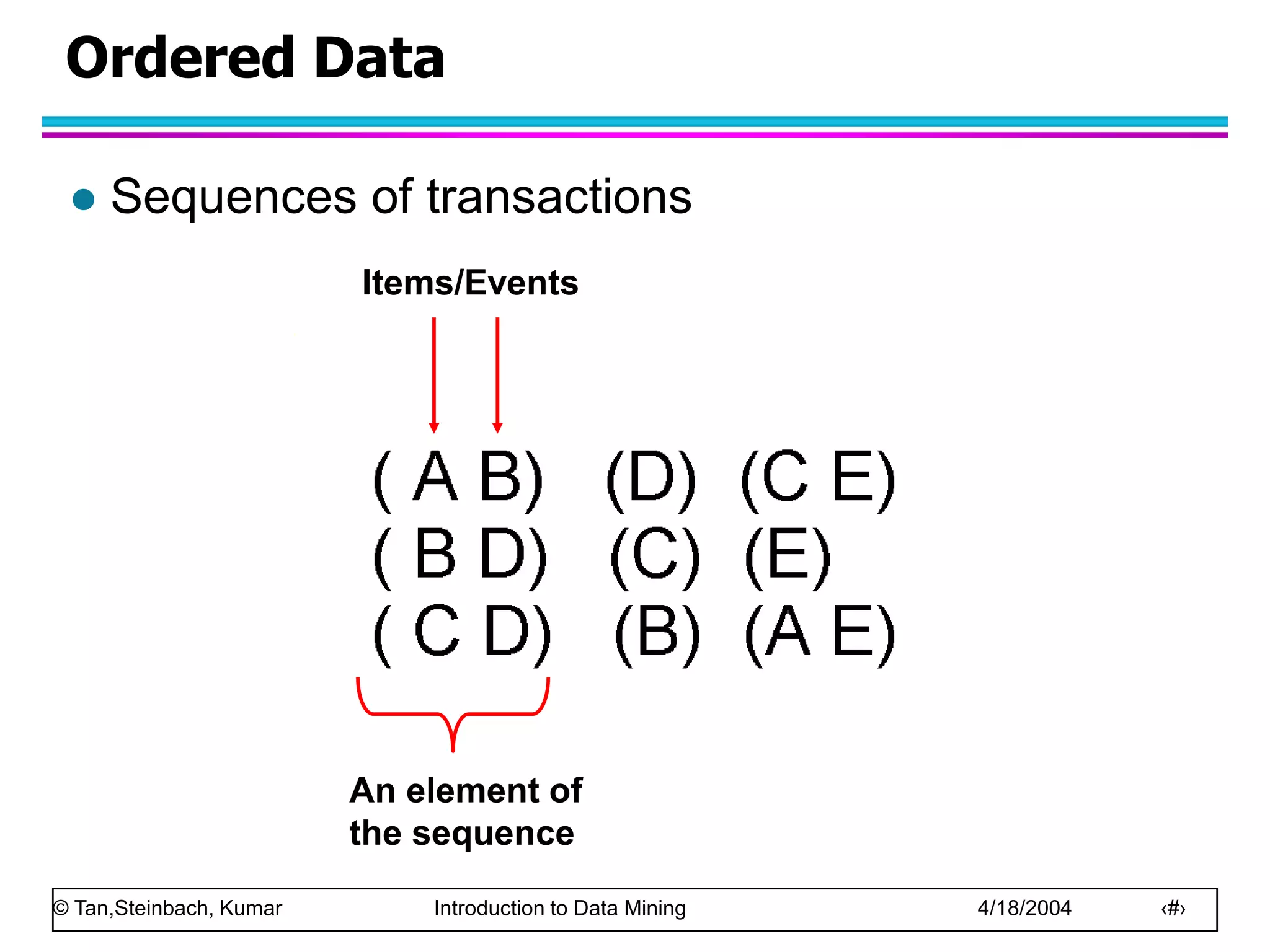
Ordered Data
 Sequences of transactions
An element of
the sequence
Items/Events
© Tan,Steinbach, Kumar Introduction to Data Mining 4/18/2004 ‹#›
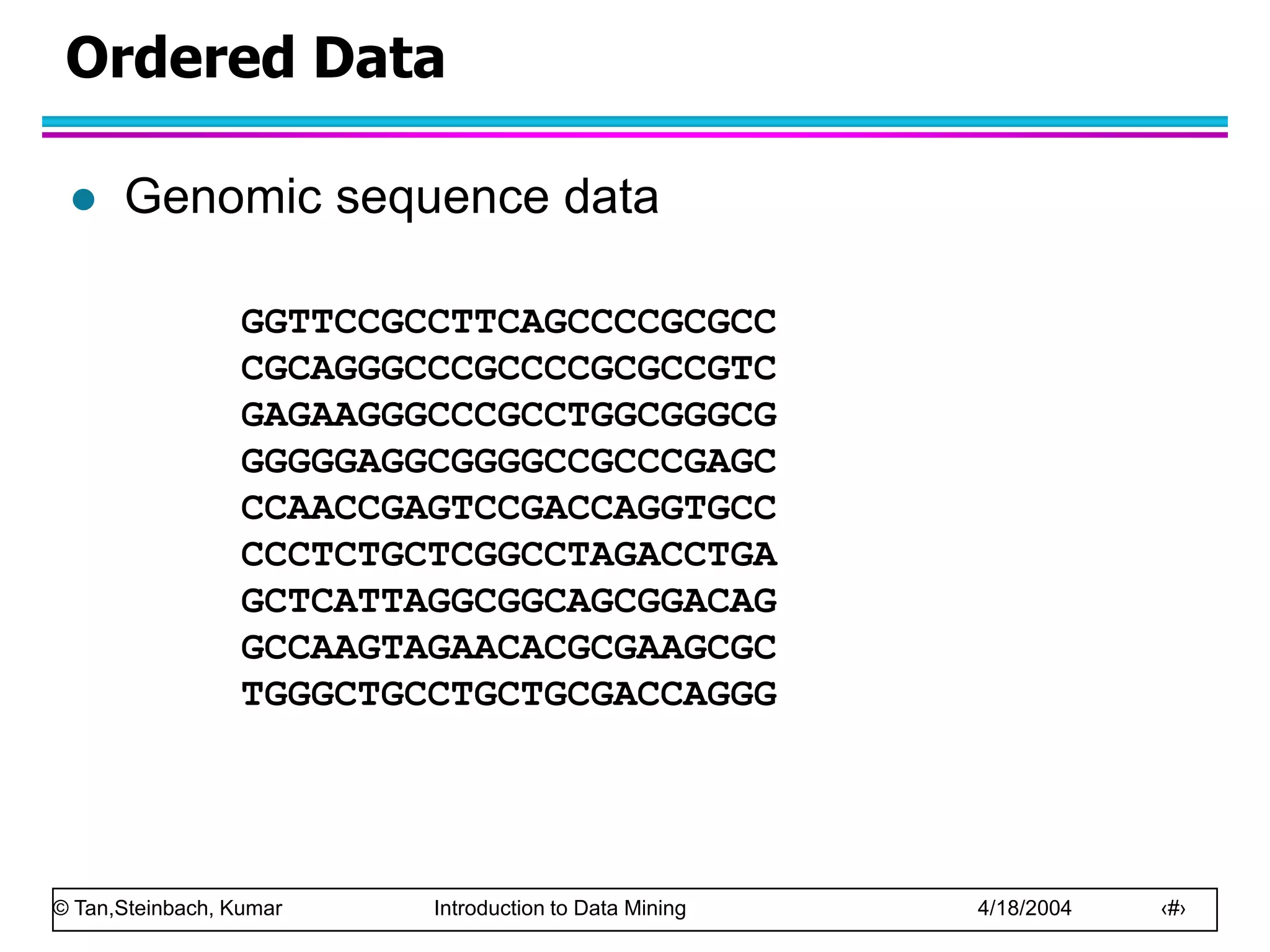
Ordered Data
 Genomic sequence data
GGTTCCGCCTTCAGCCCCGCGCC
CGCAGGGCCCGCCCCGCGCCGTC
GAGAAGGGCCCGCCTGGCGGGCG
GGGGGAGGCGGGGCCGCCCGAGC
CCAACCGAGTCCGACCAGGTGCC
CCCTCTGCTCGGCCTAGACCTGA
GCTCATTAGGCGGCAGCGGACAG
GCCAAGTAGAACACGCGAAGCGC
TGGGCTGCCTGCTGCGACCAGGG
© Tan,Steinbach, Kumar Introduction to Data Mining 4/18/2004 ‹#›
Ordered Data
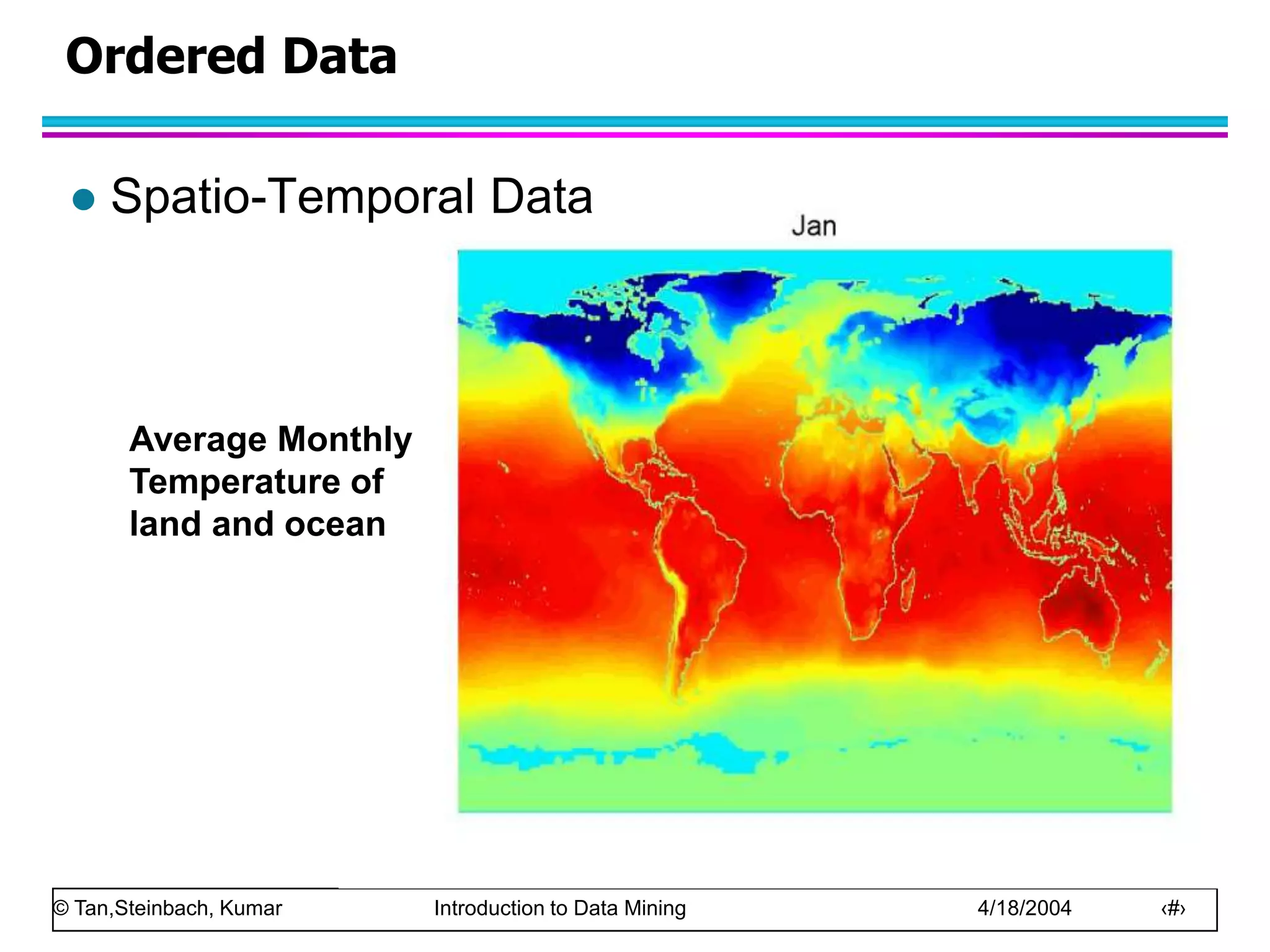
 Spatio-Temporal Data
Average Monthly
Temperature of
land and ocean
© Tan,Steinbach, Kumar Introduction to Data Mining 4/18/2004 ‹#›
Data Quality
 What kinds of data quality problems?
 How can we detect problems with the data?
 What can we do about these problems?
 Examples of data quality problems:
– Noise and outliers
– missing values
– duplicate data
© Tan,Steinbach, Kumar Introduction to Data Mining 4/18/2004 ‹#›
Noise
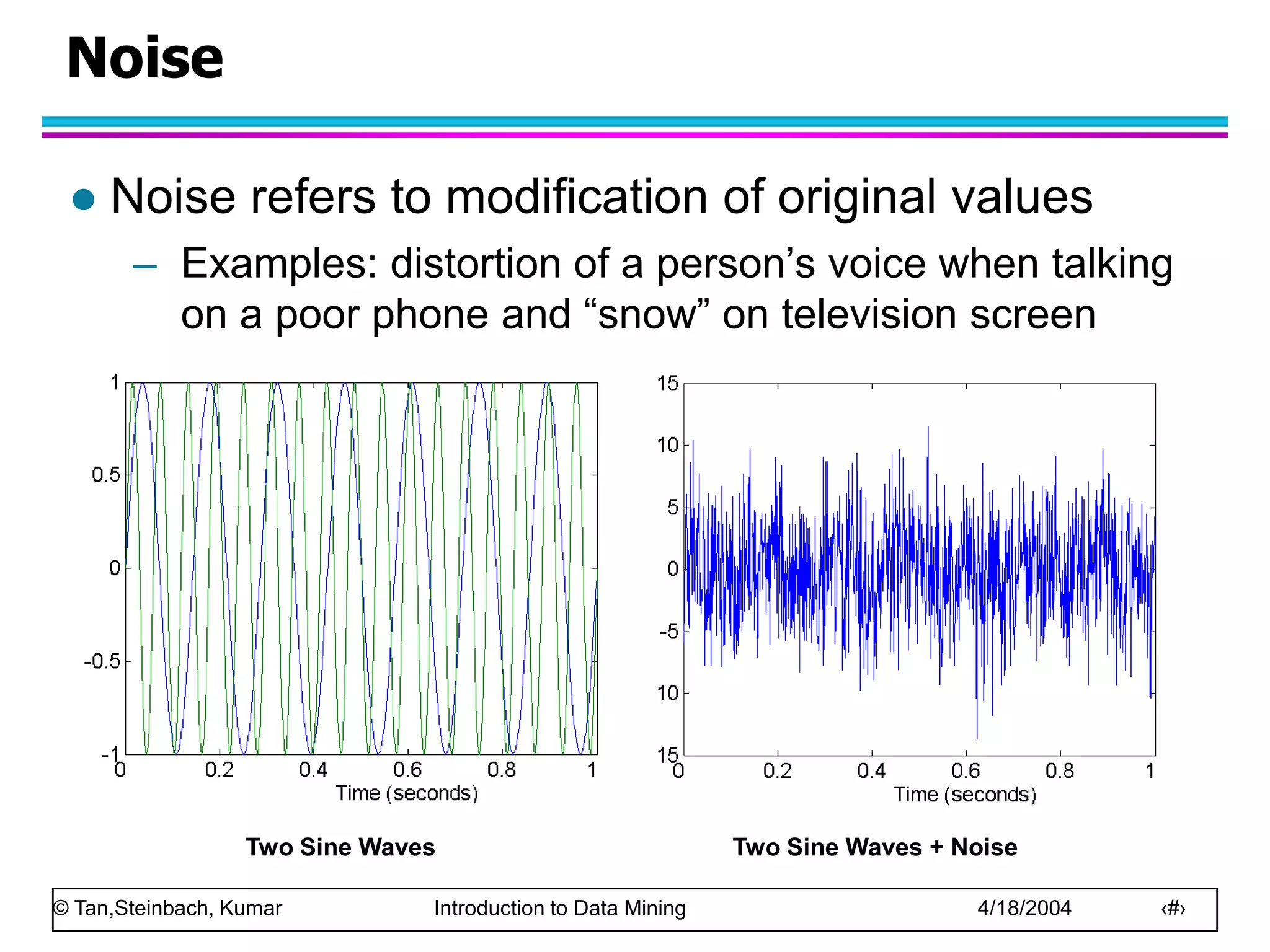
 Noise refers to modification of original values
– Examples: distortion of a person’s voice when talking
on a poor phone and “snow” on television screen
Two Sine Waves Two Sine Waves + Noise
© Tan,Steinbach, Kumar Introduction to Data Mining 4/18/2004 ‹#›
Outliers
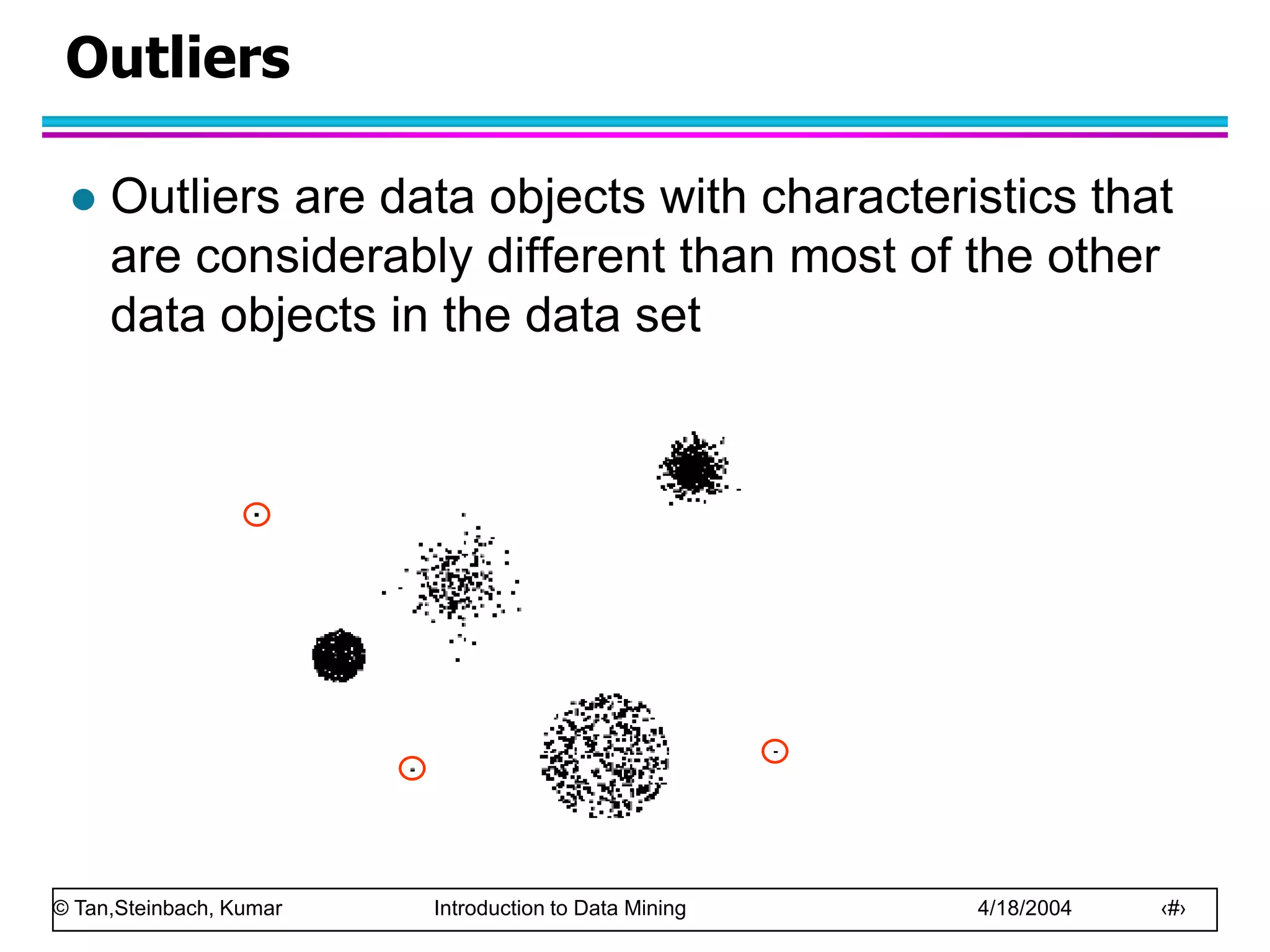
 Outliers are data objects with characteristics that
are considerably different than most of the other
data objects in the data set
© Tan,Steinbach, Kumar Introduction to Data Mining 4/18/2004 ‹#›
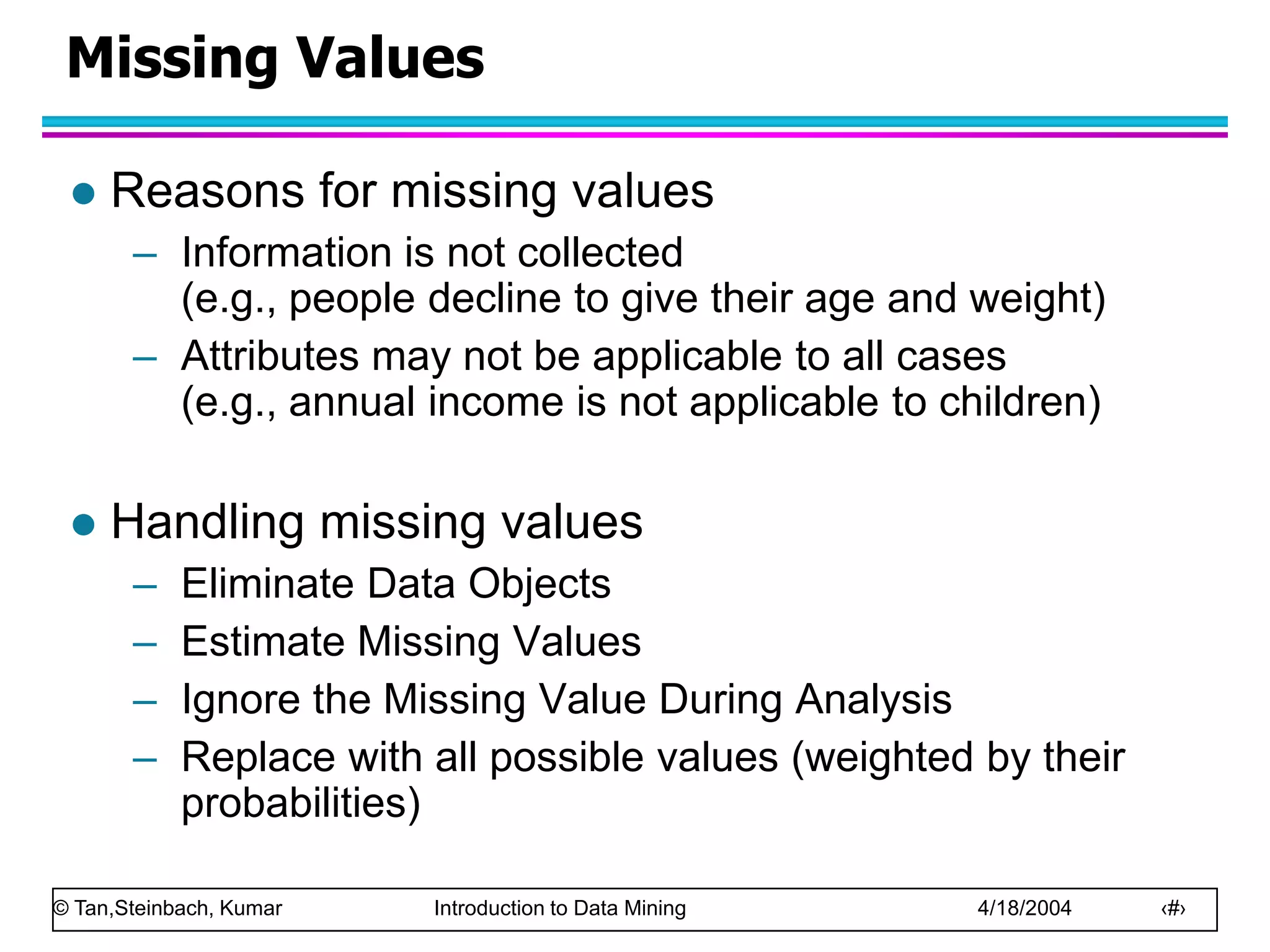
Missing Values
 Reasons for missing values
– Information is not collected
(e.g., people decline to give their age and weight)
– Attributes may not be applicable to all cases
(e.g., annual income is not applicable to children)
 Handling missing values
– Eliminate Data Objects
– Estimate Missing Values
– Ignore the Missing Value During Analysis
– Replace with all possible values (weighted by their
probabilities)
© Tan,Steinbach, Kumar Introduction to Data Mining 4/18/2004 ‹#›
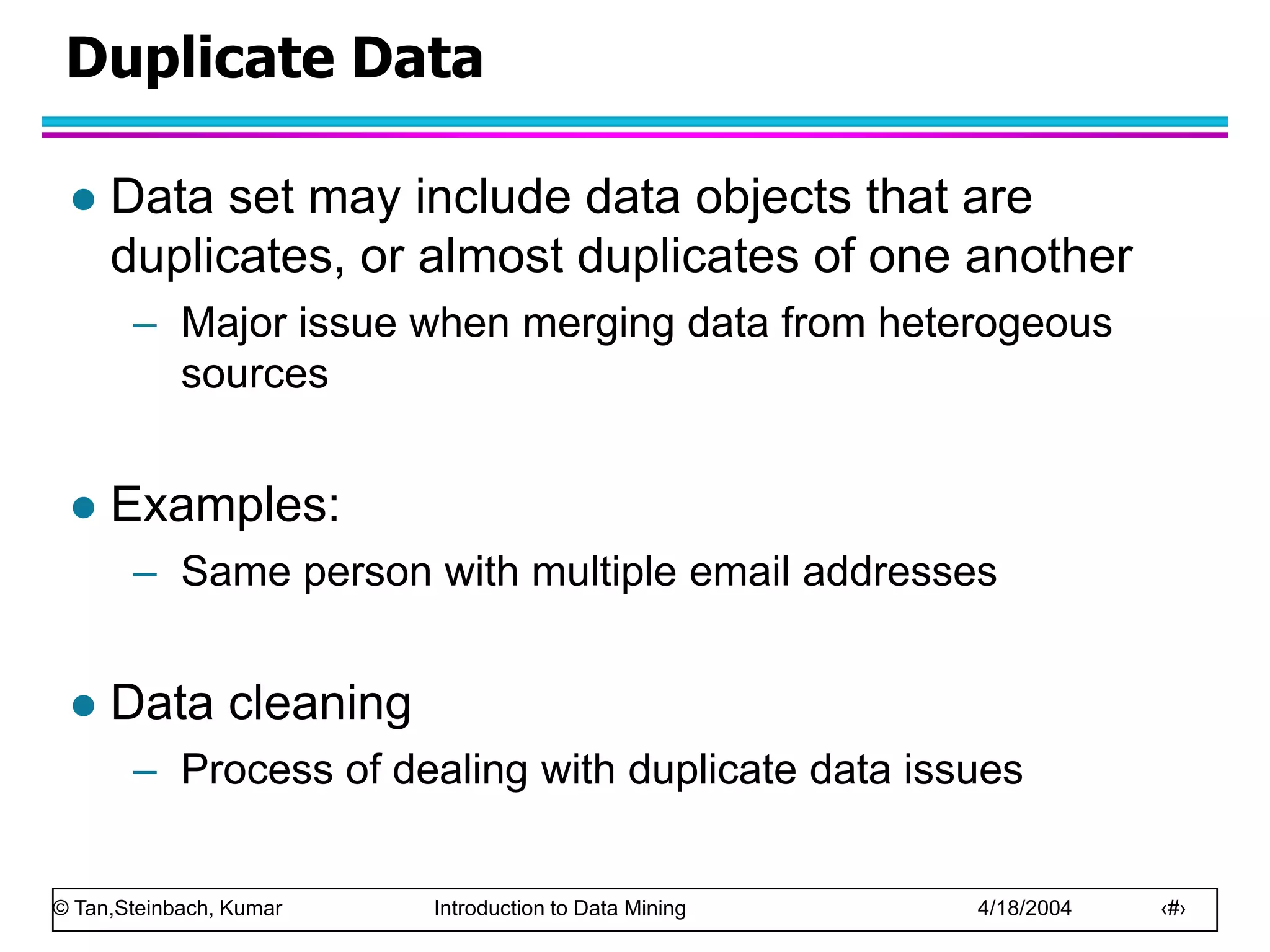
Duplicate Data
 Data set may include data objects that are
duplicates, or almost duplicates of one another
– Major issue when merging data from heterogeous
sources
 Examples:
– Same person with multiple email addresses
 Data cleaning
– Process of dealing with duplicate data issues
© Tan,Steinbach, Kumar Introduction to Data Mining 4/18/2004 ‹#›
Data Preprocessing
 Aggregation
 Sampling
 Dimensionality Reduction
 Feature subset selection
 Feature creation
 Discretization and Binarization
 Attribute Transformation
© Tan,Steinbach, Kumar Introduction to Data Mining 4/18/2004 ‹#›
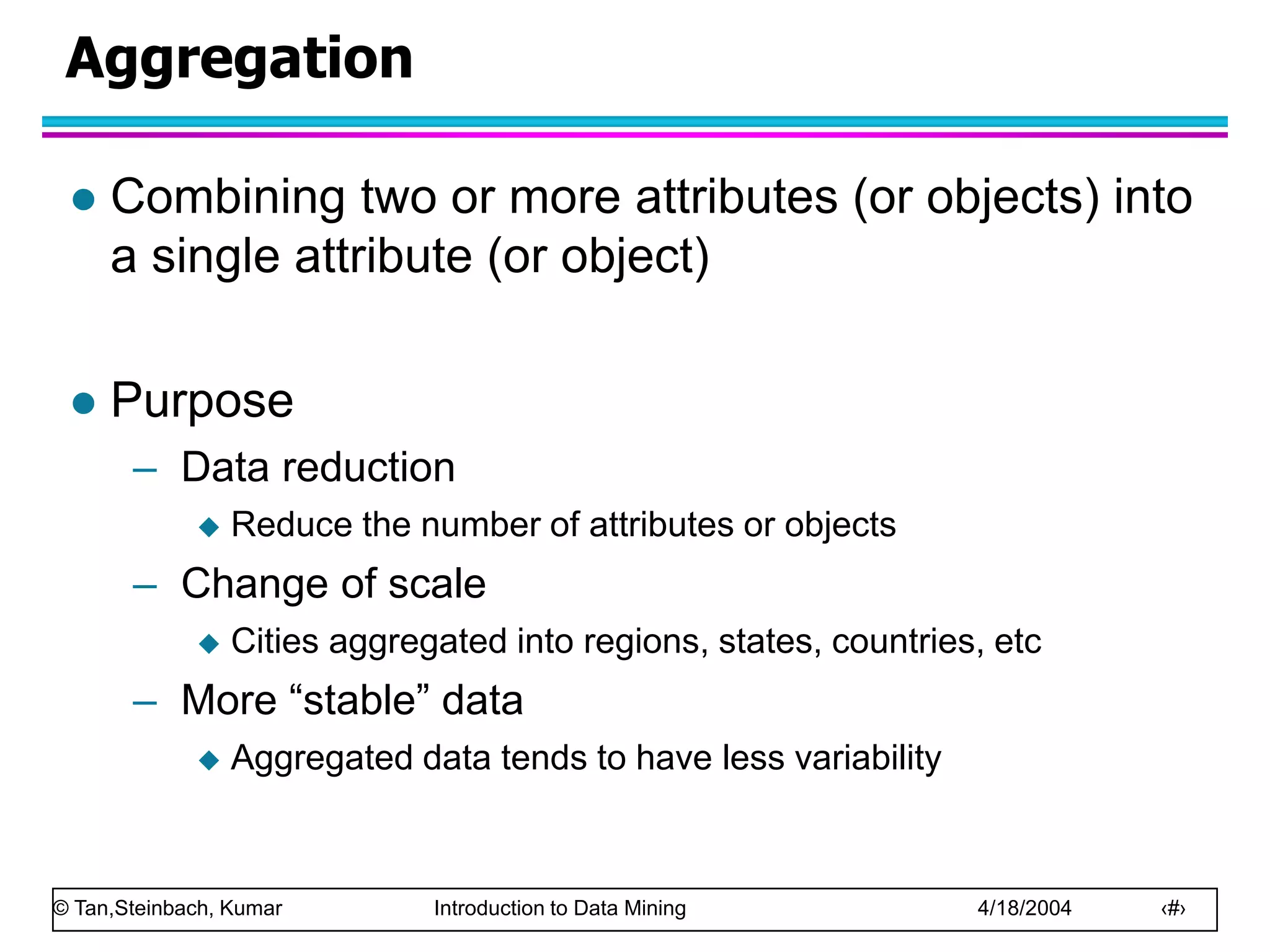
Aggregation
 Combining two or more attributes (or objects) into
a single attribute (or object)
 Purpose
– Data reduction
 Reduce the number of attributes or objects
– Change of scale
 Cities aggregated into regions, states, countries, etc
– More “stable” data
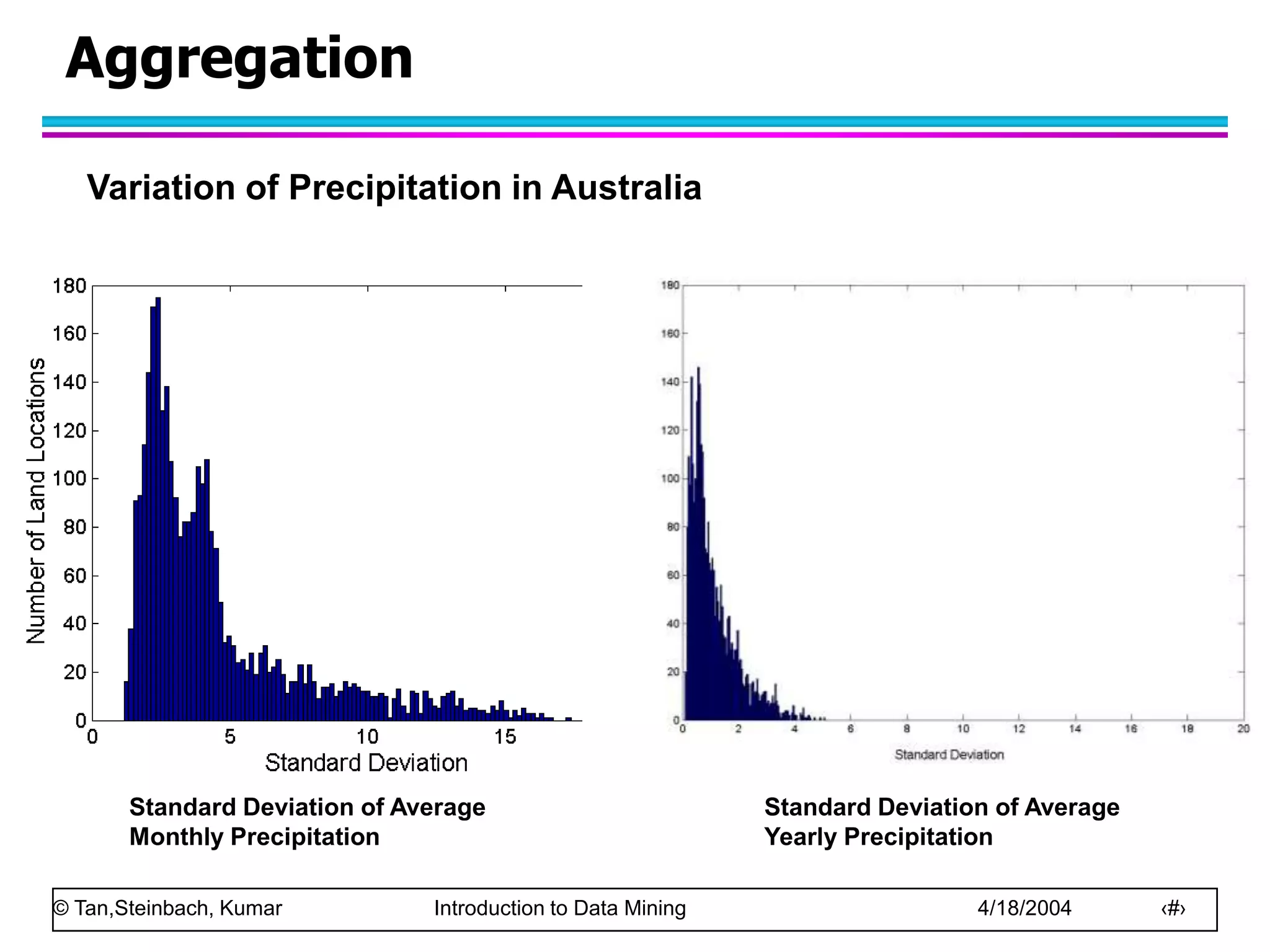
 Aggregated data tends to have less variability
© Tan,Steinbach, Kumar Introduction to Data Mining 4/18/2004 ‹#›
Aggregation
Standard Deviation of Average
Monthly Precipitation
Standard Deviation of Average
Yearly Precipitation
Variation of Precipitation in Australia
© Tan,Steinbach, Kumar Introduction to Data Mining 4/18/2004 ‹#›
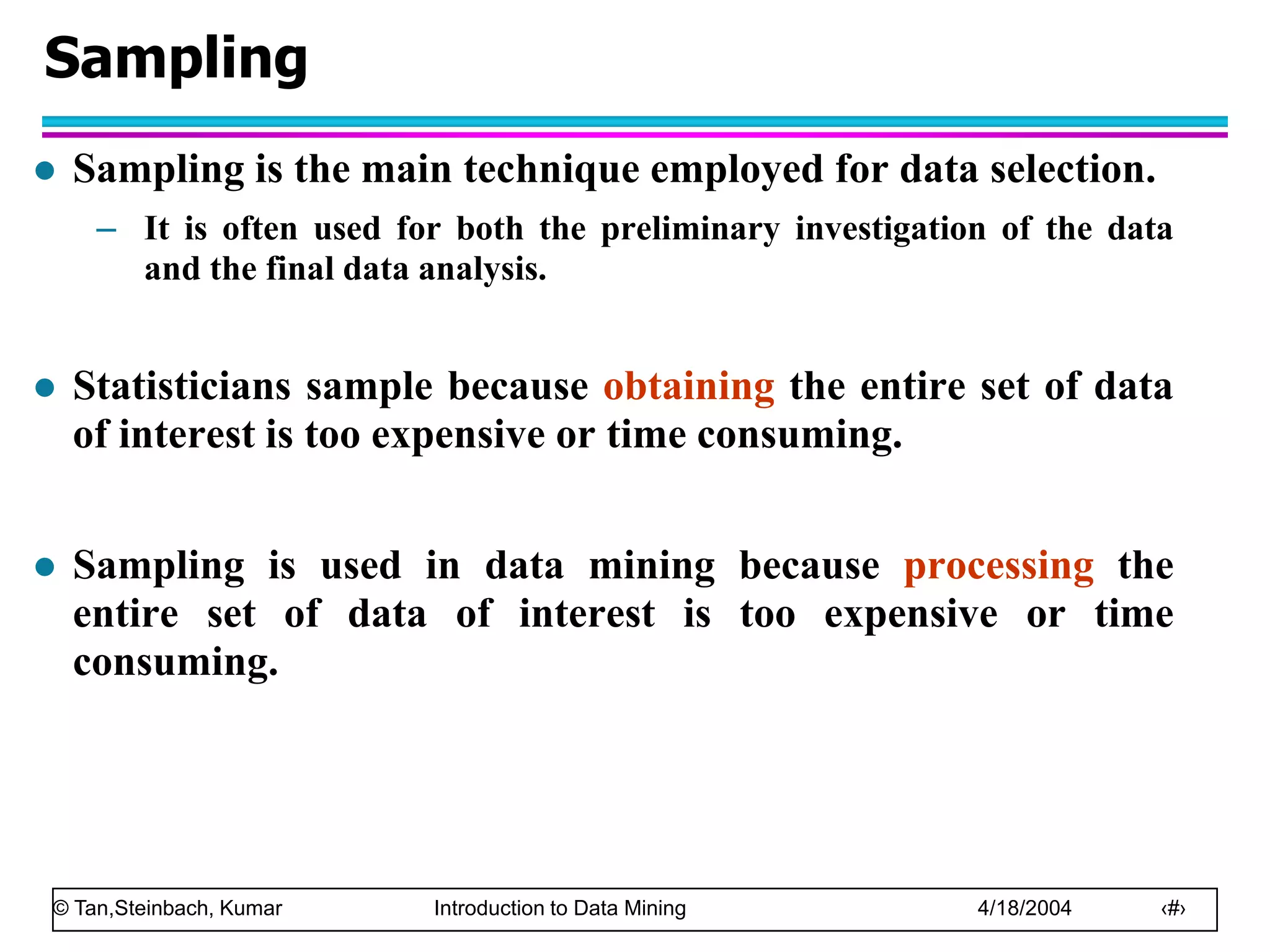
Sampling
 Sampling is the main technique employed for data selection.
– It is often used for both the preliminary investigation of the data
and the final data analysis.
 Statisticians sample because obtaining the entire set of data
of interest is too expensive or time consuming.
 Sampling is used in data mining because processing the
entire set of data of interest is too expensive or time
consuming.
© Tan,Steinbach, Kumar Introduction to Data Mining 4/18/2004 ‹#›
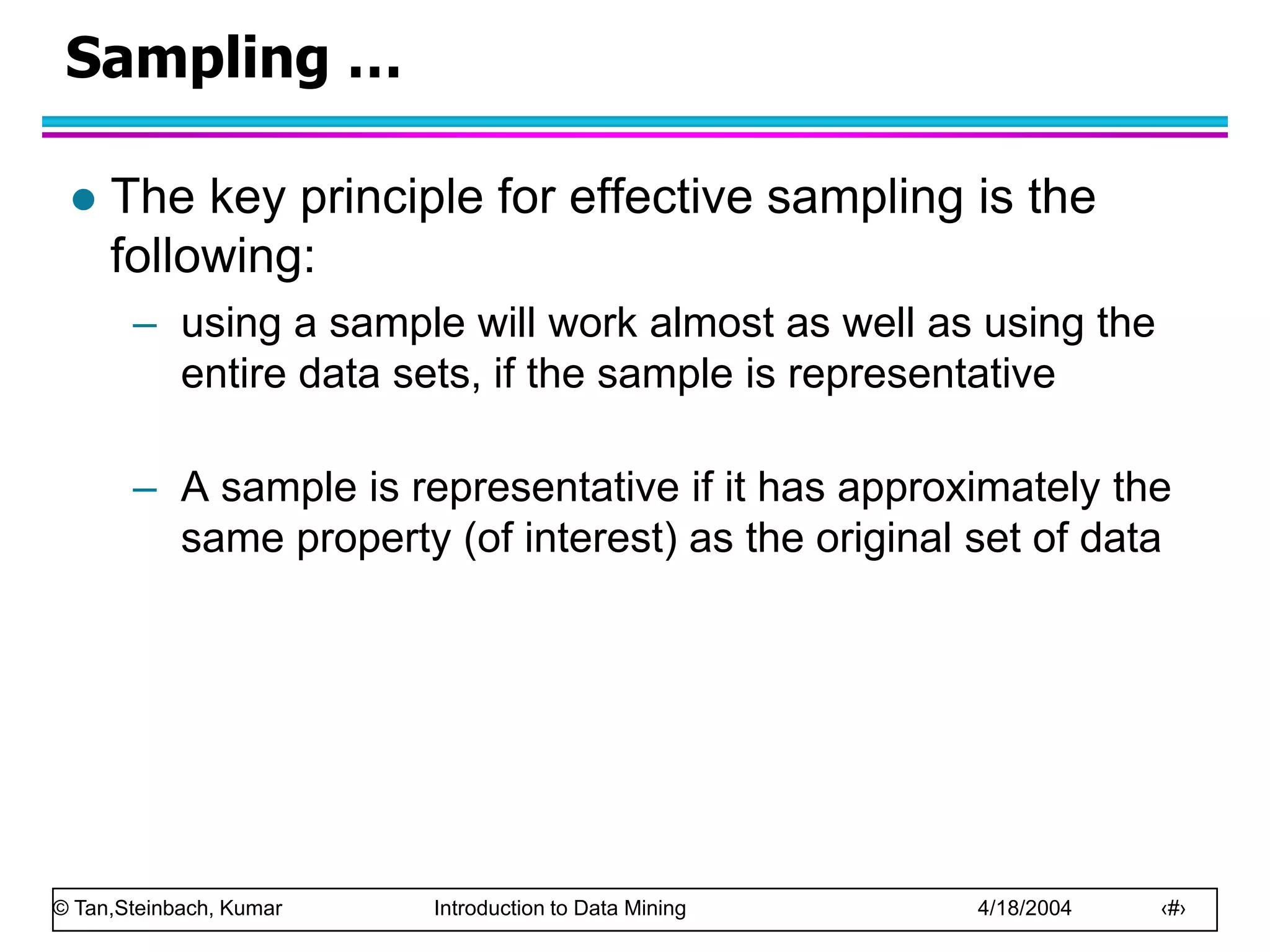
Sampling …
 The key principle for effective sampling is the
following:
– using a sample will work almost as well as using the
entire data sets, if the sample is representative
– A sample is representative if it has approximately the
same property (of interest) as the original set of data
© Tan,Steinbach, Kumar Introduction to Data Mining 4/18/2004 ‹#›
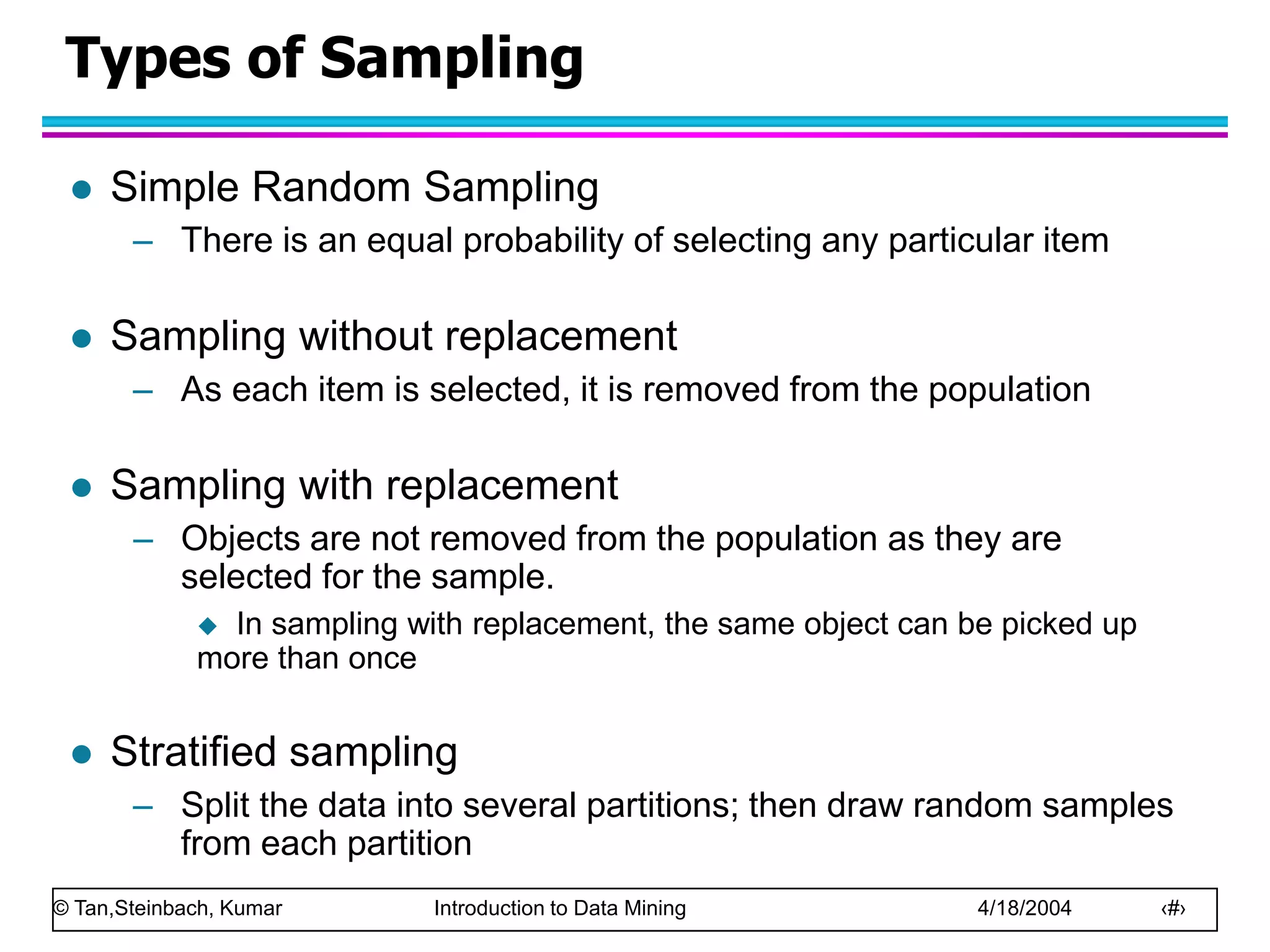
Types of Sampling
 Simple Random Sampling
– There is an equal probability of selecting any particular item
 Sampling without replacement
– As each item is selected, it is removed from the population
 Sampling with replacement
– Objects are not removed from the population as they are
selected for the sample.
 In sampling with replacement, the same object can be picked up
more than once
 Stratified sampling
– Split the data into several partitions; then draw random samples
from each partition
© Tan,Steinbach, Kumar Introduction to Data Mining 4/18/2004 ‹#›
Sample Size
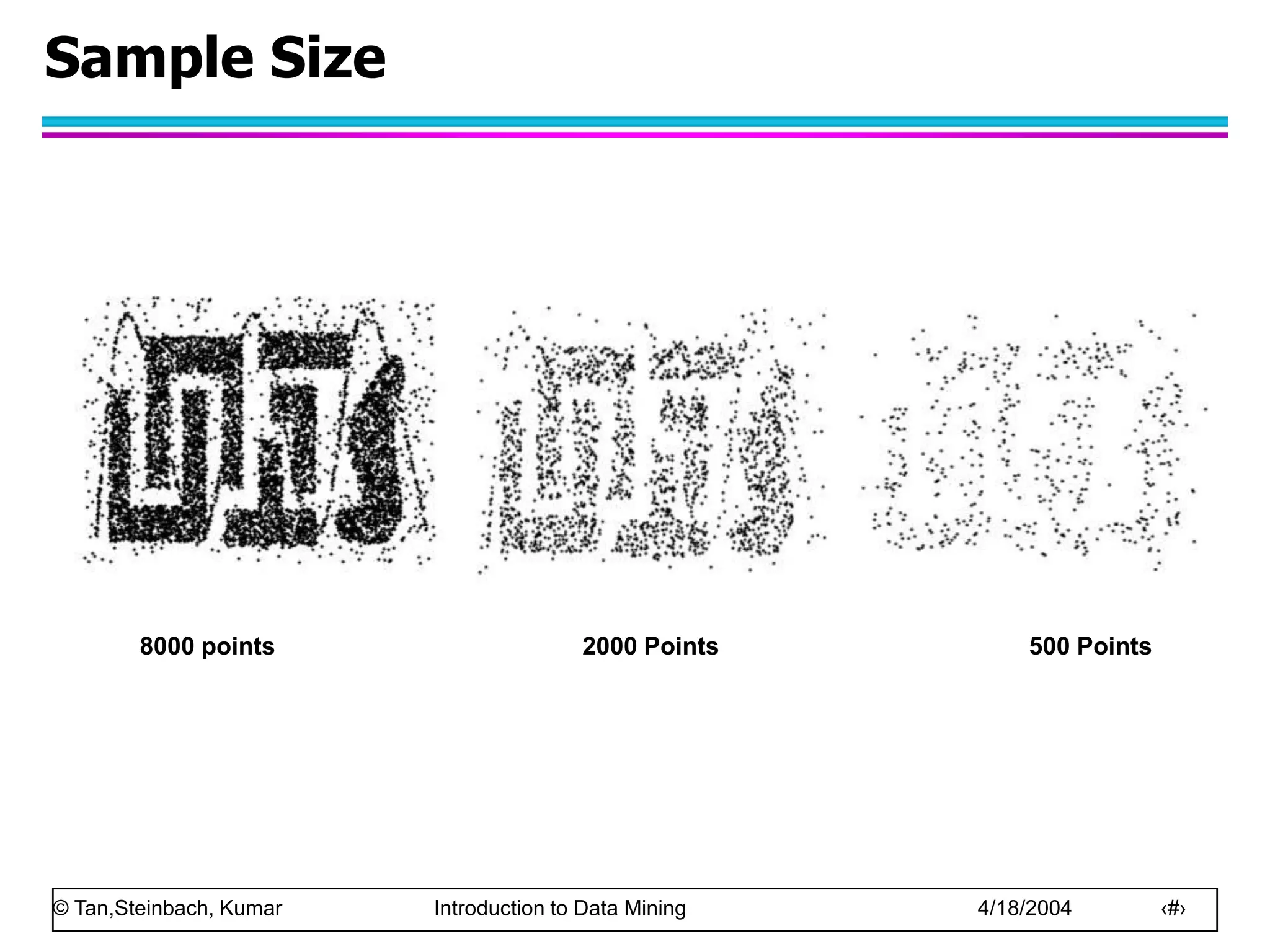
8000 points 2000 Points 500 Points
© Tan,Steinbach, Kumar Introduction to Data Mining 4/18/2004 ‹#›
Sample Size
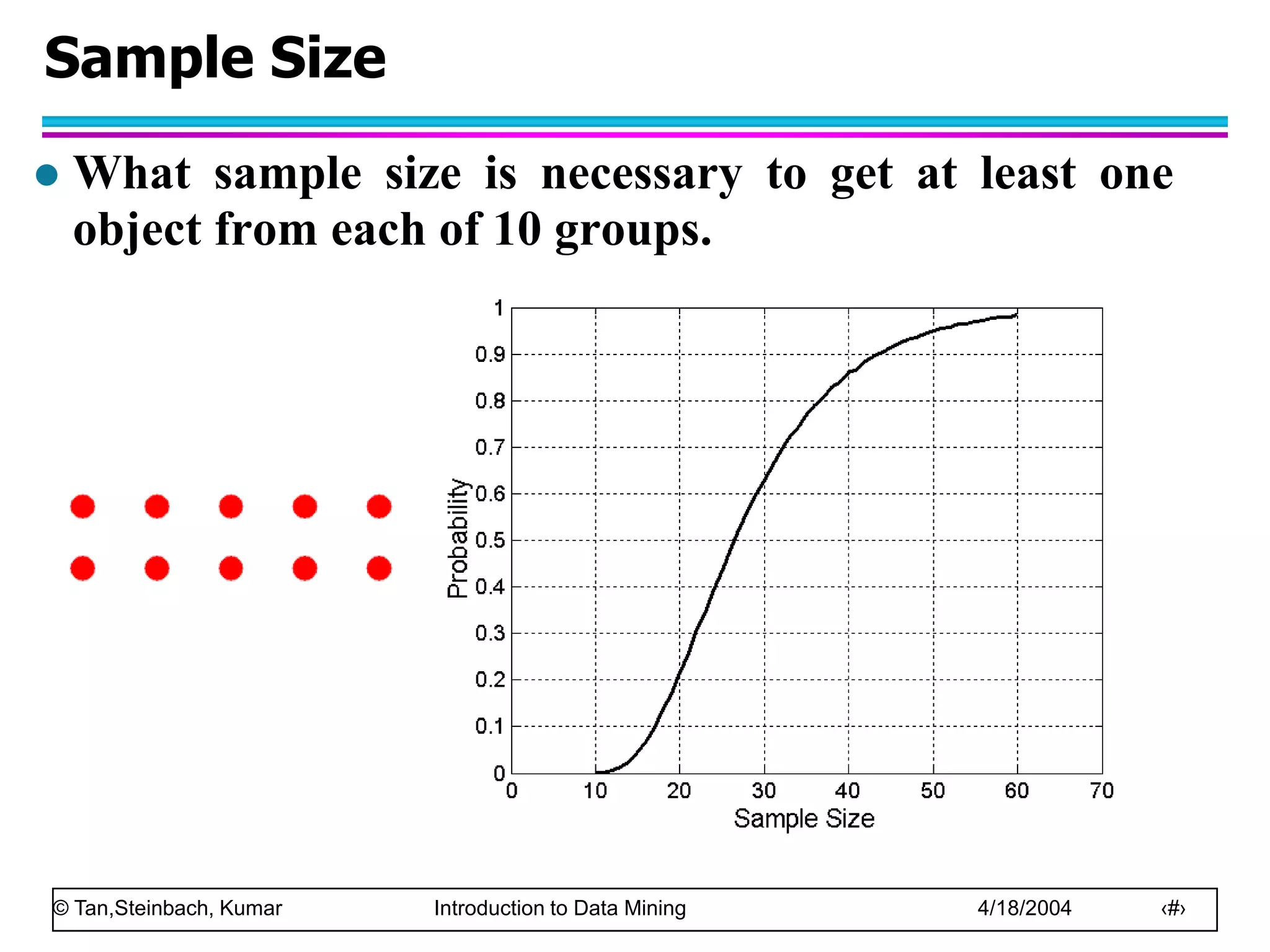
 What sample size is necessary to get at least one
object from each of 10 groups.
© Tan,Steinbach, Kumar Introduction to Data Mining 4/18/2004 ‹#›
Curse of Dimensionality
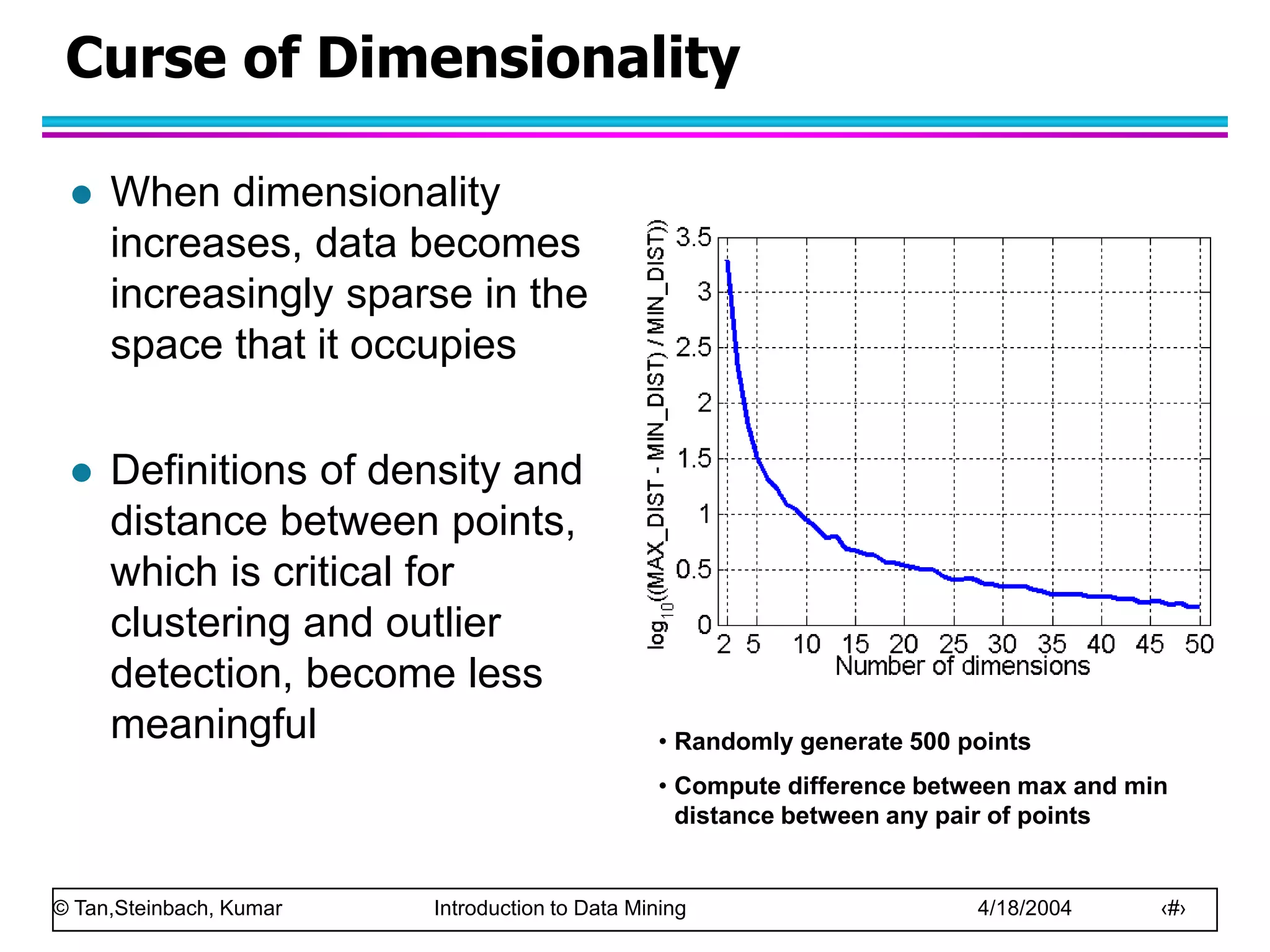
 When dimensionality
increases, data becomes
increasingly sparse in the
space that it occupies
 Definitions of density and
distance between points,
which is critical for
clustering and outlier
detection, become less
meaningful • Randomly generate 500 points
• Compute difference between max and min
distance between any pair of points
© Tan,Steinbach, Kumar Introduction to Data Mining 4/18/2004 ‹#›
Dimensionality Reduction
 Purpose:
– Avoid curse of dimensionality
– Reduce amount of time and memory required by data
mining algorithms
– Allow data to be more easily visualized
– May help to eliminate irrelevant features or reduce
noise
 Techniques
– Principle Component Analysis
– Singular Value Decomposition
– Others: supervised and non-linear techniques
© Tan,Steinbach, Kumar Introduction to Data Mining 4/18/2004 ‹#›
Dimensionality Reduction: PCA
 Goal is to find a projection that captures the
largest amount of variation in data
x2
x1
e
© Tan,Steinbach, Kumar Introduction to Data Mining 4/18/2004 ‹#›
Dimensionality Reduction: PCA
 Find the eigenvectors of the covariance matrix
 The eigenvectors define the new space
x2
x1
e
© Tan,Steinbach, Kumar Introduction to Data Mining 4/18/2004 ‹#›
Dimensionality Reduction: ISOMAP
 Construct a neighbourhood graph
 For each pair of points in the graph, compute the shortest
path distances – geodesic distances
By: Tenenbaum, de Silva,
Langford (2000)
© Tan,Steinbach, Kumar Introduction to Data Mining 4/18/2004 ‹#›
Dimensions = 10
Dimensions = 40
Dimensions = 80
Dimensions = 120
Dimensions = 160
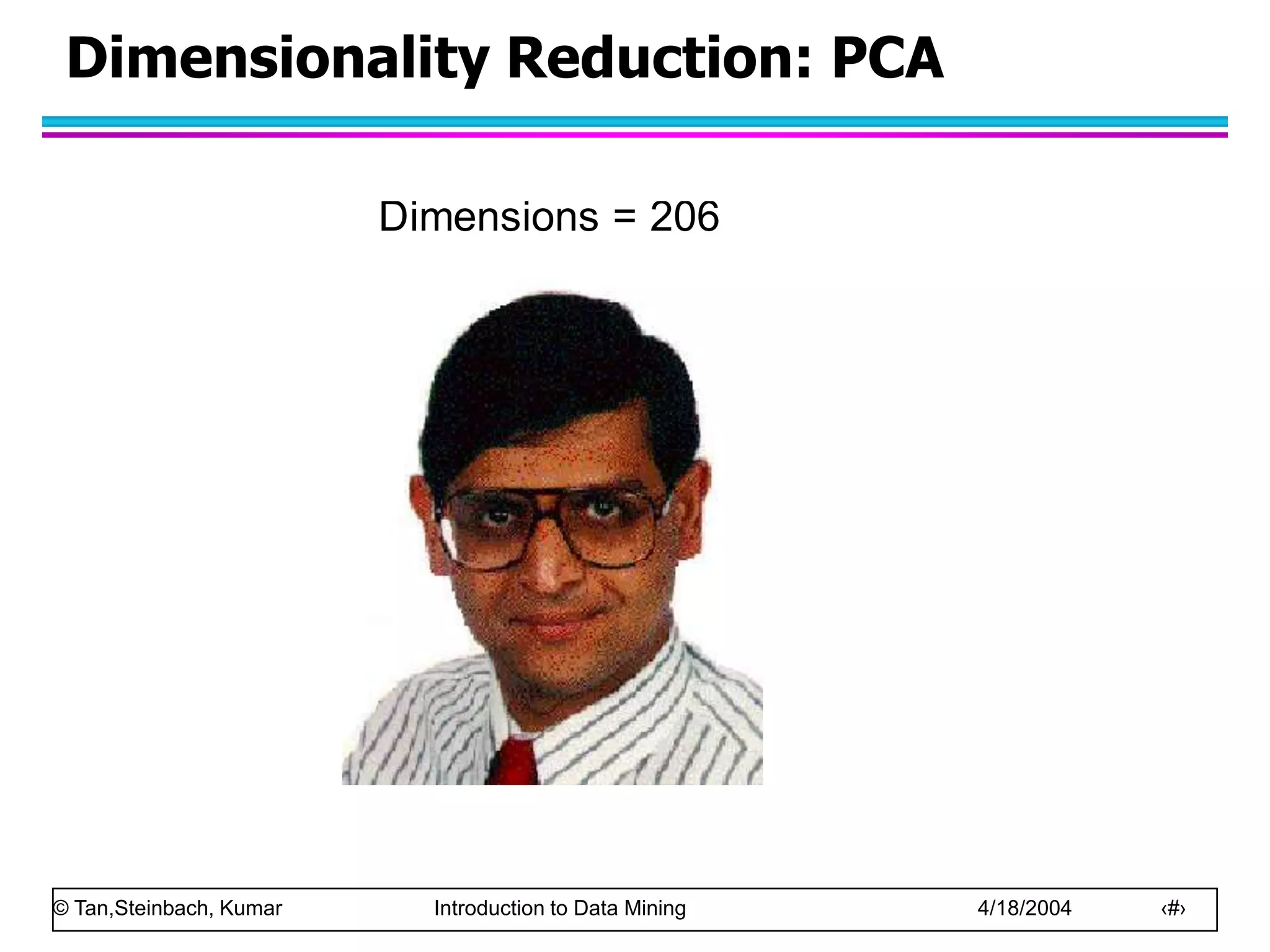
Dimensions = 206
Dimensionality Reduction: PCA
© Tan,Steinbach, Kumar Introduction to Data Mining 4/18/2004 ‹#›
Feature Subset Selection
 Another way to reduce dimensionality of data
 Redundant features
– duplicate much or all of the information contained in
one or more other attributes
– Example: purchase price of a product and the amount
of sales tax paid
 Irrelevant features
– contain no information that is useful for the data
mining task at hand
– Example: students' ID is often irrelevant to the task of
predicting students' GPA
© Tan,Steinbach, Kumar Introduction to Data Mining 4/18/2004 ‹#›
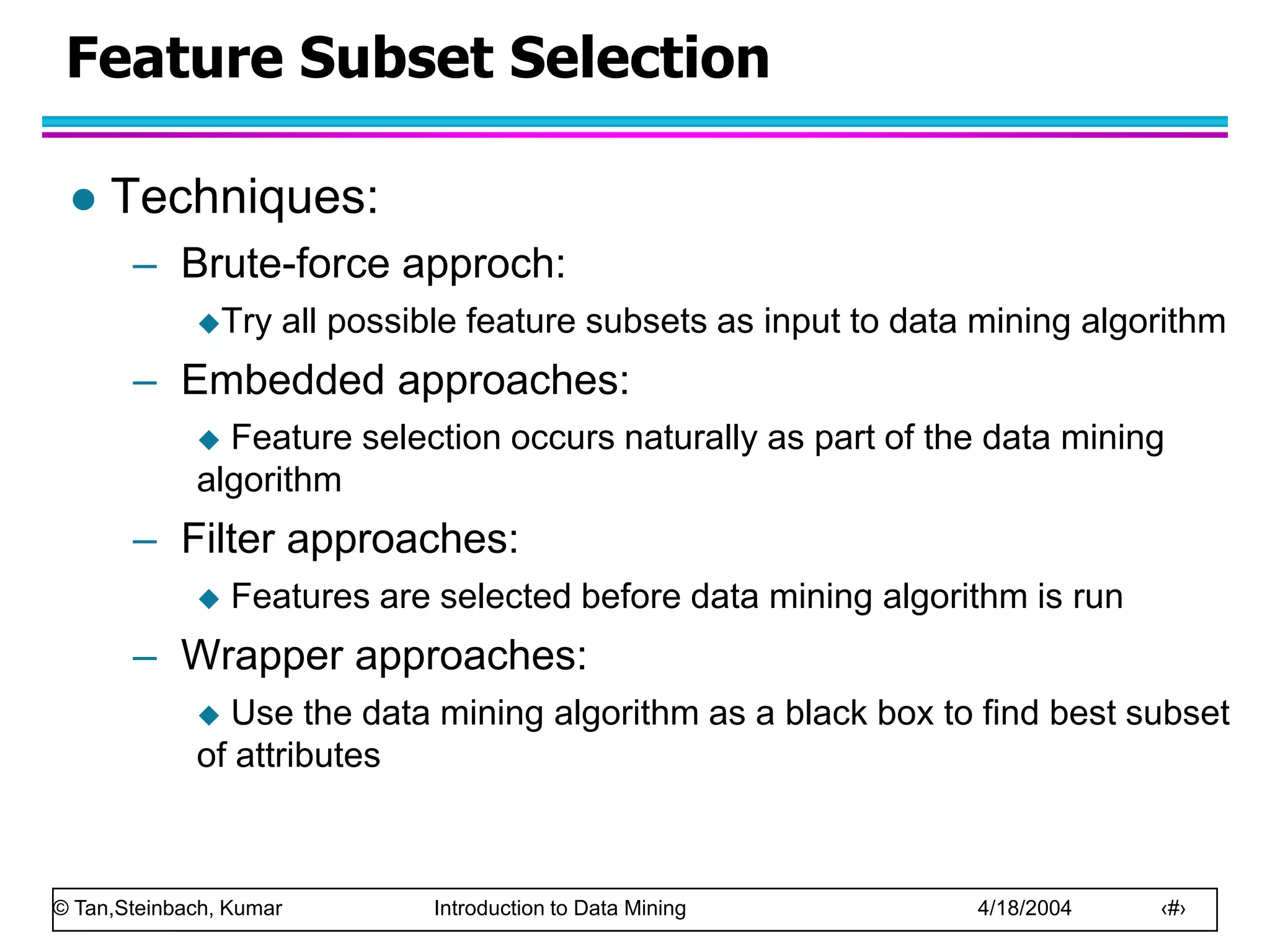
Feature Subset Selection
 Techniques:
– Brute-force approch:
Try all possible feature subsets as input to data mining algorithm
– Embedded approaches:
 Feature selection occurs naturally as part of the data mining
algorithm
– Filter approaches:
 Features are selected before data mining algorithm is run
– Wrapper approaches:
 Use the data mining algorithm as a black box to find best subset
of attributes
© Tan,Steinbach, Kumar Introduction to Data Mining 4/18/2004 ‹#›
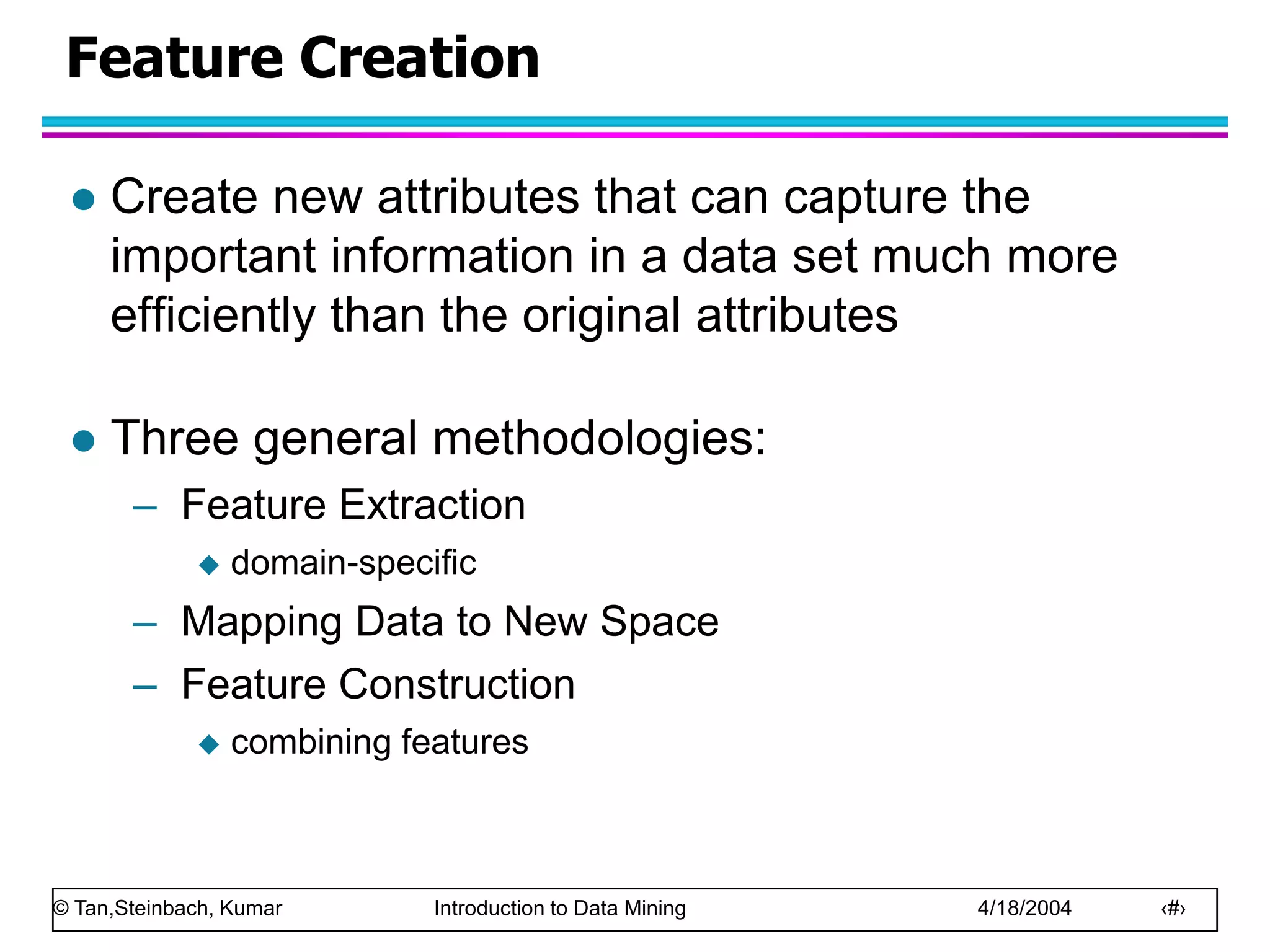
Feature Creation
 Create new attributes that can capture the
important information in a data set much more
efficiently than the original attributes
 Three general methodologies:
– Feature Extraction
 domain-specific
– Mapping Data to New Space
– Feature Construction
 combining features
© Tan,Steinbach, Kumar Introduction to Data Mining 4/18/2004 ‹#›
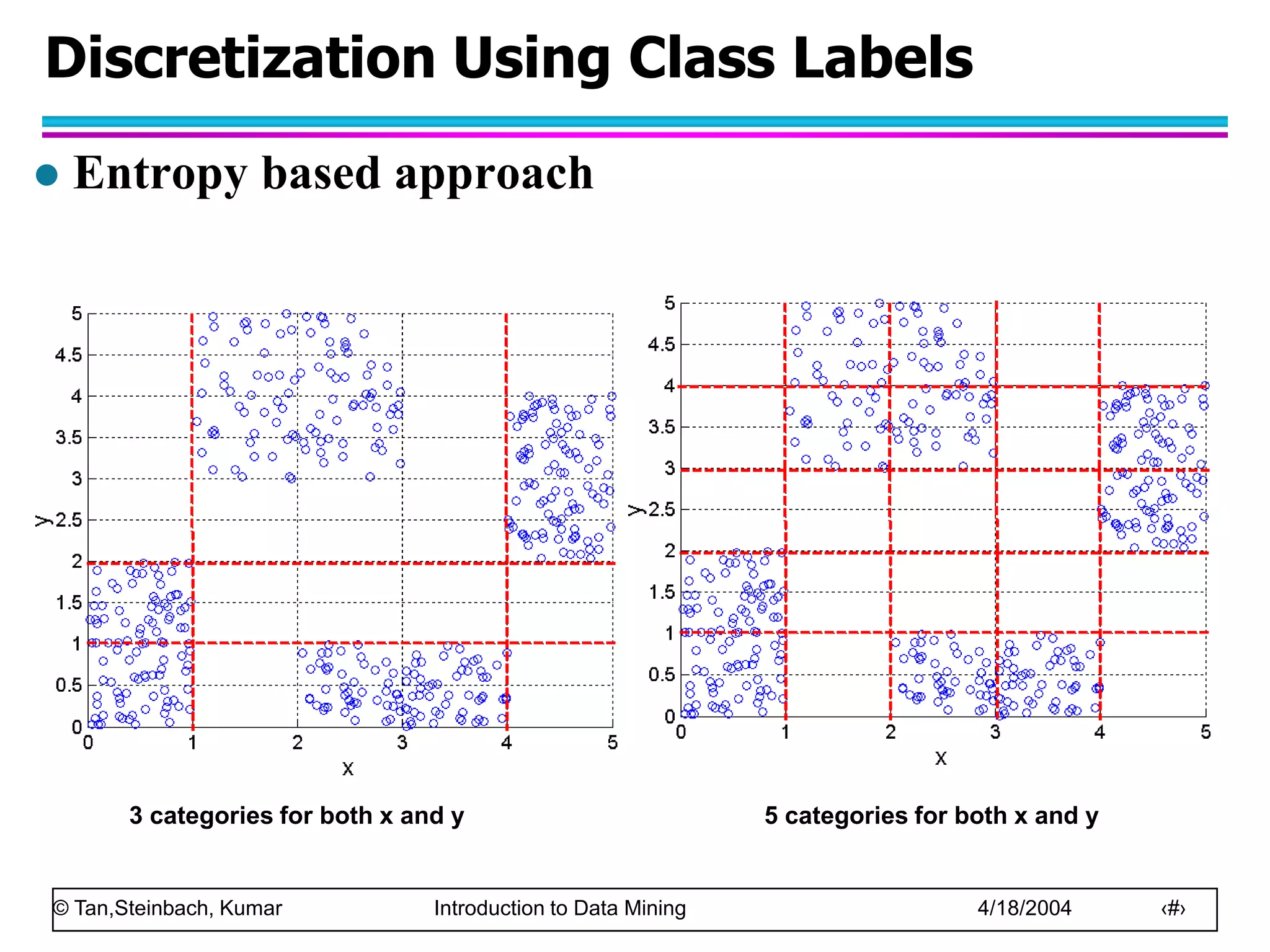
Discretization Using Class Labels
 Entropy based approach
3 categories for both x and y 5 categories for both x and y
© Tan,Steinbach, Kumar Introduction to Data Mining 4/18/2004 ‹#›
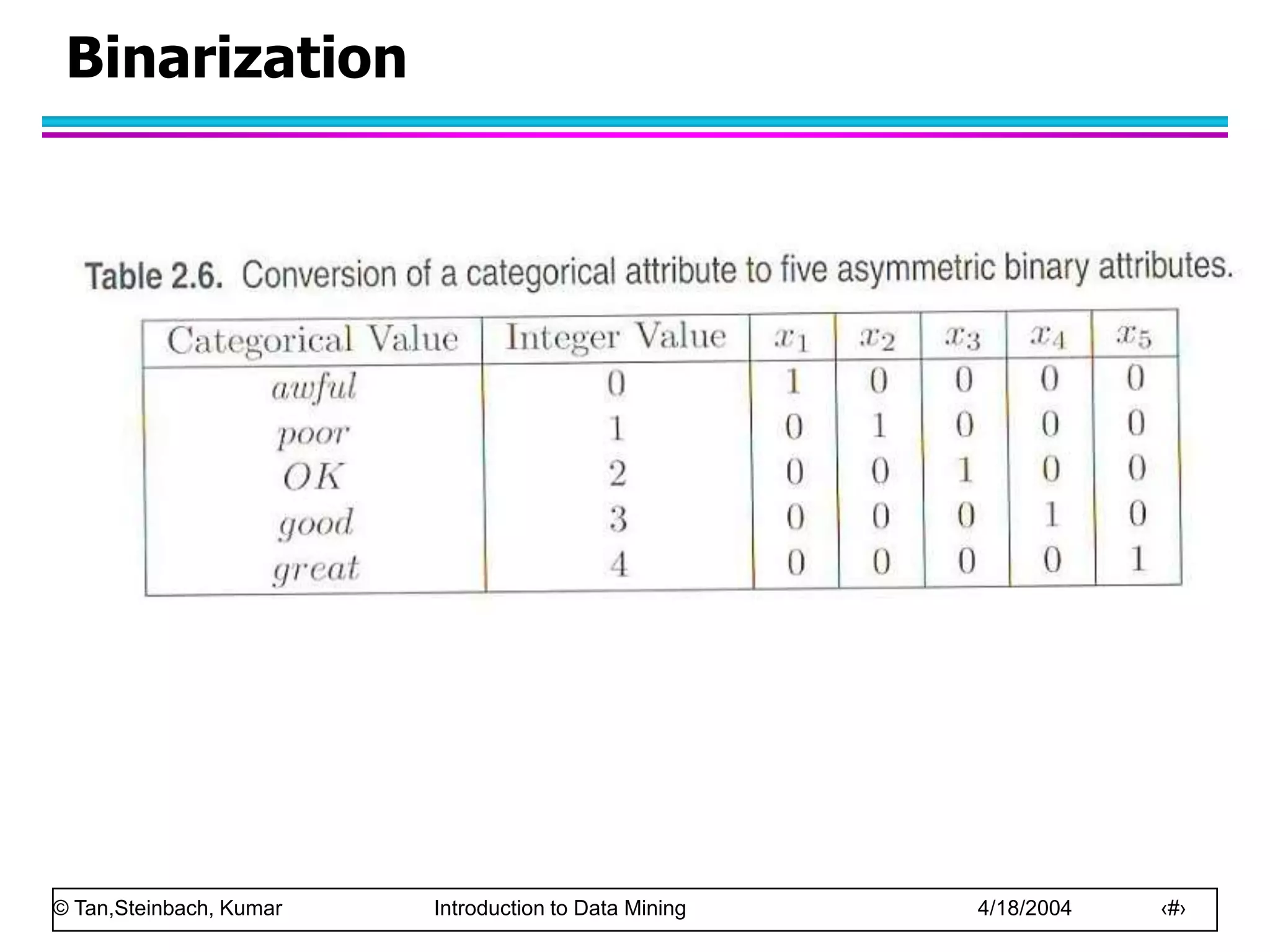
Binarization
© Tan,Steinbach, Kumar Introduction to Data Mining 4/18/2004 ‹#›
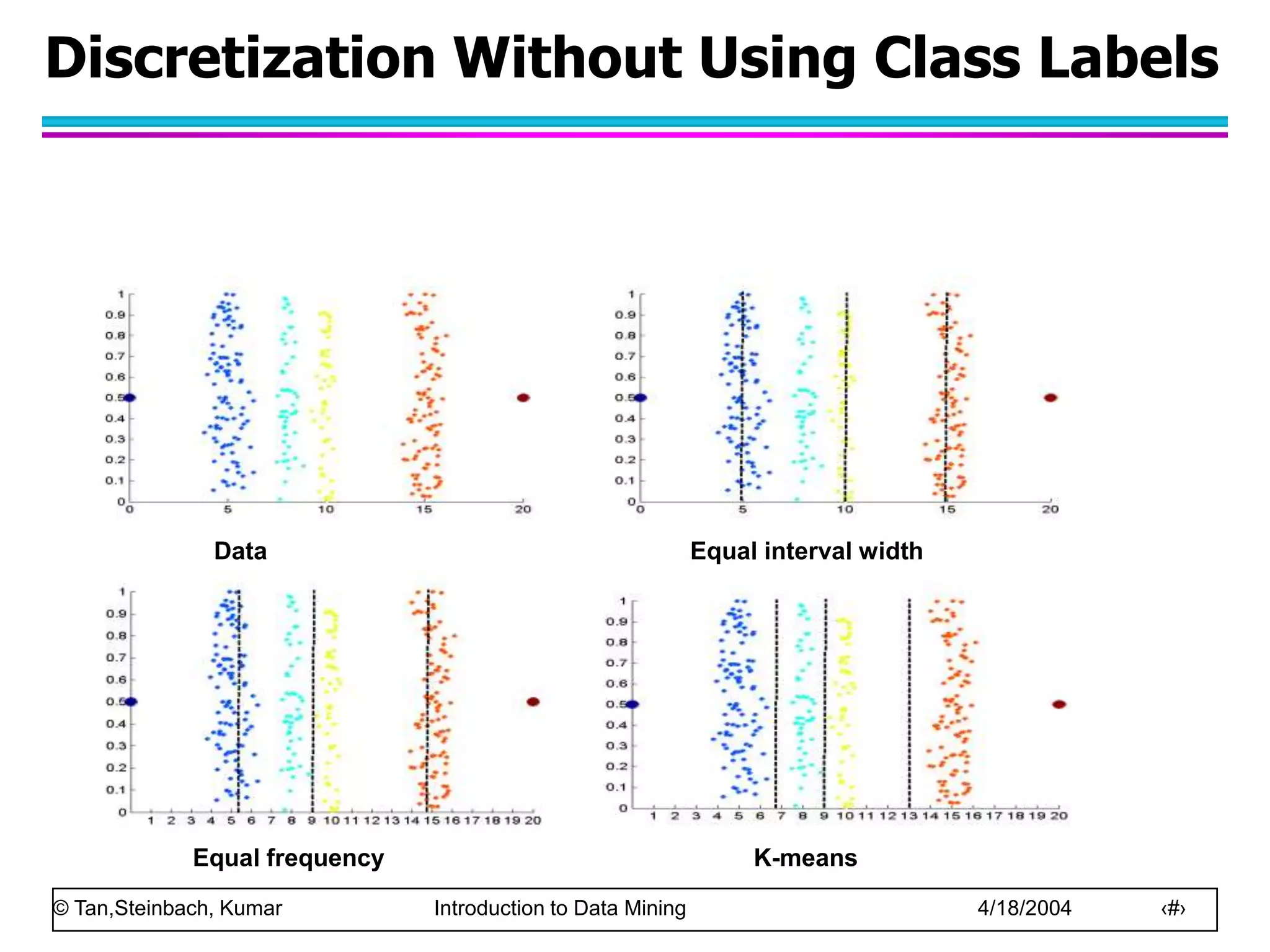
Discretization Without Using Class Labels
Data Equal interval width
Equal frequency K-means
© Tan,Steinbach, Kumar Introduction to Data Mining 4/18/2004 ‹#›
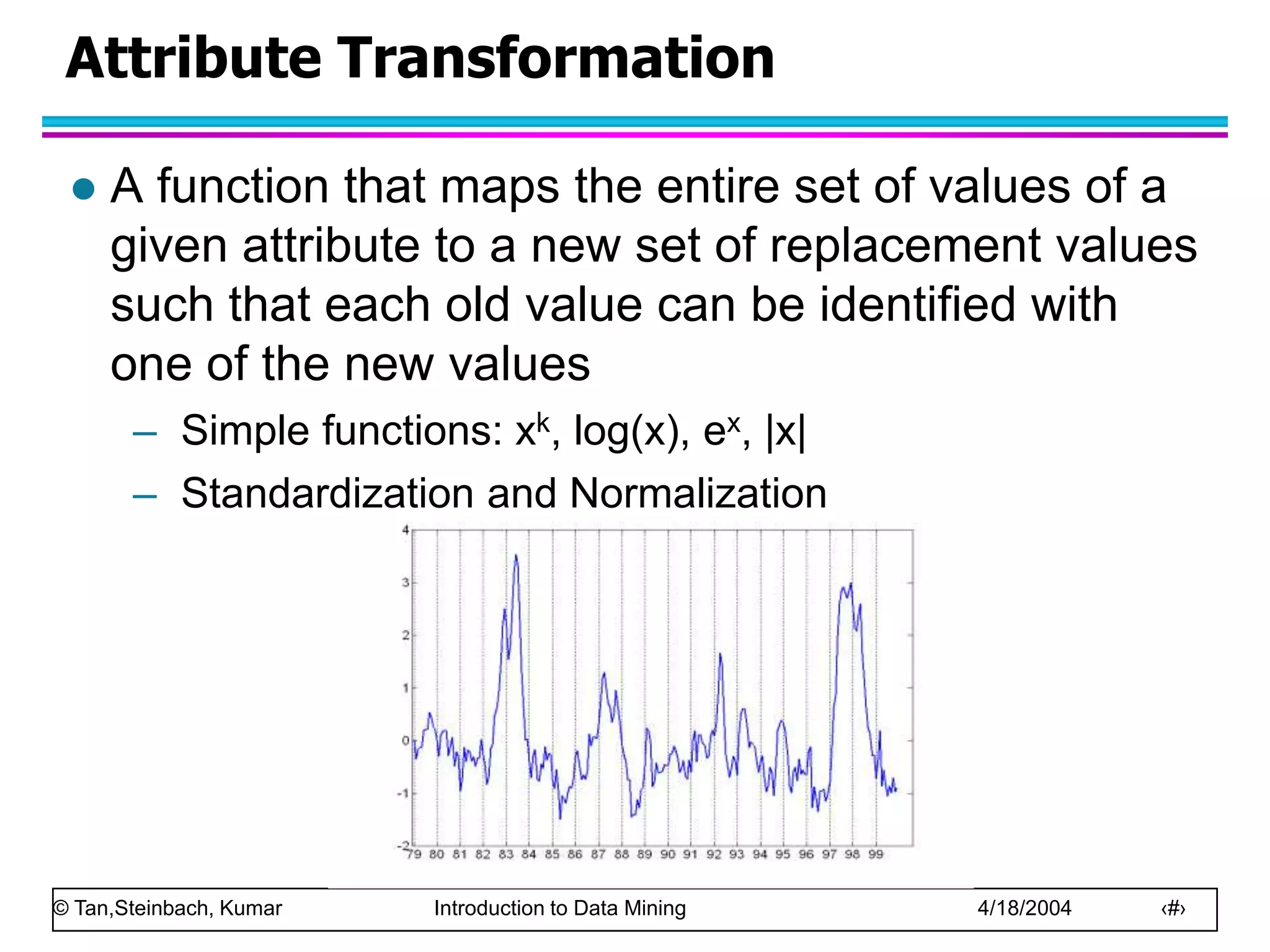
Attribute Transformation
 A function that maps the entire set of values of a
given attribute to a new set of replacement values
such that each old value can be identified with
one of the new values
– Simple functions: xk, log(x), ex, |x|
– Standardization and Normalization
© Tan,Steinbach, Kumar Introduction to Data Mining 4/18/2004 ‹#›
Similarity and Dissimilarity
 Similarity
– Numerical measure of how alike two data objects are.
– Is higher when objects are more alike.
– Often falls in the range [0,1]
 Dissimilarity
– Numerical measure of how different are two data
objects
– Lower when objects are more alike
– Minimum dissimilarity is often 0
– Upper limit varies
 Proximity refers to a similarity or dissimilarity
© Tan,Steinbach, Kumar Introduction to Data Mining 4/18/2004 ‹#›
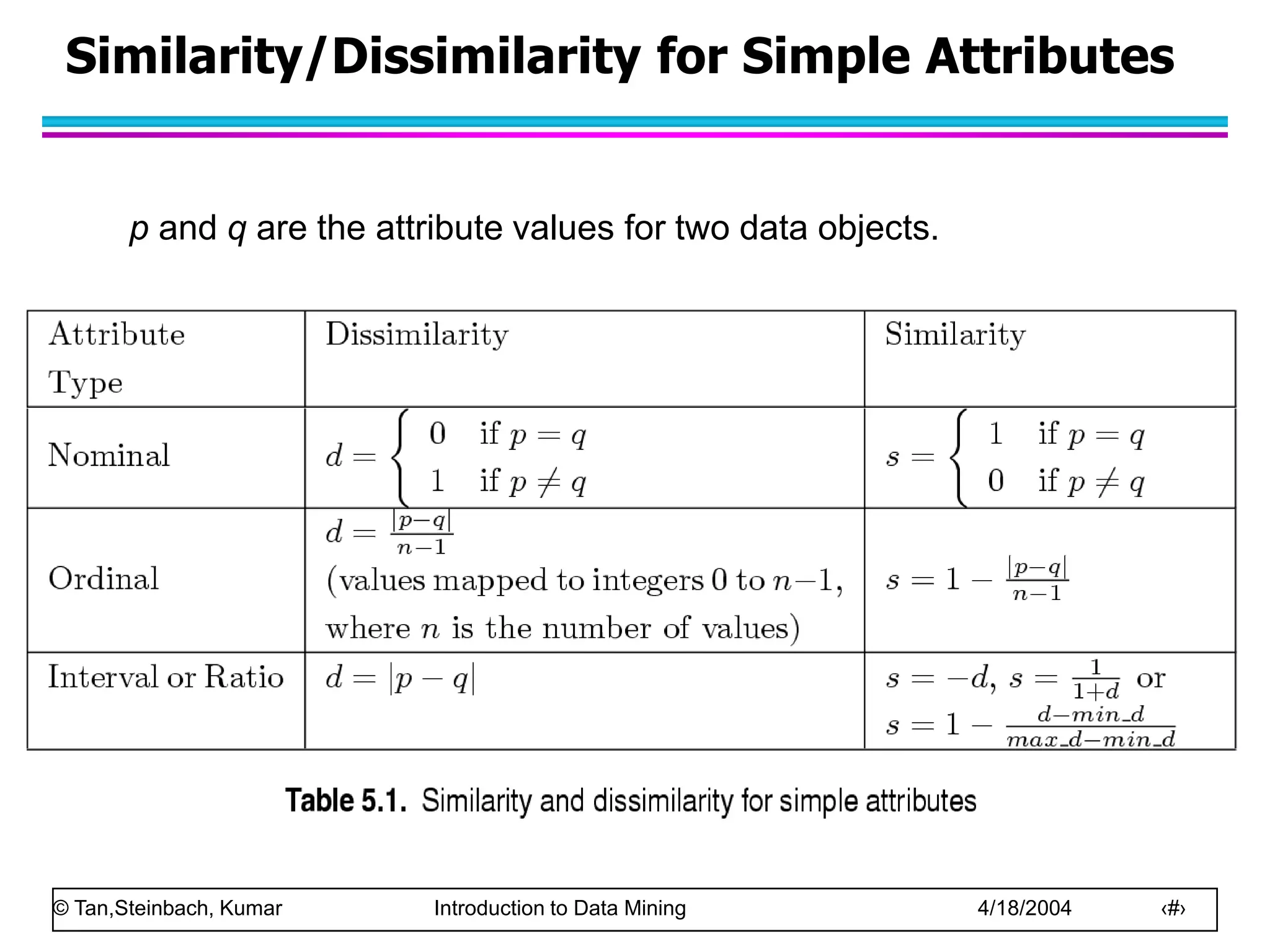
Similarity/Dissimilarity for Simple Attributes
p and q are the attribute values for two data objects.
© Tan,Steinbach, Kumar Introduction to Data Mining 4/18/2004 ‹#›
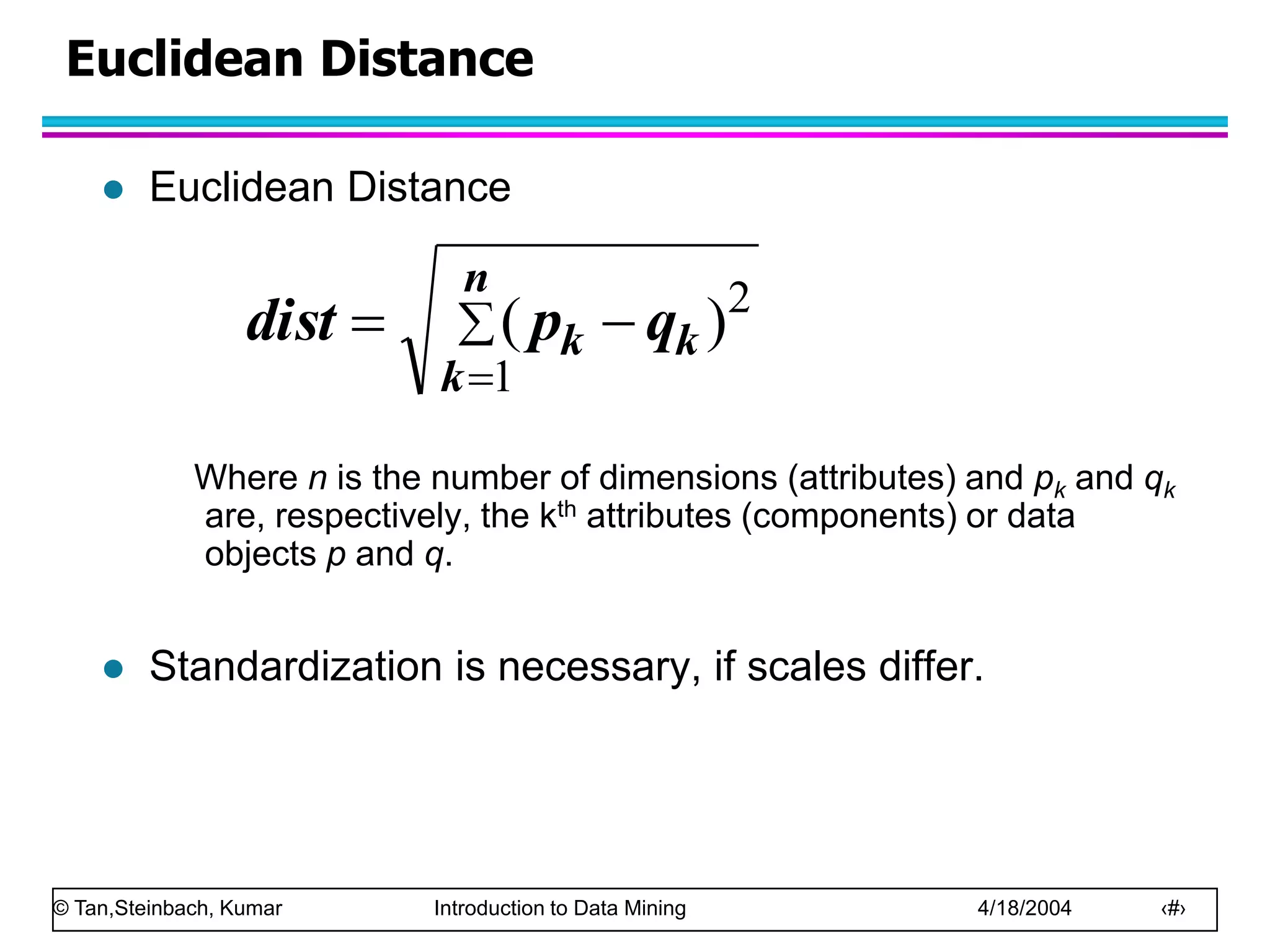
Euclidean Distance
 Euclidean Distance
Where n is the number of dimensions (attributes) and pk and qk
are, respectively, the kth attributes (components) or data
objects p and q.
 Standardization is necessary, if scales differ.




n
k
k
k q
p
dist
1
2
)
(
© Tan,Steinbach, Kumar Introduction to Data Mining 4/18/2004 ‹#›
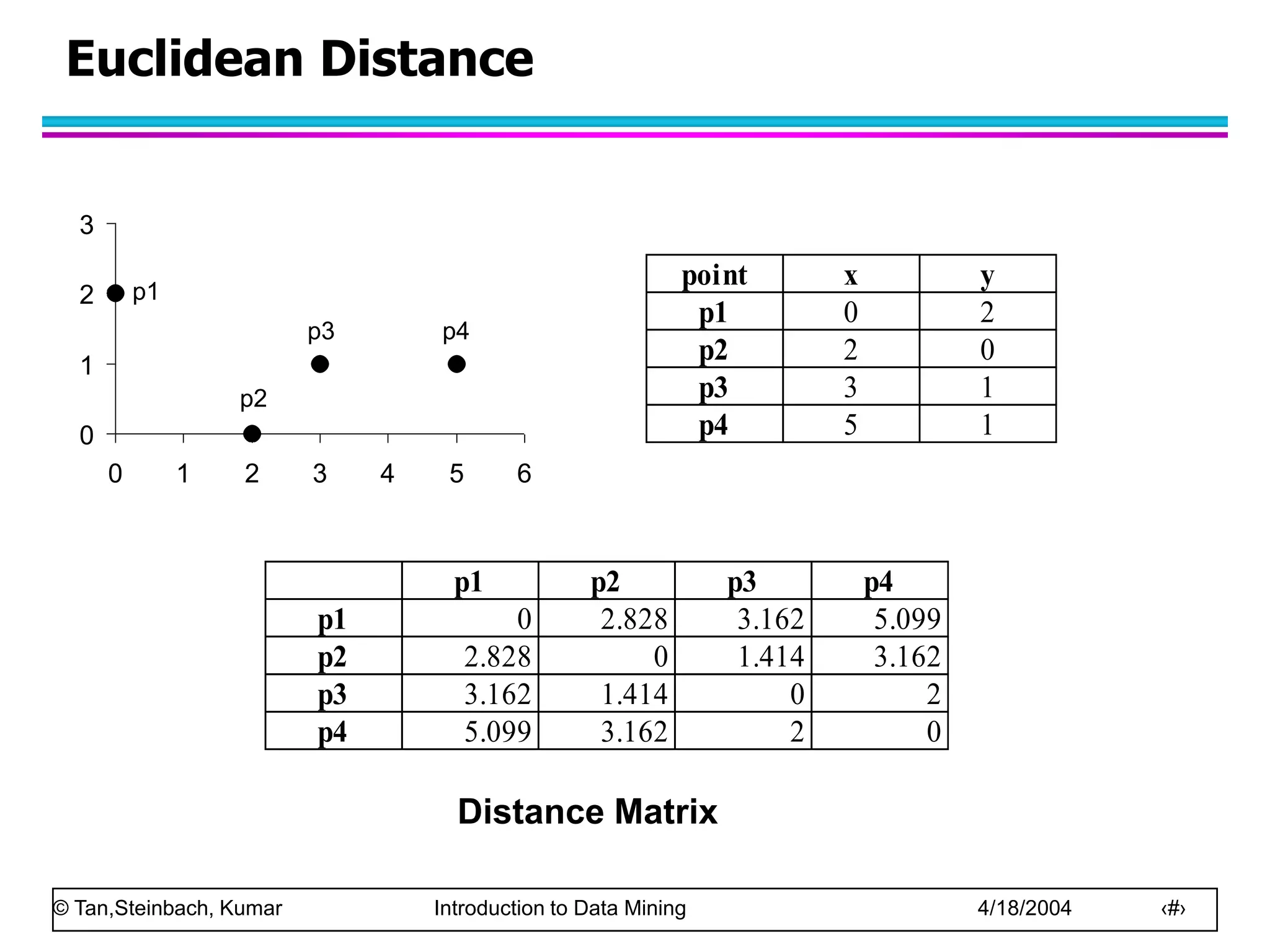
Euclidean Distance
0
1
2
3
0 1 2 3 4 5 6
p1
p2
p3 p4
point x y
p1 0 2
p2 2 0
p3 3 1
p4 5 1
Distance Matrix
p1 p2 p3 p4
p1 0 2.828 3.162 5.099
p2 2.828 0 1.414 3.162
p3 3.162 1.414 0 2
p4 5.099 3.162 2 0
© Tan,Steinbach, Kumar Introduction to Data Mining 4/18/2004 ‹#›
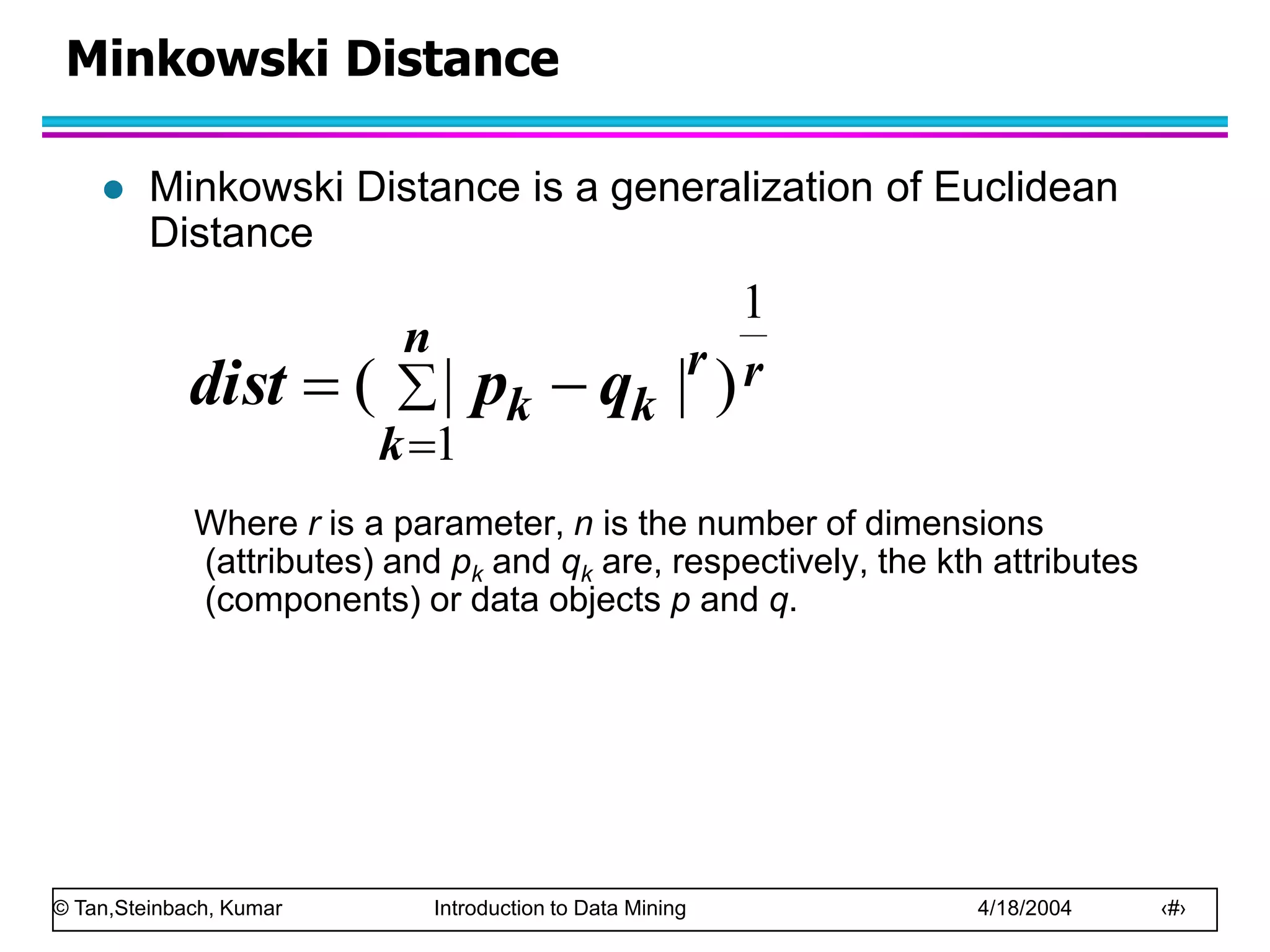
Minkowski Distance
 Minkowski Distance is a generalization of Euclidean
Distance
Where r is a parameter, n is the number of dimensions
(attributes) and pk and qk are, respectively, the kth attributes
(components) or data objects p and q.
r
n
k
r
k
k q
p
dist
1
1
)
|
|
( 



© Tan,Steinbach, Kumar Introduction to Data Mining 4/18/2004 ‹#›
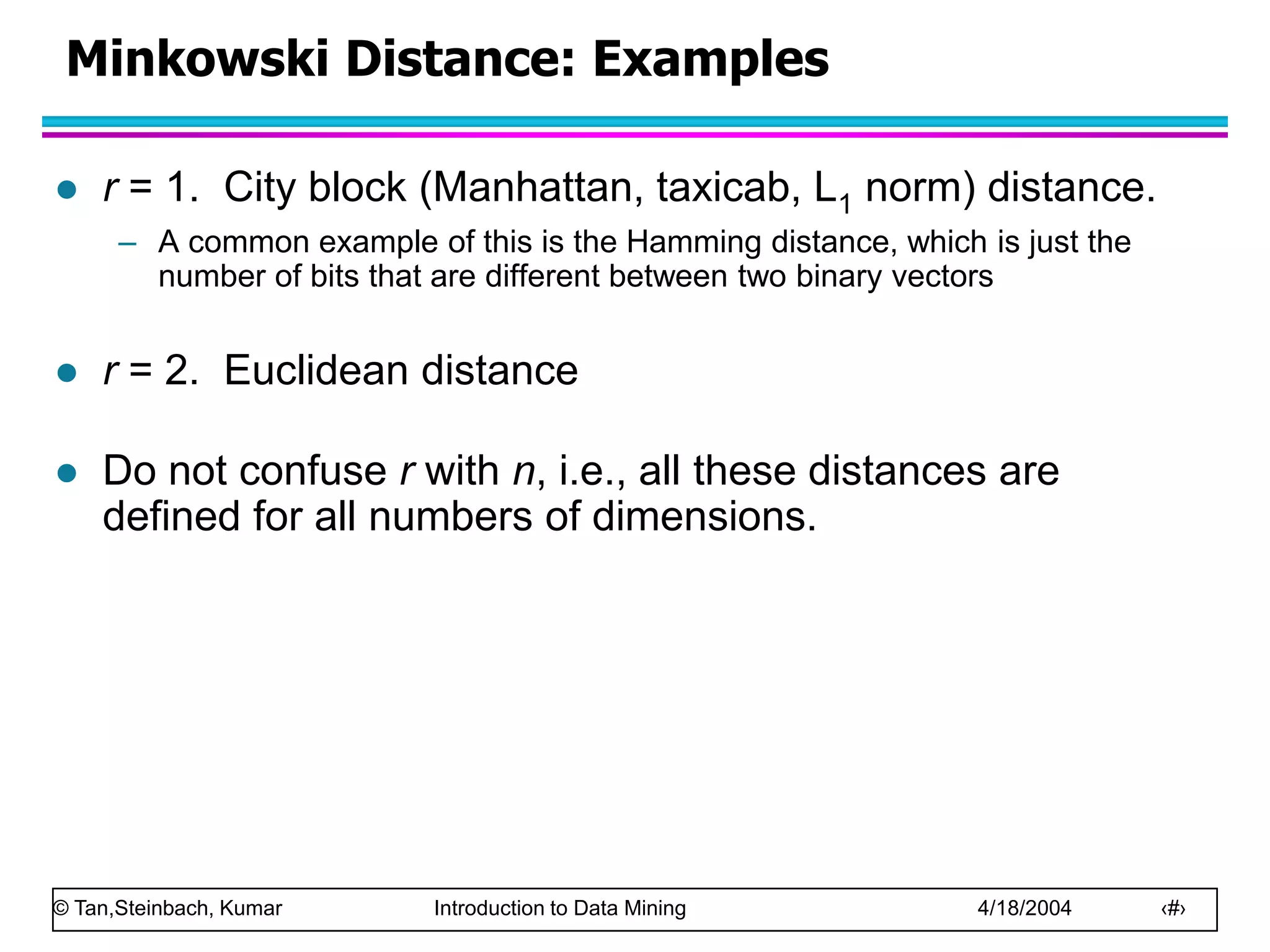
Minkowski Distance: Examples
 r = 1. City block (Manhattan, taxicab, L1 norm) distance.
– A common example of this is the Hamming distance, which is just the
number of bits that are different between two binary vectors
 r = 2. Euclidean distance
 Do not confuse r with n, i.e., all these distances are
defined for all numbers of dimensions.
© Tan,Steinbach, Kumar Introduction to Data Mining 4/18/2004 ‹#›
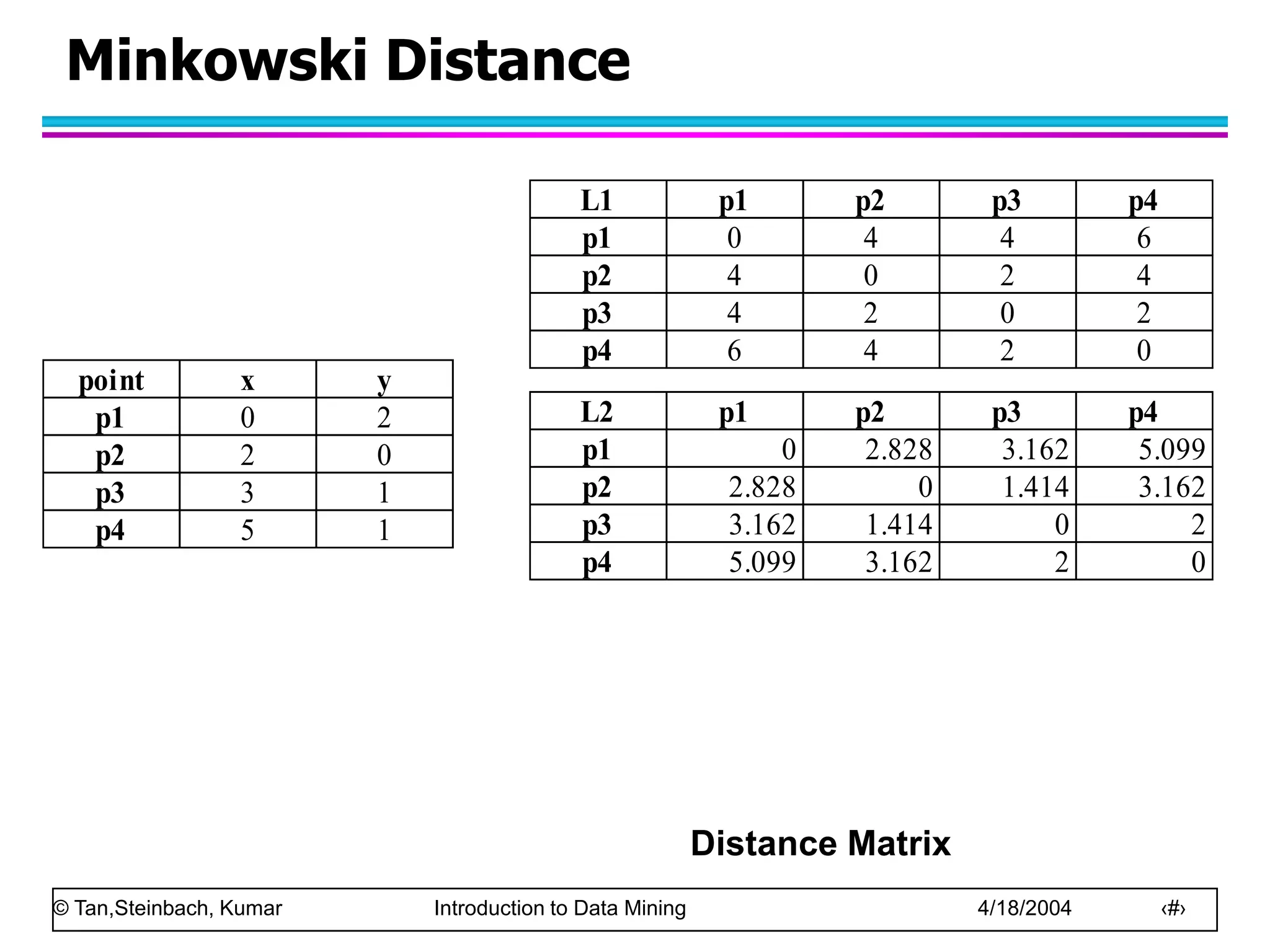
Minkowski Distance
Distance Matrix
point x y
p1 0 2
p2 2 0
p3 3 1
p4 5 1
L1 p1 p2 p3 p4
p1 0 4 4 6
p2 4 0 2 4
p3 4 2 0 2
p4 6 4 2 0
L2 p1 p2 p3 p4
p1 0 2.828 3.162 5.099
p2 2.828 0 1.414 3.162
p3 3.162 1.414 0 2
p4 5.099 3.162 2 0
© Tan,Steinbach, Kumar Introduction to Data Mining 4/18/2004 ‹#›
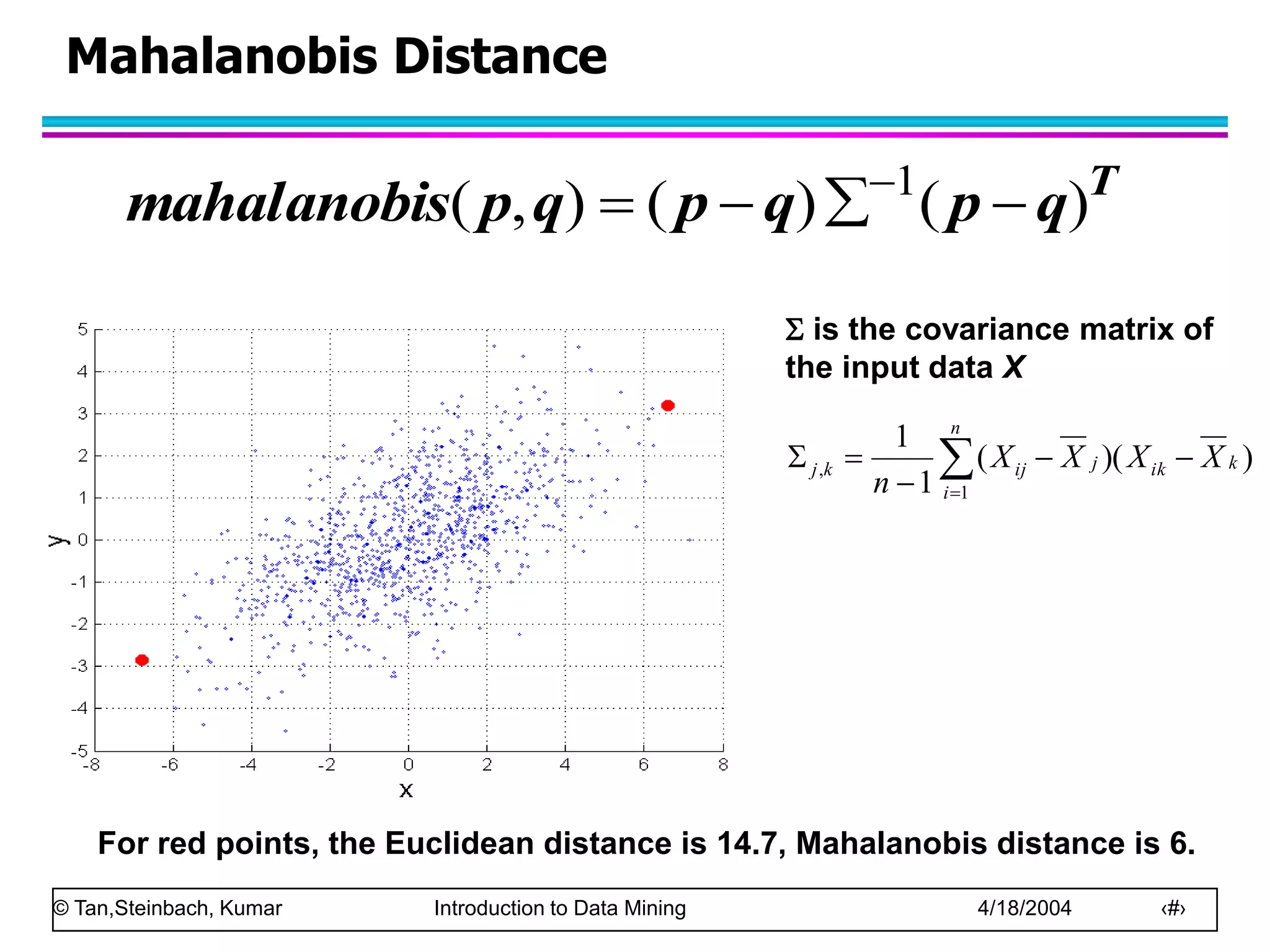
Mahalanobis Distance
T
q
p
q
p
q
p
s
mahalanobi )
(
)
(
)
,
( 1



 
For red points, the Euclidean distance is 14.7, Mahalanobis distance is 6.
 is the covariance matrix of
the input data X







n
i
k
ik
j
ij
k
j X
X
X
X
n 1
, )
)(
(
1
1
© Tan,Steinbach, Kumar Introduction to Data Mining 4/18/2004 ‹#›
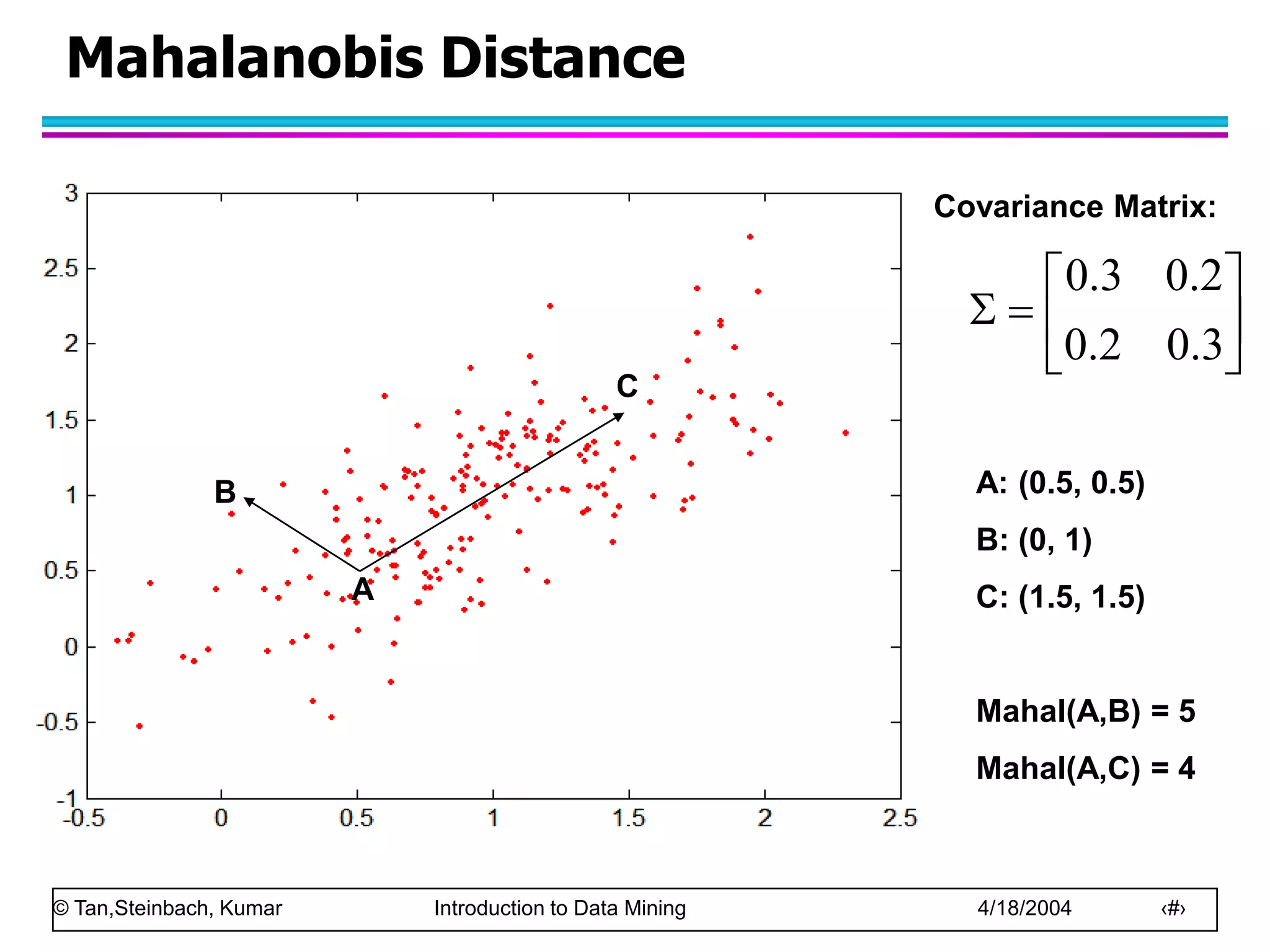
Mahalanobis Distance
Covariance Matrix:








3
.
0
2
.
0
2
.
0
3
.
0
B
A
C
A: (0.5, 0.5)
B: (0, 1)
C: (1.5, 1.5)
Mahal(A,B) = 5
Mahal(A,C) = 4
© Tan,Steinbach, Kumar Introduction to Data Mining 4/18/2004 ‹#›
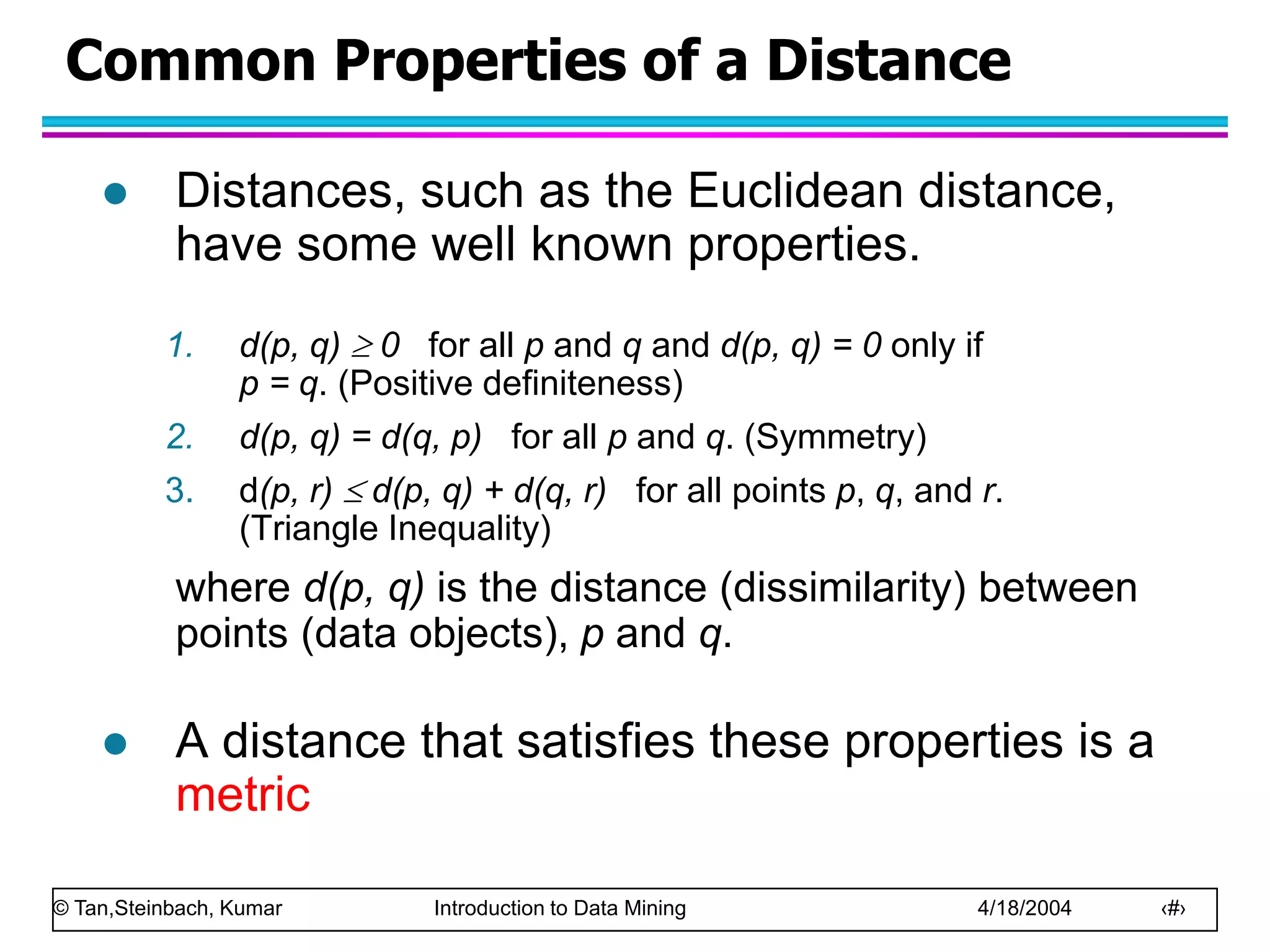
Common Properties of a Distance
 Distances, such as the Euclidean distance,
have some well known properties.
1. d(p, q)  0 for all p and q and d(p, q) = 0 only if
p = q. (Positive definiteness)
2. d(p, q) = d(q, p) for all p and q. (Symmetry)
3. d(p, r)  d(p, q) + d(q, r) for all points p, q, and r.
(Triangle Inequality)
where d(p, q) is the distance (dissimilarity) between
points (data objects), p and q.
 A distance that satisfies these properties is a
metric
© Tan,Steinbach, Kumar Introduction to Data Mining 4/18/2004 ‹#›
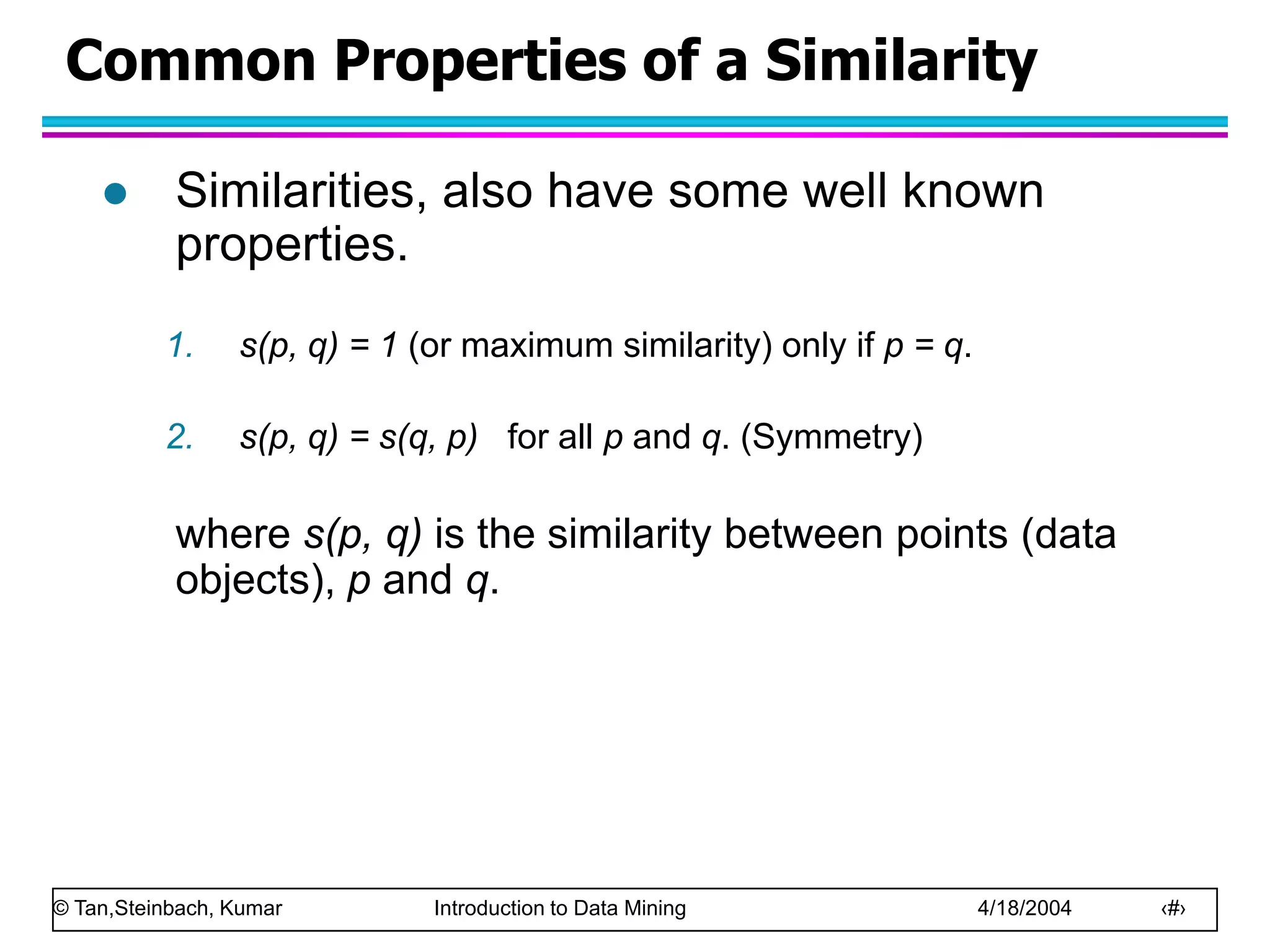
Common Properties of a Similarity
 Similarities, also have some well known
properties.
1. s(p, q) = 1 (or maximum similarity) only if p = q.
2. s(p, q) = s(q, p) for all p and q. (Symmetry)
where s(p, q) is the similarity between points (data
objects), p and q.
© Tan,Steinbach, Kumar Introduction to Data Mining 4/18/2004 ‹#›
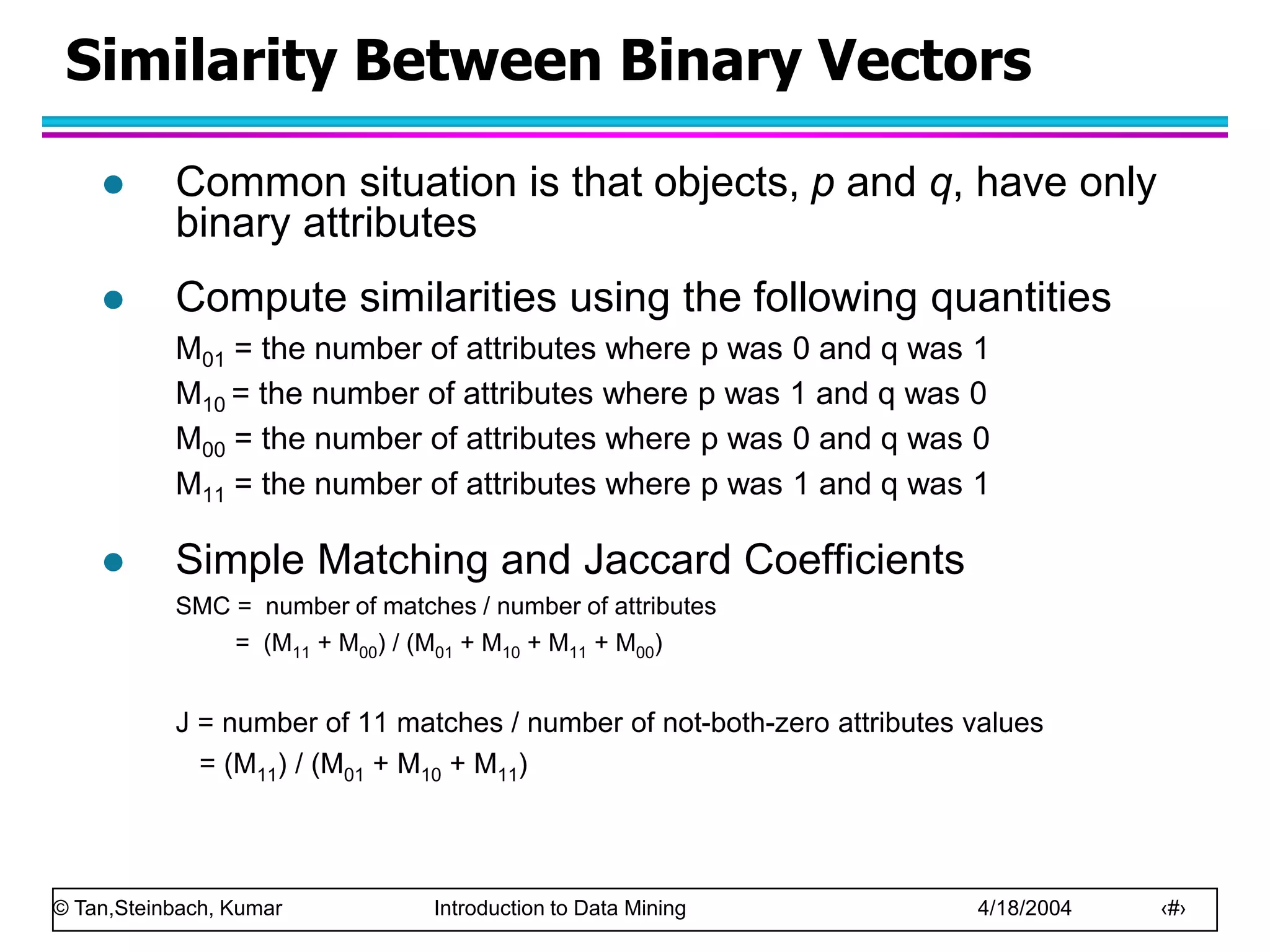
Similarity Between Binary Vectors
 Common situation is that objects, p and q, have only
binary attributes
 Compute similarities using the following quantities
M01 = the number of attributes where p was 0 and q was 1
M10 = the number of attributes where p was 1 and q was 0
M00 = the number of attributes where p was 0 and q was 0
M11 = the number of attributes where p was 1 and q was 1
 Simple Matching and Jaccard Coefficients
SMC = number of matches / number of attributes
= (M11 + M00) / (M01 + M10 + M11 + M00)
J = number of 11 matches / number of not-both-zero attributes values
= (M11) / (M01 + M10 + M11)
© Tan,Steinbach, Kumar Introduction to Data Mining 4/18/2004 ‹#›
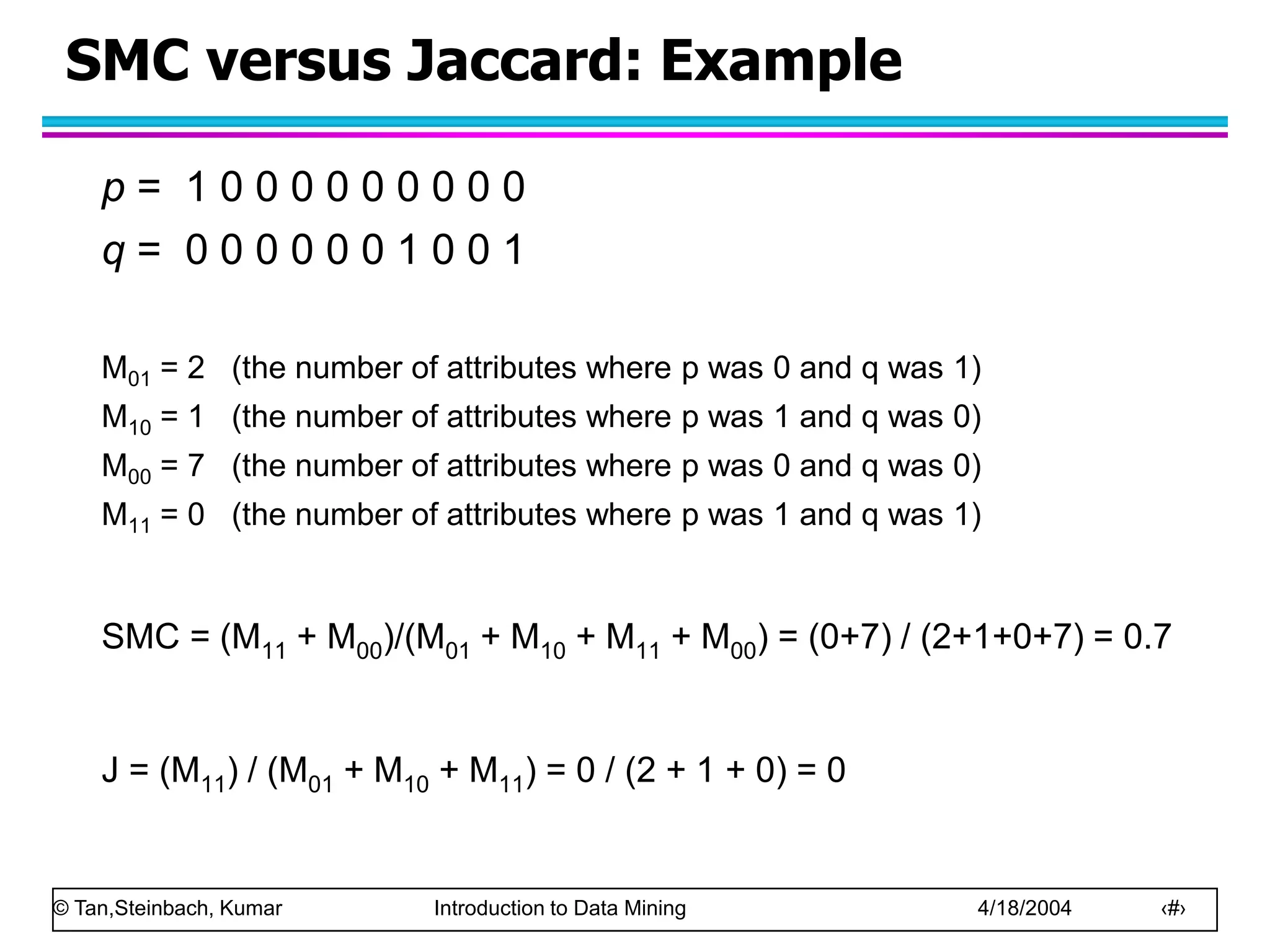
SMC versus Jaccard: Example
p = 1 0 0 0 0 0 0 0 0 0
q = 0 0 0 0 0 0 1 0 0 1
M01 = 2 (the number of attributes where p was 0 and q was 1)
M10 = 1 (the number of attributes where p was 1 and q was 0)
M00 = 7 (the number of attributes where p was 0 and q was 0)
M11 = 0 (the number of attributes where p was 1 and q was 1)
SMC = (M11 + M00)/(M01 + M10 + M11 + M00) = (0+7) / (2+1+0+7) = 0.7
J = (M11) / (M01 + M10 + M11) = 0 / (2 + 1 + 0) = 0
© Tan,Steinbach, Kumar Introduction to Data Mining 4/18/2004 ‹#›
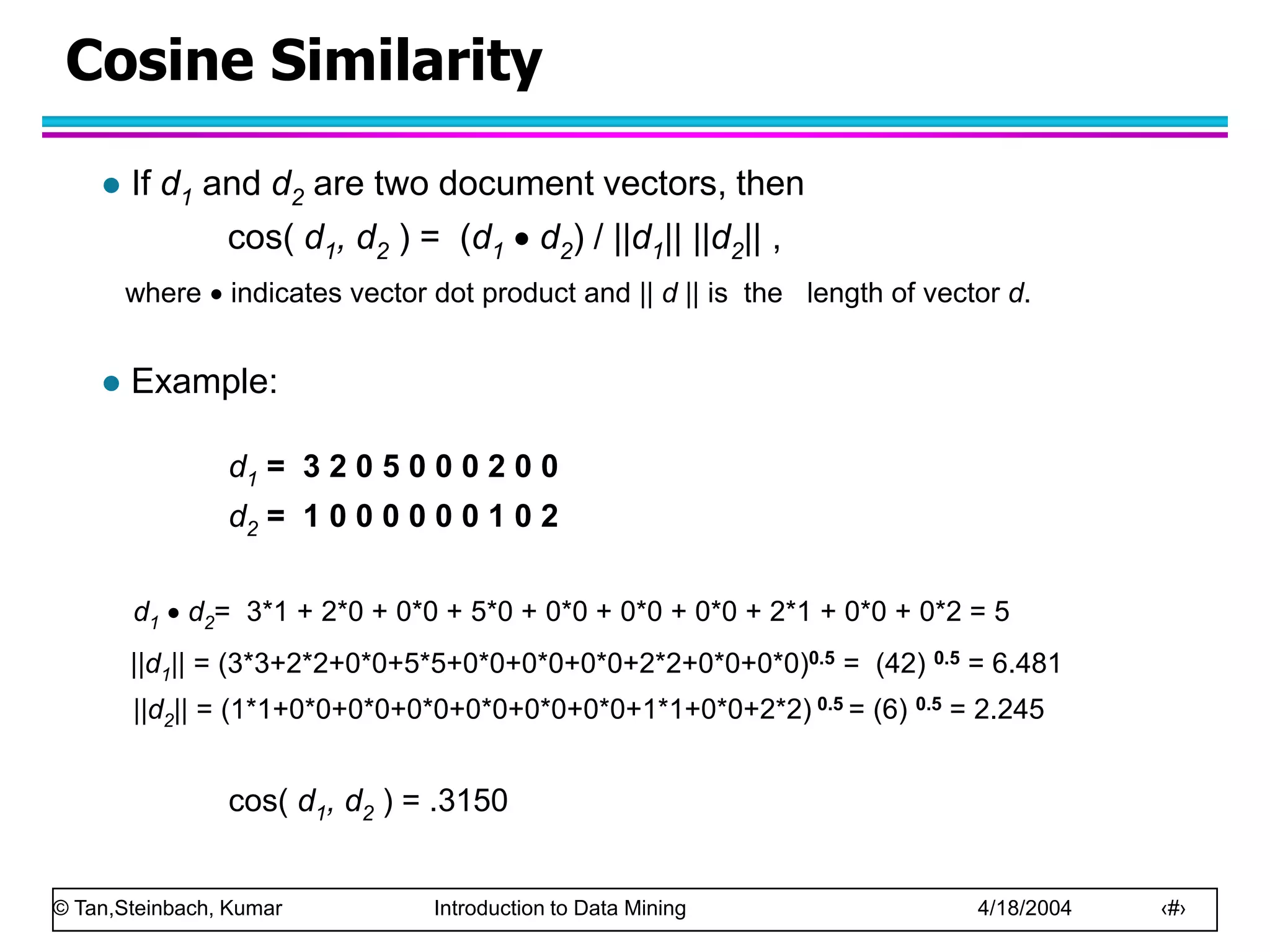
Cosine Similarity
 If d1 and d2 are two document vectors, then
cos( d1, d2 ) = (d1  d2) / ||d1|| ||d2|| ,
where  indicates vector dot product and || d || is the length of vector d.
 Example:
d1 = 3 2 0 5 0 0 0 2 0 0
d2 = 1 0 0 0 0 0 0 1 0 2
d1  d2= 3*1 + 2*0 + 0*0 + 5*0 + 0*0 + 0*0 + 0*0 + 2*1 + 0*0 + 0*2 = 5
||d1|| = (3*3+2*2+0*0+5*5+0*0+0*0+0*0+2*2+0*0+0*0)0.5 = (42) 0.5 = 6.481
||d2|| = (1*1+0*0+0*0+0*0+0*0+0*0+0*0+1*1+0*0+2*2) 0.5 = (6) 0.5 = 2.245
cos( d1, d2 ) = .3150
© Tan,Steinbach, Kumar Introduction to Data Mining 4/18/2004 ‹#›
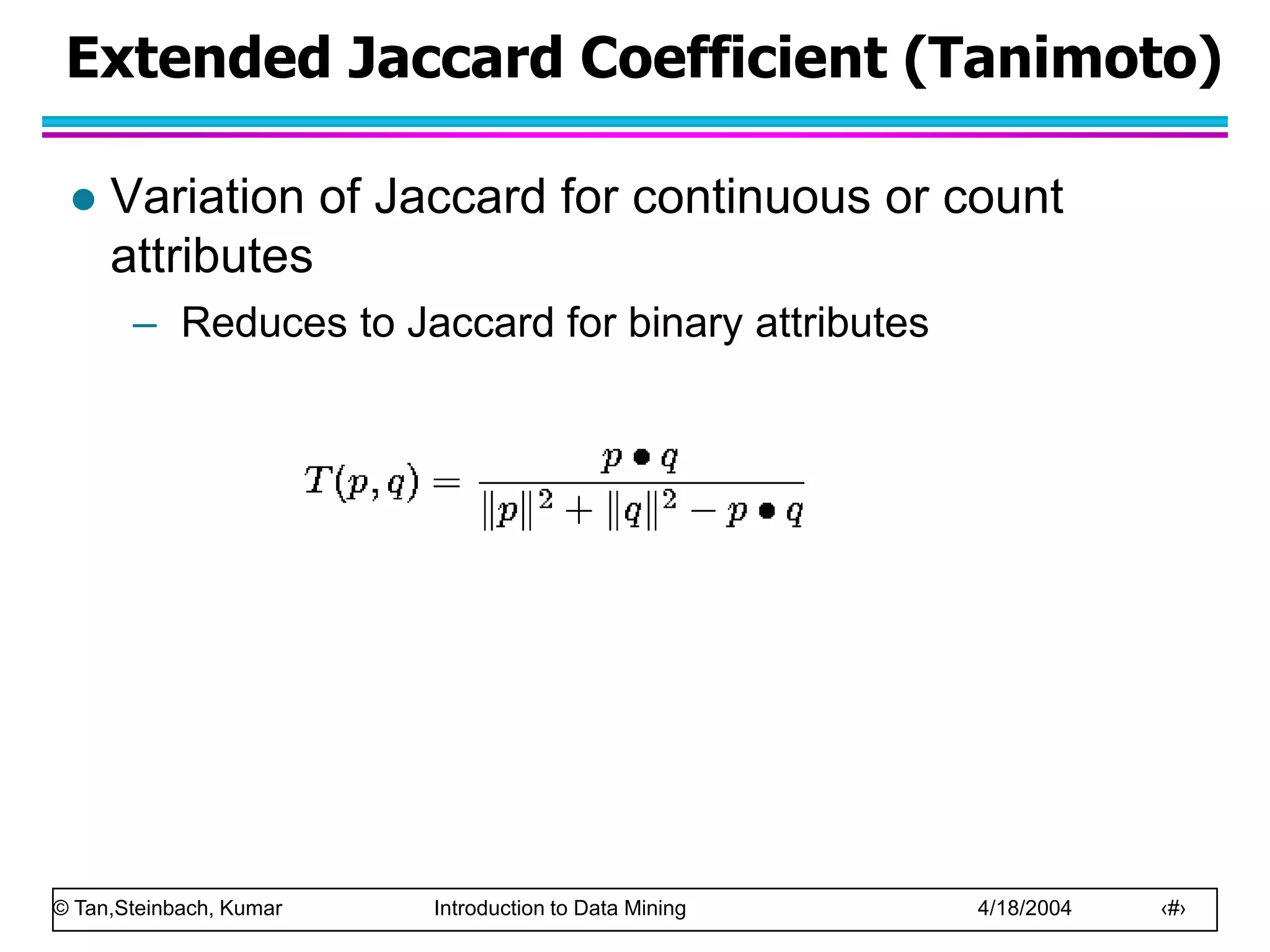
Extended Jaccard Coefficient (Tanimoto)
 Variation of Jaccard for continuous or count
attributes
– Reduces to Jaccard for binary attributes
© Tan,Steinbach, Kumar Introduction to Data Mining 4/18/2004 ‹#›
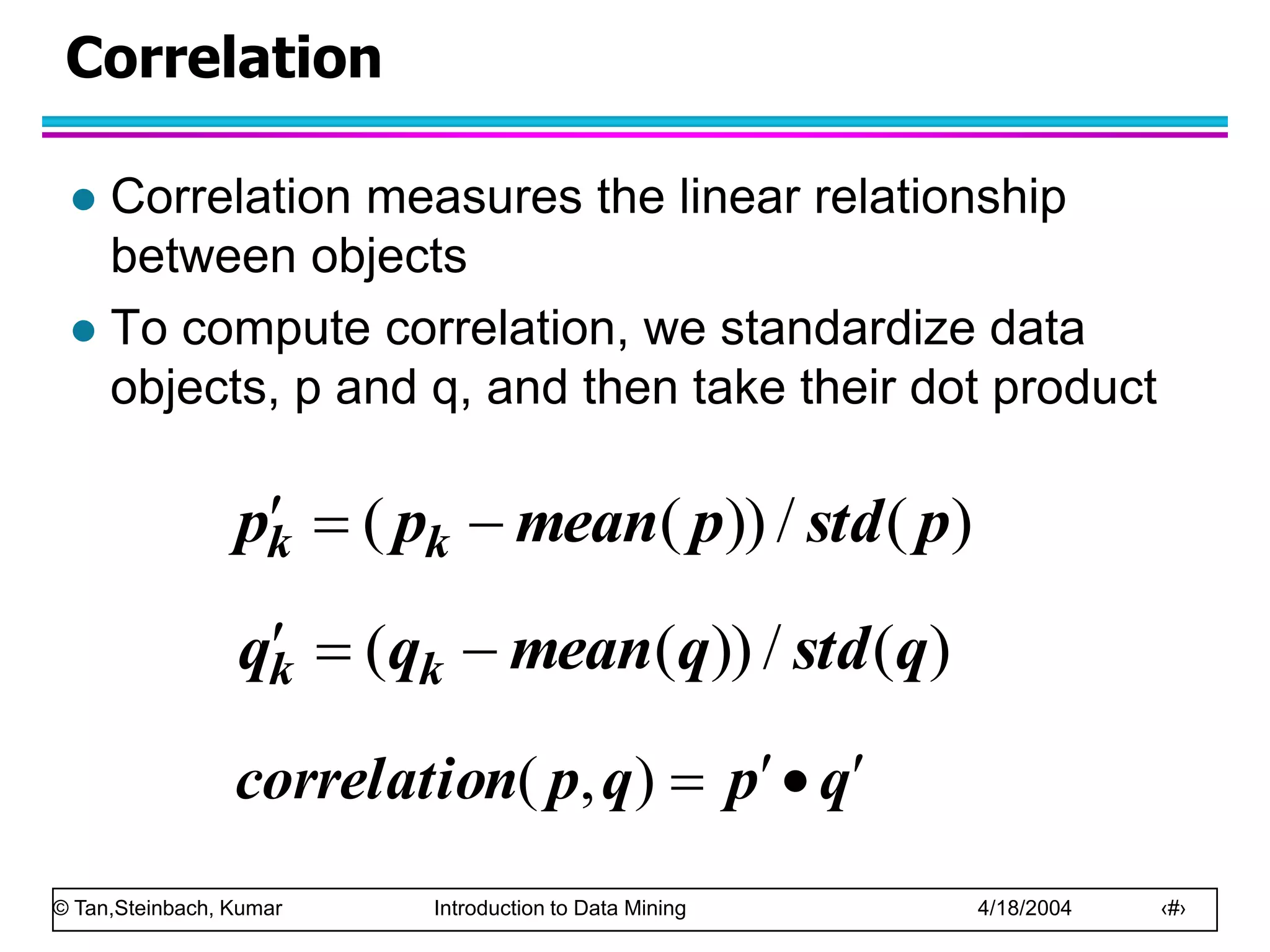
Correlation
 Correlation measures the linear relationship
between objects
 To compute correlation, we standardize data
objects, p and q, and then take their dot product
)
(
/
))
(
( p
std
p
mean
p
p k
k 


)
(
/
))
(
( q
std
q
mean
q
q k
k 


q
p
q
p
n
correlatio 



)
,
(
© Tan,Steinbach, Kumar Introduction to Data Mining 4/18/2004 ‹#›
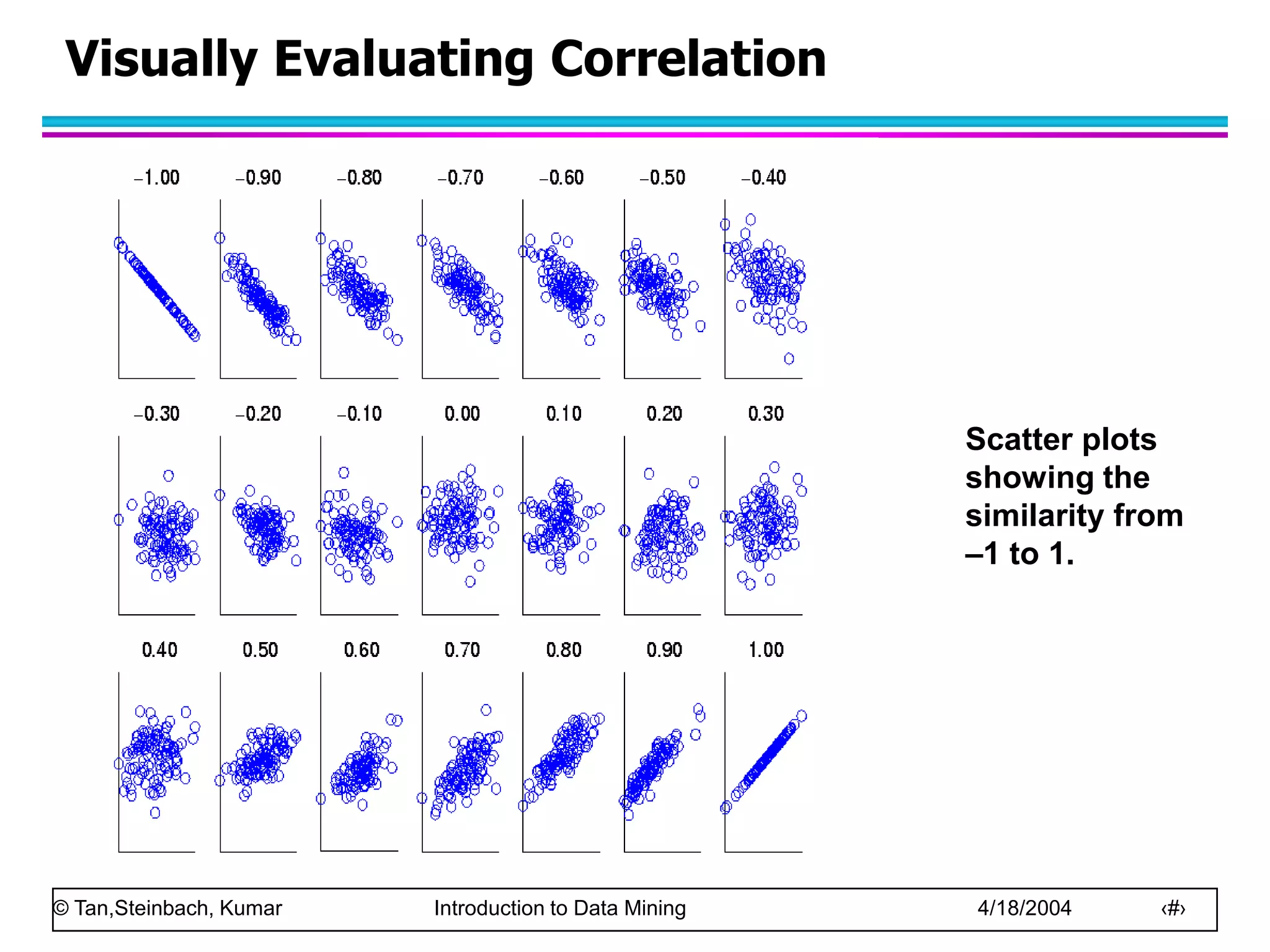
Visually Evaluating Correlation
Scatter plots
showing the
similarity from
–1 to 1.
© Tan,Steinbach, Kumar Introduction to Data Mining 4/18/2004 ‹#›
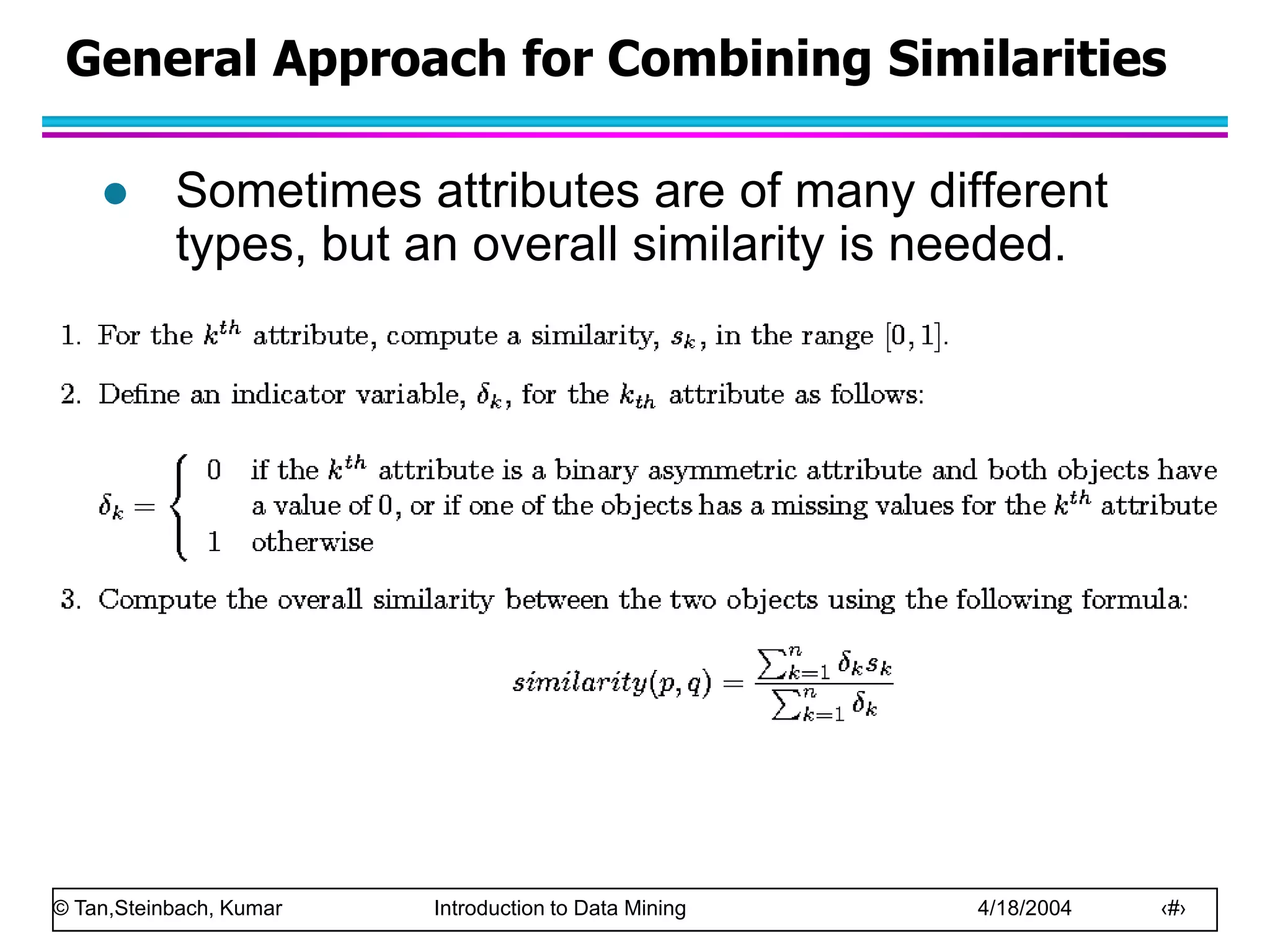
General Approach for Combining Similarities
 Sometimes attributes are of many different
types, but an overall similarity is needed.
© Tan,Steinbach, Kumar Introduction to Data Mining 4/18/2004 ‹#›
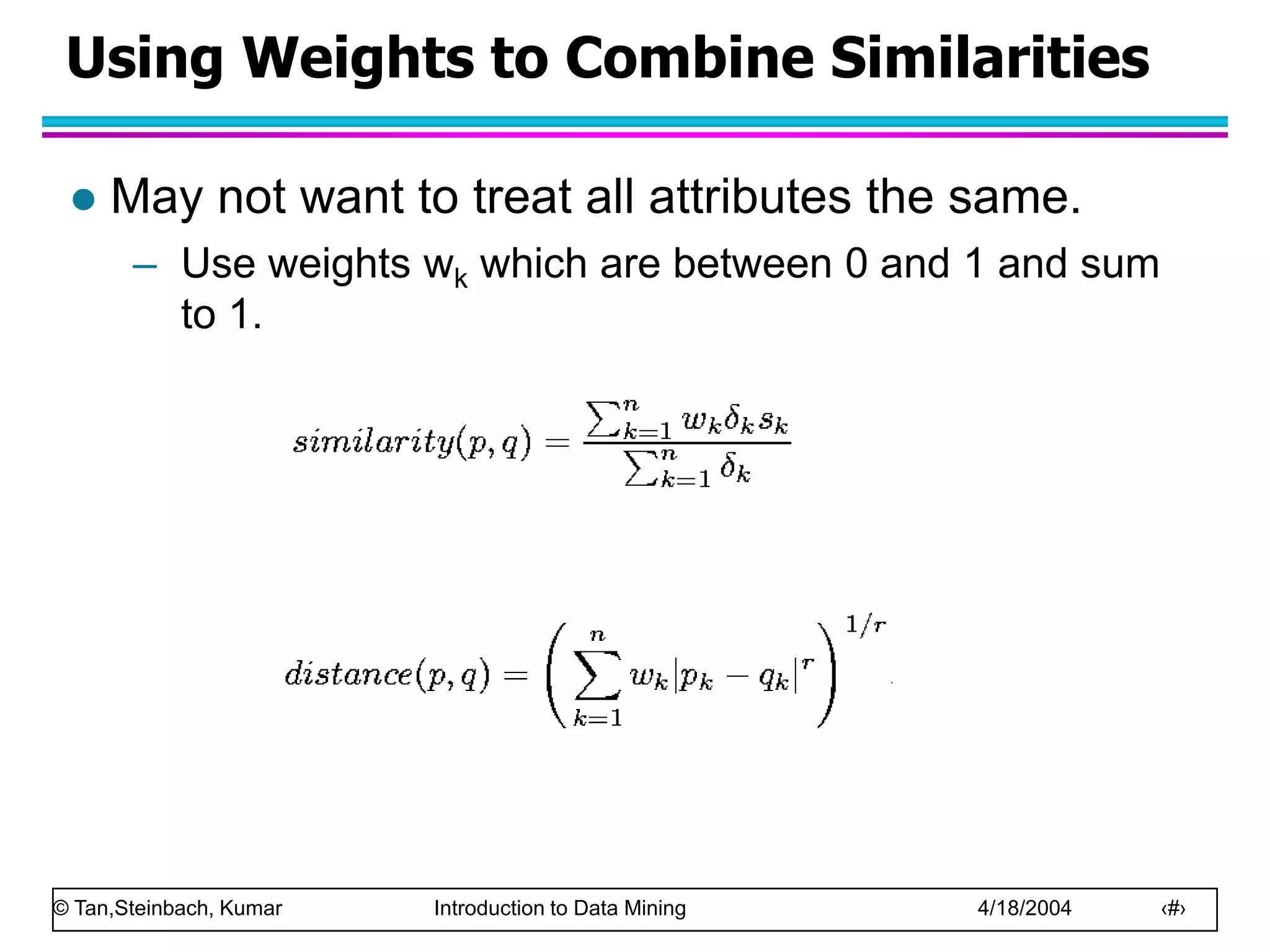
Using Weights to Combine Similarities
 May not want to treat all attributes the same.
– Use weights wk which are between 0 and 1 and sum
to 1.
© Tan,Steinbach, Kumar Introduction to Data Mining 4/18/2004 ‹#›
WEKA Filters
 1- ReplaceMissingValues.
 AddExpression
 Resample
 NominalToBinary
 Discritize (Equal width)
 PKIDiscritize (Equal Frequency)
 Standardize or Center  Mean=0, Std=1
 Normalize  [0,1]

chap2_data.ppt

  • 1.
    © Tan,Steinbach, KumarIntroduction to Data Mining 4/18/2004 ‹#› Data Mining: Data Lecture Notes for Chapter 2 Introduction to Data Mining by Tan, Steinbach, Kumar
  • 2.
    © Tan,Steinbach, KumarIntroduction to Data Mining 4/18/2004 ‹#› What is Data?  Collection of data objects and their attributes  An attribute is a property or characteristic of an object – Examples: eye color of a person, temperature, etc. – Attribute is also known as variable, field, characteristic, or feature  A collection of attributes describe an object – Object is also known as record, point, case, sample, entity, or instance Tid Refund Marital Status Taxable Income Cheat 1 Yes Single 125K No 2 No Married 100K No 3 No Single 70K No 4 Yes Married 120K No 5 No Divorced 95K Yes 6 No Married 60K No 7 Yes Divorced 220K No 8 No Single 85K Yes 9 No Married 75K No 10 No Single 90K Yes 10 Attributes Objects
  • 3.
    © Tan,Steinbach, KumarIntroduction to Data Mining 4/18/2004 ‹#› Attribute Values  Attribute values are numbers or symbols assigned to an attribute  Distinction between attributes and attribute values – Same attribute can be mapped to different attribute values  Example: height can be measured in feet or meters – Different attributes can be mapped to the same set of values  Example: Attribute values for ID and age are integers  But properties of attribute values can be different – ID has no limit but age has a maximum and minimum value
  • 4.
    © Tan,Steinbach, KumarIntroduction to Data Mining 4/18/2004 ‹#› Measurement of Length  The way you measure an attribute is somewhat may not match the attributes properties. 1 2 3 5 5 7 8 15 10 4 A B C D E
  • 5.
    © Tan,Steinbach, KumarIntroduction to Data Mining 4/18/2004 ‹#› Types of Attributes  There are different types of attributes – Nominal  Examples: ID numbers, eye color, zip codes – Ordinal  Examples: rankings (e.g., taste of potato chips on a scale from 1-10), grades, height in {tall, medium, short} – Interval  Examples: calendar dates, temperatures in Celsius or Fahrenheit. – Ratio  Examples: temperature in Kelvin, length, time, counts
  • 6.
    © Tan,Steinbach, KumarIntroduction to Data Mining 4/18/2004 ‹#› Properties of Attribute Values  The type of an attribute depends on which of the following properties it possesses: – Distinctness: =  – Order: < > – Addition: + - – Multiplication: * / – Nominal attribute: distinctness – Ordinal attribute: distinctness & order – Interval attribute: distinctness, order & addition – Ratio attribute: all 4 properties
  • 7.
    Attribute Type Description Examples Operations NominalThe values of a nominal attribute are just different names, i.e., nominal attributes provide only enough information to distinguish one object from another. (=, ) zip codes, employee ID numbers, eye color, sex: {male, female} mode, entropy, contingency correlation, 2 test Ordinal The values of an ordinal attribute provide enough information to order objects. (<, >) hardness of minerals, {good, better, best}, grades, street numbers median, percentiles, rank correlation, run tests, sign tests Interval For interval attributes, the differences between values are meaningful, i.e., a unit of measurement exists. (+, - ) calendar dates, temperature in Celsius or Fahrenheit mean, standard deviation, Pearson's correlation, t and F tests Ratio For ratio variables, both differences and ratios are meaningful. (*, /) temperature in Kelvin, monetary quantities, counts, age, mass, length, electrical current geometric mean, harmonic mean, percent variation
  • 8.
    Attribute Level Transformation Comments Nominal Anypermutation of values If all employee ID numbers were reassigned, would it make any difference? Ordinal An order preserving change of values, i.e., new_value = f(old_value) where f is a monotonic function. An attribute encompassing the notion of good, better best can be represented equally well by the values {1, 2, 3} or by { 0.5, 1, 10}. Interval new_value =a * old_value + b where a and b are constants Thus, the Fahrenheit and Celsius temperature scales differ in terms of where their zero value is and the size of a unit (degree). Ratio new_value = a * old_value Length can be measured in meters or feet.
  • 9.
    © Tan,Steinbach, KumarIntroduction to Data Mining 4/18/2004 ‹#› Discrete and Continuous Attributes  Discrete Attribute – Has only a finite or countably infinite set of values – Examples: zip codes, counts, or the set of words in a collection of documents – Often represented as integer variables. – Note: binary attributes are a special case of discrete attributes  Continuous Attribute – Has real numbers as attribute values – Examples: temperature, height, or weight. – Practically, real values can only be measured and represented using a finite number of digits. – Continuous attributes are typically represented as floating-point variables.
  • 10.
    © Tan,Steinbach, KumarIntroduction to Data Mining 4/18/2004 ‹#› Types of data sets  Record – Data Matrix – Document Data – Transaction Data  Graph – World Wide Web – Molecular Structures  Ordered – Spatial Data – Temporal Data – Sequential Data – Genetic Sequence Data
  • 11.
    © Tan,Steinbach, KumarIntroduction to Data Mining 4/18/2004 ‹#› Important Characteristics of Structured Data – Dimensionality  Curse of Dimensionality – Sparsity  Only presence counts – Resolution  Patterns depend on the scale
  • 12.
    © Tan,Steinbach, KumarIntroduction to Data Mining 4/18/2004 ‹#› Record Data  Data that consists of a collection of records, each of which consists of a fixed set of attributes Tid Refund Marital Status Taxable Income Cheat 1 Yes Single 125K No 2 No Married 100K No 3 No Single 70K No 4 Yes Married 120K No 5 No Divorced 95K Yes 6 No Married 60K No 7 Yes Divorced 220K No 8 No Single 85K Yes 9 No Married 75K No 10 No Single 90K Yes 10
  • 13.
    © Tan,Steinbach, KumarIntroduction to Data Mining 4/18/2004 ‹#› Data Matrix  If data objects have the same fixed set of numeric attributes, then the data objects can be thought of as points in a multi-dimensional space, where each dimension represents a distinct attribute  Such data set can be represented by an m by n matrix, where there are m rows, one for each object, and n columns, one for each attribute 1.1 2.2 16.22 6.25 12.65 1.2 2.7 15.22 5.27 10.23 Thickness Load Distance Projection of y load Projection of x Load 1.1 2.2 16.22 6.25 12.65 1.2 2.7 15.22 5.27 10.23 Thickness Load Distance Projection of y load Projection of x Load
  • 14.
    © Tan,Steinbach, KumarIntroduction to Data Mining 4/18/2004 ‹#› Document Data  Each document becomes a `term' vector, – each term is a component (attribute) of the vector, – the value of each component is the number of times the corresponding term occurs in the document. Document 1 season timeout lost wi n game score ball pla y coach team Document 2 Document 3 3 0 5 0 2 6 0 2 0 2 0 0 7 0 2 1 0 0 3 0 0 1 0 0 1 2 2 0 3 0
  • 15.
    © Tan,Steinbach, KumarIntroduction to Data Mining 4/18/2004 ‹#› Transaction Data  A special type of record data, where – each record (transaction) involves a set of items. – For example, consider a grocery store. The set of products purchased by a customer during one shopping trip constitute a transaction, while the individual products that were purchased are the items. TID Items 1 Bread, Coke, Milk 2 Beer, Bread 3 Beer, Coke, Diaper, Milk 4 Beer, Bread, Diaper, Milk 5 Coke, Diaper, Milk
  • 16.
    © Tan,Steinbach, KumarIntroduction to Data Mining 4/18/2004 ‹#› Graph Data  Examples: Generic graph and HTML Links 5 2 1 2 5 <a href="papers/papers.html#bbbb"> Data Mining </a> <li> <a href="papers/papers.html#aaaa"> Graph Partitioning </a> <li> <a href="papers/papers.html#aaaa"> Parallel Solution of Sparse Linear System of Equations </a> <li> <a href="papers/papers.html#ffff"> N-Body Computation and Dense Linear System Solvers
  • 17.
    © Tan,Steinbach, KumarIntroduction to Data Mining 4/18/2004 ‹#› Chemical Data  Benzene Molecule: C6H6
  • 18.
    © Tan,Steinbach, KumarIntroduction to Data Mining 4/18/2004 ‹#› Ordered Data  Sequences of transactions An element of the sequence Items/Events
  • 19.
    © Tan,Steinbach, KumarIntroduction to Data Mining 4/18/2004 ‹#› Ordered Data  Genomic sequence data GGTTCCGCCTTCAGCCCCGCGCC CGCAGGGCCCGCCCCGCGCCGTC GAGAAGGGCCCGCCTGGCGGGCG GGGGGAGGCGGGGCCGCCCGAGC CCAACCGAGTCCGACCAGGTGCC CCCTCTGCTCGGCCTAGACCTGA GCTCATTAGGCGGCAGCGGACAG GCCAAGTAGAACACGCGAAGCGC TGGGCTGCCTGCTGCGACCAGGG
  • 20.
    © Tan,Steinbach, KumarIntroduction to Data Mining 4/18/2004 ‹#› Ordered Data  Spatio-Temporal Data Average Monthly Temperature of land and ocean
  • 21.
    © Tan,Steinbach, KumarIntroduction to Data Mining 4/18/2004 ‹#› Data Quality  What kinds of data quality problems?  How can we detect problems with the data?  What can we do about these problems?  Examples of data quality problems: – Noise and outliers – missing values – duplicate data
  • 22.
    © Tan,Steinbach, KumarIntroduction to Data Mining 4/18/2004 ‹#› Noise  Noise refers to modification of original values – Examples: distortion of a person’s voice when talking on a poor phone and “snow” on television screen Two Sine Waves Two Sine Waves + Noise
  • 23.
    © Tan,Steinbach, KumarIntroduction to Data Mining 4/18/2004 ‹#› Outliers  Outliers are data objects with characteristics that are considerably different than most of the other data objects in the data set
  • 24.
    © Tan,Steinbach, KumarIntroduction to Data Mining 4/18/2004 ‹#› Missing Values  Reasons for missing values – Information is not collected (e.g., people decline to give their age and weight) – Attributes may not be applicable to all cases (e.g., annual income is not applicable to children)  Handling missing values – Eliminate Data Objects – Estimate Missing Values – Ignore the Missing Value During Analysis – Replace with all possible values (weighted by their probabilities)
  • 25.
    © Tan,Steinbach, KumarIntroduction to Data Mining 4/18/2004 ‹#› Duplicate Data  Data set may include data objects that are duplicates, or almost duplicates of one another – Major issue when merging data from heterogeous sources  Examples: – Same person with multiple email addresses  Data cleaning – Process of dealing with duplicate data issues
  • 26.
    © Tan,Steinbach, KumarIntroduction to Data Mining 4/18/2004 ‹#› Data Preprocessing  Aggregation  Sampling  Dimensionality Reduction  Feature subset selection  Feature creation  Discretization and Binarization  Attribute Transformation
  • 27.
    © Tan,Steinbach, KumarIntroduction to Data Mining 4/18/2004 ‹#› Aggregation  Combining two or more attributes (or objects) into a single attribute (or object)  Purpose – Data reduction  Reduce the number of attributes or objects – Change of scale  Cities aggregated into regions, states, countries, etc – More “stable” data  Aggregated data tends to have less variability
  • 28.
    © Tan,Steinbach, KumarIntroduction to Data Mining 4/18/2004 ‹#› Aggregation Standard Deviation of Average Monthly Precipitation Standard Deviation of Average Yearly Precipitation Variation of Precipitation in Australia
  • 29.
    © Tan,Steinbach, KumarIntroduction to Data Mining 4/18/2004 ‹#› Sampling  Sampling is the main technique employed for data selection. – It is often used for both the preliminary investigation of the data and the final data analysis.  Statisticians sample because obtaining the entire set of data of interest is too expensive or time consuming.  Sampling is used in data mining because processing the entire set of data of interest is too expensive or time consuming.
  • 30.
    © Tan,Steinbach, KumarIntroduction to Data Mining 4/18/2004 ‹#› Sampling …  The key principle for effective sampling is the following: – using a sample will work almost as well as using the entire data sets, if the sample is representative – A sample is representative if it has approximately the same property (of interest) as the original set of data
  • 31.
    © Tan,Steinbach, KumarIntroduction to Data Mining 4/18/2004 ‹#› Types of Sampling  Simple Random Sampling – There is an equal probability of selecting any particular item  Sampling without replacement – As each item is selected, it is removed from the population  Sampling with replacement – Objects are not removed from the population as they are selected for the sample.  In sampling with replacement, the same object can be picked up more than once  Stratified sampling – Split the data into several partitions; then draw random samples from each partition
  • 32.
    © Tan,Steinbach, KumarIntroduction to Data Mining 4/18/2004 ‹#› Sample Size 8000 points 2000 Points 500 Points
  • 33.
    © Tan,Steinbach, KumarIntroduction to Data Mining 4/18/2004 ‹#› Sample Size  What sample size is necessary to get at least one object from each of 10 groups.
  • 34.
    © Tan,Steinbach, KumarIntroduction to Data Mining 4/18/2004 ‹#› Curse of Dimensionality  When dimensionality increases, data becomes increasingly sparse in the space that it occupies  Definitions of density and distance between points, which is critical for clustering and outlier detection, become less meaningful • Randomly generate 500 points • Compute difference between max and min distance between any pair of points
  • 35.
    © Tan,Steinbach, KumarIntroduction to Data Mining 4/18/2004 ‹#› Dimensionality Reduction  Purpose: – Avoid curse of dimensionality – Reduce amount of time and memory required by data mining algorithms – Allow data to be more easily visualized – May help to eliminate irrelevant features or reduce noise  Techniques – Principle Component Analysis – Singular Value Decomposition – Others: supervised and non-linear techniques
  • 36.
    © Tan,Steinbach, KumarIntroduction to Data Mining 4/18/2004 ‹#› Dimensionality Reduction: PCA  Goal is to find a projection that captures the largest amount of variation in data x2 x1 e
  • 37.
    © Tan,Steinbach, KumarIntroduction to Data Mining 4/18/2004 ‹#› Dimensionality Reduction: PCA  Find the eigenvectors of the covariance matrix  The eigenvectors define the new space x2 x1 e
  • 38.
    © Tan,Steinbach, KumarIntroduction to Data Mining 4/18/2004 ‹#› Dimensionality Reduction: ISOMAP  Construct a neighbourhood graph  For each pair of points in the graph, compute the shortest path distances – geodesic distances By: Tenenbaum, de Silva, Langford (2000)
  • 39.
    © Tan,Steinbach, KumarIntroduction to Data Mining 4/18/2004 ‹#› Dimensions = 10 Dimensions = 40 Dimensions = 80 Dimensions = 120 Dimensions = 160 Dimensions = 206 Dimensionality Reduction: PCA
  • 40.
    © Tan,Steinbach, KumarIntroduction to Data Mining 4/18/2004 ‹#› Feature Subset Selection  Another way to reduce dimensionality of data  Redundant features – duplicate much or all of the information contained in one or more other attributes – Example: purchase price of a product and the amount of sales tax paid  Irrelevant features – contain no information that is useful for the data mining task at hand – Example: students' ID is often irrelevant to the task of predicting students' GPA
  • 41.
    © Tan,Steinbach, KumarIntroduction to Data Mining 4/18/2004 ‹#› Feature Subset Selection  Techniques: – Brute-force approch: Try all possible feature subsets as input to data mining algorithm – Embedded approaches:  Feature selection occurs naturally as part of the data mining algorithm – Filter approaches:  Features are selected before data mining algorithm is run – Wrapper approaches:  Use the data mining algorithm as a black box to find best subset of attributes
  • 42.
    © Tan,Steinbach, KumarIntroduction to Data Mining 4/18/2004 ‹#› Feature Creation  Create new attributes that can capture the important information in a data set much more efficiently than the original attributes  Three general methodologies: – Feature Extraction  domain-specific – Mapping Data to New Space – Feature Construction  combining features
  • 43.
    © Tan,Steinbach, KumarIntroduction to Data Mining 4/18/2004 ‹#› Discretization Using Class Labels  Entropy based approach 3 categories for both x and y 5 categories for both x and y
  • 44.
    © Tan,Steinbach, KumarIntroduction to Data Mining 4/18/2004 ‹#› Binarization
  • 45.
    © Tan,Steinbach, KumarIntroduction to Data Mining 4/18/2004 ‹#› Discretization Without Using Class Labels Data Equal interval width Equal frequency K-means
  • 46.
    © Tan,Steinbach, KumarIntroduction to Data Mining 4/18/2004 ‹#› Attribute Transformation  A function that maps the entire set of values of a given attribute to a new set of replacement values such that each old value can be identified with one of the new values – Simple functions: xk, log(x), ex, |x| – Standardization and Normalization
  • 47.
    © Tan,Steinbach, KumarIntroduction to Data Mining 4/18/2004 ‹#› Similarity and Dissimilarity  Similarity – Numerical measure of how alike two data objects are. – Is higher when objects are more alike. – Often falls in the range [0,1]  Dissimilarity – Numerical measure of how different are two data objects – Lower when objects are more alike – Minimum dissimilarity is often 0 – Upper limit varies  Proximity refers to a similarity or dissimilarity
  • 48.
    © Tan,Steinbach, KumarIntroduction to Data Mining 4/18/2004 ‹#› Similarity/Dissimilarity for Simple Attributes p and q are the attribute values for two data objects.
  • 49.
    © Tan,Steinbach, KumarIntroduction to Data Mining 4/18/2004 ‹#› Euclidean Distance  Euclidean Distance Where n is the number of dimensions (attributes) and pk and qk are, respectively, the kth attributes (components) or data objects p and q.  Standardization is necessary, if scales differ.     n k k k q p dist 1 2 ) (
  • 50.
    © Tan,Steinbach, KumarIntroduction to Data Mining 4/18/2004 ‹#› Euclidean Distance 0 1 2 3 0 1 2 3 4 5 6 p1 p2 p3 p4 point x y p1 0 2 p2 2 0 p3 3 1 p4 5 1 Distance Matrix p1 p2 p3 p4 p1 0 2.828 3.162 5.099 p2 2.828 0 1.414 3.162 p3 3.162 1.414 0 2 p4 5.099 3.162 2 0
  • 51.
    © Tan,Steinbach, KumarIntroduction to Data Mining 4/18/2004 ‹#› Minkowski Distance  Minkowski Distance is a generalization of Euclidean Distance Where r is a parameter, n is the number of dimensions (attributes) and pk and qk are, respectively, the kth attributes (components) or data objects p and q. r n k r k k q p dist 1 1 ) | | (    
  • 52.
    © Tan,Steinbach, KumarIntroduction to Data Mining 4/18/2004 ‹#› Minkowski Distance: Examples  r = 1. City block (Manhattan, taxicab, L1 norm) distance. – A common example of this is the Hamming distance, which is just the number of bits that are different between two binary vectors  r = 2. Euclidean distance  Do not confuse r with n, i.e., all these distances are defined for all numbers of dimensions.
  • 53.
    © Tan,Steinbach, KumarIntroduction to Data Mining 4/18/2004 ‹#› Minkowski Distance Distance Matrix point x y p1 0 2 p2 2 0 p3 3 1 p4 5 1 L1 p1 p2 p3 p4 p1 0 4 4 6 p2 4 0 2 4 p3 4 2 0 2 p4 6 4 2 0 L2 p1 p2 p3 p4 p1 0 2.828 3.162 5.099 p2 2.828 0 1.414 3.162 p3 3.162 1.414 0 2 p4 5.099 3.162 2 0
  • 54.
    © Tan,Steinbach, KumarIntroduction to Data Mining 4/18/2004 ‹#› Mahalanobis Distance T q p q p q p s mahalanobi ) ( ) ( ) , ( 1      For red points, the Euclidean distance is 14.7, Mahalanobis distance is 6.  is the covariance matrix of the input data X        n i k ik j ij k j X X X X n 1 , ) )( ( 1 1
  • 55.
    © Tan,Steinbach, KumarIntroduction to Data Mining 4/18/2004 ‹#› Mahalanobis Distance Covariance Matrix:         3 . 0 2 . 0 2 . 0 3 . 0 B A C A: (0.5, 0.5) B: (0, 1) C: (1.5, 1.5) Mahal(A,B) = 5 Mahal(A,C) = 4
  • 56.
    © Tan,Steinbach, KumarIntroduction to Data Mining 4/18/2004 ‹#› Common Properties of a Distance  Distances, such as the Euclidean distance, have some well known properties. 1. d(p, q)  0 for all p and q and d(p, q) = 0 only if p = q. (Positive definiteness) 2. d(p, q) = d(q, p) for all p and q. (Symmetry) 3. d(p, r)  d(p, q) + d(q, r) for all points p, q, and r. (Triangle Inequality) where d(p, q) is the distance (dissimilarity) between points (data objects), p and q.  A distance that satisfies these properties is a metric
  • 57.
    © Tan,Steinbach, KumarIntroduction to Data Mining 4/18/2004 ‹#› Common Properties of a Similarity  Similarities, also have some well known properties. 1. s(p, q) = 1 (or maximum similarity) only if p = q. 2. s(p, q) = s(q, p) for all p and q. (Symmetry) where s(p, q) is the similarity between points (data objects), p and q.
  • 58.
    © Tan,Steinbach, KumarIntroduction to Data Mining 4/18/2004 ‹#› Similarity Between Binary Vectors  Common situation is that objects, p and q, have only binary attributes  Compute similarities using the following quantities M01 = the number of attributes where p was 0 and q was 1 M10 = the number of attributes where p was 1 and q was 0 M00 = the number of attributes where p was 0 and q was 0 M11 = the number of attributes where p was 1 and q was 1  Simple Matching and Jaccard Coefficients SMC = number of matches / number of attributes = (M11 + M00) / (M01 + M10 + M11 + M00) J = number of 11 matches / number of not-both-zero attributes values = (M11) / (M01 + M10 + M11)
  • 59.
    © Tan,Steinbach, KumarIntroduction to Data Mining 4/18/2004 ‹#› SMC versus Jaccard: Example p = 1 0 0 0 0 0 0 0 0 0 q = 0 0 0 0 0 0 1 0 0 1 M01 = 2 (the number of attributes where p was 0 and q was 1) M10 = 1 (the number of attributes where p was 1 and q was 0) M00 = 7 (the number of attributes where p was 0 and q was 0) M11 = 0 (the number of attributes where p was 1 and q was 1) SMC = (M11 + M00)/(M01 + M10 + M11 + M00) = (0+7) / (2+1+0+7) = 0.7 J = (M11) / (M01 + M10 + M11) = 0 / (2 + 1 + 0) = 0
  • 60.
    © Tan,Steinbach, KumarIntroduction to Data Mining 4/18/2004 ‹#› Cosine Similarity  If d1 and d2 are two document vectors, then cos( d1, d2 ) = (d1  d2) / ||d1|| ||d2|| , where  indicates vector dot product and || d || is the length of vector d.  Example: d1 = 3 2 0 5 0 0 0 2 0 0 d2 = 1 0 0 0 0 0 0 1 0 2 d1  d2= 3*1 + 2*0 + 0*0 + 5*0 + 0*0 + 0*0 + 0*0 + 2*1 + 0*0 + 0*2 = 5 ||d1|| = (3*3+2*2+0*0+5*5+0*0+0*0+0*0+2*2+0*0+0*0)0.5 = (42) 0.5 = 6.481 ||d2|| = (1*1+0*0+0*0+0*0+0*0+0*0+0*0+1*1+0*0+2*2) 0.5 = (6) 0.5 = 2.245 cos( d1, d2 ) = .3150
  • 61.
    © Tan,Steinbach, KumarIntroduction to Data Mining 4/18/2004 ‹#› Extended Jaccard Coefficient (Tanimoto)  Variation of Jaccard for continuous or count attributes – Reduces to Jaccard for binary attributes
  • 62.
    © Tan,Steinbach, KumarIntroduction to Data Mining 4/18/2004 ‹#› Correlation  Correlation measures the linear relationship between objects  To compute correlation, we standardize data objects, p and q, and then take their dot product ) ( / )) ( ( p std p mean p p k k    ) ( / )) ( ( q std q mean q q k k    q p q p n correlatio     ) , (
  • 63.
    © Tan,Steinbach, KumarIntroduction to Data Mining 4/18/2004 ‹#› Visually Evaluating Correlation Scatter plots showing the similarity from –1 to 1.
  • 64.
    © Tan,Steinbach, KumarIntroduction to Data Mining 4/18/2004 ‹#› General Approach for Combining Similarities  Sometimes attributes are of many different types, but an overall similarity is needed.
  • 65.
    © Tan,Steinbach, KumarIntroduction to Data Mining 4/18/2004 ‹#› Using Weights to Combine Similarities  May not want to treat all attributes the same. – Use weights wk which are between 0 and 1 and sum to 1.
  • 66.
    © Tan,Steinbach, KumarIntroduction to Data Mining 4/18/2004 ‹#› WEKA Filters  1- ReplaceMissingValues.  AddExpression  Resample  NominalToBinary  Discritize (Equal width)  PKIDiscritize (Equal Frequency)  Standardize or Center  Mean=0, Std=1  Normalize  [0,1]