PRESENTED BY:
SaidarshanKapse
Gnm2nd year
March2021
Case presentationon :
Burn…🔥
OBJECTIVE
• Students give comprehensive care to
the patient.
• Students understand the disease
condition,its cause and sign-symptoms
and its complication.
• Student able to write nursing care plan.
• Student understand the drug study.
• Student understand the management of
disease.
STUDENt IDENTIFICATION
DATA
PATIENT
Identification
DATA
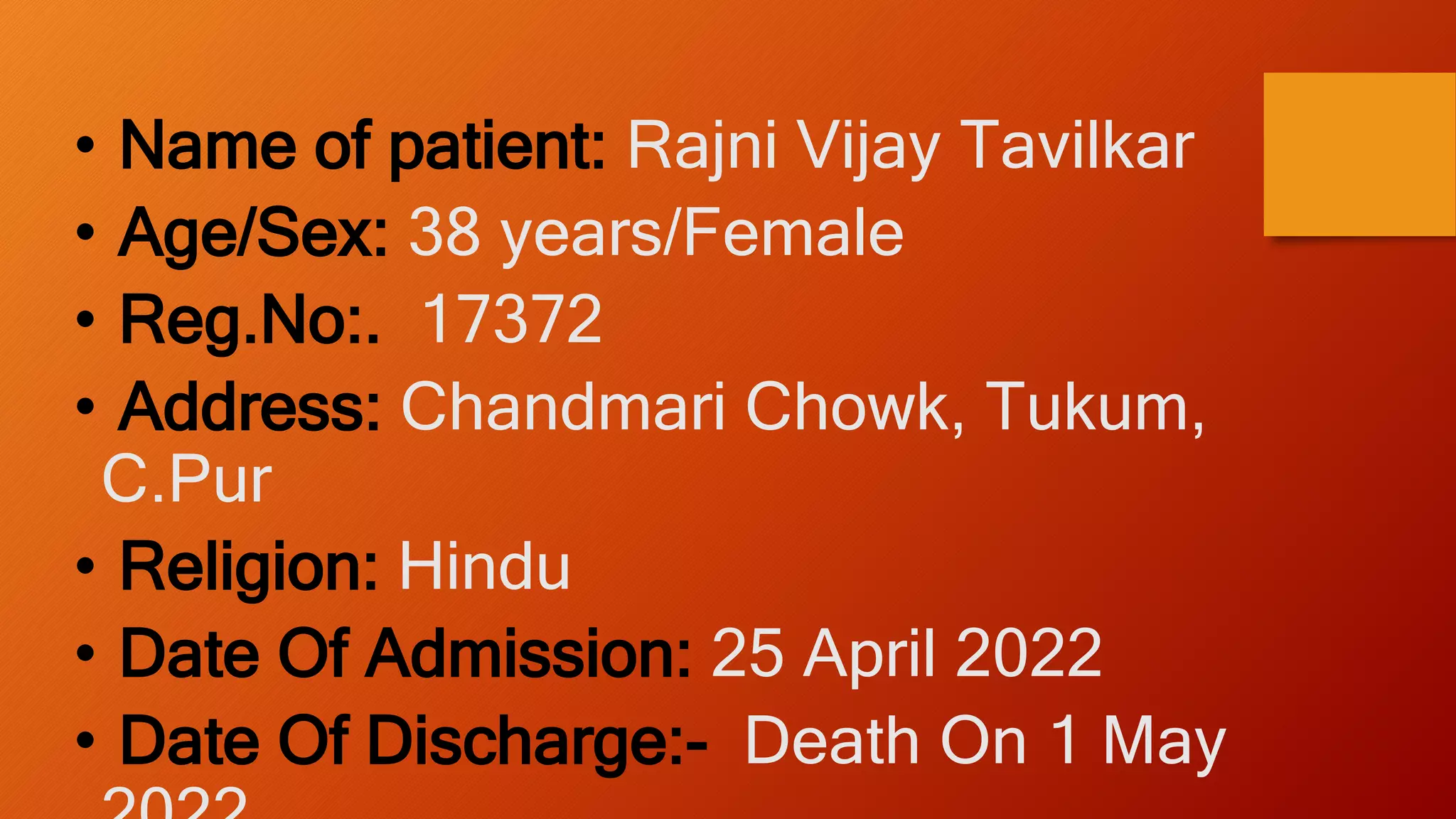
• Name of patient: Rajni Vijay Tavilkar
• Age/Sex: 38 years/Female
• Reg.No:. 17372
• Address: Chandmari Chowk, Tukum,
C.Pur
• Religion: Hindu
• Date Of Admission: 25 April 2022
• Date Of Discharge:- Death On 1 May
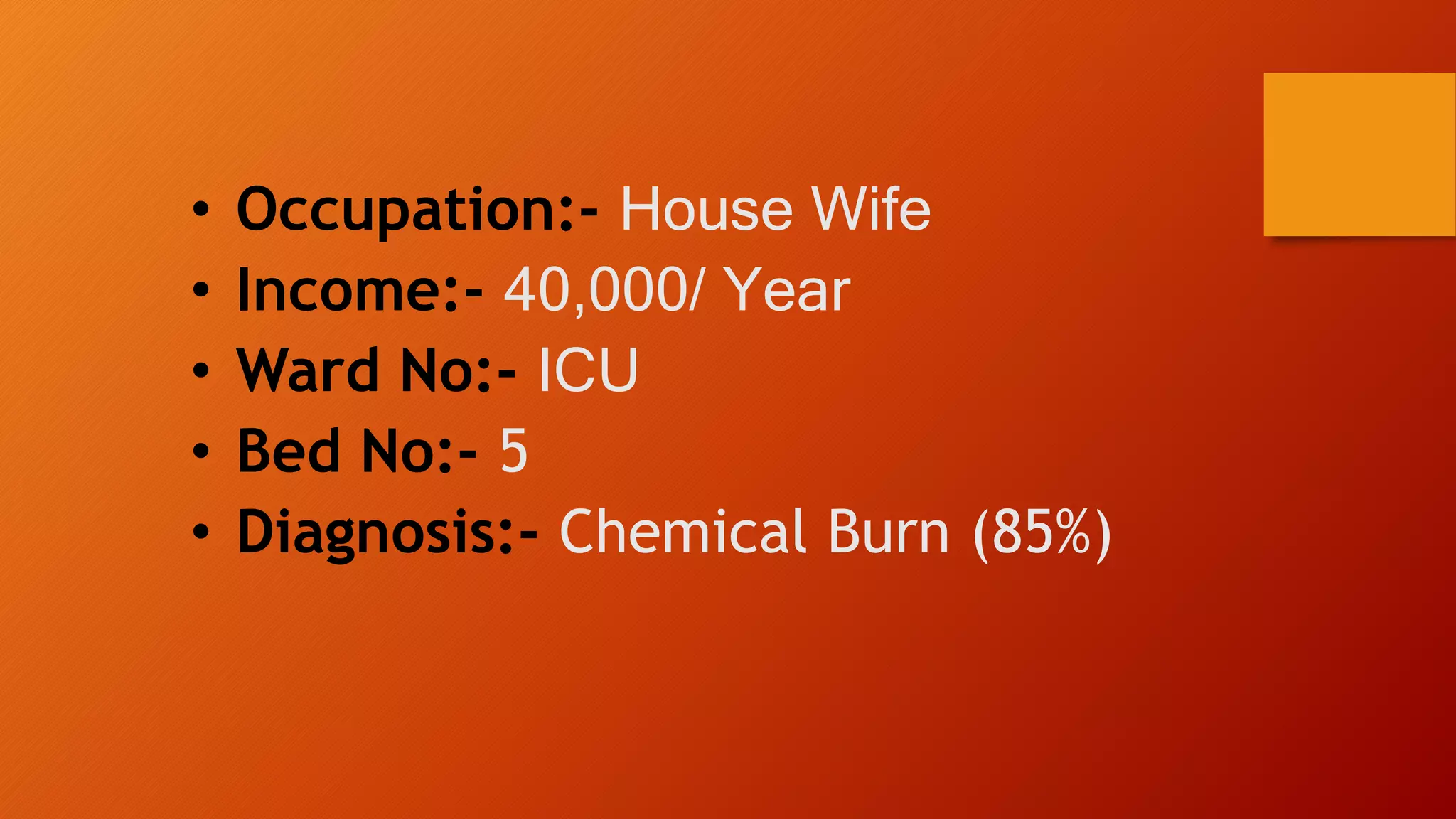
• Occupation:- House Wife
• Income:- 40,000/ Year
• Ward No:- ICU
• Bed No:- 5
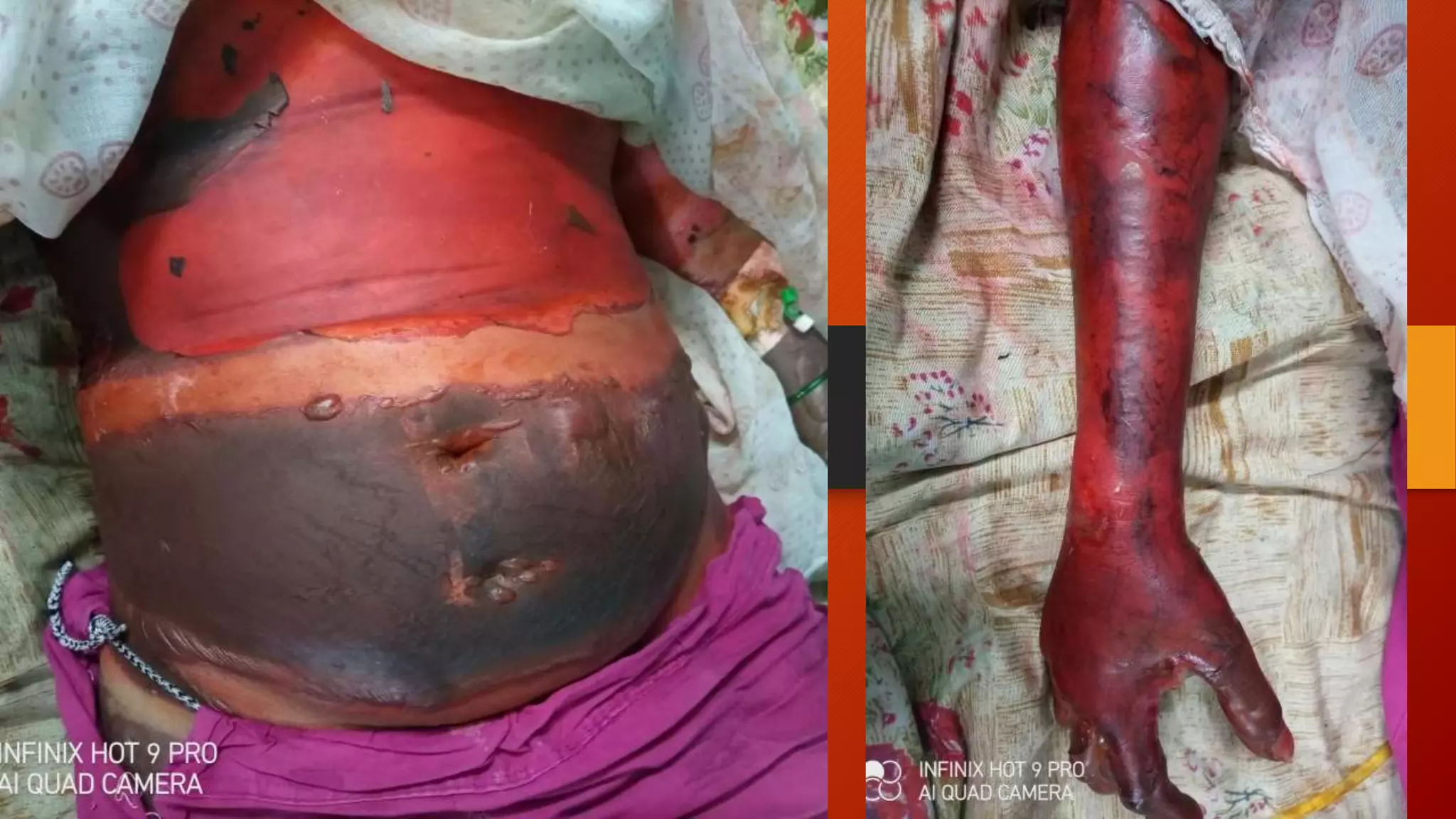
• Diagnosis:- Chemical Burn (85%)
FAMILYHISTORY
• Socio-Economic Status
• Housing Pattern
• Dietary Pattern
• Water Supply
• Sanitation
• Knowledge Of Health And Health Habits
• Religious Belief And Customs
• Likes And Dislikes
Patient medical history
• Past medical history of the patient
• Present medical history
• Past surgical history
• Present surgical history
Physical
examination
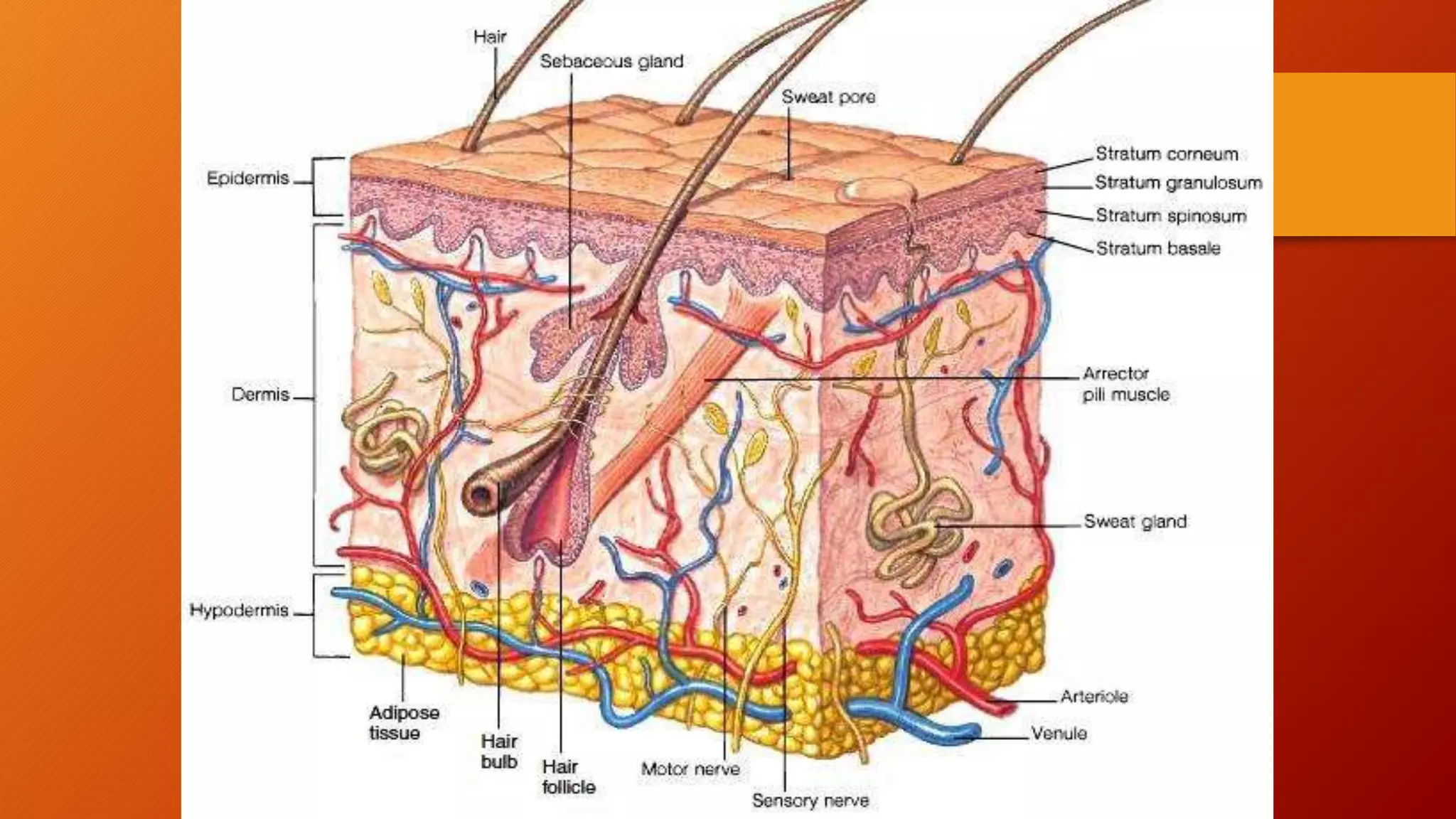
Anatomy
and
physiology
Disease condition
Introduction
•Definition:-
Injuries that result from
direct contact or exposure to any
thermal, chemical, inhalation,
electrical or radiation source are
termed as burns.
• Burn injuries occur when energy from a
heat source is transferred to the tissues of
the body.
• The depth of injury is related to the
temperature and the duration of exposure
or contact.
• Burn care has improved in recent decades,
resulting in a lower mortality for victims of
burn injuries.
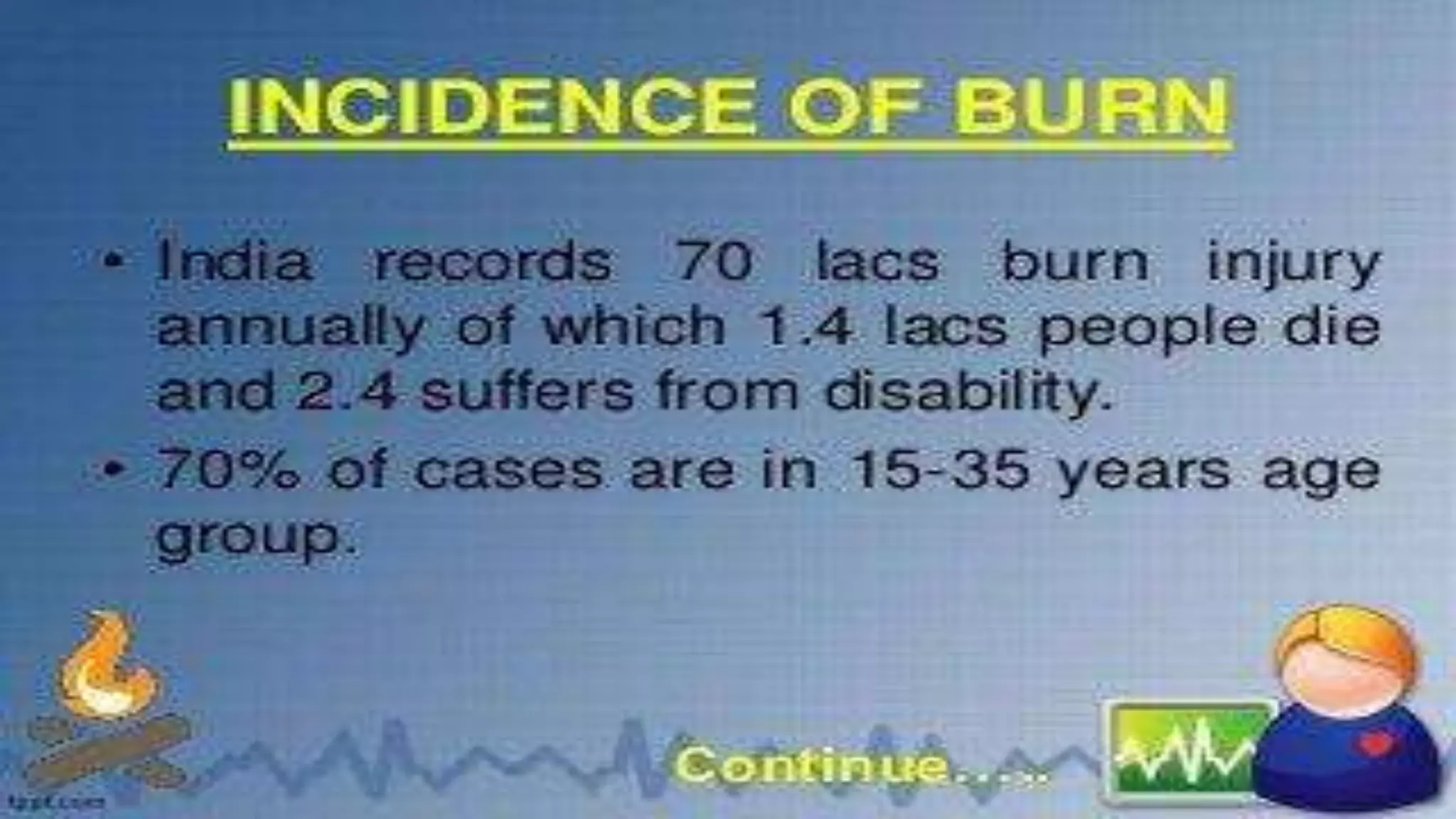
• The estimated annual burn incidence in
India is approximately 6.7 million (60 to 70
lacks/Year).
ETIOLOGY
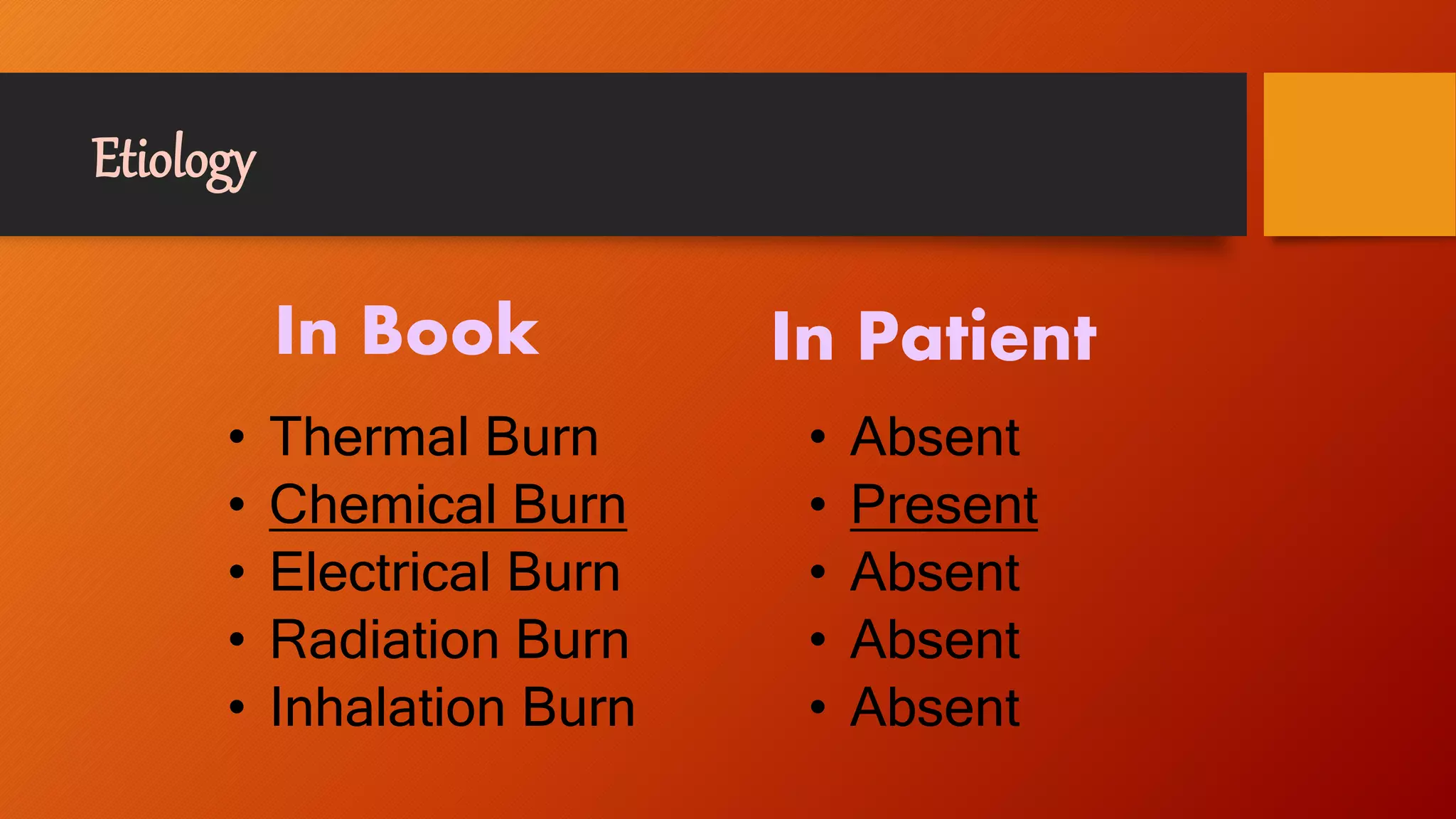
Etiology
In Book
• Thermal Burn
• Chemical Burn
• Electrical Burn
• Radiation Burn
• Inhalation Burn
In Patient
• Absent
• Present
• Absent
• Absent
• Absent
1) Thermal Burn
Thermal burns are caused
by exposure to or contact with
flame, hot liquids, semi-liquids
(e.g- Steam), semi-solids (e.g-
Tar), or hot objects (dry and
moist burns).
Specific examples of thermal
burns are those sustained in
residential fires, explosive automobile
accidents, cooking accidents or with
ignition of poorly store flammable
liquids.
2) Chemical burn
Chemical burns are caused by
contact with strong acids, alkalis, or
organic compounds. The
concentration, volume and type of
chemical, as well as the duration of
contact determine the severity of a
chemical injury.
Chemical burns can result from
contact with certain household cleaning
agents and various chemicals used in
industr,y agriculture and military.
Chemical injuries to the eyes and
inhalation of chemical fumes can be very
serious.
3) Electrical burn
Electrical burn injuries are
caused by heat that is generated
by the electrical energy as it
passes through the body.
Electrical injuries can result from
contact with exposed or faulty
electrical wiring or high voltage
power lines. People struck by
lightning also sustain electrical
The pathway of the current, and
resistance of the tissues as the electrical
current passes through the body.
Contact with electrical current greater
than 40 volts (V) is potentially dangerous
because of cardiac dysrhythmias.
4) RADIATION BURN
Radiation burns are the list common type
of burn injury and are caused by exposure to a
radioactive source. These type of Injuries
have been associated with nuclear radiation
accidents, the use of ionizing radiation in
industry and therapeutic irradation. Sunburn
from prolong exposure to ultraviolet rays (solar
radiation), is also considered to be a radiation
burn.
An acute, localised radiation injury
appear similar to a cutaneous thermal
injury. The injury is characterized by skin
erythma (superficial reddening of the
skin), edema and pain. In contrast, whole
body radiation exposure manifestation
may begin with nausea, vomiting,
diarrhea and fatigue, continue with a
headache and fever within hours of
exposure. As time Proceeds,
hematopoietic and Gastrointestinal
5) INHALATION BURN
Exposure to asphyxiants (e g:-
Carbon monoxide) and smoke
commonly occurs with flame injuries,
particularly if the victim was trapped in
an enclosed, smoke field space (e.g:- In
a residential fire). Victims who die at the
scene of a fire usually do so as a result
of hypoxia and carbon monoxide
poisoning.
Exposure to asphyxiants, smoke
poisoning, and direct thermal (heat)
injury to lung tissue constituate the three
facets of an inhalation injury components
may be present in the client suffering
from an inhalation injury.
Pathophysiology
RISK FACTOR
And
INJURYPRECAUTION
•Age Group:-20-40
• Fire flame occurs more than 60%
• Approximately 30% of all burn related
deaths
• Nations largest cause:- Ignition from
cigarettes
• Alcohol and drug intoxication:- 40%
residential fire death’s
• Clothing ignition during routine meal
preparation.
•Approximately 10% cases caused by
children by playing with matches or other
ignition.
• Scald burns
• Additionally faulty chimneys, flue vents,
wood burning, stoves ignition of wood
Investigation
Investigation
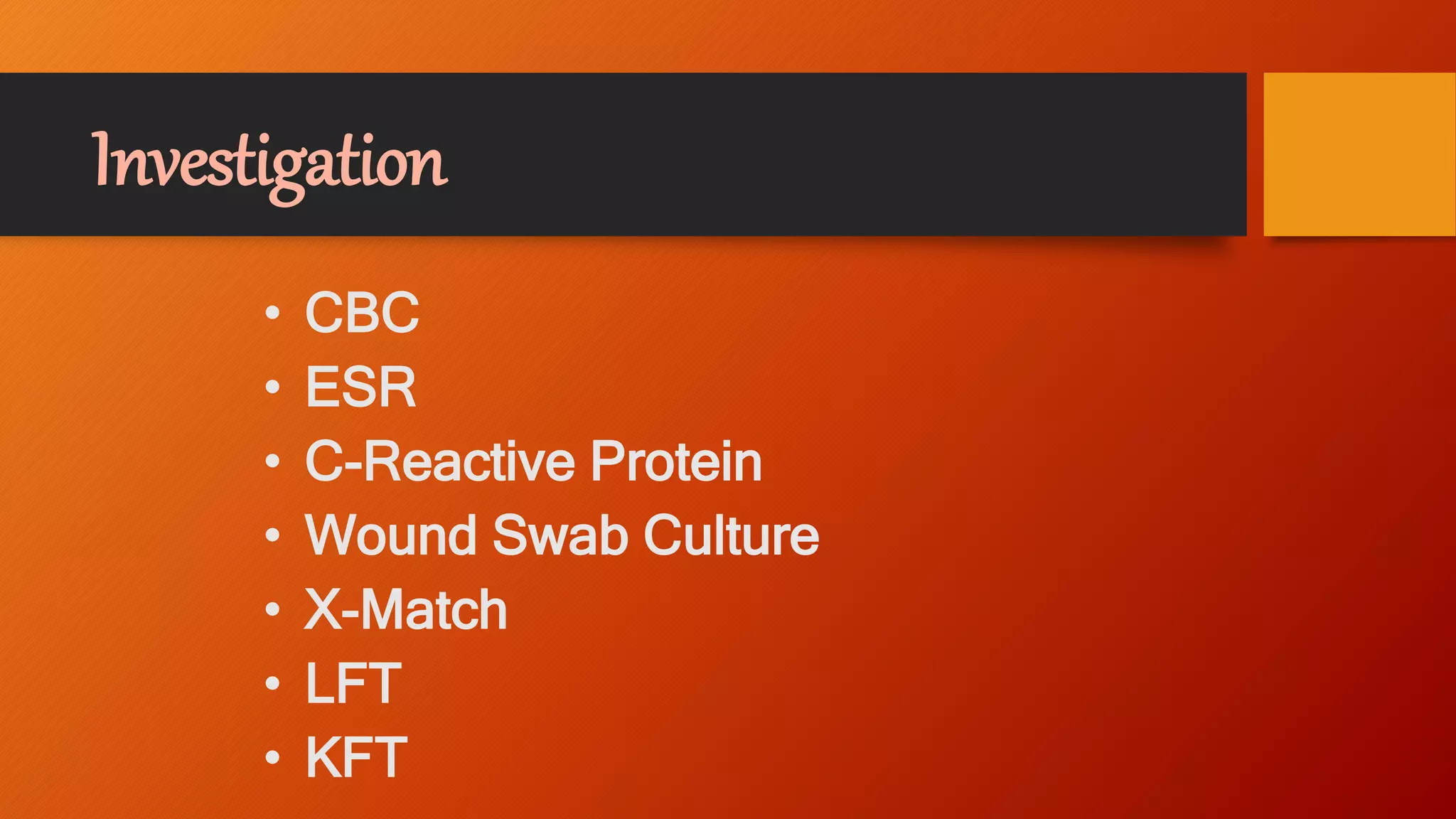
• CBC
• ESR
• C-Reactive Protein
• Wound Swab Culture
• X-Match
• LFT
• KFT
• PCT Levels
• Quantitative Biopcy
• Tissue Histopathology
• Stagging
SIGN AND
SYMPTOMS
In book
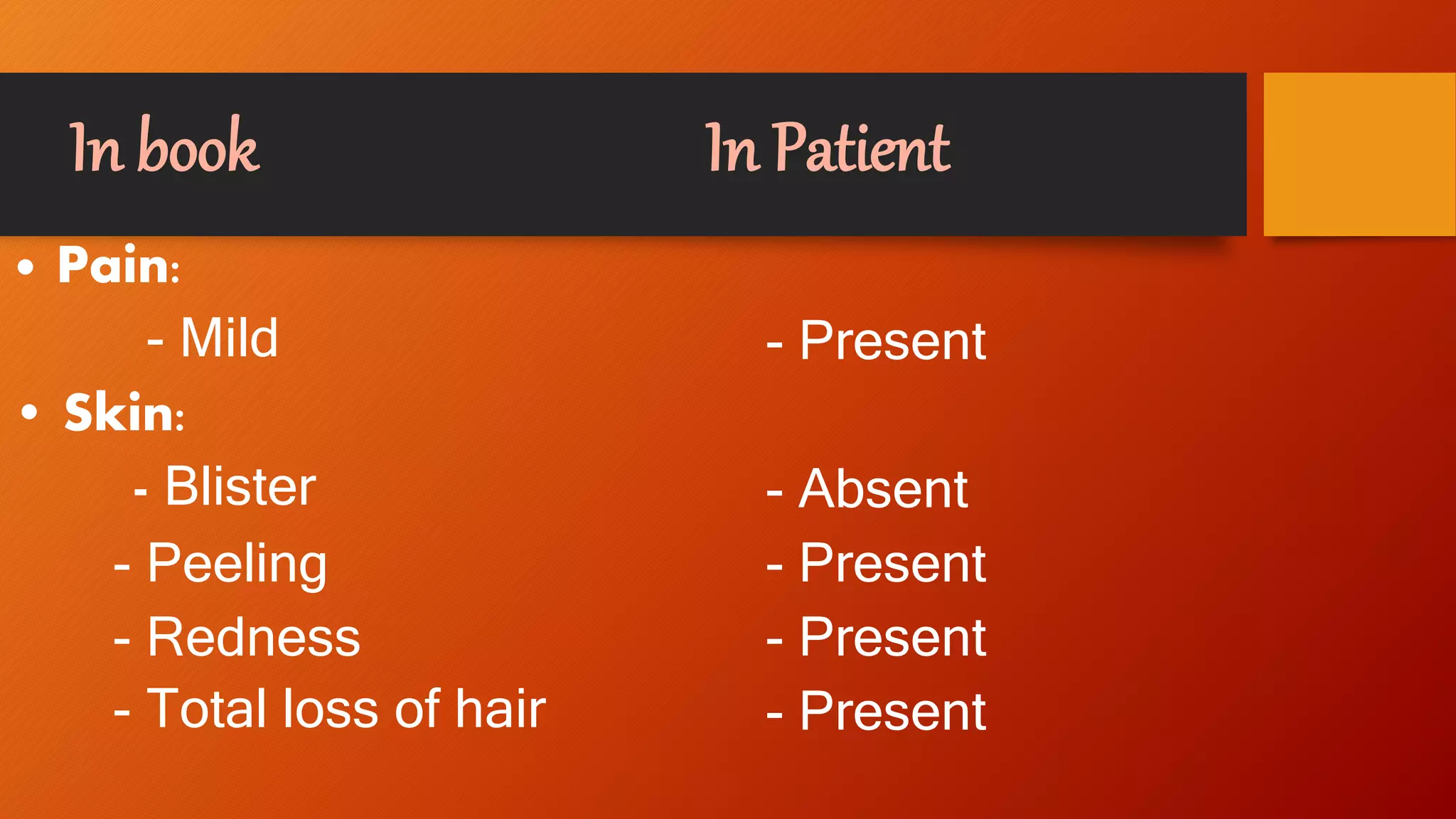
• Pain:
- Mild
• Skin:
- Blister
- Peeling
- Redness
- Total loss of hair
In Patient
- Present
- Absent
- Present
- Present
- Present
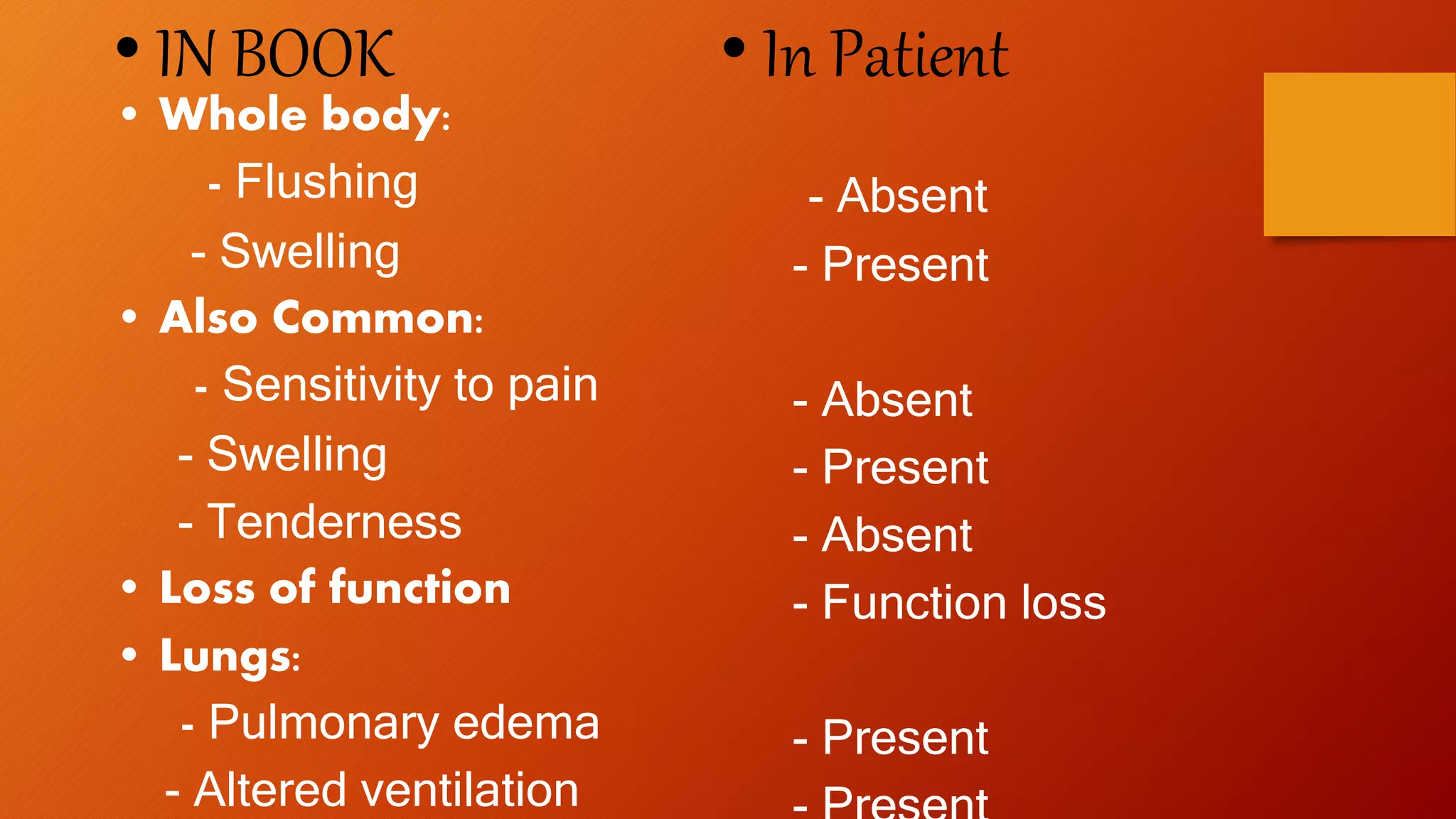
• IN BOOK
• Whole body:
- Flushing
- Swelling
• Also Common:
- Sensitivity to pain
- Swelling
- Tenderness
• Loss of function
• Lungs:
- Pulmonary edema
- Altered ventilation
• In Patient
- Absent
- Present
- Absent
- Present
- Absent
- Function loss
- Present
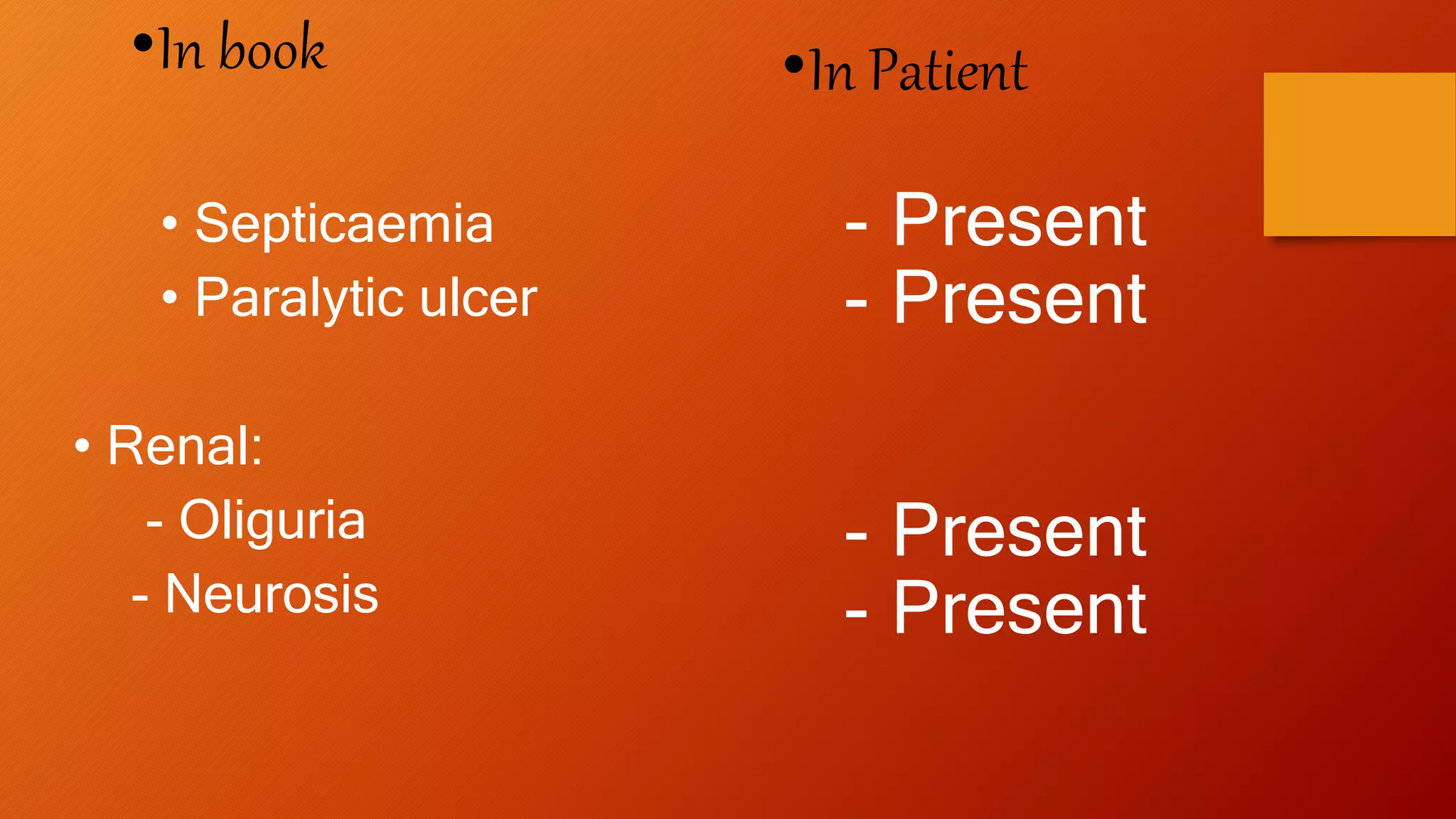
•In book
• Septicaemia
• Paralytic ulcer
• Renal:
- Oliguria
- Neurosis
•In Patient
- Present
- Present
- Present
- Present
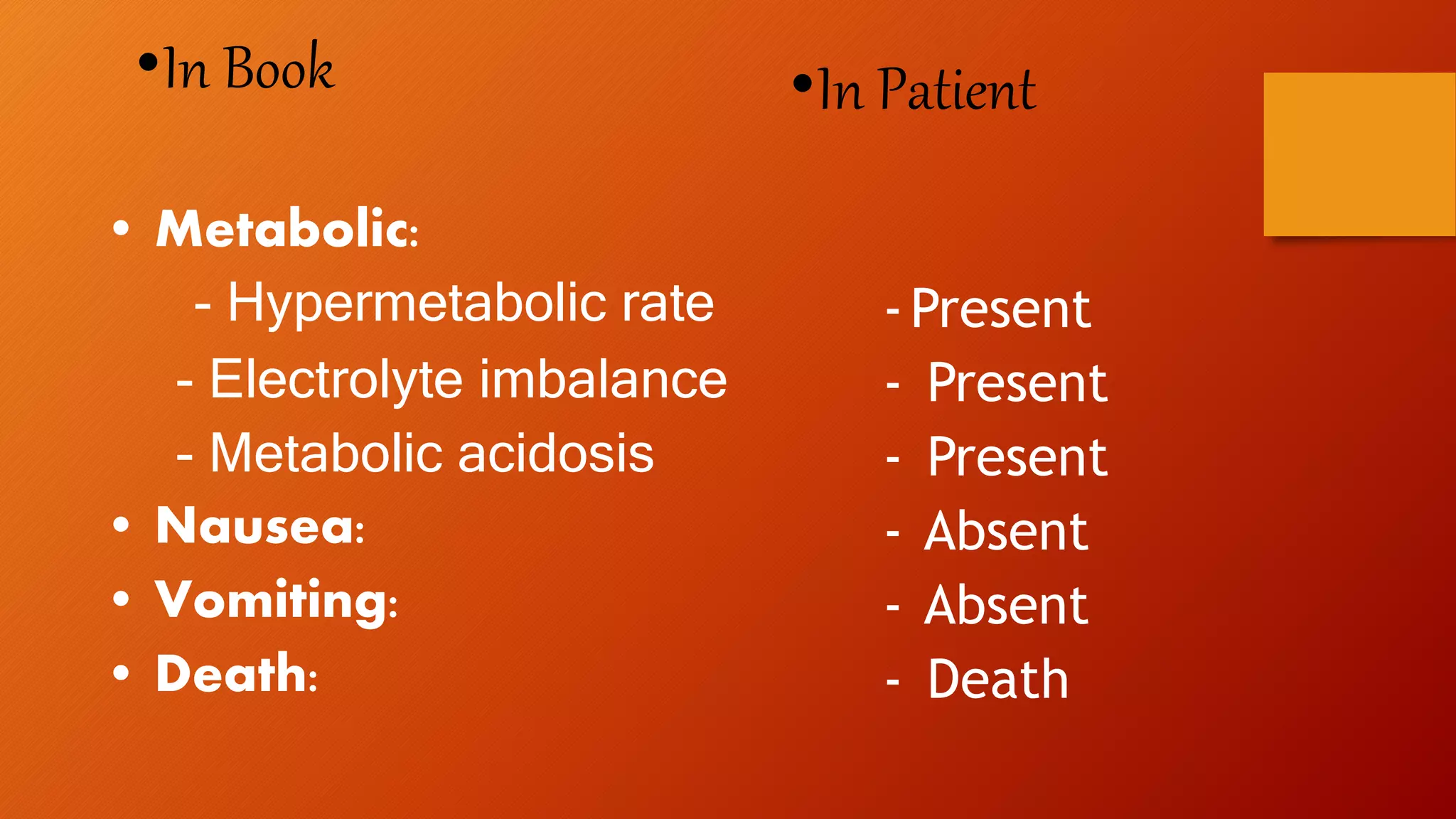
•In Book
• Metabolic:
- Hypermetabolic rate
- Electrolyte imbalance
- Metabolic acidosis
• Nausea:
• Vomiting:
• Death:
•In Patient
-Present
- Present
- Present
- Absent
- Absent
- Death
Classification
of burn
Classification of burn
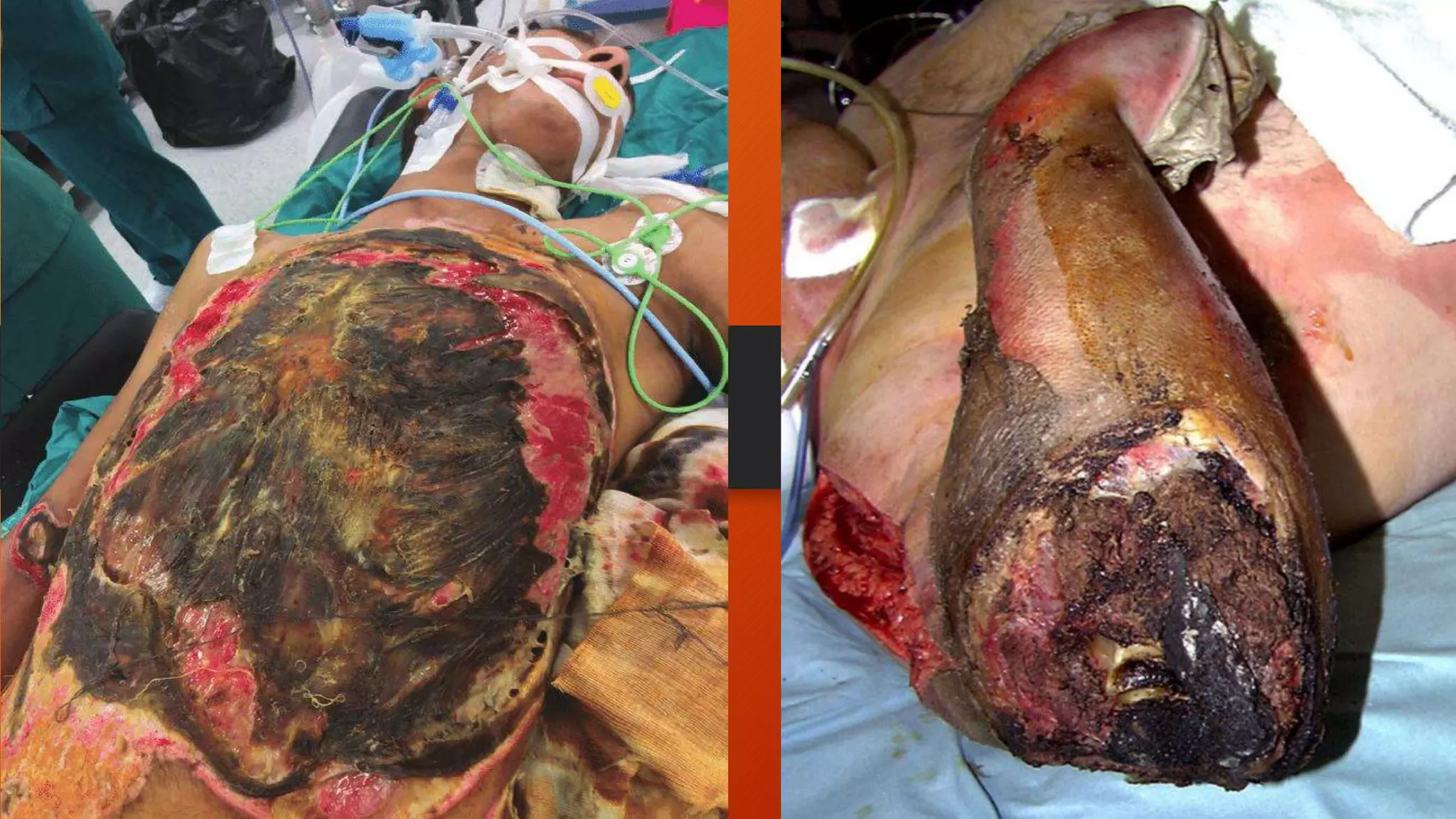
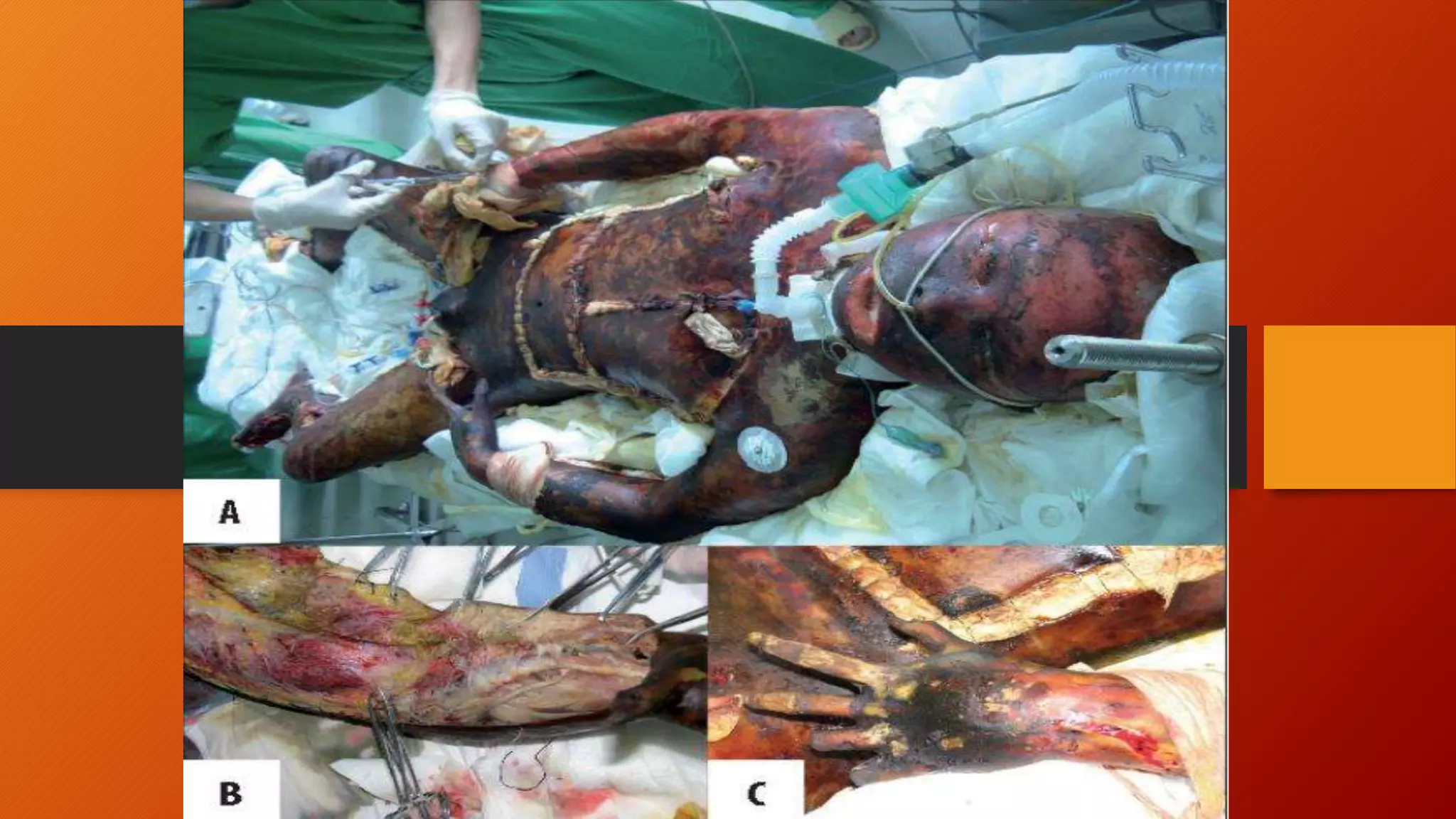
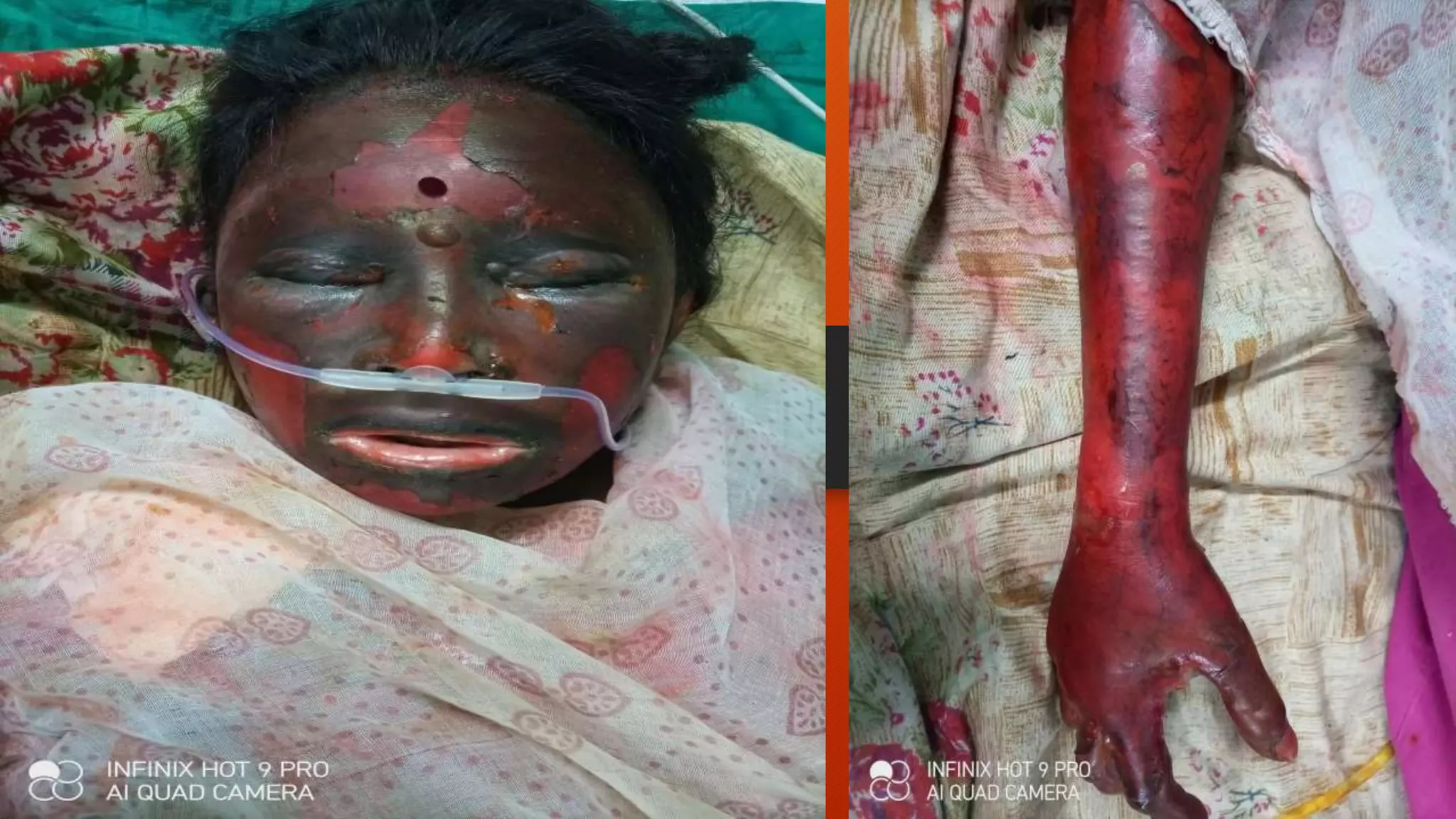
• 1st Degree Burn
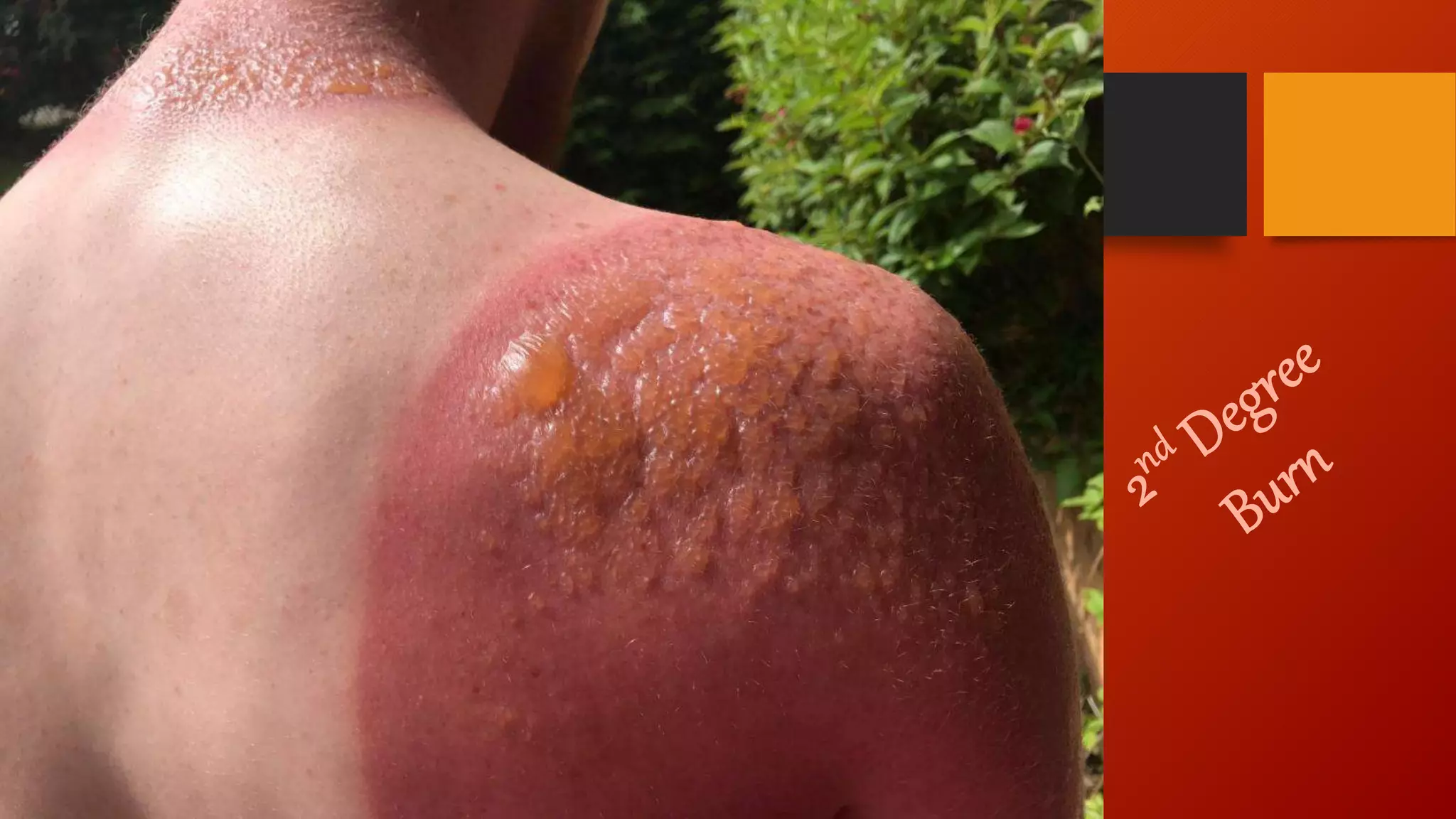
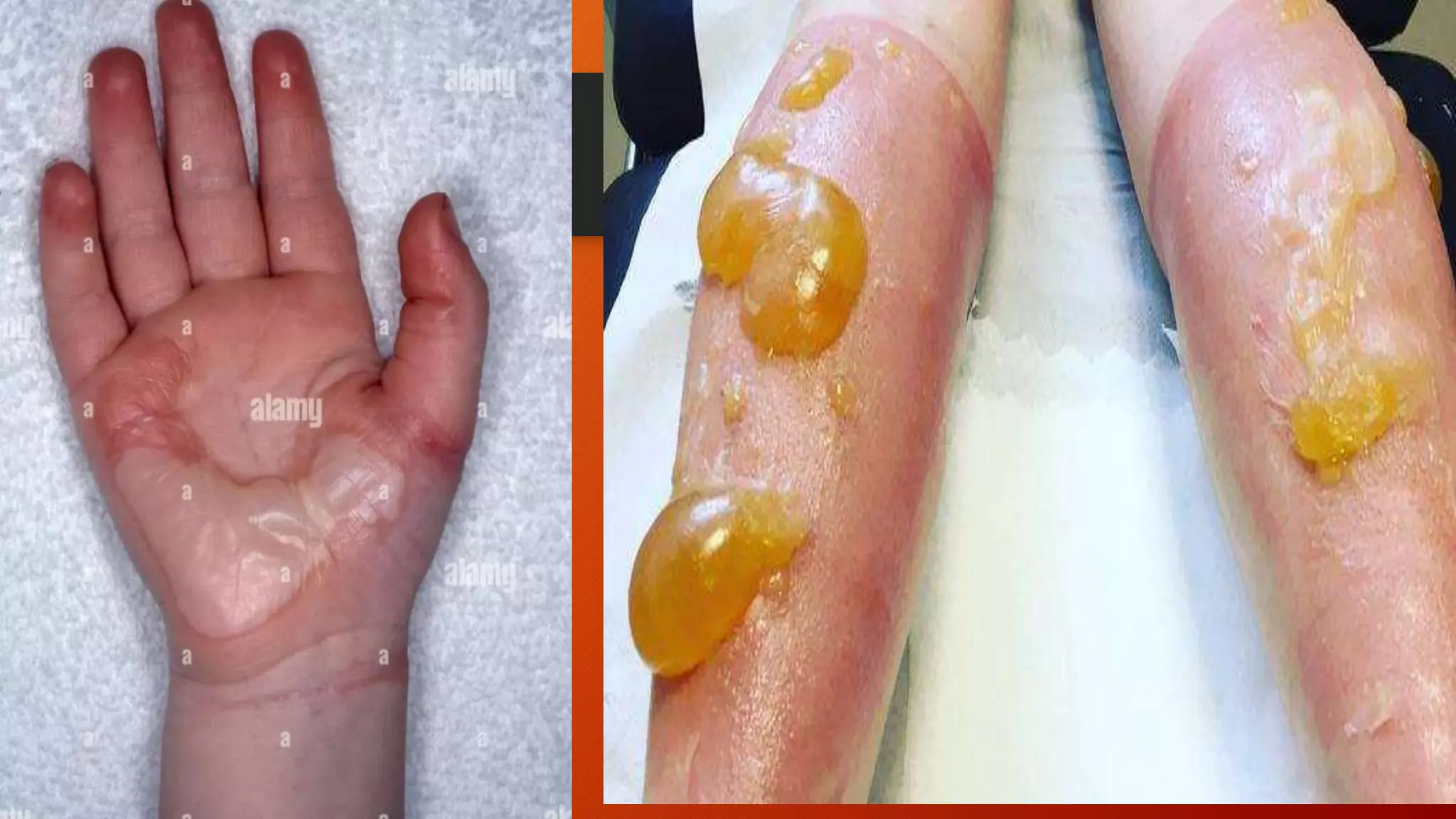
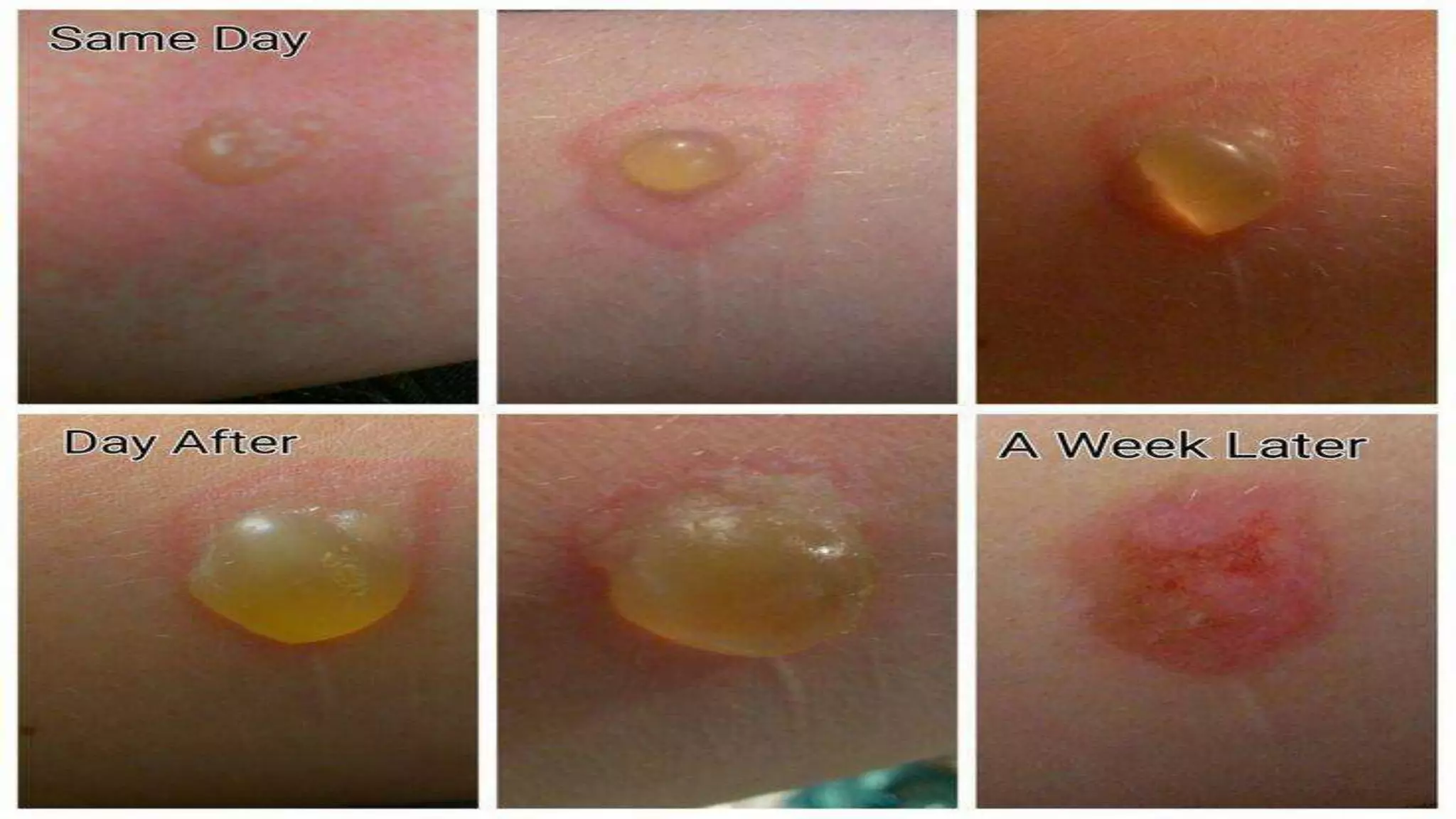
• 2nd Degree Burn
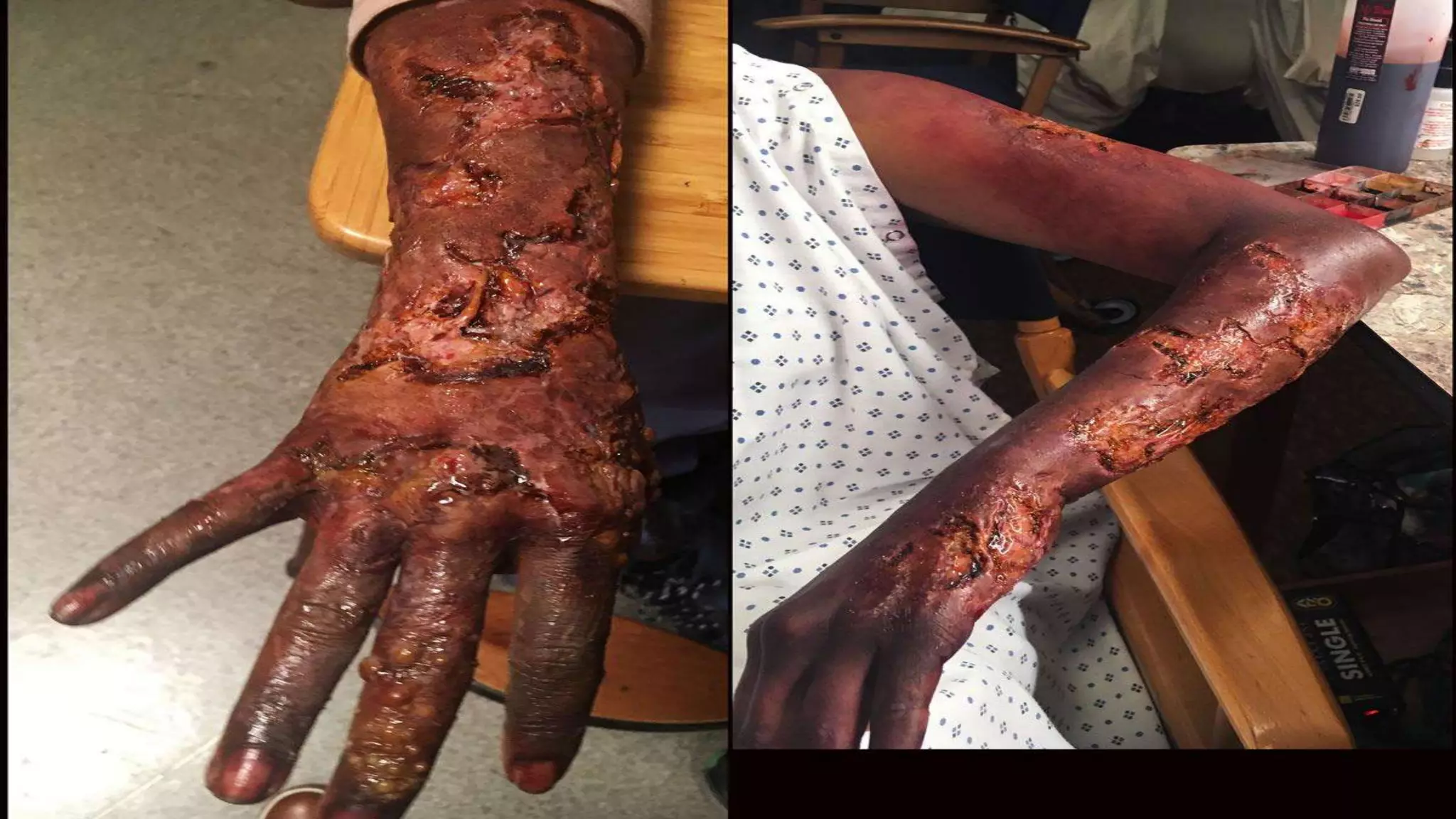
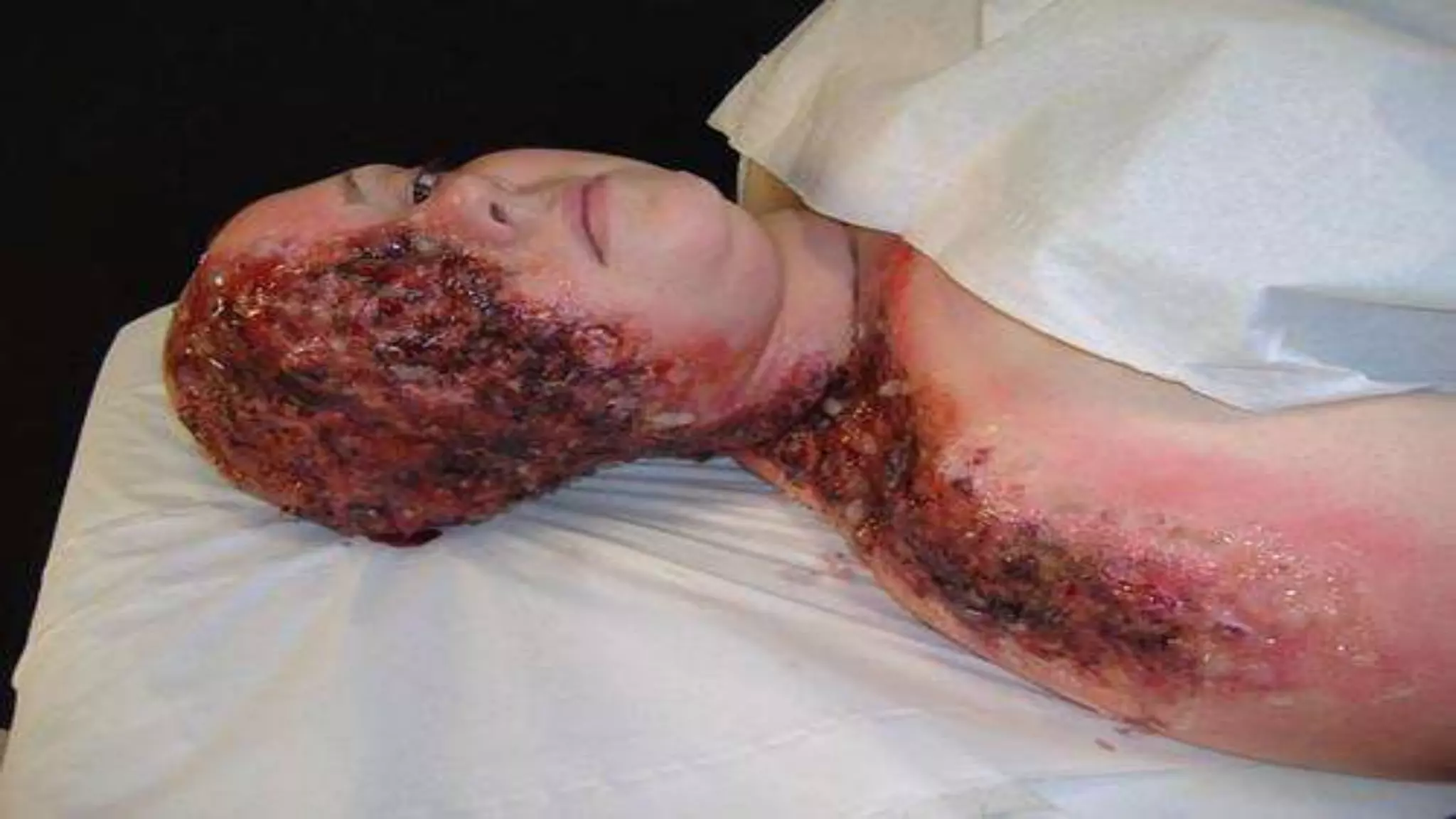
• 3rd Degree Burn
• 4th Degree Burn
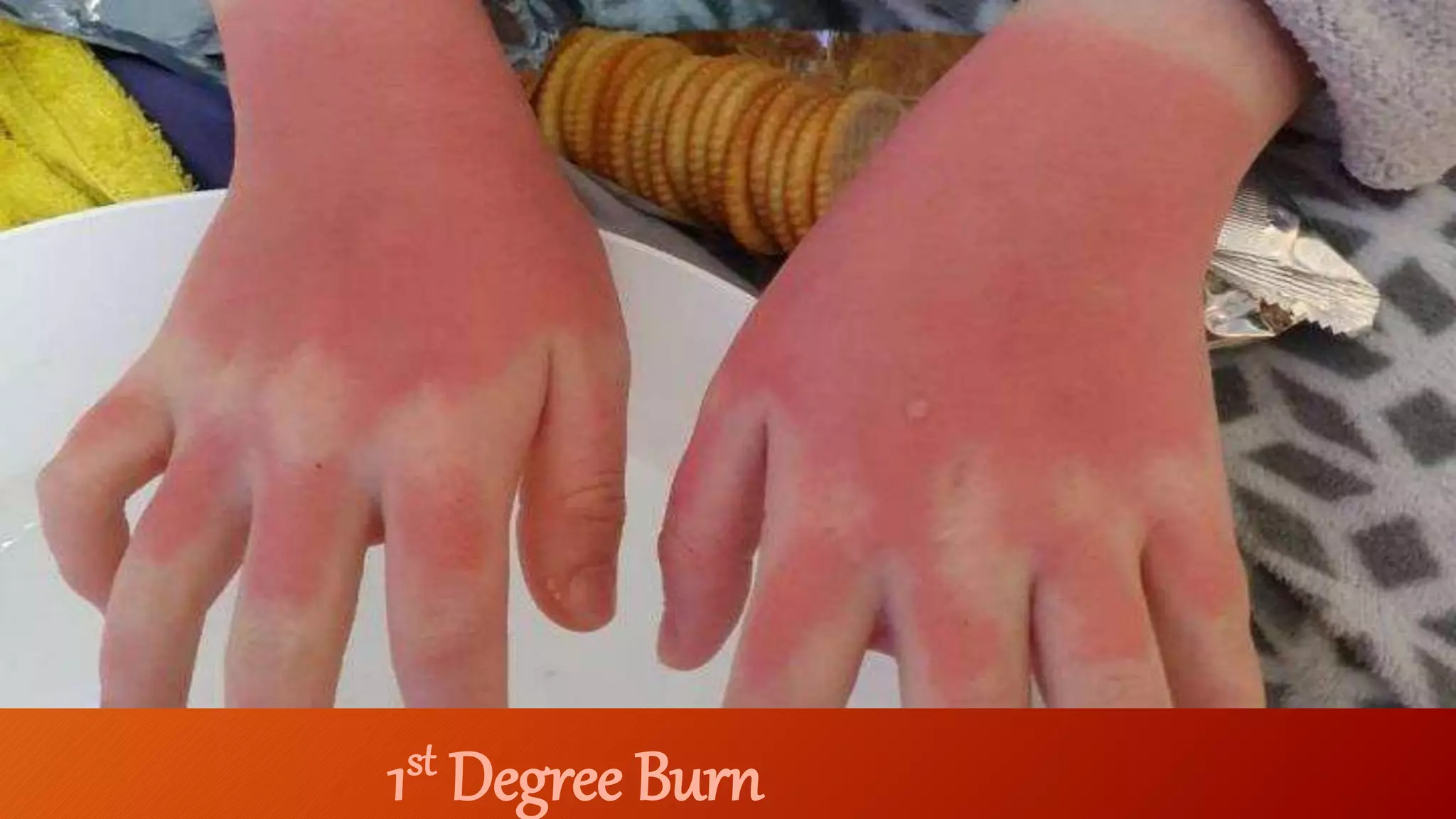
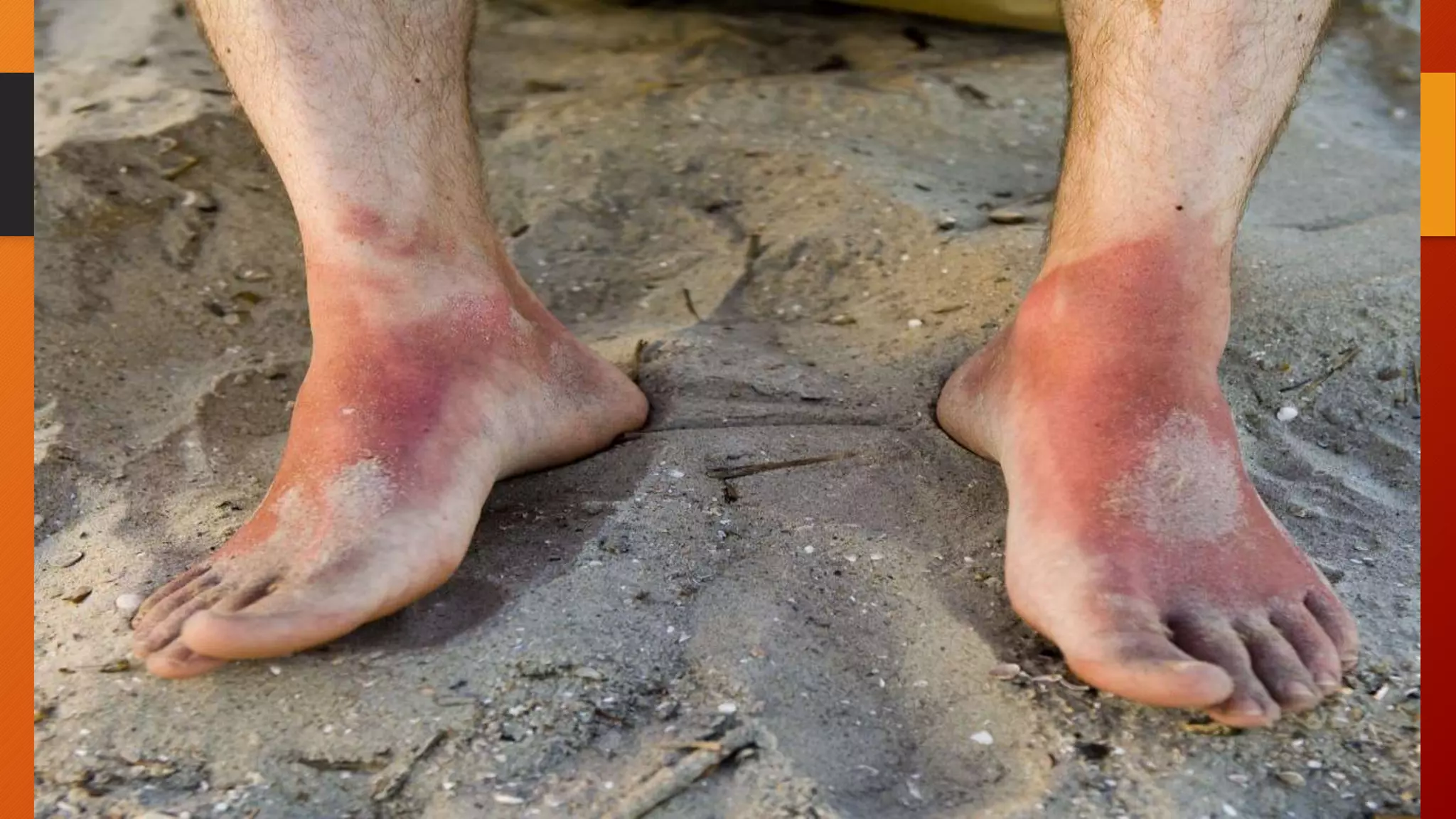
1st Degree Burn
1st Degree Burn
2nd Degree Burn
3rd Degree Burn
4th Degree Burn
Identify tHe degree of burn ?
CLINICAL
MANIFESTATION
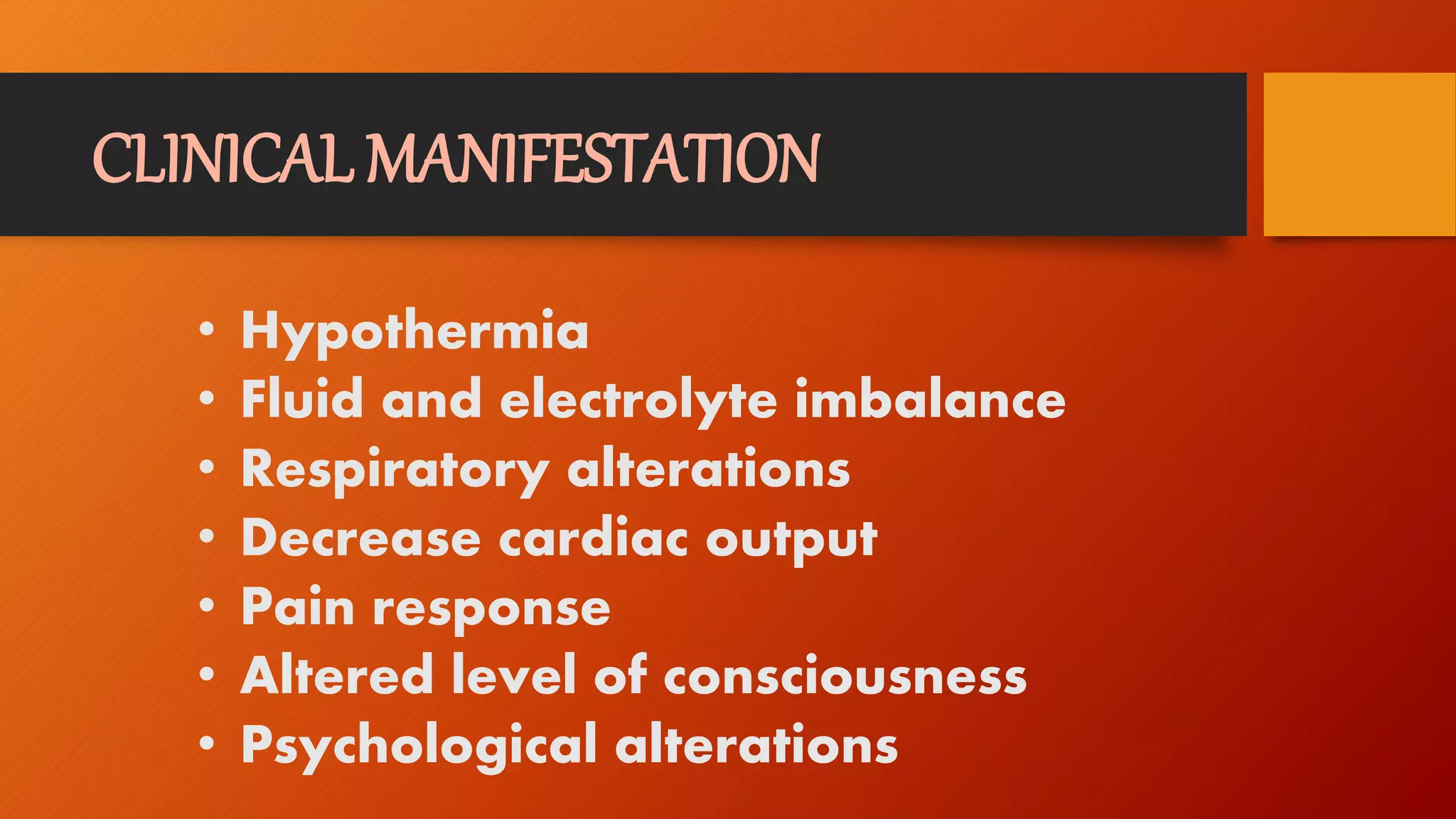
CLINICAL MANIFESTATION
• Hypothermia
• Fluid and electrolyte imbalance
• Respiratory alterations
• Decrease cardiac output
• Pain response
• Altered level of consciousness
• Psychological alterations
BURN
DETERMINATION
METHOD
BURN DETERMINATION METHOD
1) The Rule Of Nine
2) The Palm Method
3) An age specific burn diagram
or chart
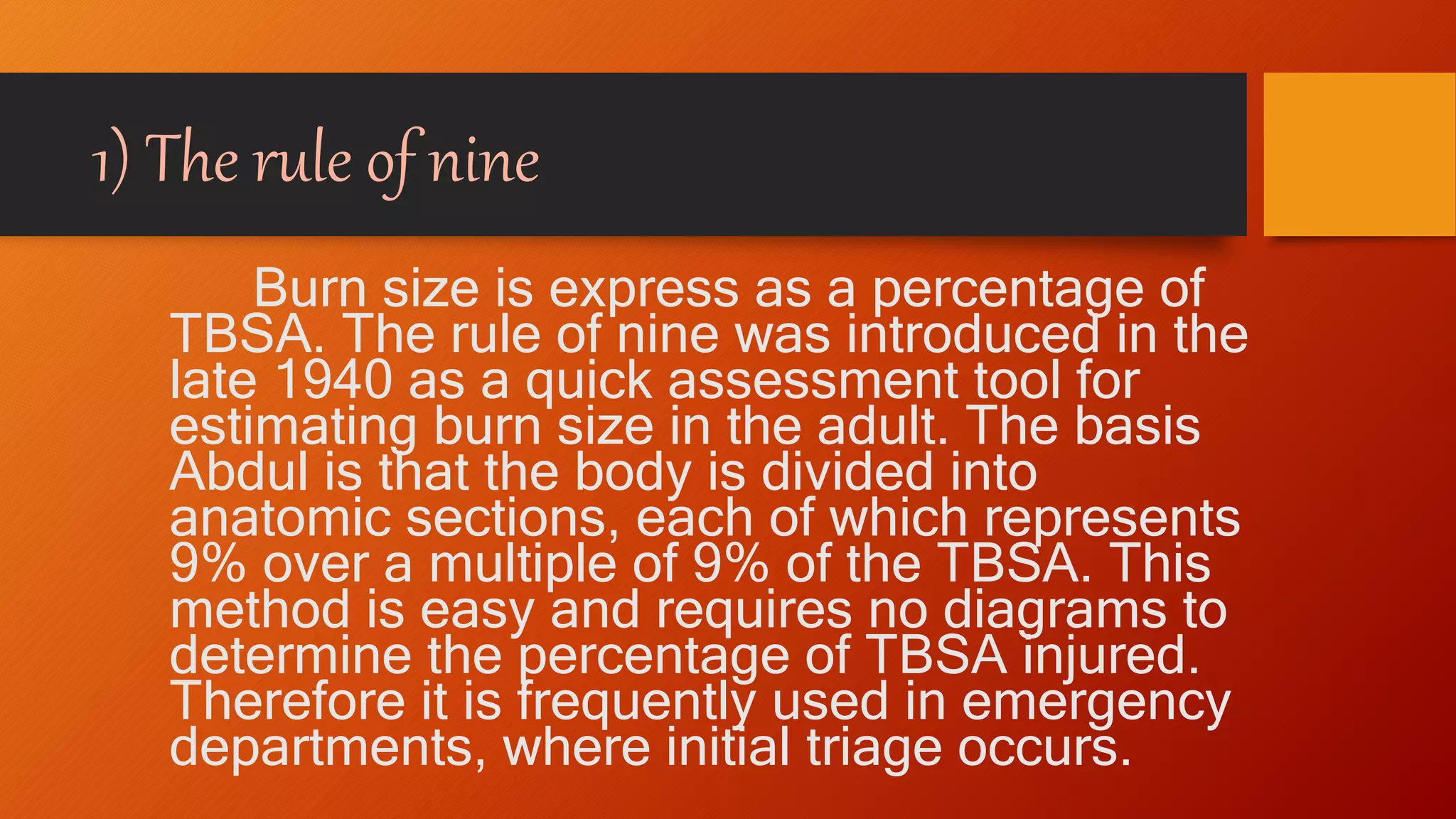
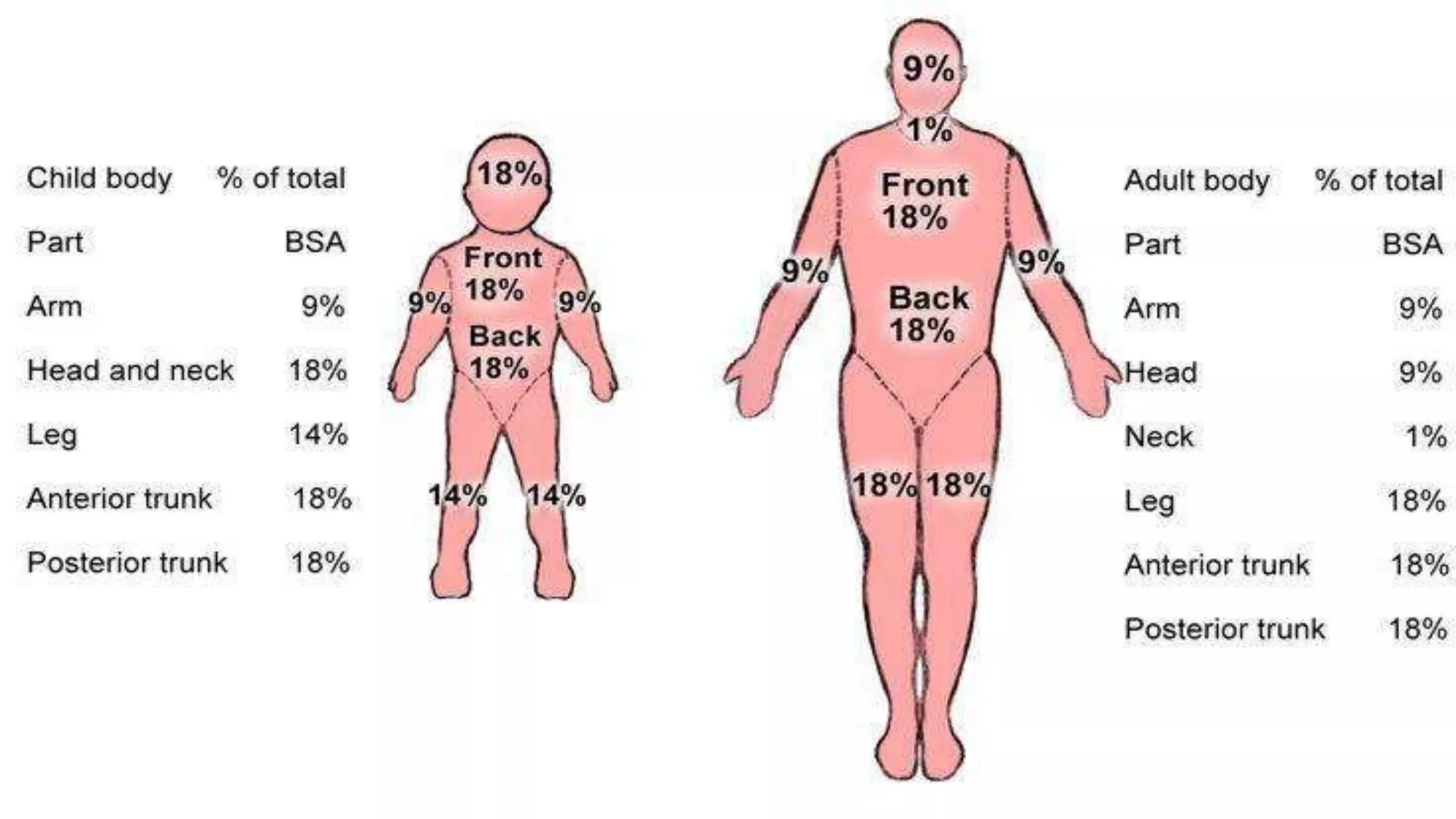
1) The rule of nine
Burn size is express as a percentage of
TBSA. The rule of nine was introduced in the
late 1940 as a quick assessment tool for
estimating burn size in the adult. The basis
Abdul is that the body is divided into
anatomic sections, each of which represents
9% over a multiple of 9% of the TBSA. This
method is easy and requires no diagrams to
determine the percentage of TBSA injured.
Therefore it is frequently used in emergency
departments, where initial triage occurs.
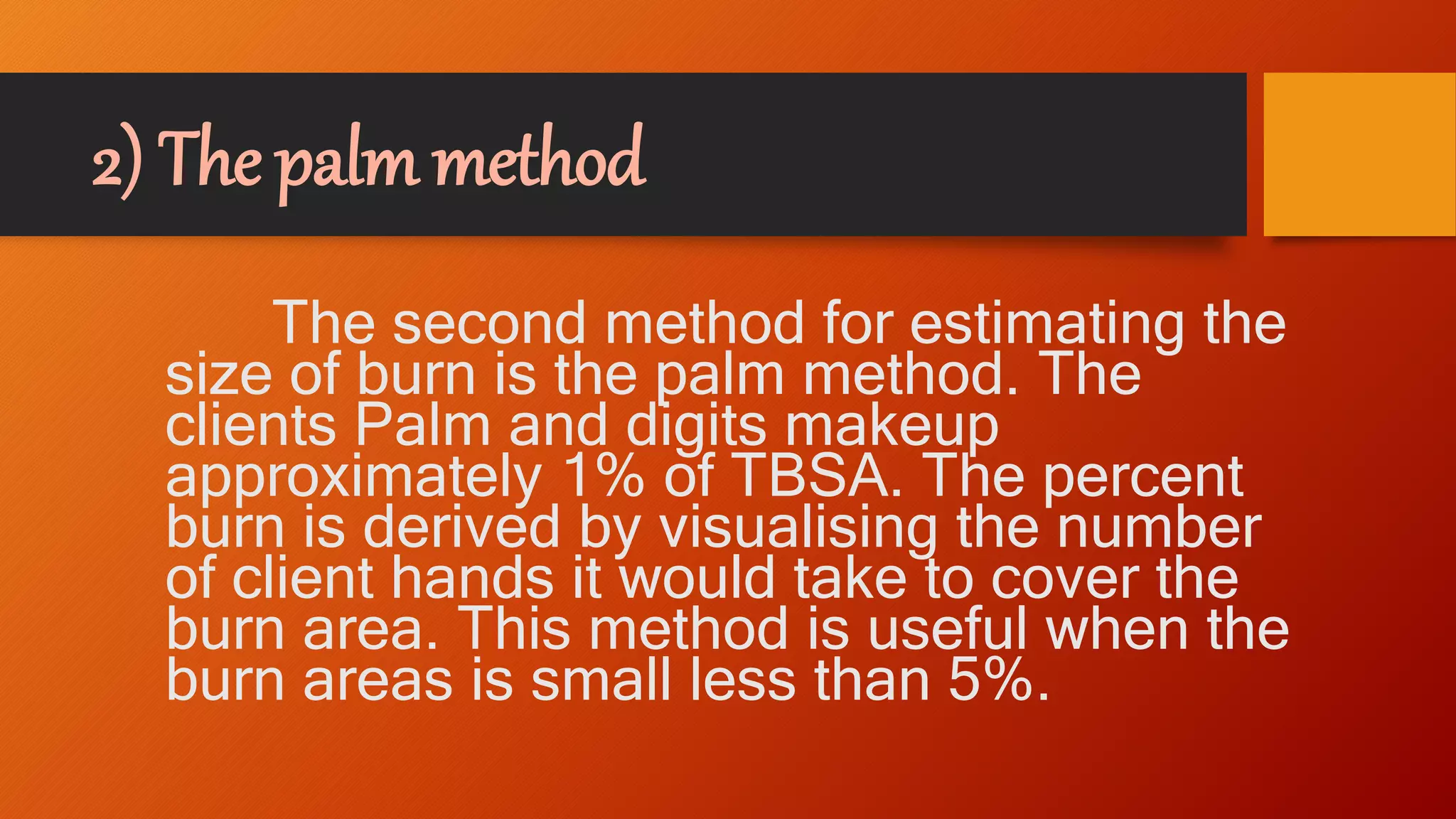
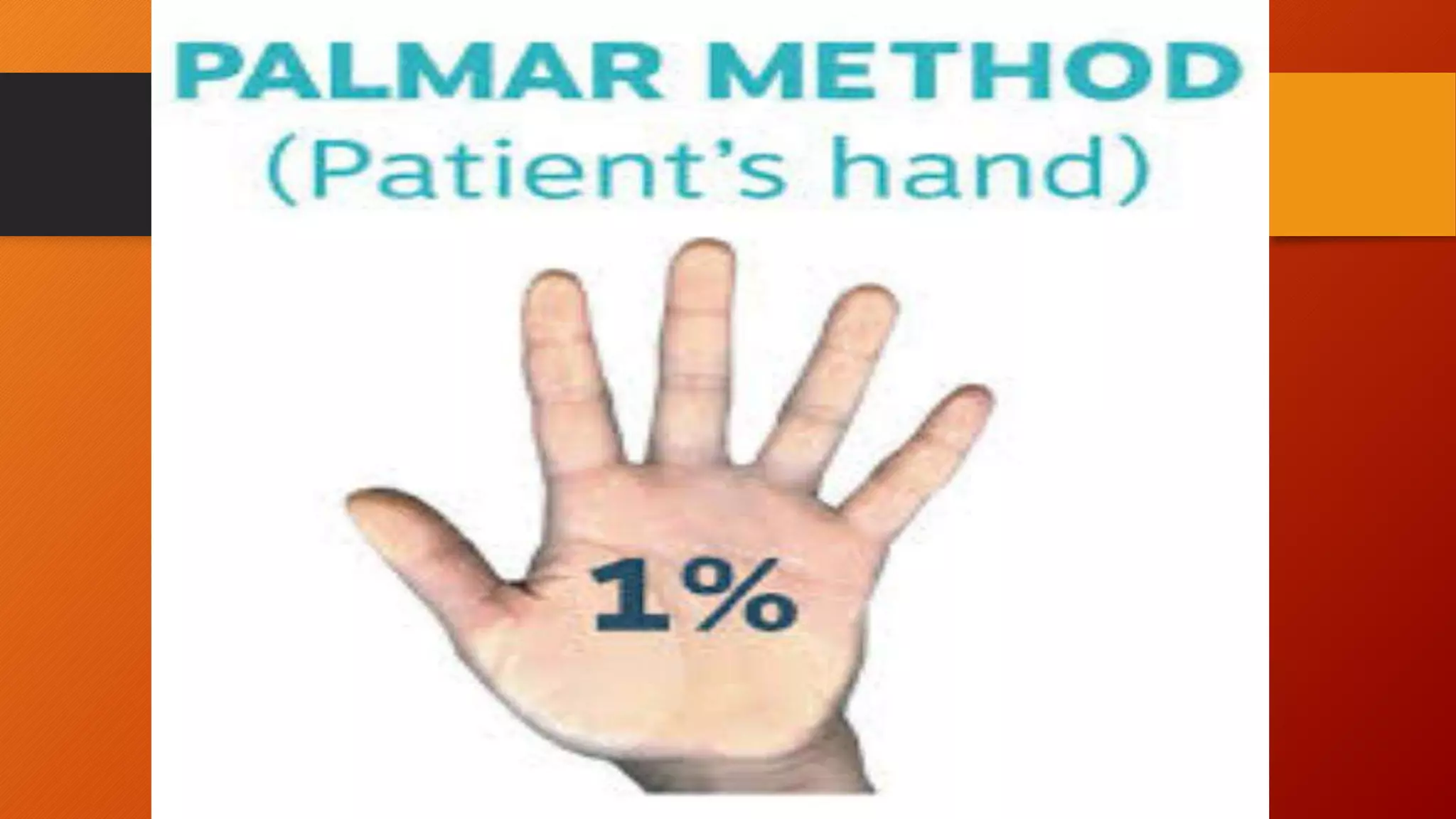
2) The palm method
The second method for estimating the
size of burn is the palm method. The
clients Palm and digits makeup
approximately 1% of TBSA. The percent
burn is derived by visualising the number
of client hands it would take to cover the
burn area. This method is useful when the
burn areas is small less than 5%.
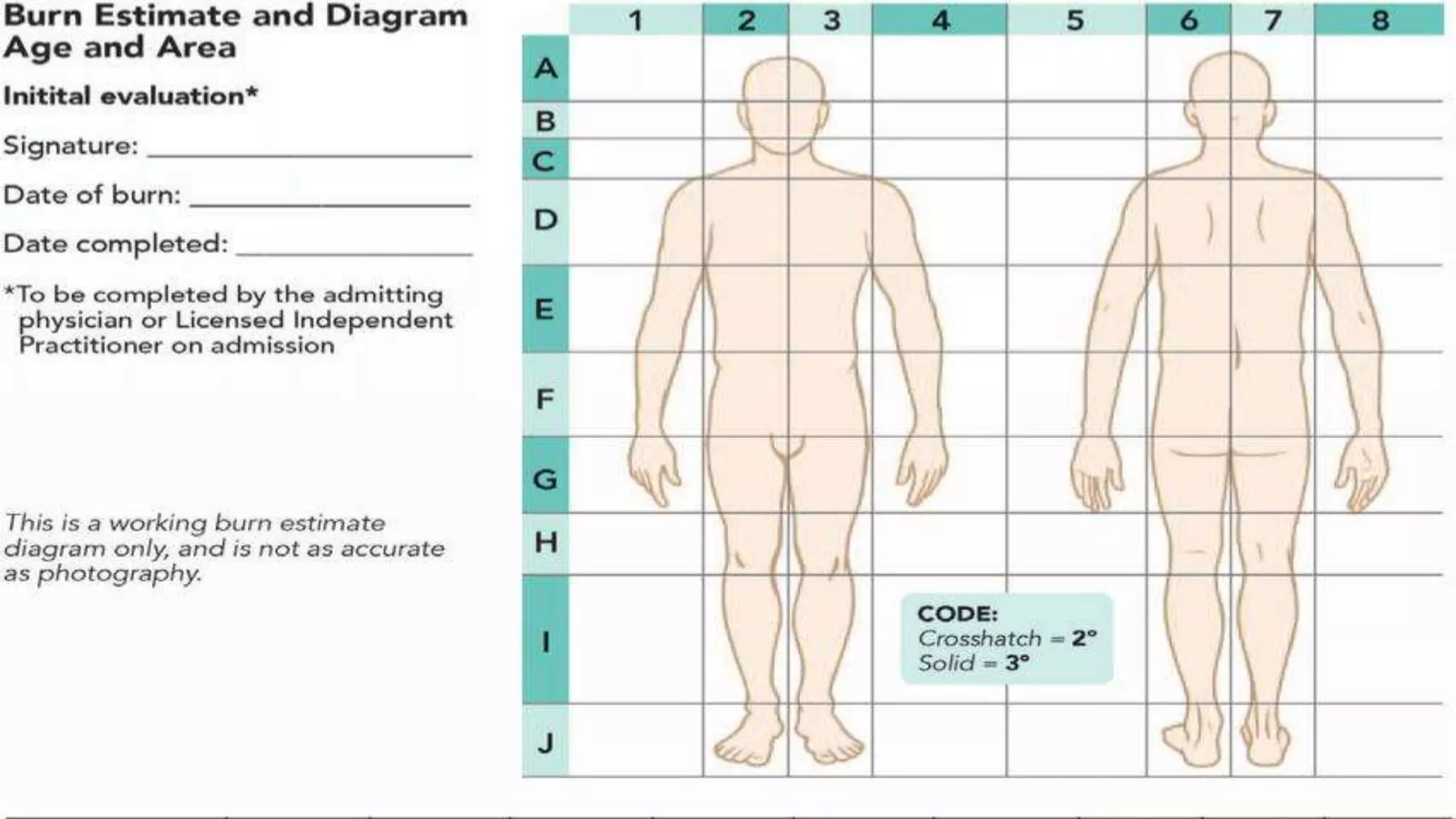
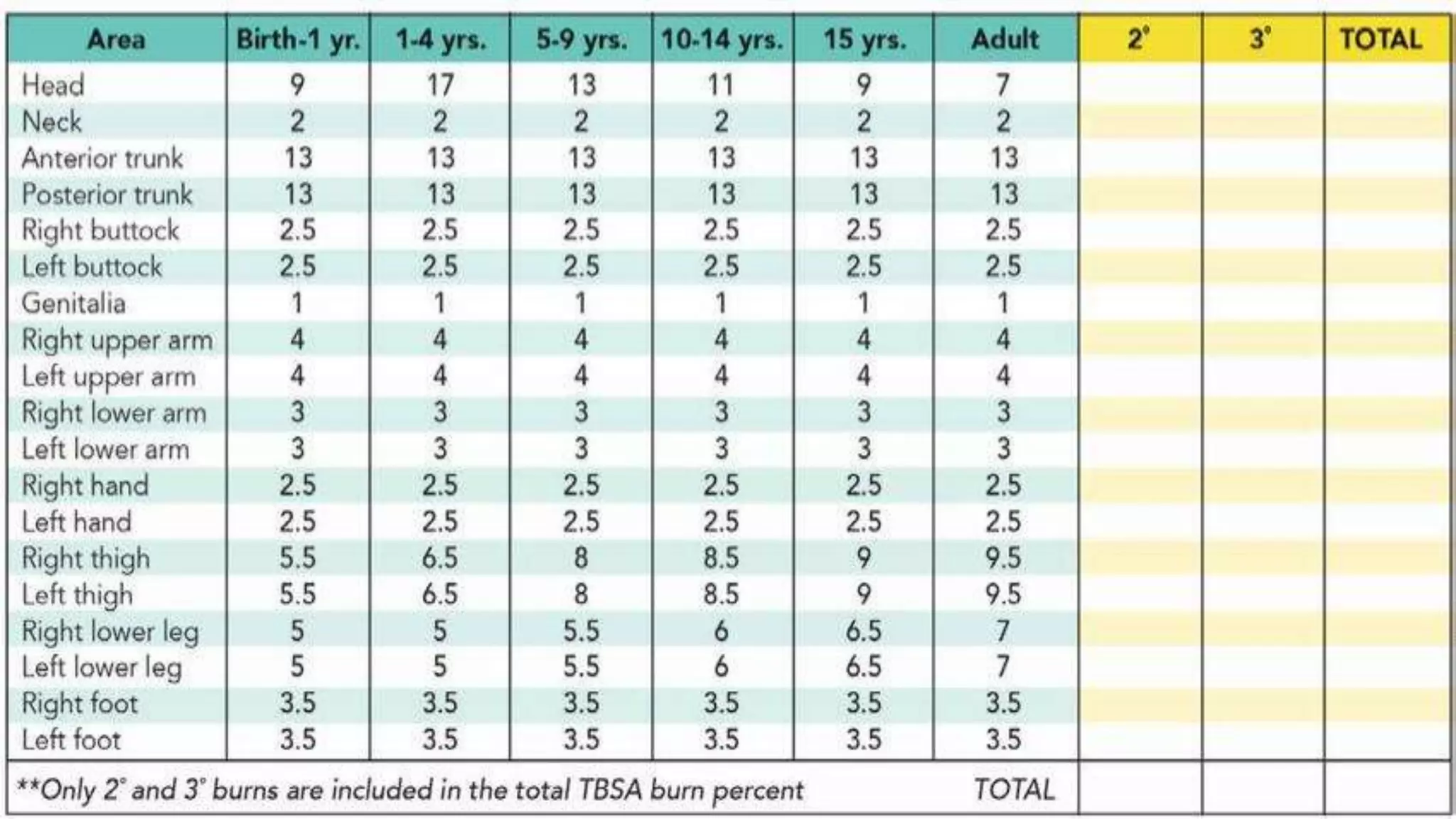
3) An age specific burn
diagram or chart
A burn diagram charts the
percentage for body segments according
to age and provide some more accurate
estimate of burn size. It should be noted
that extent of burn injury is most accurate
after initial debridement and should
therefore be veryfied again at that time.
Management
of burn
Management of burn
1) Preventive Management
2) Emergent Phase (Resuscitative
Phase)
3) Acute Phase (In Hospital)
4) Rehabilitation Phase
1) Preventive management
• In the kitchen
• In the home
• In the community
2) Emergent Phase
(Resuscitative phase)
• Remove the victim
• Assess ABC
• If there is need of CPR then we
would give it properly.
• Initial wound care
• Immediate care
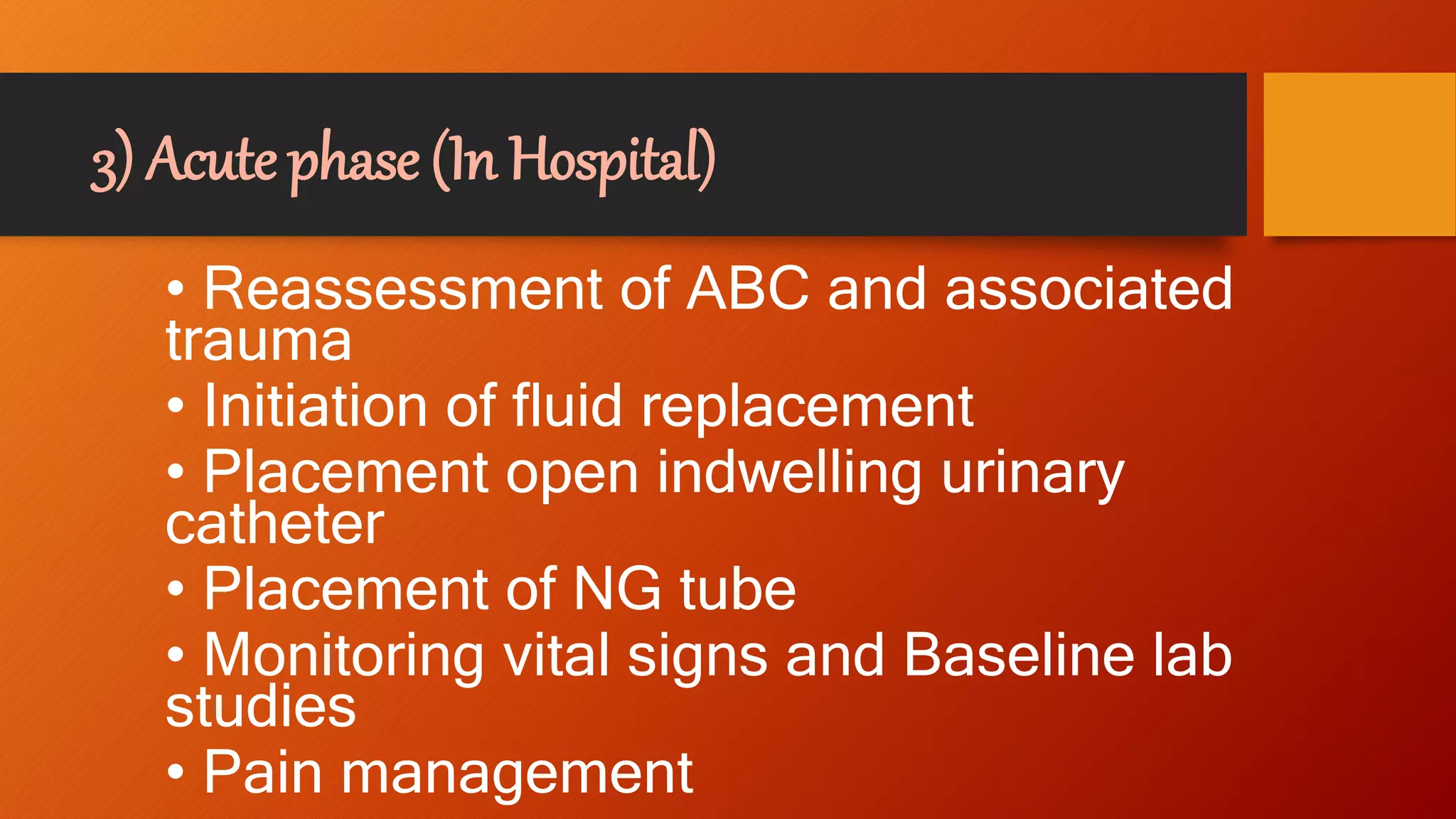
3) Acute phase (In Hospital)
• Reassessment of ABC and associated
trauma
• Initiation of fluid replacement
• Placement open indwelling urinary
catheter
• Placement of NG tube
• Monitoring vital signs and Baseline lab
studies
• Pain management
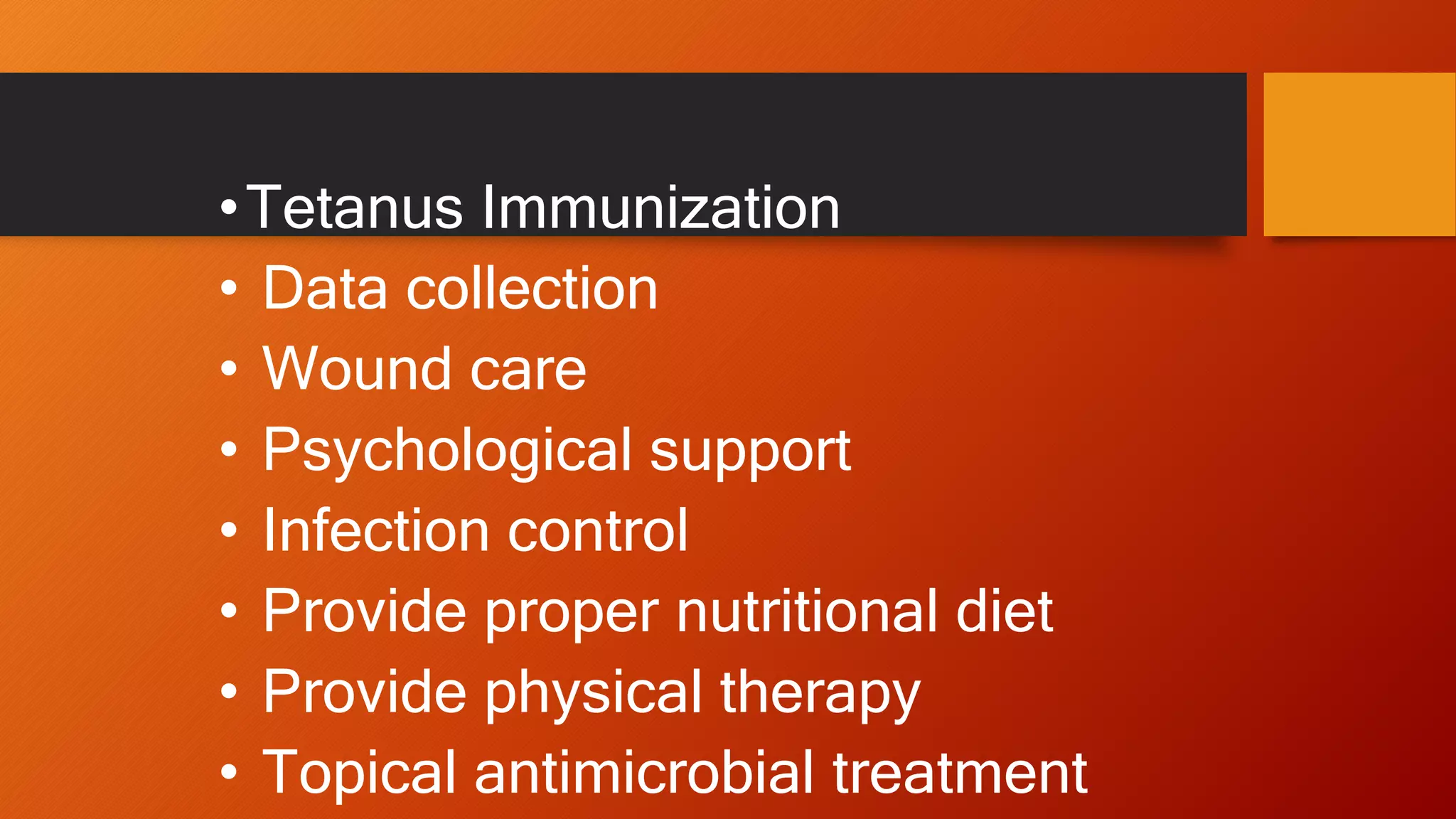
•Tetanus Immunization
• Data collection
• Wound care
• Psychological support
• Infection control
• Provide proper nutritional diet
• Provide physical therapy
• Topical antimicrobial treatment
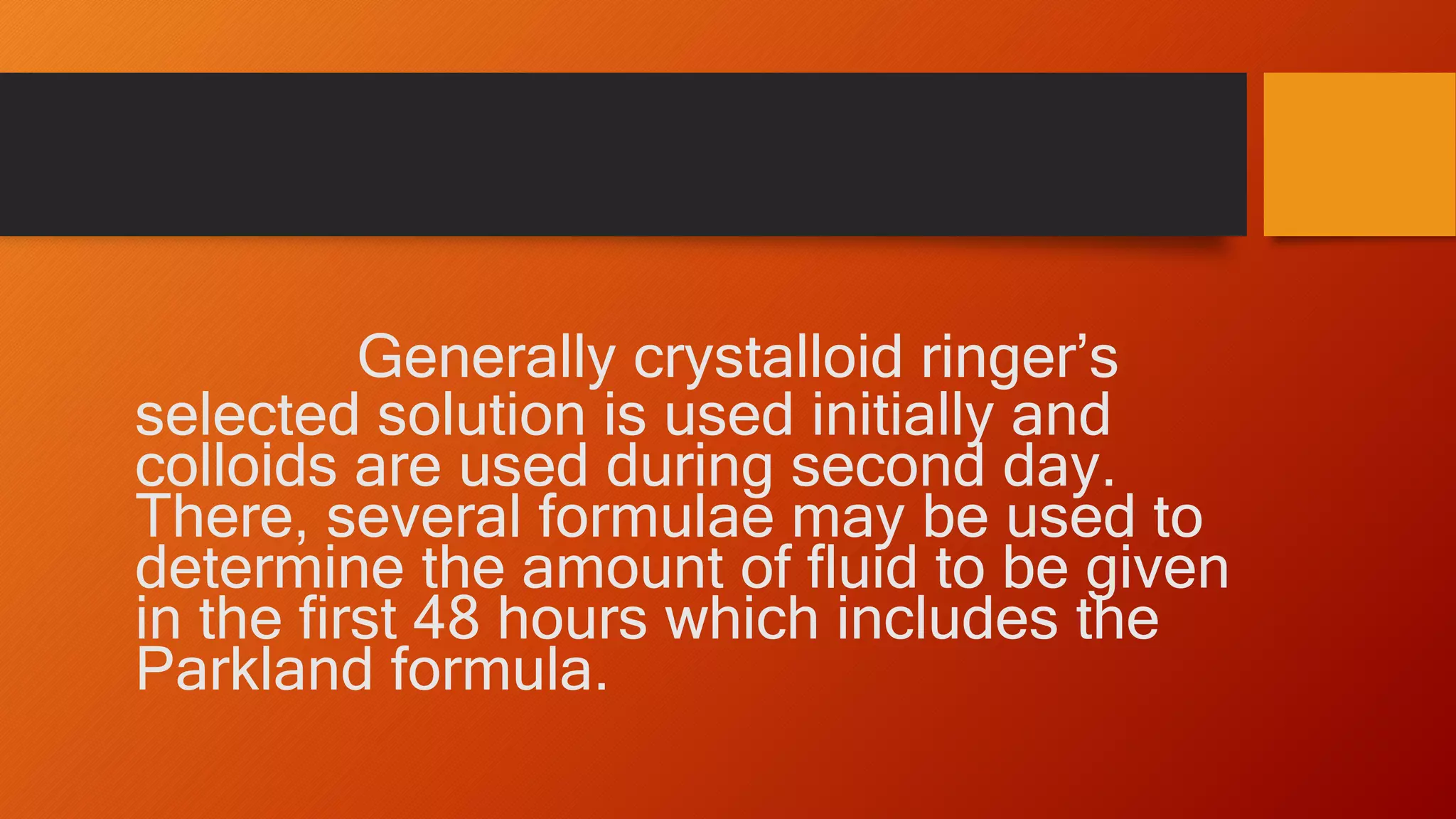
Generally crystalloid ringer’s
selected solution is used initially and
colloids are used during second day.
There, several formulae may be used to
determine the amount of fluid to be given
in the first 48 hours which includes the
Parkland formula.
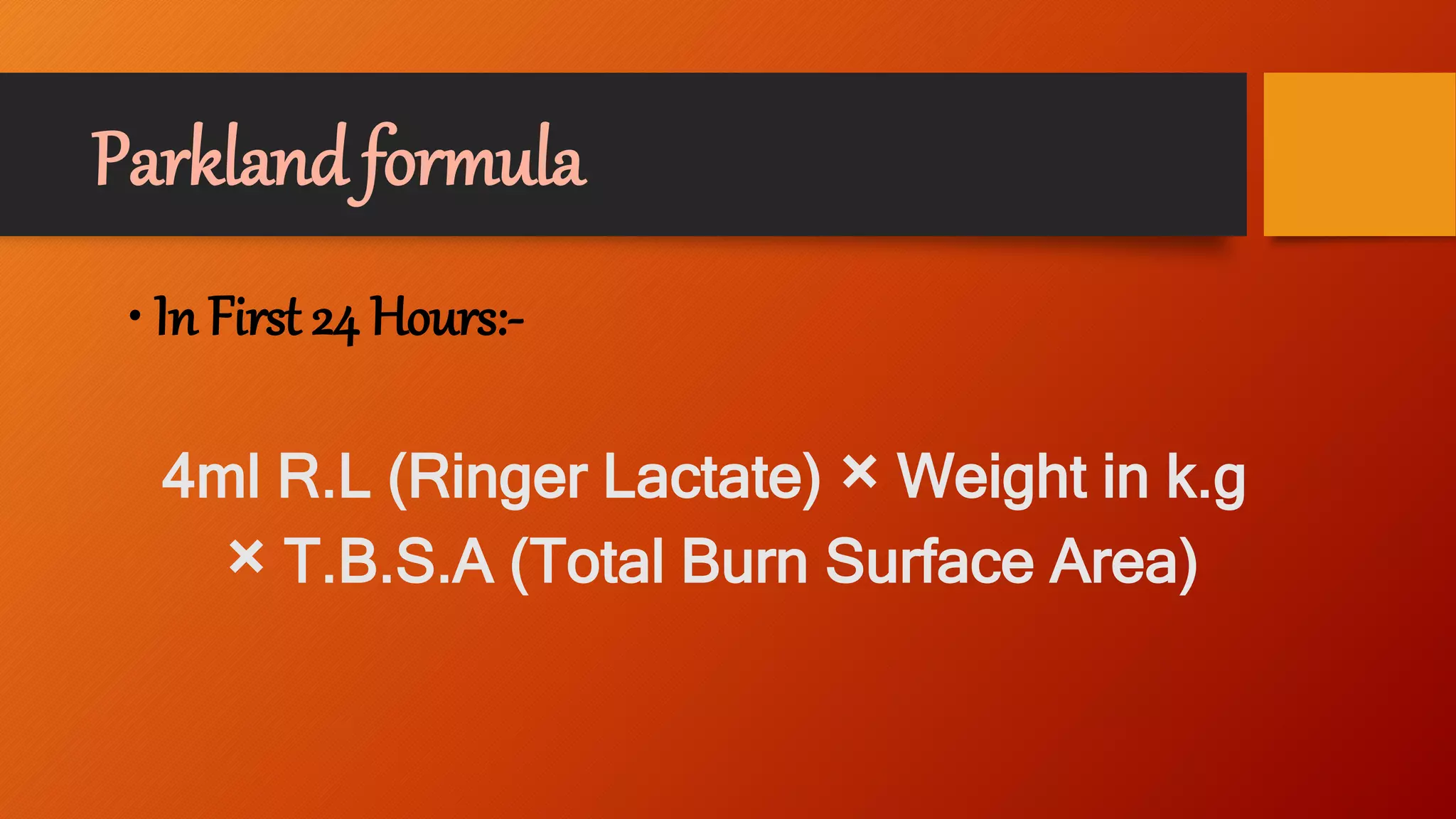
Parkland formula
• In First 24 Hours:-
4ml R.L (Ringer Lactate) × Weight in k.g
× T.B.S.A (Total Burn Surface Area)
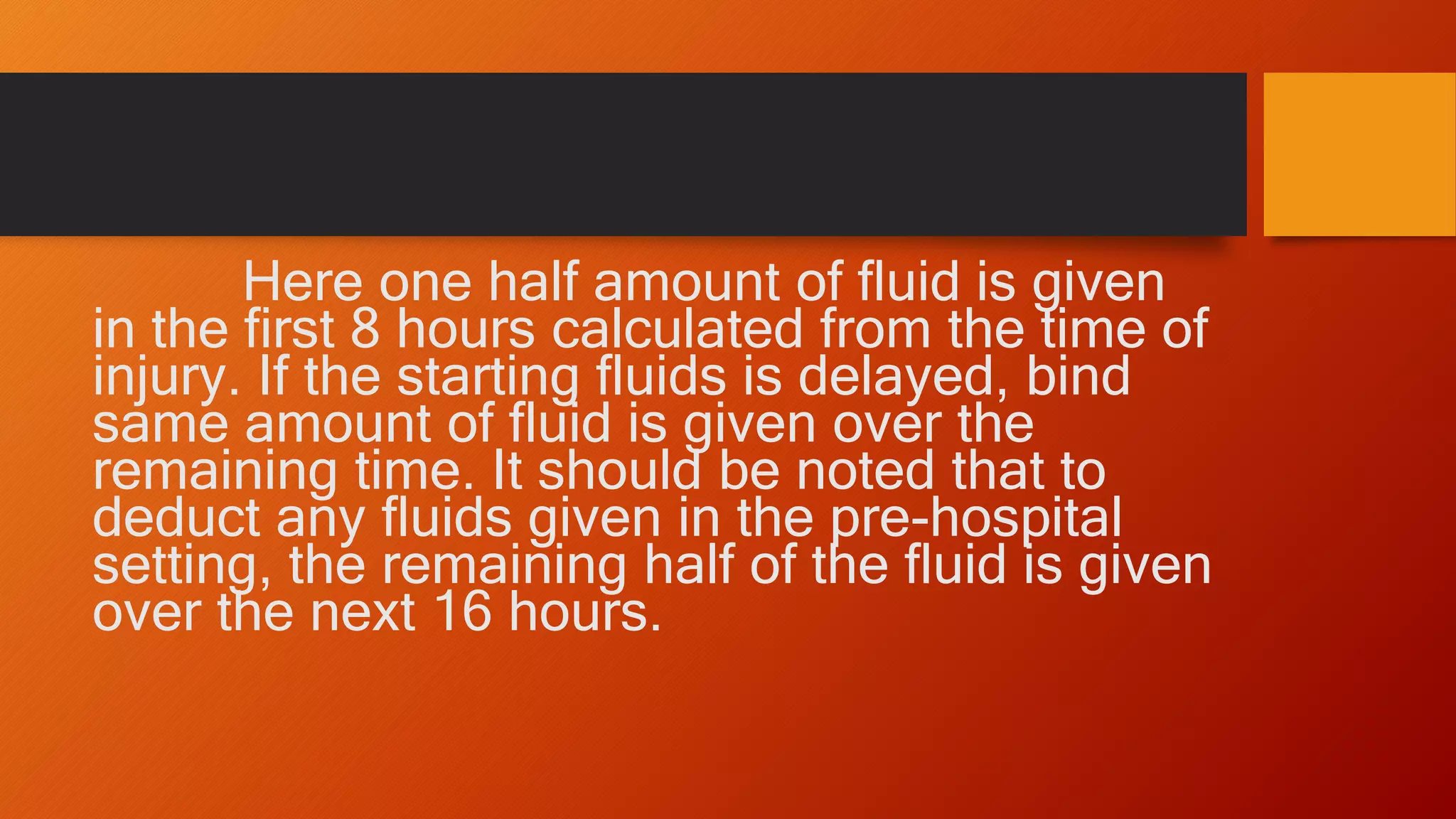
Here one half amount of fluid is given
in the first 8 hours calculated from the time of
injury. If the starting fluids is delayed, bind
same amount of fluid is given over the
remaining time. It should be noted that to
deduct any fluids given in the pre-hospital
setting, the remaining half of the fluid is given
over the next 16 hours.
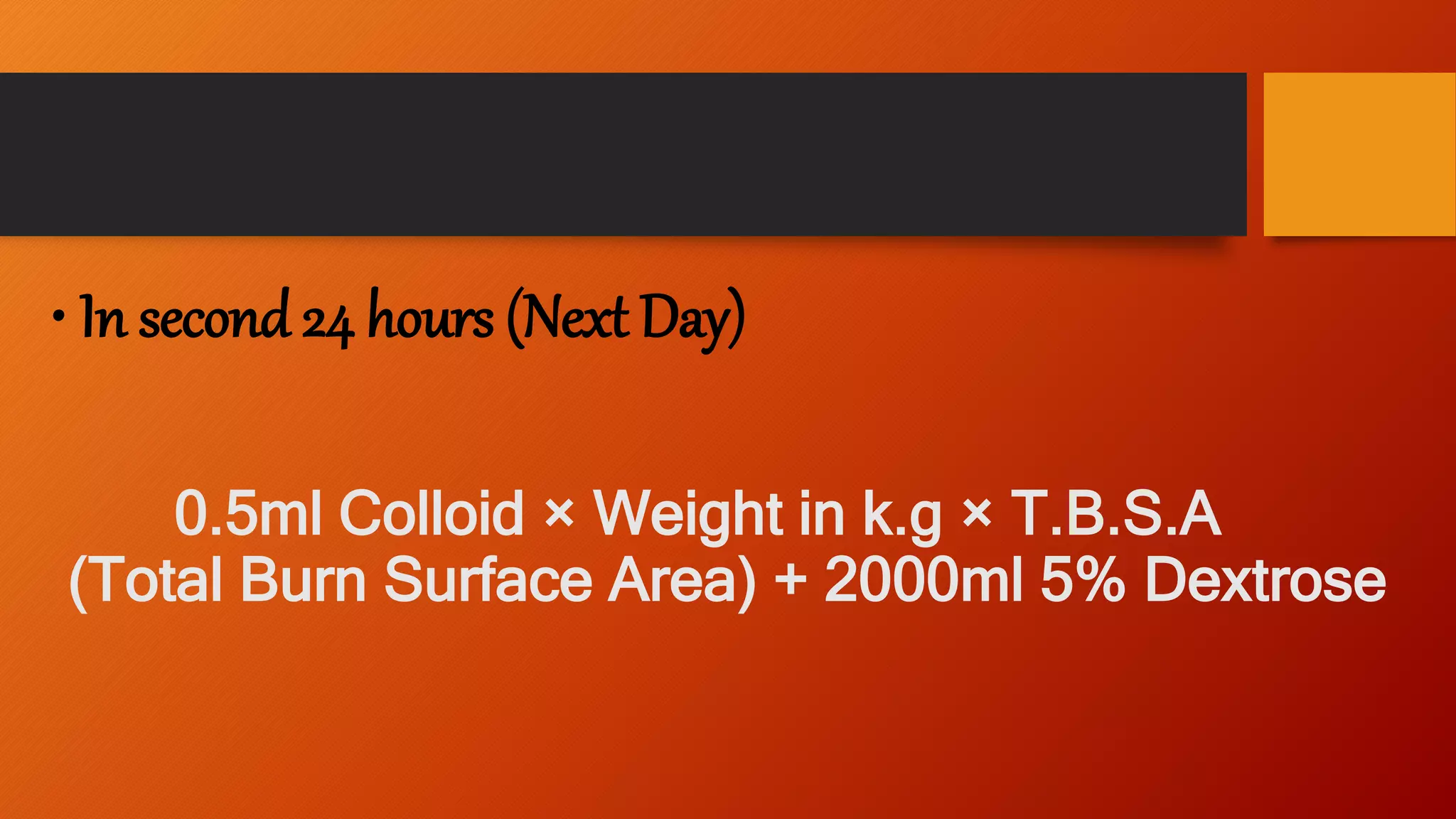
• In second 24 hours (Next Day)
0.5ml Colloid × Weight in k.g × T.B.S.A
(Total Burn Surface Area) + 2000ml 5% Dextrose
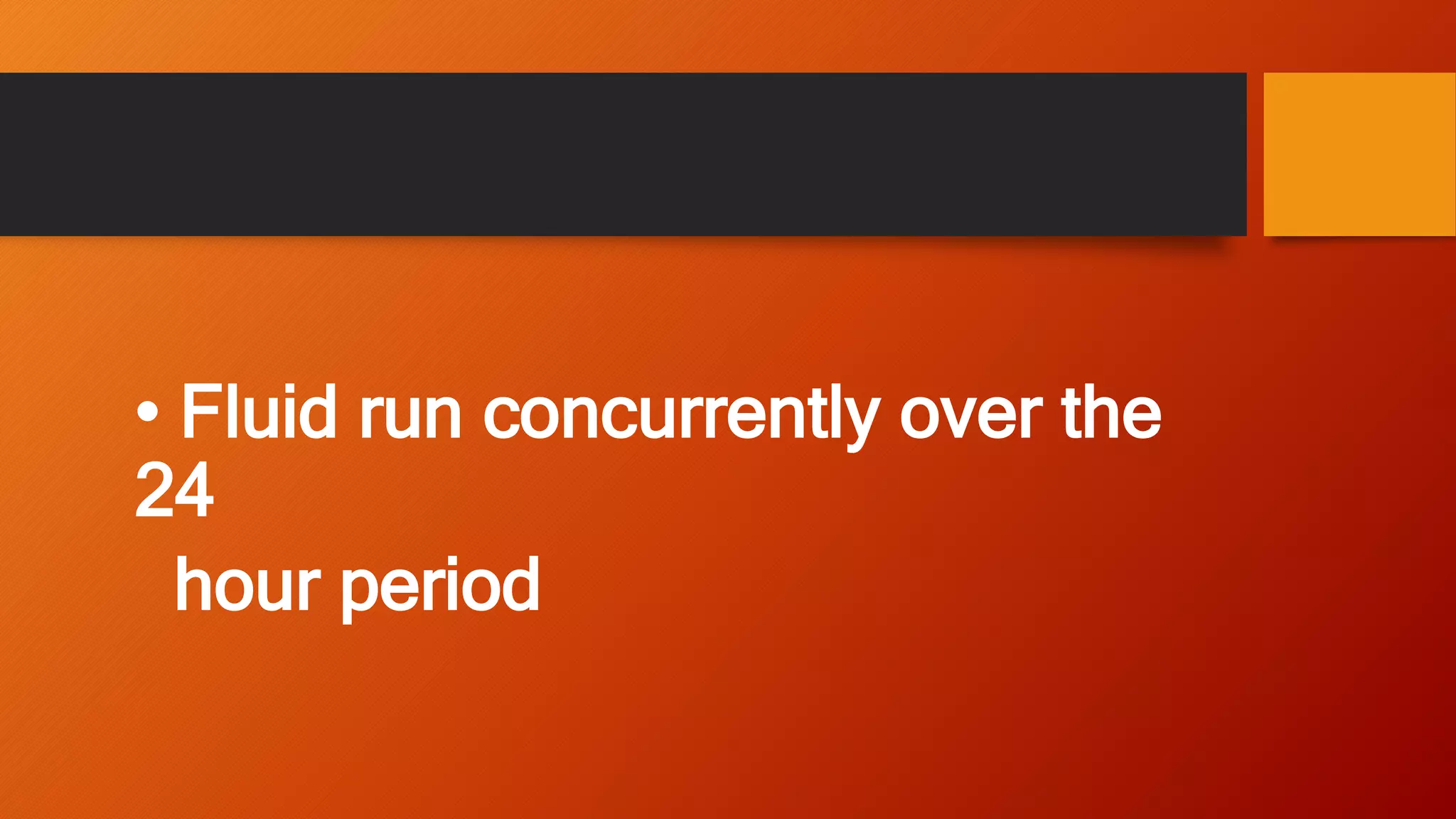
• Fluid run concurrently over the
24
hour period
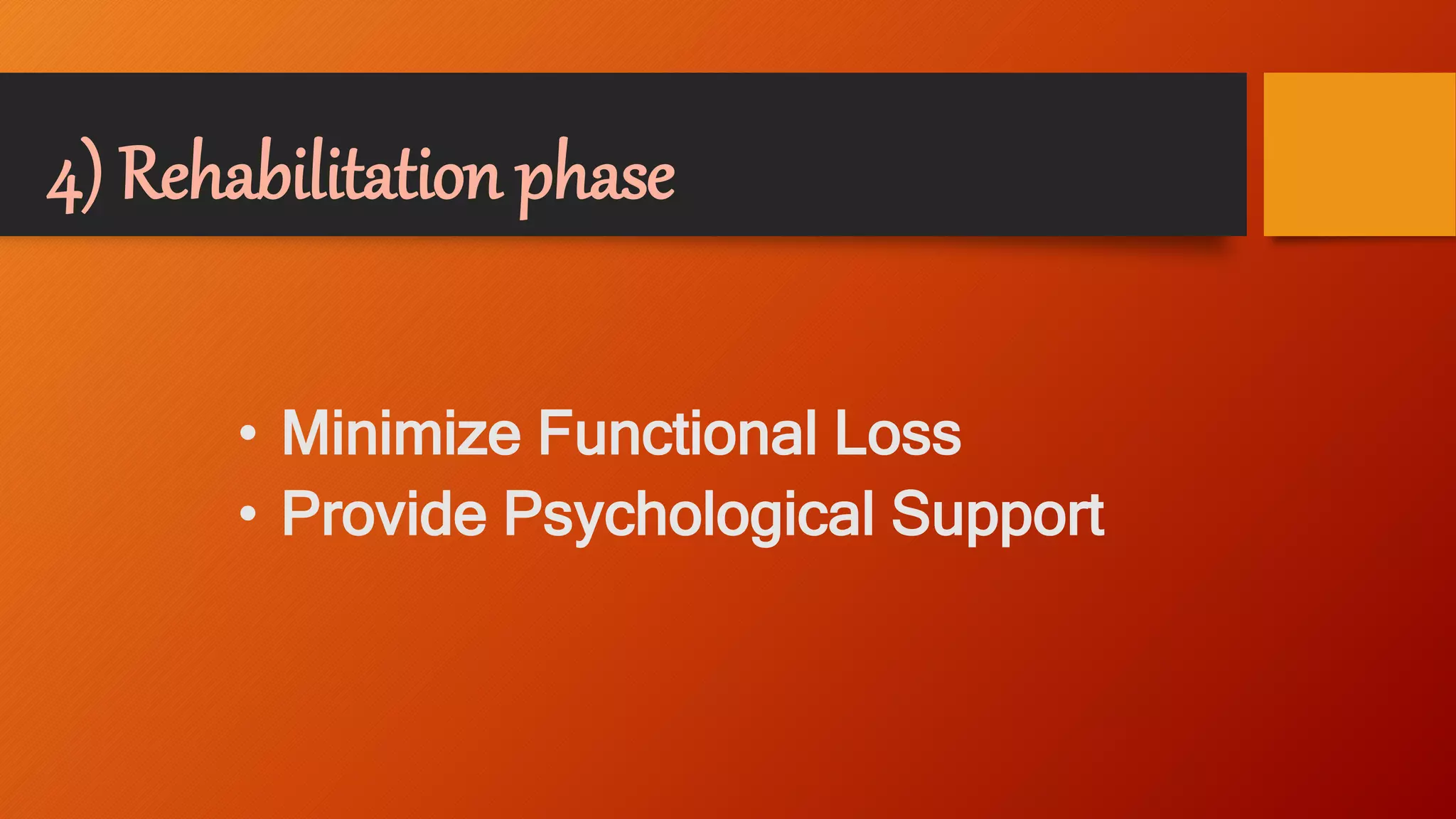
4) Rehabilitation phase
• Minimize Functional Loss
• Provide Psychological Support
COMPLICATION
Complication
• Dehydration and Hypovolemia
• Shock
• Hypothermia
• Infection
• Blood Clothes
• Renal Failure
• Contractures
Early complications
•Shock:
- Neurogenic
- Hypovolemic
- Septic
• Asphyxia, due to odema of the glottis, If
needs urgent tracheostomy.
• Toxaemia
- Acute Toxaemia
- Septic Toxaemia
• Injury of blood vessels and nerves
• Fluid and electrolyte disturbances
• Acute gastric dilation or paralytic illeous
• Acute duodenal ulcers.
Late complications
• Disliguxement due to scars and keloicls.
• Contractures of the joints.
• Chronic ulcers that may be complicated by
malignancy.
• Endocrine complications as Amenorrhea,
Huxsuitism, Testicular atropy.
• Psychological upset up to mania.
Treatment
Medical management
• Analgesics
• Benzodizepines
• Antihistamines
• Intravenous fluid
• Antibiotics
• Erythropoietin
• Calcium gluconate
• TPN (Total Parenteral
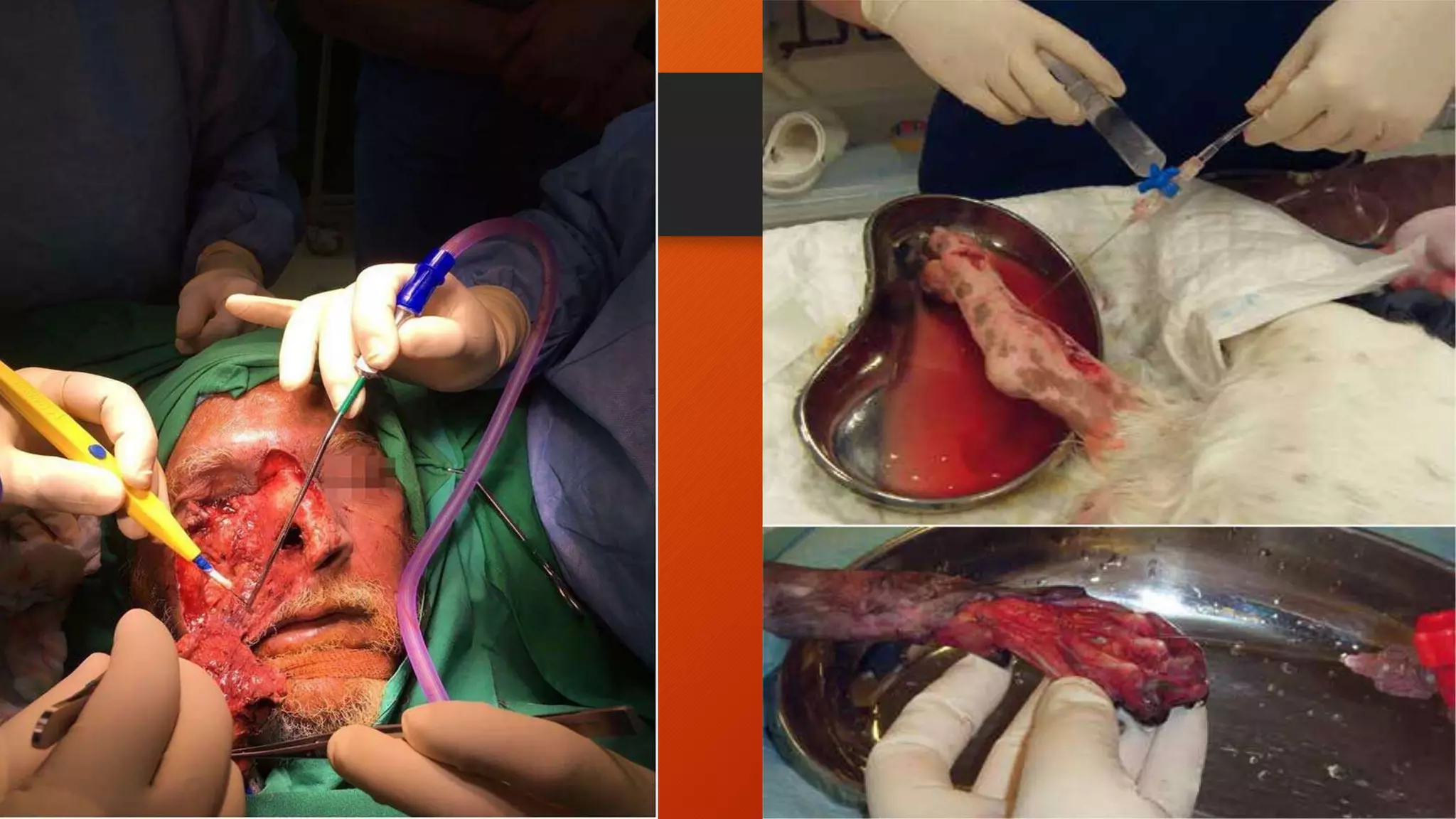
Surgical Management
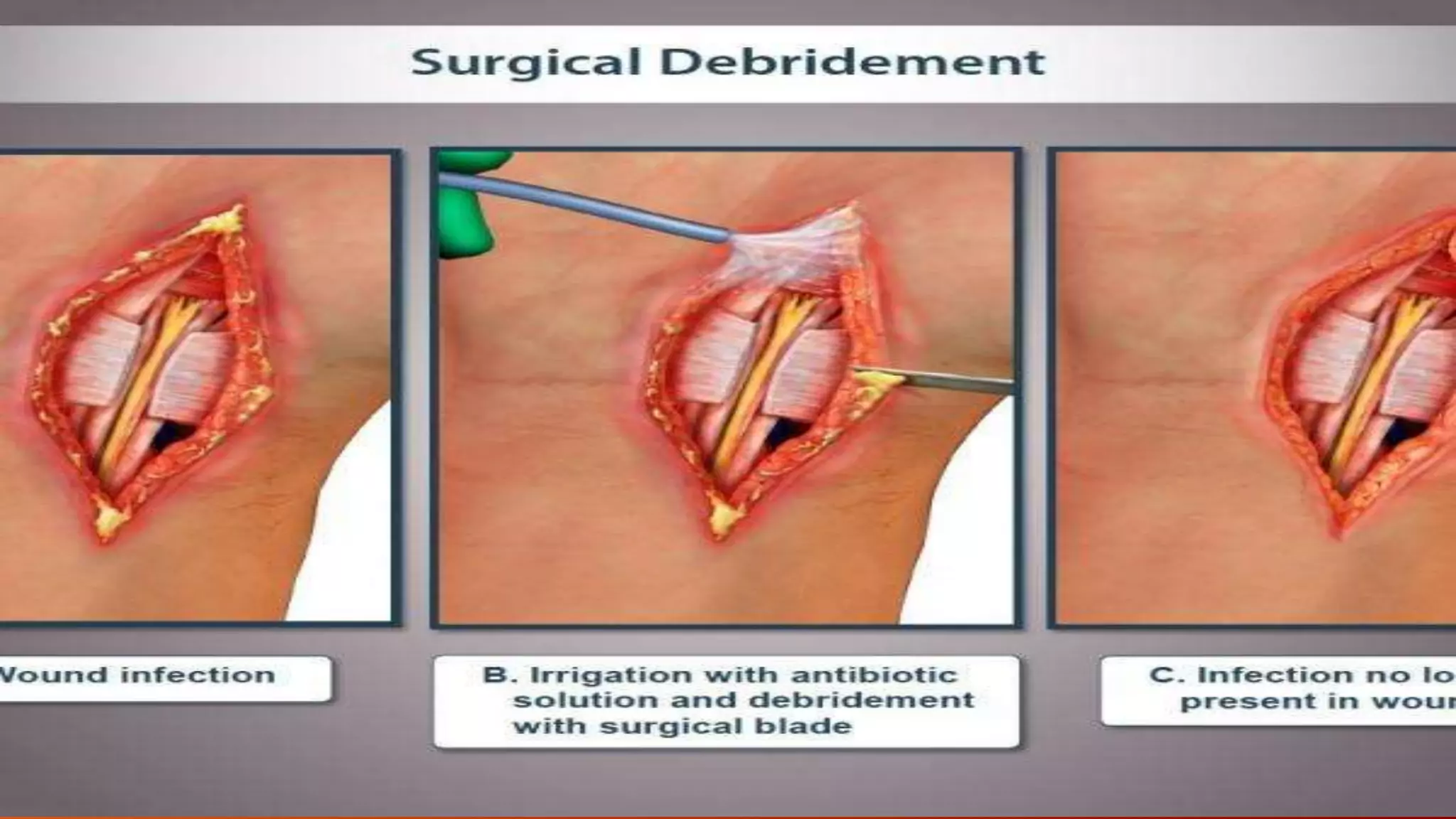
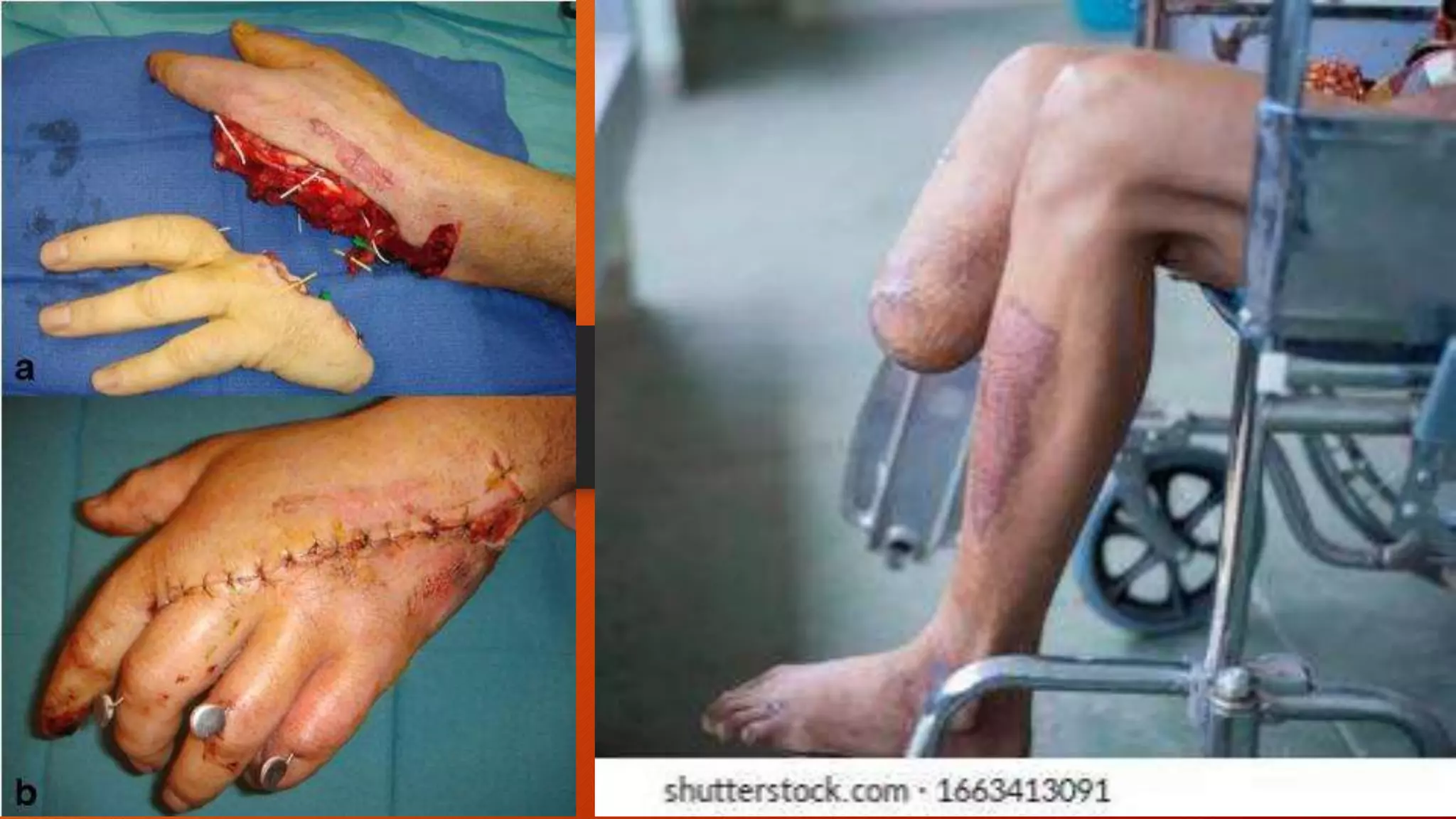
• Debridement
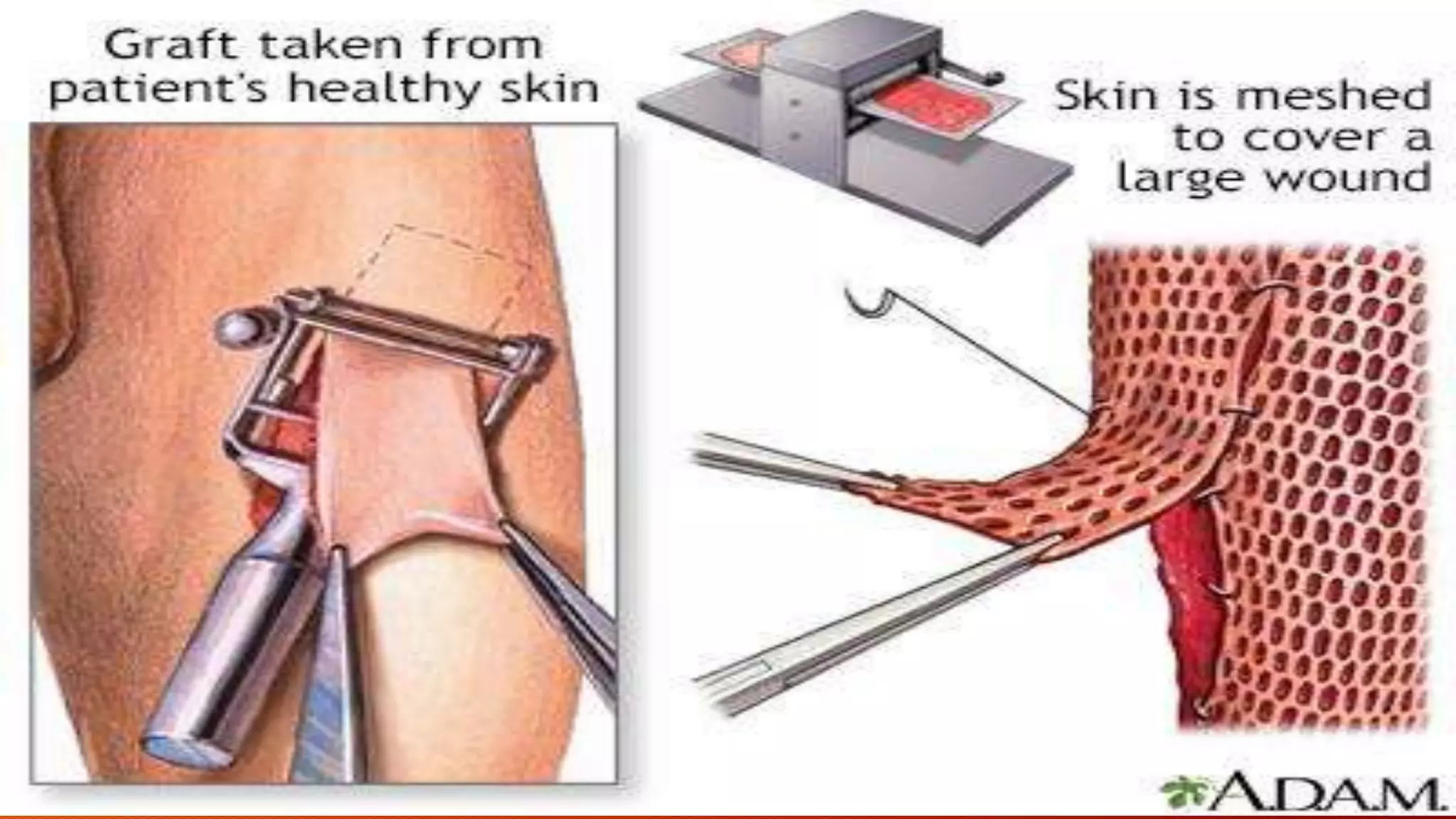
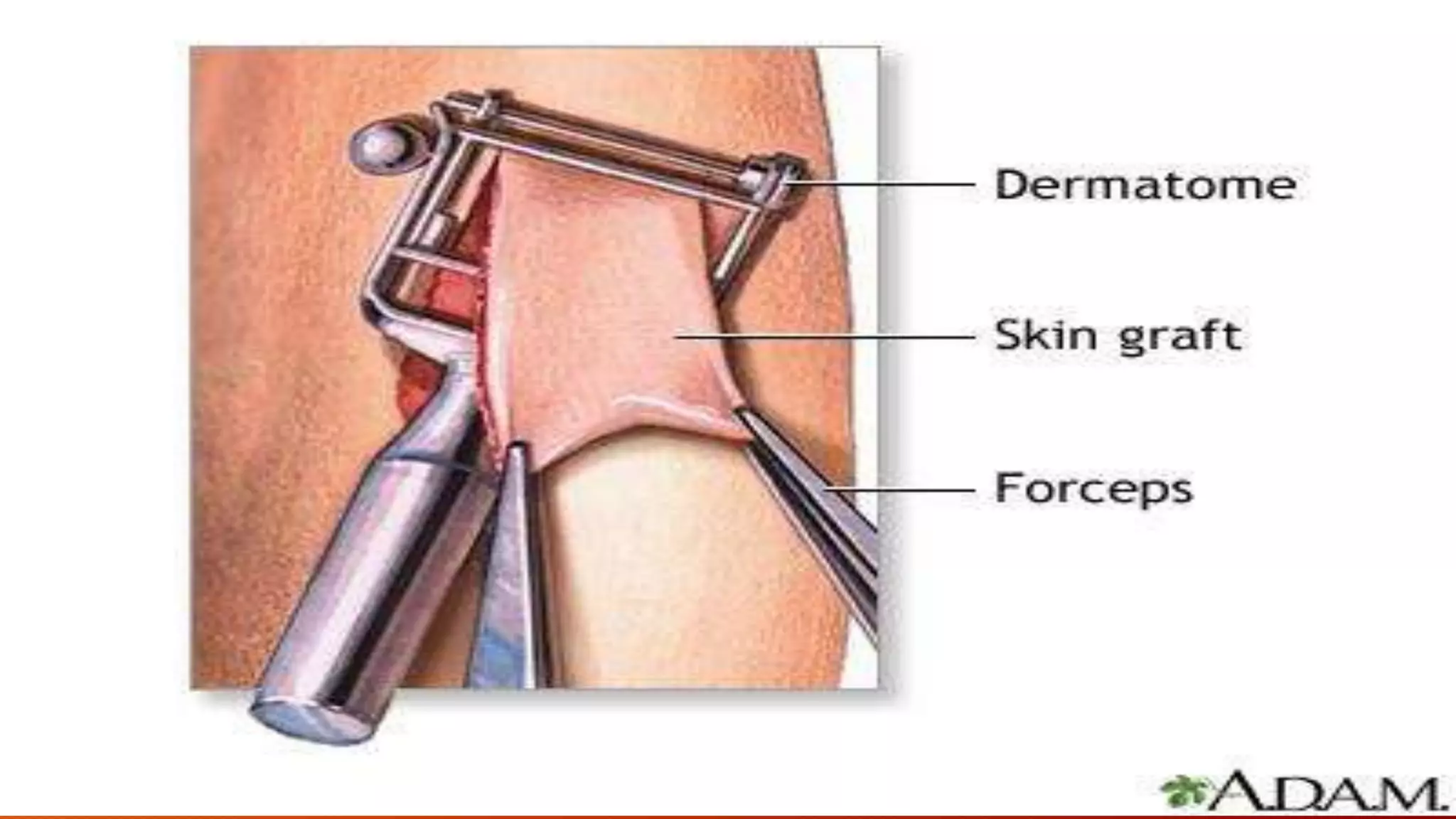
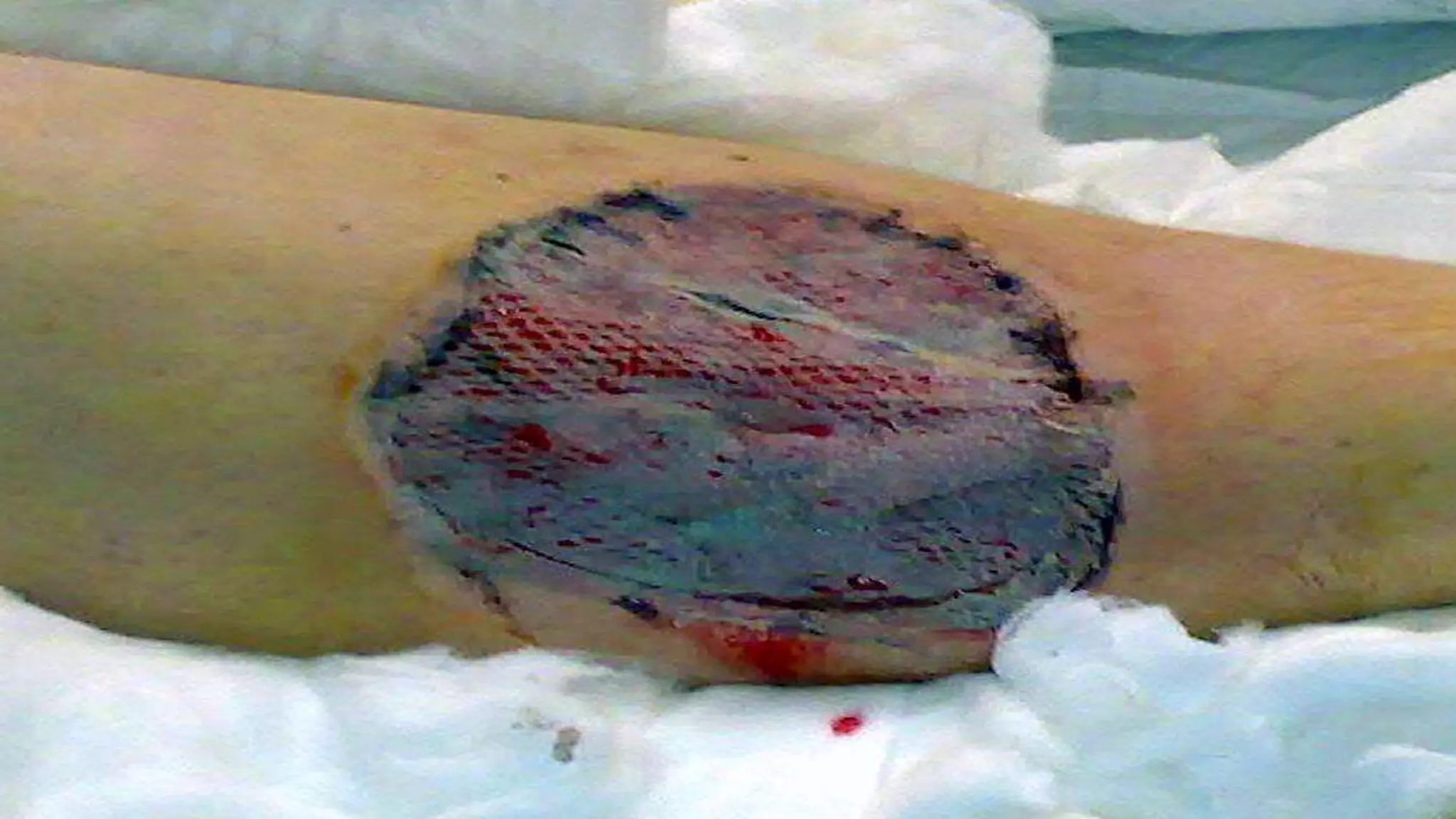
• Skin Graft
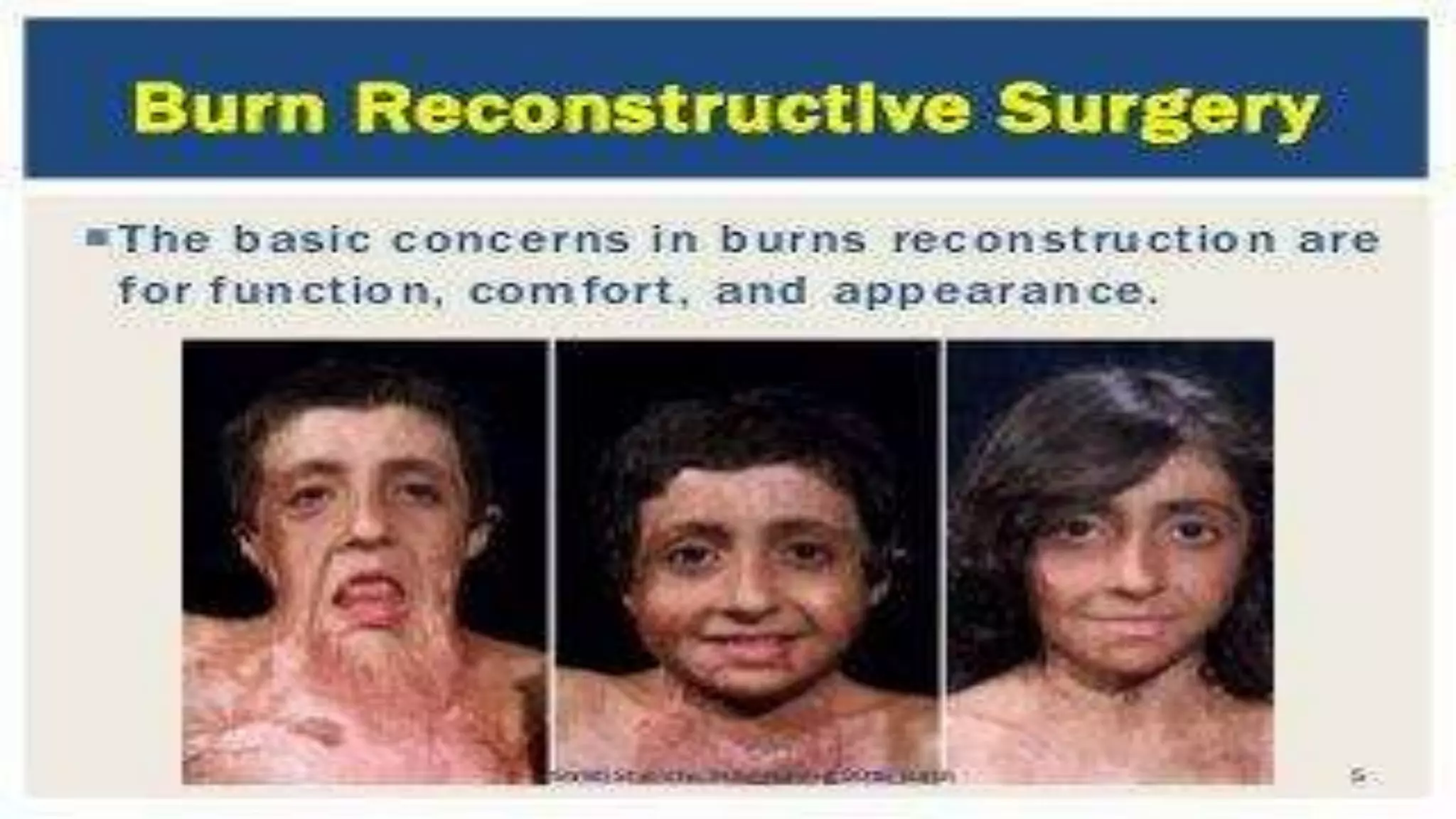
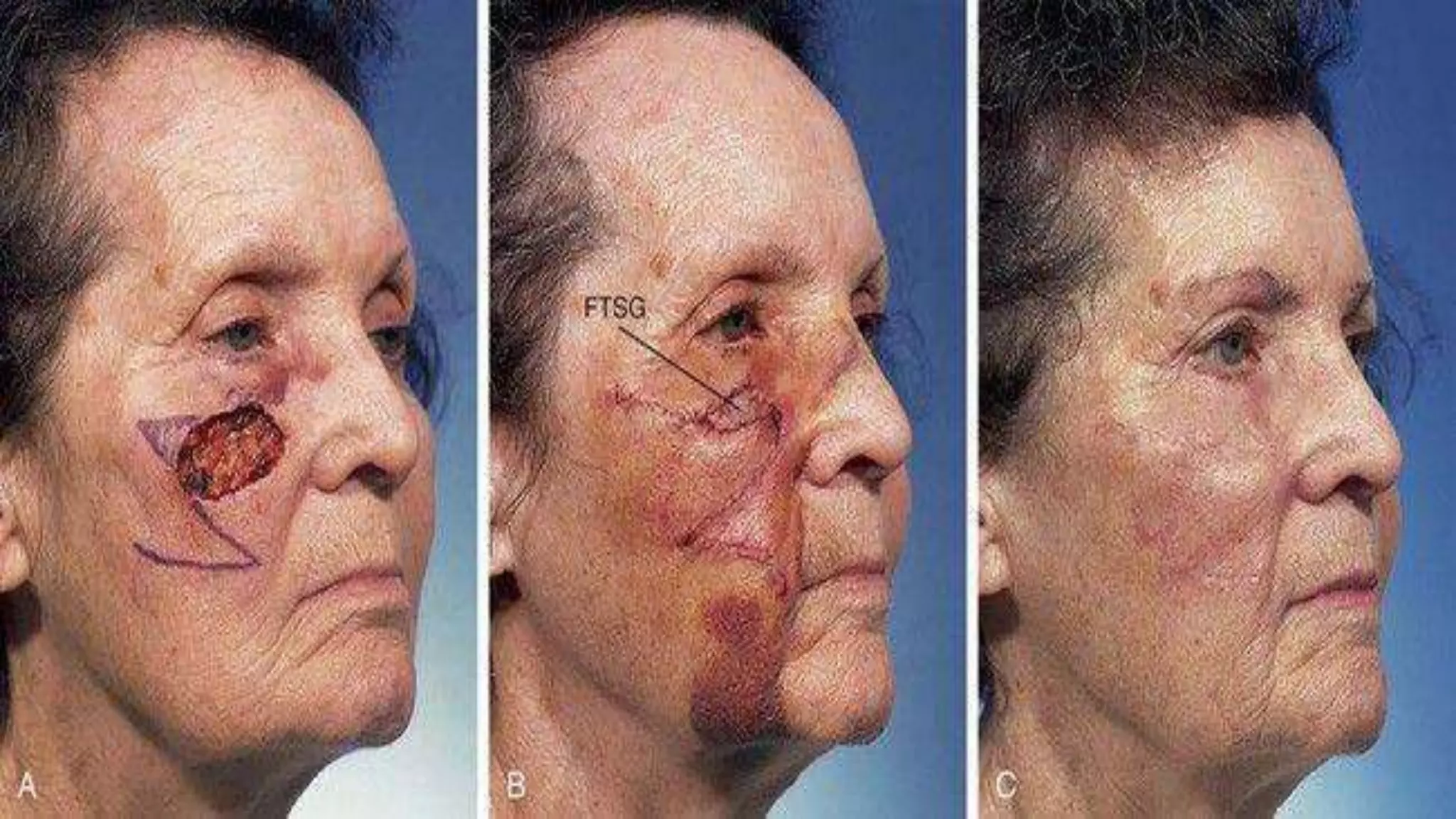
• Reconstructive Surgery
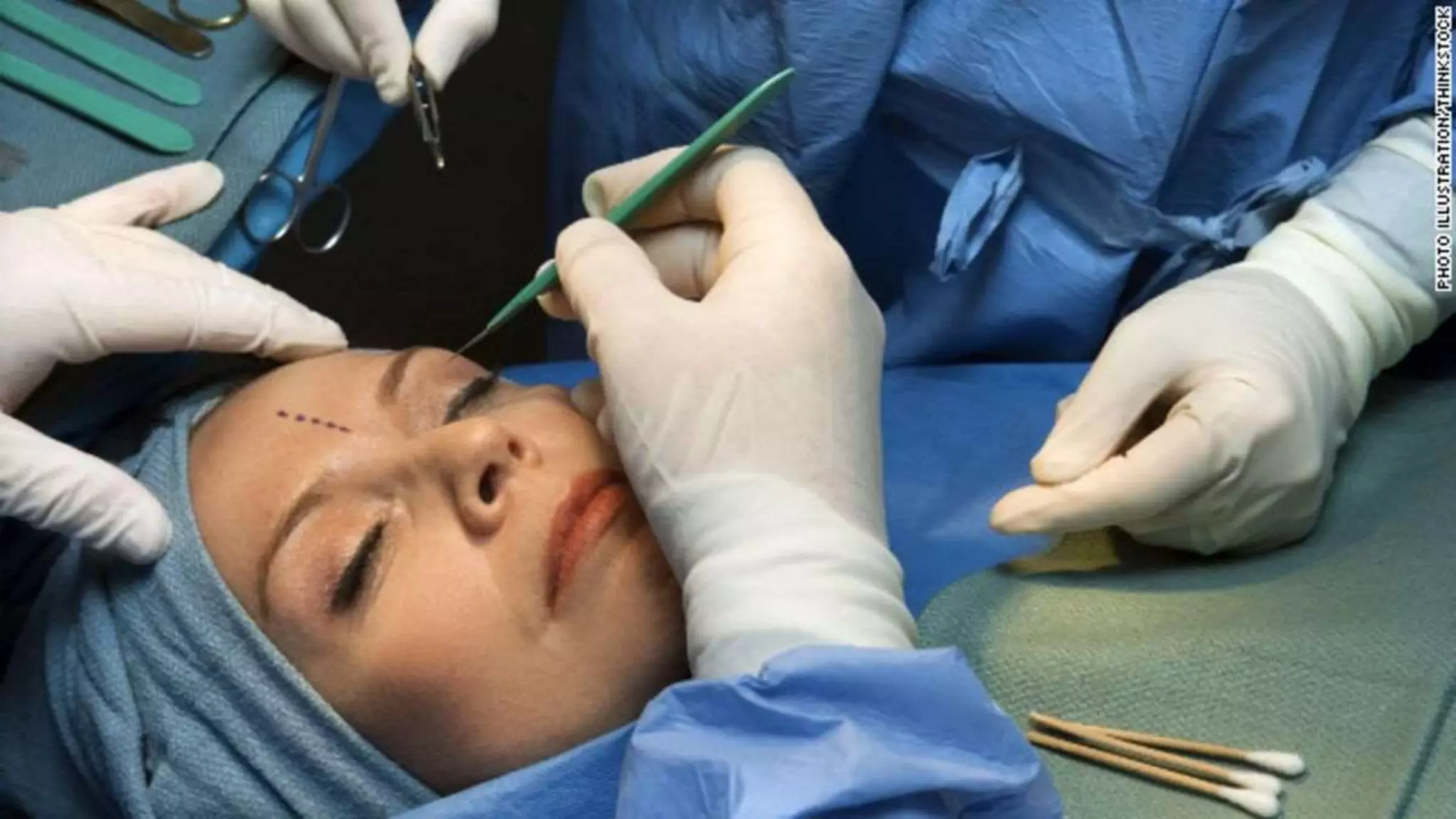
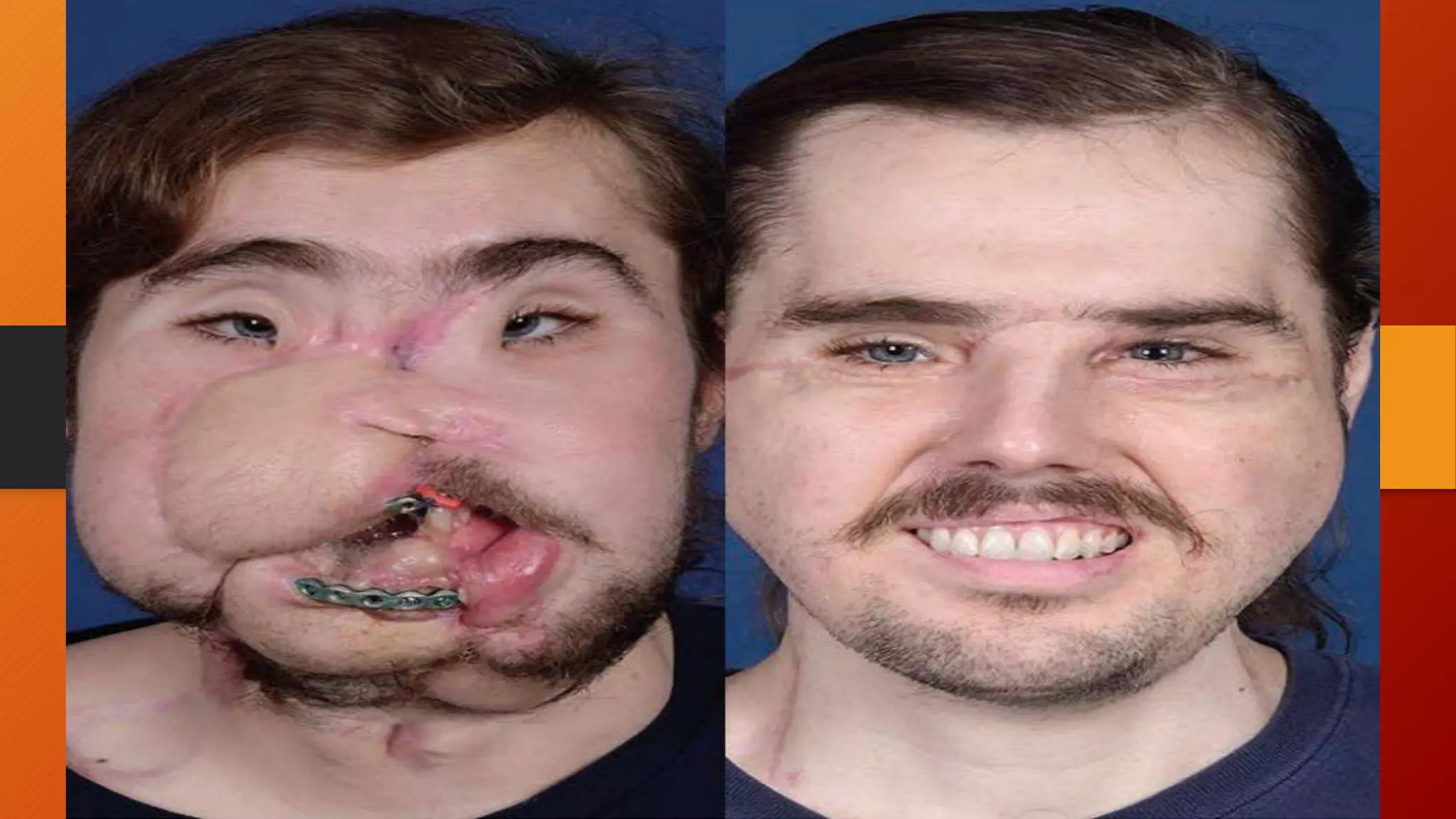
• Plastic Surgery
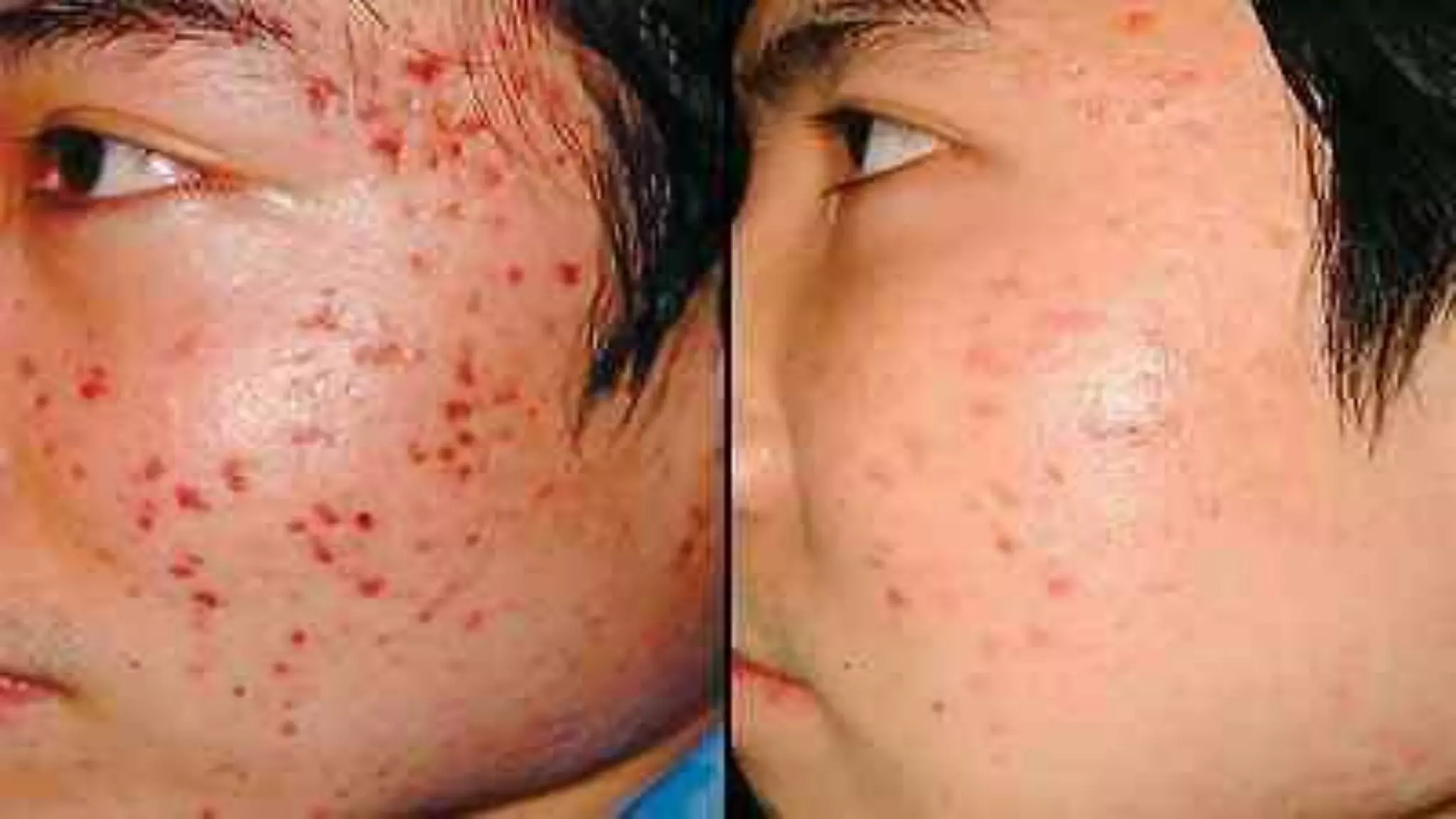
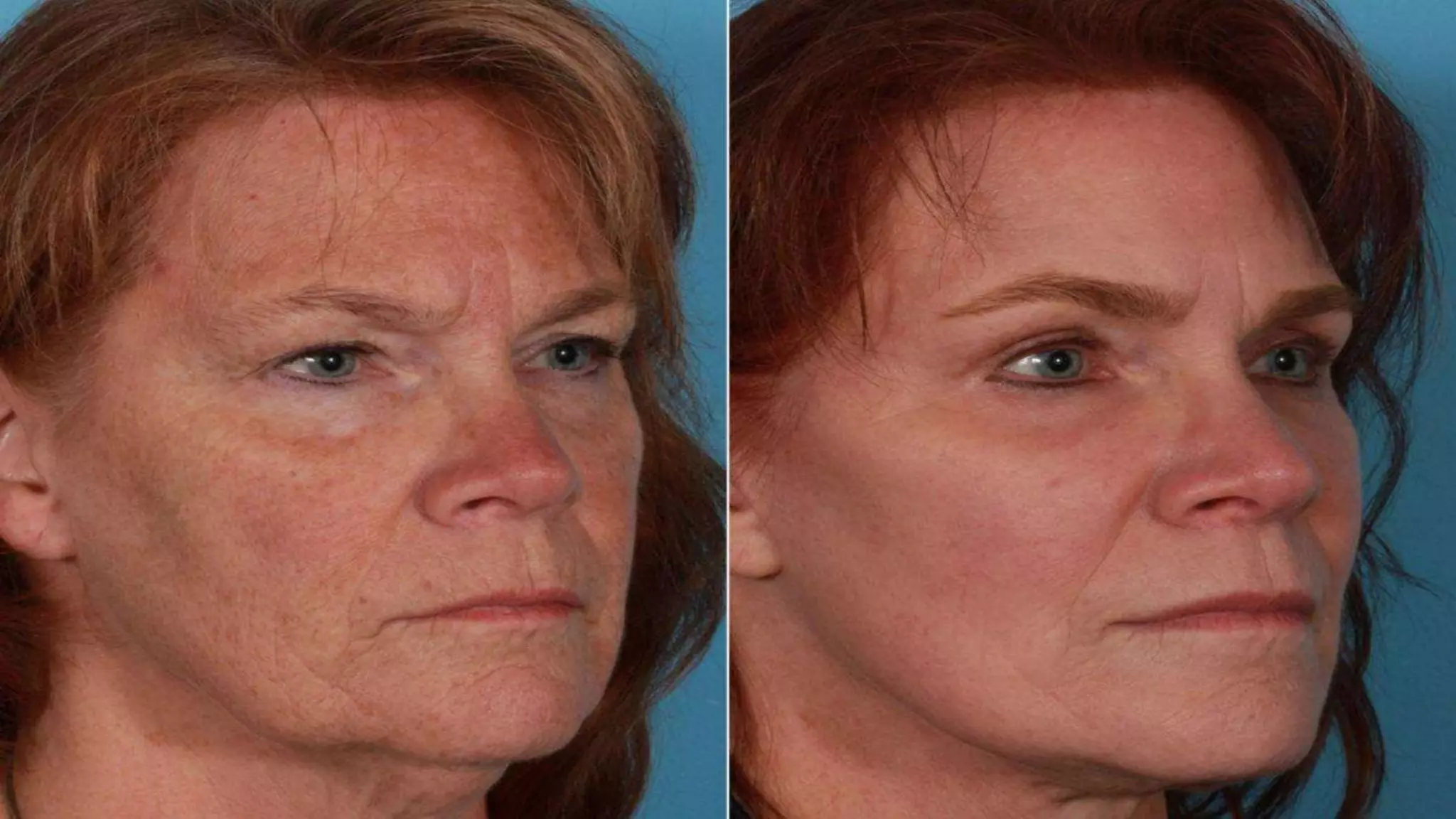
• Dermabrasion
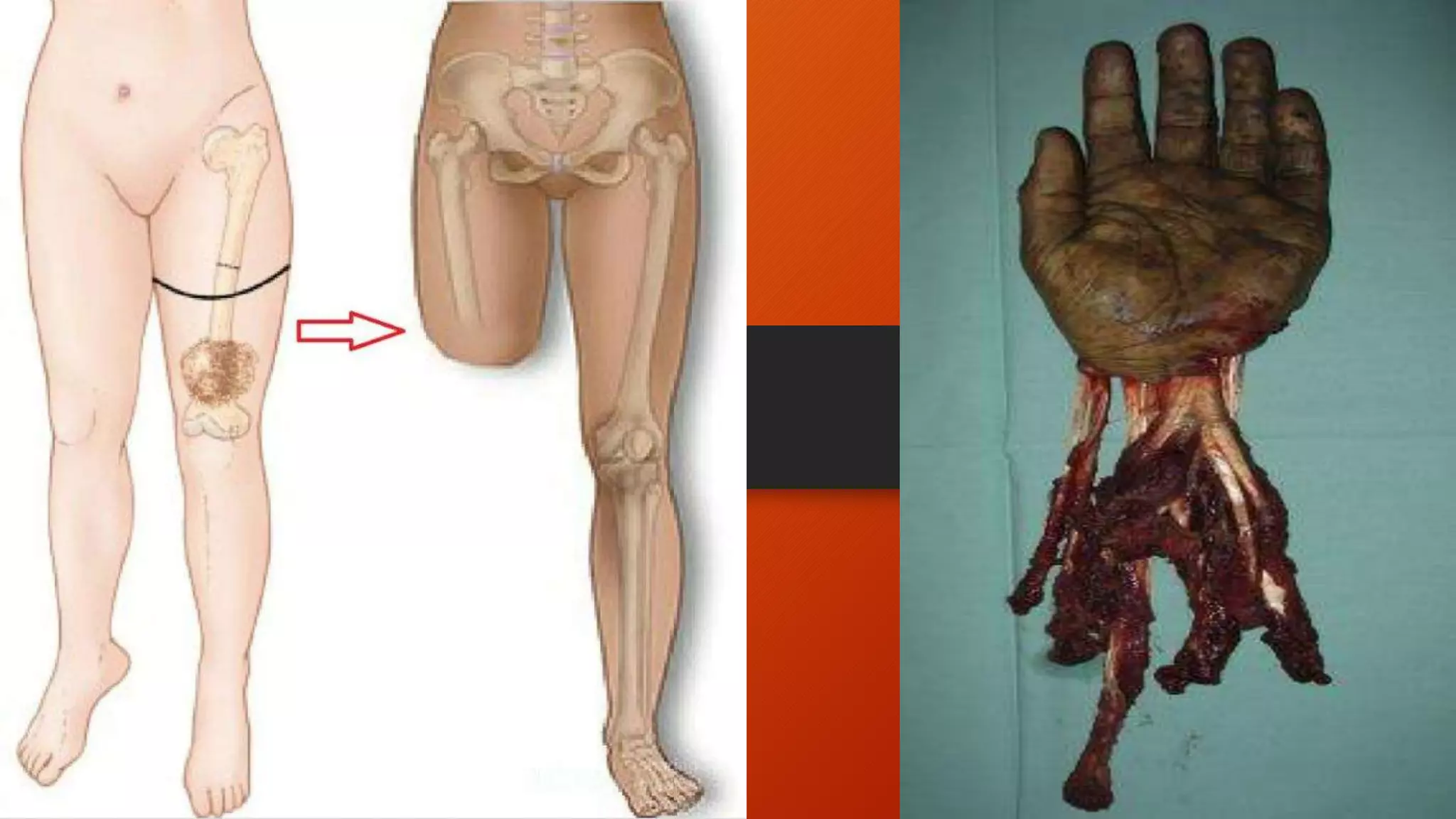
• Amputation
1) Debridement
2) Skin Grafting
3) Reconstructive
Surgery
4) Plastic surgery
5) Dermabrasion
6) Amputation
NURSING MANAGEMENT
Nursing management
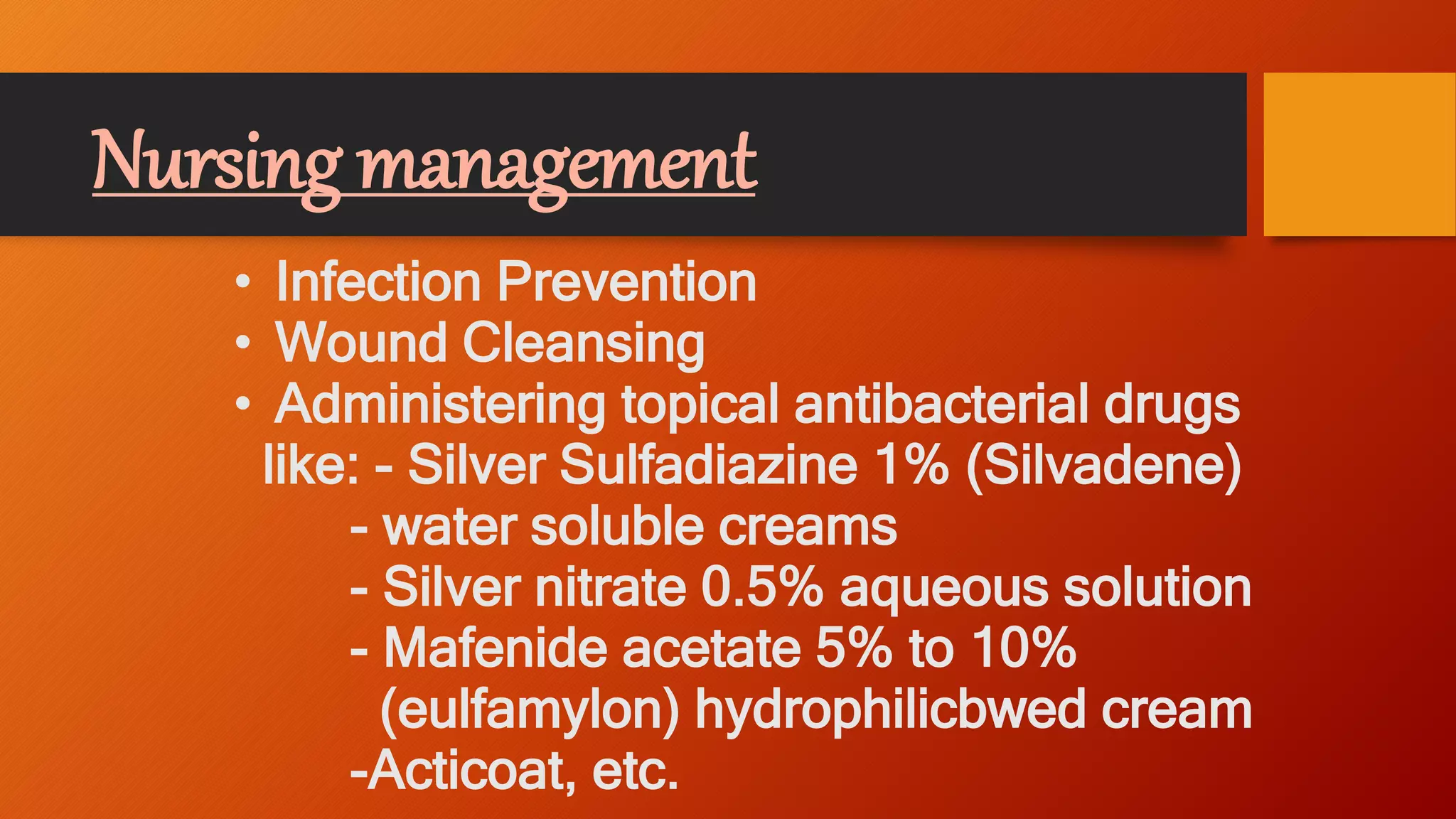
• Infection Prevention
• Wound Cleansing
• Administering topical antibacterial drugs
like: - Silver Sulfadiazine 1% (Silvadene)
- water soluble creams
- Silver nitrate 0.5% aqueous solution
- Mafenide acetate 5% to 10%
(eulfamylon) hydrophilicbwed cream
-Acticoat, etc.
• Restoring fluid and electrolyte balance
• Maintaining normal body temperature
• Minimizing pain and anxiety
• Restoring normal fluid balance
• Promoting gas exchange and airway clearance
• The wound and surrounding skin should be dry
before application of the dressing
Drug study
NURSING
Diagnosis
HEALTH
EDUCATION
Health education
• Personal Hygiene
• Nutrition
• Exercise
• Rest and Sleep
Previous year some questions
In Board exam
Questions
1) Difference between 1st Degree burn and 2nd
Degree burn. -- (2011, 2013)
2) Nursing care of burn patient. -- (2009)
3) Nursing care of patient with thermal burn. -- (2010)
15 Marks long question
a) How will you calculate percentage of burns?
Write the various degrees of burns. - (3)
b) What are the complications of burns? - (2)
c) Write in detail medical and nursing
management
for patient? - (6)
d) What health advice will you give to patient
during hospitalisation and on discharge? - (4)
a) Write classification of burns? - (3)
b) Write assessment of burns with the help
of rule of nine? - (3)
c) Write immediate management of
patient with 30% burns on chest and
neck region? - (5)
d) Write complications of burns? - (4)
( In:- 2019)
Bibliography
Burn SlideShare

Burn SlideShare

  • 2.
  • 3.
  • 4.
    OBJECTIVE • Students givecomprehensive care to the patient. • Students understand the disease condition,its cause and sign-symptoms and its complication. • Student able to write nursing care plan. • Student understand the drug study. • Student understand the management of disease.
  • 5.
  • 6.
  • 7.
    • Name ofpatient: Rajni Vijay Tavilkar • Age/Sex: 38 years/Female • Reg.No:. 17372 • Address: Chandmari Chowk, Tukum, C.Pur • Religion: Hindu • Date Of Admission: 25 April 2022 • Date Of Discharge:- Death On 1 May
  • 8.
    • Occupation:- HouseWife • Income:- 40,000/ Year • Ward No:- ICU • Bed No:- 5 • Diagnosis:- Chemical Burn (85%)
  • 9.
    FAMILYHISTORY • Socio-Economic Status •Housing Pattern • Dietary Pattern • Water Supply • Sanitation • Knowledge Of Health And Health Habits • Religious Belief And Customs • Likes And Dislikes
  • 10.
    Patient medical history •Past medical history of the patient • Present medical history • Past surgical history • Present surgical history
  • 11.
  • 12.
  • 14.
  • 15.
    Introduction •Definition:- Injuries that resultfrom direct contact or exposure to any thermal, chemical, inhalation, electrical or radiation source are termed as burns.
  • 16.
    • Burn injuriesoccur when energy from a heat source is transferred to the tissues of the body. • The depth of injury is related to the temperature and the duration of exposure or contact. • Burn care has improved in recent decades, resulting in a lower mortality for victims of burn injuries. • The estimated annual burn incidence in India is approximately 6.7 million (60 to 70 lacks/Year).
  • 18.
  • 19.
    Etiology In Book • ThermalBurn • Chemical Burn • Electrical Burn • Radiation Burn • Inhalation Burn In Patient • Absent • Present • Absent • Absent • Absent
  • 20.
    1) Thermal Burn Thermalburns are caused by exposure to or contact with flame, hot liquids, semi-liquids (e.g- Steam), semi-solids (e.g- Tar), or hot objects (dry and moist burns).
  • 21.
    Specific examples ofthermal burns are those sustained in residential fires, explosive automobile accidents, cooking accidents or with ignition of poorly store flammable liquids.
  • 22.
    2) Chemical burn Chemicalburns are caused by contact with strong acids, alkalis, or organic compounds. The concentration, volume and type of chemical, as well as the duration of contact determine the severity of a chemical injury.
  • 23.
    Chemical burns canresult from contact with certain household cleaning agents and various chemicals used in industr,y agriculture and military. Chemical injuries to the eyes and inhalation of chemical fumes can be very serious.
  • 24.
    3) Electrical burn Electricalburn injuries are caused by heat that is generated by the electrical energy as it passes through the body. Electrical injuries can result from contact with exposed or faulty electrical wiring or high voltage power lines. People struck by lightning also sustain electrical
  • 25.
    The pathway ofthe current, and resistance of the tissues as the electrical current passes through the body. Contact with electrical current greater than 40 volts (V) is potentially dangerous because of cardiac dysrhythmias.
  • 26.
    4) RADIATION BURN Radiationburns are the list common type of burn injury and are caused by exposure to a radioactive source. These type of Injuries have been associated with nuclear radiation accidents, the use of ionizing radiation in industry and therapeutic irradation. Sunburn from prolong exposure to ultraviolet rays (solar radiation), is also considered to be a radiation burn.
  • 27.
    An acute, localisedradiation injury appear similar to a cutaneous thermal injury. The injury is characterized by skin erythma (superficial reddening of the skin), edema and pain. In contrast, whole body radiation exposure manifestation may begin with nausea, vomiting, diarrhea and fatigue, continue with a headache and fever within hours of exposure. As time Proceeds, hematopoietic and Gastrointestinal
  • 28.
    5) INHALATION BURN Exposureto asphyxiants (e g:- Carbon monoxide) and smoke commonly occurs with flame injuries, particularly if the victim was trapped in an enclosed, smoke field space (e.g:- In a residential fire). Victims who die at the scene of a fire usually do so as a result of hypoxia and carbon monoxide poisoning.
  • 29.
    Exposure to asphyxiants,smoke poisoning, and direct thermal (heat) injury to lung tissue constituate the three facets of an inhalation injury components may be present in the client suffering from an inhalation injury.
  • 30.
  • 31.
  • 32.
    •Age Group:-20-40 • Fireflame occurs more than 60% • Approximately 30% of all burn related deaths • Nations largest cause:- Ignition from cigarettes • Alcohol and drug intoxication:- 40% residential fire death’s
  • 33.
    • Clothing ignitionduring routine meal preparation. •Approximately 10% cases caused by children by playing with matches or other ignition. • Scald burns • Additionally faulty chimneys, flue vents, wood burning, stoves ignition of wood
  • 34.
  • 35.
    Investigation • CBC • ESR •C-Reactive Protein • Wound Swab Culture • X-Match • LFT • KFT
  • 36.
    • PCT Levels •Quantitative Biopcy • Tissue Histopathology • Stagging
  • 37.
  • 38.
    In book • Pain: -Mild • Skin: - Blister - Peeling - Redness - Total loss of hair In Patient - Present - Absent - Present - Present - Present
  • 39.
    • IN BOOK •Whole body: - Flushing - Swelling • Also Common: - Sensitivity to pain - Swelling - Tenderness • Loss of function • Lungs: - Pulmonary edema - Altered ventilation • In Patient - Absent - Present - Absent - Present - Absent - Function loss - Present
  • 40.
    •In book • Septicaemia •Paralytic ulcer • Renal: - Oliguria - Neurosis •In Patient - Present - Present - Present - Present
  • 41.
    •In Book • Metabolic: -Hypermetabolic rate - Electrolyte imbalance - Metabolic acidosis • Nausea: • Vomiting: • Death: •In Patient -Present - Present - Present - Absent - Absent - Death
  • 42.
  • 43.
    Classification of burn •1st Degree Burn • 2nd Degree Burn • 3rd Degree Burn • 4th Degree Burn
  • 44.
  • 45.
  • 47.
  • 51.
  • 54.
  • 57.
  • 60.
  • 61.
    CLINICAL MANIFESTATION • Hypothermia •Fluid and electrolyte imbalance • Respiratory alterations • Decrease cardiac output • Pain response • Altered level of consciousness • Psychological alterations
  • 62.
  • 63.
    BURN DETERMINATION METHOD 1)The Rule Of Nine 2) The Palm Method 3) An age specific burn diagram or chart
  • 64.
    1) The ruleof nine Burn size is express as a percentage of TBSA. The rule of nine was introduced in the late 1940 as a quick assessment tool for estimating burn size in the adult. The basis Abdul is that the body is divided into anatomic sections, each of which represents 9% over a multiple of 9% of the TBSA. This method is easy and requires no diagrams to determine the percentage of TBSA injured. Therefore it is frequently used in emergency departments, where initial triage occurs.
  • 66.
    2) The palmmethod The second method for estimating the size of burn is the palm method. The clients Palm and digits makeup approximately 1% of TBSA. The percent burn is derived by visualising the number of client hands it would take to cover the burn area. This method is useful when the burn areas is small less than 5%.
  • 68.
    3) An agespecific burn diagram or chart A burn diagram charts the percentage for body segments according to age and provide some more accurate estimate of burn size. It should be noted that extent of burn injury is most accurate after initial debridement and should therefore be veryfied again at that time.
  • 71.
  • 72.
    Management of burn 1)Preventive Management 2) Emergent Phase (Resuscitative Phase) 3) Acute Phase (In Hospital) 4) Rehabilitation Phase
  • 73.
    1) Preventive management •In the kitchen • In the home • In the community
  • 74.
    2) Emergent Phase (Resuscitativephase) • Remove the victim • Assess ABC • If there is need of CPR then we would give it properly. • Initial wound care • Immediate care
  • 75.
    3) Acute phase(In Hospital) • Reassessment of ABC and associated trauma • Initiation of fluid replacement • Placement open indwelling urinary catheter • Placement of NG tube • Monitoring vital signs and Baseline lab studies • Pain management
  • 76.
    •Tetanus Immunization • Datacollection • Wound care • Psychological support • Infection control • Provide proper nutritional diet • Provide physical therapy • Topical antimicrobial treatment
  • 77.
    Generally crystalloid ringer’s selectedsolution is used initially and colloids are used during second day. There, several formulae may be used to determine the amount of fluid to be given in the first 48 hours which includes the Parkland formula.
  • 78.
    Parkland formula • InFirst 24 Hours:- 4ml R.L (Ringer Lactate) × Weight in k.g × T.B.S.A (Total Burn Surface Area)
  • 79.
    Here one halfamount of fluid is given in the first 8 hours calculated from the time of injury. If the starting fluids is delayed, bind same amount of fluid is given over the remaining time. It should be noted that to deduct any fluids given in the pre-hospital setting, the remaining half of the fluid is given over the next 16 hours.
  • 80.
    • In second24 hours (Next Day) 0.5ml Colloid × Weight in k.g × T.B.S.A (Total Burn Surface Area) + 2000ml 5% Dextrose
  • 81.
    • Fluid runconcurrently over the 24 hour period
  • 82.
    4) Rehabilitation phase •Minimize Functional Loss • Provide Psychological Support
  • 83.
  • 84.
    Complication • Dehydration andHypovolemia • Shock • Hypothermia • Infection • Blood Clothes • Renal Failure • Contractures
  • 85.
    Early complications •Shock: - Neurogenic -Hypovolemic - Septic • Asphyxia, due to odema of the glottis, If needs urgent tracheostomy.
  • 86.
    • Toxaemia - AcuteToxaemia - Septic Toxaemia • Injury of blood vessels and nerves • Fluid and electrolyte disturbances • Acute gastric dilation or paralytic illeous • Acute duodenal ulcers.
  • 87.
    Late complications • Disliguxementdue to scars and keloicls. • Contractures of the joints. • Chronic ulcers that may be complicated by malignancy. • Endocrine complications as Amenorrhea, Huxsuitism, Testicular atropy. • Psychological upset up to mania.
  • 88.
  • 89.
    Medical management • Analgesics •Benzodizepines • Antihistamines • Intravenous fluid • Antibiotics • Erythropoietin • Calcium gluconate • TPN (Total Parenteral
  • 90.
    Surgical Management • Debridement •Skin Graft • Reconstructive Surgery • Plastic Surgery • Dermabrasion • Amputation
  • 91.
  • 94.
  • 99.
  • 101.
  • 104.
  • 107.
  • 110.
  • 111.
    Nursing management • InfectionPrevention • Wound Cleansing • Administering topical antibacterial drugs like: - Silver Sulfadiazine 1% (Silvadene) - water soluble creams - Silver nitrate 0.5% aqueous solution - Mafenide acetate 5% to 10% (eulfamylon) hydrophilicbwed cream -Acticoat, etc.
  • 112.
    • Restoring fluidand electrolyte balance • Maintaining normal body temperature • Minimizing pain and anxiety • Restoring normal fluid balance • Promoting gas exchange and airway clearance • The wound and surrounding skin should be dry before application of the dressing
  • 113.
  • 114.
  • 115.
  • 116.
    Health education • PersonalHygiene • Nutrition • Exercise • Rest and Sleep
  • 117.
    Previous year somequestions In Board exam
  • 118.
    Questions 1) Difference between1st Degree burn and 2nd Degree burn. -- (2011, 2013) 2) Nursing care of burn patient. -- (2009) 3) Nursing care of patient with thermal burn. -- (2010)
  • 119.
    15 Marks longquestion a) How will you calculate percentage of burns? Write the various degrees of burns. - (3) b) What are the complications of burns? - (2) c) Write in detail medical and nursing management for patient? - (6) d) What health advice will you give to patient during hospitalisation and on discharge? - (4)
  • 120.
    a) Write classificationof burns? - (3) b) Write assessment of burns with the help of rule of nine? - (3) c) Write immediate management of patient with 30% burns on chest and neck region? - (5) d) Write complications of burns? - (4) ( In:- 2019)
  • 121.