WHAT IS MATH AND WHY SHOULD
WE CARE
PI
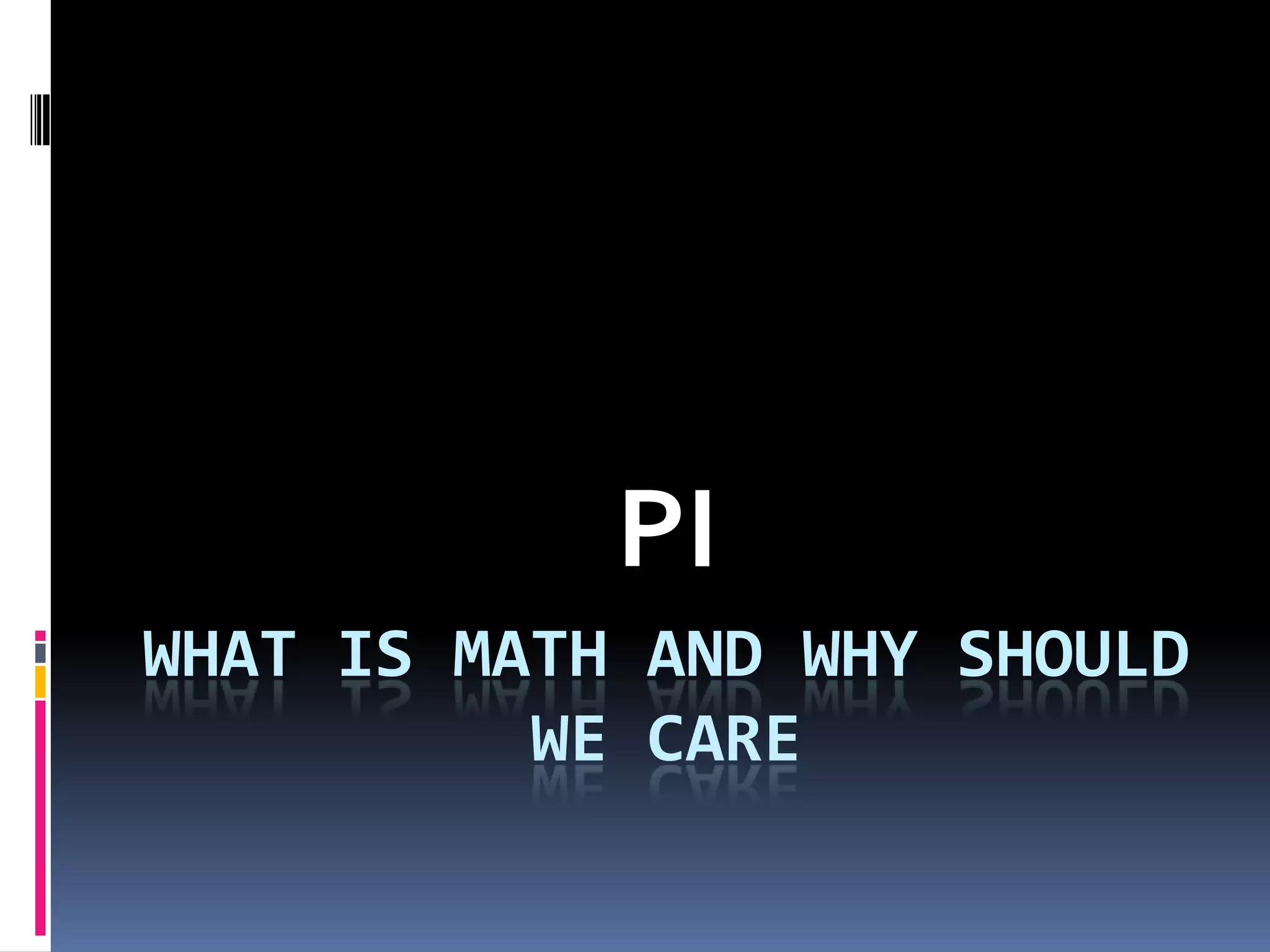
What is Pi?
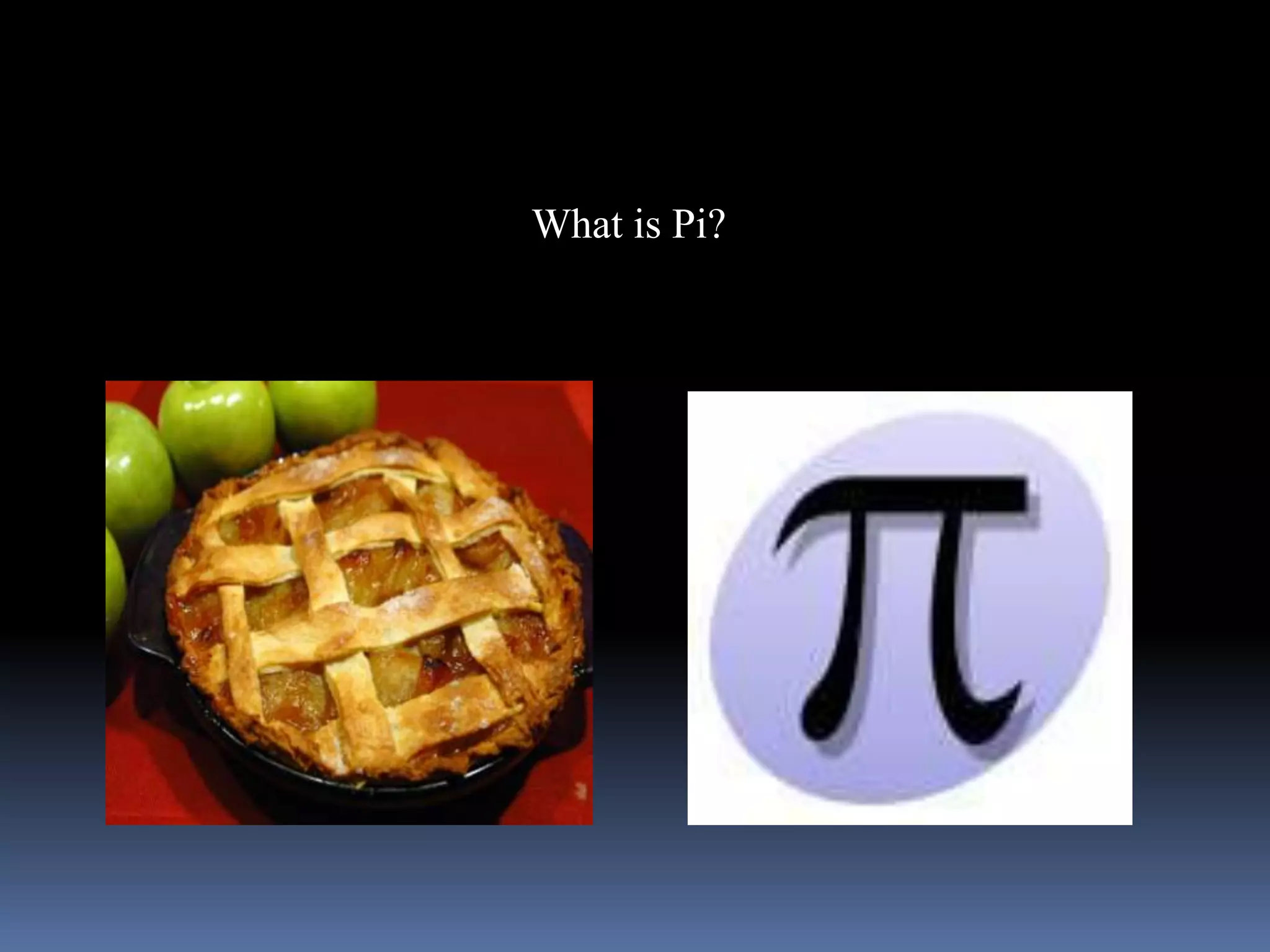
PI is the relationship between the diameter and the circumference of
a circle
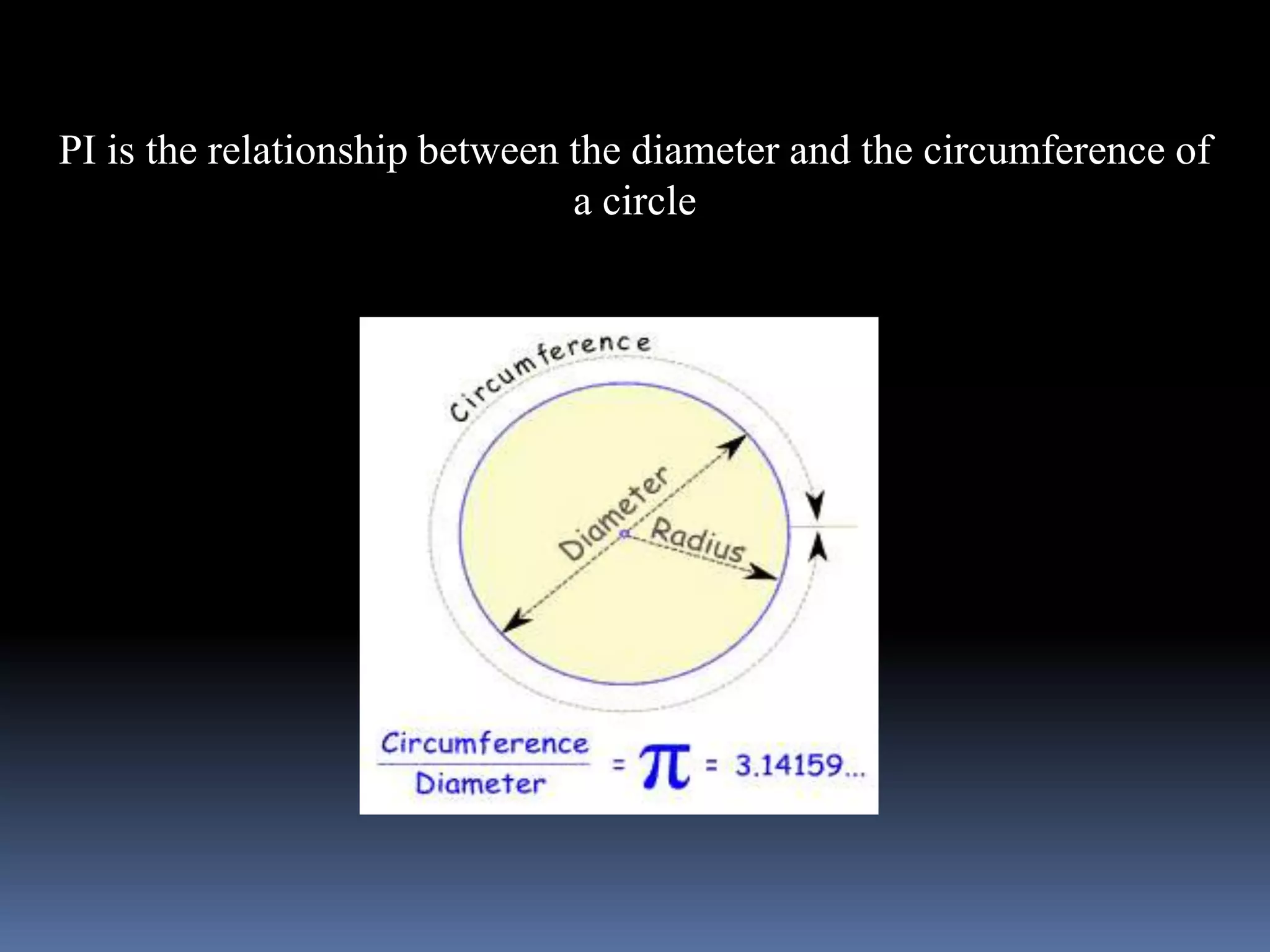
What is innumeracy?
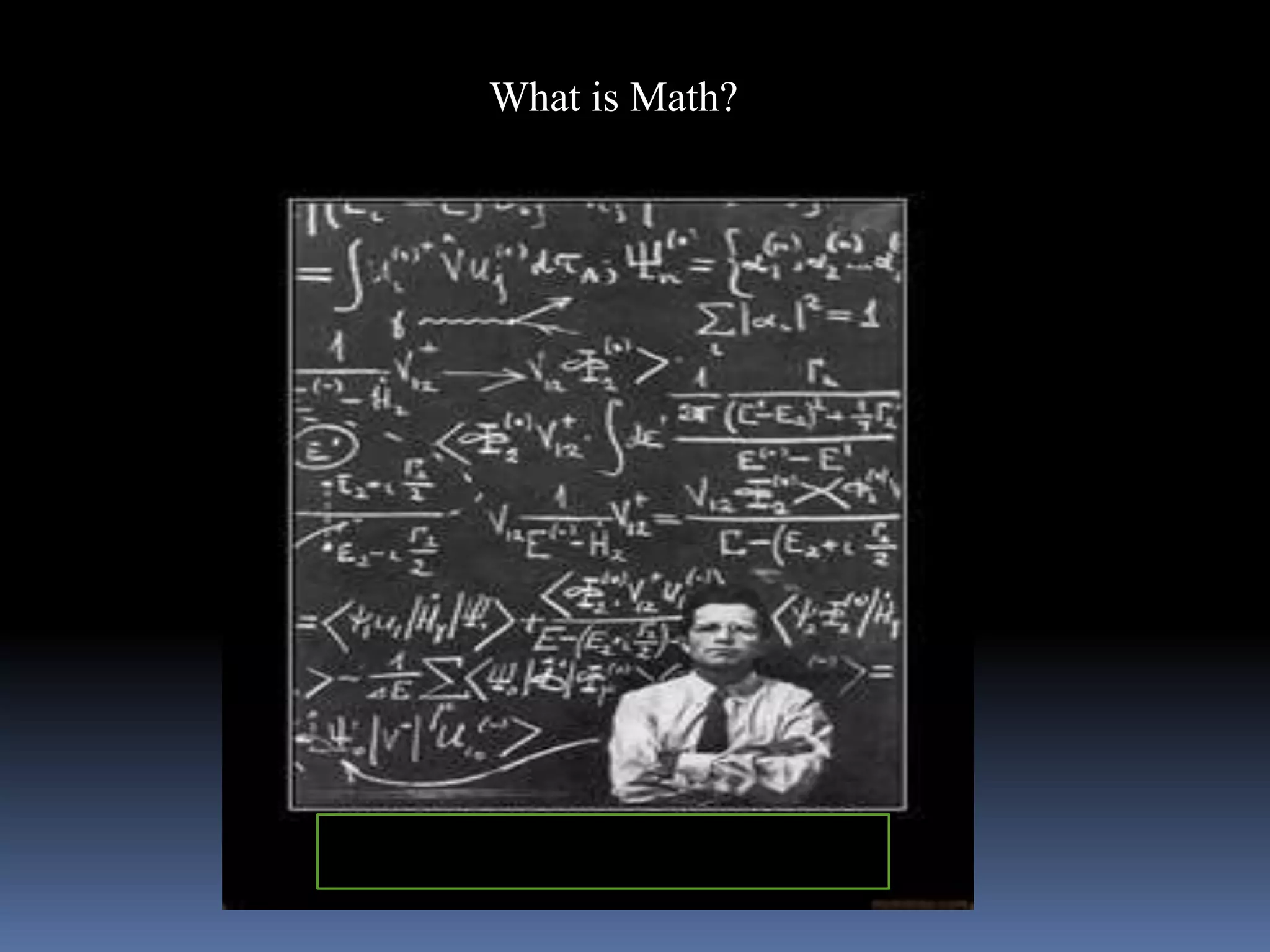
What is Math?
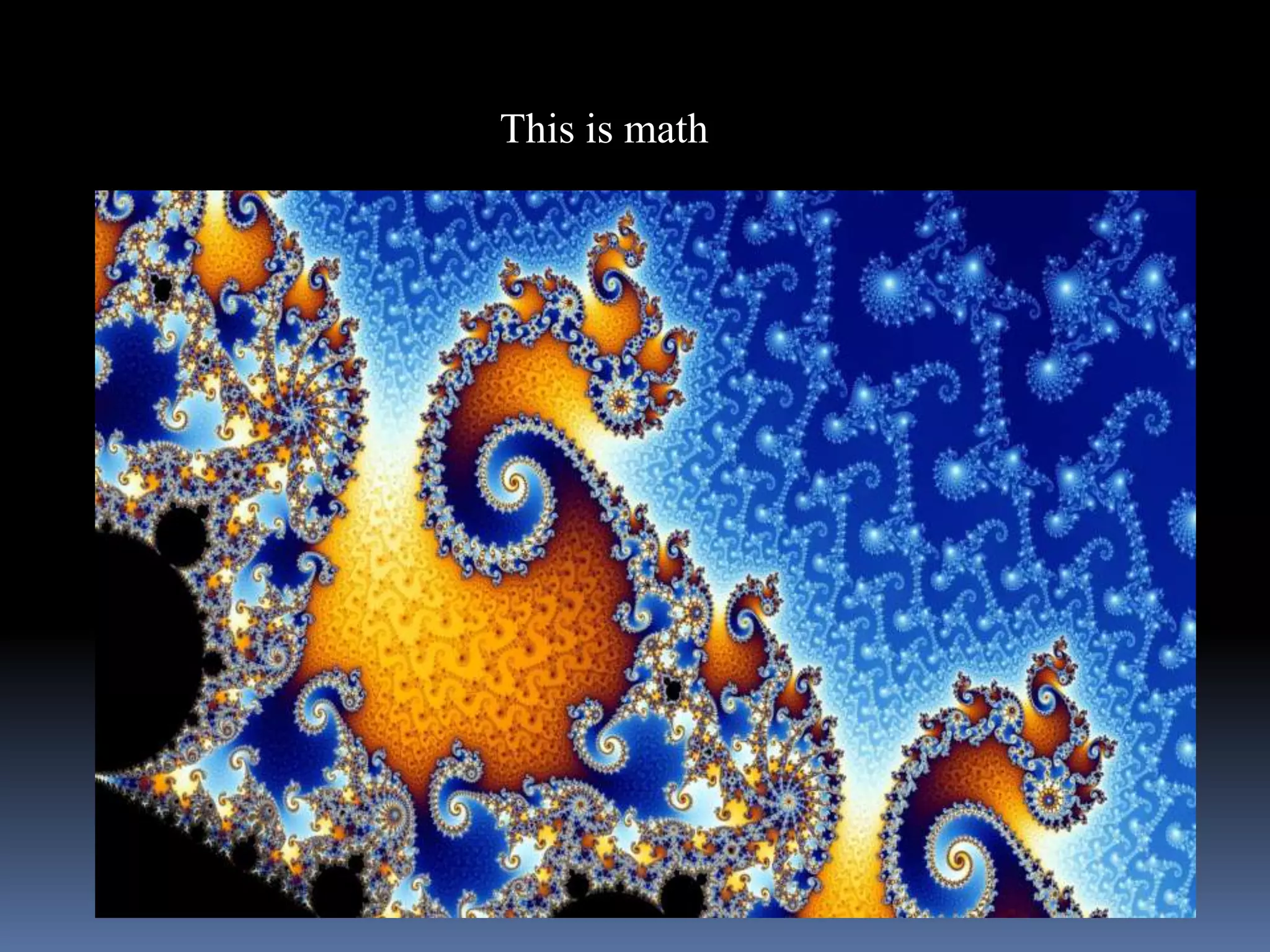
This is math
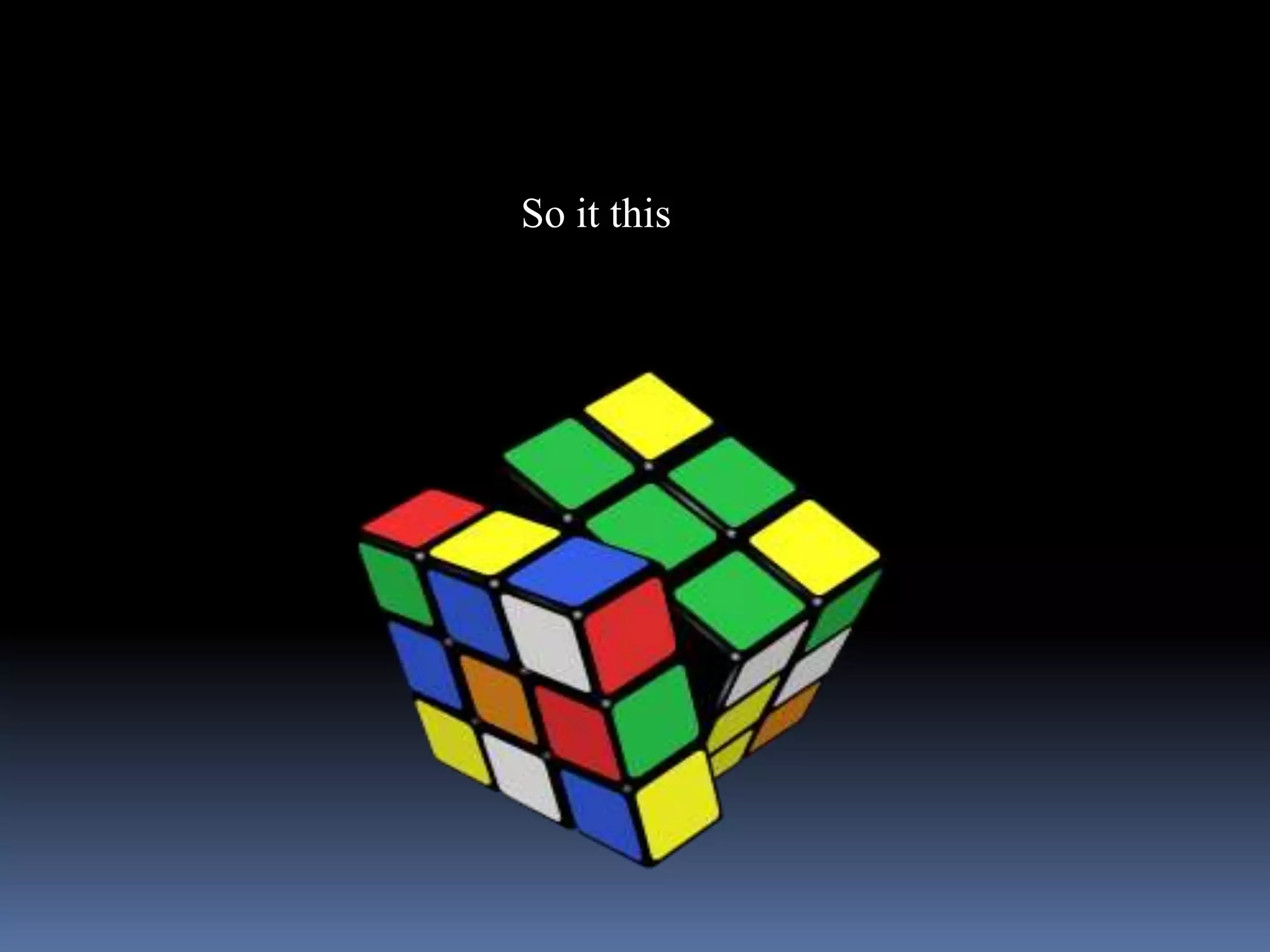
So it this
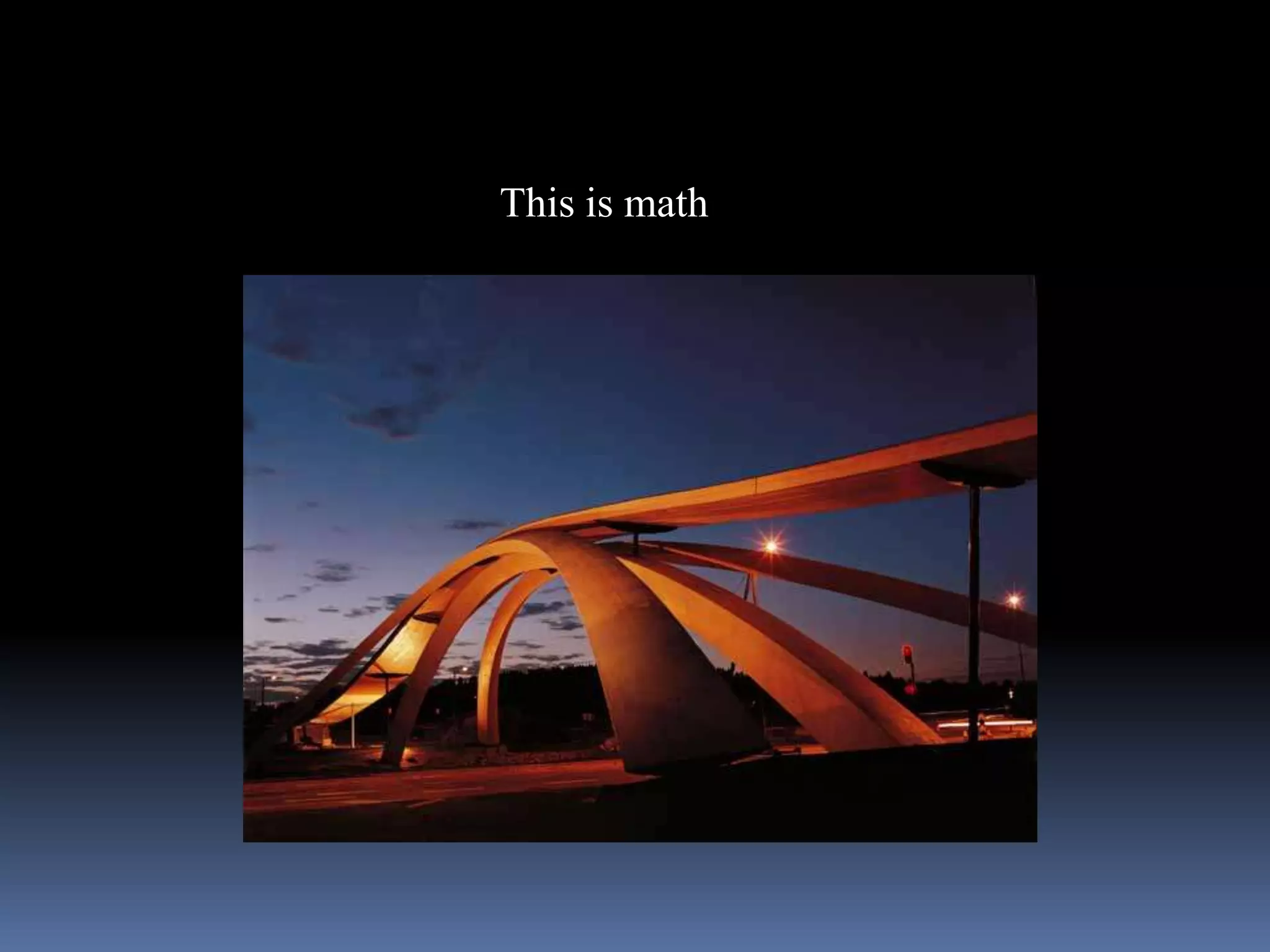
This is math
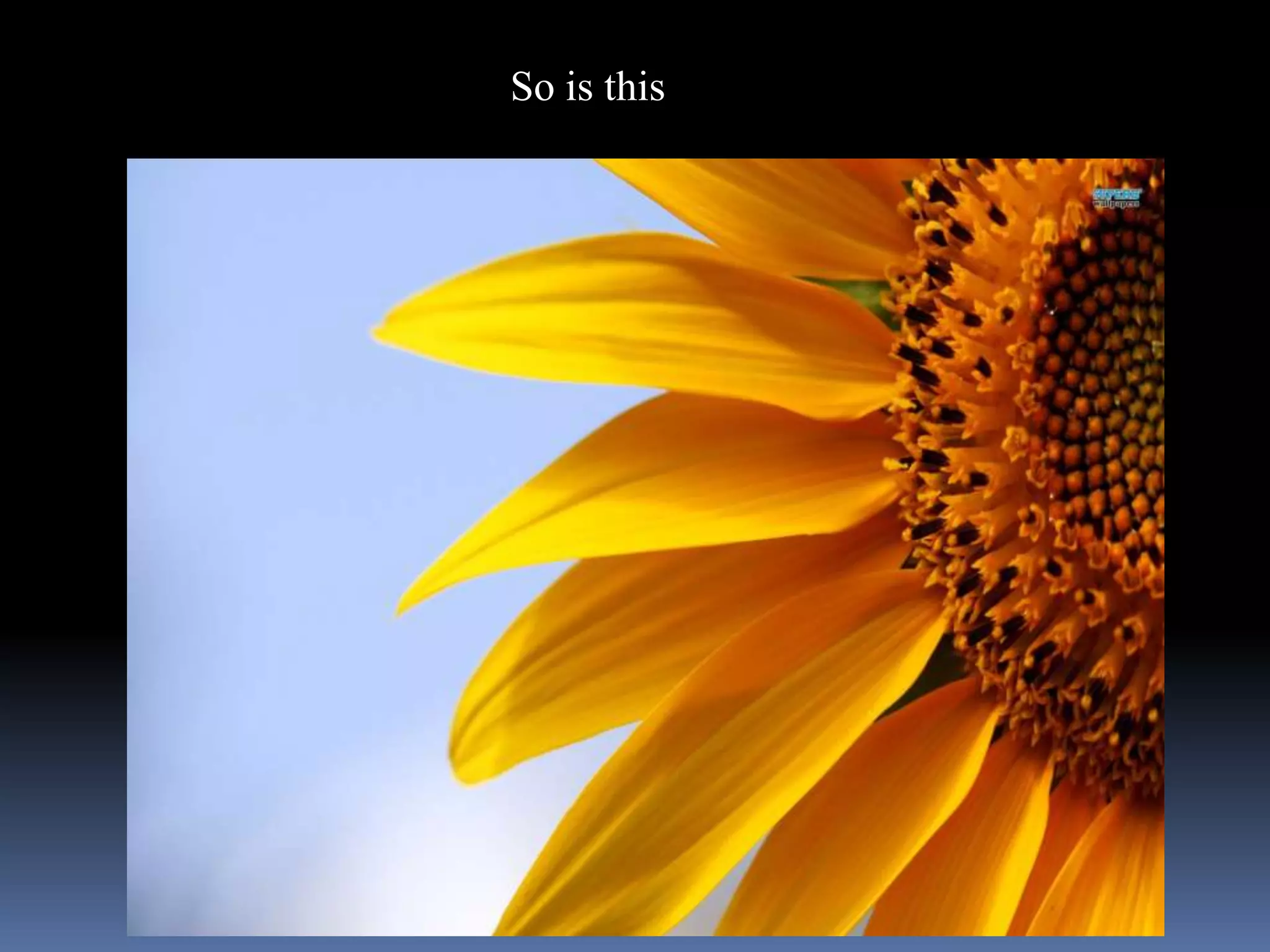
So is this
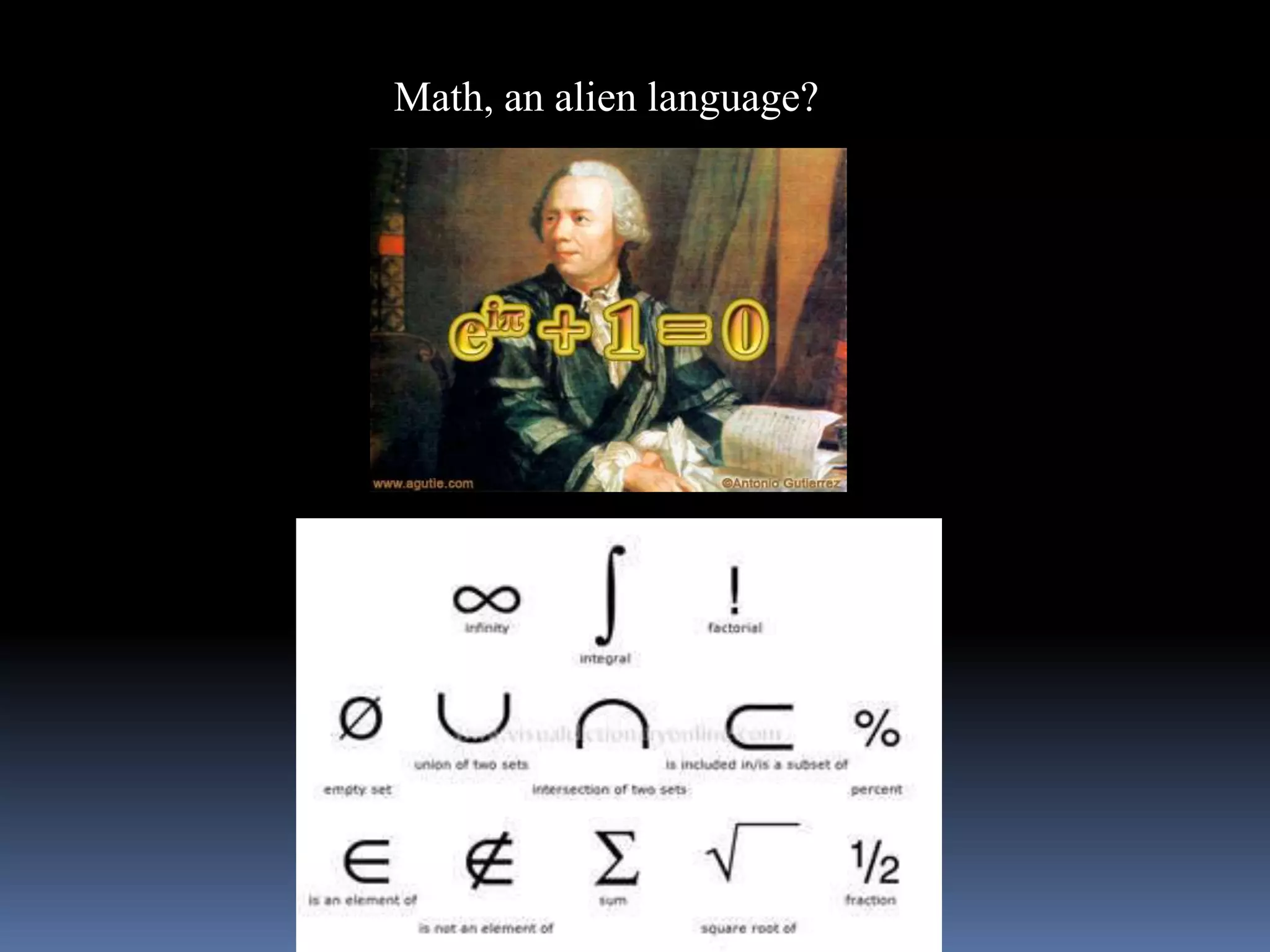
Math, an alien language?
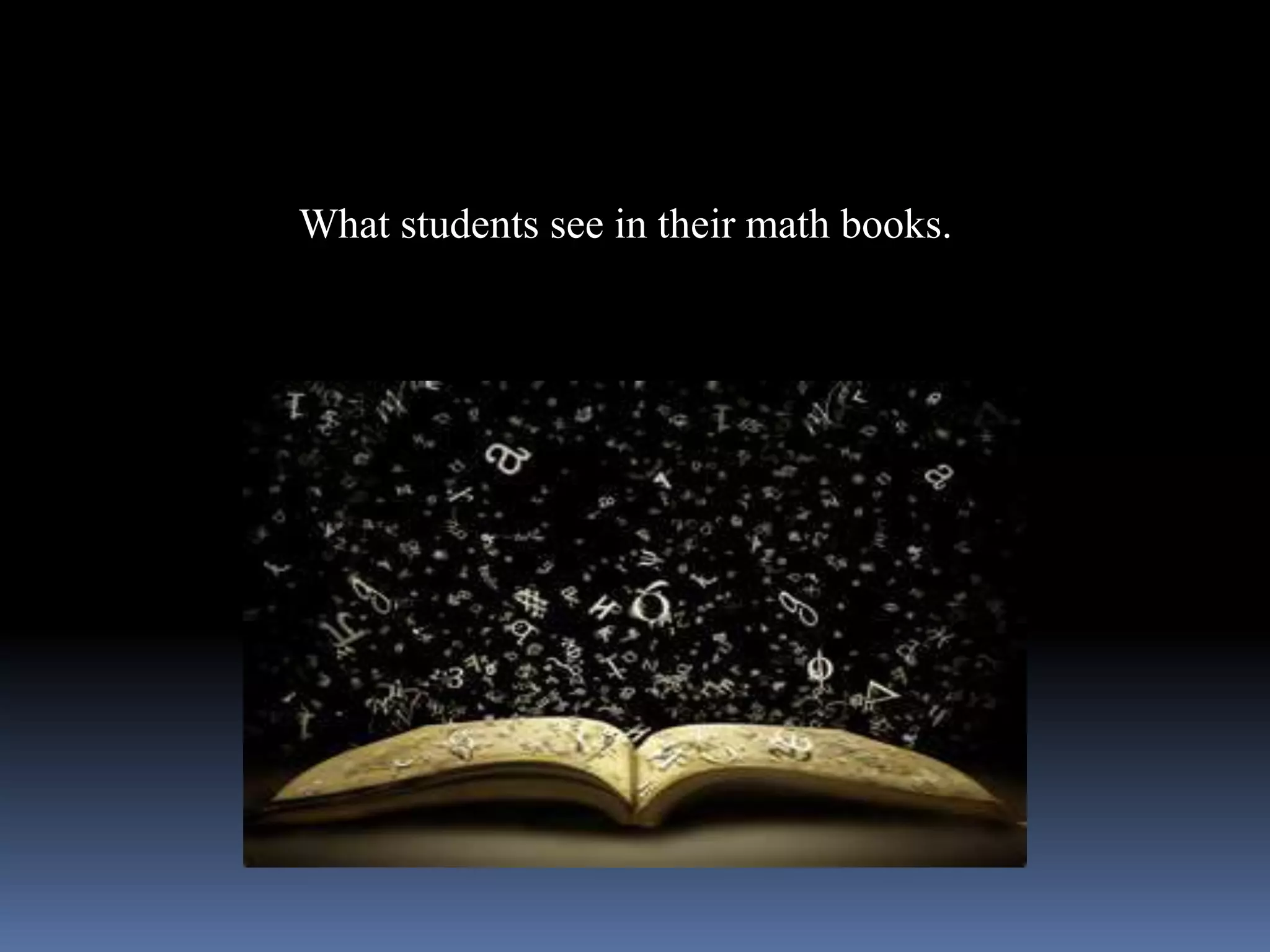
What students see in their math books.
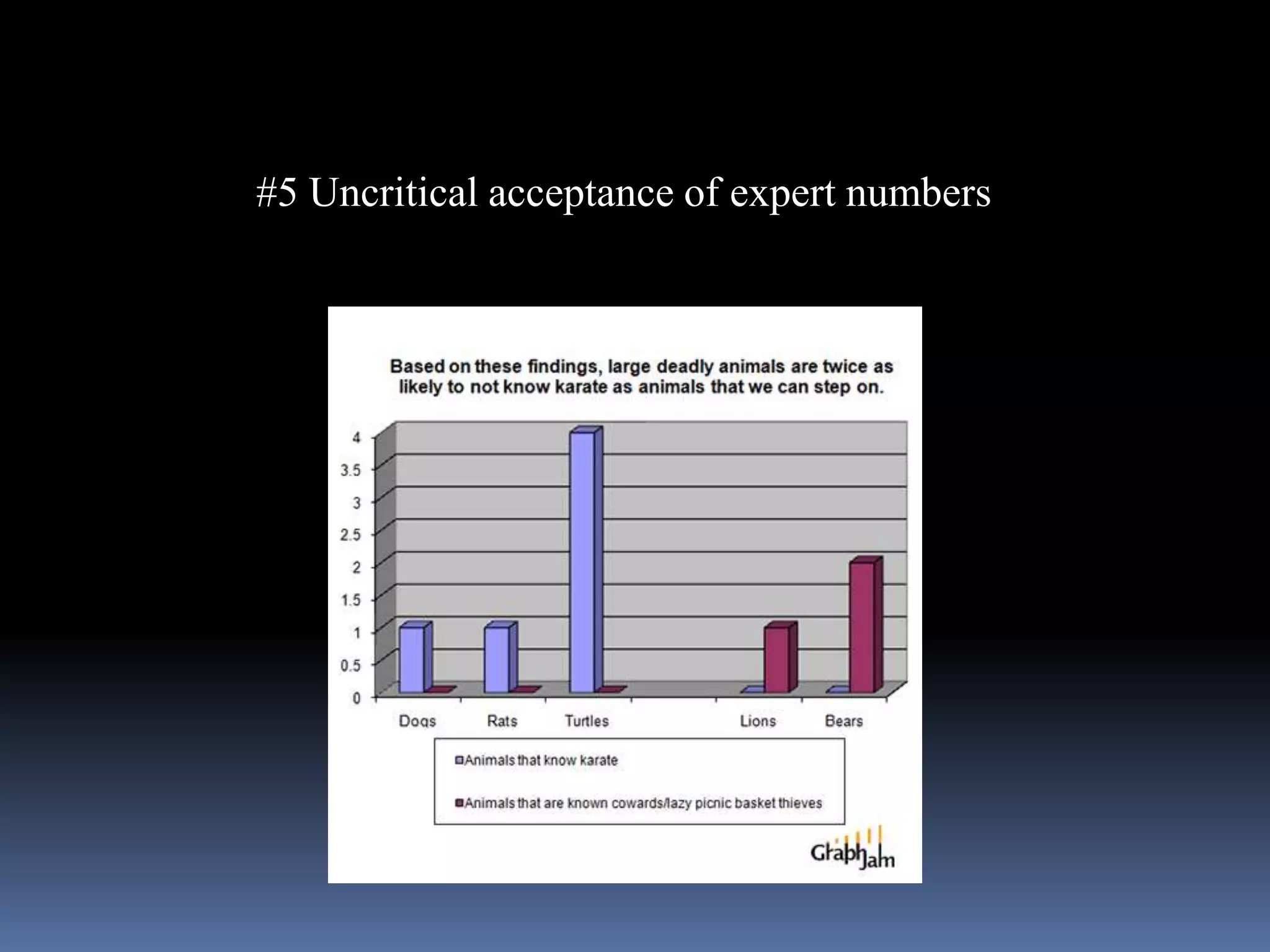
#5 Uncritical acceptance of expert numbers
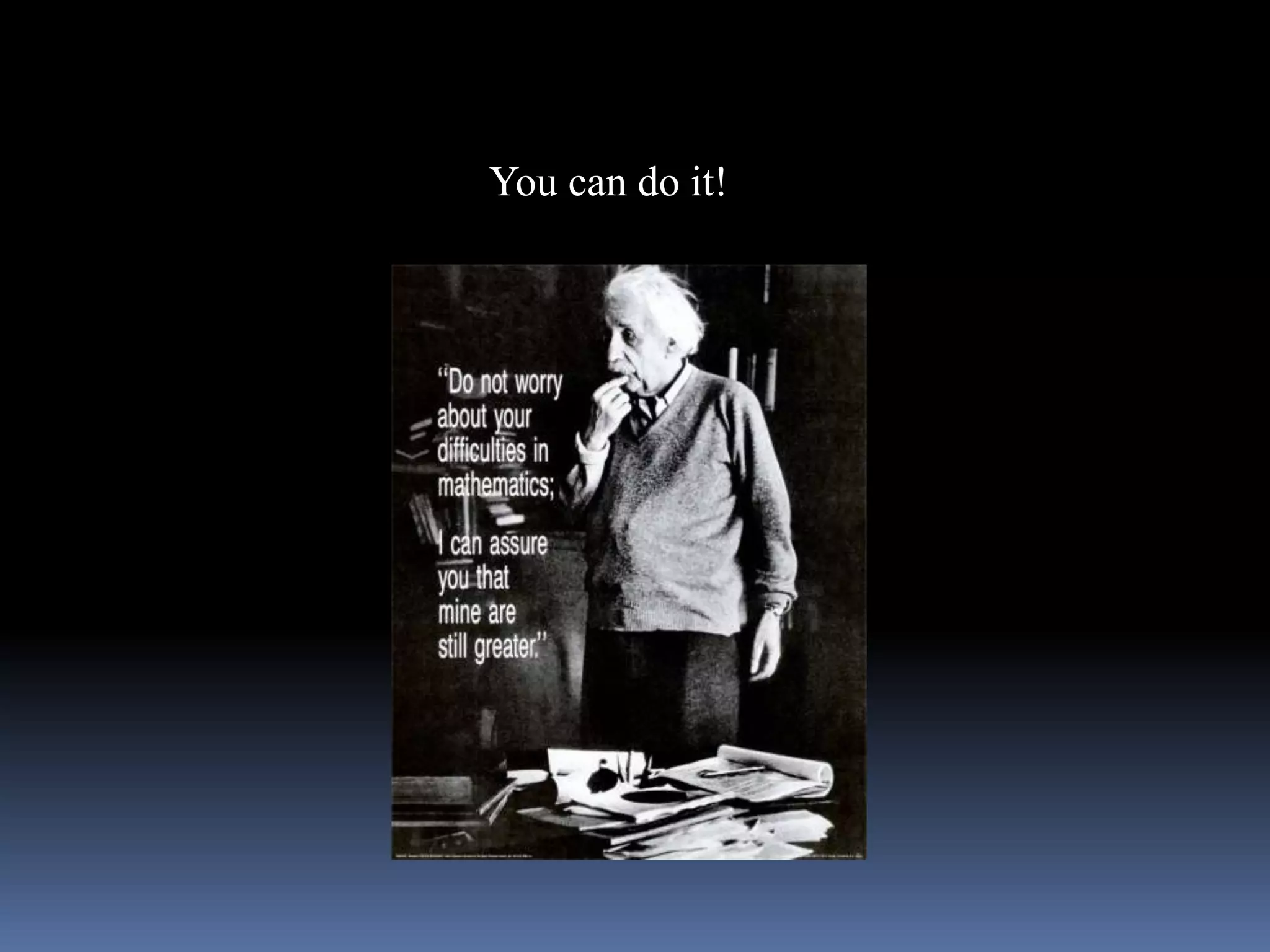
You can do it!
Bibliography
1.) Cerrito, Patricia B.,”Teaching Statistical Literacy.”, College
Teaching, winter99,Vol.47, Issue 1, P9. .
2) Dewdney, A.K., “Two Hundred Percent of Nothing…”, Consumer Research
Magazine, May93,Vol. 76, Issue 5, p16.
3) Dotson, Connie L., “Fundamentals of Dimensional Metrology”’ Delmar Learning, New
York, 2006
4) Gemignani, Michael C., “Basic Concepts in Mathematics and Logic”,AddisonWesley
publishing co., Massachusetts, 1968
5) Hemenway, Priya, “Divine Proportion, PHI in Art, Nature, and Science”, Sterling
Publishing, NewYork, 2005
6) Kline, Morris, “Mathematics for the Nonmathematician”, 1967. Dover, 1985.
7) Marshall, R. “Prescribing a ‘realistic’ cure for the epidemic of innumeracy. (Cover
Story), Newsweek, 12/2/91, Vol. 118 Issue 23, Pg54
8) Paulos, John Allen, “Innumeracy. Mathematical Illiteracy and its Consequences” , Hill
andWang, NewYork, 1988
9) Rolfe, Kathy, Personal interview, 35 year teacher of mathematics, current pre-calculus
instructor, Rogue Community College
10) Sembera, Angela and Hovis, Micheal, “Math! A Four LetterWord”, Wimberly
Press,Texas, 1990.
11) Stites, Janet and Liepke, Peter, “Running the Numbers: Ruminations of John Allen
Paulos.”,Omni,Apr93,Vol. 15 Issue 6, p34

Boyd,shane

  • 1.
    WHAT IS MATHAND WHY SHOULD WE CARE PI
  • 2.
  • 3.
    PI is therelationship between the diameter and the circumference of a circle
  • 4.
  • 5.
  • 6.
  • 7.
  • 8.
  • 9.
  • 10.
    Math, an alienlanguage?
  • 11.
    What students seein their math books.
  • 12.
    #5 Uncritical acceptanceof expert numbers
  • 13.
  • 14.
    Bibliography 1.) Cerrito, PatriciaB.,”Teaching Statistical Literacy.”, College Teaching, winter99,Vol.47, Issue 1, P9. . 2) Dewdney, A.K., “Two Hundred Percent of Nothing…”, Consumer Research Magazine, May93,Vol. 76, Issue 5, p16. 3) Dotson, Connie L., “Fundamentals of Dimensional Metrology”’ Delmar Learning, New York, 2006 4) Gemignani, Michael C., “Basic Concepts in Mathematics and Logic”,AddisonWesley publishing co., Massachusetts, 1968 5) Hemenway, Priya, “Divine Proportion, PHI in Art, Nature, and Science”, Sterling Publishing, NewYork, 2005 6) Kline, Morris, “Mathematics for the Nonmathematician”, 1967. Dover, 1985. 7) Marshall, R. “Prescribing a ‘realistic’ cure for the epidemic of innumeracy. (Cover Story), Newsweek, 12/2/91, Vol. 118 Issue 23, Pg54 8) Paulos, John Allen, “Innumeracy. Mathematical Illiteracy and its Consequences” , Hill andWang, NewYork, 1988 9) Rolfe, Kathy, Personal interview, 35 year teacher of mathematics, current pre-calculus instructor, Rogue Community College 10) Sembera, Angela and Hovis, Micheal, “Math! A Four LetterWord”, Wimberly Press,Texas, 1990. 11) Stites, Janet and Liepke, Peter, “Running the Numbers: Ruminations of John Allen Paulos.”,Omni,Apr93,Vol. 15 Issue 6, p34

Editor's Notes

  • #2  Thank you for attending today. I would like to talk about the importance of mathematics in our lives. Before I begin I would like to say that I am not going to be focusing on the technical skills needed for a variety of careers. I will be talking about what I will call, math for self defense. Together we will look at some basic concepts of mathematics, a brief look at math history, and some reasons why everyone needs some math skills. I would like to know how many of you have read John Allen Paulos’ Innumeracy…….. How about, ‘how to lie with statistics”?.............. (if yes) well some of this will be familiar to you, but I hope I have given this information a fresh treatment to keep you from being bored.Now, for my next question I would like to exclude all math majors, minors, instructors, professors, and free roaming mathematicians. This question is for the non-mathematicians in the room………………………………………………………………………………….next slide.
  • #3  If you do not know the answer to this question, do not feel bad. More Americans are innumerate than illiterate. Pi is roughly 3.1416., but………
  • #4  Pi is the same for the cross section of an apple, an apple pie, or the ring of water left on the table when you lift a drink. Pi is always with us wherever we see a circle. It exists outside of math text books and we see it everyday, even if we do not know that it is there.
  • #5 Innumeracy is a term made popular by John Allen Paulos. It is defined as a fear, discomfort, or lack of familiarity with mathematics and its operations. A vast number of Americans fall into this category, but it is not given the attention that an inability to read recieves.
  • #6 But what is Math? Do we really know what we are talking about when we discuss mathematics? Are we talking about equations, a gaggle of letters and numbers, shapes that we play with and calculate volumes and areas for? What do we really mean when we talk about math?
  • #7 Fractals are math. Fractals are shapes that have self replicating patterns. The origin of the study of fractals is popularly believed to been mapping and measuring coastlines. If you measure an image of a coastline from an elevation of ten thousand feet you can find a total length from point a to point b. When you zoom in to 100 feet you see a coastline that looks identical, but when you measure it, it is longer than the last picture. As you continue to zoom, this continues to occur. Mathematicians stated to study this pattern and their work led to images like this one, created by a mathematical equation…………so, here we have math that looks like art.
  • #8 The many permutations of aRubics Cube are functions of probabilities. The combinations of colors on each face can be calculated, and the probability of each combination can be calculated. So, now we have math that looks like fun…….
  • #9 Bridges are designed and built using math and a whole lot of sweat. The design of this bridge took extensive calculation, a combination of shape, material strength, and material cost, to list but a few elements. So, now we have math that looks like construction………
  • #10 The seeds in a sunflower approximate the ratio in mathematics known as phi. This ratio is called the golden or divine ratio. It has been recognized and studied for thousands of years. It appears in nature, construction, art, and mathematics. So now we have math that looks like art, puzzles, construction, and nature. Now look at a definition of mathematics.
  • #11 Math as a language was codified by Leonard Euler, we owe much of our modern notation to his work, however the Ancient Greeks understood that math is not simply a series of formulae that allow us to build things and calculate the volume of random solids. Math is a series of logical operations that are used within an agreed upon framework of symbols. These operations model something in the real world and are only useful in that they allow us to determine and predict elements of the world around us. This important part of this definition for most american students is logic. If math had no other influence on students, it would at least teach logical ways of thinking.
  • #12 Unfortunately most students see math as a wild jumble that means nothing. They learn the basic tools needed to get by, and do not grasp the underlying lessons of logic and critical thinking that math should impart. In his book “Innumeracy” John paulos explains these differences. 2500 years ago axiomatic geometry began with a few self-evident assumptions and the student, by logic alone, derived the whole of geometry with guidance from an instructor, today’s math books contain over one hundred axioms that are used to solve specific applications. This kind of surface learning does not benefit the student beyond passing tests based upon these problems.
  • #13 Innumerates are far more likely to accept numbers presented by experts as the truth. The belief that math is always right, and those that can interpret mathematical data are somehow able to divine the truth when others see mystery can give experts a divine aspect at times. The classic quote attributed to Disrelli refers to this, “there are three kinds of lies, lies, damn lies, and statistics.” For example. A scientific study charted the number of shark attacks on California beaches and correlated it with the number of ice cream treats sold on the same beaches. The study found that as ice cream sales increased, so did shark attacks. Clearly sharks react to elevated blood sugar levels, and the taste of humans improves with sugar consumption. This example is clearly ridiculous, it does not take into account that sales and swimming both increase in the summer months, so obviously there are more swimmers to attract sharks. Despite the ridiculousness of this idea, similar, more sneaky mathematical proofs occur in the media everyday. Without math, research methods, and some critical thinking skills, the average person can easily fall prey to this kind of prevication.
  • #14  America scores 25th out of 30 developed countries on standardized test scores. We lag far behind in what are called STEM subjects, Science, Technology, Engineering, and Mathematics. These subjects are closely aligned to the professions that we traditionally think of as math intensive. But as we have seen, math affects everyone, everyday. We all need to learn at least basic math skills for self defense if nothing else. Today we have examined only a few of the many ways in which mathematics effects our lives every day. If you would like to explore more I would recommend you start with John Allen Paulos ‘, “innumeracy, Mathematical Illiteracy and its Consequences”, Or “Mathematics for Non-Mathematicians”, by Morris Kline. Both of these books are exceptionally readable for people with very little mathematics training, and will expand on these concepts and histories. thank you. Are there any questions?